From the FasterSkier archive — posts syndicated from athletes’ and coaches’ own blogs between 2004 and 2012, kept online as published. Current coverage is at fasterskier.com.
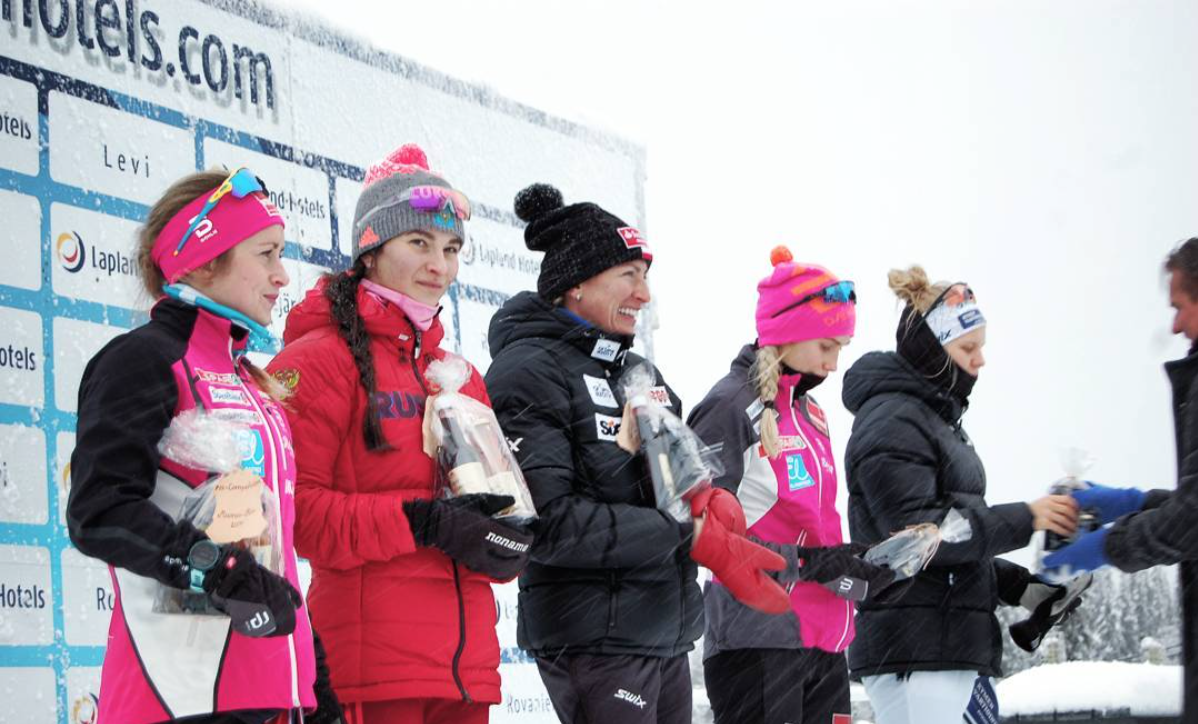
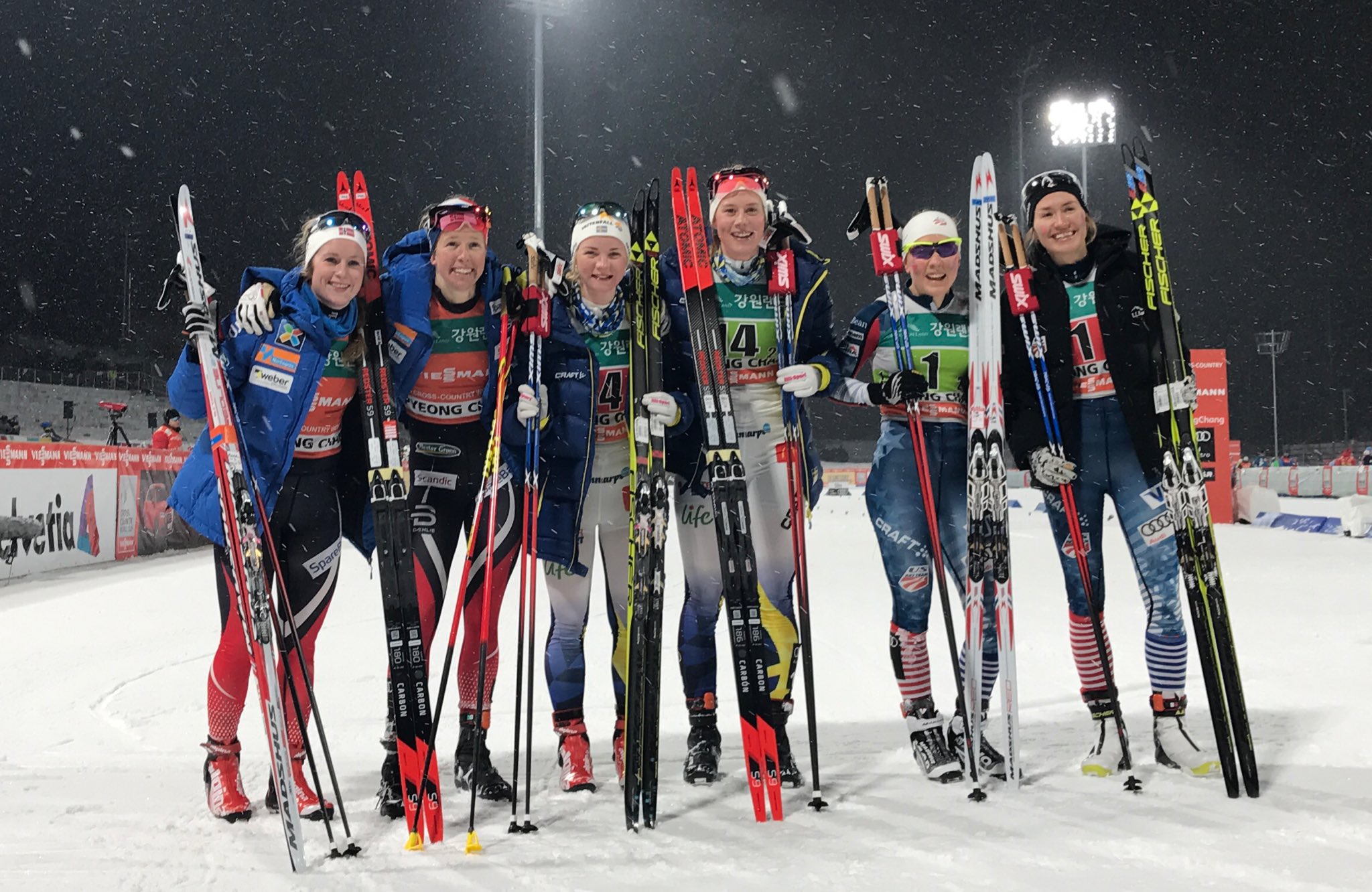
(l-r) Anna Svendsen of Norway, Natalia Nepryaeva of Russia, Justyna Kowalczyk of Poland, Lovise Heimdal of Norway, and Leena Nurmi of Finland receive prizes after rate women’s classic sprint in Muonio, Finland, on Friday. (Photo: Ski Muonio/Instagram)
FIS races are already being contested in Finland and Sweden this weekend, with most top Scandinavian racers sitting out but a few national-team members and others picking up their first victories of the season.
The competitions in Muonio, Finland, drew the most diverse field, including racers from Norway, Russia, Japan, China, Canada, Estonia, and Slovakia, among other countries. In the men’s classic sprint on Friday, the home team got a win from Ristomatti Hakola; he and Russia’s Alexander Bolshunov went 1-2 in both the qualifier and the final. Russia’s Andrey Parfenov rounded out the podium. In the women’s sprint, Anna Svendsen took the win over Russia’s Natalia Nepryaeva, with Justyna Kowalczyk of Poland finishing third.
On Saturday, racers moved up in distance. In the 10 k classic, Bolshunov – a U23 World Champion last season – bested Russian teammate Alexey Chervotkin by 20.6 seconds, with Andrey Sobakarev making it a sweep another 21.6 seconds back. Brian McKeever and Graham Nishikawa of Canada finished 56th (+2:10.6) and 63rd (+2:18.5), respectively.
Also in the men’s race was Maxim Vylegzhanin. The International Olympic Committee (IOC) decided on Thursday to strip the Russian skier of three silver medals from the 2014 Olympics for doping violations and ban him from all future Olympic Games. However, the International Ski Federation (FIS) has not yet taken any action since he and five other skiers were banned from the IOC, meaning that all six athletes are currently free to take part in non-Olympic ski competitions. In a press release, FIS stated that “the next steps will be the review by the FIS Doping Panel of the six verdicts upon the receipt of the reasoned decisions” but did not provide a time frame for these decisions.
In the women’s 5 k classic, Finland’s Krista Parmakoski posted an 18.4-second win over Nepryaeva, with Kowalczyk third again, +24.2.
Bruksvallarna, Sweden, hosted races on Saturday as well, with a primarily Swedish and Norwegian field but some other racers as well. Norway’s Chris Andre Jespersen topped the 15 k skate, posting a 31.4-second win over Simon Lageson of Sweden. Norwegian Tore Leren was third, +53.1. Canada’s Jack Carlyle finished 38th, +2:29.5. Petter Northug and his brother Even were in Bruksvallarna this week but decided at the last minute not to race, with Northug making his debut in Beitøstolen, Norway, next weekend instead.
In the women’s 10 k skate, Swedish national team member Emma Wiken bested Lina Korsgren – a long-distance specialist who finished eighth in the Visma Ski Classics standings last season – by 9.8 seconds. Berit Mogstad of Norway finished third, +15.3 seconds.
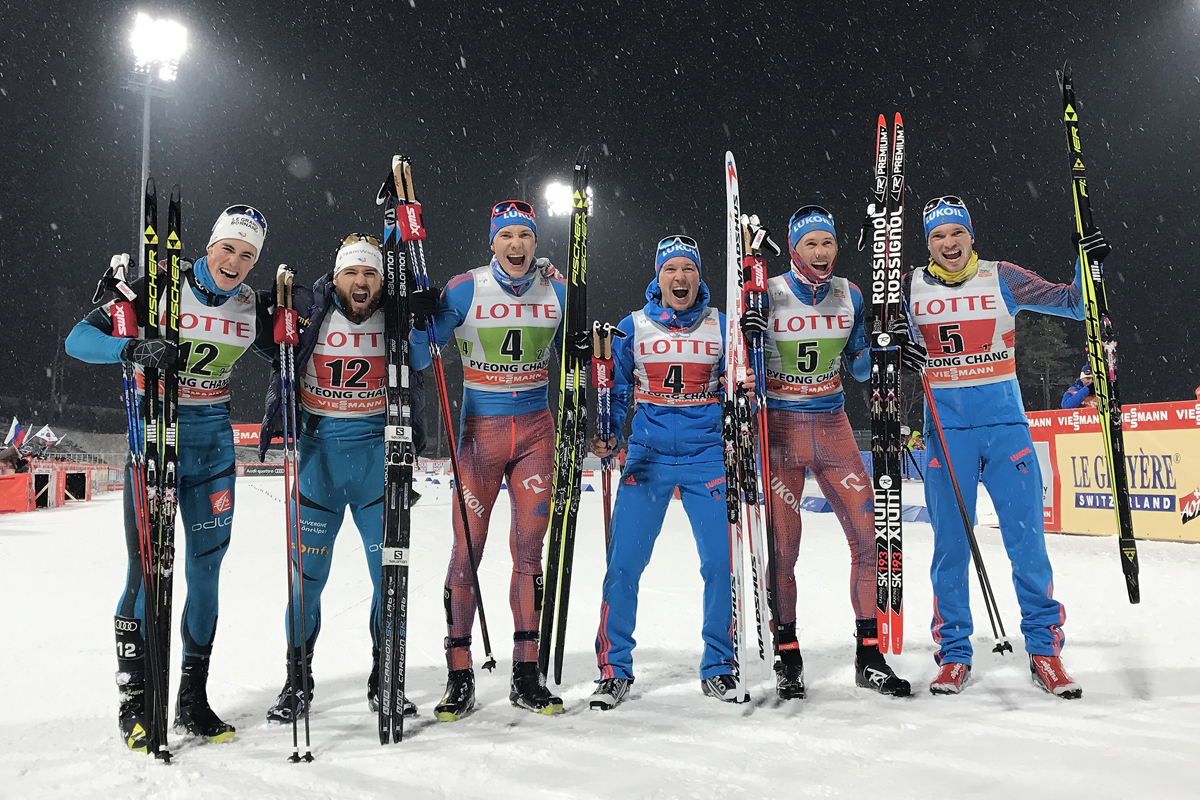
The men’s freestyle team sprint podium at the PyeongChang World Cup on Sunday in South Korea, with France’s Lucas Chanavat and Baptiste Gros in second (l), Russia’s winning team of Gleb Retivykh and Andrey Parfenov (c) in first, and teammates Nikita Kriukov and Artem Maltsev (r) in third. (Photo: Fischer/NordicFocus)
France has never won a World Cup team sprint, neither for men nor women, classic nor freestyle.
And its team will have to wait a bit longer for that time to come. But France was oh-so-close on Sunday, with Baptiste Gros and Lucas Chanavat racing against the Russian duo of Andrey Parfenov and Gleb Retivykh in the men’s 6 x 1.5-kilometer freestyle team sprint in PyeongChang, South Korea.
Chanavat, last year’s U23 world champion in the freestyle sprint, tried to attack on the last steep climb but could not gap Retivykh decisively. Then he positioned himself behind the Russian on the downhill into the arena that will host next year’s Olympic Winter Games, shaking out his arms before tucking into the draft. Coming out of the final left turn, he managed to push up next to him on the finishing stretch, but Retivykh lunged over the line a ski boot ahead for the victory in a time of 19:34.11, with Chanavat just 0.03 seconds behind.
“I did not know in the finish if we won until Andrey told me,” Retivykh told the International Ski Federation (FIS), according to a press release. “It was just as hard skating as it was in classic the other day.”
But the French duo was not too disappointed after narrowly missing the victory.
“Romantic meal to celebrate this first podium of the year! We will bring back a good memory of Korea and be strong for next year,” Gros posted on his Facebook page, according to a translation, at 4 a.m. local time with a picture of him and Chanavat wolfing down two cups of noodles.
“Second in the Team Sprint World Cup in Pyeongchang with my teammate Baptiste Gros (Showing his last drop of rage sinking in his beard)!” Chanavat commented on his Instagram account with a picture of both men smiling. “Next step: be prepared for the world championships in Lahti!”
Russia’s second team of Artem Maltsev and Nikita Kriukov secured the third position on the podium (+5.52).
“It feels absolutely great to be back on the podium,” Kriukov told FIS. “For me it’s a very important step on the way back to the top.”
It was Retivykh’s second victory of the weekend after also winning the men’s invidual classic sprint on Friday, and Russia improved their statistic to become the most successful nation in this event with seven victories in World Cup freestyle team sprints, which have only been contested 25 times so far.
The U.S. Ski Team’s first team, with Andy Newell and Simi Hamilton, finished fourth, 24.23 seconds behind, after being unable to challenge for the podium on the last leg.
The Norwegian team of Daniel Stock and Mathias Rundgreen initially crossed the line before the Americans, but was disqualified for an error on the penultimate exchange only tagging off at least a meter behind the allowed zone. Perhaps hoping a later protest might be successful, they kept skiing and finished the race, with no coach or event official stopping them.
Earlier in the day, Newell and Hamilton had won their semifinal, half a second ahead of the Swedish team of Robin Norum and Gustav Erikson, while Russian’s Parfenov and Retivykh advanced in third (+0.53).
“For me, I felt great in the semifinal, and in the final,“ Newell said on the phone after. “The semifinal was a lot more enjoyable, because it’s a very challenging course with a lot of climbing, and the pace was just relaxed enough that I was able to make moves when I wanted, and control when I wanted to control. I was able to come in and tag Simi in second to start his final leg, we were able to win that semi, and that was great.”
In the men’s race, 14 teams advanced to the final round: the top-four teams from each semifinal heat, plus six more teams with the best times.
Simi Hamilton (U.S. Ski Team) racing to 12th in the men’s classic sprint qualifier on Friday at the PyeongChang World Cup in South Korea. He went on to finish 17th overall after crashing in his quarterfinal and finishing fourth in that heat. (Photo: Fischer/NordicFocus)
In the final, Newell and Hamilton initially stuck with the leaders on the first legs, with each racer having to ski a total of three 1.5 k loops, tagging off repeatedly.
They were only 2.4 seconds back heading into the fifth leg, before Newell lost contact with the top four, which included Norway.
“It was interesting, because there were so many quality distance skiers,” Hamilton said on the phone. “It definitely became evident what their strategy was, especially in the final, they kept the pace really high the whole time. That was tough.”
“In the final it was pretty intense from the get-go,“ Newell agreed. “I know Norway and one of the Russian teams were really trying to push the pace in the first leg. It was pretty challenging, really tough. I felt pretty solid until the last lap, and then I lost contact coming over the hill, and it was kind of windy and snowy out there, so as soon as you lost contact, it was hard to regain it. It was a real leg burner. Unfortunately, that took us out of podium contention, we did end up finishing fifth, and then the Norwegian team was disqualified, so we got fourth. It was a fun day, a great workout, and a great way to practice that event on the Olympic trails.“
Not helping matters was that Hamilton had to race with an upset stomach.
“I don’t know if it’s something I ate or drank, so my energy wasn’t 100 percent, but I still really wanted to race hard,” he said. “It was a good opportunity to get a good result here with diminished fields. I definitely felt better racing than I thought I was going to, but it was for sure a pretty tough day. The course is really hard, it’s long, it’s got a couple of really big climbs, but it skied really well and we had great skis. Andy and I are pretty proud having put in a solid effort, maybe not one of our very best, but a good one for sure. We’re both encouraged by good fitness right now, leading into this little training block before World Champs.”
The team-sprint discipline, which is the newest on the World Cup circuit, is still rarely on the competition schedule. And only two freestyle team sprint races had been held in Asia previously, both in Sapporo, Japan, for a 2006 World Cup and for the 2007 World Championships. But it seems to be a popular format to test new venues.
“I don’t know why they are doing this, but every pre-Olympic weekend at least since Vancouver [for the 2009 World Cup respectively the 2010 Olympics] has always been sprint, skiathlon, team sprint”, U.S. Ski Team distance skier Noah Hoffman said on the phone last week, before his trip to Korea.
Now it was PyeongChang’s turn in the test weekend for the 2018 Olympics. Hoffman did not race on Sunday, but the U.S. was able to start a second squad with Matt Gelso (Sun Valley Ski Education Foundation) and Scott Patterson (Alaska Pacific University).
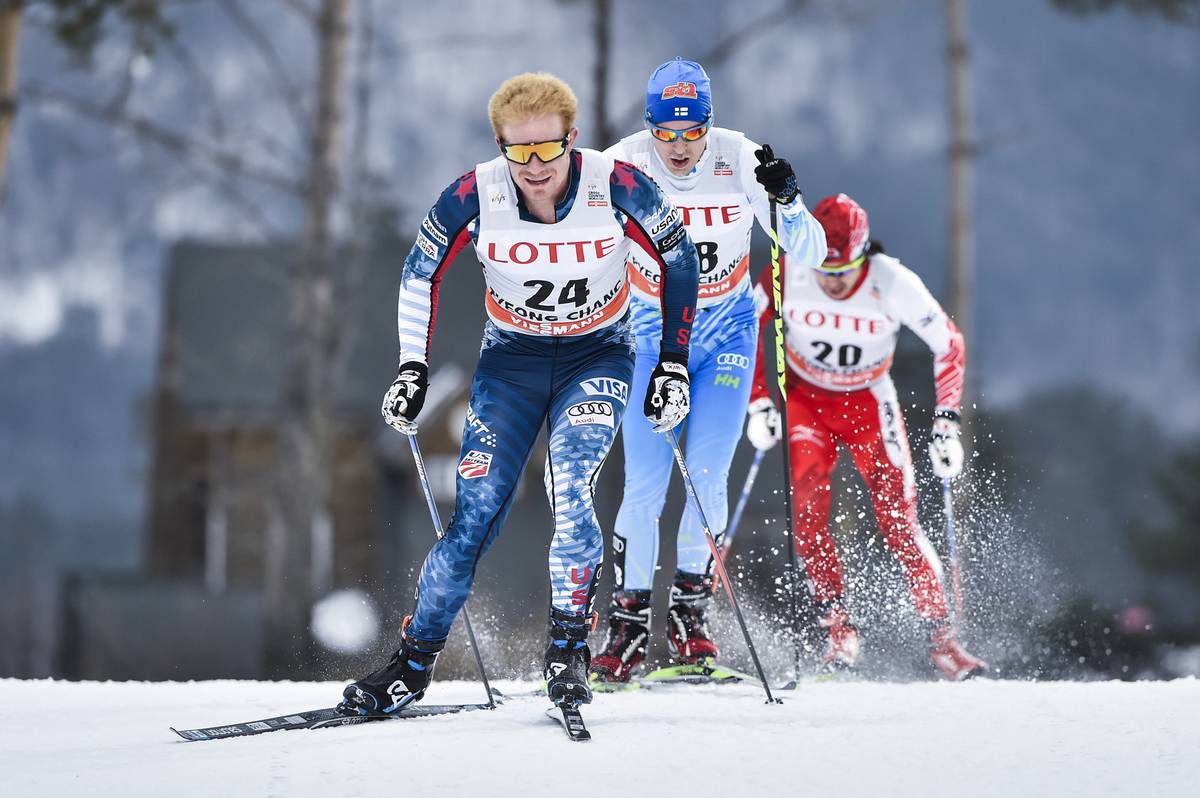
American Matt Gelso (24) racing to 19th in Saturday’s 30 k skiathlon at the PyeongChang World Cup in South Korea. (Photo: Salomon/Nordic Focus)
In their first World Cup team sprint, the duo managed to advance through the semifinal finishing fifth, 13.86 seconds behind the French team that won the heat.
“In the semi, our goal was to simply get in the top four for an automatic advance into the finals,” Patterson wrote in an email. “The pace went out moderate for the early laps and there were enough weak teams later in that it was somewhat easy to secure a high finish. Things spread out a little on the last lap for both Matt and I and we were able to advance even with a close finish for fifth.”
“Scott and I had a hard semifinal,” Gelso wrote. “The pace was very fast from the start so it was very tiring by the end. I felt completely exhausted on the final lap and was concerned with how bad my legs felt that the final would be very bad.”
But despite feeling tired, the duo managed to hang on in the final and improved by two positions on the last two legs to finish ninth (+54.85),
“The final broke apart really early,” Patterson explained. “I think for both of us it was kind of survival mode and see if we could get any last drops out of our muscles. Norway and Russia pushed it hard from the gun. I’m not the fastest starter and got caught up behind a Belarusian [Michail Semenov] so I could not chase quite as much as I wished. By the top of the first hill I was bleeding time. From there it was mostly finding our own battles. The Canadians were in it for a bit, but eventually it was between the Germans [Thomas Wick and Andy Kühne] and us. It was a good fight for both legs and happily we took it in the end.”
Germany placed 10th (+55.13) after Gelso won the finish sprint against Kühne, pushing out of the draft on the finish stretch and raising his left arm in a small celebration as he crossed the line.
“The team sprint today was very fun as Scott and I were able to be in the mix, get into the final, and ski solid through the race,” Gelso wrote. “Not an outstanding result but a good, solid, fun day on the race course with ample opportunities to make things happen.”
Canada’s Len Valjas had the chance to become the first athlete in a long time to win two consecutive team sprints, after winning last month’s freestyle team sprint in Toblach, Italy, with teammate Alex Harvey.
Teaming up with Jess Cockney for Sunday’s race (who had placed 10th in the sprint on Friday while Valjas finished fourth), the duo placed sixth (+4.1) despite a broken pole in the second semifinal, which Newell and Hamilton won.
In the final, Cockney and Valjas were initially able to keep in sight of the leaders, tagging off in ninth in the first exchange, only five seconds back. By the race’s halfway point, they were 10th (+21.0), before falling to the back of the field and losing significant time. They went on to finish in 13th position, 1:38.2 behind the winners.
Valjas and Cockney could not be reached by press time to determine if they had fallen back due to a crash, more broken poles, or were simply running out of energy after racing on a very demanding sprint course all weekend.
The World Cup goes on break for a week before resuming Feb. 18-19 in Otepää, Estonia, with freestyle sprints and 10/15 k classic races, in the last World Cup before 2017 World Championships in Lahti, Finland.
The women’s 4 x 3.3 k relay podium on the final day of 2017 Junior World Championships at Soldier Hollow in Midway, Utah, with Russia (c) in first, Italy (l) in second, and the U.S. (with Hailey Swirbul, Julia Kern, Hannah Halvorsen, and Katharine Ogden) in third. (Photo: FlyingPointRoad.com)
FIS Nordic Junior World Championships (Midway, Utah): Junior relays
Hailey Swirbul, Julia Kern, Hannah Halvorsen, and Katharine Ogden on the podium. That’s right. Two days after Ogden became the first American to earn an individual medal at Junior World Championships, those four U.S. junior women listed above did the same, placing third in the 4 x 3.3-kilometer relay on the last day of 2017 Junior World Championships at Soldier Hollow in Midway, Utah.
The team credited their lucky socks, similar to the red-white-and-blue striped socks the U.S. women’s World Cup team wears for relays and team events.
“We gave everything we got,” Kern said in a televised post-race interview.
“It’s the dream,” Ogden said.
In fourth at the last exchange, Ogden anchored the team to third, 25.8 seconds behind Russia, which won in 34:45.3 minutes with Polina Nekrasova, Lidia Durkina, Anna Zherebyateva, and Mariya Istomina.
Italy placed second (+20.6) with Martina Bellini, Anna Comarella, Francesca Franchi, and Christina Pittin.
Canada finished 12th (+4:41.3) with Natalie Hynes, Lisle Compton, India McIsaac, and Annika Richardson.
[UPDATED] In the junior men’s 4 x 5 k relay that followed, Norway’s Thomas Helland Larsen outlasted Russia’s Vladislav Vechkanov by 0.4 seconds for the team win in 49:36.1.
Norway’s gold-medal team included Herman Martens Meyer, Jon Rolf Skamo Hope, Harald Østberg Amundsen, and Larsen, while Russia took silver with Egor Kazarinov, Kirill Kilivnyuk, Yaroslav Rybochkin, and Vechkanov.
France rounded out the podium in third (+1:05), with Martin Collet, Camille Laude, Hugo Lapels, and Arnaud Chautemps.
The U.S. finished ninth (+4:28.8) with Bill Harmeyer, Kam Husain, Wyatt Gebhardt, and Hunter Wonders, and Canada followed in 10th (+5:21.6) with Antoine Blais, Ryan Jackson, Philippe Boucher, and Gareth Williams. Twelve teams finished the men’s relay, the final race of 2017 Junior World Championships.
FIS Cross-Country World Cup (PyeongChang, South Korea): Freestyle team sprint
The women’s freestyle team sprint podium at the PyeongChang World Cup on Sunday in South Korea, with Sweden’s Elin Mohlin and Maria Nordström (c) in first, Norway’s Anna Svensen and Silje Øyre Slind (l) in second, and USA I’s Ida Sargent and Sophie Caldwell (r) in third. (Photo: FIS Cross Country/Twitter)
The U.S. women had one team on the podium and one just 0.35 seconds off of it on Sunday in the World Cup 6 x 1.4-kilometer freestyle team sprint in PyeongChang, South Korea.
USA I, with Sophie Caldwell and Ida Sargent, skied in third for most of the race and ultimately finished third, 6.11 seconds behind Sweden’s Elin Mohlin and Maria Nordström in first (in 20:37.11 minutes). Norway took second, 1.71 seconds back, with Anna Svensen and Silje Øyre Slind, while USA I edged USA II, with Caitlin Patterson and Liz Stephen for third. Patterson and Stephen ended up fourth (+6.46), ahead of Slovenia’s Katja Visnar and Anamarija Lampic in fifth (+14.46).
Fifteen women’s teams competed on Sunday, with 10 of them reaching the final. Canada placed 14th overall with Annika Hicks and Sadie White.
In the men’s 6 x 1.5 k freestyle team sprint, Russia’s Gleb Retivykh picked up his second win in in PyeongChang, after winning Friday’s classic sprint. He teamed up with Andrey Parfenov for the victory in 19:34.11, beating France (Baptiste Gros/Lucas Chanavat) by 0.03 seconds in a photo finish.
Russia had two teams on the podium with Russia II’s Artem Maltsev and Nikita Kriukov in third (+5.52). Andy Newell and Simi Hamilton (USA I) fell off the leaders’ pace to finish fourth (+24.23), 18.71 seconds off the podium.
USA II, with Scott Patterson and Matt Gelso, finished ninth (+54.85) in the final, and Canada’s Jess Cockney and Len Valjas placed 13th of 14 teams.
NorAm Eastern Canadian Championships (Cantley, Quebec): 15/20 k freestyle pursuits
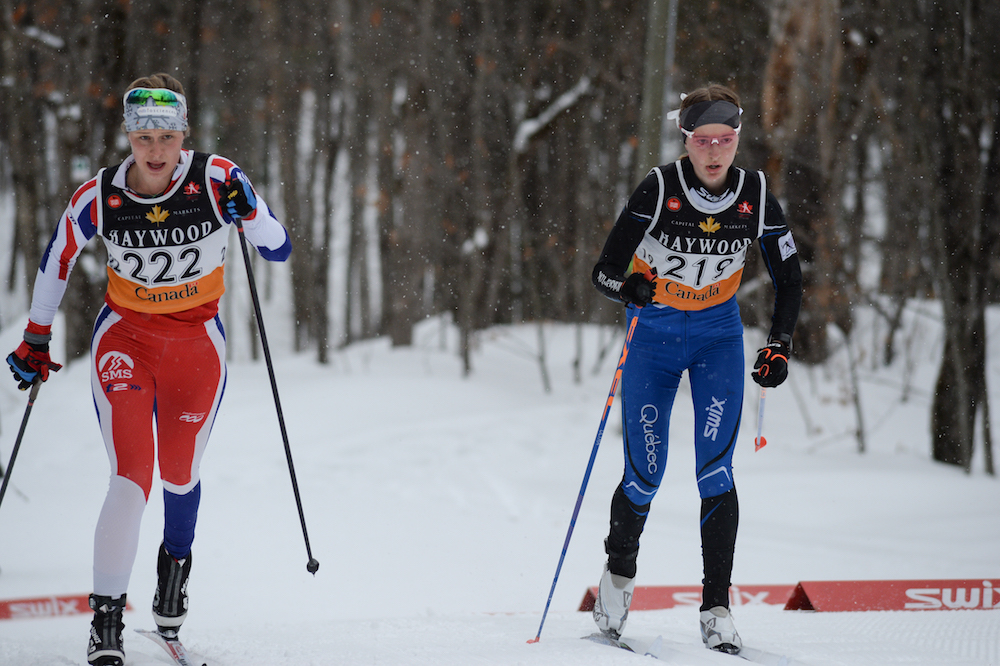
SMS Elite’s Anne Hart catching Nakkertok’s Zoe Williams in the interval start classic, day two of Eastern Championships. (Photo: Ian Austen)
The NorAm mini tour at the Nakkertok Nordic Centre wrapped up with freestyle pursuits.
In the men’s 20 k, AWCA’s Russell Kennedy posted the fastest time of 53:42.68 to move up from third to take the overall victory in 1:33.22. Lappe Nordic’s Andy Shields started first but couldn’t hold off Kennedy, finishing 36 seconds behind with a 6th best time, 1:01.46 slower. AWCA’s Dominique Moncion-Groulx wrapped up a strong weekend with the fourth best time of day, 37.92 back, to take third overall, 58.53 behind Kennedy.
SMS Elite’s Anne Hart won the women’s 15 k pursuit in dominant style, starting first and winning time of day in 47:36.10 for an overall time of 1:17:39. AWCA’s Maya MacIsaac-Jones started third and finished second with the second best time of day, 31.36 seconds back for a combined deficit of 51.39 seconds. CNEPH’s Sophie Carrier-Laforte started second and ended third, 2:14.81 down after a sixth best time of day 2:05.47 back.
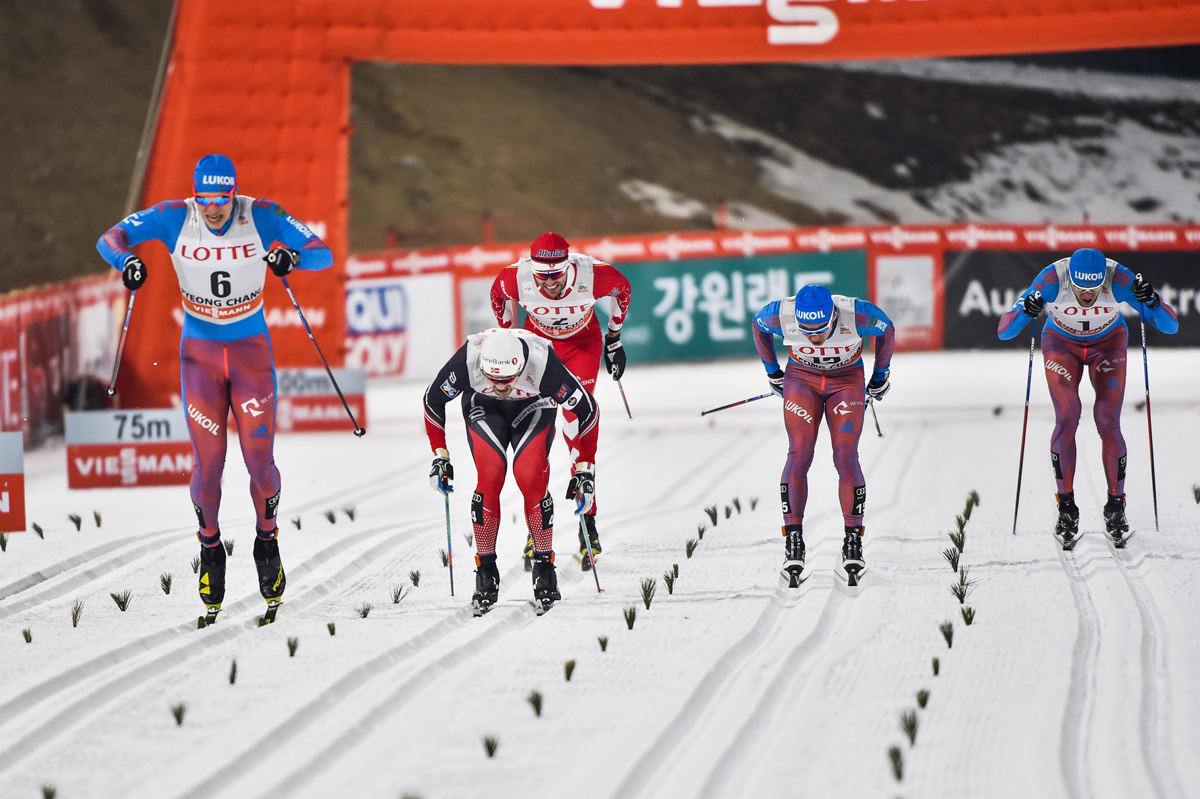
Russia’s Gleb Retivykh (l) racing to his first World Cup victory and podium on Friday in the World Cup classic sprint in PyeongChang, South Korea, ahead of Norway’s Sondre Turvoll Fossli (second from l), Canada’s Len Valjas (behind Fossli), and Russia’s Andrey Parfenov (second from r) and Alexander Panzhinskiy (r). (Photo: Fischer/NordicFocus)
As a sphere, the Earth is a tidy shape and can be divided into equal segments. It takes roughly 24 hours for the planet to rotate on its axis once, constituting a single day. So there’s 24 time zones, one for each hour of rotation. On Friday, the tidiness was disrupted a bit for European-based World Cup skiers. PyeongChang, South Korea, host of the 2018 Winter Olympics, was site of the men’s World Cup 1.5-kilometer classic sprint.
PyeongChang sits a full eight hours ahead of Central European Time, a time zone most World Cup skiers are adjusted to. To accommodate the time shift, the sprints were run at night, under the lights.
“It’s been tough. We knew the races were going to be really late here in Korea so that the T.V. time works in Europe,” U.S. Ski Team (USST) member Andy Newell said on the phone. “But as far as adjusting, you go in and out and definitely feel pretty tired at times, like when you’re trying to fire it up and get ready to race. But once you’re racing, it seems like it’s OK. You don’t notice the jet lag once you’re out there on the track.”
In a field of 55 skiers, Newell was one of two North Americans to make the men’s final; the other was Canada’s Lenny Valjas. Newell placed sixth in the final (+17.1), Valjas fourth (+0.74) in a photo finish with Russia’s Andrey Parfenov (+0.73), who skied to third overall.
“It was really close between me and Lenny,” Parfenov told the International Ski Federation (FIS), according to a press release. “I know he was next to me. I was lucky have a better lunge. It was a good track for classic. There is not so much double poling sections, more uphills and that was good for me. I am really happy for my second podium of my career.”
Russia’s 26-year-old Gleb Retivykh won the final in 3:30.79, ahead of Norway’s Sondre Turvoll Fossli in second (+0.30). It was Retivykh’s first career World Cup win and first time on the podium, despite finishing in the top 10 in World Cup sprints on 10 other occasions. And despite his comments to FIS, the Russian’s speediness may just have allowed him to momentarily outrun the jet lag.
“I arrived here yesterday so I am still jet lagged,” Retivykh said. “I knew Sondre is very strong. I did not think I could win. I was hoping for a good result. I had to wait six years for my first victory and it is great.”
Valjas Leads Canada in 4th
Time zones and new food be damned. For seasoned athletes like Valjas and Newell, planes, shuttle buses, and exploratory cuisine are all part of the international skiing life. Despite the time-zone-shift-wormhole, both skiers delivered.
For Valjas, of Canada’s World Cup A-team, the vagaries of food prep in South Korea flummoxed him.
“Adjusting to the time change went fairly well, but I ran into some trouble with the food here,” Valjas wrote in an email. He is allergic to peanuts and fish; two ingredients in the form of peanut and fish oil that’s ubiquitous in Korean meals.
“The last two dinners I have not been able to eat because I had reactions,” Valjas added. “Even the ‘safe’ boiled potatoes ended up having peanut oil dribbled all over them. The language barrier makes it very hard to understand which foods may or may not kill me. I could feel my energy getting lower and lower today, could have been my inability to eat well or the jet lag after flying here two days ago.”
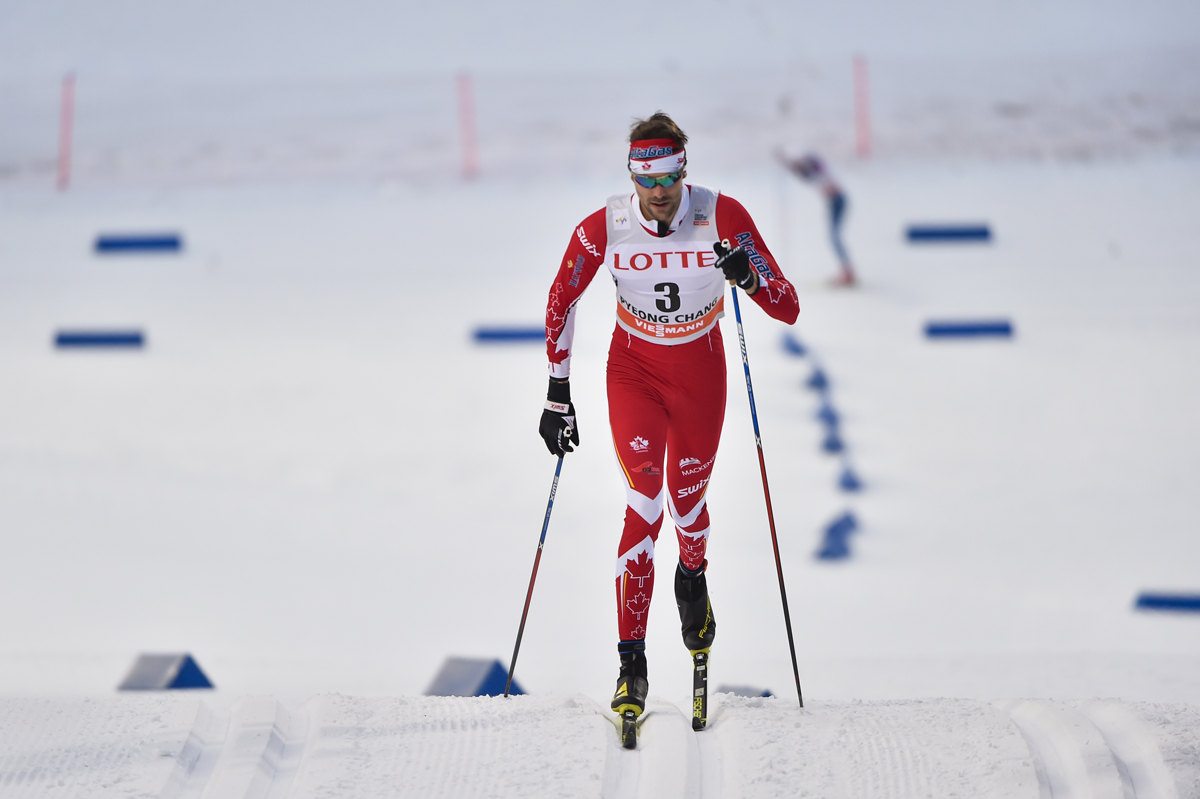
Canada’s Lenny Valjas racing to second in the men’s classic sprint qualifier on Friday at the World Cup in PyeongChang, South Korea. (Photo: Fischer/Nordic Focus)
Despite the lack of food intake, Valjas qualified in second place, 1.97 seconds back from fifth-place overall finisher and first-place qualifier Alexander Panzhinskiy of Russia.
Valjas’s progression looked like this: second in his quarterfinal then advancing to the finals as the second lucky loser from the first semifinal. And ultimately his fourth place in the final — where he missed his eighth-career World Cup podium and his third of the season, by 0.01 seconds.
“I have mixed feelings about today,” Valjas wrote about his PyeongChang classic sprint experience. “It’s tough to be that close and come up short.”
Mindful that the day was also about gaining pre-Olympic beta, Valjas noted his time in South Korea was well spent.
“On the bright side, I learned so much skiing the Olympic course today. It’s a very tough course, but it is built amazingly well,” he wrote. “The climbs are the perfect grade for striding, and racing at night with all the lights was really cool. … I hope I can use the valuable info I learned tonight to my advantage when I race here next winter in the Olympic sprint.”
Jess Cockney (Canadian World Cup B-team) racing to 16th in the men’s classic sprint qualifier on Friday at the World Cup in PyeongChang, South Korea. He went on to place 10th overall for a season best. (Photo: Fischer/NordicFocus)
Jess Cockney, of Canada’s World Cup B-team, placed 10th after qualifying 16th. Cockney skied to first in his quarterfinal after avoiding several skiers involved in crashes, including one involving U.S. Ski Team member Simi Hamilton.
“I felt that I could ski relaxed and work my way through some positions in the second half of the course and it ended up being really good to also avoid the crashes in my heat,” Cockney wrote in an email.
In his semifinal, Cockney was on fumes and finished fifth.
“He gave it all on the quarterfinal so he lost a lot of energy there, but still making it to the semi is very good,” Charles Castonguay, Canada’s lead coach in PyeongChang, said on the phone. “But at the end, I think he did really well, too. Top 10 for him is really really good and he is pretty confident that he can repeat that for Lahti in two weeks [at World Championships]. We had a little chat after and he said he was pretty happy; he said he gave it his all. … It’s his best result since [last] year in Quebec [where he placed 10th in the freestyle sprint]. So yeah, it’s promising for him for the Otepää World Cup and the Worlds at Lahti.”
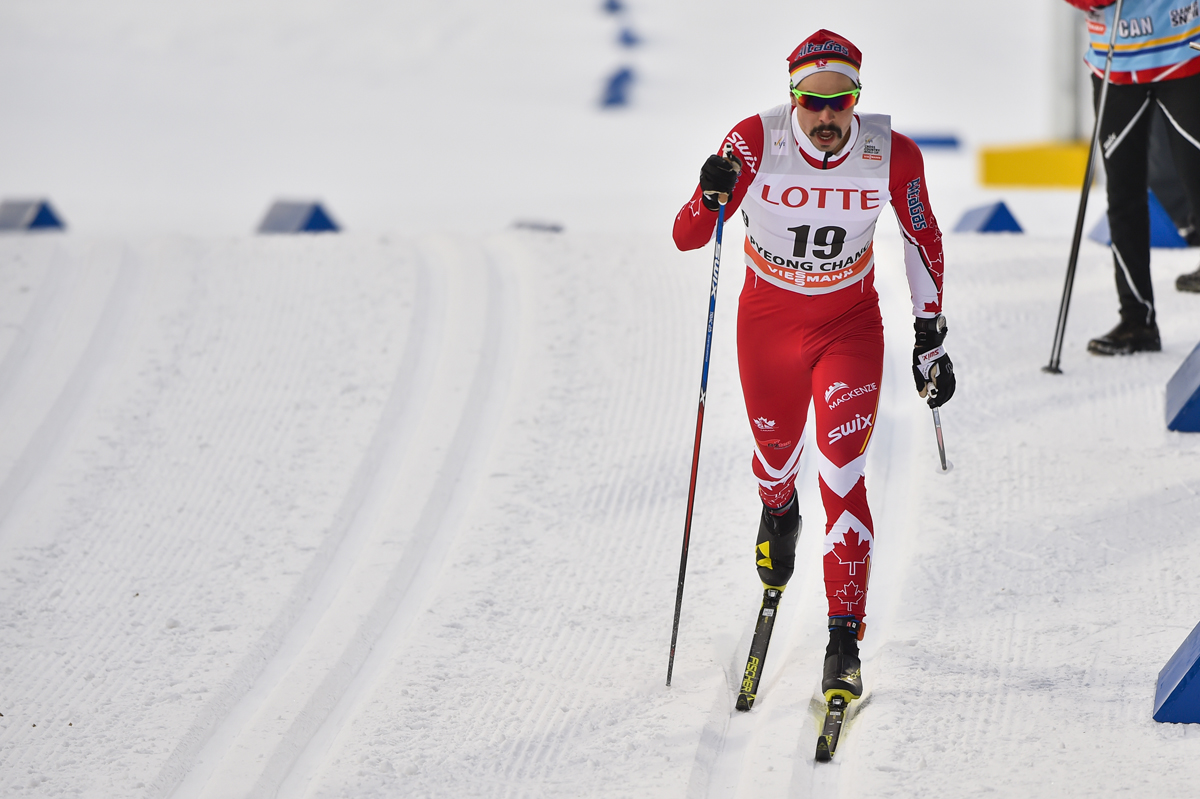
The next best Canadian was Simon Lapointe, of the Pierre-Harvey National Training Centre (CNEPH), who qualified 25th and finished 27th overall. Friday marked his first international World Cup and his previous personal best was 70th in a Ski Tour Canada stage last year.
Bob Thompson (NTDC Thunder Bay) missed qualifying by one-hundredth of a second in 31st (for his best World Cup result by 21 places), and Julien Locke (Alberta World Cup Academy/Canadian National U25 Team), in his first World Cup, placed 36th.
Newell Sixth in Final
The 1.5 k men’s course was a no-rest affair. Thirty seconds of initial double poling brought skiers into a roller coaster of a course — two big ups, quick downs, and a straight away finish all under the brights lights.
Leading the U.S. was veteran USST skier Newell in sixth overall. He qualified seventh (+5.18).
“For me in the qualifier, how I gauge a good or bad qualifier, usually it doesn’t even necessarily depend on what place I finish, a lot of it is seconds back and a lot of it is how I feel if I nailed the course or not,” Newell said on the phone Friday night.
A thorough student of the classic-skiing sprint scene, Newell adjusted after sensing he hadn’t skied the second major hill effectively.
“I know my strengths and weaknesses on a course like this,” Newell said. “I know I can be as good as anyone on those hills and so that was kind of the goal, was to make sure I was in a good position.”
American Andy Newell (7) chasing Russia’s Alexander Panzhinskiy during their quarterfinal of the men’s classic sprint at the PyeongChang World Cup in South Korea. (Photo: Fischer/Nordic Focus)
Newell was matched with top-qualifier Panzhinskiy in his quarter and semifinal. Panzhinskiy and Newell placed first and second in both, respectively, with Newell 0.63 seconds back in the quarter and 0.34 seconds back in the semi.
“[Panzhinskiy] was the top qualifier so I knew he was going to be fast and so we were kind of really able to kind of get away from anyone in our heats in both the quarterfinal and the semifinal up that [second] hill,” Newell said.
As a made-for-television production, the heats run on a tight schedule. And due to clearing the course after several crashes, organizers were running behind schedule. The time after the Newell’s semifinal to the final was reduced, hampering both Panzhinskiy’s and Newell’s normal pre-final recovery period.
“Maybe we pushed each other a little too hard in the semifinal because I think we were both a little tired,” Newell reflected. “It just so happened that the schedule they were running behind with the heats today, which means the semifinal went off five to ten minutes late, but they have to keep the final on time. … That kind of took us by surprise because I think we both pushed each other pretty hard in that semi and then to have a short ten-minute recovery as opposed to one that’s fifteen or twenty, that was definitely a tough turnaround.”
Newell skied from the back in the final. According to the Vermont-based skier, he changed skis in the final, and that decision compounded with his less-than-normal, pre-finals recovery period impacted his overall placing.
“I swapped out for a different pair of skis and was using a different pair of skis in the final,” Newell said. “It was an easier-kicking pair of skis, which probably worked out great for the first few heats, but in the final I think one of the things that came to bite us was the fact that [my wax tech] Mark and I kept adding a layer of wax to make sure we had good grip up that big climb because it was such decisive part of the race. But by the final I think we were dragging a little bit too much wax, which really played a big role in me getting shelled off after about half way through because yeah, kick was dragging considerably in the final, but you know that’s all part of the game.”
Newell ultimately finished 17.19 seconds back in sixth after realizing his efforts were in vain. But being present and racing well in PyeongChang remained important for Newell.
“This race in particular was kind of one of the races I wanted to make sure I was at,” Newell said of how he planned out his current World Cup campaign. “My goals are really quite focused towards the Olympics next year. For me, the excitement was there today just because it’s a new venue and it’s the place where the Olympics are going to be taking place next year and I know I can be competitive in these classic sprints.”
Newell will skip Saturday’s skiathlon to prep for Sunday’s freestyle team sprint. He’ll be racing the team sprint with Hamilton.
“I was not feeling great all day, and it’s been kind of a tough week for me in general,” Hamilton wrote of his adjustment to South Korea. “I was definitely struggling with how my body was responding to big travel and a pretty significant time shift, but still, I think it is extremely valuable to be able to be here experiencing the courses and the layout of the land before 2018.”
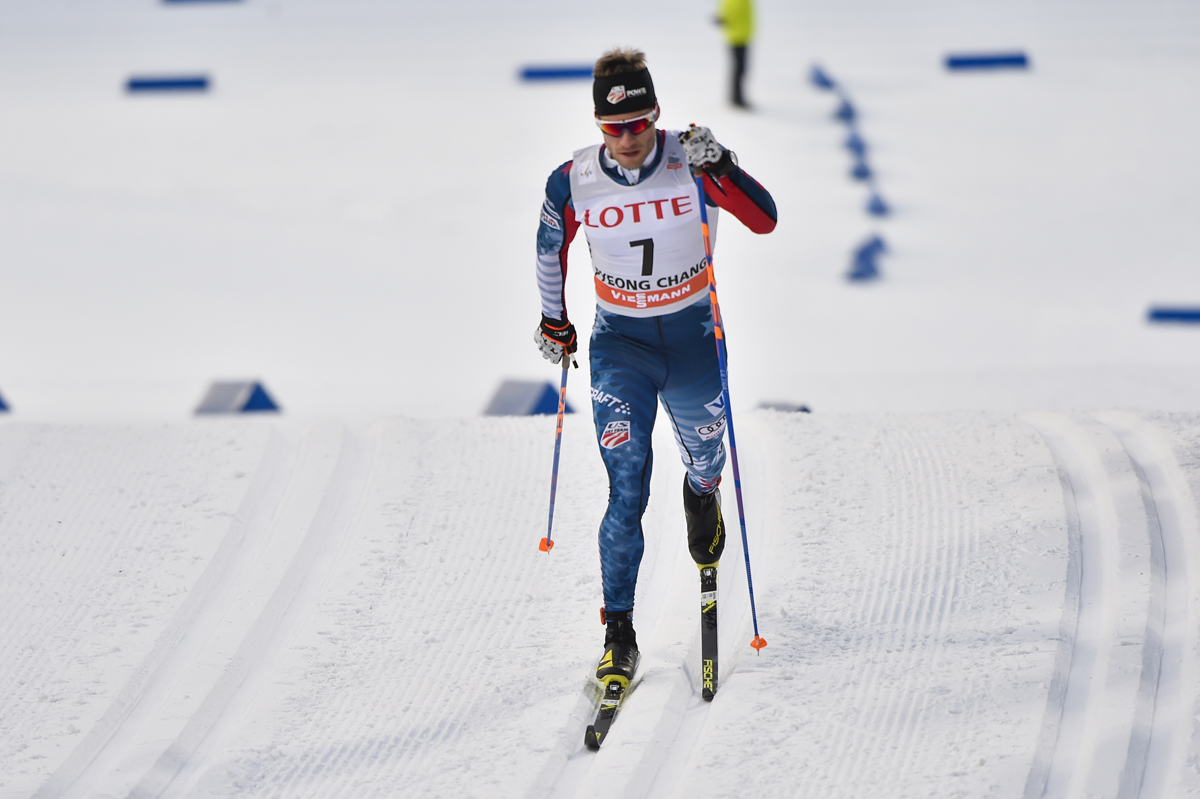
Simi Hamilton (U.S. Ski Team) racing to 12th in the men’s classic sprint qualifier on Friday at the PyeongChang World Cup in South Korea. He went on to finish 17th overall after crashing in his quarterfinal and finishing fourth in that heat. (Photo: Fischer/NordicFocus)
Hamilton qualified 12th, which he was dissatisfied with.
“I felt like I had a pretty weak qualifier, and was struggling to find big power and big glide on the two big climbs,” he wrote.
Hamilton’s focus this year has been on skate sprinting: a traditionally strong technique for him.
“But with so many skate sprints this year and the fact that the sprint in Lahti is skate, I haven’t really been thinking too much about classic sprinting or gearing my training towards classic sprinting,” he explained. “So I think with some focused training I’ll be able to dial in my preparations for this course specifically and hopefully feel much better in qualification the next time we are racing here.”
In his quarterfinal, Hamilton was well positioned for the second climb — sitting back a few meters from the leaders.
“Coming down the fast descent into the bottom of that hill, I made a slingshot move to the outside, open track on the far left, and was carrying some really good momentum past the two Norwegians in my heat,” he recalled.
With his momentum carrying him up to the leaders, Norwegian Daniel Stock swerved into Hamilton’s tracks. (Stock was eventually relegated to 30th overall due to his obstructing Hamilton.)
“I think he skied right over both of my bindings with his left ski as he was skating into that track. My feet were basically stopped dead in their tracks as the rest of my body was hurling up the hill.”
A broken pole and stopped dead, Hamilton’s chances of advancing had been squelched.
“As I got to my feet, the pack was already about 10 meters ahead of me and I realized that my night was over,” Hamilton added. He finished 17th overall.
Another American, Matt Gelso (Sun Valley Ski Education Foundation) scored his first career World Cup points. Gelso had earned the World Cup starts as the Period 1 SuperTour leader.
“It’s great to score my first ever World Cup points in my second-ever sprint,” Gelso wrote in an email. “Never thought my first points would come in a sprint. I skied the transitions well in my qualifier and accelerated through the course. I probably could have started harder but overall pacing was pretty good.”
Gelso qualified 29th and placed 29th overall after finishing sixth in his heat.
Also for the U.S., Scott Patterson (Alaska Pacific University) finished 44th and Noah Hoffman 48th in the qualifier.
Katharine Ogden (SMS/USST) finishing third for bronze in the women’s 10 k skiathlon on Friday at 2017 Junior World Championships at Soldier Hollow in Midway, Utah. She is the first American to reach the podium in a Junior World Championships. (Photo: FlyingPointRoad.com)
FIS Nordic Junior World Championships (Midway, Utah): 10/20 k skiathlon
A Junior World Championships medal has been on Katharine Ogden’s mind for some time — two years, to be exact.
“Every day in training, it’s kind of something that I think about. It’s the little thing that helps me push myself,” Ogden, a 19-year-old member of the Stratton Mountain School and U.S. Ski Team D-team, said in a post-race interview with the U.S. Ski Team on Friday. “Even in the middle of June, I’ll be like, ‘You know what I want to be? On the podium at World Juniors.’ ”
She did just that on Friday, racing to third in the women’s 10-kilometer skiathlon at 2017 Junior World Championships at Soldier Hollow in Midway, Utah. In doing so, she became the most successful American at World Juniors, surpassing Lindsey Williams’s previous best of fourth place in 2003.
Ogden finished 10.4 seconds behind the winner, Norway’s Marte Mæhlum Johansen, who finished first in 27:17.3 minutes. Sweden’s Ebba Andersson took second, 6.6 seconds back. Behind Ogden, Italy’s Anna Comarella placed fourth (+51.6) ahead of Finland’s Eveliina Piippo in fifth (+58.7).
Hailey Swirbul (University of Alaska Anchorage) was the second U.S. woman in 24th (+2:21.0), while Natalie Hynes (Whitehorse) led Canada in 28th (+3:11.3).
Also for Canada, India McIsaac (Rocky Mountain Racers) finished 30th (+3:13.8), Lisle Compton (NTDC Thunder Bay) was 33rd (+3:45.5) and Annika Richardson (NTDC Thunder Bay) 41st (+4:49.3).
Also for the U.S., Lauren Jortberg (Dartmouth) finished 37th (+4:04.5) and Taeler McCrerey (University of Denver) 38th (+4:07.5).
[UPDATED] In the men’s 20 k skiathlon that followed, Russia’s Vladislav Vechkanov notched his second gold of the week in 49:40.5, outlasting Norway’s Thomas Helland Larsen by 1.9 seconds. Norway had two on the podium with Harald Østberg Amundsen in third (+2.2).
Canada’s Gareth Williams (Telemark Race Team) was the top North American in 11th (+1:24.0) for his best result at his first Junior Worlds.
American Wyatt Gebhardt (Steamboat Springs WSC) followed in 12th (+1:42.7) for his second-straight top 20 and Hunter Wonders (Alaska Pacific University) also finished in the top 20 for the second-straight race in 18th (+1:57.9).
Canada’s Philippe Boucher (CNEPH) was 22nd (+3:15.7), Ryan Jackson (Team Hardwood) 31st (+3:52.5), and Remi Drolet (Black Jack) 49th (+6:57.3).
Also for the U.S., Kam Husain (SMS) placed 50th (+6:59), and Logan Diekmann (University of Utah) was 53rd (+7:47.3).
NorAm Eastern Canadian Championships (Cantley, Quebec): Classic sprint
The NorAm series resumed at the Nakkertok Nordic Centre on Friday with Eastern Canadian Championships with classic technique sprints.
Alberta World Cup Academy’s Maya MacIsaac-Jones returned from U23s in time to win the 1.3 k A-final in 3:42.06, after qualifying sixth. Top qualifier Sophie Carrier-Laforte was second for CNEPH at her home event, 0.66 seconds behind. SMS Elite’s Anne Hart rounded out the podium at 3.40 seconds back.
On the men’s side, AWCA’s Dominique Moncion-Groulx qualified first before winning every heat on his way to victory in 3:14.84 on a slightly longer 1.4 k course. NTDC Thunder Bay’s Angus Foster was a close second, 0.09 seconds behind. Team R.A.D.’s Russell Kennedy was a comfortable third, 2.75 seconds back, on a day marked by some surprising eliminations.
The elite field is slightly smaller than usual with some athletes away in Soldier Hollow and PyeongChang. As many younger racers were stuck in school for the day, there are only about 500 starters for what is usually the largest FIS event in Canada.
FIS Cross-Country World Cup (PyeongChang, South Korea): Classic sprint
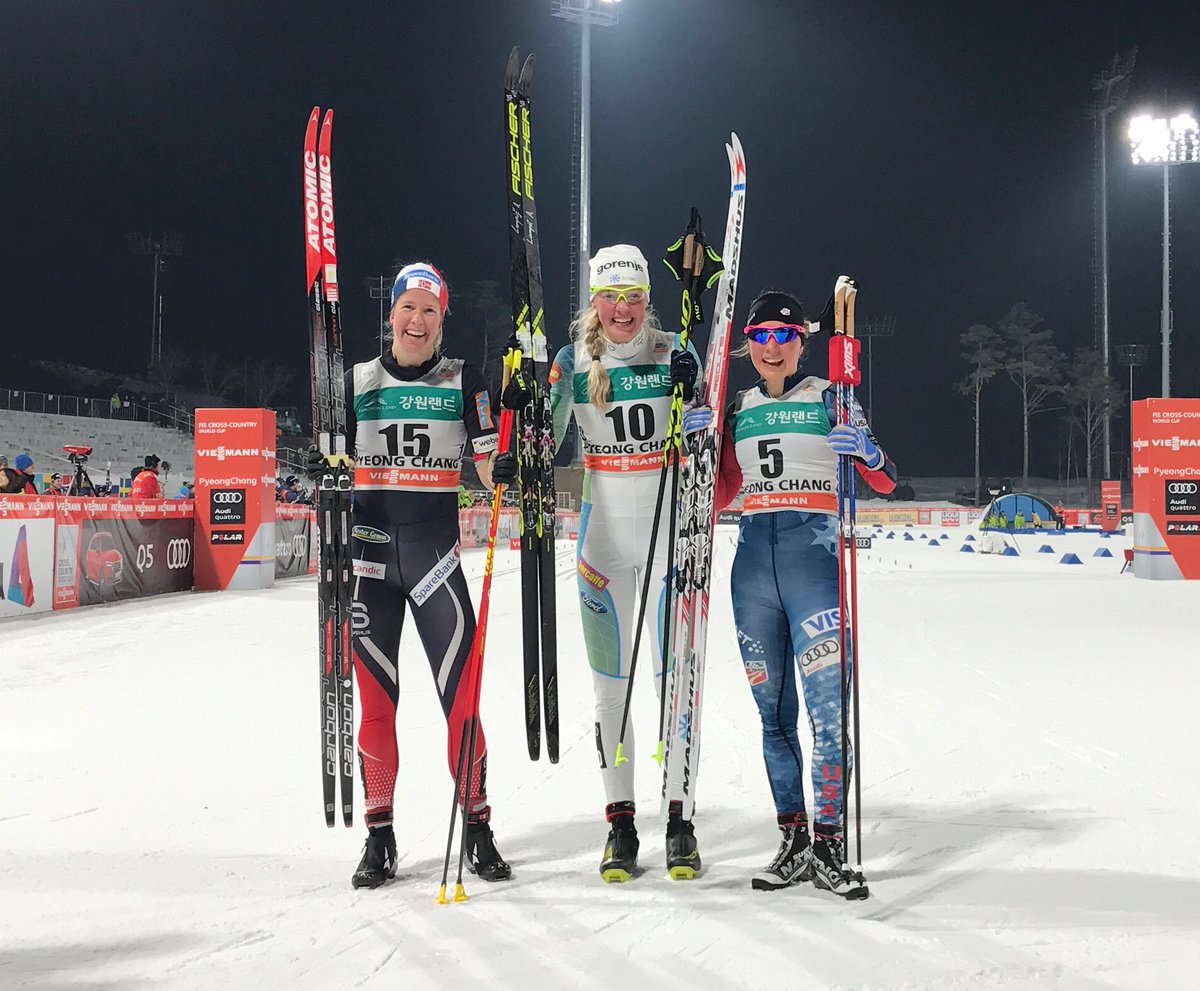
The women’s 1.4 k classic sprint podium on Friday at the pre-Olympic PyeongChang World Cup in South Korea, with Slovenia’s Anamarija Lampič (c) in first, Norway’s Silje Øyre Slind (l) in second, and American Ida Sargent (r) in third. It was the first time on the World Cup podium for all three athletes. (Photo: FIS Cross-Country/Twitter)
In the last month, we’ve seen two U.S. Ski Team members — Jessie Diggins and Sadie Bjornsen — on the World Cup podium. Add Ida Sargent to that list.
On Friday, the Vermont native raced to third in the women’s 1.4-kilometer classic sprint at the first-ever World Cup in PyeongChang, South Korea. It was the first of three days of racing in PyeongChang, which will host the 2018 Winter Olympics next season.
Sargent qualified fifth (4.76 seconds behind her teammate Sophie Caldwell, who won the qualifier in 3:40.89 minutes) and went on to win her quarterfinal in a photo finish, then placed second her semifinal (also in a photo finish), edging Russia’s Alisa Zhambalova in third by less than 0.01 seconds.
Both advanced to the final, where Sargent ultimately finished third, 1.79 seconds behind Slovenia’s Anamarija Lampič, who won in 3:41.97. Norway’s Silje Øyre Slind took second (+1.6), just 0.19 seconds ahead of Sargent. For all three women, it was their first time on a World Cup podium.
Sargent beat out Poland’s Justyna Kowalczyk for third by 0.56 seconds. Zhambalova finished fifth and Slovenia’s Katja Visnar was sixth (+17.1).
“I’m really excited about the podium and it hasn’t really set in yet,” Sargent wrote in an email on Friday. “It has been a goal of mine for a long time to be on the podium so it was a very special day! I’ve been inspired by so many fast teammates so happy to follow in their footsteps!”
All five U.S. women racing on Friday finished in the top 30 to qualify for the heats. Caldwell won the qualifier by 1.84 seconds over Kowalczyk, Caitlin Patterson qualified 22nd, Liz Guiney 25th and Liz Stephen 29th (Stephen’s first time making the heats in three years).
Jessica Yeaton, who races for Australia but trains with Alaska Pacific University, took the last qualifying spot in 30th (+26.29).
Canada’s Annika Hicks and Sadie White missed qualifying in 32nd (+32.96) and 34th (+38.96), respectively, out of 36 women.
Caldwell won her quarterfinal but finished fourth in her semifinal (behind Slind, Kowalczyk, and Sweden’s Maria Nordström, respectively) to miss advancing to the final. She placed eighth overall.
Guiney placed 24th overall after finishing fifth in her quarterfinal, Stephen was 25th after taking fifth in the same quarterfinal as Sargent (where Yeaton finished sixth for 30th overall), and Patterson was 27th after finishing sixth in her quarterfinal.
***
Both Canada’s Len Valjas and American Andy Newell reached the final in the men’s 1.5 k classic sprint on Friday, where they raced to fourth and sixth, respectively.
Valjas started the day by qualifying in second, 1.97 seconds behind Russia’s Alexander Panzhinskiy, who topped the qualifier in 3:26.78. The Canadian went on to advance in second from his quarterfinal and fourth as a lucky loser from the first semifinal. In the final, he missed out on the podium in a photo finish with Russia’s Andrey Parfenov, who took third, 0.01 seconds ahead of him.
Meanwhile, Newell qualified seventh (+5.18) and took second in both his quarterfinal and semifinal (finishing the second semifinal 0.34 seconds behind Panzhinskiy in first).
In the final, Russia’s 25-year-old Gleb Retivykh pulled off his first World Cup victory and podium with a 0.3-second win over Norway’s Sondre Turvoll Fossli in 3:30.79. Retivykh qualified sixth (+4.53) then won his quarterfinal and placed third in the same semifinal as Valjas, advancing as the other lucky loser.
“I had wait six years for my first victory and it is great,” Retivykh said, according to an International Ski Federation (FIS) press release.
Russia had two on the podium with Parfenov in third (+0.73), just ahead of Valjas. The third Russian in the final, Panzhinsky ended up fifth (+1.49), ahead of Newell in sixth (+17.19)
Three Canadian men qualified for the heats, with Jess Cockney in 16th (+10.24) and Simon Lapointe in 25th (+14.15). Bob Thompson missed 30th by one-hundredth of a second in 31st (+16.95), and Julien Locke was 36th (+17.9).
Three Americans qualified as well, with Simi Hamilton in 12th (+8.26) and Matt Gelso in 29th (+16.66). Distance skiers Scott Patterson and Noah Hoffman finished 44th (+24.21) and 48th (+25.28) out of 55.
Cockney reached the semifinals after winning his quarterfinal. In the second semifinal with Newell, he placed fifth, 5.44 seconds behind Panzhinskiy, for 10th overall.
In Cockney’s quarterfinal, Hamilton crashed and finished fourth (+41.9) for 17th overall.
Canada’s 23-year-old Lapointe finished sixth in his quarterfinal to place 27th, besting his previous World Cup best by 43 places. Gelso took 29th for his first-ever World Cup points after placing sixth in his quarterfinal.
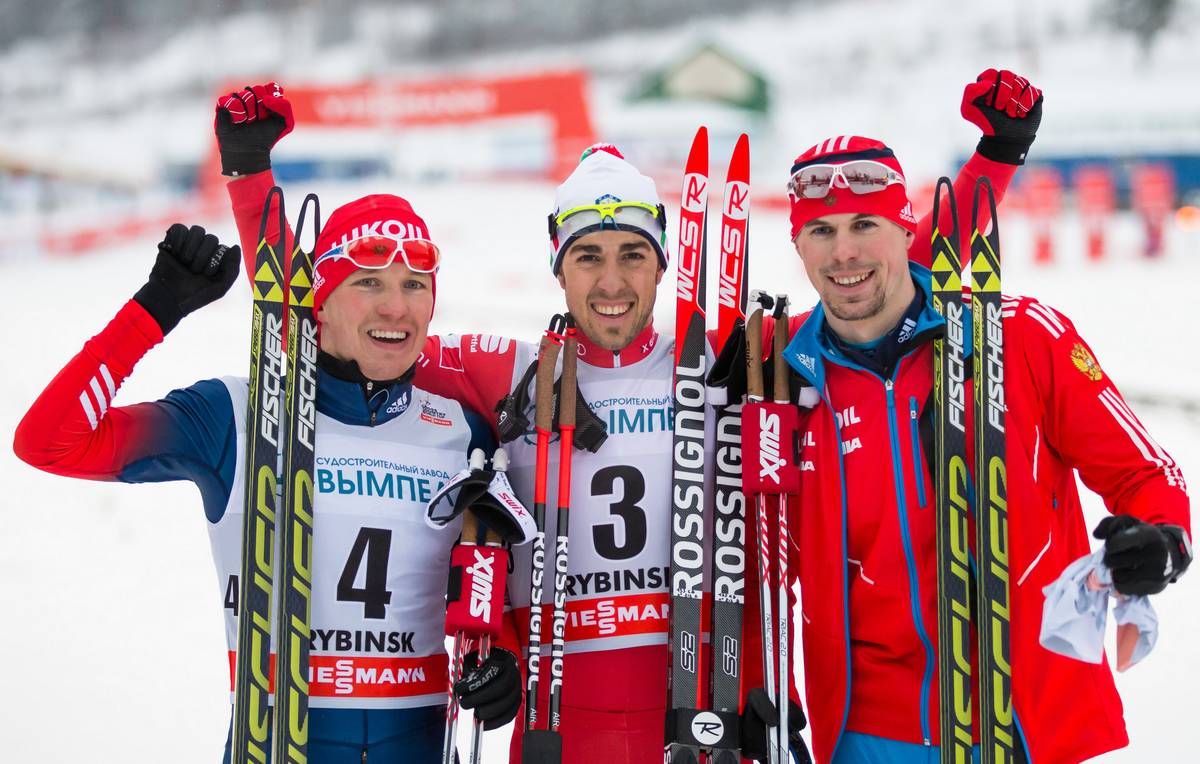
Men’s 1.3 k freestyle sprint podium in Rybinsk, Russia (from l-r): Andrey Parfenov (RUS) third, Federico Pellegrino (ITA) first, and Sergey Ustiugov (RUS) second. (Photo: Fischer/Nordic Focus)
Italy’s Federico Pellegrino skied himself into the history books after his victory in Saturdays 1.3 k freestyle sprint in Rybinsk, Russia. Pellegrino became the first athlete to win three consecutive freestyle sprint World Cups. His first two victories came this year in a Davos World Cup and in Val Mustair as part of the Tour de Ski.
“This is just amazing for me. I can’t believe I have won again. Before Davos I had never won a World Cup and now to have won three in a row is just unbelievable,” Pellegrino told FIS reports after the race.
To win his third straight viceroy, Pellegrino had to beat a strong Russian team full of sprinters. One such skier, Sergey Ustiugov clocked the fastest qualifier heading into the heat races qualifying in a time of 2:41.10. Teammate Alexey Petukhov was second fastest, 3.55 seconds behind and Pellegrino was third, 3.87 seconds back.
Pellegrino had the fastest quarterfinal with a time of 2:39.39, proving he was the skier to beat in the heats. When it came to the semifinal, however, he changed his tactic. Pellegrino skied a very conservative 2:42.69 to win his heat and to advance to the finals. In comparison, Ustiugov’s semifinal time was 2:37.73.
If the Russians wanted to stop Pellegrino, it was a perfect setup for them in the finals. Four of the six spots were filled with Russian teammates – Ustiugov, Andrey Parfenov, Nikita Kriukov, and Petukhov. Rounding out the other spots were Pellegrino and Norway’s Emil Iversen.
At the start it was obvious Russia wasn’t going to let him win easily. The four Russians marked Pellegrino the moment the gates opened. Ustiugov took the early lead followed by Pellegrino, Parfenov, and Kriukov. The pace was fast but didn’t separate the field.
Spurred by the home crowd at the base of the course’s major climb, Ustiugov put in a strong attack. However, Pellegrino and the other Russians were right there to counter it, with Pellegrino demonstrating that he had the energy to match Ustiugov’s speed.
As the skiers progressed over the hill, Ustiugov was still leading and Pellegrino tucked in behind him. The group headed into the stadium and Pellegrino stepped out to get onto faster snow. This propelled him right past Ustiugov and into the lead. Parfenov followed Pellegrino, but was quickly dropped when Ustiugov reacted to Pellegrino, who was now in front.
Into the closing meters Pellegrino’s power and speed took over. He easily out-sprinted Ustiugov and Parfenov to win his third consecutive sprint win. He crossed the line at 2:34.99, besting Ustiugov by 0.69 seconds and Parfenov third by 0.77 seconds.
Pellegrino was very happy when he talked to FIS reporters, and said he hoped to turn these wins into a financial deal.
“I feel so strong right now,” he said. “Hopefully with this success I can now find a sponsor for the front of my racing hat! Thank you to Russia for the great hospitality, the friendly people and for cheering for me today. I could hear it.”
After two podium spots in two races in Rybinsk, Ustiugov showed the home crowd that he still had energy left and was looking forward to Sunday.
“I am happy to be back on the podium again today. I feel that my shape is quite high right now and I hope to be on the podium again tomorrow in the skiathlon,” he said to FIS.
Parfenov’s third place finish was his first ever podium, and achieving it at home was an added bonus.
“This is my first podium ever. It’s great to have my first podium be here in Russia. The fans were great and competing here makes it possible for my family to be here. That is really special,” he said to FIS.
Rounding out the final spots in the final were Kriukov (+2.61), Petukhov (+3.00) and Iversen (+4.60).
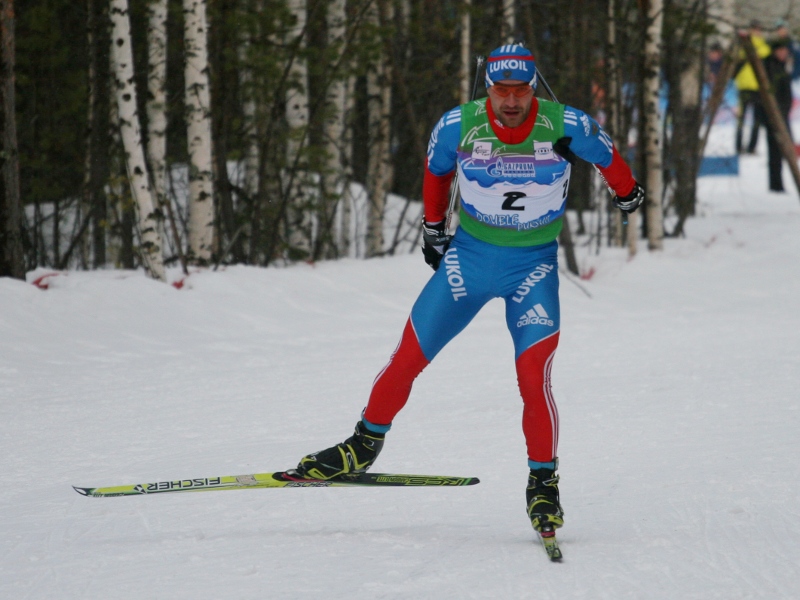
Alexei Petukhov, winner of the Grand Prix Sprint Tour 2012. Petukhov is racing in the Day 1 Skiathlon here.
After a one-year hiatus, the Russian Sprint Tour is back, bringing a unique combination of events to elite spring ski racing.
First held in 2007, the event has twice been won by Justyna Kowalczyk (POL) and Emil Joensson (SWE), and has often featured a number of top World Cup skiers.
The 2012 edition consisted of two days of racing in Yugorsk, a small city of 35,000 on the western edge of Siberia.
After the 2011 event was cancelled due to funding issues, organizers came back with a set of races that will not be found on the World Cup calendar anytime soon.
The first day of competition, on Wednesday, belied the concept of a sprint.
Despite being held on a relatively flat, 1.2-kilometer course, the race was about endurance as much as speed.
Termed a double-pursuit, the event was actually what the International Ski Federation now considers a skiathlon, held in a sprint-style format.
All entrants started in semifinals, skiing two laps in one technique before switching to the other. In an added twist, half the field of twelve in each semi started in classic, with the other half taking to the line skating.
Both techniques were held on the same loop, with a single climb two-thirds of the way through.
While the likes of Kowalczyk and Joensson were not present this year, the hosts brought plenty of their own firepower, including Alexei Petukhov and Nikita Kriukov among others.
Top foreign skiers included Mathias Standvall (FIN), Federico Pellegrino (ITA), and Tim Tscharnke (GER).
The top six from each semi advanced to the final, where the lucky participants were given an extra lap in each technique, for a total of six loops measuring 7.2k of racing—on the heels of the 4.8k of the semis.
In the first semi the advantage went clearly to those skating the first half as five of the six skiers who moved on came from this group.
With just the single hill, many chose to double pole the classic portion on skate gear, though they were still required to swap equipment in the pit.
Parfenov winning day 1.
Through the first part of the loop on the gradual terrain, the classic skiers could stay close to the skaters, but once the inclines began, the gaps grew.
In the second semi, there was no advantage for either start group with three coming from each.
The B-final was won by Kazakhstan’s Denis Volotka after the initial skaters made the interesting choice of engaging in slower paced-tactics.
They did not open up a significant gap until the final lap, and were quickly consumed when they switched to classic.
In the A-final, Tcharnke took the race out hard in skating, quickly pulling his pack away from the classic skiers for a 10 second lead after the first loop.
They added another 14 seconds on the second lap, but the pace dropped the third time around, and the skaters only gained a few more seconds before the switch.
Their opponents halved the gap after the exchange, and with the exception of classic sprint specialist Kriukov, quickly reeled in Tscharnke and company.
Entering the final lap, classic and skate came together through the stadium, leaving little hope for those in the slower technique.
Andrey Parfenov attacked over the top of the last hill, opening a gap. Evgeny Belov (RUS) and Petukhov tried to follow, but were only able to stage a fight for second and third, with the veteran Petukhov coming back in the homestretch to take second.
While hill was somewhat chopped up, the skiing was generally firm and fast, with a small but enthusiastic crowd in the bleachers.
Day 1 podium – Petukhov, Parfenov, Belov
Day two made no more effort to honor ski racing convention with the SuperSprint Double Knockout added additional complexity.
While the technique was limited to only skating, each heat had two groups, starting at different points on the course.
With one set of five or six athletes on the homestretch and the other on the backstretch the scene was of one long start line with half the field facing the opposite direction.
This time around, the seemingly sadistic organizers had the racers ski three laps in the semifinals with the slowest two skiers eliminated each lap.
With the two different groups, the only way to ensure longevity was to ski hard from the start, and then max out a sprint in the final 100 meters, making for a grueling event, that got the better of many.
By the later laps some skiers, completely spent, were unable to do more than just ski in their final lap.
As on the previous day, the A and B finals added an additional lap for a total of four, making a furious five k with intermediate sprints every lap.
In the final rounds, skiers were resting at the completion of each lap, and tried to stay in by holding top position in their group at the end of the loop, rather than worrying about the other pack.
In the B-Final, Strandvall and Anton Gafarov lunged with one lap to go. Only one would stay alive, but with just inches separating the pair, organizers quickly reviewed the photo finish camera as the stadium announcer encouraged both men to keep racing.
Neither seemed overly enthusiastic to do so, and just seconds later, Gafarov was pulled, leaving the Finn as the sole remaining skier from his start group.
The sprint specialist had no hope of continuing for another lap, and he gracefully hopped off the course at the conclusion of his loop before halting and stopping recording on the helmet cam he wore throughout.
While the skiers clearly raced as hard as possible, suffering through the brutal format, the relaxed atmosphere of spring racing prevailed, with plenty of smiles, mugging for the television cameras, dancing to the Russian opera music on the stadium loudspeakers, and clearly enjoying the conclusion of a long season.
Mikhail Devjatiarov (RUS) took the victory on day two ahead of World Cup skier Dusan Kozisek (CZE), an apparent aficionado of alternative sprint racing—he is a regular on the Red Bull NordiX circuit…
Kazakh Nikolay Chebotko placed third, while Petukhov finished sixth, good enough to claim the overall Grand Prix Sprint Tour 2012 title.
Petukhov finished the Tour with 56 points, just two more than Sergey Turyshev, a Russian World Cup distance skier.
Belov was third with 52 points.
There was no women’s race this year, though the kids event, held between semifinals and finals, was fully televised, complete with live timing, splits and results.
Both days of racing are available to watch on the website of Russian Television station Yugra.
Neither race format falls into the category of “made for TV” as following two simultaneous groups of racers on course is difficult to say the least.
Adding to festivities was an attempt on the 100-meter speed record.
A new mark had been recently set in Norway by Timo Andre Bakken (NOR).
Gafarov knocked .1 seconds off the record, posting a time of 11.72 seconds prior to the start of the SuperSprint Double Knockout event.
“I could not believe at first that I could beat the world record,” Gafarov was quoted as saying on the SprintTour website. “But I had passion and a spirit to fight. It is also pleasant to break the world record in my native land, here in the Khanty-Mansiysk region, where I live with my family. My homeland has helped me.”
Editor’s Note: If you are hankering for some more ski racing, definitely check out the race video. The television broadcast is professionally produced, the level of skiing high, and the events totally wacky. You won’t see anything else like it!
Plus if you have read the above article, you can avoid the headache of trying to figure out what is actually going on…