From the FasterSkier archive — posts syndicated from athletes’ and coaches’ own blogs between 2004 and 2012, kept online as published. Current coverage is at fasterskier.com.
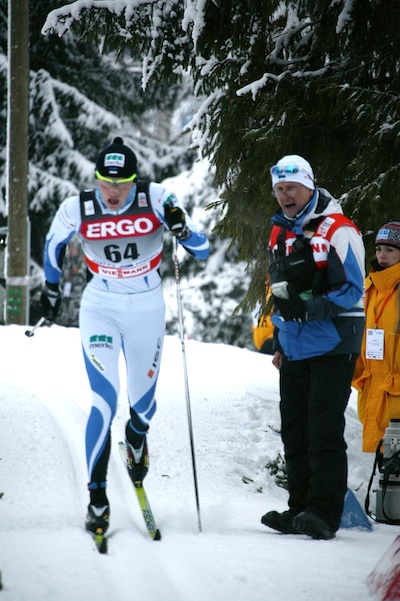
Andrus Veerpalu racing on the World Cup during the 2010-2011 season.
On April 14, the International Ski Federation (FIS) announced former Estonian cross-country skier Andrus Veerpalu was found guilty by the CAS Anti-Doping Division. Veerpalu was involved with “Operation Aderlass”, a blood doping scheme run by Dr. Marc Schmidt in Germany. Veerpalu’s penalty is a two-year ban from FIS sanctioned events ending on March 17, 2023.
Now retired from skiing, the fifty-year-old Veerpalu in recent years has served as a coach for team “Haanja” in Estonia. According to FIS, the ruling states Veerpalu violated Article 2.9 of the 2016 FIS Anti-Doping Rules which is defined as, “Assisting, encouraging, aiding, abetting, conspiring, covering up or any other type of intentional complicity involving an anti-doping rule violation, Attempted anti-doping rule violation or violation of Article 10.12.1 by another person.”
(No official CAS ruling regarding the current Veerpalu case is available on the CAS website. We will link to the ruling when it becomes available.)
In light of the FIS announcement, ERR news in Estonian reported today that Veerpalu has been stripped of two prestigious national awards. Since his 2002 Olympic gold in the 15 k classic, Veerpalu has been revered as a national hero.
Veerpalu is a two-time Olympic champion. Along with his 2002 Olymoic win, he won another gold in 2006. He also won a silver medal in the 2002 Olympic 50 k and two World Championship gold medals. Kris Freeman, an American cross-country skier, lost out on a medal in the 2009 championship 15 k classic, a race won by Veerpalu.
This is not the first time Veerpalu’s name has been associated with doping. In 2013, he was acquitted on a technicality after an adverse analytical finding (AAF) in both his A and B samples for recombinant human growth hormone (rhGH) back in 2011.
Team “Hannja” athletes also serving doping penalties for their involvement in “Operation Aderlass” include Karel Tammjärv, Algo Kärp, Kazakhstan’s Alexey Poltoranin, coach Mati Alaver, and Veerpalu’s son, Andreas Veerpalu.
The medical mastermind of “Operation Aderlass”, Dr. Schmidt is currently serving a nearly five-year prison sentence after being found guilty of breaking Germany’s strict anti-doping laws.
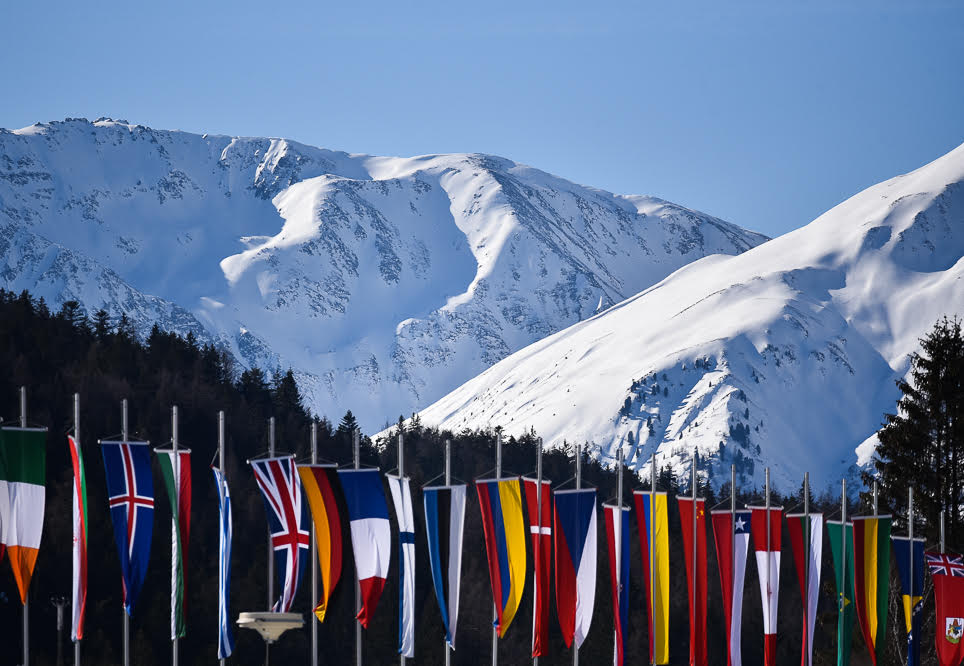
Flags from each nation fly over the stadium in Seefeld, Austria for the 2019 World Championships. (Photo: John Lazenby/lazenbyphoto.com).
As the Seefeld World Championships faded as of Sunday with the conclusion of the men’s 50-kilometer freestyle, here are some news gaps related to the recent arrest last week of five cross-country skiers.
Here are the basics. Several cross-country athletes were arrested in Seefeld as part of a German and Austrian effort to curb doping in sport. Austrian athletes Dominik Baldauf and Maz Hauke, Kazakhstan’s Alexey Poltoranin, and Estonia’s Karel Tammjärv and Andreas Veerpalu were the cross-country athletes arrested. Several other arrest were made including Dr. Mark Schmidt, a German doctor considered to be the leader of the doping efforts. Doping and enabling doping activity is criminalized by law in both Germany and Austria.
Estonian public broadcaster ERR news reported that during a press conference given by Tammjärv on March 1, upon his release from the Austrian authorities, he had admitted to doping in sport. Tammjärve stated he had begun doping in 2016 and was initially put in touch with Dr. Schmidt by Mati Alaver, the former director of the Estonian ski team.
Tammjärv also confirmed that Andreas Veerpalu and his father Andrus Veerpalu were aware of the doping program. Andrus Veerpalu is a former Estonian cross-country athlete who in the past has been implicated with doping. He has been a coaching consultant to the two Estonian athletes involved and is also an adviser to Poltoranin. The older Veerpalu is a three-time Olympic medalist.
Anti Saarepuu, the official Estonian cross-country ski coach for both Tammjärv and Veerpalu, denies knowing that athletes under his watch had been involved with doping.
Thus far, Poltoranin has not commented publicly about his involvement.
Velonews reported this morning that Austrian cyclist and three-time national time trial champion, Georg Preidler, admitted to illegal doping activity. Preidler, had been a member of the French WorldTour team Groupana-FDJ, but is no longer with the team. Over the weekend, Austria’s ex-pro cyclist Stefan Denifl is reported to have admitted to doping.
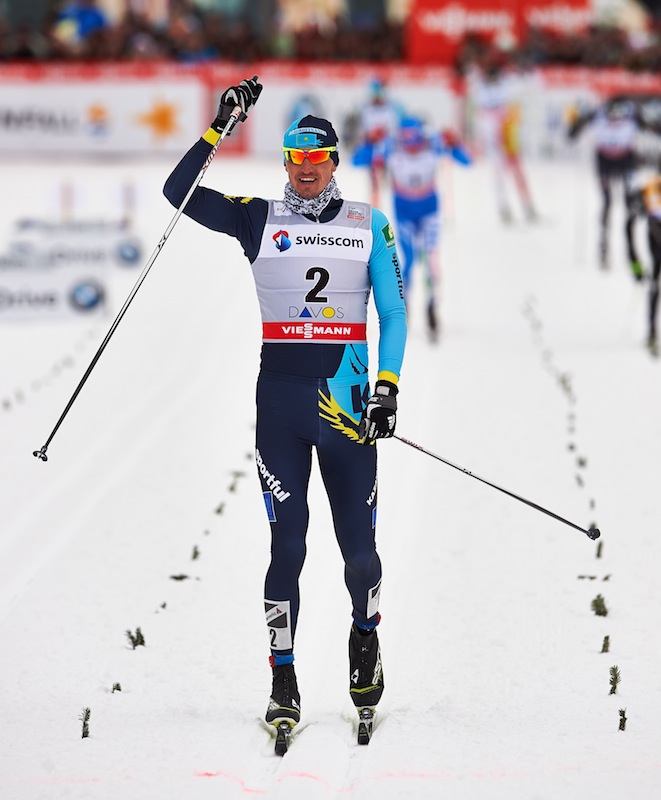
Alexey Poltoranin (KAZ) winning a classic sprint with room to spare in Davos, Switzerland, in 2013. Photo: Fischer/Nordic Focus.
One year ago, Kazakh ski star Alexey Poltoranin began working with Andrus Veerpalu, a Estonian skier who held the title of oldest skier ever to become a World Champion but was later disgraced in an human growth hormone doping scandal.
“He is a good guy and I’m happy with his work,” Poltoranin told Estonian sports outlet ERR last fall. “It’s a really good thing that he’s working with the team.”
Veerpalu was not a team coach, but more an advisor. During his time racing, he was recognized as a classic technique specialist, which made him a good match for Poltoranin.
“He is definitely a really strong skier and a great classic skier, perhaps one of the best classic skiers last year, so this is an especially attractive job offer,” Veerpalu said when he was hired. “I will be responsible for his skis, helping him choose his skis, testing the skis. My position might change later as well, maybe concerning technique and those kinds of things, but that will become clear in the course of our cooperation.”
Poltoranin finished fourth in the overall World Cup standings in 2013, but slumped in 2014, falling out of the top ten. A major medal hope for Kazakhstan, Poltoranin finished ninth in the 15 k classic at the Olympics and 15th in the skiathlon.
Despite this disappointment, he is strengthening his ties to the Estonians and this summer, moved to the country to be closer to his support staff.
He is also formalizing a relationship with Mati Alaver, the famous Estonian coach who built the program up after the country left the Soviet Union. Alaver coached both Veerpalu and two-time Olympic gold medalist Kristina Smigun. Poltoranin’s longtime coach Alexey Nakonechniyn will stay onboard as well. Veerpalu is reportedly now working primarily on ski preparation (although there is speculation and discussion that he will eventually coach the Estonian team), along with Finland’s Jari Nieminen.
This spring, Poltoranin explained that he was splitting from his federation, who he did not feel adequately supported him. He wanted to plan an individualized training group with Alaver, but the federation disagreed. Poltoranin claimed that in the future he may even switch his citizenship if the Kazakh ski team’s preparations remained inadequate.
“I did not feel comfortable with the organization, flights, accommodation, meals, inadequate coaches, challenges surrounding medical supervision and that the best equipment is not used,” Poltoranin said according to a translation. “ I have not been happy with ski service and lubrication.In order to compete on an even higher level, I need strengthened medical attention, I must have a sports physician and a good wax team… I have sponsors who are willing to assist me in preparing for this new Olympic period (the next Winter Olympics in 2018).”
For their part, some Estonians hope that adding Poltoranin to their ranks could help restore their once-great team to glory – even if he never dons an Estonian suit. Alaver is still coaching three Estonian men. Among them, current World Cup team members Raido Ränkel and Algo Kärp said that having one of the world’s top skiers train with them would surely help their preparations.
“So far I’ve only been training for Estonian men who are not as strong as Poltoranin,” Ränkel said.
Poltoranin had nothing but positive things to say about Otepää after his first training camp there.
“Previously, I had been Otepääl winter, and now for the first time in the summer,” he told EKV news. “I liked it very much. There are all conditions for training, and life is calm. I have good impressions of Otepää. I looked for rental apartments for the first year… the main thing is that the apartment has a sauna. As an athlete it’s not at all insignificant. This is a big plus.”
In a landmark decision on Tuesday, the Court of Arbitration for Sport upheld the appeal of Andrus Veerpalu, an Estonian skier who had tested positive for recombinant human growth hormone. In condemning WADA’s method for setting decision limits – the value in a sample which separates a positive test from a negative one – the court effectively made it impossible to prosecute any other cases based on the same test and same decision limits.
Although the appeal was against the International Ski Federation (FIS), which had banned Veerpalu for three years after February, 2011, test, the main question of the case was not for FIS but instead for WADA. How did they set those limits? The group’s mandate is to be 99.99% certain that a positive test is not a false positive. While the court did not dispute the test’s ability to detect ratios of different isomers in a blood sample, or that these ratios indicate use of recombinant hGH, they said that WADA did not accurately determine that 99.99% confidence level.
The limits chosen by WADA, for men, were 1.81 for kit 1 and 1.68 for kit 2; anything higher was considered a positive test. Veerpalu’s A-sample values were 2.62 for kit 1 and 3.07 for kit 2; the B-sample was 2.73 and 2.00.
The outcome is already being used by the NFL Players’ Association, among others, to decry the use of hGH tests as inaccurate and unusable, but anti-doping administrators aren’t changing their line.
“WADA is deeply disappointed with this situation, but acknowledges the CAS authority and understands that the panel was not comfortably satisfied with the decision limits currently applied to the hGH test,” WADA said in a statement on its website. “WADA will immediately engage in a process to re-establish these limits taking into account the remarks expressed in the CAS award… WADA will therefore encourage Anti-Doping Organizations (ADOs) to continue collecting samples for analysis pursuant to the hGH test and will, based on the larger number of samples now available, advise on revised decision limits shortly.”
FasterSkier talked with Sarah Lewis, the Secretary General of FIS, about how the case proceeded from the federation’s point of view, and what it means for federations prosecuting future doping cases.
FasterSkier: Although the appeal was against FIS, many of the witnesses were from WADA. How did that work?
Sarah Lewis: It has to be that way. The whole point is that WADA doesn’t carry out results management. You have a bunch of different organizations that carry out doping controls. You have the major events organizers, you have international federations, you have national bodies, those are in principal the major anti-doping organizations. And you have WADA, which carries out testing.
But in terms of results management, that’s clearly specified… this was actually a WADA out-of-competition test, but then the results management defaults to FIS. Obviously for us, we carry the responsibility for doing that. Any mistakes carried out in terms of sample collection, analysis done by the laboratory, things that are relevant to the international standards for testing – that’s all defined in the rules.
But when it actually comes to the test itself, basically what the labs are doing is carrying out the analysis in accordance with the WADA standards for laboratory. From an international federation’s perspective, we are relying on the fact that all of the prohibited substances and methods on the WADA list, that they have been scientifically validated and that aspect is not going to be challenged. So that when we receive an Adverse Analytical Finding from a laboratory, we proceed on that, on the basis that the science behind the test is not in dispute.
There are of course other things that can go wrong, with the collection or storage or transportation, or the athlete’s right to be heard, which are contained in the rules. But that’s all very clear in the rules. The one thing that we have no control over whatsoever, because it’s not our business, we’re a sports organization, is the doping tests.
FS: So were you prepared to have the science come under question, or was it surprising?
SL: Well, it had already come up. What happens is the first thing when the appelant makes an appeal, they have to submit their written submissions so that you have an overview of what their case is, why they are appealing the decision. Then the respondent will give its version of events. Then there’s a hearing and both sides have to nominate their experts. But you only know who those will be based on the written submissions, when you have an understanding of what the arguments are.
FS: Did you feel that the WADA experts who were brought in to defend how they set the limits – did you feel like they did a good job, or how did you feel they presented their work?
SL: I’m not really sure that’s something I can comment on, to be honest. Without sufficient expertise, it’s not really possible to say. It all sounded very compelling and convincing and very scientific, and Veerpalu’s experts were countering them. It was a boxing match between both sides. And the panel decided to give the athlete the benefit of the doubt.
In layman’s terms, it’s possible to describe the situation as that Veerpalu was caught doing 180 kilometers an hour, and the speed limit was 120. Then when they checked out the machine to measure speed, they showed that it may not have been accurate between 118 and 119, and at that speed it could be a case that there would be a false positive. And consequently, even though he had done 180 and that’s not disputed, he was nevertheless given the benefit of the doubt because there was a fault in the machine.
FS: Thinking into the future—
SL: We haven’t gotten that far yet.
FS: Okay. But thinking about WADA guidelines and whether they are correct, will this affect your strategy in the future? Is there anything you can do about this sort of thing?
SL: This was the first time this test has been challenged, and it took quite a long time to get there anyway with this test. I think WADA will respond very quickly. They already put a statement up yesterday about it. The point is that the panel confirmed the test itself, and so what do they need to look at? They need to look at the decision limits.
From the time they designed the original decision limits, there have been many, many, many more samples carried out. They have a whole stack more data, which they can use to reassess what the decision limits should be. Presumably, that’s what they’ll do.
They actually brought that into the trail, they said, in the meantime, this is what we have assessed, and I think it was something like 10,000 samples. So it’s a very different situation now… it’s just a question of WADA going through the process and formalizing that.
FS: It seems so unusual for an appeal like this to succeed – do you think that this will embolden athletes in the future to appeal based on the science?
SL: Well, obviously if it’s going to make them challenge the science of every test, then it will get to the stage that nobody will be able to afford to do anti-doping work, and that would not be very funny. But you know, it’s not the first time that the science has been challenged. Each times there seems to be this reaction, like, is this the end of anti-doping as we know it? And of course it isn’t.
Perhaps with this test, there may have been a deadline of wanting to get it done very quickly, namely for the Vancouver Olympics I think it was. In any case, there was a certain deadline that they were really pushing for. Perhaps that influenced the amounts of data they had for the whole process. But it’s a one-off situation.
Of course everybody needs to be sure that the substances and the methods on the list have been properly validated, and that really is the job of their scientific and legal groups and specialists. And this can be just a little bit of a signal that, yes, we have to check and make sure that’s all okay. Sometimes it takes that little reminder or kick to do that, and I’m sure WADA will react in that way to make sure in case there are any other, especially new, developing tests.
With pretty much everything else, there’s so much jurisprudence, there’s so much on-the-record decisions that have been taken, and backed up with admissions. But with a new test, that would be the moment that it could be challenged. So as they come forward with new tests, they have to be sure that every step of the way, this level of documentation is followed.
FS: I can imagine that it probably is a difficult job to have to define that thin line between a negative and a positive test.
SL: I guess it is. It’s like alcohol, drinking and driving. That’s got a different level, and it’s even different in different nations. In some you’re deemed to be over the limit with anything over 0.00, and in others you’re over the limit with considerably more than that.
Epilogue: Luckily for anti-doping agencies and federations like FIS, a new hGH test, using biomarkers instead of the isomers described in our previous article, was debuted at the 2012 Olympics in London, where it caught two Russian Paralympic powerlifters. But was it, too, rushed through the validation stage for a big event? Time will tell…
Andrus Veerpalu competing in Muonio, Finland, in the fall of 2010, as he started what would be his last season in the sport.
Athletes who test positive for a prohibited substance in both their A and B samples rarely, if ever, win their appeals cases, which often devolve into lawyers grasping at straws and drawing on desperate, irrelevant arguments in an attempt to get the case overturned.
But in a case heard ‘round the ski world, Estonian cross-country legend Andrus Veerpalu has done what seemed impossible: despite an “adverse analytical finding” (AAF) of recombinant human grown hormone (rhGH) in both his A and B sample, the Court of Arbitration for Sport (CAS) overturned his ban on a technicality.
And what a technicality it was. On Tuesday morning, CAS announced in a press release that the International Ski Federation, the governing body for skiing which initially handled the case and was the respondent in Veerpalu’s appeal, “failed to meet the applicable standard of proof with respect to the procedure followed to set the aspects of the decision limits.”
In short, the test itself was valid, but the way that anti-doping administrators applied it was not. And it clearly pained CAS to have to rule in favor of Veerpalu.
“There were many factors in this case which tend to indicate that Andrus Veerpalu did himself administer exogenous hGH,” the press release noted, but continued on to say that there was insufficient statistical proof to ban him.
Has this ever happened before?
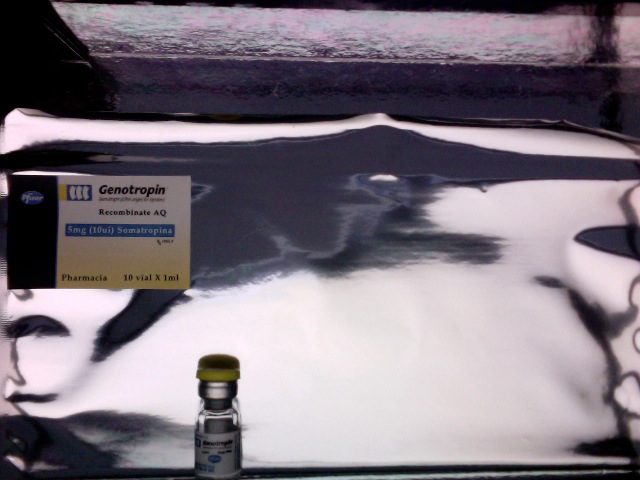
CAS is sure that Veerpalu administered some form of hGH, perhaps like Genotropin, shown here; they just can’t prove it. Photo: Hunted230 via Wikimedia Commons.
Gary Wadler, a New York doctor who used to work on the committee to select the World Anti-Doping Agency (WADA) Prohibited List, wasn’t familiar with the case, but he was certainly surprised.
“I have not heard of that, no,” he told FasterSkier of a successful appeal on the basis of math.
And the doctor who created the test, which compares ratios of differently-structured molecules of hGH and had served as a witness in the CAS hearings, was no less flummoxed.
“I could not understand from the information I have what the criticism was,” Dr. Martin Bidlingmaier told FasterSkier in an interview from his clinical offices at the University Clinic of Munich. “I know the findings in this case, and in my opinion it looked quite clear.”
No matter who you ask, as long as they are not affiliated with Veerpalu, you’ll hear that the cat was in the bag; Veerpalu was doping. So how could the case have gone wrong, with a test that has been peer-reviewed and can easily detect an unnatural ratio of the different forms of hGH?
The CAS ruling blamed not FIS, but WADA, which sets the procedures and standards that other anti-doping bodies must follow. WADA’s Senior Manager for Media Relations Terence O’Rorke has been unavailable for comment since the ruling announcement on Tuesday, and requests to the media e-mail account, as directed by his secretary, went unanswered. WADA Science Director Olivier Rabin was briefly reached by FasterSkier, but said he was on his way to a meeting and to make an appointment with his secretary, who never answered the phone.
With no official word from WADA – which has not posted anything about the outcome of the case on its website – it’s tough to know why they chose to set the decision limits in the way that they did. But both the CAS decision and WADA’s guidelines for the application of the hGH test provide a few insights.
Isomers and Ratios
Bidlingmaier has been studying growth hormones since the mid-1990’s in a range of applications: diabetes. Exercise. Pregnancy. When it came to doping, he and his colleagues tackled what seemed like an unsolvable problem: how to detect recombinant hGH, which was in many ways identical to the natural kind. Making matters worse, hGH expression fluctuates in the body over both short and long time scales, making it impossible to employ any absolute cutoffs.
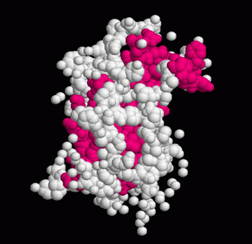
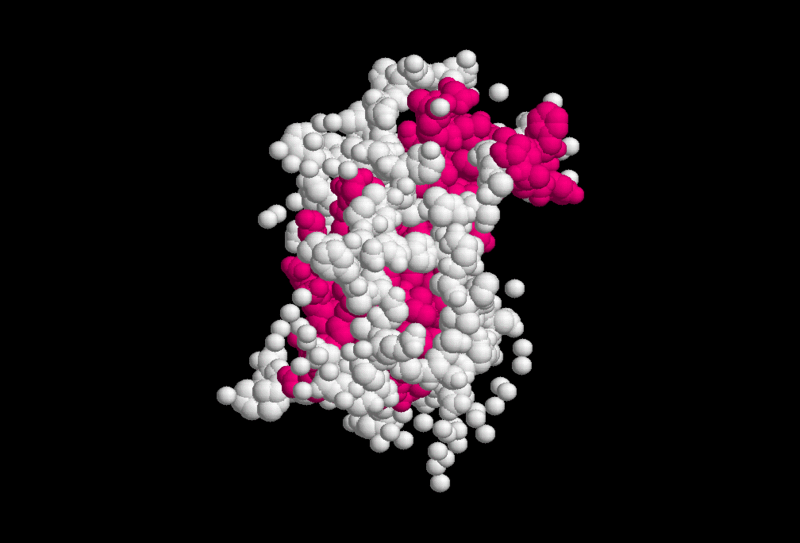
The structure of the most common isomer of hGH. Image: WikiMedia Commons
Bidlingmaier and an international team of researchers published a paper in the Journal of Clinical Endocrinology and Metabolism examining how the expression of hGH changed in the human body when an athlete began to administer the exogenous, or recombinant, variety.
In a normal, non-doping human, about 70 percent of hGH — the naturally-occurring variety that is secreted by the pituitary gland and referred to as pithGH — is expressed in forms that are 191 amino acids long, known as 22-kDa isomers. Much of the rest is in a form that has shorter, 176 amino acid chains, known as 20-kDa isomers. There are also other forms of various shapes and structures. rhGH exists only as 22-kDa isomers.
After injecting rhGH and exercising, serum concentrations of the 20-kDa and rarer isoforms dropped off to practically nothing. The high level of rhGH interferes with the body’s signaling and feedback mechanisms and tells it not to produce any more natural hGH. So instead, the ratio of 22-kDa isomers, from the recombinant form, rises.
In 1999, Bidlingmaier and three collaborators published a short report in leading medical journal The Lancet reporting that they had developed a test that compared the ratio of pithGH to rhGH. Over the next few years, more tests were developed.
The one used on Veerpalu’s samples was described in a 2009 article in Clinical Chemistry. As in previous tests, the researchers used mice that they raised either normally or on only rhGH. They then isolated antibodies that would bind specifically to one isoform of the hormones or the other. The test itself relies on two of these antibodies, which are labeled with acridinium ester, a chemical which luminesces.
A sample, then, is put in a vial with both of these antibodies. The amount of luminescence tells how strongly each is expressed, and the ratio is then calculated. If there’s too few of the non-22-kDa isomers, it is assumed that rhGH must be suppressing their production. The team verified this by establishing baseline values for the ratios in several groups of healthy subjects, then tested samples from 10 male and 10 female athletes who had been administered rhGH.
For peer review in a medical journal, this was enough to prove that the test worked – and CAS agreed, saying that the method was robust and reliable. Bidlingmaier’s job was done; it was WADA’s turn to run with his work.
Setting the Limits
Just because a test works doesn’t mean that it can immediately be put to use. Among other things, WADA had to decide what constituted a negative or a positive test. Even using a ratio, there had to be a line somewhere, and deciding where to set it would have a huge impact on future doping cases. The test, which consisted to two kits each containing one antibody of each type, was put to the test.
According to WADA’s own “Guidelines for hGH Isoform Differential Immunoassays” handbook, published in July 2010, as well as the CAS ruling, there were three trials to calibrate the test and set detection limits. The first was an “Initial Study” using samples from the 2009 IAAF Track and Field World Championships. Using these samples, WADA set a detection limit based on a lognormal distribution of the ratios in each sample.
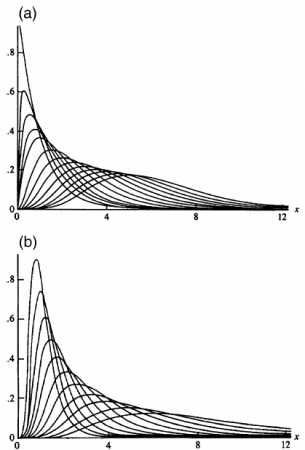
Examples of the gamma (a) and lognormal (b) distributions; Note the differences in shape on both the left and right sides of the distributions.
Over the next year, WADA collected over 700 new samples from nine of its accredited laboratories around the world. In a point that is central to Veerpalu’s case, the organization decided to combine this data with the samples from the “Initial Study” to form a “Validation Study.” They also combined male and female samples, and African and Caucasian samples, all of which had been kept separate in the Initial Study.
At this point, WADA said in the CAS hearing, they decided that sex and race did not significantly impact a finding, even though in the Initial Study they had found that ratios were typically higher in the African samples.
The researchers had 801 male samples for the first kit and 142 for the second kit. They also decided that instead of using a lognormal distribution model to set a decision limit, they would use a gamma model. The original lognormal model, they said, was not acceptable.
What’s the difference? In some ways, not much; both cater to “right-skewed” datasets, with many observations close to zero and a long tail of less common observations at higher values. But the mathematical equations used to describe the distributions are different, and their shapes are not exactly the same.
However, the conclusions were not much different than in the Initial Study, and the decision limits that they established were put into the July 2010 Guidelines. For kit 1, the limits of the ratio are 1.81 for males and 1.46 for females; for kit 2, the limits are 1.68 and 1.55.
(As reported in the original FIS ruling, Veerpalu’s A-sample values were 2.62 for kit 1 and 3.07 for kit 2; the B-sample was 2.73 and 2.00, in other words, not on the border of this decision point that WADA had identified but rather quite extreme.)
A year later WADA conducted a second verification study, using over 1,000 samples and the gamma distribution. Their results showed that the decision limits previously set were conservative, had a relatively low risk of producing false positives, and would therefore not be unfair to clean athletes.
Inappropriate Science?
In a key point, WADA decided to exclude any samples with very high values from either Validation Study. In some cases, these were samples that they knew had rhGH, but in others they were simply outliers that did not fit well within the distribution.
This was one of Veerpalu’s team’s main arguments: that by excluding samples with high ratios, even though they may have come from clean athletes, WADA set itself up to have a tight decision limit and constrained the amount of variation that could be considered clean.
Furthermore, the team claimed that the distribution of ratios from the samples can’t be modeled parametrically at all – why else would there be these troublesome outliers? They point to the rejection of the lognormal distribution in the Validation Study as evidence that no distributions truly fit the data. And WADA itself admitted: the gamma distribution fit the data well at high values, but not at low values. It wasn’t a perfect match.
The lawyers brought up, too, the question of why WADA lumped all the ethnicities together, when there were clearly – at first, at least – differences among them. It was likely an issue of sample size, but even after combining all the samples Veerpalu’s team argued that the 142 samples for kit 2 were not enough to fit a solid distribution curve. And finally, why did they not use any known positive samples to test their decision points? Why use only samples that they knew were not from dopers?
In response to all of this, WADA acquitted itself poorly. Always reluctant to explain how it develops tests due to a fear of dopers listening in and “beating the system,” the organization answered only what it was asked for, and sometimes barely that. At one point the CAS ruling notes that “The Respondent has not provided evidence or further information on the other distributions considered.”
Basically, instead of explaining what they did, WADA said: don’t worry. We did it right. The group’s scientists even backtracked and changed their explanations of the distribution models at the very last hearing.
CAS was unconvinced:
“Despite the Respondent’s ample opportunities to convince the Panel on the correctness of the decision limits including in the post-Hearing brief as well as in response to the two subsequent rounds of Panel Questions, the Panel cannot exclude to its comfortable satisfaction that the decision limits are overinclusive and could lead to an excessive amount of false positive results (beyond the claimed specificity of 99.99%). Although the Panel has found that the Test itself is undoubtedly reliable (as explained in Section 5 (‘The Reliability of the Test’)), the Panel finds that the following factors prevent it from concluding that the decision limits are equally reliable: (1) The inappropriate exclusion of certain sample data from the dataset; (2) the small sample sizes; and (3) the data provided on the distribution models used.”
Fallout and Failure
What is somewhat astounding about this case is that providing more detailed explanations of the statistics used to set the decision limits would likely not have hurt WADA. The organization’s continual refusal to share the chemical makeup of its kits or the techniques used in detecting banned substances is understandable, albeit frustrating at times.
WADA publishes the numbers that it uses as limits for these ratios; why not talk about the statistics? Knowing which type of data distribution was used to set a limit is unlikely to help a doper in any way. What it could do, however, is instill more confidence in WADA itself, from athletes across the spectrum.
After all, even if everyone is convinced that Veerpalu is guilty, anti-doping efforts have to be science, not a witch hunt. To ban an athlete you need evidence, not a hunch.
“The Panel accepts that a dynamic approach to testing may be desirable and acceptable, particularly in the field of anti-doping,” CAS wrote. “However, the Panel must bear in mind the seriousness of the allegations made against the Appellant when assessing whether it is satisfied that the decision limits with regard to hGH have been correctly determined.”
Lost in all of this is FIS itself, which should have had a slam-dunk case against a prominent athlete. When the CAS decision came out, FIS did not publicize any comments – instead they posted a brief, few-sentence announcement on their website with links to the CAS press release and ruling. Short of blaming WADA, they nonetheless passively pointed a finger at the larger body which gives them its rules and guidelines.
“The Panel found that the Decision Limits of the Test for the substance as published in the WADA Regulations were unreliable and therefore his appeal against the decision of the FIS Doping Panel to sanction him is upheld,” the statement read.
As FasterSkier reported previously, FIS Secretary General Sarah Lewis said that “there is nothing else to add.”
As for Bidlingmaier, who developed a test that he thought would catch people just like Veerpalu, he’s still marveling at how WADA failed to do so.
“All I know is from the media and the website of CAS,” he told FasterSkier. “As far as I understood, the decision made very clear that the test itself is scientifically sound and there were no doubts with respect to all the labwork. The discussion arose only around the statistical model used around the decisions they make, between positive and negative… I’m a physician and a biochemist, I’m not a statistician, and it’s their world, their arguments. I have no idea if it’s valid or not.”
After nine months of deliberation on the case, the Court of Arbitration for Sport (CAS) announced from Lausanne, Switzerland, on Tuesday that it decided to uphold Estonian cross-country skier Andrus Veerpalu’s appeal and overturn the three-year competition ban the International Ski Federation (FIS) originally imposed on him in August of 2011 for testing positive for human growth hormone (hGH) in an out-of-competition doping control test in January of that same year.
In a press release, the CAS cites FIS’s failure to “meet the applicable standard of proof with respect to the procedure followed to set the aspects of the decision limits” as the basis for its lack of confidence in the test results collected from Veerpalu. Decision limits are set by the World Anti-Doping Agency (WADA) and establish the difference between a normal and non-normal presence of hGH in the blood, a distinction that is central to avoidance of the risk of falsely positive tests.
In interviews with the media, Veerpalu thanked his legal team and the Estonia Ski Federation for standing by him throughout the court proceedings.
“The last two years have been the most difficult in my life and I would not want anyone to go through that,” he said. “I want to thank everyone who believed in me and my team and gave their support either with a good word, a kind thought or practical help. I am glad that justice prevailed but it does not erase all that I went through those past two years.”
In its ruling, the CAS concluded that “there were many factors in this case which tend to indicate that Andrus Veerpalu did in fact himself administer exogenous hGH, but that, for the reason that procedural flaws have been found in the statistical side of the WADA studies establishing the decision limits, the violation of the FIS Anti-doping Rules cannot be upheld on appeal. Therefore, the ban imposed by the decision of the FIS Doping Panel has been overturned by the Panel.”
Within its 74-page final decision the CAS details its lack of confidence in the reliability of Veerpalu’s positive test and further explains that it is unwilling to run the risk of falsely accusing an athlete of doping, given this lack of confidence:
“The Panel accepts that a dynamic approach to testing may be desirable and acceptable, particularly in the field of anti-doping. However, the Panel must bear in mind the seriousness of the allegations made against the Appellant when assessing whether it is satisfied that the decision limits with regard to hGH have been correctly determined.”
Matthieu Reeb, the secretary general and spokesman for the CAS, explained in a phone interview that there is still the possibility of further action from FIS if a newer, more reliable test is made available, and should the governing body choose to respond.
Reached by phone on Tuesday morning, FIS Secretary General Sarah Lewis referred FasterSkier to the federation’s website. “There’s nothing additional to add,” she said.
Here is what Reeb told us. The interview has been edited and condensed.
FasterSkier: Can you explain these ‘decision limits?’ Was the panel saying that FIS messed up its procedure, or that the analysis guidelines that FIS got from WADA were somehow problematic?
Reeb: The second answer. In fact, FIS had to rely on the scientific information provided by WADA, and such information was not considered as fully reliable to confirm that Mr. Veerpalu [was guilty].
The HGH test in itself is considered as reliable, because the method is admitted. The only problem is the last part, which was also the main discussion throughout the last six months in this case. The values or the statistics provided by WADA were not fully satisfactory in the eyes of the panel.
The statistics were not sufficient to convince the panel that we could exclude any false positive. It’s more a technicality because it was not possible for the panel to exonerate Mr. Veerpalu of any doping offenses. Because the scientific information was not totally reliable, therefore it was not possible to conclude that Mr. Veerpalu had committed a doping offense.
That was the suspicion, but because the panel wanted to be sure of not committing a false positive, they could not validate.
FS: Does this result invalidate the HGH test until the decision limits are fixed somehow?
Reeb: I cannot say what happens with other cases—it’s the first decision we have in this area. We do have another case pending, which is Patrik Sinkewitz. This Veerpalu decision is really the first one. My impression when I read the award is that probably the WADA experts should complete their experiment or their studies and come back with more accurate or detailed information regarding these decision limits. In theory, as long as the 8-year time limit, the statute of limitations, is not passed —in theory it’s possible to reanalyze the samples again, if there’s a new method available. We know this from other sports [where] the test was negative, [and] because of the evolution of science, maybe three or four years later the same sample could be analyzed again and the result could be different.
We did not mention that at all, in the decision. Of course, it’s only my impression that in theory the FIS, after maybe they speak to the WADA, if they can get additional information or a new study regarding the decision limits, they could perhaps initiate a new procedure. This is a question that I would perhaps ask the FIS representative.
FasterSkier: Was FIS premature in using the test?
Reeb: It’s hard to answer that. FIS was certainly convinced that they had all the elements available to have the sanction confirmed by CAS. After we know the decision today, in fact FIS did nothing wrong, I believe. What they’ve done is that they have presented all the data, all the information, the scientific studies, that they could receive from the WADA. And on that basis they did the maximum. I don’t think anything could be criticized on their side. They were using the elements which were available.
FasterSkier: Did the Panel accept the case made by Veerpalu’s lawyers?
Reeb: Honestly, they approved some arguments on both sides. For example, the FIS had the burden of proving that, for instance, the decision limits were reliable and were fully applicable, which they failed. The arguments of Veerpalu have been upheld on this side. But on the other side, Veerpalu was not in position to establish that the entire test for HGH was not reliable. The arguments for FIS have been upheld. They considered arguments on both sides and they accepted some of them, but not all.
In the conclusion, when it was necessary [to determine] which party should pay any indemnity for legal costs, the decision is almost split. I think it’s FIS which has to pay 10,000 Swiss francs to Mr. Veerpalu. It’s more like a sort of compromise, because both parties were right and wrong.
These decision limits, the procedure conducted by WADA to establish these decision limits, contained some flaws or were not totally satisfactory. Because of that, it was not possible to exploit the entire HGH test to ensure whether Mr. Veerpalu [committed a doping violation].
It’s only a small part of the test which did not allow the panel to rule in favor of the FIS.
It’s possible [for FIS] to appeal before the Swiss federal tribunal, but only for limited grounds like violation of due process rights…some more procedural formal elements. The federal tribunal will never review the interpretation of regulation by the CAS, and will not [review the evidence again].
Alaver, 58, is credited with building his country’s cross-country ski program from scratch following Estonia’s independence in 1991. Over the last two decades, its athletes have won more than 15 major medals at World Championships and Olympic Games—not bad for a country with a population of 1.3 million.
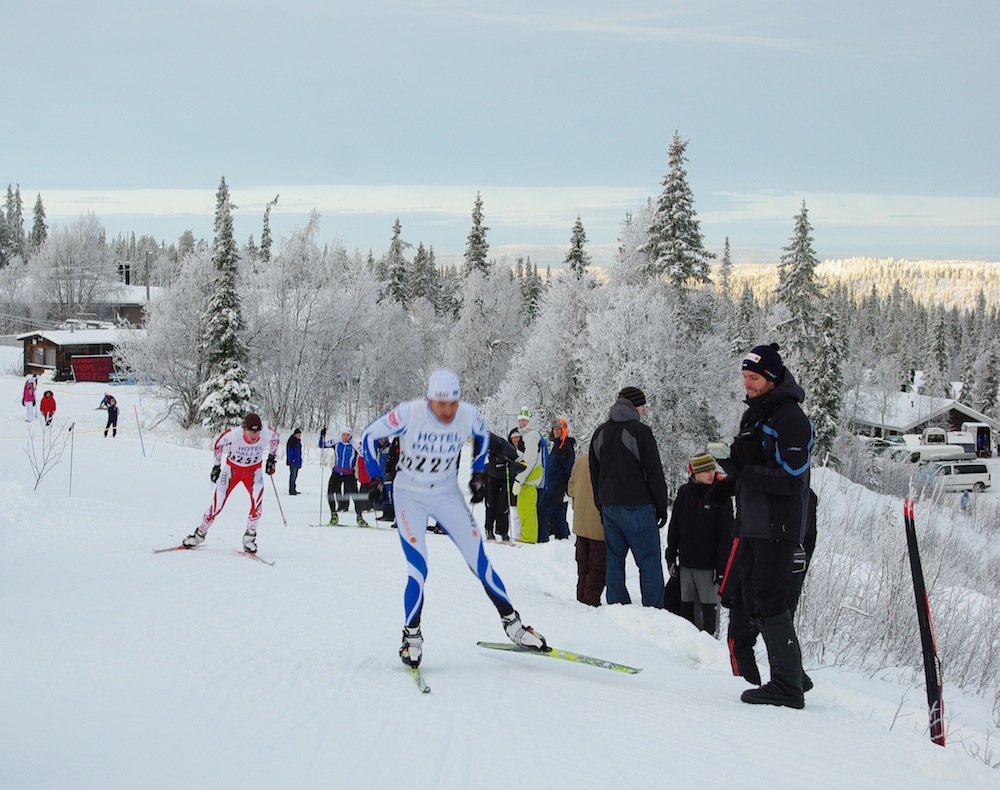
Mati Alaver (R), trailside at a race in Estonia in 2011.
Alaver is known not just as a knowledgeable and successful coach, but also as a pitchman who found the sponsor money to turn the Estonian Ski Federation into a powerhouse. “He’s a great public speaker,” an Estonian ski official told FasterSkier last year. “One day he will go to politics.”
Over the past year, however, Alaver has been tested—first, by the retirement of Jaak Mae, Andrus Veerpalu, and Kristina Smigun, who were Estonia’s core cross-country skiers over the last 15 years, and second, by Veerpalu’s positive drug test in the spring of 2011 for the use of human growth hormone.
The Estonian team—whose athletes formerly competed for the USSR—has always operated under a cloud of suspicion, and Veerpalu’s test only confirmed what many suspected. After an International Ski Federation panel convicted Veerpalu, the case moved on appeal to the Court of Arbitration for Sport (CAS), where it should be resolved in a manner of weeks.
Alaver’s current position with the Estonian Ski Team is unclear; he said that if Veerpalu was found guilty, he would step down, but according to the Estonian media, Alaver is on administrative leave pending the CAS decision—and he continued to travel with the Estonian team through last winter.
During the Tour de Ski in Italy in January, FasterSkier caught up with Alaver to discuss his work with the Estonian ski team, and the future of the program. Alaver speaks German, but not English; our questions and his answers were translated by Christian Flury, a Swiss coach.
The interview has been edited, and condensed.
FasterSkier:What’s your coaching role now? Are you doing less administrative work and working more directly with athletes?
Mati Alaver: Estonia is a small country, so you need to be multifunctional, working with sponsors, working with organizations, working with organizing committees, and working with athletes. You have to do everything, because there’s no way to build up huge infrastructure with the team.
FS:It’s not like the Norwegian team, where you have a head of the wax staff, etc.?
MA: Completely different.
FS:What are your goals for the team?
MA: After the big names retired, it’s time to build up a new team of young athletes, and also a new service staff, new trainers, new coaches, everything. For sure, it’s a three- or four-year project, at least. The goal is, for the future, that Estonia comes back into the nations that win medals. That’s our long-term coaching goal.
FS:Following the retirement of Veerpalu and Mae, which athletes are you working closely with now? Has this given you an
Andrus Veerpalu racing in Estonia, three months before news broke of his positive doping test.
opportunity to work with younger athletes?
MA: I’m personally coaching Algo Kärp and Karel Tammjärv.
FS:How did you get started in the sport? I’ve heard you’re from an out of the way village that was described to me as the Wyoming of Estonia.
MA: When I was 13, I started skiing. I had a really good coach when I was young. He was the reason I went to Tartu University and started working as a ski teacher and ski coach.
I finished university in 1976. I worked for 20 years as a lecturer in science and research. In ’76, I also started working as a coach for small kids, and in ’83 I was first hired as assistant coach for the national team. I started working with Andrus and Jaak in ’92.
FS:Did you have mentors as a coach? Who did you learn the most from?
MA: When I started working at the university, it was back in the Soviet era, and there were some coaches [that I learned from]—Victor Ivanov, Alexander Gruschin, Nikolai Lophukov. When Estonia was free in 1992, I started to go to a lot of conferences and seminars in Finland. On the World Cup, I met [former Norwegian coach] Inge Bråten.
I’ll never forget his speech about the Olympics, because the Norwegians had been so strong in Albertville in 1992. In Albertville, in the top five [in the men’s 30 k], there was one other guy, and that was bad for Norway.
Inge said the next goal is that the top four or five must be Norwegian. They need to be one, two, three, four, five. I thought, ‘that must be a crazy man who would say something like that.’
I learned from Inge that if you want to reach top results, you need to have top goals. In every sector, you need to improve one percent, or even zero-point something, to get better and better, because you start on the same line.
FS:So, you have influences from Norway, from the Soviet system and from Finland—how did you take those and turn them into an Estonian system, with Mae and Veerpalu?
MA: I realize now I was lucky to learn about being methodical and systematic from the Soviets; from Finland, the endurance and the physiology; and from Norway, how to build up structures, in terms of how to organize a team.
As a junior, Jaak Mae was in Norway at a ski school for one year, and he learned a lot from them about how the Norwegian system worked, and he brought that back. Then from ’95 until ’02 or so, we collected all the scientific articles from Norway and worked with them.
Jaak Mae racing in Estonia in 2011.
In the end, you have to take something from the Soviet system, from Finland and from Norway and then put them together and make the best out of them, because there are not that many athletes, not that much money or anything [in Estonia]. So, take the best of what you can, because there are only a few top athletes. Then focus on the development of them.
FS:Now for the hard question: A lot of Western athletes, coaches, and spectators have been skeptical of the Eastern European and Estonian training methods. And since Veerpalu tested positive for human growth hormone, some people have taken that as confirmation of their beliefs. What would you say to them?
MA: We all live in a free world, so everybody’s free to think what they want. It’s a myth to say that Eastern Europeans are the dopers. There’s Ben Johnson, Marion Jones, Taylor Hamilton—it’s not the right way to look at it, to say East and West is different.
I believe it’s a false-positive test, and we’re going to the CAS.
FS:Building your Estonian team back up was already going to be a challenge, once Veerpalu and Mae retired. Has this made it more difficult, and will you be able to bounce back?
MA: Sure—it’s difficult.
FS:The approach and the system for Veerpalu and Mae was very successful; with other athletes, it’s been more mixed. Do you think there have to be changes in the Estonian system to produce more successful athletes? What would those be?
MA: For sure, we have to come up with another system, because cross-country skiing is still endurance, but you also have to be fast now, with the mass start and sprinting. Jaak had no chance in mass start, no chance in sprint. Individual races—that was his best. So, you have to adapt, and now you have some athletes that can do that. We have to go with the times.
The saga of Estonian Andrus Veerpalu’s doping trial has dragged on for well over a year, but with a final ruling in his appeal expected soon after the conclusion of the trial this week at the Court of Arbitration for Sport in Lausane, Switzerland, Veerpalu may have finally run out options.
According to Aivar Pilv, Veerpalu’s defense attorney, their appeal claims that FIS’s testing methods for doping are faulty.
The appeal proceedings began on Monday and continued into Tuesday. Estonian Public Broadcasting reported that court secretary general Matthieu Reeb said a decision would be made within a few weeks and would be final. It is possible to appeal the decision in Switzerland’s federal court, but only in cases of court room procedural errors.
Following his retirement from cross-country skiing in 2011, news broke that the Estonian star had tested positive for human growth hormone. The International Ski Federation (FIS) consequently handed him a three-year competition ban, which was recently reset for Veerpalu’s involvement in ski testing for Estonia on the World Cup this season.
For a detailed account of how the case unfolded, click here for FasterSkier’s previous coverage.
The International Ski Federation (FIS) Doping Panel has ruled that the competition ban on Estonia’s Andrus Veerpalu will have to start from scratch. The three-year doping ban was originally set to end the day the 2014 Olympic Games concluded, but because he violated its terms this winter by testing skis for the Estonian team at the Otepää World Cup this January, the ban’s start date has been reset to January 21, 2012.
The World Anti-Doping Agency (WADA) code stipulates that any participation in official competition or involvement with a team is in violation of a doping ban. An athlete found breaking the rule starts his ban over again from the date of infringement.
FIS permitted Veerpalu to explain the situation in writing before deciding to extend the punishment. The Estonian Ski Association tried to say that Veerpalu’s involvement with the team in January was unofficial — that he didn’t travel with the team and only helped out in Otepää because the races were essentially in his back yard.
FIS dismissed this defense, which ultimately wasn’t a surprise to the Estonian Ski Association according to a translated article from the Eesti Päevaleht.
Though Veerpalu announced his retirement from competitive skiing in 2011 before testing positive for elevated levels of human growth hormone, the Association’s Secretary General Margus Hernitsa said the revelation that Veerpalu can no longer be involved with his former team in any capacity is a setback for the 41-year-old champion, who is still a national hero to many fans in Estonia.
“He must carefully monitor what can and [cannot] do,” Hernitsa said. “Andrus may not perform any official role, can not be a coach, belong to a club or Association.”
A reader asked on Twitter the other day if I’d recalculate the tallies for Kris Freeman’s top ten, top three, etc. results if we went back and removed a certain Estonian skier from prior results sheets.
I’m going to preface this with some standard caveats about how I can’t know for sure when Andrus Veerpalu was clean or not clean. He certainly failed a drug test recently, and the way public opinion works with doping is that basically all his results are now suspect. I’m agnostic on that question, but since this was a fairly interesting data exercise, I thought I indulge the haters out there.
But I’m going to take it one step further and tally the missed opportunities for all skiers, not just Freeman, if we remove Veerpalu. We’ll start with the least important consequences and work our way up.
There were 78 different skiers who would have moved up into the World Cup points (from 31st to 30th) if you removed Veerpalu. There wasn’t really one skier who bore the brunt of this; the most it happened to any one skier was 3 times. North Americans in this group include Kris Freeman, Carl Swenson, George Grey, and Dan Roycroft, all once.
Next, removing Veerpalu will move some skiers up from 11th to 10th. This was also fairly evenly spread out among 43 different skiers, including Carl Swenson again.
More dramatically, removing Veerpalu from the results will bump 13 different skiers up from 4th to 3rd. Here is where we finally include Freeman’s famous WSC “medal”. Also notable is that Mathias Fredricksson would gain three more podium finishes in WC races due to this change.
Finally, the big kahuna, and I was a little shocked at the results. There were five skiers who would gain a victory out of this transaction. Two Olympic gold medals and two WSC gold medals. When Veerpalu’s ten wins get apportioned out, one skier gets five of them: Frode Estil. And it kind of makes sense, since he was another classic ultra-specialist.
I didn’t bother removing any of the Finns or Russians (although a lot of the Russians who’ve been caught haven’t been nearly as accomplished). Perhaps I’ll tackle that in a follow up.
Magnifiques!
I jest. It’s just that Maurice Manificat’s name looks like what a dumb American who doesn’t speak French might think the French word for ‘magnificent’ is. Heck, maybe Manificat is somehow etymologically related to ‘magnifiques’ or a synonym, but I wouldn’t know.
In any case, he sure had a good race a few weekends ago in Bruksvallarna. How good was his race? Well, let’s see how it stacks up versus how he’s fared against that particular field in the past:
I used similar graphs a lot last season, but I’ve updated the look of them somewhat. The dots are from that weekend’s race, and each one represents the difference in percent back between Manificat and the others in the top 20. All values are greater than zero because Manificat won.
The shaded area and red line show the typical (and range) of values for Manificat prior to that race. Note that with the exception of a somewhat poor season in 2008, he had been basically on par with this particular group. So this result is not what I’d call ‘typical’. Indeed, Manificat followed up this performance with an OK but not great 17th in Sjusjøen. That’s not to say he won’t regain that kind of form, but it’s possible that we’ve simply seen the range of performances we’re going to see from him.
Bauer (L) leading eventual winner Petter Northug in the 50 k at 2011 World Championships in Oslo, Norway.
At the age of 34, Lukas Bauer of has already done pretty much everything a skier can hope for.
At the 2006 Olympics in Torino, he won silver in the 15 k classic. In Vancouver four years later, Bauer took home bronze in both the 15 k skate and the relay. He owns a silver medal from 2009 World Championships in the 15 k classic, and he has twice won the Tour de Ski; in 2007-2008 he also sat atop the leaderboard on the overall World Cup.
So what makes the Czech keep going?
A relentless pursuit of perfection, that’s what. Bauer still hasn’t won gold in either the Olympics or World Championships. Without either major event appearing on the 2011-12 FIS calendar, he is once again shooting for podium finishes in both the Tour de Ski and the overall World Cup.
Bauer doesn’t have one of the more outsized personalities on the World Cup; his reputation is as an honest competitor and a hard worker. He has talked in the past about doing workouts like 50 x 100 meter sprints (think about it: five kilometers worth of rollerski sprints!), a task that would make even the toughest athletes quiver in their boots. True to form, Bauer – who has excelled in individual start races but not in sprint finishes – recognizes his strengths and focuses on his weaknesses, quietly.
But in his correspondence with FasterSkier, Bauer has been not only courteous, which was expected, but funny. He was also as willing to take the time to answer questions as any other foreign skier we’ve approached.
FasterSkier was able to catch Bauer over e-mail from Muonio, Finland, where he is using the scant snow to prepare for the first World Cup races of the season along with most of Europe’s other national teams.
Bauer on his way to 7th place in the 15 k classic at 2011 World Championships in Oslo, Norway.
FasterSkier:First of all, how has your summer and fall been so far? I saw that you had ankle problems in the early summer, but
are you feeling prepared for competition now?
Lukas Bauer: I think that I had quite good summer and fall but for sure I had also some problems (ankle from a football match in June, and sickness in August). But I think it’s normal that sometimes your training is changed by some troubles. I’m not nervous about it and I know that when I was able to train, I trained well.
FS: You have been training with the Germans. Why did you decide to do that?
LB: Yes, it’s true. The system is that I’ve trained with Germans and the Oberwiesenthal group (trainer: Janko Neuber, German women’s ski team trainer; athletes: Tom Reichelt; Valentin Mättig; Monique Siegel) during my stay home, between Czech national team camps. During Czech national team camps I’ve trained with Czech team according Miroslav Petrasek, the Czech ski team trainer and my former personal trainer. The reason why I decided to change my previous training routine is not simple to explain, but I felt that I needed to change in the last two years. I had trained with this group (and also Rene Sommerfeldt) in the summer and fall of 2006 after Olympic games in Torino, and I was very satisfied. One of the reasons was that between Czech camps I had trained almost every day alone, and sometimes it is not bad if you have somebody to push you to the limits. The German group lives just five kilometers from my home. Now I have very good training partners on almost every session, and it is a benefit for everybody.
FS: How has training with them been different than when you were just training with the Czech team?
LB: Like I wrote before, now I did almost every session when I was at home with the group and not alone like before, which is good for motivation, more fun during long trainings, and also easier, because you can feel the coach’s support on every session. And there is also the difference in favor of various training resources (something that is special for every national team). If I can compare the Czech and German styles, then the Czechs prefer a lot of running training, and the German style prefers more rollerski training. But that is a very simple comparison and for me it was also interesting that this change open my eyes to training details, ĺike I was junior!
Martin Jaks racing in Estonia last winter.
FS: How are the Czechs doing? Martin Jaks had a great Tour de Ski last year.
LB: My feeling is that my teammates had a very good summer and look stronger than last year. For sure especially Martin Jaks is
coming ito the best age, and they all could be faster then before in the winter. But the question is the same for everybody – how successfully they transfer better running endurance to skis. But it would be great if they can be stronger. We especially we need it for relays.
FS: With no World Championships, what are your goals for this season?
LB: It’s simple, this season for me the goal is the Tour de Ski! And the second goal is for the overall World Cup standing, where my goal is the top three places. But if the season will go in bad direction, like if there’s no chance for the top three in the overall, then I will think about Vassaloppet.
FS: Last year, the World Cups in the Czech Republic weren’t really suited to your style of skiing, but this year there is a long classic race. Are you focusing on those “home” races in particular, and are you excited for them?
LB: Yes, for sure, I’m focusing on World Cup in Nove Mesto – because there is every time an excellent atmosphere and I like to ski there.
FS: Is it ever hard to motivate yourself to train and compete when you have already had so much success?
LB: I have no problem with races, but for sure sometimes for training, especially when is very bad weather, I need a kick [in the pants]. But without training you never get results….
Lukas Bauer after winning the final stage of the 2011 Tour de Ski. Photo: Toko.
FS: Looking back, how do you feel about the 2011 season? Were you happy with your results?
LB: I’m very satisfied with my third place in Tour de Ski overall. Maybe this Tour was for me the hardest compared to previous
Tours, because almost nothing went in the direction that I wanted and that I needed… [there were] some problems with skis, wax, some crashes, and also my rivals were very strong in the sprints, where they took a lot of bonus seconds. And with my sprint “abilities” [Bauer inserted a frowning emoticon] I had to work hard to reach third place in the final.
World Championships in Oslo was not successful for me. Not bad, but not succesful. But it is just that some athletes were simply better in this time and also after struggling with waxing, like many teams, my seventh place from 15 k classic was nothing excellent, but also not a fiasco.
FS: How much mountain bike racing did you do this year? Do you think it helps your skiing physically, or do you mainly do it just because it’s fun and that helps you get out the door?
LB: I did just one mountain bike race this year, which is nothing. I decide to decrease my mountain bike racing this summer when I changed training routine with the idea of being more focused on skiing. I like mountain bike racing a lot, and when I was junior I was on the edge about whether I would continue like a skier or a mountain biker. It’s fun and also fun training.
FS: It seems like FIS changes the rules and the race formats all the time. What new formats and new rules would you like to see?
LB: Yes, there are many changes during last few years. I think that it is important to slow down with changes and make the rules more simple and more “viewer friendly”. And to make better TV coverage, because sometimes it is quite boring – but I’m not sure how much it is FIS and how much TV production.
FS: When you won the relay bronze medal in Vancouver, it really proved that your country had a good team instead of just a few excellent individuals like you and Neumannova. What did that do for you and the other skiers? Have you been able to find more sponsors? Has skiing become more popular in the Czech Republic?
LB: The relay was amazing and I think that it helped other members of relay to find more sponsors, but for me is difficult to say if and how much, because I also had an individual medal from Vancouver and some other very good results from the past, which meant that I “already had name”. But for me it was important that we reached this excellent result with the team and not “just” with individuals. It was also great for our support team (servicemen, doctor, masseuse) and for sure for our families, because they are behind us in the shadow and without their support is not possible for us to do it.
Bauer en route to bronze at the 2010 Olympic Games.
About the sponsors, for sure after Vancouver I’ve found some more sponsors, but for me it was also important that when many companies were fighting with financial crises I still had sponsors, and with them I’m able to make preparations for the season like I want. Skiing in the Czech Republic looks more popular than some years before (I’m talking about how many kids are doing the sport, not about how often this sport is on TV and newspapers), but the problem is that skiing is quite an expensive sport and the young generation like computers and TV than sports. But it is the same everywhere.
FS: What about the 2009 World Championships – corruption seems to have been a big problem. Has that led to any change in public opinion about skiing, or affected you in any other ways?
LB: It affected me just right after WCH, when I was almost every day asked what is my opinion about [it]. I think that the investigation around WCH, if there was or wasn´t corruption, is not finished yet. But I think that after some “hot” months right after WCH it looks that public opinion is not negatively changed about skiing, there is more [just] a negative public opinion about Neumannova and her team that was organizing WCH.
FS: I’ve heard and read that you have been trying to work on your speed in all sorts of ways, including using the SkiErg. What has your strategy been in that department and would you consider the SkiErg experiment a success?
LB: Yes, the summer between Vancouver and Oslo, our goal was to work more on speed. Not to try be a danger for Petter Northug in sprint, but just to work to be faster for bonus points during mass start races and to be able to change speed during some attacks. I think that it was visible on some races last winter (for example the World Cup La Clusaz), but for sure, first it is important to be healthy and to be in good shape and this is something extra… And my former trainer thought the SkiErg looked like a good tool for upper body. I did some training on this machine, and some intervals. First I was surprised at how quickly your energy goes away, but we don’t do a lot of training on it. I still have it in my garage. I did little tuning, and sometimes I’m using it, but not often.
FS: Doping seems to always be a topic of discussion with skiing, but the Veerpalu case is bigger than most. Do you think that his positive test in particular has changed anything for the sport or for you? Do you sense a greater distrust on the part of the fans?
Bauer at 2009 World Championships.
LB: I think that it changed nothing for sport, because, it is a pity but it’s reality that just like in normal life, also in the sport (and skiing) there are some people who will cheat the rules. My opinion is that these people were, are and will be [another sad emoticon]. And this is WADA’s job to try to catch people who are cheating the rules. What his case changed for me? Nothing
specific. But for sure I had in my head questions without answers like: In the case that he used the doping (only he knows if he did or not) had he used the doping also in the past, when I took silver in WCH in Liberec 2009, and also in Olympics in Torino 2006, right behind him? Why did he do it just before end of his career? This was what I had in my mind, but I’ve stopped it, because I don´t know and never will know the answer. And also I’ve [convinced myself] that I don’t know it. Why? Because now I can think that I lost gold medals in a fair fight (hoping that if he used doping it was only when he was caught), because I don’t want to get medals by [default]. For me the results are not about the medals, but about emotions, and they were built there with the silver medal and there is no chance to change that.
And about the fans? Maybe I’m crazy but my opinion is that the fans who believed that Veerpalu is a doper now will scream that they were right, and the fans who believed that Veerpalu is clean will still believe that he is innocent, and just small part of them will change their opinion. It’s the same with every skier.
FS: You are obviously very busy as an athlete, but your wife is quite accomplished as well. How do the two of you make time for family, and is it a challenge with so much travel and racing?
LB: For sure, winter time especially is a hard time for my family, but it’s life and I’m happy that my family is still supporting me in my sport dreams. But the rest of the year I’m trying be home as much as possible, and this was also one reason why I changed my training routine last spring.
The legendary, needs-no-introduction Andrus Veerpalu was poised to go out on top, as the greatest male Estonian skier ever, and one of the all-time best big-race performeres of Nordic skiing – until an injury forced him to sit out of his final World Championships, and call it a career. The Estonian strong-man was feted, celebrated, patted on the back, and given rounds of applause – until he tested positive for human growth hormone.
Instead, he went out on the bottom, as it emerged that he tested positive for growth hormone (or did he? The lawyers are still battling it out) and opted to retire before World Championships. This created a not-insignificant amount of outrage both pro and con-Veerpalu, but Odd-Bjorn Hjelmset was clear on his opinion of the Olympic and World Championship medalist.
Peeter Kummel (left).
On course, the Estonian men were quite good, but not outstanding. While Veerpalu’s points are invalid, 13 other Estonian skiers scored World Cup points, however none of them cracked 100.
The best of the bunch were Timo Simonlatser and Peeter Kummel, both very talented sprinters. Kummel had a strong World Championships, where he qualified 17th in the sprint before battling his way through to the final to finish 6th in the Petter Northug – Marcus Hellner dominated event.
In most countries, as sixth-place result at World Championships would be cause for at least a little celebration – but the Estonians demand more.
What You Need To Know for This Season
The hurricane that is the Veerpalu doping controversy has become a massive sideshow, and the fall-out has just begun – it is extremely unclear how the Estonian distance team and skiers will shake out this season.
Mati Alaver, who coached Veerpalu as well as recently retired Jaak Mae, has been suspended as Head Coach of the National Team, and the head of the Estonian Ski Association Juri Jarv has resigned, while sprint coach Bjorn Kristianson has quit outright in protest over the Federations handling of the incident – he found out about Veerpalu’s case from the paper.
In the past, Alaver has said that he will resign if Veerpalu is not cleared of all charges, but seeing as FIS has stiffened the penalty against the Estonian legend, to a three-year barn, that seems unlikely.
Mati Alaver, currently suspended Estonian cross-country ski coach
While Estonia has never been known for having a deep womens’ team, the retirement of Kristina Smigun-Vaehi at the end of the 2009-2010 season highlighted just how little depth exists, as just two women scored World Cup points. And neither Piret Pormeister or Triin Ojaste are prepared to step up to the level that the Estonian public demands of their skiers, at least this season, as is evidenced by their lack of inclusion on the World Cup team.
If you’re looking to understand more of Estonia as a country, look to FasterSkier’s own Nat Herz who spent time in Estonia this past winter, and wrote an excellent piece on the countries’ development as a ski power.
And if there is one bright spot left in Estonia, it’s their sprint squad. A tightly-knit group of guys who have some top tier skills, and judging from their website, seem to have at least as much fun as the vaunted Norwegian Sprintgutta.
Estonian words and names are awesome – in just a short sample size, skiing in Estonian is ‘suusk’, while ski websites such as FasterSkier are ‘suusaportals’; finally, they have a ski club named ‘suusahullud’, which roughly translates to ‘ski crazy’ or ‘skier freaks’.
Who You Should Watch
Kein Einaste is a 26 year old sprinter poised on the edge of big things. He can really only classic sprint – he failed to qualify on skate skis this past winter, but went three-for-three in classic. He also seems to have some terrible luck. One Estonian newspaper headline even called out a higher power, in a story entitled “Why Does God Hate Einaste?” after the unlucky Estonian broke a pole in his semi-final during the sprint at the Otepaa World Cup.
As soon as the news broke that Estonian Olympic gold medalist and world champion Andrus Veerpalu had tested positive for human growth hormone (HGH), the ski world knew that a fight lay ahead.
For Veerpalu and the Estonians, a doping ban would be disastrous; as FasterSkier reported earlier this summer, the tiny country had built its ski program from the ground up after achieving independence from the Soviet Union in 1991, and a young but powerful legacy of success was at stake for the whole nation, not just its biggest star. Most of the Estonian Ski Federation’s leadership promised to step down if Veerpalu was convicted.
For the International Ski Federation (FIS), the pressure was on, as well. For years, the ski community had accused the Estonians of doping as they won medal after medal at World Championships and the Olympics. But none of the racers had ever been caught, and rumors continued to be just that.
While everyone knew that they were in for a battle, the minutes from the doping panel’s hearing, obtained by FasterSkier, show a full-on war, with Veerpalu launching protest after protest against everything from the HGH test itself to a typo in the blood sample’s documentation package. The minutes also show a misunderstanding between FIS and the Estonian ski federation, and finally, a harsh penalty from FIS that is almost without precedent.
Veerpalu is currently appealing a three-year ban handed down by FIS; his case is now before the Court of Arbitration for Sport. In the meantime, we dig into the details.
How it All Began
As soon as Veerpalu and the Estonian federation were notified of the positive A-sample on February 15th, they launched into damage control.
That very day, the doping panel’s minutes show that the federation’s president, Toomas Savi, called Sarah Lewis, the secretary-general of FIS. Savie reportedly told Lewis that Veerpalu’s career was ending immediately due to a knee injury – the star missed almost the entire 2007 season after coming back too quickly from arthroscopic surgery in 2006 – and asked that FIS not disclose the positive test to the public until after World Championships in Oslo had concluded. Lewis acquiesced, and also agreed to investigate whether the B-sample could be examined after World Championships, not sooner as in many other doping cases.
Savi recently explained to the press that he had wanted to protect other members of the Estonian ski team; had the media storm begun before World Championships, he worried that other athletes would have been distracted, and that the whole team would not have performed well.
FIS and the Estonians each thought that they had some sort of agreement, and proceeded accordingly. Roughly a week after the initial notification from FIS, Veerpalu announced his withdrawal from the World Championships in Oslo, and his immediate retirement.
“We have prepared for the World Ski Championships, and all the team put in a lot of work, but health, and probably age too, have sent signals that even the most ambitious sportsman has to take into account,” he said in a statement at the time. “I would have dearly liked to cap off a career nicely at the World Championships, but real life is something else.”
As World Championships progressed, and rumors about Veerpalu began to swirl, FIS denied that a positive test had occurred.
“I have heard rumors about the alleged doping case against Veerpalu, but…we have no case against him now,” FIS Anti-Doping Administrator Sarah Fussek told the Norwegian Aftenposten newspaper on March 4th.
Four days later, FIS notified the Estonian federation that it would proceed with the case, and it soon became clear that Savi’s phone conversation had sparked some sort of misunderstanding.
The first hint of trouble was that FIS’s letter stated that Veerpalu had admitted to doping, which both Veerpalu and the Estonian federation deny.
The B-sample was another point of contention. The Estonians apparently believed that FIS had agreed to allow the sample to be opened later; they responded to the letter by requesting that the B-sample be examined. FIS, however, pointed out that the period during which the athlete could request that the sample be analyzed had closed on February 24th. But “considering the achievements of the[a]thlete as a former champion,” they accepted the request anyway.
Veerpalu and a scientist he had chosen were present for the opening of the B-sample, which also came back positive for HGH.
Desperate Times Call for Desperate Measures
After six Olympic Games and 20 years on the World Cup circuit, Veerpalu had made a name for himself as a quiet, humble champion. He was reclusive, spent most of his time with his family, and tried to avoid the media circus. But as has been the case with many other famous athletes who have been accused of doping, the Estonian was willing to go to almost any length to prove his innocence.
The doping panel’s minutes show Veerpalu tried not just any tactic, but all of them. He mounted a truly exhausting number of arguments in the hearing, many of which had little scientific or legal basis.
For instance, Veerpalu claimed that because more than the recommended 36 hours had elapsed between when his blood sample was collected and when it was centrifuged, the result should be invalid. In the hearing minutes, Dr. Osquel Barroso noted that the longer delay would lead to under-reporting the true concentration of HGH in the blood, not to a false postive. Barroso, who works for the World Anti-Doping Agency (WADA), was serving as the independent expert, although FIS acknowledged its ties to WADA.
Because antidoping test protocols are not publicized, FasterSkier was unable to confirm either side of the argument. Confusingly, the test window for HGH is aproximately 36 hours, after which injected hormones are no longer detectable in the bloodstream if a sample is collected. Veerpalu, however, is talking about a 36-hour delay between the sample collection and processing, which is a separate issue.
Veerpalu also claimed that the long workout he had just completed must have changed his blood chemistry.
But while a 1999 study by a group of European and Australian researchers showed that exercise did spike HGH levels in the bloodstream by more then tenfold, the decline was dramatic after exercise stopped. The scientists reported that the half-life of HGH was just twenty minutes, meaning that if Veerpalu experienced a normal-sized spike in HGH, by the time he was tested two hours later the concentration in his blood would have returned to normal.
However, his team also argues that he was genetically predisposed to a higher-than-usual spike in HGH. An Estonian scientist named Anton Terasmaa claims to have sequenced Veerpalu’s DNA and revealed a mutation.
“Andrus Veerpalu exhibits uniquely strong post-exertion production of growth hormone,” he told Estonian Public Broadcasting in late August. “It became evident that while other skiers had a tenfold rise in the level of growth hormone, in Veerpalu it was a hundredfold.”
If Veerpalu did experience a hundredfold increase in HGH, then after two hours his blood would still show higher-than-normal levels of the hormone.
Terasmaa, who is a geneticist at the University of Tartu and works on mice, said that he had sent his analysis to FIS, but that the panel had ordered it sealed until recently. The doping panel, however, wrote in its minutes that “the Athlete has not provided any evidence that would indicate the existence of that genetic particularity.” It’s unclear whether the panel meant that it never received the documents that Terasmaa alluded to, or that it did not find them convincing. Without the actual documents, it’s tough to assess the legitimacy of Terasmaa’s claims.
Terasmaa’s genetic explanation was tarnished by his next argument, which had little scientific basis. Terasmaa told the panel that Veerpalu showed higher levels of HGH because he had been living in a hotel room pressurized to simulate a high elevation. Terasmaa said that that this would increase production of HGH, but the relationship between altitude and HGH has not been researched with any degree of rigor; FIS noted that there is only a single study on how elevation affects HGH concentrations in the blood, which concluded that there was no effect.
FasterSkier found the study, which was published in 1994 by researchers from Milan, Italy. They selected seven men to run a marathon at 4,000 meters of elevation, and found that the increased HGH concentrations found following the marathon were smaller than the increases reported by previous researchers working at sea level.
The champion’s last major line of defense was that the HGH test was not reliable.
Strictly speaking, he is right: The test doesn’t always tell whether an athlete is doping or not. It is very difficult to detect actual HGH use, and Veerpalu is among a very small handful of athletes that WADA has caught. (After years of testing, an English rugby player produced the first positive test in February 2010). The HGH test has a false-positive rate of roughly one in 10,000, and much more frequently produces false negatives.
Not only was the weakness of the test not in Veerpalu’s favor, but WADA, not FIS, selects test procedures, so even if the panel had bought his argument, they would not have been able to erase his positive finding, FIS said.
“It is not the responsibility of the FIS Doping Panel to question the applied testing method as long as a method which is validated and admitted by WADA and documented by the respective document has been used,” the panel noted in its hearing minutes.
There were other arguments, including that there was a typo on the sample documentation package. But the doping panel rejected each of Veerpalu’s many claims.
The Flip Side
One of the most interesting arguments from the pre-decision minutes is not one that was made by Veerpalu and his legal team. Instead, it was a simple question for FIS: Why did its panel assert that the Estonian star had admitted to doping?
Back when FIS notified the Estonian federation that the doping panel was opening a case against Veerpalu, they included one piece of surprising information.
“By a letter dated 8 March 2011, the FIS informed the [Estonians] that since the Athlete had admitted the use of the prohibited substance verbally and through his withdrawal from the FIS World Ski Championships in Oslo 2011 and his immediate retirement from sports, the case would now be dealt with by the FIS Doping Panel,” FIS wrote in its minutes.
But Veerpalu and his lawyers immediately replied that the skier had never admitted to doping. While fans may remember a tear-filled press conference in early April, that event transpired later. And while Veerpalu was crying as he announced that he had tested positive, he still publicly denied taking any banned substances.
There’s no evidence that he made a confession in private, either. The doping panel’s minutes do not record any conversation in which Veerpalu admitted to doping. In fact, the minutes note that FIS notified the Estonian federation of the positive test and that the president asked to avoid public disclosure, but do not show that FIS and Veerpalu ever interacted at all.
Lewis, the FIS secretary general, declined to comment, citing the fact that the case was still pending, and Patrick Smith, a Canadian judge who heads the FIS doping panel, did not respond to a request for an interview.
But Ilmar-Erik Aavakivi, a partner in the law firm representing Veerpalu, said that FIS had pulled the admission out of thin air.
“The information about the Athlete’s ‘confession’ is not accurate,” Aavakivi wrote in an e-mail to FasterSkier. “It is just not true. Andrus Veerpalu has never admitted the doping use. He has always said that he has not used doping. Moreover, he has not personally communicated with FIS (Ms. Sarah Lewis), after the blood samples’ results.”
So what made the panel decide that he had confessed? And, even after Veerpalu’s lawyers told FIS that he had not, in fact, confessed, continue to assert that he had?
“FIS attributes the admittance of doping use to the contacts the general secretary of [the] Estonian Ski Association has made on behalf of the [a]thlete in February,” Aavakivi wrote. “FIS has interpreted this communication and the following withdrawal /retirement as the admittance of doping use. In reality, the [a]thlete has never said that he has used doping, and has never authorized anyone to say something like that on his behalf.”
Aavakivi pointed out that Veerpalu had little choice but to retire, since he was planning to do so at the end of the season anyway and could not compete with a provisional suspension.
“What was left for him to do?” the lawyer asked.
A Ban Above and Beyond
After squabbles, misunderstandings, and myriad arguments from Veerpalu, the FIS doping panel did something that took his team by surprise: instead of a standard two-year ban, they tacked on one more, prohibiting Veerpalu from competing for three years.
At no time in the last decade does FIS appear to have handed down a three-year ban, and their guidelines state that it is rare to do so for a first-time offense.
The rules do address increased sentences, and describe situations when they are appropriate. Four examples of “aggravating circumstances” include systematic or methodical doping, the use of multiple banned substances and methods, the use of a masking agent to hide a banned substance, or an instance where the effects of the substance are so long-lasting that after a standard ban, the athlete would still have some benefit. Veerpalu was not accused of these types of violations.
In its minutes, the panel gave two reasons for the three-year ban. First, they said, they considered his immediate announcement of retirement “rather disturbing,” and believed that it was obstruction of justice, akin to using a masking agent.
However, Veerpalu is not the first athlete to have immediately announced his retirement following a positive test. CAS documents from Yuliya Chepalova’s 2010 doping case show that the Russian Ski Federation sent FIS administrators an e-mail when they learned that the Olympic champion had tested positive for EPO.
The case “could be closed,” the federation wrote, because Chepalova was retiring.
And like Veerpalu, even after filling out the official retirement form for FIS, Chepalova continued to fight the charges against her. And at the end of the day, FIS handed Chepalova a two-year ban, without tacking on additional punishment for her efforts to avoid a ban by retiring.
The second reason cited by FIS for its increased penalty was essentially that Veerpalu meant to dope.
“The FIS Doping Panel is also disturbed by the fact that [the HGH] cannot have been applied incidentally like, e.g., a substance contained in medication negligently prescribed or administered by a doctor,” it wrote in the minutes. Instead, the HGH use “required a high degree of expertise, and a methodical approach with the help of medical personnel.”
But the vast majority of doping cases do not address instances of accidental doping, and over the last decade, FIS has not increased the period of ineligibility for any other skiers, even if they appeared to have doped intentionally.
Even the handful of Russians who tested positive for EPO – the presence of which, like HGH, isn’t generally ascribed to accidental application – received standard, two-year bans. Yuliya Chepalova was joined on the bench by teammates Yevgeniy Dementiev, Sergey Shiryaev, Nina Rysina, Nikolai Pankratov, and Natalia Matveeva, many of whom are just finishing their sentences and will return to competition this season.
So why did FIS increase the length of the Veerpalu’s ban? Aavakivi, the lawyer, has a theory.
“According to the decision, with imposing the sanction of three years (instead of two years), FIS is rebuking the Athlete for not requesting the opening of B-sample immediately,” Aavakivi wrote in an e-mail. “We believe that the actual reason behind increasing of the sanction is that the Athlete put up a very strong defence against the adverse analytical finding. The fact that he dared to scientifically attack the reliability of the whole WADA test was definitely a bad surprise for FIS and WADA.”
What’s Next
Since Veerpalu’s legal team recently appealed the case to CAS, the drama isn’t over yet. Both sides are working to strengthen their evidence before they argue head-to-head in the independent courtroom.
The stakes are even higher for the appeal than they were for the original hearing, but the outcome of the case is unlikely to change significantly: out of all of the doping cases in CAS’s online archives from the last ten years, not a single ban has been overturned. All of the decisions by sport-specific or national governing bodies have been upheld or partially upheld, and many appeals have been dismissed outright.
Aivar Pilv, Veerpalu’s lead lawyer, recently told Estonian Public Broadcasting that more information has become available since the end of the FIS case, which he claims will buttress his arguments.
“We now clearly know FIS’s conclusions, and now we have reason to provide additional explanatory – and we believe, countermanding – arguments,” Pilv said.
But FIS may have added ammunition of its own. Dr. Inggard Lereim, a Norwegian doctor who is a member of FIS’s medical team, told several Estonian news sites that he had been threatened regarding of the case. He would not reveal the nature of the threats or even where they came from, saying that “I cannot and do not want to go into the details.”
Fussek, the FIS administrator, told the Baltic news service Delfi that she had no knowledge of any threats.
A date has not yet been set for the CAS hearing. But in many ways, the results of the case are only relevant for Veerpalu’s legacy, not to his future as a racer. In an interview with FasterSkier last November, far before the doping allegations surfaced, he indicated that he would retire and that he had no plans to race for another Olympic medal representing Estonia.
“I would like to go to my seventh [Olympics] as a journalist, or something like that,” he said.
Earlier this month, the Russian Ski Federation made public that current men’s sprint team coach, Yuri Kaminsky, was poised to become the next head coach of the entire Russian National Team. With the Sochi Olympics coming up in 2014, the depth of Russia’s 100-plus athlete program, and the team’s fight to clean up its skiers and its image, much depends on the appointment.
If Kaminsky and the Federation can come to an agreement on the nature of their working relationship at a final meeting in the next few weeks, he is ready to accept the position. Speaking through Alexei Sotskov as a translator, Kaminsky told FasterSkier in a phone interview that he must be able to operate with a certain level of autonomy in the head coaching position, which despite its name is more administrator than coach.
Kaminsky became the front-runner for the job after Mati Alaver’s candidacy became tarnished by his involvement in the Andrus Veerpalu doping scandal. Russian Ski Federation President Elena Vyalbe offered Kaminsky the position while he was in New Zealand with the sprint team at the end of August. After thinking on the offer for two weeks, Kaminsky gave Vyalbe a conditional ‘yes.’
In an interview with Moscow News, Vyalbe laid out what she was looking for in a head coach. The position requires someone who is respected by the team coaches he oversees, can be objective and take responsibility for his decisions, and will to listen to and understand where the athletes are coming from, she said. With Alaver out of the picture, the only legitimate candidates in her mind were Kaminsky and Yuri Charkovsky, who held the position prior to Vancouver.
According to Sotskov, a former Nordic Combined coach for Russia and a longtime friend of Kaminsky’s, the sprint coach was hesitant in accepting the offer.
“At first he was all excited,” said Sotskov, who was at the Snow Farm with Kaminsky and his team in August. “But then he said, ‘In a way, I’m betraying my team. There’s no way I’ll be able to continue working with all these great guys who trust me, and who I’ve been working with for so long.’” If he accepts the promotion, the helm of the sprint team will likely be taken by current assistant coach Mikhail Deviatiarov, Sr., whose son, Mikhail Jr., is on the Russian team.
Kaminsky ascended to the senior sprint team coach in 2008, after building a strong reputation as one of the most successful junior coaches in Russia. According to Sotskov, Kaminsky consulted his team on whether he should accept the promotion, which would remove him from any position of working directly with athletes. The team, too, was split—half were supportive, half wanted him to stay.
“I felt bad for him,” said Sotskov. “He was torn.”
With the pressure to perform well on home turf in 2014 mounting, the decision to take the head coaching job is all the more daunting. The Russian government directly funds the National Team, so expectations for results come all the way from the president of the country, explained Sotskov.
While the head coach feels that pressure more acutely, there is no doubt that it filters down to the individual athletes. In the past, this has perhaps manifested itself in attempts to get ahead with performance enhancers. In the last five years alone, 20 Russian skiers received bans from competition for doping violations.
With Vyalbe’s ascent to President of the Russian Ski Federation in June of 2010, however, the Federation cracked down on doping—after being fined for past violations and strongly encouraged to clean up its act by the International Ski Federation (FIS), eight tainted coaches were banned from working with athletes on the national team. When FasterSkier interviewed Vyalbe in February, she expressed confidence that no skiers under her jurisdiction were cheating.
When asked about his level of faith in the federation’s anti-doping policy, Kaminsky said that coaches and athletes are clear that there will be no mercy if they are caught, and was convinced that the testing policy is in place to catch anyone cheating on the national team.
If Kaminsky accepts the position as head coach, he will be offering guidance to all senior and development teams to ensure that everyone is working towards the same goals, and will be responsible for administrative decisions regarding which athletes get to compete in certain races. Because Russia has such an enormous pool of athletes, Sotskov explained, it’s often very difficult to select teams for specific races.
Beyond regular administrative duties, Kaminsky is waiting until he decides to take the job to start thinking about what initiatives he will tackle first.
Before the end of his interview, Kaminsky took a moment to express part of his inspiration as he moves forward in whatever capacity in the development of Russian skiing.
“I want you to know that I am totally impressed with the American Nordic Combined performance in Vancouver,” he said. “It is motivating me to work harder. I’m puzzled as to how such a small field of athletes could have performed so well. If you can do it with your resources, how on earth can [Russia] not achieve that success with the resources we have? I honestly want to wish the Americans even more luck; they inspire me and my work.”
Regardless of the decision he comes to in the next few weeks, Kaminsky says he is only sure of his continued involvement at the national level through the Olympics in 2014. After Sochi, he said he would reevaluate his relationship with the sport.
With the recent news that Andrus Veerpalu’s doping suspension has been made official, a sad story sort of ends. I’m always glad to see doping rules enforced, but it’s also not the way I want to hear about my favorite sport in the news.
Over the years, Veerpalu has raced against many people:
Name
Number of Races
MAE Jaak
138
FREDRIKSSON Mathias
110
DI CENTA Giorgio
106
BATORY Ivan
102
BAUER Lukas
94
PILLER COTTRER Pietro
94
VITTOZ Vincent
92
HJELMESET Odd-Bjoern
90
VALBUSA Fulvio
90
SCHLUETTER Andreas
89
SOMMERFELDT Rene
88
FILBRICH Jens
82
BAJCICAK Martin
81
IMAI Hiroyuki
80
TEICHMANN Axel
79
HASLER Markus
78
ESTIL Frode
76
ANGERER Tobias
75
AUKLAND Anders
71
EBISAWA Katsuhito
70
Of the folks he’s raced against the most, the following graph shows how each has fared, overall:
Negative values (left) mean that skier tended to fare better against Veerpalu, and vice versa. We’ll probably never know how much Veerpalu cheated, exactly when, or for how long. But the folks who raced against him a lot whom he often beat (e.g. Hjelmeset, Sommerfeldt) are probably wondering.
For the record, I’ve postedplenty of times on Veerpalu in the past.
The International Ski Federation (FIS) Doping Panel came to a final decision on Monday in Andrus Veerpalu’s case. The Estonian champion’s positive drug test from this winter, which came just before World Championships in Oslo and his abrupt retirement, still stands. His two-year ban from competition was extended to three; the end of the sentence in 2014 falls precisely on the closing ceremonies in Sochi.
In February, the World Anti-Doping Agency (WADA) found Veerpalu to have elevated levels of human growth hormone, a result that was later confirmed with a second test in April. Though the HGH levels in the A- and B-sample test results differed by an unaccountable 34 percent, the FIS panel concluded that the hormone couldn’t have accidentally entered his system in any way. The case for defense, which centered around the claim that the result was unreliable due to faulty methodology, was dismissed, according to Aivar Pilv, one of Veerpalu’s lawyers.
The three-year competition ban is mainly symbolic, as Veerpalu is retired, the Estonian Ski Association said that he still plans on appealing the case in the International Court of Arbitration for Sport.
“The FIS did not take into account the arguments presented by our team and our scientists and we will go on to prove I am not guilty,” said Veerpalu in an official statement.
Ilmar-Erik Aavakivi, a member of Veerpalu’s legal team, did not immediately respond to a FasterSkier e-mail seeking comment.
According to FIS, a decision made by the Doping Panel has 21 days to be appealed in the Court of Arbitration, which has the final say in a case ruling.
In the wake of the panel’s decision, Estonian ski team doctor Tarvo Kiudma resigned from his post, denying any responsibility in administering growth hormone to Veerpalu. Kiudma joins sprint coach Björn Kristiansen in leaving the national team, and it remains to be seen whether anyone on the Estonian Ski Association board or the rest of the team’s coaching staff will follow suit.
Andrus Veerpalu in the Otepaa World Cup in January, one of his last races on home soil in Estonia.
Before flying to Estonia last January, I didn’t know much about that nation’s cross-country skiers aside from their names—and their medal records.
Jaak Mae, Andrus Veerpalu, and Kristina Smigun-Vaehi—between the three of them, seven Olympic and 10 World Championship medals. Not a bad record for a country with a population of 1.3 million, or the same as the state of Maine.
But while Scandinavian stars like Petter Northug and Marit Björgen blend a certain appeal, accessibility, and charisma, there was nothing that seemed to distinguish the Estonians, save a propensity for finding their peak fitness at just the right moments. The Russians had their Vladimirs and their Olgas; the Estonians had their Kristinas and Jaaks. Every few years, they’d come out of the woodwork, win their medals, and then travel back into the darkness of Eastern Europe, with Westerners’ doubts about doping chasing them to the border and bouncing off the tatters of the Iron Curtain.
Through the beginning of last winter, I knew as much as I needed to know about the Estonians to do my job as a cross-country skiing beat reporter. Smigun was retired, while Mae and Veerpalu were both in their late thirties, but remained among the best in the business—especially in the classical technique, in which they were generally considered to be among the most graceful skiers in the world.
But come January 20, it was time for me to visit Estonia in the flesh to report on a series of races, and I decided that I should do a little bit more research. So the day I flew out of Boston, I spent some time in a bookstore reading a guidebook to the Baltics and perusing press clippings. Among other things, I learned that Estonia’s people had been denied independence for much of the 20th century, up until the 1990s,and that the country was noted for its folksinging traditions.
And, oh yeah—a press release from the organizers said that some 15,000 people show up for the annual cross-country ski races in Otepaa. Assuming those numbers were accurate, that’s just over one out of every hundred Estonian citizens—proportionally, the same as three million Americans showing up for a football game.
I left Boston for Estonia on a redeye on a Thursday night. The closer I got to the start of the World Cup races on Saturday morning, the more I sensed a strange passion among Estonians for the sport of cross-country skiing.
After landing in Tallinn, the capital of the country on its northern coast, I caught a two-hour ride to Tartu, another city in the interior that’s 45 minutes from Otepaa, where the races would take place.
For my first few nights, I stayed with the family of Vahur Teppan, an Estonian who had skied for the University of Alaska-Fairbanks. Vahur lived in Otepaa, where I’d be based for the last week of my visit. But because he was racing in the World Cup himself, I was spending the weekend in Tartu, in his mom’s apartment.
Tuuli, Vahur’s sister, picked me up at the bus station on Friday night. After a quick stop at McDonald’s for dinner, we drove back to her family’s flat. Their building, a large complex with the typical, northern-European gabled roof, was imposing from the outside. But the interior was welcoming: a cozy kitchen; a den with a big couch and a television;and my own room, complete with a wall mural depicting a pair of cross-country skiers. Tuuli left me in the den with my McDonald’s, and as I nursed my first Sprite in two years, I watched preview coverage of the World Cup races on two different Estonian television stations before going to bed.
The TV reports, though, were just the hors d’oeuvres. I got my real introduction to Estonian skiing culture the next morning, when I got up before dawn and bought a bus ticket for the 25-mile ride from Tartu to Otepaa. It was still dark when we arrived, but even as the bus rolled through the outskirts of town, I could see the floodlights in the ski stadium brightening the sky in all directions. As I walked up to the entrance to the Tehvandi Spordikeskus, I was met with a spectacle unlike anything I’d ever
The stadium in Otepaa.
seen at races in North America: tents set up for vendors to hawk flags and trinkets; a “Park of Estonian Skiing Heroes,” which was a large plaza with giant, glassed-in posters of star athletes; and, once I’d gone inside the stadium, stands with rows upon rows of seats, concessions with beer and Jagermeister, and a gleaming, four-story race headquarters that housed a cafeteria, a media center, and even a winter sports museum.
Before I’d flown across the Atlantic, I thought I’d known cross-country skiing. But I was beginning to realize that there were still some huge gaps in my knowledge. What were the roots of this fervor? What had it sprung up in Estonia? By the time the weekend was over, it was clear to me that there was a story about Estonian skiing that needed writing. As it turns out, that story is one of cross-country skiing’s most compelling—and there’s an epilogue that has yet to play out.
—————
After the weekend World Cup races, I moved my base of operations to Vahur’s apartment in Otepaa, where I’d be covering the World Junior Ski Championships. I also set about trying to unravel the mysteries of Estonian skiing. One of the first things I did was to set up a meeting with Tiit Pekk, the smiling, gregarious chief of competition for the Championships and a former student-athlete at the University of Colorado-Boulder.
At 40, Pekk is still well-muscled, handsome, and athletic. Tall, with close-cropped blond hair,his cheerfulness prompted a former teammate to describe him to me as “Mr. Estonia.” But Pekk’s charm belies a feverish intensity. His day job is working as an IT project manager for Swedbank; his dedication to cross-country skiing is so complete that one worries for his wife and kids. In addition to working the races in Otepaa, he’s the chairman of the International Ski Federation (FIS) committee in charge of running the entire World Cup circuit. And last February and March, he served as one of the chief officials at the 2011 World Ski Championships in Oslo. Pekk is “a little bit better balanced” today than he was in 2005, when he took 56 vacation days for skiing. (That was “quite mad,” he said.) But the guy still lives for the sport. The first time I got a chance to chat with him was when Vahur and I crashed an evening sauna with Pekk and a few of the members of the Estonian sprint team. When we arrived, the topic of discussion, over beers, was how many start spots the team was likely to earn for its quota for World Cup races next winter.
During a subsequent hour-long interview in an Otepaa hotel, Pekk took me on a tour of his country’s ski history. Later, I filled in some holes thanks to a conversation with Jaan Martinson, a bearded, bifocaled, chain-smoking reporter for the Estonian newspaper Ohtuleht. Martinson has been covering cross-country skiing for almost 15 years; he said that he has seen every single Estonian World Championship and Olympic medal-winning performance in person.
—————
According to the two men, the history of Estonian skiing is divided into two phases: the Soviet era, and the one that followed.
After a brief 20-year period of independence, Estonia was annexed by Russia in 1940 as part of World War II, and incorporated into the USSR. For the next half-century, it remained a part of the Soviet Republic, and its skiers did, too, wearing Russian uniforms and competing as part of Soviet teams.
The early period of Russian occupation was harsh, with campaigns of killings and deportations. A guerrilla movement was stamped out by the mid-1950’s, but Estonians still held on to some of their cultural traditions, like folksinging, as means of indirect resistance.
According to Martinson, skiing was another form of national expression. While the sport hadn’t exactly been on the fringe—he said that it’s a required activity at public schools during the winter—its popularity blossomed in the 1970’s, when an Estonian television station found a way to televise its own feed of the World Championships, with Estonian commentators—an anomaly, Martinson said, when most sports coverage came from Moscow. When the races were shown on TV, he continued, the Estonians would watch, and cheer for anyone not wearing a Soviet suit. Schools even brought televisions into the classroom to show morning races.
“All Estonians watched the TV, and everybody was against the Russians,” Martinson said. “We screamed for Swedes and Norwegians, the Finns.”
Estonia may not have had any of its own medal-winners during the Soviet era, but all along, Martinson said, the country was waiting for them. Pekk was one of the skiers who came up through the Soviet system, competing for the Estonian Soviet Republic team, which counted as his mandatory military service. His achievements included winning a Soviet Land Force championship in skiing, early in his career.
According to both Pekk and Martinson, the Soviet system provided good support for its athletes—a salary, food, housing, early-season on-snow training camps in Siberia. There were some Estonian athletes who showed glimmers of greatness. But few of them made it out of the Soviet machine in one piece, because the system was essentially training by brute force. Rather than tailoring training programs to each individual, the Soviets simply put large numbers of athletes—“meat,” Pekk called them—through various brutal regimes.
“They brought 100 [of the] best juniors, and everyone has [the] same training. Very, very hard training,” Martinson said. “If you’re still alive, you become a great skier.”
But many Estonians ended up overtrained and burned out. As an example, Pekk recounted the career of Urmas Vyalbe, the ex-husband of Russian Ski Federation President Elena Vyalbe, who destroyed his immune system in a special Soviet altitude training program. Martinson described the fall of Rutt Rehemaa, Kristina Smigun’s mother, who had a medal-winning junior career, then went through the Soviet regimen, skiing 70 kilometers a day in her teens, and burned out.
“We [had] many, many good juniors, but the Soviet Union system killed them all,” Martinson said.
One who survived, though, was Allar Levandi, a nordic combined skier with a mane of brown hair who won a bronze medal at the 1988 Winter Olympics in Calgary, at the tender age of 22. Technically, Levandi’s medal was awarded to the USSR, but coming as it did just after the first inklings of an independence movement were bubbling up in the late 80’s,the bronze was also claimed by Estonians, along with other medals won later that year by an Estonian track cyclist and basketball player who were competing in the Summer Games for the Soviet Union.
“These were very much taken as our medals, although they were representing the Soviet system,” Pekk said.
When the Soviet Union collapsed in the early 1990’s,Estonians finally got the chance to compete for their own country. But while the country’s athletes had gained their independence from Russia, they were now left without the support system that had sustained them throughout the previous decades. Pekk saw the writing on the wall and got out, heading to the U.S. to continue his career, and to study. Meanwhile, the athletes and coaches that remained were left to build a program from the ground up.
—————
As part of my job, I read about a dozen foreign websites every day, to stay in touch with skiing news from around the world. During the last off-season, in 2010, the Russians were abuzz with what to me seemed like a relatively inconsequential development: Elena Vyalbe, the president of the Russian Ski Federation, was trying to lure longtime Estonian head coach Mati Alaver to her country.
There are a lot of Russians in Russia, and, I’m sure, plenty of ski coaches. I couldn’t understand why Vyalbe wanted Alaver so badly, but I still didn’t give it much thought, and the news was filed into the same corner of my brain occupied by other curiosities like the net worth of the Norwegian legend Björn Daehlie. For months, it remained there, until I finally arrived in Estonia and learned how Alaver had presided over the meteoric rise of his country’s ski program.
If Estonian ski culture lacked its own organizing principles after the collapse of the Soviet Union, then Alaver was its Lenin, formulating an ideology and a structure that would help propel the sport to its great accomplishments of the last 12 years.
His tenure, however, did not begin auspiciously. The Estonian Ski Federation was starved for cash in the early 1990s, when Alaver got to work, and according to Martinson, the operation was running on a shoestring. The athletes, Martinson said, had no money for a car, and at one point they even resorted to carrying bags of food, on foot, to a train that would take them
Mati Alaver (R), trailside in Otepaa.
to a training camp in Finland. Veerpalu, who was supporting a wife and child, actually borrowed money from Alaver to put food on the table. At the 1992 Olympic Games in France, Veerpalu raced on cheap skis from Visu, an Estonian ski company, with Alaver himself doing the waxing.Martinson described Estonia at that point as the “poorest ski nation in the world.”
For the first half of the decade, there was no indication that Veerpalu and Mae, Alaver’s chosen pupils, were on track to challenge the world’s best—let alone win eight Olympic and World Championship medals over the course of their careers.Their results in skate technique were abysmal, but even in their favored, classic technique, even on good days, they rarely climbed higher than 30th place.
Alaver, though, had a plan. Not just a series of workouts, or an altitude training protocol, but a comprehensive blueprint for a program that would take the Estonians to another level. According to Pekk, after the Lillehammer Olympics, in 1994, Alaver wrote a thesis detailing his systematic approach.
“The foundation of what they are doing, he laid down in ’94, and he has been pursuing this ever since,” Pekk said.
Physiologically, Pekk said, Alaver’s design was largely based on what he had learned from the Russians—his teachers are “a list of Soviet great coaches.” According to Martinson, when the Soviets came to Estonia for training camps, Alaver would watch them for hours, taking notes. There were Scandinavian influences, too—Finnish coaches, and the Norwegian journeyman Inge Bråten, according to Pekk.
Another key ingredient was Alaver’s own research. A graduate of Tartu University, Alaver is constantly in pursuit of knowledge, science, and data on topics ranging from strength training to nutrition. Martinson called him the best-read coach in all of Estonia—his mind is legendary.
“He’s so phenomenal with numbers,” Björn Kristiansen, a Norwegian who coached the Estonian sprint team for the last five years, told me in a phone interview. “Places, times, VO2 max results or other results—he just knows…I would say he has been one of the strongest coaches I’ve ever worked with, because he’s a bank of information.”
Coaching, though, was only half of Alaver’s job. The rest was money—doing the fundraising required to turn Estonia’s ski team into a more muscular, legitimate operation. That meant, essentially, going door-to-door to entreat various businesses.
“He still has files, how many hundreds of letters he has sent to companies for fundraising,” Pekk said.
Alaver, a lean man with a stern, chiseled face, has a natural charisma, and as the skiers’ results improved, he was ultimately able to bring large companies on board, like Saku—the Estonian equivalent of Budweiser—and Swedbank.
“He’s a great public speaker. One day he will go to politics—there’s no question,” Pekk said.
According to Martinson, physiological testing showed Alaver that both Veerpalu and Mae had potential. But before they could start peaking to win big races, Alaver put them through years of hard training. During one camp, Martinson said,
Andrus Veerpalu racing in Estonia.
Veerpalu called Alaver, who had stayed behind to save money.
“We are practicing more than all [the] others,” Veerpalu said, according to Martinson. “But they beat us by minutes.”
“Wait—wait a couple more years,” Alaver told him. Then, he said, the two men could start a different kind of training—“to be winners.”
On February 28, 1999, in Ramsau, Germany—more than six years after his first World Cup competition—Veerpalu climbed onto the podium of an international race for the first time. He had just won the silver medal in the 50 k classic at the World Ski Championships.
Over the next 12 years of his career, Veerpalu would go on to win five more major medals, with Mae pitching in two of his own. Early in the post-Soviet era, some had derided the Estonian ski program, and even suggested that it was not worth funding. But by the time I arrived, Alaver and his two pupils had become beloved. The front-page photos and double-page spreads in the national newspaper during the World Cup were one example. But the adulation wasn’t limited to the one weekend a year that the circuit stopped in Otepaa—the skiers’ economic success was testament to that. In 2004, for example, Veerpalu became an investor in one of the hotels in Otepaa. All the major athletes, and even some of the minor ones, now have their own car sponsorships. (Mae drives a personalized Mercedes Benz.) And the country’s ski association, Martinson said, is now the “biggest, best federation in Estonia.”
“They have a lot of money,” he said.
Why, and how, had the skiers become so popular? And what made them so appealing? I couldn’t get clear answers to those questions while I was in Estonia. The results were obviously one factor, but results alone aren’t enough to sustain an entire country’s passion. One explanation, Pekk surmised, was that the athletes had worked to improve their public personas—an area in which he said they had not always been “gifted.”
“They have changed a lot. Their mindset—what they are explaining, how much they can express,” he said. “With this media attention that they have got, their coaches, their advisors…have put quite a bit of effort into this.”
There’s also charisma. I never spoke with either Alaver or Veerpalu—neither speaks English, and my visit was too brief to organize an interview with a translator—but my colleague, Chelsea Little, talked with both of them in Finland last fall (with the help of her Russian-speaking coach), and the two men made a big impression. Alaver, she said, was a natural, compelling speaker, even in Estonian.
“He was very outgoing, very personable, very willing to talk,” she said. “He just acts, and looks, and personifies somebody who knows what’s up—he’s like a really athletic, attractive grandfather.”
Tall, with blue eyes, Veerpalu was much more reserved—he was not one to rattle off his accomplishments. But Chelsea said that there was still something quietly powerful about him, a kind of sincerity. When Veerpalu opens his mouth, “you want to hear what he has to say.”
Veerpalu conducting an interview.
“He just wasn’t really that interested in self-promotion, or even discussing himself,” she said. “He seemed very focused, and content on the life he had made for himself.”
One final factor might be that as the Estonians reeled off medal after medal over the last decade, they gave the country’s citizens an outlet for the nationalistic feelings that had been silenced up until the very end of the Soviet era. There’s no easy way to measure that. But if the number of flags toted by spectators to the Otepaa races serves as quantification, the dozens in the stands and along the trailside certainly make that case.
“Relative success at different international competitions has prompted Estonians to put more money and effort into the national past-time itself, since Estonia can’t compete in all of the major fields,” Vello Pettai, a political scientist and an expert on Estonia, wrote me in an e-mail. “When this kind of investment pays off with a real medal, it raises pride in the nation, and naturally prompts even more investment and enthusiasm.”
—————
Veerpalu and Mae, between them, have won eight major medals on behalf of their country. But that total actually represents less than half the total hardware brought home by Estonian skiers since the country’s independence. The rest of the medals, all nine of them, belong to a woman who eschewed Alaver’s methods: Kristina Smigun.
The most decorated athlete in the history of Estonian skiing, Smigun has an unrivaled athletic pedigree, as the daughter of two elite skiers in their own rights. That was clear from when she was in her teens, as she racked up six medals over three years at the World Junior Championships—including one race in Canada that she won by nearly half a minute over her sister, Katrin.
Smigun ended her career in 2010, after winning her third Olympic medal; up until then, she was coached by her father, Anatoli. Anatoli Smigun is a Russian-born, former Soviet ski team member with an education from a sport institute in Moscow, according to Martinson, who recently finished co-authoring Kristina’s autobiography.
For the most part, Kristina Smigun didn’t work with Alaver or his two male stars, instead relying on her own support crew known as “Team Smigun.”That split highlights something that took me quite a while to discover: Despite all of his success, not everybody thinks that Mati Alaver is the greatest thing since sliced rye bread.
In the first few interviews I did with Estonians, people spoke about the coach in reverential, hushed tones. He seemed to be a mythic figure in the skiing community, with his reputation as a physiological genius. But I got a very different perspective from Oleg Ragilo, an Estonian wax technician who was working for the American team throughout the World Junior Championships.
Martinson told me that Ragilo had been Smigun’s chief ski waxer for much of her career, and at the tail end of the races in
Kristina Smigun (in white and blue) on the way to gold at the 2006 Olympics.
Otepaa, I cornered him for an interview for a profile. We also discussed Estonian skiing more generally, and almost immediately, Ragilo’s feelings about Alaver were clear: he didn’t like the guy.
At first, the criticisms were vague—Ragilo complained how the Estonian Ski Association treated Alaver “like a god.” But then, he got more specific, saying that Alaver’s training system is formulaic, with a predictable seven-day cycle, and that it only works for Veerpalu and Mae, Alaver’s two stars. While that pair had obviously prospered, Ragilo recounted a story about the former World Junior Champion Aivar Rehemaa that ended differently. After joining the Estonian national team, Rehemaa promptly saw his results go downhill, but when he went back to work with Anatoli Smigun, they recovered.
Ragilo has spent most of his career working with the Smiguns, so it’s possible his beef could be as much political or personal as anything else. It was obvious that Ragilo had problems with Alaver’s style as much as his substance: he said that the coach operates like a “psychologist,” and treats people as though they are “below him.”
But a closer look at Estonian results—past the heroics of Veerpalu and Mae—shows that Ragilo might actually have a point.
Estonian juniors have had their share of successes over the past few years, and there’s some talent in the pipeline. But with Smigun’s retirement after the 2010 season, and with Veerpalu and Mae departing last spring, the Estonian media—and to a certain extent, its citizens—have been hotly debating the future of their nation’s ski program. The podium performances by their stars have come fast and thick over the past decade, but at least when it comes to distance racing, there’s no one that appears to be immediately poised to fill the void left by their retirements. Things are especially bad on the women’s side: at this year’s World Ski Championships in Oslo, the Estonians didn’t even field a female relay team. And at the distance race at their home World Cup, the one I attended in January, they had just a single women’s starter: 25-year-old Laura Rohtla, who finished 38th out of 49 starters.
“We could have entered 13 [women], maybe,” Pekk said. “But we had one. So this is hard—this is the chance to promote your sport, and you have the one athlete.”
As for the men, things are slightly better. There’s a small handful of non-Veerpalu and non-Mae Estonians who have crept into the top 20 places in distance World Cup races in the last few years. Algo Karp, 26, finished 23rd in the 15 k at World Championships in March, and his teammate Karel Tammjarv, an up-and-comer at 22, was just three places farther back. And at the World U-23 Championships in January, Tammjarv made it into the top 10 two separate times.
For non-nordic powerhouse nations, those results would be enough to keep people optimistic—especially when you also remember that the country’s sprint team has two men, in Peeter Kummel and Kein Einaste, who each came close to podium
Peeter Kummel (left).
finishes in the last year. Both are still under 30, and have room for improvement. But in the mean time, the Estonian public, which has celebrated 17 Olympic and World Championship medals in the past 12 years,isn’t content with top-10’s. After Kummel finished sixth in the World Championships sprint in Oslo, Martinson told me that the result was “very good—but not enough for us.”
There are all kinds of questions about the future. Should the country be shifting its focus to sprinting, because that’s where it’s closest to a breakthrough? Or should it leave that focus on distance racing, where its heritage is stronger? What about putting more of an emphasis on skating—the technique that has historically been its weakness? Estonian skiing also needs to make more of an investment in training its coaches, Pekk said, though finding the funding to do so remains a challenge.
“The standard of living is still so low in Estonia that having so many volunteers working with kids—it’s a long shot before that will take,” he said.
As far as the current predicament, how much of the blame—if that’s the right word—to place on Alaver is unclear. On the one hand, in coaching Mae and Veerpalu, he has accomplished more than anyone could have imagined back in the thrifty post-Soviet days of the early 1990’s. Eight Olympic and World Championship medals is enough to merit a bit of laurel-resting.
On the other hand, Alaver is also the architect of the whole Estonian ski program, and the head coach of the country’s national team. One could argue he should be held responsible for its fate—even after the retirement of its big stars. Pekk seemed inclined to do so, at least in part, acknowledging that as far as the Estonian women were concerned, Alaver’s ideology “has not held.”
“The attention has been with the older guys,” he said. “Kristina’s had her separate team, lived her separate life, but overall, the ladies’ part has not been the focus.”
“This is a really tough time at the moment,” Pekk continued. Mae, Veerpalu, and Smigun have given the Estonians “so many moments. But what is after that?”
In March, with the departure of Veerpalu and Mae, the Estonian Ski Association suffered through several spasms of upheaval. A number of key support staff departed the program for greener pastures, like Urmas Vyalbe, a wax technician who worked closely with Jaak Mae, and Lauri Rannamaa, a physiotherapist. In total, according to Kristiansen, the sprint coach, four out of five of the team’s wax staff went to go work for Russia. Money was a problem: in a report in his newspaper, Ohtuleht, Martinson quoted Alaver as saying that lackluster results at the World Championships cost the Estonians crucial funding from the country’s Olympic committee.
But still, it didn’t appear to be a full-on crisis. Alaver’s rumored departure for Russia was never confirmed; Kristiansen, the sprint coach, wasn’t going anywhere. The up-and-coming athletes were still on board, as well as Kummel and Einaste, the two sprinters who are closest to a breakthrough. The key pieces of the program seemed intact. At least, that is, until early April, when the Estonian media began reporting that Veerpalu had tested positive for human growth hormone.
—————
The news wasn’t exactly out of the blue: when the Norwegian coach Björn Kristiansen first traveled to Estonia to head the country’s sprint team, in 2006, he had heard all the rumors.
“I thought I was going to Russia. I thought, ‘oh, okay, they’re doing some fake and illegal stuff,’” Kristiansen said. “But I was promised free hands to deal with the sprinting when we made the contract, so I thought, ‘okay, let’s try.’”
Suspicions had always abounded around Veerpalu and Mae for their uncanny ability to peak perfectly for important events—racing sparingly and slowly early in the season only to come on strong and sudden when it counted. In 2009, Veerpalu won
Veerpalu.
a World Championship gold medal in late February; up until that point in the year, he hadn’t cracked the podium a single time.
There were other questions, too. Smigun had had an A-sample test positive for steroids in 2001, only to have the B-sample come back negative. (A World Anti-Doping Agency official later said that that was because the lab that did the first test thought Smigun was male, according to a report in the British newspaper The Guardian.) And when a Norwegian reporter claimed to have obtained leaked results from tests looking at fluctuations in blood values among athletes participating at the 2001 World Championships in Lahti, Finland, Veerpalu was among a group whose numbers were considered “abnormal.”(Dr. Jim Stray-Gundersen, the author of a study that was widely suspected as being the source of the test results, would not confirm the reporter’s claims in an e-mail to me, citing the confidentiality of his findings.)
Estonia was also a former Soviet Republic, and the USSR’s record on performance-enhancing drugs is dubious, to put it mildly. According to a paper that appeared in 2003 in Perspectives in Biology and Medicine, a scholarly journal published by Johns Hopkins University Press, the Soviets conducted studies on the effects of blood doping on swimmers and runners, then used the technique on skiers and biathletes at the 1976 and 1980 Olympic Games. The author of the article, citing a Russian PhD dissertation report, said that the practice was “pervasive” during the 1970s and 1980s.
While I couldn’t find any irrefutable evidence linking Estonian skiers to drugs during this period, Levandi, the medal-winning nordic combined skier, was tied to a minor scandal in the late ’80s. A 1989 report in the British newspaper The Independent cited a Soviet magazine, Smena, as claiming it had evidence that an East German anti-doping lab providing tip-offs to Levandi and two other athletes that they had traces of performance-enhancing drugs still in their bodies in “pre-departure tests”—which in turn enabled them to withdraw from major championships before they could test positive.
But when Kristiansen arrived in Estonia, and throughout his ensuing five-year tenure as the sprint coach, he didn’t see any of that. Instead, to his surprise, the key components of the Estonian training plan appeared to be physical, not chemical.
“The way they have worked in these five years, it’s what I’m used to when I see Norwegian elite, or [what] top-level athletes are doing,” he told me. “What they were doing—it was just pure, hard work, as I’ve been used to in my life as a skier, and also, after that, as a coach. I didn’t suspect anything, actually…. After a while, my Russian imagination was just gone.”
There would always be rumors, but by the time I arrived in Estonia in January, it appeared that all three of its greats—Veerpalu, Mae, and Smigun—would be able to close the doors on their careers without any hard evidence of cheating.
Still, it was a topic that Pekk seemed reticent to address during our conversation in Otepaa. When I first asked him about doping allegations, he abruptly changed the subject to the next day’s weather. When I pushed him, he acknowledged that the rumors were something that the Estonians had to stomach if they were going to rely on Alaver’s training philosophy, which was itself largely based on Soviet methods. Coming into the 2002 Salt Lake City Olympics, Pekk said, he was warned by Estonian journalists that the Scandinavians would not accept Veerpalu, Mae, and Smigun waltzing into major championships and collecting medals that had typically gone to the Norwegians and Swedes.
“The journalists actually said, before it happened, that you will be attacked because you are there, [in] what they perceive as their playground,” Pekk said. “One month later, it was there.”
The more time that I spent in Estonia—and the more that I learned from Pekk, Martinson, and others about the country’s ski program—the more that I was inclined to believe that its skiers were clean. Pekk’s analysis made perfect sense. When I traveled to Norway later in the winter, I witnessed the exact same air of superiority that he had described—a refusal to see as credible any performance that bested a Scandinavian’s. When I mentioned to one of my Norwegian hosts that I had traveled to Estonia and developed a greater respect for the accomplishments of Veerpalu and the others, she sniffed, and immediately said something about artificial enhancements.
As the winter wound down, I grew more and more determined to show people the remarkable backstory of the Estonian program—which, perhaps, would make them pause a little bit longer before dismissing the country’s skiers as just another bunch of dopers.
But then, in the final days leading up to the World Championships in Oslo in late February, word came out of Estonia that Veerpalu was injured. First, he skipped the championship tune-up races; then, as attention and tension mounted, he made the abrupt announcement a few days later that he’d have to miss the Oslo races, too.
Just like that, Veerpalu’s career was over: with the news that he would miss World Championships came the decision that he would be retiring. For Estonians, who had hoped for perhaps one last medal, it was a huge disappointment. But the reaction paled in comparison to what came next. In late March, anonymously-sourced reports began appearing that said Veerpalu had failed a drug test. Initially, no one would confirm them, but after a few days, as a media frenzy began building, Veerpalu acknowledged in a tearful press conference that one of his samples had indeed tested positive.
The story-book tale of the Estonian achievements—20 years in the making, and just months from its conclusion—had just been punctured like a balloon. Even if Veerpalu is ultimately acquitted, the stain of a positive drug test will never be fully rinsed from his career, and among non-Estonians, it will likely forever obscure both his fairy-tale successes, and his intriguing cultural significance at home. It’s not just Veerpalu’s accomplishments that will be called into question, either. Fairly or not, the doping positive raises doubts over the whole Estonian program—over Alaver’s regime, and perhaps even Smigun’s career, as well. If Alaver was coaching Veerpalu, and Veerpalu was doping, would Mae, his counterpart, have been doing anything different? And Smigun may have worked in a separate program, but she comes from the same country, and from the same ski culture, too.
To a large extent, Estonia’s skiing future is staked on the outcome of the case—Alaver and the entire board of the country’s ski association have said that they will resign if Veerpalu is found guilty. There has already been significant fallout: after the announcement of the positive test, Kristiansen resigned from his position as sprint coach. In an interview a few months later, he told me that he was “furious” that he’d had to learn of the positive test through the press—not directly from the Estonian Ski Association—and that he refused to work with people who doped their athletes. Still, he said, the decision was one of the hardest he’s ever had to make, since the sprinters weren’t involved in the scandal.
“One day, you’re really motivated to continue, and the next day you just feel that someone has trampled you, down in the mud,” he said. “It’s unfair, I would say, because [the sprinters] are harmed by me stepping aside, ending my coaching there.”
“Whether they like it or not, they’re struck by people turning their back to them. That means sponsors, and the skiing community—and especially the Norwegian skiing community,” Kristiansen said.
Kristiansen had commuted between Norway and Estonia during his time as the country’s sprint coach; now, he’s living at home outside of Oslo, where he’s coaching at a local high school, and still mentoring some of the Estonians.He said his association with the teamhas damaged his prospects of getting a job at the national team level. But when I asked Kristiansen if he thought that the Estonians were capable of pulling off a doping regimen, he was still skeptical.
“I haven’t been there 24/7, or year-round, so everything would be possible,” he said, emphasizing that he was speculating. “I haven’t even been 24/7, full year-round with my athletes in the sprint group. So it could even have been possible to be [doping] there. But I’d say that they’re not doing any systematic doping—nope. That’s my impression, but it might be that I’m stupid, and perhaps I’m even used for this cause—that I was hired in five years ago, to just make a blur over what they’re doing.”
—————
Veerpalu’s arguments were heard in June by FIS’s Doping Panel, the federation’s internal body charged with judging the case.
After the positive test was made public in April, Veerpalu and the Estonian Ski Federation assembled a muscular defense team. Participants in the FIS hearing included Veerpalu himself, two lawyers from a prominent Estonian firm, and two scientific experts.Other scientists have also been consulted in the case, according to Ilmar-Erik Aavakivi, one of the two lawyers.
In an e-mail, Aavakivi laid out his team’s assault on Veerpalu’s positive test, starting with the definitive statement that “Mr. Veerpalu has not used growth hormone or any other type of doping. He has to be found NOT GUILTY.”
Aavakivi said that the problems with Veerpalu’s case began with the sample itself, which he claimed was collected under “exceptional circumstances,” though he refused to go into the details of those circumstances. But he didn’t stop there—the defense team, Aavakivi said, has had “a lot to say” against the positive test.
Among their lines of argument, he continued, are that the defense team found problems with the reliability and accuracy of the HGH test itself, as well as problems with the handling of the sample by the World Anti-Doping Agency (WADA), which accredited the lab in Cologne, Germany, where Aavakivi said that the analysis was conducted. One of the facts highlighted by the Veerpalu’s scientific team, Aavakivi said, was that the values measuring HGH in the A- and B-samples differed by 34 percent. And after citing a 2010 article in which a WADA official was quoted emphasizing the need for “rigorous” policies for the collection and storage of blood samples drawn for HGH tests, Aavakivi said that “we can say and have said that WADA has not followed its own procedures. Definitely, WADA’s diligence shown in this case has been far from ‘rigorous.’”
A WADA spokesman declined to respond to Aavakivi’s allegations; Sarah Lewis, the FIS secretary general, was similarly mum. It’s hard to tell how much credence to give Aavakivi’s arguments, given his own refusal to go into the details. To get some more information, I contacted Richard Holt, a Britain-based endocrinology professor who has worked to develop an alternative HGH test to the one currently in use.He wouldn’t speak to the specifics of Veerpalu’s case, but he did send me a review article he’d written about HGH doping. The piece suggested that if there’s any criticism that could be made of the current test, it’s that it doesn’t do a good enough job of ensnaring dopers—not that it has a tendency to produce false-positives. The window for catching an HGH doper is short, Holt wrote—the hormone is “frequently undetectable in a blood sample taken the morning after an injection.” He also noted that the HGH test was performed more than 1000 times before identifying its first culprit in 2010—six years after the procedure had been introduced.
As for the 34 percent difference between the A- and B-samples? In his e-mail, Holt said that “analytical variation” can cause swings of up to 10 percent in lab measurements. Since the test looks at a ratio of two different values, those swings could be present in each, leading to a divergence that could be, roughly, as high as 20 percent. But that still doesn’t account for the Aavakivi’s claim of a 34 percent gulf.
Complexities aside, the case is, most likely, still a long way from resolution. The Estonian media has reported that FIS will likely release a verdict by the end of the summer, but Veerpalu’s team can appeal a guilty ruling; the case would then be considered in another hearing by the Court of Arbitration for Sport, which has the final say on the matter. Conversely, if Veerpalu is found innocent by FIS, WADA could appeal that ruling, though its spokesman declined to comment on the likelihood it would do so.
—————
The outcome of the Veerpalu proceedings will undoubtedly have huge ramifications for the Estonian ski program’s reputation, and its
The poster of Veerpalu in Otepaa's Park of Estonian Skiing Heroes.
future. There’s no question that it’s in for some hard times, with the departure of some staff members already announced, as well as the potential for losses in sponsorship after the retirements and the doping scandal. But it’s now, with some doubts raised about his legacy, that Alaver will have to show that he can succeed with skiers other than Veerpalu and Mae, Kristianson said. If Alaver had wrapped up his coaching career after Veerpalu’s gold medal in the 2009 World Championships, “he had nothing more to prove.”
“Now, perhaps, it’s the other way around,” Kristiansen said. “Now it’s important to prove something.”
Martinson, though, thinks that some leaner times might not hurt the Estonians. Thanks to the success of the country’s ski association, all the Estonian athletes—even juniors—receive plenty of perks, like the car sponsorships. In a conversation with Alaver, Martinson said he told the coach that perhaps the reason that Estonia was having a hard time producing a second generation of star athletes was because they had it too easy. Perhaps, he said, the new skiers need to be doing what Smigun and Veerpalu did during those Spartan post-Soviet days: “take [their] own food, and [go] by train to Finland.”
“Maybe,” Martinson said, “they have to start from nothing.”
On April 7, the Estonian anti-doping agency confirmed that both the A and the B samples of two-time Olympian Andrus Veerpalu (EST) came back positive for elevated levels of human growth hormone (HGH). The samples were collected on January 29, 2011, and the test results came back from the World Anti Doping Agency (WADA) doping lab in Cologne (GER) on February 14. Veerpalu then withdrew from the 2011 World Championships in Oslo citing a virus infection and a knee injury.
At a press conference, Estonian coach Mati Alaver confirmed the Veerpalu took substances that increase the level of growth hormone, but claims that both are legal and the levels did not rise above the legal limit.
Veerpalu has maintained his innocence.
Odd-Bjørn Hjelemset, 39, was appalled and disappointed when he heard the news of Veerpalu’s positive doping test.
“I’ve always considered him a talented skier with superior technique and all that, and always admired him for being able to nail his peak for major events and championships. And that’s why we are so disappointed today,” Hjelmeset said to Norwegian news agency NTB.
“I think many of us feel cheated,” he said.
Hjelmeset, a veteran skier with almost 20 years on the Norwegian national team, looks at the bigger picture.
“You can’t do anything about the past. The worst part is that he cheated all of us,” Hjelmeset said, pointing out that he doesn’t buy that a knee injury caused Veerpalu to withdraw from the 2011 World Championships in Oslo at the last minute.
“I raced against Veerpalu in the World Cup in Otepää in January, where he delivered a strong fifth place. He was definitely not horribly injured at that point. If he were innocent, he should have come to Oslo and argued that his positive test was a mistake. He should have surfaced and fought for his innocence, and he would have received all the attention he wanted. That he didn’t do any of that, speaks volumes to me,” Hjelmset said.
The Norwegian veteran doesn’t believe this was the first time the 40-year-old Estonian cheated.
“He has won so many races and I’m sure he intended to do well at the World Championships this time as well. Of course he’s been doing this for a while. You don’t just start doping at age 40,” Hjelmeset argued.
From NTB, April 7, 2011. Translation by Inge Scheve
Citing an anonymous source, Postimees, Estonia’s largest newspaper is reporting that Andrus Veerpalu, the recently-retired Olympic and world champion medalist, has tested positive for doping.
In an article posted earlier this week, Postimees said that an A-sample taken from Veerpalu in January had failed an anti-doping control, but that the opening of his B-sample, which is used for confirmation, has not yet occurred.
The details of the report are sketchy, though. No sources are named, no documents are referenced, and officials with the Estonian Ski Federation, Estonian Anti-Doping Agency, and International Ski Federation have denied any knowledge of the positive test.
“We all have sources, but nobody has seen paper about [a] positive doping control,” Jaan Martinson, a veteran Estonian ski journalist, wrote in an e-mail to FasterSkier on Sunday.
Rumors about doping have long dogged Veerpalu, who has a knack for popping big results at big races. But none have ever been confirmed.
He retired suddenly earlier this year, just before the 2011 World Ski Championships in Oslo, where he was expected to end his career, citing illness and a knee injury. That, Martinson said, was where the rumors about a doping probe got started.
Outside of Norway, Estonia has one of the most vibrant ski cultures in the world—one that frequently has front-page newspaper coverage of its star athletes, and a handful of dedicated beat reporters.
Along with fellow Estonian Olympic medalists Jaak Mae and Kristina Smigun-Vaehi, Veerpalu is a national hero in his country. But with Smigun’s retirement after the 2010 season, Veerpalu’s retirement this year, and Mae also expected to hang them up this month, Estonian skiing already appeared headed towards some tough times—before the news about the failed doping test.
The national team coach, Mati Alaver, has discussed leaving to coach the Russians, and key support staff may be leaving with him. And if Postimees’s article proves accurate, it will be another, huge blow to the Estonian Ski Federation.
Eldar Roenning (NOR) on his way to the win in Saturday's 15 k classic in Otepaa, Estonia.
Heading into Saturday’s 15 k classic race, it had been more than four years since Eldar Roenning won a World Cup distance race. But even before he left the starting gate in Otepaa, Estonia, the Norwegian knew that it was going to be a solid day.
“I had a good feeling—I was feeling that I was good enough for the podium,” he said.
Roenning wasn’t just good enough for the podium—he was good enough for the win. On an unyielding course in Otepaa, the classic specialist skied to a convincing 15-second victory over Sweden’s Daniel Rickardsson.
Estonia's Andrus Veerpalu.
Estonian legend Andrus Veerpalu did everything he could to please Otepaa’s rabid crowd with a fast final lap, but in the end, he finished fifth, with seven seconds separating him from the podium. Russia’s Maxim Vyleghzhanin was third, with Sweden’s Marcus Hellner in fourth.
While Veerpalu couldn’t deliver the goods, it certainly wasn’t due to a lack of support from the Estonian fans.
The blue-and-white-clad faithful had turned out for the women’s race in the morning, but not in nearly in as many numbers as for the men’s, which began at two o’clock in the afternoon.
Flying paper flags and plied with beer and samples of Jagermeister, the Estonians were especially boisterous for their countrymen, blowing airhorns and noisemakers for all 14 of them that started the men’s race. They also mustered their enthusiasm for the rest of the international field, lining some of the most distant uphills on the five-kilometer loop—some of which were as far as a 10-minute walk from the stadium.
There didn’t appear to be the 15,000 fans that organizers claimed would show up, but what they lacked in numbers, they made up in volume.
“They cheer pretty much for everybody,” said Norwegian Tord-Asle Gjerdalen, who finished 22nd. “The best is that they cheer you by name. They know your name, and they go for it—they go, ‘Gjerdalen, Gjerdalen!’”
The athletes needed all the help they could get on Otepaa’s five-kilometer loop, which included several big, steady climbs—some of which led into short ramps that seemed near-vertical. You know a course is tough when it forces the World Cup men into a herringbone, which happened in multiple places on Saturday.
Both Martin Johnsrud Sundby (NOR) and his teammate Petter Northug started quickly, setting the first- and second-fastest times,
Petter Northug (NOR) getting a split from Norwegian coach Roar Hjelmeset.
respectively, at the five-kilometer mark. But both saw their hopes swallowed up by Otepaa’s ascents, as Sundby lost 51 seconds and Northug lost 38 in the last 10 kilometers.
“I felt like I had it in my pocket, but I stiffened up,” Northug told NRK, the Norwegian broadcaster. “I paid for it.”
Roenning, though, was ready to step up where his teammates left off, moving up from third at the five-kilometer mark. Aside from Northug, he is the only Norwegian to win a distance race in the last two years, according to NRK.
Roenning is a much stronger classic skier—some three-quarters of his individual World Cup podiums have come in the discipline—but according to Gjerdalen, Roenning likes double-poling, not climbing. Nonetheless, Roenning’s striding skills were apparent, as he was one of few men who didn’t have to go to herringbone on one particularly steep section near Otepaa’s jumping hill.
Roenning may also have been helped by the fact that he was fresh, having skipped the 2011 edition of the Tour de Ski. Rickardsson and Hellner were the only men coming off the Tour to crack the top five; Veerpalu eschewed the eight-stage race,
Russia's Maxim Vylegzhanin.
while Vylegzhanin was forced to miss it when his pre-race hemoglobin levels tested too high.
Vylegzhanin had been “sad and upset” to be held out of the start of the Tour, but on Saturday, he said he was mainly curious to compare himself to the other men, since he hadn’t raced in an international field since competing in La Clusaz, France, in mid-December.
He just managed to eke out the final spot on the podium in Otepaa, topping Hellner by less than a second.
Rickardsson, in second, had been sick in the days following the Tour de Ski, spending the first five days of an altitude camp in Italy in bed. Saturday’s 15 k was his first race back, and he used deliberate pacing to move up from seventh after one lap to second at the finish.
Rickardsson said that the 15 k will likely be his best event at the 2011 World Championships in Oslo, but with a month still to go, the men weren’t taking anything for granted.
Roenning acknowledged that he’s among the contenders, but he also maintained that there were “10 or 15 skiers” who can challenge for the win in Norway.
“Today is a good test,” he said.
Roenning will start Sunday’s classic sprint, and he said in the press conference that it will serve as an important qualifier for the Norwegian team sprint team for Oslo.
With a victory in the same event in Otepaa in 2008, Roenning will certainly be a threat to win. But while the men’s distance field was missing favorites like Swiss World Cup leader Dario Cologna and Russian strongman Alexander Legkov, the start list for Sunday includes Emil Joensson (SWE), the current leader of the sprint standings. Northug will also be in attendance, along with his 20-year-old younger brother Tomas, the reigning world junior sprint champion.