From the FasterSkier archive — posts syndicated from athletes’ and coaches’ own blogs between 2004 and 2012, kept online as published. Current coverage is at fasterskier.com.
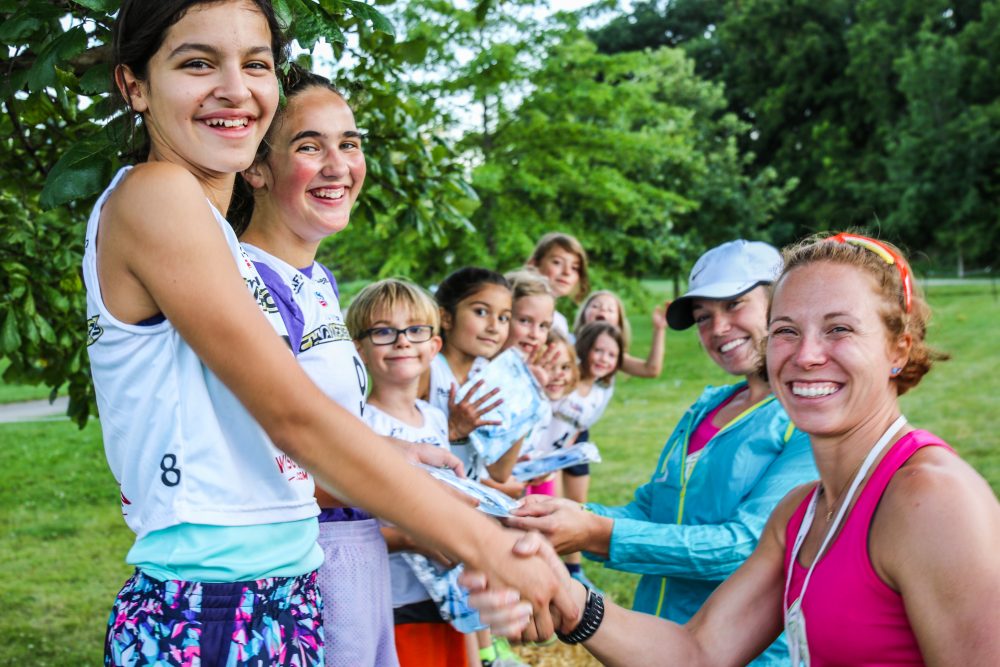
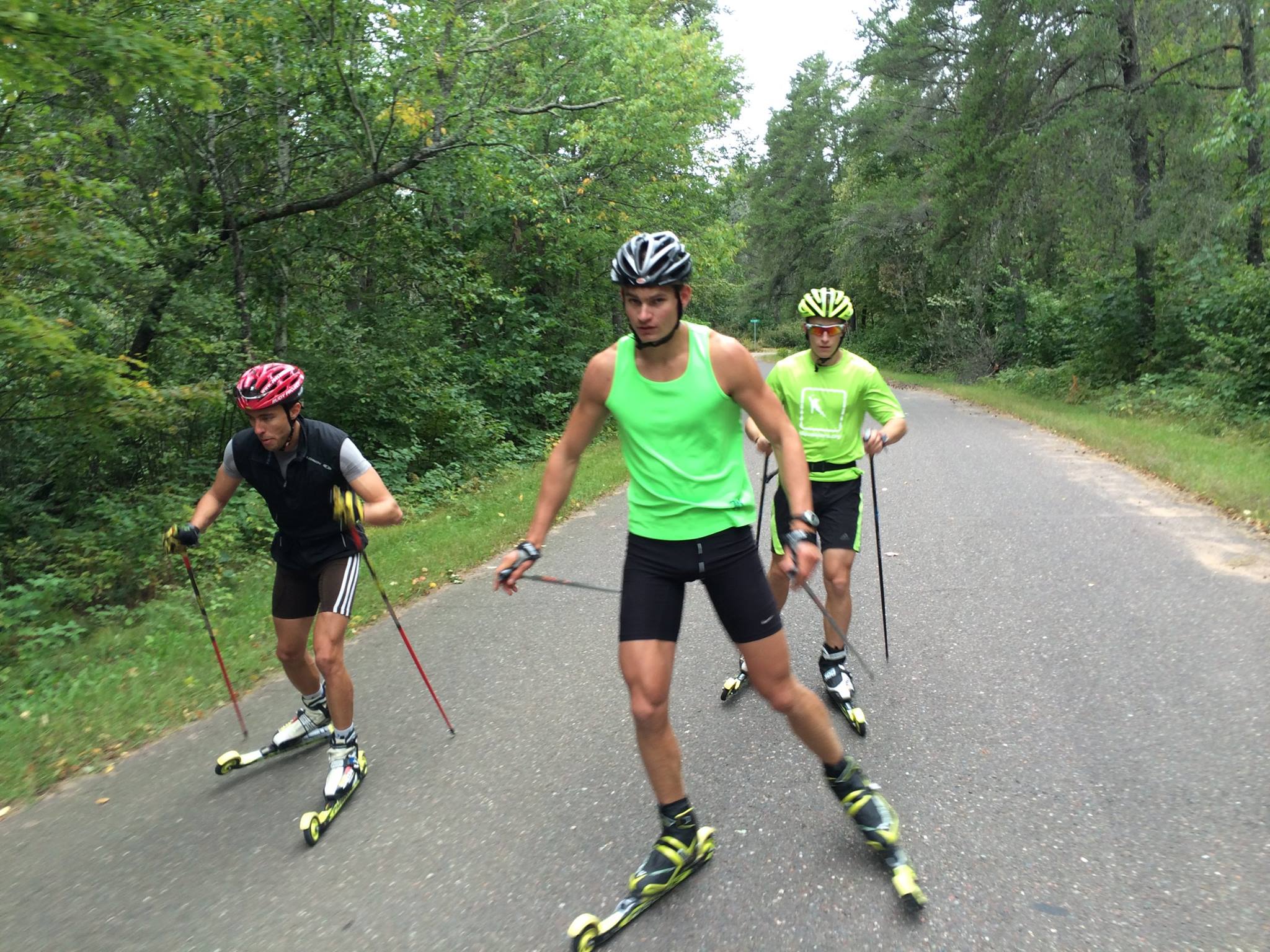
Eliška Hájek Albrigtsen (formerly Hájková, front right) with Madison Nordic Ski Club’s Trail Kids this summer.(Photo: Tobias Hájek Albrigtsen)
Many mornings, Eliška Hájek Albrigtsen’s husband, Tobias Albrigtsen, has to peel her out of bed. Living the life of an early bird like her spouse is nowhere near the top of her list — partly because she spends most nights prodding her hubby awake as he finishes his work, partly because she is strung out between four jobs of her own.
Being in charge of three ski programs while assisting a fourth is not where the 29 year old envisioned herself when she moved to Madison, Wisconsin, this past June to work for Central Cross Country (CXC). But a lot can change over the course of a summer and for Albrigtsen (formerly Hájková), a lot did.
After relocating to the Badger State’s capital from Lake Tahoe, California, to serve as CXC’s Community Olympic Development Director, Albrigtsen’s responsibilities began to accrue.
It started with the addition of coaching CXC’s online master’s program. Then she had an interest in helping with CXC’s Paralympic and adaptive athletes. Finally, in late August, Andy Keller left his head-coaching position with the CXC Team to join Northern Michigan University (NMU) as an assistant coach, and Albrigtsen was in a prime spot to take over the reins.
“When Andy took the assistant coaching job at NMU, it was kind of natural that I got the CXC Team head coach position,” Albrigtsen, a Czech Republic native, said during a recent phone interview. “For me, it’s not like a big promotion, it’s just more stuff to do while I still do all the stuff I was doing before. I have a lot of responsibilities all of a sudden that I didn’t start with.”
Among those responsibilities, she has been busy making informative videos for CXC Academy under the job title of Community Olympic Development Coach.
While attending the University of Colorado-Boulder (CU), she finished in the top 10 of 45 out of 48 races over the course of her college career, according to a CU press release, all while maintaining above a 3.5 grade-point average.
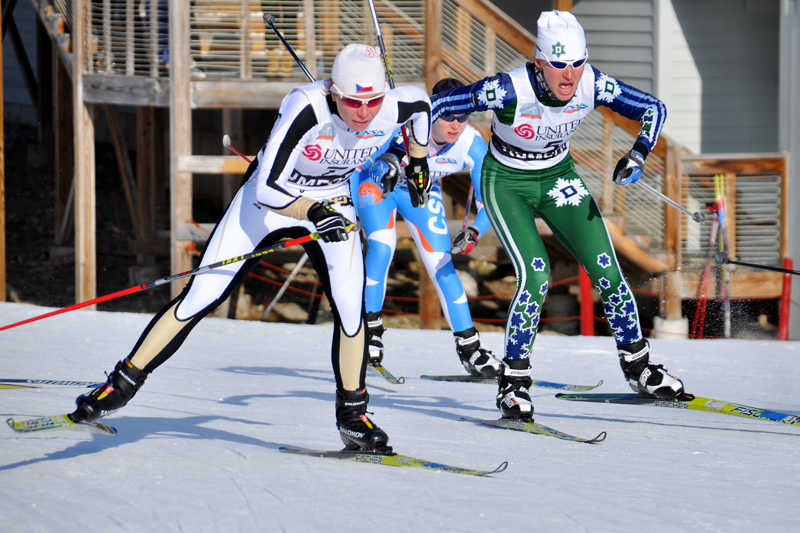
Eliska Hajkova (CU), racing against Sophie Caldwell (Dartmouth) and Corey Stock (CSU) during a sprint semifinal in 2012. Hajkova graduated in 2013 and after marrying, changed her last name to Hájek Albrigtsen. (Photo: James Doucett)
After three seasons coaching the BNJRT in Colorado, Albrigtsen moved to Kings Beach at the north end of Lake Tahoe last year, where the juggling act continued. There, she served as the head coach for Tahoe XC, while also volunteering with the Auburn Ski Club’s elite athletes, taught private ski lessons for Tahoe Donner, coached an online master’s program, and once again raced U.S. nationals, placing 12th in the 20 k classic mass start.
She’s also raced more than two dozen World Cups, most recently in 2014.
Though Albrigtsen indicates that she “never stops officially training or racing” this year might be a little different as it will be her first season coaching senior elite skiers. Still, the idea of more challenging practice sessions is enough to draw her in, even if it means scaling back her training a bit. As a coach she brings not only race experience, but the empathy and understanding of an athlete.
“With U14 kids, I mean, I was challenging them, but I was not getting challenged,” she reflected. “I think being challenged as a coach, being able to hang out with your athletes, you really see and you can really feel their pain. When you’re right on their butts and doing every exercise, you can see, ‘OK, I know that in the Level 4 on the fifth minute, during the sixth interval you died, so let’s figure that out.’ I think that’s one of my powers, that I can really be there when it’s happening.”
When asked of her strengths as a coach, CXC Executive Director Yuriy Gusev was quick to respond.
“Her racing experience, number one,” he said on the phone. “And [she’s] just very energetic and hardworking and organized.”
Albrigtsen will work with three CXC Team skiers this winter: Felicia Gesior, Kyle Bratrud and Sam Elfstrom. All three graduated from NMU, are currently based out of Marquette, Michigan, and will set their focus on the first few SuperTour races and U.S. nationals before re-evaluating their season goals. The fourth CXC Team member, Nichole Bathe (who graduated from the University of Alaska Fairbanks) remains on roster, but headed to Europe earlier this fall to train in Norway with a goal of making the 2018 Winter Olympic Games for Great Britain’s national team.
Until the first week of SuperTour racing in early December, the amount of time the other three CXC elite skiers and Albrigtsen work together will depend on the athletes. Albrigtsen wanted to keep the summer and fall schedule fairly flexible so her athletes would not feel restricted in the amount of paid work or fundraising they could accomplish while training for the upcoming season.
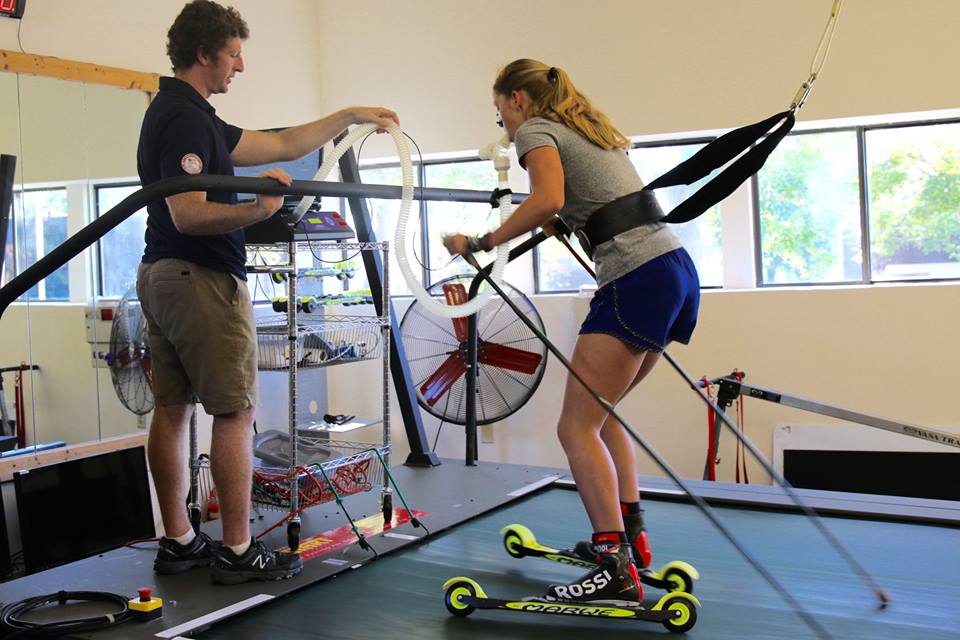
For example, Gesior made a trip to Madison earlier this fall for a training session on CXC’s rollerski treadmill with Albrigtsen, but will spend most the next few weeks training in Marquette and preparing for a fundraiser she’s organizing: the Bergkönig trail run on Nov. 11. The event features 10 k, 5 k and 1 k races and was originally created by Maria Stuber and Bryan Cook in an effort to raise money for local cross-country skiers looking to continue their ski careers post-college.
Gesior also works as a substitute teacher in Marquette, and most of her training this summer and fall has been with the NMU women’s team. Similarly, Bratrud and Elfstrom train with the NMU men’s team.
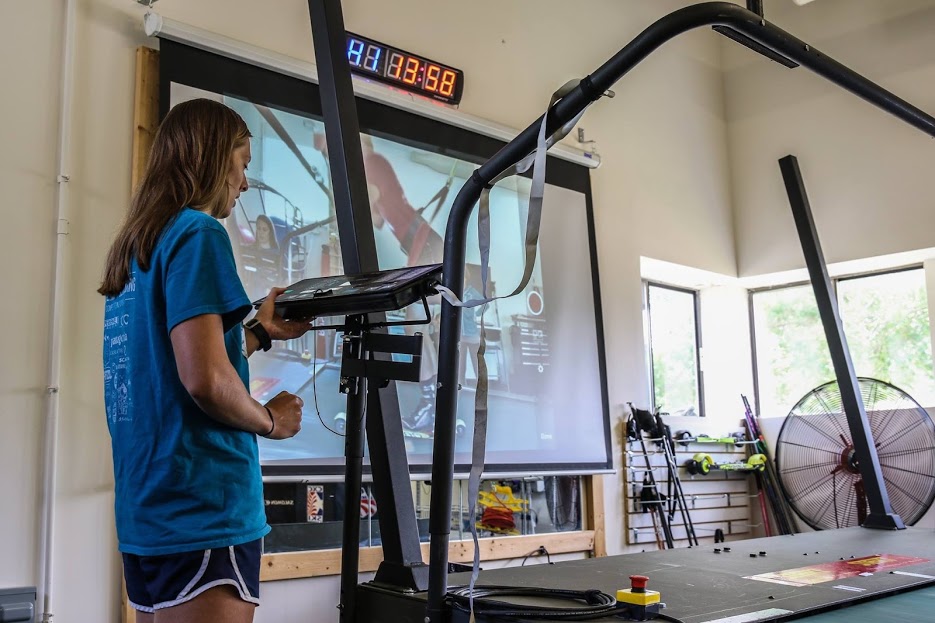
Felicia Geisor of the CXC Team prepares to hop on the treadmill in early September. (Courtesy photo)
“I think that’s OK that they follow [NMU],” Albrigtsen said, “That’s kind of the program that really took them where they are and they have something to top it. They don’t train like college skiers; I mean, it’s their job right now so they do train more. But the base is very similar and [NMU Head Coach] Sten [Fjeldheim] is being really nice about allowing them to train with them. Not all college coaches are that way, so we’re definitely really lucky.”
According to Gusev, partnerships like the one CXC has with NMU and other programs in the Midwest are the reason for CXC’s expansion. Over the last decade, he said CXC has grown from a $50,000-dollar organization to a million-dollar one.
“It’s all of those partnerships,” Gusev said of the CXC programs’ continued growth. “They’re incredible organizations so we’re able to work with all of them together and help them work together.”
The organization hopes to continue its expansion with the addition of a $12-million-dollar training complex just outside the Madison suburb of Middleton, Wisconsin, which is currently in the planning stages. The facility would not only include a competition venue, but snowmaking equipment, a lit rollerski loop, and 30,000-square-foot facility open for recreational use as well.
The idea behind the complex, Gusev indicated, would be to provide CXC athletes with a training venue, while simultaneously encouraging community members to get outside and active, using skiing as an example. The center already has one complex, the CXC Center of Excellence in Madison, complete with rollerski treadmill. “With the CXC Team, our number-one goal is to support the athletes that need the support. That’s as simple as that,” Gusev said. “But overall, our goal as an organization is to grow the sport at all levels.”
To Albrigtsen, the new facility is another reason Madison and CXC seemed like a good choice for her and her husband, Tobias, who is CXC’s media and communications coordinator, when moving from Tahoe to the Midwest. That, and the cost of living.
“We always talk about what can Midwest offer that other regions can’t. We don’t have the mountains, we don’t have the best winters, but what we really have is the best quality of life,” Albrigtsen said.
“You can live much cheaper here than anywhere else in U.S. and still make somewhat good money,” she continued. “Not everybody, especially in the U.S., there’s maybe 10-15 people who can do this professionally and get paid being skiers, otherwise you have to work and that’s something Midwest does have to offer. You can have a normal life and be a skier. You can do it here.”
While Albrigtsen’s “normal life” is somewhat busier than others might prefer, she is in no way deterred.
“I am a total sport addict, and I think every coach has to be, otherwise it’s not really worth it,” she said. “Tobias and I, we’re just trying to do what we love and give something back.”
Give something back, and get a little training in at the same time, even if it’s in between her multiple jobs.
“My motivation is also to fit in my jeans, wearing tight dresses,” Albrigtsen added with a laugh. “I have a five-year-younger husband so I have to take care of myself.”
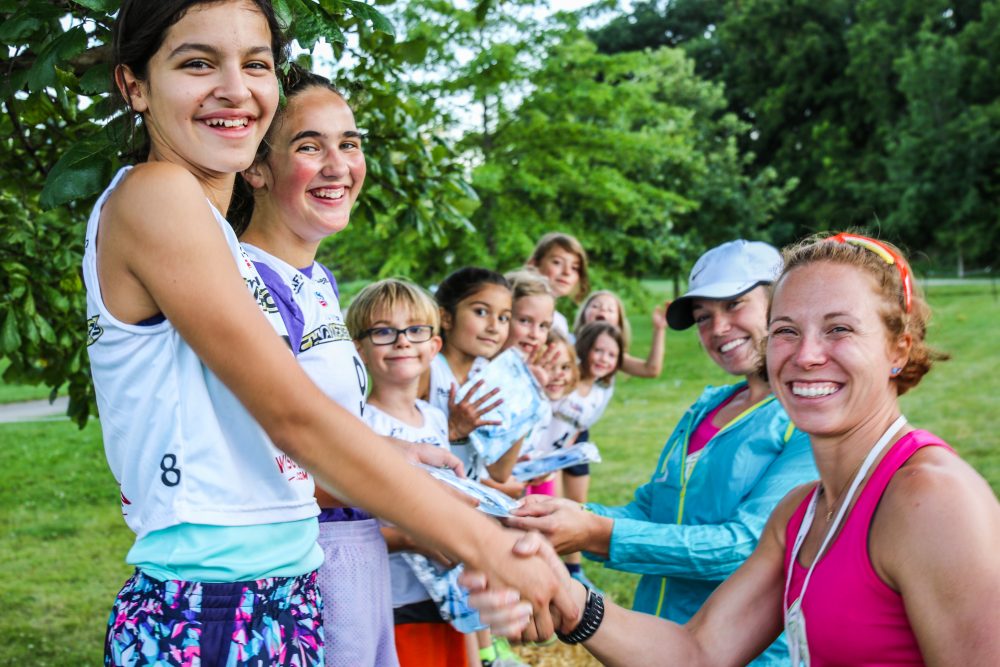
Eliska Hájek Albrigtsen (formerly Hajkova) leading a Fourth of July run with Madison Nordic Ski Club’s Trail Kids this summer. (Photo: Tobias Albrigtsen)
Central Cross Country (CXC) junior development skier Siri Martin (r) gets a mid-summer VO2max test on the rollerski treadmill at CXC’s Center of Excellence in Madison, Wis., in late July (Photo: CXC Facebook)
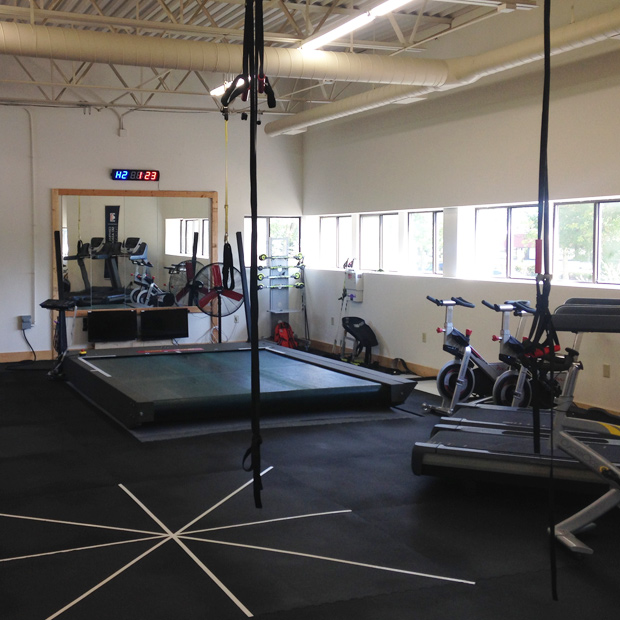
A glance into any one of the glass windows lining the east side of Central Cross Country (CXC) Academy’s Center of Excellence building might give the impression of the average athlete gym. But if you step across the front threshold or take a peek at the academy’s 360-degree virtual online tour and sport science page, you’ll find much more than treadmills, stationary bikes and medicine balls.
Located in Madison, Wis., the CXC Center of Excellence also houses a 10-by-12-foot rollerski treadmill, SkiErgs, and an in-house-made, power-pole machine. For many, though, equipment is not the most powerful tool in the center. Rather, it’s the center’s capacity to evaluate and educate its members and non-members alike about nordic skiing.
Currently, the Center of Excellence offers performance evaluations, as well as fitness testing for lactate and VO2max using the oversized treadmill. Recorded and individualized technique coaching sessions on the rollerski treadmill are also available for those willing to pay $150 dollars per hour. To help athletes gain a better understanding of their body within sport, the center is also presently working on developing a biomechanical analysis software.
The rollerski treadmill at the CXC Academy Center of Excellence (Photo: cxcacademy.com)
And CXC recently hired a sport development and education director, Egor Akimov, CXC head coach Andy Keller explained on the phone.
“He’s got a bachelor’s and PhD from the Russian State University in physical education and sport, so he majored in human physiology, he’s competed over in Russia and then he served on the Moscow Center of advanced sports technology as the head of the science department,” Keller said. “So he’s done a lot of research over in Russia on the biomechanics and stuff like that. He’s kind of leading our center [in Madison], doing a lot of the sessions down there and the technique work.”
According to the CXC Executive and Athletic Director Yuriy Gusev, the Center of Excellence is approximately 90 percent complete. Anyone from CXC club members, to donors, to CXC team members, and the general public, can access the center at no cost. Rollerski treadmill evaluations cost CXC clubs $250 per day, $150 per hour for all others.
“We are finalizing a few more partnerships on the sports science program and equipment but will start performing studies in cross country skiing this coming fall,” Gusev wrote in an email. “Our goal is to have top sports science facility to study latest innovations in the sport, potential application in cross country skiing to improve training, recovery and performance.”
While the CXC elite team, known as the CXC Team, uses the center for testing, its current base in Marquette, Mich. has also led the team to seek out other partnerships. This included collaborating with the Northern Michigan University (NMU) Olympic Training Site, allowing CXC Team members to use the school’s facility and other amenities.
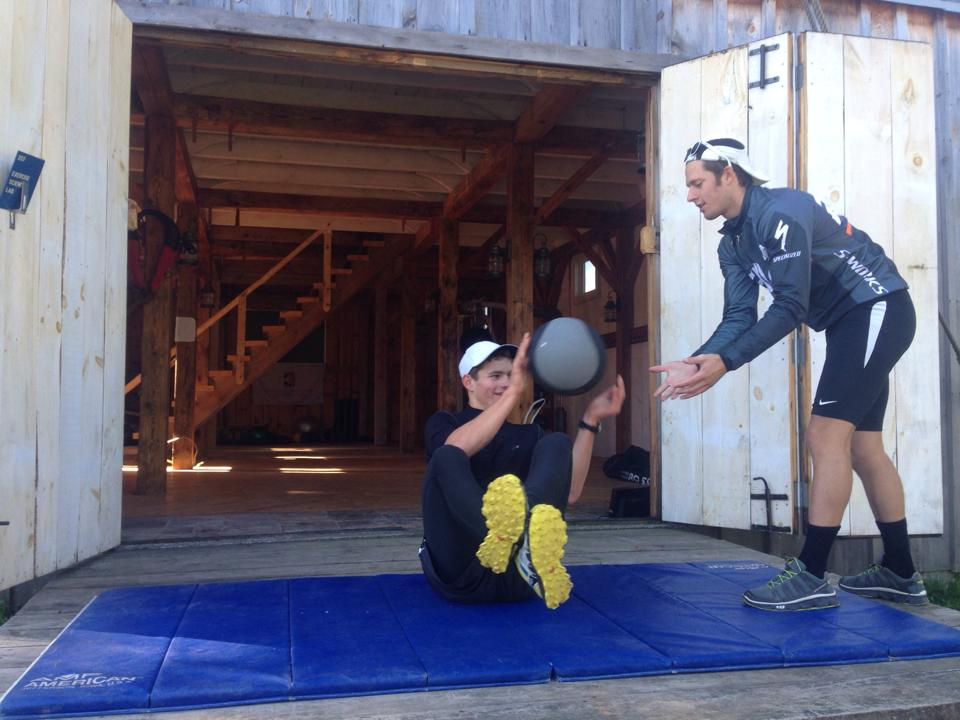
CXC Team Head Coach Andy Keller (r) works on strength with Scott Harrison outside a barn near the team’s former home base in Cable, Wis., in 2014. The team is now based in Marquette, Mich. (Photo: CXC/Facebook)
“This year we moved up to Marquette partly because a lot of the athletes have come from Northern Michigan, but also because there’s quite a bit of opportunity up here,” Keller said. “We’ve kind of partnered up with the Olympic training site located here. So we’ve been able to use the dorms on campus, offer schooling, have a training room and weight facilities available. … [The move to Marquette] has given us a lot more freedom with athlete housing and training opportunities.”
At present, the CXC Team has three full-time athletes and two part-time collegiate skiers. Kyle Bratrud returned to the CXC elite team for his second year; new full-time members include Dartmouth graduate Oscar Friedman and NMU grad Felicia Gesior. Jan Ketterson, a Dartmouth student currently taking the fall and winter trimesters off to focus on skiing, plans to race for CXC along with Nicole Bathe, presently a student at University of Alaska Fairbanks.
The growing numbers on the CXC Team was one reason CXC also recently decided to nix its marathon team, Keller explained.
“That was kind of another thing with refocusing with the marathon team, just my role and what resources I can put out just being by myself,” Keller said. “The main reason why we [ended our marathon team] is we’re trying to make a big push to promote club development.”
By discontinuing the marathon team, CXC saw an opportunity for athletes to return to their home clubs and promote racing on a more local, community-based level.
“The athletes that were on our team last year, both our current athletes and our previous athletes that we don’t have on the team anymore, we encouraged them this upcoming year to be a part of the clubs in their local area,” Keller said. “From what I heard in talking to them, most will continue to race in some facet.”
Chris Pappathopoulos won the men’s overall CXC Marathon Cup last season while competing for the CXC marathon team. (Photo: CXC)
He added that the team’s reigning CXC Marathon Cup winner Chris Pappathopoulos would likely be supported by companies like Rossignol and Boulder Nordic Sport.
While former CXC marathon team members like Pappathopoulos will look to return to their local clubs, Keller looks to expand the CXC Team program and podium at U.S. nationals with the athletes he’s currently working with.
“For a couple years [CXC] was really down and out from the years when we had Jessie [Diggins], Caitlin [Gregg], and Jennie [Bender], all those strong athletes,” he said. “So we definitely want to get back to fighting for SuperTour podiums, fighting for World Cup spots … and in this next year, I think there’s athletes who are on our team that are capable of it.”
With access to the NMU Olympic Training Site, CXC’s Center of Excellence and new scientific research taking place this fall, Keller doesn’t doubt CXC as a force to be reckoned with this season and seasons to come.
“We have the training group, we have the structure and the facilities,” Keller said. “And I think the more excitement we got here, the more we can achieve those goals of being at the top level.”
Sunrise on campus at Michigan Technological University in Houghton, Mich. (All photos: Alice Flanders/aliceflanders.wordpress.com)
This week’s workout comes from Michigan Tech masters student and skier, Alice Flanders, also a satellite athlete with the Central Cross Country (CXC) Team. Flanders trains with the Michigan Tech team, and largely does workouts designed by head coach Joe Haggenmiller, while CXC Team coach Andy Keller oversees her training. Read her complete blog post here.
Do you have a workout you’d like to share? Email info@fasterskier.com with the subject line: Wednesday Workout.
***
I’m waiting in the starting pen, the 20-degree wind blowing gently across the stadium as the clock beeps the tell-tale tones of another racer starting. I chisel the chunks of snow out of the bottom of my boot and clip into my skis. I step up to the wand.
“15 seconds”
“Beep… Beep… Beep….Beeeeeeeep”
I try to start but for some reason my feet just won’t move.
“Beep… Beep… Beep…. Beeeeeeeep”
“Thwap!”
Early morning speeds during metronomes at Michigan Tech in Houghton, Mich.
Groggily, I fumble through the sheets looking for my persistently beeping phone. It’s 5:52 am and my body feels like a sack of bricks.
I roll over placing my index and middle finger on the underside of my wrist. 10 beats in 15 seconds, 40 BPM (beats per minute). Not a bad a.m. pulse, but that’s a little higher than normal. I’ll have to drink lots of water today and make sure I haven’t caught the back-to-school-plague that seems to have taken over the school.
Stepping outside, the entire town seems dead. If it weren’t for the street lights, I’d be unlocking my bike by starlight. Occasionally I’ll pass by a group of ROTC students running in synchrony, but until arriving at the Student Development Center there’s no one in sight. This morning we’ll be doing metronomes, a workout where we double pole around the track at different tempos to work on technique and speed.
The Workout: Metronomes
Total Time: 45-60 min
Goal: Focus on high quality technique while using different tempos. Immediately apply this to sprints and starts.
Warmup: About 10 minutes or 3 songs
Workout:
Set 1:(with metronome playing over loudspeakers: listen to an actual metronome and match your pole plants to the beat)
2:30 @ 50 BPM
0:20 @ 60 BPM
0:10 @ 80 BPM
Repeat 3-5 times
Set Break: Length = one song of your choice
Set 2: 6-10 x 100-meter sprints
Cool down: About 10 minutes
This workout has a lot of benefits.
It teaches the athlete how to ski using varying tempos
By skiing around the track, it is much easier for coaches to work with athletes of different speeds and track progress throughout the session
Technique and tempo can be applied immediately during the 100m sprints
It’s good mass start practice due to the amount of passing that occurs
Pace lines will form and it’s fun to go fast in a group!
There are a lot of opportunities for younger skiers to ski with, watch and learn from older people on the team.
You get to listen to music
No Cars!
But be careful, this is an intensity session and should be counted as such. Recovery in between the 80 BPM and sprints should be a priority.
By 7:30 the sun is painting the sky hues of pink, purple and yellow. It’s not hard to realize how lucky we are to live in a place like this.
Class time: Where recovery and learning come together.
In class, while other students are guzzling coffee trying not to nod off, I’ve got positive endorphins keeping me engaged. However, as the day continues I find myself gazing out the window as storm clouds congregate on the horizon. It’s supposed to rain tonight. Right now I keep my fingers crossed that the rain will go somewhere else, keeping our roads dry for practice this afternoon. In a few weeks these clouds will hold potential for snow. As my professor fills the board with equations, I daydream about how much snow we’d get if it were 15 degrees cooler.
Excelling in any sport takes an extreme amount of commitment and self discipline. It takes over your thoughts, drives your decision making process and rules your schedule. Every moment of the day is carefully crafted to strengthen your body through nutrition, intensity, recovery or education. It’s an all encompassing full time job. Luckily, this job comes naturally when you have passion for the sport. It begs us to reach higher, to do one more pull-up, to push the limits of comfort and ultimately persevere. What are your goals this season?
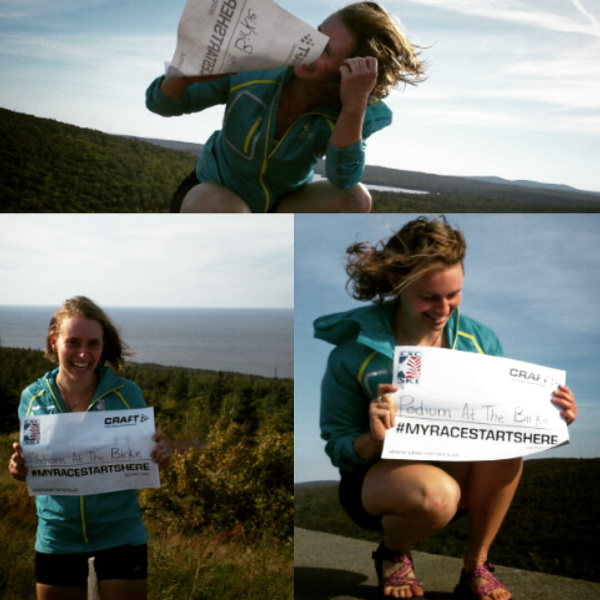
Michigan Tech masters student and skier Alice Flanders setting goals, specifically to podium in the American Birkebeiner skate race, as photographed on Brockway Mountain in Copper Harbor, Mich. (Courtesy photo)
The newly appointed CXC Team Head Coach Andy Keller (r) works on strength with postgrad Scott Harrison outside a barn near Cable, Wis. (Photo: CXC Skiing/Facebook)
Three years ago, Andy Keller was a college kid looking for an internship toward his exercise-science degree at Michigan Tech. He knew a girl, who knew Jason Cork, and he used the connection to land an apprenticeship at the Central Cross Country (CXC) Ski Association in Cable, Wis.
At the time, Cork was heading up the CXC Team, which executive director Yuriy Gusev established in 2006 to support promising skiers striving for top national and international performances. Keller, who grew up just outside Minneapolis in Chanhassen, Minn., became Cork’s intern assistant.
Andy Keller started as an intern, then an assistant, and finally a junior coach before being promoted to CXC Team head coach this month, following the departure of Bill Pierce. (Photo: CXCnewsfeed.wordpress.com)
Months later, before Keller began his senior year, Gusev offered him a job.
“I said, ‘I kind of want a degree so I’ll talk to you in a little less than a year,’ ” Keller reflected on the phone last week.
He skied for four seasons at Michigan and graduated in 2012, then asking Gusev if there was still a spot for him. There was, though Keller’s job title and responsibilities changed three times before he officially got started, he said.
First, he was hired as sport-development manager, tasked with connecting CXC to youth clubs and high-school programs in the Midwest. Then, CXC’s assistant coach Gus Kaeding left to head the Stratton Mountain School (SMS) elite team in Vermont. Cook needed an assistant, and CXC’s board decided Keller would be it.
“Then there was a little bit of [difference] with coaching styles and athletes on the team, so Bill [Pierce] got brought on to work alongside Igor [and] I took more of a dedicated role to the junior program,” Keller said of last season. “This year started off the same way … I was focused more on the junior program.”
For the next several months, Badamshin oversaw the program and Pierce worked as the elite head coach. In late January, Badamshin died unexpectedly of a heart attack while skiing the Birkie trail between Cable and Hayward, Wis. He was 47, and his passing left CXC and the surrounding community stunned.
“A guy that works his ass off and is willing to do anything for his program … his passion truly lied with working with athletes,” Keller reflected. “[I] was just trying to carry on his legacy — inspiring kids to ski and getting them excited to be out there. If there’s one thing he was good at, it was definitely that, and also carrying on his work ethic. The guy wouldn’t complain. He’d be out there skiing 50 k and waxing…
“There was definitely big shoes to fill when he passed away,” CXC Team’s new head coach continued. “As I’ve come through, I’ve been working under a ton of coaches; my philosophy is I can always learn something. When I was interning under Jason and Gus that was what I loved to do — learning and listen.”
“There was definitely big shoes to fill when [Badamshin] passed away. … As I’ve come through, I’ve been working under a ton of coaches; my philosophy is I can always learn something.” — Andy Keller, CXC Team Head Coach as of September 2014
Keller Becomes Head Coach
That’s right, Keller, in his third season as a CXC coach, was recently promoted to head of its elite team following Pierce’s decision to accept a job in Colorado (he’s becoming nordic director of the Snow Mountain Ranch YMCA near Winter Park this fall) earlier this month.
But “elite” is a term Gusev and several other U.S. nordic directors like to stay away from: it’s about development and helping athletes reach their higher-competition goals. The CXC Team became Team Vertical Limit in 2009 as part of a sponsorship deal, and a year later it had 18 athletes, including a couple Olympians (Garrott Kuzzy and Caitlin Compton — now Caitlin Gregg).
The New: 2014/2015 CXC Team
CXC Team:
Cory Ellertson
Bjorn Batdorf
Bill Bowler
Chris Pappathopoulos
Hilary Patzer
Andrew Brown
Scott Johanik
Natalia Naryshkina (lives in Russia, plans to compete in western SuperTours and U.S. nationals)
Postgrads: (living in Cable this fall/winter)
Scott Harrison
Sam Boardman
College Summer Residency Group:
Nichole Bathe (University of Alaska Fairbanks)
Nicolette Reker (now at Winona State University, competing for CXC Team)
Tom Bye (Postgrad last year, now at Michigan Tech)
Thomas Kendrick (Michigan Tech)
Will Frielinghaus (St. Lawrence University)
Seth Mares (Gogebic Community College, plans to transfer to Michigan Tech)
International Training Partner:
Leandro Lutz (living in Cable this fall, plans to travel to Europe for international races in an attempt to qualify for World Championships; may stay in Cable and race U.S. circuit)
The CXC Team currently has eight members, most of which will be focused on top-10 results in Midwest marathons to attract sponsors. In addition, Keller is overseeing two postgrads, about 10 juniors and an international guest skier.
“All the coaches agreed, the team needs to get back to the roots of developing athletes,” Gusev explained on the phone. “You would have never called our team the CXC Elite Team, it just came later when this word became very popular.
“We always see our team as a development tool for that higher step,” he added. “We don’t see this team as full of stars, but we want to have a team open to athletes of that level. If it can help them great … It’s just like having a child: at some point you need to let them go and see if they can stand on their feet.”
Considering that, Gusev is encouraged by the direction his program is headed, especially with a homegrown coach at the helm.
“It’s exciting to see somebody who went through the original pipeline and became a coach,” he said. “And that’s a goal from the time he applied from an internship.”
Still, the last few weeks — and months — have been busy at CXC, to say the least. Following Badamshin’s passing, Gusev said the organization interviewed a couple people to hire in his absence, but ultimately, Pierce and Keller stepped up and said they could handled the added responsibilities without another coach.
“It was probably more emotional for some of us, but you just move on,” Gusev said. “The programs needed to move on as well and … we had to adjust right away.”
It didn’t take long for everyone to get back “in the groove,” he added. Pierce continued to serve as head coach and Keller as his assistant and junior coach.
Last Friday, Keller drove 300 miles southeast to Madison to test about 10 juniors at a weekend camp at CXC’s administrative headquarters. The group meets about once a month in various places, holding camps with other Midwest clubs, like Loppet Nordic Racing (LNR), May through December, Keller said.
He also helps host monthly CXC master’s camps, and while he’s not scheduled for every single one, he led a recent camp under Pierce’s guidance earlier this month.
“I made Andy run over half the sessions, and I watched him and helped him a little bit,” Pierce said. Then he told him and the rest of CXC about his decision to leave.
“I saw it coming,” Keller reflected. “Bill did talk to me as he found out more about the new position he was taking.”
In Cable, where Keller lives in a condo on the Telemark property, he spent the summer working with six athletes in CXC’s new college summer residency program, which Pierce initiated.
“That overlapped with what you would call our team now, more of a marathon team,” Keller said of his previous and current responsibilities, coaching juniors and now seniors as well. “The athletes that we’ll have competing on the SuperTour is relatively small.”
Those skiers include two postgrads from LNR — Scott Harrison and Sam Boardman — who plan to live and train full time in Cable this fall and winter. Their main races include western SuperTours, U.S. nationals, and the Midwest Junior National qualifiers .
“We don’t see this team as full of stars, but we want to have a team open to athletes of that level. … It’s just like having a child: at some point you need to let them go and see if they can stand on their feet.” — CXC Executive Director Yuriy Gusev
With an overall emphasis on regional competitions, CXC is looking to assemble the best skiers in the Midwest.
The Old: What happened to last season’s CXC Team?
Not returning: Karl Nygren, Eric Wolcott, Dmitriy Ozerski (was flying back-and-forth from Russia for races)
With a single returner from last year’s CXC Team (college skier Tom Bye), Keller explained what happened:
“When Igor [Badamshin] took over there was little bit of communication issues … a little bit of discontent,” he said. Athletes like Karl Nygren, who might have had as many as five coaching changes in seven years, ultimately decided to leave the program.
“If there’s anything the program needs is some stability,” Keller said.
“As the coach now, I’d love to build the program back up to how it was when I interned,” he said, referencing past CXC standouts like Jessie Diggins, Caitlin Gregg, Brian Gregg, and Jennie Bender. “…That was the year they won the NNF Cup so that’s the level I’d like to bring it back to.”
One of Gusev’s priorities is hiring another coach focused on sport development to further connect CXC with grassroots organizations and schools throughout the central U.S. Looking at the big picture, it’s about promoting the sport and coaching development. In the long run, CXC is hoping that will translate into athlete retention.
“Regardless whether the athletes come to us directly or not … it’s a matter of whether we have consistent, easy to follow progressions, like soccer does or swimming does,” Gusev said of two sports he considers domestic successes in the U.S. “[Those sports outline the] steps to high school, college and beyond, which doesn’t exist really in cross-country skiing. We have all the pieces in place, and we can communicate that to parents.”
For Keller, his goal is to help grow the base and competitive nature of skiers in the Midwest, which includes Illinois, Indiana, Iowa, Kansas, Michigan, Minnesota, Missouri, Nebraska, North Dakota, Ohio, South Dakota, and Wisconsin.
“It’s where I grew up,” he said. “[We’re] trying to make the Midwest more of a ski powerhouse, and that’s definitely happening. We’re developing athletes, but we’re having a hard time getting them to stay around.”
He counted eight skiers in elite programs outside their region, including Jessie Diggins (SMST2), Anne Hart (SMST2), Ben Saxton (SMST2), Gordon Vermeer (Craftsbury Green Racing Project), and Rosie Frankowski (Alaska Pacific University).
“It seems like everybody wants to go somewhere else and I’ve got to figure out why,” Keller said. “I think the level of support CXC gives is among the best … It’s just we’re not in the mountains and we don’t have a glacier to [train on]…
“The Midwest might not be the most sexy training site as a Sun Valley or something like that,” he continued. “… [But] it’s not that we’re not producing the athletes.”
“It seems like everybody wants to go somewhere else and I’ve got to figure out why. I think the level of support CXC gives is among the best … It’s just we’re not in the mountains and we don’t have a glacier to [train on]…” — Keller
In terms of coaching styles, Keller said he gained a lot from working with Cork, Kaeding, Pierce, and Badamshin.
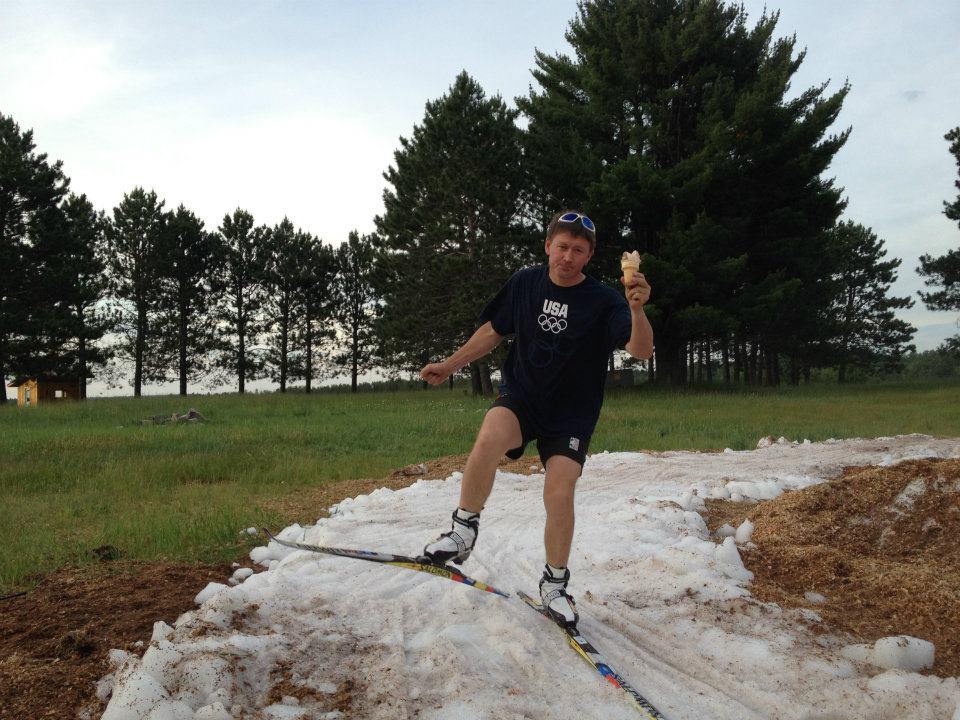
Coach Igor Badamshin having some fun on a few patches of snow. Photo is titled “Snowflakes, ice cream and Igor,” by former CXC Team elite coach Bill Pierce. Badamshin was the CXC program head coach until his unexpected death in January 2014. (Photo: cxcnewsfeed.wordpress.com)
“I’d hope I’d be maybe as analytical [as Cork],” he said. “I’m hoping I can be half as enthusiastic and motivating as Igor … I try to pull from all those guys and find out what works for myself and what doesn’t fit my personality. I would say I’m relatively soft-spoken and sometimes it’s a little bit harder for me to put myself out there. I hope I’ve gotten better at that.”
When it comes to managing athletes, Pierce will continue to write training plans for those that started with him at the beginning of the season, including Cory Ellertson, Chris Pappathopoulos, Andrew Brown, and Scott Johanik.
Keller said he’ll take on those that joined the team more recently and will be in Cable the next several months: the two postgrads and guest skier Leandro Lutz from Brazil, who plans to travel to Europe to try to qualify for 2015 World Championships.
As for coaching and waxing for 18 or so skiers throughout the season, Keller said that working alongside other Midwest clubs at races, especially at main events like U.S. nationals, should help. And not all the athletes will compete at the same events, given their varied focuses — from marathons to junior-qualifying races.
At the same time, Keller said he’s looking forward to having an assistant or some kind of helper in the future. Gusev said the new hire would largely help with junior camps.
In the last month since Pierce’s decision, he said he’d been working with Keller on the transition and will continue to offer assistance beyond his final day at the end of September.
CXC Team’s fall/winter crew during a recent workout in Cable, with postgrads Scott Harrison and Sam Boardman, and guest skier Leandro Lutz from Brazil, who will be joining the team for the next couple months. (Photo: CXC Skiing/Facebook)
“I’ve basically given [Keller] my daily responsibilities,” Pierce said earlier this month. That included even the little stuff, like “teaching him how to smooth out a trail and pick rocks and seeds.”
“There’s definitely a lot to catch up on as far as ski selection and things like that,” Keller observed. “Working with Rossignol, getting in contact with those guys, getting up to speed with things Bill might’ve taken care of as far as a team aspect and getting [ready] to compete.”
He’s also tasked with attracting sponsors through top results in Midwest marathons.
“We’ll do fine with that,” he said of his mostly marathon-focused team. “Our postgrads have goals of trying to make World Juniors … definitely a big one is qualifying for Junior Nationals and trying to make top-20 [there]. The goals for the marathon team is being on the podium or top 10 … that should be no problem.”
He’d also like to bring the CXC Team back to an “elite, elite” team, he said, by recruiting recent graduates.
CXC Para Nordic Team member Steve Baskis training with U.S. Paralympics Nordic Program in the ski tunnel in Torsby, Sweden, earlier this month. (Photo: CXC Skiing/Facebook)
According to Gusev and CXC’s mission statement, the 2,000-member organization has four straightforward goals: to build its base, promote the sport, achieve competitive success, and create partnerships through collaborations. The way he sees it, member athletes are part of that as well.
“[The CXC Team] athletes are in a community to be motivation to adult athletes at clinics, to be role models and whatever else comes with it,” Gusev said. “With competitive excellence, we hope to get them to the level [of someone like Garrott Kuzzy or Tad Elliott, who made the U.S. Ski Team]. We hope the athletes that come through our program will eventually contribute to international success…”
Emerging Adaptive Team
CXC is also focused on building its adaptive program under coach Andrew Poffenberger, another Minnesota native who skied as a junior and studied health fitness at Gustavus Adolphus College in St. Peter, Minn.
Augusto “Goose” Perez (sit-skier, cancer survivor, 2014 Paralympian)
John Oman (standing athlete, 2014 Paralympian)
“Emerging Talent” Program:
“People who have tried nordic skiing on several occasions and show promise, interest in competition, and commitment to the sport,” Poffenberger wrote. “This is an area where I am looking to grow in the next few months as people turn their attention from fall sports to winter.”
Junior Para Development: Focused on youth development and coaches interested in instructing adaptive skiers in high schools. “Our annual coaches clinic and certification will include a few sessions on adaptive nordic skiing for those interested this year,” he wrote.
This year, the CXC Para Team has expanded to include five elite athletes, four of which went to the 2014 Sochi Paralympics: Aaron Pike, Travis Dodson, Augusto “Goose” Perez, and John Oman. Its fifth member, Steve Baskis, a blind athlete and veteran, recently joined the U.S. Paralympics Nordic Team at an on-snow camp in Sweden.
Poffenberger also works with three “emerging talent” adaptive skiers — those “who have tried nordic skiing on several occasions and show promise, interest in competition, and commitment to the sport,” he explained in an email.
In addition, he coaches about four or five junior-development skiers, athletes that “can sit ski for 10 to 15 k in a session,” Gusev said. “Andrew’s done an amazing job with them.”
“Ideally we would like to mirror the development structure of able-bodied skiing,” Poffenberger explained. “Possibly the most important component of that structure is youth development. If we expect to be competitive at the highest level, we need to start developing young athletes.”
Among their efforts: CXC has submitted a proposal to include adaptive nordic at the Wisconsin state meet.
“We are also seeking out coaches who are willing and able to coach adaptive nordic skiing at the high school level,” he added.
Last week, Poffenberger attended a conference with The United States Association of Blind Athletes at the Olympic Training Center in Colorado Springs.
“I love working with these athletes because they have perspective of the entire picture, and don’t let small things stand in their way,” he said, now in his second season with the team.
“I hope we can keep having more and more individuals like [Poffenberger and Keller] that get involved with a sport as a profession,” Gusev said. “They understand the way athletes move from one stage to another stage and it’s easier for them to communicate with athletes at the younger level what expectations are. That’s really the goal.”