From the FasterSkier archive — posts syndicated from athletes’ and coaches’ own blogs between 2004 and 2012, kept online as published. Current coverage is at fasterskier.com.

Tag: Andy Shields

  • Canadian Eastern Championships: Weekend Wrap-up

    Canadian Eastern Championships: Weekend Wrap-up

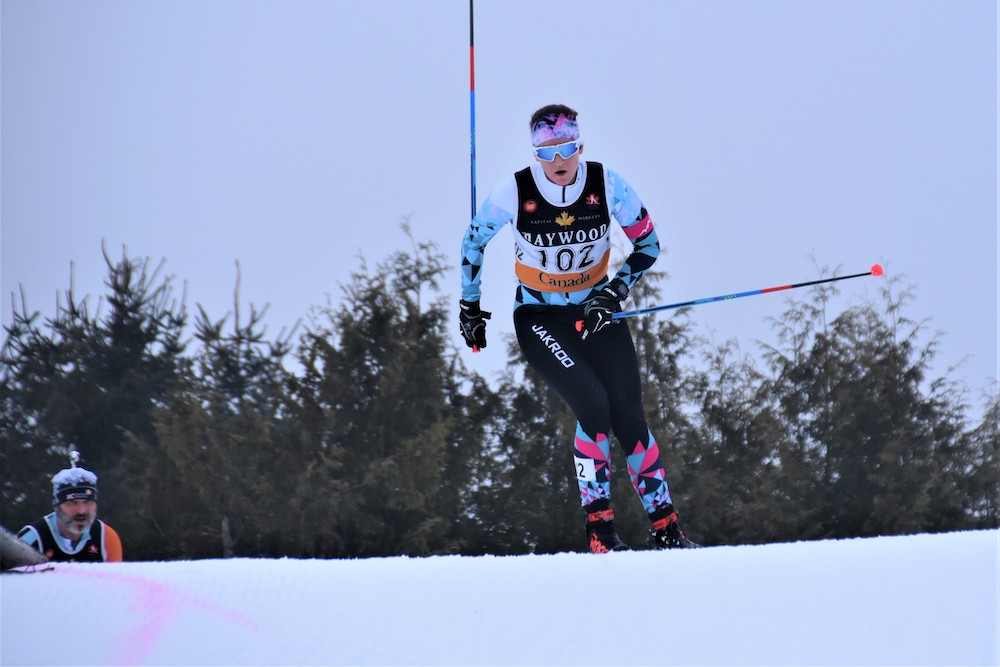
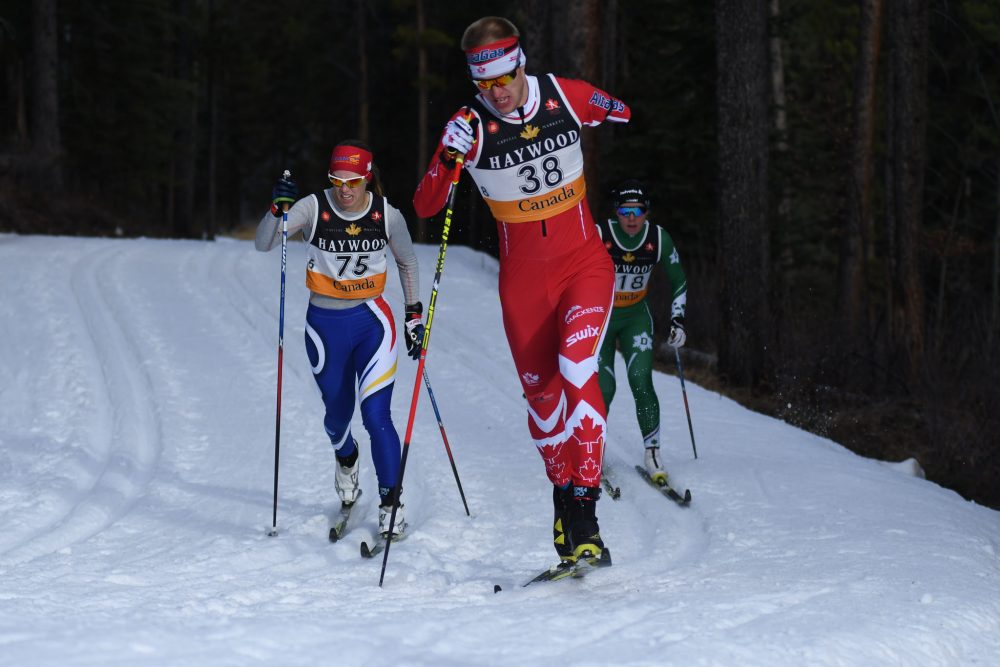
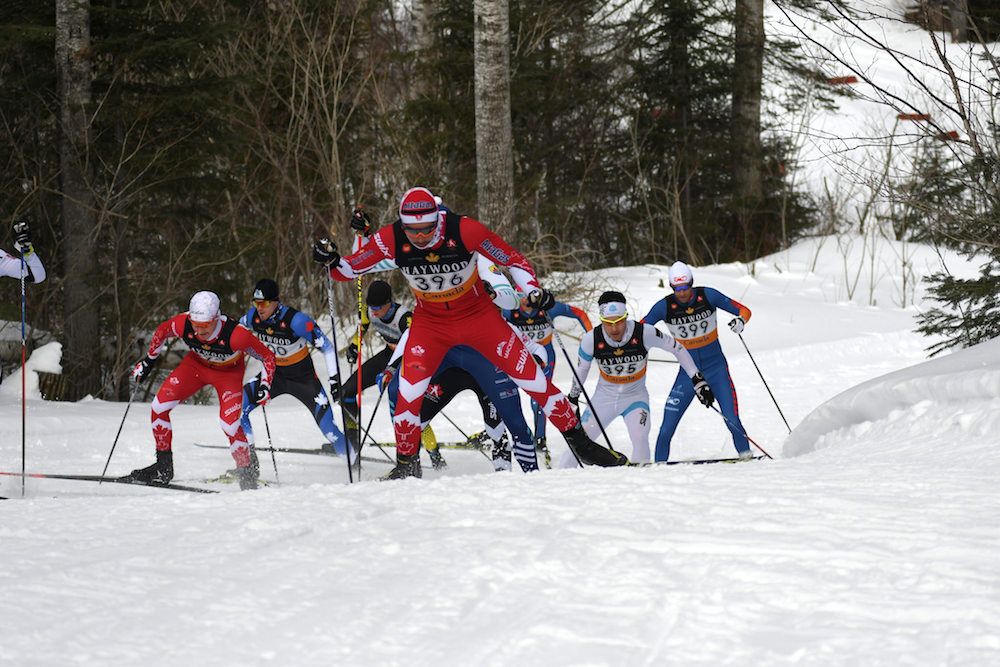
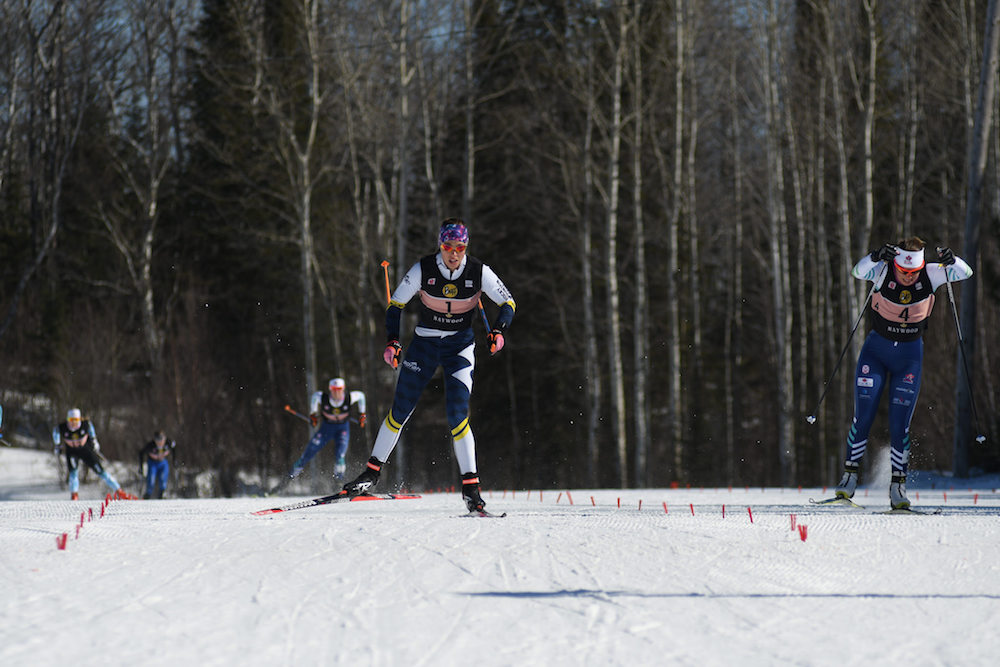
    Julien Locke leading a sprint heat. (Photo: Bob Smithson)
    Julien Locke leading a sprint heat. (Photo: Bob Smithson)

    The NorAm series went to Duntroon, Ontario, for the Canadian Eastern Championships: three days of varied weather, new race formats, and new faces on the podium, all hosted by Highlands Trailblazers.

    Easterns is possibly the most storied ski race in Canada. Most years, it is the largest FIS event in North America. This year, the Polar Vortex froze out the travel ambitions for many families and lower budgets in the post-Olympic season persuaded many western teams to stay home. Despite these challenges, over 450 athletes braved the difficult road conditions to hit the start line.

    Easterns was ringing in the changes this year. This may be the first ever NorAm where the men and women skied the same distance on the same courses in every event. The two-day pursuit reappeared for the first time at this level since 2000. 

    The two-day pursuit format was introduced in 1988. Based on the Gunderson start in Nordic Combined, there was an interval start classic race on the first day and a free technique pursuit on the second, with medals awarded for both days, but no time-of-day points for the second.

    In 2002, the two-day pursuit was replaced with the same-day pursuit, with no medals for the classic portion and a two hour break before the skate. Beckie Scott won all three medals in this event at the Salt Lake Olympics. In 2003, this was changed to ‘continuous pursuit’, sometimes referred to as ‘pursuit without a break’.  The format name was quickly shortened to ‘pursuit’, which confused people until 2011 when FIS acquired rights to the name ‘skiathlon’, allowing ‘pursuit’ to be used for the final day of a mini-tour. CCC wrote a history in 2011 to celebrate the new name.

    In the summer of 2018, FIS dropped the skiathlon format, which brings us back to a format that most of the athletes racing today will not remember.  

    The weather also came out to play: -18 Celcius (C) and windy for official training, -12 C and sunny for the sprint heats, -9 C and 37 km/h winds for Saturday’s classic, and +3 C and freezing drizzle and rain for Sunday’s pursuit.

    Photo gallery: Bob Smithson

    Results: Sprint Qualification, Pursuit Day 1, Pursuit Day 2, Time of Day

    Classic Sprints

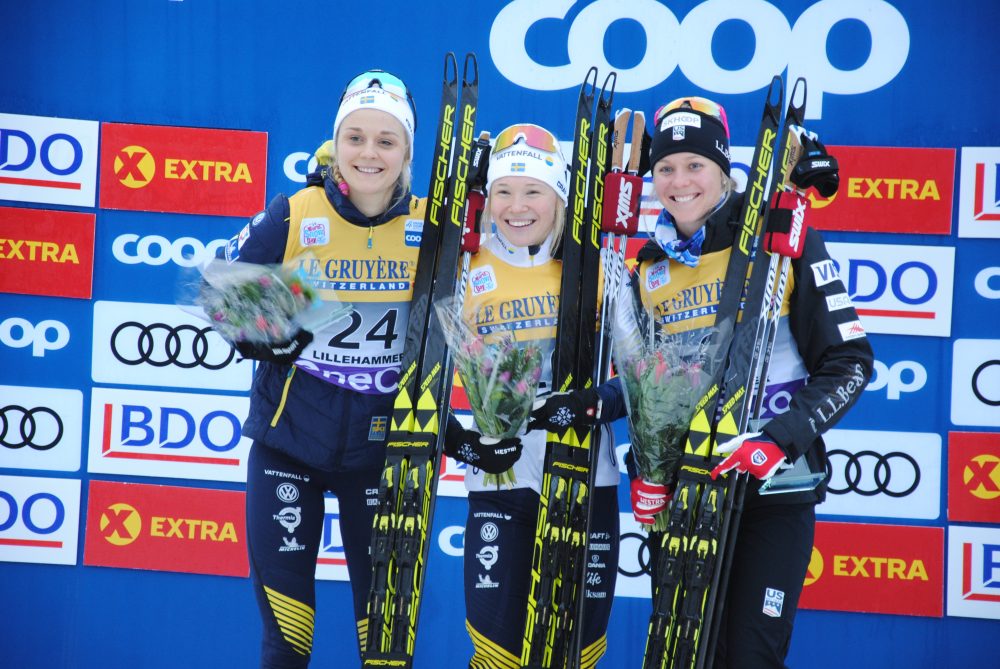
    Women’s A final: Zoë Williams (Nakkertok), Laura Leclair (CNEPH), Mia Serratore (Big Thunder), Annika Richardson (TBay), Katie Weaver (Rocky Mountain Racers), Hannah Shields (Nakkertok)

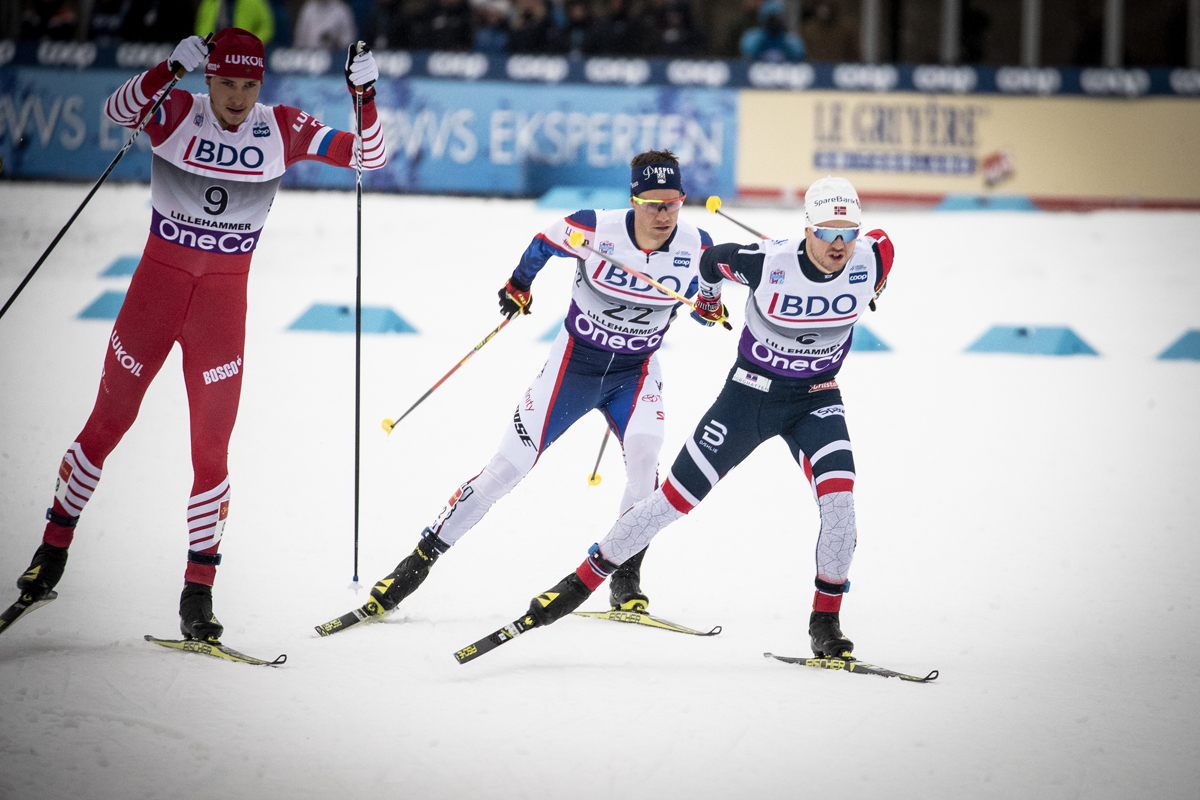
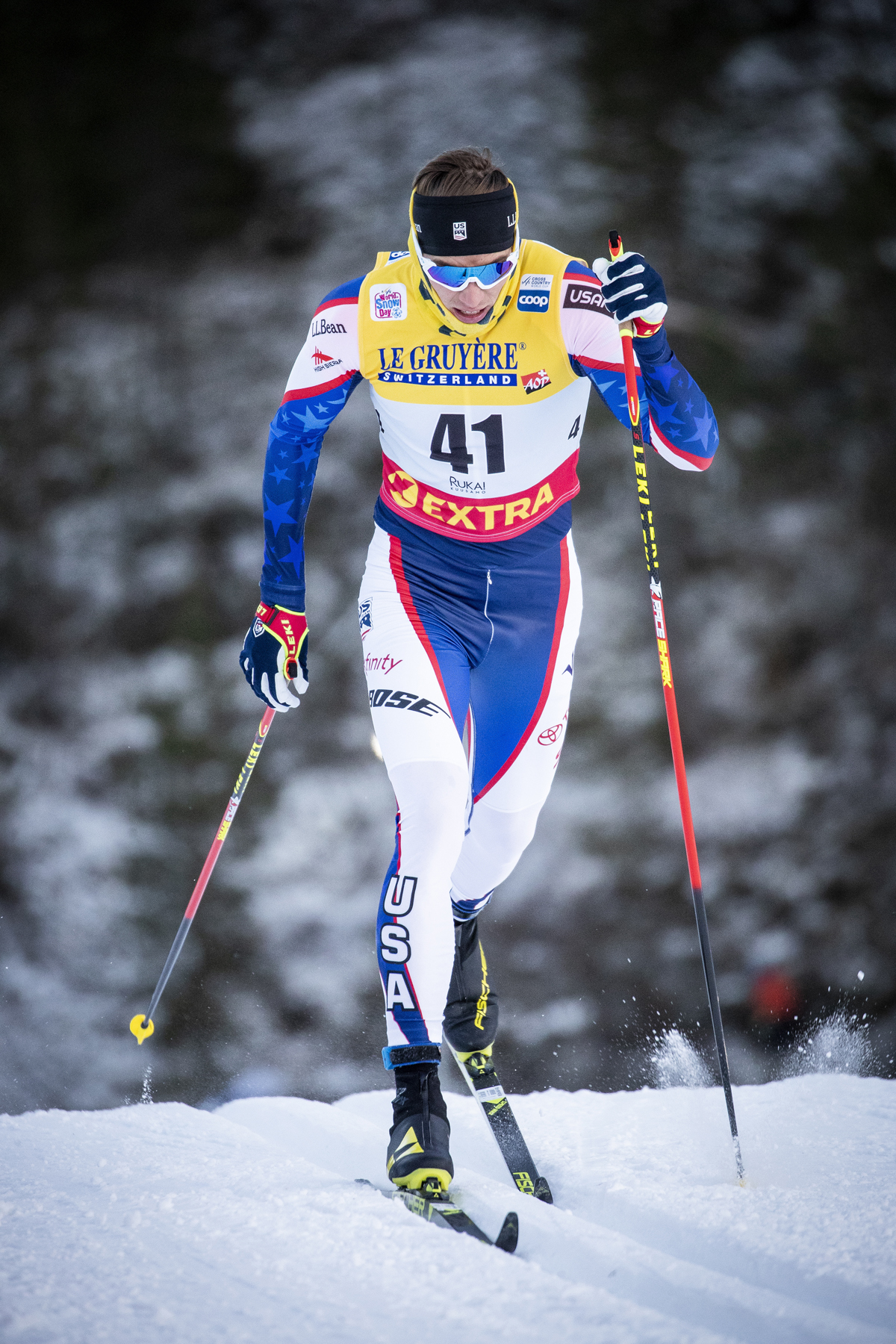
    Men’s A final: Julien Locke (CNST), Dominique Moncion-Groulx (Team R.A.D.), Antoine Briand (CNEPH), Andy Shields (Lappe), Étienne Hébert (AWCA), Angus Foster (TBay).

    There are no official results or times for the sprints.

    Friday started cold and sunny for the 1.5km classic sprints, a welcome relief after cold and windy weather on the official training day.

    “After two small running hills at the beginning, the remainder was all double pole,” Julien Locke (CNST) wrote. “While the course was not as demanding as I would have liked, it was a good opportunity to use the upper body strength.”

    The course worked well for Locke, as he won the qualifier by over 4 seconds.

    Zoe Williams (Nakkertok) won her first career NorAm, two weeks after her first podium and narrowly missing the selection for World Championships.

    “Today was very surprising,” she wrote to FasterSkier. “When I skied the course yesterday I wasn’t a huge fan and I didn’t think it played to any of my strengths. My qualifier was really messy but I pulled it together in the heats and felt I was able to get faster as the day went on!”

    The women’s A final was chaotic. Each of the three women on the podium had their own view of the action. 

    “I talked to my coach (Kieran Jones) before the A final and our plan was to stay relaxed in the first half of the course, pick it up in the second half and push it into the finish. It worked out almost perfectly; I got caught up in a fall on the main uphill and lost contact with the leaders but was able to fight back in the second half of the course with Laura and Annika and as everyone jostled for the inside line into the finish I just picked the outside lane and hammered.” — Williams

    “Honestly the A final was pretty bad. It was a cool race because everyone in the A final could race but I think we were all a little too excited (or tired). There were a lot of tangles and falls so no tactics there.” — Laura Leclair

    “Tactics were pretty important in the final. I started out hard to get out in front to stay out of trouble on the downhill. Managed to make a gap but lost it in the final straight. It was really important to be strong with the double pole at the end.” — Mia Serratore

    It was Serratore’s first NorAm podium.

    The men followed with tactics that emphasized staying out of trouble.

    “Briand set a strong pace in the first 400m up Honey and Sugar Shack hills. I followed him out to the Biathlon range and then hopped in front for the fast/icy turn. From there, I lead up the gradual Chicken Coop climb, through the twists around the wax rooms and to the line.” — Locke

    “The final started fast with Antoine putting the pace in front. I think the top three skiers (Antoine, Julien and I) had a little gap after the climbing section of the course. Julien accelerated to pass Antoine before the fast downhill, I stayed in 3rd behind them. I took the inside on the 90 degree corner at the bottom of the downhill and move up to 2nd place. Following the downhill, like in the semi-final Julien put the hammer down double poling on the gradual climb and I was the only skier that managed to stick right behind him. I tried to change tracks and pass him on the last stretch but I could not find enough speed to overtake him.” — Dominique Moncion-Groulx

    “I went all out from the gun and Julien took over at mid point. No real tactics from there on to be honest it was full gas racing.” —Antoine Briand

    Some of the athletes were feeling the effects of racing the US SuperTour after the Bishop’s University NorAms.

    “I had a dynamic first half of the qualifier but felt slow and I did not ski the second half well. I had good energy, change of gears and I felt solid through all the rounds. I’m happy with my speed in the heats and with a good final result. For a 3rd weekend of racing in a row, it’s fun to still feel energetic.” — Moncion-Groulx 

    “Coming back from a big win in Lake Placid at the US Super Tour last weekend, I was feeling confident for another classic sprint. Had a good qualification with the second best time and being on the podium at the end of the day is always satisfying.” — Briand

    Interval Start Classic

    Saturday brought in wind and warmer weather for the 10km classic race. The 5km loop had two main uphills immediately followed by downhills.

    Williams said pacing mattered because “with only 4 main hills, lots of good rest, and a ton of double pole you had to keep pushing everywhere.”  

    Williams got her second win of the weekend in 35:46.09 minutes. “Super happy with it: stuck to my plan and had fun chasing people down. Mia started ahead of me and we skied the 2nd lap together which was awesome.” 

    Serratore finished second, 37.82 seconds back. Leclair didn’t get the benefit of timely splits or good rides, but was able to grab third at 1:18.40, just 0.18 seconds ahead of Annika Richardson.

    “Because I was second to start, I was alone the whole race and didn’t see anyone,” Leclair wrote. “That was pretty hard because I didn’t know how fast the girls behind me were going. I had no bunny or rabbit. Anyway, the conditions and skis were good and it was an overall good race.”

    Among the men, Alexis Dumas (CNEPH) came the closest to even splits, crossing the line in 30:04.8 for the win.

    “I was able to ski really hard in the second lap and that’s where I made the difference. Also, my skis were super good. My wax tech and my coach did a great job today.” — Dumas

    Shields was second, 16.67 back, after an error in the unofficial results was corrected.

    “I felt flat racing today. Yesterday was a long day with the classic sprints and awards being late in the day so I was carrying fatigue,” Shields wrote. “In today’s race, I knew I didn’t have a great one but was surprised to see how far back I was when the initial set of results came out showing me in 7th place – almost a minute from the win.” 

    Boucher was happy with his third place, 21.57 seconds back.

    “I think my skis and pacing played a lot in the outcome of the race. I decided to sacrifice some kick to have a better glide on the flat sections. Turns out it was the good call for me. I’m a little disappointed that I lost nearly 15 seconds on the leader in the last lap.” — Boucher

    Skate Pursuit
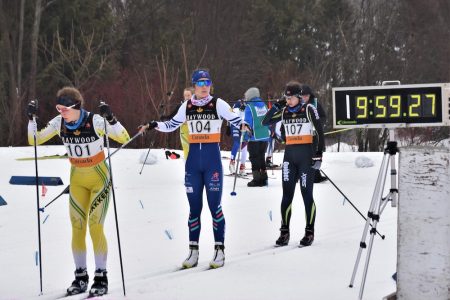
    Zoë Williams and Annika Richardson ready to start the pursuit. (Photo: Marten Burns)
    Zoë Williams (101) and Annika Richardson ready to start the pursuit. (Photo: Marten Burns)

    Sunday brought freezing drizzle replaced by rain which resulted in significant challenges in picking the right skis for the changing conditions. The start times for the skate pursuit are based on time back in Saturday’s classic race, with no bonuses awarded.

    Leclair took her first senior NorAm win, starting third at 46 seconds back.

    “My tactics for today were pretty simple,” Leclair wrote. “I wanted to start fast and catch the two girls in front of me. I put my head down, climbed and went hunting.”

    “I felt super good and skis were wicked fast. After missing the first step of the podium on the two last races, it is nice to finish on the top.” 
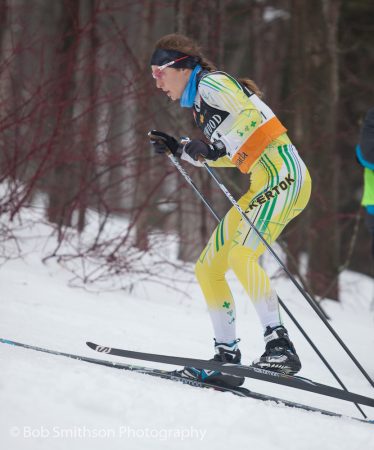
    Zoë Williams in second place in Sunday's pursuit. (Photo: Bob Smithson)
    Zoë Williams in second place in Sunday’s pursuit. (Photo: Bob Smithson)

    Saturday’s winner Williams started first and hung on for second. “Today was tough; didn’t have much left in me physically or mentally and it made the 15km a bit of a suffer fest.”

    Annika Richardson moved up to third.  “I was pretty hungry for a podium after being 4th the past two days. I have done 13 races in the past month so have felt like I have been running on empty for a little while,” Richardson wrote. “But, I really love skate distance races so was able to give it everything I had left.”

    “I started with Laura Leclair who is an amazing skate distance skier. I stuck behind her until the first long downhill but she had really, really fast skis so I wasn’t able to stick with her for the rest of the race (though my skis were quite good)  but managed to catch Mia Serratore by the end of the South 3.75 loop on the first lap.”
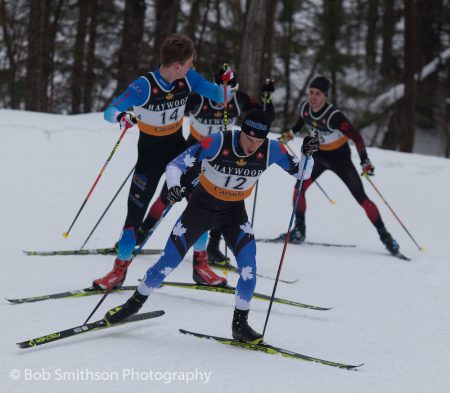
    Andy Shields leads Jack Carlyle, Philippe Boucher, and Alexis Dumas in the pursuit. (Photo: Bob Smithson)
    Andy Shields leads Jack Carlyle, Philippe Boucher, and Alexis Dumas in the pursuit. (Photo: Bob Smithson)

    Jack Carlyle earned his first senior NorAm win as well, as the top four men neatly reversed their start order at the finish.

    “Sunday was a great day,” Carlyle wrote. “Had some good jam in the legs and was able to push hard.”

    “On the first lap the first four starters (Phil Boucher, Andy Shields, Alexis Dumas and I) came together as a pack, and we skied together for most of the race,” Carlyle wrote. “We took turns taking the lead throughout the race, and on the last lap I attacked with 3km’s to go and that’s when the pack broke up.”

    Boucher started slowly in a strategy that earned him second place.  “I decided to start easy on the first km. When I got dropped I decided to stay calm and kept skiing at my pace. When I rejoined the lead pack, I think I had more energy left than the other guys. I had awesome skis and that played a good role at being able to save energy. Jack attacked with 3.5km left, I stayed in his skis in the long hill. Only the two of us survived the attack. I died a few meters after the top. That’s how Jack got away with the win.”
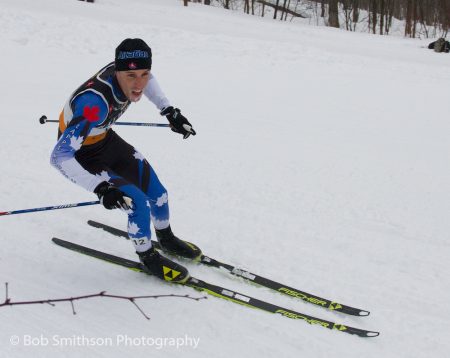
    Andy Shields looking ahead in the pursuit. (Photo: Bob Smithson)
    Andy Shields looking ahead in the pursuit. (Photo: Bob Smithson)

    Shields was still tired after two top tens and a third at the SuperTour the previous weekend, but felt better than Saturday. “Different weather today for sure. Ski selection was critical and was the main factor in determining who finished in what place – for the top 4 anyway. I felt ok with my race but my skis weren’t quick enough to complete. The wax was fine, just my ski fleet has a weak link in today’s conditions.”

    Format Changes

    None of the athletes commented on gender equality, but there were lots of opinions on what was, for most, their first two-day pursuit.
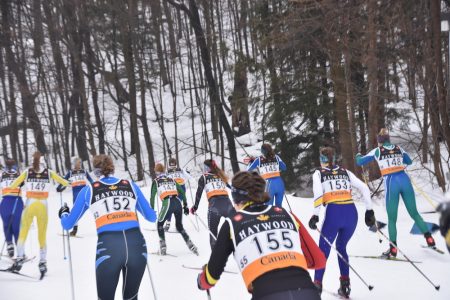
    The wave start from the open women's pursuit. (Photo: Marten Burns)
    The wave start from the open women’s pursuit. (Photo: Marten Burns)

    “I love skiathlons, but understand they’re tough from an organizational perspective. Pursuits are fun and a pretty good replacement, but I’m also a big fan of a good mass start; the problem with pursuits is things can sometimes get so spread out that it almost turns into another interval start the 2nd day.” — Williams

    “I like two days pursuit but I really wish the sprint counted for something so that all race formats would be encountered.” — Leclair

    “I’m not a big fan of two day pursuits, I think mini-tour with a sprint on the Friday is way more fun.

    I’m missing skiathlon. It was a race I enjoyed and I don’t understand why we don’t race it anymore.” — Briand

    “Pursuit starts are some of my favorite races. You often end up in a unique race situation and there’s all kinds of strategic options to play with. Lots of fun!” — Shields

    “I really like racing, so I don’t mind. Skiathlon was a fun race but pursuits are fun too.” — Boucher

    “I really like 3 day mini tours because it gives an advantage to those who are good at sprint and distance as well as skate and classic. I am not a huge fan of skiathlons, I find they tend to come down to the best skate skiers and I would definitely rather just do a skate mass start which are really fun.” — Richardson

    “Love all racing formats, don’t have a favourite to be honest.” — Carlyle

    Highlights

    “My favourite moment was seeing my coach Camille holding out a coke feed at 3.75km to go, I really needed the boost of energy.” — Richardson was happiest on Sunday, and not just for her first podium.

    “On the non-racing focused side, hanging out with the CNEPH crew! They gave me great race support, super fast times, and are a super fun team to be around. Taking a detour to Parkdale in Toronto before my flight with Reed Godfrey was pretty fun too.” — Carlyle

    “It’s been -40 in Thunder Bay so I was happy to enjoy some sun and some warmer weather today.” –Serratore, on Friday’s -12 weather.

    “Without a doubt the sprint final. It was such an exciting race and tons of fun. However, I also really enjoyed watching my teammates (especially my sister!!) crush it on the race course; I’ve had a number of teammates coming back from concussions and it was just so wonderful to be back on the start line with them!!” — Williams

    “My favorite moment was definitely my win today because I surprised myself. I am happy with the sprint final as well.” — Leclair, who likes surprises. https://carnivorestyle.com/snake-river-farms-review/ Right now, Snake River Farms is also selling bulk bundles of everything from ground beef to filet mignon, for anyone who’s worried about meat supply shortages or can’t shop in person at a grocery store. Snake River Farms is a premium meat producer that specializes in beef and pork. Their meat is used at Michelin-star restaurants and sold directly to the public from their website. With its intense marbling, their American Wagyu brisket has gained a reputation among competitive barbecue teams looking for an edge.

    “I liked the pursuit. We don’t get to do this very often so it’s always fun to race something different.” — Boucher

    “It was a surprisingly beautiful day up at Highlands today. After being greeted by howling winds and -18, today’s sunny -12 was a treat to race in.” — Locke
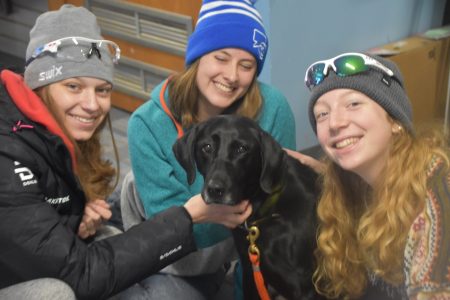
    Nakkertok rented a dog for the weekend! (Photo: Marten Burns)
    Nakkertok rented a dog for the weekend! (Photo: Marten Burns)
  • Sunday Rundown: Canadian Easterns Pursuit

    Sunday Rundown: Canadian Easterns Pursuit

    Mia Serratore on the top of the final hill in the skate pursuit. (Photo: Marten Burns)
    Mia Serratore on the top of the final hill in the skate pursuit. (Photo: Marten Burns)

    Canadian Eastern Championships wrapped up in Duntroon, Ontario, Sunday with the skate portion of the two day pursuit. Tthe men and women skied the same distance on the same course, a two lap 15km free technique pursuit. Start times were based only on Saturday’s 10km classic races, with no bonus points applied.

    Highlands Nordic showed a lot of different weather over the weekend, slowly warming from -18 on Thursday to Sunday’s freezing drizzle changing to rain.

    Alexis Dumas (CNEPH) kicked things off, 16 seconds ahead of Andy Shields (Lappe). Jack Carlyle (AWCA) and Philippe Boucher (CNEPH) started 5 and 8 seconds after Shields. On the second lap, Carlyle escaped from the group to win the pursuit with the fastest time of the day, 37:45.80. Boucher was second, 16.89 seconds back, followed by Shields (46.09) and Dumas (1:23.09). Sweetie massage chick getting fucked Horny Alexis Ford is into hardcore buggering Stepteen Anya Olsen licks stepmom Reagan Darling is tempting fellow with her tits Roxy Raye stretches her anus with a metal speculum and receives an anal reaming Kinky whore Melany loves big stuff in her pussy Cute and Tiny Blonde Halle nugget porn Whore wife Jodi West getting fucked by next door guy Ralph Long Chick receives both of her lusty fuck holes fucked Frisky blonde Kayla Green felt hard cock in her tight ass hole Independence fuck with freedom babe Phoenix Marie Playful bitches Rowan and Lorna try their new toys

    In the women’s race, Laura Leclair (CNEPH) completed her medal set, winning the pursuit with the fastest time of the day, 44:03.80. Saturday’s winner Zoë Williams (Nakkertok) held on for second at 59.6 seconds. Annika Richardson (TBay) earned her first senior NorAm podium, 2:21.59 behind.

  • Saturday Rundown: CEC Two Day Pursuit

    The NorAm weekend at Duntroon, Ontario, continued Saturday with an individual start 10km classic race, the opening half of the first two day pursuit at this level in many years.

    The two day pursuit race format was replaced in 2002 with the same-day pursuit. This is the event in which Beckie Scott famously won all three medals at the Salt Lake Olympics. In 2003, the skiathlon format was introduced under the name ‘continuous pursuit’ which was later shortened to ‘pursuit’ before FIS acquired the rights to the name ‘skiathlon’.

    In the summer of 2018, FIS dropped the skiathlon format, which brings us back to a format that most of the athletes racing today will not remember. In keeping with the spirit of change, men and women raced the same distance today, 10km, in relatively pleasant weather described by the jury as -9C and 37km/h winds.

    Nakkertok’s Zoë Williams won for the second consecutive day in 35:46.09. Mia Serratore (Big Thunder) moved up one place to take second, 37.82 seconds back, to trade places with Laura Leclair (CNEPH) at 1:18.40. Annika Richardson (TBay) just missed the podium, 0.18 seconds behind Leclair.

    Alexis Dumas (CNEPH) won the men’s race in 30:04.08, 16.67 seconds ahead of Andy Shields (Lappe) and 21.57 ahead of Philippe Boucher (CNEPH).

    Sunday’s race is a 15km skate pursuit for both genders, using only the time differences from Saturday. Unlike the mini-tour format, no bonus seconds are given to the first three finishers and Friday’s sprint doesn’t count.

    The wave starts at 12 minutes on the 7.5km loop.

    The combination of an unusual format and the potential for rain should make for an interesting final day.

    Pursuit day 1 results, Sunday’s start list


  • Sunday Rundown: Davos, Canmore, Hochfilzen (Updated 2x)

    Sunday Rundown: Davos, Canmore, Hochfilzen (Updated 2x)

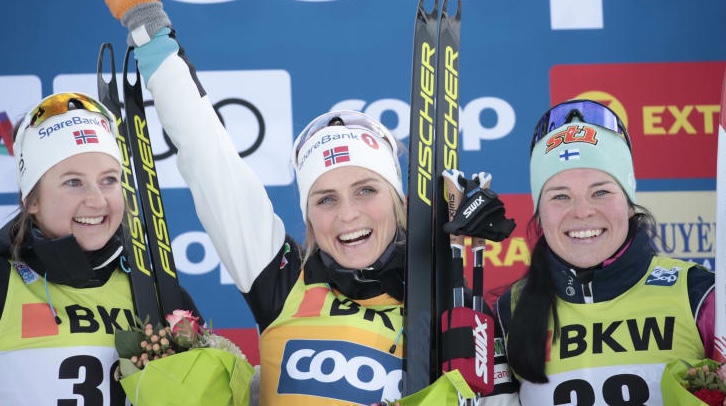
    The women’s podium from the 2018 World Cup 10 k freestyle individual start in Davos, Switzerland. Therese Johaug (center) of Norway won, teammate Ingvild Flugstad Østberg (left) was second, and Krista Pärmäkoski (right) of Finland was third. (Photo: Fis-Ski.com screenshot)

    FIS World Cup Davos, Switzerland  10k/15k Freestyle Individual Start

    Women’s Report | Men’s Report

    On Sunday, the final day of racing on the World Cup before a two-week break prior to the start of the Tour de Ski, the early season trend for women’s distance skiing continues. Norway’s Therese Johaug won the 10-kilometer freestyle individual start in Davos in a time of 26:06.9 minutes. She led the race at every intermediate time checkpoint.

    The only difference with Sunday’s distance narrative was Johaug’s margin of victory. Teammate Ingvild Flugstad Østberg placed second 12.1 seconds back. Krista Pärmäkoski of Finland placed third (+19.2).

    The U.S. Ski Team’s Jessie Diggins popped a season-best fifth place, crossing the line 1:01.1 minutes back. Also for the U.S. and posting a career-best World Cup finish was Rosie Brennan in sixth (+1:04.9).

    Also for the U.S., Caitlin Patterson placed 38th (+2:22.5) and Kelsey Phinney 65th (+4:02.1).

    Canada’s Emily Nishikawa stormed into the top-30 in only her second World Cup start of the season to place 23rd (+1:47.6). Cendrine Browne (CNST) was 44th (+2:28.8).

    Women’s Results

    In the men’s 15 k skate, Russia’s Evgeniy Belov won in 35:52.5 minutes. It was the Russian’s first career individual World Cup win.

    Over the duration of three laps on the up and then down 5 k loop, Belov only outdistanced second-place skier Maurice Manificat of France by a meager 0.9 seconds. Third place went to Norway’s Martin Johnsrud Sundby who finished 4.5 seconds back.

    In another tight men’s race, only 10.6 seconds differentiated first from fifth place. Russia’s Denis Spitsov was fourth (+7.5), and Norway’s Chris André Jespersen fifth (+10.6). Only 1:07.7 minutes separated 30th place from first.

    Alex Harvey of Canada was the best placed North American in 26th (+1:00.9). Teammate Len Valjas (CNST) was 62nd (+2:13.2), and Andy Shields 76th (+2:52.0).

    David Norris (APU) was the best placed American in 61st (+2:12.6). Adam Martin (CGRP) finished in 67th (+2:20.5), Scott Patterson of the U.S. Ski Team (USST) 72nd (+2:49.0), Simi Hamilton 77th (+2:54.3), and Kevin Bolger 92nd (+3:55.3).  

    Men’s Results


    ***

    Canmore NorAm and U23/JW Qualifier

    The third day of the Canmore NorAm weekend featured mass start classic racing.

    In the men’s race, NorAm leader Bob Thompson (TBay) emerged the winner of the 30km in 1:18.40.2 hours after beginning the 8th and final lap in a group of four. Jack Carlyle (AWCA) placed second, 0.3 seconds behind. It had been almost two years to the day since his last podium at this level.

    Russell Kennedy (Team R.A.D.) placed third, 8.6 seconds back, after winning the 15km skate individual start race on Saturday.

    In the junior ranks, Samuel Hendry (Team R.A.D.) was dropped on the final lap, finishing 22.0 seconds in back of the day’s winner as the top junior. Antoine Cyr (CNST) fell back on the 7th lap but held on for 5th overall and top U23 at 1:24.7 back. Remi Drolet (Black Jack) was the second junior in 6th, 0.3 seconds behind Cyr.

    Thompson is the COC leader for Period 1, which should qualify him for the Tour de Ski and World Cup period 3.

    Cyr should be automatically to the U23 team for the Lahti, Finland World Juniors when the High Performance committee meets Sunday afternoon to confirm final selections. As both Hendry and Drolet had already qualified, the committee will be interpreting rules to determine the remaining junior men going to Lahti. Team ULLR’s Tom Stephen (14th today, 3:29 behind) and Xavier McKeever (16th at 5:07.4) will be among the athletes considered for the final junior spots.

    In the women’s 15km, national team members Dahria Beatty and Katherine Stewart-Jones gained a gap on the shorter first lap of the race and were never reeled in. Beatty won the sprint for first crossing the finish in 42:55.8 minutes, with Stewart-Jones 1.8 seconds back.

    Beatty has already met the criteria for World Cup period 2 and 3 starts as COC leader, which means a Canadian woman could possibly be racing the Tour de Ski.

    First year senior Hannah Mehain (Telemark) finished alone in third, 1:55.6 minutes back, after dropping the original chasing pack to take the top U23 spot on the day. Frédérique Vézina (CNEPH) started slower but finished strong to take 4th overall, 2:26.7 behind. Sadie White was 5th at 2:29.7 minutes for the second U23 place.

    Jasmine Drolet was 6th overall at 2:38.0 behind to take the top junior position and join her brother Remi on the Lahti trip.

    Live results [https://zone4.ca/race/2018-12-16/f31c8bac/2018-haywood-noram-world-jr/results/]

    Weekend results [https://zone4.ca/event/18b91492-fd6d-11e8-a07c-0afc046f7944/]


    ***

    IBU World Cup Hochfilzen, Austria women’s 4 x 6 k relay / men’s 4 x 7.5 k relay

    In the women’s 4 x 6 k relay on Sunday, Italy won in a time of 1:10:58.7 hours after using three spares. Italy’s team consisted of Lisa Vittozzi, Alexia Runggaldier, Dorothea Wierer, and Federica Sanfilippo.  

    Sweden placed second (+8.4) using eight spares. Linn Persson, Mona Brorsson, Emma Nilsson, and Hanna Öberg raced the four legs.

    Anais Chevalier, Julia Simon, Celia Aymonier, and Anaïs Bescond placed third for France finishing 11.8 seconds back while using nine spares.

    The U.S. team of Joanne Reid, Susan Dunklee, Clare Egan, and Deedra Irwin placed 13th (+3:39.1) using nine spares and skiing one penalty loop.

    Canada’s women’s team of  Megan Tandy, Megan Bankes, Nadia Moser, and Rosanna Crawford placed 16th (+5:19.3) with two penalties and using 13 spares.

    Women’s relay results

    The men’s 4 x 7.5 k relay was won by Sweden’s Peppe Femling, Martin Ponsiluoma, Torstein Stenersen, and Sebastian Samuelsson in 1:16:10.6 hours using five spares.

    Lars Helge Birkeland, Henrik L’Abee-Lund,Tarjei Bø, and Vetle Sjåstad Christiansen of Norway placed second (+3.6) using seven spares. For Germany, Simon Schempp, Johannes Kuehn, Arnd Peiffer, and Doll Benedikt were third (+28.8) with a single penalty and using six spares.

    The U.S. team of Leif Nordgren, Sean Doherty, Travis Cooper, and Jake Brown placed 12th (+2:33.6) using 10 spares.

    Canada’s Scott Gow, Brendan Green, Jules Burnotte, and Nathan Smith placed 20th (+5:13.0) with three penalties and using 14 spares.

    Men’s relay results


  • Saturday Rundown: Davos, Hochfilzen, Canmore (Updated 3x)

    Saturday Rundown: Davos, Hochfilzen, Canmore (Updated 3x)


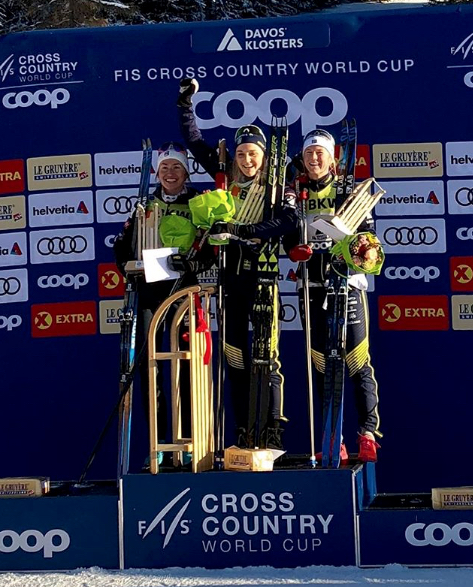
    2018 Davos, Switzerland women’s sprint podium. Sweden’s Stina Nilsson (center) placed first, Sophie Caldwell (left) of the U.S. was second, and Maja Dahlqvist (right) also of Sweden was third. (Photo: screenshot @matt.d.whitcomb)

    FIS World Cup Davos, Switzerland 1.5 k Freestyle Sprint

    Women’s Race Report | Men’s Race Report

    On a lovely Davos, Switzerland day, Sophie Caldwell of the U.S. Ski Team (USST) was the day’s fastest qualifier for the women, stopping the clock in 2:46.28 minutes. Caldwell looked cool and in-form on her way to place second overall on the day for her first podium of the season.

    The win went to Sweden’s Stina Nilsson after placing third (+2.03) in qualification. Third place went to another Swede, Maja Dahlqvist. It was the twenty-four-year-old Dahlqvist’s second podium of the year after she placed second in the Ruka, Finland classic sprint. Dahlqvist was the day’s second-fastest qualifier, finishing 0.62 seconds behind Caldwell.

    Four other Amercian’s advanced to the heats. Sadie Bjornsen qualified in 10th (+4.28). She looked strong in her heat, leading the first lap and skiing in second place down the final stretch. She was passed by a surging Natalia Nepryaeva from Russia. After placing third, Bjornsen did not advance. Bjornsen ended up 14th on the day.

    Ida Sargent (USST) qualified in 14th (+5.41) but did not advance out to the heats after placing fifth in the first quarterfinal. Sargent was 21st overall.

    Jessie Diggins (USST) was 15th (+5.50) in qualification. In the fourth quarterfinal, Diggins tripped over Russian skier’s Natalia Matveeva’s pole and fell to her knees in the heat’s opening moments. She was unable to regain the lost ground and placed sixth in a photo finish with Matveeva. Diggins placed 26th overall.

    No Canadians were entered in the women’s race.

    Rosie Brennan (APU) qualified in 28th (+8.83) and was eventually eliminated in the third quarterfinal where she placed sixth. Brennan was 29th on the day. Also for the U.S., Kelsey Phinney (SMS T2) placed 38th, after placing 38th (+12.10) in the qualifier.

    Women’s Qualification Results | Women’s Results

    For the men, although still young twenty-two-years-old, Johannes Høsflot Klæbo looked like the old Klæbo on his way to his first World Cup win of the season. The Norwegian was the World Cup’s overall winner last season and first in the sprint cup.

    Klæbo placed first in the qualifier with a time of 2:22.39 minutes. He advanced to the finals by winning the first heat and the first semi. Klæbo won the final in 2:20.44 minutes. Italy’s Federico Pellegrino was second overall, finishing 0.39 seconds back. Baptiste Gros of France was third (+1.40) to take the last podium step.

    Simi Hamilton (USST) was the best placed North American male. Hamilton qualified in 17th (+4.76) and placed 12th overall. He placed second in the fifth heat a fraction behind Finland’s Joni Maeki. In the second semi-final, won by Norway’s Eirik Brandsdal, Hamilton placed sixth (+6.90).

    Kevin Bolger (USST) just missed the heats after qualifying in 31st (+6.63). After not advancing, Bolger was 31st overall. No other Americans were entered.

    Alex Harvey was the best placed Canadian, placing 37th overall. Lenny Valjas in his first World Cup of the season was 53rd. Andy Shields finished in 60th. No other Canadians were entered.

    Men’s Qualification Results | Men’s Results


    ***

    IBU World Cup Hochfilzen, Austria 10 k/12.5 k pursuit

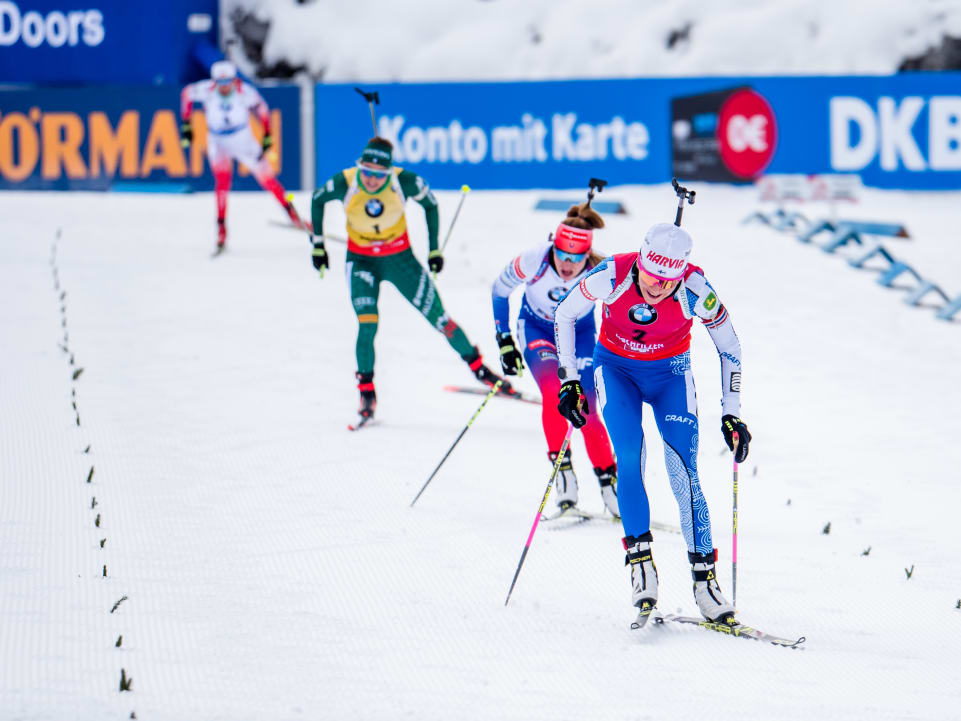
    On Saturday in Hochfilzen, Austria the women’s 10-kilometer pursuit was won by Finland’s Kaisa Mäkäräinen in a time of 30:53.8 minutes. It was Mäkäräinen’s third win of the season. The Finn had a tough time on the shooting range, despite surging for the win in the final meters, she suffered three penalties on the shooting range (1+0+1+1).

    Kaisa Mäkäräinen of Finland down the final stretch in Hochfilzen, Austria during the IBU World Cup 10k pursuit. Paulina Fialkova of Slovenia was second, Italy’s Dorothea Wierer was third. (Photo: biathlonworld.com)

    Paulina Fialkova of Slovenia was second (+1.5, 0+0+1+1) after skiing two penalty loops. Italy’s Dorothea Wierer was third in a close fight for all three podium spots finishing 2.8 seconds behind Mäkäräinen. Wierer had three penalties during the race (2+0+1+1).

    Susan Dunklee of the U.S. was the best placed North American, improving on her 34th start spot to place 28th (+2:06.1, 0+1+1+0). Teammate Joanne Reid was 31st (+2:17.1, 0+0+0+1) after missing only a single target. Clare Egan did not qualify for the pursuit.

    Rosanna Crawford was the lone Canadian to qualify for Saturday’s pursuit. She placed 44th (+3:24.8, 1+1+0+1).

    Women’s Pursuit Results

    Martin Fourcade of France, in a return to shooting and skiing form, took the win in the men’s 12.5 k pursuit. Fourcade won in a time of 32:22.3 minutes while shooting clean through his four shooting rounds.

    vancomycin


    Germany’s Arnd Peiffer was second (+13.7, 1+0+0+0), skiing a single penalty lap. Norway’s Vetle Sjåstad Christiansen was third (+16.1) after shooting clean for the race.

    First place starter after winning yesterday’s sprint, Norwegian Johannes Thingnes Bø, fell back in the standings after missing six targets. He placed ninth (+1:00.0, 0+3+1+2) overall.

    Sean Doherty for the U.S. was 31st (+2:37.3, 0+1+0+1). U.S. teammate Leif Nordgren was 42nd (+3:21.5, 1+0+1+3).

    Scott Gow was the only Canadian to qualify for the pursuit. He finished in 51st (+4:36.3, 1+0+0+3).

    Men’s Pursuit Results


    ***

    NorAm and U23/JW World Championships Qualification, Canmore, Alberta

    Day two of the Noram and U23/JW trials in Canmore, Alberta, featured freestyle individual interval races; the men raced 15km followed by the women’s 10km

    Russell Kennedy (Team R.A.D.), fresh back from Europe led the way with a 30:18.5 minute clocking for the 15km. His teammate Evan Palmer-Charrette was second, 30.7 seconds behind. Alexis Dumas (CNEPH) snatched third, 1.6 seconds behind Palmer-Charrette and 0.9 seconds ahead of Jack Carlyle (AWCA). Seb Boehmler-Dandurand (AWCA) was 4.3 seconds back from Carlyle and 48.5 seconds behind the winner.

    Gareth Williams (CNST) was sixth and the top U23 athlete at 1:02.9 back, with CNEPH U23 teammates Philippe Boucher and Antoine Cyr taking 7th and 8th, 8.2 and 8.8 seconds behind Williams.

    Samuel Hendry (Team R.A.D.) won the junior men’s 10km in 23:09.7 to earn a spot on the U23 team in Lahti next month, with his second NorAm interval start win in two tries. Remi Drolet (Black Jack) followed up two sprint NorAm sprint wins with a second place, 33.6 seconds behind. Tom Stephen (Team ULLR) was third at 45.8 seconds.

    In the open women’s 10km free, Dahria Beatty (CNST) continued her hot streak with another win, finishing in 26:05.1. Last weekend’s winner, Katherine Stewart-Jones (CNST) was second at 35.0 seconds. Frédérique Vézina (CNEPH) took third, 1:01.9 behind.

    Sadie White (TBay) was top U23 in 4th, 1:10 behind the winner.

    All results, including live timing for the rest of the weekend.

    [https://zone4.ca/event/18b91492-fd6d-11e8-a07c-0afc046f7944/]

    Sprints final: https://zone4.ca/race/2018-12-13/97cd95d0/2018-haywood-noram-world-jr/results/

    Sprint brackets: https://zone4.ca/race/2018-12-13/4408c89e/2018-haywood-noram-world-jr/results/

    Saturday Interval free:

    https://zone4.ca/race/2018-12-15/c2093acc/2018-haywood-noram-world-jr/results/

    FasterSkier will be updating the Nor-Am segment.

  • Sunday Rundown: From Lillehammer to West Yellowstone to Pokljuka (Updated 2x)

    Sunday Rundown: From Lillehammer to West Yellowstone to Pokljuka (Updated 2x)

    Snow dump — during the 2018 15 k classic pursuit in Lillehammer, Norway. Emil Iversen (bib 3) holds off the charging pack to take third. (Photo: Fischer/Nordic Focus)

    FIS Cross-Country World Cup in Lillehammer Norway: 10 k/ 15 k Classic Pursuit

    On Sunday, the third and final day of racing in Lillehammer, Norway concluded with a 10-kilometer classic pursuit for the women.

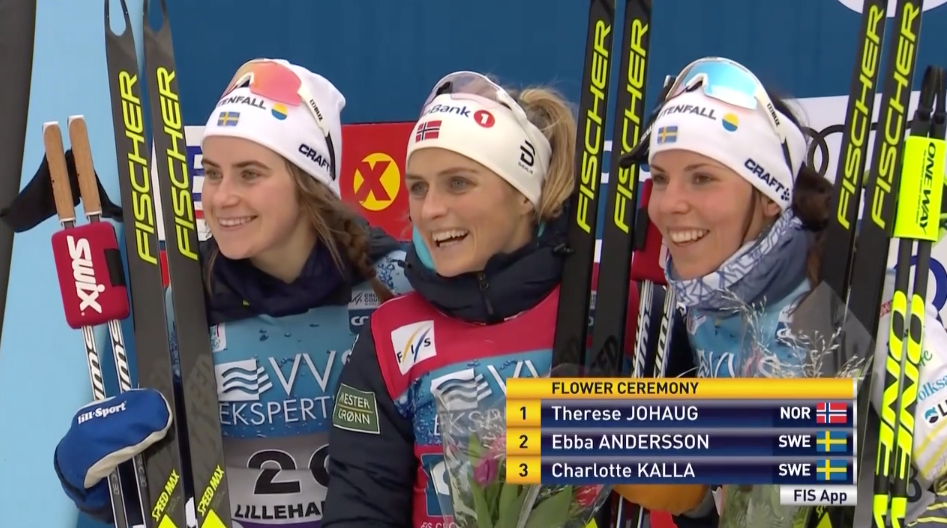
    A win is a win, and Norway’s Therese Johaug, took the day and her second victory in as many days when she crossed the line first in 29:35.5 minutes. Sweden’s  Ebba Andersson finished second (+16.8), Norway’s Ingvild Flugstad Østberg third (+17.9).

    The day’s first starter, Charlotte Kalla, trailed off to finish in fourth (+23.1). Kalla began with a small gap of 2.5 seconds on Johaug. The third starter, Andersson, began 14.5 seconds back.

    Sadie Bjornsen of the U.S. Ski Team (USST) ended her day in 10th (+2:21.7), while teammate Jessie Diggins was 13th (+2:42.4). Rosie Brennan (APU) in a strong comeback to the World Cup placed 15th (+2:46.0).

    Caitlin Patterson (CGRP), who earned a 30th place on Saturday, fell back slightly, ending up 34th (+5:13.1). Kailtlynn Miller (CGRP) finished in 50th (+7:43.9).

    Kelsey Phinney did not start.

    Fifty-six women started Sunday’s race.

    Women’s Results

    The men’s 15 k classic pursuit featured an off-the-front dual between the day’s first two starters, Sjur Røthe and Didrik Tønseth. The two Norwegians started only 1.8 seconds apart. By 5 k, they had gapped third place starter, Norway’s Emil Iversen by 35.2 seconds. (Iversen had been 11.5 seconds back at the start.)

    The Røthe-Tønseth engine continued to pull away from the field to gain over a minute by the finish. Tønseth won in a time of 44:13.8, Røthe crossed the line 1.8 seconds back.

    Iversen placed third (+1:03.3), a whisker ahead of a charging pack with over thirty skiers. Sweden’s Calle Halfvarsson was fourth (+1:04.4).

    Canada’s Alex Harvey was the best placed North American in 16th (+1:08.7). Also for Canada, Russell Kennedy (Team R.A.D.) was 61st (+4:32.4), and Andy Shields 71st (+6:06.7)

    Erik Bjornsen of the U.S. Ski Team (USST) placed 32nd (+1:26.1). However, Bjornsen skied the third fastest time of day. 

    Also for the U.S., David Norris (APU) skied to 52nd (+3:21.9), Kevin Bolger (USST) 59th (+4:20.8), Adam Martin (CGRP) 62nd (+4:35.7), Scott Patterson (USST) 63rd (+4:39.0), Simi Hamilton 66th (+4:44.1).

    Seventy-eight athletes finished the men’s race.

    Men’s Results


    ***

    SuperTour, West Yellowstone, Mont.: 15 k / 10k Freestyle

    Back on the high plateau’s of West Yellowstone, the SuperTour held day two of it’s Montana stop. The men raced a 15-kilometer freestyle — 3 times around a 5  k loop.

    Craftsbury Green Racing Project’s (CGRP) Ben Lustgarten took the win in a squeaker over Kyle Bratrud who skis for SMS T2. Lustgarten won in time of 36:42.2 minutes, Bratrud stopped the clock 3.5 seconds back. It was Lustgarten’s second podium in as many days; on Saturday he placed second in the skate sprint.

    Akeo Maifeld-Caruuci (CGRP) placed third, beating out University of New Mexico skier Ricardo Izquierdo-Bernier by 0.4 seconds. Izquierdo-Bernier was third in Saturday’s sprint.

    The women’s SuperTour 10 k skate also featured a dual-podium skier from the weekend. Alaska Pacific University’s (APU) Rosie Frankowski won in 27:33.9 minutes. Frankowski placed second in the women’s skate sprint on Saturday. University of Utah skier Guro Jordheim took second (+46.2). APU’s Becca Rorabaugh was third, finishing 1:19.5 minutes back.

    Domestic racing continues next weekend with the Sovereign Lake NorAm-SuperTour.

    Results

    ***

    IBU World Cup Pokljka, Slovenia: 2 x 6 k + 2 x 7.5 k Mixed Relay + Single Mixed Relay

    In Pokljka, Slovenia, men and women completed a 2 x 6 k + 2 x 7.5 k mixed relay. Placing first was Team France with Anais Bescond, Justine Braisaz, Martin Fourcade, and Simon Desthieux who completed the course in a total time of 1:10:02.8 with a team shooting score of (0+5). In the first leg, Bescond had two penalties (0+2 0+0). Following Bescond, was Braisaz with one miss (0+1 0+0). Fourcade raced the third lap, shooting 100 percent.  Desthieux closed out for France in first after two misses (0+0 0+2).

    Sunday’s second place went to Switzerland’s team of Elisa Gasparin, Lena Haecki, Benjamin Weger, and Jeremy Finello. The team finished 38.7 seconds back from France with a total team shooting score of (0+9). Gasparin raced the first leg, missing a total of three shots (0+1 0+2).  Gasparin handed off to Haecki who also missed three shots (0+0 0+3). Weger, who skied the third leg, shot clean and Finello, who raced the last leg, had three misses (0+1 0+2).

    The third team to finish on Sunday was Italy’s Lisa Vittozzi, Dorothea Wierer, Dominik Windisch, and Lukas Hofer. Italy finished 52.1 seconds behind France with a team total shooting score of (1+8). Vittozzi shot clean, while Wierer, who raced the second leg, missed two shots (0+2 0+0).  In the third leg, Windisch skied six penalties (1+3 0+2), while Hofer closed out the fourth leg with one miss (0+0 0+1).

    Team Canada finished in 10th (+2:33.2), with Rosanna Crawford racing the first lap and missing one (0+1 0+0). Megan Tandy tied Crawford’s score racing the second lap. In the third lap was Nathan Smith who cleaned, while Scott Gow also shot 100 percent in lap four.

    The US Biathlon team of Susan Dunklee, Clare Egan, Leif Nordgren, and Sean Doherty finished in 15th (+4:19.8). Dunklee led the team off with two misses (0+1 0+1) while Egan followed in leg two with three misses (0+3 0+0). Nordgren took leg three with one miss, while Doherty skied three penalties (0+2 0+1) to close out the fourth leg. 

    Results

    In the single mixed relay – teams consist of a single male and female athlete – Norway’s Thekla Brun-Lie and Lars Helge Birkeland won in a total time of 38:26.7 minutes. Norway used only four spare rounds on its way to the win.

    Austria’s Lisa Theresa Hauser and Eder Simon placed second, using five spare rounds, finishing 8.5 seconds back. Ukraine’s Anastaslya Merkushyna and Artem Tyshchenko were third (+20.7), using only a single spare round.

    Canada’s Megan Bankes and Christian Gow placed sixth (+37.8) after using 10 spare rounds. The U.S. duo, Joanne Reid and Max Durtschi, were eventually lapped and were not given an official time. Prior to being pulled, Reid has used two spare rounds while shooting. Durtschi struggled with his second shooting bout, using three spares and ultimately skiing three penalty laps.

    Results

  • Norway’s Røthe and Tønseth Gap the Field; Difficult Day for North Americans

    Norway’s Røthe and Tønseth Gap the Field; Difficult Day for North Americans

    The men’s podim from the second day of World Cup racing in Lillehammer, Norway. In the 15 k freestyle, Norway’s Sjur Røthe (center) won, teammate Didrik Tønseth (left) placed second, and Russia’s Denis Spitsov (right) was third. (Photo: Henrik Hunnes)

    Norway shined on their home course in Lillehammer, Norway with Sjur Røthe posting the fastest time of 36:3.0 minutes in the 15-kilometer individual start freestyle, followed closely by teammate Didrik Tønseth (+6.0). The Norwegians claimed six of the top-ten spots. Russia’s Denis Spitsov took the third podium position, finishing 28.6 seconds back.

    In his first distance World Cup race of the season, Switzerland’s Dario Cologna placed fourth (+38.3).

    “It feels amazing,” Røthe told the International Ski Federation (FIS) about his race. “I didn’t know that I was fighting for the victory, I just heard I was fighting with Didrik. I didn’t know it was for the victory until the last 5k. But I did everything I could and I kept a high speed the whole way, so I’m really satisfied.”

    For North America, Alex Harvey was the best finisher in 17th (+1:20.5). His fellow Canadians Andy Shields took 61st (+3:08.4), and Russell Kennedy placed 64th (+3:17.0).

    “I just had bad legs,” Harvey told FasterSkier in the mixed zone after the race. “I felt good in the warm-up, but racing I couldn’t climb.”

    When asked whether his podium finish in yesterday’s sprint may have left him fatigued today, Harvey replied, “Probably, but it felt like in the warmup and in my morning jog, I didn’t feel that fatigued. I am missing something in distance right now, it was kind of the same in Kuusamo. So hopefully a couple races will help to bring the base level a bit higher.”

    Harvey also noted that the course conditions played a role in his race day sensations. The weather and lack of natural snow added another layer of challenge. Rain and warm temperatures eroded the 5k manmade loop exposing wood chips, pebbles, and the ground below. While course officials worked to preserve the snow, they could not maintain the firm base that the course started with.

    Alex Harvey of Canada in the mixed zone after the 2018 World Cup 15 k freestyle in Lillehammer, Norway. Harvey placed 17th. (Photo: Henrik Hunnes)

    “It was really soft, the corners and everything,” said Harvey. “So it was hard to kind of rest the legs … you see on the results it was good for the lighter guys. Sjur, Didrik, and Spitsov are some of the lightest guys on the tour. So yeah, it was really sloppy skiing, for me it was really hard.”

    He added, “That corner heading into the stadium, you can see the pavement at the bottom. So somebody must have hit the pavement.”

    The Americans were well outside the points today; Erik Bjornsen of the U.S. Ski Team (USST) finished 43rd (+2:24.5).

    Bjornsen, who was disappointed with his finish, commented, “I just wanted to go out there and push as hard as I can and try not to rush things. To find a good pace and be able to keep it. But 3-4k into the race, the legs were just kind of stiffening up. I’m not really feeling the snap and the energy that I’d like to and the climbs are feeling hard. Hopefully, I can figure it out in the next couple of weeks. It would be great to score some points before Christmas.”

    David Norris (APU) in 54th (+2:44.5) was the next best U.S. skier. He was the day’s first men’s starter. Wearing bib number one can put an athlete in a lonely and frustrating position in an interval start as it means either skiing alone up front or being passed. But Norris saw it as an opportunity to ski with more experienced racers behind him.

    “It was kind of nice to ski alone for a lap and a half,” Norris reflected. Then, different than in the past, some of the guys that were passing me I was able to ski with for a while rather than just trying to catch a ride and blowing up.”

    Simi Hamilton (USST), who was the only American to qualify for the sprint heats yesterday, took his race in stride after placing 56th (+2:59.4). “I wasn’t expecting a ton,” Hamilton said. “At certain points in the season, I think I’m capable of putting together good distance skate races, but it’s still early. I’m not reading too much into it, but I thought my pace was okay and it was good beginner racing.

    “Late November, early December, you want to be feeling good and racing fast. But, our goal for the season is racing fast in February for World Champs,” Hamilton added. “So I think any result you have this time of year you have to take with a grain of salt… I think it’s okay not to feel your best this time of year”

    The course in Lillehammer is always taxing, as it features a four-minute climb, amongst other difficult hills.

    “The course is just naturally really tough,” Hamilton shared. “You have that one decent recovery from the high point. But you’re still kind of working down that, doing some cornering. Pretty much everywhere else, you’re working the entire course. You’re either cornering, or it’s a long gradual climb, or a long steep climb, or a short steep climb.”

    While today’s results may have been lackluster, the Americans are looking ahead to the races to come.

    “I’m going to go out there and fight, but I’m not really sitting in a great position,” said Bjornsen. “I prefer the classic, so hopefully, I can just kind of move up and who knows. Tomorrow is a new day, so hopefully, I’ll be feeling good.”

    While he hopes to see continued improvement, Bjornsen’s goals lie later in the season.

    “I’m going to try to peak at World Champs,” he said. “And there are three team sprints on the schedule this year. Simi and I definitely want to, before we end our careers, get a podium together. So it’s definitely a goal … We’ve been fifth a few times and sixth, so we’re not that far off. I think on the right day it could for sure happen.”

    Hamilton is looking forward to the road ahead as well. He added, “We go to Beitostolen on Monday. I’ll probably ski a relay there which I’m really psyched about. It’s just a 7.5 k in our relays now, so that’s a good skate distance for me. At the same time, I kind of get to use the next couple of weeks to really fine tune my speed for the sprint in Davos. I’ll definitely use the next 10 days to two weeks to get in some really sprint specific workouts.”

    Kevin Bolger (USST) in a photo taken during Friday’s skate sprint qualifier in Lillehammer, Norway. (Photo: Fischer/Nordic Focus)

    The remaining American finishers were Paddy Caldwell (USST) in 67th (+3:33.1), Kevin Bolger (USST) 68th (+3:38.7), Scott Patterson (USST) 73rd (+3:52.3), and Adam Martin (CGRP) 75th (+4:05.0)

    In his first racing on the World Cup, prior to Kuusamo Martin had not contested a World Cup, Martin felt optimistic about today’s result.

    “I’m really happy just to be here on the World Cup this fall and I’m trying to learn as much as I can,” Martin said. “These are incredibly good skiers and they’re in really good shape, so it’s a good learning experience.”

    Not to be forgotten are the impressive results of Britain’s Andrew Musgrave. Norway is practically home now to Musgrave, an athlete feared on the World Cup but also at the annual gathering at the Norwegian National Championships.

    He finished the day in sixth place, 45.1 seconds behind Røthe. It’s an impressive result as any considering the deep men’s field here in Lillehammer.

    “The race today was good for me,” Musgrave emailed. “I had really good skis- the snow was pretty dirty after the warm weather we’ve been having the last few days, so most peoples skis were slowing down a lot every lap. Mine seemed to stay fast though.”
    Historically, Musgrave peaks for the big events. He was barely off the podium in the Lahti Worlds 50 k skate. He has a penchant for arriving in form to maximize the win potential.
    “I’ve been doing a lot of training the last few weeks, so haven’t been racing all that fast (my 65th place in the Norwegian Cup in Gålå last wasn’t exactly my strongest performance ever),” Musgrave explained. “It’s nice to see that I’m back to myself again now I’ve dropped my volume down again. Hopefully the extra training will pay off later in the winter though. That’s the plan anyway!”

    Men’s Results

  • Saturday Rundown: From Lillehammer to West Yellowstone (Updated)

    Saturday Rundown: From Lillehammer to West Yellowstone (Updated)

    The women’s podium from Saturday’s 10-kilometer freestyle individual start race in Lillehammer Norway. Norway’s Therese Johaug (center) placed first, Sweden’s Ebba Andersson (left) second, and teammate Charlotte Kalla (right) third. (Photo: NBC Sports Gold screenshot)

    FIS Cross-Country World Cup in Lillehammer Norway: 10 k/ 15 k Freestyle Individual Start

    Women’s Report | Men’s Report

    On Saturday, the second day of World Cup cross-country racing ensued in Lillehammer, Norway with a 10-kilometer freestyle individual start race for the women.

    On a track of snow surrounded by green fir trees and a soggy landscape, the women skied two laps of 5 k course. Norway’s Therese Johaug was the fastest skier at every checkpoint to win in a time of 26:22.4 minutes. Ebba Andersson, the upstart Swede skied to second (+9.2), and teammate Charlotte Kalla was third (+15.7).

    Collectively, it was a strong day for the U.S. women with four skiers in the top-30.

    Sadie Bjornsen of the U.S. Ski Team (USST) finished in ninth (+1:17.0) after placing third in yesterday’s skate sprint. Rosie Brennan (APU) skied to 11th (+1:29.3), the USST’s Jessie Diggins 12th (+1:29.9), Caitlin Paterson (CGRP) 30th (+2:28.2), Kaitlynn Miller (CGRP) 60th (+4:10.4), and Ida Sargent of the USST 63rd (+4:18.4), and Kelsey Phinney (SMS T2) 65th (+4:22.5).

    No Canadian women were entered.

    Seventy-two skiers finished the women’s race.

    Women’s Results

    The men raced three times around the 5 k loop for 15 k total and three times up the course’s big climb. In this early season, many of the perceived pre-race favorites finished further back in the field.

    Norway’s Sjur Røthe won in a time of 36:34.0 minutes. By the 8.3 k time check, Røthe took control of the race. Teammate Didrik Tønseth placed second (+6.0), while Russia’s Denis Spitsov was third (+28.6).

    Canada’s Alex Harvey was the best placed North American in 17th (+1:20.5). Also for Canada, Andy Shields  was 61st (+3:08.4), and Russell Kennedy (TEAM R.A.D.) 64th (+3:17.0)

    For the U.S., Erik Bjornsen of the U.S. Ski Team (USST) finished 43rd (+2:24.5), David Norris (APU) 54th (+2:44.5), Simi Hamilton (USST) 56th (+2:59.4), Paddy Caldwell (USST) 67th (+3:33.1), Kevin Bolger (USST) 68th (+3:38.7), Scott Patterson (USST) 73rd (+3:52.3), and Adam Martin (CGRP) 75th (+4:05.0).

    Men’s Results 

    ***


    SuperTour (West Yellowstone, Mont.): 1.3 k Freestyle sprints

    The fastest qualifier for the men on Saturday in West Yellowstone was SMS T2 athlete Andy Newell.  The Vermont native, now residing in Bozeman, Mont., won in a time of 2:35.53 minutes. His margin of victory was 7.26 seconds over second fastest qualifier, Alaska Pacific University (APU) skier Logan Hannenman. Newell’s teammate, Ben Saxton qualified in third (+7.79).

    Newell advanced to the finals by winning the first heat and first semifinal.

    buy augmentin, vteabp

    In the finals, Newell controlled the pace and made clear that at thirty five years old, he can still light up the domestic ranks. Newell won in a time of 2:41.66 minutes. Craftsbury Green Racing Project’s Ben Lustgarten placed second in 2:43.55 minutes, and University of New Mexico skier Ricardo Izquierdo-Bernier was third in 2:45.66 minutes.

    Adam Luban of the Sun Valley Ski Education Foundation Gold Team finished in fourth, Forrest Mahlen of Alaska Pacific University (APU) was fifth, and Ben Saxton (SMS T2) placed sixth in the men’s final.

    Julia Kern, a member of the U.S. Ski Development Team (UUSDT) and SMS T2 , won the women’s qualifier in 3:08.58 minutes. Second in the qualifier, also from SS T2, was Erika Flowers who finished 2.5 seconds behind Kern. University of Utah skier, Julia Richter qualified in third (+3.22). 

    Like Newell, Kern won both her quarterfinal and semi to make the finals.

    Kern won the women’s final in 3:09.85 minutes. APU’s Rosie Frankowski, the day’s fourth fastest qualifier, was second in a time of 3:11.37 minutes. Teammate Hannah Halvorsen (APU/USSDT) placed third, stopping the clock in 3:12.51 minutes. Halvorsen placed sixth in the qualifier. 

    Flowers ended up fourth in the finals, while Richter and Utah teammate Karianne Moe, placed fifth and sixth, respectively.

    West Yellowtone SuperTour Sprint Results

  • Pellegrino Skates Away with Lillehammer Sprint Win; Canada’s Harvey in Third

    Pellegrino Skates Away with Lillehammer Sprint Win; Canada’s Harvey in Third

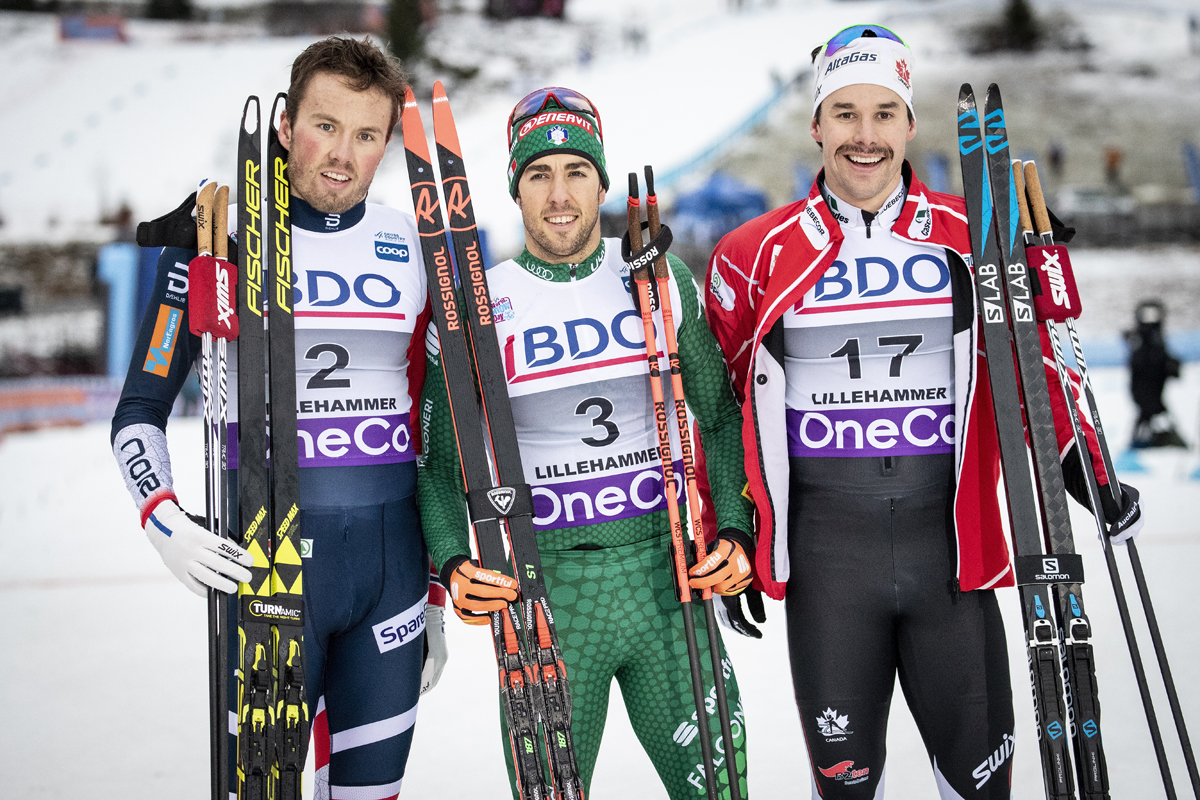
    The men’s 1.6 k skate sprint podium from Lillehammer, Norway: the winner, Italy’s Federico Pellegrino (center), Norway’s Emil Iversen (left) second, and Canada’s Alex Harvey (right) third. (Photo: Fischer/Nordic Focus)

    At two minutes into the men’s 1.6-kilometer freestyle sprint in Lillehammer, Norway on Friday, the six skiers in the final were strung in line — each milking a draft into the banked left turn before the final climb.

    Norway’s Emil Iversen was in the lead — the workhorse pushing the pace for much of the race. Behind him were Italy’s Federico Pellegrino and Canada’s Alex Harvey zooming around the corner and stepping into the climb.

    Halfway up the climb, a flip switched for Pellegrino – he was a flurry of V1 turnover as he built a five-meter, then a 10-meter gap  — and a world of momentum — descending into the final straight.

    Sporting Italy’s green lycra, Pellegrino never stopped accelerating towards the line to win in a time of 3:19.17 minutes. Iversen was second (+0.44), while Harvey hustled down the line to take third (+0.68).

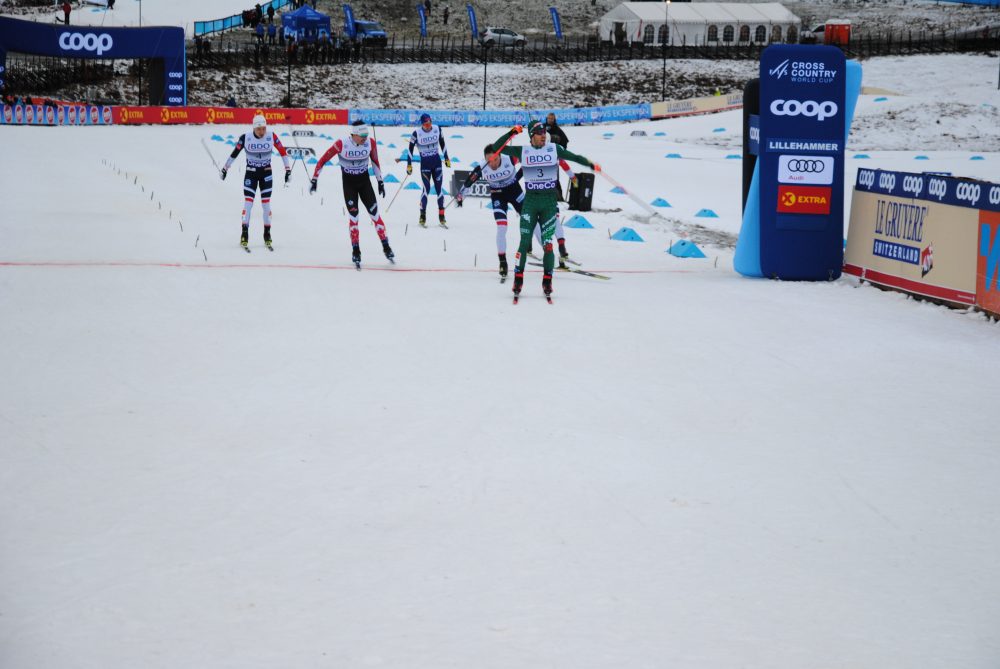
    Pellegrino crosses the finish line in the final of the men’s 1.6 k skate sprint in Lillehammer, Norway.

    “I am really satisfied about today’s race,” Pellegrino told the International Ski Federation (FIS) after the race. “My goal was to get into the finals because I know in Norway it’s really tough at the beginning of the season. But the skis were good, the skis were good and even the mind was in a good shape.”

    Pellegrino remains the record holder for World Cup skate sprint wins — today was his 11th victory in the discipline.

    For second place Iversen, it was his second podium in as many World Cup venue stops. Last weekend he placed second in the 15 k individual start classic in Kuusamo, Finland. Iversen was fourth in last Saturday’s classic sprint. In this nascent World Cup season, Iversen sits second overall after three races on the World Cup with 176 points. Russia’s Alexander Bolshunov, who won both races in Kuusamo, finished in 21st and sits atop the overall with 210 points.

    Lurking, but no stranger the to the upper tier of the World Cup is Harvey, sixth overall in the standings.

    Harvey won the fifth heat to advance to the semi-finals on Friday. He was then the second lucky loser to advance to the finals. Harvey explained after the racing ended that speed-tactics had helped his hand.

    “In the quarterfinal, I saw my skis were really good so was like ‘Okay maybe it can be a good day today,’” Harvey said. “The first semi was really slow. So then we talked, Emil or Sindre, if someone can make it to the front it would be good to make kind of a high speed. I think we were six seconds faster than the other [semi-final] so that’s why I was a lucky loser.”

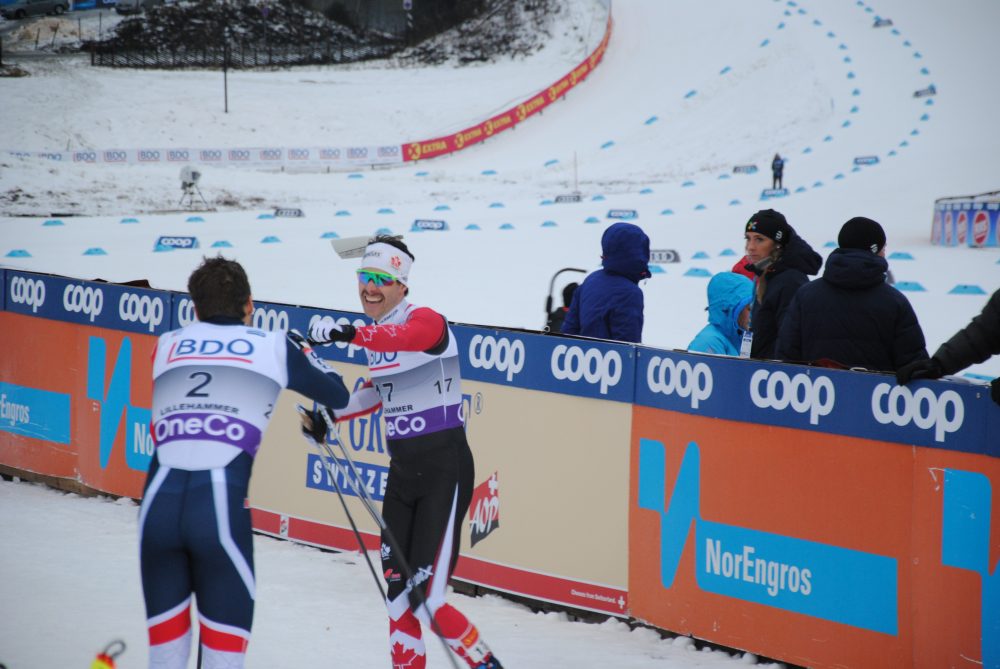
    Canada’s Alex Harvey congratulating Norway’s Emil Iversen. Harvey placed third in the men’s 1.6 k skate sprint in Lillehammer, Norway. Iversen was second.

    It was Harvey’s 27th World Cup podium and his first of the 2018/2019 season. Harvey often claims to begin his World Cup campaign with an element of caution when it comes to peaking. It’s true, his results tend to improve as the season progresses and the key races arrive. Last year, Harvey didn’t podium until January 6 during the 15 k classic in the Tour de Ski (TdS). In 2017, his first podium came on January 15th, in a team sprint. He went on that year to win the 50 k skate at the Lahti Worlds.

    His primary objectives for this season remain further out — the Tour de Ski (TdS), the 50 k and skiathlon at Worlds, and the season finale in his home province of Quebec.

    “I’ve had a good summer of training, I’ve been really happy,” Harvey said. “I was able to execute the plan basically to the dot, no injuries, nothing. So I’m really confident for the season. I worked on trying to find some speed again, like doing some speedwork a bit more often because I’m not getting any younger. So it’s something I need to work hard on. And I know that the baseline the fitness has been really good all summer so that I’m confident about. and I’m happy to see that the work that I’ve put in both in the gym and on roller skis for speed is kind of paying off for sprinting.”

    The U.S. Ski Team’s (USST) Simi Hamilton, coming off a fall early in his Ruka qualifier last Saturday, rebounded to qualify 22nd (+8.72) in Lillehammer. Hamilton was eliminated in today’s fourth heat and placed 19th overall.

    “Racing in Norway is always the toughest times of the year because the fields are so deep,” Hamilton said after his quarterfinal. “I’ve never had a good sprint here before. I’ve never even made the heats. So I think that you know, to have a decent qualifier today and to still have decent energy in the quarterfinal, I think that’s a really good sign just for my fitness this year. I got off to a rough start with falling in Ruka last weekend. But I’ve been healthy and I’m really psyched about that, It was not the best way to end the day but I’m really psyched for everything else coming up.”


    Russia’s Gleb Retivykh (bib 9), the U.S.A.’s Simi Hamilton (bib 22), and Norway’s Sindre Bjørnstad Skar in the fourth heat of of the men’s 1.6 k skate sprint in Lillehammer, Norway. (Photo: Fischer/Nordic Focus)

    Hamilton also told FasterSkier’s reporter in Norway he’s feeling sharp. Like many others, he’s focusing on the Seefeld, Austria Worlds as the main objective. Hamilton trends towards better results in skate sprints, which the World Cup schedule is heavy with this year.

    “I’m really psyched for the rest of the year we have a lot more skate sprints coming up, which really suit me well,” Hamilton said. “I enjoy classic sprinting too but I tend to be a little better at skating, so it should be a really good season.”

    As a three-race series, with an overall winner named after the classic pursuit on Sunday, many distance skiers were entered in the sprint.

    Beyond Harvey and Hamilton, no other North American men qualified for the heats. The USST’s Kevin Bolger was the next best placed American in 61st (+14.63). Also for the USST, Erik Bjornsen was 63rd (+15.04), Paddy Caldwell 82nd (+19.34). David Norris (APU) placed 90th (+20.71), Scott Patterson of the USST finished in 92nd (+22.21), and Adam Martin (CGRP) 108th (+32.72).  

    For Canada, Andy Shields placed 60th (+14.59), Russell Kennedy (Team R.A.D.) 64th (+15.21), Julien Locke (CNST) did not start due to illness.

    Racing continues Saturday for the men with a 15 k skate.

    Men’s Qualification | Men’s Final Results

  • Friday Rundown: World Cup Cross-Country Sprint in Lillehammer, Norway

    Friday Rundown: World Cup Cross-Country Sprint in Lillehammer, Norway

    The women’s podium from the 2018 1.3 k World Cup freestyle sprint in Lillehammer, Norway. Sweden’s Jonna Sundling (center) won, teammate Stina Nilsson (left) was second, and U.S. skier Sadie Bjornsen (right) third.

    FIS Cross-Country World Cup in Lillehammer Norway: Freestyle Sprint

    Women’s Report | Men’s Report

    In Friday’s women’s 1.3-kilometer freestyle sprint in Lillehammer, Norway, the first day of three successive days of World Cup racing, the women’s sprint final was stacked with Swedes, with four of six athletes sporting the yellow, blue, and white.

    In the final, Jonna Sundling of Sweden passed teammate Stina Nilsson meters before the finish line to take the win in 2:52.74 minutes. It was Sundling’s first career individual World Cup win. Nilsson placed second (+.34), the U.S. Ski Team’s (USST) Sadie Bjornsen was third (+3.03). 

    Evelina Settlin, also of Sweden, placed fourth (+3.82), Kristine Stavås Skistad from Norway was fifth (+6.65), while the day’s fastest qualifier, Hannah Falk, finished sixth (+9.81).

    American’s Jessie Diggins and Rosie Brennan were knocked out when they placed fourth and fifth respectively in the second heat. The top-four spots in the second heat were separated by 0.42 seconds. Diggins finished the day in 17th, Brennan in 21st.  

    Sweden’s Falk won the qualifier in 2:56.43 minutes.  

    The U.S. Ski Team’s (USST) Bjornsen was the fastest North American qualifier in sixth (+1.88). Brennan qualified in ninth (+3.11), Diggins 12th (+3.66).

    Ida Sargent (USST) qualified 34th (+7.28), Kelsey Phinney (SMS T2) in 38th (+8.76), Caitlin Patterson (CGRP) 59th (+13.18), and Kaitlynn Miller (CGRP)  73rd (+20.78).

    USST athlete Sophie Caldwell did not start as she is fighting a cold.

    No Canadian women were entered

    The men raced on a slightly longer 1.6 k course. Italy’s Federico Pellegrino, known for his skate sprint flash, won the men’s final in 3:19.17 minutes. On-form Norwegian Emil Iversen was second (+0.44), while Canada’s Alex Harvey, took third (+0.68).

    Norway’s Sindre Bjørnestad Skar placed fourth overall (+0.91), with Finn Hågen Krogh racing to fifth (+1:07). Finland’s Ristomatti Juhani Hakola crossed the line in sixth (+2.43).

    Norway’s Johannes Høsflot Klæbo won the qualifier in a time of 3:07.63. Klæbo placed sixth in the first semifinal finishing over thirty seconds back after breaking a pole.

    buy vancomycin online


    Canada’s Alex Harvey and USST skier Simi Hamilton were the only North American men to qualify for the heats. Harvey qualified 17th (+7.59), Hamilton 22nd (+8.72). While Harvey eventually moved onto the final, placing third, Hamilton bowed out in the third heat. Hamilton placed fourth and was unable to advance as a lucky loser. Hamilton finished 19th overall in Friday’s sprint.

    For Canada, Andy Shields placed 60th (+14.59), Russell Kennedy (Team R.A.D.) 64th (+15.21), Julien Locke (CNST) did not start.

    The USST’s Kevin Bolger was the next best placed American in 61st (+14.63). Also for the USST, Erik Bjornsen was 63rd (+15.04), Paddy Caldwell 82nd (+19.34). David Norris (APU) placed 90th (+20.71), Scott Patterson of the USST finished in 92nd (+22.21), and Adam Martin (CGRP) 108th (+32.72).  

    Stay tuned for full race reports and you can view our Lillehammer Triple course preview here.

    Women’s Qualification | Women’s Final Results |  Men’s Qualification | Men’s Final Results

  • Bolshunov atop the Podium Again in Ruka; North Americans Feel Encouraged About the Season Ahead

    Bolshunov atop the Podium Again in Ruka; North Americans Feel Encouraged About the Season Ahead

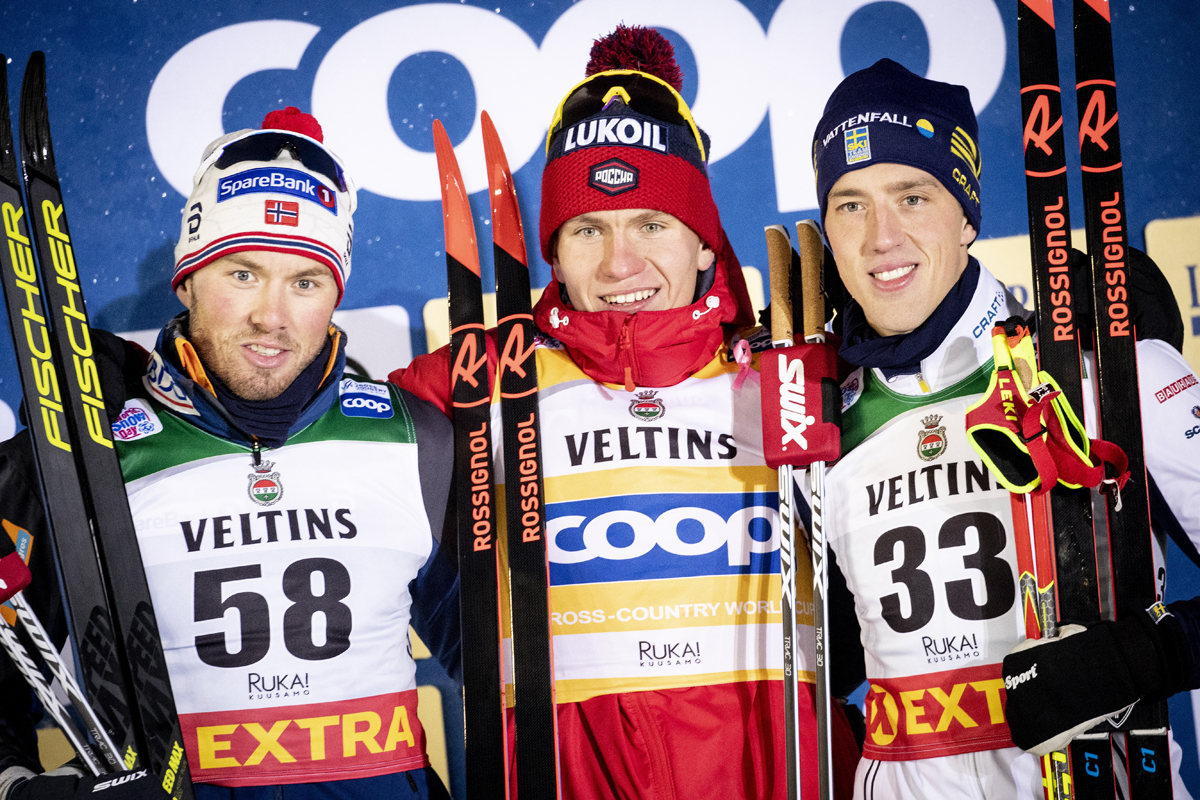
    Men’s 2018 Podium for the Ruka 15k Classic. Russia’s Alexander Bolshunov (center) won, Norway’ Emil Iversen (left) was second, Swede Calle Halfvarsson (right) placed third. (Photo: Fischer/Nordic Focus)

    “I have no secrets,” Alexander Bolshunov told FIS in regard to his back-to-back wins in Kuusamo, Finland. On Saturday, the Russian had won a drag race with Norway’s superstar Johannes Hoesflot Klaebo during Saturday’s classic sprint. 

    Bolshunov had a commanding victory in Sunday’s 15-kilometer classic race. He stopped the clock with a winning time of 36:17.8 minutes. Early in the race, Bolshunov’s splits mirrored those of Norway’s Emil Iversen during which the two skiers’ times never deviated more than one second apart.

    Toe it! Norway’s Emil Iversen skis to second place in the 2018 men’s 15 k classic in Kuusamo, Finland. (Photo: Fischer/Nordic Focus)

    In his final two laps, Bolshunov began to pull away from the field, putting 19.6 seconds on the second place Iversen before the finish. Sweden’s Calle Halfvarsson took the third podium spot finishing 21.2 seconds back.

    In a press conference, Bolshunov was asked whether anyone could stop him this season. He responded through a translator, “ It’s just the start of the season. It would be good if no one would stop me but we’ll say about it later.”

    Iversen, who finished 9th in the World Cup standings last year said he was encouraged by his race today. “I have high expectations, I want to try to beat that result. Have to do good work all winter to do that, but good start for sure,” he said in the press conference.

    Last season’s overall World Cup winner, Johannes Hoesflot Klaebo, finished 9th (+47.6).

    Alex Harvey was the top North American skier finishing in 22nd (+1:13.9). Harvey had a strong start but slowly moved backward in the standings, which he attributes to poor early season pacing.

    “I started way too hard today for how early I am in the season,” Harvey said via Skype. “The first lap I was going great everywhere, then second lap just a bit lesser, third lap worse, fourth lap worse.”

    Despite a disappointing result on the day, Harvey is feeling positive about his racing in Kuusamo and is encouraged about his fitness at this point in the season.

    “I wasn’t expecting much from the sprint and the sprint was actually really good from me,” Harvey continued. “It’s actually a PB [a personal best] for me here in Kuusamo. Today, just a bit disappointing, but I really feel like the pace I kept to the split at the first 1.1 k – I was third – so that was way too fast for me. I’m not a quick starter on any given day, especially before Christmas I need to pace a bit better than that. So a bit disappointed with the distance pacing, but happily surprised about the sprint day.”

    Harvey placed eighth in Saturday’s classic sprint.

    In his first lap during Sunday’s 15 k classic, Harvey’s fast pace challenged Halfvarsson to push harder as well, which ended positively for the Swede. Harvey shared this as the highlight of his day, “I took Calle Halfvarsson to the podium today. … He lapped his second lap when I started so I caught him. … I was kind of disappointed in myself in the changing tent afterward and he came and just said ‘hey, thanks man, you brought on the podium today, so I have to thank you.’ So that was my highlight.”

    Harvey also expressed his gratitude for the effort that went into creating the high-quality conditions expected at World Cup. This year has seen a lack of snow in Kuusamo. “It’s good to see that Ruka again did a really good job… they’ve had it rough this year, everywhere in Europe and in Scandinavia. I think they did a really good job managing to give us really good racing conditions for the weekend.”

    Also for Canada, Russell Kennedy (TEAM R.A.D.) skied to 71st (+3:47.6), Andy Shields 82nd (+4:22.6), and, Julien Locke (CNST) 83rd (+4:32.3).

    Leading the U.S. men, Erik Bjornsen finished 31st (+1:50.0), just outside of the points. (The top-30 on the World Cup score points.) Bjornsen raced with consistent lap splits, maintaining a position between 29th and 34th at checkpoints throughout the race.

    “It wasn’t the start to the season that I had hoped for, but I don’t think it was too far off,” Bjornsen wrote in an email. “Today, I didn’t feel great. I felt a little stiff, never able to open up and glide out there. I’ve always found the snow to be a little tricky here in Ruka. Hopefully next weekend I’ll feel a little more snap in the body. The goal is to be consistently skiing in the points.”

    U.S. coach Matt Whitcomb was encouraged by Bjornsen’s effort.

    “I think he [Bjornsen] should feel good about skiing a really consistent race, being in the mix with some incredible skiers, and I thought he was attacking hard from lap one through four,” Whitcomb told FasterSkier in a phone call. “I think he’s in great shape.”

    U.S. Ski Team’s Kevin Bolger raced to 63rd during Sunday’s 15 k classic in Kuusamo, Finland. (Photo: Fischer/Nordic Focus)

    Next for American skiers was Adam Martin (CGRP) in 53rd, followed by Scott Patterson (USST) in 57th, David Norris (APU) in 59th, and Kevin Bolger (USST) in 63rd.

    Whitcomb added that if the team was looking for stronger results, they would have arrived in Kuusamo sooner so the skiers could adjust to the conditions and time-zone. “We showed up and there was a Russian team that had been already skiing for 2.5 weeks in Finland,” he said. “So, each week they spend on the ground is worth, just sort of an automatic 30 or 60 seconds, just in these early season weeks, where you get your feet under you. When you’re coming from a place that is as far away as Russia or the U.S. or Canada or Australia, it takes a long time to settle.”

    Whitcomb continued, “This year is better than any year that I’ve seen since 2006. And I think what the guys have really been missing over the years is some semblance of a stronger team, and they really have that now. So I think it’s gonna produce, with time, stronger results.”

    Men’s Results

  • Sunday Rundown: Johaug and Bolshunov win in Kuusamo

    Sunday Rundown: Johaug and Bolshunov win in Kuusamo

    Kuusamo, Finland’s cross-country ski/ jumping complex. (Screenshot from rukanordic.com)

    FIS Cross-Country World Cup in Kuusamo, Finland: 10 k/ 15 k Classic

    Sunday in Kuusamo brought closure to the World Cup’s opening weekend. The women contested a 10-kilometer interval start classic race. In her first World Cup race after serving a suspension for testing positive for a banned substance, Norway’s Therese Johaug won in a time of 28:02.5 minutes.

    By the time check at 3.3 k, Johaug had begun to control the pace and the race. At the finish, she bested Sweden’s Charlotte Kalla, who placed second, by 22.5 seconds. Kalla’s teammate, Ebba Andersson placed third (+32.8).

    The U.S. placed three women in the top-30, with Sadie Bjornsen of the U.S. Ski Team (USST) leading the team in eighth place, 1:10.5 minutes behind Johaug. Jessie Diggins, also of the USST, placed 14th (+1:38.5), Rosie Brennan (APU) was 23rd (+2:02.8).

    Sophie Caldwell (USST) finished 43rd (+2:52.3), Caitlin Patterson (CGRP) 46th, (+2:56.8), Ida Sargent (USST) 56th (+3:31.1), and Kaitlynn Miller (CGRP) 61st (+3:55.7).

    No other North American women were entered in the race.

    buy minocycline online

    Saturday’s classic sprint winner in Kussamo, Russia’s Alexander Bolshunov, made it a clean sweep for himself by winning Sunday’s 15 k classic in a time of 36:17.8 minutes. Emil Iversen of Norway was second (+19.5), with Calle Halfvarsson of Sweden in third (+21.2).  

    Alex Harvey of Canada was the only North American in the top-30, placing 22nd (+1:13.9). Also for Canada, Russell Kennedy (TEAM R.A.D.) skied to 71st (+3:47.6), Andy Shields 82nd (+4:22.6), and Julien Locke (CNST) 83rd (+4:32.3).

    Just outside the points for the U.S. was Erik Bjornsen (USST) in 31st (+1:50.0). The next best placed U.S. skier was Adam Martin (CGRP) in 53rd (+2:42.7). Scott Patterson (USST) finished 57th (+2:47.8), David Norris 59th (+2:53.3), and Kevin Bolger (USST) 63rd (+3:09.5).

    Women’s Results | Men’s Results

  • Bolshunov Bests Klæbo in Ruka Classic Sprint Opener; Harvey 8th

    Bolshunov Bests Klæbo in Ruka Classic Sprint Opener; Harvey 8th

    The men’s classic sprint podium on Saturday (l to r): Johannes Høsflot Klæbo (l) leading Russia’s Alexander Bulshonov (c) and Eirik Brandsdal in Kuusamo, Finland. (Photo: Fischer/Nordic Focus)

    From an outsider’s perspective, it seemed Johannes Høsflot Klæbo of Norway would open his World Cup 2018/2019 season with the familiarity of a win. The first FIS cross-country race of the year, a 1.4-kilometer classic sprint in Kuusamo, Finland, saw the 22-year-old round the course’s final turn in first, holding off his closest competitor, Alexander Bolshunov of Russia, by close to two meters.

    Approaching the finishing stretch, Norway’s cross-country sprint king was still dictating the pace. He seemed well on his way to adding another World Cup sprint title to the eight he already holds. As Klæbo neared the finish line, he paused his double-pole to look behind him. A mis-step that turned into Bolshunov’s chance.

    Norway’s Johannes Høsflot Klæbo (l) leading Russia’s Alexander Bulshonov (c) and Eirik Brandsdal through the final corner of the men’s 1.4-kilometer classic sprint on Saturday in Kuusamo, Finland. (FIS screenshot)

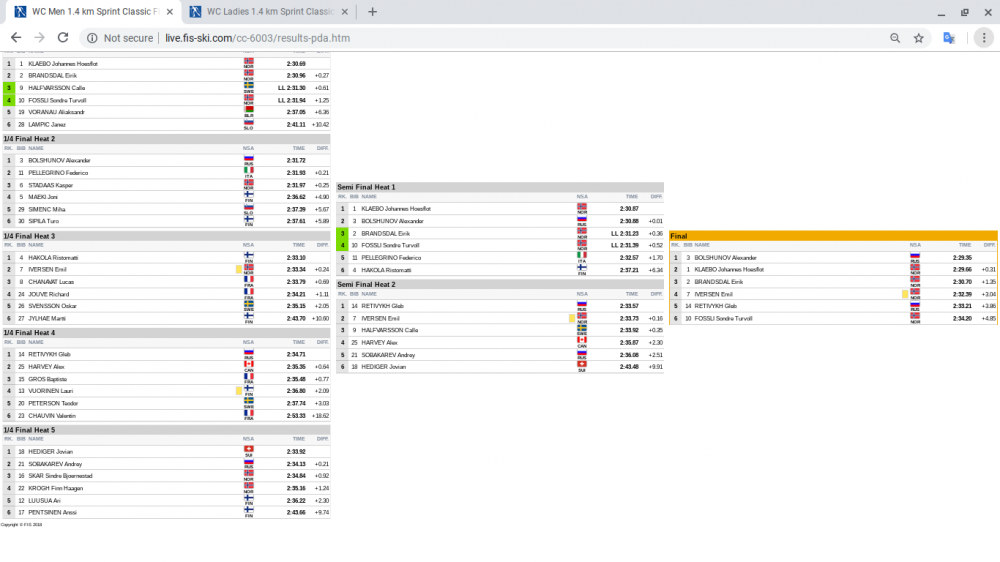
    While Klæbo glanced behind him, Bolshunov kept his head down and hammered. The 21-year-old Russian crossed the finish line first, fist and ski pole raised high, as he claimed the win over Klæbo by 0.31 seconds in a time of 2:29.35.

    Klæbo, who briefly returned to double poling once he saw Bolshunov, eventually stood up straight, seemingly giving way to a Russian defeat. The Ruka sprint victory is Bolshunov’s first World Cup sprint win.

    Eyeing Klæbo throughout the day, he showed strong positioning and pace. For the duration of the latter half of the sprint final, Klæbo had controlled from the front. At the top of the course’s final climb he had padded his gap on the field and Bolshunov by more than a meter and a half.

    Earlier in the day, Klæbo had won the qualifier in a time of 2:28.95, the next closest qualifier, Norwegian Eirik Brandsdal, 3.21 seconds behind. Regardless, Klæbo will depart the Ruka sprint hungry for more, as will Bolshunov.

    Finishing third in Saturday’s final was Brandsdal, 1.35 seconds behind the winner, Bolshunov. Also in the final on Saturday was Emil Iversen, who received a technique violation during his quarterfinal, of Norway in fourth (+3:04), Gleb Retivykh of Russia in fifth (+3.86), and Norwegian Sondre Turvoll Fossli in sixth (+4.85).

    Kevin Bolger of the U.S. Ski Team racing the qualifier on Saturday in Kuusamo, Finland. (Photo: Fischer/Nordic Focus)

    Canada’s Alex Harvey was the lone North American male to advance to the rounds after qualifying in 25th (+9.40). He advanced to the fourth quarterfinal, where he finished second to Retivykh before advancing to the second semifinal. Harvey crossed fourth in the second semifinal, missed advancing to the final, and ended the day in 8th.

    “I’m feeling great right now. I was able to execute the plan pretty much to the dot this year, no injury or illness slowed me down and I have a fun time the whole Summer and Fall!” Harvey wrote in and email to FasterSkier. “As per usual, I’m a slow-ish starter so the first goal of the season for me will be the Tour de Ski.

    buy cleocin online

    “The big goal for me this season is the World Championship in Seefeld,” Harvey continued. “I’m focusing on the skiathlon and the 50 k where I’m going to defend my world title to the best of my abilities! Right behind Worlds are World Cup Finals in Québec City so that’s huge motivating factor for me to wrap up the season at home once again just like we did in 2017.”

    Following Harvey’s performance for Canada, Julien Locke (CNST) finished 69th (+15.43), Andy Shields 75th (+18.59), and Russell Kennedy (Team R.A.D.) 76th (+18.61).  

    Five men completed the sprint for the U.S., with American and U.S. Ski Team (USST) B-team member, Erik Bjornsen leading the team in 42nd (+11.41). Kevin Bolger, new to the USST B-team this World Cup season, finished in 55th (+13.19), while Ben Saxton of the Stratton Mountain School placed 70th (+15.68) and David Norris of Alaska Pacific University finished 78th (+19.05). Simi Hamilton (USST) placed 82nd (+1:11).

    The men’s sprint bracket from Saturday’s 1.4-kilometer classic sprint in Kussamo, Finland(Photo: FIS Live Timing screenshot) Click the image to enlarge

    Results: Qualifier | Final

  • Saturday Rundown: World Cup Ruka Classic Sprint

    Saturday Rundown: World Cup Ruka Classic Sprint

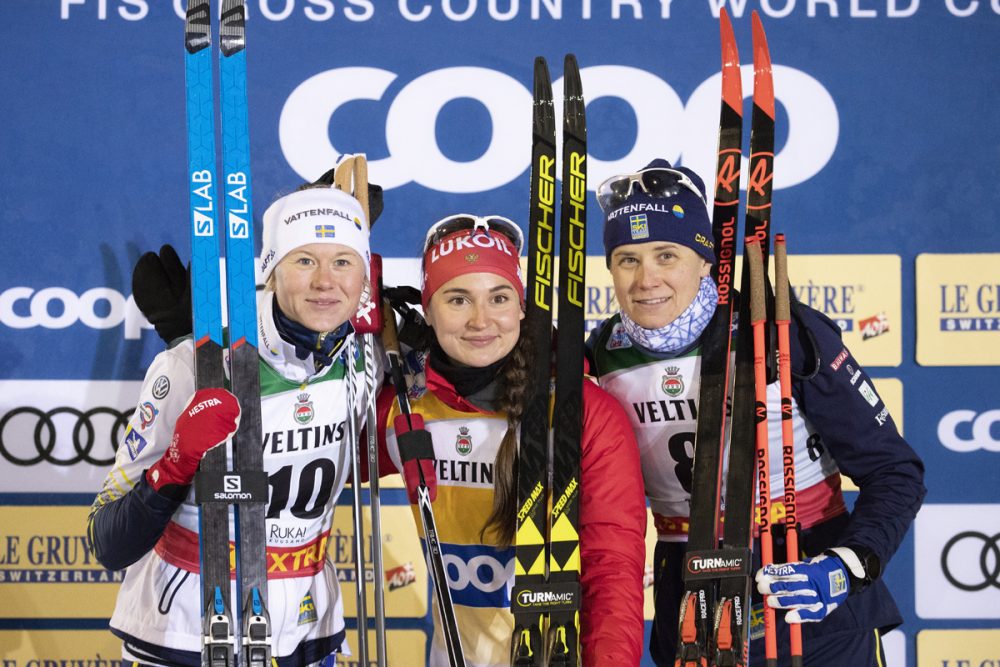
    The women’s 1.4-kilometer classic sprint podium (l to r): Sweden’s Maja Dahlqvist, Russia’s Yulia Belorukova and Ida Ingemarsdotter of Sweden. (Photo: Fischer/Nordic Focus)

    FIS Cross-Country World Cup in Kussamo, Finland: Classic sprint

    Men’s Report | Women’s Report

    On Saturday in Kussamo, Finland the 2018/2019 World Cup season began with a 1.4-kilometer classic sprint.

    Twenty-three-year-old Yulia Belorukova from Russia won the final in 2:52.62 minutes. It was Belorukova’s first World Cup win. Second place went to Sweden’s twenty-four-year-old Maja Dahlqvist who crossed the line 1.12 seconds back. Also from Sweden, Ida Ingemarsdotter was third (+1.51), Norway’s Maiken Caspersen Falla fourth (+1.52), Krista Pärmäkoski of Finland fifth (+4.71), and Stina Nilsson of Sweden, sixth (+12.33). Nilsson crashed in the final.

    In the women’s qualifier, Russia’s Natalia Nepryaeva set the fastest time in 2:56.50 minutes. Seventy-three skiers started the qualifier.

    buy cephalexin online

    Three U.S. Ski Team (USST) women advanced to the heats by qualifying in the top-30. Sadie Bjornsen in 5th (+3.01), Sophie Caldwell in 22nd (+6.97), and Ida Sargent 24th (+7.23).

    Caldwell and Sargent did not advance out of the heats. Caldwell was third in the first heat, won by second fastest qualifier, Falla. Caldwell finished 0.36 seconds behind Falla and ultimately did not secure a lucky loser spot. Sargent raced in the third heat where she placed sixth (+4.50).

    Four U.S. women bowed out in the qualifier, with last season’s second overall skier in the World Cup standings, Jessie Diggins, placing 33rd (+9.05). Rosie Brennan (APU) skied to 38th (+10.74), Kelsey Phinney (SMS-T2) 46th (+13.49), and last season’s overall SuperTour leader, Kaitlynn Miller (CGRP), was 58th (+18.06).

    Kaitlynn Miller racing for the U.S. in the women’s 1.4-kilometer classic qualifier on Saturday in Kussamo, Finland. (Photo: Fischer/Nordic Focus)

    No Canadian women entered the race.

    In the men’s race, last season’s World Cup overall and sprint cup winner, Johannes Høsflot Klæbo, scorched the qualifier in 2:28.95, winning by 3.21 seconds over he next fastest qualifier, teammate Eirik Brandsdal.

    Klæbo won his heat and his semifinal. But the semi was tight: Klæbo won by 0.1 seconds over Russia’s Alexander Bolshunov.

    In the final, Bolshunov won in 2:29.35 minutes, Klæbo was second (+0.31), Brandsdal third (+1;35). Also of Norway, Emil Iversen placed fourth (+3:04), Russia’s Gleb Retivykh fifth (+3.86), and Norwegian Sondre Turvoll Fossli sixth (+4.85).

    The only North American to advance to the heats was Canada’s Alex Harvey, who qualified in 25th (+9.40) and ended the day in eighth. Harvey advance out of the heats by placing second to Russia’s Gleb Retivykh in the fourth quarterfinal. In the second semifinal, Harvey placed fourth (+2.30) and did not advance as a lucky loser.

    Also for Canada, Julien Locke (CNST) finished 69th (+15.43), Andy Shields 75th (+18.59), and Russell Kennedy (Team R.A.D.) 76th (+18.61).  

    For the U.S., Erik Bjornsen (USST) placed 42nd (+11.41), Kevin Bolger (USST) 55th (+13.19), Ben Saxton (SMS-T2) 70th (+15.68), David Norris (APU) 78th (+19.05), and Simi Hamilton (USST) 82nd (+1:11).

    Women’s Qualifier Results | Women’s Final Results | Men’s Qualifier Results | Men’s Final Results

  • Cross Country Canada: The Reboot Part 1

    Cross Country Canada: The Reboot Part 1

    Canada’s Alex Harvey celebrating on the podium after placing second in the men’s 15 k freestyle mass start in Seefeld, Austria, for his best result of the 2018 World Cup season. (Photo: Salomon/NordicFocus)

    Cross Country Canada (CCC) has begun a reboot process as the new Olympic cycle starts. Corporations call this a reset, a rebranding, a new direction, restructuring, and various other names that try to disguise the challenges and issues that come with enacting real change.

    The reboot process traditionally starts with an acknowledgement that the current level of success, and that of the foreseeable future, doesn’t align with the goals or the potential of the organization.

    Canada left PyeongChang with no medals at three consecutive Olympics, only one skier in the World Cup red group, and a perception that there was no obvious successor to Alex Harvey.

    There are many people who, with the benefit of hindsight, believe that CCC allowed itself to be trapped by a combination of success and the Own The Podium (OTP) funding model. 

    The process of assigning blame for the past, called “blamestorming”in the corporate world, is one of the most effective ways to waste time and destroy morale without doing anything to improve the future. The “best practices” approach to a reboot starts with four apparently simple questions: How did we get here? Where are we now? Where do we want to be in five years? How can we get there?

    While CCC does many things as a national sport body, this article will focus on high performance and the development system.

    How did we get here?

    After a disastrous 1998 Olympics in Nagano, CCC shrank to a full-time staff of five and endured a forced re-invention. Four years later, in 2002 at Salt Lake, Beckie Scott won all three medals in the skiathlon after the initial silver and gold medalists were caught doping. Sara Renner missed the B final in the sprint for 9th place.

    Canadian Chandra Crawford in the 2011 team sprint in Dusseldorf, Germany. (Photo: Fischer/NordicFocus)

    In 2006 in Torino, Chandra Crawford earned a surprise gold in the sprint while Scott finished fourth. Scott had earlier teamed up with Renner for a team sprint silver medal.

    buy vancomycin

    In 2010, there were no Canadian cross-country medals. However, there were signs of promise. Renner skied to her fourth Olympic top-10 finish. All four Canadians competing in the men’s skiathlon finished in the top-15. Devon Kershaw lost out in final kilometer of the 50 k to finish fifth, 1.6 seconds away from gold.

    That post-Vancouver glow was possibly the point where CCC temporarily slid off the rails.

    A number of Canadian sports fell victim to OTP incentives. A sport qualifies for OTP funding by having good prospects for a medal in the next Olympics. The money comes with strings attached, to ensure that resources are spent on improving the probability that specific individuals will podium. For smaller sports where the OTP money is a significant proportion of the sport’s annual budget, it is hard to make choices that put that money at risk. Choices like balancing the emerging athletes in the pipeline, while simultaneously supporting those athletes already at the top-end of the sport. 

    As a result, many sports have lost their OTP eligibility by losing the focus on development and the vision that qualified the sport for OTP in the first place. Some people put cross-country skiing in the list of sports that fell into this trap.

    After 2010, the future looked bright. Harvey and Kershaw were World Champions in the 2011 team sprint. Kershaw was second overall in the 2011/2012 World cup. (A feat only equaled in North America by Scott and Jessie Diggins).

    Harvey arrived at Sochi in 2014 as a medal favorite. He was fresh off a World Cup podium in Toblach the weekend before the 2014 Games began. Sochi ended poorly when Canada, along with Norway, couldn’t solve the difficult waxing conditions.

    In 2017, the men’s World Cup relay podium in Ulricehamn, Sweden sustained the hope — that result earned another year of OTP funding for five men. (Harvey remained a the top, as he won the men’s 50 k skate at the Lahti, Finland World Championships.) 

    The results in PyeongChang were similar to 2002 numerically: Harvey was close to a medal in multiple races and Lenny Valjas collected 7th in the classic sprint. A medal would have changed the mood, but not overall situation. 

    Where are we now?

    Post-PyeongChang, CCC believes Canada is not achieving the international results a country with plentiful snow and 37 million people is capable of.

    The development system in Canada consists of the National Team, the official training centers (Centre National d’Entrainment Pierre Harvey (CNEPH), Thunder Bay National Team Development Centre (TBay), and the Alberta World Cup Academy (AWCA)), and the clubs. The ten provinces and three territories have teams, but don’t have a formal place in the development system as each of the thirteen regions approaches development support differently. In the last few years, the number of clubs actively recruiting and developing athletes while supporting a high performance team has increased. For our purposes, as no official name has been affixed to these clubs, the term ‘elite club’ will be used here.

    In the past, all national team members were required to belong to a training center while developing athletes were encouraged to join.

    “I can speak for many of the athletes, they thought that if they didn’t go to a training centre, then they might as well quit skiing,” Telemark’s coach Adam Elliot said. “It was that broad of a choice, they felt they had to choose between skiing and school immediately.”

    The landscape is more diverse now, with more options. The examples that follow skew to Western Canada, largely because the coaches quoted brought teams to Sovereign Lake snow camps in May and November and were available for in-person interviews. Eastern Canada remains equally diverse in terms of its club offerings.

    A common theme among the coaches and athletes is that each athlete’s needs are different, and he or she needs to find an environment that fills those needs. FasterSkier asked AWCA’s head coach Chris Jeffries how an athlete should choose his or her path to success.

    “It’s such an individual, case by case thing,” he said. “I don’t have an answer.”

    In 2017, a shift to allow more development paths resulted in new senior National Team member Gareth Williams staying at his home club, Telemark, in Kelowna, BC. Elliot described how it came about.

    “Tom Holland approached us, for Gareth, and said we like what you’re doing in the Okanagan, and we want to keep Gareth there. We’re going to support you and your program to be able to support Gareth.”

    Also in 2017, Julien Locke returned to his home club Black Jack while Russell Kennedy shifted to the new Team R.A.D., part of the Canmore Nordic Club.

    To further illustrate the spectrum of options and pathways, FasterSkier contacted three Canadian athletes, each with a history of NorAm podiums and some international success, to discuss their ski-training choices. Dahria Beatty started at AWCA and has remained there, Evan Palmer-Charette started at TBay then recently moved to Team R.A.D., and Andy Shields has gone rogue.

    Dahria Beatty en route to 20th overall in the Seefeld World Cup freestyle sprint for her season-best result in 2017/2018. (Photo: Fischer/NordicFocus)

    “For me, I’ve been working with Chris [Jeffries] for six years,” Beatty told FasterSkier in November. “It works really well for me, and I have a good group of training partners where I am, that can push me everyday in training.”

    AWCA is also the home training group for National Team skier Emily Nishikawa and two junior national team skiers. AWCA also benefits from its close proximity to a number of other training groups.

    “For me, Canmore’s a location where I want to be training, where I want to be based out of,” Beatty said. “All the pieces fit well together for [me], it’s somewhere I think I can keep improving.”

    Palmer-Charrette made a summer-time decision to change things up by finding a fresh environment in Team R.A.D.

    “I think the best part of being on a training centre is the entire program is based around a small group of athletes of similar age which makes for a great training and racing environment,” Palmer-Charrette wrote. “I feel training centres, as they are, are best-suited for junior/u23 athletes and especially great for athletes who are a bit late to the game like I was at the end of high school and will really benefit from learning from other athletes on the day to day training life.”

    Shields is no longer affiliated with an official team. He funds his skiing by painting houses in the summer and representing ski wax companies in the winter. Although he refers to ski racing as a hobby, he did end the last season as COC leader and will race period 1 of the World Cup.

    “I don’t think I could have done this straight out of junior,” Shields wrote. “My time on Tbay is still having a huge positive effect on my ski career. Being on a team through my early years as a senior made it much easier to get a decent training base and set a couple good habits in place which are paying dividends.”

    Shields did reflect and offer an alternative to how he might have changed his path to elite level skiing.

    “If I could go back in time I would have gone the NCAA route straight out of junior,” Shields added. “College skiing in the States is a much better deal than a training center for people in their early twenties. You can go down to the States, get a degree, not pay a dime, and come out the other side with plenty of time to have a full-time ski racing career. I would have joined a training centre upon finishing with NCAA.”

    The Canadian university system differs from the U.S. model, offering little money for sports. Heading south to the U.S. as a student-athlete remains an option for some Canadian skiers. Most athletes remain in the Canadian system to develop. With that in mind, FasterSkier asked why some athletes had chosen some of the Western based training centres.

    Jeffries, who leads the AWCA, also noted how his program has evolved. There appears to be room at the AWCA for those with concurrent goals. The AWCA has partnered with the University of Calgary to allow AWCA athletes to work towards degrees.

    “We’re always evolving our programming, and what it entails, and how we package it,” Jeffries said. “That’s why we have this new university program this year, because you just look at the popular decision making of graduated high school athletes.” 

    Elliott, based in the Okanagan, said his program offers athletes a well rounded experience too. 

    “You’ve got the trifecta,” Elliot said. “You’ve got access to education opportunities for post-secondary. We’ve got the university, UBC Okanagan, and the college. Most of the people who’ve moved here have gone to school. Secondly, it’s the Okanagan. Which is probably the best place to ski in North America, with skiing up and down the valley –with Nickel Plate, Telemark, [Kelowna] Nordic, Sovereign, and Larch Hills. The third is that you’re moving into a community of skiers: family, volunteers, everybody trying to make a go of keeping people in sport.”

    Clearly the times have changed from a programming perspective and the past’s financial windfall for Canadian cross-country skiing.

    “Probably the quad between 2010 and 2014, CCC had more money almost than it knew what to do with, ” Dave Wood, former National Team head coach, told FasterSkier in May as he finished up a long ski day. “Now, I think the budget’s still three and a half million. While it’s maybe low compared to what it has been, it’s a hell of a lot higher than it was in ‘99, by about four times.” 

    Former CCC High Performance Director Tom Holland spoke of those larger commitment from clubs during the Frozen Thunder races in October. 

    “There’s a lot more resources,” Holland said, referencing the increased numbers of coaches attending Frozen Thunder with their athletes. “One of the reasons clubs are more important now is that there are paid coaches at the clubs. That’s why training centres started in the 90’s, because you’ve got to have a coach, full-time.”

    Thee deep question remains: what next for Cross Country Canada as it ponders a post-Alex Harvey scene? Better and more diverse options for Canadian skiers, like those modernizing their offerings to connect with the student-athlete, is a step forward. But fans of the sport, and of course Cross Country Canada, have short-term and long-term goals. No one wants to see another Olympic quadrennial transpire without the glimmer of medal potential at the international championship level. 

    “I think when Alex Harvey retires, mostly likely after next year with Lenny Valjas, it will be the end of an era having athletes being able to finish on the podium at World Cups, World Championships, said Alain Masson, Whitehorse head coach. “So definitely, the program is going to go into a real rebuilding phase with lots of young athletes, but no guarantee of success in the near future.” 

    This is part one of a two-part story. 


  • Frozen Thunder Booms on Day 1 Classic Sprint

    Frozen Thunder Booms on Day 1 Classic Sprint

    Len Valjas (CNST) overall winner of the Frozen Thunder classic sprint in bib 2 leads Reed Godfrey (bib 7) in round 2 of the Frozen Thunder classic sprint. (Photo: Doug Stephen)

    The North American season kicked off today with classic sprints at Frozen Thunder in Canmore, Alberta. Most of the top athletes were treating this as a chance to do some race intensity and were more focused on training and process goals than on actual results.

    The day’s results are summarized in the rundown.

    Chief of Competition Thomas Holland had expected a smaller turnout this year, partly from fewer people traveling to Frozen Thunder in a non-Olympic year and partly because the event is not used for trip selection this year. In years past, Frozen Thunder races have been used to fill Canada’s remaining World Cup period 1 starts. While there were less elite athletes present, the overall entries rose to 159, with a large increase in juniors.

    “There’s a lot of happy athletes putting in a lot of time here, and it’s great to see the energy,” Holland said in a phone interview while waiting for doping control to finish. “The numbers are up, there’s more women this year.”

    Dahria Beatty during the 2018 Frozen Thunder classic sprint qualifier. (Photo: Doug Stephen)

    The King’s court heat format has been a good fit for the early season racing. It ensures every skier gets to ski three heats against people of similar speed.

    buy flonase online

    “You get guys skiing against girls, disabled skiing against able-bodied, there’s a lot of magic there,” Holland said. 

    This year’s course is new, adding a hill and switching to a single lap of about 1.5km.

    Below are quotes from athletes to provide insight into North America’s first day of head-to-head racing.

    Athletes on Tactics and Race Goals

    “I was happy with my race today. I executed my technical goals well and was able to maintain my speed around the entire course without slowing down much which has been something I’ve been working on this summer.” — Dahria Beatty (CNST, Q 1st, H 1st)

    “Once I got the ‘king heat’ I felt for sure like the underdog being a first-year senior man. So, my goal was just to stay in there as much as possible and hopefully beat at least one guy to stay in the king heat for the A final. It was a super fast group of guys today so I was pretty excited to be racing in the final.” — Reed Godfrey (Team R.A.D., Q 6th, H 4th) 

    “My plan for the heats was to press hard from the gun in every round. My focus today was on doing a good effort at full race pace. At this time of year, I’d prefer to get the hard racing in my legs rather than racing tactically for the win.” — Julien Locke (CNST, Q 2, H 5)

    “Unfortunately, my klister caught 2/3 of the way through the semifinal and I face planted into the snow while the other guys skied around me. I pushed hard in the B-Final, leading from start to finish. The snow softened and made for a far more challenging loop. I was happy to have good power through the last round and also to see my fellow BC NST teammate Gareth [Williams] skiing well and holding on to a good pace.” — Locke

    “I was really happy with the whole day. I found I executed my plan like I wanted too and that I skied the course well both in the qualifier and during the heats. I will have to work on my pacing for qualifiers, I went a bit to slow up the first climb at the start. I wish I could have stayed in front of Lenny in the last 100m, but I did not have enough gas. Never count this guy out ;)” — Dominique Moncion-Groulx (Team R.A.D., Q 3rd, H 2nd)

    Athletes on Feeling Fit. Or Not.

    “My shape was surprising considering I only started full-time training less than a month ago. Double pole felt stronger than I remember and the legs felt good on the climbs. I’ll attribute my podium performance to the SkiGo klister I was using.”  — Andy Shields (Lappe, Q 9th, H 3rd) Shields is the Canadian rep for SkiGo waxes.

    “I didn’t have high expectations today coming off an altitude block in Mammoth, but I ended up being super happy with how the day went. It’s obvious that the race shape isn’t there yet, but it was really fun battling it out with with some very solid skiers today!” — Reed Godfrey

    “Today’s races were pretty smooth, didn’t expect much since I just returned from the NST camp in Mammoth, California. I felt alright in the qualifier and managed to move up to 6th on the day.” — Gareth Williams (CNST, Q 8th, H 6th)

    “I was super happy to have a good qualifier [which] shows good fitness but I tried double poling and haven’t done enough on snow yet to hold my fitness through the heats.” — Russell Kennedy (Team R.A.D., Q 1st, H 7th)

    “The race today was tough, I just got on snow and coming off a volume camp in Mammoth lakes the body wasn’t too happy trying to push to the max. It was solid intensity, but hopefully not where the race shape will be. “ — Evan Palmer-Charrette (Team R.A.D., Q 11th, H 8th)

    Athletes on the King’s Court Format

    Mark Arendz (CPNST) in bib 38, leading Hannah Mehain (Bib 75) and Dartmouth’s Lauren Jortberg (bib 118) in round 1 of Frozen Thunder’s King’s Court sprint format. (Photo: Doug Stephen)

    “The King’s court format was changed slightly this year with only the winners of the heats moving up. The 2nd and 3rd skiers stayed where they were and 4th place dropped down. With the new format it meant you couldn’t cruse into 2nd place and advance like you use to – you had to get after those ‘Ws’ which was a great improvement on the part of the organizers. It made for a lot more high-stakes lunges at the line.” — Shields

    “Kings court format is a great training tool because it puts you against people who were a similar speed to you in qualifying allowing people to be in the mix for most of the heat versus the big spread you see in a normal quarter-final. I think it’s perfect for early season prep races like Frozen Thunder and as a development tool, giving everyone the opportunity to race four times.” — Beatty

    “King’s courts is nice because it allows everyone to race a full set of heats, which is a really good training benefit this time of year. It’s also nice to have everyone fighting to move up and up in the heats throughout the day.” — Reed Godfrey

    “Kings court is a great format to help people improve their race fitness in the early season and work on tactics in a low pressure situation.” — Palmer-Charette

    “The King’s Court format allows everyone in the ski community the opportunity to race multiple times. The format allows for you to race skiers of similar speed, as well as challenging yourself as you progress through the rounds. For me, I have an opportunity to race the Senior Women, [as] our ski speeds are very similar. That close head-to-head competition is always good to develop skills and tactics for future races.” — Mark Arendz (CPNST)

    Athletes on Early season racing

    Emily Nishikawa (CNST) during the 2018 Frozen Thunder classic sprint qualifier. Nishikawa qualified in second place and skipped the heats. (Photo: Doug Stephen)

    “It has been really great to get back on snow for training and racing this past week. Having on snow races early season is super valuable and is a great way to figure out what needs to be fine tuned before the season starts.” — Beatty

    “It’s important to break that barrier of racing now early in the season to learn what you need to work on moving forward to when it really starts to really count. The quicker we can make that pavement to snow transition definitely helps going into the the races in late November and December.” — Reed Godfrey

    “I leave for the World Cup in 10 days and it’s time to start ramping up the on-snow speed. No better way to do that than a good race! Frozen Thunder is such an asset for us here in Canmore. It’s a huge benefit to be back on snow before the season and it gives us an edge in our preparation for the season.” — Locke
    “I think getting on snow in the early season can be really important for people looking to race fast in period one. For everyone going overseas to the World Cup I feel like it’s essential and for those of us racing domestically it elevates the level of competition for everyone.” — Palmer-Charrette
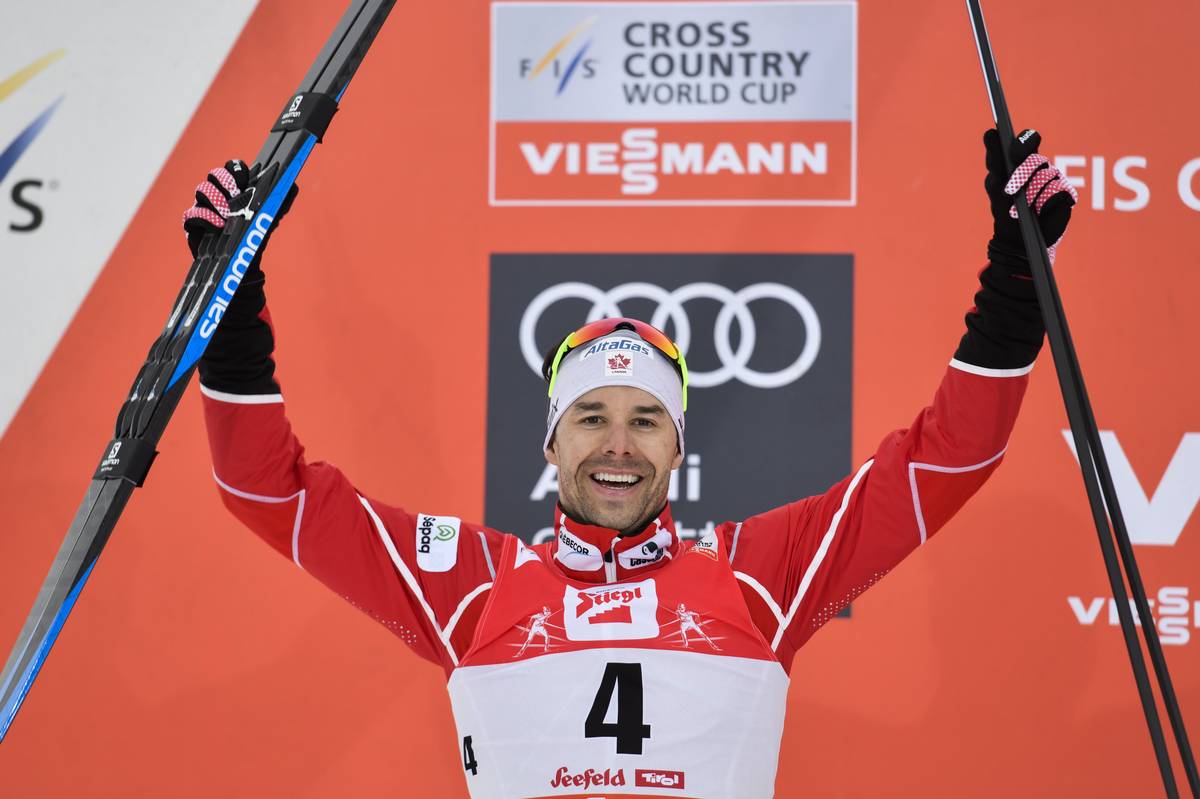
    “You can’t replace hard races with intensity. If you want to go fast at some point in the season, you need to get enough race starts throughout the year.” — Arendz


  • FasterSkier’s Canadian Continental Skiers of the Year: Andy Shields and Olivia Bouffard-Nesbitt

    FasterSkier’s Canadian Continental Skiers of the Year: Andy Shields and Olivia Bouffard-Nesbitt

    Andy Shields (l) of Lappe Nordic and Olivia Bouffard-Nesbitt (r) of Rocky Mountain Racers are FasterSkier’s 2018 Canadian Continental Skiers of the Year. (Photos: Doug Stephen & Mario Walker)

    With the 2017/2018 season officially in the rearview, FasterSkier is excited to unveil its annual award winners for this past winter. Votes stem from the FS staff, scattered across the U.S., Canada, and Europe, and while not scientific, they are intended to reflect a broader sense of the season in review. This set of honors goes to the Canadian Continental Skiers of the Year.

    Previous categories: Junior Skiers of the Year | Collegiate Skiers of the Year | Biathletes of the Year | Para-Nordic Skiers of the Year | NoCo Skier of the Year | Canadian Breakthrough Skiers of the Year | U.S. Breakthrough Skiers of the Year | Coach of the Year | U.S. Continental Skiers of the Year

    ***

    Andy Shields, Lappe Nordic

    Despite scaling back his training last year, Andy Shields had one of the most consistent seasons of any Canadian nordic racer, tallying five podiums between the NorAm and SuperTour circuit. That included a win in the 15-kilometer classic mass start at Western Canadian Championships in Red Deer, Alberta, and a runner-up finish in the skate sprint at Canadian Ski Nationals on the trails he trains on at Lappe Nordic in Thunder Bay, Ontario.

    After winning the overall NorAm title in 2015/2016 and going out on his own with the help of his dad  and the Lappe Nordic Ski Club, Shields did it again this winter as the overall NorAm leader at the season’s end. He raced fast enough to earn Period 4 World Cup starts and went on to post a top World Cup finish of 47th in the Holmenkollen 50 k freestyle mass start.

    Andy Shields racing the 15 k classic at the World Cup on March 4 in Lahti, Finland. In his first World Cup distance race of the season, Shields, who won the NorAm overall and placed second in the NorAm sprint standings, finished 70th in that race. (Photo: Fischer/NordicFocus)

    In an email to FasterSkier this week, Shields, 27, who grew up in Waterloo, Ontario, explained that last spring, he changed his mental approach to skiing.

    “Before last April, I had seven years of experience as a full-time skier and I considered it my profession,” he wrote. “However, it was becoming quickly becoming a profession that caused bills rather than paid them especially with the loss of my Canada card. This contributed to an overall feeling of not being too jazzed about competing in another season of full-bore, focussed, make-all-the-little gains, maximum performance training and racing.”

    He questioned whether he wanted to continue racing and how he was going to improve if he wanted to do so.

    “After getting wrecked on the Period 1 World Cups the season before and coming nowhere near a top 30, I had serious doubts on whether it was worth it to keep trying to crack the ‘nut’ we call World Cup racing,” Shields wrote.

    He wondered if he was physiologically and psychologically talented enough to compete at the World Cup level. He considered “setting the bar lower” to make himself happier, focusing solely on top NorAm and SuperTour finishes rather than making it to the World Cup.

    “Obviously it was time to reframe things. It was an Olympic year so and I was still having lots of fun skiing so quitting wasn’t an option,” Shields wrote. “I needed cash so I bought Skiwax.ca and started a business selling ski wax and ski equipment online and became a BNS [Boulder Nordic Sport] Canadian sales rep for SkiGo and a few other brands.”

    That summer, he also worked for his friend’s painting business in Thunder Bay.

    “With cash taken care and the birth of a burgeoning career as a sales rep and business owner, I moved skiing squarely into the ‘hobby’ category,” Shields wrote. “I suspected I could still be reasonably competitive on the NorAm and SuperTour circuits with minimal training if I relied on my large training history — maybe even quick enough to earn an Olympic spot. I decided not to subject a coach to my misadventures and intention of not working too hard. If this new way of approaching things went bad, I wanted it to be my fault.”

    He worked out less than usual last summer and fall (estimating he trained 600 hours total) and didn’t write a training plan nor keep a training log. He followed his intuition and didn’t bother to fix his heart rate monitor when it broke last June.

    “Training was very unstructured and came second to my various jobs – except for a number of training camps with the Greggs, or Micheal Somppi, or others where I buckled down for brief periods of athlete mode,” Shields noted.

    Still, his fitness gradually improved as the offseason wore on. By the time the race season arrived, he was raring to go and “hungry”, Shields reflected.

    “Only one Olympic spot was available to domestic skiers and it was a classic sprint spot, which is my weakest event,” he wrote. “When the selection criteria came out for the Olympic team, it did take awhile to get over the fact that it was extremely unlikely I’d make it. I was able to reset my goal to doing well in the NorAm overall and it wasn’t long into the season before I was in the hunt for the NorAm overall.

    Canada’s Devon Kershaw leads Andy Shields during the Holmenkollen 50 k freestyle mass start on March 10 in Olso, Norway. (Photo: Fischer/NordicFocus)

    “This was great!” he continued. “I was racing fast mostly and having a lot of fun kicking ass. When I got the opportunity to race period 4 on the World Cup, including the Holmenkollen 50km, it was a fantastic bonus.”

    That iconic race in Oslo, Norway, he said, was the highlight of his season.

    “I don’t know if I’ve ever raced so hard before,” Shields wrote. “Only 25km into the race, I was getting adrenaline rushes from the pain when I survived another climb. I had to skip World Cup Finals because I needed one more good race to lock up the NorAm overall so I came back to North America straight after the Holmenkollen to join Nationals partway through the event.”

    Four days after racing in Oslo, he reached the podium in the Canadian nationals skate sprint.

    “I dedicated that podium to Reijo Puiras who passed away over the summer and was the founder of the Lappe Ski Centre,” Shields wrote. “It turned out that final podium at Nationals was what I needed to secure the NorAm overall. It’s hard not to be satisfied with how this season turned out. I got a great sense of accomplishment from having done it on my own – financially and as my own coach. Of course, I had a lot of help in the wax room and my parents are great roommates.”

    As he looks ahead to 2018/2019, Shields explained that he’s planning to continue down a similar path, while logging some more “serious training” before starting the season on the World Cup in November. World Cup Period 1 remains his main focus for next winer.

    “It’s a chance at redemption for such an abysmal period 1 experience my first time over there,” he said. “World Cup Finals in Quebec City is also a huge focus. I have a number of top 50s in Quebec World Cups so I have a track record of good racing there to build on.”

    Olivia Bouffard-Nesbitt, Rocky Mountain Racers

    In what could very well be dubbed her comeback season, Olivia Bouffard-Nesbitt, 25, took it by storm after a rocky start. The Morin Heights, Quebec, native has dealt with an assortment of setbacks — both big and small — over the last several years. Hindered by stress reactions in her foot from 2013 to 2016, she was injured in a car accident in February 2017, which herniated a disc in her neck. She spent last summer rehabbing that injury, then last fall, discovered issues with her sympathetic nervous system.

    After nearly a year away from the racing, Bouffard-Nesbitt started her season this past January at the Mont Sainte-Anne NorAm, which doubled as Canada’s Olympic trials. In her first race there, she raced to third in the classic-sprint qualifier and advanced all the way to the A-final, but was relegated to 25th overall for a technique infraction. Also at trials, she finished ninth in the 10 k classic.

    “It was an absolute roller coaster (mostly uphill) getting to the start line of my first race of the season – the classic sprint at Olympic trials,” Bouffard-Nesbitt reflected in a recent email to FasterSkier. “But once the dust settled and I found my groove on the Noram circuit, the season actually turned out really well.”

    Olivia Bouffard-Nesbitt (c) holds off Zina Kocher (l) and Annika Hicks (r) to win the women’s 1.2 k freestyle sprint final on Friday at the NorAm Western Canadian Championships in Red Deer, Alberta. (Photo: Doug Stephen)

    At Western Canadian Championships in Red Deer, she earned her first NorAm win in four years, topping the freestyle sprint. She also placed second in the 10 k classic mass start there.

    Bouffard-Nesbitt ended the year with a national title in the 5 k classic as well as the 10 k freestyle pursuit (as the first Canadian/second overall in the latter race) at Canadian nationals. She also placed fourth in the 30 k classic mass start.

    With a strong three months of NorAm/SuperTour racing, Bouffard-Nesbitt ended the season as the first Canadian in the overall NorAm standings (she was second to American Caitlin Gregg, who led the aggregate standings with 830 points). Bouffard-Nesbitt had 635 points, as did Annika Hicks of the Alberta World Cup Academy, but Bouffard-Nesbitt won the tiebreaker based on number of wins.

    Asked about the highlight of her season, Bouffard-Nesbitt said it was winning the 5 k at nationals. More specifically, it was the “unexpected flood of emotion and sense of validation I felt after learning I had won” that race, she wrote.

    Olivia Bouffard-Nesbitt (Rocky Mountain Racers) racing to second overall (first Canadian) in the women’s 10 k freestyle pursuit on March 13 for her second national title of the week at 2018 Canadian Ski Nationals in Thunder Bay, Ontario. (Photo: Doug Stephen)

    “Really it felt like my ‘comeback’ had culminated in that moment,” she continued. “I felt like I’d shaken that monkey off my back and I felt so invigorated. I felt like I had finally proven myself. More broadly though, a major highlight was putting so many solid races together back-to-back. For the COC [Continental Cup] standings they count your best 10 races. So after a scrapped trials, I had eleven races to get there, thirteen if you count each pursuit race as two. Finishing the season as the COC leader was the best case scenario. It’s amazing and I’m ecstatic about it!”

    Going into the season, her primary goal had been to take care of herself and make sure she didn’t re-injure her neck. Secondly, she wanted to qualify for the Olympics, and when that didn’t pan out, she shifted her focus to finishing on top of the NorAm circuit.

    Moving forward, Bouffard-Nesbitt plans to continue training with Rocky Mountain Racers in Canmore, Alberta.

    “While I was rehabbing in Quebec, I was itching to get back to Canmore because I had equated being in Canmore to being healthy enough to take up my normal training routine,” she wrote. “… It’s tough to enter a race season, both physically and mentally, when you’re really under-trained. Like I said though, after I recovered from Olympic trials, I was healthy and continuously gaining fitness all winter. It felt great.”

    Next year, she aims to continue building on the work she’s done and gains she’s made over the last year while staying “hyper in tune with my body.”

    “I’m just going to train as usual, and catch up on all the fun I’ve missed,” she wrote. “I’ve been dreaming of putting together a full summer of training for a while, and I’m optimistic that it’s going to happen this year.”

    Honorable Mention: Evan Palmer-Charrette, National Team Development Centre Thunder Bay

    Evan Palmer-Charrette (l) chases American Thomas O’Harra in the 15 k skate at the Sovereign Lake NorAm near Vernon, B.C. (Photo: Peggy Hung)

    Evan Palmer-Charrette, our Canadian Continental Skier last year, had another stellar season, finishing the winter out with a national title in the 50 k classic mass start and third-place finish in the freestyle sprint at Canadian nationals. There, in Thunder Bay, where he lives and trains with the National Team Development Centre (NTDC) Thunder Bay, he also placed fourth in the national 15 k freestyle pursuit and seventh in the 10 k classic.

    Overall, he ended up third in the NorAm standings, behind Shields and Canadian World Cup Team member Jess Cockney. Earlier in the season at a NorAm mini tour in Rossland, B.C., he raced to second in the skate sprint and fourth in the 15 k skate pursuit for fourth overall in the mini tour.

    He also placed fourth in the classic sprint at Mont Sainte-Anne NorAm Olympic trials. In all, he recorded 15 individual top-10 results between the NorAm and SuperTour in 2017/2018.

    “I like to think, and try to be, a well balanced skier,” Palmer-Charrette wrote of his equal focus on sprints and distance races in an email after the Rossland NorAm.

    “… Overall period one has been a struggle coming into it after be being quite sick,” he wrote at the time. “That being said I think I haven’t burnt my brightest match of the season and have as good of a shot as anyone. I would like to have strong races in both the sprint and distances races in Quebec, but with the sprint being the only race with an Olympic birth that will be the main focus of the event for me.”

    He didn’t make the Olympics, but at 23, Palmer-Charrette still has plenty of racing years ahead of him.

    Honorable Mention: Zina (Kocher) Lawson, Foothills Nordic

    Zina Kocher (Foothills Nordic) racing to 11th in the 10 k classic on Jan. 10 at the Mont Sainte-Anne NorAm in Quebec. (Photo: Mario Walker/NorAm MSA 2018 Facebook)

    A former national-team biathlete, Kocher was our pick for Canadian Breakthrough Skier of 2018 after coming out of retirement in an effort to make the 2018 Winter Olympics in cross-country skiing.

    She went all-in in an attempt to qualify for her fourth Olympics and ultimately came up short, but she still ended up third in the overall NorAm standings, behind Bouffard-Nesbitt and Hicks, respectively. The 35-year-old Red Deer native reached the NorAm podium in seven individual races and won the 51 k freestyle Gatineau Loppet in mid-February. As the NorAm leader for Period 3, she earned late-season World Cup starts and raced the Holmenkollen 30 k freestyle mass start as well as World Cup Finals. Kocher opted out of Canadian nationals and still finished as the third Canadian in the aggregate NorAm rankings. For now, she is once again retired.

    “I think what I loved the most about this season was the challenge, being pushed out of my comfort zone, and trying a lot of firsts,” Kocher wrote in a recent email to FasterSkier. “And knowing if the big goal didn’t work out, I did have something else I was fully committed to outside of racing. (My massage therapy diploma, I had 3 courses in the fall & 2 during the winter).”

    She made a point to thank former national team coach Justin Wadsworth for coaching her over the last season and for “his enthusiasm & teaching me the classic basics, convincing me I got this,” she wrote.

    “It was really fun to do the NorAm circuit,” she reflected. “I had a really fun time, racing at new places, new formats, and many ‘firsts’ – like classic racing. The biggest challenge was classic! Doing something new and totally out of my comfort zone. And the other big challenge I was feeling, was being ok and comfortable with digging deep and the pain associated with pushing your max efforts. Was also really great to make and also re-establish old connections with the xc community.”

    Just over a week ago, on April 10, Kocher survived a scary incident in an avalanche.

    “I slid 350m, somehow missed a small cliff/rock band, and remained on top though I was in a cloud of snow pretty soon after it started moving, until it stopped and I saw the sky again,” she reflected, crediting her late coach Richard Boruta for saving her life. He passed away in a climbing accident almost exactly eight months earlier, on Aug. 9, 2017.

    “Angel Richard probably scooped me out of there,” she wrote.

  • 2018 Canadian Nationals: 30/50 k Classic Recap

    2018 Canadian Nationals: 30/50 k Classic Recap

    Katherine-Stewart Jones (193) of NTDC Thunder Bay soaks up her win in the women’s 30 k classic mass start on Saturday at 2018 Canadian Ski Nationals in Thunder Bay, Ontario, just 2.3 seconds ahead of Annika Hicks (AWCA) in second. (Photo: Doug Stephen)

    (Note: This article has been corrected to reflect that Evan Palmer-Charrette won his second national title last weekend.)

    2018 Canadian Ski Nationals (Thunder Bay, Ontario): 30/50 k classic mass starts

    On the final day of racing at Canadian Ski Nationals in Thunder Bay, two National Team Development Centre (NTDC) Thunder Bay athletes topped the podium on their local trails at the Lappe Nordic Centre on Saturday. Katherine Stewart-Jones and Evan Palmer-Charrette won national titles in the women’s 30-kilometer and men’s 50 k classic mass starts, respectively.

    Stewart-Jones, 22, who is also a Canadian National U25 Team member, won the women’s 30 k for her first national title by 2.3 seconds over Annika Hicks of the Alberta World Cup Academy (AWCA) with a time of 1:33:50.7 hours. NTDC Thunder Bay had two women on the podium with Alannah Maclean finishing third, 10.2 seconds behind her teammate. Stewart-Jones had previously placed second in the freestyle sprint last Wednesday at nationals.

    “Am I happy or am I happy????” Stewart-Jones, 22, wrote on Instagram following her win “Beyond stoked to finally get a National Champs Title in the 30km”

    Stewart-Jones also started the week with a win in the classic team sprint with Nakkertok club teammate Zoë Williams on March 10.

    Also in the top 10 of Saturday’s 30 k, Olivia Bouffard-Nesbitt of Rocky Mountain Racers (RMR) raced to fourth (+18.3), Frédérique Vézina of the Pierre-Harvey National Training Centre (CNEPH) placed fifth (+19.2), American Caitlin Gregg finished sixth (+1:25.5), Sadie White (NTDC Thunder Bay) was seventh (+2:48.3), Williams (Nakkertok) eighth (+3:40.4), Laurence Dumais (AWCA) ninth (+4:30.4), and Katie Weaver (Hollyburn) 10th (+6:47.7).

    Jack Carlyle (l) of the AWCA and Ryan Jackson (81) of BXC leading the men’s field in Saturday’s 50 k classic mass start on the last day of 2018 Canadian Ski Nationals in Thunder Bay, Ontario. (Photo: Doug Stephen)

    In the men’s 50 k, Palmer-Charrette, 23, who grew up racing at Lappe Nordic, tallied his second-straight podium (after placing third in the skate sprint) with a win in 2:16:44.1. The national title was his second after Palmer-Charrette was the top Canadian in last year’s classic sprint at nationals in Canmore. On Saturday, he finished 9.8 seconds ahead of Scott Hill of Barrie Cross Country (BXC) in second place, and BXC had two on the podium with Ryan Jackson in third (+14.6).

    The top three separated from the rest of the pack, with Julian Smith (NTDC Thunder Bay) finishing 2:40.1 back in fourth, Michael Somppi (AWCA) following in fifth (+2:45.2), then Bob Thompson (NTDC Thunder Bay) in seventh (+2:57.2), Andy Shields (Lappe Nordic) in seventh (+3:13.6), Alexis Dumas (CNEPH) in eighth (+3:20.6), Jack Carlyle (AWCA) in ninth (+3:21.9) and Jess Cockney (AWCA/Canadian World Cup Team) in 10th (+5:20.5).

    Results

    See also: Canadian nationals classic team sprints + interval starts| Skate pursuits + sprints

  • 2018 Canadian Nationals: Skate Pursuits and Sprints

    2018 Canadian Nationals: Skate Pursuits and Sprints

    Jess Cockney (396) after winning the men’s 15 k freestyle pursuit at 2018 Canadian Ski Nationals, ahead of Ty Godfrey (l), Michael Somppi (r) and Evan Palmer-Charrette (second from r) in Thunder Bay, Ontario. (Photo: Doug Stephen)

    Canadian Ski Nationals (Thunder Bay, Ontario): Freestyle pursuits and sprints

    Ski Nationals continued Tuesday and Wednesday at Lappe Nordic in Thunder Bay, with 10- and 15-kilometer freestyle pursuits (based on Sunday’s 5/10 k classic interval starts) followed by sprints.

    Jess Cockney (396) leading the men’s 15 k freestyle pursuit on Tuesday at 2018 Canadian Ski Nationals in Thunder Bay, Ontario. He went on to win the pursuit as well as the freestyle sprint the next day. (Photo: Doug Stephen)

    On Tuesday, Jess Cockney of the Canadian World Cup Team and Alberta World Cup Academy (AWCA) raced to first in the men’s 15 k freestyle pursuit, up from sixth after the 10 k classic. His cumulative time for the two races was 1:04:06.7 hours, just 1.2 seconds ahead of Ty Godfrey of Team R.A.D. in second. (Godfrey previously placed ninth in the 10 k classic.) Michael Somppi, who grew up skiing with Lappe Nordic and now trains with the AWCA, completed the podium in third, 2 seconds behind Cockney, after placing 10th in the classic race.

    Just behind Somppi, another local skier Evan Palmer-Charrette, of Lappe Nordic and the National Team Development Centre (NTDC) Thunder Bay, placed fourth in the pursuit (+2.8). Antoine Cyr and Alexis Dumas, both of the Pierre-Harvey National Training Centre (CNEPH), finished together in fifth (+11.5) and sixth (+11.6), respectively, ahead of Knute Johnsgaard (World Cup Team) in seventh (+13.4), Scott Hill of Barrie Cross Country (BXC) in eighth (+16.3), Reed Godfrey (Team R.A.D.) in ninth (+31.8), and Ryan Jackson (BXC) in 10th (+38.9).

    The fastest 15 k skate time of the day was clocked by Somppi in 36:54.5. Ty Godfrey had the second fastest time of day, just 0.2 seconds back, while Cockney’s freestyle time ranked third fastest (+4.9).

    Olivia Bouffard-Nesbitt (Rocky Mountain Racers) racing to second overall (first Canadian) in the women’s 10 k freestyle pursuit on Tuesday for her second national title of the week at 2018 Canadian Ski Nationals in Thunder Bay, Ontario. (Photo: Doug Stephen)

    American Caitlin Gregg, of Central Cross Country (CXC), Team Gregg and Loppet Nordic Racing, won the women’s 10 k freestyle pursuit by more than a minute in 43:12.4, after placing second in the 5 k classic. The winner of Sunday’s classic race, Olivia Bouffard-Nesbitt of Rocky Mountain Racers (RMR) scored her second-straight title as the first Canadian in the pursuit, placing second overall, 1:03.4 behind Gregg. Annika Hicks (AWCA) was the second Canadian in third overall (+1:16.3), up from fifth in the classic race.

    Katherine Stewart-Jones (NTDC Thunder Bay/National U25 Team) placed fourth in the pursuit (+1:18.3), Frédérique Vézina (CNEPH) fifth (+1:24.0), Alannah Maclean (NTDC Thunder Bay) sixth (+1:40.8), Maya MacIsaac-Jones (RMR/National U25 Team) seventh (+2:07.8), Lisle Compton (NTDC Thunder Bay) eighth (+2:14.4), Laura Leclair (CNEPH) ninth (+2:19), and Annika Richardson (NTDC Thunder Bay) 10th (+2:19.6).

    Gregg clocked the fastest 10 k skate time in 27:51.6, while Vézina was second fastest on the day, 1:06.5 back. Hicks had the third-fastest time, 1:07.3 back from Gregg.

    On Wednesday, Cockney racked up his second-straight national title with a victory in the 1.4 k freestyle sprint final. Cockney edged Andy Shields (Lappe Nordic) by 0.83 seconds for the win in 2:39.87. Just three-hundredths of a second behind Shields, Palmer-Charrette reached the podium in third (+0.86), Somppi followed in fourth (+2.14), Julian Smith (NTDC Thunder Bay/National U25 Team) finished fifth (+4.3) and Sebastien Boehmler-Dandurand (Stefan Kuhn HP Team) placed sixth (+11.81).

    Shields won the qualifier to start the day in 2:44.54, while Cockney was the second-fastest men’s qualifier, 1.39 seconds off Shields’s time. Shields went on to win his quarterfinal and place second in the first semifinal, while Cockney was second to Smith in both the fourth quarterfinal and second semifinal.

    Maya MacIsaac-Jones (l) and Katherine Stewart-Jones (r) go head to head for the win in the women’s freestyle sprint final on Wednesday at 2018 Canadian Ski Nationals in Thunder Bay, Ontario. MacIsaac-Jones won it by 0.05 seconds. (Photo: Doug Stephen)

    MacIsaac-Jones won the women’s skate-sprint final in 3:06:68, five-hundredths of a second ahead of Stewart-Jones in second. In a race for third, Maclean took it (+4.82), ahead of Gregg in fourth (+5.01). Hicks placed fifth (+7.22) and Zoë Williams (Nakkertok) was sixth (+9.12).

    MacIsaac-Jones topped the women’s qualifier by 5.78 seconds in 3:12.87. Mathilde Petitjean of Club Nordique Mont Sainte-Anne (C.N.M.S.A.) qualified second, and Maclean was 6.42 seconds back in third.

    MacIsaac-Jones then won the first quarterfinal and placed second to Stewart-Jones in the first semifinal. Stewart-Jones finished second to Bouffard-Nesbitt in the second quarterfinal, and Maclean won the second semifinal over Gregg, after finishing second to Gregg in the fifth quarterfinal.

    Nationals conclude with 30/50 k classic mass starts on Saturday.

    Audio livestream

    Full race schedule

    Photos

    Results:

    Pursuit | Pursuit time of day

    Sprint heats | Sprint qualifier


  • Cologna Captures First Holmenkollen 50 k; Harvey 9th, Patterson 16th

    Cologna Captures First Holmenkollen 50 k; Harvey 9th, Patterson 16th

    The start of the Holmenkollen World Cup men’s 50 k freestyle mass start on Saturday in Oslo, Norway. (Photo: Fischer/NordicFocus)

    OSLO, Norway — Thumping house music. Thousands of raucous fans, who, if not waving Norway’s flag, had their faces painted in their national colors of red, blue and white. If the American Super Bowl translated to cross-country skiing and snow, the Norwegian Holmenkollen is as close as it gets.  

    Saturday saw the 116th edition of the annual 50-kilometer men’s event, a race that totals roughly 6,574 feet of climbing for those who complete it in full. Camped along the course fence, spectators adorned in Mariusgenser sweaters, many with koozied Carlsbergs in hand, were not crazy for having hauled coolers and chairs through the snowy trailside. All said and done, racers would pass by six times on their way around the famed 8.3-kilometer loop.

    Leading through the first 8.3 k, Norwegians Didrik Tønseth and Niklas Dyrhaug set the pace, followed by two Frenchmen: Clement Parisse and the World Cup distance leader, Maurice Manificat. Alex Harvey of Canada, who won last year’s World Championships 50 k, skied 2.3 seconds off the lead pace in 17th.

    Eight skiers ahead of Harvey, Switzerland’s Dario Cologna and Norway’s Martin Johnsrud Sundby skied side by side in ninth. With the past two Holmenkollen titles in his name, Sundby was certainly in search of another on Saturday.

    Through the next lap, Norway and France continued to push from the front led by Sjur Røthe and Robin Duvillard, respectively. As they passed the 16.6 k mark, a pack of 51 skiers still remained within 21 seconds of one another.

    France’s Adrien Backscheider leading the Holmenkollen 50-kilometer freestyle mass start on Saturday in Olso, Norway. (Photo: Logan Hanneman)

    France was three-strong in the front on the third lap, with Jules Lapierre, Adrien Backscheider and Manificat taking charge. Sundby and Harvey skied 20 seconds off the Frenchmens’ pace in 17th and 18th, respectively. Seventeen seconds ahead of them was Cologna in 12th. Three laps down, three laps to go and just over an hour of racing complete.

    In another lap, France had faded from the front, while Norway subsumed the the lead. At 33.3 k, six of the top ten skiers were Norwegian, with Hans Christer Holund at the helm. Less than a second behind Holund was Sundby in second.

    Russia’s Maxim Vylegzhanin followed in third, then Harvey in fourth, Norway’s Simen Hegstad Krüger in fifth, Tønseth in sixth, Norway’s Daniel Stock in seventh, Dyrhaug eighth, American Scott Patterson in ninth, and Sweden’s Daniel Rickardsson in 10th. Only 10 seconds separated first from 17th.

    At this point, anyone who had watched the dual-skier showdown in last year’s Holmenkollen — which had broken around the 22 k mark — began to wonder how much longer the 17 skiers in Saturday’s lead pack would stay together.

    The answer came with about five kilometers to go. Patterson, who had been skiing in the top six through the fifth lap, locked up with Manificat. The Frenchman dropped off the pace, along with 10 others.

    “I was skiing right behind Maurice Manificat and one of the steep sections he just died, and that was right when that lead group pulled away so I missed the move,” said Patterson, a U.S. Ski Team member. “I didn’t quite have a strong enough group to pull back up to the leaders.”

    The lead group was reduced to seven by 46 k, with Great Britain’s Andrew Musgrave, Vylegzhanin, Sundby, Cologna, Russia’s Denis Spitsov, Holund, and Røthe all still in the hunt for the podium.

    Harvey was in 11th, about 15 seconds behind the lead group and 10 seconds ahead of Patterson in 14th.

    “I wanted to see how my skis were doing compared to the other guys,” Harvey reflected, “And then after that just try to see who is looking strong and try to think ahead and think of the last lap, whose going to be a good bet to follow when the moves are going down.”

    Norway’s Martin Johnsrud Sundby (r) and Switzerland’s Dario Cologna (4) sprint to the finish of the Holmenkollen 50-kilometer freestyle mass start on Saturday in Olso, Norway. (Photo: Fischer/NordicFocus)

    In the last half lap, Musgrave put in a surge to the front. But he was soon swallowed and spit back into seventh. Rounding into the stadium for the final time, all seven remained together, though Sundby and Cologna now skied in the front. The two cornered back toward the final 100 meters and a head-to-head distance sprint finish ensued.

    In a photo finish, Cologna outlunged Sundby for the win, before a somewhat silent, predominantly Norwegian-filled stadium. Cologna didn’t seem to mind. The 31 year old tossed his poles to the side, all smiles as he accepted his first 50 k Holmenkollen victory — the ultimate distance race of a given season (outside of the Olympics or World Championships) — in a time of 2:01:48.1 hours. 

    “It was a suspenseful race, something was always happening even though a large group stayed together for a long time,” Cologna said in an interview with Swiss broadcaster SRF, according to a translation. “Around the bonus sprints there were the most Norwegians so I was a little afraid to get attacked, but I got back fairly quickly. And in the end I felt very well. Maybe I could have risked something already earlier on the long climb, but I trusted in my finish and knew that I would surely have a good opportunity. But I didn’t expect Sundby would be quite as strong, he made my life hard on the last kilometer and then it really became very close, but thankfully it went well.”

    The Holmenkollen men’s 50 k freestyle mass start podium on Saturday at the World Cup in Oslo, Norway, with Switzerland’s Dario Cologna (c) in first, Norway’s Martin Johnsrud Sundby (l) in second, and Russia’s Maxim Vylegzhanin (r) in third. (Photo: Fischer/Nordic Focus)

    Sundby finished second, one-hundredth of a second behind. The 33 year old has reached the podium in all but one of the Holmenkollen races he’s finished.

    “I dreamt about the third in a row here for sure, but I think Dario has also been a few centimeters behind in this race a couple of times, and I think he deserved this one,” Sundby said at the press conference. “I wasn’t good enough in the sprint and Dario seemed to be the stronger one out there today. … I am not disappointed. I am on the podium here in the 50 for my seventh time in a row, so I think that’s OK.”

    In his first World Cup race since November of last year, Russia’s 35-year-old Vylegzhanin took the final podium spot in third, 1.1 seconds back from Cologna.

    Rounding out the top 10 was Røthe in fourth (+4.2), Spitsov in fifth (+4.4), Holund in sixth (+4.5), Musgrave in seventh (+15.1), Germany’s Florian Notz in eighth (+25.9), Harvey in ninth (+32.4) and Duvillard in 10th (+33.5).

    France’s Maurice Manificat (r) leads American Scott Patterson (32) and Canada’s Alex Harvey (5), among others, during the 2018 Holmenkollen 50-kilometer freestyle mass start on Saturday in Olso, Norway. (Photo: Logan Hanneman)

    “I felt good, I have been really sick in Lahti, I was on antibiotics up until Thursday, so I really didnt know what to expect heading into today,” Harvey said. “I started back with a very bad result in Drammen, very close to last. So yeah I did not know what to expect but it was good, just missed a little bit on the last 500 meters over the top… but overall it was a good race.”

    Following Harvey, Patterson was the second North American across the line, finishing in 16th (+56.3). Saturday was his third time racing at Holmenkollen and first time racing its freestyle format.

    “It’s all just about staying relaxed,” Patterson said. “Kind of felt like five pretty easy laps and then one real hard one out there. … Actually I struggled  a little bit on the third lap, my skis slowed down quite a bit and was able to switch on the fourth [lap] and then really had some rockets out there.

    “I had one quite interesting moment when I was trying to thread the needle and got taken out by a Russian and had a Sweden next to me just somersault over top of me,” Patterson added, referring to a tumble he took in his fourth lap. “But we were able to get up pretty quick and rejoin the group.”

    Devon Kershaw leads his Canadian teammate Andy Shields during Saturday’s Holmenkollen 50 k freestyle mass start in Olso, Norway. (Photo: Fischer/NordicFocus)

    Canada’s Devon Kershaw finished in 28th (+3:43.6). When the Holmenkollen race veteran was asked why he continued to return to the challenging course, Kershaw, who lives with his family near Oslo, was bare bones in his response.

    “After the Olympic 50 k, I promised myself I wouldn’t do a skating 50 k. Two weeks later, here I am. Kershaw said. “But I think the biggest reason for that is that it’s such a magical place to race. And I feel really grateful and honored to be able to race such at such a fabled venue … there is no better place in the world to do a ski race.”

    Two more Canadians competed on Saturday, with Graeme Killick placing 34th (+4:55.1) and Andy Shields finishing 47th (+8:13.6).

    American Noah Hoffman with his dad after finishing the Holmenkollen 50 k freestyle on Saturday for the final race of his pro skiing career. (Black mask and photo courtesy of Liz Stephen)

    Also racing on Saturday for the U.S. was David Norris in 37th (+6:19.7), Paddy Caldwell in 46th (+8:12.3), Noah Hoffman in 51st (+10:27.9), and Kevin Bolger in 52nd (+12:44.2). Simi Hamilton did not finish.

    Before crossing the finish line in what would be his final Holmenkollen race, Hoffman pulled to the side of the course to give his father, who was present at Saturday’s race, a hug. Hoffman has been racing the Holmenkollen since 2011.

    “The last one of my career so it’s a special one for sure,” Hoffman said of his last career race. “Pretty awesome to have my dad here and Zach [Caldwell] here. It was a little emotional on the last lap, but pretty fun.”

    Results

    — Harald Zimmer and Ian Tovell contributed

    American Paddy Caldwell racing to 46th in the Holmenkollen 50 k freestyle mass start on Saturday in Olso, Norway. (Photo: Fischer/NordicFocus)