Tag: Andy Soule

  • FasterSkier’s Coach of the Year: Eileen Carey; Runners-Up: Matt Whitcomb and Robin McKeever

    FasterSkier’s Coach of the Year: Eileen Carey; Runners-Up: Matt Whitcomb and Robin McKeever

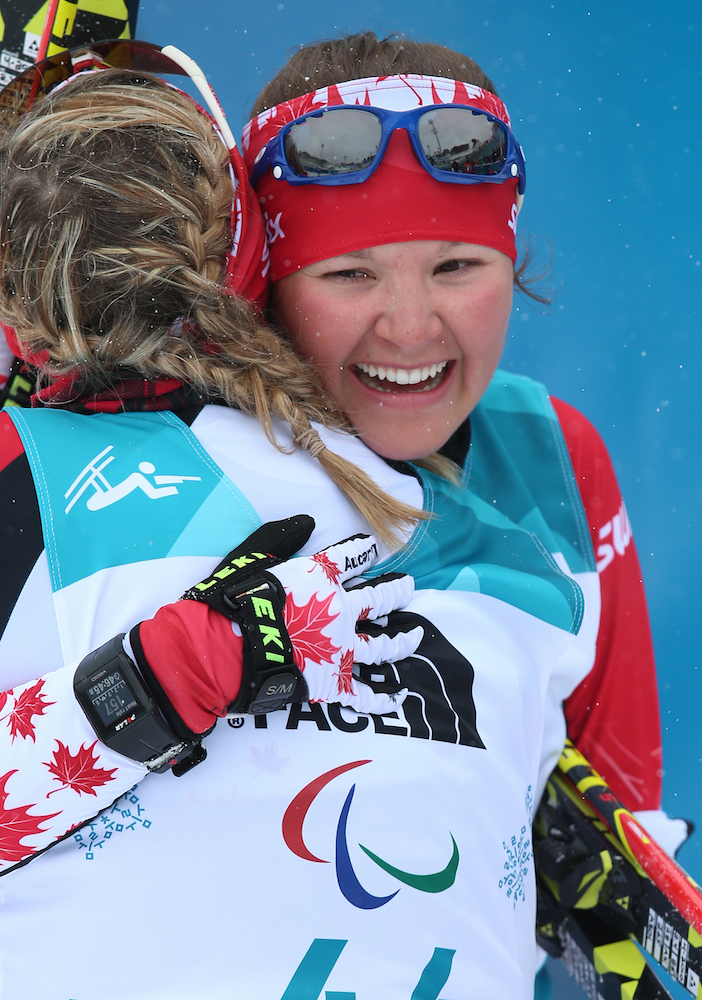
    Eileen Carey congratulating Oksana Masters after a gold medal at the Paralympic Games. (Photo: Mark Reis/U.S. Paralympics)

    With the 2017/2018 season officially in the rearview, FasterSkier is excited to unveil its annual award winners for this past winter. Votes stem from the FS staff, scattered across the U.S., Canada, and Europe, and while not scientific, they are intended to reflect a broader sense of the season in review. This set of honors goes to coaches of North American teams in any nordic discipline, at any level – although in an Olympic and Paralympic Games year, that’s what we focused on.

    Previous categories: Junior Skiers of the Year | Collegiate Skiers of the Year | Biathletes of the Year| Para-Nordic Skiers of the Year | NoCo Skier of the Year | Canadian Breakthrough Athletes of the Year | American Breakthrough Athletes of the Year

    ***

    Eileen Carey, U.S. Paralympics Nordic

    As we have already noted recently on the site, the U.S. Paralympics Nordic program made a huge jump between the 2014 and 2018 Games, winning three medals in Sochi but 16 – from five different athletes – in PyeongChang. That also included both men and women, and two types of para-nordic events: sitting and visually impaired.

    A big architect of the team’s success has been head coach Eileen Carey. It’s not an easy or simple job to coach athletes at all different levels of sport and different athletic backgrounds, and bring them all towards success.

    “The diversity in disciplines and levels of athlete in our program is one of the most interesting and motivating parts of my job,” Carey wrote in an email last week. “On one hand, I love getting into the details of what might make someone a fraction of a percent faster. I love the process of breaking down a performance into parts and working with athletes to problem solve how to make a small element better.  So much of that is about failure, modification, and trying again.  The potential gains are so small, but so are the gaps from 4th to 1st and every once in a while something sticks and that is incredibly motivating for me. Andy [Soule]’s sprint finish [for a gold medal] in PyeongChang is a great example of that.
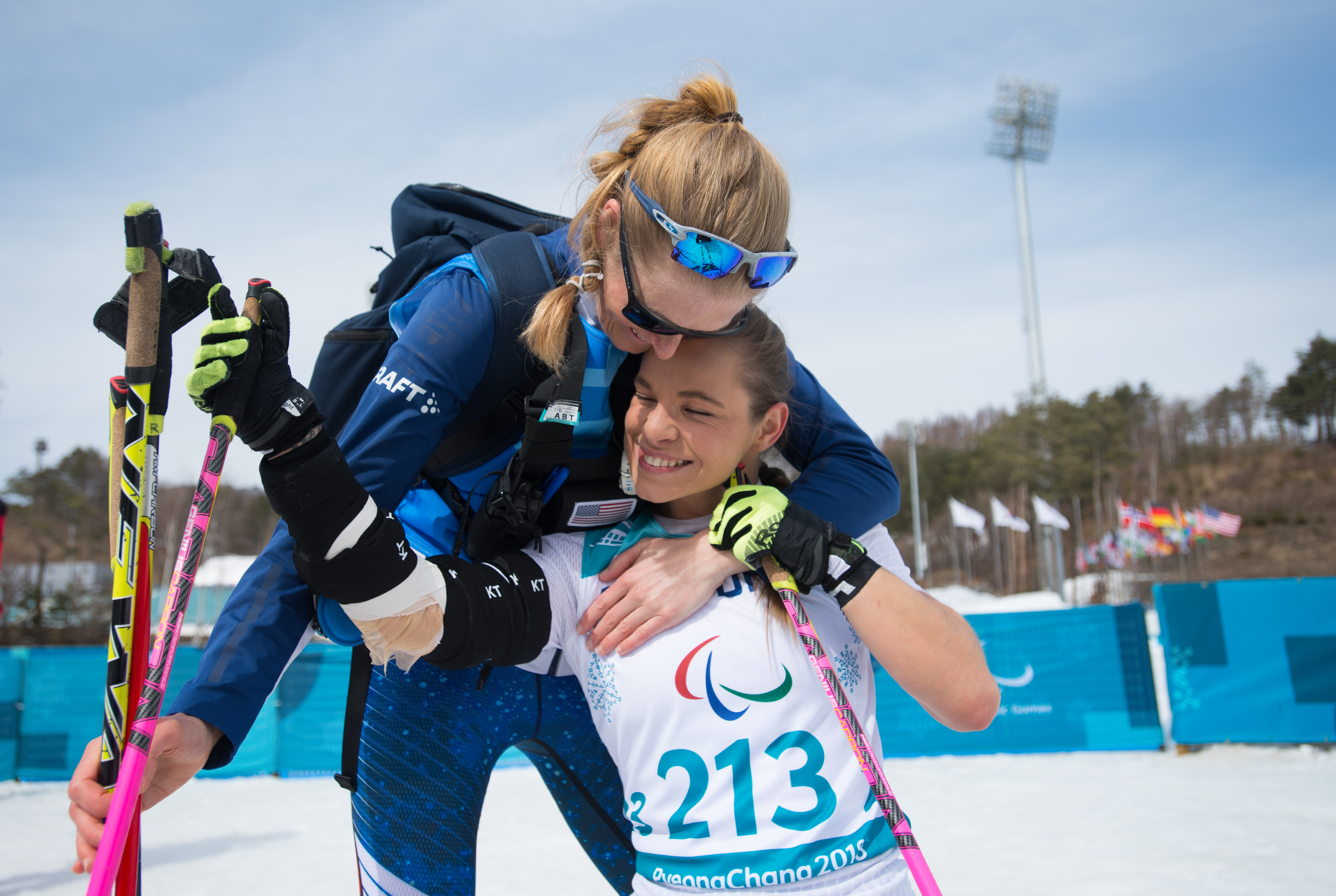
    Oksana Masters of U.S. Paralympics Nordic is hugged by head coach Eileen Carey after her gold-medal finish in the women’s sitting 5 k cross country race at the 2018 Winter Paralympic Games in PyeongChang, South Korea. (Photo: Mark Reis/U.S. Paralympics)

    “On the other hand we have some promising new athletes in our program who are at such a different level in what they need as athletes,” she continued. “For our program, our goal is always to provide best in the world service to our athletes. For our athletes who are aiming for the podium today, that involves every detail coming together, the execution of their plan. For Grace [Miller] and Mia [Zutter] and Ruslan [Reiter], our next generation of podium-potential athletes, providing best in the world service is more about making sure they see what their medal winning teammates and competitors are doing to achieve their performances and showing them a roadmap to get to that point.”

    Development coach BethAnn Chamberlain is a big piece of that effort. For the top-level athletes, Carey lives in Bozeman, Montana, where she works intensively with the sit-ski team,

    antabuse

    “They move to Bozeman in the winters,” Carey explained. “I am with them every day from November through March, in addition to training camps that we have most months from May-October. Most of them compete in summer sports, so in the off season, there is always an individualized balance of figuring out how to optimize their preparation for skiing, while working with their goals for other sports.”

    The standing and visually-impaired athletes have a different situation, and are primarily supported by clubs in their local areas. Carey works with both the athletes and their home coaches and teams to make sure they are getting the best development, but a big part of that can be training with an able-bodied ski team.

    “We can help with funding, or workout ideas that might be unique to Paralympic skiing,” Carey wrote. “But at the end of the day, Jake Adicoff and Sawyer Kesselheim’s success at the Games [where they took silver in the visually-impaired 10 k classic, the first visually-impaired medal by the U.S. in modern Paralympic history] is much more about Sun Valley SEF and Bowdoin (Jake’s club/school) and Bridger Ski Foundation and Montana State (Sawyer’s club/school)… We can help fill the gaps with funding and equipment and communication with their coaches, but their best path to the podium is the same as every skier who wants to be on an Olympic podium.”

    Carey and her colleagues, such as High Performance Director John Farra, have intentionally written their criteria so that standing and visually-impaired athletes can make the para-nordic national team without actually competing in para events – instead, they can make the C Team or Development team using USSA points from SuperTours, college races, or regional races. That means that they can spend more time with their home teams.

    “We are lucky in that we have incredible partners in the USSA community who are really the ones developing many of our athletes,” Carey wrote. “I hope the more that coaches and clubs around the country see our athletes competing in USSA and collegiate races, the more they see opportunities for providing a ski development pipeline to even more members of their communities. As much progress as we have made as a program over the last several years, we have at least that much again to improve, and this is the next big opportunity for us as a program, and also for ski clubs and communities around the country.”

    But while Carey is thinking about those big-picture goals and opportunities, she is also working one-on-one to help Americans become the best para-nordic skiers in the world.

    “The fall after Sochi, we started a technique modification process to target Andy [Soule]’s speed on flats, in particular finishing speed,” she explained. “In Sochi, he was moving quickly and had great hand speed but he was not going fast compared to the athletes he was competing against. We tried and failed at so many things in the past four years to improve that. Every once in a while, we would find a mental cue or some technical detail that seemed to make a difference and we would build on that and find ways to analyze it. It can be so frustrating, because there are inevitably times when progress stalls or reverts and there rarely is a clear answer why… When he turned it on during that finishing stretch of the sprint to take the gold, that was the epitome of a plan coming together at the right time.”

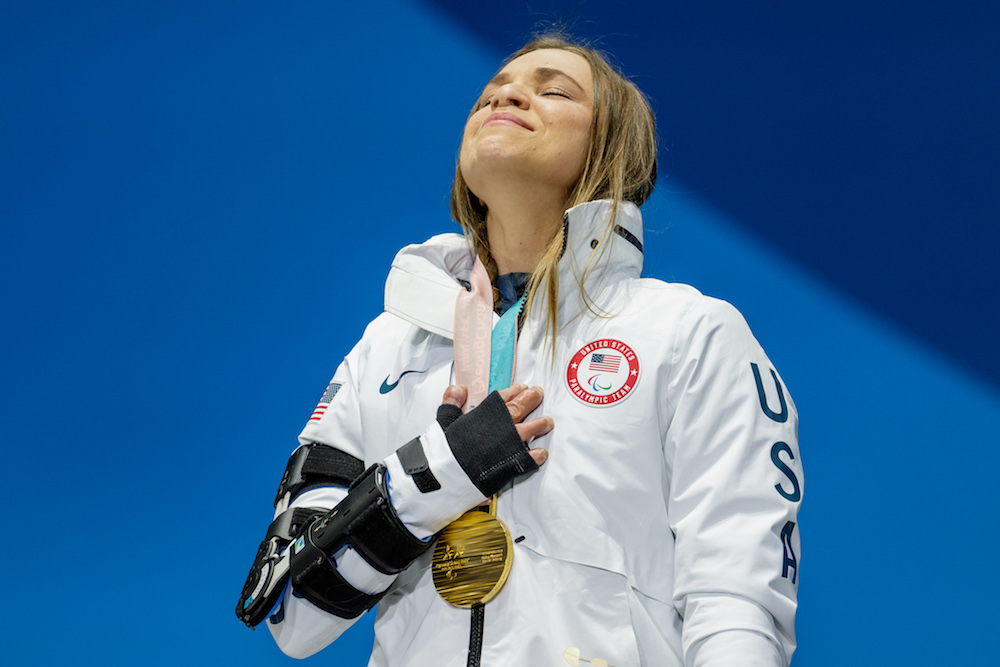
    A few minutes later, Oksana Masters won gold in the women’s sprint, overcoming an injury that had happened just weeks before the Paralympics. It was her first gold medal after collecting a silver and bronze earlier in the Games, to go with a silver and bronze from Sochi and a bronze from the 2012 summer Paralympics in rowing.

    “Both of those races, strictly from a sport performance standpoint, were just incredible,” Carey wrote. “In addition, those two athletes have really been the architects of our program’s rise over the last quad. The two of them were at every camp and World Cup, and their instincts as athletes drove the strategies of our program. That day could not have been a more meaningful culmination of the last four years for them as individuals, for us as a program, and for me as a coach.”

    Honorable Mention: Robin McKeever, Canadian Para-Nordic Skiing

    Also taking home 16 medals from PyeongChang? The Canadian Para-Nordic team, which like the Americans had a big jump in both the number of medals and the number of athletes winning them. Far from being just the Brian McKeever show – although the veteran went undefeated for the third Paralympics in a row – the team also picked up multiple medals from Mark Arendz, Natalie Wilkie, and Collin Cameron, plus an individual medal by Emily Young and two relay medals.
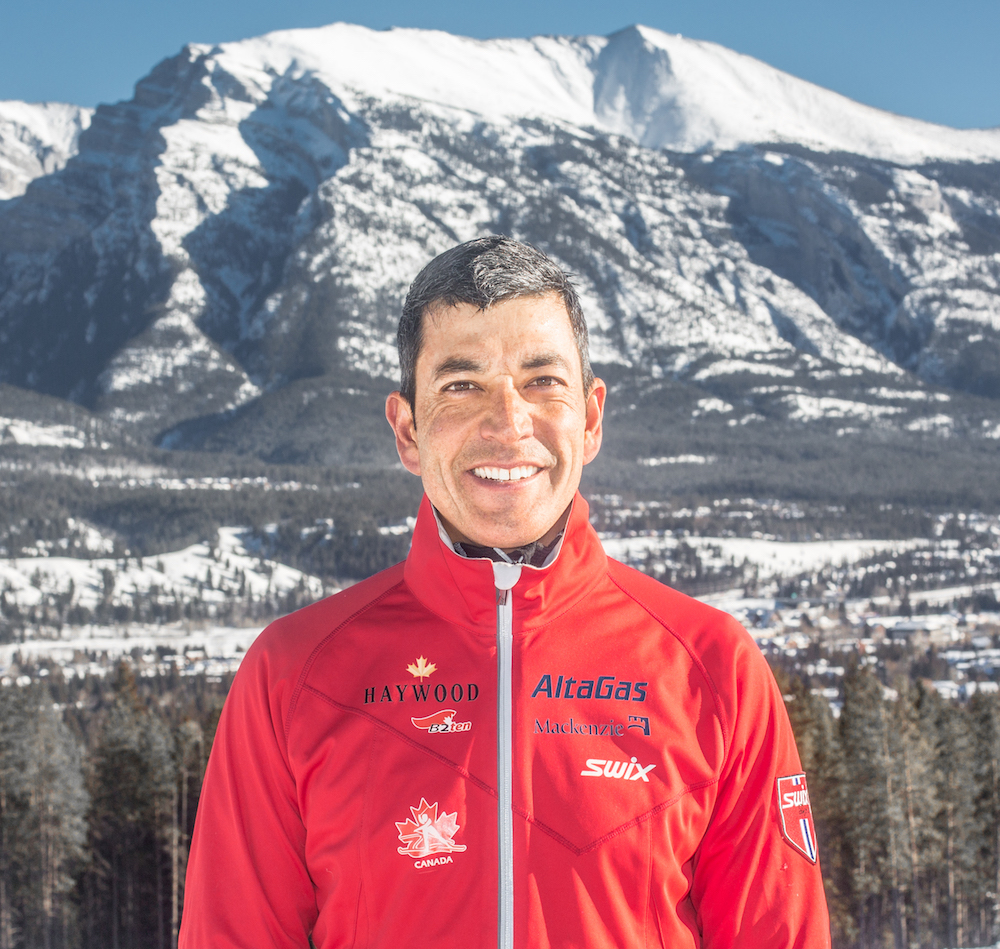
    Robin McKeever. (Photo: Noel Rogers/CCC)

    Carey’s counterpart up north is Robin McKeever, who incidentally said that he looked at what Carey was doing as an inspiration in being able to recruit summer-sports athletes and successfully transform them into winter gold medalists. The two gold medals by Kendall Gretch, an American triathlete who didn’t pick up cross-country skiing until 2015, were “eye-opening”.

    The para-sport landscape is slightly different in Canada, which also has a much smaller population to draw from (while at the same time having some of the same issues associated with far-flung geography). McKeever faces different development challenges, but has helmed the program towards depth and diversity in the last four years.

    “It started as an eight-year process in 2010,” McKeever said in an interview last week. “At that time, we only had funding for Brian. I was given the reins to rebuild, effectively. Now there are some next-generation funds we have the opportunity to access, and now that helps build the base. In the last few years we have had a development coach on board, Kate Boyd, and that has been huge.”

    There have been notable successes, such as the three medals Cameron took home; having picked up skiing just a few years ago after being involved with sledge hockey, Cameron was named one of our Breakout Athletes of the Year.
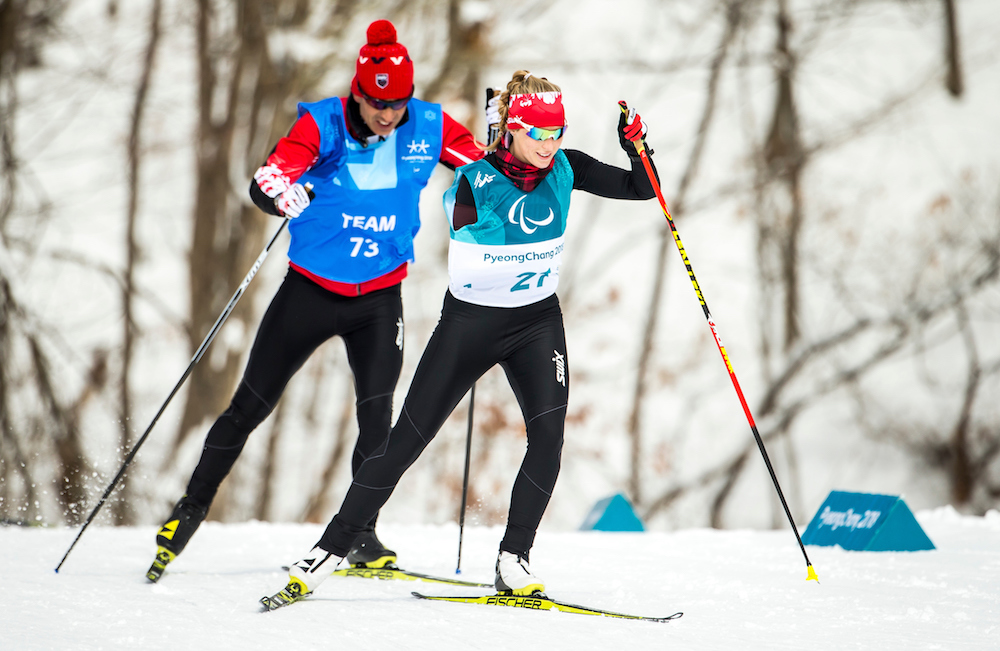
    Emily Young and coach Robin McKeever during a training session at the Alpensia Biathlon Centre during the 2018 Winter Paralympic Games in Pyeongchang, Korea. (Photo: Dave Holland/Canadian Paralympic Committee)

    Then there was Wilkie, a teenager who came to the program after losing four of her fingers in an accident.

    “We know where our pool of athletes comes from,” McKeever said. “It’s about the un-luck of athletes having trauma, which starts their Paralympic path. And it’s about luck in terms of recruiting athletes from summer sport.”

    Those newer athletes in the program have veterans to look up to, whether that is McKeever’s brother Brian, or now Mark Arendz, who took home a remarkable six medals between biathlon and cross-country skiing.

    “Mark was no surprise,” McKeever said. “Six medals was maybe a surprise, but he was a World Champion coming in.”

    Given the limitations on how the team can find new athletes, McKeever didn’t want to be too concrete about whether the program would see a big swell in numbers coming off its recent success.

    “It is still to be seen where that will go,” he said. “Some of it is a bit of luck, and some of it is really good management… A lot of staff has been around for eight years. They remain keen and excited. They stick around and are really integral to my support, and to the team’s support.”

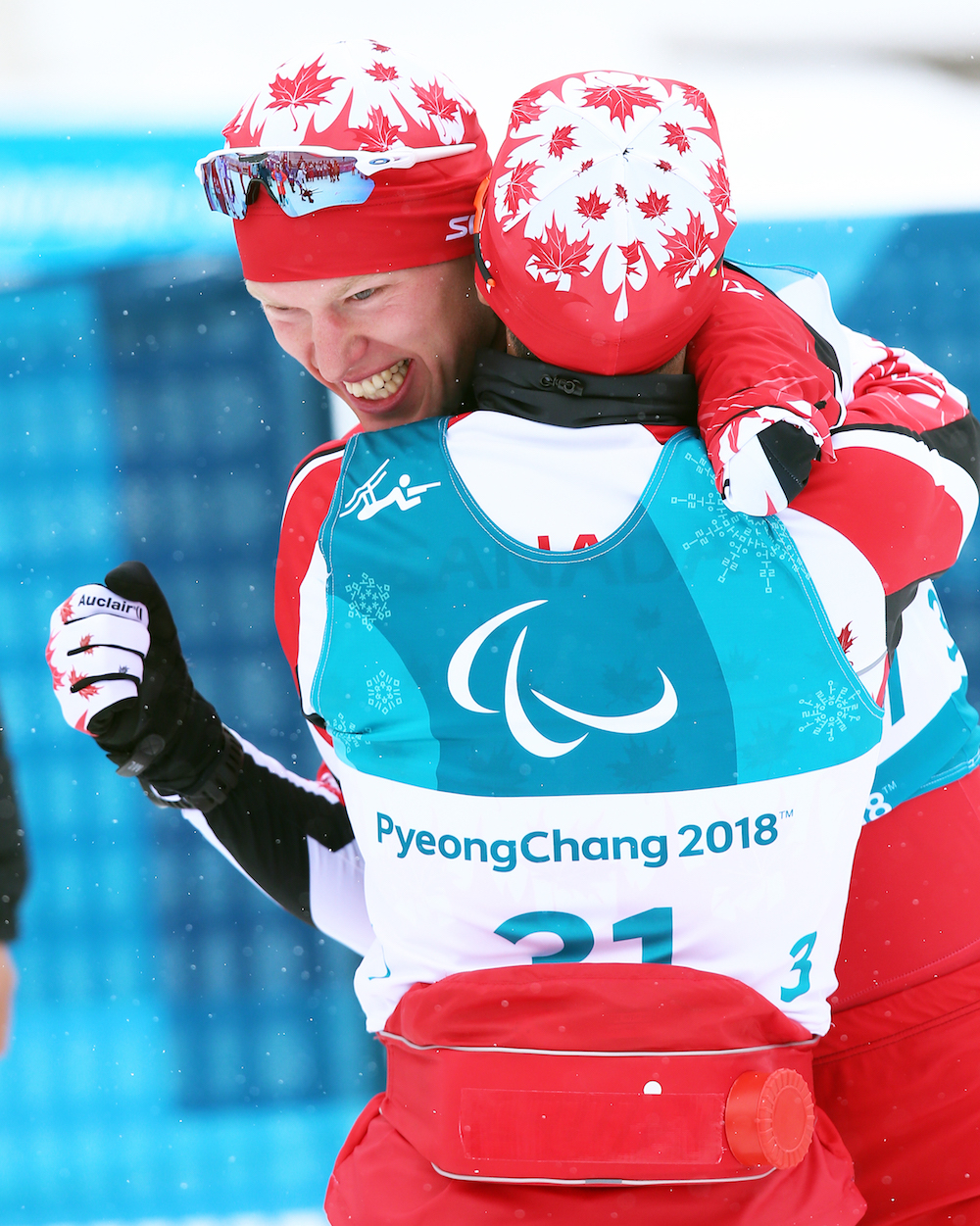
    One of the biggest highlights for McKeever, and an illustration of how the program has changed in just a few years, was the mixed relay team of Arendz, Young, Wilkie, and Chris Klebl taking silver, the first ever relay medal for Canada.

    “The mixed relay is a real highlight,” he said. “Even if the full Russian contingent had been there, that would be a podium for us. I didn’t know eight years ago that the possibility was even there.”

    Honorable Mention: Matt Whitcomb, U.S. Ski Team

    Another team that had a huge jump this year? The U.S. Ski Team women. Jessie Diggins and Kikkan Randall took gold in the Olympic team sprint, the first-ever gold medal for the U.S. in the sport.

    But the Olympics weren’t the only thing that happened this season. Diggins also won a World Cup, was third in the Tour de Ski, and second in the overall World Cup standings. Randall picked up a World Cup podium; Sadie Bjornsen picked up several; and Sophie Caldwell had enough to earn third place int he Sprint Cup standings. The team had more days with many women in the sprint heats, and more good distance results, too.
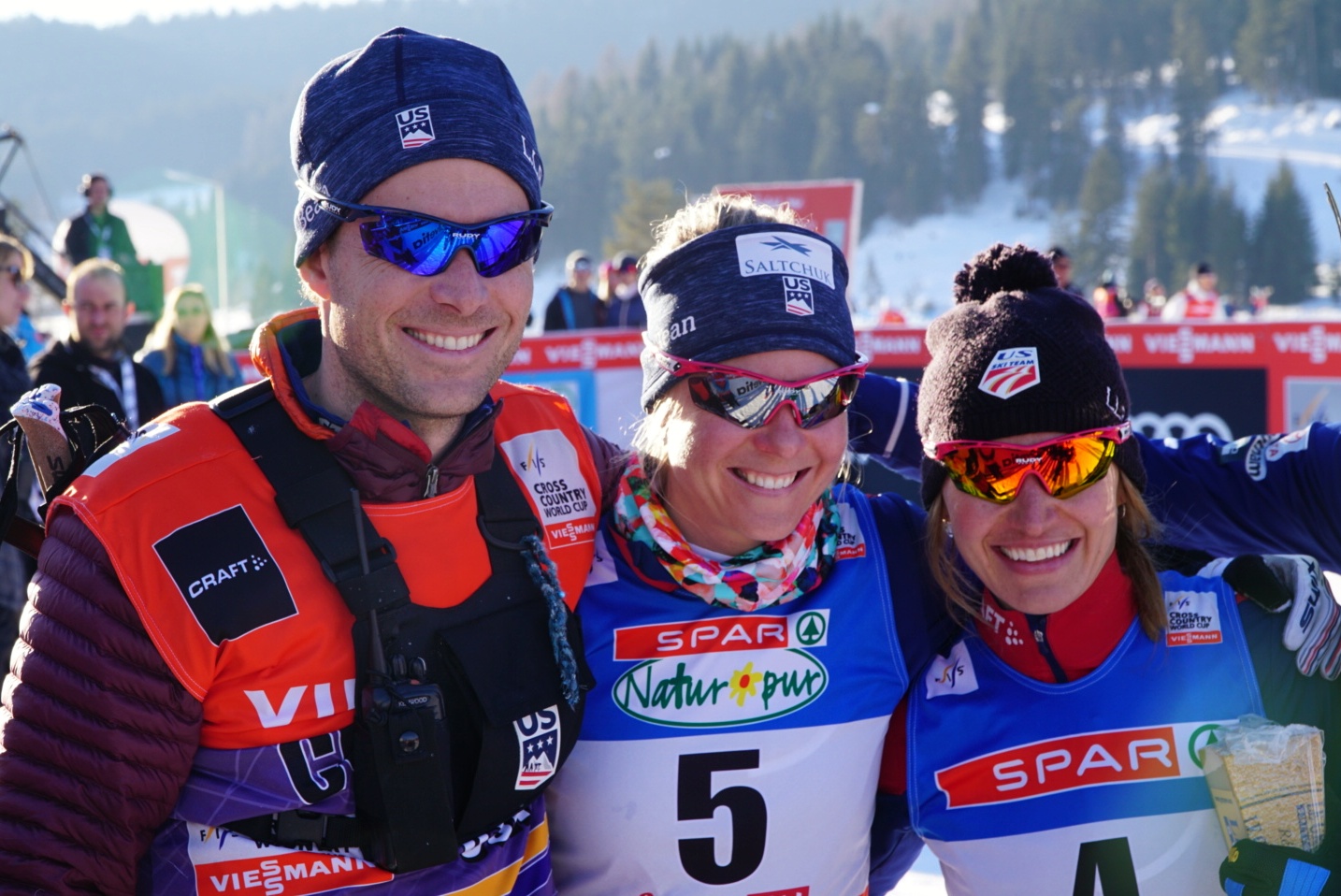
    Matt Whitcomb with Sadie Bjornsen and Sophie Caldwell in Seefeld, Austria, this winter. (Photo: Garrott Kuzzy / LumiExperiences.com)

    Its been a many-year goal of ours to be ranked in the top three for the womens team and we secured that for the first time today,” U.S. Ski Team Women’s Coach Matt Whitcomb told FasterSkier of his team’s best-ever Nations Cup ranking after the final World Cup of the season in Sweden. “Weve come into [past] finals, I believe, ranked third and then come out of finals ranked fourth. Weve been fifth… It was really quite an achievement.

    The U.S. women all spend large amounts of time with their club teams and coaches, including at APU and Stratton. But they come together to form a national team, the strength of whose relationships are a storied aspect of building their own success. And Whitcomb is a big ingredient there, facilitating not just training but atmosphere and long-range goals.

    When Caldwell secured third in the Sprint Cup, she thought back two years to a conversation she had with Whitcomb about race goals. Whitcomb wanted Caldwell to write down goal in particular: to be in the Sprint World Cup overall top three.

    “At the time I was like, ‘Eh, no, that seems pretty far off,’” Caldwell reflected in a post-race interview with FasterSkier.

    But it wasn’t, and the determination to work seriously on big goals, and believe you can get them, is a hallmark of the U.S. team.

  • From 3 to 16: Behind U.S. Paralympics Nordic’s Medal Leap in PyeongChang

    From 3 to 16: Behind U.S. Paralympics Nordic’s Medal Leap in PyeongChang

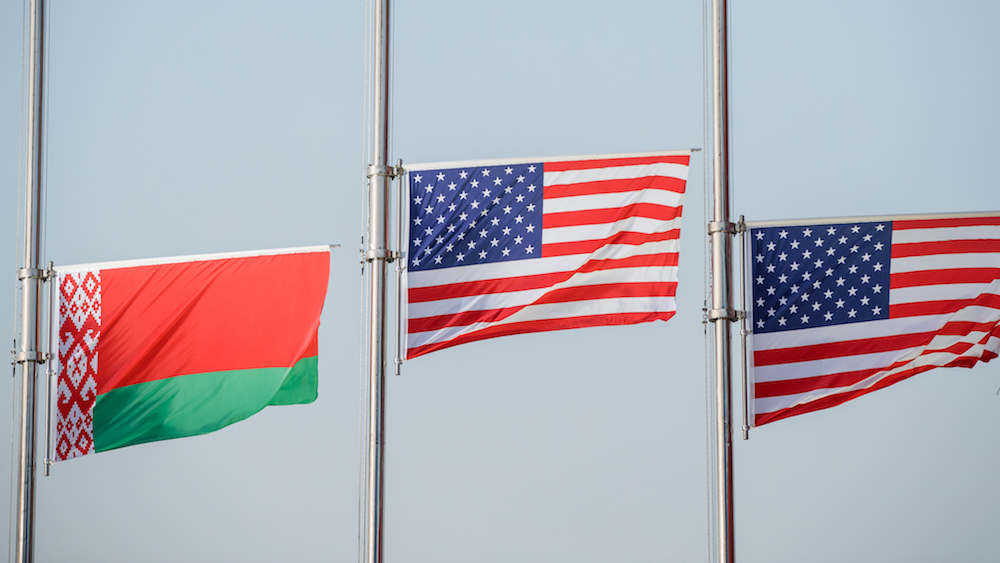
    Two American flags and a Belarusian flag being hoisted to honor the medalists in the men’s sitting cross-country sprint at the 2018 Winter Paralympics in PyeongChang, South Korea. Americans Andy Soule and Dan Cnossen placed first and second, respectively, and Dzmitry Loban of Belarus finished third. (Photo: U.S. Paralympics/Joe Kusumoto)

    Success to failure. Failure to success. Two trends of two extremes on the performance metrics on the international cross-country skiing spectrum. There are many in-betweens: scoring World Cup points with a top 30, top 10’s, any spot on the podium. There are the Olympic and Paralympic quads featuring a four-year buildup to North America’s singular focus on bronze, silver and gold hardware.

    When considering how to develop talent, placing athletes on snow with the absolute best technology available, positioning athletes to medal, the U.S. Paralympics Nordic Program is an enviable high-performance model. That became evident this winter during the 2018 Paralympic Winter Games in PyeongChang, South Korea. U.S. Paralympics Nordic hauled in 16 medals in a week about a month ago.

    That many medals for a single team borders on excess. Pursuing the perfection that leads to near-excess has driven the U.S. team staff and athletes for years. Back in 2006 in Torino, Italy, the U.S. Paralympics Nordic team earned three medals. In 2010, in Vancouver, British Columbia, they tallied one medal. In 2014 in Sochi, Russia, they claimed three. This year in PyeongChang: 16.

    “I think we have a few factors to our success,” Eileen Carey, head coach of the U.S. Paralympics Nordic team told FasterSkier in a recent phone interview. “We’ve built the entire team — every athlete who has been engaged in the last several years and the staff that we have built are totally committed to the goal of the team. There are not a lot of egos. Everybody has a role. Everybody is really good at what they do, and everybody executes on race day.”

    That goal and the team’s execution amounted to 11 medals total between two athletes, both sit-skiers. Thirty-seven-year-old Dan Cnossen entered six races: three cross-country, three biathlon. He medaled in each. Oksana Masters, 28, took five medals: two in biathlon, three in cross-country.

    In the leadup to the Games, with buoyant media coverage of para-athletes and opportunities to brand themselves more broadly, the narrative of athletes like Masters and Cnossen were hard to miss. Masters endured a Ukrainian orphanage until she was almost 8. Cnossen is a retired Navy SEAL and a Purple Heart and Bronze Star with Valor recipient. He lost both legs above the knee after stepping on an improvised explosive device (IED) while on patrol in Afghanistan in September 2009.

    Biathlon gold medalist Dan Cnossen of the U.S. celebrates his win in the men’s sitting 7.5 k biathlon sprint on opening day of competition at the 2018 Winter Paralympics on March 10 in PyeongChang, South Korea. (Photo: U.S. Paralympics/Mark Reis)

    Stories like those of Masters and Cnossen should make us appreciate for a moment our most basic gifts. Their stories are inspiring. That, according to Carey, misses the point when it comes to understanding what exactly manifested in PyeongChang.

    “Sure, the Olympic and the Paralympic mission is to inspire people,” Carey said. “But the narrative about Paralympians has historically been far more about inspiration being the central storyline versus Olympians where the essential storyline as about their athletic prowess. The comments that I have heard about these Games are about the athletic performances of the athletes. Whereas in Sochi, and a lot what I have heard before, is a lot about the inspiration.”

    (True to those sentiments, Velonews used the word “inspiring” to highlight this recent photo essay.)

    Cnossen is a graduate student at Harvard. He receives some support from the school’s cross-country coach, but trains most often north of Cambridge Square at the Craftsbury Outdoor Center in northern Vermont. There, Cnossen benefits from world-class biathlon instruction.

    Carey explained that at last season’s 2017 PyeongChang test event, Cnossen performed better in the cross-country races there than in biathlon. As a world-class athlete, traveling several hours for countless four-day Craftsbury weekends and increasing his time spent training on the shooting range were some of the commitments Cnossen made, just like any other hyper-focused, hyper-driven athlete.

    Carey also made clear what Craftsbury’s part was in developing Cnossen’s athleticism.  

    “As a sit skier, you don’t carry a rifle,” she explained. “When you are shooting, that means 100 percent of the time, someone is on the range loading pellets with bare hands when it’s cold outside and handing you your rifle. Dan would shoot three or four times a weekend when he was there, and they supported him 100 percent of that time. He won a medal in every biathlon event. That is Craftsbury’s success as much as anybody else’s.”

    Masters’s own drama unfolded two weeks before the Paralympics when she slipped and fell on ice. She dislocated her elbow and chipped all three bones that meet in the elbow. After being operated on at The Steadman Clinic in Vail, Colorado, Masters remained a medal favorite in Korea.

    She came to PyeongChang as an all-arounder in both biathlon and sitting cross-country. (Masters, also a multi-sport athlete, competed in rowing at the 2012 London Paralympics — where she earned a bronze medal — and cycling at the 2016 Rio Games.)

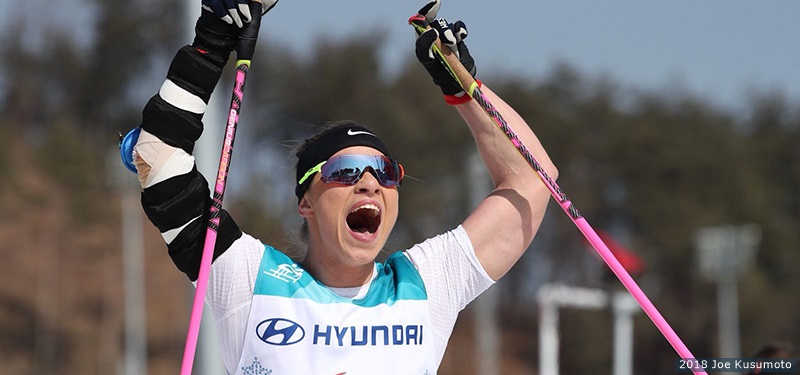
    Oksana Masters (U.S. Paralympics Nordic) after winning her first-career Paralympic gold medal in the women’s sitting cross-country sprint at the 2018 Winter Paralympics in PyeongChang, South Korea. (Photo: U.S. Paralympics/Joe Kusumoto)

    In her first race in PyeongChang last month, Masters took silver in the biathlon sprint (behind her U.S. teammate Kendall Gretsch in first). Those medals, Gretsch’s first and Masters’s first in biathlon, set the stage for more gritty performances and Masters’s five-medal PyeongChang bounty. Inspiring? Yes. But more to the point, both were athletically dominant.

    Masters’s dominance came with a very human off-race. On March 13, during the women’s sitting 10 k biathlon race, Masters fell in her sit ski onto her ailing arm and missed a total of six shots for six penalty laps. While she skied the extra laps, another U.S. coach encouraged Masters to pull herself out of the race. The team’s staff was concerned about her elbow and wanted to ensure her health for her three remaining races.

    “I sprinted down the course and just stood in front of her in the middle of the course and pulled her off,” Carey said of how she ultimately persuaded Masters to not finish. “Oksana thought she was done midway through the Games. We X-rayed her again and came up with a plan and taped her elbow in a way that would provide more protection.”

    The next day, Masters rebounded with a gold in the sitting cross-country sprint and earned another gold and silver in the next two races.

    Here Comes Soule

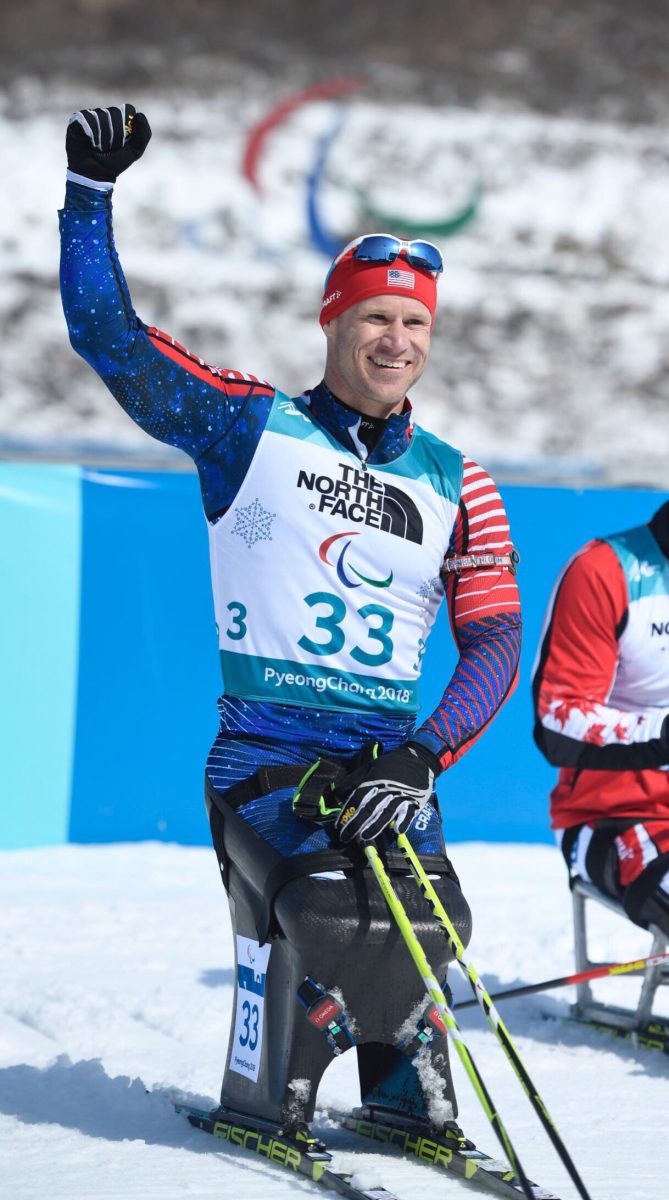
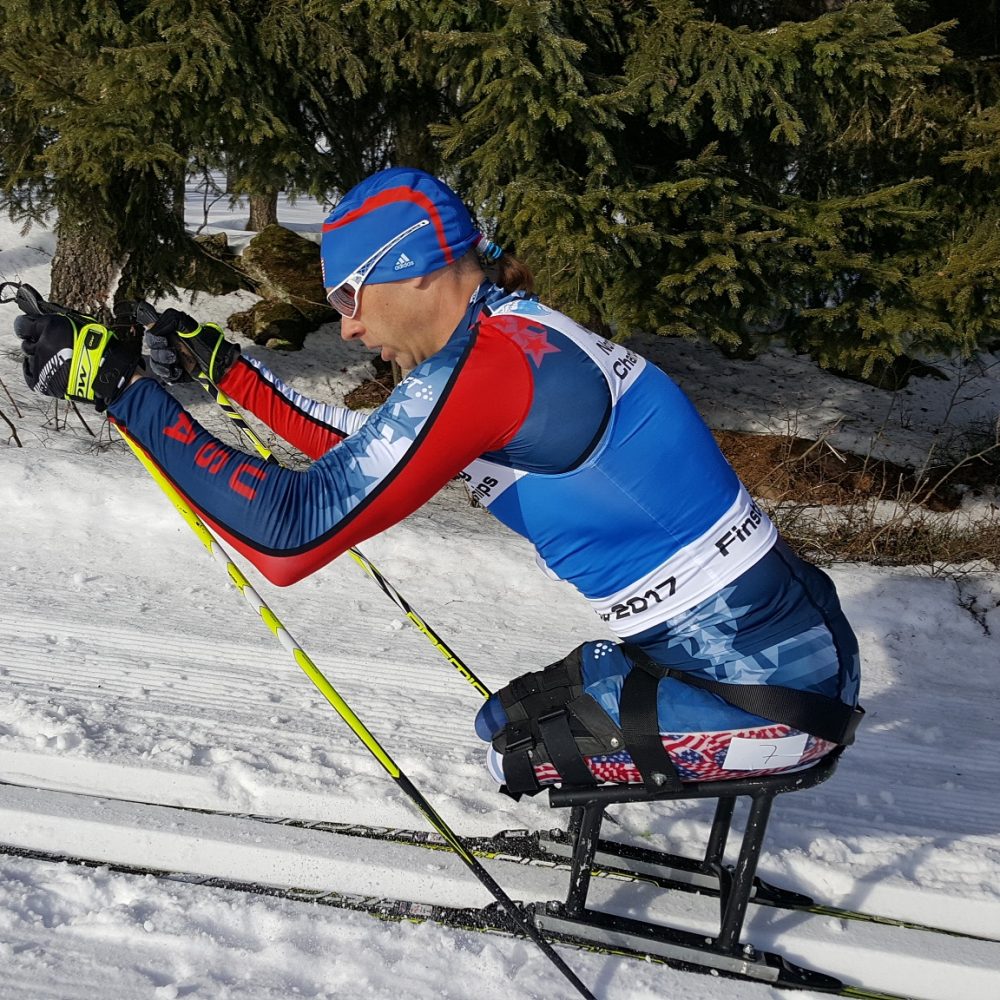
    At the 2010 Vancouver Paralympics, Andy Soule earned bronze in biathlon. His medal was the first Paralympic medal in the discipline for the U.S. team. Eight years later in PyeongChang, Soule, a 38-year-old Army veteran, who, like Cnossen, lost both his legs in Afghanistan, delivered the Paralympics equivalent to the “here comes Diggins” moment.
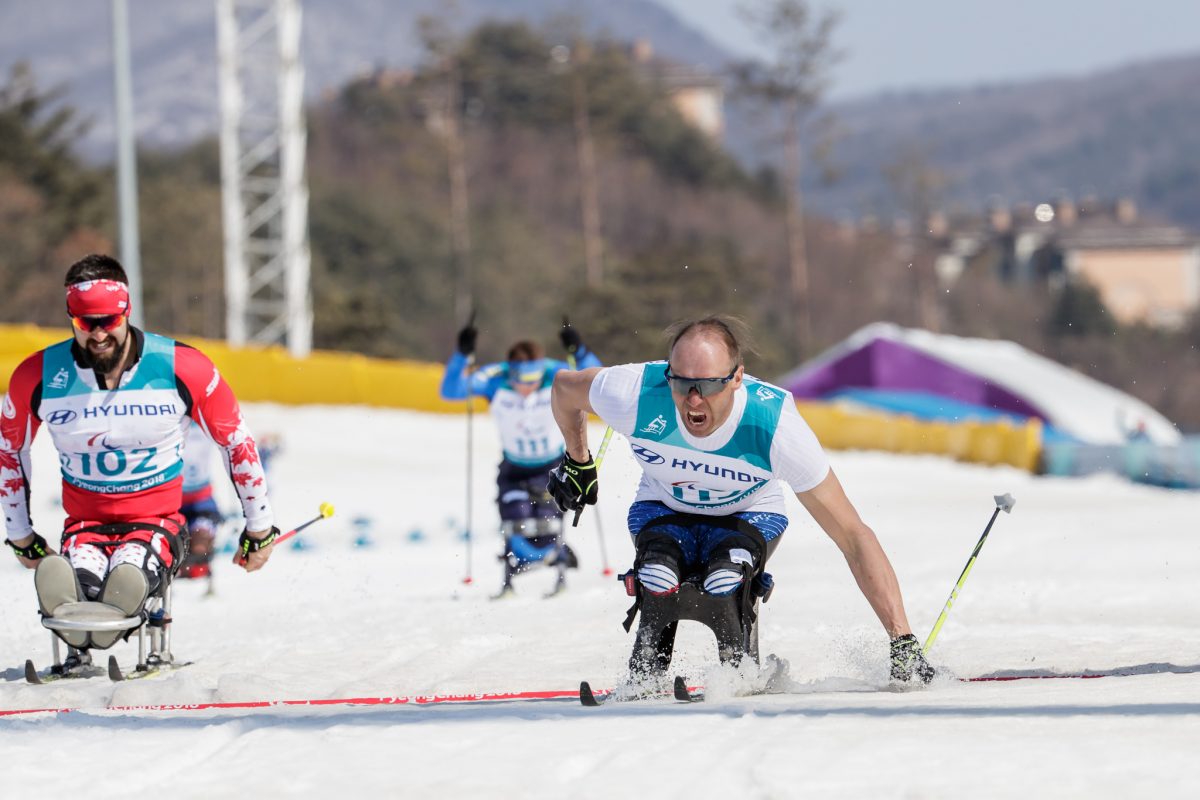
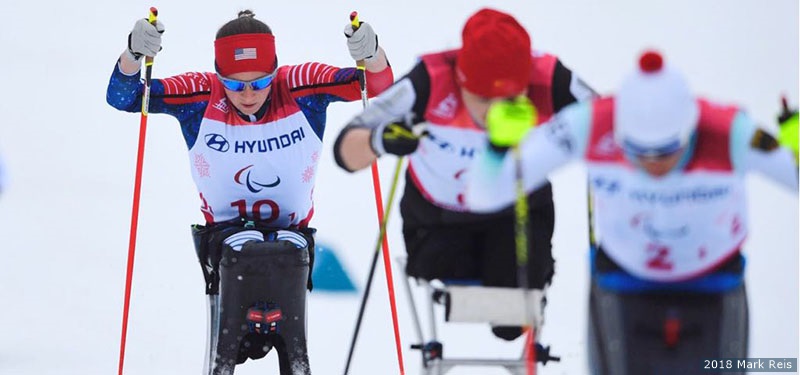
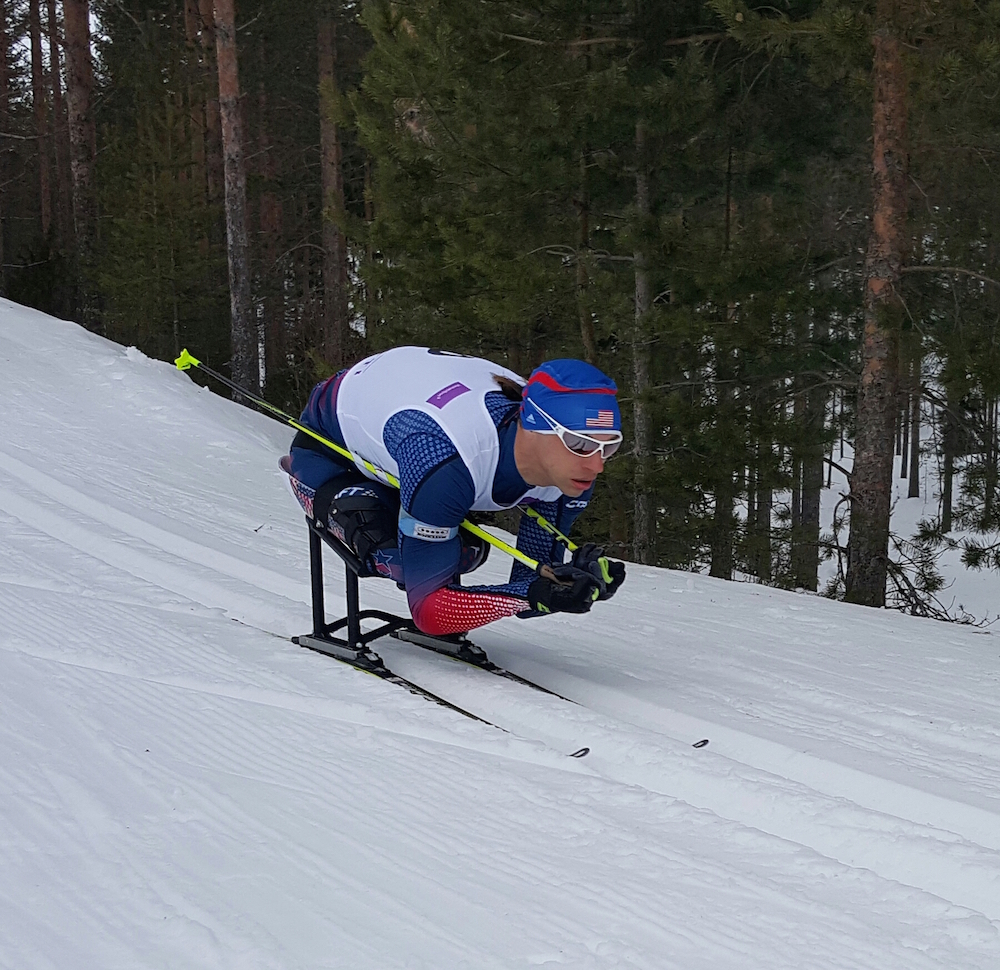
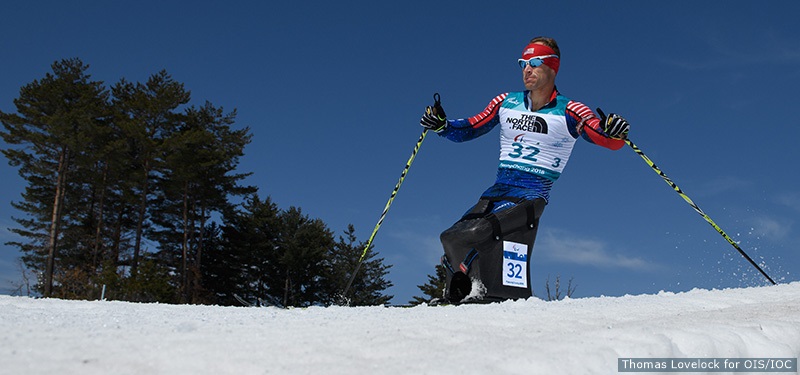
    During the men’s sitting cross-country sprint final, Soule came into the last hill in sixth place. He then glided into fourth on final downhill before the last intensive double-poling push to the finish.

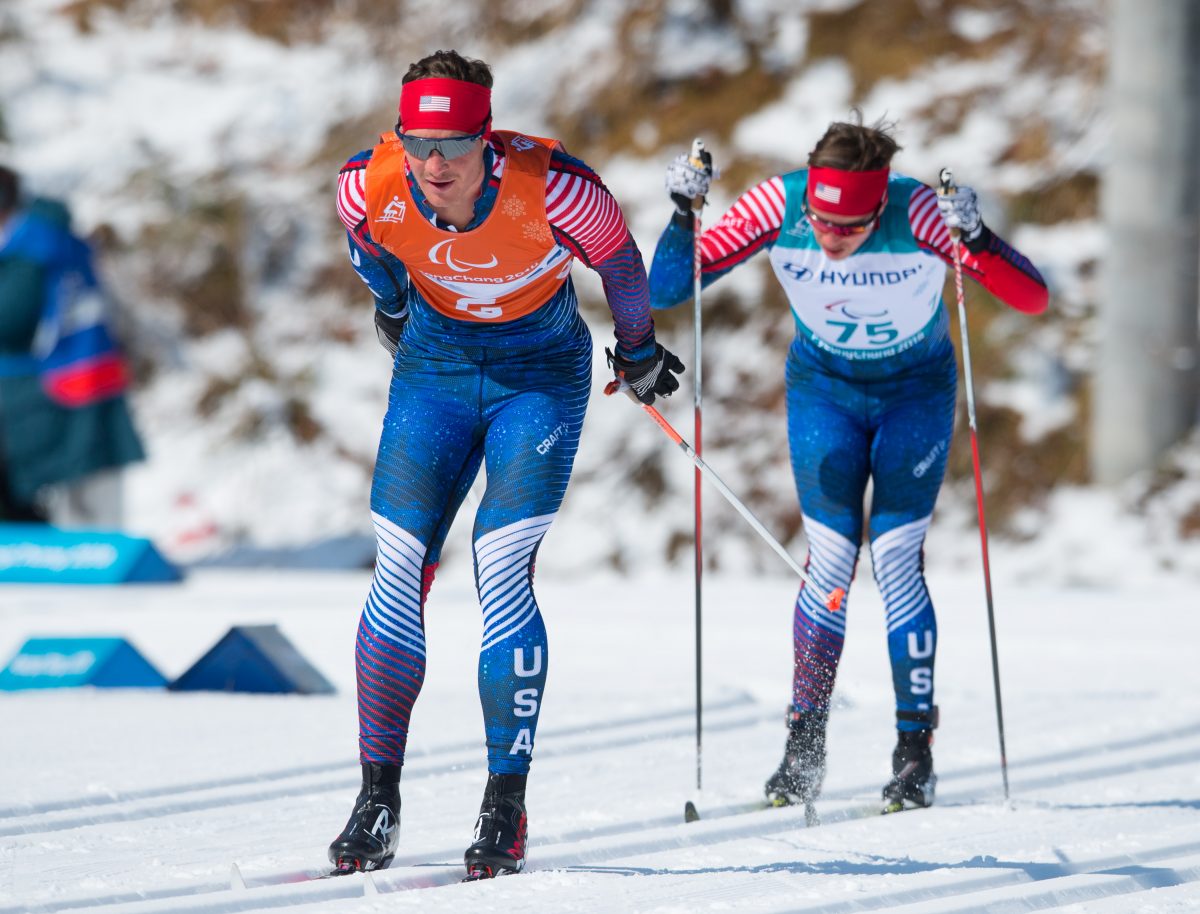
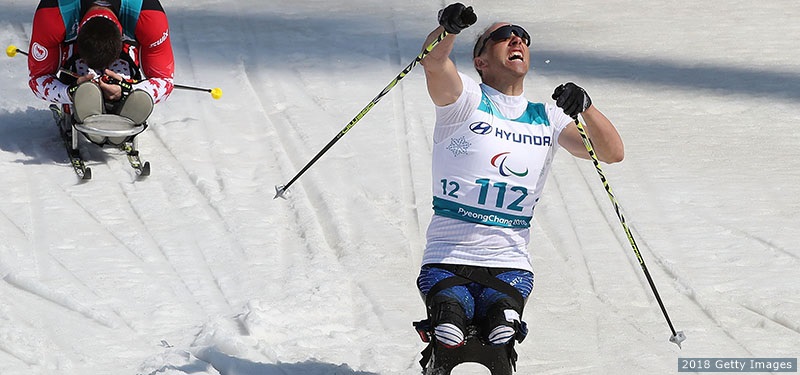
    Andy Soule (r) capturing gold in the men’s sitting cross-country sprint at the 2018 Paralympics in PyeongChang, South Korea. (Photo: U.S. Paralympics/Joe Kusumoto)

    With lickety-split skis to match his upper body’s Thor-like power, Soule willed himself into medal contention. From literally out of the camera’s view and into front and center on the final stretch, Soule threw down and accelerated. Bronze, then silver, and at the line, gold came into play. The PyeongChang sprint win was Soule’s first-career Paralympic gold in three Paralympics — he also claimed bronze in the PyeongChang 12.5 k biathlon race. (Soule promptly retired from elite-level competition afterward.)

    “Andy has spent a lot of time over the last four years doing a whole lot of stuff, like learning how to move fast on flats, which was something that we had identified from Sochi as being the weak link,” Carey said. “There was something otherworldly about those last 100 meters that was just incredibly cool to watch.”

    Cnossen, Masters, and Soule symbolize the U.S. Paralympics Nordic team’s rise. Yet, Carey, along with the team’s high-performance director, John Farra, have been able to build a program that has positioned itself for future medals. Gretsch, 26, may be part of that future. She came to nordic skiing as a world-class para-triathlete and represents what Farra calls “talent transfer”.

    “We are super proud with how our sit-ski program has evolved,” Farra said on the phone. “We are super proud that we can take athletes in a talent-transfer situation like Kendall and help her come from being a world champion in triathlon and have her transfer and learn the skills in a short period of time to now being one of the best in the world.”

    In PyeongChang, Gretsch captured two golds in the first two races. She won the sitting biathlon sprint and the 12 k sitting cross-country events.

    Winter Paralympic rookie Kendall Gretsch racing at the 2018 Paralympics in PyeongChang, South Korea. (Photo: U.S. Paralympics/Joe Kusumoto)

    The U.S. also broke barriers when it comes to the standing visually impaired (VI) events. Jake Adicoff, along with his guide Sawyer Kesselheim, raced to silver in the men’s VI 10 k classic cross-country event.

    Farra explained that their medal was the first for the U.S. in a visually impaired race at the “modern” Paralympics. The VI classes were historically split between B1, B2 and B3 classes. (B1 athletes have the least amount of vision.) The different classifications are used as a descriptor of each athlete’s degree of blindness. Formerly, each classification of athlete competed against the same classification athletes. For example, in the past, only B1’s competed against B1’s. Today, that format is defunct, and all classifications currently compete against one another. An athlete’s finishing time is adjusted based on their severity of blindness.

    As Farra explained, in the “modern” VI medals are harder to come by.

    Adicoff, a student at Bowdoin College and a member of the Sun Valley Ski Education Foundation (SVSEF), was competing at his second Paralympics. Kesselheim was a Paralympic rookie.

    “They are a team,” Carey said of the Adicoff-Kesselheim pairing. “Visually impaired athletes and guides function much more, in my view, like a cycling team as opposed to a traditional ski racer. … The medal was won by both Jake and Sawyer. In that race, they worked together more effectively than I had ever seen them work together. They were more in sync; they were skiing closer to each other. There is a lot of challenges in guiding when it comes to the communication, and Sawyer is a great communicator. He is an amazing skier and athlete, but he is a great communicator and he has no ego. He was totally bought into being on that team.”

    Guide Sawyer Kesselheim leads his U.S. teammate Jake Adicoff during the open relay on March 18 at the 2018 Winter Paralympics in PyeongChang, South Korea. (Photo: U.S. Paralympics/Mark Reis)

    The first day of the next Paralympic quad began on March 19, the day after the PyeongChang Paralympic Closing Ceremony. Yet Casey and Farra kept an eye on 2022 by nurturing and investing in more Paralympic rookies by exposing them to their respective sport’s highest level of competition. Grace Miller (standing , Alaska Nordic Racing), Ruslan Reiter (standing, Outdoor Sports Institute), Joy Rondeau (sitting, National Sports Center for the Disabled), and Mia Zutter (visually impaired, CXC/St. Scholastica) participated in their first, yet most likely not their last, Winter Paralympics.

    “Having a larger community of people that consider themselves para-nordic skiers is motivating,” Farra said.

    In the recent past, Farra explained that identifying and developing standing athletes has been a priority. The U.S. has already been a leader in supporting sitting athletes and providing them with top-end, sit-ski technology.

    “We have just scratched the surface of finding a couple of standing and a couple of VI athletes,” Farra continued. “That’s got us pretty excited about the connections they have to their local clubs and colleges, too. We were motivated to bring them to these Games so they could get a taste of what is out there and hopefully, they left absolutely motivated to live a professional athlete lifestyle and train hard with their clubs and their home college programs.”

    — Alex Kochon contributed

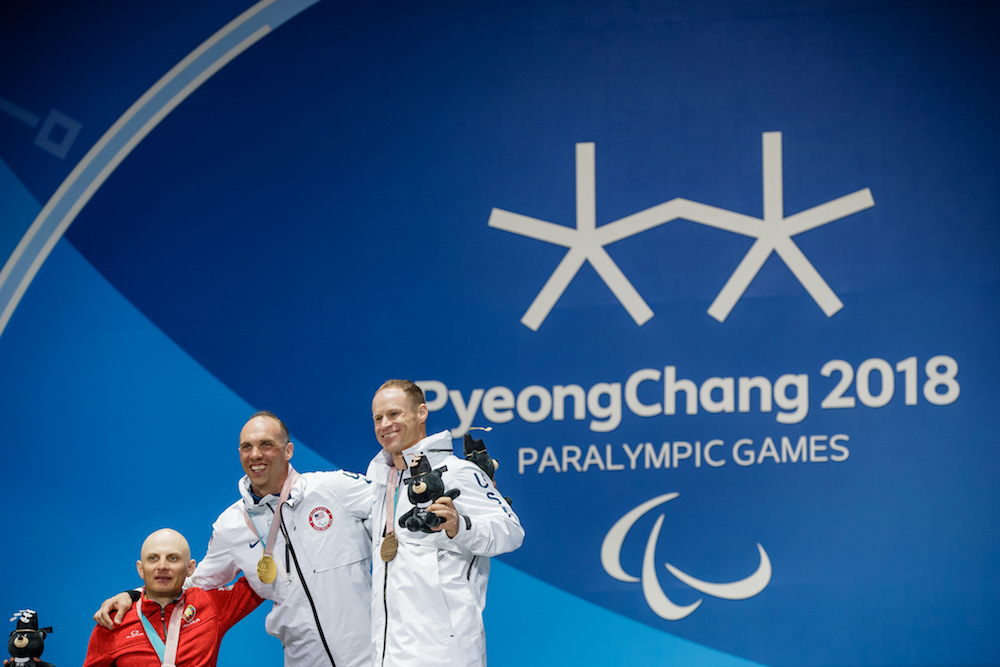
    The 2018 PyeongChang Paralympics men’s sitting cross-country sprint podium at the medal ceremony, with Americans Andy Soule (c) and Dan Cnossen (r) in first and second, respectively, and Dzmitry Loban of Belarus in third. (Photo: U.S. Paralympics/Joe Kusumoto)
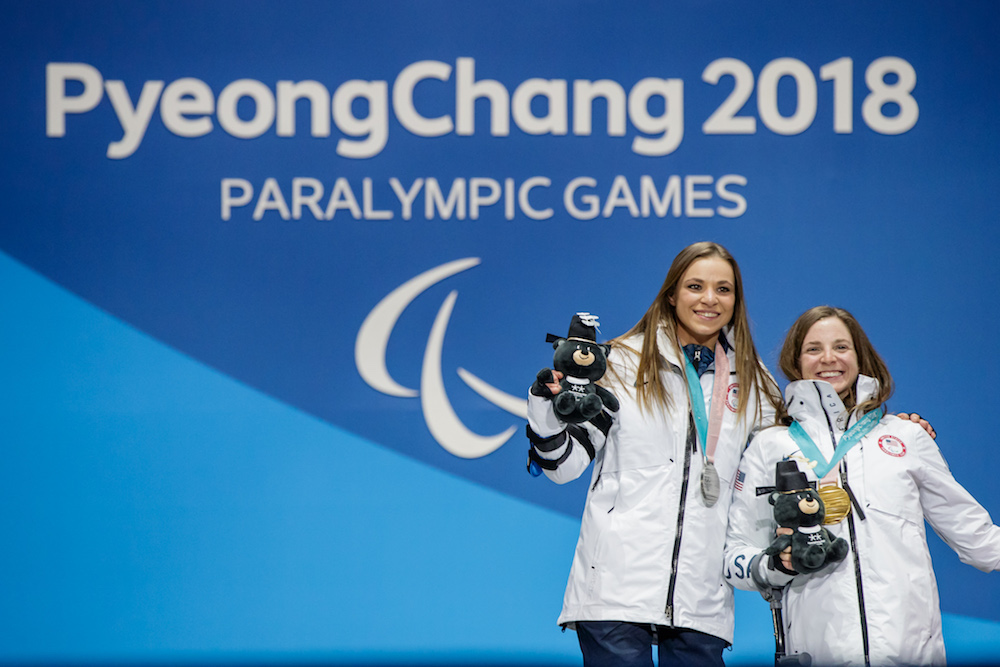
    Kendall Gretsch (r) and Oksana Masters at the 2018 Paralympics medal ceremony for the women’s sitting 6 k biathlon sprint after winning gold and silver, respectively, on the first day of competition in PyeongChang, South Korea. (Photo: U.S. Paralympics/Joe Kusumoto)
  • Canada Notches First Paralympic Relay Medals with Silver and Bronze

    Canada Notches First Paralympic Relay Medals with Silver and Bronze

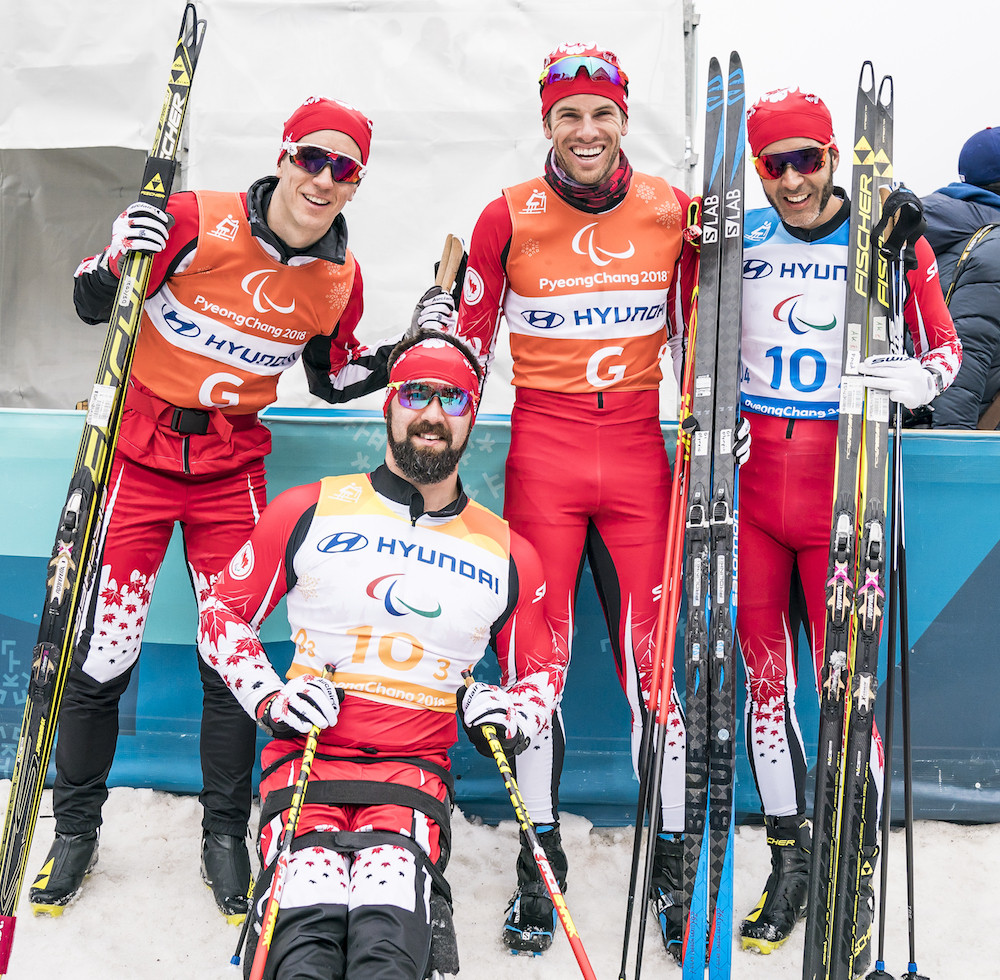
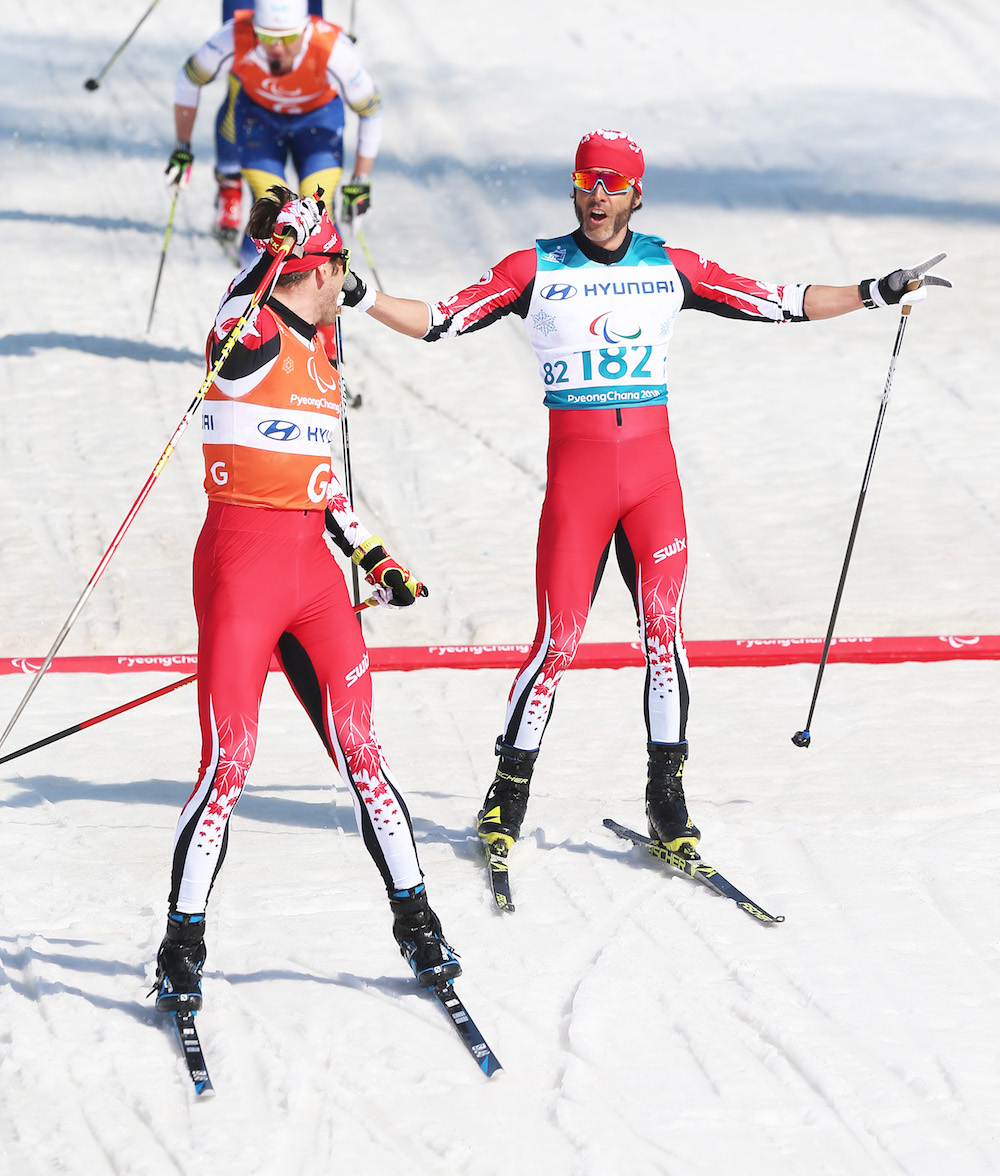
    Canada’s mixed relay after taking silver on the last day of the 2018 Paralympics in PyeongChang, South Korea, with (from left to right) Natalie Wilkie, Chris Klebl, Mark Arendz and Emily Young. (Photo: Dave Holland/Canadian Paralympic Committee)

    2018 Winter Paralympics (PyeongChang, South Korea): Mixed and open relays

    On the final day of the PyeongChang Paralympic Games, Canada was the only country to medal in both the mixed and open cross-country relays, and its mixed relay anchor, Mark Arendz, became the most decorated Canadian at a single Winter Paralympics with his sixth medal of the week.

    In the 4 x 2.5-kilometer mixed relay on Sunday, Natalie Wilkie, Emily Young, Chris Klebl, and Arendz teamed up for silver, 50 seconds behind Ukraine (Iurii Utkin, Liudmyla Liashenko, Yuliia Batenkova-Bauman, and Oksana Shyshkova), which claimed gold in 24:31.9 minutes. On the final skate leg, Arendz held off Germany (Andrea Eskau, Steffen Lehmker and Alexander Ehler) by 3.4 seconds at the line.

    Wilkie and Young, standing athletes coming off gold and bronze in Saturday’s 7.5 k cross-country race, started the team off for the first two classic legs. Wilkie, 17, also earned an individual bronze at these Games. While Wilkie tagged Young in fifth, Young went on to tag Klebl, a 2014 Paralympic champion sit-skier, in seventh place.

    “Our team worked so well together,” Young said of the relay, according to a Cross Country Canada press release. “It looked a little scary in the beginning, but we knew we had Chris in third and Mark anchoring which was going to be the difference. We each held our own in our individual sections and it is so fun to win this one as a team.”

    Klebl, 46, made up 27 seconds on the field and tagged Arendz in fourth. Arendz then caught and passed Japan’s Taiki Kawayoke and later Germany’s Ehler on the last downhill into the finishing stretch to finish second.

    “This is fantastic. It is our first relay medal ever,” Arendz, 28, told Cross Country Canada. “It is great to end the Games with a historic moment that we get to share with each other for the rest of our lives. This is a great team of two veterans and two rookies. I’m so happy we were able to get this done.”

    Arendz, who elected flag bearer of the Canadian Paralympic Team for Sunday’s Closing Ceremony, is taking home a gold medal from the 15 k biathlon race, two silvers, and three bronze medals. He competed in all but one race throughout the week, skipping the distance cross-country race.

    “I came in here thinking I could get three medals, but to get six is incredible,” Arendz said. “Today’s is a special one. I am happy we got this done, but there is no way I could do another race. I’m done.”

    American Kendall Gretsch (l) racing in the 4 x 2.5 k open relay at the 2018 Paralympic Winter Games in PyeongChang, South Korea. (Photo: U.S. Paralympics/Mark Reis)

    The U.S. team, with Kendall Gretsch, Ruslan Reiter, Jake Adicoff (and guide Sawyer Kesselheim)  placed seventh in the mixed relay, 1:35.7 out of first. Gretsch skied both the first and third legs and tagged Adicoff in ninth out of 13 teams at the last exchange.

    “It’s a little bit nerve-wracking and a little bit fun,” Adicoff said of skiing the anchor leg. “They did an awesome job on the first three legs.”

    In the 4 x 2.5 k open relay an hour later, Canada raced to bronze with two athletes: sit-skier Collin Cameron and visually impaired skier Brian McKeever (and his guides Graham Nishikawa and Russell Kennedy).

    The duo finished 1:05.8 behind France, which placed first with Benjamin Daviet, Anthony Chalencon and Thomas Clarion in 22:46.6. Norway finished 22.5 seconds back for silver, with Nils-Erik Ulset, Hakon Olsrud and Eirik Bye.

    Ukraine (Iaroslav Reshetynskyi, Olha Prylutska, Grygorii Vovchynskyi, and Anatolii Kovalevskyi) crossed the line in third but was penalized 30 seconds for an early exchange and slipped to fifth (+1:26.3), while Canada moved into third and Belarus placed fourth (+1:23.7).

    Canada’s open relay after taking bronze on the last day of the 2018 Paralympics in PyeongChang, South Korea, with (from left to right) Graham Nishikawa (guide), Collin Cameron, Russell Kennedy (guide), and Brian McKeever. (Photo: Dave Holland/Canadian Paralympic Committee)

    Early in the race, Cameron tagged McKeever in eighth at the first exchange, and McKeever and his guide raced up to fourth. On the third leg, Cameron was skiing in third until he dropped a pole on the last climb and had to turn around to recover it. He came through the last exchange in sixth, 25 seconds behind Ukraine in third. McKeever went on to crossed the finish line fourth place, but his team was awarded bronze after Ukraine was penalized for tagging outside the exchange zone.

    buy skelaxin

    The bronze medal was Cameron’s third of the week after he placed third in two biathlon races earlier in the week. For McKeever, Canada’s most decorated Winter Paralympian of all time who won all three individual cross-country races he competed in over the last week, it was the 17th medal of his Paralympic career.

    “I just tried to pace it properly and be as fast as I could. It was so much fun,” Cameron, 28, told Cross Country Canada. “This is my first relay, so I was really looking forward to this. I am super happy to leave here with three medals.”

    “It’s incredible to get two relay medals today,” McKeever, 38, said. “We knew we had a shot if we all had really good days. What Mark, Chris and the girls did in that first relay was awesome. These races are so interesting with all different disabilities together. It is never over until last tour around, and in both cases, we saw that today with lots of different lead changes out there.”

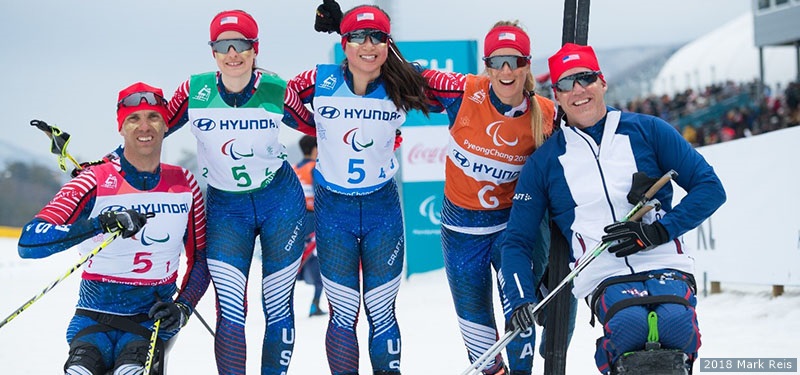
    The U.S. open relay at the 2018 Paralympics in PyeongChang, South Korea, with (from left to right) Andy Soule, Grace Miller, and Mia Zutter, Kristina Trygstad-Saari (guide), and Sean Halsted. (Photo: U.S. Paralympics/Mark Reis)

    The U.S. team, with Andy Soule, Sean Halsted, Grace Miller, and Mia Zutter (and guide Kristina Trygstad-Saari), placed 12th in the open relay out of 12 teams.

    “It’s been an amazing Paralympic Games,” Soule, 38, told U.S. Paralympics Nordic. “The organizers have put on a great event. This is a great team to be involved with. We’ve had a lot of fun here. This is my last Paralympic race, but we have a couple of young athletes here. We’ll have a great team for a long time.”

    In total, both the Canadian and U.S. Paralympic teams tallied 16 medals between nordic and biathlon in PyeongChang — a record for both programs. Notably, every member of Canada’s Para-Nordic World Cup Team is taking home at least one medal.

    Results: Mixed relay | Open relay

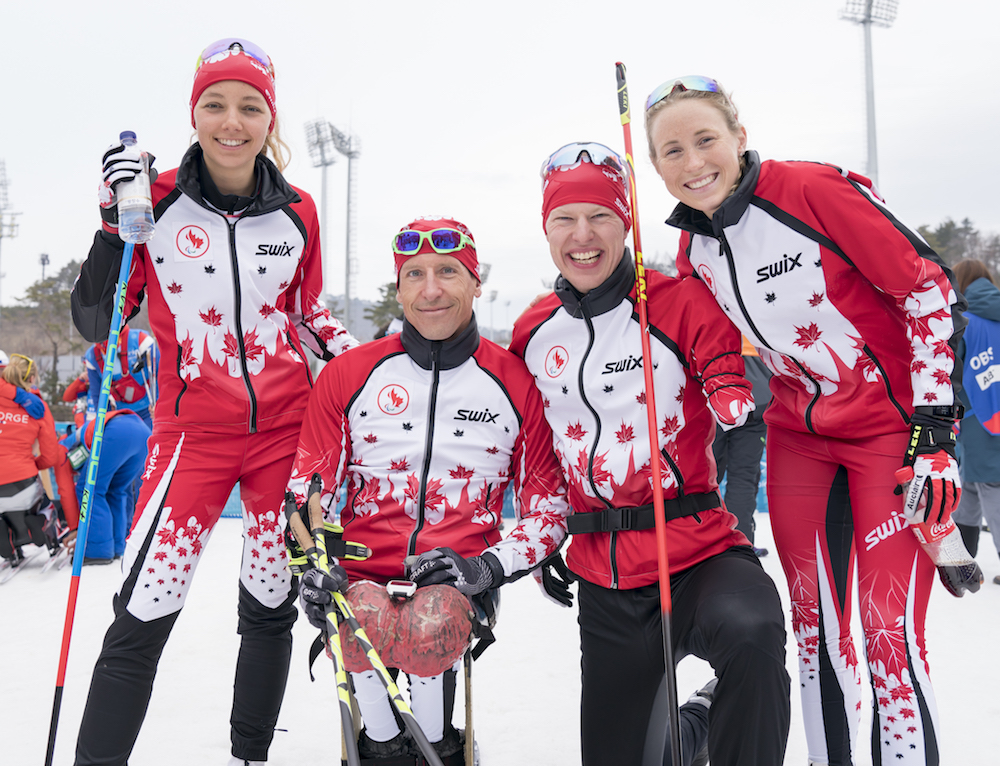
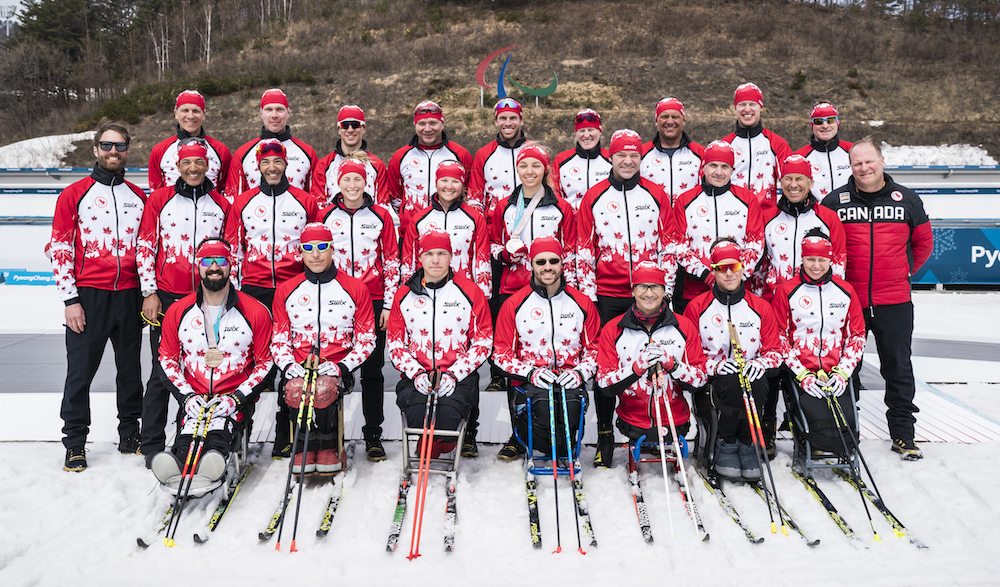
    Canada’s 2018 Paralypmic cross-country and biathlon team at the Alpensia Biathlon Centre on the last day of the Games in Pyeongchang, South Korea. (Photo: Dave Holland/Canadian Paralympic Committee)
  • Arendz Gets Gold He Came For; Cnossen and Masters Silver in Last Paralympic Biathlon Race

    Arendz Gets Gold He Came For; Cnossen and Masters Silver in Last Paralympic Biathlon Race

    Canada’s Mark Arendez gets a congratulatory hug after he won gold in the men’s 15 k standing biathlon individual race on Friday at the 2018 Paralympics in PyeongChang, South Korea. (Photo: Scott Grant/Canadian Paralympic Committee)

    2018 Winter Paralympics (PyeongChang, South Korea): 12.5/15 k biathlon races

    Mark Arendez lets out his trademark roar as he crosses the finish line of the men’s 15 k standing biathlon individual on Friday at the 2018 Paralympics in PyeongChang, South Korea. He won for his first Paralympic gold and sixth-career Paralympic medal. (Photo: Scott Grant/Canadian Paralympic Committee)

    Canada’s Mark Arendz captured his first Paralympic gold, the sixth Paralympic medal of his career and his fourth medal of the PyeongChang Games on Friday in the men’s 15-kilometer individual standing biathlon race — the longest and final biathlon event on the schedule.

    Meanwhile, Dan Cnossen of the U.S. continued his medal streak with his fifth medal in as many races, taking silver in the men’s 15 k sitting biathlon. His teammate Oksana Masters raced to silver for her fourth medal of the 2018 Games in the women’s 12.5 k sitting biathlon, and two Canadians earned bronze with Collin Cameron placing third in the men’s 15 k sitting and Brittany Hudak taking her first Paralympic medal in the women’s 12.5 k sitting.

    Arendz, 28, who placed second and third in two biathlon races at the 2014 Paralympics and once again finished second and third in two previous biathlon events at these Games, cleaned all four shooting stages to secure the win in 42:52.2 minutes. France’s Benjamin Daviet took silver, 58.3 second back, after missing one target (0+0+1+0) and having a minute penalty added to his time. Norway’s Nils-Erik Ulset shot clean for bronze, 1:14.5 behind Arendz.

    “Every time I stepped on the podium this week, I kept thinking I want to hear ‘Paralympic Champion’ and then my name announced,” Arendz told Cross Country Canada, according to a press release. “I wanted nothing more than to hear my country’s anthem played. I’ve seen the maple leaf on top of the podium three times this week, but to finally have it behind the top step of the podium for me is an amazing feeling.”

    In addition to his first gold, Arendz also took his first Paralympic medal in a cross-country race with bronze in the PyeongChang classic sprint.

    “I wanted to be consistent and focus on the process all week. This race was my strength,” he said. “It is a shooting race and you have to go clean. The process was key today, and I just tried to make sure I hit those 20 targets. Once I got to that last bout I wasn’t going to miss, so I made sure of every shot before I pulled the trigger. In the end I was clean, the skiing was strong, and that is what I wanted.

    “That completes the [medal] set for biathlon, and my first gold which means everything to me,” Arendz said of the last biathlon race of the 2018 Games.

    Also in that men’s standing individual race, American Ruslan Reiter placed 15th with nine penalties.

    Silver for Cnossen, Masters; Second Bronze for Cameron

    American Dan Cnossen racing to second in the men’s 15 k sitting biathlon individual at the 2018 Paralympics in PyeongChang, South Korea. (Photo: U.S. Paralympics/ Maddie Meyer-Getty Images)

    In the men’s sitting biathlon event on Friday, Cnossen and Cameron raced to second (+45.5) and third  (+1:01.9), respectively, behind Germany’s Martin Fleig in first. Fleig shot clean and finished in 49:57.2, while Cnossen missed one in the last stage (0+0+0+1) and Cameron had a single miss in the second shooting (0+1+0+0). The silver was Cnossen’s third of these Paralympics, and he medaled in every biathlon race in PyeongChang (taking gold in the 7.5 k and silver in the 12.5 k).

    “This is special because, for one, the conditions were so difficult,” Cnossen explained in an interview with U.S. Paralympics Nordic. “It’s snowing, it’s cold. It’s 30-40 degrees colder than yesterday. I’m getting a little bit tired. I had a bit of a mental battle this morning waking up. I was considering pulling out of the race because I really want to be fresh for tomorrow, so to overcome that and still put up a really solid performance is really quite good. I wish I could have cleaned that last stage – I missed one shot. Then I just really tried to hammer on that last lap.”

    While the biathlon races are over, Saturday holds middle-distance cross-country races in PyeongChang.

    “I have an excerpt that says it doesn’t matter how you feel today, it doesn’t matter what your background is or where you’re coming from, all that matters is what you can do,” said Cnossen, a 37-year-old retired Navy SEAL who was awarded a Purple Heart and a Bronze Star with Valor from the Secretary of the Navy for his service in combat.

    “I just tried to focus on what I could do today,” he continued. “Not the fact that I didn’t sleep well last night, that doesn’t matter. Just go out there and perform like I know I can.”

    “I have an excerpt that says it doesn’t matter how you feel today, it doesn’t matter what your background is or where you’re coming from, all that matters is what you can do.” — Dan Cnossen, U.S. Paralympian and former Navy SEAL, after racing to his fifth medal of the 2018 Paralympics

    Collin Cameron racing to his second bronze of the 2018 Paralympics on Friday in the men’s 15 k sitting biathlon individual in PyeongChang, South Korea. (Photo: Scott Grant/Canadian Paralympic Committee)

    Cameron, 29, achieved his second bronze medal of the Games after placing third in the biathlon sprint then coming close in fourth in Wednesday’s cross-country sprint.

    “This is awesome. This one is the sweetest one for sure,” Cameron said, according to a team press release. “That was a little redemption after the sprint day because I really wanted that one.

    “I got very little sleep last night. I just couldn’t seem to settle,” he continued. “My coach told me some of the best athlete performances have happened after a bad night of sleep. I told myself to just settle down. I got the bugs out in that first lap, focused on pacing in every lap and just kept pushing.

    “I came here wanting to get on the podium in cross country, and I’m going home with two biathlon medals. I didn’t expect that at all,” Cameron added.

    Also in that men’s sitting biathlon race, Aaron Pike placed sixth with perfect shooting and Andy Soule finished ninth with four penalties (0+0+4+0).

    In the women’s sitting biathlon individual, both Masters and Germany’s Andrea Eskau shot clean, but Eskau completed the course faster to claim gold in 49:41.2. Masters finished 18.8 seconds back for silver, her second biathlon medal of the Games, and Lidziya Hrafeyava of Belarus finished third (+1:15.8) with one penalty (0+1+0+0).

    American Oksana Masters celebrates as she finishes second in the women’s 12.5 k sitting biathlon individual race on Friday at the 2018 Paralympics in PyeongChang, South Korea. (Photo: U.S. Paralympics/Simon Bruty-OIS/IOC)

    “I went from getting a sunburn a couple days ago during the sprints to freezing right now,” Masters, 28, said of Friday’s conditions to U.S. Paralympics. “The skiing is great, our skis are amazing, the team is amazing putting together some fast skis. I’m so happy I got a chance to redeem myself from the last biathlon race I didn’t get to finish.”

    Masters did not finish the women’s 10 k biathlon race earlier in the week. She has been racing with an elbow injury throughout the Games.

    “The way I looked at it, I wasn’t going to get defeated by this elbow,” she said. “I definitely know I wasn’t skiing at 100 percent, but I wanted to see where I was. I’ve trained four years, the day after Sochi ended. I counted the days, it was like 1,461 days – not that I’m counting – but I was not going to let that basically take away from my Games experience here.”

    As for hitting all 20 targets on Friday, Masters said she was in the zone.

    “I just focused on that ‘breathe, exhale, pause, squeeze,’ which is everything I’ve been training and practicing,” she said. “I couldn’t believe it. I almost fell going around the corner telling my coach ‘I cleaned!’ I can’t believe it.”

    In three biathlon races in PyeongChang, the U.S. team tallied seven medals. Going into these Games, the U.S. had one biathlon medal (Soule’s bronze from 2010) in the history of the Paralympics and Olympics.

    Kendall Gretsch, an American double gold medalist in the sitting biathlon sprint and 12 k cross-country race, placed eighth in the Friday’s individual race with seven penalties (1+0+2+4).

    Hudak Makes History with Biathlon Bronze

    In the women’s 12.5 k standing biathlon race, Hudak notched her first Paralympic medal and Canada’s first in a women’s standing biathlon event in third place, 2:23.9 behind Anna Milenina of the Neutral Paralympic Athletes (NPA) in first and 1:20.1 behind Ekaterina Rumyantseva (NPA) in second. While Milenina overcame two minutes of penalties (0+1+0+1) to take gold in 38:56.8 and Rumyantseva had two misses as well (0+2+0+0), Hudak shot clean.

    Brittany Hudak hugging her teammate Emily Young after Hudak placed third for her first Paralympic medal on Friday in the women’s 12.5 k standing biathlon individual in PyeongChang, South Korea. (Photo: Scott Grant/Canadian Paralympic Committee)

    “This is such an unreal day. There are so many emotions,” Hudak said, according to the team press release. “I just tried to think about the process throughout the race. I wanted to focus on shooting because I knew it was going to make a difference today.”

    As she left the range in fourth after her last shooting stage, Hudak got a lift from her teammate Emily Young, who pushed to catch her and pull her around the final loop. Together, they clawed back five seconds and Hudak finished third, 3.7 seconds ahead of Ukraine’s Iryna Bui in fourth.

    “I’m just so lost for words. It is so incredible,” Hudak, 24, said. “I knew I was in the medal mix heading into that last lap. Everyone was screaming at me to keep going. Emily kept yelling at me the whole way around, and I just tried to hang onto her. I was breathing so hard and gave it everything I had. I was so tired at the finish and wanted to collapse.”

    Young finished the race in seventh with two penalties (1+0+1+0).

    “I was hearing the splits around the course, and I knew after my second round of shooting I was out of the top four and there was a big gap,” Young, 27, reflected. “I just chased Britt down on the course, and once I caught her, started screaming at her to follow me and not get dropped. I was breaking the wind for her the whole way. I was pretty tired on that last lap, but just kept skiing hard and screaming at her to follow. I don’t know where I found the energy.

    “She did awesome. Britt is my right-arm girl,” Young added. “I’m so proud of her. We both work so hard and I know how many hours she put into this. I’m just as excited for her as I would be for myself.”

    The Paralympics enter their final weekend with middle-distance cross-country races on Saturday, starting at 10 a.m. Korea time (9 p.m. EDT on Friday), and conclude with mixed and open relays on Sunday.

    Complete results

    Canada’s Mark Arendz with his first Paralympic gold medal after winning the men’s 15 k standing individual biathlon race on Friday at the 2018 Paralympics in PyeongChang, South Korea. (Photo: Dave Holland/Canadian Paralympic Committee)
  • First Paralympic Golds for Soule and Masters; McKeever Wins Second Straight, 12th Total

    First Paralympic Golds for Soule and Masters; McKeever Wins Second Straight, 12th Total

    American Oksana Masters reacting to her first gold medal in her third Paralympics, after winning the women’s 1.1 k sitting sprint on Wednesday in PyeongChang, South Korea. (Photo: U.S. Paralympics/Joe Kusumoto)

    2018 Winter Paralympics (PyeongChang, South Korea):  Cross-country sprints

    Hold onto your hats, this was a major day for both the American and Canadian teams at the 2018 Paralympics.

    In the cross-country sprints on Wednesday in PyeongChang, Andy Soule and Oksana Masters of the U.S. Paralympics Nordic Program both captured their first-career Paralympic golds in the women’s and men’s sitting events, while Dan Cnossen skied to his fourth medal in as many races with a bronze to add to his collection.

    Brian McKeever of the Canadian Para-Nordic Ski Team raced to his second-straight gold of the week in the men’s visually impaired sprint, with guide Russell Kennedy, and two of their teammates claimed bronze: Mark Arendz, in the men’s standing sprint for the first Paralympic cross-country medal of his career (following four biathlon medals) and Natalie Wilkie, the youngest member of the team at age 17, in the women’s standing sprint.

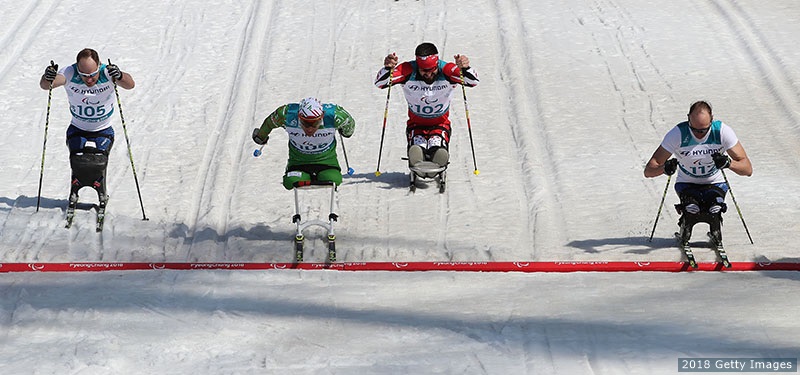
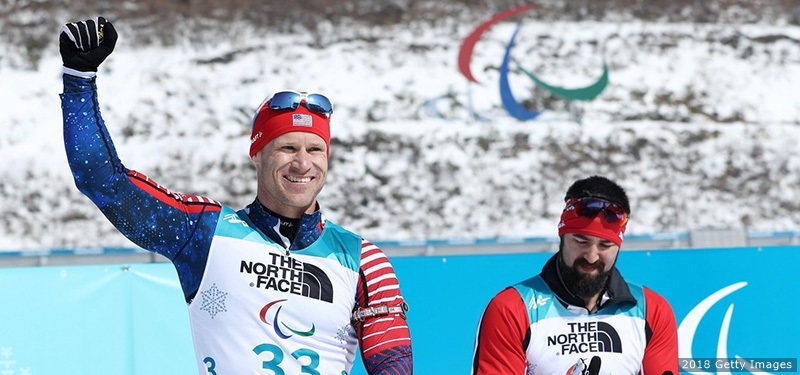
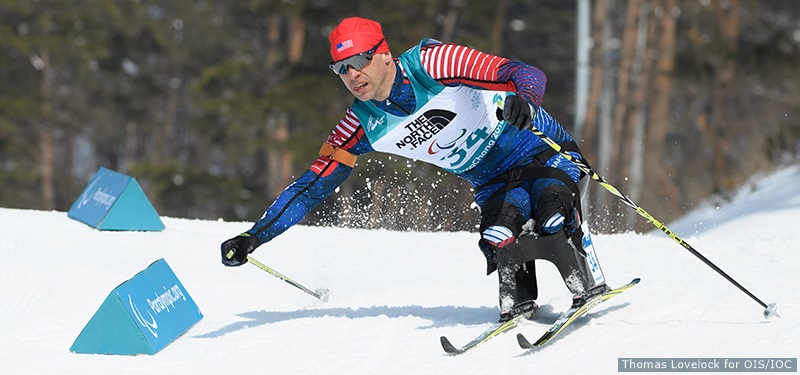
    Andy Soule (r) of U.S. taking first in a photo finish with Dzmitry Loban (second from l) of Belarus, while American Dan Cnossen (l) takes third and Canada’s Collin Cameron (second from r) fourth in the men’s 1.1 k sitting cross-country sprint at the 2018 Paralympics in PyeongChang, South Korea. (Photo: U.S. Paralympics/Chung Sung-Jun for Getty Images)

    In the men’s 1.1-kilometer sitting sprint final, Soule won a photo finish with Dzmitry Loban of Belarus, after both crossed the line in 3:31.4 minutes. Cnossen finished 0.4 seconds back in third and Canada’s Collin Cameron was just 0.3 seconds off the podium in fourth (+0.7).

    After skiing the pack throughout the final, Soule took the lead as the four racers entered the stadium together. In the finishing stretch, Loban, Cnossen and Cameron challenged him for the gold, but with a powerful surge and lean at the line, Soule, 38, notched the first gold medal after nearly 13 years in the sport. The U.S. Army veteran had previously earned bronze at the 2010 Paralympics and bronze in Tuesday’s 12.5 k sitting biathlon race.

    In a U.S. Paralympics press release, Soule described the race as “interesting” and “tactical”.

    American Andy Soule celebrates gold in Wednesday’s 1.1 k sitting sprint final at the 2018 Paralympics in PyeongChang, South Korea. (Photo: U.S. Paralympics/Chung Sung-Jun for Getty Images)

    “I chased the whole way,” he said. “I don’t think it necessarily hurt me to chase that much, it actually helped with a little bit of wind break. I think a good, tight tuck coming down the final hill put me in a natural line, and I knew I had a shot at a good sprint out. This is an incredible group to compete with. That kind of a finish … that’s what sprinting is all about.”

    “I definitely lost a little gas in the final stretch,” Cnossen reflected, according to the press release. “My strategy was to tuck in behind the Belarus athlete in the beginning and then sprint over the bridge and try to hang on. Andy had such an awesome race. This is the second day in a row we’ve had two U.S. men on the podium which is just phenomenal.”

    For Soule, the gold was his first in his third Paralympics, and his first Paralympic medal in a cross-country race (rather than biathlon).

    “It means so much. It feels so incredible,” Soule said. “I couldn’t do it without incredible teammates pushing me all the time, and without incredible coaching and technical staff. I think it speaks to a great team effort that has really paid off for us.”

    Cameron came within fractions of a second of achieving his second medal in his first Paralympics.

    “I raced as hard as I could … it is what it is. I just came up a little short,” he said, according to a Cross Country Canada press release. “It is amazing that I got a medal this week in biathlon, I wasn’t expecting it, but that was behind me. I really wanted something here. This was the race I wanted a medal in. It was a close one.”

    Also for Canada, Chris Klebl and Derek Zaplotinsky missed advancing to the final after both finished sixth in their respective semifinals.

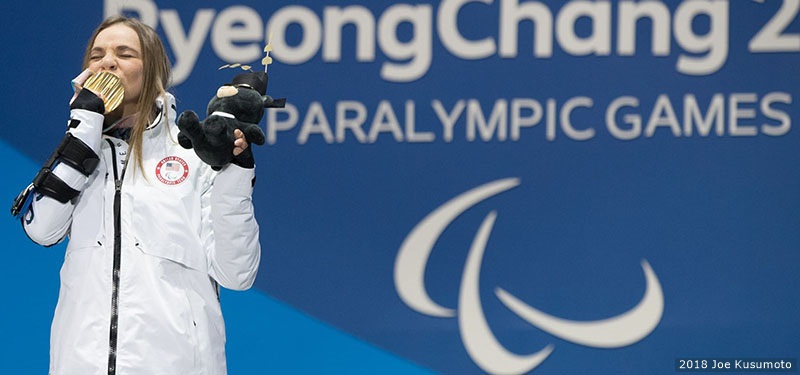
    American Oksana Masters kissing her first Paralympic gold at the medals ceremony on Wednesday night after she won the women’s 1.1 k sitting sprint at the 2018 Paralympics in PyeongChang, South Korea. (Photo: U.S. Paralympics/Joe Kusumoto)

    Masters, 28, won the women’s 1.1 k sitting sprint final by 2.1 seconds over Germany’s Andrea Eskau, crossing the line first in 4:06.7. The gold was Masters’s first in her third Paralympics, after she had previously collected five medals — two silver and three bronze — between the 2012 Summer Paralympics in London (where she placed third in a doubles rowing event), 2014 Winter Paralympic in Sochi, Russia (where she tallied one silver and two bronze in cross-country events), and PyeongChang (silver in the biathlon 6 k sprint).

    Masters has notably been racing with an injured elbow throughout these Games. On Tuesday, she did not finish the 10 k biathlon race.

    “I can’t believe it. I literally was starting to think this day would never happen,” she said of her win on Wednesday, according to the U.S. press release. “I knew that I wasn’t going to let yesterday be my last race. I couldn’t believe it, but at the same time, I knew I had it in me to dig deep a couple more times. I could not have done this without the USOC medical staff.”

    In the sitting semifinals, her teammates Kendall Gretsch, who won the first two races of the 2018 Paralympics, and Aaron Pike, were eliminated after both placed fourth in their respective heats.

    McKeever 2-for-2

    Canada’s Brian McKeever (r) and his guide Russell Kennedy celebrate gold in the men’s 1.5 k visually impaired classic sprint at the 2018 Paralympics on Wednesday in PyeongChang, South Korea. (Photo: Scott Grant/Canadian Paralympic Committee)

    A five-time Paralympian, McKeever, 38, racked up his 12th Paralympic gold medal (15th total medal) in the men’s 1.5 k visually impaired classic sprint. He finished 2.5 seconds ahead of Sweden’s Zebastien Modin (with guide Robin Bryntesson) in second place, with a time of 4:03.2. Behind them in the final, Norway’s Eirik Bye (with guide Arvid Nelson) finished third (+29.5) and Jake Adicoff (with guide Sawyer Kesselheim) was relegated to last (fourth place) for a technique violation.

    McKeever has won all three Paralympic sprints since they were introduced in 2010. On Wednesday, he double poled the entire race.

    “These sprint races are miserable,” McKeever said, according to a team press release. “They are so hard. The young guys are fast, and have natural snap. There is so much stress in sprint racing, and it goes all day long. I’m much more comfortable with the longer distances, but it was a great day for us. Russell carried the load for us today, and just thrilled we were able to cross the line first.”

    Kennedy, 26, who competed at his first Olympics last month in PyeongChang, said it was tough battling it out in Wednesday’s soft conditions.

    “We played things a bit more strategic in the semis because we knew the final was going to be a tough fight, and it was,” Kennedy reflected. “That first hill hurt a lot. Once I got to the top I was able to settle down and said to myself ‘OK, you got this.’ ”

    While Kennedy guided McKeever to gold in the second half of Monday’s 20 k cross-country race, McKeever’s other guide, Graham Nishikawa (who skied the first half with him), joined McKeever on the podium. Wednesday was Kennedy’s turn at the medals ceremony.

    “This is a new experience for me — especially coming from the Olympics where the focus is all on yourself,” Kennedy said. “Brian is such a strong athlete and guiding him requires a lot more communication. Competing here at the Paralympics is really rewarding because you do this as a team. It is hard at times to know if I’m going too hard or if he needs me to go faster, but it has been a lot of fun for me.”
    Canada’s Mark Arendz en route to bronze in the men’s 1.5 k standing classic sprint at the 2018 Paralympics in PyeongChang, South Korea. It was his first cross-country medal (fifth total) in his second Paralympics. (Photo: Scott Grant/Canadian Paralympic Committee)

    In the men’s 1.5 k standing sprint final, Arendz tied Finland’s Ilkka Tuomisto for third place, and both were awarded bronze. They finished just 0.3 seconds behind Japan’s Yoshihiro Nitta in second, and 1.1 seconds behind Kazakhstan’s Alexandr Kolyadin, who won in 4:19.7.

    “Sitting there in the finish waiting for the results of the photo finish, I was just hoping for a tie,”  Arendz said, according to the team press release. “It was a really good race but I made a mistake down the finishing stretch switching to try and find a faster track and that may have cost me the whole race.”

    The Paralympic medal was the first in a cross-country race for the 28-year-old Arendz, who has two silver and two bronze in biathlon races between these Paralympics and the 2014 Sochi Games.

    “I came here for medals in biathlon and was hoping to get my first one in cross-country,” he said. “To come away with my first bronze in cross-country skiing means a lot. I couldn’t be happier.”

    In the women’s 1.5 k standing sprint final, Wilkie raced to third for her first medal in her first Paralympics. She finished just a tenth of a second behind Norway’s Vilde Nilsen, who took silver, and 3.2 seconds out of first, which went to Anna Milenina of the Neutral Paralympic Athletes (NPA) in 5:11.1.

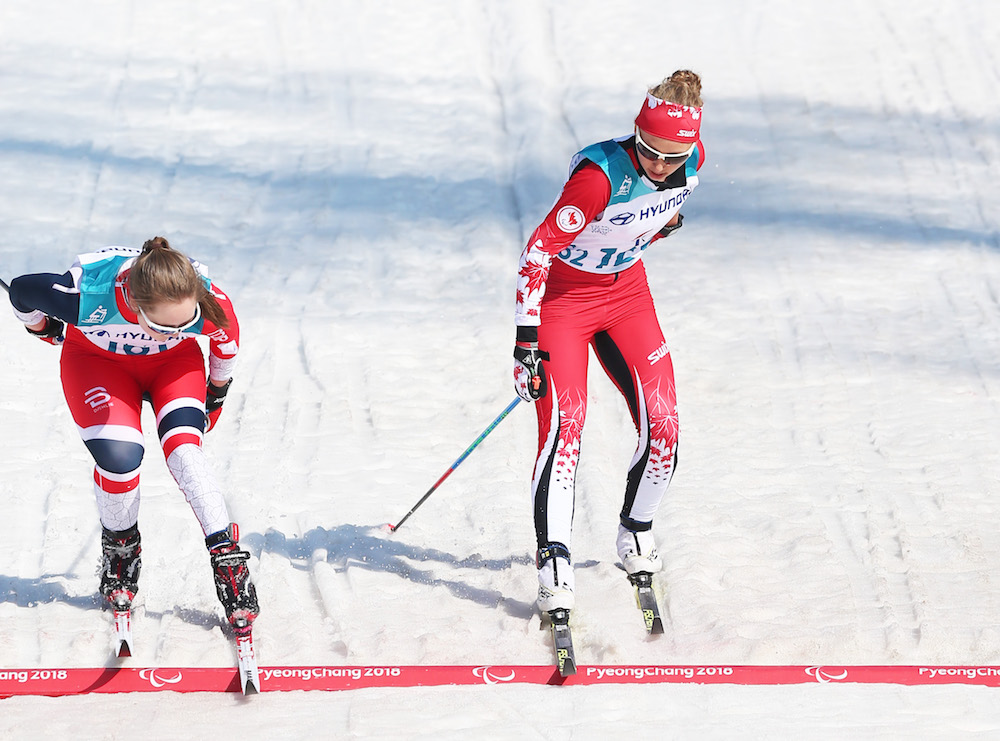
    Canada’s Natalie Wilkie (r) finishing third, just 0.1 seconds behind Norway’s Vilde Nilsen (l) in second, for her first Paralympic medal on Wednesday in the women’s 1.5 k standing classic sprint in PyeongChang, South Korea. (Photo: Scott Grant/Canadian Paralympic Committee)

    “It feels so awesome,” Wilkie said of her bronze medal. “This is my first Paralympics and I am just so happy to have won a medal.”

    Four seconds behind Wilkie, her teammate Emily Young placed fourth (+7.2). Canada made up half of the six-woman final with Brittany Hudak placing sixth (+49.2)

    “We are competing against each other, but we are also helping each other,” Wilkie said. “It was calming for me to have them there with me. We talked about strategy as a team before the final because the goal was for us to win a medal for Canada.”

    Paralympic nordic skiers and biathletes have a day off on Thursday before races resume Friday with men’s and women’s long-distance biathlon races, starting at 10 a.m. Korea time Friday (9 p.m. EDT Thursday).

    Complete results

    Canada’s Brian McKeever (r) and Russell Kennedy receiving their gold medals from the men’s visually impaired classic sprint at the 2018 Paralympic Games in PyeongChang, South Korea. (Photo: Scott Grant/Canadian Paralympic Committee)
  • Cnossen Tallies 3rd Medal of PyeongChang Paralympics; Soule and Arendz Take Bronze

    Cnossen Tallies 3rd Medal of PyeongChang Paralympics; Soule and Arendz Take Bronze

    American Dan Cnossen racing to silver in the men’s 12.5 k biathlon sitting on Tuesday and his third medal in as many races at the 2018 Paralympics in PyeongChang, South Korea. (Photo: U.S. Paralympics/Thomas Lovelock – OIS/IOC)

    2018 Winter Paralympics (PyeongChang, South Korea): 10/12.5 k biathlon races

    Amid soft and slow conditions at the Alpensia Biathlon Centre on Tuesday, American Dan Cnossen raced to his third-straight medal in as many races at the 2018 Paralympics, claiming silver in the men’s 12.5-kilometer sitting biathlon race just ahead of his U.S. Paralympics Nordic teammate and fellow military veteran Andy Soule, who earned bronze.

    Cnossen, a retired Navy SEAL, previously won gold in Saturday’s 7.5 k biathlon sprint and silver in Sunday’s 15 k cross-country race. Despite wind gusts up to 15 miles per hour on Tuesday, Cnossen hit all 20 of his targets and finished second, 1:01.7 minutes behind Ukraine’s Taras Rad, who won in 45:35.6 with clean shooting as well.

    “Personally, this was such an important breakthrough, to shoot 20 for 20, especially on the last shooting stage,” the 37-year-old Cnossen said, according to a U.S. Paralympics press release. “I’ve had some mental blocks in the past where I overthink things or get a little anxious, so I really took my time, especially on the last two shots. I wanted to get my heart rate down and make sure the wind wasn’t blowing. It feels really good to overcome this mental hurdle. I just wanted to see what I could do today, and have my own race, and not worry about what other people are doing.”

    Soule, a 38-year-old Army veteran, missed two on his third shooting stage (0+0+2+0) to finish third, 1:33.1 out of first. It was the second Paralympic medal of his career after Soule he earned bronze in the biathlon pursuit at the 2010 Games in Vancouver, British Columbia.

    “I was really skiing at an aggressive pace,” Soule told U.S. Paralympics on Tuesday. “I was struggling to hold it together at the range those last two shootings. When I missed those two, I also knew that I had seen other people missing. I knew a miss or two wasn’t going to necessarily put me out of it. I knew I just needed to get back up, set the same aggressive pace, and maybe back it off just a little earlier on the next lap to make sure I get the shots. It came together just fine.”

    It was another special moment for the U.S. Paralympics program with two of its leading men on the podium.

    “I’m really happy for our whole team, to see how much success we’re having,” Soule said. “I think it’s a testament to great coaching, great support, great staff. Lots of great work being done behind the scenes by so many people that you don’t even see who are out here long before we even arrive at the venue. It’s a great group of athletes. I’m so happy to be a teammate with these guys.”

    “This race feels especially good because I have my teammate, Andy, on the podium,” Cnossen said. “I knew he was going to have a good race. I’m really proud and happy to see him on the podium.”

    Also for the U.S., Aaron Pike placed seventh in that race (+5:38.1) with a single miss (0+0+0+1), Sean Halsted finished 14th (+10:35.7) with five penalties, and Bryan Price was 16th (+17:02.3) with 10 misses.

    Canada’s lone man in the 12.5 k sitting biathlon race, Derek Zaplotinsky finished 12th (+9:15.3) with five penalties.

    American Kendall Gretsch racing to fourth in the women’s 10 k sitting biathlon race on Tuesday at the 2018 Paralympics in PyeongChang, South Korea. (Photo: U.S. Paralympics/ Maddie Meyer – Getty Images)

    Coming off two medals in the women’s sitting biathlon and cross-country events last weekend, Kendall Gretsch placed fourth in the 10 k sitting biathlon race on Tuesday, 16.5 seconds out of third. According to a U.S. Paralympics press release, she fell three times and incurred three penalties (1+0+0+2), finishing 2:05.4 behind the winner, Germany’s Andrea Eskau.

    A four-time gold medalist in Paralympic cycling with two silver medals in cross-country skiing (from two Winter Paralympics), Eskau, 46, claimed her first gold of the PyeongChang Games in 42:36.6 with one miss (0+0+1+0). Marta Zainullina and Irina Guliaeva, of the Neutral Paralympic Athletes (NPA), took silver (+1:15.5) and bronze (+1:48.9), respectively, with Zainullina skiing just one penalty lap and Guliaeva having to ski three.

    Oksana Masters did not finish, pulling out after 8.64 k with six penalties (1+2+1+2).

    Second Medal for Arendz

    Canada’s Mark Arendz racing to bronze in the men’s 12.5 k standing biathlon race on Tuesday at the 2018 Paralympic Games in PyeongChang, South Korea. (Photo: Scott Grant/Canadian Paralympic Committee)

    Mark Arendz led Canada with his second medal in the second biathlon race, the men’s 12.5 k standing, racing to bronze, 30.9 seconds out of first. Arendz cleaned three stages before missing one on his last shooting (0+0+0+1), causing him to ski an additional 150 meters in the penalty lap.

    France’s Benjamin Daviet won that race in 38:55.5 with one late penalty as well (0+0+0+1), and Ukraine’s Ihor Reptyukh collected silver (+6.7) with one miss as well (0+0+1+0).

    “I knew there were some tired guys, so I went for it from the start and tried to put some pressure on,” Arendz, 28, said in a Cross Country Canada press release. “I decided in that last bout to go for it all, throw it down, and go for the win. Unfortunately, I had the one miss and it made it a tight and interesting race.”

    The men’s 12.5 k standing biathlon podium at the 2018 Paralympics in PyeongChang, South Korea, with France’s Benjamin Daviet (c) in first, Ukraine’s Ihor Reptyukh (l) in second, and Canada’s Mark Arendz (r) in third. (Photo: Scott Grant/Canadian Paralympic Committee)

    Arendz, who took silver in the opening biathlon sprint and also has two biathlon silver medals from the 2014 Paralympics, is seeking his first Paralympic gold.

    “It was a really tough battle all day. I handed it to them early and had a choice: to go for gold or settle for the podium. I went for the win and had that one miss that cost me today,” he said. “I ran out of energy at the end. I am really happy with my race and it is another medal for Canada. I know everything is going well. I just need that last little tweak to finally win one.”

    American Ruslan Reiter finished 11th in that race (+8:41.4) with three penalties (0+2+1+1).

    Brittany Hudak led the Canadian women in fifth in the 10 k standing biathlon race, 5:45.8 behind Ekaterina Rumyantseva (NPA) in first. Hudak cleaned the first three stages before missing one in the last bout (0+0+0+1).

    “The first lap I felt good,” Hudak recalled in the team press release. “The skis were running well in these conditions, but then it just got slower as we went on. The flat sections you really try put power to glide the ski but your weight is sinking you into the snow. It got harder to get some glide and as my legs got more tired I didn’t feel like I was moving fast.

    “I tried to keep calm in the range and take my time,” she added. “The wind today was gusting, so I took a bit longer on my setup than I usually would and tried to be consistent. For the most part it worked well until that last lap, and that last bout. Overall it was an OK race.”

    Paralympic racing continues Wednesday with men’s and women’s cross-country sprints, starting at 10 a.m. Korea time (7 p.m. EDT Tuesday).

    Complete results

  • Gretsch Scores Second Gold, Cnossen Silver, Masters Bronze in PyeongChang

    Gretsch Scores Second Gold, Cnossen Silver, Masters Bronze in PyeongChang

    Kendall Gretsch racing to her second gold medal of the 2018 Winter Paralympics on Sunday in the women’s 12 k sitting cross-country race in PyeongChang, South Korea. (Photo: US Paralympics/Joe Kusumoto)

    2018 Winter Paralympics (PyeongChang, South Korea): 12/15 k sitting cross-country races

    It was a gold, silver and bronze day for the U.S. Paralympics Nordic team on Sunday at the 2018 Paralympics in PyeongChang, as Kendall Gretsch raced to her second-straight victory in as many races, Dan Cnossen took silver and Oksana Masters claimed bronze in the cross-country distance events.

    A day after achieving a historic bronze for Canada in a biathlon sit-ski event, Collin Cameron led his country in fifth in Sunday’s 15-kilometer sitting cross-country race.

    Gretsch, a Paralympic rookie who won the sitting biathlon sprint to open the Paralympics, also won the women’s 12 k sitting cross-country race on Sunday in 38:15.9 minutes, 34.5 seconds clear of Germany’s Andrea Eskau in second, while Masters followed 49 seconds back in third.

    “For cross-country, I was pretty unsure going in here,” said the 25-year-old Gretsch, according to a U.S. Paralympics Nordic Skiing press release. “I knew that since our last World Cup I had improved a lot, but you never know until you race. Just happy with how things went today and I was able to put together another good race.”

    “It’s a very humbling experience being able to hear your anthem,” she said of her second gold medal. “Puts everything into perspective. Knowing that you’re here not just here for yourself but for your country, it’s amazing.”

    For Masters, who is recovering from an elbow injury, it was her second medal after taking silver in Saturday’s biathlon sprint.

    “I’m just so happy to be on the podium,” Masters told U.S. Paralympics. “I was a little worried on the long distance considering I haven’t done intensity in three weeks. It definitely is a very painful, rude awakening to how painful the sport is. I’m happy to be on the podium.”

    She described the pain in her elbow as “extremely excruciating. It feels like there’s just a saw going at your bone 24/7, especially hammering up the climbs,” Masters said. “I had a spill over there through the stadium, but mind over matter.”

    Ukraine’s Maksym Yarovyi won the men’s 15 k sitting in 41:37.0, and Cnossen, who had taken gold in the men’s sitting biathlon sprint, placed second, 43.1 seconds back. Sin Eui-hyun claimed South Korea’s first medal of the Games in third (+51.9) ahead of China’s Zheng Peng in fourth (+1:18.5) and Canada’s Cameron in fifth (+2:09.0).

    “I’ve already exceeded my expectations,” Cnossen, 37, said of his second Paralympic medal in as many days. “I’m very proud to represent the U.S. Today, I dug as deep as I could and went as hard as I could, and regardless of where I ended up on the result, it is my success to go as hard as I could.”

    Canada’s Colin Cameron racing to bronze in the mens 7.5 k sitting biathlon sprint on Saturday at the 2018 Paralympic Games in PyeongChang, South Korea. (Photo: Scott Grant/Canadian Paralympic Committee)

    “It was really soft out there, but the skis were still fast,” Cameron, 29, said, according to a Canadian team press release. “The skis have been awesome both days – the guys are working their butts off back in the wax room.”

    Cameron explained his goal for Sunday’s race was to “start steady and be comfortable, to get rid of the bugs from yesterday’s race because I was pretty tight.

    “I was able to loosen up as I went along, which allowed me to dig a little deeper today,” he continued. “It’s tough to go from biathlon to this event. It is a totally different mindset for pacing, a totally different game. I wasn’t event thinking about [yesterday’s medal] I just wanted to build off it and take that momentum with me the rest of the week. Today was a different day and I’m happy with how I was able to perform.”

    Also for Canada, Chris Klebl, who won gold in the 10 k sitting event at the 2014 Paralympics, finished eighth (+2:25.6), Derek Zaplotinsky followed in ninth (+2:42.6), Sebastien Fortier finished 18th (+5:01.0), Ethan Hess 24th (+10:37.1), and Yves Bourque 25th (+11:35.7)

    In the women’s sitting race, Canada’s Cindy Ouellet, a 29-year-old Paralympic wheelchair basketball player, placed 18th (+11:37.3).

    “This is my first race over five kilometres and it was tough,” Ouellet said, according to the press release. “Basketball is all stop and go, but endurance is much different. I just need more races.”

    For the U.S., Andy Soule placed 11th (+2:59.1) and Sean Halsted finished 22nd (+7:18.0).

    Paralympic racing continues Monday with the men’s and women’s standing and visually impaired cross-country long-distance events, starting at 10 a.m. Korea time on Monday (7 p.m. EDT on Sunday).

    Complete results

  • Gretsch, Cnossen Nab Historic Biathlon Golds at Paralympics

    Gretsch, Cnossen Nab Historic Biathlon Golds at Paralympics

    Kendall Gretsch takes aim during the women’s 6-kilometer sitting biathlon at the 2018 Paralympic Winter Games on Saturday in PyeongChang, South Korea. She won the race to become the first American woman to medal in a biathlon event at the Paralympics (or Olympics). (Photo: US Paralympics/Mark Reis)

    2018 Winter Paralympics (PyeongChang, South Korea): Biathlon sprints

    The 2018 Paralympic Winter Games in PyeongChang, South Korea, opened in a big way for the U.S. and Canadian Paralympic nordic and biathlon teams on Saturday, with Kendall Gretsch and Dan Cnossen winning the U.S.A.’s first-ever gold medals in biathlon, and Canada’s Mark Arendz racing to silver for his third Paralympic biathlon medal and Collin Cameron becoming the first Canadian man to medal in a Paralympic sit-ski race.

    In her first Paralympics, Gretsch, a 25-year-old three-time gold medalist in paratriathlon, led U.S. teammate Oksana Masters across the line in the women’s sitting biathlon 6 k sprint, finishing in 21:52.0 with a single miss (0+1). Masters shot clean (0+0) and finished 22.8 seconds back for silver, less than three weeks after injuring her elbow.

    “I’m just really excited to be here,” Gretsch said, according to a U.S. Paralympics Nordic Skiing press release. “It’s just a great way to kick off the week and hopefully [there’s] more to come. It was an awesome race.”

    Her gold medal was also the first for an American woman in Paralympic nordic skiing.

    “It’s incredible,” Gretsch said. “For the U.S., we’ve been watching the Olympics and [Kikkan Randall and Jessie Diggins] had their historical medal for the women’s cross-country and that definitely motivated us coming here, so if I was able to do that, that’s great.

    “Motivation to get a medal definitely heightened after seeing that and seeing how they pushed through all their races,” she continued. “They’re such a great team and we also have a really strong aspect of a really strong team all working together.”

    The women’s 6-kilometer sitting biathlon podium on Day 1 of the 2018 Paralympics in PyeongChang, South Korea, with Americans Kendall Gretsch (c) in first and Oksana Masters (l) in second, and Lidziya Hrafeyeva of Belarus (r) in third. (Photo: US Paralympics/Mark Reis)

    At the 2014 Paralympics in Sochi, Russia, Masters earned silver and bronze in cross-country skiing events. She also took a bronze medal in rowing at the 2012 Summer Paralympics.

    “I am so happy, I feel like I just won my gold medal, basically. I’m so happy to be on the podium,” Masters, 28, told U.S. Paralympics after her first Paralympic biathlon medal.

    “I was told I was not going to be able to race,” Masters said of her injury just before the Games. “I was basically fighting for a chance at the start line. I dug as deep as I could for my team and I’m happy to be standing on the podium next to Kendall.

    “It’s amazing to have team USA having not only its first female biathlon medal but the first female Paralympic gold, followed by a silver,” she added. “It gives me goosebumps. It could not have been a better feeling.”

    In his second Paralympics, Cnossen, a 37-year-old retired Navy SEAL, achieved his first medal — gold — in the men’s sitting biathlon 7.5 k sprint in 23:49.7. With a single miss (0+1), he skied in the top three throughout Saturday’s race before beating Belarus’s Dzmitry Loban, who also had a penalty (1+0), by 7.3 seconds for the win.

    American Dan Cnossen (l) celebrates gold on Day 1 of the 2018 Paralympics in PyeongChang, South Korea, next to Canadian bronze medalist Collin Cameron. (Photo: US Paralympics/Getty Images)

    Cnossen’s previous best in Sochi was sixth in the cross-country sprint and 10th in the biathlon individual race. He is also a world championships para-cyclist pursuing his second graduate degree from Harvard University.

    “I would say Andy Soule was the trailblazer,” Cnossen said of his teammate’s bronze medal from the 2010 Paralympics in Vancouver, British Columbia. “When I was new on the team, he was the inspiration, and I know he’s going to pop a good race here as well.

    “In the race, I just wanted to see what I can do, not worrying about anything else,” he explained. “In the last Games that I did in Sochi, I let the TV screens and the announcer get to me and today I just focused on what I can do and nothing else matters. I crossed the line and I wasn’t even going to look at the board and I was pleasantly surprised at the end.”

    American Andy Soule racing to eighth in he men’s 7.5 k sitting biathlon sprint at the 2018 Paralympics in PyeongChang, South Korea. (Photo: US Paralympics/Thomas Lovelock for OIS/IOC)

    With a total of nine Americans in the top 20 — Soule placed eighth, Aaron Pike 12th, Joy Rondeau 14th, Ruslan Reiter 16th, Jeremy Wagner 19th, and Bryan Price 20th — Cnossen said the best was yet to come. With the exception of Reiter, who competes in the standing division, all of those results came in Saturday’s sitting biathlon races.

    “We have such an amazing team,” Cnossen said. “The way they’ve recruited new athletes, developed the waxing protocol — it’s really showing. This is just the start and we have six more races including the relays to go. It’ll be exciting.”

    Silver + Bronze for Canada

    In his third Paralympics, Arendz, 28, opened with a silver medal in the men’s standing biathlon 7.5 k sprint, matching his result in that event in Sochi four years ago. He shot clean and finished in 18:25.9 on Saturday, 30.8 seconds behind France’s Benjamin Daviet, who also cleaned the two-stage race and won in 17:56.6.

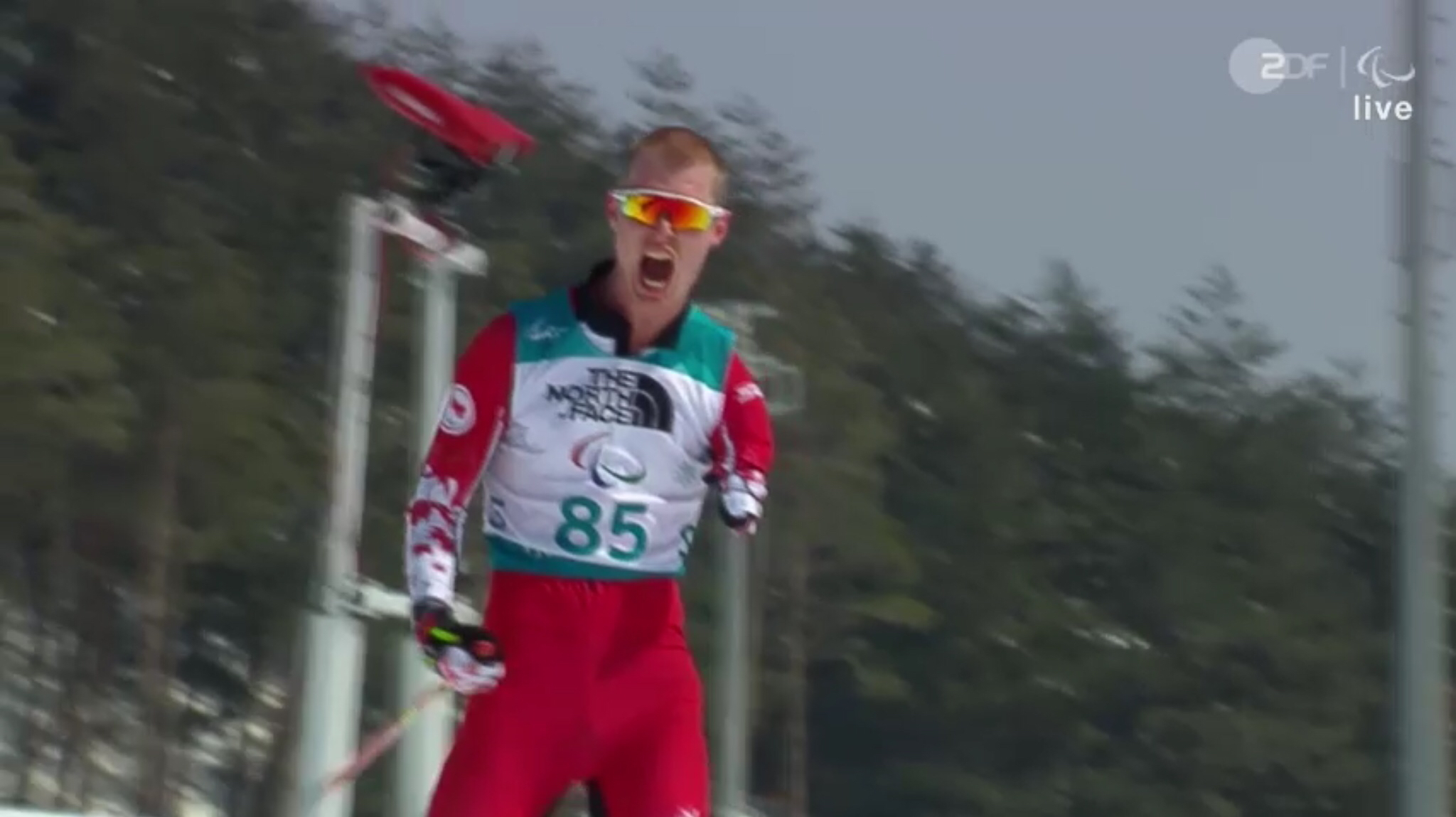
    Canada’s Mark Arendz crossing the line for silver in the men’s standing biathlon 7.5 k sprint on Saturday at the 2018 Paralympics in PyeongChang, South Korea. (Screenshot: ZDF broadcast)

    “Coming across the line I thought I had it,” Arendz said, according to a Canadian team press release. “I’m really happy with the day. It was an awesome race for me, but someone was just a little faster.”

    Earlier in the day, Cameron, 29, raced to bronze in the men’s sitting sprint, missing one target (0+1) and finishing 9.7 seconds behind Cnossen in first.

    “I got to the venue and saw Collin’s name at the top of the standings in his final lap of the sit-ski race,” Arendz recalled. “I cheered him on up his final hill and I took a lot of energy from watching him win his first ever Paralympic medal this morning.”

    A former sledge hockey player, Cameron started skiing three years ago. In achieving his first Paralympic medal, he became the first Canadian male biathlete to reach the podium in sit skiing at the Paralympics.

    “This is crazy. I didn’t expect this today,” Cameron said according to the press release. “I felt really great getting down on the mat and was in position every time. It got me on the podium today, and it is absolutely crazy.

    “When I was coming into the range for the second time, I heard on [my coach John Jaques’s] radio when he bent down to give me my rifle that I was in third, and I missed that shot,” he added. “I took a breath and got the rest – then I just went for it. Coming up that final hill, the whole team was just screaming at me and I went as hard as I could.

    “Everything came together today, and I don’t know why,” Cameron continued. “I think just the build up through the season. I was progressively getting snappier and faster, and all the work John spent with me in Sudbury. We focused on race procedure and that paid dividends today. It is such a fun course here.”

    In the women’s 6 k standing biathlon sprint, Canada’s Emily Young placed seventh with a single miss (0+1), just ahead of teammate Brittany Hudak in eighth with two penalties (1+1).

    Racing in PyeongChang continued Sunday with men’s and women’s sitting cross-country long-distance events, starting at 10 a.m. Korea time (8 p.m. EST on Saturday).

    Complete results

  • U.S. Paralympics Nordic Skiing Names 2017/2018 National Team

    U.S. Paralympics Nordic Skiing Names 2017/2018 National Team

    Three-time Paralympic medalist Oksana Masters won her third consecutive overall women’s sitting IPC World Cup globe in cross-country. (Photo: U.S. Paralympics)

    (Press release)

    COLORADO SPRINGS, Colo. — Thirteen athletes, including seven U.S. Paralympians in Nordic skiing, were named to the 2017-2018 U.S. Paralympics Nordic Skiing National Team on June 1 by U.S. Paralympics, a division of the United States Olympic Committee.

    “The level to which our Nordic skiers have performed already is very inspiring,” said Paralympic Nordic Skiing head coach Eileen Carey. “Our veteran athletes have continued to improve as we approach the Paralympic Winter Games PyeongChang 2018, and the addition of new members on our national and development teams is promising for the future.”

    Three-time Paralympic medalist Oksana Masters (Louisville, Kentucky) highlights the team after claiming four world championships titles during the 2016-17 season, including cross-country crowns in sprint, middle and long distances, as well as the sprint biathlon title. She capped off the season by securing her third consecutive overall women’s sitting world cup globe in cross-country at the World Para Nordic Skiing World Cup Finals in Sapporo, Japan. Additionally, Masters finished third in the world cup overall rankings in biathlon.

    Kendall Gretsch (Chicago, Illinois), Ruslan Reiter (Manchester, Maine) and Daniel Romanchuk (Mount Airy, Maryland) all make the national and development teams for the first time.

    Four military veterans are featured on the roster, including Dan Cnossen (Topeka, Kansas/Navy), Sean Halsted (Rathdrum, Idaho/ Air Force), Bryan Price (Belton, Missouri/Army) and Andy Soule (Pearland, Texas/Army).

    Team USA had a record-breaking 2016-17 season that finished with 33 world cup medals by five athletes, setting a record for the Nordic skiing team. Of the 33 world cup medals acquired, 12 were in biathlon. All A- and B-Team athletes reached the podium this past season, including first-time medals for Jake Adicoff (Sun Valley, Idaho) and guide Sawyer Kesselheim (Bozeman, Montana), as well as Aaron Pike (Park Rapids, Minnesota) at the PyeongChang Test Event.
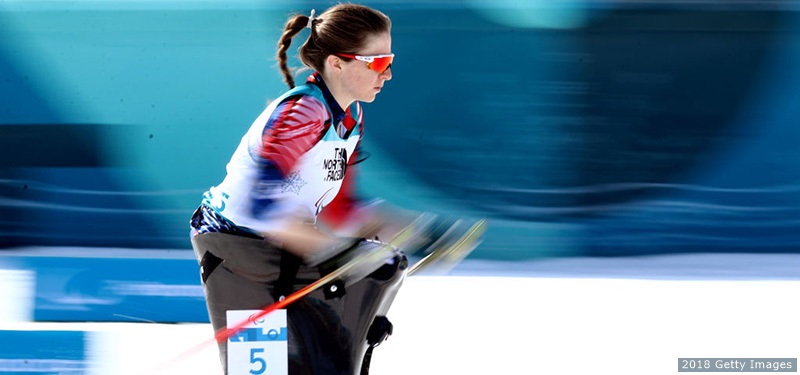
    2017-18 U.S. Paralympics Nordic Skiing National Teams

    *Denotes U.S. Paralympian in Nordic skiing

    # Denotes U.S. Military veterans

    A Team

    • Jake Adicoff (Sun Valley, Idaho) – visually impaired skier*
    • Dan Cnossen (Topeka, Kansas/Navy) – sit skier*#
    • Sawyer Kesselheim (Bozeman, Montana) – guide
    • Oksana Masters (Louisville, Kentucky) – sit skier*

    B Team

    • Aaron Pike (Park Rapids, Minnesota) – sit skier*
    • Andy Soule (Pearland, Texas/Army) – sit skier*#

    C Team

    • Kendall Gretsch (Chicago, Illinois) – sit skier

    Development Team

    • Sean Halsted (Rathdrum, Idaho/Air Force) – sit skier*#
    • Bryan Price (Belton, Missouri/Army) – sit skier*#
    • Ruslan Reiter (Manchester, Maine) – standing skier
    • Daniel Romanchuk (Mount Airy, Maryland) – sit skier
    • Joy Rondeau (Granby, Colorado) – sit skier
    • Mia Zutter (Sun Prairie, Wisconsin) – visually impaired skier
  • Golden Biathlon Breakthrough for Masters, Second Gold for Arendz and McKeever of 2017 IPC World Champs

    Golden Biathlon Breakthrough for Masters, Second Gold for Arendz and McKeever of 2017 IPC World Champs

    U.S. Paralympic skier Oksana Masters (c) along with Germany’s Anja Wicker (l) and Belarus’s Lidziya Hrafeyeva on the podium for the women’s 6-kilometer biathlon event on Saturday at the 2017 International Paralympic Committee (IPC) Nordic Skiing World Championships in Finsterau, Germany. (Photo: John Farra)

    The 2017 International Paralympic Committee (IPC) Nordic Skiing World Championships concluded this past weekend Feb. 18-19 in Finsterau, Germany with a biathlon sprint and a middle-distance cross-country event. Claiming their second gold medals of the week were Oksana Masters, of the U.S., and Canada’s Mark Arendz. Race recap and results below.

    ***

    The U.S. Paralympics Nordic Team’s Oksana Masters is plenty used to winning cross-country events. She ended last season undefeated in every cross-country race and earned World Championships titles in both the sprint and long-distance events earlier in the championships in Finsterau.

    But in biathlon, the 27 year old had yet to win a gold. However, that didn’t stop her from racing to a World Championships title in the women’s 6-kilometer sitting biathlon sprint on Saturday.

    “I am completely shocked,” Masters said to media outlets. “I entered this race with no expectations. I went from not being sure if I was going to be able to race the last two days to winning my first gold medal in biathlon. I’m so excited! I cannot wait to let this all soak in and race as hard as I can for one more race. It has been an amazing experience.”

    Despite feeling ill and not deciding until after her warmup on Saturday that she would indeed enter the race, Masters won in a time of 20:56.2 minutes, with two penalties (1+1). Finishing behind her in second was Germany’s Anja Wicker, who completed the course in 21:21.0 after one miss (1+0). In third after three misses (1+2) was Lidziya Hrafeyeva of Belarus, who finished in 21:48.0.

    Ukraine’s Maksym Yarovyi won the men’s 7 k sitting biathlon sprint, finishing in 21:36.1 after just one penalty (1+0). Shooting clean and placing second on the day was Yarovyi’s Ukrainian teammate, Taras Rad (21:48.9). German skier Martin Fleig finished in third in 21:48.9 after also hitting all of his targets as well.

    Just missing the podium for the second time this week was American Andy Soule in fourth. Soule missed one shot (0+1) and finished in 22:59.1. Behind him in fifth was his U.S. teammate Aaron Pike, who finished in 23:06.5 after shooting clean.

    Two Canadians also competed in the event, with Derek Zaplotinsky finishing 10th in 24:29.4 after shooting clean, and Cameron Collin placed 12th in 25:13.1 after three misses (2+1).

    Canada’s Mark Arendz (c) celebrates his second World Championships gold alongside France’s Benjamin Daviet (r) and Ukraine’s Ihor Reptyukh on the podium for the men’s 7.5-kilometer standing biathlon event on Saturday, Feb. 18, at the 2017 IPC Nordic Skiing World Championships in Finsterau, Germany. (Photo: Robin McKeever/Twitter)

    If Canada’s Mark Arendz had any regret about his missed shot at gold last Thursday, he found redemption in Saturday’s 7.5 k standing biathlon sprint.

    “I refocused on a new day, new race,” Arendz wrote in an email to FasterSkier of his approach to Saturday’s competition following Thursday’s silver place finish. “I knew the margin of error would be small in such a tight race. Going into the race my biggest was on recovery and preparation for Saturday’s race. The body felt great before, during and after the race. I was excited to have that feeling of renewed energy back in the legs.”

    Arendz shot 100 percent and raced to first place, earning his second gold medal for the week in a time of 18:30.0.

    I didn’t make any changes to my shooting,” Arendz added. “I considered it but in end went with what has been successful and working for me.”

    Finishing behind Arendz in a time of 18:32.6 and also shooting clean, was Ukraine’s Ihor Reptyukh in second place. Bronze went to France’s Benjamin Daviet, who clocked in at 18:57.2 after just one miss (0+1).

    In the women’s standing 6 k biathlon sprint, Ukraine once again claimed the win, with Liudmyla Liashenko emerging victorious with clean shooting in 18:25.0. Her teammate Oleksandra Kononova placed second (19:15.2) with two misses (2+0). Shooting clean for the final podium spot in third (19:24.1) was Iryna Bui, also of Ukraine.

    Canadians Emily Young and Brittany Hudak claimed eighth and 10th respectively. Young completed the course in 21:11.0 with one miss (0+1), while Hudak clocked in at 22:30.9 with two misses (2+0).

    In the women’s 6 k visually impaired biathlon sprint, Ukraine was again victorious with Oksana Shyshkova claiming first in 20:15.7 after three missed shots.

    Second place went to Germany’s Clara Klug, who completed the course in 20:38.8 after shooting 100 percent.

    “It’s just overwhelming,” Klug said, according to an IPC press release. “I said I wanted to win three Filus (the mascot of this event) and now I’ve got three. I love it here in Finsterau. A big thank you to the team and my guide Martin Hartl, who yells a lot at me on the course but it really helps!”

    Ukraine put two on the podium with Olga Prylutska taking third in 21:42.3 with three misses (1+2).

    Marking the fourth win for Ukraine on the day was Anatolii Kovalevskyi, taking gold in the men’s 7.5 k visually impaired biathlon sprint. Kovalevskyi completed the course in a time of 19:55.9 for the win, missing just one shot (1+0).

    Belarus’s Vasili Shaptsiaboi earned silver, finishing in 20:15.4 after two misses (2+0). Rounding out the podium and taking bronze was France’s Anthony Chalencon, who clocked in at 20:37.2 after one missed shot (0+1).

    Day 6 Results: Women’s 6 k biathlon sitting | Men’s 7 k biathlon sitting | Women 6 k biathlon standing | Men 7.5 k biathlon standing | Women biathlon 6 k visually impaired | Men 7.5 k biathlon visually impaired

    ***

    Canada’s Brian McKeever (third from r) with his guide Graham Nishikawa (third from left) after winning his second medal of 2017 IPC World Championships and 18th career World Championships gold on Feb. 16 in Finsterau, Germany. He racked up another individual gold on Sunday, Feb. 19, in the men’s 10 k visually impaired race to end the championships. (Photo: Robin McKeever/Twitter)

    Day 7

    With seven races over the course of nine days and only two days off, the IPC World Championships competitions were bound to test even the most accomplished of IPC athletes, including Canada’s Brian McKeever.

    “We had four races in five days so it was a lot about survival today,” McKeever said after Sunday’s race, according to a Canadian Para-Nordic Skiing press release.

    McKeever didn’t just survive the final race, he won it. The 37-year-old 18-time World Champion racked up his 19th career gold in the men’s 10 k visually impaired cross-country race in 22:15.1, besting both Thomas Clarion of France and Yury Holub of Belarus.

    “Our performances are showing that things are moving back in the right direction after being sick around Christmas. [My guide] Graham is in incredible shape right now, and a step above me which is important for us,” McKeever said.

    Clarion ended the day in second, finishing in a time of 22:45.6, while Holub took third in a time of 22:48.1.

    For the second day in a row, Shyshkova earned gold, winning the women’s 7.5 k visually impaired event in 20:23.2. Claiming silver was Sviatlana Sakhanenka of Belarus in 21:05.9, while bronze went to Austria’s Carina Edlinger in a time of 21:11.5.

    American Oksana Masters racing to her fifth medal, fourth gold of 2017 IPC World Championships, in the women’s 7.5-kilometer sitting cross-country event on Feb. 19 in Finsterau, Germany. (Photo: John Farra)

    Continuing her dominance in the women’s sitting field, Masters claimed her fifth individual medal, fourth gold, on Sunday, winning the women’s 7 k sitting cross-country event in a time of 14:15.5.

    Finishing behind Masters in a time of 14:30.5 for the silver medal was Germany’s Andrea Eskau. Norwegian Birgit Skarstein rounded out the podium in third, clocking in at 14:42.4.

    Finding the podium once again after two fourth place finishes was Soule, who earned bronze in the men’s 7 k sitting cross-country event. Soule’s time of 20:10.4 landed him third place, just behind Belarus’s Dzmitry Loban in second (19:53.3) and Ukraine’s Yarovyi in first (19:39.4)

    American Andy Soule (r) on the podium with Ukrainian winner Maksym Yarovyi (c) and Belarus’s Dzmitry Loban (l) after the men’s 7-kilometer sitting cross-country race on Feb. 19 at the 2017 IPC Nordic Skiing World Championships in Finsterau, Germany. (Photo: John Farra)

    The win was Yarovyi’s second in a row.

    “I am really happy because this is my personal best result for gold medals at a World Championships,” Yarovyi said according to an IPC press release. “I can’t express my feelings, I am just really happy.”

    Also in the men’s 7 k sitting race, Pike raced to eighth (20:58.1) for eighth place, Canada’s Zaplotinsky placed 12th (21:39.8) and his teammate Sebastien Fortier finished just behind him in 13th (21:43.8).

    Adding to his growing medal count, Canada’s Arendz secured his fifth medal of the week in the final men’s 10 k standing cross-country competition, racing to third place in a time of 23:08.9.   

    Canada’s Mark Arendz (r) capping off 2017 IPC World Championships with his fifth medal and first cross-country bronze in the men’s 10 k standing cross-country event on Feb. 19. In all, Arendz racked up two golds, one silver, and two bronze in Finsterau, Germany. France’s Benjamin Daviet (c) and Ukraine’s Ihor Reptyukh (l) reached the podium for the second-straight day as well, placing first and second, respectively. (Photo: Robin McKeever/Twitter)

    “I went into today’s race not sure what would happen given it was my sixth race in nine days. I started strong and kept it going for as long as I could,” Arendz said, according to a team press release. “It was a tight race. I threw everything I had left out there.”

    Placing ahead of Arendz in first and second respectively was France’s Daviet and Ukraine’s Reptyukh. Daviet clocked in at 21:52.9 for the win, while Reptyukh finished in 22:22.9 for second place.

    In the women’s 7.5 k standing cross-country event, all three top spots went to Ukraine, with Kononova taking gold in 19:30.7. Finishing behind her in 19:46.6 for second place was Liashenko, while third went to Iuliia Batenkova (20:20.3).

    Clocking in at 21:30.5 was Canada’s Young in seventh and rounding out the Canadians women’s team was Hudak in 10th, after finishing in 23:31.7.

    Day 7 Results: Men’s 10 k visually impaired | Women’s 7.5 k visually impaired | Men’s 7 k sitting | Women’s 7 k sitting | Men’s 10 k standing | Women’s 7.5 k standing

  • Another Gold for Masters; Historic Relay Medal for Canada; McKeever Wins 20 k at IPC World Champs

    Another Gold for Masters; Historic Relay Medal for Canada; McKeever Wins 20 k at IPC World Champs

    American Oksana Masters (c) after winning her second-straight cross-country race of 2017 IPC World Championships on Thursday in Finsterau, Germany. She is joined on the podium by Norway’s Birgit Skarstein (l) in second and Germany’s Andrea Eskau in third. (Photo: U.S. Paralympics)

    After a rest day, Paralympic athletes returned to the nordic venue in Finsterau, Germany, for Days 3, 4, and 5 of the 2017 International Paralympic Committee (IPC) World Nordic Skiing Championships. Long-distance biathlon races took place Tuesday, cross-country relays on Wednesday and individual cross-country races on Thursday.

    ***

    At the finish of Tuesday’s 15-kilometer individual biathlon race, Canada’s Mark Arendz could only think about one thing: his miss. But later, with his second 2017 World Championships medal, this one silver, around his neck after finishing in  39:21.9 minutes, the miss in his final stage (0+0+0+1) was no longer on his mind.

    Left to right: Canada’s Mark Arendz, France’s Benjamin Daviet and Norway’s Nils-Erik Ulset on the podium for the men’s 15 k biathlon standing event held on Tuesday, Feb. 14 at the 2017 IPC World Nordic Skiing Championships in Finsterau, Germany. (Photo: Robin McKeever/Twitter)

    “After crossing the finish line, all I could initially think about was the single miss (in shooting), and the fact I let the gold slip through my fingers,” Arendz said, according to a Canadian Para-Nordic Skiing press release. “But I quickly warmed up to the fact that I had won a World Championship silver medal.”

    Finishing ahead of Arendz for first place was France’s Benjamin Daviet who also shot 19-for-20 and covered the course in time of 38:33.7.

    “I am very happy and honoured. This is great and what I came here for,” Daviet said according to an IPC press release. “I will not celebrate because there are many races ahead. I hope to win more medals in Finsterau.”

    Norwegian Nils Erik Ulset claimed the final podium spot, finishing third in a time of 40:26.7 after two penalties (1+0+1+0).

    In the women’s 12.5 k standing biathlon event, Ukraine’s Liudmyla Liashenko came away with the win. She missed just one shot (1+0+0+0) and finished in a time of 39:10.0.

    “I am really happy. I want to dedicate this triumph to all my family, friends and all who have supported me all along this journey,” Liashenko said according to an IPC press release.

    In her first podium appearance, Japan’s Momoko Dekijima claimed second in 42:49.3 after two misses (1+1+0+0). Third place went to Ukraine’s Iryna Bui, who finished in 43:53.1 with three penalties (0+2+0+1).

    Canada’s Brittany Hudak raced to fifth with a single miss (0+1+0+0), finishing in 44:14.9.

    Racking up another gold medal on his home turf, Germany’s Martin Fleig took the win in the men’s 15 k sitting biathlon race in 44:39.4 with one miss (0+0+1+0).

    “I did not expect this,” Fleig said according to an IPC press release. “I had a good feeling in the morning but could not imagine the race would be so perfect. It is unbelievable that now I am a two-time world champion. It is awesome.”

    Earning silver behind Fleig was Taras Rad of Ukraine, who had four penalties (2+1+0+1) and finished in 48:01.3. Trygve Steinar Larsen of Norway earned bronze, finishing in 49:07.9 with three penalties (2+0+0+1).

    Just missing the podium with a career-best fourth was American Aaron Pike, who finished in 51:10.2 with five penalties (1+0+1+3). Canada’s Derek Zaplotinsky placed just behind Pike in fifth for his personal best, finishing in 53:28.1 with four misses as well (0+1+2+1).

    Behind them, American Andy Soule finished in seventh in 54:26.7 with nine penalties (2+2+2+3).

    Right to left: American Oksana Masters, Germany’s Anja Wicker and Ukraine’s Lidziya Hrafeyeva on top of the podium for the women’s 12.5 k sitting biathlon event on Tuesday at the 2017 IPC World Nordic Skiing Championships in Finsterau, Germany. (Photo: Oksana Masters/Twitter)

    Germany earned another victory at home in the women’s 12.5 k sitting biathlon event, with Anja Wicker returning to the podium, this time in first place.

    “I am super happy, my biggest dream came true. I was hoping this would happen, it was a perfect day for me,” Wicker said according to an IPC press release.  “Whilst I was still competing, I heard that Martin [Fleig] had already won gold and that motivated me to do the same.”

    Wicker finished in 43:07.3 with one miss (0+0+1+0). Behind her in second place was Belarus’s Lidziya Hrafeyeva, who finished in 46:05.2 after three penalties (0+2+1+0).

    American Oksana Masters also returned to the podium for her first biathlon medal of the week, finishing in 46:43.7 with four misses (2+2+0+0).

    Earning the gold medal in the men’s 15 k visually impaired biathlon race was Vasili Shaptsiaboi of Belarus, who finished in 40:47.3 with just one miss (0+0+0+1). Ukraine took the final two podium spots, with Anatolii Kovalevskyi earning silver in 41:55.2 and one miss (0+1+0+0) and his teammate Vitaliy Lukyanenko finishing just behind him for bronze in 42:21.2, also with one penalty (1+0+0+0).

    Ukraine’s Oksana Shyshkova finally found her gold on Tuesday, winning the women’s visually impaired 12.5 k biathlon event after shooting clean and finishing in a time of 38:26.6.

    “After winning two silvers in Finsterau, I am happy to finally take gold,” Shyshkova said according to an IPC press release. “Now I have to focus on the next events, do my job, give my best and the results will come as a consequence.”

    Silver went to Germany’s Clara Klug in a time of 43:58.2 with two missed shots (0+0+0+2), while Ukraine’s Olga Prylutska earned bronze in a time of 45:16.0 after six misses (1+4+0+1).

    Day 3 results: Men’s 15 k standing | Women’s 12.5 k standing | Men’s 15 k sitting | Women’s 12.5 k sitting |  Men’s 15 k visually impaired | Women’s 12.5 k visually impaired

    Day 4

    Wednesday, the fourth day of racing at the 2017 IPC World Nordic Skiing Championships was marked by mixed and open relays. The U.S. did not field a team, as no standing American athletes are present at this competition series. Canada entered a team in the open relay event.

    ***

    Canada made history on Wednesday earning its first World Championships relay medal with Brian McKeever, Emily Young and Arendz.

    McKeever, a visually impaired racer, started first. He tagged off to Young, a standing skier, and Arendz, also in the standing category, and back to McKeever. The quartet finished third in  24:53.4 just 57.5 seconds away from the win.

    “It is pretty awesome to have such a great result today with the boys, and finally snag my first World Championship medal,” Young said, according to a team press release.

    Young was one of the only women racing amidst the top teams.

    “Being one of the only girls out there, it was tough to ski against the men’s field but I gave my best effort, and that was all I could do,” Young said, according to a CCC press release. “I just had to remember to ski my race, and know that I would likely fall behind a bit. I skied the fastest so far on this course. It was a very exciting race and I am very proud of the team.”

    The win went to France in a time of 23:55.9, with standing skier Daviet leading the team, followed by visually impaired skier Anthony Chalencon, Daviet again and then standing skier, Thomas Clarion.

    Norway took second place, 23.8 seconds behind France, with standing skier Ulset racing the first leg for the team, standing skier Hakon Olsrud taking the second leg, Ulset the third and visually impaired skier Eirik Bye anchoring the team.
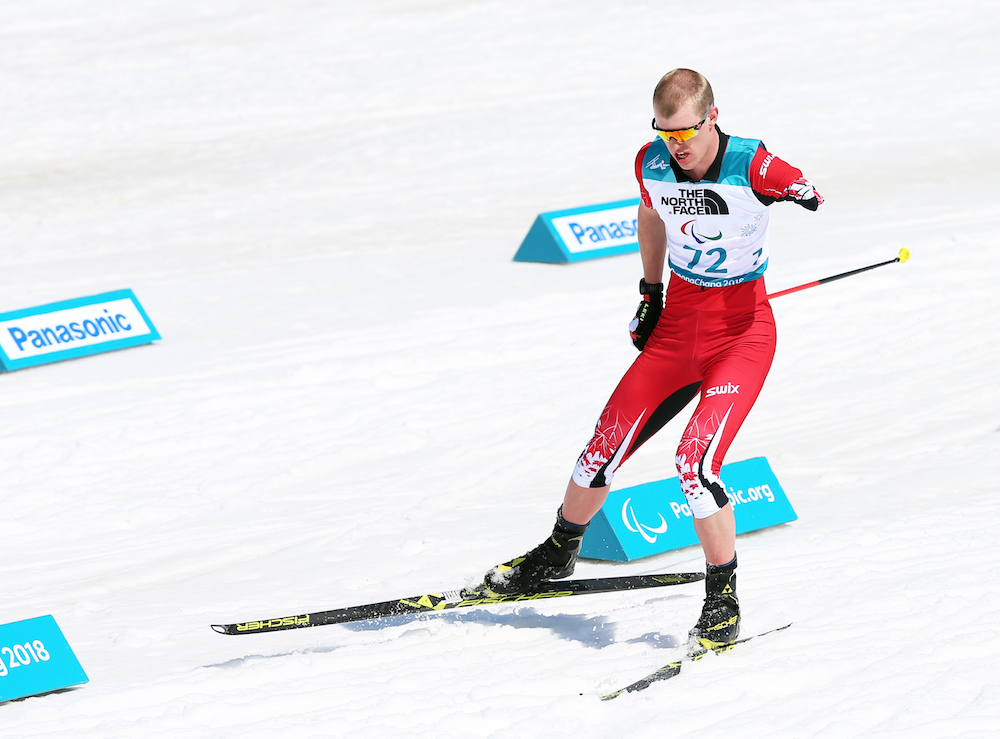
    In the mixed 4 x 2.5 k relay, it was Ukraine’s team comprised of visually impaired skier Iurii Utkin, who skied the first leg, followed by the three standing skiers Liashenko, Iuliia Batenkova, and Oleksandra Kononova. The Ukrainian team finished in a time of 26:56.5 for the win.

    “This is a really good result, we made a huge effort to achieve this,” Ukrainian head coach Andriy Nesterenko said according to an IPC press release.

    Sweden earned silver, with standing skier Helene Ripa and visually impaired skier Zebastian Modin racing for the team. The duo completed the event in a time of 27:17.5, just 21 seconds back from first place.
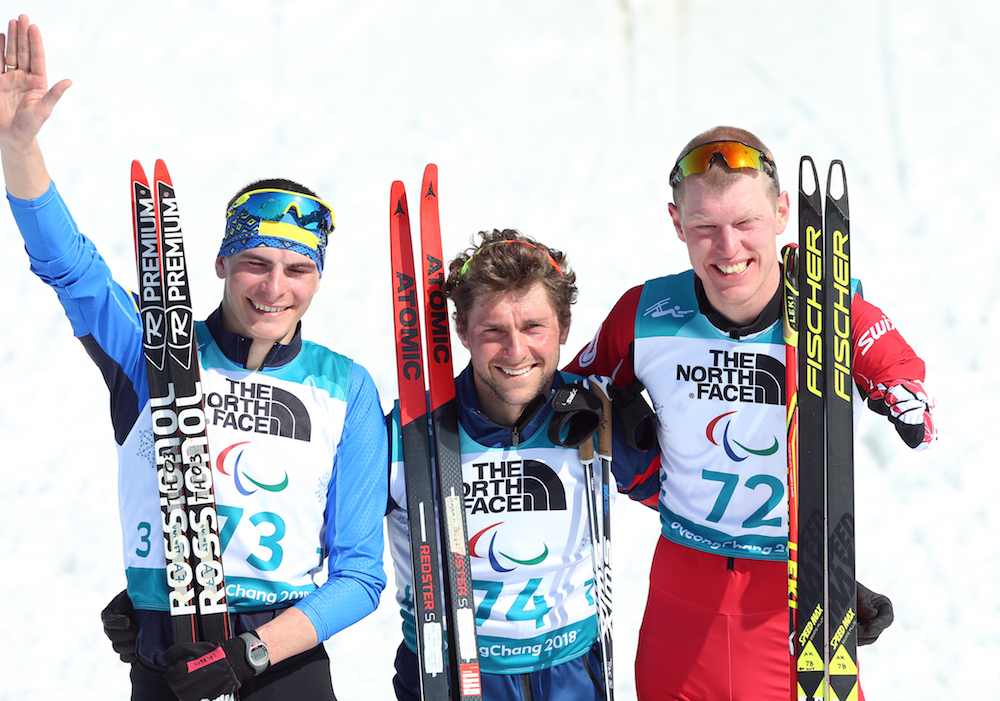
    The final mixed relay podium spot went to Belarus, with sit skier Dzmitry Loban leading the first leg, followed by visually impaired racer Sviatlana Sakhanenka. Sit skier Valiantsina Shyts raced the third leg, and visually impaired skier Mikita Ladesau anchored the team to finish in a time of 28:12.3.

    Day 4 results: Mixed relay | Open relay

    ***

    Canada’s Brian McKeever (third from r) with his guide Graham Nishikawa (third from left) after winning his second medal of 2017 IPC World Championships and 18th career World Championships gold on Feb. 16 in Finsterau, Germany. (Photo: Robin McKeever/Twitter)

    Day 5

    Just four days after she earned her first World Championships gold, Masters, of the U.S. Paralympics Nordic A-team, repeated the feat on Thursday, earning her second gold medal of the week.

    Masters, 27, raced to first place in the women’s 12 k sitting cross-country event, finishing in 36:01.0. She outlasted Norway’s Birgit Skarstein, who finished second in 36:51.7, as well as Germany’s Andrea Eskau in third (37:00.0).

    “I had some nerves going into the race today, but I used them to motivate me,” Masters said, according to a U.S. Paralympics press release. “I felt good and am really happy with how today went.”

    In the men’s 15 k sitting cross-country event, Ukraine’s Maksym Yarovyi took the win, finishing in 40:32.4. Eui Hyun Sin of South Korea earned silver, finishing in 40:56.7, while Germany’s Fleig nabbed the the final podium spot in third (41:05.4).

    Racing for the U.S., Soule narrowly missed the podium in fourth place, finishing in 41:36.4. Two Canada’s Collin Cameron placed seventh in 42:12.1 and Sebastien Fortier was 10th in 44:29.0.

    Germany’s Carina Edlinger claimed gold in the women’s 15 k visually impaired event, ahead of Ukraine’s Shyshkova and Prylutska. Edlinger finished in a time of 55:40.1 for the win, Shyshkova  in 57:11.9 and Prylutska in 1:00:01.8.

    Racking up his 18th World Championships gold on Thursday was Canada’s 37-year-old McKeever, who won the men’s 20 k visually impaired race in 57:35.4.

    “Graham skied really, really well today,” McKeever said of his guide, Graham Nishikawa, according to a team press release. “In fact he put me in an uncomfortable place for a large portion of the race, and I may have done the same for him in spots. There are different sections where we felt really good, and then others poorly. You are just comfortable with certain terrain, but it was really, really hot today and that just makes it tough to be relaxed when it is like that. It is a constant mental battle.”

    Finishing behind McKeever in second was Sweden’s Modin in 1:00:24.6. Norway’s Bye claimed the final spot in third (1:00:58.8).

    In the women’s 15 k standing cross-country race, Ukraine’s Kononova took the win, completing the course in a time of 51:56.9. Her Ukrainian teammate, Batenkova earned silver, finishing in  53:38.1, while Liashenko rounded out the all-Ukranian podium in third (53:59.4).

    Finishing just off the podium in fourth was Canada’s Young, after completing the course in 54:21.3. Behind her in fifth was her Canadian teammate Hudak, finishing in 55:53.9.

    Ukraine earned another gold, this time on the men’s side, with Ihor Reptyukh taking first place in the men’s 20 k standing cross-country event. Reptyukh finished in 58:03.1, while Finland’s lkka Tuomisto placed just behind him in second (58:39.1). Third went to Yoshihiro Nitta (58:51.6).

    Canada’s Arendz ended the day in fifth (59:34.4).

    “The most exciting part for me is watching these young guys like Brittany and Emily killing it in classic, or watching Collin who has become a superstar over year in just his second year,” McKeever said in the press release. “I’m old has heck, but you see these development guys come in and all you can do is give them the toolbox to achieve success and show them the door, but they have to open it. These guys are and they are nailing it.”

    Two days of racing remain for the 2017 IPC World Championships, with biathlon sprints on Saturday and middle-distance cross-country races on Sunday.

    Day 5 results: Men’s 20 k standing | Women’s 15 k standing | Men’s 15 k sitting | Women’s 12 k sitting |  Men’s 20 k visually impaired | Women’s 15 k visually impaired

  • Masters Claims First IPC World Champs Title, Second Time Around for Arendz, Silver for Soule (Updated)

    Masters Claims First IPC World Champs Title, Second Time Around for Arendz, Silver for Soule (Updated)

    Mark Arendz (43) of the Canadian Para-Nordic Ski Team racing to silver on Dec. 12, 2016 in Vuokatti, Finland. He finished second in the men’s standing long-distance event that day, and won his second-career World Championships gold on Saturday, Feb. 11, in Finsterau, Germany. (Photo: Canadian Para-Nordic Skiing/Facebook)

    The 2017 International Paralympic Committee (IPC) World Nordic Skiing Championships kicked off Saturday, Feb. 11, in Finsterau, Germany. Day 1 included middle-distance biathlon events for both genders, with Canada’s Mark Arendz earning his second-career IPC World Championships title. On Day 2, both genders competed in a cross-country sprint, where American Oksana Masters raced to her first world title and her U.S. Paralympics Nordic teammate Andy Soule claimed silver. Complete results and race recap below.

    ***

    There’s no better way to start a World Championships week than with a world title. After hitting all 20 targets in the men’s 12.5 k standing biathlon race, that’s just what Canada’s Mark Arendz did, taking gold on the opening day, Saturday, Feb. 11, in a time of 30:39.3 minutes.

    “To start the World Championships off with a World Title is a huge boost of confidence going into the rest of the competitions here in Germany,” Arendz wrote in an email to FasterSkier. “ It is proof that the changes that the program and I have made this year are working. That the training and hard work is going in the right direction.”

    The win is 26-year-old Arendz’s second World Championships title and first podium at a top-level international race (in a non-Paralympic year) in three years, according to a Canadian Para-Nordic Skiing press release. He previously took gold in a biathlon sprint and two bronze medals in 2013.

    “The biggest change for me has come from my approach to shooting,” Arendz said, according to the press release. “My new (shooting) coach has really brought my shooting back to the level that it once was. I was repeating too many bad habits, so the key was to rebuild the shooting from the ground up. Today, I proved the shooting is once again back on top.

    “Shooting clean at major events is key,” he added. “I controlled what I could on the range. On the course, I worked on areas where I am stronger and held a consistent pace.”

    France’s Benjamin Daviet finished behind Arendz in second place in a time of 31:14.3 with two misses (0+0+1+1), while third place went to Ukraine’s Grygorii Vovchynskyi in a time of 31:22.8 after two misses (0+1+0+1).

    (Recap continues below)

    https://www.instagram.com/p/BQYuIbflxiv/

    The women’s 10 k standing biathlon gold went to Oleksandra Kononova, who completed the course in a time of 31:41.5 after three misses (1+0+1+1).

    “I am happy but there is still a lot of work to do and many races to compete in,” Kononova said according to an IPC press release.

    Second place went to Liudmyla Liashenko, also of Ukraine, in a time of 33:05.7 with five missed shots (2+1+2+0). The final women’s standing podium spot was taken by Japan’s Yurika Abe in a time of 34:14.3 and one miss (1+0+0+0).

    Two Canadian women competed in Saturday’s standing biathlon event, with Brittany Hudak leading the team in eighth place. Hudak finished in 36:39.2 after shooting clean. Her teammate, Emily Young finished 10th in a time of 39:28.2 with five misses (0+2+0+3).

    In the men’s 12.5 k sitting biathlon race, Germany’s Martin Fleig took gold in a time of 37:31.0 with one penalty (1+0+0+0). It was his first world title and in front of a home crowd.

    “I cannot believe it, it is unreal for me, I do not know what is going on,” Fleig said according to an IPC press release. “I had a good race and I only missed one shot. Having my people cheering for me gives me extra power.”

    Ukraine’s Taras Rad placed second in a time of 37:52.2 with two misses (2+0+0+0) and third place went to Korea’s Eui Hyun Sin in a time of 39:37.4 after four misses (2+1+1+0).

    Just missing the podium in fourth place overall was Canada’s Collin Cameron, who finished in a time of 40:02.0 after one miss (0+1+0+0). In sixth was American Andy Soule, finishing in a time of 40:10.4 with five penalties (1+2+0+2). Canada’s Derek Zaplotinsky finished ninth in a time of 43:05.8 with four misses (1+0+3+0).

    Belarus’s Lidziya Hrafeyeva won the women’s 10 k sitting biathlon race, completing the course in a time of 34:46.0 with one miss (0+1+0+0).

    “My first medal at a Worlds and it is gold. This is like a dream for me,” Hrafeyeva said according to an IPC press release.

    Anja Wicker of Germany claimed second in a time of 36:22.1 after two misses (1+0+1+0), while Andrea Eskau, also of Germany, took third in a time of 36:48.5 with one miss (1+0+0+0). Just off the podium in fourth was American Oksana Masters, who finished in a time of 36:53.7 with five misses (1+2+1+1).

    “I know I have very strong opponents such as Belarus’ Lidziya Hrafeyeva, USA’s Oksana Masters and my teammate Andrea Eskau,” Wicker said according to an IPC press release.  “But I am giving my best.”

    In the men’s 12.5 k visually impaired biathlon race, Ukraine swept the podium with Iurii Utkin taking the win. Utkin shot clean and completed the course in a time of 32:50.7.

    “It feels great to win this title, this is very big and I did not expect to win. But hopefully now I will win more golds in the days to come,” Utkin said according to an IPC press release.

    His teammate, Anatolii Kovalevsky claimed second place in a time of 33:07.4 after also shooting 100 percent. Dmytro Suiarko earned the final medal after finishing third in a time of 33:51.9 with one miss (1+0+0+0).

    Ukraine also took the top two spots in the women’s visually impaired biathlon event, with Olga Prylutska winning in a time of 33:11.4 after two misses (1+0+1+0) and Ukiraine’s Oksana Shyshkova racing to second place in a time of 33:18.5 with one missed shot (0+0+1+0). Third went to Germany’s Clara Klug in a time of 36:47.9 after two missed shots (1+0+1+0).

    Day 1 results: Men’s 12.5 k standing | Women’s 10 k standingMen’s 12.5 k sitting | Women’s 10 k sitting |  Men’s 12.5 k visually impaired | Women’s 10 k visually impaired

    Day 2

    Athletes returned to the venue on Sunday, Feb. 12, for the first day of cross-country races at 2017 IPC World Nordic Skiing Championships: the sprints.

    ***

    Oksana Masters (U.S. Paralympics Nordic) after winning her first IPC World Championships gold in the women’s cross-country sitting sprint on Sunday, Feb. 12, in Finsterau, Germany. (Photo: John Farra/US Paralympics Nordic)

    Oksana Masters is far from your average athlete. The 27-year-old member of the U.S. Paralympics Nordic Skiing A-team has competed in three Olympics in three different sports: rowing, skiing and handcycling. She earned a bronze medal at the 2012 Summer Games in London and later a silver and another bronze medal at the 2014 Winter Games in Sochi, Russia.

    Five months after competing in the 2016 Summer Olympics in Rio de Janeiro, Brazil, Masters has added another medal to her growing list. This one gold.

    The Kentucky native won the women’s sitting sprint on Sunday in a time of 2:59.36, besting both Germany’s Eskau and Belarus’s Hrafeyeva for her first world title.

    “This was unreal,” Masters said, according to a U.S. Paralympics press release. “I’ve been competing in sports for so long, and this was my first world championship title. I’ve put anything and everything I had into sprinting, especially after getting so close in Sochi. I’m just so excited to bring home a world championship for Team USA for the Paralympic Nordic program.”

    Masters’s gold was historic for both her and the U.S. — the last time the U.S. national anthem was played at a World Championships was six seasons ago.

    “This is a huge day for Oksana and Andy [Soule] and historical for our program and we plan to keep the momentum going!” U.S. Paralympics Nordic Head Coach Eileen Carey wrote in an email.

    Eskau took second in a time of 3:14.97, while Hrafeyeva claimed third in a time of 3:17.24.

    In the men’s sitting sprint, another American reached the podium as Soule, U.S. Paralympics Nordic’s other A-team member, captured silver behind Ukraine’s Maksym Yarovyi in first. Yarovyi completed the sprint in a time of 2:37.77, while Soule crossed in a time of 2:47.99.

    Andy Soule (U.S. Paralympics Nordic) racing to silver in the men’s cross-country sitting sprint on Sunday, Feb. 12, in Finsterau, Germany. (Photo: John Farra/US Paralympics Nordic)

    “It is not just me that got me here,” Soule wrote in an email. “I have worked hard but without my teammates working with me and the continued support of my coaches and technicians none of this is possible. Our team is doing great things right now and I see a great future for us.”

    While Soule explained that he was able to avoid any traffic spills in his semifinal, he narrowly avoided one in his final.

    “It was a very tight race into the first turn and there was a little bit of contact,” Soule wrote. “One racer did not make it out clean and I came out tightly following two other racers in my class. When we turned up hill I took the lane they didn’t and was able to out climb them. From the top it was once again able to just hold on to a lead (for second). I was not quite able to catch Maksym Yaroviy, who gets a considerable start on me due to his classification.”
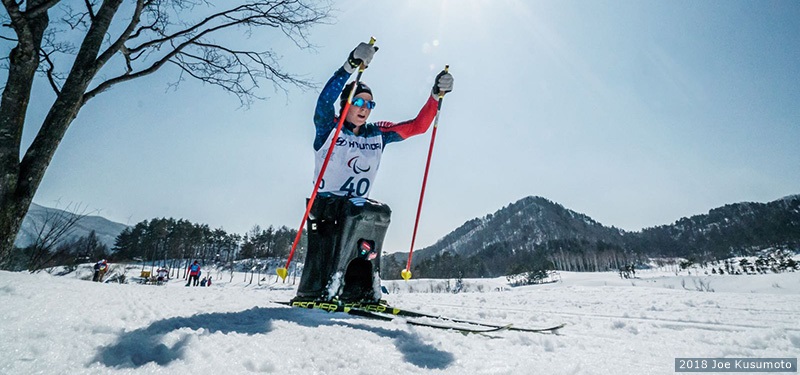
    Third place went to Trygve Steinar Larsen of Norway in a time of 2:47.23. Canada’s Cameron just missed the podium with a career-best fourth in 2:47.76.

    “Tactically I could have done a few things a little differently in the finals, but overall this was an excellent day for me, and I’m very happy with this result for just my third ever sprint race in Europe,” said Cameron, a 28-year-old World Championships rookie and former sledge hockey player, according to a Canadian team press release. “To get this close to my first podium obviously encourages me to use everything I learned from today to make myself better and ski smarter in the future.”

    American Aaron Pike also competed in Sunday’s sitting sprint, finishing in ninth overall in a time of 2:46.62 after being eliminated in the semifinals. A second Canadian competed in the sit sprint, with Sebastien Fortier finishing in 17th in a time of 3:06.33.

    Ukraine’s Ihor Reptyukh won the men’s standing sprint, crossing first in a time of 2:50.53. Witold Skupien of Poland earned silver in a time of 2:52.38, while Ukraine’s Vovchynskyi took bronze in a time of 2:54.84.

    Moving up from her second place in Saturday’s event was Ukraine’s Liashenko, who won the women’s standing cross-country sprint in a time of 3:21.05. Her teammate Kononova also earned her second medal of the week with a silver place finish in a time of 3:19.82. Rounding out the all-Ukraine podium in third was Iryna Bui, who crossed in a time of 3:36.30.

    “I worked very hard, corrected the mistakes from previous races and this is consequence of that,” Liashenko said according to an IPC press release.

    Canada’s Young took sixth in a time of 3:42.64.

    “It was not perfect, but better than yesterday,” Young said, according to a team press release. “I came in with a fresh slate and ready for a fight. I had a race plan and knew the course well. The races got better each time and it was encouraging to hang on to some of the fastest skiers for longer than I could in the past. I am happy with where I am in the sprinting field this far in my career.”

    Sweden’s Zebastian Modin claimed first in the men’s visually impaired sprint, crossing in a time of 2:46.76. Ukraine’s Utkin earned his second medal in a row, crossing second in a time of 2:54.35. France’s Thomas Clarion took the final men’s visually impaired podium spot, crossing third in a time of 2:52.85.

    “One year ago, I was thinking of throwing the skis into the fire, of retiring because of so many injuries I suffered,” Modin said according to an IPC press release. “And now being here is amazing.”

    The women’s visually impaired cross-country sprint went to Austria’s Carina Edlinger, who crossed in a time of 3:26.42 for the win. Second place was taken by Ukraine’s Shyshkova, while third went to Belarus’s Sviatlana Sakhanenka in a time of 3:29.75.


    Day 2 results: Men’s sitting sprint | Women’s sitting sprintMen’s standing sprint | Women’s standing sprint | Men’s visually impaired sprint | Women’s visually impaired sprint

    After a rest day on Monday, athletes return to the venue for Day 3 of competition with individual (long-distance) biathlon races.

    Update: On Tuesday, Arendz racked up another medal — silver — in the men’s 15 k standing individual biathlon event.

    “After crossing the finish line, all I could initially think about was the single miss (in shooting), and the fact I let the gold slip through my fingers,” Arendz said, according to a press release. “But I quickly warmed up to the fact that I had won a World Championship silver medal.”

    Also with her second podium in three races, Masters finished third in the 12.5 k sitting individual biathlon event. Pike notched a career-best fourth in the men’s 15 k sitting biathlon event, just ahead of Canada’s Zaplotinsky, who recorded a career-best fifth. Soule followed in seventh.

    Hudak raced to fifth in the women’s standing 12.5 k biathlon race.

  • U.S. Paralympics Nordic Skiing Names 2016/2017 National Team

    U.S. Paralympics Nordic Skiing Names 2016/2017 National Team

    U.S. Paralympics logo

    (Press release)

    COLORADO SPRINGS, Colo. (June 1) — Seven athletes, including five U.S. Paralympians, were announced to the 2016-2017 U.S. Paralympics Nordic Skiing National Team by U.S. Paralympics, a division of the United States Olympic Committee.

    “The high quality of our national team this season is very encouraging,” said Paralympic Nordic Skiing head coach Eileen Carey. “All of our athletes have shown themselves to be competitive as they continually challenge for medals on the international stage.”

    Headlining the team is two-time Paralympic medalist Oksana Masters (Louisville, Kentucky) who comes off a perfect 2015-16 campaign in cross-country competition. She went undefeated in sprint, middle and long distances to claim her second consecutive overall world cup globe for the women’s sitting class at the IPC Cross-Country Skiing World Cup Finals in Vuokatti, Finland in March. She also amassed the most world cup cross-country points throughout the season than any other female on the world cup circuit.

    The roster also includes three military veterans: Sean Halsted (Rathdrum, Idaho), ret., Air Force, Bryan Price (Belton, Missouri), ret. Army and Paralympic medalist Andy Soule (Pearland, Texas), ret. Army.

    Making their national team debut are two newcomers Joy Rondeau (Granby, Colorado) and Mia Zutter (Sun Prairie, Wisconsin). Both competed in their first international competitions at the world cup in Finsterau, Germany which will play host to the 2016 IPC Nordic Skiing World Championships.

    Team USA finished the 2015-16 strong with nine medals in the final two world cups, including three gold medals at the World Cup Finals. The team will face an important year in preparation for the 2018 Paralympic Winter Games. Before the world championships in February, the team will travel to world cups in Finland, Ukraine and Japan as well as South Korea for the PyeongChang Test Event.

    2016-2017 U.S. Paralympics Nordic Skiing National Teams

    *Denotes 2014 U.S. Paralympian
    # Denotes retired U.S. Military

    A Team

    *Oksana Masters (Louisville, Kentucky), sit ski

    *#Andy Soule (Pearland, Texas/Army), sit ski

    B Team

    *Jake Adicoff (Sun Valley, Idaho), visually impaired

    Development Team

    *#Sean Halsted (Rathdrum, Idaho/Air Force), sit ski

    *#Bryan Price (Belton, Missouri/Army), sit ski

    Joy Rondeau (Granby, Colorado), sit ski

  • FasterSkier’s Para-Nordic Skiers of 2016: Oksana Masters and Andy Soule

    FasterSkier’s Para-Nordic Skiers of 2016: Oksana Masters and Andy Soule

    For the second-straight year, Oksana Masters (l) and Andy Soule of the U.S. Paralympics Nordic Program are FasterSkier's Para-Nordic skiers of the year. (Photos: John Lazenby/Lazenbyphoto.com)
    For the second-straight year, Oksana Masters (l) and Andy Soule of the U.S. Paralympics Nordic Program are FasterSkier’s Para-Nordic skiers of the year. (Photos: John Lazenby/Lazenbyphoto.com)

    With the 2015/2016 season officially in the rearview, FasterSkier is excited to unveil its annual award winners for this past winter. Votes stem from the FS staff, scattered across the U.S. and Canada, and while not scientific, they are intended to reflect a broader sense of the season in review.

    ***

    Oksana Masters, U.S. Paralympics Nordic

    When Oksana Masters ended her season undefeated in every International Paralympic Committee (IPC) World Cup cross-country event, she proved podiums are just as much a performance as they are a process.

    Her third year on the U.S. Paralympic Nordic team — after making the switch from rowing to skiing in 2012 — Masters finished the 2015/2016 ski season with 11 cross-country victories in a row and four biathlon podiums. Prior to this year, her top World Cup result was second in the 5 k sitting event at 2015 IPC World Championships.

    Success doesn’t happen overnight nor does it happen on the 1st try. Every time [you] get up [you’re] 1 step closer,” Masters tweeted prior to this year’s IPC World Cup races in PyeongChang, South Korea.

    For Masters, it’s important to look beyond the season’s results to see the full story. Her 14 podium finishes (five of which came from U.S. Sit Ski Nationals) were not only products of strong skiing, but staying tuned to her body throughout season training and race recovery.

    “Oksana made gains this winter in making smart decisions for her recovery and health, even when it meant backing off from training,” U.S. high-performance coach Eileen Carey wrote in an email to FasterSkier. “She made a few mistakes early in the winter, training through some sickness, but she learned from it and made smarter decisions for the rest of the season.  Her performances in cross country races would not have been possible without that adjustment.”

    Masters’ winning streak began in Siberia, when she raced to a first place in the women’s 12 k cross-country sitting event. The run continued as she competed at U.S. nationals and the IPC Continental Cup in Craftsbury, Vt., as well as the World Cups in PyeongChang, Finsterau, Germany, and Vuokatti, Finland.

    At the end of the season, Masters won her second-straight overall cross-country World Cup by more than 200 points. She was nominated for the USA Olympic Committee’s Female Olympic/Paralympic Athlete of the Month for March, as well as the Allianz Athlete of the Month.

    “I am so excited to be nominated as Allianz Athlete of the month for the Paralympics,” she tweeted

    Andy Soule, U.S. Paralympics Nordic

    Sprinting, distance, or middle distance, cross-country or biathlon, you name it, Andy Soule is an automatic choice when it comes to all-around athlete.

    Soule, who, like Masters was also FasterSkier’s 2015 Para-Nordic award winner, continued his hold on the title after racing to 11 podiums during this IPC World Cup season.

    However, Soule’s podiums proved him as an adept skier in all distances and disciplines. He raced to two third-place finishes at the PyeongChang World Cup in the 1 k sitting sprint and the 5 k middle distance.

    He went on to achieve to two second-place finishes in PyeongChang, this time in the 7.5 k biathlon sprint and 12.5 k middle distance event.

    He took two more third-place podiums in Finsterau, one in the cross-country sprint and one in the biathlon 7.5 k sprint. He also finished third in the season-opening 12.5 k biathlon pursuit in Siberia.

    At nationals in January, he won four out of five races: the men’s biathlon sprint and individual as well as the cross-country sprint and middle distance.

    Soule, who has been on the U.S Paralympics Nordic team for the past nine years, pointed out that his performances this year were not without challenge.

    “The men’s sit field is very strong in IPC nordic, and I was up against some great skiers every day,” Soule wrote in an email after competing in Finsterau. “I just have to approach each race one at a time, and focus on good procedure, technique, and recovery for the next day.”

    At the end of the season, Soule placed fourth in the overall cross-country World Cup, 30 points short of the podium. He was fifth in the overall biathlon World Cup, while Masters placed sixth in the women’s biathlon overall.

    Honorable mentions:

    Canada’s Emily Weekes placed seventh in the women’s standing cross-country and Brian McKeever finished eighth in the men’s visually impaired, despite competing in a few select races (he won two races, including the inaugural 30 k marathon, at World Cup Finals).

    Weekes finished the season in ninth overall in the biathlon World Cup, and yet another Canadian Para-Nordic Ski Team member, Mark Arendz tied for ninth in the men’s standing biathlon.

  • Masters Ends IPC World Cup Season Undefeated in Cross Country

    Masters Ends IPC World Cup Season Undefeated in Cross Country

    Oksana Masters (front) and U.S. Paralympics Nordic coach Eileen Carey at 2016 IPC World Cup Finals in Vuokatti, Finland, with wax tech Dave Mark (behind). Masters won the overall cross-country World Cup for the second-straight year. (Photo: U.S. Paralympics Nordic)
    Oksana Masters (front) and U.S. Paralympics Nordic coach Eileen Carey at 2016 IPC World Cup Finals in Vuokatti, Finland, with wax tech Dave Mark (behind). Masters won the overall cross-country World Cup for the second-straight year. (Photo: U.S. Paralympics Nordic)

    When an athlete finishes a World Cup season undefeated, it’s not just a win for the athlete, it’s a win for their teammates as well.

    After U.S. Paralympics Nordic sit skier Oksana Masters completed the 2015/2016 International Paralympic Committee (IPC) World Cup race season as the undefeated victor in the cross-country events, from the 1-kilometer sprints to the debut of the 20 k marathon event, her success was seen as one for and from the team.
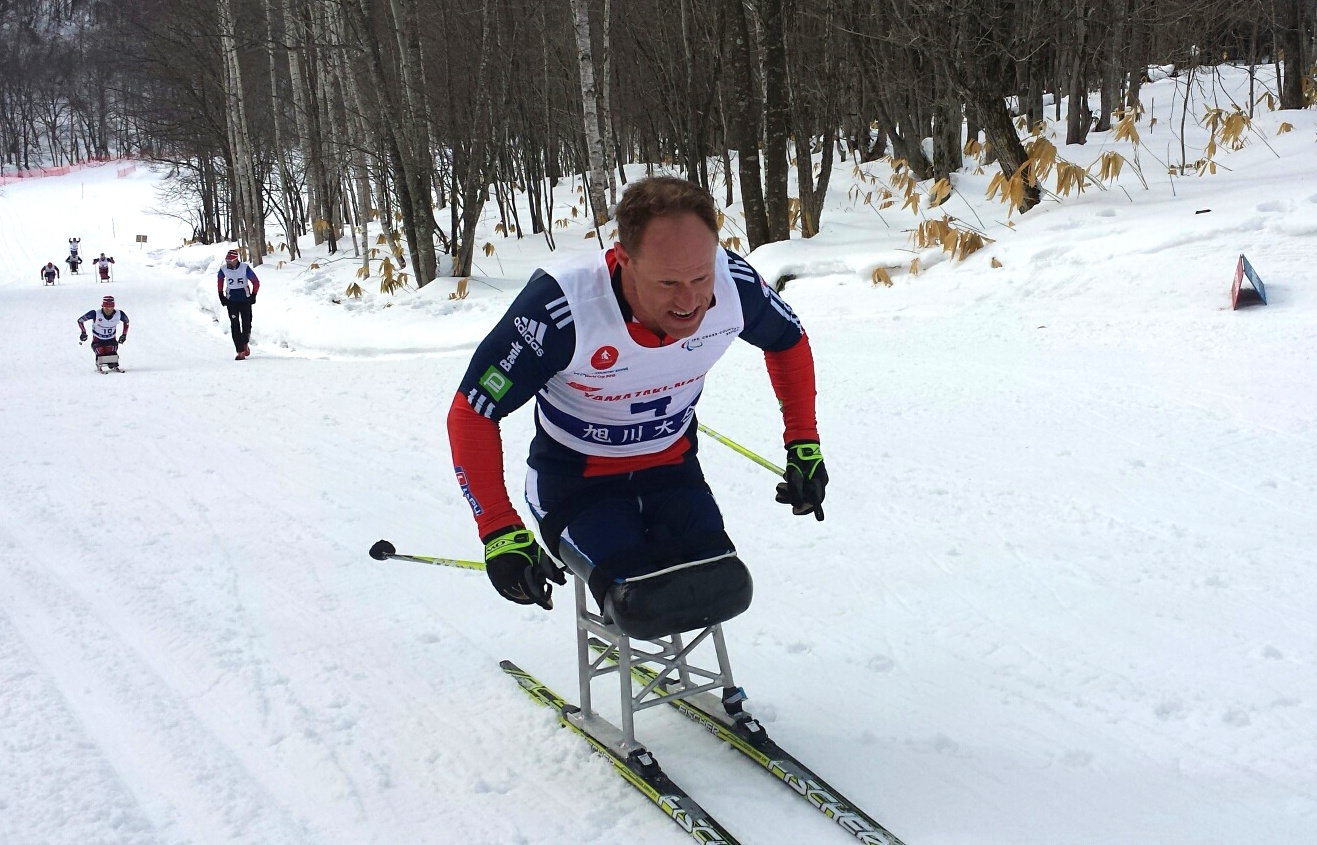
    “Oksana is an amazing athlete and I have been privileged to be a [part] of her cross country skiing career since she started the sport,” her teammate Andy Soule wrote in an email.

    “We have both become better skiers by learning from one another and training together,” Soule added. “She is hard-working, motivated, and a joy to be around as a teammate and as a person; and it makes me incredibly happy to see her having the level of success she had had these past couple of years.”

    Last week at IPC World Cup Finals in Vuokatti, Finland, Masters raced to three wins in a row, including the cross-country sitting sprint, but she didn’t let it get to her head.

    “It [was] the last sprint of the season and I didn’t want to leave anything behind!” Masters, of Louisville, Ky., told Inside the Games.

    Throughout the season, nobody came close to the 26-year-old Masters in the cross-country events. According to a U.S. Paralympics press release, nearly eight seconds separated her from her closest competitor in the sprint, and more than 28 seconds separated her from the field in the middle distance 5 k.

    “Oksana brought impressive consistency to her racing this season,” U.S. high-performance coach Eileen Carey wrote in an email to FasterSkier. “We had longer travel to our World Cups this season than is typical, so quality recovery was hard to come by at times.  Oksana made gains this winter in making smart decisions for her recovery and health, even when it meant backing off from training.  She made a few mistakes early in the winter, training through some sickness, but she learned from it and made smarter decisions for the rest of the season.  Her performances in cross country races would not have been possible without that adjustment. That self-knowledge will pay off in future seasons.”

    Day 1: Canada’s Arendz Fifth, Top 10’s for Weekes and Hudak 

    The first day of IPC World Cup Finals took place Tuesday, March 15, with a biathlon sprint.

    In the women’s 6 k visually impaired biathlon sprint, Ukraine’s Oksana Shyshkova won in a time of 20:55.8 after shooting clean. Also with perfect shooting was Mikhalina Lysova of Russia who finished in second overall. Third place went to Russian skier Elena Remizova after she missed two shots (1+1).

    In the women’s 6 k standing biathlon sprint, Oleksandra Kononova of Ukraine placed first in a time of 20:53.2 after two penalties (1+1). Russia’s Anna Milenina finished in second, also with two penalties (2+0). Russian teammate Ekaterina Rumyantseva rounded out the podium in third with three penalties (1+2).

    Two Canadians competed in the 6 k standing biathlon sprint, including Emily Weekes and Brittany Hudak. With three misses (0+3), Weekes finished ninth, while teammate Hudak finished just behind her in 10th place with four penalties (2+2).

    In the women’s 6 k sitting biathlon sprint, the top two spots went to Russia, with Irina Guliaeva coming in first in 23:31.8, after missing one shot (1+0). Her teammate Nadezhda Fedorova, came in second after shooting clean. Third place went to Germany’s Anja Wicker after she missed one shot (1+0).

    Masters finished sixth in a time of 25:47.0 after missing three shots (3+0).

    In the men’s 7.5 k visually impaired biathlon sprint,  Russia’s Stanislav Chokhlaev emerged victorious, winning the event in a time of 20:36.9 after perfect shooting. Also shooting clean was second place finisher, and Russian teammate Nikolay Polukhin. Third place for the men’s visually impaired event went to Ukraine’s Anatolii Kovalevskyi with one miss (1+0).

    U.S. Paralympics Nordic veteran Andy Soule tucking at 2016 IPC World Cup Finals in Vuokatti, Finland. (Photo: U.S. Paralympics Nordic)
    U.S. Paralympics Nordic veteran Andy Soule tucking at 2016 IPC World Cup Finals in Vuokatti, Finland. (Photo: U.S. Paralympics Nordic)

    American skier Jake Adicoff also competed in the event, racing to 11th after four misses (2+2).

    In the men’s 7.5 k standing biathlon sprint, Ukraine’s Ihor Reptyukh, raced to first place in a time of 18:49.5 after perfect shooting. In second place was Vladislav Lekomtsev of Russia with two misses (2+0). France’s Benjamin Daviet rounded out the top three, finishing third with one miss (0+1).

    Canada’s Mark Arendz competed in the men’s standing biathlon sprint, racing to fifth place overall with two misses (1+1).

    “Going into today I felt I had a lot more. The body felt ready to go, but it didn’t materialize in today’s race,” Arendz said in a Canadian Para Nordic Team press release.. “I was close on the skiing, but I’m still finding myself needing to tweak my shooting. Two misses is two too many for me right now.”

    In the men’s 7.5 k sitting biathlon sprint, the top three spots all went to Russia, Grigory Murygin leading the trio in first in 25:23.6 with one miss (1+0). Ivan Golubkov and Roman Petushkov both shot clean and finished second and third, respectively.

    Soule was the sole U.S. skier in the event, racing to an 11th place overall after five misses (3+2).

    “[I] had a broken pole early in the sprint and I am grateful to team Russia for their display of sportsmanship in offering me one of their spare poles until a coach could get mine to me,” Soule wrote in an email.

    Canada’s Derek Zaplotinsky also competed in the event, finishing in 15th overall after shooting the same as Soule.

    Results: Women Day 1 | Men Day 1

    Day 2: Arendz, Weekes Fourth

    The second day of racing, Wednesday, March 16, brought athletes out for another biathlon event.

    In the women’s 12.5 k sitting biathlon, Russia’s Maria Iovleva took her first victory of the week, finishing first in a time of 53:20.6 with just one miss (0+0+1+0). She led a Russian podium sweep with  Guliaeva placing second with three misses (2+0+1+0) and Svetlana Konovalova taking third with two misses (1+0+1+0).

    Masters finished seventh, after skiing eight penalty loops (2+0+4+2).

    In the women’s 12.5 k visually impaired biathlon, Ukraine’s Shyshkova took her second consecutive title of the week, completing the course in a time of 40:43.0 after one missed shot (1+0+0+0). Finishing in second once again behind Shyshkova was Russia’s Lysova after skiing four penalties (2+1+1+0). Third place went to Vivian Hosch of Germany, who missed three (0+3+0+0).

    In the women’s 12.5 k standing biathlon, Ukraine’s Kononova continued her winning streak, taking first place in a time of 43:15.2, after missing two shots (0+0+1+1). Second place went to Russia’s Natalia Bratiuk, with one penalty (0+0+0+1). Rounding out the podium finishers for the day was Russia’s Milenina in third after missing six shots (0+1+2+3).

    Weekes finished just off the podium in fourth, with two misses (0+0+0+2).

    “Emily led the way for us again today, and showing steady development,” Canadian head coach Robin McKeever, said of Weekes in a team press release. “The classic sprint is a bit of a tough test for Emily, but she faired well today and skied strong.”

    In the men’s 15 k visually impaired biathlon, Russia’s Polukhin bested his previous second place finish for first, winning the 15 k in a time of 43:31.3 with perfect shooting. In second place was Russian Nikita Povarov, who also shot clean. Ukrainian skier Iurii Utkin rounded out the podium in third, after two misses (1+1+0+0).

    In the men’s 15 k standing biathlon, France’s Daviet raced to the win in 44:12.0 after skiing three penalties (2+0+1+0).  Second place went to Ivan Kodlozerov of Russia with one miss (0+0+1+0). Russian teammate Lekomtsev finished third after missing four (0+2+1+1).

    Mark Arendz (Canadian Para-Nordic Ski Team) at 2015 IPC World Cup Finals in Surnadal, Norway. He placed fourth overall in the 2014/2015 IPC World Cup biathlon standings. (Photo: IPC Nordic Skiing/Facebook)
    Mark Arendz (Canadian Para-Nordic Ski Team) at last year’s 2015 IPC World Cup Finals in Surnadal, Norway. This year in Finland, he placed fifth in the 2016 World Cup Finals biathlon sprint. (Photo: IPC Nordic Skiing/Facebook)

    Arendz finished just off the podium in fourth after skiing three penalty loops (0+1+1+1).

    In his second victory of the week, Murygin of Russia, raced to first in the men’s 15 k sitting biathlon in 54:18.1 with one penalty (0+1+0+0). Germany’s Martin Fleig finished second after missing four (2+0+2+0). The third podium spot went to Poland’s Kamil Rosiek with two penalties (2+0+0+0).

    Soule finished sixth, with seven penalties (4+1+0+2).

    “Both biathlon races were difficult shooting races for me. I have struggled in the range somewhat this year and will be working in the of season to return to some solid shooting fundamentals,” Soule wrote. “I am really excited for the mass start 20km marathon race [later that week] … This is a type of race that we do not get to do often and I an looking forward to the challenge.”

    Canada’s Derek Zaplotinsky was the second North American to compete in the event, finishing 11th with 12 penalties (2+4+3+3).

    Results: Women Day 2 | Men Day 2

    Day 3: Masters Wins Sprint; Adicoff, Weekes and Soule All Reach Respective Finals

    Thursday marked the third-consecutive day of racing with a 1 k cross-country sprint, where Masters continued her streak to finish the season with her fourth cross-country sprint win in as many races. She won the sprint in 2:12.68, besting Russia’s Iovleva in second and Germany’s Wicker in third.

    The women’s 1 k visually impaired cross country sprint went to Lysova of Russia, who won in 3:31.34. Crossing after Lysova in second was her Russian teammate Remizova.  Ukraine’s Shyshkova took the final podium spot in placed third overall.

    Thursday brought the third-straight win for Ukraine’s Kononova, who won the women’s 1 k standing cross-country sprint in 3:28.44. Crossing behind her in second was her Ukrainian teammate Liudmyla Liashenko. Rounding out the top three was Russia’s Milenina in third.

    Weekes advanced to the final where she finished fifth. Her teammate, Hudak finished ninth overall.

    Three Russians dominated the men’s 1 k visually impaired cross-country sprint, with Vladimir Udaltcov taking first in 2:52.66.  Chokhlaev placed second, while Oleg Ponomarev took third.

    Jake Adicoff (c) and his two guides, U.S. Paralympics high-performance coach and director John Farra (r) and Germany's Florian Grimm. (Photo: U.S. Paralympics Nordic)
    Jake Adicoff (c) and his two guides, U.S. Paralympics high-performance coach and director John Farra (r) and Germany’s Florian Grimm. (Photo: U.S. Paralympics Nordic)

    Finishing just off the podium after advancing to the final was Adicoff of the U.S. in fourth.

    The men’s 1 k standing cross-country sprint saw Russian Lekomtsev stand at the top of the event podium, ahead of Ukraine’s Vovchynskyi in second place. Third place went to Japan’s Yoshihiro Nitta.

    Arendz missed advancing to the final by one spot, finishing seventh overall.

    Competition in the men’s 1 k sitting cross-country sprint went to Ukrainian athlete Maksym Yarovyi, who crossed the final in first in a time of 1:55.47. Russia’s Golubkov and Aleksandr Davidovich finished second and third, respectively.

    Soule advanced to the final, where he placed sixth overall.

    Canada’s Chris Klebl advanced to the semifinal, where he placed 12th and Canadian teammate Zaplotinsky finished the day in 14th overall.  

    Results: Women Day 3 | Men Day 3

    Day 4: McKeever, Masters Take Marathon Titles; Klebl Second

    After a day of rest, IPC World Cup athletes returned to the Vuokatti ski trails for Saturday’s marathon events.

    Masters raced to first place in the women’s 20 k sitting marathon on Saturday, March 19, completing the course in a time of 1:00:57.0.

    Two Russians, Guliaeva and Fedorova finished behind Masters in second and third, respectively.

    The women’s 30 k visually impaired marathon event went to Remizova of Russia, who won in 1:36:22.6. Her Russian teammate Lysova placed second. Ukraine’s Shyshkova earned her fourth-straight podium of the week, after placing third.

    Ukraine’s Kononova rolled to her fourth-straight win of the week in the women’s 30 k standing cross-country marathon. She won in 1:39:09.6, while Sweden’s Helene Ripa finished second and Russia’s Rumyantseva placed third.

    Hudak raced to fifth in the women’s 30 k.

    Brian McKeever (c) and his guide Graham Nishikawa with their gold medals after the men's visually impaired 30 k at 2016 IPC World Cup Finals Vuokatti, Finland. Russia's Alexsander Artemov (l) placed second and France’s Thomas Clarion (r) was third. (Photo: IPC Nordic Skiing/Facebook)
    Canada’s Brian McKeever (c) and his guide Graham Nishikawa with their gold medals after the men’s visually impaired 30 k at 2016 IPC World Cup Finals Vuokatti, Finland. Russia’s Alexsander Artemov (l) placed second and France’s Thomas Clarion (r) was third. (Photo: IPC Nordic Skiing/Facebook)

    Canadian team veteran Brian McKeever took the victory in the men’s 30 k visually impaired cross-country marathon, completing the course in a time of 1:20:43.0. Behind him in second was Russia’s Alexsander Artemov and France’s Thomas Clarion in third.

    Adicoff was the second North American in the men’s visually impaired marathon in sixth overall.

    After winning Thursday’s standing sprint, Russian Lekomtsev took his second win of the week in the men’s 30 k standing in 1:17:52.8. The next closest competitor was his Russian teammate, Rushan Minnegulov in second. Third place went to France’s Daviet.

    Arendz raced to eighth place in the 30 k standing marathon.

    In the men’s 20 k sitting, Klebl narrowly out on a victory, placing second behind Maksym Yarovyi of Ukraine. Yarovyi completed the 20 k course in a time of 52:31.0.

    Soule was one spot off the podium in fourth, behind Korea’s Eui Hyun Sin in third.

    “The 20km was an interesting race,” Soule wrote in an email. “It was formatted as a mass start, which is not how we usually race. Because of the way we adjust times for differing disabilities, it was not actually first across the line wins. While we do not actually train specifically for this distance, the fast conditions and relatively flat course made it run much like a long individual race.”

    Results: Women Day 4 | Men Day 4

    Day 5: Masters Defends Unbeaten Streak; McKeever Wins Again

    Athletes geared up for the final World Cup race of the season on Sunday, March 20, with the men’s and women’s middle-distance cross-country races.

    American Oksana Masters (c) on the podium with one of her three gold medals from this year's IPC World Cup Finals in Vuokatti, Finland. (Photo: IPC Nordic Skiing/Facebook)
    American Oksana Masters (c) on the podium with one of her three gold medals from this year’s IPC World Cup Finals in Vuokatti, Finland. (Photo: IPC Nordic Skiing/Facebook)

    Masters displayed her strength with one final win, topping the women’s 5 k sitting cross-country in a time of 17:16.3, for her third win of the week.

    Finishing behind Masters in second was Russia’s Fedorova and in third was Guliaeva, also of Russia.

    In the women’s 7.5 k visually impaired cross-country, Lysova won in a time of 20:02.0. Second place went to her Russian teammate Remizova and Ukraine’s Olga Prylutska finished behind her in third place overall.

    In the women’s 7.5 k standing cross-country, Russia’s Milenina won in 19:59.2. Ukraine’s Kononova finished in second and Russian Rumyantseva placed third.

    McKeever secured his second win of the week, finishing first in the men’s 10 k visually impaired cross-country. McKeever completed the 10 k course in 22:31.1. Second place went to France’s Clarion.

    “We put in a really good effort today. Nish was on fire for the first five kilometres, and that moved us into a solid position,” McKeever said of his guide, Graham Nishikawa, in a team press release. “We were able to build on that pace, and nobody was able to respond.

    Adicoff once again just missed the podium in fourth overall, finishing behind Russia’s Chokhlaev in third.

    France’s Daviet took his second win of the week in men’s 10 k standing cross-country. Behind Daviet in second was Russia’s Minnegulov and Ukraine’s Reptyukh finished third.

    Arendz placed eighth in the 10 k standing event.

    In the final men’s sitting cross-country event, Russia’s Golubkov finished first in a time of 23:47.4. Second place went to Ukraine’s Yarovyi and Korea’s Eui Hyun Sin took third.

    Soule led the North Americans in that race in fifth, while Canada’s Klebl and Zaplotinsky finished behind him in 12th and 16th, respectively.

    “Overall the event has been a lot of fun,” Soule wrote. “I always enjoy coming to Vuokatti, a place where we have competed on a regular basis for my entire nine-year career.”

    Results: Women Day 5 | Men Day 5

    Masters Wins World Cup Globe for Second-Straight Year

    Overall, Masters won the season-long World Cup title for the second year in a row in the women’s sitting cross-country. She topped the rankings with 760 points, beating out Russia’s Maria Iovleva, who had 545 points, and Russia’s Nadezhda Fedorova, who was third with 526 points.

    Andy Soule was 30 points short of the cross-country podium in fourth overall, with 390 points to Russian winner Ivan Golubkov’s 689 points in first.

    Emily Weekes placed seventh in the women’s standing cross-country, McKeever was eighth in the men’s visually impaired.

    Soule placed fifth overall in the biathlon World Cup men’s sitting, while Masters was sixth in the women’s category. Weekes finished the season in ninth overall in the biathlon World Cup, and Mark Arendz tied for ninth in the men’s standing biathlon.

    World Cup rankings

  • Five Races in Four Days: U.S. Paralympics Sit Ski Nationals & IPC Continental Cup Recap

    Five Races in Four Days: U.S. Paralympics Sit Ski Nationals & IPC Continental Cup Recap

    Canadian para athlete Yves Bourque, of Quebec, a veteran of the 2014 Sochi Paralympics, skiing in Craftsbury, Vt., at 2016 U.S. Paralympics Sit Ski Nationals and IPC Continental Cup from Jan. 6-9. (Photo: John Lazenby/Lazenbyphoto.com)
    Canadian para athlete Yves Bourque, of Quebec, a veteran of the 2014 Sochi Paralympics, skiing in Craftsbury, Vt., at 2016 U.S. Paralympics Sit Ski Nationals and IPC Continental Cup from Jan. 6-9. (Photo: John Lazenby/Lazenbyphoto.com)

    The first week of January was a busy one. In random corners of the world, some of the top-ranked nordic skiers competed for various titles: at the Tour de Ski in Switzerland, Germany and Italy, at U.S. Cross Country Championships in Houghton, Mich., and at the U.S. Paralympics Sit Ski Nationals and International Paralympic Committee (IPC) Continental Cup in Craftsbury, Vt.

    In Craftsbury, about 30 miles south of the Canadian border in northern Vermont, five races were held in a span of four days, Jan. 6-9, after anticipated rain prompted organizers to move up the last two races to the scheduled off day.

    “Busy for sure, but the OC [organizing committee] did an amazing job and the athletes got a big bang for their time and investment in being there,” U.S. Paralympics Nordic High Performance Director John Farra wrote in an email.

    Oksana Masters (U.S. Paralympics Nordic A-team) during a snowy day in Craftsbury, Vt., at the U.S. Paralympics Sit Ski Nationals and International Paralympic Committee (IPC) Continental Cup from Jan. 6-9. (Photo: John Lazenby/Lazenbyphoto.com)
    Oksana Masters (U.S. Paralympics Nordic A-team) during a snowy day in Craftsbury, Vt., at the U.S. Paralympics Sit Ski Nationals and IPC Continental Cup from Jan. 6-9. (Photo: John Lazenby/Lazenbyphoto.com)

    The Craftsbury Outdoor Center hosted 25 participants in three cross-country races followed by two biathlon races. U.S. Paralympics A-team members Andy Soule and Oksana Masters won the opening men’s 7.5-kilometer and women’s 5 k mid-distance sit ski races, respectively, and Masters went on to sweep the remaining races of nationals.

    Soule won four out of the five, placing second to longtime teammate Sean Halsted in the men’s 2.5 k short-distance sit ski on the second day of racing.

    That day entailed back-to-back races: the short-distance in the morning and a full sprint — complete with a qualifier and heats —following in the afternoon.

    “It was a busy day, but from a development perspective it was a great model,” Farra wrote.

    Interestingly, the 850-meter sprint was scored as a “mixed” event, ranking both genders on a single results sheet. Masters topped the coed field, winning with an adjusted time 11 seconds faster than Soule. Halsted was the second male and third overall.

    “This year for the first time we were able to take advantage of a new rule by IPC that allows us to combine men’s and women’s fields for the purposes of establishing a points base when the numbers of points-holding athletes in a single field would otherwise be too small,” Eileen Carey, head coach of U.S. Paralympics Nordic explained in an email.

    “There is a precedent for this in IPC in the relay, where women get an additional 18% off their compensation to equalize the field and combine everyone in one event.  As an example when Oksana is racing against women’s only fields, she has a 100% compensation, so her calculated result is the same as her real time,” Carey continued. “In this event, her calculated result was 82% of her real time. This made for a much more exciting event and a better competition for athletes. For our World Cup regulars and new skiers alike, it meant more practice going into technical sections in groups and having to ski more tactical races to qualify for finals.”

    Looking at the overall field, Farra and Carey noted they were impressed by some “brand new” athletes.

    “This was the first major competition for a majority of the field,” Carey explained. “As a group, they arrived impressively fit for skiing and improved throughout the week. It is exciting for us to have a bigger community of adaptive athletes in the same place each year.”

    U.S. para skiers (left to right) Brittany Fisher, Oksana Masters, and Joy Rondeau at 2016 U.S. Paralympics Sit Ski Nationals and IPC Continental Cup. (Photo: John Lazenby/Lazenbyphoto.com)
    U.S. para skiers (left to right) Brittany Fisher, Oksana Masters, and Joy Rondeau at 2016 U.S. Paralympics Sit Ski Nationals and IPC Continental Cup. (Photo: John Lazenby/Lazenbyphoto.com)

    In her first IPC Continental Cup and sit-ski nationals, Joy Rondeau, who trains with the National Center for the Disabled in Winter Park, Colo., placed second to Masters in all three cross-country events and the 6.5 k biathlon race.

    “We had participation in all 3 classes and both genders… which was really cool for us,” Farra wrote. “Great to have some new talent in standing and visual impaired classes especially.”

    “The development group as a whole came to the event more fit and more skilled than in the past so we think that means good things for the future of the sport,” Carey added.

    This season, sit skiers Halstead and Bryan Price are on the development team. Halstead reached the podium in all five races, Price landed on it three times, and B-team member Aaron Pike tallied two podiums in Craftsbury.

    Andy Soule (U.S. Paralympics A-team) at 2016 U.S. Paralympics Sit Ski Nationals and IPC Continental Cup. (Photo: John Lazenby/Lazenbyphoto.com)
    Andy Soule (U.S. Paralympics A-team) at 2016 U.S. Paralympics Sit Ski Nationals and IPC Continental Cup. (Photo: John Lazenby/Lazenbyphoto.com)

    “I was impressed with the group as a whole and am excited to see what is to come,” Carey wrote. “Our National Team athletes are skiing well and are on track for a good winter.”

    As for the conditions in Craftsbury, Carey described them as “great.”

    “The crew there is incredible with what they can do with small amounts of snow,” she wrote. “They worked hard making and moving snow and (once again!) made excellent courses for our skiers. I have learned to never underestimate what they are capable of, and they did not disappoint.  We are lucky to have such a dedicated organizer in Nordic sport and the fact that they pulled out all the stops for our field of 25 athletes was amazing. They put together World Cup quality competitions.”

    The national team is headed to Pyeongchang, South Korea, for the IPC Asian Cup Jan. 28-Feb. 1 and a chance to preview the 2018 Paralympics venue.

    “We will get eyes on Pyeong Chang for the first time this winter so we will learn specifics from that trip that we will apply to our training,” Carey wrote.

    Results:

    Jan. 6 mid-distance

    Jan. 7 short-distance | sprint

    Jan. 8 biathlon sprint

    Jan. 9 biathlon indvidual

    More photos: http://www.lazenbyphoto.com/craftsbury-paralympics-gallery-2016/

  • FasterSkier’s Para-Nordic Skiers of 2015: Andy Soule and Oksana Masters

    FasterSkier’s Para-Nordic Skiers of 2015: Andy Soule and Oksana Masters

    Andy Soule (l) and Oksana Masters, both of U.S. Paralympics Nordic, are FasterSkier's 2015 Para-Nordic Skiers of the Year.
    Andy Soule (l) and Oksana Masters, both of U.S. Paralympics Nordic, are FasterSkier’s 2015 Para-Nordic Skiers of the Year.

    Andy Soule

    When you become the first American to rack up five medals in six individual events at World Championships, you’re essentially a shoo-in for Para-Nordic Skier of the Year. Andy Soule, a U.S. Army veteran and sit skier, did just that at the 2015 International Paralympic Committee (IPC) World Championships in January in Cable, Wis., taking silver in two biathlon events and the 10-kilometer cross-country race plus bronze in the cross-country 15 k and sprint.

    Andy Soule and his hardware from 2015 IPC World Championships: five medals with three silvers and two bronze. (Photo: James Netz)
    Andy Soule and his hardware from 2015 IPC World Championships: five medals with three silvers and two bronze. (Photo: James Netz)

    “After the second podium, I just started feeling like that wasn’t a fluke,” Soule said in February.  “This isn’t just a one-time thing … I can come out and compete on a level with the top guys every day. It was a confidence builder as well when you have that feeling.”

    In his eighth year on the U.S. Paralympics Nordic Team, Soule, 35, was named IPC’s January athlete of the month. After World Championships, he improved to third overall in the World Cup and finished the season first overall in the cross-country standings.

    “It is a great feeling and a great finish to the season,” he said at World Cup Finals in Surnadal, Norway.

    In all, Soule tallied four World Cup golds — all of which came in Asahikawa, Japan — and a bronze during the 2014/2015 season.

    And all the success has led him to commit to another three seasons leading up to the 2018 Paralympics in Pyeongchang, South Korea. According to his teammate, Dan Cnossen, Soule considered retiring after 2013/2014.

    “I’m right at that age and I’m right at the point in my career where I’m in the prime of real top-performance potential,” Soule said. “I feel really great about what I have going forward and that I’ll be able to build on it and still improve on it.”

    Oksana Masters

    It got even better for U.S. Paralympics as Oksana Masters, another sit skier, also rose to the top of the 2014/2015 World Cup cross-country podium in her second year on the team.
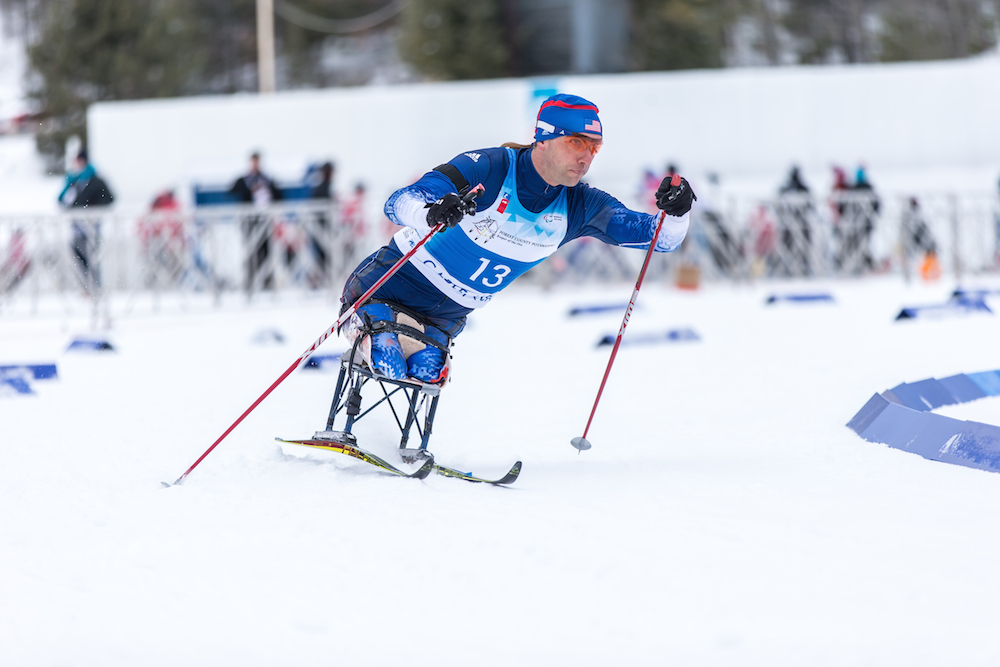
    Oksana Masters (U.S. Paralympics Nordic) in a biathlon competition at 2015 IPC World Cup Finals in Surnadal, Norway. Masters won Saturday's 5 k cross-country sitting to clinch the overall World Cup cross-country title for 2014/2015. (Photo: IPC Nordic Skiing/Facebook)
    Oksana Masters (U.S. Paralympics Nordic) in a biathlon competition at 2015 IPC World Cup Finals in Surnadal, Norway. Masters won the 5 k cross-country sitting to clinch the overall World Cup cross-country title for 2014/2015. (Photo: IPC Nordic Skiing/Facebook)

    A rowing convert, Masters, 25, earned two cross-country medals at 2015 World Championships — silver in the middle distance and bronze in the sprint — and won four out of five races in Japan this year. That put her on top of the IPC overall and she ended the season in first with a total of seven individual World Cup golds and two silvers.

    “I respect my competition, of the years they put in to be where they are now,” Masters said in February. “I’m playing catchup and I’m just doing what I can and focusing on myself. It just so happens to be putting me much higher than I ever could imagine being.”

    She explained that it took her 13 years to reach the Paralympic podium in rowing (she earned bronze in the double scull in 2012) and was humble about the strides she had made in skiing since starting the sport a year and a half ago.

    A silver and bronze medalist at the 2014 Winter Paralympics, Masters committed to skiing full time last spring, partially to alleviate a past rowing injury in her back. A training crash leading up to 2015 U.S. nationals re-aggravated the injury, forcing her to sit out the week.

    A week before World Championships, she got back on snow while fighting bronchitis and walking pneumonia.

    “World Championships was just more of a mental battle than … just a battle for getting medals, with one setback after another,” Masters said. “I didn’t really have much expectations for myself … so [I was] just basically trying to survive at that point.”

    The bronze medal she earned in Cable, her first of World Championships, brought her some serious relief.

    “[It] also just brought my focus more towards, OK, I had setbacks, but I still can be within the competition and hang with the field, so just believe in the previous training that I’ve done and what I do know and just do it,” she said.

    Masters made the nomination list for IPC athlete of the month in February.

    Honorable mentions: 

    Brittany Hudak

    Brittany Hudak (Canadian Para-Nordic Ski Team) at 2015 IPC World Cup Finals in Surnadal, Norway. Hudak won the 2014/2015 World Cup Overall Cross-Country title. (Photo: IPC Nordic Skiing/Facebook)
    Brittany Hudak (Canadian Para-Nordic Ski Team) at 2015 IPC World Cup Finals in Surnadal, Norway. Hudak won the 2014/2015 World Cup Overall Cross-Country title. (Photo: IPC Nordic Skiing/Facebook)

    The Canadian Para Nordic Ski Team had a banner season as well, with standing skier Brittany Hudak topping the overall World Cup cross-country podium in her first year on the development team.
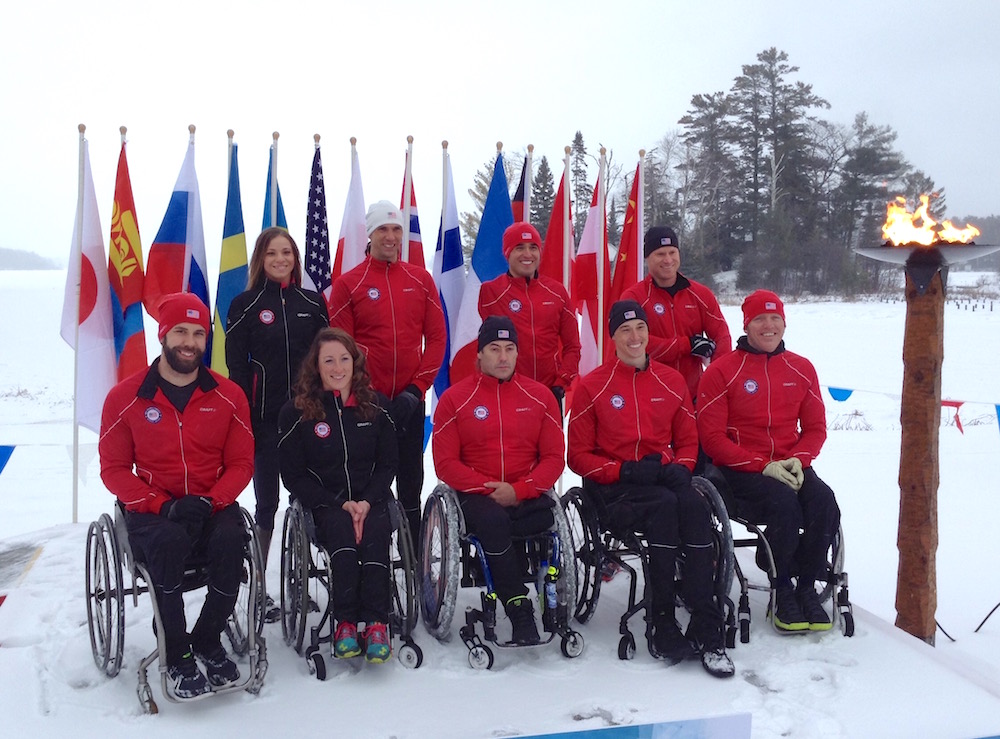
    “The learning curve has been so huge for me,” Hudak, 21, said in a team press release after winning two consecutive races in Asahikawa.

    At the following World Cup Finals, she collected three medals: silver in the 15 k cross-country, silver in the 12.5 k biathlon and bronze in the 6 k biathlon.

    “Having the opportunity to attend national training camps … I have noticed a huge improvement in my technique,” she added. “It has been such an advantage for me to be in the same environment with the high-performance athletes, seeing how the train and learning from them.”

    Hudak wrapped up 2015 with two World Cup golds, two silvers and a bronze in cross-country, and a silver and a bronze in biathlon.

    Chris Klebl

    It’s a close call between several Canadian Para-Nordic teammates for the men’s pick for honorable mention, but Klebl tops the list as he placed third overall on the cross-country World Cup and is currently first in the IPC rankings. Standing biathlete Mark Arendz was was fourth overall in biathlon, and longtime team veteran Brian McKeever — a visually impaired distance specialist — won most of the races he jumped into for third overall in cross-country.

    Canada's Chris Klebl racing to gold in the last race of his third Paralympics on Sunday in the cross-country 10 k sit-ski  at the 2014 Paralympic Winter Games in Sochi, Russia.  (Photo: Matthew Murnaghan/Canadian Paralympic Committee)
    Canada’s Chris Klebl racing to gold in the cross-country 10 k sit-ski at the 2014 Paralympic Winter Games in Sochi, Russia. (Photo: Matthew Murnaghan/Canadian Paralympic Committee)

    In Asahikawa, both Klebl and Arendz notched back-to-back bronze medals before Klebl placed second in both the 10 and 15 k cross-country races. Klebl, a 2014 Paralympic gold medalist in the 10 k, went on to win the 15 k at World Cup Finals.

    McKeever won the 20 k that same day in Surnadal (he won the same event at 2015 World Championships; it was the lone race he competed in there) and took first in the 10 k classic in Japan as well.

    Arendz picked up two bronze medals at World Cup Finals in the biathlon sprint and following pursuit.

    Klebl edged American Dan Cnossen by 40 points for third overall on the World Cup, making Cnossen — who won his first World Cup in Japan and achieved multiple podiums later in the season — worthy of mention as well.

    ***

    Other 2015 Skiers of the Year (SOTY): Junior | Collegiate | Nordic Combined | Biathlon

  • Hudak, Masters and Soule End Season with Overall IPC World Cup Crowns

    Hudak, Masters and Soule End Season with Overall IPC World Cup Crowns

    Brittany Hudak (Canadian Para-Nordic Ski Team) at 2015 IPC World Cup Finals in Surnadal, Norway. Hudak took silver in Saturday's 5 k cross-country sitting to clinch the 2014/2015 World Cup Overall Cross-Country title. (Photo: IPC Nordic Skiing/Facebook)
    Brittany Hudak (Canadian Para-Nordic Ski Team) at 2015 IPC World Cup Finals in Surnadal, Norway. Hudak took silver in Saturday’s 5 k cross-country sitting to clinch the 2014/2015 World Cup Overall Cross-Country title. (Photo: IPC Nordic Skiing/Facebook)

    Three North Americans, count ’em, three, topped the 2014/2015 International Paralympic Committee (IPC) Overall World Cup cross-country podiums, ending their seasons on Sunday at IPC World Cup Finals in Surnadal, Norway.

    Canada’s 21-year-old Brittany Hudak tallied her third medal of the week on Sunday, taking silver in the women’s 12.5-kilometer biathlon race a day after clinching the women’s overall cross-country title in the standing division by 33 points over Russia’s Ekaterina Rumyantseva.

    Hudak placed fourth in Saturday’s 5 k cross-country race then finished second in Sunday’s biathlon distance race, 50.4 seconds behind Ukraine’s Oleksandra Kononova, who won in 39:46.2.

    While Kononova missed two — one in each of the last shooting stages — Hudak cleaned every stage except the first, in which she missed one.

    “The learning curve has been so huge for me,” Hudak said in a Canadian Para-Nordic team press release.

    Two years ago, Canada’s legendary (now-retired) sit skier Colette Bourgonje encouraged her to try skiing while Hudak was working at a Canadian Tire store.

    “Having the opportunity to attend national training camps, particularly the New Zealand camp this summer, I have noticed a huge improvement in my technique,” Hudak said. “It has been such an advantage for me to be in the same environment with the high-performance athletes, seeing how the train and learning from them.”

    In all, she racked up two golds, two silvers and one bronze medal in IPC cross-country events this season, plus a silver and bronze in biathlon at World Cup Finals.

    Oksana Masters (U.S. Paralympics Nordic) in a biathlon competition at 2015 IPC World Cup Finals in Surnadal, Norway. Masters won Saturday's 5 k cross-country sitting to clinch the overall World Cup cross-country title for 2014/2015. (Photo: IPC Nordic Skiing/Facebook)
    Oksana Masters (U.S. Paralympics Nordic) in a biathlon competition at 2015 IPC World Cup Finals in Surnadal, Norway. Masters won Saturday’s 5 k cross-country sitting to clinch the overall World Cup cross-country title for 2014/2015. (Photo: IPC Nordic Skiing/Facebook)

    Hailing from south of the Canadian border, two Americans topped the overall IPC World Cup sitting standings, with Oksana Masters and Andy Soule claiming the cross-country crowns on Saturday, which U.S. Paralympics dubbed as a “three-medal day for Team USA.”

    Masters and teammate Lt. Dan Cnossen won the women’s 5 k and men’s 10 k cross-country races, respectively, with the former capping her season with the overall win as well. Throughout this season, Masters earned seven World Cup golds and two silvers, plus a silver and bronze at IPC World Championships in January.

    “I felt really good today,” Masters told U.S. Paralympics on Saturday. “It was a hard race, but my skis were fast, and I felt good. This is a great way to end the cross-country season. Everything has been pretty perfect here.”

    A U.S. Army veteran, Andy Soule (U.S. Paralympics Nordic) at 2015 IPC World Cup Finals in Surnadal, Norway. Soule finished third in Saturday's 10 k cross-country sitting to clinch the overall World Cup cross-country title for 2014/2015. (Photo: IPC Nordic Skiing/Facebook)
    A U.S. Army veteran, Andy Soule (U.S. Paralympics Nordic) at 2015 IPC World Cup Finals in Surnadal, Norway. Soule finished third in Saturday’s 10 k cross-country sitting to clinch the overall World Cup cross-country title for 2014/2015. (Photo: IPC Nordic Skiing/Facebook)

    The 25-year-old former Paralympic rower won the women’s 5 k by 28 seconds over Norway’s Mariann Marthinsen in 14:19, and beat Marthinsen in the overall by 160 points.

    On Sunday, Masters placed fifth in the final biathlon event: the 12.5 k sitting. While Germany’s Anja Wicker missed two shots to win in 48:46.5, Masters had a total of eight penalties to finish 5:38.2 behind.

    Cnossen won Saturday’s cross-country 10 k sitting in 25:37, edging Russia’s Alexey Bychenok by 3.8 seconds. Soule finished third, 19.8 seconds back, to take the men’s overall cross-country title by 155 points over Bychenok. Cnossen ended up fourth in the overall cross-country standings.

    Lt. Dan Cnossen (U.S. Paralympics Nordic) at 2015 IPC World Cup Finals in Surnadal, Norway. Cnossen won Saturday's 10 k cross-country sitting to finish fourth in the overall World Cup cross-country standings. (Photo: IPC Nordic Skiing/Facebook)
    Lt. Dan Cnossen (U.S. Paralympics Nordic) at 2015 IPC World Cup Finals in Surnadal, Norway. Cnossen won Saturday’s 10 k cross-country sitting to finish fourth in the overall World Cup cross-country standings. (Photo: IPC Nordic Skiing/Facebook)

    “I was getting updates from the coaches during the race that it was a really tight race between Alexey Bychenok and myself,” Cnossen told U.S. Paralympics on Saturday. “I was really happy for Andy, who came in third and got the World Cup overall win — that is even better. Our team had a great performance today.”

    “It is a great feeling and a great finish to the season,” Soule, 35, said after his first podium at World Cup Finals. “This took a lot of hard work by myself, my teammates, my coaches and wax techs. This is just a great end to the season.”

    At World Championships, Soule racked up an unprecedented five medals for the U.S., three of which were in cross-country races. Adding to that haul, he totaled four World Cup golds and a bronze this season.

    On Sunday, he placed seventh in the 15 k biathlon race with six penalties (1+1+2+2), finishing 4:03.6 behind Germany’s Martin Fleig, who won in 49:32.1. Cnossen was 5.4 seconds off the podium in fourth with five misses (1+2+0+2).

    Canada’s Chris Klebl placed fifth in Saturday’s 10 k sitting, 51.3 seconds behind Cnossen. The result helped him secure third overall in the men’s cross-country sitting on the IPC World Cup,  40 points ahead of Cnossen. Klebl did not race on Sunday.

    Klebl’s teammate, Mark Arendz finished fifth in the men’s biathlon 15 k standing on Sunday, 3:23.2 behind Ukraine’s Ihor Reptyukh, who won in 42:17.6. While Reptyukh had three penalties (1+0+1+1), Arendz had five (1+1+1+2). The Canadian placed fourth overall in the biathlon World Cup, 161 points behind Reptyukh in third.

    Mark Arendz (Canadian Para-Nordic Ski Team) at 2015 IPC World Cup Finals in Surnadal, Norway. He placed fourth overall in the 2014/2015 IPC World Cup biathlon standings. (Photo: IPC Nordic Skiing/Facebook)
    Mark Arendz (Canadian Para-Nordic Ski Team) at 2015 IPC World Cup Finals in Surnadal, Norway. He placed fourth overall in the 2014/2015 IPC World Cup biathlon standings. (Photo: IPC Nordic Skiing/Facebook)

    Results:

    Saturday’s cross-country: Women | Men

    Sunday’s biathlon: Women | Men

    Overall World Cup standings

  • From Students to Favorites: Masters, Soule Lead IPC World Cup Before Finals in Norway

    From Students to Favorites: Masters, Soule Lead IPC World Cup Before Finals in Norway

    The U.S. Paralympics Nordic team at the World Cup in Asahikawa, Japan, Feb. 14-19. (Photo: Eileen Carey/U.S. Paralympics Nordic)
    The U.S. Paralympics Nordic team at the World Cup in Asahikawa, Japan, Feb. 14-19, including athletes Andy Soule (l), Oksana Masters (second from l) and Dan Cnossen (second from r). (Photo: Eileen Carey/U.S. Paralympics Nordic)

    Heading into the last races of the season, the International Paralympic Committee (IPC) World Cup Finals, the U.S. Paralympics Nordic Program is probably used to the weight of carrying several medals around, but its athletes aren’t feeling any pressure.

    “I honestly can not believe that I am currently the World Cup leader,” U.S. sit skier Oksana Masters wrote in an email last month after winning two-consecutive World Cup races in Asahikawa, Japan.

    In her second year of skiing, the 25-year-old former Paralympic rower went on to win four out of five races in Asahikawa to stay on top of the overall World Cup standings and earn a nomination for IPC Athlete of the Month.

    Oksana Masters racing to gold in the cross-country 5 k sit ski at the World Cup last month in Asahikawa, Japan.(Photo: Eileen Carey/U.S. Paralympics Nordic)
    Oksana Masters racing to gold in the cross-country 5 k sit ski at the World Cup last month in Asahikawa, Japan.(Photo: Eileen Carey/U.S. Paralympics Nordic)

    “It’s a great feeling knowing what I have been working on is working,” Masters continued. “I feel like anything can happen … I am just eager to continue to grow as a skier and feeling more confident on the snow.”

    At IPC World Championships in January, Masters earned silver in the cross-country middle distance and bronze in the cross-country sprint in Cable, Wis. She was the second-most decorated skier on her team after Andy Soule, who racked up five medals in seven races.

    A few weeks beforehand, Masters had to skip U.S. nationals at Soldier Hollow in Midway, Utah. Leading into the championships, she injured her back in training, compressing nerves on the right side while stopping suddenly and aggravating a previous injury from rowing.

    “I sat out the whole week of nationals and then that week before Cable, I started to get back on snow,” she explained on the phone in early February. “I was basically on the bed for that week, then afterwards, [I] kind of had to fight off a little bug that I got that week prior to Cable, which happened to turn into bronchitis and walking pneumonia. So World Championships was just more of a mental battle than gonna be just a battle for getting medals, with one setback after another.”

    “I didn’t really have much expectations for myself at all considering there’s only so much your body will allow you to do when it’s trying to get back to it’s healthy stage and so [I was] just basically trying to survive at that point,” Masters continued. “Instead of being in the top five or something, I was trying to focus on areas where I need to be focused in any race, which is technical aspects, like turns and transitions, up and over the hill, and kind of take it one race at a time.”

    She quickly found her racing form in Cable.

    Asked how her first race there felt, she reflected: “Like I was gonna die. I just saw the black light, nothing else … but skiing-wise, it was the first time since about three weeks that I’d basically did anything and pushed my body at that race pace, so that first [biathlon] race was brutal and tough, but at the same time, it got my body more ready and prepared me for the cross-country races and [upcoming] races through that week.”

    In total, Masters competed in six events in Cable and explained she was shocked after taking her first medal — bronze — in the sprint.

    “Not to fall and to end up with that medal was kind of a relief, but [it] also just brought my focus more towards, OK I had setbacks, but I still can be within the competition and hang with the field, so just believe in the previous training that I’ve done and what I do know and just do it,” she said.

    “I’m just doing what I can and focusing on myself. It just so happens to be putting me much higher than I ever could imagine being.” — Oksana Masters (U.S. Paralympics Nordic)

    Last year, Masters made herself known as one of the world’s most competitive sit skiers after taking two medals (silver and bronze) at the Sochi Paralympics. She went on to podium in three races at this season’s IPC World Cup opener in Vuokatti, Finland.

    Based on her experience in rowing, in which it took her 13 years to medal at the Paralympics (she earned bronze in the double scull in 2012), she appreciated the time it takes to become a veteran of any sport — despite being a new favorite in nordic.

    “I’m now that the stage where I respect my competition, of the years they put in to be where they are now,” she said. “I’m playing catchup and I’m just doing what I can and focusing on myself. It just so happens to be putting me much higher than I ever could imagine being.”

    Lt. Cmdr. Dan Cnossen (l) and Oksana Masters with their gold medals from the  Asahikawa World Cup in Japan last month. (Photo: Eileen Carey/U.S. Paralympics Nordic)
    Lt. Cmdr. Dan Cnossen (l) and Oksana Masters with their gold medals from the Asahikawa World Cup in Japan last month. (Photo: Eileen Carey/U.S. Paralympics Nordic)

    Next week from March 16 to 22, Masters and her teammates will be competing at IPC World Cup Finals in Surnadal, Norway.

    “I think our athletes are still feeling fresh and motivated and excited to get another opportunity to race, especially with the full field competing,” U.S. Paralympics High-Performance Coach Eileen Carey wrote in an email. “Our goals will be to continue the process of progress, and squeeze as much as we can from final days on snow this season.”

    There’s no ignoring that they’ll be favorites. At the last World Cup in Asahikawa in mid-February, Soule, an Army veteran, won four-straight races. His teammate, Lt. Cmdr. Dan Cnossen won the fifth: the middle-distance cross-country.

    “I knew that with a small but strong field there was a good chance for several very good and meaningful finishes,” Soule wrote in an email earlier this month. “The whole week felt great and was an amazing experience. I have never had a string of wins like that, but tried to approach it the same way I do any other race series, taking one day and one race at a time, trying not to think too far ahead.”

    With his success in Japan, Soule, 35, rose from third to first in the overall World Cup.

    “I am excited to go to Norway and have a good strong finish to the season,” he said.

    A biathlon specialist, he’s looking forward to three biathlon events in Norway.

    Cnossen pointed out that Soule considered retiring before this season. Soule explained that, because he was doing well at the end of last year and still having a lot of fun, he couldn’t imagine ending his ski career. As of February, Soule said he was committed through the 2018 Paralympics in Pyeongchang, South Korea.

    “The mental space he is in is pretty remarkable and I think it has allowed him to relax and let his skills, experience, and love for skiing take over,” Carey explained. “He is aware of the results and knows what he has to do to clinch the World Cup overall, but isn’t letting that distract him from focusing on the basics when he gets to the start line. More than his personal performances, I think he is excited by the team’s performance as a whole.”

    While he didn’t have his best performance in the final middle-distance race in Asahikawa, Cnossen did — and Carey wrote that Soule was excited for him.
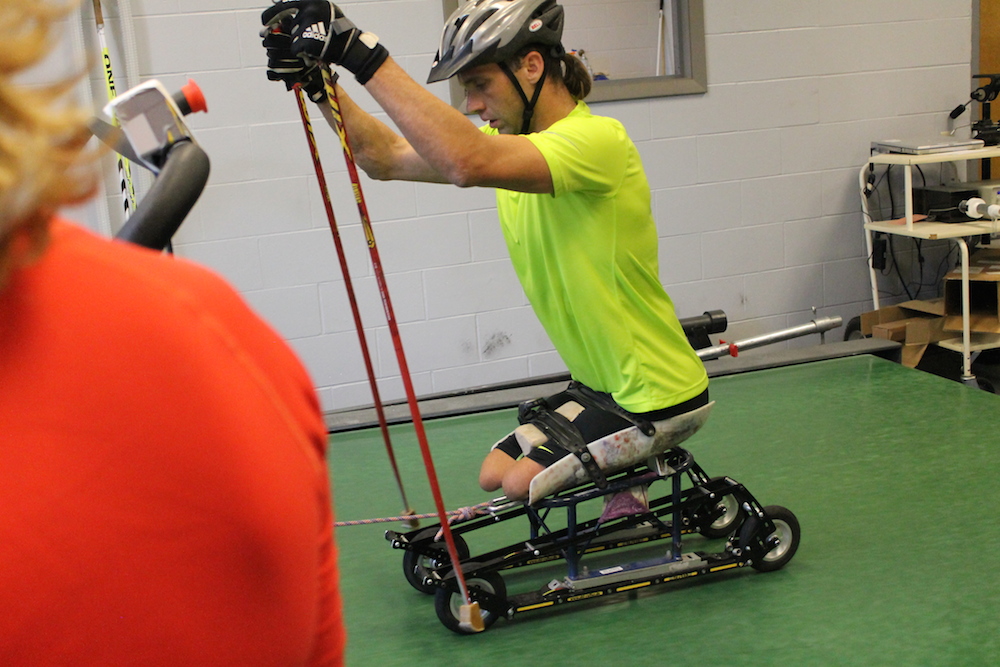
    “It has strengthened him to be a part of the success and progress of the team as a whole,” she added. “The coolest thing about Andy and all our National Team athletes is that they are still very much in progress. They have all made gains this year and all have more to make. It is exciting for all of us as a team to feel the progress but to also see the space for improvements.”
    Cnossen, for instance, took a major risk in the last World Cup race in Japan and came out with huge gains.

    Dan Cnossen racing to gold in 10 k cross-country sit ski at the World Cup last month in Asahikawa, Japan.(Photo: Eileen Carey/U.S. Paralympics Nordic)
    Dan Cnossen racing to gold in 10 k cross-country sit ski at the World Cup last month in Asahikawa, Japan.(Photo: Eileen Carey/U.S. Paralympics Nordic)

    “I decided to ski a hard first lap on the 10km race and see if I could hang on for the remaining three laps,” Cnossen wrote in an email.

    “The coaches mentioned during the team meeting the previous night that we should use this World Cup event as an opportunity to take chances without worrying about the finishing result. I wanted to see if skiing an overly-fast first lap, out of four total, would result in an implosion or if I could hang on knowing I’m in with the leaders.”

    On the second lap, a Norwegian wax technician told him he was in the lead.

    “The US coaches may not have wanted me to know that early!” Cnossen reflected.

    He went on to win by 13.4 seconds over Canada’s Chris Klebl. Cnossen spent the better part of the fall and winter in San Diego — not exactly ideal for a winter athlete.

    “This season has been a transition for me, with a move [from Colorado] to San Diego in order to out-process from the military,” he explained. “Accordingly, my training time on snow has suffered, so my goal this year is to accumulate as much race experience as possible and work on a relaxed, powerful double pole technique.”

    The process, which involves a thorough evaluation by the Veterans Affairs and Departments of Defense, will have taken the 34-year-old Navy SEAL commander six months to complete. Unable to get on snow in southern California, he spent about two to three hours a day training with a Ski Erg or hand cycle, after taking up competitive cycling last summer.

    “Now, so close to retiring, I’m able to train in the mornings for a couple hours as I normally would, with a second workout in the afternoon,” he wrote. “I’m going to attempt to travel to Norway one week in advance of my team, which would be ten days ahead of the first competition, to train on snow.”

    As for the team on the whole, Carey wrote that she could not be more proud.

    “Our athletes have taken being students of the sport to a new level this year,” she wrote. “They enjoy doing the hard and sometimes frustrating work to back up what they are learning.  Of course it is motivating to see race results back up the progress. But we are not getting too distracted by the podiums.

    “There is a lot of progress left to make so we try to keep sight of that,” she added.

  • Fourth No More, Soule Up to Third Overall in IPC World Cup with Five Medals at World Champs

    Fourth No More, Soule Up to Third Overall in IPC World Cup with Five Medals at World Champs

    Andy Soule and his hardware from 2015 IPC World Championships: five medals with three silvers and two bronze. (Photo: James Netz)
    Andy Soule and his hardware from 2015 IPC World Championships: five medals with three silvers and two bronze. (Photo: James Netz)

    Andy Soule took one look at the skate course at the International Paralympic Committee (IPC) World Championships — with technical downhills and a massive uphill — and thought, I could do that. The 35-year-old Army veteran previewed it the day before the final race in Cable, Wis., and found it to be “fairly difficult by our standards,” he said in a phone interview last week.

    Difficult in the sense that he’s a sit skier who relies entirely on his upper body and core strength, double poling everything from flats to steep hills. The course was designed for standing athletes — with two freestyle legs in the mixed relay, but the U.S. only had one man that could skate.

    “We wanted to enter a relay at World Champs, but we only had one standing athlete available to us, Omar Bermejo, who had been battling sickness during these events so running him twice on a super cold day did not seem like the best idea,” U.S. Paralympics High Performance Director John Farra explained in an email. “So we floated it by Andy and he did not hesitate to say yes!  … This is the first time a sitting athlete has done the standing course in the relay, so that was fun as countries came up to me to be sure we had not made a mistake.”

    It wasn’t against the rules, as Soule pointed out: “There is no rule that says you have to have a sit skier or a stand skier on either one; factors are just supposed to take care of those.” So as the second leg of the U.S. mixed relay on Feb. 1, he headed out after teammate Oksana Masters tagged him in fourth of seven teams.

    Farra’s Take on the “Sit-Ski Heavy” U.S. Team:

    “It’s a good thing… we have been able to attract sitting athletes from other sports and they are having success, which is getting attention from other sitting athletes,” U.S. Paralympics High Performance Director and Coach John Farra wrote in an email. “We have proven that we can be a good sport for summer sport athletes looking for cross training and a new challenge and tough competition.”On the other side we are very much interested in increasing the [numbers] of standing and visually impaired athletes who can develop into strong international racers.  Those who are finding success are finding it best to join up with a USSA Club program so they can be training & racing with other standing (able bodied) skiers as much as possible.”

    “Our team is very sit-ski heavy right now, and while we didn’t really go into the relay with an expectation of a high place or anything, they decided to go ahead and field me on the standup course,” Soule said from his home in Pearland, Texas. “I told my coaches I believed it was entirely doable … it’s probably not any sort of a competitive advantage for sure, but it was an interesting experience, and it went pretty well.”

    Soule came through the exchange in seventh, just seven seconds behind Germany’s Tino Uhlig, a standing skier who uses one pole, in sixth. With sit-skier Tatyana McFadden and Bermejo, a single-arm amputee, racing the third and fourth legs, respectively, the Americans placed seventh, 45.4 seconds out of sixth.

    From the outset, the mixed relay was the team’s weakest event of the week, one in which they did not field a team at last World Championships. However, more symbolically, it capped their historic showing in Cable, where Soule racked up five medals — unprecedented for a U.S. cross-country skier at World Championships — and competed in all seven events, including the relay.

    He was glad he did it.

    “It have me a really good gauge of where we are in terms of what relative speeds look like for sit skiers versus standup athletes,” Soule said. “On the largest climb of that race, I was passed by one of the best standup skiers in the world in our sport, Nils-Erik Ulset, of Norway. I think it was an interesting event for a lot of people to see exactly what is possible for a sit skier, too.”

    Andy Soule navigates a turn  during one of his six individual races at 2015 IPC World Championships in late January in Cable, Wis. Soule medaled in five of those events. (Photo: James Netz)
    Andy Soule navigates a turn during one of his six individual races at 2015 IPC World Championships in late January in Cable, Wis. Soule medaled in five of those events. (Photo: James Netz)

    And he held his own on the descents. “I definitely didn’t lose any time on downhills,” Soule added.

    “Andy left Cable as a bit of a Legend,” Farra wrote. “5 medals and climbing & descending Telemark Hill successfully!”

    In his eighth year on the U.S. Paralympics Nordic team, it was not only Soule’s most successful World Championships, it was perhaps the highlight of his career after winning bronze in biathlon at the 2010 Paralympics.

    “This is a pretty high highlight,” Soule said. “After the second podium, I just started feeling like that wasn’t a fluke. This isn’t just a one-time thing, I’m really up here with the top of the field. I can compete with these guys. I can come out and compete on a level with the top guys every day. It was a confidence builder as well when you have that feeling.”

    “After the second podium, I just started feeling like that wasn’t a fluke … I can come out and compete on a level with the top guys every day.” — Andy Soule, who earned three silver medals and two bronze at the 2015 IPC World Championships in Cable, Wis., unprecedented for an American

    That feeling translated into three silver medals in two of three biathlon events and the cross-country 10-kilometer race at the 2015 championships, and two bronze in the cross-country 15 k and 1 k sprint (where Soule charged up from fourth with 40 meters to go to take third). On Monday, the IPC named Soule its January athlete of the month across all sports.

    Prior to this season, he had a Paralympic bronze from 2010 and placed fourth twice during last winter’s 2014 Paralympics in Sochi, Russia.

    “I wanted to break through that last little barrier for sure,” Soule said of his tendency toward wooden medals. “Between being almost on the podium and being a solid, consistent at least podium-potential finisher … that’s kind of been the source of all the little tweaks and changes we’ve been working with over the past year.”

    2015 U.S. Paralympics Nordic World Championships Team in Cable, Wis. (Photo: U.S. Paralympics Nordic)
    2015 U.S. Paralympics Nordic World Championships Team in Cable, Wis. (Photo: U.S. Paralympics Nordic)

    Asked specifically about those changes, U.S. High Performance coach Eileen Carey explained, “To talk about what any one individual athlete has done to improve is to talk about the whole team,” she wrote in an email.

    Everyone on the team is analytical and thoughtful when it comes to what they need to work on and how to achieve those changes, she added. “They have created a really cool team environment focused on improving as individuals and as a team.”

    For Soule, it was about relaxing his technique at race pace.

    “He has always skied well at level 2, but speed had previously introduced a lot of wasted, inefficient movements into his technique, especially on flat terrain,” Carey wrote. “His ski speed and relaxed technique have always been there, it was just a matter if translating them to a race pace.”

    In September, they started with rollerski sessions on the treadmill with live video so Soule could see the changes he was making as he tried them out.

    “Once we had the cues we knew worked for him, we brought it to snow this fall,” Carey explained. “It has been an evolution and I am sure it will continue to evolve. We did a lot of video analysis during and after the first World Cup in Finland in December and spent the pre-World Champs camp honing in on some of the patterns we saw from that.  He and his teammates have driven the process and we have worked to find the process and communication style that works best with each athlete.”

    Andy Soule working on technique during a treadmill session on Sept. 16 at the Olympic Training Center in Lake Placid, N.Y.
    Andy Soule working on technique during a treadmill session on Sept. 16 at the Olympic Training Center in Lake Placid, N.Y.

    As a result, Soule came out of the World Cup opener in Vuokatti, Finland, with two fourth-place finishes in the cross-country 10 k and biathlon sprint. While they weren’t podiums, he could feel a difference.

    “What I used to be doing was concentrated more on high tempo,” he said. “My emphasis on training recently has been to focus on flat sections of the course, what standup, able-bodied skiers would be considering a V2-technique section, lengthening out the pole stroke.”

    He continued to work on his technique at U.S. nationals in early January and at the team’s pre-World Championships training camp after that. He also switched to shorter poles this season.

    “I think everything just builds off what you’ve been working on in the past,” he explained. “You keep watching video of yourself, keep looking at races and identify what did work and then what little things we can maybe experiment with to get a little more speed.”

    Soule approached the biggest races of the season in Cable hoping to see improvement first, then results.

    “I wasn’t really worried going in what specific places I was aiming for — you can never really control that because you can never control how good everyone else is going to be,” he said. “But I wanted to see a personal improvement in what I would be able to accomplish as compared to how I’ve been performing in the past year.”

    As for which medals meant the most to him, he said his bronze in the cross-country 15 k was something he’d remember.

    Andy Soule's stack of medals from 2015 IPC World Championships in Cable, Wis., where he earned three silver and two bronze between three biathlon and two cross-country races. (Photo: U.S. Paralympics Nordic)
    Andy Soule’s stack of medals from 2015 IPC World Championships in Cable, Wis., where he earned three silver and two bronze between two biathlon and three cross-country races. (Photo: U.S. Paralympics Nordic)

    “It meant a lot to get the medals in the cross-country races just because that long-distance race, the first cross-country race of the week, was actually my first-ever podium in a cross-country race,” he said. “And it also boosts my confidence going into a biathlon event. It used to be, in order to have a shot at the podium in biathlon, I had to outshoot the top competitors. They had to miss shots in order for me to have a shot at the podium. Now I have that confidence that I can ski right with them. If neither of us misses anything, between me and the top competitors, I’m still in it.”

    Now third overall in the IPC World Cup standings with two major stops remaining (this weekend in Asahikawa, Japan and at World Cup Finals from March 16-22 in Surnadal, Norway), Soule said he mostly wanted to put together a “solid string of really great performances” for the rest of the season. Beyond that, he has his sights set on the 2018 Paralympics in Pyeongchang, South Korea.

    “I’m right at that age and I’m right at the point in my career where I’m in the prime of real top-performance potential,” he said. “I feel really great about what I have going forward and that I’ll be able to build on it and still improve on it.”

    In most every interview in Cable, Soule tossed around the word: “team.” He reiterated that he couldn’t have done it without his teammates and turned the focus toward their many successes at this year’s World Championships as well, including five Americans making the sit-ski sprint finals (three men and two women), and Masters tallying silver and bronze in the cross-country 5 k and cross-country sprint, respectively.

    “It just feels really good to have great teammates,” Soule said. “You’re always cheering for each other and everyone wants to see everyone else succeed, so it makes practice more fun when we’re all there and it makes racing more exciting. A good team component is really important to what we have going right now.”

    “Lots of good things were going in Cable beyond the medals,” Farra added.

    Masters currently ranks first in the World Cup in cross-country. Stay tuned for her interview.