Tag: Angus Foster

  • Canadian Eastern Championships: Weekend Wrap-up

    Canadian Eastern Championships: Weekend Wrap-up

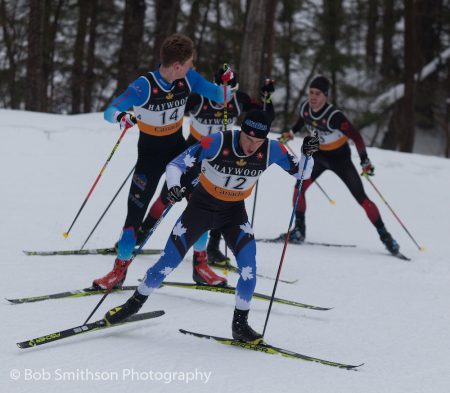
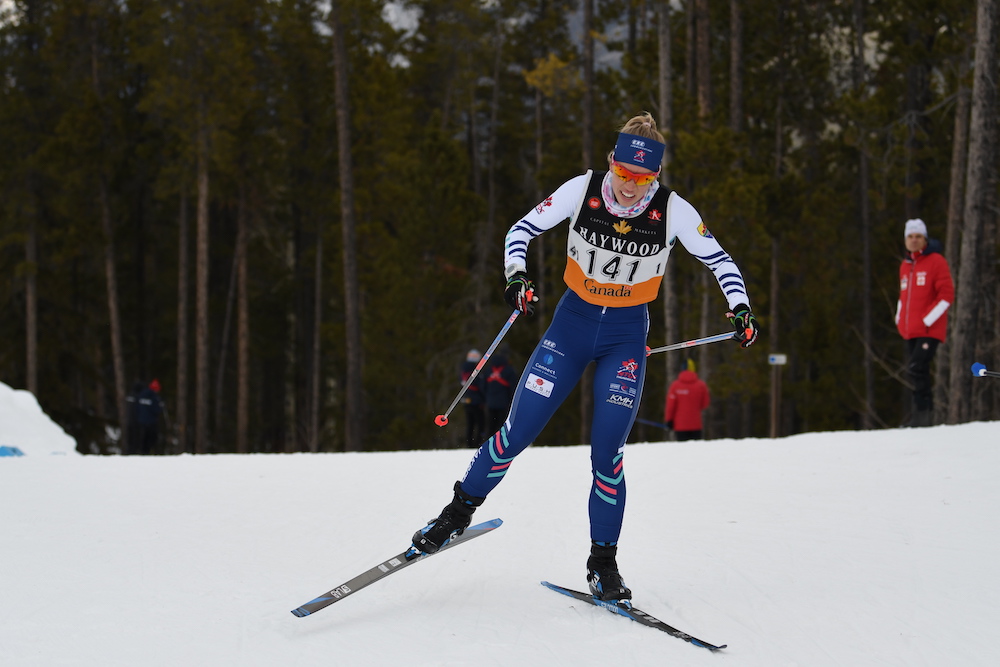
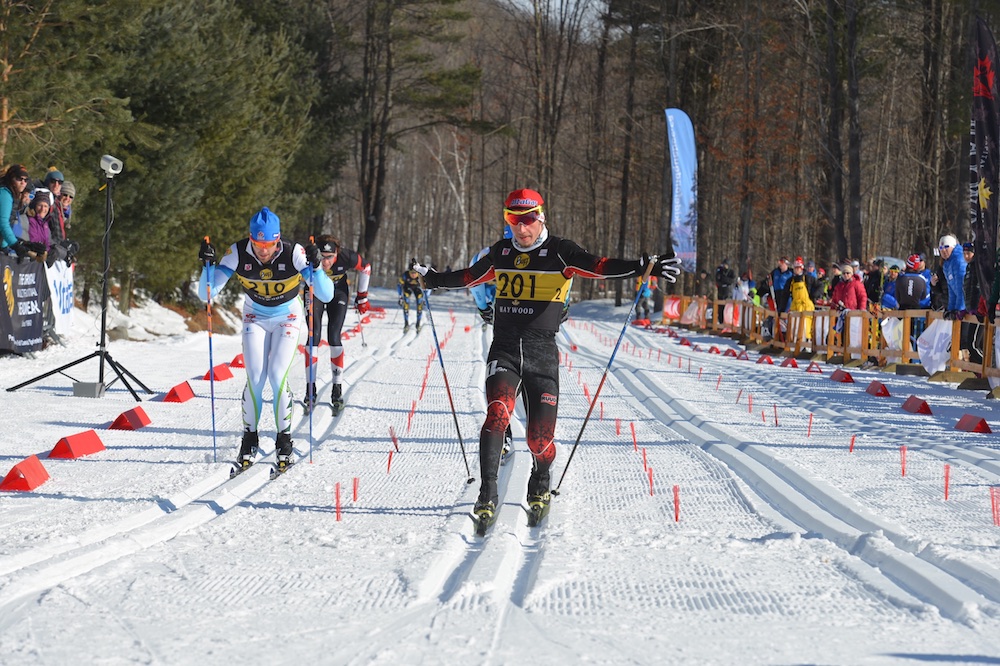
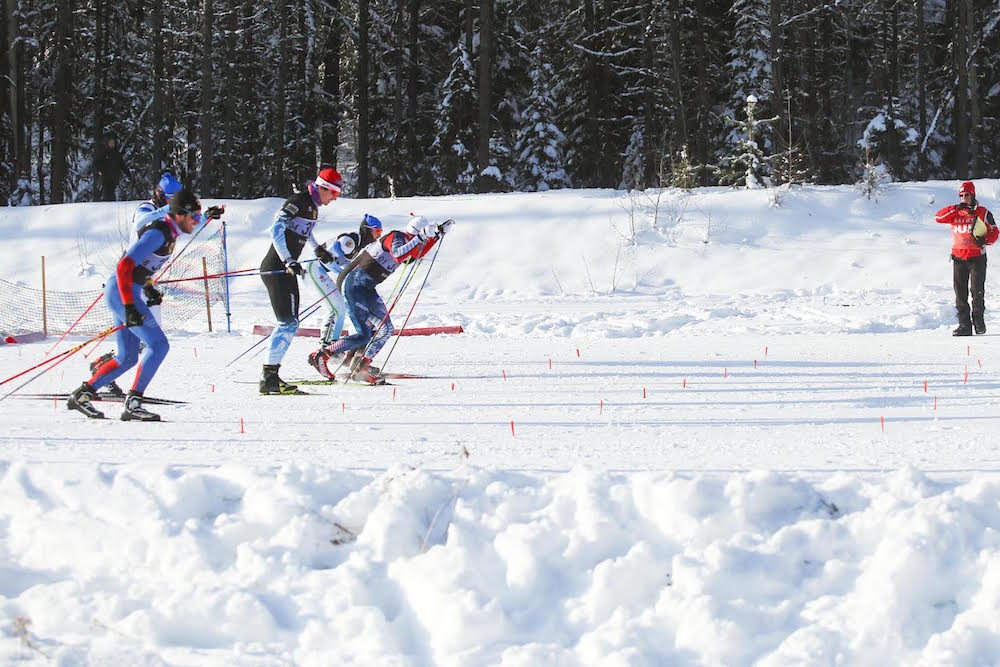
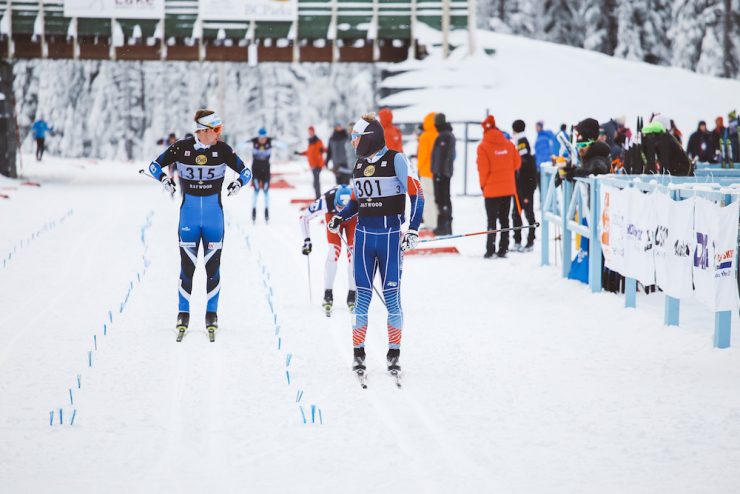
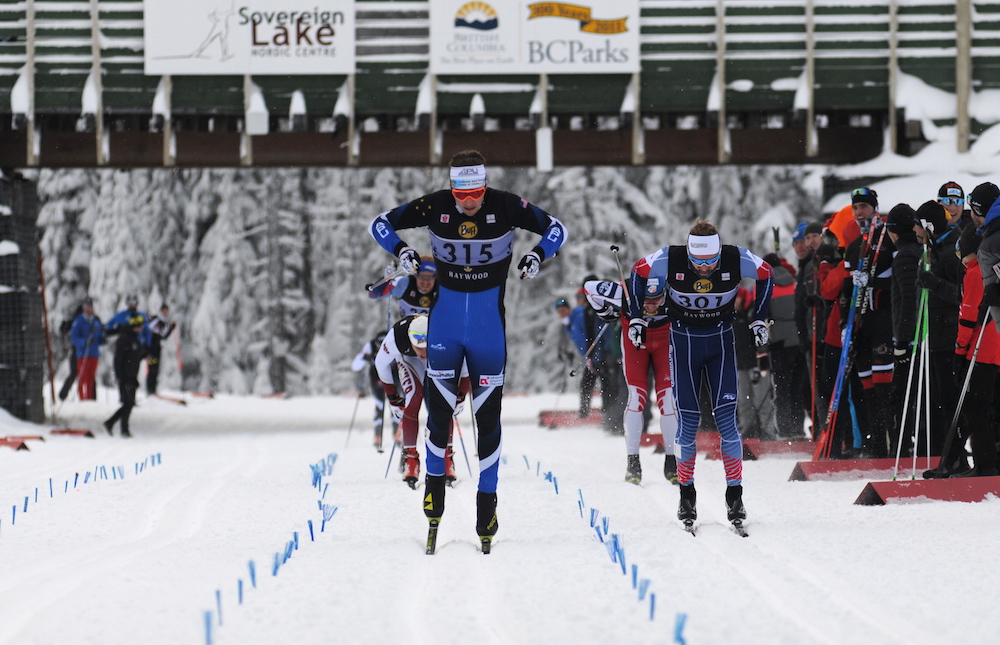
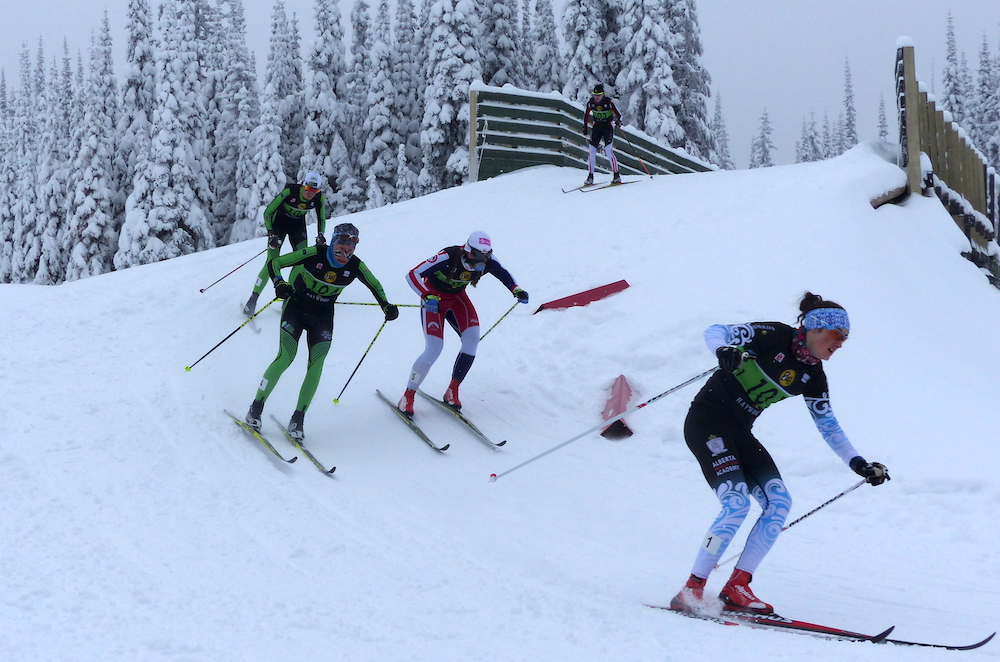
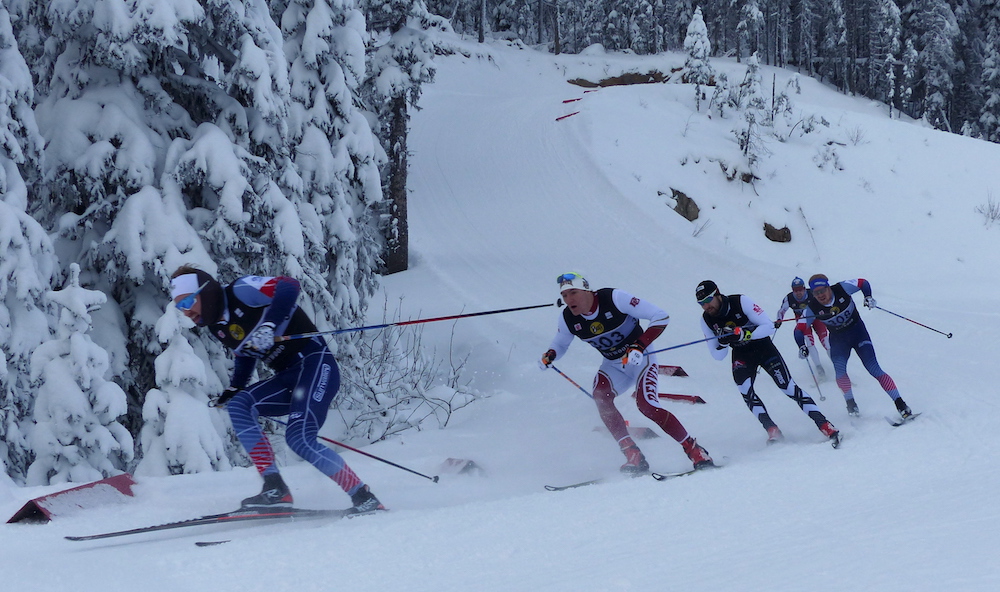
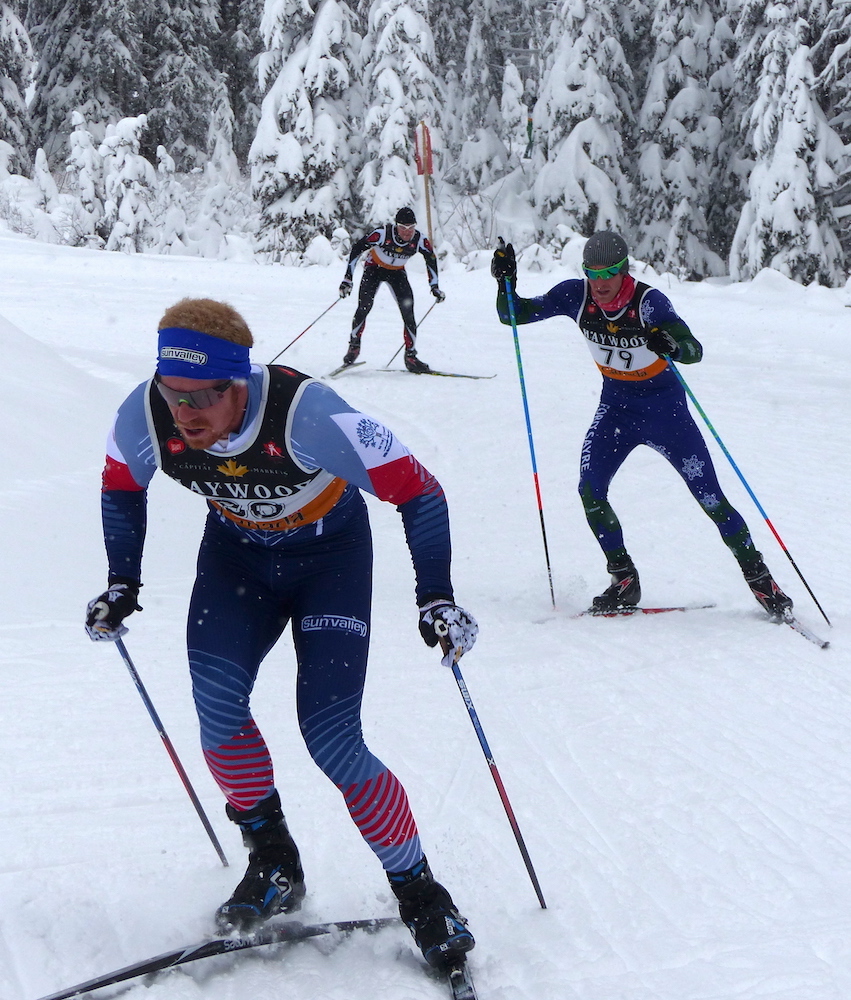
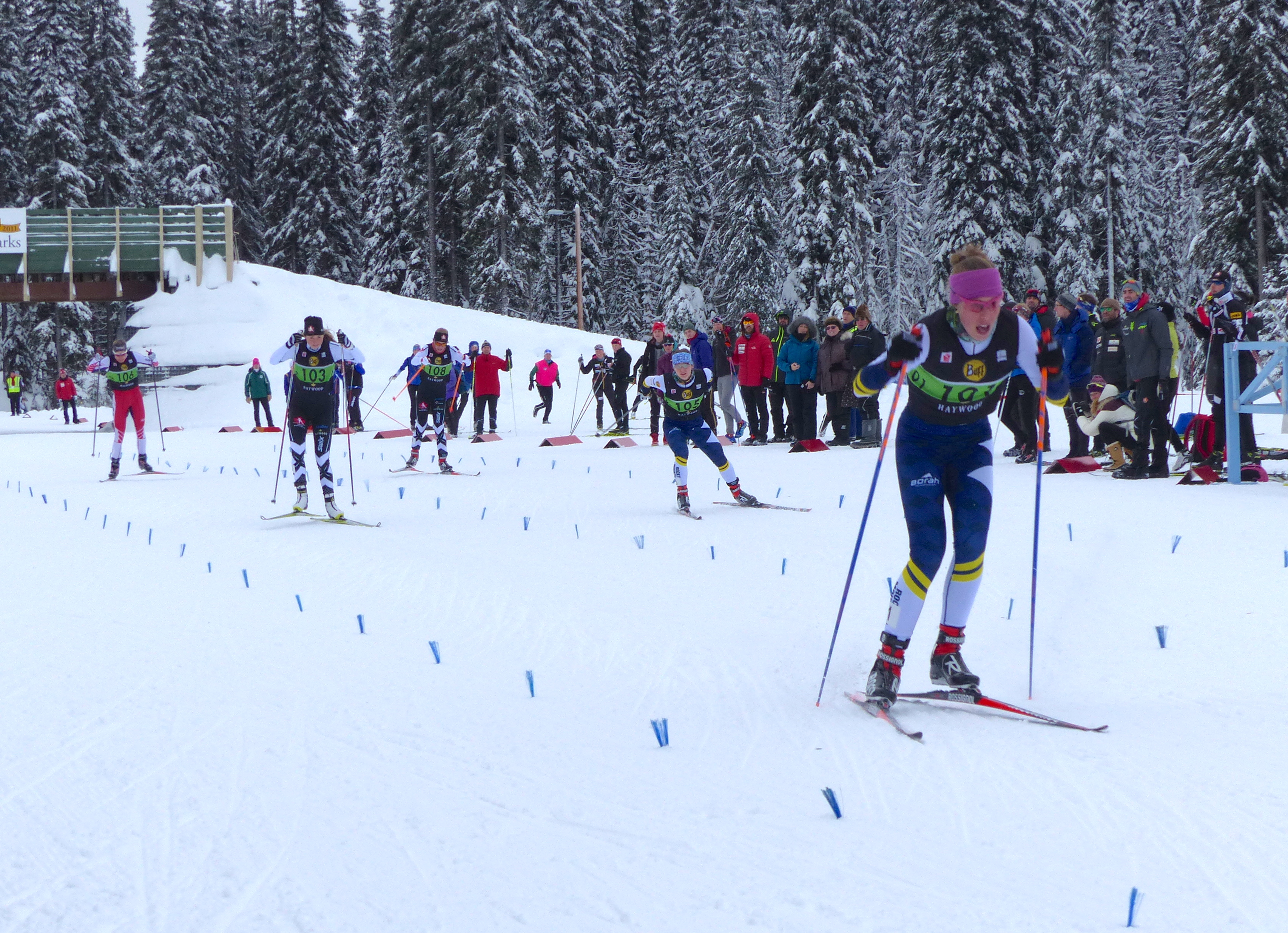
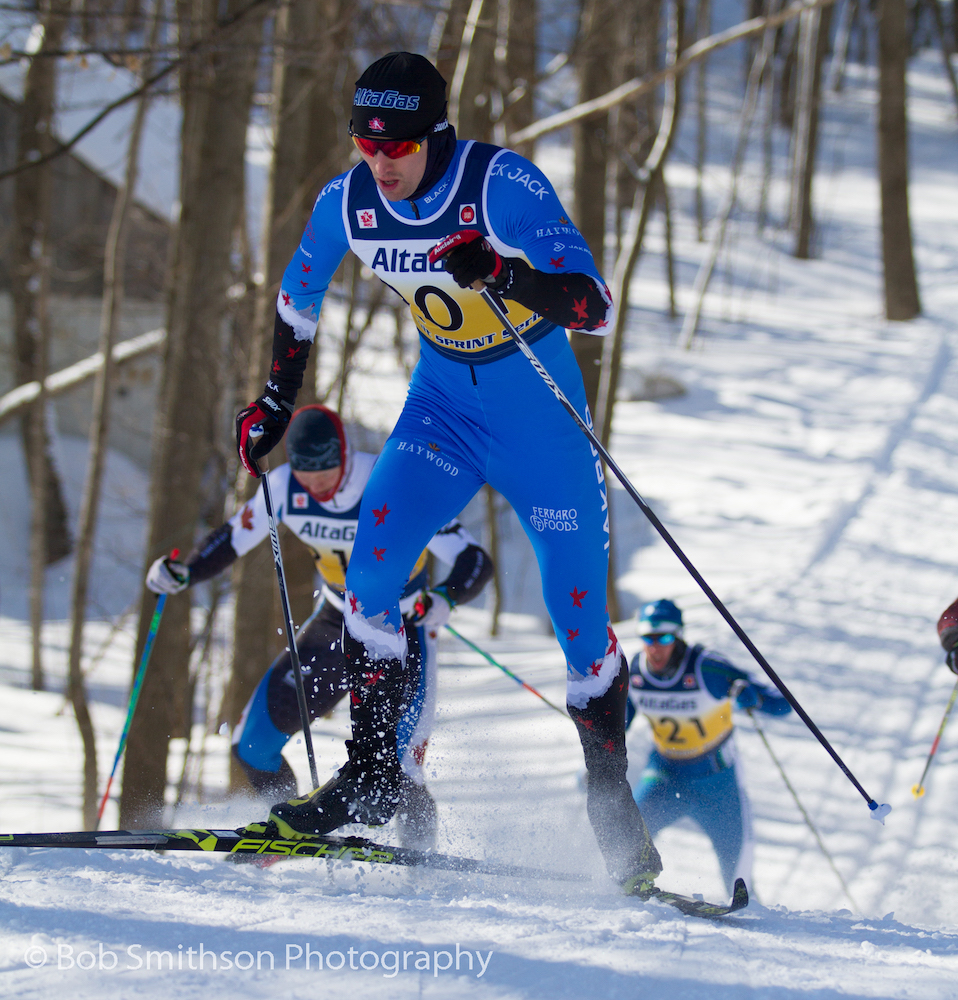
    Julien Locke leading a sprint heat. (Photo: Bob Smithson)
    Julien Locke leading a sprint heat. (Photo: Bob Smithson)

    The NorAm series went to Duntroon, Ontario, for the Canadian Eastern Championships: three days of varied weather, new race formats, and new faces on the podium, all hosted by Highlands Trailblazers.

    Easterns is possibly the most storied ski race in Canada. Most years, it is the largest FIS event in North America. This year, the Polar Vortex froze out the travel ambitions for many families and lower budgets in the post-Olympic season persuaded many western teams to stay home. Despite these challenges, over 450 athletes braved the difficult road conditions to hit the start line.

    Easterns was ringing in the changes this year. This may be the first ever NorAm where the men and women skied the same distance on the same courses in every event. The two-day pursuit reappeared for the first time at this level since 2000. 

    The two-day pursuit format was introduced in 1988. Based on the Gunderson start in Nordic Combined, there was an interval start classic race on the first day and a free technique pursuit on the second, with medals awarded for both days, but no time-of-day points for the second.

    In 2002, the two-day pursuit was replaced with the same-day pursuit, with no medals for the classic portion and a two hour break before the skate. Beckie Scott won all three medals in this event at the Salt Lake Olympics. In 2003, this was changed to ‘continuous pursuit’, sometimes referred to as ‘pursuit without a break’.  The format name was quickly shortened to ‘pursuit’, which confused people until 2011 when FIS acquired rights to the name ‘skiathlon’, allowing ‘pursuit’ to be used for the final day of a mini-tour. CCC wrote a history in 2011 to celebrate the new name.

    In the summer of 2018, FIS dropped the skiathlon format, which brings us back to a format that most of the athletes racing today will not remember.  

    The weather also came out to play: -18 Celcius (C) and windy for official training, -12 C and sunny for the sprint heats, -9 C and 37 km/h winds for Saturday’s classic, and +3 C and freezing drizzle and rain for Sunday’s pursuit.

    Photo gallery: Bob Smithson

    Results: Sprint Qualification, Pursuit Day 1, Pursuit Day 2, Time of Day

    Classic Sprints

    Women’s A final: Zoë Williams (Nakkertok), Laura Leclair (CNEPH), Mia Serratore (Big Thunder), Annika Richardson (TBay), Katie Weaver (Rocky Mountain Racers), Hannah Shields (Nakkertok)

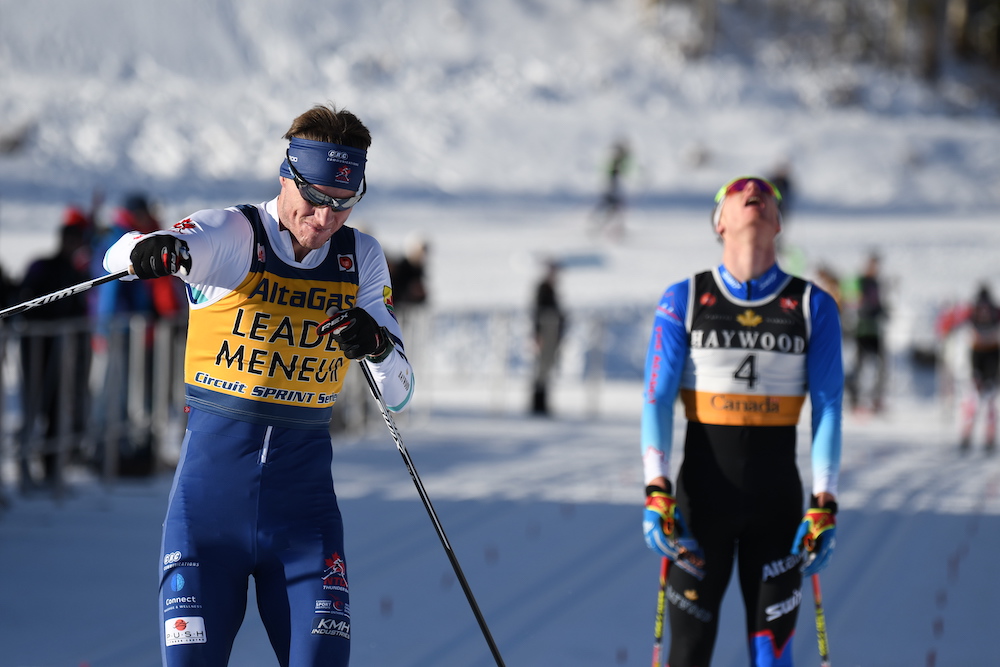
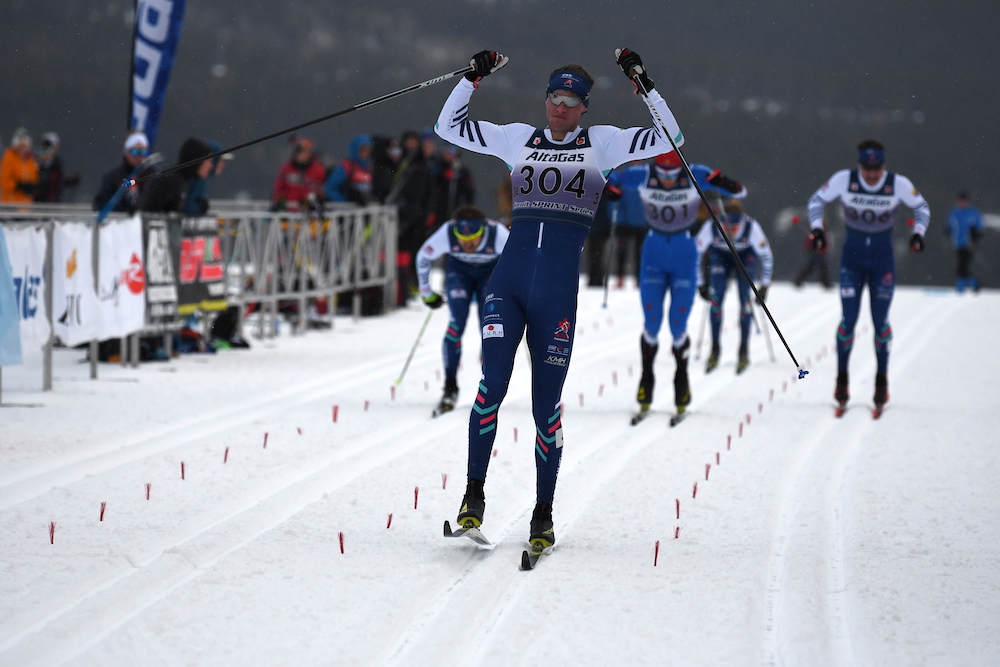
    Men’s A final: Julien Locke (CNST), Dominique Moncion-Groulx (Team R.A.D.), Antoine Briand (CNEPH), Andy Shields (Lappe), Étienne Hébert (AWCA), Angus Foster (TBay).

    There are no official results or times for the sprints.

    Friday started cold and sunny for the 1.5km classic sprints, a welcome relief after cold and windy weather on the official training day.

    After two small running hills at the beginning, the remainder was all double pole,” Julien Locke (CNST) wrote. “While the course was not as demanding as I would have liked, it was a good opportunity to use the upper body strength.”

    The course worked well for Locke, as he won the qualifier by over 4 seconds.

    Zoe Williams (Nakkertok) won her first career NorAm, two weeks after her first podium and narrowly missing the selection for World Championships.

    Today was very surprising,” she wrote to FasterSkier. “When I skied the course yesterday I wasn’t a huge fan and I didn’t think it played to any of my strengths. My qualifier was really messy but I pulled it together in the heats and felt I was able to get faster as the day went on!”

    The women’s A final was chaotic. Each of the three women on the podium had their own view of the action. 

    “I talked to my coach (Kieran Jones) before the A final and our plan was to stay relaxed in the first half of the course, pick it up in the second half and push it into the finish. It worked out almost perfectly; I got caught up in a fall on the main uphill and lost contact with the leaders but was able to fight back in the second half of the course with Laura and Annika and as everyone jostled for the inside line into the finish I just picked the outside lane and hammered.” — Williams

    Honestly the A final was pretty bad. It was a cool race because everyone in the A final could race but I think we were all a little too excited (or tired). There were a lot of tangles and falls so no tactics there.” — Laura Leclair

    “Tactics were pretty important in the final. I started out hard to get out in front to stay out of trouble on the downhill. Managed to make a gap but lost it in the final straight. It was really important to be strong with the double pole at the end.” — Mia Serratore

    It was Serratore’s first NorAm podium.

    The men followed with tactics that emphasized staying out of trouble.

    “Briand set a strong pace in the first 400m up Honey and Sugar Shack hills. I followed him out to the Biathlon range and then hopped in front for the fast/icy turn. From there, I lead up the gradual Chicken Coop climb, through the twists around the wax rooms and to the line.” — Locke

    “The final started fast with Antoine putting the pace in front. I think the top three skiers (Antoine, Julien and I) had a little gap after the climbing section of the course. Julien accelerated to pass Antoine before the fast downhill, I stayed in 3rd behind them. I took the inside on the 90 degree corner at the bottom of the downhill and move up to 2nd place. Following the downhill, like in the semi-final Julien put the hammer down double poling on the gradual climb and I was the only skier that managed to stick right behind him. I tried to change tracks and pass him on the last stretch but I could not find enough speed to overtake him.” — Dominique Moncion-Groulx

    I went all out from the gun and Julien took over at mid point. No real tactics from there on to be honest it was full gas racing.” —Antoine Briand

    Some of the athletes were feeling the effects of racing the US SuperTour after the Bishop’s University NorAms.

    I had a dynamic first half of the qualifier but felt slow and I did not ski the second half well. I had good energy, change of gears and I felt solid through all the rounds. I’m happy with my speed in the heats and with a good final result. For a 3rd weekend of racing in a row, it’s fun to still feel energetic.” — Moncion-Groulx 

    Coming back from a big win in Lake Placid at the US Super Tour last weekend, I was feeling confident for another classic sprint. Had a good qualification with the second best time and being on the podium at the end of the day is always satisfying.” — Briand

    Interval Start Classic

    Saturday brought in wind and warmer weather for the 10km classic race. The 5km loop had two main uphills immediately followed by downhills.

    Williams said pacing mattered because “with only 4 main hills, lots of good rest, and a ton of double pole you had to keep pushing everywhere.”  

    Williams got her second win of the weekend in 35:46.09 minutes. “Super happy with it: stuck to my plan and had fun chasing people down. Mia started ahead of me and we skied the 2nd lap together which was awesome.” 

    Serratore finished second, 37.82 seconds back. Leclair didn’t get the benefit of timely splits or good rides, but was able to grab third at 1:18.40, just 0.18 seconds ahead of Annika Richardson.

    Because I was second to start, I was alone the whole race and didn’t see anyone,” Leclair wrote. “That was pretty hard because I didn’t know how fast the girls behind me were going. I had no bunny or rabbit. Anyway, the conditions and skis were good and it was an overall good race.”

    Among the men, Alexis Dumas (CNEPH) came the closest to even splits, crossing the line in 30:04.8 for the win.

    I was able to ski really hard in the second lap and that’s where I made the difference. Also, my skis were super good. My wax tech and my coach did a great job today.” — Dumas

    Shields was second, 16.67 back, after an error in the unofficial results was corrected.

    I felt flat racing today. Yesterday was a long day with the classic sprints and awards being late in the day so I was carrying fatigue,” Shields wrote. “In today’s race, I knew I didn’t have a great one but was surprised to see how far back I was when the initial set of results came out showing me in 7th place – almost a minute from the win.” 

    Boucher was happy with his third place, 21.57 seconds back.

    I think my skis and pacing played a lot in the outcome of the race. I decided to sacrifice some kick to have a better glide on the flat sections. Turns out it was the good call for me. I’m a little disappointed that I lost nearly 15 seconds on the leader in the last lap.” — Boucher

    Skate Pursuit
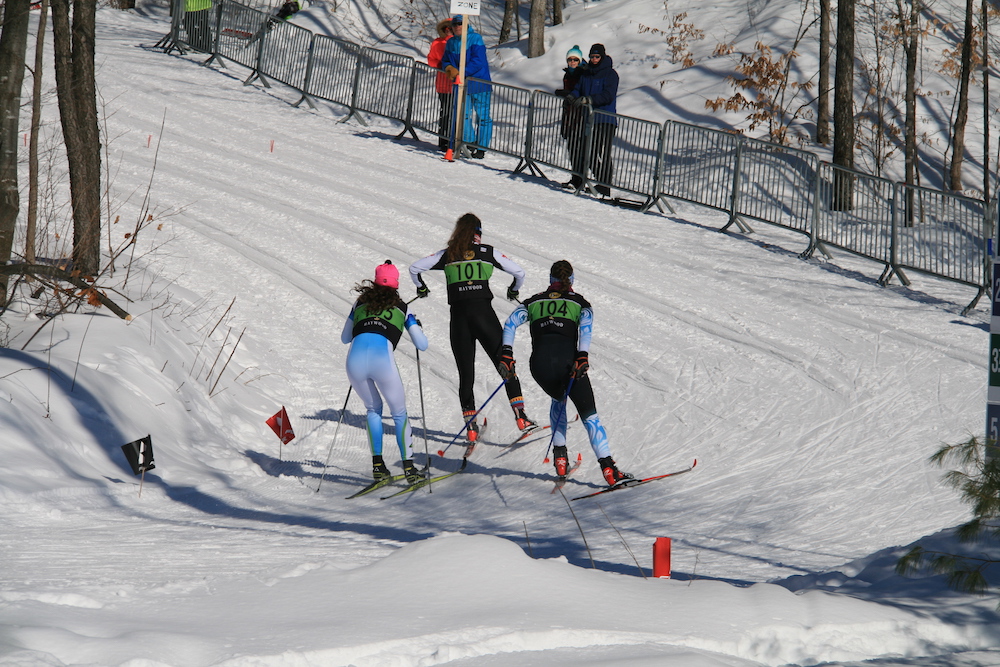
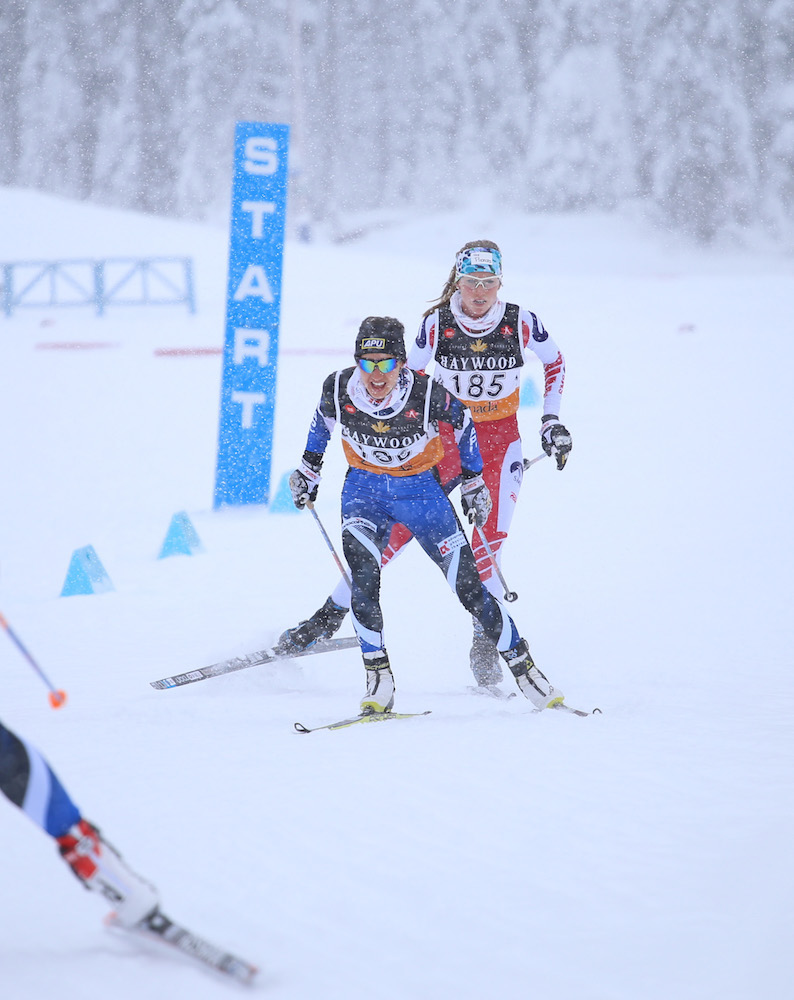
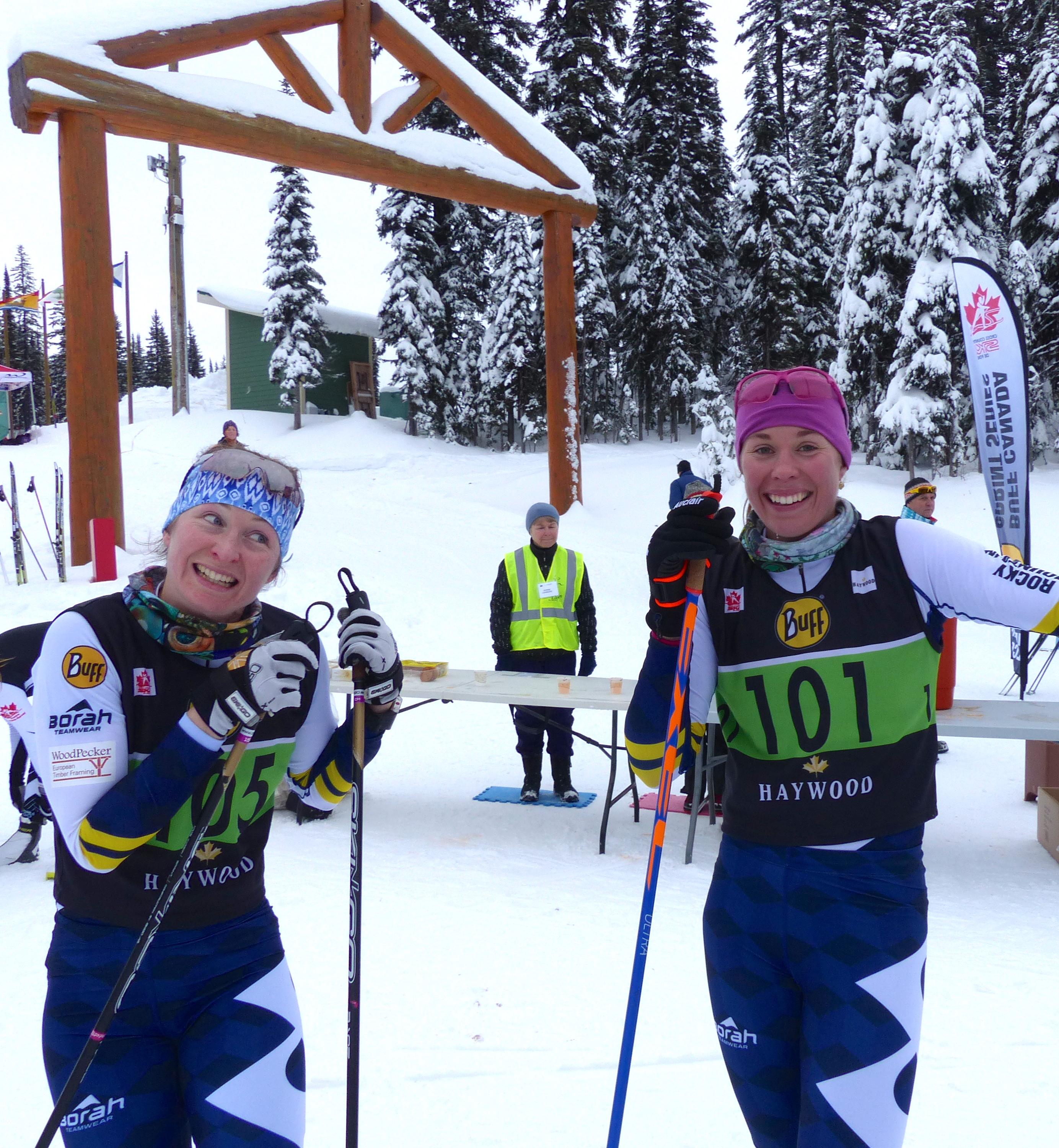
    Zoë Williams and Annika Richardson ready to start the pursuit. (Photo: Marten Burns)
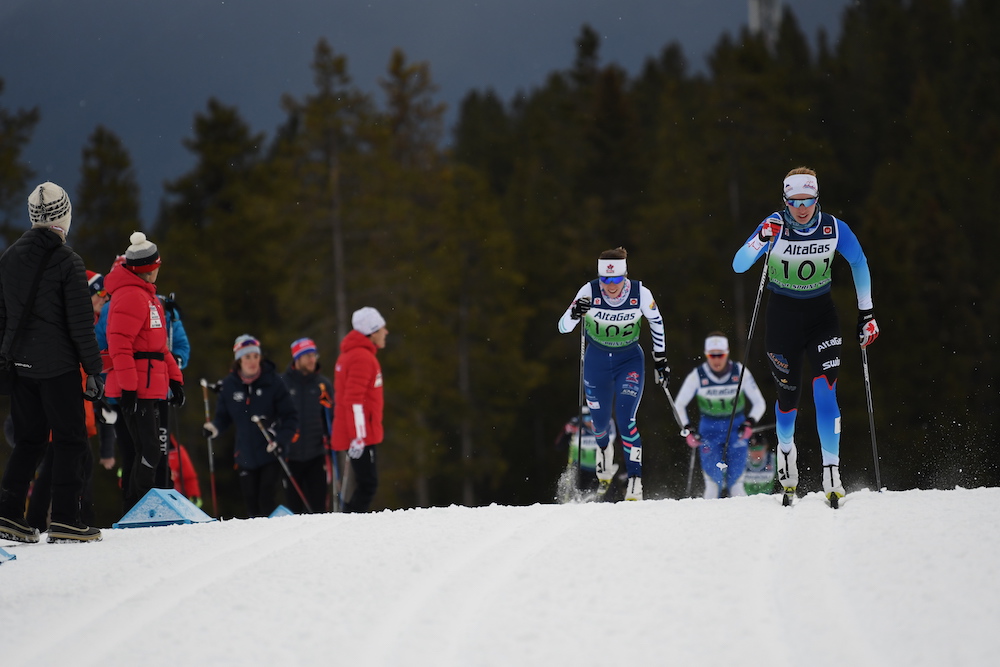
    Zoë Williams (101) and Annika Richardson ready to start the pursuit. (Photo: Marten Burns)

    Sunday brought freezing drizzle replaced by rain which resulted in significant challenges in picking the right skis for the changing conditions. The start times for the skate pursuit are based on time back in Saturday’s classic race, with no bonuses awarded.

    Leclair took her first senior NorAm win, starting third at 46 seconds back.

    My tactics for today were pretty simple,” Leclair wrote. “I wanted to start fast and catch the two girls in front of me. I put my head down, climbed and went hunting.”

    I felt super good and skis were wicked fast. After missing the first step of the podium on the two last races, it is nice to finish on the top.” 
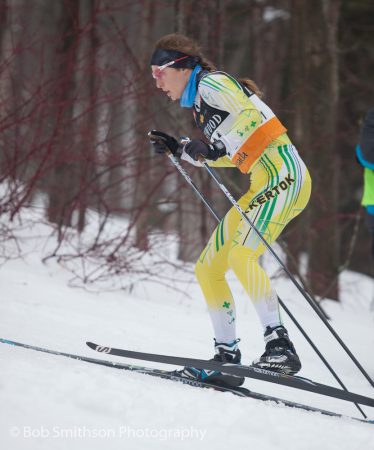
    Zoë Williams in second place in Sunday's pursuit. (Photo: Bob Smithson)
    Zoë Williams in second place in Sunday’s pursuit. (Photo: Bob Smithson)

    Saturday’s winner Williams started first and hung on for second. “Today was tough; didn’t have much left in me physically or mentally and it made the 15km a bit of a suffer fest.”

    Annika Richardson moved up to third.  “I was pretty hungry for a podium after being 4th the past two days. I have done 13 races in the past month so have felt like I have been running on empty for a little while,” Richardson wrote. “But, I really love skate distance races so was able to give it everything I had left.”

    “I started with Laura Leclair who is an amazing skate distance skier. I stuck behind her until the first long downhill but she had really, really fast skis so I wasn’t able to stick with her for the rest of the race (though my skis were quite good)  but managed to catch Mia Serratore by the end of the South 3.75 loop on the first lap.

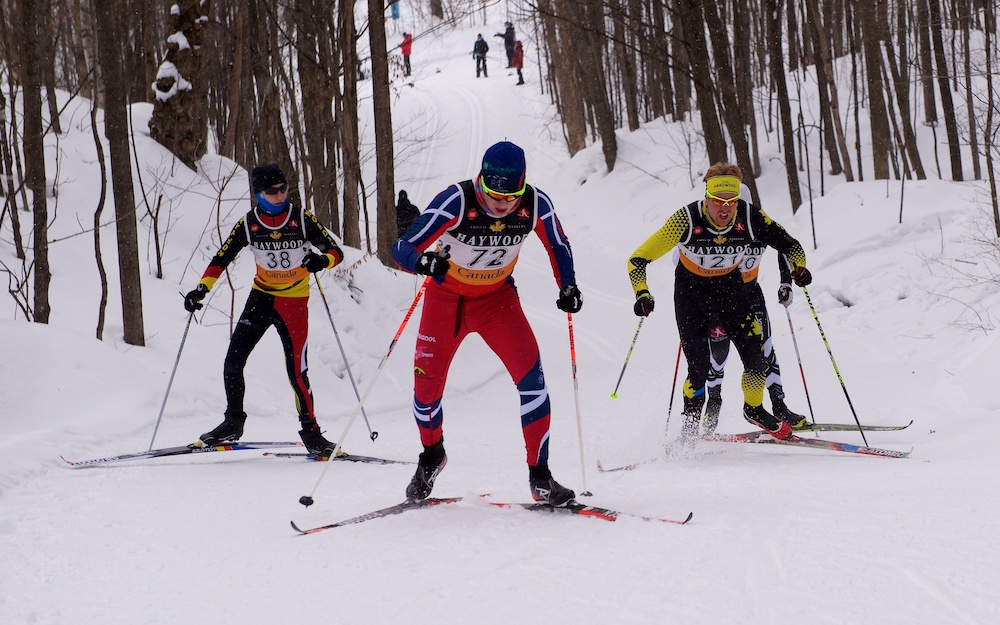
    Andy Shields leads Jack Carlyle, Philippe Boucher, and Alexis Dumas in the pursuit. (Photo: Bob Smithson)
    Andy Shields leads Jack Carlyle, Philippe Boucher, and Alexis Dumas in the pursuit. (Photo: Bob Smithson)

    Jack Carlyle earned his first senior NorAm win as well, as the top four men neatly reversed their start order at the finish.

    Sunday was a great day,” Carlyle wrote. “Had some good jam in the legs and was able to push hard.”

    On the first lap the first four starters (Phil Boucher, Andy Shields, Alexis Dumas and I) came together as a pack, and we skied together for most of the race,” Carlyle wrote. “We took turns taking the lead throughout the race, and on the last lap I attacked with 3km’s to go and that’s when the pack broke up.”

    Boucher started slowly in a strategy that earned him second place.  “I decided to start easy on the first km. When I got dropped I decided to stay calm and kept skiing at my pace. When I rejoined the lead pack, I think I had more energy left than the other guys. I had awesome skis and that played a good role at being able to save energy. Jack attacked with 3.5km left, I stayed in his skis in the long hill. Only the two of us survived the attack. I died a few meters after the top. That’s how Jack got away with the win.”
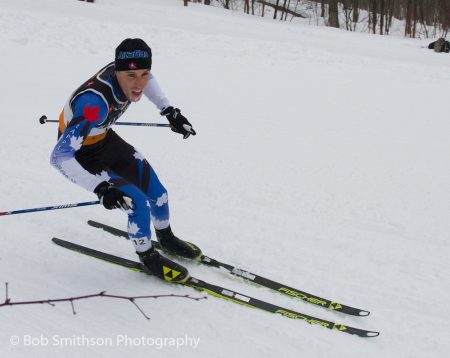
    Andy Shields looking ahead in the pursuit. (Photo: Bob Smithson)
    Andy Shields looking ahead in the pursuit. (Photo: Bob Smithson)

    Shields was still tired after two top tens and a third at the SuperTour the previous weekend, but felt better than Saturday. “Different weather today for sure. Ski selection was critical and was the main factor in determining who finished in what place – for the top 4 anyway. I felt ok with my race but my skis weren’t quick enough to complete. The wax was fine, just my ski fleet has a weak link in today’s conditions.”

    Format Changes

    None of the athletes commented on gender equality, but there were lots of opinions on what was, for most, their first two-day pursuit.
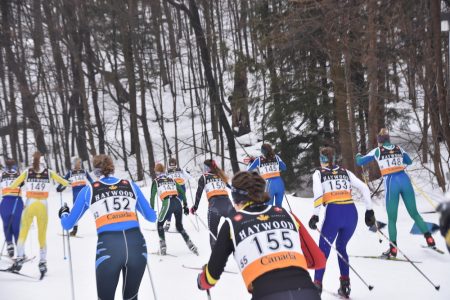
    The wave start from the open women's pursuit. (Photo: Marten Burns)
    The wave start from the open women’s pursuit. (Photo: Marten Burns)

    I love skiathlons, but understand they’re tough from an organizational perspective. Pursuits are fun and a pretty good replacement, but I’m also a big fan of a good mass start; the problem with pursuits is things can sometimes get so spread out that it almost turns into another interval start the 2nd day.” — Williams

    I like two days pursuit but I really wish the sprint counted for something so that all race formats would be encountered.” — Leclair

    I’m not a big fan of two day pursuits, I think mini-tour with a sprint on the Friday is way more fun.

    I’m missing skiathlon. It was a race I enjoyed and I don’t understand why we don’t race it anymore.” — Briand

    Pursuit starts are some of my favorite races. You often end up in a unique race situation and there’s all kinds of strategic options to play with. Lots of fun!” — Shields

    I really like racing, so I don’t mind. Skiathlon was a fun race but pursuits are fun too.” — Boucher

    I really like 3 day mini tours because it gives an advantage to those who are good at sprint and distance as well as skate and classic. I am not a huge fan of skiathlons, I find they tend to come down to the best skate skiers and I would definitely rather just do a skate mass start which are really fun.” — Richardson

    Love all racing formats, don’t have a favourite to be honest.” — Carlyle

    Highlights

    My favourite moment was seeing my coach Camille holding out a coke feed at 3.75km to go, I really needed the boost of energy.” — Richardson was happiest on Sunday, and not just for her first podium.

    On the non-racing focused side, hanging out with the CNEPH crew! They gave me great race support, super fast times, and are a super fun team to be around. Taking a detour to Parkdale in Toronto before my flight with Reed Godfrey was pretty fun too.” — Carlyle

    It’s been -40 in Thunder Bay so I was happy to enjoy some sun and some warmer weather today.” –Serratore, on Friday’s -12 weather.

    Without a doubt the sprint final. It was such an exciting race and tons of fun. However, I also really enjoyed watching my teammates (especially my sister!!) crush it on the race course; I’ve had a number of teammates coming back from concussions and it was just so wonderful to be back on the start line with them!!” — Williams

    “My favorite moment was definitely my win today because I surprised myself. I am happy with the sprint final as well.” — Leclair, who likes surprises. https://carnivorestyle.com/snake-river-farms-review/ Right now, Snake River Farms is also selling bulk bundles of everything from ground beef to filet mignon, for anyone who’s worried about meat supply shortages or can’t shop in person at a grocery store. Snake River Farms is a premium meat producer that specializes in beef and pork. Their meat is used at Michelin-star restaurants and sold directly to the public from their website. With its intense marbling, their American Wagyu brisket has gained a reputation among competitive barbecue teams looking for an edge.

    I liked the pursuit. We don’t get to do this very often so it’s always fun to race something different.” — Boucher

    It was a surprisingly beautiful day up at Highlands today. After being greeted by howling winds and -18, today’s sunny -12 was a treat to race in.” — Locke
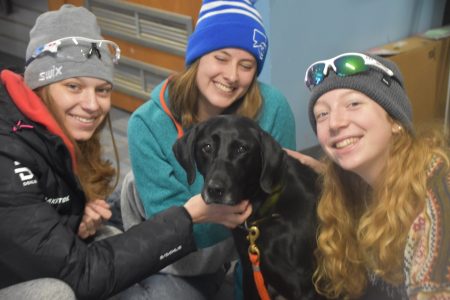
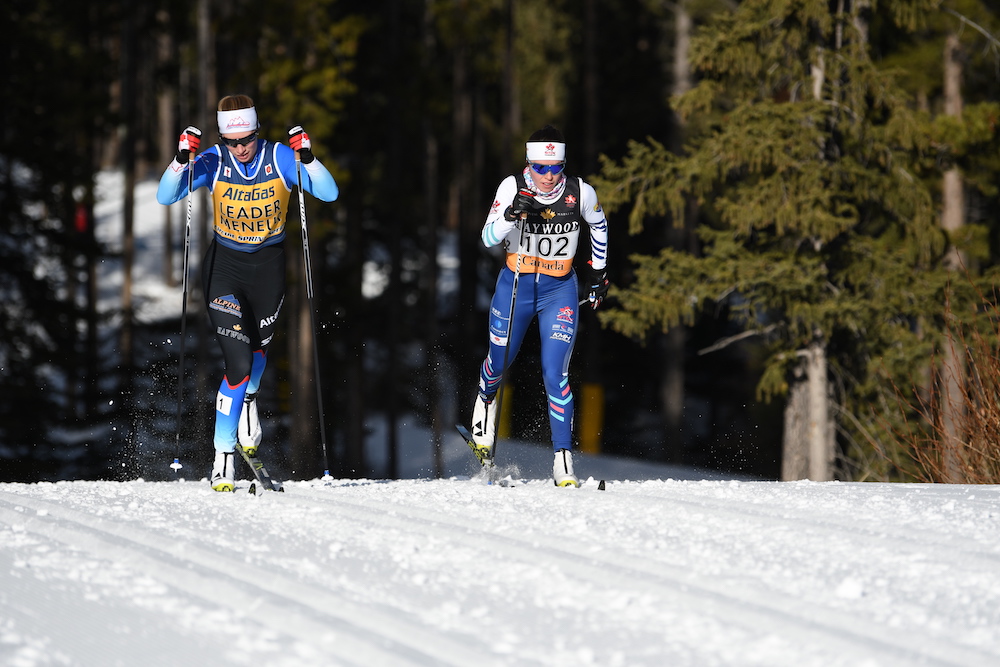
    Nakkertok rented a dog for the weekend! (Photo: Marten Burns)
    Nakkertok rented a dog for the weekend! (Photo: Marten Burns)
  • Canmore NorAm: Notes, Quotes, and Selections

    Canmore NorAm: Notes, Quotes, and Selections

    Bob Thompson outsprinted Jack Carlyle in the men's 30km. (Photo: Doug Stephen)
    Bob Thompson outsprinted Jack Carlyle in the men’s 30km. (Photo: Doug Stephen)

    Canmore hosted the second NorAm of the 2018/2019 season on December 13th, 15th, and 16th. The event also served as U23 and Junior World trials.

    By the end of the weekend, starts at the U23/Junior World Championships and the World Cup’s Tour de Ski would be earned.

    This event was originally scheduled for Whistler Olympic Park but had to be moved as a result of heavy rain and inclement weather forecasted into the immediate future. The Callaghan Valley Cross Country organization, the original bid-winner for this season’s trials, made the difficult decision to cancel on December 1st. The weather gods added one final insult on December 13th, when a major snowstorm ensued in the Callaghan Valley that would have made racing possible on the 14th.

    Canmore’s cross-country community stepped in on December 2nd and was able to organize a successful race weekend with a few weeks notice.

    The International Ski Federation (FIS) mandates that Continental Cup leaders for each period earn automatic start rights for the next World Cup period, including financial support from the event hosts. This season, Period 1 leaders get starts for Period 2 (Tour de Ski) and period 3 (Dresden, Otepää, and Ulricehamm) along with race support.

    For the first time since Perianne Jones and Dasha Gaizova started in the 2014 edition, Canada will enter a woman in the Tour de Ski (TdS). The last female finisher was Sara Renner, who placed 16th overall in 2010.

    This past weekend, Dahria Beatty won all three races in Canmore. Combined with her second place (and top Canadian result) in Sovereign Lake the previous weekend, Beatty is the COC leader and will leave for Europe on the 21st.

    In an email to FasterSkier after Thursday’s sprint, Beatty wrote: “I think the first 3 stages of the Tour this year are my dream come true, 2 sprints and a 10km skate.” The day after sending the email, Beatty received the official news that her TdS dream would be a reality.

    On the men’s side, Bob Thompson won twice in Canmore to lock down the male COC leader position.

    inhalers

    As this event was also the selection trials for U23 and Junior World Championships, up to 12 athletes would automatically qualify for the Lahti, Finland championship races. The High Performance Committee met Sunday afternoon and will announce the final choices soon.

    Weekend Results Summary:

    Names in green earned automatic selection for Lahti.

    Classic Sprint, Thursday:

    • Open Women: Dahria Beatty, Katherine Stewart-Jones, Maya Macisaac-Jones; Marie Corriveau (6th, U23)
    • Junior women: Anne-Marie Petitclerc, Molly Miller, Anna Pryce
    • Open Men: Bob Thompson, Angus Foster, Julien Locke; Graham Ritchie (4th, U23)
    • Junior Men: Remi Drolet, Tom Stephen, Xavier McKeever

    Interval start freestyle, Saturday:

    • Open Women 10km: Dahria Beatty, Katherine Stewart-Jones, Frédérique Vézina; Sadie White (4th, U23)
    • Junior Women 5km: Molly Miller, Isobel Hendry, Elizabeth Elliot
    • Open Men 15km: Russell Kennedy, Evan Palmer-Charrette, Alexis Dumas; Gareth Williams (6th, U23)
    • Junior Men 10km: Sam Hendry, Remi Drolet, Tom Stephen.

    Mass start classis, Sunday:

    • Men 30km: Bob Thompson, Jack Carlyle, Russell Kennedy; Sam Hendry (4th, top junior), Antoine Cyr (5th, U23)
    • Women 15km: Dahria Beatty, Katherine Stewart-Jones, Hannah Mehain (U23); Jasmine Drolet (6th, junior)

    Doug Stephen photographed all three days; see his albums on Flickr for many more images in full resolution.

    Results: Full Weekend, Sprints, Sprint BracketsInterval Starts, Mass Starts


    Quotes from Canmore:

    Sprint

    Dahria Beatty leads Katherine Stewart-Jones. They would finish 1-2 all three races. (Photo: Doug Stephen)
    Dahria Beatty leads Katherine Stewart-Jones. They would finish 1-2 all three races. (Photo: Doug Stephen)


    My tactics for every heat was to ski smooth and relaxed the first half and attack off the final two climbs into the finish. That worked out well for me today. I skied from the front and had control of the heats. The sprints were staged out of the biathlon stadium (hence why you couldn’t find them on the webcam) so it was an uphill finish, making for very fair racing.” — Beatty (1st)

    I was not happy with my qualifier but am really happy with how I skied the heats. Our staff did an awesome job with the skis today! The course was a lot of fun. Tactics essentially involved staying relaxed off the start, positioning well for the final climb and then hammering to the finish.” — Maya MacIsaac-Jones (CNST, 3rd)

    I feel pretty amazing about today’s race. 4th senior at a NorAm sprint is by far my best sprint result ever! My tactic was to have fun and just go like hell; I had a blast and I never went this fast before!” — Frédérique Vézina (CNEPH, 4th)

    I didn’t really have any tactics, I just wanted to go as fast as I could, ski well and try to stay with the leaders. I didn’t ask myself a lot of question, just ski fast!” — Marie Corriveau (MSA, 6th)


    Bob Thompson wins the A final with three Thunder Bay teammates in frame. (Photo: Doug Stephen)
    Bob Thompson wins the A final with three Thunder Bay teammates in the camera frame. (Photo: Doug Stephen)

    I am very happy with how today went. I found the finishing sprint gear I felt I was missing had the speed when I needed it.

    Everyone was fairly relaxed for the first half of the final knowing it was important to have the energy for the gradual climb into the finish. My move was made coming up to the last short downhill and then on the short striding hill before turning into the finish. I had been feeling great in that section in every heat and made sure I was at the front to make the most of it.” — Thompson (1st)

    The group strung out a little bit going into the big downhill, I was back in 5th but had amazing skis and came back up to the group pretty easily. Everyone was really skiing together going into the last climb, and Bob just put down a mean last hill and got away from us. I jumped out from behind Julien Locke as we hit the finishing stretch and got up beside him as we got right down to the line, and just got him in a big lunge.” — Angus Foster (TBay, 2nd)
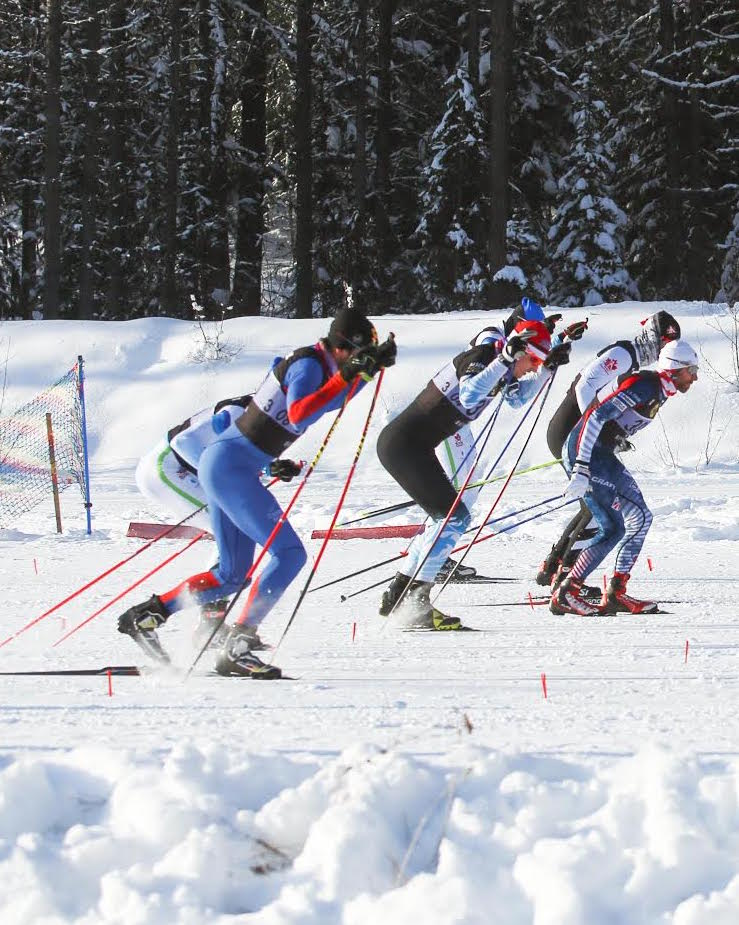
    The tactics worked out for me as well! I was planning on holding on to the leaders in the final for as long as I could, and then using my fitness to the best of my ability in the finishing stretch.” — Graham Ritchie (TBay, 4th)

    Interval start free technique

    Sadie White was fourth and top U23 on Saturday. (Photo: Doug Stephen)
    Sadie White was fourth and top U23 on Saturday. (Photo: Doug Stephen)

    It was a hard race today. I had a good start but then got really stiff going into my second lap after the big climb. It took a lot of mental fight to regroup after I got really stiff on the second lap but I was able to ski out of it and push really hard on the final lap.

    I am really happy with my fitness right now, my pacing was a bit off today but I think that fact that I am in good shape allowed me to bring it back.” — Beatty (1st)

    I felt better and better throughout the whole race today! I kind of wish we had more lap to go…” — Vézina (3rd)


    Russell Kennedy descending to first place. (Photo: Doug Stephen)
    Russell Kennedy descending to first place. (Photo: Doug Stephen)

    “Pacing was important today: that being said I didn’t pace it that well. Was definitely fastest the first two laps. Skis for me were really good [as] the team did an awesome job on them.” — Russell Kennedy (Team R.A.D., 1st)

    “The race today went alright, I tried to start hard and couldn’t quite get myself into a top end race gear. I skied relatively consistent and was able to find a better feeling on the last lap, but overall not the way I want to feel during a race, the result was a pleasant surprise.

    I think pacing played a big role, I was pretty far back after the first and second lap but turned out to be less than some guys lost on the last lap and so I was able to move up quite a few places in the final kms.” — Evan Palmer-Charrette (Team R.A.D., 2nd)

    My race today was really good. I feel like I was able to push hard and keep a good technique. I think the key today was to get a good glide after each push because they were not a lot of easy part on this course and the downhills were fast so you needed to get recovery were you can.” — Alexis Dumas (CNEPH, 3rd)

    Today’s race was good, not amazing but I’m happy to come away with the top U23 spot which qualifies me for U23 World Championships.

    Today’s weather was static and remained the same for the whole race. The race was decided on the last lap, that’s where I pushed my hardest. My plan for the race was to increase the speed as the race progressed, getting a bit faster each lap. I was getting splits and I realized I was off the pace on the first laps, so I just made sure to push as hard as I could on the final climbs.” — Gareth Williams (Telemark, 6th)

    Mass start classic

    Russell Kennedy (bib #1) leads out the men's 30km while Bob Thompson towers over the field in the leader's bib. (Photo: Doug Stephen)
    Russell Kennedy (bib #1) leads out the men’s 30km while Bob Thompson towers over the field in the leader’s bib. (Photo: Doug Stephen)


    Today’s race stands out as the most fun I’ve had in a 30k since the very first one I ever did at the Canmore Nationals in 2010.

    The main group got smaller definitely through Russell pushing the climbs on most laps. We had the group of 6 for several laps and then the last 2 were really just the 3 of us with Russell pushing hard on the climb from the bottom of the course. Jack and I had faster skis and on the final downhills went by and then had a great sprint to the line.” — Thompson (1st)

    After a tough sprint day, it was great to bounce back with two super successful distance races.  ” – Sam Hendry (Team R.A.D., 1st junior in 4th)

    Today was a fun race. A good battle between Katherine and me once again.

    Katherine set the pace early and by the second lap, we were on our own. It was windy on course today, so it was hard to break from each other and after testing each other a few times on the last lap it came down to the finish sprint, which of course is my favourite.” — Beatty (1st)

    The race was really fun. I pushed the pace right off the start so Dahria and I made a break from the rest of the group after the first lap. We skied together the entire race, it was the type of course that made it difficult to break away because the hills were relatively short and there was quite a big drafting effect on the flats. It came down to the finishing stretch and Dahria was stronger on the double pole!” — Katherine Stewart-Jones (CNST, 2nd)

    Selection

    At this point, if I am offered a start I will plan to race the first 3 stages and then reassess after that based on how I am skiing. The Dresden WC will also be a focus just after the new year so I want to make sure I am well prepared and have enough energy for those races as well.” — Beatty, on Thursday, before the Tour de Ski offer was made.

    Qualifying for world juniors has been a big goal of mine for many years and I am really excited to have achieved it this weekend.” — Hendry

    Personal Highlights

    Most unusual part was getting to come home and lie in bed between the quali and heats.” — MacIsaac-Jones

    I am very very happy with my race today, I really surprised myself! It’s been a long time I didn’t feel good at racing so it was really fun to have good feelings again. Take the first spot for U23 world champ was the best way to start the season!” — Corriveau

    Getting to race the final with three of my NTDC Thunder Bay teammates was a blast, I was really proud of the way we skied out there today and think it reflects a lot of hard work by our team and coaches this year! I’m stoked for Graham and Julian go 1-2 in U23 with World Champs spots on the line, and we all owe a big thank you to our wax techs for some wicked boards all day.” — Foster

    It’s been really nice to race at home and sleep in my own bed, especially knowing I will be away a lot for the rest of the season.

    Everyone in Canmore has done a great job organizing the races so last minute. I’ve been especially loving the chocolate medals!” — Beatty

    The highlight from this past weekend was hands down, getting to ski with my teammate and role model Russell Kennedy for almost all of the classic mass start on Sunday.” — Hendry

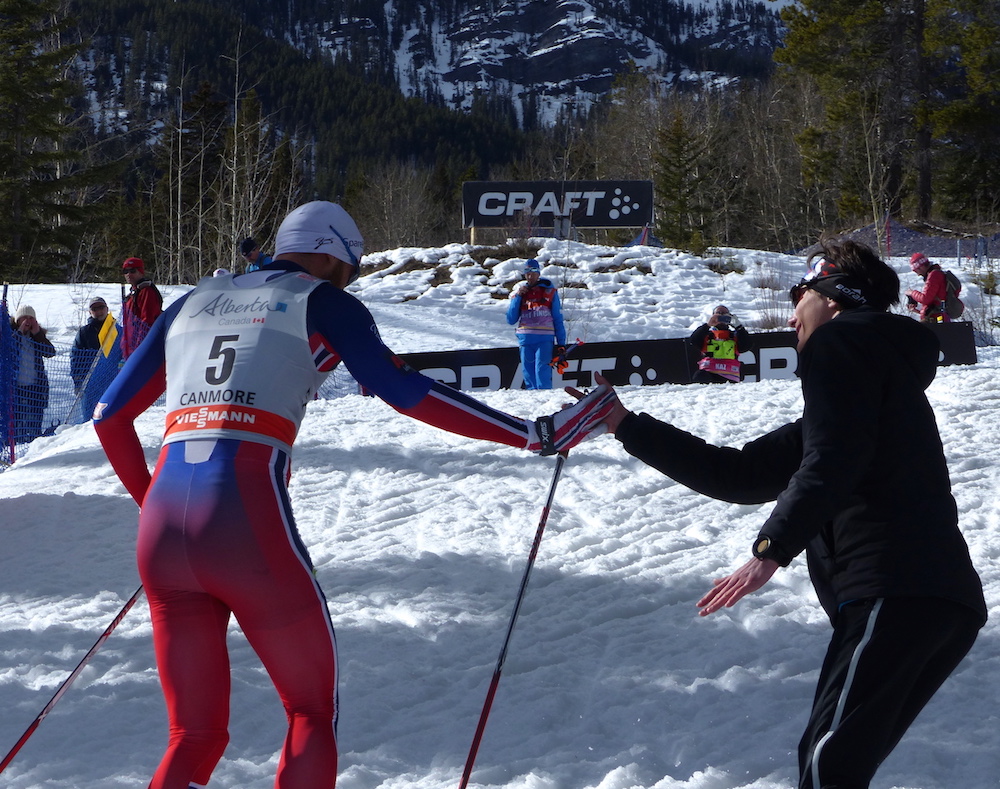
    Remi Drolet has been in Canmore before: Petter Northug (NOR) (l) high fives Remi Drolet (spectator) as he finishes his final lap during the men’s 1.5 k classic sprint at the Ski Tour Canada on Tuesday in Canmore. (Photo: Peggy Hung)
  • Thursday Rundown: Hochfilzen, Canmore and U23/JW Trials

    Thursday Rundown: Hochfilzen, Canmore and U23/JW Trials

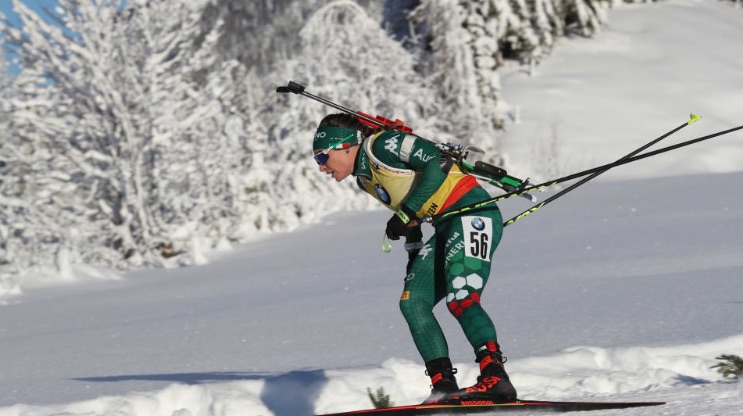
    Dorothea Wierer of Italy won Thursday’s sprint in Hochfilzen, Austria in a time of 21:04.9 minutes. (photo: biathlonworld.com)

    Today in Hochfilzen, Austria, Dorothea Wierer of Italy won the sprint in a time of 21:04.9 minutes. Wierer missed one shot standing for a single penalty during the race. Kaisa Mäkäräinen of Finland was close behind in second, 0.6 seconds back. Mäkäräinen also had one missed target standing. Third place went to Russia’s Ekaterina Yurlova-Percht, finishing 24.4 seconds behind. Yurlova-Percht short clean in the race.

    Susan Dunklee was the best placed American in 34th (+1:33.0, 0+2). Joanne Reid was 44th (+1:48.3, 0+1), and Clare Egan 65th (+2:22.1, 2+2).

    Canada’s Rosanna Crawford laced 49th (+1:56.4, 2+0), Megan Bankes 73rd (+2:47.8, 1+2), Megan Tandy 87th (+3:26.9, 2+3), and Nadia Moser 88th (+3:34.8, 2+2).

    Results

    On the non-racing front, the IBU released a statement about “Austrian state authorities” investigating five Russian biathlon officials and five biathletes due to their connections to doping. The IBU stated that the possible infractions occurred during the 2017 Hochfilzen IBU World Championships.

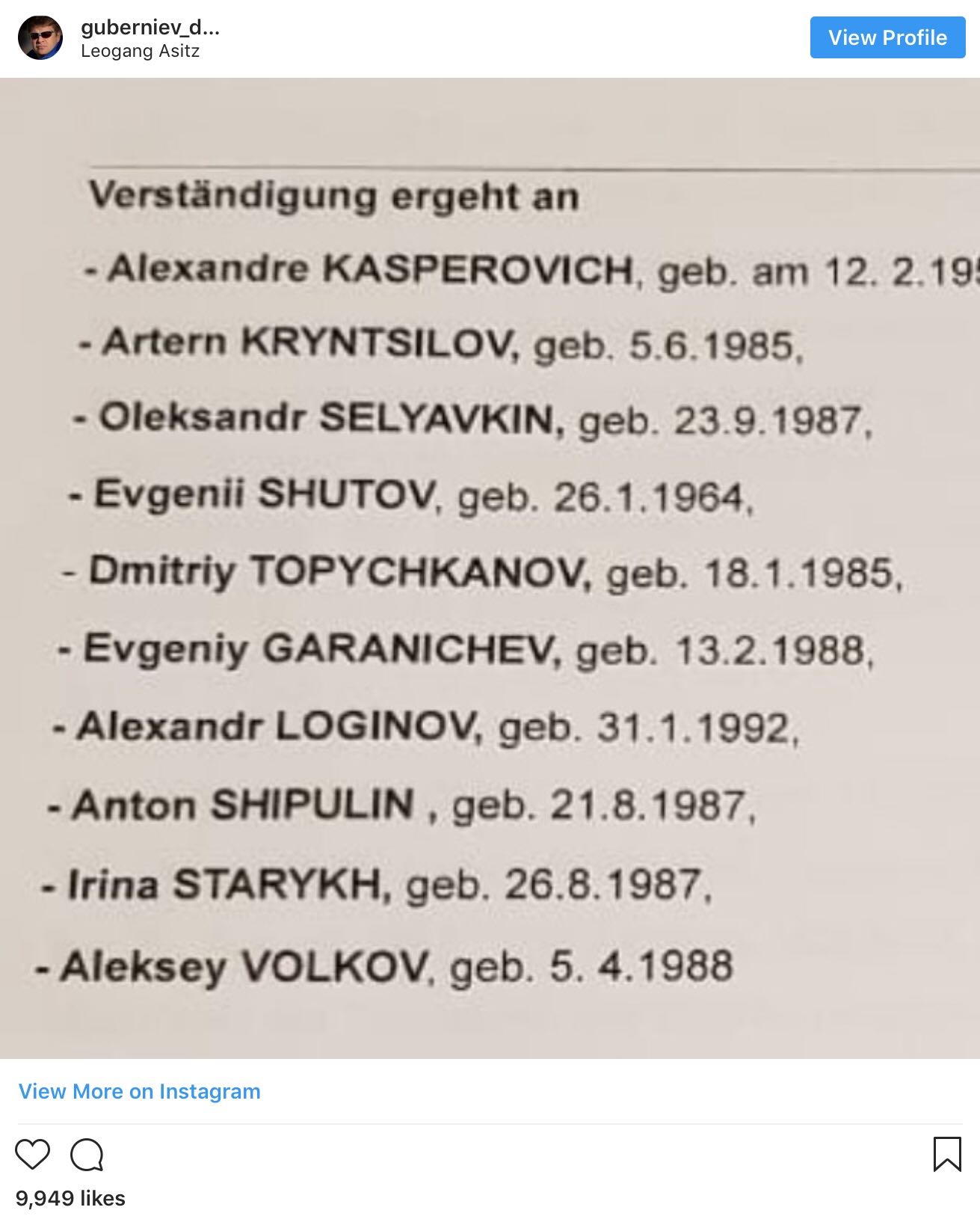
    Russian sports journalist Dmitry Guberniev has posted the names of the individuals under investigation. According to tass.com, a Russian news site, Guberniev the following people: “Among athletes accused of violating anti-doping rules are 2014 Olympic champion Anton Shipulin, Evgeny Garanichev and Alexander Loginov. The list also includes biathletes Alexey Volkov, Irina Starykh, former coach of the Russian national team Alexander Kasperovich, doctors and massage therapists Artyom Kryntsilov, Alexander Selyavkin, Evgeny Shutov and Dmitry Topychkanov,” tass.com reported.

    List of people under investigation according to Russian journalist Dimitri Guberniev (Screenshot from @guberniev_dmitry)

    FasterSkier will post updates about this developing story as more information is discovered

    – Harald Zimmer contributed

    ***

    NorAm and U23/JW World Championships Qualification, Canmore, Alberta

    The Canadian NorAm series continued Thursday in Canmore, Alberta, with a combined NorAm and trials for U23 and Junior World Championships.

    The three race weekend kicked off with classic sprints, run from the biathlon stadium which offers an uphill finish in place of the traditional long descent into the finish straight.

    The selection criteria are involved, but it appears that each day four athletes will earn a spot in U23/JW World Championships in Lahti, Finland. The top athlete of each gender in U23 and junior each day should be automatically selected.

    There are also World Cup period 2 (Tour de Ski) and period 3 starts on the line, with the possibility of Canadian women in the Tour de Ski for the first time since Sara Renner finished 16th in 2010.

    Dahria Beatty (CNST) won the open women’s category in style, winning the qualifier in 3:51.06 by 4.96 seconds before winning all three heats by large margins.

    vancomycin online

    Katherine Stewart-Jones (CNST) finished second in the A final in 3:49.60, 2.20 seconds behind Beatty after finishing second in the qualifier and winning her earlier heats. Maya MacIsaac-Jones (CNST) completed the podium, finishing 5.37 back.

    Marie Corriveau was the top U23, finishing 6th in the A final after qualifying in 6th. Corriveau has struggled with results for two seasons, but her first race of the season is a very positive sign.

    Anne-Marie Petitclerc (Mont Sainte Anne) won the qualifier and quarterfinal on her way to the junior win in 4:01.71. Molly Miller (Black Jack) was second at 0.68 seconds back and Anna Pryce (Foothills) took third at 7.25 seconds.

    Bob Thompson (TBay) won the men’s A final in 3:19.43 by 2.31 seconds. Angus Foster (TBay) outstretched top qualifier Julien Locke (CNST) by 0.01 seconds for second. Graham Ritchie (Big Thunder) was the top U23 in 4th, 2.36 back after qualifying 6th.

    Remi Drolet (Black Jack) won the junior A final in 3:31.94, after winning the qualifier and all his heats. Foothills teammates Tom Stephen and Xavier McKeever were second and third, 2.08 and 2.51 seconds back respectively. Stephen has two future seasons as a junior while McKeever has three.

    All results, including live timing for the rest of the weekend.

    Sprint results Sprint brackets 


  • Palmer-Charrette, Gregg Top First-Ever Canada 150 Rollerski Race

    Palmer-Charrette, Gregg Top First-Ever Canada 150 Rollerski Race

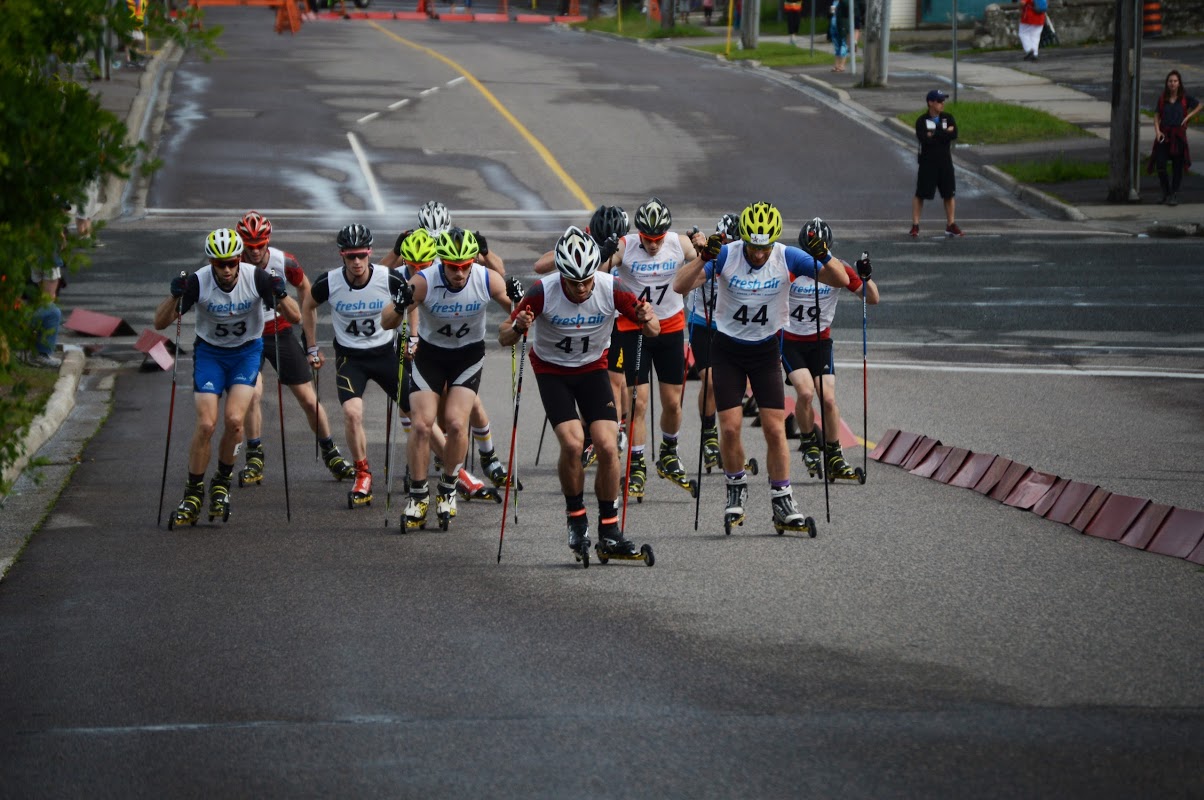
    Evan Palmer-Charrette (41) leads the elite men’s 11.25 k mass start at the Canada 150 Rollerski Race on Saturday, July 1, in Thunder Bay, Ontario. Right behind him, Brian Gregg (44) and Angus Foster (46) follow. (Photo: Christian Hollmann)

    Editor’s note: Evan Palmer-Charrette, a 23-year-old member of the National Team Development Centre (NTDC) Thunder Bay, agreed to write a recap of the inaugural Canada 150 Rollerski Race, the first Cross Country Canada (CCC) sanctioned rollerski race in Thunder Bay, Ontario, well before he won the race. By no fault of his own, Palmer-Charrette ended up being both the author of and a subject in the following article, and his teammate Annika Richardson provided a post-race video interview with him. Richardson finished second in the women’s race.

    ***

    THUNDER BAY, Ontario — On Canada Day this past Saturday, July 1, a historic holiday for Canada as a nation, NTDC Thunder Bay in conjunction with the Lakehead Superior Nordic Association, Big Thunder Nordic Ski Club and Lappe Nordic, made history of its own, hosting a Cross Country Canada (CCC) sanctioned rollerski for the first time in downtown Thunder Bay. It was the second time a sanctioned (tier-two, non-FIS) rollerski race had been held in Canada, following last year’s Challenge Volvo 2016 in Sainte-Catherine-de-Hatley, Quebec.

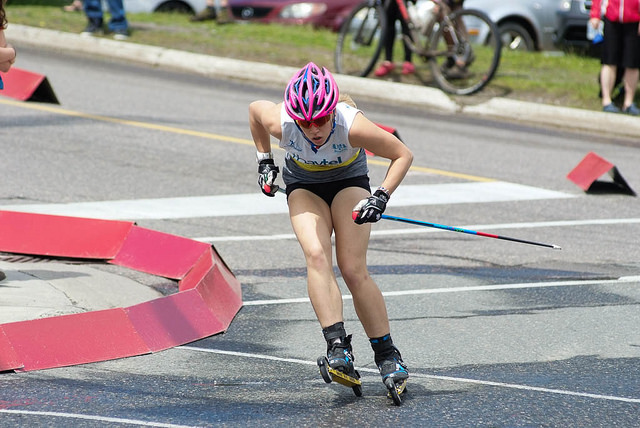
    Sadie White racing in the Canada 150 Rollerski Race on July 1 in Thunder Bay, Ontario. (Photo: Kevin Schlyter)

    Saturday’s event, dubbed the Canada 150 Rollerski Race, drew more than 40 of Canada’s top development skiers and Americans Caitlin and Brian Gregg to showcase rollerski racing as part of the city’s Canada Day festivities. The day began with both men and women racing 1.5-kilometer time-trial sprint qualifiers on a two-lap, 750-meter course.

    Evan Palmer-Charrette qualified first in a time of 3:03.71 minutes, followed by Julian Smith in second (+3.64) and Jack Carlyle in third (+5.05).

    In the women’s qualifier, Caitlin Gregg won the qualifier by more than nine seconds in 3:28.21. Annika Richardson was second overall (+9.35) and top Canadian qualifier, followed by Sadie White in third (+11.51).

    The forecast for the day called for thunderstorms, and while some rain led into the qualifier, the sun came out for most of the distance races. All of the women raced together over a 9 k distance, whereas the men were broken up into four groups racing either 4.5, 6, 9, or 11.25 k based on their qualifier results. The distance races were held on the same course as the sprint, which circled a city block and included an out-and-back for an additional climb and descent.

    The elite races offered cash prizes for the top five men and women ($500, $300, $200, $75, and $25, respectively), as well as the top three in the men’s and women’s qualifier ($150, $100 and $50, respectively). Each race featured three primes scattered throughout the course, which rewarded the first to reach them with cash ($100 at the second prime) and prizes from local businesses.

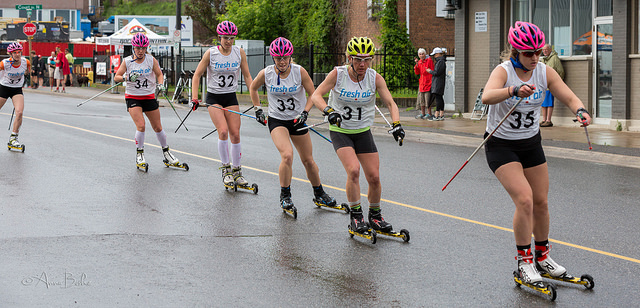
    Mia Serratore (35) leads Caitlin Gregg (31), Annika Richardson (32), Katherine Stewart-Jones (34), and others in the women’s 9 k “Canada 150 Rollerski Race”, the first-ever sanctioned rollerski race held July 1 in Thunder Bay, Ontario. (Photo: Anna Buske)

    Given her qualifying result and impressive resume, Gregg established herself as the race favorite for the women’s 9 k race. The first prime was on Lap 4, which was when Gregg made her move and broke away from the field, which gave her a sizable gap for the remainder of the race. She won in 23:25.9, more than a minute ahead of anyone else.

    “I’ve been working on my starts so I try to get out fast, which was a lot of fun when you have a big pack like that in a mass start,” Gregg explained. “And then I just tried to relax for the first couple of laps. … I felt strong and was able to push through the whole race, which was nice for having a race effort this time of year.”

    After Gregg’s move dismantled the pack, Richardson raced to second (+1:01.1) as the top Canadian finisher.

    “After attempting to bridge it [the gap] with Sadie, it was all about skiing smoothly and holding second until the end,” she said.

    Canadian national-team member Katherine Stewart-Jones rounded out the podium in third (+1:56.9). Only four women finished the race, with White placing fourth (+2:07.7).

    Michael Somppi leads Brian Gregg (second from l) and Evan Palmer-Charrette (second from r) during the “Canada 150” downtown rollerski race, the first-ever CCC-sanctioned rollerski race in Thunder Bay, Ontario, on July 1. (Photo: Kevin Schlyter)

    The elite men’s 11.25 k race played out quite differently with 10 of the 13 starters finishing within 17 seconds of one another. Yet similarly to the women’s race, the pace picked up going onto the fourth lap with a prime and a prize on the line. Angus Foster outsprinted teammate and fellow Thunder Bay native Palmer-Charrette to take the first prime and a prize to go along with it.

    After Brian Gregg was first to the second prime, Michael Somppi took the third and final prime on the 12th of 15 laps and made a decisive move to try and break away from the pack. However, with just over two laps to go, Palmer-Charrette reeled him back in and finished first in 25:20.2. Gregg followed just 0.2 seconds later for second overall and Carlyle crossed 0.3 seconds later for third place. Less than 4 seconds out of first, Somppi finished sixth (+3.8), behind Dominique Moncion-Groulx in fourth (+1.7) and Andy Shields in fifth (+2.0).

    The men’s 6 k race was hit by the worst weather of the day, as a looming storm cloud opened up during it. Thomas Manktelow of the Albert World Cup Academy (AWCA) won the first prime and went on to win the race as well.

    Thomas Manktelow (l) and Levi Nadlersmith (r) racing to first and second, respectively, in the men’s 6 k race at the Canada 150 Rollerski Race in Thunder Bay, Ontario. (Photo: Kevin Schlyter)

    “I was a little worried about some of the corners in the wet, but managed to get away without any crashes,” Manktelow said. “The mass start was super-fun and went pretty well, and the entire event was well-run.”

    Larkin Wasmuth won the men’s 9 k race and Aleksi Luoma topped the men’ 4.5 k.

    The field was quite strong with the likes of 2014 U.S. Olympian Brian Gregg and several athletes from national training centres across Canada.

    “It was so much fun to compete in a sanctioned roller ski race in North America,” Gregg wrote in an email. “NTDC and Thunder Bay did a fantastic job running the event especially with the added challenge of a few rain showers throughout the day. I can’t wait for the next rollerski race, the Canada 150 race has set the bar high.”

    Results: Qualifying time trial | Final

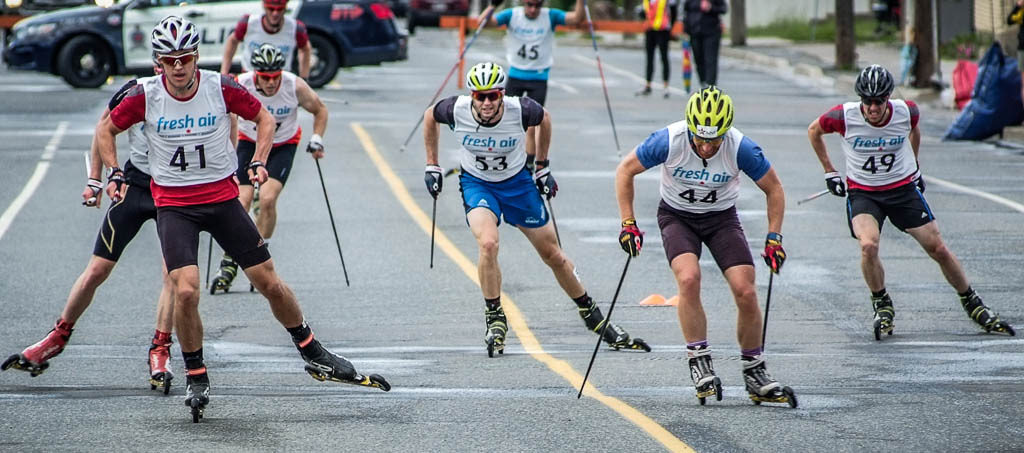
    Evan Palmer-Charrtee (41) holds off Brian Gregg (44) and others, including Dominique Moncion-Groulx (53) and Andy Shields (49), for first place in the elite men’s 11.25 k “Canada 150 Rollerski Race” on July 1 in Thunder Bay, Ontario. (Photo: Kevin Schlyter)
  • Eastern Canadian Champs: Notes, Quotes, Galleries, & No-Double-Pole Zones

    Montériski's Étienne Hébert returned from WJC in Soldier Hollow in time to outsprint NTDC TBay's Fergus Foster in a quarterfinal heat. (Photo: Dianne Gallus)
    Montériski’s Étienne Hébert (c) returned from WJC in Soldier Hollow in time to outsprint NTDC TBay’s Fergus Foster (l) in a classic-sprint quarterfinal at NorAm Eastern Canadian Championships at Nakkertok Nordic in Cantley, Quebec. (Photo: Dianne Galus)

    The annual Eastern Canadian Championships are a special event in the Canadian winter.  On paper, it is just another NorAm that provides opportunities to earn World Cup starts, national-team positions, and valuable International Ski Federation (FIS) points, but it has grown to be bigger than that.

    While Western Canadian Championships and Canadian nationals change their host venue each year, Easterns has settled in at the Nakkertok South trail system for ten of the last eleven years. While Cantley, Quebec, is the nearest town, the national capital Ottawa and Gatineau are just twenty minutes away, providing a wealth of accommodation options and a major airport. With Toronto, Montreal and Quebec City all within a five-hour drive, a third of the Canadians competing were within easy driving distance.

    The event is hosted by four regional ski clubs with distinct and interesting histories: Nakkertok, Skinouk, Chelsea Nordiq, and Kanata Nordic.

    With 835 athletes registered this year and more than 700 finishers each day, Easterns is likely to be larger than next month’s 2017 nationals in Canmore, Alberta. The American Birkebeiner (SuperTour #4) in Hayward, Wis., is the largest FIS points race this season in North America, with U.S. nationals at Soldier Hollow in Midway, Utah, ranking the fourth largest.

    How do you put together a three-day event featuring an interval start with 736 finishers, including para-nordic, masters and university categories? It starts with 553 volunteers and a FIS request to test a no-double-pole zone. The open categories were slightly reduced by races happening simultaneously in PyeongChang, South Korea (World Cup), and Soldier Hollow (U23/Junior World Championships), but there were enough familiar faces to fill the podiums.

    It ends with smiling faces, results, and a select few skiers who improved their FIS points and made their case for future selections. The photo gallery links are at the bottom, just keep scrolling past the quotes.

    ***

    No-Double-Pole Zone

    The classic sprint was Canada’s first test of the new FIS rule, and athlete opinions were not divided.

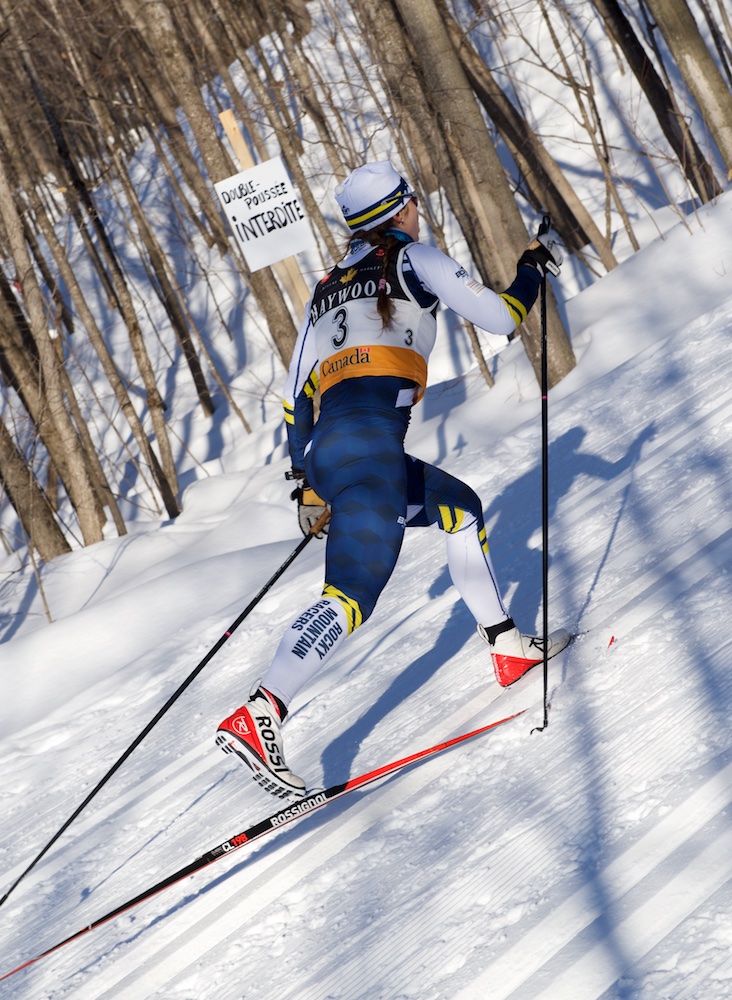
    RMR's Andrea Dupont strides past the no-double-pole sign during the classic sprint qualifier. (Photo: Rob Smith)
    Double-poussée interdite: a new twist from FIS. RMR’s Andrea Dupont strides past the no-double-pole sign during the classic sprint qualifier. (Photo: Rob Smith)

    They started the no double pole zone on the gradual climb before the steep pitch, which made the flow of the course a bit annoying (in training yesterday they actually had it right at the bottom of the climb in a section that was too fast to stride, but the jury was really great about taking athlete feedback and moved it higher up the hill. I’m personally not a fan of the no double pole zone idea but I think they managed it as well as they could have on that course).” 

    — Angus Foster, NTDC TBay,  2nd

    I was not a fan of the no double pole section. I personally love striding and I hope striding can remain a part of our sport, but I think having no double pole sections or limiting pole lengths aren’t the solution for keeping striding a part of our sport (that being said, I’m still not sure what the solution is).”

    — Maya MacIsaac-Jones, AWCA/NST U25 Team,  1st

    It was so unnecessary. Everyone I talked to would have strode that no DP zone anyway. It should have been a double pole only zone. That would have made it a challenge. I’d love to see these silly pole length and DP zone rules revoked. Let the sport evolve as it will.”

    —Andy Shields, Lappe Nordic, 7th

    I didn’t think it would have made a difference. Classic was definitely pretty fast and so was the snow.”

    —Russell Kennedy, Team R.A.D., 3rd

    For me those would have been striding sections anyways, so it had very little effect. I think it is an interesting issue — the development of double poling as a technique of its own and the repercussions for traditional classic skiing. I love to stride, so I think the best solution is to have courses that force striding. I don’t know too many people (boys included) who I think would have double poled that course, but the no double pole zone ensured that wouldn’t be a problem. It is exciting to see the sport changing and trying to adjust itself though!”

    —Anne Hart, SMS Elite, 3rd

    Nakkertok South and the Easterns Atmosphere

    Easterns is my favorite race of the year despite the zoo it always is. The courses are staples on the circuit and the Ottawa/Gatineau area is great. Plus I have a lot of family in the area so it’s great to visit with everyone.”

    —Shields

    The atmosphere of the races is incredible, and I think that has a lot to do with all the participants- both older and younger.  One thing I’ve noticed in particular here is that the race feels really important, which it is.  I think often times if races aren’t a World Cup or some big European race people don’t put the effort in to make the race feel like a big deal.  But for the senior athletes here the races are important, and for the younger kids maybe even more so, and it is much appreciated to have the reflected in the race quality.  I’ve been so impressed with the organization and volunteers, and having racers starting every 30 seconds from 9 in the morning until 1 in the afternoon is awesome.”

    —Hart

    Easterns is amazing, it has a great community vibe and there are so many teams out here and so many young skiers that are all super pumped to be racing!”

    —Kennedy

    It is really inspiring to see all the young skiers here and makes me excited for the future of skiing in Canada. It was also a ton of fun for me because both of my siblings were racing Easterns!”

    The Montreal style bagels at lunch and the hundreds of young Nakkertok racers running around!”

    —MacIsaac-Jones

    What I love about Easterns is the community. We are all working as a group. We get to work with the other clubs, get to know them. We are working as a region, really. It makes it special to be a volunteer at the Easterns. I love it because I get to talk to everyone.”

    —Sue Holloway, Volunteer Organizer and first Canadian to compete in both Summer and Winter Olympics (1976)

    “AMAZING.  It has been an absolutely wild winter with rain, snow, blizzards, negative fahrenheit conditions…so to have some sun, hard tracks, and mild winter weather was just incredible.  The Nakkertok club did an incredible job with the grooming and race set up, the volunteers were so friendly and helpful, and I must thank Nic from the Carleton University team for helping me out with wax last minute!  I walked into the Fresh Air ski shop yesterday [Thursday] at about 2 PM, and asked if there might be anyway someone could help for the weekend of waxing.  He offered immediately, and he did an amazing job.”

    —Hart

    Friday: Classic Sprints

    Sophie Carrier-Laforte (101) leads Alannah Maclean (105) and Maya MacIsaac-Jones (104) towards the no-double-pole zone. (Photo: Elisabeth Fink)
    Sophie Carrier-Laforte (101) leads Alannah Maclean (105) and Maya MacIsaac-Jones (104) towards the no-double-pole zone in the first women’s classic-sprint semifinal. (Photo: Elisabeth Fink)

    The women’s 1.3-kilometre and men’s 1.4 k classic sprints were held on hard, cold tracks with the air warming up enough to allow a bit of glazing. With some of the younger racers stuck in school, this day had the smallest turnout of the weekend with 714 finishers.

    Results: Qualifier and Prologue | Heats

    Women’s classic sprint podium:

    1. Maya MacIsaac-Jones, NST U25, 3:42.06
    2. Sophie Carrier-Laforte, CNEPH, +0.66
    3. Anne Hart, SMS Elite, +3.40

    My qualifier today was OK, but I was really happy with my heats. I went into the day not knowing what to expect, especially with a fairly small field this year at Easterns in the Open categories, but was really happy to come out with a win!”

    In the final I basically tried to tuck in right behind Sophie. She has a really solid herring bone, so I knew I would have to push hard over the tops of the hills to stay with her. I was able to stick with her and got a good draft coming into the finishing straight, and was able to use that draft to pass her and pull ahead at the finish.”

    —MacIsaac-Jones

    We had a very relaxed first 45 seconds- Maya got out in front and really just controlled the pace going into the first time up the hill.  I pulled up next to her and we were both doing our best sprint herringbone, when Sophie came up between us in the most impressive herringbone-run I think I’ve ever seen.  I was on the inside and got a little bit pinched in the corner, and by the time I got all of my ducks in a row both Sophie and Maya had taken off down the hill.  I then tucked in behind Andrea, and used the draft and some double pole horsepower to get myself back into third!”

    — Hart

    Men’s classic sprint podium

    1. Dominique Moncion-Groulx, AWCA, 3:14.84
    2. Angus Foster, NTDC TBay, +0.07
    3. Russell Kennedy, Team R.A.D., +2.75

    I decided to go really light on the grip and just run the first part of the striding zone, and with a lot of harringbone on the climb that was basically the only place you had to kick. I lost a bit of time on the climb but my skis were flying on the downhills, and I could make it back up in the finish pretty easily.”

    Going up the hill the last time in the final I was behind Dominique and Ricardo. Ric had pushed the pace pretty hard early, and i think was feeling it a bit going over the top. Dominique got away a bit and I couldn’t really get around Ricardo, so I lost touch with Dominique going into the last downhill and had to come from a long way back in the finish. Really put everything I had down to close the gap but ended coming up just short in the lunge.”

    —Angus Foster

    I have never made an A final in a classic sprint so I was pretty pumped. I played the waiting game and slowly moved up to the front.”

    —Kennedy

    Saturday: 10/15 k classic

    The individual start classic provided lots of herringbone work (Photo: Rob Smith)
    The 10/15 k classic interval starts provided lots of herringbone work (Photo: Rob Smith)

    Saturday brought classic interval-start racing with 10 k for the women and 15 k for the men on a 5 k loop.

    Full Results

    Women’s 10 k classic podium

    1. Anne Hart, 30:03.3
    2. Sophie Carrier-Laforte, +9.3
    3. Maya MacIsaac-Jones, +20.0

    “I had only skied the 5K lap once before, so the first lap I definitely had some surprises (namely some downhills) and didn’t take the best line in a lot of places.  Luckily the course was two laps so by the second lap I had a better idea of what was coming.”

    “I think pacing was probably the biggest thing today!  It’s always hard to gauge output versus recovery the first time racing a course, so I think if I could do it again I probably would have skied some parts a little bit harder.  The herringbone sections are always tough when your legs get wobbly, so I think making sure you had enough in the tank to really execute those efficiently was important!  Other than that I picked the right skis, and had great wax once again from Nic and the Carleton University team.  I was really able to stride it out, and still have enough glide for some good double poling.”

    —Hart

    I was really happy with my classic race. I was really happy with how I held it together mentally and kept my technique solid throughout. The Nakkertok 5km course is a ton of fun to race!”
    “I just tried to ski a consistent pace throughout. For skis, I went a bit lighter on the kick, because lots of the climbs are herring bone anyways, which made it really nice for the rolling double pole sections.”

    —MacIsaac-Jones

    Men’s 15 k classic podium

    1. Andy Shields, Lappe Nordic, 39:14.7
    2. Ricardo Izquierdo-Bernier, +0.7
    3. Russell Kennedy, +34.6

    Tight race today but I wasn’t getting splits off Ricardo so I had no idea it was that close. I was able to close really hard over the last 1.5 km thinking that getting as big a margin over the field would be ideal in advance of tomorrow’s pursuit start. It the end that extra effort gave me the win today. I’ll have Ricardo to ski with tomorrow so we’ll be able to work to keep the rest of the field behind us.”

    —Shields

    After my best sprint of the season Friday I was very confident going on today! A start fast and skiing power for the first 2 laps. In my last lap I was receiving some splits and that push me to finish strong!”

    —Ricardo Izquierdo-Bernier, CNEPH

    I was pretty happy with my race it was definitely my best classic distance race and I think my classic has come a long ways this year alone.”

    —Kennedy

    Sunday: Freestyle Pursuit

    The final day was a pursuit for the open categories and distance mass start for the rest of the skiers. The men did four laps for 20 k and the women three laps for 15 k. Fresh snow caught some of the skiers unprepared.

    Results: Pursuit | Distance

    Women’s 15 k freestyle pursuit podium:

    1. Anne Hart, 47:36.10
    2. Maya MacIsaac-Jones, +31.36
    3. Jaqueline Mourao, Brazil, +1:08.97
    Anne Hart feeling it as the field chases her through heavy snow. (Photo: Rob Smith)
    Anne Hart (SMS Elite) feeling it as the field chases her through heavy snow in the women’s 15 k freestyle pursuit on Feb. 5, the last day of Eastern Canadian Championships in Cantley, Quebec. (Photo: Rob Smith)

    Again, I am very pleased with my effort today.  After a season of snow storms, the falling snow and soft tracks definitely didn’t catch me as off guard as they would have in November.  The race was really fun, but also very hard.  Going out first in a pursuit is always a little bit scary (while I’m happy to have won yesterday, I very much prefer being the chaser and not the chase-ee).  This weekend was a chance for me to get three high quality races at sea level under my belt to prepare for the rest of the season, and they accomplished exactly that.”

    Having been the chaser before, I know that once a person is out of sight it is much harder to catch them.  So I went out of the gate quite quickly, in an effort to put a big enough gap on Sophie and Maya that they couldn’t see me up the big hills.  Plus going out quickly meant that if Sophie or Maya caught me, they would have to be going extra fast, which I figured would be to my advantage in the end.  And looking at the splits and the ultimate result, I think my tactic was a good one.  My first lap was very quick, and then from there I dropped my speed a little bit and just maintained.  There are a couple of places I know I didn’t ski the most efficiently or effectively, but I really attacked as best I could and was quite relieved when the finish line came into sight!”

    —Hart

    I’m really happy with my race today. I wasn’t sure how my body would handle three races in a row, but I was happy to see that my fitness is decent and I was able to have three consistent races this weekend. I started 11s behind Sophie, so I tried to make up that time on the first climb. The course has a long rolling section that I wanted to be able to draft her throughout, so I wanted to catch her before then. I pulled away after the first lap and did my best to pull back some of the time to Annie who was in front, but she had a really strong first lap so I think the splits between us basically stayed the same for the 2nd and 3rd laps.”

    —MacIsaac-Jones

    Men’s 20 k freestyle pursuit podium:


    1. Russell Kennedy, 53:42.68
    2. Jack Carlyle, AWCA, +1.68
    3. David Palmer, Black Jack, +14.98

    I was really happy with my race today I felt very strong and had great skis. It was a pretty big snowfall today so tactics kinda went out the window and it became a hammer fest.”

    —Kennedy

    Bit of a rough day for me. We had a lot more snow than was forecast but I had skis ready for it. But for some reason my new snow/soft track skis weren’t testing well before the race so I decided to race on my generic skis. Bad choice as I was outclassed on the downhills.”

    —Shields


    Overall

    The snow kept falling on the open women's podium. Left to right: Andrea Dupont, Maya MacIsaac-Jones, Anne Hart, Sophie Carrier-Laforte, and Jacqueline Mourao. (Photo: Rob Smith)
    The snow kept falling on the open women’s podium at 2017 Eastern Canadian Championships. Left to right: Andrea Dupont, Maya MacIsaac-Jones, Anne Hart, Sophie Carrier-Laforte, and Jacqueline Mourao. (Photo: Rob Smith)

    Women’s overall podium:

    1. Anne Hart, 1:17:39.43
    2. Maya MacIsaac-Jones, +51.39
    3. Sophie Carrier-Laforte, +2:14.81

    Men’s overall podium:

    1. Russell Kennedy, 1:33:22.12
    2. Andy Shields, +36.46
    3. Dominique Moncion-Groulx, +58.53

    Overall Results


    Photo Galleries

    Day 1: Dianne Galus, Robert Smith, Elisabeth Fink

    Day 2: Ian Austen, Dianne Galus, Robert Smith

    Day 3: Rob Smith, Dianne Galus, Elisabeth Fink

  • Friday Rundown: PyeongChang, Soldier Hollow & Eastern Canadian Champs (Updated x3)

    Katharine Ogden (SMS/USST) finishing third for bronze in the women's 10 k skiathlon on Friday at 2017 Junior World Championships at Soldier Hollow in Midway, Utah. She is the first American to reach the podium in a Junior World Championships. (Photo: FlyingPointRoad.com)
    Katharine Ogden (SMS/USST) finishing third for bronze in the women’s 10 k skiathlon on Friday at 2017 Junior World Championships at Soldier Hollow in Midway, Utah. She is the first American to reach the podium in a Junior World Championships. (Photo: FlyingPointRoad.com)

    FIS Nordic Junior World Championships (Midway, Utah): 10/20 k skiathlon

    A Junior World Championships medal has been on Katharine Ogden’s mind for some time — two years, to be exact.

    “Every day in training, it’s kind of something that I think about. It’s the little thing that helps me push myself,” Ogden, a 19-year-old member of the Stratton Mountain School and U.S. Ski Team D-team, said in a post-race interview with the U.S. Ski Team on Friday. “Even in the middle of June, I’ll be like, ‘You know what I want to be? On the podium at World Juniors.’ ”

    She did just that on Friday, racing to third in the women’s 10-kilometer skiathlon at 2017 Junior World Championships at Soldier Hollow in Midway, Utah. In doing so, she became the most successful American at World Juniors, surpassing Lindsey Williams’s previous best of fourth place in 2003.

    Ogden finished 10.4 seconds behind the winner, Norway’s Marte Mæhlum Johansen, who finished first in 27:17.3 minutes. Sweden’s Ebba Andersson took second, 6.6 seconds back. Behind Ogden, Italy’s Anna Comarella placed fourth (+51.6) ahead of Finland’s Eveliina Piippo in fifth (+58.7).

    Hailey Swirbul (University of Alaska Anchorage) was the second U.S. woman in 24th (+2:21.0), while Natalie Hynes (Whitehorse) led Canada in 28th (+3:11.3).

    Also for Canada, India McIsaac (Rocky Mountain Racers) finished 30th (+3:13.8), Lisle Compton (NTDC Thunder Bay) was 33rd (+3:45.5) and Annika Richardson (NTDC Thunder Bay) 41st (+4:49.3).

    Also for the U.S., Lauren Jortberg (Dartmouth) finished 37th (+4:04.5) and Taeler McCrerey (University of Denver) 38th (+4:07.5).

    [UPDATED] In the men’s 20 k skiathlon that followed, Russia’s Vladislav Vechkanov notched his second gold of the week in 49:40.5, outlasting Norway’s Thomas Helland Larsen by 1.9 seconds. Norway had two on the podium with Harald Østberg Amundsen in third (+2.2).

    Canada’s Gareth Williams (Telemark Race Team) was the top North American in 11th (+1:24.0) for his best result at his first Junior Worlds.

    American Wyatt Gebhardt (Steamboat Springs WSC) followed in 12th (+1:42.7) for his second-straight top 20 and Hunter Wonders (Alaska Pacific University) also finished in the top 20 for the second-straight race in 18th (+1:57.9).

    Canada’s Philippe Boucher (CNEPH) was 22nd (+3:15.7), Ryan Jackson (Team Hardwood) 31st (+3:52.5), and Remi Drolet (Black Jack) 49th (+6:57.3).

    Also for the U.S., Kam Husain (SMS) placed 50th (+6:59), and Logan Diekmann (University of Utah) was 53rd (+7:47.3).

    Results: Women | Men 

    ***

    NorAm Eastern Canadian Championships (Cantley, Quebec): Classic sprint

    The NorAm series resumed at the Nakkertok Nordic Centre on Friday with Eastern Canadian Championships with classic technique sprints.

    Alberta World Cup Academy’s Maya MacIsaac-Jones returned from U23s in time to win the 1.3 k A-final in 3:42.06, after qualifying sixth. Top qualifier Sophie Carrier-Laforte was second for CNEPH at her home event, 0.66 seconds behind. SMS Elite’s Anne Hart rounded out the podium at 3.40 seconds back.

    On the men’s side, AWCA’s Dominique Moncion-Groulx qualified first before winning every heat on his way to victory in 3:14.84 on a slightly longer 1.4 k course. NTDC Thunder Bay’s Angus Foster was a close second, 0.09 seconds behind. Team R.A.D.’s Russell Kennedy was a comfortable third, 2.75 seconds back, on a day marked by some surprising eliminations.

    The elite field is slightly smaller than usual with some athletes away in Soldier Hollow and PyeongChang. As many younger racers were stuck in school for the day, there are only about 500 starters for what is usually the largest FIS event in Canada.

    Results: Qualifier | Heats

    ***

    FIS Cross-Country World Cup (PyeongChang, South Korea): Classic sprint

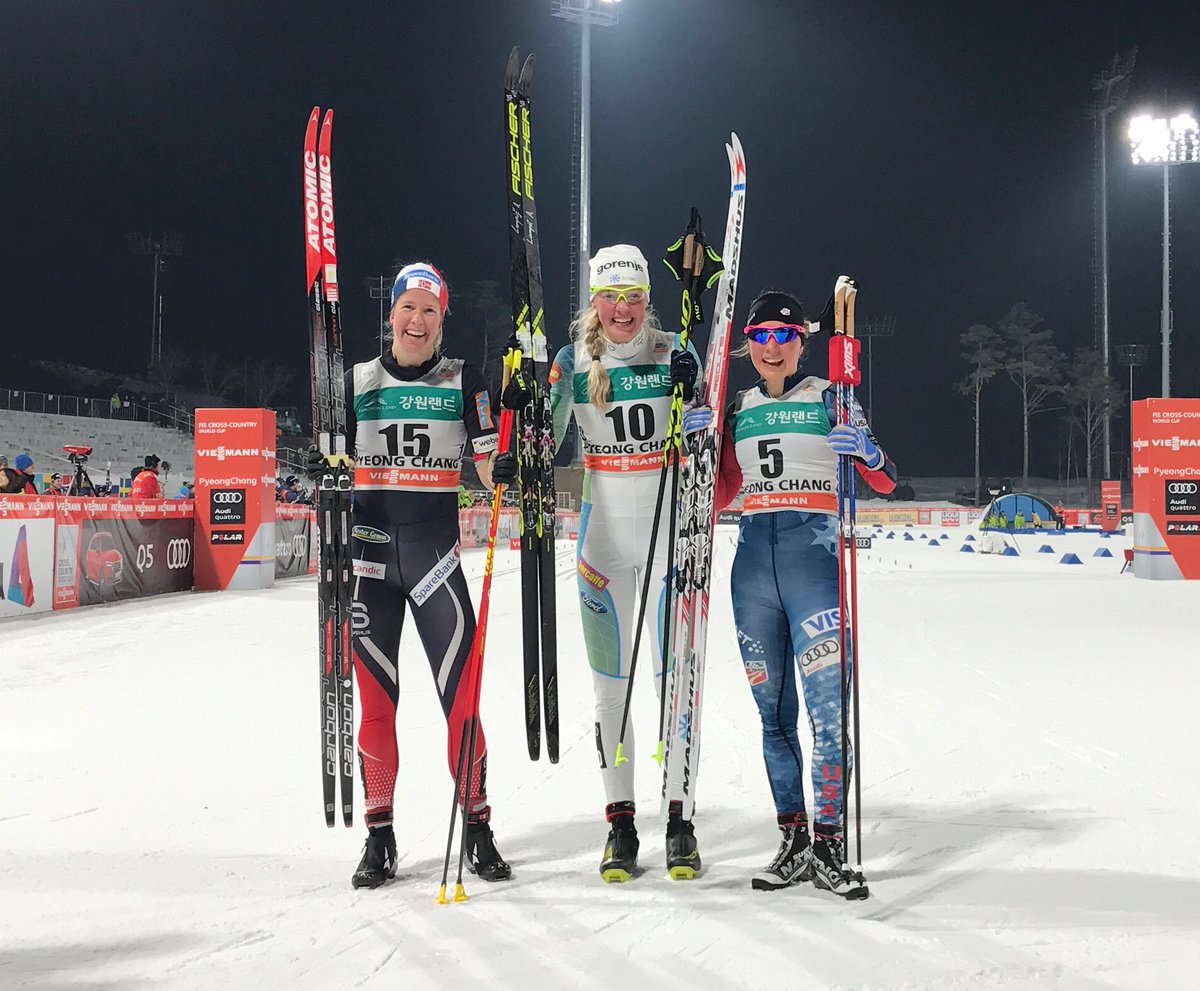
    The women's 1.4 k classic sprint podium on Friday at the pre-Olympic PyeongChang World Cup in South Korea, with Slovenia's Anamarija Lampič (c) in first, Norway’s Silje Øyre Slind (l) in second, and American Ida Sargent (r) in third. It was the first time on the World Cup podium for all three athletes. (Photo: FIS Cross-Country/Twitter)
    The women’s 1.4 k classic sprint podium on Friday at the pre-Olympic PyeongChang World Cup in South Korea, with Slovenia’s Anamarija Lampič (c) in first, Norway’s Silje Øyre Slind (l) in second, and American Ida Sargent (r) in third. It was the first time on the World Cup podium for all three athletes. (Photo: FIS Cross-Country/Twitter)

    In the last month, we’ve seen two U.S. Ski Team members — Jessie Diggins and Sadie Bjornsen — on the World Cup podium. Add Ida Sargent to that list.

    On Friday, the Vermont native raced to third in the women’s 1.4-kilometer classic sprint at the first-ever World Cup in PyeongChang, South Korea. It was the first of three days of racing in PyeongChang, which will host the 2018 Winter Olympics next season.

    Sargent qualified fifth (4.76 seconds behind her teammate Sophie Caldwell, who won the qualifier in 3:40.89 minutes) and went on to win her quarterfinal in a photo finish, then placed second her semifinal (also in a photo finish), edging Russia’s Alisa Zhambalova in third by less than 0.01 seconds.

    Both advanced to the final, where Sargent ultimately finished third, 1.79 seconds behind Slovenia’s Anamarija Lampič, who won in 3:41.97. Norway’s Silje Øyre Slind took second (+1.6), just 0.19 seconds ahead of Sargent. For all three women, it was their first time on a World Cup podium.

    Sargent beat out Poland’s Justyna Kowalczyk for third by 0.56 seconds. Zhambalova finished fifth and Slovenia’s Katja Visnar was sixth (+17.1).

    “I’m really excited about the podium and it hasn’t really set in yet,” Sargent wrote in an email on Friday. “It has been a goal of mine for a long time to be on the podium so it was a very special day! I’ve been inspired by so many fast teammates so happy to follow in their footsteps!”

    All five U.S. women racing on Friday finished in the top 30 to qualify for the heats. Caldwell won the qualifier by 1.84 seconds over Kowalczyk, Caitlin Patterson qualified 22nd, Liz Guiney 25th and Liz Stephen 29th (Stephen’s first time making the heats in three years).

    Jessica Yeaton, who races for Australia but trains with Alaska Pacific University, took the last qualifying spot in 30th (+26.29).

    Canada’s Annika Hicks and Sadie White missed qualifying in 32nd (+32.96) and 34th (+38.96), respectively, out of 36 women.

    Caldwell won her quarterfinal but finished fourth in her semifinal (behind Slind, Kowalczyk, and Sweden’s Maria Nordström, respectively) to miss advancing to the final. She placed eighth overall.

    Guiney placed 24th overall after finishing fifth in her quarterfinal, Stephen was 25th after taking fifth in the same quarterfinal as Sargent (where Yeaton finished sixth for 30th overall), and Patterson was 27th after finishing sixth in her quarterfinal.

    ***

    Both Canada’s Len Valjas and American Andy Newell reached the final in the men’s 1.5 k classic sprint on Friday, where they raced to fourth and sixth, respectively.

    Valjas started the day by qualifying in second, 1.97 seconds behind Russia’s Alexander Panzhinskiy, who topped the qualifier in 3:26.78. The Canadian went on to advance in second from his quarterfinal and fourth as a lucky loser from the first semifinal. In the final, he missed out on the podium in a photo finish with Russia’s Andrey Parfenov, who took third, 0.01 seconds ahead of him.

    Meanwhile, Newell qualified seventh (+5.18) and took second in both his quarterfinal and semifinal (finishing the second semifinal 0.34 seconds behind Panzhinskiy in first).

    In the final, Russia’s 25-year-old Gleb Retivykh pulled off his first World Cup victory and podium with a 0.3-second win over Norway’s Sondre Turvoll Fossli in 3:30.79. Retivykh qualified sixth (+4.53) then won his quarterfinal and placed third in the same semifinal as Valjas, advancing as the other lucky loser.

    “I had wait six years for my first victory and it is great,” Retivykh said, according to an International Ski Federation (FIS) press release.

    Russia had two on the podium with Parfenov in third (+0.73), just ahead of Valjas. The third Russian in the final, Panzhinsky ended up fifth (+1.49), ahead of Newell in sixth (+17.19)

    Three Canadian men qualified for the heats, with Jess Cockney in 16th (+10.24) and Simon Lapointe in 25th (+14.15). Bob Thompson missed 30th by one-hundredth of a second in 31st (+16.95), and Julien Locke was 36th (+17.9).
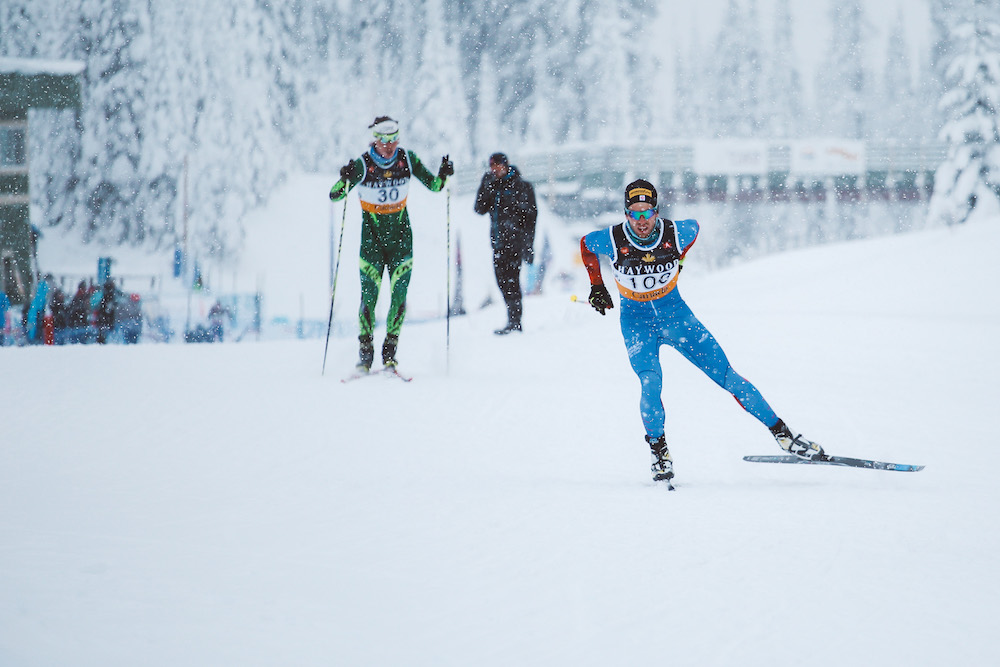
    Three Americans qualified as well, with Simi Hamilton in 12th (+8.26) and Matt Gelso in 29th (+16.66). Distance skiers Scott Patterson and Noah Hoffman finished 44th (+24.21) and 48th (+25.28) out of 55.

    Cockney reached the semifinals after winning his quarterfinal. In the second semifinal with Newell, he placed fifth, 5.44 seconds behind Panzhinskiy, for 10th overall.

    In Cockney’s quarterfinal, Hamilton crashed and finished fourth (+41.9) for 17th overall.

    Canada’s 23-year-old Lapointe finished sixth in his quarterfinal to place 27th, besting his previous World Cup best by 43 places. Gelso took 29th for his first-ever World Cup points after placing sixth in his quarterfinal.

    Results:

    Women’s qualifier | Women’s brackets

    Men’s qualifier | Men’s brackets 

  • Holmes, Palmer-Charrette Win Black Jack Mini Tour

    Holmes, Palmer-Charrette Win Black Jack Mini Tour

    The start of the A final, day two of of the BlackJack mini tour in Rossland. Newell (301) leads Locke (304, tallest) with Kennedy nearest. (Photo: Dafné Theroux Izquierdo)
    The start of the men’s freestyle sprint A-final on Day 2 of of the NorAm mini tour in at Black Jack Ski Club in Rossland, B.C. American Andy Newell (301) leads Julien Locke (304, tallest) with Russel Kennedy nearest. (Photo: Dafné Theroux Izquierdo)

    The Black Jack mini tour represented the final chance for Canadians to earn World Cup Period 2 starts. A timely week of snow and colder weather delivered great skiing conditions after an unusually warm November wreaked havoc on most of the western ski areas. That same warm weather canceled the Bozeman combined SuperTour/NorAm, which reduced the selection races from seven days to five.

    Chelsea Holmes of Alaska Pacific University (APU) continued her winning ways in Canada, destroying the field in the 10-kilometre freestyle on Friday, placing fourth in the Saturday freestyle sprints, and holding off the field in the 15 k classic pursuit on Sunday with the second-fastest race time to complete the weekend with an aggregate time of 1:08:04.4.

    Erika Flowers of the Stratton Mountain School (SMS) Elite team finished the weekend in second, 2:23.9 behind. Olivia Bouffard-Nesbitt of the Alberta World Cup Academy (AWCA) and Canadian National U25 Team took third, 0.2 seconds ahead of Katherine Stewart-Jones of the Thunder Bay National Team Development Centre (NTDC TBay).  Bouffard-Nesbitt and Stewart-Jones will also be very close on the NorAm leaderboard, and one of them has earned a quota spot for World Cup Period 2.

    In the men’s overall, Evan Palmer-Charrette (NTDC TBay) started the pursuit with a 37-second lead after winning the 15 k freestyle and placing third in the freestyle sprints. Palmer-Charrette held off the chasers to take the overall title and, most likely, the Continental Cup (COC) leader’s spot for World Cup Period 2.

    Alexis Dumas of the Pierre Harvey National Training Centre (CNEPH) charged up from a sixth-place start to grab second overall with the fastest time of the day, 52.2 seconds behind Palmer-Charrette. AWCA’s Jack Carlyle used the second fastest time of the day to take third overall, 1:10.1 back.

    Friday: Freestyle Interval Start

    In a reprise of the the previous Sunday’s event at Sovereign Lake, Holmes won the 10 k by an even larger margin, 1:49.4 minutes, finishing in 29:37.8.

    I love the courses here,” Holmes wrote in an email to FasterSkier. “Lots of steep climbing followed by technical downhills … very fun!”

    She learned from her 31-second victory five days earlier: “Last week in the 10k I exploded into a million pieces at 5km, so I tried very hard to control myself in the first lap today.”

    Flowers, who caught a ride with Holmes the previous week, moved up one place to second despite the larger time gap.

    I felt decent skiing (albeit a bit cold!) but definitely have some work to do on the downhills and keeping my tempo up on the hills,” Flowers wrote. “I tend to ski with a lot of glide so I am learning to turn it over a bit more when is cold like this and good glide is harder to come by.”

    This would be the warmest day of the three, with a high of -12 degrees Celsius.

    Bouffard-Nesbitt placed third (+2:27.2), and was already missing the deeper field of the previous weekend.

    “When you have 2:27 separating the top 3, that’s not something you really want to see at the highest level of domestic racing,” Bouffard-Nesbitt wrote.

    In the men’s 15 k, Palmer-Charrette made up for his head cold-induced DNF the previous weekend with the winning time of 40:36.7.

    Until today I had not had a strong distance race this year, so it was great to see the form come around.”

    Palmer-Charrette was also missing the deeper SuperTour field.

    “This weekend definitely is not as competitive […] as we had last weekend with the Americans in Sovereign Lake,” he wrote. “I’m disappointed [that] I was under the weather when we had the chance to race with them.”

    Russell Kennedy (Team R.A.D.) was leading after 5 k before fading to second, 31.1 seconds back.

    “I really wanted the win after the first lap but my body was feeling a little fatigued,” he explained in an email. “It was cold and the snow wasn’t very fast, but the weather was nice.”

    Erik Carleton, of Rocky Mountain Racers and the Canadian Para-Nordic Ski Team, was happy with his third place, 56 seconds back, especially after a late arrival on Thursday.

    “My teammate [and fellow Para-Nordic guide] Graham [Nishikawa] and I waxed our own skis, with the help of some good advice, and the outcome was positive,” Carleton wrote.

    Carleton and Nishikawa have raced at a lot of venues, while guiding paralympian Brian McKeever and in their own domestic and World Cup careers, and are a good source for course comparisons.

    “It was a fun and challenging course, with steeper climbs and slightly more technical downhills than most courses,” Carleton wrote of the Black Jack trails. “At -18C this morning, the snow was quite slow, especially on the steep uphills. If you had decent skis, the course was more of factor than the conditions. Climbing steep uphills with no glide was a key to a good race.”

    SMS Elite’s Andy Newell, freshly arrived from the World Cup circuit, placed fourth (+1:08.9).

    It’s my goal to use these races to help get back into the feeling of racing again after such a rocky start to the season,” Newell wrote after Friday’s race. “I was happy with the way today went and they way my body felt.”

    Newell is another athlete with wide experience of race courses: “Having just come off the world cup I can tell you that these courses here are top notch,” he wrote.

    Saturday: Freestyle Sprint

    Saturday brought a romantic result to a chilly day, with the affianced Flowers and Newell winning the women’s and men’s sprints, respectively.

    Bouffard-Nesbitt won the qualifier and easily moved through to the A-final, but Flowers was first at the line.

    Olivia skied really well off the line and up the entire first half of the course-super smooth and strong,” Flowers wrote. “I was able to jump in behind her in second and tried to chase her down leading up to the high point of the course. By the top of the first big climb we had a sizable gap on the rest of the field but she was still a few meters ahead of me so I tried to ski hard over the top of the hill and free skate the downhill in order to chase her down. I was able to get right behind her going into the last little uphill and felt good coming off the downhill into the finish stretch for a drag race finish.”

    The sprint course has some tricky descending which didn’t affect the top racers or Flowers’s enjoyment of the day.

    “I did get to see a few epic crashes on the S-turns and I thought it was fun to join my fiance Andy on the top of the podium!” she wrote.

    Bouffard-Nesbitt was also positive about her race, despite coming up 0.44 seconds short of the win.

    “I’m pretty happy with my race today!” she wrote. “Definitely happy with my qualifier. I skied the final just like I skied the final in Silver Star — I left it all out on the course.”

    Bouffard-Nesbitt found her legs were fading in the finishing stretch, after spending much of the summer on crutches.

    Stewart-Jones placed third (+7.89), edging Holmes by four-hundredths of a second.

    “Olivia and Erika skied impressively well, all day today!” Holmes wrote. “Olivia took the final out hard and Erika followed… I didn’t see much after that but the results tell the story!”

    Maya MacIsaac-Jones (AWCA/NST U25 Team), who is recovering from a more-recent foot injury than Bouffard-Nesbitt, held off her NTDC TBay’s Annika Richardson by nearly 2 seconds for fifth (+10.65).

    Newell won the men’s qualifier and every heat before topping the A-final in 2:44.81.

    Another view of the men's A final. Newell and Lapointe (black suit hidden by Newell) would lead out early. Kennedy is nearest, Locke is tallest, the TBay skiers are light blue. (Photo: Dafné Theroux Izquierdo)
    Another view of the men’s A-final. Newell (far right) and Lapointe (black suit hidden by Newell) take the lead out early, with Kennedy (nearest) Locke, and the Thunder Bay NTDC skiers in light blue. (Photo: Dafné Theroux Izquierdo)

    “I was happy with the race today,” he wrote. “The cold temperatures felt a little more manageable today and it was a great opportunity to race 4 hard rounds on a fun sprint course.

    “It was my strategy to be in a front position to be able to charge up the second hill and gap the field, which was the strategy I used in all the heats,” he added

    Former Black Jack racer Julian Locke (AWCA) was 1.05 back, outreaching Palmer-Charrette by 0.05 seconds.

    “[CNEPH’s] Simon Lapointe was pushing pretty hard with Newell and Russell Kennedy with him,” Locke wrote. “I had to put on the gas halfway up [the first long hill] to get back with the leaders and stay in the race. I made contact with the group going over the top and then got behind Newell going over the small hill in the middle of the course, following him down through the twists and into the finish. Evan Palmer-Charrette had some good speed coming into the lanes and we had a fun lunge to the line.”

    Kennedy was on the wrong side of the gap for fourth. Lapointe and NTDC TBay’s Angus Foster, who with Palmer-Charrette crashed out of the previous weekend’s sprint, rounded out the A-final in fifth (+6.26) and sixth (+6.97), respectively. 

    Sunday: Classic Pursuit

    Sunday brought slightly warmer conditions for the 10/15 k classic pursuits, but the waxing was still straightforward with -13-degree Celsius air and colder snow.

    Holmes started the 10 k pursuit with a 1:42 head start and kept the lead, finishing in 35:35.4, which stood as the second-fastest time of the day. Her race plan was simple.

    I think the expression is to go out ‘like a bat out of hell.’ ”she wrote on Saturday night.

    On Sunday, she was feeling more contemplative after the race: “I have never started off the front in a pursuit and quite honestly it made for some different feelings out there… surprisingly lonely.”

    Flowers was third on Sunday, 48.1 seconds back, but it was enough to maintain her second overall (+2:23.9).

    “I wasn’t thrilled with my race today but it was a good mental challenge to get out there and play around with some classic skiing,” Flowers wrote. “I have some work to do there technically for sure and while I wasn’t pleased with how I skied, I now know where to focus some training energy over the next few weeks so that’s a good thing!”

    Bouffard-Nesbitt was fifth-fastest on the day, 1:04.7 back, but was able to finish ahead of a flying Stewart-Jones by a scant 0.6 seconds for third on the mini-tour podium (+3:25.2).

    Stewart-Jones was the fastest in the 10 k classic, 6.2 seconds ahead of Holmes, for fourth overall (+3:25.7).

    “I was able to stay relaxed and set into a good pace on the first lap and really dig deep on the second,” Stewart-Jones wrote. “It took awhile to get into race shape but every race I have felt stronger. I’m really looking forward to the rest of the season!”

    Richardson was fourth-fastest of the day after starting fourth, dropping one place to Stewart-Jones who started 8 seconds behind her for fifth overall (+4:08.7).

    Palmer-Charrette started the men’s 15 k classic pursuit with a 38-second lead over Kennedy.

    I skied smooth and relaxed at the front of the race,” Palmer-Charrette wrote. “I kept the pace quite conservative until the second half of the last lap just to ensure I had an extra gear in the tank in case someone started to bring back major time.”

    Palmer-Charrette was very happy with his first time leading a pursuit and first mini-tour win. He finished 52.2 seconds clear of runner-up despite Dumas, who posted the fastest time of the day. (Palmer-Charrette’s time ranked fourth, 1:14.7 behind Dumas.)

    “I was really happy with my weekend, mostly with how consistent I was able to ski all three days. Today I was pretty far off the win [for time of day], but skiing out front racing for the mini tour overall I didn’t quite leave it all out there,” Palmer-Charrette wrote.

    Dumas started in sixth, 2:08 back, but was able to ski through to second after catching Kennedy, Newell, Carleton and Carlyle, all of whom started ahead of him. Carlyle had the second-best time of the day, 29.9 seconds slower than Dumas, to move from fifth to third overall (+1:10.1).

    Carleton was third on the day, 1:01.2 back, and came within 0.8 seconds of catching Kennedy, who finished the mini tour in fourth overall (+1:20.8) after starting second.

    “It was a good weekend,” Kennedy summarized. “I just couldn’t seem to hold it together in the classic but learned a lot and have some stuff to work on over Christmas!”

    ***

    At the end of the three days of racing, there were a lot of positive comments, but as Holmes put it:

    I am very glad that I chose to come to Rossland to finish off my early season racing — all the girls were super great, Canmore Nordic (who helped me with wax for the weekend) and the venue, organizers and volunteers were top notch!”

    ***

    Results: Day 1 | Day 2 (QualifierHeats) | Day 3 (click “overall results” and “aggregate results” tabs on top of page)

  • Sovereign Lake NorAm/SuperTour: Photos, Notes & Quotes

    Sovereign Lake NorAm/SuperTour: Photos, Notes & Quotes

    Team RAD's Russell Kennedy powering through the snow to be top Canadian in the 15 km. (Photo: Marie-Éve Bilodeau-Corriveau)
    Team R.A.D.’s Russell Kennedy (r) powering through the snow to finish at the top Canadian in ninth in the men’s 15 k freestyle on Sunday, Dec. 11, at the Sovereign Lake NorAm/SuperTour. (Photo: Marie-Éve Bilodeau-Corriveau)

    VERNON, B.C. –The combined Noram/SuperTour last weekend at Sovereign Lake, British Columbia, produced some exciting skiing and some challenging photography conditions with almost non-stop snowfall both days. Some of our best photos that didn’t make the two-day race recap are included below, but first, a little background and feedback:

    The NorAm circuit has not been a fully North American circuit since 2006. This year, Canada and the U.S. planned two combined NorAm/SuperTour events in Bozeman, Montana, and Sovereign Lake, B.C. With the relocation of the Bozeman event to West Yellowstone, Sovereign Lake became the only combined event of the season.

    While many athletes dream of a return to the glory days of this series, the 2006/2007 birth of the SuperTour coincided with a second Continental Cup quota spot, allowing each country to send one “COC” leader of each gender.  Effectively, each country became a “continent” in the eyes of the International Ski Federation (FIS). Combining the two series could reduce North America to one COC position per gender.

    FasterSkier asked athletes and organization leaders what they thought of the 2016 combination of the early season NorAm and SuperTour:

    “I think what became very clear last year [in] the discussion with the coaches and the Canadian people, instead of trying to send to our athletes East to West, maybe it’s better to send them North to South. In terms of saving cost, obviously, and more competition between better athletes, [this] is better to improve the quality of our athletes in Canada and the US.”Robert Lazzaroni, U.S. Ski & Snowboard Association (USSA) nordic domestic program director

    “If you back to the NorAm races, when we used to do them with the U.S., when Devon Kershaw was racing Justin Wadsworth … ‘x’ number of years later, the one guy is coaching the other guy. Crossing over generations is very important.”Thomas Holland, Cross Country Canada (CCC) high performance director

    “The altitude at West Yellowstone is too high to use it as a selection race for the Canadian team.” — Holland, on applying the FIS limits to selection races.

    “I think it’s an incredible opportunity. I think we as North Americans don’t get the opportunity to have such a competitive field and I think coming together and making each other better is super important and think there’s just so much more to learn.”Julia Kern, Stratton Mountain School (SMS) Elite

    I really like it. This has been a very well-run, well-organized event. It’s really fun to race against other athletes, more people than the usual SuperTour field. It would be awesome to have more.”Kaitlyn Miller, Craftsbury Green Racing Project (CGRP)

    I can’t express to you how much I love it and how happy I am. I’ve been telling everyone I run into that I absolutely love it, and I would wish that the entire circuit could be combined the way it is today. I know that logistically, that’s not totally possible, but it’s so good for us, it adds such a depth of field. It’s just so much more fun, I love it. Yeah, I love it.”Olivia Bouffard-Nesbitt, Alberta World Cup Academy (AWCA)

    “I think it’s awesome. I think we should do more of these, for sure. Rossland and Silver Star and Canmore, it’s always beautiful snow and great grooming, and a really hilly, challenging course. I think all three of those have some really good terrain; it’s always fun to come up here and get a little bit different than our usual back courses back home.”Jennie Bender, Bridger Ski Foundation (BSF)

    It’s been great. I’ve been amazed at the professionalism here. They’ve put on an amazing event. For us in North America, we have it unique that we are separate from Europe and it’s cool to be able to challenge each other against the Canadians, and I think we should have more of it.”Heather Mooney, CGRP

    It’s just great. In sport and in skiing, I always believe that you need to race against the best.  That’s why we’ll be racing in Europe in February. It’s a super good idea, and I don’t know why we didn’t do it earlier.  They’re so close to us, so we need to race against them, and they need to race against us.”Antoine Briand, Pierre-Harvey National Training Centre (CNEPH)

    I think it’s incredible. Last year at our athlete meeting at Canadian Nationals, I made that point very strongly a couple times. I raced U.S. nationals in Houghton last year. That was an awesome event, I thought. Having a higher level of competition benefits everyone and then when we get to racing deeper fields in Europe, we’re not caught quite as offguard.”Evan Palmer-Charrette, Thunder Bay National Team Development Centre (NTDC)

    I think it’s awesome. I think it’s better for both the Americans and the Canadians. Everybody that I’ve talked to likes it. It raises the level of competition, we’re still competing for SuperTour points and NorAm points respectively. It just makes a deeper, faster field.”Reese Hanneman, Alaska Pacific University (APU)

    It raised the level of competition a lot, brings everyone’s game up, I think it’s good for North American skiing.”Cole Morgan, Sun Valley Ski Education Foundation (SVSEF)

    “It’s the best, we need to do this all the time. It’s so good to mix it up and see all of our best racers. I think if you look back generations, guys like [Chris] Jeffries and [George] Grey and Kersh [Devon Kershaw], like [Ivan] Babikov, they cut their teeth on a combined circuit. I think their success on the world cup is definitely in part due to that. I hope we get a couple more opportunities to keep racing each other.”Ben Saxton, SMS Elite (Note: Jeffries is the AWCA head coach, Grey placed eighth in the skiathlon at the 2010 Vancouver Olympics, Kershaw was second overall in the 2012 World Cup,  and Babikov is one the Canadian World Cup coaches.)

    I think it’s a great idea. It’s really nice to get some deeper fields, to get the Americans and Canadians racing together. It wasn’t so fun to watch the podium here, to watch it filled up with Americans, but when all the Canadians go down in the semi, that was happens. We’ll be down at US Nationals for sure.”Angus Foster, NTDC Thunder Bay

    It’s really good, because the level is really high with the U.S. Good for us to see other skiers, and other fast guys.”Alexis Dumas, CNEPH, the second Canadian and 15th overall in the men’s 15 k

    I love it! I think it’s like the best thing for our sport. The camaraderie, and also you learn so much from your peers, it’s super important and so valuable.”Chelsea Holmes, APU

    I love it, I hope we do more. I think it’s awesome for everyone involved.”Katharine Ogden, SMS Elite

    I love it. It’s fun having a bigger field and a new venue. I love Silver Star, this place is hard to beat.”Erika Flowers, SMS Elite

    More photos: XTS Photography | Team Gregg


  • Americans Lock Out Canadians at Sovereign Lake NorAm/SuperTour

    Americans Lock Out Canadians at Sovereign Lake NorAm/SuperTour

    APU's Reese Hanneman (315) leading down the finishing stretch, with Sun Valley's Cole Morgan (r), Moritz Madlener (behind Hannneman) and Ben Saxton (behind Morgan) chasing. (Photo: Doug Stephen)
    APU’s Reese Hanneman (315) leading down the finishing stretch of the Sovereign Lake NorAm/SuperTour men’s classic sprint final on Dec. 10, with Sun Valley’s Cole Morgan (r), the University of Denver’s Moritz Madlener (behind Hanneman), Stratton’s Ben Saxton (behind Morgan), and Sun Valley’s Matt Gelso (behind Madlener) chasing. (Photo: Doug Stephen)

    VERNON, B.C. — It might’ve been the first Canadian NorAm of the season, but the Americans made it all about themselves in what also doubled as their second stop on the U.S. SuperTour circuit this past weekend at the Sovereign Lake Nordic Centre.

    U.S. skiers kept Canada off the podium in the classic sprints and freestyle intervals starts on Saturday, Dec. 10, and Sunday, Dec. 11, with Olivia Bouffard-Nesbitt, of the Alberta World Cup Academy (AWCA) and Canadian U25 Team, coming closest in fourth on Day 1.

    On Saturday, Bouffard-Nesbitt started off the very first NorAm race, a 1.2 k classic sprint, with a qualifying win. She went on to advance in second in her quarterfinal and third in her semifinal, before finishing fourth in the A-final, 1.49 seconds out of first.

    American Julia Kern of the Vermont-based Stratton Mountain School (SMS) Elite Team (formerly the T2 Team) won the women’s final in 3:17.04, after qualifying fifth and placing second in both her quarterfinal and semifinal. Kern led two Craftsbury Green Racing Project (CGRP) teammates, Liz Guiney and Kaitlynn Miller, in second (+0.67) and third (+0.91) on the podium, respectively.

    Bouffard-Nesbitt leads the American's through the bridge turn. Kern's tactical choice over a minute earlier gave her the inside position on Miller and the advantage she needed. (Photo: Peggy Hung)
    Olivia Bouffard-Nesbitt (AWCA) leads the Americans through the bridge turn in the women’s classic sprint A-final on Saturday, Dec. 10, at the Sovereign Lake NorAm/SuperTour. Stratton’s Julia Kern (second from r) made a tactical choice more than a minute earlier, which gave her the inside position on Craftsbury’s Kaitlynn Miller (l) and the advantage she needed to win. (Photo: Peggy Hung)

    Bouffard-Nesbitt led the six finalists into the finishing straight after opening up a wide gap at the top of the second climb.

    “Yeah, those Americans,” Bouffard-Nesbitt told FasterSkier after the race. “I was in first until we hit the final finishing straight, and then I just got out-double poled by three of the girls.”

    Kern, a U.S. Ski Team Development Team member and Dartmouth student, credited tactical choices for her victory.

    “In the quarterfinal, I made the mistake of not taking the outside, which turned into the inside turn on the second downhill,” Kern said.

    The second downhill on Sovereign’s sprint course has a gentle right turn leading into a high-speed left, followed by the long climb and then two sharp left turns to the finish. Keeping control of the inside for the last three turns gave Kern the ideal position to take the second skied-in finish lane to cross the line first.

    Guiney followed Kern to second, leaving Miller with the fresh snow in lane three.

    “I was in third the first half of the course, just stayed in the mix,” Miller said of the final. “I really like the striding hill at the end.”

    Despite being slowed in the final straight, Miller loved the conditions.

    “This course is really nice, the conditions are awesome,” she said. “I love all the fresh snow. We had really great skis today, so that always helps.”

    While Bouffard-Nesbitt was disappointed that there wasn’t a Canadian on the podium, she was happy with her day.

    “I haven’t really sprinted this year,” she said, referring to a stress fracture in her foot that put her on crutches for several months this summer. “The intensity I’ve done since I’ve been back on my feet has been almost exclusively controlled Zone 3.”

    The fourth American in the top five, Jennie Bender of the Bridger Ski Foundation (BSF) qualified third and finished fifth overall (+3.8). The SuperTour leader after West Yellowstone’s first two races of the season, she was disappointed with fifth.

    “It was a tough field out there,” Bender said. “It’s a really short course, lots of turns, three different 180-degree turns. I kind of got swallowed up on the last downhill and lost a little gusto.”

    Asked if she was tempted to double-pole the course, Bender laughed and said, “I was! I might of been interested to do it during the qualifier, but I was third, and yeah, I’ll keep the striding.”

    A third Craftsbury skier in the A-final, Heather Mooney qualified ninth and went on to finish sixth in the final (+19.84).

    “It’s a really fun course, fun with lots of transitions,” Mooney said. “Off the start of the final, I was really excited that we had three from our team. I just didn’t quite have it at the beginning, caught back up a little bit, but I was definitely on and off the back of the pack. Came in last, but it was a good day.”

    All six of the women’s B-finalists were American, with Becca Rorabaugh of Alaska Pacific University (APU) ultimately placing seventh, Erika Flowers (SMS Elite) eighth, Mary O’Connell (CGRP) ninth, Jessica Yeaton (APU) 10th, Mary Rose of the Sun Valley Ski Education Foundation (SVSEF) 11th, and Anne Hart (SMS Elite) 12th.

    Maya MacIsaac-Jones, who had earned the opportunity to race World Cup Period 1, raced the NorAm sprint after sesamoiditis changed her early season plans.

    “I definitely wasn’t skiing as fast as I would like to be,” MacIsaac-Jones said, “but I am definitely just happy to be racing and on snow.”

    She was eliminated after placing fifth in her quarterfinal and skipped the 10 k freestyle on Sunday for a distance training session instead.

    ***

    The men's final on the first downhill. Hanneman leads Madlener, Briand, Gelso, and Morgan (Photo: Peggy Hung)
    The men’s final on the first downhill at the Sovereign Lake NorAm/SuperTour on Dec. 10 near Vernon, B.C. Sun Valley’s Cole Morgan leads Denver’s Moritz Madlener, CNEPH’s Antoine Briand, Sun Valley’s Matt Gelso, and Stratton’s Ben Saxton Saxton in pursuit of APU’s Reese Hanneman (not shown). (Photo: Peggy Hung)

    The men’s classic sprint shared the same 1.2 k course and the same American domination of the podium after a semifinal crash took three Canadians out of contention.

    Reese Hanneman (APU) double poled to the win in 2:38.08 after qualifying 15th. Cole Morgan (SVSEF) and Ben Saxton (SMS Elite) rounded out the podium in second (+0.87) and third (+1.92), respectively.

    “I had a really bad qualifier, for me. I chose a classic ski,” Hanneman said of his qualification round. “But I think [grip wax] was much slower, as the heats showed.”

    He described the A-final as fast from the start.

    “I had a decent start; I was in second behind Cole up until the top of the first climb. I made a pass, double poled by him, and I was kind of leading into the big climb,” Hanneman recalled.

    “Then he and I were side by side, one and two, with a little gap. Then up the steep pitch, he took the lead and I tucked in behind him and just followed him over the bridge. I was able to close down the gap and then pass him and then turn on the jets coming in the final double-pole section.”

    Morgan, who won the qualifier and was one of the four others on skate skis in the final, was also pleased with his tactics.

    “I did the same tactic as I did in every heat, try to be in second place coming into the big downhill before the last hill,” Morgan said. “[I] was able to lead over the top, but didn’t have the same finish as Reese did.”

    Saxton double poled all four laps, as did Hanneman, Morgan and many of the top men.

    “I think that was the faster call, but it was definitely a physical task those last heats there,” Saxton said.

    Another double poler in the final, the University of Denver’s Moritz Madlener ended up fourth (+1.92) after qualifying third.

    “Considering how much we trained the last couple of weeks, it was a great result,” he said.

    For Madlener, who is originally from Germany, this marked his first visit to Canada.

    “This is German territory. The last time there was a World Cup here, the first five were Germans,” he said, probably not realizing that it was 11 years to the day since that 30 k pursuit event.

    The lone finalist on grip wax, Matt Gelso (SVSEF) finished fifth (+3.88) after winning his crash-marred semifinal. Antoine Briand of the Pierre-Harvey National Training Centre (CNEPH) was the lone Canadian in the A-final, with a lucky loser time that was faster than Gelso’s winning time from the other semifinal.

    Angus Foster untangles himself as Evan Palmer-Charrette waits underneath. The ski through the big belongs to Simon Lapointe. (Photo: Shelley Woodman)
    Angus Foster (309) untangles himself after a semifinal crash at the Sovereign Lake NorAm/SuperTour on Dec. 10, as his NTDC Thunder Bay teammate Evan Palmer-Charrette tries to get his breath back. The ski through the bib belongs to Simon Lapointe. (Photo: Shelley Woodman)

    For a few Canadian athletes, the crash in the second semifinal was the defining moment of the day. Only 50 metres into the race, Gelso used his inside position in the tight pack to pull in front of Angus Foster, of the Thunder Bay National Team Development Center (NTDC), but Gelso skied over Foster’s ski, triggering a chain reaction.

    “[Gelso] got through, but I went down, had two other Canadians go down with me,” Foster said after. “Probably the hardest crash we’ve ever had.”

    Foster fell sideways in front of NTDC teammate Evan Palmer-Charrette.

    “I just got unlucky, [Foster] fell right in front of me, and I just pitchforked over him, got the wind knocked out of me pretty bad,” Palmer-Charrette said. “Unfortunate, but that’s racing.”

    CNEPH’s Simon Lapointe was the third skier in the tangle. Lapointe got up quickly, but a broken binding required him to wait for a coach to run over with a spare ski.

    Palmer-Charrette was slow to get up, leaving Foster pinned in place. Foster finished the heat with three holes in the back of his race bib and likely a few ski-shaped bruises underneath.

    Lapointe, one of the top Canadians sprinters, was the most frustrated with the semifinal crash. He left the finish area with a quick French-language “nothing to say” before going on to win the B-final by 1.06 seconds over Palmer-Charrette in 2:43.31.

    None of the three Canadians protested to the jury member at the finish. Asked directly about whether there was cause for a protest, Foster said “That wasn’t a clean move, but that happens. People make mistakes.  Still frustrating, but….”

    Gelso was surprised to find only one skier with him at the top of the second climb. “We both went for a track at the same time, and I don’t know what happened,” Gelso said later, “but I’ve been on both ends of that.”

    Everyone interviewed spoke favorably of the combined NorAm/SuperTour weekend.

    “It’s really nice to get some deeper fields, to get the Americans and Canadians racing together,” Foster said. “It wasn’t so fun to watch the podium here.”

    Day 1 results: Classic sprint brackets

    ***

    APU's Scott Patterson leading Canadian junior Ty Godfrey (Team R.A.D.) during the men's 15 k freestyle interval start on Sunday, Dec. 11, at the Sovereign Lake NorAm/SuperTour. (Photo: Peggy Hung
    APU’s Scott Patterson leading Canadian junior Ty Godfrey (Team R.A.D.) during the men’s 15 k freestyle interval start on Sunday, Dec. 11, at the Sovereign Lake NorAm/SuperTour. (Photo: Peggy Hung)

    Day 2 at Sovereign proved to be more populated with Americans sweeping the top five and nearly the top 10 in the men’s and women’s distance freestyle interval starts.

    In the men’s 15 k, Scott Patterson (APU) topped the field by 13.2 seconds with a winning time of 40:00.2. Gelso reached the podium in second — his third this season in four SuperTour races — and Tad Elliott (Ski Club Vail) placed third (+26.6).

    The U.S. swept the top eight with Brian Gregg (Team Gregg) in fourth (+54.8), Paddy Caldwell (SMS Elite/Dartmouth/USST) in fifth (+1:20.5), Ben Lustgarten (CGRP) in sixth (+1:27.4), Madlener in seventh (+1:31.3), and Kyle Bratrud (CXC Team) in eighth (+1:33.5).

    Russell Kennedy of the Canmore-based Team R.A.D. was the top Canadian* in ninth (+1:38.8), and John Hegman (SVSEF) finished 10th (+1:44.2).
    (*While Kennedy lives and trains in Canada, he is originally from Truckee, Calif.)

    Out of 112 finishers in the men’s race, nearly 50 were American, and two were Australian national team members.

    “Gelso’s definitely in good shape so it was good to hear splits out there that I was leading,” Patterson said. He started in bib 94 behind Gelso in bib 80.

    “Fifteen k skate’s kind of been my game, one race I can always fall back to and know I can ski pretty fast,” Patterson added.

    Asked about the event doubling as a SuperTour, he said it added competition.

    “I would have loved to see the Canadians in West [Yellowstone], but it’s a weird course, makes sense to skip it,” he said of the SuperTour’s usual first stop on the circuit (one of the few places in the U.S. with reliable early season snow) at the Rendezvous Ski Trails in West Yellowstone, Mont. The SuperTour opener was originally scheduled for Bozeman, Mont., which would have been a NorAm as well, but moved because of low snow.

    “It’s always fun to have a bunch of people that you don’t know all that well,” Patterson added. “This is my first time in Silver Star and it’s been great.  Real winter, and we’ve been lacking that in Anchorage [Alaska].”

    After spending a good chunk of last season in Europe on the World Cup, Patterson noted that even those venues tend to rely on manmade snow.

    “It’s nice to have dumping snow out here,” he said.

    “I think the third lap, things started to slow down,” Patterson added about the race itself. “I was getting ice through my glasses and eyes. It made things feel a little more closed in, feel like it’s snowing harder. I think it slowed down a little bit, but maybe that’s just getting tired, too.”

    Sun Valley's Matt Gelso (front) charging a false flat on his first lap of the men's three-lap 15 k freestyle on Dec. 11 at the Sovereign Lake NorAm/SuperTour. (Photo: Peggy Hung)
    Sun Valley’s Matt Gelso (front) charging a false flat on his first lap of the men’s three-lap 15 k freestyle on Dec. 11 at the Sovereign Lake NorAm/SuperTour, followed by Welly Ramsey (Ford Sayre). (Photo: Peggy Hung)

    Gelso recalled a slower last lap as well, but was pleased with his effort.

    “It’s a great course, and it was fun,” he said.

    Gelso was strongly in favor of combining the two North American circuits whenever possible, recalling a conversation he had with some U.S. and Canadian national-team members at 2015 World Championships.

    “Devon Kershaw and a bunch of the Canadians and Americans were staying in the same hotel, and we were talking about how cool … instead of having one Canadian, one American that goes to the World Cup on the Continental Cup, why [doesn’t the International Ski Federation] give North America three spots for Canada and the US, and all of our races are together?” he said. “Sometimes it will be three Americans, sometimes it will be three Canadians, sometimes it will be two and one, whoever’s racing fast. The more we are racing together, I think the better we’re going to fare internationally.”

    “I mean, we’re friends with these guys, we know who they are,” Elliott said of racing with Canadians. “Michael Somppi, Kevin Sandau, they’ve been visited us at U.S. nationals last year. Silver Star’s gorgeous, great skiing, great course, well-run races, so it’s always a pleasure to visit here.”

    Elliott, a former U.S. Ski Team distance skier, described feeling surprised with his effort on Sunday after what he called a “great sprint” in West Yellowstone (in which he placed 14th) followed by a head cold, which forced him to skip the West Yellowstone distance race.

    “I rested all week indoors, and I felt incredible today,” he said.

    Kennedy in ninth called his race a solid start, but had hoped to finished a “little higher up.”

    “The U.S. guys are skiing super-strong right now, you could just see it out there,” Kennedy said. “I thought I was skiing pretty well, and then got some splits off of Gelso, and OK, they’re moving. I am hoping when we have [World Championships] trials in Park City, we’ll be a little bit more up there, but we’ll see. It’s good to have that competition, too. You can’t rest anywhere, you have to push everywhere, so that’s good.”

    Asked about the NorAm/SuperTour combo, he was also positive.

    “It’s good for us to have the extra competition and it’s good to race new faces,” Kennedy said. “Especially in sprints, you get used to the same tactics from the same people. When you have someone new, it’s nice to have to adjust your tactics and be prepared for what they’re going to do when you don’t know them as well. In distance, it’s really cool to have new guys to chase. I can kind of know the Canadians, what’s happening with them, but I was chasing down David [Norris] today, and he kind of surprised me how strong he was on the last lap, it was good to have that extra push, for sure.”

    The second-fastest Canadian man of the day, Alexis Dumas (CNEPH) placed 15th (+2:13.1).

    “I feel really fast on the one-skate, and the uphill was good, too,” Dumas said after. “I improved a lot my offset this summer, so it was good for this course.”

    In terms of season goals, he’s looking to qualify for U23 World Championships, where he’d like to achieve a top 20.

    ***

    Chelsea Holmes leads Erika Flowers at the 5 k mark of the women's 10 k freestyle interval start on Sunday, Dec. 11, at the Sovereign Lake NorAm/SuperTour. (Photo: Marie-Éve Bilodeau-Corriveau)
    Chelsea Holmes leads Erika Flowers at the 5 k mark of the women’s 10 k freestyle interval start on Sunday, Dec. 11, at the Sovereign Lake NorAm/SuperTour. (Photo: Marie-Éve Bilodeau-Corriveau)

    In the women’s 10 k, Chelsea Holmes (APU) took the win in 30:42.9, topping the time of the race’s previous leader, Katharine Ogden (SMS Elite) by 13.4 seconds. Stratton had two on the podium with Flowers in third, 36.4 seconds back from Holmes.

    “The course was really hard, but my techs and coaches gave us really good skis,” Holmes said after. “Today, I had the most amazing team, all the boys finished and they were cheering so hard.”

    Holmes started 30 seconds after Flowers and 1 minute behind her APU teammate Rosie Frankowski.

    “Chelsea started right behind me, and her and Frankie [Frankowski] and I all skied together for most of it, which made it a lot more fun cruising through the snow,” Flowers recalled. “We had a good little crew going, so it was hard, but hard with friends.”

    Frankowski finished with Holmes and 59.9 seconds off her winning time in sixth place, behind Gregg in fourth (+40.8) and Rose in fifth (+51.7). APU had three in the top seven with Rorabaugh in seventh (+1:09.8). Craftsbury’s Guiney placed eighth (+1:17.9), Deedra Irwin (SVSEF) was ninth (+1:18.4), and Kern, Saturday’s sprint winner, 10th (+1:24.8).

    For the second day in a row, Bouffard-Nesbitt was the top Canadian woman, placing 13th (+1:51.8). Of the top 20, the U.S. swept all but three places: 13th, 18th with NTDC’s Annika Richardson, and 20th with Sovereign Lake’s own Hannah Mehain. (Both Richardson and Mehain belong to Canada’s Junior National Team.)

    “I’ve never had an easy race at Silver Star,” Bouffard-Nesbitt said after Sunday’s 10 k. “It was really hard as usual. To be honest, all morning, I feel pretty wrecked from yesterday’s race. Whole body, that sprint really took a toll on me. I was kind of just trying to play the hand I was dealt the best I could, make the most of it. I think I’m happy with it.”

    Asked how she felt about being the top Canadian for the second-straight day, albeit outside the top 10, she replied, “Let’s say, bittersweet. Obviously, we want to have Canadians represented at the top of these fields, among the Americans, but of course I’m happy to be top Canadian.”

    Regardless, she was glad to have the competition.

    “We not coming here to have easy wins; we’re coming here to be challenged,” Bouffard-Nesbitt said. “I’m very happy to have them here, and I’m very happy when they can show us what fast racing looks like.”

    Sixty-two women finished the distance race, and about half were American. Most of the NorAm field is headed to Rossland, B.C., for next weekend’s NorAm, which is not a SuperTour and will not count toward the U.S. Ski & Snowboard Association’s (USSA) national ranking list.

    Day 2 results: 10/15 k freestyle


  • MacIsaac-Jones Wins First Career NorAm; Shields Tops Sovereign Men’s Sprint

    MacIsaac-Jones Wins First Career NorAm; Shields Tops Sovereign Men’s Sprint

    VERNON, British Columbia — The NorAm youth movement continued into the second weekend of the Canadian domestic series on Saturday at the Sovereign Lake Nordic Centre, with three new athletes reaching the podium in the freestyle sprints.

    In the women’s 1.275-kilometre sprint, first-year senior Maya MacIsaac-Jones of Rocky Mountain Racers (RMR) won the qualifier and her semifinal before taking a convincing victory in the A-final in 2:37.60. The 20-year-old finished 2.56 seconds ahead of her teammate, Andrea Dupont in second place, and 18-year-old junior Marie Corriveau, of the Pierre Harvey Training Centre (CNEPH) and national junior team placed third, 2.86 seconds after MacIsaac-Jones.

    Maya MacIsaac-Jones (r) leads Rocky Mountain Racers teammate Andrea Dupont (second from r) and Marie Corriveau (CNEPH/NST Junior Team) into the finish for the A-final victory in the NorAm freestyle sprint at Sovereign Lake in Vernon, B.C. (Photo: Gerry Furseth)
    Maya MacIsaac-Jones (r) leads Rocky Mountain Racers teammate Andrea Dupont (second from r) and Marie Corriveau (CNEPH/NST Junior Team) into the finish for the A-final victory in the NorAm freestyle sprint at Sovereign Lake in Vernon, B.C. (Photo: Gerry Furseth)

    “It was a goal of mine this season to win a a NorAm so I’m pretty stoked to have that achieved,” MacIsaac-Jones told FasterSkier after the race. “I had a really tough sprint last week at the Canmore NorAm and I was really glad to be able to come back both mentally and physically from that and have a good race today.”

    A regular podium contender in the sprints, Dupont, 25, was less excited than her teammate.

    “It was pretty decent, yeah,” Dupont said. “It was a good day for the club, both Maya and myself, and Olivia [Bouffard-Nesbitt] comes from our club, too.”

    Bouffard-Nesbitt, of the National Senior U23+ Development Team, placed sixth in the final after winning her quarterfinal and placing second in her semifinal behind Dupont.

    First-year senior Maya MacIsaac-Jones (r) with her Rocky Mountain Racers teammate Andrea Dupont after the two placed first and second in the NorAm freestyle sprint on Saturday at Sovereign Lake. MacIsaac-Jones won for her first NorAm victory. (Photo: Gerry Furseth)
    First-year senior Maya MacIsaac-Jones (r) with her Rocky Mountain Racers teammate Andrea Dupont after the two placed first and second in the NorAm freestyle sprint on Saturday at Sovereign Lake. MacIsaac-Jones won for her first NorAm victory. (Photo: Gerry Furseth)

    “We were all tight,” Dupont said of the A-final. “I was chilling out and expecting the finishing kick would be enough to make it. Olivia and I unfortunately got tangled in the bottom of the course which put me out of the fight for the win.”  

    The final descent, sweeping right, and short climb into the finishing straight caused several challenges throughout the day, despite being more than 10 metres (33 feet) wide.

    “I love the course,” Dupont continued. “It is a nice three-minute sprint, compared to last weekend that was almost five. As someone who really loves sprinting, the five minute [course] was just too long.”

    Corriveau, a first-year junior, was excited to race with the senior women.

    “It was a great challenge and really fun,” she said. “It was my first senior podium.”

    The men’s 1.65 k sprint course shared the same start and final kilometre as the women’s, but had an extra loop that included two very short climbs.

    Andy Shields of the Thunder Bay National Development Centre (NDC) dominated the men’s qualifier, his quarterfinal, and his semifinal on the way to A-final victory in 3:15.68.  Sebastien Boehmler-Dandurand, 22, of Canmore, grabbed his first senior podium, 0.95 seconds back, and Knute Johnsgaard, of the Alberta World Cup Academy (AWCA) and U23+ Development Team, was visibly unhappy in third, another 0.28 seconds back.  The Canmore NorAm sprint winner, Bob Thompson (NDC Thunder Bay) finished fourth, also 0.28 seconds behind Johnsgaard.

    “I went to the lead right off the line,” Shields said, “which wasn’t exactly what I wanted to do.  I wanted to follow [because] there’s some headwind sections in the first part of the course.  When I got to the point when I wanted to make my move, I stretched it out and was able to stay pretty strong right to the end.”

    Shields accelerated hard on the third last climb, with only Johnsgaard staying close.  Johnsgaard allowed Shields a slight gap for the fast dip, but remained tight on Shield’s ski tails going over a narrow bridge — some 5 metres (16 feet) wide — leading into the final descent, turn and climb to the finish straight. On the final high-speed corner, Shields said he stayed clear ahead while Johnsgaard said he was impeded while trying to do an inside pass.

    “I had a lot of speed and was starting to slingshot Andy,” Johnsgaard said. “He saw me coming and really shut me down on the inside.”

    During Friday’s official training, Shields was seen taking one of the tightest exit lines on the corner.  Shields and Johnsgaard never faced off until the final (after both won their respective quarterfinals and semifinals), and Shields likely skied his preferred-and-practice line while Johnsgaard expected him to take the more common line.

    Dandurand took advantage of the tussle, carrying speed out of the second group to close the gap on Johnsgaard and edge ahead of him in the final metres for second.

    “In the final, my goal was to be always in the front because I knew at the last [downhilll] turn I could slingshot past and have a good line into the finish,” Boehmler-Dandurand said.” I had confidence in the final sprint so, yeah, it worked out almost perfectly.”

    He aimed to conserve energy in the quarterfinal, he explained, and finished second behind Angus Foster (NDC Thunder Bay). Boehmler-Dandurand then placed second in his semifinal after pushing “as hard as I could,” behind Shields in first. Their semifinal was slower than Johnsgaard’s (which he won) and Foster in third place did not advance.

    Johnsgaard was still shaking off the emotions at the podium ceremony.  “Third’s alright,” he said, “but I’ve been third and second and fourth and fifth so many times in the NorAms and I’ve never won one, so this is quite frustrating when this happens all the time.”

    Waxing was not a significant issue, with -4 degrees Celsius temperatures (25 Fahrenheit) and fresh snow overnight, but no falling snow during the open categories’ races.  Around 80 volunteers were on site to make the event happen.

    Complete results | Brackets