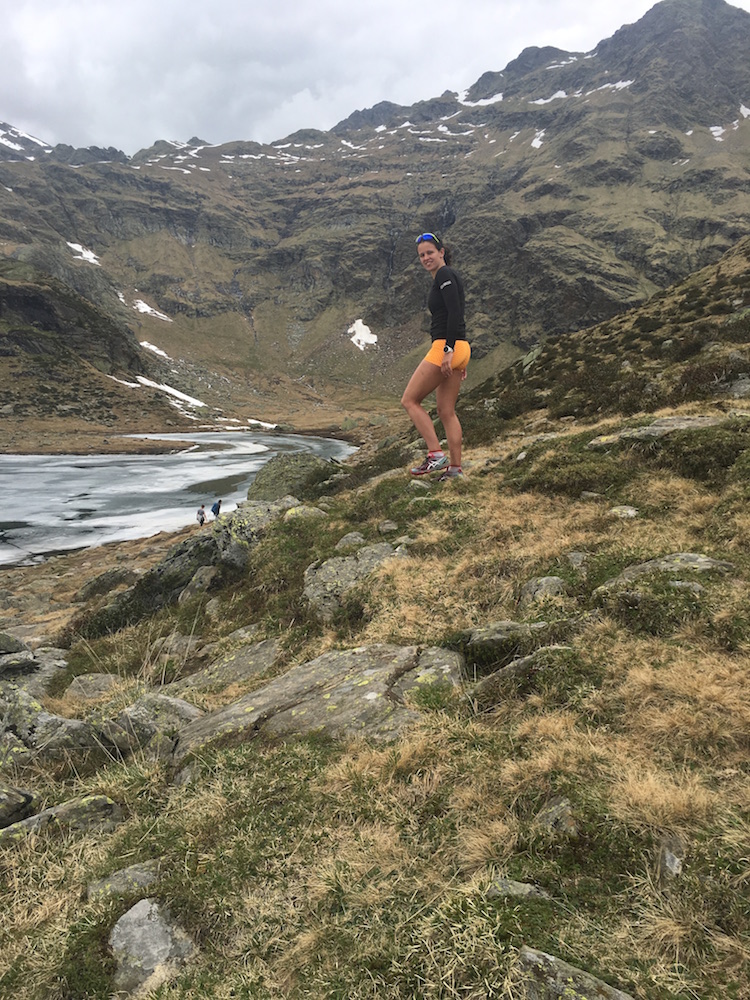
Ann-Cathrin Uhl on a hike in Germany this summer. (Courtesy photo)
Ann-Cathrin Uhl will be a senior at the University of Anchorage Fairbanks (UAF) this year, but for the summer she was back in her native Germany as usual.
Uhl made her first trip to NCAA Skiing Championships last season, finishing 30th and 34th at the races in Jackson, N.H. But she has long been a contributor to the UAF Nanooks effort both on the ski trails and as a cross-country runner. This summer, a group of ski teammates came to visit her in Germany.
Uhl is probably also a familiar name to American competitors as well, because in both 2015 and 2016 she won the junior heats of the classic sprint at U.S. Cross-Country Championships.
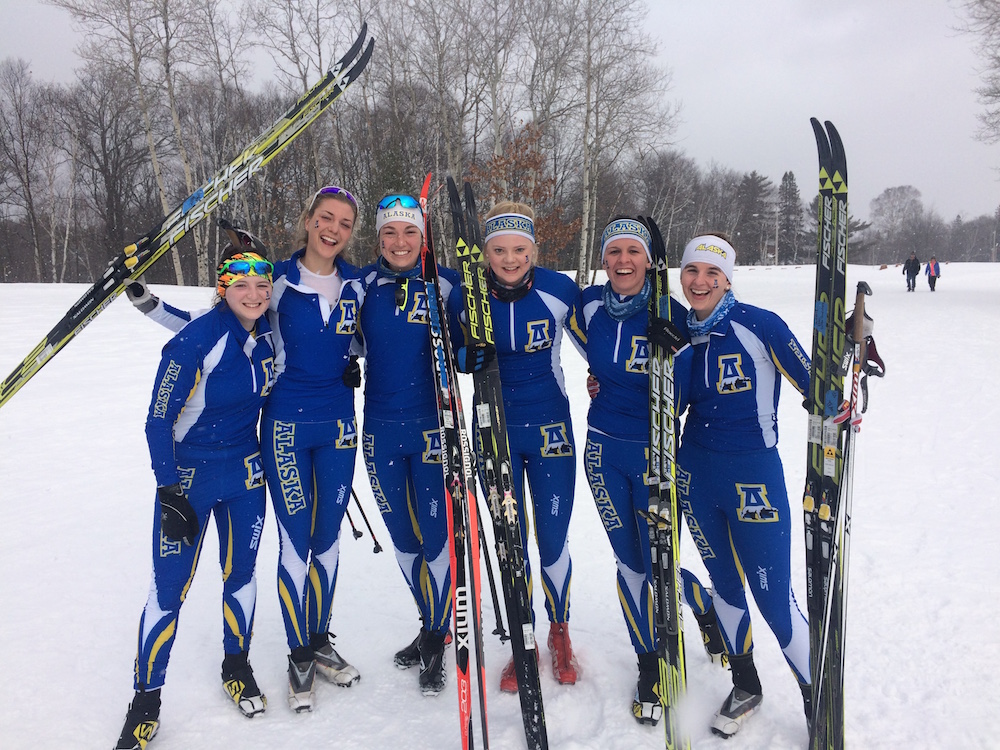
University of Alaska Fairbanks women’s nordic-team skiers get together for a photo last season: (from left to right) Hannah Rowland, Anne-Tine Markset, Nichole Bathe, Martina Himma, Ann-Cathrin Uhl, and Sarissa Lammers. (Photo: Nick Crawford)
Uhl took some time over email to share what it’s like to train from her home base in Germany’s Black Forest region, a mountainous region in the southwest of the country.
FasterSkier: Where are you based this summer? What part of the Germany?
Ann-Cathrin Uhl: This summer my training base is mainly the Black Forest, that is the southwestern part of Germany. I am living with my family in Mühlenbach, which is the town I grew up in. During the week I train at home and on some weekends I drive to the Alps for altitude training.
FS: What is your part of the Germany like? How is the landscape? What do people do there?
ACU: I live close to a town called Schonach, where the annual Nordic Combined World Cup is hosted. Sandra Ringwald, the German Nordic World Cup skier is also from this town. The Black Forest is a mountainous region, bordering France and Switzerland. Its beautiful nature with mountains, valleys, gorges, lakes and rivers is reason for lots of tourism. People that live here like to be outside and active. Hiking and mountain biking are very popular.
Uhl competing at German Mountain Running Championships, where she finished 30th and helped her team to sixth place. (Courtesy photo)
FS: Do you have a team that you are training with, or are most of your training sessions alone?
ACU: I don’t have a ski team I can train with. I do all the rollerskiing and strength on my own. But I am training with a professional mountain running team in my area. I actually got to know my teammates pretty well, since we were travelling to competitions together.
FS: How do you design your training — is it based on a plan from Nick at UAF? Are you adapting it at all to be able to match with other people/groups you might have opportunities to join?
ACU: My training is based on the plan from coach Nick at UAF. I am training with the running team two to three times a week and other than that I try to follow Nick’s instructions for rollerskiing, strength, volume, and intensity. Sometimes, I adapt the plan to train with the team.
FS: Is your college training plan very different in terms of volume, types of workouts, or other focus compared to what you would be doing if you were on a German team at the same level?
ACU: My college training plan is pretty similar to what I would be doing on a German team. I believe that Germans do more running and less strength than we do at UAF. Germans highly value intensity running workouts, whereas most of our intensity is on rollerskis, but other than that the plans are similar.
Uhl heading uphill on a rollerski workout. (Courtesy photo)
FS: What’s the hardest workout you have done so far this summer?
ACU: This question is hard to answer. I would say the workouts I did in the Alps were the toughest ones. I did some hard uphill rollerskis and mountain running workouts. Apart from that, I raced at German Mountain Running Nationals with the running team, which was a very intense and tough race.
FS: Are there any absolute favorite places to run or bike or rollerski?
ACU: I love training in South Tyrol, which is in Northern Italy. It’s super fun to do uphill rollerskiing and running in the Italian Alps. Other than that, the Black Forest is perfect for summer training. The landscape is very diverse and therefore perfect for road biking, running, and rollerskiing.
FS: Is your area set up best for some parts of training?
ACU: I honestly thing that the Black Forest is ideal for summer skiing training. At my home we have many excellent hills for intensity, but also hilly and flat areas for longer workouts. We have a million of trails for running and biking, and good bike paths for rollerskiing. We only drive three hours to the Alps for training in bigger mountains. The only thing that is currently missing is more snow in the winters.
FS: What do you do when you are not training? Do you need to have a job?
ACU: I worked a summer job at the tax office for six weeks. In my free time I like to hang out with my friends from home or go swimming at lakes and the local swimming pool.
FS: What is the best part of German summer, aside from training?
ACU: I like being so close to Switzerland, Austria, France, and Italy, because it’s so easy to travel and do some roadtrips. I also like the climate, since it gets up to a 100 degrees.
Finding the cold: Ann-Cathrin Uhl in the mountains this summer. (Courtesy photo)
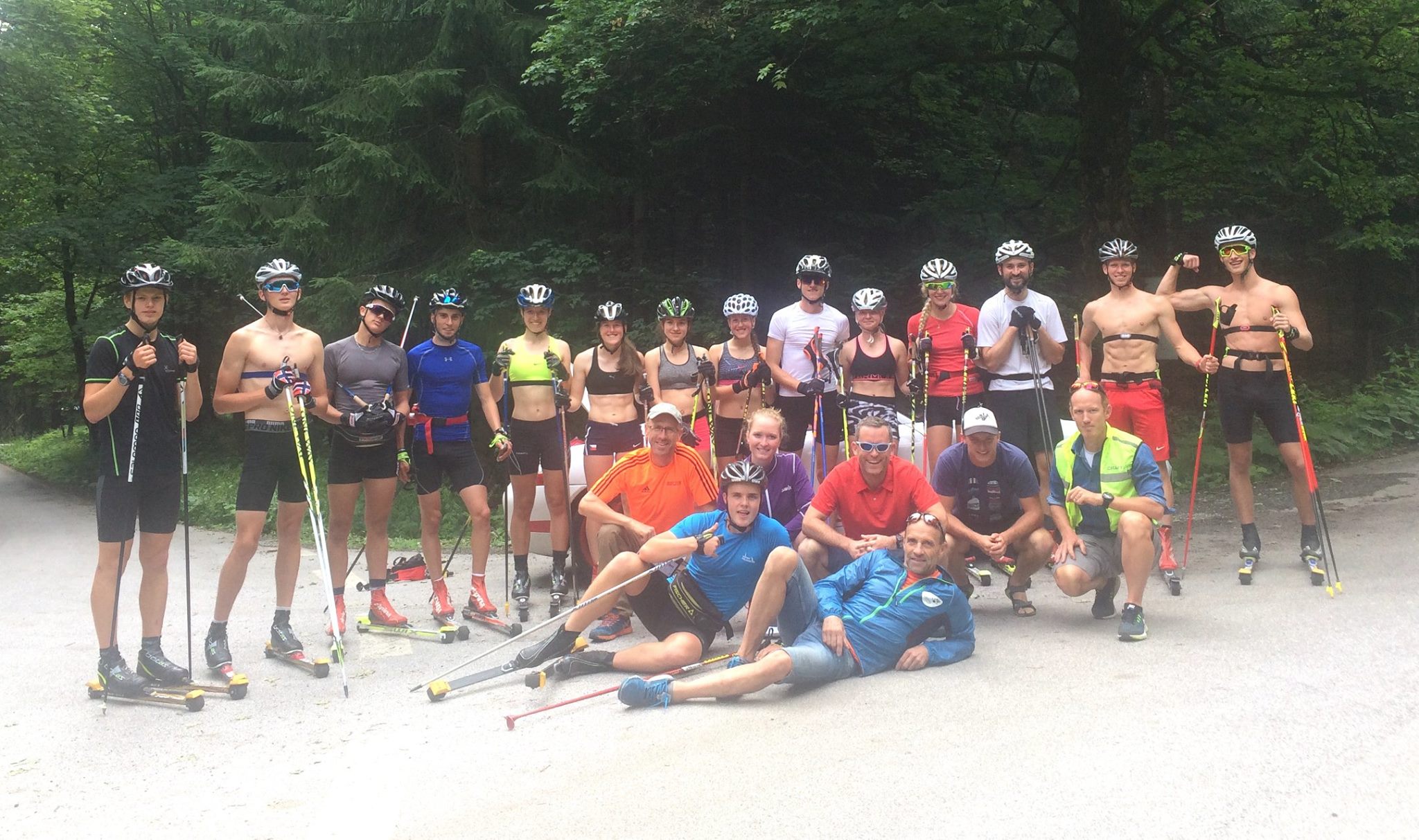
Some things are the same everywhere: a mostly junior training group after a rollerski workout in the Czech Republic. (All photos courtesy of Jan Čech)
For almost as long as Nick Lovett has been skiing at the University of Alaska Fairbanks (UAF), he has been thinking about how people train in other parts of the world.
This summer, the Wyoming native went on a trip to find out, visiting teammate Jan Čech at his home in the Czech Republic.
“I have been roommates with Jan for two years, and have been considering training with him in Czech for just as long,” Lovett wrote in an email. “I thought it would be a good experience to go somewhere new and see how training works somewhere else. I would say my decision was half for the training aspect, and half for the travel opportunity. I also traveled to Norway, Germany, and Scotland while away this summer.”
https://www.instagram.com/p/BUbn9oIgLcL/
That also included visiting teammate Ann-Cathrin Uhl in Germany, and UAF teammate Seiji Takagi joined part of the trip as well.
So what did he find? Both Lovett and Čech, both 23 and seniors at UAF, answered some questions over email about summer training in the Czech Republic. The interviews have been edited and condensed.
Čech working hard in the Czech Republic. (Courtesy photo)
FasterSkier:Jan, where are you based this summer, what part of the Czech Republic? Is this the same area you grew up in, or is your training base away from your family home?
Jan Čech: My base camp is in Jilemnice, the northeast part of Czech Republic, close to Giant Mountains. I was born here and I went here for sport elementary school, and high school focused on sport education. Now I train with my brother’s group — he is coach at the high school above, as well as a coach of the Czech junior national team for cross country skiing.
FS: What is that part of the Czech Republic like? How is the landscape, what do people do there?
JC: Because are where I live is right under mountains, the landscape is rolling with numerous of tree-covered hills. It’s perfect for running and biking. People here are big fans of any sport and most of them spend weekends in the mountain, hiking, climbing, or biking in the countryside.
FS:Do you have a team that you are training with, or are most of your training sessions alone? How well do you know the other athletes and are they at a similar level to you?
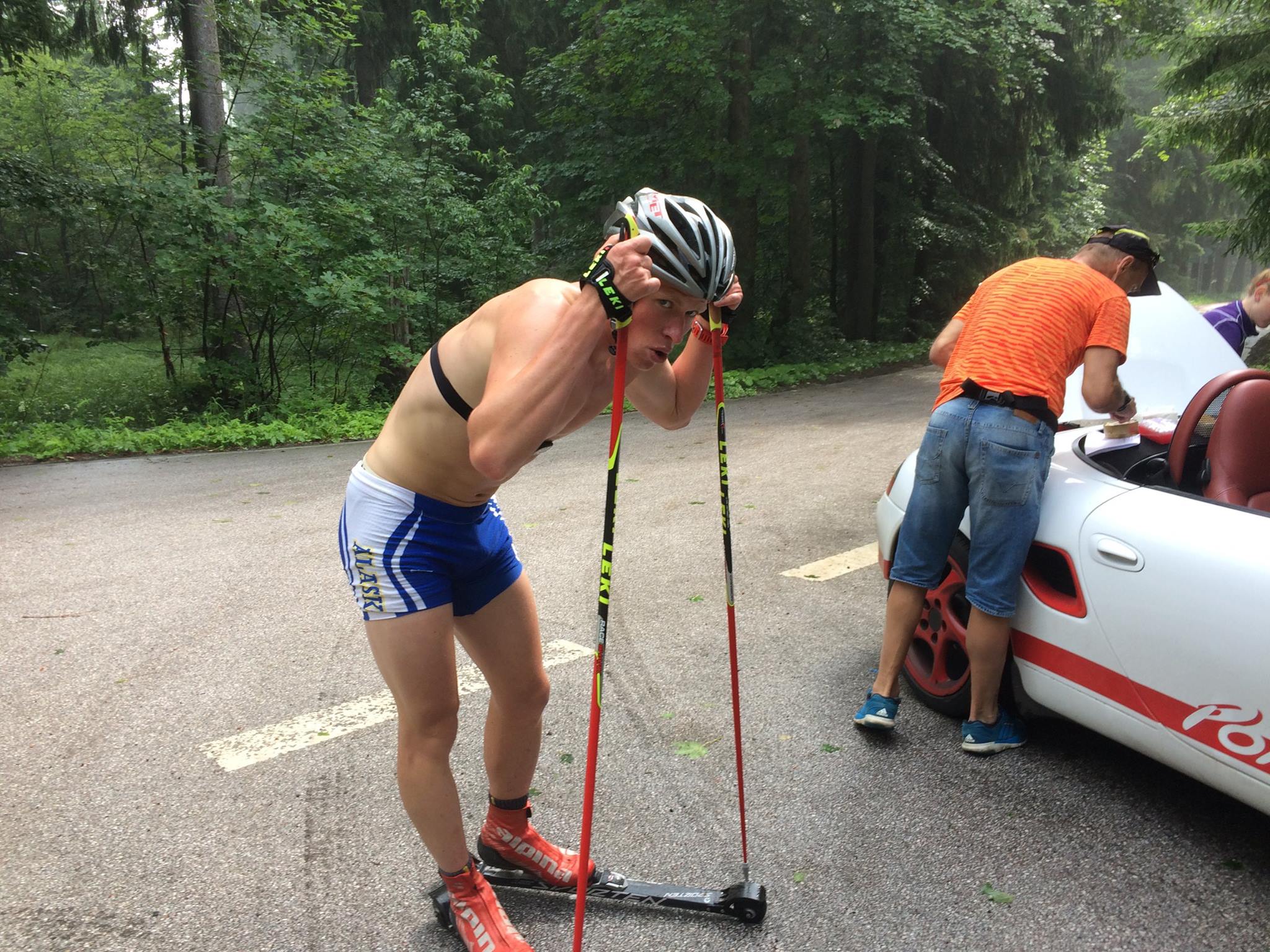
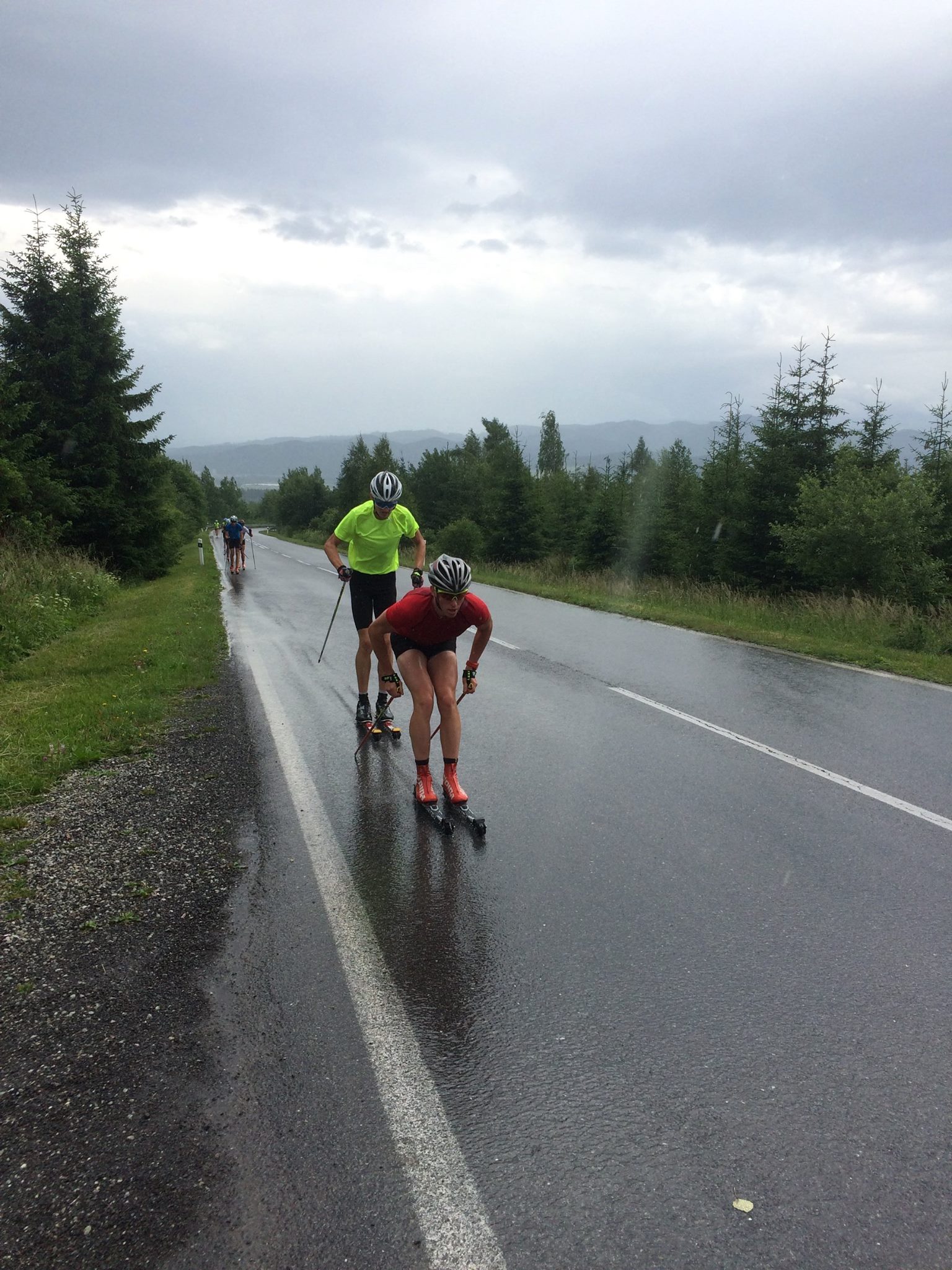
A rainy rollerki in the Czech Republic. (Photo: Jan Čech)
JC: Most of the time I train with my brother’s junior group. The guys are fast — some of them attended World Junior Championships in Soldier Hollow, Utah, last season. So they are good training partners. Also sometimes I drive to the rollerski track an hour away from town, and there I can train with men from the national B-team who are my friends. I competed against them before I came to Fairbanks.
FS: Nick, did you spend some time training with this group, and how easy was it to join them?
Nick Lovett: It was as easy as possible for me to integrate, but there were some challenges. Aside from Jan, there were very few other skiers or coaches who spoke fluent English. This was the most challenging part as we tried to communicate some complex technique ideas with less than ideal words to use. While the language barrier was a challenge, I still feel I was able to learn and accomplish enough to fit in well.
FS:How do you design your training? Is it based on a plan from Nick Crawford at UAF? Are you adapting it at all to be able to match with other people/groups you might have opportunities to join?
JC: I train with the team in my hometown so I can have training partners, especially during interval sessions so I can push myself harder. Then I try match the intensity and volume hours from Nick’s plan. I also keep doing the UAF strength system whole summer as well.
FS: What are some of the differences between Czech training and American training?
NL: I would say there were some differences, but overall it was very similar to what I expected and what I have experienced here. The most notable difference was the emphasis that was put on general athleticism. While in the U.S. most workouts are all ski-oriented, some workouts there incorporated elements of gymnastics and track running.
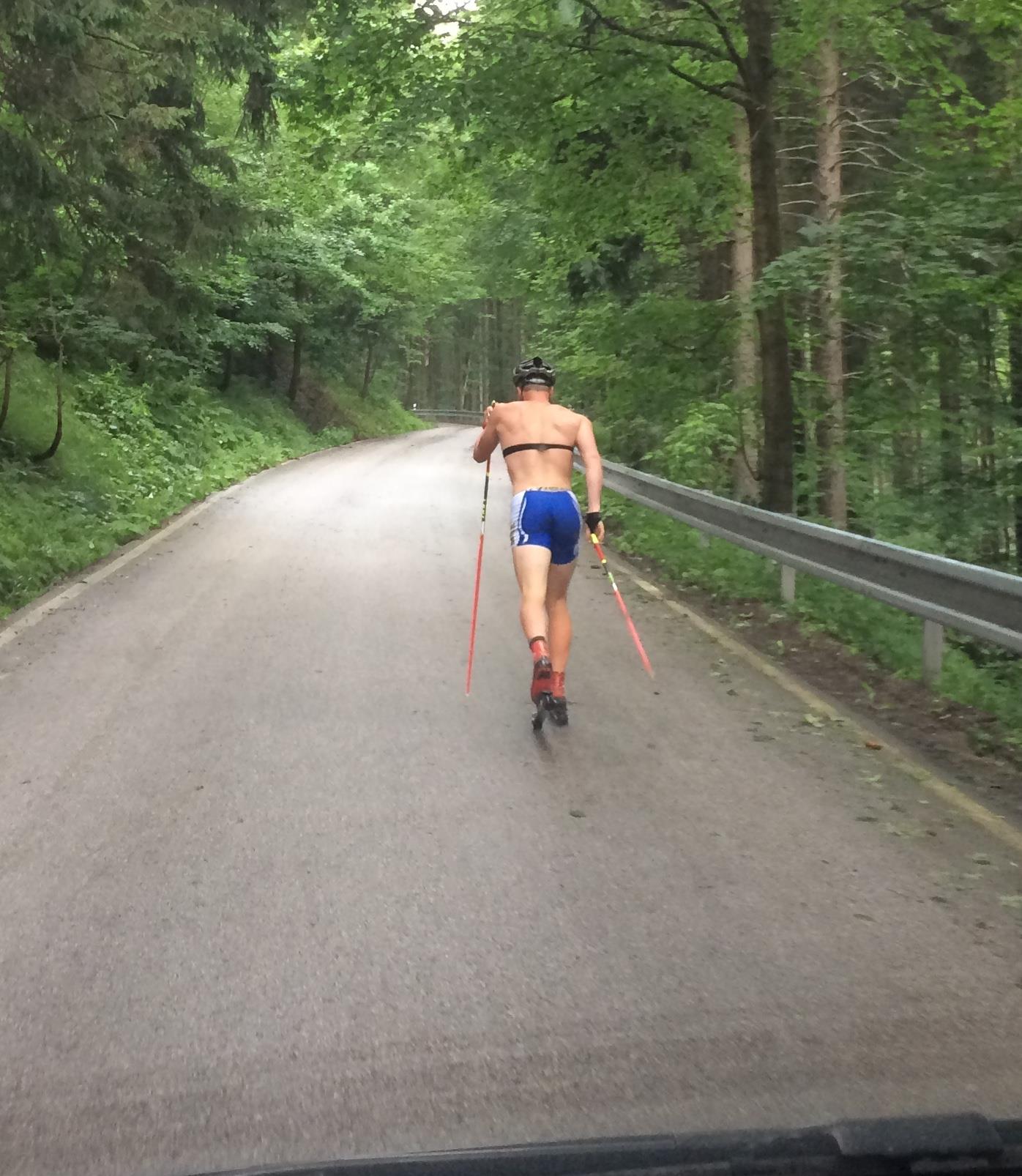
Čech, seen from the dashboard of a coach’s car, has the road to himself. (Courtesy photo)
FS:What’s the hardest workout you have done so far this summer?
JC: My hardest workout this summer so far was uphill run time trial, which I do every year since I was 13. So that’s the best way how to test my fitness level for me.
FS:Are there any absolute favorite places to run or bike or rollerski?
JC: I believe my area is a great place to train. We have lots of opportunities to go mountain biking or road biking for up to four hours, which are amazing workouts and we bike as a group of 15 people. Also we have many country roads with new asphalt, which connect a hilly rolling loop of about 50 kilometers. That is great for classic OD’s [over-distance].
NL: Jilemince was a beautiful place to train. There were ample trails to run on, and some very quiet roads where one could ski for 2.5+ hours and never repeat the same asphalt. There is also a rollerski track and biathlon stadium currently under construction in Jilemince which will be an incredible addition to the town as a training venue.
FS:What is the best part of Czech summer, aside from training?
JC: The best part of summer in Czech are my evening walks with my sister to the old town square, which has buildings over 700 years old and great chocolate factory near by.
FS: Nick, where was your favorite place you visited?
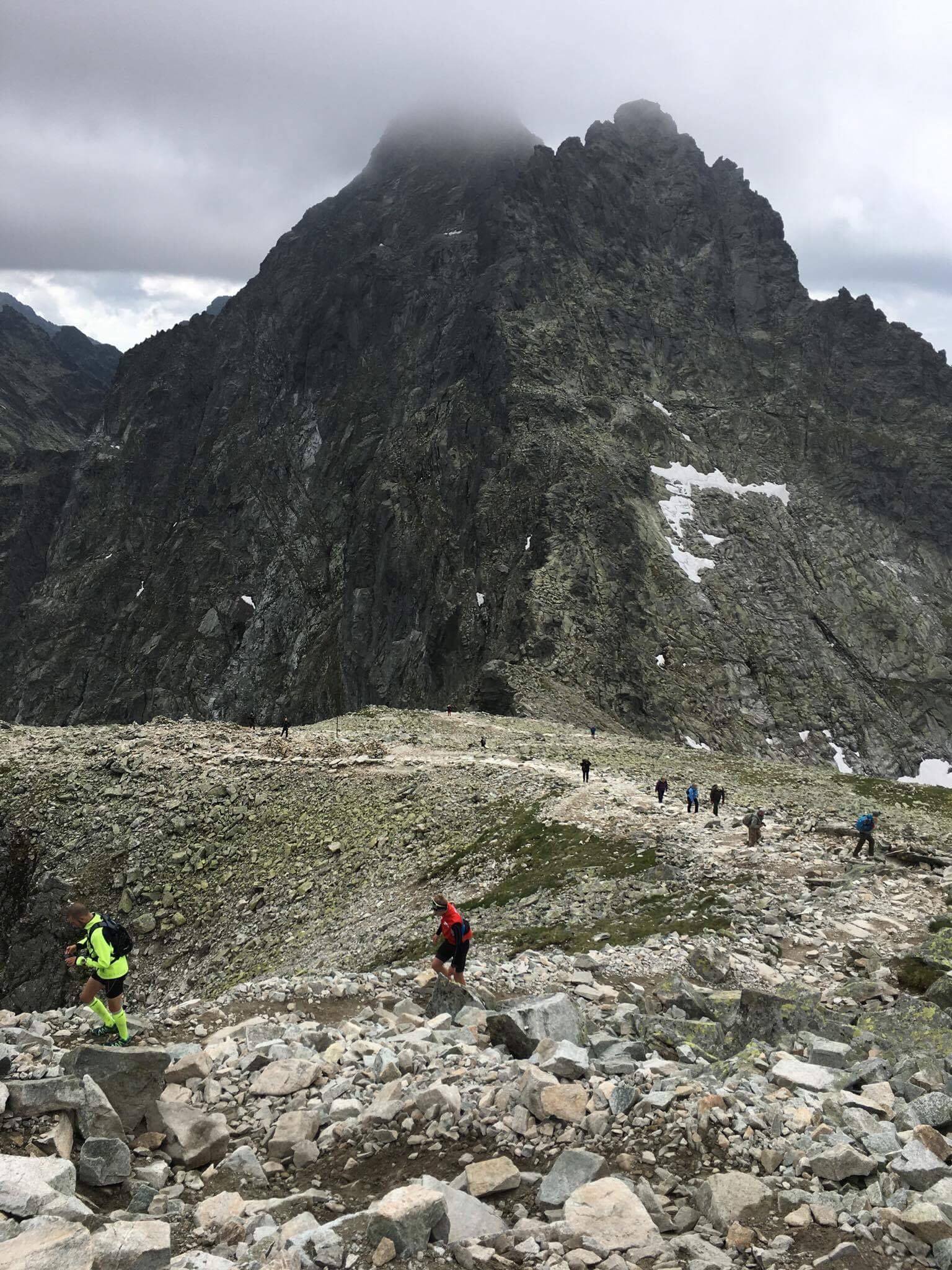
NL: My favorite place we went was the city of Prague. It is an incredibly beautiful old city, and I just loved being there. Also we did some long runs in the mountains on the Czech-Poland border. I am from Jackson, Wyoming, so I loved being in the mountains and it made me feel closer to home there.
A workout in the mountains on the Polish border. (Photo courtesy of Jan Čech)
FAIRBANKS, Alaska – As Mike Campbell famously said in The Sun Also Rises, he went bankrupt two ways: “Gradually and then suddenly.” Alaskan breakup – the season known as “spring” in other parts of the world – proceeds much the same way.
A field of nearly 300 skiers experienced a little of both in the Sonot Kkaazoot family of races, held last Saturday, March 26, in Fairbanks, Alaska. At the end of the day, Fairbanks skier Rebecca Konieczny and Anchorage skier Seiji Takagi came away victorious in the flagship 50-kilometer skate races. But the real victory may have been that the races were held at all.
Sonot kkaazoot comes from the Athabaskan (indigenous language group) words for “springtime” and “to slide your feet across the snow.” The race with this name has been held in Fairbanks on the last weekend in March every year since 1988. Reflecting the cold winter temperatures of Interior Alaska, as well as Fairbanks’s location at 65° N latitude, the race has never been canceled despite this late date (although the course has occasionally been modified).
Traditionally, the race starts on the Chena River in the heart of downtown Fairbanks, travels 10 k east along the river, proceeds inland to Birch Hill Recreation Area, spends 30 k covering most of the trails in the renowned trail system, and then returns to the river to finish 10 k west in central Fairbanks. The 2016 race covered this full course. Barely.
A field of 106 racers started the combined 40 k and 50 k races at 10 a.m. The first water hazard came approximately 300 meters into the race, as the field had to negotiate overflow several inches deep (the video shows the 20 k start). Once past the water crossing, a lead pack of a dozen racers quickly formed, including five skiers from the University of Alaska Fairbanks (UAF), five skiers from Alaska Pacific University (APU), and two junior skiers from Fairbanks’s West Valley High School.
Takagi, a sophomore skier for UAF, set an honest pace from the start.
“I know a lot of these guys will be mad at me for doing that but I kind of like doing that in mass starts, going out a little fast and then kind of settling,” Takagi told the Fairbanks Daily News-Miner in an in-person interview after the race.
Takagi led for much of the initial 10 k down the river, occasionally trading off the lead with other skiers. Despite his desire to push the pace, the lead pack remained intact 10 kilometers and approximately 25 minutes into the race, as all 12 skiers who had made the initial break continued to ski in a pack.
Shortly after leaving the river, the race course proceeds to the base of the Ft. Wainwright downhill ski area, then takes a series of switchbacks to the top of the alpine hill.
Takagi put in a surge immediately upon reaching the base of the hill.
“I just worked on trying to open that gap after that and maintaining it,” Takagi told News-Miner. Although his energy flagged considerably over the remaining 39 kilometers – “I had about less than 10 percent left, negative 10 percent left” by the finish, Takagi later said – he skied relatively unchallenged to the end. He would finish first by over two minutes in 2:20:30.2, taking the victory in his first time racing the Sonot.
Behind him, there was heated competition for the remaining podium spots.
“Soon after we started up the downhill resort the pace increased,” wrote eventual third-place finisher Fischer Gangemi of Takagi’s move. “As we rounded the first corner [going uphill] I could see Seiji already making a gap.”
APU skier Andre Lovett, who would eventually finish fourth, tried to stick with Takagi. Two chase packs formed behind the leaders. Gangemi eventually bridged the gap to Andre Lovett and the two 40 k racers.
“By that point,” he wrote, “Seiji had a considerable lead but we could still see him.”
The next time Gangemi saw Takagi, he was at least 2 ½ minutes back of the UAF skier. Gangemi skied alone for some time, until he was eventually caught by UAF skier Nick Lovett (no relation to Andre).
“We skied together [through Birch Hill, back to the river, and] all the way until the last 1 kilometer mark,” Gangemi wrote, “trading drafts regularly in the very hard push down the river and around the overflow. Both of us tried to make futile pushes a couple times. Finally Nick had much more gas in the last kilometer and slowly gapped me to the finish.”
Nick Lovett finished second in 2:22:34.5, 2:04 back from Takagi. Gangemi was third in 2:22:45.0, roughly ten seconds behind. Andre Lovett came in fourth, nearly three minutes later.
The top nine men’s finishers were split between UAF and APU, with five members of the UAF ski team and four from the APU university and masters teams. (The APU Elite Team was busy contesting its own slushy 50 k in Craftsbury.)
(Story continues below)
Rebecca Konieczny (5) and Ann-Cathrin Uhl (11) racing to first and second, respectively, in the women’s 50 k at Sonot Kkaazoot in Fairbanks, Alaska, in 2016. (Photo: Max Kaufman)
(Photo: Max Kaufman)
(Photo: Max Kaufman)
While Takagi skied away early for the solo win in the men’s race, the women’s race featured heated competition throughout. In a battle between UAF past and present, UAF past took the narrow victory. After 50 kilometers of head to head racing, Konieczny, a former Nanooks skier who now coaches for the Nordic Ski Club of Fairbanks, finished first in 2:42:00.7. Ann-Cathrin Uhl, a sophomore skier for the Nanooks from Mühlenbach, Germany, crossed the line less than six seconds back in 2:42:06.6. Third place went to Anchorage’s Sarah Freistone, who finished roughly eight minutes later in 2:50:07.4.
Konieczny won the race for the third year in a row, but was thrilled to have some competition, and some company, this time. “I actually want to thank Ann Uhl,” Konieczny told the News-Miner. “Usually I follow the men for 20 k-ish, not even, and then I have to ski the whole race by myself. So it was really fun to ski with her and go back and forth.”
Konieczny added, “I was excited to ski with a couple of the UAF ladies. Thought it would make it a little more fun for me.”
Although Freistone finished some distance off the podium, she hardly had to ski by herself.
“Throughout the race I was skiing in small packs of people,” she wrote in an email. “Whenever I felt the pack I was with was slowing down or if I thought I could go faster, I tried to make a move to the next group of people.”
Freistone also had a personal source of motivation: “I was also trying really hard to catch my mom before the finish,” she wrote. “That kept me motivated when the skiing got rough and slow. She competed in the 40k and finished about a minute in front of me.”
In the day’s other races, Maria Bray won the 40 k for the women in 2:21:21.7, with Jenna DiFolco second and Alyeska Daniels third. Local high school skiers Ti Donaldson and Benjamin Koenig were first and second in the men’s 40 k, with Donaldson setting a winning time of 1:52:29.3. Pete Leonard was third.
Kaya Ratzlaff was fastest in the women’s 20 k, with Emma Jerome second and Anna Rix third. Mike Kramer, Jonathan Burrell and Jacob Moos were the top three in the men’s 20 k.
Lynne Petersen was the winner, and only entrant, in the women’s 50 k classic race. Daniel Serventi won the men’s 50 k classic in an impressive 2:49:48.1 solo effort, with Bill Husby and Owen Hanley second and third.
All skiers in all races had to contend with conditions that may charitably be described as variable. Fairbanks began experiencing a dramatic springtime freeze–thaw cycle somewhat earlier than normal this March. Temperatures on the Birch Hill section of the course were never lower than 36 degrees Fahrenheit during race grooming the night before, and were still as high as 52 degrees at 2 a.m., eight hours before the 10 a.m. start. They then fell to slightly below freezing by 6 a.m.
Between the springtime conditions, the initial 10 k on the river, the groomed trails at Birch Hill, and the final 10 k back on the river, plus temperatures that climbed at least 15 degrees during the race, racers encountered a range of conditions. There was standing water, flowing water, sheet ice, bulletproof crust, melting snow, dirty snow, perfect midwinter corduroy, and what appeared to be midwinter corduroy but was in fact soft and painfully slow groomed snow. Then came the final 10 k on the river, when the sun came out, the morning’s ice broke down into slush, and even the top finishers faced a grinding trip to the end.
Strategies for dealing with the range of conditions varied. One racer was heard muttering at the finish that he literally would have saved time had he skied with a Structurite tool in his water belt the entire way, then stopped before returning to the river to quickly hand-structure his skis.
For her part, women’s winner Konieczny told the News-Miner, “My skis were fast when the conditions were right for it but then up at Birch Hill, especially, it got really really soft. It made it actually more interesting too because you had to be more tactical and find spots to pass.”
Gangemi, who was on eponymous RCS Plus skis, was slightly less sanguine. He reported that he waxed with Holmenkol Betamix Red, plus “whatever structure tool Mike Hajdukovich from Trax [Outdoor Center] made available.” He added, “I think I should have used a graphite wax as well to improve the durability because it seemed they became slower as the race progressed not just because of variable conditions and fatigue.”
The challenging conditions were reflected in the finishing times. Konieczny was more than 18 minutes off her course-record time of 2:23:40 from 2015. Takagi, similarly, was over eight minutes slower than last year, when APU skier Jack Novak won in 2:12:10.
Three-time winner Konieczny was not the only frequent contender. Second-place skier Uhl had finished only one second off the podium in the Oosik Classic 50 k the weekend before. Third-place finisher Freistone was also third in the 2015 Sonot Kkaazoot, first in the Kachemak Nordic Ski Marathon earlier this month, and first in this winter’s season-long Anchorage Cup series. Among the men, Nick Lovett was third and Takagi fifth in last weekend’s Oosik, while Gangemi won the Kachemak Marathon.
But the real story of the 2016 Sonot Kkaazoot was the weather. Despite race organizers’ assiduous attention to ice conditions in the days leading up to the race, including drilling at several sites to check for ice thickness near the start and delaying a final decision on whether or not to ski on the river until the morning of the race, everyone was surprised when a small portion of the Chena River experienced breakup during the race.
(Story continues below)
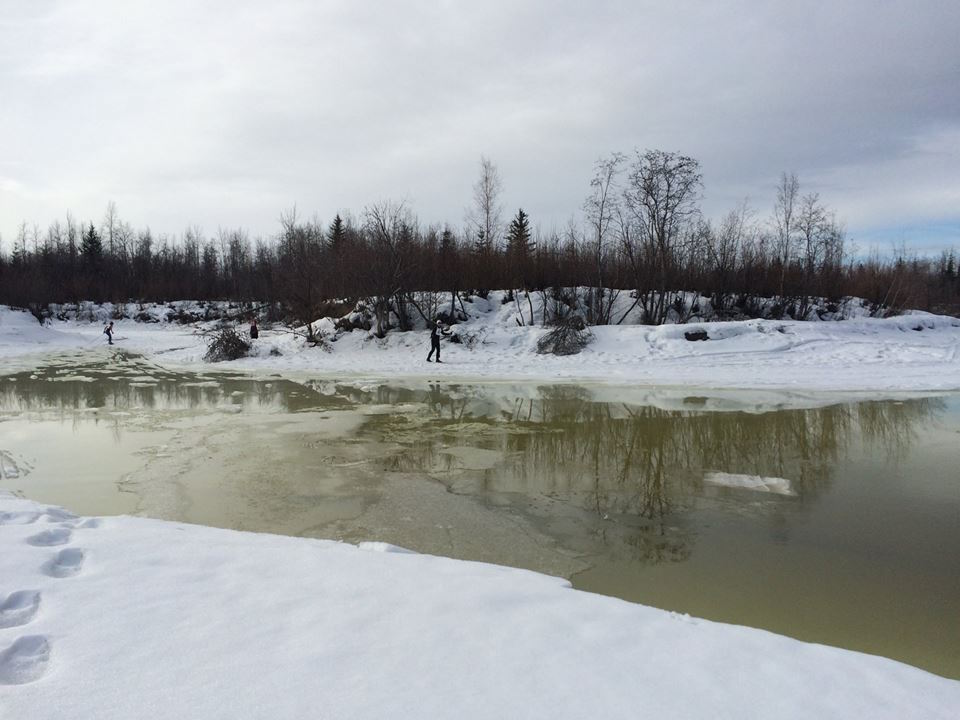
Overflow on the surface of the Chena River, following a partial breakup of the Chena River in Fairbanks, Alaska, on March 26, 2016. The groomed trail originally went through the foreground of this picture. Two skiers can be seen in the background safely detouring around the overflow on the established detour route. (Photo: Stella Wisner)
A relatively small piece of ice went out at some point while the lead 50 k skiers were traversing Birch Hill. The Chena River promptly began flowing over the ice for a stretch of several hundred meters. While skiers had blithely skied down the groomed river trail earlier in the race, on their return they were met with a lengthy stretch of overflow.
No one was injured. A detour route was quickly established, requiring returning skiers to head inland for approximately 100 meters, traverse around the farthest reaches of the overflow, step up on to some shore-fast river ice along the bank, duck under some alders, and return to the established race course on the far side of the overflow. (Two skiers can be seen on the detour route in the above picture.)
In a blog post on the race website, race organizers wrote, “Huge thanks to David Frey, nordic ski coach at Tanana Middle School who alerted Sonot Kkaazoot officials of the major disruption of the Sonot Kkaazoot trail on the river and provided standby guides around the hazardous area until Sonot volunteers could set up an alternative course.” (Organizers declined further comment on the breakup incident.)
As the race director told skiers in his pre-race remarks, imploring them to stay on the set course, “If you go off the course, you may die.” It appears he may have been correct.
Or, as third-place finisher Sarah Freistone observed in an email, “I was really happy with how my race went this year despite the tough conditions.” She added, “I have never really worried about falling into a river in a ski race before, but I guess there’s a first for everything.”
The reporter would like to thank local skier Max Kaufman for his sterling hospitality all weekend long, as well as for taking all the racer pictures in this story.
About the Author: Gavin Kentch lives in Anchorage. He skis with the Alaska Pacific University Masters team, plays with his two adorable daughters, and occasionally works as a solo attorney. He was probably on snow this year before you were.