Tag: Ann-Kristin Flatland

  • Norway’s Flatland Climbs to the Top in Women’s 7.5 k Biathlon

    Norway’s Flatland Climbs to the Top in Women’s 7.5 k Biathlon

    IBU world cup biathlon, sprint women, Oestersund (SWE)
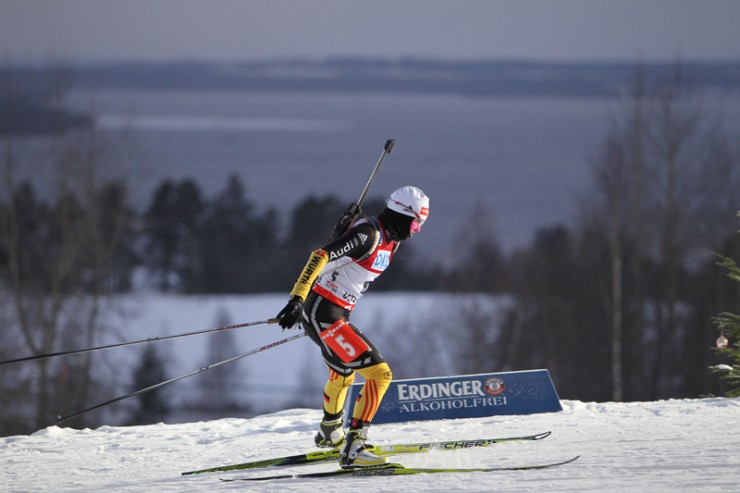
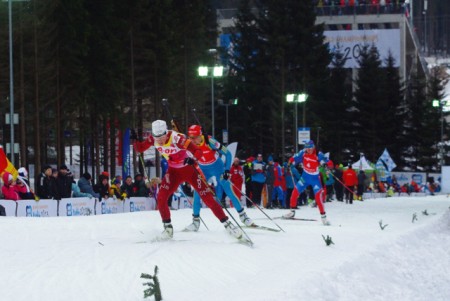
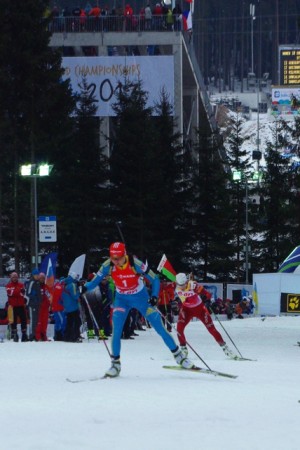
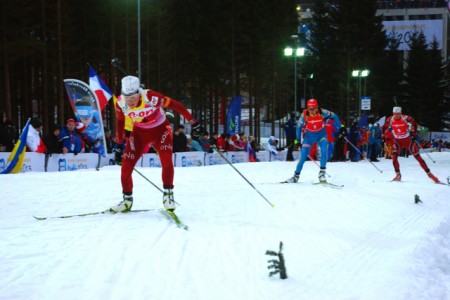
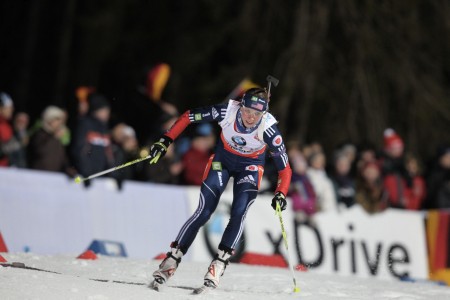
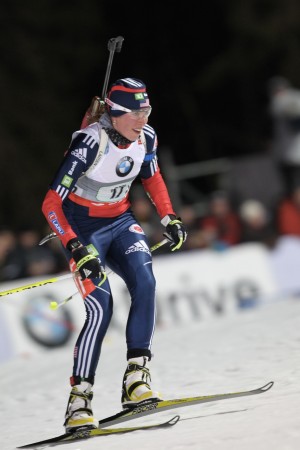
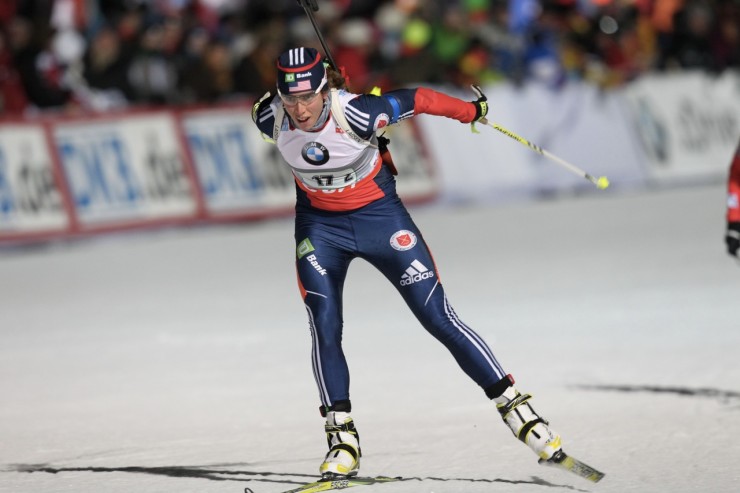
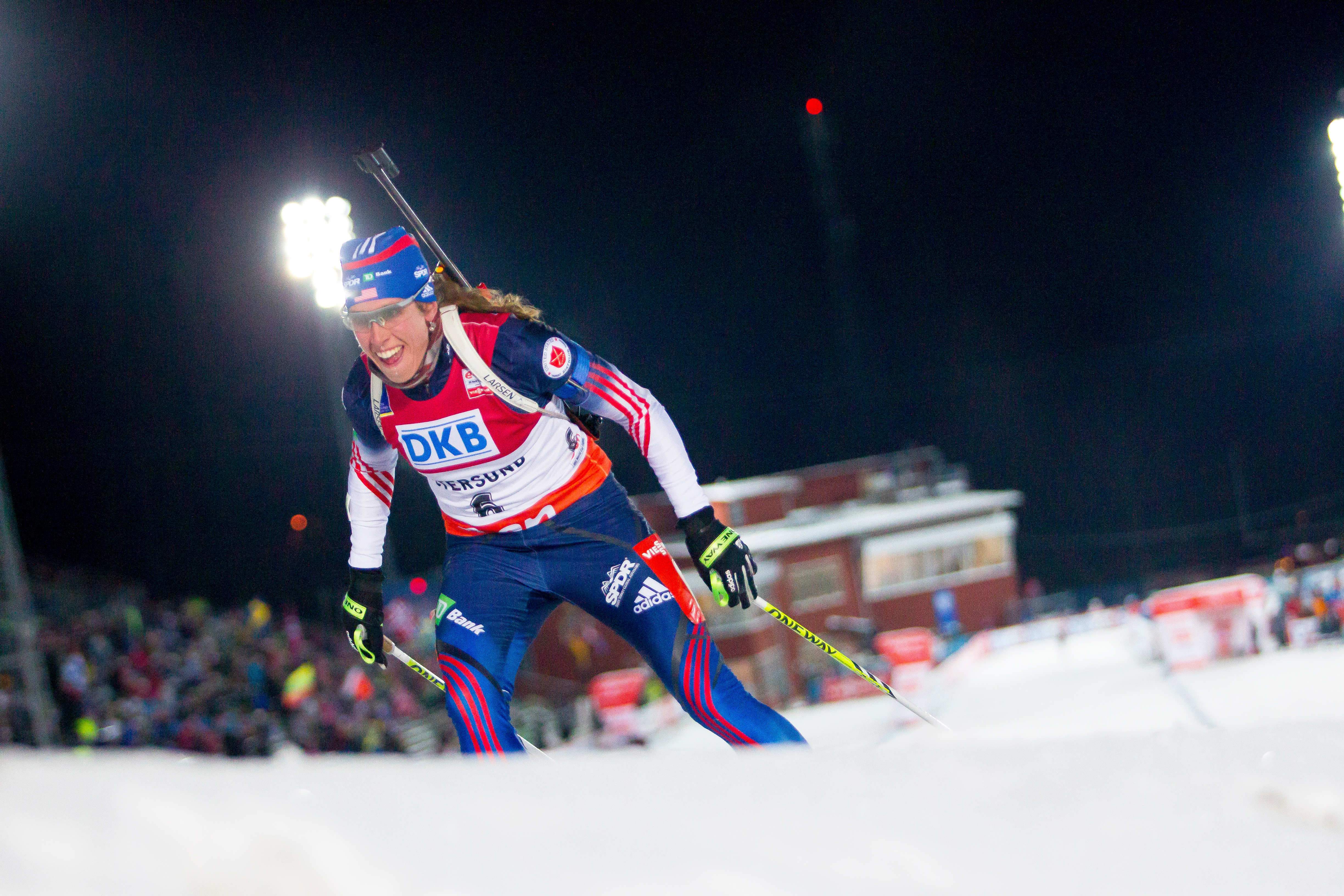
    Susan Dunklee on her way to 16th place in the women’s 7.5km sprint in Ostersund. (Photo Credit: US Biathlon/Nordic Focus)

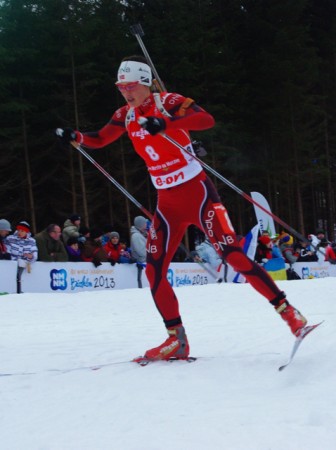
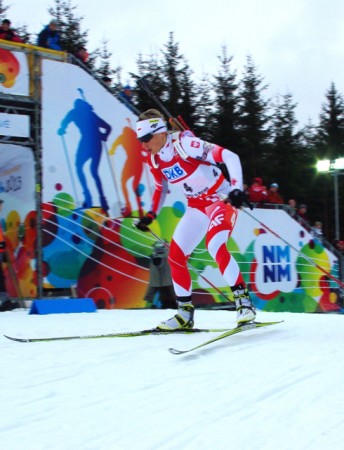
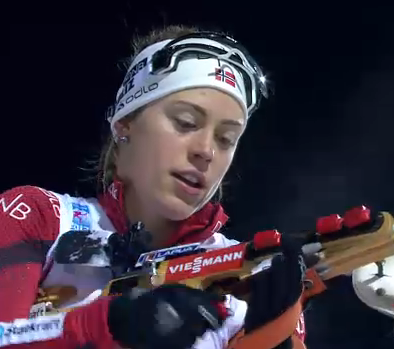
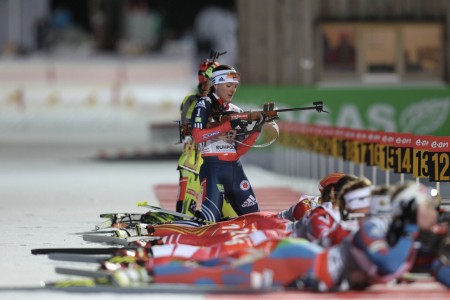
    Conditions were excellent for racing this evening in Ostersund with mild temperatures and light winds.  But perfect conditions demand perfection from those that wish to make the podium, and Noway’s Ann Kristin Flatland delivered, skiing and shooting her way to her second career victory in 21:41.2.  In second place, Russian Olga Zaitseva also delivered perfect shooting to earn her a spot on the podium, finishing 15.9 seconds behind Flatland.  Rounding out a good day for Norway, Tora Berger was able to chase down a podium spot after one missed shot in the prone stage, finishing 22 seconds behind the top spot.  Yesterday’s winner in the 15km individual race, Czech Gabriela Soukalova delivered a solid performance to earn her sixth place with one penalty in the prone stage.

    This victory is notable to Flatland as it is her first victory her pregnancy, giving birth midway through last season.

    “It is of course very good for your self-esteem,” she said in an interview with the Norwegian newspaper NRK, “it shows that I have done a good job [of training] this summer.”

    Flatland’s daughter and husband are with her Östersund, which makes it easier. She was so down at the end of last season that she considered retiring. A win boosts her confidence that continuing towards the Sochi Olympics was the right decision despite the huge changes in her family life.

    “It’s been up and down in the fall, and there have been times when I’ve wondered if it was worth coming back,” she said. “… I showed that I can compete at the top with a perfect race. It has proven both to myself and those who may not have had faith in me, that I can do it.”

    As for second-place Zaitseva, today’s result was an indication of more to come: “I am satisfied with my performance,” she said in an interview with Biathlon Russia.   “I can say, ‘we are warming up.’  I always want to win, but I understand that the work is not done yet.  Everything will be fine in pursuit.”
    zaitseva flatland
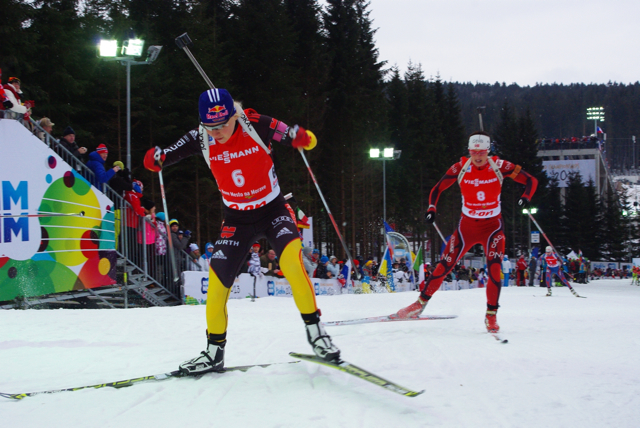
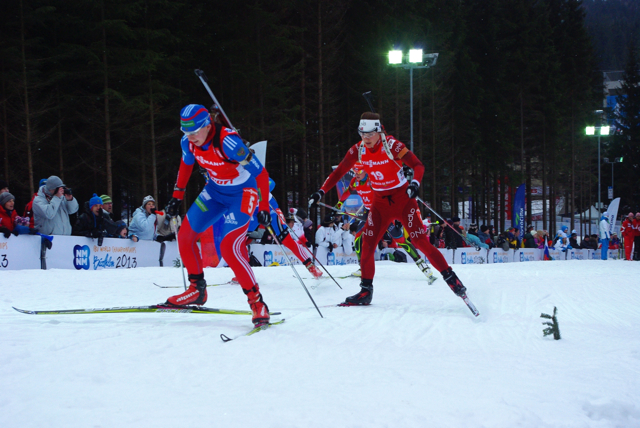
    Ann Kristin Flatland (right) chases Olga Zaitseva in the 2013 World Championships pursuit, where both finished just off the podium. (Photo: Chelsea Little, FasterSkier)

    Berger, last year’s runaway World Cup total score winner, said that she often has difficulty in the beginning of the season.

    The top North American woman, Susan Dunklee, finished 16th with one penalty in the standing stage and a total time of 21:41.9, one minute behind first place.

    “My shooting and skiing came together on the same day and that is a big confidence booster for me” Dunklee said of the day’s efforts, “popping a top 20 this early in the season is something I feel really good about.”  Dunklee is optimistic about the coming days of racing, “later this weekend we have a pursuit based off of today’s results and there will be lots of great people to ski around – I’m excited!”

    “Biathlon is very unpredictable sport,” Dunklee added in an email. “Every athlete on the World Cup is capable of ‘cleaning’ a race; we have all done it many times during practice.  Even when we approach our races the same way every time, the shooting doesn’t always pan out due to any number of factors: wind, physical exertion, nerves, etc.  It feels extra special when the pieces do come together on a race day.”

    The top Canadian, and second North American woman, Megan Imrie, finished 22nd in 22:08.4, 1:27.2 behind Norway’s Flatland.  This is Imrie’s third-best World Cup finish after two top-20 finishes in the 2011-2012 season, and a dramatic improvement over yesterday’s 85th place finish, where she had a disappointing nine penalties.  Most importantly for Imrie, today’s result qualifies her for the 2014 Sochi Olympics.

    “Biathlon Canada is not surprised that Megan was able to complete her Olympic qualification today,” Canada’s High Performance director, Christopher Lindsay, wrote in an email to FasterSkier regarding Imrie’s performance. “She has been training hard and her very strong performance in the WC1 Mixed Relay made it clear that she is ready to race at the top level. We are confident she will have more top 30 results this season.”

    Rounding out today’s North American finishers were Canada’s Rosanna Crawford in 51st with three penalties, American Annelies Cook in 55th with two penalties, and Canadians Megan Heinicke in 56thalso with three penalties, and Zina Kocher in 64th with four penalties.

    Crawford started strong, cleaning the prone stage, but had “a bit of a disaster” in the standing stage and missed three.  Her total course time of 19:29 was 33rd in the field.

    “I am glad that I still get to go to battle this Sunday in the pursuit!” she said of the day’s racing.

    The final two North Americans were Sara Studebaker and Hannah Dreissigacker, both of the United States, in 71st and 93rd places, respectively.  Both Studebaker and Dreissigacker were frustrated with their performances.  Studebaker said that it usually takes her a few races get into race shape each season, adding that she was “pretty close to making the pursuit, so I hope to build on that and improve for next week.”

    As for her race, Dreissigacker said that she was “sort of embarrassed, really.  But at least everything was bad on the same day.”

    Studebaker summed it up, “Overall, I think our team is in a good place and we’ll continue to improve as the season goes on. This is just the first week and the most important races are still a couple of months away.”
  • Svendsen, Henkel Top Biathlon ‘Season Openers’

    Svendsen, Henkel Top Biathlon ‘Season Openers’

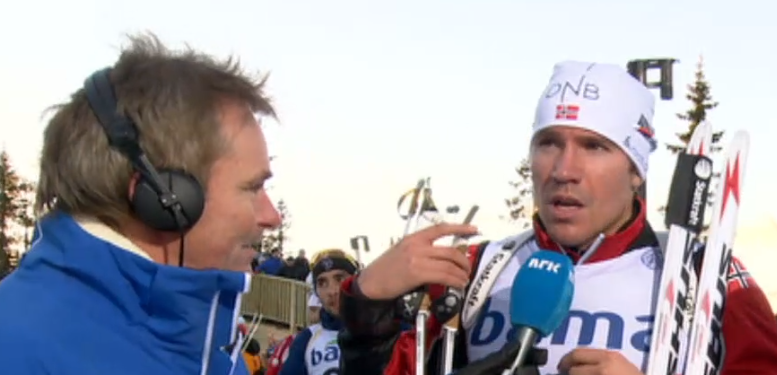
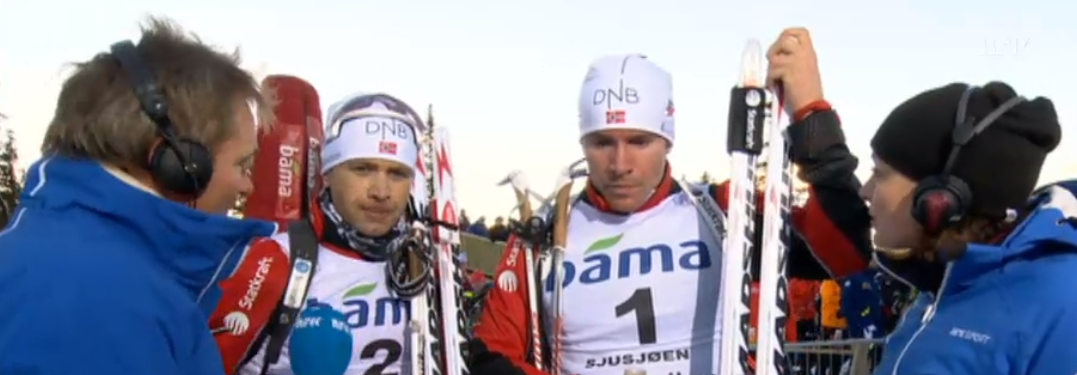
    Sprint winner Emil Hegle Svendsen (2nd from right) and Norwegian teammate Ole Einar Bjørndalen (2nd from left) are intereviewed by NRK commentators in Sjusjøen.
    Sprint winner Emil Hegle Svendsen (2nd from right) and Norwegian teammate Ole Einar Bjørndalen (2nd from left) are intereviewed by NRK commentators in Sjusjøen.

    Season start? Season started.

    The elite biathlon field hit the tracks in Sjusjøen, Norway, which hosted not only the Norwegian national team but the Germans, Austrians, Ukrainians, French, and others for the first international competitions of the season. The races were big: 103 men and 68 women toed the line in the sprint races, and half were from outside the host country. With the World Cup kicking off in Östersund, Sweden, next weekend, many of the teams will use these races to finalize team selections.

    On the men’s side, the Norwegian team came out winners – hardly unexpected, given their dominance in the last few years. Emil Hegle Svendsen had one penalty and skied the fastest course time to take the win in the 10 k sprint over teammate Ole Einar Bjørndalen by seven seconds. The “king of biathlon” shot clean, but was unable to match Svendsen’s speed. Simon Desthieux of France took third place, also with clean shooting.

    “I started out quite controlled, and it worked out fine,” Svendsen told NRK broadcasters. “It wasn’t top speed…. if I’d had a harder last round, I would have had more to go on. Instead it was an easy passage… especially the standing shooting was good. I’m happy.”

    Bjørndalen was also pleased with his efforts.

    “When Emil shoots clean, he is so fast that he beats me,” he told the interviewers. “Today I should have taken him, but he was fast and on a roll. I’ll try tomorrow…. I had expected to be skiing better today, but not to shoot clean. It was fun to go today and it meant a lot to me to shoot clean.”

    Last season’s overall World Cup winner, Martin Fourcade of France, was fifth with one penalty, just one second behind a clean-shooting Andreas Birnbacher of Germany. Alexander Os and Johannes Thingnes Bø of Norway were just behind, more good news for the home team.

    In the women’s 7.5 k race, Andrea Henkel of Germany opened with a bang: despite a penalty in standing, she sped to a huge 27-second win over Marie Dorin Habert of France. Norway’s Ann Kristin Flatland and Tiril Ekhoff were third and fourth, with the top four competitors all accumulating a penalty.

    Tora Berger, the Norwegian favorite who was so dominant last season, placed sixth after missing three shots in her prone stage.

    “Three penalties can happen to anyone,” Henkel told NRK. “Tora is just a human being.”

    Canada’s Megan Heinicke competed – the only North American to do so, as the rest of the Canadians haven’t left for Europe yet and the Americans are already in Östersund – but was disqualified for violating shooting safety rules.

    Racing continues in Sjusjøen tomorrow with mass starts.

  • Blink Festival Recap: Some Top-Notch Competition, Plenty of Fun

    Blink Festival Recap: Some Top-Notch Competition, Plenty of Fun

    Sondre Turvoll Fossli (NOR) skis into the lead of the cross country sprint final on Saturday in Sandnes, Norway. (Photo: blinkfestivalen.no)
    Sondre Turvoll Fossli (NOR) takes the lead in the cross-country rollerski sprint final at the 2013 Blink Ski Festival on Saturday in Sandnes, Norway. (Photo: blinkfestivalen.no)

    A freestyle sprint through the downtown streets of Sandnes, Norway, on Saturday wrapped up the three-day Blink rollerski festival, a selective event for both cross country skiers and biathletes.

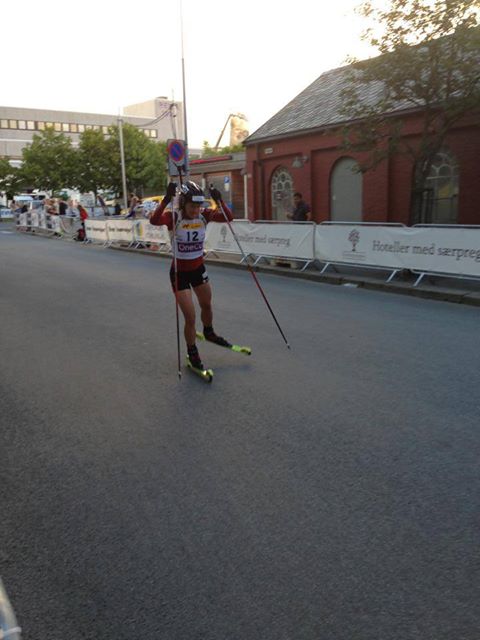
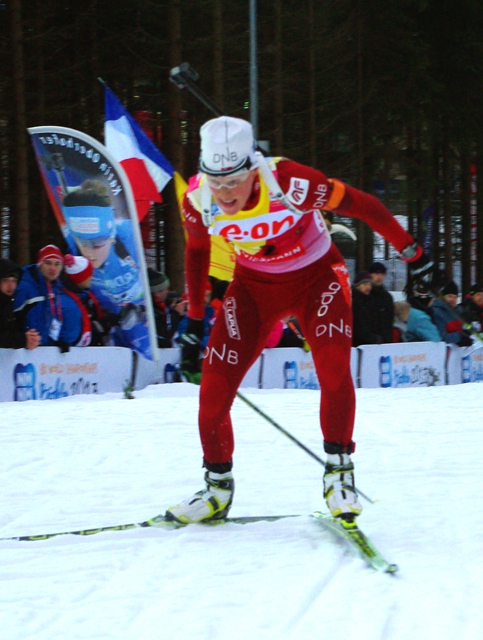
    Ann Kristin Flatland on her way to winning the biathlon sprint on Saturday. (Photo: blinkfestivalen.no)
    Ann Kristin Flatland on her way to winning the biathlon sprint on Saturday. (Photo: blinkfestivalen.no)

    A tenth of a second separated Norwegian Barbro Kvåle from Ida Ingemarsdotter of Sweden, giving Kvåle her first win of the week after placing 14th in Thursday’s hill climb and fourth in the 10-kilometer mass start on Friday.

    “I know that I have good top speed,” Kvåle told NRK, according to a translation. “Now I’m approaching the best.”

    Sondre Turvoll Fossli pulled away from fellow Norwegian Øystein Pettersen to win the men’s cross country sprint, avenging Pettersen’s 1.1-second win in Friday’s 15-kilometer mass start.

    “In the winter it is valid, but it’s fun to win with so many people here and a good atmosphere,” Fossli told Langrenn.

    On the biathlon side, misses in the standing portion cost Norway’s Hilde Fenne the lead and ultimately the win, which Norwegian Ann Kristin Flatland claimed.

    The Boe brothers from Norway went 1-2 in the men’s race, with Johannes winning the final that included International Biathlon Union (IBU) World Cup champion Martin Fourcade of France.

    The biathletes and cross country skiers united for Thursday’s hill climb. First to the top were Switzerland’s Curdin Perl and Kaisa Mäkäräinen of Finland. Mäkäräinen also won the women’s biathlon mass start.

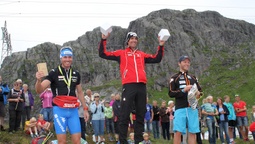
    Curdin Perl (SUI) celebrates atop the podium after winning the 7.5-kilometer hill climb at the Blink rollerski festival in Lysebotn, Norway on Thursday. (Christian Stahl- on FIS website)
    Curdin Perl (SUI) celebrates atop the podium after winning the 7.5-kilometer hill climb at the Blink rollerski festival in Lysebotn, Norway, on Thursday. (Photo: Christian Stahl via FIS)

    “It is great to win,” Perl told Langrenn. “In the years before I was number 4, 3 and 2.”

    Carl Johan Bergman of Sweden won the men’s biathlon mass start and Norway’s Maiken Caspersen Falla took the women’s cross-country mass start. Led by Falla, Norway placed five women in the top six.

    “I had never won here,” Falla told Langrenn. “This was cool.”

    The event included children’s activities, entertainment and a free brunch for the entire city. Blink attracts about 50,000 spectators annually. A record crowd of 5,000 lined the Lysebotn hill climb.

    Complete results

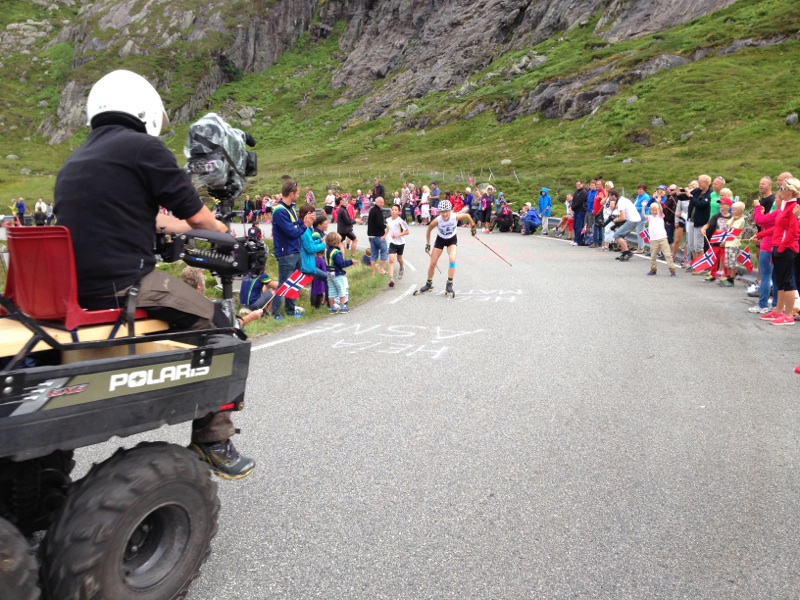
    Kaisa Mäkäräinen (FIN) climbs to victory in the Lysebotn hill climb on Thursday. (Photo: blinkfestivalen.no)
    Kaisa Mäkäräinen (FIN) climbs to victory in the Lysebotn hill climb on Thursday. (Photo: blinkfestivalen.no)
  • Germany’s New Biathlon Relay Is Plenty Fast, Takes Team Win on Olympic Course

    Germany’s New Biathlon Relay Is Plenty Fast, Takes Team Win on Olympic Course

    Andrea Henkel en route to a podium finish earlier this season in Ostersund; today she turned in a strong relay performance.. Photo: Fischer/NordicFocus.
    Andrea Henkel en route to a podium finish earlier this season in Ostersund; today she turned in a strong relay performance.. Photo: Fischer/NordicFocus.

    When Germany talked about having a “new” women’s relay team this season, it was assumed that they were talking about one thing: replacing Magdalena Neuner, their World Cup winner and many-time World Champion.

    But by the time the women made it to Sochi for the second-to-last World Cup of the season, the relay team had become even fresher. It included one newcomer who was still a junior, and had never expected to compete on the circuit this season – and another in her first year of biathlon, period.

    Joining veteran Andrea Henkel and teammate Miriam Gössner were newly crowned World Junior Champion Laura Dahlmeier and former cross country skier Evi Sachenbacher-Stehle. That might seem like a risk, but Germany skated through Sunday’s relay with one strong performance after another and ended up with an eleven-second victory.

    “I never imagined such a season,” Dahlmeier marveled in the post-race press conference. “I focused on the World Junior Championships, and I hoped to be good there. After that I heard that I could go to the World Championships in Nove Mesto and I started in the relay, and it was really great for me. Then I heard that I could go to the World Cups in Russia. But I never imagined that it would be possible to be a winner in the relay.”

    None of the newcomers were cut any slack, and neither were the veterans. Henkel started things off with one of her strongest efforts of the season. On the podium in Ostersund, Sweden, earlier this season, Henkel had told reporters that her coach had said she was too old to be strong all season. That seems to be an underestimation of the eight-time World Champion, who picked up silver in Nove Mesto and was still plenty quick today.

    Henkel used a single spare round and skied the fastest time among all the scramble legs to hand off in first place.

    Evi Sachenbacher-Stehle battling Charlotte Kalla of Sweden as she skied to a gold medal in the team sprint at the Vancouver Olympics.
    Evi Sachenbacher-Stehle battling Charlotte Kalla of Sweden as she skied to a gold medal in the team sprint at the Vancouver Olympics.

    “It’s always fun when you win, but we always put effort into our relay and our races,” she said in the press conference. “So it’s nice that it worked out today. Of course it’s hard work to win, but when it has this prize at the end, we are fine now.”

    Next up was Sachenbacher-Stehle, probably the biggest question mark in the lineup. The day before, she had stunned by shooting clean and placing sixth in the sprint. An Olympic gold medalist in skiing, it is her first year of biathlon. Could she repeat the performance?

    Not quite – Sachenbacher-Stehle used two spare rounds in standing. But her years of skiing on the World Cup circuit no doubt came in handy as she handled the pressure with aplomb and still tagged off in third.

    The deficit was not small; 46 seconds separated the team from the Czech Republic. Germany was right on the tails of Ukraine as they embarked on the third leg.

    But Czech racer Jitka Landova, after cleaning prone, had a disastrous standing stage and fell out of the picture completely. Instead, Valj Semerenko of Ukraine took the lead. Gössner hadn’t shot so well herself, skiing a penalty loop after standing, but managed to drag herself within five seconds of Semerenko by the time she tagged off.

    And from there, it was a race. Dahlmeier, the rookie, was anchoring for Germany, but the woman she was chasing wasn’t so experienced herself. Mariya Panfilova, like Dahlmeier, has only joined the World Cup circuit in the last few weeks. She placed 13th in the individual race in Sochi, but said that anchoring this relay team – which has done so well in the past – was a serious obstacle.

    “For me the biggest challenge in Sochi was not the tracks or the weather but the fourth lap today,” she said. “It was a very high burden for me, and not as successful as it could have been.”

    But you wouldn’t have guessed these women’s relative inexperience if you hadn’t been told. Both cleaned the first stage, with Dahlmeier trailing Panfilova out of the range by eight seconds. They battled around the loop; their ski times were separated by less than a second. Despite using a spare round, Panfilova left the range with a scant five second lead.

    But Dahlmeier soon charged past her, and went on to claim the win. The other thing that the young Ukrainian might have to worry about was a threat from further back: World Cup leader Tora Berger of Norway had moved into third place.

    As it turns out, Panfilova’s coaches made sure she didn’t worry about that.

    “To tell the truth I wasn’t aware of the fact that Tora was following me,” Panfilova said in the press conference. “I just knew that when I left she was thirty seconds behind me, and with thirty seconds I was sure to beat her.”

    At that point, teammate Olena Pidhrushna leaned over and whispered something in her ear. Panfilova laughed and kept talking.

    “Actually, it was twenty seconds!” she said. “I was told thirty seconds, so I felt quite confident.”

    Regardless, her lead was safe, and Ukraine took silver while Norway was stuck with bronze.

    It was better than they might have hoped for: after Hilde Fenne and Tiril Eckhoff had raced the first two legs, Norway sat in sixth, over a minute and 15 seconds back. Veteran Ann Kristin Flatland cut that deficit to 33 seconds before Berger took over.

    “I think it’s very important that every does a good race,” Flatland said. “If everyone has good races, then we can be on the podium. But I’m very glad that Tora is on our team, because she is really strong, especially on the last shooting and the last loop.”

    Dahlmeier, though, was almost as strong, skiing only eight seconds slower than Berger on her six-kilometer leg.

    “These were good races for me and I hope to be so strong in Khanty-Mansiysk also,” she said.

    Sachenbacher-Stehle, too, wondered at her success this weekend. Both hope that next year they can be a part of the Olympic team on these very trails.

    “Now I feel for the first time more like a biathlete than a cross country skier,” Sachenbacher-Stehle said. “I’m really happy to be part of the World Cup team now for the last races. I hope that I will be part of the World Cup team for next year too. I will work hard for that, and it will be my goal.”

    When that time comes around, Henkel admitted, “maybe we are one of the favorites now.”

    Results


  • Berger Anchors Norway to Second-Ever World Championships Relay Title

    Berger Anchors Norway to Second-Ever World Championships Relay Title

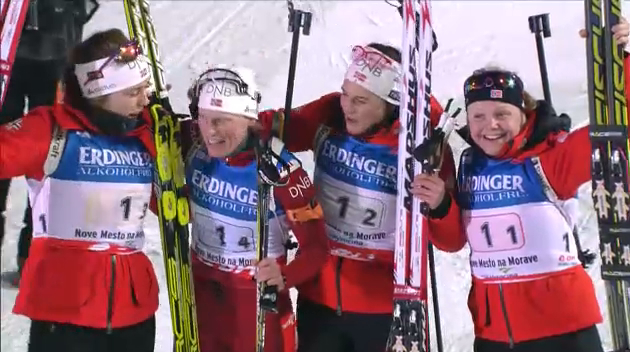
    The Norwegian women's relay celebrates its second-ever World Championships title after winning the 4 x 6 k event on Saturday in Nove Mesto, Czech Republic. From left to right: Synnøve Solemdal, Tora Berger, Ann Kristin Flatland and Hilde Fenne.
    The Norwegian women’s relay celebrates its second-ever World Championships title after winning the 4 x 6 k event on Saturday in Nove Mesto, Czech Republic. From left to right: Synnøve Solemdal, Tora Berger, Ann Kristin Flatland and Hilde Fenne.

    What does it feel like to have Tora Berger breathing down your neck? Ask Andrea Henkel of Germany, Ukraine’s Olena Pidhrushna or Italian Karin Oberhofer, who started the final leg of Friday’s 4 x 6-kilometer relay less than 40 seconds ahead of her.

    Norway’s 31-year-old anchor, Berger had already racked up three world titles in the last week at the International Biathlon Union (IBU) World Championships in Nové Město na Moravě, Czech Republic. She was flawless in Wednesday’s 15 k individual, defending her 2012 victory without a single miss, and seemed to be no reason she couldn’t do it again on Friday.

    Fourth at the exchange thanks to teammate Synnøve Solemdal, who skied the fastest third leg to elevate the team from 13th, Berger left the stadium 38.6 seconds behind Henkel in first. One kilometer later, Pidhrushna was about seven seconds down on Henkel, and Oberhofer was another 23 seconds back.

    And then there was Berger, who shot clean on the prone to move within 21 seconds of Pidhrushna in the lead. Henkel had to use one spare round, but remained close to the Ukrainian, trailing by 1.4 seconds while Oberhofer cleaned to leave the stadium in third, 10.7 seconds behind.

    As Henkel pushed to the front, Berger did the same from the fourth position, overtaking Oberhofer by 3.5 k and moving to third. Barbora Tomesova of the Czech Repubic followed close behind, stepping on Berger’s pole and ripping it out of her hand. The Norwegian remained calm, took a few no-pole strides and received another near the top of the long incline. She didn’t lose any ground, and if anything, set herself up for a solid last stage.

    Despite using one spare on the standing stage, Berger ended up clocking the seventh-fastest range time in the range and left the stadium in third, just 2.3 seconds behind Oberhofer, who had cleaned again. Pidhrushna was just 1.3 seconds back in second after using one spare, and Henkel, who used two spare rounds, fell to fourth nearly 16 seconds back.

    Berger didn’t waste any time and took the lead with a fast-and-furious V1 up the gradual 2-kilometer grind. A Norwegian coach put his hand over his mouth as he watched from the stadium. Could Berger hold it?

    Then it became apparent; her contenders couldn’t keep up. With 1 k remaining, Pidhrushna trailed by 3.5 seconds. The deficit grew to seven seconds with half a kilometer to go. Oberhofer was five seconds down, then 10 seconds behind Berger before the final push to the finish.

    There, Berger skied uncontested to the win in 1:08.11. For Norway, which included Hilde Fenne and Ann Kristin Flatland, it was the second women’s relay victory ever and first since 2004. For Berger, it was her fourth gold at a single World Championships, which put her on par with Norway’s retired great, Liv Grete Skjelbreid Poirée. Back in 2004, Poirée also won four gold medals at Biathlon World Championships. And Berger has one more race remaining: Sunday’s 12.5 k mass start.

    “I was just trying to do my best,” Berger said in a press conference about her simple-yet-effective game plan. “I never dreamed of this as I was driving to Nove Mesto. Whatever happens Sunday will only be a bonus.”

    Seven seconds behind, Pidhrushna brought home silver for Ukraine (which included Juliya Dzhyma, Vita Semerenko and Valj Semerenko). Valj Semerenko put the team into contention on the third leg after cleaning her standing stage and boosting the team to first. She and Germany’s Laura Dahlmeier switched leads over the next two kilometers and were the first through the exchange with Italy’s Michela Ponza.

    After bringing Italy (with Dorothea Wierer and Nicole Gonteier) from fourth to first earlier in the leg, Ponza helped her team notch bronze for its first World Championships relay medal. It was her first medal at worlds as well.

    “I am the oldest one up here … it is a dream come true,” Ponza said at the press conference. “All of my colleagues made a great race. … I want to thank everyone who believed in us. This is a good moment for Italian biathlon.”

    Overall, the Norwegians made fewer than 80 percent of their shots (compared to Ukraine’s 88.9 percent and Italy’s 90.9 percent), using nine spare rounds and skiing a penalty loop on the first leg. Ukraine had no penalties and used five spare rounds, and Italy used just four spares.

    “I was sure today that the last shooting and the last loop would be important,” Pidhrushna said. “I had a spare round but the others did too, so I told myself that this was a chance. That last loop was quite crazy.”

    Russia placed fourth (+29.0) after being an early contender. Three of their seven used spares came on the third leg with Ekaterina Shumilova after she cleaned the prone. Germany finished 30.9 seconds behind in fifth after using 11 spare rounds, three of which came from Henkel.

    Women’s relay results

  • Berger Golden Thanks to Clean Last Stage; Competitors’ Crash Hands Palka First Medal for Poland

    Berger Golden Thanks to Clean Last Stage; Competitors’ Crash Hands Palka First Medal for Poland

    Tora Berger (NOR) leads Olena Pidhrushna (UKR) and Olga Zaitseva (RUS) on the second lap of the women's 10 k pursuit at World Championships.
    Tora Berger (NOR) leads Olena Pidhrushna (UKR) and Olga Zaitseva (RUS) on the second lap of the women’s 10 k pursuit at World Championships.

    NOVÉ MĚSTO NA MORAVĚ, Czech Republic – On her best days, Tora Berger is perfect.

    Today was not one of those days. The Norwegian, who leads the World Cup standings, missed three targets in the 10 k, four-stage pursuit, and had to ski three corresponding penalty loops. When she started, in bib two and just 6.4 seconds behind sprint winner Olena Pidhrushna of Ukraine, she was a favorite to take gold; by the time she left the third shooting stage that seemed unlikely, as she sat in third 23 seconds behind Olga Zaitseva of Russia.

    “Before the fourth shooting, I was thinking that if I shoot clean in the last shooting, then maybe I would have a chance for a medal,” Berger said in a press conference. “I didn’t expect that I would take the gold.”

    But the two women ahead of her, Zaitseva and Krystyna Palka of Poland, each missed a shot. And that gave the Norwegian, who is arguably the best standing shooter in the world, male or female, the opening that she needed.

    “I saw that the first two had each had misses, and I knew that it was all on myself,” she said. “I hit all the targets, and then I went as hard as possible on the last loop.”

    She left the range with a five-second lead on Palka, then skied the fastest last loop of anyone in the field to extend that to 18 seconds by the finish line. The usually reserved superstar could not contain her feelings, and was grinning from ear to ear with genuine happiness as she celebrated her gold medal – the second of this World Championships after she and her teammates won the opening mixed relay.

    It was another success for the Norwegian team, which has rarely misstepped so far this weekend. Besides the mixed relay, Emil Hegle Svendsen has taken both men’s golds and Berger was silver in the sprint. After taking a day away from the stadium to do an easy classic ski tomorrow, Berger plans to be back in contention again in Wednesday’s 15 k individual.

    “For me it’s most important that I try to do the best in all of the competitions,” Berger said. “And we’ll see after the Championships what that brings me.”

    In Disastrous Crash, Medals Lost for Norway and Russia

    Ann Kristin Flatland on the course's first climb, before she lost the binding from her ski.
    Ann Kristin Flatland on the course’s first climb, before she lost the binding from her ski.

    It was nearly an even better day for Norway – with a kilometer to go, Ann Kristin Flatland was locked in a battle for second place with Zaitseva. Both had passed Palka earlier on the loop. It would have been a storybook comeback for 30-year-old Flatland, who took last season off to have a baby and had just one penalty in the pursuit to move up from eighth position at the start.

    But going around a corner, she and Zaitseva tangled. Flatland fell, taking out the Russian with her; Palka was able to fly past. Then Pidhrushna did, too.

    “It was really shit – I don’t know what happened,” Flatland told Norwegian broadcaster NRK after the race (and after hiding from the press for a long time while she stopped crying and regained her composure). “It was a course that suited me well. On that last lap I felt so fit, like I was stronger than those around me.”

    Indeed, Flatland’s skiing style is much like Svendsen’s – as her competitors skied up the hills in V1, she used her strength and power to V2 easily up the climbs. But she had even worse luck than Zaitseva, because when she crashed, Flatland’s binding ripped off her ski.

    “I felt that time passed very slowly as I lay there,” Flatland said.

    The team’s press coordinator, who watched Berger ski past and then wondered why Flatland wasn’t right behind, eventually found her on the trail and handed her a new ski. Flatland ended up seventh, over a minute behind Berger.

    Zaitseva was able to get up more quickly, but the damage was done for her medal hopes as well. Although she was not hurt, she was unable to catch Palka and Pidhrushna, and finished fourth.

    “Ann Kristin fell, and there was no room for me to maneuver in, so I fell too,” Zaitseva explained to the press. “She came up to me after the race and said she was sorry, and I understand that – it happens.”

    Both the Norwegian and Russian teams filed protests about the accident – it’s hard to tell exactly what they hoped to accomplish – but withdrew them later, and the results stood as originally listed.

    “Maybe we can play SingStar tonight,” Berger told NRK. “That’s at least one thing [Flatland] likes.”

    Palka Capitalizes for Poland’s First Medal

    Poland's Krystyna Palka competing in Saturday's sprint.
    Poland’s Krystyna Palka competing in Saturday’s sprint.

    As Zaitseva and Flatland were trying to pick themselves up, Palka and Pidhrushna were carrying on their own battles – and wound up in the medals even though they weren’t necessarily expecting it when the left the range. Pidhrushna almost closed the gap to Palka, but the Pole was able to hold her off.

    “Now we have medal from the World Championships for the women’s team!” Palka told FasterSkier as she waited for the press conference to start. “We have never had this.”

    While Poland has had a World Champion before – Tomas Sikora won gold in the sprint back in 1995 – Palka indicated that there hadn’t been a medal for the women before. But the women’s team, which has seen several racers in the top ten on the World Cup this season, knew that it was possible one of these days. Starting with bib seven, Palka had her shot here in Nove Mesto.

    “I know that we can really have some medals, and we were ready for this,” she told FasterSkier. “We have a lot of good competitions, but all the time we miss some shots or there’s something with the skiing. But we have a lot of chance for really good competitions, and finally I did this.”

    She was helped along the course by the cheering fans, not only the rowdy Czechs, but also a large contingent from Poland; she said that it’s not so far to travel, so many came to see her and the other women race.

    The World Championships medal adds another layer to Poland’s success in the nordic sports, and the biathlon team may be trying to emulate skier Justyna Kowalczyk. They aren’t so dominant just yet – but they certainly have more depth than the Polish ski team.

    Pidhrushna leading Berger earlier in the race.
    Pidhrushna leading Berger earlier in the race.

    “We train alone as the biathlon group,” Palka explained. “But when I was a child I often had competitions with Justyna, and in school we were in one class together. We are friends.”

    In the press conference, she struggled to describe what it meant to win a medal for her country.

    “Today is a really special day for me,” she said. “It’s my first podium, and it’s at World Championships. That’s hard to say what I feel – I feel everything at once, all the time, I’m happy and I want to cry. I don’t know how to describe today.”

    Pidhrushna also had conflicting emotions – she had been on track for gold at the race’s halfway point, but then missed two shots in the first standing stage.

    “I think that was some internal pressure because I was leading,” she said through a translator in the press conference. “I was thinking about the second gold being possible, but I couldn’t cope with this pressure – I don’t have as much experience as some others. So I think that’s why I missed those two targets.”

    She knew that her bronze medal today came at a cost to the other racers, too.

    “After the last shooting I was skiing, and suddenly I saw two girls fall down on the track,” she said. “I went around them and was fine, so I was lucky today to get a medal.”

    Despite the blown standing stage and the fact that her medal didn’t come exactly the way she would have hoped, Pidhrushna – who had never won a race before yesterday’s sprint, said she was still “happy” to be back on the podium.

    Ekaterina Glazyrina of Russia and Andrea Henkel of Germany placed fifth and sixth after Zaitseva, capping off impressive runs through the field. Both hit a perfect 20 of 20 targets; Glazyrina moved up from bib 27 and Henkel from bib 33.

    After Flatland crossed the finish line, Veronika Vitkova used the home crowd’s roaring cheers to propel herself past Vita Semerenko of Ukraine in a sprint finish for eighth, and Kaisa Makarainen of Finland rounded out the top ten.

    Results

    Berger leading Pidhrushna and Flatland on the penultimate lap.
    Berger leading Pidhrushna and Flatland on the penultimate lap.


  • Flatland’s World Cup Return Paves Way for Norwegian Relay Victory over Near-Flawless Russians

    Flatland’s World Cup Return Paves Way for Norwegian Relay Victory over Near-Flawless Russians

    Sara Studebakers settles in for her prone stage in Wednesday's World Cup relay in Ruhpolding, Germany. Photo: USBA/NordicFocus.
    Sara Studebakers settles in for her prone stage in Wednesday’s World Cup relay in Ruhpolding, Germany. Photo: USBA/NordicFocus.

    From the rain, fog, and wind of Oberhof, the biathlon circuit picked up and moved to the other side of Germany this week. In Ruhpolding, the World Cup didn’t find much more snow – but conditions did improve. The courses were better salted, meaning that they were fast (albeit rutted) instead of slushy, and for the first time in days it was possible to race without getting rained on.

    Another change? The range were so calm that, incredibly, seventeen of the teams in the women’s 4 x 6 k relay made it through the first prone shooting stage without touching their spare rounds. In fact, more than 2/3 of the women in the race cleaned in prone on their first try, including the entire Russian and Italian teams.

    Between the good shooting conditions and the speed of the tracks, it made for a tight relay – at least at first.

    Annelies Cook in action on the scramble leg; she wrote that "There are a couple of big turns at the bottom of each of the large hills, so I had that on my mind and I wanted to stay out of trouble." Photo: USBA/NordicFocus.
    Annelies Cook in action on the scramble leg; she wrote that “There are a couple of big turns at the bottom of each of the large hills, so I had that on my mind and I wanted to stay out of trouble.” Photo: USBA/NordicFocus.

    “When everyone shoots well, then it keeps the field much more compressed and close,” American leadoff skier Annelies Cook told FasterSkier. “There is not that much time to make up spots when it is so fast on the tracks, and you are only skiing 2 k loops. You have to be smart because so much happens in the first leg and athletes are quite bunched together. The main goal is to tag off to your team without a large time deficit and it doesn’t necessarily matter what place as long as you are close to the leaders.”

    After the first leg, the top 16 teams were all within 40 seconds of each other and the top four within nine seconds.

    But in the second leg, the favorites made a break for it, sort of. On the first loop Ann-Kristin Flatland of Norway moved into the lead from fourth place, then cleaned the prone stage. It was just her first World Cup of the season after missing last year to have a baby, but she was back in a big way.

    “I managed to keep my nerves under control,” she told Norwegian broadcaster NRK of her re-debut.

    On the second loop, however, she was caught by a new star who she never had to contend with when she won her first World Cup back in 2011: Gabriela Soukalova of the Czech Republic, who recently took her own first victory. Soukalova reined her in, making a small comeback of her own after getting sick over the holiday break and missing the Oberhof races last weekend.

    “I was feeling so good after Pokljuka [before Christmas] that I wanted to train, but I was on antibiotics for a few days and had to rest,” Soukalova said in a press conference, speaking of the time that most athletes used as a training block. “I spent a lot of time watching movies.”

    Synnøve Solemdal broke the race open for Norway.
    Synnøve Solemdal broke the race open for Norway.

    In the standing stage, however, both used a spare round. Russia’s Olga Vilukhina cleaned to take the lead. The drama intensified when Miriam Gössner of Germany – who like Soukalova is having a breakout season – caught them after starting the leg in 16th position. At the tag it was Gössner who had the lead, but there were still eight teams within 30 seconds, making it an unusually close race.

    That didn’t last long as Norway’s Synnøve Solemdal charged to the front, dropped her competitors, and then used just a single spare round over two stages to hold onto it. By the time she was done skiing the fastest course time of her leg, Norway had a 26-second lead over Russia.

    After she tagged off to Tora Berger, it was game over. The reining World champion in the individual race didn’t use a single spare round, shooting what Norwegians are beginning to call a “Tora special” in the standing stage: just 21 seconds in total, and 6.5 of them spent shooting. Not even the men can manage that.

    She didn’t slow down on the tracks despite her lead, and would have had the fastest time of the anchor legs if she hadn’t stopped to grab a flag and enjoy her saunter through the finishing stretch. As it was, the Norwegians won by 54 seconds over Russia.

    “This was an awesome relay,” head coach Egil Gjelland told NRK. “Today they were solid. I’m impressed.”

    Also impressive was Russia: to knock down 40 targets, the team used just one extra bullet. But their ski speed simply was not on par with the Norwegians, who limited themselves to four. In the press conference, Ekaterina Glazyrina and Ekaterina Shumilova explained that they have been helped by having Ruhpolding native Wolfgang Pichler as a coach; they have come to the venue for training camps, and now know the shooting range well.

    Susan Dunklee chasing Gossner. Photo: USBA/NordicFocus.
    Susan Dunklee chasing Gossner. Photo: USBA/NordicFocus.

    The battle for third was the first spot to be seriously contested, with the upstart Italian team holding it until the very last loop; it would have been their first podium in the team’s history. But Alexia Runggaldier couldn’t hold on and was passed by Veronika Zvaricova of the Czech Republic, who was just able to outlast Andrea Henkel at the finish line. Italy had to settle for fifth – still one of their best-ever performances.

    For the Czech team, it was affirmation of a growing talent base. Not only has Soukalova shot up through the World Cup rankings, but Veronika Vitkova also had her first podium this season. Third place was the team’s first podium since 1997.

    The American team hovered around and just outside of the top ten for most of the race, with Cook turning in a strong anchor leg to tag off 12th, 35 seconds out of the lead, despite breaking a pole early on.

    “I cleaned prone, which kept me within range of the pack and in standing, I had two misses and used two extra rounds,” Cook wrote in an e-mail. “Standing has been a challenge for me in races, so I was pretty slow and deliberate to make sure I got them. And it was such a relief to hit them! And then I just went for it and tried to pass as many girls as possible in that last lap and it was nice to have the feeling that that was possible.”

    She turned in the third-fastest time on that last loop, then handed off to Susan Dunklee, who attacked out of the gate and climbed as far up as eighth before succumbing to two penalties in the standing stage. Like Cook, she had the seventh-fastest course time of her competitors.

    “That was a fun race tonight and everybody put together a solid leg for our team,” she told FasterSkier. “Night racing in front of big crowds is a blast!  A little competition and adrenaline was exactly what I needed to reset my body, and more importantly, my head after being sick last week. The legs were feeling a little torched by the end but I got to ski behind Miriam [Gössner] for almost a loop and a half, which was great.”

    After Dunklee handed off in 11th place, still only 48 seconds out of first, Sara Studebaker and Lanny Barnes took over, using two and three spare rounds, respectively. At the end of the day, the team was 13th, 4:29 behind Berger and the Norwegians.While the team seemed happy with their performance, they’re also eager to do better next time.

    “We can’t wait to give the relay another go next week in Antholz,” Dunklee wrote.

    For Cook, the feelings were even stronger after racing around in front of Ruhpolding’s famous crowds.

    “I felt really great today and had the aggressive strong feeling that you don’t get very often but when you do, it reaffirms everything you work for,” she wrote. “Now we are all amped up and not going to fall asleep for a while!”

    The Canadian women finished one spot and 17 seconds back in 14th, with nine spare rounds to the Americans’ eight. Both teams avoided the penalty loop.

    Action continues tomorrow in Ruhpolding with the men’s 4 x 7.5 k relay.

    Results


    Dunklee cruising through the stadium. Photo: USBA/NordicFocus.
    Dunklee cruising through the stadium. Photo: USBA/NordicFocus.