From the FasterSkier archive — posts syndicated from athletes’ and coaches’ own blogs between 2004 and 2012, kept online as published. Current coverage is at fasterskier.com.
PARK CITY, Utah – The 2022 NCAA Skiing Championships got underway on Thursday at Park City Mountain Resort and Soldier Hollow in Midway. Cool temperatures in the mid-20’s and sunny skies welcomed the competitors on the first official day of competition.
Utah’s Novie McCabe claimed her first NCAA title by winning the women’s 5K classic at Soldier Hollow. Ben Ogden of Vermont was crowned a national champion for the second time in his career by winning the men’s 10K.
Colorado claimed the top spot on the podium in both giant slalom races at Park City Mountain Resort. Freshman Magdalena Luczak won gold on the women’s side while Filip Forejtek was the men’s winner.
With two days remaining in the championships, Utah has a 286.5-262.0 lead for first place over Colorado. The Utes had the top score in any of the four races with 102.5 points in women’s 5K classic and the best men’s GS total of 75 points.
Denver is in third place with 249.0 points as the Pioneers had the best men’s 10K classic score along with Alaska Fairbanks (76.0) and the top women’s GS score (69.0). Vermont is fourth (235.0) and Middlebury is fifth (131.5).
The championships conclude with the women’s 10 k and the men’s 20 k freestyle races on Saturday at Soldier Hollow at 9:30 a.m. MST. The forecast calls for sunshine both days with a high in the low 30’s on Friday and mid 40’s on Saturday.
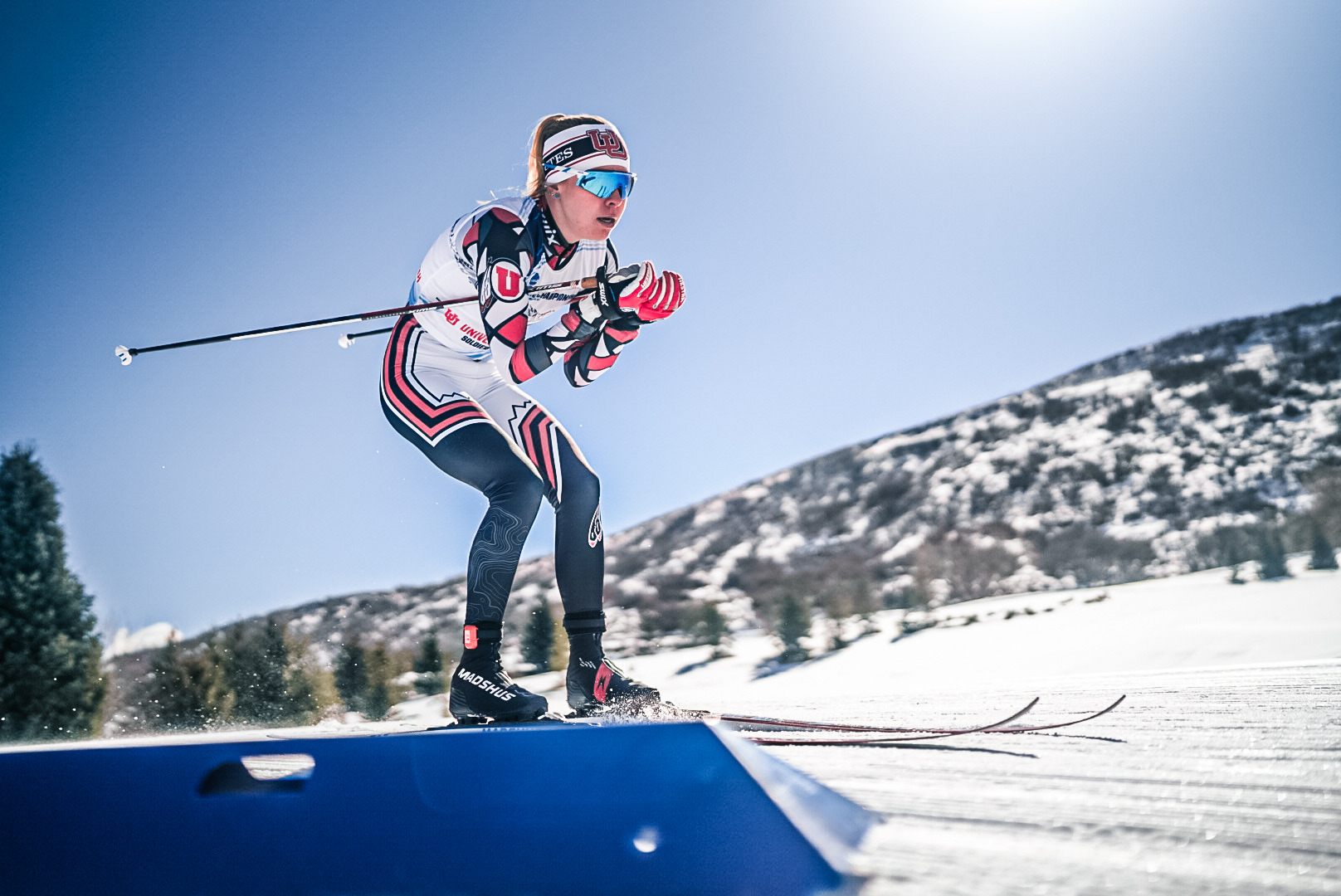
Novie McCabe (Univ. of Utah) wins the women’s 5 k classic during the 2022 NCAA Championships in Soldier Hollow, UT. (Photo: Tobias Albrigtsen / @untraceableg)
WOMEN’S 5K CLASSIC
Novie McCabe of Utah became the first to earn an NCAA title, winning the women’s 5K classic in 13:22.8, crushing the field by more than 13 seconds. McCabe, a sophomore from Winthrop, Wash., won both of the women’s Nordic races at the RMISA Championships upon returning from the 2022 Beijing Olympics, where she was part of the U.S. cross-country 4 x 5km relay team that took sixth.
Her Utah teammate, Sophia Laukli, tied for runner-up honors with Vermont’s Anna Bizyukova as both finished in 13:36.3. Anabel Needham of Michigan Tech (13:48.6) and Hanna Abrahamsson of Colorado (13:57.2) rounded out the top five to earn first team All-America honors.
Utah’s Sydney Palmer-Leger and Michigan Tech’s Nea Katajala tied for sixth place. Palmer-Leger won both the women’s classical and freestyle titles in 2021. Jasmie Lyons (New Hampshire), Hannah Ray (Denver) and Weronika Kaleta (Colorado) placed seventh through 10th to earn second team All-America.
MEN’S 10K CLASSIC
Vermont’s Ben Ogden edged out Andreas Kirkeng of Denver by 6.4 seconds for the men’s 10K classic championship. Ogden skated in with a time a 23:43.1 while Kirkeng came back in 23:49.5.
Ogden, a senior from Landrove, Vt., has won three consecutive races since returning from the 2022 Beijing Olympics. Ogden captured the 2022 EIS titles in the 20K freestyle and the 10K classic. Back in 2020, he took the men’s 10K freestyle to earn his first NCAA title.
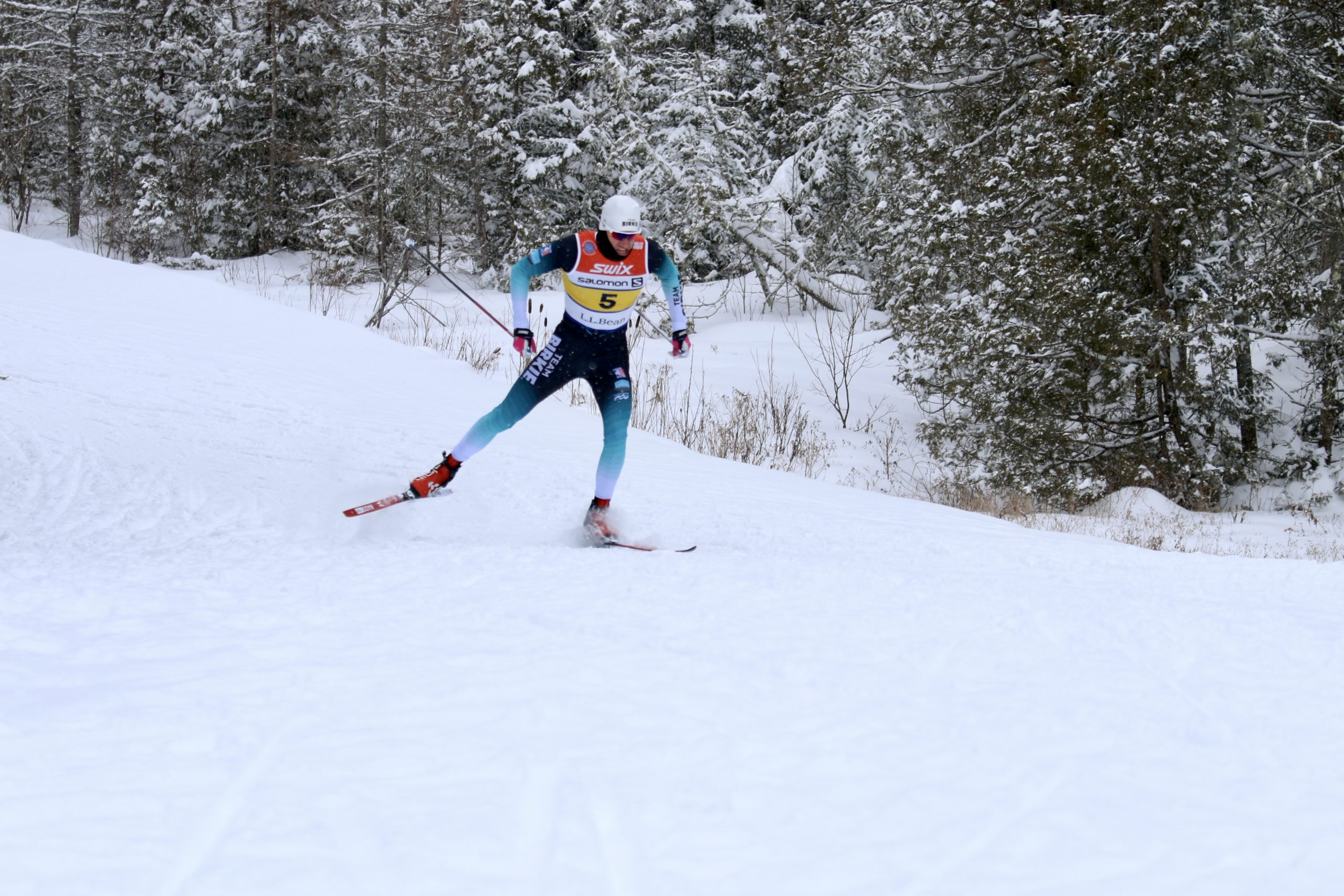
Ben Ogden (Univ. of VT) races for the win in the 10 k classic during the 2022 NCAA Championships in Soldier Hollow Utah. (Photo: Tobias Albrigtsen / @untraceableg)
Magnus Bøe of Colorado, who swept both men’s individual Nordic titles a year ago, placed third in 24:03.7. Christopher Kalev and Mike Ophoff both gave strong efforts for Alaska Fairbanks, coming in fifth and sixth, respectively, to earn first team All-America honors. Kalev was hot behind Boee with a time of 24:08.3
Second team All-America honors went to Jacob Nystedt (Vermont), Will Koch (Colorado), Peter Wolter (Middlebury), Epsen Persen (Alaska Anchorage), and Bernhard Flaschberger (Denver), who placed sixth through 10th.
QUOTES
Novie McCabe – Utah (Women’s 5 k Champion)
On how the race played out:
“It was a good race and it was fun. It was kind of icy but still really awesome skiing. You just had to make every second count and really push the corners and push the transitions to get those extra seconds because it was so tight.”
On her strategy:
“Everyone has their own way of skiing because it is your own race. I tried to take it out not really conservative but just tried to relax and ski smooth and have something left for the last lap. I think it went well for me. Sometimes you are just dialed in and it was good day for me.”
On Utah placing three in the top six:
“I’m super proud of everyone. We’ve worked hard together so it’s fun to see everyone succeed. We’re just stoked for the next race.”
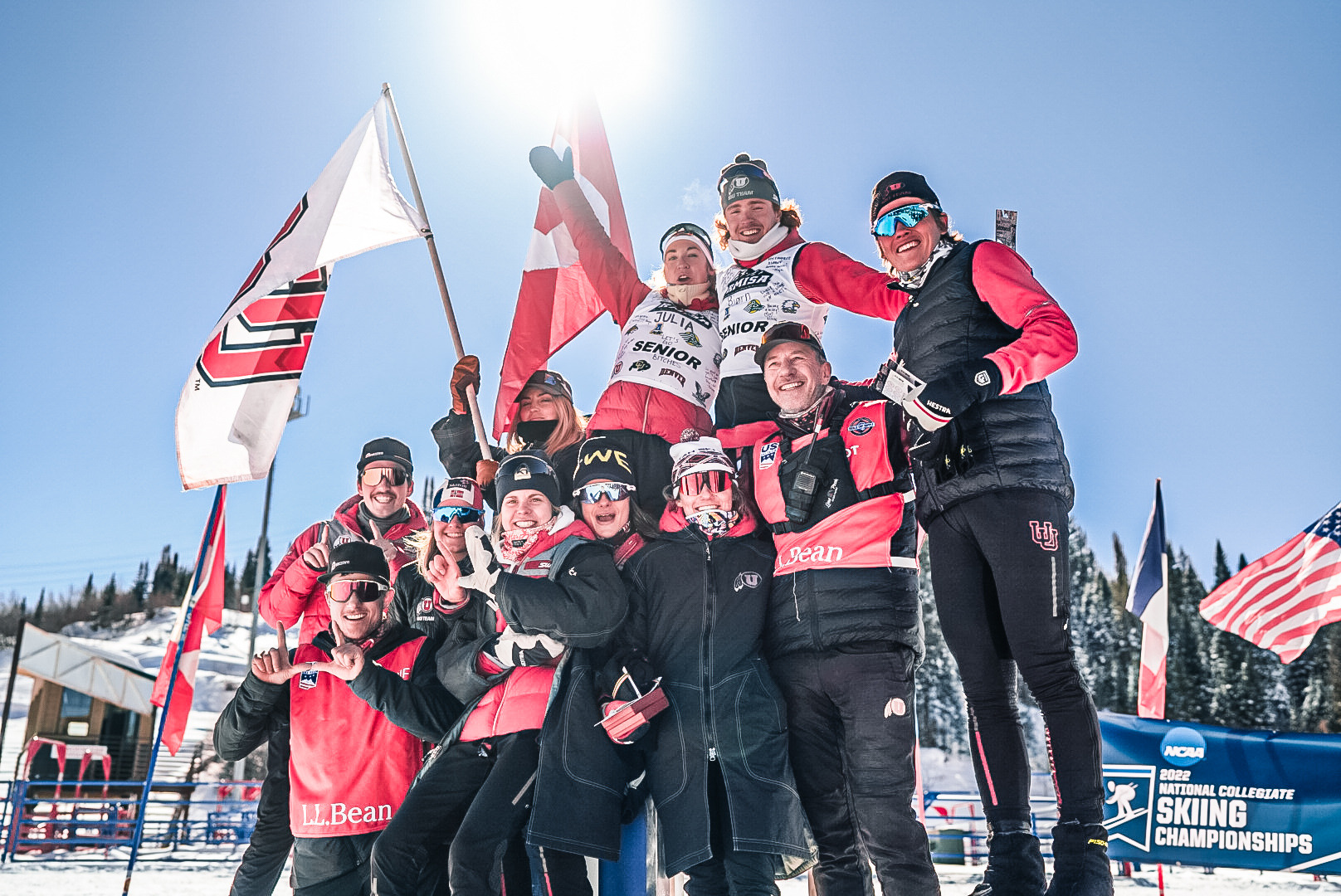
University of Utah celebrates a strong performance in the first day of NCAA racing. Novie McCabe won the women’s 5 k classic, while Sophia Laukli tied for 2nd, and Sydney Palmer-Leger finished 6th. (Photo: Tobias Albrigtsen / @untraceableg)
Ben Ogden – Vermont (Men’s 10 k Champion)
On being a national champion for the second time:
“It feels good. This was a big goal of mine this year and I’m really proud to say that I delivered when it counted. It was awesome.”
On how the race played out:
“I’m not a man known for his strategy, and if you look at the times you’ll see that. I went out damn hard and it was sort of a hanging on game for the rest of the race. But I was lucky to make it to the finish line just in front of Mr. (Andreas) Kirkeng. I was psyched.
On coming back from the Olympics:
“A couple of us came back from the Olympics and we had to be smart and rest up. That was a long and exhausting experience. But the mental aspect of this sport is not to be slept on and all of us took a lot of confidence by being named to the U.S. Olympic team and being able to represent over in China. I think that makes a huge difference with your performances late in the season. You feel fast, so we are fast.”
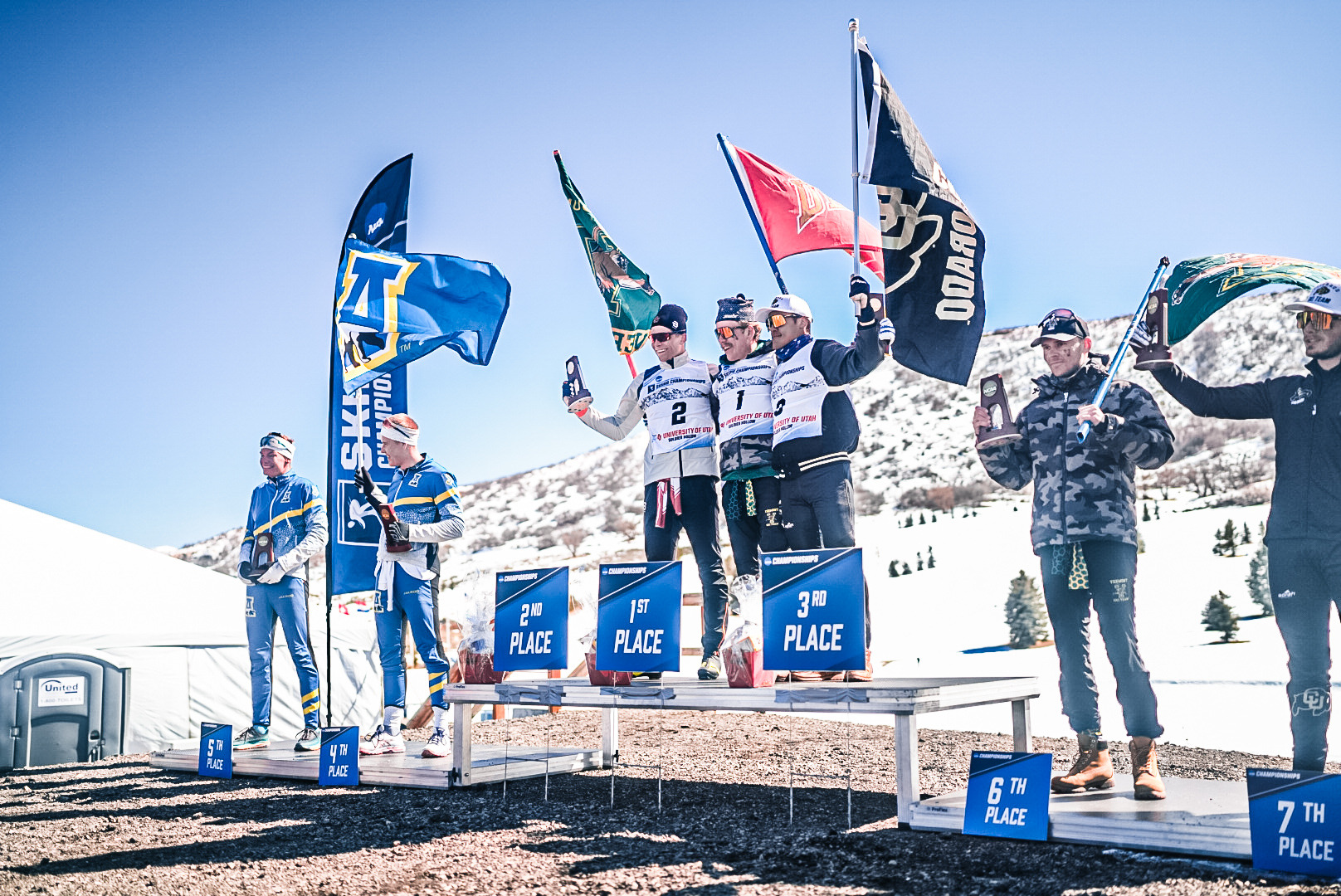
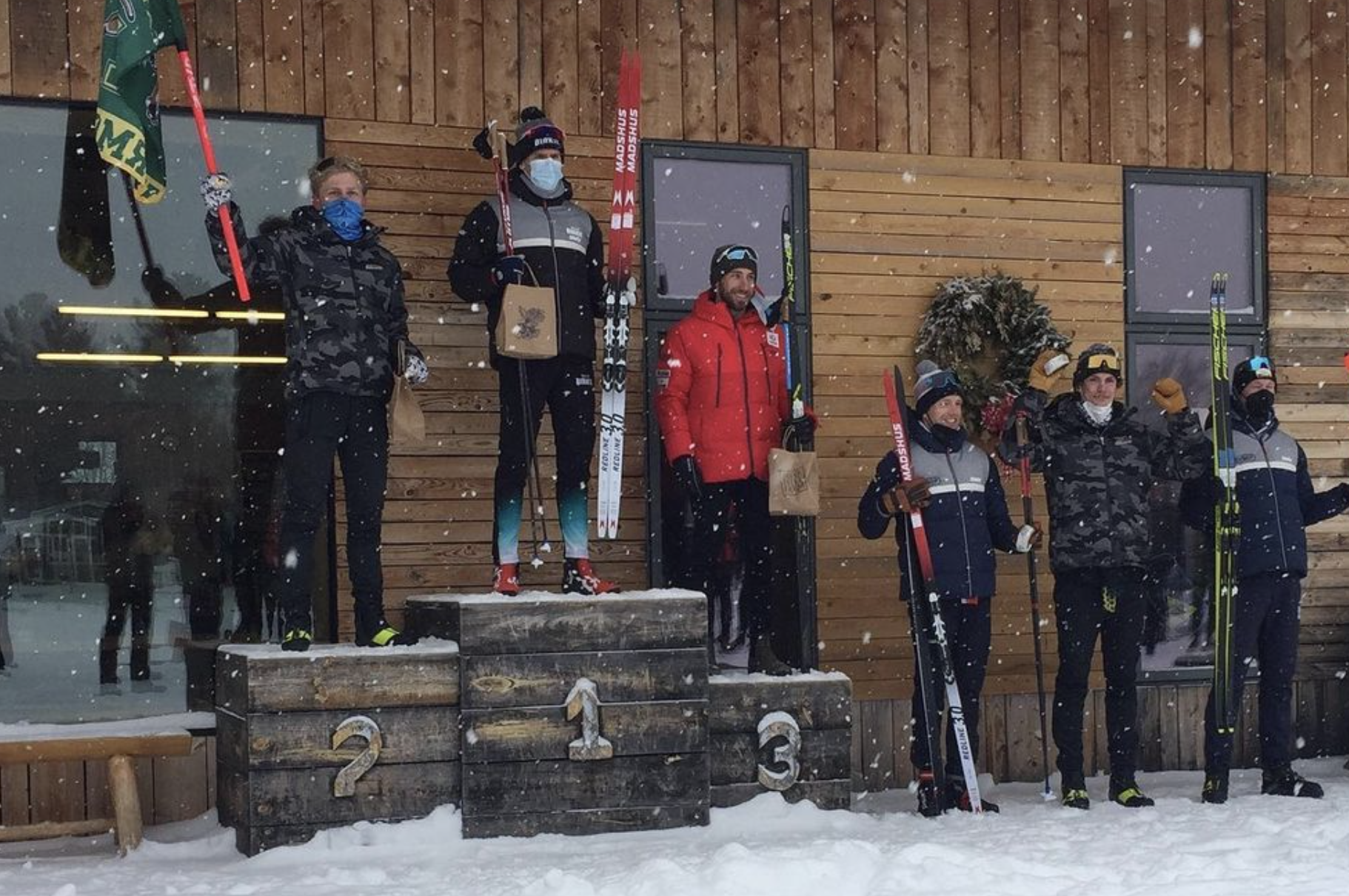
The 2022 NCAA 10 k classic podium: Ben Ogden (Univ. of VT) took the win ahead of Andreas Kirkeng (Denver Univ.) and Magnus Bøe (Univ. of CO). (Photo: Tobias Albrigtsen / @untraceableg)
Miles Havlick – Utah (Nordic Head Coach)
On the conditions:
“Perfect day for racing. The tracks were fast and firm. Blue sky, typical Utah day. It was awesome.”
On Novie McCabe and Sophia Laukli coming back so strong from the Olympics:
“I think both Sophia and Novie were really exposed to top-level racing, and Sydney (Palmer-Leger) as well on the World Cup. But Novie and Sophia spent a little more time over there and were able to make the Olympic team. So they just came back with guns blazing. I think it’s nice for them to be back home eating the food they’re used to and being with friends, so they’re having fun and skiing fast.”
Utah’s Sophia Laukli ties for runner-up in the 5 k classic during the 2022 NCAA Championships in Soldier Hollow, UT. (Photo: Tobias Albrigtsen / @untraceableg)
On the women’s team:
“Really not surprising out of them. We knew that they were going to be duking it out for the win. I think Novie really carried her form from regionals. Just looked so sharp, especially up the last climb. She really paced it out well. Sophia was just a few seconds off. Very solid out of Sophia and those two have just been incredible all year. Sydney was just a few seconds behind them. Very solid day for her and I’m sure she’s going to be hungry for more on Saturday.”
On the men’s team:
“We gambled a little bit and went light on the kick so their skis would be a little faster. Maybe that wasn’t the best move but they fought hard all the way to the line and they were very solid. We’ll be looking for more out of them on Saturday. I think mass starts suit us better as a team.”
SuperTour racing continued on Friday in Craftsbury, Vermont, as part of the Henchey Memorial Carnival, which also included Eastern Cup and collegiate racing. The three-day event is presented by the Craftsbury Outdoor Center, NENSA, U.S. Ski & Snowboard, and the University of Vermont (UVM), the EISA carnival host school.
Racers were faced with snowy conditions for the opening 1.4-kilometer freestyle sprint as a winter storm made its way across the Northeast. Friday morning’s grooming report mentioned 6 inches of fresh snow, as more continued to fall throughout the morning.
On the women’s side, last weekend’s 10k freestyle winner, Alayna Sonnesyn (SMS T2), won the qualifier in 3:58.27, ahead of BSF Pro Team’s Lauren Jortberg in second and APU’s Rosie Frankowski in third. Perhaps a nod to the wintery conditions, these top three finishers were separated by over six seconds.
Sonnesyn advanced from the first heat of the quarterfinals into the semis, where she finished third in the first heat behind Katharine Ogden (SMS T2) and Ava Thurston (Mansfield Nordic Club), who crossed the line together, roughly 0.4 seconds ahead of Sonnesyn. As the second semi, which was won by Jortberg, was roughly four seconds faster on average, Sonnesyn did not earn a lucky loser spot in the final. Instead, Jortberg advanced with Anna Bizyukova of UVM, Frankowski, and Craftsbury’s own Margie Freed.
Despite the trend seen in the qualifier, the final featured tight racing, with the top five athletes finishing within two seconds of one another. Just 0.6 seconds separated second from fifth.
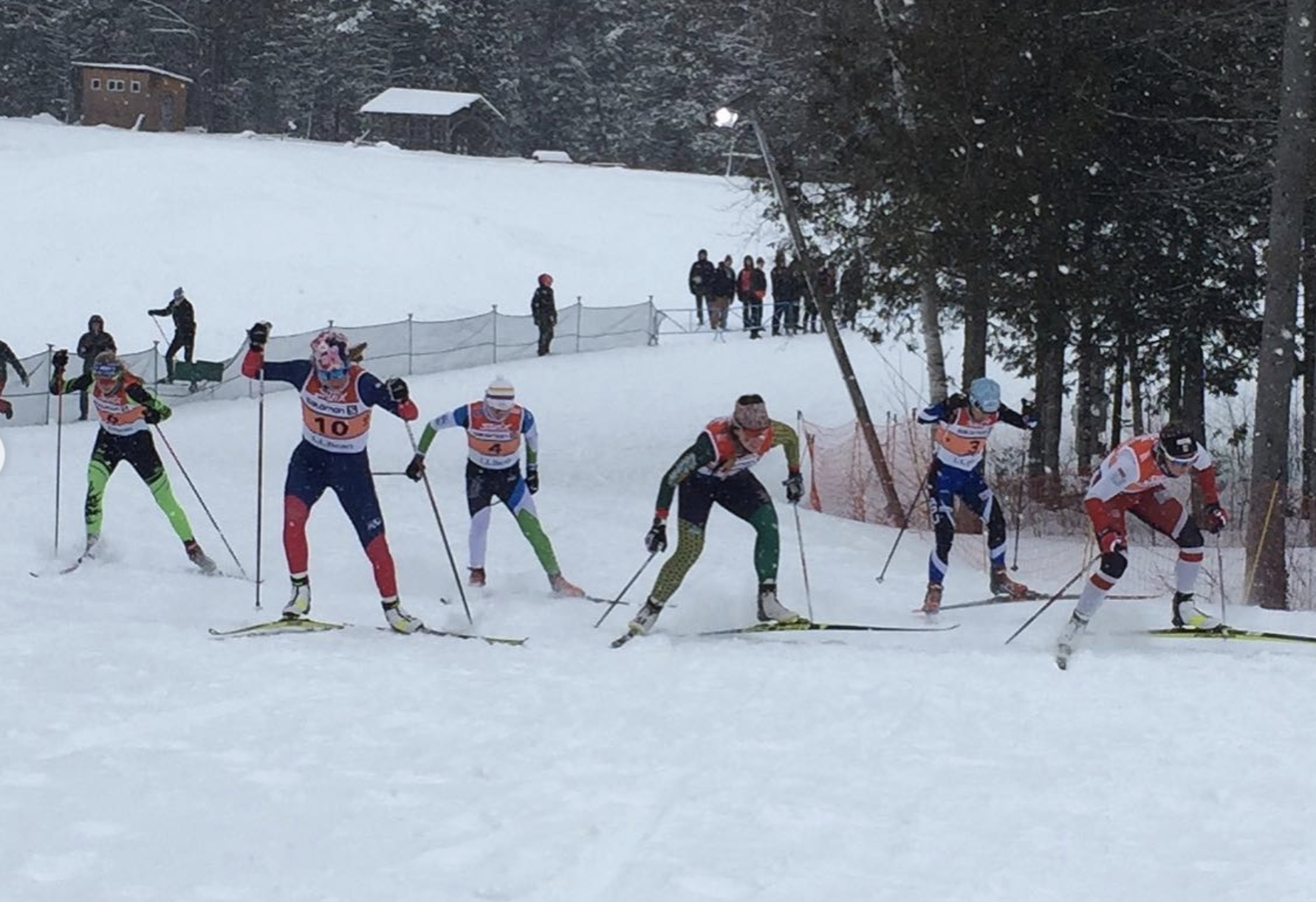
A scene from the women’s final of the 1.4k freestyle sprint in Craftsbury. (Photo: Instagram @nensa_nordic)
Coming out on top was Ogden, who won the final in 3:59.08. After racing on the World Cup from the opening races in Ruka through the midway point of the Tour de Ski, Ogden has gone three-for-three in SuperTour sprints since returning stateside, winning classic sprints in Soldier Hollow and Lake Placid before checking off a skate win today.
Just behind, Jortberg took second place (+1.30) with U18 athlete Thurston closing in third (+1.78). Bizyukova was next to the line in fourth (+1.86), with Frankowski less than a meter behind in fifth (+1.91). Freed rounded out the women’s final in sixth (+4.51).
“I think that the biggest thing to note about today was that it was blizzarding!” wrote Ogden in a post-race email. “The heavy falling snow made the heat racing very tactical and rewarded being very quick off of the line. There was one lane on the course that was packed down by traffic and the other areas were pretty soft!”
Ogden was just 11 points behind Caitlin Patterson on the Olympic qualification distance list, based on the athletes’ best two distance races on the SuperTour or at the U.S. Cross Country Championships, during which Ogden competed in only one race – the 10k individual start classic where she was second to Patterson. The following weekend in Sun Valley, she was second in one distance race and fourth in the other, behind three Olympians and ahead of Patterson in each. As the races at U.S. Nationals were scored at a higher point value, Patterson took the final Olympic spot, leaving Ogden on the wrong side of the cusp.
Nevertheless, Ogden has found silver linings in the additional time back east.
“It was a blast to be able to race with the EISA. I miss skiing for Dartmouth (Ogden graduated in 2021), so it was fun getting to ski with some of my old teammates and some new Dartmouth skiers. It was also pretty great to ski in lots of natural snow, we rarely get a snowstorm this big anymore and it was undeniably very fun.”
The women’s podium after the opening freestyle sprint race which kicked off a weekend of SuperTour, Eastern Cup, and EISA racing. (Photo: APU Nordic Ski Center / Instagram)
As Thurston is, remarkably, still in high school, Bizyukova was the top collegiate racer to earn today’s EISA sprint title. The second and third placed collegiate racers both hailed from Dartmouth College, with Callie Young finishing fifth in the first semifinal and 10th overall, and Jasmine Drolet taking sixth in the second semi for 11th overall.
The men of the Sun Valley Ski Education Foundation (SVSEF) Gold Team swept the top-three spots in the men’s qualifier, with Karl Schulz leading the way in 3:23.48. Peter Holmes was 0.33 behind in second, with Johnny Hagenbuch in third (+1.21).
Schulz carried momentum from the qualifier win into the first quarterfinal, which he won by half a second, but his day ended soon after in the semifinal. Racing in a fast first heat that contained two eventual podium winners and found both lucky losers, Schulz was fifth in the heat, +1.72 behind winner Matias Øvrum of UVM. Sam Wood (SVSEF) was second in the heat, ahead of last weekend’s sprint winner Zak Ketterson (Team Birkie) and Gregory Burt (UVM).
In the second semi, which was nearly three seconds slower, Canada’s Étienne Hébert (CNEPH) edged out Holmes by 0.1 seconds to go 1-2 and advance to the final round.
Zak Ketterson leads up the final climb in the men’s freestyle sprint final in Craftsbury. (Photo courtesy Zak Ketterson)
The top two spots in the final were decided by a close finish between Ketterson and Øvrum, with Ketterson crossing 0.28 ahead in a time of 3:22.57 to earn his third SuperTour sprint title of the season. Øvrum was second, though he was named the collegiate race winner for UVM, with Hébert crossing the line a few meters behind on his own in third (+2.17).
“I’ve always really liked racing at Craftsbury,” Ketterson wrote to FasterSkier after the race. “It’s an awesome place and this year Team Birkie has been lucky enough to stay right at the Outdoor Center. The race course is right out our back door!”
Ketterson also provided insights to the final round for those following from afar.
“The final was really close! I gave it everything I had at the top of the last hill but I definitely started to get tired and bogged down a bit into the finish. Matias skied a smart race and gave me a really good challenge in the last few meters but luckily I was able to fend him off. It was a tricky day with super soft fresh snow and I’m happy I was able to execute.”
Zak Ketterson races a snowy freestyle sprint qualifier in Craftsbury. (Photo courtesy Zak Ketterson)
Wood was fourth in the men’s final (+6.9), with Burt fifth (+7.17), and Holmes sixth (+10.82).
The men’s freestyle sprint podium after the opening day of SuperTour racing in Craftsbury. (Photo: Instagram @nensa_nordic)
As mentioned, Øvrum was the top collegiate racer, with Burt second, going one–two for UVM. Third place among college athletes was Allan Luke of Dartmouth, who finished sixth in the first semifinal and 12th overall.
Craftsbury’s Day 1 coverage of the the 2022 Henchey Memorial Carnival: SuperTour, NENSA Eastern Cup and UVM EISA carnival.
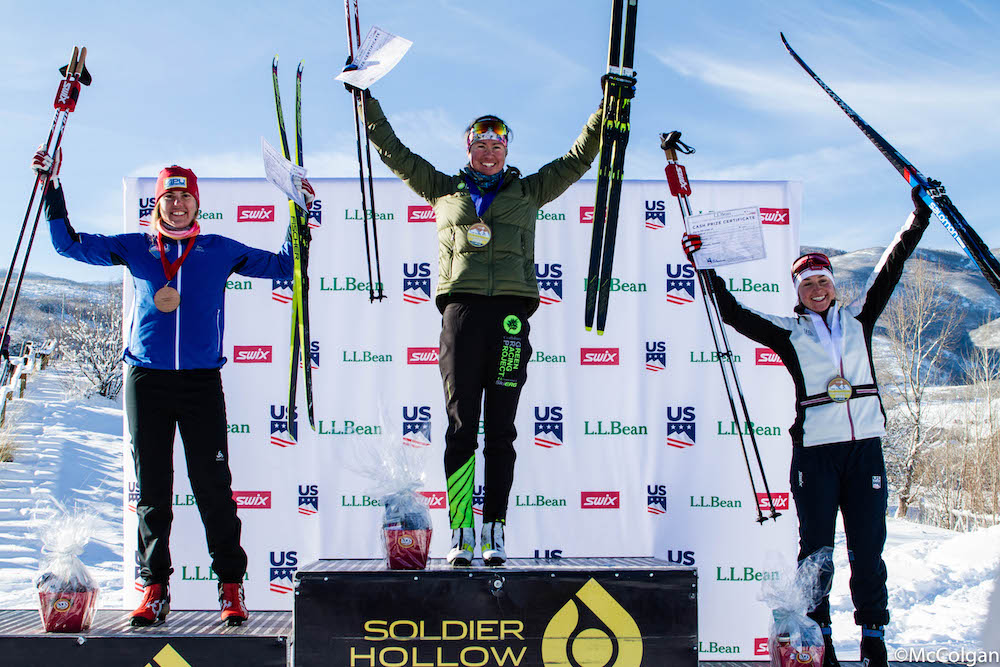
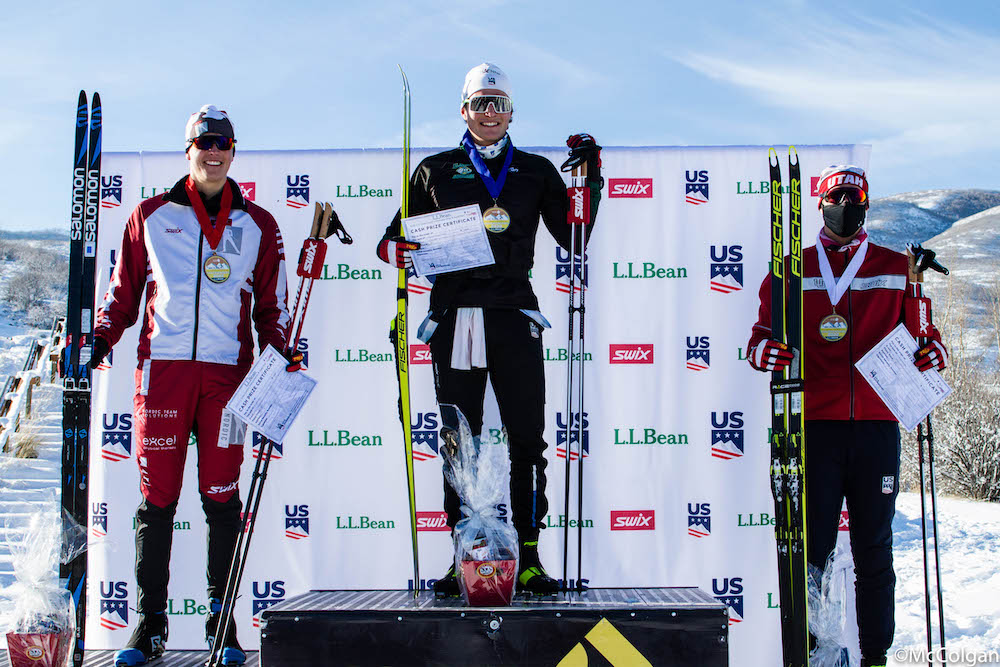
From left, Becca Rorabaugh (APU), Caitlin Patterson (CGRP), and Sydney Palmer-Leger (Utah) on the podium, 2022 U.S. Nationals. (photo: John McColgan)
By Gavin Kentch and Rachel Bachman Perkins
The 2022 U.S. Cross Country Championships began in Soldier Hollow, outside of Salt Lake City, Utah, on Sunday with skate sprints. JC Schoonmaker, recently returned from Europe, took his first national championship with relative ease for the men, while Caitlin Patterson, who was the first American in all four races at 2018 U.S. Nationals, returned to her Olympic-year winning ways by taking the victory for the women. Will Koch and Rosie Frankowski won the qualifiers, the race that matters for potential domestic Olympic qualification.
Men’s Race: JC Schoonmaker Wins First National Title with Tactics and Speed
JC Schoonmaker was born in August 2000. Eighteen months later, American skier and ski journalist Cory Smith, writing on a nascent website called FasterSkier.com, observed that race tactics were important on the sprint course being used for the 2002 Winter Olympics in Salt Lake City, and that it was generally disadvantageous to be leading into the final downhill as athletes approached the sweeping lefthand turn into the finishing stretch. He discussed Kateřina Neumannová’s quarterfinal heat as an example of the potential dangers of leading throughout, if that name gives you a sense for how long ago we’re talking about.
Twenty years later, in the opening race of 2022 U.S. Cross Country Championships, the names had changed but not the physics, as time and again it became apparent that athletes’ positioning on the final downhill was the single most important aspect of the course. Multiple heats saw athletes come back from fifth or even sixth to move up through the field and advance, and the one male athlete who tried to lead his heat from the gun paid for it in the end.
Schoonmaker, the U.S. Ski Team athlete who skis domestically for University of Alaska Anchorage, understood these tactics to perfection, using the experience gained from racing into 14th in the current World Cup sprint standings (despite missing two sprints in the Tour de Ski) to position himself exactly where he wanted to be throughout the afternoon. The result was his first national title, on a sunny, high-pressure, perfect day at Soldier Hollow.
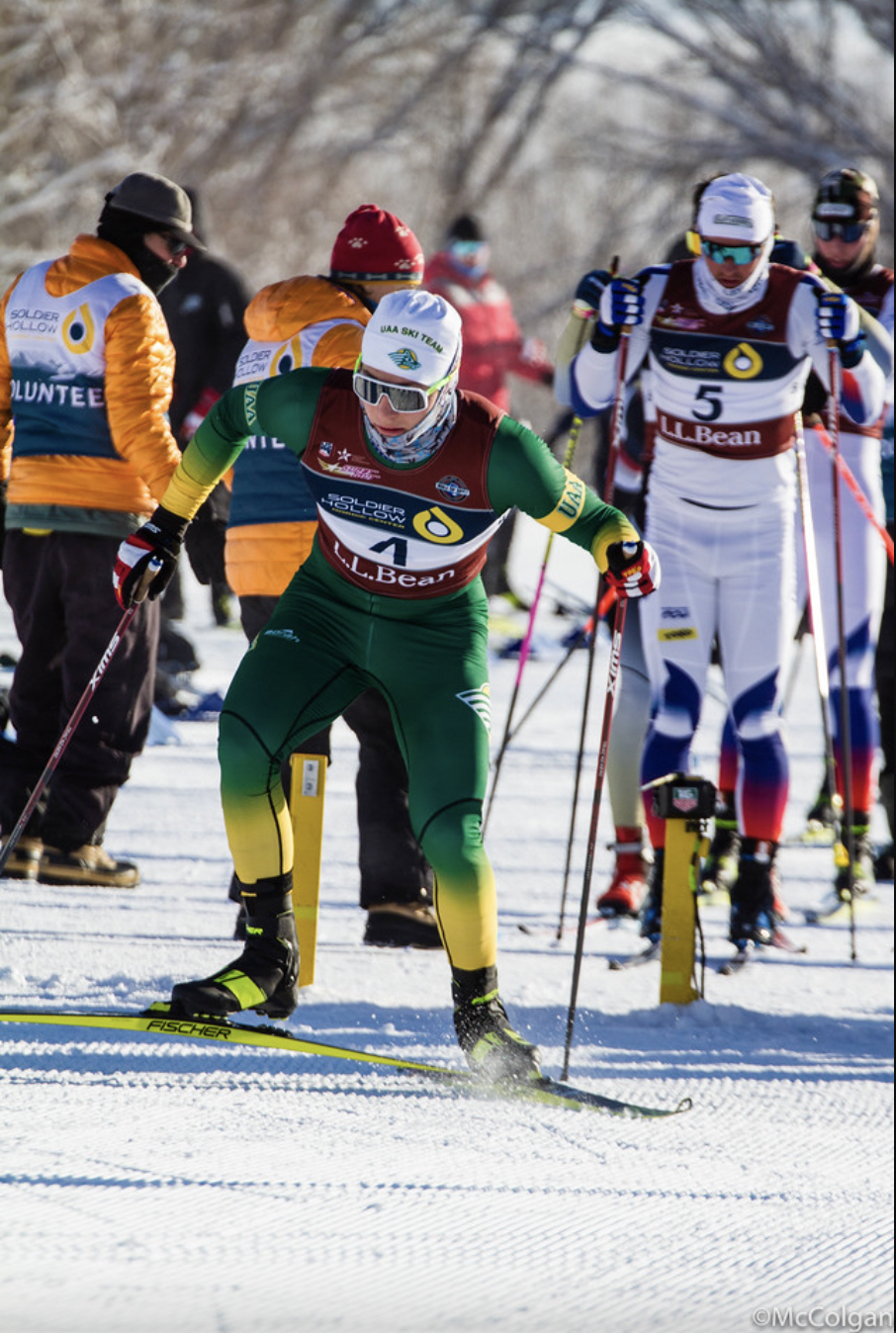
JC Schoonmaker heads out in the qualifier. (Photo: John McColgan)
We’re not going to survey every heat from Sunday’s races, on the first of four days of competition at Soldier Hollow, but it’s worth looking at the fastest qualifiers, and the day’s first quarterfinal, to set a tone for what followed.
In the qualifier, 19-year-old University of Colorado skier Will Koch may have turned some heads when he notched the day’s fastest time, 3:07.88. Schoonmaker had the day’s second-best mark, 0.47 seconds back, with Bridger Ski Foundation athlete Logan Diekmann third by over a second more.
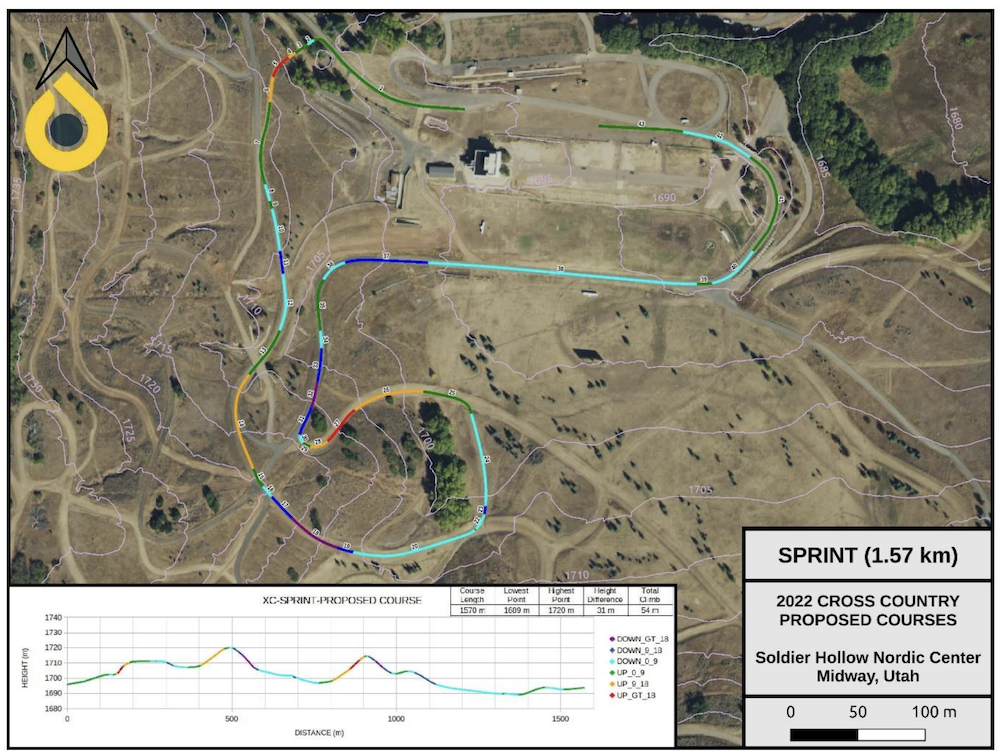
In the day’s first quarterfinal, Koch picked up where he had left off in the qualifier, blasting off the line to set a hot pace right from the start. He was probably the only athlete all day to V2 the entire first hill leading out of the stadium. He led up the first hill, down the first downhill, up the second and main climb on the course, and into the start of the final sweeping downhill into the stadium and the finishing lanes (see course map and profile below).
Course map and elevation profile for 2022 U.S. Nationals sprint course. (photo: screenshot from race website)
But then, for the first time on the day but not the last, the athlete who led into this descent was swallowed up by the rest of the field by the time they reached the final lefthand curve. Koch was caught up, gamely contested the group sprint that ensued, but barely ran out of gas after pushing hard for the entire heat.
Koch would finish fifth in a five-man heat – despite skiing faster than he had in qualifying. For his troubles, he towed the entire heat to the day’s fastest times by far, and both lucky loser spots; fifth in this heat would have won any other quarterfinal, semifinal, or final on the day. By nearly 5 seconds.
While the top qualifier was knocked out in the first quarterfinal, the effort is not to be diminished. Indeed, Koch chose a tactic, committed to it fully, executed it well, and came within 0.05 seconds of claiming fourth in his quarterfinal to advance as a lucky loser. With that in mind, this heat set the tone for the day, as a field of observant professional athletes noticed that there was maybe not a lot to gain by leading out the heat, and a lot to lose.
As Smith wrote of these dynamics on this course 20 years ago, “The ideal situation is to spend the first three-quarters of the race in the back, avoiding mayhem and drafting. Then move up to second coming into the final turn, and use the turn to shoot out and around the leader to win the sprint. But obviously that is easier said than done when everyone else is trying to do the same thing.”
In lieu of a play-by-play of the next six quarterfinal and semifinal heats on Sunday, let’s just survey some winning times: 3:06.09 (QF1, Koch’s heat); 3:15.31 (QF2); 3:13.97 (QF3); 3:16.83 (QF4); 3:10.99 (QF5); 3:13.16 (SF1); 3:20.04 (SF2). There’s a theme there: While the heat 1 lucky losers may see Koch’s reward for pushing the pace, no one else in the men’s field chose his approach. Racing was slower-paced, but it was hard to fault the results, at least for the athletes who advanced.
(The discrepancy is perhaps even greater than that, as local observers noted that the course got progressively faster throughout the day, as it warmed up from below-zero F temperatures the night before. On quiet moments in the livestream, the difference between notably squeaky snow (for the qualifiers) and not-squeaky snow (for the heats) was apparent.)
The other, related issue was falls at the bottom of the long runout, as trailing athletes accordioned back up to the leaders, and four, five, or even six men all sought to move from a narrow tuck to a wide V2 at the same time on the same stretch of trail. Through what consistently looked like incidental contact rather than malicious contact punishable by a yellow card or other formal sanction, Ian Torchia, Bill Harmeyer, Christopher Kalev, and Brian Bushey all hit the deck in their quarterfinals. The same thing happened in the semis, too, with Karl Schulz falling in the first semifinal and John Schwinghamer in the second. Again, it certainly appeared that it was not intentional, just the results of athletes all commencing a V2 at the same time at high speed.
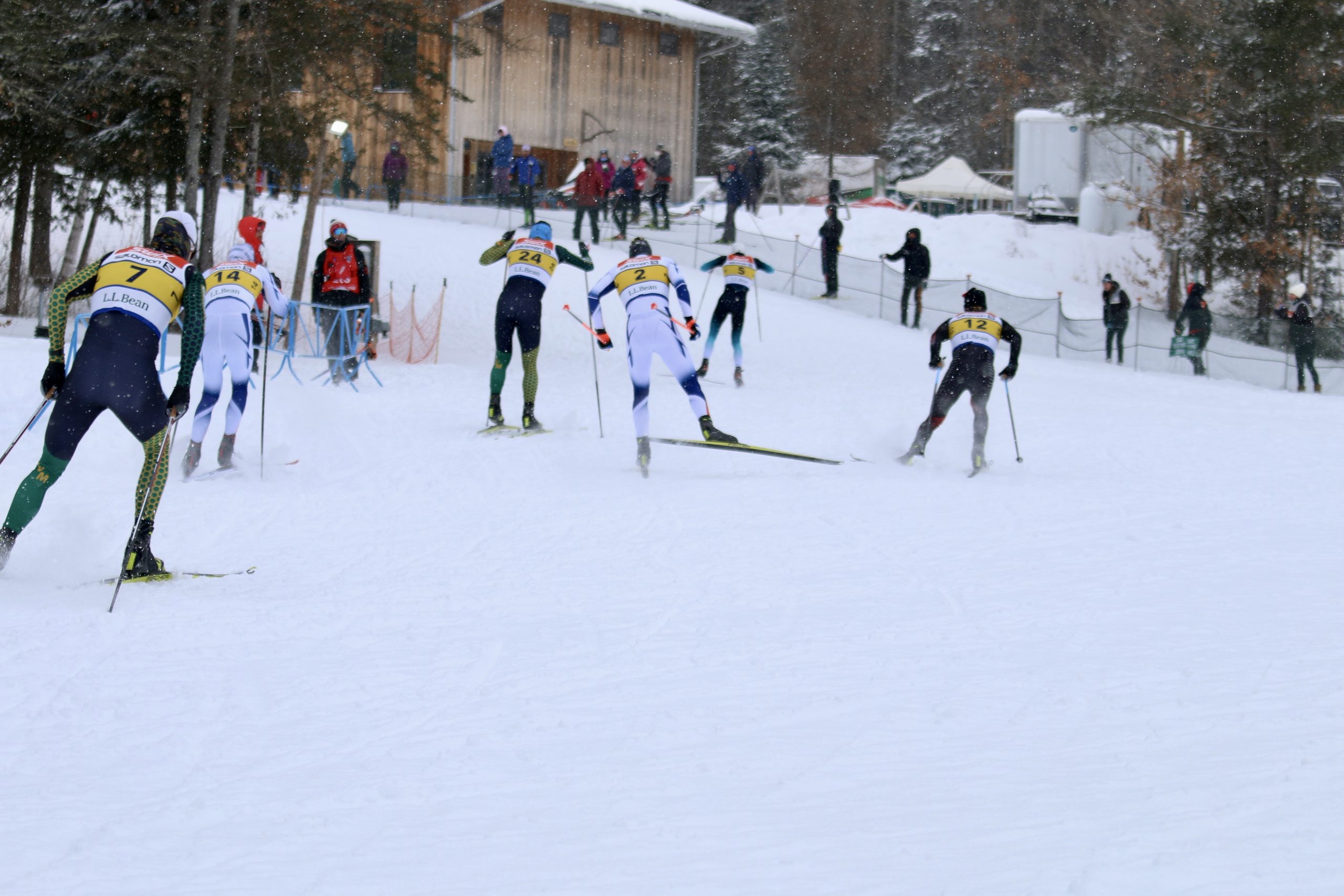
After one fast heat and six slower heats, six men lined up for the final: JC Schoonmaker (UAA/USST), Noel Keeffe (University of Utah/USST), Logan Diekmann (BSF), Johnny Hagenbuch (SVSEF/USST), Magnus Bøe (University of Colorado), and Andreas Kirkeng (University of Denver).
Their average age was slightly less than 22; they had probably not read Smith’s coverage of the 2002 Olympic sprint when it was first published. But they had all successfully raced two heats on this course already, and they seemed disinclined to change what had got them there.
All of which is to say that Schoonmaker’s winning time for the final, 3:21.05, was the slowest of any men’s heat that day. (Indeed, this time would have placed him fourth in the first junior boys semifinal.) Diekmann led the pack out of the stadium in the final, closely tailed by the rest of the field. The men skied fairly leisurely up the first uphill, down the first downhill, and up the second uphill.
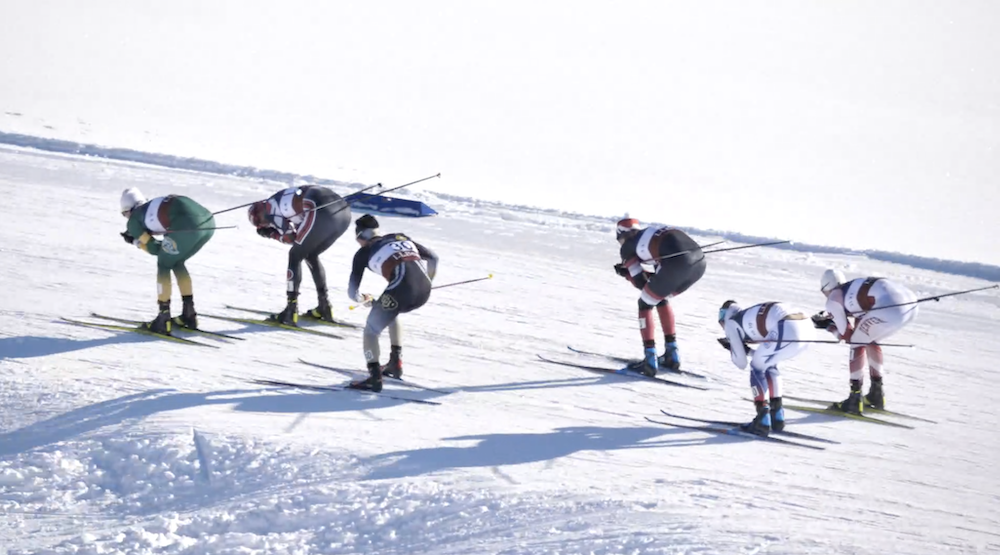
Finally, coming into the final downhill, Bøe moved, and Schoonmaker followed. The field started racing in earnest at this point, but there was still not much separation between six athletes traveling at high speeds: Here’s the men’s field, nearly three minutes into the final, about to come up out of their tucks, navigate the final lefthand turn, and sprint into the finish:
JC Schoonmaker (far left) leads the final in the men’s skate sprint at 2022 U.S. Nationals. (photo: screenshot from livestream)
That’s Schoonmaker in the lead, Keeffe just off his right shoulder in second, Bøe (bib no. 30) in third, then Diekmann, Hagenbuch, and Kirkeng trailing slightly behind in fourth through sixth, respectively, from left to right. And, spoiler alert, these were not their final finishing positions; there was more movement yet to come.
While the camera work, free live broadcast, and Adam Verrier’s announcing were consistently superb, the limitations of the available camera angles meant that a portion of the final lefthand curve was obscured from view for a few seconds. (That curve can be seen in the video in the second half of this Instagram post from BSF.)
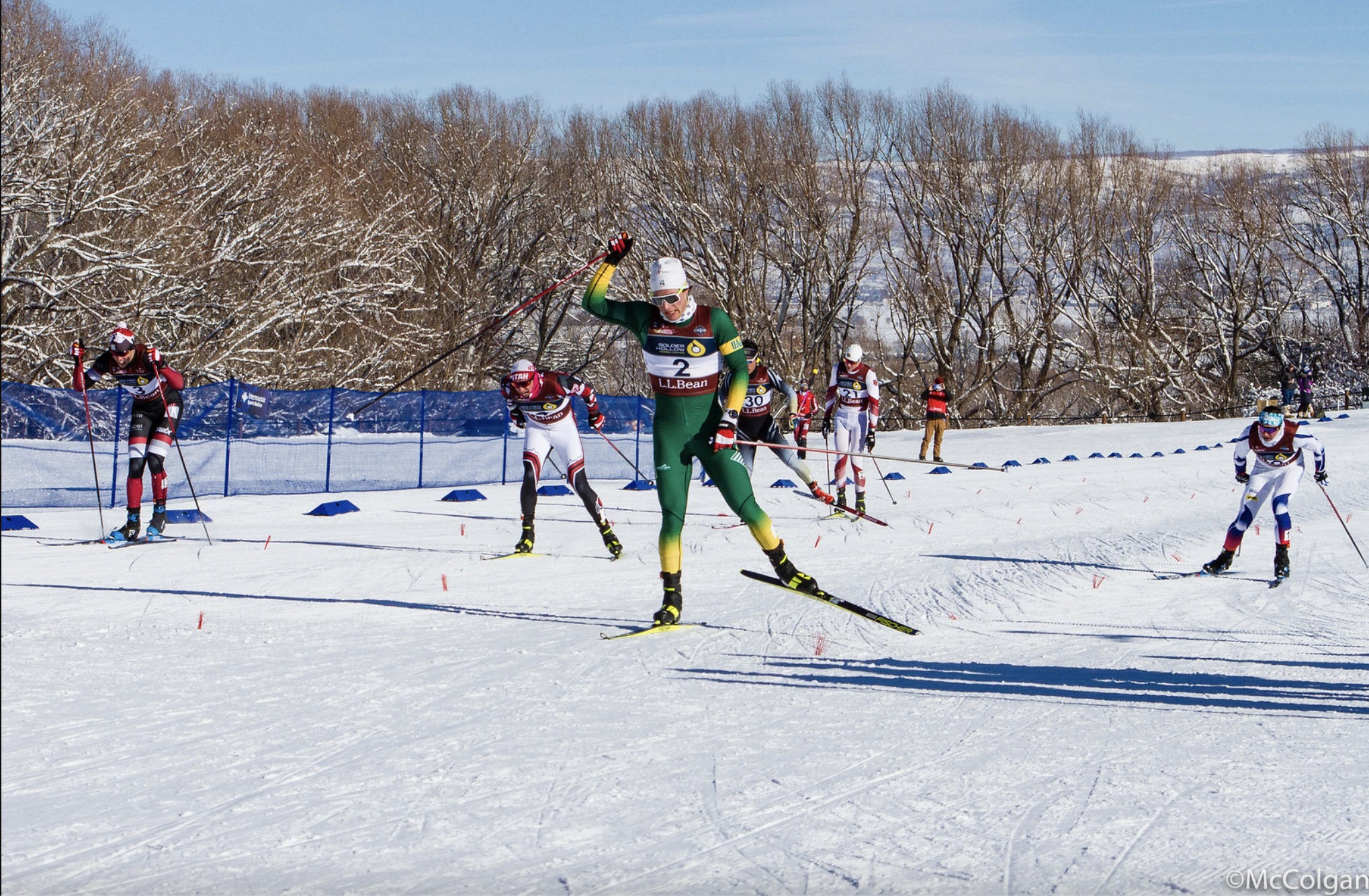
By the time the athletes came into view once more, Schoonmaker had positioned himself precisely where he wanted to be, on the inside of the curve, carrying a lead of multiple meters. His gap was small but consistent through the finish, which he approached with sufficient time and space to stand up and celebrate across the line.
JC Schoonmaker celebrates across the line as he wins the men’s skate sprint at 2022 U.S. Nationals. (Photo: John McColgan)
Schoonmaker’s winning time was 3:21.05. Behind him, Diekmann (+0.83) outlunged Keeffe (+.91) for second by less than a ski. Hagenbuch was another 0.20 seconds back in fourth (+1.11) , followed by the two collegiate skiers, Bøe and Kirkeng, in fifth (+2.14) and sixth (+3.47).
“I’m feeling really good after a nice relaxing Christmas at home [in Tahoe City, CA],” Schoonmaker wrote to FasterSkier after the race. “It was great to have a mental break from racing and we got absolutely dumped on with snow so that was really fun too.”
Schoonmaker also spoke to his feelings in the sprint, after a successful, but potentially draining stint in Europe, where he skied into the semifinals three times, finishing as high as 7th in Ruka, Finland.
“Today I felt pretty good and felt like I was getting better throughout the day after a little break from racing. It’s a weird course with the last downhill being so tactical but I was happy with my positioning and how I skied it. I won’t race the 30k just to make sure I’m not overdoing it but I’m really looking forward to the 15k classic, almost more than the sprints since I haven’t been doing much distance racing. I’m also just super excited to be back racing in the US and seeing a ton of friends out there!”
From left, Logan Diekmann (BSF), JC Schoonmaker (UAA/USST), and Noel Keeffe (Utah/USST) on the skate sprint podium, 2022 U.S. Nationals. (Photo: John McColgan)
It was Schoonmaker’s first national championship. His trajectory to the top of American sprinting has been quick, and recent; he finished 13th in the skate sprint at 2020 U.S. Nationals, and 14th in the classic sprint at 2019 U.S. Nationals. The last time he raced a national championship at Soldier Hollow, in 2017, he was 165th, albeit also age 16.
Women’s Race: Caitlin Patterson Times Her Move to Take the Victory
The tactical theme held fast through the women’s heats. Athletes stayed relaxed through the first two climbs of the course, using the sweeping downhill in the middle to establish position heading into a final shorter climb. Pushing over the top and into the downhill, athletes benefited from tucking into the slipstream of the leader rather than being first in the glideout, conserving energy for the final explosive push over the bridge and up through the finish lanes to the line.
Perhaps the only skier breaking from this narrative was APU’s Rosie Frankowski. Though she was third in both Period 1 SuperTour sprint races this season, Frankowski has historically been better known for her distance chops. Perhaps recognizing she’d need a fast heat to ensure lucky loser opportunities, Frankowski took the first heat of the quarterfinal out hot, dropping the field on the opening climb only to be reeled back in on the subsequent descent. As the women left the critical descent and began to skate out of the subsequent glideout, Frankowski was within a group of four women.
Powering into the final stretch, it was Frankowski matched by her teammate Becca Rorabaugh leading the way to the line, with Sun Valley’s Samantha Smith and Northern Michigan’s Katarina Hyncicova close behind. Rorabaugh took the heat in 3:43.67 with Frankowski in second. Though she qualified automatically, Frankowski’s fast start achieved the objective; it was the fastest heat of the quarters, allowing both Smith and Hyncicova to advance to the semis.
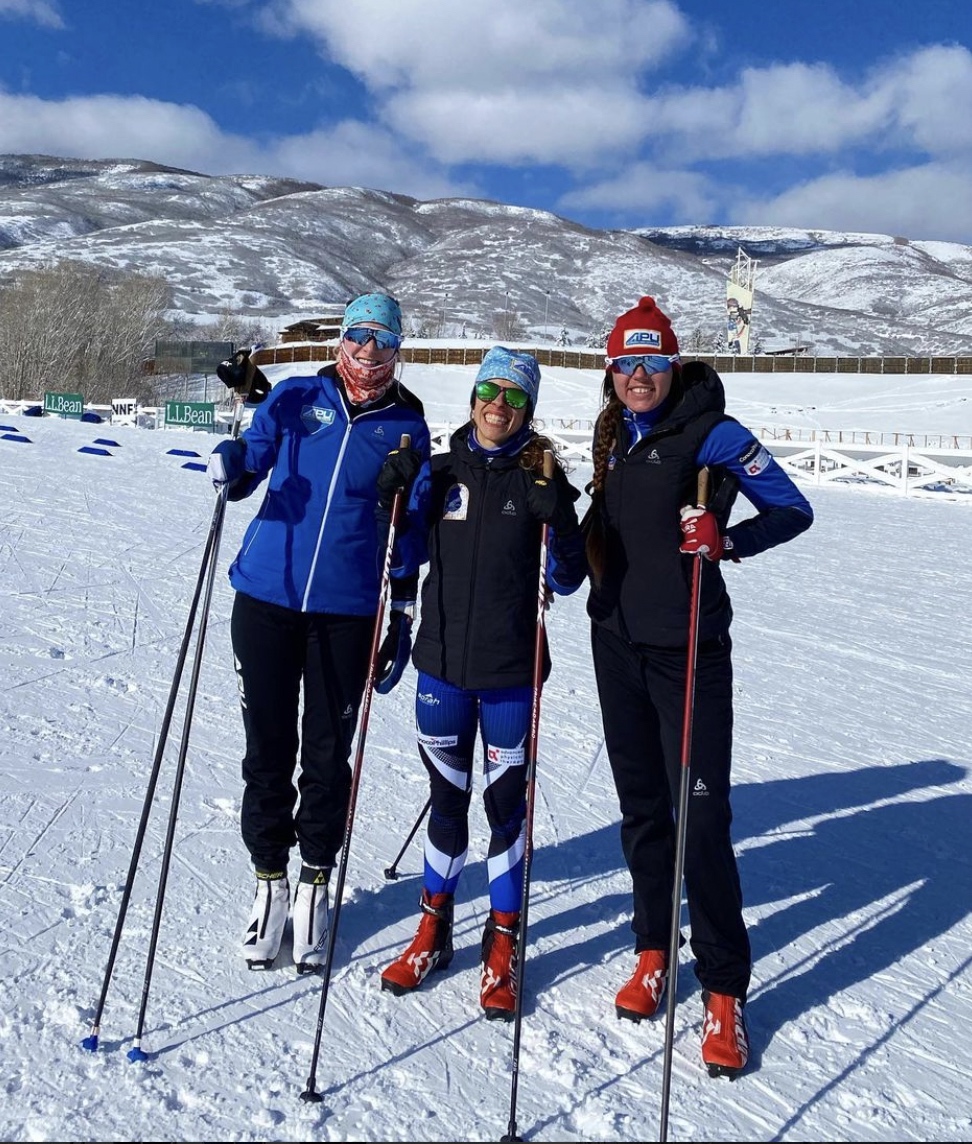
A trio of APU women on site at US Nationals. From left to right, Annie Gonzales, Rosie Frankowski, and Becca Rorabaugh. (Photo: Instagram @frankowitz)
In the semis, Frankowski repeated her approach, again pushing the pace early to establish a fast heat. Sydney Palmer-Leger (Univ. of Utah/USST) looked comfortable and content with her position as she trailed Frankowski into the sweeping downhill. Rorabaugh and Anna Bizyukova (UVM) also caught the leaders in the glideout, with Bizyukova sliding around the outside to head over the bridge alongside Palmer-Leger, setting the stage for a tight four-way spread at the finish with Frankowski and Rorabaugh on their tails.
Finishing with what would be by far the fastest times of the day, Palmer-Leger took the win in 3:38.61, edging out Bizyukova by 0.14 seconds. Half a ski length behind, Frankowski crossed in third (+0.31), with Rorabaugh fourth (+0.46). Roughly seven seconds back, Hannah Rudd (BSF) was fifth in the semi, finishing just ahead of Hyncicova.
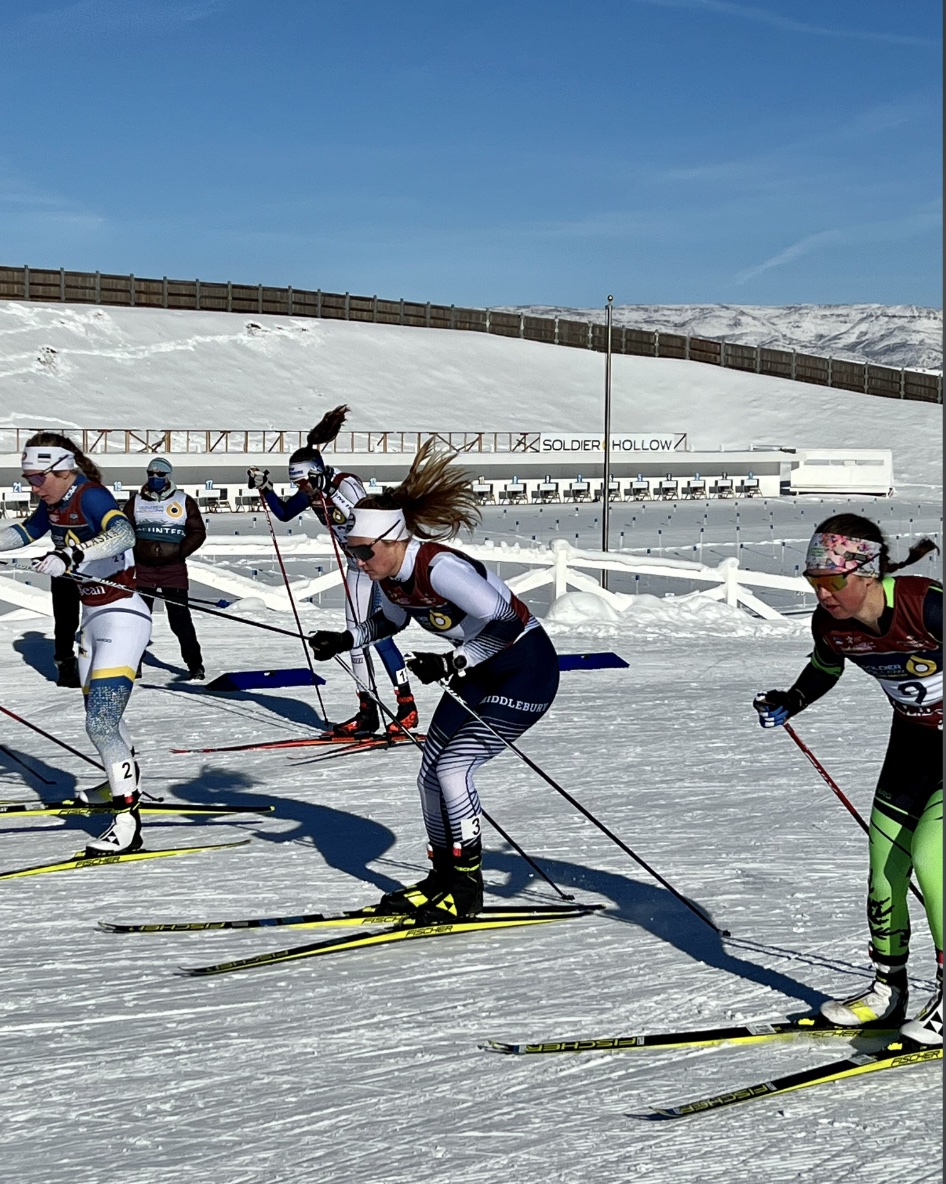
The start of the second women’s semifinal. (Photo: Julie Oldham)
In the second semi, SMS T2 athlete Lina Sutro set a more conservative pace, leading Middlebury athlete Kate Oldham through the first two climbs. Sun Valley’s Samantha Smith made some aggressive hop-skate pushes to take the lead on climbs, but she was caught and passed on each of the subsequent descents. Sutro and Oldham charged hard over the top of the final climb, pushing into the downhill, but a strong move around the curve by Mariel Pulles (UAF) shot her to the front from fourth, while Caitlin Patterson also accelerated into the lead group.
Coming into the final stretch, it was Pulles with a narrow advantage over Patterson, with Sutro and Oldham holding on for a fast time, but no longer within reach of automatic qualification. Pulles crossed the line in 3:45.15, well behind the previous heat’s benchmark, indicating that only she and Patterson, who crossed +0.10 behind, would advance to the final.
Sutro crossed the line just ahead of Oldham for third (+0.28), followed by Oldham in fourth (+0.74). Lucinda Anderson (UNH) and Smith rounded out the second semi in fifth (+1.04) and sixth (+2.72), respectively.
In the final, a broken pole early on put Pulles at a significant disadvantage, though she held contact with the leaders. Frankowski again pulled ahead from the start, looking to be at the front, and set a pace that would not leave her opponents fresh for a fast and tactical final push.
After maintaining her position at the front through the meat of the course, Frankowski was once again swallowed up in the glideout as Patterson, Palmer-Leger, Rorabaugh, and Bizyukoga each caught and passed her. Frankowski wobbled as she found her position, looking as if some unintentional bumping of skis had taken place at the spot where we saw many crashes in the men’s quarterfinals and semifinals.
Patterson led over the bridge with Rorabaugh on her tails and Palmer-Leger in a competitive position alongside. Creating a small gap ahead of the three women in pursuit in the final straightaway, Patterson, Rorabaugh, and Palmer-Leger skied three abreast, seemingly evenly matched in the closing meters. Palmer-Leger skied with the highest tempo, but Patterson’s smooth and powerful technique carried her through the finish with the advantage, stopping the clock at 3:42.60, with Rorabaugh half a ski length behind in second (+0.24), and Palmer-Leger spaced evenly behind in third (+0.57).
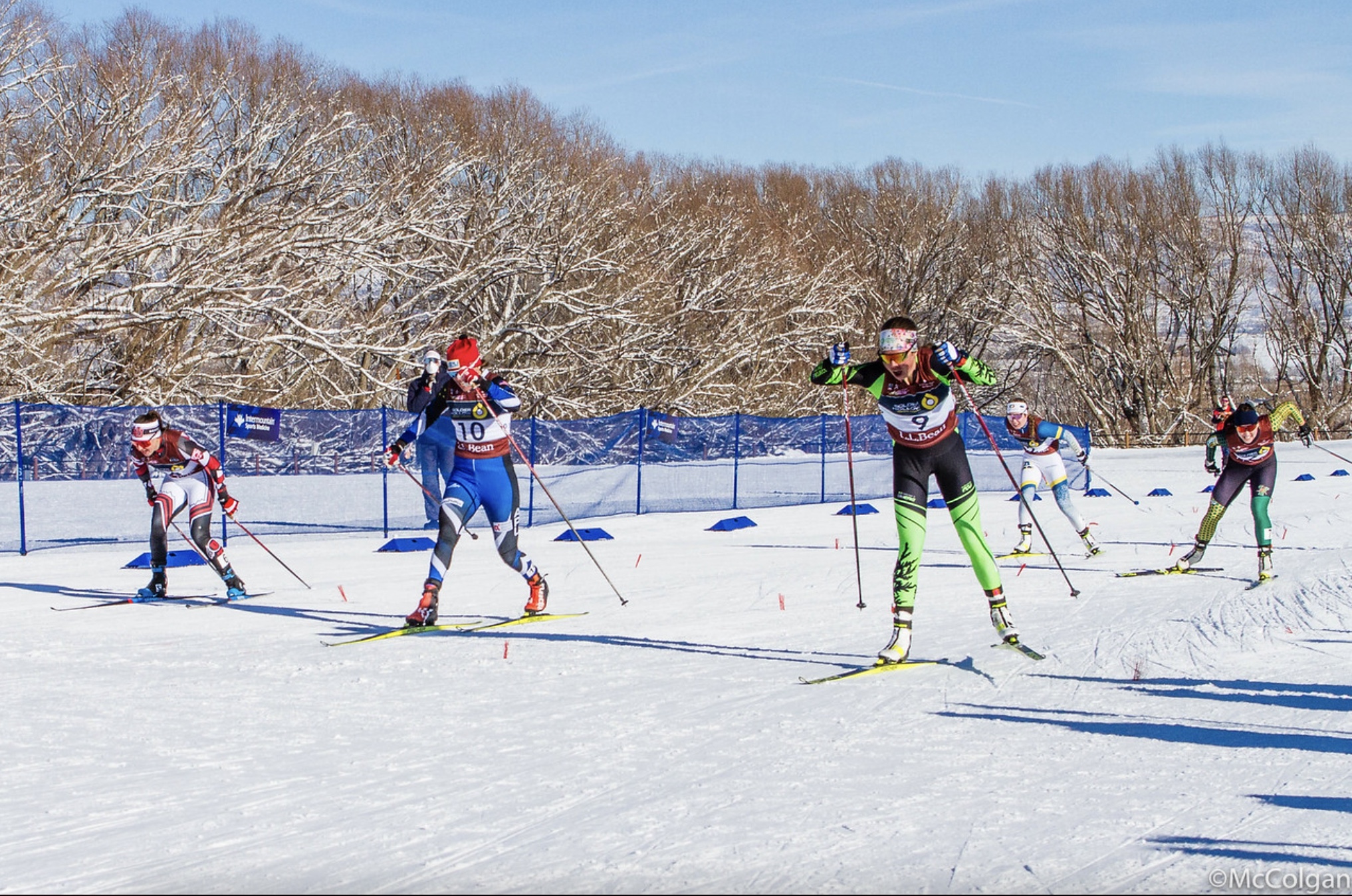
Caitlin Patterson (far right), Becca Rorabaugh (center), and Sydney Palmer-Leger (far left) race to the line in the women’s sprint final at 2022 US Nationals. (Photo: John McColgan)
Bizyukova won the second-wave sprint to take fourth (+1.57), with Pulles, still racing with a dysfunctional pole, next over the line in fifth (+2.28), with Frankowski finally losing steam to finish sixth (+2.52).
Patterson was realistic after the race when she assessed her chances, while also revealing it was no secret that the final downhill was the crux of the course.
“The sprint today was really fun,” she wrote to FasterSkier late Sunday. “I went into it in no way expecting to win, but believed that it was within the realm of possibilities. The key would be to see how the final downhill played out in the heats and and try to play it well myself.”
Patterson added, “I do love downhills, but this Soldier Hollow sprint course perplexes me somewhat because it feels hard to control what’s going to happen in the race, with the way the draft might play out in those final hundred meters. I didn’t feel particularly in control during my heats, but I took advantage of whatever I could work with for positioning and made it work to move on through the quarterfinal and semifinal. I felt better in the heats than during the qualifier, but in much of the heat race I felt that the packs moved around and stayed tight together in a way that I had to tap into surges here and there rather than a consistent effort throughout the whole course. There were a lot of really tight finishes today – my own and others – and I think there were a ton of super strong skiers out there who probably got edged out by the tiniest of margins, but so goes sprint racing.”
Caitlin Patterson won the opening freestyle sprint of the 2022 US National Championships in Soldier Hollow. (Photo: John McColgan)
Turning to the final, Patterson recounted, “I was forced out wide to the right at the base of the final climb, and had to tuck in behind some people skiing up that steep hill. It wasn’t necessarily my plan to enter the downhill in 5th, but then when I pushed super hard over the top of the hill, I caught several drafts and executed good passes. When I found myself taking the lead going into the final corner, I pushed to the finish with everything I had even as I started to get a bit wobbly, and fortunately managed to hold off Becca and Sydney!”
The 30-something Patterson added, “Becca and I would like to note that no one should count us Master’s racers out of the game!”
Patterson noted that she is pleased to achieve sprint success domestically, but is seeking more international opportunities in distance races.
“Period 1 racing on the World Cup was ok for me, but not great, it felt like a bit of a slow start to wake up the distance race speed. Undoubtedly the whole World Cup field is extremely competitive right now, and the other US women are super strong which is awesome to see, but I want to get up there myself into contention! Without scoring any World Cup points in P1, it wasn’t really an option to stay and race the Tour this year, so I came back to the US to regroup and focus on Nationals racing. I believe that with strong Nationals distance race performances I may be able to earn more upcoming international racing starts, so that is my focus looking ahead.”
Juniors
A full field of juniors raced as well, going through a complete set of heats and finals after the senior athletes. Kendall Kramer (University of Alaska Fairbanks/USST) took the junior girls final over fellow Alaskan Marit Flora (APU), with Erica Laven (Täby IS Skidor) in third. Laven is from Sweden; Lauren McCollor (Northern Michigan University), fourth overall, rounded out the domestic national championship podium as the third American.
In the junior boys final, Finegan Bailey (SMS) took the win, with Trey Jones (Steamboat Springs Winter Sports Club) in second. Aidan Burt (University of Vermont) was third.
More about the course
The Soldier Hollow sprint course has historical relevance looking back to the 2002 Olympics, as discussed above. It also has prospective relevance, to the 2022 Olympics that start in Beijing in roughly a month.
Notably, and speaking of this year’s Olympics, it is “only … qualification round finish placing” that is considered for the USSS 2022 Championship Selection List, i.e., Koch and Frankowski each received a full 45 points (30 points for first plus 15 points for the national championship bonus) for winning the qualifier, regardless of their final overall placing.
While it remains an open question how many domestic athletes will be selected to this year’s Olympic team off of these races, it would be hard to find a better course to use as a basis for comparison. As Rosie Brennan noted in explaining her decision to come back home during the Tour de Ski and experience an extended period of living and skiing at altitude, the two trail systems were even designed by the same person.
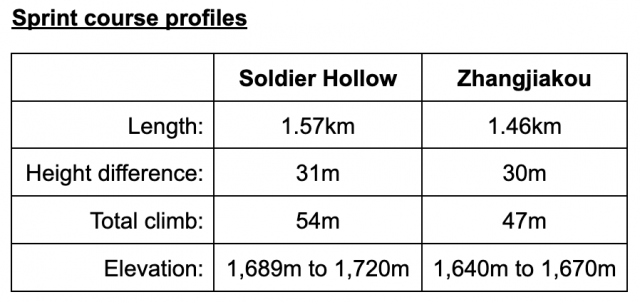
In addition to their more holistic similarities, their statistics are very comparable as well, particularly the overall elevation but also the more specific details of the course profiles:
Course information for 2022 U.S. Nationals and 2022 Olympics sprint courses. (FasterSkier table by Gavin Kentch)
If an athlete is indeed picked for the Olympic team based off of their performance in this week’s sprint races, it seems fair to say that they will have achieved success on the type of course they can expect to find in Zhangjiakou.
On Friday, the third day of racing at the 2019 NCAA Skiing Championships featured another cross-country racing day with the women’s 15-kilometer mass start classic and the men’s 20 k mass start classic.
After two days of racing and scores tallied from a single day of nordic racing on Wednesday and an alpine GS event on Thursday, Dartmouth was in the overall lead for the team championship. They had tallied 259 points to Utah’s 252.3 in second. Vermont sat in third overall with 245 points.
Dartmouth’s Katherine Ogden won the women’s 15 k classic on Friday in a time of 46:25.7 minutes. Utah’s Julia Richter was second in 46:49.1, with Colorado’s Hedda Baangman third in 47:15.2.
Utah’s Huro Jordheim skied to fourth in a time of 47:19.8, and Vermont’s Anna Bizyukova was fifth in 48:07.7.
With 2 k to go in the men’s 20 k mass start classic in Stowe, seven skiers were in a train separated by roughly six seconds. One of those athletes, Ricardo Izquierdo-Bernier of the University of New Mexico, played his hardest effort in the closing k as he gapped University of Alaska’s Sigurd Roenning.
Izquierdo-Bernier won in 55:50.6 minutes with Roenning skiing through to place second overall (+5.9).
Utah’s Maximilian Bie placed third in 55:57.7. Colorado’s Alvar Johannes Alev was fourth in 56:01.2, and Utah’s Ola Jordheim fifth in 56:02.4.
For the team overall results, heading into Friday evening, Utah has taken the lead with 426.5 points. Colorado sits in second place with 361 points, while Dartmouth fell to third with 359 points.
In the women’s race, Utah took second, fourth and seventh places. Whereas in the men’s race, the Utes took third and fifth places.