From the FasterSkier archive — posts syndicated from athletes’ and coaches’ own blogs between 2004 and 2012, kept online as published. Current coverage is at fasterskier.com.
After a long spring of indecision, Anna Carin Zidek of Sweden finally announced her retirement from biathlon last week.
“I no longer have any desire, my motivation has disappeared, and so I will stop,” the 2006 Olympic gold medalist told an Ostersund newspaper. The announcement came after months of deliberation.
“Oh yes, there are many who wonder if I should continue or not next season,” Zidek had written on her blog in late April. “And frankly I do not know myself just yet, and yes I know I should take my decision now.”
As the spring progressed, the rest of the team went to Majorca for a training camp without her. It became more and more apparent that even if she did not retire, the 2012 season would not be a high priority for her.
Her last season had high points, but was mainly a struggle. Zidek finished ranked 10th overall on the World Cup, far from where she wanted to be.
“I have had to fight from start to finish,” she said after the last World Cup race in Oslo. “The body hasn’t been working properly.”
Zidek started her career as a skier, and made Sweden’s national team for the 2002 Olympics in Soldier Hollow. There, her top finish was 30thplace in the 15 k mass start (American Nina Kemppel beat her in a sprint finish). While Zidek – then Olofsson – was the top Swede in the race, she didn’t feel that she was succeeding as a skier. And so, even though she was already twenty-nine years old, she switched to biathlon.
“I got tired of cross-country skiing, after so many years, without any better results,” she told IBU News. “I had the choice to stop everything or maybe start biathlon. The training got much more fun when I started biathlon, and there was something more to do, the shooting.”
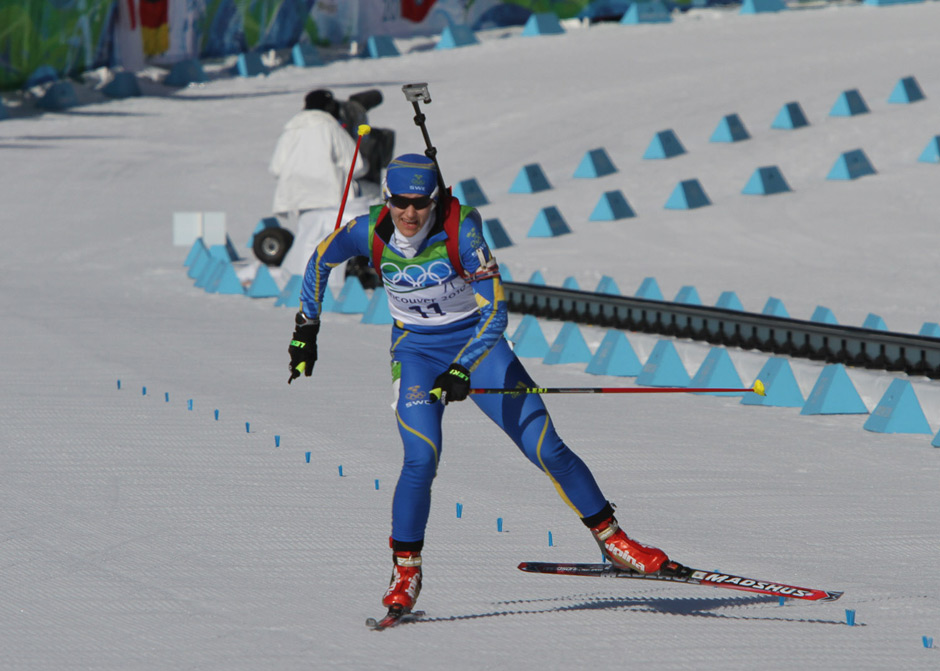
Zidek on the homestretch in the 15km individual competition at the 2010 Olympic Games.
After a single season of training with Wolfgang Pichler, the German coach who had come to lead the Swedish team after turning Magdalena Forsberg into a six-time world champion, Zidek was representing Sweden in World Cup competition. By 2004, she had reached the top ten in a few World Cup races, and in 2005 picked up a silver medal at World Championships.
“I thought I was training very hard [in cross-country], but what I was doing then is nothing compared to Wolfgang’s training,” Zidek told IBU News.
“We train so much that you are tired pretty much all of the time. You do not have much time for seeing friends or family and if you have the time, you do not have the energy to do it.”
At the next Olympics she competed as a biathlete, not a skier. Zidek did not disappoint, winning gold in the mass start and silver in the sprint in Torino. After Forsberg’s retirement, many doubted that Sweden, not traditionally a powerhouse, would have a follow-up act. Zidek proved otherwise and became beloved by her country, where she is referred to as “ACO”, an acronym using her maiden name.
Since 2006, Zidek and her teammates have had many successes, including a win in the mixed relay at World Championships in 2007. That gold medal was in some ways more symbolic of the programs resurgence than Zidek’s had been; it showed depth, and a move away from the days when Forsberg was the only Swedish biathlete of consequence.
Zidek won twelve World Cup races over the course of her career, including the opening individual race in Ostersund, Sweden, last season. There, she became the oldest biathlete to grace the World Cup podium, much less win. The 37-year-old shot clean to beat France’s Marie-Laure Brunet by 8.3 seconds.
“I did not have much in the way of expectations today,” Zidek said at the time, foreshadowing a tough season. “My shape has not felt the best, nor has my shooting been very good. So I went into the race to do what I could: my best.”
At the end of 2011, the star had thirty World Cup podiums to her name. Zidek is married to Canadian wax tech Tom Zidek, and lives in Canmore part-time. She has one son, Liam, who was born the year after the Torino Olympics. Even though she spent much of her time outside the country, her departure leaves the Swedish team – already reeling from Pichler’s departure for Russia – with a hole to fill, and not only on the results sheet.
“It will feel empty without her for the winter, but I understand that she feels ready [to leave] in terms of training,” teammate Anna Maria Nilsson wrote on her blog. “ACO has been on the team a long time and it’s been a great advantage for us youngsters to have an Olympic champion to train with!”
When FasterSkier last wrote about the Russian biathlon federation (RBU) it was in a state of crisis. In the middle of the women’s relay, the culminating event at 2011 World Championships in Khanty-Mansiysk, Russia, RBU President Mikhail Prokhorov had fired Anatoly Khovantsev, the coach of the women’s team. As soon as the race was over, star athlete Olga Zaitseva abruptly announced her retirement.
Since the fiasco in March, the federation has started to rebuild. While it has not named all of its teams for next year, it has introduced a new coaching staff and structure, in which both the men and women are split into A and B teams.
The women’s team in particular is the subject of intense speculation. The women had a very disappointing World Championships, with superstars Zaitseva and Svetlana Sleptsova failing to win a single medal and the team racing to a worst-ever relay result. Zaitseva is rumored to be considering a return to the team, but nothing has been finalized.
Perhaps the biggest question is whether the new coach of the women’s team, Wolfgang Pichler, will fit in and find success. A German who has worked for the Swedes for the past sixteen years, Pichler is undeniably one of the best coaches in the world. But Russia is unlike any other place, and Pichler – who in the past has angrily denounced what he perceived as systematic doping by the Russians – doesn’t even speak the language.
So why would he make the move?
“I have sixteen years of coaching with the Swedish national team, and I wanted a change,” Pichler said simply in an interview with Russian news site Sport-Express.
Abrupt Departure from Sweden
Pichler’s name has become synonymous with Swedish triumph on the trails. He coached Magdalena Forsberg to six World Championships gold medals and 42 World Cup victories, the most of any woman in the history of the sport. After her retirement in 2002, he was offered the head coaching position in Sweden.
“When I started, there was no base as far as biathlon was concerned,” Pichler said in a 2009 interview with Biathlon-Online.de. “But then a talent like Magdalena Forsberg appears, and no one could have expected that… she was simply a perfect biathlete. She had it all: she united the perfect shooter with a perfect cross-country skier. You find something like this once in a lifetime.”
Although Sweden has a strong cross-country skiing tradition, many people didn’t see a strong future for the country in biathlon after Forsberg’s retirement. They were wrong.
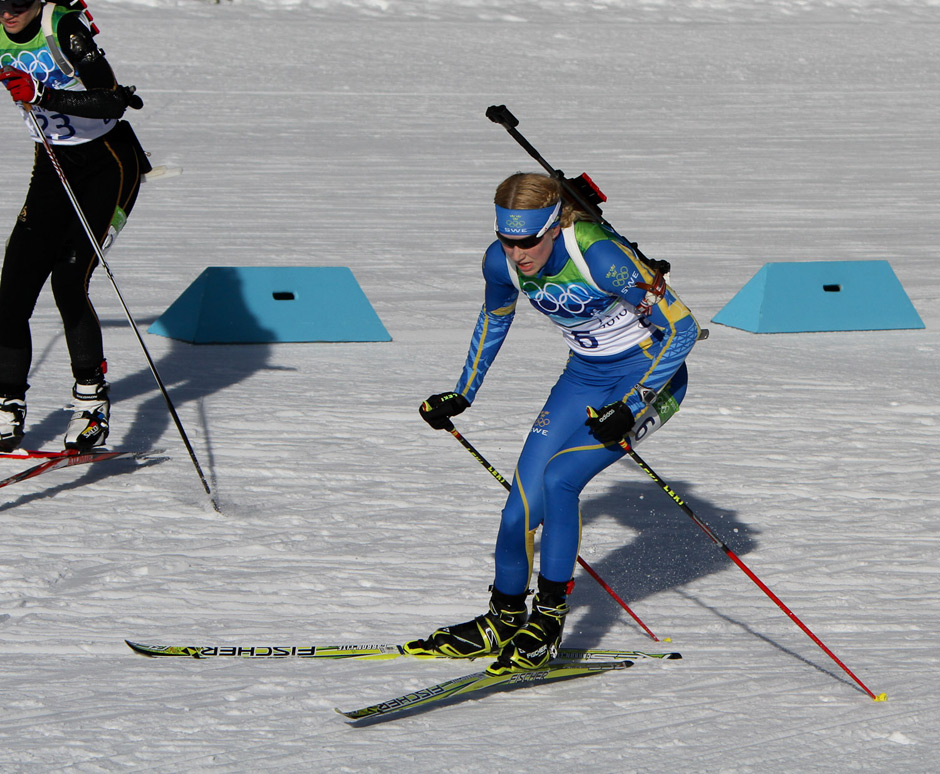
Helena Ekholm racing at the 2010 Olympics in Vancouver
Under Pichler’s tutelage, Anna Carin Zidek (then Oloffson) won gold and silver at the Torino Olympics. Then in 2007, the team of Zidek, Helena Ekholm (then Jonsson), Bjorn Ferry, and Carl Johan Bergman captured World Championships gold in the mixed relay. Ekholm also won the overall World Cup in 2009.
In 2010, the Swedish team restructured, and Pichler was left in charge of only the women while Jonas Johansson took over the men. From its humble pre-Forsberg beginnings, the Swedish team had grown; the new structure reflected that change.
“I have worked close together with Wolfgang for many years,” 2010 Olympic gold medalist Bjorn Ferry told live-wintersport.com midway through his first season without the enigmatic coach. “It’s exciting to test something new. It was the right time for that.”
Soon, it was time for Pichler to test something new himself. On April 27th, he backed out of his contract with the Swedes, which ran through 2014, and signed a new contract to head the Russian women’s team for the next three years instead.
The timing was unfortunate as far as Sweden was concerned. With the training season about to start, they named Johan Hagström, their IBU Cup coach, as an interim replacement until they fill the head coach position. Since then training has begun, and the women are following plans drawn up by Pichler.
“It would have been much more of a shock five years ago, back then Wolfgang was biathlon in Sweden,” said Swedish Biathlon’s Information and Communication Director Patrik Jemteborn. “Of course it still is a big loss because he is a great coach, but now we have people who can absorb this to some degree. We will still be friends, with Wolfgang and with the Russians. There are no hard feelings.”
Many of the athletes conveyed a similar feeling to the public.
“It was a little bit of chaos now at the beginning because Wolfgang left so suddenly, but I am sure everything will work out fine,” Ekholm told IBU News.
Privately, however, Ekholm is said to be upset with how Pichler managed his departure from the team. And Zidek, who is in the process of deciding whether to continue her career as a racer, noted her frustration on her blog.
“I am perhaps a bit disappointed in how he handled the whole thing,” she wrote. “I had not heard anything about this until I heard it on the radio… especially after he was so disappointed in how he was treated by the men last year. It feels a bit like he did the same thing himself to us women.”
When the Russian sports site Championnat asked Pichler about whether he had discussed his departure with the Swedish team, he didn’t seem bothered.
“I was talking about retiring from the Swedish biathlon team,” he said. “In particular, I spoke about it with Anna-Maria Nilsson, who was the team captain. Apparently, Helena just didn’t know about it.”
Even Zidek, though, said she could see why Pichler would take the Russian job, as did many others in the biathlon world.
“I kind of understand,” U.S. Head Coach and native Swede Per Nilsson told FasterSkier in an interview last week. “Pichler, because he’s had big success in Sweden and many years… maybe it was time for him to move.”
Past Animosity with Russia
While the challenge of coaching a supremely talented yet frustratingly inconsistent group of women may be appealing to Pichler, the move to Russia is puzzling given his past relationship with the RBU.
For several years, Pichler – who is outspoken on many issues – very publicly accused the Russians of having a systematic doping program, and proposed severe measures to keep them in line. In 2008, he spoke as the representative of the national team coaches on the World Cup circuit.
Olga Zaitseva blows kisses to the crowd as she brings Russia the gold in the Olympic biathlon relay in 2010
“We have seen examples of suspended athletes coming back after two years’ suspension, pretending nothing has happened,” he told the International Sports Press Association on that occasion. “Or where their national team just presents new athletes that fill the positions. The rules are not strict enough and something better has to be done. Therefore we ask on behalf of the trainers and athletes, that nations which obviously are not afraid of cheating, must be punished.”
He proposed that if any nation had two or more doping cases in a two year period, the entire team should be suspended. At the time, the Russians and Austrians – who had a major scandal at the Torino Olympics – were the only teams such a rule would have affected.
Since then, the Austrians have cleaned up their act, but the Russians have not. In 2009, three Russian athletes – Albina Akhatova, Ekaterina Iourieva, and Dimitri Yaroshenko, all world champions – tested positive for EPO at World Cup races in Östersund, Sweden, prompting Pichler to speak again.
“We should keep the entire Russian team out of the World Championships and next year’s Olympics,” he told Swedish newspaper Aftonbladet. “I have always suspected that they were doing something. Three in the same race? It cannot be anything but systematic, and it has been going on for years. I think the whole team takes drugs.”
While Pichler worried that doping was a blow to the sport and that biathlon would lose the respect and interest of its fans, he also took the doping offenses personally.
“’I am quite sure that we have lost medals because they were doped,” he said in the Aftonbladet interview. “They were ahead of us in the mixed relay at the World Championships last year, for example. At the [2006] Olympics they were the second and we were fourth in the men’s relay. I can’t imagine that they were clean then either.”
Hit outspoken attitude rubbed off on his athletes; Ferry was widely quoted at the Vancouver Olympics as saying that dopers should get the death penalty, “or at least a lot of kicks in the balls.”
In 2009, Ferry and teammate Mattias Nilsson received death threats via e-mail from Russian IP addresses. In that case, Pichler defended his athletes and called on Russia and the IBU to protect the Swedish team at the season-ending World Cups.
“If the IBU does not ensure our safety, we will not be able to go to Russia to compete. We have several athletes who have a chance to win the World Cup, but security is paramount,” Pichler told German news channel ZDF.
Later that week, he claimed that a member of the Russian team staff attacked him in the VIP tent at a race.
“[Pichler] has always been against our team for some reason,” RBU Press Attaché Dmitry Loyev told Russian news channel RT at the time.
Integrating Into The Culture
These days, the attitude toward the German could not be more different.
“Today we rely on the experience of a world-class coach who has achieved huge success on the international level,” Prokhorov, the IBU President, told the International Biathlon Union in introducing the new coaching staff. “We have a huge desire to win, that’s why we’re making these changes. We want the best specialists to work for Russian biathlon and we will not back out of this strategy.”
And Pichler has warmed to his new colleagues as well.
“Russia isn’t a bad nation and I think the new leadership is a good one to cooperate with,” he told the IBU. “The team has huge potential, but of course we have to work hard.”
One of the things that the women had complained about in Khovantsev, last year’s coach, was that they did not work hard enough. They are definitely in for a change with Pichler, who has a reputation as a task-master.
“Now the Russians find out what training is,” Zidek wrote on her blog. “There are no shortcuts allowed.”
Pichler himself told Russian sports site Championnat that not all of the Russian women would be able to keep up with the training he had planned for them. He also spoke of making adjustments in the women’s diets, saying that weight loss would be a large goal of his program.
The German has said that he is too old to learn Russian, and will communicate with athletes through a translator. He coached the Swedes primarily from his home in Ruhpolding, so communication barriers obviously don’t intimidate Pichler, but it will be an added difficulty as he integrates himself into the culture of the program.
To ease the transition and attempt to smooth over any past animosity, Pichler has backpedaled on his doping comments, saying only that there will be no doping in his program.
“I will do everything to fight against doping,” he told Championnat. “It’s a disaster, when the athletes use illicit drugs. It poisons the sport. We will fight for medals only the honest way. When people see that we work hard and have good results, then they will treat us accordingly.”
Many of the athletes he is now coaching were part of the Russian teams which he indicted in his statements in 2008 and 2009, but only one of the banned athletes was hoping to work with Pichler this season. Iourieva returned to competition partway through the 2010-2011 season after serving her two-year suspension; she competed in the two World Cup weekends in northern Maine, where her best finish was 22nd place.
For Pichler, that wasn’t good enough, and he didn’t name her to the national team A squad.
“Everybody has made mistakes in their lives, and I am no exception,” he told sports.ru. “Iourieva has already served her punishment. My personal attitude to her doesn’t matter now… Have you seen her results this year? In my opinion, they are not good enough to speak about the national team. In any case, the road to the team is not closed for anybody.”
This was a sentiment he conveyed again in again in numerous interviews: Pichler will work with anyone, young or old, doped or not, famous or unknown, to try to make the Russians the best team in the world.
“Russia is not so bad, you have a lot of good biathletes,” Pichler told Sport-Express. “We will try as quickly as possible to create a strong team. And we must always give chance to young talents. For sure we will work with a wide range of people. The most important thing is to send to the start line at the Olympic Games in Sochi, the best team.”
Lowell Bailey shot clean and helped the United States to an 11th-place finish. Photo: nordicfocus.com, 2008.
In Saturday’s World Cup sprint race, Bjorn Ferry gave habitual powerhouse Sweden its third victory of the new season, and its first in a men’s race.
On Sunday, Sweden took win number four. After Helena Ekholm and Anna Carin Zidek, the team’s first two World Cup victors this season, left the Swedes within striking distance of the podium, Carl Johann Bergman used some last-minute heroics to take a 0.3 second win over Ukraine France and Russia.
But if you thought that Ferry, yesterday’s winner, set him up, you’d be wrong. Ferry was slated to start today, but felt a bit off this morning.
He was replaced instead by Fredrik Lindstrom, who used two rounds to move the Swedes from fourth place into second. At just 21 years of age and with a top individual World Cup finish of 10th place, Lindstrom probably wasn’t expected to be the hero of the day – but although Bergman got the glory of crossing the finish line first, he couldn’t have gotten there without his less-experienced teammate.
“It was actually good for us to be a little back in the early part,” Lindstrom told IBU News. “It took away a little bit of the pressure. I was pretty relaxed when I took over.”
By the end of Lindstrom’s leg, he was only five seconds behind the French, who had led from start to finish. But things were about to change.
Martin Fourcade took the tag for France and proceeded to use all three spare rounds in prone. By the time he had left the range, he had dropped to fifth place. Bergman, too, used three spare rounds, and fell from second back to fourth. For a minute it looked like Lindstrom’s work had been in vain – Lukas Hofer of Italy was now in the lead, followed by Evgeny Ustyugov of Russia and Sergui Sednev of Ukraine.
But Fourcade skied the second loop faster than anyone else, and was soon back in the lead. After cleaning the standing stage, he held a ten-second lead over Sednev, with five-second gaps back to Bergman and Ustyogov.
And as exciting as the anchor leg had been so far, things were just getting started. Slowly but surely, the three chasers closed on Fourcade. With 1200 meters to go, he still led by two seconds. But with 700 meters to go, Bergman passed him, and looked like he would be able to hold on for the win.
Though he had lost the lead, Fourcade still had two more skiers to hold off if he wanted to finish second. Try as he might, he couldn’t do it, and after a furious finishing sprint, Sednev nipped him at the line by exactly a second. Ustyugov was four seconds behind, unable to quite close the gap to the podium.
It was the Swedes’ first victory in a mixed relay since 2007, when they won the World Championship. At this year’s World Championships in Khanty Mansiysk, Russia, they might be favorites.
But so too might Norway, who started their second-best team today and finished 12th. Four different Norwegians have won World Cup races so far this year, and none of them started today. Because there were no nations cup points attached to the mixed relay, the Norwegian team used the opportunity to gain their up-and-comers some experience.
The Norwegians ended up sandwiched between two North American teams. The Americans finished eleventh and the Canadians thirteenth – and each sat our their biggest star, too, with neither Tim Burke nor Jean-Phillipe Leguellec competing today.
“Eleventh place is quite good for us,” U.S. head coach Per Nilsson told FasterSkier. “It was a good ending of the first trimester of World Cups. The most positive today was the shooting. We were actually the best team of all today! It was nice to see after the struggle we have had, especially for the men.”
The U.S. used only five spare rounds in eight shooting stages, and both Annelies Cook and Lowell Bailey shot clean without having to use any spares.
It was Cook’s second World Cup start ever, and she certainly made the most of it. After receiving the tag from Sara Studebaker in 15th place, she both skied and shot well, and tagged off to Bailey in 11th.
“The relay was really great and it was special for me to be on a relay team with someone I grew up with, like Lowell,” Cook said in an e-mail. “I haven’t cleaned that many times in my biathlon career, so it always feels good to do it, especially at a World Cup! I felt much better on my skis today and it was pretty awesome to be running away from a German on my last lap, even if she did catch me right at the finish.”
Bailey also cleaned, and moved the team up further, into ninth. But he said that he hadn’t even been skiing his fastest.
“I was definitely feeling the last three weeks of racing and I didn’t feel 100 % on the tracks. But I had solid shooting in the range and was able to move up a couple of spots on account of that. Now I’m looking forward to a little down time and a chance to recover.”
Bailey tagged off to Leif Nordgren, who was starting just his second World Cup relay. Nordgren used three spare rounds over two stages and dropped the team back into eleventh.
He wasn’t thrilled with his performance as the anchor leg, and told FasterSkier in an e-mail that his leg “wasn’t very good.”
“I’ve had a few stomach problems this week, nothing to write home about, but it definitely didn’t help,” he said. “I’m still pretty young, so anything less than my best day isn’t going to do me any good. I had three mistakes in shooting. With the extra rounds it was no problem, but that’s still some lost time on the range.”
Overall, though, the team seemed very happy with their result.
“I think it is one of the best team performances on the shooting range that I can remember in recent history,” Bailey said. “We came into today hoping to break in to the top ten. We didn’t quite make it, but we are satisfied with the result. I think it was a bit of a surprise for a lot of people that we were right in the top ten throughout the race.
“It was impressive to see Annelise Cook, in her second ever world cup start, shoot clean without extra rounds while many of the veterans around her struggled with the always fickle Pokljuka winds.”
The Canadians were some of those athletes that Bailey saw struggling with the wind. They used twelve spare rounds and still hit the penalty loop three times.
“Our team has a ton of potential in the mixed relay,” leadoff skier Megan Imrie told FasterSkier. “Unfortunately today, our standing shooting was exceptionally rough. We can maintain good contact with the leaders in the skiing, so when our shooting hits the mark, watch out.”
The mixed relay concluded the first period of World Cups, and the athletes now have a break before competition resumes in Oberhof, Germany on January 5.
Before this weekend, Finland’s Kaisa Makarainen had never won a World Cup biathlon race.
How things change.
After winning Friday’s sprint race by eighteen seconds, then extending that lead to almost a minute and a half in Sunday’s pursuit race, Makarainen will have a target on her back when the World Cup heads to Hochfilzen, Austria, next weekend.
Makarainen was the first woman out of the starting gate and never looked back, shooting clean through four stages and extending her lead on each of the two-kilometer loops until the last one, when she allowed Miriam Gossner of Germany to claw back twenty seconds. But her lead was insurmountable at that point, and Gossner’s acceleration was more to secure second place over Helena Ekholm of Sweden than to close on Makarainen.
Gossner, who started the pursuit in second place, had the fastest course time of the day, but missed three shots. After the second loop, she had dropped to third place behind Ekholm. However, her speed on skis was superior and despite the fact that both she and Ekholm missed a shot in the last standing stage, Gossner was still able to ski to second place relatively easily, finishing fifteen seconds ahead of the Swede.
Anna Carin Zidek, the winner of Wednesday’s individual competition, finished fourth, just seven seconds behind her teammate. Zidek started in ninth position, but almost immediately gained several places and only missed one shot out of twenty. But her fourth-place finish wasn’t enough to keep her from losing the yellow overall leader’s bib, which will now be worn by Makarainen.
No North American women competed today, as neither the Americans nor the Canadians finished in the top 60 in Friday’s sprint competition.
The biathlon World Cup opened in parasite-infested Ostersund, Sweden on Wednesday, with the country’s own Anna Carin Zidek riding clean shooting through four stages to a nine-second win over France’s Marie Laure Brunet in the 15 k individual competition. Hometown favorite Helena Ekholm finished third.
Further down the results sheet, but not too much further, Laura Spector led the U.S. with a 25th-place finish. It was the best race of her career, and the best U.S. World Cup finish since Haley Johnson’s 21st-place effort in Pokljuka, Slovenia, in December of 2009.
Zidek told IBU News that she hadn’t expected to win the race.
“I did not have much in the way of expectations today,” she said. “My shape has not felt the best, nor has my shooting been very good. So I went into the race to do what I could – do my best. My shooting felt incredibly good today, though.”
And indeed it was; Zidek was one of only three women in the entire 95-racer field to shoot clean.
Brunet, who missed one shot in the first prone stage and one shot in the last standing stage, had the fastest ski time on the day. In an individual race, one minute is added to a competitor’s time for each missed shot – much longer than it takes to ski a penalty loop in other race formats. It was this penalty system that kept Brunet out of the win.
However, she wasn’t entirely disappointed, telling IBU News that she was “very, very happy to finish second.”
Spector was similarly pleased with her efforts. It was largely her shooting that got her into the top 30. Her ski time was only the 65th-fastest on the day, but she only missed one shot out of twenty. Only six of the women above her in the results shot as well or better.
“It was not only my best race when it comes to shooting, it also was my best race ever,” she told the U.S. Biathlon Association in a press release. “So, of course I feel great about that.”
Spector’s result is perhaps all the more impressive because she is currently enrolled at Dartmouth College and will be taking her final exams for the term later this week in Ostersund.
Previously, Spector’s best results were a pair of 58th-place finishes at World Championships in Pyeong Chang, Korea in 2009.
And for the U.S. women, there have only been a handful of top-thirty results since before the last Olympic cycle began. Johnson had one top-30 World Cup finish in early 2009, and one at the World Championships in Korea. Lanny Barnes finished 23rd at the Vancouver Olympics and 15th in a World Cup in Oestersund in 2006, and Sarah Konrad finished 30th at a World Cup in Oslo, Norway, in 2006.
In short, Spector’s performance in Sweden on Wednesday was something that the U.S. women have, in the past, only had the chance to enjoy once or twice a year, if at all. The last banner year was 2004, when Rachel Steer had four top-20 performances and Tracy Barnes was top-30 in a pair of World Cups in Slovenia.
The other U.S. woman in the race was Sara Studebaker, the only woman to have pre-qualified for the first period of World Cups. She suffered from an infection of the parasite cryptosporidium last weekend, as did many biathletes and residents of Oestersund, which affected her performance today. Studebaker finished 72nd, with three missed shots and the 78th-fastest ski time.
“Today I woke up feeling much better, but still pretty tired,” she told FasterSkier in an e-mail. “During the race, my stomach was a little upset, but the main issue was my energy level. I was definitely running on empty the last couple laps. The worst is definitely over, and I’ve been feeling better each day since Monday, so I’m optimistic about [Friday’s] sprint.”
“My race today was good, given my feeling,” Studebaker continued. “I am glad I started; it feels good to have one race out of the way. I am happy with my shooting, though I wish I would have shot a little better in my last stage [where she missed two shots]! My misses were close though, and I know my shooting is solid right now, so that’s a great confidence builder going into the season. I am very positive about my skiing right now, also. I feel like I’m in good shape, and when I’m able to give 100 percent, I know I will be able to have some good results.”
Zina Kocher led the Canadians with a 49th-place finish. For Kocher, who finished just outside of the top 30 in the overall World Cup last year, it wasn’t the best start to the season. She was followed by Rosanna Crawford in 69th and Megan Imrie in 83rd. Imrie struggled on the range, missing six shots.
The men’s World Cup season kicks off Thursday, and racing continues in Oestersund through Sunday.