From the FasterSkier archive — posts syndicated from athletes’ and coaches’ own blogs between 2004 and 2012, kept online as published. Current coverage is at fasterskier.com.
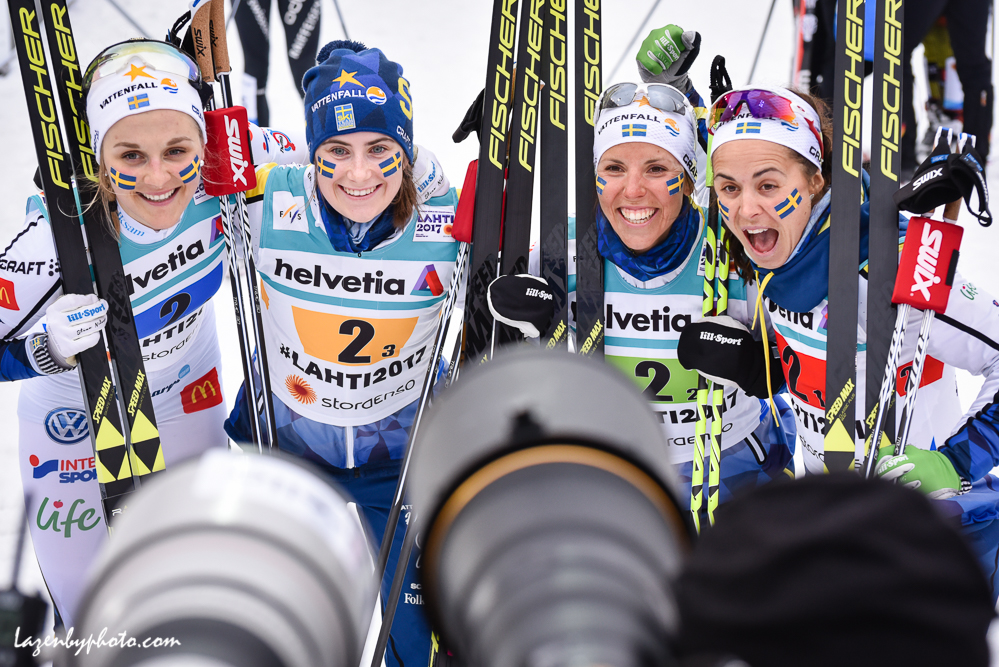
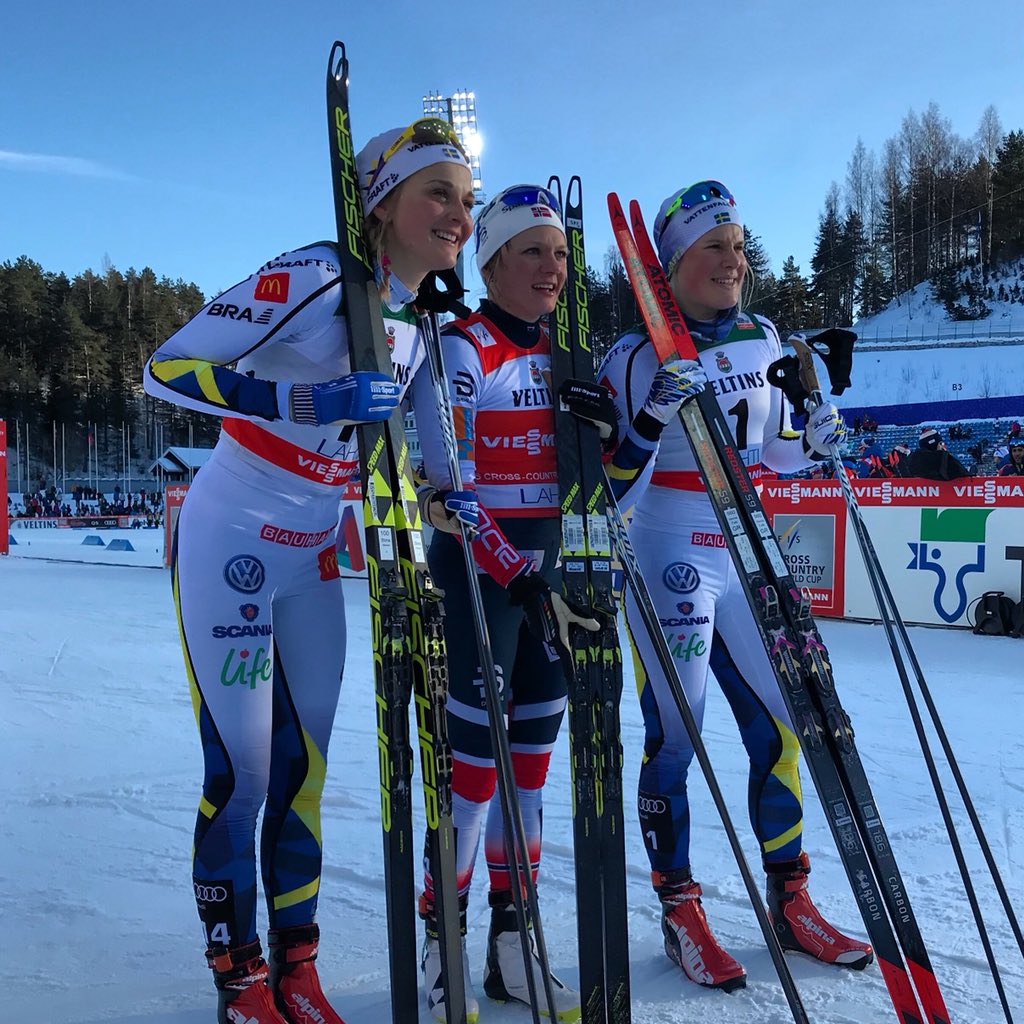
Sweden’s Stina Nilsson, Ebba Andersson, Charlotte Kalla and Anna Haag faced the cameras after winning the silver medal in the women’s relay at the 2017 Nordic World Championships in Lahti. (Photo: John Lazenby)
Welcome to FasterSkier’s World Cup Preview, where we check in with the top-10 teams from last year’s FIS Cross Country World Cup tour before the season starts. The World Cup begins with a classic sprint in Ruka, Finland on Nov. 24th
***
Sweden
Overall in Nations Cup Last Year: 2nd
Women’s Ranking 2017/2018: 2nd
Men’s Ranking 2017/2018: 5th
Swedes to Watch:She’s fast. She’s fierce. And she’s Swedish. While last spring gave rise to the retirement of many veteran cross-country ski names, 31-year-old Charlotte Kalla wasn’t one of them.
Kalla, who has been racing World Cups since 2006, is back for her 13th season on the circuit and not about to slow down. She finished last year, on a limited World Cup schedule, ranked seventh in the women’s overall, after securing five top three performances, two thirds of them victories.
Her singular focus remained peaking for the Games. She entered the 2018 season scorching fast, winning the the overall in the opening Ruka triple weekend. She won the following weekend’s 15-kilometer skiathlon in Lillehammer, Norway.
Kalla dialed back the racing in mid-December, did not race the Tour de Ski, and returned to World Cup racing on January 21, in Planica, Slovenia. She placed second in the 10 k classic.
Kalla returned from the Pyeongchang Olympic Winter Games with four medals, two for individual performances–most notably a gold in the women’s skiathlon.
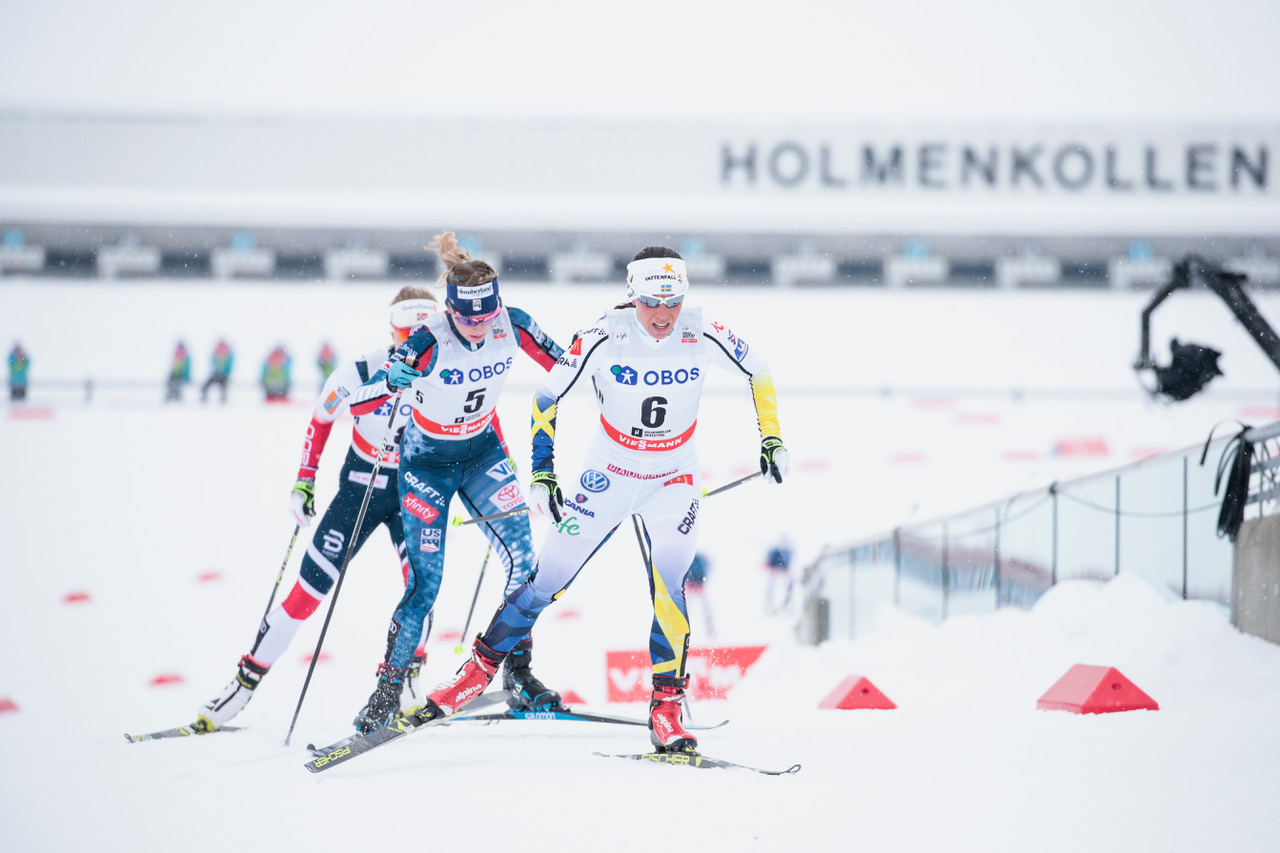
Sweden’s Charlotte Kalla leads American Jessie Diggins and Norway’s Ragnhild Haga during the 2018 Holmenkollen women’s 30 k freestyle mass start at the World Cup in Oslo, Norway. (Photo: Fischer/NordicFocus)
When not name dropping Kalla, the Swedes have plenty to look to in the remainder of their women’s team. There’s the ever shining sprint star, Stina Nilsson, not to mention the up-and-comer Ebba Andersson. In between those two, with the retirement of Anna Haag, there’s sprint power houses,Hanna Falk and Ida Ingemarsdotter. Throw in Anna Dyvik and you’ve got your female Swedes for the season.
On the men’s side, despite the retirements of Emil Jönsson, Martin Johansson and Marcus Hellner, Calle Halfvarsson remains a name to watch out for on course. Halfvarsson ended last season ranked 13th in the overall, with six individual top-10 finishes, four of those on the podium.
Then there’s the 36 year old veteran, Daniel Rickardsson, as well as the 23-year-old Oskar Svensson, who both landed in last season’s World Cup top-30 more than once.
Sweden’s Hanna Falk (r) smiles as she wins the fourth World Cup race of her career and first race in Falun, Sweden, with a victory in the women’s freestyle sprint at 2018 World Cup Finals on Friday. Her teammate Jonna Sundling (l) placed second while Norway’s Marit Bjørgen finished third. (Photo: Svenska Skidspelen/Instagram)
FIS Cross Country World Cup Finals (Falun, Sweden): Freestyle sprints
In the last sprint of the season and the first race of the three-day World Cup Finals in Falun, Sweden’s Hanna Falk and Norway’s Johannes Høsflot Klæbo won their respective 1.4-kilometer freestyle sprint finals, while Norway’s Maiken Caspersen Falla and Klæbo claimed the season-long Sprint Crystal Globes and Sophie Caldwell of the U.S. placed third in the Sprint World Cup.
Falk started Friday by topping the women’s qualifier on home turf in 2:59.88 minutes, 1.65 seconds ahead of American Jessie Diggins, who qualifiedin second. Russia’s Natalia Nepryaeva qualified third (+2.73), while American Sadie Bjornsen raced to the fourth-fastest qualifying time (+2.96), ahead of Norway’s Marit Bjørgen in fifth (+3.72).
Falk then won the first quarterfinal and first semifinal before taking control and dusting the field in the women’s final. She essentially led the final from start to finish, but slowed her pace and the five women behind her as she ascended the last climb. As she reached the 180-degree turn at the top, Falk launched into high gear, leaving the rest of the field chasing. Bjørgen was closest to her in second, but still several meters back, as they descended down into the stadium, and Falk skated away from her pursuers for her fourth-career World Cup win (and first victory in Falun) in 3:08.25. Sweden’s 23-year-old Jonna Sundling came on strong in the finishing straight for her first World Cup podium in second (+0.53), Bjørgen took third, and Sweden had three in the top four with Anna Dyvik in fourth (+1.72).
Norway’s Silje Øyre Slind finished fifth (+4.3), andCaldwell, who had qualified for the heats in 16th then won her quarterfinal and advanced in third in the second semifinal, placed sixth overall (+6.99).
Four American women posted top-20 qualifying times, with Kikkan Randall advancing as well in 18th. Diggins placed seventh overall after finishing third in the first semifinal, 0.42 seconds behind Falk in first and just 0.08 seconds behind Sundling, who advanced to the final in second.
Bjornsen was ninth on the day after placing fifth in that semifinal, 0.85 seconds out of first. Randall finished 15th overall after placing third in her quarterfinal, 3.14 seconds behind Diggins, who won that heat.
Also for the U.S, Ida Sargent missed the top 30 needed to qualify in 36th, as did Rosie Brennan in 49th, Caitlin Patterson in 63rd, Liz Stephen in 66th, Kaitlynn Miller in 69th, and Rosie Frankowski in 75th.
Canada’s Emily Nishikawa placed 40th, Dahria Beatty was 48th, Cendrine Browne 60th, and Zina Kocher 71st.
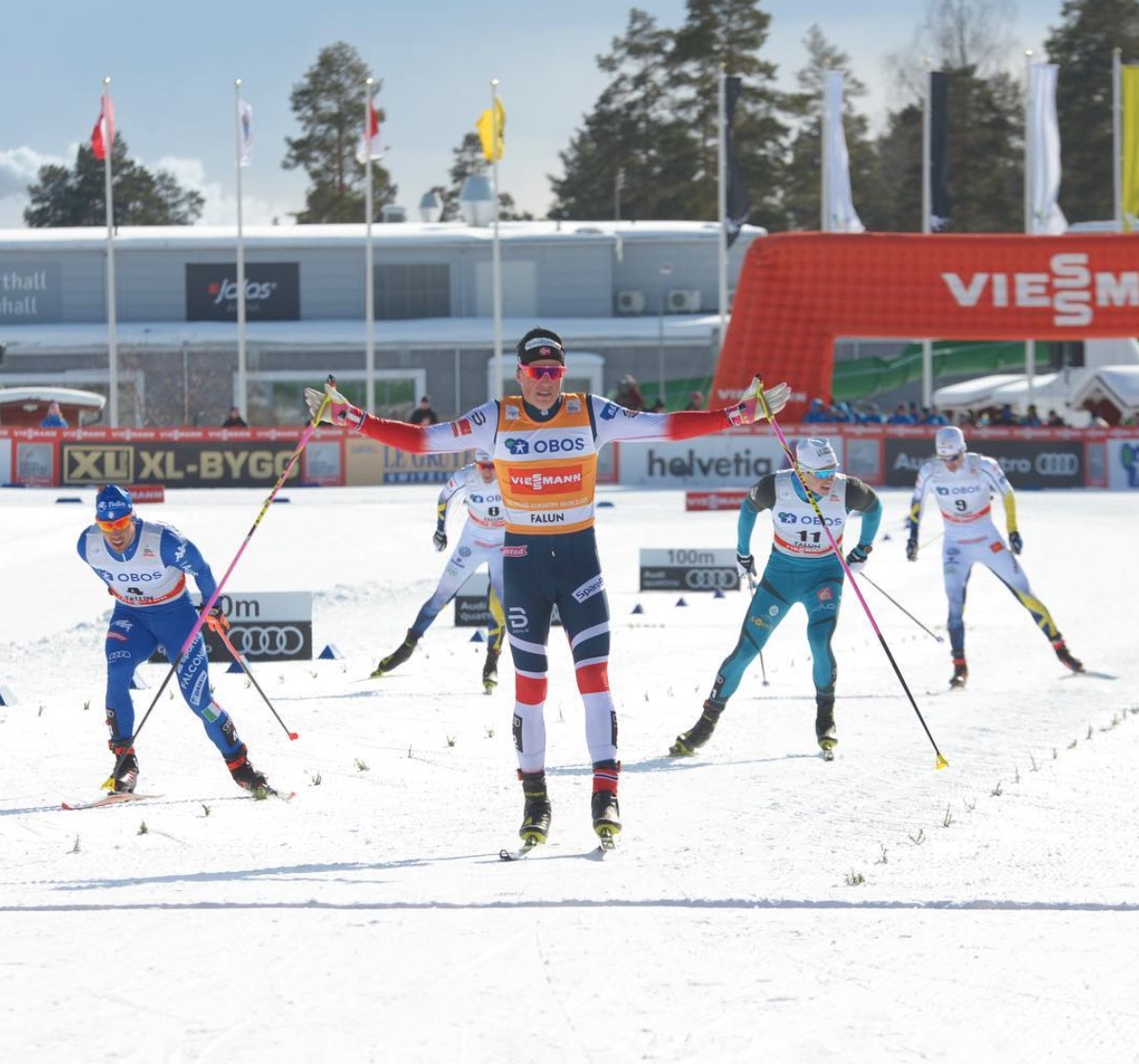
Norway’s Johannes Høsflot Klæbo (yellow bib) celebrates his 11th World Cup victory of the season in the men’s freestyle sprint at 2018 World Cup Finals in Falun, Sweden, ahead of Italy’s Federico Pellegrino (l) in second and France’s Lucas Chanavat (11) in third. (Photo: Svenska Skidspelen/Instagram)
In the men’s race, Russia’s Alexander Bolshunov qualified first in 2:36.23, 0.46 seconds ahead of Klæbo in second. Klæbo then won the first quarterfinal, first semifinal, and you guessed it, the final as well, backing off before crossing the finish line for the last time in 2:37.03.
Italy’s Federico Pellegrino powered past France’s Lucas Chanavat in the finishing stretch of the final to claim second, 0.39 seconds behind Klæbo. Chanavat completed the podium in third (+1.76), Finland’s Ristomatti Hakola finished fourth (+3.26), and Sweden’s Oskar Svensson and Teodor Peterson placed fifth (+3.88) and sixth (+6.17), respectively.
Two American men qualified for the heats, with Simi Hamilton advancing in 13th and Kevin Bolger in 29th. Hamilton went on to place 14th on the day after finishing third in the first quarterfinal, 0.61 seconds behind Klæbo. In his second-career World Cup sprint, Bolger placed 30th overall after finishing sixth in his quarterfinal, 2.21 seconds behind Peterson in first.
In the overall Sprint World Cup, Klæbo took his second-straight title by a whopping 243 points over Pellegrino in second, while Falla won her third-straight Sprint Crystal Globe by 78 points over Sweden’s Stina Nilsson, who was out sick for Friday’s race. Nilsson joined her at the Sprint World Cup podium ceremony on Friday, as did Caldwell, who achieved her best overall sprint standing in third.
Falla placed eighth overall on the day after being eliminated in the semifinals (she finished fourth behind Falk, Sundling and Diggins, respectively).
For the U.S., Erik Bjornsen narrowly missed qualifying in 31st, Andy Newell placed 43rd, Paddy Caldwell was 60th, David Norris 84th, and Scott Patterson 87th.
For Canada, Julien Locke placed 32nd, Alex Harvey 34th, Devon Kershaw 74th, and Graeme Killick 81st.
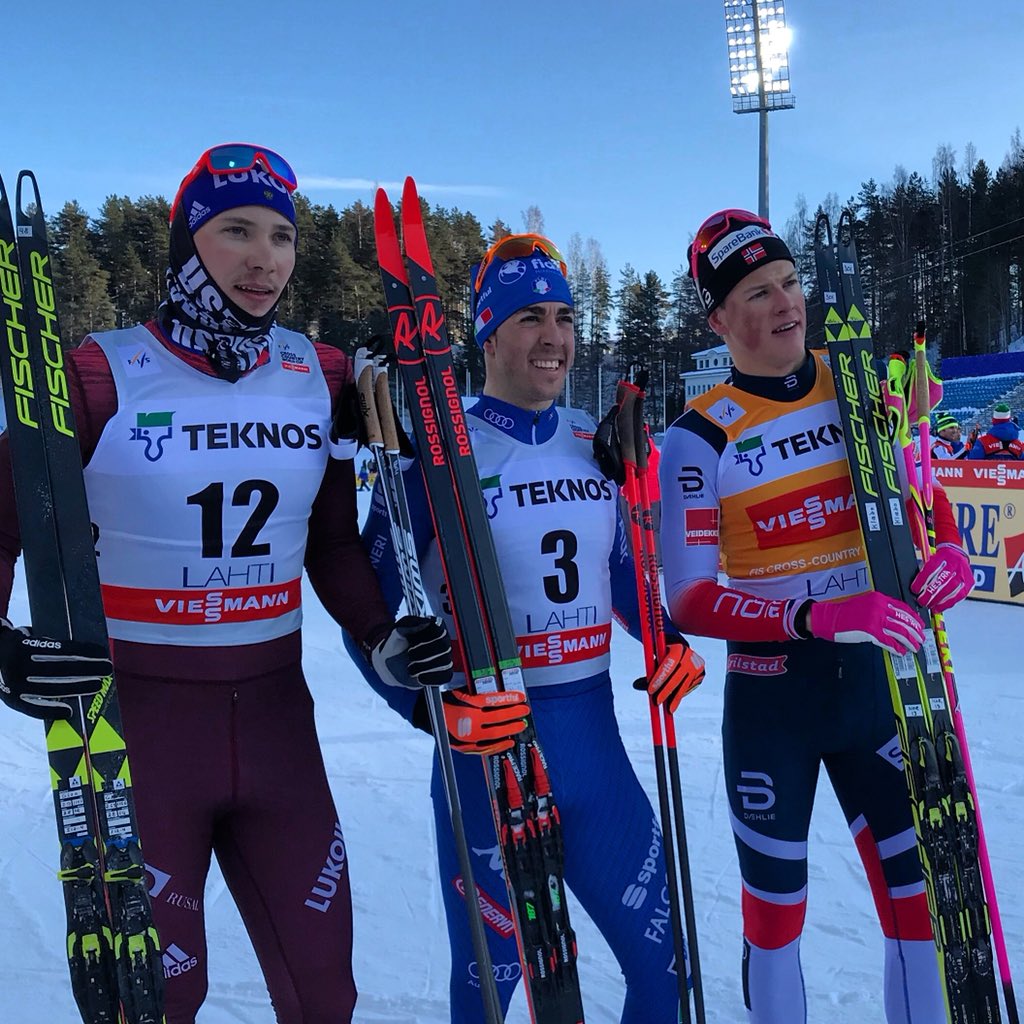
The men’s 1.6 k freestyle sprint podium at Saturday’s World Cup in Lahti, Finland, with Italy’s Federico Pellegrino (c) in first, Russia’s Gleb Retivykh (l) in second and Norway’s Johannes Høsflot Klæbo (r) in third. (Photo: FIS Cross Country/Twitter)
FIS Cross Country World Cup (Lahti, Finland): Men’s & women’s freestyle sprints
The defending world championships from the 2017 freestyle sprint prevailed again in Lahti on Saturday, with Norway’s Maiken Caspersen Falla winning the women’s 1.4-kilometer freestyle sprint final and Italy’s Federico Pellegrino coming out on top in the men’s 1.6 k final at last year’s World Championships venue.
Falla’s rise to the final started with her qualifying in 12th, 7.96 seconds off the fastest qualifying time set by Sweden’s Hanna Falk in 2:54.72. Russia’s Natalia Nepryaeva qualified second (+0.63) and Finland’s Krista Pärmäkoski third (+3.62), just ahead of Germany’s Victoria Carl in fourth (+3.88) and American Sadie Bjornsen in fourth (+3.88). Four American women qualified for the heats, with Sophie Caldwell in 17th, Ida Sargent in 21st and Rosie Brennan in 29th.
The women’s 1.4 k freestyle sprint podium at Saturday’s World Cup in Lahti, Finland, with Norway’s Maiken Caspersen Falla (c) in first, and Sweden’s Stina Nilsson (l) and Hanna Falk (r) in second and third, respectively. (Photo: FIS Cross Country/Twitter)
Falla went on to place second in the first quarterfinal, 0.71 seconds behind Sweden’s Stina Nilsson in first. According to the race jury’s ruling, Carl obstructed Pärmäkoski coming out of the last downhill before they entered the finishing straight and both crashed out of contention, with Pärmäkoski finishing fifth in the heat (+12.11) and Carl sixth (+49.5). Carl was relegated to last (30th place) for the obstruction.
Falla then won the first semifinal by just 0.04 seconds over Nilsson in second. The two other Swedes in that heat, Falk and Ida Ingemarsdotter, advanced to the final as well as lucky losers with fast-enough times.
In the final, Falla found herself at the front of the pack early then held her position to the finish, crossing the line in 2:54.83 and beating Nilsson by 0.36 seconds. Sweden had two on the podium with Falk in third (+0.78), Germany’s Sandra Ringwald placed fourth (+0.88), Ingemarsdotter was fifth (+1.83), and Switzerland’s Laurien van der Graaff placed sixth (+3.02).
Caldwell was the lone American woman to make it past the quarterfinals, as she placed second in her quarterfinal, 0.25 seconds behind Ringwald in first, then fourth in the second semifinal, 1.46 seconds behind Ringwald, who also won that heat. Overall, Caldwell finished the day in eighth.
Bjornsen placed 17th overall after finishing fourth in her quarterfinal, 2.84 seconds behind Falk in first. Sargent had been second in her quarterfinal until the final tight lefthand corner into the finishing straight, where she slipped to sixth and ultimately finished sixth, 1.07 seconds behind Sweden’s Anna Dyvik in first. Overall, Sargent finished the day in 27th, and Brennan placed 29th overall after finishing sixth in her quarterfinal, 4.91 seconds behind Ingemarsdotter in first.
Two American men advanced to the heats as well, with Kevin Bolger of the Sun Valley Ski Education Foundation (SVSEF) qualifying in 16th in his World Cup debut, 6.38 seconds behind Norway’s Johannes Høsflot Klæbo, who topped the qualifier in 2:59.06. Erik Bjornsen of the U.S. Ski Team qualified 29th, 8.29 seconds back.
Meanwhile, Pellegrino qualified for the heats in third (+1.9) behind France’s Baptiste Gros in second (+1.23).
There, Pellegrino won the first quarterfinal by 0.19 seconds over Klæbo, with the Norwegian visibly backing off before the finish — comfortable enough to automatically advance to the semifinals in second place. But Klæbo showed Pellegrino what he’s made of in the first semifinal and beat the Italian by nine-hundredths of a second.
Bolger also raced in that first semifinal after placing fourth in his quarterfinal, 0.73 seconds behind Russia’s Gleb Retivykh in first. Bolger’s time was good enough for one of two lucky loser spots in the semifinals, where he went on to finish sixth, 1.86 seconds after Klæbo. Overall Bolger finished the day in 11th.
Erik Bjornsen placed 20th on the day after finishing fourth in the first quarterfinal (with Pellegrino and Klæbo), 1.56 seconds out of first.
In the final, Klæbo set the tone, slowing the pace to almost a stop at one point, while he and Pellegrino stood side by side at the top of the course. On the way down, they accelerated, but Norway’s Sindre Bjørnestad Skar was the one who truly attacked. It might’ve been a bit too early, as Pellegrino caught him by the top of the final climb and took the lead on the following downhill into the stadium. Pellegrino held off his challengers, including Retivykh who came on strong out of the downhill, to take the win in 3:16.73, 0.77 seconds ahead of Retivykh in second and 0.9 seconds ahead of Klæbo in third. Skar settled for fourth (+1.3), Finland’s Ristomatti Hakola placed fifth (+1.44) and France’s Lucas Chanavat finished sixth (+7.55).
In the qualifier, Canada’s Dahria Beatty finished 34th, +13.39 and just 0.9 seconds from making the quarterfinals. She was the only Canadian woman competing.
American Kelsey Phinney (SVSEF) was also close to making the cut. In her first European World Cup, she placed 36th in the qualifier, +13.74. Caitlin Patterson and Kaitlynn Miller, both of the Craftsbury Green Racing Project, placed 56th (+20.12) and 61st (+21.70).
Mathilde Petitjean of Togo, a primarily Quebec-based skier, finished in 59th (+20.80).
In the men’s qualifier, Logan Hanneman (APU) placed 49th (+11.45). Paddy Caldwell (U.S. Ski Team/SMS T2) finished 59th (+13.55), and APU’s Reese Hanneman and David Norris placed 61st (+14.33) and 67th (+19.27).
Julien Locke led Canada in 42nd place (+9.78), and Andy Shields finished 60th (+14.29).
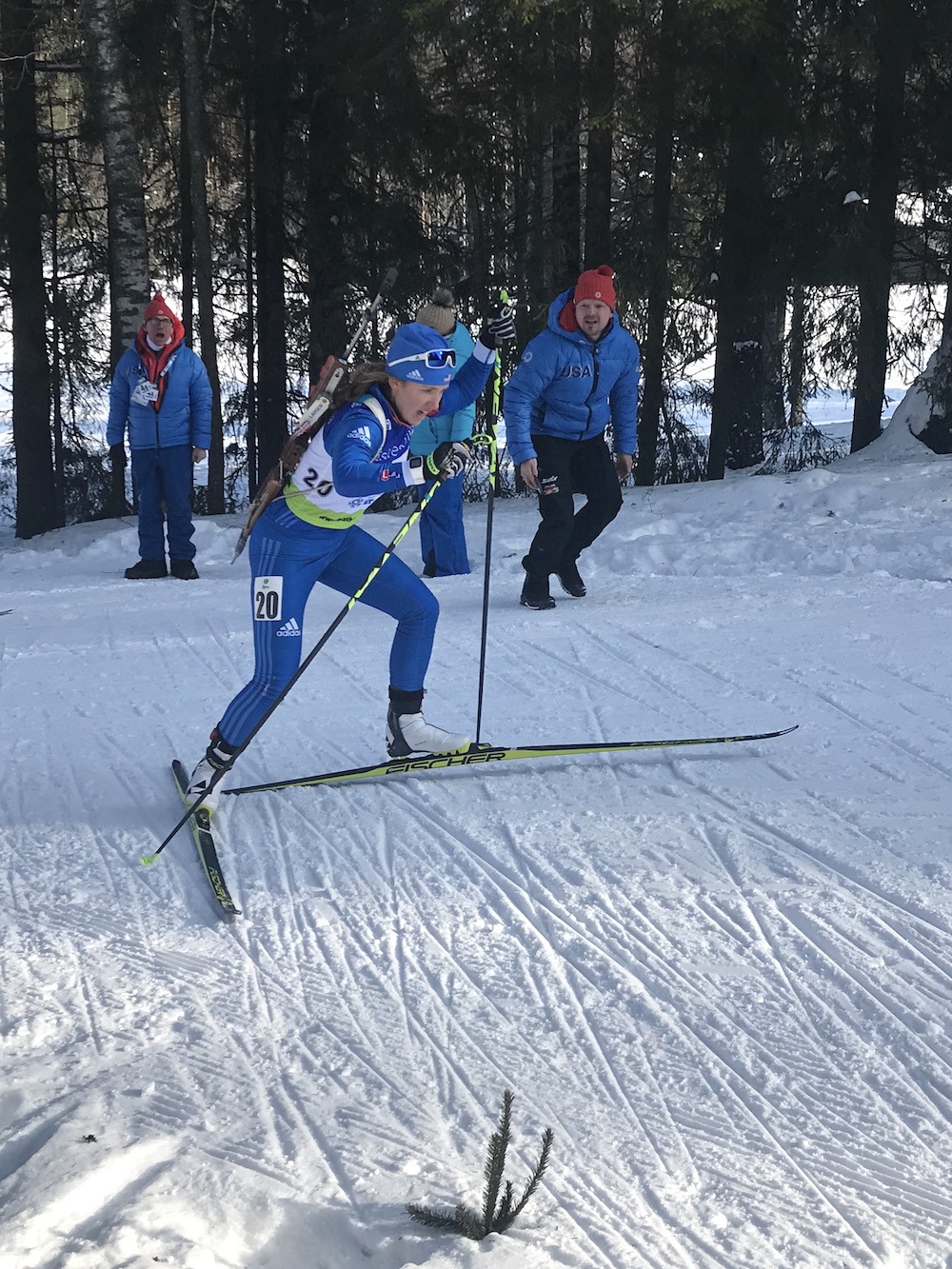
American Chloe Levins racing to seventh in the junior women’s 7.5 k sprint on Saturday at IBU Junior World Championships in Otepää, Estonia. (Photo: Terri Dickson)
Poland’s Kamila Zuk won her second race in a row, taking gold in the junior women’s 7.5 k sprint after also winning the individual at World Junior Championships. Zuk had one penalty to two by second-place Marketa Davidova of the Czech Republic, who finished 26.0 seconds back. Bronze went to Myrtille Begue of France, who shot clean to finish 52 seconds back.
The sole U.S. starter, Chloe Levins followed up her sixth-place finish in the individual with seventh place in the sprint. Levins had a single penalty and finished +1:31.7.
For Canada, Megan Bankes was close behind Levins in ninth, with two penalties and +1:49.5. Teammate Nadia Moser was 21st, also with two penalties, +2:46.2. Emily Dickson finished 36th, +3:50.5 with two penalties, and Zoe Pekos just missed the pursuit cutoff in 66th (+6:22.4) with four missed shots.
In the junior men’s 10 k sprint, Vasilii Tomshin of Russia took the gold with perfect shooting. France’s Martin Perillat Bottonet was second, less than a penalty-loop’s worth of time back at 20.5 seconds – and he did have one penalty. Norway’s Sverre Dahlen Aspenes took bronze (+29.4) with two missed shots.
Trevor Kiers led Canada in 16th, a breakthrough result; his previous World Juniors best was 39th in the pursuit last season. Kiers missed two shots, both in prone, and finished 1:34.9 behind the time set by Tomshin.
Adam Runnalls placed 26th for Canada (+2:08.3) with three missed shots. Teo Sanchez also qualified for the pursuit by placing 53rd (+3:19.2) with one penalty, and Angus Tweedie was left on the outside looking in with 69th place (+4:41.3) with three missed shots.
Cody Johnson led the Americans in 37th, with clean shooting, 2:31.1 back from Tomshin’s time. Tim Cunningham was the next finisher in 71st (+5:13.5) with seven missed shots, followed by Jacob Pearson in 79th (+6:24.2) with two penalties and Cam Christiansen in 86th (+7:52.5) with three penalties.
Sweden’s Stina Nilsson (center) won gold in the classic sprint at the 2018 Olympics on Tuesday in PyeongChang, South Korea, with Norway’s Maiken Caspersen Falla (left) taking silver and Russia’s Yulia Belorukova bronze. (Photo: FlyingPointRoad)
PYEONGCHANG, South Korea — Tuesday at PyeongChang’s Alpensia cross-country venue, the site of the Olympic Games women’s 1.25-kilometer classic sprint, Sweden’s Stina Nilsson took gold. On an evening when athletes were already challenged by an aerobic capacity testing course, shifting winds and falling snow, another factor made the challenge debilitating.
Nilsson came into the Games well-rested and well-primed to take her first individual Olympic medal. The 24 year old had come close before; at her first Olympics, the Swede placed 10th in the freestyle sprint in Sochi, Russia. There, she went on to claim bronze in the classic team sprint with teammate Ida Ingemarsdotter.
A year later in Falun, Sweden, at World Championships, Nilsson placed second in the individual classic sprint. When you are close, you begin to think more about achieving a singular goal and less about overall season-long outcomes.
Nilsson last raced a World Cup the weekend of Jan. 20-21 in Planica, Slovenia, where she raced to 13th place in the 10 k classic. The day before, on Jan. 20, Nilsson took a small prize: a World Cup classic-sprint win.
In her run up to PyeongChang, Nilsson explained she was able to focus on her training and block out distractions.
“Not so much pressure the last weeks, because I have not been on the Internet so much,” Nilsson said at the post-race press conference. “And not on Instagram. So the most pressure comes from myself, and that’s the pressure that I have to deal with. But today I managed to control those feelings and just ski so fast as I can.”
With temperatures hovering around 25 degrees on Tuesday evening, Nilsson was unstymied by the gusting winds or falling snow in formulating the answer to her success equation. Starting with Tuesday’s qualifier in PyeongChang, Nilsson marked the fastest time, stopping the clock in 3:08.74 minutes. With Nilsson pushing the pace, she also scored a win in the quarters. Again in her semifinal, Nilsson placed first after dualing with the 2014 Sochi skate-sprint champion, Norway’s Maiken Caspersen Falla (who also won the skate sprint at last year’s World Championships), in a photo finish.
“I had a really good day,” said Nilsson, a 2015 World Championships classic-sprint silver medalist. “I felt strong already in the prologue, and I felt also strong in the quarterfinal, and in the semifinal. I felt like I had some energy saved for the final.”
Sweden’s Stina Nilsson and teammate Hannah Falk (4) embrace after Nilsson won the classic sprint gold medal at the 2018 Olympics in PyeongChang, South Korea. (Photo: FlyingPointRoad)
Lining up in the final trying to prevent Nilsson’s clean sweep on the day were Falla, Nilsson’s Swedish teammate Hannah Falk, American Jessie Diggins, and Russians Natalia Nepryaeva and Yulia Belorukova.
The energy Nilsson stated she had saved for the final was more than sufficient. Off the line she set the pace up the course’s first climb — a climb not steep enough to create big gaps and string out the field. The group stayed together with two skiers in the inside lane, three in the adjacent lane, and Diggins skiing outside the tracks and closing on the outside.
Topping out on the hill and taking a sharp 180-degree turn, Nilsson led but no skier pulled away. Down the hill, the six skiers tucked and glided and double poled into the course’s decisive climb with Belorukova then Falla the closet skiers to challenge.
The final hill is where Nilsson seized the day.
“I just wanted to cross the finish line totally tired, so I just went for it in the last uphill,” Nilsson said about her race tactics in the final. She carried considerable speed over the final climb and the gap grew to the two closest chasers, Falla and Belorukova.
“My plan was to save the most of the power until the last part of the [final] climb,” Falla, 27, said at the press conference. “But when the two others got a little gap in the first downhill, I used too much power in the first part of the climb. So in the top where I was planning to use all my power, there wasn’t that much left.”
Nilsson still had power to spare. She soloed off the front to win the final in 3:03.84 minutes. Falla took silver (+3.03), Belorukova, a 23-year-old Olympic rookie, bronze (+3.37).
In the post-race press conference, Belorukova was asked about the tense relationship between the International Olympic Committee (IOC) and the Russian Ski Federation. The IOC banned numerous Russian skiers from PyeongChang for doping violations. Those Russian athletes competing at the 2018 Winter Olympics are not competing under the Russian flag, but as Olympic Athletes from Russia (OAR).
“Good question,” Belorukova said through an interpreter. “There is nothing that will break us, there is nothing that will instill fear into us, we are strong and we will fight until the end.”
Nepryaeva ended up fourth (+9.14), Falk fifth (+11.16), and Diggins sixth (+11.23). FasterSkier will post an additional report on the U.S. women’s results.
Sweden’s Stina Nilsson celebrates her third individual sprint victory of the season on Saturday in the World Cup classic sprint final in Planica, Slovenia. Behind her, Norway’s Kathrine Rolsted Harsem (third from l) placed second and Maiken Caspersen Falla (l) finished third and American Jessie Diggins (far r) placed fourth. (Photo: Fischer/NordicFocus)
PLANICA, Slovenia — With the Julian Alps and Mount Triglav, Slovenia’s highest peak, as a backdrop, it’s suitable to say the Planica Valley nordic course can be summed up in one word: burly.
A high mid-afternoon sun had illuminated the mountain range throughout the rounds for the World Cup women’s 1.4-kilometer classic sprint on Saturday, but by the time the six finalists lined up for the final heat, a few shadows were being recast onto the course.
At the sound of the gun, Sweden’s Stina Nilsson took the lead into the first downhill. Norway’s Kathrine Rolsted Harsem followed close behind. Maiken Caspersen Falla, also of Norway, dangled to the far right, while American Jessie Diggins hugged tightly to the inside left, just ahead of Sweden’s Anna Dyvik.
The third Norwegian in the final, Heidi Weng picked up the rear of the group through the corner that had seen at least one skier in the men’s quarterfinals fly into the blue net that fenced off the course. Diggins had also fallen on that corner during her warmup.
“It rattled my confidence,” Diggins said, referring to her warmup mishap. The American then took the corner more cautiously during her qualifier, which she felt was uncharacteristic of herself and and left her wanting more going into the day’s heats. (Diggins had qualified in 19th, 6.19 seconds behind Harsem’s winning qualifying time of 3:28.03.)
American Jessie Diggins leads Sweden’s Hanna Falk during their quarterfinal of the women’s classic sprint on Saturday at the World Cup in Planica, Slovenia. Diggins went on to place fourth overall in the final. (Photo: Salomon/NordicFocus)
“I am not a hesitant downhill skier at all,” Diggins explained. “So I was like, ‘All right, in the rounds I am not going to ski like a wimp,’ and I was really proud of myself for … taking something that had rattled me and put it away and then just ski the rest of the day.”
In the women’s final, Diggins maintained her position through the bottom of the sharp downhill corner and the brief double-pole section before the first uphill hiccup. As the pitch increased, Nilsson transitioned to striding and the rest of the field followed suit.
Pressure began mounting from the Norwegians as Harsem strode to Nilsson’s left and Caspersen Falla caught up to her right. A meter behind them were Diggins, Dyvik and Weng.
The group disappeared from the teleprompter for a moment as they moved under the wooden bridge spanning the course. When they reappeared, Harsem had overtaken the lead. Nilsson clung to the back of her skis.
Diggins, who had been skiing alone in the second inside track, switched lanes, maneuvering herself into second alongside Harsem and Nilsson. But as they descended into the second downhill, the Norwegian and Swede pulled slightly away.
Another corner and the six finalists were heading uphill again, Diggins was the only skier who chose the far outside track. The climb was the course’s most grueling uphill, and Harsem had used it to break away from her competition all afternoon.
In the final, it appeared Harsem would do the same as she strode powerfully to the front, looking to gap Nilsson and Falla. But the 28 year old had not factored in her teammate Falla’s own dig in the ups. Halfway up the hill, Falla, 27, changed tracks and was gunning for the lead.
By the time the group reached the hairpin turn that would lead them back down to the stadium, Falla was first, Harsem second, and Nilsson third. Chasing them around two meters away was Diggins, followed shortly by Dyvik and Weng.
As they descended, the Swede’s skis seemed to lose ground. A Norwegian battle for first looked to be in the cards. In the second group, Diggins continued to hold off Dyvik’s attempts to push past her for fourth.
With one final hill to go, Falla strode with a speedy turnover to the outside. But while the Norwegian’s legs swished through the tracks, the Swede was powering forward in a powerful double pole.
Three years younger than her Norwegian challenger, Nilsson, 24, had already won one of two classic sprints previously this season. On Saturday, she was looking to rack up another win (and her third individual victory of the season after winning a skate sprint in Davos, Switzerland).
The women’s classic sprint podium on Saturday in Planica, Slovenia, with Sweden’s Stina Nilsson (c) in first, and Norway’s Kathrine Rolsted Harsem (l) in second and Maiken Caspersen Falla (r) in third.(Photo: Fischer/NordicFocus)
She and Falla strode over the top of the final climb together, but heading into the final double pole to the finish, the Swede had made up her mind. The red World Cup sprint leader’s bib she was wearing would stay with her.
She double poled away from Falla and Harsem in the final 100 meters, crossing first in a time of 3:26.28. The win marked her fourth-career victory in a World Cup classic sprint and her 12th World Cup sprint win.
“I saw an opening there and took the chance,” Nilsson told Längd.se, according to a translation. “I think it worked very well technically.”
Crossing second, 1.27 seconds behind Nilsson was Harsem. The second-place finish was the Norwegian’s first World Cup podium ever.
“It’s amazing to be finally on the World Cup podium,” Harsem said, according to an International Ski Federation (FIS) press release. “I have been fourth a couple of times and seventh 100 times. It is very emotional for me. There have been many ups and downs in my career. I feel just amazing.”
Falla placed third, 1.81 seconds behind Nilsson. The defending Sprint World Cup champion, with 14 individual World Cup titles to her name, Falla was more critical of her own result.
“I did not really have it today. It’s good to be third but I will be headed home now and try to find shape for the Olympic Games,” Falla told FIS.
Diggins ended the day just off the podium in fourth (+3.81), while Dyvik was fifth (+4.45) and Weng sixth (+14.89).
“I feel like I just did the hardest interval ever,” Diggins told FasterSkier after. “But I think that’s great because going into the Olympics, it’s fun knowing that I have qualified and I made it to the finals in three out of four classic sprints this year; it is a good confidence booster.”
Though tired by the end of the day after rounding the course four times at a hard effort, Diggins indicated she found ways to keep herself relaxed and have fun.
“They played my absolute favorite songs all day I was doing a little salsa dance getting ready,” Diggins said with a laugh. “You do have to have fun, this is your life you have to enjoy it.”
Two Americans in Top 10
Rounding out the the top 10 was Russia’s Yulia Belorukova in seventh, Sweden’s Hanna Falk in eighth, American Sophie Caldwell in ninth, and Norway’s Mari Eide in 10th.
Sophie Caldwell (U.S. Ski Team) racing to 13th in the women’s classic sprint qualifier at the World Cup in Planica, Slovenia. She went on to reach the semifinals and place ninth overall. (Photo: Fischer/NordicFocus)
After qualifying in 13th, 5.38 seconds out of first, Caldwell advanced to the first quarterfinal, going head-to-head with Nilsson, Belorukova and Finland’s Aino-Kaisa Saarinen.
Caldwell skied strong through the first portion of the major climb, pacing toward the front with Nilsson, Belorukova and Norway’s Anna Svendsen. Just before the final hairpin turn, however, Nilsson and Belorukova charged. Caldwell pushed to maintain contact, but was edged out just before the final straightaway.
Her quarterfinal time was fast enough for her to earn the day’s second lucky loser spot, after Diggins advanced as the first lucky loser in third in her heat, behind Falk and Harsem.
Caldwell then advanced to the first semifinal, up against Falla, Nilsson, Belorukova, Falk, and Finland’s Krista Pärmäkoski. Caldwell was in the mix until halfway through the mjor course climb, when Nilsson, Falla and Belorukova began to push the pace.
“I think a lot of the classic courses now kind of have big steep hills that you do more of a run shuffle up,” Caldwell said. “[Today’s] was more power striding, which for me personally is definitely one of my weaknesses and something I’m working on.”
Caldwell finished her semifinal in fifth, 4.34 seconds behind Falla in first.
“I felt good, but it was definitely one of the hardest sprints I’ve ever done,” Caldwell said. “I don’t know if it felt that way because we’ve been racing some shorter ones lately and this one was quite a bit longer … but I’m happy with today.”
Sadie Bjornsen (U.S. Ski Team) racing to seventh in the women’s classic sprint qualifier at the World Cup in Planica, Slovenia. She went on to finish fifth in her quarterfinal for 21st overall. (Photo: Fischer/NordicFocus)
Also for the U.S., Sadie Bjornsen placed 21st and Ida Sargent 23rd overall, after finishing fifth in their quarterfinals.
Reflecting on her qualifier, in which she qualified seventh (+4.10), Bjornsen said she finished “feeling like I had lost some time in the corners.”
“In my [quarterfinal] I felt like there was a lot of bouncing and trying to find a track and just trying to find a place to ski, so I was kind of depending on that final corner and climb into the finish,” Bjornsen said on the phone.
Her quarterfinal saw Falla and Pärmäkoski take the lead early on, but Bjornsen was positioned well within striking range as the group rounded the hairpin turn for the final descent.
The final descent and corner went smoothly for Bjornsen, but a tangle with Germany’s Sandra Ringwald caused her to crash out of contention. By the time Bjornsen reached the finishing stretch, Pärmäkoski and Falla had already locked up the top-two spots to automatically advance to the semifinals, and Bjornsen followed 8.81 seconds back in fifth.
“I had an awesome corner and then came into that final climb and unfortunately, Sandra just ended up falling on top of me, which was a bummer because I felt like I was really opening up there and finally had an opening,” Bjornsen said. “At the end of the day you just have to, for me, focus on what felt really good and channel that extra energy into some Olympic racing coming up here soon.”
Bjornsen did not race last weekend in Dresden, nor will she start Sunday’s 10 k classic in Planica.
“I just want to make sure I am fully recovered,” Bjornsen said of her decision to opt out of Sunday’s distance race.
“I actually think this going to work out really naturally well for me just to have one more week to absorb that enormous load and feel really fresh and quick and ready for next weekend,” she added.
The fourth American woman to qualify on Saturday was Sargent in 17th (+6.13).
“Warming up for the heats, I tried to do a little harder warm up to try to see if I could get my body going, but I was definitely feeling some fatigue,” Sargent said after. “It was a hard course to feel that way, so I’m looking forward to hopefully getting a little more energy for tomorrow.”
Three other American women’s also competed on Saturday, with Julia Kern finishing 43rd, Rosie Brennan 49th and Caitlin Patterson (Craftsbury Green Racing Project) 53rd.
The women’s freestyle sprint podium on Saturday at the World Cup in Dresden, Germany, with Sweden’s Hanna Falk (c) and Maja Dahlqvist (l) in first and second, and American Sophie Caldwell (r) in third. (Photo: FIS Cross Country/Twitter)
FIS Cross Country World Cup (Dresden, Germany): Freestyle sprints
For her second-straight World Cup sprint, Sophie Caldwell of the U.S. Ski Team reached the podium in the women’s 1.2-kilometer freestyle sprint on Saturday in Dresden, Germany.
Caldwell placed third in the final behind Sweden’s Hanna Falk, who won it in 2:11.02 minutes, and Maja Dahlqvist, also of Sweden, who placed second (+0.23). Caldwell and Dahlqvist both lunged in a photo finish for second, which Dahlqvist took by 0.07 seconds.
Also in the final, which included four Swedes, Switzerland’s Laurien van der Graaff finished fourth (+0.58), and Sweden’s Anna Dyvik followed in fifth (+0.68) and Stina Nilsson sixth (+7.56) after tripping.
Falk started the day by winning the women’s qualifier in 2:06.34, by just 0.02 seconds over Nilsson in second. Caldwell qualified 11th (+2.02). and another American Ida Sargent made it into the heats in 14th (+2.44). Kikkan Randall missed the top 30 by 0.6 seconds in 34th (+6.57), Julia Kern placed 38th (+7.78), and Caitlin Patterson, of the Craftsbury Green Racing Project (CGRP), was 40th (+8.56) out of 49 women in the qualifying round.
Sargent finished fourth in her quarterfinal, 043 seconds behind Sweden’s Ida Ingemarsdotter in first, to finish the day in 17th overall.
For Caldwell, who went on to advance in second in her quarterfinal and third in her semifinal, the podium came after she finished second in the last World Cup skate sprint (the first stage of the Tour de Ski) on Dec. 31 in Lenzerheide, Switzerland.
Her boyfriend and fellow U.S. Ski Team member Simi Hamilton came close to reaching the men’s 1.2 k sprint final on Saturday after qualifying in 15th then placing second in his quarterfinal and fifth in the second semifinal, 0.38 seconds behind Sweden’s Emil Jönsson in first.
France’s Lucas Chanavat won the qualifier in 1:50.42, 0.15 seconds ahead of Norway’s Johannes Høsflot Klæbo in second. Hamilton was 4.32 seconds back in the qualifier, and his U.S. teammate Andy Newell also qualified in 18th (+4.91). Erik Bjornsen missed qualifying by 0.23 seconds in 32nd (+6.15) and Ben Lustgarten (CGRP) finished 49th (+8.64) out of 67 men.
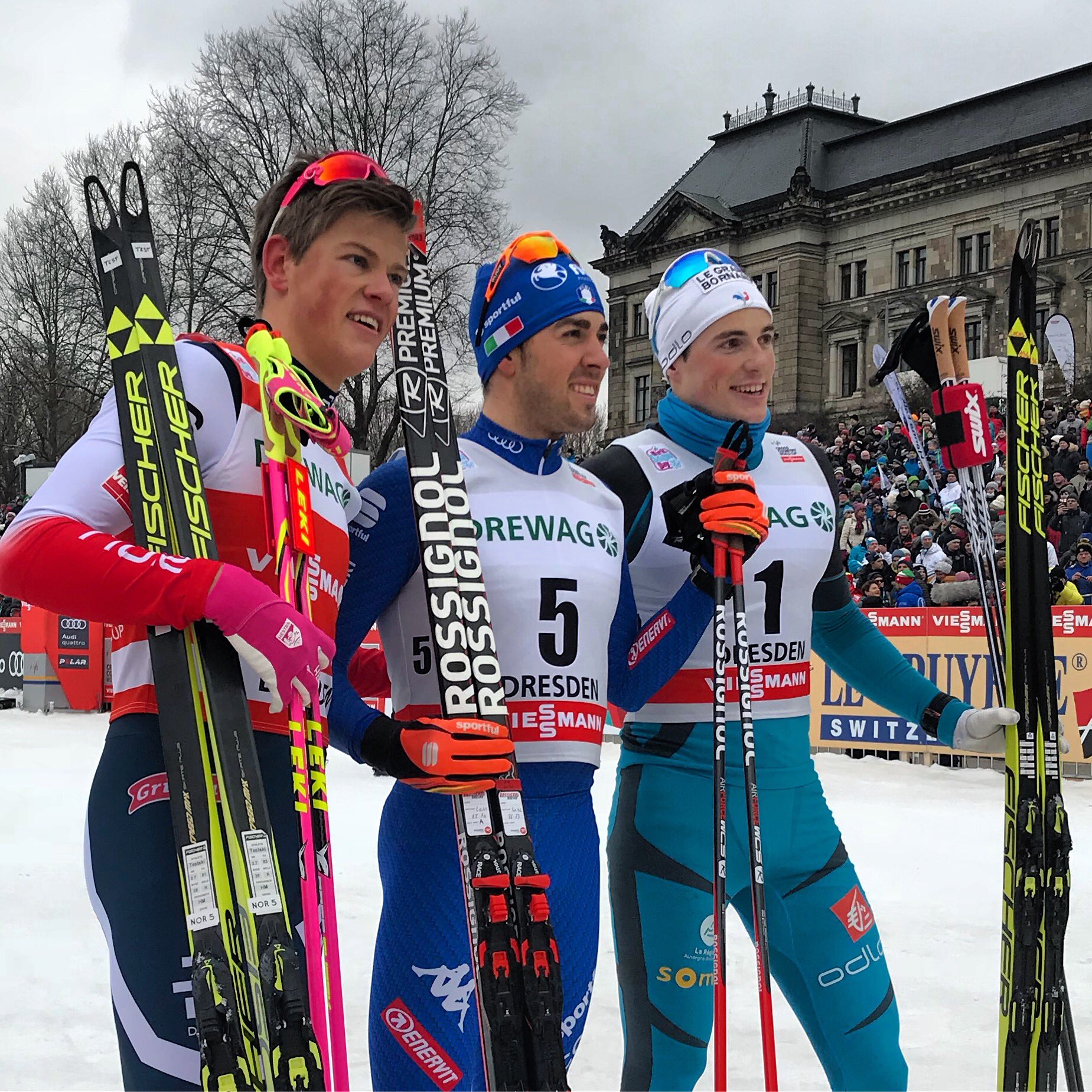
The women’s freestyle sprint podium on Saturday at the World Cup in Dresden, Germany, with Italy’s Federico Pellegrino (c) in first, Norway’s Johannes Høsflot Klæbo (l) in second, and France’s Lucas Chanavat (r) in third. (Photo: FIS Cross Country/Twitter)
While Hamilton’s day ended in the semifinals, putting him 10th overall (and Newell finished sixth in his quarterfinal to place 27th overall), Italy’s Federico Pellegrino timed his attack perfectly in the final, challenging Klæbo for the win down the finishing stretch. The Italian took it by 0.18 seconds in 1:52.77, Klæbo placed second and Chanavat third (+0.98).
France and Norway had two men in the final, with France’s Richard Jouve placing fourth (+1.23), Sweden’s Jönsson taking fifth (+2.36) for his best individual World Cup result since December 2016. Norway’s Even Northug finished sixth (+12.04) after breaking his pole out of the start.
Canada’s Julien Locke of the National U25 Team and Black Jack Ski Club had a career-best day, finishing 15th overall. He qualified 16th (+4.61) then placed third in his quarterfinal, crossing the line just 1 second behind Norway’s Fredrik Riseth, who won that heat. Hamilton was second in that quarterfinal, 0.67 seconds back.
Also for Canada, Bob Thompson (NTDC Thunder Bay) finished 50th in the qualifier (+8.67), Dominique Moncion-Groulx (Alberta World Cup Academy) was 59th (+9.99) and Antoine Briand (Pierre-Harvey National Training Centre) 60th (+10.12).
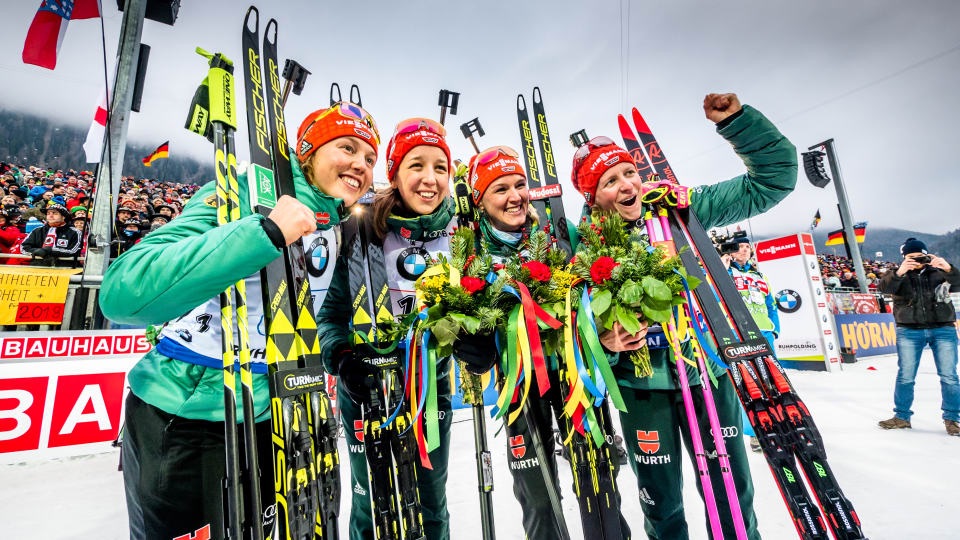
Germany’s Laura Dahlmeier, Franziska Preuss, Denise Herrmann and Franziska Hildebrand (left to right) celebrating their win in the women’s 4×6-kilometer relay at the 2018 IBU World Cup in Ruhpolding, Germany. (Photo: IBU/Biathlonworld)
IBU World Cup (Ruhpolding, Germany): Women’s relay
The teams from Germany and Italy dueled for the top position all race in Saturday’s 4 x 6-kilometer women’s relay at the IBU World Cup in Ruhpolding, Germany. Cheered on by some 20,000 home-crowd fans, Germany’s anchor Laura Dahlmeier stayed on the ski tails of Italy’s Federica Sanfilippo after the last shooting stage, then passed her before the last major climb and held a narrow lead around the rest of the course to cross the finish line first in a time of 1:08:47.0 hours, with Italy 2.9 seconds behind. German had a team total of zero penalties and nine spares.
“It’s incredibly fun to win in front of this audience here today,” Dahlmeier told German broadcaster ZDF in an interview right after the race, according to a translation. “I think this will boost our whole team morale. We showed today that we are a team to be reckoned with in relays. It was just a nice race.”
Germany with Franziska Preuss, Denise Herrmann, Franziska Hildebrand, and Dahlmeier was never more than 30 seconds behind the pace, even though Hildebrand temporarily fell back from leading the field to tagging off to Dahlmeier in fourth position.
“My race held all kinds of surprises today,” Hildebrand told ZDF with a laugh. “It started with a fall on an icy patch 100 meters after it began… Then I dropped my pole, also had to exchange the replacement one, and then three spares [in prone] to avoid the penalty. Today everything conspired in my race.”
Italy with Lisa Vittozzi, Dorothea Wierer (coming off a victory in the individual race on Thursday), Nicole Gontier and Sanfilippo had the best shooting performance of the day, with no penalty and just three spares.
“That last loop with Laura was really tough,” Sanfilippo said in the press conference. “I gave my best, I tried all for my team. I knew that I can be strong on the last loop. I tried to attack, but Laura was a little bit stronger. But I am also really happy that we finished in second place, I think that was really important for our team.”
Sweden with Linn Persson, Mona Brorsson, Anna Magnusson and anchor Jenny Öberg was third, 17.2 seconds back, with no penalty and five spares. Brorsson and Öberg managed to move the team up to the podium positions, for the second one in a row following a third place from Oberhof, Germany, a week ago. Before that, the Swedish women’s team had been on a six-year hiatus from those lofty positions.
“It’s cool to be on the podium again,” Persson said in the press conference.
“This is like our second home and there were a lot of Swedes here, so we had big support during the race on the tracks,” Brorsson added.” That was an advantage for us.”
Just a few seconds off the podium, Norway with Synnøve Solemdal, Tiril Eckhoff, Ingrid Landmark Tandrevold and Marte Olsbu was fourth (+23.1, with no penalty and nine spares), with Olsbu outsprinting Poland’s anchor Weronika Nowakowska on the finish stretch (+24.5, with no penalty and five spares). For both teams it was their best relay result of the season so far.
Switzerland with the three sisters Elisa, Selina and Aita Gasparin reinforced by Lena Häcki surprisingly led the race at the third exchange after Selina had moved them in front, but her youngest sister Aita could not hold that position, falling back with a penalty lap in the last standing stage to finish eighth (+1:37.1, with one penalty and 11 spares).
Biathlon Canada’s team of Emma Lunder, Julia Ransom, Sarah Beaudry, and Rosanna Crawford started the race with a setback after Lunder incurred a penalty in her prone stage, leaving the range in 23rd position at the end of the field and already almost a minute behind the leader. She managed to limit the gap with a clean standing stage to exchange still in 23rd position and 1:47 back.
Taking over Ransom then remained clean in both stages to move the team up to 17th, tagging off 2:14 behind. Beaudry only required one spare in her prone stage (0+1, 0+0) to improve to the 12th position even making up 3 seconds to the leaders.
Then Crawford, fresh off her first career podium in the individual race on Thursday, managed to also shoot clean in both stages and overtook the teams from Slovakia and Ukraine while further decreasing the gap to finish the race in 10th position, 1:56.7 back, with one penalty and just four spares.
“Things were a bit softer and slushy today compared to the individual, but nothing too bad,” Crawford commented on the conditions in an email to FasterSkier. “There was quite a bit of wind on the range, which I think was tricking people, the wind flags weren’t showing much but I had to make 6 left correction during zero [target practice].”
“Today was a solid showing from our team,” she added regarding their result. “Everyone cleaned standing, I think we can be really happy of this race, and take some real confidence going into the Olympic relay.”
Previously this season Canada had finished the relay in Oberhof, also Germany, in 14th position, and the first one in Hochfilzen, Austria, in ninth.
For US Biathlon with Susan Dunklee, Clare Egan, Emily Dreissigacker, and Joanne Reid, it was the first women’s relay of the year after missing out on the first two races of the season in this discipline.
Thus starting at the very end of the field, veteran Dunklee moved up through the pack and got through the prone stage with one spare. But then she had to fight against a penalty lap in her standing stage requiring all three spare rounds, leaving the range in 12th position. With the fastest course time on the opening leg, she managed to slightly decrease the gap to 21.6 seconds and made up three positions to exchange in ninth place.
Egan missed the first two shots in her prone stage, but hit the targets with her spares leaving the range over a minute back. She followed that up by cleaning her standing stage and left the range 1:29.5 back, then only lost five more seconds on the last loop to exchange in 14th.
Dreissigacker also needed just one spare in her prone shooting, but then incurred two penalties in her standing stage, doubling the gap and falling back to 19th position at the exchange and 3:51 back.
Anchor Reid needed three spares on her leg (0+2, 0+1) and managed to still overtake the teams from China and Finland to finish 17th, 4:57.7 behind Germany, with two penalties and 13 spares overall.
“Finally we had a full team and raced a relay!” Dunklee wrote on Instagram. “Competing on a foreign continent has its challenges.”
Ski Classics (Seefeld, Austria): 60 k Kaiser Maximilian Lauf
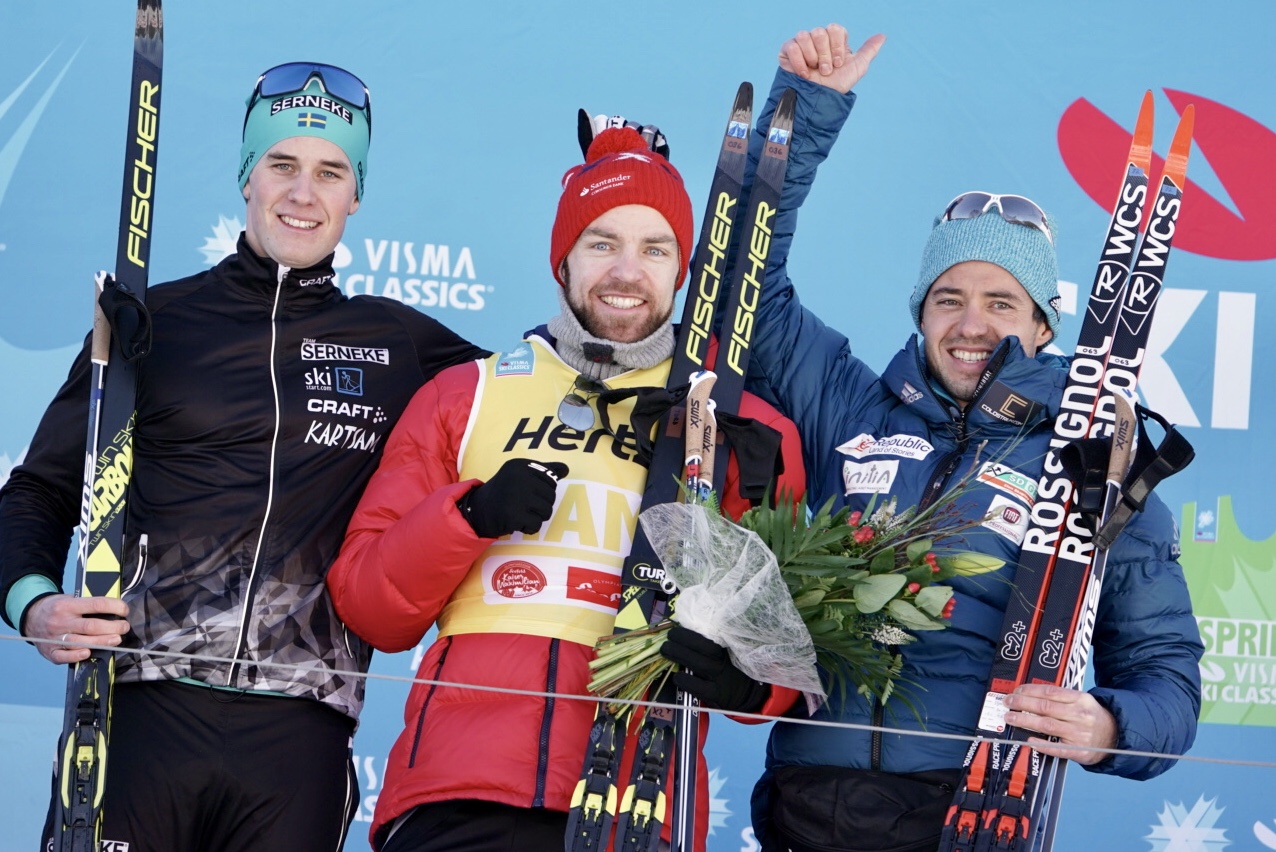
The men’s podium at the Kaiser Maximilian Lauf 60 k Ski Classics marathon in Seefeld, Austria, with Norway’s Tord Asle Gjerdalen (c) in first, Sweden’s Andreas Holmberg (l) second, and Russia’s Ilya Chernousov (r) third. (Photo: Visma Ski Classics)
At the third Ski Classics event of the 2017/2018 season, the 60-kilometer Kaiser Maximilian Lauf on Saturday in Seefeld, Sweden’s Britta Johansson Norgren (Lager 157 Ski Team) and Norway’s Tord Asle Gjerdalen (Team Santander) took the women’s and men’s victories, respectively.
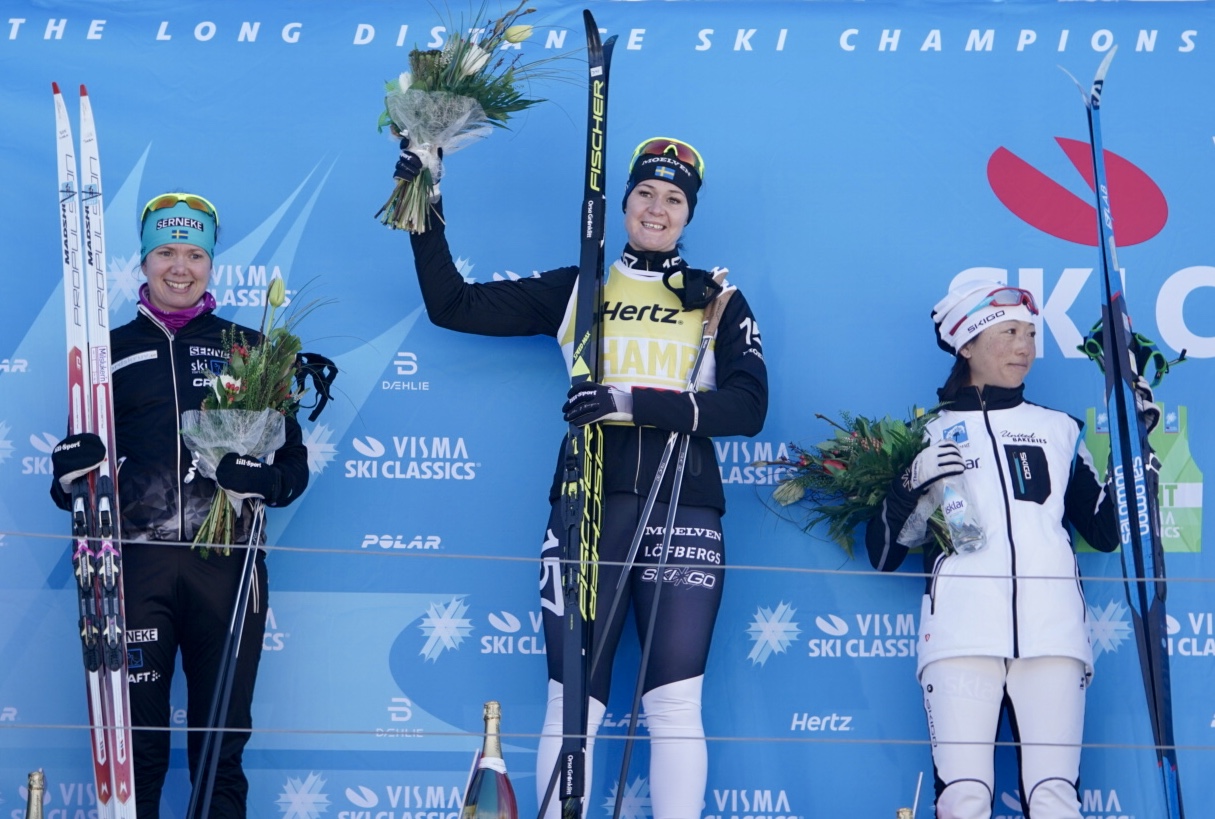
Johansson Norgren and Japan’s Masako Ishida (Team Koteng) broke away shortly after the start. The two went back and forth for a while until Johannson Norgren gapped Ishida in the Leutasch valley. While Ishida was caught by a chase pack with Sara Lindborg (Team Serneke), Kari Vikhagen Gjeitnes (Santander) and Lina Korsgren (Åre Ski Team), she reined Johansson Norgren back in on the long climbs after the valley. Ultimately, Johansson Norgren took the win in 2:49:16.0 hours, while Lindborg claimed second, 37.5 seconds back. Ishida finished third (+58.9), Gjeitnes placed fourth (+1:40.7) after injuring her ankle about 2 k before the finish, and Korsgren fifth (+2:05.1).
The women’s podium at the Kaiser Maximilian Lauf 60 k Ski Classics marathon in Seefeld, Austria, with Sweden’s Britta Johansson Norgren (c) in first, Sweden’s Sara Lindborg (l) second, and Japan’s Masako Ishida (r) third. (Photo: Visma Ski Classics)
“It was my plan to go full speed from the beginning,” Johansson Norgren said, according to a Ski Classics press release. “I knew Ishida will go fast in the climbs, but I felt strong from the beginning. It was really hard skiing alone in the valley, and when Ishida caught me up, I wasn’t sure if I could win the race. But the last part of the course was perfect for me and I had no problems securing the victory today.”
The Leutasch valley was the turning point of the men’s race as well, where Vinjar Skogsholm (Team Parkettpartner) and Andreas Holmberg (Team Serneke) broke away from the pack and had built a 90-second gap on the chase group as they left the valley. There on the first climb out of the valley, Holmberg pushed the pace and dropped Skogsholm, while Gjerdalen and Ilya Chernousov (Bauer Ski Team) worked to catch Holmberg up front. They caught him 3 k before the finish and Gjerdalen was first across the finish line in 2:27:49 hours, 14.8 seconds ahead of Holmberg in second.
Chernousov finished third (+32.0), Ermil Vokuev (Russian Marathon Team) was fourth (+1:07.6), and Anton Karlsson (Lager 157) fifth (+1:08.2).
“I didn’t like the fact that we gave too much leeway for Holmberg and Skogsholm,” Gjerdalen said, according to the press release. “I’m happy that Ilya helped me in our attempt to catch up with Holmberg, but I wasn’t really sure if we were going to make it. You never know how the other person is feeling in the front, what kind of skis he has and what goes on in his mind. But I managed to win today and it feels great to be back on the top.”
In the overall “Champion” standings, Nordgren leads with 450 points, 110 ahead of Lindborg in second. Gjerdalen is first in the men’s champion standings with 330 points, 50 points ahead of Morten Eide Pedersen in second.
The Ski Classics tour moves to Zuoz, Switzerland, next weekend for the 65 k La Diagonela.
Paddy Caldwell (SMS/USST) racing to a career-best ninth in the men’s 15 k freestyle individual start on Thursday at U23 World Championships at Soldier Hollow in Midway, Utah, while his dad, Tim Caldwell, cheers him on. (Photo: FlyingPointRoad.com)
(Note: This article has been updated to include comments from Paddy Caldwell.)
Three years ago, American Patrick “Paddy” Caldwell made his debut at Junior World Championships, racing to 10th in the 20-kilometer skiathlon in Val di Fiemme, Italy. It was the first time he had ever done a skiathlon; he was 19 years old and a college freshman at the time.
Now a 22-year-old Dartmouth sophomore, who continues to train with the Stratton Mountain School (SMS) as a member of the U.S. Ski Team’s development “D” team, Caldwell (son of four-time Olympic cross-country skier Tim Caldwell and cousin of current U.S. Ski Team standout Sophie Caldwell) is in his third U23 World Championships. The skiathlon distance has increased to 30 k, yet that classic-to-skate race remained his main focus for this year’s U23 Worlds at Soldier Hollow in Midway, Utah.
Earlier this week, he broke through with his best-ever sprint result at the championships, reaching the quarterfinals and placing 18th overall in the classic sprint. Then, on Thursday in the men’s 15 k freestyle, he cracked the top 10 for the first time in his U23/Junior Worlds career.
“I was really excited going into today’s race,” Caldwell wrote in an email on Friday morning. “15km FS is one of my favorite race formats. I have been targeting this week of races all year and was really looking forward to this race in particular.”
While the sprint was a primer for Caldwell, he said it also boosted his confidence leading into the two individual distance races at U23s.
“I have been working on my sprinting a lot this year and I am psyched to be mixing it up in the heats!” he wrote.
He described the conditions on Thursday as hard-packed with a fair amount of moisture, “which made for some fast skiing.”
It was overcast — grey and spitting rain at times — a stark contrast from the preceding bluebird days. But with temperatures just below freezing, the course remained firm.
“My strategy for the day was to pin it from the start and hold on,” said Caldwell, who started 44th of 53 in the men’s three-lap, individual start race, in a post-race interview with the U.S. Ski Team. “It was a really tight race and I definitely paid for my first lap, but I am happy to have put it all out there.”
After being passed by Russia’s eventual winner Alexander Bolshunov, who started 30 seconds behind him in bib 45, Caldwell initially finished sixth, 1:03.6 minutes behind Bolshunov. Three later starters ultimately bumped the American to ninth, including Russia’s Alexey Chervotkin, who took second at the finish, 21.8 seconds behind Bolshunov (who won in 32:55.7).
“I started off with a fast first lap and was getting splits between 1st and 4th for the first five or six kilometers,” Caldwell recalled in an email. “Bolshunov caught me around 7 kms into the race… I skied with him for about 1.5km but on the big downhill halfway through the 5km loop another skier slotted in between us and Bolshunov ended up gapping us before I could get around the other skier — it would have been sweet to ski with him some more but who knows how long I could have stuck with him. I could see him for the rest of the race which was a good gauge and kept me pushing to make up time on him.
“In the end I am really excited to be in the top ten overall and to have left it all out there,” Caldwell added. “It was a tight race and I was a bit disappointed to be at the tail end of a close group of times but in the end I am really happy with the result. I want to be the best all around skier I can be and I am really excited to be making progress in both sprint and distance racing.”
The all-Russian podium in the men’s 15 k freestyle at 2017 U23 World Championships, with Alexander Bolshunov (c), who won by nearly 22 seconds over Alexey Chervotkin (l) in second, and was 28.2 seconds ahead of Denis Spitsov (r) in third. (Photo: FlyingPointRoad.com)
For the second-straight day of 2017 Junior/U23 World Championships, Russia claimed all of the medals in the men’s race, with Denis Spitsov placing third (+28.2).
“It’s very, very cool,” Bolshunov, the silver medalist in Tuesday’s classic sprint, told the U.S. Ski Team media. “I couldn’t explain my emotions now, it’s really cool.”
“I was really excited to be in the mix with the top guys today,” Caldwell told the U.S. Ski Team. “U23s have been my focus all year and I am psyched to have improved on my results from past U23 and World Junior races.”
Next up for Caldwell, Saturday’s skiathlon, which will be his first since placing 20th in the 2015 skiathlon in Almaty, Kazakhstan.
“I have only done two skiathlons (Val de Fiemme and Almaty) but both were really fun and exciting races,” he wrote. “Mass start races are always a blast!”
Adam Martin (Northern Michigan University) racing to 22nd in the men’s 15 k freestyle at 2017 U23 World Championships at Soldier Hollow in Midway, Utah. (Photo: FlyingPointRoad.com)
Four American men raced the 15 k, with Adam Martin (Northern Michigan University) placing 22nd (+2:22.4), Jack Hegman (Sun Valley Ski Education Foundation) 24th (+2:25.2), and Cal Deline (Dartmouth Ski Team) 37th (+3:48.6). For Martin, 22nd was his best at U23 Worlds by one place, and Hegman and Deline also notched personal bests at their first U23 Worlds.
Evan Palmer-Charrette (NTDC Thunder Bay) led Canadian men in 34th (+3:20.2) for his best result at his U23 Worlds debut as well. Alexis Dumas, of the Pierre-Harvey National Training Centre (CNEPH) followed in 38th (+3:52.9), tying his U23 best. Julien Lamoureux (CNEPH) was 43rd (+4:16.7) in his first race of U23 Worlds, and Scott James Hill (Team Hardwood) 49th (+6:15.2).
Second-Straight Win for Dyvik; Beatty 16th
Dahria Beatty (AWCA/Canadian U25 Team) racing to 16th in the women’s 10 k freestyle on Thursday at 2017 U23 World Championships at Soldier Hollow in Midway, Utah. (Photo: FlyingPointRoad.com)
In the women’s 10 k freestyle, Dahria Beatty (Alberta World Cup Academy/Canadian National U25 Team) notched her second top 20 of the week in 16th, after placing 12th in Tuesday’s classic sprint.
She finished the two-lap 10 k in 27:39.8, more than a minute faster than her 10 k freestyle time at 2017 U.S. nationals last month (where she finished 17th. Beatty went on to place fourth in the classic sprint and win the freestyle prologue at U.S. nationals).
On Thursday, she was 1:25.8 minutes back from the winner, Sweden’s Anna Dyvik, who racked up her second-straight gold of the championships with the best time of the day in 26:14.0.
“Today’s race played out fairly similarly to the 10k skate at US Nationals, but not on an extreme of scale,” Beatty wrote in an email, referring to the conditions. “I was skiing where I wanted to be for the first two thirds of the race but then I really struggled at the end.
“Today’s race was extremely hard,” she added. “The courses here are really tough by any standard and the altitude makes it even harder. I tried to go out fairly conservatively by my standards today as I like starting fast. I was able to start smooth and build through the first lap into the second and was sitting in a good position just in the top 10.”
Despite trying to pace her race, Beatty described “blowing up” in the last 2.5 k.
“The last big climb was a very painful one today,” she wrote. “I haven’t quite figured out the 5k course here at Soldier Hollow yet and how to save something in my legs for the end but I was happy with my effort. I raced hard and used the tactics that I thought would give me the best result possible. I was hoping to be able to be in the top 12 but am still pleased to have skied at that pace for part of the race.”
Sweden’s Anna Dyvik racing to her second-straight gold medal of 2017 U23 World Championships on Thursday in the women’s 10 k freestyle at Soldier Hollow in Midway, Utah. (Photo: FlyingPointRoad.com)
Beatty started 32nd (of 44) and Dyvik in bib 33 passed her around 5 k.
“I only skied with her for a few hundred meters, she was moving fast and I knew if I tried to stay with her I would end of blowing up and really paying for it later in the race,” Beatty wrote.
The top Canadian in the last two U23 races, Beatty planned to race Saturday’s 15 k skiathlon.
“I’m looking forward to the Skiathlon with hopes of being able to put together a bit stronger of a performance all the way to the finish line not just for part of the race,” Beatty wrote. “Mass starts are always exciting and I am looking forward to doing some pack skiing, it was pretty windy out there today.”
Dyvik outlasted four Norwegians for the win, which she took by 16.8 seconds over Norway’s Tiril Udnes Weng (Heidi Weng’s cousin) in second. Norway claimed second through fourth place, with Lovise Heimdal in third (+23.0), and Lotta Udnes Weng (Weng’s twin sister) just 0.1 seconds off the podium in fourth (+23.1).
Half a second behind Beatty, the Czech Republic’s Petra Hyncicova (University of Colorado-Boulder Ski Team) finished 17th (+1:26.3) for her first top 20 at her second U23 Worlds.
Canada’s Frédérique Vézina (CNEPH) finished 25th (+1:58.8) for a career best at her second U23 Worlds as well, Katherine Stewart-Jones (NTDC Thunder Bay/NST U25 Team) was 27th (+2:07.8), and Jenn Jackson (Lappe Nordic/Team Hardwood) 37th (+3:31.8).
Kelsey Phinney (SVSEF) led the Americans in 30th (+2:24.6), Jesse Knori (University of Colorado-Boulder) was 32nd (+2:36.4), Alayna Sonnesyn (University of Vermont) 33rd (+2:51.4) in her first U23 Worlds race, and Nichole Bathe (University of Alaska Fairbanks) 39th (+4:19.8).
Australia’s Casey Wright (University of Alaska Anchorage Ski Team) followed in 40th (+4:22.0).
American Patrick “Paddy” Caldwell chasing Russia’s Alexander Bolshunov during the men’s 15 k freestyle individual start on Thursday at U23 World Championships at Soldier Hollow in Midway, Utah. Bolshunov went on to win and Caldwell placed ninth for a career best. (Photo: FlyingPointRoad.com)
FIS Nordic U23 World Championships (Midway, Utah): 10/15 k freestyle
Paddy Caldwell, of the Stratton Mountain School and U.S. Ski Team D-team, raced to the first top 10 of his career at a U23 World Championship on Thursday, placing ninth in the men’s 15-kilometer freestyle individual start at Soldier Hollow in Midway, Utah.
Caldwell started 44th (of 53) and crossed the finish in sixth before being bumped down three places to ninth. Upon being passed by the eventual winner, Russia’s Alexander Bolshunov, who started 30 seconds behind him in bib 45, Caldwell worked to keep pace with the Russian and ended up 1:03.6 minutes off his winning time. The silver medalist in Tuesday’s classic sprint, Bolshunov took the victory in 32:55.7 minutes, and Russia swept the men’s podium for the second-straight day at U23/Junior World Championships with Alexey Chervotkin in second (+21.8) and Denis Spitsov in third (+28.2).
Also for the U.S., Adam Martin (Northern Michigan University) placed 22nd (+2:22.4), Jack Hegman (Sun Valley Ski Education Foundation) was 24th (+2:25.2), and Cal Deline (Dartmouth Ski Team) 37th (+3:48.6).
Evan Palmer-Charrette (NTDC Thunder Bay) led Canadian men in 34th (+3:20.2), Alexis Dumas (CNEPH) was 38th (+3:52.9), Julien Lamoureux (CNEPH) 43rd (+4:16.7), and Scott James Hill (Team Hardwood) 49th (+6:15.2).
In the women’s 10 k freestyle Thursday morning, Sweden’s Anna Dyvik won her second-straight race of the championships, finishing in 26:14.0 minutes. Norway took second through fourth with Tiril Udnes Weng in second (+16.8), Lovise Heimdal in third (+23.0), and Lotta Udnes Weng (Weng’s twin sister) just 0.1 seconds off the podium in fourth (+23.1).
Dahria Beatty (AWCA/Canadian U25 Team) was the top Canadian in 16th (+1:25.8), and Petra Hyncicova (a University of Colorado-Boulder Ski Team member who’s skiing for her native Czech Republic) followed in 17th (+1:26.3).
Canada’s Frédérique Vezina (CNEPH) placed 25th (+1:58.8) for a career best at her second U23 Worlds, Katherine Stewart-Jones (NTDC Thunder Bay/NST U25 Team) was 27th (+2:07.8), and Jenn Jackson (Lappe Nordic/Team Hardwood) 37th (+3:31.8).
Kelsey Phinney (SVSEF) led the Americans in 30th (+2:24.6), Jesse Knori (University of Colorado-Boulder) was 32nd (+2:36.4), Alayna Sonnesyn (University of Vermont) 33rd (+2:51.4), and Nichole Bathe (University of Alaska Fairbanks) 39th (+4:19.8).
Australia’s Casey Wright (University of Alaska Anchorage Ski Team) followed in 40th (+4:22.0).
FIS Nordic Combined Junior World Championships: 4 x 5 k team event
[UPDATED] In the lone nordic-combined team event of Junior World Championships, Austria took the win in 46:17.3 with Samuel Mraz, Marc Luis Rainer, Florian Dagn, and Mika Vermeulen. The team ranked fourth after the jumping portion and started 23 seconds behind Japan in first, but captured the 9.7-second victory over France (Lilian Vaxelaire, Laurent Muhlethaler, Theo Rochat,Mael Tyrode), the third-ranked team after the jump.
The Czech Republic started the relay in fifth and reached the podium in third (+15.3), with Ondrej Payout, David Zemek, Jan Vytrval, and Lukas Danek.
The U.S. (Elijah Vargas, Grant Andrews, Ben Loomis, Stephen Schumann) finished seventh (+2:10.8) out of nine teams after starting sixth. Last year, the U.S. squad placed sixth at 2016 Junior Worlds in Rasnov, Romania, and in 2015 in Almaty, Kazakhstan, they were seventh.
Japan slipped from first at the start of the relay to eighth at the finish (+2:46.4).
Canada’s Dahria Beatty (8) chasing Norway’s Thea Krokan Murud (3) in the fifth quarterfinal of the women’s classic sprint on Tuesday at U23 World Championships at Soldier Hollow in Midway, Utah. Beatty finished 12th on the day while Murud went on to place second in the final. (Photo: FlyingPointRoad.com)
A year ago, Canada’s Dahria Beatty had eight World Cup starts to her name. Not too shabby considering she was 21, but now another year older, the Whitehorse, Yukon, native has more than doubled that amount with a grand total of 21 World Cup starts — one of which included her 15th-place breakthrough at the Ski Tour Canada classic sprint in Canmore, Alberta.
Beatty lives and trains in Canmore as a member of both the Alberta World Cup Academy (AWCA) and Canadian National U25 Team. She led the NorAm (Continental Cup) standings at the end of last season, reiterating her position as one of Canada’s top talents. Just under a month ago, she won the freestyle sprint prologue at U.S. nationals at Soldier Hollow in Midway, Utah.
Then on Tuesday, on the same 1.3-kilometer sprint course at Soldier Hollow, Beatty notched a career-best individual result at her second U23 World Championships, placing 12th in the classic sprint. She started the day by qualifying in eighth, 3.85 seconds back from the fastest qualifier, Sweden’s Anna Dyvik, who rounded the course in 3:39.4 minutes.
“My qualifier was pretty solid. I skied well, I made one small tactical mistake on the last climb but the rest of the race went smoothly,” Beatty reflected in an email. “This is a really taxing course and by the finish shoot my legs were pretty exhausted … it was a fight to get across that line. I was happy to qualify 8th and to post another consistent qualifier. Overall my qualifying speed has improved this year which I am very happy with.”
She was one of three Canadian women to qualify in the top 30, with Jenn Jackson (Lappe Nordic/Team Hardwood) posting the 22nd-ranked time (+12.99) and Katherine Stewart-Jones (NTDC Thunder Bay/NST U25 Team) qualifying in 28th (+16.61).
Maya MacIsaac-Jones, Beatty’s teammate on the AWCA and national U25 Team, missed advancing to the heats in 32nd (+20.68), 3.7 seconds out of 30th.
American Kelsey Phinney (6) racing alongside Norway’s Lotta Udnes Weng (5) during their quarterfinal of the women’s classic sprint on Tuesday at U23 World Championships at Soldier Hollow in Midway, Utah. (Photo: FlyingPointRoad.com)
All four of the U.S. women qualified, with Kelsey Phinney (Sun Valley Ski Education Foundation) leading them in sixth (+2.77), followed by Nichole Bathe (University of Alaska-Fairbanks) in 14th (+8.8), Jesse Knori (University of Colorado-Boulder) in 19th (+12.07), and Corey Stock (Bridger Ski Foundation) in 26th (+15.11).
Out of those seven North Americans, Beatty was the lone woman to advance to the semifinals, which had been her “base” goal to start the day. She finished third in her quarterfinal (the fifth and final quarterfinal) and advanced as a lucky loser with a fast-enough time.
“My quarterfinal was going well, but I had a stumble cresting the last hill and l lost contact with the top 2 women,” Beatty reflected in an email. “My heat was really fast and I was able to recover from the stumble and move onto the semis as lucky loser. When I finished I had a feeling it was a fast heat but you always have to wait and see.”
Norway’s Thea Krokan Murud won her quarterfinal in 3:35.2, which would hold up as the fastest time of the day until the final. Germany’s Pia Fink took second in that heat (+1.25) and Beatty was third (+2.45), ahead of Russia’s Yana Kirpichenko in fourth (+7.13) and Stewart-Jones in fifth (+12.63).
Without much time to recover before the second semifinal, Beatty explained that she was still pretty tired by the start of it. She ended up sixth in that semifinal, 8.04 seconds behind Murud, who won it in 3:37.42.
“Overall it was great to be in the semi finals and I learned a lot about tactics and where my weaknesses lie,” Beatty wrote. “I just didn’t have enough in the tank today to contend for the final but I am happy to have race my first international semi final and am looking forward to the 10k skate Thursday.”
With a previous U23 best result of 20th in the 2015 classic sprint in Almaty, Kazakhstan (and 15th in the 5 k classic at 2014 Junior Worlds the year before), 12th was Beatty’s best ever at a world championship.
“Racing well on the World Cup had definitely helped my confidence in myself and race knowledge. I feel I am right in the mix with these top women and on the perfect day I could be on that podium,” she wrote. “Going into today I had set base goal (I would be happy with the day if I achieved this) at making the semi finals. My target goal was making the final and my dream goal was being on the podium. My goals will stay pretty similar for the distance races. There are two more races and we’re at altitude so you never know what can happen.”
Jesse Knori (University of Colorado-Boulder) leading Estonia’s Anette Veerpalu during their quarterfinal of the women’s classic sprint at U23 World Championships at Soldier Hollow in Midway, Utah. Knori finished third in that heat (while Veerpalu was sixth). While she didn’t advance to the semifinals, Knori was the top U.S. woman in 15th on the day. (Photo: FlyingPointRoad.com)
While Beatty reached the semifinals, the two other Canadians and four Americans were eliminated in the quarterfinals. Knori led three U.S. women in the top 20 overall, placing 15th on the day after finishing third in her heat, 7.18 seconds behind Norway’s Tiril Udnes Weng (who won that heat by 1.07 seconds over another Norwegian Lovise Heimdal).
Canada’s Jackson raced in that same quarterfinal and finished fifth (+8.72), behind Italy’s Caterina Ganz in fourth (+7.56), for 21st overall.
Both fourth in their quarterfinals, Phinney ended up 16th and Bathe 18th overall. Phinney finished 3.81 seconds behind Weng’s twin sister, Lotta Udnes Weng, in first. Bathe finished 7.14 seconds behind the winner of her quarterfinal, Germany’s Sofie Krehl.
American Corey Stock (Bridger Ski Foundation) leads Australia’s Casey Wright (University of Alaska Anchorage) in the third quarterfinal of the women’s classic sprint at U23 World Championships at Soldier Hollow in Midway, Utah. They finished fifth and sixth, respectively, in that heat. (Photo: FlyingPointRoad.com).
Stock ended up 22nd after finishing fifth in Phinney’s quarterfinal, 10.08 seconds behind Lotta Weng. Also in that quarterfinal, Australia’s Casey Wright, of the University of Alaska Anchorage Ski Team, finished sixth (+12.37). Wright qualified in 25th and ultimately placed 29th overall.
Canada’s third woman, Stewart-Jones placed 24th after finishing fifth in the same quarterfinal as Beatty.
In the first quarterfinal, the Czech Republic’s Petra Hyncicova (Knori’s teammate at the University of Colorado-Boulder) finished fourth, 4.33 seconds behind Sweden’s Maja Dahlqvist in first. Hyncicova qualified in 21st and ended up 20th overall.
Sweden’s 22-year-old Anna Dyvik celebrates her win in the U23 World Championships women’s classic sprint on Tuesday, nearly 3 1/2 seconds clear of second place. (Photo: FlyingPointRoad.com)
Dahlqvist and Murud won the first and second semifinals, respectively, then took a back seat to Dyvik — the qualifying winner who finished second in both her quarterfinal and semi — in the final. Dyvik took control early and avoided a crash near the back to win the final in 3:32.40, the fastest time of the day. She won by more than three seconds for her first U23 Worlds medal, after earning gold in the relay and bronze in the skiathlon at 2014 Junior Worlds.
Behind her, Murud claimed silver (+3.42), edging Dahlqvist, the second Swede on the podium in third (+3.76).
Norway’s Heimdal took fourth (+6.03), while Krehl and Lotta Weng, who fell, finished fifth (+33.34) and sixth (+1:13.17), respectively.
Junior Worlds racing continues on Wednesday with the 5/10 k freestyle individual starts.
The women’s classic sprint podium on Tuesday at U23 World Championships at Soldier Hollow in Midway, Utah, with Sweden’s Anna Dyvik (c) in first, Norway’s Thea Krokan Murud (l) in second, and Sweden’s Maja Dahlqvist (r) in third. (Photo: FlyingPointRoad.com)
Norway’s Fredrik Riseth (4) celebrates his win in the men’s classic sprint at U23 World Championships on Tuesday at Soldier Hollow in Midway, Utah. He beat out Russia’s Alexander Bolshunov (1) by 1.05 seconds for the victory and Norway’s Joachim Aurland followed in third (+2.3). (Photo: FlyingPointRoad.com)
FIS Nordic U23 World Championships (Midway, Utah): Classic sprint
[UPDATED] All four American women and three Canadians qualified for the women’s classic sprint heats on the first day of U23 World Championships on Tuesday, and in the men’s qualifier, three Americans finished in the top 30 to advance to the quarterfinals at Soldier Hollow in Midway, Utah.
Kelsey Phinney led the Americans in sixth in the women’s 1.3-kilometer qualifier, clocking in 2.77 seconds off the fastest women’s qualifying time of 3:39.40, set by Sweden’s Anna Dyvik.
Canada’s Dahria Beatty qualified eighth (+3.85), followed by Nichole Bathe (USA) in 14th (+8.8), Jesse Knori (USA) in 19th (+12.07), Jenn Jackson (CAN) in 22nd (+12.99), Corey Stock (USA) in 26th (+15.11), and Katherine Stewart-Jones (CAN) in 28th (+16.61).
In the men’s 1.5 k qualifier, American Cole Morgan claimed with the 11th-fastest time, 8.19 seconds behind Russia’s Alexander Bolshunov, who topped the qualifying round in 3:36.52.
Also for the U.S., Paddy Caldwell qualified 20th (+14.68) and Jack Hegman 23rd (+15.59), while Cal Deline missed the top 30 by 0.14 seconds in 31st.
In the quarterfinals, Morgan finished second by 0.85 seconds to Bolshunov, and both automatically advanced to the semifinals. There, the Russian finished second to Norway’s Fredrik Riseth while Morgan took fifth, 9.67 seconds out of first. Overall, Morgan placed ninth on the day for his best result at a Junior or U23 World Championship.
The top North American woman on Tuesday, Beatty finished third in her quarterfinal, 2.45 seconds behind the winner of her heat, Norway’s Thea Krokan Murud. Beatty advanced to the semifinals as a lucky loser, where she ended up sixth, 8.04 seconds behind Murud, who won that heat as well. Overall, Beatty placed 12th for her first top 20 at U23 Worlds.
Meanwhile, Stewart-Jones raced in the same quarterfinal as Beatty and finished fifth (+12.63) for 24th overall.
Knori was the top U.S. woman in 15th overall after placing third in her quarterfinal, 7.18 seconds behind Norway’s Tiril Udnes Weng, who won that heat.
Phinney was right behind in 16th overall after finishing fourth in her quarterfinal, 3.81 seconds behind Weng’s sister, Lotta Udnes Weng, in first. Stock also raced in that quarterfinal and finished fifth (+10.08) for 22nd overall.
Petra Hyncicova, who skis for the University of Colorado-Boulder but is representing her native Czech Republic at U23s, took 20th on Tuesday. She qualified in 21st then finished fourth in her quarterfinal, 4.33 seconds behind Sweden’s Maja Dahlqvist in first.
Dahlqvist went on to win the first semifinal and Norway’s Murud won the second semi. Both met in the final, where Dyvik — who had placed second from the first semifinal — dominated throughout to take the win in 3:32.40. Murud finished 3.42 seconds back in second, and Sweden had two on the podium with Dahlqvist in third (+3.76).
On the men’s side, Caldwell ended up 18th after placing fourth in the same quarterfinal as Morgan, finishing 6.17 seconds behind Bolshunov in first.
Hegman placed 28th on the day after finishing sixth in his quarterfinal, 5.71 seconds behind Norway’s Chrisander Skjoenberg Holth in first.
Norway’s Riseth won his quarterfinal and semifinal before taking the victory in the final, by 1.05 seconds over Bolshunov with a winning time of 3:32.78. Norway had two on the podium with Joachim Aurland in third (+2.3).
FIS Nordic Combined Junior World Championships (Park City & Midway, Utah): Individual normal hill/10 k
Finland’s Arttu Mäkiaho winning the normal hill/10 k competition on Tuesday, the first day of Nordic Combined Junior World Championships, at Soldier Hollow in Midway, Utah. He won by nearly 22 seconds. (Photo: FlyingPointRoad.com).
[UPDATED] On the first day of Nordic Combined Junior Worlds, with the jumping taking place at Utah Olympic Park in Park City, Utah, and racing at Soldier Hollow in nearby Midway, Stephen Schumann achieved his first top 10 in the individual normal hill/10 k.
Schumann jumped to 28th then clocked the fifth-fastest cross-country time to place 10th overall, 55 seconds behind Finland’s Arttu Mäkiaho, who won in 25:54.5 minutes.
Mäkiaho started the 10 k in ninth, based on his jump, with a 35-second starting deficit to jump leader Laurent Muhlethaler of France. While Muhlethaler dropped to 17th in the 10 k, Mäkiaho clocked the third-fastest ski time to win the first nordic-combined competition of the championships.
Austria’s Mika Vermeulen finished 21.6 seconds back in second, after picking off 27 places in the ski race. He jumped to 29th and skied the fastest 10 k in 24:48.1.
Germany’s Martin Hahn rounded out the podium in third (+25.6), moving up from 26th in the jump with the fourth-fastest ski time.
Four Americans competed, with Ben Loomis landing in the top 20 in 18th (+1:38.5), Koby Vargas in 37th (+3:44.0) and Grant Andrews in 44th (+4:25.6).
Junior/U23 World Championships continue Wednesday with the junior 5/10 k freestyle individual starts, plus women’s and men’s ski jumping. Complete schedule
World University Games cross-country skiing (Almaty, Kazakhstan): 5/10 k freestyle pursuits
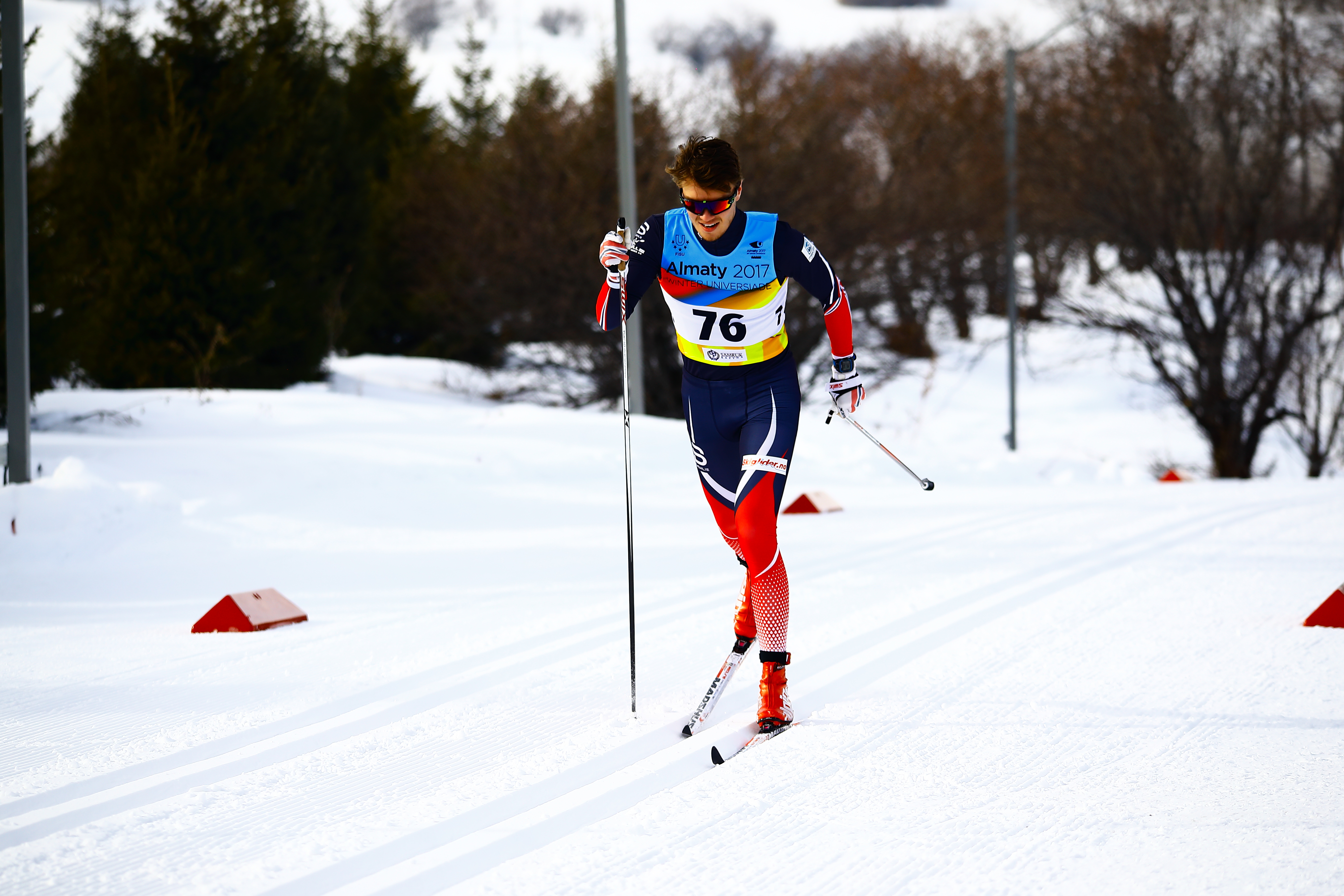
Jørgen Grav of Ford Sayre competing for Norway at the World University Games in Almaty, Kazakhstan. (Photo: Almaty2017.com)
Cross-country ski competitions continued at the World University Games on Tuesday with pursuit races based off the finish times from Monday’s 5 and 10 kilometer classic races.
In the men’s 10 k pursuit, Dmitriy Rostovtsev overtook Russian teammate (and yesterday’s winner) Valeriy Gontar to win by 14.7 seconds. Armenia’s Sergey Mikayelyan moved from fourth up to third place (+52.0) to claim the final podium spot.
Jørgen Grav of Norway, a former University of Vermont skier now in graduate studies at Dartmouth College and competing for Ford Sayre, placed 36th, +5:14.4.
For Canada William Dumas (Skinouk) skied from 48th all the way up to 40th to lead the team and finish +5:26.0. Carrington Pomeroy (Nakkertok) moved from 57th up to 48th (+6:01.2), Conor Thompson (Université Laval) finished 52nd (+6:33.3), Gavin Shields (Lappe Nordic) 58th (+6:54.6), Jordan Cascagnette (Team Hardwood) 62nd (+7:24.8), and Alexis Morin (Université Laval) 68th (+8:44.1).
Vincent Mason of the University of Wyoming had the best U.S. finish, clocking in at 55th (+6:36.6). Teammate Will Timmons finished 63rd (+7:29.9) and Sam Wiswell 71st (+9:27.9). Mitchell Hollman (Air Force Academy) 74th (+10:25.1), Kevin Geisen (Western State)78th (+12:07.6), and Cameron Moore (Western State)79th (+12:50.0).
In the women’s 5 k skate pursuit, Anna Nechaevskaya of Russia moved up and stole the lead from Russian teammate (and yesterday’s winner) Lilia Vasilieva (+18.1). Anna Shevchenko of Kazakhstan kept her hold on third place (+21.3).
Elise Sulser of the University of Wyoming againled the United States, slipping one spot to finish 24th (+3:47.1). Her teammate Meghan Kent was 47th (+6:39.9) and Yara Thomas 50th (+7:20.0). Emma Malmqvist (Colorado Mesa University) placed 53rd (+8:04.7), Sierra Jech (State University of New York) 55th (+8:26.9), and Sierra Foster (Oregon State University) 61st (+10:00.3).
For Canada, Christel Pichard-Joliceur (Université Laval)finished 31st (+4:35.9). Shelby Dickey (Highlands Trailblazers) followed in 41st (+5:35.9), then Emma Camicioli (Rocky Mountain Racers)in 44th (+5:53.0) and Kyla Vanderzwet (Nakkertok) 45th (+5:54.8).
World University Games biathlon (Almaty, Kazakhstan): 15/20 k individual
In the women’s 15 k individual, the first biathlon competition of the Universiade, Kazakhstan took four of the top five places with much of their World Cup team competing on home turf. Alina Raikova won over Galina Vishnevskaya by 2:21.1 thanks to just two penalties to Vishnevskaya’s four. Ukraine’s Nadiia Bielkina was third, +2:23.6 with five penalties.
The lone Canadian finisher was Jessica Paterson of the University of Alberta, who finished 23rd (+13:06.1) with eight missed shots.
In the men’s 20 k individual, Baptiste Jouty of France came out on top by 41.0 seconds over Sergey Korostylev of Russia, with two penalties for each racer. Third place went to Semen Suchilov, also of Russia, +1:05.5 with three missed shots.
Seamus Boyd-Porter of Memorial University led Canada with a 36th-place finish, +13:33.1 and eight missed shots. Taij Isaac Mann of MacEwan University finished 42nd with two missed shots (+19:37.2), and Sasha Eccleston 45th with seven missed shots (+23:07.8).