From the FasterSkier archive — posts syndicated from athletes’ and coaches’ own blogs between 2004 and 2012, kept online as published. Current coverage is at fasterskier.com.

Tag: Anna Svendsen

  • Rebounding From the Skiathlon, Three Americans Sprint to Top-10 Results (Updated)

    Rebounding From the Skiathlon, Three Americans Sprint to Top-10 Results (Updated)

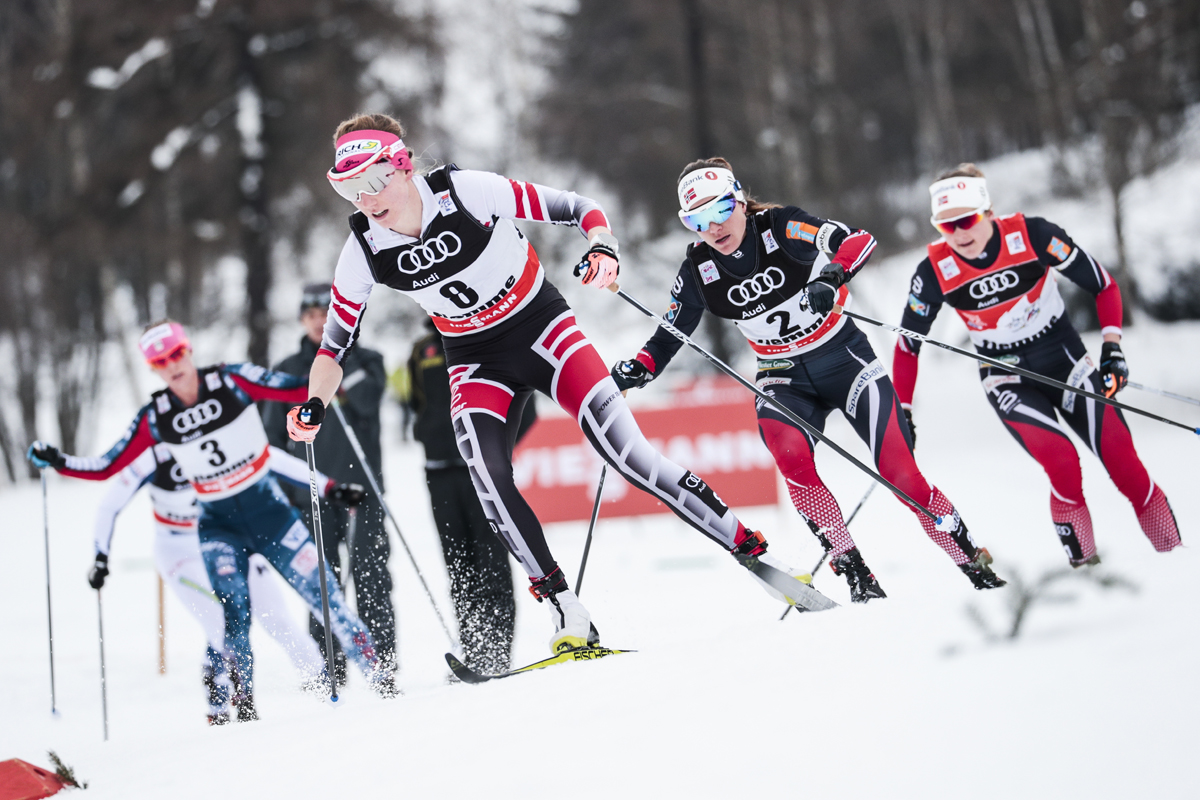
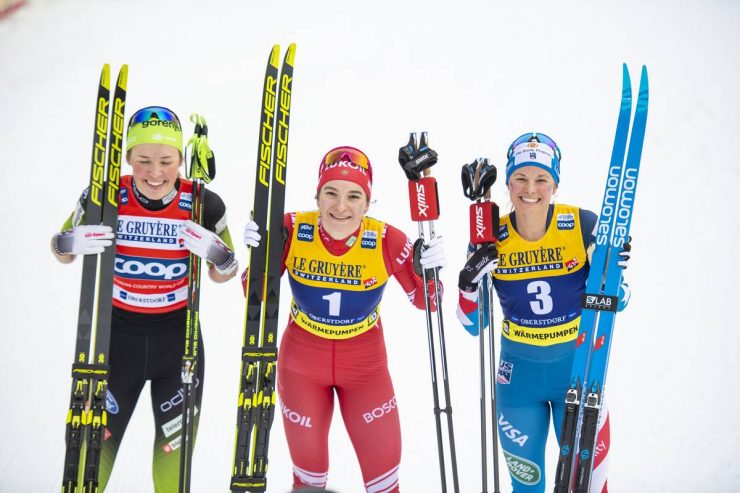
    The speedy women of Oberstdorf. Natalia Nepryaeva (RUS) won the classic sprint ahead of Anamarija Lampic (SLO) and Jessie Diggins. (Photo: NordicFocus)

    Onward and upward. Day two in Oberstdorf, Germany featured a 1.5-kilometer classic sprint with three sharp toothlike climbs. Seemingly riding the edge of their capability inside the tracks, athletes pumped their way up each pitch before wrapping around a bend and descending an equal grade back toward the stadium.

    Wolf jaw or race course? The Obesrtdorf sprint loop in profile. (Photo: Screenshot FIS Broadcast)

    After what Matt Whitcomb called an “off day”, the Americans demonstrated their ability to rebound. To not let the sensations or disappointment from one day percolate into subsequent races. Onto the next.

    This was clearly demonstrated in the qualifying round: three, four, nine, eleven. Diggins was the fastest of the crew finishing 2.24 seconds behind top qualifier Natalia Nepyaeva of Russia, who stopped the clock at 3:38:08. Diggins was 0.8 seconds behind Anamarija Lampic of Slovenia, who won both sprint events, skate and classic, during the Tour de Ski, and took second the weekend after the Tour in the freestyle sprint in Dresden. Lampic also popped the second fastest qualifying time of the day.

    Sadie Maubet Bjornsen nearly matched Diggins time in fourth (+2.35), followed by Sophie Caldwell in ninth (+5.38), and Rosie Brennan in eleventh (+5.90). The only other country to put three athletes in the top ten was Norway, a testament to the strength of the American women on a day where our expectations meet reality. 
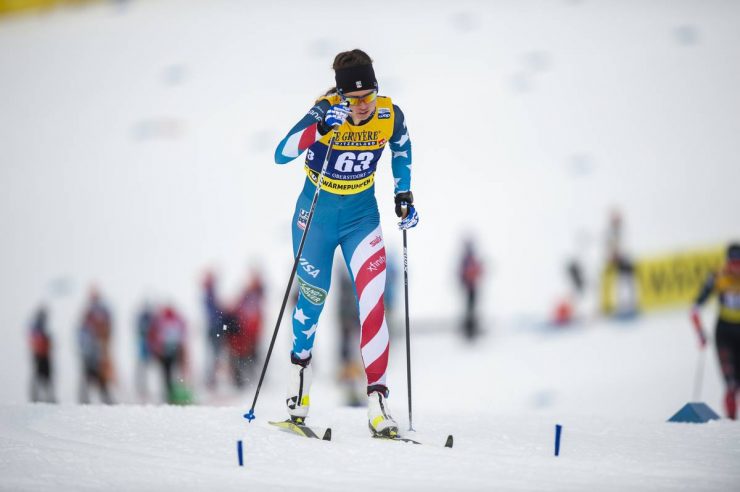
    Striding it out in Oberstdorf, Caitlin Patterson skis to 61st in the qualifier. (Photo: NordicFocus)

    Also starting for the U.S., Caitlin Patterson took 61st (+24.18), and Alayna Sonnesyn finished 66th (+26.7).

    In the quarterfinals, Maubet Bjornsen wore the lowest bib number in the first heat, which is curious as this is often the choice of the top two qualifiers (see Diggins comments on heat selection below). Maubet Bjornsen took second in a tight finish with Lotta Udnes Weng and Astrid Uhrenholdt Jacobsen of Norway, moving with Weng into the first wave of semis. 

    Caldwell won the third heat of the semis in a photo finish with Ane Appelkvist Stenseth of Norway. Brennan was eliminated after finishing fourth in the fourth heat to finish 16th for the day, a top result in the event. 
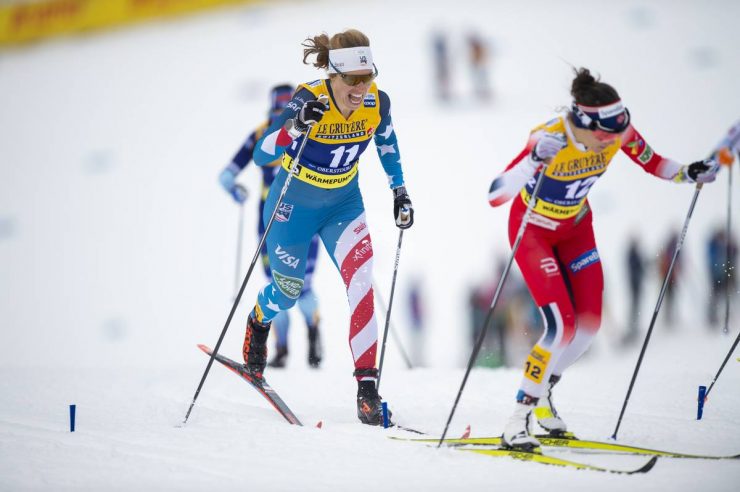
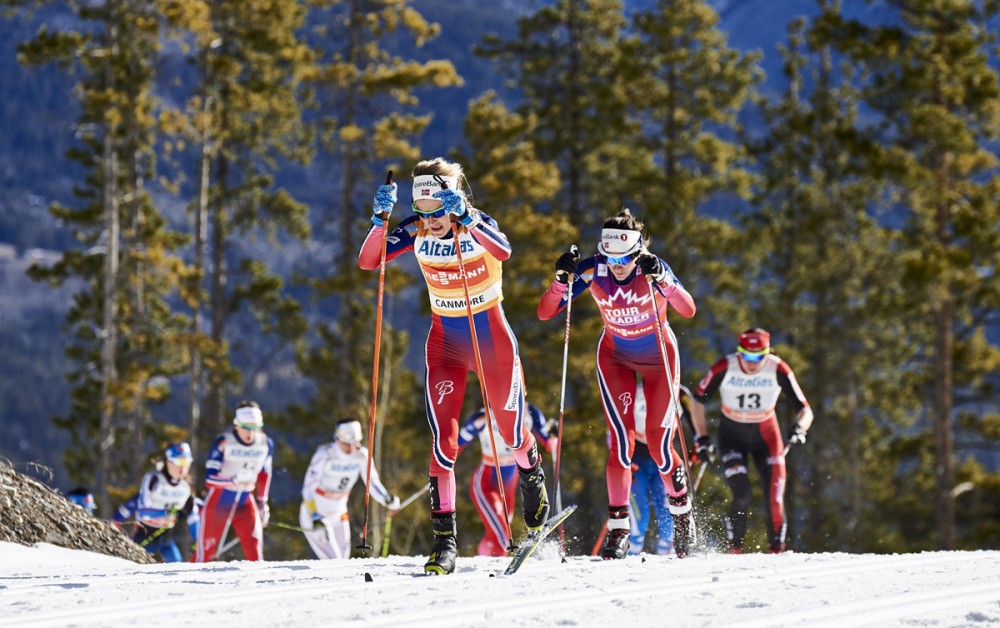
    Rosie Brennan attacks the climb behind Norway’s Heidi Weng. (Photo: NordicFocus)

    “Sprint is always such a bitter sweet event for me,” Brennan emailed. “While today was the best classic sprint of my career, I still felt that I made some mistakes and didn’t ski as well as I felt. The course here is long and has some good striding which I was really excited about. I know there are probably some sprinters that aren’t excited about the length but I felt the course did a good job of including all kinds of skiing and really rewarding good skiers. I am really happy with my feelings and for sure have a little list of things to work on moving forward.”

    Diggins charged full gas through the fifth heat of the quarters for the win, beating out Sweden’s Linn Svahn who advanced alongside her. 
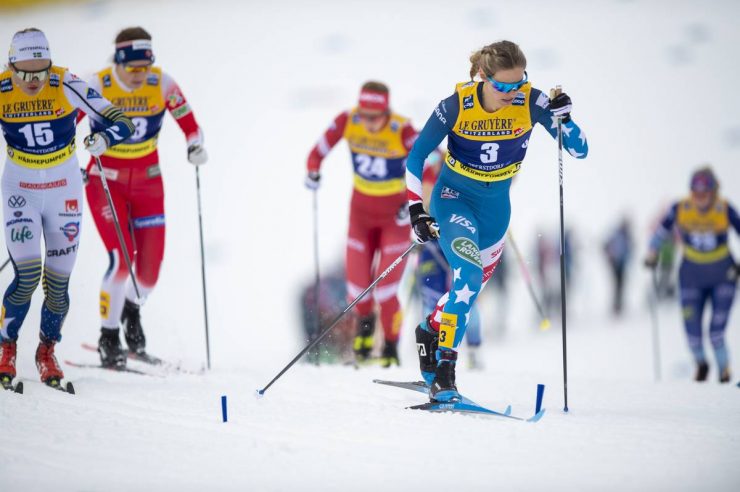
    Jessie Diggins leads Sweden’s Linn Svahn during the quarterfinal in Oberstdorf. (Photo: NordicFocus)

    In the first semi, Caldwell and Maubet Bjornsen took it out with the leaders, matching Nepryaeva’s long powerful bound up the climbs and the speedy out-of-the-track tempo of Anna Svendsen of Norway. Coming into the final downhill, Svendsen, Nepryaeva and Caldwell pulled ahead, creating a small gap to the remaining women. Caldwell held her tuck longer than the other women, collecting herself for a spicy double pole sprint to the finish. Sliding across the line at the heels of Nepryaeva, Caldwell stayed ahead of the Norwegian to take second in the heat. Maubet Bjornsen finished fifth between Nadine Faehndrich of Switzerland and her opponent from the quarters, Weng.

    “It was one heck of a thrill out there today on the courses for next year’s World Championships,” wrote Maubet Bjornsen in an email to several outlets. “This is certainly one of the hardest sprint courses I have sprinted on, but I really enjoyed it! My legs felt a lot stronger than last weekend, but still not quite recovered enough to put together the race I was dreaming of today. Finishing 9th is still and achievement, but I know I am capable of more when I have my full strength.
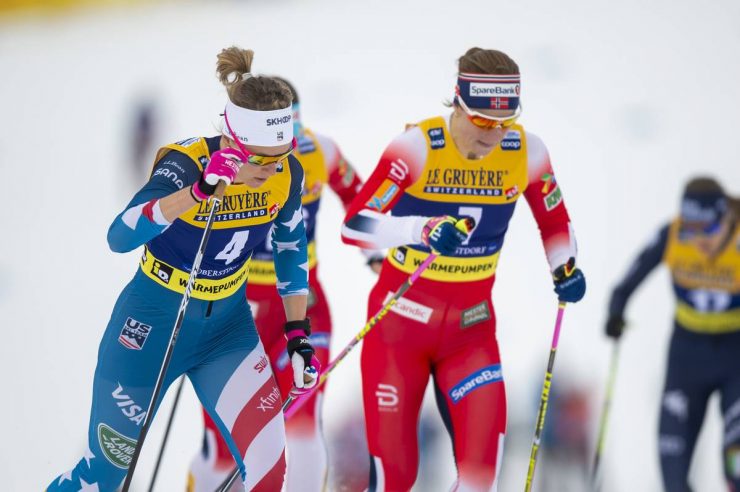
    “My tactic today was to race at the front of the group, even if it required a bit more energy, because then I knew I wasn’t going to get stuck behind anything. I always feel most confident skiing that way. In the final climb of the semi’s, I think I paid the price a bit.”
    Sadie Maubet Bjornsen matches Astrid Uhrenholdt Jacobsen (NOR) up the climb in Oberstdorf. (Photo: NordicFocus)

    Striding hot out of the gate, Diggins also held a position at the front, matching Lampic, who dictated the pace, up the climbs and tucking into her draft on the descents. On the last and longest climb, Diggins was overtaken by Svahn and Heidi Weng of Norway and she was unable to regain her position on the subsequent downhill. Though her tempo was faster than her opponents in the final double pole sprint, she finished fourth. As her time would have won the previous heat, Diggins and Svahn advanced with Lampic and Weng as the lucky losers. 

    Again taking the reins from the start-beep, Lampic surged to the front of the group and stayed there, though she could not drop the strong group of women in her wake. Up the final climb, Nepyaeva matched Lampic stride for stride, her long powerful pushes keeping her alongside the Slovenian’s green and black suit.

    Like a slingshot, Nepryaeva sped around Lampic as they rounded the final curve into the straightaway. The duo duked it out double poling in perfect synchrony, but Lampic recovered no ground on the Russian. Nepraeva stopped the clock at 3:27:08, the fastest split of the day. 

    Racing for the last podium position, Diggins and Caldwell flew into the final straight in neighboring tracks, with Svahn not far behind. Firing on all cylinders, Diggins pulled ahead of Caldwell to take third by just over a second (+2.44). After being left behind by the Americans, Svahn finished fifth (+5.16), followed long after by Stenseth (+30.20). The Norwegian had fallen off the pace midway through the round, ceding her chances to contend with the pack. 

    Due to poor WiFi connection, athletes chose to send comments via email. Reflecting on her performance, Diggins expressed that she “loved” the long sprint course.

    “You had time to try out different tactics and that last hill saw some moves, for sure. We had awesome skis today so I was able to use a little bit of a slingshot to get into good position in the finishing lanes, and I just worked to stay smooth and calm in the first half, while looking for openings to get into better position.”

    Diggins explained that heat selection is variable, and did not feel today’s variance from a usual bracket was explained by the length of the course. Her choice to race in the fifth quarter and second semi were based simply on her perception of the opportunity to advance.

    “I chose the latter heat because it was wide open, and seemed to be a good path forward out of the quarters. But you never know how it’s going to go, and I was happy to secure lucky loser time in the fast semifinal!”
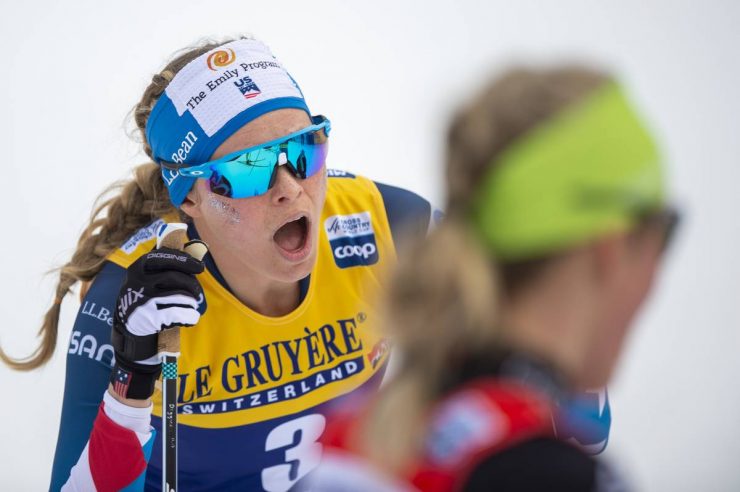
    Gasping for air after an effort Diggins can be proud of in Oberstdorf. (Photo: NordicFocus)

    After finishing 22nd in the skiathlon, some might question from the comfort of their couches whether Diggins is on the same form that we have seen in previous years. As was discussed with Matt Whitcomb, “success breeds expectation.” We expect to see Diggins at the top of the results sheet day in and day out, and that pressure can creep into an athletes self-expectation as well. When asked how she handles this, Diggins explained that she does not dwell on what is on the paper or posted in the comments.

    “That’s a great question about handling expectations and pressure…and my plan for that has always been to set really concrete process-oriented goals, work as hard as I can to meet them, and then regardless of the result on paper I can decide if it was a “good” day for myself or not based on my effort, focus, technical progress and strategy.”

    In her post-race remarks, Caldwell offered an insightful perspective that took into account her strengths as a sprint specialist versus an all-arounder like Diggins or Maubet Bjornsen.

    “This sprint was definitely one of our longest ones, and for sure the longest one of the year. I think it’s really exciting to have varying sprint courses throughout the year and this is about as far from the Dresden course as you can get. I used to think short and flat suited me best, but now I don’t really know what I like, especially for classic, but I try to be excited for any kind of sprint so I don’t count myself out before it begins. That said, I do think that there are already a lot more distance races than sprints, so when it gets much over 3 minutes, it’s starting to favor distance skiers more, which is fine to do sometimes, it’s just too bad when there are already so few sprints if too many of them start getting really long. But I personally really enjoyed the course and the race today. I don’t think it’s too much different for recovery for me whether the course is 3 mins or 3:30, but I think for the men it is probably harder because if they’re in the second half of the bracket, they have a lot less recovery. I usually just try to move around until I’ve flushed my legs out and then relax for a little bit and then start moving around again before my next heat!

    “Today was a really awesome day for our team. I was psyched to make my first classic final in years, and I think only my third ever. I’ve now had three 4th places in the last four races, which is a little bittersweet, but it’s important to remind myself that 4th is still a really strong result, especially in a tough classic sprint. It was great to ski with Sadie in my semi and I know she’s bouncing back from giving her all in the tour, but is getting stronger each day and a good result today is a huge step in the right direction. And Jessie was on fire all day and it was awesome to see her get another classic podium. So really fun to have such a strong day for our women and even though it was a tough day for the guys, I know they will be fighting back in Falun!”
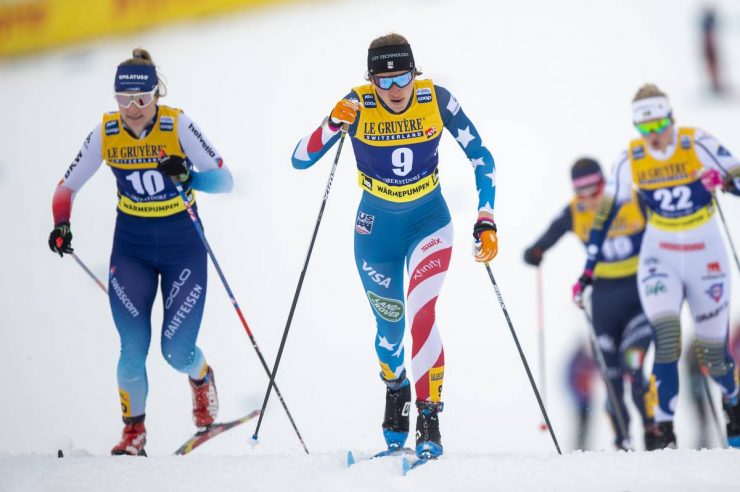
    Sophie Caldwell skis to 4th place in Oberstdorf. (Photo: NordicFocus)

    Between the city sprints in Dresden and today’s event in Oberstdorf, Caldwell headed to Austria for an altitude camp. She explains the role this plays in balancing training and recharging, and how the sprinters use an altitude stint to build fitness without losing their top end speed.

    “Simi and I just took a little break in Seefeld during the distance weekend in Nove Mesto and it’s was really nice both physically and mentally. The schedule this year is very demanding, with almost no weekend off, so we felt it was important to find in a couple times to work in a break, remove ourselves from the World Cup, and take some time for ourselves. I was really tired right after Dresden and didn’t realize it until I allowed myself to take a break, so it was nice to have a few days of true recovery and then I felt I was able to train really well for 9 or 10 days before coming here. Seefeld is at mild altitude, but I think it’s only at 3,700 ft, so as long as I keep my easy skis easy, I don’t feel too many effects of altitude and don’t worry about not being sharp when coming down a little in elevation.”
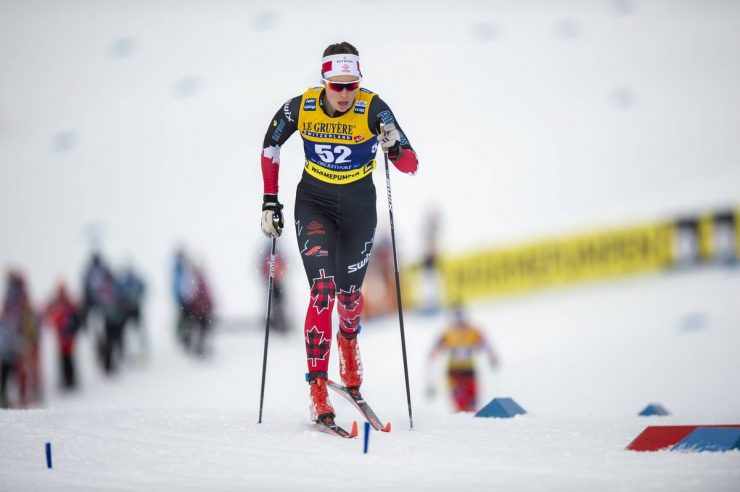
    Maya Macisaac-Jones posted the top qualifying time for Canada in 35th. (Photo: NordicFocus)

    Racing for Canada, Maya Macisaac-Jones posted the top qualifying time in 35th (+14.28), followed by Dahria Beatty (+15.79), Katherine Stewart-Jones in 50th (+18.58), and Katherine Weaver 65 (+26.08).

    Qualification | Final Results 

  • 2018/2019 Tour de Ski Preview (Updated)

    2018/2019 Tour de Ski Preview (Updated)

    The start of the men’s 15 k classic mass start at Stage 6 of the 2018 Tour de Ski on Saturday in Val di Fiemme, Italy, with (front row, left to right) Canada’s Alex Harvey, Russia’s Sergey Ustiugov, Kazakhstan’s Alexey Poltoranin, Norway’s Martin Johnsrud Sundby, and Switzerland’s Dario Cologna. (Photo: Salomon/NordicFocus)

    Beginning this Saturday in Toblach, Italy with a freestyle sprint is the 13th edition of the Tour de Ski (TdS). According to the International Ski Federation (FIS), over the course of seven stages the men will race 80.918 kilometers, the women 60.67 k. 

    The TdS has become both a staple and a spectacle of the annual World Cup calendar. With a jam-packed series of races primacy is placed on both the ability to recover well and wither less as the TdS transpires.

    Prognostication can be tricky in a long-form template like the TdS. So much can go astray during seven races not to mention the travel and dicey germ-avoidance. 

    Last season’s winner on the women’s side, Heidi Weng of Norway, sits 18th overall in the World Cup standings (14th in distance). She has four top-20’s in the four distance events she’s contested with her best result an eighth in Lillehammer’s 10 k skate. Although featuring two sprints in the first three stages, the TdS remains a distance skier’s paradise.

    Weng has skied solidly on the World Cup, but she has yet to show the form that made her a TdS overall winner in 2017 and 2018. Norway has won the last five iterations of the TdS: Marit Bjørgen won once in 2014/2015, Therese Johaug twice (2013/2014, 2015/2016), and Weng the last two years.

    Austria’s Teresa Stadlober leads Norway’s Heidi Weng (2) and Ingvild Flugstad Østberg, American Jessie Diggins (3) and others around a downhill corner during the women’s 10 k classic mass start at Stage 6 of the 2018 Tour de Ski in Val di Fiemme, Italy. (Photo: Fischer/NordicFocus)


    If Norway is to keep the streak alive, Ingvild Flugstad Østberg, last year’s TdS runner up, could be the heir apparent. She currently ranks second in the World Cup overall and 15th on the sprint list.

    Johaug, having returned from an 18 month doping ban, has been on a distance race tear. She has won all five World Cup distance events this season. Johaug, however, will not be lining up for the TdS.

    Only five different women have earned distance podiums this season — Johaug, Østberg, Sweden’s Charlotte Kalla and Ebba Andersson, and Finland’s Krista Pärmäkoski. Along with Johaug, Kalla and Andersson are skipping the TdS. (Andersson sits third overall on the World Cup, Kalla fifth.) With the TdS missing three of the five top ranked World Cup distance skiers, daily stages and the overall podium are up for grabs.   

    Last season’s third overall finisher, Jessie Diggins of the U.S. Ski Team (USST), often cites the TdS as a point in the season when her form trends towards podium performances. She sits eighth in the current distance standings and could very well have a stout TdS. 

    Russia’s Natalia Belorukova and Yulia Nepryaeva look strong as does Sadie Bjornsen (USST), and Austria’s Teresa Stadlober.

    With less than predictable distance stage podiums for the women, it may simply come down to a drag race on the Alpe Cermis final climb Jan. 6.

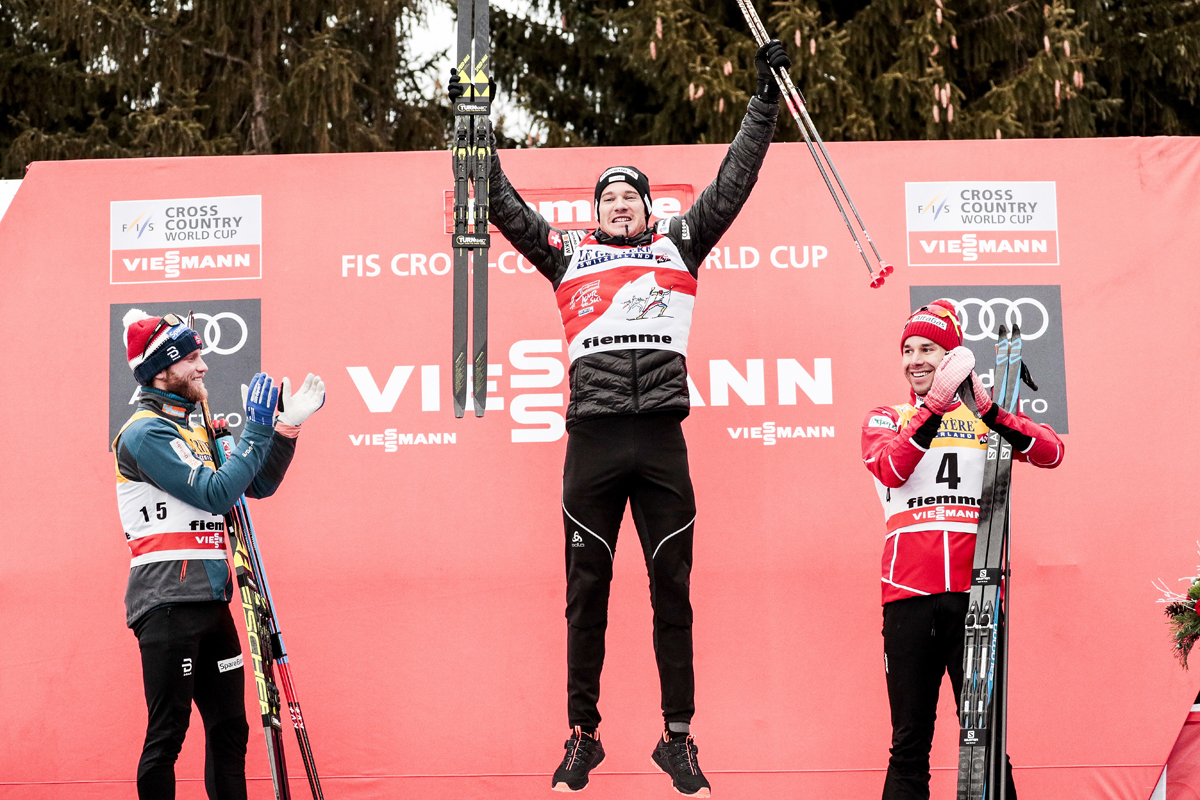
    Switzerland’s Dario Cologna (c) celebrates his fourth Tour de Ski overall title. He was joined by Norway’s Martin Johnsrud Sundby (l) and Canada’s Alex Harvey (r) on the podium in second and third, respectively. (Photo: Fischer/NordicFocus)


    The men’s scene is also open to interpretation. Last season’s TdS winner, Switzerland’s Dario Cologna, was in fact a surprise victor. Prior to Cologna’s stage two win in last year’s TdS, it had been nearly three years since the four time TdS overall winner had won a World Cup. Cologna sits 21st overall on the World Cup currently. Given last year’s resurgence, anything is possible for the Swiss skier.

    Then there’s Martin Johnsrud Sundby form Norway. He finished on the TdS podium the last three years. At thirty-four-years-old, Sundby is ranked first on the distance list, with a second, a third, and a fourth place in distance races this season.

    Sundby won the TdS on two occasions – in 2013/2014 and in 2016. His 2015 win was stripped after he tested positive for excessive levels of Salbutamol. He placed second in the past two Tours.

    In a field rife with talent, Sundby’s ability to race and rebound and race and rebound will be tested. Sjur Røthe, Emil Iversen, and Didrik Tønseth— all from Norway— look in form. And there’s Norway’s Johannes Høsflot Klæbo. The winner of last season’s overall World Cup has had flashes of his past explosive self. He could be a TdS protagonist.

    The men’s field is notably tight. Along with the Norwegians, several Russians could pop a podium, a stage win, and the overall. Russia comes with a loaded team ready to exploit. Alexander Bolshunov leads the overall World Cup – he’ll turn twenty two on Dec. 31st. He’s backed by teammates Evgeniy Belov, Andrey Melnichenko, and Denis Spitsov. 

    Canada’s Alex Harvey placed third overall last year and he looked stronger as the TdS progressed.

    The Stages

    Stage 1:  Dec. 29, skate sprint in Toblach, Italy.

    Stage 2: Dec. 30, 10 k/15 k skate in Toblach, Italy.

    Stage 3: Jan. 1, skate sprint in Val Müstair, Switzerland.

    Stage 4: Jan. 2, 10 k/15 k classic mass start in Oberstdorf, Germany.

    Stage 5: Jan. 3, 10 k/15 k skate pursuit in Oberstdorf, Germany.

    Stage 6: Jan. 5th, 10 k/15 k classic mass start in Val di Fiemme, Italy.

    Stage 7: Jan 6th, 9 k final climb skate pursuit in Val di Fiemme, Italy.

    Teams

    United States

    Women: Sophie Caldwell, Sadie Bjornsen, Jessie Diggins.

    Men: Ben Lustgarten, Simi Hamilton, Erik Bjornsen, Kevin Bolger.

    U.S. Ski Team Head Coach Chris Grover noted in a text that Caldwell, Hamilton, and Bolger will likely cease the TdS after the stage three sprint. Additionally, this is a small team for the U.S. at the TdS. Several athletes turned down TdS nominations including Scott Patterson (USST), Andy Newell (SMS T2/Salomon), Kyle Bratrud (SMS T2), Rosie Brennan (APU), Rosie Frankowski (APU), Caitlin Patterson (CGRP), and Julia Kern (SMS T2). These skiers plan on racing U.S. Nationals this January in Craftsbury, Vermont.

    Canada

    Women: Emily Nishikawa, Dahria Beatty

    Men: Alex Harvey, Lenny Valjas, Bob Thompson

    Norway

    Women: Ingvild Flugstad Østberg, Maiken Caspersen Falla, Astrid Uhrenholdt Jacobsen, Kari Øyre Slind, Kathrine Rolsted Harsem, Heidi Weng, Lotta Udnes Weng, Tiril Udnes Weng Mari Eide, Anna Svendsen

    Men: Martin Johnsrud Sundby, Hans Christer Holund, Emil Iversen, Didrik Tønseth, Simen Hegstad, Krüger, Sjur Røthe, Johannes Høsflot Klæbo, Martin Løwstrøm Nyenget, Eirik Brandsdal, Finn Hågen Krogh

    Russia

    Women: Yulia Belorukova, Lidia Durkina, Anna Zherebyateva, Mariya Istomina, Natalia Nepryaeva, Anna Nechaevskaya, Anastasia Sedova, Elena Soboleva

    Men: Evgeniy Belov, Alexander Bolshunov, Maxim Vylegzhanin, Andrey Larkov, Andrey Melnichenko,  Gleb Retivykh, Andrey Sobakarev, Denis Spitsov, Sergey Ustiugov

    Sweden

    Women: Mia Eriksson, Ida Ingemarsdotter, Moa Molander Kristiansen, Stina Nilsson, Maria Nordström, Linn Sömskar, Lisa Vinsa

    Men: Calle Halfvarsson, Simon Lageson, Teodor Peterson, Daniel Rickardsson, Oskar Svensson, Viktor Thorn, Karl Johan Westberg

    Finland

    Women: Mari Eder, Anne Kyllönen, Laura Mononen, Krista Pärmäkoski, Susanna Saapunki

    Men: Ristomatti Hakola, Matti Heikkinen, Lauri Vuorinen

    Italy

    Women: Elisa Brocard, Anna Comarella, Ilaria Debertolis, Caterina Ganz, Greta Laurent, Sara Pellegrini, Lucia Scardoni

    Men: Francesco de Fabiani, Stefano Gardener, Enrico Nizzo, Dietmar Noeckler, Federico Pellegrino, Maicol Rastelli, Giandomenico Salvadori

    Switzerland

    Women: Nathalie von Siebenthal, Laurien van der Graaff, Nadine Fähndrich

    Men: Dario Cologna, and Jovian Hediger, Jonas Baumann, Livio Bieler, Roman Furger, Käser Erwanm, Beda Klee, Toni Livers, Jason Rüesch, Schaad Roman

    Austria

    Women: Therese Stadlober

    Germany

    Women: Julia Belger, Victoria Carl, Pia Fink, Laura Gimmler, Katharina Hennig, Sandra Ringwald, Elisabeth Schicho, Anne Winkler

    Men: Thomas Bing, Lucas Bögl, Janosch Brugger, Jonas Dobler, Sebastian Eisenlauer, Andreas Katz, Valentin Mättig, Florian Notz, Max Olex, Thomas Wick

    France

    Women: Anouk Faivre Picon, Delphine Claudel, Laura Chamiot-Maitral

    Men: Maurice Manificat, Lucas Chanavat, Adrien Backscheider, Jean-Marc Gaillard, Baptiste Gros, Renaud Jay, Richard Jouve, Jules Lapierre, Clement Parisse

    FasterSkier will update team start lists as we gather more information.

    antibiotics

  • Johaug and Tønseth take Beitostølen, Norway Classic Openers

    Johaug and Tønseth take Beitostølen, Norway Classic Openers

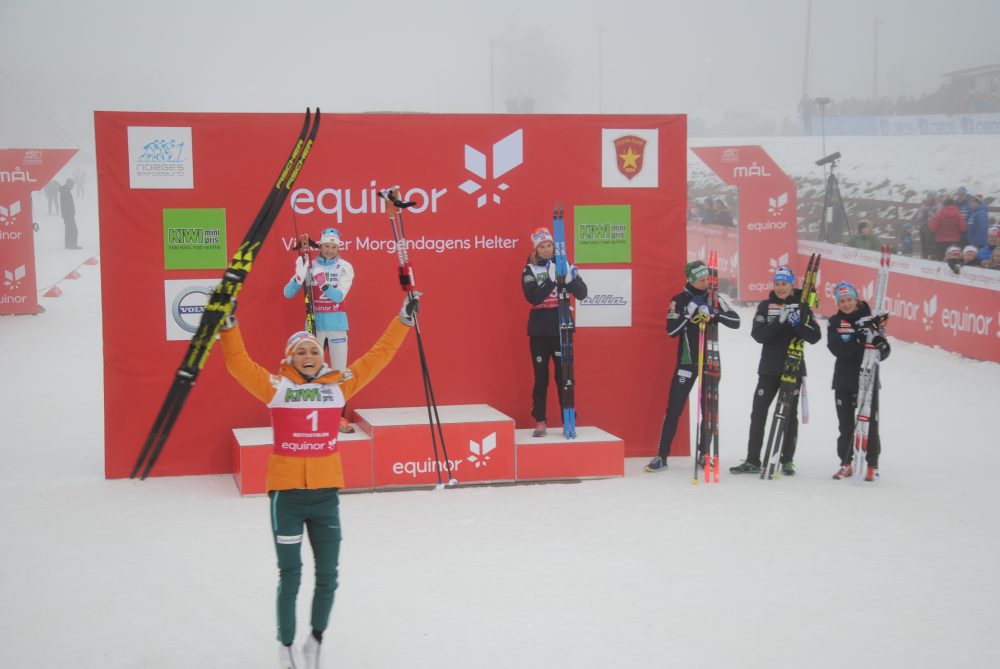
    She’s back. Therese Johaug celebrates after winning the 2018 FIS 10-kilometer classic in Beitostølen, Norway.

    After an 18 month suspension for a positive out of competition positive doping test, during which Norway’s thirty-year-old Therese Johaug could build hour upon hour of base fitness and fine tune the engine with no race-stress, she arrived in Beitostølen, Norway on Friday and didn’t skip a beat.

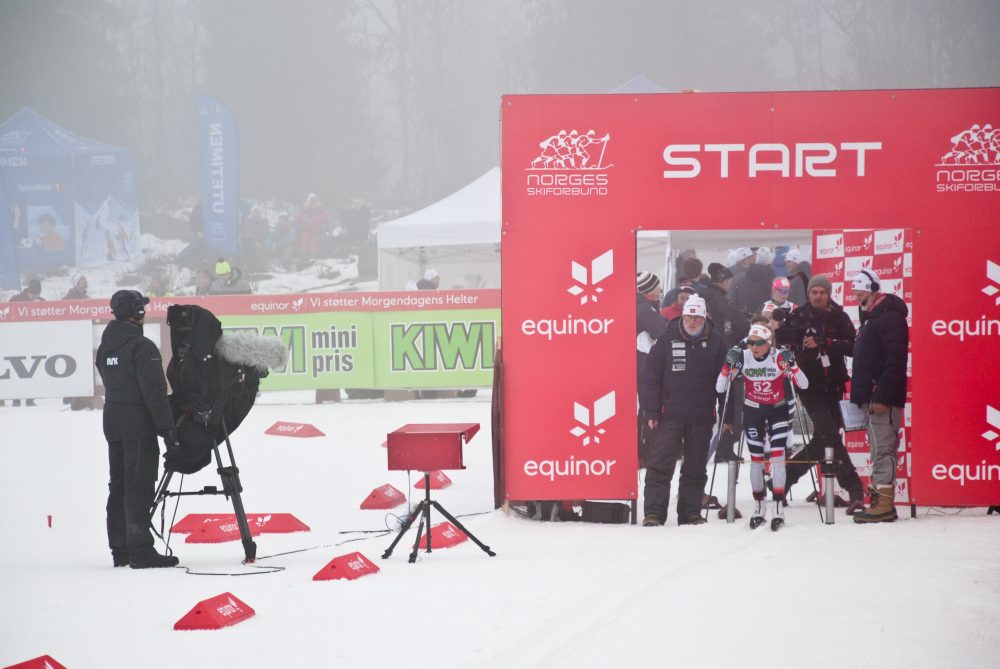
    In temperatures hovering around 32 degrees Fahrenheit, and low-level clouds descending on the course, Johaug established herself as the early season favorite amongst a deep Norwegian National Team in Beitostølen’s FIS season opener 10-kilometer classic race.

    As the 52nd starter in a 60-skier field, Johaug never let off the throttle.

    The race was tight at the 1-kilometer time check, with national team skier Ingvild Flugstad Østberg marking the fastest time over Johaug by only 0.9 seconds. With nine kilometers to go, it was all Johaug, as she clocked the fastest times at the remaining checkpoints.

    Up by 4.3 seconds at 2.2k, the time back to the second fastest skier grew to 15.5 seconds at the race’s midpoint for Johaug. By the finish, Johaug did as she has done many times before, winning by a comfortable margin. She won in 25:42.6 minutes. Østberg, who ranked third in the World Cup overall last season, placed second (+23.9). Kari Øyre Slind was third (+59.8)

    Therese Johaug ready to start it all over again after her 18-month suspension.

    “It was special being here today,” Johaug told Norwegian broadcaster NRK according to a translation. “It feels incredible to back in the xc family again. To come up here and meet all the people that I’ve been skiing with for so many years, hear the cries from the crowds out in the course and the splits, it was a special feeling. It was so much. I was nervous before the start, but when I got started I really didn’t want it to end. I could have skied an extra lap.”

    The opening Beitostølen FIS races are the early season proving grounds for Norway’s elite cross-country athletes. The top-10 in the women’s race was riddled with names World Cup fans are familiar with.

    Astrid Uhrenholdt Jacobsen skied to fourth (+1:21.3), Haga Ragnhild fifth (+1:33.1), Anna Svendsen sixth (+1:42.8), and Heidi Weng, winner of last seasons overall World Cup finished seventh (+1:58.7).

    Annika Taylor, a former University of New Hampshire skier now skiing for Great Britain, raced her way to 21st (+3:49.3). 

    In similar conditions, the men raced a 15 k classic. Like the women’s field, it was a Norwegian who’s who of elite class skiers. But unlike Johaug setting an increasing time margin over any contenders, the men’s race was tight, separated by only 15 seconds for the top-five skiers 5 k into the race.

    At that point, with Didrik Tønseth in first and Emil Iversen in second, only a sliver of time, 0.1 seconds, differentiated the two. Martin Johnsrud Sundby and Johannes Høsflot Klæbo were gapped by 12.2 and 12.7 seconds respectively, as they skied through the time check in third and fourth place. Sjur Røthe came through in fifth (+15.8).

    Iversen, in bib 141, kept it close, setting the initial times to beat. Tønseth started three skiers back in bib 144. Through 10k, the two were still evenly matched: with Tønseth up by 3.4 seconds over Iversen.

    The men’s 15 k classic podium for the 2018 FIS opener in Beitostølen, Norway. Didrik Tønseth (NOR) in first, Norway’s Emil Iversen (left) in second, and Sjur Røthe (right) of Norway third.

    Tønseth won the race in 36:08.6 minutes, with his winning margin of 12.4 seconds over the second place Iversen only solidified in the closing kilometers. Røthe gradually moved up and finished third (+29.3).

    Sundby skied to fourth (+37.5), Hans Christer Holund fifth (+1:07.4), and Klæbo sixth (+1:17.5). British skier Andrew Musgrave finished seventh (+1:26.3). Musgrave is historically a stronger skate skier.

    One hundred and forty-three skiers finished the men’s race.

    Of note, thirty-two-year-old Petter Northug Jr., now a seemingly timeless presence on the Norwegian ski scene, was disqualified for classic technique violations. Prior to his DQ, Northug had been skiing in the top-20 for much of the race. Sundby was given a verbal warning for a classic technique violation.

    Several Canadians raced the 15 k classic. Russell Kennedy was the best placed Canadian finishing tied for 23rd (+2:37.6). Brian McKeever was 68th (+4:06.6), Ryan Jackson 110th (+5:39.1), Maks Zechel 113th (+5:56.5).

    Racing continues Saturday with a skate sprint.

    Beitostølen Women’s 10 k classic results | Beitostølen Men’s 15 k classic results


  • Friday Rundown: Beitostølen FIS Opening Race and More

    Friday Rundown: Beitostølen FIS Opening Race and More


    Norwegians Therese Johaug and Heidi Weng, (l-r) during the 2016 women’s 15 k skiathlon in Canmore, Alberta. (Photo: Fischer/NordicFocus)

    Welcome to The Rundown, your quick primer of need-to-know information about the day’s racing. We’ll be updating this digest as the day goes on with additional results, photos and quotes. The Rundown is NOT a race report; stay tuned for complete race reports later today with interviews from the day’s top racers.

    ***

    FIS cross-country Beitostølen, Norway: 10 k/15 k classic

    The race results are in from today’s 10-kilometer individual start classic FIS race in Beitostølen, Norway. The first of the season Beito races are used as a test pad for Norwegian athletes to gauge fitness and for some to make the rare jump to a coveted and scarce World Cup start. 

    Off of her suspension for using a banned substance, Norway’s Therese Johaug skied like she’d never been gone. Johaug was suspended for 18 months due to her violation.

    Johaug fired off the 10 k winning in 25:42.6 minutes. Ingvild Flugstad Østberg was second (+23.9). Rounding out the podium was Kari Øyre Slind in third (+59.8).

    Astrid Uhrenholdt Jacobsen skied to fourth (+1:21.3), Haga Ragnhild fifth (+1:33.1), Anna Svendsen sixth (+1:42.8), and winner of last seasons overall World Cup, Heidi Weng finished seventh (+1:58.7).

    The men skied a 15 k classic race Friday in Beitostølen. Didrik Tønseth won in a time of 36:08.6 minutes. In second was Emil Iversen (+12.4), while Sjur Røthe placed third (+29.3).

    Martin Johnsrud Sundby skied to fourth (+37.5), Hans Christer Holund fifth (+1:07.4), and Johannes Høsflot Klæbo sixth (+1:17.5).

    British skier, although based in Norway, Andrew Musgrave finished seventh (+1:26.3).

    One hundred and forty-three skiers finished the men’s race. Of note, Petter Northug Jr., now a seemingly timeless presence on the Norwegian ski scene, was disqualified for technique violations.

    buy temovate online


    Several Canadians raced the 15 k classic. Russell Kennedy was the best placed Canadian finishing tied for 23rd (+2:37.6). Brian McKeever was 68th (+4:06.6), Ryan Jackson 110th (+5:39.1), Maks Zechel 113th (+5:56.5).

    Beitostølen Women’s 10 k classic results | Beitostølen Men’s 15 k classic results 


    ***

    Bruksvallarna, Sweden cross-country: 5 k/10 k freestyle

    In Bruksvallarna, Sweden FIS racing began with a 5 k freestyle for the women. Three of Sweden’s star skiers took the podium spots. Ebba Andersson won the tight race in 9:57.1 minutes, finishing only 2.6 seconds ahead of second place skier Charlotte Kalla. Known for her sprinting prowess, Hanna Falk was third (+15.7).

    One hundred and twelve skiers finished the race.

    For the men, after skating 10 k, the race was a tie for first. Sweden’s Jens Burman and Karl-Johan Westberg skied the fastest time. Both crossed the line in 19:11.0 minutes for the win. Japanese skier Keishin Yoshida placed third (+9.5).

    Daniel Rickardsson, of Sweden, skied to fourth (+12.9).

    Women’s results | Men’s results


  • Big Results for Geraghty-Moats, Harvey at Summer GP, Toppidrettsveka

    Big Results for Geraghty-Moats, Harvey at Summer GP, Toppidrettsveka

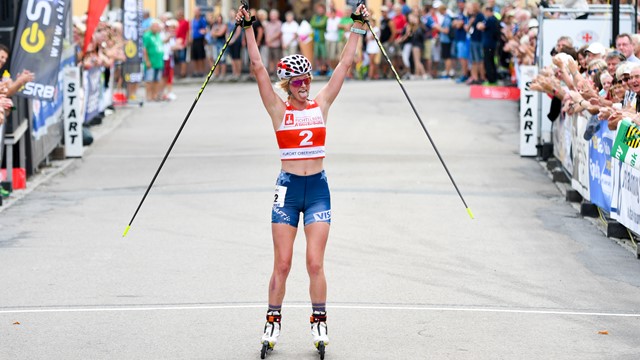
    Tara Geraghty-Moats winning Sunday’s normal hill/5 k Gundersen at the 2018 Women’s Nordic Combined Summer Grand Prix in Oberwiesenthal, Germany. (Photo: Romina Eggert/FIS)

    Two North Americans posted impressive results at nordic events in Germany and Norway over the last week, with Vermont native Tara Geraghty-Moats racing to first overall in the first-ever Women’s Nordic Combined Summer Grand Prix and Quebec’s Alex Harvey placing second, fifth and 10th in three races at the Toppidrettsveka rollerski series.

    Geraghty-Moats 1st and 2nd at Inaugural Women’s NoCo Grand Prix

    Brand new to nordic combined as well as the jump hill in Oberwiesenthal, Germany, Geraghty-Moats took the inaugural women’s Nordic Combined Summer Grand Prix by storm this past weekend, placing first and second in two competitions. That tied her for first place in the overall Grand Prix standings, alongside Russia’s Stefaniya Nadymova — the defending champion of last winter’s inaugural women’s Nordic Combined Continental Cup.

    On Sunday, Geraghty-Moats, 25, of USA Nordic and the New York Ski Education Foundation (NYSEF), handily beat Nadymova and the rest of the 10-woman field after starting the 5-kilometer Gundersen rollerski race in second, four seconds behind Germany’s Jenny Nowak. While Nowak had posted the best jump of 96 meters on Oberwiesenthal’s 106-meter “normal” hill, Geraghty-Moats tied for the second-best-scoring jump (94.5 meters), with Austria’s Lisa Hirner (95 meters). From there, Geraghty-Moats dropped Hirner, Nadymova and Nowak on the first of three laps in the rollerski race and went on to finish in 11:04.8. Nowak ultimately placed third, 1:29.2 behind Geraghty-Moats.

    ortho tri-cyclen, buy clomid online

    “I was really satisfied by how my first weekend of being a nordic combined-er went, and I think the patience of waiting to be a nordic combined-er really paid off,” Geraghty-Moats told the International Ski Federation (FIS) after. “I struggled with the jump a little bit the first couple days. I had never jumped this hill before, and I sort of figured it out today so I got to ski a little bit easier than yesterday, but I was also happy that yesterday I was able to have a good fight and ski fast to my potential and end up on the podium.”

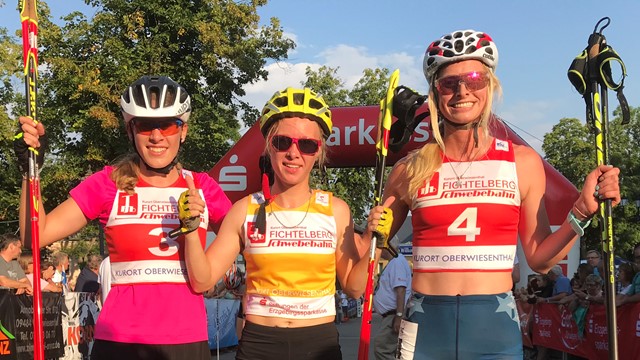
    The women’s individual normal hill/5 k Gundersen podium on Saturday at the 2018 Women’s Nordic Combined Summer Grand Prix, with Russia’s Russia’s Stefaniya Nadymova (c) in first, American Tara Geraghty-Moats (r) in second, and Germany’s Jenny Nowak (l) in third in Oberwiesenthal, Germany. (Photo: FIS/Silke Tegethof)

    On Saturday, the American (who started as a ski jumper, then raced cross-country before taking up biathlon, and finally returned to jumping) placed second to Nadymova, who won the individual 5 k Gundersen in 12:21.4. Geraghty-Moats finished just 3 seconds back after starting the race in fourth, 1:13 minutes behind Nadymova in first. Nowak placed third in that race as well, 50.3 seconds back.

    “It was a dream come true to finally be able to compete in women’s Nordic Combined on an international level,” Geraghty-Moats told FIS on Saturday. “I’m using this weekend to learn the level I have to be at to have success in Nordic Combined. I made some mistakes today and learned a lot but I came away with a good result and having had a huge amount of fun competing with small but strong field.”

    Eleven women competed in Saturday’s normal hill/5 k.

    Results:

    Day 1 (ski jumping | final) 

    Day 2 (ski jumping | final)

    Overall Grand Prix

    Harvey on Toppidrettsveka Podium

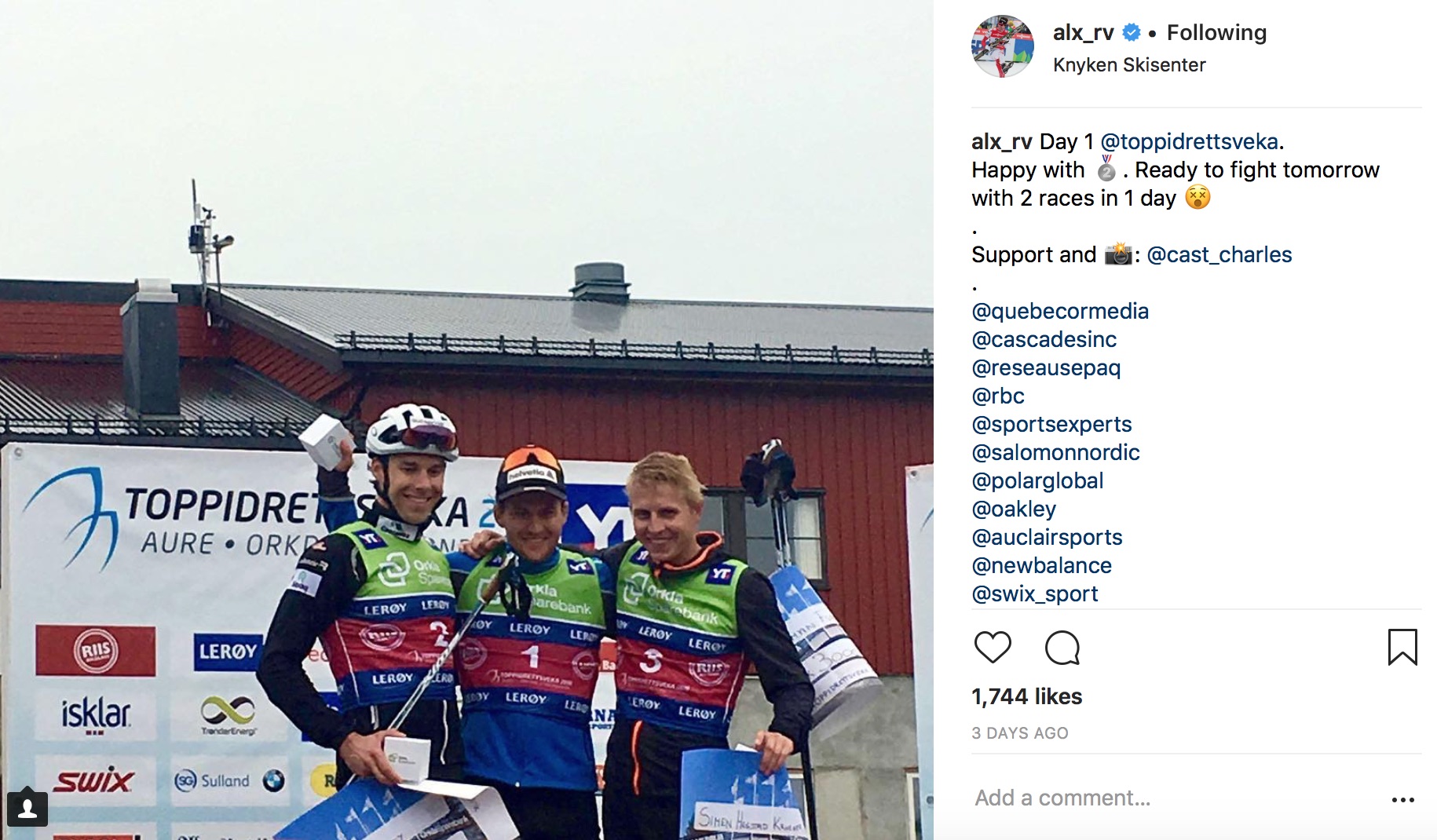
    Alex Harvey (l) on the podium with Roman Furger (c) and Simen Hegstad Krüger (r) at the 2018 Toppidrettsveka rollerski festival in Norway last Thursday, Aug. 16. (Photo: Alex Harvey/Instagram)

    At the Toppidrettsveka rollerski festival in Norway, Canada’s Alex Harvey raced to second in the 15 k skiathlon last Thursday in Orkdal, missing out on first by just 0.6 seconds to Switzerland’s Roman Furger, who won in 30:43.3. Norway’s Simen Hegstad Krüger, the reigning Olympic skiathlon champion, finished third, 1.5 seconds back. In a stacked international field of 125 men, Canada’s Evan Palmer-Charrette placed 75th in that race (+2:14.4), Bob Thompson was 84th (+2:32.7), and Scott Hill 89th (+2:52.5).

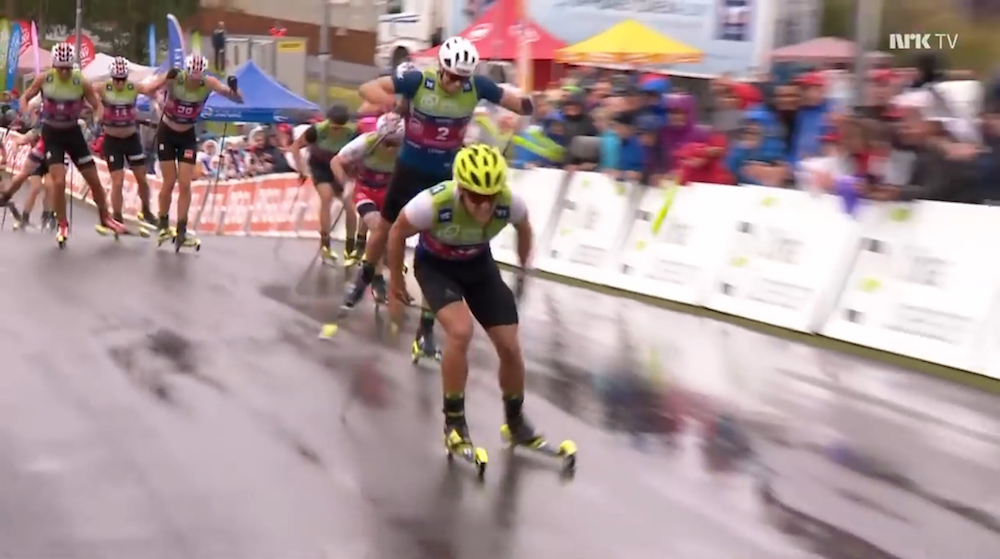
    Canada’s Alex Harvey (2) gunning for first in the men’s 15 k skiathlon on Aug. 16 at the Toppidrettsveka rollerski festival in Orkdal, Norway. (Screenshot: NRK broadcast)

    Heidi Weng beat her cousin Tiril Udnes Weng by 0.7 seconds in the women’s 10 k skiathlon that day, finishing in 22:52.1. Norway swept the top five of the women’s race, with Anne Kjersti Kalvå reaching the podium in third (+1.3), and national-team members Kathrine Harsem and Astrid Uhrenholdt Jacobsen placing fourth (+1.4) and fifth (+1.5), respectively, out of 43 women.

    In the men’s 24 k classic mass start around Aure/Brekka on Friday, Harvey finished fifth, 19 seconds after Krüger, who won in 59:57.5. Norway’s Hans Christer Holund placed second in that race (+2.6), Norway’s Magnus Stensås was third (+13.0), and Switzerland’s Dario Cologna fourth (+17.1). Also for Canada, Palmer-Charrette finished 61sth (+2:30.9), Hill 78th (+4:02.3), Thompson 86th (+5:40.3), and Maks Zechel 88th (+7:01.4) out of 125.

    Heidi Weng repeated in first in the women’s 24 k mass start, finishing in 1:10:02.4 hours, while Tiril Udnes Weng again placed second, 25.4 seconds back, and Jacobsen reached the podium in third (+27.7).

    Later on Friday in Aure, Norway’s Sondre Turvoll Fossli topped the men’s freestyle sprint final ahead of four other Norwegians, including Pål Trøan Aune in second and Jan Thomas Jenssen in third, and Switzerland’s Furger in fifth, while Harvey did not qualify for the heats and ended up 37th overall. Palmer-Charrette was once again 61st in qualification, Hill 107th and Thompson 109th out of 121.

    In the women’s sprint, Norway’s Mathilde Myhrvold won the final in 2:56.54, 1.05 seconds ahead of Slovenia’s Katja Visnar in second. Heidi Weng placed third in the final (+1.97), ahead of Tiril Weng (+2.64) in fourth, another Norwegian Anna Svendsen in fifth (+2.76), and another Slovenian Alenka Cebasek in sixth (+3.73). 

    In the final race of the series, the classic pursuit on Saturday, Harvey started second, 10 seconds behind Furger in first. The Canadian went on to place 10th, 4.2 seconds out of first, in the 15 k race, while Stensås took the win in 37:45.5 after starting seventh. (Furger slipped to 55th and 1:55.5 behind at the finish.) Norway’s Mikael Gunnulfsen rose from eighth to second (+0.7) and France’s Jean-Marc Gaillard made it all the way up to third (+1.7) after starting 15th. 

    Palmer-Charrette finished the pursuit in 59th (+2:04.2), Thompson placed 80th (+2:55.2), Hill 87th (+3:41.5), and Zechel 93rd (+3:48.9) out of 105. 

    Jacobsen ended the weekend as the women’s 12 k mass start winner, after the entire women’s field (of 33) started at the same time. She crossed the line first in 34:20.8, 0.4 seconds ahead of Heidi Weng in second and 1.2 seconds ahead of Kalvaa in third. 

    Results:

    Men’s skiathlon | Women’s skiathlon

    Men’s mass start | Women’s mass start

    Men’s sprint | Women’s sprint

    Men’s pursuit | Women’s mass start

  • Finns, Russians, Norwegians & Swede Nab Early-Season Wins; Vylegzhanin Competes Despite IOC Ban

    Finns, Russians, Norwegians & Swede Nab Early-Season Wins; Vylegzhanin Competes Despite IOC Ban

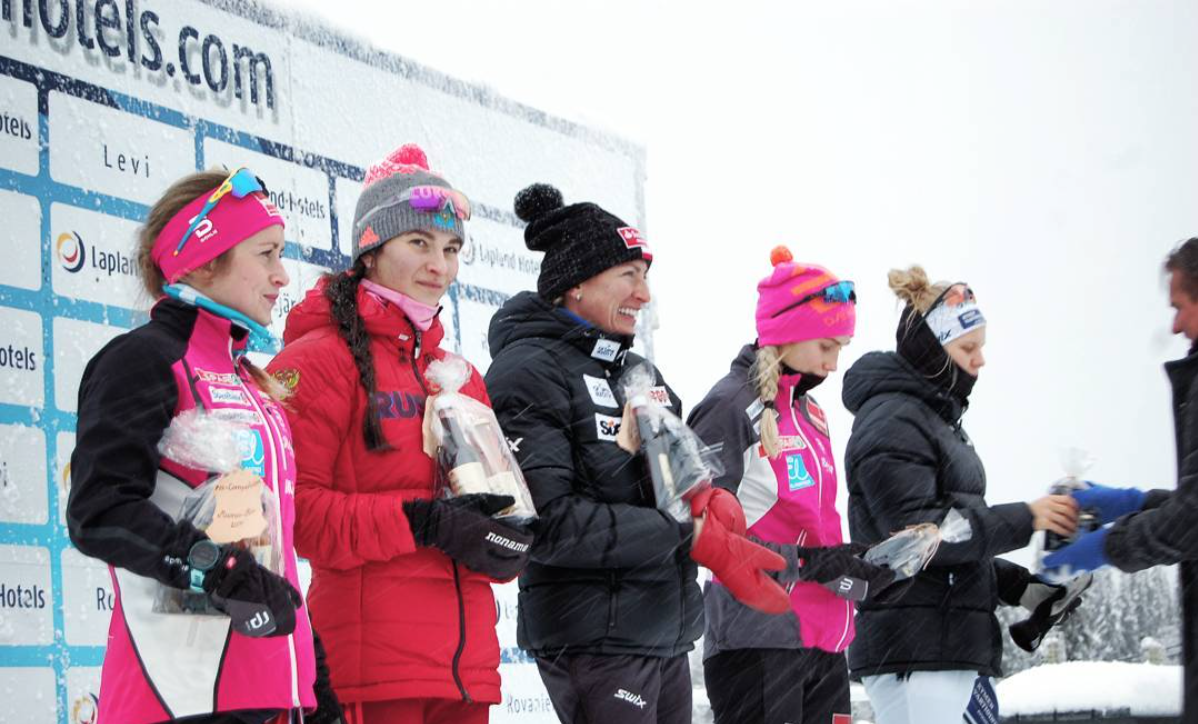
    (l-r) Anna Svendsen of Norway, Natalia Nepryaeva of Russia, Justyna Kowalczyk of Poland, Lovise Heimdal of Norway, and Leena Nurmi of Finland receive prizes after rate women’s classic sprint in Muonio, Finland, on Friday. (Photo: Ski Muonio/Instagram)

    FIS races are already being contested in Finland and Sweden this weekend, with most top Scandinavian racers sitting out but a few national-team members and others picking up their first victories of the season.

    The competitions in Muonio, Finland, drew the most diverse field, including racers from Norway, Russia, Japan, China, Canada, Estonia, and Slovakia, among other countries. In the men’s classic sprint on Friday, the home team got a win from Ristomatti Hakola; he and Russia’s Alexander Bolshunov went 1-2 in both the qualifier and the final. Russia’s Andrey Parfenov rounded out the podium. In the women’s sprint, Anna Svendsen took the win over Russia’s Natalia Nepryaeva, with Justyna Kowalczyk of Poland finishing third.

    On Saturday, racers moved up in distance. In the 10 k classic, Bolshunov – a U23 World Champion last season – bested Russian teammate Alexey Chervotkin by 20.6 seconds, with Andrey Sobakarev making it a sweep another 21.6 seconds back. Brian McKeever and Graham Nishikawa of Canada finished 56th (+2:10.6) and 63rd (+2:18.5), respectively.

    Also in the men’s race was Maxim Vylegzhanin. The International Olympic Committee (IOC) decided on Thursday to strip the Russian skier of three silver medals from the 2014 Olympics for doping violations and ban him from all future Olympic Games. However, the International Ski Federation (FIS) has not yet taken any action since he and five other skiers were banned from the IOC, meaning that all six athletes are currently free to take part in non-Olympic ski competitions. In a press release, FIS stated that “the next steps will be the review by the FIS Doping Panel of the six verdicts upon the receipt of the reasoned decisions” but did not provide a time frame for these decisions.

    In the women’s 5 k classic, Finland’s Krista Parmakoski posted an 18.4-second win over Nepryaeva, with Kowalczyk third again, +24.2.

    Bruksvallarna, Sweden, hosted races on Saturday as well, with a primarily Swedish and Norwegian field but some other racers as well. Norway’s Chris Andre Jespersen topped the 15 k skate, posting a 31.4-second win over Simon Lageson of Sweden. Norwegian Tore Leren was third, +53.1. Canada’s Jack Carlyle finished 38th, +2:29.5. Petter Northug and his brother Even were in Bruksvallarna this week but decided at the last minute not to race, with Northug making his debut in Beitøstolen, Norway, next weekend instead.

    In the women’s 10 k skate, Swedish national team member Emma Wiken bested Lina Korsgren – a long-distance specialist who finished eighth in the Visma Ski Classics standings last season – by 9.8 seconds. Berit Mogstad of Norway finished third, +15.3 seconds.

    https://www.instagram.com/p/BbW-cRsn14l/

    Results

    Muonio

    Classic sprint: men’s qualifier – men’s final – women’s qualifier – women’s final

    Classic distance: men’s 10 k – women’s 5 k

    Bruksvallarna

    Skate distance: men’s 15 k – women’s 10 k

  • Sargent Edges Stephen for 3rd; Sweden Tops PyeongChang Team Sprint

    Sargent Edges Stephen for 3rd; Sweden Tops PyeongChang Team Sprint

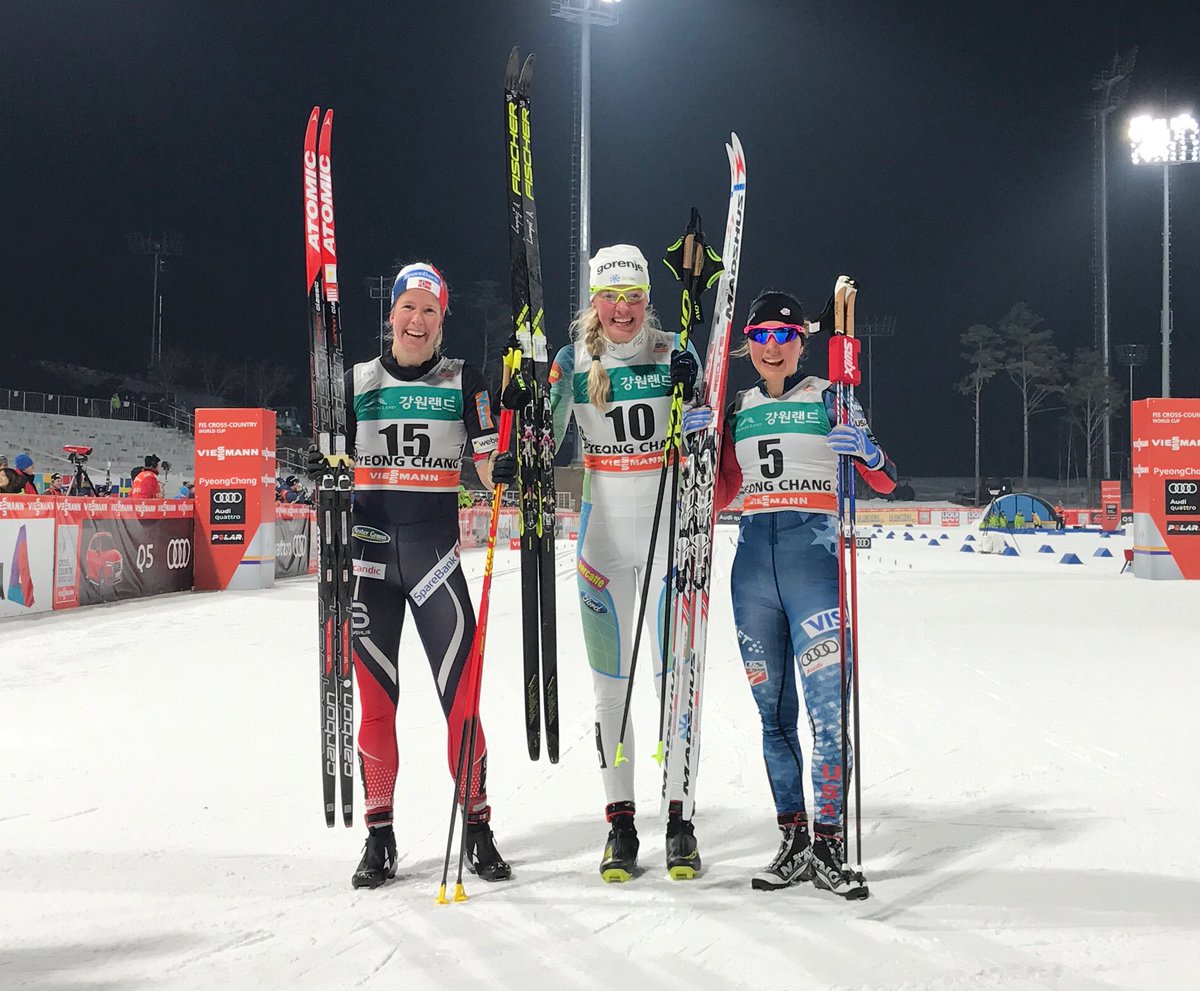
    The women's freestyle team sprint podium at the PyeongChang World Cup on Sunday in South Korea, with Sweden's Elin Mohlin and Maria Nordström (c) in first, Norway's Anna Svensen and Silje Øyre Slind (l) in second, and USA I's Ida Sargent and Sophie Caldwell (r) in third. (Photo: FIS Cross Country/Twitter)
    The women’s freestyle team sprint podium at the PyeongChang World Cup on Sunday in South Korea, with Sweden’s Elin Mohlin and Maria Nordström (c) in first, Norway’s Anna Svensen and Silje Øyre Slind (l) in second, and USA I’s Ida Sargent and Sophie Caldwell (r) in third. (Photo: FIS Cross Country/Twitter)

    It was a sprint course that catered to climbers. For those tuning into the televised event, it might have even been mistaken as a final-stage climb, with two back-to-back, 20-meter-long uphills taking most of the competition screen time.

    Maybe that’s why during all three of her legs in Sunday’s 6 x 1.4-kilometer freestyle team sprint, American distance specialist Liz Stephen stole the front-runner spotlight.

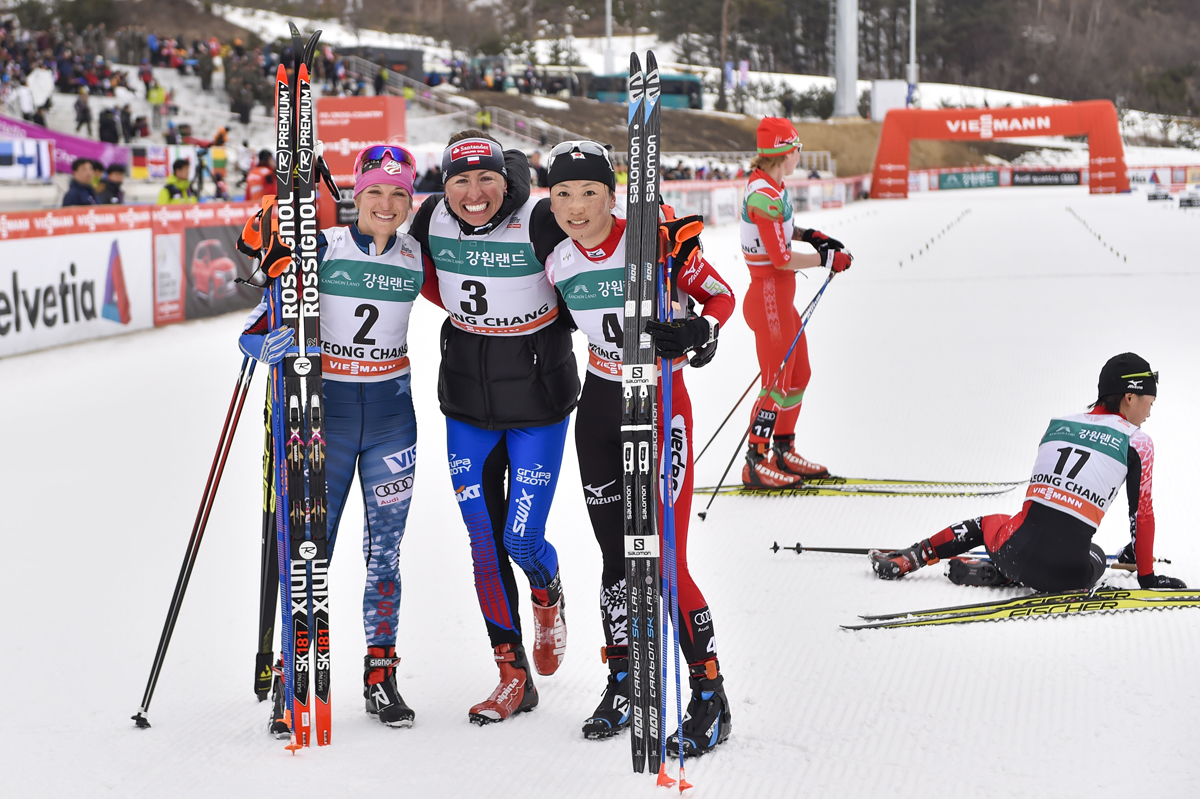
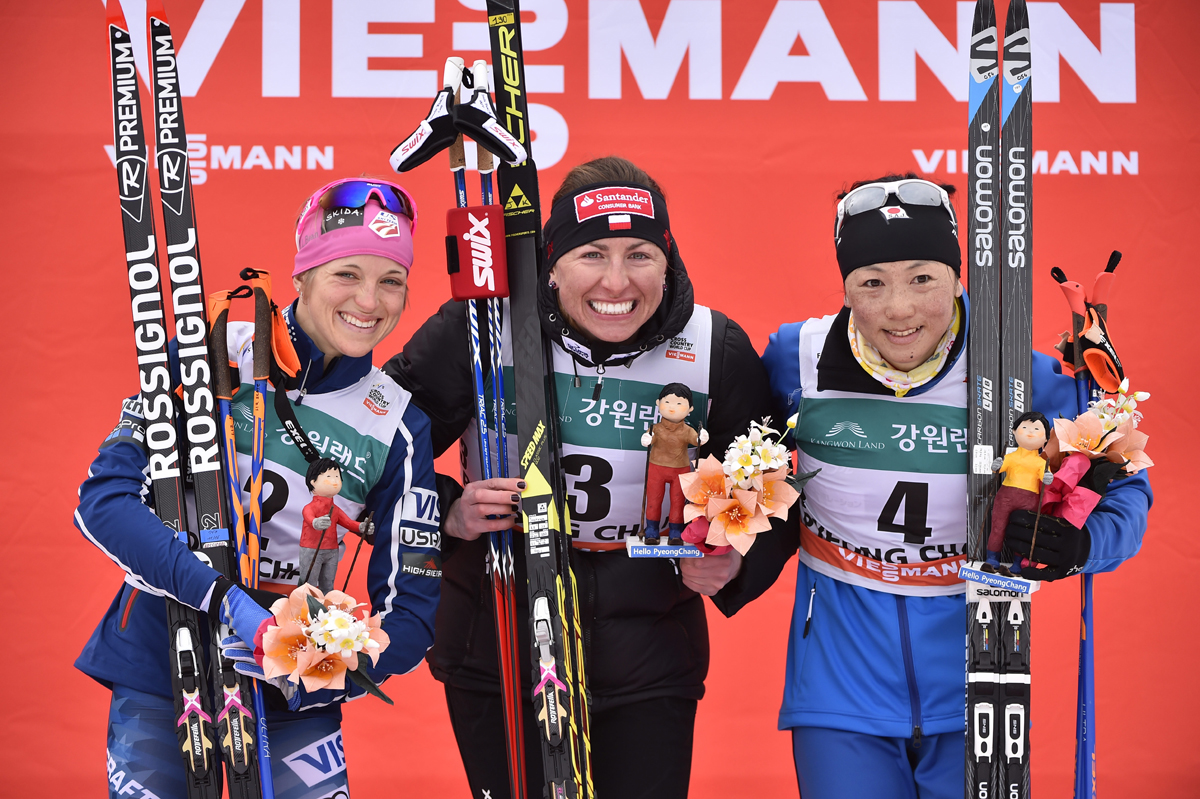
    The women's World Cup 15 k skiathlon podium on Saturday in PyeongChang, South Korea, with Poland's Justyna Kowalczyk (c) in first, American Liz Stephen (l) in second, and Japan's Masako Ishida (r) in third. (Photo: Fischer/NordicFocus)
    Liz Stephen (l) of the U.S. Ski Team reached the World Cup podium on Saturday in the women’s 15 k skiathlon podium in PyeongChang, South Korea, after placing second behind Poland’s winner Justyna Kowalczyk (c) and ahead of Japan’s Masako Ishida (r) in third. (Photo: Fischer/NordicFocus)

    Even with the shallower World Cup field competing in PyeongChang, South Korea, the U.S. Ski Team (USST) distance skier was having a weekend. For the first time in three years, Stephen advanced to the World Cup sprint heats on Friday and earned her seventh individual World Cup podium on Saturday.

    Teaming up with Caitlin Patterson on the second U.S. team on Sunday, Stephen was leading the likes of USST sprinter Ida Sargent, Norway’s Silje Øyre Slind, Sweden’s Maria Nordström, and Slovenia’s Anamarija Lampič (the winner of Friday’s classic sprint).

    “If it would have been a flat course today there would have been no chance,” Stephen said on the phone after. “I need a course like this, for sure.”

    With the 1.4 k course housing a pair of hard-hitting hills, Patterson and Stephen were causing the field — including their compatriots Sophie Caldwell and Sargent skiing for the U.S. first team — to scramble throughout the final’s six laps.

    After skiing in the back of the pack for most her first leg, the 27-year-old Patterson had taken over the lead from Caldwell, Norway’s Anna Svendsen, and Russia’s Anna Medvedeva by the end of Lap 1.

    Stephen took charge in the second leg, leaving Slind, Sargent and Nordström fighting to keep up with her high tempo on the hills.

    The women's 1.4 k classic sprint podium on Friday at the pre-Olympic PyeongChang World Cup in South Korea, with Slovenia's Anamarija Lampič (c) in first, Norway’s Silje Øyre Slind (l) in second, and American Ida Sargent (r) in third. It was the first time on the World Cup podium for all three athletes. (Photo: FIS Cross-Country/Twitter)
    The women’s 1.4 k individual classic sprint podium on Friday at the pre-Olympic PyeongChang World Cup in South Korea, with Slovenia’s Anamarija Lampič (c) in first, Norway’s Silje Øyre Slind (l) in second, and American Ida Sargent (r) in third. It was the first time on the World Cup podium for all three skiers. (Photo: FIS Cross-Country/Twitter)

    “I was skiing with Liz all day … and I was just trying to hold on for dear life,” Sargent, who placed third in the classic sprint to start the long weekend, said on the phone. “[This was] probably by far the hardest course I’ve ever done. It felt more like a distance race than a sprint. Normally in a sprint race I hop skate up the hills and I don’t think I hop skated at all today.”

    With Nordström maneuvering around Stephen just before the exchange zone, it was Sweden’s Elin Mohlin out first for the third leg, followed by Patterson and Caldwell. A fall had forced Slind to from a second place positioning to last by her hand off to Svendsen. 

    “On my first leg I managed to fall in the curve before the stadium,” Slind said according to a International Ski Federation (FIS) press release. “Afterwards I spent a lot of energy to get in contention with the leading group. There was no space for resting on the course.”

    As Caldwell explained, her tactic for the final was to spend as much time in the draft as possible.

    “This sprint course is one of the hardest ones we’ve ever encountered and we knew doing it three times in a row was going to be really tough,” Caldwell wrote in an email. “In the final I wanted to do more following and try to hang when moves were made.”

    Patterson continued to pace the field from the front, putting Stephen once again in the lead for the fourth leg.

    As Stephen approached the second hill, both Sargent and Nordström surged to her left. By the top, it appeared as if Sargent would make her way to the front.

    Neither Sargent or Nordström, however, managed to take the lead before the exchange to the fifth leg.

    With the lead back to Patterson, Caldwell followed closely in second, Mohlin in third, Slovenia’s Katja Visnar in fourth and Svendsen in fifth.

    “I’m really proud of how both of our teams skied today,” Caldwell wrote. “Liz and Caitlin proved that distance skiers can also rock on this course and in team sprints in general, and it was so cool to have two teams fighting for the podium.”

    On the second climb, Visnar made her move, sweeping around Patterson’s right. Caldwell and Patterson held on for the chase along with Mohlin and Svendsen.

    Yet, in the exchange for the final leg, it was Stephen once again who emerged first from the crowd charging. By the end of the first climb, she had put close to a seven-meter gap on the rest of the field, Slind, Sargent, Nordström in hot pursuit.

    Midway through the second climb, however, Slind and Nordström had regained contact with Stephen, moving around her at the top.

    “My strategy the whole day was to go hard and hope that I could kill people before the last lap, and it almost worked, but not quite,” Stephen said.

    A battle for first began between Sweden and Norway, while a second battle between the two U.S. teams began for third. Sweden outskied Norway, with Nordström crossing in a time of 20:37.11 for the win. Slind crossed 1.71 seconds later for second place. 

    “I was nervous when Maria Nordström raced at the end, but I know she is strong and I hoped she would make it,” Mohlin told Langd.se, according to a Norwegian translation.

    Still head to head closing in on the final 100-meter stretch were the Americans, neither willing to budge, until the finish line, where Sargent outlunged Stephen by 0.35 seconds for third, 6.11 seconds out of first.

    “I was trying to stick with Liz going up the hill, cause I knew if I could hold on on the hill, the downhill, and the sprint to the finish would be my strength,” Sargent said. “It was really fun to be on the podium with [Sophie], and to race with Liz and Caitlin in the final.”

    Despite just barely missing the podium, Stephen was pleased with the performance, it being her first time competing in a team sprint in nearly eight years.

    “There was a moment when I thought it was possible that both of our teams could be on the podium,” Stephen said. “I skied the day the best that I could and I’m really happy with the result.”

    Results

  • Stephen Back on Podium in 2nd, Patterson 4th in PyeongChang Skiathlon

    Stephen Back on Podium in 2nd, Patterson 4th in PyeongChang Skiathlon

    The women's World Cup 15 k skiathlon podium on Saturday in PyeongChang, South Korea, with Poland's Justyna Kowalczyk (c) in first, American Liz Stephen (l) in second, and Japan's Masako Ishida (r) in third. (Photo: Fischer/NordicFocus)
    The women’s World Cup 15 k skiathlon podium on Saturday in PyeongChang, South Korea, with Poland’s Justyna Kowalczyk (c) in first, American Liz Stephen (l) in second, and Japan’s Masako Ishida (r) in third. (Photo: Fischer/NordicFocus)

    Multiple race warmup and cool downs, managing hydration and caloric intake, moving at her max sprinting speed — more than once. It’s not often that American Liz Stephen feels the lingering effects of a World Cup sprint day. Her most recent memory was three years ago, when she qualified 22nd in Szklarska Poreba, Poland.

    But this weekend’s three-day competition series in PyeongChang, South Korea, challenged the distance specialist once again. With a smaller World Cup field than usual, Stephen qualified 29th in Friday’s classic sprint and advanced quarterfinals, where she raced in the first heat of the day.

    In what ended up being the fastest women’s quarterfinal, Stephen pushed through Friday’s hill-dominant sprint course and crossed fifth for 25th overall. The back-to-back sprint experience, however, left the 30-year-old Stephen with a little less energy than she would have liked as she entered Saturday’s 15-kilometer skiathlon.

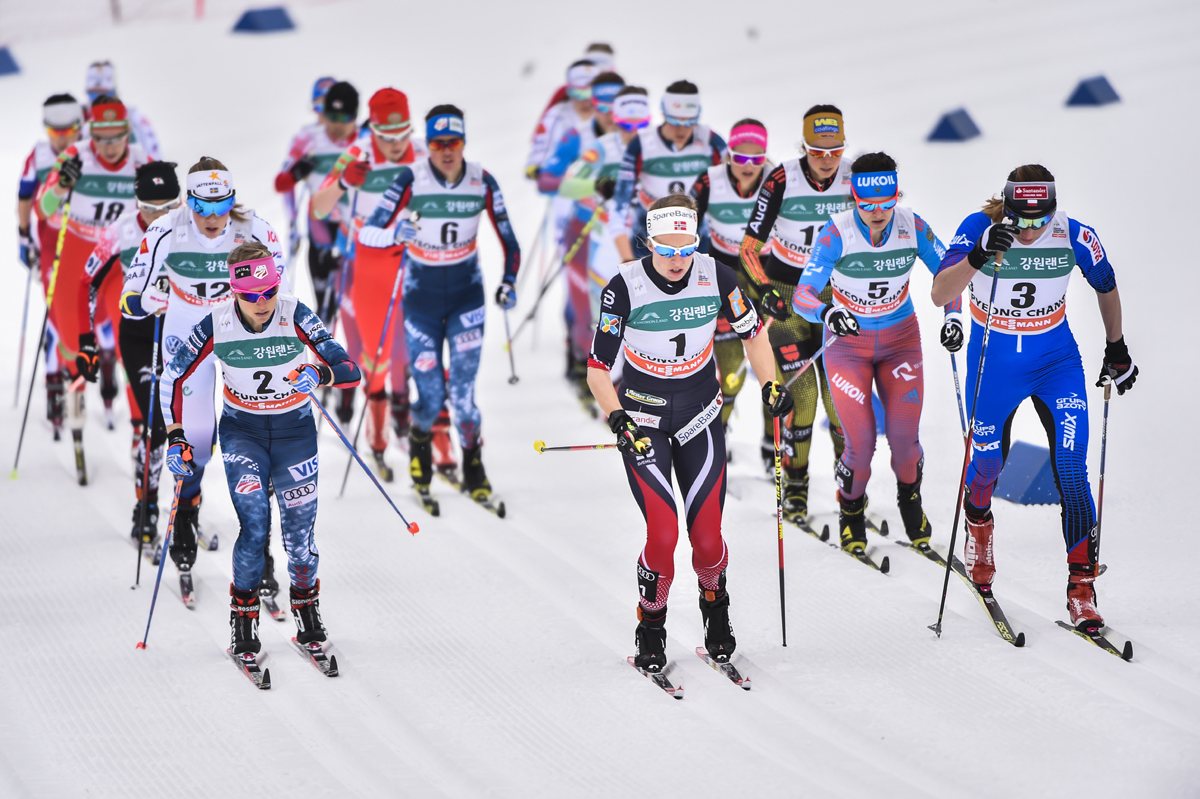
    American Liz Stephen (2) skiing at the front of the women's 15 k skiathlon on Saturday, alongside Norway's Silje Øyre Slind (1) and Poland's Justyna Kowalczyk (3), at the World Cup in PyeongChang, South Korea. (Photo: Fischer/NordicFocus)
    American Liz Stephen (2) skiing at the front of the women’s 15 k skiathlon on Saturday, alongside Norway’s Silje Øyre Slind (1) and Poland’s Justyna Kowalczyk (3), at the World Cup in PyeongChang, South Korea. (Photo: Fischer/NordicFocus)

    “I think I was feeling yesterday’s sprint race a bit, as I did twice as many rounds as I usually do!” Stephen joked in an email.

    Yet, standing at the start in bib 2, behind Norway’s Silje Øyre Slind in bib 1, Stephen wasn’t going to let a little soreness stop her from racing to Saturday’s skiathlon podium.

    After Poland’s Justyna Kowalczyk gapped the front by close to 20 seconds in the first two kilometers of the classic leg, the American held on tight to the lead chase group, striding even with a medley of skiers, including Slind, Japan’s Masako Ishida, Norway’s Anna Svendsen, Sweden’s Maria Nordström, and Germany’s Elisabeth Schicho.

    Stephen came through the exchange in fifth position, a little over a minute behind the race leader Kowalczyk and 12 seconds back from the second place skier, Ishida.  

    “I was afraid I skied little too hard in the classic portion,” Stephen said, according to an International Ski Federation (FIS) press release. “I wanted to stay with the leading group in the classical part not to fall back.”

    Skate skis on, Stephen quickly caught and surpassed Svendsen and Schicho by the 8.4 k mark, rejoining Ishida. With over a minute separating her and Ishida from Kowalczyk, the battle for second began. Around the 10 k mark, Stephen made her move. Powering past Masako, Stephen started her second hunt, this time for the Polish skier.

    But Kowalczyk’s early classic-leg surge and strong skating staved off any attempts from Stephen.

    “Liz was able to take some time out of her, but not significant time,” USST Head Coach Chris Grover said on the phone. “So that was impressive racing by Kowalczyk.”

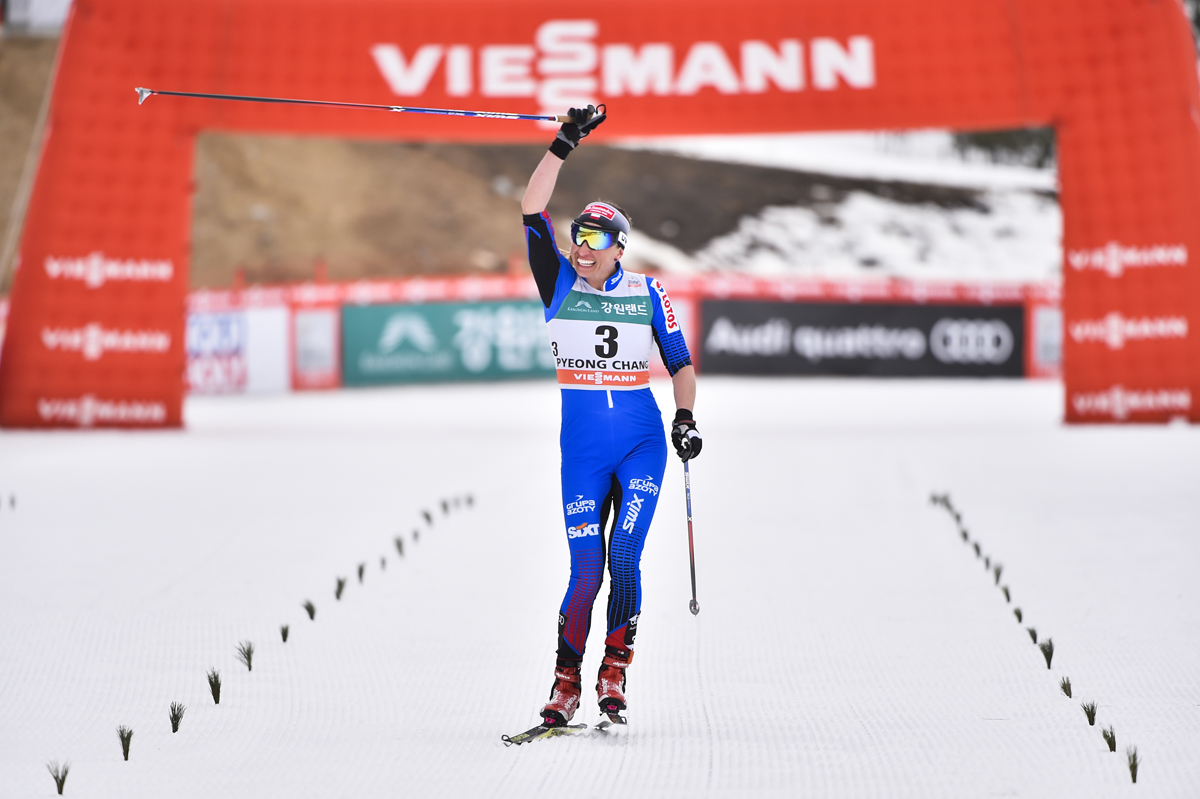
    Poland's Justyna Kowalczyk winning her first World Cup in three years on Saturday, the women's 15 k skiathlon at in PyeongChang, South Korea. (Photo: Fischer/Nordic Focus)
    Poland’s Justyna Kowalczyk winning her first World Cup in three years on Saturday, the women’s 15 k skiathlon at in PyeongChang, South Korea. (Photo: Fischer/Nordic Focus)

    Kowalczyk ultimately finished first for the win in a time of 43:54.7. The victory marked her 50th World Cup win and first individual World Cup victory since 2014.

    “It has been a long time since I have been on the World Cup podium,” Kowalczyk said, according to FIS. “I was quite surprised to see how well I skated.”

    Finishing exactly 56 seconds behind Kowalczyk was Stephen in second place. The result was Stephen’s best individual result since 2015, when she placed second in the 10 k freestyle race in Rybinsk, Russia.

    “It’s hard not to feel happy when you get a podium finish!” she said, according to a U.S. Ski Team press release. “However, I didn’t feel like I had as much energy as I wanted to have today, but it was enough to hold onto second.”

    In her first podium appearance since 2009, Ishida finished 18.8 seconds after Stephen in third (+1:14.8).

    Just missing the podium by 6.6 seconds was American Caitlin Patterson in fourth (+1:21.4). Though a tangle on the first hill of her classic leg pushed Patterson back to 13th, the 27-year-old Craftsbury Green Racing Project skier was able to reconnect with the top 1o by the 2 k mark.

    Unconcerned with Kowalczyk’s blistering pace, Patterson focused on the chase pack. By the time she reached the ski change, she was positioned in seventh. Her transition to skate skis smooth and energy still strong, Patterson began to pick people off.

    She caught Nordström, who had been 10 seconds ahead of her at the exchange, as well as Schicho and Svendsen, both of whom were close to 30 seconds ahead of her when they switched to skate skis.

    Caitlin Patterson (Craftsbury Green Racing Project) en route to a career-best World Cup result of fourth in the women's 15 k skiathlon in PyeongChang, South Korea. (Photo: Fischer/NordicFocus)
    Caitlin Patterson (Craftsbury Green Racing Project) en route to a career-best World Cup result of fourth in the women’s 15 k skiathlon in PyeongChang, South Korea. (Photo: Fischer/NordicFocus)

    “Caitlin Patterson was really impressive,” Grover said. “She was kind of hovering around seventh or eighth for most of the race, and then really in the last lap, really started to pick people off, including right at the very end to get all the way up to fourth.”

    Feeling fairly well adjusted to the time difference, and appreciative of the low-altitude racing, Patterson was proud of her race effort. Her only issue being the seconds that separated her from the podium.

    “When I look at the results and see how close third place was ahead of me, I can’t help but wish I could have somehow gone faster sooner!” Patterson wrote in an email. “A true sign of how much this makes me hungry for more, though I know I gave it everything I had out there today.”

    The third American woman on Saturday was Liz Guiney in 13th (+2:21.7). The PyeongChang World Cup marks Guiney’s third week of World Cup racing and, while this weekend’s field is not as strong as the ones she recently raced against in Sweden, the result was still a little unexpected for Guiney.

    “I’m very happy with my race today!” Guiney, 25, wrote in an email. “With the weaker World Cup field, it was a good opportunity to score some points, but I think I surprised myself by being within reach of the top 10.”

    The last two races mark Guiney’s first World Cup points, with her best individual finish prior to this weekend 49th in the Falun 15 k classic mass start.

    “Last weekend in the Falun 15k, I got a little too excited out of the start and paid for it later in the race, so my goal today was to ski my own race,” Guiney wrote. “I was really psyched to cross the line and find out that Liz Stephen placed 2nd and Caitlin (my GRP teammate) was 4th, which is a big breakout result for her!”

    Two Canadian women also earned their first World Cup top 30’s on Saturday, with Annika Hicks (Alberta World Cup Academy) placing 26th (+5:17.8) followed by Sadie White (NTDC Thunder Bay) in 29th (+6:54.7).

    Racers return to the race venue tomorrow for Sunday’s freestyle team sprint.

    Results | Sunday’s team sprint start list

  • Bjornsen ‘Fastest in the World’ in Qualifier; Weng Tops Lillehammer Sprint Final

    Bjornsen ‘Fastest in the World’ in Qualifier; Weng Tops Lillehammer Sprint Final

    Sadie Bjornsen (U.S. Ski Team) racing to first in the classic sprint qualifier on Thursday at the World Cup mini tour in Lillehammer, Norway. It was Bjornsen's second time winning a qualifier, and first classic-sprint qualifier win. She went on to place 17th overall. (Photo: Fischer/Nordic Focus)
    Sadie Bjornsen (U.S. Ski Team) racing to first in the classic sprint qualifier on Friday at the World Cup mini tour in Lillehammer, Norway. It was Bjornsen’s second-career qualifier win, and first time winning a classic-sprint qualifier. She went on to place 17th overall. (Photo: Fischer/Nordic Focus)

    LILLEHAMMER, Norway — If anything’s consistent after two days of classic sprinting on the Cross-Country World Cup this year, it’s that nothing is a given — especially on the women’s side of World Cup sprinting.

    No more Maiken Caspersen Falla dominating every World Cup sprint. However, Norway’s defending Sprint World Cup champion is no slouch, placing second in both classic sprints so far this season.

    Take Sadie Bjornsen, for example. In her sixth time classic skiing in the last couple months (because of problematic heel spur), she clocked the fastest qualifying time in the women’s 1.3-kilometer classic sprint on Friday morning, 0.29 seconds faster than Falla, who qualified second.

    “… I’m actually so happy I’m even here, and also that’s so crazy I was the fastest person in the world today,” Bjornsen reflected on the phone Friday evening. “That’s something you can’t forget.”

    It wasn’t totally out of the blue. Bjornsen won a freestyle sprint qualifier last season in Quebec at the Ski Tour Canada (STC) World Cup stage.

    “I hadn’t done that in classic so that was really fun,” Bjornsen, who turned 27 last week, said.

    On Day 1 of Lillehammer’s three-day mini tour, the other big name in the women’s race was Norway’s Heidi Weng, who won her first-ever World Cup sprint after placing third in both races last weekend. (She also qualified third on Friday, 0.36 seconds behind Bjornsen). Weng’s teammate and the favorite in most races, Marit Bjørgen didn’t qualify for the final after finishing fourth in her semifinal, 0.71 seconds behind Weng, for eighth overall.

    But let’s go back to Bjornsen for a moment. Her winning qualifying time was 3:19.62 minutes, which would have put her fifth in the final had she made it that far. Bjornsen was eliminated in the quarterfinals after placing fourth in her heat and ended up 17th for the third-straight race this season.

    That was frustrating, but a phone call with her coach back in Alaska helped her regain perspective.

    “I actually had an awesome chat with Erik [Flora] back to the U.S.,” she said. “He was like, ‘Who cares what happened? You were the fastest in the world.’ ”

    Teammate Kikkan Randall, who wasn’t picked for this weekend’s mini tour, also gave her some words of advice at the finish.

    “She handed me Breck for a little hug right after,” Bjornsen said of Randall’s seven-month-old infant. “He’s like the team cheer-up.”

    Bjornsen raced in the same quarterfinal as teammate Jessie Diggins, who qualified in ninth (+1.75). Last week, Diggins qualified 13th. Last year, her best qualifying result in a classic sprint was seventh.

    “Last year, going into the start of the season, I had never qualified in a classic sprint ever in the World Cup,” Diggins noted in a phone interview on Friday. “Now I feel like I have the fitness to make it into the semi. I’m in a different place than I was last year.”

    Facing off against Russia’s Yulia Belorukova and Norway’s Kathrine Rolsted Harsem in the quarterfinal, along with Germany’s Sandra Ringwald and Finland’s Kerttu Niskanen, Diggins and Bjornsen stuck in the middle of the pack — both frustrated with their positioning.

    Jessie Diggins (U.S. Ski Team) strides to sixth in the Ski Tour Canada's Stage 5 classic sprint on Tuesday in Canmore, Alberta.
    Jessie Diggins (U.S. Ski Team) striding to sixth overall in the 2016 Ski Tour Canada classic sprint last season in Canmore, Alberta.

    For Diggins, who led Bjornsen for much of the race and ended up just ahead of her in third (for 14th overall), it was about finding her rhythm on the uphills. She was pleased with the way she skied her qualifier, but felt like she wasn’t skiing to her potential in the quarterfinal.

    “It’s kind of funny because when I get in a heat setting, I get really nervous having all these people around me,” Diggins said.

    She recalled leading Bjornsen until the first big climb, where Bjornsen made a move on the outside and Diggins stepped right to let her pass. She tucked behind her over the top, and sitting in fourth at the time, thought about how to get herself closer to the top two (Harsem, who set a fast pace early, and Belorukova).

    Skis weren’t a problem, Diggins said, but the chewed-up tracks presented some difficulties.

    “I remember thinking, ‘Oh my gosh, Sadie’s right behind me. I really gotta go!’ ” she said. “I think I got a little too stressed and I was not really going anywhere, which is too bad because I know the fitness is there. … When the tracks break down I feel like one of those cartoon characters where I’m spinning my wheels…

    “It has nothing to do with the skis, the skis were great,” Diggins added. “… In the finish, I was psyched to feel good again. Double poling is my strength.”

    Despite a big push for second, Diggins finished 0.08 seconds back from the runner-up in that heat, Harsem, and 0.22 seconds behind the winner, Belorukova. Bjornsen was another 0.6 seconds back in fourth.

    “I probably wasn’t aggressive out of the start as I should have been,” Bjornsen reflected.

    After feeling like she started too hard in her quarterfinal last Saturday in Finland, she decided to try to conserve a bit more early in this race.

    “I just felt like I was fighting the whole time to try to go, but wasn’t really feeling like I could get in the right position,” Bjornsen said. “I just didn’t feel like I could get in quite the correct place. It didn’t go as I would’ve liked.”

    But she had some good takeaways from Friday’s sprint, and was feeling positive heading into the next two days of racing in Lillehammer.

    “I feel like every time I do a sprint race, it’s great practice for me,” Bjornsen said. “I’m not somebody who can naturally see gaps and jump on them so I have to practice that…”

    Jessie Diggins (r) lunging at the line with Russia's Yulia Belorukova (22) and Norway's Kathrine Rolsted Harsem (12) in the women's classic sprint quarterfinal. Diggins placed third in the heat and her U.S. teammate Sadie Bjornsen (second from l) finished fourth for 14th and 17th overall.
    Jessie Diggins (9) lunging at the line with Russia’s Yulia Belorukova (22) and Norway’s Kathrine Rolsted Harsem (12) in the women’s classic sprint quarterfinal. Diggins placed third in the heat and her U.S. teammate Sadie Bjornsen (second from l) finished fourth for 14th and 17th overall. (Photo: Aleks Tangen)

    Two other Americans qualified for the heats: Sophie Caldwell in 10th (+2.01 behind Bjornsen) and Ida Sargent in 26th (+6.17). Caldwell went on to place 21st overall after finishing fifth in her quarterfinal, and Sargent was 28th after placing sixth in her quarterfinal.

    “We kicked off the day feeling like we’re a different team from last weekend,” U.S. Women’s Coach Matt Whitcomb said on the phone. “We had three women qualify in the top 10, including Sadie’s career-qualifier win, which was always so exciting, to watch someone like Sadie suceed that way, and then Ida qualified — a little piece of trivia — for the first time in Norway.”

    Caldwell explained in an email that she struggled out of the start of her quarterfinal.

    “There was a lot of lane changing happening so I found myself at the back of the pack pretty quickly,” she wrote. “Once I was back there, I think I got a little frantic and frustrated and ended up losing some steam and staying towards the back of the pack.”

    Coming out of the final hill, she remembered skiing in fifth or sixth.

    “[I] caught a decent draft coming into the finish stretch, but I was a little out of steam and didn’t have a very strong double pole finish,” she added.

    Caldwell crossed the line in fifth, 3 seconds behind Falla as the winner of that heat.

    “I haven’t come into the season with a bang, but I usually don’t and I feel like I’m taking a step in the right direction with each race effort,” she wrote. “I was really happy with my qualifier today and pretty happy with my quarter final last weekend and to qualify in classic sprints, especially in period one, used to a pretty big stretch for me. So I feel like I’m making some progress and looking forward to a long season ahead!”

    Sargent wrote in an email that she was pleased with her qualifier, considering how competitive the field was.

    “I tried to go with slightly slick skis but it didn’t end up being a great approach for me, and I was very tense on the uphills,” she wrote of her qualifier. “.. But my energy felt really good. So I was happy to still qualify with not a great feeling out there.

    “I wasn’t as happy with the quarterfinal,” Sargent continued, after finishing 8.24 seconds behind Finland’s Krista Parmakoski, who won the quarterfinal in 3:14.57, the fastest time of the day. “The lane that I was in ended before the big uphill so I had to jump in behind people from the start and felt like I was skiing from the back and wasn’t able to find an opening … I couldn’t get the same energy going in the heat and was just feeling kind of tired so I ran out of steam over the top of the last hill.”

    She explained her skis were “awesome” in her quarterfinal, but speculated that she may have spent too much time and energy testing them.

    “I know I can improve the way that I warmup and cooldown from the heats and dial in my ski testing so I’m still figuring out that routine and glad there is lots of racing yet to come this season,” Sargent concluded. “Overall it feels like a solid start for me this year but I know that I have a lot more in the tank so I’m excited for more racing!”

    “We’re still struggling to find a stable platform,” Whitcomb said of the team in general. “We’re new to snow, things got a little bit mealy [with the course conditions], and while the energy certainly looked better for a one-off qualifier, and even at times for the quarters, I just don’t think we were ready yet to put together a full four rounds of sprinting.

    “That said, Jessie was absolutely on fire near the end of her quarterfinal, and had she advanced, which she nearly did by half a meter, I think the day could have looked a lot differently,” he added. “There was no one in the women’s field who had a more impressive drag race in the last 100 meters, so I’m in no way disappointed. I feel like we skied representative of where we are right now.”

    Weng for the Win

    Norway's Heidi Weng (3) celebrates her third World Cup victory and first sprint win on Thursday in the women's classic sprint in Lillehammer, Norway. (Photo: Fischer/Nordic Focus)
    Norway’s Heidi Weng (3) celebrates her third World Cup victory and first sprint win on Friday in the women’s classic sprint in Lillehammer, Norway. She edged her teammate Maiken Caspersen Falla (r) by 0.48 seconds. (Photo: Fischer/Nordic Focus)

    At the top of the results, Weng won her quarterfinal and semifinal before outlasting five others once again in the final. She bested her teammate Falla by 0.48 seconds with a winning time of 3:15.76, and Sweden’s Hanna Falk placed third (+1.06). Of the four Norwegian women in the final, Ingvild Flugstad Østberg placed fourth (+2.99) and Anna Svendsen was fifth (+6.27). Russia’s Belorukova finished sixth (+16.75).

    Falla took an early lead and Østberg jumped in behind her to follow closely in second. While Sweden’s Falk strained to put herself in third, Weng sat back and eventually seized the opening — chasing Falla and Østberg as the three Norwegians took hold of the race.

    Falla began to gap her teammates on the final climb, but Weng strided powerfully into second while Falk moved back into third. In the finishing stretch, Weng proved strongest as she double poled past Falla for her first sprint World Cup win (after 10 sprint podiums).

    It was evident that the win meant a great deal to Weng as she raised her arms in the air and screamed as she crossed the line. Asked at a post-race press conference why she did that, Weng responded, “I was very happy!”

    The women's classic sprint podium on Thursday in Lillehammer, Norway, with winner Heidi Weng (c) of Norway, runner-up Maiken Caspersen Falla (l) of Norway, and Hanna Falk (r) in third. (Photo: Fischer/Nordic Focus)
    The women’s classic sprint podium on Friday in Lillehammer, Norway, with winner Heidi Weng (c) of Norway, runner-up Maiken Caspersen Falla (l) of Norway, and Hanna Falk (r) in third. (Photo: Fischer/Nordic Focus)

    But immediately after the race, she wasn’t sure what to say.

    “It’s incredible to go so fast in sprint and I’m…,” she said in a finish-line interview.

    The interviewer asked, “You are speechless?” to which Weng lit up and firmly answered, “Yes!”

    Weng spoke to a group of Norwegian journalists after, and when she was asked about her performance, she said, “This may be one of the greatest performances in my career. I figured before the final that I should just give it all that I have, and during the final climb I had to take a few detours, but it worked out in the end.”

    For the 25-year-old Weng, one of the most consistent podium threats on the circuit, this was only her third World Cup victory. She said that she hadn’t really worked on improving her sprinting,“but I have been focusing on my techinique as usual during my workouts.”

    Three other Americans and three Canadian women raced in the qualifier. Rosie Brennan of the U.S. Ski Team (USST) was closest to qualifying in 34th, about a second out of the top 30. Canadian World Cup B-team member Emily Nishikawa placed 62nd, followed by Canadian U25-Team teammates Dahria Beatty and Cendrine Browne in 66th and 67th, respectively. American Caitlin Patterson (Craftsbury Green Racing Project) placed 68th, and USST distance specialist Liz Stephen was 70th in her first race of the season.

    Results: Qualifier | Heats | Mini-tour standings (after Day 1)

  • Friday Rundown: Lillehammer Classic Sprint

    Friday Rundown: Lillehammer Classic Sprint

    Sweden's Calle Halfvarsson racing to his first World Cup win in three years, ahead of Norway's Emil Iversen in Friday's 1.6 k classic sprint in Lillehammer, Norway. (Photo: Nordic Lillehammer/Twitter)
    Sweden’s Calle Halfvarsson racing to his first World Cup win in three years, ahead of Norway’s Emil Iversen in Friday’s 1.6 k classic sprint in Lillehammer, Norway. (Photo: Nordic Lillehammer/Twitter)

    Welcome to The Rundown, your quick primer of need-to-know information about the day’s racing. We’ll be updating this digest as the day goes on with additional results, photos and quotes. The Rundown is NOT a race report; stay tuned for complete race reports later today with interviews from the day’s top racers.

    ***

    FIS Cross-Country World Cup in Lillehammer: Classic sprint

    Women’s report | Men’s report

    For the second time in her career, Sadie Bjornsen of the U.S. Ski Team (USST) won a World Cup sprint qualifier on Friday, Day 1 of the first mini tour of the season in Lillehammer, Norway.

    After turning 27 last week and finishing 17th in both races at the Ruka World Cup in Finland, Bjornsen put down the fastest qualifying time in the women’s 1.3-kilometer classic sprint, by 0.29 seconds over Norway’s Maiken Caspersen Falla, who qualified in second.

    Four U.S. women made the heats, with Jessie Diggins qualifying ninth (+1.75), Sophie Caldwell in 10th (+2.01), and Ida Sargent in 26th (+6.17).

    In the men’s 1.6 k classic sprint, Calle Halfvarsson of Sweden topped the qualifier, clocking in 0.14 seconds faster than Norway’s Johannes Klæbo in second. Last weekend’s sprint winner, Pål Golberg qualified third (+2.07), and two Canadians, Len Valjas and Alex Harvey qualified for the heats in 19th (+10.24) and 23rd (+10.92), respectively. American Erik Bjornsen (USST) nabbed the final qualifying spot in 30th (+12.61).

    In the heats, the women’s third-fastest qualifier (who was third in the first two races of the season), Heidi Weng of Norway won her quarterfinal and semifinal and finally, the final, by 0.48 seconds over her teammate, Falla. (It was Falla’s second runner-up finish in as many classic sprints this season.)

    Sweden’s Hanna Falk placed third, 1.06 seconds after Weng, and Norway’s Ingvild Flugstad Østberg finished fourth (+2.99). The fourth Norwegian in the women’s final, Anna Svendsen placed fifth (+6.27), and an early leader in the race, Yulia Belorukova of Russia faded to sixth (+16.75).

    Meanwhile, Diggins led the U.S. women in 14th overall after all four did not advance to the semifinals. Diggins finished third in her quarterfinal, just 0.22 seconds behind Belorukova and 0.14 behind runner-up Kathrine Rolsted Harsem of Norway, respectively.

    Bjornsen finished in, you guessed it, 17th for the third-straight race after placing fourth in that same quarterfinal, 0.82 seconds behind Belorukova.

    Caldwell was 21st on the day after placing fifth in her quarterfinal, 3 seconds behind Falla, who won that heat. Sargent finished 28th overall after placing sixth in the first quarterfinal, 8.24 seconds behind Finnish winner Krista Parmakoski.

    In the men’s heats, Halfvarsson took it all the way to the final, winning his first World Cup race in three years (since a skate sprint win in Oberhof, Germany, in December 2013). There, he beat out Norway’s Emil Iversen by 0.12 seconds at the line, and Sweden had two on the podium with Teodor Peterson in third (+0.54). Finland’s Iivo Niskanen placed fourth (+4.01), Sweden’s Emil Jönsson finished 42 seconds back in fifth, and Golberg crossed the line nearly 2 minutes after Halfvarsson in sixth.

    Harvey notched his first top 10 of the season in 10th overall, after placing fifth in his semifinal. (Notably, the same semifinal where Halfvarsson received a yellow card for obstruction, but was allowed to start the final. Norway’s Finn Hågen Krogh and Sondre Turvoll Fossli were relegated to 29th and 30th, respectively, for technique infractions in the heats.)

    Then there was Valjas, who led his quarterfinal until late, where Norway’s Martin Johnsrud Sundby initially picked up the pace and Petter Northug came from behind to win the heat. Just 0.05 seconds back, Niskanen took second and Valjas just missed out on advancing to the semifinal in third (+0.19). Overall, Valjas placed 13th for his best World Cup result since the Canmore classic sprint last year at the Ski Tour Canada (STC), where he placed 11th.

    Bjornsen finished 24th (his best World Cup result since finishing 20th in the Quebec skate sprint at the STC) after placing fifth in his quarterfinal, 3.69 seconds behind Klaebo, who won that heat.

    Also for the U.S., Rosie Brennan narrowly missed the heats in 34th, last season’s U.S. SuperTour leader Caitlin Patterson (Craftsbury GRP) placed 68th, and USST distance skier Liz Stephen was 70th in her first World Cup of the season.

    In the men’s race, Canada’s Devon Kershaw missed qualifying in 42nd, Knute Johnsgaard was 51st, Bob Thompson 52nd, Graeme Killick 71st, and Andy Shields 90th.

    U.S. sprinters Andy Newell and Simi Hamilton finished 47th and 48th, respectively. Last season’s SuperTour leader Eric Packer (APU) placed 76th, and Noah Hoffman (USST) 89th.

    Canada had three women in the distance race, with Emily Nishikawa finishing 62nd, Dahria Beatty 66th, and Cendrine Browne 67th

    Final results: Men | Women