From the FasterSkier archive — posts syndicated from athletes’ and coaches’ own blogs between 2004 and 2012, kept online as published. Current coverage is at fasterskier.com.
Of the four Russian athletes starting the 15-kilometer classic mass start in Lahti, Finland three placed in the top four. Anna Zherebyateva won in 40:31.4 minutes as she was able to stretch her nine-second gap at 10 k to 23.5 seconds by the finish. Also from Russia, Lidia Durkina placed second (+23.5), Germany’s Katharina Hennig skied to third (+37.5).
“My tactic was to make a gap in the second loop,” Zherebyateva said during the post-race press conference. “So I did exactly what I wanted. It went really well. Tracks were exactly right for me. This gold medal is an important step for my sport career.”
Yana Kirpichenko was the third Russia in the top-five as she placed fourth (+41.6).
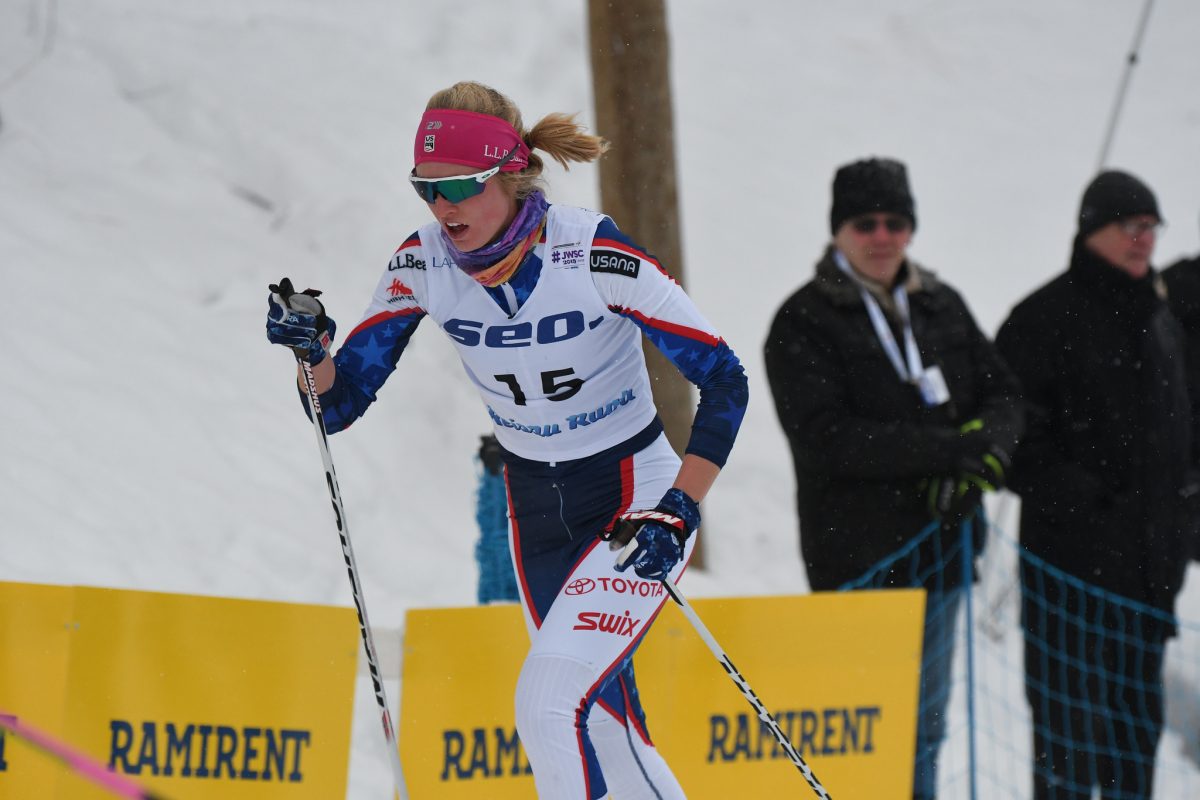
The best North American finisher was U.S. skier Hailey Swirbul who raced to 10th (+1:27.8). Swirbul was positioned 29th at the 5 k time check but steadily moved up in the field as the race progressed. By 10 k she had positioned herself in the top-15.
For the twenty-year-old Swirbul, this is her first go at U23 Worlds after participating in three Junior Worlds as an U20. Last season in Goms, Switzerland she placed second in the 5 k classic and third in the 10 k skiathlon.
Two other U.S. skiers raced into the top-30. Julia Kern placed 16th (+1:43.4), while Alayna Sonnesyn was 23rd (+2:24.9). Hannah Halvorsen, the fourth U.S. starter, placed 54th (+6:58.6).
Hannah Mehain was the top Canadian in 31st (+3:16.8), Sadie White placed 33rd (+3:18.6), and Natalia Hynes 51st (+3:40.9). Marie Corriveau did not start.
Similar to the U23 women’s race, Russian skiers dictated the pacing at the front of the pack — the four Russian starters swept first through fourth place.
Andrey Sobakarev won in 1:17:19.1 hours, Ivan Kirillov placed second (+3.5), Ivan Yakimushkin third (+4.9), and Anton Timashov fourth (+11.4).
Canada’s Antoine Cyr was the top North American in 27th (+2:26.8), while teammate Gareth Williams toed the line a fraction behind in 28th (+2:26.9). Also for Canada, Ritchie Graham was 41st (4:44.1), and Julian Smith 45th (+5:14.3).
Peter Holmes was the top U.S. finisher in 33rd (+3:15.7). Hunter Wonders placed 40th (+4:43.0), Braden Becker 53rd (+6:59.0), and Daniel Streinz 66th (+15:53.9).
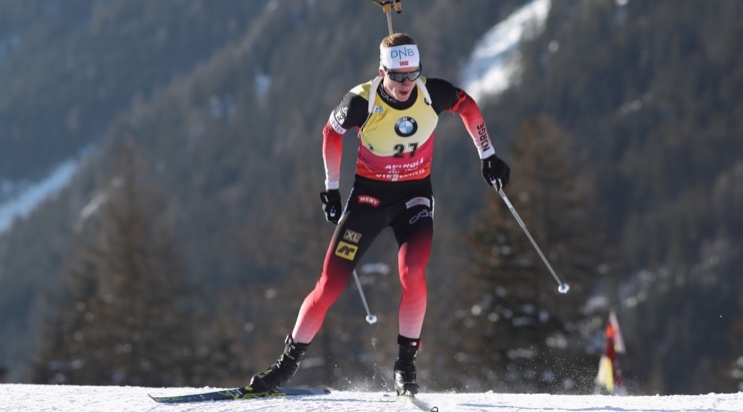
Johannes Thingnes Bø scored his 10th IBU World Cup win of the season today in the 10 k sprint in Antholz, Italy. (Photo: biathlon world.com screenshot)
IBU World Cup Antholz, Italy 10 k sprint
In the groove is in the groove. Norway’s twenty-five-year-old Johannes Thingnes Bø scored his 10th IBU World Cup win of the season today in the 10 k sprint in Antholz, Italy. Bø won the race in 23:53.9 minutes with a single penalty in standing. The Norwegian leads the IBU World Cup overall and padded his lead with his fifth sprint win this year.
“It was quite difficult; the altitude here is quite heavy and with the new tracks, I felt dead from 5K so the last 5K was really tough,” Bø said to the IBU after the race. “I managed to have a good plan for the race. When I shoot nine targets, I was quite happy and then it was just to fight hard for the finish line. I like this year’s track; I liked last year’s too because it was not so painful.”
Bø’s season thus far has been a study in speedy skiing. His shooting stands at 87% for accuracy (82% standing, 91% prone) with his superior skiing speed carrying him to the World Cup overall lead. In Antholz today, his course time for each of his two 5 k laps were ranked first.
Norwegian teammate Erlend Bjøntegaard shot clean in both his shooting bouts to take second place, 17.5 seconds behind. France’s Antonin Guigonnat placed third (+20.2, 0+1).
Scott Gow of Canada was the top North American in 20th (+1:06.6, 0+0). Teammates Jules Burnotte raced to 48th (1:55.9, 1+1), Christian Gow 61st (+2:13.4), and Aidan Millar (+3:46.7, 2+2).
Jake Brown was the top American in 40th (1:42.4, 1+0). Sean Doherty finished in 55th (+2:06.2, 2+1), Max Durtschi 62nd (+2:13.8, 0+1), and Leif Nordgren 73rd (+2:43.1).
Racing continues tomorrow in Antholz for both the men and women with the 12.5k and 10 k pursuits.
Lake Placid SuperTour 5 k/10k Skate Individual Start
In the 5 k-freestyle individual start Jessica Yeaton (APU/Australian National Team) placed first with a winning time of 15:01.9 minutes. She was in a tight race for the top spot with U.S. Ski Team/SMS T2 athlete Sophie Caldwell who finished 3.0 seconds back. Caldwell is back home in Vermont training and preparing for the 2019 World Championships.
Katherine Ogden (Dartmouth Ski Team) placed third in a time of 15:17.8. Kelsey Phinney (SMS T2) placed fourth in 15:37.7.
“Today’s race went super well for me; I had awesome skis despite tricky conditions/weather leading into the race – our wax tech did a phenomenal job,” Yeaton wrote to FasterSkier. “The course here is really good for me with all the steady climbing in the first part- I just tried to push hard to the top of the course and then survive and carry my speed on the downhill, which turned out to be a good tactic.
“Between US Nationals and now I definitely feel like I am in a good place leading into Seefeld. I struggled with some injuries in the fall and was forced to do a lot of cross-training (especially on the bike) and skip the early season races in Nov/Dec. In retrospect I think this actually was a blessing in disguise, as I ended up putting in a super hard training block and gaining a lot of fitness. Looking ahead to Seefeld, my goal is to top 30 in one of the races, with my main focus being on the skate events (30k and sprint), and the 15km skiathlon. I am really excited for the rest of the races this weekend; they are my final prep before heading over to Europe to race on World Cup and in Seefeld.”
Kyle Bratrud (SMS T2) won the men’s 15 k skate in 25:27.1 minutes. Bratrud, who was recently selected to the 2019 U.S. World Championship Team, has been a top-performing distance skier this season on the SuperTour.
“Today went well,” Bratrud emailed. “After Nationals, I made the tough decision of turning down World Cup starts in Otepaa and Ulricehamn in order to get some quality training in for the World Champs. Today reflected that as I felt a little tired and pretty flat from not racing since Nationals. That being said, I expect to keep feeling better each race and I should be in a great place when I fly to Europe on the 4th!”
Bratrud recently won the NorAm/SuperTour 15 k classic in Sovereign Lake and the 15 k classic at U.S. Nationals. Bratrud placed second in West Yellowstone’s SuperTour 15 k skate, and the 30 k skate mass start at U.S. Nationals.
Akeo Maifeld-Carucci (CGRP) placed second in a time of 26:18.9. It was Carucci’s second SuperTour podium of the season and his best career SuperTour result. In West Yellowstone, he was third in the 15 k skate behind Ben Lustgarten (CGRP) and Bratrud.
Alexis Dumas (CNEPH) of Canada was third in 26:32.2. U.S. skier Adam Martin was fourth, 3.1 seconds behind Dumas.
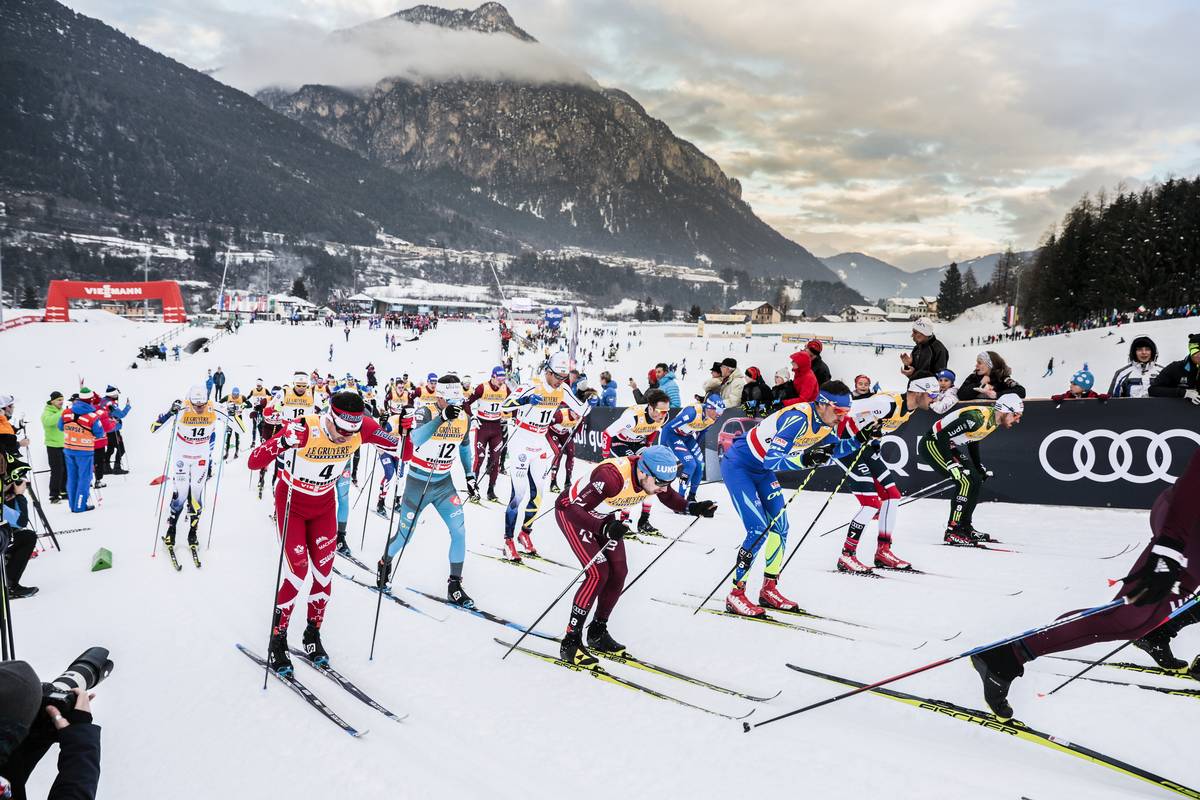
The start of the men’s 15 k classic mass start at Stage 6 of the 2018 Tour de Ski on Saturday in Val di Fiemme, Italy, with (front row, left to right) Canada’s Alex Harvey, Russia’s Sergey Ustiugov, Kazakhstan’s Alexey Poltoranin, Norway’s Martin Johnsrud Sundby, and Switzerland’s Dario Cologna. (Photo: Salomon/NordicFocus)
Beginning this Saturday in Toblach, Italy with a freestyle sprint is the 13th edition of the Tour de Ski (TdS). According to the International Ski Federation (FIS), over the course of seven stages the men will race 80.918 kilometers, the women 60.67 k.
The TdS has become both a staple and a spectacle of the annual World Cup calendar. With a jam-packed series of races primacy is placed on both the ability to recover well and wither less as the TdS transpires.
Prognostication can be tricky in a long-form template like the TdS. So much can go astray during seven races not to mention the travel and dicey germ-avoidance.
Last season’s winner on the women’s side, Heidi Weng of Norway, sits 18th overall in the World Cup standings (14th in distance). She has four top-20’s in the four distance events she’s contested with her best result an eighth in Lillehammer’s 10 k skate. Although featuring two sprints in the first three stages, the TdS remains a distance skier’s paradise.
Weng has skied solidly on the World Cup, but she has yet to show the form that made her a TdS overall winner in 2017 and 2018. Norway has won the last five iterations of the TdS: Marit Bjørgen won once in 2014/2015, Therese Johaug twice (2013/2014, 2015/2016), and Weng the last two years.
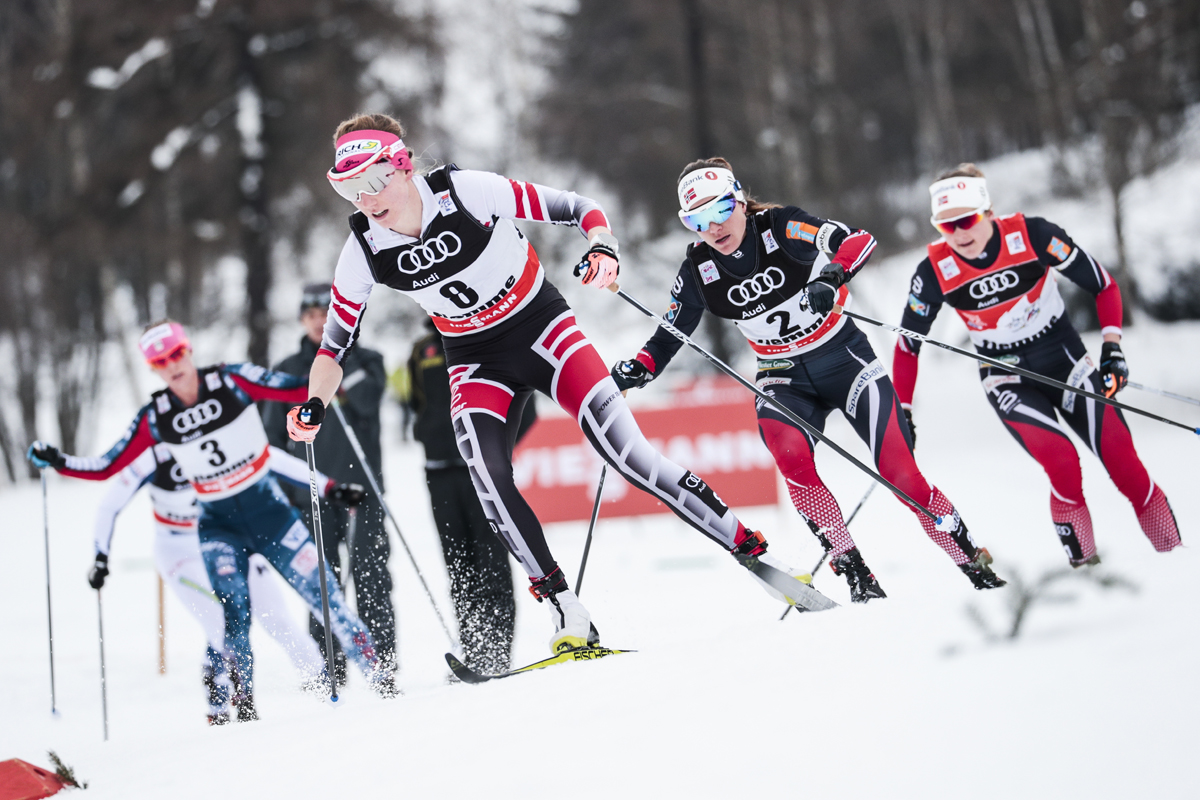
Austria’s Teresa Stadlober leads Norway’s Heidi Weng (2) and Ingvild Flugstad Østberg, American Jessie Diggins (3) and others around a downhill corner during the women’s 10 k classic mass start at Stage 6 of the 2018 Tour de Ski in Val di Fiemme, Italy. (Photo: Fischer/NordicFocus)
If Norway is to keep the streak alive, Ingvild Flugstad Østberg, last year’s TdS runner up, could be the heir apparent. She currently ranks second in the World Cup overall and 15th on the sprint list.
Johaug, having returned from an 18 month doping ban, has been on a distance race tear. She has won all five World Cup distance events this season. Johaug, however, will not be lining up for the TdS.
Only five different women have earned distance podiums this season — Johaug, Østberg, Sweden’s Charlotte Kalla and Ebba Andersson, and Finland’s Krista Pärmäkoski. Along with Johaug, Kalla and Andersson are skipping the TdS. (Andersson sits third overall on the World Cup, Kalla fifth.) With the TdS missing three of the five top ranked World Cup distance skiers, daily stages and the overall podium are up for grabs.
Last season’s third overall finisher, Jessie Diggins of the U.S. Ski Team (USST), often cites the TdS as a point in the season when her form trends towards podium performances. She sits eighth in the current distance standings and could very well have a stout TdS.
Russia’s Natalia Belorukova and Yulia Nepryaeva look strong as does Sadie Bjornsen (USST), and Austria’s Teresa Stadlober.
With less than predictable distance stage podiums for the women, it may simply come down to a drag race on the Alpe Cermis final climb Jan. 6.
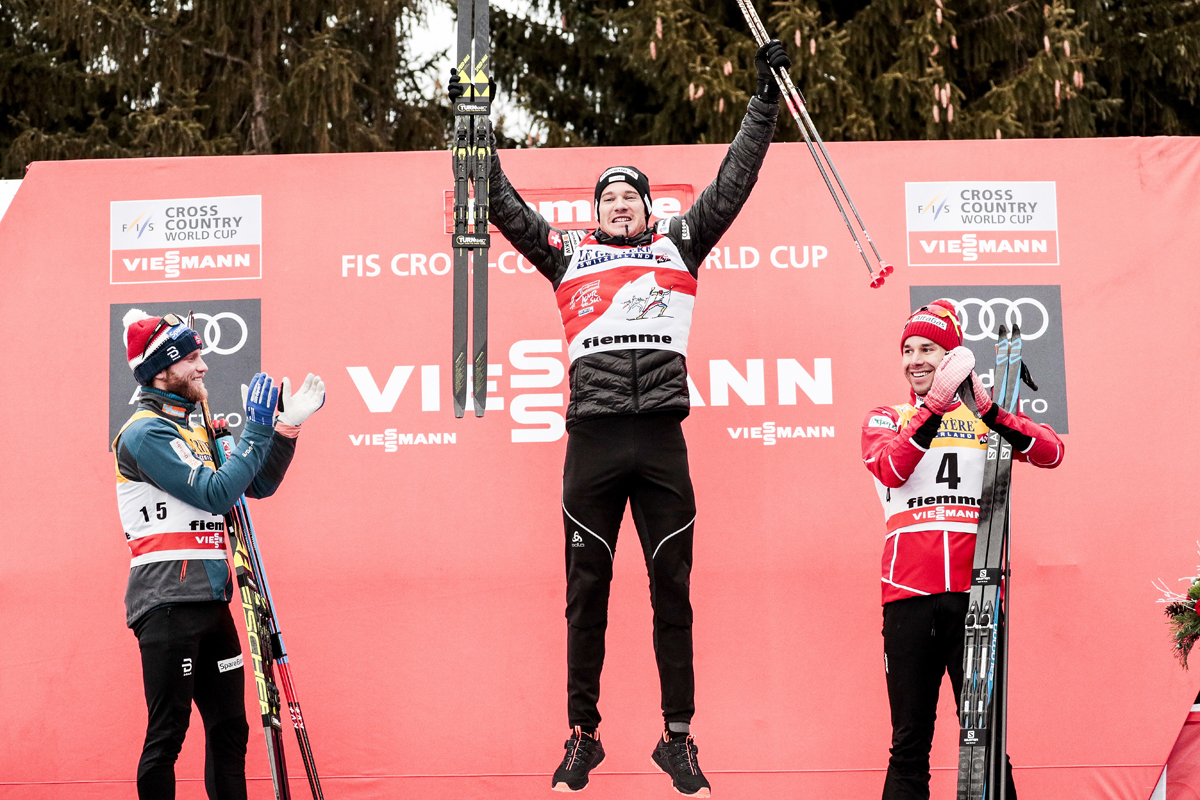
Switzerland’s Dario Cologna (c) celebrates his fourth Tour de Ski overall title. He was joined by Norway’s Martin Johnsrud Sundby (l) and Canada’s Alex Harvey (r) on the podium in second and third, respectively. (Photo: Fischer/NordicFocus)
The men’s scene is also open to interpretation. Last season’s TdS winner, Switzerland’s Dario Cologna, was in fact a surprise victor. Prior to Cologna’s stage two win in last year’s TdS, it had been nearly three years since the four time TdS overall winner had won a World Cup. Cologna sits 21st overall on the World Cup currently. Given last year’s resurgence, anything is possible for the Swiss skier.
Then there’s Martin Johnsrud Sundby form Norway. He finished on the TdS podium the last three years. At thirty-four-years-old, Sundby is ranked first on the distance list, with a second, a third, and a fourth place in distance races this season.
Sundby won the TdS on two occasions – in 2013/2014 and in 2016. His 2015 win was stripped after he tested positive for excessive levels of Salbutamol. He placed second in the past two Tours.
In a field rife with talent, Sundby’s ability to race and rebound and race and rebound will be tested. Sjur Røthe, Emil Iversen, and Didrik Tønseth— all from Norway— look in form. And there’s Norway’s Johannes Høsflot Klæbo. The winner of last season’s overall World Cup has had flashes of his past explosive self. He could be a TdS protagonist.
The men’s field is notably tight. Along with the Norwegians, several Russians could pop a podium, a stage win, and the overall. Russia comes with a loaded team ready to exploit. Alexander Bolshunov leads the overall World Cup – he’ll turn twenty two on Dec. 31st. He’s backed by teammates Evgeniy Belov, Andrey Melnichenko, and Denis Spitsov.
Canada’s Alex Harvey placed third overall last year and he looked stronger as the TdS progressed.
The Stages
Stage 1: Dec. 29, skate sprint in Toblach, Italy.
Stage 2: Dec. 30, 10 k/15 k skate in Toblach, Italy.
Stage 3: Jan. 1, skate sprint in Val Müstair, Switzerland.
Stage 4: Jan. 2, 10 k/15 k classic mass start in Oberstdorf, Germany.
Stage 5: Jan. 3, 10 k/15 k skate pursuit in Oberstdorf, Germany.
Stage 6: Jan. 5th, 10 k/15 k classic mass start in Val di Fiemme, Italy.
Stage 7: Jan 6th, 9 k final climb skate pursuit in Val di Fiemme, Italy.
Teams
United States
Women: Sophie Caldwell, Sadie Bjornsen, Jessie Diggins.
Men: Ben Lustgarten, Simi Hamilton, Erik Bjornsen, Kevin Bolger.
U.S. Ski Team Head Coach Chris Grover noted in a text that Caldwell, Hamilton, and Bolger will likely cease the TdS after the stage three sprint. Additionally, this is a small team for the U.S. at the TdS. Several athletes turned down TdS nominations including Scott Patterson (USST), Andy Newell (SMS T2/Salomon), Kyle Bratrud (SMS T2), Rosie Brennan (APU), Rosie Frankowski (APU), Caitlin Patterson (CGRP), and Julia Kern (SMS T2). These skiers plan on racing U.S. Nationals this January in Craftsbury, Vermont.
Canada
Women: Emily Nishikawa, Dahria Beatty
Men: Alex Harvey, Lenny Valjas, Bob Thompson
Norway
Women: Ingvild Flugstad Østberg, Maiken Caspersen Falla, Astrid Uhrenholdt Jacobsen, Kari Øyre Slind, Kathrine Rolsted Harsem, Heidi Weng, Lotta Udnes Weng, Tiril Udnes Weng Mari Eide, Anna Svendsen
Men: Martin Johnsrud Sundby, Hans Christer Holund, Emil Iversen, Didrik Tønseth, Simen Hegstad, Krüger, Sjur Røthe, Johannes Høsflot Klæbo, Martin Løwstrøm Nyenget, Eirik Brandsdal, Finn Hågen Krogh
Russia
Women: Yulia Belorukova, Lidia Durkina, Anna Zherebyateva, Mariya Istomina, Natalia Nepryaeva, Anna Nechaevskaya, Anastasia Sedova, Elena Soboleva
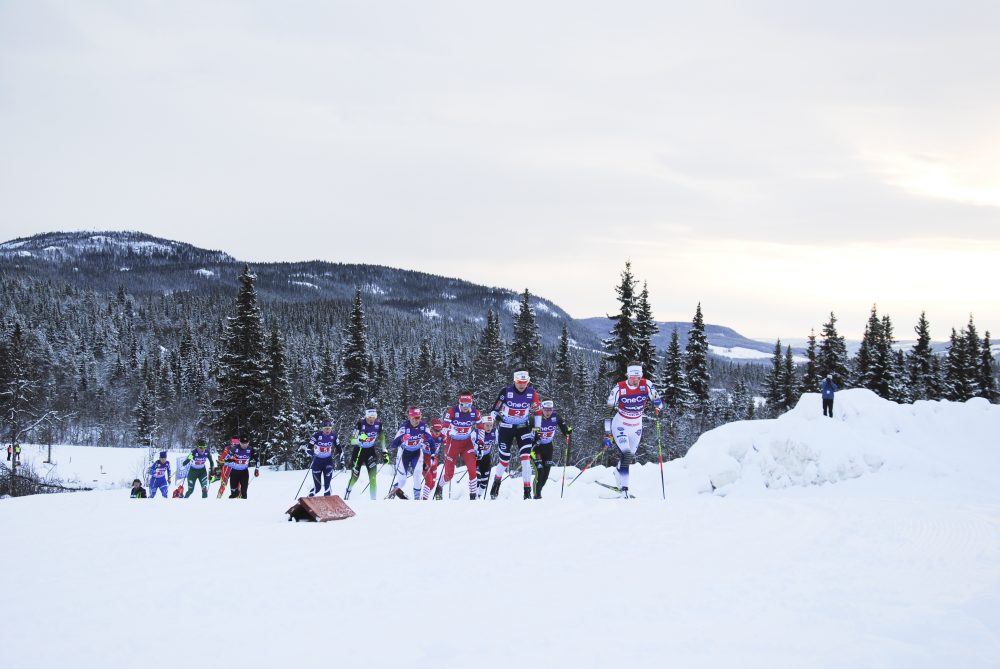
The women’s field cresting a hill during the scramble leg of the World Cup 4 x 5 k relay in Beitostølen, Norway.
FIS World Cup Beitostølen, Norway 4 x 5 k / 4 x 7.5 k Relay
Sunday in Beitostølen, Norway the women raced a 4 x 5-kilometer relay on firm tracks and under partly cloudy skies — Saturday’s races featured fresh snowfall.
Norway I took the win in a total time of 57:23.6 minutes. In order of relay legs, Heidi Weng, Therese Johaug, Ragnhild Haga, and Ingvild Flugstad Østberg comprised the team that raced at the sharp end of the race for all but the first leg.
Weng, the first leg skier for Norway, tagged Johaug in fourth, 7.3 seconds behind Russia’s Yulia Belorukova who scrambled for Russia I. From then on, Norway I set the speed benchmark.
Despite Russia I’s star power, it was Russia II that took second place Sunday. Lidia Durkina, Anna Zherebyateva, Mariya Istomina, and Elena Soboleva, having been gapped by Norway I, could pack-ski until the final stretch to slot over the line .5 seconds ahead of third place Finland I. (Russia II finished 37.3 seconds behind Norway I.)
Russia I’s anchor, Anna Nechaevskaya, fell in the final downhill turn losing several places for her team.
Finland I, the third-place team on the day, featured Johanna Matintalo, Krista Pärmäkoski, Ritta-Liisa Roponen, and Eveliina Piippo. Finland I finished 37.8 seconds behind winner Norway I.
The U.S. I team placed fifth (+48.0) in a performance that saw them out dual Sweden and Norway II in the closing moments of the race. Sadie Bjornsen, Rosie Brennan, Caitlin Patterson, and Jessie Diggins skied for the U.S. on a roster absent some names that were longtime staples of the U.S. team’s relay quartet — both Kikkan Randall and Liz Stephen retired from racing last season.
The U.S. had planned on fielding a second team featuring the U.S. Ski Team’s (USST) Sophie Caldwell (USST), Ida Sargent (USST), Kelsey Phinney (SMS T2), and Kaitlynn Miller (CGRP), however, they did not start.
Norway I held on for the win in the men’s 4 x 7.5 k relay today in Beitostølen in a time of 57:23.6 minutes. This was head-to-head racing at its finest. After 30 k of racing, the final standings came down to a lunge at the finish between Norway I and Russia I. Russia I placed second (+0.7).
Emil Iversen, Martin JohnsrudSundby,Sjur Røthe, and Finn Hågen Krogh formed the Norway I team. The Russia I team included Evgeniy Belov, Alexander Bolshunov, Denis Spitsov, and Andrey Melnichenko.
Norway II’s Didrik Tønseth, Hans Christer Holund, Magne Haga, and Simen Hegstad Krueger placed third (+53.4).
The U.S. team of Erik Bjornsen, Kevin Bolger, Scott Patterson, and Simi Hamilton placed 12th (+3:22.7).
IBU World Cup, Pokljuka, Slovenia 7.5 k / 12.5 k Pursuit
Looking smooth across the finish line, Norway’s Johannes Thingnes Bø, won the men’s 12.5 k pursuit in Pokljuka, Slovenia in a time of 30:20.4 minutes. That smoothness was matched in a photo finish with France’s Quentin Fillon Maillet who placed second, 0.1 seconds behindBø. Maillet cleaned his four shooting stages.
Bø looked in control for the last portions of the race. His strong skiing gave him a 50-second lead as he began his final shooting stage. There, the Norwegian missed two targets, allowing the chasers to latch back on during the final lap. In total, Bø missed three targets, one during his first prone stage, and two during his second standing stage.
Russia’s Alexander Loginov was third in the sprint, finishing 1.9 seconds back. Loginov missed one target in his first standing bout, otherwise, he shot clean.
Canada’s Christian Gow placed 14th (+1:09.1) while shooting clean. No other Canadians qualified for the pursuit.
For the U.S., Leif Nordgren was the best placed American in 33rd (+2:39.1, 0+2+1+0). Sean Doherty was 39th (+3:07.9, 0+0+2+2),
Kaisa Mäkäräinen of Finland won the women’s 10 k sprint in a time of 29:16.9 minutes. Mäkäräinen shot clean during the competition. Italy’s Dorothea Wierer was second, finishing 41.3 seconds behind while also shooting clean during all four shooting bouts.
Third place went to Paulina Fialkova of Slovenia. Fialkova finished 59.2 seconds back and shot clean for the day.
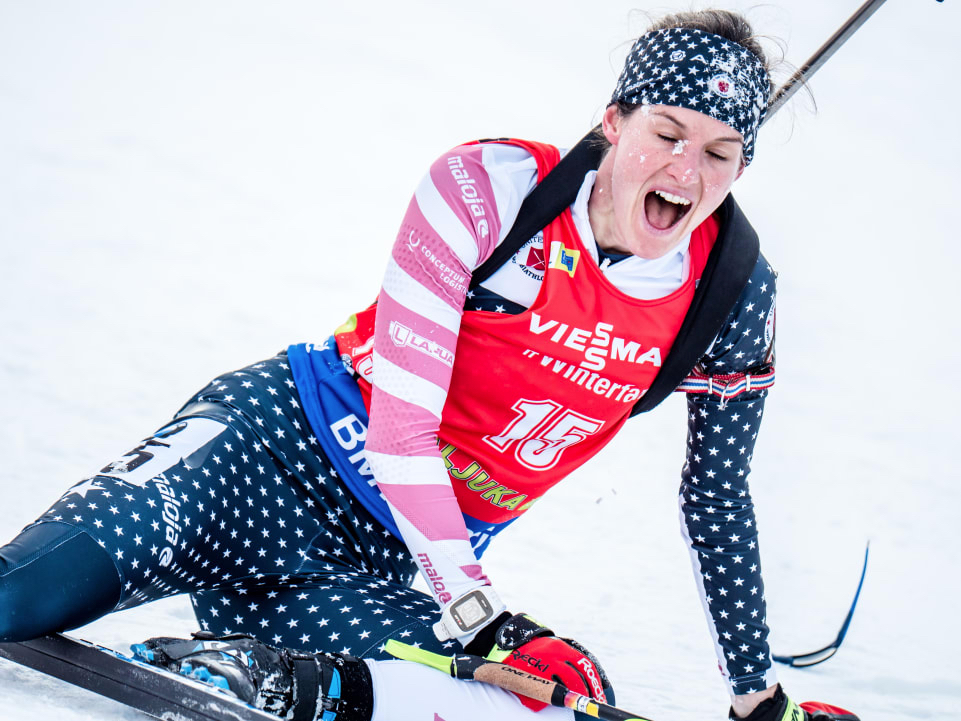
Clare Egan after placing sixth in the IBU World Cup’s 10 k pursuit in Pokljuka, Slovenia. (Photo: Biathlonworld.com)
For the U.S., Clare Egan placed a career-best sixth (+1:22.4, 0+0+1+0). Egan missed a single target during the race.
“I knew the pieces were there,” Egan told IBU TV after the race. “I had clean shooting in a [preseason] race at the Austrian trials before the World Cup. And then I had just awesome ski times this week, so I knew it was coming. I just had really good focus today, and I love competing head to head, so pursuit is a great race for me. I thought I was… I wasn’t sure if I was in fifth or sixth, and this Norwegian skier [Marte Olsbu Røiseland], really good, just got me at the finish. So I was so happy when I looked up and saw that I was in sixth in the flower ceremony.”
Also for the U.S., Susan Dunklee placed 39th (+3:36.3 0+1+0+1), and Joanne Reid 43rd (+3:51., 0+0+1+0).
CNST teammates Dahria Beatty (l) and Katherine Stewart-Jones charge the last hill of the 10km on their way to 6th and 1st respectively. (Photo: Peggy Hung)
Sovereign Lake NorAm/SuperTour 5k/10k Classic
The Sovereign Lake weekend wrapped up with individual start classic distance races and a more neighbourly distribution of results.
Katherine Stewart-Jones (CNST) won the women’s 10km in 31:48.4, hanging on in the last lap to finish ahead of APU’s Becca Rorabaugh (+7.1) and SMS’ Julia Kern (+7.8). APU’s Hailey Swirlbul snatched 4th at 10.9 seconds with Dahria Beatty (CNST) in 5th, 26.7 seconds back.
Kyle Bratrud on his way to victory in the 15km (Photo: Peggy Hung)
Kyle Bratrud (SMS T2) won the battle in the men’s 15km in 41:59.3, 3.8 seconds ahead of Ben Lustgarten (CGRP) and 34.7 seconds ahead of Ricardo Izquierdo-Bernier (NMU/CNEPH). Sam Hendry (CJNST) edged out Andy Newell (SMS T2) for fifth.
Individual start results are here with the full weekend here. Photos and interviews are coming in the Noram/SuperTour wrap-up.
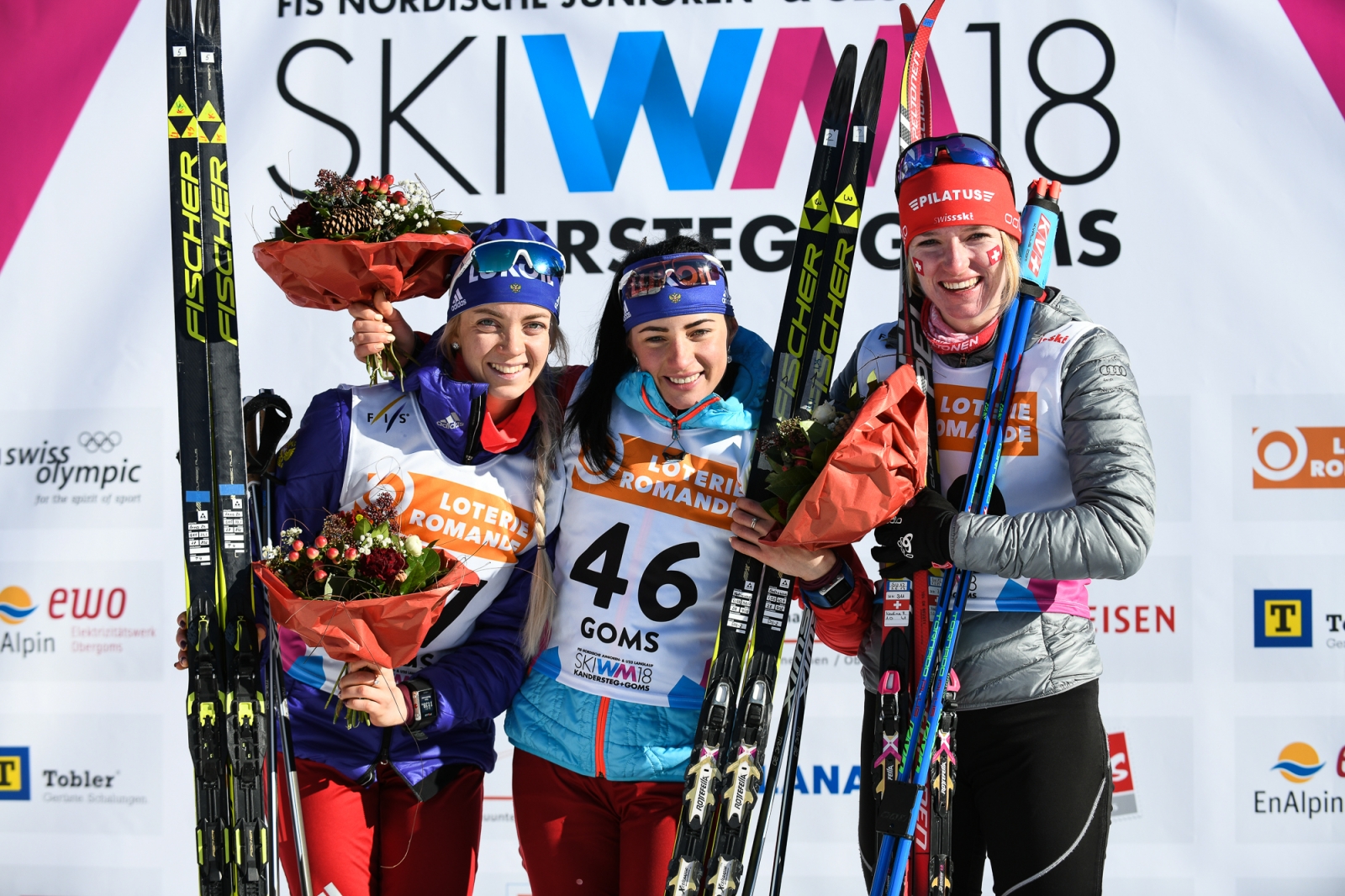
The women’s 10 k classic podium at 2018 U23 World Championships, with Russia’s Yana Kirpichenko (c) in first and Anna Zherebyateva (l) in second, and Switzerland’s Nadine Fähndrich (r) in third. (Photo: JWSC2018.ch)
(Note: This article has been updated to include comments from Americans Lydia Blanchet and Ian Torchia.)
U23 World Championships (Goms, Switzerland): 10/15 k classic
Russia put two in the top three in both the women’s and men’s races on Wednesday at U23 World Championships in Goms, and for the second-straight race, Canada’s Katherine Stewart-Jones landed in the top 30.
In the women’s 10-kilometer classic, Russia’s Yana Kirpichenko pulled out a 13.9-second victory over fellow Russian Anna Zherebyateva, finishing with the winning time of 27:46.1 minutes. Switzerland’s Nadine Fähndrich returned to the podium for the second race in a row (after placing second in Monday’s skate sprint), finishing third, 29.6 seconds behind Kirpichenko.
In Monday’s sprint, Kirpichenko qualified fourth and ended up fifth in the final. She is a bronze medalist in the 15 k skiathlon at last year’s U23 Worlds.
Stewart-Jones, of the Canadian National U25 Team and National Team Development Centre (NTDC) Thunder Bay, started relatively early on Wednesday in bib 19 and ultimately placed 29th, 3:07.3 out of first. She sped up as the race progressed, from 40th at 2.4 k to 32nd at 5 k and up to 30th at 7.4 k.
So far in all five races she’s competed in over the last two years at U23 Worlds, Stewart-Jones has finished in the top 30. Her best result is 21st in last year’s 15 k skiathlon, and at the Junior Worlds level, she had a best individual result of 14th in the 10 k skiathlon in 2015.
American Lydia Blanchet (Dartmouth Ski Team) started fifth on Wednesday and ended up 30th (+3:10.4) after skiing in the top 30 throughout the race. Her Dartmouth teammate Lauren Jortberg followed in 34th (+3:28.9) and Nicole Schneider was 49th (+5:23.8). Julia Kern did not start.
For Blanchet, a Dartmouth junior, this week marked her first time racing at the Junior/U23 World Championships level. So far, she has placed 32nd in the freestyle sprint and now 30th in the classic distance race.
“This is my first time racing internationally, and I tried to go into the races with no expectations,” Blanchet explained in an email. “I was excited to get as close as I did to qualifying for the sprint, but it was definitely bittersweet—missing heats by 0.3 seconds left me regretting some of the smaller details of my race. Still, it is really exciting to know that I can compete on the world stage!”
After the sprint, she made a goal of finishing in the top 30.
“I really like hilly, rolling courses—especially ones with very technical downhills—and this course definitely fit that bill,” she wrote of the classic distance course. “I am really happy with my race, all things considered. I didn’t feel great while I was racing – my legs flooded pretty hard a few km’s in – but I think I did a good job of holding myself together and staying strong mentally. I know I have the ability to do even better, which is motivating and exciting. I am looking forward to get to ski head-on against the whole field in the skiathlon, and I’m excited to try and pick my way forward from my bib number. I’m also really excited to go home and race carnivals with the Dartmouth team.”
Canada’s Laura Leclair finished 40th (+4:20.9), Sophie Carrier-Laforte was 43rd (+4:19.2) and Maya MacIsaac-Jones 47th (+4:47.3) out of 53 finishers.
Nicole Bathe of the Midwest-based Central Cross Country (CXC) Team, who races for Great Britain, placed 37th (+3:43.8), for her second top 40 of the week after placing 39th in the skate sprint.
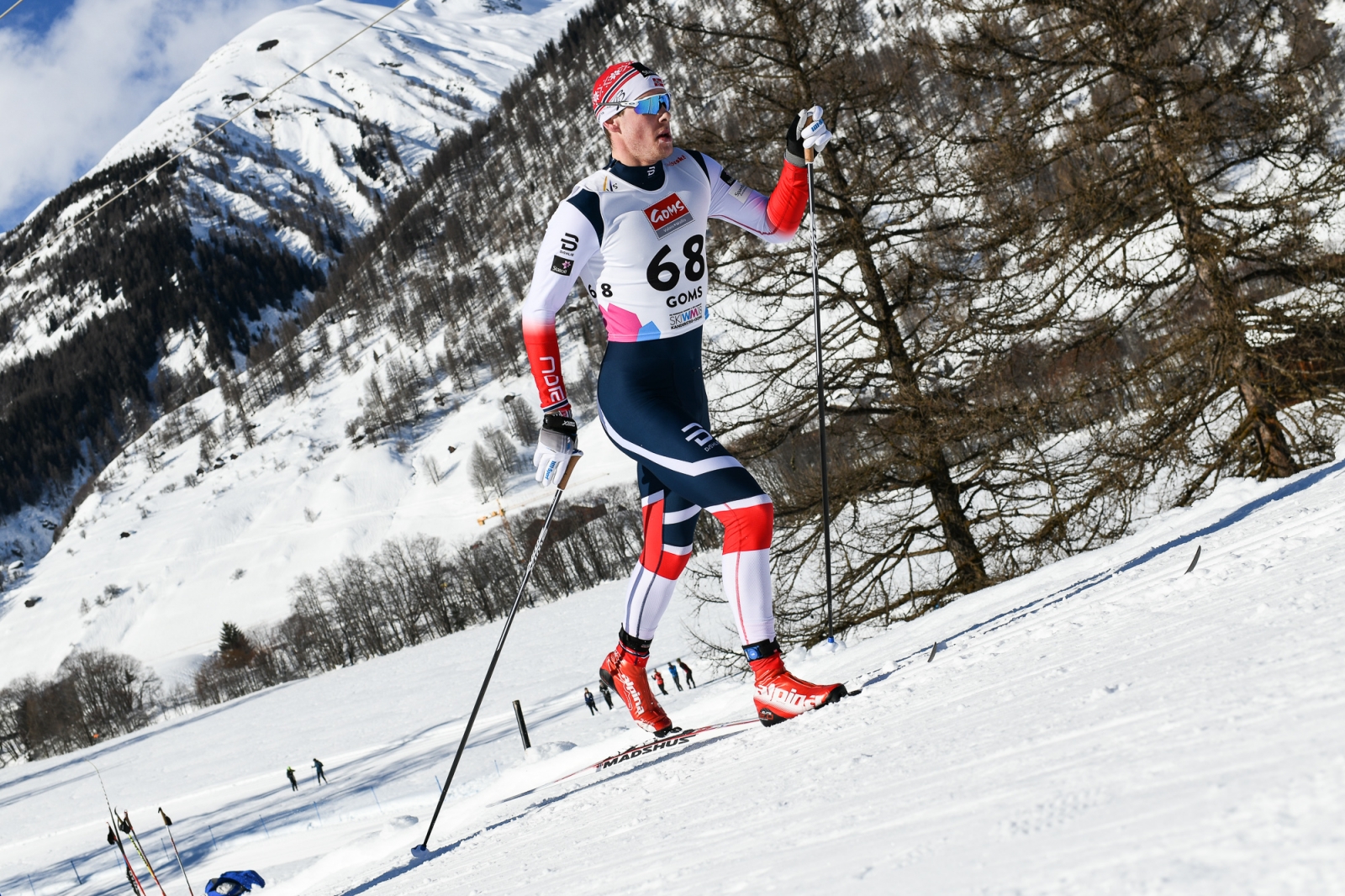
Norway’s Mattis Stenshagen racing to the win in the men’s 15 k classic at 2018 U23 World Championships in Goms, Switzerland. It was his first gold medal and podium at U23 Worlds (he earned silver two years ago in the 15 k freestyle at Junior Worlds and also gold in the relay that year). (Photo: JWSC2018.ch)
In the men’s 15 k classic that followed, Norway’s Mattis Stenshagen edged Russia’s Denis Spitsov by 4.8 seconds for the win in 36:28.3. Also for Russia, Ivan Yakimushkin placed third, 35.2 seconds back.
Canada’s Alexis Dumas, of the Pierre-Harvey National Training Centre (CNEPH) was the top North American in 31st, 2:51.7 out of first. He worked his way up from 40th at 5 k to 35th by 10 k, and finally just 0.2 seconds outside of 30th at the finish.
American Ian Torchia (U.S. Ski Team D-team/Northern Michigan University) followed in 32nd (+2:55.9) and Bill Harmeyer (University of Vermont) finished 39th (+3:43.3). Also for the U.S., Thomas O’Harra placed 43rd (+4:17.3) and Zak Ketterson was 57th (+5:37.6).
Torchia, an NMU junior, has been to two Junior Worlds in 2015 and 2016, but this marked his first U23’s.
“The jump from juniors to U23s is quite a leap. I missed the first year of being a U23 last year due to mono so getting back into international racing was a shock to the system,” he explained in an email.
As for his goals for the 10 k, he was hoping for a top 15 or 20, but moreover “wanted to race smart and feel good out on the course technically and physically,” Torchia wrote. “This was the hardest course I have ever raced with 600m of climbing throughout the 15k and I was excited to showcase my striding ability out there…
“However, from the first km I was in the pain cave (even though I didn’t open that fast!) and it was a fight the entire way,” he continued. “I need to work on staying technically strong when hurting and I did not do a good job of executing that today. The eventual second place Russian started as I was looping around for my 2nd lap so I was able to see and feel what a podium performance looks like. Going to have that image in my head throughout the next year!”
For Friday’s 30 k skiathlon, Torchia wrote that he would be “throwing all place goals out the window and focusing on skiing technically well and racing smart. Looking forward to channeling my last skiathlon in Kazakhstan which went really well [he placed 11th in the 20 k at 2015 Junior Worlds] and moving up from my starting position.”
Canada’s Gareth Williams finished 41st (+4:00.2) on Wednesday, Philippe Boucher was 45th (+4:22.7) and Ricardo Izquierdo-Bernier 47th (+4:24.3) out of 63 finishers.
Note: This article has been updated to include comments from Sweden’s Charlotte Kalla.
For the second day in a row, Charlotte Kalla, a name synonymous with the yellow and blue of Sweden, stood atop the podium, placing first in the women’s 10-kilometer classic International Ski Federation (FIS) race on Saturday in Gällivare, Sweden. On Friday, Kalla won another individual-start race, the 5 k freestyle, by a margin of 8.8 seconds. She more than doubled that time gap by the finish of Day 2, winning the 10 k classic in 27:55 minutes, 17.7 seconds ahead of Russia’s Yulia Tchekaleva in second place. Natalia Nepryaeva, also from Russia, skied to third, 40.9 seconds back of Kalla.
“I am feeling good and I think I am where I should be at this moment,” Kalla wrote in an email. “I had a good feeling on the classic race and handle the condition well. On Friday I opened hard and tried to push hard all the way.”
Known as a skate powerhouse, Kalla has improved her classic skiing and is now a double threat. “I have improved my classic technique the last years,” Kalla explained. “When I am in shape it doesn’t matter if it is skating or classic. I am glad I managed to ski well in the condition we had. It was a little bit soft because of the snowfall.”
Although a home FIS event for Sweden, Russia secured six of the top-10 spots with Sweden settling for three. Japan’s Masako Ishida, the only non-Russian or Swede outlier in the top 10, placed fourth (+1:02.4). Russians Anna Zherebyateva raced to fifth (+1:08.8) while teammate Yulia Belorukova was sixth (+1:12.8).
Sweden took the next two spots with Stina Nilsson in seventh (+1:20.9) and Anna Haag in eighth (1:20.9). Russia rounded out the top 10 with Anatasia Sedova placing ninth (+1:24.1) and Mariya Guschina in tenth (+1:25.0).
Sweden’s Ida Ingemarsdotter, a World Cup regular, placed 11th (+1:30.6).
Kikkan Randall was the only U.S. Ski Team member at the race, and a day after finishing eighth in the 5 k skate, she finished 15th (+1:48.1) on Saturday. In an email, Randall explained that snow had fallen continuously for the last 24 hours in Gällivare.
“Conditions were pretty nice, the track was a little soft and a lot of racers here made the pole track a little punchy,” she wrote.
Considering the massive time-zone shift from her home in Anchorage, Alaska, to Central European Time, it appears Randall is adjusting well.
“I felt decent today, not too tired from the jet lag or yesterday’s race. I wanted two back-to-back races to get ready for next weekend’s triple World Cup opener,” she wrote, referring to the first three World Cup races in Kuusamo, Finland, starting Friday, Nov. 23.
Throughout Saturday’s 10 k, Randall steadily improved her overall placing: she was 32nd at 4.2 k, 23rd at 6.8 k and locked into 15th by 9.2 k.
“It was definitely good to race a 10km classic today,” Randall wrote. “I had trouble really digging into my race gear on the first lap today. I think I was skiing a little stiff and not carrying my momentum down the track. Nepryaeva [the third-place finisher] caught me going into the 2nd lap and that was the jumpstart I needed. I was able to match her pace for most of the rest of the race and it helped me find better technique and tempo.
“I wanted to be a little stronger today but I got some really important feedback on where I’m at and what I need to work on as the race season progresses,” she added. “My fitness feels pretty good and now it’s just a matter of fine-tuning.”
Emily Nishikawa was the only Canadian entered on Saturday and finished in 51st (+3:39.3). Sixty-nine women started the race, 38 from Sweden, 17 from Russia, seven from Japan, two from Switzerland and Estonia, and one each from the U.S., Canada, and Poland.
In Friday’s 10 k skate in Gällivare, only Swiss star Dario Cologna kept the Russians from sweeping the top nine by placing third. In that race, Evgeniy Belov and Sergey Ustiugov of the Russian national team finished first and second, respectively.
Saturday was a different race, a 15 k classic, but with a similar thread and no Cologna as a Russian foil.
The Russian men finishing in unison to take first, second and third in the men’s 30 k skiathlon, the final race of 2017 U23 World Championships at Soldier Hollow in Midway, Utah. Alexander Bolshunov (8) was deemed the winner, Alexey Chervotkin (1) was second, and Denis Spitsov (11) third. (Photo: FlyingPointRoad.com)
It was Russia, Russia, Russia.
Alexander Bolshunov, winner of the 30 k skiathlon at 2017 U23 World Championships, won the race in 37:13, one second ahead of Maxim Vylegzhanin in second. Alexey Chervotkin was third (+5.1).
Classic specialist, Kazakhstan’s Alexey Poltoranin finished fourth, 13 seconds off the podium, and Cologna placed fifth (+22.1).
Despite being on Swedish soil, the rest of the top 10 became a mostly Russian affair. Russian teammates Alexey Vitsenko and Artem Maltsev placed sixth (+29.5) and seventh (+37.4), respectively, Sweden’s Calle Halfvarsson interrupted the trend by tying Russia’s Evgeniy Belov for eighth (+38.0), and Russia’s Alexander Bessmertnykh took 10th (+40.1).
There’s a pattern: Russia took 14 of the top-20 places. Twenty-eight of 126 starters were from Russia, with the vast majority of the field being Swedish. Outside of the top 10, Sweden’s Daniel Rickardsson was the next-best Swede in 12th (+49.6).
Devon Kershaw (World Cup Team), who finished 12th on Friday, once again led Canada in 20th (+1:06.7). At 6.8 k, Kershaw was ranked 15th, and at 9.6 k he was down one spot to 16th. By the 11.4 k checkpoint, he began slipping further in the standings.
“Today was a tough one,” Kershaw wrote in an email. “I felt pretty good but conditions were soft, so you had to really feather it (the technique) – especially on the climbs. Pacing wise I think I was doing pretty well, but in the last 2.5km today I was missing any semblance of a kick to the finish and ended up conceding a few seconds to those around me, knocking me from about 15-16 to 20th.”
Although an interval start race, Kershaw never found a strong pacing partner. “I was skiing alone – no help at all today,” Kershaw wrote of his solitary effort. “It would have been so helpful! Especially that last lap when things get tough. But in individual start races, you need to learn to do it alone. So good to try and get used to that “time trial” feeling.”
Three other Canadians competed, with Graeme Killick (World Cup Team) finishing 50th (+2:32.3), Jack Carlyle (Alberta World Cup Academy) 91st (+4:06.1), and Brian McKeever (Para Nordic Team) 110th (+5:16.0).
As of press time, Fasterskier could not confirm if the International Ski Federation (FIS) held an emergency meeting to discuss the involvement of IOC-banned Russian skiers in FIS-sanctioned races. Of the six IOC-sanctioned Russian skiers, four are men: Belov, Vylegzhanin, Alexander Legkov, and Alexey Petukhov. All four skiers raced on Friday, however, Legkov and Petukhov (and Shapovalova, one of the two women sanctioned by the IOC) did not contest Saturday’s race.
Racing continues in Gällivare on Sunday with classic sprints.
The U.S. women’s relay after taking a historic third in the 4 x 3.3 k relay at 2017 Junior World Championships on Sunday at Soldier Hollow in Midway Utah, with (from left to right) Hailey Swirbul, Katharine Ogden, Julia Kern, and Hannah Halvorsen. (Photo: FlyingPointRoad.com)
For fans of North American skiing, some of the last races of U23 and Junior World Championships at Soldier Hollow in Midway, Utah, proved beyond captivating, surpassing most expectations and previous results.
But for the U.S. junior women’s relay, a group of four that had set a goal two years ago at a U.S. development training camp, the podium was exactly where they had envisioned themselves.
Relay bronze
Hailey Swirbul, Julia Kern, Hannah Halvorsen, and Katharine Ogden went out and achieved that very goal on Sunday, racing to third in the 4 x 3.3-kilometer relay on the final day of Junior Worlds.
According to Ogden, who became the first American to capture an individual bronze two days earlier in the women’s 10 k skiathlon, the foursome were at a camp two years ago in Lake Placid, N.Y., when they walked into a store together. In the 1980 Olympic village, they found red-white-and-blue tube socks — just like the socks the U.S. Ski Team women wear in World Cup team events — on sale. They each bought a pair and made a goal of wearing them together in the relay at World Juniors.
“The four of us have a group message, and it wasn’t unusual to open that message and see a note from someone who just couldn’t contain their excitement for this relay and had to share it with the rest of us… and this was up to two years ago!” Swirbul explained in an email. “We didn’t just think or hope we were capable of this result, I think we all KNEW we could do it deep down. It was kind of surreal to wake up on the morning of the race and think, ‘Today is the day, this is what we have been waiting for for so long! Let’s do this.’ ”
So just by getting to the relay start line on Sunday, they achieved their goal. But they knew they were capable of a top, even best-ever, result.
Hailey Swirbul tucking into the stadium as the first skier on the U.S. women’s 4 x 3.3 k relay team at 2017 Junior World Championships at Soldier Hollow in Midway, Utah. (Photo: FlyingPointRoad.com)
Swirbul started the team off by skiing to eighth in the first classic leg.
“My leg of the race started out fast — exactly what I had expected going into it,” Swirbul wrote. “The first kilometer flew by, and before I knew it, I was cresting the peak of the biggest climb of the course with legs that felt like they were made of lead! I tried to stretch them out on the downhill and hung onto the girls around me through the rolling last kilometer of the race. That 3k was tough!!”
She tagged off to Kern, who moved the team into sixth by the race’s halfway point. Kern came down with a cold last Wednesday and sat out Friday’s skiathlon to rest of for the relay.
“I was feeling a lot better today but definitely not 100% healthy,” Kern wrote in an email. “My goal was to go out and ski the best leg I could and fight hard to the finish because every second counts. I wasn’t really nervous until I was hanging around in the start pen waiting to see Hailey throw down a strong first leg. I was most nervous that I wouldn’t be able to ski well since I am not completely healthy and let the team down.”
She focused on skiing strong over the second half of the course, “since it played my strengths and I knew people would be hurting at the point,” Kern wrote. She tagged Halvorsen in sixth, about 25 seconds out of third and 45.5 seconds behind Italy in first.
Skiing the first skate leg for the U.S., Halvorsen focused on third place. She attacked on the climb known as “Horseshoe Hill”, passing Sweden and France to take that position, but France’s Laura Chamiot-Maitral passed her back on the downhill.
After the race, Halvorsen told the U.S. Ski Team media that she had learned a lot about pacing the 3.3 k after placing 13th in the 5 k freestyle earlier in the week (following Ogden, who fifth).
“I realized I just needed to trust myself and not start so fast — just be calm and slowly catch up,” she said.
The final exchange of the 4 x 3.3 k relay, with Americans Hannah Halvorsen (second from left) before tagging Katharine Ogden (l) in fourth, right behind France (6) in third. (Photo: FlyingPointRoad.com)
Halvorsen tagged Ogden in fourth at the final exchange, just 2.1 seconds out of third.
“I knew that no matter what, I needed to catch up to third place,” Ogden reflected in an email. “I honestly didn’t even think about pacing myself and just went hard from the tag.”
On the long, sustained climb on the backside of the 3.3 k loop, Ogden passed France’s Lena Quintin to move into third. As she soared down the other side, within view of her teammates, Ogden continued to push the pace to lock up third.
“I know Katharine’s technique really well so when I spotted a black dot skiing along I knew it could only be Katharine,” wrote Kern, Ogden’s teammate for the last two seasons at the Stratton Mountain School (SMS) in Vermont. Kern, Ogden and Halvorsen are all members of the U.S. Ski Team (USST) development “D” team.
“I waited a few more seconds but still no one came and I knew she had third locked in!” Kern wrote.
“I was crying when I saw her all alone,” Swirbul told the USST.
“I came into the finish and saw the team standing there cheering for me and it was an incredibly special moment,” Ogden reflected.
She finished third, 25.8 seconds behind Russia in first and just 5.2 seconds behind Italy in second. France’s Quintin finished about 40 seconds later in fourth. The bronze was the first for a U.S. women’s relay at Junior Worlds.
The first U.S. women’s team to podium at Junior World Championships: (from left to right) Hailey Swirbul, Katharine Ogden, Hannah Halvorsen, and Julia Kern, after placing third in the 4 x 3.3 k on Sunday at 2017 Junior World Championships at Soldier Hollow in Midway, Utah. (Photo: FlyingPointRoad.com)
“This week at worlds has been amazing,” wrote Ogden, 19, who left the championships with two bronze medals in her final year of Junior Worlds eligibility. “Wonderful skiing and good weather and unprecedented results for the whole team…”
“It was really incredible to stand up at the medals ceremony the other night,” she told the USST. “The only thing I can think of that would be better is standing up there with my friends.”
“This has been a dream for us for more than two years,” Swirbul, and 18-year-old University of Alaska Anchorage freshman, told the USST. “To see that dream come true — I was crying, happy, hugging and screaming — all in one emotion.”
“I was so happy but not in shock — because I knew we could do it,” Halvorsen, 18, of the Sugar Bowl Academy, told the USST.
Halvorsen, of Truckee, Calif., brought her little sister up on the podium with her.
“After having my whole family here: parents, grandparents, four brothers, and baby sister, it was special to bring the littlest one up to the podium,” Halvorsen wrote in an email.
“There is no one I would rather be on the podium with than my best friends and teammates,” Kern, 19, wrote. “Not only did I share the experience with my best friends, but on home soil with all my family and friends there to celebrate with us!
“I am just proud of our team because everyone skied so well and brought their A game today,” Kern continued. “And to have [USST development coach] Bryan Fish there to help us make it happen was amazing because he has worked so hard to help us become the fastest skiers we can be and this has always been a dream of his as well!”
“I am so lucky to be in this generation with these tough competitors that double as amazing teammates, and I think our country is just getting started with more exciting results to come!” Swirbul wrote.
Russia took the lead on the third leg and stayed ahead of Italy for gold, finishing first in 34:45.3 minutes, with Polina Nekrasova, Lidia Durkina, Anna Zherebyateva, and Mariya Istomina. Italy secured second (+20.6) with Martina Bellini, Anna Comarella, Francesca Franchi, and Christina Pittin, while France was fourth (+1:05.0) with Juliette Ducordeau, Flora Dolci, Chamiot-Maitral, and Quintin. Sweden finished fifth (+1:20.3), and Canada placed 12th (+4:41.3) of 12 teams, with Natalie Hynes, Lisle Compton, India McIsaac, and Annika Richardson.
In the junior men’s 4 x 5 k relay that followed, Norway eked out the win over Russia by 0.4 seconds, with Herman Martens Meyer, Jon Rolf Skamo Hope, Harald Østberg Amundsen, and Thomas Helland Larsen, in 49:36.1. After the first leg, which Germany’s classic-sprint winner Janosch Brugger led, the race was a Norway-Russia battle for first, with Russia leading through the second and third exchanges before Larsen outlunged Vladislav Vechkanov at the finish.
Russia took silver with Vechkanov, Egor Kazarinov, Kirill Kilivnyuk, and Yaroslav Rybochkin, ahead of France, which skied most of the race in third in finished in that position (+1:05), with Martin Collet, Camille Laude, Hugo Lapels, and Arnaud Chautemps.
Of 12 teams, the U.S. finished ninth (+4:28.8) with Bill Harmeyer, Kam Husain, Wyatt Gebhardt, and Hunter Wonders, after skiing in sixth during the first two classic legs, then slipping to ninth on the third leg.
Canada followed in 10th (+5:21.6), with Antoine Blais, Ryan Jackson, Philippe Boucher, and Gareth Williams, after skiing in ninth for the first two legs.
Paddy Caldwell switching to skate skis during the halfway point of the men’s 30 k skiathlon on Jan. 4 at 2017 U23 World Championships at Soldier Hollow in Midway, Utah. (Photo: FlyingPointRoad.com)
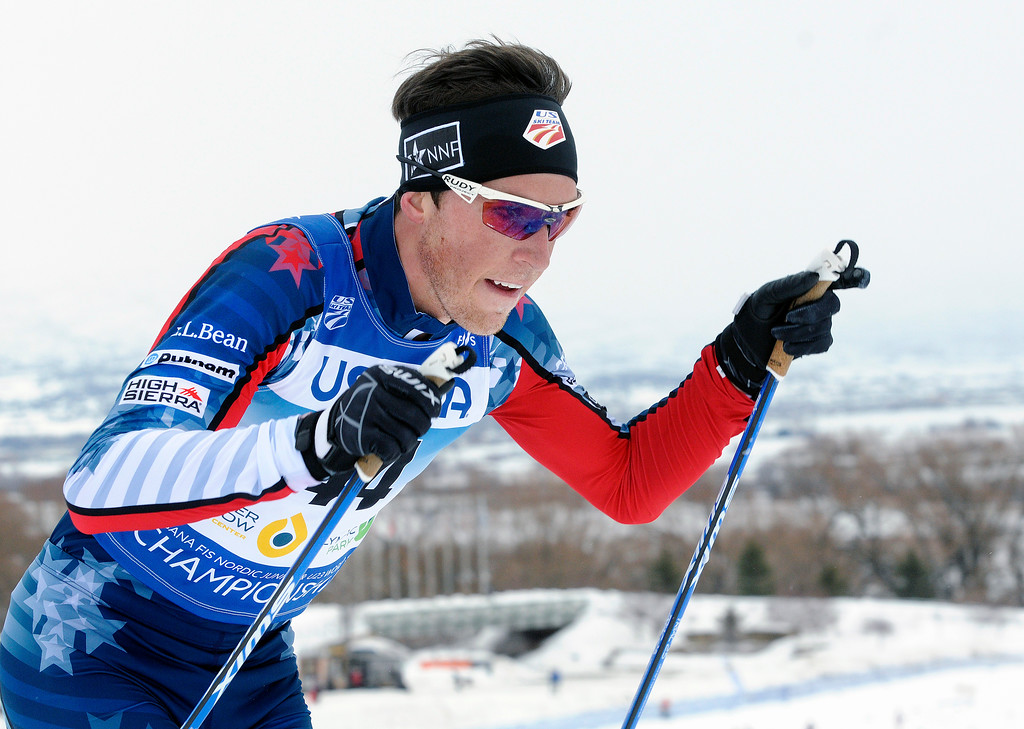
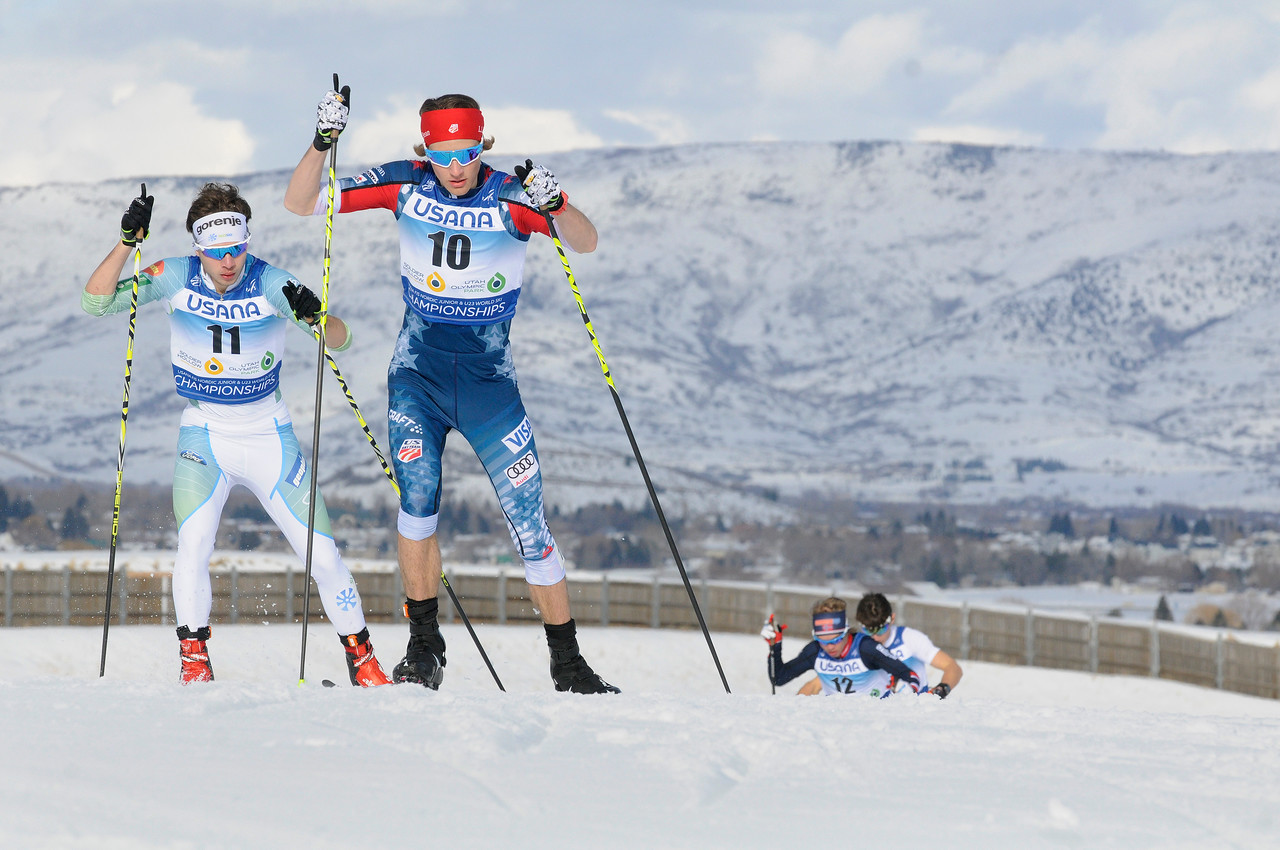
The day before, in the last races of U23 World Championships on Saturday, American Paddy Caldwell matched his personal best from two days earlier in the 15 k freestyle, placing ninth in the men’s 30 k skiathlon.
Caldwell had been 10th at the ski change halfway through the race, following his U.S. teammate Jack Hegman in ninth by half a second.
Paddy Caldwell, of the Stratton Mountain School and U.S. Ski Team, racing to ninth in the men’s 15 k freestyle at 2017 U23 World Championships at Soldier Hollow in Midway, Utah. (Photo: U.S. Ski Team/Tom Kelly)
“Starting off in the classic leg I was trying to stay relaxed and maintain position,” Caldwell wrote in an email. “For the first half of the classic I was at the tail end of the lead group then started to lose some time over the last part of the classic.”
He and Hegman started skiing together about 8 k into the 15 k classic leg, and remained together for most of the rest of the race. At the transition, they were about 44 seconds behind eighth place and 13 seconds ahead of 11th.
“I was really struggling with breathing during the classic leg so I tried to relax for the first part of the skate leg and maintain our position,” Caldwell wrote. “We put in a surge on the second lap of the skate to try to catch the group ahead of us (5th-8th) but they were just out of contact. On the last lap I put in one last push early on to break away from the French skier in 10th and got just far enough ahead to hold him off on the last climb before the long decent into the stadium.”
With the sixth-fastest skate leg, Caldwell (SMS/USST D-team) finished ninth, 9.2 seconds ahead of France’s Jean Tiberghien in 10th. Nearly 20 seconds after Tiberghien, Hegman finished 11th (+1:53.5) for a career best at his first U23 Worlds.
American Jack Hegman (SVSEF) racing to 24th in the men’s 15 k freestyle on Feb. 2 at 2017 U23 World Championships at Soldier Hollow in Midway, Utah. (Photo: FlyingPointRoad.com)
“I think I am slightly better at skating, but felt really good about my classic skiing today,” Hegman, of the Sun Valley Ski Education Foundation (SVSEF) Gold Team, wrote in an email. “ I think I was able to gain some good time on the classic portion and then hold on in the skate. In the skate portion I tried to follow Paddy as long as I could and conserve energy. I lost quite a bit of time in the last 2k but thankfully didn’t lose too many places.”
“For the entire skate leg, when I realized I was in the top 12, all I was thinking about was holding onto that top 12 position,” Hegman wrote.
The two led three U.S. men in the top 15, with Adam Martin (Northern Michigan University) not far behind in 15th (+2:23.3). For Martin, it was his first skiathlon in three years (he finished 40th in the 20 k skiathlon at 2014 Junior Worlds in Val di Fiemme, Italy).
Adam Martin (Northern Michigan University) racing to 15th in the men’s 30 k skiathlon on Saturday at 2017 U23 World Championships at Soldier Hollow in Midway, Utah. It was his first top 20 in two U23 Worlds. (Photo: FlyingPointRoad.com)
“I wanted to go out hard enough to establish a decent position, but also wanted to conserve sufficient energy to ski a strong back end of the race,” Martin wrote of Saturday’s eight-lap race.
He skied most of it with the Czech Republic’s Petr Knop, who ultimately finished 14th, 1.4 seconds ahead of Martin.
“Sometimes I was following, and sometimes I led and tried to catch up to the skiers in front of us,” Martin wrote.
“I’ve never been top 20 at one of these competitions before, so top 15 is cool,” he added. “I think I’ve had very decent races this week!”
“It is awesome to see three of us in the top 15 today,” Hegman wrote. “I think having the momentum from this week with so many good performances helped us quite a bit today. Also our skis were awesome today (and all week).”
“I am really happy with my results all week,” wrote Caldwell, who notched top 20’s in all three races, including 18th in the classic sprint to start the championships. “It was an amazing week of racing for USA and I was really happy to end on a high note.”
Russia swept the men’s 30 k skiathlon podium with Alexander Bolshunov, Alexey Chervotkin, and Denis Spitsov, respectively, after the three skied together for most of the race, well ahead of France’s Jules Lapierre and Switzerland’s Jason Rueesch in pursuit of them. As the Russians descended down the final hill — clear of any outside contenders for the podium — they locked arms and coasted into the stadium together. Just before the finish line, they stopped to cross as one.
According to a USST press release, the competition jury had to review timing and scoring records, as well as consult photo assets and the finish referee to determine who finished first, second and third. Gold went to Bolshunov, who also won the 15 k freestyle two days earlier, with an official finish time of 1:15:31.5 hours. Chervotkin was listed as second (+0.2) and Spitsov third (+0.5).
Lapierre crossed 11 seconds later in fourth, about three seconds ahead of Rueesch in fifth (+14.3).
Evan Palmer-Charrette (NTDC Thunder Bay) led the Canadian men in 26th (+5:44.6). Alexis Dumas of the Pierre Harvey National Training Centre (CNEPH) finished 33rd (+9:02.7) out of 36 finishers. Several North Americans did not finish, including Canada’s Julien Lamoureux and Julien Smith, and American Cal Deline.
In the U23 women’s 15 k skiathlon earlier on Saturday, Canada had three in the top 30, with Dahria Beatty (Alberta World Cup Academy/Canadian National U25 Team) in 19th (+2:18.1) for her third top 20 of the week. Katherine Stewart-Jones (NTDC Thunder Bay/NST U25 Team) placed 21st (+2:29.3) for her best result at U23 Worlds, and Frederique Vezina (CNEPH) notched a personal-best 29th (+3:36.2). The team’s fourth skier, Jenn Jackson, did not finish.
Jesse Knori, of the University of Colorado-Boulder (CU) led the U.S. women in 30th (+3:40.1). Alayna Sonnesyn (University of Vermont) followed in 31st (+3:42.5), Nichole Bathe (University of Alaska Fairbanks) was 33rd (+4:36.9), and Corey Stock (Bridger Ski Foundation) 36th (+5:42.1).
Another CU skier, Petra Hyncicova, who raced for her native Czech Republic, placed 22nd (+2:30.7) for her second-best result of the week after placing 20th in the classic sprint.
Norway’s 19-year-old Lotta Udnes Weng won the 15 k skiathlon for her first gold of U23 Worlds, finishing in 40:50.9 minutes and besting Finland’s Johanna Matintalo by 3.8 seconds. Russia’s Yana Kirpichenko captured third (+13.9), edging Weng’s twin sister, Tiril Udnes Weng in fourth (+15.6).
“On paper, this is not my best distance,” Lotta Weng, a six-time Junior Worlds medalist, told the USST. “But I knew I could do well in both classic and skate, and that if I had a really good day, I could ski for a gold medal … I knew I would have a good sprint and I was just trusting it.”
American Ben Loomis (10) racing to a career-best ninth in the individual normal hill/5 k competition on Feb. 4 at Nordic Combined Junior World Championships at Soldier Hollow in Midway, Utah. (Photo: U.S. Ski Team/Tom Kelly)
Ninth for Loomis
Also on Saturday, in the last individual competition of nordic-combined Junior Worlds, 18-year-old American Ben Loomis notched his first top 10 in his third Junior Worlds appearance.
Loomis started the day by jumping to 10th on the normal hill at Utah Olympic Park in Park City, his home training base. That put the U.S. Nordic Combined skier 58 seconds out of first and 11 seconds behind Finland’s Arttu Mäkiaho in ninth for the start of the 5 k race at Soldier Hollow. While Loomis didn’t catch Mäkiaho (who raced to second place for his second-straight individual medal after winning the normal hill/10 k to start the week), Loomis picked off one place to finish ninth, 1:22.3 minutes behind the winner, Germany’s Vinzenz Geiger.
“My goals for the 5k competition were to jump into the top ten, and to not lose any ground during the race,” Loomis wrote in an email. “I was able to do this, but was still hoping for a higher finish.”
He explained that a snow flurry during the jumping competition left the last 20 starters on the hill waiting for it to pass. Loomis was the fourth-to-last to jump, out of 49 starters.
“I was able to stay relaxed, focused and have my best competition jump of the week,” he explained. “The home hill advantage made a huge difference in my jumping. Prior to this week, I had little jumps on the hill this winter. Luckily, I know the hill well and was able to get in rhythm with the jump very quickly.”
Considering his starting position in the 5 k, which is half the distance of the usual 10 k in nordic-combined competitions, Loomis said he knew he needed to move up quickly, but do so in a controlled manner.
“5 k really places a big importance on the jumping,” Loomis told the USST. “It’s a lot harder to make up time, and these Europeans are really quick.”
He paced his first 2.5 k, and by the second lap, he worked with Norway’s Lars Ivar Skaarset — who had caught Loomis after starting 12th — to rein in Slovenia’s Matevz Malovrh, who started fourth and was fading. While Skaarset finished 17.4 seconds ahead of Loomis for eighth place, they both beat Malovrh, who placed 10th, 1.8 seconds behind Loomis.
“Overall, I am very happy with my 9th place result. I was hoping for a little more, but to be 9th in the world is very special,” Loomis wrote. “I am already looking forward to next year’s competitions and approaching them with even more experience.”
Earlier in the week, Loomis placed 18th in the normal hill/10 k and skied the third leg of the men’s 4 x 5 k team event, in which the U.S. placed seventh (with Elijah Vargas, Grant Andrews, Loomis, and Stephen Schumann). After Vargas tagged Andrews in 10th, Andrews skied them into ninth, and Loomis brought the U.S. up to seventh, which Schumann held during the final leg.
The U.S. had two in the top 15 on Saturday, with Schumann in 15th (+1:44.3), up from 20th after the jump. Grant Andrews placed 33rd (+2:40.0) and Tucker Hoefler finished 46th (+3:56.9).
Geiger won Saturday’s normal hill/5 k after jumping to first then starting with a 4-second lead over Japan’s Yuto Nakamura in second. Mäkiaho passed seven people to finish second, 22.6 seconds after Geiger, who won in 12:14.9 minutes. France’s Laurent Muhlethaler started fifth and captured third (+23.9), while Nakamura missed the podium in fourth (+42.8).
“It’s great to be on top of the podium today, after the 10k it was so hard for me due to some illness and an injury after I fell at the World Cup in Chaux Neuve,” Geiger said. “It just feels amazing to be Junior World Champion now.”
The women’s 4 x 3.3 k relay podium on the final day of 2017 Junior World Championships at Soldier Hollow in Midway, Utah, with Russia (c) in first, Italy (l) in second, and the U.S. (with Hailey Swirbul, Julia Kern, Hannah Halvorsen, and Katharine Ogden) in third. (Photo: FlyingPointRoad.com)
FIS Nordic Junior World Championships (Midway, Utah): Junior relays
Hailey Swirbul, Julia Kern, Hannah Halvorsen, and Katharine Ogden on the podium. That’s right. Two days after Ogden became the first American to earn an individual medal at Junior World Championships, those four U.S. junior women listed above did the same, placing third in the 4 x 3.3-kilometer relay on the last day of 2017 Junior World Championships at Soldier Hollow in Midway, Utah.
The team credited their lucky socks, similar to the red-white-and-blue striped socks the U.S. women’s World Cup team wears for relays and team events.
“We gave everything we got,” Kern said in a televised post-race interview.
“It’s the dream,” Ogden said.
In fourth at the last exchange, Ogden anchored the team to third, 25.8 seconds behind Russia, which won in 34:45.3 minutes with Polina Nekrasova, Lidia Durkina, Anna Zherebyateva, and Mariya Istomina.
Italy placed second (+20.6) with Martina Bellini, Anna Comarella, Francesca Franchi, and Christina Pittin.
Canada finished 12th (+4:41.3) with Natalie Hynes, Lisle Compton, India McIsaac, and Annika Richardson.
[UPDATED] In the junior men’s 4 x 5 k relay that followed, Norway’s Thomas Helland Larsen outlasted Russia’s Vladislav Vechkanov by 0.4 seconds for the team win in 49:36.1.
Norway’s gold-medal team included Herman Martens Meyer, Jon Rolf Skamo Hope, Harald Østberg Amundsen, and Larsen, while Russia took silver with Egor Kazarinov, Kirill Kilivnyuk, Yaroslav Rybochkin, and Vechkanov.
France rounded out the podium in third (+1:05), with Martin Collet, Camille Laude, Hugo Lapels, and Arnaud Chautemps.
The U.S. finished ninth (+4:28.8) with Bill Harmeyer, Kam Husain, Wyatt Gebhardt, and Hunter Wonders, and Canada followed in 10th (+5:21.6) with Antoine Blais, Ryan Jackson, Philippe Boucher, and Gareth Williams. Twelve teams finished the men’s relay, the final race of 2017 Junior World Championships.
FIS Cross-Country World Cup (PyeongChang, South Korea): Freestyle team sprint
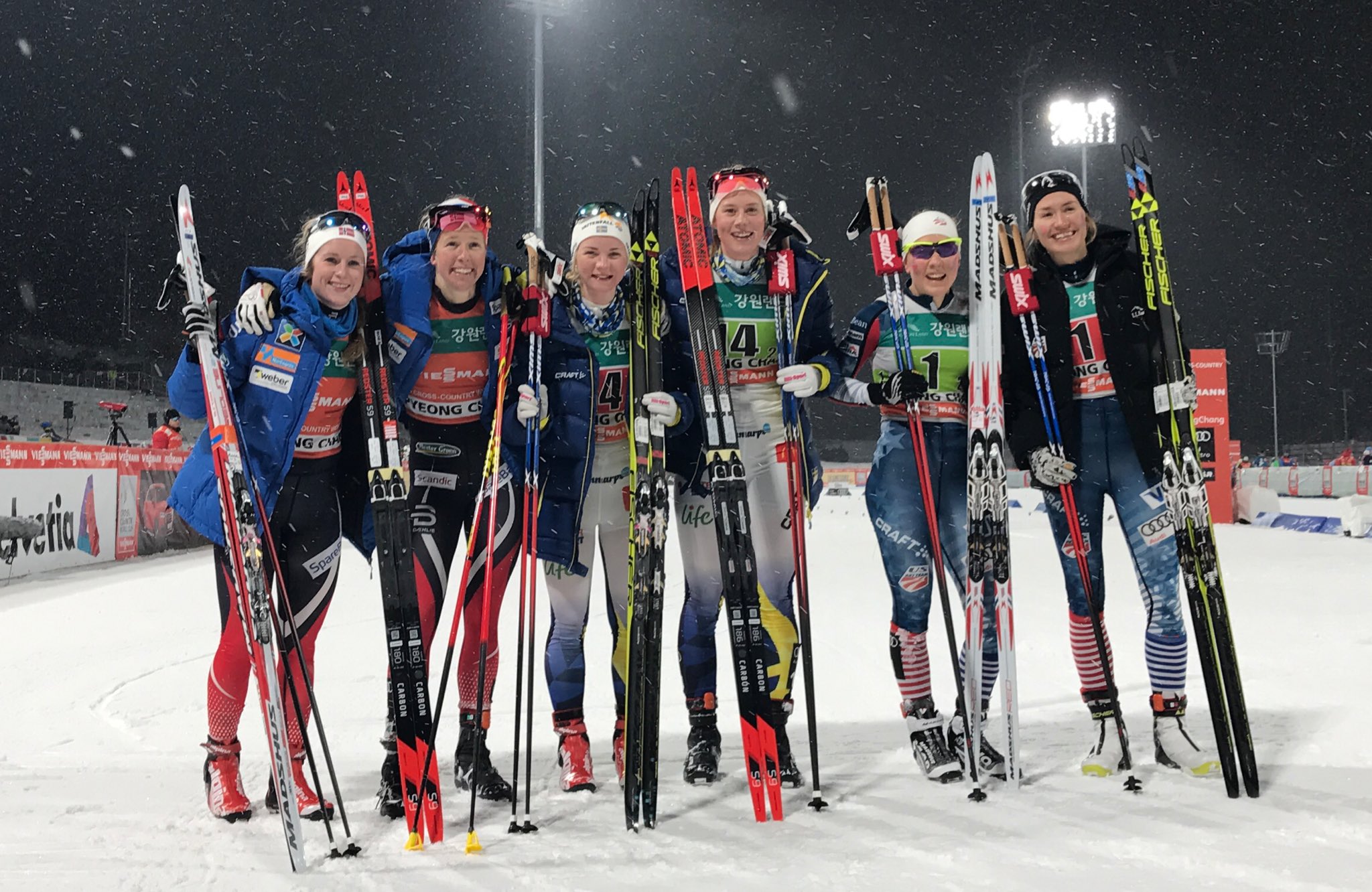
The women’s freestyle team sprint podium at the PyeongChang World Cup on Sunday in South Korea, with Sweden’s Elin Mohlin and Maria Nordström (c) in first, Norway’s Anna Svensen and Silje Øyre Slind (l) in second, and USA I’s Ida Sargent and Sophie Caldwell (r) in third. (Photo: FIS Cross Country/Twitter)
The U.S. women had one team on the podium and one just 0.35 seconds off of it on Sunday in the World Cup 6 x 1.4-kilometer freestyle team sprint in PyeongChang, South Korea.
USA I, with Sophie Caldwell and Ida Sargent, skied in third for most of the race and ultimately finished third, 6.11 seconds behind Sweden’s Elin Mohlin and Maria Nordström in first (in 20:37.11 minutes). Norway took second, 1.71 seconds back, with Anna Svensen and Silje Øyre Slind, while USA I edged USA II, with Caitlin Patterson and Liz Stephen for third. Patterson and Stephen ended up fourth (+6.46), ahead of Slovenia’s Katja Visnar and Anamarija Lampic in fifth (+14.46).
Fifteen women’s teams competed on Sunday, with 10 of them reaching the final. Canada placed 14th overall with Annika Hicks and Sadie White.
In the men’s 6 x 1.5 k freestyle team sprint, Russia’s Gleb Retivykh picked up his second win in in PyeongChang, after winning Friday’s classic sprint. He teamed up with Andrey Parfenov for the victory in 19:34.11, beating France (Baptiste Gros/Lucas Chanavat) by 0.03 seconds in a photo finish.
Russia had two teams on the podium with Russia II’s Artem Maltsev and Nikita Kriukov in third (+5.52). Andy Newell and Simi Hamilton (USA I) fell off the leaders’ pace to finish fourth (+24.23), 18.71 seconds off the podium.
USA II, with Scott Patterson and Matt Gelso, finished ninth (+54.85) in the final, and Canada’s Jess Cockney and Len Valjas placed 13th of 14 teams.
NorAm Eastern Canadian Championships (Cantley, Quebec): 15/20 k freestyle pursuits
SMS Elite’s Anne Hart catching Nakkertok’s Zoe Williams in the interval start classic, day two of Eastern Championships. (Photo: Ian Austen)
The NorAm mini tour at the Nakkertok Nordic Centre wrapped up with freestyle pursuits.
In the men’s 20 k, AWCA’s Russell Kennedy posted the fastest time of 53:42.68 to move up from third to take the overall victory in 1:33.22. Lappe Nordic’s Andy Shields started first but couldn’t hold off Kennedy, finishing 36 seconds behind with a 6th best time, 1:01.46 slower. AWCA’s Dominique Moncion-Groulx wrapped up a strong weekend with the fourth best time of day, 37.92 back, to take third overall, 58.53 behind Kennedy.
SMS Elite’s Anne Hart won the women’s 15 k pursuit in dominant style, starting first and winning time of day in 47:36.10 for an overall time of 1:17:39. AWCA’s Maya MacIsaac-Jones started third and finished second with the second best time of day, 31.36 seconds back for a combined deficit of 51.39 seconds. CNEPH’s Sophie Carrier-Laforte started second and ended third, 2:14.81 down after a sixth best time of day 2:05.47 back.