From the FasterSkier archive — posts syndicated from athletes’ and coaches’ own blogs between 2004 and 2012, kept online as published. Current coverage is at fasterskier.com.
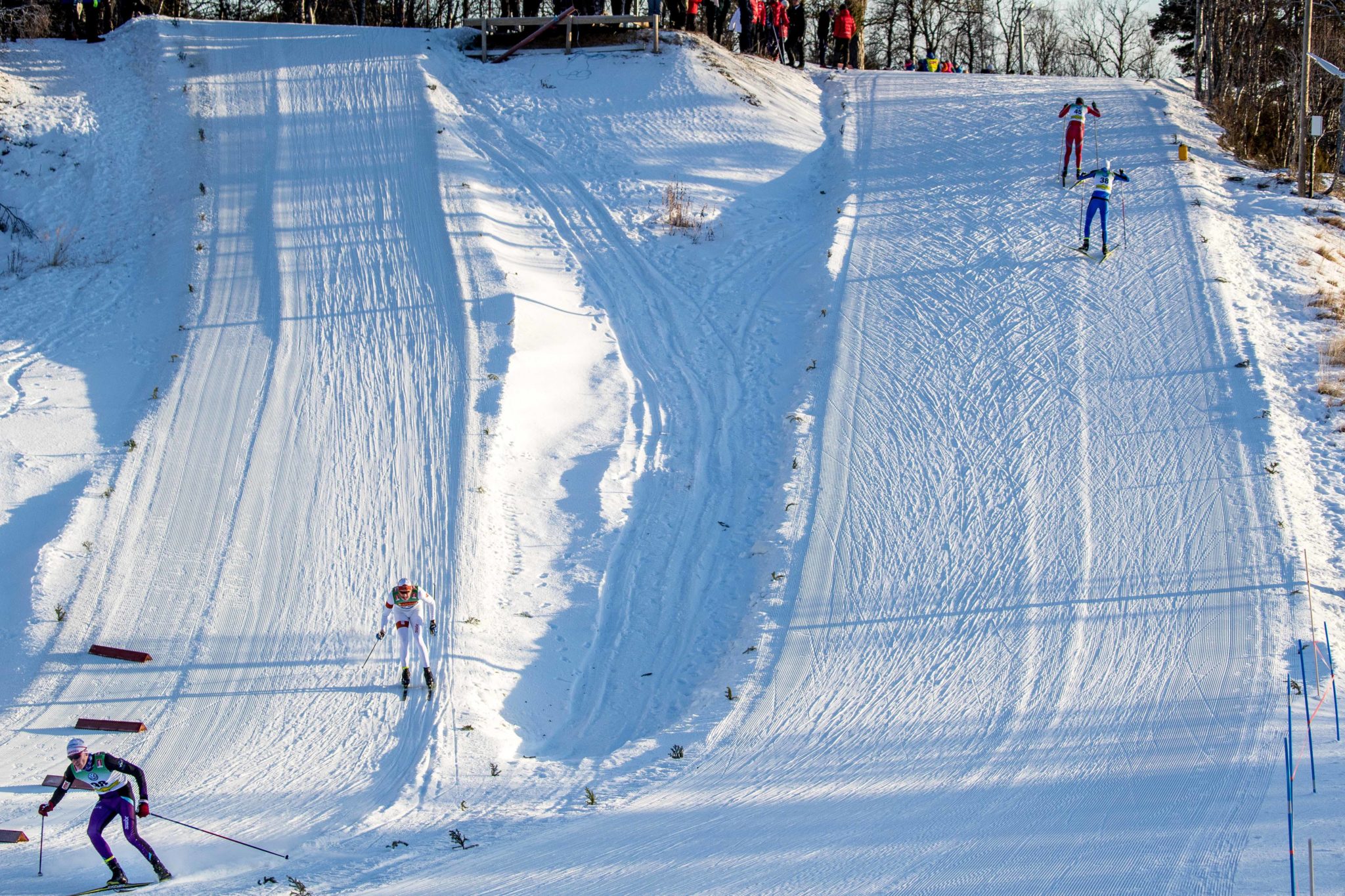
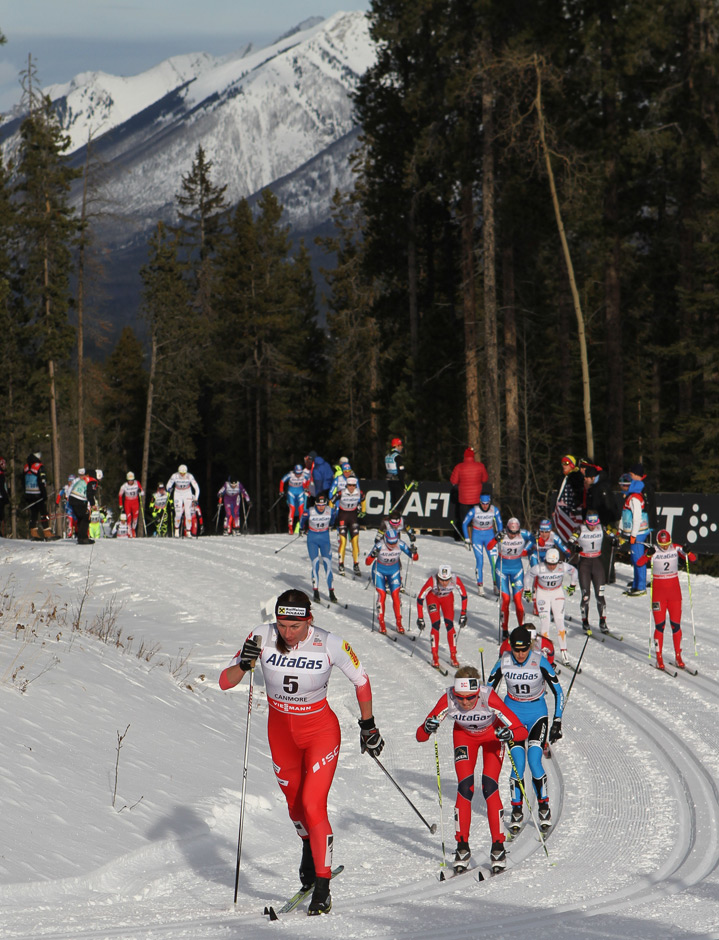
Racers navigate a steep climb and descent on the race loop at Bruksvallarna on Saturday. (Photo: Jocke Lagercrantz/Bruksvallsloppet.se)
The World Cup season draws ever-closer as season-opening races continued this weekend in Sweden, Finland, and Switzerland.
In Muonio, Finland, a long weekend of racing wrapped up with 10 and 15 k skate races. Finland’s Anne Kylloenen took the win in the women’s 10 k, besting Emilie Kristoffersen of Norway by 8.2 seconds. Kylloenen’s national-team teammates Laura Mononen and Aino-Kaisa Saarinen took third (+14.0) and fourth (+17.1), respectively. Merete Myrseth, a Norwegian skier who competed for the University of Utah on the NCAA circuit last season, finished 17th, +57.1.
In the men’s 15 k, Alexey Chervotkin of Russia took a 13.8-second win over Iivo Niskanen of Finland. Denis Spitzov of Russia was third, +17.5, and University of Utah alum Snorri Einarsson fourth, +21.2. Einarsson is competing for Iceland. Graham Nishikawa of Canada finished 19th, +1:14.4, and Brian McKeever 40th, + 2:05.3.
Finishing sixth (+37.0) was Maxim Vylegzhanin of Russia, who made his second flower ceremony of the weekend. The International Olympic Committee (IOC) decided on Thursdayto strip the Russian skier of three silver medals from the 2014 Olympics for doping violations and ban him from all future Olympic Games. However, the International Ski Federation (FIS) has not yet taken any action since he and five other skiers were banned from the IOC, meaning that all six athletes are currently free to take part in non-Olympic ski competitions. FIS has not yet responded to a request for comment about Vylegzhanin’s continued competition.
https://www.instagram.com/p/BbZO7VFFYpg/
In Bruksvallarna, Sweden, Sunday meant skate sprinting, and Norwegians took both the men’s and women’s wins. In the men’s race, Paal Troean Aune bested countryman Even Northug in the final, with Anton Persson the only Swede on the podium in third. None of the top sprinters from either country competed. Jack Carlyle of Canada finished 60th, 19.4 seconds behind Aune’s qualifying time.
In the women’s sprint, Wenche Aune Snildalsli took the win over four Swedes: Emma Thalin, Moa Olsson, Jackline Lockner, and Wilma Joensson were next across the line, and Latvia’s Patricija Eiduka finished sixth.
A large contingent of international racers has also been training in Davos, Switzerland, where organizers have a lengthy saved-snow loop covering some of the same terrain which will host the World Cup in mid-December. On Friday and Saturday, the Swiss competed with the German and Italian teams in sprint and distance races, with a few individual athletes from other countries attending as well.
In Friday’s sprints, Laurien Van Der Graaf came out on top for the home team, besting Germany’s Laura Gimmler and Steffi Boehler in the ‘A’ final after Gimmler had won beat her by 1.59 seconds in the qualifier. Fourth place went to Sandra Ringwald, also of Germany, and fifth to Ilaria Debertolis of Italy. In the men’s sprint Thomas Bing claimed the win for Germany, skiing away Switzerland’s Erwan Kaeser by more than two seconds. Giacomo Gabrielli and Stefan Zelger of Italy were third and fourth, and Janosch Brugger of Germany rounded out the ‘A’ final in fifth.
https://www.instagram.com/p/BbUYGpgl2V_/
In Saturday’s distance races, Katerina Smutna – racing for the Czech Republic after taking a break for several years to focus on a long-distance marathon career – won the three-lap, 10.5 k competition by just three seconds over Katharina Hennig of Germany, with Boehler another 12.2 seconds back in third. Van Der Graaf finished fourth, + 27.1, and Debertolis fifth, +39.6.
In the men’s four-lap race, covering 14 k, Swiss Olympic gold medalist Dario Cologna took a commanding 26.6-second win over Russia’s Ilia Chernousov. Jonas Dobler of Germany claimed third, +33.8, with Giandomenico Salvadori of Italy fourth (+59.2), narrowly beating out Livio Bieler of Switzerland (+1:00.9).
Chernousov could soon become an Olympic champion like Cologna. Vylegzhanin’s disqualification from the 2014 Olympics, along with that of Alexander Legkov, leaves Chernousov to inherit a gold medal in the 50 k freestyle, where he initially finished third. He has not been named in any of the doping investigations by the World Anti-Doping Agency or the International Olympic Committee. In fact, a Russian ski coach recently claimed that Chernousov had turned whistleblower and informed against his Russian teammate, but Chernousov has denied that allegation.
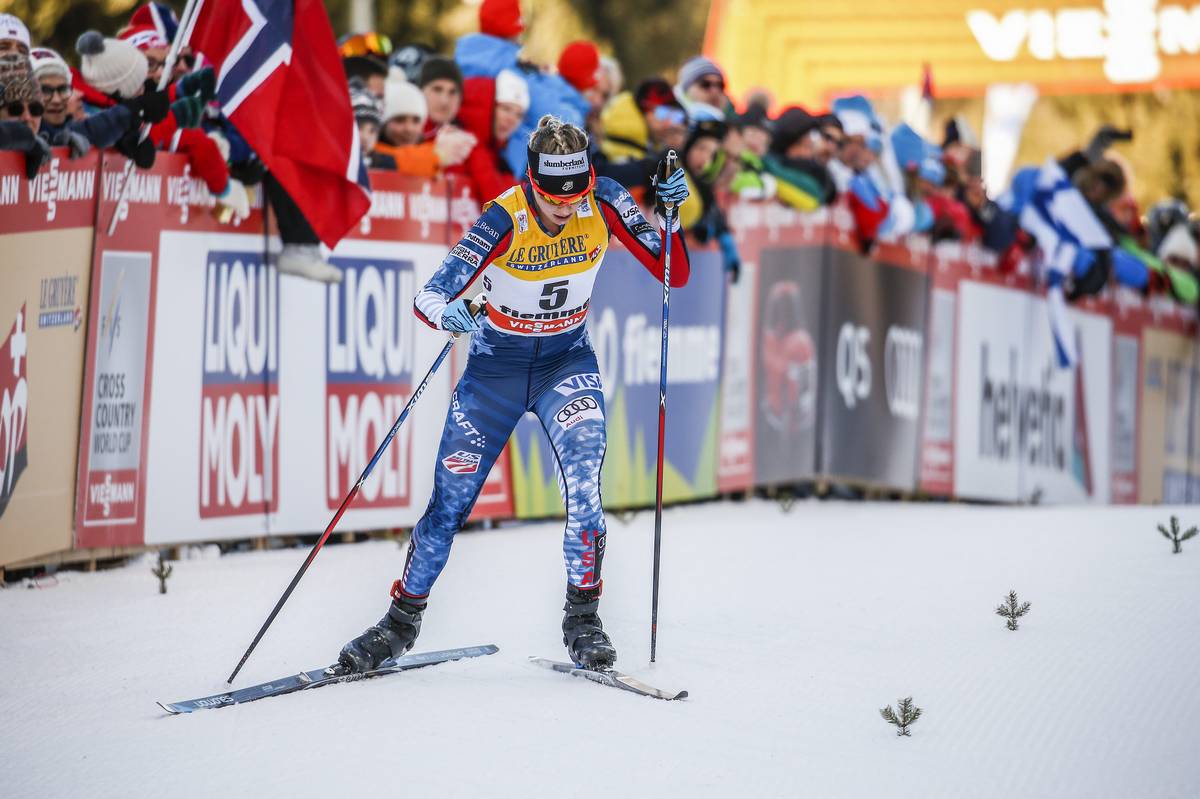
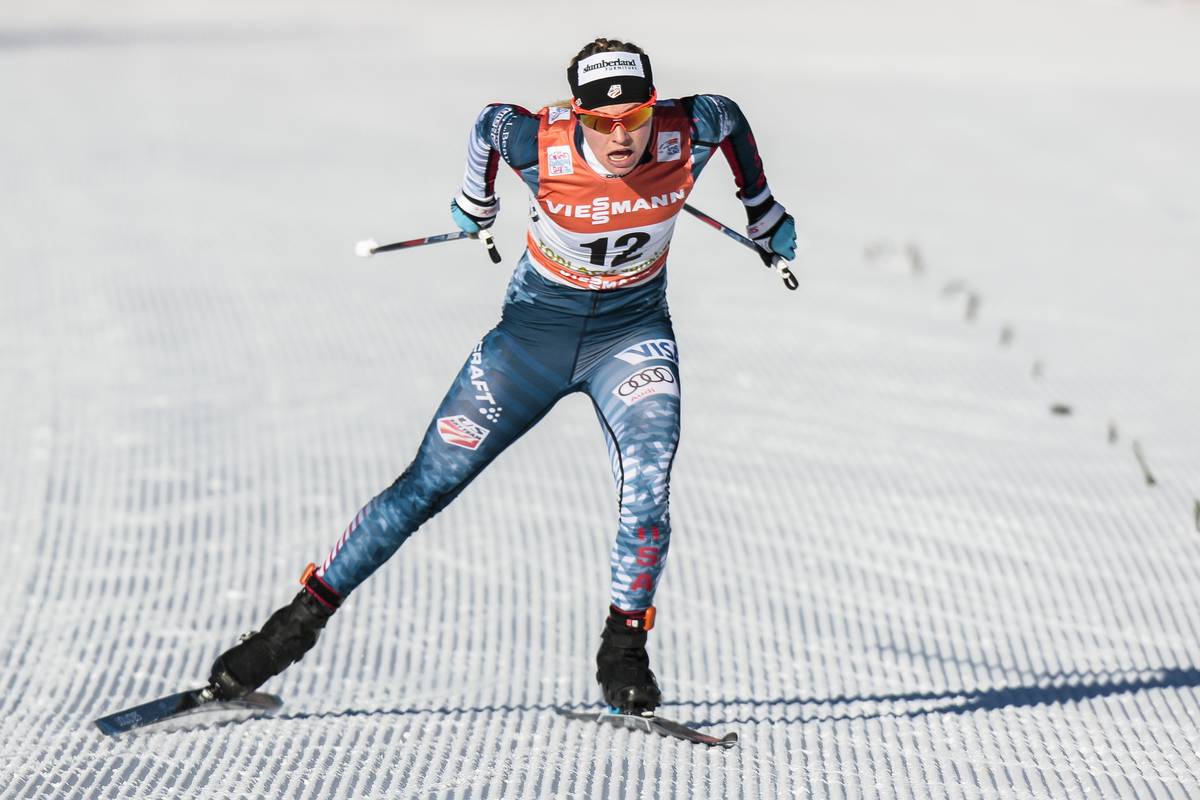
Jessie Diggins (U.S. Ski Team) racing to fifth in the women’s 9 k final climb up Alpe Cermis in Val di Fiemme, Italy, for fifth overall in the 2017 Tour de Ski. (Photo: Salomon/NordicFocus)
Sweden’s Stina Nilsson didn’t fancy herself a favorite for this year’s Tour de Ski title, despite having won four stages and wearing the leader’s bib to start out today’s final race.
And after about six kilometers of the 9-kilometer climb up the Alpe Cermis, everyone knew why.
Heidi Weng, a Norwegian who had started 19.2 seconds behind Nilsson, had slowly gained ground on the Swede in the flat sections leading up to the climb itself. At 6.2 k, she caught Nilsson.
Weng barely paused and certainly never looked back. Instead, she stepped on the gas. Weng clocked the fastest time up the hill of any woman in the field and skied to a 1:37.0 win for her first-ever overall Tour de Ski title.
Weng, in tears during interviews, was overcome at winning her first major title. She has had dozens of podiums, including three in the overall Tour de Ski and one after the Ski Tour Canada last season. But she had yet to collect a tour win.
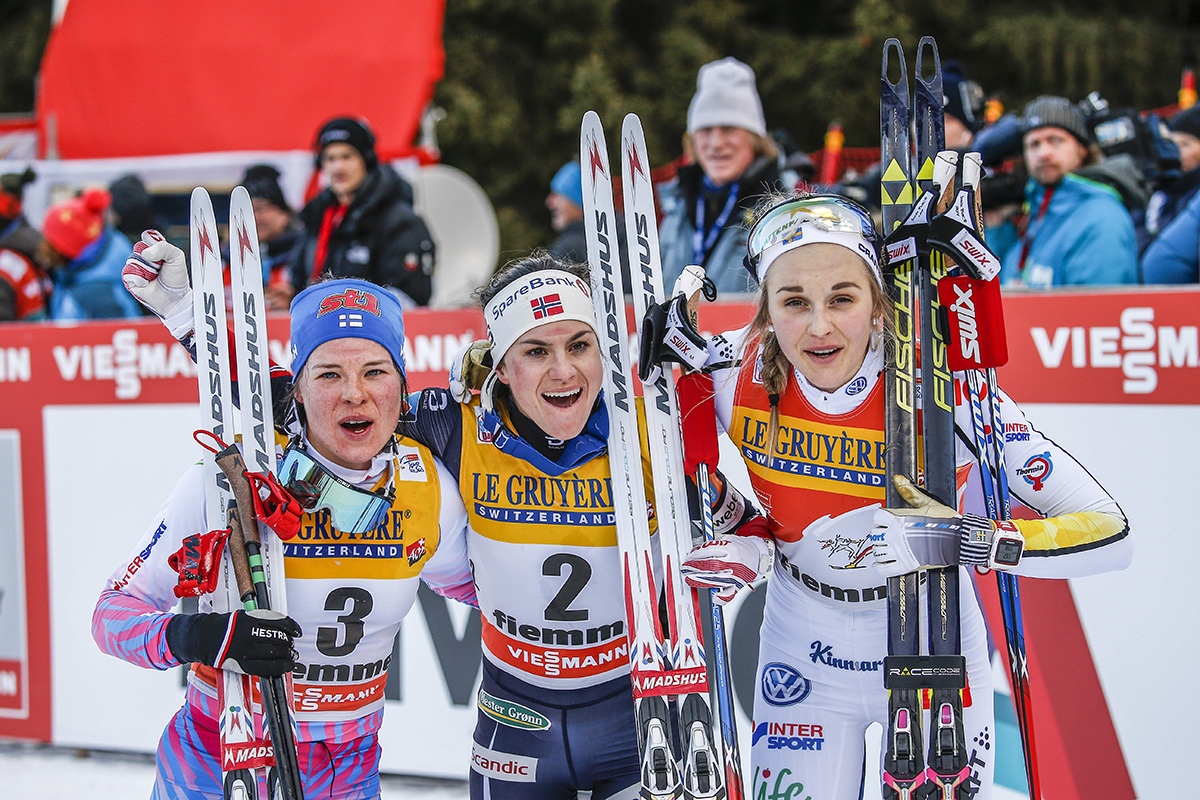
The 2017 Tour de Ski women’s podium, as determined by the final climb on Sunday in Val di Fiemme, Italy, with winner Heidi Weng (c) of Norway, Finland’s Krista Parmakoski (l) in second, Stina Nilsson (r) in third. (Photo: Fischer/NordicFocus)
Climbing, though, is a strong suit of hers. And she received some motivation from teammate Therese Johaug, who has won both the Tour de Ski and the final climb before but is sidelined for a doping violation.
“Therese said, ‘You can do it. You are a machine climbing.’ And I thought, ‘Such a machine, that’s not me.’”
But she was, matching Johaug’s time from the previous year (although snow conditions were different).
“It’s crazy big – it hasn’t dawned on me yet,” Weng told VG. “It has been an exhausting tour… I was nervous all the way and now I’m ecstatic.”
After getting dropped by Weng, Nilsson’s trials still weren’t over. The rest of the field was coming for her too. They knew that the previous year she had skied just the 40th-fastest time up the climb and guessed that she was likely to be suffering again this time around.
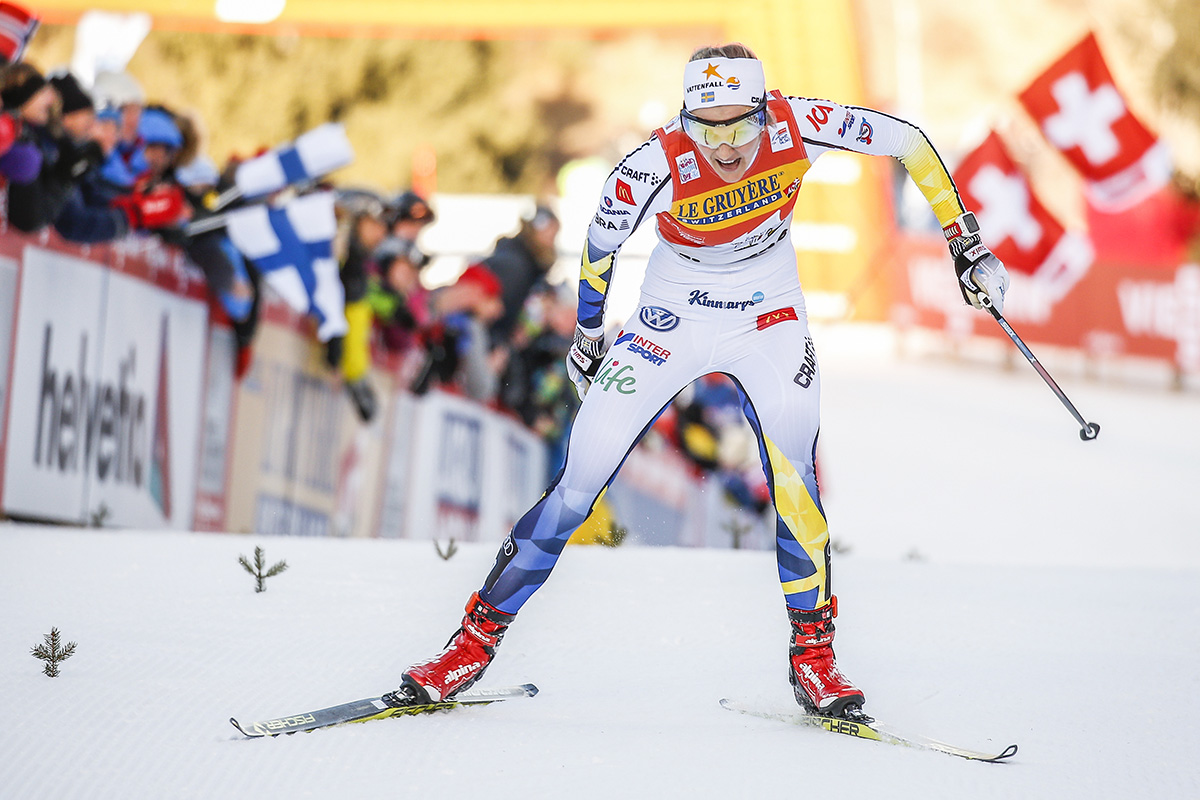
Sweden’s Stina Nilsson racing to third in the final climb of the 2017 Tour de Ski up Alpe Cermis in Val di Fiemme, Italy. (Photo: Fischer/NordicFocus)
Nilsson has improved a lot in the last year – her many World Cup wins and podiums can attest to that. And she cut her margin to the leader in the climb time more than in half this year, from 5:57 behind Therese Johaug in 2016 to 2:13.6 behind Weng this time.
But she was still suffering. And at 8.1 k, Krista Parmakoski of Finland caught her.
Parmakoski had skied out of the start in third place, and made up 54 seconds on Nilsson. She appeared exhausted, and rather than blowing by the Swede as Weng had done stayed behind her for a bit. But then she, too, moved past and opened up a gap that grew to 17.4 seconds at the finish.
“I had a really good day,” Parmakoski told FIS. “I have been many times fourth, so it is great to be on the podium. Today I felt great and surprisingly fast on the climb.”
But even then, Nilsson wasn’t out of danger in her quest for a podium.
Ingvild Flugstad Østberg, whose hopes of a Tour title had been dashed by a rough 10 k the day before and who had started fourth, was on the hunt.
The Norwegian had Nilsson in her sights and appeared to be making up ground. But Nilsson buckled down on the climb’s upper reaches and sprinted it in to the finish, podium secure.
“For the first time I wish the course was a little longer,” Østberg lamented to NRK.
“I’m very pleased with how I held it together,” Nilsson told Expressen. “I tackled this much better than I have all year… I’m so glad I made the bronze. It was so nice to snag third place! I was glad I had a sprint when Ingvild closer to the end, because I had no desire to come in fourth.”
Østberg was disappointed to be off the podium, but congratulated her Swedish rival.
“It was a bitter, sour fourth place for me,” she told Expressen. “But it is well deserved for Stina get a podium when she won so many races.”
Diggins Secures Fifth, Tying Best U.S. Result
Jessie Diggins had started the day in fifth place, and came in with dual ambitions: “chase fourth, but protect fifth.”
“I knew that there was some good climbers behind me,” the American skier explained in a phone interview. “And I knew that I had to have a decent day to hold them off, because things can change dramatically on that hill. So I was trying to catch Østberg, but part of my plan was… don’t blow up so badly that we lose what I already had.”
She has been making steady progress in managing the final climb. In her first go-rounds, in 2013 and 2014, she clocked the 20th-fastest times up the hill; in 2016 she was 15th; and today, her time came in 11th.
“In past years I have tried to catch people right at the base of the climb, and if you blow up there you are screwed,” Diggins said. “You can just bleed minutes of time. I really wanted to be going as hard as I could right before blowing up if that makes sense, find that line and ride it. Then at the end I really started trying to push, but… I started losing time because I was just getting extremely fatigued. But I think this is one of my better climbs because I was able to not just blow myself open.”
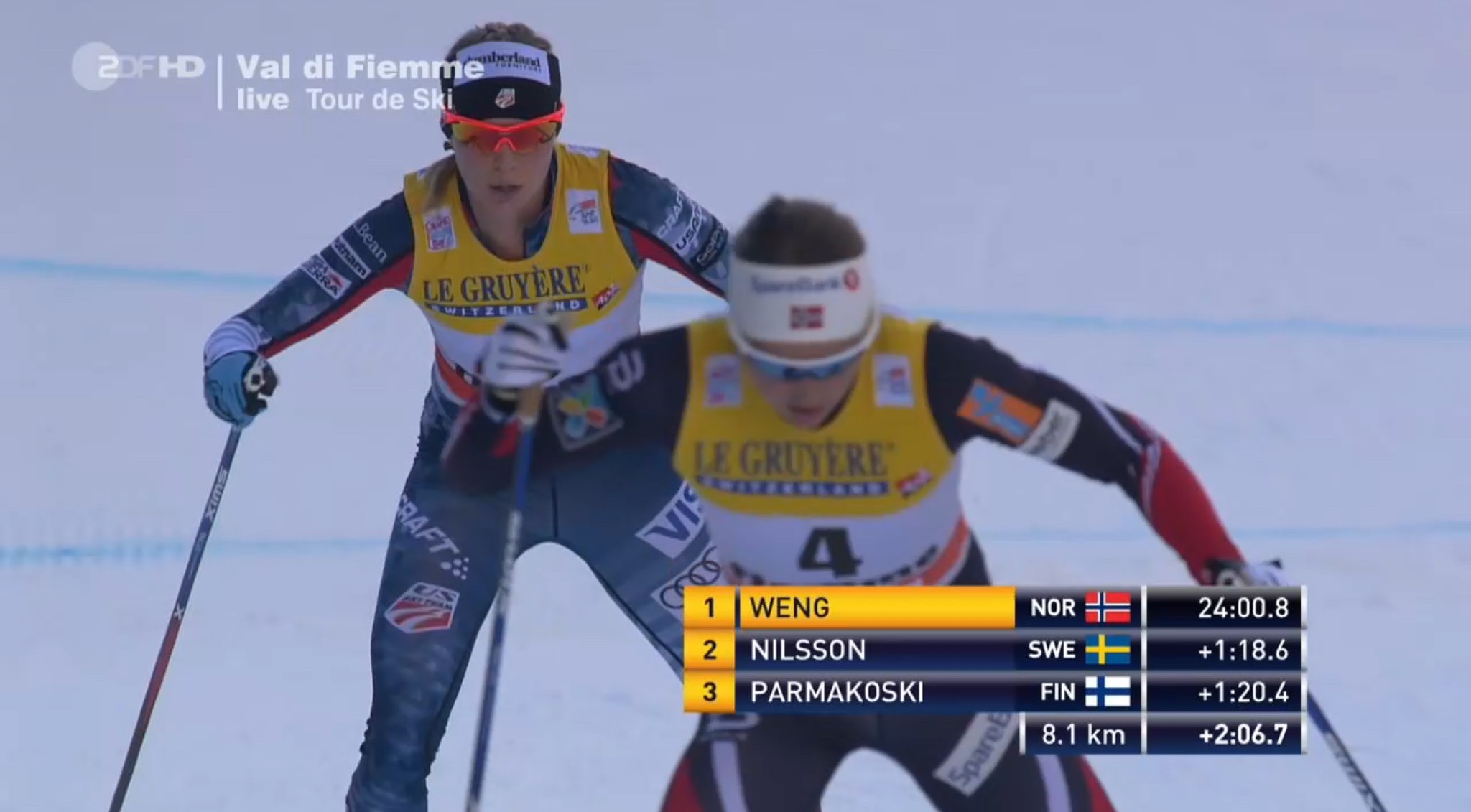
American Jessie Diggins chasing Norway’s Ingvild Flugstad Østberg on the final climb of the 2017 Tour de Ski up the Alpe Cermis in Val di Fiemme, Italy. Østberg finished the Tour in fourth and Diggins fifth, tying a best-ever mark for the U.S., set in 2015 by Liz Stephen. (Photo: ZDF screenshot)
Diggins had closed in on Østberg, and was at one point quite close. But feeling under threat – and maybe simultaneously perceiving that third place might be within her reach – Østberg pulled away.
“I was trying to hang with Østberg, thinking maybe if it comes to a sprint-off I could get her, but I wasn’t trying to sprint up to her to close the gap because I knew that would have disastrous results,” she said. “At one point I was like 25 feet behind her, but then I couldn’t quite hold on. She was so mentally strong, she really galvanized me at the end. I kept my spot; I was really happy to finish in fifth.”
That ties Diggins for the best American finish ever in the Tour de Ski, a mark set by Liz Stephen in 2015. Diggins also finished fifth in last year’s Ski Tour Canada.
“I mean any time you can be like Liz Stephen it’s a really good day,” Diggins laughed.
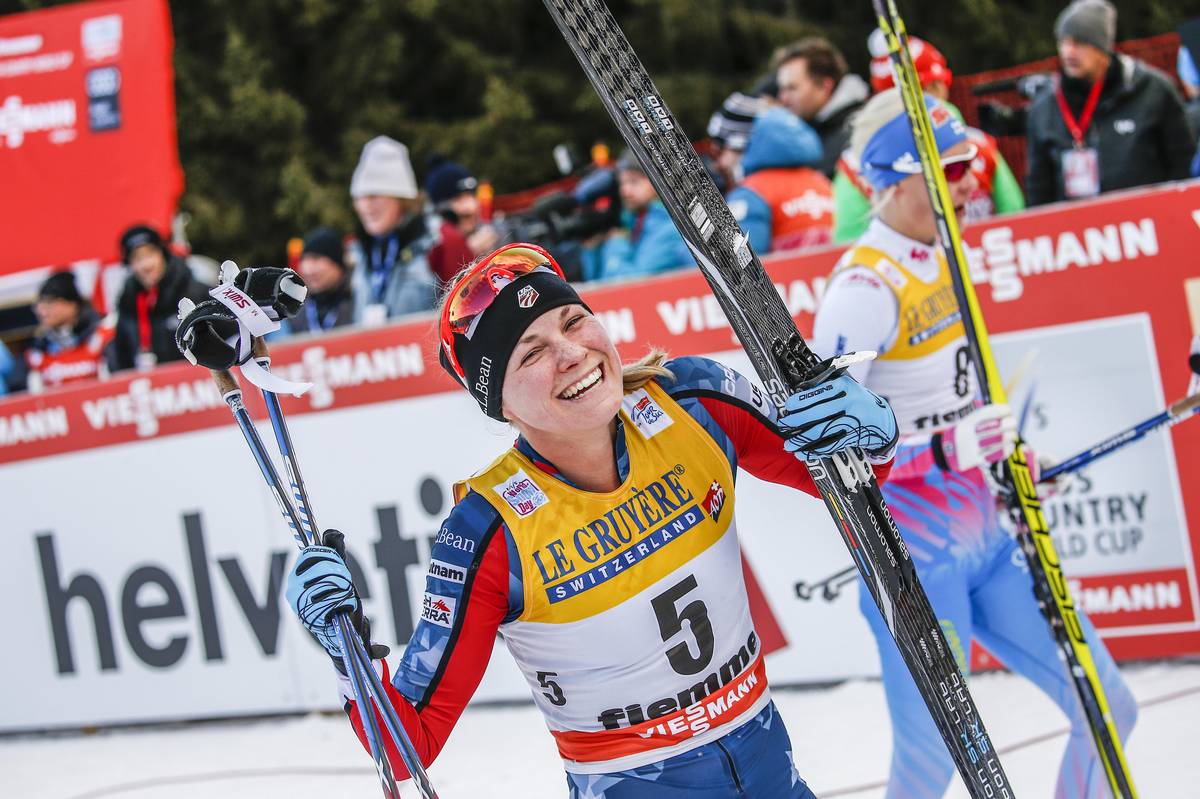
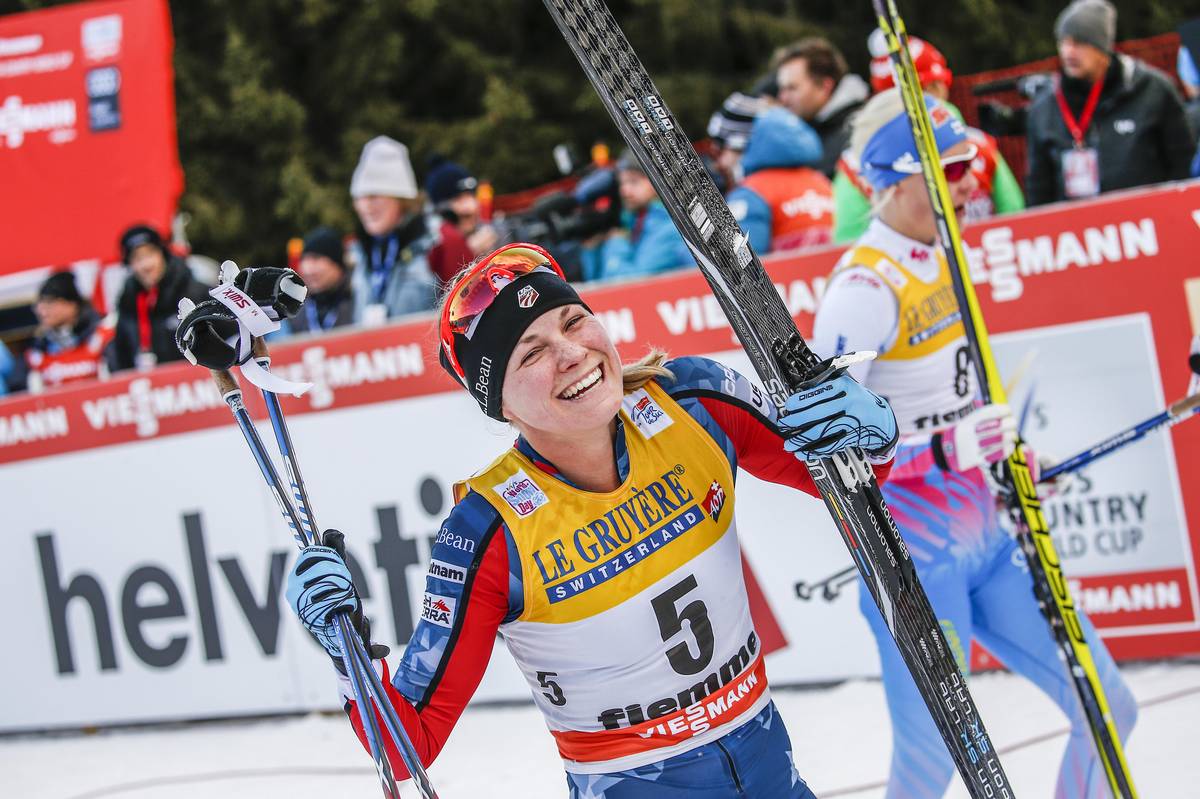
Jessie Diggins (U.S. Ski Team) smiles after finishing the 2017 Tour de Ski in fifth place on Sunday in Val di Fiemme, Italy. (Photo: Salomon/NordicFocus)
But besides her own efforts, she was impressed with the whole team that made it possible for her to have a top overall result.
“It takes an immense effort from the wax tech and the staff, and the massage and physical therapists, and the athletes and everyone — being positive and staying on it,” she said. “To be able to string together race after race, without any of them being bad, without losing your overall place in the Tour. You’re bound to have a day that is not great, but you need to be able to put together solid enough performances to keep going.”
Not just in the context of a Tour, but in terms of the World Cup season, that has been a goal for Diggins.
“It’s something that I have been working on, is consistency through my skate and classic and sprint and distance,” Diggins said. “So that’s what I am really proud of because I have been working towards it.”
Stephen Second-Fastest Up Hill, 14th Overall; Brennan 28th
The U.S. Ski Team’s Liz Stephen was making a bid to win the hill climb. Doing so would have made her the fourth U.S. woman in history to notch a Tour de Ski stage win behind Kikkan Randall, Sophie Caldwell, and Diggins.
She came up just short, finishing 38.2 seconds behind Weng’s fastest time up the Alpe Cermis. Nobody else came closer.
“I wanted to win today for sure,” Stephen said. “It was a really good opportunity. I knew I would have to do a really good race to beat Heidi, but it was definitely the goal. So I was a little disappointed for sure with second — which sounds ridiculous, but the win was the goal.”
The U.S. team has set a culture of high expectations, and for years this has been the favorite day of a favorite race series for Stephen. This was the fourth time she has finished second in the climb, and she really wanted the win.
“You set out to win every day, but actually you have a realistic goal as well, generally, in your brain,” she said. “I think today it was realistic for me to win. Anytime you miss the goal that you set for yourself, you have a little bit of disappointment.”
But, she tried to also pick out some reasons to feel good about her race.
“It definitely does play a role I think that Heidi was going for her first Tour de Ski win… and to have $100,000 on the line, I am sure that also gave her even a little extra motivation,” Stephen said. “She was on fire today, and I never mind losing to Heidi. She is a hell of an athlete and a really fun person to know and I am really happy for her.”
For Stephen, disappointment means looking ahead. In 365 days (more or less), she’ll have another chance.
“I guess I have already set my sights on next year,” she said. “I want to win this thing before I retire. So we’ll see, maybe a little extra training for it specifically next year. I don’t know, maybe not. But yeah, I will try to do it again next year and see how it goes.”
Teammate Rosie Brennan started in a wave of five women at eight minutes behind Nilsson, and was the first from the wave to cross the finish line.
“The flat section is really narrow, and really hard to pass people,” she said in a phone call. “[The wave] is kind of a toss up: the flats are definitely hard for me, so it’s nice to be able to draft, but also when you’re going for time of day, it’s nice to have space to go when you want to go.”
When she got to the actual climb, Brennan began to feel better. The day before, she had surmised that the climb is actually straightforward when you’re tired. All that’s required is to just put one foot in front of the other.
“I tried to just chip away once we started the climb, and maybe a third of the way up it I started feeling pretty good,” she said. “I tried to move up a bit, and was able to pass a few people. Then I just held steady because at that point I was in no man’s land.”
With nobody close enough to catch, Brennan crossed the line 26th. Once her time was adjusted to account for the wave start, she was 28th overall.
“I’m happy with how the Tour finished,” she said. “The start was okay and the middle was really rough. Then I came around a little bit at the end. I really like tours, but it’s very challenging to put together a good tour. To be top ten even in a tour is an incredible accomplishment for anybody. It’s so hard to not lose time on any given day. I’m happy I was able to stick it out, and turn things around in the last few days. I’m satisfied with that, and hopefully I’ll get another chance next year.”
Looking to Refresh
Diggins, who was on the massage table during her interview, was very much looking forward to some rest and recovery.
“We’re going to go spend one day here [in Val di Fiemme] and then we are going to go up to Seiser Alm, which is where we usually go for our training camp,” she said. “It’s high altitude. It’s great living, we know the skiing is good, the food is good, so it’s a good place to kind of recover and regroup. And I plan on going sledding every day.”
For Stephen, a goal will be to keep the mindset she was able to achieve by the end of the Tour.
“I think this tour helped me get much better, not only in my physical state — I think that all of this racing has really helped where I am physically right now — but also, I think the daily race efforts mentally really get me going again,” she said. “The best thing sometimes this tour does for me is just puts me into race mode. Now the challenge will be, well, first to rest, but then to figure how to keep so mentally psyched and engaged in the sport I am doing … Hopefully I can rest a little bit and then get some really good training in and look forward to World Champs, and even the [World Cup] races in Sweden.”
Brennan won’t travel with the team but instead will do a recovery and training camp outside of Seefeld, Austria.
“It’s just to mix things up and take a break,” she said of her choice of Seefeld.
She will then rejoin the U.S. team in Sweden for World Cups.
“I had a little bit of a slow start to the season, and then in France I was finally able to turn things around,” she said of the pre-Christmas races. “But then I got really sick over Christmas. To be able to turn in this Tour makes me believe I’m okay, after that. It just took a while to get my energy back from that illness. Now I have the confidence that I will be able to take a rest, and train a little bit, and be back where I want to be come Sweden.”
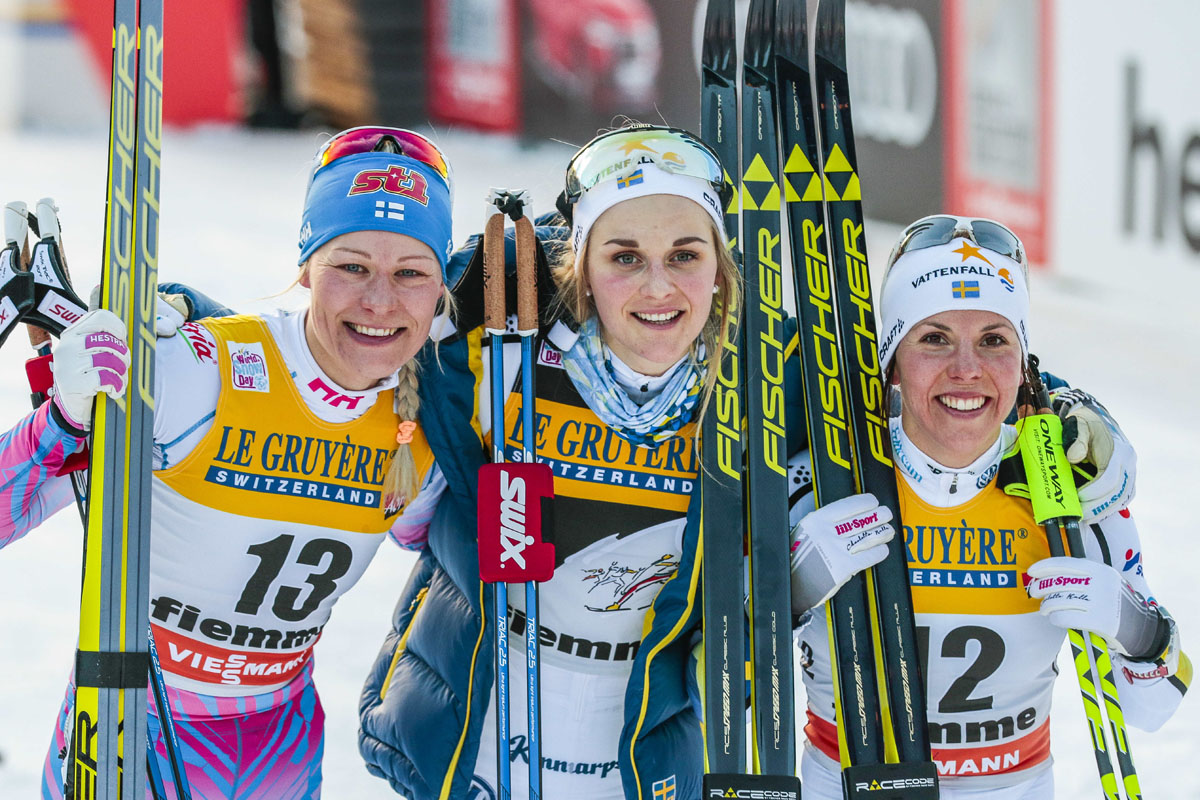
Stina Nilsson of Sweden (center) celebrates another win in the Tour de Ski, which puts her atop the overall standings; Anne Kyllönen of Finland (left) was second in the 10 k classic mass start and Charlotte Kalla of Sweden third. (Photo: Fischer/Nordic Focus)
As the Tour de Ski drags on, the World Cup field is tiring. Nobody – except maybe Sergey Ustuigov – has managed six good days in a row.
Everyone else has had at least subpar race. But sometimes a good day follows a bad one. Just ask Sweden’s Stina Nilsson.
23-year-old Nilsson had been leading the Tour after winning three out of the first four stages. But she finished 20th in the 5 kilometer freestyle on Friday – 40.5 seconds behind the time set by Jessie Diggins, and far from seeing any bonus seconds. So she lost the lead.
Saturday was a brand new day: the 10 k classic mass start in Val di Fiemme. As Nilsson noticed her rivals in the overall Tour standings slipping – quite literally, as some struggled with slick skis – she pounced.
First she won the bonus sprint at 3.6 k. It wasn’t something that she had planned ahead of time, but the opportunity seemed ripe for the picking.
And then as the race went on, Nilsson stayed always near the front. By the final 2.5 k lap she decided to push up the hills. The rest of the pack fell away, all except for Anne Kylloenen of Finland.
Coming down the hill to the finish she was able to pull away from Kylloenen, too. That gave her a 3.0-second win — and 30 total bonus seconds, 15 for the first sprint and 15 for the win. Voila – now she is back in the Tour lead.
“It is amazing,” Nilsson marveled to FIS. “You never know how the body bounces back. Yesterday was a difficult day. I am really happy with today’s result.”
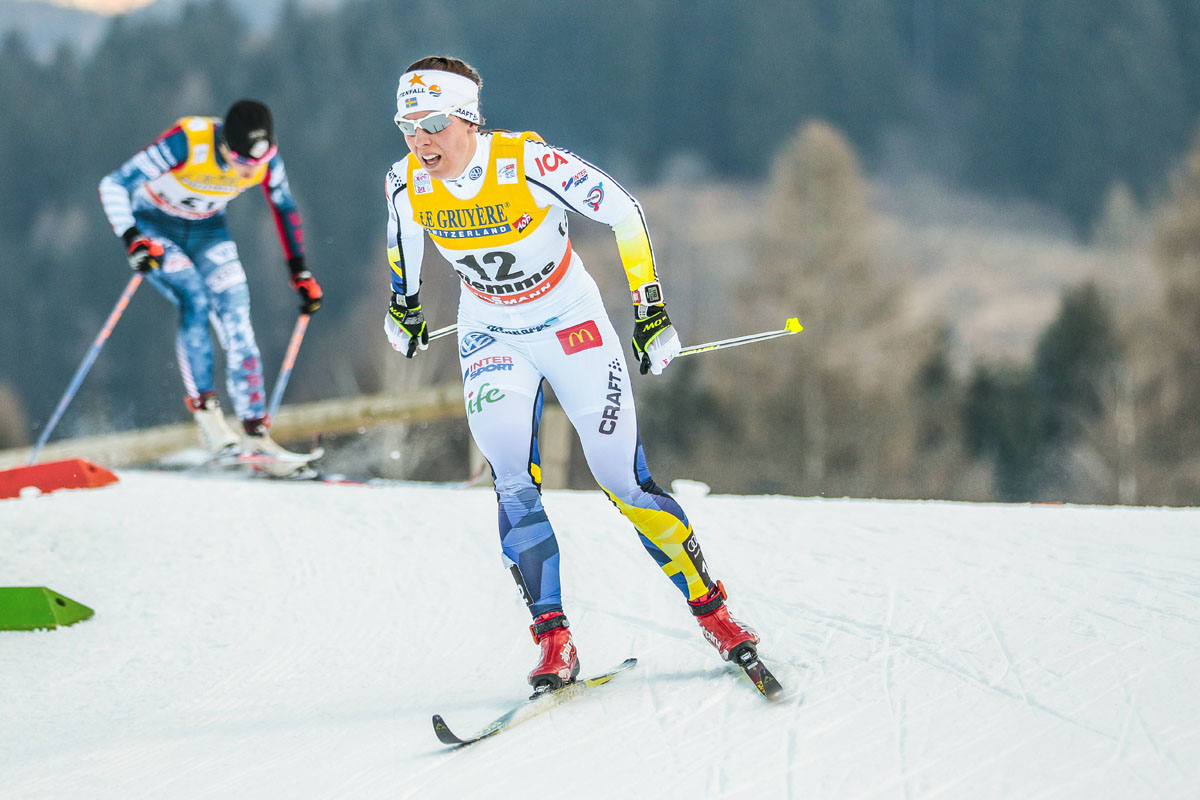
Charlotte Kalla of Sweden racing to third place in the 10 k classic in Val di Fiemme, Italy. (Photo: Fischer/Nordic Focus)
It was the first individual podium of the season for Kylloenen, and a strong day for Finland. Krista Parmakoski placed fourth (+9.4) and Kerttu Niskanen ninth (+19.8). The team is traditionally strong in classic skiing, and Kylloenen also credited their ski techs.
“It is great to be on the podium again, especially after I crashed today,” she told FIS. “I had to fight my way back in the race but in the end I felt very strong.”
While Kylloenen had praised her skis, one team wasn’t doing so. The Norwegians failed to reach the podium for a second straight day. Heidi Weng was their top finisher, in seventh (+17.5). She had been leading the Tour, but now sits 19.2 seconds behind Nilsson going into the final stage.
Kathrine Harsem finished 12th (+35.3) and Ingvild Flugstad Østberg 18th (+1:08.5). All three blamed their skis, which they said were too slippery and the worst in the field.
“It should be f–ing possible to wax properly, goddammit,” Harsem told NRK. “We have to try and put this behind us.”
For Østberg, it was a disaster in terms of the overall Tour standings, as she slipped from second place down to fourth, 1:23.3 behind Nilsson and 39.7 seconds behind third-place Parmakoski.
“It’s a lot to take in when you see your chances in the final standing go away,” she told NRK. “I am terrible at waxing myself so I’m not blaming anyone. They do all that they can and we do all that we can. You can’t always hit the bullseye, but of course it is even more frustrating when it’s a Tour.”
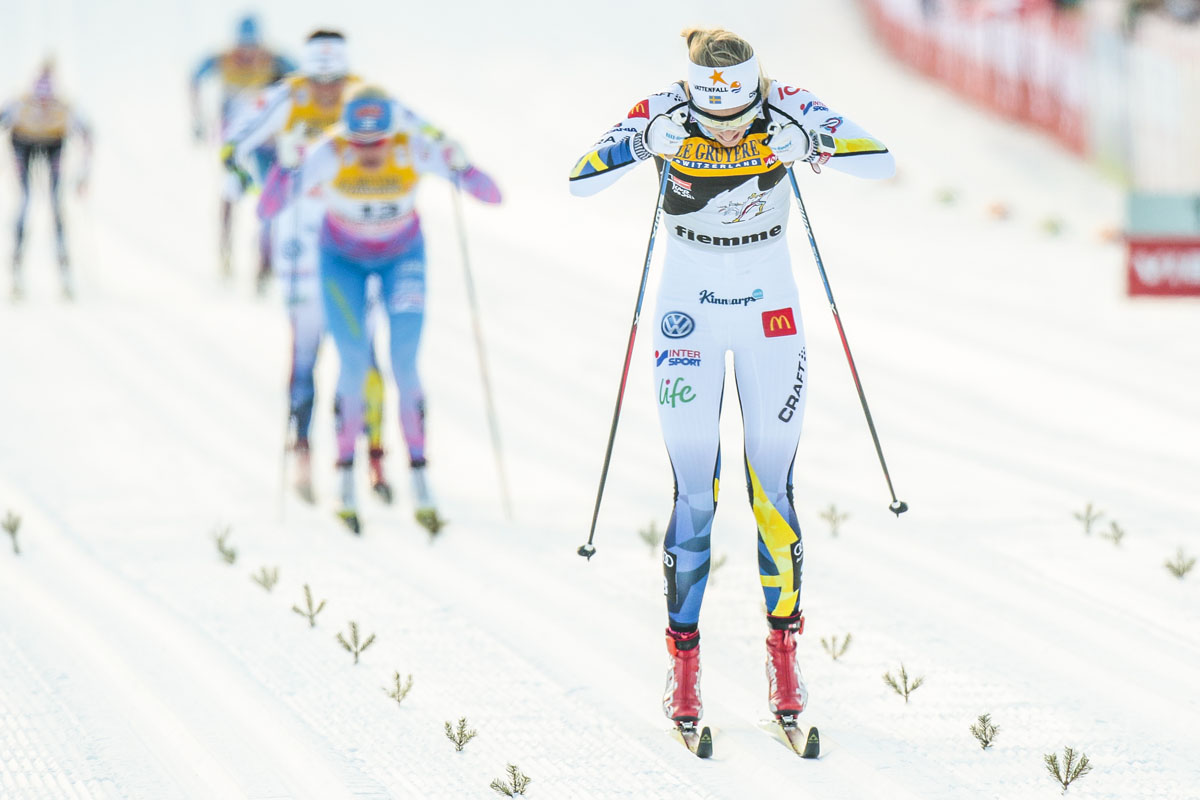
Stina Nilsson double-poling to the win in Val di Fiemme. (Photo: Fischer/Nordic Focus)
As for Weng’s chances of winning the Tour de Ski, they are still decent. She is currently 19.2 seconds behind Nilsson overall.
The final stage is a grueling 9 k climb up the Alpe Cermis, a stage where Weng has excelled in the past.
“It’s fun to still be in the race, “ Nilsson told Expressen. “It’s Heidi Weng and it’s Alpe Cermis… I see myself absolutely not as the favorite. But it’s fun to still be in the game a little bit.”
Nilsson hasn’t excelled in the climb – but she is also a much stronger skier than she was last season.
“Stina is in better shape than ever,” Weng told Expressen. “I don’t know if I will take her on the slopes in the morning.”
Diggins Eighth, Holds Tour Position
With her recent flurry of podiums and wins, eighth place might seem like a standard day for the U.S. Ski Team’s Jessie Diggins.
But in the 10 k classic? Not so much. Sure, she was eighth in the 10.5 k classic Ski Tour Canada stage in Montreal last season, but there she was 1:43.5 behind the winner, Therese Johaug (and 43.2 seconds behind second-place Weng).
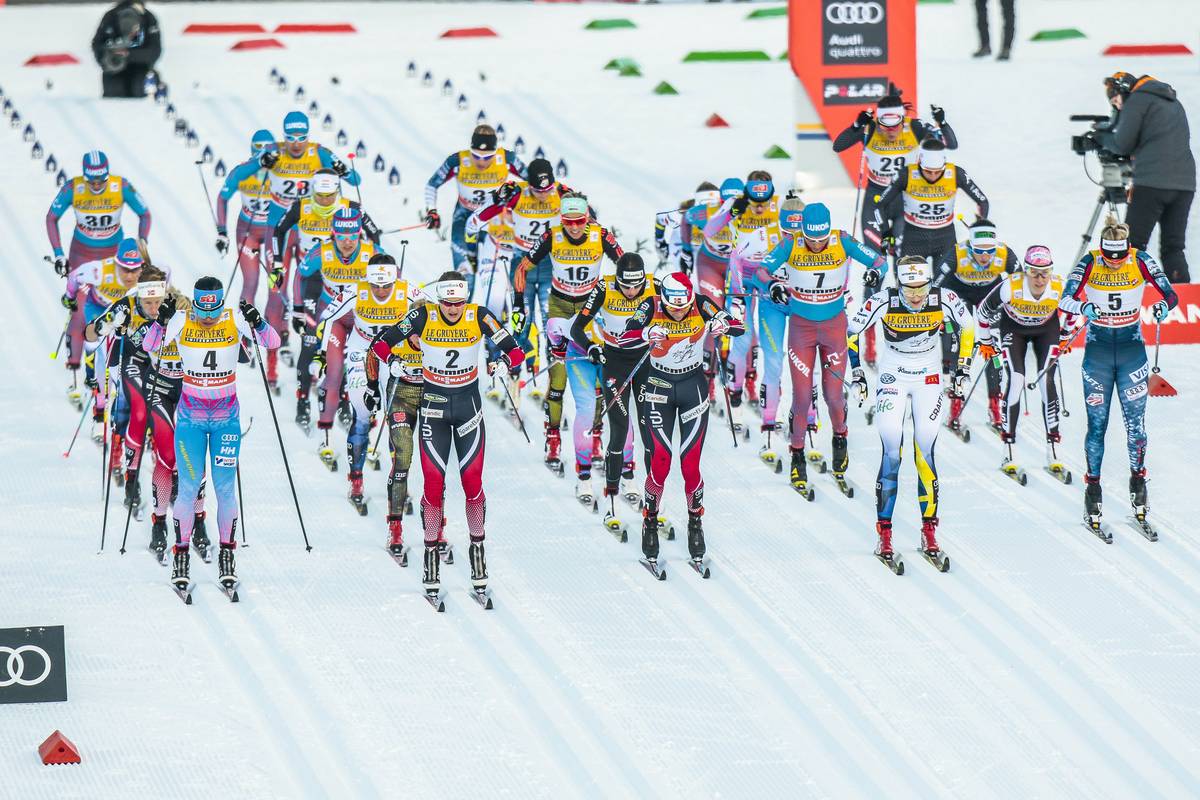
The women’s field, including Jessie Diggins in bib 5, takes off in the 10 k classic. (Photo: Salomon/Nordic Focus)
In Val di Fiemme, Diggins was eighth and only 19.5 seconds behind the day’s winner, Nilsson.
“I was psyched,” Diggins said in a phone interview. “I don’t know that I’ve ever been within 19 seconds of the leader in a 10 k classic.”
The result came from a combination of attitude and strategy, Diggins said.
Attitude: “I was channeling my classic-loving teammates today, thinking, ‘Okay, what would they do? They would not fall down, they would stay upright on the climbs. So I’m going to try to do that too.’ And basically, I raced today thinking only positive things to myself.”
Positive thinking can get you far – Diggins knows that as well as anyone. But she also knew she had to race smart. In order to have the best possible final Tour de Ski position, she was racing for time back from the winner, not necessarily place. So she picked her battles.
“I was trying to stay within sight of the leaders for absolutely as long as possible,” she said. “That meant that when everyone was kind of sprinting for the bonus sprint, I didn’t do that because I didn’t want to implode. So then I was able to reel my way right back in afterwards, and I was really psyched about that.”
For much of the race she held on to the back of the lead group, never falling off, but rarely part of the mêlée.
“People are switching lanes, cutting each other off, stepping on each other, and I was like, ‘Okay. I’m just going to do my thing in the back, and ski as smooth as I can’,” Diggins explained. “And then I knew the pace was going to go up on the last lap. I wanted to be able to respond to that attack as well as I could, so I just kind of stayed out of trouble. And that tactic worked out well for me today.”
A number of racers, including Kalla and Parmakoski, fell on a sharp corner coming into one of the course’s steep downhills. That, too, was a reason for Diggins to use caution.
“The worst thing I could do for myself in this race is to have some accident happen and lose a ton of time,” she said. “There was a little bit of a hairy corner there. I watched a girl half jump over another skier to avoid a crash. I remember thinking, ‘Wow, I’m so impressed. It’s the middle of the race, but I’m just so impressed right now.’ So I stood up [to avoid it]. I just wanted to stay out of trouble.”
Jessie Diggins (U.S. Ski Team) racing to first for her third-straight 5 k freestyle victory on Friday at Stage 5 of the Tour de Ski in Toblach, Italy. Diggins won her first World Cup race in the Toblach 5 k one year ago. (Photo: Salomon/NordicFocus)
As Nilsson upped the pace on the final lap, Diggins found it harder to stay with the leaders. She put her head down and dug, and knew that she had one trick card up her sleeve: the course’s downhill finish.
If the Tour de Ski has demonstrated anything, it’s that Diggins loves downhills.
“I knew that I had a chance of catching the girl in front of me if I really skied the downhill perfectly, and then hopped out of her draft at the right time,” she said. “It was really fun to actually execute a long-distance slingshot. [Niskanen] gapped me over the top of the hill. Kerttu’s a really good skier. But it was really fun to be able to actually pull it off.”
All in all, Diggins wanted to be there for the final sprint, to be close to the winner – but being 20 seconds back, she’d take it. She credited Niskanen with helping her not lose more time on Nilsson.
“We helped each other give everything we had,” she said. “When you’re duking it out with someone, you both move faster, which was cool… 10 k classic has never been my marquee event, I guess you could say. But I was really proud of myself for giving it my best shot. And not giving up, and really just going after it.”
More Points for Stephen and Brennan
By the end of the first lap, American Liz Stephen – starting from bib 21 – was holding her position and within ten seconds of the leaders.
But within a kilometer, Stephen found tat she couldn’t hang on.
“Classic is just a continuous work in progress for me, and I was hoping to feel a little more energetic out there than I did,” she admitted in a phone call. “But it’s my favorite course on the World Cup, so I was having fun out there, for sure. There seems to be this gap that I can’t quite close in classic. It happened again today. Right off the back of the leaders, and right off the back is just not close enough. Then the gaps open and I’m not there to cover the gaps, and they just get bigger and bigger.”
She finished 19th – 1:11.2 behind Nilsson, just one spot behind Østberg.
“Hell, I almost beat Ingvild today, and that doesn’t quite feel right,” Stephen said. “I certainly got to ski right behind her, which I haven’t done for five or six years. There were some highlights… I really do enjoy skiing with Steffie [Boehler, of Germany]. I was skiing the downhills well today. There’s a lot of positives for sure, but I was hoping to be just a little closer to the lead pack today.”
Teammate Rosie Brennan also had a strong start, immediately moving up eight or so places from her bib number. But then she got tangled on an uphill and it was the straw that broke the camel’s back, in terms of keeping the pace.
“We got to the top of the course and it’s a short steep pitch, like a herringbone, and I got stepped on and face planted there,” she explained in an interview. “I just lost my steam. So I had to reset then. I felt really beat, and didn’t have much there, and just tried to keep a steady pace, keep chugging along. I figured if I kept steady I would pick off a few people who had exploded. So that’s how the rest of the race went.”
By the finish Brennan had moved up to 28th (+2:06.1). She scored a few more World Cup points and is now in 30th in the Tour overall.
“I didn’t lose that much time, so it’s hardly an excuse,” she said. “But I was just tired enough that it threw me off a little bit. It was much easier to follow today than to chase, so I would have preferred to have been following. But that said, I didn’t lose that much time, so it’s not much of an excuse, just a bummer.”
It’s vanishingly unlikely that an American will win the Tour de Ski.
But one, Liz Stephen, is intent on winning the climb. Three times — 2013, 2014, 2016 – she has had the second-fastest time up the Alpe Cermis. Tomorrow she hopes to do one better.
“I’m certainly going to go out and try to catch some people, but my goal tomorrow is to win this big climb,” she said. “That’s certainly the goal, and it’s been on my radar all year. With [Therese] Johaug out of the mix [for a doping violation], I think it’s a possibility if I have a really good race. That’s the goal… I feel really ready for tomorrow. I know that everybody is tired. I’m tired too. But I’ve been looking forward to this for 364 days, so it’s go time!.”
For Diggins, who has held onto fifth place for several stages now, the climb represents another chance to simply push really, really hard.
“My whole strategy to the Tour this year, and every year, has just been day by day,” she said. So tomorrow, I think it’s the exact same approach: just go out there and it’s gonna be hard, of course, I mean, we’re climbing a mountain. But I’m just going to go out there and ski it as well as I can, and be as mentally tough as I possibly can. And I know that’s my strength, is I can dig really deep and I can deal with a lot of pain, and I can grind it out. So I’m just going to take confidence in that and go for it.”
All of the Americans said the same thing: you know what you’re signing up for when you decide to do the Tour de Ski. You’re signing up to climb a mountain after you already have half a dozen races in your legs in just one week’s time.
Brennan was philosophical about it.
“I’m quite tired. But I think sometimes when you’re tired the hill is easier than doing a race, because there’s a lot less thinking,” she said. “You’re just putting one foot in front of the other, and you don’t have to think about how to make speed, or skiing around a corner. From that aspect I feel like it will be OK. I’ll make it.”
Therese Johaug (l) leading Norwegian teammate Ingvild Flugstad Østberg in the women’s 5 k skate pursuit, Stage 3 of the Tour de Ski, in Lenzerheide, Switzerland. Østberg later passed Johaug on the final climb and took the first distance win of her career, as well as the lead in the 2016 Tour de Ski.
LENZERHEIDE, Switzerland — Who knew that some of the most compelling racing on the women’s World Cup circuit this season would come in a distance race, at the Tour de Ski?
Norway’s Therese Johaug has been a favorite in the event for months — and is indeed a favorite to win stages, if not the whole Tour, almost every year. Through Saturday, she was unbeaten in distance racing this season.
So when 25-year-old teammate Ingvild Flugstad Østberg started five seconds behind Johaug, 27, in Sunday’s 5-kilometer freestyle pursuit, the younger skier’s effort to close the gap right off the line seemed like a big risk that could end in a blow-up.
Østberg claimed to be as surprised as anyone that she not only caught Johaug, but then dropped her on the final uphill and skied to a 9.3-second win in 13:02.3 – her first World Cup win in a distance race ever, and on what a stage.
The first- and second-place Norwegians, Østberg (r) and Johaug, congratulate each other at the finish.
“I haven’t realized it yet,” Østberg told Norwegian broadcaster NRK. “It was a great victory for me, in many ways … I tried to follow my own plan. But I saw that for once it looked as if Therese began to be a little stiff. Then I saw the opportunity to [ski away], although I felt a little stiff myself.”
There had been clues about Østberg’s ascent as an all-around skier. She has been in the top five of distances races this season, and achieved her first distance podiums this season in Kuusamo, Davos and Toblach.
And in Saturday’s 15 k classic mass start, Østberg skied away from teammate Heidi Weng, who was among the top skiers in the world last season, including in the Tour de Ski.
But skiing away from Weng is one thing, and skiing away from Johaug something else altogether. Johaug’s quick skating uphill has won her many a race, including the Tour de Ski final climb in the past.
On Sunday, though, the World Cup leader’s legs wouldn’t cooperate.
“I did the best I could,” Johaug said, according to a translation. “But the acid came to my legs and took me. I had no chance.”
Heidi Weng of Norway skied all alone for the whole race to keep her hold on third place in the Tour de Ski.
And so she was left to watch Østberg drift farther and farther in front of her, then scream in victory as she crossed the finish line – a move that Johaug has made her own so many times.
Østberg told FIS that she had planned to catch Johaug from the start, and then just do her best. She was far from certain that her best would mean crossing the finish line first. Just a day before, Johaug had appeared completely unbeatable.
And now Østberg, who has had her biggest successes in sprinting before this season, has a 14.3-second lead on Johaug in the Tour de Ski and a whopping two minutes and 13 seconds on third-place Heidi Weng, also of Norway.
She wasn’t expecting to become a favorite for a Tour de Ski podium.
“I never thought it would go so well,” Østberg told NRK. “I am shocked and pleased with myself. … Others have said [I could be there], but I have never had that goal.”
Johaug, though, wasn’t so surprised that she found herself out of the Tour de Ski lead.
“I have tried to tell everyone all along that this is no easy march,” she told Norwegian daily VG. “The Tour de Ski is not a Championships, and it’s not like normal World Cups. You have with you sprinters and bonus seconds, and you go shorter and longer distances. And you must be uniformly good throughout. Such a competition fits Ingvild’s shape very well.”
Charlotte Kalla of Sweden was also on her own as she retained fourth place.
Johaug, who won the Tour two seasons ago in 2014, also knows that being behind after three of eight stages isn’t the end of the world.
“I’m not worried yet,” she said. “There are still many ski races to go. … It’s a little silly to be worried after day three.”
Indeed, Johaug can make up a lot of time if distance races go her way. The final climb is her hallmark event; last year her time up the Alpe Cermis was a full minute faster than Weng, who had the next best effort.
But before that climb, there are four more races, including a classic sprint in Oberstdorf, Germany, on Tuesday.
Both rivals are looking forward to recuperating first.
“It was really hard today,” Østberg told FIS. “My legs were really tired at the end. I am looking forward to the rest day.”
Weng skied a steady race to keep third position locked up; she now has a 32-second lead on Charlotte Kalla of Sweden going into the Tour de Ski’s fourth stage.
Finns Anne Kyllönen and Kerttu Niskanen skied most of the race together to hold on to fifth and sixth place, while their teammate Krista Parmakoski caught the American duo of Sadie Bjornsen and Jessie Diggins and then beat them at the finish to land in seventh place.
“Fortunately, I regained some of my skiing shape,” Kylloenen told the Finnish press. “I felt surprisingly good, because I thought this would be for me the most difficult race the Tour.”
Diggins sits in eighth and Bjornsen in ninth. Stay tuned for more reporting on the U.S. women’s races.
Ragnhild Haga of Norway and Laura Mononen of Finland had the third- and fourth-fastest pursuit times behind Østberg and Johaug. Starting with bibs 11 and 12, they move up and now sit tenth and eleventh.
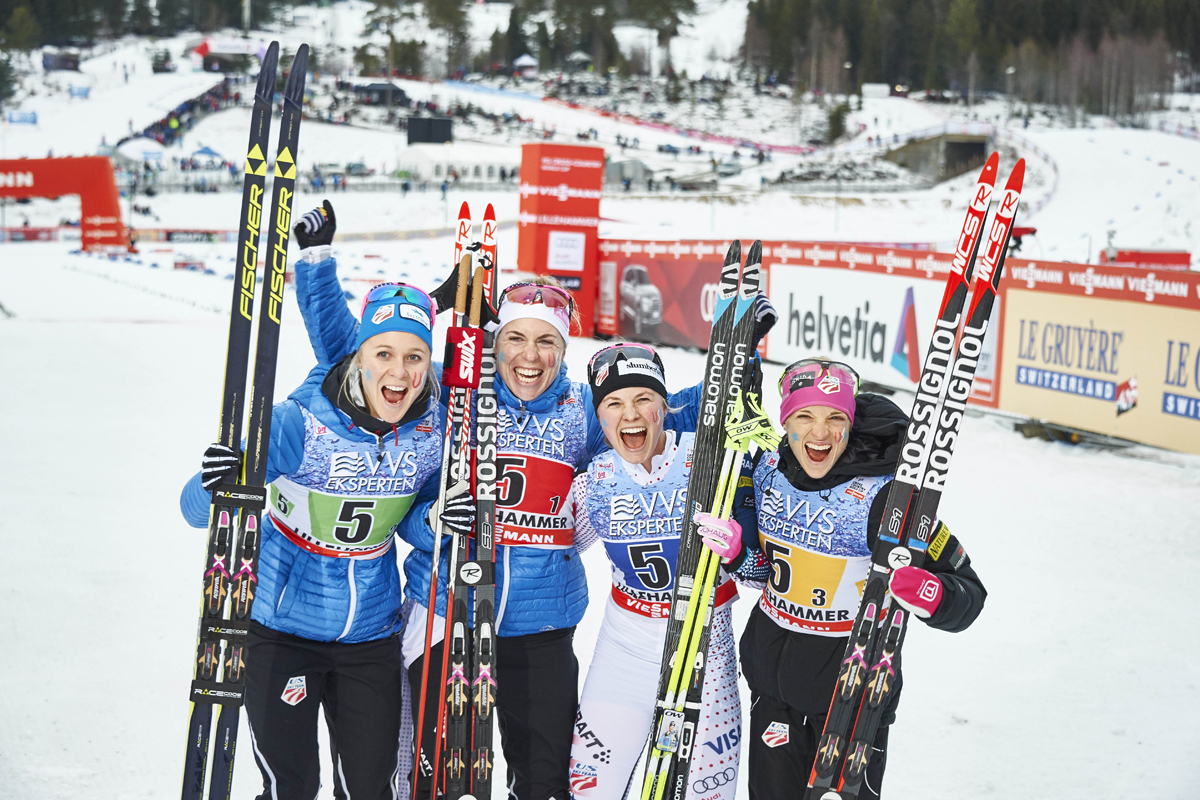
The U.S. women celebrate third place in Sunday’s 4 x 5 k relay at the World Cup in Lillehammer, Norway. (From l to r) Sadie Bjornsen, Rosie Brennan, Jessie Diggins, and Liz Stephen. (Photo: Fischer/NordicFocus)
Note: This article has been updated to include the U.S. women’s third-place finish at the Lillehammer World Cup in Dec. 2013.
Amidst stunning conditions of bright sun and a dangerously icy track at the Birkebeiner Stadium in Lillehammer, Norway, the Norwegian women’s all-star first relay team of Maiken Caspersen Falla, Ingvild Flugstad Østberg, Therese Johaug, and Heidi Weng, notched another seemingly effortless victory in the women’s 4 x 5-kilometer World Cup relay on Sunday.
Taking the win by almost two minutes over second place Finland’s Krista Parmakoski, Kerttu Niskanen, Laura Mononen, and Anne Kyllönen, the Norwegians may have won the race, but the Americans stole the show.
As Norway’s first team reveled in victory, they had to stop their celebratory hugs to turn and witness the crowd roar in both surprise, and applause, as the U.S. Ski Team’s Jessie Diggins flew past Ragnhild Haga of Norway’s second team, careened down the final hill, into the finishing stretch, snatching the final podium spot from Haga by 1.4 seconds.
Approaching the top of the last short climb before the stadium, Diggins saw a tall figure jumping up and down, swinging their poles in circles around their head, “like a cowboy,” she recalled in a post-race group phone interview with her teammates: Rosie Brennan, Sadie Bjornsen and Liz Stephen.
It was U.S. Ski Team (USST) Women’s Coach Matt Whitcomb, and he was giving her the go-ahead to go for it in the final meters. “I was like, ‘Yes, this is what I live for!’ … and I just hammered,” she said.
On a day where the downhills appeared to equal a life or death decisions on bulletproof ice and uphills hurt just as bad as the day before, Team USA’s women showed the world once again they can ski with the best. Knowing this drive and the precarious track conditions, USST Head Coach Chris Grover explained the prerace strategy as the following:
“In this case, we knew that is was going to be an absolute battle and that anything was possible, so one strategy was just to keep our head in the game and know that at times we might be up and that at other times we might be down, but to just keep our heads in the game and to keep fighting back and fighting back,” he said.
After the first leg, the U.S. team already had its work cut out for them.
Brennan skied smooth through the first large climb at 1.2 k, moving through the time check on the heels of Norway’s Falla and Sweden’s Ida Ingemarsdotter. From there, she lost the pace on the downhills.
On the phone, Brennan explained that they, “woke up to some extremely icy snow conditions,” and she “was quite terrified to be honest.” However, her uphill pace was not far from the leaders’ and she was able to hand off “close enough for these girls [her teammates] to have somebody in sight to go chase.”
From left to right: Finland’s Krista Parmakoski, Norway II’s Astrid Uhrenholdt Jacobsen, Sweden’s Ida Ingemarsdotter, Norway I’s Maiken Caspersen Falla during the first leg of the 4 x 5 k relay in Lillehammer, Norway. (Photo: Fischer/NordicFocus)
At the first exchange Norway’s second-team skier, Astrid Uhrenholdt Jacobsen, led Falla of Norway I by 6.1 seconds, closely followed by Ingemarsdotter of Sweden and Parmakoski of Finland. Brennan tagged Bjornsen for the second classic leg in seventh, 49 seconds back from Jacobsen.
From there the race for first appeared over. Norway’s Østberg dropped the hammer, skiing away from Finland and Norway II, putting them 21.5 and 36.6 seconds down at the second exchange.
For Team USA and Bjornsen, the second leg meant hanging tough and staying upright. Bjornsen said she “got a little over excited at the beginning and tried to close the gap to Germany and Russia in the first k.” She spent the “next 2.5 k trying to hold on for dear life,” recover, and more importantly, make it safely down the icy hills with “completely flooded legs.”
When asked how she managed to hang on despite the excitedly fast start, Bjornsen painted a target on the back of the Norwegians and Swedes.
“Anytime you see a red [Norway] or white [Sweden] suit, man, you just find another gear because those are the two people you’re gunning for normally,” she said.
Before handing off to Stephen, the first skate leg, Bjornsen skied the fifth-fastest second leg, and tagged off 1:29.9 behind the Norwegian leaders, in a pack with Russia’s second team (+1:21.3), Germany (+1:21.7), Sweden (+1:23.5).
Halfway through the first skate leg, Norway II, skiing in third place, looked vulnerable. Falling from only 36.6 seconds back at the exchange to 1:16.0 at the 2.5 k mark; Stephen was also closing the gap, now only down 31.5 seconds to third place.
“I was focused on the uphills. This course couldn’t be much better for someone like me who likes to climb,” Stephen said. “My goal was to just drop them on the first uphill [Germany and Russia].”
Stephen explained her strategy going into her leg. Skiing the third-fastest third leg, she mimicked Bjornsen’s motivation, “You see the white suit and you go for that, and when you look up and see a red suit, you really go!” Closing out her 5 k, the red suit of Norway’s second team hovered a tantalizing 21 seconds away.
At the front, Johaug showed her form from the previous day, skiing the fastest third leg and extending Norway’s lead to 1:04 over Finland at the final exchange.
Second-place Finland continued to ski in no-man’s land, maintaining its distance ahead third — 45.5 seconds at the third exchange — but unable to gain ground on Johaug, dropping to over a minute back at 1:04.
In the battle for third, Stephen handed off to Diggins in fifth, 3.6 seconds behind defending Olympic and World Championship gold medalist Charlotte Kalla.
Diggins quickly passed Kalla up the long climb on the first of two laps, and focused on Haga for the second lap.
Just over 3 k into her race, Diggins caught Haga and the two skied neck and neck.
Diggins dropped her on the last big uphill. “I didn’t look back so I had no idea if she was there or not,” she said.
Coming in toward the stadium, Diggins described the atmosphere as “a total adrenaline rush. The people on that last hill were so loud because I was coming in with a Norwegian. You’re in so much pain, but you just can’t feel anything…”
Diggins closed out the fourth leg with the second-fastest skate leg of the day and fastest final lap of any team.
The U.S. women ended up third, their best result in a four-person relay since Kikkan Randall, Bjornsen, Stephen, and Diggins placed third in the 2013 Lillehammer World Cup relay two seasons ago. Before that, Holly Brooks, Randall, Stephen, and Diggins broke through with the first U.S. relay podium at the November 2012 World Cup relay in Gallivare, Sweden.
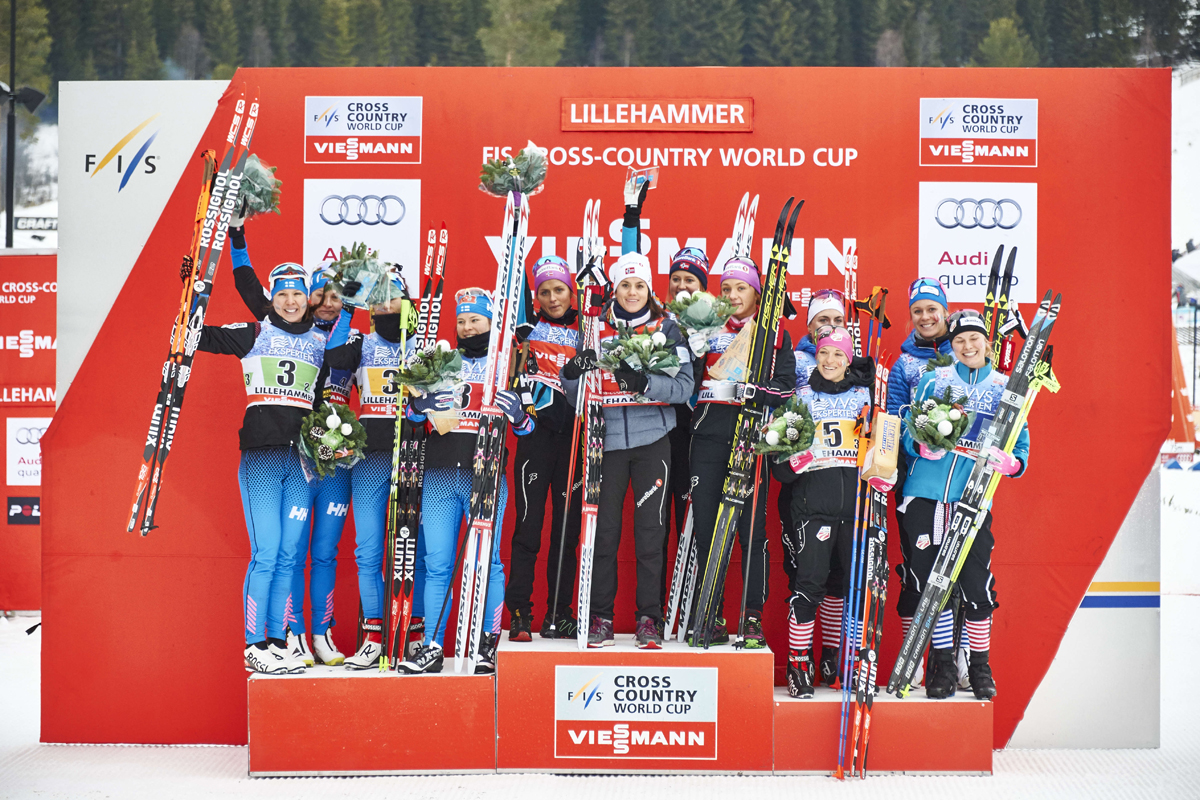
The women’s 4 x 5 k relay World Cup podium in Lillehammer, Norway, on Sunday, with Norway I in first (c), Finland in second (l) and the U.S. in third (r). (Photo: Fischer/NordicFocus)
“It speaks volumes to do it here,” Bjornsen said. “We have this belief that it can be any number of the four people on this relay team and it’s totally possible.”
“We’re definitely a team that’s known for our skating on the women’s side — we saw that yesterday in the skiathlon,” Grover said. The U.S. had four women in the top 30. “We know that if we can be close in classic then we can really have a chance in the last couple legs of skating to get to the podium.”
He added that the service team nailed the wax. “We had incredible skis, incredible kick, fantastic glide, for sure, some of the best skis in the field today, both for the women and for the men,” Grover said. “It was really a big effort not only from the group of women and the guys, but also from the entire staff. I’m super proud of everybody performed today.”
What was perhaps most important to the four women was the fact that they recognized not all of them had perfect days.
“Maybe it wasn’t perfect; it was just solid,” Stephen said, adding that both Norway and Finland are “catch-able” — not out of reach.
“Today was really special. I’m so proud of these girls,” Stephen added. “I can really relate to Rosie’s fear of downhills; I think we’re both struggling on it … and I’m really proud of her for that. … When you put relay socks on Jessie Diggins, it’s like a different person. It’s a really fun thing for me to touch her butt and watch her go. Sadie… she kicks ass and is just so solid.
“It’s a really fun team; it’s changed. There’s been a few members changing over the years, but being back on the podium, it’s a real thing to stand on that block and to get a brick of cheese that weighs more than half your team together.”
— Alex Kochon and Katie Madden contributed reporting
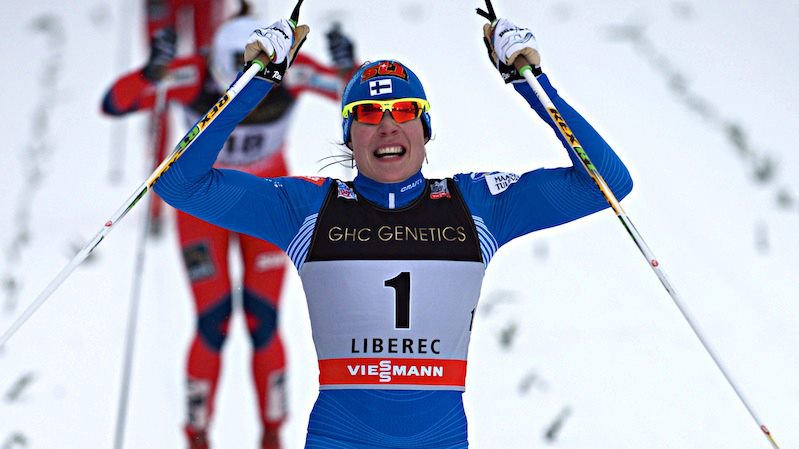
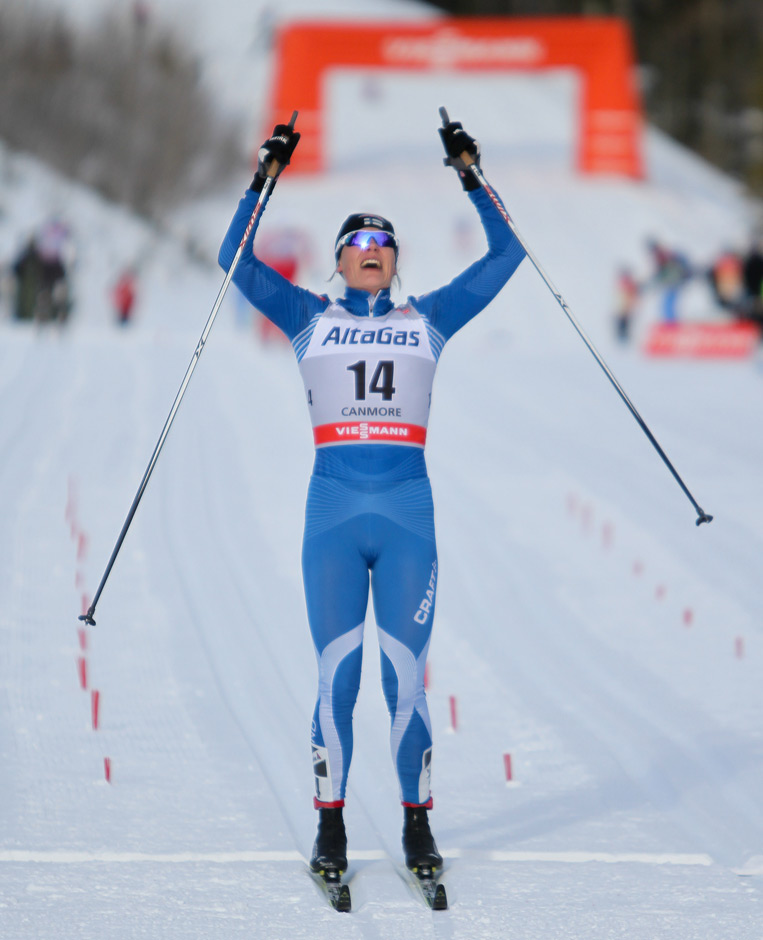
Mona-Liisa Malvalehto of Finland celebrates her first World Cup victory and podium at the classic sprint in Liberec, Czech Republic, in 2013. On Saturday, she won a Finnish Cup sprint to open the 2015-2016 season. (photo: FIS Cross Country)
Just days after the Frozen Thunder sprint in Canmore, Alberta, the official European racing season kicked off in Vuokatti, Finland, with classic sprints contested by most of the Finnish national team, among others.
For the women, Mona-Liisa Nousiainen won the 1.5 k qualifier by 2.03 seconds of Anne Kyllönen, with Kerttu Niskanen in third. Nousianen won her first World Cup in January, 2013, but recently married national team teammate Ville Nousiainen.
Mona-Liisa then won her quarterfinal and semifinal before skiing away from the field in the final to take the season’s first win.
“My goal is to stay in great shape the entire season,” she told Finnish broadcaster YLE. I hope I managed to ski a smooth strong season and stay healthy.”
Kyllönen, another World Cup regular, had led the final out of the gate. But after Nousiainen passed her coming towards the finish, she was also beaten out for second place by Katri Lylynpera. Lylynpera was a top-20 finisher at U23 World Championships last season, but this is by far her best national-level result.
“In the final, I had no other strategy than that podium,” Lylynpera told Kestävyys Urheilu, a Finnish sports website.
Niskanen placed fourth, Leena Nurmi fifth, and Aino-Kaisa Saarinen sixth.
Also in the field was Kaisa Mäkäräinen, the World Champion and two-time World Cup Total Score winner in biathlon. Not used to racing classic, Mäkäräinen qualified in ninth. She made it to the semifinals of the sprint but then placed sixth in her heat.
“I’ve done sports for so long that I might as well go embarrass myself,” Mäkäräinen told the Ilta-Sanomat newspaper a few days before the race. “I’ve never skied before a classic sprint.I’ve been doing hours of rehearsals for it now… The aim is to get a good workout sprint.”
College of Saint Scholastica alum Anita Kirvesniemi placed third in her quarterfinal and just missed moving on to the semifinals.
The men’s competition was full of drama, with Matthias Strandvall crossing the line first in the final but quickly getting relegated to last place in the heat due to skiing on Toni Ketelä’s skis.
Strandvall had won the qualifier by 0.93 seconds over Anssi Pentsinen.
The jury reportedly relegated him due to an obstruction incident which not only affected Ketelä, but caused Ville Nousiainen to crash; Ville crossed the line 35 seconds after the leaders in the final.
“My tactic was that I saved all the tempo for the end, it is my trump card,” Ketelä told the media; he had made a close finish with Strandvall and Mikkonen. “The jury then decided on what had happened before.”
Juho Mikkonen placed second and Ristomatti Hakola third, with Pentsinen fourth and Nousiainen fifth. Other favorites like Sami Jauhojärvi and Martti Jylhä did not make the final.
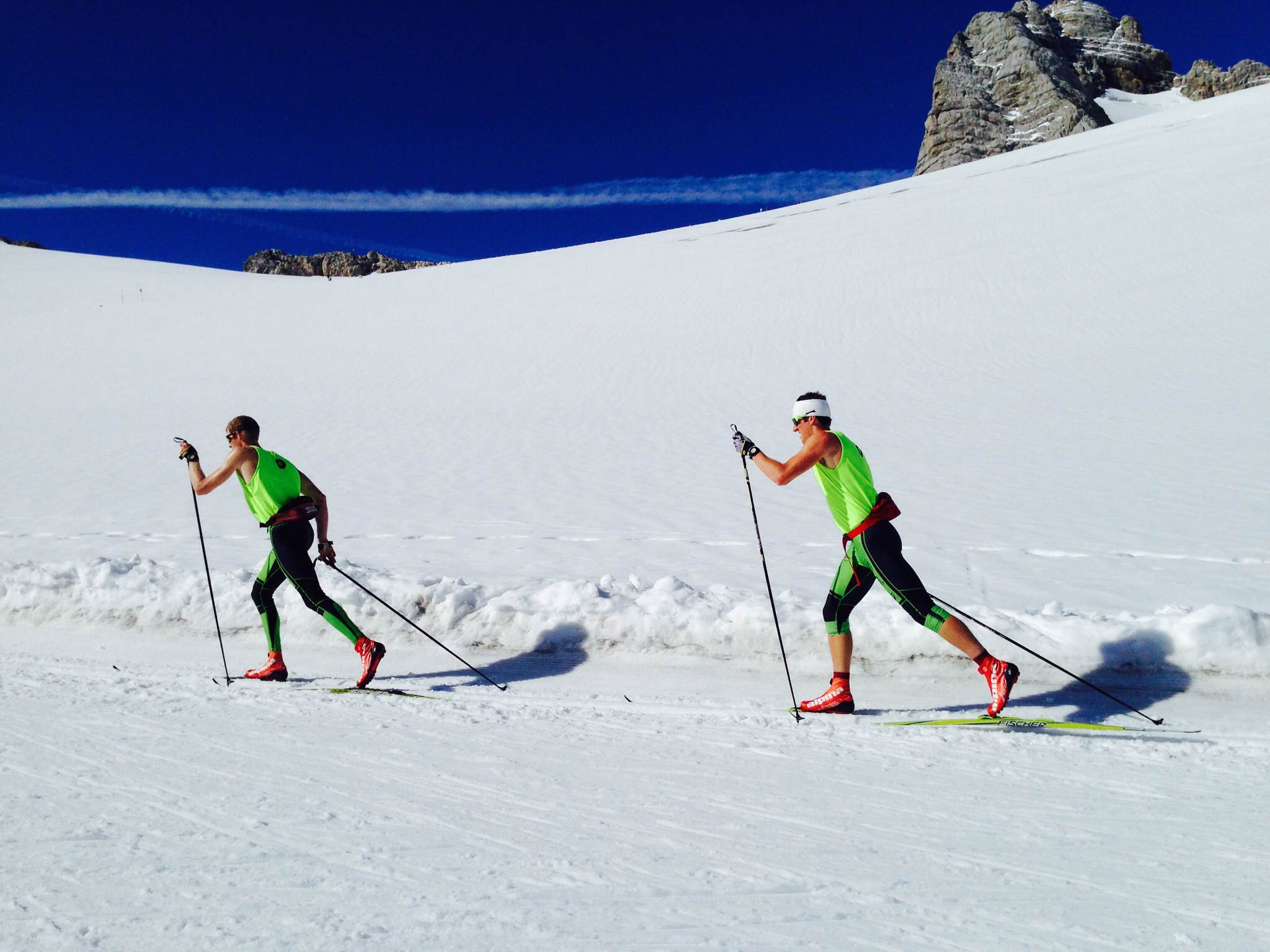
Craftsbury Green Racing Project skiers traverse the Dachstien Glacier in Rasmau, Austria as part of the teams on-snow camp in September 2014.
Anne Kyllönen is an exemplary skier. The Finnish athlete’s technique – both flawless and efficient – has served as an example for the USST and other American club teams over the 2014 summer to help visualize improvements.
But why watch a video when the real thing can be right in front of you?
Such was the case for Ida Sargent, who had the opportunity to mimic the 2014 Olympic medalist’s technique in-person during the Craftsbury Green Racing Project’s (GRP) training camp in Ramsau, Austria.
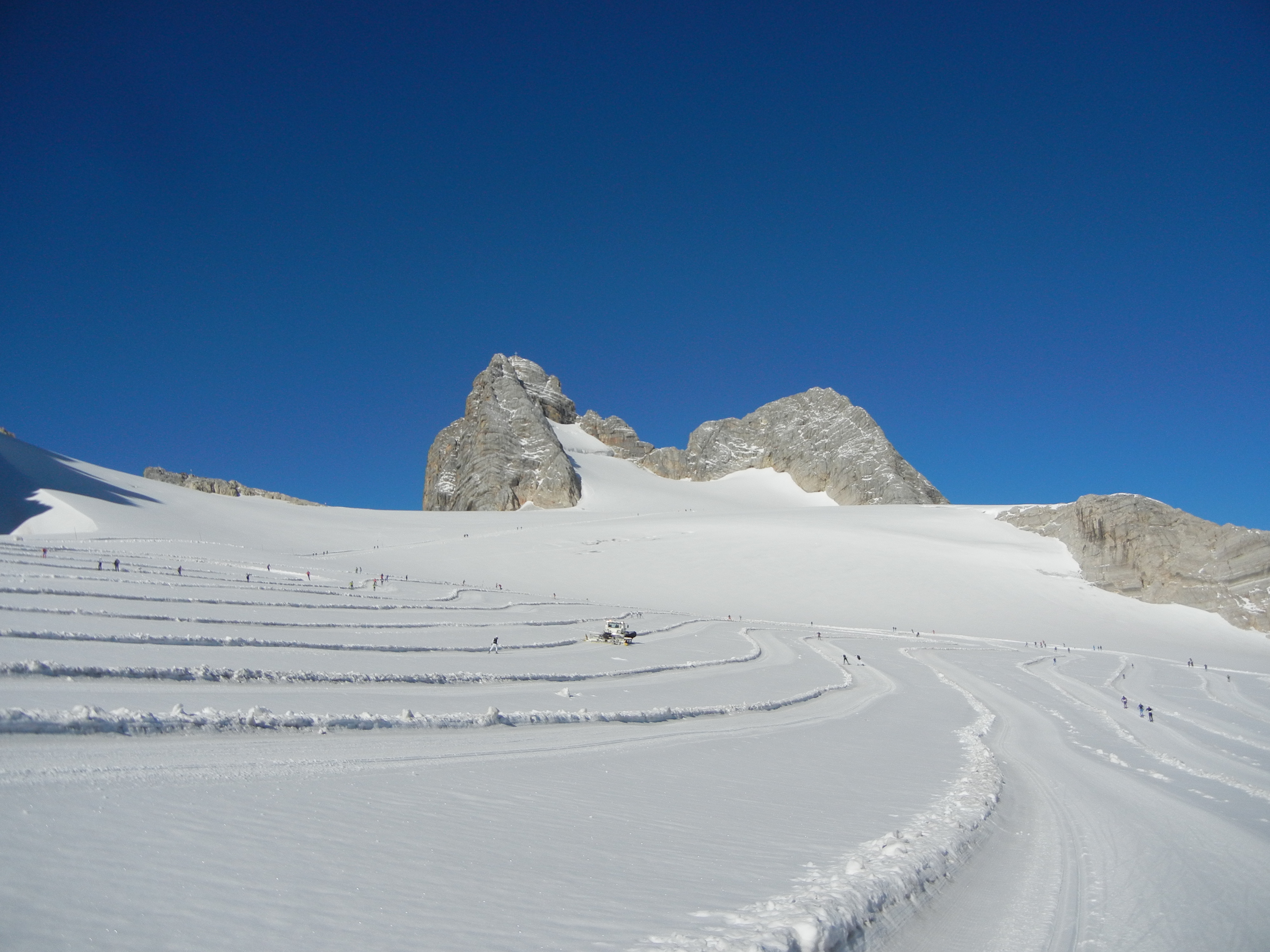
Pristine September skiing on the Dachstein Glacier in Ramsau, Austria. (Photo: GRP Blog)
This is the first year that GRP has made the summer trip to Austria, and so far the team’s skiers have given the experience rave reviews. While traveling across the globe to find on-snow training opportunities has become a rarity in U.S. skiing in recent years (Noah Hoffman was the sole USST member to make the trip to New Zealand this year), Austria might be closer than it seems.
According to GRP athlete Liz Guiney, it is just as demanding to travel to Europe from the East Coast as it would be to go to Haig or Eagle Glaciers, which are located in Canada and Alaska.
“Once we made it to Munich, it was an easy three hour drive to Ramsau, and we were all set,” Guiney wrote in an email. “Logistically speaking, it makes more sense for our team to come here, because anyone is welcome to use the Dachstein (Glacier) and you don’t have to take a helicopter up there.”
The team arrived in Austria Sept. 8 and will remain until the Sept. 27. The squad of GRP athletes in attendance includes Gordon Vermeer, Pete Hegman, Alex Schulz, Andrew Dougherty, Ethan Dreissigacker, Jake Barton, Mike Gibson, Caitlin Patterson, Kaitlynn Miller, Guniey, USST member Sargent and the coaching staff of Pepa Miloucheva and Nick Brown..
The Dachstein Glacier, which boasts an elevation of 2,800 m, or just under 9,200 ft., is one of several European glaciers that is groomed for off-season skiing. Each year skiers from around the world take advantage of the 9 k of groomed summer trails.
According to Sargent, the glacier’s conditions have been better than expected with hard and fast tracks. Even though the team endured some rain and fog during the camp’s first week, she said the sunny days have been spectacular.
“The skiing conditions have been really good… The past couple days have been those magical days when you have to pinch yourself to see if it is actually real,” she wrote in an email. “It is sunny and warm but the tracks were staying very firm and fast. I didn’t even know that was possible.”
https://www.youtube.com/watch?v=EfwXde3TC0s
While the afternoons can be too warm for skiing, the team often runs on one of the many trails that take them straight from the door of their house in the Austrian Alps. The lower elevation running also helps diversify their training.
According to Sargent, the main purpose of the Rasmau camp is to implement technique changes made during the summer to on snow skiing. With the Austrain camp, Canmore’s Frozen Thunder, and the start of the World Cup season in November she hopes to eliminate as much off-snow training as possible.
GRP coach Miloucheva explained that partaking in on-snow training for an extended period of time in the summer and fall can aid her athletes in avoiding the technique mistakes of the previous season.
“Back in U.S. we normally have only a few days to a week on snow before we start racing and this isn’t enough, so normally everyone goes straight to same mistakes they did last winter,” she wrote in an email.
Guiney explained that the Rasmau camp helps skiers like herself have a seamless start to the season because it allows for a low-pressure transition from rollerskis to snow.
“That real snow feeling is very hard to replicate, and making technique changes in, say, West Yellowstone, when you also have to prepare to race a few days later, can be challenging,” she said. “This way we can make and implement changes, and it will make the transition to snow in November that much easier.”
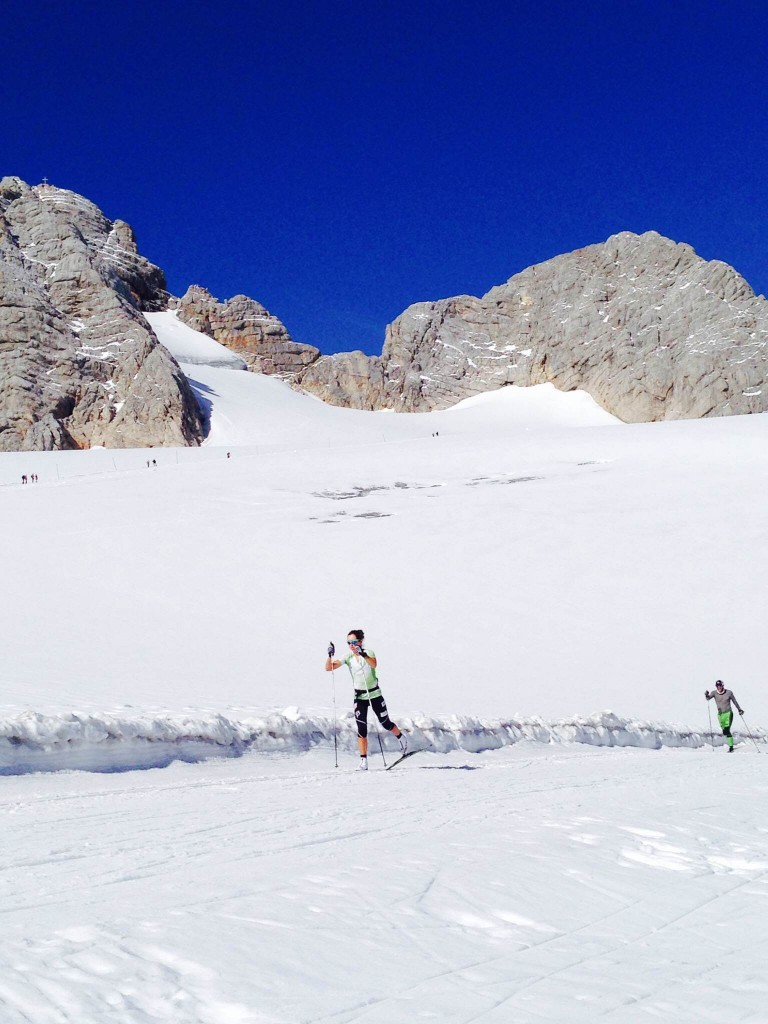
Caitlin Patterson (GRP) takes advantage of the sunshine to ski the firm and fast conditions of the Dachstien Glacier in Ramsau, Austria as part of the GRP’s on-snow training camp. (Photo: GRP Blog)
GRP isn’t the only team hoping to take advantage of early fall skiing. The Swedish, Finnish, Russian, Estonian, and Japanese national teams have been training alongside the American team – an experience that has proven to be extremely valuable for some of GRP’s athletes.
“It’s really inspirational to share a training venue with the best skiers in the world; technique lessons are just a matter of looking around you or hopping in behind someone and hoping they don’t mind,” explained Guiney, who said that she spent time skiing behind both Swedish star Charlotte Kalla and Kyllönen.
Guiney said that one of the highlights of the camp was witnessing GRP skier Andrew Dougherty jump in behind Olympic champion Giorgio Di Centa of Italy.
“Andrew is always wearing hats with pom-poms – it’s kind of his ‘look.’ We always joke that he looks just like Di Centa, and seeing them ski together was priceless,” she said.
Despite the many skiers on the glacier’s trails, Sargent said that space wasn’t an issue. The 26-year-old, who has been regularly skiing with several Swedish and Finnish skiers over the course of the camp, said that it has been great to catch up with friends from the World Cup.
GRP continues its Rasmau training camp until Sept. 27, when it returns to the U.S. for the rest of the fall training season.
Andy Newell while training with the U.S. Ski Team last month in Bend, Ore. (Photo: Matt Whitcomb)
This week’s Wednesday Workout comes from Matt Whitcomb, the U.S. Ski Team women’s coach. Whitcomb and the team recently returned from their on-snow camp in Bend, Ore., where they practiced improving technique with visualization.
***
Before starting the workout the coach identifies one 10-second clip of one male and one female World Cup skier classical striding up gradual terrain and then plugs it into iMovie. I like the clips of Anne Kyllönen striding up the sprint course in Sochi. If you don’t have access to these clips, YouTube something and video your own computer screen. The quality will be lower but you’ll be surprised at how well it works.
In iMovie, create a project that plays your 10-second clip in regular speed and then in 1/2 speed (totaling 30 seconds), and repeat that six times in your movie project without music or any sound to remove sensory interference so the women’s clip is 2 minutes long. Add a 2-minute clip for the men to watch. Paste a 30-second clip of the women to see one last time at the end followed by a 30-second men’s clip. The total movie is only 5 minutes so you can get out the door and ski more.
Keep the men and women together for the viewing in case one clip works better than the other. Watch on a large TV screen or with a projector play your iMovie clip to the team immediately before going out to ski. As a variation try talking them through the clip one one day, focusing in one one thing the World Cup athlete does well, and on another day try not talking at all to prevent polluting what they are seeing on their own. Many athletes are much better coaches than we are!
If you don’t have access to footage, here is a YouTube video of Anne Kyllönen in addition to other World Cup athletes:
Warm-up for 30 minutes and encourage the athletes to ski by themselves and on similar terrain to what you just watched, trying to channel and emulate the World Cup skier. It’s very easy for some and nearly impossible for others, but the process opens up new windows regardless.
Meet your team on a very gentle downhill slope that is 200-meters long for a drill. Have them ski back and forth, striding both the gradual downhill and uphill. This isn’t about holding your glide for as long as possible on the gradual downhill, but more about feeling the flow of good striding under low tension. Watching our team do this left us feeling that the gradual downhill section unlocked some hip and shoulder tension in many athletes.
Encourage the athletes to ski by themselves and on similar terrain to what you just watched, trying to channel and emulate the World Cup skier. It’s very easy for some and nearly impossible for others, but the process opens up new windows regardless.
After the drill, film your athletes one at a time skiing up a gradual hill. Before they begin to ski toward you, have them rest on their poles, eyes closed and without talking, and visualizing that World Cup clip for 30 seconds. Then have them ski past you. Film the pass on your iPad or phone so they can look at it immediately.
If it works out, great. Please let me know. If not, there are many creative ways to trigger technical improvements. Email me at mwhitcomb@ussa.org if you have a cool idea to share or just drop it anonymously into the comment section :). I would love to take a couple of your thoughts to our glacier camp in Alaska next month. Keep it fun and focused out there!
Astrid Jacobsen, Therese Johaug and Heidi Weng (l-r) on the podium at the conclusion of the 2014 Tour de Ski. Photo: Fiemme Ski World Cup
Norway has suffered few droughts in the history of competitive cross-country ski racing, with periods of total dominance interrupted by slumps that would be the envy of most other nations.
But over the course of the last decade, there has been one event where victory has eluded the sea of red that has ruled the major championships and regular season alike.
No Norwegian had won the Tour de Ski, the grueling stage race modeled on the multi-day event popular in elite cycling, though there were plenty of close calls.
In the seven years the event had run, Norway totaled 11 podium finishes and five sprint cup victories. Petter Northug finished second three times and Marit Bjørgen and Therese Johaug two each.
That all changed on a sopping day on the Alpe Cermis, site of the renowned Final Climb. The Norwegian women, led by climber extraordinaire Johaug, swept the podium in definitive fashion.
As expected Johaug overtook teammate Astrid Jacobsen on the three kilometer ascent, and skied away to a clear victory. Jacobsen maintained her lead on the rest of the field to take second, while 22-year-old Heidi Weng held off an impressive comeback by Finland’s Krista Lahteenmaki to round out the podium.
Johaug became just the fourth woman to win the Tour in eight years, joining four-time defending champion Justyna Kowalczyk of Poland, two-time winner Virpi Kuitunen (FIN) and Sweden’s Charlotte Kalla.
Jacobsen, a somewhat surprising force on the Tour this year, had planned to withdraw after four stages, but with a chance to win, and a podium spot firmly in grasp, she kept racing.
She entered the final stage with a 23.8 second lead on Johaug, substantial, but in her mind, not enough. In the days leading up to the Final Climb she consistently pointed to Johaug as the favorite, a claim not based in false modesty.
Entering this season, Johaug completed the Tour five times. Her first season in the event, 2008, she was fourth in the last stage before reeling off four consecutive Final Climb victories, often by a large margin.
Jacobsen, a tall powerful skier, excels on more gradual terrain, and she left the start in a hurry, pushing through the earlier flats and descents. Johaug, however, kept pace, and while Jaccobsen did not falter on the hill, she was no match for the high tempo and light step of Johaug.
Johaug climbing. Photo: Fiemme Ski World Cup
Johaug came up from behind, and did not hesitate, moving right by her teammate, and immediately opening a gap on the 28 degree headwall half way up. With Jacobsen single-sticking and Johaug in a V1, the lead grew.
Jacobsen said after the race that she was focused on her own race.
“I knew Therese is a strong climber,” she told FIS News. “I skied my own speed. Therese passed me fast.”
As the terrain became more skiable again, Jacobsen slowed the bleeding, but the damage was done. Johaug, not taking anything for granted, looked back several times, confirming her lead was secure.
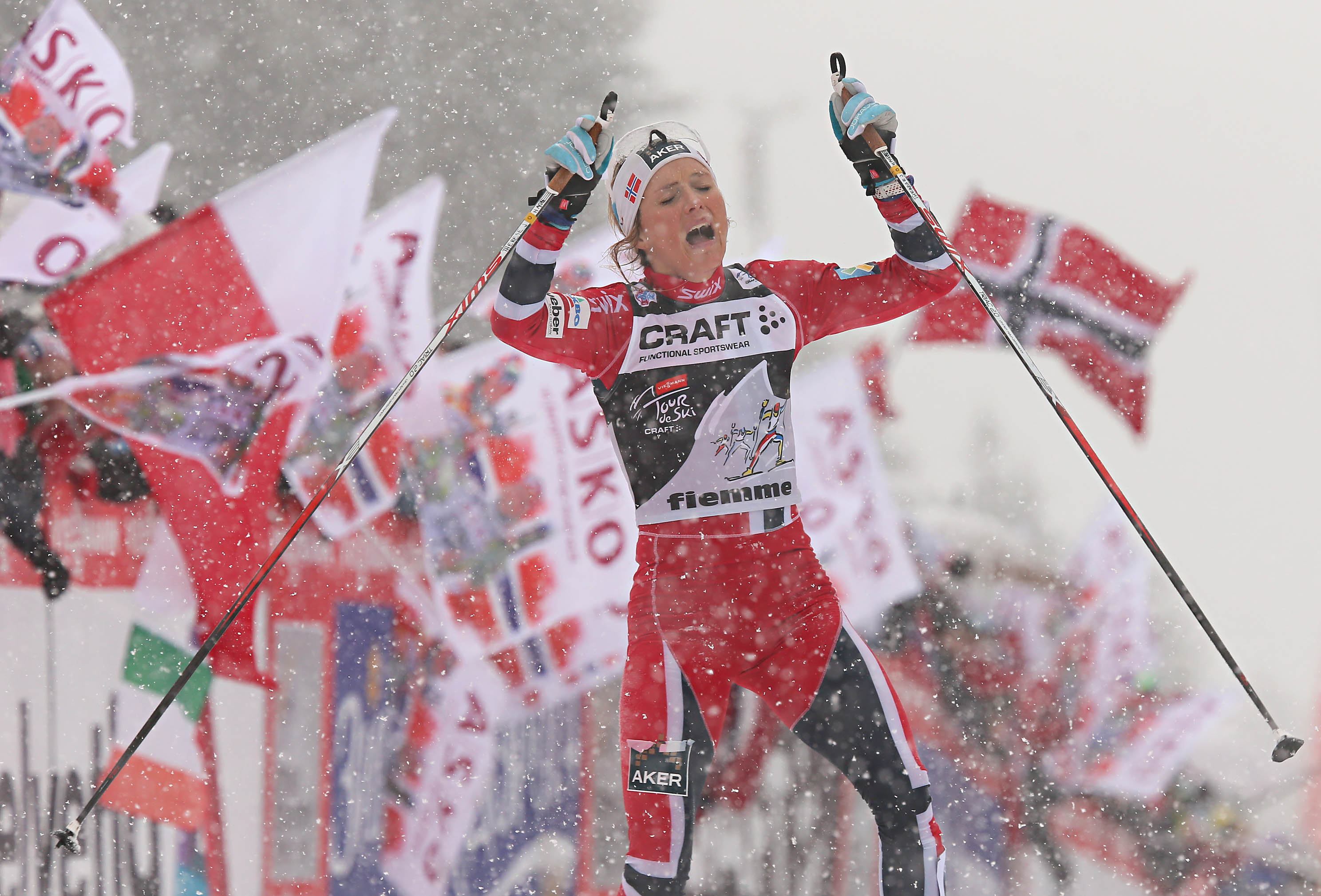
She crossed the line with a pump of her arms and a yell, before collapsing into the new wet snow. Jacobsen followed 20 seconds later, falling into her own gasping heap.
The pair had some time to recover before the rest of the field trudged into sight. Anne Kylloenen (FIN) started in third, +1:31.5, and lost ground from the start.
Weng, in bib 6, quickly formed up with two more Finns, Lahteenmaki and Kerttu Niskanen, and set about hunting Kylloenen, the trio staying together into the climb.
Niskanen was the first to drop, unable to manage the pace. Weng, doing most of the leading, pulled Lahteenmaki by Kylloenen, with the later looking exhausted.
Racing in her second Tour, Weng appeared the more controlled, and when she pulled away from Lahteenmaki on the big switchbacks, it appeared the podium would be solid red.
But the steep grade makes distance meaningless. Eight hundred meters straight uphill takes a long time, and with the focus on the top two, Lahteenmaki made one last charge, closing back up on Weng, catching her with just 65 meters to go. Sprint finishes are usual in the Tour, particularly for the podium, and they are always agonizing, the athletes trying to eke one last push out of exploding muscles and lungs.
At the 50 meter mark, Lahteenmaki pulled alongside Weng, trying to gain the advantage, but the Norwegian had something in reserve, accelerating, and leaving Lahteenmaki meters back in fourth.
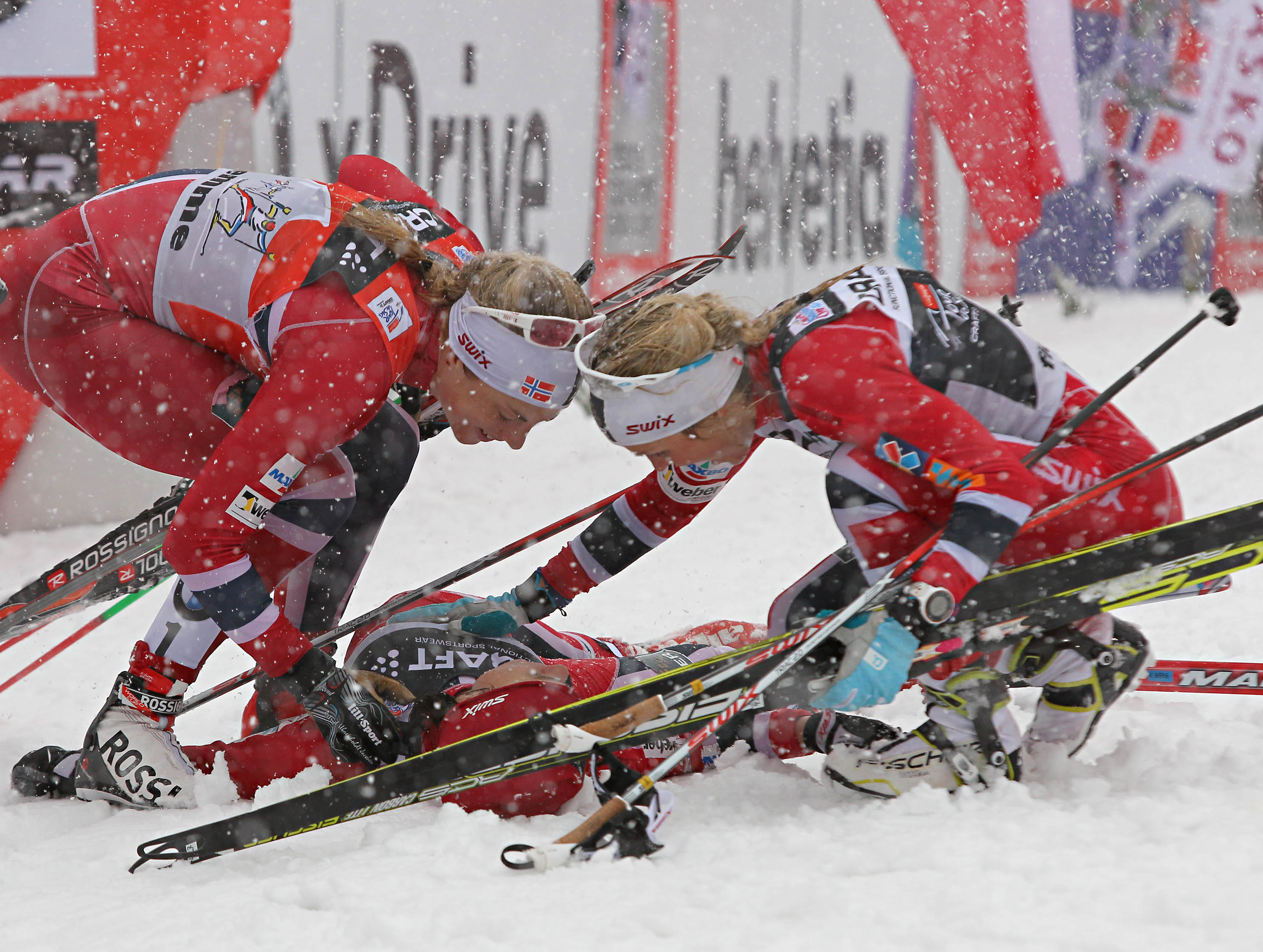
Johaug and Jacobsen waited across the line cheering voraciously. As Weng collapsed in the snow, the top two fell on top of her, celebrating over their nearly comatose teammate, finally rising and high-fiving.
Jacobsen and Johaug greet Weng at the finish. Photo: Fiemme Ski World Cup
The trio were the only Norwegians to finish the whole event, with star Marit Bjørgen dropping out due to illness, and last year’s bronze medalist, Kristin Stoermer Steira also withdrawing, with bronchial issues.
Niskanen followed Lahteenmaki in fifth, and Kylloenen was sixth before American Liz Stephen broke up the Norwegian/Finnish parade.
Johaug posted the fastest time of the day, 44.2 seconds ahead of Jacobsen. Stephen was third best, another 14.5 back, followed by Weng.
“It’s a dream come true for me,” Johaug told FIS News after the race. “It is amazing to become the first Norwegian to win the Tour, and even better when Astrid and Heidi could join me on the podium.”
Heavy rain turning to wet snow made for soft, slow conditions, and perhaps the toughest Final Climb ever. Norwegian coach Egil Kriastensen describes the snow as “like glue” to Norwegian broadcaster NRK.
“There are many thoughts through your head when you pass the finish line,” Johaug told NRK. You are quite tired, and many of the thoughts turn to how much I have sacrificed…Now it’s absolutely worth it.”
Johaug with little energy left for celebration. Photo: Fiemme Ski World Cup
Jacobsen was also thrilled with her performance.
“I have good reason to be proud. I’m number two behind Therese. Who’d have thought it?” she said to NRK.
Jacobsen won the World Championship sprint in 2007 in Sapporo, Japan, but while she has turned in plenty of strong results, her career has been interrupted by a combination of illness and serious injury.
The young Weng has plenty to look forward to, and is ready to head home to start recovery.
She described the experience as “almost like World Championships” last year in Val di Fiemme, where she took bronze in the skiathlon and was a member of the gold medal winning relay team.
“Now I will go home and eat everything I come across,” Weng told NRK.
Of Note:
– Maako Ishida (JPN), usually a force in classic, was fifth fastest on the day
– Eva Vrabcova-Nyvltova (CZE) was a surprising eighth overall. The 27-year-old has never stood on a World Cup podium and has just six top-10 results in her career, two of which came in this Tour.
– Twenty-year-old Julia Svan, daughter of the great Swedish skier Gunde Svan, placed 41st out of 42 skiers.
– Overall 38 skiers withdrew from the Tour, including Kowalczyk and Anastasia Slonova (KAZ) both of whom did not start the first stage.
– Kowalczyk did not start in protest of the format, particularly the number of skate events.
– Valentina Schevchenko (UKR) completed her eighth Tour at age 38. She is the only person to ski every Tour de Ski. She finished 14th. Schevchenko was third in the inaugural Tour back in 2007.
– Jacobsen won the Sprint Cup for best Tour sprinter. The ranking combines the sprint races with additional sprint bonuses from distance races. She was the first Norwegian woman to win the Cup. Ingvild Flugstad Oestberg was second and Johaug third.
– Johaug helped herself with continued improved sprinting. She set a career-best Tour sprint mark by placing 7th in Oberhof, Germany and was 24th in Lenzerheide, Switzerland, picking up valuable bonus seconds.
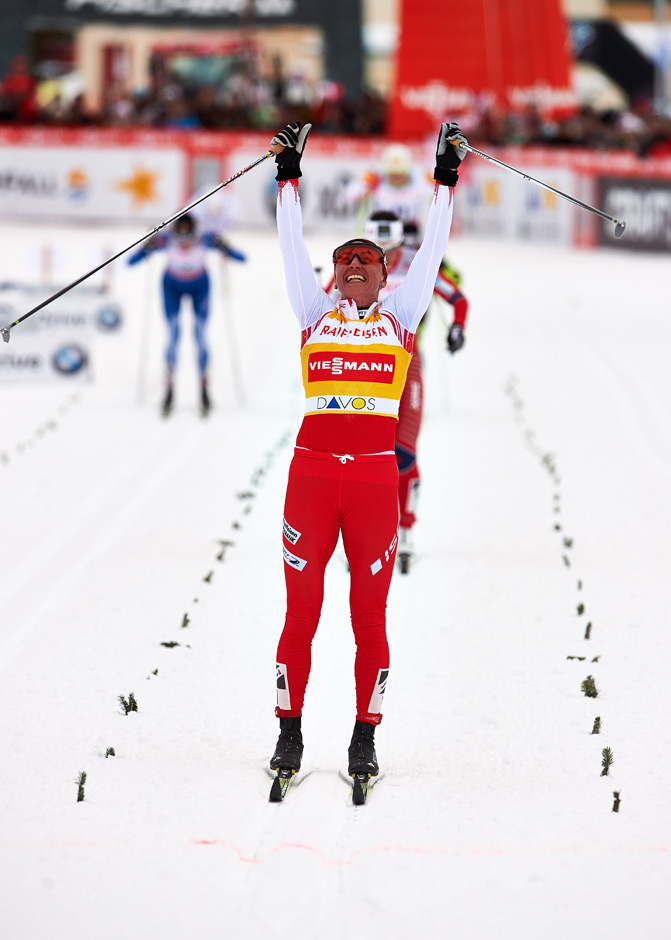
Justyna Kowalczyk celebrates her sprint win in Davos (Photo: Fischer/NordicFocus)
Justyna Kowalczyk (POL) bounced back from an uncharacteristic slump two weeks ago, serving notice to rival Marit Bjørgen (NOR) and the rest of the women’s field that she is the favorite headed into World Championships.
Known for her remarkable ability to race nearly every event of the season, almost always in top form, Kowalczyk dropped out of the pursuit in Sochi, Russia on the last World Cup stop, a surprising display of weakness.
She had finished back in 43rd in the freestyle sprint the day before, and suddenly showed chinks in her usually invincible armor.
Any concerns about her health and fitness were laid to rest today however. She won qualification by over a second, besting the surprising Aurora Jean (FRA) and then proceeded to lay waste to any and all who dared challenge her in the heats.
Kowalczyk won both her quarterfinal and semifinal going away, using high tempo on the challenging Davos climbs. Soft snow, requiring herring bone did not cause any issues, and her lead was large enough that she could afford to snowplow the big sweeping left turning descent down to the stadium.
After the race, Kowalczyk told FIS News that her strategy was to ski from the front and attempt to open up a gap.
She did just that in the final. The Davos course consists of two laps, and just halfway up the big climb the first time, Kowalczyk had skied away.
Bjørgen and Jean made an effort to stay close, but they never had a chance.
Jean led through the stadium, with the Norwegian taking over on the hill, opening her own lead, and skiing clear to second.
Anne Kylloenen (FIN) came back on Jean in the homestretch, edging out the Frenchwoman for the final podium spot.
Like Jean, Kylloenen has had a breakout season, and the performance was her third individual podium of the season, after entering the year with none.
Prior to this season, Jean had advanced to the finals in a World Cup sprint just twice, both times placing last in the heat. But in Sochi, she earned her first podium, placing second to American Kikkan Randall, and while she just missed her second consecutive top-3, she was in the running right to the line.
Bjørgen last raced on the World Cup back on January 20th in La Clusaz, France. Until today she had won every World Cup race she started — though she missed the entire Tour de Ski because of concerns about her heart.
She checked out fine, and today’s sprint was her first time racing since Norwegian Nationals wrapped up on January 26th.
Bjørgen told FIS news that her feeling “was not as good” as she had hoped but is expecting to improve as World Championships get under way.
Racing continues on Sunday with a 10km individual start freestyle race.
– Maiken Caspersen Falla (NOR), who entered the day 2nd to Kikkan Randall in the Sprint Cup standings, crashed in her quarterfinal and placed 21st. Kowalczyktook over the second spot in the Sprint Cup by four points.
– Six different nations were represented in the final — Katerina Smutna (AUT) was fifth and Ida Ingemarsdotter (SWE) was sixth.
– Laurien Van Der Graaff was the only representative of the home country to crack theheats, qualifying 30th and placing 29th.
– Ingvild Flugstad Oestberg (NOR) qualified in 27th, but did not race the heats. According to Norwegian broadcaster NRK, this was due to illness.
Justyna Kowalczyk (POL) on her way to winning her fourth-straight Oberhof pursuit in the second stage of the Tour de Ski. Photo: Marcel Hilger.
It didn’t take long for the three-time defending Tour de Ski champion to remind everyone how dominant she can be. Starting the 9 k classic pursuit from the third position, nearly 15 seconds down to prologue winner Kikkan Randall (USA), Justyna Kowalczyk (POL) swallowed that deficit by just the third kilometer of the 10 k classic pursuit, eventually extending it to a 41.4-second winning margin over Therese Johaug (NOR). Anne Kyllönen (FIN) continued her impressive early season in third (+45.0) and Denise Hermann (GER) had a strong fourth-place performance (+48.5) in front of the German crowd.
Kowalczyk was happy to be back in the familiar leader’s bib. “It was good for me today,” she said. “My servicemen did a very good job today, my skis were fast and the kick was good. I also like the conditions here, when the track is a little bit soft.”
Her skis certainly seemed better than most of the field’s. Where others slipped and were forced into a herring-bone, Kowalczyk was more often able to maintain a diagonal stride. Her techs also hit the glide, as she was able to make up considerable time on the descents.
Kowalczyk pulling alongside Kalla in the first few kilometers. Photo: Marcel Hilger.
Kowalczyk has turned mass start events into battles for second several times this season, and after about seven minutes on the Oberhof course she seemed nearly guaranteed do so again. She bridged the gap on Charlotte Kalla (SWE), the starter in front of her, and then on Randall. The American held onto Kowalczyk’s tails for about a minute but by the time the leaders came through the stadium she was losing ground.
“I tried to make it hard for Kowalcyk to catch me, [and then] I tried to hang onto her a little bit but I just can’t seem to find that final gear in my classic skiing yet,” Randall said. She stayed with the main chasing pack for the next few kilometers but eventually lost contact, finishing fourteenth and 1:33 back.
As Kowalczyk skied strong off the front, for only a brief period did it look as though anyone would be able to catch her. Johaug, who started 32 seconds back in bib 13, remained within 18 seconds of Kowalczyk at 3.7 k, at which point the latter had already taken the lead. But by the next checkpoint at 6.7 k Kowalczyk had widened the gap to 35 seconds.
“It was pretty good at first, but I had a little too aggressive start,” Johaug told the NRK.
Therese Johaug leading the chase at the start of the 9 k pursuit. Photo: Marcel Hilger.
The Norwegian women’s best hope to win the Tour made her attempt at catching Kowalczyk alone, and when the chasing group behind her caught back up the leader was out of anyone’s reach. From there Johaug battled in a pack of about ten skiers, including Kyllönen, Hermann, Kristin Stoermer Steira (NOR), Astrid Jacobsen (NOR), and three other Finns.
Johaug successfully held them at bay to move into second in the Tour, and she isn’t counting herself out of the running for the overall just yet. With the time bonuses Johaug is 46.4 seconds down to Kowalczyk headed into the third stage, a sprint in Switzerland, where Kowalczyk is likely to struggle.
“[Kowalczyk] has got a good head start, but now I managed to take second place and got ten bonus points. Now [there is] the sprint, and it is perhaps advantageous that Kowalczyk starts alone in the lead on the next pursuit, so we can chase behind,” Johaug said.
Perhaps Johaug does stand a better chance trying to hunt Kowalczyk down in the next distance race, but on the other hand Kowalczyk is pretty comfortable skiing alone at the front.
“I’m not surprised at all [at the winning margin],” Kowalczyk told the NRK.
The Tour de Ski field and its associated crews travel to Val Müstair, Switzerland, today for the third stage sprint on January 1. Kowalczyk plans to do light training at the venue on the rest day in between and knows that the sprint will be a challenge for her.
“The sprint will be difficult for me especially in the skate technique,” she said. “I will try to not lose too much time.”
Of Note:
— The Finns placed five in the top ten and six of its seven-woman team in the top thirteen.
— Kowalczyk has now won the Oberhof pursuit four times; each time she won this race in the past she went on to win the overall Tour.
— Tour de Ski wins are worth 50 World Cup points, half of what regular-season victories count for. Kowalczyk now has 608 points at the top of the overall World Cup standings; Randall is in second with 550 points.
Justyna Kowalczyk crossing the Tour de Ski finish line in 2012.
Just when you thought you couldn’t go another day without races to follow and results to check, the Tour de Ski is here to deliver a concentrated dose of cross-country drama. The seventh edition of the event begins on Saturday with a freestyle prologue in Oberhof, Germany, where organizers are filling dump trucks with artificial snow to overcome the warm local weather.
There are a few notable differences between the 2013 Tour and last season’s iteration. At seven races long it’s two whole events shorter than it was in 2012. Some think this makes it a lesser event, but shorter doesn’t necessarily mean easier. There’s less room for error and fewer bonus points — one bad race could ruin an athlete’s entire Tour. With one fewer skiathlon and sprint, the new event lineup lends a slight advantage to distance specialists this time around.
Though it isn’t the biggest event on the calendar this year and there are a few notable names sitting out, the Tour is definitely not just a warm up for World Championships. The start list is chock full of skiers who are serious about their Tour ambitions: Justyna Kowalczyk is poised to make it four-straight, Petter Northug desperately needs to live up to his own hype, and for once Dario Cologna enters the Tour as a bit of an underdog.
Marit Bjørgen, of course, is a notable scratch. Recent heart trouble, now under control, forced the Norwegian start to skip the Tour in favor of recovery. She would have been the best candidate to finally dethrone Kowalczyk, but the week should nevertheless provide plenty of excitement. Here’s a breakdown of the likely contenders:
Northug working up the Alpe Cermis during the final climb of the 2012 Tour, where he was 24th in the 9 k pursuit in Val di Fiemme, Italy.
Petter Northug, Jr. (NOR). As the most outwardly brazen athlete on the World Cup Northug has a lot of credibility to lose if he fails to deliver in yet another Tour. He’s already told the Norwegian press exactly how he’ll win the title that has so far eluded him. If they gave out medals based on sheer force of personality, Northug would be a shoe-in.
Still, the proud owner of a personal tour bus is probably the closest thing to a podium guarantee this year. Despite not going to Canada he sits only a few points behind Emil Jonsson (SWE) in the overall World Cup rankings.
Northug started the Tour strong in 2012 but ruined his chances when he fell apart during the 5 k classic in the fifth stage. With a victory in the Kuusamo mini-tour earlier this month, Northug appears to be in better health and shape this time around and is clearly hungry to keep going. Whether he does or not, he’s at least going to be the most exciting skier to watch over the next nine days.
Cologna.
Dario Cologna (SUI) has won this event three out of the last four years, including in 2012. He’s the defending overall World Cup champion. Duh.
He’s had a shaky start to this season, however, and hasn’t been on a World Cup podium once. Compare that to pre-Tour results in 2012, when he had already filed away a sprint victory and ascended to second in the World Cup rankings. Perhaps if Cologna had traveled to Canada we would have seen him in similar shape at the end of Period 1, but as a no-show for the past five World Cup races he’s a bit of a wild card going into Saturday.
Nevertheless, he clearly knows how to win Tours, and began showing signs of improvement a few weeks ago. Instead of racing in Canada he competed in a series of Alpen Cups in Austria, where he was second, first and second in three races against the likes of Alexey Poltoranin (KAZ) and Alexander Legkov (RUS). He wrote on his blog afterwards that those final tune-ups gave him confidence in his fitness heading into the Tour; we’ll just have to see how that plays out once he puts on a bib.
Marcus Hellner (SWE). Maybe he’s just been easing into the season to save up for the more important things, but the 2012 Tour runner-up has had a lackluster start to his season. The same was true of his opening results last year, however, and he wound up finishing second in the Tour, so as long as he’s been training for it and comes to the starting line healthy, Hellner should be in the hunt over the next seven races.
Emil Jönsson (SWE), though traditionally strongest at sprinting, is at the top of his game at the moment. The victor in both individual sprints in Canada, he is sitting at the top of the overall World Cup rankings. He had a poor showing in last year’s tour (41st), but the Swede says he’s feeling “calm, relaxed and incredibly charged” heading into this one.
Alexey Poltoranin (KAZ) has been a bit of a surprise this season, but two outstanding sprints in Quebec and a series of strong Alpen Cup races against Cologna have shown that his recent success is no fluke. Poltoranin didn’t compete in the Tour last year but skied well in the Kuusamo mini-tour earlier this month.
Alexander Legkov (RUS) was fifth in the 2012 Tour. If he’s able to stay within striking distance in the early stages this year, Legkov will be a major threat in the final stage up the Alpe Cermis. One fewer sprint could work to his advantage, too, as Legkov has been slow in the shorter events thus far.
Devon Kershaw (CAN) was out of sorts on his home course in Canmore this month, but if he’s been able to rest and recover over the holiday break for his favorite event of the year he could be back to the kind of fitness that got him fourth place in last year’s Tour. He says on his website that he’s not feeling 100%, but we’re not counting the Canuck out quite yet.
Others to watch for: Lucas Bauer (CZE), Maxim Vhylegzhanin (RUS), Alex Harvey (CAN), Tobias Angerer (GER), Tim Tscharnke (GER)
Not the start list: The Norwegian sprinters, Maurice Manificat (FRA) due to a pulled muscle in Canmore.
Justyna Kowalczyk (POL) is leading the overall World Cup right now and enters the Tour as its three-time defending champion. That’s an impressive record. Say what you will about her bizarre technique, abysmal downhilling (both of which have improved this year) and November inconsistency, she proved in Canmore that she’s on top of her game. So what if there was less competition in Canada? Those winning margins were ridiculous.
Additionally, fewer sprints on the event lineup should work to her advantage as the shorter distances seem to be Kowalczyk’s current weakness. Her coach, Alexander Wierietielny, laments the shortening of this year’s Tour, but expects Kowalczyk to show up in Oberhof ready and fighting. And with Bjorgen off the start list there’s one less challenger standing in her way to a fourth-straight crown.
Therese Johaug (NOR) usually stands in Bjorgen’s shadow, but in her teammates’ absence this may be the year Johaug’s dream of winning the Tour comes true. She was third last year, with her climbing prowess showing through in the Alpe Cermis. If she’s going to challenge Kowalczyk, however, she’ll have to keep herself in the hunt throughout the early Tour to keep herself in contention.
Jacobsen and Randall on the Alpe Cermis in 2012.
Kikkan Randall (USA) has finished in the top 10 eight times this season — more than any other woman on the World Cup. Only once has she fallen outside that cutoff. That kind of consistency in sprints and distance races is why the American is currently ranked second on the overall circuit. Seeing her name at or near the top of results is a matter of routine these days, a fact that’s made believers out of American ski fans from Anchorage to Williamstown.
Randall was tenth in the 2012 Tour, and her challenges there came in the distance events. But she’s proven to be a stronger distance skier already this season, surprising many competitors who thought her injury would hold her back. Even with fewer sprints on the schedule, Randall will be in the fight for the podium.
Charlotte Kalla (SWE) is usually mentioned right after Bjorgen on any given list of top female skiers, but has done nothing special so far this winter. She was fourth in the season opener in November but has been missing from World Cup start lists ever since. Kalla has been training away from home in Italy over the holidays to prepare for the Tour, and if she has been able to get back to her usual form she can be expected to battle with Kowalczyk and Johaug.
Anne Kylloenen (FIN) had a pair of breakthrough races in Canmore and will definitely be interesting to watch as the Tour gets underway. Kylloenen skied decently well in the Kuusamo mini-tour, where she was 11th, but as the fourth-ranked skier on the World Cup and the third-seeded starter on Saturday she sits in a good position to mix things up with the frontrunners.
Others to watch for: Heidi Weng (NOR), Katrin Zeller (GER), Krista Lahteenmaki (FIN), Kristin Stoermer Steira (NOR), Ingvild Flugstad Oestberg (NOR), Astrid Jacobsen (NOR)
Not on the start list: Vibeke Skofterud (NOR), Marit Bjorgen (NOR), Maiken Kaspersen Falla (NOR), Masako Ishida (JPN)
The 3.1/4.0 k freestyle prologue begins in Oberhof at 1:15 pm CET (women start first).
CANMORE, Alberta – Justyna Kowalczyk knows a thing or two about racing in Canmore. Among them, hard tracks, big hills and cold snow. Perfect, she thought before Sunday’s World Cup 15-kilometer skiathlon.
Every single distance race Poland’s pride and joy has done at the Canmore Nordic Centre, some 1,400 meters (4,600 feet) above sea level, she’s made the podium. Last year’s overall World Cup runner-up, Kowalczyk has won four races in Canmore since 2008, and two of them came this week.
After a victory in Thursday’s 10 k classic mass start, the 29-year-old rebounded from a less-then-stellar skate sprint on Saturday (in which she was 21st) to win the skiathlon. Doing so didn’t seem to be much of a problem; she created a gap of nearly a minute and ended up finishing in 42:51.5 minutes, 34.9 seconds ahead of Finland’s Anne Kylloenen in second.
Just one-tenth of a second behind, Vibeke Skofterud of Norway took third after Kylloenen outsprinted her to the finish. Kristin Størmer Steira (NOR) was fourth (+35.8) after initially trying to hang on to Kowalczyk with Skofterud for the first half of the race. Skofterud dropped off the pace on the second of four laps, but Steira held on.
Kowalczyk opened up an 11-second gap by the transition, and over the next kilometer, Steira fell off the pace. Skofterud picked up the slack and led a six-person chase group, but the 30-second deficit progressively increased. With one lap to go, Kowalczyk was nearly 50 seconds ahead.
“My plan was not so fast the first lap and then … ,” Kowalczyk said with a laugh.
The rest was self explanatory. She created a gap that made her essentially untouchable, even as the group worked together to catch up – albeit slightly – with three kilometers to go. Kowalczyk’s lead went from 52 seconds to about 35 at the finish.
“This was good plan I think,” she added.
Steira tailing Kowalczyk in the classic portion of the race.
Kowalczyk said she expected Steira and Skofterud to stick with her, and was surprised to drop Skofterud relatively early. Meanwhile, Kowalczyk tried to maintain a steady pace in the classic leg and accelerate when she put on her skate skis, and was pleased to find she wasn’t tired at the transition.
“My ski was working better today [and] I feel good,” she said. “It was really nice, not-so-fast snow, perfect for me.
Her win put her atop the World Cup standings ahead of American Kikkan Randall (who was eighth on Sunday) and Norway’s Marit Bjørgen, respectively.
“I have good feelings here, great memories,” she added, acknowledging a crowd with dozens of Canmore-based Polish supporters. “Sprint skating is not perfect for me, but all races, number one or number two is perfect.”
First place was probably preferable on Sunday. Kylloenen, 25, was more than happy with her silver, which matched the previous personal best she set Thursday. Kylloenen hadn’t been on a World Cup podium before this week, and on Sunday, she climbed from skiing outside the top 10 early to do so.
“I know that I’m in very good shape now,” Kylloenen said in a press conference. “I also tried to stay in the group and I know that I’m very strong that last part.”
Skofterud early in the race.
She edged Skofterud as well as Steira, Masako Ishida (JPN), Valentina Shevchenko (UKR) and Alija Iksanova (RUS), respectively, by less than two seconds at the finish. Kikkan Randall was next across the line in eighth, 1:18.4 minutes back, Ingvild Flugstad Oestberg (NOR) was ninth (+1:18.5) and Anna Haag (SWE) was 10th (+1:19.2).
Skofterud said she didn’t feel well during the classic portion, but hung in and found the 7.5 k skate leg was an entirely different race. About 10 seconds back on Steira at the transition, she led the chase group out on the next lap while Steira fell off the pace.
“I had to fight hard to stay in the group and when I get my skating skis I felt better and
better,” Skofterud said. “In the end I was looking forward to the sprint and I was looking for where Kylloenen was because I know she has a good last hundred meters, but I’m happy.”
After placing fourth in Thursday’s 10 k, she was pleased to capture her first individual World Cup podium of the season. The 32-year-old said she’s been having problems with her lungs in Canmore.
“This year I have not been feeling that good so I have been fighting hard to get in shape,” Skofterud said. “Today I felt better than I did Thursday, but still not 100 percent, but it’s going the right way and it’s good to go home to Christmas with better feeling.”
From here, she’ll prepare for the second World Cup period, minus the Tour de Ski. She made the decision to skip the Tour in order to maintain her form and training through the holidays and peak at World Championships. Without the conflict, it was an easy decision to race in Canmore.
Skofterud (l) and Kylloenen (r) battle to the line.
“I wanted to race every race before Christmas except for the sprint,” she said. “I think it was positive.”
Narrowly missing the podium in fifth and sixth, Ishida and Schevchenko took turns leading the chase pack, but ultimately, Skofterud drove the pace. Steira also got in the mix after climbing back from seventh place.
“I was surprised [with] myself with this day and that made me feeling even better than I did,” Skofterud said. “When I saw that I had possibilities to take part in the sprint, it was a good feeling and that made me stronger. It was cool to ski down into the stadium in front.”
Coverage of the Canmore World Cups was made possible through the generous support of Travel Alberta and Tourism Canmore.
The women’s 10k classic gets underway in Canmore.
CANMORE, Alberta — Despite a nine month absence, Justyna Kowalczyk (POL) did not need help finding the top step of the podium.
While her last straight win came back in February of last year, more than 30 World Cup victories was a trail of crumbs with enough staying power to allow the Polish star to retrace her steps.
Precipitous climbs, high altitude, classic skiing — all the ingredients for a Kowalczyk victory — made the three-time World Cup Champion the race favorite, despite a two-week layoff.
“Before the race you have some questions in the head,” she said of putting the bib back on. “But I know about my body and my skis. I was not afraid.”
Over the years Canmore has been good to Kowalczyk. She won for the third time in the picturesque western Canadian mountain town.
“It is a really hard course,” Kowalczyk said after skiing to a 14 second victory in the women’s 10km mass start classic in Canmore, Alberta. “One of the harder in the world,” she continued, before stating simply, “I am strong here.”
Strong indeed.
After starting the season slowly, as is her wont, Kowalczyk skipped the Quebec City sprints and came directly to Canmore after the Kuusamo mini-tour. Ten days of training clearly served her well as she showed the power and high gear that is her trademark.
“It is good to be outside Europe. For the head, for everything,” Kowalczyk said of her time in Canada. “Good altitude, a lot of snow, nice weather, sunshine,” she described her days of training.
Similar conditions greeted racers as they lined up for the start, but there would be no time to enjoy the scenery and fine weather. Unsurprisingly, the pace was high right from the gun.
Kowalczyk held position at the front of the pack through the first of three 3.3-kilometer loops. As the race approached the half-way mark, headed up the monstrous climbs for the second time, Kowalczyk accelerated, and gradually pulled away from the field.
Kowalczyk beginning to pull away the second time up the climbs.
“This was my tactic,” she explained. “Ski the first 5k together with the others and then try to ski faster.”
She took the preem at the high point of the course at 4.2k, earning an additional 15 World Cup points. The ageless Valentina Schevchenko (UKR) gave chase, cresting the climb just several seconds back, but Kowalczyk was not to be denied, and the Ukrainian was soon consumed by the chasers, a group that included the Norwegian quartet of Maiken Caspersen Falla, Vibeke Skofterud, Ingvild Flugstad Oestberg and Kristin Stoermer Steira as well as Kikkan Randall (USA).
As Kowalczyk pulled away, the battle for second became a race of attrition, with women steadily dropping off the back.
The Norwegians stayed strong, as did Randall while Anne Kylloenen (FIN) made her way up through the field to join the pack.
Primarily a sprinter by trade, the 25-year-old Kylloenen just missed the podium two weeks ago in the Kuusamo classic sprint, placing 4th.
The third time up the “wall,” the biggest climb of the course, Kylloenen made a move. To the surprise of most observers, no one could respond.
Finnish head coach Magnar Dalen said he was “shocked” when Kylloenen struck. He told FasterSkier that he liked her chances at the end of the race given the strength of her double pole and her sprinting skills.
“I was a little bit worried of course,” he said, but Kylloenen was feeling good.
“I had very much power,” she said of her final time up the big hills, and didn’t look back, skiing clear to second place, 14 seconds out ahead of third.
She described her first World Cup podium as “amazing,” but not completely unexpected.
“I know that I am in very good shape,” she said. “And it is very good conditions for me.”
Dalen was beside himself with the performance. He was hoping for a top-10, and the 2nd place marked a big step for Kylloenen.
“To see a young athlete climbing up to the podium for the first time, that is the best payment a coach can get…The best feeling in a coaches heart,” Dalen said.
A very happy Kylloenen crosses the line.
He described the progression Kylloenen has made, much like a parent would recount the accomplishments of a child — her first World Cup points, then a top-20, a 13th, a 12th, and now the podium.
In his 25th year of international coaching, Dalen has been around the block a time or two, and says he has seen “many stars raised up and then the hard way down again.”
He sees a difference between the breakthroughs of skiers like Kylloenen and the day-in, day-out efforts of the usual suspects.
“Bjørgen, Kowalczyk, Saarinen, and those like Northug, Cologna, that is more like professional gladiators fight,” he said. The success of his young athletes, however, is “more important to me than my salary.”
Kylloenen was not the only young sprinter to excel today. Falla, second last year in the Sprint Cup to Randall, put her speed to good use, besting teammates Skofterud and Oestberg and Randall in the homestretch to earn her first distance World Cup podium.
“I do not know what happened,” Falla told Norwegian broadcaster NRK after the race. “This was great fun.”
The Canmore finish stretch is notorious for requiring perfect execution. Coming off a fast downhill, drafting is crucial, and the associated slingshot effect is often the difference maker in head-to-head sprints to the line.
Coming from the back of the group Falla said “I didn’t realize I had a chance until the last 20-meters when I saw I had the highest speed.”
Randall, who finished in 6th was right in the mix but was unable to get the position she needed headed into the homestretch.
“I didn’t play my cards right at the finish,” she said. Slotting into second on the downhill behind Skofterud, she didn’t get enough of the draft effect to hit the podium.
“Maiken played it perfect,” Randall said. “She really had the best slingshot…and she is a really fast sprinter over the last 100 meters.”
Falla holding her own celebration.
Falla noted the absence of some of the world’s top women, including her teammates Marit Bjørgen, Therese Johaug, Marthe Kristoffersen and Heidi Weng, as well as the likes of Charlotte Kalla (SWE) and Krista Lahteenmaki (FIN), recognizing her placing was in part due to the depleted field.
Americans Jessie Diggins and Liz Stephen were also last-minute scratches.
But you need to show up to win, so while Kylloenen and Falla may have been harder pressed to reach the podium in a European World Cup, they still end the day with 80 and 63 additional World Cup points respectively.
Kylloenen can also talk about field strength all the way to the bank to deposit her 10,000 CHF of prize money. Falla, for her part, takes home a tidy 5,000 CHF.
Racing continues on Saturday with a freestyle sprint.
Of Note:
– Norway placed four in the top-7
– Masako Ishida (JON), a strong classic skier, and a podium contender entering the day, crashed early and never made it all the way back.
– Schevchenko ended up in 9th place.
– Russia had 5 women in the top-20, but none in the top-10. Norway was the only other nation to do so with Ragnhild Haga placing 20th.
MILAN, Italy – Eat your heart out Justyna Kowalczyk, there is a new sheriff in town — or in this case, sheriffs, and they are hanging out in central Milan.
Kowalczyk, the ironwoman of cross-country skiing, who rarely misses a race, is back in Poland, recovering from the Tour de Ski, and preparing for the next phase of World Cup racing, while Ida Ingemarsdotter (SWE) and Kikkan Randall (USA) are duking it out in the lovely Parco Sempione.
Ingemarsdotter bested Randall in the homestretch of the freestyle city sprint in front of a reported crowd of 20,000 boisterous spectators, a 1-2 finish by women who completed the entire Tour just six days ago — the phrase “no rest for the weary” has never been so apt.
While the likes of Kowalczyk, Marit Bjørgen (NOR) and a host of others (including a high percentage of the men’s field) are off licking their wounds, Ingemarsdotter and Randall survived the usual mishaps of city sprinting to stage a thrilling run for the line.
Ingemarsdotter celebrates.
It is unlikely anyone from the organizing committee counted every person who strolled by the event, but if all comers are counted, from the passionate Federico Pellegrino fan club, bedecked in matching t-shirts and custom buffs, to the confused tourists wandering out of the museums of the Castello Sforzesco, there very well may have been a crowd worthy of one of the world’s great city.
The fans lined both sides of the 650-meter loop, packed half-a-dozen deep in some places, cheering raucously for everyone, though saving the most vigourous bell clanging, air-horn tooting, and cries of “die die die” (Italian for “go go go”) for the home team.
They were not disappointed on this sunny day, balmy by any measure of a ski race, with the performance of Randall, the top sprinter in the world.
Randall in qualifying.
The American entered the race as the clear favorite, especially with Bjørgen absent, and a victory in the November city sprint in Dusseldorf, where she flawlessly navigated the tight turns and narrow course with precision.
As become the norm, Randall was able to stay relaxed toward the front of her quarterfinal, cruising across the line behind top qualifier Anne Kylloenen (FIN), another Tour survivor.
The semis, however, presented another challenge.
While Swedish coach Rikard Grip sung the praises of the Milan course, pointing to ample opportunities to pass, advancing was no simple cone of gelato.
Each heat started tightly packed, and there was a surprising lack of carnage on the first corner — perhaps a testimony to the fine layout Grip congratulated as the turn offered plenty of space, and did not angle a full 90 degrees.
For those who enjoy roller derby, or watch NASCAR for the crashes, there was still plenty of damage, with a number of crashes and countless broken poles.
Randall was coming off a strong second place in the Toblach skate sprint, but crashed in her previous two outings, at significant cost.
Early in her semifinal, while trying to move back up after a bad start, she bumped with Swiss skier Laurien Van der Graaff, who was taking a tight line in front of Randall, and disaster almost ensued.
Ingemarsdotter catches her breath after qualifying.
“I felt my weight kind of go to my heels and one ski go up in the air, and I went ‘no way, not this time,’” Randall told FasterSkier.
Whether it was force of will, or just excellent ski handling, Randall recovered and set about the task of regaining position, only to avoid a second close call when Finland’s Mona-Lisa Malvalehto, skiing to the American’s side, went down.
“It was definitely wild out there,” Randall said.
Despite the challenges, Randall was able to move through the field, taking the top spot ahead of Kylloenen, meaning the two women would match up in the final for the third head-to-head meeting of the day.
Meanwhile Ingemarsdotter was having her own wild ride en route to the finals.
The powerful Swede favors flat courses, but also skis with an Achilles heel that can wipe away any advantage that a city-sprint course might hold.
Grip attributes Ingemarsdotter’s success on gradual terrain to her height and associated power and her ability to ride her skis.
And the weakness?
“She is not that fast in the start,” Grip told FasterSkier. “When the start is really important, she is not making the best result.”
In a tough quarterfinal, with Natalia Matveeva (RUS), Riikka Lilja-Sarasoja (FIN) and Denise Hermrann (GER), among others, Ingemarsdotter suffered worse than a poor start.
Kylloenen leads out Randall in the quarters.
Halfway through the first lap another skier hit her pole, breaking the shaft. As luck would have it, a coach stood just meters ahead, and Ingemarsdotter tossed the splintered piece of carbon aside, grabbing the replacement with barely a hiccup.
There is not a hill worth mention in the Parco Sempione, meaning no hard ups, and just as importantly, no rest. This made for a lung-burning interval, and also left nowhere to strap on a ski pole.
Ingemarsdotter said she was trying “just to keep calm and do my work as good as possible,” and stay patient while regaining position.
Impressively, she worked her way through the field to win the heat, tightly gripping the unstrapped pole for the duration.
In the semis, she had no one to blame but herself for any drama. Suffering the slow start that Grip pointed to, she was never able to regain position, but advanced as the second lucky loser.
The day may have been missing many of the big names of the women’s field, but any discerning ski fan would be hard-pressed to put together a stronger final, especially on this course.
Randall, Ingemarsdotter, Kylloenen, Matveeva and Maiken Caspersen Falla (NOR), who won the skate sprint in Rogla, and now sits third in the Sprint Cup, just behind Matveeva headed to the start pen together.
The only surprise was 22-year-old Mari Eide (NOR), making her first finals appearance.
Falla, who won both her earlier heats, and appears to enjoy leading from the front, was out early, Randall tucked in behind on the inside, Kylloenen to her left.
Falla leading her quarterfinal.
The pack remained jammed tight, no one giving an inch, and no one appearing to suffer for the kilometers already raced.
The Finn made the first move halfway through the second lap, with Randall responding to hold second position, dropping Falla back.
It appeared it would come down to those three as the race swung into the homestretch, but Ingemarsdotter took the last turn very wide, skiing significantly more distance, but gaining harder, faster snow.
At that point it became a simple drag race between the two, and for many it may have come as a shock to see the Swede take the win.
Randall had the position to reach the top of the podium, but in hindsight made one critical mistake.
She said she knew Ingemarsdotter was coming, but said, “I think maybe I just relaxed a little too much coming off the final turn and didn’t build momentum soon enough coming into the final [homestretch] there.”
She added that it wasn’t a matter of fatigue, saying “I definitely had the energy left in my legs, so it is one of those things when you cross the finish line and go ,‘Oh I want to do it again.’”
Sarasoja qualifying.
Falla came across in third, edging Matveeva for the last spot on the podium.
While Randall may have felt her legs had everything she needed, U.S. Ski Team Head Coach Chris Grover saw differently from the sidelines.
“I felt like watching her ski she is still carrying some fatigue from the Tour de Ski,” Grover said after the race. “You could see she didn’t have the exact snap that she has had say in Davos or Dusseldorf.”
He was referring to Randall’s two victories this season, but that “given that big of a load [of the Tour], I am super impressed she was on the podium today.”
For her part, Ingemarsdotter pointed to the Tour as helping her find her top form.
“Maybe the Tour de Ski has been a good training session to do a lot of races, and just competing and competing and finding a good shape,” Ingemarsdotter responded when asked for the secret of her success.