From the FasterSkier archive — posts syndicated from athletes’ and coaches’ own blogs between 2004 and 2012, kept online as published. Current coverage is at fasterskier.com.

Tag: anne kyllonen

  • 2018/2019 Tour de Ski Preview (Updated)

    2018/2019 Tour de Ski Preview (Updated)

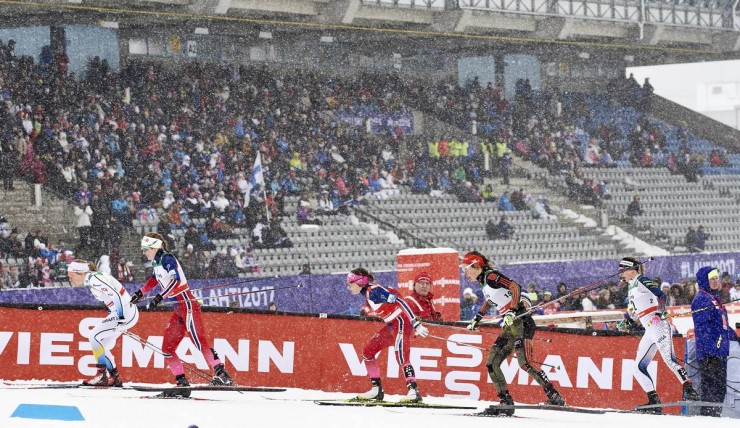
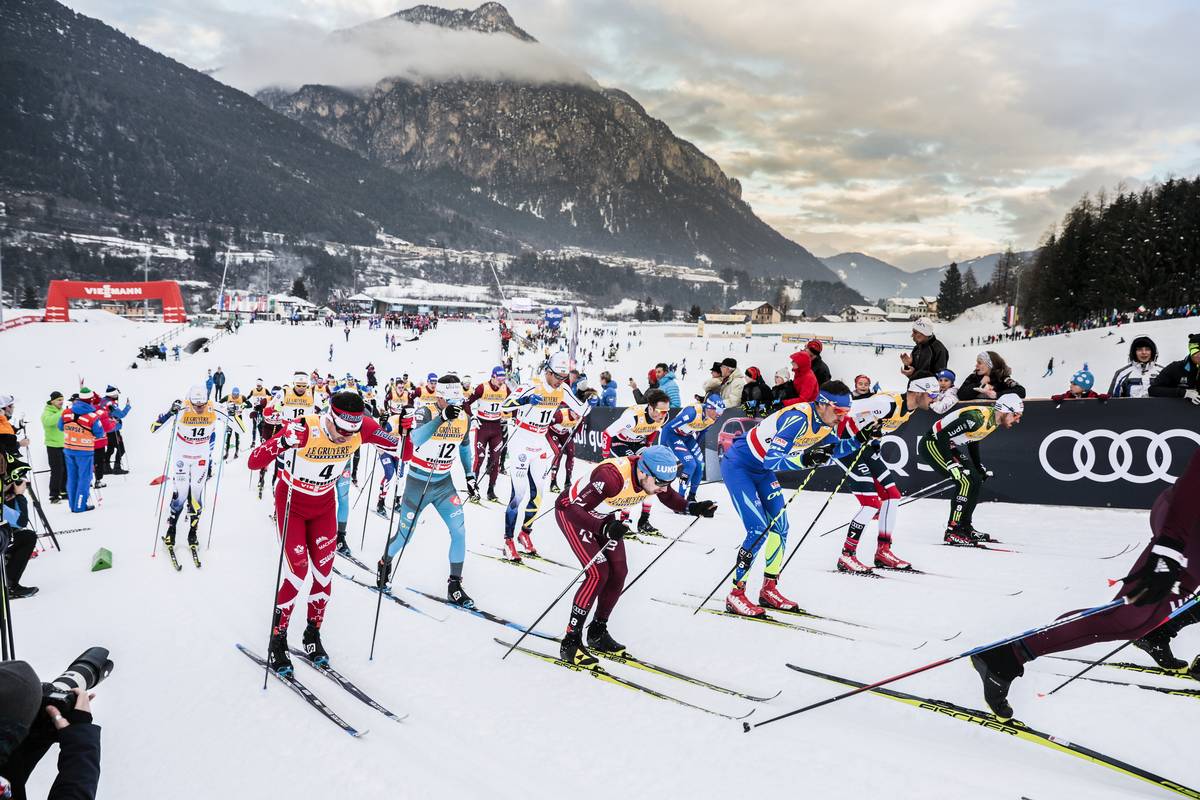
    The start of the men’s 15 k classic mass start at Stage 6 of the 2018 Tour de Ski on Saturday in Val di Fiemme, Italy, with (front row, left to right) Canada’s Alex Harvey, Russia’s Sergey Ustiugov, Kazakhstan’s Alexey Poltoranin, Norway’s Martin Johnsrud Sundby, and Switzerland’s Dario Cologna. (Photo: Salomon/NordicFocus)

    Beginning this Saturday in Toblach, Italy with a freestyle sprint is the 13th edition of the Tour de Ski (TdS). According to the International Ski Federation (FIS), over the course of seven stages the men will race 80.918 kilometers, the women 60.67 k. 

    The TdS has become both a staple and a spectacle of the annual World Cup calendar. With a jam-packed series of races primacy is placed on both the ability to recover well and wither less as the TdS transpires.

    Prognostication can be tricky in a long-form template like the TdS. So much can go astray during seven races not to mention the travel and dicey germ-avoidance. 

    Last season’s winner on the women’s side, Heidi Weng of Norway, sits 18th overall in the World Cup standings (14th in distance). She has four top-20’s in the four distance events she’s contested with her best result an eighth in Lillehammer’s 10 k skate. Although featuring two sprints in the first three stages, the TdS remains a distance skier’s paradise.

    Weng has skied solidly on the World Cup, but she has yet to show the form that made her a TdS overall winner in 2017 and 2018. Norway has won the last five iterations of the TdS: Marit Bjørgen won once in 2014/2015, Therese Johaug twice (2013/2014, 2015/2016), and Weng the last two years.
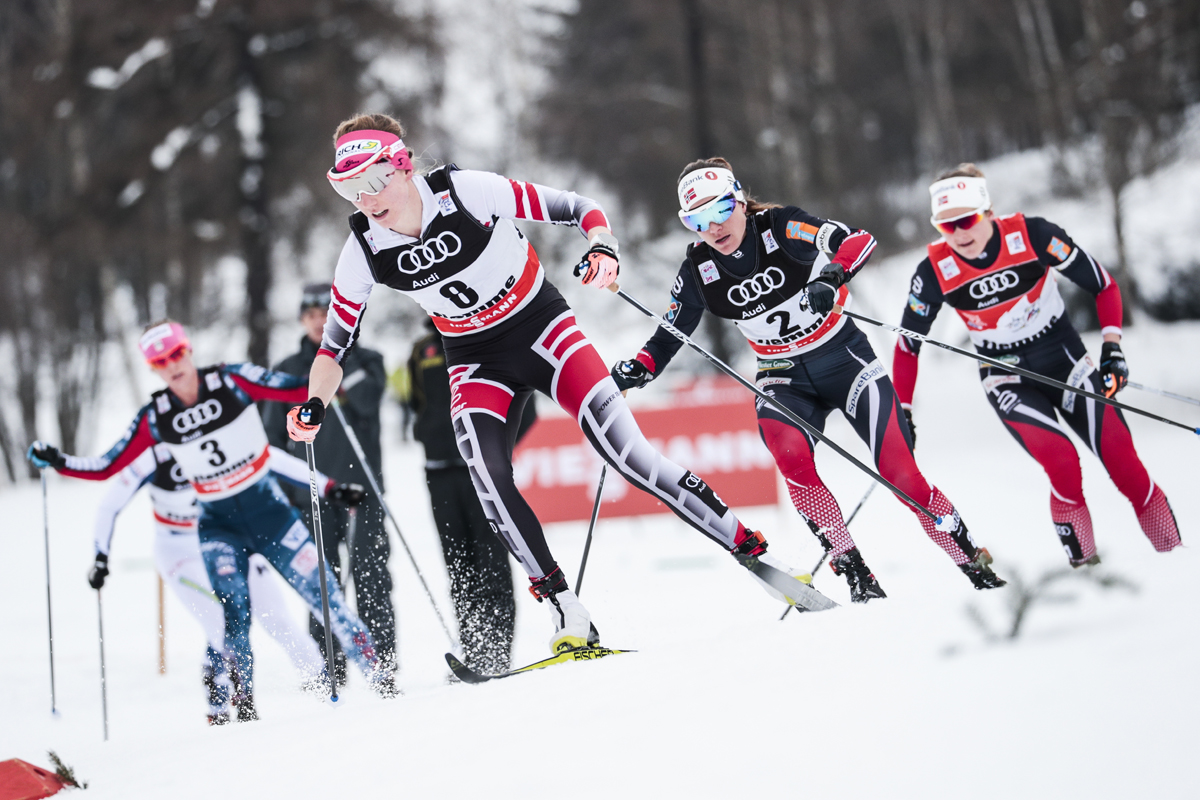
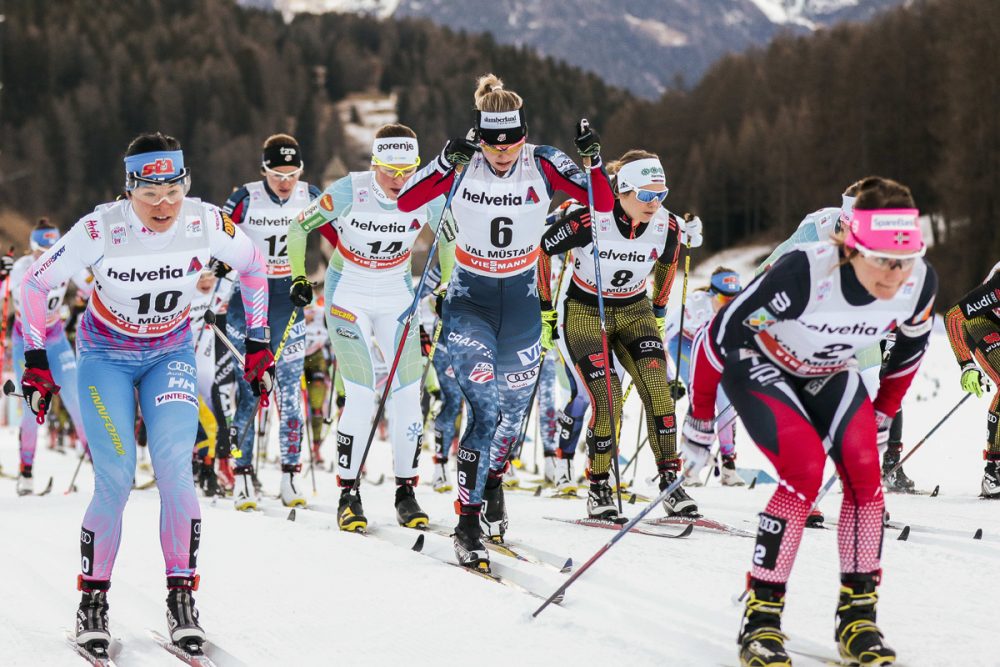
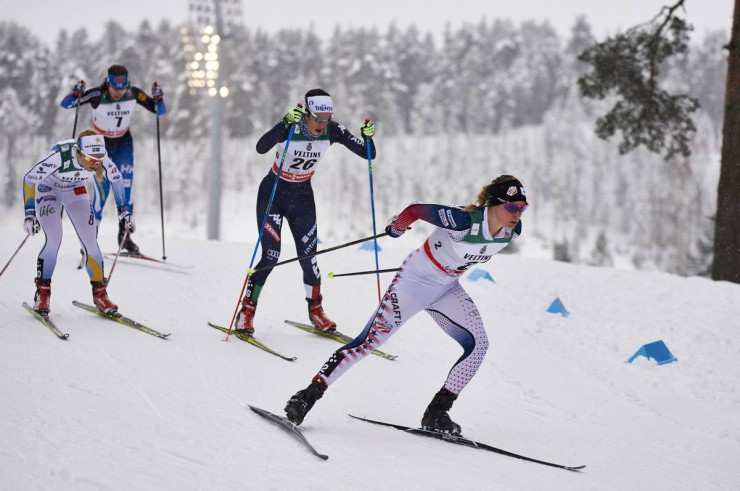
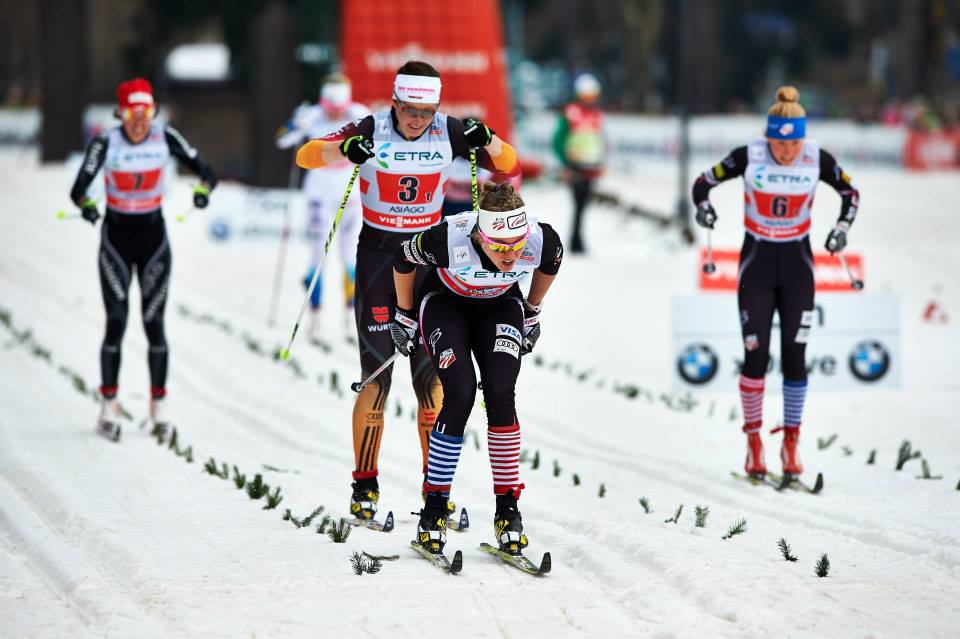
    Austria’s Teresa Stadlober leads Norway’s Heidi Weng (2) and Ingvild Flugstad Østberg, American Jessie Diggins (3) and others around a downhill corner during the women’s 10 k classic mass start at Stage 6 of the 2018 Tour de Ski in Val di Fiemme, Italy. (Photo: Fischer/NordicFocus)


    If Norway is to keep the streak alive, Ingvild Flugstad Østberg, last year’s TdS runner up, could be the heir apparent. She currently ranks second in the World Cup overall and 15th on the sprint list.

    Johaug, having returned from an 18 month doping ban, has been on a distance race tear. She has won all five World Cup distance events this season. Johaug, however, will not be lining up for the TdS.

    Only five different women have earned distance podiums this season — Johaug, Østberg, Sweden’s Charlotte Kalla and Ebba Andersson, and Finland’s Krista Pärmäkoski. Along with Johaug, Kalla and Andersson are skipping the TdS. (Andersson sits third overall on the World Cup, Kalla fifth.) With the TdS missing three of the five top ranked World Cup distance skiers, daily stages and the overall podium are up for grabs.   

    Last season’s third overall finisher, Jessie Diggins of the U.S. Ski Team (USST), often cites the TdS as a point in the season when her form trends towards podium performances. She sits eighth in the current distance standings and could very well have a stout TdS. 

    Russia’s Natalia Belorukova and Yulia Nepryaeva look strong as does Sadie Bjornsen (USST), and Austria’s Teresa Stadlober.

    With less than predictable distance stage podiums for the women, it may simply come down to a drag race on the Alpe Cermis final climb Jan. 6.
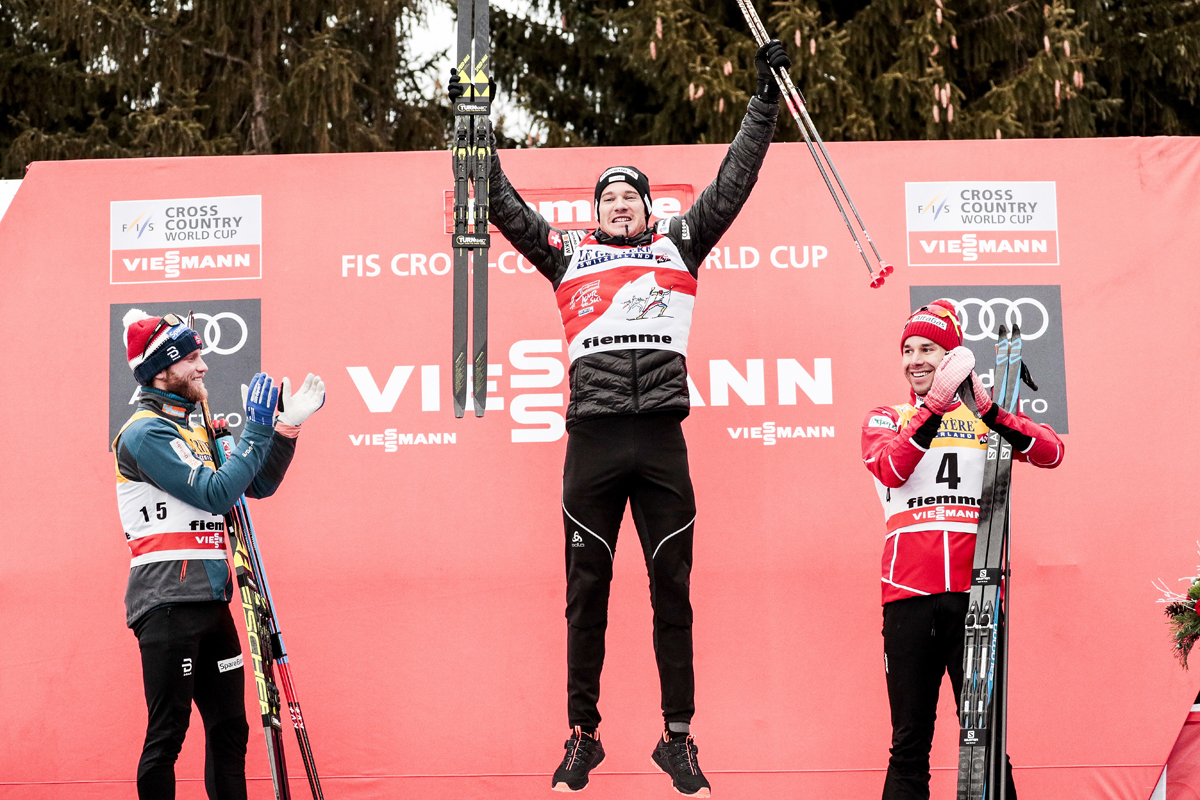
    Switzerland’s Dario Cologna (c) celebrates his fourth Tour de Ski overall title. He was joined by Norway’s Martin Johnsrud Sundby (l) and Canada’s Alex Harvey (r) on the podium in second and third, respectively. (Photo: Fischer/NordicFocus)


    The men’s scene is also open to interpretation. Last season’s TdS winner, Switzerland’s Dario Cologna, was in fact a surprise victor. Prior to Cologna’s stage two win in last year’s TdS, it had been nearly three years since the four time TdS overall winner had won a World Cup. Cologna sits 21st overall on the World Cup currently. Given last year’s resurgence, anything is possible for the Swiss skier.

    Then there’s Martin Johnsrud Sundby form Norway. He finished on the TdS podium the last three years. At thirty-four-years-old, Sundby is ranked first on the distance list, with a second, a third, and a fourth place in distance races this season.

    Sundby won the TdS on two occasions – in 2013/2014 and in 2016. His 2015 win was stripped after he tested positive for excessive levels of Salbutamol. He placed second in the past two Tours.

    In a field rife with talent, Sundby’s ability to race and rebound and race and rebound will be tested. Sjur Røthe, Emil Iversen, and Didrik Tønseth— all from Norway— look in form. And there’s Norway’s Johannes Høsflot Klæbo. The winner of last season’s overall World Cup has had flashes of his past explosive self. He could be a TdS protagonist.

    The men’s field is notably tight. Along with the Norwegians, several Russians could pop a podium, a stage win, and the overall. Russia comes with a loaded team ready to exploit. Alexander Bolshunov leads the overall World Cup – he’ll turn twenty two on Dec. 31st. He’s backed by teammates Evgeniy Belov, Andrey Melnichenko, and Denis Spitsov. 

    Canada’s Alex Harvey placed third overall last year and he looked stronger as the TdS progressed.

    The Stages

    Stage 1:  Dec. 29, skate sprint in Toblach, Italy.

    Stage 2: Dec. 30, 10 k/15 k skate in Toblach, Italy.

    Stage 3: Jan. 1, skate sprint in Val Müstair, Switzerland.

    Stage 4: Jan. 2, 10 k/15 k classic mass start in Oberstdorf, Germany.

    Stage 5: Jan. 3, 10 k/15 k skate pursuit in Oberstdorf, Germany.

    Stage 6: Jan. 5th, 10 k/15 k classic mass start in Val di Fiemme, Italy.

    Stage 7: Jan 6th, 9 k final climb skate pursuit in Val di Fiemme, Italy.

    Teams

    United States

    Women: Sophie Caldwell, Sadie Bjornsen, Jessie Diggins.

    Men: Ben Lustgarten, Simi Hamilton, Erik Bjornsen, Kevin Bolger.

    U.S. Ski Team Head Coach Chris Grover noted in a text that Caldwell, Hamilton, and Bolger will likely cease the TdS after the stage three sprint. Additionally, this is a small team for the U.S. at the TdS. Several athletes turned down TdS nominations including Scott Patterson (USST), Andy Newell (SMS T2/Salomon), Kyle Bratrud (SMS T2), Rosie Brennan (APU), Rosie Frankowski (APU), Caitlin Patterson (CGRP), and Julia Kern (SMS T2). These skiers plan on racing U.S. Nationals this January in Craftsbury, Vermont.

    Canada

    Women: Emily Nishikawa, Dahria Beatty

    Men: Alex Harvey, Lenny Valjas, Bob Thompson

    Norway

    Women: Ingvild Flugstad Østberg, Maiken Caspersen Falla, Astrid Uhrenholdt Jacobsen, Kari Øyre Slind, Kathrine Rolsted Harsem, Heidi Weng, Lotta Udnes Weng, Tiril Udnes Weng Mari Eide, Anna Svendsen

    Men: Martin Johnsrud Sundby, Hans Christer Holund, Emil Iversen, Didrik Tønseth, Simen Hegstad, Krüger, Sjur Røthe, Johannes Høsflot Klæbo, Martin Løwstrøm Nyenget, Eirik Brandsdal, Finn Hågen Krogh

    Russia

    Women: Yulia Belorukova, Lidia Durkina, Anna Zherebyateva, Mariya Istomina, Natalia Nepryaeva, Anna Nechaevskaya, Anastasia Sedova, Elena Soboleva

    Men: Evgeniy Belov, Alexander Bolshunov, Maxim Vylegzhanin, Andrey Larkov, Andrey Melnichenko,  Gleb Retivykh, Andrey Sobakarev, Denis Spitsov, Sergey Ustiugov

    Sweden

    Women: Mia Eriksson, Ida Ingemarsdotter, Moa Molander Kristiansen, Stina Nilsson, Maria Nordström, Linn Sömskar, Lisa Vinsa

    Men: Calle Halfvarsson, Simon Lageson, Teodor Peterson, Daniel Rickardsson, Oskar Svensson, Viktor Thorn, Karl Johan Westberg

    Finland

    Women: Mari Eder, Anne Kyllönen, Laura Mononen, Krista Pärmäkoski, Susanna Saapunki

    Men: Ristomatti Hakola, Matti Heikkinen, Lauri Vuorinen

    Italy

    Women: Elisa Brocard, Anna Comarella, Ilaria Debertolis, Caterina Ganz, Greta Laurent, Sara Pellegrini, Lucia Scardoni

    Men: Francesco de Fabiani, Stefano Gardener, Enrico Nizzo, Dietmar Noeckler, Federico Pellegrino, Maicol Rastelli, Giandomenico Salvadori

    Switzerland

    Women: Nathalie von Siebenthal, Laurien van der Graaff, Nadine Fähndrich

    Men: Dario Cologna, and Jovian Hediger, Jonas Baumann, Livio Bieler, Roman Furger, Käser Erwanm, Beda Klee, Toni Livers, Jason Rüesch, Schaad Roman

    Austria

    Women: Therese Stadlober

    Germany

    Women: Julia Belger, Victoria Carl, Pia Fink, Laura Gimmler, Katharina Hennig, Sandra Ringwald, Elisabeth Schicho, Anne Winkler

    Men: Thomas Bing, Lucas Bögl, Janosch Brugger, Jonas Dobler, Sebastian Eisenlauer, Andreas Katz, Valentin Mättig, Florian Notz, Max Olex, Thomas Wick

    France

    Women: Anouk Faivre Picon, Delphine Claudel, Laura Chamiot-Maitral

    Men: Maurice Manificat, Lucas Chanavat, Adrien Backscheider, Jean-Marc Gaillard, Baptiste Gros, Renaud Jay, Richard Jouve, Jules Lapierre, Clement Parisse

    FasterSkier will update team start lists as we gather more information.

    antibiotics

  • World Cup Preview #4: Finland

    World Cup Preview #4: Finland

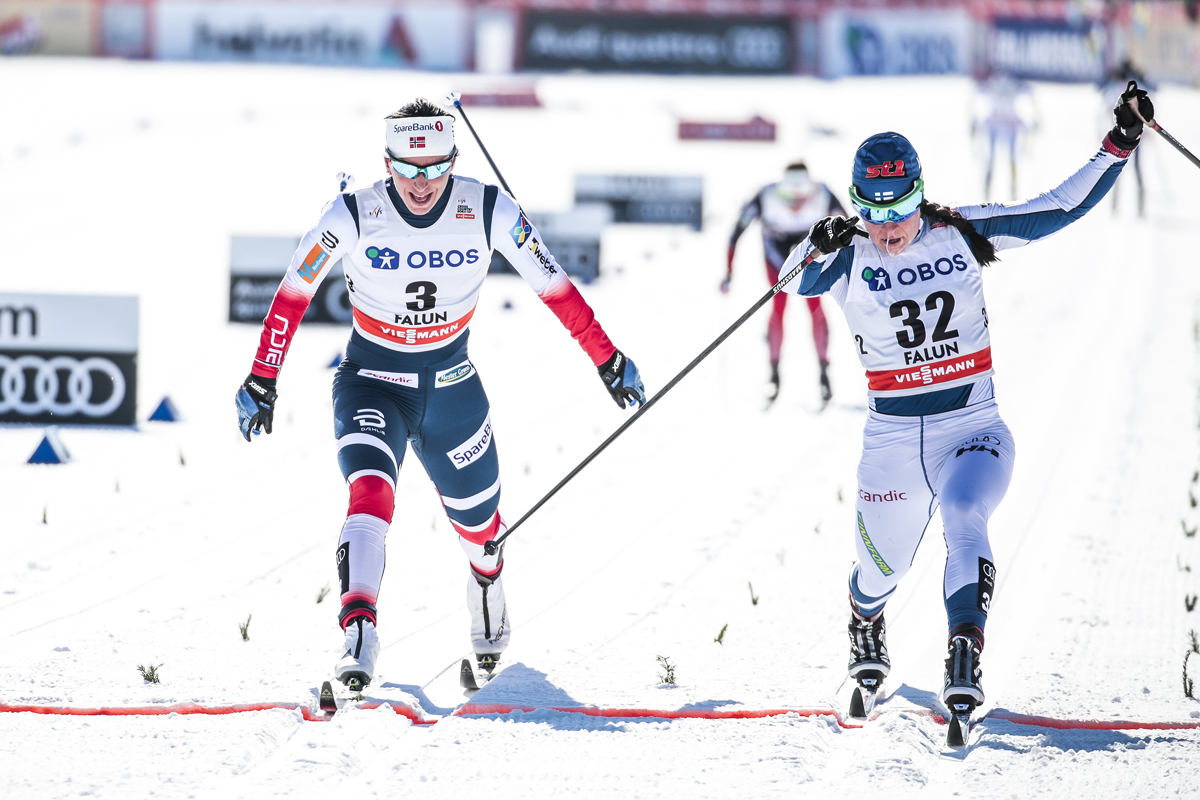
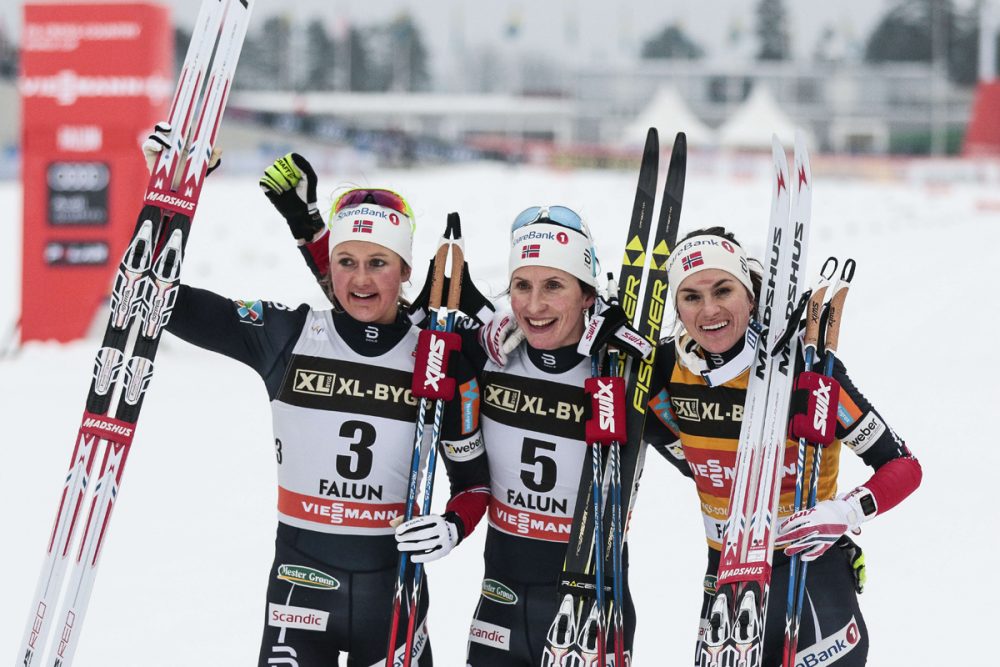
    Finland’s Krista Pärmäkoski (32) edges Norway’s Marit Bjørgen for the win in the women’s 10 k classic mass start at 2018 World Cup Finals in Falun, Sweden. (Photo: Fischer/NordicFocus)


    Welcome to FasterSkier’s World Cup Preview, where we check in with the top-10 teams from last year’s FIS Cross Country World Cup tour before the season starts with the Ruka weekend in Kuusamo, Finland, on Nov. 24 with a classic sprint.

    ***

    Finland

    Overall in Nations Cup Last Year:4th

    Women’s Ranking 2017/2018: 4th

    Men’s Ranking 2017/2018: 7th

    Finnish Skiers to Watch:

    If there are two names Finland’s cross-country ski fans loves to cheer–and will be looking to chant again this season–it’s Krista Pärmäkoski and Iivo Niskanen. And with good reason.

    Pärmäkoski opened Period II of last season with a win, cruising to first in the 10-kilometer classic race in Planica, Slovenia. Pärmäkoski racked up two more 10 k victories after Planica, winning both the Lahti 10 k and the Falun 10 k. Altogether, Pärmäkoski landed on the World Cup podium seven times last season, capping off the FIS 2017/2018 season ranked fourth, just ahead of Norway’s Marit Bjørgen in fifth.

    Outside of the World Cup, Pärmäkoski also came away from the 2018 Pyeongchang Winter Olympic Games with three individual medals, one silver and two bronze.

    Complimenting Pärmäkoski on the men’s side, Niskanen, earned two World Cup podiums last season, placing third in the Ruka 15 k and third in the Lahti 15 k. He landed in the top-20 twelve times during last year’s World Cup season, and finished 15th in the FIS overall.

    buy celebrex online

    buy celebrex online

    Like Pärmäkoski, he also departed the Winter Games with hardware, a gold medal from the men’s 50 k mass start.

    Pärmäkoski and Niskanen aren’t the only Finns capable of pushing into the top tiers of World Cup skiers. With the retirement of Aino-Kaisa Saarinen this past spring, the women’s side will look to Kerttu Niskanen (Iivo’s sister), Riitta-Liisa Roponen, Anne Kyllönen and Laura Mononen–all of whom scored World Cup points more than once last season– to keep the women’s team’s forward momentum.  

    Following Niskanen, Matti Heikkinen and Ristomatti Hakola are two veteran Finnish names who are not about to let up as the 2018/2019 season prepares to get underway.  


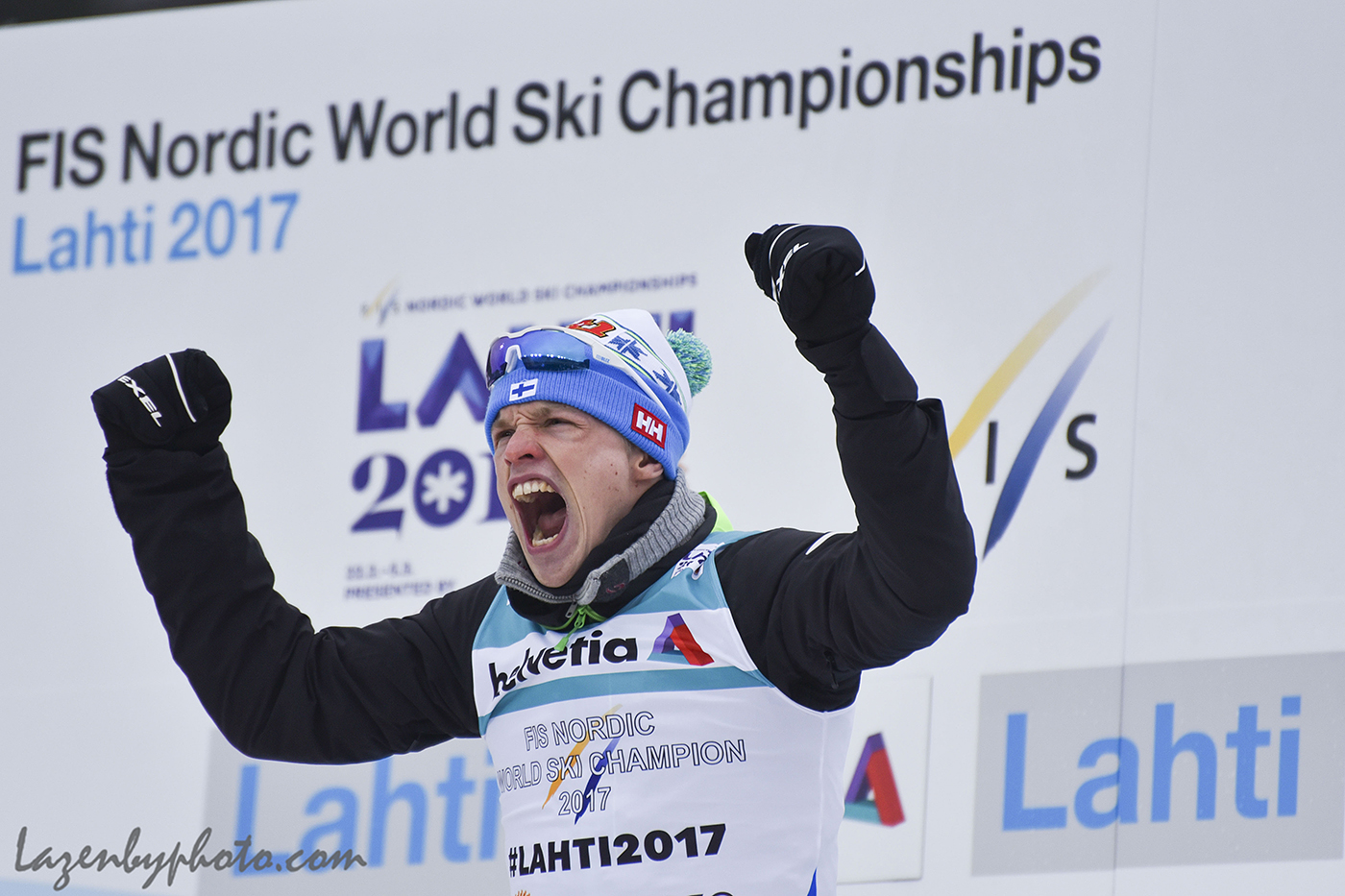
    Finland’s Iivo Niskanen celebrating his first World Championships gold in the men’s 15 k classic on March 1, 2017, in Lahti, Finland. (Photo: John Lazenby)
  • Win No. 105 for Bjørgen; U.S. Put 4 in Top 30 in Falun 15 k Classic

    Win No. 105 for Bjørgen; U.S. Put 4 in Top 30 in Falun 15 k Classic

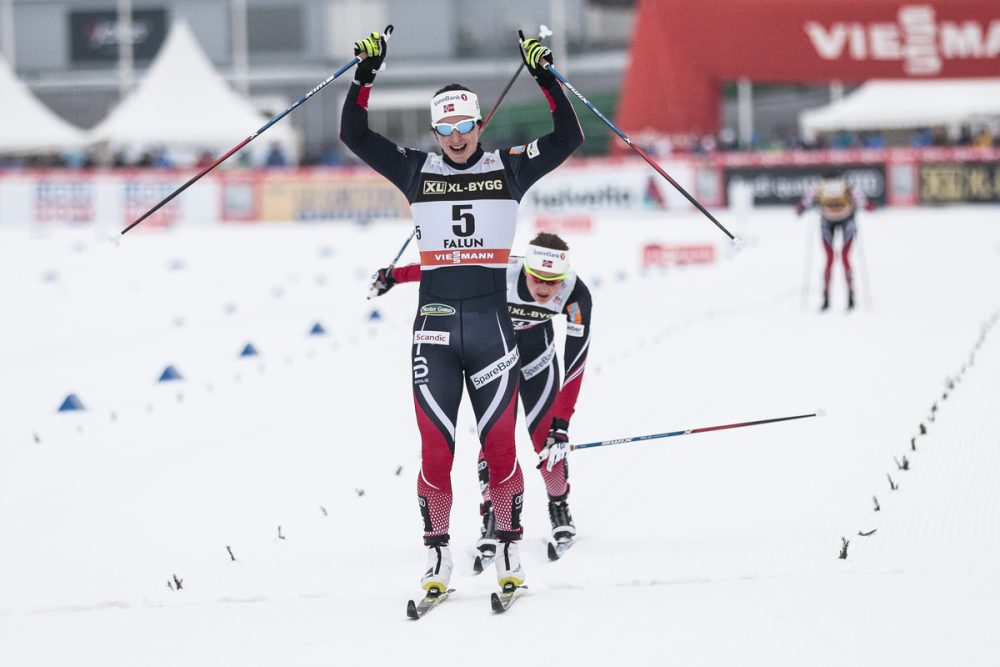
    Norway's Marit Bjørgen celebrates her 105th individual World Cup win after she crosses first in the women's 15-kilometer classic mass start on Sunday in Falun, Sweden. (Photo: Fischer/NordicFocus)
    Norway’s Marit Bjørgen celebrates her 105th individual World Cup win on Sunday after finishing first, ahead of teammate Ingvild Flugstad Østberg, in the women’s 15-kilometer classic mass start in Falun, Sweden. (Photo: Fischer/NordicFocus)

    *Note: this article has been updated to include comments from U.S. women’s head coach Matt Whitcomb as of Monday, Jan. 30. 

    After sealing her 105th individual World Cup victory on Sunday, and her second distance win in a row, Marit Bjørgen is shutting out any doubt. The 36-year-old Norwegian was the first across the line in the women’s 15-kilometer classic mass start in Falun, Sweden, besting her teammate Ingvild Flugstad Østberg by half of a second, as well as the current overall World Cup leader, Heidi Weng, also of Norway.

    “It’s great to be able to win World Cups still,” Bjørgen said according to an International Ski Federation (FIS) press release. “The young girls are strong, so it feels good to be able to come out with a win.

    Starting in bib 5, Bjørgen wasted no time putting her teammates and the field to work. By 1.5 k she was in the lead, pulling Østberg and Weng, as well as Sweden’s Stina Nilsson — yesterday’s sprint winner — and Finland’s Krista Pärmäkoski.

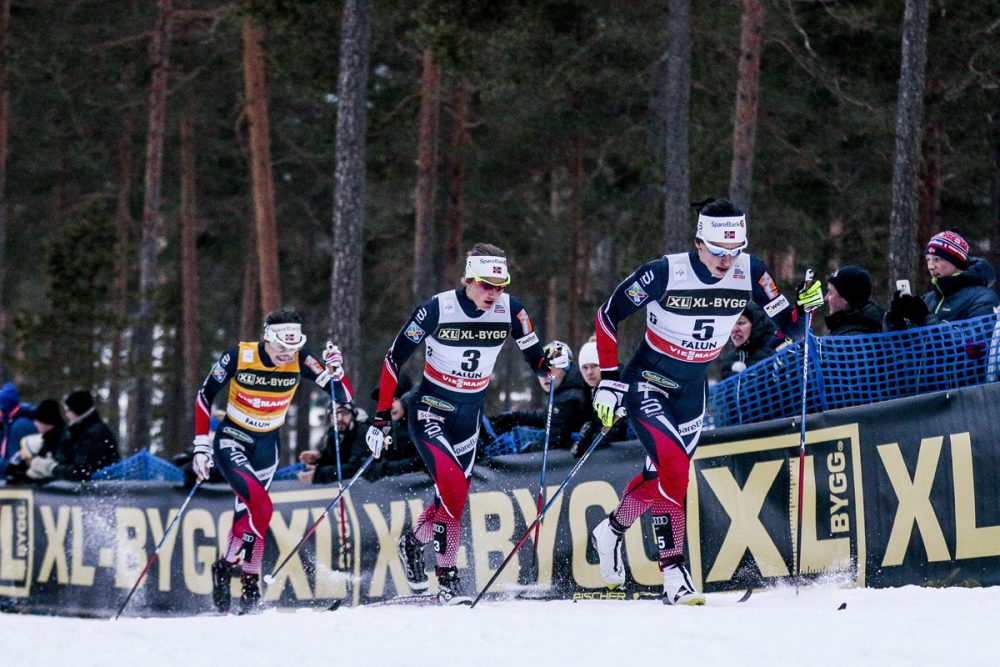
    Right to left: Norway's Marit Bjørgen leading her teammates Ingvild Flugstad Østberg and Heidi Weng during the women's 15-kilometer classic mass start on Sunday in Falun, Sweden. (Photo: Fischer/Nordic Focus)
    Norway’s Marit Bjørgen (5) leads her teammates Ingvild Flugstad Østberg (3) and Heidi Weng during the World Cup women’s 15 k classic mass start on Sunday in Falun, Sweden. (Photo: Fischer/NordicFocus)

    Also within firing range was American Jessie Diggins, skiing in seventh, along with Norway’s Astrid Uhrenholdt Jacobsen and Maiken Caspersen Falla, and Sweden’s Charlotte Kalla.

    However, within another four kilometers, the Norwegians had broken away, a close to seven-second gap forming from them to Nilsson and Pärmäkoski.

    While Bjørgen led for the first third of the race, Østberg took over by 10 k and Weng continued to follow in third.

    With 1.8 k to go, Bjørgen was back to the front, Nilsson the closest challenger to the Norwegians just over 30 seconds behind.

    “I thought Stina might catch me, so I am very happy to make the podium today,” Weng said, according to a FIS press release.

    As the three headed into the second-to-last major climb, Østberg pushed to the front, Bjørgen trailing back. But coming into the final climb, Bjørgen moved back into first as she herringboned to the far outside right of Østberg, almost departing the marked course.

    “I didn’t ski the final climb well … Marit got a gap and I wasn’t able to close it,” Østberg said according to FIS. “I wasn’t satisfied with yesterday’s sprint result, so it’s good to be back on the podium today.”

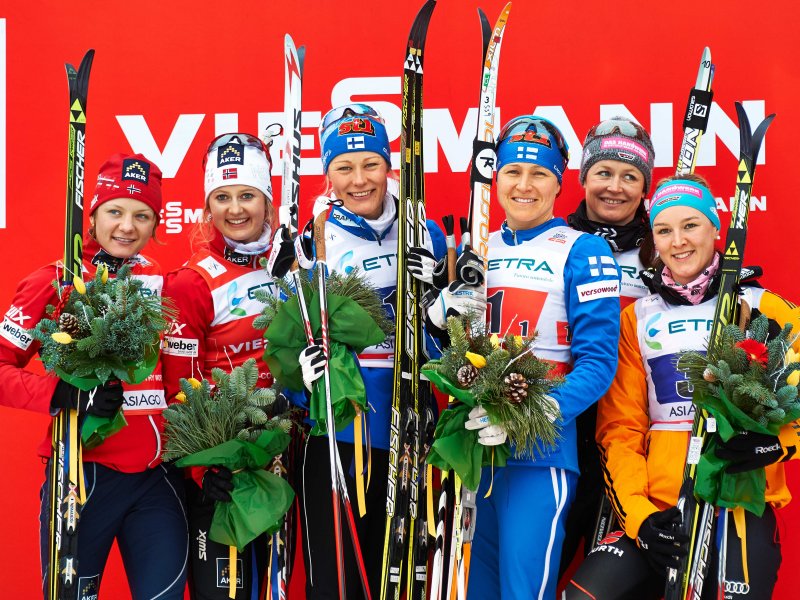
    Left to right: Norway's Ingvild Flugstad Østberg, Marit Bjørgen and Heidi Weng celebrate an all-Norwegian podium in the women's 15-kilometer classic mass start on Sunday at the World Cup in Falun, Sweden. (Photo: Fischer/NordicFocus)
    Left to right: Norway’s Ingvild Flugstad Østberg, Marit Bjørgen and Heidi Weng celebrate an all-Norwegian podium in the women’s 15-kilometer classic mass start on Sunday at the World Cup in Falun, Sweden. (Photo: Fischer/NordicFocus)

    In a double-pole sprint to the finish, Bjørgen held off Østberg for the win in a time of 41:28.8. Østberg finished half a second later for second place, followed by Weng in third (+8.1). 

    The first American across the line was Diggins in 10th (+1:37.5) wearing bib 4. While the Afton, Minn., native explained that Sunday’s sugary conditions are some of her least favorite, the opportunity to put her classic striding to the test was something she welcomed.

    After losing the leaders, the 25-year-old Diggins skied with a mix of Finnish skiers, including Laura Mononen, Anne Kyllönen, and Kerttu Niskanen, as well as Norway’s Falla.

    “Early on I tried to go with the leaders but then settled into a great pack of girls to ski with and it came down to an exciting sprint out,” Diggins wrote in an email. “I’m really looking forward to some rest and then a quality training camp with some family time in Valadalen [Sweden] for the next few weeks! My boyfriend is here cheering me on and coming to camp with me, and then my parents come next week so I have so many great things to look forward to!”

    The second U.S. woman across the line was Sadie Bjornsen in 21st (+2:43.6). A known lover of all-things-classic, Bjornsen was disappointed when she found herself tired during Sunday’s race. The 27 year old, however, was happy that she made it through the mental and physical challenge.

    “Today I literally gave everything I had, and while I am not stoked on the number or result, I am really proud that I kept fighting through that wall in front of my face,” Bjornsen wrote. “It was really challenging classic skiing out there, which I love, so I am sad to have missed an opportunity to fight in those tricky conditions. Big shoutout to our team for giving me good skis! I am looking forward to some rest and recovery to rebuild for a big and important block of racing to come!”

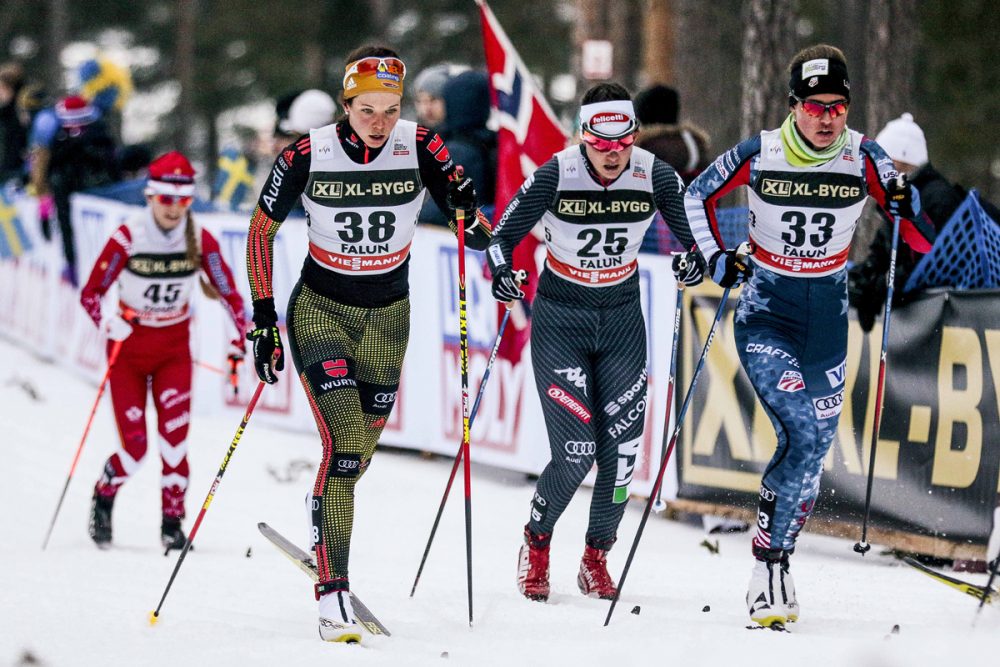
    American Caitlin Patterson (33) and Canadian Cendrine Browne (45) racing the women's 15-kilometer classic mass start on Sunday in Falun, Sweden, along with Germany's Elisabeth Schicho (38) and Italy's Giulia Stuerz (25). (Photo: Fischer/NordicFocus)
    American Caitlin Patterson (33) and Canadian Cendrine Browne (45) racing the women’s 15-kilometer classic mass start on Sunday in Falun, Sweden, along with Germany’s Elisabeth Schicho (38) and Italy’s Giulia Stuerz (25). (Photo: Fischer/NordicFocus)

    Two other American women also scored World Cup points, including Rosie Brennan in 24th (+2:57.0) and Liz Stephen in 29th (+3:24.5).

    Despite the sugary conditions and deteriorated tracks due to the men’s race, Brennan explained that Sunday’s snow was what she was looking for coming into the 15 k.

    “I actually really enjoy skiing in this kind of condition so I was optimistic about today’s race,” the 28-year-old Brennan wrote in an email. “I felt that I was fighting a bit of fatigue out there and only really had one speed, luckily it was a decent speed and I was able to hold consistent throughout the race.”

    Also competing for the U.S. finishing just outside the points was Caitlin Patterson in 32nd (+3:47.6) and Ida Sargent in 34th (+4:02.8).

    “Today was a solid day for the team,” U.S. women’s head coach, Matt Whitcomb wrote in an email. “We fought hard, and nearly accomplished what I will consider to be a huge achievement for the women, and that will be when we regularly can score our full national quota (6) in the points.  Today we had 4, with a close 32nd and 34th. That’s close to where I know we can be.”

    Canada’s lone competitor in the women’s race, Cendrine Browne crossed in 46th (+5:41.4) and American Liz Guiney finished 49th (+6:22.6).

    Results

  • Saturday Rundown: Val di Fiemme, Oberhof, Soldier Hollow, Planica (Updated x3)

    Saturday Rundown: Val di Fiemme, Oberhof, Soldier Hollow, Planica (Updated x3)

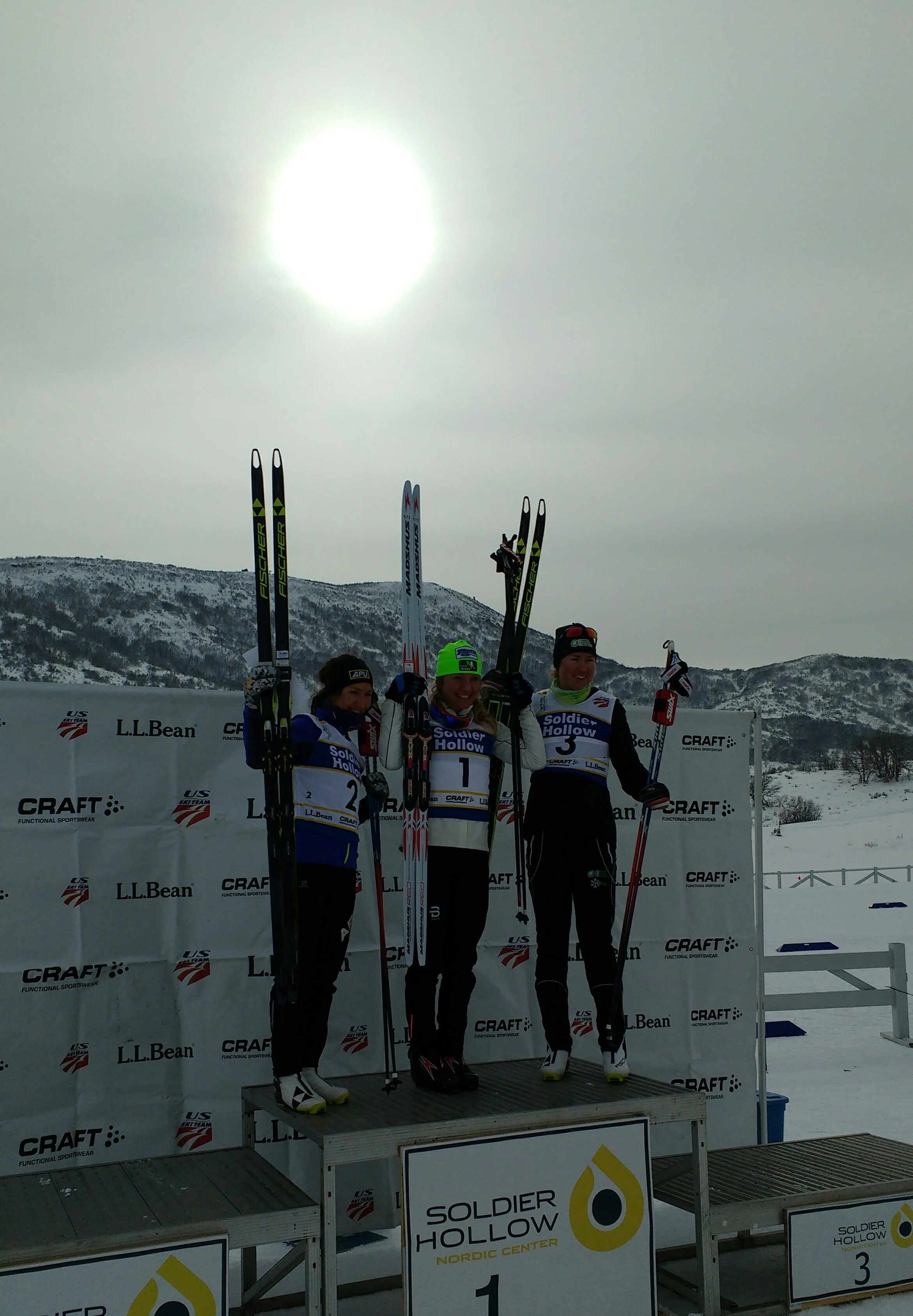
    Left to right: Chelsea Holmes, Caitlin Gregg, and Caitlin Patterson standing on top of the podium for the women's 10-kilometer freestyle event at the 2017 U.S. Cross Country Championships at Soldier Hollow in Midway, Utah.
    Left to right: Chelsea Holmes, Caitlin Gregg, and Caitlin Patterson standing on top of the podium for the women’s 10-kilometer freestyle event at the 2017 U.S. Cross Country Championships at Soldier Hollow in Midway, Utah.

    U.S. Cross Country Championships (Soldier Hollow): 10 k skate

    [UPDATED] Don’t bet against Caitlin Gregg (Team Gregg) in a distance skate event. The 36-year-old took another national title in the 10-kilometer freestyle individual start at Soldier Hollow in Midway, Utah, earlier today in the first event of the 2017 U.S. Cross Country Championships. Gregg’s winning time was 27:00.6 on a cold, slow-snow morning at SoHo.

    Chelsea Holmes (Alaska Pacific University) was second, 2.2 seconds back, with Caitlin Patterson (Craftsbury Green Racing Project) third (+14.5). Katharine Ogden (Stratton Mountain School, +20) was fourth, Becca Rorabaugh (APU, +58.4) fifth, and Rosie Frankowski (APU, +1:05) sixth to round out the extended podium.

    In the men’s 15-kilometer freestyle event, Central Cross Country Ski Association’s Kyle Bratrud took first in a time of 34:52.0. Second place wen tot Ski and Snowboard Club Vail’s Tad Elliott  finished in a time of 35:14.6, while University of Denver’s Mori Madelaner (+35:22.4) rounded out the podium in third. Patrick Caldwell of Stratton Mountain School was seven tenths of a second out of third place in fourth overall (the third American on the day) in a time of 35:23.1. Fifth went to Kris Freeman of Team Freebird in a time of 35:28.0. 

    Results: Women | Men

    ***

    IBU World Cup (Oberhof): 10/12.5 k pursuits

    [UPDATED] In the men’s 12.5 k pursuit on Saturday in Oberhof, Germany, France’s Martin Fourcade got back to his winning ways, shooting 19-for-20 (0+1+0+0) on a cold and gusting afternoon for a 1:09.9-minute victory in 36:45.7. He started eighth.

    Germany’s Arnd Peiffer started 15th and finished second with three penalties (0+0+1+2), and for the second-straight race, Italy’s Dominik Windisch placed third (+1:32.4), with five misses. Windisch was just 0.2 seconds ahead of Norway’s Emil Hegle Svendsen in fifth (+1:32.6), also with five penalties (1+1+2+1).

    Tim Burke (US Biathlon) raced to 26th (+3:18.9) after starting 35th, with four penalties, all in standing (0+0+2+2). Also for the U.S., Russell Currier placed 34th (+4:29.8), up from 46th at the start, with five penalties (2+0+1+2).

    Canada’s Scott Gow finished 45th (+5:45.7) with seven misses (1+1+2+3).

    No North American men are listed on the provisional start list for Sunday’s 15 k mass start.

    In the women’s 10 k pursuit that followed, France made it a double on the day with Marie Dorin Habert taking a 38.8-second victory in 34:33.3. She started third and had two penalties (1+0+0+1) en route to the win, ahead of Friday’s sprint winner Gabriela Koukalova of the Czech Republic in second, with two clean stages followed by three misses (0+0+1+2).

    Finland’s Kaisa Mäkäräinen started second and ended up third (+1:19.1) with four penalties (1+0+1+2) amid blustery conditions in Oberhof.

    Canada’s Rosanna Crawford finished 22nd (+3:47.9), one spot down from starting 21st, with four penalties (0+1+1+2).

    For the U.S., Susan Dunklee placed 44th (+6:20.4), up from starting 50th, despite nine misses (1+3+4+1). Clare Egan finished 49th (+7:25.6) after starting 52nd, with seven misses (4+0+0+3).

    Dunklee was listed as the lone North American starter in Sunday’s 12.5 k mass start, as she is currently ranked 17th overall in the IBU World Cup. Crawford is next in line on the “reserve standby athletes” lists by her event results of the week, should another qualified athlete have to cancel (e.g. due to illness).

    Results: Men | Women

    Mass start provisional start lists: Men | Women

    ***

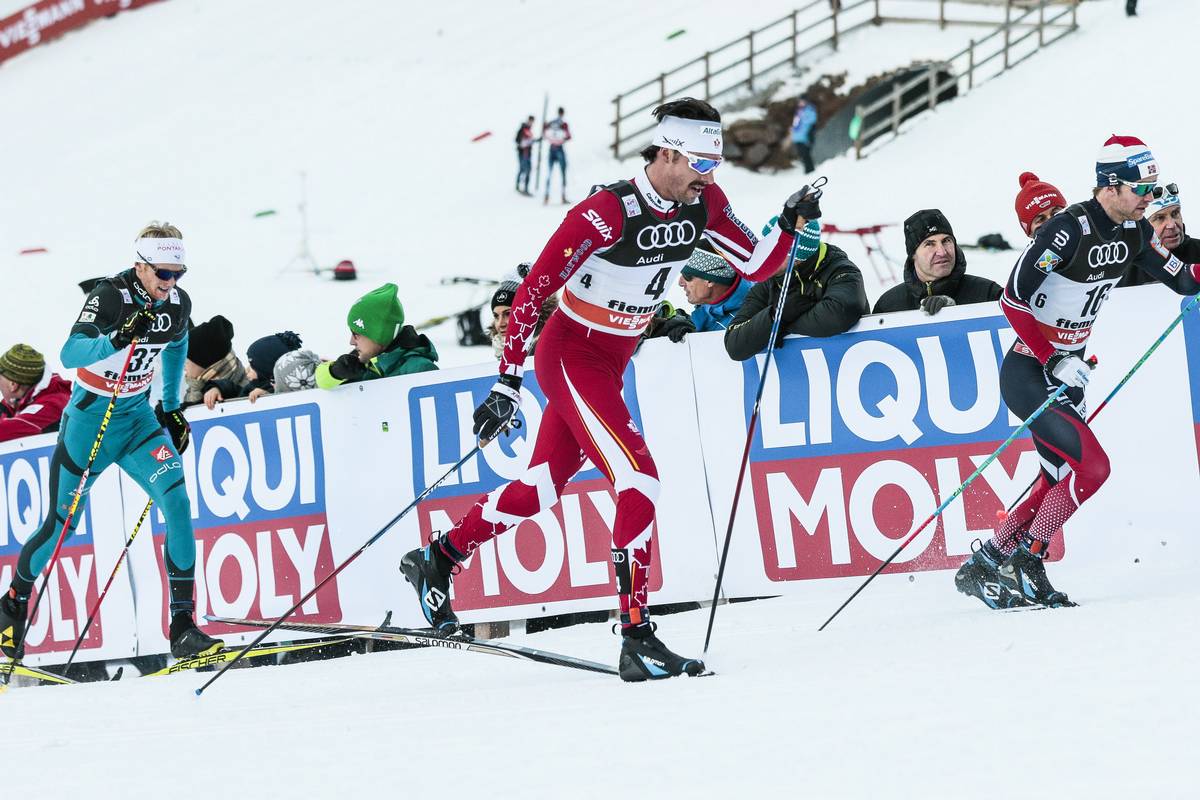
    Alex Harvey (Canadian World Cup Team) en route to 19th in the men's 15 k classic mass start on Saturday, which puts him sixth overall in the Tour de Ski with one stage remaining in Val di Fiemme, Italy. (Photo: Salomon/Nordic Focus)
    Alex Harvey (Canadian World Cup Team) en route to 19th in the men’s 15 k classic mass start on Saturday, which puts him sixth overall in the Tour de Ski with one stage remaining in Val di Fiemme, Italy. (Photo: Salomon/Nordic Focus)

    FIS Cross-Country Tour de Ski Stage 6 (Val di Fiemme, Italy): 10/15 k classic

    Russian Sergey Ustiugov’s Tour de Ski winning streak came to an end on Saturday at the penultimate stage of the seven-stage Tour, with Norway’s Martin Johnsrud Sundby breaking away on the final 2.5 k lap to win the men’s 15-kilometer classic mass start at Stage 6 in Val di Fiemme, Italy.

    Ustiugov had to outlast a chase pack to settle for second, 2.2 seconds behind Sundby, who won in 40:40.0. Finland’s Matti Heikkinen reached the podium in third (+2.8), ahead of Italy’s Francesco de Fabiani in fourth (+3.2), Russia’s Andrey Larkov in fifth (+3.3), Norway’s Niklas Dyrhaug in sixth (+3.5), Switzerland’s Dario Cologna in seventh (+3.8), and Russia’s Alexander Bessmertnykh in eighth (+3.9). Behind Heikkinen, the fourth- through eighth-place finishers were all within 1.1 seconds of the stage podium.

    Canada’s Alex Harvey ended up 19th (+38.7) after losing seconds to the leaders on the second half of the course. He finished ahead of teammates Devon Kershaw in 27th (+1:12.1) and Graeme Killick in 32nd (+1:31.0).

    For the U.S., Noah Hoffman scored points for the second-straight day in 30th (+1:17.1). Erik Bjornsen crashed on an early downhill and dropped out of the race around the halfway point.

    Ustiugov previously built a more than 1 1/2 minute lead in the Tour, so he remains 1:11.9 minutes ahead of Sundby in the overall with one stage (the 9 k final climb) to go. Cologna remains in third (+2:04.1), Heikkinen is fourth (+2:32.9), France’s Maurice Manificat fifth (+2:34.6) after finishing 13th on Saturday, and Harvey slipped from fourth to sixth overall (+2:42.5), ahead of Sweden’s Marcus Hellner, who finished 10th for seventh overall (+2:54.5).

    Kershaw is 23rd overall (+7:19.1), Hoffman 30th (+9.42.7), and Killick 37th (+11:25.1) heading into the final stage.

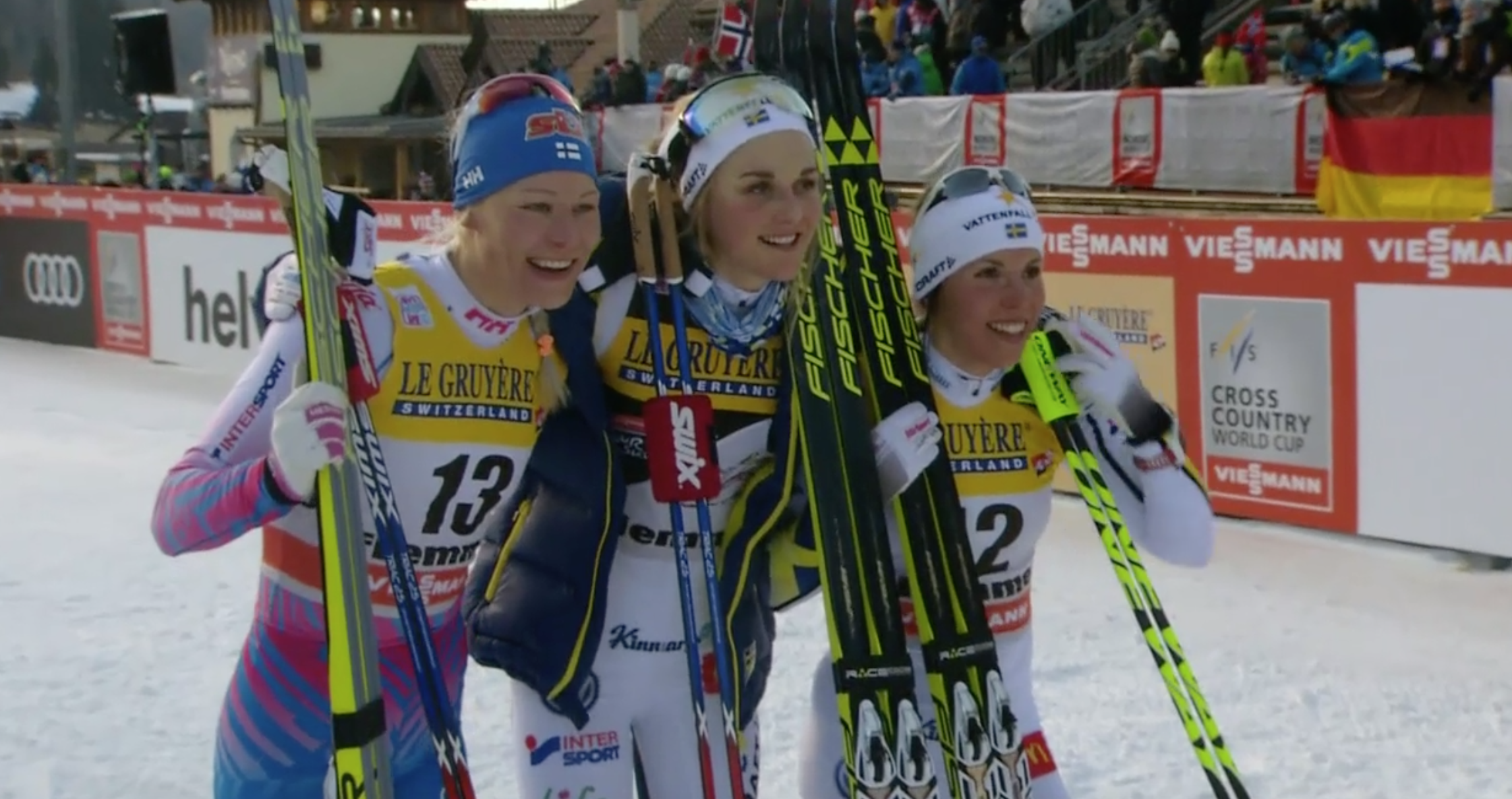
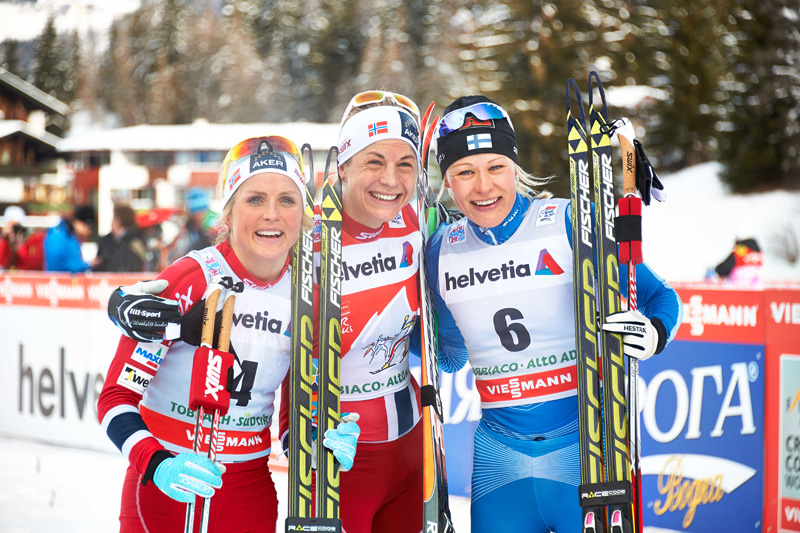
    Stina Nilsson of Sweden (center) celebrates another win in the Tour de Ski, which puts her atop the overall standings; Anne Kylloenen of Finland (left) was second in the 10 k classic mass start and Charlotte Kalla of Sweden third.
    Stina Nilsson of Sweden (center) celebrates another win in the Tour de Ski, which puts her atop the overall standings; Anne Kyllönen of Finland (left) was second in the 10 k classic mass start and Charlotte Kalla of Sweden third.

    In the women’s 10 k classic mass start to start the day, Stina Nilsson of Sweden won her fourth stage of this year’s Tour, racing aggressively from start to finish and picking up extra bonus seconds along the way.

    Nilsson pushed the hills late and nobody from the already-fractured main pack could keep up. She notched a 3.0-second win over Anne Kyllönen of Finland, who collected her first individual podium of the season. Charlotte Kalla joined her Swedish teammate on the podium in third (+3.7), also her first podium of the year; she had been fourth in the 5 k freestyle the day before in Toblach, Italy.

    Krista Parmakoski of Finland was fourth, +9.4, Teresa Stadlober of Austria fifth, +10.1, and Yulia Tchekaleva of Russia sixth, +10.5.

    With the bonus seconds that Nilsson picked up along the way, she stole the overall Tour de Ski lead from Norway’s Heidi Weng, who finished seventh (+17.5). Ingvild Flugstad Østberg, also of Norway, had been in second place but slipped even farther. After leading at the start of the race, she slipped through the pack and then off the back, crossing the line 18th (+1:08.5). She is now fourth in the Tour de ski, behind Parmakoski.

    Jessie Diggins of the U.S. skied to eighth place (+19.5) and retained her fifth place overall Tour standing. Teammate Liz Stephen raced to 19th (+1:11.2), and moved into the top 20 of the Tour standings for the first time. Rosie Brennan scored points again in 28th (+2:06.1).

    Results: Men | Women

    Tour standings (through Stage 6): Men | Women

    ***

    FIS Cross-Country OPA Cup (Planica, Slovenia): 10 k classic

    [UPDATED] A quartet of American sprinters turned to distance classic skiing, placing as high as fifth, in 10-kilometer classic interval start races at the OPA Cup in Planica, Slovenia, earlier Saturday.

    U.S. Ski Team member Simi Hamilton posted the day’s best result for the Americans, finishing fifth in the men’s race, 13.8 seconds back from winner Jean Tiberghien of France. Hamilton, who started in the final third of the 110-skier field, worked his way into the race, placing 14th at the 3.8 k mark and seventh at 7.5 k before moving up into fifth by the finish. His teammate and the other American in the race, Andy Newell, placed 58th, 1:30.7 back, finishing strong after placing 67th at the 7.5 k time checkpoint.

    Mickael Philipot (+2.0) and Valentin Chauvin (+8.6) rounded out the all-Gallic podium.

    In the women’s race, Ida Sargent (USST) was the leading American in 17th. She finished 1:10 behind winner Sara Pellegrini of Italy. Sargent likewise worked her way into the race, placing 26th and 18th at intermediate checkpoints before moving up to 17th by the finish.

    Three places and less than ten seconds back, Sophie Caldwell (USST) finished 20th, 1:19.7 back of Pellegrini. Caldwell started out somewhat faster than the three other Americans who raced today, placing as high as seventh at the first checkpoint.

    The final podium, reminiscent of the 2006 World Cup soccer final, was Pellegrini in first, Italian Caterina Ganz in second (+7.6), and Delphine Claudel of France in third (+14.6).

    Conditions in Planica were clear and cold and just a few degrees above the FIS-legal cutoff, with race-time temperatures between 3° F and 5° F.

    Racing in Planica concludes tomorrow with interval start 10 and 15 k classic races, replacing the 7.5/15 k skiathlon that was originally scheduled.

    Results: men | women

  • Østberg Takes Tour Lead with 5 k Classic Win; Diggins 8th, 6th Overall

    Østberg Takes Tour Lead with 5 k Classic Win; Diggins 8th, 6th Overall

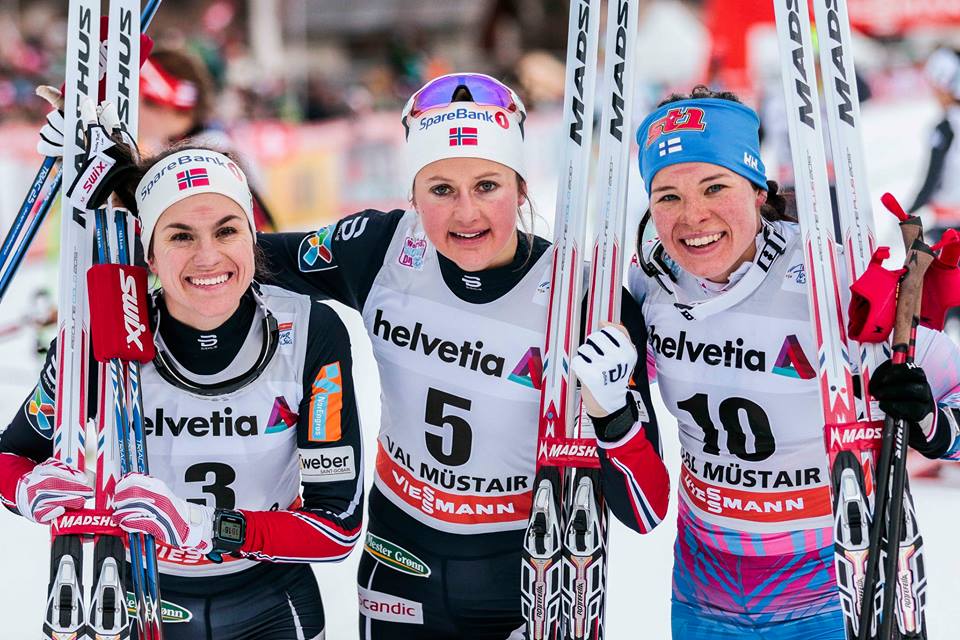
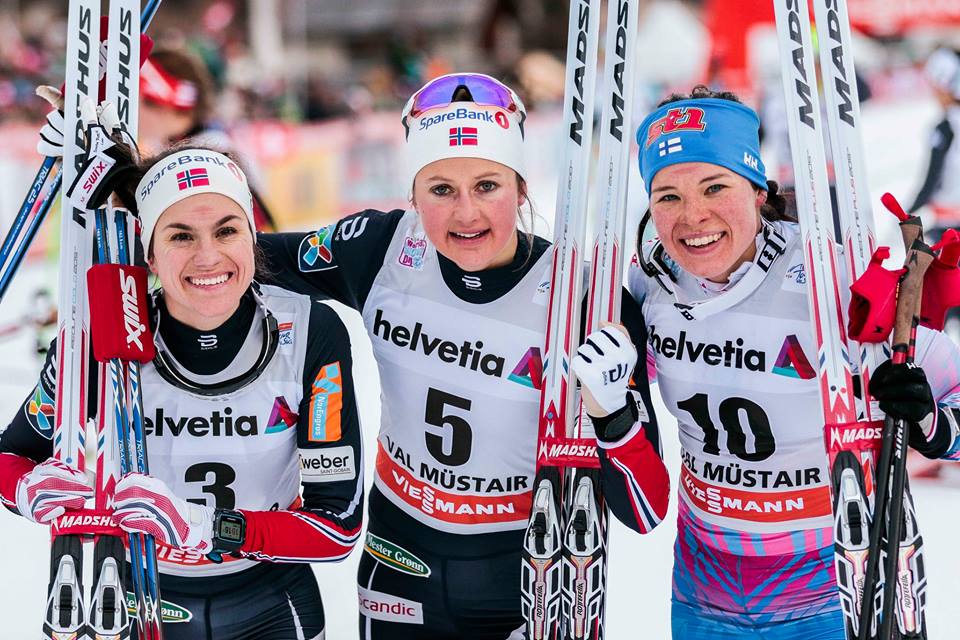
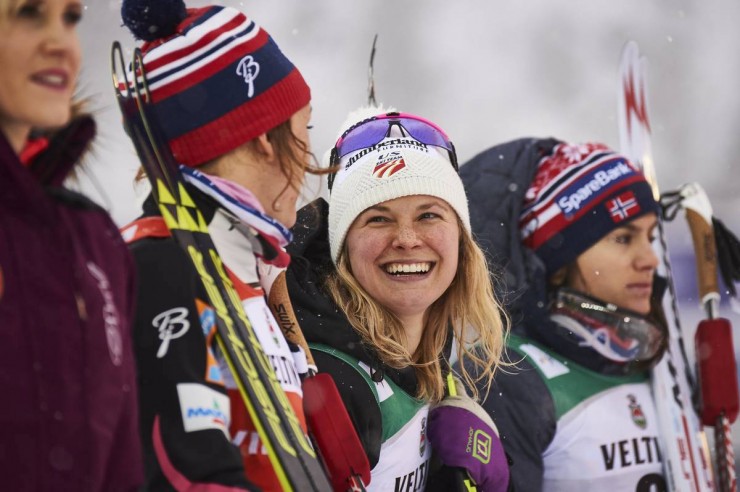
    Left to right: Norwegians Heidi Weng and Ingvild Flugstad Østberg along with Finland's Krista Pärmäkoski on the podium for the women's 5-kilometer classic mass start on Sunday, Jan. 1 2017 in Val Müstair, Switzerland. (Photo: Fischer/Nordic Focus)
    The Tour de Ski Stage 2 women’s podium on Sunday with (from left to right) Norway’s runner-up Heidi Weng and winner Ingvild Flugstad Østberg, and Finland’s third-place finisher Krista Pärmäkoski in the 5-kilometer classic mass start in Val Müstair, Switzerland. (Photo: Fischer/NordicFocus)

    Maybe it was because she wanted redress. Maybe it was because there was less pressure to perform. Or maybe it was because the yellow Tour de Ski (TDS) leader’s bib was with Sweden, calling her Norwegian name.

    Whatever it was, when Ingvild Flugstad Østberg lined up for the women’s 5-kilometer classic mass start on Sunday in Val Müstair, Switzerland, she was ready to race for the win.

    After being eliminated in the semifinal of Saturday’s freestyle sprint, the 26-year-old turned the lost chance at a podium into an opportunity to prove her place as a top contender.  

    “I was irritated with myself after yesterday,” Østberg told NRK.

    “Such a result sometimes makes you give your best,” she added, according to a International Ski Federation (FIS) press release.  

    American Jessie Diggins (bib 6) chases down Norway's Maiken Caspersen Falla at the start of the the women's 5-kilometer classic mass start on Sunday, Jan. 1 2017 in Val Müstair, Switzerland. (Photo: Fischer/Nordic Focus)
    American Jessie Diggins (6) chases down Norway’s Maiken Caspersen Falla (2) at the start of the the women’s 5-kilometer classic mass start on Sunday in Val Müstair, Switzerland. (Photo: Fischer/NordicFocus)

    Wearing bib 5, Østberg had her Norwegian teammates, Maiken Caspersen Falla in bib 2, Heidi Weng in bib 3, and Kathrine Rolsted Harsem in bib 4, as well as the Stage 1 TDS leader, Stina Nilsson to chase down.

    That didn’t stop Østberg from rallying to the front off the gun, leading the mass of skiers through the first lap, with Weng just behind. As the women started their second lap of the 2.5 k course, a gap began forming between the Norwegians and a second front group, Nilsson and Finland’s Krista Pärmäkoski.

    Moving up through the pack into the top 10 by lap one was Finland’s Anne Kyllönen, who started in bib 29, as well as her Finnish teammate Laura Mononen, who started in bib 19.

    Switzerland’s Nadine Fähndrich, who started in bib 15, had also joined the front chase group, along with her Swiss teammate Laurien van der Graaff (bib 7). Just behind the Swiss duo was American Jessie Diggins (bib 6) positioned in eighth. Diggins’s U.S. Ski Team (USST) teammate Sadie Bjornsen, who had started in bib 21, had burned her way up to ninth.

    Bjornsen’s hot start, however, didn’t last. The American began to fade, falling back into the low 20’s and eventually just outside of the points in 35th, where she ended the day.

    “I was behind Nadine [Fähndrich] and Laurien [van der Graaff] and picked the innermost track, so in principle the best lane, and exactly on that lane Bjornsen bonked, totally, she couldn’t move anymore,” Switzerland’s Natalie von Siebenthal said during a television interview. “And I couldn’t get past left or right. Then the other athletes started to go by on my left.”

    USST Women’s Coach Matt Whitcomb explained that hard start was part of Bjornsen’s plan. The way her body reacted was not.

    “She took it out aggressively, which we told her to do and is always encouraged to do and just didn’t feel good today,” Whitcomb said on the phone after Sunday’s race.

    Bjornsen explained that while the result was not what she hoped for, she is ready to move forward with no weight on her shoulders.

    “Today was a day to forget and refocus,” Bjornsen wrote in an email. “I had a strong start, and felt great, but felt like I was working extra hard with some potentially slow skis. As soon as I crossed the red line, I wasn’t able to recover as I was hoping, and suffered a pretty bad explosion … Now I am focused on the next two events in Germany, and will hopefully find the good shape I know I am capable of!”

    Maintaining position was the name of game for the remainder of the race for those still in the top 10, with Diggins sticking to her spot in eighth and Østberg holding off any attack attempts from Weng.

    “I’ve been struggling a bit with the high altitude here,” Weng said according to a FIS press release. “Before the race I was afraid about the downhills but I’m happy I did not fall.”

    While Weng was able to avoid any crashes, American Kikkan Randall was not so lucky. Though she had been skiing around 15th for most of the first lap, after starting in bib 17, she fell and had to make her way back into the top 20.

    American Kikkan Randall after a crash a little over halfway through the women's 5-kilometer classic mass start on Sunday, Jan. 1 2017 in Val Müstair, Switzerland. (Photo: Fischer/Nordic Focus)
    American Kikkan Randall after a crash just over halfway through the women’s 5-kilometer classic mass start on Sunday in Val Müstair, Switzerland. (Photo: Fischer/NordicFocus)

    “My shape feels a lot better and sharper than it did in period one of World Cup,” Randall wrote in an email to several media outlets. “Really pumped to feel my race gears coming around and loving the chance to race, race, race!”

    “It was so cool to watch an athlete have a breakthrough like that,” Whitcomb said of Randall’s performance. “To start off the Tour with two good races in the points, we all feel really good about that and the team is really proud of her.”

    Eventually, with a close to 20-meter gap, Østberg finished first for the win in 13:21.2 minutes. Weng claimed second place, seven seconds back, while third went to Pärmäkoski who finished 11.4 seconds after Østberg.

    Diggins crossed 32.6 seconds after Østberg for eighth.

    “It was tricky to pace and if I could do it again I would have paced it slightly differently, but I was happy with my skis and I’m chipping away at that striding technique!” Diggins wrote in an email. “Overall I think I’m in a solid place for the tour and I’m really looking forward to the next set of races!”

    Randall was the second American after Diggins in 15th (+42.4) followed by Bjornsen, who placed 35th (+1:02.6) in a photo finish with Slovenia’s Petra Novakova. Also racing for the U.S., Sophie Caldwell placed 38th (+1:09.4), Rosie Brennan 39th (+1:10.5), and Liz Stephen 44th (+1:21.2).

    “There’s not a whole lot of movement that’s possible in a 5 k classic mass start … when you’re starting out of the top 20,” Whitcomb said. “Rosie and Liz were fighting from the back. … For their position in the start, I thought they skied phenomenally.”

    As the USST makes its way to Oberstdorf, Germany, for the third and fourth stages of the Tour — a 10 k skiathlon and 10 k freestyle pursuit — Whitcomb remains positive of where the U.S. women are currently positioned. Diggins currently sits in sixth in the overall Tour standings, 1:01 minutes behind Østberg, Randall 15th (+1:45.9) and Bjornsen 25th (+2:05.4). Caldwell, who is ranked 22nd overall (+2:03.3), planned to withdraw from the Tour after Sunday. Brennan in is 41st (+2:33.1) and Stephen 46th (+2:49.9).

    “We don’t put any specific goals or demands for any athlete on any one particular race,” Whitcomb explained. “What we try and do is link together as many quality races in a row as we can. If you can string together a bunch of decent days, and then pop one great one, it can move you way up in the tour.”

    Østberg now leads the Tour followed by Weng 10.3 seconds back in second and Nilsson in third (+23.8).

    Results | Tour standings (through Stage 2)

  • Norway’s Women Win Again in La Clusaz Relay: U.S. 7th

    Norway’s Women Win Again in La Clusaz Relay: U.S. 7th

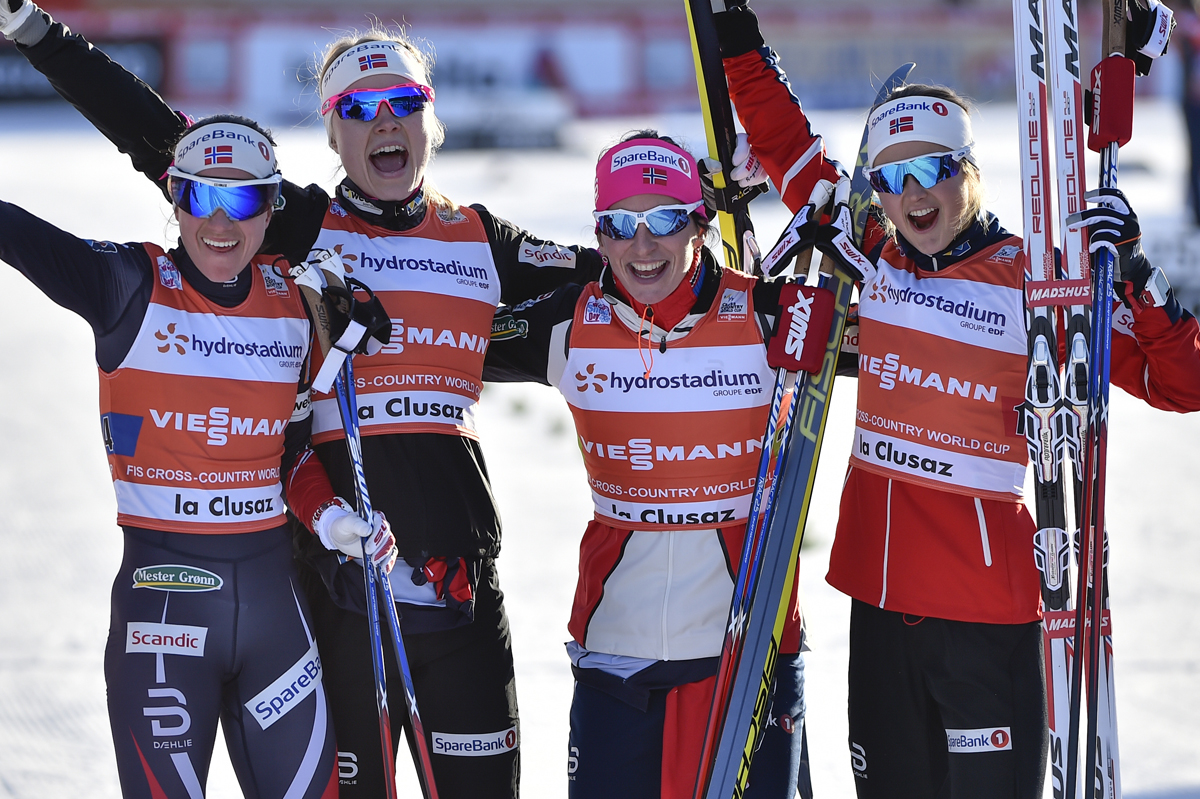
    Norway won the women's World Cup 4 x 4 k relay on Sunday in La Clusaz, France, with (from left to right) Ingvild Flugstad Østberg, Marit Bjoergen, Ragnhild Haga, and Heidi Weng. (Photo: Fischer/Nordic Focus)
    Norway won the women’s World Cup 4 x 4 k relay on Sunday in La Clusaz, France, with (from right to left) Ingvild Flugstad Østberg, Marit Bjoergen, Ragnhild Haga, and Heidi Weng. (Photo: Fischer/Nordic Focus)

    Sunday’s 4 x 4-kilometer relay in La Clusaz, France, was a 39:23.3 minute macro-statement by the Norwegian women’s team of Ingvild Flugstad Østberg, Marit Bjørgen, Ragnhild Haga, and Heidi Weng.

    That statement was dominance. Norway won the relay in time-trial-like fashion: each Norwegian leg a solo affair. Finland’s team of Aino-Kaisa Saarinen, Anne Kyllönen, Riita-Liisa Roponen, and Laura Mononen placed second (+50.2). Sweden’s team of Emma Wiken, Stina Nilsson, Maria Rydqvist, and Anna Dyvik was third (+1:08.9).

    As with lopsided races, the 10,000 foot view on the first classic leg showed Østberg stretching a fatigued rubber band back to the pack. At 2 k, 11.5 seconds was Østberg’s initial gap.

    Then snap. The band broke. At 4 k when Østberg handed off to Bjørgen, it was a 28-second cushion on Russia, 33.3 to Switzerland, 34.9 to Finland.

    Why belabor the point in words when the numbers tell the micro-story which lead to the dominance?

    • Østberg fastest leg at 10:04.
    • Bjørgen fastest leg at 10:11.8.
    • Haga seventh-fastest leg at 9:43.2.
    • Weng fastest leg at 9:27.9.

    Some problems are good to have. That’s the case with Norway and Haga. Here’s the context. Although she skied the seventh-fastest leg split, it was a tight leg and she kept Norway’s lead comfortable.

    For example, the U.S. Ski Team’s Liz Stephen skied the 10th-fastest third leg, only 13.4 seconds off the fastest time skied by Sweden’s Rydqvist. Compare that to the fourth leg, the 10th fastest time was skied by Kazakhstan’s Irina Bykova — she was 57.2 seconds off Weng’s pace.

    There’s the number crunching and analysis, but it can be rendered down to this: Weng had plenty of time to high-five the crowd before crossing the line.

    With her teammate Therese Johaug serving a provisional sentence for doping, Weng is the new relay team anchor.

    “It wasn’t that scary when the girls performed so well,” Weng told Norwegian broadcaster NRK after the race about her anchor role. “I didn’t have to sprint at the end. The last time I had a final leg I was too afraid to do anything. Now I was high-fiving the spectators and had some fun.”

    Østberg told NRK in the same article that she was experiencing pre-race butterflies. “I was extremely nervous before the start, but it went well,” Østberg said. “I didn’t want to disappoint the other. You’re competing for a team in a relay and not yourself. I didn’t want to let the others down … I had to go fast today so Marit could go home to her son Marius. She’s missed him all week.”

    Relay Socks and Rebounding from Illness

    Here’s the straight talk. The two powerhouses of the deep U.S. women’s team, Jessie Diggins and Sadie Bjornsen, were scratched from the roster due to illness. But the relay socks made a feisty appearance.

    The U.S. lineup that finished seventh overall (+2:26.0) consisted of Sophie Caldwell, Rosie Brennan, Liz Stephen, and Kikkan Randall.

    “You know clearly we were not at full strength today and it showed I think,” U.S. head coach Chris Grover told FasterSkier on the phone. “My guess is that Sophie might be fighting a little bit of something, we have seen that before where an athlete maybe is on the edge of getting sick and goes out and skis fine for a while and then kind of blows up and it turns out maybe they are coming down with something.”

    Caldwell is primarily known as a sprinter on the World Cup. Sunday’s relay legs were 4 k, a relative no-women’s land when it comes to sprint or distance race length. One kilometer into the race and Caldwell was third (+1.0). By the first tag to a resurgent Brennan, Caldwell had lost over a minute to Norway.

    On Saturday, Brennan skied from last to 22nd place in the 10 k freestyle mass start. During the relay Brennan again proved she’s in play too when it comes to a classic relay leg. During FasterSkier’s conversation with Grover, the internet was down in La Clusaz.

    “I haven’t really seen any times yet, there is no internet up here today, so it seemed like a pretty solid leg out of Rosie,” Grover posited.

    In fact, Brennan skied the fourth-fastest split of any second-leg skier (+38.2) — Bjørgen set the benchmark.

    “The legs were incredibly short, especially for people like Liz and I who like a little longer,” Brennan said of the 4 k distance, as opposed to 5 k, on the phone. “I think it was a solid effort and especially considering the illness that has destroyed our team the last week.”

    Brennan began the season out of the points and took last weekend’s races in Davos off.

    “I definitely had a less-than-stellar start to the season, I don’t really know why,” Brennan said. “I guess in my past it hasn’t been uncommon for me to start a little slow, but I was trying, I was actually focusing on doing the opposite just knowing it is so important to come over here and have some good races and build some confidence right away, that obviously that didn’t work out quite as planned.”

    Brennan will remain in France for the holiday break and begin resting and preparing for the Tour de Ski beginning on Dec. 31. She’ll begin the Tour with a boost of confidence. “It was great to turn that around yesterday and I am feeling much better to hear that I had the fourth-fastest leg, or time on my leg, it is really encouraging especially for such short race,” Brennan said. “I wasn’t quite sure about my speed just yet, that is definitely a step in the right direction for me.”

    Like Brennan, Stephen came into the day heartened by a solid effort and result on Saturday. But 4 k is a k short of 5 k.

    “Even a 5 k is like a sprint for me. Rosie and I were actually talking about that in our cooldown,” Stephen said after the race. “When I go out, it’s like a sprint, because when I’m done with a sprint, I’m like ‘it’s already over?’ and it’s kind of like that in a relay. Don’t blow up, but it’s pretty hard for me to completely blow up in such a short race. I attacked from the beginning knowing that this is a nine-minute race today, and I do intervals longer than that often times.”

    Grover reiterated that point. “It was a 4 k course for the relay and you know Liz just needed more real estate out there. It was almost like, some of our athletes, it takes them one or two k to get into the race and you are already half way through the race at that point.”

    Stephen kept the margin to Norway just under two minutes and showed improving form before her favorite stretch of racing in the Tour.  “I’m always looking forward to [the Tour]. But also I feel like this last weekend that I’ve been able to feel like I want to. Physiologically I feel like racing has really helped get me into the shape I want to be in. I have some work to do over the break, but I feel like I’m in a good place to do what I’m normally able to do at the Tour.”

    Team and relay vet Kikkan Randall skied the anchor leg. Her’s was the seventh-fastest anchor leg (+27.1).

    “I got the tag from Liz a ways back from Germany ahead and a gap to Italy behind,” Randall wrote in an email to several media outlets. “I focused on holding a good rhythm on the first lap but Italy was able to almost close the gap. I was getting ready for a good battle on the last two climbs but I guess the Italian anchor crashed behind me. So I skied the rest of my lap alone.”

    Randall secured seventh place for the U.S. (+2:26).

    Grover didn’t spend any time lamenting what could have been. “I really expect by the time we do our next relay in Sweden that we are going to be very competitive for the podium,” he said. “Norway, of course, on paper was far gone, but in terms for the hunt, the usual hunt for Seed 3, we will be back there.”

    The U.S. women's 4 x 5 k relay team, (from l to r) with Sadie Bjornsen, Rosie Brennan, Jessie Diggins, and Liz Stephen, matched a team best on Sunday in third in the World Cup relay in Lillehammer, Norway. (Photo: USSA Nordic/Twitter)
    Last season’s U.S. women’s 4 x 5 k relay team after placing third in the first relay of the 2015/2016 season in Lillehammer, Norway: (from l to r) Sadie Bjornsen, Rosie Brennan, Jessie Diggins, and Liz Stephen. They matched a team best in third in December 2015, and went on to place second in January 2016 (with Sophie Caldwell in place of Brennan) in Nove Mesto, Czech Republic. (Photo: USSA Nordic/Twitter)

    Expectations are what they are for the U.S. women’s relay team: high.

    Grover explained that the relay is a target event for a podium at both 2017 World Championships and the 2018 Olympics. “We also have a women’s team right now that is the strongest women’s team we’ve had in the history of U.S. skiing. So the time to win is now, and we’ve got the athletes to do it,” Grover added.

    In mainstream professional sports, cybermetrics is understandbly the rage. Essentially it’s data-based decision making when it comes to sports. Coaches like Grover and U.S. women’s coach Matt Whitcomb play their version of ski-cybermetrics when picking a relay team.

    “It’s a matter of putting together on a certain day the right athletes, with the right fitness in the right technique, in the right legs, and also taking into account the course profiles in terms of strengths of the athletes, and what are the attributes of the course,” Grover said of picking the most viable relay squad. “Is the course long for 5 k, it it short for 5 k? Is it flat for classic? Is it hilly for classic? Is it technical or is it more of just a grinding course?”

    The U.S. team’s strategy is to have at least three skiers in each discipline, skate or classic, to choose from on relay day.

    “If we can do that, then we can put the women who are the fittest at the time and for whom the technical elements of the course suit their strength the most, and we can put together a super competitive team, so that is kind of the puzzle that we are always putting together with relays,” Grover said.

    The next opportunities to contest the relay will be the 4 x 5 k in Ulricehamn, Sweden, on Jan. 22, and March 2 at World Championships in Lahti, Finland.

    Canada’s team of Emily Nishikawa, Cendrine Browne, Dahria Beatty, and Sophie Carrier-Laforte finished 12th (+4:07.9). But the biggest victory of the day for the team was fielding a women’s relay.

    “We were so happy to have a women’s relay team today,” Nishikawa wrote in an email. “I didn’t feel great today, but my teammates all skied really well and I’m very proud of them. It makes having a tough day so much better when you can be pumped to see amazing races from the rest of your team! The atmosphere in La Clusaz is just amazing! So many fans out cheering and the organizers did an incredible job of getting the course ready. It was a lot of fun racing here.”

    Beatty was also excited about Canada fielding a legitimate women’s World Cup relay team.

    “It is wonderful for us to be able to start a relay,” Beatty wrote in an email. “Having a group of women on the world cup this first period has been really great for all of us. Today’s race was a great building point for our team and I am really proud to be able to races with this group and grow together.”

    The Canadian appears to be coming into good form; Beatty skied the second-fastest third leg (+2.8).

    “I was really happy with how my leg went,” Beatty added. “I was able to build off my good feeling from yesterday and ski a really strong race. I was just focusing on trying to catch as many people as possible. When I found out that I had skied the 2nd fastest leg time I was a bit shocked and really excited. It feels great to have a great feeling race correlate to a strong result.”

    Results

  • Another World Cup Podium for Diggins, Second in Lahti Skate Sprint

    Another World Cup Podium for Diggins, Second in Lahti Skate Sprint

    LAHTI, Finland – An army of vuvuzelas echoed from the stadium’s stands and snow blew hard through the Lahti stadium on Saturday. The atmosphere was thrilling and the athletes no doubt felt it.

    The “pre-World Championships” — a year out from 2017 World Championships — 1.6-kilometer freestyle sprints opened this weekend’s Lahti World Cup. There, Jessie Diggins, a Minnesota native and U.S. Ski Team member, reached the final for the first time in a year and finished second for her career-best sprint result.

    Diggins entered the day with significant momentum following consecutive top-five finishes in Falun, Sweden, last weekend.

    She was the second-fastest qualifier in the morning, just 1.68 seconds back from Norway’s Ingvild Flugstad Østberg, who posted the fastest time in 3:30.85. Diggins then opted for the second quarterfinal in the heat selection process, along with World Cup Sprint leader Maiken Caspersen Falla of Norway and Finland’s local favorite, Krista Parmakoski.

    After comfortably advancing from her quarterfinal in second place, behind Falla, Diggins landed in the first semifinal with the likes of Østberg, Falla and Sweden’s Hanna Falk. Diggins skied most all of her semifinal in fourth place behind these three women until the final bend before the finishing straight.

    Going into this section, entering the stadium, there is a long decent where a bulletproof tuck and drafting can create an important passing opportunity right before the finish. Here, Diggins rocketed out from drafting behind Falk and glided into the inside lane for the final bend. After passing Falk, Diggins raced to third in the heat, behind Falla and Østberg. While this wasn’t quite good enough to ensure her automatic bid for the final, Diggins’ time was fast enough to give her one of two lucky loser spots to move on.

    Jessie Diggins (U.S. Ski Team) racing to second in the qualifier at the World Cup freestyle sprint in Lahti, Finland. (Photo: JoJo Baldus)
    Jessie Diggins (U.S. Ski Team) racing to second in the qualifier at the World Cup freestyle sprint in Lahti, Finland. (Photo: JoJo Baldus)

    The women’s final consisted of Diggins, Falk and four Norwegians: Østberg, Falla, Astrid Uhrenholdt Jacobsen, and Heidi Weng.

    The snow seemed to only pick up as the day went on, adding an exciting, yet also challenging strategic element to the race.

    “The conditions made passing very difficult as the day went on because snow started to accumulate on the edges of the trail,” U.S. women’s coach Matt Whitcomb said in an in-person interview afterward. “So one of the strategies was to stay in control, at least in the middle of the pack, if not farther forward than that. Because [the fresh snow] placed those in the fourth, fifth and sixth positions at a pretty serious disadvantage in that final round, and even some of the semifinals.”

    Out of the start, Diggins was unable to get to the front, but quickly climbed up through the pack into fourth position, behind Falla, Østberg, and Weng. Going into the second and final big climb, she held her position in fourth, all the way up to the top and the turnaround.

    Then came that same long downhill, which Diggins had made her move at the bottom of during her semifinal. There was a small gap between Diggins and the three Norwegians as they entered the stadium, tucked in a line. Vuvuzelas blared at an all-time high and everyone waited with anticipation for the final moves and hectic finishing sprint.

    Again, going into the final bend, Diggins slingshot out from the Norwegian slipstream and began her pass on the inside. She took the nearest lane and put the hammer down in the final sprint before lunging and claiming second in a photo finish with Weng.

    “[Diggins] had gas at the end, so she hit the pedal,” Whitcomb recalled. “She was awarded with some extra speed and that made the difference today.”

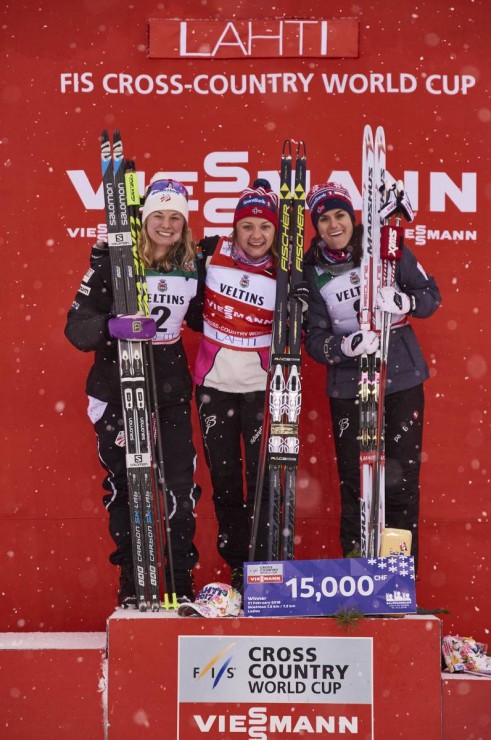
    Jessie Diggins (l) of the U.S. Ski Team and two Norwegians Maiken Caspersen Falla (c) and Heidi Weng (r) jump for joy after reaching the podium in second, first and third, respectively, in the World Cup skate sprint in Lahti, Finland. (Photo: Fischer/NordicFocus)
    Jessie Diggins (l) of the U.S. Ski Team and two Norwegians Maiken Caspersen Falla (c) and Heidi Weng (r) jump for joy after reaching the podium in second, first and third, respectively, in the World Cup skate sprint in Lahti, Finland. (Photo: Fischer/NordicFocus)

    “In those finishing lanes, I was like, ‘I cannot believe this is happening! I can’t believe it!’ And I just gave it my best lunge I could,” Diggins said after the race. “I just am so happy – it was one of those things that was just incredibly fun and it was a great day out here with the team.”

    The Sprint World Cup leader, Falla led most of the sprint as she usually does, and then held on for the outright win in 3:33.81. Diggins finished 0.25 seconds back in second place, beating Weng in a photo finish by six-hundredths of a second. Weng took third (+0.31), Østberg missed the podium in fourth (+0.41), Jacobsen was fifth (+2.27), and Sweden’s Hanna Falk finished sixth (+18.4).

    For Falla, it was her fifth-straight sprint victory, and her sixth sprint win of the season. Asked how she does it, she responded: “I always try to stay in front of the heat,” she said during the post-race press conference. “And if I don’t get the first position, I really want the second one [because] I know it’s a big risk to stay behind in the sprint finals. You can always be in an accident, and people can get tired and make some space to the one racing in front. So I just try to stay in front and have some speed left before the last climb or the last meters.”

    Weng earned her first win earlier this winter at the Tour de Ski, but Saturday added to her multitude of other podiums.

    “ I tried to win, but Maiken and Jessie were faster,” she said. “In the last corner I was going too much on the right. [That made] it hard to fight for the victory.”

    Slingshot Tactics and a Longer Course

    Two key aspects of the race played out well for Diggins on Saturday: the inherently lengthier nature of the course and her draft into slingshot strategy.

    “That was super exciting,” Diggins said about her final slingshot move. “I think I must have had the fastest skis in the world. I was counting on that slingshot to work for me and it did!”

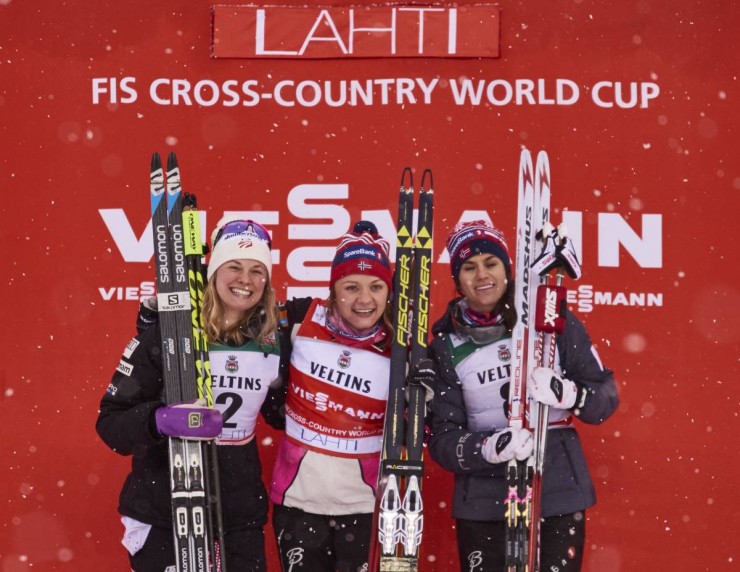
    The women's freestyle sprint podium on Saturday at the World Cup in Lahti, Finland, with American Jessie Diggins (r) in second, Norwegian winner Maiken Caspersen Falla (c), and Norway's Heidi Weng (r) in third. (Photo: Fischer/NordicFocus)
    The women’s freestyle sprint podium on Saturday at the World Cup in Lahti, Finland, with American Jessie Diggins (r) in second,
    Norwegian winner Maiken Caspersen Falla (c), and Norway’s Heidi Weng (r) in third. (Photo: Fischer/NordicFocus)

    This proved to be truly essential in both Diggins’ semifinal and final. In both races, she hovered around fourth place for the majority of the race until the final downhill and corner.

    “You saw [Diggins] try a few different tactics [throughout the heats],” Whitcomb noted. “With the Norwegian girls leading most of the heats and Jessie working from the front-middle of the pack, she was able to try a couple different drafting strategies. And I thought by that final round, she timed the slingshot perfectly, so that it didn’t come down to just who was sprinting fastest, but who was coming in with just a fraction of a mile per hour of more speed.”

    Another factor helping Diggins was that the longer-than-usual sprint course. At 1.6 kilometers, the Lahti sprint course is at the maximum allowed length. Also an accomplished distance racer, the course’s demand for some endurance played into Diggins’ strengths.

    “If you can ski top ten in distance, a long sprint course is going to be your game,” Whitcomb said.

    “It was a brutally hard course, it was a long course, [and] it was a hilly course” Diggins explained.

    Her teammate, Sadie Bjornsen reflected on the course similarly after her second semifinal, in which she finished fifth (behind Weng, Jacobsen, Norway’s Therese Johaug, and Sweden’s Stina Nilsson, respectively) for 10th overall on the day.

    “This is a fitness course, it is really, really long and it is hard,” Bjornsen said. “I think at the end of the day it is going to be those distance skiers that are going to [benefit]. You can see, [Diggins] is in there and she is probably going to win today because she is a distance skier and this takes some extra strength.”

    Bjornsen proved to be just a few tenths of a second off with that prediction. Diggins’ distance experience and abilities prevailed on the Lahti course and she highlighted the U.S. day with second place.

    Bjornsen 10th; Four U.S. Women Qualify

    Sadie Bjornsen (U.S. Ski Team) racing to 12th in the qualifier at the World Cup skate sprint in Lahti, Finland, where she ended up 10th overall. (Photo: Fischer/NordicFocus)
    Sadie Bjornsen (U.S. Ski Team) racing to 12th in the qualifier at the World Cup skate sprint in Lahti, Finland, where she ended up 10th overall. (Photo: Fischer/NordicFocus)

    As a whole, the U.S. women’s team continued on its path of increasing momentum. Along with Diggins and Bjornsen, who qualified in second and 12th, respectively, Sophie Caldwell qualified sixth and finished in 13th, after placing third in the first quarterfinal and narrowly missing advancing as a lucky loser. Ida Sargent qualified 27th and finished in 24th after placing fifth in the same quarterfinal as Bjornsen (which Falk won and Bjornsen automatically advanced in second out of).

    “We have been a little off our mark the last couple weekends,” Whitcomb said. “So to get four [women] back in there and to have Ida in the rounds, she has only missed two sprints this year in terms of qualification, so it was great to have her back in there … it was fantastic.”

    Of the four, Bjornsen was the only other woman to reach the semifinals, where she faced off against Weng, Johaug, Nilsson, Jacobsen, and Finnish fave Anne Kyllönen.

    “I think that those are some of the girls who are racing the fastest right now,” Bjornsen said. “Today I felt like I could ski with them, but unfortunately today I was duking it out with Stina at the end.”

    Bjornsen finished 1.75 seconds behind Weng, the winner of that semifinal, and 0.83 seconds behind Nilsson in fourth. Johaug was third in that heat, just 0.05 seconds ahead of Nilsson, and did not advance to the final, either.

    With two in the top 10, and Diggins’ third podium in just over a month (after she won the 5 k freestyle at the Tour de Ski in Toblach, Italy), the results in the last World Cup in Europe before the season ends at the Ski Tour Canada bode well for the U.S. team.

    “[Our athletes] are now respected in these heats and are people that belong in there,” Whitcomb said. “They were not getting shut down on their moves today.”

    Also for the U.S., Caitlin Patterson (Craftsbury Green Racing Project) placed 35th, 2.1 seconds out of qualifying in 30th, and Jennie Bender (Bridger Ski Foundation) placed 51st.

    Racing in Lahti continues with skiathlon races on Sunday: 15 k for women and 30 k for the men.

    Results

    — Harald Zimmer contributed reporting

    ***

    About the Author: JoJo Baldus is a nordic skier from snowy Minneapolis, Minn. Currently living the dream as a volunteer journalist and photographer for FasterSkier while enjoying a gap year before starting at Macalester College in St. Paul. He could not be more excited to attempt to stagger across the finish line of 8 different WorldLoppet ski races this winter!

  • Her Biggest Win Yet: Johaug Wins Holmenkollen 30 k by 3:46

    Her Biggest Win Yet: Johaug Wins Holmenkollen 30 k by 3:46

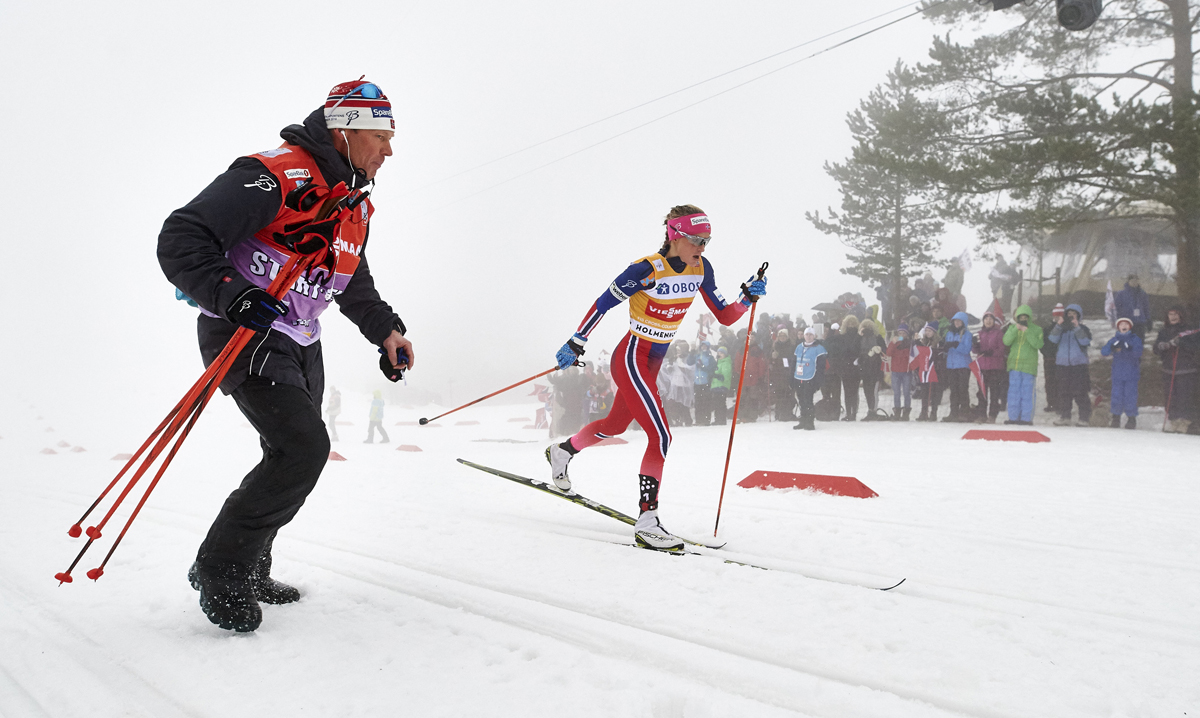
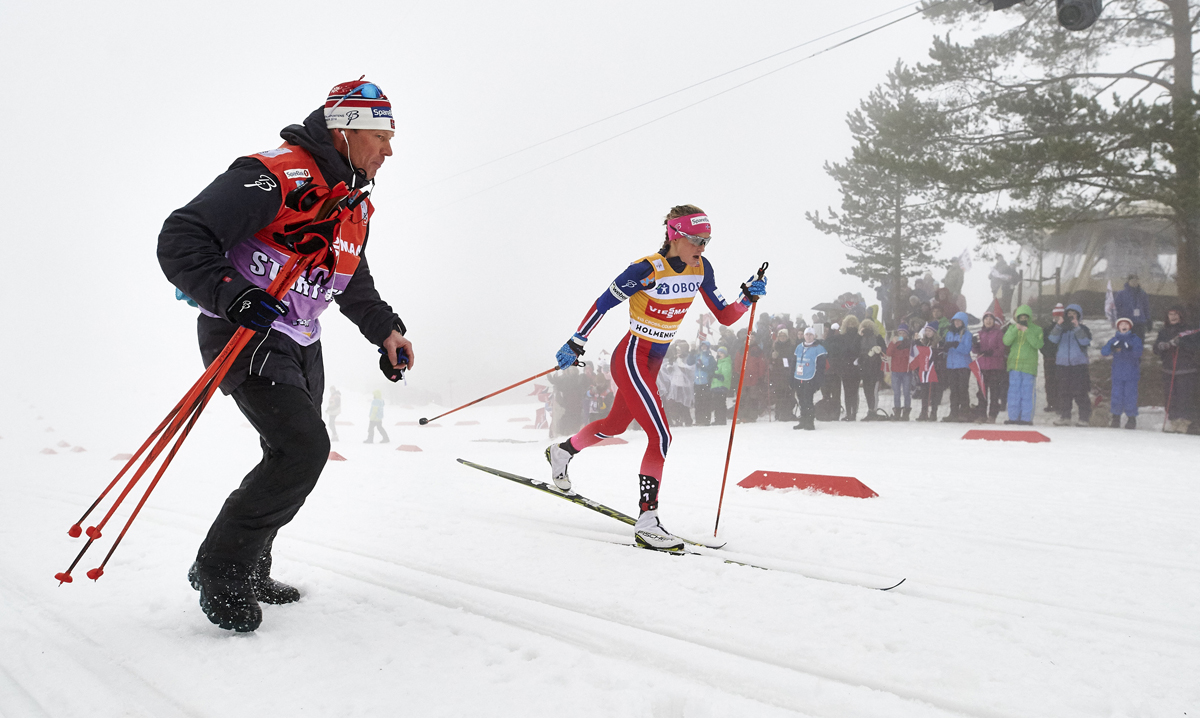
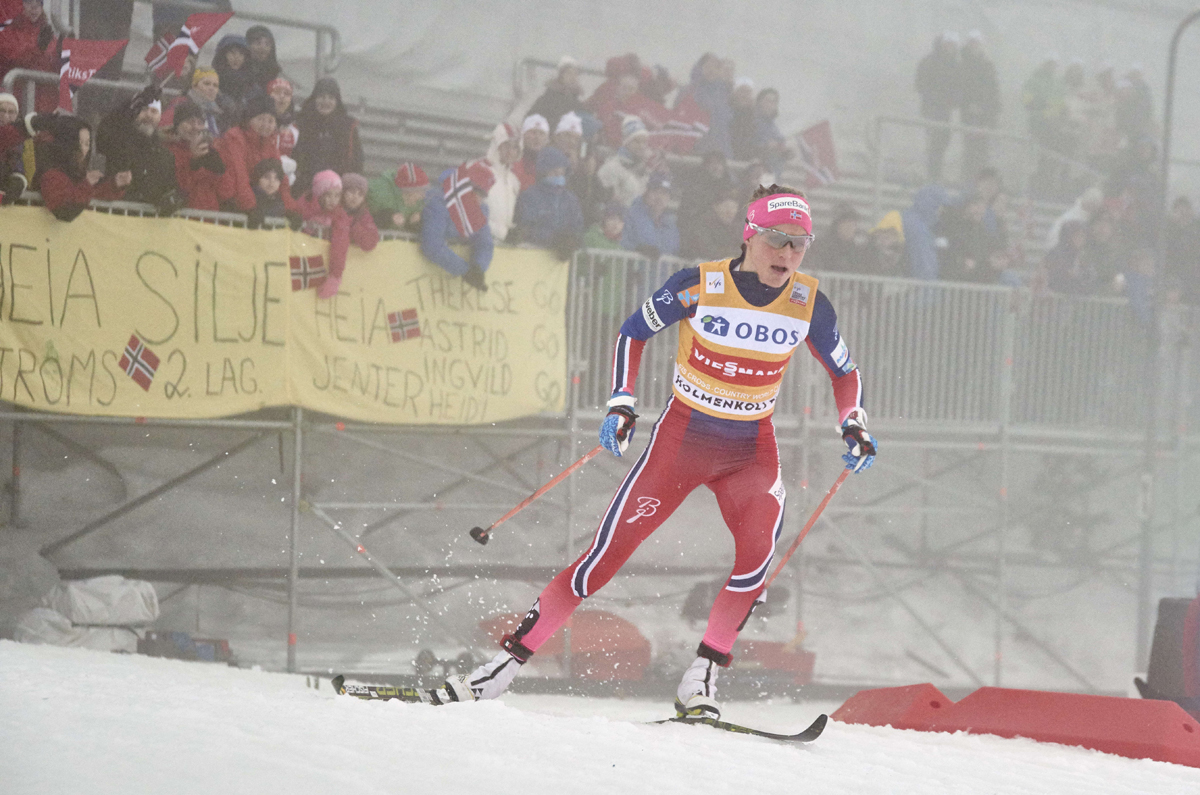
    Norway's Therese Johaug racing to her biggest win ever, by 3 minutes and 46 seconds in the women's 30 k classic at Holmenkollen on Sunday in Oslo, Norway. (Photo: Fischer/NordicFocus)
    Norway’s Therese Johaug racing to her most definitive win yet, by 3 minutes and 46 seconds in the women’s 30 k classic at Holmenkollen on Sunday in Oslo, Norway. It was her first classic victory at Holmenkollen. (Photo: Fischer/NordicFocus)

    Maybe it was the signature Johaug gloves dazzled for the television camera at the start. Maybe it’s the training hours, or the grit, or the lucky combination of DNA and athletic potential realized. 

    On Sunday, at the famed Holmenkollen tracks, Norway’s Therese Johaug dominated. She won the 30-kilometer classic mass start, her first Holmenkollen classic victory, in 1:24:55. Ingvild Flugstad Østberg, also from Norway, took second, 3:46.5 behind. Finland’s Anne Kyllönen broke up the Norwegian podium sweep by skiing to third place (+4:16). Johaug’s margin of victory was the largest ever for a women’s cross-country World Cup, according to a FIS press release. 

    Norway took four of the top-eight spots, while Finland placed four in the top eleven.

    Norway’s Heidi Weng placed fourth (+4:16), Finland’s Laura Mononen fifth (+4:43), and Swedish star Charlotte Kalla sixth (+4:45.9). Notable others in the top 10, Masako Ishida of Japan placed ninth (+4:55.2) and Poland’s Justyna Kowalczyk finished 10th (+5:06).  

    The domination

    Norway's Therese Johaug dropped the field out of the start in the women's 30 k classic mass start on Sunday at Holmenkollen in Oslo, Norway. By 3 k, she was about 20 seconds ahead. That gap grew to 3 minutes and 46 seconds at the finish for her first Holmenkollen classic win. (Photo: Fischer/NordicFocus)
    Norway’s Therese Johaug dropped the field out of the start in the women’s 30 k classic mass start on Sunday at Holmenkollen in Oslo, Norway. By 3 k, she was about 20 seconds ahead. That gap grew to 3 minutes and 46 seconds at the finish for her first Holmenkollen classic win. (Photo: Fischer/NordicFocus)

    The time back on the results sheet were not in error. The Johaug spectacle was that one-sided.  From the first intermediate checkpoint at 1.8 k, Johaug’s race-journey was a solitary one. Her furious pace immediately distanced all other competitors. Johaug was solo through every intermediate checkpoint. And solo as she crossed the finish line.

    The mythical Holmenkollen venue was draped in a dense fog. With humidity at 99 percent, Johaug was literally skiing through the clouds: Her striding form barely visible to trailside spectators or those watching on a screen. If the poor visibility prevented a full understanding of the race’s dynamics, the live timing splits, tell the story.

    At the first time check, at 1.8 k, Johaug had an 8.6-second gap on Kalla in second, and 9.2 seconds on Norwegian teammate Astrid Uhrenholdt Jacobsen in third. Jacobsen ultimately DNF, pulling out of the race around 11 k.

    At five kilometers, Johaug’s pace was unmatchable. She was already 44.8 seconds up on Finland’s Krista Parmakoski, skiing in second at that point, with the critical mass of potential podium placers grouped close together — only 12.6 seconds separated second place from 30th.

    During the women’s 30 k, racers were allowed a single ski exchange. A chance perhaps to improve their kick or maximize their glide. But that single ski exchange would only be advantageous in the race for second. 13.3 kilometers in, Johaug changed skis with a comfortable margin of 2:07 over German Stefanie Böhler, while eventual second-place finisher on the day, Østberg, came into the exchange in sixth (+2:25.6).

    Norway's Therese Johaug celebrates across the line as she wins the 2016 Holmenkollen 30 k classic.
    Norway’s Therese Johaug celebrates across the line as she wins the 2016 Holmenkollen 30 k classic mass start.

    With no mishaps, her pace never waning, Johaug was on cruise control, albeit at near red-line speed. That’s how she took it across the line, waving to a thunderous, yet nearly invisible fog-enshrouded crowd, for the win. Her’s was  a 3:46.5 margin of victory won in the spirit of a legend in the making.

    Absent Marit Bjørgen, and with no real contenders challenging, this was a defining race for Johaug in a cross-country venue where a single win can define a skier’s career.

    Sunday’s race was only the 22nd time a women’s World Cup 30 k has been held in Holmenkollen in its 114-year history. According to FIS, Johaug’s first 30 k there was a 2008 freestyle event in which she placed fourth. Since 2010, when she finished the Holmenkollen 30 k freestyle in third, Johaug has landed on the podium in all six Holmenkollen 30 k events. That includes her 2011 victory at the Olso, World Championships 30 k freestyle, and a win in the 2013 edition of the Holmenkollen 30 k. That, too, was a freestyle race. Her teammate, Bjørgen, was absent from that race.

    There’s more for the record books. Sunday, with Bjørgen also out due to the recent birth of her new baby, Johaug became a three-time Holmenkollen 30 k winner — yet this was her first 30 k classic victory there. Johaug’s win was also her seventh Holmenkollen 30 k podium, a record, placing her one ahead of Bjørgen, who has six podiums at the famed venue.

    “It was a raw run today. I felt everything worked out in the first hill and I heard I got some distance, but I do not think it went so fast. I just had to go my own race,” Johaug told Norwegian news outlet NRK, according to a translation.
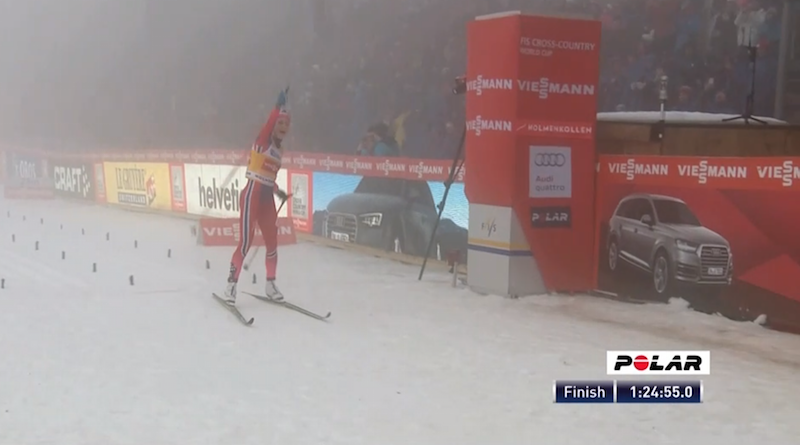
    In a post-race interview with FIS, an elated Johaug spoke or her season’s goals, which included a Holmenkollen win.

    “My goal today was to ski good, to have good technique. I worked on it this week,” Johaug said. “I had three goals this season. It was a win in Ruka, and the Tour de Ski, and the 30 k here in Holmenkollen. Because I never win here in the classic. It was a big goal for me this season. Today, my body was good, the skis were good, and the technique. I had to focus the whole time, I have lots of power and lots of energy. I am not tired. So I’m in good shape. I was a little bit nervous before the start because of I was sick for the Norwegian Championships in Tromsoe. For me, maybe some days in the bed was good. I have a lot of energy and it was amazing to ski here.”

    The Race for Second + World Cup Overall

    At 24.6 kilometers, the race for second was winnowed to four skiers, Østberg, Kyllönen, Weng, and Mononen, all coming through the checkpoint in that order and only 2.4 seconds separating them.

    Østberg, although a proven sprinter and capable of taking a sprint at the line, did not leave her day’s results up to final meters. She made a decisive move and surged ahead. Her effort broke apart the small train behind her, after which, the remaining contenders would all be skiing alone.

    Finland's Anne Kyllönen celebrates her podium in the Holmenkollen 30 k classic, after placing third on Sunday in Oslo, Norway. (Photo: Fischer/NordicFocus)
    Finland’s Anne Kyllönen celebrates her podium in the Holmenkollen 30 k classic, after placing third on Sunday in Oslo, Norway. (Photo: Fischer/NordicFocus)

    6.6 seconds at 26.6 kilometers. 14.5 seconds to Kyllönen at 27.5 k. If the rubber band to ultimate third-place finisher Kyllönen was stretching then, it broke by the finish. 

    Østberg skied to second, a full 29.5 seconds ahead of Kyllönen. It was Kyllönen’s best ever result at the Holmenkollen 30 k. 

    According to a translation, Kyllönen told Finnish news outlet, Helsingin Sanomat, that despite her inability to match Østberg’s surge, she remained satisfied. 

    “I could not respond to the Østberg up and running, but it was cool when I was able for once to enjoy the situation and examine the winds properly in the home stretch,” she said, according to a translation.
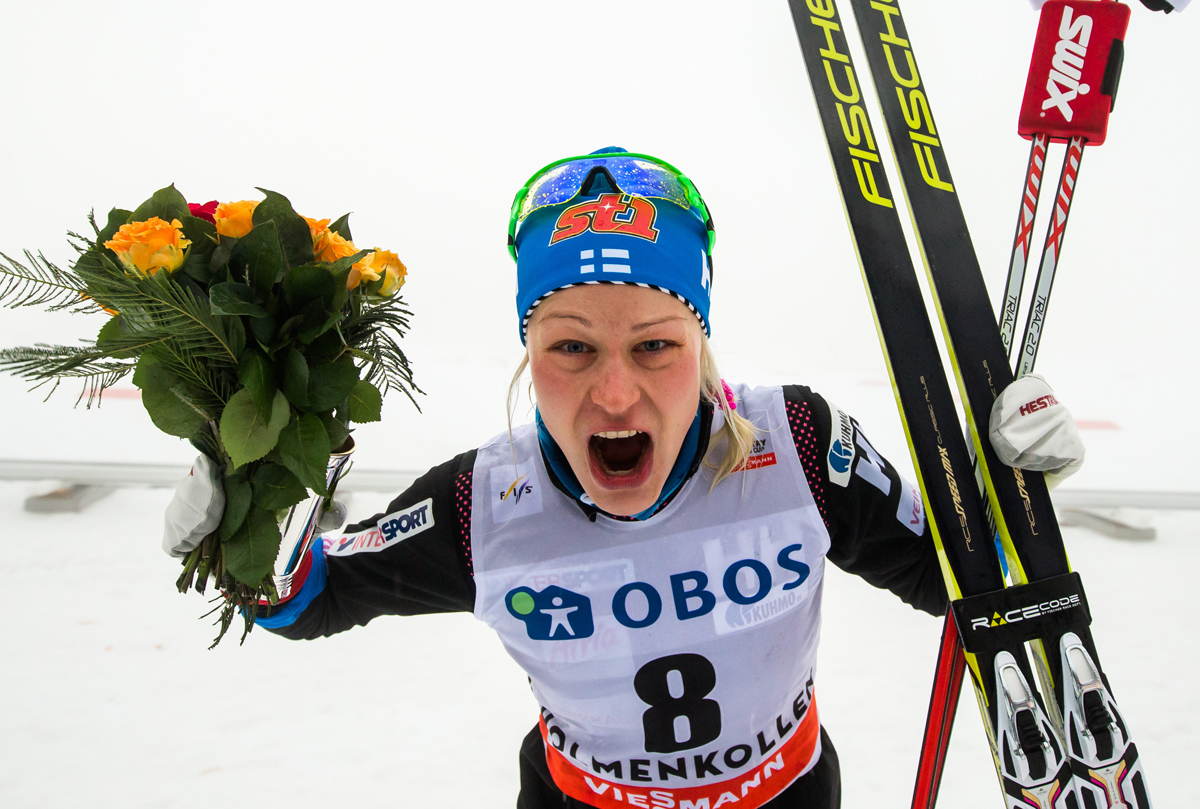
    “Such success requires that all aspects fall into place. I have felt after many of my competition, I would have been able to ski even better rate. I do not know if this was not yet a 110-percent success,” Kyllönen said. “Johaug was once again really hard in the attack. She got to ski Holmenkollen and certainly knows the tracks accurately. No one even think to try to hang on to her momentum.”

    Østberg is another sign that Norway’s pipeline of skiers is not tapped out.

    This was Østberg’s best Holmenkollen 30 k result. In 2010 she placed 32nd in the 30 k free, in 2012, 42nd in the 30 k classic, in 2014, 15th in the 30 k classic, and in 2015’s 30 k free, 21st.

    “I did not in my wildest imagination thought I would get on the podium here. Although I am miles behind ‘Miss Joy’ [Johaug], this is like a victory for me,” Østberg told NRK.

    The 2016 Holmenkollen 30 k classic podium: with Norway's Therese Johaug (c) in first, teammate Ingvild Flugstad Østberg (l) in second, and Finland's Anne Kyllönen (r) in third. (Photo: Fischer/NordicFocus)
    The 2016 Holmenkollen 30 k classic podium: with Norway’s Therese Johaug (c) in first, teammate Ingvild Flugstad Østberg (l) in second, and Finland’s Anne Kyllönen (r) in third. (Photo: Fischer/NordicFocus)

    Johaug’s win on Sunday gives her a small buffer for the Overall World Cup. With 1644 points, Johaug leads Østberg, who remains in second overall, by 172 points. That margin could dwindle by Thursday of next week. Johaug will not race in the Stockholm, Sweden, sprints, while Østberg remains a favorite.

    “I think not so much on the points you make. But I’m not going to give up the World Cup,” Østberg explained to NRK. Sunday’s result solidifies Østberg’s evolution from sprint star to potential podium placer in the longest distance events. Her eyes now fixed on the overall globe once thought to be a gimme for Johaug.

    Østberg’s goals may have broadened. Yet those aspirations are grounded with the knowledge that Johaug has proven she remains on form and virtually untouchable. “I’ve never been on the [overall] podium either. If I can do it, it’s a great achievement for me. But I do not give up until we’re done in Canada. But you see how insane superb Therese is,” NRK reported Østberg as saying.

    Notes: Sadie Bjornsen was the top North American, skiing to 22nd (+7:44.5). Liz Stephen placed 23rd in a photo finish (+7:45.4), Jessie Diggins, 25th (+7:46.1), Rosie Brennan, 33rd (+11:43.7), Caitlin Patterson, 36th (+12:03.2), Canadian Emily Nishikawa, 39th (+12:41.1). A sixth American, Ida Sargent did not start.

    World Cup racing continues on Thursday with sprints in Stockholm, Sweden.

    Results | World Cup Overall standings

  • U.S. Women Step Up to Best-Ever Second in Relay; Norway Seals the Deal in Nove Mesto

    U.S. Women Step Up to Best-Ever Second in Relay; Norway Seals the Deal in Nove Mesto

    The U.S. women placed a historic second for their best-ever relay finish on Sunday at the World Cup 4 x 5 k in Nove Mesto, Czech Republic. From left to right: Jessie Diggins, Sophie Caldwell, Sadie Bjornsen, and Liz Stephen. (Photo: Fischer/NordicFocus)
    The U.S. women placed a historic second for their best-ever relay finish on Sunday at the World Cup 4 x 5 k in Nove Mesto, Czech Republic. From left to right: Jessie Diggins, Sophie Caldwell, Sadie Bjornsen, and Liz Stephen. (Photo: Fischer/NordicFocus)

    From a clinical standpoint, the women’s 4 x 5-kilometer relay in Nove Mesto, Czech Republic, on Sunday became a time trial for the Norwegian women. That TT began 2.5 k into the first leg, as Norway’s Ingvild Flugstad Østberg came through the stadium for her second lap, 0.4 seconds back in second place, behind Finland’s Anne Kyllönen. By the time Østberg tagged off to Heidi Weng, she had a 27.5-second gap on the next-closest team. The combination of the four Norwegian speedsters, Østberg, Weng, Therese Johaug, and Astrid Uhrenholdt Jacobsen, won the relay in 50:17.2. Norway, with Sunday’s win, extended their unbeaten relay streak to 10.

    But sport, at it’s best, is about drama and emotion. That type of racing belonged to the U.S. women’s relay team.
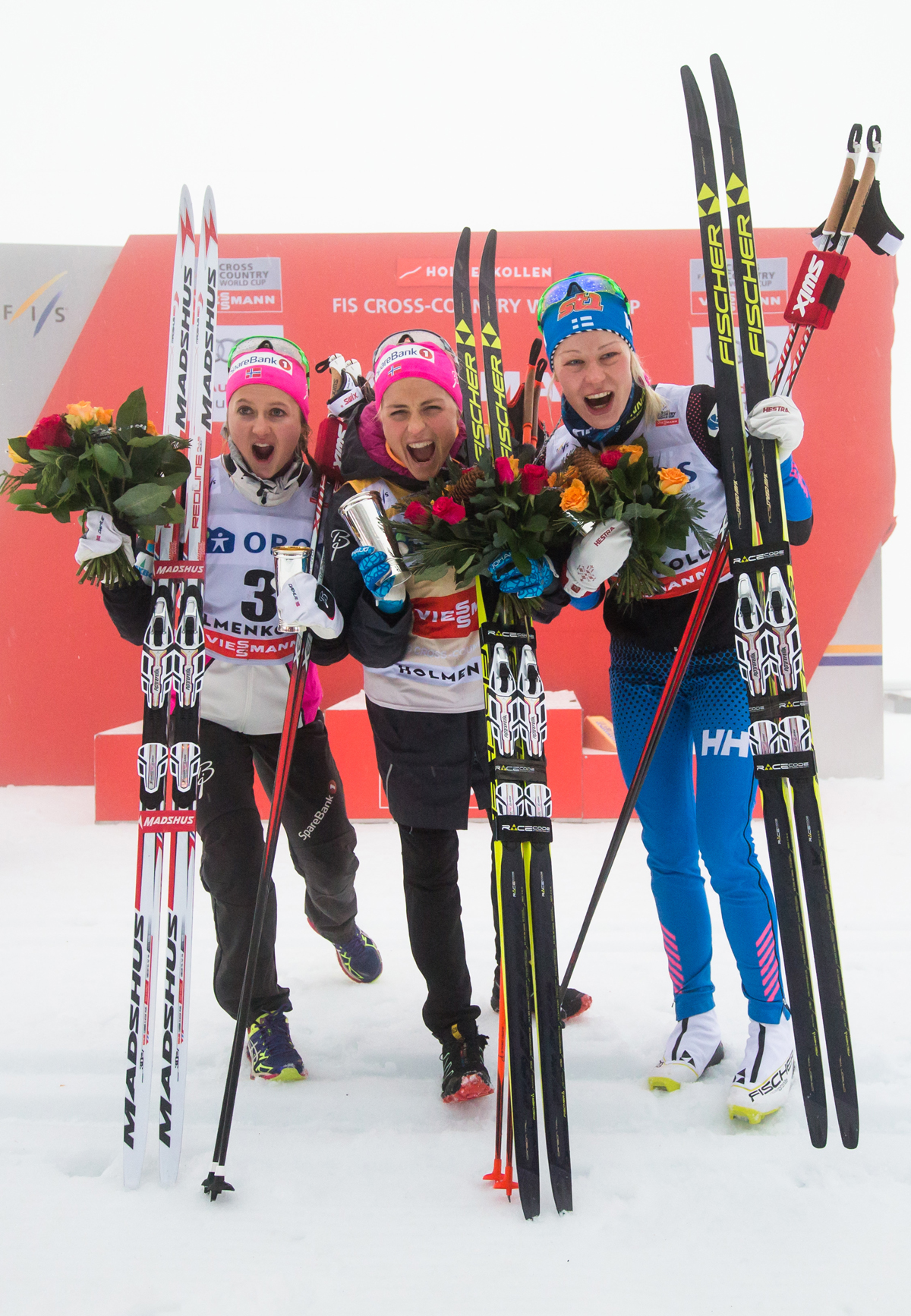
    With a combined effort from Sophie Caldwell, Sadie Bjornsen, Liz Stephen, and Jessie Diggins, the U.S. women’s team placed second in a relay for the first time, after having reached the podium three times before in third. Diggins anchored them to the next step up, finishing 42.1 seconds after Norway and 13.8 seconds ahead of Finland, the team that beat them for second in the last World Cup relay in Lillehammer, Norway. On Sunday, Finland fell off the U.S. pace and settled for third, 55.9 seconds behind Norway. (In the last three World Cup relays, Finland has finished second to Norway.)

    Whether or not it was considered an upset is debatable, as podiums for the U.S. women’s relay team have become a staple of their success. But anytime a relay is on the schedule, they are now considered podium favorites. Of the last five women’s World Cup relays, Sunday marked the Americans’ fourth podium.

    Four Legs to Go

    The start of the women's World Cup 4 x 5 k relay on Sunday in Nove Mesto, Czech Republic, with American Sophie Caldwell (bib 5) following Finland's Anne Kyllönen (3) while Norways' Ingvild Flugstad Østberg (in red) and Germany's Denise Herrmann (4) also lead the way. (Photo: Fischer/NordicFocus)
    The start of the women’s World Cup 4 x 5 k relay on Sunday in Nove Mesto, Czech Republic, with American Sophie Caldwell (bib 5) following Finland’s Anne Kyllönen (3) while Norways’ Ingvild Flugstad Østberg (in red) and Germany’s Denise Herrmann (4) also lead the way. (Photo: Fischer/NordicFocus)

    The newest addition to the relay, Caldwell skied the opening “scramble” classic leg, keeping the U.S. in contention and podium within sight.

    Initially, Germany’s Denise Herrmann and Finland’s Kyllönen set the pace, with a large group of trailing skiers in their draft. Caldwell came through the 2.5 k mark in sixth place, 1.2 seconds back — striding within a long line of teams about to be steadily broken apart.

    Through the stadium, Østberg led a group of nine teams, all within 1.6 seconds of the lead. This is when Østberg made her move, showing her strength at the front. Half a kilometer later, Caldwell was gapped by 7.8 seconds. The U.S. Ski Team (USST) sprinter remained in a tight group, which included Germany I, Finland, Germany II, and Sweden, with the remaining teams following within sight.

    “I assumed that someone was gonna start pushing the pace at some point, but I didn’t anticipate [Østberg] taking off at that speed,” Caldwell recalled during a phone interview with the rest of her relay teammates. “I knew that, while it would’ve been awesome to try to keep up with her, trying to keep up with her and then imploding would’ve been a lot worse than trying to stay with that second-place group and coming in in a solid position. So instead I just focused on staying with those next girls and trying to hold off the people behind us.”

    U.S. Women’s Coach Matt Whitcomb has shepherded the team along as podiums and individual top-20 results have become regular occurrences in recent years. In a phone interview on Sunday, he reduced the team’s relay strategy to what he referred to as a game of contact.

    “When you can hand off to your teammate with one of the key players in contact with you, you do them a huge favor,” he said. “They can just hop in the draft or work with that team … It’s a big piece of relay. It’s not just head down, hammer. You have to know when to hammer, when to strategically sit in and recover, and when to attack.”

    Caldwell kept contact and pace, keeping her sight on the relay’s long-term endgame. She tagged off to Bjornsen in third place, right there with Germany I in second, and 27.9 seconds behind Norway.

    Next up, Bjornsen

    Sadie Bjornsen (in white) racing with Finland's Krista Parmakoski during the second leg of the women's 4 x 5 k World Cup relay on Sunday in Nove Mesto, Czech Republic. (Photo: Fischer/NordicFocus)
    Sadie Bjornsen (in white) racing with Finland’s Krista Parmakoski during the second leg of the women’s 4 x 5 k World Cup relay on Sunday in Nove Mesto, Czech Republic. (Photo: Fischer/NordicFocus)

    According to Whitcomb, Bjornsen’s classic leg proved to be another turning point.

    “When Sadie got tagged off in the position that Sophie handed it to her, it was just a sensation of confidence, knowing that Sadie was no longer chasing, she was going to be commanding with Finland,” he said. “And they skied a pretty exciting race. When one was going a little bit too slow, the other one would attack and they just spent the whole race trading attacks.”

    Bjornsen skied a leg that provided a simpler overall narrative — her efforts made it a two-team race for second. She lead the hunt early on, setting a tone that her effort would make a statement. At each of her intermediate time checks, Bjornsen, working with Finland’s Krista Parmakoski, broke apart the chase. First the two German teams fell seven seconds back at 2.5 k, halfway through that leg. Half a kilometer later, Germany’s first and second teams were 11 and 14 seconds out of third, respectively.

    “I just tried to go out and stay a little more relaxed in the beginning, but then take the chance to try to break some of the people that were skiing in our group,” Bjornsen said. “Krista [Parmakoski] is one of the better classic skiers, so I was thinking to just sort of work together with her and make some time on those girls behind us and hopefully make some time on the one girl [Weng] in front of us as well. It ended up going really well.

    “That’s the cool thing about a relay day, you’re not racing for yourself. You’re just finding all these crazy extra gears,” she added.

    Stephen’s Turn

    At the second exchange, where Bjornsen tagged off to Stephen, Norway lead by 24.5 seconds, while Finland came through in second (+24.5) and the U.S. just 1.2 seconds farther back in third.

    Stephen’s skate leg was a point where the team could get comfortable with their odds for a podium, or make a kill-shot. With a high-tempo, head down, grind-it-out pace, Stephen kept the pressure on Finland’s Riitta-Liisa Roponen, and distanced any teams with thoughts of working their way back into podium contention. Three kilometers into her leg on the course’s biggest climb, Stephen took charge; she put two seconds into Roponen, but from the looks of Stephen’s determination, it might as well have been twenty. Stephen had broken Roponen down — the Finn had the look of a hanger-on.
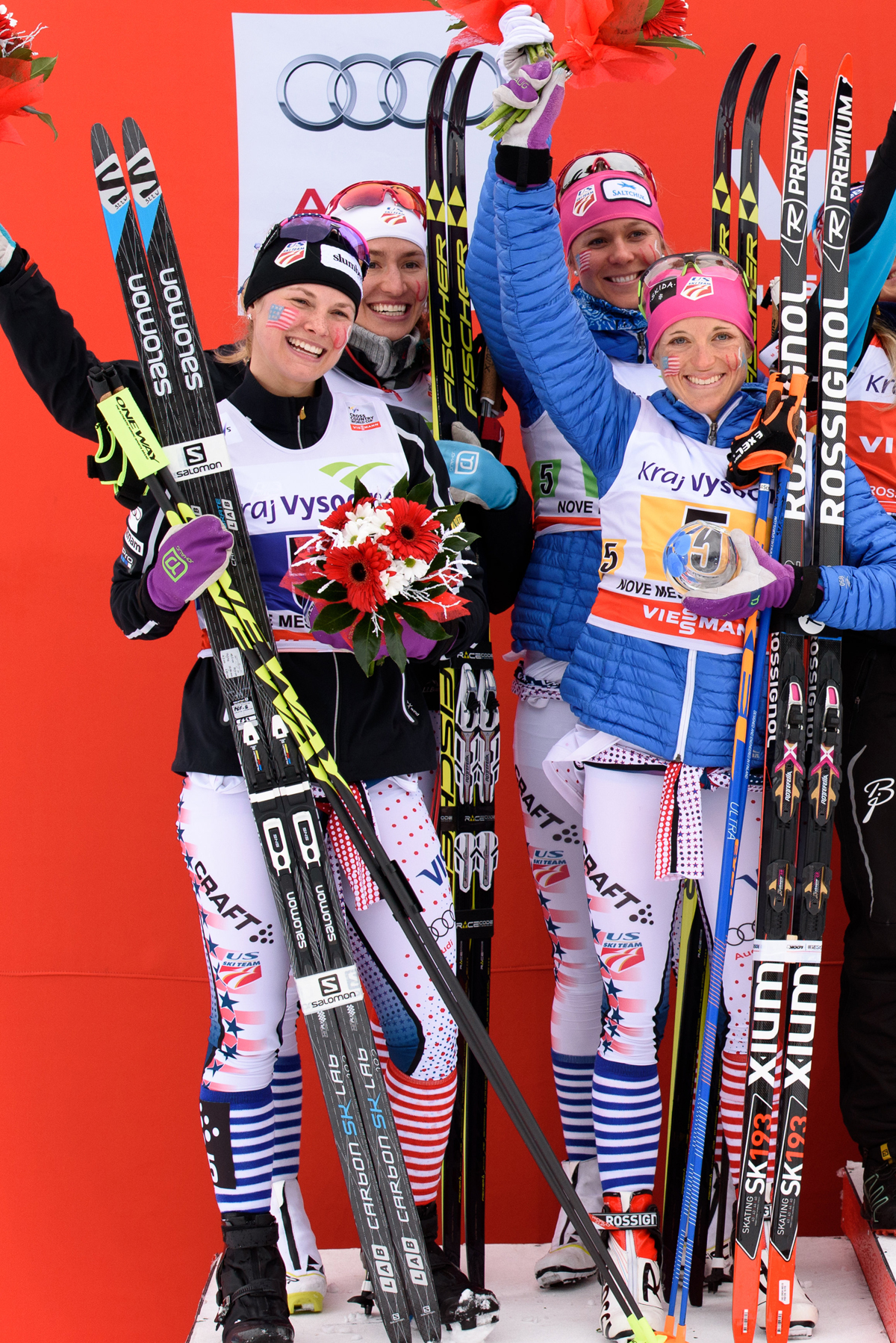
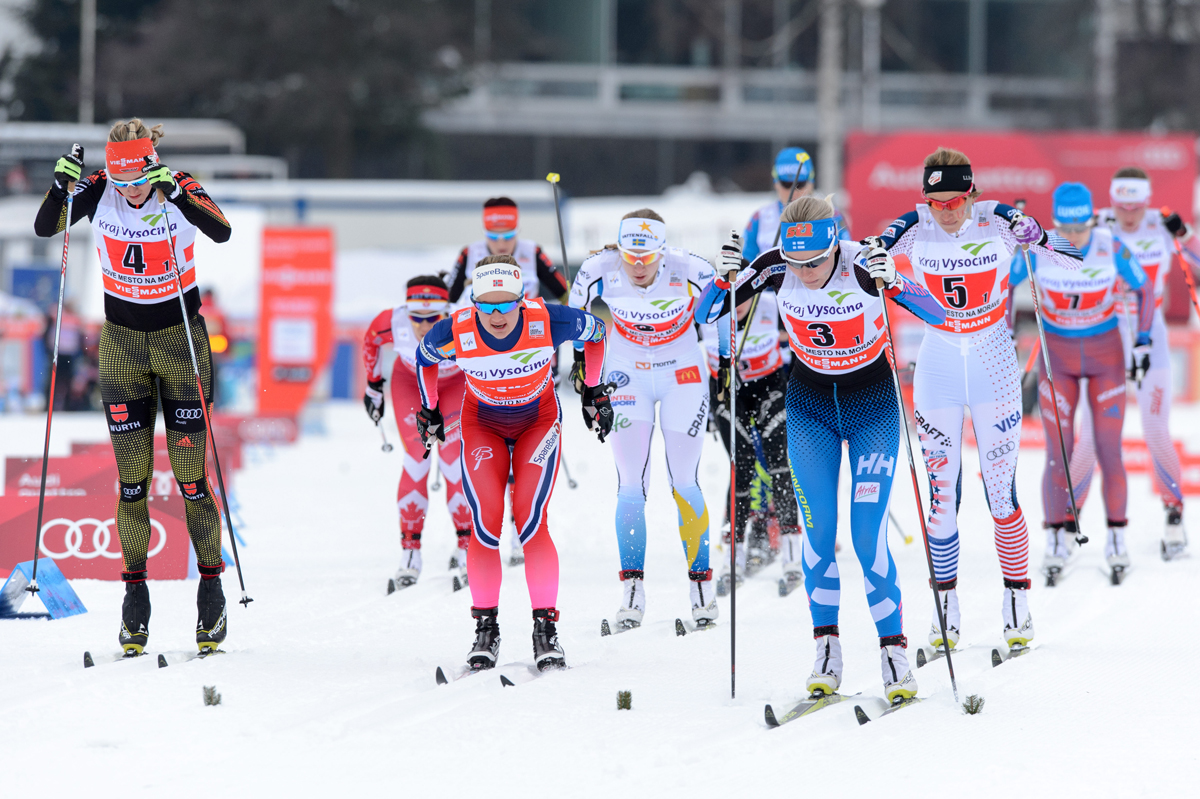
    With three top 20’s this season (including 19th overall in the Tour de Ski), it can be argued that Stephen should be popping top 10’s in the World Cup’s more demanding distance races. This season, something just hadn’t clicked for the 29-year-old team veteran.

    “I think I’m beginning to feel a little bit better physically, and kind of like these girls were saying, it’s a little different when it’s a relay,” Stephen said. “In any other race, you have to find your own confidence in yourself and in the relay, you find confidence in the other girls. And the fact that we’re handed off in second or third or whatever it was at that moment, that’s confidence in itself. I’ve been struggling finding that a little bit since part of the season, for me individually, but today I was just working off their confidence.

    “I was determined today,” she added. “You never want to be somebody that’s handed off third in the relay and you blow up. So definitely there’s a little extra motivation there. I tried to ski a smartly paced relay leg. I have a tendency to go flying like a bat out of hell. So Riita-Liisa and I worked together for a lap and then the second lap, you do what you can.”

    Stephen handed Diggins a 5-second margin over the Finns at the final exchange.

    The Difference Maker

    Jacobsen anchored Norway’s team. Like the seasoned veteran that she is, she never relented,  — skiing the fastest skate leg of the day, even besting Johaug’s third-leg time by 16.6 seconds. Out in front, but within site of Diggins on the straights, Norway’s top spot remained secure.

    Jessie Diggins (c) celebrates with teammates Sadie Bjornsen (l), Sophie Caldwell (r) and Liz Stephen (not shown) after anchoring the U.S. women's 4 x 5 k relay to a best-ever second in the Nove Mesto World Cup on Sunday in the Czech Republic. (Photo: Fischer/NordicFocus)
    Jessie Diggins (c) celebrates with teammates Sadie Bjornsen (l), Sophie Caldwell (r) and Liz Stephen (not shown) after anchoring the U.S. women’s 4 x 5 k relay to a best-ever second in the Nove Mesto World Cup on Sunday in the Czech Republic. (Photo: Fischer/NordicFocus)

    Diggins on the other hand, skated out of the exchange zone with Finland’s Kerttu Niskanen close behind. Her first-lap-strategy, go full gas — and she did so a day after achieving her second-career individual podium in the 10 k freestyle.

    “On a windy course like this, my strategy was, if I can put time into [Niskanen] right off the bat, like in the first 3 k and totally drop her, then that’s it. That will decide it right there because when you can’t see someone, that is incredibly mentally challenging,” the 24-year-old Diggins said. “So my goal was to just put the hammer down right away, get far enough that she thinks she has no way of getting to me and then settle in. And the second lap I was just trying to ski very carefully. Like, OK, don’t fall, don’t trip, don’t make any bobbles, because if I can just get across the finish line, we’ve got it. I just have to ski cleanly and make no mistakes.”

    Diggins made no mistakes.

    In the end, Diggins celebrated across the line with several elated fist pumps before her three teammates surrounded her with a group hug. The U.S. team finished in 50:59.3, 42 seconds behind the Norwegian winners and nearly 14 seconds clear of Finland in third.

    “We belong in the race for those medals just as much as any other nation and I think we’re all starting to ski that way,” Diggins reflected.

    More Dissection

    Sophie Caldwell opened for the U.S. women's relay team on Sunday at the World Cup in Nove Mesto, Czech Republic, tagging them in third, immediately behind Finland (not shown) in second place en route to the U.S. women's team's best-ever result of second place. (Photo: Fischer/NordicFocus)
    Sophie Caldwell opened for the U.S. women’s relay team on Sunday at the World Cup in Nove Mesto, Czech Republic, tagging them in third, immediately behind Finland (not shown) in second place en route to the U.S. women’s team’s best-ever result of second place. (Photo: Fischer/NordicFocus)

    In December, when the U.S. women placed third in the last World Cup relay in Lillehammer, Rosie Brennan skied the scramble leg. With Caldwell’s success on Sunday’s first leg, Whitcomb has options.

    “With Sophie, it was one of the interesting components of today,” he reflected. “We had a really difficult decision to choose between Rosie and Sophie for the classic leg. I do believe that we would have been on the podium with Rosie, I know she could have skied a great leg. We just felt that this course and conditions really suited Sophie. But it was one of those things we could have gone either way on. So with Soph, we just talked about conserving as much as possible, using the corners to position herself near the front third of the pack, and to just have a good time out there.

    “She’s a racer, she knows she needs to stay in contact, she knows when Norway makes an incredibly decisive move, whether that move is for her or not,” Whitcomb continued. “I think she skied a really brilliant race today, that was a key component in our success.”

    Caldwell skied the third-fastest scramble leg. Bjornsen skied the second-fastest time among the second-leg skiers, even 2.2 seconds faster than Weng, who was roaring off the front. For Stephen and Diggins — they both posted the second-fastest times for their respective legs as well. (Diggins’ 5 k time of 11:48.2, was second overall for skaters. To put that in perspective, Johaug’s 5 k split took 11:55.2.)

    The Canadian Side

    Sunday’s race was also the first time Canada has fielded a women’s relay since 2009. On that day, the team did not finish.

    In Nove Mesto, it was the first World Cup relay for all four women. Emily Nishikawa, Dahria Beatty, Cendrine Browne, and Maya Macisaac-Jones skied to 12th place (+5:02.4).

    Chris Jeffries, head coach of the Alberta World Cup Academy who assisted the Canadians the last two World Cup weekends, wrote in an email that this was a solid stepping stone for their women’s program.

    “Really happy we could get these girls into a team event. Message to them before the race is that this is the beginning, not the end,” he wrote. “We have a very young group of female skiers in Canada, and a great racer in Emily to help lead them forward on the world stage.”

    Nishikawa opened for the team on Sunday, tagging Beatty, also of the senior national development team, in seventh, 45.3 seconds back. While Beatty slipped to 12th, 2:21.8 behind at 10 k, another development-team skier, Browne brought them back to 11th (+3:05.9). MacIsaac-Jones (Rocky Mountain Racers) anchored them to 12th.

    “We knew it was going to be tough, 3 of the 5 girls were not healthy this week with colds, and you need 100% health if you are a development skier on the World Cup to have a good result,” Jeffries wrote. “Both Emily and Cendrine have been healthy, and both put up very strong races today. Emily fought hard and made up a lot of spots in the second half of her leg, but got taken down entering the exchange and lost contact.  Cendrine put together what I though was one of her best races ever, really close in time to the top girls. We have a lot of hope for future women’s teams in the next few years.”

    What about Germany and Sweden?

    On the first lap of the final leg, Nicole Fessel skiing for Germany’s first team and Sweden’s Marika Sundin literally went astray. About 24 seconds out of third in fourth and fifth, respectively, and a minute behind Norway, Fessel led Sundin as they went off course, following the classic track and missing the skate turn. Several meters later, they realized their mistake (see the video on Norway’s TV2). Fessel estimated in a post-race interview with ARD that it cost them 30 seconds.

    The next time through the stadium, with 2.5 k to go, they were about a minute out of the fight for the podium. Ultimately, Fessel finished fourth for Germany I, a minute out of third and 1:56.1 behind Norway. Sundin placed fifth for Sweden (+2:14.9).

    World Cup racing takes a break until Feb. 3, when men’s and women’s sprints will be held in Drammen, Norway. The next distance events will take place Feb. 6-7 in Oslo, Norway.

    Results

  • Johaug Pulls Away at 0.8 k, Wins 15 k Classic by 37.9 Seconds to Lead Tour

    Johaug Pulls Away at 0.8 k, Wins 15 k Classic by 37.9 Seconds to Lead Tour

    Norway's Therese Johaug celebrates at the finish of Saturday's 15 k classic mass start in Lenzerheide, Switzerland. She won the race by nearly 38 seconds to take the lead in the Tour de Ski after the second stage. (Photo: Fischer/NordicFocus)
    Norway’s Therese Johaug celebrates at the finish of Saturday’s 15 k classic mass start in Lenzerheide, Switzerland. She won the race by nearly 38 seconds to take the lead in the Tour de Ski after the second stage. (Photo: Fischer/NordicFocus)

    Eight-hundred meters into Saturday’s 15-kilometer classic mass start — the second stage of the Tour de Ski — it was all over. Therese Johaug, the Norwegian World Cup leader who’s won every distance race this season, had already put five seconds between herself from the rest of the 65-athlete women’s field. Several teammates fought to hang on behind her, with Heidi Weng skiing in second, Sweden’s Charlotte Kalla in third (+5.7), Astrid Uhrenholdt Jacobsen in fourth (+6.6), and Ingvild Flugstad Østberg in fifth (+7.3).

    Jessie Diggins positioned herself in sixth by 0.8 k, less than a second behind Østberg, and another American, Sadie Bjornsen skied another 2.5 seconds back in 10th.

    But that was less than a kilometer into the four-lap mass start in Lenzerheide, Switzerland: a classic distance race on a thin strip of snow amid a brown field, in temperatures just above freezing.

    Norway's Therese Johaug broke away early to win the women's 15 k classic mass start at the second stage of the Tour de Ski on Saturday in Lenzerheide, Switzerland.
    Norway’s Therese Johaug broke away early to win the women’s 15 k classic mass start at the second stage of the Tour de Ski on Saturday in Lenzerheide, Switzerland.

    Around 2 k, Johaug had nearly 13 seconds to play with. The order remained the same behind her, except Sweden’s Stina Nilsson crept into sixth, 22 seconds back. Diggins stuck in ninth (+25.8) and Bjornsen in 14th (+30.9).

    The rest of the race continued to be all about Johaug, as the 27 year old raced to a 37.9-second victory over Østberg in 41:26.4, and took the overall lead in the Tour de Ski by 4.5 seconds (thanks to 30 bonus seconds she captured at the 5.8 k and 9.6 k checkpoints).

    “The plan was not to get a gap so early,” Johaug explained in a post-race press conference.
    But she felt good, so she decided to go for it.

    “When I have this gap in the front of the girls, I had to do my own race,” she said. “I had to focus on the technique and my job. I am sure I have perfect skis and the body was really good.  It was a good feeling here.”

    Fifteenth in Friday’s skate sprint at the first stage of the Tour, Johaug had 44.4 seconds to overcome in order to catch Østberg as the leader. Another Norwegian, Maiken Caspersen Falla had won the sprint, but decided not to continue the Tour in order to prepare for other World Cups later in January.

    Ingvild Flugstad Østberg leads Norwegian teammate Heidi Weng about a third of the way through Saturday's 15 k classic mass start, Stage 2 of the Tour de Ski in Lenzerheide, Switzerland.
    Ingvild Flugstad Østberg leads Norwegian teammate Heidi Weng about a third of the way through Saturday’s 15 k classic mass start, Stage 2 of the Tour de Ski in Lenzerheide, Switzerland.

    That put Østberg, who had been second in Stage 1, in the lead heading into Saturday’s distance race.

    Best known as a sprinter, Østberg hammered the last five kilometers to drop Weng (whom she skied in second and third with in pursuit of Johaug for about seven kilometers) around 10 k and minimize the distance back to Johaug. With about a kilometer to go, Østberg trailed Johaug by 42 seconds. Østberg recovered 4 seconds on that final kilometer.

    “It was a great day for me, maybe my best 15 k ever, so surprised I’m not [farther] behind Therese,” Østberg said in the press conference.

    When Johaug was asked if this was her ideal start to the Tour, she replied, ‘Yes.’

    “I’ve got the perfect start,” Johaug told VG. “I have never gone with the [Tour leader’s] red jersey until the nine years I have gone, so I am very pleased to have with me 45 bonus seconds today, plus the difference to the others. So I’m very, very happy.”

    The Norwegian women swept the 15 k classic mass start podium at Stage 2 of the Tour de Ski on Saturday in Lenzerheide, Switzerland, with winner Therese Johaug (c), Ingvild Flugstad Østberg (l) in second, and Heidi Weng in third. (Photo: Fischer/NordicFocus)
    The Norwegian women swept the 15 k classic mass start podium at Stage 2 of the Tour de Ski on Saturday in Lenzerheide, Switzerland, with winner Therese Johaug (c), Ingvild Flugstad Østberg (l) in second, and Heidi Weng in third. (Photo: Fischer/NordicFocus)

    Weng finished third, 38.3 seconds after Østberg and 1:16.2 behind Johaug. It was another 16.5 seconds to fourth, with Anne Kyllönen edging her Finnish teammate Kerttu Niskanen by 0.2 seconds. Kalla crossed the line 0.7 seconds later in sixth. Finland had four in the top 10 with Laura Mononen 2:19.3 back in seventh and Krista Parmakoski 2:30.7 behind in 10th.

    “The last lap, I was very stiff,” Weng recalled in the press conference. She now ranks third in the overall Tour standings, 1:45.2 behind Johaug. “I was very slow so it was very hard. I think that the other girls come back, will take me to the end, but I still take the third place so I was very happy.”

    Part of a seven-skier chase pack behind Østberg and Weng until about a kilometer before the halfway point, when the group started to faction off behind the leaders, Jacobsen missed the top 10 by 11.5 seconds in 11th (+2:42.2) and lay on the ground after the finish for a long time. Several teammates and competitors, including the U.S. women checked on her, but Jacobsen needed help from medical staff to get her back on her feet.

    “I just talked to Astrid, and the intention is that she’ll race tomorrow,” Norway’s national-team doctor Fredrik Bendiksen told NRK, according to a translation.

    Sunday’s race, Stage 3, is a 5 k freestyle pursuit for the women and the final race in Lenzerheide.

    Women’s coach Egil Kristiansen expressed concern about Jacobsen.

    “I do not know what it is, but it is not quite good,” he told NRK. “I guess it might have something to do with the breath. She has had no cases of it before.”

    As for the 5 k, Johaug wasn’t sure the distance was long enough to her liking.

    “Oy, It is really short race,” she said in the press conference. “Ingrid starts only 5 seconds behind me, so I know it’s gonna be tough, but I will do my job and focus on my stuff, and, yeah, then we see how it goes.”

    Østberg saw it from a different viewpoint. Five seconds to Johaug was still a lot to overcome, she said.

    “I’m not quite sure if I’m going to try to keep up to Therese or just focus on my own race,” she said. “My plan today was to focus on my own race and stay calm, that’s been a really good plan for me this season in distance races, so I guess I have to do the same tomorrow.  But for sure, it would be fun if I could keep up with Therese.  She’s really strong in distance races … so it will be a hard fight tomorrow.”

    Stay tuned for another report on the U.S. women, with Diggins and Bjornsen leading their team in 12th (+2:44.7) and 13th (+2:45.3), respectively, on Saturday. Bjornsen currently ranks eighth in the Tour (+3:02.8), and Diggins ninth (+3:05).

    Results | Tour standings (through Stage 2)

  • Sweden’s Nilsson Snags Team-Sprint Victory Over Norway

    Sweden’s Nilsson Snags Team-Sprint Victory Over Norway

    The World Cup women's 6 x 1.2 k freestyle team sprint podium on Sunday in Otepää, Estonia, with Sweden (c) in first (Ida Ingemarsdotter/Stina Nilsson), Norway (l) in second (Maiken Caspersen Falla/Ingvild Flugstad Østberg), and Poland in third (Justyna Kowalczyk/Sylwia Jaskowiec). (Photo: FIS Cross-Country/Otepää World Cup)
    The World Cup women’s 6 x 1.2 k freestyle team sprint podium on Sunday in Otepää, Estonia, with Sweden (c) in first (Ida Ingemarsdotter/Stina Nilsson), Norway (l) in second (Maiken Caspersen Falla/Ingvild Flugstad Østberg), and Poland in third (Justyna Kowalczyk/Sylwia Jaskowiec). (Photo: FIS Cross-Country/Otepää World Cup)

    While Norway’s first team dominated both its semifinal and most the final in the freestyle team sprint on Sunday in Otepää, Estonia, both Sweden’s first team and Poland maintained pressure on the Norwegians, before Stina Nilsson, a 2014 Olympic bronze medalist in the classic team sprint with teammate Ida Ingemarsdotter, surged through the final turn and secured a clear victory for Sweden’s first team.

    “It was about time we won something again, but we have more to offer,” Ingemarsdotter told the Swedish TV station SVT after the race. “This was an important confidence builder, and it’s always a little bonus to beat Norway.”

    Last season in Sochi, Russia, Ingemarsdotter and Nilsson teamed up to earn bronze in the team sprint at the 2014 Olympics. On Sunday, the duo beat Sochi’s team-sprint gold medalist, Ingvild Flugstad Østberg (who paired with Marit Bjørgen for the title), and Østberg’s Norwegian teammate Maiken Caspersen Falla.

    Norway, Sweden and Poland took control of the top three by the halfway point of the Otepää 6 x 1.2-kilometer team sprint, and turned the first team sprint of the year into a fight for World Cup points for the rest of the field.

    Poland opened with Justyna Kowalczyk as the scramble leg and Sylwia Jaśkowiec as the anchor. On her last of three laps, Kowalczyk took the lead from Falla, but on the final hill before the stadium, Falla passed Kowalczyk and sent Østberg out in first on the final leg, 0.22 seconds ahead of Jaśkowiec. Sweden’s Ingemarsdotter tagged Nilsson in third, 1.64 behind Norway. Meanwhile, Finland’s second team, with Aino-Kaisa Saarinen and Riikka Sarasoja-Lilja, was another 3.72 seconds back in fourth.

    Not long after the last exchange, the 21-year-old Nilsson quickly closed the gap. She passed Jaśkowiec, 28, and was right on 24-year-old Østberg’s tails at the beginning of the lap, while Jaśkowiec latched on behind. Østberg tried to drop them both, leading them into the climb and up and over toward the finish, but the race turned into a three-way sprint by the finishing stretch.

    Stina Nilsson (l) slingshot past Norway's Ingvild Flugstad Østberg (c) and Poland's Sylwia Jaśkowiec (r) to take the 0.85-second team-sprint victory for Sweden on Sunday in Otepää, Estonia.
    Stina Nilsson (l) slingshot past Norway’s Ingvild Flugstad Østberg (c) and Poland’s Sylwia Jaśkowiec (r) to take the 0.85-second team-sprint victory for Sweden on Sunday in Otepää, Estonia.

    Putting herself in second on the descent, Nilsson took advantage of fast skis and the draft off Østberg to slingshot past her, and put four-to-five meter gap on the Norwegian and Jaśkowiec as the trio rounded the last corner toward the finish.

    In the straightaway, Nilsson increased the gap to cross the finish line with a clear victory, 0.85 seconds ahead of Østberg in second. Jaśkowiec was another tenth of a second back in third for Poland’s first-ever podium in a team sprint. It was also Kowalczyk’s first podium of the season.

    “I knew that Ingvild is really strong, so I stayed behind her until the last turn, when I surged past her,” Nilsson told SVT. “It was marvelous. My skis were amazing, and it was super inspiring to race, and that meant a lot today. We both had a good feeling.”

    “We felt good and tried to get a big gap,” Østberg told FIS. “Unfortunately the plan did not work as we had hoped but the second place is good.”

    With the victory in Otepää, the Swedish duo will be among the favorites for the freestyle team sprint at the World Championships on their home turf in Falun next month.

    While the top three teams duked it out up front, they separated themselves from fourth by nearly 16 seconds at the finish. Germany’s first team, with Hanna Kolb and Denise Herrmann, placed fourth (+16.54), and Finland’s first team, with Anne Kyllönen and Krista Parmakoski, finished fifth (+17.64).

    Ida Sargent and Rosie Brennan, of the Americans’ second team, came through the first exchange in fourth, half a second behind Sweden, after Ingemarsdotter led the first lap. At the second exchange, Brennan tagged Sargent three seconds back in sixth, but remained in the top six with a slight gap to the remaining 10 teams in the field.

    Sargent brought the team back to fourth and within 2.2 seconds of first on her second lap, but by the fourth of five exchanges, the U.S. slipped to seventh, six seconds behind. One lap later, they were back in sixth, 8.4 seconds back, and Brennan held that position to the finish, coming in sixth, 18.14 seconds after Sweden.

    The first U.S. team, with Sadie Bjornsen and Sophie Caldwell, was knocked out in the semifinals after placing fourth and ended up 11th overall. The top-three teams from their semifinal (the U.S. second team, German first team and Poland) advanced based on time.

    Results

  • Wednesday Workout: Tackling Technique with Visualization (like the U.S. Ski Team)

    Wednesday Workout: Tackling Technique with Visualization (like the U.S. Ski Team)

    Andy Newell while training with the U.S. Ski Team last month in Bend, Ore. (Photo: Matt Whitcomb)
    Andy Newell while training with the U.S. Ski Team last month in Bend, Ore. (Photo: Matt Whitcomb)

    This week’s Wednesday Workout comes from Matt Whitcomb, the U.S. Ski Team women’s coach. Whitcomb and the team recently returned from their on-snow camp in Bend, Ore., where they practiced improving technique with visualization. 

    ***

    Before starting the workout the coach identifies one 10-second clip of one male and one female World Cup skier classical striding up gradual terrain and then plugs it into iMovie. I like the clips of Anne Kyllönen striding up the sprint course in Sochi. If you don’t have access to these clips, YouTube something and video your own computer screen. The quality will be lower but you’ll be surprised at how well it works.

    In iMovie, create a project that plays your 10-second clip in regular speed and then in 1/2 speed (totaling 30 seconds), and repeat that six times in your movie project without music or any sound to remove sensory interference so the women’s clip is 2 minutes long. Add a 2-minute clip for the men to watch. Paste a 30-second clip of the women to see one last time at the end followed by a 30-second men’s clip. The total movie is only 5 minutes so you can get out the door and ski more.

    Keep the men and women together for the viewing in case one clip works better than the other. Watch on a large TV screen or with a projector play your iMovie clip to the team immediately before going out to ski. As a variation try talking them through the clip one one day, focusing in one one thing the World Cup athlete does well, and on another day try not talking at all to prevent polluting what they are seeing on their own. Many athletes are much better coaches than we are!

    If you don’t have access to footage, here is a YouTube video of Anne Kyllönen in addition to other World Cup athletes:

    Warm-up for 30 minutes and encourage the athletes to ski by themselves and on similar terrain to what you just watched, trying to channel and emulate the World Cup skier. It’s very easy for some and nearly impossible for others, but the process opens up new windows regardless.

    Meet your team on a very gentle downhill slope that is 200-meters long for a drill. Have them ski back and forth, striding both the gradual downhill and uphill. This isn’t about holding your glide for as long as possible on the gradual downhill, but more about feeling the flow of good striding under low tension. Watching our team do this left us feeling that the gradual downhill section unlocked some hip and shoulder tension in many athletes.

    Encourage the athletes to ski by themselves and on similar terrain to what you just watched, trying to channel and emulate the World Cup skier. It’s very easy for some and nearly impossible for others, but the process opens up new windows regardless.

    After the drill, film your athletes one at a time skiing up a gradual hill. Before they begin to ski toward you, have them rest on their poles, eyes closed and without talking, and visualizing that World Cup clip for 30 seconds. Then have them ski past you. Film the pass on your iPad or phone so they can look at it immediately.

    If it works out, great. Please let me know. If not, there are many creative ways to trigger technical improvements. Email me at mwhitcomb@ussa.org if you have a cool idea to share or just drop it anonymously into the comment section :). I would love to take a couple of your thoughts to our glacier camp in Alaska next month. Keep it fun and focused out there!

  • Johaug Dominates 5 K Classic, Jacobsen’s Lead Narrows

    Johaug Dominates 5 K Classic, Jacobsen’s Lead Narrows

    Photo: Fischer / Nordic Focus.
    Photo: Fischer / Nordic Focus.

    Therese Johaug, second overall in the Tour de Ski, skied a dominating race that was far and away faster than any of her competitors. Johaug’s performance went a long way toward her goal of being the first to the summit of the Alpe Cermis on Sunday.

    Saturday’s event was a 5 k classic individual start race, held in Val di Fiemme, Italy, under drizzling skies that hovered around freezing.

    Japan’s Masako Ishida was the early pace setter, recording fast splits through all the interval timing stations.  Starting fifth, she passed through the first timing station at 1.3 k in 4:14.3.

    USA’s Jessie Diggins, starting thirteenth, was just over Ishida’s time at 1.3 k, trailing the early leader’s time by 1.4 seconds.  Liz Stephen of the US, who started fifteenth, trailed Diggins’ time through the first interval by 7 seconds.

    Finland’s Aino-Kaisa Saarinen started in bib 21, and set the new pace to beat at 1.3 k at 4:12.  Her teammate, Kerttu Niskanen, then came through the first interval a second behind Saarinen.  Saarinen’s time would be beaten shortly thereafter by yet another Finn, Anne Kyllönen, who skied past the first timing point 3.3 seconds ahead of Saarinen.  The Finns now held the top three positions.

    Photo: Fischer / Nordic Focus.
    Photo: Fischer / Nordic Focus.

    Johaug, wearing the black sprint leader’s bib, started in 36th, two places ahead of the final red group skier, and Tour leader Astrid Jacobsen of Norway.

    Johaug wasted no time in setting a fast pace on a slow day.  Using her quick tempo and fast skis to her advantage on the hills of Val di Fiemme, she undercut Kyllönen’s time at 1.3 k by 3.2 seconds to set the leading pace.

    If Jacobsen had hopes of winning the day, she knew she was in trouble early on.  Placing third at 1.3 k, she was 5.1 seconds off of Johaug’s pace and did not appear to be climbing as well as her teammate.

    The second timing interval, at 3.3 k, was held early by Ishida. Diggins, 8.1 seconds behind, was unable to break it.  The Finnish women again took over the race as they passed the station, with Kyllönen, Saarinen, and Niskanen separated by just 1.6 seconds.

    The Finnish times looked favorable until Johaug skied through, slashing Kyllönen’s time by 11.1 seconds.  All eyes awaited Jacobsen’s arrival at the interval station, which confirmed that she was losing a lot of time to her compatriot.  At 3.3 k, Jacobsen was 13.7 seconds behind her teammate, sitting in 5th place behind Johaug and the three Finns.  Cameras showed a Norwegian coach instructing Jacobsen extensively as she labored up a climb.

    Whatever was said must have a had an effect.  Jacobsen, knowing that she was at risk of losing her entire 43 second advantage to Johaug through lost time and the fifteen bonus seconds Johaug would surely collect for winning, began to really battle through the final kilometer and half.

    Johaug, meanwhile, tracked a skier at the edge of the finishing lanes, and tore through the finish line to set the winning time of 13:58.4, some 19.2 seconds ahead of then second place Kyllönen.

    Johaug's finish.  Photo: Fischer / Nordic Focus.
    Johaug’s finish. Photo: Fischer / Nordic Focus.

    Jacobsen arrived at the finish not long after, powerfully double poling her way across the line.  Her late effort had paid off—she had stanched her time hemorrhage to just 1.2 seconds to Johaug over the last 1.2 k of the race, and most importantly, finished second, outskiing the Finnish contingent that had tired.  Jacobsen seemed pleased with her result as she crossed the finish line and looked at the timing board, she raised her arm happily before succumbing to exhaustion.  Her rally at the end was key to her chances tomorrow as she won a further 10 second bonus that preserved some distance between her and Johaug.

    Jacobsen had another reason to celebrate: she won back the black sprint leader’s jersey, and no matter where she ends up on the Alpe Cermis, she is guaranteed to keep it.

    Diggins had another great day of skiing, finishing in 10th,  her best classic race ever in the World Cup, 30.3 seconds out of first. Liz Stephen was 21st, 52.4 seconds back.  Holly Brooks left the Tour and did not start.

    Johaug’s victory, her first of this year’s Tour de Ski, puts her in a good position heading into Sunday’s final stage up the Alpe Cermis.  Still in second overall behind Jacobsen, Johaug’s effort shaved 14.9 seconds off of her teammate’s advantage.  Johaug will start Sunday’s race just 23.8 seconds behind her teammate.

    Speaking to FIS after the race, Johaug said,  “It was a great day for me. I have been in a very good shape. My skis were just flying, I had the best skis I can ever remember. My plan was to go full speed from the beginning. I like competing in difficult weather conditions. I will try to recover well to be ready for tomorrow’s Final Climb.”

    Jacobsen, for her part, said to Dagbladet, “I fought myself to the second place on sheer will. I did it because I wanted this more than the others.”

    Photo: Fischer / Nordic Focus.
    Kyllönen.  Photo: Fischer / Nordic Focus.

    Kyllönen was once again third, the same position she holds overall.  She will start Sunday’s stage 1:31 behind Jacobsen.  It was another fantastic day for the Finnish women who went 3, 4, 5 and 7.  Finnish newspaper Helsingen Sanomat reported that Kyllönen has told her teammates that she hopes they will, “stream by to do some work.” Krista Lähteenmäki, who has twice in the past finished fourth in the Tour, told the newspaper that she dreads the final climb.  “Every time, I have been really tired and thought in the morning that I can not go skiing.  I have no idea what is coming tomorrow.”

    The Alpe Cermis will now be especially difficult for Jacobsen as Johaug will be starting close enough to her to keep her in eye contact on the climb, if she doesn’t catch Jacobsen before then.  “It was important to take the second today” Jacobsen said to Dagbladet, “Now I have her back from the start. I just have to go steadily throughout the race.”

    Jacobsen has downplayed her chances of winning the Tour since she took possession of the leader’s bib.  “Last year I lost 1:30 up the last hill, so any logical sense tells me that 24 seconds is not enough,” she conceded after the race.  But she added to FIS, “I feel I am in very good shape and I can compete with almost everybody. I do not think much about the overall result in the Tour de Ski. It’s already a great achievement for me to be in the leading position before the final stage.”

    Johaug, for her part, isn’t willing to take a victory for granted yet.  “Astrid has shown that she is in great shape so far, so nothing is settled,” Johaug said. “But all indications are that it will be a Norwegian victory for the first time tomorrow, and we on the girls team are very happy,” she reported, smiling.

    With Norway in an advantageous position to go 1st and 2nd tomorrow, Norwegian National Team Coach Egil Kristiansen is also hungrily looking at the possibilities of Heidi Weng, currently in 6th and just over half a minute behind Kyllönen, to move up to third and make the Tour a Norwegian treble.

    “We have to work for it, but it should be our goose,” he said.

    The Tour continues Sunday with the final stage, a 9 k freestyle pursuit race that finishes at the summit of the Alpe Cermis.

     Results

    Same podium as Friday, just in a different order.  Photo: Fischer/Nordic Focus
    Same podium as Friday, just in a different order. Photo: Fischer/Nordic Focus
  • Jacobsen Wins 15 k Pursuit, Stephen and Diggins 12th and 13th

    Jacobsen Wins 15 k Pursuit, Stephen and Diggins 12th and 13th

    The women's 10 k classic mass start podium at Stage 4 of the Tour de Ski: winner Kerttu Niskanen (c) of Finland, and Norway's Astrid Uhrenholdt Jacobsen (r) in second and Therese Johaug in third. (Photo: Fischer/Nordic Focus)
    The women’s 10 k classic mass start podium at Stage 4 of the Tour de Ski: winner Kerttu Niskanen (c) of Finland, and Norway’s Astrid Uhrenholdt Jacobsen (r) in second and Therese Johaug in third. (Photo: Fischer/Nordic Focus)

    Astrid Jacobsen of Norway, the Tour leader in the red bib, won Friday’s 15 k freestyle pursuit race to maintain her lead over teammate Therese Johaug.  Leading the race, Jacobsen started with a 44 second advantage over Johaug who was followed 37 seconds later by Kerttu Niskanen of Finland, holder of the black sprint leaders bib.

    The course, a 5 kilometer loop that climbed long and gradually out of the stadium through the pine forests outside Toblach, was wide and hard packed, and most of all difficult, with little rest along the way.

    For Jacobsen, her hopes of winning the Tour de Ski rested on her ability to maintain her lead over Johaug.  With the withdrawal of Marit Bjørgen from the Tour, Johaug, with her impressive climbing ability, has become the favorite to win the 7 stage event.

    Behind Johaug came Aino-Kaisa Saarinen of Finland, and Heidi Weng of Norway, 1:09 behind Jacobsen.

    Further back, Norway’s Kristin Stoermer Steira led a large group of chasing skiers 2:26 behind Jacobsen.  Anna Haag of Sweden was four seconds behind Steira, followed by Jessie Diggins of the U.S. at the same time and her teammate Liz Stephen, two seconds later.  Holly Brooks of the US started in 42nd, 3:43 behind Jacobsen.

    The race started fast with Jacobsen reaching the first split at 1.8 k in 4:38.  By the time Johaug had reached the marker, she had passed Niskanen, and had shaved a second and a half off of Jacobsen’s lead.  Ten minutes into the race, as the course began to wind its way out of the forests and back toward the stadium for the second lap, Johaug appeared to have clawed back a further two and half seconds on Jacobsen.

    Johaug Finishing.  Photo: Fischer/Nordic Focus
    Johaug Finishing. Photo: Fischer/Nordic Focus

    As the skiers passed through the sunny stadium and back into the forest, the split time at 5.7 k confirmed that Johaug was now 39.8 seconds behind Jacobsen.  Behind her by 23 seconds was Niskanen, who was close to being caught by her teammate Anne Kyllönen, just five seconds behind.

    The course began to climb up the hills and at 6.8 k, Jacobsen’s lead had shrunk a second further, to 38.6 seconds.  Behind Johaug, however, Niskanen and Kyllönen, now skiing together, were falling a few more seconds behind the leader’s pace.

    The largest chasing pack was led up the climb by Diggins, who was skiing in 11th place ahead of Germany’s Katrin Zeller, Haag, and Stephen.  As the climb neared the crest, Steira took the lead from Diggins.

    The 10.7 k split confirmed that it was going to be a difficult day for Johaug to make time on Jacobsen.  As they skied through the stadium to start their third and final lap, Johaug was 40.5 seconds behind the leader, with Kyllönen and Niskanen slipping back further to 1:21 behind Jacobsen.

    The large chasing group that Stephen led into the stadium was taken over once again by Steira on the climb, with Sweden’s Sara Lindborg and Diggins chasing.

    Liz Stephen (U.S. Ski Team) on her way to 34th in Saturday's 3 k freestyle prologue at the first stage of the Tour de Ski in Oberhof, Germany. (Photo: Marcel Hilger)
    Liz Stephen (U.S. Ski Team)  (Photo: Marcel Hilger)

    11.8 k into the pursuit found Johaug, battling hard, losing time on Jacobsen, who now led by 42.2 seconds.

    Steira came through in 10th place with Stephen close on her skis and six other skiers following.  Diggins was three places behind Stephen and trailing by six seconds.

    In the final kilometers, Johaug skied aggressively. It appeared to be paying off some 1.5 kilometers before the finish where her splits indicated that she was 34.6 seconds behind.  Jacobsen, however, had a strong finish, and she briefly raised her arms in celebration after she crossed the finish line before immediately collapsing.  Her effort had paid off; Johaug completed her race 38.7 seconds later, and with Jacobsen’s hard won bonus seconds, she finished the day with a lead of 43.7 seconds.

    Kyllönen was third and Lindborg, skiing the fastest time of the day in 37:16, moved from 24th to 10th.  The race for 11th was close between Stephen and Steira, with the Norwegian just edging out Stephen by four tenths of a second.  Diggins was next, in 13th, 3.3 seconds behind Stephen.

    Kristin Stoermer Steira (NOR)
    Kristin Stoermer Steira (NOR)

    Jacobsen, speaking to FIS after the race said, “It was a tough competition. I was little bit tired after the first lap; the course is quite hard in Toblach. I was happy there was a feeding station. I felt better in second half of the race. I am happy that my shape has been so good. It is a good sign for the Games, which are the biggest goal for me. I still think that Therese (Johaug) is the biggest favorite for the overall victory in the Tour de Ski. She has been always very strong on the Final Climb.”

    Jacobsen told Norwegian Newspaper Dagbladet that she did not anticipate still being at the Tour, let alone contending for the title. “I was only going down to a couple of classic races, and then going home” she said of her Tour plan.  “I have just brought a racing Suit and warmup suit, so I had to wash some clothes yesterday” she said, smiling.

    Last year Jacobsen lost a minute and a half to Johaug on the final climb up the Alpe Cermis. “That, I choose not to think anything about.  I lost 1:30 last year, an advantage I am guaranteed not to get this year. If I do go out first on Sunday, I will be only be thinking that I want her to get going fast to catch up.”

    Johaug for her part is hungry to recover some more time in tomorrow’s 5 k classic race. “I feel I have a good chance before the final weekend” she told Dagbladet, “But it’s a race tomorrow where there is the opportunity to both retrieve and lose seconds.  It is very difficult to say how close I have to be to have a chance, but if I manage to keep under a minute, I might have some opportunities.”

    Kyllönen and Niskanen.  Photo: Fischer/Nordic Focus
    Kyllönen and Niskanen. Photo: Fischer/Nordic Focus

    It was a great day for Finland as well, with four women in the top 10.  Kyllönen told Finnish newspaper Helsingen Sanomat, “It is always great to be among the three, and, above all, to get success.” Kyllönen is in third place overall, 1:22 behind Jacobsen.  Of her chances of winning the Tour she said, “If they [Jacobsen and Johaug] stay healthy, they are difficult to be overcome, but the game is still open.”

    The Tour continues to thin out as skiers leave to rest and train ahead of the Sochi Olympics in February.  Notable withdrawals ahead of stage 5 included Østberg, Herrmann, Hanna Erikson (SWE), Sophie Caldwell (USA), Vibeke Skofterud (NOR) and Daria Gaiazova (CAN).


    The Tour de Ski continues on Saturday with a 5 k classic race.

  • With Bjørgen Out, Niskanen Rises Above Rest of Norwegians for First Stage Win in Lenzerheide

    With Bjørgen Out, Niskanen Rises Above Rest of Norwegians for First Stage Win in Lenzerheide

    Finland's Kerttu Niskanen (second from l) and Aino-Kaisa Saarinen (l) lead Norway's Therese Johaug, Heidi Weng, , Ingvild Flugstad Østberg, Astrid Uhrenholdt Jacobsen, and Sweden's Hanna Erikson (r) in Wednesday's 10 k classic mass start at Stage 4 of the Tour de Ski in Lenzerheide, Switzerland. (Photo: Fischer/Nordic Focus)
    Finland’s Kerttu Niskanen (16) and Aino-Kaisa Saarinen (14) lead Norway’s Therese Johaug (11), Heidi Weng (20), Ingvild Flugstad Østberg, Astrid Uhrenholdt Jacobsen (4), and Sweden’s Hanna Erikson (7) in Wednesday’s 10 k classic mass start at Stage 4 of the Tour de Ski in Lenzerheide, Switzerland.
    (Photo: Fischer/Nordic Focus)

    Marit Bjørgen is sick. For Norwegians, the news that the 33-year-old team leader had to pull out of the Tour de Ski on Wednesday morning was definitely a bummer; having never won the Tour before, she was missing the opportunity to do so again.

    The attention quickly shifted to her teammates, including distance favorite Therese Johaug and Ingvlid Flugstad Østberg, who led the Tour standings through three stages.

    But the Norwegians aren’t the only ones in this seven-stage game, and Finland’s Kerttu Niskanen was among the “others” seeking a little recognition on Wednesday, New Year’s Day.

    In the fourth stage of the Tour, Johaug, Østberg and another Norwegian, Astrid Uhrenholdt Jacobsen, assembled almost immediately out of the start of the women’s 10-kilometer classic mass start in Lenzerheide, Switzerland. Together in red suits at the front of the pack, they were out to send a message. They were setting the pace and controlling this race.

    The women's 10 k classic mass start podium at Stage 4 of the Tour de Ski: winner Kerttu Niskanen (c) of Finland, and Norway's Astrid Uhrenholdt Jacobsen (r) in second and Therese Johaug in third. (Photo: Fischer/Nordic Focus)
    The women’s 10 k classic mass start podium at Stage 4 of the Tour de Ski: winner Kerttu Niskanen (c) of Finland, and Norway’s Astrid Uhrenholdt Jacobsen (r) in second and Therese Johaug in third. (Photo: Fischer/Nordic Focus)

    But three laps is a long way.

    Before the end of the first loop around 2.4 k, the three led while Sweden’s Hanna Erikson — who notched her first international podium with a freestyle-sprint win in Stage 2 — hung less than a second behind the three in fourth. Another 0.5 seconds back, Aino-Kaisa Saarinen headed up Finland’s trio in fifth, with Niskanen and Anne Kyllönen trailing in sixth and seventh, respectively.

    By the end of the first 3.1 k lap, Johaug and Østberg still led, but Saarinen had made her way up to third, 0.7 seconds back and even with Jacobsen. Another 1.3 seconds later, Niskanen came through in fifth, followed by Erikson another half-second back in sixth. The top 10 remained within 6 seconds of one another, but when you’ve got Johaug up front — known to “pop” and drop the field at any time — that’s a lot of time to claw make up on her.

    Niskanen remained in contact, even after dropping more than five seconds behind Johaug at 4.6 k, along with Østberg, who fell off the pace slightly as well. With Johaug nearly 2 seconds ahead of Saarinen in second and 3.6 seconds up on Jacobsen in third, it seemed the writing was on the wall: another Johaug win without Bjørgen to make it a little more interesting.

    At the sprint preem less than a kilometer later, Niskanen sprung to life. First through the bonus checkpoint at 5.5 k, she put 1.2 seconds into Saarinen and just over two seconds into Jacobsen and Johaug. Norway’s Heidi Weng had moved up to fifth, 3 seconds behind Niskanen, and Østberg was more than six seconds back in sixth.

    Whatever was going on behind Niskanen, it didn’t matter. Striding smoothly along the rolling course, with an approximately 500-meter climb in the middle of each lap, Niskanen never relinquished the lead — even with Johaug breathing down her neck with less than 3 k remaining.

    She managed to keep the Norwegians at least a full stride and couple meters behind until one pivotal point on the high point of the course at 8.6 k, where the preem was on the second lap. As if it was there again, Niskanen charged up and over the top to break free of Johaug and Saarinen, who were nearly even with her at the time. Jacobsen was right there with them, and Weng lost a little time on the screaming-fast descent toward the stadium.

    With one more rise to go, Niskanen was first to the top and used her fast skis with superior glide to gain even more on her ground competitors, all while tucking in the track of her choice. Jacobsen followed and Johaug was right behind her in one of the outside tracks, but Johaug’s drafting tactic ended up impeding her as she came up on Jacobsen and quickly searched for a open track to switch to. Meanwhile, Weng was gaining on the group, including Saarinen, skiing alone in another track.

    As the leaders rounded the lefthand turn into the stadium, Niskanen launched into double poling as she tried to fend off Jacobsen and Johaug for one last time. She succeeded, winning in 26:27.4, four-tenths of a second ahead of Jacobsen in second. Johaug took third, another 0.7 seconds back, Weng passed Saarinen for fifth (+1.9) and Saarinen settled for sixth (+2.5).

    The third Finn in the top six on Wednesday, Kyllönen placed sixth (+23.9) for her fourth-straight top eight in the Tour. Eva Vrabcova-Nyvltova of the Czech Republic finished seventh (+24.5), Russia’s Olga Kuziukova was eighth (+25.1), Erikson ninth (+25.8) and Østberg edged France’s Aurore Jean in a photo finish for 10th (+29.8).

    Finland's Kerttu Niskanen holds off Astrid Jacobsen of Norway to the finish of Wednesday's 10 k classic mass start to win Stage 4 of the Tour de Ski in Lenzerheide, Switzerland. (Photo: Fischer/Nordic Focus)
    Finland’s Kerttu Niskanen holds off Astrid Jacobsen of Norway to the finish of Wednesday’s 10 k classic mass start to win Stage 4 of the Tour de Ski in Lenzerheide, Switzerland. (Photo: Fischer/Nordic Focus)

    For Niskanen, 25, the victory was her first stage win — and podium — after she took third in the classic sprint last season at World Cup Finals in Stockholm.

    She started to cry “tears of joy” when she crossed the finish line, Niskanen told the Helsingin Sanomat, according to a translation. “Then I thought, ‘It’s useless to cry when this is not so terribly serious.’ ”

    With a total of 30 bonus seconds (15 for being the first through 5.5 k, and another 15 for winning), Niskanen improved to third in the overall Tour behind Jacobsen in first and Østberg in second. The frontrunner since winning Tuesday’s sprint, Østberg dropped 35.4 seconds out of the lead and Niskanen stood 36.8 seconds back in third.

    Jacobsen was originally going to go home after four stages, but now she’s in it to win it.

    “I’ll go to each race as it is the most important ski race,” she said of the remaining three stages, which pick up Friday in Toblach, Italy.

    “She’s at least a podium contender,” Norwegian women’s coach Egil Kristiansen told NRK.

    Through four stages, Johaug was fourth overall (+44.7) and Saarinen sat in fifth (+54.0), and Kyllönen was sixth (+55.7).

    Kyllönen told the Ski Association Bulletin that Weng pushed her “into the wall,” during Wednesday’s 10 k, according to the Sanomat. “I was on the tip … when I fell, and the group escaped,” she said. “There is no TV picture, so making a protest is a pointless waste of energy.”

    Germany’s Denise Herrmann ranked seventh overall (+59.3) after placing 20th in the first classic race of the Tour, Weng was eighth (+1:09.4), Erikson ninth (+1:13.2), and Vrabcova-Nyvltova 10th (+1:39.9).

    Leading the Americans, Sophie Caldwell was still in the top 20 after placing 33rd (yet Wednesday marked her last race of the Tour), and fellow U.S. Ski Team member Jessie Diggins was 21st (+2:30.2) after placing 32nd. Liz Stephen finished 26th in the first distance race of the Tour to improve to 21st overall (+2:32.0).

    As for Bjørgen, she flew back to Norway on Wednesday, but Kristiansen expects her to be up-and-training again in two or three days.

    “The most important thing now is that she gets stored up energy and eats well,” Kristiansen told NRK, according to a translation.

    Tuesday was a bit much; she raced after struggling to eat breakfast.

    “She was not quite [right],” he said. “Normally she is very sharpened and focused towards competition. … It is never positive to be sick, but at the same time plan B might just as well [focus on] the Olympics. We talked about how important it was that she forgot that and started with a clean slate. We are done with what happened.”

    Bjørgen’s righthand rival and close teammate, Johaug said she was “very sorry” to hear the news.

    “I told her that [there’s a] more important ski race this year. The Olympics is the main goal,” Johaug told NRK. “The most important thing now was that she came home. There are new opportunities.”

    Results | Tour standings (through Stage 4)

  • Finland’s Saarinen, Kyllönen Reign at Asiago Team Sprint; Top Norway

    Finland’s Saarinen, Kyllönen Reign at Asiago Team Sprint; Top Norway

    Finland's Anne Kyllönen celebrates another classic team sprint victory on Sunday after she and Aino-Kaisa Saarinen won the World Cup 6 x 1.25 k event in Asiago, Italy, by nearly 10 seconds over Norway. (Photo: Fischer/Nordic Focus)
    Finland’s Anne Kyllönen celebrates another classic team sprint victory on Sunday after she and Aino-Kaisa Saarinen won the World Cup 6 x 1.25 k event in Asiago, Italy, by nearly 10 seconds over Norway. (Photo: Fischer/Nordic Focus)

    You know what they say about the Finns; those women are good at team sprints.

    Aino-Kaisa Saarinen and Anne Kyllönen dominated Sunday’s 1.25-kilometer classic team event at the World Cup in Asiago, Italy, giving a lesson to more than 20 other teams on how to get out front and stay there.

    Fellow US Ski Team members Sadie Bjornsen (front) and Ida Sargent (r) go head to head in Sunday's 1.25 k classic team sprint at the World Cup in Asiago, Italy. Together in the semifinals, both American teams made the final as well. (Photo: Fischer/Nordic Focus)
    Fellow US Ski Team members Sadie Bjornsen (front) and Ida Sargent (r) go head to head in Sunday’s 1.25 k classic team sprint final at the World Cup in Asiago, Italy. Together in the semifinals, both American teams made the final as well. (Photo: Fischer/Nordic Focus)

    The duo won their semifinal ahead of two American teams – Ida Sargent and Sophie Caldwell for USA II, and Sadie Bjornsen and Kikkan Randall for USA I, respectively. The three broke away on the last of three legs, Finland won, USA II automatically qualified in second and USA I skied fast enough to get a lucky-loser spot.

    Earlier in the heat, Caldwell and Randall shook off an inadvertent collision, in which Randall went down and Caldwell skied on, at the end of their first leg. As the two converged around a 180-degree corner before the exchange, Randall fell Karolina Grohova of the Czech Republic came up from behind and “toppled over me,” Randall said in a phone interview. With a “little raspberry” on her hip, she got up quickly, tagged Bjornsen, and the two made up the 10-second deficit to Finland and their American teammates up front.

    Despite what happened behind them, Finland was in control from start to finish on Sunday. They advanced to the final without any major stresses and started that race in second, following Norway’s No. 1 team by 0.2 seconds into the first exchange. The 26-year-old Kyllönen then charged to the front of the pack and the Finns held their own for the rest of the race.

    By the second-to-last exchange, Saarinen had given Finland a 4.4-second lead on Norway’s Ingvlid Flugstad Østberg and Maiken Caspersen Falla. The cat-and-mouse game between Finland and Norway, with Germany another five seconds back in third, was losing its allure. Finland was getting away, Norway was going to have to hold off Germany’s Katrin Zeller and Denise Herrmann, and the Americans were going to have to fight for fourth.

    Denise Herrmann anchored Germany I to third, just 0.3 seconds behind the Norwegians in second in the Asiago World Cup classic team sprint. (Photo: Fischer/Nordic Focus)
    Denise Herrmann anchored Germany I to third, just 0.3 seconds behind the Norwegians in second in the Asiago World Cup classic team sprint. (Photo: Fischer/Nordic Focus)

    As Kyllönen sealed the Finnish victory in 19:15.72, Norway I hustled for second, 9.68 seconds back. Falla barely edged Herrmann, who pushed for second and ended up third, 0.34 seconds behind Falla. Norway II’s Kari Gjeitnes and Celine Brun-Lie stayed in front of the U.S. and Russia to place fourth (+11.53), and Randall anchored USA I to fifth, 18.48 seconds after Finland and 19 seconds ahead of Russia II’s Julia Ivanova and Anastasia Dotsenko.

    Switzerland took seventh with Bettina Gruber and Laurien Van Der Graaff (+19.25), and Sargent and Caldwell ended up eighth (+20.56).

    “It is great to be back on the top of the World Cup podium,” Saarinen, a 34-year-old World Cup veteran embarking on her third Olympic, told FIS.

    The last time she stood on top of the podium in World Cup or Olympic event – team or individual – was 2009.

    “It’s been a great day not for only for me but for Finland,” she added. “Anne was very strong today.”

    Last February, Kyllönen teamed up with Mona-Liisa Malvalehto to win the pre-Olympic classic team sprint at the World Cup in Sochi, Russia. That was a good sign then; this is even better now less than 50 days out from the 2014 Olympics.

    “Finland was very strong but hopefully in February we can be stronger,” Østberg told FIS after achieving her first podium of the season.

    The men's classic team sprint podium at the Asiago World Cup in Italy on Sunday: Finland's Anne Kyllönen and Aino-Kaisa Saarinen (c) won, Maiken Caspersen Falla and Ingvlid Flugstad Østberg (l) placed second, and Germany's Katrine Zeller and Denise Hermann (r) were third. (Photo: Fischer/Nordic Focus)
    The men’s classic team sprint podium at the Asiago World Cup in Italy on Sunday: Finland’s Anne Kyllönen and Aino-Kaisa Saarinen (c) won, Maiken Caspersen Falla and Ingvlid Flugstad Østberg (l) placed second, and Germany’s Denise Herrmann and Karin Zeller (r) were third. (Photo: Fischer/Nordic Focus)

    The Norwegians remained within 1 ½ seconds of Finland through four laps until Saarinen dropped Østberg on her final lap.

    Gruber opened strong to put Switzerland in third through the first leg, but Van Der Graaff drifted to six before Gruber could bring them back to third on her second leg. After her third time around, Gruber tagged in eighth behind USA II in seventh. USA I was fourth with one lap to go, 2.3 seconds behind Norway I in third and 12.2 seconds behind the Finns.

    With nearly five seconds to play with, Kyllönen extended her gap to bring the victory home, refusing to let up.

    “I was very tired all day, but that was a very good race,” Saarinen said.

    “They went hard from the gun and kept the level high,” Randall said.

    She and Bjornsen fell behind on the second leg, with Bjornsen tagging her in ninth and Randall recovering to fifth before the second-to-last exchange. At the Sochi team sprint last season, Bjornsen and Sargent placed fifth.

    “I am confident that both teams could be in the runnings for a medal if everything went golden!” Bjornsen wrote in an email about Americans’ competitive team combinations. “But that is how we light the fire. First we find a possibility on a ‘perfect day,’ and then we have that perfect day, and the confidence brings even more!”

    Third in the Sochi team sprint behind Russia in second, Canada’s Perianne Jones and Dasha Gaiazova finished eighth in their semifinal for 16th overall.

    Results

  • Kowalczyk Continues Classic Dominance in Italy

    Kowalczyk Continues Classic Dominance in Italy

    Justyna Kowalczyk (POL) celebrates her victory in the Asiago, Italy city sprint Photo: Fischer/Nordic Focus
    Justyna Kowalczyk (POL) celebrates her victory in the Asiago, Italy city sprint Photo: Fischer/Nordic Focus

    Poland’s Justyna Kowalczyk remained unbeaten in the classic technique this season, skiing to an uncontested win in the World Cup sprint in Asiago, Italy.

    Anne Kyllönen of Finland finished second with Norwegian Maiken Caspersen Falla in third.

    The day, however, was all about Kowalczyk. She qualified second, and was never seriously threatened as she romped through the heats.

    Through four classic races, including two sprints, Kowalczyk remains unbeaten and is showing top form early in the season.

    The defending World Cup overall champion, Kowalczyk has traditionally started the season slowly, training hard into the early part of the competition schedule. Thus far, however, she has held nothing back, and is establishing herself as the favorite in the classic events entering the Olympics.

    After Katja Visnar of Slovenia skied a faster qualification, Kowalczyk served notice in the first quarterfinal that she would be taking no prisoners.

    Anne Kyllönen (FIN) crosses the line in second. Photo: Fischer/Nordic Focus
    Anne Kyllönen (FIN) crosses the line in second. Photo: Fischer/Nordic Focus

    German Hanna Kolb tried her best to hang with the Pole on the first climb, but by the top had succumbed to the furious pace and dropped back to the pack. On the gradual terrain, a resurgent Aino Kaisa Saarinen of Finland pulled the group back up, but Kowalczyk easily accelerated away in the homestretch.

    The semis were similar, with another German attempting to keep pace. Denise Herrmann, off to a strong start this season, tailed Kowalczyk, along with Norway’s Kari Vikhagen Gjeitnes.

    Kowalczyk was unable to get free, but was clearly in command at the front. She pulled away in the homestretch, leaving Gjeitnes in second and Herrmann content to advance to the finals as a lucky loser.

    Falla won her quarterfinal going away while Kyllönen duked it out with Britta Norgren Johansson of Sweden.

    Norgren Johansson was one of just several women to double pole the course on skate skis. The strategy worked initially as she edged out Kyllönen.

    The two matched up again in the semis, this time with Falla as well. Visnar, who had also double poled the quarterfinals, was on classic gear, but struggled to maintain the pace and was quickly off the back.

    Falla took the lead early and set a fast pace with Kyllönen on her heels. The pair pulled away from the field while Norgren Johansson looked to make up ground. She had dropped back on the early climbs, but as the terrain flattened, her superior ski speed came into play, and by the homestretch she had closed up on Switzerland Laurien Van der Graaff, powering by to take third, and a lucky loser spot in the last round.

    The top-3 in Asiago. Photo: Fischer/Nordic Focus
    The top-3 in Asiago. Photo: Fischer/Nordic Focus

    The finals featured little drama. Falla and Kyllönen tried to change things up, breaking in front early and leaving Kowalczyk in third. The pace was furious, but the pair couldn’t create space, and Kowalzcyk took the lead by the end of the first climb.

    The Norwegian and Finn battled gamely, maintaining contact with the unstoppable force that was Kowalzcyk, but had little hope of overcoming her.

    By the end Kowalczyk was well clear in first, Kyllönen by herself in second, and Falla alone in third.

    Norgren Johansson doubled poled again, powering to fourth place ahead of Herrmann and Gjeitnes.

    Falla, who finished in the top-6 in the Sprint Cup standings the last three years, earned her first podium of the season. Kyllönen also stepped on the podium for the first time in 2014.

    Kowalczyk took over the red Sprint Cup leaders bib from American Kikkan Randall. Randall was eliminated in the quarterfinals and placed twentieth. Kowalczyk leads the sprint rankings with 156 points, eight points ahead of Herrmann and 19 in front of Randall.

    Kowalcyk still trails Marit Bjørgen (NOR) by 125 points in the overall World Cup. Bjørgen is skipping the sprint weekend in Italy.

    Of Note:

    – Norway qualified six women for the heats. The United States and Sweden both advanced four.

    – Eight nations were represented in the top 12.

    – Caspersen Falla was given a written reprimand for not following the marked course in her quarterfinal.

    – Gaia Vuerich was the only Italian to make the heats. She finished 27th.

    – Aino Kaisa Saarinin (FIN) finished eighth, matching her season best result. She has not finished with a better place since last year’s Tour de Ski.

    Results

  • Johaug Takes Off ‘Like a Crazy Lady’ to Set Up Norway’s Relay Win; U.S. Hammers for Third

    Johaug Takes Off ‘Like a Crazy Lady’ to Set Up Norway’s Relay Win; U.S. Hammers for Third

    Thursday's 4 x 5 k relay winners (from left to right), Marit Bjorgen, Kristin Stormer Steira, Therese Johaug and Heidi Weng celebrate their second-straight title at World Championships. The topped Sweden by 26.2 seconds for the victory in Val di Fiemme, Italy, but had a little difficulty spelling out a tribute to Norway at the finish.
    The reigning world champions in the 4 x 5 k relay winners (from left to right), Marit Bjørgen, Kristin Størmer Steira, Therese Johaug and Heidi Weng celebrate their second-straight title at 2013 World Championships in Val di Fiemme, Italy.

    At least the race for second was interesting. The women’s 4 x 5-kilometer relay at the Lillehammer World Cup in Norway on Sunday was, in some ways, a tale as old as time.

    The Norwegian’s top team (out of four Norwegian squads in the women’s race) might as well have lulled spectators to sleep with their predictable execution and essentially flawless victory. But the reality is they’re fun to watch.

    And ultimately, teams like the U.S. think they’re beatable – at least that’s what they’ve been told.

    “We got a really funny email from a 44-year-old guy in Norway that told us that Norway is definitely beatable, we just have to get close to Marit [Bjørgen] and get her stressed out on the last leg,” US Ski Team member Kikkan Randall said in a post-race phone interview with her relay team. “We’re close. I think our best form is still coming. You’ve got some people that are starting this year off super hot, some people that are building into it, so when it comes to Sochi we just gotta stay close, and I think if we put them under pressure, anything can happen.”

    The U.S. women after placing third in a World Cup relay, the first relay podium in the history of the program – Kikkan Randall, Holly Brooks, Jessie Diggins, and Liz Stephen. Photo: NordicFocus/Felgenhauer/Fischer.
    The U.S. women after placing third in a World Cup relay, the first relay podium in the history of the program – Kikkan Randall, Holly Brooks, Jessie Diggins, and Liz Stephen. (Photo: NordicFocus/Felgenhauer/Fischer)

    On Sunday, the U.S. women were close, tying their best-ever result of third in a World Cup relay, which they first achieved just over a year ago in Gällivare, Sweden.

    The U.S. women’s first team of Randall, Sadie Bjornsen, Liz Stephen and Jessie Diggins was 23.4 seconds shy of another historic first in second place, which went to Finland’s Aino-Kaisa Saarinen, Anne Kyllönen, Kerttu Niskanen, and Krista Lähteenmäki.

    However, the Finns finished a minute and 13.1 seconds behind the Norwegians, who skied themselves out of the ballpark (starting on the second leg) for yet another relay win in 58:38.9.

    “This was a good performance from the team, but annoying is when I was not able to [match] Johaug,” Finland’s Kyllönen told the Ilta-Sanomat.

    If it makes her feel any better, nobody could on Sunday.

    Heidi Weng opened with a solid classic leg to put Norway I in first, Therese Johaug vented some frustrations after her fourth-place finish on Saturday, and Kristin Størmer Steira held steady in the third leg to set Bjørgen up for two final cruiser laps.

    Bjørgen told NRK that the lead was so good, she simply needed to stay on her feet. After Steira tagged her in first with a 35-second lead, Bjørgen was one of the few skiers who appeared smooth from start to finish on a snowy and technically wrenching day. Johaug was the other, accelerating out of the stadium with a two-second lead, which quickly grew to 15 seconds just 800 meters into the second classic leg.

    But their race started with Weng, the youngest on the team at 22, who made a move just over halfway through the first classic leg.

    The U.S. scramble skier, Randall was one of the first out of the gate and led for most of the two-lap 5 k, until Weng attacked exactly where Randall expected her to on the second lap.

    As Weng surged up the steep section of the long climb, Randall latched on.

    “I just did everything I could to stay on her heels” Randall said. “I was able to all the way up [and over the hill], then just kind of followed her, figuring it would be good to tag off to Sadie [Bjornsen] in the pack knowing we were in touch at the front.”

    Weng handed off to Johaug in first, tied with Norway II’s Ingvild Flugstad Østberg. Randall was 2.1 seconds back in third, just ahead of Russia’s Julia Ivanova and Finland’s Saarinen in fourth and fifth, respectively.

    The scramble leg of the second U.S. team (the first time the Americans have been able to start two women’s relays in recent memory), Sophie Caldwell came through in sixth, just 5.5 seconds after Weng.

    With a two-second lead, Johaug didn’t waste anytime breaking away. Meanwhile, Bjornsen and Kyllönen took turns leading the chase, and realistically, battling for second. Strung out by the attack, the rest of the pack fell behind.

    “Johaug took off like a crazy lady from the start,” Bjornsen recalled. “It was challenging out there today with all that snow, and you start falling apart at one point and then you just have to collect your mind and know that it’s relay day and just have to keep going. So it was really awesome to have that Finnish girl just to chase down. That’s why I was so stoked to where Kikkan put me … thank God she didn’t stick us way in the front.”

    The two followed Johaug into the tag zone, with Kyllönen 38.5 seconds behind in second, Bjornsen 39.2 seconds back in third, and Russia’s Alija Iksanova another 20 seconds back in fourth. Johaug had put down the kind of race Norway needed, setting Steira up perfectly to put Bjørgen in a position to win.

    “I was much more active today,” Johaug told NRK, according to a translation. “It was a slightly different body … I was probably a bit annoyed after the race yesterday … and I managed to get the flick that I was missing.”

    With nearly 40 seconds separating Stephen from Steira at the start of the third leg, Stephen immediately sprang to try to chase her down.

    Two kilometers in, Stephen had made up about five seconds on Norway. Niskanen followed closely in an effort to do the same, and ended up passing Stephen on a climb with about 1 ½ k remaining.

    “If I had known how my body was going to feel today, I would have stuck behind Finland for a bit longer than I did,” Stephen said. “But you certainly always hope for the best, and I felt fairly good in warm up and just off the bat, I felt really psyched. Probably a lot of that was adrenaline. Maybe if I had it to do over and I knew exactly how it was going to go, but I was not as concerned with Norway as I was with Charlotte Kalla catching me.”

    Down by nearly 45 seconds heading into the third leg, Sweden rose from sixth to fourth with Kalla, just three seconds behind the Americans, by the final exchange.

    Trying to hang onto Niskanen while holding off Kalla, Stephen caught her ski tip in some powder on the edge of the course and nearly fell just meters before the exchange. She caught herself, and tagged Diggins in third, about 14 seconds behind Finland and 49 seconds back from Bjørgen.

    The U.S. women surround Jessie Diggins after she anchored them to third in the Lillehammer World Cup 4 x 5 k relay, tying their best-ever relay result on Sunday.
    The U.S. women surround Jessie Diggins after she anchored them to third in the Lillehammer World Cup 4 x 5 k relay, tying their best-ever relay result on Sunday.

    Careful not to blow up on the first hill out of the stadium, Diggins, the tried-and-tested U.S. anchor, reeled in Lähteenmäki by the 2 k mark. The two skied together to drop Sweden’s Britta Johansson Norgren and Maiken Caspersen Falla of Norway II, in fourth and fifth, respectively.

    “I knew we were in for a medal; it would either be silver or bronze,” Diggins recalled.

    She took the lead up the long climb of their second lap and over the top, Diggins dropped Lähteenmäki, and said she could feel her energy rising.

    “I was ready for a sprint, like, ‘OK, bring it, we can do this. We have this silver medal,’ ” Diggins said. “But then I caught my tip in the powder in the same spot that Liz [did], where suddenly you’re in the track and then [it] suddenly goes away and you’re in some powder.”

    Not expecting that, Diggins fell and broke a pole, forcing her to ski over the last bridge without one. On the descent, Norwegian coach Vidar Lofshus ran over to her with a replacement.

    “They didn’t have to do that; that’s not part of their job,” Diggins said of the gesture. “I was able to hold off the chasing Norway and Sweden and we were able to get a bronze, which was awesome. It’s still tying our best result ever and it’s cool because I know that, hey, it was a little bit of bad luck with the hard fall and all that, but we’re in good shape. We know how to put together a good day … we are right the hunt and that’s right where we want to be.”

    Trailing the U.S. in third by 10.8 seconds, Norway II placed fourth (+1:47.3), Russia I was fifth (+1:53.9), and Sweden placed sixth (+2:05.1) of 19 teams.

    USA II, with Ida Sargent, Holly Brooks and Rosie Brennan, went on to place 12th (+3:20.5).

    — Emily Schwing contributed reporting

    Results

    Liz Stephen (USST) hits the weight room hours after racing to third with the U.S. women's team in Sunday's World Cup 4 x 5 k relay in Lillehammer, Norway. (Photo: Billy Demong/Twitter)
    Liz Stephen (USST) hits the weight room hours after racing to third with the U.S. women’s team in Sunday’s World Cup 4 x 5 k relay in Lillehammer, Norway. (Photo: Billy Demong/Twitter)
  • Bjørgen Completes Collection with Meaningful 30 k World Title

    Bjørgen Completes Collection with Meaningful 30 k World Title

    Norway's Marit Bjorgen celebrates her fourth gold and fifth medal of the 2013 World Championships after winning Saturday's 30 k classic mass start in Val di Fiemme, Italy. She hadn't won the ultimate distance event at a World Championships since 2005.
    Norway’s Marit Bjorgen celebrates her fourth gold and fifth medal of the 2013 World Championships after winning Saturday’s 30 k classic mass start in Val di Fiemme, Italy. She hadn’t won the ultimate distance event at a World Championships since 2005.

    FasterSkier’s coverage of the 2013 FIS Nordic World Ski Championships in Val di Fiemme, Italy, is brought to you by the generous support of Fischer Sports.

    VAL DI FIEMME, Italy – When you’ve already got 11 World Championship golds, it takes something really special to bring you to tears for the 12th one.

    For Norway’s Marit Bjørgen, who’s been on the Nordic World Ski Championships podium more than any other woman, it wasn’t the 19 medals or number of victories that moved her. The 32-year-old was focused on her achievement in the one race that mattered most to her this season: the 30-kilometer classic mass start.

    One of the sport’s most unrivaled competitors, Bjørgen had some losses over the years that haunted her. Placing second to Poland’s Justyna Kowalczyk in the 2010 Olympics and again at the 2011 World Championships to teammate Therese Johaug topped the list. Both were in 30 k mass starts, and while she viewed the latter as “winning a silver,” it still wasn’t the gold she had hoped for.

    Norway's bronze medalist in Saturday's 30 k classic mass start, Therese Johaug (l) and fourth-place finisher Heidi Weng congratulate teammate Marit Bjørgen on her fourth victory at the 2013 World Championships in Val di Fiemme, Italy. (Photo: Fiemme2013)
    Norway’s bronze medalist in Saturday’s 30 k classic mass start, Therese Johaug (l) and fourth-place finisher Heidi Weng congratulate teammate Marit Bjørgen on her fourth victory at the 2013 World Championships in Val di Fiemme, Italy. (Photo: Fiemme2013)

    And so she tailored her focus and training this season specifically for that race. That’s why Bjørgen, who will turn 33 in 19 days, took nearly a month off of World Cup racing from late-January to mid-February. That’s why she collapsed at the finish on Saturday and held her head in her hands as two of her teammates, Johaug and Kristin Størmer Steira, kneeled to hug her.

    Her fourth gold medal of the week, and fifth in five races, meant everything to her. And she had worked for 30 k to get it.

    “I think the other girls on the team knew that this was one of my biggest goals this season,” Bjørgen said at a post-race press conference. In the last 300 meters, she outsprinted Kowalczyk to claim her first 30 k gold since the 2005 World Championships in Oberstdorf, Germany.

    “They were really happy for me and we are really happy for the whole team that we have been so good in this World Championships,” she added. “We have taken many golds, many medals, but we haven’t celebrated yet.”

    Bjørgen contributed to Norway’s total of 16, between the men and the women, with four golds – one of which was in Thursday’s relay – and a silver. Johaug added another gold and a bronze, which she took 5 seconds behind Kowalczyk on Saturday.

    Easily a race favorite, Bjørgen had her work cut out for her in taking on Johaug, the defending world champ and this week’s 10 k winner, and Kowalczyk, the classic distance specialist. Of course there were other contenders, too, like Norway’s Heidi Weng, Germany’s Nicole Fessel, Sweden’s Anna Haag and Charlotte Kalla. Finland’s Kerttu Niskanen and Anne Kyllönen were also in the mix, along with Masako Ishida of Japan, but none came close to the podium.

    A sea of red: Three Norwegians and Poland's Justyna Kowalczyk (second from l) lead early in Saturday's 30 k classic mass start at the 2013 World Championships. Therese Johaug (l) and eventual-winner Marit Bjørgen work up fron, followed by Heidi Weng (r) and Sweden's Charlotte Kalla (8).
    A sea of red: Three Norwegians and Poland’s Justyna Kowalczyk (second from l) lead early in Saturday’s 30 k classic mass start at the 2013 World Championships. Therese Johaug (l) and eventual-winner Marit Bjørgen work up fron, followed by Heidi Weng (r) and Sweden’s Charlotte Kalla (8).

    The Kowalczyk-Bjørgen-Johaug trio wouldn’t let them.

    On the third of six laps, the three frontrunners – who led from the start – began to drop the 42 other starters. Weng held onto the back, and Steira and Haag managed to stay within a few seconds behind. By the halfway point, six women remained in contention, with Bjørgen up front then Johaug, Kowalczyk, Weng, Fessel and Haag, respectively.

    Lap four was a different story.

    With temperatures soaring above 10 degrees Celsius (50 Fahrenheit) and the snow softening accordingly, several of the top skiers had already changed their skis.

    Ishida was the only one besides Kowalczyk, Bjørgen and Johaug to catch a glimpse up front, albeit briefly, at the start of lap three after they did so. She chose to go another round on the same boards and paid the price, slipping up the final climbs.

    Japan's Masako Ishida briefly took the lead on the start of the third of six laps in Saturday's 30 k classic mass start at the 2013 World Championships in Val di Fiemme, Italy. She finished 10th.
    Japan’s Masako Ishida briefly took the lead, ahead of eventual-winner Marit Bjørgen (7), on the start of the third of six laps in Saturday’s 30 k classic mass start at the 2013 World Championships in Val di Fiemme, Italy. She finished 10th.

    “I can’t make diagonal up so I was losing power,” Ishida said after falling back to 10th and fighting to keep that position to the finish. “It was difficult. I am not so strong like Marit Bjørgen and Justyna. … I made a mistake today.”

    Still going strong up front halfway through the fourth lap, Kowalczyk, Johaug and Bjørgen steadily distanced themselves from the rest. Coming through the stadium at 20 k, Weng skied in fourth, 11 seconds back, and Fessel another 8.3 behind in fifth.

    All the top women used their second opportunity to change skis, and Kowalczyk, Johaug and Bjørgen left the stadium with a sizable gap. Less than two kilometers later at the high point of the course, they were 34 seconds up on Weng.

    Over the top of one of the last hills, Johaug looked over her shoulder to make sure no one was close. Comforted by the empty expanse behind her, she proceeded to switch leads with Kowalczyk and her teammate for the rest of the penultimate lap.

    Heading into the stadium with 5 k to go, Bjørgen, Kowalczyk and Johaug had 42.5 seconds between them and Weng. Fessel was 57.4 seconds back in fifth, and Ishida was sixth, nearly a minute and 30 seconds behind, leading a chase group with Steira, Haag and Niskanen. Kyllönen was another nine seconds back in 10th.

    A Norwegian coach shouts to Marit Bjørgen (l) and Therese Johaug (c) as they set out on the last of six laps in Saturday's 30 k classic mass start with Poland's Justyna Kowalczyk. Bjørgen went on beat Kowalczyk by 3.7 seconds.
    A Norwegian coach shouts to Marit Bjørgen (l) and Therese Johaug (c) as they set out on the last of six laps in Saturday’s 30 k classic mass start with Poland’s Justyna Kowalczyk. Bjørgen went on beat Kowalczyk by 3.7 seconds.

    The front three remained relatively quiet on the last lap, saving their energy for the final two kilometers. Bjørgen and Johaug strategically hung in second and third throughout the loop while Kowalczyk worked to stay ahead, picking up the pace on second-to-last hill.

    Her Norwegian contenders answered, and they kept their order — Kowalczyk, Johaug, Bjørgen – over the top. As Kowaczyk double poled into the ensuing downhill, the other two stood up, conserving.

    At the bottom, Bjørgen carried her momentum and pulled alongside Kowalczyk. With less than a kilometer left, this was the moment everyone had been waiting for. Bjørgen challenged Kowalczyk to the top, and Johaug slipped back while struggling with her kick. Before the descent, Bjørgen let Kowalczyk lead into the stadium.

    “I attacked on the last climb and Justyna answered on that, and I thought, ‘I have to be in second [on the] downhill and use my power,’ ” Bjørgen told reporters.

    The tactic worked as Bjørgen slingshot past Kowalczyk over the final bump before the long stretch to the finish. There, she extended her gap by several hundred meters, leaving no question who was the 30 k world champion. Bjørgen beat Kowaczyk by 3.7 seconds in 1:27:19.9, and Johaug finished third, 8.7 seconds back.

    “I am proud of myself,” Bjørgen told NRK. “This here was my goal in this championship. I have an incredibly good feeling right now.”

    Sitting on the ground with her head tucked into her knees, Kowaczyk absorbed the loss. She later told reporters she was disappointed, but pleased with the effort. Asked why she didn’t attack first, she said she tried, but without much luck.

    “Today, Norway skied really good,” Kowalczyk said. “After 30 k, you don’t think nothing, you try to ski fast and fast and nothing more.”

    The race’s 2011 freestyle champion, Johaug immediately congratulated her teammate at the finish, hovering over Bjørgen as she recovered on the ground.

    “Justyna was much stronger than me to the last hill,” Johaug said at the press conference. “I won the bronze medal today. It was a special race; it was a lot of tactics and nobody wants to go first. This World Championships has been a dream for me. I leave here with one gold and one silver and one bronze medal, and of course, the gold in the relay so I could never dream about that before.”

    Nearly a minute and 30 seconds off the podium, Weng was the third Norwegian across in fourth, 1:38.3 behind Bjørgen. Fessel notched her best individual result at World Championships in fifth (+1:49.0) and Haag was sixth (+2:05.7). Finland took seventh and eighth with Niskanen and Kyllönen, respectively, and Steira placed ninth. Ishida made it into the top 10, and Kalla, who competed in all six races at this year’s World Championships was 11th.

    Norway's Marit Bjørgen Norway nabs a clear-cut victory over Justyna Kowalczyk of Poland in Saturday's 30 k classic mass start at the 2013 World Championships in Val di Fiemme, Italy.
    Norway’s Marit Bjørgen Norway nabs a clear-cut victory over Justyna Kowalczyk of Poland in Saturday’s 30 k classic mass start at the 2013 World Championships in Val di Fiemme, Italy.

    Of note:

    While it had nothing to do with the race, one of the most comical moments of the day came at the post-race press conference. Just when it seemed like the question-and-answer session with Bjørgen had come to an end, an Italian reporter asked her what she thinks about being a “sexy icon” – “sexikon” in Euro-speak.

    Bjørgen laughed.

    “I’m not thinking about that,” she said. “I’m getting [to be] an old women and I think the younger women on the team like Therese and Heidi are much more sexy.”

    Results

  • Finland’s Malvalehto, Kyllönen Combine for Team Sprint Win; Canadians Capture Third

    Finland’s Malvalehto, Kyllönen Combine for Team Sprint Win; Canadians Capture Third

    Dasha Gaiazova (r) finishes third, just six-hundredths of a second behind Russian Natalia Matveeva (l) in second, at Sunday's Sochi World Cup classic team sprint in Krasnaya Polyana, Russia. (Photo: Chandra Crawford)
    Dasha Gaiazova (r) finishes third, just six-hundredths of a second behind Russian Natalia Matveeva (l) in second, at Sunday’s Sochi World Cup classic team sprint in Krasnaya Polyana, Russia. (Photo: Chandra Crawford)

    Krasnaya Polyana, Sochi’s mountain village and one of its 2014 Olympic venues, is nowhere near Dasha Gaiazova’s birthplace just outside Moscow. In fact, it’s almost 1,700 kilometers south of the Russian capital and a day’s drive away.

    But Sunday, the 29-year-old Canadian transplant who spent her formative years in Banff, Alberta, found herself right at home in the 6 x 1.25-kilometer classic team sprint, the last of three pre-Olympic races in Krasnaya Polyana.

    Some Russian fans knew her story, and they cheered her on as she rounded the course six times – three in the semifinal and three in the final.

    Gaiazova and teammate Perianne Jones successfully advanced out of the semis in third with a fast-enough time despite slowing conditions under sunny skis. In the final, Jones got off to a slippery start and tagged off to Gaiazova in 10th, five seconds out of the lead. She handed her skis to her husband and wax tech, Joel Jacques, and begged for more kick.

    Meanwhile, Gaiazova began clawing her team closer to the front, where Finland and Russia’s B-team steadily increased the pace. First through the first two laps, Finland’s Mona-Liisa Malvalehto and Anne Kyllönen proceeded to switch leads with Russia’s Julia Ivanova and Natalia Matveeva on the second leg.

    Canada worked to pick of the places, moving all the way to sixth. On the final go-around, Jones burst out of the exchange and brought the team to fifth, 3.8 seconds behind Russia and 2.7 behind Finland in first and second, respectively. Norway stood between them in third, but Gaiazova took care of that, passing Celine Brun-Lie on the last lap.

    Working her way up the long climb toward the stadium, Gaiazova heard one voice. There could’ve been dozens cheering her on, but it was Canadian head coach Justin Wadsworth who got through to her.

    Canadians Perianne Jones and Dasha Gaiazova celebrate their first bronze of the season, and together, in the Sochi World Cup classic team sprint. (Photo: Chandra Crawford)
    Canadians Perianne Jones and Dasha Gaiazova celebrate their first bronze of the season, and together, in the Sochi World Cup classic team sprint. (Photo: Chandra Crawford)

    Pushing hard up and over, Gaiazova gained on Russia’s Matveeva entering the finish. Matveeva had lost contact with Kyllönen, who dropped the pack on the last lap, and likely had no idea what was coming from behind. Gaiazova surprised her at the line, where Matveeva lunged to secure second by 0.06 seconds. Gaiazova captured third, 5.58 seconds behind the Finnish winners, for the Canadians’ best team-sprint result of the season.

    “If it had been a little bit longer, it would’ve been more of an advantage to me, but I did the best I could and I was happy with that,” Gaiazova said. “It’s kind of good, always leaves me with a little bit more to wish for, like, ‘OK, I was fourth and photo finishing for third and now I’m third photo finishing for second.’ ”

    Gaiazova recently notched an individual career best of fourth in a classic sprint at the World Cup in Liberec, Czech Republic. After placing third in a World Cup freestyle team sprint last year with Chandra Crawford in Dusseldorf, Germany, the podium was Gaiazova’s first of the season – as it was for Jones (who also won bronze with Crawford in a freestyle team sprint last season in Milan, Italy).

    “It feels really good and really good to do it here in Sochi,” Jones said Sunday. “I think it also speaks to the strength of our women’s program. Now all three of us have been on the podium in the team sprint in all different configurations so that’s pretty exciting.”

    On her final leg, Jones knew she had some gas left after conserving somewhat the second time around. She made a point to charge up the hill, where she also found Wadsworth cheering her on over the top.

    “He was just screaming his head off,” Jones said. “That was really awesome because I passed a couple more girls there and just hung on for the downhill and made sure to go around the corner without crashing and handed off to Dasha relatively cleanly.”

    Easier said than done. With changing conditions throughout the day, several skiers and their wax techs worked frantically within the roughly two-and-a-half minute frame between exchanges to get the wax right. It was never going to be perfect on the 4-degree Celsius (nearly 40 Fahrenheit) afternoon, with either no kick or way too much sticking, but they continued to try.

    Gaiazova said her hairies worked great throughout the day and Jones found a better pair of skis after the first leg. With a fast descent and sharp corner heading into the finish, staying on one’s feet was also important – and Russia’s eventual silver medalists nearly didn’t qualify for the final after crashing and placing fourth in the semi. They came in 12.37 seconds behind the Americans, Ida Sargent and Sadie Bjornsen, in first, but fortunately for them, that was the faster semifinal of the two.

    Gaiazova and Jones felt some tension after learning their semifinal, the second one, was almost seven seconds slower than the first with softer snow in warming conditions.

    “I got a little nervous, but thankfully we made it through,” Gaiazova said after her team finished third (+4:32) behind Finland in first and Russia’s A-team in second.

    Perhaps the biggest game changer of the day, however, occurred at the exchanges, which were tracked. According to Gaiazova, there were six tracks for 10 teams, which made it especially tricky.

    “Say I’m standing in the exchange zone in the track … waiting for Peri to come and tag me,” she explained. “Peri’s coming in, but she can’t ski in the same track as me, her skis would run into my skis, so she has to ski in the track next to mine and then step out at the very last moment to tag me so each team is taking, like, two tracks. It’s messy. There’s people everywhere and all you’re trying to do it just to it as quick as possible and carry the speed from one person to another. I think everybody struggled with exchanges today.”

    Perianne Jones (l) and Dasha Gaiazova having some fun after notching their first podium together with bronze in the classic team sprint at the Sochi World Cup on Sunday. (Photo: Chandra Crawford)
    Perianne Jones (l) and Dasha Gaiazova having some fun after notching their first podium together with bronze in the classic team sprint at the Sochi World Cup on Sunday. (Photo: Chandra Crawford)

    “I hope with today’s result and basically this whole month we can just carry the momentum for the girls, for the team,” Gaiazova said.

    For Finland, which notched its first women’s team-sprint victory since Aino-Kaisa Saarinen and Virpi Kuitunen won the classic event at the 2009 World Championships, the win was pretty sweet – but tiring.

    “I was tired, but I tried everything [in] intervals,” Kyllönen told Eurosport, according to the Helsingin Sanomat.

    Malvalehto explained their strategy was to get in front on the first lap, ski the second one more moderately and push hardest on the third.

    “The last leg of the race was the most difficult leg, but overall we didn’t have any big problems here today,” Malvalehto said in a press conference. “The track was very good. I hope it will be the same for the Olympics. It’s very nice here when it’s sunny.”

    Matveeva said the finishing stretch was especially tough.

    “I just didn’t have enough in me, but we still did well,” the Russian said in a press conference. “The speed today was much higher than on previous days. It was wonderful to feel the support of all the Russian fans here today.”

    Norway’s Astrid Uhrenholdt Jacobsen and Brun-Lie finished fourth (+7.2), and the Americans were fifth (+9.16) after coming through the last exchange in fourth.

    Women’s results