From the FasterSkier archive — posts syndicated from athletes’ and coaches’ own blogs between 2004 and 2012, kept online as published. Current coverage is at fasterskier.com.
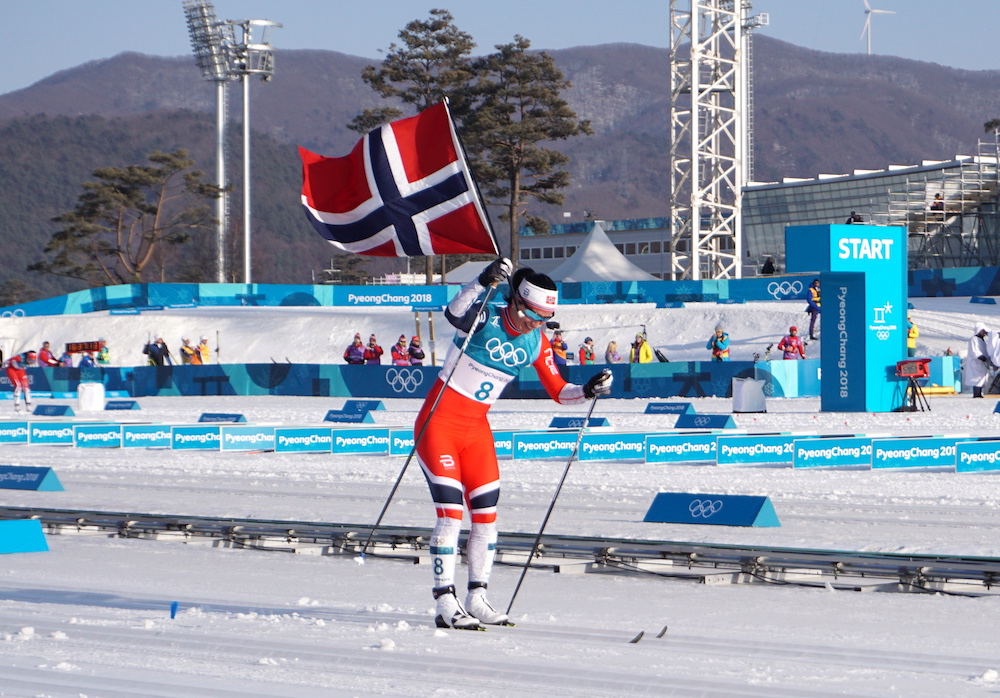
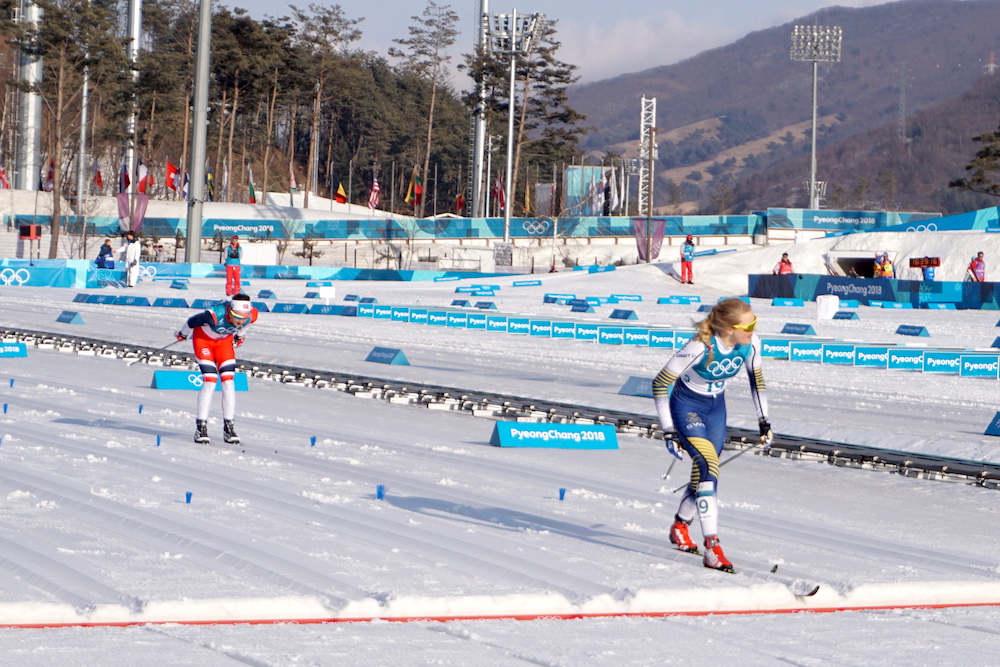
Marit Bjørgen approaches the line for her eighth-career Olympic gold (and 15th medal) with a win in the final race of the 2018 Olympics, the women’s 30 k classic mass start, on Sunday in PyeongChang, South Korea. (Photo: Noah Hoffman)
Marit Bjørgen went out with a bang. Skiing in presumably the final Olympics race of her illustrious career, the most-decorated Winter Olympian in history simply skied away from a strong field less than 10 kilometers into Sunday’s 30 kilometer classic mass start, earning the 15th Olympic medal of her career (and eighth gold) in dominant fashion.
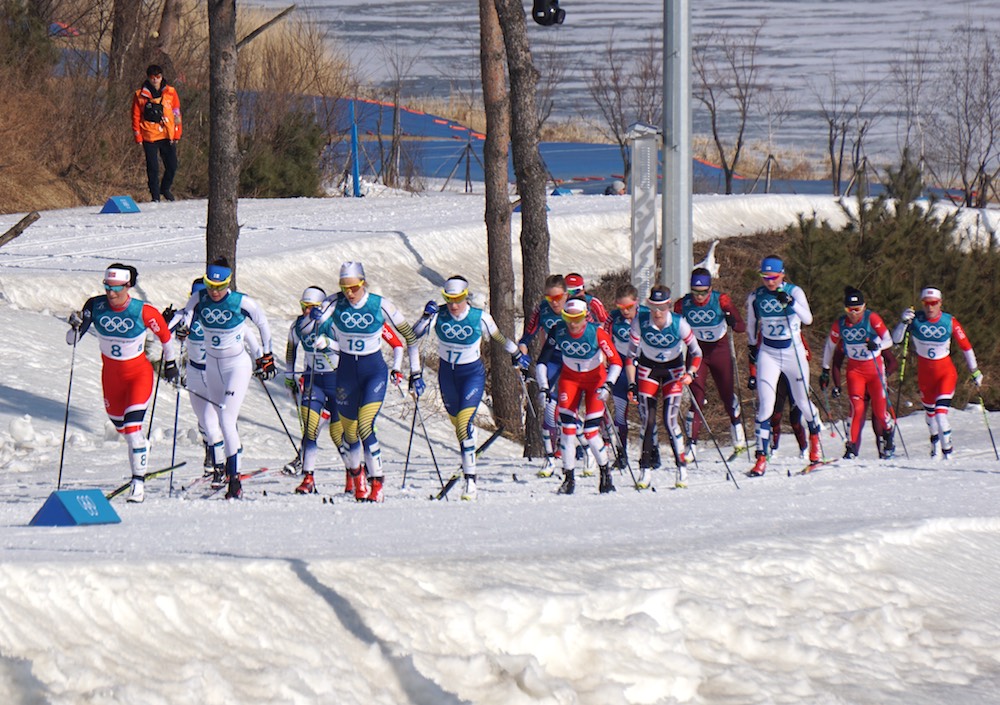
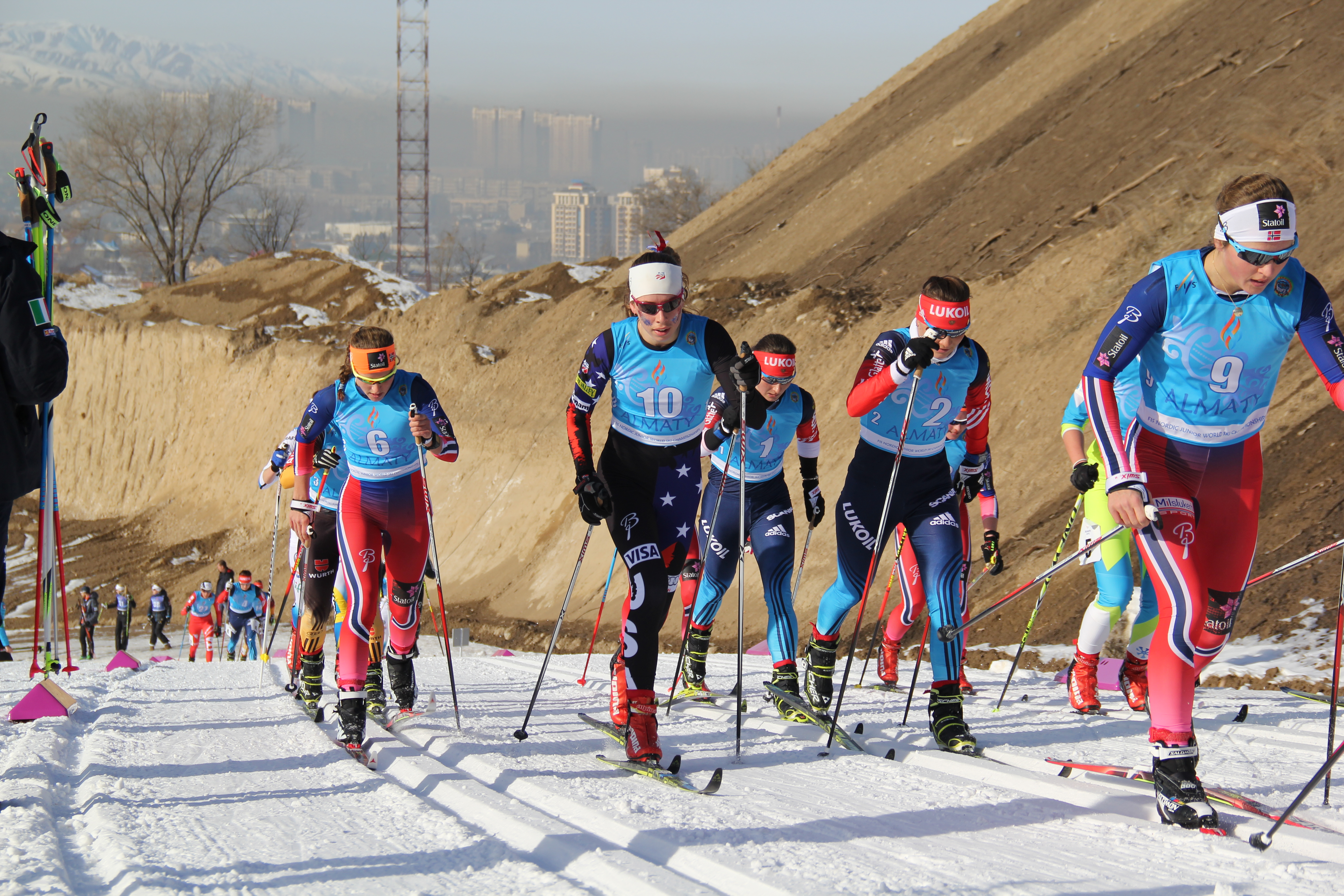
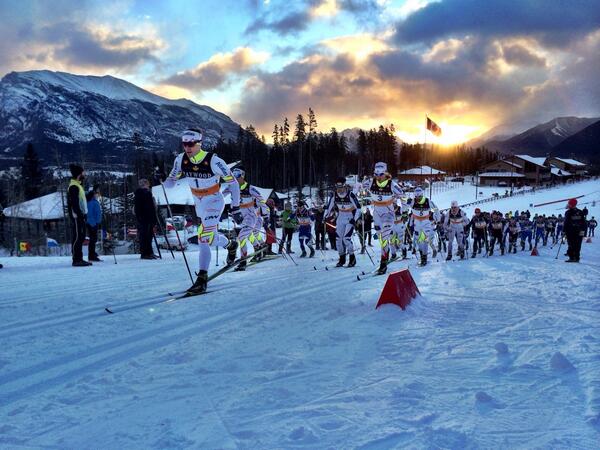
From right to left: Norway’s Ingvild Flugstad Østberg leading Finland’s Kerttu Niskanen and Krista Pärmäkoski, Sweden’s Stina Nilsson, and Austria’s Teresa Stadlober (r), among others in the women’s 30 k classic mass start on the final day of the 2018 Olympics in PyeongChang, South Korea. (Photo: Noah Hoffman)
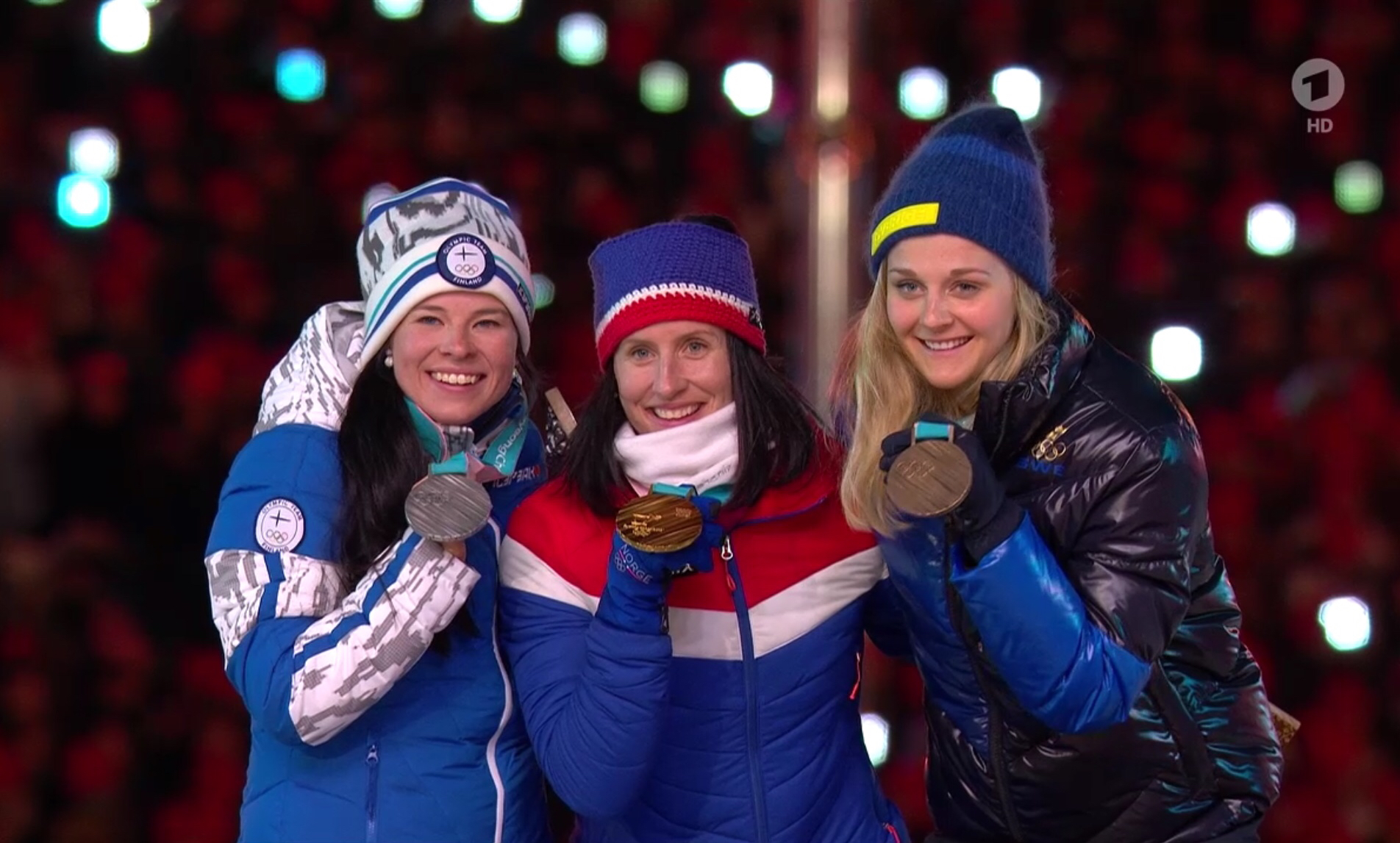
Behind her, Finland’s Krista Pärmäkoski (+1:49.5) and Sweden’s Stina Nilsson (+1:58.9) rounded out the podium, with Nilsson breaking away from Norway’s Ingvild Flugstad Østberg (+2:00.4) within the stadium to edge her out for third.
Fifth went to Charlotte Kalla of Sweden (+2:57.2), with Kerttu Niskanen of Finland sixth (+3:01.6). Jessie Diggins was seventh (+3:37.2), in an American performance that would have been lauded just a few years ago yet somehow represented her worst placing in all six races at these Olympics.
Heidi Weng of Norway (+4:07.9) in eighth, Teresa Stadlober of Austria (+4:14.1) in ninth, and Masako Ishida of Japan (+4:20.8) rounded out the rest of the top ten. Stadlober’s ninth-place finish was particularly poignant; she was holding steady in silver-medal position through 20 k, before taking a wrong turn at an ill-marked course intersection and losing well over a minute returning to the correct track.
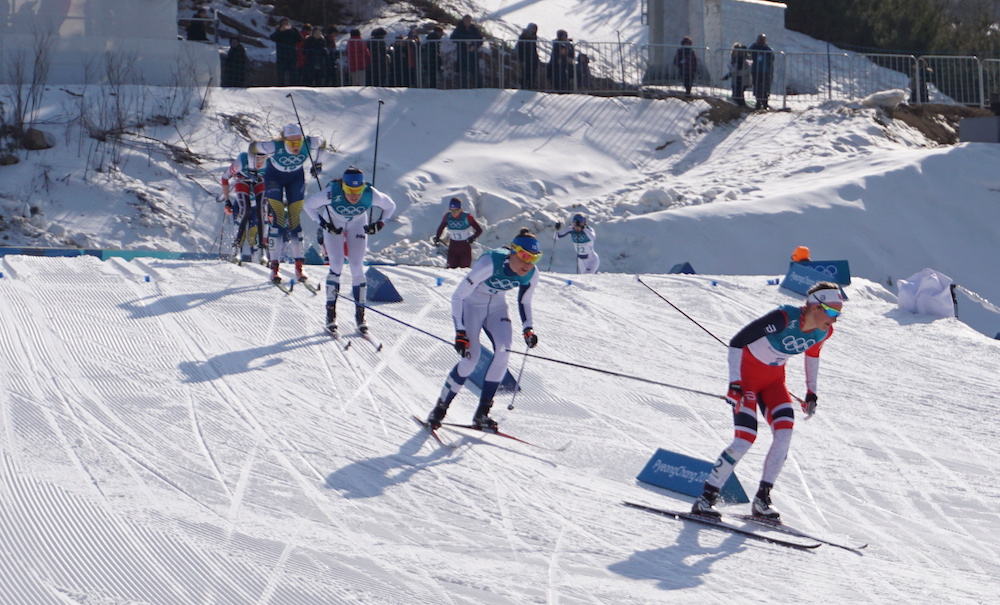
Norway’s Marit Bjørgen (l) leading the pack during the women’s 30 k classic mass start at the 2018 Olympics in PyeongChang, South Korea. (Photo: Scott Patterson)
But let’s go back to Bjørgen. Given those time gaps by the finish – nearly two minutes clear of second and third – this was clearly Bjørgen’s day. The 37-year-old Norwegian mother started in bib number 8, and was all of 1.1 seconds off the lead by the first checkpoint, less than one kilometer into the race. But after that… Bjørgen led by 2.3 k, midway through the first of four 7.5-k laps. Bjørgen led at 5 k. Bjørgen led at 7.5 k. Bjørgen led at 8.4 k. And so on. It was not literally a wire-to-wire victory, but it was pretty darn close.
The race went from a mass start contest to a solo endeavor at roughly 9.5 kilometers in, midway through the second lap. Bjørgen simply surged ahead, and immediately opened up a small gap. By 9.8 k, the gap was 7 seconds. By 12.5 k, it was already up to 33 seconds. By 15 k, the advantage had swelled to 51 seconds. Bjørgen was putting nearly 10 seconds per kilometer on a chase group composed of Olympic medalists and World Championships podium finishers.
With all due respect to Iivo Niskanen, the hero of Saturday’s courageous breakaway in the men’s 50 k classic, Bjørgen’s performance never felt in doubt the way Niskanen’s did. Bjørgen didn’t have any company, for one, and she had a shorter distance to cover, for another (“only” 20 k of solo skiing off the front). But mostly, well, she is Marit Bjørgen, the most dominant cross-country skier of all time.
Bjørgen’s gap stretched to as great as 2:04 by the 27.5-k mark of the course. Finally, approaching the finish, she slowed slightly over the last few hundred meters, accepting a large Norwegian flag from a Viking helmet-clad fan and beaming as she carried it across the finish line. Her final time was 1:22:17.6. If they were the final 82 minutes of racing of a five-Olympics career, they were an exceptionally dominant 82 minutes.
Behind her, a four-woman chase pack formed: Pärmäkoski, Kalla, Niskanen, and Stadlober. As late as 20 k, Kalla was still in seventh, nearly two minutes back of Bjørgen and roughly 35 seconds back of Stadlober in second.
Soon after this, Stadlober took her wrong turn, skiing for some distance on the wrong course before having her error pointed out to her by a courseside coach or tech. She dropped from second to eighth within a kilometer.
Reportedly, Austrian coach Markus Gandler was out on the course and the first to inform her of her mistake, yelling, “You are wrong!” She realized her mistake and turned around.
“We were preparing the feed and noticed she didn’t come,” Gandler told Austrian broadcaster ORF, according to a translation. “I ran over but she didn’t hear me while skiing up. Only on the downhill I caught her.”
“I don’t know if I should laugh or cry,” Stadlober told ORF after, according to a translation. “I can’t explain it to myself. I have been here for three weeks and if by now I don’t know the loop then I don’t know … I noticed skiing up that something wasn’t right because there was no more staff. When I looked over I just thought: Sh*t!”
She said she had been feeling great up until that point and confident about her skis.
“I would have had the power, but had-I-would-I [what could have been] is too late now,” Stadlober said of missing out on her first Olympic medal. “That’s life. It’s just bitter it happened in such a race and on a day when everything would have fit together.”
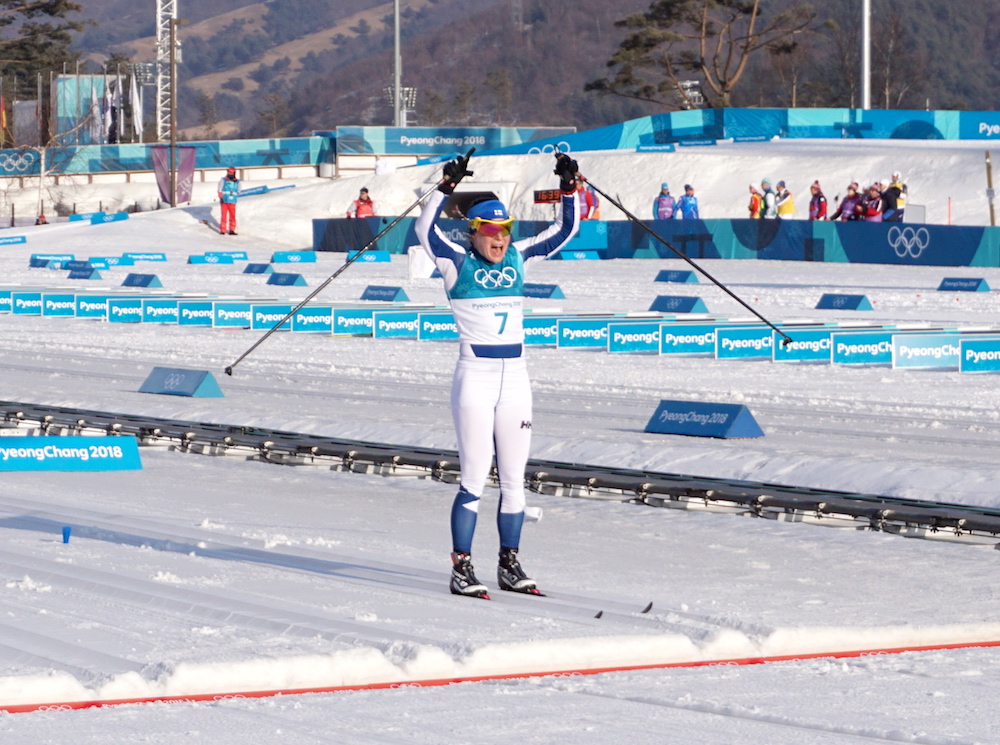
Finland’s Krista Pärmäkoski celebrates her first individual silver medal which she claimed in the women’s 30 k classic mass start on Sunday at the 2018 Olympics in PyeongChang, South Korea. (Photo: Noah Hoffman)
By 21 k, Pärmäkoski had a 13-second gap over Niskanen in the race for second, and Kalla had moved up to sixth. By 25 k, it was still Pärmäkoski in second, but now Østberg and Nilsson skiing lockstep in the fight for third.
Pärmäkoski was never seriously threatened over the final lap, and crossed the finish line for silver.
“I think that this 30 k was [the] hardest 30 k race [ever] for me,” Pärmäkoski reflected in a post-race press conference. “Of course I heard that Nilsson and Østberg come behind me and I also heard that now it’s 11 seconds, and then 14 seconds. And after this big downhill I heard that it’s a little bit more, but because I know that they are good in sprint, I just hoped that they can’t catch me. This was a crazy, crazy Olympics for me. Before I came here I wanted to win one individual medal and now I won three medals, so I am really happy.”
In two Olympics, Pärmäkoski, 27, now has four medals — three of which came in PyeongChang (silver in the 30 k and bronze in the 15 k skiathlon and 10 k freestyle races).
Behind her, Østberg and Nilsson dueled for the final podium spot. But while Østberg was aware of it, Nilsson hadn’t heard about Stadlober’s wrong turn ahead of them.
Sweden’s Stina Nilsson (r) outlasts Norway’s Ingvild Flugstad Østberg (l) for bronze in the women’s 30 k classic mass start at the 2018 Olympics in PyeongChang, South Korea. (Photo: Noah Hoffman)
At the finish, Nilsson looked surprised when Bjørgen told her she had won the bronze. Bjørgen then went immediately over to console her teammate, Østberg, who finished fourth, 1.5 seconds behind Nilsson in third.
“I was quite sure that it was fourth. That I got the bronze was quite sick,” Nilsson told Norwegian broadcaster NRK, explaining that she thought the team staff was trying to give her false hope that a medal was within reach.
“I did not realize that Stadlober had gone wrong. I thought she had moved away,” Nilsson said.
But Østberg knew the bronze was between her and the Swede. “I definitely knew what I was fighting for. It’s amazing that she did not know, too,” Østberg told NRK.
Diggins would finish roughly 90 seconds later in seventh, 36 seconds behind sixth and 30 seconds ahead of eighth. The result was emblematic of her day, in which she had skied for much of the race entirely by herself.
Sadie Bjornsen was the next American, finishing in 17th (+6:32.6). The mid-teens result continued a trend at these Olympics; she was 14th in the classic sprint and 15th in the 10 k freestyle.
The third American on the day was Rosie Frankowski in 21st (+8:53.8). Forget first Olympic start for the 26-year-old Alaskan and Alaska Pacific University athlete (which it was), Frankowski has zero World Cup starts to her name. She was the second American in the 20 k classic at last month’s U.S. Nationals, though, behind Caitlin Patterson.
On Sunday Patterson was five spots behind in 26th (+10:26), after narrowly losing a sprint finish to Germany’s Victoria Carl.
For Canada, Emily Nishikawa led the way in 30th (+12:14.1). She was followed by Cendrine Brown in 43rd (+19:06.3), as Anne-Marie Comeau did not finish.
Also of note, Jessica Yeaton, who competes internationally for Australia but lives and trains in Anchorage with Alaska Pacific University, was 42nd (+18:37.2). And Petra Hyncicova, who skis in this country for the University of Colorado but races internationally for the Czech Republic, was 39th (+16:57.1).
The women’s 30 k classic mass start medalists at the 2018 Olympics Closing Ceremony, with Norway’s Marit Bjørgen (c) in first, Finland’s Krista Pärmäkoski (l) in second, and Sweden’s Stina Nilsson (r) in third in PyeongChang, South Korea. (Screenshot: ARD broadcast)
PYEONGCHANG, South Korea — Cross-country is still a roots sports in the United States. Woods-skiers and fitness buffs stoke the small engine driving the sport. But every four years, the buildup begins. The pressure notched up. There’s national television appearances for U.S. nordic athletes. Time to shine when the spotlight is pointed in your direction. For a fringe sport in North America, easy access to snow is a prerequisite, the Olympic buildup makes the cross-country conversation more relevant.
To study on paper the lineups for Saturday’s women’s Olympic 4 x 5 kilometer relay is to realize the chances of medaling are exactly that: chances. Every head-to-head matchup, like a Stina Nilsson versus a Marit Bjørgen as the evening’s anchors for Sweden and Norway respectively, has its pros and cons. Coaches make calculated decisions. Can Bjørgen gain enough ground on Nilsson before the final straight? Can Nilsson stay close enough to edge Bjørgen on the final straight? Ultimately the skiers go out and ski.
U.S. Ski & Snowboard put out a press release as the U.S. relay team was announced detailing the women’s 4 x 5 k relay results chronologically both on the World Cup and major championships.
The U.S. women’s best-ever result relay result on the World Cup was a second place in January 2016 in Nove Mesto, Czech Republic. (That lineup was Caldwell, Bjornsen, Stephen, Diggins). Their best World Championships relay result was a fourth place last year in Lahti, Finland. 2014 in Sochi marked the women’s best Olympic result of eighth place.
Team. Much is said about the U.S. women’s team. So it’s fitting that in terms of promoting potential medals, the women’s relay gets the playbill’s frontpage.
Again it’s a calculated chance for any team — no nation is ever a lock. Look at Norway’s 4 x 5 k relay result in Sochi. Fifth. So could the U.S. end a medal drought 26-years deep on Saturday? No. So is the Olympic buildup fair — maybe not.
The beauty of the relay isn’t based so much in the euphoric glow of the podium’s top-three steps but how the chances played out.
Norway played its chances with the Bjørgen-Nilsson duel. And Bjørgen couldn’t escape Nilsson’s shadow until the closing 300 meters — a place where Nilsson herself was supposed to shine. Norway stopped the clock in 51:24.3. Sweden placed second (+2.0).
The U.S team of Sophie Caldwell, Sadie Bjornsen, Kikkan Randall, and Jessie Diggins placed fifth (+1:20.5). About all the pre-race hype and expectations, Randall, in her fifth Olympics, said it best.
Five-time Olympian Kikkan Randall skiing the U.S. team into sixth position during Saturday’s Olympic 4 x 5 k relay. (Photo: FlyingPointRoad)
“This is our best Olympic finish ever,” Randall said in the mixed zone after the race. “When we tend to be really focused on the medals it’s because we know deep in our hearts it is possible. I still think this is amazing that we put together four strong legs today and to get the best-ever result, keep the pathway going forward.”
This is not baseball’s World Series with a best-of-seven series. It is one and done. So when Caldwell toed the line in the scramble leg, there was belief. And if we want to fast forward to the end of this report, belief remains.
Caldwell sent it for the first half of her leg. Russia’s young upstart team took it out hot — their strategy one of padding their skate legs for the onslaught from Norway’s and Sweden’s skate legs. Only 8.1 seconds off the front at the time, Caldwell then fell off as the Olympic Athletes from Russia (OAR) and Norway surged ahead by the 3.58 k mark. Caldwell came through to tag Bjornsen in 11th place (+1:01.5).
“I think that our team has more belief than we ever had right now,” Bjornsen said after the race. “It’s just so motivating and exciting, and we show up to every race just so excited to see what we can do, and kind of goosebumps just standing on the start line and that is certainly a memory that we are going to take away forever.”
Sophie Caldwell during the scramble leg for the U.S women during Saturday’s 2018 Olympic 4 x 5 k relay. She is ahead of Switzerland’s Laurien van der Graaff. (Photo: FlyingPointRoad)
After skiing the sixth fastest leg, Bjornsen took the team into eighth place (+1:05.2) as she tagged to Randall for the first skate leg. Randall skied the third best time on her leg and brought tagged off to Diggins in sixth.
As the Bjørgen-and-Nilsson parry played out ahead, Diggins motored. She, too, skied the third-fastest anchor leg split and reeled in another place as she crossed the line in 52:44.8 minutes to secure fifth place.
Here’s the thing: a medal appeared out of reach for the U.S. early on. But these women make you believers. That’s not U.S. Ski & Snowboard spin. That’s not wishful fan-boy thinking. It’s incremental steps the U.S. women have made.
Every nation shows up for the Games primed. The U.S. showed up and they were fifth on Saturday. Thirty-seven-point-two seconds out of third. Who wouldn’t believe in that?
“I think for me, every time you get to put on the rely socks it’s a big honor, its a privileged,” Diggins said as she reflected on the race. “You know you’re just not racing for yourself. You are racing for your teammates, you are racing for the people who did not get named to the relay, but easily could have, and are out there cheering on the course, and you are racing for Team USA. … I got to see each of my teammates ski their hearts out. I was getting more and more fired up watching them, just like, ‘OK, it’s my turn I am going to go reel in as many people as I can,’ and then we are going to walk away proud of what we did here today because there is more to it than just medals.”
Asked after the race to expand on what the day in and day out meaning of belief is like for the women’s team, U.S. women’s coach Matt Whitcomb elaborated on his role and that of the athletes.
“As coaches we spend a lot of time trying to tune people’s engines and try to make sure that they show up with a roaring Ferrari,” Whitcomb remarked. “But the Ferrari needs a driver and for the skier that’s the brain. The body will not go if the brain isn’t behind it and we’ve seen it time and time again where you have someone who you think is completely tuned up and prepped and ready to win a race and they’re not even in the points, and you later uncover that something had them out of balance and listing starboard and kept them off course for the day.
Jessie Diggins after skiing the U.S. women into fifth place during the 4 x 5 k Olympic relay. (Photo: FlyingPointRoad)
“So when we, as a team, first believe in one another, you then have your entire team that believes in you,” Whitcomb continued. “And that’s impossible to miss the positive effects of your team. One after the next, believing in you as a skier and you can’t help but believe more in yourself. So when you’re confident, you believe more in yourself, the body starts up really quickly and you can race the car.”
Under Whitcomb’s guidance, the U.S. nordic community has come to expect excellence for it’s women’s team. Consider that for a minute. Consider that during the early part of Randall’s career, it was a fight to even field a women’s relay team. Consider that Whitcomb chose a Ferrari as his vehicular metaphor. That metaphor works for the U.S. squad.
Whitcomb also spoke of how the race unfolded from the outset.
“The first thing that jumped out was that Russia chose the strategy of two very hot classic legs,” Whitcomb said. “That is something we were hoping didn’t occur. And it doesn’t always in championship events, it tends to, but I felt like, and I still feel like, we put together the very best team we had tonight. I have really honestly no regrets about that.”
Here’s the link to the 4 x 5 k women’s relay start list. It’s a wow-type list. The Norwegians, the Swedes and the Finns, all loaded lineups. And the Russians were seated fifth. Natalia Nepryaeva and Yulia Belorukova, both Russian skiers that have already medaled at these Games, led off the first two relay legs. They were a big unknown who pulled through for the bronze.
Ready, set, go. The start of the women’s 4 x 5 k Olympic relay. (Photo: FlyingPointRoad).
“It was really interesting to talk with the Russian coach on the trails as we were watching the race and confirm that they were in fact they were going to take it out hot, so we were privy to that,” Whitcomb said. “The athletes more than anybody knew what was going on. They can see the splits opening up or closing down. But as you saw in several cases, with Riita-Liisa [Roponen] from Finland, with Astrid [Uhrenholdt Jacobsen] from Norway, with Russia’s last skier on their first leg anyways, there are dents in armor here and there. We were hoping to really tear those open, and we got close but we were on the same hill as the medal. We’ve been there before and that’s frustrating. But for me, it’s fortunately more than just medals and I’m very proud of the team today.”
Canada’s relay team of Dahria Beatty, Emily Nishikawa, Cendrine Browne, Anne-Marie Comeau placed 13th (+4:50.3).
“We are racing all for each other; we are doing our very, very best,” Nishikawa said after the race. “I think our team has come a long ways. Last year at the world champs we probably had one of our best days ever [in 10th]. On a really good day we could be fighting with a lot of these teams.”
Racing continues Sunday with the men’s 4 x 10 k relay.
The women’s 10 k freestyle podium on Thursday at the 2018 Olympics in PyeongChang, South Korea, with (from left to right) Sweden’s Charlotte Kalla in second, Norway’s Ragnhild Haga in first, and Norway’s Marit Bjørgen and Finland’s Krista Parmakoski tied to third. (All photos: FlyingPointRoad)
PYEONGCHANG, South Korea — Ragnhild Haga put herself front and center stage on Thursday in the women’s 10-kilometer freestyle individual start, winning by 20.3 seconds over Sweden’s Charlotte Kalla and establishing herself as the latest Norwegian gold medalist on the Olympic scene. Behind them, Norway’s longtime powerhouse Marit Bjørgen tied Finland’s Krista Pärmäkoski for third. That’s right, there were four women on the podium on Thursday in PyeongChang. And American Jessie Diggins was next in line in fifth for her second-straight fifth place and third top six at these 2018 Games.
While we’re working on a report that will bring you the full details of that cross-country race, here are some quotes and FlyingPointRoad.com photos to hold you over:
Ragnhild Haga (Norway), 1st:
“I am not sure if I have dreamt of the gold medal, but I managed to take it today so I’m very happy.”
“I think I had a better start than usually. I felt very good and got good messages from the coaches, that I was only a few seconds behind. On the last lap I was very afraid that some of the others were going to speed up so I increased my speed and got some more seconds. I just focused on staying on my feet on the last downhill, and to give it all to the finish line. It was just a perfect day.”
Charlotte Kalla (Sweden), 2nd:
“I tried to ski very offensive from the first lap. I knew that it will be very tough today. When you are on the bottom of the long downhill, you will work very hard until you are there the next time. It was hard to keep up a good technique today because I became very tired. It was hard to get recovery. I fight the hardest that I could, and I’m satisfied with my performance.”
Krista Pärmäkoski (Finland), 3rd:
“I think that it’s better that both of us stand on the place today. Of course Marit is one of my idols when I was younger. It’s really nice to stand on the same podium today.”
Marit Bjørgen (Norway), 3rd:
“Today I’m happy to take a medal. I thought that I was out of the podium in the 8 km, but we had a good finish, both me and Krista, I can see that we were racing the same, actually, all the way. So I’m really happy. To share it with Krista, it’s good for me.”
Jessie Diggins (USA), 5th:
“To have three top-six finishes at the Games, in totally different events, is like a dream come true for me. And yeah, of course you want a medal, you always want a medal, that’s why we are here, that’s like the point of the Olympics. But there are other things that are also really important besides the actual hardware. And I think it’s important to not put other people’s expectations on me.”
“To be that close and to be skiing with the best in the world — I have looked up to Marit my entire life, and to be, I don’t know how many seconds I was from her, like four or five … it’s so awesome, and I could not have gone any harder. I can honestly look back and say: I don’t know where I would have found those seconds. I pushed my body way past its limit, I killed myself out there, and I thought I was gonna pass out on that last climb. I was completely locked up. That’s a really good feeling to know you gave it everything that you had and more than you thought you could give, and I’m really proud of today.”
Sadie Bjornsen (USA), 15th:
“It was definitely a fun day out there today. It’s pretty much the most perfect conditions that South Korea has delivered yet so it was really fun skiing. Certainly a tough course. I went out there and just tried, you know, no pressure, no expectations, see what I could do. It was fun. Definitely I wouldn’t say it’s the greatest moment ever, but the greatest moment is yet to come in these Games.”
Kikkan Randall (USA), 16th:
“I was really happy today to be able to focus on my own pacing. I think what got me at the skiathlon the other day was exploding with that fast pace of the start so I wanted to just ski it in four sections, kind of pick up speed as I went. I think I started nice and controlled but maybe started a little fast so that middle section was kind of tough to keep it together, and Haga passed me and tried to stay with her, but she was clearly skiing on another level. I am just happy that it felt like I paced it well, I skied it ’til the end where I had not much left in my legs, and that was the feeling I was going for today.”
“It’s certainly been heartbreaking for Jessie because she’s clearly skiing at the top level and just skiing her heart out every single race … I know she has been laying all out there. She has had such a great happy demeanor that we are all feeding off of so it’s tough to see her … not quite get there, but I know all of us seem to rise to an occasion when the relays come around, and it’s what we’ve all been looking forward to. I think it would be pretty special to be able to do it [get a medal] in the relay, but there is obviously going to be some tough competition out there, a lot of countries are putting a lot of people in the top 10 there. It’s going to be challenge, but I think we can ski right in there if we have the right day.”
Liz Stephen (USA), 30th:
“I definitely didn’t have the best race I was hoping for, but I mean our team has so much good to focus on, and that’s what I plan on doing.”
“I think of this [10 k skate individual start] as maybe my strong suit because I do so much training by myself, so I went out with the focus of pacing it and not ever like completely blowing up, because when I blow up its like seconds on seconds I lose, so I tried to pace it really conservatively in the beginning and then work into it a little bit. I didn’t blow up until maybe like the second-to-last hill, but I think I skied the best that I could ski it so I am happy with the performance. You always want the result to be just like a ‘1’ or something, but yeah, it’s not, only one person gets that.”
Emily Nishikawa (Canada), 32nd:
“I had all these little process goals just to ski each section of the course the best I could. I think I really did that. I just focused on technical aspects and just little things like pushing over the tops and working the corners well, and I think I did a really good job of that so I am really, really happy with my race today.”
Dahria Beatty (Canada), 37th:
“I was really happy with today’s race. I just really tried to focus on pushing hard and getting into that hurt locker today and skiing smoothly there. It was defintley the best race so far for me, the first 5 k felt really good and in control, lost a little bit of time in the end, but I was still pushing really hard and I was really satisfied to have a top 40 and feel like I gave everything I had when I crossed the finish line.”
Cendrine Browne (Canada), 43rd:
“… First 5 k was really good, I felt good, I was top 20 for the first 5 k, so I was like, ‘Yes, this will be a great race,’ but then I died unfortunately, so I lost 20 places in 5 k so I am a little bummed right now, but I gave everything I had. I pushed really hard so there’s some days that are just like that. Your body doesn’t respond like you want it to, but I still did my best.”
Anne-Marie Comeau (Canada), 62nd:
“I’m happy about just starting the race, like, I am happy about skiing with all the other skiers and to see how fast it is and to get experience each time, so I am not happy with the result, but I am just excited for the next one and happy to be here and compete with all the other skiers.”
It was a disappointing opening to the Olympics for Johannes Thingnes Bø of Norway, who despite winning eight World Cup races this season started the Games with finishes of 31st and 21st in the sprint and pursuit. But on Thursday he showed why he was a medal favorite and won the 20 k individual race – only by 5.5 seconds, but that margin becomes impressive when you consider that he had two penalties, and thus two minutes of penalty time, while silver and bronze medalists Jakov Fak of Slovenia and Dominik Landertinger of Austria (+14.2) shot clean.
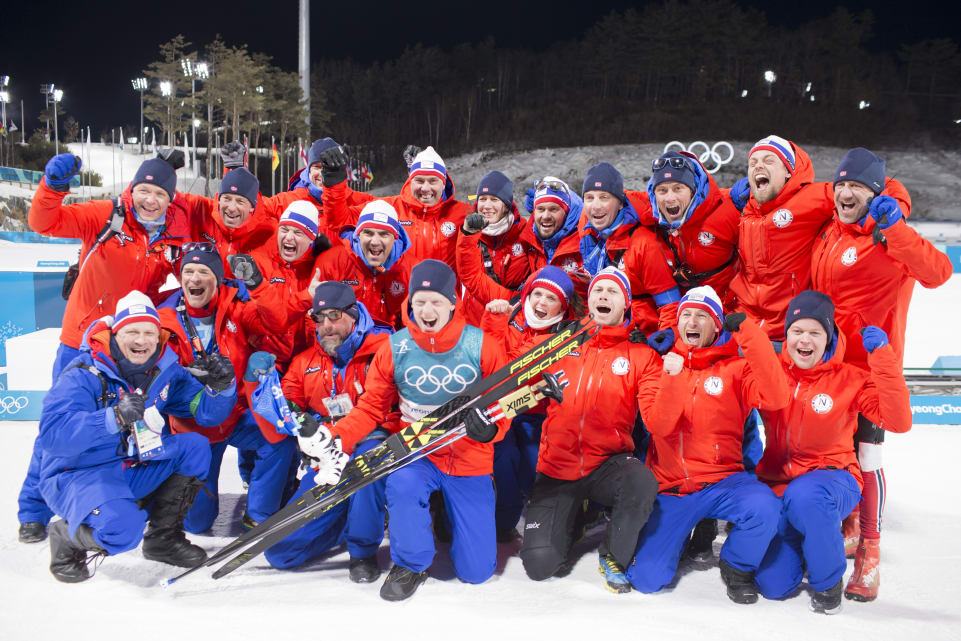
Johannes Thinges Bø celebrates with Norwegian team staff after winning Olympic gold in the 20 k individual despite two missed shots. (Photo: IBU/Biathlonworld.com)
Sweden’s Sebastian Samuelsson followed up a silver medal in the pursuit with fourth place in the individual, missing one shot and notching a time 29.1 seconds behind Bø. France’s Martin Fourcade, gold medalist in the pursuit, missed two shots like Bø but finished in fifth (+42.4). Switzerland’s Benjamin Weger placed sixth (+48.6) with one penalty.
It was a good day for Canada on the back of strong shooting: Scott Gow placed 14th (+2:02.5) with one penalty for a career-best result result; he had previously had two 16th-place finishes on the World Cup this season. With the same shooting, Brendan Green placed 22nd (+2:26.6). Christian Gow had two penalties to finish 26th (+2:57.2). Canada’s fourth man, Nathan Smith, missed five shots and placed 81st (+8:11.9).
For the United States, shooting was not as successful and Tim Burke led the way in 41st (+4:01.9) with four penalties. With one less penalty Sean Doherty was close behind in 44th (+4:21.8). Lowell Bailey placed 51st with four penalties (+4:53.0) and Leif Nordgren missed five shots to finish 66th (+6:27.3).
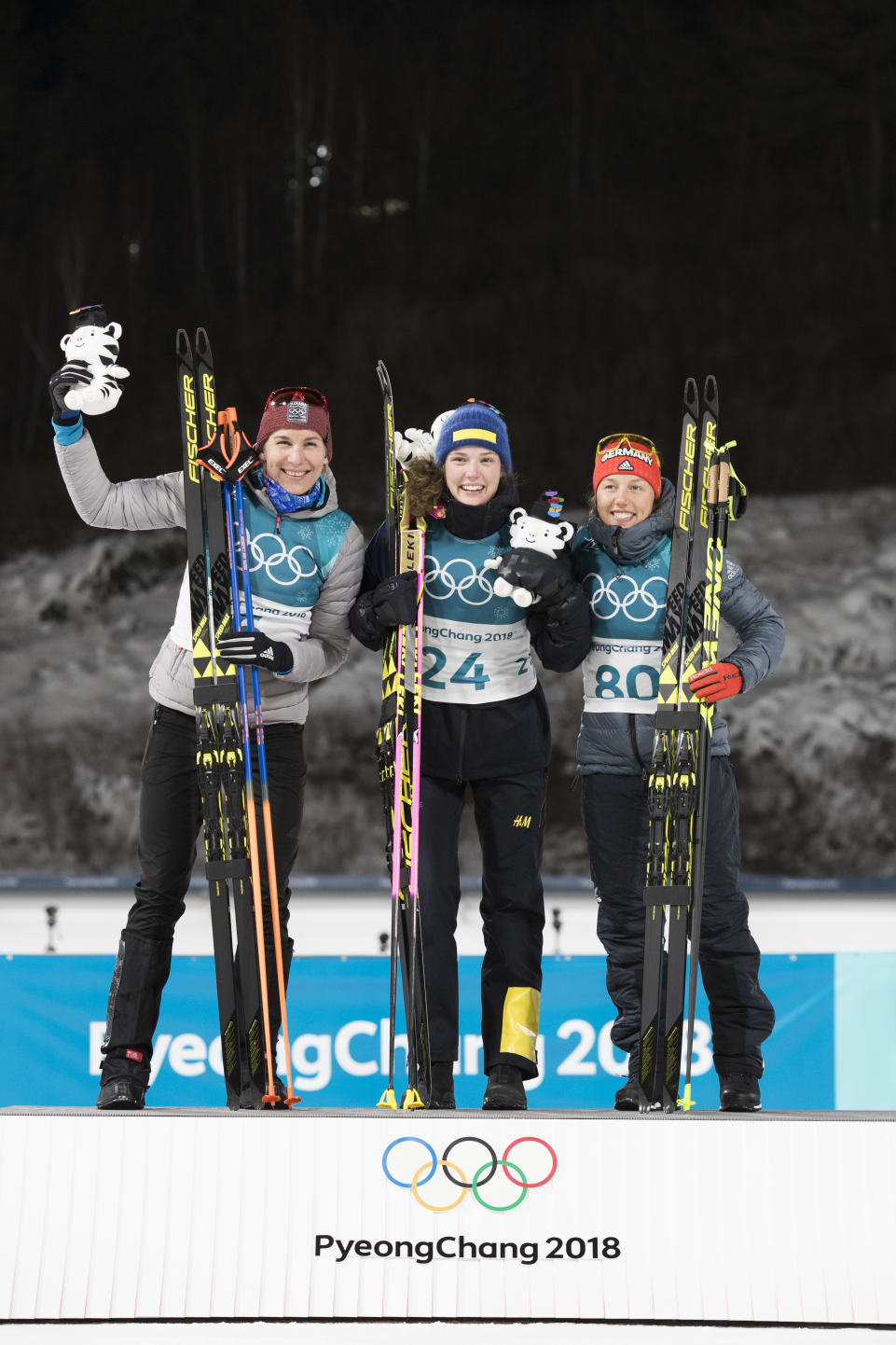
Sweden’s Hanna Oeberg (center) won gold in the biathlon women’s 15 k pursuit, followed by Slovakia’s Anastasiya Kuzmina (left) in silver and Germany’s Laura Dahlmeier in bronze. (Photo: IBU/Biathlonworld.com)
A few days after teammate Samuelson scored a career-best result to earn silver in the pursuit, Hanna Öberg of Sweden used perfect 20-for-20 shooting to capture gold in the women’s 15 k individual. The 22-year-old’s previous best results were fifth place in both Monday’s pursuit, and in a World Cup race last season.
She bested the two pre-race favorites: Anastasiya Kuzmina of Slovakia had two penalties but still managed a silver medal, her second of the games, finishing +24.7. And double gold medalist Laura Dahlmeier of Germany had one penalty and earned bronze (+41.2).
It was a good day for both of those teams as Franziska Preuss of Germany finished fourth, +59.0 with clean shooting, and Paulina Fialkova of Slovakia placed sixth (+1:02.3) with one missed shot. Poland’s Monika Hojnicz finished sixth (+1:54.8) with one missed shot as well.
The United States was led by Susan Dunklee in 19th, with two penalties (+3:26.3). Her teammate Joanne Reid finished 22nd (+3:34.1), her best-ever result in top-level international competition, with just one missed shot. Clare Egan finished 62nd (+6:53.6) and Emily Dreissigacker 67th (+7:09.2) with four penalties apiece.
For Canada, Rosanna Crawford led the way in 26th (+3:48.7) with two penalties and Sarah Beaudry was close behind in 29th (+3:58.4) with one missed shot. Emma Lunder finished 54th (+5:49.4) with three penalties and Julia Ransom was 74th (+8:31.4) with five missed shots.
Montana State University student Johanna Talihärm of Estonia finished 50th (+5:36.8) with three penalties.
Thursday afternoon saw more of the same for the women’s cross-country ski events at this year’s Winter Olympics: Scandinavia filling up the podium, with American Jessie Diggins tantalizingly close to that breakthrough American podium in fifth. This time it was Norwegian Ragnhild Haga in first in the 10 kilometer freestyle individual start, Charlotte Kalla of Sweden in second (+20.3), and Finland’s Krista Pärmäkoski and Norway’s Marit Bjørgen tied for third (+31.9).
The bronze is Bjørgen’s 12th lifetime Olympic medal, moving her into a tie with fellow Norwegian Bjørn Dæhlie for the most Olympic medals won by a cross-country skier. Countryman Ole Einar Bjørndalen, a biathlete, holds the overall Winter Olympics record with 13.
Diggins was 35.2 seconds back of Haga in fifth. She was in seventh place through 1.6 k, up to fifth at 5 k, up to third at 6.2 k, and still in third at the 8.4-k time checkpoint, 1.9 seconds up on Bjørgen and five seconds up on Pärmäkoski. But her form seemed to break down over the final uphill, and Diggins lost just enough time on Bjørgen and Pärmäkoski over the final 1.6 k to slip off the podium.
Between a 4.6-second deficit to third in Saturday’s skiathlon and a 3.3-second gap here, Diggins has now missed two bronze medals by a combined 7.9 seconds over 25 kilometers of racing.
Jessie Diggins pushing to the finish in the Olympic 10 k skate. The American finished fifth. (Photo: FlyingPointRoad)
Sixth place went to Swiss skier Nathalie von Siebenthal (+49.8), who slowed slightly after a fast start that saw her with the second-ranked time through 1.6 k. Ingvild Flugstad Østberg (+1:05.5), in seventh, was the third Norwegian in the top seven.
Olympic Athlete from Russia Anastasia Sedova (+1:07.3), Austrian Teresa Stadlober (+1:15.6), and Olympic Athlete from Russia Anna Nechaevskaya (+1:24.3) rounded out the top ten.
Sadie Bjornsen (+1:42.1) in 15th and Kikkan Randall (+1:49.9) in 16th were the next two Americans. Randall started relatively early with bib number 23, and was the leader in the clubhouse when she crossed the finish line. Liz Stephen (+2:35.4) was 30th.
For the Canadians, Emily Nishikawa (+2:41.) led the way in 32nd. Dahria Beatty (+2:48.4) was 37th, Cendrine Brown (+3:11.9) 43rd, and Anne-Marie Comeau (+4:10.8) 62nd.
Also of note, Australia’s Jessica Yeaton, who lives and trains in Anchorage with Alaska Pacific University, recorded an Olympics personal best finish of 41st (+3:09.1). University of Alaska Anchorage student Casey Wright, also competing for Australia, finished 81st (+6:55.8).
University of Colorado skier and NCAA champion Petra Hyncicova of the Czech Republic finished 60th (+4:09.4). University of New Hampshire alum Annika Taylor of Great Britain finished 75th (+5:52.4).
And Jaqueline Mourau of Brazil, who lives and trains in Quebec, was 74th (+5:49.8).
Sweden’s Charlotte Kalla winning gold in the first race of the 2018 Winter Olympics in PyeongChang, South Korea, the women’s 15 k skiathlon, on Saturday ahead of Norway’s Marit Bjørgen (behind, in red) and Finland’s Krista Parmakoski, respectively. (Photo: FlyingPointRoad)
PYEONGCHANG, South Korea — Hot from the start, the expected Olympic-opening pace in the women’s 15-kilometer skiathlon on Saturday was a blistering tease. With the U.S. Ski Team’s Jessie Diggins, Norway’s overall World Cup leader Heidi Weng and Sweden’s Charlotte Kalla striding three abreast on the opening climb, the tactics were clear: hang with chargers from the get-go. That’s the blistering part.
Much is at stake on the Olympic stage and making the cut with the skiers up front on Saturday’s skiathlon required high-rev, keep-in-contact speeds with just enough pedal off the gas to keep hopes alive. On a course built into a golf course that would seem to require golfers to be marathon-fit — the hills are for real — the attrition from the back was steady. Yet at 3.75 k into the classic leg, the race hadn’t been decisively shattered. There was still a semblance of an organized field of skiers. Twenty-four skiers ranging from Germany’s Victoria Carl in first to Finland’s Laura Mononen in 23rd, were separated by 4.3 seconds at 3.75 k. That part was the tease.
Germany’s Victoria Carl (front), followed by Sweden’s Charlotte Kalla and American Jessie Diggins, leading the women’s field on a downhill during Saturday’s 15 k skiathlon at the 2018 Winter Olympics in PyeongChang, South Korea. (Photo: FlyingPointRoad)
Although it may have appeared like it could have been any one of those skier’s race, that was only a mirage. Already the skiathlon champ from the 2010 and 2014 Olympics, Norway’s Marit Bjørgen, had moved into the front. Her control move wasn’t decisive, but it was a reminder to the young corps of racers in her midst that her final Games wasn’t a farewell tour.
Bjørgen skied in front, but the likes of two Swedes, Charlotte Kalla and Ebba Andersson, kept a checkmate-type watch on the venerable queen of international cross-country skiing. Also on Bjørgen’s flanks were teammates Weng and Ingvild Flugstad Østberg, Finland’s Krista Pärmäkoski, Switzerland’s Nathalie von Siebenthal, and Austria’s Teresa Stadlober. And right in there, for moments in contact, then out of contact, then right there again, was perhaps the most tenacious in the bunch, Diggins.
Weng was the first out of the ski exchange at 7.5 k followed in order by Østberg, Bjørgen, Kalla, Pärmäkoski, Andersson, Stadlober, Russia’s Natalia Nepryaeva, Diggins and von Siebenthal.
Jessie Diggins (standing, in blue) in the ski exchange while Norwegians Heidi Weng (r) and Ingvild Flugstad Østberg (second from r) prepare their departure at the halfway point of the women’s 15 k skiathlon on Saturday at the 2018 Olympics in PyeongChang, South Korea. (Photo: FlyingPointRoad)
Immediately after the exchange, a long grinder of a hill kicks up out of the stadium. And it was not as if Kalla played her full house of a hand at the start of the skate portion, but she certainly made it clear her fitness and motivation were no bluff.
From 9 k to 11.5 k, the race was all about gamesmanship. At moments, Kalla and Andresson appeared to be setting the pace in an attempt to prevent others from upping the tempo. The two Swedes slowed around 26:40 minutes, and allowed Bjørgen to take over the pace-making. Although Bjørgen’s limited World Cup run this year has shown a smidge of mortality — she’s won two of 10 World Cup races entered — one couldn’t help but think that Bjørgen would simply pull away after some herculean effort and dust the field.
Around 12 k into the race, roughly 32:40 minutes in, Kalla dug into a powerful V2 and sure enough gapped the lead group by five then ten meters. With 1.5 k to go, Kalla had a 9.6-second lead on Bjørgen in second. Bjørgen led the chase, with Andersson, Pärmäkoski, von Siebenthal and Diggins close behind her.
The women’s 15 k skiathlon medalists on Saturday at the opening race of the 2018 Olympics in PyeongChang, South Korea, with Sweden’s Charlotte Kalla (c) in first, Norway’s Marit Bjørgen (l) in second and Finland’s Krista Parmakoski (r) in third. (Photo: FlyingPointRoad)
“I knew that she was trying to attack in that area, so I was looking for her,” Bjørgen said of Kalla during a post-race press conference. “We had a downhill and then she attacked when we were down. I tried to follow her, but we were too many girls and I didn’t get her back like I wanted to. So she got some meters early in the attack, and then I knew that it was hard. I tried and pushed hard to attack her, but she was too strong.”
Kalla’s version of her winning move illustrates the singular focus with which she’s skied on the World Cup this season. The 30-year-old Swede has entered eight races, winning three and placing second twice.
“I didn’t know exactly where Marit was,” Kalla recalled in the press conference. “I knew that she was in the front somewhere, but I just tried to focus on my performance when I increased the speed and not what the others did. … Yes, there were thoughts about what are the others doing but I just tried to focus on my performance all the time and just look forward and I knew that I have been in pain many times during the summer.”
Kalla’s victory, however, never really seemed certain with Bjørgen chasing — as if the 37-year-old Norwegian could simply roll back the years and gobble up meter after meter until she clung to Kalla’s tails.
Only after Kalla had gone up and over the steep final climb and came bolting down a sweeping banked turn close to the stadium’s straightaway finish, was her win assured. With enough distance on the chasers, Kalla raised her arms in victory and scored gold.
Winning the skiathlon in 40:44.9 minutes, Kalla became the first Swedish women to have won three gold medals at the Olympics. The victory is her second in a non-relay event at the Games, with her last individual gold coming in the 10 k freestyle back in 2010 in Whistler, British Columbia. Her second gold came four years ago at the Olympics in Sochi, Russia, where she anchored Sweden’s 4 x 5 k relay team to the win.
Bjørgen pulled slightly ahead of Pärmäkoski and Andersson to place second, 7.8 seconds behind Kalla. Before the descent into the stadium, Pärmäkoski passed Andersson on the last climb stayed just ahead of her to the finish, toeing for bronze (+10.1), while Andersson, a 20-year-old first-time Olympian, placed fourth (+10.9). Diggins pushed for fifth (+14.7), which stands as the best Olympic finish by an American female cross-country skier.
Norway’s Marit Bjørgen (r) leads the pack through the stadium heading into the second lap of the skate portion in the women’s 15 k skiathlon at the 2018 Winter Olympics in PyeongChang, South Korea, while Sweden’s Charlotte Kalla (5) and Ebba Andersson (16) and Switzerland’s Nathalie von Siebenthal (10) follow. (Photo: FlyingPointRoad)
Bjørgen remarked at the press conference that her years racing at the sharp end of the World Cup has allowed her to fully understand how to peak for the big events.
“Since before Sochi, I was doing actually the same, competing before Christmas and then not competing so much before the Olympics,” she said of her established tapering plan. “I have been training and not doing the Tour de Ski, so that has been good for me, and I really wanted to do the same this year.”
One race into the Olympics, that recipe has worked. But Bjørgen knows, too, her time is divided with caring for a young child, and afterall, she is Marit, so a limited World Cup race schedule might not be such a big deal.
“Things are different for me now, to be a mom also it’s harder to do every race,” Bjørgen said. “And of course I am 37 years old … I think that’s not good for me to do every race. And also, I don’t need so many races to do a good race.”
So while it was an all-Scandinavian podium (or more accurately, all-Nordic nations podium) on Saturday, Diggins is knocking.
During the classic portion of the skiathlon, there were moments when it appeared the U.S. Ski Team (USST) member would pop just enough off the lead pack to acquiesce the ground lost. But that is not her style. She skied fierce.
Diggins (near) and Kalla racing during the women’s 15 k skiathlon at the 2018 Winter Olympics in PyeongChang, South Korea. (Photo: FlyingPointRoad)
The splits on the results sheet don’t indicate what was evident. Diggins willed herself to keep in the bronze-medal hunt. On the last hill before the finish, Diggins went for it. Whatever fumes were left gave the momentary appearance that just maybe she could close the gap to Pärmäkoski and even Bjørgen. To say the American skier came up short is to get it wrong. She has proven she’s in the Olympic medal hunt. This athlete came through.
“I am really psyched with today,” Diggins told FasterSkier after the race. “It was a really good race. It was not my best race, but in terms of skis, tactically, physically, mentally, that was a really really good race for me. I was just struggling with some cramps out there, like my triceps were twitching on me and I couldn’t quite feel my legs. And so when I was trying to go and make my move, I just … I was pushing so hard and my body wasn’t quite responding the way I was hoping it would.”
Diggins went on to explain that she’ll focus on her race hydration and fueling to temper the prospects of cramps.
A fifth place for Diggins in a gutsy performance was a confidence boost.
“Being seconds out of a medal is so exciting because I know it’s possible,” she added. “I have the belief, I have the confidence, and I have the love and support from home. And I definitely have the boards, oh my gosh, our techs did such a good job, my skis were so fast. So I am really happy with it.”
Canada’s 24-year-old Cendrine Browne, of Cross Country Canada’s National U25 Team, was the next best-placed North American, finishing in 33rd (+3:17.0). In her first Olympics, Browne explained that her pre-race nerves were settled after an anxious Olympic-qualifying series before the Games.
Cendrine Browne (Canadian U25 Team) racing to 33rd in her first Olympic race, the 15 k skiathlon at the 2018 Winter Olympics in PyeongChang, South Korea. (Photo: FlyingPointRoad)
“I was really calm actually, I was more stressed out for trials [in early January] before coming here because I really wanted to be here,” Browne said. “So now that I’m here, I just want to enjoy and race and do my best. I just want to finish every race and tell myself, yes, I did everything I could today.”
American Caitlin Patterson (also in her first Olympics) skied to 34th (+3:30.0). U.S. Ski Team member Kikkan Randall placed 40th (+4:02.3).
In her fifth Olympics, Randall explained after the race that she still felt those pre-race nerves.
“Just because you’ve done it more times doesn’t mean it gets any easier,” Randall, 35, explained. “I definitely was nervous. It helped to walk in the Opening Ceremony last night because that’s always such a highlight. I’ve been having a really good time with the girls.”
Randall knows the pulsing nature of race dynamics and that the scorching pace someone like Bjørgen, Kalla or Diggins can throw down isn’t insurmountable if it’s your day.
“I was definitely nervous coming into today just because I knew when I ski well and ski in the pack, I can have a really good performance,” Randall said. “But it’s always kind of a critical point out there when the pace is high and whether or not you can hang with it. So I wanted to try and be able to hang with that pace today and that was my goal. I did it for about 2 k and then I kind of fell apart. It’s just how it goes.”
Randall admitted she was surprised she didn’t have better sensations during the race after what she stated was a solid week of training.
Canadian World Cup Team member Emily Nishikawa finished 44th (+4:31.7), Canada’s Anne-Marie Comeau (a Laval University student at her first Olympics) finished 48th (+4:57.9), Australia’s Jessica Yeaton (who trains with Alaska Pacific University) was 50th (+4:59.9), Canada’s Dahria Beatty 52nd (+5:32.4), and American Rosie Brennan 58th (+6:51.1).
“It wasn’t a great day for me as I’ve been struggling with some illnesses the last month and it’s kind of just left me a little bit of an empty feeling,” Brennan told FasterSkier after the race. “I was hoping that it would have turned around by now but I wasn’t quite there so I’m happy to be here and happy to have finished my first Olympic race and I’m hoping I still have some time to turn things around in the coming weeks.”
The men’s 30 k skiathlon is the next cross-country event on the schedule in PyeongChang, set for Sunday at 1:15 a.m. Eastern Standard Time.
— Harald Zimmer, Alex Kochon and Aleks Tangen contributed
The finish of the women’s 15 k skiathlon, with (standing, from left to right) Sweden’s Charlotte Kalla, her teammate Ebba Andersson and Norway’s Marit Bjørgen looking on, while American Jessie Diggins (near) recovers on the ground with Austria’s Teresa Stadlober (4) and Switzerland’s Nathalie von Siebenthal after the first race of the 2018 Olympics in PyeongChang, South Korea. (Photo: FlyingPointRoad)
The start of the women’s 15 k skiathlon on Saturday, Day 1 of the 2018 Winter Olympics, with (front row, from left to right) Austria’s Teresa Stadlober, Norway’s Ingvild Flugstad Østberg, Norway’s Heidi Weng, American Jessie Diggins, and Sweden’s Charlotte Kalla leading out of the stadium in PyeongChang, South Korea. (Photo: FlyingPointRoad)
The 2018 Winter Games kicked off Saturday with the women’s 15-kilometer skiathlon, which saw Sweden’s Charlotte Kalla take her second-career individual Olympic gold (third including relays) and first individual gold in eight years. Not far behind her, American Jessie Diggins achieved the best Olympic result for an American woman in cross-country skiing.
After Kalla established herself as a leader early in the opening 7.5 k classic leg, the Swede spent much of the race working with her teammate Ebba Andersson to counter any type of attack from the Norwegians, specifically Marit Bjørgen.
On rock-solid classic conditions in PyeongChang, Bjørgen led the second half of the classic leg up until the ski exchange, where she entered the “pit stop” first, just ahead of Kalla in second. Norway’s Heidi Weng was in third at the time and swapped into her skate gear fastest, leaving the exchange about 28 seconds later in first. Her Norwegian teammate Ingvild Flugstad Østberg followed her in second and Bjørgen emerged in third, just ahead of Kalla in fourth.
Meanwhile, Diggins skied consistently in the top 10 and within about four seconds of the lead throughout the classic leg, entering the exchange in 13th and leaving in ninth, 5.4 seconds after Weng.
While Kalla took the lead early in that first skate lap, Switzerland’s Nathalie von Siebenthal made a move into first on a climb just before 9.75 k, while Bjørgen kept her close. Andersson continued to keep herself in the mix, skiing in third, just ahead of Kalla in fourth and Finland’s Krista Pärmäkoski in fifth. Diggins slotted behind two Norwegians, Østberg and Weng, while Austria’s Teresa Stadlober followed. At 9.75 k, 11 women were within 6 seconds of first.
Bjørgen reclaimed the lead shortly thereafter, but Kalla made her game-changing move on a climb about 34 minutes into the race, just before the 12.5 k checkpoint. There, the Swede had begun to gap the pack and was 5.5 seconds ahead of Bjørgen in second. Andersson remained in third, 5.9 seconds back, just ahead of von Siebenthal, Pärmäkoski, and Stadlober. Diggins in seventh pushed to keep herself in the chase group and was able to with about 2.5 to go.
One kilometer later, Kalla was nearly 10 seconds clear of Bjørgen, as well as Andersson and Pärmäkoski. The Finn moved ahead of Andersson on one of the last climbs to put herself in third as they headed down and back toward the stadium.
Sweden’s Charlotte Kalla celebrates her victory in the women’s 15 k skiathlon on Saturday at the 2018 Olympics in PyeongChang, South Korea, and her first individual Olympic gold medal in eight years. She beat Norway’s Marit Bjørgen (behind) by nearly eight seconds. (Photo: FlyingPointRoad)
All alone, Kalla skied to the win in 40:44.9 minutes, what Bjørgen distanced herself from third place and claimed second, 7.8 seconds later. Pärmäkoski took the bronze medal in third (+10.1), less than a second ahead of Andersson in fourth (+10.9). Kalla’s previous Olympic gold medals came individually in the 10 k freestyle at the 2010 Games in Whistler, British Columbia, and with her team in 2014 in the women’s 4 x 5 k relay in Sochi, Russia.
Diggins finished fifth (+14.7) for a new all-time best for a female American cross-country skier at the Olympics (after Sophie Caldwell placed sixth in the sprint at the 2014 Games), about three seconds ahead of von Siebenthal in sixth (+17.6). Stadlober placed seventh (+26.6), Russia’s Natalia Nepryaeva was eighth (+33.0), Weng was ninth (+40.7), Sweden’s Stina Nilsson 10th (+48.9), and Østberg 11th (+58.3).
In her first Olympics, Canada’s Cendrine Browne (Canadian U25 Team) led her team in 33rd (+3:17.0), ahead of American Caitlin Patterson (also in her first Olympics) in 34th (+3:30.0).
U.S. Ski Team member Kikkan Randall placed 40th (+4:02.3), Canadian World Cup Team member Emily Nishikawa finished 44th (
+4:31.7), Canada’s Anne-Marie Comeau was 48th (+4:57.9), Australia’s Jessica Yeaton (who trains with Alaska Pacific University) was 50th (+4:59.9), Canada’s Dahria Beatty 52nd (+5:32.4), and American Rosie Brennan 58th (+6:51.1).
The men’s 30 k skiathlon is the next cross-country event on the schedule in PyeongChang, set for Sunday at 1:15 a.m. Eastern Standard Time.
Germany’s Laura Dahlmeier racing to her first Olympic gold (and first Olympic medal) on Saturday in the women’s 7.5 k sprint, the first biathlon race of the 2018 Winter Olympics in PyeongChang, South Korea. (Photo: FlyingPointRoad)
2018 Winter Olympics (PyeongChang, South Korea): Biathlon women’s 7.5 k sprint
While most others struggled on the range in the first biathlon race of the 2018 Olympics, Germany’s Laura Dahlmeier held steady and shot clean, then posted the winning time in the women’s 7.5 k sprint on a windy Saturday evening in PyeongChang.
The 23rd starter (out of 87 finishers), Dahlmeier had to wait a long time for her gold medal to be confirmed, but she had done it, winning with a time of 21:06.2 minutes for her first Olympic medal. She has seven gold medals from World Championships but this was her first at her second Olympics. And on Saturday, she was one of just two women in the top 20 to hit all 10 targets in the two-stage race. Russia’s Tatiana Akimova was the other and she finished 20th.
The 24-year-old Dahlmeier bested the time of Norway’s Marte Olsbu, who started 11th and had a single miss in prone (1+0), by 24.2 seconds. Olsbu’s time was good enough for second, just ahead of the Czech Republic’s Veronika Vítková, who started right behind her in bib 12, in third place (+25.8). Vítková also had to ski one penalty lap after a standing miss (0+1). For Olsbu, 27, this is her first Olympics. For Vítková, 29, it was her first individual medal in three Olympic Games.
France’s Marie Dorin Habert missed the podium by 7.3 seconds in fourth (+33.1), after one prone penalty (1+0). Germany had two in the top five with Vanessa Hinz in fifth (+40.3) with one miss, Italy’s Lisa Vittozzi was sixth (+40.5) with one miss, Sweden’s Hanna Öberg seventh (+40.8) with one miss, Switzerland’s Irene Cadurisch eighth (+45.5) with one miss, Belarus’s Darya Domracheva ninth (+46.2) with two penalties, and France’s Justine Braisaz 10th (+47.9) with two penalties as well.
Julia Ransom (Biathlon Canada) racing to 40th in the women’s 7.5 k sprint at her Olympic debut in PyeongChang, South Korea. (Photo: FlyingPointRoad)
Canada’s Julia Ransom was the top North American in 40th (+2:08.8) with one standing penalty (0+1). Canada had all four women finish in the top 60 (thus qualifying for Monday’s pursuit) with Rosanna Crawford in 53rd (+2:23.0) with three misses (1+2), Emma Lunder in 54th (+2:24.2) with two standing misses (0+2), and Megan Tandy in 57th (+2:36.6) with a penalty in each stage (1+1).
One American finished in the top 60 to qualify for the pursuit: Emily Dreissigacker, in her first Olympics, in 51st (+2:21.0), after shooting 9-for-10 (0+1). Clare Egan just missed the cutoff in 61st (+2:45.4) with three misses (1+2), Susan Dunklee fell out of contention with five misses (1+4) to finish 66th (+3:06.9), and Joanne Reid finished 86th (+5:12.6) with seven penalties (+3:06.9).
Estonia’s Johanna Talihärm, a Montana State University student who lives in Bozeman, finished 22nd (+1:20.8) with one miss (0+1) for her best individual result at her second Olympics.
The men’s 10 k sprint takes place Sunday in PyeongChang at 6:15 a.m. EST.
Cendrine Browne (CNEPH/Canadian National U25 Team) celebrates her 11.9-second win in the women’s 15 k skiathlon on Jan. 8 at Mont Sainte-Anne NorAm Trials in Quebec. (Photo: Mario Walker/NorAm MSA 2018 Facebook)
Since March of last year, Cendrine Browne has been waiting and trying, with all her might, for another top 30. She achieved it twice last season, placing 26th in the World Championships 30-kilometer mass start and 35th in the World Cup 10 k skate in Ulricehamn, Sweden (30th with Olympic-style scoring, which counts the top-four athletes for each nation in a given race).
To meet Cross Country Canada’s (CCC) alternate qualifying criteria for the 2018 Olympics, Browne, who turned 24 this past September, needed one more top 30 at the World Cup with the same type of scoring.
She had four weekends to give it her all in late November and December.
Browne, of the Canadian National U25 Team and Centre National d’Entraînement Pierre Harvey (CNEPH), a.k.a. Pierre-Harvey National Training Centre, finished the 2017/2018 season-opening World Cup mini tour in 72nd overall with the 62nd-ranked pursuit time in Kuusamo, Finland.
“That was my first [weekend of racing] so it was tough,” Browne recalled on the phone in early January. “But the last race of the mini tour went much better. I started to have good race feelings so I knew I was going in the right direction. The next weekend was Lillehammer [Norway] and I performed pretty well there in the skiathlon.”
She finished 45th to lead two Canadian women finishers. With Olympic-style scoring, she was 31st.
“To qualify for the Olympics I had to do a top 30 so 31st was a little frustrating, but I knew I was able to do a top 30,” Browne said. “I knew I could do a real top 30, not only a four per nation top 30. But I only had four weekends to do a top 30 and I was down to two.”
Cendrine Browne racing in the World Cup 10 k freestyle on Dec. 10 in Davos, Switzerland. She placed 45th for the second World Cup distance race in a row. (Photo: Reese Brown / U.S. Ski & Snowboard)
In Davos, Switzerland, she tied her season best of 45th in the 10-kilometer freestyle and led four Canadian women, but she was still outside the top 30 with Olympic scoring. Her result at altitude (about 1,560 meters above sea level) was promising, she said, but still not quite there in terms of what she needed.
One weekend later, it all came down to two races in Toblach, Italy. There, she finished 55th in the 10 k skate and 66th in the 10 k classic pursuit.
“Maybe I had put some pressure on myself, but I felt pressure from my federation and pressure to do that top 30, and I don’t work very well with pressure,” she said. “So unfortunately when we went to Toblach, I didn’t perform at all. I was so stressed out that I didn’t even have fun racing, and I just felt awful the whole skate race. I cried a lot.”
With Period 1 of the World Cup behind her and Christmas break on the horizon, she told herself it wasn’t over yet. But she was still disappointed.
“I was supposed to stay [in Europe] for Christmas … I was so focused on Plan A that I didn’t even think about Plan B,” she said.
On the bright side, “Plan B” involved races in her home province of Quebec at Mont Sainte-Anne (MSA), where she trains with CNEPH. And she got to spent time with her family and boyfriend in her hometown of St-Jérôme, about 50 kilometers northwest of Montreal, as well as reset mentally for NorAm Olympic trials starting Jan. 5.
“I was so focused on Plan A that I didn’t even think about Plan B.” — Cendrine Browne, Canadian National U25 Team and Pierre-Harvey National Training Centre, on qualifying for the Olympics
“I was really really stressed out the week before the first race [at trials] and I was feeling the pressure again, and I really didn’t want to react the the same way as I did in Toblach so I went to see my sports psychologist,” Browne said. “She explained some stuff to me, like instead of thinking that the pressure is bad and instead of trying to run away from it, she said I have to try to accept it, and if I accept it, it would help me to go faster.”
With that in mind, Browne tried to keep everything in perspective. Then, she came out at full steam for the classic sprint on Jan. 5, the first day of MSA NorAm trials.
“I think it really worked well because I managed to sleep better the night before the race, and the morning of the race I was feeling like myself again,” she said. “I was skiing and just loving the glide as I usually do when I’m having a good day. I was smiling … and I felt free and I felt like myself. I feel like when I’m stressed out, I’m not having fun any more and that day I was having fun again.”
A self-described freestyle distance specialist, she placed second in the classic-sprint qualifier then fourth overall in the final. As the top-performing woman between the qualifier and final, excluding fellow national-team member Dahria Beatty (who had previously met Canada’s alternate qualifying criteria for the Olympics), Browne effectively secured one of Canada’s coveted quota spots at the 2018 Olympics in PyeongChang, South Korea.
While that wasn’t a done deal until a few weeks later, when CCC named its 11-athlete Olympic team, that result put Browne in the best place any Canadian Olympic hopeful would want to be.
“I can’t say I’m qualified yet because it’s kind of complicated,” Browne said on Jan. 7. “… We can only say, like Daria, Emily [Nishikawa] and I, that we have reached an Olympic criteria and that we’re in good position to go to the Olympics.”
Beatty and Emily Nishikawa, members of Canada’s World Cup Team, met CCC’s “Alternate Qualifying Criteria A” (three top-30 results) last season. According to CCC’s Olympic selection criteria, one female sprinter and one female distance skier would be selected to the Olympic team based on trials. So Browne effectively secured the female sprint spot, and as the rest of the week at MSA played out, she ended up being the top distance skier at trials as well.
On Jan. 8, Browne won the women’s 15 k skiathlon on Day 2 of the trials. Two days later, she won the 10 k classic interval start as well. In the event that the trials sprint leader was the top distance skier as well, as was Browne, the criteria was written so that the second-ranked distance skier in those two distance races would be selected.
That spot went to Anne-Marie Comeau, Browne’s former teammate. The two trained together at CNEPH three years ago, before Comeau left skiing due to an injury and concentrated on running. At last month’s trials, Comeau placed second in the skiathlon, about 12 seconds behind Browne, and third in the 10 k classic, about a minute and 5 seconds back. Browne won the classic individual start by 39 seconds over Katherine Stewart-Jones, who had previously placed fifth in the skiathlon.
“I know she has a huge VO2 max,” Browne said of Comeau, a student at the Université Laval. “She has a huge cardio and these courses were perfect for her, so I knew she could do well, but I’m really surprised that she could actually be on the Olympic team, just because she wasn’t sure she wanted to ski anymore, so that’s really a big surprise for everybody. She trained for running for two years almost, and we didn’t think she would be such a big comeback.”
(Browne is also enrolled at Laval, where she takes classes toward a bachelor’s degree in sports intervention in the fall, as well as HEC Montréal, a university business school where Browne is pursuing a certificate in administration during the summer and winter terms. “It’s important to prepare my post-career now,” she said during another interview this summer.)
While both Browne and Comeau were named to the Olympic team on Jan. 29, along with Beatty and Nishikawa on the women’s side, Browne said her results at trials gave her confidence moving forward.
“I was surprised because classic sprints usually are not my best race at all,” she said of her result in the classic-sprint qualifier to start the trials. “But I think I’m in good shape right now and that’s why I managed to do so well. Also the sprint course is really hard here, it’s like a World Cup course, so it’s made for distance skiers, I would say. Pure sprinters get tired on that course, it’s so hard. So I think it was a good course for me.”
Going into the races at MSA, Browne had been on the NorAm podium 12 times since 2013. Two of those races were sprints (both in 2015).
“I’m definitely more of a distance skate skier, without a doubt,” she said.
Four Races, Four Big Results
The MSA classic sprint marked Browne’s first time skiing heats since last year’s U.S. nationals in Utah, where she qualified fifth in the classic sprint and went on to finish 22nd after being eliminated in the quarterfinals.
On Jan. 5, she clocked the second-fastest qualifying time on MSA’s 1.2 k course, 3.13 seconds behind Beatty, who won the qualifier in 3:41.55. Olivia Bouffard-Nesbitt, of Rocky Mountain Racers (RMR), qualified third (+8.08) and Maya MacIsaac-Jones (Canadian U25 Team/RMR) qualified fourth (+8.49). Taking Beatty out of the equation, that meant Browne needed to place fourth or better in the final to lock up that women’s sprint spot. According to the CCC sprint selection process, a given athlete’s result in the qualifier and final were scored equally (one point per place, lowest points win). So Browne had 2 points after qualifying and MacIsaac-Jones had 4. In the final, MacIsaac-Jones placed second to Beatty and Browne finished fourth, bringing both of their point totals to 6. The tiebreaker, according to the criteria, was the top qualifying result, which Browne had.
Asked about home-course advantage on the trails she’s skied on for the last six years with CNEPH, Browne said the sprint course was brand new and specifically designed for the 2018 trials.
“I hadn’t tried those yet, but they’re great. They’re really hard,” she said.
In the heats, she made a point to lead early in her quarterfinal and semifinal in order to set the pace.
“The course was so hard that you couldn’t start too fast, so I went in front of everybody and didn’t go too fast on the first uphill,” Browne recalled. “My race really started at the top of the first huge pitch, and at the top of that big uphill, that’s when I started to go faster and that’s where I created a little gap.”
She won both her quarterfinal and semifinal to advance with ease to the heats, 1.5 seconds ahead of Annika Hicks, of the Alberta World Cup Academy (AWCA) in the quarter and 2.81 seconds ahead of Hicks again in the semifinal.
NTDC Thunder Bay’s Katherine Stewart-Jones (l) and CNEPH’s Cendrine Browne, both the Canadian U25 Team, after the NorAm Trials classic sprint on Jan. 5 at Mont Sainte-Anne, Quebec. (Photo: Mario Walker/NorAm MSA 2018)
In the final, Browne found herself behind Beatty (also of AWCA) and Stewart-Jones, of the Canadian U25 Team and National Team Development Centre (NTDC) Thunder Bay, at the top of the last major climb. They jumped in the tracks on either side of her, and Browne found herself without a track for the downhill.
Beatty crossed the finish line first once more (after winning both her quarterfinal and semifinal as well), finishing in 3:45.02, while MacIsaac-Jones followed 0.64 seconds later in second place. Stewart-Jones was 1.2 seconds back in third, and Browne 4.5 seconds behind in fourth. Hicks placed fifth (+10.21) and Andrea Dupont (RMR) rounded out the women’s final in sixth (+12.18).
Going into the final, Browne wasn’t aware she needed to finish fourth or better.
“I don’t really like thinking about criteria before I go into a race so I had no idea what I had just done,” she recalled. “A friend [Alexis Turgeon] told me when I crossed the finish line, he said, ’I think you got that Olympic spot!’ I was like, ‘What?’ and then the rumors started to spread and then my coaches told me it was true, I had made it. It was pretty great.”
One of those coaches was her coach, Louis Bouchard, head coach at CNEPH, also a Canadian World Cup coach and Alex Harvey’s personal coach, who attended the classic sprint at NorAm trials then left for Europe on Sunday.
“He said he was almost as stressed out as I was and he didn’t sleep before the first race,” Browne said. “It’s a relief for him as well.”
As for the distance races at trials, Browne said she had been targeting both.
“I really didn’t expect to qualify in a sprint race,” she said on Jan. 7. “I was hoping to win those [distance] races and do a spectacular criteria, so I still want to do really well in those races. I don’t want to think about the result because I only want to think about what I can control, which is my movements and how I ski, but I want to have great feelings during this race and ski really well.”
Cendrine Browne (61) leading the women’s 15 k skiathlon on Jan. 8 at Mont Sainte-Anne NorAm Trials in Quebec. She went on to take the win by 11.9 seconds over Anne-Marie Comeau (Université Laval). (Photo: Mario Walker/NorAm MSA 2018 Facebook)
On Monday, Jan. 8, she went on to win the 15 k skiathlon by almost 12 seconds after leaving the pack toward the end of the first 7.5 k classic leg.
“My goal was to start really hard and try to break away right at the start,” Browne recalled.
But she wasn’t able to shake skiers such as Beatty, MacIsaac-Jones, Comeau, or Stewart-Jones as quickly as she’d hoped. She built a small gap on the others around 6 k, but Comeau caught her before the transition to skate and Browne fell on the final climb before the exchange.
“I fell right before the downhill so I lost my gap,” Browne recalled. “And then we headed towards the ski exchange and I had some trouble with my binding and I couldn’t clip it on. It didn’t work, so I lost like another five seconds there. Anne-Marie was at the ski exchange before [me], and it took me like 2.5 k to catch up to her.”
After catching Comeau about a third of the way into the skate leg, Browne said she took the lead in an effort to drop Comeau over the next 2.5 k.
“I thought I could gap her, but I couldn’t,” Browne said. “And so on the last 2.5 k, I thought about my tactic. I saw how she skied, and I saw where I could pass her, so I stayed behind her and waited for the last big uphill, and I passed here there. … I knew I had faster skis and I knew I’m better on sections that need more power.”
With about a kilometer to go, Browne skied away to an 11.9-second victory. The next day, she raced to second in the freestyle sprint (a NorAm race but not an Olympic trials event) after qualifying in third.
She hadn’t planned on racing that second sprint of trials (and her third race in five days), but her coach, Bouchard, encouraged her to use it as intensity training before the Olympics.
“At first I wasn’t supposed to do that sprint, but … I had to race as much as I could before leaving [for Europe],” she said. “After the qualifier, I asked Louie, ‘I’m feeling really tired. Should I race in the heats?’ and he said, ‘Yeah, you should.’ … I didn’t know how it would turn out, but it turned out pretty well.”
The next day, she woke up for her fourth race of the week, the 10 k classic, not feeling as fatigued as she had on some of the previous days.
“Of course, I was tired, but I was telling myself everybody’s really tired,” Browne recalled. “My goal was to push as hard as I could during the whole race because I had to prepare as well as I could for the Olympics.”
Cendrine Browne racing to first in the women’s 10 k classic on Jan. 10 at Mont Sainte-Anne NorAm Trials in Quebec. (Photo: Mario Walker/NorAm MSA 2018 Facebook)
Despite being one of the last starters in that race, she said she wasn’t quite sure where she stood during it, so she simply pushed as hard as she could.
“It was like, I don’t wanna be second … and then it turned out that I had a really big gap,” she said. “I felt so good during that race. You don’t feel that good that often in races during the year, so I think I’m in really good shape leading towards the Olympics so that’s really exciting and it’s great news.”
Before leaving Quebec for a mid-January training camp in Livigno, Italy, Browne summarized her trials performance.
“I really wanted to show that I deserved my spot,” she said. “I qualified in a sprint race, but I really wanted to show that I was that I was good in distance racing, too, because I am a distance racer. … I guess you could say I qualified in all the events, but I just wanted to show Cross Country Canada that I that I deserved my spot and I really wanted to be safe. I think that’s what kept me going.”
And while qualifying domestically was her last resort to get to her first Olympics, Browne said it all worked out in the end.
“‘Actually I’m kind of happy I was in Mont Sainte-Anne; it gave me confidence that I really deserve my place and it was really nice to ski at home, well, kind of at home,” she said. “My boyfriend was there, my family was there, and lots of friends and everybody was cheering … it was really fun. Great atmosphere and the races were really well-organized.”
“You don’t feel that good that often in races during the year, so I think I’m in really good shape leading towards the Olympics so that’s really exciting…” — Browne
Browne and the rest of the Canadian World Cup team returned to World Cup racing Jan. 27-28 in Seefeld, Austria. There, she placed 54th in the freestyle sprint then 37th in the 10 k freestyle mass start. She was the second Canadian in the 10 k, after Nishikawa in 35th, and with Olympic-style scoring, Browne would’ve been 33rd.
“I think us three girls did really well today, considering we are just coming back from a training camp,” Browne said after the mass start, referring to Nishikawa, herself, and Beatty, who placed 45th. “So it’s really looking good for the Olympics.”
Path to PyeongChang
Last summer, Browne worked to rehab back tension and knee tendonitis. Those injuries only set her back about two weeks in July, she said, and she attended all training camps, including the Canadian women’s team camp in New Zealand in late July and early August.
“I did a total of 60 hours of training in just under three weeks and realized that despite my small injuries my shape was intact; I was as much in my place as before among these girls,” Browne said in August.
As of early January, she said she was injury free.
With more than 40 World Cup starts currently behind her, Browne said she’s reached a new level with her racing. Last year was about understanding “the importance of self-confidence,” she said last summer, “but also that the most important thing is to have fun.
“It’s easy to forget when you’re at the top level,” she continued. “When I was stressed before the start of a race, I would ask myself, ‘Why are you doing this?’ Because I like it.”
Initially, it was lining up against the best skiers in the world that intimidated her.
“In the beginning, you reach the highest level, you face the best in the world. It’s intimidating being new to the field, but I’ve learned to master this stress throughout the season,” she said. “At the end, I felt in my place.”
— François Léger Dionne, Andrea Potyondy-Smith and Gabby Naranja contributed
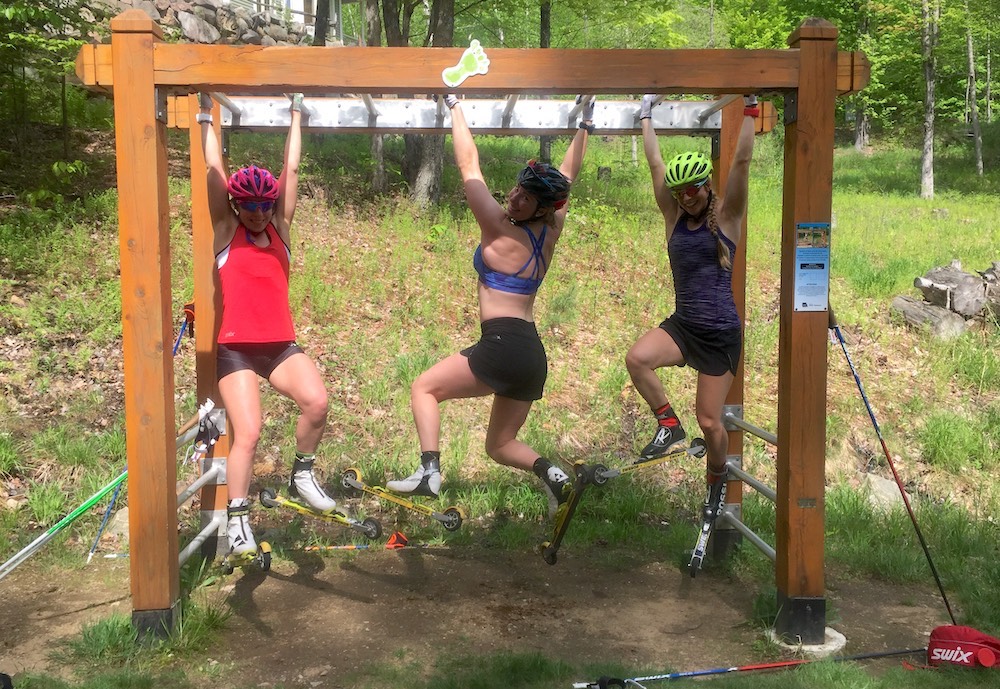
Canadian national-team member Cendrine Browne (r) hanging with her teammates Katherine Stewart-Jones (l) and Dahria Beatty at a training camp in Tremblant, Quebec, in May. (Photo: Dahria Beatty) La membre de l’équipe nationale canadienne Cendrine Browne (D) en compagnie de ses coéquipières Katherine Stewart-Jones (G) et Dahria Beatty lors d’un camp d’entraînement à Tremblant, Québec, en mai. (Photo: Dahria Beatty)
Anne-Marie Comeau leading Cendrine Browne during the skiathlon at Cross Country Canada’s NorAm/Olympic Selection Races in Mont Sainte Anne, Quebec, in January. (Courtesy photo)
Today, she’s Olympic-bound. But two years ago, Anne-Marie Comeau was stepping away from cross-country skiing.
Comeau had raced at 2015 World Junior Championships, finishing 25th in the skiathlon, but by December of that year the Canadian was diagnosed with a shoulder injury that required her to take half a year away from skiing.
Anne-Marie Comeau (Université Laval) racing to third in the women’s 10 k classic on Jan. 10 at Mont Sainte-Anne NorAm Trials in Quebec. (Photo: Mario Walker/NorAm MSA 2018 Facebook)
And that was plenty for Comeau to focus on. A talented runner, she had set the Quebec junior record at 5,000 meters (16:34.4, a time she has since improved on). And she won a silver medal at Junior Pan-American Games.
But skiing was something she couldn’t shake.
“I did more training for running, but skiing remained a sport that I love in the winter,” Comeau wrote in an interview with FasterSkier last week, translated from French into English. “I realized over the months that I missed ski racing, and so I decided in autumn of 2017 that I would do the selection races for Olympics, especially since they were at Mont-Ste-Anne where I live.”
So Comeau, who began attending Université Laval this fall and competed with their cross-country team, adapted her training somewhat. She added a rollerski workout once a week and uphill sessions on Mont Sainte Anne.
“Since it had been two years that I wasn’t doing ski races, it was difficult for me to come up with fixed goals,” Comeau wrote. “The prospect of participating in this type of selection gave me a certain motivation to train, and I couldn’t wait to get back to the joy of ski racing.”
At the same time, she was part of a college team for the first time.
Comeau ran for the Laval Rouge et Or team this fall. (Courtesy photo)
“It’s always really stimulating to be part of a team where the other athletes have the same passion,” she wrote.
The Laval women won the Quebec Conference Championships, and finished third at Canadian U Sports Cross-Country Championships.
“I’m very satisfied with my first season,” Comeau wrote. “I’m particularly pleased with the result that I had when we participated in an NCAA race in Princeton, New Jersey. It was a 6 k cross-country race and our team finished second in the overall standings. I finished first in that race. That second place for our team gave us confidence for what came next. The atmosphere in the team was really good and I am always very proud to represent the Rouge et Or.”
The pride and team energy, combined with just enough ski-specific training, combined perfectly to prepare Comeau to re-enter the world of ski racing.
To say that the Olympic selection races went well would be an understatement. On the second day of racing Comeau placed second in the 15 k skiathlon behind Cendrine Browne, who had already sealed her Olympic nomination by winning the sprint to open the trials series. Then on the last day of competition Comeau placed third in the 10 k classic behind Browne and Katherine Stewart-Jones.
That made her the distance winner of the trials, not counting Browne.
“To succeed in qualifying for the Olympics was truly a huge joy for me and a motivation to give my best for what would follow!” she wrote.
Comeau at the trials races in Mont Sainte Anne. (Courtesy photo)
But there was a catch: because Comeau hadn’t raced in so long – the only competitions she had done this season before selection trials were the Sovereign Lake NorAms – she did not have the required five FIS races averaging 100 points or below. So while she topped the selection list, in order to be allowed to race at the Olympics she had to get a few more results with good FIS points.
“After my races at Mont Sainte Anne, I was so motivated and proud of my results that it gave me positive energy to face the challenges that I had to overcome to meet the Olympic criteria from FIS,” Comeau wrote. “I didn’t really think about everything I had to accomplish, I just went right into it, the motivation of going to the Olympics being my main objective that I wanted to meet.”
To do that, she headed south, racing in a 10 k skate in Craftsbury, Vermont, and a 5 k classic in West Yellowstone, Montana. That brought her average FIS points down to 98.47.
Comeau is still absorbing the idea of becoming an Olympian.
“At 21 years old, I consider myself blessed to be able to live this experience, and I want to try to take the most of this experience to help me in the pursuit of my athletic career,” she wrote. “Honestly, to give the best I can and to live fully in each of my races, that’s my main goal. For the results, it’s hard for me to predict.”
On Monday, Cross Country Canada announced its 2018 Olympic cross-country ski team for the upcoming Winter Games in PyeongChang, South Korea. The team includes 11 athletes: seven men and four women.
According to the press release, “each of the 11 athletes met the standard for nomination to the Canadian Olympic Committee under Cross Country Canada’s Internal Nomination Procedures for the 2018 Olympic Games, and in the process form a talented squad replete with veteran leadership and podium potential.”
“This is a team that has evolved from a group of talented athletes excited to be on the start line into a group of determined high-performers focused, and confident, in their ability to achieve international podium results,” Cross Country Canada (CCC) High Performance Director Tom Holland said in the press release. “Led by our men’s team of Devon, Alex and Lenny over the last two quadrennials, we are in the podium hunt, and will continue to push towards getting Canada back on the Olympic podium at the Nordic venue.”
As the press release points out, Canada has three Olympic medals in cross-country skiing, starting when Beckie Scott earned the gold medal at the 2002 Salt Lake City Games. She added a silver Olympic medal to her collection in 2006, placing second in the team sprint with Sara Renner. Also in 2006, Chandra Crawford won gold in the Olympic skate sprint in Turin, Italy.
The women’s 10 k classic podium on Wednesday at the NorAm trials in Mont Sainte-Anne, Quebec, with Cendrine Browne (1) in first, Katherine Stewart-Jones (2) in second, and Anne-Marie Comeau (3) in third. Dahria Beatty (l) placed fourth. Comeau and Stewart-Jones are both on the U23 World Championships roster, although it’s likely that one or both of them will end up focusing on the Olympics instead. (Photo: Cross Country Canada/Instagram)
The U.S. and Canada have named their squads for FIS Cross Country World Junior and U23 Championships, set to begin later this month in Goms, Switzerland.
Both countries’ selections include athletes who excelled against the senior fields at recent domestic races (U.S. National Championships and NorAms) which served as selection races for Olympic teams.
In fact, Canada’s U23 women did so well against their senior compatriots that it’s unclear who will represent Canada at the Championships and who will do so at the Games. Anne-Marie Comeau (Université Laval), Maya MacIsaac-Jones (Rocky Mountain Racers), and Katherine Stewart-Jones (NTDC Thunder Bay/Nakkertok) were all on the podium in different competitions at Mont Sainte Anne, Quebec, last week at Canadian Olympic Selection Races.
Comeau was second in the 15 k skiathlon and third in the 10 k classic, earning herself a probable Olympic berth when each country’s Olympic quota size is finalized. However, she does not currently have the five sub-100 FIS point races on her resumé which are required to compete in the Olympics.
Then-21-year-old Ricardo Izquierdo-Bernier CNEPH racing his first World Cup during the men’s freestyle sprint qualifier at World Cup Finals in March. He won the senior men’s 15 k classic at the NorAm selection series this week. (Photo: John Lazenby/Lazenbyphoto.com)
“Anne-Marie is looking at different options now to find those races in North America,” Cross Country Canada High Performance Director Thomas Holland explained in an email.
Meanwhile, Stewart-Jones is next on the distance ranking list, and could get an Olympic call if Comeau is unable to get those points, or if an additional quota spot opens up after better-ranked countries finalize their rosters. Despite fighting off illness through the race weekend, Stewart-Jones finished second in the 10 k classic at the end of the selection series.
“I know that I have qualified for U23 World Champs,” Stewart-Jones told FasterSkier. “That trip leaves on [January] 15th. I’m keeping my fingers crossed for Olympic selection but I will probably not know until the 21st.”
Meanwhile, MacIsaac-Jones was second in the classic sprint final after qualifying fourth in the final, missing taking the open women’s sprint spot for PyeongChang by just one place. That spot went to Cendrine Browne instead, taking her out of the distance rankings and opening the way for Comeau and/or Stewart-Jones.
Some of the men who ended up on Canada’s U23 squad also competed well against the seniors. Ricardo Izquierdo-Bernier (CNEPH/Fondeurs-Laurentides) won the men’s classic distance race at the NorAm week, and both he and Olivier Hamel (CNEPH/Skibec) were in the final of the skate sprint. Gareth Williams (Telemark) was on the podium in the 30 k skiathlon, where Philippe Boucher (CNEPH/Skibec) finished fifth.
The U.S. women’s relay after taking a historic third in the 4 x 3.3 k relay at 2017 Junior World Championships on Sunday at Soldier Hollow in Midway Utah, with (from left to right) Hannah Halvorsen (holding her baby sister), Julia Kern, Katharine Ogden, and Hailey Swirbul. (Photo: U.S. Ski Team/Tom Kelly)
The U.S squad, meanwhile, is headlined by Hannah Halvorsen (Alaska Pacific University/U.S. Ski Team), Julia Kern (Stratton Mountain School T2/Dartmouth College/U.S. Ski Team), and Hailey Swirbul (University of Alaska Anchorage), who return from last year’s World Juniors medal-winning relay team.
Kern is now a U23, and is competing at the World Cup sprints in Dresden, Germany, this weekend. Back in the U.S., Swirbul finished eighth in the women’s 10 k skate at U.S. Nationals, while Halvorsen was fifth in the skate sprint after qualifying fourth.
Joining Swirbul and Halvorsen on the junior team will be two men who turned heads in the senior races at U.S. Nationals. Gus Schumacher (Alaska Winter Stars) finished sixth overall in the men’s 15 k skate and eighth in the skate sprint. Ben Ogden (Stratton Mountain School) was ninth in the 15 k skate and then qualified fourth in the classic sprint, before finishing the day in 12th overall.
The U.S. U23 team includes Zak Ketterson (Northern Michigan University), who finished just off the podium in fourth in the skate sprint at U.S. Nationals and followed it up with sixth in the classic sprint; Alayna Sonnesyn (University of Vermont), who was eighth in the skate sprint and sixth in the 20 k classic mass start; Lydia Blanchet (Dartmouth College), sixth in the classic sprint; Andrew Egger (Colby College) and Thomas O’Harra (Alaska Pacific University), tenth in the skate and classic sprints, respectively; Bill Harmeyer (University of Vermont), 11th in the skate sprint; Ian Torchia (Northern Michigan University/U.S. Ski Team), 12th in the 30 k classic; and Lauren Jortberg (Dartmouth College), who never finished out of the top 15 in the three senior races she entered at U.S. Nationals.
Rosters
Junior Men
USA:
Luke Jager, Alaska Pacific Nordic Ski Center
Ben Ogden, Stratton Mountain School
Karl Schulz, Univ. of Vermont
Gus Schumacher, Alaska Winter Stars
Canyon Tobin, Alaska Pacific Nordic Ski Center
Hunter Wonders, Alaska Pacific Nordic Ski Center
Canada:
Antoine Cyr, Centre National d’Entraînement Pierre-Harvey / Skinouk
Félix Longpré, Club Nordique Mont Sainte Anne
Etienne Hébert, Alberta World Cup Academy / Montériski
Graham Ritchie, National Team Development Center Thunder Bay / Big Thunder
Reed Godfrey, Canmore Nordic
Junior Women
U.S.:
Margaret Gellert, Alaska Winter Stars
Hannah Halvorsen, Alaska Pacific Nordic Ski Center / U.S. Ski Team
Kathleen O’Connell, Montana State University
Hannah Rudd, Univ. of Alaska-Anchorage
Sofia Shomento, Dartmouth College
Hailey Swirbul, Univ. of Alaska-Anchorage
Canada:
Natalie Hynes, Whitehorse
Annika Richardson, National Team Development Center Thunder Bay / Hollyburn
Hannah Mehain, Sovereign Lake Nordic
Catherine Reed-Metayer, Skibec
India McIsaac, Rocky Mountain Racers
U23 Men
US:
Andrew Egger, Colby College
Bill Harmeyer, Univ. of Vermont
Zak Ketterson, Northern Michigan University
Thomas O’Harra, Alaska Pacific Nordic Ski Center
Ian Torchia, Northern Michigan University / U.S. Ski Team
Canada:
Gareth Williams, Telemark / Canadian National Ski Team
Olivier Hamel, Centre National d’Entraînement Pierre-Harvey / Skibec
Ricardo Izquierdo-Bernier, Centre National d’Entraînement Pierre-Harvey / Fondeurs-Laurentides
Alexis Dumas, Centre National d’Entraînement Pierre-Harvey / Skibec
Philippe Boucher, Centre National d’Entraînement Pierre-Harvey / Skibec
Antoine Briand, Centre National d’Entraînement Pierre-Harvey / Skibec
U23 Women
U.S.:
Lydia Blanchet, Dartmouth Ski Team
Lauren Jortberg, Dartmouth Ski Team
Julia Kern, Stratton Mountain School / Dartmouth College / U.S. Ski Team
Nicole Schneider, Northern Michigan University
Canada:
Anne-Marie Comeau, Université Laval
Maya MacIsaac-Jones, Alberta World Cup Academy / Rocky Mountain Racers
Katherine Stewart-Jones, National Team Development Center Thunder Bay / Nakkertok
Laura Leclair, Centre National d’Entraînement Pierre-Harvey / Chelsea Nordiq
France’s Martin Fourcade after winning the men’s 20 k individual at the IBU World Cup in Ruhpolding, Germany, by more than a minute on Wednesday. (Photo: IBU/Biathlonworld)
IBU World Cup (Ruhpolding, Germany): Men’s 20 k individual
For France’s Martin Fourcade, the difference between a miss on the last shooting stage of the men’s 20-kilometer individual International Biathlon Union (IBU) World Cup on Wednesday versus perfect shooting wouldn’t have ultimately changed his result in Ruhpolding.
Despite the one-minute penalty, which was tagged onto his total time after his lone miss of the day, Fourcade still won by a minute. The Czech Republic’s Ondřej Moravec, who started 2 1/2 minutes ahead of him in bib 18 (while Fourcade wore bib 23), had successfully cleaned every stage, shooting 20-for-20, and initially crossed the finish line first — about a minute and 23 seconds ahead of former race leader Simon Eder of Austria.
But Moravec’s moment in first was fleeting as Fourcade burst into the stadium, not yet letting off the gas, seconds after Moravec finished. Fourcade took the win in 44:27.9, 1:01 ahead of Moravec in second. To indicate how fast Fourcade’s last loop was, it’s worth noting that he was 30 seconds ahead of Moravec with 4 k to go. On that final 4 k loop, he doubled his time ahead of second place.
Fourcade’s win came four days after his last race in Oberhof, Germany, the 12.5 k pursuit, which he also won.
“We are in a biathlon routine now,” he said, according to an IBU press release. “It was hard to find strong motivation with not much recovery or training this week. … Today I wanted to beat my record of podiums in a row. Today was my 14th [individual podium, including last season] in a row and I am really proud of this. I am very happy with my competition as well. Ruhpolding is place that I really love and I am happy that I continued my success here.”
Norway’s Johannes Thingnes Bø achieved his eighth-straight podium in third, 1:06.3 behind Fourcade with a single miss on the last stage as well (0+0+0+1).
“I heard the speaker, so I knew Martin had missed,” recalled Bø, who started behind Fourcade in bib 29. “I knew if I could shoot clean, there was a small chance I could beat him. I tried and missed. That was my tactic: to go for the win, not save the podium.”
He left the range for the last time 48.3 seconds back from Fourcade in first.
Michal Krcmar (l) and Ondřej Moravec (r) after reaching the flower ceremony in fifth and second, respectively, on Wednesday at the IBU World Cup in Ruhpolding, Germany. (Photo: IBU/Biathlonworld)
Germany’s Roman Rees shot clean and placed fourth (+1:19.1) for his first-career World Cup top 10, and the Czech Republic had two in the top five with Michal Krcmar in fifth (+1:36.6) for his best result of this season.
For Moravec, second place marked his season best as well, after finishing outside the top 10 in previous races this season.
“This podium is really important for me,” he told the IBU. “My first trimester was really bad; my shape was not good especially for the shooting. I also missed a lot of the summer training so did not have the best preparation … I am very please at how I was able to focus and have success in this race.”
Austria’s Dominik Landertinger followed in sixth (+2:21.9) with one penalty and Eder ended up seventh (+2:23.8) with one miss as well.
While the one-minute penalty per miss did not faze Fourcade, it led several North Americans to drop out of top-20 contention, particularly Tim Burke (US Biathlon), who had been in 16th after cleaning the third shooting stage. Burke had cleaned his first stage then missed one on the first standing, but was back in the top 20 with a clean third stage. On the final standing, he missed his first two shots, causing him to look up for a moment to refocus. He cleaned the last three, but still ended up with two additional minutes of penalties that put him 36th at the finish, 4:35.0 out of first (0+1+0+2).
Sean Doherty (US Biathlon) racing to 31st to lead his team in the men’s 20 k individual on Wednesday at the IBU World Cup in Ruhpolding, Germany. (Photo: US Biathlon/NordicFocus)
Sean Doherty led the U.S. men in 31st after missing two targets between the first prone and first standing stages. Ranked 76th after the second stage, he recovered to 53rd after a clean third stage and then 32nd after hitting all five targets on his last stage (1+1+0+0). With two penalties, Doherty finished the race 4:13.6 back in 31st.
“I am happy with the race today,” Doherty said, according to a US Biathlon press release. “I left some room for improvement on the range. It was a big step in the right direction from last week. We had very fast conditions on the course today and our waxing staff did a great job as usual.”
All three U.S. starters finished in the top 40, with Lowell Bailey in 37th (+4:36.4) with three misses (0+2+0+1).
Biathlon Canada was led by Christian Gow in 34th (+4:30.7), for his career-best in a 20 k individual race. After starting in bib 2, he cleaned his first and third stages to put himself in 32nd with one stage to go, within 28 seconds of the top 20. But a miss on his last standing put Gow in 39th leaving the range for the last time, and he ended up 34th at the finish (0+1+0+1).
“My shooting was just OK today,” Gow wrote in an email. “I would have liked to hit one more for sure and then I would have been completely satisfied with the race. I felt more nervous than normal in the range, and my two misses were a direct result of being a bit hesitant on the shooting mat.
“I am pretty happy with today overall,” he added. “I think this is the best skiing I’ve had in an Individual race and my best placing as well. I do wish I could have one or two shots back, but overall I am happy.”
Also for Canada, his older brother Scott Gow finished 55th (+5:13.2) with three penalties (0+1+1+1), Brendan Green placed 78th (+6:53.7) with four misses (1+0+2+1), and Macx Davies was 91st (+8:02.4) with five penalties (1+1+3+0), out of 107 finishers.
The Gow brothers and Green raced Sunday in the men’s 4 x 7.5 k in Oberhof, where they placed 10th.
“Honestly, I have been feeling pretty tired after the 3 days of racing in a row last weekend,” Christian wrote. “Our travel wasn’t too bad, but it still didn’t feel like much of a rest day.”
The Ruhpolding World Cup continues Thursday with the women’s 15 k individual (starting at 8:30 a.m. EST on the Olympic Channel). Another men’s 4 x 7.5 k relay will follow on Friday, then the women’s 4 x 6 k relay on Saturday, and the men’s and women’s mass starts on Sunday.
The women’s 10 k classic podium on Wednesday at the NorAm trials in Mont Sainte-Anne, Quebec, with Cendrine Browne (1) in first, Katherine Stewart-Jones (2) in second, and Anne-Marie Comeau (3) in third. Dahria Beatty (l) placed fourth. (Photo: Cross Country Canada/Instagram)
The NorAm trials at Mont Sainte-Anne (MSA), Québec, concluded Wednesday with the 10- and 15-kilometer classic interval starts. On the line were NorAm points, U23 and World Championships invitations, and for the women, what may well be the last Olympic spot on the Canadian team.
The action started with the men’s 15 k classic, which Ricardo Izquierdo-Bernier of the Pierre-Harvey National Training Centre (CNEPH) won in 39.07.8 minutes to punch his ticket to U23 World Championships later this month in Goms, Switzerland. He won the race ahead of Scott Hill of Barrie Cross Country (BXC) in second, who skied a fast final lap to come within 6.9 seconds of first.
Canadian Para-Nordic teammates Graham Nishikawa and Brian McKeever finished third (+30.0) and fourth (+37.4), respectively, with Nishikawa as McKeever’s guide in Paralympic events having the edge in the interval-start race the two skied on their own (Nishikawa started 64th and McKeever 55th).
According to Nishikawa, the two have been entering NorAm events that fit into their preparation for the PyeongChang Paralympics. Nishikawa wrote a quick email on his way to the airport on Wednesday.
“Happy with my week overall in MSA. Shape is good. Skis were good. Will keep improving into Korea for Paralympics,” he wrote after his second distance podium of the week.
In the women’s 10 k classic, Cendrine Browne (Canadian National U25 Team/CNEPH) continued her strong showing at trials with her second victory and fourth top-four result, taking the win in 29:47.0.
Katherine Stewart-Jones, of the U25 Team and National Team Development Centre (NTDC) Thunder Bay, and Anne-Marie Comeau (Université Laval) were virtually tied for second after the first lap, but Stewart-Jones held the speed to take second, 39.2 seconds behind Browne and 24.3 seconds ahead of Comeau in third.
About 16 seconds later, Maya MacIsaac-Jones, of the U25 Team and Rocky Mountain Racers (RMR), finished fourth (+1:21.0) ahead of Dahria Beatty, of the Canadian World Cup Team and Alberta World Cup Academy, in fifth (+1:26.6).
The selection criteria are complex, but a quick calculation suggests that Comeau, who placed second to Browne in Monday’s skiathlon, gets the provisional women’s distance spot for the PyeongChang Olympics (since Browne already established herself as the sprint leader), and Stewart-Jones, who was fifth in the skiathlon, gets the U23 Worlds berth. Stay tuned for updates and official selections.
The junior men’s 10 k classic podium on Wednesday at the NorAm trials in Mont Sainte-Anne, Quebec, with Antoine Cyr (c) in first, Félix Longpré (2) in second and Étienne Hébert (3) in third. (Photo: Cross Country Canada/Instagram)
CNEPH’s Antoine Cyr took his third win of the week in the junior men’s 10 k, finishing in 25:57.3, well ahead of local Félix Longpré (MSA) in second (+48.2) and Étienne Hébert (AWCA) in third (+55.6).
In the junior women’s 5 k, Hannah Mehain (Sovereign Lake Nordic/National Junior Team) took the win in 15:22.7, just 2.7 seconds ahead of skiathlon winner Natalie Hynes (Whitehorse Ski Club/National Junior Team) and 15.0 seconds ahead of Tuesday’s skate sprint winner Annika Richardson (NTDC Thunder Bay/National Junior Team) in third.
Left to right: Tyler Kornfield (APU), Reese Hanneman (APU) and Ben Saxton (SMS) the top three Americans in the men’s 1.6 k classic sprint final on Monday, the last day of 2018 U.S. Cross Country Championships in Anchorage, Alaska.
U.S. Cross Country Championships (Anchorage, Alaska): Classic sprint
Caitlin Patterson did it. With a classic-sprint win on Monday, she successfully capped off an undefeated 2018 U.S. Cross Country Championships, as the top American woman in all four races over the past week in Anchorage, Alaska.
Patterson, of the Craftsbury Green Racing Project, qualified seventh then won the women’s 1.5-kilometer final by more than 2 seconds in 3:39.58 minutes. Finland’s Jasmi Joensuu, a junior at the University of Denver (DU), won the qualifier and ultimately finished second in the final, 2.36 seconds behind Patterson.
Craftsbury once again had two on the podium with Kaitlynn Miller placing third overall (+3.9) as the second American. Becca Rorabaugh, of Alaska Pacific University (APU), was the top American in the qualifier in second overall, then placed fourth in the final (+9.92) and reached the U.S. podium in third.
Petra Hyncicova, a University of Colorado Boulder (CU) senior from the Czech Republic, placed fifth overall (+10.03), and Lydia Blanchet, a Dartmouth College U23 skier, finished sixth (+11.21) and was the fourth American woman.
Joensuu, 21, of Kuortane, Finland, started the day by winning the qualifier in 3:41.4, while Rorabaugh followed in second, 1.31 seconds back. Hyncicova qualified third (+1.85), CU’s Hedda Bångman (who won Sunday’s 20 k classic) qualified fourth (+2.92), and Miller qualified fifth (+2.93). Anne Hart of the Stratton Mountain School (SMS) Elite Team clocked the sixth-fastest qualifying time (+3.88), and Patterson followed in seventh (+4.77).
From there, Patterson won both her quarterfinal and semifinal, besting Miller and Joensuu in the latter by 0.66 seconds and 2.63 seconds, respectively. Blanchet placed fourth in that same semifinal (+5.15) and advanced to the final as a lucky loser with a fast-enough time, along with Joensuu (Patterson and Miller automatically advanced in first and second).
With her 4-for-4 record at 2018 nationals, Patterson is the most successful woman at U.S. Cross Country Championships since U.S. Ski Team member Jessie Diggins was the top American in all four races at 2012 nationals in Rumford, Maine.
In the men’s classic sprint final, Reese Hanneman (APU) captured his second title in as many sprints this week (after winning the freestyle sprint on Friday). He won the qualifying round by 2.84 seconds in 3:21.93, and later the final by a 0.2 seconds in 3:20.62. Kornfield placed second, and Ben Saxton (SMS Elite Team) rounded out the podium in third (+4.78).
Logan Hanneman, the winner of Friday’s freestyle-sprint qualifier, finished second to his older brother Reese in Monday’s classic-sprint qualifier, then went on to reach the final and place fourth overall (+5.42). Kevin Bolger (Sun Valley Ski Education Foundation) placed fifth (+5.52), and Zak Ketterson (Northern Michigan University) was sixth (+6.83).
NorAm Trials (Mont Sainte-Anne, Quebec): 15/30 k skiathlons
The women’s 15 k skiathlon podium on Monday at NorAm trials at Mont Sainte-Anne, Quebec, with Cendrine Browne (c) of the Pierre-Harvey National Training Centre (CNEPH) and Canadian U25 Team in first, Anne-Marie Comeau (l) of Laval University in second, and Dahria Beatty (Alberta World Cup Academy/Canadian World Cup Team) in third. (Photo: Cross Country Canada/Instagram)
Cendrine Browne won the women’s 15-kilometre skiathlon in 43:01.9 minutes on Monday at the Mont Sainte-Anne (MSA) ski trails to put an exclamation point on her presumptive selection for the PyeongChang Olympics. Browne, of the Centre National d’Entraînement Pierre Harvey (CNEPH)/Pierre-Harvey National Training Centre, which is based in nearby Saint-Ferréol-les-Neiges, broke away with Laval University’s Anne-Marie Comeau during the classic leg to take a 20-second lead that she held to the finish.
Comeau faded slightly to take second, 11.9 seconds back, qualifying for U23’s and putting her name in the hat for the upcoming 2018 Olympics. Either Comeau or the winner of Wednesday’s classic interval start should take that potential Olympic berth as Canada’s top female distance skier not already qualified. Browne has theoretically earned a spot as the top women’s sprinter, besides Dahria Beatty, who won the sprint and already met Canada’s Olympic qualifying criteria.
“It now has to go before the selection committee,” Cross Country Canada’s High Performance Director Thomas Holland wrote in an email on Friday.
After trials races were shuffled around due to extreme cold, with temperatures near -20 Celsius on Sunday at MSA, it warmed up to a balmy -8 degrees Celsius (17 Fahrenheit) by mid-afternoon on Monday. Both the women’s and men’s skiathlons were held, which not only served as one of two distance races for Olympic selection, but for Junior and U23 World Championships as well.
In the race for third place,Beatty outsprinted a group of four to take the final podium spot, 19.9 seconds behind Browne and 0.3 seconds ahead of their fellow Canadian National Team member Maya MacIsaac-Jones, of Rocky Mountain Racers (RMR) and U25 Team. Just 0.2 seconds out of fourth, Katherine Stewart-Jones, of the National Training Development Centre (NTDC) Thunder Bay and national U25 Team, placed fifth (+20.4) and CNEPH’s Laura Leclair was another second back in sixth (+21.4).
Almost 55 seconds passed before the seventh-place finisher came across the line, which was Zina Kocher (Foothills Nordic) skiing alone (+1:15.8). Another 49 seconds later, Jaqueline Mourao of Brazil’s national team placed eighth (+2:04.9), ahead of Zoë Williams (Carleton University) in ninth (+2:11.3), and Andrea Dupont (RMR) in 10th (+2:11.5).
In the junior women’s 10 k skiathlon, Whitehorse’s Natalie Hynes won in 30:19.8 to punch her ticket to Junior Worlds in Goms, Switzerland, from Jan. 28-Feb. 3. India McIsaac (RMR) finished 0.7 seconds back in second and Orford’s Alexandra Racine completed the podium in third (+32.8).
The men’s 30 k skiathlon podium at NorAm trials at Mont Sainte-Anne, Quebec, on Sunday, with Knute Johnsgaard (c) of Canada’s World Cup Team in first, Graham Nishikawa (r) of the Canadian Para-Nordic Team in second and Gareth Williams (Telemark Nordic/Canadian U25 Team) in third. (Photo: Cross Country Canada/Instagram)
On the men’s side, Canadian World Cup Team member Knute Johnsgaard, who met qualifying criteria for PyeongChang last season, shook off a slow start to the World Cup season with a win in the NorAm trials men’s 30 k skiathlon, finishing in 1:13:30.9.
Graham Nishikawa, who’s already destined for the PyeongChang Paralympics as a guide on the Canadian Para-Nordic Ski Team, finished 1 second back for second place. The 34-year-old Nishikawa edged out first-year senior national-team member Gareth Williams, 20, of Telemark Nordic and the national U25 Team, by 0.5 seconds. Williams was the top U23 athlete to qualify for this year’s U23 World Championships.
The top 6 finished within 41 seconds of the podium, with Jack Carlyle (AWCA) in fourth (+5.8), Philippe Boucher (CNEPH) in fifth (+13.9), and Scott Hill (BXC) in sixth (+40.7). World Cup Team member Len Valjas led the next group across the line in seventh (+1:28.6), followed by Bob Thompson (NTDC Thunder Bay) in eighth (+1:29.4), Alexis Dumas (CNEPH) in ninth (+1:35.5), and Ricardo Izquierdo-Bernier (CNEPH) in 10th (+1:35.7)
CNEPH’s Antoine Cyr won the junior mens 15 k skiathlon in 50:13.1 to earn a spot at Junior Worlds. Félix Longpré, of the local M.S.A. ski club, finished second (+15.7) and Thomas Manktelow was third (+49.0), just ahead of his Alberta World Cup Academy teammate Étienne Hébert in fourth (+49.3).
After Sunday’s racing was postponed due to temperatures well below the legal race limit, the remaining trials schedule includes freestyle sprints on Tuesday (for Junior and U23 World Championships qualifying purposes only), and classic interval starts on Wednesday.
Katharine Ogden (10) of the Stratton Mountain School on her way to sixth place in the women’s 10 k skiathlon at the Junior World Championships in Almaty, Kazakhstan. With that result, Ogden tied Kristina Tryggstad-Saari for the best Junior Worlds distance result since Tryggstad-Saari placed sixth in the 5 k freestyle in 2002. (Photo: Bryan Fish/USSA)
It may be Katharine Ogden’s first-ever Junior World Championships, but the 17-year-old Stratton Mountain School (SMS) skier is having a week to remember.
Ogden placed sixth in Friday’s 10-kilometer skiathlon in Almaty, Kazakhstan, following an 11th-place finish in Wednesday’s 5 k freestyle. The American finished just 13.2 seconds behind winner Sofie Nordsveen Hustad of Norway (27:02.8) and was 6.4 seconds from the podium.
“I am beyond stoked about my race today!” Ogden wrote in an email. “Going into the race I was originally hoping for a top 20, but after the 5 k on Wednesday I was really hoping for a top-10 result.”
Ogden explained that the race went smoothly, as she was able to avoid crashing during the hectic mass start. She was then able to maintain a position in the top 20 for the majority of the classic portion.
“It was really cool to be able to ski with some fast, aggressive Europeans and to experience a crazy, Euro-style mass start for the first time,” she wrote.
Katharine Ogden’s sixth-place finish in the women’s 10 k skiathlon is the best American distance result in a Junior Worlds race since 2002. (Photo: Bryan Fish/USSA)
Germany’s Victoria Carl broke away during the first lap of the skate portion, and Ogden joined the pack chasing her down. By the second of two skate laps, the lead group had dwindled down to six skiers and was fairly spread out, Ogden explained.
“Katharine would charge on the climbs, leading the pack uphill and the Russians would immediately react over the climbs and pull in front,” U.S. Ski Team Development Coach Bryan Fish wrote in an email to the press. “It was a hard fought battle on a challenging 2.5 k skate course.”
Ogden would finish in the back of the lead pack, but was just 2.2 seconds behind fifth-place Anastasia Sedova of Russia (+11.0).
“This was a really good, encouraging result for me, and going forward it is really awesome to have the learning experience from my first international mass-start race,” Ogden wrote.
“Both Katharine and Ian’s results are in a very small group in the history of U.S. Junior World cross-country ski results. Historically, we have had strong results in junior sprinting and U23,” Fish explained in an email to FasterSkier.
U.S. Women’s Head Coach Matt Whitcomb posted on Facebook that Ogden’s result tied the best women’s Junior Worlds distance result, men or women, after Kristina Tryggstad-Saari placed sixth in the 5 k freestyle in 2002.
“The future is bright for the U.S.!” Whitcomb wrote.
Fish added that there is no special way the U.S. team prepared for the skiathlon – they just treated it like any other distance race.
Julia Kern (41) of the Cambridge Sports Union on her way to 38th place in the 10 k skiathlon at Junior Worlds in Almaty, Kazakhstan. (Photo: Bryan Fish/USSA)
“The athletes often do two-a-day training where one ski discipline is in the AM and another in the PM, so the body is already somewhat accustomed to it. Certainly, practice is necessary to transition from classic to skate back-to-back,” he explained.
Fish added that based on Ogden and Torchia’s results, “the whole team is riding a high. We’re going to feed off this energy tomorrow for the U23 skiathlon races.”
Meanwhile, Canadian National Junior Team and Nakkertok member Katherine Stewart-Jones cracked the top 15 in 14th (+1:34.0) and Anne-Marie Comeau (CNEPH/NST-Junior) was 25th (+2:02.0).
Stewart-Jones wrote in an email that she was very happy with Friday’s result, as she accomplished her goal of earning a top-15 finish in a distance race at Junior Worlds.
“It is my last individual race I’ll get to do as a junior at Worlds and so I couldn’t be happier with how it finished,” the 19-year-old wrote.
She explained that the race was chaotic from start.
“There were girls falling everywhere and breaking poles. I just focused on staying on my feet, avoiding trouble, and skiing relaxed. I got myself into a good position at the end of the classic leg and was skiing with a big group of girls,” she wrote.
She explained that she felt strong heading into the skate, and was leading the large group of skiers behind the lead group. The other skiers would draft her on the downhills, which made it hard to break away, so Stewart-Jones knew she would have to make her move on the final hill.
From l-r, Canadians Annah Hanthorn, Katherine Stewart-Jones, Anne-Marie Comeau, and Maya McIssac-Jones, after the 10 k skiathlon at Junior World Championships in Almaty, Kazakhstan. (Photo: Lisa Patterson/CCC)
“The last kilometer is a blur. I just skied as hard as I could and didn’t think about anything else,” she wrote.
During that last kilometer, she distanced herself from the large group and held on during the final stretch to take 14th.
“All in all, it is such a great feeling to have improved from last year’s 31st place and this is definitely some motivation for the next races and training season!” she wrote.
Comeau managed to avoid getting tangled up at the start and was 29th after the classic portion and 58.5 seconds behind Carl, who led after the classic (13:00.7). However, she picked up the pace after the transition and had the 14th-fastest skate, beating Kazakhstan’s Angelina Shuryga by 0.3 seconds to earn a top-25 finish.
After Hustad, the other podium spots were filled by Carl in second (+2.0) and Sweden’s Ebba Andersson in third (+6.8).
“After the classic [portion] I was in fourth or fifth place, so I didn’t expect to become a champion today,” Hustad told the International Ski Federation (FIS). “I had amazing skis, I just glided into the finish line.”
Andersson said to FIS, “The course is very tough and fun at the same time. I really did not expect that I would be on the podium. Of course I am very happy today!”
Other North American skiers included Americans Hailey Swirbul (Aspen Valley Ski & Snowboard Club) in 35th (+2:45.4), Julia Kern (Cambridge Sports Union) in 38th (+3:19.1), and Alayna Sonnesyn (University of Vermont) in 50th (+4:56.2).
Canadian Maya Macisaac-Jones (Rocky Mountain Racers/NST-Junior) finished in 45th (+4:00.9) while Annah Hanthorn (Whitehorse) was 47th (+4:36.2).
Hanthorn was faced with some unusual adversity, as Canadian High-Performance Development Coordinator Lisa Patterson told Cross Country Canada.
“Annah had her skis taken from the exchange box by a Finnish skier. Annah wasted at least 30 seconds searching and then skied on the Finn’s skis. At the end of the race she was extremely polite and showed no anger, and actually congratulated the Finnish racer. On a positive note, both said their skis were fast,” Patterson said.
Junior Worlds finish in Almaty on Sunday with the men’s 4 x 5 k relay and the women’s 4 x 3.3 k relay.
Scott Hill (NDC Thunder Bay/NST) in the leader’s bib racing to his second-straight individual junior title at Canadian Nationals on Tuesday in the 15 k freestyle in Corner Brook, Newfoundland. (Photo: Emilie Stewart-Jones)
CORNER BROOK, Newfoundland — Five days after Canadian Ski Nationals started at Blow Me Down Trails, the third races of the week took place Tuesday with the 10- and 15-kilometre freestyle interval starts.
Upon checking out the course profiles before arriving in Newfoundland, the image of Tuesday’s race course was strikingly simple. It went up. It went down. With the exception of a short, flat section around the stadium and a quick up-and-down loop at the end, the course was pretty much one big uphill followed by a descent back to the stadium. Men raced four 3.75 k loops and women three 3.3 k laps, going not quite as high on the hill as the men.
With regards to conditions, the one thing that’s been consistent this week with weather is the ridiculously strong winds, and Tuesday was no exception to this trend. Blowing snow challenged racers with some solid headwinds at points on the course in temperatures around -9 degrees Celsius.
But even with the headwinds it was a quick race. World Cup veteran Ivan Babikov led the charge, winning the senior men’s 15 k in at just over 35 minutes, typical of the top times one might see on a tough World Cup 15 k course.
When the snow cleared (more of a figure of speech: it’s still blowing snow outside), here’s who stood with Babikov at the top of the podium:
Senior Women: Heidi Widmer
Heidi Widmer (front) racing to a victory in the open women’s 10 k freestyle on Tuesday at Canadian Nationals in Corner Brook, Newfoundland. (Photo: Emilie Stewart-Jones)
Last fall, Widmer, of the Alberta World Cup Academy (AWCA) and Canadian Senior Development Team (NST) dealt with the effects of a concussion following a rollerski crash. She stayed focused through the setbacks and managed to put down some solid results throughout the ski season, qualifying for the U23 World Championships and first Olympics in her final year as a U23.
1. Did you have a particular focus going into today’s event?
“To be present in the moment. Just like Pooh Bear in the ‘Tao of Pooh’. Great read.”
2. Before you knew your result were you happy with today’s race?
“I had a great time, had good skis and pushed my limits. So I would be happy with my efforts either way. It is even better when that aligns with a win!”
3. Imagine that it is your birthday and you get to choose whatever meal you want. What’s the main course and what’s for dessert?
“It depends where I’m celebrating — whatever the locals are doing and what is in season! Hopefully it’s Mexican style. For dessert, chocolate cake with chocolate mousse and strawberry filling. Vanilla ice cream on the side.”
Ivan Babikov (Canadian World Cup Team) racing to a victory in his first race at 2014 Canadian Nationals, two days after his last World Cup race, in Tuesday’s 15 k freestyle in Corner Brook, Newfoundland. (Photo: Emilie Stewart-Jones)
A World Cup veteran, Babikov, 33, is fresh off the World Cup Finals in Falun, Sweden, after finishing up there in 23rd in the 15 k freestyle pursuit on Sunday. A consistent performer at international races, he really adds to the level of competition here in Newfoundland.
1. Did you have a particular focus going into today’s event?
“Tried to stay awake today with the jet lag from my return from Europe. I worked to keep the speed up through the four laps. I hadn’t skied the course beforehand so I just focused on checking things out the first lap and then pacing based on that.”
2. Before you knew your result were you happy with today’s race?
“A win is a win, and racing back in Canada is always fun. It’d be nice to have some more World Cups over here.”
Imagine that it is your birthday and you get to choose whatever meal you want. What’s the main course and what’s for dessert?
“My wife makes really good Russian fried potatoes — kinda like french fries but healthy — and fried chicken. Something chocolatey for desert, like chocolate cake.”
Anne-Marie Comeau, 17, racing to a junior women’s victory in the open 10 k freestyle at Canadian Nationals on Tuesday in Corner Brook, Newfoundland. (Photo: Emilie Stewart-Jones)
Hailing from the Pierre-Harvey National Training Centre (CNEPH) and National Junior Team (NST), Comeau, 17, is part of a strong contingent of junior women from Quebec who are making a mark on the Canadian ski scene. With European racing experience already under her belt and two years as a junior, next season, she’ll be one to watch at Junior World Championships.
1. Did you have a particular focus going into today’s event?
“Going into the race I was just thinking about going as hard as I could.”
2. Before you knew your result were you happy with today’s race?
“Yes! I felt good during the race and had fun.”
3. Imagine that it is your birthday and you get to choose whatever meal you want. What’s the main course and what’s for dessert?
“Chicken shish kabobs for dinner and maple syrup pudding for dessert.”
Hill is already on a winning streak this week, making it 2-for-2 in the first couple races. In an effort to showcase some of the other top skiers in the junior men’s category, this reporter interviewed Tuesday’s runner-up Evan Palmer Charrette.
Evan Palmer-Charrette (NDC Thunder Bay/NST), the second junior in the open men’s 15 k freestyle on Tuesday at Canadian Nationals in Corner Brook, Newfoundland. (Photo: Emilie Stewart-Jones)
Charrette, of Thunder Bay in northern Ontario, trains with the National Development Centre in his hometown and is also part of the National Junior Team. A well-known junior on the NorAm circuit, he’s working towards his goal of racing internationally and one day making the World Cup team.
1. Did you have a particular focus going into today’s event?
“Big focus today was pacing and really getting long glides, especially on the uphills in the offset.”
2. Before you knew your result were you happy with today’s race?
“Absolutely. Pacing was great and the body came together today. I’ve been having some trouble with compartment syndrome in my shins, and with illness last week; these didn’t effect me today.”
3. Imagine that it is your birthday and you get to choose whatever meal you want. What’s the main course and what’s for dessert?
“Pad Thai for the main course and a chocolate milkshake for desert.”
About the Author: A Canadian cross-country ski racer with the Alberta World Cup Academy, Zeke spends most of his time in Canmore, Alberta, but calls Cantley, Quebec, his home. He thinks that you can learn a lot about a person from their goals — his is to ski really fast on the Winter Olympic race course in 2018. Unfortunately he is not competing at 2014 Canadian Nationals on account of an injury. Check out his blog: zekewilliams1.blogspot.ca.
The Swedish women’s relay team congratulates anchor Jonna Sundling at the finish, with Anna Dyvik, Sofia Henriksson, and Maja Dahlqvist, after defending their Junior World Championships relay title with another win on Monday in Val di Fiemme, Italy. (Photo: Fiemme2014)
Monday’s final event of the Junior World Championships included the women’s 4×3.3-kilometer and men’s 4×5-kilometer relays. Both events alternated classic and skating legs in Val di Fiemme, Italy.
According to a press release, Russia, France and Sweden led through the classic legs, while Norway and Finland sat patiently. On the last leg, Norway’s Eirik Sverdrup Augdal was first to pick up the pace at the end of a long uphill. AlexeyChervotkin, of Russia, and JeanTiberghien, of France, were surprised and forced to react quickly. Over the final sprint, Augdal found the best line and captured gold for Norway in 53:36.6, exactly 1 second ahead of Tiberghien who outskied Chervotkin by a tenth of a second for second.
Norway’s Eirik Sverdrup Augdal looks back after anchoring his 4×5 relay to gold on Monday on the last day of Junior World Championships in Val di Fiemme, Italy. France took second, 0.1 seconds ahead of Russia. Augdal teamed up with Eivind Krane Heimdal, Petter Reistad, and Johan Hoel. (Photo: Fiemme2014)
In the women’s relay, Russia led the first leg, but Sweden’s Sofia Henriksson did not let the Russian off easily, according to press release. Early in the the skate portion, Sweden was a hair ahead of Russia, while Norway was shortly behind, attempting to make up ground. At the final exchange, Russia’s Natalia Nepryaeva started off with a slight advantage over Jonna Sundling of Sweden, but by the end of the last leg, Sundling had gained enough ground to surpass — and even create a gap on — Nepryaeva, sealing the win for Sweden in 39:54.8. Russia took second, 7.7 seconds behind, and Norway’s Lotta Weng followed in third, 26.8 seconds behind the Swedes.
With four gold, two silver, and eighth bronze medals, Norway was crowned as the winning team at the 2014 FIS Nordic Junior/U23 World Ski Championships.
Among the North Americans, Canada placed just above the U.S. women in 10th (out of 14 teams). The Canadian females chosen to participate in the day’s event included Frédérique Vézina of the Pierre-Harvey National Training Centre (CNEPH), Dahria Beatty (Alberta World Cup Academy), Anne-Marie Comeau (CNEPH), and Katherine Stewart-Jones (Nakkertok). They raced in that order and Team Canada finished 2:49.9 behind the winners.
“I love mass starts so I was pretty pumped when I knew what position I had for the relay,” Vézina wrote in an email. “It was a great fast fight right from the start. My body felt very good and I was able to stay with the lead pack up the first long up hill.”
With slightly slower skis, Vézina explained she struggled on the downhills, but was able to catch back up to the pack on the climbs. “I am very happy with our race and it was as always a lot of fun!” she wrote.
The American women finished about a minute after, 3:51.4 behind the leaders in 12th. Racers included Nichole Bathe (University of Alaska-Fairbanks), University of Vermont’s Marion Woods and Stephanie Kirk, as well as Sloan Storey (University of Utah), respectively.
The Americans men placed 12th out of 18 teams, 3:08.4 behind the winners, with Canada finishing 45 seconds later in 13th. The U.S. men’s team included Adam Martin (Northern Michigan University), Lars Hannah (Steamboat Springs Winter Sports Club), Thomas O’Harra (Alaska Pacific University), and Patrick Caldwell (Dartmouth College),in that order.
“It was exciting to race today, because we got another chance to race head to head with the best junior athletes,” Martin wrote on Monday. “I was able to hang with the Norwegian skier for both 2.5 k loops. … In general the relay was fun, it was a nice way to conclude the week. … It is very motivational to see some of the other athletes’ strong form and on days like today realize that I can really get in and race them.”
The Canadian men’s team included Ricardo Izquierdo-Bernier (Fondeurs Laurentides), Alexis Dumas (Skibec), Scott James Hill (NDC Thunder Bay), and Benjamin Wilkinson-Zan (NDC Thunder Bay), who crossed the finish line in 13th. The Canadians finished in 57:30.4, 3:53.8 minutes behind the winners.
Russia Roman Kaygorodov racing to his first Junior World title on Sunday in the 10 k classic individual start in Val di Fiemme, Italy. (Photo: Fiemme2014)
Note: This article has been updated to include comments from Canadians Ricardo Izquierdo-Bernier, Scott Hill and Katherine Stewart-Jones.
Russia went out on a high note on the last day of individual racing at Junior World Championships in Val di Fiemme, Italy, with Natalia Nepryaeva and Roman Kaygorodov winning the women’s 5- and men’s 10-kilometer classic individual starts, respectively, on Sunday.
Russia’s 18-year-old Natalia Nepryaeva celebrates her 2.7-second victory in Sunday’s 5 k classic individual start, her first title at Junior World Championships in Val di Fiemme, Italy. (Photo: Fiemme2014)
For Nepryaeva, 18, the victory was her first at the world championships and she did so by edging Sweden’s Sofia Henriksson by 2.7 seconds in 14:05. Another Russian, Anastasia Sedova rounded out the podium in third, 13.6 seconds after her teammate.
“I am exhausted, but winning a gold medal in a world championship is an incredible satisfaction,” Nepryaeva told FIS after the race. “I kept focused on my pace throughout the whole race, although I wasn’t sure I was going to be able to climb the last uphill. There was another girl in front of me and I kept skiing really close to her to keep control of my pace. I am really happy for the other girls in my team too, it’s a great day for Russia.”
For Henriksson, 19, the silver marked her first individual podium at her fourth Junior World Championships.
“I feel so happy today because I have been struggling for this medal for so long,” she told FIS. “In 2012 in Erzurum in the 5km Classic I finished fourth, only one second behind the bronze medal. It feels good to break up the three Russians.”
As Nepryaeva and Henriksson passed through the intermediate checkpoints, it was clear they were gunning for top two. Nepryaeva narrowly prevailed on a hilly and challenging course at Lago di Tesero, leading four Russians in the top six, with Alisa Zhambalova in fourth (+16.4), Germany’s Julia Belger in fifth (+24.2) and Russia’s Yulia Belorukova in sixth (+27.4).
In the men’s race, Kaygorodov, 18, won his first race at the championships in 26:36.9 for his first title (and podium) as well, beating Swedish runner-up Jens Burman by 5.5 seconds. Norway’s Petter Reistad was another 0.3 seconds back in third.
“I can’t believe it!” Kaygorodov told FIS. “In the first part I didn’t want to push too much, the snow was pretty slow and I wanted to save most of my energy for the last lap. When I finished this race I was totally exhausted, and for me this result will be unforgettable.”
Burman said he felt like he had good power and energy throughout his race.
“I think that was a good race for me,” he told FIS. “I don’t do anything in particular to get encouragement or motivation, I only think I have to go fast.”
Canada’s Ricardo Izquierdo-Bernier leads a teammate in the 20 k skiathlon on Jan. 31 at 2014 Junior World Championships in Val di Fiemme, Italy. (Photo: Ricardo Izquierdo-Bernier)
France’s Jules Lapierre and Valentin Chauvin were fastest through the first checkpoint, but Kaygorodov picked it up for the last half of the race and put time into his competitors over the final kilometers.
Lapierre ended up fourth (+12.9) and Chauvin placed seventh (+18.4), while Sweden’s Simon Lageson placed fifth (+13.5) and Marcus Ruus took sixth (+16.9).
Monday’s relays were the final races on the schedule, with Sweden winning the women’s 4 x 3.3 k, defending their title from last year with Anna Dyvik, Henriksson, Maja Dahlqvist, and Jonna Sundling.
Canada placed 10th with Frédérique Vézina, Dahria Beatty, Anne-Marie Comeau, and Katherine Stewart-Jones. The Americans finished 12th of 14 teams with Nichole Bathe, Marion Woods, Stephanie Kirk, and Sloan Storey.
Norway won the men’s 4 x 5 k with Eivind Krane Heimdal, Reistad, Johan Hoel, and Eirik Sverdrup Augdal. The U.S. men placed 12th of 18 teams, with Adam Martin, Lars Hannah, Thomas O’Harra, and Patrick Caldwell Canada was 13th with Ricardo Izquierdo-Bernier, Alexis Dumas, Scott Hill, and Benjamin Wilkinson-Zan.
Two Canadians in Individual Top 15
Izquierdo-Bernier (Fondeurs Laurentides), who’s living in France with his family until August, when he’ll return to Montreal, notched 14th in the 10 k on Sunday.
In an email, he xplained his goal was top 20 in one race at his first Junior World Championships.
“I had identified the skiathlon to be my best chance to accomplish it, but bad skies in the classic part ruined my race … it’s part of cross country,” he explained of the preceding race, in which he placed 57th. “Sunday morning I had no expectations, my only goal was to do a good race in classic and keep a steady pace for the 2 laps. Up to now this year in classic, I didn’t have any good race and the result of Sunday morning surprised me a little!”
Throughout the 10 k, he focused on managing himself and his effort.
“I knew that I had a good race but I was not expecting to finish in the top 20,” Izquierdo-Bernier wrote. “After the race I was watching the screen with the timings, as the other skiers were ending their race and my time was staying tin the top ones. As the last racer finished, I was very happy and my goal was achieved.”
Izquierdo-Bernier moved to the French Alps, specifically the Vercors, for his father’s sabbatical year.
“Last summer I trained at the training center in Québec and when I came to France I trained 2 months with some French athletes and had finalised my preparation alone with a personal coach,” he explained.
Dahria Beatty (Alberta World Cup Academy) racing to 29th in Friday’s 10 k skiathlon at Junior World Championships in Val di Fiemme, Italy. She notched 15th in the 5 k classic on Sunday. (Photo: FlyingPointRoad.com/Proceeds go to the National Nordic Foundation)
The lone Canadian man in the top 40, he shared a personal best in the top 15 with Dahria Betty of the Alberta World Cup Academy (AWCA), who was 15th in the women’s 5 k.
For Beatty, 19, the result was her best in three world championships after she placed 20th in the freestyle sprint on Jan. 29. She explained in an email that her goal was top 15.
“I am really happy to have achieved that,” Beatty wrote. “The 5k classic was the race I was most looking forward to as I prefer classic races to skate races. I’d like to think I can be both a sprinter and a distance skier, and I hope that I showed that with my 20th place finish in the skate sprint the first day!”
Her plan for the 5 k was to start fast but relax on the climbs, then push hard over the remaining parts of the course.
“I didn’t push enough on the second last climb in the skiathlon Friday so I made sure not to make that mistake again today and went all all out up the climb at 3.5km,” she wrote. “All along I was getting splits that I was leading at my bib, which is what I was hoping for. It’s always great to cross the line in first and see your name with a 1 beside it even if you know it won’t last. I had the chance to sit in the winners chair for a minute too which is always great!”
The 2014 U.S. women’s Junior World Championships team (Photo: Sloan Storey)
Two Americans tied for the best U.S. result of the day in 26th: Nichole Bathe (University of Alaska-Fairbanks) and Adam Martin (Northern Michigan University). For both, it was their first top 40 at their first world championships.
“My goal going into to today’s race was to top 40 and to just feel like I was skiing strong and to really leave it all out there,” Bathe wrote on Sunday. “I didn’t know what place I was in while racing, I went off third so there where only two girls started ahead of me so I just went out as hard as I could and tried to hold on and set down a time that would hold to a certain extent.”
After breaking through with her first podium at U.S. nationals a month ago, Bathe explained that results like third-place in the nationals classic sprint gave her confidence, but she also knew she would be racing at another level internationally.
“I knew … these girls … are the fastest juniors in the world and that it was going to be tough to even hang in there,” she wrote. “I’m feeling pretty good about where I am at, I’m looking ahead to the next couple weekends of racing leading into the end of the collegiate year knowing that those are going to be some tough races so I’m just gonna try and keep everything going for another month and a half and hope that it all goes well.”
Martin wasn’t sure how he’d stack up in the 10 k after placing 40th in the preceding 20 k skiathlon on Jan. 31. He thought top 30 “would be cool,” but tried not to dwell on results — instead focusing on having a strong race in difficult conditions. He remembered seeing the thermometer read 8 degrees Celsius (46 Fahrenheit) at one point.
“The race was back seeded with the best ranked skiers starting last, so I tried not to think too much about splits, but they did help me gauge that I was picking up a few spots towards the end,” Martin wrote. “I was pleased when I saw that I was 26th. More so, I was happy that I was 1:24 off of the leader. While this certainly is a notable amount of time back in a 10k, it seems like a margin that I can hopefully work with.”
About 3 1/2 seconds after Martin, Caldwell (Dartmouth College) placed 29th. Two days earlier, he notched 10th in a 20 k skiathlon.
Woods, a University of Vermont freshman, placed 34th, and her U.S. teammate Storey (University of Utah) was 43rd.
Canada’s Katherine Stewart-Jones (Nakkertok) finished 36th, Anne-Marie Comeau of the Pierre-Harvey Training Centre (CNEPH) was a second behind in 38th. Also of CNEPH, Vézina finished 51st of 72 women.
Stewart-Jones wrote in an email that she was aiming for top 25 and felt good before falling on a downhill after the first 2 k.
“After that I really picked it up,” she added. “I have had a lot of fun so far. … I also improved my placings in every single race, so it is encouraging to see that improvement!”
Comeau, 17, wrote than her goal was to have fun and give 100 percent. She had already placed 21st in the 10 k skiathlon, and two years ago at Junior Worlds, she was 18th in the skiathlon.
“I’m happy about the result,” she wrote Sunday. “I felt good during my race and I gave all that I had! I think that’s important.”
Also for Canada, Hill (NDC Thunder Bay) placed 45th, Dumas (Skibec) was 1.2 seconds behind in 46th, and Wilkinson-Zan (NDC Thunder Bay) placed 66th of nearly 100 men.
“Going into this season I had my sights set on a top 10 at world juniors,” Hill wrote in an email. “Unfortunately I wasn’t feeling that great leading into the championships and I knew that I wasn’t going to get to the top 10 unless I was in good race shape.
Rain before his race, which made the snow wet and heavy and ruined the tracks on the hill made things tougher.
“I knew I wasn’t capable of reaching my original race goal but I was still hoping for a top 30 so I was disappointed with where I ended up,” he explained. “I have been disappointed with my racing in Italy but I really like the venue and courses, more than last year in the Czech Republic. This year I was solely focused on my racing and results compared to last year where I was more just trying to get experience. My season has been good up until now and I hope I can rest up and finish the season on a strong note at nationals.”
Among the U.S. men, Hannah (Steamboat Springs Winter Sports Club) finished 57th in the 10 k and Cole Morgan (University of Vermont) was 68th.
Start of the women’s 10 k skiathlon at Junior World Championships on Friday in Val di Fiemme, Italy. (Photo: FlyingPointRoad.com/Proceeds go to the National Nordic Foundation)
As if skiathlons weren’t rare enough, Friday’s 10- and 20-kilometer races at Junior World Championships in Val di Fiemme, Italy, posed another unique challenge with 2 1/2 feet of new snow from the night before. Tracks had to be set for the races that combined both classic and skate disciplines.
Patrick Caldwell (Dartmouth) racing to a career-best 10th on Friday in his skiathlon at his first Junior World Championships in Val di Fiemme, Italy. (Photo: FlyingPointRoad.com/Proceeds go to the National Nordic Foundation)
For American Patrick Caldwell, of Dartmouth College, this was his first skiathlon. After not feeling great following the long trip to Europe, Caldwell wrote in an email: “I think the sprint really helped wake me up and get me ready.”
Caldwell’s strategy in the skiathlon was to hang on in the classic race, then try to gain ground in the skate.
“Overall this strategy worked very well,” the 19-year-old freshman said, after finishing 10th for a career-best in his first Junior Worlds.
Snow kept falling continuously early Friday morning and continued up to the first race: the junior women’s 10 k skiathlon. According to a press release, the Russians took the lead in the classic leg with Alisa Zhambalova and Natalia Nepryaeva, followed by Germany’s Julia Belger and Sarah Schaber, as well as Norway’s Lotta Udness Weng.
Zhambalova was first through the exchange with about 10 competitors close behind her, and Sweden’s Anna Dyvik led the chase group while trying to close the gap. Halfway through the fourth lap, Weng, Belger, Schaber, and Zhambalova accelerated to the front, but Belger crashed on the second-to-last descent. Schaber stayed on her feet and dropped the pack on the final climb, winning the skiathlon by 2.1 seconds in 30:45.8. Zhambalova placed second and Dyvik outsprinted Weng and Nepryaeva for third (+3.0).
Japan had a solid showing as well, with two women, Yukari Tanaka and Kozue Takizawa, placing in the top 16.
Dahria Beatty (Alberta World Cup Academy) racing to 29th in Friday’s 10 k skiathlon at Junior World Championships in Val di Fiemme, Italy. (Photo: FlyingPointRoad.com/Proceeds go to the National Nordic Foundation)
Canada’s Anne-Marie Comeau, 17, of the Pierre-Harvey National Training Centre (CNEPH), was the top North American in 21st, her second-best individual result at her third Junior Worlds. Dahria Beatty (Alberta World Cup Academy) placed 29th, Frédérique Vézina (CNEPH) was 30th and Katherine Stewart-Jones (Nakkertok) 31st.
American Sloan Storey (University of Utah) was not thrilled after finishing 39th, but was happy to be the top American female and to have made it to this level of racing.
“Today’s race was tough but really fun!” she wrote. “I always find myself getting very nervous before these international races with all the insanely fast-looking Russians, Germans, Norwegians, and Swedes warming up around me, but then I remind myself how amazing it is that I just get to compete against these girls and experience racing at this level. My nerves begin to settle and I just get excited.”
Unlike Caldwell, Storey, a 19-year-old sophomore, competed in this event last year (and placed 32nd in Nove Mesto), which made her more comfortable with the race format. Regardless, she wrote that her warmup was pretty unorganized and hectic because of the races’ delay of an hour due to continuous snowfall.
After Storey, Nichole Bathe (University of Alaska-Fairbanks) placed 47th, Stephanie Kirk (University of Vermont) was 52nd and Maggie Williams (University of Vermont) placed 59th.
Eirik Augdal (12) and Evgeniy Vakhrushev (18) at the front of the pack in the men’s 20 k skiathlon at Junior World Championships on Friday in Val di Fiemme, Italy. (Photo: FlyingPointRoad.com/Proceeds go to the National Nordic Foundation)
On the junior men’s side, Russia dominated yet again as Alexey Chervotkin and Evgeniy Vakhrushev took the lead in the classic part of the race. They were followed by France’s Jules Lapierre and Petr Knop of the Czech Republic.
Norway’s Eirik Sverdrup Augdal and Johan Hoel joined the lead pack after the transition zone, and formed a chase with the Russians. The Norwegians and Russians both finished with a solid day as Augdal won in 56:09.6, Chervotkin placed second, 10 seconds back, and Hoel took third, 1.3 seconds later.
Russia had four in the top nine with Vakhrushev placing seventh, Evgeniy Grigoriev in eighth and Alexander Bakanov in ninth.
While Caldwell was the lone North American in the top 39, Americans Adam Martin (Central Cross Country) placed 40th and John Hegman (University of Vermont) was 59th.
Scott Hill (NDC Thunder Bay) led the Canadian men in 51st, Ricardo Izquierdo-Bernier (Fondeurs Laurentides) was 57th, Alexis Dumas (Skibec) 60th, and Benjamin Wilkinson-Zan (Nakkertok) 68th.
If the junior women are a harbinger of things to come, then, with three women in the top 30, Canada’s future looks bright. Canada’s best result in Wednesday’s Junior and U23 World Championships was delivered by Katherine Stewart-Jones, who finished 15th in the junior women’s 1.2-kilometer sprint. She was followed by Dahria Beatty, who finished 20th, and Sophie Carrier-Laforte, who finished 28th.
All three women advanced to the quarterfinals. The fourth Canadian junior, Anne-Marie Comeau, was 52nd.
“I was super excited with how things turned out today,” Stewart-Jones wrote in an email. In spite of a rough start to the quarterfinal, she moved into second place over the top of an uphill, saying that she “managed to squeeze in the side.”
But bad luck struck again, and she was passed by two skiers on an uphill after taking a corner too wide. But the race was not over.
“The German girl fell right in front of me, and, after losing my balance, I was able to stay on my feet and pass her.” Stewart-Jones poured the power into what she described as “really good” skis. “I free skated the last flat and almost caught up to the second girl. I was about one second from the lucky loser spot.”
In spite of alternating good and bad luck, Stewart-Jones was delighted with her performance.
“I was still extremely excited about today. I did not expect to make top 15, but I am satisfied for sure!”
Continuing the strong performances of Canadian women, U23 Heidi Widmer delivered a solid performance on the 1.2 k course, making the quarterfinals and finishing 19th. Teammates Olivia Bouffard-Nesbitt placed 34th and Cendrine Brown was 36th in the qualification round.
The top Canadian U23 man was Andy Shields, who finished 39th in the qualification round on a 1.5 k course, followed by Knute Johnsgaard in 42nd, Patrick Stewart-Jones (older brother to Katherine Stewart-Jones) in 50th, and Sebastien Townsend in 53rd.
“Conditions were rock hard which is not good for me,” Shields wrote in an email. “If it was mushy I would have qualified.”
Foster Agnus was the top junior man, finishing 45th in the qualification round, with Scott Hill and Ricardo Izquierdo-Bernier coming in 50th and 51st, respectively. Benjamin Wilkinson-Zan was 64th.
The Canadians have all been in Europe for nearly two weeks getting acclimatized to the different time-zone and to life in Europe. The transition to life in Europe has been easy for the young skiers, according to Shields.
“The event organizers here are very experienced which make it easier for us athletes because there were no extracurricular hassles to deal while we’ve been here.”
Looking forward, Katherine Stewart-Jones was excited about what her team of young women might have to offer this rest of this week.
“I am excited about the team relay because I think we have a strong group of junior girls this year and I can’t wait to see how we will do!”
But her attitude is far from wait-and-see:
“With such a strong field, I am going to be thinking: every second counts!”
The start of the men’s 30 k skiathlon at the Canmore Nordic Centre on Sunday. (Photo: Pavlina Sudrich)
CANMORE, Alberta — Four racers made claims to berths on Canada’s Olympic team this weekend in the freestyle sprints and 15- and 30-kilometer skiathlon on the last two days of Olympic Trials at the Canmore Nordic Centre.
Heidi Widmer of the Alberta World Cup Academy (AWCA) and Canadian National Team (NST), and Jesse Cockney (AWCA/NST) took top honors in Saturday’s freestyle sprint, while Graeme Killick (AWCA/NST) and Amanda Ammar (Team Ninja) won Sunday’s skiathlon.
Cross Country Canada (CCC) intends to name one sprinter and one distance racer per gender to the Olympic team based on this past week’s races at the Canmore Nordic Centre. The team will be announced Tuesday morning in Calgary.
“I didn’t want to be one of those Olympiczillas getting caught up in it all. … This is a dream come true, but I have only completed part one. Now the real journey and work begins.” — Heidi Widmer, 2014 Canadian Olympic Trials skate-sprint winner
Heidi Widmer of the Alberta World Cup Academy and Canadian Senior Development Team, en route to a victory in the 2014 Canadian Olympic Trials skate sprint on Jan. 11. (Photo: Angus Cockney)
Heidi Widmer all but guaranteed her selection to the Olympic team on Saturday with a win in the 1.3 k freestyle sprint. This backs up her second-place finish in Wednesday’s freestyle sprint to Chandra Crawford (Team Ninja/NST), who is already prequalified for the Olympics. Although Crawford did not race on Saturday, Widmer wrote in an email that she used the lessons she had learned from racing Crawford to help her take the win on Saturday.
“I have raced these trails and trained on them so many times, but this just feels so surreal,” Widmer told CCC. “I was on a mission for this. I didn’t want to be one of those Olympiczillas getting caught up in it all. There are so many ups and downs. I just wanted to stay focused on the process and not look back or ahead of myself. This is a dream come true, but I have only completed part one. Now the real journey and work begins.”
Behind her, the women’s field showed remarkable consistency from Wednesday’s freestyle sprint. In the absence of Crawford, the women’s top-four finishers from Wednesday simply became Saturday’s top three.
Biathlete Zina Kocher showed that her third place on Wednesday (in her first-ever sprint) was no fluke by finishing second in the trials on Saturday. Despite her strong finishes, she has no intention of switching over to cross country. Kocher is proud, however, of representing biathletes well.
“I know biathletes get a rep for not being as fast [and] strong as xc skiers, but I hope I have started to prove otherwise!” Kocher wrote in an email. “But I’m not going to make a complete switch [to cross country]. Biathlon has another element to it that I love [and] that makes it incredibly exciting and it would be hard to give that up!”
Andrea Dupont of Rocky Mountain Racers rounded out the podium in third.
Phil Widmer (AWCA/NST) leads teammate Jesse Cockney (second from l) and the rest of the men’s final at the 2014 Canadian Olympic Trials on Jan. 11 in Canmore, Alberta. (Photo: Angus Cockney)
For the men, Jesse Cockney moved up to top spot on the podium after finishing second on Wednesday and, along with Widmer, will almost certainly be named to the Olympic team.
Skiing tactically within the pack until the finishing stretch, Cockney moved alongside Phil Widmer (NST) in the finishing stretch and threw the hammer down to win the 1.7 k skate-sprint final by two seconds.
Widmer finished second and young-gun Patrick Stewart-Jones (AWCA) followed in third. Cockney described his finishing strategy to CCC:
“I just kept telling myself to get to the line. … Phil has been so strong, and I took that outside lane for the finish. I didn’t know what else to do, but I just wanted to get to the line. It has been years of hard work. I don’t know if it is official. I did all that I can do and I just want to enjoy this moment.”
15/30 k Skiathlon
With the qualification wrapped up for the sprint racers, the last chance for the distance racers was Sunday’s skiathlon.
Killick, who finished second to Brian McKeever (Canadian Para-Nordic World Cup Team) in the 15 k classic on Thursday, was a strong favorite heading into the men’s race and he delivered.
“My initial strategy was to try and break with someone in the classic and work together to hold off the group,” Killick wrote in an email. “I tried a few times to go the classic but was pulled in on the downhill and never really got away with anyone. On the last lap I was finally able to respond to an attack by Graham Nishikawa and keep pushing past to get a little gap on the field. Jess [Cockney] bridged to me and we were able to work together into the first lap of the skate.”
Graeme Killick (AWCA/NST) soaring to a 30 k skiathlon victory at 2014 Canadian Olympic Trials on Jan. 12 in Canmore, Alberta. (Photo: Angus Cockney)
After that, Killick, who had not raced the previous day’s sprint race, started to pull away.
“I just tried to keep a good pace going and managed to stay strong through the last couple laps,” he explained.
By the end of the race, Killick had extended his lead to just under a minute to take the win. He joins Cockney and Heidi Widmer as another almost shoe-in for the Olympic team.
Cockney faded somewhat towards the end of the race and was caught by the rest of the pack, but he regrouped to win a sprint finish with Michael Somppi (AWCA/NST) for second place. Already having secured a vital win during the week’s trials, Cockney entered the day with a relaxed attitude.
“The day was really fun,” he wrote in an email. “Tactically I just wanted to conserve energy and ski near the front for a podium. I’m happy with the result and thrilled with the week of racing.”
Somppi wrote in an email that he was happy with the day, but overall unsatisfied with his fitness thus far this season. Though the Olympic team is likely out of his reach for this season, he wrote:
“I still don’t feel I am racing at my best, but today was a good step forward. I will take some much needed rest and recovery now and hopefully I can find my top racing form for the second half of the season.”
McKeever, winner of Thursday’s distance race, ended up in eighth and is likely out of the running for Olympic qualification — but the visually impaired skier is a gold-medal favorite at the Paralympics in early March.
Amanda Ammar (Team Ninja) leads Brittany Webster in the 15 k skiathlon on Jan. 12 at 2014 Canadian Olympic Trials in Canmore, Alberta. (Photo: Angus Cockney)
On the women’s side, Ammar gritted out a huge win for herself after finishing sixth on Thursday. Although she wrote in an email that she didn’t feel great energy-wise on the day, she tried to simply “hold on” for as long as possible. Her strategy worked, as the pack was whittled down to three skiers, two of whom Ammar thought she could out-sprint in the end (the other being herself).
However coming into the last few kilometres, she decided to start her sprint with 1 k remaining in the race, and it was all over for the other racers.
Ammar crossed the finish line in 49:16, with Brittany Webster (Mito Canada) five seconds back and junior Anne-Marie Comeau (Pierre-Harvey National Training Centre) at 30 seconds back. All three were over a minute ahead of the fourth-place finisher.
Ammar, while thrilled with her result, is circumspect.
“No matter what happens with the Olympic decision, I will now know that I am just as fast and as fit as the girls going, and I’m at that top level. It’s been a long hard journey for us, and I’m just so proud.”
Webster is equally happy with the week of racing, although disappointed to have finished second on both days of distance racing. She wrote in an email to Fasterskier that,
“I feel great about my [two] efforts, and I know that the way I have trained this year, it should only keep getting better. Of course I am bummed I didn’t have what it took to win on either day, but hey that is racing, and I am really looking forward to working on it for the rest of the season.”
According to a Cross Country Canada press-release, the 2014 Olympic Team selections will be announced Tuesday morning in Calgary, Alberta.
Anne-Marie Comeau (Pierre-Harvey National Training Centre) and Sean Doherty (Vermont Collegiate Biathlon) are FasterSkier’s Juniors of the Year.
Moving right along with our Skier of the Year awards, we’re delighted to introduce Junior of the Year for all the talented U19’s out there. The big hypothetical prize goes two outstanding North Americans, U.S. biathlete Sean Doherty and Canadian Anne-Marie Comeau, who have already notched results most seniors would envy, and they haven’t graduated high school yet.
Sean Doherty (Vermont Collegiate Biathlon/Ethan Allen)
It’s a pretty big moment when you grab your nation’s flag and ski across the finish uncontested, and Doherty, a high-school senior, did just that at the International Biathlon Union (IBU) Youth and Junior World Championships in January in Obertillach, Austria.
One day after notching silver in the 7.5-kilometer sprint, the 17-year-old from Center Conway, N.H., became the first American to win gold at the Youth and Junior World Championships since Jay Hakkinen in 1997. Despite some early penalties, Doherty collected himself and skied to a nearly 30-second victory in the 10 k pursuit race, soaking up every moment he could.
“It was incredible,” he told FasterSkier after the race. “It was just amazing to know that it was locked up, that I was going to be able to grab the flag at the end, all the stuff that I just see people do at big World Championship type races, and then all of a sudden, wow, I’m going to be able to do that.”
The next day on Jan. 27, Doherty racked up another silver, this time in the 12.5 k individual race, to become the winning-most U.S. biathlete at Youth and Junior World Championships.
Great results and medals are nothing new to Doherty; last year at the Winter Youth Olympic Games in Innsbruck, Austria, he anchored U.S. biathlon’s mixed relay to its first medal: bronze. After his most recent performances in Obertillach, Doherty appeared in Sport Illustrated’s “Faces in the Crowd.”
“It was an amazing week,” Doherty told TeamUSA.org. “The best way I could put it is that it was incredible to have all that good racing come together in a week when it really, really counted.”
Anne-Marie Comeau (Pierre-Harvey National Training Centre)
At just 16 years old, this Québec athlete, who shares the same training centre and town (St-Ferréol-les-Neiges) as Canada’s celebrated World Cup skier Alex Harvey, is quickly rising to similar success.
In December, Comeau earned her first World Cup starts in Canmore, Alberta, and made the top 50 in both the 10 k classic mass start and 15 k skiathlon. In the classic race, she was the top junior and second Canadian out of 14 nation’s group women. (Did we mention she’s 16?)
In late January, she ventured to Liberec, Czech Republic, for her second Junior World Ski Championships. There, she was the second Canadian to teammate Frederique Vezina in the 10 k skiathlon, placing 34th despite a crash while Vezina tallied 29th.
Back in Canada, Comeau wowed at Canadian Ski Nationals in March, finishing 11th in two races: the 5 k freestyle and 10 k classic. She wrapped up her season on yet another high note in California, placing 14th – the best of any junior or Canadian – in the U.S. Distance Nationals 30 k classic mass start at Royal Gorge near Truckee.
Honorable Mentions
In recognizing top juniors, we couldn’t go without giving some love to Ben Saxton (F.A.S.T. Performance Training) and Logan Hanneman (Alaska Pacific University).
Both born in June of 1993, these two were neck-and-neck rivals throughout the season, with Hanneman beating him in three races at Junior Nationals, including a photo-finish skate sprint, but Saxton finally edged him in the OJ 15 k classic mass start.
“It was a pretty great feeling to finally come out on top,” Saxton told JN2013Fairbanks.us.
At 19, Saxton achieved fifth at U.S. Nationals in the classic sprint and went on to place 14th at Junior World Ski Championship in the same event. Hanneman, 19, was right behind in 16th in the Junior Worlds classic sprint and nearly made the podium at senior nationals in Midway, Utah, where he was fourth in the freestyle sprint.
“I definitely wanted to make it out of the quarters but the qualifier was so hard … I was just like, ‘Oh, gosh, this is not going to happen,’” Hanneman said at the time. He went on to win the junior 10 k classic mass start in Midway.