Tag: Annecy

  • Martin Fourcade Nordic Festival Draws Big Crowds in Annecy, France

    Martin Fourcade Nordic Festival Draws Big Crowds in Annecy, France

    Enthusiastic fans fill the stands for the Martin Fourcade Nordic Festival.

    Nordic festival are two words most North American ski fans can only dream about. Skinny skiers here are unlikely to experience the reality of such an event for themselves unless they make a trip across the Atlantic. For residents of France, the opportunity to participate in the second edition of the Martin Fourcade Nordic Festival presented itself this weekend and there were many eager attendees. This lucky expat was among the masses.
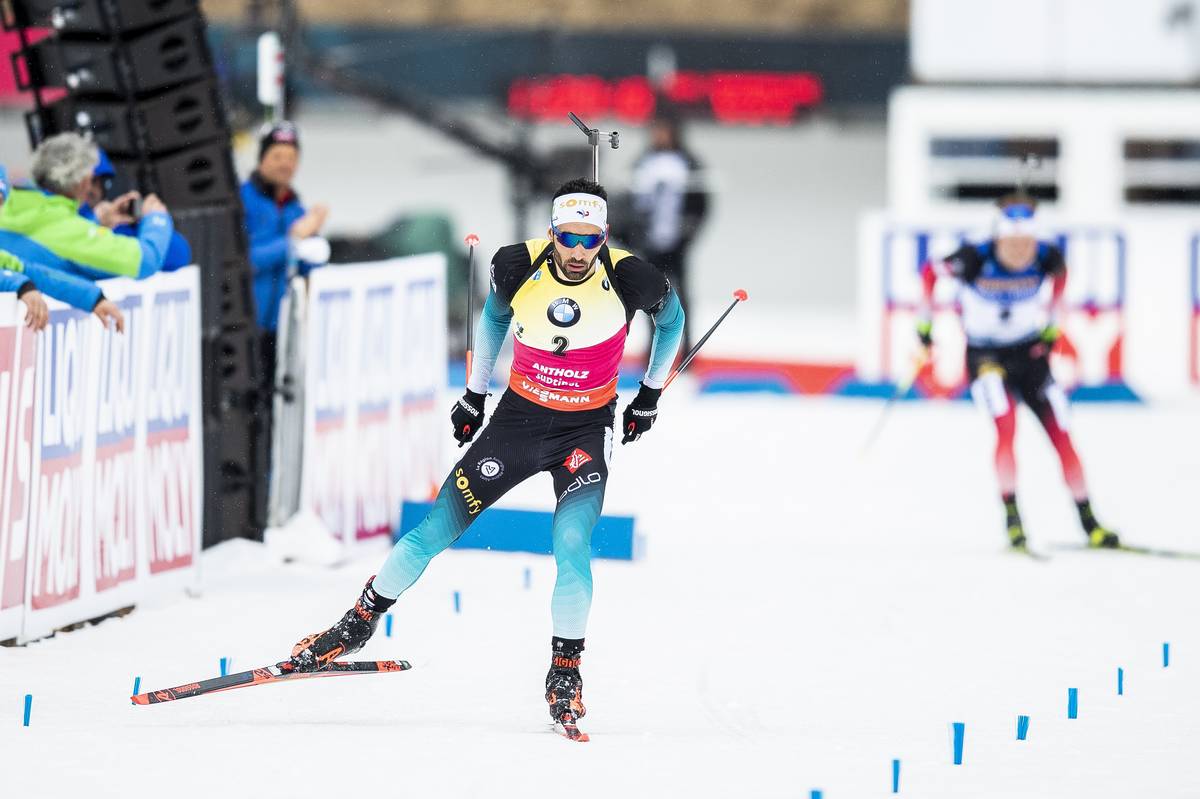
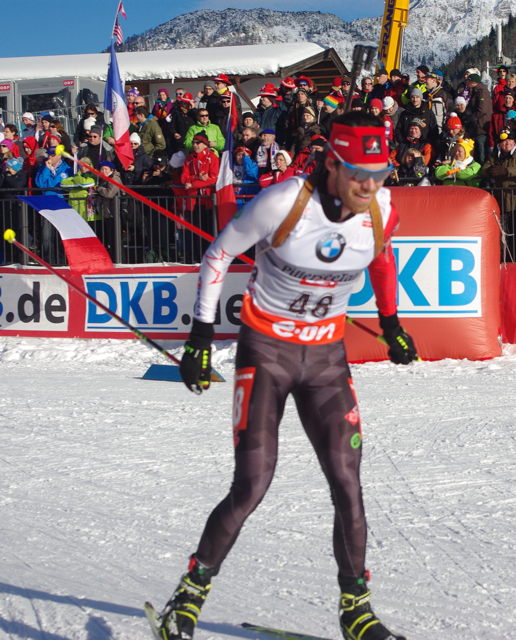
    Martin Fourcade (FRA) IBU world championships biathlon (Photo: NordicFocus)

    For those unfamiliar with the name, Fourcade retired from biathlon competition in March 2020 after a very successful career, including five Olympic gold medals and thirteen World Championships titles. He is the most successful French Olympian of all time and is celebrated as a beloved hero in his home country. Anywhere he went this weekend, he was accompanied by cheers and a train of fans hoping for autographs, handshakes, or photos. 

    The festival stretched over three days, beginning Friday, September 3rd and wrapping up on Sunday the 5th. Located in Annecy, in the Haut-Savoie department of France, the stadium sat facing the electric blue water of Lac d’Annecy, rimmed by limestone bluffs.

    It’s difficult to imagine a better setting for drawing crowds than the park Le Pâquier, which is right downtown and runs along the popular bike path that circumnavigates the lake. Indeed, the place was bustling with spectators all weekend long, both paying customers and those stopping by, drawn along the fence by all the commotion.

    Tickets cost €33 (about $40), and were sold out before the event began. As evidence, several posts were made in the days leading up to the festival on the French nordic Craiglist-esque site, searching for available tickets. 

    In addition to tickets, to enter the venue one needed to present their pass sanitaire, essentially a health passport in the form of a QR code which proves either you’ve been vaccinated, had a negative COVID test in the last 72hrs or, recovered from COVID in the last 11 days to 6 months. Furthermore, masks were required, even though the event was taking place outdoors where typically masks are not required in France. 
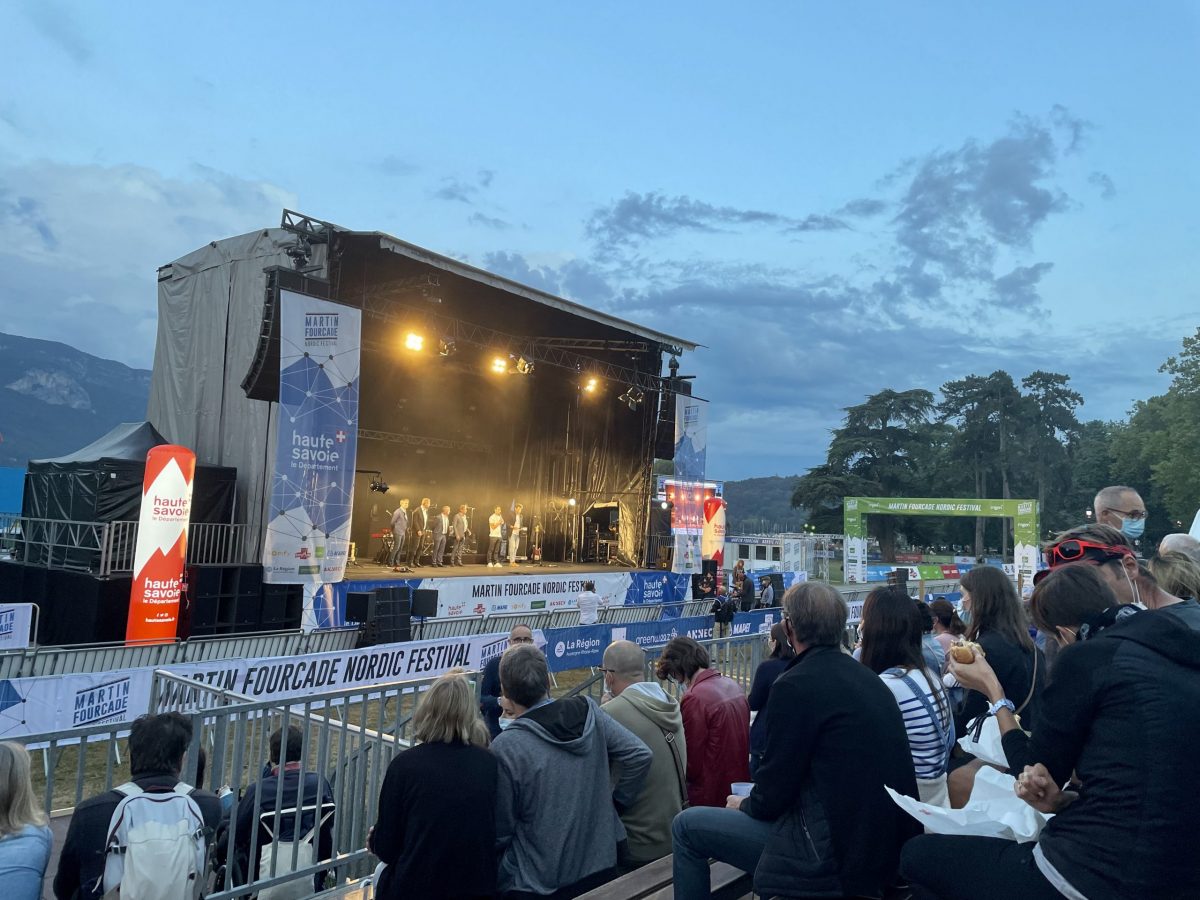
    Kicking off the weekend with the presentation of the athletes on Friday evening.

    The festivities kicked off in earnest Friday night, beginning with a presentation of the athletes on stage. While 30 international athletes had been recruited to the event, not all were able to make the journey. Many French national team members were present, both biathletes and cross-country racers, including: Richard Jouve, Renaud Jay, Delphine Claudel, Julia Simon, Anais Chevalier-Bouchet, Antonin Guigonnat, and Quentin Fillon-Maillet.

    As for the international contingent, some notable names in attendance were: Tiril Eckoff (NOR), Johannes Dale (NOR), Sturla Laegrid (NOR), Oskar Svensson (SWE), Jovian Hediger (SUI), Nadine Faendrich (SUI), Laurien van der Graaff (SUI), and Emma Ribom (SWE). 

    Following the presentation of athletes, a concert featuring Gaëtan Roussel, a well-known French musician drew quite a crowd and provided the festival with quite a lively start, setting the tune for the rest of the weekend. 
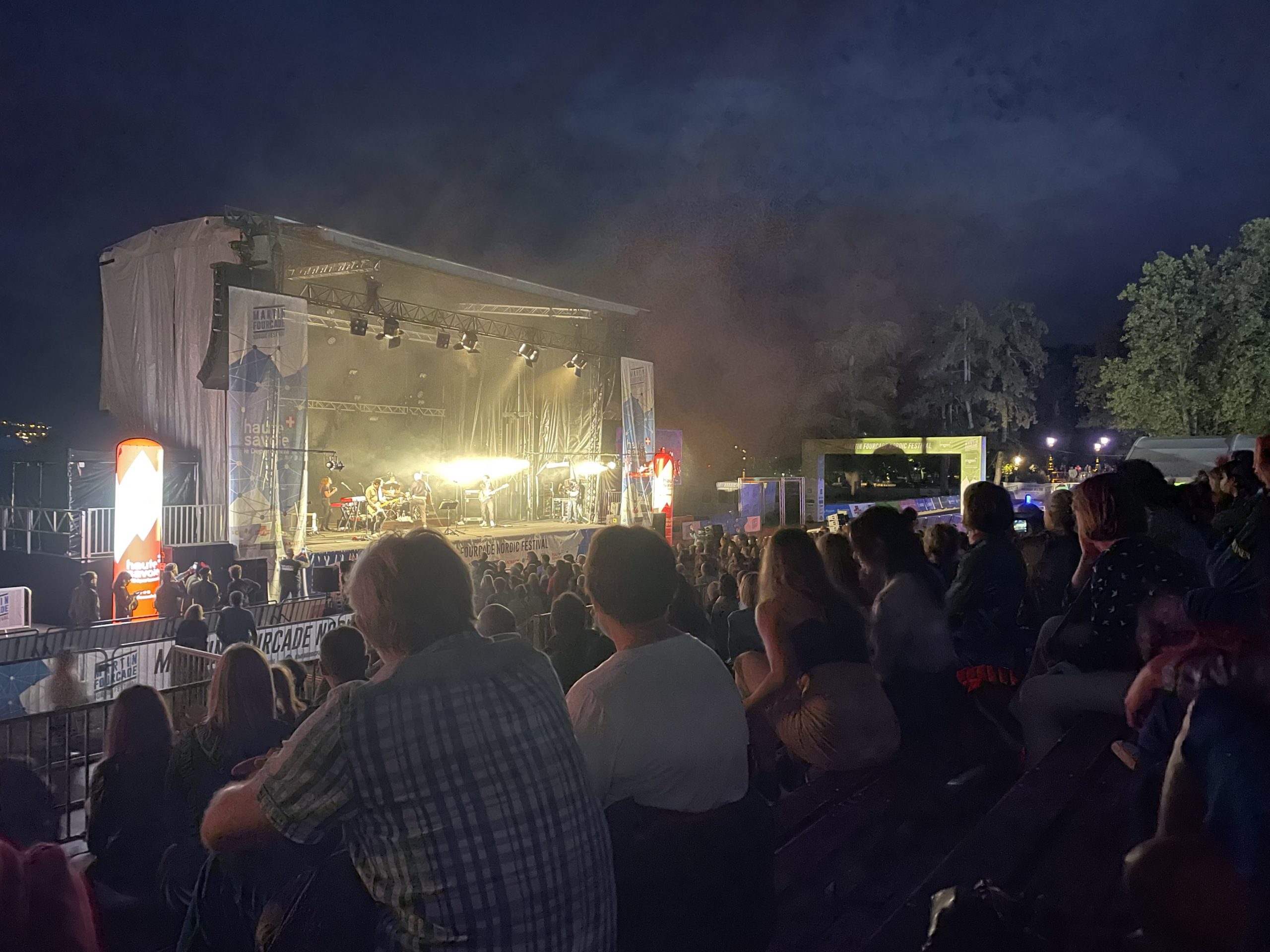
    Gaëtan Roussel in concert, Friday evening.

    Saturday started with the exposition village opening, a circle of vendor tents featuring nearly 60 brands, food and drink options, and shops. Attractions included, virtual biathlon, ski-erg competitions, and athlete appearances.

    Lines at both the Fischer and Salomon tents stretched for quite a distance as athletes patiently sat for hours, signing autographs and taking photos with fans. Not only were famous nordic athletes present, but recent competitors in the Ultra Trail du Mont-Blanc mountain running series, such as Camille Bruyas who took second place in the storied 170 km full tour around Mont-Blanc, and Thiabuat Beronian who finished 3rd in the 100 km “CCC”. These events both end in Chamonix.
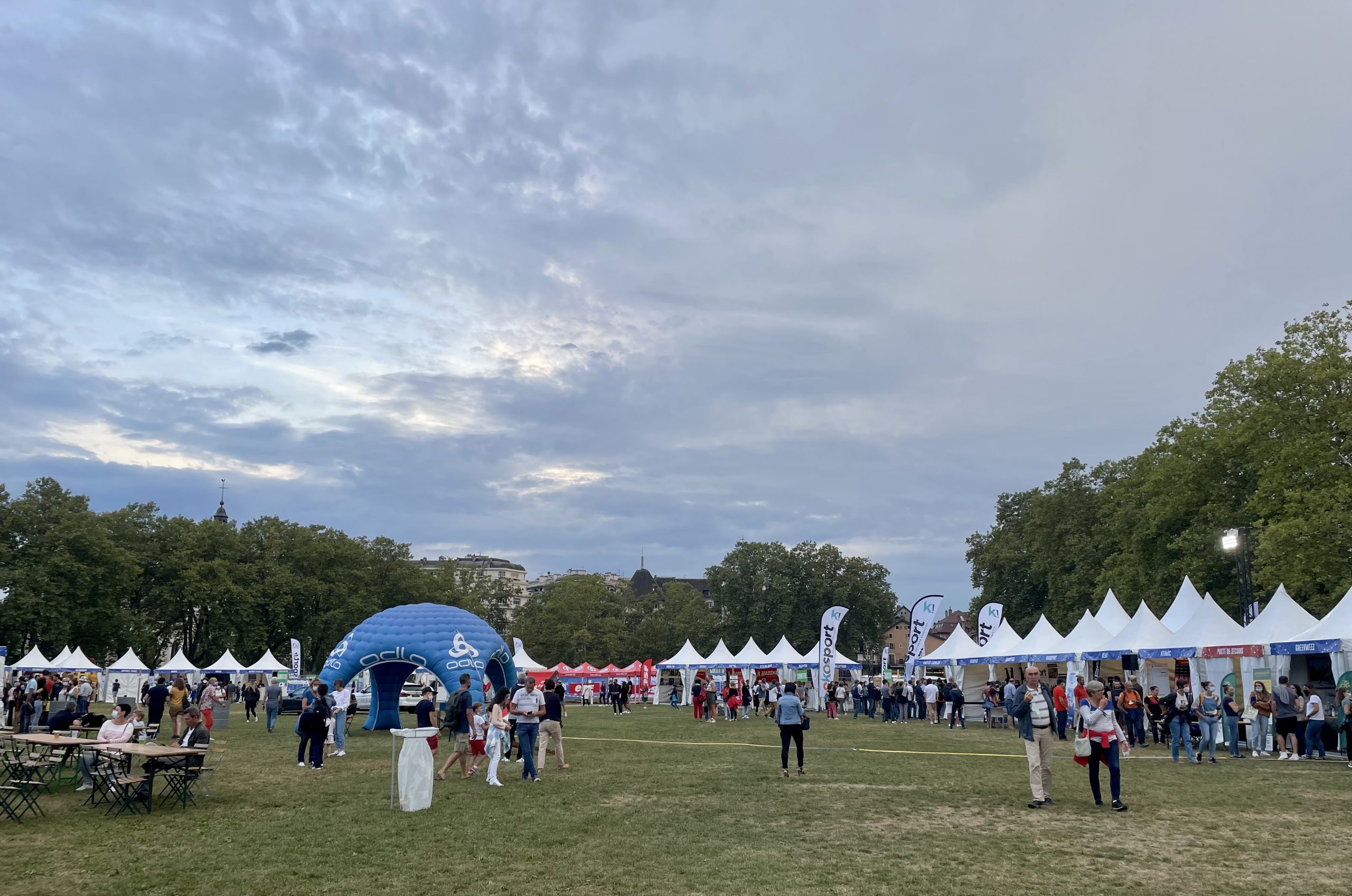
    The exposition area, filled with vendors (pictured here Friday evening).

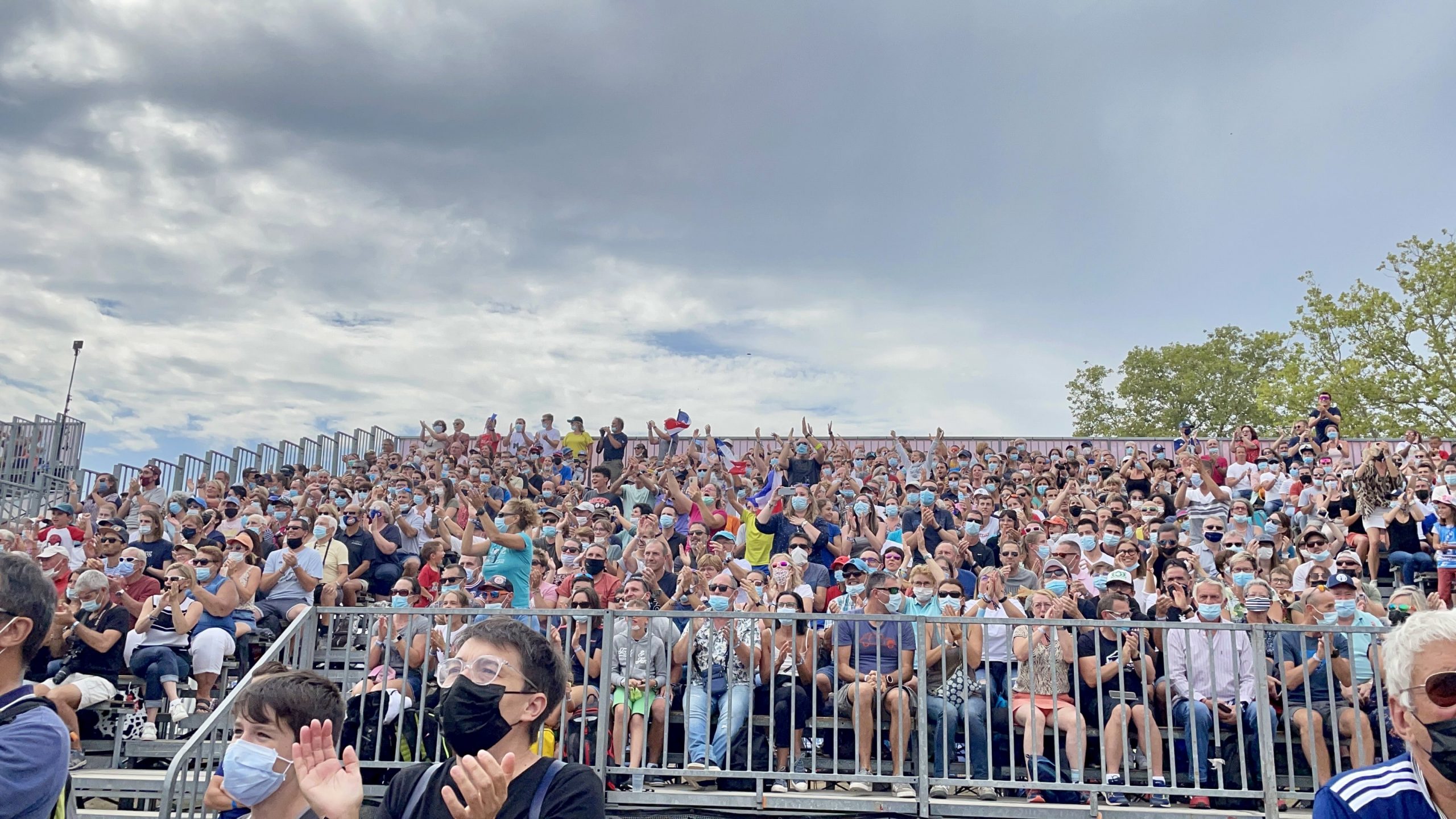
    Gradually, the crowd began to shift focus towards the stadium, as athletes started warming up for the afternoon show races. Over 3,000 attendees filed into the stands, giving Martin Fourcade a cheer that lasted for minutes as he gave an introduction.

    Explaining his motivation for organizing this event, Fourcade said, “When I think of a Nordic festival, I want an event that grows the sport, that shares the sport, and that promotes the sport.” He thanked the crowds for their support and provided a schedule for the afternoon events, starting with women’s biathlon. 

    Eight elite biathlete women toed the start line, headed by Eckoff of Norway. They completed four laps of the flat course, with two prone and two standing rounds of shooting. Eckoff lead to start, followed by Chevalier-Bouchet (FRA) who cleaned the standing shoot quickly and gained the lead for the penultimate lap, to the joy of the crowd.

    She maintained her lead and entered the final shooting round with a bit of a lead to Eckoff (NOR), cleaning again in rapid time. Franziska Preuss of Germany was second out of the range, followed by Eckoff.

    Out on the course, which at times was flanked directly by the lake where boaters had pulled close to cheer, Eckoff passed Preuss (GER) to find second place. Chevalier-Bouchet (FRA) finished first, Eckoff second (+14) and Preuss third (+29.2).

    The spectators were thrilled to begin the competitions with a French victory and showed their appreciation in the form of overwhelming applause.

    “Yeah it’s amazing,” said Chevalier-Bouchet after her victory, “Thanks everyone. I can’t hear anything because of the noise!”
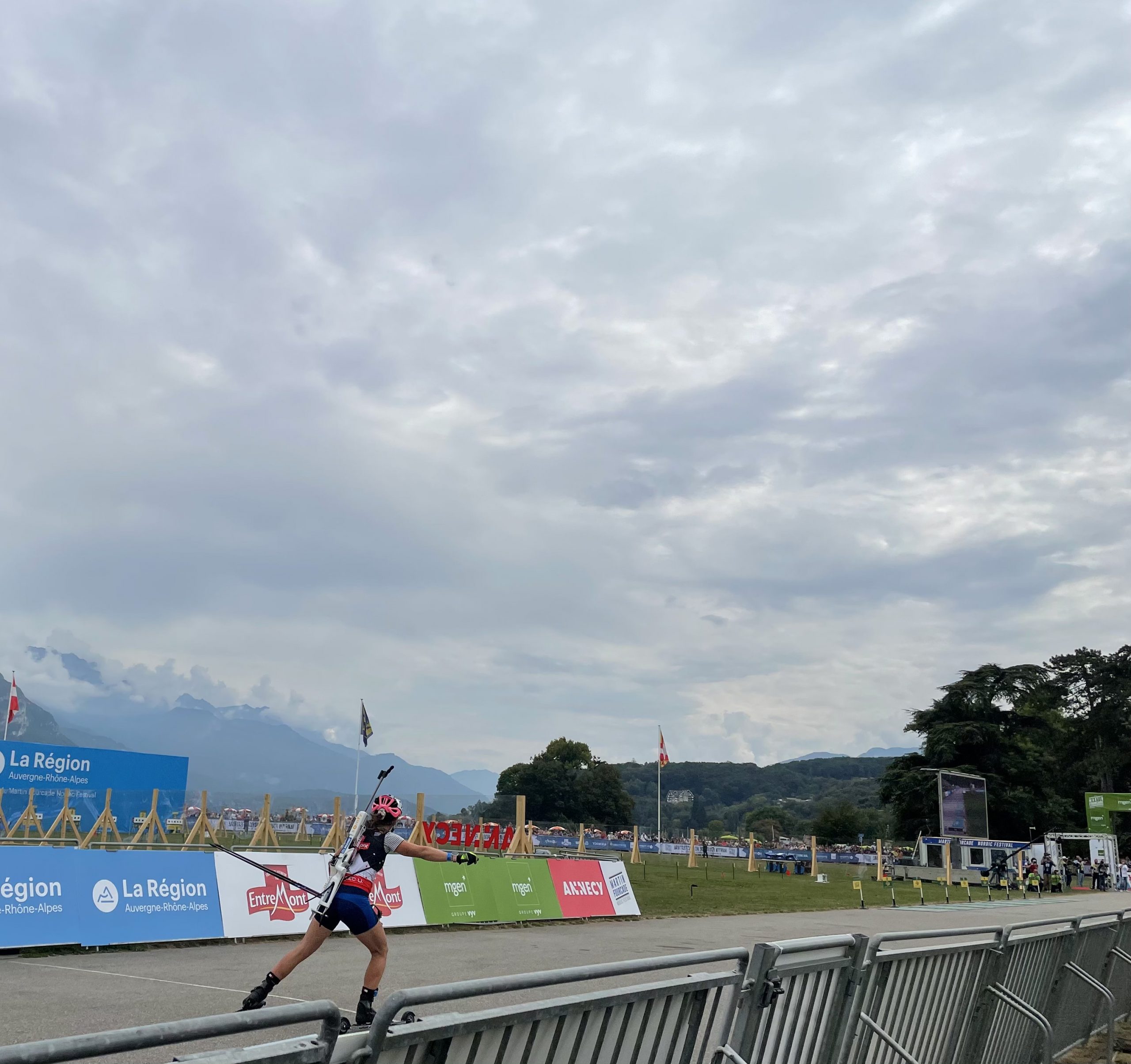
    Anais Chevalier-Bouchet (FRA) pumps up the crowd as she heads towards the finish line.

    Tiril Eckoff similarly enjoyed the support of the crowd and said, “It was very fun to be in such a good atmosphere again. It’s the first time in two and a half years to be in front of crowds so it’s really fun.” 
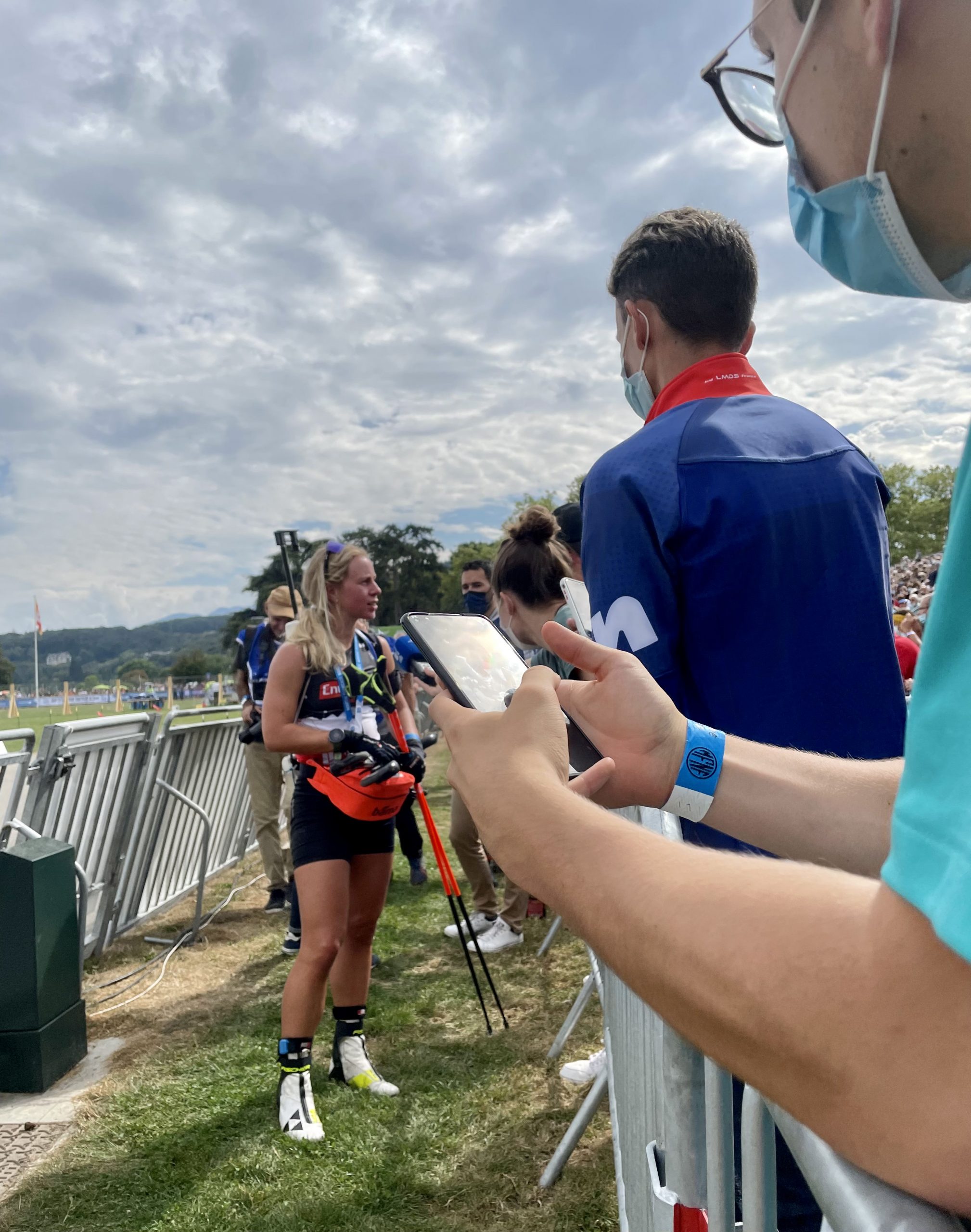
    Tiril Eckoff (NOR) finished second.

    Up next was the men’s biathlon. Guigonnat (FRA) was the first to clean and left the first round of shooting in the lead, while Fillon-Maillet (FRA), a fan favorite, struggled and exited well behind the pack. Through the second time, Doll of Germany was first to clean with Fak (SLO) right behind. Into the standing round, Laegrid (NOR) was the first to clean, Fak in second but with a penalty and Khalili (RUS) in third.

    Sturla Laegried (NOR) leads the pack along the lakeside. (Photo: NordicFocus)

    For the final time, Laegrid entered without anyone else in sight, shot 5/6 and left the range still in the lead. Khalili (RUS) was next out with Fak in third, followed closely by Fillon-Maillet who had made up ground and had a fast final round of shooting.

    Laegrid skied the last lap with a healthy gap and high-fived fans as he headed for the finish with a big lead, ending in 25:02.4. The Russian, Khalili held on for second place and Doll (GER) took third having passed Fillon-Maillet (FRA) and Fak (SLO).

    “I’m a very lucky man today so thank you Annecy!” said Laegrid after the race, “It was really fun and it was so nice to say hi to all my fans. Merci beaucoup!” 
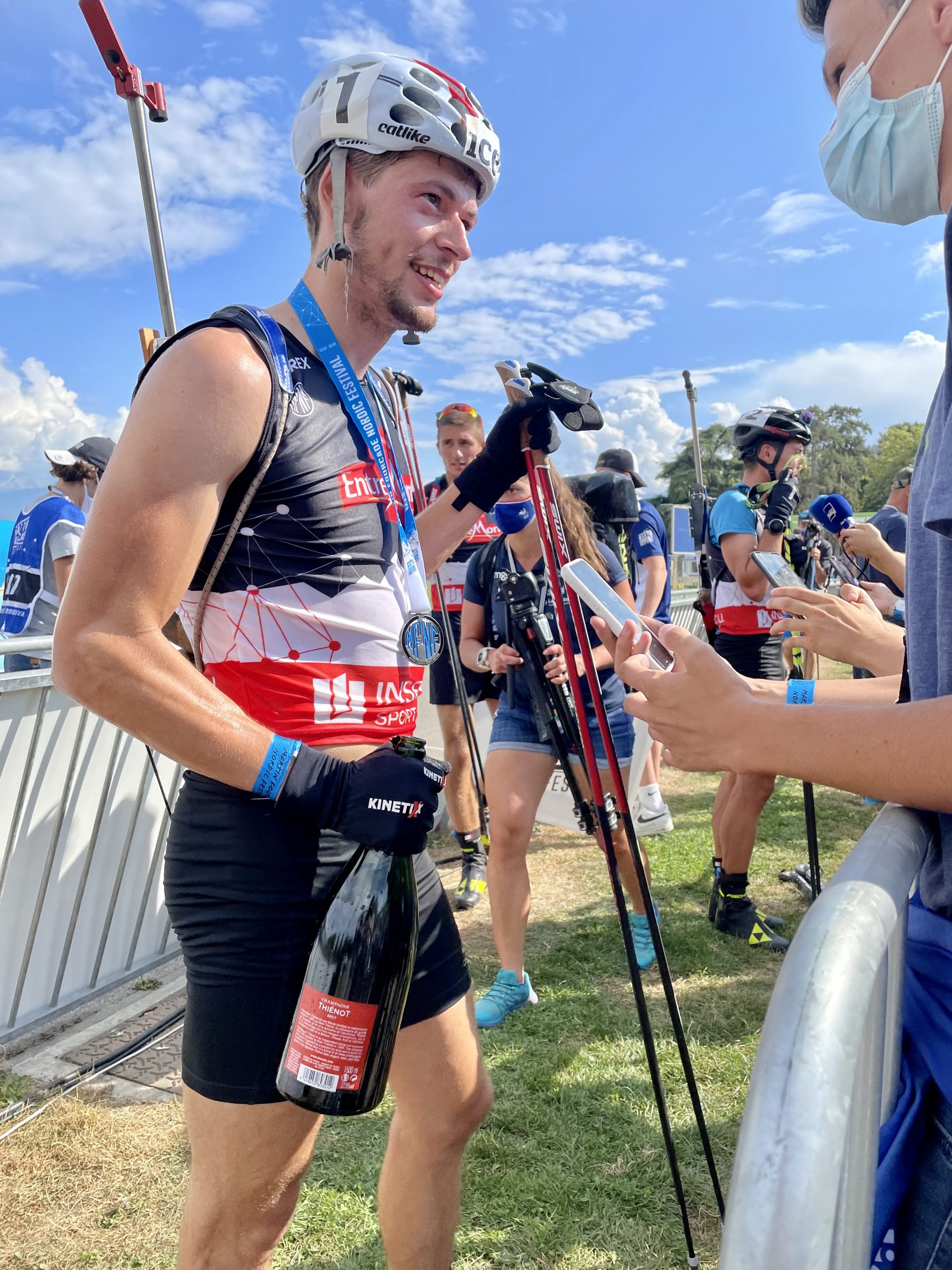
    Sturla Laegrid (NOR) holds a bottle of victory champagne after his win.

    With the biathlon races concluded, the crowd lost some it’s density before the cross-country rounds, biathlon being more popular. Nevertheless, there were still plenty of spectators who stuck around as the women lined up for their event. Not a true sprint event, the cross-country skiers completed six laps in succession with the final skier across the lap line being eliminated each round.

    The pack stayed tight for the first five laps, gradually losing skiers off the back. With a tight course, passing was quite difficult so the leaders did not change much. French skier Flora Dolci had the lead into the final lap, with the top seven athletes all within 1.4 seconds.

    Faendrich (SUI) dropped off as they passed along the lake, and then there were six. Ribom (SWE) made a pass to the front, shadowed by Van der Graaff (SUI). Rounding the final corner Van der Graaff launched an attack but Ribom held her off, keeping the advantage heading into the finish.
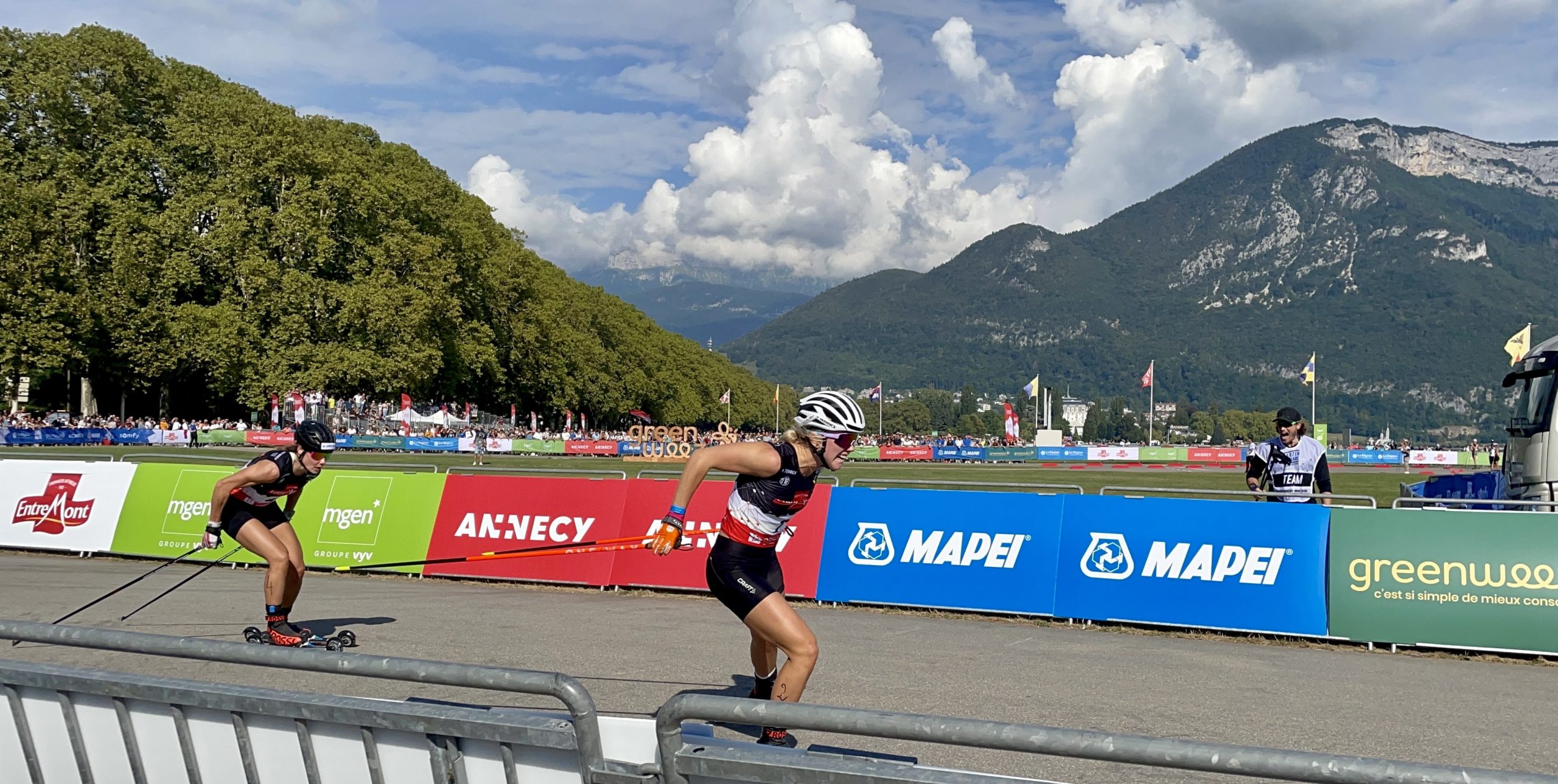
    Emma Ribom (SWE) guns for the finish line, followed by Laurien van der Graaff (SUI).

    Behind them, Dolci (FRA) outsprinted Claudel (FRA) to take third place, +4.5 back. “I felt really strong out there so it was a fun race,” said Ribom, “My plan was to have a good position the whole race so I tried to stay in the front and keep on pushing to the finish line.”

    Post race interview with Emma Ribom: 


    Van der Graaff, who speaks a bit of French, said, “I am very happy with the competition but not to do an interview in French! I tried really hard to get a second win here, but Emma was really strong.” 

    The final race of the day was the men’s cross-country. With such tight pack racing there was sure to be some broken equipment out there and sure enough, nearly every lap saw someone with a broken pole. Hugo Lapalus (FRA) was the first to be eliminated, Hediger (SUI) broke a pole near the end of the second lap and was next to stop.

    Svensson (SWE) dropped off the pace during the third lap and was stopped, followed by Valentine Chauvin (FRA) on the next lap. Jouve (FRA), a race favorite, broke a pole in lap three but managed to hang with the group, only to be eliminated with two laps to go. Heading into the final lap, Adrien Backscheider (FRA) had the lead, with Marcus Grate (SWE) the last to be eliminated.

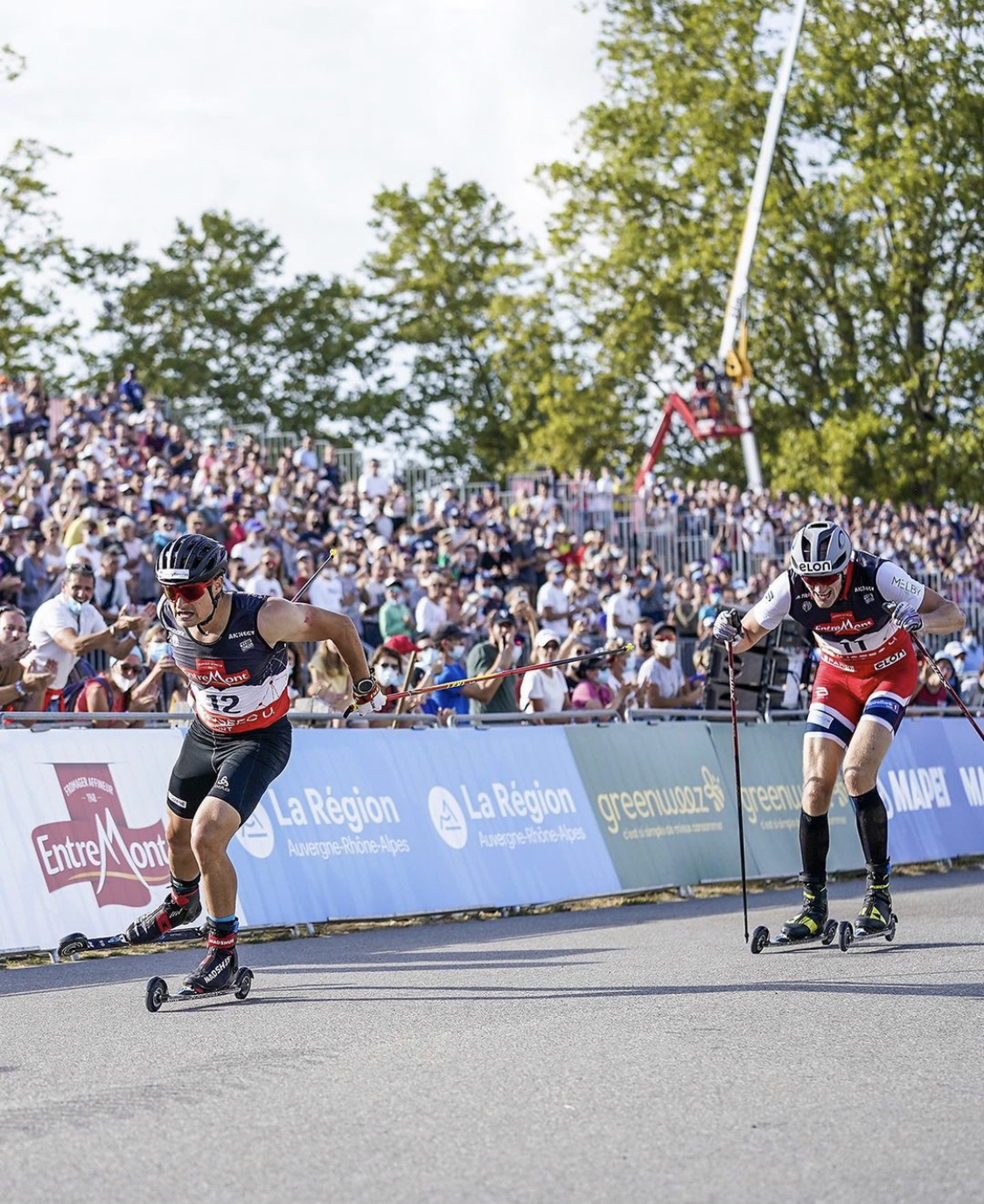
    As they neared the finish, Jay (FRA) and Pål Aune (NOR) were duking it out, ultimately the win going to Jay. Arnaud Chautemps of France finished third.

    “I’m really happy,” said Jay, “I wasn’t able to be here two years ago so this is really nice.” 
    Renaud Jay (FRA) and Pål Aune (NOR) speed towards the finish (Photo: NordicFocus)

    After the professionals raced on Saturday, it was the public’s turn to compete on Sunday. The “Biathlon Running” was open to all, involving teams of 4-6 in a relay style event. First up to compete were the kids, racing a 1km course with obstacles and shooting in between laps, followed by the adult teams.

    Kids navigate the “toile de l’araignée” (spider web) in Sunday’s obstacle course.

    There were three categories to sign up under (Mixed, female, and male) and the price was €200/team. The competitors were enthusiastic and lots of smiles were seen out on course, a fun way to wrap up a fun weekend. 
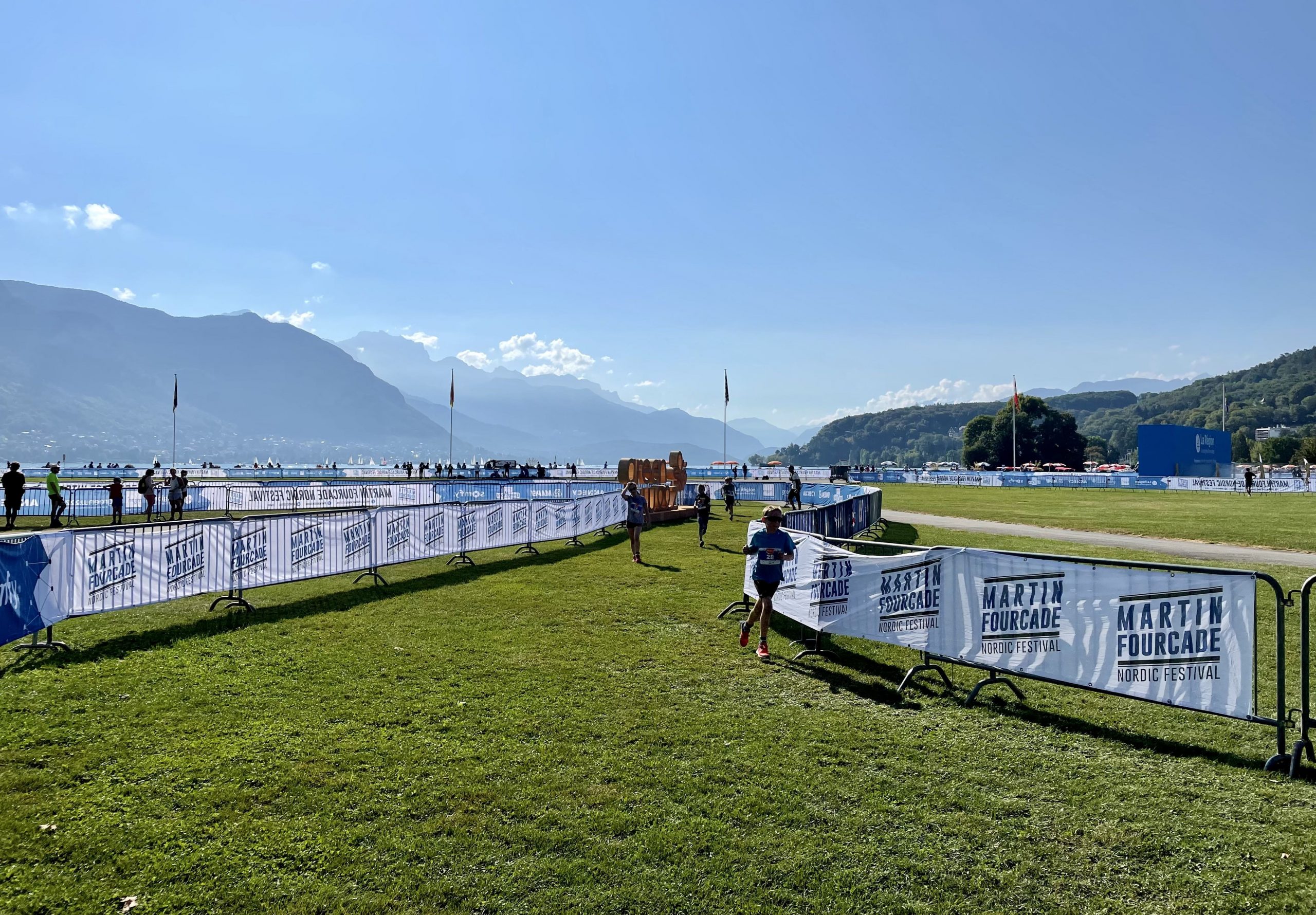
    Scenic backdrop of Sunday’s biathlon running event.
  • FasterSkier’s Biathletes of the Year: Tim Burke and Rosanna Crawford

    FasterSkier’s Biathletes of the Year: Tim Burke and Rosanna Crawford

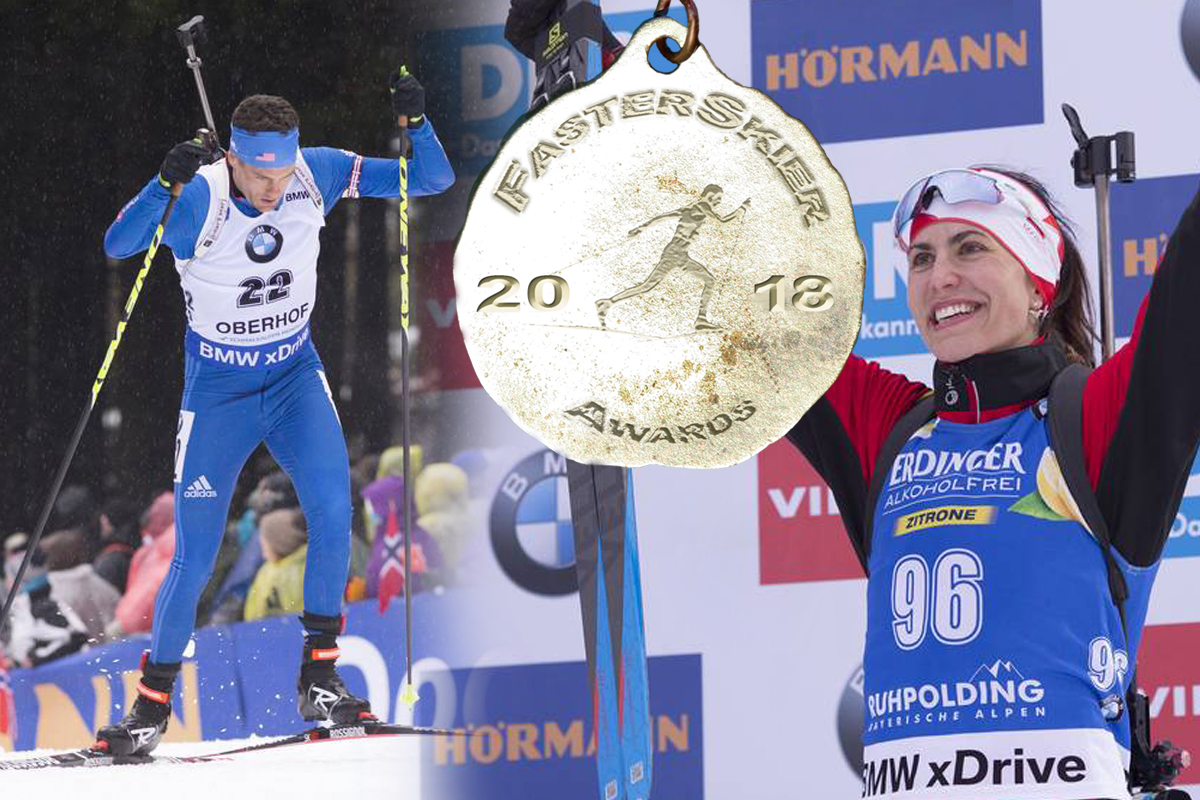
    Tim Burke of US Biathlon (left) and Rosanna Crawford of Biathlon Canada (right) are FasterSkier’s 2018 Biathletes of the Year. (Photos: USBA/NordicFocus; Salomon/NordicFocus)

    With the 2017/2018 season officially in the rearview, FasterSkier is excited to unveil its annual award winners for this past winter. Votes stem from the FS staff, scattered across the U.S., Canada, and Europe, and while not scientific, they are intended to reflect a broader sense of the season in review. This set of honors goes to outstanding North American biathletes on the international circuit.

    ***

    Rosanna Crawford, Biathlon Canada

    Rosanna Crawford had been close to the podium before, coming into this season. Fourth place. Fifth place.

    But then she had a disastrous 2017 season that left her in tears after World Championships, wondering what had gone wrong. After that, she lost her brother, as the Crawford family endured heart-rending tragedy.

    Rosanna Crawford celebrates with her Biathlon Canada teammates Emma Lunder (l) and Julia Ransom (r) after placing third for her first-career IBU World Cup podium on Thursday in the women’s 15 k individual in Ruhpolding, Germany. (Photo: Salomon/NordicFocus)

    All of that might have stopped some people, but not Crawford. In Ruhpolding, Germany, she finally scored that podium – in a race so tough it’s only held a few times a season, the 15 k individual. She shot a perfect 20-for-20 to take third place, 21.2 seconds behind Dorothea Wierer of Italy.

    “There’s just so many lessons you learn over the years, and trying to bring it all together and to have it pay off on one day is exactly what we’re all hunting for out there,” Crawford said after her podium.

    Later that weekend she again shot 20-for-20, this time in the mass start. She left the range the final time in first place, but was passed by three other women on the final loop and had to settle for fourth.

    “I was really surprised to leave the range in 1st, these are the 30 best women in the world,” Crawford wrote in an email after the mass start. “I would have love to hold onto a podium, but was pretty dead on my last loop… I was pretty disappointed when I crossed the line in fourth, but as time went by I got more and more happy. To have hit another 20/20 is fantastic, especially in the high pressure situation of a Mass Start. With that race I went 50/50 in Ruhpolding!”

    It was an up-and-down season for Crawford, who finished no better than 39th in the first period of World Cup racing and was sent down to the second-tier IBU Cup. But she excelled there, and then came the races in Ruhpolding.

    From there she headed to the Olympics – her third – and had a poor sprint race, finishing 53rd with three penalties. It was devastating, but she came back and climbed all the way up to 19th in the pursuit, the biggest improvement in the whole field.

    “I had some really good chats with my sister Chandra,” Crawford said after the Olympic pursuit. “She’s a huge motivator for me and my biggest cheerleader now. She really just talked some sense into me to not be so down on myself after the sprint, so that was really helpful.”

    Immediately after the Olympics, Crawford finished 12th in the sprint and 11th in the mass start in Kontiolahti, Finland, before finishing the season off in Oslo. She has still not announced whether she will continue competing next year, or retire.

    buy skelaxin

    But crossing the finish line in third in Ruhpolding was an unforgettable highlight, either way.

    “[Teammates] Julia [Ransom], Emma [Lunder] and Sarah [Beaudry], they kind of pushed past the IBU guys, which I don’t think they were allowed to do, but Canada’s not on the podium every day so they let them sneak by to give me a hug so that was really special,” Crawford told FasterSkier. “I’ve been with these girls the past couple years now and so to be able to celebrate with them is amazing. Their results have been so inspiring for me … [My coach Roddy Ward] also jumped the fence, which I don’t think was allowed, so that was nice to be able to see him as well.”

    Tim Burke, US Biathlon 

    While Crawford was finally hitting that career mark, U.S. Biathlon’s Tim Burke was getting his mojo back. After a frustrating few seasons, Burke rallied for the 2018 Olympics, his fourth.

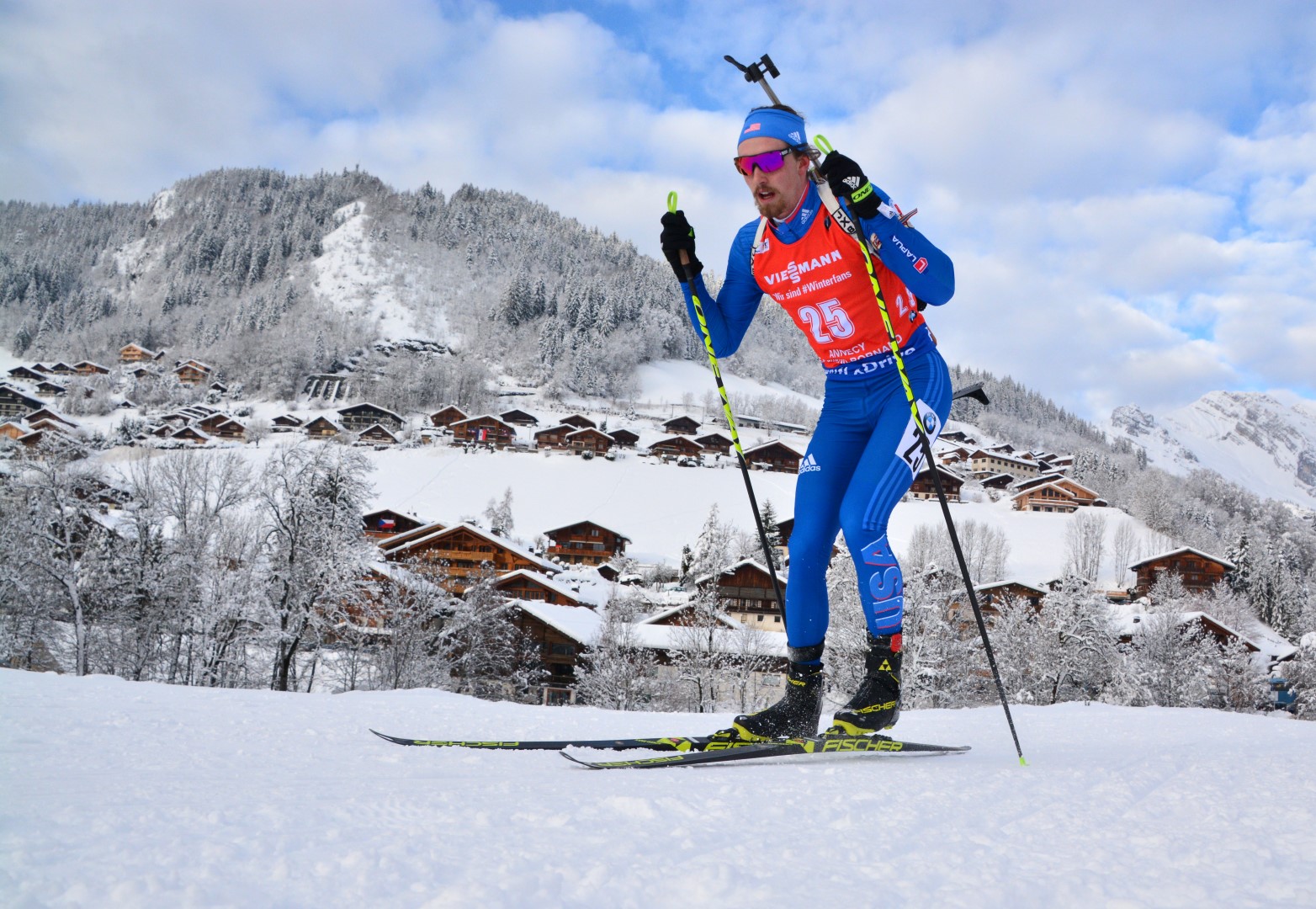
    Tim Burke (US Biathlon) racing to 14th in the men’s 12.5 k pursuit at the IBU World Cup in Oberhof, Germany. (Photo: US Biathlon/NordicFocus)

    Along the way, he amassed some strong results: tenth in the sprint in Annecy, fourth in the sprint in Oberhof. The Oberhof sprint was his best result since 2013.

    It came on a course with a personal connection, as his wife, Andrea (Henkel) Burke, had her home training base in Oberhof.

    “I have spent a lot of time training here over the last eight years,” Burke laughed. “It’s Andrea’s home town and I feel like the fans out there today were really behind me from the start, because of Andrea. So be able to have the best performance of my season and my best performance in a long time here was for sure special.”

    Burke didn’t set a best-ever U.S. mark for himself at the Olympics, with a top finish of 17th in the pursuit. Like Crawford, he made the best of things after a disappointing Olympic sprint, in his case having finished 47th in the opening competition.

    “I was disappointed in the result not the performance,” he said of the sprint, after improving in the pursuit. “I felt like I executed well. I felt like I hit my cues on the course and on the range, and it just didn’t happen yesterday. The game plan going into today, there was nothing new. Stick to the things that have been working well for me in the World Cup, and that’s what I did.”

    In PyeongChang, he contributed to a U.S. men’s relay team which finished sixth, tying the best ever team result at an Olympic Games.

    A few weeks later, in his final race before retiring, he went out and did some solid biathlon, helping the team to seventh in the World Cup relay in Oslo.

    Burke’s career has had many individual highs – six podiums including a World Championships silver medal in 2013, and a brief stint in the overall World Cup leader’s bib – but this season, it was his team efforts that were some of the best.

    “The Olympic relay, we were very happy with,” he said in Oslo. “The sixth place there [in PyeongChang, South Korea], we were right there. That was a great race for us, but this is solid as well… I’ve been here a long, long time, and an top eight today is very different than a top eight when I came on the World Cup 14 years ago. It’s so close now. There’s so many good teams. So it’s a solid result.”

    Honorable Mention: Susan Dunklee, US Biathlon

    Burke’s teammate Susan Dunklee saved the best for last this season, hitting the podium for the first time since winning silver in the mass start at last year’s World Championships.

    Susan Dunklee racing to 20th in the mass start in Annecy, France. (Photo: Glen Crawford)

    It was a tough start to the season for Dunklee, who tried to implement a new shooting strategy and saw it backfire, as she had a string of results no better than 53rd in the opening two weekends of racing.

    But then she had a solid weekend in Annecy, France, finishing tenth in the sprint and sixth in the pursuit. A lifeline.

    “After Thursday, I was just feeling relief, to be honest,” she said after the Annecy pursuit. “It’s so huge to get a top ten and then get a flower ceremony today.”

    Two months later, Dunklee had an athlete’s worst nightmare and got sick at the beginning of the Olympics, racing the opening sprint anyway but then finishing 66th and missing the pursuit. In the 15 k individual she placed 19th, and she led the women’s relay at one point.

    “I often start feeling stronger and stronger as the season goes on, and this season it took a little longer,” Dunklee explained. “I had a lot of sickness, and some frustrating shooting days early in the season that made it hard for me to keep going.”

    After the Games, she finished 36th in the sprint in Kontiolahti despite still getting over (another) illness, then came to Oslo and placed fourth in the sprint and third in the pursuit, in a podium that only appeared thanks to clean shooting in the final stage where others faltered.

    “It doesn’t really matter what everybody else is doing, you just have to try to put the best race you can,” she said of landing on the podium despite two penalties. “Sometimes you have a perfect race and five other people do too, and then you are sixth. But some days you don’t have a perfect race and you end up third.”

    Like Crawford, Dunklee hasn’t announced whether she will keep racing next season. If not, her last World Cup memory will be sharing the podium with Anastasiya Kuzmina and Darya Domracheva. Not bad.

    Honorable Mention: Scott Gow, Biathlon Canada

    Canada’s Scott Gow just keeps improving, and this season was no exception. Early on he had two career-best performances: 16th in the sprints in both Östersund and Annecy.

    Scott Gow (Biathlon Canada) after placing 16th in the IBU World Cup men’s sprint on Friday in Annecy, France. (Photo: Glen Crawford)

    But the biggest career-best also came on the biggest stage. At the Olympics, Gow shot 19-for-20 in the 20 k individual to finish 14th, the best performance by any North American in PyeongChang.

    He had started the Games with 61st in the sprint – maybe the worst place to finish, just one spot (in his case one tenth of a second) out of the pursuit.

    Gow re-tooled and started focusing on the 20 k.

    “When it’s this calm, relatively as calm, everyone can shoot well,” he said after that race. “So that puts a little extra pressure and emphasis on myself to shoot well. So going into today I knew that would be have to the focus, to hit targets, because even if my skiing is a little off I can make up for it with a really good shooting. And that was what was going through my head the last few days preparing for this.”

    Plan achieved, mission accomplished. Except that one shot.

    “I was very happy with it,” Gow said, noting that even a career-best at the Olympics wasn’t perfect. “A little disappointed to miss that one standing shot, especially when everything was going quite well in the range. Skiing was pretty good, and so overall I am very happy.”

  • Notes and Quotes: French Biathlon World Cup Weekend

    Notes and Quotes: French Biathlon World Cup Weekend

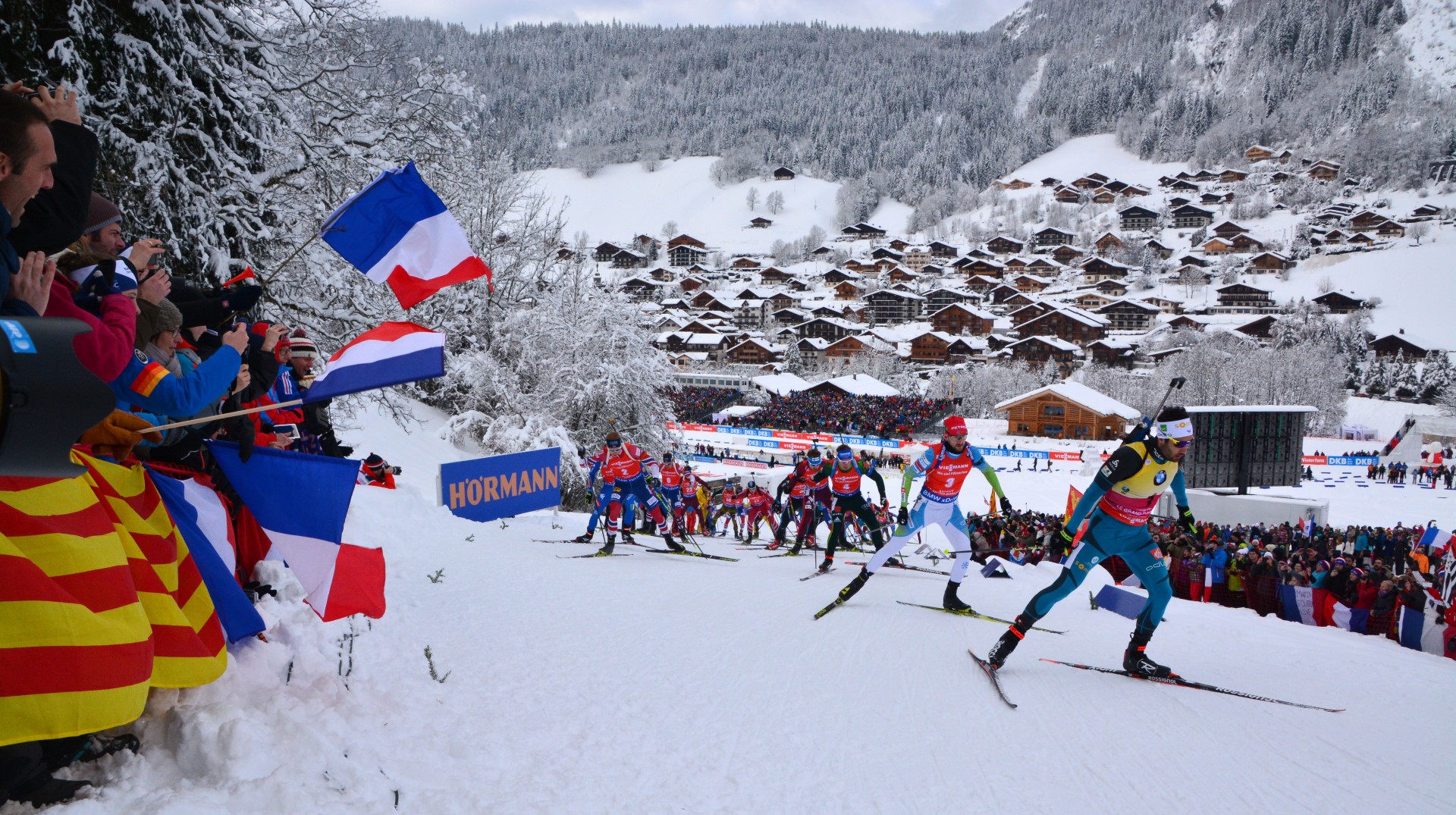
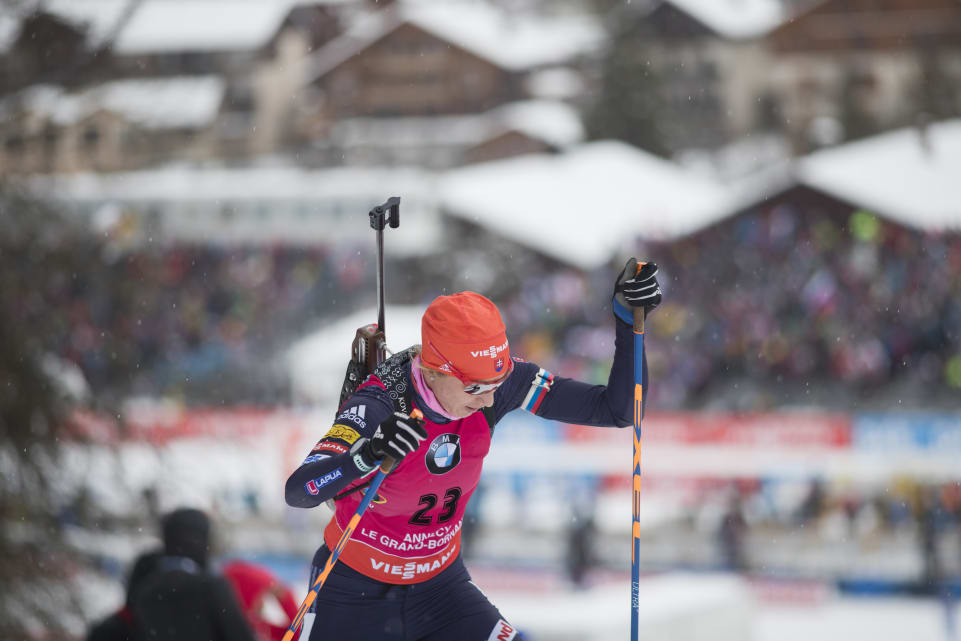
    Martin Fourcade of France leads the IBU World Cup 15 k mass start in Le Grand-Borland, France, on Sunday. (Photo: Glen Crawford)

    LE GRAND-BORNAND, France — After a long weekend of racing, beginning with heavy snow and continuing with glazed tracks, the biathlon World Cup is on break for two weeks to recalibrate and rejuvenate as the athletes prepare for the rest of the season and the 2018 Olympics in February.

    Here’s what some members of the field thought about the races this weekend – the bits of interviews and press conferences that didn’t make it into our race reports.

    On Pressure

    “This was tougher than some World Cups where we are less expected. But it’s also what we want, asking for a World Cup at home. We know that it’s not the same as when we are competing in Norway. It’s so much bigger in terms of emotions. I would do it again.”

    — Martin Fourcade (France)

    Susan Dunklee of U.S. Biathlon after the mass start, which moved her up to being ranked 30th on the World Cup after a disastrous first two weeks of racing had left her out of the points. (Photo: Glen Crawford)

    On Annecy & Le Grand-Bornand

    “I like this place. Four years ago I was on the podium too in the pursuit behind Johannes. I was one year later on holiday here. I like this place, I like the people. It’s a really nice nature, mountain, valleys. I know that I got some Reblochon cheese, too.”

    — Erik Lesser (Germany)

    “It was very loud. I couldn’t hear what my coaches were saying on the side of the course at all. I knew they were there because I could see them out of the front of my eyes, but their voices just got lost in that big, massive noise. Getting this many people here, is absolutely incredible. It has grown so much since last time [in 2013]. It’s a lot of positive energy, and that counts for a lot.”

    — Susan Dunklee (USA)

    “I love it. It’s definitely a different race course with those steep little bumps. But I think it could be [more often] on the circuit.”

    — Julia Ransom (Canada)

    “There are amazing trails that go up the valley. I just went for a classic cruise yesterday just looking around everywhere in awe. The food… We are staying right in the downtown, and the food in our hotels is like cheese and dessert after every meal. I’m like ‘oh no I have to pass on that…’ And the fans, too, I couldn’t believe it. They are so loud, cheering for everyone. I was a little bit overwhelmed just with the sound during the race. I was like ‘okay, keep going’. I love this place.”

    — Emma Lunder (Canada)

    Anastasiya Kuzmin of Slovakia leading the women’s mass start. (Photo: Glen Crawford)

    “We had a really good atmosphere four years before. But now we really have so much snow in the mountains and in the village. That is why we all make biathlon – we love winter and we love the snow. I’m really happy to have such good conditions here.”

    — Laura Dahlmeier (Germany)

    “You can feel power from the mountains and the snow. What is more important is that there are many fans here… you feel the power from the people who are always supporting you. It’s like a big energy wave. On the track it helped me. Thank you so much.”

    — Anastasiya Kuzmina (Slovakia)

    “Every athlete has their World Cup which is their favorite and where they always do good races. And I think this is one of my top three venues on the World Cup. I really like it here.”

    — Johannes Thingnes Bø (Norway)

    “I want to point out that the organization and the popularity of biathlon grew a lot since 2013. I was really surprised to see so many people around the track cheering, not only local athletes but also international athletes. I could hear them saying my name. So I want to thank them for supporting us.”

    — Anton Shipulin (Russia)

    On Three Weeks of Racing, and Now a Break

    Emma Lunder of Canada competing in the mass start in Le Grand-Bornand, France. (Photo: Glen Crawford)

    “I think it’s great to finish with a nice race. Now I can enjoy the time at home, the time in France. And keep confident of the work which was done.”

    — Justine Braisaz (France) after winning the mass start

    “I think my shape is getting better and better and also on the shooting range. It’s important to make some good races, it’s good for your own feeling. It’s good for the Christmas holiday now.”

    — Laura Dahlmeier (Germany) after finishing third in the mass start

    “To have good races going into the Christmas break, that’s all I could ask for… Now we can feel like we did a good job, relax, and get some good training in.”

    — Emma Lunder (Canada), who had her best-ever World Cup result and qualified for her first mass start

    “Yeah, I definitely felt [the fatigue] today, but you kind of come to expect that after the first trimester. Now we have a good block of recovery time, and I’ll definitely be looking forward to a few days off.”

    — Lowell Bailey (USA)

    (l-r) Erik Lesser, Martin Fourcade, and Johannes Thingnes Bø after the mass start. (Photo: Glen Crawford)

    “It is always a fight there. Today [Erik] Lesser was there also and [Anton] Shipulin is coming back top-six too. They will be stronger after Christmas.”

    — Johannes Thingnes Bø (Norway), winner of the sprint and pursuit, after the mass start

    “I’ll be getting some good volume training in, I think. Kind of reset the body and get a bit of a training load.”

    — Scott Gow (Canada)

    “I felt pretty tired today, and then on top of it everyone is fast in the mass start… I was looking forward, looking forward to the finish line.”

    — Emma Lunder (Canada), after the mass start

    “Now I’m just [working on] my good shooting and staying concentrated on the shooting position. I think I need a little bit more time, a little bit more practice. But I’m happy that my ski times are still good.”

    — Anastasia Kuzmina (Slovakia)

    Mission Accomplished

    Scott and Christian Gow of Canada after the pursuit, where they both finished in the top 30. (Photo: Glen Crawford)

    “I was hoping to just lock up the Olympic qualification and get that off my back, which is really nice. And then really just put together a solid three sets of races. Last year I was sick, and I wasn’t even in Europe at this point. I was kind of just slogging my way back to good health. So I’ve had some good races here and it’s a good block to start the year… Last year taught me how to grind through something that isn’t the best hand of cards that you could have been dealt.”

    — Sean Doherty (USA), who was named to the U.S. Olympic Team after his performances this weekend

    “I’m really glad that we are finally part of the podium. Finally third, on the World Cup.”

    — Anton Shipulin (Russia), after finishing third in the pursuit and earning Russia’s first podium of the season

    Goals

    Laura Dahlmeier of Germany setting up to shoot in Thursday’s sprint. (Photo: Glen Crawford)

    “I’ve been trying to win the yellow bib every year since I came in the World Cup. But I’ve never had a chance. So we will see this year. But I know it’s a long way there. Now I’m just focusing on the race today, and the next race, and not about the whole season. I’m in good shape here and I try to do the best I can.”

    — Johannes Thingnes Bø (Norway), currently trailing Martin Fourcade by 20 points in the World Cup Total Score

    On Ski Speed

    I’m definitely working my way back into it. I don’t feel 100% on skis. I felt good all the way up to the beginning of the season, and then got set back with some sickness. But I’m still confident with how we trained this summer, and the path towards PyeongChang, so just have to stick to the plan.”

    — Lowell Bailey (USA)

    “Honestly, my skiing, I’m not very satisfied with it at the moment. It’s coming back, step by step, and week by week it has improved, but I feel like there is a lot of room there and I don’t totally feel like myself yet. There’s still plenty of season left.”

    — Sean Doherty (USA)

  • Sunday Rundown: Ramsau, Toblach, Annecy, St. Ulrich, Rossland (Updated)

    Sunday Rundown: Ramsau, Toblach, Annecy, St. Ulrich, Rossland (Updated)

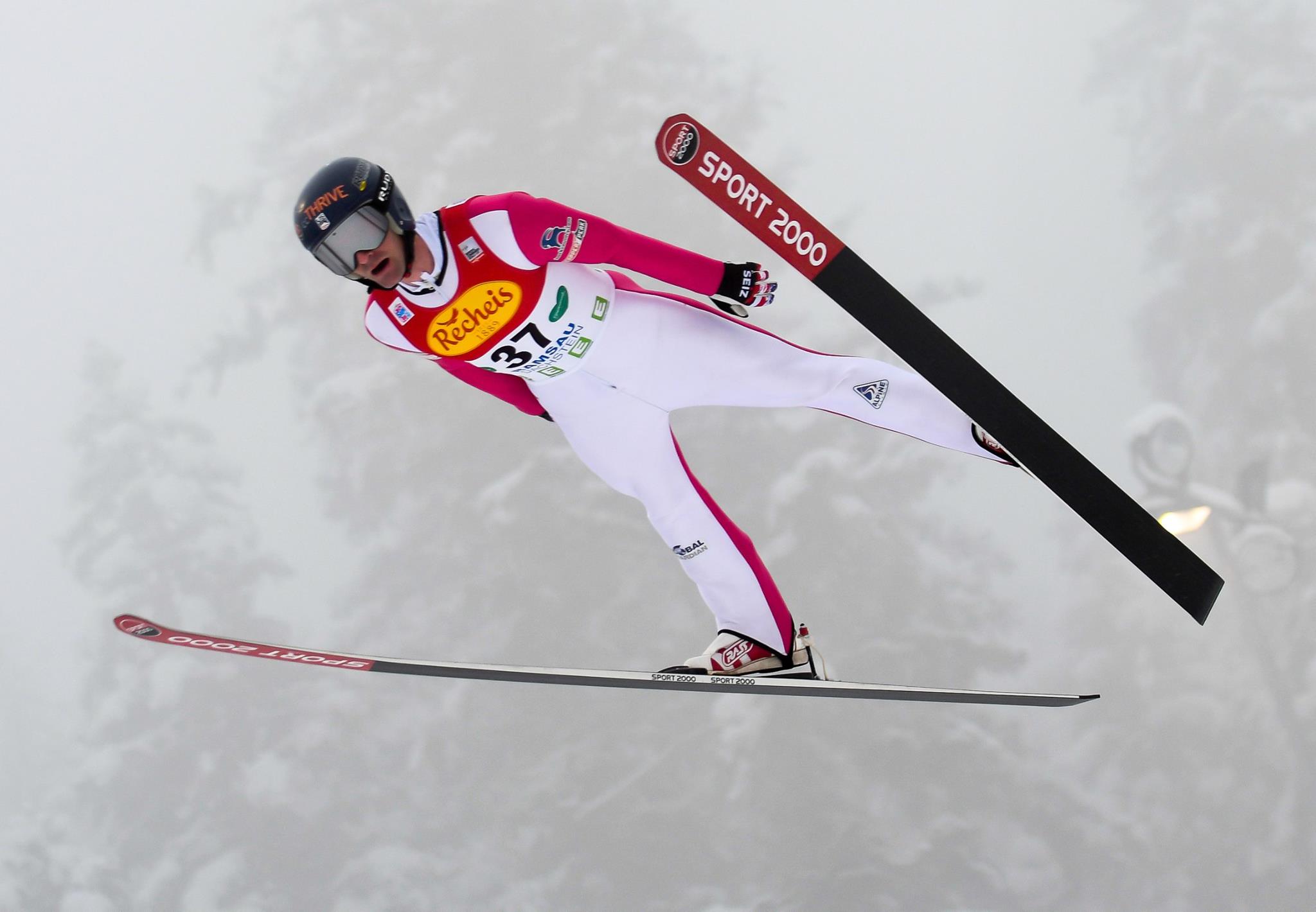
    Bryan Fletcher (USA Nordic) jumping to 45th in the Nordic Combined World Cup on Sunday in Ramsau, Austria. In the 10 k that followed, he skied the third-fastest time to finish 14th overall. (Photo: Romina Eggert/USA Nordic Facebook)

    NorAm mini tour (Rossland, B.C.): 10/15 k freestyle pursuits

    Team Gregg ended the Rossland NorAm mini tour with another double win, with American Caitlin Gregg and her husband Brian Gregg winning the 10- and 15-kilometer freestyle pursuits, respectively, at the Black Jack Ski Club trails.

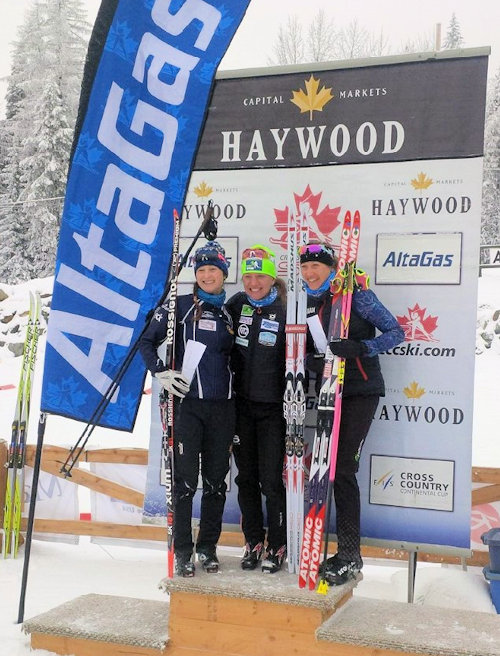
    The women’s 10 k freestyle pursuit podium at the NorAm in Rossland, B.C., with American Caitlin Gregg (c) in first, and Canadians Zina Kocher (l) and Andrea Dupont (r), in second and third, respectively. (Photo: Cross Country Canada)

    Caitlin capped the long weekend with her third-straight win, a 48.28-second victory over former Canadian biathlete Zina Kocher (Foothills Nordic). Caitlin started first and was first across the finish in 29:02.86, while Kocher started ninth and rose to second place for her second-consecutive podium (after placing third in Saturday’s skate sprint). Andrea Dupont (Rocky Mountain Racers) started fourth and finished third (+1:58.35) for her second-straight podium as well (she was second in the skate sprint behind Gregg).

    Lisle Compton of the National Team Development Centre (NTDC) Thunder Bay and Canadian National Junior Team finished fourth overall (+2:07.03), Frederique Vezina of the Pierre-Harvey National Training Centre (CNEPH) was fifth (+2:16.10), and Annika Hicks of the Alberta World Cup Academy (AWCA) sixth (+2:16.51). Laura Leclair (CNEPH) placed seventh, Kaia Andal (Caledonia Nordic) was the top junior in eighth overall, Jaqueline Mourao (Brazil Ski Team) ninth, and Sophie Carrier-Laforte (Skinouk) 10th.

    Brian, who won the Rossland men’s 10 k classic on Friday, also started Sunday’s 15 k freestyle pursuit first and finished in that position in 38:43.93. Andy Shields (Lappe Nordic) raced to second overall, 7.65 seconds back, after starting fourth, and Jack Carlyle (AWCA) reached the podium in third (+8.75) after starting 10th.

    Evan Palmer-Charrette (NTDC Thunder Bay) ended the weekend in fourth (+17.68), Philippe Boucher (CNEPH) was fifth (+19.02), Brian McKeever (Canadian Para-Nordic Ski Team) sixth (+22.16), Michael Somppi (AWCA) seventh (+34.62), Alexis Dumas (CNEPH) eighth (+52.78), Bob Thompson (NTDC Thunder Bay) ninth (+54.76), and Julien Locke (Black Jack/Canadian U25 Team) 10th (+1:04.46).

    Results

    ***

    FIS Nordic Combined World Cup (Ramsau, Austria): Saturday & Sunday individual competitions

    Bryan Fletcher (USA Nordic) notched seventh in the Nordic Combined World Cup this weekend in Ramsau, Austria, for his best result since January 2016. (Photo: USA Nordic/Facebook)

    After a bye week, the Nordic Combined World Cup resumed in Ramsau am Dachstein, Austria, with back-to-back individual normal hill/10-kilometer Gundersen starts on Saturday and Sunday.

    On Saturday, American Bryan Fletcher posted his best individual result in nearly two years in seventh place, 32.6 seconds behind German winner Eric Frenzel.

    Saturday’s individual competition on Ramsau’s 98-meter hill started out with Japan’s Taihei Kato going farthest in the jump portion, the Czech Republic’s Tomas Portyk jumping to second, and Frenzel jumping to third. Fletcher tied Japan’s Yoshito Watabe for 28th and the two started the 10 k race 1:02 minutes back accordingly.

    While Frenzel picked off two places to finish first in 24:05.8 minutes, Fletcher moved up 21 spots to seventh place with the second-fastest course time of 23:48.4.

    Germany had two on the podium with Fabian Rießle just 0.7 seconds back in second place, and Norway’s Jan Schmid finished third, 8.1 seconds behind Frenzel.

    On Sunday, Rießle climbed to the top step on the podium, winning the weekend’s second normal hill/10 k in 26:12.5.

    Norway’s Jørgen Graabak led after the jump portion, yet ultimately finished sixth, 9.8 seconds behind Rießle.

    Rießle jumped to ninth and started 18 seconds out of first, then took the win on the four-lap course by just 0.3 seconds over Italy’s Alessandro Pittin. The Italian notched second place after starting 36th based on his jump and racing the fastest 10 k time in 25:00.8.

    Finland’s Eero Hirvonen finished third (+1.5) after starting 10th, and Schmid was another 2 seconds back in fourth (+3.5) after jumping to seventh. Frenzel did not start.

    Three Americans qualified for Sunday’s competition. Fletcher jumped to 45th and started 1:30 back, yet rose to 14th (+43.7) with the third-fastest course time. His younger brother Taylor Fletcher skied the second-fastest course time to finish 34th (+2:01.6), up 24 places after jumping to 58th. Adam Loomis finished 52nd (+4:38.6) after jumping to 59th.

    The U.S. Nordic Combined team is headed back to the states to prepare for U.S. Olympic trials later this month, according to the USA Nordic Facebook page.

    Results: Saturday | Sunday

    ***

    FIS Cross Country World Cup (Toblach, Italy): 10/15 k classic pursuits

    Norway’s Johannes Høsflot Klæbo after winning the men’s 15 k classic pursuit for his seventh World Cup win of the season on Sunday in Toblach, Italy. With win No. 7, he has the most wins before the new year in FIS Cross Country World Cup history. (Photo: FIS Cross Country/Twitter)

    Women’s report

    Men’s report

    If you thought Johannes Høsflot Klæbo was out, think again. After placing 10th in the men’s 15-kilometer freestyle on Saturday in Toblach, the 21-year-old Norwegian raced to his seventh victory of the season in the men’s 15 k pursuit on Sunday.

    In doing so, Klæbo broke the record for the most World Cup wins before the New Year: he’s tallied seven in the last eight races he’s contested.

    On Sunday, he started 10th, 36 seconds behind his Norwegian teammate Simen Hegstad Krüger, who won the 15 k freestyle and started first. Klæbo had worked his way up to third by 11.4 k, and at the finish, he edged Russia’s Sergey Ustiugov by 1.9 seconds for the win in 33:31.1 minutes.

    Ustiugov, who started fifth, claimed second, and Kazakhstan’s Alexey Poltoranin rose from 14th to third place (+4.5), ahead of Russia’s Alexander Bessmertnykh in fourth (+9.7), Finland’s Matti Heikkinen in fifth (+9.8), France’s Maurice Manificat in sixth (+10.7), Norway’s Hans Christer Holund in seventh (+11.1), Switzerland’s Dario Cologna in eighth (+11.8), Canada’s Alex Harvey in ninth (+16.3), and Krüger in 10th (+24.0). Norway’s defending Overall and Distance World Cup champion, Martin Johnsrud Sundby placed 11th (+34.4) after starting 20th based on his result on Saturday.

    Erik Bjornsen once again led the U.S. men, racing from 29th at the start to 26th (+1:43.1). Scott Patterson improved from 42nd to 39th (+2:37.2), Paddy Caldwell moved up from 52nd to 44th (+2:57.7), and Noah Hoffman slipped to 49th (+3:01.7) after starting 40th.

    Canada’s Devon Kershaw moved up five places to 33rd (+2:02.8), Graeme Killick finished 50th (+3:42.0), Russell Kennedy 66th (+5:05.8), and Knute Johnsgaard moved up six places to finish 76th (+6:20.8).

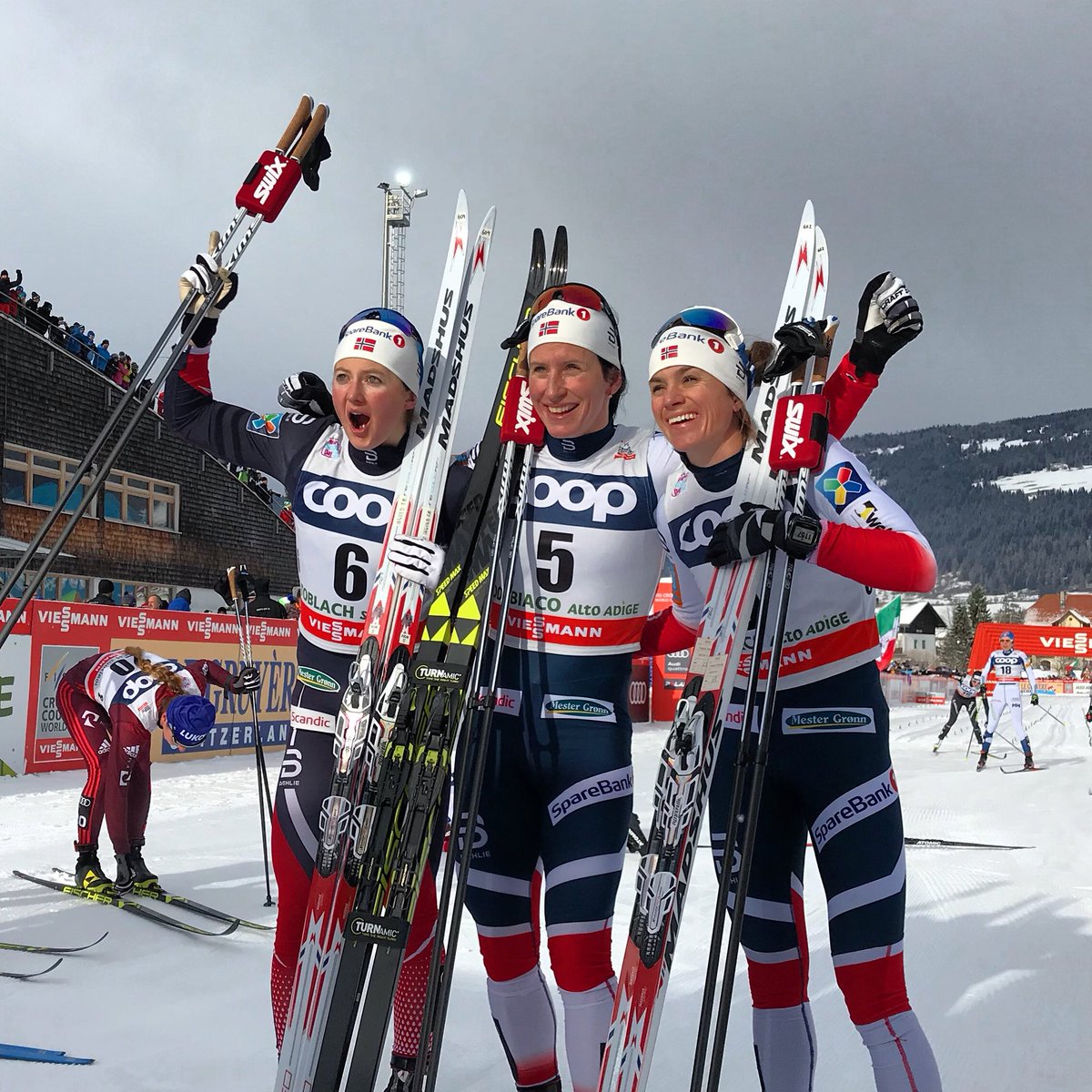
    The all-Norwegian women’s 10 k classic pursuit podium on Sunday at the World Cup in Toblach, Italy, with Marit Bjørgen (c) in first, Ingvild Flugstad Østberg (l) in second and Heidi Weng (r) in third. (Photo: FIS Cross Country/Twitter)

    In the women’s 10 k classic pursuit earlier in the day in Toblach, Norway’s Marit Bjørgen overcame a 22-second starting deficit to take the win by just 0.3 seconds over her teammates Ingvild Flugstad Østberg in second. It was an all-Norwegian podium with Heidi Weng in third (+0.8).

    Bjørgen started fifth, 22 seconds behind Swedish race leader Charlotte Kalla, based on their results in Saturday’s 10 k freestyle individual start. By the 6.4 k checkpoint, Bjørgen led a pack of four other Norwegians and Kalla — all within 1.4 seconds of first. At 8.5 k, Bjørgen led Østberg in second and Weng in third, while another Norwegian Astrid Uhrenholdt Jacobsen skied another eight seconds back with teammate Ragnhild Haga in fourth and fifth, respectively. By that point, Kalla was skiing alone, another 11.7 seconds in sixth, while American Jessie Diggins led a group 25 seconds behind Kalla in sixth.

    Ultimately, Bjørgen finished first in 25:19.3 and formed an all-Norwegian podium with Østberg and Weng, Jacobsen placed fourth, 21.5 seconds out of first and 20.7 seconds behind Weng in third.

    Haga was fifth (+31.8), Kalla sixth (+41.9), Diggins seventh (+53.7), Russia’s Natalia Nepryaeva eighth (+54.2), American Sadie Bjornsen ninth (+55.2), and Austria’s Teresa Stadlober 10th (+55.6) in a photo finish with Finland’s Kerttu Niskanen, who placed 11th (+55.6).

    For the U.S. Ski Team, Diggins and Bjornsen retained their starting positions of seventh and ninth, respectively, while Rosie Brennan started 19th and finished 25th (+2:14.6). Chelsea Holmes (Alaska Pacific University) finished 39th (+3:03.8) and Liz Stephen (USST) finished 48th (+4:05.2).

    Canada’s Emily Nishikawa placed 53rd (+4:14.5), Dahria Beatty finished 63rd (+5:44.7), Cendrine Browne 66th (+5:57.7), and Katherine Stewart-Jones 70th (+7:31.5).

    Results: Women Men

    ***

    IBU World Cup (Annecy, France): Women’s and men’s mass starts

    Women’s report

    Men’s report

    France’s Justine Braisaz won her first International Biathlon Union (IBU) World Cup race of the season on Sunday at home in Annecy, France, topping the women’s 12.5 k mass start by 11.2 seconds in 37:19.4.

    While Braisaz shot 19-for-20 (0+0+1+0), Iryna Kryuko of Belarus cleaned the four-stage race for second place, her first World Cup podium. Germany’s Laura Dahlmeier, who won Saturday’s 10 k pursuit, placed third (+19.9) with two penalties (0+1+0+1).

    Two North Americans qualified for the selective mass start, with Susan Dunklee (US Biathlon) racing to 20th (+1:16.3) with three misses (1+0+1+1), and Emma Lunder (Biathlon Canada) placing 28th (+2:21.4) with a single penalty (1+0+0+0).

    In the men’s 15 k mass start that followed, France’s Martin Fourcade finally got the win he was looking for, shooting clean and beating his main rival Johannes Thingnes Bø of Norway by 3.9 seconds. Fourcade crossed the finish line first in 36:30.3, Bø settled for second after skiing two early penalty loops (2+0+0+0) and Germany’s Erik Lesser tallied his second podium in Annecy (after placing third in the sprint) in third place again (+6.2) with clean shooting.

    Two Americans and a Canadian qualified for the mass start, with US Biathlon’s Lowell Bailey leading them in 23rd (+2:22.4) with three penalties, Sean Doherty following in 24th (+2:52.5) with four misses, and Biathlon Canada’s Scott Gow finishing 26th (+4:05.4) with five penalties.

    Results: Women| Men

    ***

    OPA Cup (St. Ulrich, Austria): 10/15 k freestyle pursuits

    On the final day of Alpen Cup (a.k.a. OPA Cup) racing in St. Ulrich, Ida Sargent of the U.S. Ski Team (USST) scored her third-straight top five with a fifth place in the women’s 10 k freestyle mass start. She previously placed third in the skate sprint and 5 k classic on Friday and Saturday.

    Germany’s Julia Belger won the women’s mass start on Sunday in 28:33.6, while Saturday’s 5 k winner, Elena Soboleva of Russia placed second (+0.7). Russia had two on the podium with Mariya Istomina in third (+6.4). Germany’s Elisabeth Schicho finished fourth (+15.8), just ahead of Sargent in fifth (+15.9).

    Germany’s Antonia Fräbel placed sixth (+17.1), followed by American Sophie Caldwell in seventh (+17.9). The USST had three in the top 10 with Julia Kern in 10th (+41.9), out of 60 finishers.

    In the men’s 15 k freestyle mass start, Beda Klee of Switzerland took the win in 37:14.6, 2.4 seconds ahead of Germany’s Thomas Bing in second. Six-time Olympian Sergey Dolidovich of Belarus reached the podium in third (+4.5).

    The U.S. had two men in the race, with Simi Hamilton finishing 14th, 16 seconds out of first, and Andy Newell finishing 71st (+2:25.2) out of 118.

    Results: WomenMen

  • Fourcade Gets Emotional First Win of Season in Annecy, But Battle with Bø Continues

    Fourcade Gets Emotional First Win of Season in Annecy, But Battle with Bø Continues

    Martin Fourcade leads the men’s 15 k mass start out of the gate in Le Grand-Borland, France. (Photo: Glen Crawford)

    LE GRAND-BORNAND, France—Martin Fourcade was winless so far this season, a strange situation. On Saturday he joked that his current foe, Johannes Thingnes Bø of Norway, was just too good and couldn’t be beaten.

    But in the last race of the French World Cup weekend, the men’s 15 k mass start, Fourcade managed to do it, thrilling the 16,000-strong home crowd in the process. The formula was simple: shoot clean.

    Fourcade did, Bø didn’t, and the Frenchman came away with is first win of the season.

    “It’s difficult to speak of it,” Fourcade said. “What I can say is that in terms of emotions, it’s probably the most amazing competition in my life. It was something really incredible to be supported by all the fans.”

    Fourcade shoots slowly in prone, and so it wasn’t until the third loop that he came to the front, passed rivals Erik Lesser of Germany and Anton Shipulin of Russia, and then just kept going.

    “It was very tough against these guys,” Lesser said in a post-race press conference. “Martin was always aggressive on the track. He was never happy with my pace, especially on the third loop.”

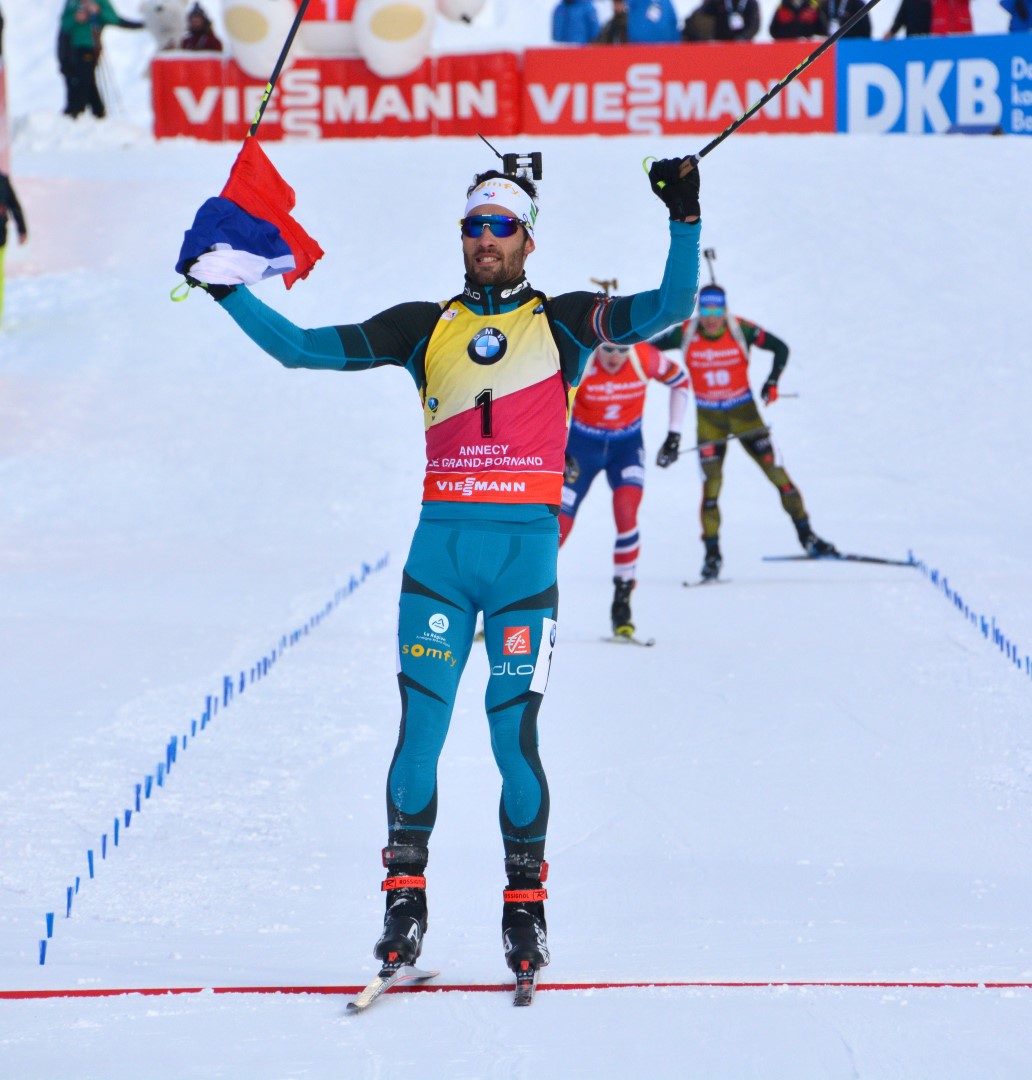
    Martin Fourcade celebrates at the finish as Johannes Bø and Erik Lesser race to round out the podium. (Photo: Glen Crawford)

    Coming into the fourth shooting, Fourcade had built a lead of more than ten seconds. That allowed him to take one of the slowest shooting times in the whole field to clean his last five targets.

    Lesser and Shipulin also both cleaned to go 20-for-20, and left the range eight seconds behind. And Bø – who had missed two shots in the very first stage and clawed his way back – also cleaned, and fast, and headed out in fourth, 15 seconds back.

    Fourcade’s win was secure. He kept attacking anyway, never allowing the chasers to come close. That gave him time to pick up a French flag and saunter his way down the finishing stretch.

    “I could enjoy it a bit, but I was still under pressure and I had to keep a good level of speed,” he said. “But it was something really special because it was a mix of emotion. It was not only hunger or happiness or satisfaction. It was all of that. It was probably the craziest race of my life and I will remember it for a long time.”

    Behind him, Bø was charging and passed first Shipulin and then Lesser. The German tried to follow, but couldn’t quite hold on to Bø’s tails. Bø crossed the line in second, 3.9 seconds behind the loitering Fourcade, and Lesser was third, +6.2.

    “I knew that Shipulin wasn’t in great shape today,” Lesser told German broadcaster ZDF. “I just didn’t quite know where to attack him. Then going past Andi [assistant coach] I thought about passing by Johannes just to fake it, but I noticed that my legs were flooded already after I have done every race this season so far. I am mega-happy about the third place, with a clean shooting. Yesterday I pitied myself after my bad shooting, now I proved to myself that I can do it.”

    “I was quite a little bit stressed out on the first shooting so I missed two targets,” Bø said. “From there it was really painful because I had to ski really fast to make up for those mistakes. To finish in second place is a little more than I was hoping for after the first shooting.”

    Shipulin hung on for fourth (+25.1), outsprinting Switzerland’s Benjamin Weger (fifth, +25.8).

    Sean Doherty racing in his first mass start in Annecy, France. (Photo: Glen Crawford)

    Four North Americans qualified for the in the 30-man mass start, but American Tim Burke did not race because he was sick. His teammates Lowell Bailey and Sean Doherty did most of the race within a few seconds of each other, finishing 23rd (+2:22.4) and 24th (+2:52.5) with three and four penalties, respectively.

    “The first lap was a bit of a cluster,” Doherty said. “It just gets such an accordion with that bridge right after the start, and a couple of other spots. This course, you know, it’s fun, but it needs a little bit of realignment for the bigger races. Everyone knows what they’re doing though, so you don’t have to worry much that some guy will crash and take out 30 people or something like that.”

    With a few penalties apiece, the Americans couldn’t hope for top finishes.

    “It was a solid race, but in this field you need an exceptional race to do well,” Bailey said. “It’s funny, I had this thought maybe in the third or fourth loop. I’m working so hard, and it’s like, in this field, it’s the top 30 guys in the world and you can have what on any other day would be like a decent race, but you’re, you know, 23rd or 24th. It wasn’t a bad race.”

    Scott Gow on his was to 26th place in the Annecy mass start. (Photo: Glen Crawford)

    It was Doherty’s first mass start.

    “It was a fun experience,” he said. “Getting in there and mixing it up with the top 30 guys in the world–it’s a treat, it’s fun. And next time, I hope just to be fresher and be ready to get in there and throw some elbows and just hit a few more shots. The other guys, they’re right there, it’s not like I’m way off.”

    For Canada, Scott Gow competed in his second-ever mass start, finishing 26th (+4:05.4) with five missed shots.

    “I didn’t shoot well today,” Gow said. “Five misses was, like, five way too many, so — a little disappointed, shooting-wise, especially because it’s perfect shooting conditions. There’s no real good excuse for it. Skiing I was kind of tired…. I will just work on shooting and work on my the confidence in the range, because it’s there sometimes, but it’s not there other times. I need to get a little more consistent.”

    Results

  • Braisaz Stuns in Home Mass Start with First Victory; Dunklee 20th, Lunder 28th

    Braisaz Stuns in Home Mass Start with First Victory; Dunklee 20th, Lunder 28th

    Justine Braisaz of France crossing the finish line with her first World Cup victory, in Le Grand-Borland in the 15 k mass start. (Photo: Glen Crawford)

    LE GRAND-BORNAND, France—Justine Braisaz was so excited for today’s 15 k mass start that she jumped the gun, scooting forward on her skis a few seconds before the start and having to reset.

    That provoked a laugh among the crowd and perhaps even her competitors, but they weren’t laughing by the time the race finished and Braisaz had left them in the dust, claiming her first World Cup win – on her father’s birthday, no less.

    The early start was more than nervous energy. Braisaz wanted to soak in everything in the last race of the weekend, the first time in four years that the biathlon World Cup had come to her country.

    “I just wanted to take pleasure today and have no pressure at all,” she said in a press conference after the race. “It’s just like that. I did not have any serious ambition, I just wanted to try my best.”

    Once the race was off, she followed Kaisa Makarainen of Finland – who started in the front row directly ahead of her – and Anastasiya Kuzmina and Denise Herrman, and the four women gapped the field to come into the range ahead of the others, a rare situation on the first loop of a women’s mass start.

    Anastasiya Kuzmin of Slovakia leading Denise Herrmann, Kaisa Makarainen, and the rest of the women’s mass start. (Photo: Glen Crawford)

    Braisaz cleaned that stage, as well as the next, and was never far from the lead. When Braisaz and Kuzmina missed shots in the first standing stage, Herrman surged to the lead.

    A relatively recent convert to biathlon – a relay medalist in cross-country skiing at the 2014 Olympics – Herrmann has already won two races this season. She has become an impressively stable shooter given her short career, and when she came into the shooting range alone for the final bout she hit the first target.

    But then she missed. And missed, and missed. She hit the last shot, but had to ski three penalty loops and came out in 13th. With the third-fastest last-loop time she moved up to twelfth.

    Braisaz, in the meantime, had come in to the second lane of the range and hit all of her targets, skiing out in first place. When Germany’s Laura Dahlmeier, the winner of Saturday’s sprint, missed one shot behind her, Braisaz seemed to be in the clear. The next woman out on course was Belarus’s Iryna Kryuko, who had cleaned the whole race and hit the trails 15 seconds back.

    But Braisaz felt the threats behind her, real or imagined.

    Justine Braisaz leadin Denise Hermmann and Kaisa Makarainen in the middle of the race. (Photo: Glen Crawford)

    “During the last loop on the track, I just thought, the women behind me will catch me,” Braisaz said. “I was so stressed, under pressure. I did not believe it [would happen]. When I saw my wax man with the French flag, I just started breathing.”

    That moment came 200 meters before the finish, when Braisaz had enough of a cushion to stop and grab the tricolore. She waved it behind her as she skied down the finishing lanes, the crowd of 15,000 spectators going more than wild.

    “It was just great,” she said. “A very nice feeling to share it with all the crowd and all the French people and everybody. It was just like a dream. But the reality is better actually.”

    Kryuko, too, hadn’t felt secure in her position on the last loop. Dahlmeier came out of the penalty loop and into third place, just under ten seconds behind her; after that was Kuzmina, whose ski speed had impressed over the last several weeks.

    “I saw that I shot clean – and I certainly saw that behind me there were some very strong girls,” Kryuko said through a translator at the press conference. “The only thing I was hoping for was to get flowers, the top six.”

    Dahlmeier put in an early surge to try to close the gap.

    “On the final lap I tried to give it everything I had,” she told German broadcaster ZDF. “I fought hard right from the beginning, and immediately went a very high tempo. I didn’t really get closer to her [Kryuko] initially, then made up a few meters, but in the end the necessary energy wasn’t there anymore to really overtake her.”

    Kryuko thus held onto second place, finishing 11.2 seconds behind Braisaz. Dahlmeier was third (+19.9), Kuzmina fourth (+25.5), and Germany’s Vanessa Hinz fifth (+28.4). Anais Chevalier gave the French crowd another reason to lose their minds when she crossed the finish line in sixth (+30.1).

    For Kryuko, her very first mass start came on the same day as her first World Cup podium. The 26-year-old’s previous best finish was ninth in the pursuit in Hochfilzen, Austria, last weekend.
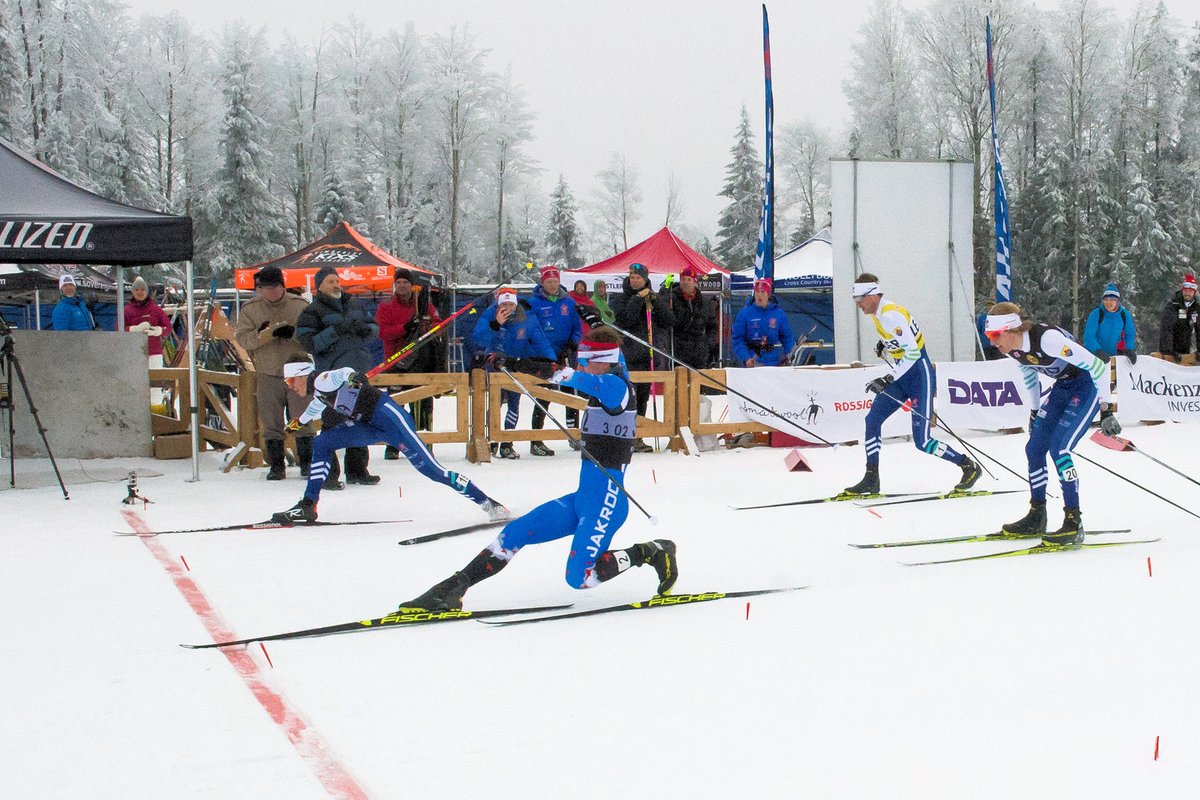
    Susan Dunklee racing to 20th in the mass start. (Photo: Glen Crawford)

    “It’s my first mass start and of course my first podium,” she said. “It’s a really great feeling.”

    Dunklee 20th, Lunder 28th

    Both Susan Dunklee of the U.S. and Emma Lunder of Canada started in the back of the mass start, with bibs 26 and 29, respectively. In most World Cups, starting at the back of the pack is not a big problem, as most of the field is still together when athletes enter the range for the first shooting.

    “This course it is!” Dunklee exclaimed. “This course it absolutely is. This is a very narrow course… that first bridge, we just had this major accordion-ing, where everybody stopped for about five or six seconds in the back waiting for the top people to get up there. We had to snowplow and then just stand there and wait. We were laughing. So it was a lot of just being really patient on the first loop because there was no good way to pass.”

    “Probably 300 meters into the race there is a super steep little hill, and the back of the pack, the back 15, literally came to a standstill and then it took people a lot to get going, and it was so spread out by then,” Lunder said. “So I was last and I just tried to hang on to number 29. I had figured I would come into the range last or close to last, but I felt pretty relaxed during that lap.”

    Canada’s Emma Lunder chasing the Czech Republic’s Eva Puskarcikova in the women’s mass start in Le Grand-Bornand, France. (Photo: Glen Crawford)

    Despite strong races earlier in the week, finishing 10th and sixth, Dunklee never made contact with the leaders – in part because they had broken away already on the first lap when she was stuck in the back, and partly because she missed a shot in the first prone stage.

    Dunklee missed two more, one in the first standing stage and then the very last shot of the race.

    “With 85% shootings, it was obviously not my best, but certainly something I can be proud of,” she said.

    She crossed the line in 20th after laying down the fifth-fastest closing loop and moving up two spots.

    “I had a great battle going with Maren [Hammerschmidt] and Selina [Gasparin],” Dunklee said. “Selina got me by a tenth of a second, which is, well, ugh. She had the better lane in the finish and I just couldn’t get around her, but it was fun. I like it when it’s exciting like that.”

    Lunder also missed a shot in the first prone, but she was clean after that. She had some issues with her rifle though, which resulted in slower shooting times even though she never again had to visit the penalty loop.

    “I was a little bit shaky and I double-ejected three times,” she explained. “So then I had to load a spare and was like ‘okay, do not miss this and then have a penalty loop on top of it.’ I am so happy with shooting 19 out of 20 again, I’m really relieved. And it was a good chase again out there. On the last lap there were two Polish girls right with me, I tried so hard but I just didn’t have it in me.”

    She crossed the line 28th, +2:21.4. It was the first mass start of her career.

    “This was an awesome experience,” Lunder said. “Any time I finish in the top 30 I think I’ll still be happy… I can say I had fun. It’s like the most painful kind of fun. I felt pretty tired today, and then on top of it everyone is fast in the mass start. So I just knew that I wanted to execute on the range the same way I have been this weekend.”

    Results

  • Saturday Rundown: Annecy, Toblach, St. Ulrich, Rossland (Updated)

    Saturday Rundown: Annecy, Toblach, St. Ulrich, Rossland (Updated)

    The photo finish for first in the men’s skate sprint final on Saturday at the NorAm in Rossland, B.C., with Julien Locke (near) outstretching Evan Palmer-Charette for first, and Julian Smith (r) taking third third ahead of Bob Thompson (yellow NorAm leader’s bib). (Photo: CCC/Twitter)

    NorAm Mini Tour (Rossland, B.C.): Freestyle sprints

    On Day 2 of NorAm racing in Rossland, British Columbia, Julien Locke, of the Black Jack Ski Club and Canadian National U25 Team, won the men’s 1.4-kilometer freestyle sprint final on his home trails by just one-hundredth of a second over Evan Palmer-Charrette, of the National Team Development Centre (NTDC) Thunder Bay, in 2:38.13. NTDC Thunder Bay had two on the podium with Julian Smith in third, 0.4 seconds behind Locke.

    Locke started the day by qualifying second, just 0.06 seconds behind Bob Thompson (NTDC Thunder Bay), who won the qualifier in 2:39.49. Locke went on to finish second to Thompson in the first quarterfinal, then won the second semifinal while Thompson won the first semi.

    In the final, Locke tallied his first NorAm win of the season, while Thompson, last weekend’s classic-sprint winner at Sovereign Lake, placed fourth (+0.43), missing the podium by three-hundredths of a second. Andy Shields (Lappe Nordic) finished fifth (+1.78) and Sebastien Boehmler-Dandurand (Canmore Nordic/Stefan Kuhn HP Team) sixth (+5.21) in the men’s final.

    Also on Saturday, American Caitlin Gregg (Team Gregg/Loppet Nordic Racing) racked up her second-straight win in Rossland (after topping Friday’s 5 k classic), winning the women’s 1.4 k skate-sprint final in 3:03.36. Canada’s Andrea Dupont (Rocky Mountain Racers) finished 2.5 seconds later for second place and Zina Kocher (Foothills Nordic) scored her first podium of the season in third (+3.53).

    Dupont won the women’s qualifier in 3:07.68, and Gregg qualified second, 0.87 seconds back. Dupont went on to win the first quarterfinal and first semifinal, while Gregg won her quarterfinal and semifinal as well. (Gregg’s quarterfinal had four racers, compared to five in Dupont’s quarterfinal, as only 21 women competed in the senior women’s heats.)

    Also in the final, Laura Leclair, of the Centre National d’Excellence Pierre Harvey/Pierre-Harvey National Training Centre (CNEPH), finished fourth (+6.11), Maya MacIsaac-Jones (U25 Team) was fifth (+6.31) and Sophie Carrier-Laforte (Skinouk) sixth (+8.57).

    Results: Heats | Qualifier

    ***

    OPA Cup (St. Ulrich, Austria): 5/15 k classic

    On the second day of Alpen Cup (a.k.a. OPA Cup) racing in St. Ulrich, Ida Sargent of the U.S. Ski Team (USST) finished third in the women’s 5 k classic behind two Russians, Elena Soboleva and Natalia Matveeva, respectively.

    Soboleva took the win in the individual-start race in 14:25.8, and Matveeva was 12.5 seconds back for second place. Just like Matveeva, Sargent reached the podium for the second-straight race in third (+18.1), after placing third in the freestyle sprint on Friday (Matveeva finished second in the sprint).

    Germany’s Antonia Fräbel finished fourth (+21.0) and American Sophie Caldwell (USST), who won the sprint the day before, placed fifth (+22.7). The other USST member in the race, Julia Kern finished 15th (+53.5).

    The men raced a 15 k classic, with France’s Alexis Jeannerod taking the win in 38:45.6. Germany’s Thomas Wick was 4.7 seconds back in second, and Russia’s Gleb Retivykh placed third (+11.3). The lone American man racing, Andy Newell (USST) finished 36th (+2:07.1) out of 125 finishers.

    The three-day OPA Cup weekend in St. Ulrich wraps up Sunday with 10/15 k freestyle mass starts.

    Results: Women| Men

    https://www.instagram.com/p/Bcxx2GhlDfv/?taken-by=juliakernski

    ***

    IBU World Cup (Annecy, France): Women’s and men’s pursuits

    Susan Dunklee (US Biathlon) after placing sixth and reaching the flower ceremony in the women’s 10 k pursuit at the IBU World Cup on Saturday in Annecy, France. After starting 10th, sixth stands as a season-best for Dunklee. (Photo: Glen Crawford)

    Women’s race report

    Men’s race report

    Germany’s Laura Dalhmeier captured her first win of the season, preventing Slovakia’s Anastasia Kuzmina from her third-straight win, and American Susan Dunklee raced to a season-best sixth in the women’s 10-kilometer pursuit on Saturday in Annecy-Le Grand Bornand, France.

    Canada’s Emma Lunder achieved a career-best 18th after starting 34th, and her teammate Julia Ransom placed 27th after starting 39th.

    In the men’s 12.5 k pursuit that followed, Norway’s Johannes Thingnes Bø started first, shot clean and fended off his competition to rack up his fourth-straight victory — winning by more than a minute.

    And for the second-straight race, France’s Martin Fourcade finished second, this time 1:01.4 minutes behind Bø, who crossed the line first in 32:52.1. Fourcade had to ski two penalty laps later in the race (0+0+1+1), while Russia’s Anton Shipulin, who started sixth and had a single miss (0+0+0+1), rose to third place (+1:10.5).

    American Lowell Bailey shot clean to race up to 14th (+2:13.9) after starting 35th. His US Biathlon teammate Tim Burke finished 26th (+3:03.1) with three penalties (1+0+1+1), after starting 10th.

    Canada’s Scott Gow finished a second later for 27th (+3:04.1) after starting 16th and skiing four penalty laps (1+0+1+2). His brother Christian Gow moved up one spot to 29th (+3:06.6) after starting 30th and shooting 19-for-20 (1+0+0+0).

    The U.S. had four men in the pursuit, with Sean Doherty placing 30th (+3:07.0) with three penalties after starting 17th.

    Leif Nordgren improved to 48th (+4:54.9), up from 56th, despite three misses.

    ***

    FIS Cross Country World Cup (Toblach, Italy): 10/15 k freestyle

    Women’s report

    Men’s report

    The men’s 15 k freestyle podium at the Toblach World Cup in Italy, with Norway’s Simen Hegstad Krüger (c) scoring his first World Cup victory in first place, last weekend’s winner Maurice Manificat (l) of France in second, and Great Britain’s Andrew Musgrave (r) in third. (Photo: FIS Cross Country/Twitter)

    In the men’s 15 k freestyle on Saturday in Toblach, 24-year-old Simen Hegstad Krüger achieved his first individual World Cup victory in 29:58.8 minutes, and was joined on the podium by France’s Maurice Manificat in second (+10.6) and Great Britain’s Andrew Musgrave in third (+11.5).

    Canadian World Cup Team member Alex Harvey missed the podium by 2.5 seconds in fourth place (+14.0), tying his best result of the season after finishing Ruka Triple mini tour in fourth place late last month in Kuusamo, Finland.

    Russia’s Sergey Ustiugov followed in fifth, Norway’s Finn Hågen Krogh was sixth and Hans Christer Holund seventh, Finland’s Matti Heikkinen eighth, Switzerland’s Toni Livers ninth, and notably, Norway’s Johannes Høsflot Klæbo — who hasn’t lost a race all season (he sat out last weekend’s 15 k skate in Davos, Switzerland) — was 10th.

    Erik Bjornsen of the U.S. Ski Team (USST) was the lone American in the points (top 30) in 29th (+1:09.6), Noah Hoffman finished 40th (+1:24.5), Scott Patterson (USST) was 42nd (+1:29.4), and Paddy Caldwell (USST) 53rd (+1:50.0)

    For Canada, Devon Kershaw (World Cup Team) placed 38th (+1:22.1), Graeme Killick (World Cup Team) was 49th (+1:47.8), Russell Kennedy (Team R.A.D.) 60th (+2:13.2), and Knute Johnsgaard (World Cup Team) 85th (+3:28.3).

    The women’s 10 k freestyle podium on Saturday at the World Cup in Toblach, Italy, with Sweden’s Charlotte Kalla (c) in first, and Norway’s Ragnhild Haga (l) and Heidi Weng (r) in second and third, respectively. (Photo: FIS Cross Country/Twitter)

    In the women’s 10 k freestyle individual start in Toblach, Sweden’s Charlotte Kalla tallied her third win of the season in 22:40.1 minutes, ahead of five Norwegians and American Jessie Diggins.

    Norway’s Ragnhild Haga was 5.8 seconds shy of Kalla’s time for second place, and her teammate Heidi Weng was another 8 seconds back in third (+13.8).

    Norway occupied second through sixth place, with Astrid Uhrenholdt Jacobsen in fourth (+17.9), Marit Bjørgen in fifth (+22.6) and Ingvild Flugstad Østberg in sixth (+29.3). Diggins led the U.S. Ski Team (USST) in seventh (+40.5), with Finland’s Kerttu Niskanen close behind in eighth (+43.5) and the second U.S. woman in the top 10, Sadie Bjornsen, another 0.4 seconds back in ninth (+43.9).

    The USST had three in the top 20 with Rosie Brennan placing 19th (+1:15.2) for her second-straight top-20 result (following a 17th place in last weekend’s 10 k freestyle in Davos, Switzerland). Chelsea Holmes (Alaska Pacific University) finished 36th and Liz Stephen (USST) was 47th.

    Emily Nishikawa (Canadian World Cup Team) led her team in 51st, Cendrine Browne (Canadian U25 Team) followed in 55th, Dahria Beatty (World Cup Team) was 69th, and Katherine Stewart-Jones (U25 Team) 77th.

    Results: Women | Men

  • Dunklee Sixth in Annecy Pursuit; Dahlmeier Back to World Cup Winning; Lunder 18th

    Dunklee Sixth in Annecy Pursuit; Dahlmeier Back to World Cup Winning; Lunder 18th

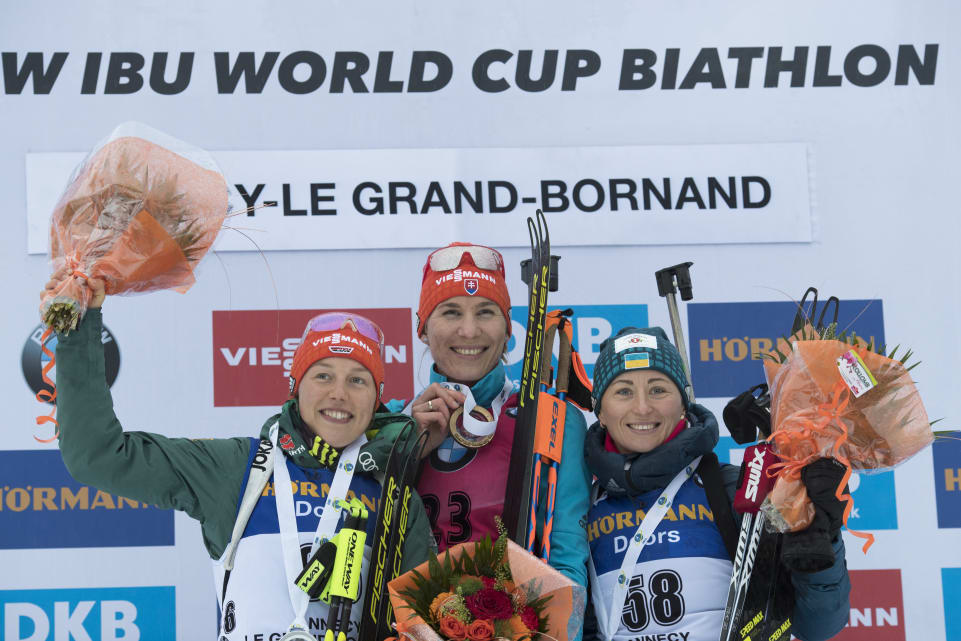
    Germany’s Laura Dahlmeier (c), Slovakia’s Anastasia Kuzmina (l), and Italy’s Lisa Vittozzi on the podium after Dahlmeier won the women’s IBU World Cup pursuit in Annecy-Le Grand Bornand, France, on Saturday. (Photo: IBU/biathlonworld)

    LE GRAND-BORNAND, France – Well, that didn’t take long.

    After missing the first stop on the World Cup calendar due to illness and showing less than her usual ski speed in Hochfilzen last weekend, Germany’s Laura Dahlmeier picked up her first International Biathlon Union (IBU) World Cup win of the season in the women’s 10-kilometer pursuit on Saturday.

    The 24-year-old German, who was the overall IBU World Cup champion last season as well as three-time individual gold medalist at 2017 World Championships, took an opening early in the race when Anastasia Kuzmina of Slovakia, the winner of Thursday’s sprint, missed a surprising three shots in her first shooting bout.

    “It was not easy to concentrate on the first shooting for me,” Kuzmina said in a post-race press conference. “Maybe it was [too much] emotion.”

    Dahlmeier, the second woman onto the range after being the runner-up to Kuzmina in the sprint, hit all her targets. Then again, and again. She looked on pace to clean the entire competition, but missed the last shot of her final standing bout.

    “She made three mistakes on the first shooting and then the door was a little bit open for me,” Dahlmeier said of her rival. “Then I was in front the whole time. In my last shoot was my first mistake. Then I thought, OK, she will win the race.”

    Kuzmina had climbed back to second place, and also hit the first four targets of her final shooting bout. But then she took a long, long pause before the final shot – and missed it anyway.

    “I was in the penalty loop,” Dahlmeier said. “But then she didn’t come. I couldn’t see her. I heard the sound of the spectators. And she had also this mistake. I’m very happy to be in front now.”

    “I gave a chance to Laura,” Kuzmina said of her earlier misses. “And also she gave me a chance on the last shooting, but you see the result.”

    Susan Dunklee chasing France’s Anais Chevalier en route to sixth place in the women’s 10 k pursuit on Saturday at the IBU World Cup in Annecy, France. (Photo: Glen Crawford)

    Kuzmina held on for second place, finishing 14 seconds after Dahlmeier. Italy’s Lisa Vittozzi placed third (+31.8), up from fourth place in the sprint, after shooting one penalty. Selina Gasparin of Switzerland followed in fourth (+52.8), Denise Hermann of Germany was fifth (+55.2), and Susan Dunklee of the U.S. placed sixth (+1:12.1).

    Recalibration Brings Dunklee to Flower Ceremony

    Sometimes, you have to go slow to go fast.

    Dunklee had a tough start to her season, not breaking into the top 50 and missing both pursuits in the first two weekends of racing. On Thursday she broke the pattern when she placed tenth in the sprint.

    As she explained then, she tried slowing down her shooting and going back to basics after missing so many shots in the first competitions. It was a strategy that she continued to pursue in the pursuit.

    “This year I have been doing a lot of speed shooting, like over the summer,” Dunklee explained. “But I have really gone away from that in the last two weeks. I have been trying to go back to the basics, mostly with trigger squeeze. That was all I was thinking about on the range, just trigger squeeze. And not worrying about speed at all.”

    Dunklee missed one shot in her first prone stage, dropping from 10th to 17th place. She climbed back up before again missing a shot in the first standing stage.

    When she came into the range the final time, she was in 10th place, just where she had started. And she calmly – more slowly than some races in the past – hit all the targets, leaving the range in seventh place and passing Ukraine’s Valj Semerenko to earn sixth place and a spot at the flower ceremony.

    It was a big turnaround from such a disappointing start to the season, one where she said the term “shooting struggles” would be an “understatement.”

    “After Thursday, I was just feeling relief, to be honest,” she said. “It’s so huge to get a top ten and then get a flower ceremony today.”

    Besides improving her shooting, Dunklee had the 12th-fastest ski time of the day and the sixth-fastest closing loop.

    “This was one of the first real head to head ski situations I have had since the relay in Östersund,” Dunklee said. “And it is so much easier to ski with a pack and behind people. So much more relaxed. I had some very fast people around me — I think two loops with Maren [Hammerschmidt], and a couple loops with [France’s] Anais Chevalier. I also had a lot of energy left on the last loop, which I don’t normally have for the last loop, so that was good.”

    With that performance, Dunklee qualified for Sunday’s mass start, which will give her another crack at a course that she said was unusual among the other World Cup venues.

    “Different, very narrow,” she said of the French venue, which the World Cup last visited four years ago. “You have to be smart tactically. The hills are really short and steep.”

    Career-Best for Canada’s Lunder in 18th

    Emma Lunder of Canada has been on a tear this season, with a number of top results. Today she had a career-best day, missing just one shot to move from 34th in the sprint up to 18th in the pursuit (+2:06).

    Biathlon Canada’s Emma Lunder (l) and Julia Ransom (r) after finishing 18th and 27th in the women’s 10 k pursuit on Saturday at the IBU World Cup in Annecy, France. (Photo: Glen Crawford)

    “We were talking about it yesterday — I just feel more solid in my position on the team,“ the 2017 World Championships team member said. “I think this year, honestly, I just feel a little bit more relaxed. Instead of thinking every day, ‘Oh you have to have a good race to stay on the circuit,’ I am just saying, ‘Just go doing what you know how to do,’ and it’s turning out well.”

    Not perfectly – but well. Like Dahlmeier and Kuzmina, Lunder missed the last shot of the competition. With clean shooting she would have made the top 15.

    “I tried to get focused on the range,“ she said. “And on that last shot I did everything trying not to collapse. The second I yanked the trigger I was like, ‘Oh my God, Roddy [Ward, her coach] is gonna kill me’. But I was so happy with the race.“

    Despite skiing into the top 20, a somewhat unfamiliar position, Lunder said she didn’t feel more pressure than usual. Instead, it was a bonus – she had better competitors around her.

    “There were just faster girls to ski with,“ she said. “I got passed by quite a few on the first loop, but I just tried to relax. After [the first shooting] I seemed to pick it up skiing and was able to stay with more people, so that was really fun, too.”

    With her for much of the race was teammate Julia Ransom, who had started in bib 39. Ransom accumulated two penalties, but still moved up to 27th (+2:29.8). She used the 17th-fastest course time of the day to maintain a position despite the shooting errors.

    “There was a few shots that I knew I was like, ‘Wing the prone and wing the standing,’ ” Ransom said. “But you know, overall, I’m very happy I kept it together. I could see Emma the entire time. We skied together on the first couple laps, and I was just thinking, ‘This is the dream’.”

    “Who would have thought when I was twelve and I first met Julia that we’d be skiing together in the front half of a World Cup pursuit?” Lunder said. “It was really special.”

    “Our skis were so amazing,” Lunder continued. “I was just cruising on the downhill passing people. I felt like I could keep up with so many more people just by gliding longer than they were.”

    Canada’s third woman qualified for the pursuit, Rosanna Crawford, did not start due to illness.

    Results

  • Bø Extends Lead in Annecy Pursuit; Clean-Shooting Bailey Climbs to 14th

    Johannes Thingnes Bø has never been beaten in an individual race in Annecy, France, and that didn’t change today. (Photo: Glen Crawford)

    LE GRAND-BORNAND, France– Johannes Thingnes Bø had won three straight races coming into today’s 12.5 k pursuit.

    But if anyone was going to knock him off his pedestal, it seemed likely to be the home team. Behind Bø, Martin Fourcade started second, Antoine Guigonnat third, and Simon Destheiux fifth. When each of them sprinted out of the race start, the 15,000 spectators went wild, enveloping this mountain venue in a wall of noise.

    But never mind the noise, Bø was focused. He cruised around the course, and shot 20-for-20 – including with some of the fastest shooting time in the field in standing. He had such a lead on his last loop that as his coach ran along beside him up a hill, he slowed down and gave the guy a fist-bump.

    The last one to win four races in a row was Fourcade, who finished second today, with two penalties and one minute and one second back.

    Martin Fourcade of France chasing. He was in second place for entire race. (Photo: Glen Crawford)

    “I am quite satisfied about my performance, despite my slow prone and two mistakes on the standing,” he said in a post-race press conference. “But also of course I am struggling to catch the win, because this man to my left is simply too good now.”

    For Bø’s part, he can’t put his improving performance down to any one factor. He has had many bouts of brilliance in the past, including sweeping the World Cup weekend the last time it was held here, in 2013.

    “I’m really surprised about my own shape and that I now have my fourth win in a row,” he said. “It’s very untypical me. When I do a good race, I often do a bad race after… This sport is like, the more you train and the more races you have, the better you will be. I am one year older than last year. And I think this is a good thing. You get older you get more experience, and you can use that.”

    Not only could the French team not put Fourcade – Olympic gold medalist, World Champion, several time World Cup overall champion, the most reliable prediction to win at any time in the last few years – on the top step of the podium, but the teammate behind him also faltered.

    Guigonnat, who was called up to the World Cup after starting the season at a lower level and had immediately scored his first ever podium in Thursday’s sprint, missed three shots and finished 12th (+2:06.9). Desthieux missed two shots, crucially one coming in the last bout, and finished sixth (+1:41.9).

    Instead it was two Russians sprinting for the podium. Anton Shipulin edged past younger teammate Alexander Loginov to take third place by just two tenths of a second.

    “Alexander was really going really well today,” Shipulin, through a translator, said of his teammate. “He was battling really hard and I’m really proud of him. But I’m also very happy for myself that I am part of the podium today.”

    When asked by a French journalist about the recent IOC decision that Russian athletes must compete under the Olympic flag at the upcoming Games in PyeongChang due to doping violations, Shipulin said, “let’s not talk about the past.”

    Bailey Cleans All 20, Moving Up to 14th

    Lowell Bailey charging to 14th place in the pursuit. (Photo: Glen Crawford)

    Like Bø, American Lowell Bailey had some happy memories of the last time the World Cup visited the French Alps.

    “I cleaned the pursuit the last time I was here,” he explained. “My coach said that to me. He said, you like this course, last time this was your first clean pursuit.”

    Bailey doubled down on that effort. After a sprint that hadn’t been perfect, he shot 20-for-20 in the pursuit, moving up to 10th after the last shooting bout before slipping a few places on the last loop to finish 14th (+2:13.9).

    “I am really happy with the result today,” he said. “It was painful out there on the course, but we had great skis and we had enthusiastic staff and my family is here too, which is awesome.”

    Bailey was sick earlier in the season, and feels like it is still limiting his ski speed. And while he had an incredible run at World Championships last year and one of the best shooting percentages of any male athlete on the World Cup all season, this year his shooting hasn’t been on sharp.

    “My shooting hasn’t been bad this year, but I also haven’t had a race where I felt that everything clicked,” he said. “For today I really just wanted to have a good solid shooting race I just haven’t put it together in the races — especially in the sprints. And if you don’t put it together in the sprints, then obviously it doesn’t help you in the pursuits. So yeah, I was happy. I didn’t quite have [the speed] in the last few loops, but… I was really happy to hold it together.”

    On his way up through the field he passed a few teammates, including Tim Burke. Burke had finished tenth in the sprint, but was undone by three missed shots scattered across his different shooting bouts. He ended up 26th (+3:03.1).

    Sean Doherty had started 18th and like Burke, missed three shots – one in each stage after a clean first bout.

    “The shooting overall, looking at everyone else’s, three penalties isn’t terrible,” he said. “It’s just the timing. To miss that one in my last stage really cost me big. The other two misses weren’t as consequential. It’s a little unfortunate because I felt like I was taking pretty good shots. It’s a high pace out there. It’s not like the sprint where you can get in your own rhythm. You have got to ski, you have to hold on to other guys around you. That can make things tougher on the range.”

    Also for the U.S., Leif Nordgren started 56th and moved up to 48th (+4:54.9) with three penalties.

    Gows Top-30 Again for Canada

    Christian Gow racing in the 12.5 k pursuit in Le Grand-Bornand, France. (Photo: Glen Crawford)

    For Biathlon Canada, two men had turned in excellent sprint performances: Scott Gow had been a career-best 16th, and his brother Christian’s 30th place was also one of the top few results of his senior career.

    Both had reasons to be cautious about their prospects in the pursuit.

    “I got sick on the day of the relay [last weekend],” Christian Gow explained. “I woke up not feeling great and it got worse as the week went on. I’ve been getting better the last couple of days but honestly, I was debating whether or not to race the sprint. And then I decided, well, we have a lot of break after this to recover. So I figured I’d go for it but I had no expectations really… I had no expectations for this whole weekend.”

    The younger Gow had just one penalty and moved up one spot to 29th (+3:06.6) for a second-straight top-30 finish.

    “I think that, honestly, maybe what helped me was going into this with an open mind, not expecting anything, and not feeling pressure to do really well,” he said. “Just thinking, it’s going to be what it’s going to be. Of course, I knew that if I wanted to do anything I would have to shoot really well this weekend. But I’m very confident in my shooting. It has been really good this year. I knew I could put that together. But it felt like good pressure, a positive pressure.”
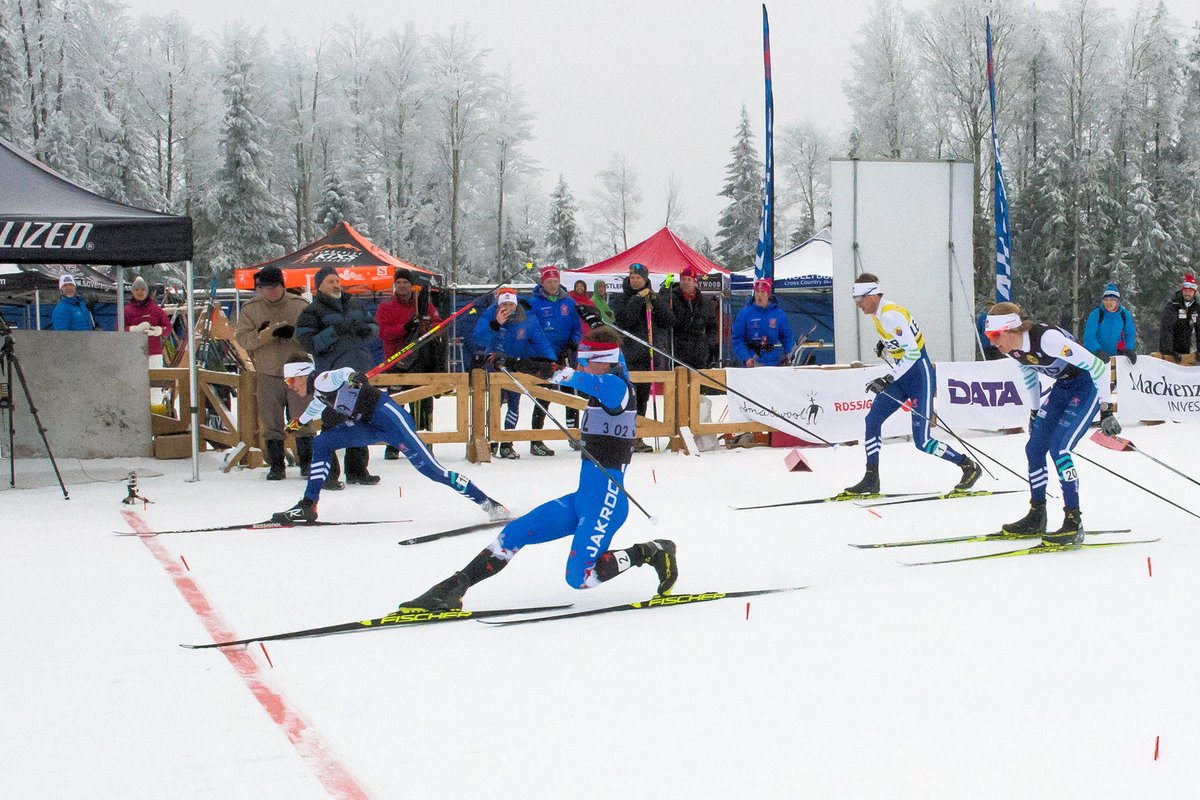
    Scott Gow has struggled in pursuits in the past, often undone by poor shooting after good sprint results put him in a good position. Today, he missed four shots and finished 27th (+3:04.1).

    “This wasn’t too bad,” he said. “I’m not super happy with it but I’m not upset either. It’s a small step towards finally improving my pursuit racing. Normally I drop 20 or 30 spots.”

    Coming into the final bout, he was in the top 20. That’s what he began to think about, before missing two shots there.

    “I am disappointed with my last shooting,” he said. “It felt quite good, but I think I was just a little too nervous. Just knowing where I was in the race. I was coming in at the tail end of a group of guys, so I knew a clean shooting would go a long way. Obviously I’m not supposed to think that, but it’s hard not to sometimes.”

    He left the range in 29th, but was able to pick up two spots by the finish (one of them his brother, who had left the range in 22nd). Scott Gow had the 24th-best ski time of the day.

    “My skiing felt quite good today,” he said. “It kept me in the mix.”

    Results

    Anton Shipulin of Russia outlunging teammate Alexander Loginov for third place. (Photo: Glen Crawford)
  • Friday Rundown: Annecy, St. Ulrich, Rossland (Updated)

    Friday Rundown: Annecy, St. Ulrich, Rossland (Updated)

    Tim Burke (US Biathlon) racing to 10th in the men’s 10 k sprint at the IBU World Cup on Friday in Annecy, France. (Photo: US Biathlon/NordicFocus)

    IBU World Cup (Annecy, France): Men’s 10 k sprint

    (Note: This rundown has been updated to include quotes from US Biathlon’s Tim Burke and Sean Doherty.)

    Norway’s Johannes Thingnes Bø racked up his third-straight individual win of the International Biathlon Union (IBU) World Cup season on Friday (and fourth non-relay win of 2017/2018), topping the men’s 10-kilometer sprint in Annecy, France. And he did so in head-turning fashion, beating French superstar Martin Fourcade, the race’s runner-up, by 21.1 seconds on Fourcade’s home turf.

    Norway’s Johannes Thingnes Bø racing to his third-straight win of the season on Friday in the IBU World Cup men’s sprint in Annecy, France. (Photo: IBU/biathlonworld)

    On a pristine day in Annecy, Bø started 24th and consistently clocked the fastest times throughout the race. He cleaned prone, then standing, and finished 41.8 seconds faster than Germany’s Simon Schempp, the race leader until that point who also shot clean (0+0).

    Fourcade started 31st and shot a flawless 10-for-10 as well, yet trailed Bø from start to finish. After prone, Fourcade was 8.3 seconds back in second. After standing, he was 14.7 seconds out of first with one loop to go. Bø skied the fastest course time on every loop to remain out of reach, and also shot faster than Fourcade, who clocked the second-fastest overall course time.
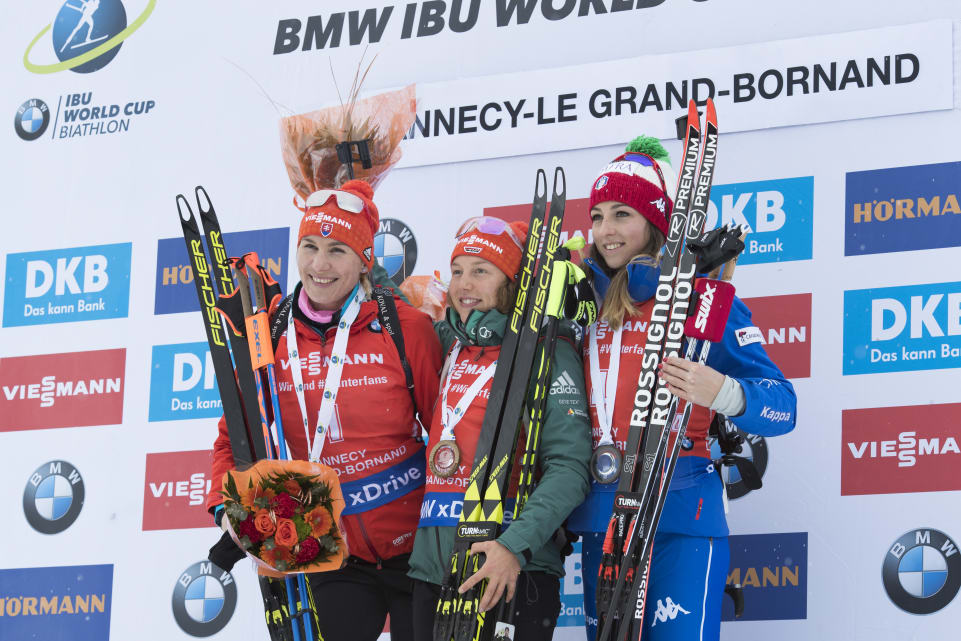
    Ultimately, the 24-year-old Bø crossed the finish line with the fastest time of 22:16.9 minutes, Fourcade was second and France’s 26-year-old Antonin Guigonnat achieved his first World Cup podium in third (+34.7) with clean shooting. In fact, the top-four finishers all shot clean, with Schempp in fourth and the third Frenchman in the top five, Simon Desthieux in fifth (+45.7).

    Guigonnat’s previous best World Cup result was 24th in a 20 k individual in 2015 in Oslo, Norway.

    France’s Antonin Guigonnat placed third in Friday’s IBU World Cup men’s 10 k sprint for his first podium and first top 20 of his World Cup career. (Photo: Glen Crawford)

    “It seems unreal to be here besides two monsters like these guys,” Guigonnat told the IBU, according to a press release. “After standing I was informed I had 7 seconds on Schempp and at that moment I trusted myself to hold that gap. I always trust in myself to be able to do something great like today.”

    Fourcade, who has either placed second or third behind Bø in three consecutive races, was not excited about second place.

    “Never cool, because I expected to win,” Fourcade said in an English interview with German broadcaster ZDF. “… But when you find someone better you just have to congratulate him and wait for the next chance. For now, with zero mistakes Johannes is not beatable. I will take the Christmas break to work on my shape, and expect to have a better shape in January to try and challenge him, because for now in the three last competitions I didn’t challenge him enough. I want to be faster, but he is good, he is really good.”

    “That’s good words from the World Cup leader,” Bø replied to ZDF in English. “… Every victory I had this season Martin has been right behind me, so I just have to continue being at 100 percent. I always have to think about myself, and then afterwards we will see if I am in front or second, but it has been a good start.”

    Only one man in the top 11 didn’t shoot clean: Russia’s Anton Shipulin in sixth (+54.9), who missed one in prone (1+0), but made up for it with the sixth-fastest overall course time and fifth-fastest overall shooting time.

    US Biathlon’s Tim Burke achieved his first top 10 in two seasons, placing 10th, 1:08.2 behind Bø with clean shooting.

    “I feel like I executed the perfect race for the shape I am in right now,” Burke wrote in an email to FasterSkier. “I know I am not in top form right now so this was about the best I could do considering that.

    “I have worked a ton on my shooting in the past year and I know that I’ve reached a higher level in training than ever before. It was nice to be able to show some of those improvements today,” he continued. “It feels great to be back in the top ten. Last season I was only racing in about half of the races and I had a top finish of 11th.  But I have to say that I am more pleased with how I executed the race today than the actual result.”
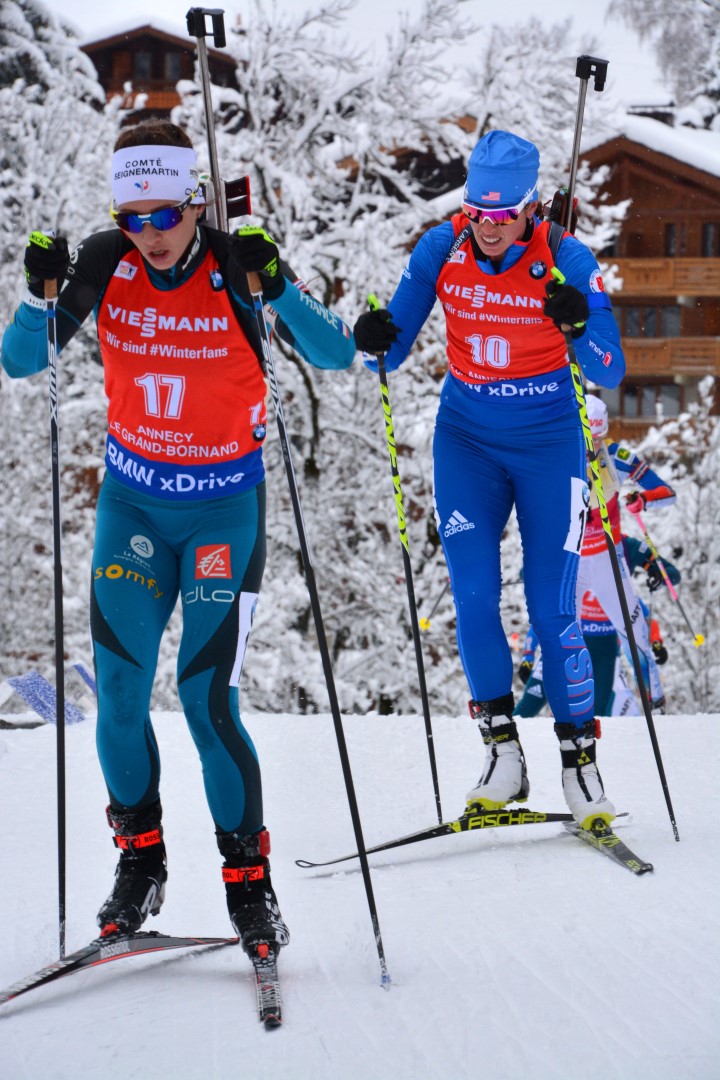
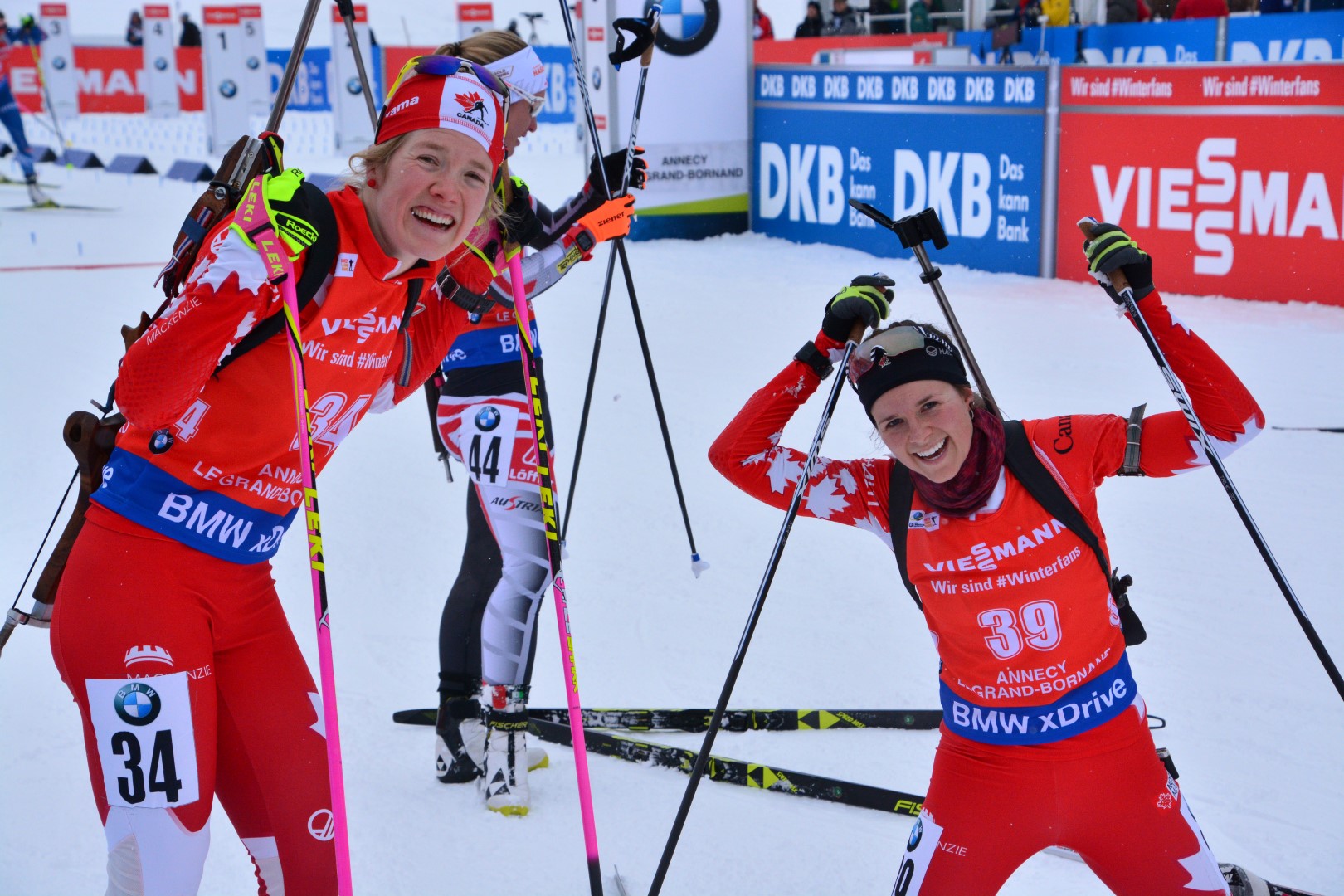
    In a US Biathlon press release, Burke noted that “perfect shooting conditions and a fast track” made for a tight race, as he had expected. “This was a good confidence boost for me heading into the holiday break,” he said.

    Sean Doherty (US Biathlon) racing to 17th for the second-straight individual IBU World Cup race on Friday in the men’s 10 k sprint in Annecy, France. (Photo: US Biathlon/NordicFocus)

    Also for US Biathlon, Sean Doherty placed 17th (+1:20.2), also with 10-for-10 shooting, for the second-straight individual race to tie his season best from last week’s pursuit in Hochfilzen, Austria.

    “I feel I executed a great race plan today,” Doherty wrote in an email. “The sprint is all attack right from the start, and this aggressive racing demands that you are on every transition from the first 100 meters. I carried this mentality through the range and the last lap.”

    After starting in bib 7 and cleaning the first shooting stage, Doherty took the race lead by 22 seconds.

    “Prone was solid and I was happy to execute my plan on the range, had no idea I was leading, just keep the pedal down for another lap,” he wrote. “Being an early bib you can’t look too hard at the place number on the split times. … Coming into standing I just reminded myself of the same focus points I have been working on since May. Focusing on those fundamentals really helps block out any extraneous thoughts that might want to sneak into your mind.”

    Scott Gow (Biathlon Canada) after placing 16th in the IBU World Cup men’s sprint on Friday in Annecy, France. (Photo: Glen Crawford)

    Biathlon Canada’s Scott Gow notched his second top 16 of the season to put himself at the top of the list for Olympic team selection, based on Biathlon Canada’s “Priority 2” criteria. Gow started near the back of the field in bib 99 and ended up 16th (+1:13.5) with clean shooting.

    “I’m very happy with another top 16,” Gow wrote in an email. “This result has solidified my priority 2 Olympic criteria which is a big relief. I’m also happy with my performances so far this early in the season. I’m normally a slow starter so it’s a good sign that I’m hitting good results before Christmas. I just hope I can make it last…”

    “Conditions were rock solid today,” Gow explained. “The fresh snow we got overnight mixed with the wet snow and created a very hard glaze. It was hard to hold a solid edge and the downhills were squirrelly. There was zero wind all day today, so range conditions were perfect.”

    His younger brother Christian Gow tallied Canada’s second-result in 30th (+1:44.2), also with clean shooting. He was one of 19 men (out of 103 finishers) that hit every target on Friday.

    A total of four Americans qualified for Saturday’s pursuit, with Lowell Bailey placing 35th (+1:49.5) with a prone penalty (1+0), and Leif Nordgren finishing 56th (+2:18.1) with one prone miss as well (1+0). Paul Schommer placed 85th (+3:19.3) to miss the top 60 required for the pursuit.

    “… It was a strong Nations Cup points day for the team as a whole,” Doherty noted.

    Canada’s Brendan Green and Nathan Smith did not qualify for the pursuit, after Green finished 86th (+3:21.0) with five penalties (3+2) and Smith was 91st (+3:36.4) with two misses (0+2).

    The women’s and men’s pursuits will be held Saturday in Annecy, with the women’s 10 k race starting at 5:45 a.m. Eastern Standard Time (EST) and the men’s 12.5 k at 8:45 a.m. EST.

    “It’s always chaotic with a lot of action during pursuits and I’ll try to filter all of that out,” Scott Gow wrote. “As for skiing, there’s a lot of transition areas where I think a lot of time can be made.”

    Results| Men’s pursuit start list

    ***

    OPA Cup (St. Ulrich, Austria): Freestyle sprints

    The women’s 1.2 k freestyle sprint podium at Friday’s Alpen Cup in St. Ulrich, Austria, with two U.S. Ski Team members in the top three: Sophie Caldwell (c) in first, Ida Sargent (r) in third, and Russia’s Natalia Matveeva (l) in second. (Photo: Sophie Caldwell/Instagram)

    With this weekend’s World Cup races in Toblach, Italy, being solely distance events, five U.S. Ski Team (USST) sprinters ventured to St. Ulrich, Austria, to compete in the Alpen Cup (also known as OPA Cup) skate sprints on Friday.

    Longtime couple Sophie Caldwell and Simi Hamilton came away with wins, with Caldwell winning the women’s 1.2 k freestyle sprint final ahead of Russia’s Natalia Matveeva in second and Caldwell’s USST teammate Ida Sargent in third. Another World Cup regular, Switzerland’s Laurien van der Graaff placed fourth, while Germany’s U23 World Championships classic sprint silver medalist Antonia Fräbel finished fifth. Italy’s Greta Laurent was sixth, Germany’s Hanna Kolb seventh, Austria’s Lisa Unterweger eighth, and Julia Kern (USST) ninth.

    In the men’s 1.4 k, Hamilton took the win in a photo finish, just ahead of USST teammate Andy Newell in second and Switzerland’s Gianluca Cologna in third. France’s Jean Tiberghien placed fourth and Russia’s Gleb Retivykh finished fifth.

    “#OPA men’s sprint was a nail-biter,” U.S. Ski Team Women’s Coach Matt Whitcomb wrote on Instagram with a finish-line photo on Friday. “Super close race for @simihamilton, @andynewellskier and @gianlucacologna. Well-run race by the OC in St Ulrich…

    https://www.instagram.com/p/BcuedeHDyxy/?hl=en&taken-by=matt.d.whitcomb

    Earlier in the day, Caldwell won the qualifier by 2.82 seconds over Matveeva with a top time of 2:27.85. Sargent qualified sixth, 4.6 seconds behind Caldwell, and Kern qualified ninth (+5.54). Canadian-born Swiss skier Heidi Widmer qualified 11th (+6.66) and went on to place 14th overall.

    In the men’s qualifier, Newell clocked the fastest time in 2:47.93. Retivykh was 2.01 seconds back in second, and Hamilton qualified third (+3.26).

    Two more days of OPA Cup racing remain in St. Ulrich, with the 5/15 k classic individual starts on Saturday and 10/15 k freestyle pursuits on Sunday, according to the International Ski Federation (FIS) events calendar.

    Final results: Women | Men

    Women’s qualifier| Men’s qualifier

    ***

    NorAm Mini Tour (Rossland, B.C.): Classic Interval Start)

    Winner Brian Gregg (LNR/Team Gregg) flanked by second place Scott Hill (r, BXC) and Bob Thompson (l, NTDC TBay) (Photo: Kai Symington-Kruss)
    The NorAm men’s 10 k classic podium on Friday in Rossland, B.C., with Brian Gregg (Team Gregg/Loppet Nordic Racing) in first, Scott Hill (r) of BXC in second  and Bob Thompson (l) of NTDC Thunder Bay in third. (Photo: Kai Symington-Kruss)

    The NorAm series continued this weekend with the Black Jack Ski Club hosting the first Canadian mini-tour of the season.

    Racing started Friday with classic interval start races, with 10 kilometres and two laps for the men, and 5 k and one lap for the women.

    Brian Gregg, representing Loppet Nordic Racing (LNR) and Team Gregg, dominated in 29:34.0 minutes, for his second win of the season after topping the 15 k classic mass start in West Yellowstone. Team BXC’s Scott Hill followed 28.2 seconds back in second. Last weekend’s sprint winner Bob Thompson, of the National Team Development Centre (NTDC) Thunder Bay, notched his second podium of the season in third (+39.4).

    Fresh off the World Cup, Canadian national team sprinters Jess Cockney (World Cup Team) and Julien Locke (U25 Team) finished seventh and 13th, respectively.

    Caitlin Gregg (Loppet Nordic Racing/Team Gregg) on her way to victory. (Photo: Kai Symington-Kruss)
    Caitlin Gregg (Team Gregg/Loppet Nordic Racing) on her way to a win in the NorAm women’s 5 k classic on Friday in Rossland, B.C. (Photo: Mark Richards)

    It was a big day for Team Gregg with Brian’s wife Caitlin Gregg winning the women’s 5 k in 16:08.0. Annika Hicks, of the Alberta World Cup Academy (AWCA), finished 46.8 seconds back in second, while Sophie Carrier-Laforte of the Centre National d’Excellence Pierre Harvey/Pierre-Harvey National Training Centre (CNEPH) narrowly edged out a group of women to take third (+1:16.1).

    The Rossland NorAm continues with freestyle sprints on Saturday, followed by 10/15 k freestyle pursuits on Sunday.

    Results

    CNEPH's Sophie Carrier-Laforte charging the downhill on her way to third place. (Photo: Kai Syminton-Kruss)
    Sophie Carrier-Laforte charging the downhill on her way to third place in the NorAm women’s 5 k classic on Friday in Rossland, B.C. (Photo: Mark Richards)
  • Dunklee Proves Her Resiliency, 10th in Annecy Sprint

    Dunklee Proves Her Resiliency, 10th in Annecy Sprint

    Susan Dunklee (US Biathlon) hitting every target in the prone shooting stage of the women’s 7.5 k sprint at the IBU World Cup in Annecy, France, on Thursday. She ended the day in 10th place with perfect 10-for-10 shooting. (Photo: Glen Crawford)

    Susan Dunklee’s start to another International Biathlon Union (IBU) World Cup season hadn’t played out as she’d hoped, specifically in terms of results. Coming off a banner winter, with a silver at 2017 World Championships (in the women’s mass start), Dunklee 31, had so far placed 53rd, 79th and 97th, respectively, in non-relay races over the last two weeks. She had yet to race a mass start, but also had yet to qualify for a pursuit in two World Cup sprints.

    So she went back to the drawing board, back to basics and to a “moose garden”.

    “My confidence took a big hit these past couple weeks and it was a real challenge was working through that,” Dunklee wrote in an email to FasterSkier on Thursday.

    “I tried to find some non-biathlon activities like visiting a ‘moose garden’ in Sweden and seeing the ‘Krampus’ in Austria,” she explained, referring to an Advent costume tradition, “to keep my mind fresh so I wouldn’t obsess 24/7 over disappointing results.  I also tried really hard to take a moment each evening to appreciate all the positive things that happened over the course of the day. And I kept telling myself that I am resilient.”

    After missing eight targets in last week’s snowstorm sprint in Hochfilzen, Austria, she sat down to brainstorm with US Biathlon consultant Matt Emmons, a 2004 Olympic champion in rifle shooting.

    “All summer I’ve been working on some fancier shooting skills, such as wind shading,” Dunklee explained. “Basically we decided I could benefit from focusing back on the absolute basics of shooting: sight alignment, trigger squeeze and follow [through]. That’s what I’ve been doing the last few days.”

    Susan Dunklee (US Biathlon) out of the start of the IBU World Cup women’s 7.5 k sprint on Thursday in Annecy, France, where Dunklee placed 10th overall for her best result of the season. (Photo: Glen Crawford)

    On Thursday, she started 60th out of 93 in the women’s 7.5-kilometer sprint in Annecy (Le Grand Bornand), France. In warm, slushy conditions with little wind, as Dunklee described it, she fired away for perfect 10-for-10 shooting to put herself in ninth at the finish.

    Dunklee was ultimately bumped one spot down to 10th overall, 1:16.8 minutes behind the winner, by Germany’s Laura Dahlmeier, who started in bib 86 and ended up second — 33.9 seconds behind Slovakia’s Anastasia Kuzmina in first.

    Kuzmina, who notched her second-straight individual World Cup win with a time of 20:59.6, and  the rest of the top-four finishers — Dahlmeier, Ukraine’s Vita Semerenko in third (+41.4) and Italy’s Lisa Vittozzi in fourth (+50.0) — all shot clean, just like Dunklee. Semerenko’s twin sister Valj, who placed seventh (+1:06.8), was the other woman in the top 10 to hit every target.

    Dunklee spent all of the race in the top 10, ranking eighth after the first of three loops and seventh after the second loop.

    “All the difference today for me was made on the shooting range,” Dunklee wrote. “The skiing has been fine all season. I backed off approaching the range, and I took enough time to make sure I was taking good shots.”

    Her top 10 was her best result since placing seventh in a sprint last March in Oslo, Norway. By landing in the top 60, Dunklee qualified for the Annecy pursuit on Saturday, which will be her first of the season.

    “Today helped me put to rest some doubts I was starting to have in my abilities,” she wrote. “I am very grateful to qualify for the pursuit.  It will be a good opportunity for some head to head racing which I haven’t seen much of yet this year.”

    Kuzmina in Control

    Slovakia’s Anastasia Kuzmina racing to a nearly 34-second win in the women’s IBU World Cup sprint on Thursday in Annecy, France. (Photo: IBU/biathlonworld)

    Starting in bib 23, Kuzmina rocketed to first place with the fastest course time and fourth-fastest shooting and range times, all while hitting every target.

    “It is always a great feeling to be a winner, especially when the race was pretty good from start to finish,” Kuzmina, a two-time defending Olympic sprint champion (from 2010 and 2014), told the IBU, according to a press release. “It was really important to shoot two times zero. The snow condition was not too comfortable for me; I really want to thank my service team for the skis. That was an important part of my victory.”

    The Russian-born Slovakian (whose brother is Russian biathlete Anton Shipulin) took the lead after the first shooting, leaving the range 6.3 seconds ahead of Germany’s Denise Herrmann, who started ahead of her in bib 16 and also cleaned prone. Herrmann had a penalty lap in the standing bout to slip to sixth and 45 seconds back, while Kuzmina cleaned again to start her final loop 35 seconds clear of Vittozzi, who was in second at the time wearing bib 13.

    Germany’s Laura Dahlmeier prepares to hit all five targets in the standing stage of the IBU World Cup women’s sprint on Thursday in Annecy, France. (Photo: Glen Crawford)

    A much later starter in bib 86, Dahlmeier cleaned prone to move into third, 6.7 seconds off Kuzmina’s time. Her next time in the range, Dahlmeier shot clean again to improve to second, but she was still 25.8 seconds short of Kuzmina’s time with one loop to go. Kuzmina skied the second-fastest last loop (about two seconds slower than Switzerland’s Selina Gasparin) to lock up first, while Dahlmeier ended up nearly 34 seconds back in second place.

    “This was the first podium in an individual-start race of the new season for me and that makes me very very happy,” Dahlmeier told German broadcaster ZDF, according to a translation. “I am excited that it worked out today, it took a while until I now got back in shape. I am not at 100 percent yet, but today was a super race and I am just happy about that, it was a lot of fun to race today.”

    Thursday marked Dahlmeier’s fourth race of the season after she missed the World Cup opener in Östersund, Sweden, due to illness. In Hochfilzen, she anchored the women’s 4 x 6 relay to the win and placed 10th in the pursuit and 16th in the sprint.

    “It’s a bit of an unusual situation for me to have such a late bib in an individual race, but as an anchor in relays I am kind of used to that, passing the time by listening to music or something like that,” she said. “When I was at the start gate I was focused again and just tried to do my on race. It has its pros and cons, I just tried to make the best of it.”

    The women’s IBU World Cup sprint podium on Thursday in Annecy, France, with Slovakia’s Anastasia Kuzmina (c) in first, Germany’s Laura Dahlmeier (l) in second, and Vita Semerenko (r) in third. (Photo: IBU/biathlonworld)

    For Vita Semerenko, it was her first podium since taking bronze in the sprint at the 2014 Olympics. She missed the two seasons that followed due to a back injury, and gave birth to her son just over a year ago.

    “I will never forget my first training after giving birth,” she told the IBU. “My coach said, ‘If we don’t give it a try, we will not find out what happens next.’ I said ‘OK’, but I had a lot of anxiety about coming back to biathlon, as I understood that coming back after three years would be tough. I am also thankful to my husband who told me every day after I had my child, ‘Vita, come on, come on, let’s make a comeback!’ ”

    Herrmann was the top finisher with a penalty (0+1) on Thursday in fifth place (+50.6), while Gasparin was just behind in sixth (+53.4) with one miss as well (1+0).

    “I am noticing that I am not feeling as fresh anymore as in Östersund, it was quite the number of races for me already,” Herrmann, who won both the sprint and pursuit in Östersund, told ZDF. “And I’d say deep snow conditions like today aren’t ideal for athletes over 60 kilograms. But nevertheless it was a good race, I really tried to hit every shot, and lost quite a few seconds with my shooting time. But I am back on track compared to last weekend, and hope I can continue my successes in the pursuit race.”

    In the women’s 10 k pursuit on Saturday, Kuzmina will start 34 seconds ahead of Dahlmeier in second, and Vita Semerenko will head out another 7 seconds later in third. Dunklee will start 1:17 back and just 4 seconds behind Valj Semerenko in seventh.

    Emma Lunder (Biathlon Canada) racing to 34th in the IBU World Cup women’s 7.5 k sprint on Thursday in Annecy, France. (Photo: Glen Crawford)

    Three Canadians qualified for the pursuit, with Emma Lunder leading them in 34th (+2:07.4) with one standing penalty (0+1). Julia Ransom followed in 39th (+2:13.9) with one prone miss (1+0) and Rosanna Crawford snuck into the top 60 in 60th (+2:39.1) with two penalties (1+1). They will start the pursuit 2:07, 2:14 and 2:39 back, respectively.

    Also for Biathlon Canada, Megan Bankes missed the cutoff in 65th (+2:51.5) with one penalty (1+0).

    For the U.S., Clare Egan finished 81st (+3:43.7) with three misses (1+2), and Emily Dreissigacker was 88th (+4:36.0) with three penalties as well (2+1).

    The Annecy IBU World Cup men’s 10 k sprint takes place Friday, starting at 8:15 a.m. EST.

    Results | Pursuit start list

  • Semerenko Locks Up First IBU World Cup Win Before Holiday Break; Crawford Cracks Top 20 in Annecy Pursuit

    Semerenko Locks Up First IBU World Cup Win Before Holiday Break; Crawford Cracks Top 20 in Annecy Pursuit

    Biathletes Andrea Henkel, Veronika Vitkova and Valj Semerenko (r) in a World Cup pursuit last season in Oberhof, Germany.
    Biathletes Andrea Henkel (l) of Germany, Veronika Vitkova (second from r) of the Czech Republic, and Ukraine’s Valj Semerenko (r) in a World Cup pursuit last season in Oberhof, Germany. Semerenko placed third in the pursuit behind Russia’s Olga Zaitseva (not shown) in first and Vitkova in second. (Photo: Wikimedia Commons)

    About halfway through the IBU World Cup women’s 10-kilometer pursuit on Sunday, Valj Semerenko’s luck started to change.

    A penalty on her first prone had put her in 11th with four loops to go at Le Grand Bornand in Annecy, France. The Ukrainian had started third behind Switzerland’s Selina Gasparin and Finland’s Kaisa Mäkäräinen, respectively; backwards wasn’t the direction Semerenko was hoping for.

    Most of the eventual top 16 cleaned the first stage, except Gasparin, Semerenko and Germany’s Franziska Preuss. Meanwhile, Mäkäräinen, Gabriela Soukalova of the Czech Republic, and Russia’s Olga Vilukhina moved to the front of the pack, all cleaning their second prone.

    The first standing, however, threw a stick in their tracks. Mäkäräinen entered the range first and came out with three penalties, and Vilukhina missed one. Soukalova cleaned again for a 10-second lead over Semerenko and another Ukrainian, Olena Pidhrushna, who cleaned the first three stages.

    Ukraine was quickly moving up in the standings, along with Russia’s Irina Starykh and Vilukhina, another 10 seconds behind heading into the final standing.

    With the pressure on, Semerenko entered the range third behind Soukalova and Starykh, respectively. The Czech World Cup leader missed one, Starykh cleaned once more and Semerenko did the same to put 20 seconds into Soukalova and Norway’s Tiril Eckhoff, who came back from a penalty in the third stage.

    With a kilometer remaining and the top two women accelerating toward the finish, Semerenko attacked on the final climb to drop Starykh and win her first World Cup in 28:05.4. Starykh was 4.2 seconds behind, and Eckhoff overtook Soukalova for third and her first World Cup podium, another 11.3 seconds back. Soukalova finished fourth (+21.9) about seven seconds ahead of Germany’s Laura Dahlmeier, who cleaned for fifth. Gasparin finished sixth (+37.1).

    “I did not expect such success here in France,” the 27-year-old Semerenko, who turns 28 on Jan. 28, told IBU. “It is a nice New Year present to myself. I am happy to win, especially after such a battle with a great competitor like Irina on the last lap … It is just starting to sink in.”

    After 20-for-20 shooting, Starykh dismissed suggestions that she was Russia’s top woman. “I do not think I am the top woman. This is the result of my summer training. I am only concerned about results,” she told IBU.

    Despite her first World Cup podium, Eckhoff was similarly straightforward. “It was just my day,” she said. “I shot well and did my work.”

    Crawford Cracks Top 20

    Rosanna Crawford (CAN).
    Biathlon Canada’s Rosanna Crawford at last week’s IBU World Cup in Hochfilzen, Austria..

    Out of four Canadian women in the pursuit, Rosanna Crawford had the best position from the beginning, starting 26th and a minute behind Gasparin. Her first prone didn’t go so well and she racked it up to the range’s quick entry from a downhill, which was especially tough in lanes 25 through 30.

    “My first prone don’t think I switched over soon enough. The shots were everywhere,” Crawford wrote in an email. “From there I made sure to start my range entry sooner.”

    The 25 year old then cleaned her second prone and missed one more on her first standing. She rose from 37th on the second loop to 29th on the third (with the ninth-fastest loop time), and finally 20th before her final loop. With Norway’s Fanny Well-Strand Horn about eight seconds ahead of her on the last loop, Crawford worked hard to catch her and credited her fast skis for helping her do so.

    She finished 19th for her best pursuit result, 1:47.5 behind Semerenko and 1.1 seconds ahead of Horn.

    “Anything is always possible in a pursuit,” Crawford explained. “It’s been a good 4 weeks in Europe but I am ready to go home and recover and see my family! The next trip will be a long one.”

    The IBU World Cup resumes Jan. 3 in Oberhof, Germany.

    Crawford’s teammate Megan Heinicke rose from 50th to 33rd with two penalties – one in the first and third stages – for her second-best pursuit result at the World Cup. Starting 1:41 behind, Heinicke figured a top 30 was possible given how tightly packed everyone was from the start.

    Despite missing her first shot in the first prone, Heinicke, 25, clocked the third-fastest range time. The second time around, she was second fastest on both the range and the loop.

    “The fast shooting times were part of my plan … I wanted to go into the shooting confident, focused, fast and aggressive,” Heinicke explained in an email. “While I did make a conscious decision to shoot aggressively on the whole I was more focused on the shooting process today which was a good thing.”

    She ended up with the fastest overall shooting time, which surprised her.

    “The ski times came about more naturally,” Heinicke wrote. “I was feeling a bit tired today and the loop times partially reflect my own feeling as well as the speed of the different groups I was skiing with.”

    She finished 2:25.2 behind the winner and was pleased to end the day and trimester with 90-percent shooting.

    “I feel a mixture of frustration and determination,” she said of the last five days in Annecy, which started with the Canadian women notching an unprecedented fourth in Thursday’s relay. “I have seen fast enough skiing, fast enough shooting and good enough shooting from myself to know that the top 30 and top 16 are realistic goals. Of course, to reach these goals I will need to do a better job of bringing everything together on the same day which makes me very determined to train smart and focused over Christmas.”

    Heinicke’s headed home to her husband and son Predo Emil, who turned 3 in November and was at the races last week in Hochfilzen, Austria.

    Rounding out the Canadian performances on Sunday, Megan Imrie placed 41st – one place behind where she started – with four standing penalties. Three came on the first standing and she missed one more on the last stage.

    Zina Kocher had seven penalties to drop from 45th to 52nd (2+1+2+2) and American Susan Dunklee finished 53rd of 58 with 15-for-20 shooting (1+1+1+2).

    Results

  • Comfortable in Bib 1, Bø Wins Second Straight in Annecy; Smith Captures Another PB

    Comfortable in Bib 1, Bø Wins Second Straight in Annecy; Smith Captures Another PB

    Johannes Thingnes Bø after finishing sixth at 2012 Norwegian biathlon championships in Trondheim. At 20, Bø won his first IBU World Cup on Saturday, then repeated with another victory in Annecy, France, on Sunday. (Photo: Wikimedia Commons)
    Johannes Thingnes Bø after finishing sixth at 2012 Norwegian biathlon championships in Trondheim. At 20, Bø won his first IBU World Cup on Saturday, then repeated with another victory in Annecy, France, on Sunday. (Photo: Wikimedia Commons)

    The thing about Le Grand Bornand in Annecy, France, is it’s so darn flat, you’ve got to ski real fast if you’re going to make waves there.

    That’s one thing IBU World Cup competitors quickly realized during their five days of races at the venue, with relays on Thursday and Friday, sprints on Saturday, and a final pursuit on Sunday.

    As a biathlete, you’ve also got to hit your targets. Norway’s Johannes Thingnes Bø did both – almost perfectly with 19-for-20 shooting – to rack up his second-straight victory of the weekend and his career.

    Starting first, 33 seconds ahead of the Czech Republic’s Ondrej Moravec, the 20-year-old Bø won the men’s 12.5-kilometer pursuit by 37.5 seconds in 31:43.7. He cleaned his first prone and missed one on the second stage, but it didn’t make much of a difference. He had a 46-second lead before his second prone and was still 21 seconds ahead heading into his third loop.

    Bø recorded some of the fastest range and loop times to beat Germany’s Erik Lesser, who cleaned every stage to take second. Another 1.6 seconds back, Russia’s Anton Shipulin placed third with a penalty on the first standing. Meanwhile, Moravec had two penalties to finish 12th.

    Twenty of the top 25 finishers cleaned the first prone, and six of those men – including Shipulin, Lesser, Austria’s Daniel Mesotitsch and Dominick Landertinger, and Norway’s Lars Berger and Henrik L’Abee Lund – also cleaned their second prone.

    But by the time Bø knocked down all his targets in the first standing, no one else had got a shot off. Lesser cleaned again to move to second, 31 seconds behind the Norwegian, but Bø cleaned once more to dash the hopes of anyone trying to catch him and finished uncontested.

    “It was a special feeling to go out with bib number one,” Bø told IBU, according to a press release. “I never felt the pressure. I think that is why I was so good on the shooting range and on the tracks.”

    Overjoyed with second and a solid start to the season, Lesser described his weekend in France as “phenomenal.”

    “I hope our team can keep this form and try to beat Johannes and his brother [Tarjei]  in Sochi,” Lesser said.

    The IBU World Cup goes on a three-week holiday break before resuming on Jan. 3 in Oberhof, Germany.

    Smith on a Roll

    Nathan Smith (Biathlon Canada) racing to seventh in the 12.5 k pursuit in early August at 2013 North American Biathlon Rollerski Championships in Jericho, Vt. Four months later, he's punched his ticket to Sochi.
    Nathan Smith (Biathlon Canada) racing to seventh in the 12.5 k pursuit in early August at 2013 North American Biathlon Rollerski Championships in Jericho, Vt. Four months later, he’s punched his ticket to Sochi.

    A day after he tied his career-best 16th and qualified for Canada’s Olympic team, Nathan Smith finished eighth in Sunday’s pursuit, 57.5 seconds behind Bø and 18.4 seconds off the podium.

    He had risen from 48th to 27th in a pursuit a week earlier in Hochfilzen, Austria, yet Smith knew it would be tighter and harder to pick off the places closer to the front.

    As a result, he started conservatively and tried to keep pace with those around him using as little energy as possible. He missed a shot in the first prone, but after doing the same thing last Sunday, Smith knew it was possible to recover.

    He ended up cleaning his second and third stages before missing one more on his second standing.

    “Missing the last shot is a biathlon classic,” Smith wrote in an email. “I think I lost focus thinking about the possibility of a podium. Frustrating for what could have been, but I’m not too upset, as the race was still a solid [personal best].”

    On Monday, Smith plans to fly home to Canmore, Alberta, via Calgary to spend the holidays training and enjoying the break. On Jan. 4, he’ll head back to Germany.

    Both his Biathlon Canada teammates currently in France also qualified for the pursuit, with Jean-Philippe Le Guellec shooting clean and placing 33rd (+2:19.0), and Scott Perras finishing 48th with five penalties (+3:29.2).

    “Skiing was ok‘ish.’ Better than [Saturday],” Le Guellec wrote in an email. The team veteran placed 49th in the preceding sprint with two standing penalties.

    “Shooting 20/20 is a great feeling before heading home,” he added. “I basically tried to survive skiing. I was always between packs too, so skied alone a lot, which makes it harder because you have no one to help you. But easier to since you can really just do your own thing.”

    Getting passed a couple times reminded Le Guellec to keep pushing, and he was glad his back didn’t suffer the effects of the flat course.

    “I tweaked my standing position a tad, remembering stuff that was working well this summer and kind of forgot down the road, so I think that really helped bring standing back for me,” he explained.

    Having a perfect day on the range as well, Lowell Bailey of US Biathlon placed 15th, up from 35th. Perhaps most notably, he had the second-fastest net time of 31:13.7 behind Carl Johan Bergman of Sweden, who finished fourth.

    “After cleaning my third stage, I knew I had a good chance at a top finish but I just tried to refocus on what tasks I needed to execute during the fourth stage,” Bailey wrote in an email. “I had been a little bit too tentative on the range earlier in the week and I wanted to stay aggressive and focused for the last stage.  I was able to do this and found myself in 18th leaving the range, fighting for a top-15.  We had great skis and I felt better than I had in the last two races.”

    Bailey went 20-for-20 to finish 1:11 behind Bø (after starting 1:41 behind), and crossed the line just 0.6 seconds ahead of teammate Tim Burke in 16th.

    Burke had two penalties – one on each of standing stage – as he skied up from starting 28th.

    “I wanted to be really aggressive on the shooting range and on the course,” Burke wrote in an email. “I knew that would be my only chance to move up.”

    While Bailey clocked the second-fastest loop time on the fourth of five laps, Burke had the second-fastest course time on the same loop. Burke’s course time on the second loop ranked third.

    “I tried to go out really hard right from the start and just hold on,” he explained. “It worked out well for me and I ended up feeling better today than in any of my previous races this season.  I ended with the 3rd fastest ski time, so I am very happy with the direction my skiing is headed.”

    After cleaning both prone stages, he was up to 15th and thought a podium might be possible. He didn’t get ahead of himself, though, staying aggressive on the range and not “trying to make my shots too perfect,” Burke explained.z

    Skiing in 19th at the beginning of the last loop, he trailed Bailey and Sweden’s Frederik Lindstrøm by about five seconds, and pushed hard on the first climb to catch them. Burke also caught Frenchman Martin Fourcade and the group he was skiing with, then beat Lindstrøm and Fourcade in the finishing stretch.

    “The finish sprint is really fast here and it comes after nearly a minute downhill, so everyone goes into it completely recovered,” Burke explained. “This is definitely not my type of finish so I knew that I had to try something before the last downhill.  I made my move on the last climb and was able to get free of the group.”

    Happy with his performance and how he felt after three weeks of racing, Burke’s ready for another big training block. He’ll be in Antholz, Italy, while the rest of his team travels back to the U.S.

    “I have had a lot of trouble in the past staying healthy when I fly home for the Holidays, so I did not want to take any extra risks this year,” he explained. “I will also train at altitude for the next few weeks and I am hoping that this will help me in Sochi.”

    Results

  • Younger Bø Bests Moravec, Fourcade for First World Cup Win; Smith Ties Career-Best 16th

    Younger Bø Bests Moravec, Fourcade for First World Cup Win; Smith Ties Career-Best 16th

    Fourcade and Moravec shooting head to head in the final stage.
    Fourcade and Moravec shooting head to head in the final stage at a World Cup in Oslo, Norway, last season.

    It’s easy to bet on a guy like Martin Fourcade on his home turf at Le Grand Bornand in Annecy, France. It’s also easy to overlook an up-and-comer.

    One of the earlier starters in bib 14, Fourcade opened the IBU World Cup men’s 10-kilometer sprint with a sizable lead, shooting clean through the first stage.

    Nine starters back, Norway’s Johannes Thingnes Bø — Tarjei Bø’s younger brother – got off to a rapid-fire start, cleaning his prone and skiing and shooting faster than Fourcade.

    A fluke? Not exactly.

    The 20-year-old defending Junior World Champion went on to clean his standing to take sole control of the lead while Fourcade missed one and lost his pole on his way to the penalty loop. Not his day; it was Bø’s.

    The two remained in first and second until Ondrej Moravec of the Czech Republic cleaned his second-straight stage to bump Fourcade out of the top two.  

    Bø proceeded to ski the third-fastest second lap and fastest last lap as Fourcade dropped to sixth, then skied up to third.

    The young Norwegian ended up capturing his first World Cup win in 22:06.7 minutes, nearly 33 seconds over Moravec in second. Fourcade took third, 37.1 seconds behind Bø, and was the only one in the top six who didn’t shoot clean.

    Russia’s Dmitry Malyshko placed fourth (+39.7), Germany’s Simon Schempp was fifth (+40.6), and Austria’s Daniel Mesotitsch took sixth (+41.9).

    “I thought maybe I could win or be on the podium in an individual competition, but not a sprint and by more than 30 seconds,” Bø told IBU, according to a press release. “This morning my legs felt a bit tired and I did not feel very strong. I have not raced for a couple of weeks. But I guess the results show that I was very strong … It is cool to beat Martin here.”

    In the third week of IBU World Cups, Moravec said he was tired following Friday’s relay as well, but he had his “normal feeling back” and was glad to be on the podium.

    Disappointed with his last shot, Fourcade was happy to make the podium at home.

    “It was so nice that all of the fans helped me on my last lap,” he said. “I will have this memory for a long time. … It was just wonderful to compete here.”

    Smith Ties Career Best 

    Leading the way for the North Americans, Nathan Smith, who turns 28 on Dec. 25, gave himself a something of an early birthday gift in  16th – his best result by 27 places in a sprint.

    Nathan Smith on the move for Canada.
    Biathlon Canada’s Nathan Smith racing to 27th in last weekend’s IBU World Cup 12.5 k pursuit in Hochfilzen, Austria.


    On Nov. 28 at the opening World Cup in Östersund, Sweden, Smith finished 16th in the 20 k individual – his personal best at the time. A week earlier, he stood on the IBU Cup podium.

    For Smith it’s been a whirlwind of a start so far, and he wrote in an email that he was feeling the effects earlier this week.

    “I felt kind of tired … earlier this week but did a hard race-prep session on Thursday and a couple short sprints [Friday] to bring back some snap,” he wrote.

    Without a fourth man with them (Brendan Green left for Canada after last weekend’s World Cup in Hochfilzen, Austria, to prepare for Olympic trials), the Canadians did not race Friday’s relay. That gave Smith and his teammates, Perras and Le Guellec, a little extra rest.

    “My first lap went well, but I usually start a little conservative and try to build through the race,” Smith explained. “I had a double eject in prone so ended up with one of the slowest shooting times.  A little disappointing but in the end I still did what I needed to do.”

    Smith cleaned his prone and had one standing penalty to ski away to 16th, 1:08.4 behind Bø. On a flat course with a couple short, steep climbs, Smith explained that shooting well was key.

    “Standing was definitely not a cake walk. I felt a little out of control so had to fight really hard for each shot and slow things down a little compared to normal,” he wrote.

    Heading into his last lap, Smith thought he was capable of top 30. Sixteenth was a nice surprise.

    “I worked a lot on my weaknesses this summer and fall,” he wrote. “Based off how training had gone I knew I could put down some solid PBs but wasn’t sure if that would be enough. Today was just the work paying off.”

    Last week in Hochfilzen, Smith placed 27th in the 12.5 k pursuit – another personal best. Sunday he’s hoping to do the same, and plans on “lots of drafting.”

    Burke on the World Cup sprint podium in Østersund, Sweden, earlier this season. (Photo: Manzoni/NordicFocus)
    Burke on the World Cup sprint podium in Østersund, Sweden, earlier this season. (Photo: Manzoni/NordicFocus)

    Also making the cut for the men’s pursuit, Americans Tim Burke and Lowell Bailey placed 28th and 35th, respectively. Canada’s Scott Perras and Jean-Philippe Le Guellec finished 31st and 49th to make the top-60 requirement.

    Burke cleaned his prone and had two standing penalties to slip from 13th to 20th, and was ultimately bumped down to 28th. In an email, he explained he might have opened too hard, “but you kind of have to put yourself out there if you want a top result.”

    “I felt steady in the standing shooting but I simply did not execute,” Burke wrote. “Some days are just like that and you kind of just have to accept that and move on. It was pretty hard heading out onto the last loop after skiing two penalty loops.  At that point, I knew I would not have a great result but I was just trying to limit the damage for the pursuit.”

    Disappointed with his standing stage, Burke was confident in his skiing; he was seventh-fastest on the second lap and 24th quickest on the final lap.

    “I’m happy that I most likely would have made it to the podium with clean standing shooting,” he said of finishing 44 seconds back from third. “This is always the goal of a sprint race.”

    Not too far back from the top 10, Burke was looking forward to the pursuit.

    “I think it will be tough to move up because the shooting range is pretty easy here,” he explained. “I expect that we will see lots of good shooting from the field so I think the biggest differences will come from the skiing.”

    Less than a month after arriving in Europe, Perras wrote that he simply needs more races to get the results he’s looking for. On Saturday, he missed one prone target and cleaned standing.

    “I was pretty disappointed after prone, the shooting speed felt really slow and with a penalty I knew that was all the error I could afford,” Perras wrote. “I just don’t have a lot of confidence in shooting at the moment but can prevail at times by focusing on the process. … I felt like I was bleeding time all over the course, it is flatter course and not my forte so I just did my best hoping I was going to make the Pursuit. The info I was receiving on the course was not overly encouraging.”

    He did jump from 60th to 28th after the second stage, then posted the 36th fastest final lap to finish 31st.  Sunday will be his first pursuit this season.

    “I will just try to enjoy that,” Perras wrote. “After seeing how flat the course is in Le Grand Bornand, I am convinced they could hold a WC Biathlon race in my home province of Saskatchewan :)”

    Bailey wasn’t happy with a penalty in both bouts despite feeling good skiing, especially on the first lap.

    “Then, to miss my first shot, right off the bat, was pretty frustrating,” he wrote. “I regrouped after that and was hoping to clean prone and ski back into the race.  After hitting the first four targets, I resettled on the last, and missed. It always hurts to miss your last shot.”

    Sunday, he’ll try to focus on doing his “own thing.”

    “It’s extremely tight in the results so there will be a lot of head to head skiing and anything can happen on the shooting range!” Bailey wrote.

    Le Guellec cleaned his prone then missed two standing for 49th, a result he hope will kick him into “better shape” on Sunday. The course in Annency doesn’t exactly suit him, he explained, with flats and bumps that wreak havoc on his back.

    “It’s all the one skate followed by tucking and opening again for more one skate that takes its toll,” Le Guellec wrote. “So I could feel my back being pretty tight in standing, which definitely is an issue… But these two missed targets were very close… so maybe just a hint of bad luck in there too.”

    “All in all I’m just really happy, and mostly relieved, that I get to race tomorrow,” he added. “Hopefully feel better on the skis and just end this trip on a good note.”

    Outside the top 60, US Biathlon’s Leif Nordgren and Jeremy Teela placed 83rd and 87th, respectively. Norgren missed one prone and two standing, and Teela had two penalties in prone and one standing.

    Results

  • Russia Stages Comeback in Men’s Biathlon Relay in Annecy

    Russia Stages Comeback in Men’s Biathlon Relay in Annecy

    With a dramatic come from behind win in Friday’s 4 x 7.5 k relay in Annecy, France, the Russian men’s team established themselves as the team to beat on home snow when the Olympics come to Sochi in under two months.

    The quartet of Ivan Tcherezov, Alexander Loginov, Evgeniy Garanichev, and Anton Shipulin trailed until the final leg, before tacking down Germany and winning a sprint to the line.

    Austria finished third, 26.8 seconds back.

    Led by Erik Lesser, Germany came out of the gate strong, and did not relent until the final meters. With solid shooting — the Germans needed just five extra rounds over the course of the day — the team skied from the front, opening a a gap that fluctuated over the course of the race.

    After the first leg, it was Lowell Bailey of the United States holding second, 13.4 seconds back with a surprising Latvia, and an always dangerous Norway, just behind.

    Russia meanwhile was over thirty seconds down.

    As is so often the case in a biathlon relay, the standings continued to change rapidly, with Germany as the only constant. The U.S. began to drop through the standings, while Russia, on the strength of Loginov’s blistering leg, climbed up to second.

    Andreas Birnbacher used just one spare round, giving the German men just three spares after two legs. Birnbacher had a 14 second lead over Russia and Austria as he tagged Arnd Peiffer. Peiffer stretched the gap to 20 seconds after his prone stage, with the home team, France in fourth, 32 seconds down. Peiffer added a single spare round in standing, giving his team just four total going into the anchor leg. At the exchange it was Germany 21.5 seconds ahead of Austria, with Russia another four seconds back, then Norway.

    On the final leg, Norway’s Johannes Bö could not keep pace with Shipulin and Simon Eder of Austria, falling out of contention on the skis, before needing three extra rounds in standing, and dropping to 5th, behind Sweden.

    Eder needed three spares as well on his final shooting, and lost over 30 seconds to the Russian. Shooting accurately, and fast, Shipulin also had the form on the skis. He picked 20 seconds on the solid-shooting German Simon Schempp in standing shooting, and the pair left the range together,  setting up this final sprint to the line.

    Shipulin tried to get away earlier, but Schmepp responded, and eventually took the lead back, staying in from until the homestretch.

    The U.S. slipped to eighth. Tim Burke, on the second leg, need four spares rounds, and while Jeremy Teela, skiing third, shot well, needing just two spares, he struggled to keep pace on the snow. Leif Nordgren brought the team home in eighth, 1:58.1 back.

    After the race Shipulin said he was confident heading into Saturday’s sprint.

    “I felt that I had good power out on the tracks and saved my energy for the finish,” he said at the press conference.

    Conditions were excellent, with a firm track, sunny skies and no wind. The event was held at the Le Grand Bornand Biathlon Arena, a new World Cup venue.

    Results

    Parts of this article were drawn from an International Biathlon Union press release.