From the FasterSkier archive — posts syndicated from athletes’ and coaches’ own blogs between 2004 and 2012, kept online as published. Current coverage is at fasterskier.com.
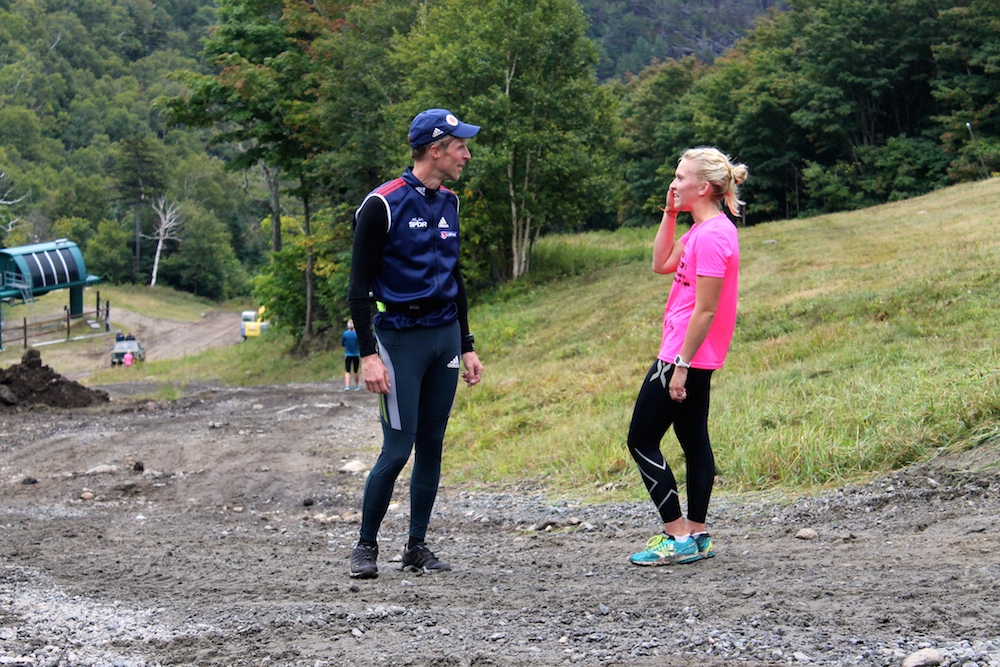
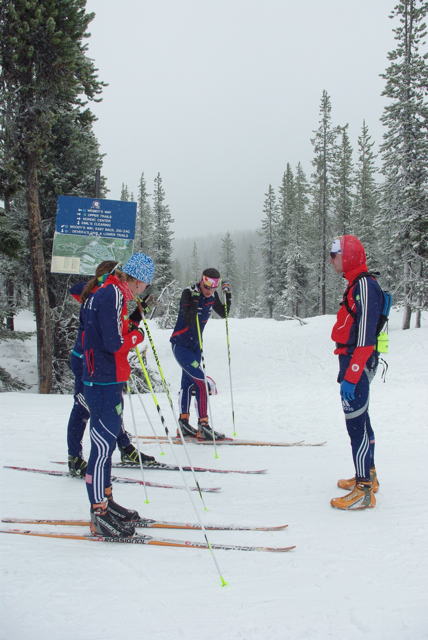
U.S. Biathlon Association women’s coach Jonne Kähkönen checks in with Kelsey Dickinson after an uphill running time trial in 2014.
When Jonne Kähkönen was hired to be the women’s national team coach by the US Biathlon Association (USBA) in 2010, there wasn’t much of a playbook to follow.
The Finn couldn’t mimic the footsteps of his predecessor, because there wasn’t one.
For the first time, the women’s team was going to have a coach of their own.
“The men’s program was on a really high level going into Vancouver [2010 Olympics],” USBA Chief of Sport Bernd Eisenbichler – then the high-performance director – said on the phone this weekend. “It was a deep program and the men’s relay was having pretty good potential. And we saw the women coming up having the same potential to go up to the top as well.
“We knew that if we wanted to build up a strong women’s program, we needed to have a dedicated coach for them,” he explained. “Really just focused on their development, and putting the group together to make it a really good environment.”
Enter Kähkönen, who had spent the previous four years as the head coach of the Finnish biathlon team.
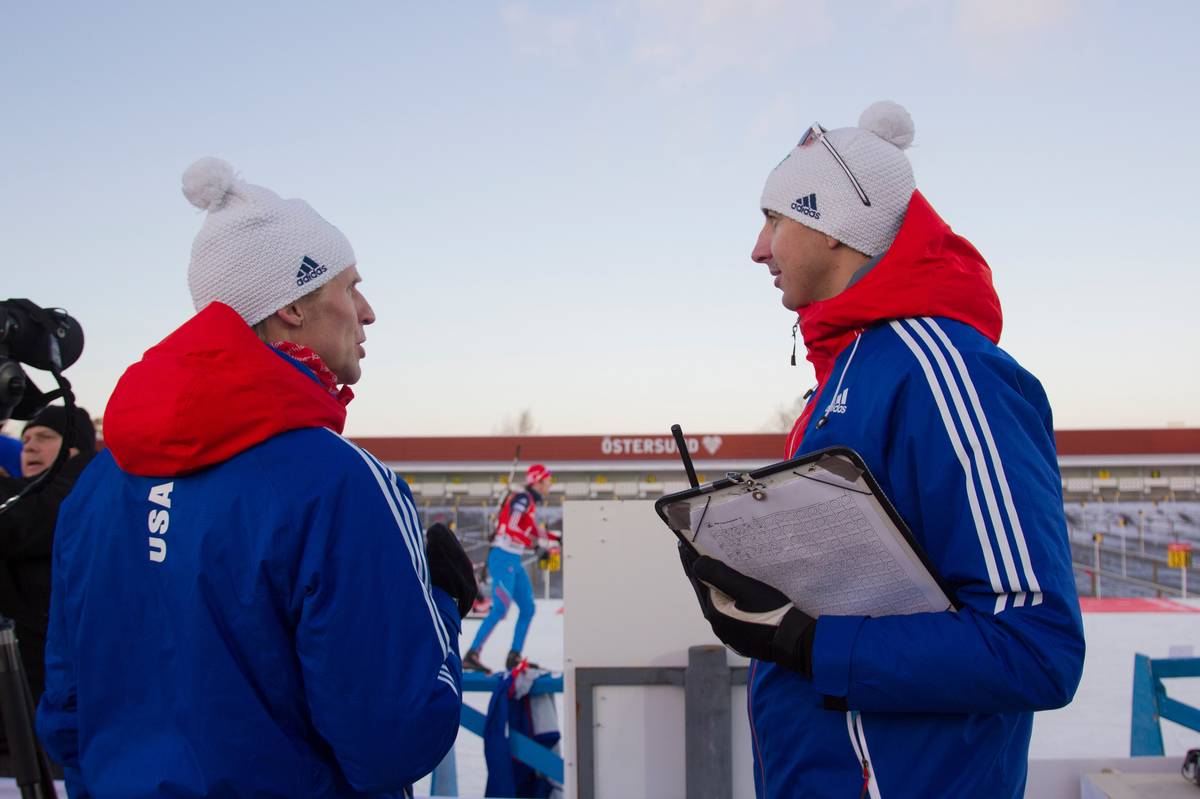
US women’s coach Jonne Kähkönen, left, and men’s coach Jonas Johansson on the range in Sweden in 2014. (Photo: USBA/NordicFocus.com)
“Obviously the first quad [four-year Olympic cycle] felt like it went by really quick, because everything was new,” Kähkönen said in a phone interview last week. “I think looking back, we made really good decisions overall with the philosophy of the team for both the men and the women. Especially for the women, in the early years, to get them up to speed, to be competitive. And it was successful already after the first couple years.”
In 2009, the U.S. women were ranked 20th in the World Cup’s Nations Cup standings. Eight years later, they have had numerous top-20 performances from multiple athletes, World Youth and Junior Championships flower ceremonies, and World Cup podiums and a World Championships silver medal by Susan Dunklee.
“When we started, we didn’t think we were capable of that,” Eisenbichler said. “We saw the potential, but to win a silver medal with Susan, to have these multiple top 20’s by six or seven different athletes, I think we can be really happy with what the women’s program has looked like the last eight years and where we are right now.”
And after leading that charge for eight years, Kähkönen is leaving the team to take back his role as the head coach for Finland – a program that has also risen in that period, with Kaisa Mäkäräinen winning three overall World Cup titles, Mari Laukkanen scoring two World Cup victories, and the mixed relay team finishing sixth at the 2018 Olympics.
“It has been a process,” Kähkönen said of the transition. “I definitely have been thinking of each quad [cycle] as a project. At the end of the project it is always good to evaluate and think about the next steps and what’s good for me professionally, but then I want what’s best for the team and the athletes also. And I feel like now with the few retirements, it’s probably good in a way to make the changes now.”
“I think that the women need a new stimulus,” Eisenbichler said. “Not that the old stimulus wasn’t good or wasn’t working anymore, but after eight years it’s normal. And Jonne and I see that the same way. I could not be more thankful and grateful to Jonne. And now it’s time for him to have a new era with the Finnish biathlon association.”
The Fun-Loving Finn
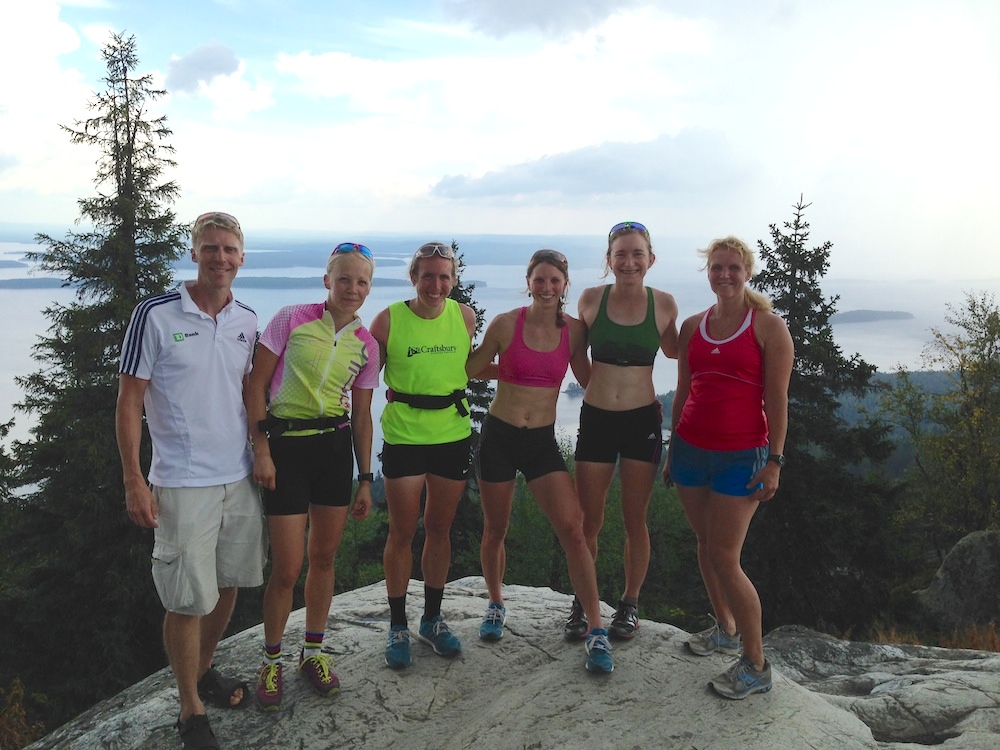
The US Biathlon women’s team after an uphill interval session up Koli, the highest point in southern Finland, with coach Jonne Kähkönen (l) and his wife (r), who also rollerskied up, and Finnish World Cup champion Kaisa Mäkäräinen (second from l). (Photo: Jonne Kähkönen)
“I think that having a women’s coach changed something in the heart of the women’s team, because it felt like a validation that we were improving and deserved someone that was there specifically for us,” 2014 Olympian and five-time World Championships competitor Annelies Cook, who retired in 2016, wrote in an email last week.
“Personally, I am really grateful that I had Jonne as a coach,” she continued. “Jonne was there in my life through many big changes and I could always talk to him and I always felt supported by him. He was always positive for us, and that is something you really need in a sport that can really get you down sometimes. Biathlon is different from cross-country skiing in where the differences in performances from day to day don’t change that drastically. Biathlon can change instantly from good to bad, and that can be really emotional sometimes.”
Kähkönen said that he learned a lot in his years of coaching in the U.S., not least from the athletes and the team’s international staff, who hail from Sweden, Italy, the Czech Republic, and Germany.
“It makes me think what works and what doesn’t work, and also to take that into account working with the athletes,” he said.
But what he learned the most was to have fun.
“I know that having fun seems dangerous to say [in a serious environment],” he said. “It’s not only about having fun, but enjoying your work and enjoying what you’re doing — I think that’s more descriptive. But, at times, having fun as well!”
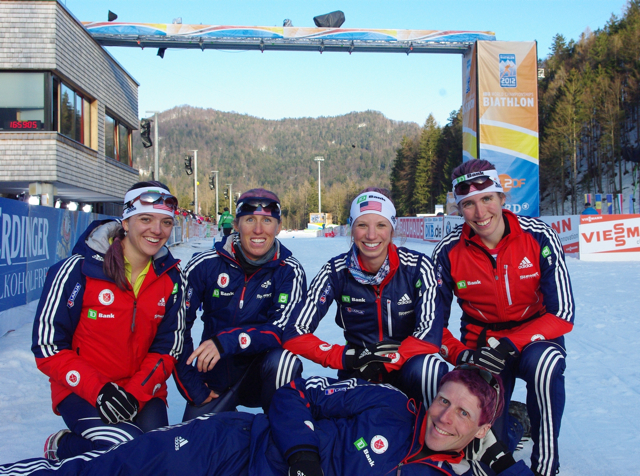
Sara Studebaker, Lanny Barnes, Annelies Cook, and Susan Dunklee, with coach Jonne Kahkonen, model their new hairstyles at 2012 World Championships.
Case in point: in 2012 at World Championships, Kähkönen dyed his hair purple. He had told the team that if any of the women finished in the top 10, he’d do it. Susan Dunklee placed fifth in the 15 k individual. So purple it was.
“I think those types of things are important, whatever it is, just to try to lighten it up a little,” he said. “Me being Finnish, people say that I’m not a typical Finn. I’m more open or more lively or whatever.”
Quite apart from the hair, Dunklee’s fifth-place finish in Ruhpolding was one of Kähkönen’s favorite moments from his tenure with the team. At the time, he was midway through his second winter leading the women’s squad, and Dunklee had competed in just two weekends of World Cup racing.
“Probably one of the most exciting moments was Susan’s first breakthrough at Ruhpolding World Champs in that individual,” Kähkönen reminisced. “She had the lead for a good while, and her being really surprised by it. That was definitely, maybe not the start of it all, but one of the very good results that we had early on.”
The previous year, Sara Studebaker and Laura Spector had broken into the top 20 on the World Cup, and Haley Johnson had been close in 21st. One year later, Cook made her own jump into the land of top-20’s. And later still, Hannah Dreissigacker and then Clare Egan would hit the top 20, along with Dunklee’s four World Cup podiums and her World Championships silver medal.
“Obviously after all the hard work, all the medals, Tim [Burke] in Nove Mesto and then Susan and Lowell [Bailey] in Hochfilzen last year, those are on top of the list,” Kähkönen said.
Back to Finland
Kähkönen hesitated to say that he was headed for home.
“It may be a cliché to say that home is where your heart is, but Lake Placid has been my home,” he said. “I’ve said this to a couple of people, but it hasn’t hit me yet because I’m still here. It has been great. The community is so supportive. There are great people there and we made good friends. So it will be tough to leave when that day comes.”
The family will move this summer, after his oldest son graduates from high school in June.
U.S. women’s coach Jonne Kahkonen talks to his team between intervals at a training camp in Bend, Oregon, in 2012.
But it is an interesting assignment for Kähkönen to retake the reins of a program that has changed a lot since he last worked there.
“With Kaisa [Mäkäräinen] being the star, it is exciting to go back and work with her, if she decides to continue [racing], which remains to be seen,” he said of an athlete who had five podiums the last time he worked with the team, but now owns 23 international wins and 54 more podiums. “We worked together in the past, so it will be fun to be reunited.”
But the other pieces of Finland’s biathlon puzzle are no less compelling.
“At the same time, I think as big a part of it is seeing the rise of the next generation,” Kähkönen said. “They won a couple medals at the junior level. It’s not just the juniors and youth who won the medals, but even behind them, there are just more people doing biathlon now, which is good to see. And just seeing the good results that the men’s team is starting to post on the World Cup now. That’s inspiring to me.”
And in the end, the fun is one thing that he hopes to bring back to Finland.
“I just read in one of the Finnish papers today, Aino-Kaisa Saarinen, who is part of the cross-country team — she has trained a bunch with Kikkan Randall and the U.S. women — she made a comment that what she was missing a little bit in the last couple of years was having this sort of North American type of relaxed and having fun atmosphere while doing the work that everyone is committed to.”
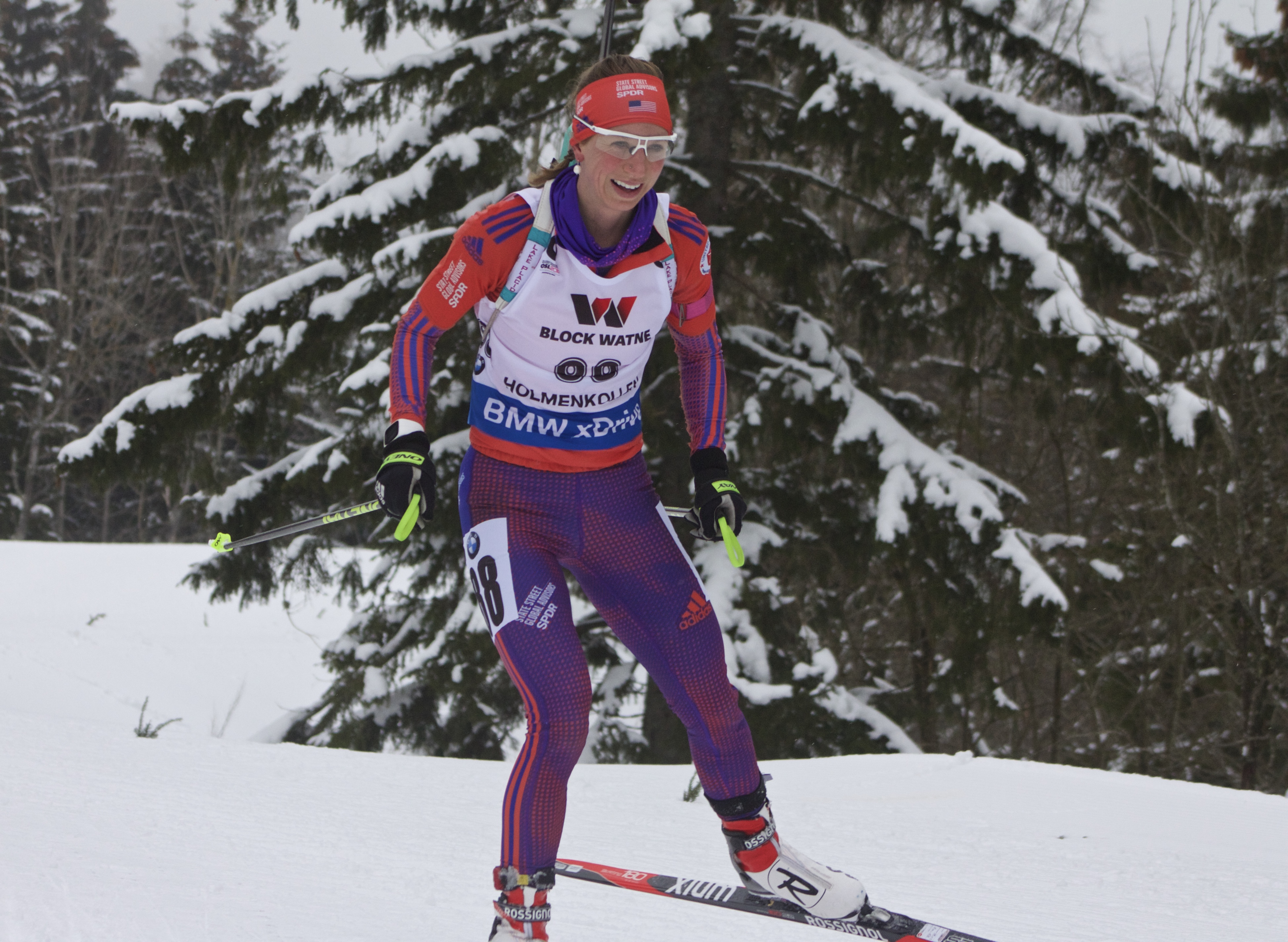
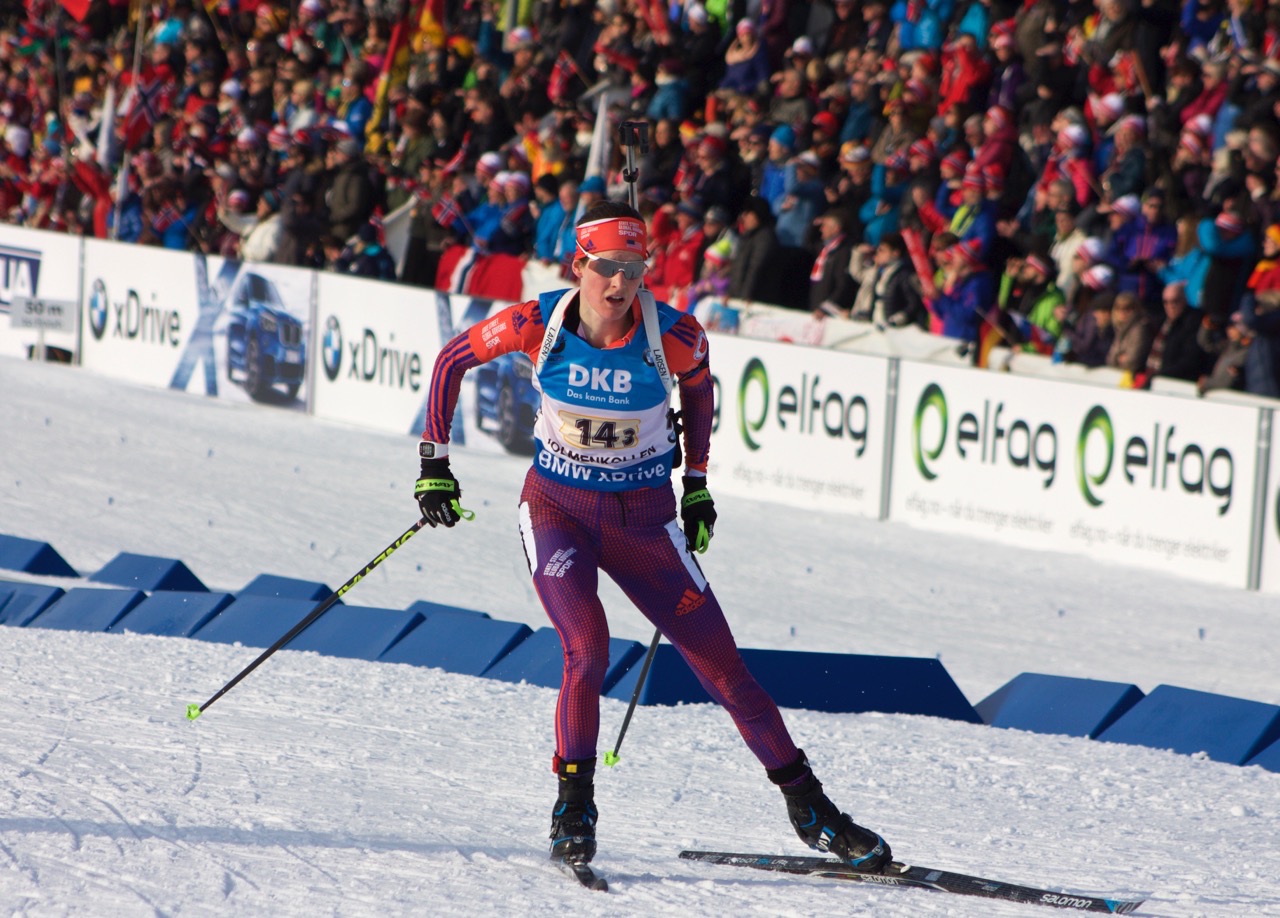
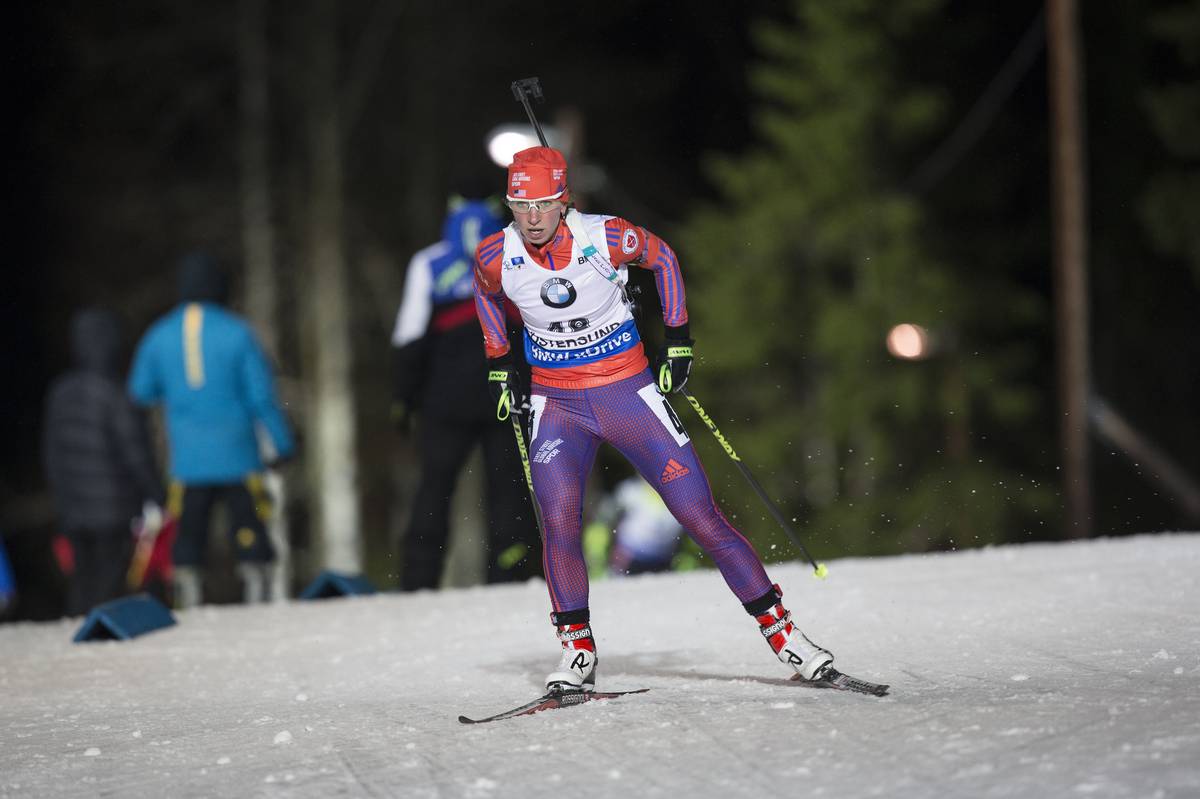
Annelies Cook of the United States on course in the women’s 4 x 6 k relay at 2016 World Championships in Oslo, Norway. (Photo: JoJo Baldus)
The U.S. National Championships/NorAm Championships series didn’t exactly start off badly for Annelies Cook, but it didn’t start off well in Fort Kent, Maine, either.
“Between colds and sleep deprivation, we were all in survival mode but trying to have fun with it,” she wrote of the national team at the first race, a sprint, on Thursday. “The sprint was better than I thought it would be skiing wise, but I missed 4 [targets, out of ten], so that didn’t help.”
Those misses put her back in fourth place, almost two minutes behind teammate Clare Egan. With Egan also shooting well in Friday’s pursuit, making it to the front of the field seemed more or less impossible.
But then Saturday rolled around: a 12.5 k mass start competition, and the very last race of Cook’s career as a professional biathlete. The Saranac Lake native is set to retire at the end of this season.
With the sun and snow and festive end-of-the-year atmosphere, Cook was able to enjoy herself while also racing her hardest.
“Yesterday was a beautiful sunny day with great skiing and we just wanted to have fun,” she wrote in an email on Sunday. “We dogged it the first loop so that everyone could come in shooting together, which was fun and then after that the race started.”
Cook missed only two shots, both in her first standing stage, for 90% shooting overall. That tied her for the best shooting of the day and allowed her to hold off a challenge from Joanne Reid of the Auburn Ski Club and Colorado Biathlon.
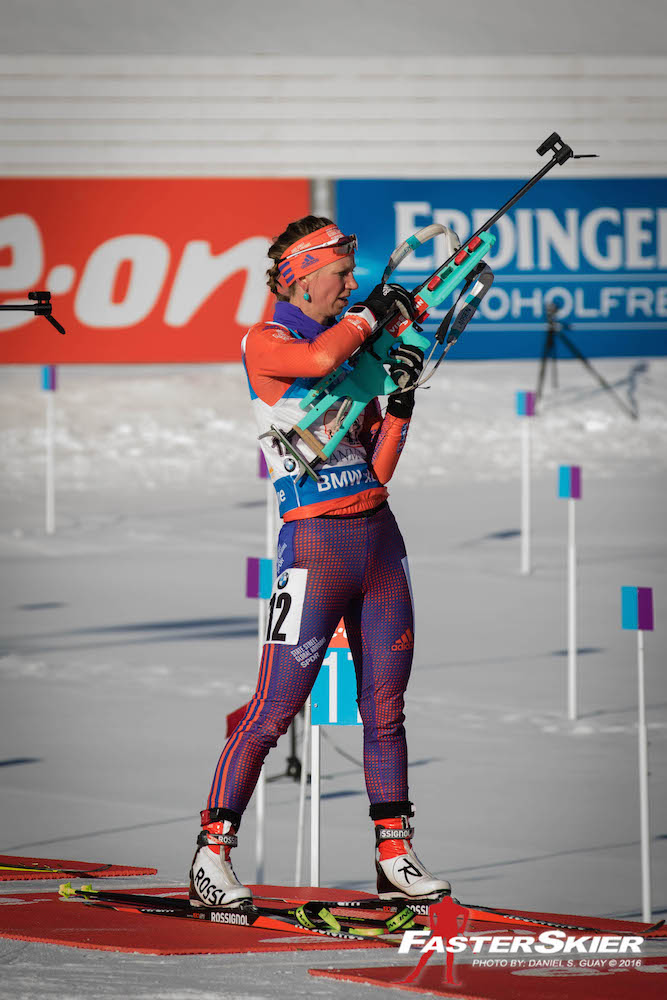
Annelies Cook (US Biathlon) during one of her two standing stages in the single mixed relay at the IBU World Cup in Canmore, Alberta. She teamed up with Leif Nordgren to place 16th. (Photo: Daniel S. Guay)
Reid had four penalties, two apiece in each of the standing stages.
“It was my best shooting of the year in a 4-stage race, ironically, and that was good because I knew that Joanne was skiing a lot faster than me so my only hope was in the range,” Cook explained. “I only beat her because we came into the last standing together and I cleaned and she missed two, so I was thankful for that! I didn’t have much fight in me other than to make it around the course.”
She made it, earning a 22-second victory to win the national title in her last start ever.
Sisters Emily and Hannah Dreissigacker took third and fourth, +1:16 and +2:25 with two and four penalties, respectively. Hannah Dreissigacker is also retiring. Egan took fifth, +3:07 with seven penalties.
Cook said that she had been mulling retirement for over a year, but arriving in Oslo everything clicked into place: it was time.
“I don’t think it actually felt real until this week,” she said at the time. “I had been saying to people, ‘I think I’m going to retire, I might retire,’ for a long time. But when I got here it was like, yup, I’m going to retire. This is going to be it.”
Cook has been doing biathlon since she was 13 years old. Back in 2002 she made her first trip to World Junior Championships and finished in the top 20 in every race.
After a stint doing biathlon full-time at the Maine Winter Sports Center and racing on the junior and European Cup circuits, Cook enrolled at the University of Utah in 2006, where she raced for the cross-country ski team and earned NCAA All-American honors in 2009. One of several World Cup biathletes to have taken a detour through the college skiing system, and credited it with enabling her to stay in the sport long-term.
“It was a very much needed break,” she told FasterSkier in 2012. “[But] when I went into college, I told myself, I really want to go back into biathlon when I’m done here.”
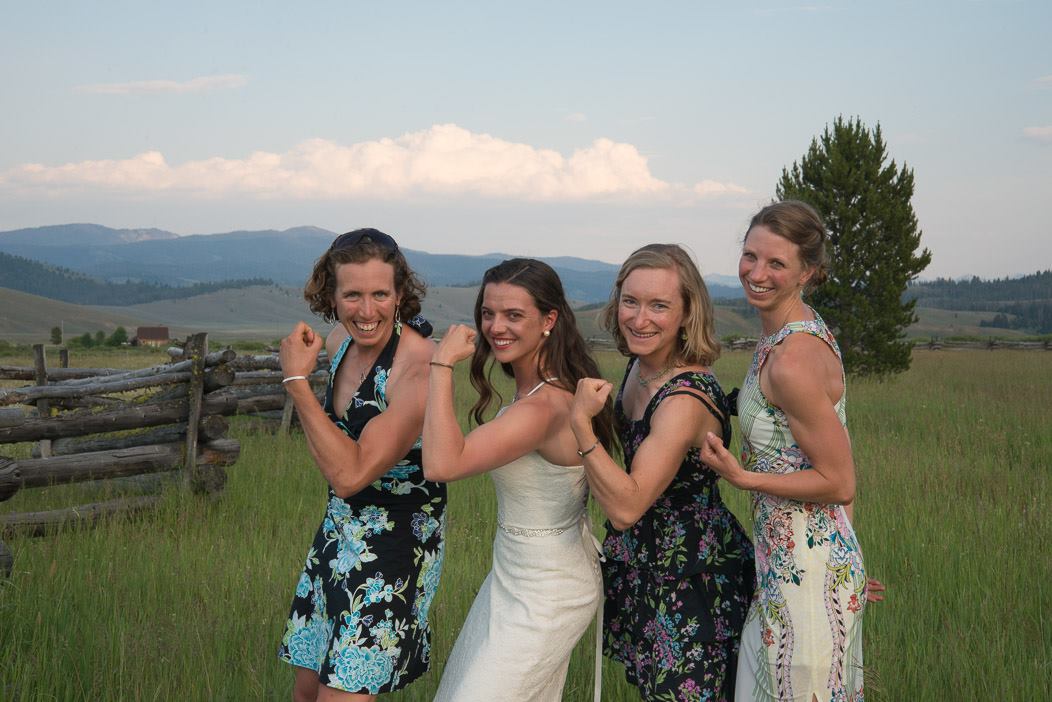
The women of the 2014 Olympic team are a close-knit group. Sara Studebaker (second from l) married Zach Hall in mid July and celebrated with friends and former US Biathlon teammates Susan Dunklee (l), Hannah Dreissigacker (second from r), and Annelies Cook (r) in Stanley, Idaho. (Photo: Sara Studebaker/Facebook)
After graduating, she was immediately invited onto the biathlon national team, but floundered during the transition back into being a full-time athlete. After a year of supporting herself, she raced her way onto the World Cup and has been a national team staple ever since; in 2012 she also renewed her partnership with the Maine Winter Sports Center.
“It has been a really amazing adventure,” Cook said in Oslo. “Biathlon is just such a crazy sport. There have been so many high points and so many really low points. I don’t think there’s a sport like it that makes you feel so much. Such a wide range of emotions.”
A 2014 Olympian, Cook had her best World Cup results in 2013, when she hit the top 20 on three different occasions.
“I’ve loved it so much,” she said. “I love training with my team, and I love racing, and I love my wax techs who always cheer me up if I’m sad. There’s so many good people. That’s why I’ve done it. I haven’t done it because I’m a World Champion athlete, or because I love living out of a suitcase. It’s because I love the people so much. It’s going to be really hard to say goodbye to everyone.”
The women’s team has been particularly close-knit during that time, which adds to the difficulty of those goodbyes.
“We’ve grown up together,” Cook said. I think about what we were like- I mean, I did this when I was 19 and just figuring out how to start being an adult… we’ve just all gotten more mature. We’ve turned into better people I think. We’ve all had our moments of being little shits, and we’ve all learned how to be nicer, better people together. I’m really proud of the people I’ve gotten to work with. That’s what’s really cool about our team: it’s a really genuine group of people.”
That includes not only her teammates, but the myriad others who work with the team.
“The wax techs are always there to take care of us and I am so lucky to have Jonne [Kahkonen] as a coach,” Cook wrote in a later email. “As such a small team, we are incredibly well organized thanks to the outstanding efforts of Bernd Eisenbichler and Max Cobb.”
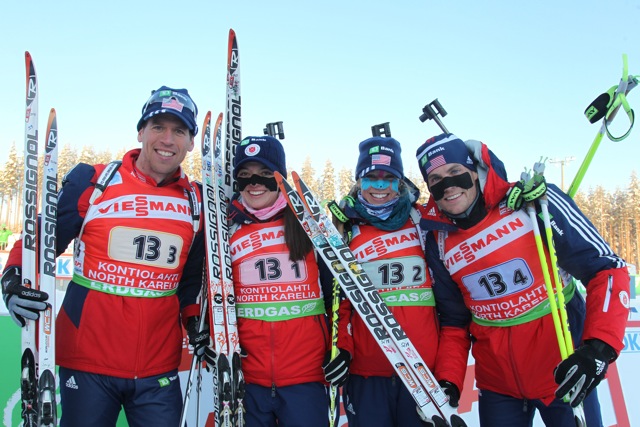
Jay Hakkinen, Sara Studebaker, Annelies Cook, and Tim Burke pose after their sixth-place World Cup mixed relay result in Kontiolahti, Finland, in 2012. (Photo: NordicFocus/USBA.)
Cook is not sure exactly what she’ll do next – “life!” she exclaimed – but her biathlon friends will never be far. That’s particularly true of Tim Burke and Lowell Bailey, who are also from the Lake Placid area and have been longtime teammates of Cook’s through many career stages.
Bailey told FasterSkier in Oslo that he hadn’t yet decided whether to retire or not, but that a decision would be made this spring. Burke will stay in the game.
“I’m going to have fun watching them on TV,” Cook laughed. “We’re close, and we have family history. We’re from the same place. My relationship with them will always be there, with or without biathlon. We’ll probably see each other more when we’re not doing biathlon together. Like, ‘hey, come over for dinner!’ And I can babysit their kids for them.
The women’s team, too, she says will be just fine without her – evidenced in part by strong performances by newcomers Reid and Emily Dreissigacker at the NorAm Championships.
As she cheers for more American success from the comfort of her home, Cook also says that biathlon will never be far.
“I don’t think I could ever really leave biathlon 100 percent,” she said. “It’s just too much a part of me. I did my first biathlon camp when I was 13 ½ years old. It’s more than half of my life that I’ve been involved in biathlon. So I just want to say thank you to everybody, and see you around.”
* * *
In the men’s 15 k mass start, it was Burke who took top honors. With just a single missed shot over the four shooting stages, he claimed a huge win: a minute and 28 seconds over the closest competitor, national team teammate Sean Doherty.
Leif Nordgren was third, +1:41, and Bailey – who had won both the sprint and pursuit – finished fourth, +1:54. Hometown favorite Russell Currier rounded out the top five, +2:54.
In the junior men’s field, Brian Halligan of the Maine Winter Sports Center won with four penalties, one in each stage; in the junior women’s field, MWSC athlete Hannah Streinz beat Caitlin Campbell of Prince Edward Island, Canada, by 52 seconds.
Lucas Boudreau of Prince Edward Island took the youth men’s race by 18 seconds over Matthew Forshey of the Hudson United Race Team.
In the youth women’s race, Chloe Levins of Mountain Top Nordic bested Eliza Thomas of Mansfield Nordic by 2:57.
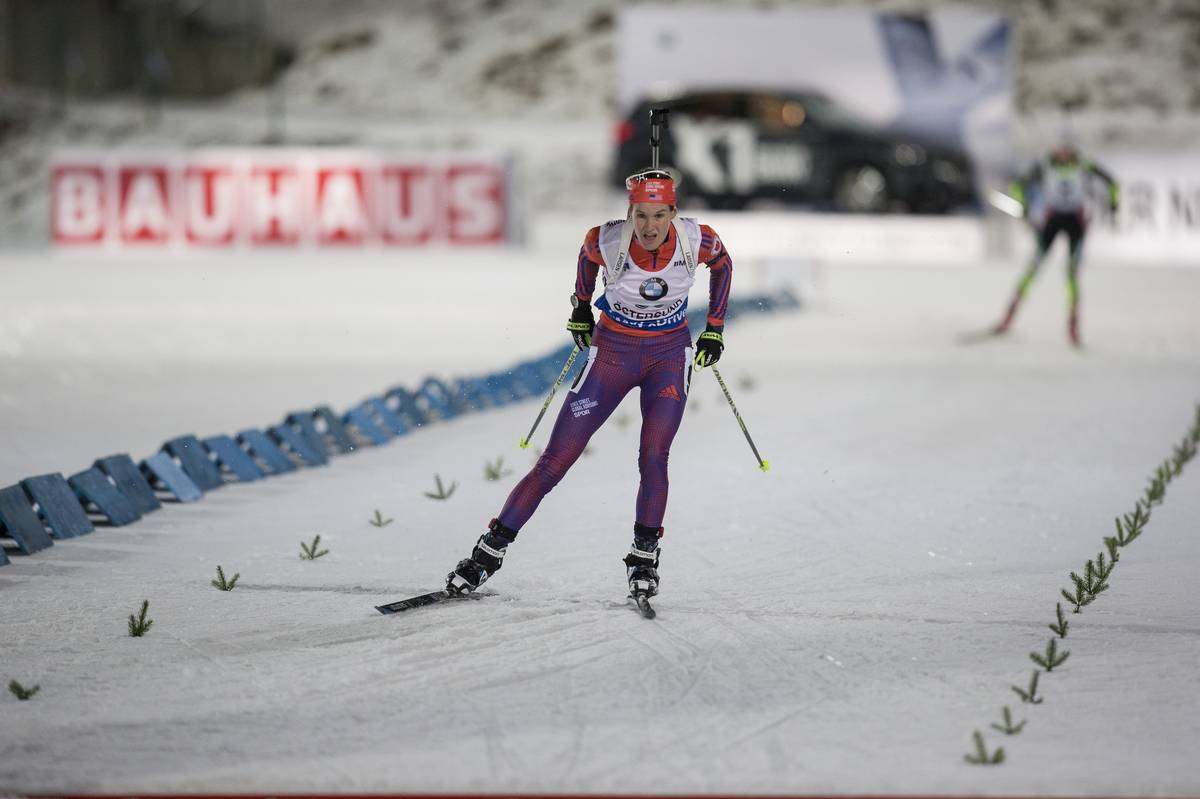
Annelies Cook finishing out her international biathlon career, anchoring the U.S. women’s relay team to 13th at 2016 IBU World Championships. (Photo: USBA/NordicFocus)
OSLO, Norway — The women’s 4 x 6-kilometer relay wasn’t just the last race of 2016 World Championships for part of the US Biathlon team, but also the last international race of some of their careers.
With both Hannah Dreissigacker and Annelies Cook set to retire – and neither are attending the final World Cups in Khanty-Mansiysk, Russia – it is the end of an era for the team.
“I’m really sad to be saying goodbye to Annelies and Hannah as teammates,” Clare Egan said. “Really, really sad. They are just great teammates, relay day or not relay day. Summertime, wintertime. We have big shoes to fill.”
But before they could laugh and cry and reminisce about so many training camps and racing trips done together, the women had to get through the relay, and they wanted a good result.
“I said last night in our race meeting, we definitely want to approach every day until the end of the World Championships very professionally,” U.S. women’s national team coach Jonne Kähkönen said. “Sure, there are a lot of emotions. You have to put those on the side, and finish the day first, and then celebrate the retirements. But have a good focus all the way through.”
“We want to have fun on this last day, and we want to put together a good result to have a good memory to go out on,” Susan Dunklee agreed. “When you’re seeking fun, that doesn’t mean that you don’t work hard and it doesn’t mean that you’re unprofessional or you’re not doing the focused work that you need to do. But I think that’s the common misconception when we talk about fun. Fun means keeping yourself motivated to be hungry and to want to do the work.”
Dunklee led things off for the United States, cleaning prone with no spare rounds and going out with the leaders.
“I don’t think I’ve ever seen so much contact in the women’s field in a mass start situation,” she said of the early going. “People were bumping elbows and poles, and stepping on each others’ skis, and I saw a couple different people go down. People were moving back and forth across the trail more than they usually do. It was really difficult to move up today.”
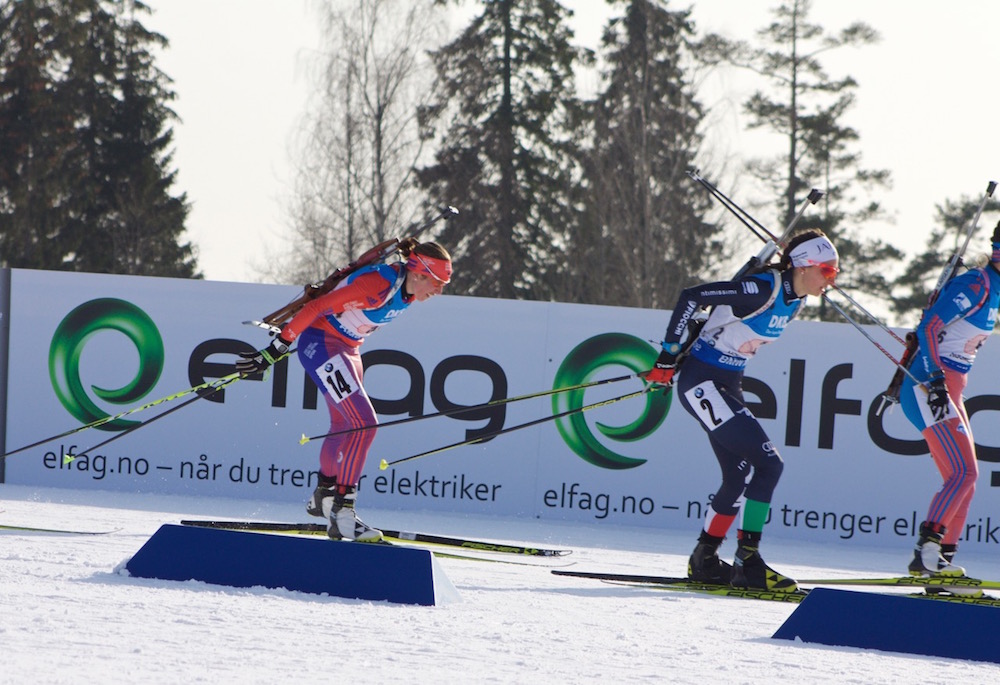
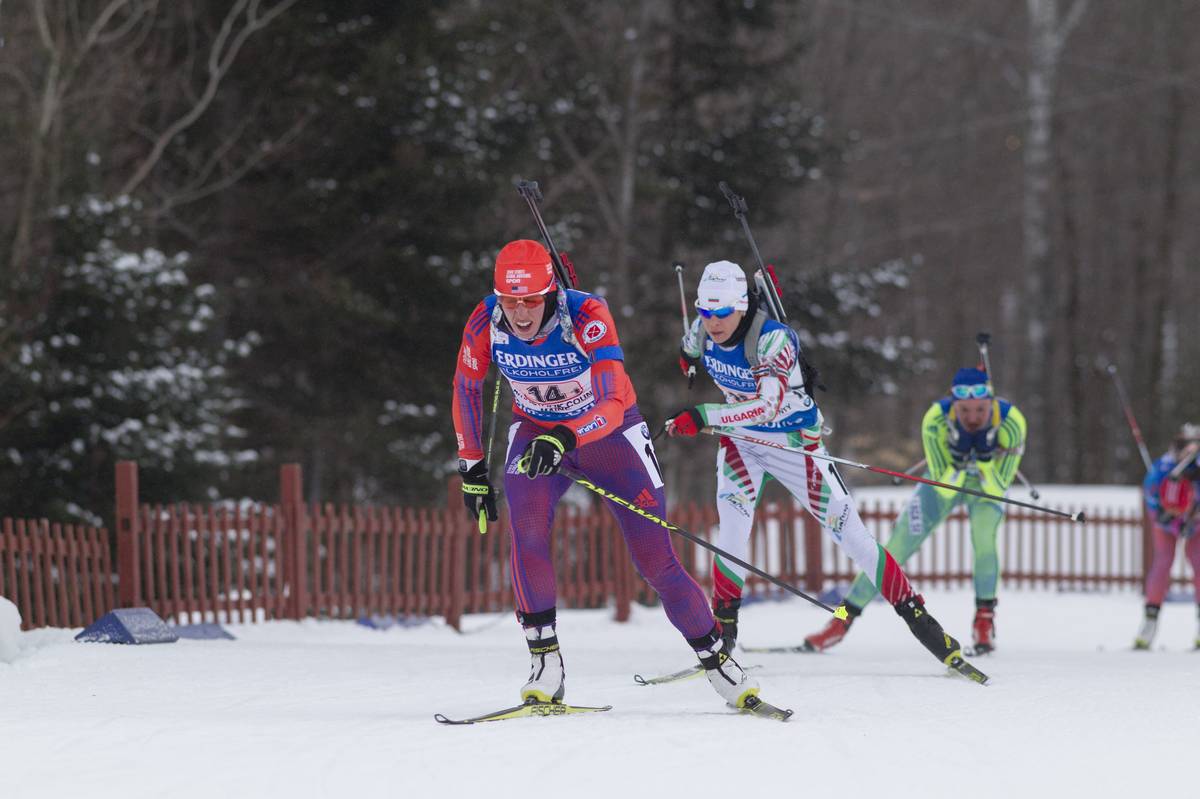
American Susan Dunklee (14) chasing Italy’s Lisa Vittozzi (2) while skiing the first leg of the women’s 4 x 6 k relay at 2016 IBU World Championships in Oslo, Norway. She tagged her team in 10th and the U.S. went on to place 13th. (Photo: JoJo Baldus)
Dunklee tried to attack on the second loop, but was quickly caught.
“I don’t think I felt as sharp on skis,” she said, comparing the effort to her leadoff leg in the mixed relay a week ago, where she tagged off in first place.
“I didn’t have the gas to quite go as hard, and when I did go hard I didn’t recover. I think all this racing is starting to get to me a little bit. I attacked off the front, and then people passed me on that downhill leading into the big hill. They caught right back up, so I thought it was stupid to waste that much energy if I’m not going to make a big break.”
Dunklee then used two spare round in standing and tagged off in tenth place, 28.2 seconds back. Her ski time was the second-fastest of all leadoff skiers.
She tagged off to Dreissigacker, who was in the last relay race of her career. Things didn’t go perfectly, and the team fell to 16th.
“Shooting, I had to use three spares,” Dreissigacker explained. “I am not that happy with my shooting, but it still wasn’t terrible. It’s just a tough competition out there today. There are all kinds of teams at the top.”
Egan moved up to 14th with two spares, before tagging off to Cook.
Cook had only announced her retirement publicly in the last 24 hours, and of all the emotions running rampant on the team, hers were the strongest.
“I was so nervous, oh my god,” she said. “I wanted to be able to finish in a good way, with my team. I had the worst butterflies all day long. But I was just really happy to ski.”
And after being frustrated in the sprint, after a bout of pre-Championships illness, Cook felt her ski speed come back around as the week went on. She used just one spare round on the anchor leg and was left with a performance she could feel happy about. She crossed the line smiling in 13th place, 3:47.1 behind the winning Norwegian team.
“I think Annelies did a great job today,” Kähkönen said. “Cleaning quick in prone, and then just one reserve in standing. That was excellent execution. To her potential, I mean, that’s how Annelies Cook shoots.”
Still, even out on the course there were bits of emotion.
“On the last little bit I saw Hannah, and Susan and Clare, and they are such a great team,” Cook said, tears wellling up in her eyes. “I’m going to miss them so much. It has been a really amazing adventure with a lot of really good people.”
The result wasn’t the best of the season. The U.S. had finished tenth in the last World Cup relay before World Championships, at home in Presque Isle, Maine.
Clare Egan skiing the third leg for the U.S. women in the 4 x 6 k relay at 2016 IBU World Championships. After receiving the tag in 16th, she brought the team to 14th and the U.S. finished 13th. (Photo: JoJo Baldus)
“We maybe just didn’t have the energy on the skis today,” Egan said. “It seemed like some of the other teams were performing extremely well. I don’t think we were performing poorly.”
Kähkönen thought that was a fair assessment.
“At the World Champs, that’s just the level [of competition],” he said. “You need that good shooting, and even better shooting, and the best shape of the day. And as usual, we had a few surprises mixed in there. Like the Slovenian team, and Kazakhstan definitely had a great day today.”
Now, the team is looking forward to Dunklee and Dreissigacker competing in Sunday’s mass start, the first time ever that two American woman qualified for the 30-woman event at a Championships.
From there, Dunklee and Egan will go to Khanty-Mansiysk to finish off the World Cup, while the retirees will go home, and then to North American Championships in Fort Kent, Maine.
After that, it’s time for the team to contemplate life with two fewer members.
“I’m going to miss them so much. It has been a really amazing adventure with a lot of really good people.” — Annelies Cook (US Biathlon) on retiring
“It will be a great challenge,” Kähkönen said. “We’ve talked about this for the last two years now. Ever since Sochi I guess. Just trying to find ways to bring in more resources and effort into development, because it’s a long path. I typically say it’s four, five, six years, depending on where you start from, to get to a true World Cup level. I mean, even Clare [Egan, who started biathlon three years ago], she is doing awesome, but still on the way. She is in the process of getting there.”
Dunklee and Egan both agreed that there is plenty of opportunity for their team, naming Maddie Phaneuf and Joanne Reid as women they are excited to work with more next season.
“We have some candidates,” Dunklee said. “It’s going to be a fun challenge, getting some new people up to speed. There’s hope. We have a bright future.”
Kähkönen sees Dunklee, who has had world class performances each of the last several seasons and turned in a top-ten sprint result earlier in World Championships, as the ‘captain’ of the team going forward.
But team cohesion and a supportive atmosphere are hallmarks of the U.S. women’s team, and he doesn’t see any problem fitting new candidates into that group.
“The others members took Joanne into the team immediately,” Kähkönen said of Reid’s first World Cup experience. “It was good to see. And I must say, it was almost out of the blue that she raced national trials, and then IBU Cup, and then most of the [World Cup] athletes had not seen her, had not even met her. So I think they did a good job, and at the same time that’s just how the team operates.”
Memories of the atmosphere that Cook and Dreissigacker helped create will inform the group moving forward.
“These awesome experiences you have with your teammates, these bonding moments whether it’s training in the mountains in the summer or in the pouring rain when nobody wants to be out but you’re out there and you’re badass, those keep you motivated,” Dunklee said. “Your teammates make it fun.”
Rosanna Crawford of Canada finished 13th, the best World Championships finish of her career. (Photo: JoJo Baldus)
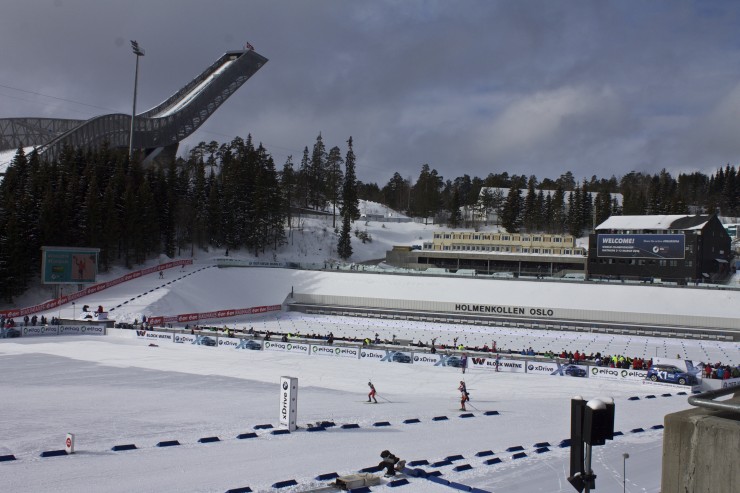
The scene at Holmenkollen stadium in Oslo during the women’s 15 k individual of IBU World Championships. (Photo: JoJo Baldus)
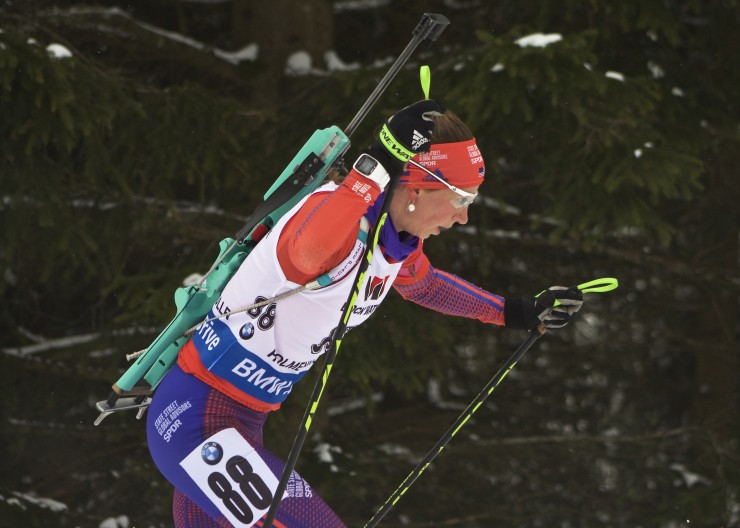
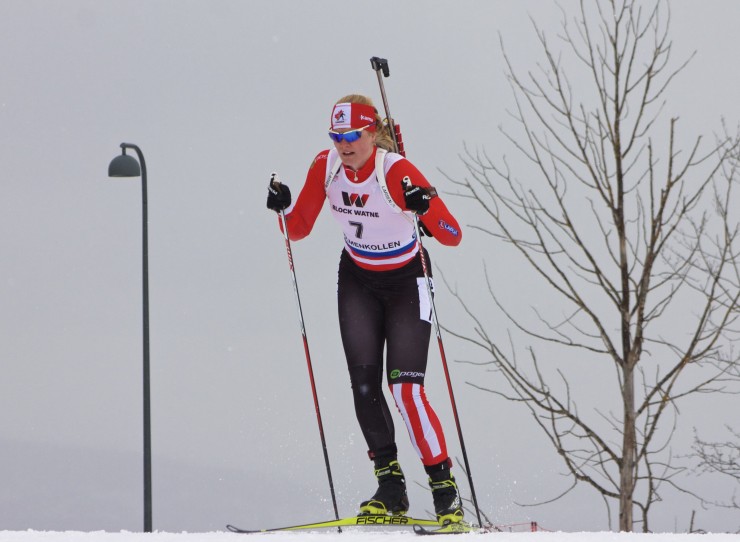
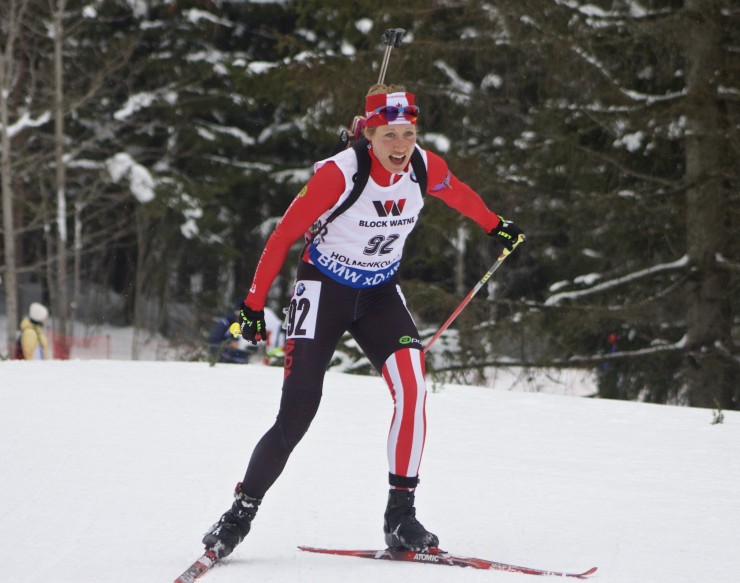
Annelies Cook of the United States placed 77th. (Photo: JoJo Baldus)
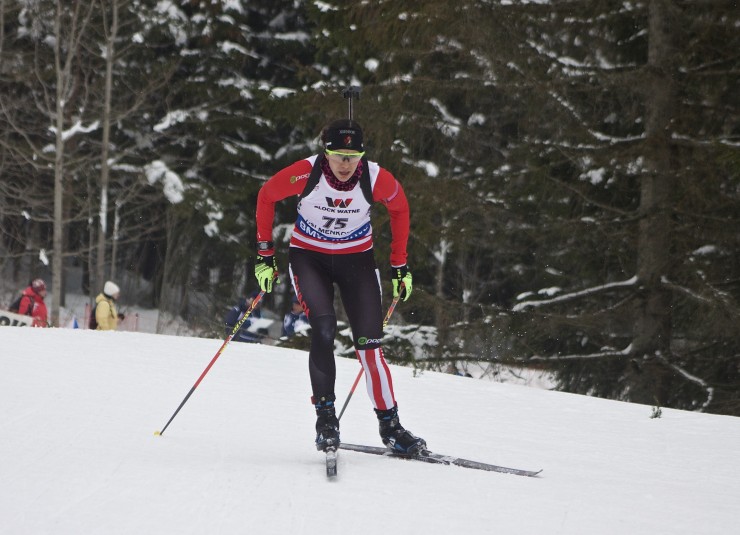
On course in the 15 k individual. (Photo: JoJo Baldus)
Marie Dorin Habert of France won her first individual gold of these World Championships. (Photo: JoJo Baldus)
A scene outside of the race course at Holmenkollen. (Photo: JoJo Baldus)
Susan Dunklee pushing over a hill for 18th place. (Photo: JoJo Baldus)
Hannah Dreissigacker of the United States finished 33rd in the 15 k individual at World Championships on Wednesday. (Photo: JoJo Baldus)
Clare Egan en route to 66th place. (Photo: JoJo Baldus)
Gabriela Soukalova of the Czech Republic, the overall World Cup leader, placed fifth. (Photo: JoJo Baldus)
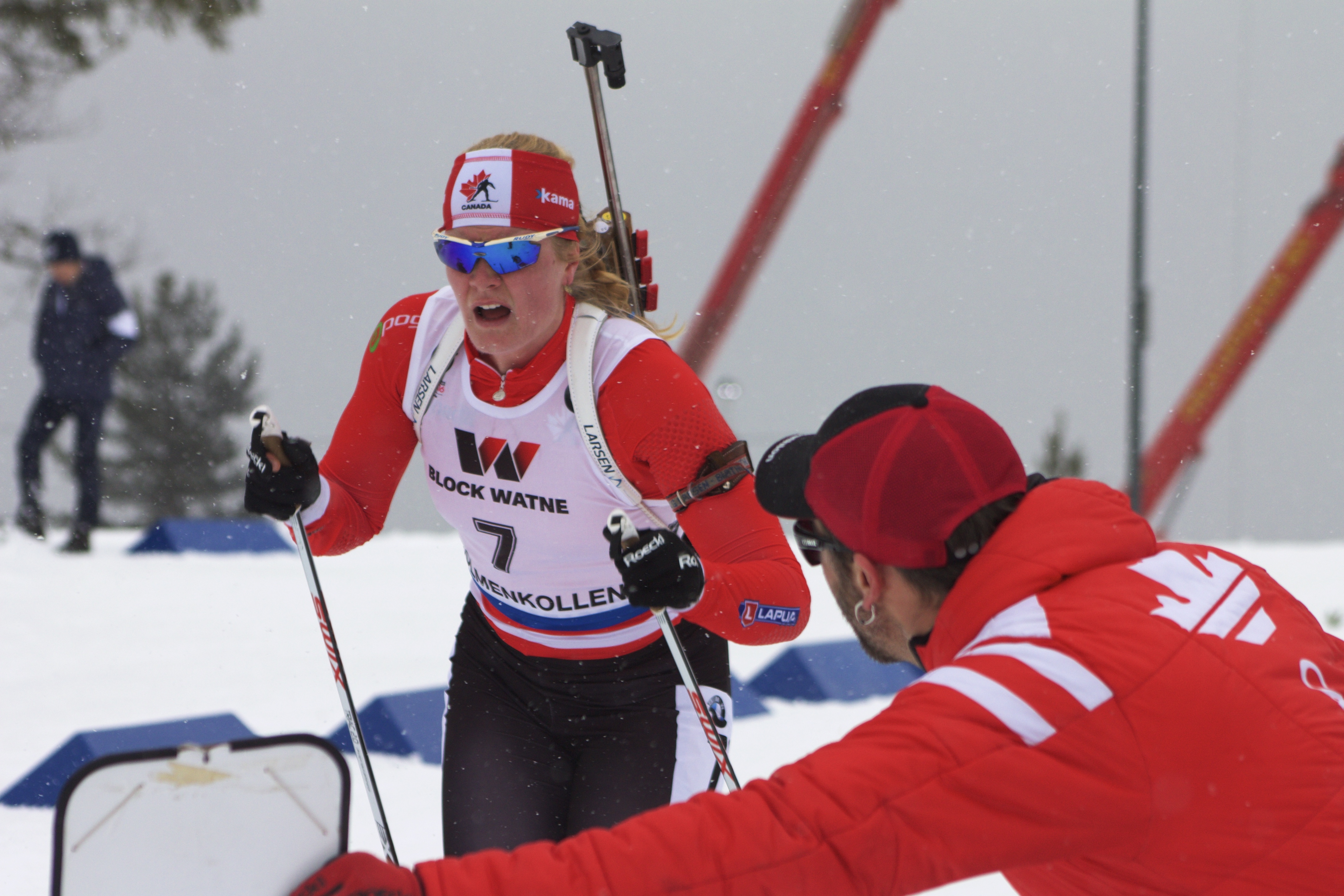
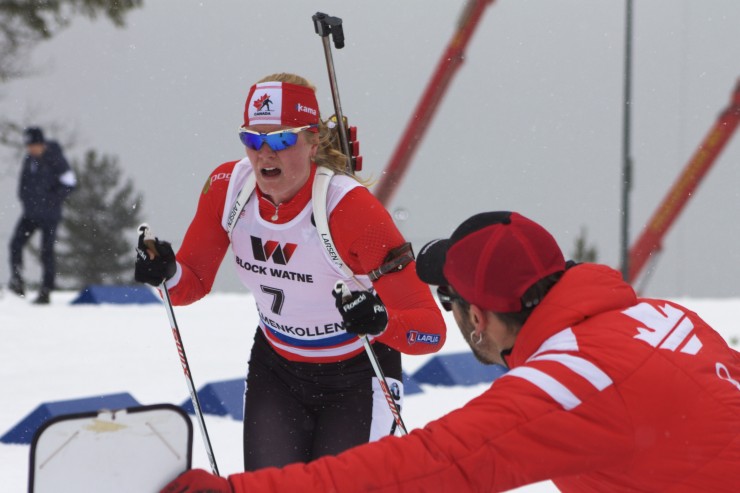
Sarah Beaudry of Canada is urged on by head wax tech Tom Zidek. (Photo: JoJo Baldus)
Oslo 2016 IBU World Championships – Clare Egan of the United States. (Photo: JoJo Baldus)
Julia Ransom en route to 20th place for Canada. (Photo: JoJo Baldus)
Laura Dahlmeier of Germany earned bronze in the 15 k individual. (Photo: JoJo Baldus)
Hannah Dreissigacker earned her first mass start qualification after today’s race. (Photo: JoJo Baldus)
Sarah Beaudry of Canada. (Photo: JoJo Baldus)
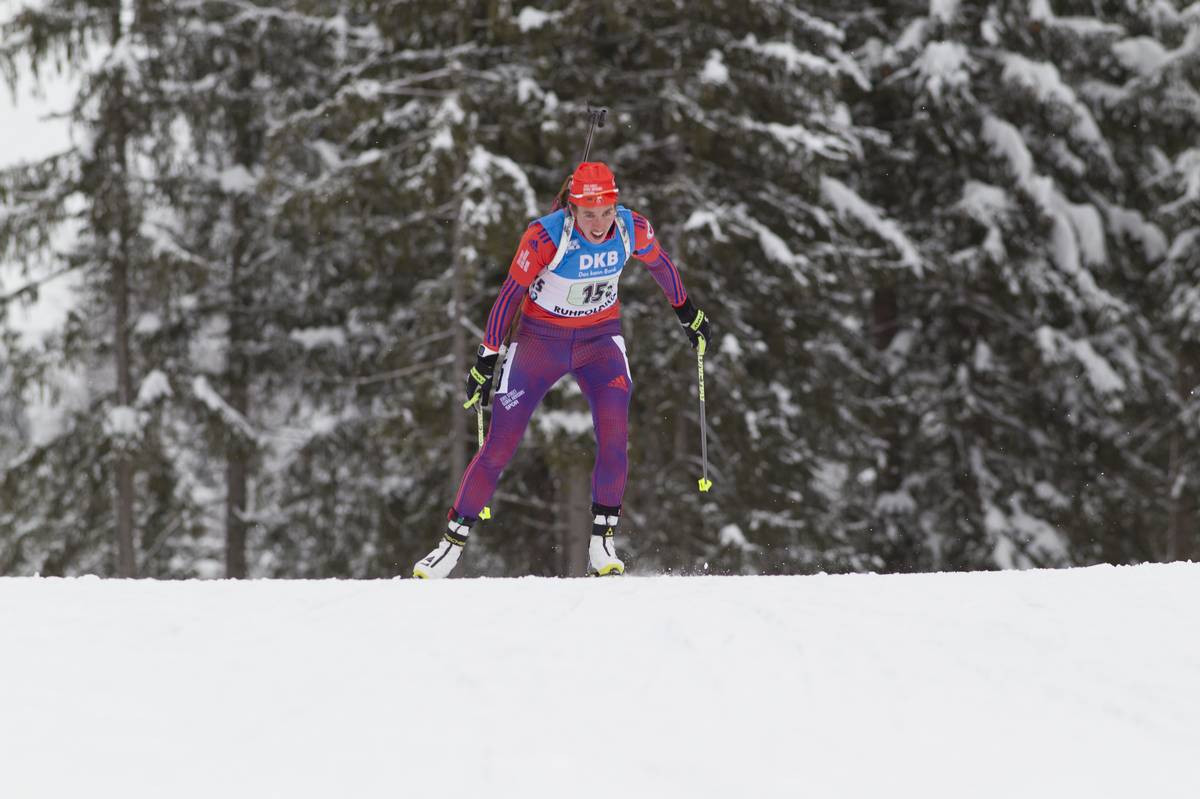
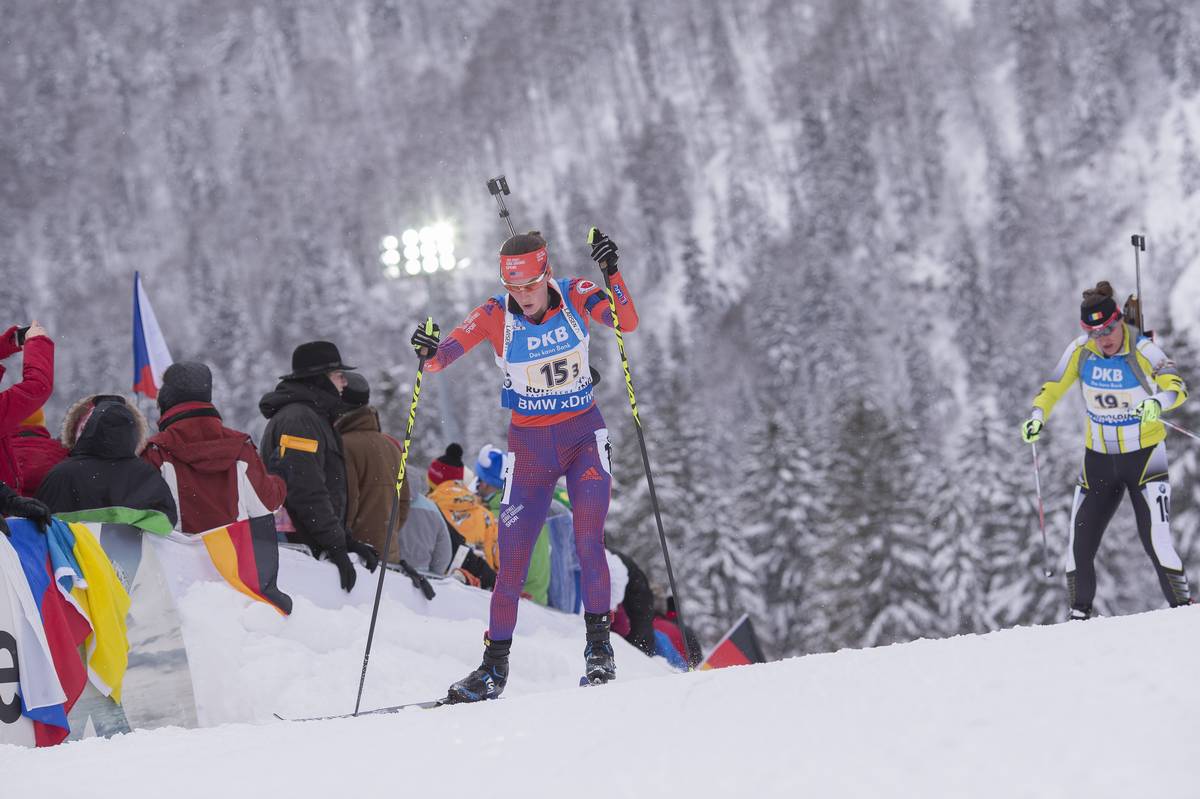
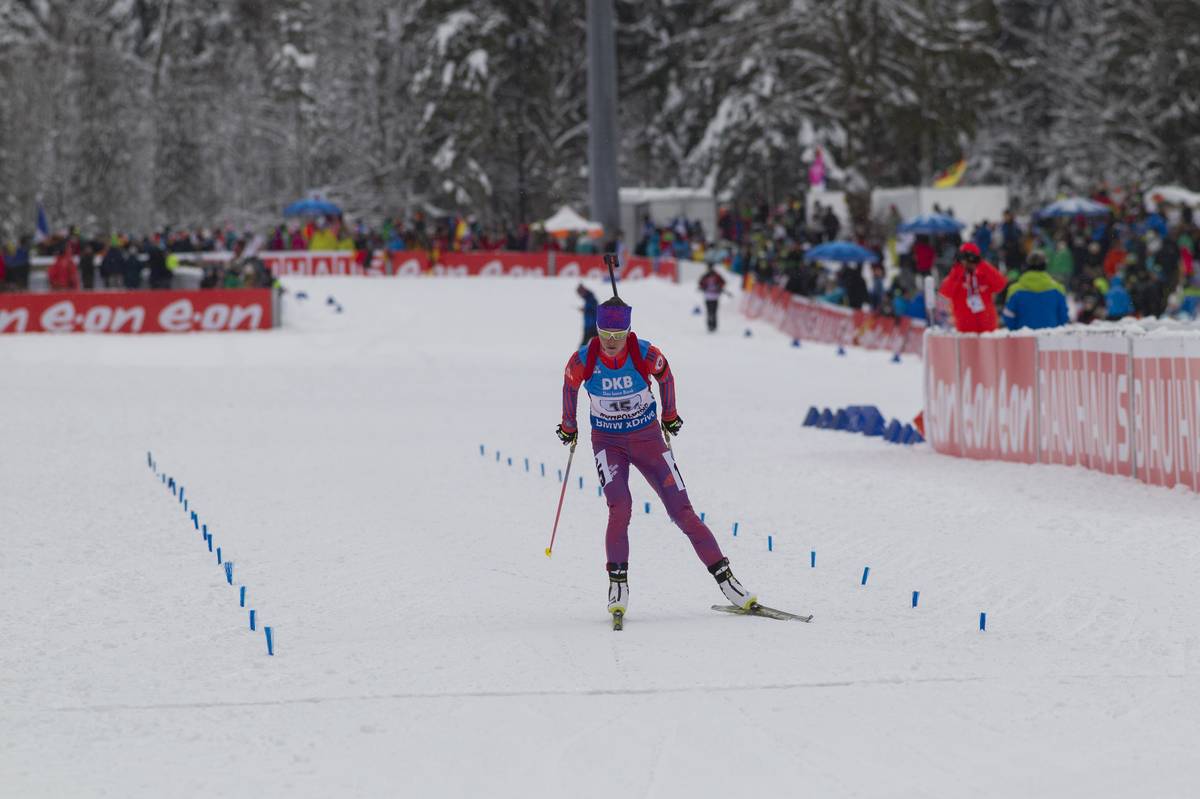
Annelies Cook of the United States on course in the women’s 4 x 6 k relay at 2016 World Championships in Oslo, Norway. (Photo: JoJo Baldus)
Zina Kocher of Canada placed 54th. (Photo: JoJo Baldus)
Canadian tech Tom Zidek showing an athlete their shooting group. (Photo: JoJo Baldus)
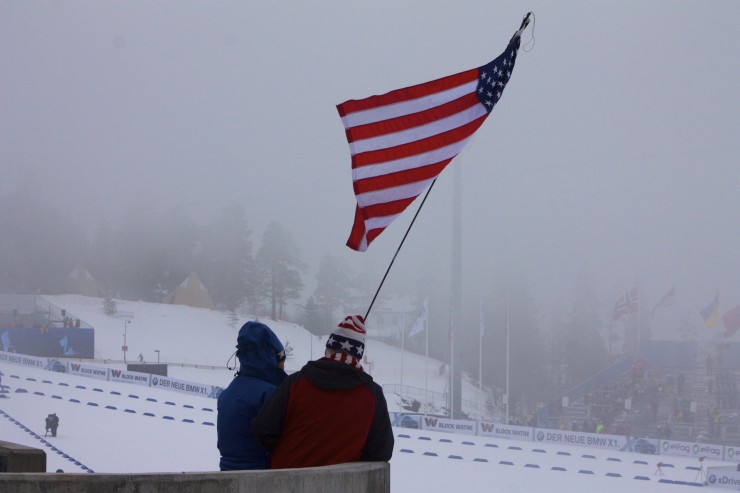
Susan Dunklee’s parents wave an American flag in the stadium. (Photo: JoJo Baldus)
OSLO, Norway—After frustration on the shooting range in the World Championships sprint and pursuit competitions, the Canadian women’s team were pleased to up their percentages in the 15 k individual, translating to top-20 performances by both Rosanna Crawford and Julia Ransom.
Crawford missed just one of her targets, finishing 14th, 2:15.3 behind new World Champion Marie Dorin Habert of France.
And Ransom was one of only two women in the whole field to shoot 20 for 20, finishing 20th, +2:33.5.
“It always is a big focus,” Ransom said of perfection on the shooting range. “I’m just glad it came out today, because those one minute penalties hurt. I was more calm and confident today.”
As in Antholz, Italy, earlier this season, Ransom gained momentum as she knocked down target after target: first five out of five, then ten out of ten, then 15 out of 15.
But not so few athletes cleaned three stages. It’s the fourth one which can be trouble. The gold and silver medalists, Dorin Habert and teammate Anais Bescond of France, had each hit 15 for 15 before missing a shot on their last stage.
So did last year’s World Champion, Ekaterina Yurlova of Russia, who ended up 11th after that one miss. And so did several other women, as well.
Ransom was able to keep her focus.
“I think it’s easy to get into your own head, especially if you shoot 15 for 15,” she said. “So I was happy to stay solid.”
Crawford after the sprint had complained of a “nine out of ten curse”, but started off her 15 k with ten straight hits before missing a shot in her second prone stage.
“Shooting was so good,” Crawford said. “It’s always so good in training so I really tried to bring that feeling to the race today. As I was cresting the top of Hellner’s hill [the last big climb before the stadium], I kind of just said to myself, OK, now for the easy part, which is shooting. That was really nice to have that feeling. I really took my time on the last standing. I didn’t want to have a repeat of the pursuit.”
On the tough and hilly Holmenkollen course, Crawford was satisfied to finish 14th, her best World Championships or Olympic result to date, and also one of her best of the regular season.
“My best was 13th in Östersund [the first week of the World Cup] in an individual with 18 for 20 I think,” she said. “So the ski speed is coming around. It would’ve been really nice to have that top 10, especially for funding for the team. This will probably secure me a spot for the mass start so I’ll just try again on Sunday.”
Canada also started Zina Kocher, who finished 54th with four penalties (+5:33.6) and Sarah Beaudry, who finished 60th with two penalties (+6:02.3).
“I’m happy I hit 18,” Beaudry said. “I didn’t feel great skiing, but I did some of the things I was hoping to do. To push with the hills – there are so many long tops of the hills, and I find that I struggle with that, so I focused well on that in the race, which is good. I’m just happy that I feel better than during my sprint.”
In her first senior World Championships, Beaudry was thrilled to see Ransom hit perfect shooting. Separated in age from Beaudry by just a year, Ransom got her senior World Championships debut last season and has already made good on her accumulated experience.
“We’ve known each other longer than we haven’t known each other,” Beaudry said. “I’ve always watched Julia do everything one year before me. So it’s so neat to watch and say, that could be me next year. She leads the way and I have someone to follow.”
So perfect shooting next year?
“That would be great,” she laughed.
Dunklee Leads U.S. in 18th
After two top-tens in the sprint and pursuit, Susan Dunklee missed a few more shots on the range to finish 18th in the individual, +2:29.5.
She missed a shot in each of the first three stages, but cleaned her last one for three total penalties.
“I finished on a good note,” she said. “I’m making that a habit, which is nice.”
Earlier in the week Dunklee talked of shooting feeling good and easy, and that didn’t necessarily change. She thinks she’s still got it for the rest of the week.
“Today felt a little more average, to be honest, but it still felt in control, which is exactly what I want,” she said. “I was really surprised I only missed one in the first standing because I was kind of seeing spots a little bit. Spots beyond just the five dots. It was hard to stay focused.”
That might be from exertion: Dunklee had the fourth-fastest course time behind medalists Dorin Habert, Besond, and Laura Dahlmeier of Germany. The four were separated by just 6.8 seconds.
“Today I was feeling good,” she said. “Ideally you would want to start out a little slower then speed up as the race goes on in a long race like this. But when I’m feeling really good I don’t worry too much about that. I just go and then deal with the consequences later. I was definitely hurting on loop four, but Doro [Wierer of Italy, who finished eighth] was right there. She was on her finishing loop so I just kept her within reach and that helped a lot.”
With two penalties, Hannah Dreissigacker finished 33rd (+3:45.2).
“The shooting has been feeling so good lately,” Dreissigacker said. “Like in practice yesterday, I missed one shot the whole time and I was feeling so solid. Today, also, I just felt like I didn’t even need to miss those two, I could’ve just hit them. That’s a great feeling, that’s how it should feel, close.”
Along with an 18th place finish in the sprint and 36th in the pursuit, the result was enough to qualify Dreissigacker for her first ever mass start competition.
It’s a cherry on top of what has been a good World Championships, the last before Dreissigacker retires.
“This will be my second mass start,” she wrote in an email after the mass start qualification list was announced. “I started with bib 30 in the mass start in Khanty-Mansisk last year. It was definitely a goal of mine for this year do another mass start, and I really didn’t think that it would happen for a while there so I am just SO happy about it! It will be the perfect way to end my biathlon career.”
Clare Egan had four missed shots, three of which came in one stage, to finish 66th (+6:41.9). Annelies Cook finished 77th with seven missed shots (+8:49.4).
“I had one bad stage,” Egan said. “I was pretty bummed out. But I was psyched that I was able to keep it together after that and not go downhill… I’m happy to have another race with 80% shooting. My goal this year was to average 80%, and I’ve only had one individual race (sprint or pursuit or individual) below that. With my shooting I’m doing way better than I could have hoped this season.”
The U.S. women are now looking toward the relay, which has extra significance since with Dreissigacker set to retire next year.
“This is our last relay as a group, and it’s going to be sad but it’s also going to be a nice way to go out,” Dunklee said. “I’m going to miss being on a team with [her] a lot, and I’m going to try to savor this last one.”
Will that added emotional aspect make it harder to focus?
“I’m just going to try to go out and do what I always do,” Dunklee said. “We’ll see.”
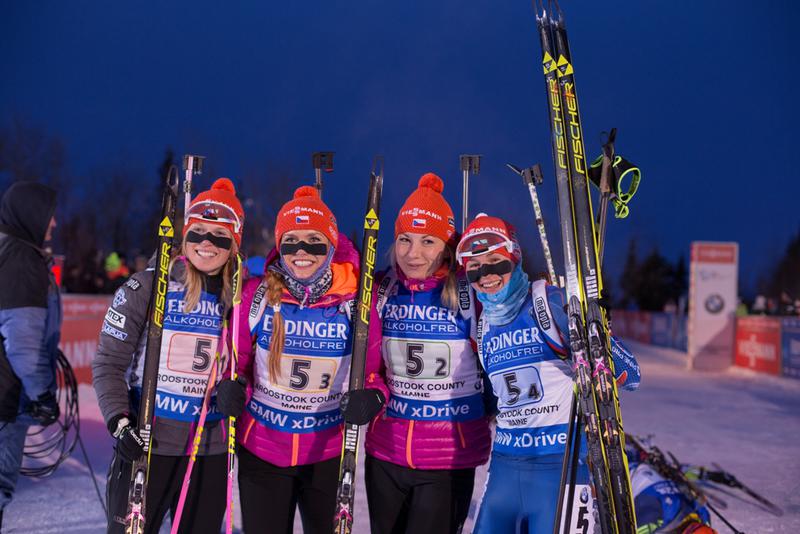
The Czech Republic women’s team, which won the 4 x 6 k relay on Saturday at the IBU World Cup in Presque Isle, Maine, with (from left to right) Eva Puskarcikova, Gabriela Soukalova, Lucie Charvatova, and Veronika Vitkova. (Photo: IBU/NordicFocus)
“It’s good to try a romantic atmosphere,” World Cup leader Gabriela Soukalová of the Czech Republic joked about the dark and cold course conditions at the end of the International Biathlon Union (IBU) World Cup women’s 4 x 6-kilometer relay in Presque Isle late Saturday afternoon, when the sun had long set behind the trees and hills of northern Maine for the final 6 k. “I appreciate it so much. I was thinking about my boyfriend,” she said in an post-race team interview with the IBU.
“Candles…” her teammate Eva Puskarcíková added.
The Czech women had every reason to be in a good mood. In the final race before the upcoming IBU World Championships in Oslo, Norway, their team had asserted its intention to be on the podium there in March, achieving the first relay victory of the season in a time of 1:07:11.0, with one penalty and 14 spare rounds.
After narrowly avoiding a penalty lap in the last shooting, anchor Veronika Vítková had a large enough lead to ski to the side of the track and look for a national flag for the final stretch, but none was immediately available from coaches or fans, so she celebrated across the line just by raising her arms, before her teammates hugged her at the finish.
The women’s relay was moved up from Sunday to Saturday due to extremely cold temperatures in the forecast, with a start time of 4:10 p.m. following the men’s relay, giving the athletes the rare experience of racing in the dark on the final loops, dimly lit by portable lights on a few sections of the course. (Evening Biathlon World Cup races are occasionally on the schedule, for example in Oberhof, Germany, but that course is equipped with large fixed floodlights.)
With the athletes emerging from the darkness into the slightly brighter Nordic Heritage Center stadium, the race for second and third place on the podium was decided in an exciting sprint finish between the relays from Germany, Ukraine, and Poland.
Germany’s exhausted anchor Karolin Horchler tried to rescue her once-comfortable lead after the final shooting that had diminished precariously into the finish, with a double-pole effort on the final meters before she collapsed across the line.
Ukraine’s Olena Pidhrushna passed her with quick skating steps to claim second place, 25.2 seconds behind the winners, with a team total of zero penalties and 12 spares. Pidhrushna edged Horchler by just 0.2 seconds as the Germans took third (+25.4), with one penalty and seven spares, after erasing a 30-second deficit on the final loop. Poland’s Krystyna Guzik came into the finish narrowly off the podium in fourth place (+26.0), with a team total of zero penalties and seven spares.
The U.S. with Susan Dunklee, Hannah Dreissigacker, Clare Egan and Annelies Cook finished the race in 10th (+2:12.4), with one penalty and 12 spare rounds. It was their best result in a women’s relay this season.
Czech Republic joins this season’s other podium finishers — Ukraine, Italy, France, Germany, and Russia — as the favorites for the women’s relay in Olso, with a few more “dark horses” also in the mix.
After the flower ceremony, several women fielded questions at the indoor post-race press conference, still wearing protective tape on their cheeks and noses.
“Today’s race was very hard because of the very big cold,” Czech Republic’s starter Puscarcíková said. “My fingers were frozen. But I am happy we are first again. Last year we won in Oslo this time of the year. It’s very fantastic and unbelievable for me.”
“I had trouble because I shot my third bullet under the target,” Lucie Charvatová explained at the press conference. She had a penalty on her second relay leg and fell back to 11th, before tagging off 47.7 seconds back in ninth place. “After that I was so, so nervous. I ran fast and tried to do the best I could. But I am also happy.”
“I don’t know what I can say,” World Cup leader Soukalová said at the press conference, trying to explain how she had moved her team back into first place on the third leg, following two straight individual wins in Presque Isle. “It was a really fantastic weekend. It’s amazing. I was feeling really good during the race. I don’t remember when I [last] have been in the same shape. It’s a perfect performance before the World Championship.”
“It was very hard because on the track it was dark,” Vítková recalled of the anchor leg and the final shooting. “I have seen nothing. On the shooting range, too. And I was a little bit nervous, because I needed three extra [rounds of] ammunition.”
Ukraine, winner of the relay in Ruhpolding, Germany, earlier this season, was in fourth place with its lineup of Iryna Varvynets, Natalya Burdyga, Juliya Dzhyma and Pidhrushna for most of the race, before Pidhrushna moved her team up with the fastest skiing on the last loop, and beat Germany at the line.
“It’s difficult to recall a relay that was so close and tough,” a smiling Dzhyma said during the press conference, through a translator. “Maybe the one in Hochfilzen [where Ukraine finished third, though with a much larger gap to second and fourth place]. It was really interesting and tough, not just because of the close results, but also because of the frost in this cold weather. In the end we are really happy to be in second, and to be on the podium.”
“At the beginning of my leg, I couldn’t see any uphills, any downhills,” anchor Pidhrushna explained, via a translator. “It was like racing blind. When I came to the shooting range, my only thought was to shoot clean and not go to the penalty loop.”
“It’s already a legend,” a happy Pidhrushna later added in an interview with the IBU when asked about her final loop. “It was again a funny situation after the last shooting. I had no idea which place I was in, going away from the shooting range. One of our staff members shouted so loud, then I realized I was somewhere close, because I couldn’t see the screen, I couldn’t see anything because it was already dark. I just had to think that I was close so I had to fight for it again.”
“Krystyna [Guzik] from Poland was behind me, and we were running so fast to chase the German girl,” she explained. “But I couldn’t even think of doing that, actually.”
“I didn’t know what was happening behind me, I just tried to race,” Germany’s Horchler told ARD, after she had advanced her team from fifth to second, requiring one spare in prone and staying clean in her final shooting. “But I had brutal pain in my shins, and was already pushing into the downhill. I am really annoyed by that two-tenth of a second [at the finish]. But I am just pleased about my 0-5 shooting in standing, because with that I settled a few things in this competition so the relay could still make the podium.”
“Hats off to the organizers,” she added. “They put up makeshift lanterns, and I am happy about my prescription lenses in my glasses, otherwise it would not have been possible for me to see anything.”
“I as very nervous, because it’s been a long time since I took the starting position,” Germany’s Franziska Preuss said at the press conference. “The last time was Sochi [2014 Olympics, where Preuss crashed and got snow into her rifle sights, falling back far, as German failed to medal for the first time in an Olympic women’s relay]. But now I am really happy that it was a good race for me… I think nobody expected Germany on the podium today.”
Germany started a lineup without Franziska Hildebrand and Laura Dahlmeier, their two highest-ranked athletes on the World Cup.
“Temperatures were better today than yesterday,” second leg Luise Kummer told ARD. “We feared it would become really cold by now, but today it was bearable. And the audience is really participating with the action, so it was definitely fun. You actually get warm during the race. One would not believe that, in training we were also worried. But in normal competition it is no problem at all.”
“I just could not handle the standing position on the range here, and unfortunately also not today,” Germany’s third leg Miriam Gössner, who had her team’s penalty, told ARD. “I don’t know why. I really tried to do my best. In the prone shooting and out on the course I felt really, really good. So I think I could compensate for that penalty lap fairly well.”
Poland, with Magdalena Gwizdon, Monika Hojnisz, Weronika Nowakwska, and Guzik (formerly Palka) finished just 0.4 seconds off the podium, after losing the sprint against Ukraine and Germany.
“We had to fight not only with our rivals, but mainly with low temperatures,” Hojnisz later posted on Facebook, according to a translation, after she had avoided a penalty in her first prone shooting but lost about 45 seconds to the top. “I was not the best link in today’s relay, so thank you girls for your faith and fight to the last meter.”
“I held her until the end of the climb and tried to overtake on the flats,” Guzik said of Pidhrushna on the last loop, as told to Polish sports website SportoweFakty, according to a translation. “Unfortunately, none of the three attempts worked. Olena took it well tactically. It is a pity that the course was not a little bit longer, because I could fight to the finish. … I am sad that I could not lead us to a medal. We need this podium in the relay. I still believe that soon we will succeed.”
A number of teams started different lineups than they will likely have at World Championships, including France, which won the previous relay in Antholz, Italy, but on Saturday gave its top athlete, Marie Dorin Habert, a break. France finished sixth (+48.2), with one penalty and 13 spares, after Anaïs Chevalier had tagged her teammate Justine Braisaz in second place at the last exchange.
U.S. Achieves Season-Best 10th
Susan Dunklee (US Biathlon) racing the first leg of the women’s 4 x 6 k relay on Saturday at the IBU World Cup in Presque Isle, Maine. Her team went on to place 10th for a season best. (Photo: USBA/NordicFocus)
Coming off a historic week for US Biathlon with Dunklee’s silver medal in the sprint and fifth place in the pursuit, the team’s leading woman was picked to start Sunday’s relay (after racing the second leg in the three prior relays this season), followed by Dreissigacker, Egan and Cook.
“We are still experimenting with the order,” Dunklee wrote in an email. “Last week’s mixed relay went well with myself leading and Han [Dreissigacker] going second so we tried that again.”
As for moving the race up to Saturday, Dunklee wrote, “I think most athletes would agree that moving the race to today was the right call in light of the cold forecast.”
But that made for a pretty hectic race day for the women, as they had very little time to prepare with the men’s relay only wrapping up about an hour before their own.
“Today was a great opportunity for dealing with unusual challenges on race day,” Dunklee explained. “We had some struggles getting to the venue on time, then I had a broken firing pin right before zero [target practice to adjust the rifle sights before the start], which is very tricky to replace, and finally 13 minutes before the start, I heard that the course got changed and didn’t get to preview it.”
“With the short turn around from the guys race, we only had 25 minutes to zero 4 people,” she continued. “I didn’t fit in more than 10-15 minutes of skiing warmup, a new record for me. Dealing with chaos is an extremely important skill for a biathlete to have and we all did well today in spite of the challenges.”
Dunklee’s performance didn’t seem to suffer much despite those unusual circumstances, she she used just one spare to clean the first prone stage, and another two in her standing bout. She also skied the fastest course time of all starters in 13:55.4, and second-best among every woman in the relay, behind France’s anchor, 19-year-old Braisaz.
Hannah Dreissigacker racing the second leg of the U.S. women’s 4 x 6 k relay on Saturday under darkening skies at the IBU World Cup in Presque Isle, Maine. Her team went on to place 10th for a season best. (Photo: USBA/NordicFocus)
Dunklee tagged off to Dreissigacker in fourth, only back 11.1 seconds behind Switzerland’s Selina Gasparin, who was then leading the pack (Switzerland went on to finish 12th).
For Dreissigacker, a regular member of the U.S. relays last year including at 2015 World Championships, it was her second World Cup relay of the season after spending some time on the second-tier IBU Cup, before returning to the World Cup in Canmore, Alberta, and Presque Isle, where she most recently placed 27th in the sprint and 24th in the pursuit.
Like Dunklee, she didn’t let the stressful race preparation get to her.
“It was definitely a little bit rushed today before the race for everyone,” she wrote in an email. “We had to rearrange things and it got a bit hectic. But it was fine for me anyways… a good adrenal warm-up, as I like to call it!”
Dreissigacker needed one spare in prone and two in standing, just like Dunklee, and lost a little more time on the course, handing off in seventh, 43.7 seconds behind the leaders.
“I am a little disappointed that I didn’t hit my last standing shot, and then took two spares to hit it, but it could have been worse!” Dreissigacker wrote. “I had a good battle with Austria [Lisa Theresa Hauser] and France [Anaïs Bescond] at the end of my leg which was fun and made me go hard.”
Egan, who had started the prior relay for the U.S. in Antholz, moved back to the third leg, which she had also raced in Ruhpolding and Hochfilzen earlier this season.
Clare Egan (US Biathlon) during her standing stage of the women’s 4 x 6 k relay at the IBU World Cup in Presque Isle, Maine. Her team went on to place 10th for a season best. (Photo: USBA/NordicFocus)
In Presque Isle, she had finished 32nd in the sprint and 23rd in the pursuit. She continued her solid recent shooting performances in Saturday’s prone stage, cleaning her targets to leave the range in seventh position (+41.4).
After moving up to sixth place on the next loop, Egan came into the standing stage fighting for position with France, Ukraine and Austria. There she was unable to hit her last target with her three spares, having to ski through the 150-meter penalty lap.
“The conditions for my standing shooting were fine, I am just not as solid in standing as I am in prone,” Egan wrote in an email. “I missed two from the clip and then fired the first spare accidentally before I was ready. Then I had two bullets for two targets and unfortunately I only hit the first one. I should have taken more time to make a perfect hit on my last shot.”
She left the range in 12th, and tagged off to Cook in that position, having lost an additional minute to the leaders by the exchange (+1:50.6).
Just like it was for her teammates, Cook’s race leadup was a bit hectic.
“The preparation was actually funny today,” Cook wrote in an email. “I did not get to ski the course before the race started, and the girls actually had to tell me that they took out a sketchy corner, so I had never even done our course before I was on it racing it.”
On the shooting range, she matched the performance of Dunklee and Dreissigacker, requiring one spare in her prone stage and two in standing, but had to overcome an additional challenge: the sun had set when the anchors were on their relay legs, and large sections of the course had fallen into darkness.
“I was glad that nothing crazy happened on the downhills because it was definitely a shadowy course, not like the huge floodlights that we are accustomed to,” Cook explained. “But I didn’t mind. It reminded me of how night races were growing up at my local ski area, with little light bulbs hanging over the course. The range was a bit dark and the big movie screen flashed really brightly while I was shooting prone, so the light changed drastically and suddenly and that was distracting. But it worked out okay.”
She was able to overtake two more relays, moving the U.S. up to 10th in the finish. The U.S. women were satisfied with their result, though believed there was still additional room for improvement.
“As a team, we all had okay shooting performances and it is exciting to see us move up so much already even without a great day,” Dunklee concluded. “Oslo will be exciting.”
“I think we are all happy with 10th since its our best relay of the year, but we also know we can do better and today was a good sign of that!” Dreissigacker wrote.
“Despite my penalty lap this was the best relay result we have had with this group of four athletes,” Egan explained. “Our previous best was 12th which we got twice last year (World Cup 6 Antholz, World Championships). It is also a season best. Of course we can still do better and intend to do so in Oslo.”
“I still know we can do better in the relay, but it is a hard, hard thing for everyone to have stellar races on the same day,” Cook concluded. “And luckily, we know that all we have to do is have a good normal day and we can be right up there.”
With Some New Faces, Canada 17th
Without Rosanna Crawford and Julia Ransom, Canada did not have two women in Presque Isle who will likely be part of the women’s relay at World Championships in Oslo. Crawford and Ransom started in all three other relays this season where the team finished 10th in Hochfilzen, and ninth in both Ruhpolding and Antholz.
Instead, with veteran Zina Kocher (in her third relay this season), Emma Lunder (who had one relay start before in Hochfilzen), Audrey Vaillancourt and Erin Yungblut struggled on Saturday, quickly falling to the back of the field, with Kocher having to ski a penalty loop in her first prone.
After leaving the range in 16th out of 17 teams (with Norway and Slovakia pulling their teams before the start due to illness), Canada was never able to catch back up to the top 10, losing time to the leaders as the race progressed.
Kocher tagged off to Lunder 2:14.3 back, who then incurred another penalty in her prone stage (1+3, 0+1) to exchange 4:28.1 back in 17th place.
Vaillancourt then put in a strong performance on the range with two clean shooting stages, but was slower on the course and passed on the penultimate loop by the leading teams. She handed off to anchor Yungblut 6:38.6 back.
After requiring three spares to hit her targets (0+1, 0+2), Yungblut then was taken out of the race and scored as lapped in 17th position before her final loop.
On to Oslo
The athletes will now have two weeks of additional training and preparation, before traveling to Norway for the World Championships, beginning on Thursday, March 3 with the mixed relay.
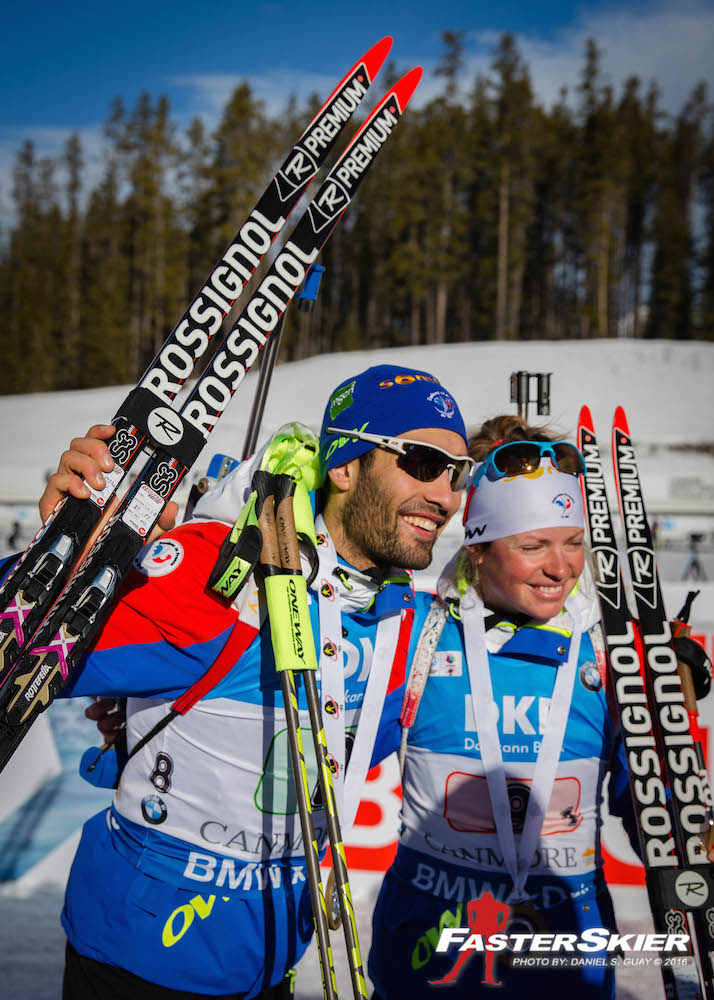
Teammates in the single mixed relay on Sunday, France’s Martin Fourcade and Marie Dorin Haber after winning the first of two relays on the last day of the IBU World Cup in Canmore, Alberta. (Photo: Daniel S. Guay)
France was determined to win the International Biathlon Union (IBU) World Cup 13.5-kilometer single mixed relay on Sunday in Canmore, Alberta, using their best athletes with men’s overall World Cup leader Martin Fourcade and Marie Dorin Habert, who ranks third in the women’s standings. And they succeeded in convincing fashion, finishing first in 37:58.0 minutes, with four spares and no penalties.
The first time the new race format was on the calendar this season at the World Cup in Östersund, Sweden, the French duo of Dorin Habert and Martin’s older brother Simon Fourcade thought they had won the race, but because Fourcade had not fired a shot during the competition the team was slapped with a four-minute penalty, putting them back to 21st place.
On Sunday morning, France made no such mistakes and didn’t leave the other teams any chance in nearly a start-to-finish victory. Dorin Habert took the lead out of the arena, stayed there for most of her leg and tagged narrowly in first place, before both Fourcade and Dorin Habert expanded their lead on the next three legs with good shooting and fast skiing. Fourcade put an exclamation mark on the victory by sprinting into the finish despite knowing he had a comfortable lead of more than half a minute on the final loop.
“It was a really exciting race. I like these kind of short races. I tried to be as strong as Martin, it’s an honor to run with him,” Dorin Habert said at the post-race press conference. “It was in our head before the competition to win, but this is biathlon and everything can happen on the [shooting range].
“I tried to train the finish, I think that was a good opportunity,” Fourcade explained during the press conference. “But I actually didn’t compete the full last loop,” he added with a smile. “I only did for some parts, the ones in front of the TV.”
“Today I was satisfied even if I needed two extra shots, two too much,” Fourcade later told the IBU in an interview. “It was a good competition for both of us.”
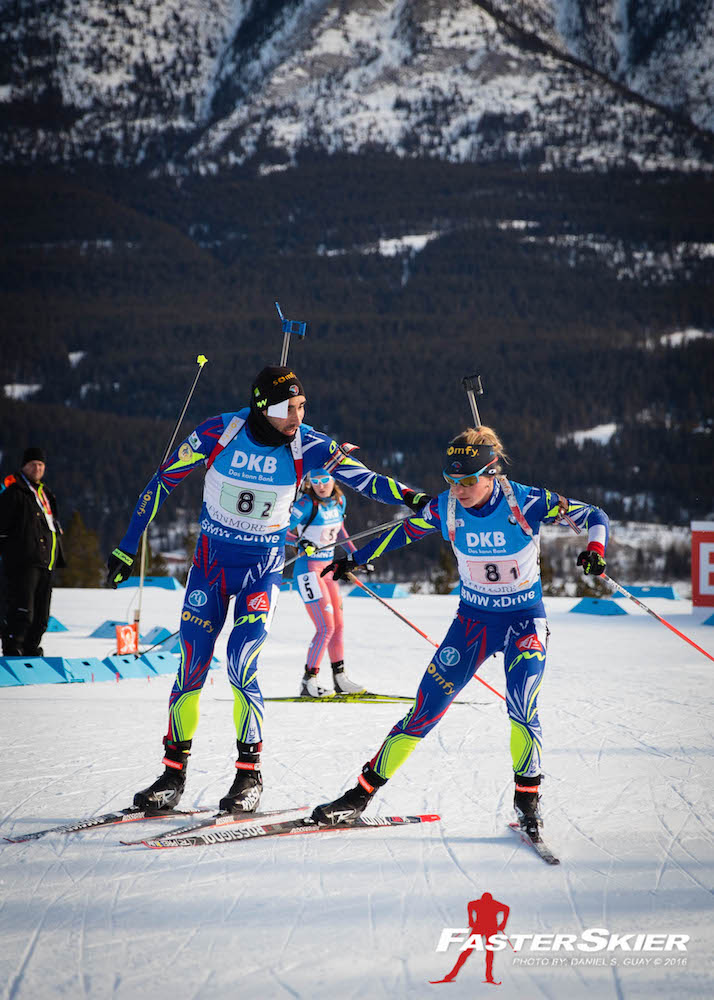
France’s Martin Fourcade (l) tags teammate Marie Dorin Habert for her the third of four legs in the single mixed relay at the IBU World Cup in Canmore, Alberta. They ended up winning by 45 seconds. (Photo: Daniel S. Guay)
Second place went to the Austrian duo Lisa Therese Hauser and Simon Eder, 45.2 seconds back, with eight spares and no penalties. It was Hauser’s first World Cup podium.
Norway’s Hilde Fenne and Lars Helge Birkeland secured the third spot on the podium, 55.3 seconds back, with seven spares and no penalties. Birkeland defended his lead on the final loop, coming into the finish two seconds ahead of Russia’s Olga Podchufarova, who teamed up with Alexey Volkov to finish fourth (+57.3), with no penalties and just two spares.
New since the 2014/2015 season and only held for the third time at the World Cup level on Sunday, the single mixed format was established by the IBU to have another action-packed event and give “smaller” biathlon nations a shot at the podium. For some countries, it presented an opportunity to start a team event. It is not yet a part of Biathlon World Championships or Olympic Games.
“The single mixed relay is interesting for smaller nations, because they maybe don’t have five women and five men who can compete with the top, but maybe one or two,” Canadian head coach Matthias Ahrens told German TV broadcaster ZDF in an interview before the race. “Then you can use those in the mixed or single mixed relay, thereby potentially getting a chance to reach the podium, which worked pretty well for us at the season-opening in Östersund [where Canada placed second].”
On Sunday, some teams, such as France — though not an example for a “small” biathlon nation — Austria and Latvia (in eighth place), made use of that by putting their best racers in the event. Other teams decided to focus on the “normal” mixed relay, with two women and two men on each team, that followed later on Sunday in Canmore.
The single mixed relay features the shortest loops in biathlon, with the athletes skiing a 1.5-kilometer loop between each shooting stage, then immediately exchanging after the standing shooting. After the female team member starts and shoots one prone and one standing stage, she exchanges to her male teammate, then the woman gets tagged again to ski the third leg (six kilometers total), and the man closes out on the fourth anchor leg racing an additional 1.5 k after the final standing shooting, which adds up to the odd 13.5 k distance. The athletes are allowed to use three spare rounds per shooting like in a normal relay, and the penalty lap is also shortened to 75 meters (usually 150).
Thus the whole race is extremely fast-paced, and rather resembles a cross-country team sprint than a traditional biathlon or cross-country relay.
“This was a new start for me in the World Cup, because I never did a single mixed relay before,” Fourcade said at the press conference. “I already did it a lot during the show competitions like Schalke [World Team Challenge in late December] or Moscow or Tyumen [Race of Champions, another invitational at the end of the season]. I really love that. But it was different today … with the pressure of the World Cup… I think the single mixed relay is really good for biathlon.”
“The single mixed relay is a super fun race format, but you really have to shoot well to have a chance,” U.S. Biathlon’s Annelies Cook wrote in an email.
“Certain abilities are demanded, especially ‘shooting efficiency,’ ” Ahrens told ZDF. “That means you need athletes who, first of all, can shoot well and hit, but also shoot very fast.”
Germany’s Luise Kummer (2), Norway’s Hilde Fenne (1) and Canada’s Julia Ransom (3) early in the single mixed relay at the IBU World Cup in Canmore, Alberta. Norway went on to place third, Germany seventh and Canada finished 12th. (Photo: Daniel S. Guay)
Conditions on Sunday were good throughout the race, with calm winds and the sun shining in the Canadian Rocky Mountains, after the athletes had struggled with snowfall and strong gales in the previous days.
“I think we were all satisfied to know that it would be fair and beautiful conditions. It’s the [kind of] biathlon we love,” Fourcade said in an interview with the IBU.
“Today was the best snow conditions of the week. There was a light wind, but it seemed pretty consistent,” Canada’s Nathan Smith wrote in an email.
France steadily expanded its lead throughout the race. At the first exchange, Dorin Habert tagged Fourcade in first, just 0.4 seconds ahead of Sweden. Fourcade slightly expanded that lead to 6.5 seconds over Russia in second place by the next exchange, and then Dorin Habert cleaned both shooting stages on her second leg to balloon the gap to 50.1 seconds over Norway in second. Essentially, Fourcade just needed to go through the motions on his last leg to lock up first.
Before the final shooting, Germany’s Erik Lesser had been in second place behind Fourcade. But unable to clean his targets and running out of spares, Lesser incurred a penalty lap and ended up seventh (+1:29.6), as teams passed him with better shooting. Lesser and teammate Luise Kummer combined for one penalty and eight spares.
This brought back some painful memories from the first time a single mixed relay was held in a year ago in February 2015 in Nove Mesto, Czech Republic. Lesser and Kummer had been in the lead before the final shooting, then Lesser slipped into fourth with a penalty.
After Sunday’s race, suffice to say Lesser wasn’t happy.
“Does anyone still want to see that? I don’t!” Lesser quipped when the interviewer in the mixed zone asked him to take a look at a replay of his targets in the final shooting stage. “It really doesn’t matter where those [shots] went, I just didn’t hit, fired four really poor shots,” he added after taking a glance at the fairly close misses. “If Mark [Kirchner, men’s head coach] wants to chew me out for that, I hard-earned it.”
“On the first spare I was already thinking, ‘Oh great, this is going the same way as last year,’ ” Lesser continued. “On the second leg I struggled, I tried to keep the others at bay on the course so they would not catch up, but I somehow didn’t move well, got tense on the shooting range, and then the misses happened. I am completely annoyed, mega-disappointed… This is the World Cup level, so you should also be able to hit with tired legs.”
Kummer used four spares and was also disappointed, but didn’t pin the blame on Lesser.
“A [single mixed] relay is comprised of two people, everything has to work out, and that mistake can happen to everybody,” she told ZDF. “You are always happy yourself to get through [a relay shooting stage] unscathed, so that shouldn’t be a problem…. I still think it’s a very exciting competition for the spectators, very fast-paced exchanges. It doesn’t have the same standing as a relay or mixed relay yet, but one can see that it is developing.”
Lesser’s troubles allowed Austria’s quick-shooting Eder to pass him and secure second place, after he and Hauser had been just outside the podium ranks for most of the race.
“I am really happy about this podium today. It’s my first one. I dreamed about it, and today it worked,” the 22-years-old Hauser told reporters at the press conference. “My shooting was not so good especially in prone. Simon and I are both fast shooters and also good shooters, but today it was not the best.”
“I felt great on the course, I always could keep up or even close gaps,” Hauser added in an Austrian Ski Federation press release. “On the shooting range I let the stress get to me a little bit, that caused the spares. But of course I am overjoyed by the podium finish.”
“The first turn did not go according to plan on the shooting range. I had problems with my ski poles and used too many spares,” Eder, 32, said in the press release. “But the second turn went all the better, I could really push the tempo also on the shooting range. Finally we have a place on the podium also in a mixed relay.”
In the absence of their usual stars that are skipping the North American World Cups in the leadup to 2016 World Championships at home in Oslo, the Norwegians still reached the podium with Fenne and Birkeland, who both improved on their second legs to move from seventh at the first exchange to third at the finish. (Birkeland also won the first single mixed race of the season, though with Kaia Woeien Nicolaisen as his partner.)
“I am not sure why, we just always try to do good races,” Fenne said during the post-race press conference when asked why Norway seems to do so well in the single mixed relay. She added that the coaching staff picked the lineups for Sunday, so she didn’t know why she was put on the single mixed relay instead of the four-person mixed relay.
Canada 12th, U.S. 16th
Representing Canada at home in Canmore, Julia Ransom, who is competing in her first full World Cup season, teamed up with veteran Nathan Smith, who raced to second in the Östersund single mixed relay with Rosanna Crawford.
Canada’s Nathan Smith (behind) coming through the exchange zone to tag teammate Julia Ransom during single mixed relay at the IBU World Cup in Canmore, Alberta. (Photo: Daniel S. Guay)
This time, the Canadians ended up nearly two minutes off the podium in 12th (+1:54.3), with 10 spares and no penalties.
On her first leg, Ransom used one spare round in her first prone, but then required all three spares in standing to narrowly avoid a penalty lap.
“It was hard, very hard,” Ransom said in a Biathlon Canada press release. “I haven’t done that format before. I felt that one for sure. This is the first time I’ve done a relay with Nathan so it was lot of fun for me, and a great experience.
“I was bouncing around at the start and maybe nerves got to me a little bit because I didn’t know what to expect,” she added. “The techs just told me to ‘reel it in.’ ”
After the first 1.5 k, she tagged Smith 47.0 seconds behind in 19th of 23 teams. On his first leg, Smith cleaned prone without any spares and only required one spare in standing to keep his distance to the top, handing off to Ransom 49.2 seconds back in 11th.
“We unfortunately fell back pretty early in the race. Julia had some difficulty in the range,” Smith wrote in an email to FasterSkier. “The time lost loading spares is even more penalizing when the loops are so short. The format itself is pretty fun to race, and quite a bit different from traditional races. It’s almost more like two races back to back with a little break. It suits my quick shooting speed really well.”
Ransom cleaned her next prone stage as she had done repeatedly in recent weeks, but with two more spares in standing, she lost a minute to the top.
Still in 11th when he received the tag, Smith again hit all targets in his prone stage, but required three spares in his last standing to avoid the penalty lap, approximately holding his gap to the leaders.
“Other than my last standing my [two relay] legs went really well. Prone felt amazing. Probably almost the best ever. Just fast, easy and accurate,” Smith wrote. “I ended up battling a lot with [Latvia’s] Rastorgujevs. He surprised me by matching my shooting speed. He’s always one of the fastest out there. It was too much for me to hang on to on the last lap.”
“It was my best race this week. The legs felt a lot better today. Not amazing, but quite good until that last lap,” Smith said in the team press release. “One of the toughest things to do is race at home with the pressure we put on ourselves with our friends and family watching all the volunteers we know out here. I obviously wanted to peak here and do well but there are so many factors that come into play. It was a great experience racing at home that we’ll be able to take with us.”
For the U.S., Cook teamed up with Leif Nordgren. In Östersund, their teammates, Clare Egan and Sean Doherty finished 15th in the single mixed relay. This time, the Americans finished in the same range in 16th place (+3:20.1), with one penalty and 14 spares.
Annelies Cook (US Biathlon) during one of her two standing stages in Sunday’s single mixed relay at the IBU World Cup in Canmore, Alberta. She teamed up with Leif Nordgren to place 16th. (Photo: Daniel S. Guay)
After using just one spare in her first prone stage, Cook incurred a penalty in her first standing stage, quickly disappearing out of the focus of the TV cameras, tagging Nordgren in 20th, about 1:05 behind the leaders.
“I felt good on skis and was in the mix, but I had a hard time holding back in the skiing and was probably breathing too hard to shoot well in standing,” Cook wrote in an email. Her course time ranked seventh fastest of the first-leg skiers. “My penalty in standing took us too far from the top to have contact.”
Nordgren needed two spare rounds in prone and another one in standing, losing about another 30 seconds to the top teams on his leg (+1:41.3) as he tagged Cook in 18th.
“This format is for sure a little different than a typical relay,” Nordgren explained in an email. “The pace is usually fast right from the start, and because the loops are so short it really puts all the focus on the shooting since its hard to really break away on such a short loop. It’s nice to have that difference, but you really have to be on top of your game in the shooting to be competitive.”
On her second leg, Cook again emerged from prone with just one spare, but needed another three spare rounds to clean her final standing stage and avoid another penalty. When she exchanged back to Nordgren, the U.S. was 3:04.7 out of first in 20th.
“The race does feel like a cross country sprint. But what makes it hard is knowing that you still have to hit targets, and finding the balance between all out sprinting and going just at the level where you can manage to hit your targets is tricky,” Cook wrote. “I just tried to make up time lost on the range by catching up on skiing as best as I could. There were a few of us together each lap, so it felt like a competition between that group of people.
“I had a hard time holding back because I really love sprinting, and that probably kept me from hitting in standing,” she added. “That put Leif on a position where he had to try and chase people down. He did a really good job of that and I was proud of him for catching people in the last loop.”
On the anchor leg, Nordgren mirrored his performance from his first round, again requiring two spares in prone and one in standing, but only lost 15 more seconds to the leaders and leapt to 16th by overtaking Romania, Slovenia, Belarus and Finland.
“Today neither Annelies nor I really had a great day on the range so we had a hard time to stay with the top teams,” Nordgren concluded. “The tracks were in perfect shape today which is always nice. Our techs did a great job to give us fast material, but we weren’t able to put it to good use.”
Staying Warm
In the exchange zone, several teams could be seen using spinning bikes to keep warm and stay loose during their race breaks while their teammate was out on the course, something the Norwegians pioneered for the single mixed relay in Östersund, though the Americans and Canadians opted for a traditional warmup.
“I just ran around to keep warm,” Cook wrote. “It’s not a big break and we don’t have a team bike. But running was totally fine for me.”
“During the break both of us just opted to jog around, being that it’s such a short race, it’s more important to stay warm any way possible,” Nordgren wrote. “Today was the first day in a several that the wind was pretty low, so that made staying warm a little easier.”
“I just jogged around while Julia was doing her second leg,” Smith explained in his email. “I considered using a spin bike but decided it would be best to practice like at World Champs.”
Moving on to Presque Isle
Nathan Smith (Biathlon Canada) during Sunday’s single mixed relay at the IBU World Cup in Canmore, Alberta. He teamed up with Julia Ransom to place 12th. (Photo: Daniel S. Guay)
The IBU World Cup now moves east to Presque Isle, Maine, with sprints for the women and men on Thursday, followed by pursuit races on Friday, and traditional relays on Saturday (men) and Sunday (women).
“Today was the best I’ve felt in a couple weeks. I hope my shape continues to return to normal through Presque Isle,” Smith wrote.
While Smith continues to work to hold his own in the overall World Cup standings (he’s currently 19th), the rest of Canada’s A-team, those pre-qualified for World Championships, will skip the Presque Isle World Cup and train in Canmore until Feb. 22, according to Crawford. That includes Crawford, Ransom, Sarah Beaudry, Brendan Green, Scott Gow, Christian Gow, and Macx Davies.
Smith and a women’s contingent of Emma Lunder, Zina Kocher, Audrey Vaillancourt, and Erin Yungblut will head to Maine, and after those races, the Canadian team will select its fourth woman for World Championships.
“I think we’re … looking forward to racing next week on home soil in Presque Isle,” Nordgren wrote on behalf of the U.S. team. “I haven’t raced there for about 5 years, so it will be fun to be back!”
In the four-person mixed relay that followed Sunday afternoon, the U.S. notched a team-best fourth with Susan Dunklee, Hannah Dreissigacker, Tim Burke, and Lowell Bailey, while Canada tied its previous best of sixth, with Crawford, Beaudry, Davies, and Green. Stay tuned for a separate report.
Note: Presumably due to a software bug, the IBU’s competition analysis report for the single mixed relay contained erroneous ranks for data such as course and shooting times, with higher numbers than the 23 teams that started in this race, so no such information was used for this article.
Canada’s Julia Ransom racing in front of a home crowd in Canmore, Alberta, to tie her IBU World Cup career-best 19th in the women’s 7.5 k sprint on Friday. (Photo: Daniel S. Guay)
The way some of the Canadians were tossing around the term “Chinook wind” on Friday, one might have thought that gusts hard enough to knock rifles off their stands was a regular occurrence in Canmore, Alberta. It wasn’t, according to one Canmore native, Rosanna Crawford.
“It was windier than I’ve seen it here in Canmore in a long time,” the 27-year-old Biathlon Canada veteran recalled in an in-person interview after the women’s 7.5-kilometer sprint at the IBU World Cup in Canmore. “So it was definitely luck of the draw if you were going to get a calm range or not.”
She wasn’t one of the lucky ones. Crawford started sixth and missed two off the bat in the first prone shooting stage. She wasn’t alone; most of the rest of the top-seeded skiers failed to hit all five prone targets as well.
Early on, it appeared that France’s Anais Bescond, in bib 8, and Italy’s Dorothea Wierer, bib 17, might be fighting for a podium. Both were the only women to clean prone through the first 24 starters.
Then Krystyna Guzik, a 32-year-old Polish biathlete who last reached the IBU World Cup podium two seasons ago in third in a pursuit in Hochfilzen, Austria, entered the mix. In bib 25, she cleaned prone to leave the range in first, 6.7 seconds faster than Wierer. Guzik went on to clean standing as well, while Wierer missed one, to hold a 7.3-second lead after the second shooting.
Poland’s Krystyna Guzik (l) trails France’s Marie Dorin Habert during the women’s 7.5 k sprint at the IBU World Cup in Canmore, Alberta. Guzik went on to place second while Habert finished 29th. (Photo: Daniel S. Guay)
On the final loop, Guzik stayed ahead of Wierer — who had initially finished first, 21 seconds ahead of Gabriela Soukalova of the Czech Republic— to bump the Italian to second place by 12.4 seconds at the finish.
Meanwhile, Bescond had missed two in standing to slip out of contention and nearly 1 1/2 minutes behind Guzik at the finish. It might not have been her fault; the winds were extremely variable — those Chinook (western interior) winds.
Canada’s Julia Ransom, who has lived and trained in Canmore for the last five years, started 38th and later said she felt the wind in prone and adjusted accordingly.
“I knew the wind. I know Canmore. I know how Chinook winds work and I did correct for prone, a lot,” she told FasterSkier afterward. “Really cranked the sights, and it wasn’t a hurricane for standing so maybe I lucked out a bit there.”
Ransom, who turned 23 on Thursday, cleaned both stages and was one of seven women in the field to do so. Initially 12th at the finish, she ended up 19th, 1:19 behind the winner and the top North American on the results sheet.
Moreover, Ransom tied her World Cup best, which she set two weeks ago in 19th in the pursuit at the last World Cup in Antholz, Italy.
Canada’s Julia Ransom racing to 19th in the women’s 7.5 k sprint at the IBU World Cup in Canmore, Alberta. (Photo: Daniel S. Guay)
“Double nineteenth!” she exclaimed upon realizing she had secured the result again on Friday.
While she cleaned the four-stage pursuit in Antholz on Jan. 23, this was the first time she hit all her targets in a World Cup sprint.
“I knew leaving standing that my family was in for an exciting race,” Ransom wrote in an email. “I was hoping to maintain 12th, but that rarely happens when you start in the earlier seeds. However I am very excited with another top 20. It is a confidence booster going into world champs. I’ve got my sights on those single digits now!
“19th at home is obviously amazing!” she continued. “It’s always nice sharing personal bests with the friends and community that supports me all year round.
Originally from Kelowna, British Columbia, Ransom celebrated her birthday the night before with “a little wine and some little minion cupcakes from my Dad,” she explained in a Biathlon Canada press release. “It was a perfect pre-race meal. … [On Friday] it was a balance between not being too anxious with everyone here to watch and being so excited I couldn’t even contain myself at the start.”
It appeared that most of the racers who started 25th or later, including Guzik, benefited from the sudden calm once the winds subsided considerably.
“It was crazy windy on my first loop,” Crawford recalled of the late-morning (11:15 a.m.) start. “The wind was so strong that I was almost at a stop on one of the uphills…”
She placed an uncharacteristic 72nd, with four penalties — two in prone and two in standing. But considering she’s been sick for the last week and a half, Crawford said she couldn’t completely blame the wind.
“I knew that today was not going to be my best race of the season, but it’s still hard to go out there and have a tough race,” she said.
Susan Dunklee (US Biathlon) had three penalties en route to 35th in the women’s 7.5 k sprint at the IBU World Cup in Canmore, Alberta .(Photo: Daniel S. Guay)
The first U.S. starter in bib 18, Susan Dunklee watched from the start pen while the winds blasted through the stadium.
“When I was in the start gate, the first [competitors] were coming through the range and there were some crazy gusts,” Dunklee said. “We were in the start pen and this huge gust comes up and the rifles started falling off the rack.” They were caught just before hitting the ground.
“I hear this is what they call a Chinook or something like that,” the American added. “It made things interesting…”
Personally, Dunklee found Canmore’s altitude challenging, about 4,600 feet above sea level. Not feeling her usual self skiing, Dunklee placed 35th (+1:58.9) with three misses (1+2). Typically one of the faster skiers in the field, her course time ranked 35th.
“It wasn’t great, but it was OK,” she said of her result.
“It’s pretty nice to be here. I really like being in beautiful places with mountains like this,” she added. “This is my first time racing in North America for a World Cup and that’s something special. I mean, I’ve been looking forward to it for years.”
Dunklee wasn’t alone: Canada’s 33-year-old Zina Kocher, of Red Deer, Alberta, had been waiting to race a World Cup in Canada for at least the last two years, since deciding to continue her career beyond the 2014 Olympics.
“It was a dream I always had to race here and I finally accomplished it,” Kocher said in the team press release. “I was looking for a little inspiration last night and I started pulling out newspaper clippings and looking at photo albums of my career.”
In 2006, she became the second Canadian to reach the IBU World Cup podium when she placed third in Östersund, Sweden.
“I realized I will just miss all of my teammates and coaches. We worked hard at this together, and we were a family,” Kocher said. “It is nice to see the program now getting the results.”
While she told FasterSkier she was “overall not very happy with today’s result,” in 56th with five penalties (2+3), Kocher said she felt good skiing and might have been affected by some nerves on the range.
“But it was awesome to race at home and be in front of the home crowd and have my friends and family out there,” she said.
(Story continues below)
Women’s 7.5 k sprint at the IBU World Cup in Canmore, Alberta. (Photo: Daniel S. Guay)
Women’s 7.5 k sprint at the IBU World Cup in Canmore, Alberta. (Photo: Daniel S. Guay)
Susan Dunklee (US Biathlon) during the Women’s 7.5 k sprint at the IBU World Cup in Canmore, Alberta. (Photo: Daniel S. Guay)
Women’s 7.5 k sprint at the IBU World Cup in Canmore, Alberta. (Photo: Daniel S. Guay)
Women’s 7.5 k sprint at the IBU World Cup in Canmore, Alberta. (Photo: Daniel S. Guay)
Women’s 7.5 k sprint at the IBU World Cup in Canmore, Alberta. (Photo: Daniel S. Guay)
Post-Retirement, Pidhrushna Takes the Win
While Guzik appeared to have locked up her first World Cup victory, several other surprises were making charges from behind. Ukraine’s Olena Pidhrushna, back after a one-year retirement, started 43rd and cleaned both stages to finish 7.5 seconds faster and seize the win in 19:56.9. She bumped Guzik to second and Wierer to third (+12.4).
For the 29-year-old Ukrainian, it was her second-career World Cup victory after winning a sprint in Nove Mesto, Czech Republic, four seasons ago.
“This is why I returned,” Pidhrushna told the IBU in a post-race interview through a translator. “A year ago, I couldn’t imagine being back here and being on the podium. Only at the beginning of this [season] I realized how much I miss biathlon and how I need it.”
The women’s sprint podium at the IBU World Cup in Canmore, Alberta: with winner Olena Pidhrushna (c) of Ukraine, Poland’s Krystyna Guzik (l) in second and Italy’s Dorothea Wierer (r) in third. (Photo: Daniel S. Guay)
Behind her, some names of the past and future like Poland’s Monika Hojnisz (bib 65) and Latvia’s Baiba Bendika (bib 63) made a run for the podium to end up fourth (+14.1) and fifth (+23.7), respectively.
“Good joke, wake me up when this dream is over!” Bendika, 24, posted with a photo of Friday’s flower ceremony on Instagram. She had shot clean for her first individual top 40. “I guess there is not much to stay, it’s just- CRAZY!!”
Also 24, Hojnisz previously placed fifth in the 2014 Olympics mass start and took bronze in the pursuit at 2013 World Championships. On Friday, she had one prone penalty and cleaned standing en route to fourth, 1.7 seconds off the podium.
Germany’s Franziska Preuss in bib 40 rebounded from a broken tailbone to place sixth (+33.2) with a single standing miss, just 0.4 seconds ahead of Soukalova in seventh. It was Preuss’s second-best result of the season after placing fourth in the Östersund sprint. She crashed in a race there and missed much of the next two months of competition.
“It was the first race of the new year for me,” Preuss told German TV broadcaster ZDF. “I am just happy that it worked so well, that felt good for my psyche. Those were some hard weeks. … sitting in the gym on the ergometer and having to watch the others race. But you learn from every situation and get stronger. Of course you ask yourself, ‘Why does this have to happen?’ but yeah… tick it off and now I am happy that the re-entry went so well.”
“Itʼs just been a weird season for illness and injury,” Tandy said on the phone Friday. “In Pokljuka, I passed out on course, and I struggled over the next weeks to feel fit and energized again. Then in Antholz, I finally had a day where I was like, OK, Iʼm starting to feel back in shape, the ski speedʼs there,ʼ and then this happened.
“Iʼm making the best of it, or trying to,” she added.
Dreissigacker 28th; Beaudry in the Points
Sarah Beaudry, who shares Tandy’s hometown of Prince George, B.C., started the sprint and rose to the occasion in her absence. The 21-year-old Beaudry notched her first World Cup points in 38th (+2:02.3) with Canada’s second-best result after Ransom.
In her fifth-ever World Cup, Beaudry started 77th, cleaned prone and had one standing penalty to set a new career best by 16 places.
“I was happy that I managed to hit nine, especially on this windy day,” Beaudry said. “Overall I’m happy with how I performed and to get a personal best, first points at home, and especially when you never know when the next opportunity to race at home will be, it’s exciting to be able to do well.”
She’s lived in Canmore the last four years.
“I’m excited that Julia and Sarah were able to represent with some good shooting today,” Crawford said. “Overall, the team seems to be a little bit flat ski-speed-wise so that’s unfortunate. There’s so much excitement around these races…”
Next week, she explained that the B-team will represent Canada at the next Word Cup in Presque Isle, Maine, while most of the team’s World Cup regulars recover and train in Canmore.
Hannah Dreissigacker (US Biathlon) racing to 28th for her best IBU World Cup result of the season on Friday in the women’s sprint in Canmore, Alberta. (Photo: Daniel S. Guay)
The top American on Friday, Hannah Dreissigacker of US Biathlon’s A-team had received the call back up to compete at the World Cup in Canmore, where she placed 28th (+1:42.8) with one penalty in each stage.
“I got off to a really slow start this year, especially skiing-wise,” Dreissigacker noted. “I’ve been struggling to really get going on the course, and I think today I may have gone too fast on the first loop, but that’s better than never going fast at all.”
She spent the last several weeks racing the IBU Cup, where she’s been working to find her speed again.
“Today, two misses was good because it was windy and I got a little lucky with the shooting,” Dreissigacker wrote. “To be honest, I should’ve hit more than I hit. I gave one away in prone, my last shot, I just pulled the trigger too early I wasn’t even on the target. That was a bit of a bummer, but on the whole, I think 80 percent [shooting] was good today.”
Behind her, U.S. teammate Annelies Cook finished 47th with three penalties, all in prone.
“I’ve had a really rough string of racing so my confidence has gotten really low,” Cook said. “I missed three prone which was too bad, but for me, looking at how I shot, it was actually OK. I had a good group and I just didn’t take enough clicks that I needed. What was really important to me is that when I came back in standing, I cleaned and I cleaned fast, and that felt really, really good.
“I think three was kind of average shooting today,” she added. “It wasn’t great but it wasn’t terrible, either.”
Dabbling in biathlon for the first time this year, Joanne Reid of the U.S. explained she just learned how to “click,” or adjust the sights on her rifle, one day before the race.
“I’d love to blame it on the wind but … I think I got a little overexcited about clicking,” Reid said after placing 57th, exactly 5 seconds back from Kocher and 2:33.2 behind the winner. Aside from her six penalties (3+3), her overall course time ranked 16th.
On Saturday, men’s and women’s mass starts will be held (at 10 and 11:30 a.m. Mountain time, respectively) with Dunklee qualifying in the overall World Cup top 30. Crawford and Ransom were listed as reserve athletes based on a provisional start list.
— Seth Adams, Harald Zimmer and Chelsea Little contributed reporting
“I’m super happy that we can show the world how awesome Canmore is and hopefully be able to get more races of this caliber here,” she said. (Photo: Daniel S. Guay)
Women’s 7.5 k sprint at the IBU World Cup in Canmore, Alberta. (Photo: Daniel S. Guay)
Women’s 7.5 k sprint at the IBU World Cup in Canmore, Alberta. (Photo: Daniel S. Guay)
Beaudry finished 38th in the 7.5 k sprint at the IBU World Cup in Canmore, Alberta, in 2016, before making her first trip to World Championships. (Photo: Daniel S. Guay)
Joanne Reid representing the United States in the women’s 7.5 k sprint at the IBU World Cup in Canmore, Alberta. (Photo: Daniel S. Guay)
She posted the 16th fastest overall course time. (Photo: Daniel S. Guay)
Women’s 7.5 k sprint at the IBU World Cup in Canmore, Alberta. (Photo: Daniel S. Guay)
The French women’s 4 x 6 k relay team, including Justine Braisaz, Anaïs Bescond and Anaïs Chevalier, hugs and kisses anchor Marie Dorin Habert at the finish, after Habert secured their IBU World Cup victory by 17 seconds over the Czech Republic on Sunday in Antholz, Italy. (Photo: IBU/Rene Miko)
After Ukraine, Germany and Italy occupied the podium in the first two International Biathlon Union (IBU) World Cup women’s relays of the season, on Sunday it was time for three other nations to shine in front of more than 20,000 fans in a packed arena in Antholz, Italy.
On a beautiful day with blue skies, almost no wind, and surrounded by the spectacular mountain scenery of the South Tyrolean Alps, the French team with Justine Braisaz, Anaïs Bescond, Anaïs Chevalier, and Marie Dorin Habert shot well and skied fast to stay near the top throughout the 4 x 6-kilometer relay. Habert as the anchor received the tag with a 10.6-second buffer to Russia in second, then closed out the race with clean shooting in both stages, eliminating any chance of other teams challenging her.
After she crossed the finish line in first for France with a time of 1:07.53.5, her teammates hugged her enthusiastically. Overall the French women shot no penalties and required just eight spare rounds.
“It was a very nice race for the team,” starter Braisaz said during the post-race press conference. “I was a bit [too] excited on my first shoot. But it was a good experience to start the relay. And I am very happy today.”
“A very happy end to my week,” her teammate Bescond told the media. “Today I felt very good on my skis. I think all of the team made a very good job.”
“I am very tired, especially this week,” Habert said, reflecting on her season and the race. “It’s a very good thing to finish in the first position.”
The French women’s relay after winning Sunday’s 4 x 6 k IBU World Cup relay in Antholz, Italy. With Justine Braisaz (l), Anaïs Bescond (second from l), Anaïs Chevalier (r), and anchor Marie Dorin Habert (second from r). (Photo: IBU/Rene Miko)
“This is the first time we tried our relay for the World Championships [in Oslo], so it’s important to [get] a good position to see that this formation of the relay is functioning,” she later said in another interview with the IBU.
On the last loop, the Czech Republic, Russia and Italy battled for the positions on the podium, with Veronika Vitková able to create a small gap to secure second place for the Czech team, 17.2 seconds behind France.
Initially, the outlook didn’t look good for the Czech Republic, after second-leg Lucie Charvátová skied two penalty laps and slipped to 12th at the exchange. Later she could be seen in the finish pen with tears in her eyes, while being consoled by team staff.
“After my leg I didn’t think [it would be possible to come back], because I was such a bad shooter in each relay I started this year. So I was afraid, afraid all race, all year,” Charvátová, 22, said during the press conference. “I am so under pressure. So I am very happy, because those other girls are the best.”
Gabriela Soukalová (l) tags Czech teammate Veronika Vitková in fourth during the final exchange in the IBU World Cup women’s 4 x 6 k relay. The Czech Republic team went on to finish second with just two spares from Vitkova. (Photo: IBU/Rene Miko)
Her veteran teammates, World Cup leader Gabriela Soukalová and Vitková turned the race around with solid shooting and fast skiing, recording the best and fourth-best course times on their legs, respectively, to capture second. Overall, the team incurred two penalties and required seven spare rounds. It was the best performance for the Czech relay team this season, after two sixth-place finishes before.
“It’s very surprising,” starter Eva Puscarciokova said during the press conference. “I am very happy today, because it was very hard after my race in Ruhpolding [Germany] when I went to the penalty loop.”
Third place on the podium went to the Russian team with Ekaterina Shumilova, Anastasia Zagoruiko (who replaced Daria Virolaynen from the last relay in Ruhpolding), Ekaterina Yurlova, and Olga Podchufarova, finishing 21.2 seconds back, with no penalties and 10 spare rounds.
Yurlova, Saturday’s pursuit winner, lifted her team from sixth to second, skiing fast — with the second-best course time of the third-leg skiers — and only needing two spares.
“I am really happy about my leg, and especially about my standing [shooting],” Yurlova said at the press conference. “Because I am really, really tired after two competitions before. And now I was really afraid about my standing. It was all shaking, but I am really happy that I could do it clean. Overall I am really satisfied about this World Cup.”
In the finishing stretch, Italy’s anchor, Dorothea Wierer, and Russia’s Podchufarova (who had beaten Wierer in the sprint last Friday) fought for third, as they had done earlier this season at the end of the relay in Ruhpolding, Germany, where Italy came out ahead. But this time, Podchufarova prevailed, to the huge excitement of her teammates who immediately ran into the finish area and piled onto her. Wierer crossed the line just 0.5 seconds behind (+21.7), after having made up nearly 15 seconds after the final shooting.
“My only thought was to come into the finish in the third position,” Podchufarova said in the press conference. “I didn’t know at first that [Wierer] was behind me, only when I came into the stadium I saw it on the monitor. Then I tried my best to get the third place for the team.”
“I wanted to go on the podium, but I was too [many] seconds behind,” Wierer said in a post-race interview with the IBU. “On the finish line I couldn’t anymore, because I was flushed pushing from the first loop, and in the final I had no more energy.
“It was a really nice [weekend], but I am a little disappointed today,” she added with a laugh. “You want always more and more, that is the problem.”
Norway, with Kaia Wøien Nicolaisen, Fanny Horn Birkeland, Marte Olsbu and Tiril Eckhoff, had been in third position behind France and Russia coming into the last shooting, but Eckhoff — a fast skier who has struggled with her shooting all season, hitting 68 percent of her standing targets — again had problems and ended up skiing a penalty lap. She finished fifth for Norway, 47.1 seconds back from France, with a team total of one penalty and 10 spares.
“I had the opportunity and screwed it up. This was real sh*t. This was not the way I wanted to end [my] last World Cup race before the World Championships,” Eckhoff told Norwegian broadcaster NRK after the race, noting she and her coaches were aware of some technical corrections she still plans to implement.
Ahead of the upcoming World Championships on their home turf in Oslo, the Norwegian women have yet to reach the podium since earning bronze in the relay at the 2014 Olympics.
Arguably the biggest surprise of the day was Sweden, with Emma Nilsson, Mona Brorsson, Ingela Andersson, and Linn Persson, in sixth place (+50.5) just 3.4 seconds behind Norway, with no penalties and seven spare rounds.
After the race, the Swedish women claimed they knew they were on a very good trajectory this season.
“We expected it,” Brorsson said during in a group interview with the IBU.
“We really thought we had a chance to be top six,” Andersson added.
They credited their coach, Wolfgang Pichler, for their improved performance, after he helped several Swedish biathletes, such as Magdalena Forsberg, Helena Ekholm and Anna Carin Olofsson (now Zidek) reach Olympic and World Championship medals, before returning last summer after a stint with the Russian biathlon team.
“I think that’s the big difference this year,” said Brorsson. “He always finds a way to motivate you. On the track, he is incredible. He knows what he is doing.”
Ukraine, winner of the last relay in Ruhpolding and usually a team with very solid shooting performances, had some difficulties on the range on Sunday and finished ninth (+1:45.5). The team with Iryna Varvynets, Valj Semerenko, Olga Abramova (replacing Juliya Dzhyma) and Olena Pidhrushna stayed near the front for most of the race and Semerenko even exchanged in the lead. But Abramova needed five spares, and anchor Pidhrushna had to ski a penalty lap, setting them farther back (12 spares overall).
Similarly, Germany had been in second place for both relays this season. On Sunday, with their regular anchor Laura Dahlmeier taking a break after a respiratory infection, the team struggled almost right out of the gate. Starter Karolin Horchler required five spare rounds and only narrowly avoided the penalty lap in her prone stage, leaving in last position at that time. She tagged off already a minute behind the best in 15th, before Miriam Gössner and Vanessa Hinz moved up a bit, but each incurred a penalty to slow down the chase. Anchor Franziska Hildebrand still managed to improve her team two positions on her leg, ultimately finishing 10th (+1:51.8).
“I don’t know why, but my legs felt like a sewing machine today in standing, that hasn’t happened to me in a long time,” Gössner told German TV broadcaster ARD in an interview while the race was still going on. “I stood there, and already from the first shot my legs were shaking so much that I really didn’t have myself under control anymore. Even though I went slowly on the prior loop. I tried to fight and prevent the penalty lap, but unfortunately I did not succeed.”
“My race was all right. All in all I am satisfied,” Hildebrand told ARD. “We somehow struggled a bit in Antholz. Next time it hopefully will be better again for us. There are weekends where not everything works out, and this was one of those.”
Switzerland, with Saturday’s pursuit runner-up Selina Gasparin, started the relay very strong, with Gasparin tagging off in the lead, and her younger sister Aita Gasparin keeping the team in contention in fourth. Then two less-experienced skiers closed for Switzerland, with Irene Cadurisch tagging off in fifth place, before anchor Ladina Meier-Ruge faded a bit and lost two minutes to the front. They finished 12th with nine spares, one place ahead of Canada.
Canada 13th, U.S. 17th
After achieving her first-career top 20 in Saturday’s pursuit, Canada’s Julia Ransom had said her team was “fired up” for the relay, and that they were eager to reach the top six after feeling they had come close in ninth a week ago in Ruhpolding.
Unfortunately on Sunday, the performance on the shooting range did not allow that to happen for the Canadian team with Ransom, Rosanna Crawford, Megan Tandy, and Zina Kocher.
Starting as the scramble leg, Ransom missed two targets in her first prone stage, then required all three spares to clean them, narrowly avoiding the penalty but only leaving the range again in 18th position, already 41 seconds back.
After skiing a fast second loop (with the third-best course time, seventh-best overall) and a clean standing shooting, she moved the team back up significantly and tagged Crawford in ninth place, 32.2 seconds behind the top.
Crawford had two solid shooting performances, requiring one spare round in her prone stage and two in standing. Skiing the 11th-fastest second-leg course time, she brought her team close to the top six in seventh place, just 32.5 seconds out of first.
Tandy skied a very fast first loop (fourth-best), and came through her prone stage with two spare rounds, leaving still in 10th position. After a slower loop, she then struggled in her standing position, and was unable to avoid the penalty lap (0+2, 1+3), losing a minute to the top. She tagged off in 13th place (+1:58.7).
Kocher as the team’s anchor initially held 13th and had a solid first prone shooting with one spare round, but lost another minute on the next loop. In the final standing, similar to Tandy, she also ran out of spares and had to ski a penalty lap, leaving the range in 14th and more than four minutes behind the leaders. On the final loop she was able to pass Bulgaria’s anchor Daniela Kadeva, finishing 13th for Canada (+4:12.2 minutes) with two penalties and 15 spare rounds.
In an email, Biathlon Canada’s head coach Matthias Ahrens explained that the team was packing up Sunday afternoon, driving to Munich, Germany, then flying back to Canada early Monday morning. The Canadian athletes could not be reached for immediate comment.
“Women’s race started excellent with Julia and Rosanna, then unfortunately Megan and Zina could not match that Performance,” Ahrens briefly noted about the women’s result before leaving Antholz.
Susan Dunklee (US Biathlon) used a total of four spares between two stages in the women’s 4 x 6 IBU World Cup relay, handing off in 14th. (Photo: USBA/NordicFocus)
The U.S., with Clare Egan, Susan Dunklee, Annelies Cook, and Joanne Reid, adapted its lineup order a bit again on Sunday compared to the first two relays, with Egan starting and Cook moving to the third leg.
“Today I got my first mass-start experience at the World Cup level,” Egan wrote in an email. “It reminded me of how much I thrive on head-to-head racing. The decision was made with the intent of giving me that head-to-head experience, both because it will be useful in the future for pursuits and mass starts, and because I think my coaches thought I would like it.”
She skied at a steady pace in the middle of the field, and required just one spare in each of her shooting stages.
“The altitude is a challenge here, for the skiing of course but also for recovering before the shooting,” Egan wrote of the biathlon trails situated some 2,000 meters (6,500 feet) above sea level. “The range approach does not provide rest, so I have been making rest for myself by skiing into the range extra easily.”
“There was a light wind but it was constant, so with the correct sight adjustments the wind was not a factor,” Egan explained. “I had super fast skis and put them to good use passing people on course, but then despite using only one spare round per stage, I still lost places on the range to faster shooters.”
On the last loop, Egan sped up her pace and skied the sixth-fastest course time of her leg, catching six other teams in front of her to hand off in 12th place (+53.9)
“The highlight for me was on the last lap when I passed Team Germany,” she wrote.
After receiving the tag from Egan, Dunklee set out fast with the best course time on her first loop, but then required three spare rounds in her prone shooting. After skiing her second loop at a slightly lower pace, she managed to miss only one target in standing. She slipped two spots to tag off in 14th (+1:10.1), with the third-best course time overall.
Cook was initially able to hold that position, despite requiring two spares in her prone. Then in standing, she used all three spares and had to ski a penalty lap. That set her back to 18th place, more than three minutes behind the leaders. She tagged off still in that position (+3:36.7).
In the second World Cup weekend of her career, Reid, 23, skied as the U.S. anchor for the second time. She posted the ninth-best course time on her first loop and managed to shoot clean in prone, but then was lapped by the top teams after another penalty in her standing. That kept Reid from skiing her last loop and ended the race for the U.S. in 17th place with two penalties and 14 spares. Estonia and Romania behind them were lapped as well.
Next Stop: Canmore/Canada
The IBU World Cup picks back up again in two weeks in Canmore, Alberta, with sprints on Thursday, Feb. 4 and Friday, Feb. 5, followed by mass starts on Saturday, Feb. 6, and single-mixed relay (1 woman, 1 man) and mixed relay (2 women, 2 men) relays on Sunday, Feb. 7.
Several strong athletes will not make the trip overseas, notably several members of the Norwegian team, such as Eckhoff and Synnøve Solemdal, citing a focus on instead preparing for the upcoming World Championships.
Sitting in second in the overall World Cup standings, Habert plans to be there to fight for more points: “Just five days to recover, and then we will fly to Canmore,” she said at the press conference.
“We are still in discussion with the coaches about the best approach,” Germany’s Hildebrand told ARD. “In order to stand nicely relaxed and regenerated at the start in Oslo.”
Note: The U.S. men placed sixth in the men’s 4 x 7.5 k relay to match a season best, despite using 13 spares and skiing a penalty lap, with Lowell Bailey, Tim Burke, Leif Nordgren, and Sean Doherty. Canada’s men, with Christian Gow, Nathan Smith, Macx Davies, and Scott Gow, placed 11th with eight spares and no penalties.
Stay tuned for a complete report on the men’s race.
Ukraine’s Olena Pidhrushna (l) boxing out Germany’s Laura Dahlmeier (r) in the final meters of the women’s 4 x 6 k relay in front of a packed Chiemgau Arena at the IBU World Cup in Ruhpolding, Germany. (Photo: IBU/Ernst Wukits)
It’s not often that you can hear catcalls and booing in a ski stadium. A football, basketball or soccer game maybe, but biathlon? On Sunday, 20,000 spectators packed the Chiemgau Arena in Ruhpolding, Germany, and many were not pleased with how the IBU World Cup women’s 4 x 6-kilometer relay played out. Just before the finish, Ukraine’s anchor Olena Pidhrushna, skiing in first, cut off local fan-favorite Germany’s Laura Dahlmeier to claim the ideal left lane in the final stretch. That ended Dahlmeier’s furious chase on the last loop to finish, and Ukraine took the win by 1.2 seconds in 1:16:14.2.
Ukraine, with Iryna Varvynets, Yuliia Dzhyma, Valj Semerenko, and Pidhrushna, incurred one penalty lap and only needed four spare rounds (three prone and one standing), while Germany, with Karolin Horchler, Miriam Gössner, Maren Hammerschmidt and Dahlmeier, had two penalties and required eleven spares (six prone, five standing), but the latter three athletes all skied the fastest course times on their legs to make up the deficit.
Behind them, Dorothea Wierer anchored Italy — which had no penalties and used 10 spares — to third (+43.8), about a second of Russia’s Olga Podchufarova, after the Russians had two penalties and required seven spares. Thus the same teams that had already been on the podium after the first relay of the season December in Hochfilzen, Austria, made it again, except Italy and Ukraine swapped positions.
Teams from 22 countries started on Sunday and 17 finished without being lapped.
Canada, with Julia Ransom, Rosanna Crawford, Megan Tandy, and Zina Kocher, placed ninth (+1:59.5) with no penalties and seven spare rounds, while the U.S., with Annelies Cook, Susan Dunklee, Clare Egan, and Joanne Reid, finished 16th(+5:39.8) with three penalties and eleven spare rounds.
‘Of course you are angry in the moment’
At first, Dahlmeier was visibly annoyed about the end of the race, after she erased a 27.7-second gap on the last leg (and was still 9.2 seconds behind heading into the last loop). After getting blocked she switched back to the middle lane, but once she realized she couldn’t beat Pidhrushna, Dahlmeier stopped pushing and slammed her right pole into the snow across the finish.
“The final loop was really hard. Of course you are angry in that moment, after going at full throttle for 6 kilometers, and then it fails on the last few meters,” said Dahlmeier, who anchored Germany to a relay gold at 2015 World Championships, told TV broadcaster ZDF. “But we can be very, very happy about the second place, especially with the penalty laps that were shot, and with this lineup. I think that’s really nice, and a beautiful finish for the days in Ruhpolding.”
“It was a hard last loop,” Pidhrushna said at the post-race press conference through a translator. “I know Laura is a really good skier, and I knew that I would have to fight for every meter. I am really happy that the team won. I just held the shortest line to the finish. I really wanted to win; it was a big battle but it is sport.”
After seeing a replay again, Dahlmeier agreed in a later interview with ZDF: “That was all correct, you can’t say anything against that. For me, it’s too bad; it didn’t help to switch lanes, and then it was already all over. Maybe I have to train a little bit with the cross-country skiers, pick up some things on how they solve sprints in order to become better.”
“That’s biathlon, that’s the race,” her teammate Hammerschmidt said at the press conference. “It was the same in Hochfilzen [where Germany lost a finishing sprint to Italy], maybe in the next relay we are first. But I think it was OK, and the girls [from Ukraine] make a good job, congratulations to the first place.”
The German athletes did not complain for long, knowing their day could have ended much worse after second leg Gössner incurred two penalty laps earlier in the race, at that time falling back to 15th position with the podium seemingly out of reach.
(Story continues below)
The women’s 4 x 6 k relay podium at the IBU World Cup in Ruhpolding, Germany; with Ukraine (c) in first, Germany (l) in second, and Italy (r) in third. (Photo: IBU/Ernst Wukits)
Race Day
Several teams had opted to rest good athletes for Sunday’s relay at the end of a long block of races, including Germany. Franziska Hildebrand, who already won two World Cups this season, had asked her coaches for a break, and then Vanessa Hinz also had to defer her relay start due to a cold, while teammate Franziska Preuss missed the entire Ruhpolding weekend with a hairline fracture in her tailbone.
That prompted the coaches to change their second-place relay from Hochfilzen on three positions, and make a call to Karolin Horchler, 26, who originally had other plans for Sunday:
“[Saturday] afternoon I had been on my way to Ridnaun, South Tyrol [Italy], because I was supposed to compete there in an IBU Cup mixed relay today,” Horchler told ZDF. “And shortly before the arrival Gerald [Hönig, women’s head coach] called me and said I should please turn around. All in all, it was on the road for five hours… To start here in my second home in Ruhpolding, that’s what I always dreamed of.”
“It’s surely not a very common lineup,” coach Hönig told ZDF before the race. “But in general our expectation is that any relay team we start contends for a spot on the podium.”
Similar to Germany, the Czech Republic chose to rest overall World Cup leader Gabriela Soukalová, France rested Marie Dorin-Habert, currently second place in the World Cup standings, Italy’s Federica Sanfilippo sat out the relay, and Austria’s top skier Lisa Theresa Hauser missed it as well. Finland didn’t enter a team, missing their best athletes Kaisa Mäkäräinen and Marie Laukanen.
The newly called-up Horchler began the race well for her team, skiing at a pace that allowed her to stay in contact with the best and requiring only one spare each in prone and standing. She tagged off in fifth place, 22 seconds behind Norway’s Marte Olsbu in the lead, with Ukraine’s Varvynets in second after shooting clean.
“It was a really crazy day, in the morning I heard that I can start here. The second place is very good for the team. It’s wonderful,” Horchler said in the press conference after the race.
“It’s surely not a very common lineup, but in general our expectation is that any relay team we start contends for a spot on the podium.” — German Women’s Head Coach Gerald Hönig
Germany’s second skier,Gössner skied out fast on her first loop making up positions, but struggled in prone, missing two of her targets and quickly running out of spare rounds.
“Trying to do everything especially well because it’s a relay is a fitting description,” Gössner told ZDF while the race was still going on, with tears welling up in her eyes. “I really can’t explain myself how I can shoot two penalty laps in prone. I didn’t have the feeling that conditions were difficult or that I was shaking… Then I was completely flustered, I didn’t know if that shot went left or right, just didn’t know where to aim.”
After another fast loop, at least she was able to avoid the penalty lap in the standing position after requiring two spare rounds, usually her more shaky discipline, moving up to 13th place.
“Without my two penalty laps a lot more would have been possible today,” a still-disappointed Gössner later told ZDF after the race. “Our luck was that the other nations also shot penalty laps, so the other two [teammates] could make up some time, and that saved us. But my race was absolutely not good.”
“Yeah, she is very annoyed, but that’s relay,” said Hammerschmidt, who lifted Germany from 11th to second on the third leg. “That happens to everyone, but it’s all the better for her that we still got the second place. And I just told her she is allowed to say two more sentences about her shooting, and then we’ll call it a day.”
“I just told her she is allowed to say two more sentences about her shooting, and then we’ll call it a day.” — Germany’s Maren Hammerschmidt, about her teammate Miriam Gössner
While Gössner had been struggling on the range, Ukraine’s Dzhyma shot clean at the top of the field, and while not quite as fast as the German behind her, also skied the sixth-fastest time on her leg.
“Our skis were really good today, thanks to the service team,” she said in the press conference. “I like the new [additional] snow better.”
Hammerschmidt received the tag 1:48.8 minutes behind Ukraine in 11th place, then began a furious chase to get closer to the top again (“one of the best relay performances I can remember in quite a while” ZDF color-commentator Herbert Fritzenwenger commented).
She missed two shots in her prone shooting stage, and then needed one more spare round in standing.
“I have to say, I was a little too cautious there,” Hammerschmidt told ZDF. “I should have turned [on the sights] immediately but thought ‘maybe it will work,’ and when you think that it usually doesn’t. So I should have reacted earlier, I got pretty nervous there after the two misses. In standing I went with full risk, and thankfully only had to reload once.”
Like Gössner, she skied the fastest course time of all athletes on her leg, and handed off to Dahlmeier in second place, 27.7 seconds behind.
“Of course I would have liked to have a better starting position,” Hammerschmidt told ZDF during the race. “But maybe the pressure was off a little. I just wanted to do my own race, and see that I can catch a good pack. I had really good skis today, and felt good on the course. On the last loop I could catch one after another, that was such a great feeling. And then I was really surprised to be second in the finish.”
Ukraine’s Semerenko skied the third leg, and at this point could have secured a large gap over the rest of the field. She narrowly missed her last shot in prone, but then the usually solid shooter was not able to clean the remaining target with her three spares, and had to ski a penalty lap. That opened the race back up as Belarus’ Nadzeya Pisareva overtook her and some other teams moving back within striking distance of the lead.
“I had nothing left but to run faster,” Semerenko joked in the press conference, according to a translator.
How quickly the fortune of a team in a relay can change was demonstrated once again after the next shooting. Pisareva and Semerenko each needed one spare in standing, with Semerenko still trailing by 9.8 seconds as she left the range. Then suddenly Pisareva completely ran out of energy, and could be seen trying to herringbone up the next hill without any glide.
Semerenko quickly passed her, along with several other teams as well. At the bottom of the next climb, Pisareva stopped next to one of her coaches to exchange a few words, seemingly ready to quit the race, before continuing to ski again.
The Belarusian tagged her teammate Darya Yurkevich 1:28.2 minutes behind in 11th place. Yurkevich would end up losing two more positions, finishing 13th (+2:40), despite Belarus posting one of the best shooting performances of the field for Belarus (no penalties, five spares).
With Belarus now out of the picture, the race for the podium on the final leg came down to Ukraine, Germany (+27.7), Norway (+28.6), Italy (+42.4), Sweden (+43.0), Slovakia (+45.3), and Russia (+45.7), with more teams looming shortly behind.
Dahlmeier set out at a fast pace to close the gap to Pidhrushna, and after both shot clean in prone, the lead had been reduced to 18 seconds. On the next loop, Dahlmeier stormed up the climbs and managed to catch Pidhrushna, overtaking her just before the shooting range. But while the Ukrainian stayed clean in the final standing stage, Dahlmeier required one spare, again falling behind by 9.2 seconds as they left the range.
On the final loop, Dahlmeier had more problems catching up to Pidhrushna again, who managed to preserve her lead through the last flat section and descent into the stadium. Then the most talked-about scene of the race happened, and Ukraine prevailed in that final sprint.
“I was pretty down on my strength, but too bad, at the end it went a little poorly,” Dahlmeier told ZDF. “Maybe I should have stayed behind her and then pick the middle lane. A little unfortunate. But still, considering how it looked initially, we are mega-happy about the second place. That was a grandiose success, and you really see what is all possible in a relay race.”
After a number of changes between several countries vying for third place, Italy,
with Lisa Vittozzi, Karin Oberhofer, Alexia Rungaldier and Wierer, beat out Russia’s Ekaterina Shumilova, Daria Virolaynen, Ekaterina Yurlova and Podchufarova in a second exciting finishing sprint by 1.1 seconds.
“I think the relay is the work of the whole team, everybody has to do their best, it’s not only one man or one woman,” Wierer said in the press conference. “I was in the fourth position when I started, and I was a little bit worried because [there were] also Tiril [Eckhoff] and Laura. I hoped that I would shoot well. I was a little too fast in the standing so I missed the first one. But I was lucky that Tiril shot more misses than me. And then behind me was the Russian, and I was really nervous. I was sure that she will pass me on the finish line, but I gave everything and it was the third place, finally.”
Norway was fifth (+1:11.5) with Marte Olsbu, Fanny Horn Birkeland, Synnøve Solemdal and Eckhoff combining for one penalty and 13 spares. Olsbu tagged the team in first after the first leg, and after Birkeland’s penalty on the second leg, Norway still remained in podium contention, picking off the places with Germany, until Eckhoff required all her spares on the last leg — three in prone, three in standing.
Ahead of the upcoming World Championships at home in Oslo, the Norwegian women have not reached the podium since taking bronze at the 2014 Olympics, though they remain hopeful.
“It may not look like we’re there yet, but we are good enough. It’s about getting the final touches in place,” Eckhoff told Norwegian broadcaster NRK.
Canada in Top 10
Canada’s 22-year-old Julia Ransom (116) during the 2014 IBU Junior World Championships pursuit. (Photo: Katrina Howe)
For Canada, Ransom’s day began with tangle out of the start and a resulting broken pole, but she quickly received a replacement.
“It caught me a little by surprise but I quickly realized that I needed to signal to someone for a spare,” Ransom wrote in an email to FasterSkier. “I was on the opposite side of the trail as all of the coaches, but one of our wax techs was somehow able to get a pole to me despite having a few girls between us. Unfortunately that little mishap put me to the back of the pack, but I was able to sneak my way back in there before the first shooting.”
After the field had stayed closely together on the first loop, Ransom shot fast and accurately in the first prone, cleaning all five targets and leaving the range in fifth place. By the next timing point, she even had moved up to third.
“I was stoked to be skiing with the top 3 girls! I felt strong and controlled on skis,” she wrote. “Unfortunately, I struggled with my [standing] spares and lost those leaders. I’m not letting that happen again next relay! “
In her standing stage, Ransom initially missed just one shot, but then required all three spares to clean it and avoid the penalty lap. She fell back a few positions, and tagged off to Crawford in 11th place, 50.7 seconds behind Norway up front.
Crawford shot flawlessly, cleaning both her prone and standing positions, something only 10 other athletes achieved on Sunday. When she left the range after the last stage she had moved her team back up to fifth place (+1:01.5), then only lost only a few more seconds on the final loop tagging Tandy still in fifth (+1:07.7), behind Slovakia and ahead of Norway.
In the prone stage, Tandy missed two targets, then needed all three spares to clean them, leaving the range in 10th place (+1:17.1) with Germany still behind in 12th. In standing, Tandy was able to stay clean, though she could not make up another position. But she also barely lost any more time, tagging off in 10th and 1:17.6 back.
Kocher winning an IBU Cup sprint in Canmore, Alberta, last season. (Photo: Pam Doyle)
Team veteran Kocher anchored the relay, and like her teammates, displayed a strong shooting performance. She cleaned prone, and then had only one miss in the final standing, leaving the range in the vicinity of a number of other teams fighting for position.
“Last laps are usually my strength so I attacked leaving standing,” Kocher wrote in an email. “Unfortunately, just before the uphills the French competitor [Celia Aymonier] stepped on my pole and it broke, costing me metres of time. I got a pole fairly soon from Norway, but it was very short, and then for the last sprint to the finish switched it for my own pole from our coach Matthias [Ahrens]. But that cost us a potential top 6. Two broken poles for our team, crazy!”
In the end, she finished the ninth for Canada, 1:59.5 minutes back, with no penalties and only seven spares. “Excellent momentum for going forward to next week’s relay for our team,” Kocher concluded.
“Our team had a goal of collectively using 8 spares and stay in the top 10… We also wanted to beat Sweden to maintain our current Nation’s Cup position,” Ransom wrote.
They achieved both those goals. The Nations Cup is its own end-of-season award by the IBU, but also determines the number of starting spots a country gets awarded for the next year. Germany is still in the lead after the races of this weekend, with Canada in 10th position and the U.S. in 15th.
“I was proud of our women’s team today. We all had fairly solid races and had the potential for top 6; unfortunately Zina broke a pole on her last lap, which caused a fall and a few positions. I think we are all fired up for another exciting race next weekend,” Ransom added. “The crowds here in Ruhpolding were fantastic. They brought a lot of energy to the races and were devoted fans in even the worst conditions.”
U.S. 16th with three penalties
For the U.S. the relay got off to a difficult start, when Cook incurred a penalty lap in her first prone shooting, leaving the range in 20th position, 58.6 seconds back behind the leaders.
“I was disappointed in myself today because I had a penalty in the first prone shooting that put me in the back of the pack,” Cook said in a US Biathlon press release. “I was unable to get the girls into a good starting position, although I had a lot of confidence in what could happen after that. It was a crazy day with lots of penalty loops happening to great teams and the standings changed a lot through the race.”
After a better standing stage shooting where she only required one spare, Cook about kept her position but lost a few more seconds to the top (despite skiing the 14th best course time on her leg), tagging Dunklee in 21st (+1:38.4).
Susan Dunklee (US Biathlon) skied the second leg for the U.S. women’s relay on Sunday, picking off three places to bring them from 21st for 18th. They ultimately placed 16th. (Photo: USBA/NordicFocus)
Dunklee, who had been the starter for several years, again moved to the second leg, the same order the team had experimented with in the relay in Hochfilzen. After needing one spare in the prone, she had moved up one position, but had lost additional time to the leaders (+1:58.8) despite skiing the fastest first loop.
In standing, she again had to use one spare and left the range in 19th (+2:26.3). Dunklee barely lost more time on the final loop, and tagged Egan in 18th, having made up three positions on her leg, but almost losing another minute to the top, now 2:29.9 behind.
On Sunday, Egan had one of her best recent shooting performances, cleaning prone and only requiring one spare round in standing.
“I made a breakthrough in my standing shooting at the beginning of the winter, and I’m taking advantage of that newfound confidence. I have bad stages now and then but I am learning from each one and improving all the time,” Egan wrote in an email. “For example I missed 1,3 in the first two stages of Thursday’s Individual, but then pulled myself together and finished the race with 0,0 on the last two stages. Today I missed my last (10th) shot, which is a letdown, but I was able to hit it with my first spare round.”
Clare Egan (US Biathlon) skiing the third leg of the 4 x 6 k relay on Sunday, bringing her team from 18th to 16th with just one spare round. (Photo: USBA/NordicFocus)
Out on the loop, Egan skied the 14th-fastest time of her leg, and was able to move her team up two positions, tagging off 2:45.4 minutes behind in 16th.
“The conditions were relatively fast today,” she added. “It snowed a ton last night but we were lucky and it stopped during our race. Our wax staff gave me excellent skis this morning, but unfortunately I was not able to put them to very good use, as my body was not responding well at all.”
In her first week with the World Cup team, Joanne Reid anchored the relay (in place of Hannah Dreissigacker, who skied that leg during the first relay of the season).
“I think the reason the coaches put me last is because I don’t have the consistency or the experience of the rest of the team, and therefore any mistakes I made would be after they had already raced,” Reid wrote in an email.
Reid emerged from prone having used just one spare, but then struggled in the final standing, running out of spare rounds and ultimately having to ski two penalty laps (0+1, 2+3).
“Today I made what I assume is a classic error for a new biathlete coming in from pure skiing, and came into the range too hard in standing,” Reid explained. “I was intensely focused on catching the two teams in front of me, which was going well until I got to the range. It’s always hard to remember in the heat of the moment that your shooting is just as important as your skiing.”
In her first IBU World Cup relay, Joanne Reid anchored the U.S. women’s team to 16th with the 11th-fastest course time on that leg. (Photo: USBA/NordicFocus)
“The pacing on that lap was certainly my mistake, and not just pacing, but the fact that I don’t have the shooting skill to handle as high of a heart rate or shoot at the same speed as the rest of the girls, not to mention I hand load spares much slower.”
Overall, Reid skied the 11th-fastest course time.
“It was definitely a fast course out there, but still very difficult. I can only imagine how tired the athletes are who have raced the entire world cup period, and also qualified for and raced the mass start this weekend,” she wrote. “For Susan to go out there and ski the fastest leg after all those races (and long ones besides) is incredibly inspiring to me, and I wish I could have given her a better performance on my end.”
“I really enjoyed the course out there today — we were much luckier than everyone in the mass start to have such hard-packed conditions,” Reid added. “I think that’s the only 6 km I’ve ever skied in my life, so I wish I could compare it to something, but until I do a few more biathlons I have no reference point.”
Reid finished in 16th for the U.S., ahead of Romania, with the other five teams behind them lapped.
“We wanted to do better than last time (15th) but unfortunately we fell just short of that today,” Egan concluded in her email.
“This team has so much potential and I really believe in that,” Cook said in a US Biathlon press release. “So many of the pieces are there and are also showing, but not quite enough of them to do what we are capable of. It is frustrating but it is also making us hungry to do better and we have another relay coming up next week.”
“I think a team always goes into a relay with the hope that they can improve on their start position,” Reid wrote. “Obviously for us today, that didn’t happen, but I think we have a lot of the pieces right, and I’m certain this team (whether or not in the future it includes me), can have an incredible day.”
The IBU World Cup now moves on to Antholz-Anterselva, Italy, where there will be another relay for the women and men on Sunday.
Germany’s Franziska (1) leads Gabriela Soukalova of the Czech Republic (2) and German teammate Laura Dahlmeier in the women’s 10 k pursuit at the IBU World Cup in Ruhpolding, Germany. Dahlmeier started fourth and finished first, 7.3 seconds ahead of Soukalova. (Photo: IBU/Eberhard Thonfeld)
It was a pursuit race, but it must have felt more like a mass start.
The first four women all started within the first three seconds of one another in Saturday’s 10-kilometer pursuit at the IBU World Cup in Ruhpolding, Germany. Franziska Hildebrand of Germany started first, followed by Gabriela Soukalova of the Czech Republic, Finland’s Kaisa Mäkäräinen, and another German, Laura Dahlmeier in fourth.
Hildebrand and Mäkäräinen didn’t hold on to their top spots, each accruing too many penalties in such a tight field to remain competitive for a spot on the podium. After an initial miss in the first prone shooting took her out, Hildebrand ended up ninth and 1:24.3 behind the eventual winner with four penalties (1+0+1+2). Behind her, Mäkäräinen took 13th (+1:52.1) after skiing five penalty laps (0+1+2+2).
But Dahlmeier and Soukalova stayed neck-and-neck at the front of the race, each earning one penalty — Dahlmeier on the second-to-last stage, Soukalova on the final standing stage. Dahlmeier passed Soukalova on the last lap, much to the delight of the German crowd, holding on to win by 7.3 seconds in 32:35.9.
Ruhpolding’s already-sloppy course got worse, along with the weather, as the race went on. Light rain ensured mushy conditions, a factor that Soukalova cited in losing her lead to Dahlmeier. “Traditionally, I am not very strong on the last loop,” the runner-up said in a post-race press conference. “Besides, I am not very light for this kind of snow.”
Italy’s Dorothea Wierer moved up from sixth to claim the final podium spot in third (+53.6) despite two penalties (0+1+0+1). She led a tight pack into the finish, including Norway’s Tiril Eckhoff in fourth (+57.3), France’s Marie Dorin Habert in fifth (+57.5), and Slovakia’s Paulina Fialkova in sixth (+1:01).
Susan Dunklee (US Biathlon) racing to 15th in the IBU World Cup women’s 10 k pursuit on Saturday in Ruhpolding, Germany. (Photo: USBA/NordicFocus)
American Susan Dunklee started 11th and finished 15th (+2:04.1) in a sprint to the line with Karin Oberhofer, edging the Italian by 0.1 seconds.
Over the four-stage race, Dunklee accrued three penalties, all of which came in the last two standing stages (0+0+2+1).
“It was one of those days when it is difficult to apply any sort of power effectively without simply wasting energy,” Dunklee explained in an email. “The race started great. … I moved up as far as 6th.”
However, she experienced some technical difficulties, and lost a clip while putting her rifle back on after the second prone stage. She got a new one, but “I didn’t do a perfect job of regaining control of my focus before beginning shooting,” she explained. She missed two shots in next shooting stage.
Julia Ransom was Canada’s top finisher, gaining four spots to finish 45th (+4:19.6), with two misses (0+0+1+1), followed by teammate Sarah Beaudry, who improved one place to 54th (+6:12.4) with three penalties (0+1+0+2). American Annelies Cook started 43rd and finished 58th (+7:50.6) with eight penalties (1+2+3+2).
“I had an exciting sprint battle with Karin Oberhofer of Italy for 15th place,” Dunklee wrote. “Inspired from watching the Tour de Ski all week, I thought it was the perfect opportunity to use a finishing lunge. The good news: I outlunged Karin. The bad news: I broke my rifle stock when I crashed after the line.”
Was it worth it?
“Worth it, I think. The stock will be fixed by tomorrow.”
Dunklee will start Sunday’s 12.5 k mass start in bib 23 (of 30). Race starts at 8:45 a.m. Eastern time. Watch here.
Germany’s Franziska Hildebrand on her way to winning her second IBU World Cup during Friday’s sprint in Ruhpolding, Germany. (Photo: IBU/Eberhard Thonfeld)
In a 7.5-kilometer sprint that came down to the wire on Friday afternoon, Germany’s Franziska Hildebrand, who has made Ruhpolding her training ground in recent years, achieved the second World Cup win of her season and career in front of thousands of excited fans, clamoring for a good result after the German men failed to reach the podium earlier that day.
Hildebrand crossed the finish line in 19:46.5 minutes, just 0.3 seconds ahead of Czech World Cup leader Gabriela Soukalová who had been the race leader until then. Finland’s Kaisa Mäkäräinen, who won the last race of the 2015 before the holiday break, could not make up a deficit on the final loop, taking third, just 2.3 seconds back. All podium finishers cleaned both shooting stages.
Susan Dunklee achieved the best results for a North American biathlete on Friday, finishing 11th, 45 seconds back from Hildebrand with one penalty (0+1).
Despite no direct sunshine on most of the track, snow conditions on the course started to get softer compared to the earlier men’s race where athletes had still described the track as “icy,” giving a slight advantage to starters with an earlier bib.
“Starting early was good today,” Hildebrand said in a post-race interview with German TV broadcaster ARD. “On that long climb back there, the snow was pretty deep because temperatures are above freezing point, you can see on the [TV] images that we kind of had to dig through that.”
Soukalová, starting in a red bib 13 as the overall World Cup leader, initially set the best split times on the course and at the finish by hitting all 10 of her targets. A slight mistake cost her several seconds, when she rushed to leave the mat on the range but dropped a ski pole, having to step back to pick it up.
Starting four positions behind her, Hildebrand skied fast while opting to shoot slow and methodical, only recording the 65th fastest time on the range (all podium finishers ranked in the bottom half of that statistic). After the second shooting, Hildebrand left the range 5.1 seconds behind the Czech, but was able to make up the deficit by skating the third-fastest last loop (and second-fastest course time overall). She received split times from her coaches, while Soukalová clocked the seventh-fastest final loop.
The IBU World Cup women’s sprint podium on Friday in Ruhpolding, Germany, with German winner Franziska Hildebrand (c), Gabriela Soukalova of the Czech Republic (l) in second, and Finland’s Kaisa Mäkäräinen in third. (Photo: IBU/Eberhard Thonfeld)
Hildebrand took time to waive to the crowd and kiss her skis in the finish: “We had really great skis today, and that was the foundation for the outstanding result,” she told ARD.
“I expected this today, it’s my home track so I’m very powerful,” Hildebrand added.
“It was a big surprise for me today,” she said in a post-race press conference. “It is difficult to compete in Germany with so many spectators, and so it’s unbelievable that I finished first. Over a couple of years, I think I can manage it better and better. I remember the first time when I competed in Oberhof [in front of a home crowd], it was a difficult feeling for me, because all the people screamed when they saw me.”
“I am very happy to have this result after Christmas, this is amazing for me,” Soukalová said during the press conference. “Sometimes you just don’t know what to expect, as other people might have better preparation than you.
“I was a little bit afraid of the range conditions, because I have seen the track after the guys’ race,” she added. “But I thought it was definitely quite well, and snow was not as deep as I thought. I just tried to do everything like in the training.”
One of the later starters to land on the podium, Finland’s Kaisa Mäkäräinen in bib 26, considered one of the best skiers in the field with frequently the best course times, could not quite make up a 12-second deficit to Hildebrand on the final loop, significantly reducing, but not closing the gap despite her coaches’ encouragement to catch the German.
“I was really really happy to shoot clean today. It has been many years since my last sprint zeroes,” Mäkäräinen said in the press conference. “Skiing in these conditions when it’s a little bit soft and no big uphills, it’s not my favorite, but I tried to do my best. I was quite behind the fastest skiers, so I still have work to do and am waiting for the more difficult track.”
Asked about the increasing level of competition, she added: “It looks like that. Many girls can now ski the fastest times, there are no big differences anymore. As you see, the women shoot always very well so if you want to be on the podium, you also need really good shooting. Some years ago I could shoot two penalties in the sprint still get high on the result list, but not anymore.”
Hildebrand recalled Mäkäräinen telling her in the locker room that she had not cleaned a sprint in a long time.
The top three all shot clean, but fourth-place finisher Laura Dahlmeier did not: widely missing her first shot of the competition to the audible dismay of many spectators. She could not know it then, but in the end, this mistake cost her a spot on the podium despite skiing the fastest course time by 17.7 seconds. She finished 2.8 seconds behind Hildebrand and just 0.5 seconds back from Mäkäräinen (a penalty lap typically costs racers about 20 seconds).
Dahlmeier achieved all that despite still suffering from the aftereffects of a cold, according to her interview with ARD.
“I am pretty surprised by that [course time], especially because it was so decisive,” Dahlmeier said. “I am extremely happy that it works so well so early again, but it’s all the more annoying that I shot the miss.
“I was not really nervous, but I just didn’t know where that shot went, and now I am irritated by that,” she recounted of her prone miss. “But well, that’s biathlon, that’s only human.”
“I think this [race] was an argument for how close the German team, and in general the international women’s biathlon field, is grouped together these days,” Dahlmeier added.
Also all shooting clean, Russia’s Olga Podchufarova finished fifth (+22.3), 0.2 seconds ahead of Italy’s Dorothea Wierer in sixth place (+22.5).
Shuffled Squads for North Americans; Dunklee Leads 4 in Pursuit
Susan Dunklee (US Biathlon) racing to 11th in the women’s 7.5 k sprint at the IBU World Cup in Ruhpolding, Germany. (Photo: USBA/NordicFocus)
The U.S. and Canadian women’s teams came to Ruhpolding out of the holiday break with changed and smaller rosters.
US Biathlon assigned regular A-team member Hannah Dreissigacker to the second-level IBU Cup in Nove Mesto, Czech Republic, reinforcing a team with her sister Emily Dreissigacker, Maddie Phaneuf and Joanne Reid.
As with the men, the plan is to call up the best finisher for the next World Cups, in order to have the chance to collect Nation Cup Score points and secure at least the fourth starter spot for next season. Phaneuf is also pre-qualified for the upcoming Junior World Championships in Cheile Gradistei, Romania.
Thus only three U.S. athletes started the Ruhpolding sprint on Friday: Dunklee, Annelies Cook and Clare Egan.
“The break was good. I enjoyed spending a couple weeks at home in Craftsbury [Vermont],” Dunklee wrote in an email. “I stayed healthy and got in a super training block with the [Craftsbury Green Racing Project] biathletes and visitor Maddie Phaneuf.
“Normally the first races after the break aren’t my finest, but this week I have been adjusting to jet lag better than I ever have before and feel well rested and relaxed,” she continued. “I tried to approach the race without any expectations and just do my normal thing and see what happened.”
Dunklee added that she was glad to be racing in Ruhpolding two weeks in a row, after the originally scheduled IBU World Cup 4 in Oberhof, Germany, had to be moved to Ruhpolding for this week.
“Ruhpolding isn’t my favorite skiing course because everyone’s ski times tend to be very tight, but I love the general atmosphere and have great memories of this place,” she wrote.
In the 2011/12 season, Dunklee had achieved fifth in an individual-start race in Ruhpolding, her first major World Cup breakthrough.
On Friday, Dunklee started early in bib 14, one position behind eventual runner-up Soukalová. Dunklee went out of the gate fast, recording the ninth-fastest course time on the first loop. Nevertheless, she hit all five prone targets in what looked like a fluid sequence by her usual standards on the range (with the eighth-fastest shooting). After skiing a slower second loop, she went on to miss one of her standing targets (0+1).
“My prone shooting has been going well lately but standing has been challenging all winter,” Dunklee reflected. “Although it wasn’t perfect, I was satisfied to have a good standing stage today.”
Dunklee skied the 11th-fastest course time overall, but as she explained, an error on the last loop — out of the sights of TV cameras — might have cost her an even better position.
“On the last loop I planted my pole between my legs and fell which cost me a couple places but I’m hoping to make those up tomorrow!” she explained.
One position behind Dunklee was France’s Marie-Dorin Habert in 12th. Ranking second in the overall World Cup standings, Habert missed two (1+1) and finished 53.4 seconds back from Hildebrand.
Starting closer to the middle of the field in bib 41 when course conditions already had started to deteriorate, Cook also qualified for Saturday’s pursuit in 43rd place. Like Dunklee, she initially shot clean, before missing one shot in the standing stage (0+1), and finished 1:47 back.
Egan started even later in bib 79, and two misses in the standing shooting (0+2) cost her a better result after initially skiing in 49th after the first loop and prone stage. In the end she finished in 74th (+3:08.6), over 30 seconds out of the top 60 needed to qualify for the pursuit.
Like the U.S., Biathlon Canada also only had three women at the start of Friday’s sprint.
Rosanna Crawford, who stands as Canada’s best woman in the overall World Cup, caught a cold over the holiday break and decided to stay home in Canmore, Alberta, to rest and train.
Thus Zina Kocher and Sarah Beaudry were called up from the IBU Cup team, while first-trimester World Cup starter Emma Lunder was assigned to join a group heading to Nove Mesto.
Kocher notched fifth in an individual 15 k and sixth in a 7.5 k sprint race in Obertilliach, Austria, just before the holiday break. Beaudry had placed 12th in the sprint and 37th in the 15 k there.
In Ruhpolding, they joined Julia Ransom as the only woman who already competed in the World Cup weekend in Pokljuka, Slovenia. On Friday, 22-year-old Ransom achieved the best result for her team in 49th (+2:02.1). She initially cleaned prone, leaving the range in 25th, but missed two shots in standing (0+2), while skiing the 44th-fastest course time overall.
Beaudry finished 55th (+2:23.0) after missing one shot (0+1), narrowly qualifying for the pursuit 10 seconds ahead of 60th.
Kocher finished 76th (+3:10.7), after skiing four penalty laps (1+3). She ended up just behind Egan, also missing the pursuit.
Pursuit Race on Saturday
“Tomorrow will be another very close race,” Hildebrand predicted of the 10 k pursuit. “I am not actually getting chased, the four of us [Hildebrand, Soukalová, Mäkäräinen, Dahlmeier] are only 2.8 seconds apart going on the first loop, so it rather has a mass-start character. I hope we can benefit from each other and pull each other, because the others are also extraordinary skiers.”
“For tomorrow I think everything is wide open,” her teammate, Dahlmeier added. “I think the four of us will go on the first loop [together]. It will surely be a suspenseful race that will be decided on the shooting range again. I feel strong in terms of skiing, especially on the final loop. This will be an exciting race in front of a home crowd.”
The victorious Italian women’s 4 x 6 k relay, with (from l to r) Federica Sanfilippo, Dorothea Wierer, Karin Oberhofer, and Lisa Vittozzi at the Hochfilzen World Cup on Sunday in Austria. (Photo: Fischer/NordicFocus)
The women’s biathlon 4 x 6-kilometer relay, marked by good shooting performances, perfect weather, and several unusual lineup choices came down to the wire, with the race decided on the last lap in a sprint between Italy’s anchor Dorothea Wierer and Germany’s Franziska Preuss. Wierer lunged over the line first by less than a ski length, in a time of 1:05:32.6. This secured the first World Cup win for an Italian women’s relay in history, celebrated extensively by her teammates and coaches in the finish.
After a number of changes between several countries vying for the final spot on the podium, Ukraine prevailed in the end, taking third 13.1 seconds behind the Italians. None of the three teams on the podium suffered a penalty lap, with Italy having to use eight spare rounds, Germany seven, and Ukraine 10.
After sweeping the podium in the sprint and securing first and second place in the pursuit race this weekend, Germany’s women had to be considered the overwhelming favorites for the relay. But on Sunday, Germany opted for a lineup of Franziska Hildebrand, Maren Hammerschmidt, Vanessa Hinz and Franziska Preuss, a group of athletes who had never been in a relay team together.
They were not alone in trying something new, with teams such as the Czech Republic, Italy, France, Russia, Ukraine, the United States, and Canada also experimenting with new athletes or at least order changes.
Germany’s Laura Dahlmeier, the winner of the pursuit race on Saturday and anchor of the gold-medal-winning relay at the 2015 IBU World Championships, rested on Sunday.
“This was my own decision,” she explained in an interview with German broadcaster ARD before the race. “The season is long enough, and the World Championships are what matters. And I believe as strong as we are as a team right now, the other four girls can do well without me.”
The German coaches are happy that they still have an ace up their sleeve for the next relays. “We know that there still is a long and tough season ahead of us,” Women’s Head Coach Gerald Hönig said. “We are planning with an eye towards the [2016] World Championships in Oslo in March. So a deep team is a nice problem to have, in contrast to always having to use the same two or three top performers.”
Miriam Gössner, who achieved a third place in the sprint on Friday, also took a break from racing on Sunday.
American Susan Dunklee racing the second leg of the IBU World Cup women’s relay on Sunday in Hochfilzen, Austria. (Photo: Fischer/NordicFocus)
With the Germans explicitly stating their goal to reach the podium, the day got off to a problematic start for Germany, with other teams charging ahead.
Hildebrand, the winner of the sprint race on Friday and fourth place in the pursuit on Saturday, skied a controlled race at first, and cleaned the prone stage with perfectly centered shooting. But then she required two spare rounds in the standing position and had trouble inserting them, setting her back to 14th position. After a good final round, she tagged off at the first exchange 11 seconds behind in eighth.
“Still in sight of the leaders,” Hildebrand recalled in the ARD interview. “And the other girls then turned it around.”
Italy’s first skier, Lisa Vittozzi, who also scrambled for Italy’s bronze-medal relay at World Championships last March, fared better, shooting perfectly (0+0, 0+0) and tagging off just 4.2 seconds behind the Czech Republic who was in first at that time. On the second leg, Karin Oberhofer kept Italy near the front, requiring only one spare round (0+0, 0+1), and tagged Italy just 1 second behind.
Throughout the race, Germany struggled a bit with technical details. Maren Hammerschmidt, the surprise second-place finisher in both of the previous races, had two misses (0+1, 0+1) and doubled the deficit she had been handed by Hildebrand. In slow-motion replays from the shooting range, she could be seen desperately trying to insert a spare round into her rifle, before it fumbled back out.
“That was a technical malfunction today, nothing I could do about it,” Hammerschmidt said an interview with ARD. “A shot hung up in the ammunition magazine. I did not expect this, and will have to check that clip again at home.”
She tagged 22.2 seconds behind the leaders in ninth place, one behind Canada’s Megan Tandy.
“I hope we can still secure a podium finish,” Hammerschmidt said in a mid-race interview.
It then fell to Vanessa Hinz, who placed 15th in the Hochfilzen sprint and 29th in the pursuit, to bring Germany back into contention. With two fast shooting performances (28 seconds prone) and requiring only one spare round, she steadily moved up through the ranks, and handed over to Franziska Preuss in first.
“I was really happy about the nomination [for the relay], and glad that it worked so well today,” Hinz later said.
On the third leg of the relay, Italy struggled a bit. Federica Sanfilippo, a surprising podium finisher during the first World Cup weekend in Östersund, Sweden, and not a member of Italy’s bronze-medal relay at World Championships, required five spares to clean her targets. She had the toughest time in standing (0+2, 0+3), but avoided the penalty and skied the fastest lap of the field, handing off to Wierer 21.6 seconds behind.
For Preuss, the 2014 Olympics ended in a minor drama during the relay, when she started for Germany at the age of 19 and crashed twice, getting snow into the sights of her rifle and costing her team their chance at a medal. Since then, Preuss has usually raced the second or third leg in relays.
But on Sunday, with her close friend Dahlmeier taking a break, she was called up to anchor the relay. Preuss headed out strong and required only one spare round to clean prone. But by the time she came back to the range for the final shooting, a group of athletes that included Wierer had caught up to her.
Preuss hit the first four targets, and was convinced that her fifth shot had also hit, closing the protective flap on the sights of her rifle, before realizing it was a miss. This forced her to load the spare and take aim again, hitting the target, and left the range with Wierer, who had also required one spare, right behind her.
On the last lap the lead changed back and forth. Preuss later told ARD she deliberately let Wierer overtake her. Then she accidentally stepped on the tails of Wierer’s skis near the top of the first climb, causing both to stop briefly, but neither Preuss nor Wierer fell or broke their poles. At the halfway checkpoint, they were just 0.3 seconds apart.
Preuss then decided to try and force a decision before the stadium by “slogging away on the last climb from the bottom to the top, 100 percent,” and managed to create a small gap. But Wierer refused to be dropped, and caught the end of Preuss’ skis again as they entered the arena. After a right turn into the closing stretch, Wierer double poled past her taking the middle lane, with Preuss on her right trying to hold on. But Wierer had more power left, and lunged over the line 0.2 seconds ahead, into the arms of her excited teammates.
“I know I’m not the best female sprinter. I have to work on that again,” Preuss confided to ARD during a group post-race interview. “The second place is a great result, I think we are all satisfied with that”.
Canada’s Megan Tandy blasts through the second leg of the women’s relay at the IBU World Cup in Hochfilzen, Austria. Tandy’s clean shooting helped Canada move into eighth place at the end of her leg. (Photo: Fischer/NordicFocus)
Her teammates also agreed with her that the Hochfilzen arena poses a difficult challenge for a finishing sprint, with a noticeable incline the last 100 meters.
Wierer had already beaten Preuss and Hildebrand in a sprint to the line in Östersund this season, so she had every reason to be confident that she could do it again.
“I was only thinking that I should run as fast as you can. She was close in front of me. I was hoping I could win in the final sprint,” Wierer told the IBU.
Afterward, both teams seemed happy with their results, with the women all smiling and posing for pictures.
“You can hardly ask for a better selling point for biathlon [than this race],” German coach Hönig said with a laugh. “That’s why millions of people watch us on TV and the arenas are full.”
Asked later why the Italians didn’t seem even more jubliant about their first-ever victory in a women’s relay, Wierer tried to explain: “I think we are just all so tired.”
The Czech Republic, who frequently had the best relay performances last season, also had been in the lead early in this race, thanks to Eva Puskarcikova and Olympic silver medalist Gabriela Soukalova. But then team rookie, Lucie Charvatova – who was sixth in Friday’s sprint and replaced Jitka Landova on Sunday – could not clean her standing shooting with the three spare rounds and thus incurred a penalty lap. After another difficult shooting by anchor Veronika Vitkova, they finished the race in sixth place (1+12), 29.8 seconds back from Italy.
Chervatova only recently took up biathlon training when she failed to qualify for the Czech cross-country senior national team again, and her new teammates are expecting great things from her.
“Just watch, she is incredible, her body is all muscle. In a few years she will be frequently at the top,” veteran Soukalova told the media in Hochfilzen.
The podium was in hot contention with 22 countries at the start line, and with the Czech Republic, Sweden, Austria, France, Ukraine, and Belarus (this year having to race without defending World Cup champion Darya Domracheva) in the top three at various points of the relay.
In the end, Ukraine’s team claimed the third, with anchor Olga Pidrushna requiring three spares but skiing the second best time on the final round. Overall the team, usually known for their excellent shooting, required ten spare rounds to clean all the targets.
“I think there are some things we could improve, so we will work on them this season,” starter Yuliia Dzhyma said in the press conference.
Poland placed fourth, 27.5 seconds back, while France was fifth, (+28.8).
Canada 10th, U.S. 15th
For the relay in Hochfilzen, Biathlon Canada put up a different lineup and order than in the last World Championships in Kontiolahti, Finland. Canada advanced as high as eighth in split times during the race.
Starting in the fourth row in bib 10, Julia Ransom kept the leaders within viewing distance.
“I always like relays so was excited for today!” Ransom wrote in an email. “My legs weren’t as snappy as usual the past two races but things came together for today and I felt much better. I am new to starting relays but I have a background racing cross country and feel comfortable in a mass. This helps with navigating the more technical areas of the course with a group.”
The 22 year old needed two spares to clean the first shooting, then one more in the standing stage. Ransom tagged Tandy in 11th, 20.6 seconds back.
Tandy was able to keep her gap to the best athletes at the top of the field and even improved position, largely helped by two clean stages (0+0, 0+0) and the shortest range time on her leg. At the exchange, she handed off 21.5 seconds back in ninth place. At that time Canada was ahead of top teams like Germany, Norway and Russia.
Emma Lunder took over, and while the 24 year old lost about a minute to the leaders and required four spare rounds (0+1, 0+3), Lunder avoided a penalty lap in the standing shooting. She tagged Canadian anchor Rosanna Crawford 1:23 back in 12th place.
“The 2 k course here is quite easy and has a lot of rolling flat sections, which really plays to my strengths in two skate and one skate,” Crawford wrote in an email. “It’s also a really fast 6 k — the race was only taking 16-17min, which is super fast for a relay. Skiing felt a lot better than it has this year and we had some super fast skis, thanks to our techs.”
Crawford cleaned her prone shooting stage, and only required one spare round in the standing position (0+0, 0+1), making up ground to the top by skiing the fourth-fastest course time on her leg.
“Prone has been feeling really good all year, but I’ve been struggling with one miss standing far too often!”
She finished the relay for Canada in 10th, 1:08.7 behind Italy and just 4.3 seconds behind the Russian team.
“I think this will be a great learning experience for our younger girls on the team,” Crawford continued. “Feel that excitement of doing well in a relay and allow them to be better prepared for the next relay. Overall we are happy as a team, but know with a few less spares that top 8 is within reach!”
“Canada did great today!” Ransom wrote. “All of us had solid races and were in the mix for the most part. I think this was a great place to start from for the season.”
The US Biathlon women’s team also experimented with a new order. Susan Dunklee, who has been the starter for several years, moved to the second leg while Annelies Cook started.
Canadian Emma Lunder racing the third leg of the women’s relay at the IBU World Cup in Hochfilzen, Austria. (Photo: Fischer/NordicFocus)
“We are experimenting [with our relay order] to see what combinations work best for the team as a whole,“ Dunklee wrote in an email. “Traditionally I have started off the first leg, which involves a lot of tactics and is exhilarating, but today Annelies tried it instead and did a fantastic job.”
In her first season starting on the World Cup circuit, Clare Egan, who anchored the team at World Championships and in the last relay of last season, was moved to the third position, with Hannah Dreissigacker closing out the race instead.
“My job today was to try the second leg and chase down the lead pack not far ahead,” Dunklee continued. ” Skiing feels strong and I had nearly regained contact with the leaders, then my extra rounds in standing set us back again. We didn’t have a perfect day and we look forward to improving on our 15th place in the future.”
Based on the U.S. relay performances last season, Cook started back in the seventh row in bib 20. She opened her race with two misses in prone, then one more in standing (0+2, 0+1), and tagged off to Dunklee 32.0 seconds behind the leader in 14th place.
Dunklee made up some positions, entering the prone stage in 13th place, then cleaned it. On the next lap she caught up with a few more athletes to move into seventh. But then she used all of her spare rounds in standing, narrowly avoiding a penalty lap but losing a lot of valuable time with the reloads. At the second exchange, she tagged Egan 41.8 seconds behind in 11th place.
On her standing stage, Egan struggled, missing four shots in a row and thus running out of spare rounds. In the end, she had to circle the 150-meter penalty lap twice (0+1, 2+3), and tagged off to Dreissigacker 3:08.6 minutes behind.
Dreissigacker fared better, cleaning her prone stage and using two spares in standing (0+0, 0+2). While the clean prone helped her catch a few teams ahead of her, Dreissigacker lost time on the final loop before the finish and ended up 15th (+4:10.9).
In the women’s Nation Cup rankings — important not only for prestige as an own end-of-season award, but also determining the number of starters a country can use in World Cup event — Germany is in the lead after this weekend’s races. Canada ranks 10th and the U.S. stands in 16th.
Kaisa Mäkäräinen of Finland celebrates after a last-lap move brought her into first place in the 10 k pursuit in the final day of racing at the IBU World Cup in Östersund, Sweden. (Photo: Fischer/NordicFocus)
The final event of the IBU World Cup in Östersund, Sweden, Sunday’s 10-kilometer women’s pursuit, was decided under clear skies with calm winds. And it came down to the final leg, when Finland’s Kaisa Mäkäräinen made her move, beating four other women to the finish to win ahead of Italy’s Dorothea Wierer by 1.9 seconds in 30:45.1, with two penalties (1+0+1+0).
Wierer had one penalty in the first standing stage, while Germany’s Franziska Hildebrand had no penalties and took third (+3.3). Fourth place was nearly 10 seconds back, as Marie Dorin Habert of France came in 12.5 seconds behind Mäkäräinen, barely edging the Czech phenom Gabriela Soukalova, who took fifth (+12.8). Habert and Soukalova had three and two penalties, respectively.
Canada’s Rosanna Crawford was the top North American, started 22nd and finished 23rd (+2:40.9) with five penalties (1+2+1+1). In a post-race email, she wrote that she felt good on skis, but that she couldn’t be happy with the way she raced due to imperfect shooting.
“My hits were centre and misses off,” she wrote. “So just didn’t have the focus for prone. I’ll work on my shooting next week, to get that confidence back.”
Clare Egan (US Biathlon) started 16th and finished 45th in Sunday’s pursuit, the final race of the IBU World Cup in Ostersund, Sweden. (Photo: USBA/NordicFocus)
The top American was Clare Egan, who finished a career-best 16th in the Saturday’s sprint. On Sunday, she finished 45th and cited fatigue, finishing 4:01.6 behind the winner with five penalties (+1+2+1+1).
“I definitely did not have the same energy on course today as I had in the previous races here in Ostersund,” Egan wrote in an email. “The first three races took a lot out of me mentally, and physically I really struggled to eat enough this week with the odd training and racing times so I was running on empty.”
“I was disappointed with my three prone misses, having cleaned prone in the last two races. However in standing I overcame first-shot misses in both stages to hit the next four.”
In her second season of international racing, the 28-year-old Egan explained that she is still adapting to being on the World Cup, saying that she has learned a lot this week.
“Part of the challenge at this level is figuring out how to push your body and mind through four races in one week — and then do it again the next week,” she added. “Overall I am thrilled about how this week went, and I’m looking forward to resting, recovering, and racing again!”
Annelies Cook on her way to 53rd in the 10 k pursuit on Sunday at the IBU World Cup in Ostersund, Sweden. She started 25th but slipped with six misses. (Photo: USBA/NordicFocus)
The only other American to qualify for the women’s pursuit was Annelies Cook, who finished 53rd (+4:32.8) after two clean prone stages followed by three misses in each of her standing stages.
“Today was a textbook example of a biathlon meltdown,” Cook wrote in an email. “Things were going really well in the first half. Although I was definitely tired in my body after a hard week of races, I felt comfortable with the group of athletes I was around.”
At first she succeeded, she explained, and moved up 10 places after cleaning both prone stages.
“I had a total mental fail in standing and eventually missed 6 total,” Cook wrote. “I tried not to let the first three bother me, but the penalty loop was icy and really hard to go around with any speed and so it did bother me a bit.”
She tried to pull it together.
“I was just tense and not able to follow a good rhythm. It was a big bummer and I fought hard to the finish. But it does take some spunk out of your legs when you mess up like that,” she wrote.
Four Canadian women qualified for the pursuit, with Megan Tandy starting 46th and finishing 25th (+2:42.9) after three-straight clean stages and one miss in the final standing. Julia Ransom started 32nd and placed 36th (+3:34.0), with four penalties (2+0+2+0), and Zina Kocher placed 51st (+4:27.5) after starting 27th and ending up with seven penalties (1+0+3+3).
Clare Egan (US Biathlon) racing to a career-best 16th in the women’s 7.5 k sprint on Saturday at the IBU World Cup in Östersund, Sweden. (Photo: USBA/NordicFocus)
Clare Egan had been hoping for a top 60 in the International Biathlon Union (IBU) World Cup sprint on Saturday. That’s what she needed to qualify for Sunday’s pursuit in Östersund, Sweden.
To meet that goal, she aimed to push herself out of her comfort zone in the 7.5 k sprint, she wrote in an email after the race. The newest member of U.S. women’s World Cup team, she also wanted to stay “calm and confident” while shooting. Two days ago, Egan shot 17-for-20 in a four-stage race to place 44th in the 15 k individual. That was her second-best finish on the World Cup.
Imagine how she felt after placing 16th for a career best on Saturday.
“I knew that with clean shooting I would do well,” Egan reflected.
It had been raining, hailing and snowing before their race, she explained, but all of that stopped before the first woman started. The men had to deal with more unfortunate elements in the earlier race, and just one of the 100-plus men in the field cleaned: 22-year-old Canadian Macx Davies.
“It was stable weather throughout [our] race, clear and light wind,” Egan wrote. “I think the track got a bit faster as it got skied-in so that was to my advantage as a late starter.”
She started 90th, giving her enough time to “chill out in the cafeteria and eat cookies,” she wrote. Once on course, she quickly found that she had “excellent skis,” as proven by a downhill approach to the stadium followed by a flat 300-meter stretch into the range.
“I coasted almost the entire way to the shooting point, which definitely helped my shooting,” she explained.
Clare Egan (US Biathlon) after Saturday’s 7.5 k sprint in Östersund, Sweden. She cleaned and ended up 16th for a career best. (Photo: USBA/NordicFocus)
Egan cleaned prone to put herself in 27th, then standing to rank 15th with one lap to go. She finished 15th and was ultimately bumped one place to 16th, 1:05.3 behind race winner Gabriela Soukalova of the Czech Republic and 0.1 second behind Sweden’s Elisabeth Högberg in 15th.
“I saw on the big screen that that I was around 10th leaving the range for the last lap, and then all of our staff members were out on the course screaming for me,” Egan wrote. “Unfortunately it was once of these situations where the first coach told me I was 2 seconds out of the top-10, the second coach told me I was 2 seconds out of 12th, then 2 seconds out of 14th, and so on, so I was just trying to get to the finish line as quickly as possible.
“I had the 40th-fastest ski time today, which is much better than my 59th rank from Thursday’s individual, and I hope to continue on that trajectory as I get into race shape,” she added.
Last January, Egan shot a perfect 10-for-10 in an IBU Cup sprint in Ridnaun, Italy, which qualified her for her first World Cup. While she was proud of that shooting result, she explained Saturday’s 16th was “sweet in a different way because this is a much higher level.”
She also had to consider the training she’s been through to get to the World Cup this season. Egan explained she “narrowly qualified” for the World Cup team this fall, “so I am relieved to be outperforming my summer self. I don’t want to get hung up on the meaning of one result, because biathlon is very volatile, but it gives me confidence that the work I am doing is good and that I am on the right track,” she wrote.
After performing well enough at two sets of team trials in August and October, Egan was named the World Cup team in early November. Asked what she had hoped for in terms of results her first season starting on the World Cup, she wrote, “Not these ones!!!”
“I want to use the head-to-head competition to push my ski speed, and then be really diligent about sticking to my own routine on the range,” Egan wrote of her goal for Sunday. “If I do those two things I will be happy with my race. And I want to enjoy the opportunity to ski with some extremely fast women.”
Annelies Cook (US Biathlon) racing to 25th in the 7.5 k sprint at the IBU World Cup in Östersund, Sweden. (Photo: USBA/NordicFocus)
Along with Egan, Annelies Cook qualified for the pursuit for the U.S. in 25th. She finished 1:23.6 behind the winner with a single standing miss for the fourth-best result of her career.
“It was super fun to perform in the way that I expect from myself,” Cook wrote in an email. “My goals today were to let go of the Individual race and not let that shooting haunt me.”
She placed 91st in the 15 k individual on Thursday, with nine one-minute penalties.
“I am just happier to be skiing better than I have in the last two years,” Cook wrote on Saturday. “And after I missed standing, I just wanted to be able to dig deep and allow myself to hurt and see where that would get me. I finished in 18th and I knew that I would most likely move back a bit, but I figured it might be good enough to be a top 30 at the end of the day.”
She’ll start 1:24 back in the pursuit with three others: Norway’s Marte Olsbu, who placed 26th on Saturday, Canada’s Zina Kocher in 27th, and France’s Coline Varcin in 28th.
Kocher and Canadian teammate Rosanna Crawford finished in the top 30, with Crawford leading the way in 22nd with two misses (1+1). Kocher cleaned prone and missed one standing.
“With 1 miss, I had hoped to be within the top 20 or better but I am still happy with the result because I gave everything I had today,” Kocher wrote. “It’s only the 1st week & it’s always been my pattern that I need a few races to pick up the speed. After what I went through last year, this start to the season feels amazing.”
On Thursday, she placed 98th in the 15 k with nine penalties.
“I’m stoked to be back on the World Cup,” Kocher wrote. “I’m feeling stronger & mentally in a way better head space that last year. … I am only focusing one day at a time and will find out on Sunday whether I continue to the WC2 [World Cup 2], or to the IBU Cup.”
Crawford placed 13th in the 15 k, and last year at the same venue, she was 12th in the sprint.
“I know the ski speed isn’t the same right now, so I was hoping to stay in the top 20,” Crawford wrote. “I am a bit disappointed with this result, I think more because I got to see how unlucky the men had it … So with our conditions I expected a lot more, but any day you have a top 30 is a pretty good day.
“It’s amazing to see how things have changed for me in the sport,” she added. “This is what you want, to keep striving for that perfect race and to always be challenging yourself.”
She noted that it was a tight sprint, with just 2 minutes and 20 seconds separating the top 60. Also qualifying for Canada was Julia Ransom in 32nd (+1:37.7), with one prone miss, and Megan Tandy in 46th (+2:00; 1+1).
“Skiing felt great!” Ransom wrote, after posting her career best by 20 places. “I love this course because you get the hard work done in the beginning and then get to play all the way back to the range.
“Making world cup points feels like a door has been opened to the top 30,” she added. “I would love to walk through that door tomorrow, but ultimately I just want to have a solid race to be proud of.”
American Susan Dunklee started early and led early on in the sprint after a clean prone, but missed four standing to end up 64th (+2:25.5). Hannah Dreissigacker placed 91st (+3:57) with five misses (3+2).
Nathan Smith and Rosanna Crawford celebrate their second-place finish in the World Cup single mixed relay in Ostersund, Sweden. (Photo: Fischer/NordicFocus)
In the first race of the International Biathlon Union (IBU) World Cup season, Rosanna Crawford and Nathan Smith reached the podium, placing second in the single mixed relay in Östersund, Sweden. Three seasons after the event was introduced, Crawford and Smith made history for Canada on Sunday. It was Canada’s first relay podium, and it was also Crawford’s first time in the top three at the World Cup.
“It feels amazing,” Crawford said. “I feel so lucky to share the podium with my teammate who I’ve trained with for so long.”
On the same day, Canada’s four-person mixed relay — Julia Ransom, Zina Kocher, Scott Gow, and Brendan Green — finished ninth for Biathlon Canada’s best result in the event in four years. The U.S. placed 10th with Susan Dunklee, Annelies Cook, Leif Nordgren, and Lowell Bailey.
Meanwhile, some 1,000 kilometers north in Kuusamo, Finland, the International Ski Federation (FIS) Cross Country World Cup season kicked off with the Ruka Triple last Friday. In the classic sprint that day, U.S. Ski Team veteran Andy Newell rocketed to fourth, his best World Cup result in three seasons, and his teammate Ida Sargent placed seventh in the women’s sprint.
On Saturday, Canadian Alex Harvey placed second in the 10 k freestyle for his first-ever podium before Christmas. In the women’s 5 k freestyle, Americans Sadie Bjornsen and Jessie Diggins took 14th and 16th, respectively, to put themselves in 11th and 19th overall going into the final pursuit.
The first Nordic Combined World Cup of the season in Kuusamo was ultimately canceled after a string of postponements due to wind. They’ll start the season next weekend in Lillehammer, Norway.
Jessie Diggins of the U.S. Ski Team won both races in last weekend in Gällivare, Sweden, leading a 1-2 U.S. women’s finish in the classic sprint with teammate Sophie Caldwell on Saturday, and sharing the podium with Caitlin Gregg, who was third in the 10 k skate on Sunday. (Photo: USSA/Stefan Nieminen)
A win is a win: especially when it’s north of the Arctic Circle in chilly conditions and in the first races of the season.
Jessie Diggins started 2015/2016 off with back-to-back wins at the International Ski Federation (FIS) races in Gällivare, Sweden, topping the podium in both the classic sprint and 10-kilometer freestyle.
Above all, the U.S. Ski Team member said the races were confidence boosting and a good way to take inventory on “what else needs to be improved, as well as a good reminder of warmups, race routines, and testing skis.”
On Day 1 of the cross-country races in Gällivare, Diggins and her teammate Sophie Caldwell captured first and second, respectively, in the classic sprint.
“I want to walk up to the start line of a classic race with that same confidence in myself that I have at the start of every skate race,” Diggins said after Saturday’s sprint.
“I don’t care if it’s a World Cup or a local club race. Having three of the six podiums was just a lot of fun,” U.S. women’s coach Matt Whitcomb said on Saturday, after Andy Newell finished second in the men’s sprint.
On Sunday, two American women again reached the podium, with Diggins in first and Caitlin Gregg in third. In the men’s 15 k freestyle, Canada had two in the top four, with Alex Harvey in second and Devon Kershaw in fourth.
“That … was probably my best individual-start skate race in 1.5 years,” Kershaw remarked.
Norway’s Petter Northug racing to a 10 k classic win on Nov. 20 in Bruksvallarna, Sweden. He did so in a custom suit with the Swedish colors. (Photo: AdaMedia Med Mera/@adamedmera)
About 900 kilometers south in Bruksvallarna, Sweden, Petter Northug ruffled feathers on Day 1 of the three-day FIS race series. He won Friday’s 10 k classic by 36 seconds while wearing a Swedish-national-team-like suit. Meanwhile, Sweden’s Charlotte Kalla won the women’s 5 k classic by 25 seconds.
The next day, Kalla won again — this time by 36 seconds in the 10 k freestyle. Led by Niklas Dyrhaug, the Norwegian men swept the Bruksvallarna 15 k skate podium.
Finally on Sunday, Stina Nilsson put the kibosh on Kalla’s streak as the 22-year-old Nilsson won the women’s skate sprint. Kalla placed second, and in the men’s sprint, Norway’s Havard Solås Taugbøl, 22, won by 0.09 seconds over Sweden’s Karl-Johan Westberg.
For the first time, the US Biathlon team logged some pre-World Cup race starts, traveling to Sjusjøen, Norway, to do so. In Saturday’s sprint, the American men all finished in the top 30. Tim Burke led them in 13th.
“Today was definitely a solid team performance,” Burke explained. “Our entire men’s team is at a very high level…”
At one point, American Susan Dunklee ranked first in the women’s sprint after cleaning the first stage, but missed four in standing and ended up 21st.
“My ski shape feels a little sharper than it usually does in November,” she wrote.
Less than four seconds back, her teammate Annelies Cook was 25th. Canadian Megan Tandy (formerly Heinicke) was 23rd with 90-percent shooting. Italy’s Dorothea Wierer won the race with clean shooting.
In Sunday’s mass start, the lone American competing, Leif Nordgren finished 19th with six penalties on a windy day. Tandy placed 40th in the women’s race with seven penalties.
“I was disappointed for sure since it was such a good opportunity against tough competition, but considering the conditions, I’ll get over it quick!” Nordgren wrote.
The men’s sprint winner from the day before, Germany’s Simon Schempp won the mass start as well, by fewer than six seconds over Norwegian Alexander Os of Team Feskslo — or fish guts.
Ukraine’s Juliya Dzhyma cleaned the final stage to win the women’s mass start.
U.S. national team coach Jonas Johansson takes video of Annelies Cook as she skis to 25th place. (Photo: U.S. Biathlon Women / Facebook)
The international biathlon season started in earnest on Saturday, with Sjusjøen, Norway, hosting most of the top teams as well as a deep domestic field for 7.5 and 10 k sprint races.
In the women’s 7.5 k, Tiril Eckhoff just missed out on being able to give the home team a win. She finished 3.1 seconds behind a clean-shooting Dorothea Wierer of Italy, meaning that shooting ten for ten would have likely given her the victory.
“I am very pleased with how I did the shooting,” Eckhoff told Norway’s NRK broadcaster, according to a translation. “Especially the prone series. That’s something I can take forward with me.”
Last season in this race, Wierer also won with perfect shooting. In 2014 Eckhoff was also second, but with two penalties and 37 seconds behind.
The top Norwegian is closing the gap.
“I know I am stronger,” Eckhoff told NRK. “So time will tell whether I am as strong throughout the season.
Germany’s Maren Hammerschmidt was a surprise third place, with clean shooting like Wierer. Olga Abramova of Ukraine placed fourth, Franziska Preuss of Germany fifth, and Krystyna Guzik of Poland sixth, all with one penalty.
For several teams, the results will add to curiosity about roster choices for the first World Cup. Germany, for instance, had already selected Preuss, Laura Dahlmeier, and Franziska Hildebrand for the World Cup, but leaves three spots open. Hammerschmidt’s podium was unexpected. Vanessa Hinz and Karoline Horchler, who placed 14th and 16th, are also in the running, while former star Miriam Gössner missed five shots but with quick skiing was able to stay in the top 30.
Norway’s favorites struggled on the shooting range as well, with only Kaia Wøien Nicolaisen, not a usual member of the World Cup team, joining Eckhoff in the top ten. Fanny Horn Birkeland (formerly Welle-Strand Horn) missed four shots to place 20th, and Synnøve Solemdal also missed four to land 32nd.
Susan Dunklee led the American team in 21st place, +1:40.3. She was actually leading the race as well, after cleaning the prone stage.
But then she missed four shots in standing and dropped back in the penalty loop.
“My major focus in summer training was to improve my shooting speed and it has taken a big step,” Dunklee wrote in an email. “Normally I stick with the same race shooting cadence that I use in training but today I may have been better off to reset mid-stage after missing a few targets… I missed this race stuff during the summer; it’s good to be back at it. My ski shape feels a little sharper than it usually does in November.”
Dunklee’s teammate Annelies Cook placed 25th with two penalties just 3.7 seconds further back.
“The race was fun and hard today,” she wrote. “I am satisfied with how it went today, nothing was perfect so there is room to improve but I didn’t feel as far behind where I want to be as I have in the past. It was great to practice a ‘mini World Cup’ to have a soft entrance into the racing season. I have to say that I actually only felt nervous about two minutes before my start, so that was kind of nice having a more relaxed confident feeling leading into the race. I wanted to remember that it is just racing and is supposed to be something we do because it is fun to race.”
Canada’s Megan Tandy placed 23rd, +1:41.3, with a single missed shot.
“I was satisfied with shooting 9/10 in somewhat windy conditions, I felt focused and stuck with my shooting plan,” she explained. “Skiing was hard and I don’t think today’s ski performance reflects what I expect from myself this season.”
The Canadian team is not traveling to Europe until later this week when they will go straight to Östersund, Sweden, for the start of the World Cup.
Tandy, however, has been based in Europe already so made the trip to Norway on her own.
“It is always more stressful to be alone than in a team,” she wrote in an email. “I need to cover all of my own expenses and be organized (book my own flights, rental car etc.) However, I am well taken care of here!! My home coach, Knut Tore Berland, lives in Lillehammer so I actually have my own coach here to support me. I have known his family for almost 10 years and look forward to visiting them every November… The USA Team is taking care of my race skis which I really appreciate!”
Like Cook, she appreciated the lower-key start to the season, even though most of her World Cup competitors were actually already in the field in Sjusjøen.
“I feel like there was a lot less pressure here, especially because in the back of my head these are training races,” she wrote. “The stakes will certainly be higher [in Östersund] but I am sure that racing here will help me start the first World Cup feeling more confident and relaxed.”
Tandy moved to a new part of Germany this year, so her training hasn’t been the same as usual. She said that it was good to check back in with the field and get race time instead of just time trials.
“My on-snow preparation will be shorter than usual this year as I will travel back to Germany for 5 days so I can have a last visitation with my son before joining the Canadian Team in Östersund in time for the Individual race,” she explained. “This means that I haven’t tapered for these races, they are just integrated in my training plan and my goal here is to have a great week of snow training and use the races as experience and good hard sessions… I feel really glad to have the opportunity to race here.”
For the United States, Clare Egan placed 84th (+5:26.4) with seven penalties.
Racing continues on Sunday with mass starts, but the American women confirmed that they did not plan to compete.
Annelies Cook (USBA A-team) en route to the first of back-to-back sprint victories last weekend in Jericho, Vt. As a result of her performances at the USBA trials, Cook was one of two women selected to the team’s upcoming training camp in Utah. (Photo: Erika Bailey)
Note: This article has been corrected to reflect the fact that Annelies Cook was sick in the opening sprint of the 2015 USBA trials and did not start.
Annelies Cook wasn’t feeling the heat the first time around in Jericho, Vt., at the first set of US Biathlon Association (USBA) trials in August. She was sick and didn’t compete in the opening sprint, but came back to place third in the mass start the next day.
“I was coming off a small cold [during] the first trials and also didn’t feel great with the heat that we had at the time,” the USBA A-team member explained in an email on Monday.
Last weekend was different. Again in Jericho, Cook, 31, won back-to-back sprints at the second set of trials, which determine who goes to the USBA Utah training camp near Park City from Oct. 18-Nov. 1, and from there, who is selected for the early season International Biathlon Union (IBU) World Cups 1, 2 & 3.
“These trials races were a lot more positive feeling,” she wrote after winning last Saturday’s sprint by 12.5 seconds over teammate Clare Egan and Sunday’s sprint by 1:26.8 over Maddie Phaneuf of the USBA X-team. Cook hit 70 percent of her targets on Saturday and 80 percent on Sunday.
“The shooting isn’t good enough for a World Cup standard,” Cook wrote. “You really have to hit a minimum of 80% to do even okay now. It’s just so competitive.”
According to women’s coach Jonne Kähkönen, conditions made for a fair playing field, with light winds and crisp, clear fall weather.
“The level of shooting was average, both for the qualified athletes and the non-qualified,” he wrote in an email.
The 2015 USBA men’s trials winner Sean Doherty (A-team) placed second in both sprints last weekend in Jericho, Vt. (Photo: Erika Bailey)
Leif Nordgren, of the USBA A-team, who prequalified for the World Cup with a top 20 on the international circuit last season, won the men’s sprint with 70-percent shooting, finishing 16.3 seconds ahead of 20-year-old teammate Sean Doherty. One of several men in the mix for the lone remaining World Cup spot available on the men’s side, Doherty also missed three targets on Saturday, but finished 5 seconds ahead of team veteran Lowell Bailey, who had two misses. (Bailey is also prequalified for the World Cup.)
“As always, some showed better shape of the day than the others, e.g. Sean and Clare (the first sprint on Saturday),” Kähkönen explained. “Overall, I can see that the tough block of training has taken its toll and the performance is not yet at the level we want to see at the World Cups, but I am also confident that through a good periodization and working on the shooting execution especially during this next block of training we will get to where we want to be.”
Based on last weekend’s results and the previous August trials, the USBA coaches invited Cook (the women’s overall trials winner), Egan (the second woman) and Doherty (men’s trials winner) to join them in Utah. The team has two World Cup openings for the women and one for the men.
“My biggest focus for these trials was to keep on doing the work that we have been doing,” Cook explained. “The pressure I feel is mostly internal, wanting to prove to myself that I am more fit than the previous year and better able to handle the shooting pressure.”
She has focused on more intensity this year — hard intensity — balanced with distance training to avoid peaking in September, Cook wrote.
“I think that I was slow to start on the World Cup last year and that is really hard to catch up. It’s hard to get fast while you are trying to race too,” she wrote. “So our approach is to get there a little bit sooner this year.”
She felt some fatigue on Saturday and “had to fight really hard to ski fast,” she explained.
Cook finished just ahead of Egan, who missed two targets to place second on Saturday, and Phaneuf placed third, 37.2 seconds back with two penalties as well. The two prequalified World-Cup women on the A-team, Susan Dunklee was fourth and Hannah Dreissigacker finished fifth. Mikaela Paluszek of the Maine Winter Sports Center (MWSC) was sixth, Emily Dreissigacker (Craftsbury) seventh, Chloe Levins (National Development Group) eighth, and Lisa Ratschiller (LRB) ninth to round out the senior women’s field.
“I saw these races as an opportunity to compete well under pressure,” Egan, 27, wrote in an email. “On skis, a good performance comes from extraordinary effort, but on the shooting range a good performance comes from repeating your normal process in a totally average manner. Switching between those mindsets is one of the great challenges in biathlon, and being under pressure adds to that challenge.”
On Sunday, Cook explained she felt notably better and ended up winning by nearly 1 1/2 minutes. Phaneuf missed three to place second, Egan was third with four misses, Hannah Dreissigacker placed fourth, Emily Dreissigacker fifth, Ratschiller sixth, Paluszek seventh, and Jordyn Leighton (Chelsea) eighth. Levins and Dunklee did not start.
“Shooting … seems to always be tricky in Jericho,” Cook wrote. “I think it probably has a lot to do with the approach because it is just this long gradual uphill that is hard to bring your [heart rate] to a good place that feels in control for shooting. I didn’t do a good job on the first day for sure, but that gave me something work on the second day. I am working on being mindful in the shooting range.”
Clare Egan (USBA A-team) prepares to shoot during the second set of USBA trials in Jericho this past weekend. (Photo: Erika Bailey)
Egan was satisfied with Saturday after meeting her goal of 80-percent shooting, but not so much with Sunday after two prone and two standing misses.
“Over the course of the weekend, only two people shot 90% and nobody shot clean (men or women), which is definitely below average for this field of competitors,” she wrote. “It could be because of the pressure scenario, but I also think that the Jericho range has its own set of difficulties including the uphill approach and wind.”
In the Saturday’s men’s race, Russell Currier (MWSC) placed fourth, Wynn Roberts (National Guard) was fifth, Max Durtschi (X-team) sixth, Jakob Ellingson (Loppet Nordic Racing/Mt. Itasca Biathlon) seventh, Craftsbury’s Alexander Howe and Casey Smith eighth and ninth, respectively, and Brendan Cyr (MWSC) 10th.
On Sunday, Bailey won the second sprint by 15.3 seconds with a single penalty. Doherty was second again, this time with two misses, and Nordgren was third with two misses as well.
Ellingson placed fourth, Durtschi was fifth, Currier sixth, Roberts seventh, Smith eighth, Patrick Johnson (X-team) ninth, and Howe 10th.
According to USBA Chief of Sport Bernd Eisenbichler, who also observed the athletes in Jericho, the A-team controlled the field during the trials, but non-national team standouts Ellingson and Currier made a case for themselves. Currier placed second in the trials and Ellingson was third, and both earned an invite to the team’s November camp in Lake Placid, N.Y. The didn’t make the Utah cut “as the distance to [the] A-team is still too big,” Eisenbichler wrote.
“[We are] very happy with Max Durtschi’s improvement and development in a short time doing Biathlon — he is on the right track,” he added.
Kähkönen noted Cook’s overall consistency last weekend “and the fact that she did nothing spectacular,” as good indicators for her potential this season.
“Clare had a good sprint on Saturday especially, [we’re] happy to see the progression and the clean prone stage in a race which has been a bit of a challenge this summer,” he added. “Maddie also has taken a good step towards the senior women, which I’m happy to see as we definitely need to have all of these women in top of their game during the winter — also to have competition on who gets to race the relay.”
In Utah, the focus will be high-quality biathlon training and an emphasis on race execution, especially from a mental standpoint.
“The camp in Utah is a tough one and if the performance of an athlete is not at the level where they can handle the altitude it can be a push back in their performance,” Kähkönen explained. “So looking at the bigger picture and seeing the progression over a longer period of time [throughout the trials period], this is the way to go.
“For the athletes that did not make the cut at this time, we are offering a camp and coaching support here in Lake Placid with [development coach] Jean [Paquet], so all of the potential athletes are getting a good block of training leading up to the start of the season and we have our coaching staff eyes on them,” he added.
“We still have 7 weeks ’til the World Cup starts and I am very confident, that this is on the right track,” Eisenbichler added.
American Leif Nordgren (3) and Canadian Nathan Smith (2) are among the leaders of the men’s mass start at the 2015 North American Rollerski Cup and US Biathlon National Rollerski Championships in mid-August in Jericho, Vt. Smith ended up winning, ahead of Jakob Ellingson in second, Sean Doherty in third, and Nordgren in fourth. (Photo: Paul Bierman)
For the second time in two months, several top U.S. biathletes are headed to Jericho, Vt., for back-to-back rollerski races this weekend — except instead of August weather, they could see frost, and instead of a mass start and a sprint, they’ll compete in sprints both Saturday and Sunday.
The races mark the second set of trials for US Biathlon, which holds them annually in August and October to determine the final spots for its early season World Cup team.
“We have 4 start spots for women and 4 for men the entire season,” Bernd Eisenbichler, US Biathlon Association (USBA) chief of sport, wrote in an email. “And we [are] always looking to keep one spot open before the season, so that is an open chance for anyone to qualify through trials.”
This year, they have one opening on the men’s side and two for the women. USBA A-team men Tim Burke, Lowell Bailey and Leif Nordgren prequalified for the International Biathlon Union (IBU) World Cups 1, 2 and 3 with top-20 results on the circuit last season, as did A-team women Susan Dunklee and Hannah Dreissigacker.
USBA A-team rookie Clare Egan competing at the 2015 North American Rollerski Cup and US Biathlon National Rollerski Championships in mid-August in Jericho, Vt. (Photo: Paul Bierman)
Annelies Cook, Clare Egan and Sean Doherty made the USBA’s A-team standard this year, but without a World Cup top 20 last season, they have to prove themselves at trials and in training camps.
“The naming to the A Team gives you the right to train in [Lake Placid] and be part of the camps,” Eisenbichler explained. It doesn’t automatically qualify an athlete for World Cups.
After this weekend’s races, the USBA staff will decide whom to invite to its Utah training camp, in addition to its five prequalified World Cup skiers, Oct. 18 through Nov. 1. After that camp, they will name the final spots for World Cups 1-3.
Heading into the weekend, Cook, Egan and Maddie Phaneuf had the best chances for the two women’s positions based on their results at the August trials, according to Eisenbichler. Doherty, Jakob Ellingson, Russell Currier, and Casey Smith are all vying for the lone men’s spot.
As for what the national-team coaches are looking for, Eisenbichler stressed progression over a long period of time rather than “peaking” for a single race. This extended trial format gives a sense of progression over a longer block of time, and can be a good indicator of what to expect for the winter, he added.
Rollerski competitions make for “fair and consistent conditions,” he wrote, and eliminate the angst of searching for snow just before the start of the season.
The format also allows for more time for coaching input “to guide the athletes on the right track,” Eisenbichler explained, and another month of preseason training after trials.
In August, more than 80 biathletes from North America and Sweden participated in the first set of races, the North American Rollerski Cup and US Biathlon National Rollerski Championships. Burke won the men’s sprint, Canadian Nathan Smith topped the men’s mass start, and Dunklee won both women’s races.
This weekend’s races at the Ethan Allen Firing Range are open to participants outside of the USBA as well, and results will be posted at http://www.eabiathlon.org/results.html. Racers will likely compete in temperatures ranging from the low 40s to 50-degrees Fahrenheit.
Paddy Caldwell (black shirt, yellow helmet) of the U.S. Ski Team D-team and SMST2 Team chases Rogan Brown (l) around mile four of five in Sunday’s Climb to the Castle up Whiteface Mountain in Wilmington, N.Y. Caldwell won the race, followed by biathletes Russell Currier and Tim Burke in second and third, respectively. Brown (SVSEF) placed fourth and Kyle Bratrud (CXC) was fifth. (Photo: Tim Cowan)
Note: Two photo captions have been corrected to reflect the leader of the men’s race around mile four in the 2015 Climb to the Castle. Rogan Brown of Sun Valley led the pack at the time.
For years, U.S. Nordic Ski Team athletes and their coaches trucked themselves up to the start of the Whiteface Veterans Memorial Highway, clicked into their rollerskis and allowed an ample amount of time for warming up before ascending New York’s fifth highest peak.
Before it became an official race nine years ago, it was a workout: a five-mile grind to the summit of Whiteface Mountain, 4,867 feet above sea level in Wilmington, N.Y.
Now, for many top-level skiers, especially those based on the East Coast, the annual Climb to the Castle an offseason staple. And if you win, you get a T-shirt and a medal for your efforts.
Mary Rose (SVSEF) leads US Biathlon’s Annelies Cook up the Whiteface Mountain toll road during the annual Climb to the Castle. Rose won and Cook finished second, 32 seconds later. (Photo: Tim Cowan)
“Climb to the Castle was a blast this year!” wrote women’s winner Mary Rose of Idaho’s Sun Valley Ski Education Foundation (SVSEF) Gold Team. “My goal going into this race was to have good energy the whole time, focus on technique and hopefully put together a good effort.”
She reached the top on Sunday in 45:15.1 and topped her competition — the closest of which was US Biathlon’s Annelies Cook — by 32.6 seconds.
“It was a fun, tough effort,” men’s winner Patrick Caldwell of the U.S. Ski Team D-team and Stratton Mountain School (SMS) T2 Team said in an interview after the finish.
The 21-year-old Caldwell outlasted biathletes Russell Currier and Tim Burke by 5 and 11.5 seconds, respectively. Caldwell won in 37:05.2, Currier was second and Burke was third.
“Right from the start, we stayed pretty much together against a decent headwind,” Burke said after the finish. “I think a lot of us were fatigued at the end of a big camp, so I didn’t really want to push like crazy.”
The US Biathlon and U.S. Nordic teams spent at least the last week training in Lake Placid, N.Y., with biathletes like Burke logging five race efforts in nine days preceding the Climb.
“I decided today instead of going for time, I wanted to go for the win,” said Burke, a defending multiple-time Climb to the Castle (C2C) champion. “So I decided to sit in and push that last half mile.”
Rogan Brown (l) of Sun Valley leads Tim Burke (second from l) and Paddy Caldwell (third from l) and Russell Currier and Kyle Bratrud around mile four in Sunday’s Climb to the Castle up Whiteface Mountain in Wilmington, N.Y. (Photo: Tim Cowan)
He said he “did a lot of pulling and got some help towards the end.” Rogan Brown (SVSEF) led around mile four, and Burke explained that five men battled in the lead pack for the last two miles.
“I broke my pole in the last couple hundred meters, that kind of took me out of it,” he explained.
Caldwell took the blame what he called an “unfortunate incident” in the final 200 meters. “I broke Tim Burke’s pole,” he said. He did so when Burke made his final attack toward the finish.
“Aside from that, it was a good, solid race,” Caldwell said.
“It’s a good way to end it,” Burke said after 10 days of hard training.
Currier, who placed second, called it an “entertaining race” with five men contending throughout.
“For a rare change I was able to be on the better side of tactics and consistently stay in the back of the pack,” Currier wrote in an email. “On the other hand, the final 100 meters came up a lot earlier than I expected and didn’t give much time to react. The pace picked up and Tim Burke lost a pole tip. The next thing I knew there was an opening for the lead. I’m not much of a sprinter and didn’t do much to challenge Patrick, but was I was still pleased to break out of the back of the pack just in time for the podium.”
A former US Biathlon (USBA) B-team member, Currier, who trains with the Maine Winter Sports Center, was not renamed to the team this spring and is working towards making the cut via a series of trials ending in October.
“The status for the National team is still very unclear,” he wrote. “… All I can do is make the best of every training session and go for better results. The second round of trials is coming up in October. A couple of good enough results there should help my cause for the coming race season.”
Brown placed fourth in the men’s race, 4.3 seconds from the podium and 15.8 seconds after Caldwell. Brown edged Kyle Bratrud of Central Cross Country (CXC) by 0.3 seconds, and behind them, another CXC skier Duncan Douglas placed sixth.
USBA’s Sean Doherty and Lowell Bailey finished seventh and eighth, respectively, Miles Havlick (SVSEF) was ninth and developing biathlete Max Durtschi finished 10th of 61 men.
The start of the women’s race at the 2015 Climb to the Castle up Whiteface Mountain in Wilmington, N.Y. (Photo: Peter Minde)
In the women’s race, Rose and Cook pushed each other to the top. Rose recalled it being just the two of them shortly after the start. A perennial contender, USBA’s Susan Dunklee had some pole issues at the very beginning, Rose explained in an email.
“I knew I needed to break away about 1/2 mile to the finish because I can’t beat [Cook] in a sprint,” Rose wrote. “I fought pretty hard through the ‘wind tunnel’ and I think that is where I broke away.”
Overnight rain left the toll road wet, and wind dried out its lower sections. From about the halfway point to the finish, skiers pushed through mist on wet pavement and faced a steady wind blowing 10 to 20 miles per hour throughout the race. After starting in temperatures around 47 degrees Fahrenheit, they met temperatures in the mid-30’s at the top.
“It sounds weird to say it aloud, but I actually had fun doing the climb to the castle,” Cook wrote in an email. “Mary and I skied together the entire time and switched leads back and forth. I usually get bored doing the climb and lose focus and switching back and forth with her kept me in the game mentally.
“She got me at the last turn right before the finish when I suddenly flooded with lactic acid and had no chance,” she added. “But I don’t really think of myself as a climber and so it was fun to be the two people leading the race. That doesn’t happen too often! Of course, the usual suspects were not there and that obviously made it difference.”
With the exception of Paddy Caldwell, the U.S. Ski Team (USST) skipped the Climb this year for the first time in years.
“As hard as it is to miss it because it is a fantastic event, it just didn’t play well athletically for the needs of the group,” USST Head Coach Chris Grover said on the phone last week. “We wanted to do more sprint-specific training and short intensity as opposed to giving up a whole workout or two to do the Climb to the Castle.”
The USST camp was also only a week long, compared to the two weeks the team usually spends in Lake Placid this time of year. On the other hand, the largely Lake-Placid-based US Biathlon team did either time trials or Level 5 (race-pace) workouts for last 10 days.
“I had my personal best by quite a lot and I felt strong skiing,” Cook said of the Climb. “It felt good to end a really tough ten days on a good note. … I think we are all pretty glad to be done.”
The Climb marked the end of a two-week training block for Rose and her Sun Valley teammates, who were in Stratton, Vt., with the SMST2 team for the first week.
“We had some super hard intensity sessions over the past two weeks and all were very productive,” Rose wrote.
USBA’s Hannah Dreissigacker, who placed third, 2:05.9 after Rose, explained in an email that the women’s race broke up quickly.
“Mary and Annelies started off a little faster than I really wanted to be going, and I tried to hold on for a bit but then gave up pretty quickly and lost contact,” Dreissigacker wrote. “My goal in the Climb to the Castle is always to not start too fast and then blow up. Then I skied with Susan for a mile or so and then slowly inched ahead of her a bit. Eventually we skied into a cloud and I lost sight of Annelies and Mary and just skied the whole second half by myself.”
She finished 1:10.9 ahead of Dunklee, who placed fourth, while wearing a figure-skating tutu she wore the first time she did the race.
“The lacy elbows really allowed for added breathability and the rhinestones gave me some extra motivation on those long hard stretches when I was all alone,” Dreissigacker wrote.
Another biathlete, Clare Egan finished fifth, Paige Schember (SVSEF) was sixth, Erin Perryman (St. Lawrence University) was seventh, Jackie Garso of the local New York Ski Education Foundation (NYSEF) was eighth, St. Michael’s assistant coach Silke Hynes was ninth, and Stratton U16 skier Anna Lehmann was 10th of 25 women.