From the FasterSkier archive — posts syndicated from athletes’ and coaches’ own blogs between 2004 and 2012, kept online as published. Current coverage is at fasterskier.com.
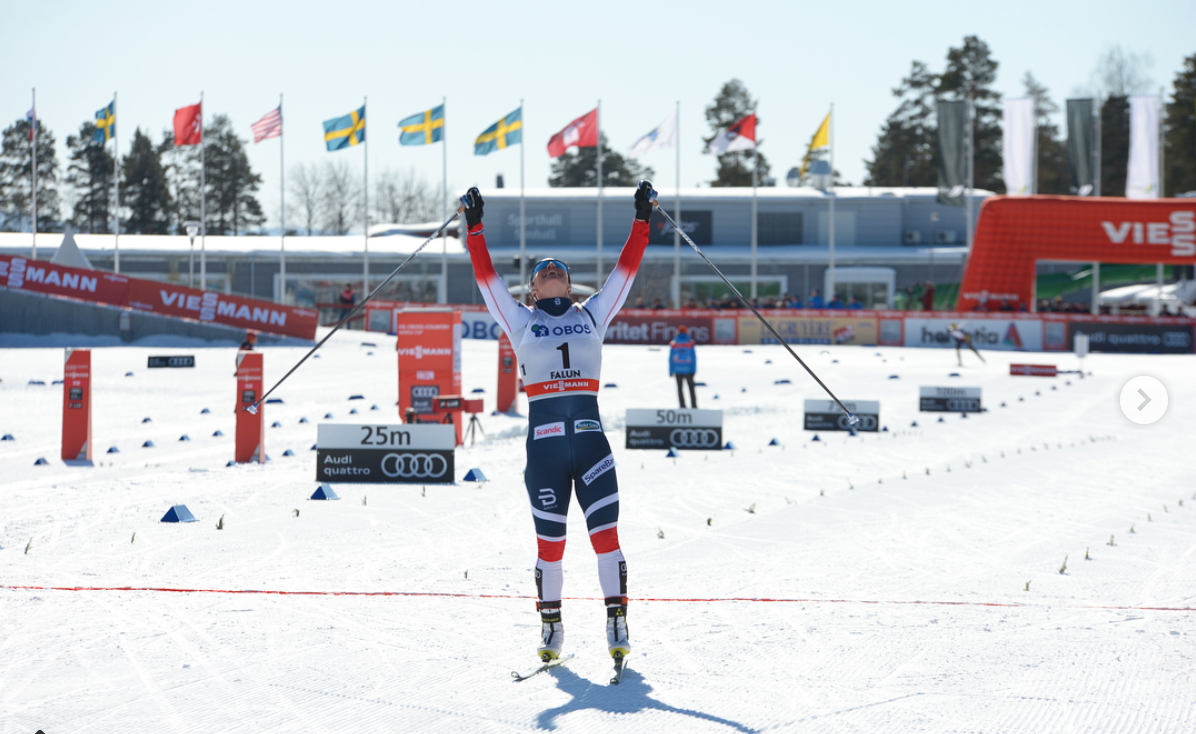
Norway’s Marit Bjørgen celebrates her overall win in the last race of 2018 World Cup Finals, the 10 k freestyle pursuit, on March 18 in Falun, Sweden. Bjørgen officially announced her retirement from skiing last Friday, April 6. (Photo: Svenska Skidspelen/Instagram)
You’ve probably heard the news by now: Marit Bjørgen, the Norwegian queen of cross-country skiing, has decided to retire. The 38 year old made the announcement a week ago after winning the first race of Norwegian nationals, the 5-kilometer classic, on April 6.
“In reality it has been a long process,” she told NRK that day, according to a translation. “I had almost decided before the competitive season started. I feel that I lack the motivation and desire required to be right there in the top. I also have a little boy at at home, who is beginning to understand more and more, that I’d like to spend time with. That time I can never have again. It’s also a little frightening. This is been half of my life. This is emotional.”
The most decorated Winter Olympian of all time across all sports with 15 medals, five of which came at the 2018 Olympics in PyeongChang (two golds, a silver, and two bronze), Bjørgen closed her season on Saturday, April 7 with a second-place finish behind teammate Ragnhild Haga in the national 30 k freestyle in Alta, Norway.
“I’m proud of what I’ve achieved in my career, but I’ve also been privileged to have been able to win top-level sports,” Bjørgen said in Norwegian team press release. “I am very much thankful to amazing team friends, teammates, coaches, medical team, service team, managers and the whole support crew that have been around me. You have a great deal of credit for my results.”
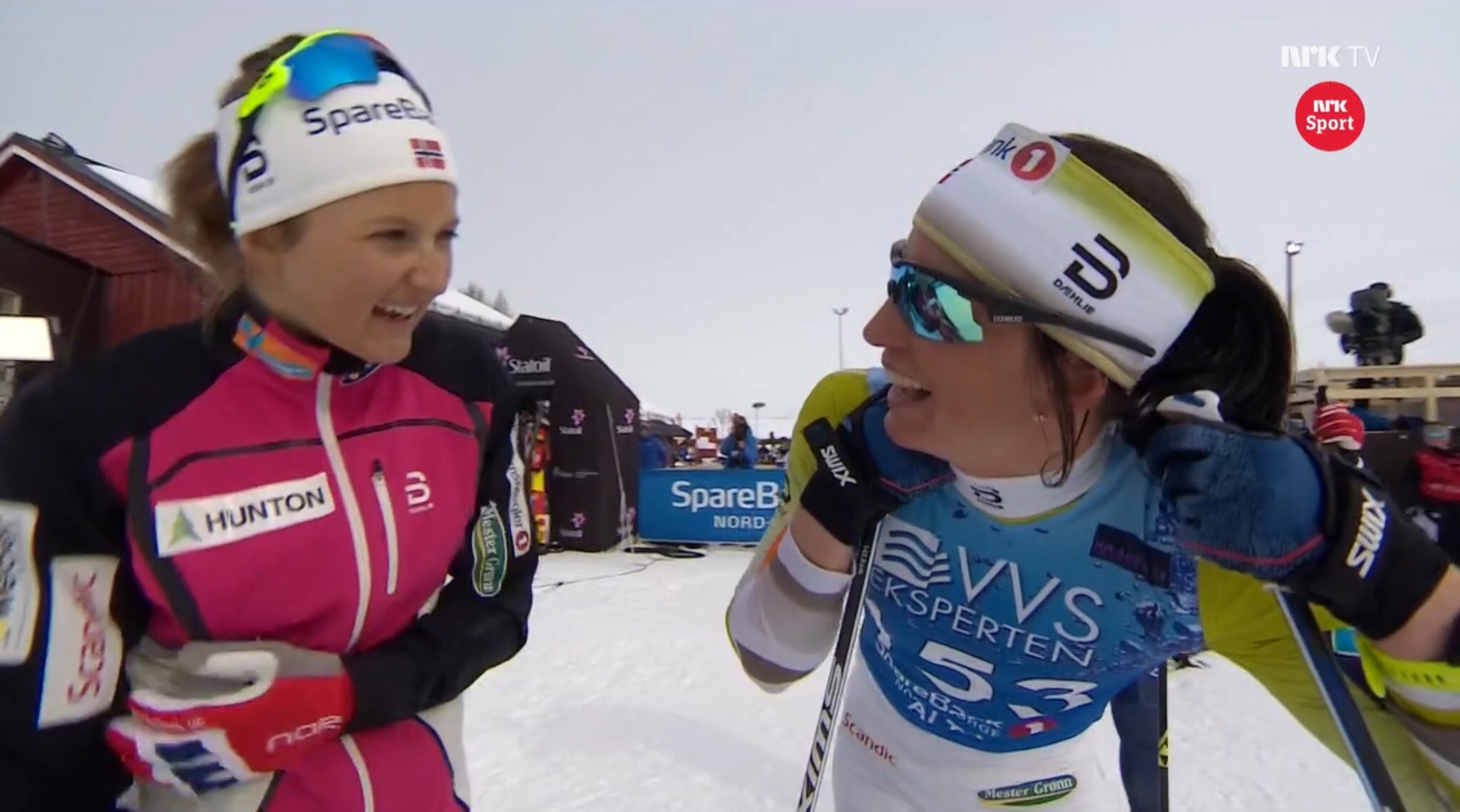
Teammates Marit Bjørgen (r) and Ingvild Flugstad Østberg after placing first and second, respectively, in the women’s 5 k classic at Norwegian nationals in Alta on April 6. (Screenshot: NRK broadcast)
Norway’s head coach Vidar Løfshus described Bjørgen as a “team captain” who was “always there for the girls,” according to an interview with NRK.
He added that she was also a valuable coaching consult.
“For me, she’s been a good sparring partner; when tough things happening internally, I often call Marit,” Løfshus said, according to a translation. “Now there will be one less coach in my team. There are a lot of good coaches in the association, but … [none that have] won so many medals. She knows more about cross country skiing then I do, Sju, Ole and Roar combined, almost.
“We can’t let a woman like that disappeared through the back door,” he said of his desire to keep Bjørgen involved with the team. “But now we’re gonna let her exhale and enjoy her time with [her son] Marius and [partner] Fred Børre. She has not had enough time for that. And after that I know she will contribute again.”
Bjørgen shared emotional moments with her teammates at nationals.
“She has been a role model to me for many many years,” Ingvild Flugstad Østberg told NRK.
“One day has to be the last,” Heidi Weng said. “We’ve had a lot of fun with Marit. She’s a legend. She has been the security blanket and the mother in the team. It’s frustrating not to have mommy at the starting line, someone to joke around with and calm your nerves. Someone who is supportive.”
Who else is on our list of notable cross-country retirements so far? (For our biathlon list, which should also include the additions of Norway’s Ole Einar Bjørndalen and Emil Hegle Svendsen, click here.)
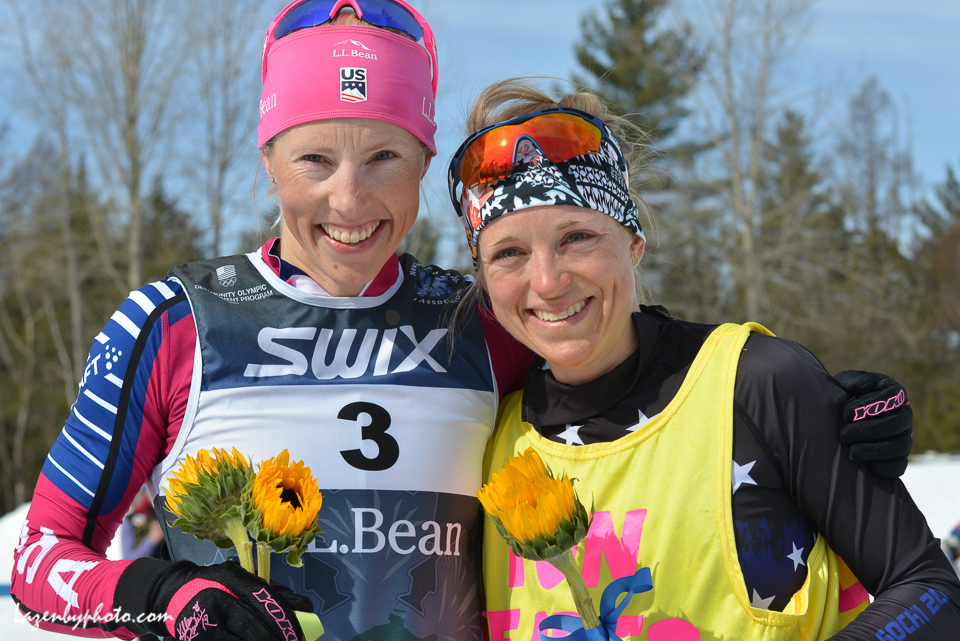
Kikkan Randall (l) and Liz Stephen after the last race of their professional careers, the 30 k classic mass start at 2018 U.S. Distance Nationals in Craftsbury, Vt. (Photo: John Lazenby/Lazenbyphoto.com)
From the U.S., we have U.S. Ski Team members Kikkan Randall and Liz Stephen, who said ‘so long’ to international racing, while another team veteran Andy Newell told FasterSkier that he plans to continue racing, but apart from the national team and likely outside of the World Cup circuit.
Former national-team members Noah Hoffman and Kris Freeman have also announced their retirements from professional skiing. On the domestic side, Annie Hart has stated this was the last season of her ski career as she plans to begin law school.
There has been talk of a few of Canada’s World Cup Team members retiring, but the only one FasterSkier has confirmed so far is Graeme Killick.
Zina Kocher, a 2006, 2010 and 2014 Olympic biathlete who came out of retirement to make a bid for the 2018 Olympics in cross-country skiing, has stated that it’s really over this time after her comeback season.
“As I reflect on the last 16 years that I trained full-time and competed at an international level I’m flooded with a lot of memories,” Kocher, 35, wrote in a blog post last week. “If someone had told me when I started biathlon in ’98 that I would be a ‘lifer’ (aka someone who does the sport & can’t give it up till they’re an old veteran in their 30’s), I would have laughed and said ‘yea right’. But here I am, finally saying goodbye!”
Michael Somppi, of the Alberta World Cup Academy, is also retiring after 16 years of competitive skiing. Somppi, 29, a former member of Canada’s senior development team, won three national titles and World Cup start rights as Canada’s NorAm overall leader at the end of the 2014/2015 season.
“I didn’t accomplish everything I wanted to in my ski career, but I am really proud of all that I did accomplish,” Somppi wrote in a blog post on Sunday. “I feel I got all I could out of myself given the circumstances I faced and the system I worked in. Thinking back to when I started out ski racing in high school, I am amazed how far I’ve come. ‘Started at the bottom, now we here!’ I picked up racing late and was never the most talented. I worked hard with extreme motivation and focus to become one of the top skiers in Canada.”
“One of the highlights of my career was certainly the team sprint with my brother Dario at the Olympic Winter Games in Sochi,” Gianluca wrote in a Facebook post announcing his retirement, according to a translation. “We reached the 5th place and could take home an [Olympic] diploma. It was not only a highlight because of the 5th rank, but also because our parents were there to witness it live. I never dreamed of anything like that when I was a little boy.”
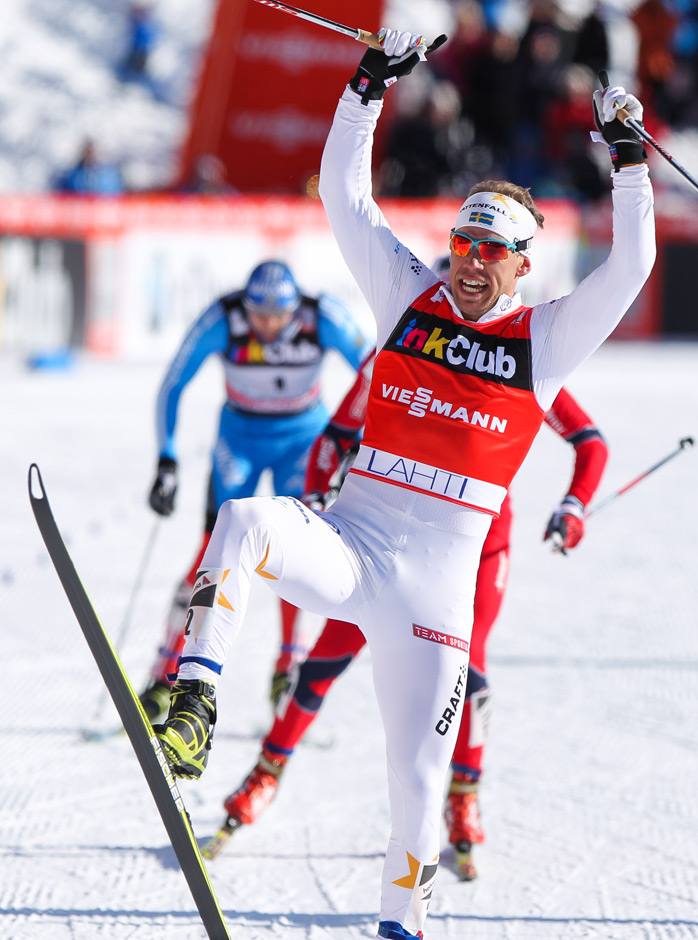
Sweden’s Emil Jönsson celebrates a 2013 World Cup victory in Lahti, Finland. (Photo: Fischer/NordicFocus)
The Swedish team is seeing the exit of Anna Haag, Emil Jönsson and Martin Johansson. Haag, 31, won gold with the Swedish women’s relay at the 2014 Olympics in Sochi, Russia, and has four medals from the last three Olympics. Jönsson, 32, Haag’s longtime partner and an internationally renowned sprinter, earned two Olympic bronze medals in 2014.
From Finland, four-time World Championships gold medalist Aino-Kaisa Saarinen is stepping away from competitive skiing at age 39.
“I have done this 20 years, what I really wanted, and I have raced my goals and even more,” Saarinen told FasterSkier after the last race of World Cup Finals in Falun, Sweden. “This skiing family is the thing what I’m going to miss the most, and of course, I love the competitions. I don’t know any other job where you can feel so high and so low, so, maybe those are the feelings right now, what I’m going to really miss the most.”
Poland’s 35-year-old Justyna Kowalczyk, a two-time Olympic champion and two-time World Champion, has announced her retirement as well.
Then there’s Aurore Jean, 32, who became the second French woman to reach the cross-country World Cup podium with a second-place skate-sprint finish in 2013.
And last but not least (for now), we have heard news of Russia’s Alexander Legkov — the controversial 2014 Olympic champion who was not allowed to compete at this year’s Games because of Russia’s systematic doping in Sochi — officially retiring.
“You have all been with me in the course of many years of my professional career and I truly love you all,” the 35-year-old Legkov said at a sports tournament in Khanty-Mansiysk, Russia, on April 6, according to the Russian News Agency. “… I will see all of you later, not at international tournaments, but perhaps at domestic tournaments or marathon. I am announcing the end of my international sports career.”
At the Sochi Games, Legkov won the 50 k freestyle mass start and took bronze with his teammates his the men’s 4 x 10 k relay. He ended his ski-racing career on March 3 in Rybinsk, Russia, where he placed fourth in the 50 k freestyle Demino Skimarathon.
Stay tuned for more retirement announcements as they are made public.
Sadie Bjornsen (U.S. Ski Team) during the classic leg of the women’s Olympic 15 k skiathlon at the 2014 Winter Olympics in Sochi, Russia. She placed 31st in her Olympic debut.
If you read FasterSkier, two aspects of our coverage generates the most reader comments: doping violations and their adjudication, and team-selection criteria. Although here we are, two days away from the PyeongChang Olympics’ Opening Ceremony with Sochi doping still plaguing the news, as the title suggest, this piece is about team selection.
On Jan. 26, U.S. Ski & Snowboard revealed its 2018 U.S. Olympic Team — a list 20 skiers deep comprised of nine men and 11 women. The U.S. Ski & Snowboard press release announcing those selections used this statement to describe the roster: “The team includes 20 athletes who qualified for the team through World Cup results as well as domestic racing results at the L.L.Bean U.S. Cross Country Championship.”
The buzz following Olympic team selection followed two major threads, one focused on team size, the other on the selection of non-U.S. Ski Team (USST) women sprinters.
In considering why team size remains a concern, let’s zip back to 2014 when the USST was allocated a quota of 17 athletes for Sochi. The team that headed to Russia was 14-athletes deep; seven men and seven women. The remaining three U.S. spots were were reallocated to other nations. At the time, U.S. Ski Team Head Coach told FasterSkier that the small team was by design.
U.S. teammates Sadie Bjornsen (l), Kikkan Randall (c) and Jessie Diggins at the finish of the women’s 2014 Sochi Olympic relay, in which they placed ninth with Liz Stephen.
“With seven women and seven men, we have our start positions filled,” Grover said in 2014. “Seven and seven was the magic number for us.”
One line of reasoning is that a smaller team is more easily managed and the potential for medals are higher.
An Olympic cycle later, the current iteration of the U.S. Cross-Country Olympic team is six skiers larger. That’s partly a function of the depth of the U.S. women’s team on the World Cup and partly a function of how the Olympic selection criteria was interpreted during the team nomination process.
In explaining how the team was named, U.S. Ski & Snowboard Chief of Sport Luke Bodensteiner said that U.S. Ski & Snowboard (formerly USSA) was not mandated to use all of its quota spots for the 2018 Olympics.
“That is a decision we made,” Bodensteiner said on the phone. “We received, across all of sports at U.S. Ski & Snowboard, 110 quota spots, and we accepted all 110. However, we have 109 athletes; one athlete is participating in two different disciplines.”
Bodensteiner clarified that the uneven split of nine men and 11 women on the cross-country team was a result of the women’s depth both domestically and on the World Cup. He explained that the selection criteria does not specify how the spots are distributed between men and women.
“It is really based on results achieved on World Cup ranking and then the Olympic selection list points,” Bodensteiner said. “As it worked out, more women scored more points, actually scored more rankings in the World Cup than the men, and then more selection points than the men on the women’s side. So we just applied down the sort of next-best points in most cases, and that is why [we] have two more women than men and that is just a function of the women scoring more substantial points in the tryout events.”
Practically speaking, a larger team means more variables to manage but clear upsides for the broader cross-country community.
“Filling quotas presents clear positive possibilities and also some challenges to both mitigate and maximize…,” Bodensteiner said. “We try to take everything into account like utilizing start positions in the Olympics and how large a team quota we get. There are challenges for a bigger team, in particular, when you exceed the start possibilities. In cross-country, we have a number of athletes that probably won’t compete. That creates challenges like issues with health, waxing skis, and maintaining a positive team spirit. On the other side, there’s the positive: we have a lot of cross-country athletes going to the Olympics. It is a great experience generally, and something the community appreciates, that the athletes have that opportunity.”
Bodensteiner communicated that several athletes are not expecting to start races in PyeongChang are onboard in terms of fulfilling U.S. Ski & Snowboard’s performance outcomes in PyeongChang.
“We have also had quality discussion with athletes that we have no place to start,” Bodensteiner said. “We have been able to share our concerns that with a large team, we’d like dynamics that do not distract from winning medals. We spoken about how we mitigate those concerns and we have oriented those athletes in terms of how to help mitigate and work together to establish the way to go about doing business. They have been good, highly productive discussions.”
Team Selection: Nominations from the World Cup Qualifying Criteria
Let’s start with the low-hanging fruit, the athletes who met the following objective criteria: “Any eligible athlete that posts a top-8 individual final World Cup result during the selection period [Nov. 23, 2017, through Jan. 15, 2018] in the following events will be selected to the Team: Sprint C, individual start 10/15 km F, and 15/30 km Skiathlon.”
Sophie Caldwell (U.S. Ski Team) racing to sixth in the individual freestyle sprint at the 2014 Winter Olympics in Sochi, Russia. (Photo: Fischer/NordicFocus)
U.S. Ski Team members Sadie Bjornsen, Sophie Caldwell and Jessie Diggins automatically qualified for the Olympic team by meeting the top eight in an Olympic event threshold. Bjornsen qualified on Nov. 24 in Kuusamo, Finland, with a second place in a classic sprint. Caldwell qualified in the same race in eighth place. Diggins made the Olympic team on Dec. 12 in Lillehammer, Norway, when she placed sixth in a classic sprint. (Regarding both Bjornsen and Diggins, each scored multiple top-eight results in Olympic events during the selection period; we’ve simply specified the first instance each skier automatically qualified.)
Three skiers down, 17 to go.
The second-tier of the objective criteria reads as follows: “Athletes ranking in the top-50 in the distance World Cup standings or the top-50 in the Sprint World Cup standings as of January 15, 2018 shall be selected to the team.”
Rosie Brennan, Kikkan Randall, Ida Sargent, Liz Stephen, Erik Bjornsen, Simi Hamilton and Andy Newell jumped the top-50 hurdle.
Let’s run through the men first. On Jan. 15, Hamilton was ranked 15th, Newell 36th and Bjornsen 49th on the World Cup sprint list. Bjornsen was also ranked 41st on the distance list.
For the women, Sargent was ranked 13th on the World Cup Sprint list and Randall 19th. We’ll get back to this in a moment, but Brennan was ranked 43rd on the sprint list and 34th on the distance list. Liz Stephen ranked 35th overall on the distance list.
Some of the chatter heard after the Olympic team selection had to do with a portion of the criteria stating that no more than five athletes per gender would be selected based on sprint results, including all of World Cup sprint results, World Cup sprint rankings, and the domestic OWG points list.
So far we’ve discussed six more skiers, bringing us to nine athletes, all current members of the U.S. Ski Team (USST) and all qualified from their World Cup results.
U.S. Ski Team Head Coach Chris Grover wrote in an email that he believed the World Cup-based criteria served the purpose of fielding the most competitive team.
“From my perspective, the objective World Cup criteria worked well,” Grover wrote. “The fastest athletes were selected to the PyeongChang team.”
He also acknowledged that the inclusion of overall results from the Tour de Ski’s (TdS) final hill climb as part of major championship qualification criteria would be revisited.
“One bit of criticism/feedback that we received was that the Final Climb from the Tour de Ski should not be included in the selection period, because it is a special event that is not representative of the races at a major Championships,” Grover wrote. “I think this is a valid point. The Final Climb has been in our criteria for years, and nobody has complained until this season. Although we believe this race has been effectively useful in identifying our aerobically fit skaters, we are very open to removing it from future criteria and closing the World Cup distance selection period one day earlier. This is something we can discuss with the Cross Country Committee this spring.”
Non-World-Cup-Based Nominations
Filling out a team large enough to fill the four-starters-per-nation race quota allowed the coaches and selection committee to refer to the 2018 Olympic Winter Games (OWG) points list (click “2017/2018 SuperTour Points” under “Resources” on right side of page). That points lists kept a running total for the season’s first two SuperTour weekends and weighted results at 2018 U.S. Cross Country Championships in Anchorage. (For sprinters, points were allocated only for qualification results, not the final results.) The rankings were then further organized by an athlete’s two best sprint results and two best distance results in separate columns on the spreadsheet (note: those columns were blank on Monday morning.)
For the men, team selection appears to have been rather straightforward. The top-three ranked distance skiers were selected off the OWG points list. In order, those athletes were USST member Scott Patterson, Alaska Pacific University’s (APU) Tyler Kornfield and former USST member Noah Hoffman.
Patterson, who is in his first season as a USST member, did not score World Cup points in Period 1 and declined an offer to race the TdS as his path to Olympic qualification. Patterson contested U.S. nationals as his potential qualifying route to the Games. Patterson won the 15 k skate and placed sixth in the 30 k classic mass start.
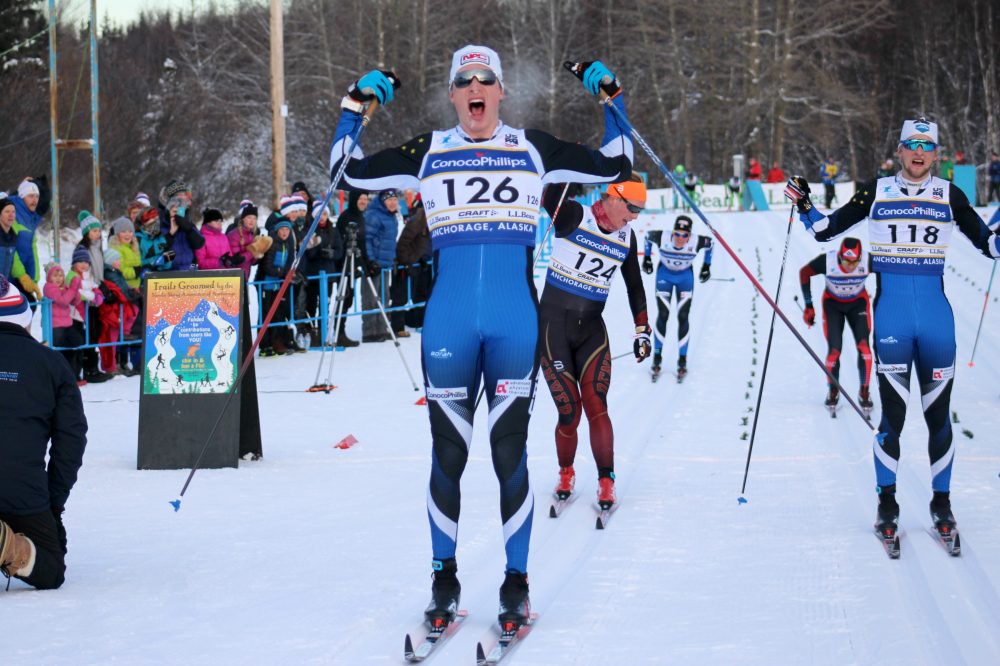
APU’s Tyler Kornfield (126) celebrates as he crosses the line first in the men’s 30-kilometer classic mass start on Jan. 7 at 2018 U.S. Cross Country Championships in Anchorage, Alaska. Eric Packer (118) finished second and Denver University’s Eivind Romberg Kvaale (124) placed third. Kornfield reached the podium in three out of four races at 2018 U.S. nationals.
Second on the OWG list was Kornfield, who won the 30 k classic mass start, placed 13th in the 15 k skate, qualified sixth in the skate sprint and third in the classic sprint. He also placed third overall in both the classic and skate sprints at nationals. Kornfield’s all-around point scoring catapulted him into the team selection conversation.
Third on the list was Hoffman, who placed second in the 15 k skate at nationals and fifth in the 30 k classic mass start. Hoffman also scored World Cup points in 28th in the Lillehammer 30 k skiathlon, a race loaded with home-field Norwegian talent.
Paddy Caldwell, also in his first season as a full-fledged USST member, played his qualifying hand by remaining in Europe and racing the TdS. In his first winter racing full time on the World Cup, Caldwell has popped solid results. His nascent 2017/2018 World Cup resume is highlighted by the 19th-fastest time of day in Kuusamo’s 15 k skate pursuit and the 19th-fastest time of day on the TdS’s final climb 9 k skate pursuit. However, Caldwell landed outside the top-50 bubble on the World Cup distance list.
Patterson was selected as the highest-ranking athlete on the 2018 OWG selection list. As specified in U.S. Ski & Snowboard’s Olympic team press release, Patterson’s selection, according to U.S. Ski & Snowboard, was not a discretionary pick.
However, Hoffman, Kornfield, and Caldwell were all selected to the Olympic team by discretion. Bodensteiner, himself a former U.S. cross-country Olympian, explained over the phone that Hoffman, Kornfield, and Caldwell were nominated to the team by head coach Grover. Those nominations were then reviewed and approved by a three-person committee composed of Bodensteiner, U.S. Ski & Snowboard President Tiger Shaw, and former USST member Holly Brooks as the athlete representative.
Bodensteiner provided firsthand insight into Caldwell’s nomination and approval process.
“Chris Grover presented to the committee whether Paddy was qualified to be part of roster,” Bodensteiner said. “From an athlete-management standpoint, Paddy is somebody we have all agreed has got high potential for the future and the coaches were very interested in getting him into this environment [on the World Cup] and let him race a lot and developing him that way. We could have declined to accept Chris’s nomination of discretion. When I think of developing Paddy, for him it is not necessarily about performance in this Olympics but about future Olympics. Also, in thinking of his development, you don’t want to pull a guy like that out of racing for a month. We agree from an athlete management standpoint we want to make sure he has that experience. On our phone call about Paddy, Chris Grover does get into specifics about [Paddy’s] recent results. Paddy will get a start and maybe more in PyeongChang.”
It should be noted that in an interview about team selection this past summer, Grover stated that development occurs at many lower levels, like Europa Cups, World Juniors, etc., but “It does not and should not come at the World Championships or the Olympics. … It’s not a development trip; it’s a competition trip at the very highest level.”
At the same time, the criteria allows use of discretion for “Indication of medal potential in future Olympic or World Championship competition (such as international age group results and rankings) that would be materially enhanced by selection to the team.”
In the past, that “future medal potential” option for discretionary selection has rarely been used.
“We haven’t used it that way,” Grover said this summer. “Obviously the language is there if we were to choose to use it, but in the past we really have not used it that way, and I don’t anticipate using it going forward into this season. … We want … the fastest skiers on the start line in Korea, and those are the ones that we’re gonna be selecting.”
In PyeongChang, it’s likely that Patterson, Hoffman, Bjornsen and Paddy Caldwell will form the core of the U.S. Olympic men’s distance starts, with Kornfield getting several warranted race opportunities. Hamilton also skied himself into the Olympic distance race start mix by placing 12th in the 15 k skate mass start in the final pre-Olympic World Cup weekend in Seefeld, Austria. The 15 k skate at the Olympics is an individual start.
Factored into the men’s Olympic sprint-start equation are brothers Logan and Reese Hanneman. The Alaskan brothers (both members of APU) were the two highest ranking sprinters on the OWG list. Logan, the younger of the two, placed first and second in the U.S. nationals classic and skate sprint qualifiers. Reese placed third and first, respectively. Older brother Reese also doubled up by winning both the skate and classic sprint crowns. According to the U.S. Ski & Snowboard Olympic team press release, neither Hanneman was considered a discretionary pick.
Depending on Erik Bjornsen’s race schedule, the U.S. coaches will have a core of Newell, Hamilton, the Hannemans, and Bjornsen for the classic sprint. In case of illness, Kornfield has sprinting chops as well. He’s a former two-time classic sprint national champion who reinforced his sprint cred with his double-podium performance in the sprints at the 2018 nationals.
Time to bring the discussion back to the women’s Olympic team selections. To restate, Diggins, Sadie Bjornsen, Sophie Caldwell, Sargent, Randall, Brennan, and Stephen all qualified objectively with their World Cup results. That’s seven female athletes, which leaves four spots remaining on the 11-athlete women’s Olympic cross-country team.
“We acted on the principle that we wanted to maximize start rights in each race,” Bodensteiner explained. “There was an interesting dynamic to women’s team. We have a generous quota and the need to fill spots. Our top women are going to race quite a bit and they ultimately exhaust start options for other skiers.”
In other words, this team is in PyeongChang to medal. Yet even with that caveat, “slam dunk” could be used to describe the nomination of Caitlin Patterson, of the Craftsbury Green Racing Project (CGRP). She was the top American in all four races contested at nationals. She won the 10 k skate, and both the skate and classic sprints, and was the first American in the 20 k mass start classic (and second overall). Patterson was selected off the OWG point list as the highest ranking female athlete.
Caitlin Patterson (Craftsbury Green Racing Project) racing to 52nd in the freestyle sprint qualifier at the last World Cup on Jan. 27 in Seefeld, Austria. The next day, she placed 23rd in the 10 k freestyle mass start. (Photo: Fischer/NordicFocus)
With the exception of Caitlin Patterson, Scott’s older sister, who again reinforced her Olympic readiness with a 20th place in Planica’s 10 k classic, start spots remain scarce for non-USST women skiers at the Games. That said, three more domestic-circuit-based female skiers were nominated to the Olympic team: Annie Hart (Stratton Mountain School T2 Team), Kaitlynn Miller (CGRP) and Rosie Frankowski (APU).
Frankowski was second on the distance OWG points list after placing fourth and second*, respectively, in the 10 k skate and 20 k mass start classic at Nationals (*she was the second American, third overall in the mass start). According to Grover in an email, Frankowski remains an “alternate” for the distance events.
If we don’t include Hart and Miller yet, we’re at 18 athletes total, nine men and nine women.
According to Bodensteiner, initially the U.S. Olympic Committee (USOC) relayed that U.S. Ski & Snowboard had a quota of 18 cross-country athletes.
“Once we get that quota, we are required to make an entry,” Bodensteiner explained. “So we do the selection, in this case on 18 athletes. We do the entry, and then it is a couple days later when you start with this reallocation. It is really hard to determine what is going to happen there. Because you don’t know if Norway is going to give back a spot, or Germany or even a Macedonian. You just don’t really know what is going to happen.”
According to Bodensteiner, the U.S. was reallocated a 19th team spot. Soon after the additional reallocated spot, the USOC informed U.S. Ski & Snowboard that a 20th quota spot was added.
“That creates some interesting dynamics for selection because then you select your team, and couple days later, in this case, a 19th quota drops,” Bodensteiner said of the team-naming process. “And the coaches had done all their nominations about coach discretion that they wanted to do. And when we hit 19, and then eventually 20, and made a subsequent selection, that is a fairly dynamic process as well.”
For both the 19th and 20th spots, which Bodensteiner confirmed were Hart and Miller respectively, the selection committee in consult with the USOC, decided to go strictly off the point hierarchy from the women’s domestic list.
“Ultimately we decided to accept [the 19th and 20th spots], and at that point did not elect to use anymore coach’s discretion and just re-apply the procedure, with the athlete on objective criteria that had the next-best selection points,” Bodensteiner said.
Hart topped the OWG sprint list. Yet, as mentioned earlier, the criteria is written in a way to seemingly cap the number of sprinters at five in either gender. Last year, as a result of the the strict interpretation of those guidelines used to select the U.S. team for the Lahti World Championships, no domestic sprinter was selected to the World Championship roster. (Sophie Caldwell, Diggins and Randall all advanced to the final in that event. Diggins earned silver, Randall bronze.) The requisite lack of sprint opportunities for U.S. based women skiers at cross-country events like World Championships or the Olympics may be the cost of fielding perhaps the strongest women’s sprint team in the world. Sophie Caldwell, Diggins, Bjornsen, Randall and Sargent are internationally recognized sprinters. Even in a best-case Olympic scenario, one of these podium threats will be cheering during sprint qualifications, as only four can start a given race.
Yet the U.S, Olympic team will bring six female sprinters to PyeongChang. Bodensteiner stated that despite the language in the criteria (“will not exceed”), capping the number of sprinters at five per gender is not absolute.
“That is where, as I have explained with the quote-unquote sixth sprinter, that it was not a selection that was made in that allocation of 18,” Bodensteiner said. “That was made basically in consultation with the USOC and an external review to decide what’s the most fair application of the criteria in terms of filling the 19th position. That is where we as a selection committee would have looked at the athlete with the next highest selection points even knowing this athlete would be a reserve but we defaulted to the person who had the highest selection points.
“Annie is an interesting spot in thinking about how deep to get, and looking at outstanding results in sprinting, rather than choose lower on the distance list,” he continued. “It made sense to choose and recognize exceptional results. Discretion allows the committee to fill start rights and use the criteria in the most equitable way possible.”
Miller and Caitlin Gregg were tied for third on the women’s OWG distance points list. With their two best races considered, each athlete earned 56 points. Miller was selected over Gregg by applying the criteria’s tie-break procedure.
As a notable aside, multiple athletes alleged to FS, in writing but off the record, that Olympic team selection had been influenced by internal arbitration, external civil litigation, or the threat of either or both of these. However, both the existence and outcome of arbitration procedures are confidential, and multiple docket searches in state and federal courts revealed no lawsuit that had actually been filed.
Asked whether the USOC had been prompted to begin arbitration to either open up more Olympic team spots or be included on the team beyond the original 18 athletes selected, Bodensteiner stated that the USOC helped guide those particular selections.
“I guess what I will tell you, there is always an opportunity for independent review,” Bodensteiner said. “And that is where the USOC is really involved with us and we have a lot of discussions with them, like what’s the proper application of the procedure in terms of being applied fairly and equitably with the 19th selection and probably the 20th. We had done a lot of consultation with the USOC on both those selections.”
Bodensteiner also made clear that it is in every interested party’s right right to advocate for themselves.
“The athletes have the protection to challenge a selection position,” Bodensteiner explained. “It can be any reason they feel wronged. It is also not part of public record. They have the opportunity to make a complaint to USOC — they oversee the whole process. The USOC also approves the selection criteria, they have influence over it. Yet, they do not tell us to fill our quotas. So, the athlete can file a complaint to the USOC and they, the USOC, will moderate the discussion with the athlete who feels they wrongly have not been selected. If we can not come to terms, it is referred to an arbitrator.”
As far as FasterSkier has been informed, at least one athlete, and potentially more, was involved in official arbitration in connection with the 2018 U.S. Olympic cross-country selections. The USOC is not a government funded agency and it’s arbitration records are not public documents.
“That is not public record, we have dealt with that in the past, that is as deep as I want to get,” Bodensteiner said. “It is interesting when you get into application of criteria. Despite what you write specifically, they are open to interpretation. We maintain fidelity to criteria as much as possible. Some people will feel that wasn’t the right process. I understood to be something different. We will always go on and rewrite if there are any ambiguities and make better criteria.”
As of Wednesday morning, FasterSkier was still seeking comment from the the USOC regarding the reallocated spots — spots 19 and 20 — on the U.S. Olympic cross-country team.
Moving forward, Grover wrote that Hart will be a reserve for the classic sprint and Miller a reserve for the distance events.
It’s full steam ahead with 20 U.S. cross-country athletes in PyeongChang. As the final rosters take shape in what on paper could bring the U.S. its first Olympic cross-country medal in almost two generations, coaches like Grover and the USST women’s coach Matt Whitcomb will be carefully penning out each race’s start roster for the Games.
In the often black-and-white world of elite ski racing, Bodensteiner conveyed he, too, could imagine the pressure exerted on both the athletes and coaches in the Olympic pressure cooker.
“It takes pretty adept coaching to work the athletes through that and deal with the athletes who don’t get selected to race in each competition,” Bodensteiner said about the tough race start decisions facing the team. “That can be a tough thing for athletes for sure. You can imagine the pressure on the team sprint race right now. That is going to be a pretty difficult challenge for those guys. I anticipate it will be a tough one for the athletes. There’s a very high potential to get a medal there and there are certainly more than two athletes that are probably thinking they should be on that team.”
The Games begin on Feb. 10 with the women’s 15 k skiathlon.
Via Facebook on Friday, U.S. Ski & Snowboard announced its 20-athlete roster for the U.S. Cross-Country team at upcoming Winter Olympics in PyeongChang, South Korea.
The U.S. Cross Country Ski Team will be one of the largest at the 2018 Olympics with a full squad of 20 athletes, with 11 women and nine men. Twelve of the 20 are U.S. Ski Team members.
According to a press release, “The team includes 20 athletes who qualified for the team through World Cup results as well as domestic racing results at the L.L.Bean U.S. Cross Country Championships.”
The release notes four discretionary picks: Annie Hart, Patrick Caldwell, Noah Hoffman, and Tyler Kornfield.
“The U.S. Ski Team is headed to PyeongChang with one of the most talented and decorated Olympic Teams of all time,” U.S. Ski Team Head Coach Chris Grover said in the press release. “Never in our history have we fielded a team with so many podium-proven World Cup and World Championship athletes. We also have incredible momentum in this Olympic season with 10 World Cup podiums secured by early January. These USA Olympians have prepared extremely well for PyeongChang and are looking to rewrite U.S. cross country skiing history.”
2018 U.S. Olympic Cross Country Skiing Team
Erik Bjornsen (U.S. Ski Team/Alaska Pacific University)
Patrick Caldwell (USST/Stratton Mountain School T2)
Norway’s Marit Bjørgen racing to a 29-second win in Friday’s 10 k classic FIS race in Beitostølen, Norway. (Photo: Aleks Tangen)
(Note: This article has been updated to include comments from Nichole Bathe.)
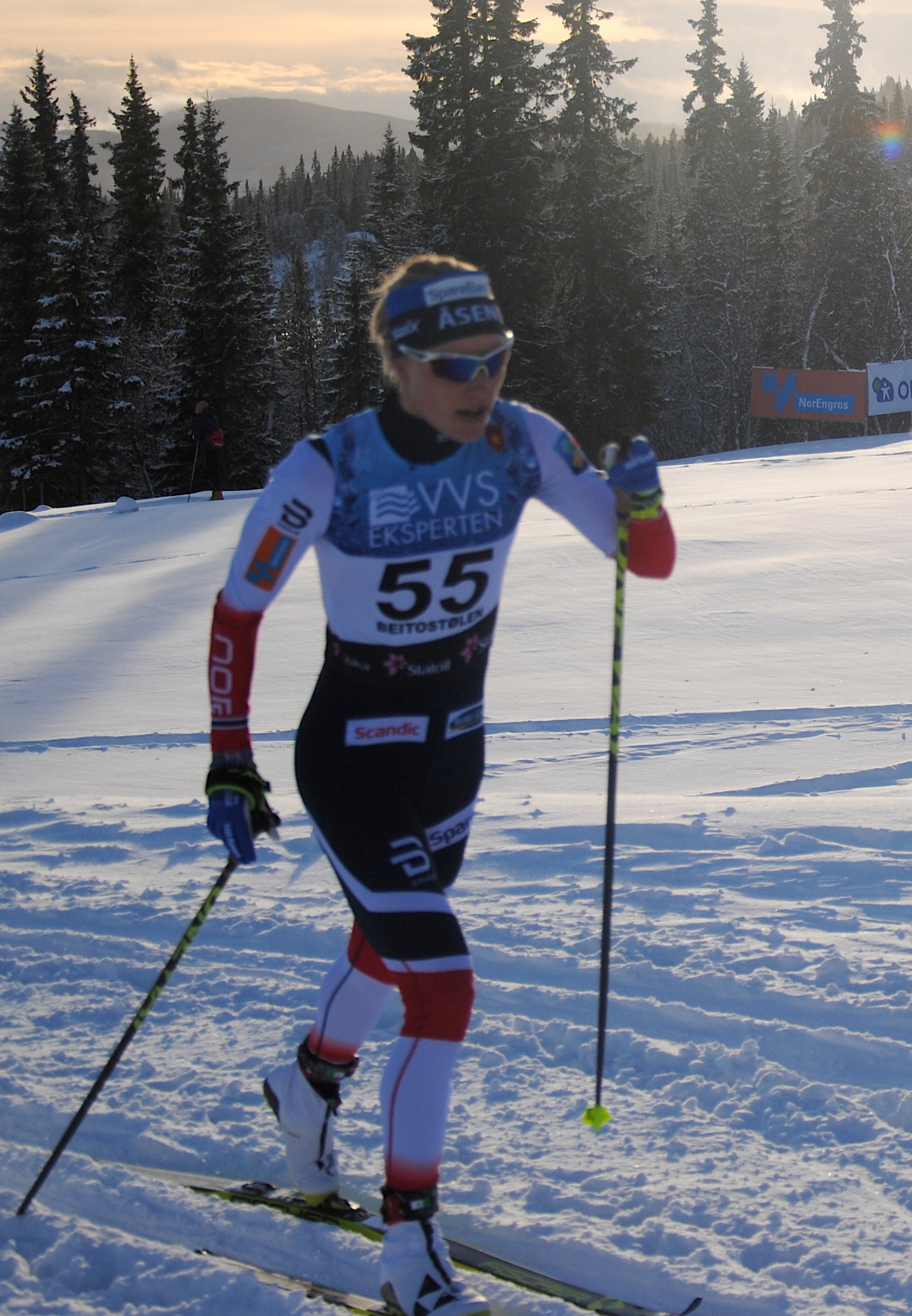
BEITOSTØLEN, Norway — The question of whether Bjørgen or Weng will be the bigger name this season went in the favor of the former on Friday at Norway’s first big matchup of the season. Marit Bjørgen, now 37 and in her 20th World Cup season, won the first race of the three-day International Ski Federation (FIS) weekend in Beitostølen, starting last out of 56 women and finishing first in the 10-kilometer classic individual start, with 29.4 seconds between her and Weng in second place.
On a morning that marked the start of the 2017/2018 season in Norway, with temperatures just below zero and a snow squall during the women’s pre-race warmup, the snow covering the course appeared loose but ample.
Weng, the 26-year-old reigning Overall World Cup and Distance World Cup champion who started 30 seconds behind fellow Norwegian national-team member Bjørgen, told reporters after the race that she was satisfied with her performance, but could have skied better and “could have had better grip”.
For the first 2 kilometers of the race, Bjørgen’s pace was comparable to that of another one of her teammates, Ingvild Flugstad Østberg, who started just ahead of Weng. But halfway through the race, Bjørgen was nearly 22 seconds up on Østberg and 28 seconds ahead of Weng.
While Bjørgen continued to put seconds into her teammates in the final 5 k — blowing through the 7 k checkpoint 28 seconds faster than anyone else — Weng and Østberg battled for second. Weng clocked through 6.1 k just 2.7 seconds faster than Østberg and skied 5.1 seconds faster than her over the next 900 meters. Despite crossing the finish 11.6 seconds faster than Østberg, Weng’s time in the leader’s chair was short-lived, as Bjørgen finished 29.4 seconds faster with a winning time of 29:30.9 minutes.
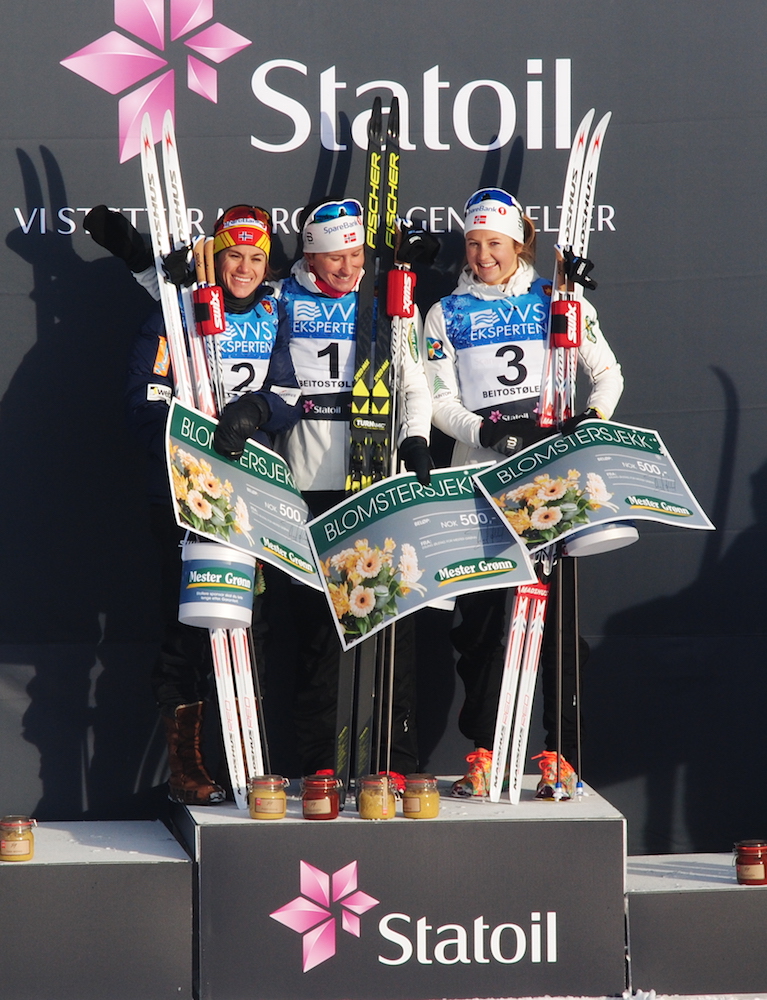
The women’s 10 k classic all-Norwegian podium at Friday’s FIS race in Beitostølen, Norway, with Marit Bjørgen (c) in first, Heidi Weng (l) in second and Ingvild Flugstad Østberg in third. (Photo: Aleks Tangen)
Østberg claimed third, 41 seconds back and 10 seconds ahead of another Norwegian national team member Ragnhild Haga in fourth (+51.0). Norway swept first through 13th place with Kathrine Rolsted Harsem in fifth (+1:08.1), Astrid Øyre Slind in sixth (+1:27.5) and notably, sprint specialist Maiken Caspersen Falla in ninth (+1:54.3).
“Marit is superior,” Weng said in a post-race interview with NRK. “This is top level and I have to step it up.”
She added, “29.4 and 41 seconds is a lot, but Marit is not invincible.”
But even Bjørgen has to tell herself to ski relaxed for the first race of the season.
“I tried to stay calm and ski my way up to Weng,” Bjørgen told NRK. “Considering that she held the yellow bib [as the World Cup leader] last year, I think that’s pretty good.”
Bjørgen reflected that she could have skied the flatter parts of the course better.
“Heidi did well there, and it was fun to ski behind here and learn from her,” she said.
Norwegian national-team member Ragnhild Haga racing to fourth in the women’s 10 k classic FIS race on Friday in Beitostølen, Norway. (Photo: Aleks Tangen)
Fourth-place finisher Haga told reporters that she was pleased with her technical improvements in classic, which she has been working on for three years.
“It was fun, and I’m glad I was able to race at such a high level,” Haga said.
Three Americans, two of which race for Great Britain, finished 29th, 30th and 31st: Annika Taylor (+3:48.2) Nichole Bathe (+3:51.3) and Anne Hart (+3:51.4), respectively. Taylor was born in California and is a member of Great Britain’s women’s team, as is Bathe, who hails from Wisconsin and is also a member of the CXC Team. Hart, originally from Minnesota, races for the Stratton Mountain School (SMS) Elite Team in Vermont.
Since mid-September, Bathe, a recent University of Alaska Fairbanks graduate, has been living in Lillehammer, Norway, while training with the British national team.
“It’s been quite the transition especially from college racing but it has been such a great learning experience and makes me really exited for the season!” Bathe wrote in an email. “That was my first race of the season and I thought it went okay. I went out pretty hard which caught up to me in the end but overall I think it was a good start to the season.
“Typically I am more of a sprinter but in general I like classic more than skate and 5k classic is my absolute favorite race,” she added. “This winter I am focusing on U23s [World Championships] and skiing fast there especially in the sprint. I will mainly be racing in Europe this year. I am racing the Kuusamo World Cups and then heading onto the OPA and Scando Cup races!”
In an in-person interview with FasterSkier, Hart explained that she made a point to get on snow earlier this season and spent the last two weeks training in Sjusjøen, Norway. After this weekend, she’ll return to the U.S. for the first SuperTour races in West Yellowstone, Montana, Dec. 2-3.
“I’ve been told by just about everyone that this is more competitive than a World Cup in part because these are [the Norwegians’] major qualifying races [for the World Cup], or their only ones I think,” Hart said of Beitostølen. “So I just went out hard. I had great kick on my skis so I just was really working on skiing well because last year that was an area I think I just got really frantic.”
During training on Thursday, Hart skied one lap with Bjørgen.
“Yesterday I actually skied with — stalked — Marit on an easy lap, and I was just trying to imitate her skiing,” Hart said. “So I was just trying to think of her out there and obviously not quite as fast, but I was really psyched with how I skied everything well. I felt a little tired on the last bit, but again, I didn’t fall apart and I’m really pleased with that.”
American Anne Hart (SMS Elite Team) racing to 31st in the women’s 10 k classic FIS race on Friday in Beitostølen, Norway. (Photo: Aleks Tangen)
For Hart, the biggest difference she noticed in this initial race of the season was the fact that she was having fun.
“Last year I was just struggling the whole season to find that ‘fun’ gear, I guess, and today I was really enjoying the whole time and really pushing and not looking forward to the end,” she said. “Instead of thinking, ‘I have to make it another kilometer,’ it was like, ‘Oh my god, I only have a kilometer to go. I’ve gotta really give it all I’ve got.’ ”
For Canada, Isabella Howden, of the newly formed Barrie Cross Country (BXC), finished 53rd (+7:18.2). Afterward, Howden, who started 16th, recalled being passed by the five fastest women on her second lap, which she said was beneficial.
“That was pretty cool, seeing them and getting to stay with them on the downhills and copy their technique for as long as I could see them,” she said.
For Howden and some of her Canadian teammates, Beitostølen is familiar territory; they raced there last year. Regardless, she was in awe of the atmosphere.
“It’s so cool … all the kids up there cheering and there’s a whole crew around the corner with all their cowbells, like 10 of them,” she said with a laugh.
Sundby Pulls It Together
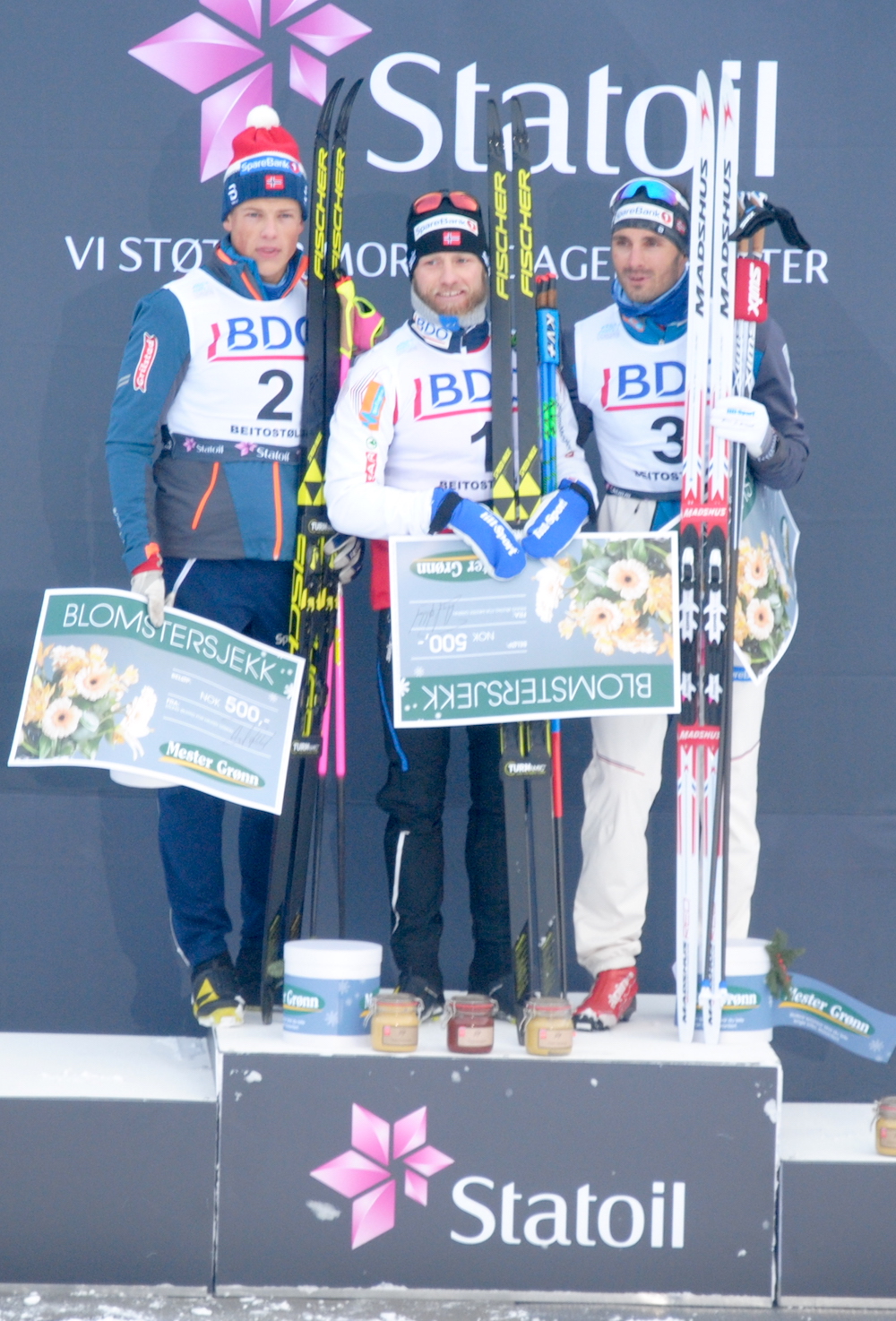
The men’s 15 k classic all-Norwegian podium at Friday’s FIS race in Beitostølen, Norway, with Martin Johnsrud Sundby (c) in first, Johannes Høsflot Klæbo (l) in second and Hans Christer Holund in third. (Photo: Aleks Tangen)
In the men’s 15 k classic individual start that followed, defending World Cup champion Martin Johnsrud Sundby took the win by 18.2 seconds over Norwegian teammate Johannes Høsflot Klæbo, who won last season’s Sprint World Cup at the age of 20.
Now 21, Klæbo is recognized as more of an all-around force, and on Friday, he led the men’s race up until the 4.9 k checkpoint. Sundby started last out of 158 men and trailed Klæbo until 6 k. But from that point on, the race was Sundby’s; at 9.8 k, he was 12.3 seconds faster than Klæbo in second place.
“I had to pull myself together,” Sundby told reporters after the race, explaining that he felt tired around 6 k. While the rest of his race required some extra effort, Sundby expressed contentment with his performance.
“This was something positive that I will take with me going into the season,” he said. “This was the first race of the season and it could have gone both good and bad. … It was so-so, I felt goofy skiing today, but that was also the case for everyone else.”
He attributed that awkward feeling to challenging conditions, “but that is also good practice,” he said. “I didn’t feel all that well in the first 5 k, but after that I was able to speed up and I felt that was able to control the race.”
And he did so without going too far into the pain cave.
“I didn’t have to dig as deep as I have done sometimes in the past,” Sundby said.
Sundby’s winning time of 38:57.2 was 18.2 seconds faster than Klæbo in second and 37 seconds clear of Hans Christer Holund in third. The top-seven men — all Norwegian — finished within 59 seconds of first. The women were a bit more spread out, with the seventh-place woman, Silje Theodorsen (Kvaløysletta Skilag), finishing 1:36.3 behind Bjørgen.
Holund clawed his way into the race after his 4.9 k time ranked 11th. With about 5 k to go, the Norwegian national-team member was up to fifth, and by 11.9 k, he was within reach of the podium in fourth place.
Didrik Tønseth ended up just 1 second off the podium in fourth (+38.0), while Johan Hoel (Åsen IL/Team Veidekke Oslofjord) placed fifth (+42.2), ahead of Simen Hegstad Krüger in sixth (+44.1) and Emil Iversen in seventh (+59.0).
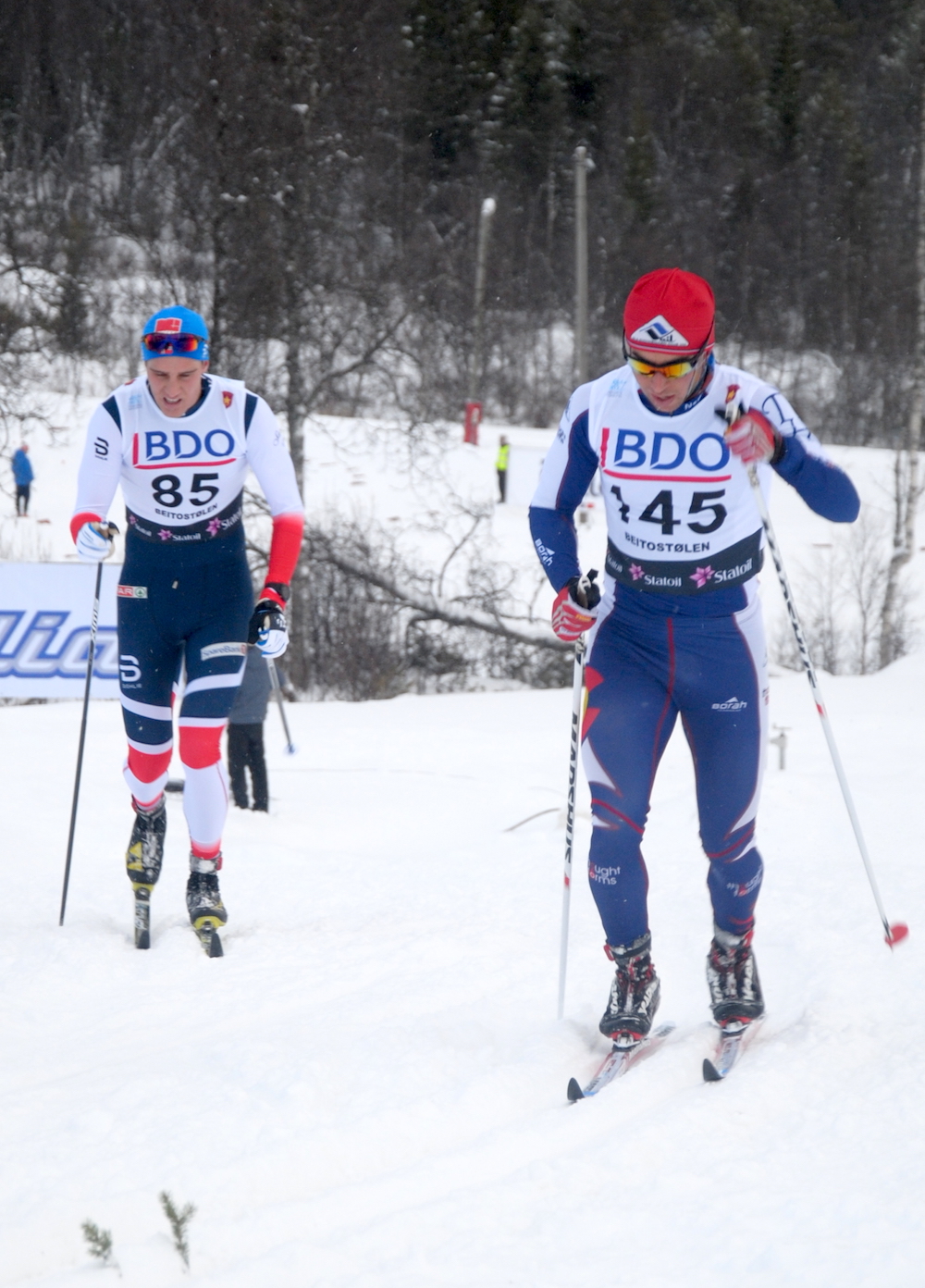
Noah Hoffman (r) passes Norway’s Torstein Bu during the men’s 15 k classic FIS race season opener on Friday in Beitostølen, Norway. Hoffman went on to place 29th, while Bu finished 75th. (Photo: Aleks Tangen)
The lone American in the race, Noah Hoffman placed 29th, 2:25 minutes behind Sundby. After a slow opening that put him in 47th at the 2.1 k mark, the former U.S. Ski Team member settled into a pace that put him within the top 30.
Afterward, he told FasterSkier that his performance was a good starting point. He started the race toward the back of the field in bib 145, just ahead of several top Norwegians.
“It was a little unfortunate that there was a big train that formed right behind me, and those guys didn’t catch me until less than a k to go,” Hoffman reflected. “I was hoping they’d get me a little sooner or not get me at all, but it was good.”
In terms of a race plan, he explained that he tried to ski with energy and build throughout the entire 15 k, which he felt he did.
“I got a little excited the second time up the big hill and maybe burned a little too much, but for the most part it was a good effort and I’m looking to build this for Sunday and then obviously into next weekend,” he said.
After Sunday’s second set of distance races in Beitostølen, the 10/15 k freestyle individual starts, Hoffman will race four weekends of World Cups as an invited member of the U.S. Ski Team (USST) for Period 1. He missed the objective qualifying criteria for renomination to the USST by one place (he ranked 51st in the World Cup at the end of last season) and is thus skiing independently this year, paying his own way (and paying his own wax technicians, Zach Caldwell and recently retired USST tech Peter Johansson) so that he can race in Europe.
“The early season is important for me this year because I don’t have guaranteed start rights for the whole winter, so I need to ski well,” Hoffman, 28, said. “And I believe I’ve done everything I can to prepare and I hope to see the results from that.”
Several Canadian juniors raced the men’s 15 k as well. Ryan Jackson led them in 97th (+5:16.8), followed by Scott Hill in 99th (+5:19.1), Joey Foster in 124th (+6:45.3), and Maks Zechel in 143rd (+8:25.5).
“It was hard out there today,” said Foster, a 21-year-old member of BXC, noting that he was still feeling the effects of travel after arriving in Europe a week ago. “Considering how I felt, the race was pretty good. … I started with what I thought was a pretty conservative pace and I got in with a good train of people, and I skied with them for almost the whole first lap, and from there I just kind of fell off pace. … I think my leadup to the race just wasn’t as good as it could’ve been, so I wasn’t feeling as crisp as I would’ve liked.”
The Beitostølen FIS races continue through the weekend with classic sprints on Saturday, which U.S. Ski Team member Andy Newell plans to race, and 10/15 k skate races on Sunday.
Montériski’s Étienne Hébert (c) returned from WJC in Soldier Hollow in time to outsprint NTDC TBay’s Fergus Foster (l) in a classic-sprint quarterfinal at NorAm Eastern Canadian Championships at Nakkertok Nordic in Cantley, Quebec. (Photo: Dianne Galus)
The annual Eastern Canadian Championships are a special event in the Canadian winter. On paper, it is just another NorAm that provides opportunities to earn World Cup starts, national-team positions, and valuable International Ski Federation (FIS) points, but it has grown to be bigger than that.
While Western Canadian Championships and Canadian nationals change their host venue each year, Easterns has settled in at the Nakkertok South trail system for ten of the last eleven years. While Cantley, Quebec, is the nearest town, the national capital Ottawa and Gatineau are just twenty minutes away, providing a wealth of accommodation options and a major airport. With Toronto, Montreal and Quebec City all within a five-hour drive, a third of the Canadians competing were within easy driving distance.
With 835 athletes registered this year and more than 700 finishers each day, Easterns is likely to be larger than next month’s 2017 nationals in Canmore, Alberta. The American Birkebeiner (SuperTour #4) in Hayward, Wis., is the largest FIS points race this season in North America, with U.S. nationals at Soldier Hollow in Midway, Utah, ranking the fourth largest.
How do you put together a three-day event featuring an interval start with 736 finishers, including para-nordic, masters and university categories? It starts with 553 volunteers and a FIS request to test a no-double-pole zone. The open categories were slightly reduced by races happening simultaneously in PyeongChang, South Korea (World Cup), and Soldier Hollow (U23/Junior World Championships), but there were enough familiar faces to fill the podiums.
It ends with smiling faces, results, and a select few skiers who improved their FIS points and made their case for future selections. The photo gallery links are at the bottom, just keep scrolling past the quotes.
***
No-Double-Pole Zone
The classic sprint was Canada’s first test of the new FIS rule, and athlete opinions were not divided.
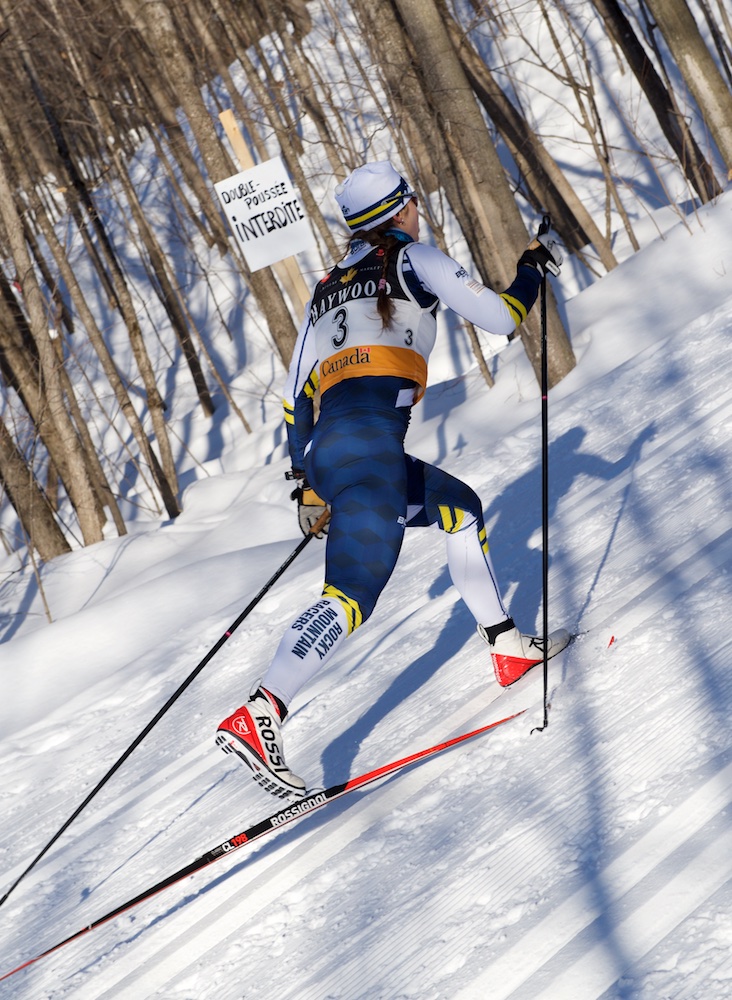
Double-poussée interdite: a new twist from FIS. RMR’s Andrea Dupont strides past the no-double-pole sign during the classic sprint qualifier. (Photo: Rob Smith)
“They started the no double pole zone on the gradual climb before the steep pitch, which made the flow of the course a bit annoying (in training yesterday they actually had it right at the bottom of the climb in a section that was too fast to stride, but the jury was really great about taking athlete feedback and moved it higher up the hill. I’m personally not a fan of the no double pole zone idea but I think they managed it as well as they could have on that course).”
— Angus Foster, NTDC TBay, 2nd
“I was not a fan of the no double pole section. I personally love striding and I hope striding can remain a part of our sport, but I think having no double pole sections or limiting pole lengths aren’t the solution for keeping striding a part of our sport (that being said, I’m still not sure what the solution is).”
— Maya MacIsaac-Jones, AWCA/NST U25 Team, 1st
“It was so unnecessary. Everyone I talked to would have strode that no DP zone anyway. It should have been a double pole only zone. That would have made it a challenge. I’d love to see these silly pole length and DP zone rules revoked. Let the sport evolve as it will.”
—Andy Shields, Lappe Nordic, 7th
“I didn’t think it would have made a difference. Classic was definitely pretty fast and so was the snow.”
—Russell Kennedy, Team R.A.D., 3rd
“For me those would have been striding sections anyways, so it had very little effect. I think it is an interesting issue — the development of double poling as a technique of its own and the repercussions for traditional classic skiing. I love to stride, so I think the best solution is to have courses that force striding. I don’t know too many people (boys included) who I think would have double poled that course, but the no double pole zone ensured that wouldn’t be a problem. It is exciting to see the sport changing and trying to adjust itself though!”
—Anne Hart, SMS Elite, 3rd
Nakkertok South and the Easterns Atmosphere
“Easterns is my favorite race of the year despite the zoo it always is. The courses are staples on the circuit and the Ottawa/Gatineau area is great. Plus I have a lot of family in the area so it’s great to visit with everyone.”
—Shields
“The atmosphere of the races is incredible, and I think that has a lot to do with all the participants- both older and younger. One thing I’ve noticed in particular here is that the race feels really important, which it is. I think often times if races aren’t a World Cup or some big European race people don’t put the effort in to make the race feel like a big deal. But for the senior athletes here the races are important, and for the younger kids maybe even more so, and it is much appreciated to have the reflected in the race quality. I’ve been so impressed with the organization and volunteers, and having racers starting every 30 seconds from 9 in the morning until 1 in the afternoon is awesome.”
—Hart
“Easterns is amazing, it has a great community vibe and there are so many teams out here and so many young skiers that are all super pumped to be racing!”
—Kennedy
“It is really inspiring to see all the young skiers here and makes me excited for the future of skiing in Canada. It was also a ton of fun for me because both of my siblings were racing Easterns!”
“The Montreal style bagels at lunch and the hundreds of young Nakkertok racers running around!”
—MacIsaac-Jones
“What I love about Easterns is the community. We are all working as a group. We get to work with the other clubs, get to know them. We are working as a region, really. It makes it special to be a volunteer at the Easterns. I love it because I get to talk to everyone.”
—Sue Holloway, Volunteer Organizer and first Canadian to compete in both Summer and Winter Olympics (1976)
“AMAZING. It has been an absolutely wild winter with rain, snow, blizzards, negative fahrenheit conditions…so to have some sun, hard tracks, and mild winter weather was just incredible. The Nakkertok club did an incredible job with the grooming and race set up, the volunteers were so friendly and helpful, and I must thank Nic from the Carleton University team for helping me out with wax last minute! I walked into the Fresh Air ski shop yesterday [Thursday] at about 2 PM, and asked if there might be anyway someone could help for the weekend of waxing. He offered immediately, and he did an amazing job.”
—Hart
Friday: Classic Sprints
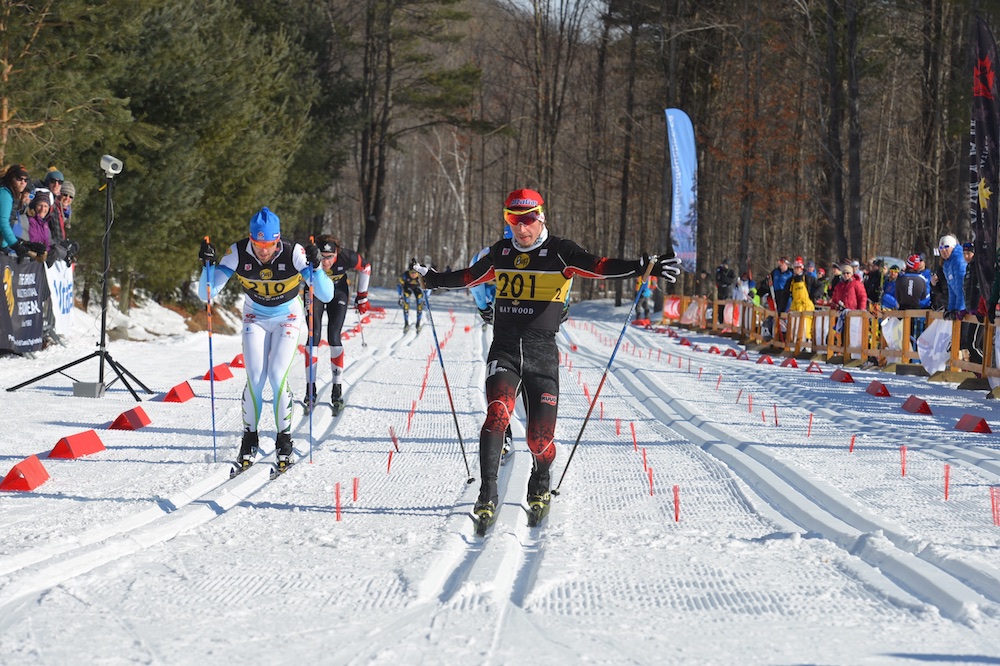
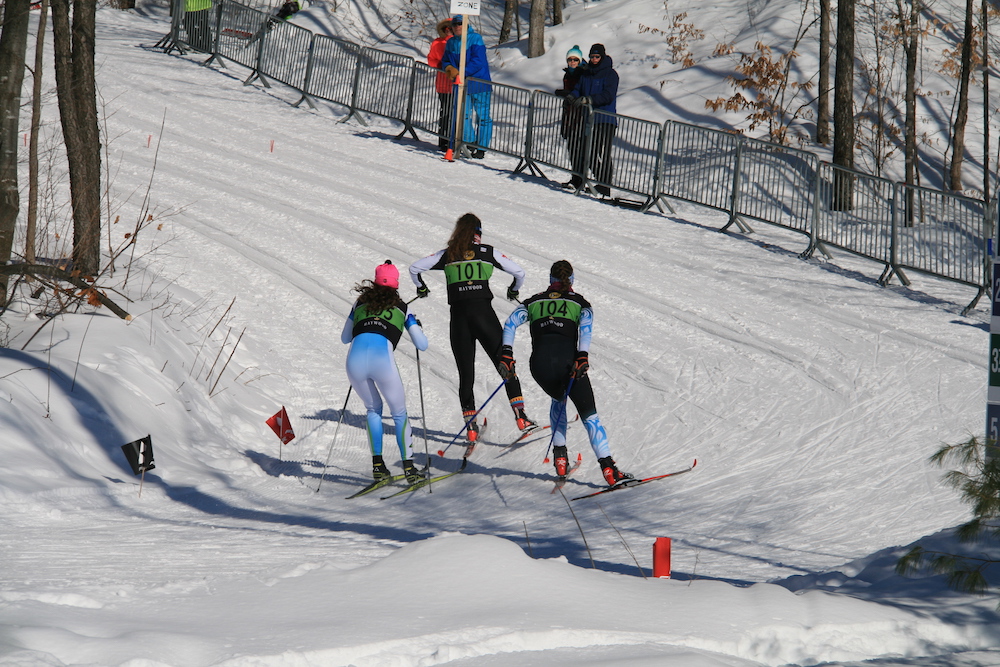
Sophie Carrier-Laforte (101) leads Alannah Maclean (105) and Maya MacIsaac-Jones (104) towards the no-double-pole zone in the first women’s classic-sprint semifinal. (Photo: Elisabeth Fink)
The women’s 1.3-kilometre and men’s 1.4 k classic sprints were held on hard, cold tracks with the air warming up enough to allow a bit of glazing. With some of the younger racers stuck in school, this day had the smallest turnout of the weekend with 714 finishers.
“My qualifier today was OK, but I was really happy with my heats. I went into the day not knowing what to expect, especially with a fairly small field this year at Easterns in the Open categories, but was really happy to come out with a win!”
“In the final I basically tried to tuck in right behind Sophie. She has a really solid herring bone, so I knew I would have to push hard over the tops of the hills to stay with her. I was able to stick with her and got a good draft coming into the finishing straight, and was able to use that draft to pass her and pull ahead at the finish.”
—MacIsaac-Jones
“We had a very relaxed first 45 seconds- Maya got out in front and really just controlled the pace going into the first time up the hill. I pulled up next to her and we were both doing our best sprint herringbone, when Sophie came up between us in the most impressive herringbone-run I think I’ve ever seen. I was on the inside and got a little bit pinched in the corner, and by the time I got all of my ducks in a row both Sophie and Maya had taken off down the hill. I then tucked in behind Andrea, and used the draft and some double pole horsepower to get myself back into third!”
— Hart
Men’s classic sprint podium
Dominique Moncion-Groulx, AWCA, 3:14.84
Angus Foster, NTDC TBay, +0.07
Russell Kennedy, Team R.A.D., +2.75
“I decided to go really light on the grip and just run the first part of the striding zone, and with a lot of harringbone on the climb that was basically the only place you had to kick. I lost a bit of time on the climb but my skis were flying on the downhills, and I could make it back up in the finish pretty easily.”
“Going up the hill the last time in the final I was behind Dominique and Ricardo. Ric had pushed the pace pretty hard early, and i think was feeling it a bit going over the top. Dominique got away a bit and I couldn’t really get around Ricardo, so I lost touch with Dominique going into the last downhill and had to come from a long way back in the finish. Really put everything I had down to close the gap but ended coming up just short in the lunge.”
—Angus Foster
“I have never made an A final in a classic sprint so I was pretty pumped. I played the waiting game and slowly moved up to the front.”
—Kennedy
Saturday: 10/15 k classic
The 10/15 k classic interval starts provided lots of herringbone work (Photo: Rob Smith)
Saturday brought classic interval-start racing with 10 k for the women and 15 k for the men on a 5 k loop.
“I had only skied the 5K lap once before, so the first lap I definitely had some surprises (namely some downhills) and didn’t take the best line in a lot of places. Luckily the course was two laps so by the second lap I had a better idea of what was coming.”
“I think pacing was probably the biggest thing today! It’s always hard to gauge output versus recovery the first time racing a course, so I think if I could do it again I probably would have skied some parts a little bit harder. The herringbone sections are always tough when your legs get wobbly, so I think making sure you had enough in the tank to really execute those efficiently was important! Other than that I picked the right skis, and had great wax once again from Nic and the Carleton University team. I was really able to stride it out, and still have enough glide for some good double poling.”
—Hart
“I was really happy with my classic race. I was really happy with how I held it together mentally and kept my technique solid throughout. The Nakkertok 5km course is a ton of fun to race!” “I just tried to ski a consistent pace throughout. For skis, I went a bit lighter on the kick, because lots of the climbs are herring bone anyways, which made it really nice for the rolling double pole sections.”
—MacIsaac-Jones
Men’s 15 k classic podium
Andy Shields, Lappe Nordic, 39:14.7
Ricardo Izquierdo-Bernier, +0.7
Russell Kennedy, +34.6
“Tight race today but I wasn’t getting splits off Ricardo so I had no idea it was that close. I was able to close really hard over the last 1.5 km thinking that getting as big a margin over the field would be ideal in advance of tomorrow’s pursuit start. It the end that extra effort gave me the win today. I’ll have Ricardo to ski with tomorrow so we’ll be able to work to keep the rest of the field behind us.”
—Shields
“After my best sprint of the season Friday I was very confident going on today! A start fast and skiing power for the first 2 laps. In my last lap I was receiving some splits and that push me to finish strong!”
—Ricardo Izquierdo-Bernier, CNEPH
“I was pretty happy with my race it was definitely my best classic distance race and I think my classic has come a long ways this year alone.”
—Kennedy
Sunday: Freestyle Pursuit
The final day was a pursuit for the open categories and distance mass start for the rest of the skiers. The men did four laps for 20 k and the women three laps for 15 k. Fresh snow caught some of the skiers unprepared.
Anne Hart (SMS Elite) feeling it as the field chases her through heavy snow in the women’s 15 k freestyle pursuit on Feb. 5, the last day of Eastern Canadian Championships in Cantley, Quebec. (Photo: Rob Smith)
“Again, I am very pleased with my effort today. After a season of snow storms, the falling snow and soft tracks definitely didn’t catch me as off guard as they would have in November. The race was really fun, but also very hard. Going out first in a pursuit is always a little bit scary (while I’m happy to have won yesterday, I very much prefer being the chaser and not the chase-ee). This weekend was a chance for me to get three high quality races at sea level under my belt to prepare for the rest of the season, and they accomplished exactly that.”
“Having been the chaser before, I know that once a person is out of sight it is much harder to catch them. So I went out of the gate quite quickly, in an effort to put a big enough gap on Sophie and Maya that they couldn’t see me up the big hills. Plus going out quickly meant that if Sophie or Maya caught me, they would have to be going extra fast, which I figured would be to my advantage in the end. And looking at the splits and the ultimate result, I think my tactic was a good one. My first lap was very quick, and then from there I dropped my speed a little bit and just maintained. There are a couple of places I know I didn’t ski the most efficiently or effectively, but I really attacked as best I could and was quite relieved when the finish line came into sight!”
—Hart
“I’m really happy with my race today. I wasn’t sure how my body would handle three races in a row, but I was happy to see that my fitness is decent and I was able to have three consistent races this weekend. I started 11s behind Sophie, so I tried to make up that time on the first climb. The course has a long rolling section that I wanted to be able to draft her throughout, so I wanted to catch her before then. I pulled away after the first lap and did my best to pull back some of the time to Annie who was in front, but she had a really strong first lap so I think the splits between us basically stayed the same for the 2nd and 3rd laps.”
—MacIsaac-Jones
Men’s 20 k freestyle pursuit podium:
Russell Kennedy, 53:42.68
Jack Carlyle, AWCA, +1.68
David Palmer, Black Jack, +14.98
“I was really happy with my race today I felt very strong and had great skis. It was a pretty big snowfall today so tactics kinda went out the window and it became a hammer fest.”
—Kennedy
“Bit of a rough day for me. We had a lot more snow than was forecast but I had skis ready for it. But for some reason my new snow/soft track skis weren’t testing well before the race so I decided to race on my generic skis. Bad choice as I was outclassed on the downhills.”
—Shields
Overall
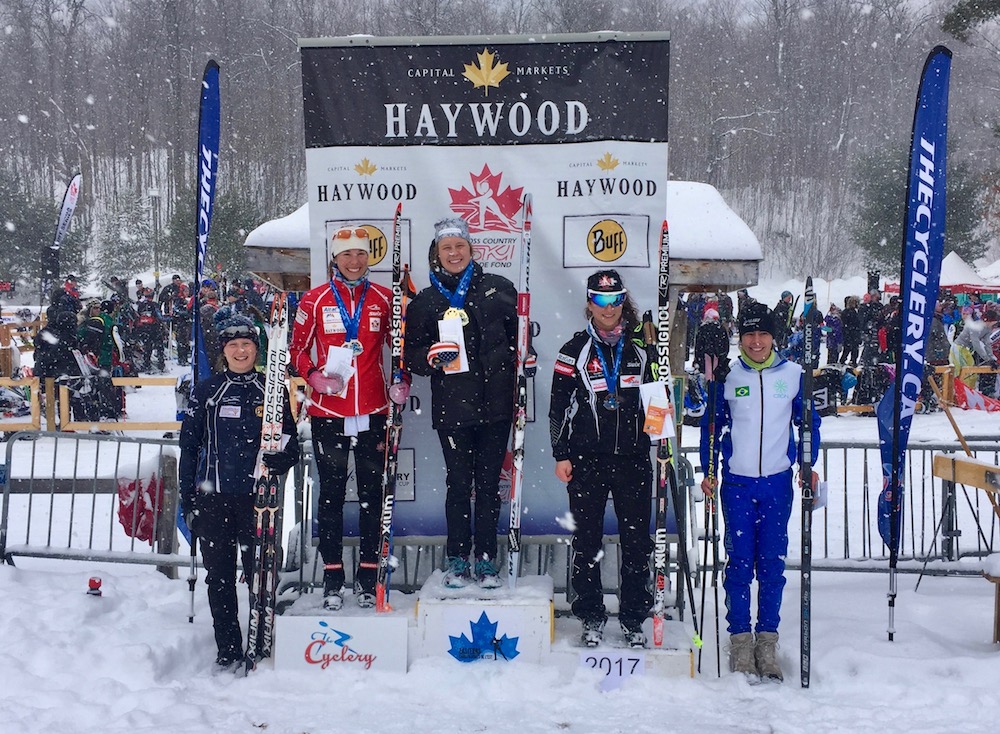
The snow kept falling on the open women’s podium at 2017 Eastern Canadian Championships. Left to right: Andrea Dupont, Maya MacIsaac-Jones, Anne Hart, Sophie Carrier-Laforte, and Jacqueline Mourao. (Photo: Rob Smith)
The Russian men finishing in unison to take first, second and third in the men’s 30 k skiathlon, the final race of 2017 U23 World Championships at Soldier Hollow in Midway, Utah. Alexander Bolshunov (8) was deemed the winner, Alexey Chervotkin (1) was second, and Denis Spitsov (11) third. (Photo: FlyingPointRoad.com)
FIS Nordic Combined Junior World Championships (Park City and Midway, Utah): Normal hill/5 k
American Ben Loomis (6) leads Norway’s Lars Ivar Skaarset (7) during the third leg of the nordic-combined 4 x 5 k team event on Thursday at 2017 Nordic Junior Worlds at Soldier Hollow in Midway, Utah. Loomis brought the U.S. from ninth to seventh, and his team ultimately finished seventh. (Photo: FlyingPointRoad.com)
[UPDATED] In the individual normal hill/5-kilometer Gundersen on Saturday, the last nordic-combined competition of 2017 Nordic Junior World Championships, American Ben Loomis captured his first top 10 in his third Junior Worlds in ninth place.
Eighteen-year-old Loomis jumped to 10th then picked off one place in the 5 k to finish ninth, 1:22.3 minutes behind the winner, Germany’s Vinzenz Geiger.
Geiger led after the jump and started the ski race 4 seconds ahead of Japan’s Yuto Nakamura in second. Geiger was able to hold off Finland’s hard-charging Arttu Mäkiaho, who raced from ninth to second, by 22.6 seconds. France’s Laurent Muhlethaler raced from fifth to third (+23.9) for the final spot on the podium, while Nakamura slipped to fourth (+42.8).
The U.S. had two in the top 15 with Stephen Schumann in 15th (+1:44.3), up from 20th after the jump. Grant Andrews placed 33rd (+2:40.0) and Tucker Hoefler finished 46th (+3:56.9).
FIS Nordic U23 World Championships (Midway, Utah): 15/30 k skiathlon
It was a Russian affair and a head scratcher for the photo-finish crew at U23 World Championships on Saturday, with three Russians putting enough time on the rest of the field in the men’s 30-kilometer skiathlon that they had time to slow to a stop and inch across the line in unison.
The jury ultimately had to decide who won, awarding it to Alexander Bolshunov in 1:15:31.5 hours, 0.2 seconds ahead of Alexey Chervotkin in second. Denis Spitsov was listed as third (+0.5). France’s Jules Lapierre came closest to the Russians in fourth, finishing 11 seconds later.
The field was considerably strung out by the end of the race, with Switzerland’s Jason Rueesh finishing 14.3 seconds out of first in fifth and Norway’s Gaute Kvaale crossing the line in sixth (+33.0), ahead of France’s Valentin Chauvin in seventh (+49.1), and Andorra’s Irineu Esteve Altimiras in eighth (+56.8).
American Paddy Caldwell (SMS/USST) placed ninth for the second-straight race at U23s, finishing 1:24.4 behind the winner.
The U.S. men had three in the top 15 for their best day of the championships, with John Hegman (SVSEF) placing a 11th (+1:53.5) and Adam Martin (NMU) 15th (+2:23.3) for their best results at U23 Worlds.
Evan Palmer-Charrette (NTDC Thunder Bay) led the Canadian men in 26th (+5:44.6). Alexis Dumas (CNEPH) finished 33rd (+9:02.7) out of 36 finishers. Several North Americans did not finish, including Canada’s Julien Lamoureux and Julien Smith, and American Cal Deline.
In the women’s 15 k skiathlon, Lotta Udnes Weng achieved her first gold of U23 Worlds, holding off Finland’s Johanna Matintalo by 3.8 seconds and crossing the line in 40:50.9 minutes. Russia’s Yana Kirpichenko reached the podium in third (+13.9), fewer than two seconds ahead of Weng’s twin sister, Tiril Udnes Weng in fourth (+15.6).
Dahria Beatty, of the Alberta World Cup Academy and Canadian National U25 Team, led the North Americans in 19th (+2:18.1), and teammate Katherine Stewart-Jones (NTDC Thunder Bay/NST U25 Team) was 21st (+2:29.3) for her best U23 Worlds result.
The Czech Republic’s Petra Hyncicova (University of Colorado-Boulder) followed in 22nd (+2:30.7), and three Canadian women finished in the top 30 with Frederique Vezina (CNEPH) in 29th (+3:36.2). Jenn Jackson did not finish.
Jesse Knori (University of Colorado-Boulder) was the top American in 30th (+3:40.1), Alayna Sonnesyn followed in 31st (+3:42.5), Nichole Bathe (University of Alaska Fairbanks) in 33rd (+4:36.9), and Corey Stock (Bridger Ski Foundation) in 36th (+5:42.1).
Mathilde Petitjean, who races for her native Togo but trains with the Quebec-based CNEPH, finished 38th (+6:04.8) of 38 finishers.
FIS Cross-Country World Cup (PyeongChang, South Korea): 15/30 k skiathlon
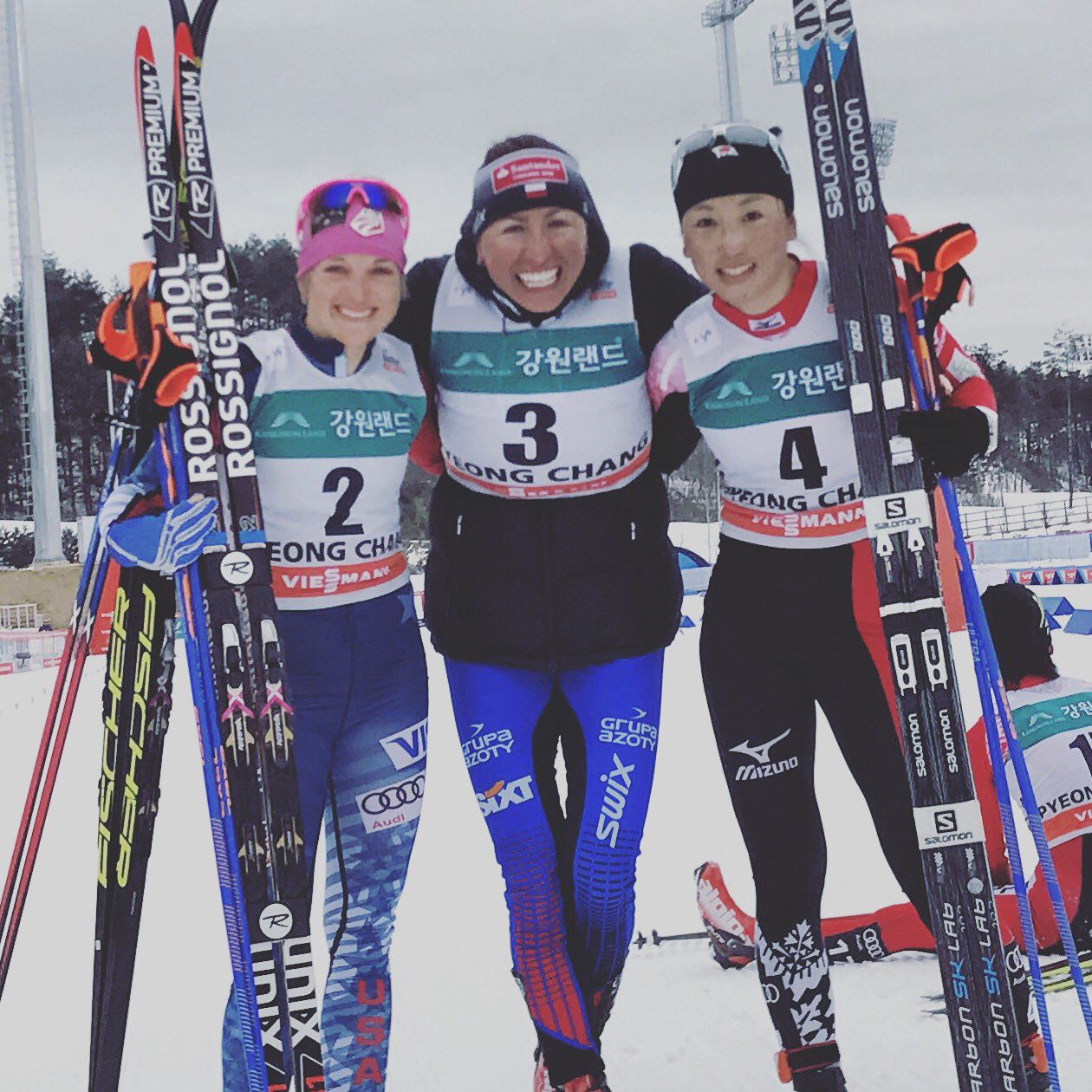
The women’s 15 k skiathlon podium at the PyeongChang World Cup in South Korea, with Poland’s Justyna Kowalczyk (c) in first, American Liz Stephen (l) in second, and Japan’s Masako Ishida in third. (Photo: FIS Cross Country/Twitter)
The second day of World Cup racing in PyeongChang, South Korea, took place this Saturday, with a skiathlon event for both genders. The women raced a total of 15 kilometers, the first 7.5 k leg classic and the second 7.5 k leg freestyle. Poland’s Justyna Kowalczyk came away with the women’s win (her first in three years), getting back to her old ways of breaking away from the pack to finish first in 43:54.7 minutes. Liz Stephen of the U.S. Ski Team (USST) claimed second place (+56.0), while Japan’s Masako Ishida took third (+1:14.8).
For Stephen, second matched her best individual result in a from two years ago, when she placed second in a 10 k freestyle in Rybinsk, Russia. This year at the Tour de Ski, Stephen posted the second-fastest time up the final climb in Val di Fiemme, Italy. For Ishida, it was her first podium since 2009.
Caitlin Patterson, racing for the U.S., finished just off the podium with a career-best fourth (+1:21.4) for her first top 20 on the World Cup, and American Liz Guiney placed 13th (2:21.7) for her first top 20 as well. Jessica Yeaton, who trains with Alaska Pacific University and races for Australia, came in 24th (4:58.6).
Two Canadian women competed with Annika Hicks leading the team in 26th (+5:17.8) followed by Sadie White in 29th (+6:54.7) for their first World Cup top 30s.
In the men’s 30 k skiathlon that followed, Russia’s Petr Sedov broke away during the skate leg to take a decisive victory over Norway’s Daniel Stock and Mathias Rundgreen, finishing in 1:18:49.6 hours, 22.5 seconds clear of second place. It was Sedov’s first World Cup win and podium, and the first individual podiums for Stock and Rundgreen as well.
Rundgreen edged Russia’s Konstantin Glavatskikh for the final spot on the podium, with both being listed as 42.1 seconds behind Sedov.
While Rundgreen held off three others for third place, including Sweden’s Gustav Eriksson in fifth (+46.8), Japan’s Keishin Yoshida in sixth (+47.1), and Russia’s Alexander Utkin in seventh (+49.0), American Noah Hoffman kept his distance ahead of the second chase group to finish eighth (+1:06.2) for his best result in a non-World Cup stage since placing eighth in a 2012 skiathlon in Canmore, Alberta. (Hoffman won the time of day in the 15 k pursuit four years ago in Kuusamo, Finland.)
Also for the U.S., Scott Patterson was next across the line in ninth (+1:28.4) for his first World Cup points, and Matt Gelso finished 19th (+5:00.8) for his first top 20.
Brian McKeever of Canada’s Para-Nordic Ski Team was the lone Canadian finisher in 29th (+8:48.9). Bob Thompson was listed as placing 32nd of 37 after being lapped, and Simon Lapointe did not finish.
NorAm Eastern Canadian Championships (Cantley, Quebec): Classic interval start
The NorAm mini tour at the Nakkertok Nordic Centre continued on Saturday with Eastern Canadian Championships with classic individual start races.
In the men’s 15 kilometre, Lappe Nordic’s Andy Shields took a lead in the first lap and held on to win in 39:14.7, just 0.7 seconds ahead of CNEPH’s Ricardo Izquierdo-Bernier. Team R.A.D.’s Russell Kennedy collected his second bronze of the weekend, 24.7 seconds back.
SMS Elite’s Anne Hart won the women’s 10 k in a reversal of Friday’s sprint podium. Hart’s 30:03.3 finish gave her a 9.3 second edge on CNEPH’s Sophie Carrier-Laforte and 20.0 seconds on AWCA’s Maya MacIsaac-Jones.
For the 123 men and 77 women doing the full distance, the weekend is a mini tour. For the younger categories, it is three separate events allowing the kids who couldn’t skip school on Friday to race Saturday and Sunday.
There should be over 700 finishers today with 768 on the start list. The volunteers will have more hours of work even after the open categories have finished.
Results will update continuously as more categories start.
Katharine Ogden (SMS/USST) finishing third for bronze in the women’s 10 k skiathlon on Friday at 2017 Junior World Championships at Soldier Hollow in Midway, Utah. She is the first American to reach the podium in a Junior World Championships. (Photo: FlyingPointRoad.com)
FIS Nordic Junior World Championships (Midway, Utah): 10/20 k skiathlon
A Junior World Championships medal has been on Katharine Ogden’s mind for some time — two years, to be exact.
“Every day in training, it’s kind of something that I think about. It’s the little thing that helps me push myself,” Ogden, a 19-year-old member of the Stratton Mountain School and U.S. Ski Team D-team, said in a post-race interview with the U.S. Ski Team on Friday. “Even in the middle of June, I’ll be like, ‘You know what I want to be? On the podium at World Juniors.’ ”
She did just that on Friday, racing to third in the women’s 10-kilometer skiathlon at 2017 Junior World Championships at Soldier Hollow in Midway, Utah. In doing so, she became the most successful American at World Juniors, surpassing Lindsey Williams’s previous best of fourth place in 2003.
Ogden finished 10.4 seconds behind the winner, Norway’s Marte Mæhlum Johansen, who finished first in 27:17.3 minutes. Sweden’s Ebba Andersson took second, 6.6 seconds back. Behind Ogden, Italy’s Anna Comarella placed fourth (+51.6) ahead of Finland’s Eveliina Piippo in fifth (+58.7).
Hailey Swirbul (University of Alaska Anchorage) was the second U.S. woman in 24th (+2:21.0), while Natalie Hynes (Whitehorse) led Canada in 28th (+3:11.3).
Also for Canada, India McIsaac (Rocky Mountain Racers) finished 30th (+3:13.8), Lisle Compton (NTDC Thunder Bay) was 33rd (+3:45.5) and Annika Richardson (NTDC Thunder Bay) 41st (+4:49.3).
Also for the U.S., Lauren Jortberg (Dartmouth) finished 37th (+4:04.5) and Taeler McCrerey (University of Denver) 38th (+4:07.5).
[UPDATED] In the men’s 20 k skiathlon that followed, Russia’s Vladislav Vechkanov notched his second gold of the week in 49:40.5, outlasting Norway’s Thomas Helland Larsen by 1.9 seconds. Norway had two on the podium with Harald Østberg Amundsen in third (+2.2).
Canada’s Gareth Williams (Telemark Race Team) was the top North American in 11th (+1:24.0) for his best result at his first Junior Worlds.
American Wyatt Gebhardt (Steamboat Springs WSC) followed in 12th (+1:42.7) for his second-straight top 20 and Hunter Wonders (Alaska Pacific University) also finished in the top 20 for the second-straight race in 18th (+1:57.9).
Canada’s Philippe Boucher (CNEPH) was 22nd (+3:15.7), Ryan Jackson (Team Hardwood) 31st (+3:52.5), and Remi Drolet (Black Jack) 49th (+6:57.3).
Also for the U.S., Kam Husain (SMS) placed 50th (+6:59), and Logan Diekmann (University of Utah) was 53rd (+7:47.3).
NorAm Eastern Canadian Championships (Cantley, Quebec): Classic sprint
The NorAm series resumed at the Nakkertok Nordic Centre on Friday with Eastern Canadian Championships with classic technique sprints.
Alberta World Cup Academy’s Maya MacIsaac-Jones returned from U23s in time to win the 1.3 k A-final in 3:42.06, after qualifying sixth. Top qualifier Sophie Carrier-Laforte was second for CNEPH at her home event, 0.66 seconds behind. SMS Elite’s Anne Hart rounded out the podium at 3.40 seconds back.
On the men’s side, AWCA’s Dominique Moncion-Groulx qualified first before winning every heat on his way to victory in 3:14.84 on a slightly longer 1.4 k course. NTDC Thunder Bay’s Angus Foster was a close second, 0.09 seconds behind. Team R.A.D.’s Russell Kennedy was a comfortable third, 2.75 seconds back, on a day marked by some surprising eliminations.
The elite field is slightly smaller than usual with some athletes away in Soldier Hollow and PyeongChang. As many younger racers were stuck in school for the day, there are only about 500 starters for what is usually the largest FIS event in Canada.
FIS Cross-Country World Cup (PyeongChang, South Korea): Classic sprint
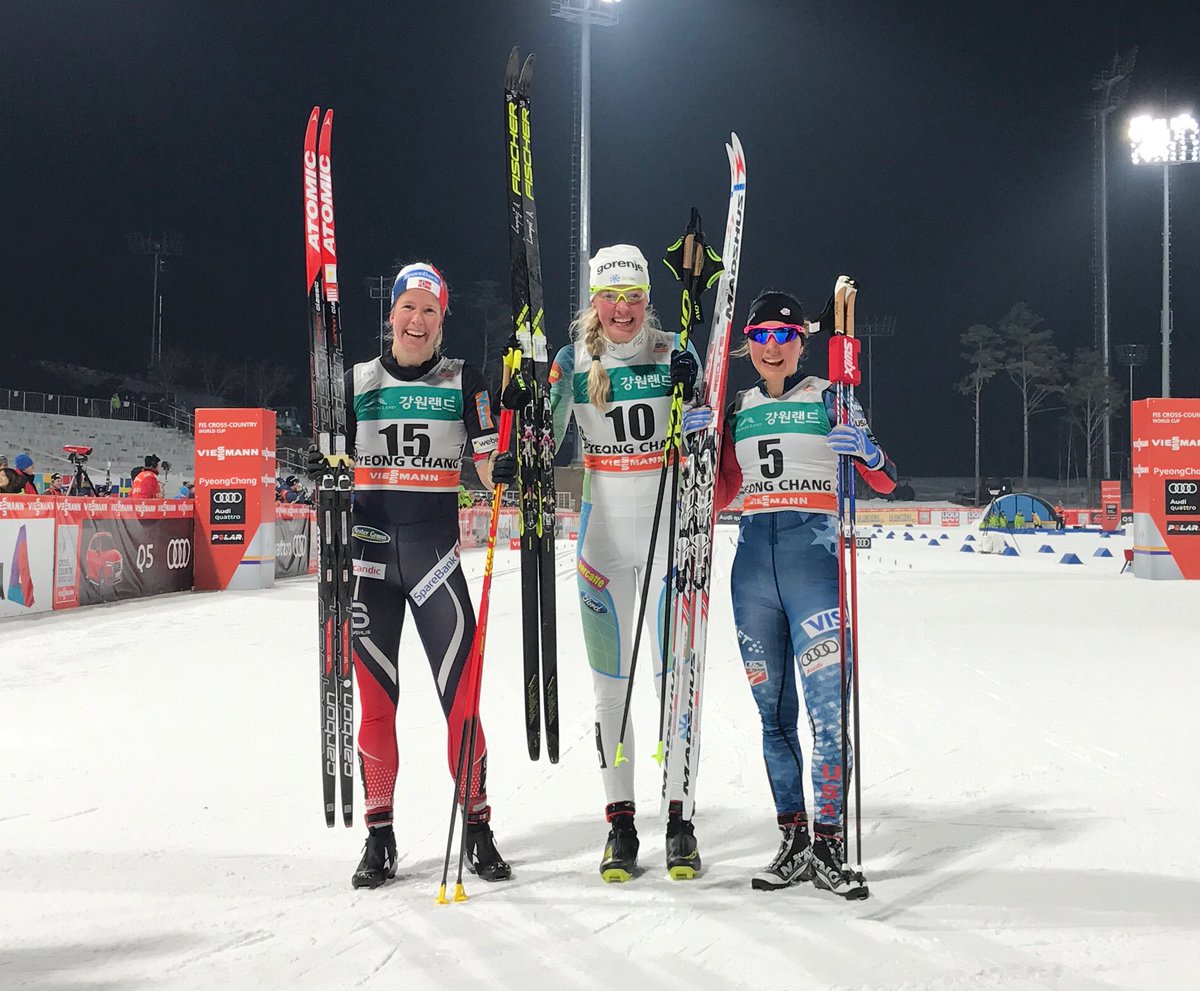
The women’s 1.4 k classic sprint podium on Friday at the pre-Olympic PyeongChang World Cup in South Korea, with Slovenia’s Anamarija Lampič (c) in first, Norway’s Silje Øyre Slind (l) in second, and American Ida Sargent (r) in third. It was the first time on the World Cup podium for all three athletes. (Photo: FIS Cross-Country/Twitter)
In the last month, we’ve seen two U.S. Ski Team members — Jessie Diggins and Sadie Bjornsen — on the World Cup podium. Add Ida Sargent to that list.
On Friday, the Vermont native raced to third in the women’s 1.4-kilometer classic sprint at the first-ever World Cup in PyeongChang, South Korea. It was the first of three days of racing in PyeongChang, which will host the 2018 Winter Olympics next season.
Sargent qualified fifth (4.76 seconds behind her teammate Sophie Caldwell, who won the qualifier in 3:40.89 minutes) and went on to win her quarterfinal in a photo finish, then placed second her semifinal (also in a photo finish), edging Russia’s Alisa Zhambalova in third by less than 0.01 seconds.
Both advanced to the final, where Sargent ultimately finished third, 1.79 seconds behind Slovenia’s Anamarija Lampič, who won in 3:41.97. Norway’s Silje Øyre Slind took second (+1.6), just 0.19 seconds ahead of Sargent. For all three women, it was their first time on a World Cup podium.
Sargent beat out Poland’s Justyna Kowalczyk for third by 0.56 seconds. Zhambalova finished fifth and Slovenia’s Katja Visnar was sixth (+17.1).
“I’m really excited about the podium and it hasn’t really set in yet,” Sargent wrote in an email on Friday. “It has been a goal of mine for a long time to be on the podium so it was a very special day! I’ve been inspired by so many fast teammates so happy to follow in their footsteps!”
All five U.S. women racing on Friday finished in the top 30 to qualify for the heats. Caldwell won the qualifier by 1.84 seconds over Kowalczyk, Caitlin Patterson qualified 22nd, Liz Guiney 25th and Liz Stephen 29th (Stephen’s first time making the heats in three years).
Jessica Yeaton, who races for Australia but trains with Alaska Pacific University, took the last qualifying spot in 30th (+26.29).
Canada’s Annika Hicks and Sadie White missed qualifying in 32nd (+32.96) and 34th (+38.96), respectively, out of 36 women.
Caldwell won her quarterfinal but finished fourth in her semifinal (behind Slind, Kowalczyk, and Sweden’s Maria Nordström, respectively) to miss advancing to the final. She placed eighth overall.
Guiney placed 24th overall after finishing fifth in her quarterfinal, Stephen was 25th after taking fifth in the same quarterfinal as Sargent (where Yeaton finished sixth for 30th overall), and Patterson was 27th after finishing sixth in her quarterfinal.
***
Both Canada’s Len Valjas and American Andy Newell reached the final in the men’s 1.5 k classic sprint on Friday, where they raced to fourth and sixth, respectively.
Valjas started the day by qualifying in second, 1.97 seconds behind Russia’s Alexander Panzhinskiy, who topped the qualifier in 3:26.78. The Canadian went on to advance in second from his quarterfinal and fourth as a lucky loser from the first semifinal. In the final, he missed out on the podium in a photo finish with Russia’s Andrey Parfenov, who took third, 0.01 seconds ahead of him.
Meanwhile, Newell qualified seventh (+5.18) and took second in both his quarterfinal and semifinal (finishing the second semifinal 0.34 seconds behind Panzhinskiy in first).
In the final, Russia’s 25-year-old Gleb Retivykh pulled off his first World Cup victory and podium with a 0.3-second win over Norway’s Sondre Turvoll Fossli in 3:30.79. Retivykh qualified sixth (+4.53) then won his quarterfinal and placed third in the same semifinal as Valjas, advancing as the other lucky loser.
“I had wait six years for my first victory and it is great,” Retivykh said, according to an International Ski Federation (FIS) press release.
Russia had two on the podium with Parfenov in third (+0.73), just ahead of Valjas. The third Russian in the final, Panzhinsky ended up fifth (+1.49), ahead of Newell in sixth (+17.19)
Three Canadian men qualified for the heats, with Jess Cockney in 16th (+10.24) and Simon Lapointe in 25th (+14.15). Bob Thompson missed 30th by one-hundredth of a second in 31st (+16.95), and Julien Locke was 36th (+17.9).
Three Americans qualified as well, with Simi Hamilton in 12th (+8.26) and Matt Gelso in 29th (+16.66). Distance skiers Scott Patterson and Noah Hoffman finished 44th (+24.21) and 48th (+25.28) out of 55.
Cockney reached the semifinals after winning his quarterfinal. In the second semifinal with Newell, he placed fifth, 5.44 seconds behind Panzhinskiy, for 10th overall.
In Cockney’s quarterfinal, Hamilton crashed and finished fourth (+41.9) for 17th overall.
Canada’s 23-year-old Lapointe finished sixth in his quarterfinal to place 27th, besting his previous World Cup best by 43 places. Gelso took 29th for his first-ever World Cup points after placing sixth in his quarterfinal.
After winning Saturday’s 5 k freestyle World Cup race, U.S. Ski Team member Jessie Diggins (l) high fives Minnesota youngster Greta Stange, atop the shoulders of Diggins’s teammate Liz Stephen, on Dec. 3 in Lillehammer, Norway. (Photo: Aleks Tangen)
Three days of racing, more than a dozen North American skiers, and one FasterSkier on-site reporter was there to witness it all — including Jessie Diggins’s second-career win — in Lillehammer, Norway. We were also trailside at the first U.S. SuperTour races of the season in West Yellowstone, Mont., and provided remote coverage of the biathlon World Cup opener in Östersund, Sweden.
Here’s what we came out of last weekend with, in terms of what didn’t make it into the race reports.
Jessie Diggins (U.S. Ski Team) celebrating her second career World Cup victory after winning the women’s 5 k freestyle on Dec. 3 in Lillehammer, Norway. (Photo: Aleks Tangen)
[Asked whether she might consider targeting a top finish in the Overall World Cup, in addition to World Championships]
“She has obviously doesn’t talk about that and we’re not really talking about that either, but I think it’s for sure a possibility. She is really rounding out her ability, whether it’s sprint, distance, classic, or skate, and I think with her we will see continued improvements as we get into the season, in every discipline. She is the kind of skier that can and will be, in the future, an all-around threat for an Overall World Cup title, and she’s been kind of chipping away at it for some time now obviously, with a big step forward last season. … Right now she is planning on being at most World Cups, she is planning on skipping the World Cup weekend that is after the Tour de Ski the sprint, the sprint weekend, which has been a real smart strategy for her in the past. Right now she is not planning on being in Korea for that World Cup. We will kind of just take it race by race and see, and see what happens and see where we are.”
“Jessica can be either in the front or in the back when it comes to classic. I thought that if she has a good day, then we and Marit can try to chase Heidi, and that would be a really nice group. Or that she would be like the performance she delivered today and the she kind of falls through. But I was prepared to do most of the work myself, and it also turned out to be more than I was prepared for since Marit did not have her best day on the job.”
Ingvild Flugstad Østberg (Norway) after placing second in 10 k classic [Diggins placed eighth]
On progress:
“Today for me, I was maybe a little bit tired, and I was trying to ski with Ingvild [Flugstad Østberg] at the start… . So I know that there were a lot of things to improve on from today, but also some things to be proud of, like not totally losing it, because it was pretty stressful at the start.”
Jessie Diggins (USST) after placing eighth in 10 k classic pursuit
“There’s a certain time of the year where you feel just absolutely reckless, like you can push above and beyond, I haven’t yet found that place yet, but I am definitely really stoked with how things are going. I feel like each race I start, I am feeling better and better so it was definitely an encouraging thing on skate skis today, skiing like that on such a hilly course.”
Sadie Bjornsen (USST) after placing 14th in 5 k skate
“Today was better, it was a step in the right direction for sure. I got sick at the end of October and was sick for about 2 1/2 weeks, so I missed some of the hard intensity in preparation to get ready for the season and fortunately got healthy in time to come over here, but it’s just taking a couple of races for my body to come around. Today was the first time I felt like I was able to race and push hard, and it wasn’t perfect yet, but today was much better than I’ve felt so far.”
Eric Packer (Alaska Pacific University) after placing 78th in 10 k skate
“I’m still getting used to being on snow. I didn’t get enough opportunity to be on snow before starting racing, so arches on my feet and quads are pretty blown out. Yeah, it was pretty rough out there…
“I was able to dig pretty deep, and I extracted as much as I could out of the body, but again it wasn’t much, so it’s pretty disappointing that the season is off to such a rough start so far.”
Andy Shields (NTDC Thunder Bay) after placing 89th in 10 k skate
“A lot of lessons learned, but none of the races were quite what I wanted. But it was OK. It was a good first experience of a mini-tour.”
Caitlin Patterson (Craftsbury Green Racing Project) after placing 42nd in 10 k classic pursuit
On placing 17th in three-straight races:
“I know the 17th curse, holy cow. That’s what I was like, I was on the phone with [my coach Erik] Flora yesterday I was like, ‘What? No, 17th again. Well, I mean, that’s not bad, I would like to get a little better than 17th at some point that would be nice.’ ”
Sadie Bjornsen, after placing 14th in 5 k skate
On races beyond the race:
“I’ve been working on 5 k skate for the relay a lot this summer and the past years, so it was really nice to have a really hard and fun course to ski today and focus on the relay.”
Liz Stephen (USST) after placing 26th in 5 k skate
On Lillhammer’s big climb:
“I live for the long climb. That’s my favorite part on any course, I think, so for me, I love the uphills. This one out of the stadium, it just doesn’t ski great. Everybody does their testing there so it’s always the most chewed up…”
Stephen, after placing 26th in 5 k skate
On the conditions:
“The conditions were awesome, the corners were a little bit — you know, after all the boys went and stuff — they were a little icy, but nothing scary. Just had to have your feet under you.”
Liz Stephen (U.S. Ski Team) after placing 26th in 5 k skate
“They’re good. I really like the rolling hills and over the bridges here. It’s kind of a cool venue, the hills just feel really big racing, but they’re over pretty quickly. The trail was getting a bit churned up in places and little bit deeper and sugar than maybe I like … but overall I think it was really great skiing.”
Patterson, after placing 38th in 5 k skate
On having family there:
“Kristen came down on the last day to watch and her mom and her sister were there, too. It was fun to have some family cheering me on. Even the family dog came out. I didn’t hear her bark, she is really well trained, so it’s nice that that she could come watch, too.”
Devon Kershaw (Canadian World Cup Team) after placing 27th in 15 k classic pursuit
“On this course, the work is done on the transitions. It’s a very tough course with lots of climbing and minimal rest so it really takes a lot of strong skiing to have a fast time. That is what allowed me to slowly move up through the race.”
Bryan Fletcher (U.S. Nordic Combined) after placing ninth in the large hill/10 k individual
On the challenges of being a new working dad:
“With the wife and kid at home it’s a bit of a challenge. However I am managing by visiting when I can and with the help of family and friends we are able to make it work. She is working full time and caring for the baby so as you can imagine it’s challenging when I am not home. So it’s really helpful for me when I am performing well as it makes the trips more worthwhile in my mind. Certainly it would be easier if they could travel with me but that is not a realistic option. So as long as I have balance between training and family life, I am happy and the results will come.”
“It’s been hard to be away from them for these last two weeks, but I will meet them in Munich tomorrow [Monday] morning and drive down to Slovenia with them. They will be with me on the road for the next two world cups before we fly back to the States.”
Lowell Bailey (US Biathlon) after placing 15th in Sunday’s 12.5 k pursuit
On the races being moved from Bozeman to West Yellowstone, Mont.:
“I definitely have raced well in the past at Bohart, so I was kind of a little bummed [when the races were moved], but I was also excited to race [in West Yellowstone]… It’s definitely the best I’ve ever felt at west Yellowstone, usually it’s a bit of a struggle here.”
Kaitlynn Miller (Craftsbury Green Racing Project) after placing 3rd in Sunday’s 15 k classic
“I typically don’t do very well in West Yellowstone and so this year was by far the best first race I have had…the curse is broken!”
Annie Hart (Stratton Mountain School) after placing 3rd in Saturday’s 1.3 k freestyle sprint
On goals for the next month of racing:
“I am hoping for another few podiums in the next 2 races. It would be great to win if I feel good and have solid skis, but its a tough field with a lot of strong guys. We will see how it goes.”
Ben Lustgarten (Craftsbury Green Racing Project) after placing 2nd in Sunday’s 15 k classic
USST Toko Athlete Sam Morse on What Makes a Champion
At just 20 years old, Morse’s maturity separates him from his peers. And, he’s so very kind. He is one of the most genuine humans this planet has to offer. The future is bright for this one, so make sure to follow him as he moves up the ranks on the Team. We asked Morse our three questions on what he believes makes a champion.
U.S. SKI TEAM: In your words, what makes a champion?
SAM MORSE: A champion wins with passion and loses with grace, and pours their heart, soul and everything they’ve got into a sport.
U.S. SKI TEAM: Do you remember the first time you felt like a champion?
SM: The first time I felt like a champion was racing in Maine, winning the Maine Alpine Racing Association season championship title as a J5. I thought, “Maybe I can really make something out of this whole ski racing thing.” It felt satisfying and propelling.
U.S. SKI TEAM: What is the biggest piece of advice you have for aspiring kids who want to be sitting where you are today?
SM: Give it all you’ve got and find enjoyment in striving for your own goals, rather than for the affirmation of others. Also, the best advice I’ve ever received was, “No one thing will make you the greatest, it is the sum of the parts that make a masterpiece.”
Fun Facts:
“Moose” is Morse’s childhood nickname, as there are more moose than people where he lives and they’re big, burly animals that are gentle yet very powerful.
If he could be one inanimate object, he’d be water, because “you get to travel the globe, change physical states and always keep moving.”
Go-to travel items are a deck of cards and a good book.
His best friend on the team is fellow east-coaster Drew Duffy (Warren, VT), whom he grew up with racing in the Junior Olympics.
Morse is a HUGE Boston Red Sox fan, and his non-skiing role model is Jason Varitek, catcher for Boston Red Sox through early-mid 2000s because he’s a man of faith and always worked hard day in and day out.
Morse is involved with the Winter Special Olympics held at Sugarloaf each January, is a Sugarloaf Area Christian Ministry active church member and a rostered speaker for Camps Farthest Out (CFO) a Christian family camp organization.
Annie Hart: What is a Winter Warrior. Introducing the Toko Winter Warrior collection.
Arctic Split Mitt – for extreme cold weather
Profi – lightweight race
Thermo Plus – cold weather glove
Thermo Plus Biathlon
Thermo Plus Biathlon is the same as the Thermo Plus except it has reinforced seams around a serrated line on the shooting finger in case an athlete wants to cut the shooting finger to allow for a better feel on the trigger. The reinforced seams will prevent the cut from getting bigger and bigger.
Toko glove sponsored elite Cyclocross Rider Becca Fahringer has had a great season so far both domestically and in Belgium in the Super Prestige Cups. Not only is she really fast, but she also writes an entertaining and witty blog. Follow her at gofahr.com
There is snow on the valley floor in St Moritz, site of the Alpine World Championships this winter. For those that are as excited about these events as we are, it’s cool to see!
Why it is important to use a quality detergent on specialty outdoor apparel? This video explains the difference between ECO Textile Wash and supermarket detergents. Find ECO Textile Wash at TokoUS.com and other Toko dealers. (See dealer links at TokoUS.com)
Reese Hanneman = Winter Warrior. Are you?
It is almost winter, most of the peaks are white, the mornings are crisp, we are pumped to be on snow! Here’s a video that will get your adrenaline pumping and will motivate you to get out when the weather is not so inviting. What is a Winter Warrior?
Ski Austria and Toko are ready for winter!
Toko Team Hats
The idea behind Toko Team hats is to offer hats for event organizers and teams or clubs to use our hats as their official hats at a very low price. Here are the options:
We offer you the Toko Team hat for just $9! The front of this hat has been left blank for you to screen or embroider at your local embroidery shop (this is for your to organize).
The lycra hat is at a crazy price of just $11. You can’t miss! Has a microfleece liner. The front of this hat is also blank.
The Sina hat is our most popular hat currently in general (not team sales). It is medium weight. The front of this hat is mostly blank (see Toko logo).
One thing that we have noticed is that people have been trying to find Toko products and haven’t been able to easily find them. This especially concerns products such as TF90 Paste Wax, some tuning tools, spray klisters, Toko gloves in various models and colors (such as the new Winter Warrior), start duffels, Care Line products such as Down Wash, etc.
For this reason, we are especially excited to be able to say that every product in every variation is now easily available at TokoUS.com. We have also made a number of brand new short how-to videos that should be a great resource to you!
Of course we have a great many valued dealers who we will continue to support. We work with Quivers which is an order fulfillment system that will enable us to offer orders to our local dealers if they have the product in stock.
For the second installment of “What Elite Skiers Eat for Breakfast“, we asked Stratton Mountain School (SMS) athletes to share a photo of a typical breakfast for a weekday training day and describe what they eat. Here’s what they told us:
“When I have time, I like to make breakfast burritos filled with rice, eggs, Cabot cheese, baby spinach, and top it all with bbq sauce. It’s a good way to get a lot of carbs, and depending on the number of eggs a fair amount of protein as well. I know that bbq sauce isn’t for everyone but I would highly recommend introducing it to your breakfast lineup.”
“Big bowl of plain greek yogurt topped with banana and a mix of berries or other fresh fruit plus granola (my favorites are Elizabeth’s pumpkin fig and Ezekiel cinnamon raisin) and cinnamon. I always finish with a side of peanut butter toast (crunchy peanut butter!) topped with hemp seeds and a big french press for coffee plus some water if I am being a good athlete :)”
“I definitely try and keep things interesting (there is nothing worse than a breakfast burn out) but one of my favorites is some high protein homemade pancakes topped with all the fruit in the fridge (as local as I can find it) and a big scoop of Greek yogurt. And coffee — lots of coffee.”
“This is a smoothie bowl (mango, strawberry banana with yogurt) topped with granola, sliced banana, yogurt drizzle and honey drizzle.”
“I like a strong black coffee in my owl mug (the mug is an important part of my breakfast routine) and oats with berries, yogurt, nuts and honey.”
“English muffins with peanut butter, banana, and honey is a standard go to.”
“Then I typically mix it up with some kind of cereal and yogurt. If I can use home made gernola, that’s the best. On rest days when we have more time I’m the go-to pancake guy at the SMS house.”
“My breakfast varies depending on the day and what we have for food in our kitchen, but one of my favorite easy breakfasts is buttered toast, scrambled eggs, cheese, avocado, and salt!”
“First: Coffee. Then a large bowl (or two) of: steel cut oats, greek yogurt, crunchy peanut butter, homemade raspberry jam, cereal of choice (usually granola or Kashi) – when available add blueberries and/or banana.”
“My go-to breakfast would be plain greek yogurt with granola and lots of fruit such as blueberries, raspberries, strawberries, bananas and pineapple. I also like to add a touch of honey :)”
“I’m not too much of a breakfast guy if I’m training early. I definitely don’t enjoy the feeling of having a stomach full of eggs and bacon when I head out for a hard interval session or long OD. Most of the time, I just make myself a bowl of granola with Greek yogurt, almond milk, and some fresh fruit (usually either blueberries, strawberries, or a banana). Most days I’ll drink 2 cups of black coffee, but on days when I’m training a bit later in the day I’ll make some green tea. And I usually compliment everything with a glass of orange juice.” On off days, he sleeps in a bit and might make eggs, pancakes or waffles. While with his girlfriend and teammate Sophie Caldwell in her hometown of Peru, Vt., they’ll head to the local general store, “JJ Hapgood’s, for a breakfast sandwich (English muffin with an egg, local bacon, and local cheddar) and a cup of coffee.”
Which elite nordic team (in the U.S., Canada or elsewhere) would you like to hear from next for our breakfast series? Leave your recommendations in the comments section below!
The opening ceremony at the 2016 Ski Tour Canada, held at the Grand Hall of the Canadian Museum of History in Hull, Quebec, just across the Ottawa River from Ottawa and a block for the sprint venue at Jacques Cartier Park. The evening included aboriginal dancers, Canadian Mounties, the introduction of athletes, and various speakers in front of a filled hall. (Photo: John Lazenby/Lazenbyphoto.com)
(Photo: John Lazenby/Lazenbyphoto.com)
(Photo: John Lazenby/Lazenbyphoto.com)
(Photo: John Lazenby/Lazenbyphoto.com)
(Photo: John Lazenby/Lazenbyphoto.com)
(Photo: John Lazenby/Lazenbyphoto.com)
(Photo: John Lazenby/Lazenbyphoto.com)
(Photo: John Lazenby/Lazenbyphoto.com)
With 49 North Americans competing at the Ski Tour Canada (26 Canadians and 23 Americans), there were a ton of tales to be told after the first two stages in Gatineau and Montreal, Quebec, respectively. FasterSkier did its best to check in with most of the North American racers.
Check out some of the best of our post-race interviews from Day 1 and 2 below (and a guide to team affiliations at bottom*).
For more on the top North American finishers, read our race reports:
“Being able to race in front of a home crowd and going around the course twice and hearing my name, like, left, right and center was pretty crazy. It was definitely just an incredible experience.” — Alannah MacLean (NDC Thunder Bay), after finishing 63rd in Gatineau sprint
“It was the loudest race I’ve ever done. It was crazy to hear all the noise. It was motivating.” — Olivia Bouffard-Nesbitt (CNST), 49th in sprint
“It was just really amazing to be at home and have so many people watching.” — Katharine Stewart-Jones (NDC Thunder Bay and originally from Nakkertok), 68th in sprint
“It’s really exciting because I get to race in front of my friends and family, which doesn’t happen very often, so that’s great to hear my name when I’m racing.” — Cendrine Browne (CNEPH/CNST), 55th in sprint
“It was an amazing atmosphere. So many people cheering, and I felt a little distracted…” — Dahria Beatty (AWCA/CNST), 45th in sprint
“The ambiance was pretty good and helped me a lot to do a good race.” — Simon Lapointe (Skinouk), 82nd in classic mass start
“Racing in front of a home crowd and just having so many fans out cheering for us is really special.” — Emily Nishikawa (CNST), 66th in sprint
“At every corner, at every point of the course there was a roar. It’s surreal racing in front of the home crowd. Looking to the crowd, and recognizing so many faces that are there to support you.” — Mark Rajack(Trinidad & Tobago/XC Ottawa), 86th in the sprint
“It’s just so great that we have such great volunteers and the organizing committees of all these places are really, ah, it’s fantastic.” — Devon Kershaw (Canadian World Cup Team), 50th in the sprint
“Having this many races here at home is a nice advantage for us, not having the jet-lag and [such]. It’s pretty special being able to race in front of the home crowd.” — Graeme Killick (CNST), 76th in the sprint
“Just tons of people cheering your name, and just cheering for Canada, so it’s really fun to be at home.” — Len Valjas (Canadian World Cup Team), 37th in the sprint
Americans:
Katharine Ogden (SMS/USST) racing to 59th in the women’s 10.5 k classic mass start in Montreal, Quebec, at the second stage of the Ski Tour Canada. (Photo: Flyingpointroad.com/NNF)
“It was exhilarating.” — Katharine Ogden (SMS/USST), 62nd in sprint
“It’s nice that people are speaking English and we can use our phones. There’s a lot more comfort involved than being over in like Finland or somewhere.” — Tad Elliott (SSCV), 81st in sprint
“The crowd is awesome. There’s so many Americans out here and it’s something special.” — Noah Hoffman (SSCV/USST), 74th in sprint
“Everything here is awesome. The fans are amazing, like half of them are from the U.S. I think, and the other half are from Canada so it’s pretty awesome to be here.” — Liz Stephen (USST), 59th in sprint
“I grew up in Vermont so it’s not that far. It really helps. It makes everything feel more comfortable. Any taste of home on the trail is amazing.” — Jennie Bender (BSF), 51st in classic mass start
“There were a lot of people cheering for us. A lot of Americans, a lot of Canadians. … Hope for even bigger crowds for the rest of the tour.” — Scott Patterson (APU), 75th in sprint
“It was awesome. You hear your name everywhere.” — Dakota Blackhorse-von Jess (Bend Endurance Academy), 54th in the sprint
Bonus: Great Britain
“There were a few people cheering me on, that was nice.” — Andrew Musgrave, 44th in sprint
What can you say about this opportunity?
“These are my first World Cups so I’m just going out here and learning as much as I possibly can and seeing what the next level of skiing is.” — MacLean, 64th in classic mass start
“It’s a really good team atmosphere. Everyone’s really stoked to have the opportunity to do these races in Canada.” — Michael Somppi (NDC Thunder Bay), 68th in sprint
“To have 12 girls here is just incredible. It’s really important for our women’s program.” — Nishikawa
“To have such a huge girls team is so awesome. I don’t think it’s ever been this big, and we’re all super supportive of each other. I think it’ll be a super-fun Tour.” — Annika Hicks (Canmore Nordic), 71st in sprint
“I’m racing against people that are four years older and have lots more experience than me so I’m here for more experience.” — Marie Corriveau (CNEPH/Canadian National Junior Team), 67th in sprint
“This is my first tour of World Cups, my first World Cups ever. So really every race is kind of a new adventure.” — Annie Hart (SMST2), 61st in classic mass start
How are you feeling?
Caitlin Gregg (Team Gregg/U.S. Ski Team) training on the course in Quebec City. (Photo: John Lazenby/Lazenbyphoto.com)
“I’m feeling really good. I have a ton of energy and I can tell that I want to just keep going and going and going, kind of that long-distance kind of style racing.” — Caitlin Gregg (Team Gregg/USST), 47th in classic mass start
“I’ve been getting over a chest cold after the last World Cup [in Falun]. I don’t know why, it was just a terrible recovery. I’ve been able to ski the last week, but I’ve only done two intensities and they both really sucked. So, all things considered, the lungs held up OK with the temperature, but I was just missing a bit of a snap.” — Valjas, after sprint
“I had a bit of issues with my back seizing. I’ve been struggling with that my last couple races.” — MacLean, 64th in classic mass start
“I had a couple crashes out there, broke a pole and my back seized on the second lap after the first crash. The first lap went really well actually, and I was right up there in the group and I felt like I was skiing well. After the tucking section, I came into the second lap and stood up and just, bam, my back completely seized. The last two laps were a real struggle.” — Beatty, 65th in classic mass start
“I don’t know what was going on, I was just so tired by the top [of the course]. …The body was doing something weird to me today.” — Andy Shields (NDC Thunder Bay), 76th in classic mass start
“I took a few spills, which sent me back a bit, but I felt good so I’m happy with that.” — Russell Kennedy (Canmore Nordic), 74th in classic mass start
What was your strategy?
“I took a lot of energy from the crowd and I just went out as hard as possible.” — MacLean, after sprint
“I really tried to stay composed. Everyone was rushing at the start. I kept my eyes opened, stayed on my skis and skied relaxed… Though I fell in the first lap like many others.” — Browne, 48th in classic mass start
“I just really wanted to survive it, you know, not get lapped. As silly as that seems, setting the bar pretty low, I haven’t had great classic races this year so it was a concern in the back of my mind and I’m happy to have survived. … I raced the first 3 k as if it was a 3 k race. I was kind of racing for my life out there, trying to get up as far up into the field as I could, as soon as I could to avoid crashes and bottlenecks and it worked.” — Bouffard-Nesbitt, 53rd in classic mass start
“I started really far back because I fell in the sprint … so it was just a matter of, let’s see how many spots I can move up, and I think I got about twenty so that was good.” — Bender, after the mass start
What were the course and conditions like in Montreal?
Kaitlynn Miller (Craftsbury Green Racing Project) on a cold training day in Quebec City on Thursday before the third stage of the Ski Tour Canada. (Photo: John Lazenby/Lazenbyphoto.com)
“It was a really technical course. The downhills were really icy and really hard to stay on your feet at some points, especially after some of the grueling uphills. I managed to stay upright and it was a success in that sense, but I wasn’t able to hang onto the group for as long as I would’ve liked.” — Knute Johnsgaard (CNST), 69th in classic mass start
“I started pretty far back. I was seeded 75th and I noticed right up the first hill that I was in dead last. I’m thinking, ‘Oh man, something didn’t go right with that start.’ It was kind of a weird course with sharp downhills that got skidded to ice so it just scraped off all your wax and then it was like, herringbone and double pole, herringbone and double pole.” — Patterson, 55th in classic mass start
“The downhills were very icy and very sketchy. Some of the most sketchy downhills I’ve had in a race. It was very icy around the turns and we were just all doing our best to stay on our feet and try not to get in any pileups.” — Eric Packer (APU), 67th in classic mass start
“It was a tough day. I think the conditions made the course and the race even more challenging. But it’s always a learning experience for me, only my second World Cup today so I’ll take what I can get.” — Jenn Jackson (NDC Thunder Bay), 63rd in the classic mass start
“I really enjoyed the course and just the energy of everyone cheering. My family and friends were there to watch so it was really fun.” — Kaitlynn Miller (CGRP), 39th in classic mass start
What are your goals for the Tour?
“I think all the Canadian girls are searching for those top 30s, and if a few of us can get it that’s gonna be great.” — Andrea Dupont (RMR), 56th in the sprint
“Definitely trying to stay in the competition every race. … My goal is really a top 30, and I hope to get it one of these races.” — Beatty
What race are you most looking forward to?
“Very excited about having two 15 k skates.” — Brian Gregg (Team Gregg), 83rd in sprint
“The pursuit in Canmore. It’s a course I know pretty well, and I had some great races on the exact course like for trials and other events. So I’m really excited to race the pursuit.” — Killick
“I’m excited to go back to Quebec, but I’m really looking forward to Canmore. For me that’s home. That’s a home venue.” — Blackhorse-von Jess (of Bend, Oregon)
“The classic sprint in Canmore. That suits me, that is my best event I think.” — Bob Thompson (NDC Thunder Bay), 52nd in sprint
“I think each event presents it’s own learning experiences and challenges, but a classic sprint in Canmore — I really enjoyed the classic sprint in Canmore on the NorAms — so hopefully we can have some good races there.” — Jackson, 58th in sprint
“Just getting to ski a lot of World Cups is a pretty awesome opportunity. Definitely looking forward to more of the distance races.” — Ogden
“I’m quite looking forward to the skiathlon in Canmore, but there’s going to be a lot of good stages, good crowd here, so I think all of the stages will be fun if the crowd is good the whole way.” — Musgrave, after the sprint
“The other athletes here worked their entire lives to be here. I literally started [skiing] three years ago and I just showed up. So my goal here is to come here and do justice to the sport and not erode the validity and integrity of the sport that these athletes worked so hard to create.” — Rajack, after the sprint
Also:
We missed NorAm leader Kevin Sandau (AWCA), but this video he made before the Ski Tour Canada sums up a lot (click here to view on YouTube)
*Guide to North American teams:
Canada:
– AWCA: Alberta World Cup Academy
– CNEPH: Pierre-Harvey National Training Centre (Centre National D’entraînement Pierre Harvey)
– CNST: Canadian National Senior Team
– NDC Thunder Bay: Thunder Bay National Development Centre
– RMR: Rocky Mountain Racers
USA:
– APU: Alaska Pacific University
– BSF: Bridger Ski Foundation
– CGRP: Craftsbury Green Racing Project
– SMS: Stratton Mountain School
– SMST2: Stratton Mountain School T2 Team (elite team)
I went pretty simple on glide for the classic race, waxing with HF Blue cut with AX134 for the guys in the AM, and a mix of HF Blue, AX134 and HF yellow for the ladies who were racing second. The traffic from all of the competitors was releasing a pretty decent amount of moisture and I wanted to soften the relatively colder HF blue paraffin for the later races. I found that I was not liking the way straight HF red was running early that week in testing so ended up on a mixed paraffin. AX134 tends to run really well at high speed or any place there is some free moisture or the track is glazed. I ended up using a different powder that I preferred in the higher moisture snow over either Jetstream red or yellow powder. Topcoat was Jetstream Red block. Safe and effective, tested well in the AM. Helix sprays felt good feel testing but weren’t drastically improving runout. I ran a pretty simple hand structure on the tails of the skis to deal with moisture in the track.
For kick, I did not go ahead and race wax with Toko kick waxes. Their red and yellow hard waxes can run really well in the warmer range, the yellow being a great last wax to try before switching away from dry wax. Although I have had a lot of success with them, I stuck to a different brand that gave m e a few different options for both speed and kick. I ran a warmer wax over a light tacky binder to form my kicking layer and ran a colder wax over top for a shell.
Skate Sprint:
I ran a pretty similar glide combo to the classic distance day for the skate sprint. The only difference was the temperature was a bit colder so I pulled the warmer paraffin out of the mix. I found that both floro blocks and certain liquids were improving the top end speed on top of powders so I burnt powder early in the day for durability. I intended to have the floro powder down as an insurance policy for the rounds and didn’t want to rework the skis too much. In testing the day before I felt that Helix 2.0 spray was once again improving the slippery feel of the ski climbing but some other liquids had higher top end speed which I really wanted to get athletes to the front of the race for the rounds. Again, I went with a pretty moderate hand structure to keep the skate skis from being too aggressive and bitey on the climb back into the stadium. Skis seemed very competitive on the day with Anne Hart finishing a career best 2nd place in the skate sprint.
Skate Mass Start:
Warmer temps greeted us for the skate mass start race. I pushed people out on warmer softer skate skis, especially for the women’s race at 1:30 PM. I figured that given the humidity in the snow and the amount of traffic, we would see a pretty hard glaze develop. Athletes wanted enough structure (especially hand structure) to deal with this moisture while still having a stiff enough ski to deal with variable track conditions. I ran a pretty warm buildup for both the guys and girls skis with HF Red, warm powder, block and liquid. I found again that certain liquids delivered better characteristics than just blocks. I buried Helix 2.0 spray under the block on a few skis and corked together for climbing freeness and topped with another brands liquid that was gliding out really well and is always a very safe bet for warmer temperatures. I ran a full length light crossing structure on the skate skis with a heavier linear structure on the tail to help with the glaze but still climb well. It seemed that this pretty straightforward approach to prioritizing hand structure and topcoat testing the morning of worked well with 3 athletes in the top 5 for the women’s 20k race.
Classic Sprint:
Warm temperatures in the 30s cooling off to low 20s by the end of the round.
I threw on paraffin without too much testing. I figured that I can always change the topcoats and dealing with kick would be more the priority. HF Red was a safe bet because it runs pretty well in a wide range of temperatures and conditions. I did burn a powder (the same powder from a different brand) that I had been running all week. It was very safe and seemed to improve speed with topcoats over it. For whatever the reason (pretty moist snow would be my guess) the Jetsteam powders were not clear test winners. I kept putting them on snow and could not get them to beat some other product out there. I find they usually prefer some more transformed snow, or much drier snow than the new moist lake effect snow we had. I ran the same topcoat build from the skate sprint.
Again for kick wax I started with a pretty warm dry wax and shell and cleaned it off after the qualifier and the semi and kept stepping down to a colder option from the same hard waxes I used on the classic day. Structure was a light crossing structure on the tails only.
Overall I felt we had decent skis on the week. I used Toko products where I knew they were safe and effective. When I could find something running better, I used it, but my familiarity with the waxing line and knowing that they wouldn’t be a liability allowed me to get skis waxed and focus my energy on testing and chasing more unknown variables.
Pat O’Brien, Head Coach SMS T2
U.S.S.A. Nationals Wax Report
We were fortunate to have had Sugar Bowl assistant coach Christina Mishica, who grew up in Hancock and raced for Michigan Tech. Her hometown knowledge was especially valuable when picking skis and waxing. The early part of the week was characterized by conditions that favored colder grinds and underlayers. Despite the cold air temps, the snow was relatively fast, especially with glazing classic tracks and during the skate heats. Throughout the week, we liked the new Toko 2.0 Jetstream Red powder.
Classic Individual: For base layer, we liked an under layer of Toko X-Cold powder, with our race paraffin a mix of HF Blue and HF AX134. The Blue provided good durability for the 10/15 km distances, while the AX134 helped the high end speed. That was key in a course where maintaining speed is crucial. For powder, the 2.0 Red Powder was consistently at the top of our test. The final layer was 2.0 Red Helix. With glazing tracks the Helix provided the best high-end speed. Blue and Red kickers with a klister/hardwax mixed binder provided good options for kick and speed.
Skate Mass Start: With slightly warmer temps for this race day, we opted for a paraffin layer of HF Red. We kept the X-Cold powder in as an underlay; happy with the breaking speed it gave us. For topcoats, based on our success with 2.0 red through the week, this was our natural starting point. We had 2.0 Red Powder ironed in with a layer of 2.0 Red Block ironed in over the top. Ironing in the block gave us better durability than rotofleecing.
Skate Sprint: Once again, Jetstream 2.0 Red Powder was a winner on the sprint day. We tried similar wax to the day before, and found that blocks were running better than any liquids. JetStream 2.0 Red Block was a clear winner in glide outs as well as on feel. Even as the day progressed, conditions remained consistent and our skis were good. We did rotofleece the block as opposed to corking it in.
– Spencer Eusden, Sugar Bowl Elite Team
Annie Hart Videos from Classic and Skate Sprints at US Nationals
Temperatures plummeted from +25F friday to -8 F on race morning. I knew going in to the race that finding speed would be the greatest challenge. Caitlin and I have had fantastic results with Toko on the Birkie Trail over the years and went with one of our favorite combinations. I hardened my base with a layer of LF Blue and Cold Powder before putting on my final race layer of HF Blue and Cold Powder. I opted not to go with a flouro bloc with the temperature being so cold with the high forecasted as -2F. I sanded my kick zone aggressively and ironed in a green base binder, making it pretty thick under the foot and tapering out the edge, ending about an inch short of my normal kick zone. I kicked on Toko Blue hard wax covered with one layer of flourinated Swix XF30. My skis were rockets and I had great kick the entire race. Thankfully I dressed warmly and enjoyed some fantastic classic skiing. This same combination proved fantastic the next day in even colder temperatures for the Birkie Tour.
– Brian Gregg
(Congratulations to Brian on his win)
Brian Gregg at the Seeley Hills Classic (Photo credit: Once in a Blue Moon Studio- Kelly Randolph )The Seeley Hills Classic winners Natalia Naryshkina and Brian Gregg with race director Dennis Kruse
Wax Report from Seeley Hills Classic
Glide: Applied Toko LF Blue — scraped warm Applied Toko LF Blue — cooled, scraped, brushed Apply Toko HF Blue — scraped warm Applied 2nd coat of Toko HF Blue, sprinkled in Toko Cold Powder, cooled, scraped, brushed Crayoned on Blue JetStream Ironed the JetStream with a sheet of fiberlene to protect the base Cooled and Brushed Brushed again, and then polished bases with a Toko pad
Kick: Ironed in a thin coat Toko Base Green in kick zone (just to the Hard wax marking, not the Powder marking) Let cool, then cork smooth Five thin layers of Toko X-Cold kick wax — cork smooth each layer (just to the Hard wax marking, not the Powder marking) Two thin layers of Toko Blue kick wax — cork smooth each layer Two thin layers of Toko X-Cold kick wax — cork smooth each layer
Congratulations to Natalia Naryshkina on her win
– Bruce Manske, CXC Development Coach
Reports from Junior Olympic Qualifiers
BEND JNQ – Wax Report
CLASSIC RACE: Conditions were slated to be cold and clear for the first day of racing, an individual start classic race. We base-waxed with Toko LF blue, a no-brainer given how versatile and wide-ranging that wax is. On race day I tested a few different blocks but given how cold it was I didn’t find huge differences between block vs. no block and so opted to focus my attention on finding a fast kick wax in the cold snow. I tried Toko X-Cold straight, Toko Blue straight, and compared them to a few other brands’ cold waxes. After some different combos I found that two layers of Toko BLUE covered with a layer of X-Cold for speed did the trick; it was faster than straight blue and provided the softness underneath for good kick.
SKATE RACE: It was a bit warmer and fresh snow was falling for the skate day. We stuck with Toko LF Blue for base paraffin but I jumped right on testing blocks and liquids when we arrived, along with structure. I was joint-waxing with Jordan Buetow of BEA and he had some Finite tools to use for structure, so we tested those against the Toko red structure tool, run only from the heel to the tail. The Finites ran a bit faster so we went with that; both the Toko and Finite were faster than no structure and I think had he not had the Finite we would’ve definitely chosen the red structurite over any other choices.
Block choice was between a wax he thought was best and Toko JS Blue and JS Red. I thought Blue would be the ticket but it was slower than his wax. But then putting Red against his wax I felt it was faster, especially on initial acceleration; once they were up to speed it was pretty equivalent. Jeff Hashimoto of Ellensburg concurred with me and they went with JS Red block, as well.
We had two podium finishes in the U14 race and several top-12s in the U16 and up categories – a sure sign that our skiers are getting more competent with their technique and fitness and able to compete with the experienced teams.
Kongsbergers Gunnar Hagen 7.5km:
This past weekend was the KSC Gunnar Hagen, a 30km and 7.5km classic race. Dave Ford was up there as the Toko rep so he and I set up our tables in the middle of the stadium and acted as the Wax Knowledge Stations for the day. He had tested early; the temps had gone from 26F in the middle of the night, up to 32F and then back down to 23F by race time. As such there was some transformation in the snow. He and I immediately thought of Base green thick ‘n short application, and tried it with success. He called it as the top pick, but when I tested straight Toko Yellow I found that to be quite good as well. Another brand’s wax was also running but I was nervous about its speed on the back sections of the course; it didn’t seem as free as the Yellow. My athletes all went on Yellow and felt the kick was great without icing. I ended up converting a lot of the masters skiers from their choices of klister or similar gook over to an application of Toko Yellow and they all reported great skis. Once again, I was pleased at how wide a range that wax has without suffering speed.
– Sam Naney, Head Coach Momentum Northwest
Wax report from Wasatch Citizen Series 10k Classic at Mountain Dell, just outside of Salt Lake City, UT 16 January
Recently, there had been a lot of 32f and snowing type weather, so I was curious to see what the weather was going to bring for this race.
Upon arrival, snow termperature was 18f and air was 20f. I was the first skier on the course and found that the well groomed tracks had completely filled in with new fallen windblown snow. Windblown snow is generally very dry and “grabby”. I tested various kick waxes (also joined by my fellow Toko Tech Team members) and we found that a few layers of Toko Nordic Grip Red covered by a thin layer of Blue was best. Noteworthy was that as the track got skied in, the platform for skiing on was not very flat (due to all of the new snow not having been skied in perfectly flat – it resembled more of an old style track that was simply skied in). Additionally the snow was breaking on itself (shearing). So, the kick wax was sticking to the top layer of snow in the track, but the snow under the top layer wasn’t sticking to that snow resulting in less sure kick. So, in general, the snow was a bit grabby, especially in the more shaded sections, and the kick was not very sure due to the nature of the track (despite the excellent grooming by the volunteer Tuna crew – thanks!). If a person were to try for perfect kick, the only result would be a sacrifice in glide since the kick was not bomber due to the nature of the snow in the tracks.
As the air temperature rose to 28f and the snow to 24f, we settled on a race kick wax recommendation of straight Toko Nordic Grip Red put on as thinly as possible with a bit more underfoot. For glide, we went with our recommendation which was LF Black, HF Red, and an application of JetStream Red (block/fiberlene application method). As it turns out, the addition of HelX 2.0 Red was also excellent. It was nice to see that after all the dialing it in and testing, this turned out to be the exact wax recommendation made two days before the event by TTT member Barry Makarewicz. Nice job Barry!
Thanks to the Tuna crew and Mountain Dell Groomers for a great day!
The American Birkebeiner Ski Foundation (ABSF) is excited to offer a $2500 youth racing development grant for junior ski clubs or teams (kids 13-18 years of age). To enter the grant contest, teams must submit a video that expresses what a healthy, active Birkie lifestyle means to them. The word BIRKIE must be spelled out with each letter representing one aspect of what the Birkie lifestyle means to the team. The American Birkebeiner Ski Foundation is teaming up with the Yellowstone Ski Festival to promote the grant and junior racing. To learn more about the 2015 Birkie Video Challenge Grant, visit:http://www.birkie.com/live/philanthropy/skier-development-fund/.
One day. Eight events. Introducing NEW Ultra 100K Marathon!
Hayward, WI (September 22) — The 14th annual American Birkebeiner Ski Foundation®
(ABSF) Birkie Trail Run & Trek, Presented by Salomon, will be held on the iconic Birkie Trail this
Saturday, September 26th. From the challenge and intensity of a new 100K Ultra Marathon to
the fun of a 5k run/walk, an estimated 1000 runners and trekkers from around the Midwest will
take to the trails.
The Birkie Trail Run & Trek events start and finish at Birkie Ridge Trailhead, 12.5 miles north of
Hayward, Wisconsin, and 5 miles south of Cable, Wisconsin. The eight Birkie Trail Run & Trek
events place runners and trekkers on some of the most scenic stretches of the famous Birkie Trail and single-track sections of the CAMBA (Chequamegon Area Mountain Bike Association) trail system. With eight events on the roster – including a marathon, marathon relay, half marathon, Nordic Trek, 5K run/walk, youth 5K (12 and under) and 1K (free for ages 9
and under), and this year’s new 100K Ultra Marathon – there is a north woods trail experience
available for every ability level. This year’s new Ultra 100K marathon utilizes all of the marathon
course plus two additional loops, with aid stations and support teams along the course route. Full race course information is available at www.Birkie.com.
“The Birkie Trail Run & Trek event is ideal for runners looking to break free from traditional road
running and provides an ideal crossover race experience and introduction to trail running,” said
Ben Popp, ABSF Executive Director. “Our event is continually evolving and we are excited to
offer the new Ultra 100K marathon to the mix of existing running and trekking events.”
The Birkie Trail Run & Trek welcomes new elite athletes to the marathon, including: Jeff
Quednow, Ogema WI; and Marco Sturm, Neuötting-Bavaria, Germany. Additionally, the 2014
Birkie Trail Run & Trek male marathon champion, Craig Cardinal, Northfield, MN, is back to
defend his title, while 2014 women’s half-marathon champ, Tiffany Karl, Duluth, MN, is returning
and running the full marathon.
“The trail is in great shape, volunteers are ready and we are excited to welcome runners,
trekkers and their families to this weekend’s events,” said Allan Serrano, ABSF Event Director.
“The wide, grass covered, level surface and challenging profile of the groomed Birkie Trail,
along with the smooth and fast CAMBA single-track will give runners of all abilities everything
they’re looking for this weekend.”
The weekend kicks off on Friday with bib pick-up at the Cabin Stop, Hayward, WI, with cheese,
craft beer and wine samples, and exciting door prizes. The new Ultra 100K event starts
Saturday, bright and early, with rolling starting times for all other running and trekking events
(see schedule below). Festivities continue with awards ceremonies, food, craft beer and wine,
vendor displays, and live music by Duck for the Oyster under the big tent. Later that evening,
the celebration moves to Rivers Eatery, Cable, Wisconsin, with live music by Molly and the Danger Band. This year, participants have the opportunity to camp near the start/finish area at
Birkie Ridge Trailhead.
With a focus on youth development, Annie Hart – Birkie Ambassador, 5-time All-American and
professional cross-country skier – will lead the kids warm-up games and race activities. There
will also be an obstacle course for kids and treats following the youth events, hosted by the
Central Cross Country Ski Association (CXC).
“We are very pleased to be the presenting sponsor of the Birkie Trail Run & Trek,” said Josh
Korn, Regional Marketing Manager, Salomon Soft Goods. “The Birkie trail is truly a gem of a
course for both running and Nordic trekking alike!”
Over the years, the Birkie has grown its programming into an exciting array of fitness and
recreational opportunities. The 107-kilometer Birkie Trail system attracts skiers, runners, bikers,
trekkers, and hikers, from casual day-trippers to elite superstars.
Follow us on Twitter #BirkieRun15
###
About the American Birkebeiner® Ski Foundation and Birkie® Events Located near Hayward and Cable, Wisconsin, the American Birkebeiner Ski Foundation, a 501(c)(3) organization, is known for its signature American Birkebeiner Ski Marathon held each February. Today, the Birkie brand has grown to encompass a year round lifestyle that provides healthy, active events for thousands of outdoor fitness enthusiasts of all levels. Birkie. Ski. Run. Bike. Live! Visit www.Birkie.com to learn more.
About Salomon – Designed for Freedom –For more information about Salomon, visit www.Salomon.com
Birkie Trail Run & Trek, Presented by Salomon Schedule of Events
Final Birkie Trail Run & Trek registration. There is no relay team registration
after 4pm on Wednesday, 9/23. There is no registration for all other Birkie Trail
Run & Trek events after Friday, 9/25
Erik Bjornsen (Alaska Pacific University) celebrates his team’s victory in the 4 x 5 k mixed relay on Tuesday at 2015 SuperTour Finals in Sun Valley, Idaho. (Photo: FlyingPointRoad.com)
SUN VALLEY, Idaho — It felt more like winter and less like spring at the third day of SuperTour Finals. Tuesday’s national championships 4 x 5-kilometer mixed relay were marked by blustery winds and heavy snow, which left conditions slow and deep on the two lap course.
The trying weather wasn’t enough to prevent Alaska Pacific University (APU) from claiming the top two spots on the podium. APU’s first team, consisting of Sadie Bjornsen, Lex Treinen, Chelsea Holmes, and Erik Bjornsen, claimed victory in 58:52.5. The win is APU’s second in two years after it won the inaugural U.S. Distance Nationals mixed relay last year in Anchorage, Alaska, ahead of the Stratton Mountain School (SMS) T2 team and APU’s second team, respectively.
On Tuesday, APU 2, with Becca Rorabaugh, Reese Hanneman, Rosie Frankowski, and Scott Patterson, finished 21.6 seconds back to give APU an unprecedented 1-2 finish. The Stratton Mountain School (SMS) T2’s first team of Annie Hart, Andy Newell, Katharine Ogden, and Simi Hamilton finished third, trailing the winners by 25 seconds.
Craftsbury 1 (+44.1) finished fourth, while the University of Utah (+47.3) placed fifth.
The race began with New Mexico’s Emilie Cedervaern and Sadie Bjornsen pushing a fast pace, with Craftsbury’s Liz Guiney, University of Colorado’s Maja Solbakken, and Hart following close behind. As the first leg progressed, Team Le Misfits’ Liz Stephen powered from bib 27 to make contact with the leaders. By the end of the 5 k, Stephen tagged teammate Dakota Blackhorse-von Jess in first, while New Mexico came through in second and APU 1 in third.
“I think today was a challenging day to be leading,” Bjornsen said after notching her third win in as many races at SuperTour Finals. “It was especially hard to make some gaps. From the beginning I tried to make a gap and then they all caught me on the downhill. Our following legs did a good job of opening up some gaps but not working so much harder than everyone else.”
Blackhorse-von Jess strode through the deep snow to keep the Le Misfits in the lead for just over a kilometer, but Treinen and New Mexico’s Aku Nikander soon caught him on the first major climb of the course. Colorado’s Rune Ødegård joined the three skiers at the top of the course and took the lead in the final kilometers. Entering the second exchange, Ødegård pulled ahead to gain a 14-second gap on Treinen, who tagged off to Holmes in second position.
“I was feeling really good on the uphill so I was just staying behind those first two people,” Treinen said. “I was waiting for the uphill to make my move and I gave it everything I got. I just tired to hold on until the finish.”
Holmes quickly made up ground on the two skiers in front of her. After almost 2 k, Holmes had a roughly 10-second gap on New Mexico’s Eva Severrus.
Two skiers behind them, APU 2’s Frankowski and University of Utah’s Veronika Mayerhoffer, weren’t about to let the podium slip away and picked off the places until they reached second and third. In the last kilometer, the two closed the gap to Holmes, and in the final meters, Mayhofer blew by Holmes to enter the final leg in first. Holmes tagged Erik Bjornsen in second while Frankowski tagged Patterson in third. Ogden, who started in eighth, skied the third-fastest time of leg three to bring SMST2 1 into fourth and 14.7 seconds from third.
“I blew up a little at the last k,” Holmes said. “I was rather amped so I went out at pretty much my sprint race pace. I think I just blew up a little and it’s hard to recover when you’re up this high. I just tired to hold it together as much as I could.”
The APU skier added that she had extra motivation from the fact that Rosie Brennan was originally slated to start as the team’s third skier. Due to illness, Brennan withdrew and gave her spot to Holmes.
“I had some big shoes to fill,” Holmes said. “That’s all I was trying to do, just go as fast as I could.”
Bjornsen took no time in passing Utah’s Nick Hendrickson as the last leg began, and increased APU’s lead throughout the rest of the final 5 k lap. Clocking the second fastest time of the leg, Bjornsen brought his team across the line with no other skiers in sight. Hendrickson attempted to stay with the U.S. Ski Team athlete for the first kilometer, but fell behind and was eventually passed by Patterson.
SMST2’s Hamilton skied smoothly and efficiently to continually make ground on Patterson throughout the 5 k. Hamilton finished just short of second, depleting the 14.7-second difference to APU2 to 3.5 seconds and bringing SMST2 1 across the line in third.
“From the start I knew I needed to hammer,” Bjornsen said. “Patterson was coming up from behind and I knew this course would be good for Simi, so I went out as hard as I could and tried to hold onto it.
“It was a little more exciting this year than last so that makes the win even better,” he added, referring to APU’s 2014 win in the same event.
APU Head Coach Erik Flora was nothing but smiles after the finish of Tuesday’s relay.
“It definitely surpassed my expectations,” Flora said. “I’m super proud of those guys. Our game plan for team one was to see if we could see if we could spread the field out, but with the [soft] snow, it kept everyone together, which made for an awesome race. It kind of came to the later legs to do their things.”
According to Flora, the 1-2 APU finish demonstrates the depth of the program, especially with the absence of many of the team’s top skiers due to sickness or nonattendance.
“It shows our depth,” Flora said. “Because even today, we have David Norris and Rosie Brennan and Kikkan Randall and Holly Brooks that aren’t here so the depth of our program, to be able to do what we did last year with first and third, and then to turn it around with the change in the teams to go 1-2, it’s awesome. It’s really exciting.”
Ben Saxton (SMS T2/U.S. Ski Team) leads Norwegian Sondre Fossli in a quarterfinal of the 1.3 k classic sprint at the 2015 U23 World Championships in Almaty, Kazakhstan. Saxton finished sixth in Tuesday’s final after crashing in the final. (Photo: Bryan Fish/USSA)
Ben Saxton of the Stratton Mountain School (SMS) T2 Team and U.S. Ski Team had a a lot to celebrate after the finish of Tuesday’s 1.3-kilometer classic sprint at the U23 World Championships in Almaty, Kazakhstan. He notched a top-10 result in the qualifier, he dominated a challenging quarterfinal, survived the fastest semifinal of the day, and was in strong position near the last meters of the final before falling victim to a crash.
Saxton ended his day in sixth behind eventual race-winner Sondre Turvill Fossli of Norway. Despite being a U23, Fossli has skied to much success on the World Cup circuit with several qualifier wins and podium finishes. He was recently named to the Norwegian World Championships team. In Tuesday’s sprint, Fossli skied to a time of 2:56.46 in the final to best teammate Sindre Bjørnestad Skar by 2.02 seconds. Taking the final podium spot was Russian Emil Vokuev, who finished 3.42 seconds off the winning time. Rounding out the final were France’s Richard Jouve (+4.66), Norway’s Martin Løwstrøm Nyenget (+6.48), and Saxton (+17.54).
Saxton entered the classic sprint looking to crack the top-10, a feat he had yet to accomplish as a junior or U23 skier. He did just that in qualifier, placing 10th and 3.59 seconds off the pace of Fossli.
Saxton used a strong start in his quarterfinal to catapult himself into the lead. He and Fossli led the pack through the winding course, which featured many twists and turns in the form of switchbacks and 180 degree turns. The group crested the final hill and Saxton powered down the finish to place first, easily qualifying for the semifinals.
“I was able to get out front for most of my races today and control that. It’s not like I was working that hard but I was controlling the rest of the field,” Saxton said in a post-race phone interview. “I had a clean run up the hill and I was able to go up with Fossli. I’m not exactly sure how but I beat him in the quarterfinal.”
Saxton employed similar tactics in the semifinal but was unable to ski the heat with the ease of his quarterfinal. Forced to tactically maneuver around competitors when his preferred tracks were blocked, Saxton recovered from a fourth place standing to finish third. The heat was the faster of the two semifinals, meaning Saxton advanced to the final as lucky loser.
“I’m supposed to be racing with them at their level on a regular basis. I’m capable of that and that’s the biggest thing I took away from today. It’s not just some pipe dream. I’m here and I can race them.” — Ben Saxton on finishing sixth in the 1.3 k classic sprint at 2015 U23 World Championships
In the final, Saxton was sitting in fourth and close to the leaders at the bottom of the final hill. A lane opened in front of him, giving him a chance to power forward. However, the chance was denied as Russia’s Vokuev skied from the far left track to cut in front of Saxton. In the process, the Russian clipped Saxton’s pole, which he subsequently planted between his legs. The resulting fall took Saxton out of contention and he skied the remainder of the race behind the pack to finish sixth.
Ben Saxton (10) in the semifinal of Tuesday’s 1.3 k classic sprint at the U23 World Championships in Almaty, Kazakhstan. Saxton finished third in the heat and sixth in the final for his best international result. (Photo: Bryan Fish/USSA)
“It was probably a clean move, but the tail of his ski clipped my pole and I just planted between my legs and went down. After that I just got up, finished, and enjoyed it because it was still a really fantastic day,” he said of the fall. “Honestly right now my biggest emotion is a little bit of regret. I didn’t put myself in 100 percent the best position [in the final] and I paid for it.”
Saxton said that the sixth-place finish is a strong indicator of where his fitness and abilities are in the 2015 season. According to the SMST2 skier, his previous results, especially at the U.S. Cross Country Championships in early January, were not representative of his potential as a skier. With a strong showing in Kazakhstan, Saxton is confident that he has reached his top shape.
“I qualified less than four seconds out from Fossli who has won World Cup qualifiers and I beat him in a quarterfinal and skied with him all the way up the climb in the semifinal,” Saxton said. “All those things are representative that I belong with those guys and I’m supposed to be racing with them at their level on a regular basis. I’m capable of that and that’s the biggest thing I took away from today. It’s not just some pipe dream. I’m here and I can race them.”
Saxton wasn’t the only North American to find success in Tuesday’s sprint.
The men’s 1.3 k classic sprint podium at the U23 World Championships in Almaty, Kazakhstan. (Photo: Ben Saxton/Facebook)
Canada’s Knute Johnsgaard (Yukon Elite Squad) finished just out of the semifinals with a 14th place finish. He improved two spots from his qualification placement in 16th after finishing third in his quarterfinal heat. Johnsgard explained that his results on the domestic circuit this season haven’t matched his expectations but that his performance in the U23 classic sprint demonstrated his fitness is back.
“Last year my best result was 21st so I was happy to improve on that today. Every opportunity I get to race in Europe is always a learning experience so for sure it helps having gone to World Juniors and U23s before,” he wrote in an email.
The third North American finisher of the day was Logan Hanneman of the University of Alaska Fairbanks. Hanneman skied his way to 21st in the qualifier and finished fifth in his quarterfinal — the same as Saxton and Fossli — to take 23rd overall.
“It was just awesome to be in a heat with [Saxton], and with Sondre Fossli,” Hannmen wrote in a post-race email.
Hanneman, who achieved his goal of a top-30 finish, wrote in an email that he was pleased and proud of his result.
Canadian Sebastian Townsend (Alberta World Cup Academy) narrowly missed the heats, finishing 31st and 0.15 seconds out of qualification. Rounding out the North American finishers were Canadian Raphael Couturier (CNEPH/NST-U23), American Scott Patterson (Alaska Pacific University), and Canadian Scott James Hill (Thunder Bay NDC) who placed 33rd, 39th, and 40th in the field of 52.
Beatty Top North American Women in 20th
In the U23 women’s 1.3 k classic sprint, Canada’s Dahria Beatty (AWCA/NST-U23) led the North American contingent in 20th place. She qualified 27th and finished fourth in her quarterfinal. Beatty explained in an email that her goal for each race of U23s is to place in the top 20 and that Tuesday’s result was a good start to the week.
“I had a poor qualifier and was glad to be able to move up a bit. I was hoping to contend for a lucky loser spot but the last little pitch I ran out of energy and dropped back a bit from the first three ladies,” Beatty wrote. “I placed exactly the same this year as I did in the junior sprint last year. I am hoping to have stronger results in the distance races.”
Just behind Beatty was Canadian Olivia Bouffard-Nesbit (Rocky Mountain Racers) in 21st. Bouffard-Nesbit had a strong to start the day and placed 12th in the qualifier. She finished fifth in her quarterfinal to end the sprint as the second North American.
Annie Hart (21) skis at the back of her quarterfinal in Tuesday’s 1.3 k classic sprint at the U23 World Championships in Almaty, Kazakhstan. She finished her day in 24th. (Photo: Bryan Fish/USSA)
Anne Hart (SMST2) was the top American finisher in Tuesday’s race after qualifying in 21st position and finishing fifth in her quarterfinal.
Hart, who earned her best-ever international finish, explained that she was confident going into the quarterfinals, but got “caught a little off guard” at the start of the race.
Regardless, she was able to maintain her position in the pack of skiers until one of leading women forced the heat to nearly stop, and subsequently charged ahead to leave the pack behind her. After the move, Hart explained that she was unable to match the fast pace and maintained her fifth-place standing into the finish.
“It was unlike any race I had ever done, with very aggressive lane changing, cornering, and skiing,” she wrote in an email. “There is no room for error, no time for panicking, and no time to let off the pedal. Everyone really just sends it the entire way, and it was pretty cool to be a part of. In a perfect world I would have moved on past the quarters, but for my first international heat experience I would call the day a smashing success.”
Canada’s Cendrine Browne (CNEPH/NST-U23) also finished in the top 30. She placed 23rd in the qualifier and skied to fifth in her quarterfinal to take 26th overall.
Tuesday’s race was dominated by Italian Francesca Baudin who won the qualifier and ultimately the final. Her final time of 3:27.66 bested second place finisher Silje Thødorsen of Norway by 0.48 seconds. Fellow Italian Giulia Stuerz claimed the remaining podium spot, 1.59 seconds back.
Other North American finishers in the women’s 1.3 k classic sprint were Deedra Irwin (Michigan Tech), Annie Pokorny (SMST2), and Paige Schember (Sun Valley Ski Education Foundation) who finished 31st, 32nd, and 35th, respectively, in the field of 39 women.
Conditions in Kazakhstan
Organizers were forced to reschedule the classic sprint, which was originally planned for Monday, due to an unprepared course and need for more snowmaking. While organizers were able to create a 1.3 k loop, there were still complaints of rock and dirt in the snow. In addition, pollution continued to be a problem at the Almaty venue with many skiers using air masks during training to prevent the inhalation of unhealthy air.
Despite any problems, the possible 2022 Olympic venue still has promise.
“This place has the potential to be an absolutely amazing venue. Huge mountains as backdrops with the city below. Yes the smog is an issue. It is quite bad. But everyone is in the same boat, so you just have to go with it. I am looking forward to the clean air back home…we don’t know how good we have it,” Hanneman wrote.
Beatty agreed, but explained that she had become accustomed to the air quality after several days of training.
“The smog is bad but after having been here a week I barely notice it anymore. Since everyone is having to race in it I don’t think it plays a big part in performance,” she wrote.
Racing continues in Kazakhstan on Wednesday with the Junior World Championships 5/10 k freestyle races.
An NCAA banner hangs at the 2013 NCAA Skiing Championships in Vermont. The 2014 Championships are set to begin Wednesday in Park City Utah. Photo: Flyingpointroad.com (All proceeds benefit NNF)
FasterSkier’s coverage is made possible through the generous support of Madshus.
One-hundred and forty-eight. That’s the number of skiers who have descended upon the ski town of Park City, Utah, to participate in the 2014 NCAA Skiing Championships. The championships will be hosted by the University of Utah, who last had the honor in 2000. The four day event, which consists of two alpine and two nordic races, begins Wednesday and continues through Saturday.
The cross country portion of the event will take place at Soldier Hollow in Midway, Utah, the site of the 2002 Olympic Games and many national events, including the 2014 U.S. Cross Country Championships.
The weather in Utah looks to be warm and wet with highs in the mid 40s to lower 50s and precipitation expected on Thursday and Friday, making for tricky waxing and racing conditions.
Given the nature of course, sloppy conditions, the field, and the stakes, the competition is set to be fierce. Several schools will be in the hunt for the title of america’s fastest skiing school, but only one will walk away with the championship title.
Last year at the 2013 NCAA Championships in Ripton, Vt., it was the University of Colorado that came out on top followed by the University of Utah and the University of Vermont. Colorado’s chances in Utah seem a more slim in 2014, as they were unable to win a collegiate weekend all season. However, with a strong showing for men’s nordic, the Buffs may be able to make up for their other weaknesses.
The University of Utah is hungry to break a three-year-streak of finishing second at NCAAs. After winning last weeks Rocky Mountain Intercollegiate Ski Association (RMISA) Championships, Utah goes into this week’s races with confidence and energy. Having the home advantage should certainly help Utah as well. However, if they want the title that’s slipped out of their hands the past three years, they’ll have to rely less on their alpine team and see better results from their nordic squad.
It would be asinine to discount the University of Vermont, whose skiers have been looking especially strong this year. In the 2012 Championships they demonstrated that they could tackle western altitudes with ease in Bozeman, Mont. And with Soldier Hollow looking to be warm and wet this week, the conditions may favor eastern skiers who are used to rough easter weather.
The East
The eastern skiers are as strong as ever this year with the undefeated University of Vermont setting its sites on another NCAA victory. The 2012 champions have a strong team in both alpine and nordic which has contributed to their uncontested dominance this season.
Anja Gruber (University of Vermont) racing to fourth in the 10 k classic mass start at Soldier Hollow for her best U.S. nationals result by more than 20 places. (Photo: Bert Boyer/http://bertboyer.zenfolio.com/) All proceeds from photo sales will be directly donated to NNF.
The east finds its greatest strength in its women. Anja Gruber, a native of Germany, has been UVM’s shining star this year, and finishes the regular season as the top-ranked skier in the Eastern Intercollegiate Ski Association (EISA). Last year’s NCAA 5 k classic champion, she placed fourth at the 2014 U.S. nationals at Soldier Hollow on the same course where the NCAAs are being held. Throughout the season the senior has been a top contender in the EISA circuit, consistently winning all but one classic race and finishing in the top three in every freestyle race.
UVM’s talent doesn’t stop there, with sophomores Linda Danvid-Malm of Umea, Sweden and Stephanie Kirk of Anchorage, Alaska, showing that Gruber isn’t the only catamount with claws. Danvid-Malm has been dominant in freestyle, winning three out of six EISA races this season. Kirk, who competed in Italy as part of the U23 World Championships, has been a consistent performer as well highlighted by a spectacular win in the 15 k skate mass start at the EISA Championships at Middlebury College last weekend.
Annie Hart of Dartmouth College has been the only real threat to Vermont’s dominance all season, having been the only non-UVM woman in the east to win a scored collegiate race this season. Consistently on the podium in classic races, Hart finally saw her hard work pay off at the EISA championships when she won the 5 k classic. With the same event being held on Thursday, Hart is hungry for a national championship title. Corey Stock, also of Dartmouth, has had a decent season as well, ranking fifth in the eastern points standings.
While not as dominant as their women, the UVM men shouldn’t be taken lightly. Their lead skier, Scott Patterson of Fairbanks, Alaska, has won three of the six collegiate races he’s participated in this season. Patterson made the headlines earlier this year when he riskily tried to break away from the men’s field in the 30 k mass start. Unsurprisingly, the move failed on the national level, but a similar move with in a collegiate field may be what Patterson needs to secure a title..
Sophomore Jorgen Grav is another UVM skier to watch in Soldier Hollow. The Oslo, Norway native finished fifth in the EISA rankings, followed by teammate Rogan Brown of Durango, Colo., in sixth.
Silas Talbot of Dartmouth racing in the 2013 NCAA Championships at Middlebury, Vermont.
Two Dartmouth College skiers have the chance to dethrone the dominant catamounts. Paddy Caldwell and Silas Talbot have both been atop the results this year both winning multiple carnival races. Caldwell skied to a convincing win in the men’s 20 k freestyle at the ESIA Championship and was named 2014 rookie skier of the year for the region.
A notable emission from this year’s NCAA Championships will be Ben Lustgarten of Middlebury College. Lustgarten had a spectacular year which started with strong skiing at the 2014 U.S. National Championships, continued with racing at the U23 World Championships, and finished with a win in the 10 k classic (by 50 seconds!) at the EISA Championships. Lustgarten would have been a top contender in Soldier Hollow this year but due to an knee injury he sustained in the 20 k mass start at the EISA Championships the senior will be on the sidelines.
—
The West
Unlike the east, there has been no clear contender for the top spot in the west. At the beginning of the season it looked as if the University of Denver might be ready for another NCAA Championship, but by the time the RMISA Championships was over last week, Denver had finished fourth, roughly 60 points behind the winner, the University of Utah. Despite the end-of-season falter, Denver still held the top spot in the regular season standings demonstrating their potential.
Sylvia Nordskar of the University of Denver racing in West Yellowstone, Montana earlier in the 2013/2014 season.
Sylvia Nordskar of Bærum, Norway, is the most-likely woman from the West to capture an NCAA title. The University of Denver freshman has either won or placed second in every collegiate race that she has competed in this season and has no signs of stopping.
Senior Makayla Cappel, a Sun Valley native skiing for Denver, became a late-season standout after winning the 5 k classic and taking third in the 15 k freestyle mass start at the RMISA Championship in Minturn, Colo. After dealing with illness upon her return from the World University Games in Italy, Cappel recovered from a slow start to her season to rocket herself onto the first team All-RMISA. Rounding out the Denver women is Silje Benum, who has also had many top finishes this season.
Only two non-Denver skiers have been able to top Nordskar this season. The first is Marine Dusser of the University of Alaska Anchorage, who was third in the women’s 15 k in 2013 and has had several wins in the RIMSA circuit this year. The second is Slovenian Eva Severrus of the University of New Mexico, a freshman who has helped New Mexico improve its standings in the west.
Sloan Storey of the University of Utah is another western woman to watch. Storey joined the U.S. contingent at the Junior World Championships in Italy earlier this year and made first team All-RMISA after and exemplary collegiate season.
Rune Ødegaard racing in the West Yellowstone Super Tour.
Like its women’s team, the Denver men were the top team in the west during the regular season. The trio of Moritz Madlener, Pierre Guedon and Trygve Markset made the Pioneers proud in 2014 and hope to continue the trend into the NCAA Championships. However, they’ll need to have a better performance than they did at the RMISA Championships, where they garnered only 46 points compared to the University of Colorado’s 93.
Norwegians Rune Ødegård and Mads Strøm, a junior and freshman, have been the top skiers from Colorado throughout the latter half of the 2014 collegiate season. After sitting out the first two weekends of collegiate racing the duo has consistently been in the top five. Ødegård won last year’s 10 k classic at the 2013 NCAA Championships and looks to continue that success into 2014.
The University of Utah men have shown that the best skiers in the west aren’t just based in Colorado. Niklas Persson, Oscar Ivars, and Noe Bellet have all performed well this season, garnering spots on the second team All-RMISA. However, all three will need to up their game if they want to outpace the Catamounts and the Buffs.
Colorado, Denver, and Utah have had steady competition from the 2013 RMISA skier of the year, Lukas Ebner of the University of Alaska Anchorage. The senior, who hales from Germany, hopes to build on a season that has included multiple podiums.
—
Central
The Central Collegiate Ski Association (CCSA) has traditionally trailed the east and west in terms of results at past NCAA Championships, which is reflected in the small numbers of qualifiers from the region. Despite that fact, there are several top performers who have a chance at an NCAA podium in Utah.
Rosie Frankowski of Northern Michigan University in the 20 k freestyle mass start at U.S. Nationals at Soldier Hollow.
RosieFrankowski, a senior of Northern Michigan University, has had an excellent season and looks to continue her speed into her time in Utah. Frankowski finishes her regular season as the top skier in the CCSA.
Freshman Nicole Bathe of University of Alaska Fairbanks has turned out to be quite the powerhouse in classic races. Bathe has had excellent start to the season after finishing third in the classic sprint at the 2014 U.S. Cross Country Championships.
Fellow Fairbanks teammate Logan Hanneman looks to be the top male competitor for the CCSA in Utah. The junior finished fifth in the freestyle sprint at U.S. Nationals earlier this season.
—
Whether Colorado can reclaim its title, Utah can snap its second place curse, or Vermont use the sloppy conditions to their advantage, the NCAA Championships will be an exciting display of talent from the fastest skiers in the country.
The 5 k and 10 k classic will take place this Thursday at 10 a.m. and 12 p.m. MST. The Championships will conclude with the 15 k and 20 k freestyle mass starts on Saturday, also at 10 a.m. and 12 p.m, MST. Watch the action unfold live on the NCAA site and check FasterSkier for reports.
A weekend of exciting races and great atmosphere encapsulated the 2014 Middlebury Carnival, which doubled as the EISA Regional Championships. The venue and course, familiar to many as the site of last year’s NCAA Championships, did not disappoint. The twists and turns of the Tormondsen Family race course have now seen numerous high-level events, and have not failed to deliver excellent competition.
This past weekend was no different, with a wild classic race held in rain, sleet and violent wind. A thunderstorm even rolled through the mountains of Ripton after the nordic events, putting a stop to alpine competitions just up the road. Though the conditions created some challenges to organizers and racers alike, the competitions continued to showcase the top talent of the EISA skiers.
Friday: 5/10km classic
Klister was the order of the day for most on Friday. A mix of granular snow and wet tracks necessitated solid kick on the long, steady climbs spread across the homologated 5k loop.
Middlebury’s Ben Lustgarten stomps the field with a 50-second victory in the 10km classic (Photo: Ian Nesbitt)
With his final Carnival race at his home course, in his preferred discipline and among his biggest supporters, Middlebury senior Ben Lustgarten did not disappoint the home crowd on Friday. Lustgarten rocketed around the course, putting 25 seconds into the field over the first half of the race before doubling-down on lap two for a 50 second victory over UVM’s Scott Patterson.
Lustgarten notched a 4th place finish and claimed the honor of top American in the same event and on the same course at last year’s NCAA Championship, and on Friday he again proved his striding and pacing prowess. Lustgarten and Patterson were joined on the podium by UVM’s Jack Hegman, who used a fast second lap to nab the final podium spot just ahead of his Catamount teammate Rogan Brown.
After posting the 2nd-fastest first lap, UNH skier Eirik Fosnaes faded to 5th place.
The women’s race saw many familiar faces near the top of the results. Despite being runner-up in what seemed like nearly EISA event, Dartmouth’s Annie Hart was able to finally pick up her first win of the season on Friday, edging UVM’s Linda Danvind-Malm by 6 seconds.
Hart’s Dartmouth teammate Corey Stock picked up the first podium of her season in third, while UVM’s Anja Gruber had an uncharacteristic off-day on the classic tracks in 4th place.
Finishing just 5 seconds behind Gruber was Colby freshman phenom Amy Bianco, who skied to the top finish of her young collegiate career thus far with a 5th-place showing.
Saturday: 15/20km freestyle
Scott Patterson (L) and Paddy Caldwell sprint to the line on Saturday (Photo: Ian Nesbitt)
The final event of the EISA season saw shakeups at the top in both the men’s and women’s races, with perhaps one of the most exciting races of the season happening during the men’s competition.
Halfway through the men’s race, UVM’s skating powerhouse Scott Patterson made what has become a signature move: attempting to gap the field by a wide margin before cruising home alone to victory. Last year several skiers made valiant attempts to stick with the “Patterson break”, most notably Dartmouth’s Sam Tarling. During the 20km freestyle at last year’s Middlebury Carnival, Tarling broke away with Patterson’s initial move, but was unable to keep up and drifted into second place almost a full minute behind.
This time it was another Dartmouth skier who attempted to latch on to Patterson as he strung-out the field. Paddy Caldwell not only matched Patterson’s initial break, he hung on for the duration and traded leads with the UVM senior throughout the race.
On the final lap it was Patterson in the lead, with Caldwell waiting to pounce less than a few boot lengths behind.
Caldwell had executed a tactically excellent race, and he wasn’t about to let it slip away at the line. As the two made their way to the stadium a sprint ensued. With a gap large enough to celebrate with arms raised high, Caldwell celebrated a triumphant victory.
Patterson may have been dethroned temporarily, but he did not relinquish his freestyle Regional title without a great effort and show: the duel at the front put both Caldwell and Patterson over 40 seconds ahead of third and fourth place, which went to Dartmouth’s Silas Talbot and UVM’s Rogan Brown, respectively. Williams skier Will Wicherski rounded out the top 5 with a fifth place finish.
The women’s race featured another breakaway, and with it another duel between the top skiers from Dartmouth and UVM.
L-R: Linda Danvind-Malm, Stephanie Kirk and Anja Gruber sprint for a UVM podium sweep on Saturday (Photo: Ian Nesbitt)
As the race progressed into later laps a leading group of four emerged: UVM teammates Anja Gruber, Linda Danvind-Malm and Stephanie Kirk, along with Dartmouth’s Annie Hart. Behind this lead group was a hard-charging wave of Dartmouth racers composed of Emily Hannah, Carly Wynn, Isabel Caldwell and Corey Stock.
It looked like the race would be a four-way battle for first until midway up the final long climb of the course. With encouragement from coach Patrick Weaver, the UVM women accelerated in unison and matched strides with increased tempo, immediately dropping Hart and setting themselves up for a podium sweep.
That inevitable podium sweep was brought home in a sprint finish by Stephanie Kirk, who earned her first EISA victory. Gruber placed second, while Danvind-Malm took home third. All three were ecstatic with the result, which capped a great regular-season campaign for the UVM women.
Though the Catamounts swept the podium, the force and depth of Dartmouth was also staggering. Places four through eight all went to Dartmouth skiers, with Hart taking fourth and Corey Stock earning her second top-5 finish of the weekend.
Women’s 15 k freestyle mass start winner, Joanne Reid holds up the University of Colorado’s first-place trophy at the 2013 NCAA Skiing Championships on Saturday at the Rikert Nordic Center in Ripton, Vt.. (Photo: Flyingpointroad.com/All photo sales benefit NNF.)
RIPTON, Vt. – Joanne Reid knows exactly what it takes to win. The University of Colorado senior has been no stranger to the podium in her four years at Boulder, placing third as a sophomore at the 2011 NCAA Skiing Championships.
But this season was an exception. In 10 total Rocky Mountain Intercollegiate Ski Association (RMISA) races, Reid won eight of them. Her unrivaled dominance made the 20-year-old from Palo Alto, Calif., the clear-cut RMISA MVP.
The question was: how would she fare against eastern-collegiate skiers on what was essentially their home turf at Rikert Nordic Center in Vermont? On Thursday, in the first of the two-day nordic NCAA Championships, Reid placed fourth in the women’s 5 k classic individual start. It was the first time she hadn’t made the top two all season.
Saturday was a different story. With teammate Eliska Hajkova, Reid was confident they could get out front in the 15-kilometer freestyle mass start and stay there. Just as they’d done all season (including when they swept the podium with teammate Maria Nordstrom at regionals), they planned to feed off each other to achieve what they both wanted: the podium.
Joanne Reid leads her Colorado University teammates, Eliska Hajkova (4) and Maria Nordstrom (9) early in Saturday’s 15 k freestyle mass start at the 2013 NCAA Championships. Reid won by nearly 27 seconds and Hajkova was second. (Photo: Flyingpointroad.com)
The CU seniors led from the start: Reid in a blue headband, Hajkova in a pink one. The way they were skiing, that was one of a few ways you could tell them apart.
Changing leads throughout the first and second laps, Reid took charge for good on the third and final loop around a twisty, turning and technical 5 k course. Hajkova remembers her dropping the pack – with Marine Dusser of the University of Alaska-Anchorage (UAA) and Mary O’Connell (Dartmouth College) – on the third of several hills.
“She kind of went and we couldn’t follow,” said Hajkova, who hails from the Czech Republic. “We were, like, falling apart.”
About a half kilometer from the finish, Reid entered Rikert’s spectator-packed stadium in first without any contenders in sight. She cruised around the field’s final curve more than 30 seconds ahead, grabbed a CU flag a few hundred meters before the finish, and carved some turns while making her way across the line.
Reid finished in 38:17.8 for her first NCAA title, 26.8 seconds ahead of Hajkova, who outlunged Dusser for second. The RMISA MVP runner-up, Dusser placed third for the second-straight race at NCAAs, 0.4 seconds behind Hajkova.
Colorado University’s top-two sweep put the Buffs in prime position against the University of Vermont (UVM) for the combined alpine-nordic NCAA team title. Trailing by 54 points to start the day, CU overtook UVM by 16 points after the women’s race.
Thanks to some solid men’s performances in the following 20 k, CU rolled to a 43-point victory over the University of Utah (which put three men in the top five) and topped UVM by 56 points. Last year, UVM edged CU for the team win, but in 2011, CU took it.
“Our girls were not such a surprise because they were consistent and forming all season,” said CU head coach Richard Rokos, who’s in charge of both the university’s alpine and nordic programs. “I was a little surprised that UVM didn’t put a little more resistance on us.”
Joanne Reid (University of Colorado) with her mom Beth after winning Saturday’s 15 k skate mass start for her first NCAA title at the 2013 championships in Ripton, Vt. Beth Heidin won a NCAA nordic title at the 1983 championships. (Photo: flyingpointroad.com)
With Reid, it was somewhat of a blast from the past. Her mother Beth Heiden skied for UVM and won the 1983 NCAA Nordic Championships. Before that, she was the all-around world speed skating champion in 1979, the 1980 world road cycling champ and a bronze-medalist speed skater at the 1980 Olympics.
“I saw her at the finish line and it was great,” Reid told BuffZone.com. “It’s cool that we have both now won NCAA individual titles … Every time I go skiing with her, they just list all her awards so now I have one that she has. I just need a few more world championships in other sports now to catch up.”
Reid’s uncle, Eric Heiden, won five gold medals at the 1980 Olympics, and set four Olympic records and a world best there. According to the CU website, he was the only athlete in the history of speed skating to have swept five events in a single Olympics.
University of Colorado-Boulder seniors Joanne Reid (l) and Eliska Hajkova celebrate placing first and second, respectively, in Saturday’s 15 k freestyle mass start at the 2013 NCAA Championships at Rikert Nordic Center in Ripton, Vt. (Photo: Flyingpointroad.com)
On Saturday, Reid put down a commanding performance of her own and said she couldn’t have done without her teammate.
“It’s always better if I can have this one right next to me,” she said of Hajkova. “That’s what makes it really complete.”
After a somewhat relaxed first lap, the CU women led a group of four the last two loops with Dusser and O’Connell, who placed fourth.
“I was more comfortable in front and I just kept skiing how I felt,” Reid said. “I guess I ended up in front.”
Hajkova said they had “great skis,” which Dusser noticed early on. The former French national-team biathlete wasn’t having as much luck with hers.
“I tried to keep my energy and stay behind Eliska,” Dusser said. “But she was a better sprinter. I was tired at the end so she beat me by not a lot, but that’s a race.”
A 2011 NCAA champion in the 15 k classic, Hajkova said placing second to Reid was about as much as she could’ve asked for after struggling to get healthy since last fall.
“I couldn’t dream for more,” Hajkova said. “If I had been second to somebody else, and Joanne didn’t win, it would be a little bit sad, but this, I’m just on top of my happiness.”
Dusser, too, was thrilled with another podium in her first NCAA Championships. Unsure what her plans are next year, she’s hoping to ski another year at UAA, but said it depends whether she can get another scholarship.
“I would like to stay in Alaska,” Dusser said. “It was out too quick with biathlon and I don’t regret. I really like nordic skiing; I really like the spirit of NCAA race. It’s a lot of fun and people are really nice and I like my team.”
Thursday’s runner-up, O’Connell finished 33.3 seconds behind Dusser (1:00.5 after Reid). Silje Benum of Denver University was fifth (+1:03.2) and the University of New Hampshire’s Anya Caldwell Bean was another 5.4 seconds back in sixth.
“Top ten I thought it would be awesome,” Bean said. “But I didn’t really know what to expect.”
She avoided several crashes, but top contenders like Elizabeth Guiney (UNH), Anja Gruber (UVM) and Annie Pokorny (Middlebury College) did not. Guiney placed 16th, Gruber ended up 21st and Pokorny did not finish after falling on a downhill less than two kilometers into the first lap.
After hitting a tree in Thursday’s 5 k and knocking her hips out of alignment, Pokorny wasn’t sure she would be able to compete Saturday. Finally able to bend at the waist again that morning, she decided she could.
“It would’ve been fine if I stayed on my feet,” Pokorny said while watching the men’s 20 k on crutches.
She completed the first lap, but ultimately did not finish. After an initial look at her injury, Pokorny believed she had bruised her femur.
Women’s 15 k freestyle mass start podium at 2013 NCAA Championships at Rikert Nordic Center in Ripton, Vt. From left to right: Annie Hart (Dartmouth/8th), Anya Caldwell Bean (UNH/6th), Mary O’Connell (Dartmouth/4th), Marine Dusser (UAA/3rd), Joanne Reid (CU/1st), Eliska Hajkova (CU/2nd), Silje Benum (DU/5th), Rosie Frankowski (NMU/7th). (Photo: Flyingpointroad.com)
As for the rest of the field, Rosie Frankowski of Northern Michigan University placed seventh, Dartmouth’s Annie Hart was eighth, Utah’s Rose Kemp (who also fell) was ninth, and Denver’s Makayla Cappel finished 10th.
At the end of the day, the happiest coach had to be Rokos. He said getting his alpine and nordic teams to combine for a national title was tricky, especially because of the nature of downhill racing.
“On the nordic side, it’s a race to go and ski your best and race fast,” Rokos said. “In alpine, all year long we go pretty much the same until NCAA Championship and then we put them in a dilemma, ski fast but finish, and there is no compromise between those things.”
He told his alpine squad they had to finish and was proud of those athletes for using such discipline. And while UVM beat CU on the downhill runs at Middlebury College’s Snow Bowl, the Buffs made up for it at Rikert.
“Every single person on the team made a great contribution,” Rokos said of Colorado’s 18th NCAA victory, his seventh with the team since 1991. “It’s teamwork and it came that way.”
He also credited the team’s success to head nordic coach, Bruce Cranmer, in his 13th season with the Buffs.
“Both Eliska and Joanna are in their last year; they were maturing athletically throughout all their career with CU and they have a great coach,” Rokos said. “[He] did a great deal of work with them and it paid off.”
Erik Bjornsen (Alaska Pacific University/U.S. Ski Team) en route to a 16th-place finish in the men’s 30 k skiathlon at U23 World Championships on Saturday in Liberec, Czech Republic. Photo: Logan Hanneman/Corduroy AK.
Consistency has been the name of the game for Erik Bjornsen (Alaska Pacific University/U.S. Ski Team) at U23 World Championships this week. He started off in 10th in the classic sprint, took 15th in the 15 k freestyle and on Saturday wrapped things up with a 16th place finish in the 30 k skiathlon.
At the end of three races at the championships, Bjornsen reflected on his performance as a whole. Is he happy with stability in his results? Yes. Satisfied with top-20s? Not even close.
Bjornsen skiing in the pack in the classic portion of the skiathlon. Photo: Logan Hanneman/Corduroy AK.
“I’ve got to be happy with the place, but again I think I could have made some changes to get a little bit higher,” Bjornsen said over the phone from Liberec. “But all in all it was a good race.”
A five-lane chevron that narrowed to three lanes, and then again to two in a matter of meters, made for a chaotic start to the 68-man skiathlon. The first few minutes of the race were defining — either get in a good position or get left behind. Bjornsen said he eventually managed to position himself well, but it was hard to ski relaxed in the opening kilometers.
“It was really hard to ski smooth those first three to four laps around,” he said. “I finally got in a good position and it started turning into a real race.”
After the classic leg, Bjornsen came through the pit in sixteenth place, about 40 seconds down to the leaders. He had ambitions to redeem himself of a disappointing skiathlon in Canmore, where he moved too early and “fried myself trying to hang with the leaders.” Saturday was to be about being conservative to avoid the same mistake.
Bjornsen thought the revised strategy worked out OK for him in Liberec. He couldn’t see the Russian breakaway from where he was skiing, but the chase pack through fifteenth place was within striking distance.
Bjornsen in the classic portion of the race. Photo: Logan Hanneman/Corduroy AK.
“At times I was ten meters off that and I should have just gone for it and scrambled up to the group, but I haven’t done a lot of 30 ks and I’m still learning what I’m capable of doing,” he said. “I just paid the price of a small move closing a gap, so you have to be really careful when you can make that move. Maybe I should have gone for it, but it was good.”
Though he didn’t bridge the gap to the first chase group, Bjornsen didn’t have to ski completely alone. He traded leads on and off with a French skier, which was better than working solo, but at times slowed him up.
“Whenever he took the lead we got farther away from that pack,” Bjornsen said.
So with two 2.5 k laps to go he decided to make a run for it.
“I could see those guys start to come close to us and I decided to go for it. I skied the last few laps by myself and almost caught them, but didn’t really change positions after that,” Bjornsen said. “I was pretty psyched with how I felt the last 5 k; I was feeling pretty strong… Last year when I’d get to skating I’d feel like people were passing me, but I’m feeling confident in my skating right now.”
Though it wasn’t the top 10 he was hoping for, he was relatively satisfied with 16th.
“I think it’s a pretty good result, and I was two minutes back, which was about the same as I was in the 15 k,” he said. “It’s great to be feeling how I’m racing now… I didn’t really expect this going into the season but I felt like I trained hard over the summer and it’s definitely paid off this year.”
Eric Packer, 40th. Photo: Logan Hanneman/Corduroy AK.
A few minutes behind Bjornsen, Eric Packer (SMS T2) saw his season start to head towards an upswing. The Alaska native has felt off so far in his rookie season as a professional, but in the skiathlon on Saturday felt things started to come around.
Packer finished 40th overall, 4:47 behind Sergey Ustiugov’s (RUS) winning time. The bottleneck at the beginning of the mass start set him back, but he skied the 32nd-fastest skate leg in the second half of the race.
“The race went out pretty easily up front, but the pack was churning as people fought for position,” Packer said. “There were some bad bottlenecks on the climbs and we came to a complete stop in several places. I should have been more aggressive early on and gotten up front, since the stop-and-sprint yoyo effect was much more taxing than the consistent pace the leaders were setting.”
Packer lost the pack on the fourth lap and came through the exchange in 60th place, 2:16 down from the leaders. He picked people off in the skate portion, however, and felt the best he has all season.
“After the transition to skating I started feeling much better and was able to start picking people off,” he said. “The last lap, I put the hammer down and passed a group of racers, which always feels good… I am happy with how I felt, especially in the skate leg. It was the first time since last season that I felt good while racing.”
Packer couldn’t help wondering what might have been if he’d been aggressive in the early kilometers but was ultimately pleased to be feeling better.
“The result was OK, but I’m hungry for better,” he concluded. “But at least my skiing seems to finally be on the right track.”
Packer moving up through the skate portion of the skiathlon. Photo: Gus Kaeding.
Bjornsen and Packer were the only two American men to compete in the skiathlon on Saturday. The other half of the men’s squad came down with the flu, food poisoning, or some combination therein and did not start. Sam Tarling (Dartmouth College) went on an IV on Friday night and was still feeling too ill to race Saturday morning.
“I got some really bad food poisoning and was up all night vomiting,” Tarling wrote in an email. “I went on IV yesterday, which helped me get some hydration back, but I’m still nauseous and weak. It’s too bad because I had really high hopes for the skiathlon.”
David Norris (Montana State University) also felt ill on Saturday, though he characterized it as “just fever and sinus infection-type symptoms.”
According to U.S. Ski Team development coach Bryan Fish, athletes from several nations have stuggled with illness this week. Each team is staying in the same hotel in Liberec, and Fish said skiers from Canada, Slovenia and Finland have also gotten ill over the course of the championships.
“I really [feel] for these two guys,” Fish said. “It’s very challenging to train for these competitions, make sacrifices to be here, and get hammered with the flu.”
Packer said his efforts in the skiathlon were motivated in part by his teammates. “I wanted to have a good one for those guys if I could. They’re some of my best friends, and I know they would have loved the opportunity to race today.”
Caitlin Paterson (Craftsbury Green Racing Project) leading Sophie Caldwell early in the women’s 15 k skiathlon. Patterson placed 19th to lead the U.S. women. Photo: Logan Hanneman/Corduroy AK.
The American women were led once again by Caitlin Patterson (Craftsbury Green Racing Project) in the 15 k skiathlon, who took 19th overall for her second top-20 of the week. In a mass start that was just as chaotic as the men’s, Patterson felt she skied well for the first few kilometers, just off the lead group. At 25-30 skiers strong she said it was a tricky group to ski in, particularly on changeable terrain.
The women’s field leaves the chevron. Photo: Logan Hanneman/Corduroy AK.
“At the top of the first big hill there is a very steep pitch — steep enough that when you’re frantic and fighting for positions it isn’t very easy to stride (at least for us girls),” Patterson said. “Many people jumped out of the tracks, or on top of the tracks, to herringbone run, which is very awkward in a pack of 50 to say the least.”
Though she has generally enjoyed racing the courses in Liberec, Patterson added that the classic course was perhaps ill-suited for a mass start.
In such conditions, she got off to a start just outside the top-20 at the end of 7.5 k, about 27 seconds down to the leaders. Patterson could see the entire field stretched in front of her on one early climb in the skate leg, thought for a moment they were close enough to catch, but didn’t quite pass as many people as she wanted.
She skied the rest of her race with a small group that included two Estonians and a Swede.
“It was nice to be able to work with people a little bit, but it seemed like they faded and surged in strange places compared to how I was skiing,” Patterson said.
Patterson and Caldwell. Photo: Liberec2013.
She got into a three-way sprint for the line with the Estonians at the finish, where one of them got through just ahead of her. Patterson finished 19th in 42:02.7, 1:45 back from Ragnhild Haga’s (NOR) winning mark.
With a 38th in the sprint, a 14th in the 10 k and a 19th-place on Saturday now under her belt, Patterson gave her week in Liberec a good rating.
“I’m happy with my races here at U23s, but not ecstatic,” she said. “I definitely gave the races my best each day, and they did go pretty well, but I think I can do better in future races. The experience I’ve gained has been extremely valuable though, and I’ll remember these races for a long time — how close I’ve been to the top European U23s, and yet how I need to work on skiing a little faster each kilometer to get to the very top of the field.”
Sophie Caldwell (SMS T2) was the second American to come through the finish in 28th, 3:15 off the winning time. She began the classic half of the skiathlon skiing right behind Patterson but fell when a Russian skier decided to “ski directly through everyone” and went down right in front of Caldwell. From that point on she was never able to find that extra gear.
“After that I could never really reconnect with the pack and got pretty tired out,” she said.
Caldwell came through the exchange in 29th, where she thought she could begin to race her way back up through the pack. But it was not to be.
“I was so ready to get to skate skiing that I face planted again when I started trying to skate on my classic skis in the exchange zone!,” Caldwell said. “I felt fine for my skate leg but it was hard to get back in it and I didn’t feel like I had that extra gear. I’m a little bummed because I was really looking forward to this race but it happens and everyone has bad days!”
On the whole, however, Caldwell is pleased with her results from U23s, particularly with a 9th place in the classic sprint.
“I was really happy with the sprint and how I skied in the 10k skate so that was encouraging,” she said.
After leaving Liberec, both Patterson and Caldwell travel to Latvia and Estonia at the beginning of February to compete in a series of FIS races.
Annie Pokorny following a Czech skier in the classic part of the skiathlon. Photo: Liberec2013.
Annie Pokorny (Middlebury College) finished less that two seconds behind Caldwell in 29th to put three Americans in the top 30. Pokorny had the 33rd-fastest classic split and the 21st-ranked skate split.
“My race improved with each second, even though the beginning wasn’t all that impressive,” Pokorny said. “I was certainly taken aback by the pace and aggression in the start, and it took until my skate leg to calm down and ski my own race. Once I had my feet back under me, I was able to work my way back up.”
Pokorny gauged her week at U23s as pretty successful.
“At the very least, I was consistent!” she said. “Just being in the same race as the fastest girls in the world is so cool. I still cannot get the image of Haga taking the hill during the skate race out of my mind. It’s unbelievable skiing, and it’s attainable.”
Annie Hart (Dartmouth College) finished 20 seconds behind Pokorny in 31st, just nine seconds out of the top 30. Like her teammates, Hart felt the effects of a “crazy” mass start.
“It was the first time (and I hope the last) I ever get elbowed in the face, some of those girls were very aggressive,” she said. “But I just hopped out of the tracks and that ended up working pretty well!”
Hart finished 3:37 behind Haga’s winning time and thought her race, on the whole, went well.
“I outsprinted some girls at the end which always makes for a more a exciting and happier day,” she said.
Pokorny and Hart both join to the NCAA carnival circuit upon returning to the U.S. after the championships.