From the FasterSkier archive — posts syndicated from athletes’ and coaches’ own blogs between 2004 and 2012, kept online as published. Current coverage is at fasterskier.com.
When reaching out to Sun Valley’s Annie Pokorny to learn more about her decision to become a technical delegate and her experience so far, it was also on the radar that Pokorny’s friend and former teammate Kelsey Phinney was also engaged in the process. As it turned out, Pokorny had been a leading influence in Phinney’s decision to become a TD herself.
Like Pokorny, Phinney is a 2016 graduate of Middlebury College, before continuing with her ski career, first with the SVSEF Gold Team and then the SMS T2 team until 2020. The 2019-2019 season was perhaps her peak year from a performance perspective; spending ample time in Europe racing World Cups, Phinney popped a top-20 during a skate sprint in Lahti, after having taken third at U.S. Nationals a month prior, behind Julia Kern and Hannah Halvorsen. At the end of the season, a crash during Spring Series left Phinney with a torn labrum in her shoulder, for which she underwent surgery later that year and rehabbed, before eventually stepping away from professional skiing.
Phinney is currently in her final semester of graduate school where she’d pursuing a Master’s Degree in Health Systems, Management, and Policy through the Colorado School of Public Health. She now lives in her hometown of Boulder, CO with her partner, fellow retired SMS T2 skier Kyle Bratrud.
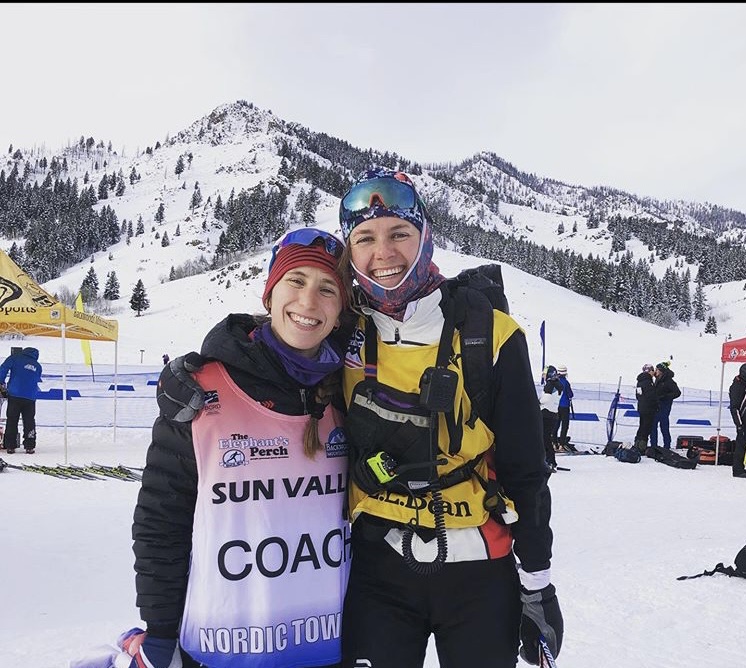
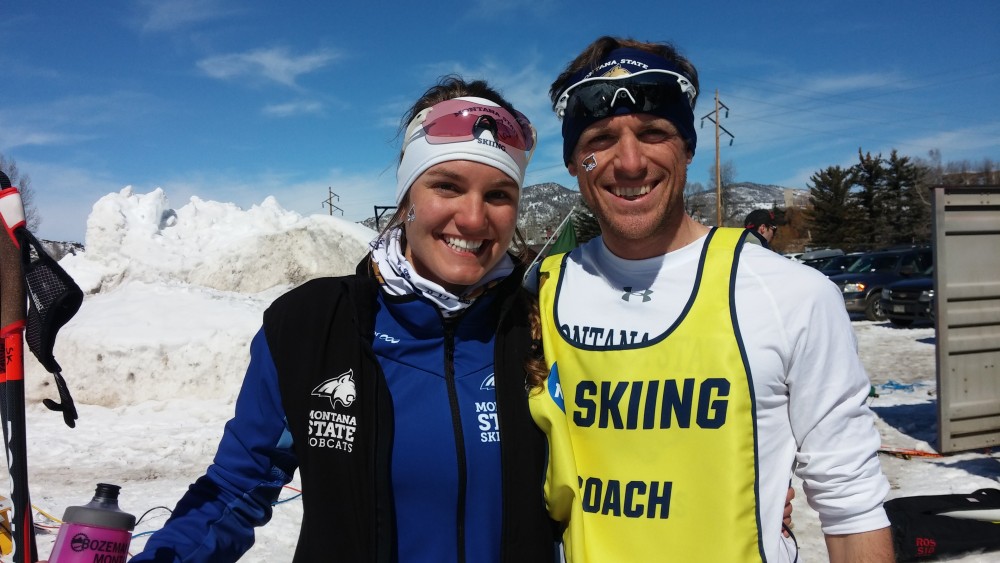
Kelsey Phinney and friend Annie Pokorny snap a picture at a 2019 SuperTour in Sun Valley, where Pokorny was working as a technical delegate and Phinney was assisting SMS T2 coach Pat O’Brien with waxing while rehabbing from shoulder surgery. (Courtesy photo)
FasterSkier (FS): When did you begin the process of becoming certified as a TD? What was your experience like with the certification process? Were you able to “fast-track” given your experience as an athlete and has your experience as a high level racer been an asset?
Kelsey Phinney (KP): I began the process of becoming a TD this past fall after a conversation with Annie Pokorny about ways to stay involved with the sport. My experience as a former racer has certainly been an asset. While I have learned much more about the specific rules than I knew when I was racing, I hope my ability to bring a racer’s perspective to decisions – like where to start and end turning zones in a classic race – helps make races safer and more fair.
FS: You mentioned Annie helped get you involved. Can you say more about what those conversations were like? What/who were some of the other factors/people that motivated you to become a TD?
KP: The primary reason I looked into becoming a TD was to give back to the sport within my current time constraints as a full-time graduate student. There is also a shortage of TDs in Colorado, which motivated me to follow through with the training and certification process following my conversation with Annie.
Since I’m currently living in Boulder, the races hosted in Colorado are all within driving distance for me. This year, I was the assistant TD at a junior race in Aspen the weekend after my fall semester wrapped up, as well as at a college race in Steamboat a couple of weeks ago.
FS: There is an overall need for TDs in the U.S., and while there are some noteworthy female TDs who have or will be jury members at the World Cup, World Championship, and Olympic level, there are few women in the role domestically. We ran an article about the need for TDs in 2017 and at the time, there were only 10 women listed in the U.S. Is this something that you considered prior to becoming a TD?
KP: To be honest, I didn’t think much about the lack of female representation of officials when I decided to work towards becoming a TD, but I do think representation matters and it is important to have diverse voices and perspectives included in the decision-making process. I’m happy to contribute to increased representation of women among the officials domestically. I think my racing experience and age are other important qualities I bring to the table.
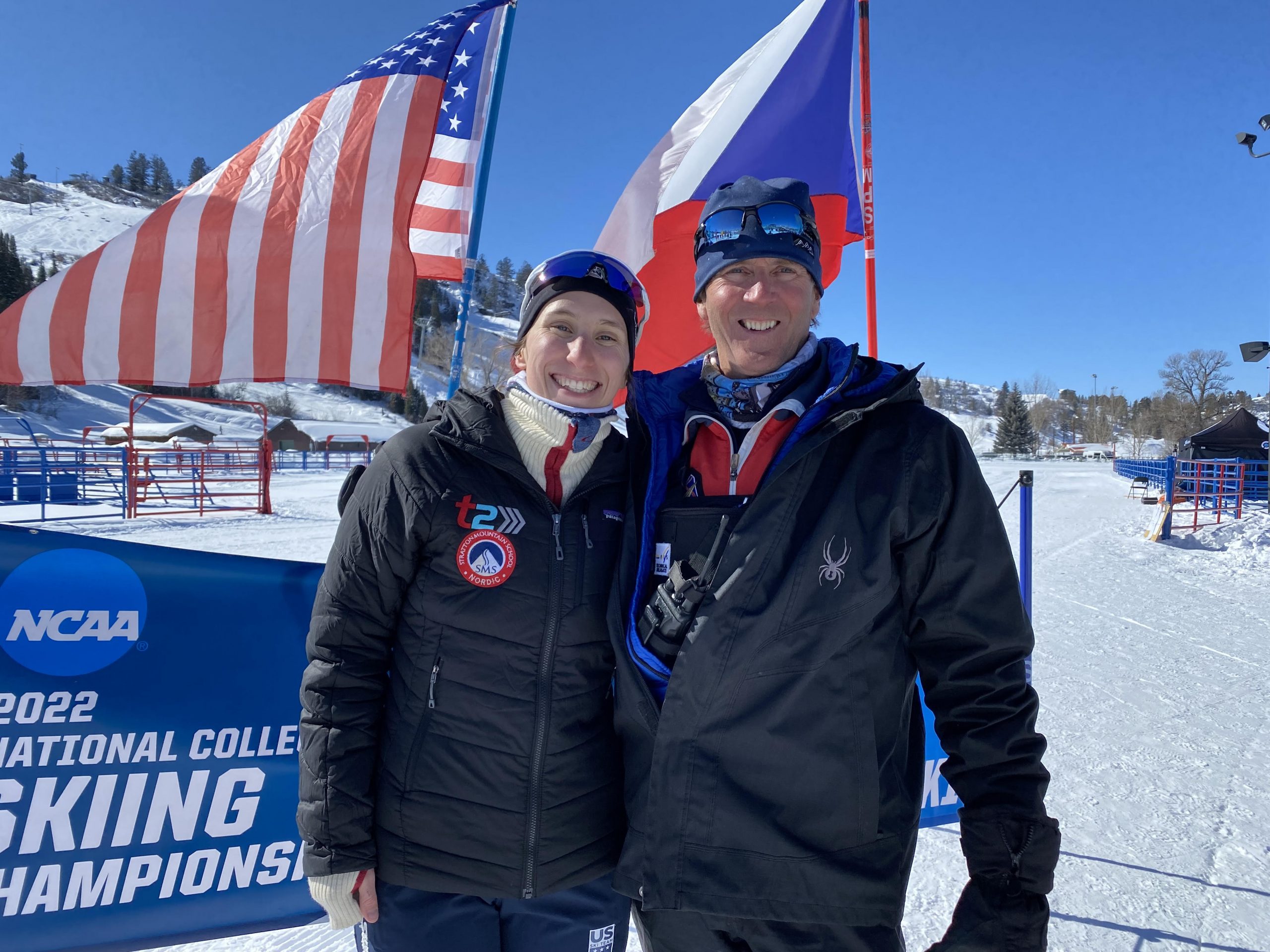
Kelsey Phinney and Al Pokorny (father of Annie) work as technical delegates at the RMISA Regionals race in Steamboat Springs, CO. (Courtesy photo)
Front page of the Anchorage Daily News on Thursday, Feb. 22, 2018.
You may have noticed that Kikkan Randall and Jessie Diggins won a gold medal yesterday. (If you’ve forgotten, or just haven’t seen the video in the last five minutes, you should probably go watch that finish sprint one more time. We’ll wait.)
The rest of the world noticed. For longtime fans of the sport, one of the most surreal things about Wednesday may have been seeing cross-country skiing – our sport, a niche sport, a pastime that typically merits mention in The Gray Lady only when it’s in that one piece about cross-country skiing and “topographical Buddhism” that all your friends sent you even though we’re totally cooler than that and don’t actually wear helmets and goggles when we ski – in The New York Times, andThe Washington Post, andThe Washington Post again, and The Wall Street Journal, and so on. Apparently gold medals talk or something.
Here’s a non-scientific roundup of how the Americans’ win was covered in English-language media. Coverage is arranged from very roughly the most-national newspapers (“the U.S. wins a medal”) to the most-parochial (“local hero Randall/Diggins wins a medal”), followed by a handful of online-only publications. Particularly good lines and, in some case, unfortunately imprecise lines are highlighted.
Best line: “The team sprint – especially on this brutal course – is a sadistic event. It requires two skiers to take turns skiing three legs each of 1.25 kilometers. With two rounds of racing for the top 10 teams, that means six all-out sprints for each skier, with a little more than an hour to recover between the semifinals and the final.”
Least-accurate line: “Randall, an Alaska native, was the first American woman to break into the elite of international cross-country skiing, and there was a long period in which she was the only woman on the United States team.” (The phrase “Alaska Native” is the preferred term of cultural identity for the indigenous peoples of Alaska; it’s a small point, but “native Alaskan” would be more appropriate for someone who grew up in Alaska but is of Caucasian heritage. Plus, Randall was technically born in Salt Lake City while her mother was in law school in Utah, before moving to Anchorage in childhood.)
Best line: “Diggins, the ebullient talisman of the US team who spends her downtime learning hip-hop dance routines from YouTube tutorials, was third entering the final lap before finding an extra reserve to overtake both the Swedish and Norwegian teams and secure the history-making gold.”
Front page of the Minneapolis Star Tribune sports section on Feb. 22, 2018. (Photo: Scott Beutel)
Best line: “While Bjoergen was winning 14 medals, Randall was waiting for one. Diggins had made it happen with her 100-meter sprint. Randall had made it possible with the previous 16 years.”
Best line: “Technically, every mother deserves a gold medal.”
Least-accurate line: “And Randall – who intentionally positioned her childbirth midway between two Olympics and in a non-World Cup year – has attracted admirers for her decision to stick with her craft.” (The World Cup of course went on in Randall’s absence in the 2015/2016 season; it was a non-World Championships year.)
Best line: “Kikkan Randall screamed at the Alpensia Cross Country Centre’s finish line here as Jessie Diggins, her teammate on the two-woman sprint relay, ricocheted off the final turn for home.”
Least-accurate line: “The Americans found themselves in an unusual position: racing the powerhouse Norwegians and Swedes for gold over the final meters.” (Well, actually, Diggins and Randall have been competing head to head with Scandinavia for many years now, often with World Cup or World Championship gold at stake.)
Best line: “When President Obama first got inaugurated,” Randall said, “I had a dream that I was sitting on Air Force One talking to him about cross-country skiing and telling him it is a really cool sport but didn’t get enough attention. He said [in the dream] when he became president, he would help make cross country a higher profile.”
Least-accurate line: “Each racer skies three legs on the twisting, undulating course, and the three medalists separated themselves from the rest of the 10-team field entering the final loop.” (The verb is “skis,” guys, not “skies.”)
Front page of the Minneapolis Star Tribune (see bottom right) on Feb. 22, 2018. (Photo: Scott Beutel)
Best line: “When she reached the finish line, Diggins said, she couldn’t feel her legs. Within moments, though, she came out the other side of the pain cave, into the light of a golden evening.”
Least-accurate line: “It was the 18th Olympic medal for Bjoergen, the most of any Winter Olympian in history.” (Bjørgen’s cumulative medal haul is stunning, but in fact stands at “only” 14 Olympic medals total.)
Best line: “Diggins has stayed a part of the Stillwater team. She sent a text from South Korea last week before the Ponies girls team went out and won the team title. Wednesday the texts were going the other way.”
Best line: “Few Americans have Olympic gold medals. Fewer still have an ice cream flavor named after them. Jessie Diggins has one, and she might soon have both. … The goal is to introduce the flavor in coordination with a citywide celebration of Diggins’ accomplishment that Afton officials, business owners and residents are planning to honor their hometown hero.”
Best line: “Randall and Bjoergen, 37, are both five-time Olympians and both are mothers of toddlers. Randall’s son, Breck, will turn 2 in April, and Bjoergen’s son turned 2 in December. Both have shown that neither age nor motherhood spell the end of a world-class career.”
Least-accurate line: “[Diggins is] also a three-time World Championship medalist – in 2013, she and Randall won the team sprint at worlds – and a frequent visitor to the World Cup podium.” (Diggins has four World Championships medals.)
Best line: “I puked after a lot of races that year. There is old camcorder footage of me vomiting at a race in Michigan’s Upper Peninsula and you can audibly hear all of my teammates – and I do mean ‘all,’ I was one of the last guys across the line – scream with laughter.”
Best line: “On the fourth lap, Diggins made a move, pulling ahead of the entire field. Even though I already knew the outcome of the race before I watched the full replay, I still sat up in my chair when I saw Diggins pull ahead. I’ve watched enough cross-country skiing to know it’s rare for an American to ever pull ahead. ‘She’s going to do it,’ I said, even though I knew she had already done it. That’s how thrilling this race was: It made me nervous about an outcome that I already knew was not in doubt.”
Least-accurate line: “On Wednesday in Pyeongchang, cross-country skiers Kikkan Randall and Jessie Diggins pulled off the United States’ biggest upset of the Winter Games, winning a gold medal in the women’s team sprint. It’s safe to say no one saw this coming. If cross-country skiing is the NFL, then the United States is the Cleveland Browns. Imagine how surprised you’d be if the Browns made the playoffs, then got to the Super Bowl, then hoisted the Lombardi Trophy, having defeated Norway along the way.”
(The U.S. team is currently ranked fifth in the Nations Cup (the women alone are third), barely behind Finland for fourth. Luke Bodensteiner, U.S. Ski & Snowboard Chief of Sport, told FasterSkier yesterday, “I think we came in feeling like team sprint was not only our best opportunity for a medal, but probably a pretty high likelihood for us, honestly.” The Browns, by contrast, just suck.)
Best line: “People often call cross-country skiing an individual sport. But more than anything, Randall’s and Diggins’ success is a counterpoint to that idea; their victory is a testament to the people rallying behind them. … This community pushed through dips in funding, apathy in American ski culture, and the general challenges that come with pursuing the hardest sport on the planet. Today, Randall and Diggins proved that this is truly a team sport.”
Least-accurate line: [Not applicable; author Annie Pokorny, a recently retired elite American domestic racer, knows her stuff.]
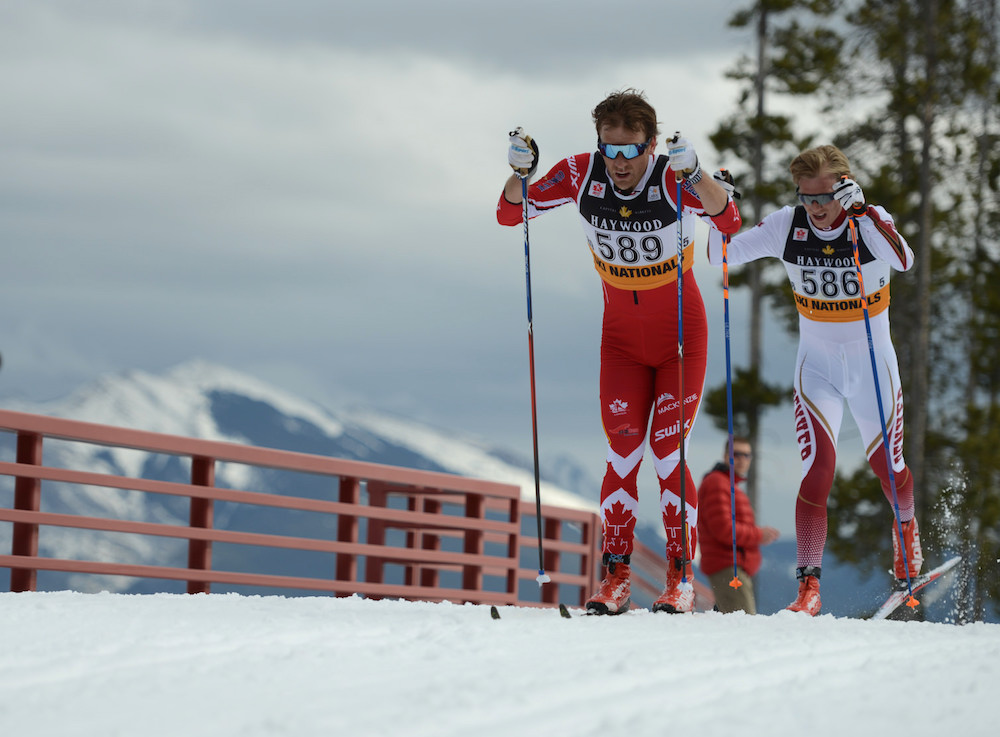
Devon Kershaw (589) leads University of Denver skier Eivind Romberg Kvaale during the men’s 15 k classic interval start on Tuesday at Canadian Ski Nationals at the Canmore Nordic Centre in Canmore, Alberta. Kershaw went on to win and Kvaale placed sixth. (Photo: W. James MacLean)
2017 Canadian Ski Nationals (Canmore, Alberta): Days 1, 2 & 3
On the third day of Canadian Ski Nationals in Canmore, Alberta, World Cup skiers Devon Kershaw and Emily Nishikawa — both fresh off World Cup Finals in Quebec City — picked up victories in the men’s and women’s classic interval starts on Tuesday.
Kershaw won the men’s 15 k in 45:05.3 minutes, 44.6 seconds ahead of two University of Denver (DU) skiers Dag Frode Trollebø and Moritz Madlener.
Both of Tuesday’s second- and third-place men’s finishers reached the podium at NCAA Skiing Championships earlier this month. On Tuesday, Trollebø, who’s originally from Norway, finished second, 44.6 seconds behind Kershaw. Madlener, of Germany, was another 2.2 seconds back in third (+46.8). World Cup skier Graeme Killick was the second Canadian in fourth overall (+1:09.2), and David Palmer, of the Black Jack Ski Club, placed fifth (+1:22.5).
“It was so hard, hot, and the conditions were vicious,” Kershaw said, according to a Cross Country Canada (CCC) press release. “I cramped up with five kilometres to go. It was a really hard day. But this is my home. I love Canmore and I think it is important for the kids to see that even after a hard World Cup season you should come and support the national championships.”
“That was a massive effort for me,” he added. “The conditions were just really, really slow, but I wanted to do this race to end the season.”
Nishikawa won the women’s 10 k classic by nearly 1 1/2 minutes in 29:07.6. American Mary Rose, of the Sun Valley Ski Education Foundation (SVSEF) finished second (+1:24.8), Katherine Stewart-Jones (NTDC Thunder Bay/Canadian U25 Team) was the second Canadian in third overall (+1:27.9) and Frédérique Vézina, of the Pierre Harvey Training Centre (CNEPH), placed fourth (+2:44.7).
“It was great to be back racing today in Canmore and see so many friendly faces out there,” Nishikawa said, according to CCC. “It was tough racing today, having raced three races last weekend in Quebec and then travel, but I was so happy to be able to race.
“I had great skis and was able to have another solid race,” she added. “It is always an honour to win a National Title. I love racing at Nationals.”
“I think it is really important for the next generation to get a chance to compete against, and meet National Team athletes,” she continued. “When I was a juvenile racing at Nationals, I was so inspired to be able to meet some of my idols who were on the National Team, so it’s important to me that I am here.”
While many of the 30 Canadians that competed at World Cup Finals last Friday through Sunday flew directly to Canmore for nationals, the races started without them, with a brand-new collegiate relay cross event on Saturday, March 18, and 10/15 k freestyle interval starts (for the open class) on Sunday, March 19.
The relays put university teams head to head on obstacle courses, with two skiers per team.
The women’s relay win went went to the University of Alberta’s Ember Large and Kathryn Stone, with a team name of “Largely Stoned” as a play on their last names. They won in 13:05.1, just 1 second ahead of Jenn Jackson and Makaila Hudson, representing Lakehead University, in second. The Rouge et Or (University of Laval) first team of Christel Pichard-Jolicoeur and Camille Burbidge Izquierdo placed third, 15.3 seconds back.
In the men’s relay, Rouge et Or/University of Laval, with Alexis Turgeon and William Dumas, took the win in 10:36.7, 17.5 seconds ahead of Lakehead’s first team, Noah Thompson and Gavin Shields, in second. Christopher Weller and Carrington Pomeroy of Carleton University’s first team reached the podium in third (+33.5).
On Sunday, Madlener won the men’s 10 k skate by 6.8 seconds over Graham Nishikawa, a guide for the Canadian Para-Nordic Ski Team, in 23:58.0. Another DU skier, Eivind Romberg Kvaale placed third (+13.4), ahead of Jack Carlyle (Alberta World Cup Academy) in fourth (+20.3). Michael Somppi (NTDC Thunder Bay) was the third Canadian in fifth overall (+25.3).
Retire biathlete Zina Kocher won the women’s 5 k skate by 14.6 seconds over Jenn Jackson (Lappe Nordic) in 13:08.7. Sun Valley took third through sixth with Deedra Irwin in third (+34.1), Kelsey Phinney in fourth (+35.2), Annie Pokorny in fifth (+38.6), and Rose in sixth (+41.7).
Racing continues at the Canmore Nordic Centre on Wednesday with classic sprints. The sprints on Wednesday and Thursday will be streamed live on YouTube. Details here: skinationals2017.com.
SuperTour skiers won’t be starting their season at the Rendezvous Ski Trails in West Yellowstone, Mont., this November. For the first time in the Yellowstone Ski Festival’s history, SuperTour races are not on the schedule. Citing altitude and frigid temperatures, the series is starting north in Bozeman, Mont.FasterSkier previously shared a press release from the U.S. Ski & Snowboard Association (USSA) giving the where and when of the 2016/2017 SuperTour schedule for high-level domestic racing. This article provides the why – why are the season’s first races not in West Yellowstone? Why are some U.S. SuperTour races in Canada? Why are U.S. nationals returning to Soldier Hollow after just two years away? And so on. FasterSkier spoke with various members of the American cross-country ski community to help get some answers about why the country’s top skiers will be going where when this winter.
Period One: Western Swing (but no West Yellowstone)
The single most noteworthy change to this year’s schedule may be the move away from West Yellowstone for the season’s opening races. Skiers have flocked to West Yellowstone in search of early-season snow, and often raced there, for a very long time. For how long? And why the change now?
As FasterSkier previously reported, elite skiers have made the Thanksgiving-week pilgrimage to West for nearly forty years: It was 1978 when the U.S. Ski Team held its first Fall Camp there, “with then-U.S. Ski Team coach Marty Hall and skiers like Bill Koch, Dan Simoneau and Tim Caldwell. Koch didn’t come too many years after because of exercise-induced asthma, which worsened with altitude.” People kept coming back. In 2004, Fall Camp, which had long since expanded to include a range of citizen skiers from around the country, was renamed the Yellowstone Ski Festival, with a full slate of clinics, demos, and a gear expo.
So why the change? Well, here’s another number from our article on the history of early-season skiing in West Yellowstone: “6,663: Elevation of West Yellowstone. The Rendezvous Ski Trails are about 6,800 feet above sea level (2,000 meters), and the South Plateau just outside the park is about 1,000 feet higher.”
The athletes have noticed. Bill Koch evidently noticed in the early 1980s. More recently, as Alaska Pacific University (APU) skier Reese Hanneman blogged in December 2015, “For as long as I have been racing, these first two weekends of elite racing have been held in the high mountain west, at illegally high altitude (according to FIS), which always makes them a little funky.”
USSA and club coaches noticed, too. As Robert Lazzaroni, USSA’s nordic domestic program director, explained in a phone interview, the impetus to move away from opening the season in West Yellowstone “came from the club coaches when we met in Craftsbury” following last season’s SuperTour Finals in March. The decision to move elsewhere was close to a consensus, Lazzaroni said: “It was very clear that the season starts too early. It’s too early – November 23rd – to start to chase points, when we want the athletes to peak at Nationals [in early January].”
West Yellowstone, known as “West” for short, is also at altitude, Lazzaroni noted. And finally, Lazzaroni made the uncontroversial observation that “West can be very cold.”
Putting all that together, he said, it just seemed like too much to ask of the athletes: “When you ask the athletes for the first race of the season to be at full speed, and to be fit, and in a cold place – it can be too much. And it puts their season in jeopardy. The risk was too big in their [the club coaches’] mind – too early, too high and the weather can be difficult. And that’s not good that early in the season.”
Hence the move from West in late November to Bozeman in early December: later, lower, and hopefully a little warmer.
So what will be left in West Yellowstone over Thanksgiving week, without elite athletes eyeing the competition, washing their hands, and chasing SuperTour points? Quite a bit, both USSA and West Yellowstone boosters agree.
As Lazzaroni noted, it was a “bummer” to lose the SuperTour component of the Yellowstone Ski Festival, but the festival “will continue. They will still have the junior race, they will still have the Masters race. It will just not be a SuperTour. … We believe a lot of the clubs will be there, training.”
Moira Dow seemed to agree. The program director of the Yellowstone Ski Festival, Dow said on the phone that she was “disappointed” to lose out on the opportunity to host the SuperTour races, but had no hard feelings toward USSA and appreciated the need to structure a race series to support athlete development.
“We understand that the athletes have to look out for the best of their development on the national stage,” Dow said. “While we recognize that, we are disappointed. We think that having the SuperTour held in a small town of West Yellowstone is fun and exciting. So we’re disappointed, but we understand the need.”
Dow admitted that the schedule change “was a surprise” to the organizers of the Yellowstone Ski Festival.
“Going into the [USSA] Congress [in mid-May] I thought it was still up for debate,” she said.
But given “the way it was presented at Congress,” Dow continued, “the athletes made their statement – I think the schedule was decided before Congress.”
Despite the surprise, Dow underscored that she had no hard feelings, and certainly did not view the schedule change as a personal attack on her or the festival. And she emphasized that everything that citizen skiers have come to expect from West Yellowstone in Thanksgiving week – clinics, demos, etc. – will still be there, including the races: “We’ll be holding just as many races, they just won’t be designated SuperTour” races, she said.
“SuperTours are not the most important part of our festival,” concluded an upbeat Dow. “We hope to see you in West Yellowstone.”
(So will the SuperTour return to West next year? The short answer is that likely nobody knows. In August 2015, quoting then-USSA nordic manager Joey Caterinichio, we reported, “West is the perennial host for Period I and could potentially rotate with Alaska, although, ‘there is no intention of changing West Yellowstone,’ according to Caterinichio.” That obviously didn’t last long. As Dow said when asked about her plans for November 2017, “we’re waiting to see – it changes from year to year.” She added, reflecting the development of this year’s schedule, “we find out in May what the athletes are looking to do to help put them on the national stage,” and then respond to that.)
An early December morning at the Sovereign Lake Nordic Centre in Vernon, B.C.
So the opening SuperTour weekend will be in Bozeman, Mont., starting with a skate sprint on Saturday, Dec. 3. A 10/15 kilometer classic individual start follows on Dec. 4. It will be a short week before athletes return to action with a classic sprint at Sovereign Lake in Vernon, British Columbia, on the evening of Friday, Dec. 9, with another short turnaround before 10/15 k skate interval starts the next day. (A relay that is not scored for SuperTour points will be held at the same venue on Sunday.)
If the move away from West Yellowstone was the first thing that struck many skiers about this year’s schedule, the move across the border was probably the second thing of note. The races in Silver Star will be a joint SuperTour/NorAm weekend (that is, they will be held together with the Canadian high-level domestic race series), an arrangement that has occurred in the past but not for some time. Ski representatives from both countries – which are identified as “children of a common mother” in the inscription on the Peace Arch at the border crossing between Blaine, Wash., and Surrey, B.C. – agree that the cooperation is welcome.
As Cross Country Canada (CCC) High Performance Director Tom Holland said on the phone earlier this summer, “We had a couple of phone meetings this year and there’s a willingness to work more together on a NorAm/SuperTour. Why not? To have more of these North-South relationships in the East and the West so people don’t have to travel so far. We’re sort of repeating history here. We’ve wanted to do this, but we did a lot of it in the ’90s, if you look at the results there were some great races back then. So it’s kind of a common-sense thing to have a North American race circuit where we compete against each other. We went down to West Yellowstone the last couple of years. It would be nice if there was more than that one weekend, but the U.S. has some other commitments in December. It would be nice if we had three or four weekends. The Euros ski more than us before Christmas, so the more we do the better.”
Holland continued, “We have those races every year anyway. It’s more about getting a high level of competition so we’re competing against the best in each nation and get warmed up for the season. There’s lots of examples of it working in the past, but it sort of faded as the SuperTour got stronger at one point. Anyway, we’re totally committed, and the U.S. is making a commitment, and we’re happy about U23/World Juniors being down there. So we’re going to do our trials down there. There’s a lot of cross-border stuff going on this year. I hope that sets a good tone for the future.”
Lazzaroni concurred, explaining that USSA wanted to hold consecutive race weekends relatively close together in order to make transportation somewhat easier. He also said they were pleased to combine with Canada in order to create a larger and more competitive field. Lazzaroni said that he hoped to have more joint SuperTour/NorAm weekends in the future.
Period Two: SoHo and Truckee
Athletes and coaches test skis in the stadium at Soldier Hollow in Midway, Utah, at 2014 U.S. Cross Country Championships.
Athletes will have nearly a month off before racing resumes with U.S. Cross Country Championships in January at Soldier Hollow in Midway, Utah. There is a 10/15 k skate individual start on Jan. 7, a full classic sprint the next day, and a 20/30 k classic mass start on Jan. 10. A qualification-only skate sprint event rounds out the week on Jan. 12.
U.S. nationals visited Soldier Hollow fairly recently. The races were held there in 2013 and 2014, before moving to Michigan’s Upper Peninsula for 2015 and 2016. The move back to Utah after only two years away is atypical.
The “main reason” for the quick return to Soldier Hollow, Lazzaroni said, “is because of World Juniors.”
The U23/Junior World Championships will be held at Soldier Hollow from Jan. 30 to Feb. 5, 2017, and will include roughly 750 athletes from dozens of nations. Some of those athletes will be junior and U23 skiers from the U.S., and Lazzaroni said that USSA wants to provide American skiers with a home-field advantage: “It was very important to us to bring the Championships back to the U.S., to show our commitment to FIS, and also to provide our athletes home-field advantage.” Lazzaroni explained that the best way to give American athletes this advantage was to give them an additional chance to race at Soldier Hollow in advance of the championships.
Therefore, Lazzaroni explained, USSA did not look back to the last time when U.S. nationals were held at Soldier Hollow in setting this year’s schedule. Rather, they looked forward, asking how best to prepare American athletes for Junior Worlds. And the answer was to let them race at Soldier Hollow in January before – for some skiers – racing there again in February.
But there will be something missing from this year’s edition of U.S. nationals: a national championship skate sprint. Instead, in the 2016/2017 season only, the national championship skate sprint will be held at the season-ending SuperTour Finals, as part of a race series colloquially known as Spring Series.
This schedule change, Lazzaroni explained, is due to the overall load on the Soldier Hollow volunteers and local community. It is “asking a lot of the venue” to hold both U.S. nationals and Junior Worlds at Soldier Hollow within the same month, Lazzaroni said. Among other inconveniences, he noted that there is an elementary school at Soldier Hollow, which also serves as the timing building and race headquarters, that has to be shut down when high-level races are held. Lazzaroni said that the local community was unable to commit to a full U.S. nationals schedule, including a full skate sprint day, on top of its other hosting obligations.
A quarterfinal in the freestyle sprint at 2013 U.S. nationals at Soldier Hollow in Midway, Utah. There will be no heats at this year’s national skate sprint; a qualification-only skate sprint will be held instead.The initial solution was just to take away the sprint race, moving U.S. nationals week from four races down to three. But, Lazzaroni said, this created a problem from the perspective of U.S. Ski Team Head Coach Chris Grover, who needs to oversee the selection of the U.S. team for the 2017 World Championships in Lahti, Finland, later this winter.
The races in Lahti include an individual skate sprint and a team classic sprint. The first half of the SuperTour schedule includes two classic sprints, but only one skate sprint.
The compromise, Lazzaroni explained, was a qualification-only skate sprint event at Soldier Hollow on Jan. 12. This was acceptable to Soldier Hollow event organizers and volunteers. And, Lazzaroni states, he feels that this “was a good compromise.” This way, “Grover can still have a qualification to make sure he has the best skiers to go to Lahti, and we don’t burn out the skiers and volunteers at Soldier Hollow.” The result will be a qualification-only skate sprint day, with no rounds contested. Results from the qualification will be used for purposes of qualifying for the U.S. World Championships team, but will not be scored for SuperTour points.
Following the skate-sprint qualification event, athletes have nine days off before racing on the Auburn, Calif., trail system in late January. A classic sprint will be held on Jan. 21, and a 5/10 k skate individual start on Jan. 22.
Period Three: Why not Ishpeming?
Roughly a month later, the SuperTour resumes with two races in Ishpeming, Mich., about 15 miles outside of Marquette on the state’s Upper Peninsula. There will be a skate sprint on Friday, Feb. 17, and a 5/10 k classic individual start on Sunday. (A 15/20 k mass start skate race, which will be a FIS-sanctioned collegiate race but will not be scored for SuperTour points, will be held on Saturday.) The race weekend will be held in conjunction with the NCAA Central Region Championships hosted by Northern Michigan University.
Al Quaal Recreation Area (Photo: Travelmarquettemichigan.com)The trails at Ishpeming’s Al Quaal Recreation Area last hosted a FIS event in February 2016. Before that, the previous and only entry for Ishpeming in the FIS results database is for a race weekend in February 1993. Suffice to say that it’s been a while.
So why Ishpeming? As Lazzaroni explained, repeating part of a reporter’s question, “You say, ‘Why Ishpeming?’ I would say, ‘Why not Ishpeming?’ ”
He said USSA attempts to rotate the SuperTour sites within the regions each year, and that this year the mid-season races are coming to the Midwest. It also recognized that the American Birkebeiner is held in the Midwest in late February, so there is an incentive to keep the SuperTour in the area. And Theodore Wirth Park in Minneapolis is undergoing construction work at present, and so was unable to host SuperTour races this year.
Lazzaroni explained that USSA was looking for a venue that could host SuperTour races for two weekends in a row, but was unable to find any venue that would take on this commitment. He said that they were pleased to get a taker for just one weekend in Ishpeming (population approximately 6,500), which has newly homologated trails and was eager to show them off. When the discussion was opened regarding bringing the SuperTour to the Midwest, Lazzaroni said, Ishpeming jumped on board.
“They have a long tradition of nordic skiing,” Lazzaroni noted, adding that Ishpeming was hosting cross-country races as early as 1905. The National Ski Association of America, a group that would later become the modern-day USSA, was founded in Ishpeming that same year.
Although last year’s Birkie was only scored for half SuperTour points, USSA has since revisited this assumption. At this year’s working group for the SuperTour schedule, Lazzaroni explained, they opened the question of whether the Birkie should count for full points or half points. Although some people had argued over the past few years that the Birkie should count for only half points, because it is often not a “normal” race distance, he clarified that the USSA Nordic Competition Guide makes “no mention that it should be half points.” Accordingly, USSA opted to follow the Comp Guide and restore the Birkie to full-points status.
Something less than a full SuperTour field typically races the Birkie; there were 17 American skiers with FIS points in the men’s elite race last year, and nine in the women’s.
Period Four: Spring Series in the Golden Heart City
A month after the Birkie, racers will travel north to end the season at Spring Series in Fairbanks, Alaska. Races will be held every other day over a week-long period from March 27 to April 2. A skiathlon, a skate sprint, a mixed club relay, and a 30/50 k mass start skate race are on the calendar. With a full skate sprint not being held at U.S. nationals in January, all events save the skiathlon will be national championship races.
Longtime Fairbanks race director John Estle is already excited. In an email to FasterSkier, Estle explained that the races will be held on a series of newly homologated and re-homologated courses at Fairbanks ski area Birch Hill. He noted that the new men’s sprint course will be “between 1500 and 1600m, which seems to be the preferred distance for sprint courses. Guys seem to like them to be about 3:30 in duration.” The women’s course will be “just a bit shorter than the men’s course.”
A 2012 photo from the trails at Birch Hill in Fairbanks, Alaska. (Photo: Lauren Fritz)After explaining the combinations of homologated loops that will be used for the various races, particularly the 30 and 50 k races on the last day of the season, Estle concluded, “The courses for those races will be quite challenging.”
Of the four races at Spring Series the skiathlon stands out, for its presence as well as its non-canonical distance. The suggestion on the official schedule that the distances will be 14 k for the women and 24 k for the men is apparently not quite accurate. Rather, Estle wrote, the distances will be 15 k and 22.5 k, respectively. “That is because we will have two homologated 3.75Km courses, one for the classic leg and one for the skating leg. Two laps of each course for women, three laps of each course for men” comes to 15 k and 22.5 k.
Estle is well aware that, at the Olympic Games or World Ski Championships level, women typically race a 15 k skiathlon and men a 30 k. “But most of the feedback I got from coaches and athletes was that at the end of a long, long World Cup season 30Km would just be too much,” Estle wrote. “At the World Cup finals in Canmore last year they did a 30Km skiathlon on a 3.75Km course and a large chunk of the field was pulled from the race (and hence the tour) after getting lapped. That was on a really tough course on a really warm day, but still. Those were damned good skiers, and they were completely shot at the end of that race.” So 15 k and 22.5 k it is.
A skiathlon, over any distance, is a rare event at the SuperTour level. Estle recalled hosting skiathlons in Fairbanks in both 2008 and 2009, but it is unclear whether they have occurred in this country at the highest levels of domestic competition since then. (The races are often entered in the FIS database as “pursuit” rather than “skiathlon” when they are held in this country, making it difficult to search for them. They are held more broadly at the high school and citizen racer levels.)
Skiathlons may be uncommon at this level of competition, but there seems to be widespread agreement that there should be more of them.
As Estle wrote, speaking as a race director, “One of the reasons that we are doing a skiathlon is that nobody ever does them in the US. … A skier’s first experience in a format contested at the World Championships should not be at those championships: Junior WC or U23 WC. If we are thinking about developing skiers who can compete at the highest levels, and coaches who can support them, then we need to make sure that our domestic schedule (FIS or otherwise) provides the types of experiences that will prepare them for the next highest levels of competition. Our skiers need a broad spectrum of experiences, and right now, because there are very few, if any, skiathlons on the domestic schedule, we are not preparing those skiers as well as we could or should.”
Lazzaroni sounded similar notes on behalf of USSA, saying that the skiathlon is contested at various international championships, and “why not prepare our athletes for that?” Echoing Estle, he noted that athletes reported back from the most recent World Junior Championships that they had never done a skiathlon before, “And that’s not right.” Lazzaroni said that he wouldn’t expect to see “many, many more [skiathlons] in the future” – but he added, “my vision is that, yes, we should train our skiers to be better at skiathlon, to be better prepared to do skiathlon.”
U.S. Ski Team Women’s Coach Matt Whitcomb was in complete accord, telling FasterSkier in a recent interview, “It’s often that at the junior and even U23 level when we go internationally, that we’re scrambling last-minute to find skiathlon boots, or to teach athletes how to load an exchange zone and what the rules are. So we’ll consider this just a quick dose of education for our entire community, and I think it’s going to have a big effect.”
The athletes seem to agree as well. Lex Treinen of APU, a top domestic athlete who has recorded SuperTour podiums but has not yet raced on the World Cup (which sees a handful of skiathlons each year), wrote in an email that he had done a skiathlon in Fairbanks some years ago – but that otherwise, “I have just done a couple at World Juniors and U23s.”
As Treinen explained, “Skiathlons are great and there is a good reason that they don’t do them very often on the Supertour: they are a pain in the ass logistically … for coaches and athletes and as the APU SuperTour team operates right now, we would not have the resources to wax for a skiathlon very effectively most of the season. Fairbanks will surely be an exception, since #1 it is closer to home and #2 it is Nationals which means there is a little bit of extra tech support from our team. Either way I don’t have a doubt that the fittest person will win this March and I really think it is a positive thing to be able to race some new formats. I am very excited that the Fairbanks organizers have decided to do something novel.”
Annie Pokorny, of the Sun Valley Ski Education Foundation (SVSEF) Gold Team, expressed similar sentiments. “The only skiathlons I’ve raced were at U23 World Champs, one in the Czech Republic and one in Italy,” Pokorny wrote in an email. “Despite my slim experience, however, I was incredibly excited to hear that USSA had integrated the skiathlon into domestic racing.”
Pokorny wrote that, “While it will certainly take some adjustment, I am always excited to see a diversified schedule on the SuperTour circuit. The more events we have, the more opportunities there are for varied competition and exposure to certain skills that our World Cup brethren see on a regular basis. Personally, the skiathlon is one of the most fun and exciting races I’ve ever entered. Having a switch in technique changes the rules of the game so there are more chances for comebacks than in a traditional mass start.”
When asked whether she was going to do anything special to prepare for this addition to the schedule, Pokorny wrote, “Few people know this, but in my first skiathlon I literally had the slowest transition time in the world, by many seconds. I don’t think I’ll need to change training much to be ready for the racing part, but it would be in my best interest to spend some time skiing while taking on and off my poles.” (Pokorny, who finished 29th in that race, is correct that her transition time ranked 48th out of 48 skiers.)
Looking to the future: Cross-country ski cross?
While this year’s SuperTour aims at selecting the U.S. team for Lahti and assigning start rights for upcoming World Cup events, USSA is also looking toward the future. And to hear Lazzaroni tell it, the future may involve cross-country ski cross.
Hannah Halvorsen (Far West/Sugar Bowl Academy) qualified 10th in the first-ever Cross-Country Cross event at the 2016 Youth Olympic Games in Lillehammer, Norway. (Photo: Far West/Facebook)“The cross-country cross has been a big success at the Youth Olympic Games in Lillehammer this winter,” he said. “It’s a format that the TV likes, the athletes like, that everybody likes. … I do hear from FIS that this is a format they want to push forward. We don’t know yet where it is going to go, but this is something we are keeping our eyes open [for], and I would not be surprised if you will see cross-country cross at some of the national events in the near future.”
Lazzaroni clarified that, by “near future,” he does not mean right away – “Obviously not next winter.” He added that this could become an important event to prepare U.S. athletes for larger stages: “Again, if this is going to be an event at World Juniors down the road – in two, three, four, five years, I don’t know – at Olympics, down the road – we should prepare our kids. And we have this discussion at Congress with the club coaches at a younger age, and we did encourage them to put some cross-country cross events at the local races. And again, the kids love it, because it’s fun. It’s working on agility, and it’s working on balance, and they become better skiers. It’s not now on the calendar, but I wouldn’t be surprised if in the near future we see more and more of this type of events.”
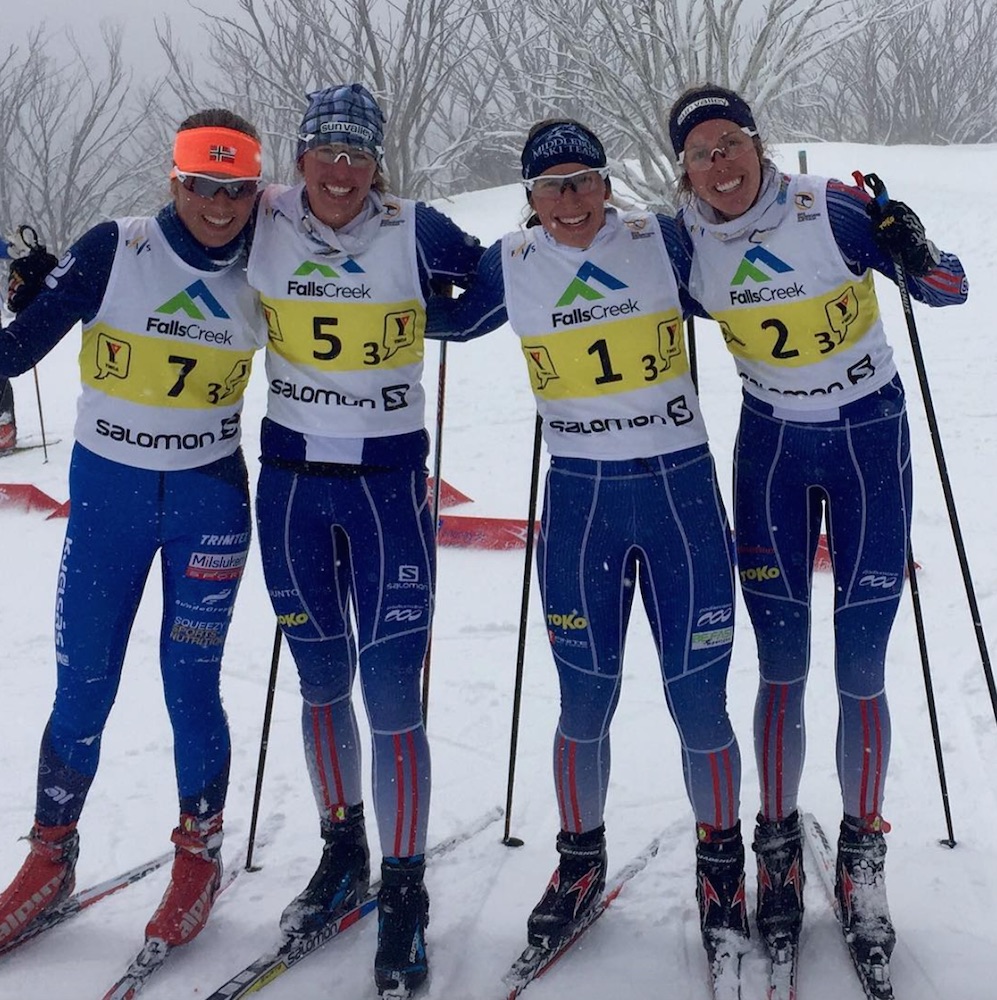
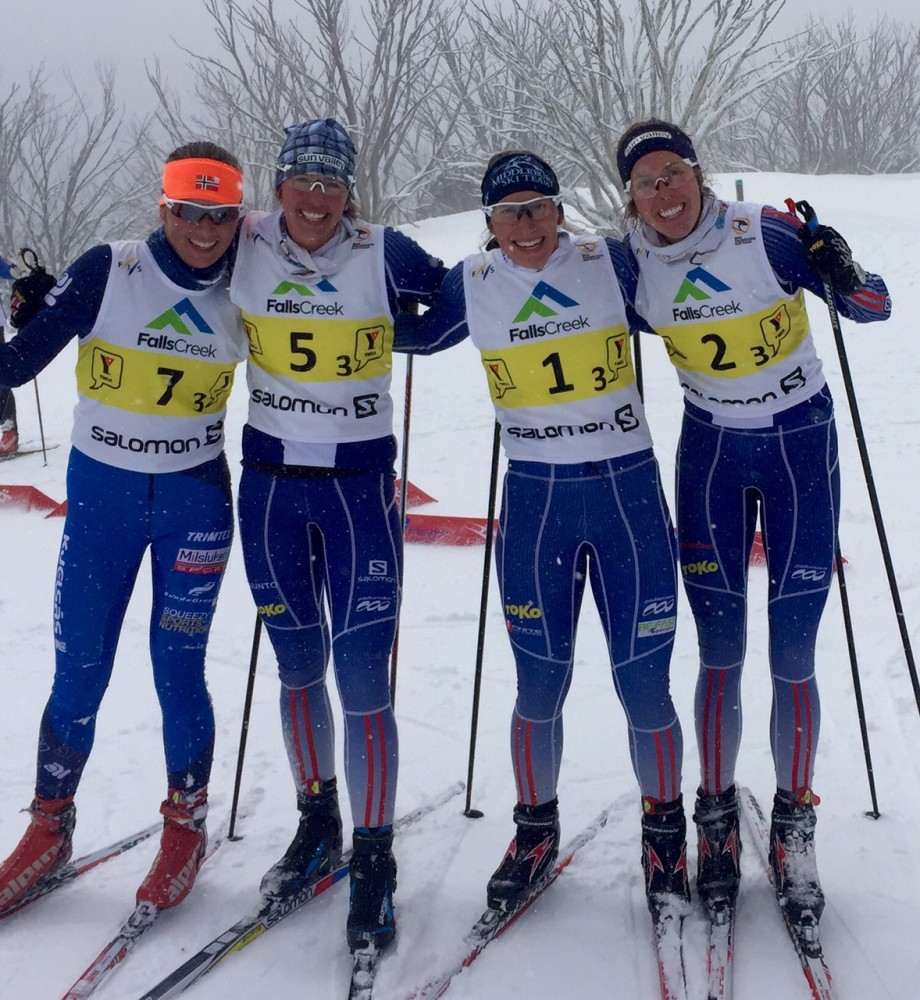
Sun Valley Ski Education Foundation Gold Team members Kelsey Phinney, Annie Pokorny, Mary Rose, and Deedra Irwin skiing at Falls Creek Resort in Victoria, Australia, earlier this month. (Photo: Mary Rose)
Getting there means 24 hours are lost somewhere in limbo and layovers that are more than cause for lethargy. But even with a disappearing day and assured hours of drowsy adjustment, traveling to the Land Down Under presents a unique opportunity for any western traveler, especially those who nordic ski. That’s because in the state of Victoria in southeastern Australia, nearly a four-hour drive north of the country’s second-most populated city, Melbourne, Falls Creek boasts accommodations, trails and most importantly, a winter season with snow.
For those of us in the Northern Hemisphere, the months of June, July and August often bring heat waves rising off the blacktop, but in Falls Creek, this the season for a mixture of snow flurries and sun.
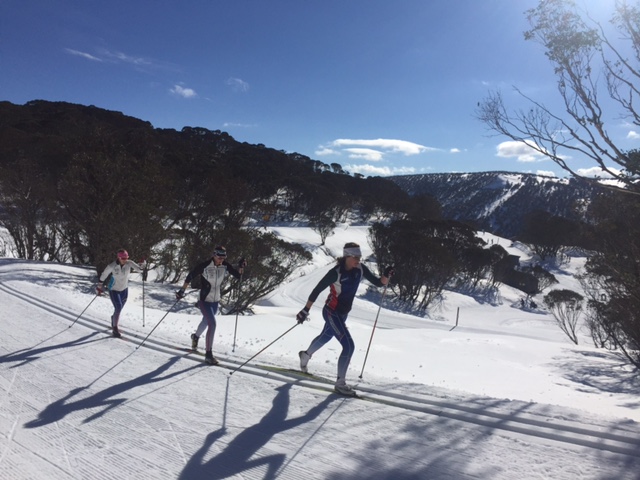
SVSEF Gold Team members (right to left) Annie Pokorny, Mary Rose and Kelsey Phinney classic skiing at Falls Creek Resort in Victoria, Australia. (Photo: Colin Rodgers)
With the promise of the latter from early June to late September — the peak season taking place in July and August — and a decent deal on plane tickets, several Sun Valley Ski Education Foundation (SVSEF) Gold Team members decided that when it came to the month of August, Falls Creek was where they wanted be.
“The team has never been here before, but one of our SVSEF coaches, Tom Smith, spent a summer coaching down here and told us how great the training was,” Colin Rodgers, SVSEF Gold Team head coach, wrote in an email from Australia. “We decided we had a great opportunity to come here and train this year because the airline tickets were quite inexpensive from the Western USA. Overall the skiing has been great so far!”
Along with Rogers, five Gold Team skiers made the trek to Falls Creek on Aug. 1, including Annie Pokorny, Kelsey Phinney, Mary Rose, Deedra Irwin, and Matt Gelso. The crew planned to remain in Australia for on-snow training until the end of the month, returning to the U.S. on Aug. 29.
This past weekend, the Sun Valley women swept the freestyle-sprint podium at Australian Cross-Country Ski Championships on Saturday, with Phinney winning the International Ski Federation (FIS) Australia/New Zealand Cup race, Rose placing second and Irwin taking third. Norway’s Nora Ulvang finished fourth just ahead of Pokorny in fifth.
The women’s skate sprint podium at 2016 Australian Cross-country Ski Championships on Saturday, Aug. 20, in Falls Creek, Victoria. Kelsey Phinney (1) placed first, Mary Rose (2) took second, Deedra Irwin (5) was third, and Norway’s Nora Ulvang (7) was fourth. (Photo: XCGoldTeam/Instagram)
“The races this past weekend were a very unique experience,” Rose wrote in an email. “Not often do you have a chance to race in the middle of August. The conditions were very challenging for everyone. I took this weekend as a great opportunity to practice skiing through all the sprint heats as well as learning to deal with less than ideal race conditions. Living in the West, I don’t get much opportunity to race in the pouring rain. This was a great learning experience!”
The men’s freestyle sprint and 15 k classic results were not available at press time. Due to a cold, Gelso did not race this past weekend.
While much of the Gold Team’s camp revolved around logging hours and kilometers on snow, Rodgers also anticipated his group would jump into a few races, including the Kangaroo Hoppet 42 k skate marathon on Aug. 27.
According to him, the opportunity to travel to Australia and compete was largely due to the international relationships the SVSEF has fostered.
“Our club has hosted several Australian skiers over the past few seasons (Kat Paul, Casey Wright, Mark Pollock- to name a few) so we have established a good relationship with many of the athletes,” Rodgers wrote. “They have all always told us we should come to Australia to ski. It seemed like a far off dream, but then we started looking at the details and all of a sudden we realized we could make it happen without breaking the bank. The Australian Jr and U23 team is coming to prepare for the Soldier Hollow World Jr/ U23 World Championships in Sun Valley this winter. They will be in Ketchum for about 8 weeks leading into those Championships so we have a nice partnership growing.”
“This is not spending a week on a glacier in summer. This is turning August into February.” — SVSEF Gold Team memberMatt Gelso on training on snow in Australia
New to the SVSEF Gold Team, Pokorny reflected that the chance to travel to Australia to train has been somewhat surreal. This year marked one of her first summer snow-skiing experiences.
“This year, with support from SVSEF and the Australian race organizers, I’m able to get my first summer skis AND do it during one of the biggest training blocks of the year,” Pokorny wrote in an email. “I’ve gotten to work on technique and put in big hours while exploring a part of the world I’d never thought I would get to visit, which has made this trip incredibly valuable to me both athletically and personally.”
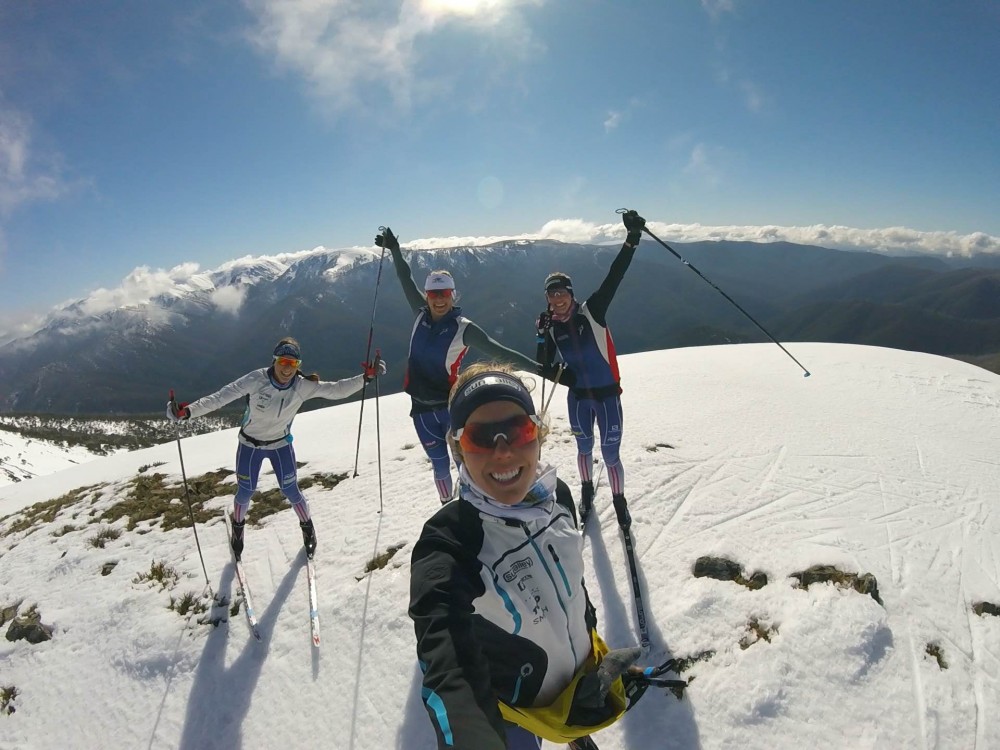
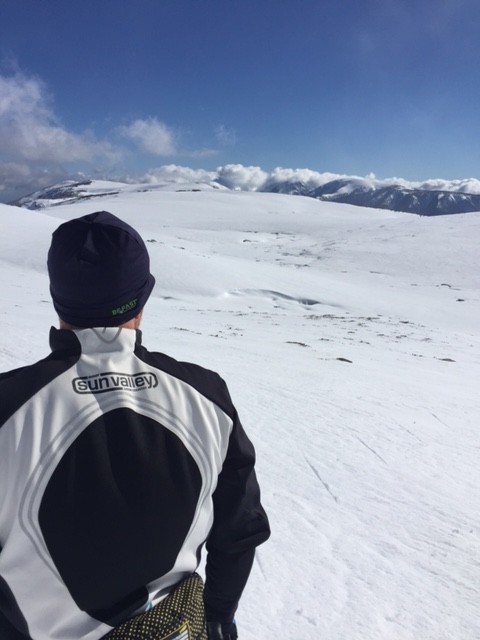
Sun Valley Ski Education Foundation Gold Team member Matt Gelso takes in the view during a ski at Falls Creek Resort in Victoria Australia in August. (Photo: Colin Rodgers)
“This is not spending a week on a glacier in summer, this is turning August into February, and it is a new experience for me, but a very positive one for ski training,” Gelso wrote in an email. “Not only getting on snow and getting the feel for skis, but being here for long enough that I can actually make gains is huge.”
Both Pokorny and Gelso pointed out that spending a month skiing in Australia is a memory they won’t forget.
“I have been wrapping my head around the sun being in the northern sky, and the north slopes being the warm, sunny side…. Pretty different,” Gelso wrote. “Also the trees, they have these Snowgum trees that don’t lose their leaves, it feels like the coast, it has taken some time to get used to it all.”
“My favorite part, by far, has been the landscapes we see on our long skis,” Porkorny wrote. “Snow capped mountains over green jungles, burned and growing gum trees, and violently changing weather have kept every training session interesting.”
Sun Valley Ski Education Foundation Gold Team member Matt Gelso during a ski at Falls Creek Resort in Victoria Australia in August. (Photo: Mary Rose)
Sun Valley Ski Education Foundation Gold Team members skiing at Falls Creek Resort in Victoria Australia in August. (Photo: Mary Rose)
Left to right: Sun Valley Ski Education Foundation Gold Team members Annie Pokorny, Mary Rose, Matt Gelso, and Kelsey Phinney during some dry land training in Falls Creek, Victoria, Australia (Photo: Colin Rogers)
Two skiers from the Sun Valley Ski Education Foundation Gold Team skiing at Falls Creek Resort in Victoria Australia in August. (Photo: Mary Rose)
The women’s skate sprint podium at Australian national championships in Falls Creek, Victoria. 1st Kelsey Phinney (center), 2nd Mary Rose (r), 3rd Deedra Irwin (not shown), 4th Nora Ulvang (Norway). (Photo: Mary Rose)
Sun Valley Ski Education Foundation Gold Team member Annie Pokorny during a classic ski at Falls Creek Resort in Victoria Australia in August. (Photo: Colin Rogers)
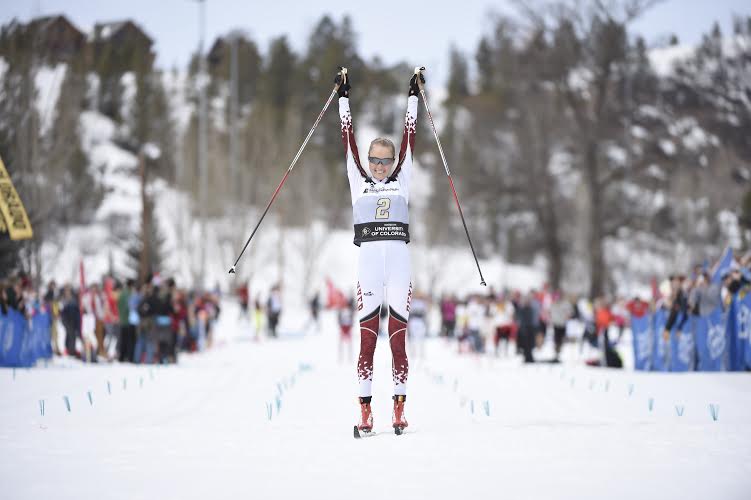
Linn Eriksen of the University of Denver celebrates her win in the women’s 15 k classic mass start at the 2016 NCAA Skiing Championships in Steamboat Springs, Colo. (Photo: Jamie Schwaberow/NCAA Photos)
In March, FasterSkier recently published an article (Part I) on college ski racing in the U.S. and what a change to National Collegiate Athletic Association (NCAA) Championships might require in regards to adding a sprint race. In the second part of the series, we explore why men’s and women’s race distances are different at the collegiate and World Cup level and whether this constitutes a need for change.
***
Men | Women. Women | Men. Scanning the athletics webpage for an American institution of higher education that boasts a varsity sports team becomes a sail down the Casiquiare canal, with gender bifurcation an obligatory outcome.
Resting under the canopy of NCAA sports, however, nordic skiing presents itself as somewhat of an anomaly. Shared race days. Shared coaches. Shared course site. Shared team. At the surface level, gender in collegiate nordic skiing is almost arbitrary.
Olivia Amber (r) of Colby College and teammate Amy Bianco celebrate their top-20 finishes in the women’s 15 k classic mass start at the 2016 NCAA Skiing Championships in Steamboat Springs, Colo. (Photo: Colby.edu)
Yet, closer inspection reveals one particular area in collegiate cross country skiing where the genders differ: Race distance. In most individual nordic events at the college level, the course length of women’s and men’s races are not the same. The trend is a 5-kilometer deficit for women’s race events in comparison to men’s events.
For Molly Peters, the head nordic coach at Saint Michael’s College and former NCAA All-American in nordic skiing for Middlebury College, this is a problem.
“We’re sending a message to all the young women who have a goal to ski in college,” Peters said in a phone interview. “I just can’t imagine that they feel like their equal as people or athletes when they look and they see, ‘Oh, look every single race I’m going to be skiing 5-kilometers less.’ How are men every going to look at women equally and how are women ever going to look at themselves as being equal if you’re always skiing 5-kilometers less?”
With that in mind, Peters promised herself to reshape the sport.
“It had to be my mission in life to get it changed,” Peters said. “I feel like my best bet to get it changed is to change the NCAA Championships because everyone bases all their racing off of what the NCAA does. Every EISA [Eastern Intercollegiate Ski Association] Carnival is basically not equal because they follow whatever the NCAA does. It all trickles down.”
The Trickle Effect: One Theory on Why Race Distances Differ
A single change can create countless more. When Title IX was passed in 1972, a change was instituted in the treatment of both genders by federally funded college institutions. Within the realm of campus athletics, the alteration brought about numerous others, including an increase in the number of women participating in college sports, the scope of sports available to women and men (in certain instances, harmfully so), and perceptions of women who choose to ‘play.’
Recent Middlebury College returnee, Annie Pokorny, points out that this sort of ‘trickle down’ change should not be looked at lightly.
“When women entered sport, some rules were tweaked to account for physiological differences, but also to support the idea that athletics could be harmful to women, (particularly their reproductive systems,” Pokorny wrote in an email.
Pokorny is completing her undergraduate senior thesis on feminist philosophy and the philosophy of sport. While she admits she is not an expert, her studies and experience in nordic skiing quantify her knowledge on the subject.
Pokorny explained that myths surrounding the female body and exercise in the 20th century, caused men “to adjust sport to make it safer and more “womanly”), which turned into a conceptual connection between women and the need to protect them.”
“That conception turned into tradition, one that still thrives today in the form of shortened distances for female endurance athletes,” Pokorny added.
The top 10 in the women’s 5 k freestyle race at the 2016 NCAA Skiing Championships in Steamboat Springs, Colo. (Photo: Matt Johnson/MSU)
For Pokorny and Peters, these types of traditions were made to be broken.
“The best things that have ever happened are from people changing tradition,” Peters said. “My purpose is to get the NCAA Championships changed to be the same distance for men and women because that will trickle down to the smaller races.”
But implementing change in the NCAA Championship event and NCAA skiing is no easy task.
“NCAA skiing is comprised of a wide variety of institutions: Division I, II and III; private and public; and large and small,” Dave Stewart, head nordic coach at the University of Denver, wrote in an email. “Any choices about race format, distances, etc. must take into consideration the perspectives of this diverse group and, ideally, the decisions should be made with the goal of broadening participation at the NCAA level and increasing competition.”
If Stewart is right, the question becomes: Would making race distances equal between men and women broaden participation and increase competition?
A Second Theory & the Distance Debate: Should Men Race Shorter or Women Race Farther?
When it comes to long distance endurance events, some research argues women fare better than men.
“Women can race just as long as men,” Montana State University (MSU) incoming senior Anika Miller said on the phone. “If [the NCAA] wanted us to do a 50 k in college, sure we could do it, but it wouldn’t make any sense athletically.”
Montana State University’s Anika Miller (l) with head coach Matt Johnson after Miller took won the women’s 5 k freestyle at the 2016 NCAA Skiing Championships in Steamboat Springs, Colo. (Courtesy photo)
Miller — a native of McCall, Idaho, and this year’s NCAA champion in the 5 k freestyle — doesn’t doubt the ability of women to race the same distance as men.
What she questions is whether it’s necessary for women to do so.
“It’s kind of a hard conversation to have as a female athlete because you don’t want to say that women are inferior,” Miller said. “My opinion on it is that the race distances are good as they are as far as women doing a shorter distance than the men. Because time wise … for the 15 k versus the 20 k at least, sometimes the guys only race it five minutes different than the women, which isn’t really that large of a margin, [meaning] effort wise, it’s more equal.”
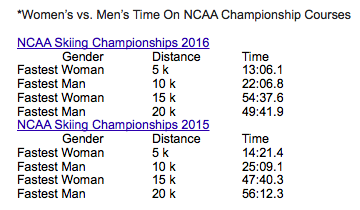
The point Miller makes is that women and men are currently racing equal. Equal amounts of time on course, at least in the 15 k and 20 k events (*see men’s and women’s course times).
Oscar Friedman, coming off his senior season at Dartmouth where he was a captain of the men’s nordic team, also argued that close to equal amounts of time on course is more important than equal course distances between men and women.
“The point of having those different race distances was to make the men’s and women’s races equally competitive,” Friedman said on the phone. “That being said, if women are internalizing it, then that’s a bigger issue. If there’s a push from within the sport, women should be the ones deciding the race distances.”
The push from women within the sport varies, but much revolves around whether women race longer or men race shorter distances. Kelsey Phinney, coming of her senior season and also a captain at Middlebury, admitted that originally the idea of equal distances didn’t appeal to her because she assumed women would be required to race farther.
“I think the misconception has been that equal distances meant that women had to race longer,” Phinney on the phone. “But it doesn’t mean that women have to go 10 k and 20 k it could mean that men go 5 k and 15 k. Or that the races range from sprints to 30 k.”
Rachel Hampton, an incoming senior at Harvard University, advocated that while women are capable of racing men’s distances, men would benefit from racing shorter lengths.
“There’s a feminist side of me that wants to say that girls can do anything boys can do and there’s no theological reason why we shouldn’t be able to race the same distance as them,” Hampton said on the phone.
“I will say I sometimes feel bad for the guys because it seems like they only race long races. I think if we added sprinting and a few 5 k races for the guys and did a wider range of distances, that would be better for them. And I think if the men were on that plan, the women could then get on the same distance plan.”
However, when men competing in college were asked if they would be willing to race the same length as women, responses were often shaped by race distances at other levels of nordic competition.
“Shortening the men’s distances would be a huge disservice because as I see it, the goal of NCAA skiing is to make American skiers as competitive as possible on the World Cup,” Friedman said. “I would be completely against shortening the men’s races. But if women want to make the call and race longer, they should fully be able to do that.”
For a few women, however, simply adjusting the women’s race lengths to match those of the men sends a certain message: Women have to be like men to be equal.
“I think the message it sends depends a lot on whether you shorten the distance of men or you increase the distance that women have to race,” Bates College ’16 grad and skier Britta Clark said on the phone. “Trying to increase the distance that we race in the name of equality, but at the same time really just saying that equality is women doing what men do, I don’t think it’s necessarily speaking to the issue.”
Clark’s point is supported by Dartmouth College Women’s Head Nordic coach and Director of Skiing Cami Thompson-Graves, also a member of the NCAA Men’s and Women’s Skiing Rules Committee, chair of the USSA Cross Country Committee, and most recently, a member of the International Ski Federation(FIS) Ladies’ Cross Country Committee.
“I don’t feel the need for women to do men’s distances,” Thompson-Graves said on the phone. “Why don’t we just do women’s distances? Why can’t we just be different … I’m a big believer in being proud to be a woman, and not a little man.”
Harvard’s Rachel Hampton leads a Dartmouth skier during the 2016 Colby Carnival. Hampton went on to compete at the NCAA Skiing Championships in Steamboat Springs, Colo. (Photo: FlyingPointRoad.com/Harvard Facebook)
Increasing women’s distances strikes some as a forfeiture of female identity for one that is male. Which is one reason Peters more strongly advocates for decreasing men’s distances to be the same length as women’s.
“In skiing, I think the men should come down,” Peters said. “The 20 k is really irrelevant, even at the international level. I see nothing wrong with the 5 k, I think men should do 5 k. Five k is super exciting and can be a great race. I think it should be 5 k, 10 k, 15 k, and then add in the relays and sprints.”
However, a men’s 5 k race doesn’t appear on numerous nordic race calendars — national or international — either.
“I don’t think at the national or international level men race 5 k so maybe that’s a distance skill set that would only be applicable to college skiing in the U.S.,” Raleigh Goessling, coming of his senior season at the University of New Hampshire, said on the phone. “If the race distances were changed, I feel like the distances that are contested at other levels of the sport and other formats should also play into it.”
The Window Between U.S. College Racing and the World Cup
At the international level, women and men rarely race the same distance. FIS course lengths — like the NCAA — are designed around the gender of the athletes competing.
FIS Cross-Country Committee Chair and Norwegian Olympian Vegard Ulvang indicated that similar to college racing in the U.S., FIS race distances have been different for decades. One potential reason for these differences aligns with Porkorny’s findings. According to Ulvang, how female athletes were viewed in endurance sports when they started ski racing influenced the original length of women’s race courses.
“The history behind the differences comes from the time where the nations believed that women were weaker — [with the] first female race in 1952,” Ulvang wrote in an email to FasterSkier. “Today we of course know better. Female athletes are better prepared for longer distances than men, so principally the distances should be equal.”
Principality does not always equal response. Ulvang indicated that even if the race distances should principally be equal, one major driving force for the committee to keep women’s race distances shorter than men’s rests on the race experience for spectators.
“The argument has been that the time gap between the 20 best women is bigger than that of the men,” Ulvang wrote. “Longer distances would create a ‘worse TV product’ — with one racer skiing alone [during the race].”
T.V. time does not strike Peters as an excuse for NCAA Championships and U.S. college cross-country ski schedules to follow the same format as the World Cup.
The men’s 20 k classic mass start at the 2016 NCAA Skiing Championships in Steamboat Springs, Colo. (Photo: Jamie Schwaberow/NCAA)
“A lot of people will say well, look at what they do at the Olympics, and look at what they do at the World Cup — it’s vastly different,” Peters said. “The women do so much less. But that doesn’t make it right. That’s a reason why NCAA follows it and EISA follows it, but that doesn’t make it right.”
Stewart, who has helped the Denver Pioneers achieve five NCAA Championship titles, supports the idea that NCAA skiing in the U.S. could act as a catalyst for change.
“As long as FIS schedules longer races for men than for women in international championships, there will be some resistance to equal distances at other levels, but I see no reason why the NCAA should not be a trendsetter and work to turn the tide on this,” Stewart wrote in an email.
He supports equal distances in cross-country skiing, seeing it as a statement that should be sport-wide, not just within NCAA nordic skiing.
“Equal distances for men and women should be implemented in our sport, both at the NCAA and international levels,” Stewart wrote. “We have had equal distances in the sports of swimming and track and field at the international and collegiate levels for many years. Equal distances would reinforce gender equity and would send the right message about our sport.”
Yet, when it comes to World Cup race lengths versus those contested at the NCAA, some argue the Championship event is already sending a message to other levels of cross country competition.
“I actually think that NCAA’s, where the women race 15 k and the men race 20 k, is much more equal than on the World Cup when the women race 15 k and the men race 30 k,” Rosie Brennan, Dartmouth grad and current U.S. Ski Team (USST) member, said on the phone.
Brennan is not opposed to a more balanced race length distribution between men and women. Her concern with changing race distances at the World Cup and NCAA collegiate level is ensuring that the racers’ performance and perspective are taken into account.
“I think it would be nice if they tried to make the [race distances] a little closer,” Brennan said. “I also think the reason the distances were different in the first place was the idea that the time the race takes should be fairly equivalent, so the effort is the same. If the time differences [between men and women] are getting to be much greater, to the point that the races are no longer requiring the same amount of effort, then I think it’s worth proposing some sort of a change and [is] something to re-visit over time.”
Brennan’s suggestion to visit the race experience for athletes doesn’t go unsupported. Men’s and women’s race distance differences have been discussed at the collegiate and World Cup level. But the actual number of times the topic has been statistically ‘re-visited’ remains a bit blurry.
Regarding conversations within the college circuit, Peters indicates that implementing changes to men’s and women’s race distances has been thrown around for some time.
“Patty Ross, who coaches at Middlebury, she’s been fighting it for 25 to 30 years and she’s had no success,” Peters said.
Ross could not be reached for comment.
Within the FIS Cross Country Committee, Ulvang indicated that the turn of the millennium was when most conversations regarding the different course lengths at the World Cup level of racing began.
“[The] question has been discussed in the FIS committee a few times the last 15 years,” Ulvang wrote.
Beyond that, four-time Olympian, USST member, Fast and Female USA President, FIS athlete rep, and now a new mother Kikkan Randall revealed that World Cup athletes have also had at least one opportunity to make their opinion about equal distances known.
Fast and Female USA President Kikkan Randall leading a Fast and Female session two years ago in Bend, Ore. (Photo: Matt Whitcomb)
“It’s an interesting topic that actually comes up quite often on the World Cup,” Randall said. “As the athlete rep to FIS, I do a survey at the end of each season and couple years ago, as part of the survey, I sent out that question [of equal distances].”
The responses Randall received found most women on the World Cup circuit — at least a few years ago — did not want to race the same distances as men.
“The majority of women actually said that they were not interested in racing the same distances as the men,” she said. “I’m considering putting that same question on the survey again this year because the comment was brought up a couple times this spring.”
And how might women racing on the World Cup respond to shortening men’s distances to make the lengths equal? The question has not been posed, but Randall may incorporate it into her next athlete poll.
“That would be another interesting take on the same question,” Randall said. “This year on the World Cup I feel like the distances were reduced a little bit with so many tour [multi-stage] events, so again it’d be an interesting time to poll the athletes and see how they feel.”
Conclusion: Connecting Part I and Part II
As long as there is snow around, colleges with nordic programs in the U.S. will continue to attract a cohort of cross-country skiers looking to compete, while simultaneously continuing their education. For many, choosing college over a club team is not the end of a cross-country skier’s long term career. It is also the potential beginning.
“The way our country is, you’re always going to have athletes choosing to go to college after high school no matter what path they’re on,” Brennan said. “So I think the more that that can be facilitated, the better it is. I mean there are a lot of good club programs that offer alternatives for people who choose that, but I think the NCAA can provide a route as well.”
Some individuals also see the NCAA as an opportunity for Americans to attend college in the U.S. and potentially compete against athletes from other countries.
“As a venue for athletes to develop into international level skiers, [the NCAA circuit] is a great place because there are really high-level skiers from all over the world in the small microcosm of NCAA skiing,” Chad Salmela, outgoing nordic coach of the College of St. Scholastica, said on the phone.
With an assured influx of athletes choosing skiing and school — and the opportunity for some to race international athletes at ‘home’ — many don’t deny the difficulty of disconnecting U.S. collegiate racing and higher levels of nordic competition.
“From a purely objective standpoint, I would say that a junior athlete who chooses to skip college (at least until they are completely done with their racing career, whenever that may be) and pursue ski racing full-time starting at age 18, is much better set up to ski faster on the World Cup level later in their career,” current USST member and former Middlebury skier Simi Hamilton wrote in an email.
“However, because of the small numbers of junior skiers we have in our country (relative to all the other skiing powerhouse nations), college is a great way to keep kids engaged and in touch with racing during a period of their lives when they may have decided they want to do something completely different,” he added.
Yet, if NCAA racing is to preserve itself as one potential path for athletes looking to make professional steps in the sport, college and World Cup racers alike agree that conversations about change — be those for adding sprinting or making race distances equal between men and women — need to continue.
“I think incorporating sprints at the NCAA is definitely worth talking about and pushing forward because that’s at least one-third of the races we do [on the World Cup], if not more,” Brennan said. “I think trying to stay current is a valuable thing.”
Ida Sargent, a Dartmouth grad and current USST member, agreed that sprinting deserves spotlight attention in present-day skiing.
“I can obviously only speak for the women’s distances but I liked how there was a short and a longer distance race,” Sargent wrote in an email regarding NCAA race distances. “I think a more important change would be adding in more sprint races. We race a sprint almost every weekend on the World Cup and when I was in college we would have one a year at the most.”
With one more year of college racing left at MSU, Miller also pushed adding more sprint races to the college race circuit to foster cross country skiers’ development.
“I think it’s unfortunate that we don’t have sprinting,” she said. “Because that’s such a great development tool.”
Though Miller and Sargent are at odds with Pokorny’s press for equal distances, all three do seem to agree that changing customs can create better opportunities and a better outlook for cross-country skiers.
Annie Pokorny racing to 33rd in the 10 k classic at the 2014 U23 World Championships in Val di Fiemme, Italy. (Photo: Flyingpointroad.com/NNF)
This week, the top collegiate cross-country skiers in the U.S. converged in Steamboat Springs, Colo., to wrap up the season at the NCAA Skiing Championships, which begin Thursday with the 5/10-kilometer freestyle individual starts and wrap up Saturday with the 15/20 k classic mass starts. One Middlebury skier has the unique opportunity to be reimmersed in the collegiate circuit after a glimpse at post-collegiate skiing and will race for the NCAA podium with a different appreciation for collegiate competition.
Annie Pokorny, 23, returned to the collegiate racing circuit this season after a two-year hiatus while training and racing with the Stratton Mountain School T2 Team. Although this is a rare progression, it was a path that has allowed her a different depth of experience in the sport.
Skiing for Middlebury College, Pokorny had a breakthrough season in 2013 as a sophomore where she netted two top-10 finishes at U.S. nationals in Midway, Utah, and finished in the top 30 twice at U23 World Championships in Liberec, Czech Republic. The season reflected a huge improvement over the previous year where she finished 47th in the 10 k freestyle at U.S. nationals.
Although most collegiate skiers who continue onto the professional level exhaust their eligibility before moving on, Pokorny wanted take the sport to the next level sooner rather than later. In the spring of 2013, the Spokane, Wash., native made the difficult-but-measured decision to join the SMST2 team based out of Stratton, Vt. Pokorny was excited to be a part of the culture of success SMST2 built and join World Cup-level skiers such as Jessie Diggins and Sophie Caldwell. She also knew the opportunity might not present itself in another two years after she graduated and wanted to capitalize on her momentum by training and racing full time.
Annie Pokorny (SMST2) at the top of the coach’s climb during a training day before the December 2015 SuperTour in Sun Valley, Idaho.
While training and racing with SMST2, Pokorny continued to take classes at Middlebury and balanced coursework with an international race schedule. She would take the fall semester off when training volume was high and take classes full time in the spring.
“The logistics have certainly been complicated, coordinating with professors to miss multiple weeks or months of class by Skyping into lectures (an idea inspired by Sadie Bjornsen), writing additional essays and navigating the black hole that is European village internet,” Pokorny wrote in an email. “However, I got to take advantage of the international racing available to me; finding balance never felt like a sacrifice.”
While Pokorny has posted solid results the past two seasons with SMST2, another breakthrough season proved elusive. With both her skiing and academic goals in mind, Pokorny made another pivitol decision — to return to college racing.
“I decided to return to college racing because it gave me the chance to have six weeks of consistent, competitive, comped racing while also allowing me the structure to take a full course load and graduate in the spring,” she explained.
However, the process of returning to collegiate racing required more than just agreement from her coaches. Because collegiate cross-country skiing is an NCAA sport, athletes must abide by the NCAA amateurism rules and in the eyes of the NCAA, Pokorny was considered a professional athlete while skiing for SMST2.
However, since Pokorny could prove she never made money from racing at SMST2, she was eligible to return to the collegiate circuit after being reinstated as a Middlebury athlete as a senior with junior eligibility. To ensure everything was in order before she put on a Middlebury suit, Pokorny sat out the first two carnival races.
Annie Pokorny (l) with several Stratton Mountain School (SMS) T2 teammates in 2014. (Photo: SMST2 Blog)
Although it was a process, Pokorny said she felt supported in her decision from Middlebury, SMST2 and the ski community.
“Patrick O’Brien and Sverre Caldwell at SMST2 showed an immense amount of support for me returning to collegiate racing, which I’m glad I had before starting the process of returning,” she wrote. “When we knew I had eligibility, the Middlebury program communicated that to the rest of the Eastern Intercollegiate Ski Association (EISA) circuit and I received nothing but support from every coach and competitor.”
Pokorny describes her transition back as “nearly seamless.” In addition to being welcomed back to the team and collegiate racing, being on campus and attending lectures eliminated the stress of remote coursework.
She has also returned as a force on the EISA circuit, winning the 5 k classic pursuit at the Williams Carnival, the 5 k freestyle at Middlebury Carnival, taking second in the 10 k classic at University of Vermont Carnival and earning a berth to NCAA Championships.
“On the skiing side, I think one of the valuable lessons of skiing internationally is that it teaches you a certain flexibility and ability to navigate with new waxing, coaching and racing situations, so everything leading up to the races felt completely normal to me,” she wrote. “The Midd coaches, Andrew Johnson and Patty Ross, have worked to make sure that I felt supported on training and race days while the entire Midd team embraced my return like I was coming home.”
The transition also illuminated the unique and constructive culture of collegiate racing and how it can pave the way for international racing.
“I suppose one way my perspective has changed is that as an older, more experienced racer, I can appreciate the details that make racing NCAA a standout experience,” she explained. “In addition to the team culture and glitter and pride in representing your school, I can better see how what we learn on this circuit can transfer to international racing. The practice in mass starts, for one, and scoring points for and representing something greater than yourself, for another, are two things that will contribute to my racing after I graduate.”
Although it is easy to think that skier development is a linear process, this is rarely, if ever, the case. Pokorny’s grounded thoughts on her journey illustrate this phenomenon. There are lessons that can be taken from every race, from every experience despite if an athlete is aware and open to growth.
“I never considered returning to college racing a step back, but rather a step sideways, onto another incredibly competitive circuit that would contribute to my growth as a skier,” she wrote. “In the past three seasons, I have had some incredible experiences and feel that I have grown as a skier in so many different ways. I would never choose a different path, circuitous as it was.”
Julbo, the French eyewear brand dedicated to Mountain Performance Eyewear has increased its Nordic skiing presence in the United States with strong results and a focused core of skiing athletes. “This is my second season on the Julbo Team, and it’s an honor to be a part of such a successful, adventurous and inspiring group,” explained Noah Hoffman.
Hoffman leads a crew of Nordic athletes that include recent National Champion Scott Patterson, APU racer Lex Treinen, SMS/ T2 racers Ben Saxton and Annie Pokorny, U23 team member, Heather Mooney, and former Birkie Winner and national stalwart, Matt Liebsch.
Annie Pokorny (SMST2) at the top of the coach’s climb for the SuperTour 1.3 k classic race course in Sun Valley, Idaho.
SUN VALLEY, Idaho — Armed with plenty of shovels and smiles, the Sun Valley Ski Education Foundation crew has been moving snow to make the next stop on the SuperTour circuit happen at the Lake Creek venue in Sun Valley, Idaho.
“We’re cautiously optimistic that we’ll be able to do both races [at Lake Creek], with the sprint race happening here for sure,” Sun Valley Ski Education Foundation (SVSEF) Nordic Director Rick Kapala said on Wednesday afternoon.
With close to six inches of snow currently covering the trails, according to Sun Valley’s assistant nordic program director Kelly Sinnott, local volunteers and coaches are putting their shovels to work to increase that numerical amount by the work hour.
The SuperTour races are scheduled for Saturday and Sunday, with a classic sprint followed by 10- and 15-kilometer classic individual starts. On Thursday morning, temperatures were below freezing, around 28 degrees Fahrenheit in Sun Valley.
“We spent hours [on Tuesday] shoveling the course and there’s a crew out there today as well,” Sinnott said on Wednesday.
While a decent snow storm might be the preferred way of covering the race course, many of the volunteers don’t seem to mind scooping snow for the sake of this weekend’s SuperTour races.
“I was out here yesterday, I would say three-plus hours,” said Mel Dyke, of Hailey, Idaho, a snow-shoveling volunteer, and webmaster for 5B Nordic News.
(Left to right): Mel Dyke (volunteer), Kate Barton (Burke Mountain Academy coach) and Colin Rogers (SVSEF Gold Team head coach) push a sled full of snow on Wednesday afternoon to dump onto the SuperTour 10/15 k classic distance race course in Sun Valley, Idaho.
“There were three crews of 15-20 people yesterday,” he said. “I’m just doing it because it’s fun.”
While pushing snow piles is not everyone’s idea of “fun,” the dedicated group of individuals working out on the trails for free will make the Sun Valley SuperTour races possible.
“We’ve got a community of people that just jump in and do it. And we’ve had a few low snow years so we’ve had to do a lot of this,” said Bob Rosso, another volunteer and owners of Elephant’s Perch sports speciality shop in Ketchum.
“We’re die hard cross-country skiers,” Rosso added. “When the race coordinators call out for help, people show up.”
Still, even with a soldiery of willing snow-shovelers, why not use host trails with enough coverage nearby?
Kapala points to the quality of the race course at Lake Creek as motivation for making it the preferred race site.
“One of the biggest concerns that the coaching community has with regards to the early SuperTours is that we’re able to have appropriately difficult courses,” Kapala said.
“We could go to Galena, and we could make the races work there … but putting the work in here gives the athletes an opportunity to test themselves appropriately on the kinds of courses that they need to be prepared to ski on,” he said. “These are homologated, FIS [International Ski Federation-standard] courses, they have A-climbs and that’s important.”
On top of the promise of challenging racers, the Lake Creek venue offers coaches, spectators and skiers a perspective like no other.
“One of the unique things about the Lake Creek venue, is it’s really open,” said Kapala. “You can stand in one spot and watch the entire race happen.”
Kids ski around the SuperTour 1.3 k classic sprint course, while athletes and coaches convene in the Lake Creek stadium center in Sun Valley, Idaho.
Alex Howe (CGRP) (r) leads Caitlin Patterson (CGRP) Wednesday morning before the last downhill of the SuperTour 1.3 k classic sprint course in Sun Valley, Idaho.
Paddy Caldwell (SMST2) rounds a turn while teammates stride up the coaches’ climb in the the background during a Wednesday morning ski on the SuperTour 1.3 k classic sprint course in Sun Valley, Idaho.
Heather Mooney (CGRP) smiles and strides into the final turn before the las downhill on the SuperTour 1.3 k classic sprint course in Sun Valley, Idaho.
Wednesday morning, skiers from Stratton Mountain School and the Craftsbury Green Racing Project practice striding up the coach’s climb of the SuperTour 1.3 k classic sprint course in Sun Valley, Idaho.
Bob Rosso, with shovel in hand and plenty to spare, is ready to help scoop snow Wednesday afternoon onto the SuperTour 10/15 k classic distance race course in Sun Valley, Idaho.
Comp coach Tom Smith (SVSEF) (r) pulls Gold Team head coach, Colin Rogers (SVSEF) out to shovel snow onto the SuperTour 10/15 k classic distance race course in Sun Valley, Idaho.
Left to right: Sam East, Mel Dyke, and Grace Dyke get ready to hit the trails with their shovels and smiles.
Volunteers (left to right) Grace Dyke, Mel Dyke, Sam East, and Gary Storey trek across the Lake Creek trail bridge on Wednesday afternoon to shovel snow onto the SuperTour 10/15 k classic distance race course in Sun Valley, Idaho.
Head coach for SMST2 Patrick O’Brien and Mike Sinnott pushing piles of snow Wednesday afternoon onto the SuperTour 10/15 k classic distance race course in Sun Valley, Idaho.
Bob Rosso, Mike Sinnott, Gary Storey, Kate Barton, Kelly McClowskey, and Colin Rogers shovel snow onto the SuperTour 10/15 k classic distance race course in Sun Valley, Idaho, in 2015.
“When the race coordinators call out for help, people show up,” says Rosso while shoveling snow Wednesday afternoon onto the SuperTour 10/15 k classic distance race course in Sun Valley, Idaho.
WEST YELLOWSTONE, Mont.– While the Yellowstone Ski Festival crew is plenty busy grooming the trails with the fresh snow fall Wednesday, many skiers are also busy grooming their upper lip. In the spirit of no-shave “Movember,” FasterSkier decided to rank the top mustaches found out on the trails. Ranking decisions were made based off the official rules according to the Movember Foundation, as well as an individual’s responses, and overall look.
The photo gallery shows our picks for the Top 10 Movember Men. This is followed by the Top Five Movember Women*, abbreviated because of the number of women who participated*. The gallery is rounded out with the top-three Bearded Honorable Mentions.
Why this ‘stache: “I’m just a poor college student and I can’t afford a razor,” said Parr. “I’ve been working on this for quite a while, not going to lie, I cheated a little bit. Started this back in June to prepare for this month. It’s a big month, there’s Yellowstone races, you have to show up and look tough and having facial hair is a big part of that,” added Dubay.
Why this ‘stache: “I thought it looked pretty good.”
Why this ‘stache: “Been growing it since November first. Started as a full beard, then I went to a goatee for a couple days. A lot of people didn’t like that, now I have handle bars,” said Michaud. “It’s really thick and full,” voiced Diekmann.
Why this ‘stache: “First, it started because a professor called me out last year for not having a mustache during November. That was number one. And then two, coming out to Montana from Minnesota, I’m thinking, I gotta get that ski bro..pretty laid back look.”
Why this ‘stache: “It’s been a very important month preparing for this moment.”
Why this ‘stache: “I had a big beard up until three or four days ago. We had a fundraiser for our team, it’s call Nordic Fest, a nordic themed dinner/silent auction. At the end of the night, someone had the idea [that] we could auction off shaving my beard. People threw up money like crazy and we raised over $600.00 for it. Now I’ve got this mustache.”
Why this ‘stache: “You can use the mustache to double check the kick wax of the day. For example, I’m using Extra Blue today to wax my mustache and it’s clearly the right wax for the day.”
Why this ‘stache: “It started on a hunting trip in September. It got hearty enough, that I had more than I ever had before, so I figured I just had to keep it going. I made a deal with the girlfriend that I could keep it until I got home from the SuperTours this fall. I look mean, but it makes the ‘stache look better that way.”
Why this ‘stache: “It reminds me of Colonel Mustard,” said Bean. “I don’t really know…,” Guiney reflected.
Why this ‘stache: “It’s a classic.”
Why this ‘stache: “It’s a modern twist on a classic ‘stache.”
Why this ‘stache: I chose this mustache because it has attitude, but it’s also business-like, which is how I feel I try to ski. You want to take what you’re doing seriously, but not take yourself too seriously, [and] I feel like ‘No Shave November’ really encapsulates that lifestyle.”
Why this look: “Oh, I just always have a beard.”
Why this look: “I really don’t like my facial shape. So it’s sort of to make an illusion that I have a better shape than I have.”
Why this look: “It didn’t really happen on purpose or anything. Starting in October I felt like I’d try it out, and that’s all there really is to it.”
Along with getting the history behind the facial hair, FS asked athletes about their race goals for the weekend and beyond:
Annie Pokorny (SMST2): “Be one of the top girls going into the season.”
Sloan Storey (University of Utah): “Just getting back into it, waking my body up, and having fun.”
Liz Guiney (CGRP): “Get the first races out of the way and have fun.”
Miles Havlick (SVSEF): “Should be a good weekend to get into the racing routine.”
Chris Parr (Unaffiliated): “To try and not to shave … I’m hoping I can hold off, it’s tempting.”
Joe Dubay (Unaffiliated): “I’m going to try not to let the icicles on my beard get too out of control.”
Nicholas Michaud (BSF): “Have the best mustache in the A-final on Friday.”
Eric Packer (APU): “First race of the year you’re always trying to put down a good effort and practice all of the things you worked on over the summer. My biggest goal is to go out there and ski really well.”
Akeo Maifeld-Carucci (BSF): “Make sure my mustache is looking real good at the finish.”
Reese Hanneman (APU): “I’m focusing on the sprint and hoping for an elite podium.”
WILLISTON, VT- Since entering the nordic ski market in the U.S. in early January of 2015, Julbo Eyewear and its network of athletes have wasted no time making their mark on competition at all levels. Former Birkie winner, Matt Liebsch kicked off the marathon season with wins in the Sisu Marathon in Ironwood, Michigan, a win at the City of the Lakes Loppett and an American Mora Vassaloppet victory (his 6th victory in the race). He will toe the line in the American Birkebeiner later this month.
Lex Treinen continued a strong domestic campaign, after a silver medal at this year’s U.S. Cross Country Championships, with multiple top five finishes included a third place finish at the recent Craftsbury Super Tour 15K Classic event. Treinen will head to Europe to compete in Europa Cup events next week.
Meanwhile in Europe, Julbo athletes, Ben Saxton and Annie Pokorny qualified and raced in the U23 World Championships held in Almaty, Kazakhstan. Saxton faired particularly well taking home a sixth place finish in the classic sprint and earning a discretionary spot on the U.S. World Championship team to compete next week in Falun, Sweden.
“It has been a goal of mine all year long to make the World Championship team, and there’s no way I would have been able to perform a the level to do so without my sponsors. My Julbo eyewear allow me to forget about any vision worries and race at a World Championship level, there is no other company I would want to work with,” Saxton explained.
Saxton will join fellow U.S. Ski Team member and fellow Julbo Athlete, Noah Hoffman who has made a strong recovery after breaking his leg in the opening World Cup Weekend in Finland back in early December. Hoffman explained, “I feel incredibly lucky to be heading back to the World Cup and to the World Championships in Falun. After breaking my leg in the first race of the season, my recovery has gone as quickly and smoothly as anyone could have hoped. I could not have done it without the help of a world class medical team. I am very excited and nervous to return to racing. I have some great opportunities to accomplish my goals and make progress towards my career goal of being the best cross country skier in the world. I am also excited to be joining a team of incredible athletes who are building momentum as the season progresses.”
Julbo cross country athletes use a variety of Julbo styles, all with photochromic lenses, including the Sniper, the Venturi, and the Dust. For more information, log onto www.julbousa.com
Julbo USA is excited to announce its entrance into the high end cross country ski market and the addition of elite U.S. Nordic skiers.With over 125 years in business, the eyewear brand based in France’s Jura Mountains has a profound history in the mountaineering and ski mountaineering worlds. From this history, Julbo eyewear has produced unrivaled technical products geared towards mountain and snow sports. “We’re a mountain brand with followings from sports that require highly technical products,” explained Julbo USA CEO, Nick Yardley. “If you look at the Julbo culture, you see people in mountaineering, backcountry skiing, ultra and trail running and enduro mountain biking. Cross country skiing at the high end is an obvious pairing for us”
Julbo USA Cross Country athletes this year include U.S. Team members, Noah Hoffman and Ben Saxton, former Birkebeiner winner, Matt Liebsch and elite racers Annie Pokorny of the Stratton/T2 team and Lex Treinen of the APU program.
“When I started looking into who is on the Julbo team, I knew they must make great products. The headliner for the team is Frenchman Martin Fourcade, arguably the best biathlete in the world. Fourcade is a two-time Olympic champion (in Sochi), a five-time World Champion and three-time winner of the overall World Cup for biathlon. Also on the Julbo team are Glen Plake (U.S. big mountain skier who you may have seen in any number of ski films with his trademark blond Mohawk), Dylan Bowman (an ultra-marathoner living in Aspen who I admire through a mutual friend) and my teammate on the U.S. Ski Team for cross country Ben Saxton. I am proud to be on the Julbo team with these athletes,”
Cross country athletes have their choice of models to select from Julbo’s performance lineup. The Julbo Sniper being the single product that all athletes selected.
For more information on Julbo eyewear and Julbo products, see their US website: www.julbousa.com
Alysson Marshall (AWCA/NST) in bib 4 and Heidi Widmer (AWCA/NST) in bib 1 lead (from l-r) Rosie Brennan (APU), Eva Severrus (UNM), Chelsea Holmes (APU) and Jennie Bender (BSF) in the women’s A-final of the 2014 West Yellowstone SuperTour freestyle sprint. Marshall won the event with Widmer and Bender finishing second and third.
WEST YELLOWSTONE, Mont. — Alysson Marshall had plenty of opportunities to practice her finishing lunge in Friday’s SuperTour freestyle sprint in West Yellowstone.
The Canadian National Development Team member, who skis for the Alberta World Cup Academy (ACWA) in Canmore, Alberta, barely earned an automatic qualifying spot in her quarterfinal after outlunging Stratton Mountain School (SMS) T2 skier Erika Flowers for second place in the heat.
Alysson Marshall (AWACA/NST) racing to a fourth place finish in the qualification round of Friday’s SuperTour freestyle sprint in West Yellowstone, Mont. Marshall went on to win the event.
In the semifinal, Marshall was neck-and-neck with University of New Mexico’s Eva Severrus, but was able to eke out a position in the A-final despite finishing in fourth behind her competitor. Both Severrus and Marshall earned the lucky loser positions as their times were faster than the second semifinal’s third-place finisher, Becca Rorabaugh of Alaska Pacific University (APU).
When it came to the last heat of the day, Marshall positioned herself in third for most of the A-final. When she reached the finishing stretch into the stadium, however, she surged past APU’s Chelsea Holmes to go head-to-head with fellow AWCA and Canadian national team member Heidi Widmer. As the two approached the finish, Marshall did what she had been doing all day and lunged for the win.
Her practice paid off as she edged Widmer by 0.28 seconds.
“In sprint races, I tend to get stronger as it goes on, so I felt good in the final and had enough in the final kick,” Marshall said.
Marshall, who has competed in both the Canadian and international World Cup circuits, said that the result was an indication that she was on the right track for her season goals. While she considered Friday’s sprint a warmup and acknowledged that anyone in the A-final could have nabbed the top spot, she said that her win was a confidence boost that would serve her well in future races.
Just a boot length behind Marshall, Widmer lost steam in the finishing stretch of the 1.5-kilometer race.
“I felt really strong but I’m a little disappointed that I lost in that little finishing stretch there… It’s nice to have it under the belt and get into the rhythm of ski racing,” the 2014 Olympian said after finishing the A-final.
Heidi Widmer (AWCA/NST) racing to a first place finish in Friday’s SuperTour freestyle sprint qualification round. She finished second in the A-final behind teammate Alysson Marshall.
Widmer started the day with a strong finish in the qualification round, where she placed first ahead of Annie Pokorny (SMST2) and Rosie Brennan (APU), who were second and third, respectively.
The qualification result propelled Widmer throughout the heats as she won both her quarterfinal and semifinal by healthy margins.
Like Marshall, Widmer said that the result added to her confidence but had no concrete significance regarding her season goals – racing on the World Cup and skiing at the 2015 World Championships in Falun, Sweden.
Despite the significance of the race, Widmer said the American competition was refreshing, as Canadian sprint heats are often only competitive in the final.
“It is always good to practice skiing in the heats… getting used to that kind of stuff, especially when we can come down to the states and ski in more competitive heats,” she said. “In Canada we have great skiers, but often it won’t really come together until the final, so we won’t have a competitive heat until the final.”
Two-time U.S. National sprint champion Jennie Bender (Bridger Ski Foundation), agreed, saying that the competition, especially in the A-final, was “stacked.”
Bender, who finished in third position as the top American, fought back after 17th in qualification to handily win her quarterfinal and semifinal.
Once in the A-final, Bender said that it was one most competitive heats she has ever raced, with all six women jostling for a strategic position the entire 1.5 k.
“It was fun and awesome, but scary because you’re in self-preservation mode and you’re trying to hold your line,” she explained. “That was one of the closest finals I’ve had in a long time — just five of us right there.”
Bender, who was in fifth as the skiers crested the final hill into the stadium, looked to find an opening in which she could make her move.
All that was open between the five skiers was a gap to her far right. Although she had to use precious time to place herself into the opening, Bender explained that she believed it was better than the alternative of sitting in behind another athlete.
“You pick [an opening] and you go for it, there’s no time to really jump in behind anyone in my opinion,” she said.
Jennie Bender (BSF) was the first American in Friday’s SuperTour freestyle sprint in West Yellowstone, Mont. She finished the day 3rd overall. (Photo: Toko)
Bender was happy with her third-place finish, but acknowledged that she needed to improve if she wanted to accomplish her season goal of making World Championships.
“I have high expectations for myself, and this is what I wanted to do,” she said. “So, a podium’s good – it’s okay, but it’s not first.”
Just five-hundredths of a second behind Bender was Holmes, positioned in second before Marshall and Bender passed her in the finishing stretch.
Holmes, who qualified in seventh and is traditionally a stronger distance skier, said she was excited to perform well in sprinting and explained that it was a testament to the work she has put into her training the past year.
She said that what set her apart from much of Friday’s field was her ability to climb the final hill into the stadium.
Her teammate, Brennan was also in the hunt for a position on the podium. The 2014 national champion in the classic sprint was a favorite for the top spot and skied both a strong quarterfinal and semifinal to make her way into the A-final.
Brennan said that she was happy with her fifth-place finish and explained it was a victory in itself that she was racing Friday because of the many difficulties she has dealt with in the previous months.
Rounding out the A-final was Severrus, a Slovenian who skis for University of New Mexico. She finished sixth, 1.8 seconds behind Marshall.
Despite the high spirits of the SuperTour racers, there were several organizational issues that caused the day to be longer than planned.
As skiers prepared for their second round of heats, several coaches, including Sun Valley’s Rick Kapala and Stratton’s Patrick O’Brien noticed that the semifinal lists were incorrectly ordered. While the issue was eventually fixed, racing was postponed, leaving skiers in the cold wind while they waited for their start order.
The incorrect order of the men’s semifinal would soon become the least of the organizers’ worries as it was soon discovered that they had incorrectly placed Hailey Swirbul (Aspen Valley Ski Club) into one of the women’s semifinals.
Swirbul had placed fourth in the quarterfinal, 3.03 seconds behind Flowers, but the results read that Swirbul had instead finished ahead of Flowers.
Flowers and several other members of SMST2 alerted organizers of the mishap, but it wasn’t until Swirbul herself came forward that the timers reversed the placement and gave Flowers a position in the semifinal.
When all was said and done, the schedule was delayed by more than 40 minutes.
Flowers said she understood that mistakes happen and explained that the best ski racers are the ones who can work past such setbacks.
“There are a million things that can affect you on race day and that’s just something you have to be prepared for,” Flowers said after placing fifth in the B-final for 11th overall. “The best racers are the ones who can roll with it and that’s always something I can work on so this was good practice of that. It’s frustrating but everyone’s trying to make the best outcome. I think ultimately it worked out even if it added some delays.”
Other athletes were equally as graceful, with Marshall joking that the delays had made her “ready for lunch.” She explained that her key to staying warm and snappy during such a long waiting period was to do a signature running shuffle — a move that often draws the laughter of her teammates.
The SuperTour women will continue competition Saturday with a 10 k freestyle individual start.
The men’s 15 k freestyle individual start podium at the 2014 SuperTour Finals in Anchorage, with (from l-r) Patrick Johnson (6th), David Norris (4th), Scott Patterson (2nd), winner Noah Hoffman, Erik Bjornsen (3rd), and Lex Treinen (5th). (Photo: Rob Whitney)
Note: This article has been corrected to describe the race women’s SuperTour leader Caitlin Gregg is shooting for at World Championships: the 10 k skate.
WEST YELLOWSTONE, Mont. — National racing begins Friday as the SuperTour kicks off in West Yellowstone, Mont., and the excitement on the Rendezvous trails couldn’t be higher. The best skiers from around the country have been training for at least a week in the little Montana town as they prepare to compete for American dominance and possible positions on World Cup and World Championship teams.
With several departures from the racing scene including, Olympian Torin Koos (BSF), Rose Kemp (SVSEF), and Kate Fitzgerald (APU), and a multitude of up-and-coming racers on the cusp of success, the 2015 SuperTour will be anyone’s game.
When the USST selected four men (Erik Bjorsen, Brian Gregg, Koos and Kris Freeman) and no women from outside the regular World Cup team, it left many skiers hungry to show that they could perform well on the international level.
This year they’ll have another shot with the 2014 Nordic World Championships in Falun, Sweden.
While the U.S. is allotted 12 spots for each gender in Falun, USST head coach Chris Grover explained that he and his staff would select eight skiers per gender at most.
World Championship team selection will be based on several criteria. Those skiers ranked in the top 50 in the World Cup sprint or distance standings as of January 18 will be named to the team. After that coaches’ discretion kicks in. If coaches feel that the World Championship team could benefit from additional skiers after their discretionary picks, they will then begin selections from the USSA points list.
The selection is identical to last year’s Olympic process, with the exception of the USSA points. When making selections for the Olympics, coaches picked three non-USST skiers from the FIS points list to fill in the gaps.
According to USST Head Coach Chris Grover, the reason for the switch to USSA points is to emphasize domestic racing so that potential candidates for the championships will be racing against each other, rather than chasing FIS points across the globe like many did last season.
Due to the emphasis on USSA points this season, the SuperTour will be where non-World Cup team athletes will have the chance to prove they have what it takes.
The Veterans
Brian Gregg (Team Gregg) will be a top competitor in 2015. Photo: flyingpointroad.com.
On the men’s side, 2014 overall SuperTour champion Reese Hanneman (APU) will be competing in the first period World Cup races and will return to the national circuit in Houghton, Mich. for the 2015 U.S. Cross Country Championships. While the benefits of early-season World Cup racing are considered mixed, Hanneman can expect his chances of racing in Falun to increase if he demonstrates that he can keep up with the Europeans and his fellow American teammates.
With Hanneman out of the picture in West Yellowstone and Bozeman, the men’s SuperTour favorites are the remaining two non-USST members to attend the 2014 Olympics – Brian Gregg and Kris Freeman.
Freeman, a 34-year-old former USST member, will be racing in West Yellowstone for the first time in nine years. Freeman, who lost his position on the USST in 2013, was one of three non-USST members to qualify for the 2014 Olympics. Despite high hopes of his best olympics yet, he struggled in Sochi. This season he is looking to turn around his skiing and earn a spot on the World Championship team. As one of most experienced skiers on the SuperTour circuit he will have an advantage over much of the competition.
Gregg, like Freeman, will also enter the 2015 SuperTour with a multitude of experience. The 2013/2014 season saw Gregg on the SuperTour podium several times, most notably with his two second place finishes in the 2013 West Yellowstone 15 k freestyle and in the 2014 U.S. Nationals 30 k freestyle. At the Olympics, he constantly finished in the 40s and 50s.
As he starts the season, Gregg acknowledged that the first races of the season would be challenging.
“Kris is in really good shape so I think there are going to be some very competitive races. I’m excited,” Gregg said from West Yellowstone Tuesday.
Joining Freeman and Gregg as veterans of the SuperTour are Matt Gelso of the Sun Valley Gold Team and Dakota Blackhorse-von Jess of the Bend Endurance Academy. Gelso will be looking to build on past results while Blackhorse-von Jess will pursue success in sprinting, especially since U.S. sprint champion Torin Koos retired from competition.
After disappointment in the freestyle sprint at the 2014 U.S. Cross Country Championships and a failure to qualify for the 2014 Olympics, Blackhorse von-Jess said that nothing has changed in his career trajectory.
“I’m re-energized after the disappointment of the Olympics with the reaffirmation that I still want this and believe I have what it takes… My career/goal trajectory hasn’t changed in the least: I’m focused on racing my best in the biggest international competitions and just need to make sure I do what is necessary to make those trips and come to the starting line in Falun prepared to light it up,” he wrote in an email.
Matt Liebsch of Team XC United will also be returning to racing after missing out on Olympic qualification. However, Liebsch, who works near full time for Gear West, has lightened his training load as is looking to “maximize fun and earning potential ” rather than qualify for international events.
“I’m not going to be chasing FIS points around the world or country necessarily. If they fall in my lap because I’m racing well, that’s great, but I’m not going to be stressing about it… It’s not really a change for me. I’m still going to try to race as fast as I can only I won’t be training as much,” he said in a phone interview.
Ryan Scott, living and training independently in Boulder, Colo., will also return to competition, but, like Liebsch, has cut back his training as a result of work.
For the women, one name has particularly dominated the domestic circuit for years – Caitlin Gregg.
Gregg, like Hanneman, will start her season on the World Cup after earning the women’s overall title at the SuperTour finals in Anchorage last season. Gregg said earlier this fall that she is as motivated as ever and has her sights set on a particular race: the 2015 World Championships 10 k skate. To get to Sweden, however, she’ll need to demonstrate that she’s on par with USST and dominate when she returns for the U.S. championships in January. In the meantime, she’s excited for the 5 k next weekend in Lillehammer and aims to earn a start in that race.
With the absence of Gregg, the West Yellowstone and Bozeman SuperTours are anyone’s for the taking.
Rosie Brennan (APU) leading her semifinal in the 2014 U.S. Cross Country Championships. (Photo: http://bertboyer.zenfolio.com).
Always a strong skier, APU’s Rosie Brennan will once again attempt to demonstrate her mettle as she makes a bid for World Championships. Last year Brennan started her season on the World Cup and returned to the U.S. exhausted, but earned a national title at U.S. Nationals in addition to several podiums. This year she will enter the season with fresh energy despite a turbulent fall after loosing her father in August.
Joining Brennan at the top of the SuperTour expectations are APU teammates Chelsea Holmes and Becca Rorabaugh.
Rorabaugh won the 10 k interval start classic at the 2014 U.S. Cross Country Championships for her first national title, and is looking to have even more time upon the podium as she continues through the season.
Last year Bridger Ski Foundation’s Jennie Bender repeated a national title in the freestyle sprint. While she’s dealt with illness and injury for the past two years, Bender told FasterSkier that her summer training this year was her best to date, and that she is looking to find success domestically and qualify for World Championships.
The Wild Cards
While the veterans of the 2015 SuperTour are names we’ve seen at the top of the result sheets for years, there are several skiers who have an excellent opportunity to shake up the status quo and make a name for themselves on the domestic circuit.
Sun Valley Ski Education Foundation’s Miles Havlick didn’t have the season he wanted in 2014, but has come back with a vengeance in 2015. While he has yet to face his competitors on-snow, Havlick has won a slew of time trials including the USST1o k freestyle rollerski time trial in Park City, Utah against the country’s best. He also broke a 25-year-old record in the Baldy Hill Climb this year.
According to Havlick, he has the all the ingredients for a breakout season. Now it’s only a matter of time.
“I think on any given day – when I am mentally competent, carrying confidence from previous races, focused, and my wax is good – I can be the best skier out there. The college skiing is when I was really able to prove that to myself. Last year was kind of tough because I felt like I was spinning my wheels by the end, but I think I’ve made some adjustments this year that can fix that,” he said in a phone interview in October.
Havlick also has gained the attention of Grover and the USST.
Erika Flowers racing to the fastest women’s time in the inaugural Tim Burke Uphill Run Test at Whiteface Mountain this fall.
“I’m excited to see how Miles Havlick is going to ski. He’s had a great fall. He won our US ski team time trial that we did in Soldier Hollow. He set a new course record on the Baldy Hill climb that stood for 26 years or something. There’s some new emerging faces to keep an eye on,” he said.
For the women, a possible 2015 wild card is a less well known. However, despite her lack of national attention Stratton Mountain School T2’s Erika Flowers has all the makings of an up and coming skier.
Flowers has always been a strong and consistent skier with the majority of her SuperTour results landing in the top-ten. However, when she traveled to Europe in the spring of 2014 she demonstrated her potential, wining a 10 k mass start in Silvapalana, Switzerland. Several weeks later she placed 14th in the Alpen Cup mini-tour. She finished the tour as the second American behind Holmes and had the fifth-fastest time in the final 10 k pursuit.
While Flowers has struggled with sprinting in the past, she demonstrated that she could stick with the best of them at the 2014 Frozen Thunder races in Canmore, Alberta ending the day in 7th.
The following day she finished 7th in the 7.2 k freestyle at Frozen Thunder. She was the 3rd American, and placed ahead of several notable Olympians including Jessie Diggins.
The Rest
In addition to Havlick, there are several other men who could make the domestic season anyone’s game.
Recent college graduates Ben Lustgarten of SVSEF, David Norris of APU, and David Sinclair of Green Mountain Valley School will be looking to take their success from NCAA racing to the SuperTour.
Scott Patterson (APU) is another notable graduate who had success on the SuperTour both at the 2014 Nationals and 2014 SuperTour finals. According to his family, Patterson will not be starting his season in West Yellowstone due to a skiing accident that occurred Oct. 31st in which he was impaled by a broken ski in his upper leg. While the leg wound healed, Patterson developed a pulmonary embolism (blood clots in his lungs) which has limited his exercise to walking. However, according to his family, Patterson is optimistic that he will return to racing at U.S. Nationals.
Ben Saxton (SMST2) and Paddy Caldwell (SMST2/Dartmouth) will be the sole USST members starting the season in West Yellowstone. Saxton who was second in the freestyle sprint at U.S. Nationals last year, is aiming perform well in Friday’s sprint. Caldwell, who has yet to decide whether or not he will ski for Dartmouth this year is a strong distance skier and will be vying for top results amongst the country’s best.
“They need to prove themselves and make those teams just like any other athlete that is on the domestic scene. Obviously those guys are younger guys and they’re still focused on the U23 World Champs,” Grover said of the two USST D-Team athletes.
Welley Ramsey (MWSC), Tad Elliott (SSCV), and a slew of other men from APU and Craftsbury will also look to challenge the national favorites as the season gets underway.
On the women’s side recent graduates Anne Hart (SMST2), Rosie Frankowski (APU), and Anja Gruber (Far West Elite) are new to full-time racing on the national circuit after having successful college careers. While the adjustment from college skiing to professional racing is often difficult, these women will still be a strong force to contend with.
Annie Pokorny (SMST2), Caitlin Patterson (CGRP), Liz Guiney (CGRP), and Mary Rose (SVSEF) are shaping up to be strong competitors in the 2014/2015 season after a productive summer and fall trainings with their respective teams.
Sophie Caldwell leads a train of SMST2 skiers during the team’s 100 k rollerski fundraiser. (Photo: SMST2 Blog)
Anne Hart had many thoughts running through her mind last Saturday. At one point all she could think about was barbecue chicken, asparagus and freshly baked bread with butter.
Contrary to what you might think, Hart wasn’t participating in one of her many culinary projects. Instead, she was rollerskiing 100 kilometers.
The SMS T2 men partake in 100 k Ski-A-Thon on Sept. 20, 2014. The event serves both as a fundraiser and an over-distance workout. (Photo: SMST2 Blog)
Hart was joined by her Stratton Mountain School (SMS) T2 teammates in the third-annual 100 k Ski-A-Thon on Sept. 20. A clever mix between a fundraiser and an over-distance workout, the event is a way for the team to reap both physical and financial benefits over the course of 62.1 miles.
“We always welcome donations, but it’s easier to ask people for money if it is paired with an event,” Hart explained in an email. “We wanted something that is out of our normal training regimen, and also demonstrates our commitment to skiing. The 100 K was the perfect event for both of those goals.”
The 100 k Ski-A-Thon has proven to be one of the team’s biggest individual fundraisers of the year and especially helps non-U.S. Ski Team athletes pay for unfunded racing and travel.
“Our 100 k ski is very important to us because it allows our athletes to get to the races that they need to go to. It doesn’t cover everything, but it does make a huge dent in things and it allows them to be in a good place where they don’t have to make tough decisions,” SMST2 Head Coach Patrick O’Brien said in a phone interview.
The Ski-A-Thon wasn’t always a fundraiser. Andy Newell, who has been with SMS since his high-school days, remembers skiing 100 k with the program’s then-head coach Sverre Caldwell (now program director) when he was younger.
“Sverre liked to do things like that just to ‘show us we could’ and it was always pretty inspiring to do that as a high school kid,” Newell wrote in an email. “Nowadays 100k is still long but easily doable without any real preparation, we all do normal training the day before I still had a double session 4 hour day leading into it.”
The Inside Scoop:
According to SMS T2 coach Patrick O’Brien, a 100 k rollerski is basically an extended workout that requires extra planning and support.“Everything you’re going to get from a three-hour ski, you’re going to see that over a six-hour workout as well. The recovery time is going to be longer,” he said.O’Brien explained that it’s important to make sure that a 100 k ski doesn’t come as a shock to an athletes training plan. He said that both sufficient rollerski fitness and planned rest before and after the workout ensured that his athletes gained the most from the workout and weren’t overly exhausted or “bonk-ing.”According to Hart, nutrition before and during such a long workout is key.
“Ideally I would have eaten quite a bit more the day before, and also brought some non-power bar food. Staying fueled is definitely the hardest part of the day. According to my watch we burned just over 3,700 calories.”
She said another important factor for a successful 100 k ski is the athlete’s mindset.
“For me, and I think for a lot of us, the battle isn’t so much physical as mental. 6 hours is a long time to be doing anything, and the hardest part is wrapping your head around that,” she explained.
Other than individual preparation, O’Brien said that it is also important to choose a route that will have minimal traffic and relatively smooth pavement. He also said that this year’s Ski-A-Thon was held in September because of the cooler weather and often busy schedule of the summer.
While the 100 k workouts of Newell’s high school days were without much fanfare, the 2014 Ski-A-Thon attracted the most attention to-date. A full team SMS T2 athletes participated in the event including Newell, Hart, Ben Saxton, Simi Hamilton, Paddy Caldwell, Sophie Caldwell, Erika Flowers, Annie Hart, Annie Pokorny, and Jessie Diggins.
Hamilton, who is still suffering from the lasting effects of an August ankle injury, was able to rollerski the entire 100 k. He said that while he is still unable to run, he was happy to participate in the “great adventure.”
The athletes were joined by U.S. Ski Team men’s coach, Jason Cork, Sverre Caldwell, and a mix of parents, relatives and friends who attended the event to help with logistics and encourage the athletes as they skied over the New England pavement.
This year’s course started in Vermont but mostly traversed the back roads of New York. Unfortunately for the athletes, a strong headwind for most of the ski made progress slow. However, the men were able to finish around the five hour and 45 minute mark while the women were roughly half and hour behind.
For Hart, the most challenging part of the Ski-A-Thon was pushing through the “dark periods” where she felt the length of 100 k start to take it’s toll.
“I would be lying if the thought of sitting down on the side of the road and just waiting for a van didn’t cross my mind at least once,” she joked. “But then we would have a little break, eat some sugar and espresso and get back rolling.”
A SMS T2 skier’s watch reads 100 k, marking the end of 2014 the Ski-A-Thon. (Photo: SMST2 Blog)
Newell said that the Ski-A-Thon is not only a great opportunity to build both funds and fitness, but that it was also an important team building exercise.
“One of the coolest things about the 100 k is that it really feels like a team challenge,” he said. “We cheer each other on during the ski and will loop back to the girls.”
During the event, the team participated in what Newell called a “secret skier” gift exchange in which members would surprise a fellow teammate with a treat at some point in the day. Newell was Hart’s “secret skier” and presented her with ice-cold seltzer water at the finish.
O’Brien, who biked over half the Ski-A-Thon to break the strong winds and encourage his athletes, said that while there’s nothing “magical” about the number 100, there’s something to be said about participating in a six-hour workout.
“It is a really, really big OD (over distance workout),” he said, pointing to the fact that his athletes would need some extra rest in the coming days.
Despite the length of the Ski-A-Thon, no one from the Stratton team was overly exhausted at its conclusion. The only true challenge of the day was when the team’s van suffered a flat tire 15 minutes away from its return to Stratton.
The team made a quick tire change and returned to their small Vermont town, both tired and content. Now that the Ski-A-Thon is finished, the Stratton skiers will partake in some well-deserved rest before they enter the next block of fall training.
“We really do have the greatest team, and I am so happy I get to spend painful days and not so painful days with them,” Hart said. “But now it’s on to the next block of training.”
The SMS T2 team at the 2014 100 k Ski-A-Thon. From left to right: Annie Pokorny, Annie Hart, Jessie Diggins, Andy Newell, Erika Flowers, Ben Saxton, Paddy Caldwell, Sophie Caldwell, and Simi Hamilton. (Photo: SMST2 Blog)
Speed Camp participants and organizers pose for a picture at the Olympic Jumping Complex in Lake Placid, N.Y. September 5.
LAKE PLACID, N.Y. – Nate Ball had fallen multiple times. His shorts were ripped and his legs were shaky. Despite the fact that it was Ball’s second time on rollerskis, he was ready to take on his next challenge – beat his pervious time of 30 seconds on the race course World Cup stage-winner Simi Hamilton had created for him.
Ball, a 10-year-old who skis and jumps for the New York Ski Education Foundation, was participating in the second-ever Speed Camp put on by the men of the U.S. Ski Team.
USST coach Jason Cork helps Andrew Scanio, 9, navigate a downhill. It was Scanio’s third time on rollerskis and first time on skate rollerskis.
The September 5 event took place at the Olympic Jumping Complex and was aimed at introducing young skiers to speed on rollerskis.
A brainchild of Andy Newell and Hamilton, Speed Camp was a male version to Chandra Crawford’s girls event, Fast and Female.
The roughly 20 participants at the Speed Camp filled a spectrum of ages, ranging from 9-year-olds to a older local coach aiming to increase his knowledge of rollerski technique.
“This is my second time on rollerskis. It’s good and hard,” Ball said. “The guys are nice.”
When asked what his favorite part of the day was, the 10-year-old responded with excitement saying, “The one time I did the downhill without falling!”
At the nearby Olympic Training Center a similar event for youngsters of the opposite gender was taking place.
Fast and Female at the Olympic Training Center in Lake Placid, N.Y. September 5.
The U.S. Ski Team women in addition to the women of U.S. Biathlon were hosting a popular Fast and Female workshop.
Like the Speed Camp, Fast and Female is geared toward girls aged nine to 19. Unlike the Speed Camp, there was a lot of glitter involved.
In it’s ninth year, Fast and Female events have become wildly popular across the continent. This year alone, Annie Pokorny of the SMST2 team told FasterSkier that she has helped lead three of the events and has one more scheduled this fall.
At the Lake Placid gathering, girls were introduced to the U.S. Ski Team and U.S. Biathlon skiers who would be leading the event.
After the introduction in which skiers stating her favorite place to ski, the group headed to the center’s gym where they participated in rhythmic dancing, an obstacle course, and one-on-one instruction in skiing and shooting.
A Fast and Female participant applies glitter to Jessie Diggins face.
According to the organizers of the Lake Placid event, the goal of Fast and Female gatherings are to create an environment where girls and women are comfortable and excited to be active in sport.
A little inspiration from Olympians Jessie Diggins, Sophie Caldwell, Liz Stephen and Susan Dunklee doesn’t hurt.
Both Speed Camp and Fast and Female demonstrate a marked effort by the U.S. Ski Team and U.S. Biathlon to give back to the communities in which they train. Whether it’s learning how to slalom with Hamilton or dancing next to Caldwell, America’s top skiers are attempting to make a positive impact on the lives of the next generation of athletes.
If the big smiles of participants were any indication, it would appear that their efforts were working.
Canadians Alex Harvey (r), Devon Kershaw (front left) lead six others, including Ivan Babikov (third from l), Kris Freeman (second from l) and Andy Newell (l), during a combo over-distance rollerski on Aug. 15 near Stratton, Vt.
STRATTON, Vt. — When Tor-Arne Hetland thought of the U.S., his mind went to places he had been before, like New York City and Park City, Utah.
Stratton — a small town in southern Vermont with roughly 200 year-round residents (not including the private ski school near the height of the land) — was a surprise, but Hetland figured if Andy Newell grew up training there, it had to be worth visiting.
Canada’s newest World Cup coach and his four-man team of Ivan Babikov, Devon Kershaw, Alex Harvey, and Lenny Valjas ventured to the land unknown in early August for a sea-level, dryland intensity camp with the Stratton Mountain School (SMS) T2 Team. They rented a house in Stratton and brought a physical therapist along, and let Newell, an SMST2 skier and longtime U.S. Ski Team (USST) member, show them around.
Newell, of nearby Shaftsbury, Vt., picked the rollerski routes and joined the Canadians for about half of their workouts during their two-week stay, as did fellow USST and SMST2 skier Simi Hamilton.
APU’s Rosie Brennan leads Stratton skiers Anne Hart (second from r), Annie Pokorny (c), Sophie Caldwell (second from l), and Jessie Diggins (l), during a combo over-distance rollerski in Stratton, Vt.
Stratton’s new head coach in his third month with the team, Patrick O’Brien said the Canadians were a welcome addition while most of his team was training together, two weeks before the USST training camp in Lake Placid, N.Y.
Hetland and Canada’s World Cup assistant coach Louis Bouchard, who drove five hours down from Quebec City, came with two vans — making logistics somewhat easier for supporting eight men during a given workout. On Aug. 15, they did a three-hour, combo over-distance rollerski (mimicking a skiathlon), looping around hilly backroads.
“It’s been really cool working with Tor-Arne and Louis,” O’Brien said. “As a young coach, I’ve been picking their brains … They’ve been really accommodating.”
Not all the workouts lined up. The Canadians, with a fifth athlete in Raphaël Couturier of the Pierre-Harvey Training Centre (where Bouchard is head coach), generally focused on high-intensity (Level 4-5) rollerskiing during the camp. The amount of hours they wanted to put in didn’t always match those of Newell, Hamilton and Ben Saxton on the T2 Team, O’Brien explained.
“Kind of our go-to is threshold and speeds with some L4,” O’Brien said.
Newell had been scaling back the amount of L4 workouts this summer and doing longer workouts to increase volume, he added. Plus, Newell and Hamilton recently returned from the USST camp in Alaska.
During the Canadians’ camp in Stratton, O’Brien also had five female athletes to coordinate workouts for: Jessie Diggins, Sophie Caldwell, Erika Flowers, Anne Hart, and Annie Pokorny.
The crew from north of the border originally wanted to hold their own camp in Lake Placid at the recommendation of U.S. head coach Chris Grover. When they couldn’t find a house to rent in August, they turned their attention to Vermont at the suggestion of Grover and Justin Wadsworth, Canada’s other World Cup and National Team head coach.
Canadian World Cup Team coach Tor-Arne Hetland (r) talks with the SMST2 Team during a water stop on an over-distance rollerski session on Aug. 15 near Stratton, Vt.
“Londonderry, Brattleboro,” Hetland read out loud from street signs along the rollerski route. Not much imagination those English settlers had, he chuckled.
No, not in New England, but weren’t these 18th-century buildings neat? More like cute by his standards, considering Norway was 900 years older.
Regardless, Stratton had something he wanted to see in person.
“I was thinking, Andy Newell can train here for many years so … that’s the reason we are here,” said Hetland, an Olympic gold medalist who coached the Swiss national team with his wife from 2010-2014. He and his wife, Guri Hetland, currently live in Davos, Switzerland.
Another plus: Stratton’s near-sea-level altitude with a low point around 1,900 feet (580 meters). The Canadians wanted to train a lot and test their limits, so recovery times needed to be shorter, Hetland explained. In mid-October, they’ll head to Park City for their annual altitude camp with less intensity, and they previously got together as a group in Canmore, Alberta, and also in Bend, Ore.
Back when they were planning their late-summer camp, they ruled a few locations out. Their regular stop in New Zealand for actual skiing at the Snow Farm couldn’t happen because of Cross Country Canada’s budget cuts. Whistler, British Columbia, was a possibility, but it wasn’t great for rollerskiing, Hetland said. Then they couldn’t find a place to stay in Lake Placid.
But Newell, Hamilton and their SMST2 teammates: “We can use [them],” Hetland said.
“The U.S. and Canada have great skiers, but they’re alone,” he explained. “[That’s the] biggest difference to Russia and Norway.”
“Anytime you can make the group larger without sacrificing quality, it’s great,” O’Brien began, noting the high-caliber of the Canadians. “These guys are really fast.”
An hour and 30 minutes in, eight men — Newell, Hamilton, Babikov, Kershaw, Harvey, Valjas, Couturier, and Kris Freeman of Waterville, N.H. — clicked out of their bindings and switched from classic to skate. Hetland and Bouchard had parked their two vans on the side of the road and carefully laid out each athletes’ equipment a few minutes before.
Four months into his new role with the team, Hetland was still getting to know them. He remembers his parents’ first impression of the Canadians, having only seen them on TV.
“My parents, who never met them, said that will be good,” Hetland said.
Simply put, they seemed like they liked each other, and having worked with them for the last few months, Hetland could attest to that.
The key to their chemistry over the years hasn’t been a fluke: consistency in training partners and coaches has been a major factor, Hetland said. For instance, he linked Harvey’s success to his longtime coach, Bouchard.
As for the changes he’s instilled within the team, Hetland said there’s no one secret.
“The work over a long time is important, and also for the athletes to hear the same ideas about technique,” he said. “I’m saying it a different way … something old, but in a new way.”
Andy Newell (second from l) and Alex Harvey (r) lead an over-distance rollerski past the Stratton Mountain School while Canadian coach Tor-Arne Hetland (l) checks in.
Just a few minutes earlier, five women — Alaska Pacific University’s Rosie Brennan in place of Flowers — transitioned from skate to classic (Flowers helped at the Stratton junior camp that morning). Three of them — Caldwell, Hart and Pokorny — logged three hours for their longest rollerski of the season.
After picking their way through the woods to bypass a culvert-construction site on their go-to rollerski road, appropriately called Mountain Road, they ended in Stratton’s town center, a quiet intersection with a couple municipal buildings.
“26.25 miles,” Caldwell read off her GPS watch. “We just rollerskied a marathon!”
Later this month, after the USST camp in Lake Placid, the SMST2 Team plans to do its annual 100-kilometer (62-mile) rollerski to raise money for travel expenses for the upcoming season.
“I really enjoy watching and supporting these guys in training sessions,” said O’Brien, a Stratton alumnus who raced for the Craftsbury Green Racing Project until this spring.
Now he’s writing training plans for Hart, Pokorny, Flowers, and Saxton. The rest of the T2 skiers are on the USST, and O’Brien collaborates with their coaches to make sure they’re on target.
“I’m as much a facilitator as I am a club coach,” O’Brien said. “It’s kind of like putting pieces of a puzzle together.”
Early morning at the Stratton Mountain School on Aug. 15
One of the new buildings at the Stratton Mountain School in southern Vermont
SMST2 Team preps for its over-distance combi workout
SMST2 Head Coach Patrick O’Brien talks to his women’s team before their three-hour combi rollerski on Aug. 15 in Stratton, Vt.
The Canadian men’s team gets ready in the same parking lot in Stratton
Start of a 3+ hour workout
Canadians Alex Harvey (r), Devon Kershaw (front left) lead six others, including Ivan Babikov (third from l), Kris Freeman (second from l) and Andy Newell (l), during a combi over-distance rollerski near Stratton, Vt.
Kris Freeman (r) and Andy Newell during a rollerski workout in Stratton, Vt.
Kris Freeman (r) leads Andy Newell (c) during a rollerski workout in lAugust in Stratton, Vt. There, he trained with the Stratton Mountain School T2 Team as well as the Canadian World Cup Team (not shown).
Rosie Brennan leads Stratton skiers during a over-distance, combi rollerski in Stratton, Vt.
Rosie Brennan leads Stratton skiers during a over-distance, combi rollerski in Stratton, Vt.
Sophie Caldwell (r) and Jessie Diggins
The women chase the men up a climb
Canadian World Cup Team coach Tor-Arne Hetland (r) talks with the SMST2 Team during a water stop on its over-distance rollerski session on Aug. 15 near Stratton, Vt.
Devon Kershaw (front), Andy Newell (l), Alex Harvey, and Ivan Babikov (r) slow for a water break
Turkey crossing on Winhall Hollow Road in South Londonderry.
Alex Harvey (front r), Andy Newell (front left), Lenny Valjas, and Devon Kershaw (r)
Andy Newell (l) and Alex Harvey (r) lead an over-distance rollerski past the Stratton Mountain School on Aug. 15 in Stratton, Vt.
Andy Newell (l) and Alex Harvey (r) lead an over-distance rollerski past the Stratton Mountain School while Canadian coach Tor-Arne Hetland (l) checks in.
The SMST2 women venture around a construction site to avoid a hole in the road where a new culvert is being installed on Mountain Road in Stratton, Vt.
The SMST2 women venture around a construction site to avoid a hole in the road where a new culvert is being installed on Mountain Road in Stratton, Vt.
Adrien Backscheider of France celebrates his first title at U23 World Championships after winning Saturday’s 30 k skiathlon in Val di Fiemme, Italy. (Photo: Fiemme2014)
(Note: This article has been updated to include Annika Taylor, originally from Truckee, Calif., who competed at U23 World Championships for Great Britain. Comments from Ben Saxton also follow.)
For most skiers, skiathlons are somewhat of a rarity, something you might compete a couple times, or even the first time, in your career.
When you’re under 23, chances are you’ve had even less experience with the half-classic-half freestyle distance format — which makes it all the more fun.
France and Norway perhaps had the best time of anyone on Saturday at U23 World Championships, with Adrien Backscheider and Damien Tarantola of France going 1-2 in the men’s 30-kilometer skiathlon, and Martine Ek Hagen and Ragnhild Haga placing first and second in the women’s 15 k.
The women’s 15 k skiathlon podium at U23 World Championships on Saturday, with Norwegian winner Martine Ek Hagen (c), her teammate and runner-up Ragnhild Haga (l), and Teresa Stadlober of Austria in third (r). (Photo: Fiemme2014)
The best part about Saturday’s men’s race was that Backscheider and Tarantola pushed each other to the line, with Backscheider getting the 0.1-second edge for his first U23 title in 1:24:27.9. Norway’s Daniel Stock rounded out the podium in third, 6.4 seconds after Backscheider.
“Today we proved that France has a great team and really good equipment,” Backscheider, 21, told FIS on Saturday. “I am satisfied with my performance throughout the competition and I had very good skis. We have been training a lot for these championships and we showed what we are capable of. In addition to these two medals, we have to add the one won in the cross-country sprint. I think that bringing home these three medals for cross-country skiing is really amazing.”
Tarantola said that silver was “simply amazing, both for me and the whole French team. The weather conditions were pretty bad and the race got harder and harder due to the rain. Nevertheless, I never gave up and I did my best … I’m really proud of our achievements.”
According to a press release, the men’s 15/15 k proved to be tactical, with Armenian Sergey Mikayelyan attacking on the final climb of the penultimate of 12 laps. Seven skiers went with him: Russia’s Kiril Vichuzhanin, Norway’s Martin Loewstroem Nyenget, Sindre Bjørnestad Skar, Mathias Rundgreen, Tarantola, Backscheider, and Stock.
On the second climb of the last lap, the group dwindled to five when Nyenget attacked and Vichuzhanin, Tarantola, Backscheider, and Stock followed. Right before the last hill, Nyenget lost his balance and fell as Backscheider made a move. Vichuzhanin stuck with the leaders over the top but crashed on the downhill into the stadium. Norway ended up taking third through sixth with Stock, Rundgreen, Skar, and Nyenget, respectively.
In the women’s 7.5/7.5 k, the 22-year-old Hagen led for much of the first half of the race, holding off attacks from Italy’s Francesca Baudin and Debora Agreiter, who looked to have superior skis on the wet tracks.
All together heading into the skate portion, Hagen picked up the pace and Haga, Austria’s Teresa Stadlober and Agreiter initially kept her in sight. Hagen went on to ski the remaining 7.5 k on her own, winning by 22.4 seconds in 44:37.5.
“I’m so glad for the gold medal, of course, it means so much for me,” Hagen said to FIS about her second-straight win at this year’s U23 championships, and her third total. “These competitions are much harder than what you may think, and on top of that, the rain didn’t stop falling today, making the snow wet and heavy. These weather conditions didn’t help us today and made the race even tougher. Today’s a very special day for our team, Ragnhild won the silver medal and I’m really happy for her, too.”
“I understood I wouldn’t be able to catch up to first place even though I was hoping for the gold for more than one lap, but Martine was very strong,” Haga said. “I dedicate this silver medal to my family. We hoped for the double victory, it turned out really well and it is great fun to be on the podium with another Norwegian.”
Stadlober placed third, 42.2 seconds after Hagen,and Agreiter was another 13.1 seconds back in third.
Patterson Repeats in 18th for U.S.
In his second race of his first U23 championships, University of Vermont (UVM) senior Scott Patterson placed 18th — again. He notched 18th two days earlier in the 15 k classic individual start.
Team USA, with female juniors, U23s and ski jumpers at the 2014 Junior/U23 World Championships opening ceremonies. (Annie Pokorny courtesy photo)
Rosie Frankowski, a senior at Northern Michigan University, finished 26th in the women’s race for a career best at her first U23’s after placing 38th in the 10 k classic on Jan. 30.
Annie Pokorny (Stratton Mountain School T2 Team) finished 31st for her second-best result in her second U23’s after she placed 29th in two events last year.
“I really wanted to keep my cool and ski a nice, relaxed race,” Pokorny wrote in an email. “I knew that the pace would be hot off the start, so I wanted to be warmed up, but also wanted to conserve as much energy as I could through all 15 k’s.”
By the time she got to the venue, Pokorny explained it had already started raining. That turned to downpour for the women’s race, but the tracks held up throughout their three classic laps.
Pokorny did her best to stay in the main pack out of the start. “The accordion factor was pretty serious through the end of our first lap and I had trouble skiing in the lanes, so I dropped pretty far off the top 30 and started working my way up from there,” she wrote.
“When I came through the transition, I was fighting for 35th place. The minute I stepped onto them, I knew I had amazing skis, and was able to work the transitions to my advantage all around the course. When I caught girls, it was mostly on the flats after uphills, where my skis allowed me to carry speed over the top.”
Heading into the last lap with a top-30 within reach, Pokorny explained she improved from 32nd to 30th at the top of the course before getting passed on the last climb into the stadium.
Jessie Diggins of the U.S. Ski Team (l) on the podium after winning silver in the first race of U23 World Championships, the freestyle sprint on Nov. 29 in Val di Fiemme, Italy. (Liz Guiney courtesy photo)
“I knew that I still had a chance so I pushed as hard as I could down the finishing stretch, no-pole skiing and chanting ‘Jessie, Jessie, Jessie’ hoping to channel my teammate [Jessie Diggins],” she wrote. “I got close to the 30th place spot, but she just edged me out at the finish. It was really exciting for me, and even though I didn’t make the top 30, I was proud of how I skied.”
While she felt short of her goals, Pokorny focused on the fact that she was having fun.
“This championship has been a blast. The Olympic year has changed the competition, there’s no avoiding its influence, and being a part of these races has been challenging and exciting.”
Another American in the top 35, Ben Lustgarten, a Middlebury College senior, finished 34th in the men’s race. In the preceding 15 k classic, he placed 30th. His goal was to beat that.
After getting off to a strong start, Lustgarten explained in an email he tried to ski relaxed in a good position at the back of the lead pack while avoiding tangles and broken poles.
“The pace was fast but I was expecting that, I’m glad I could hang on for the whole classic portion,” he wrote. “The skate leg turned out pretty miserably and I lost a lot there. I crashed early on really hard and hit my head (turned out to be a minor concussion) which made me a bit dizzy. I was also pretty tired and losing that much momentum was not ideal. Then I broke a pole going up a hill and by that point I just wanted to finish the race, I knew I could not make up any ground and I was pretty beat physically and emotionally.”
The 2014 U.S. Junior/U23 World Championships team (Ben Lustgarten courtesy photo)
He finished and that’s what mattered most to him.
“I am not super happy with my result today due to the fall and breaking a pole, but I am very happy with my classic portion of today’s race,” he wrote on Saturday. “The world championships experience has been amazing! I was not racing at my full potential this week but I had some good parts of races and it is an excellent learning experience. The trip itself has been extremely fun and very valuable as a whole to understand how travel and racing in Europe really feels like.”
Annika Taylor, a junior captain at the University of New Hampshire, raced for Great Britain, where her dad was born and she technically has citizenship. According to Far West junior trip coordinator Mark Nadell, she contacted the British team’s nordic coach and inquired about racing for them.
Before competing at her first world championships for Great Britain, Taylor raced at Swiss nationals and tallied two top 10’s. On Saturday, she was 35th — her first top-40 in Val di Fiemme.
Mary Rose (Sun Valley Ski Education Foundation) finished 38th, after placing 34th in the 10 k classic on Jan. 30.
“My goal was to ski in the top 25 and hang on for dear life. That didn’t happen at all today,” Rose, 22, wrote in an email. “I had a pretty good start and made my way into the top 15, I think. That only lasted for about 1k and then I am not sure what happened. I was off the back and skiing with Annie Pokorny and Elizabeth Guiney.”
She and Guiney, of the Craftsbury Green Racing Project, stayed together for the rest of the classic leg, and Guiney ultimately finished 14.6 behind Rose in 41st.
“For the skate, I had a much better race,” Rose wrote. “I felt like I could actually ski and made up a lot of time on the girls in front of me. I was going pretty hard on the last lap trying to catch the 2 or 3 girls in front of me. I was in a sprint at the finish and lost to a foot throw with Olivia [Bouffard-Nesbitt] on the Canadian team!”
Bouffard-Nesbitt (Rocky Mountain Racers) led the Canadians in 37th, beating Rose by 0.1 seconds. She wrote that she felt strongest in the classic leg, but had “just enough juice at the end” to outsprint Rose.
“I absolutely love any opportunity I am given to race mass starts because it gives me the chance to ski with the pack and test myself head to head with the other skiers,” Bouffard-Nesbitt wrote. “I like to try to just hang on to the lead pack as long as I can because as that’s as fun as racing gets for me … The price to pay for that race tactic is that you fatigue really quickly, and in my case I just slowed down from that point on and struggled to stay with the girls that were passing me. I lost a lot of positions, but I don’t regret going out too fast because it’s very rare that we get the opportunity to race with the best in the world, and I think it’s really valuable to ski up there with them.”
Cendrine Browne (Pierre-Harvey Training Centre/Canadian Senior Development Team) racing to 31st in the 10 k classic on Jan. 30 at U23 World Championships. She placed 39th after crashing early in Saturday’s 15 k skiathlon. (Photo: FlyingPointRoad.com/All proceeds go to the National Nordic Foundation)
Also for Canada, Cendrine Browne of the Pierre-Harvey Training Centre placed 39th.
“Today my goal was to do the top 20, but I had no luck at the start,” Browne wrote. “After the first 500 meters, I was part of a tangle up. A girl stepped on my ski and pole and I fell on her. Then, the hole pack went by me by the time we got untangled. I was far from the rest of the pack.
“At first, I thought I could catch up, but it was impossible,” she continued. “On top of that, my classic skis weren’t that great. I didn’t have much grip compared to the other skiers. For a moment, I thought: what is the most embarrassing between quitting or being last at World’s … My answer to myself was: I’ve never quit a race and I won’t start doing that today. So I fought, alone, trying to catch girls in front of me.”
Disappointed with her result, Browne, a 20-year-old member of Canada’s Senior Development Team, explained she’s proud of placing 31st in the 10 k classic — a discipline that isn’t usually her best.
“I find it kind of sad that there are no relays for U-23… Relays were so fun when I was in the junior category!” she added.
Guiney wrote that she didn’t have many expectations for her first international skiathlon. “I was hoping for a top 30 if everything went well,” she wrote.
“The pace off the gun was incredibly fast. I actually got an outside track with not many girls in front of me so the first hill went well, but after that people started to pull away,” Guiney continued. “After the classic leg I was pretty much by myself, not really in danger of being caught but also pretty far from the people in front of me. So that was a little tough, just convincing myself to keep up the pace and keep pushing.”
Overall, she explained her U23 experience has been great.
“It’s funny coming to Italy because you expect sunshine and great tracks, but we’ve had some of the most challenging weather conditions I’ve raced in all year during our races. I felt a lot more prepared than last year, but the level of competition here is so high that I keep realizing how much farther I have to go and how much work I have to do to reach the top.”
Patrick Stewart-Jones (Alberta World Cup Academy) led the Canadian men in 41st, and American Ben Saxton (SMS) finished 14.3 seconds later in 42nd.
“I basically just missed out on the lead pack at the end of the classic race, which was frustrating,” Saxton wrote in an email on Sunday. “However I was in a good group for the skate leg, when I took a tumble coming down from Brink hill. I took the inside line and due to the conditions, my entire ski went under the snow and I got whipped into the ground. I was ok, but from that point on I was in kind of a no mans land, trying to bridge the gap back to my group and to other skiers.
“The American team had a killer week, and it’s hard not to be feeling the positivity from Jessie’s podium, Paddy [Caldwell’s] top 10 [in the Junior skiathlon], and the numerous top 30’s we’ve accrued over the week,” Saxton added. “On a personal note I’m definitely not satisfied with how my racing went this week. It was a big step up from the Junior level, and I think the results reflected that, but it’s huge motivation for me moving forward. I’m ready to get back out and ski with these guys next year.”
Four North American men were lapped: Knute Johnsgaard (Yukon Elite Squad) in 48th, Tyler Kornfield (Alaska Pacific University) in 49th, Sebastien Townsend (AWCA) in 52nd, and Andy Shields (NDC Thunder Bay) in 53rd.
The skiathlon concluded the U23 championships, with junior races continuing with 5/10 k classic individual starts on Sunday and relays on Monday.
Caitlin Gregg (2) leads the women’s SuperTour 10 k classic mass start on Sunday in Bozeman, Mont. She went on to place third behind Chelsea Holmes (7), who won by 43.4 seconds, and Caitlin Patterson (3), who placed second. (Photo: Anya Caldwell Bean)
To say Sunday’s 10- and 15-kilometer classic mass start races in Bozeman, Mont., were cold would be an understatement. With the temperature hovering just above the legal racing limit of -4 degrees Fahrenheit, racers adorned their warmest gear, wore breathing masks, and covered their faces with tape in order to protect themselves from the frigid conditions.
In addition to braving subzero temperatures, racers had to ski an extremely difficult and technical course at Bohart Ranch.
“The course is tough,” said Dragan Danevski, race organizer and Bridger Ski Foundation (BSF) Head Coach, said in a press release. “But we expect athletes to prove their preparation for competing in the Olympics.”
Chelsea Holmes with a significant lead on the last lap of the women’s 10k (Photo: Anya Caldwell Bean)
Many did just that. In the women’s 10 k, Chelsea Holmes of the Sun Valley Ski Education Foundation Gold Team (SVSEF) won by a commanding 43 seconds in 34:23.5. Caitlin Patterson of the Craftsbury Green Racing Project (CGRP) placed second and Caitlin Gregg (Team Gregg/Madshus) followed in third (+1:08.1).
Rounding out the top six were Kate Fitzgerald of Alaska Pacific University (APU) in fourth, Bozeman native Erika Flowers of the Stratton Mountain School T2 Team (SMST2) in fifth, and Becca Rorabaugh (APU) in sixth.
An Alaska native, Holmes had fun despite the temperatures and tried to prevent the weather from distracting her from the race.
“No one’s psyched to be so cold, but I just try to put it out of my mind and focus on what’s at hand,” she wrote in an email. “Really, it’s the coaches, techs and volunteers that bear the brunt of the cold with all that standing around!”
Sunday’s SuperTour race came after Saturday’s classic sprint was first delayed, then canceled due to temperatures between -10 and -20 Fahrenheit. Organizers decided to push Sunday’s distance races back by three hours and were prepared to shorten them in case of even colder temperatures. Fortunately, Mother Nature complied.
Best known as a distance skier, Holmes wrote that she had looked forward to the classic sprint and was disappointed that it had been canceled. However, with a SuperTour win under her belt, she’s off to a good start this season.
Gordon Vermeer makes his way up the first climb in the men’s 15k mass start (Photo: Anya Caldwell Bean)
The men’s 15 k was much tighter, with Russian Dmitriy Ozerskiy of Central Cross Country (CXC) edging out Miles Havlick (SVSEF) by 1.5 seconds for the win in 44:47.7.
lacing third through sixth were Patrick Johnson (Far West), Matt Liebsch (XC United/Team StrongHeart), Brian Gregg (Team Gregg/Madshus), and Reese Hanneman (APU), respectively.
Gregg and Liebsch competed in the Bozeman SuperTour after going 1-2 in the Canadian NorAm at Sovereign Lake, B.C., on Saturday. They were able to make it to Bozeman via chartered plane that was funded by donations.
In an email, Hanneman wrote that BSF did an “incredible job” with Sunday’s races and was impressed with the high quality of the tracks and course. He felt the weather was bearable, but “probably on the lower limit of what was reasonable.”
For some, the racing in the cold wasn’t worth the risk. Annie Pokorny (SMST2) decided to sit forgo the race after having trouble breathing earlier in the week.
“During my warmup, I decided to save my lungs for the next few weeks of training,” she wrote. “Even at a legal temperature, it wasn’t safe for me, so I’m happy with that decision.” She wasn’t the only one, as roughly 20 racers opted not to start. Seventeen senior women completed the 10 k, and 33 senior men raced the 15 k. US Ski Team member Erik Bjornsen (APU) did not start.
The next round of SuperTour races will be at Solder Hollow in Midway, Utah, as part of the U.S. Cross Country Championships from Jan. 4 through 10.
WEST YELLOWSTONE, Mont. — A look at the top 10 and some others in the women’s 10-kilometer freestyle individual start on Nov. 30 — the final race of the West Yellowstone SuperTour. Read more.
Stratton Mountain alumn Cambria McDermott (independent) on her way to sixth in the West Yellowstone SuperTour 10 k freestyle individual start on Nov. 30.
Cambria McDermott (independent), sixth
Jessica Yeaton (Montana State University), 10th
Caitlin Gregg (Madshus/Team Gregg) hammering up Tele Hill the first of two times in the West Yellowstone SuperTour 10 k freestyle individual start on Nov. 30. She won the race by more than a minute and 20 seconds.
Becca Rorabaugh (APU), ninth
Caitlin Patterson (CGRP), second
Eliska Hajkova (University of Colorado), seventh
Erika Flowers (SMST2), fifth
Kate Fitzgerald (APU), third
Annie Pokorny (SMST2), eighth
Sylvia Nordskar (University of Denver), fourth
Caitlin Gregg (Madshus/Team Gregg), first
Caitlin Gregg (Madshus/Team Gregg), first
Becca Rorabaugh (APU), ninth
Eliska Hajkova (University of Colorado), seventh
Caitlin Patterson (CGRP) leads Erika Flowers (SMST2) the second time up Tele Hill at the Rendezvous Ski Trails during the SuperTour 10 k freestyle.
Kate Fitzgerald (APU), third
Sylvia Nordskar (University of Denver) leads University of Utah skier Anna-Lena Heynen (l) the second time up Tele Hill in the West Yellowstone SuperTour 10 k freestyle on Nov. 30.