From the FasterSkier archive — posts syndicated from athletes’ and coaches’ own blogs between 2004 and 2012, kept online as published. Current coverage is at fasterskier.com.
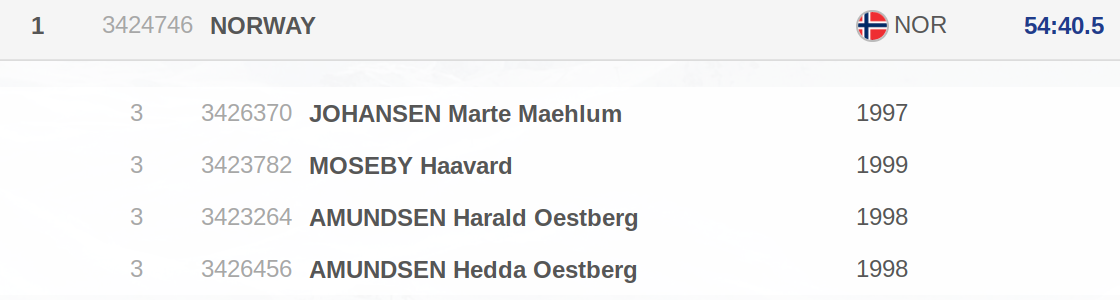
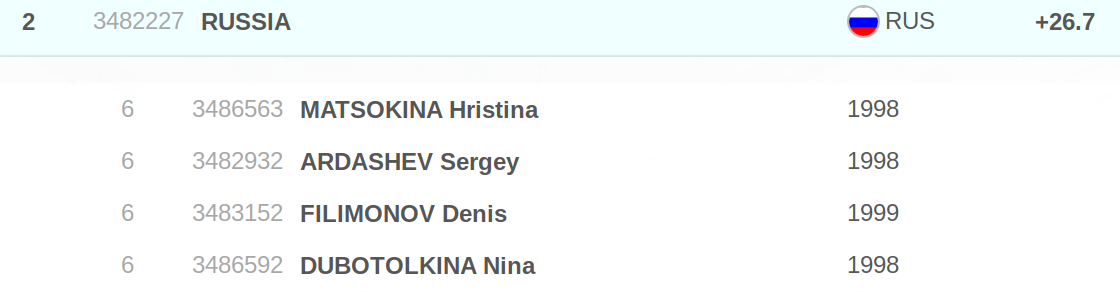
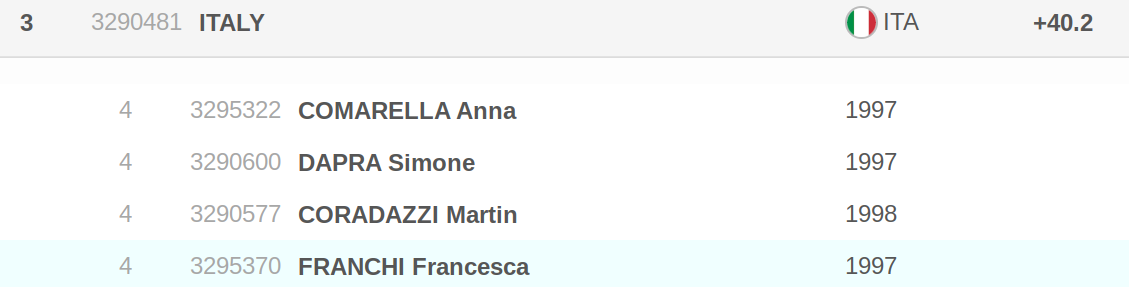
U23 World’s closed out today in Oberwiesenthal, Germany with the 4 x 5 k mixed relay. Norway, which had struggled in both the junior women’s and junior men’s relay won in 54:40.5 minutes. Russia followed in second (+26.7), and Italy third (+40.2).
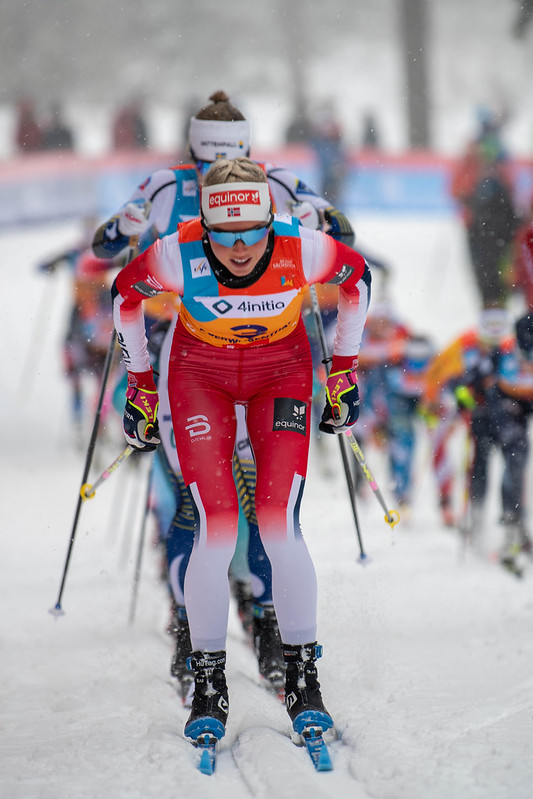
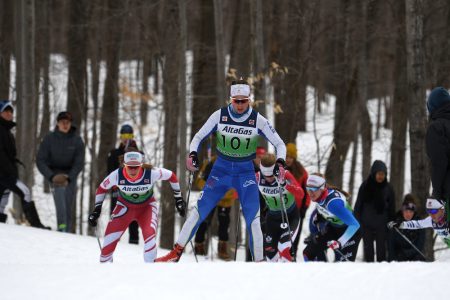
Norway’s Marte Mæhlum Johansen of Norway at the start of the U23 4 x 5 k relay. (Photo: Doug Stephen)
The U.S. placed fifth (+54.6) of the 15 teams finishing the event.
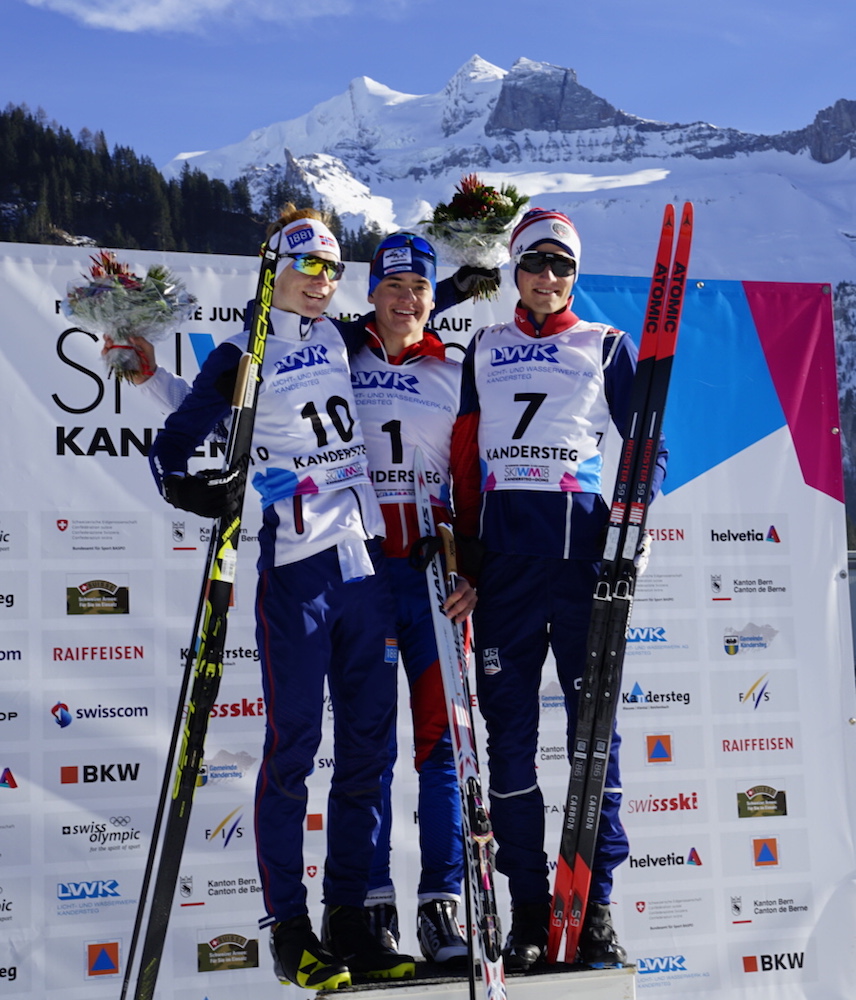
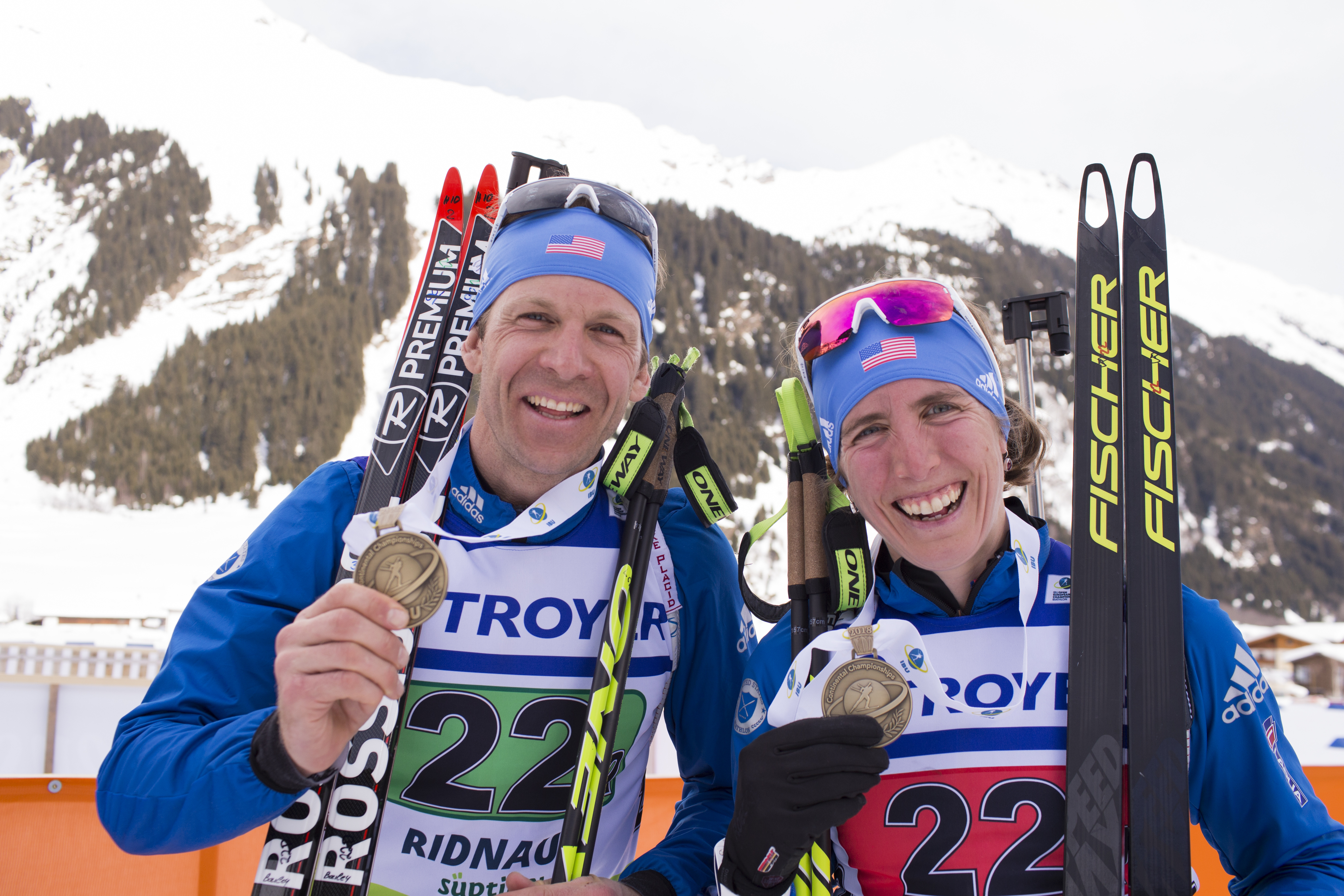
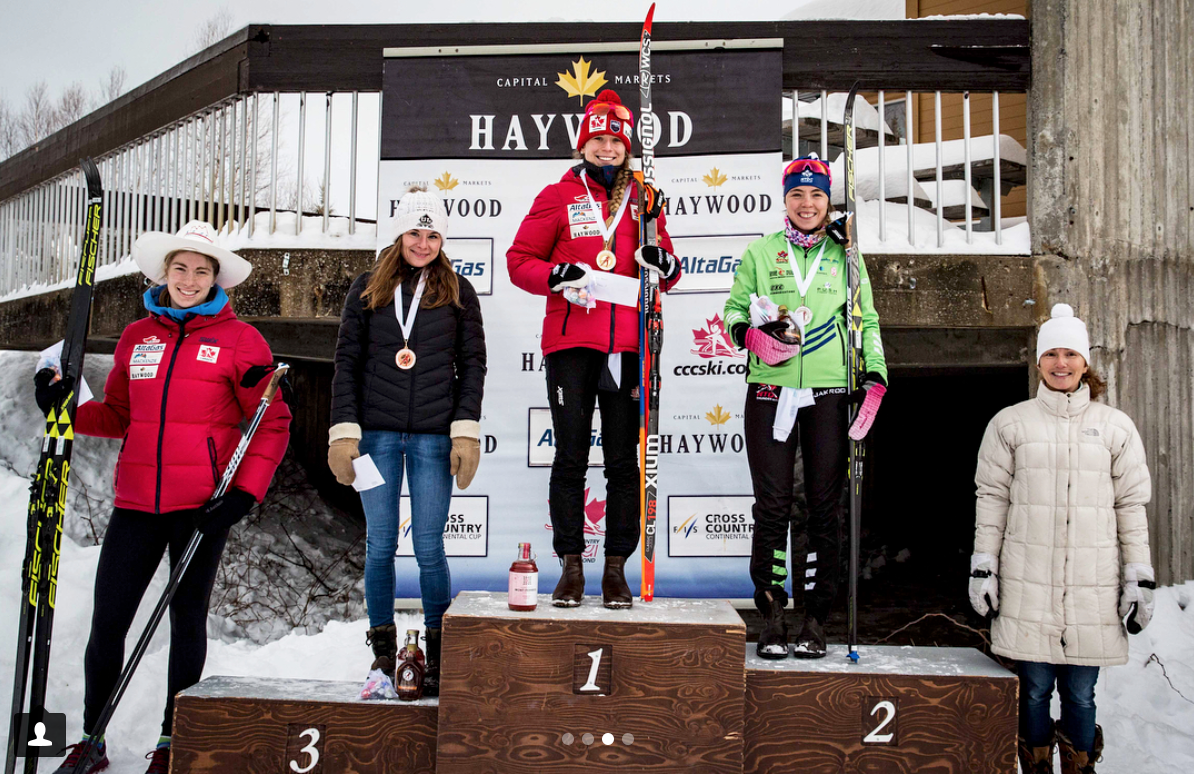
The U23 World’s skate sprint podium: Johanna Hagström (SWE) second, Emma Ribom (SWE) first, and Julia Kern (USA) third (l-r). (Photo: Doug Stephen)
Racing continued amidst a snowstorm in Oberwiesenthal, Germany in today’s U23 1.2-kilometer freestyle sprint event. Coming down lightly at some times and in heavy bursts at others, the precipitation accumulated on the tracks creating some excitement in the form of repeated starts and untimely crashes.
Two Americans qualified on the women’s side, with Julia Kern (USST/SMST2) near the top in third, exactly 1 second behind the top racer, Sweden’s Johanna Hagström. Hailey Swirbul (USST/SMST2) was the next qualifier in 21st (+7.80).
Julia Kern during the U23 skate sprint qualification. (Photo: Doug Stephen)
Post-race interview with Julia Kern
Outside the top-30, Amanda Kautzer (US Biathlon/Michigan Tech) finished 40th (+17.25) and her collegiate teammate Sarah Goble finished 47th (+23.16).
For Canada, Laura LeClair was the top qualifier in 27th (+13.66). Hannah Mehain was next in 36th (+16.20), followed by Annika Richardson in 39th (+16.39), and Laurence Dumais in 43rd (+19.19).
Swirbul raced in the first heat of the quarter-final and finished fifth, ending her day in 22nd, and Leclair finished fourth in the second heat for 20th overall.
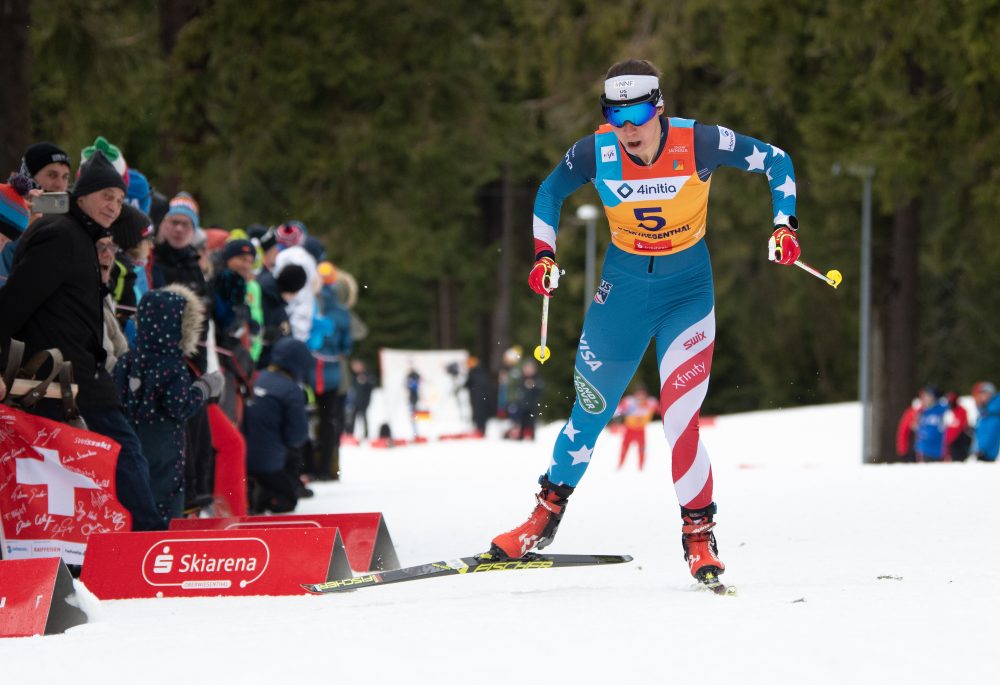
Snow began to fall heavily as Kern raced in the final heat of the quarters, obscuring racers from view in the live feed. Kern took the lead in the second half of her round, pushing through the final meters for the win.
Her semi looked markedly similar, and she advanced to the final with ease.
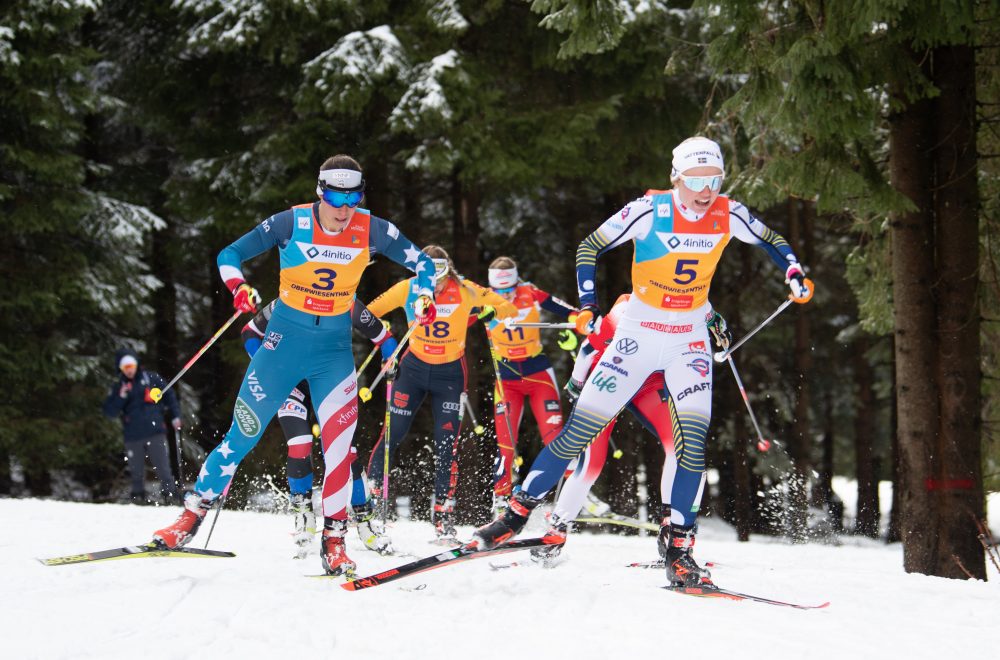
Julia Kern (bib 3) with the day’s eventual winner, Emma Ribom (bib 5), during their semifinal. (Photo: Doug Stephen)
In the final, Emma Ribom and Hagström, both of Sweden, controlled from the outset. At 1:10, Kern was stuck fifth in the line of six skiers. Kern remained boxed out, coming up and over the climb at 2:10. V2ing into the long final straight, Kern found open real estate to her left, where she was able to surge into third place across the line.
Ribom won in 2:36.77, with Hagström in second (+0.54). Kern was 1.14 seconds back in securing third place. Ribom most recently placed ninth overall on the World Cup’s Ski Tour 2020. At twenty-one-years-old, Hagström already has a World Cup podium on her resume: A third place in last season’s skate sprint in Cogne, Italy.
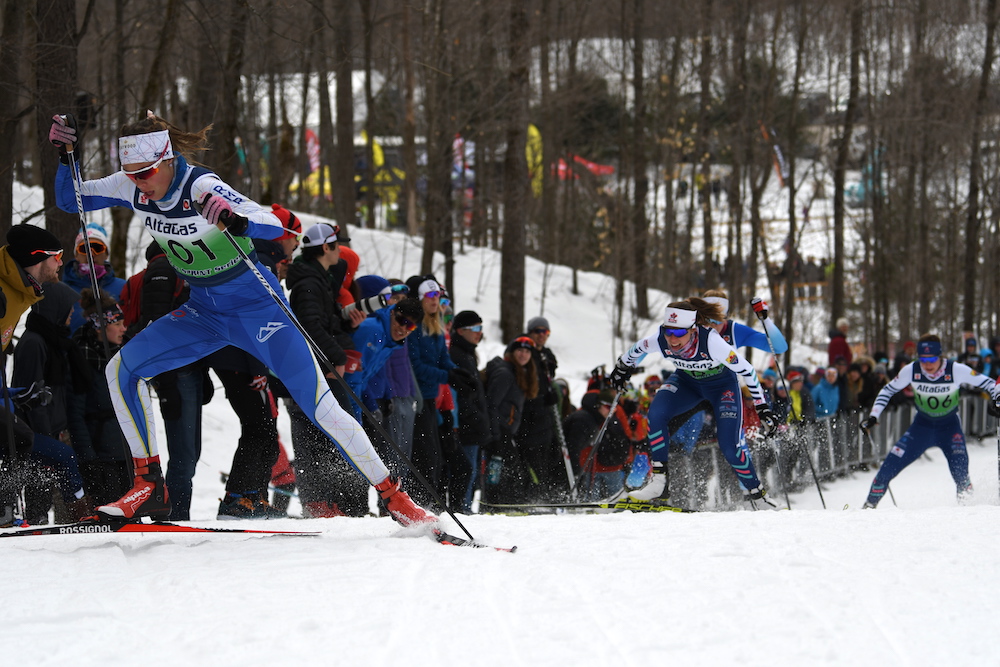
Emma Ribom (bib 5) hungry to the finish, with Kern powering into third. (Photo: Doug Stephen)
Kern who has become a regular U.S. Ski Team athlete on the World Cup, earned another World Junior/U23 medal. She first earned bronze in 2017 on the junior 4 x 3.3. K relay team.
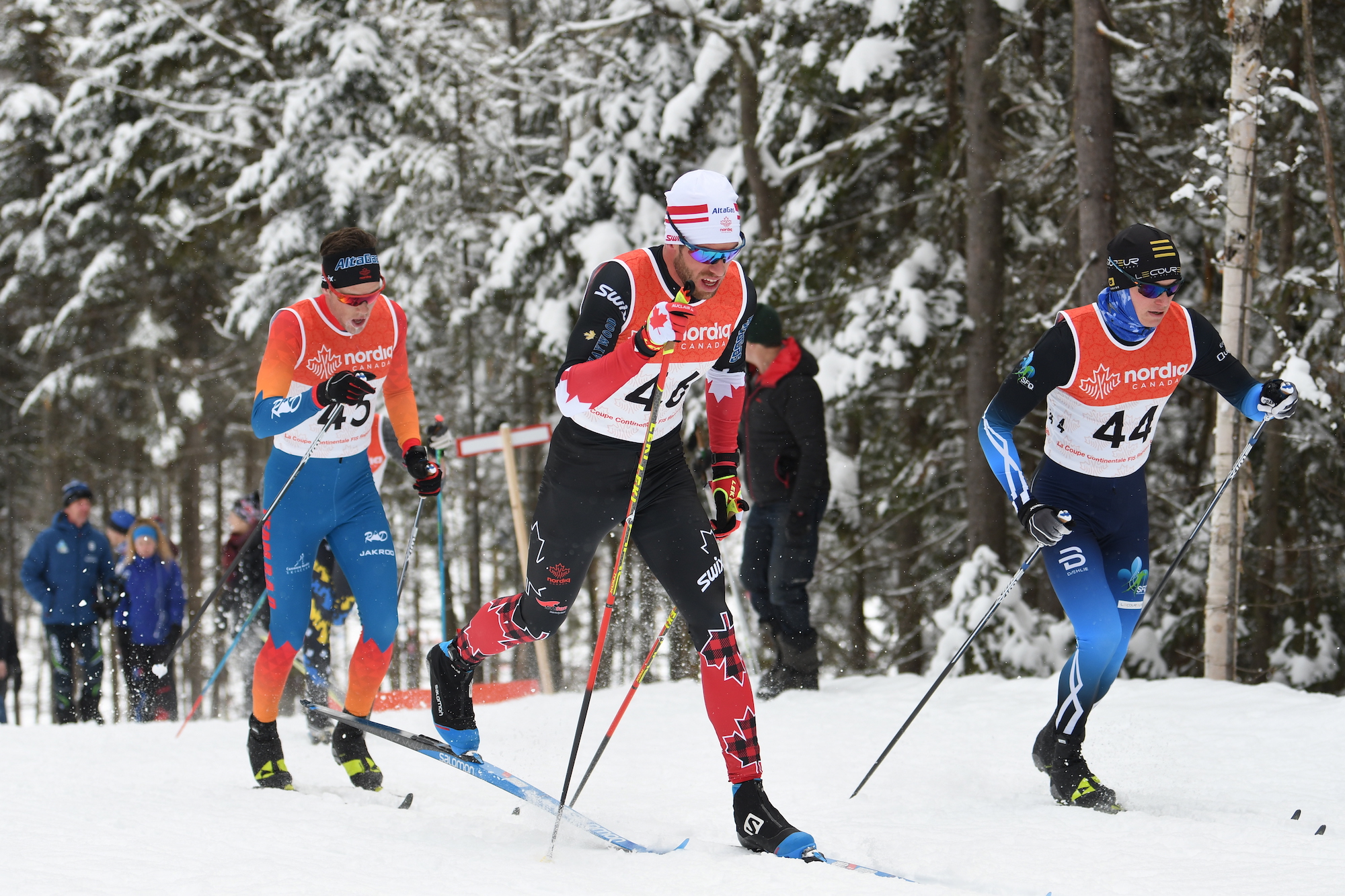
Russell Kennedy (#46) caught Sam Hendry (#45) and Nicolas Beaulieu (#44) on his way to third place in the 15km. (Photo: Doug Stephen)
Fresh snow greeted day two of the Mont Sainte-Anne Trials for the interval start classic. With athletes battling to qualify for U20/U23 World Championships in Oberwiesenthal, Germany and three separate World Cup trips (Falun/Scando Tour, Sprint Tour, Canmore), it was never going to be a simple matter of skier against the clock.
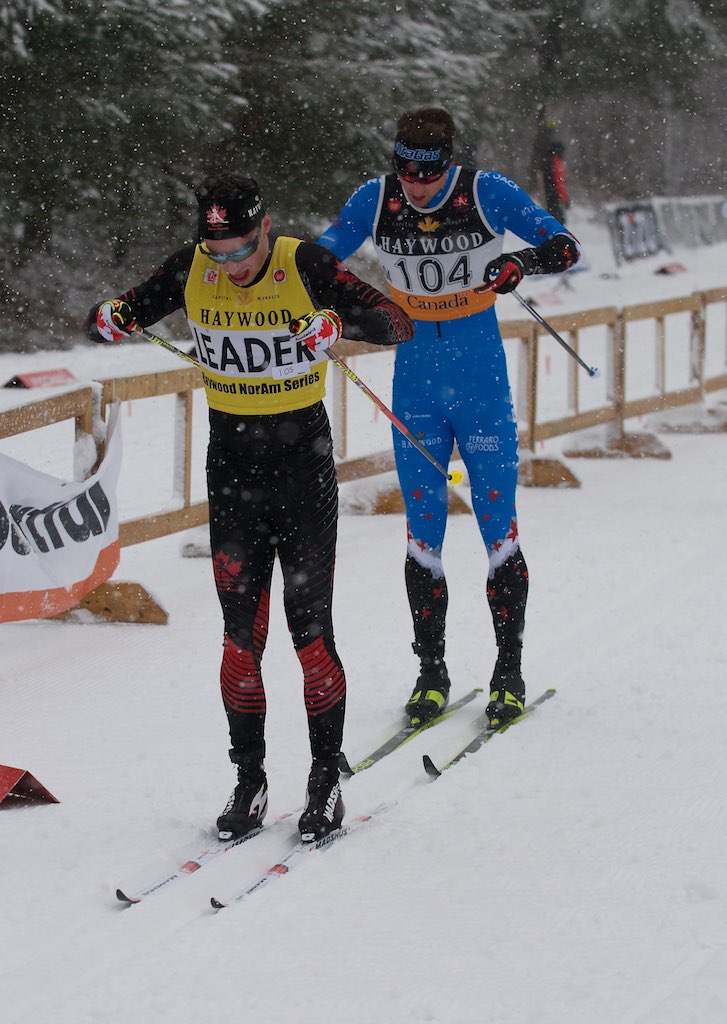
Antoine Cyr rocking the NorAm leader’s bib on the way to victory. (Photo: Doug Stephen)
Racing started with the open men’s 15km on a 5km loop that was shared by all the elite categories. Early on, it looked like a tight four way battle, but CNEPH’s Antoine Cyr, starting last, was 14 seconds ahead after the first lap. Cyr was fastest on all three laps to win in 40:05.1, 47.5 seconds ahead of Fondeurs Laurentides’ Ricardo Izquierdo-Bernier and 51.6 ahead of Canmore’s Russell Kennedy. Cyr should be selected for U23’s based on this win. In the interview posted below, he talks about his relief to know that his form is still good after a disappointing first World Cup in Europe.
The U20 and U18 men raced 10km and once again Black Jack’s Rémi Drolet displayed that full time students can be competitive, as he won both laps to finish in 26:46.2. CNEPH’s Olivier Léveillé took advantage of a late start bib to narrowly beat ULLR’s Xavier McKeever, finishing at 35.4 and 39.1 seconds respectively. This result combined with Thursday’s sprint should see both Léveillé and McKeever selected for U20 Worlds.
Olivier Léveillé took second place and penciled his name on a ticket to Oberwiesenthal. (Photo: Doug Stephen)
(Drolet’s post-race interview starts with the punchline to a joke, but without the setup we miss the laugh.)
In the women’s 10km, Emily Nishikawa continued the theme of winning every lap on her way to a clear victory in 29:51.2. CNEPH’s Cendrine Browne showed that her recovery is going well with a strong second place in her less-favoured technique, finishing 48.7 back. Laval University’s Andrée-Anne Théberge completed the podium, 2:04.7 back.
Emily Nishikawa on a mission. (Photo: Doug Stephen)
AWCA’s Annika Richardson was 4th at 2:15.4 to take the top U23 finish and what should be a selection for U23 Worlds.
By the time the U20 and U18 women headed out, the tracks were showing some wear, but that didn’t stop Black Jack’s Molly Miller from winning the 5km in 15:24.8, 10.9 seconds ahead of teammate Jasmine Drolet, and 11.0 ahead of Revelstoke’s Beth Granstrom. Revelstoke also took fourth with Alexandra Luxmoore at 11.1 seconds, only 0.2 seconds away from silver.
Molly Miller attacking the 5km classic at MSA Trials. (Photo: Doug Stephen)
Black Jack defended their club’s reputation for developing young skiers with three U20 wins so far this weekend. Revelstoke is also starting to make waves with yesterday’s winner Elizabeth Elliott 11th today at 47.6 seconds. With 86 U20 and U18 men and 72 U20 and U18 women competing today, the future of Canadian skiing is starting to look brighter.
Sunday’s free technique mass starts should be exciting, with the U20 and Open categories merged so the younger athletes can measure themselves against the top seniors.
Photographer Doug Stephen has a new gallery for Saturday. Athletes are welcome to download and use full resolution images if they give credit to ‘Doug Stephen’ or @vr45photography.
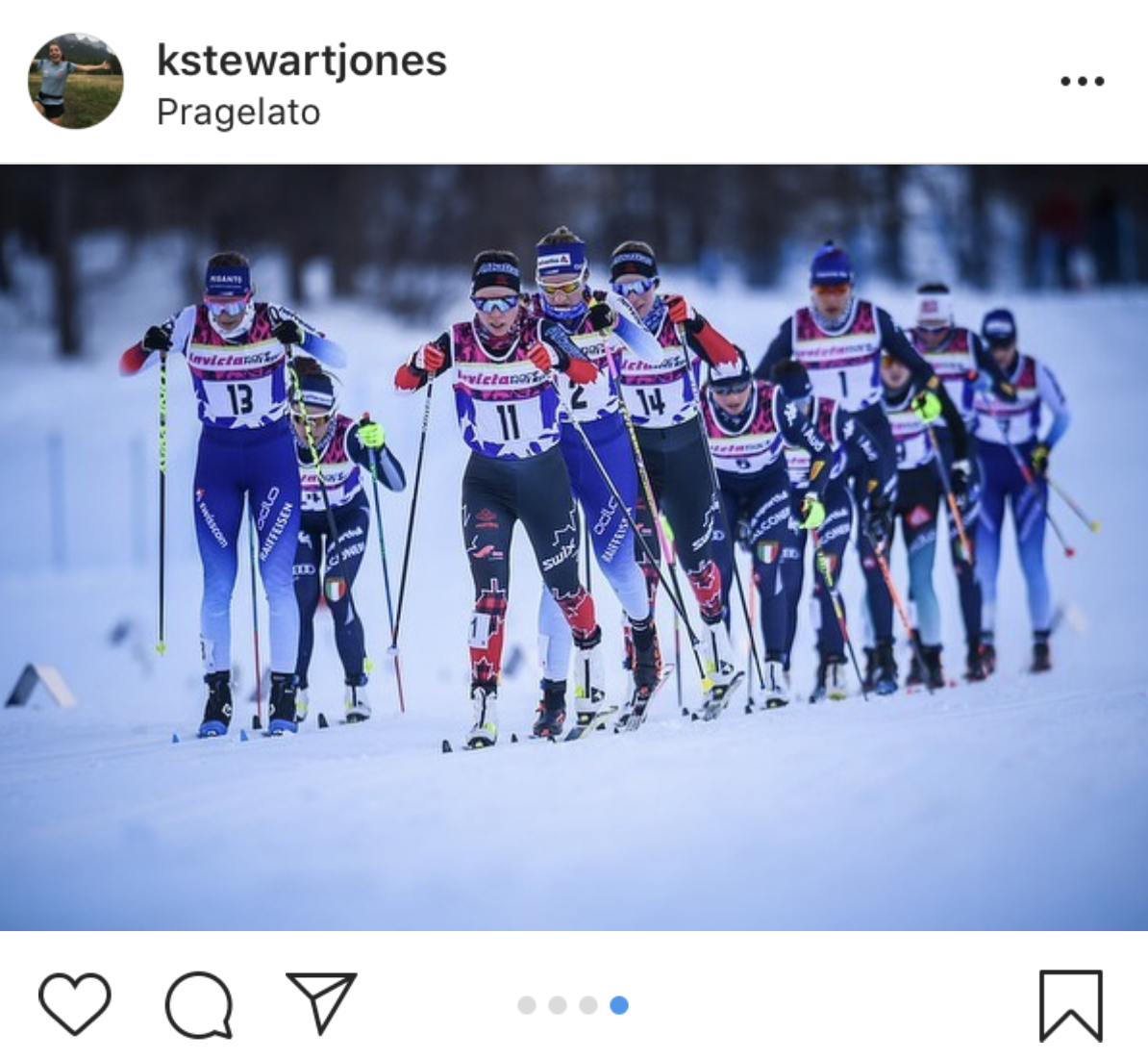
Katherine Stewart-Jones leads the mass start on the way to a Canadian 1-2 at the OPA Cup in Pragelato, Italy. (Photo: Athlete Instagram, credited to @damianobenedettophoto)
Canada took a step back from the World Cup circuit this weekend and focussed attention into development series. As the country tries to build momentum in a post Alex Harvey world, the focus has moved away from World Cup podiums and towards a consistent presence in the top 30. The road to the World Cup goes through local and regional races on the way to national/continental races.
One of the development challenges in Canada is size. The second largest country has roughly the same population as California. Skiers from Newfoundland live closer to Holmenkollen than Whistler Olympic Park.
The Continental Cup series in each FIS ‘continent’ is the top level race series below the World Cup. Canada has the NorAm series. The USA has the SuperTour series. France, Germany, Italy, Slovenia, Switzerland, and Austria share the OPA Cup series. This distribution of ‘continents’ may seem odd, but remember that the combined land area of the OPA countries is equal to British Columbia and Nova Scotia. Canada has three more time zones separating those two provinces.
As part of an effort to reduce travel demands on developing skiers in Canada, Nordiq Canada has been making changes. For the second year in a row, Westerns is not a NorAm event, but a regional event (albeit for a region larger than continental Europe). While this eliminates one east/west flight for eastern-based skiers, western athletes from Saskatchewan, Manitoba, Nunavut, North West Territories, and the Yukon still have a flight to pay for.
8 young Canadians are in Lausanne, Switzerland, for the Youth Olympic Games. Another 8 were in Pragelato, Italy, for an OPA Cup event, where two Canadians won. If you know someone who doesn’t think winning an OPA Cup is a big deal, listen to what Devon Kershaw and Jess Cockney think in the latest podcast. Cockney may ‘only’ have four top 10 results on the World Cup before he ‘retired’, but he did win a combined NorAm/SuperTour earlier this season.
As Cockney reminded us in the podcast, development comes in cycles. It is hard to remember that ten years ago Norway needed to borrow a biathlete to make a mens relay team for the Olympics, the same Olympics when Canada had four different men with top 10 individual finishes. The glory of being at the top of the roller coaster comes with an unseen cost of getting a big machine up a steep hill. This weekend was part of that climb.
Western Canada Cup, Whistler Olympic Park
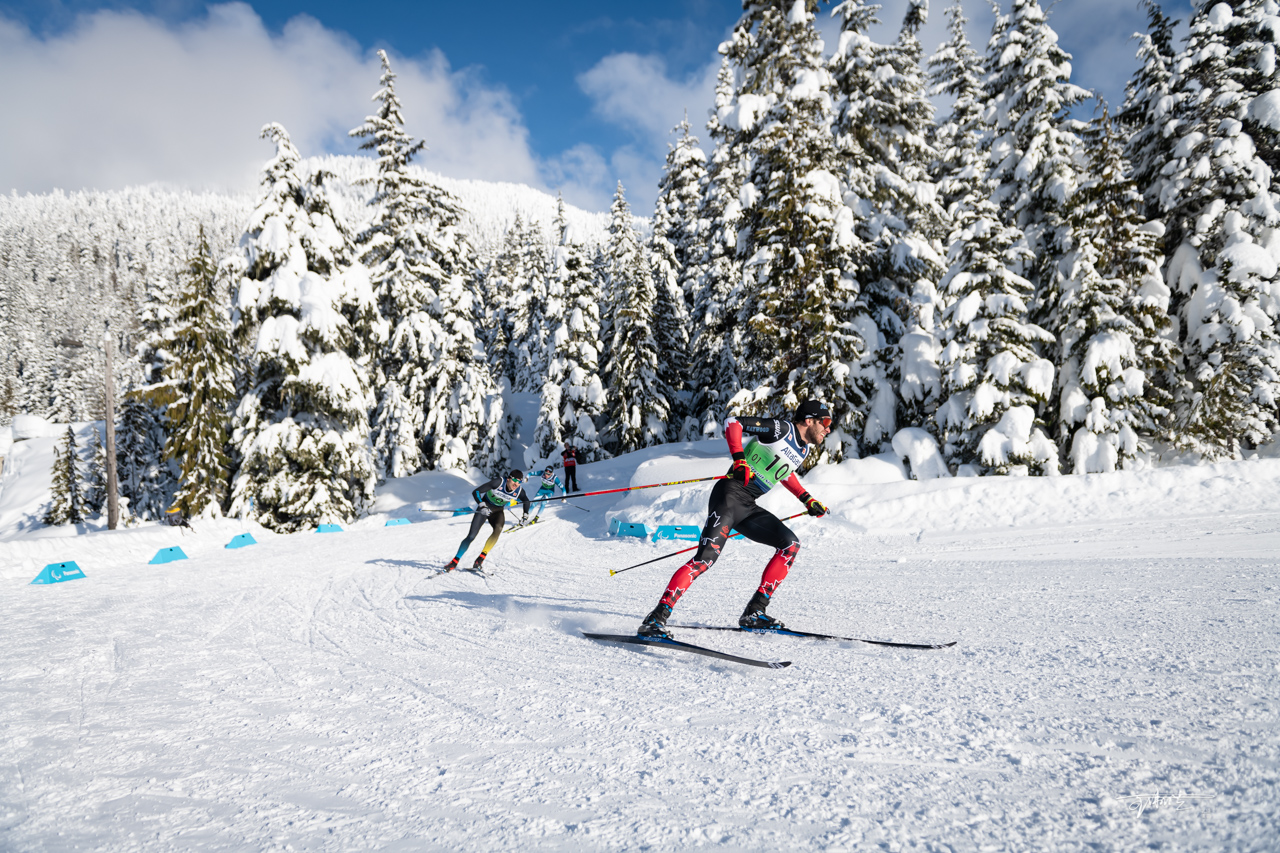
Russell Kennedy leads the A final out of a corner that Petra Majdič remembers well from the 2010 Olympics. (Photo: Weisheng Wang)
Western Canadians was held at Whistler Olympic Park, with over 250 athletes competing for titles under a slightly changed name: Western Canada Cup. Record-setting snow storms and very challenging driving conditions should make for some good stories from the athletes who completed the trip.
The embedded videos are the full-length interviews by Nordiq Canada’s Jeff Ellis. Social media has edited versions.
On a spectacularly sunny Friday, AWCA’s Annika Richardson won the 1.3km classic sprint on a course that will bring back Olympic memories for older fans. Richardson’s 3:16.95 put her 1.45 seconds ahead of Benita Peiffer and 2.11 seconds clear of Elizabeth Elliott which made an all-AWCA podium. Peiffer and Elliot are in their final season of U20.
Bragg Creek’s Sebastien Boehmler-Dandurand edged out Canmore’s Russell Kennedy by 0.28 seconds to win the men’s 1.3km in 2:41.37. Telemark’s Gareth Williams grabbed third at 1.90 seconds, well ahead of his brother Ian in 4th who claimed the top U20 finish.
On Saturday, WOP showed the changeable weather with falling snow and soft tracks after a heavy overnight snowfall. In the men’s 15km classic interval start, Kennedy confirmed his favourite status with a win in 46:57.6, 45.3 seconds clear of Gareth Williams. AWCA’s Jack Carlyle grabbed the bronze at 1:20.3 back. Ian Williams was again 4th overall to take the U20 win.
In the women’s 10km, Emily Nishikawa showed why she was Canada’s top distance skier on the World Cup last season with a 35:42.4 time. Sprint winner Richardson claimed second, 2:51.4 back followed by AWCA teammate Sadie White at 3:09.0 Whitehorse’s Amanda Thomson was 5th at 3:45.5 to take the U20 title.
Sunday continued the domination by the favourites. Nishikawa won the 15km free mass start in 43:06, 2:07.6 ahead of Elliott and 2:13.8 ahead of Revelstoke’s Gina Cinelli.
In the men’s 15km, Kennedy snatched a second win in 37:29.4, 1.6 seconds ahead of Gareth Williams and 19.4 seconds ahead of Carlyle.
“It is fun to be back in Canada and see how well people are skiing here!,” Kennedy wrote to FasterSkier. “Whistler is so pretty but it is super tricky with weather. Always unpredictable but really good for testing skis I don’t use that much.”
While the regional field may not have been as deep as MSA will be, the return of Nishikawa and Kennedy from World Cup period 1 gave nearly 300 athletes a good vision into what the next level of competition looks like.
Dahria Beatty wins the OPA Cup ahead of Katherine Stewart-Jones. (Photo: Beatty’s Instagram)
While the western athletes were at the 2010 Olympic venue, eight Canadians made the trek to the 2006 Olympic venue to compete in the OPA cup. Dahria Beatty won the Saturday’s mass start 15km classic in 49:09.0, 8.1 seconds ahead of teammate Katherine Stewart-Jones. Italy’s Sara Pellegrini was third at 38.7.
In the men’s 30km, Antoine Cyr edged out Bob Thompson for 22nd place at 5:56.1 back from winner Paolo Ventura who won in 1:26.36.3.
On Sunday, Stewart-Jones moved up, taking first in the 5km free in 14:03.5, 5.2 seconds ahead of Italy’s Elisa Brocard and 10.4 seconds ahead of Beatty in third.
“Being on the podium for both races is a huge confidence booster going into next weekend’s World Cup races, especially because the courses in Pragelato are World Cup level,” Stewart-Jones wrote in an email. “With Dahria also on the podium the last two days I couldn’t be more excited with how well our Canadian Women’s team is performing.”
Stewart-Jones is targeting the Scando Tour, starting in Åre, Sweden, on February 18th and ending in Trondheim, Norway, on the 23rd.
“The courses here in Pragelato are awesome which made for some good hard racing this weekend,” Beatty wrote after her third OPA podium of the season.
“I had only done one distance race this season before this weekend so it was really good for me to get some high caliber race kilometres in. My distance skiing is feeling strong right now so I am excited to do a few distance World Cups in the next month and do some classic skiing since Saturday was also my first classic race of the year.”
Canadian men recovering from the 30km classic in Pragelato’s OPA Cup. (Photo: Erik Bråten)
In the men’s 10km, Cyr was again top Canadian, finishing 23rd, 1:38.2 behind France’s Jean Tiberghien who won in 24:05.1.
Thompson is a sprinter by preference and was in Pragelato with Oberstdorf’s sprint in mind.
“The main focus for me this weekend was to get some longer really hard work in, which a 1.5 hour 30k definitely accomplished,” Thompson wrote. “I think the OPA’s are a great chance to find near World Cup level racing and for those who are looking to get a bit more experience at that level they are a great challenge for those looking to make a jump in their racing.”
The OPA cup is a continental cup series (like the NorAm and SuperTour) and the field is studded with athletes who move up and down between the World Cup and this series. The athletes best known to North Americans would probably be France’s Richard Jouve (8th here) and Italy’s Elisa Brocard (12th and 2nd).
Head coach Erik Bråten is with the team until Oberstdorf and back to Canada briefly for MSA Trials. He is excited with the progress this season and happy with the visit to Pragelato.
“What I take away is that we have some young athletes that is getting great race experience outside of North America, and a couple of girls that really showed a high level even in a tough training week.”
The YOG started off with a ‘cross country cross’ event including obstacles on Saturday, followed by the more traditional events: Sprints Saturday, classic mass starts Tuesday, and a mixed relay on Wednesday. The American athletes outshone the Canadians over the obstacles on the first day, taking 4th in each gender before working up to podiums on Tuesday. Full results for the event are here.
While this is an important event in young athlete’s lives’ and there have been some great individual results, fans and media alike have to be careful not to apply expectations and pressure to the developing minds in those developing bodies.
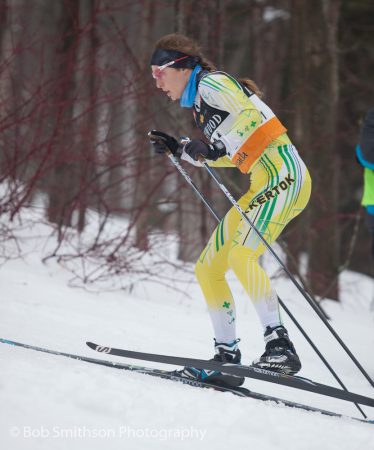
Katherine Stewart-Jones leads a sprint heat on her way to domination. (Photo: Robert Smith)
The NorAm circuit moved east to the Nakkertok trails for three days of racing jointly hosted by Nakkertok Nordic, Club Skinouk, Chelsea Nordiq, and Kanata Nordic. Friday featured classic sprints, Saturday interval start free, and Sunday interval start classic.
The event was also the Candy Cane Cup for the younger categories, as well as Ontario Cup 1 and Coupe Québec 1. 374 athletes in the U16, U18, and Open categories competed on Friday with many more younger athletes racing Saturday and Sunday.
Nordiq Canada’s Jeff Ellis was there and has once again shared the full-length post-race interviews. Photographer Robert Smith has galleries for each day, so keep scrolling.
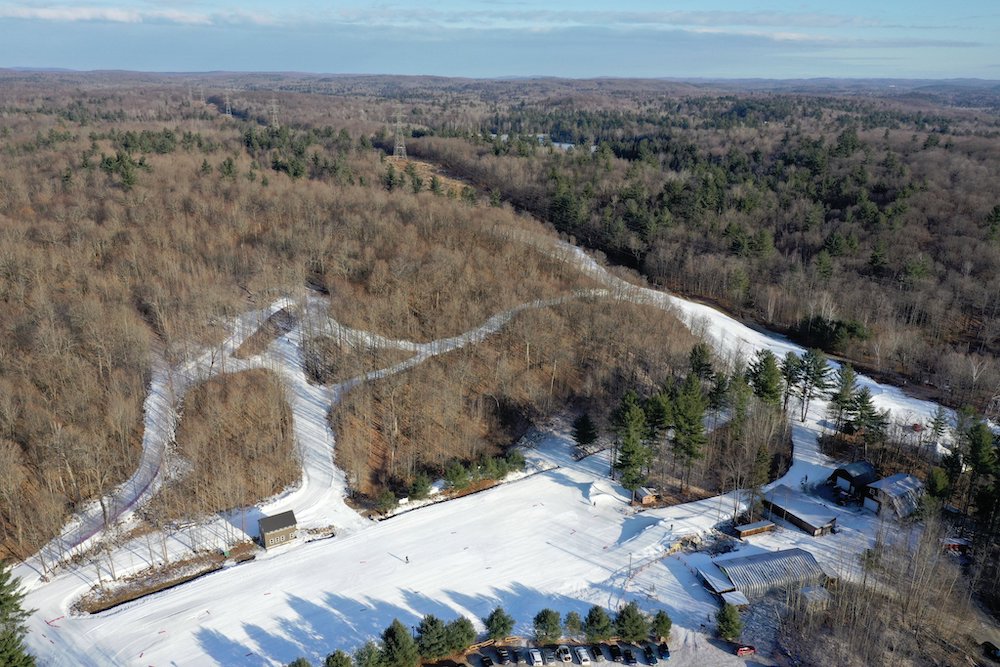
Nakkertok had over 3km of trail open thanks to their snowmaking, with a 2.5km loop used for the distance races.
The ‘NakkerTrak’ at Nakkertok before the 2019 NorAm weekend. (Photo: Natural Fitness Labs)
On the women’s side, it was the KSJ show, with home-grown national team member Katherine Stewart-Jones winning all three days.
In the sprint, Stewart-Jones finished in 3:19.96, comfortably ahead of AWCA’s Maya MacIsaac-Jones and RMR’s Katie Weaver at 2.43 and 3.93 seconds back respectively. The podium trio were the top three qualifiers, but in reverse order.
Stewart-Jones steamrolled the field in the free 5km, 36.8 seconds ahead of Laura Leclair in second and 39.9 seconds before Cendrine Browne, both of CNEPH.
The trend continued on Sunday, with Stewart-Jones finishing the classic 10km in 28:52.1, 1:18.1 ahead of Skibec’s Andrée-Anne Théberge and 1:29.8 ahead of AWCA’s Annika Richardson.
Antoine Cyr leads Julien Locke in the interval start classic. (Photo: Robert Smith)
For the men, Hardwood’s Bob Thompson kicked the weekend off with a sprint victory in 3:12.71, followed by national team member Antoine Cyr at 0.36 seconds and his CNEPH teammate Antoine Briand at 0.63.
On Saturday, Cyr won the free 10km in 22:10.4, 20.9 seconds ahead of Fondeurs Laurentide’s Ricardo Izquierdo-Bernier and 32.8 seconds clear of Team R.A.D.’s Evan Palmer-Charrette.
Palmer-Charrette stepped up to finish the weekend on top of the podium, winning the 10km classic in 24:43.8. National team member Julian Smith was second at 6.2 seconds followed by Cyr at 14.4 seconds.
For many Canadians this season, the big focus is on the Mt. Sainte Anne (MSA) NorAm in January, which is the Junior and U23 World Championship trials. That series is also a path to World Cup starts. As a result, a number of athletes chose the nearer of the two December NorAm races and skipped the other to reduce travel. Over 30 western Canadians drove to Sun Valley for the SuperTour event instead of flying to Nakkertok.
“I think that it’s good for younger athletes to chase high competition for development,” Stewart-Jones wrote in response. “It makes more sense for them to travel less too. This year, for most of the younger athletes and even a lot of the older ones, the focus is on trials in MSA in January so there is a lot of time to prepare for their optimal race performance.”
Stewart-Jones moved from Nakkertok to Canmore this training year, resulting in new training partners and a new personal coach, national team head coach Erik Bråten. That also meant returning to Nakkertok required two extra flying days and the associated illness risk.
“If I hadn’t been trying to get the COC spot locked up for the rest of the season I would have most likely gone to Sun Valley too.”
There is a complicated calculus to getting World Cup starts in Canada. The COC leader gets FIS-guaranteed starts and financial support from the host organization for each race weekend. Keeping the COC leader bib for the season would mean more and cheaper time on the World Cup for Stewart-Jones. Dahria Beatty and Emily Nishikawa chose to race period 1 in Europe instead, with Beatty qualifying for the next WC trip selection by placing 25th in the Davos sprint on Saturday.
Maya MacIsaac-Jones attacked on the final hill to win. Behind, Katherine Stewart-Jones leads Dahria Beatty and Annika Richardson. (Photo: Doug Stephen)
This article has been updated with final WCF selections and a video of the sprint A finals.
Nationals rolled on at Nakkertok trails with free technique sprints on Saturday. The women raced a 1.3km course while the men added one more hill for 1.4km. The jury described the conditions as ‘soft icy’, which seems to mean ‘fast spring skiing’ with a soft layer over a firm base.
Maya MacIsaac-Jones (CNST) took her second consecutive national sprint title by jumping clear on the final climb to earn a solo victory in 2:46.62. Dahria Beatty (CNST) led the pack into the finish 2.87 seconds later with Katherine Stewart-Jones (CNST) at 3.27 seconds and Cendrine Browne (CNST) at 3.47.
Germany’s Julia Richter took fifth for the University of Utah at 4.82 followed by Annika Richardson (NTDC TBay) at 5.31.
“Going into the final,” MacIsaac-Jones wrote, “I knew that my offset was strong so I made the decision to attack on the final climb, which worked out as planned!”
Maya MacIsaac-Jones leading the A final. From left to right, Julia Richter (104, red), Cendrine Browne (113), Dahria Beatty, and Katherine Stewart-Jones pursue. (Photo: Doug Stephen)
MacIsaac-Jones is ending her nationals on a high, as she makes a planned shift to focus on World Cup finals next Friday. “I’m so happy with my race today, this is the best I’ve felt all year. It’s been a rocky season, and this is really motivating for me going into next year.”
The conditions made for fast racing, but the A final was different.
“It went out pretty slow,” Stewart-Jones wrote, “because no one wanted to lead on the first climb because there was significant draft on the next downhill.”
Browne, who is usually described as a distance specialist, now has 4th in every event at nationals.
“My qualifier was not so great, so I didn’t know what to expect in the heats,” Browne told the LOC. “Fortunately, I felt really good in the heats and I managed to squeeze myself up to fourth place today. Really happy with that, usually not a sprinter, so yeah, good day for me.”
***
Norwegian junior Haakon Skaanes wins the sprint ahead of Antoine Briand. (Photo: Doug Stephen)
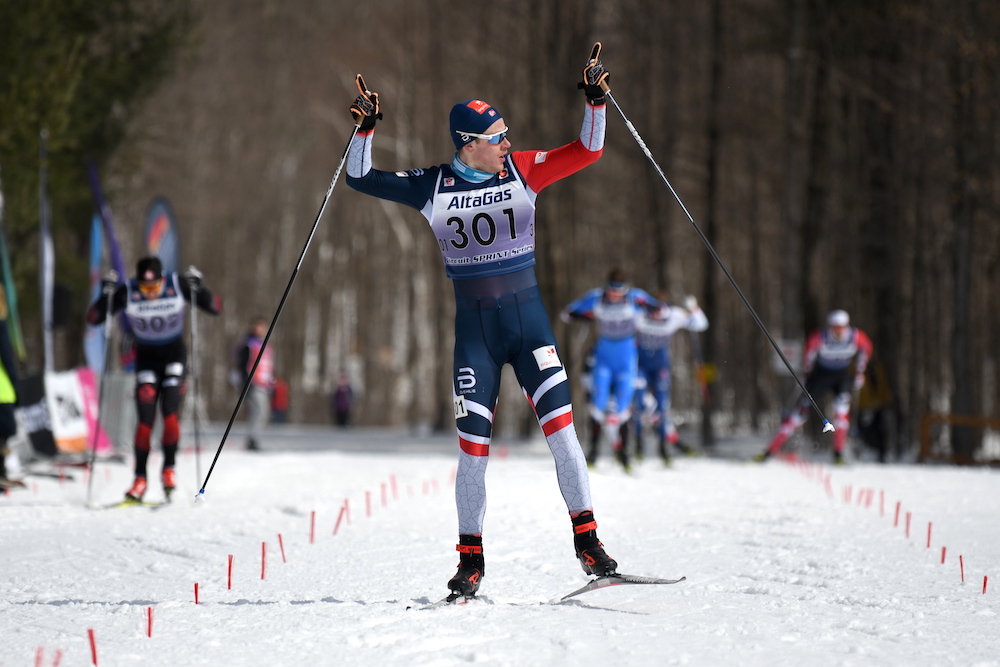
In the men’s A final, the Norwegian theme from today’s World Cup sprint in Falun flowed into Canada. Norwegian national team junior Håkon Skaanes (Strindheim IL) won the qualification and all his heats to take the A final in 2:45.69.
Antoine Briand (CNEPH) finished alone in second, 2.54 back, to become the Canadian champion. Julien Locke (CNST) out-sprinted the rest to take third and the silver medal at 5.60 seconds. Julian Smith (NTDC TBay) completed the Canadian podium at 5.73. Lenny Valjas (CNST) was fifth at 6.08 ahead of Norwegian junior Albert Sunde Oehlschlaegal (Sjåstad v Lier IL) at 6.26.
Briand, who qualified second 1.05 behind Skaanes, was happy with his first Canadian title.
“Today’s race, I’ve been thinking about it for the past eight, nine months,” he told the LOC. “I was really strong today, from the start of the day, qualification this morning and every heat I was feeling good.”
Briand didn’t wait for others to set the stage.
“In the final, I went really hard in the first uphill,” Briand wrote. “My coach shouted on me that the gap had opened. So me and the Norwegian guy who won kept going hard until the end. I couldn’t follow him the second time we went up but I managed to stay 2nd.”
Julien Locke (317) takes third, ahead of Julian Smith (305), Lenny Valjas (308) and Albert Sunde Oehlschlaegal (behind Locke). (Photo: Doug Stephen)
“For me,” Smith wrote in an email, “I was really confident in my skis so I was trying to settle into 3rd place going into the first downhill, and then move into second during the second climb. This allowed for drafting on the final descent. … I did let one too many people between me and the finish line on the last climb and then was not quite able to close the gap in the end.”
This nationals is not just the largest in recent memory, but also one of the most competitive. Unusually, there are only two Canadians on the World Cup circuit in Falun, with everyone else here in Nakkertok. The addition of the Norwegian juniors and NCAA athletes added speed to the mix.
“I have never been to a Canadian National Ski Championships where the field is so deep, with National Team members, competitive domestic racers and so many international racers,” Smith wrote.
Racing continues Sunday with sprints for the younger age groups and an invitational for even younger athletes. Sunday has 507 racers on the start list compared to 194 finishers and 12 DNS on Saturday.
World Cup Final Qualification
Twelve athletes have already qualified, leaving seventeen spots to be decided at nationals: 8 men and 9 women.
The criteria was summarized after the pursuit race. The races that count are the sprint, the individual start classic, the pursuit, and pursuit time-of-day.
Twelve athletes were already named to the World Cup Final team:
Alex Harvey, Lenny Valjas, Emily Nishikawa, Dahria Beatty based on World Cup or Olympic results.
Katherine Stewart-Jones and Jack Carlyle (AWCA) as COC leaders.
Cendrine Browne, Maya MacIsaac-Jones, Russell Kennedy (Team R.A.D.), Scott Hill (Hardwood), and Evan Palmer-Charrette (Team R.A.D.) by qualifying for World Championships.
Rémi Drolet (Black Jack) with a top ten at World Juniors.
What follows is an interpretation of the criteria. CCC will announce the definitive list Sunday night at La Soirée, along with the new CCC branding.
Update: At the Sunday evening event, Nordiq Canada (the organization formerly known as CCC) announced the final selections.
For the women, it is Annika Richardson, Anne-Marie Petitclerc, Sadie White, Marie Corriveau, Zoë Williams, Hannah Mehain, Frédérique Vézina, Alannah Maclean, and Laura Leclair.
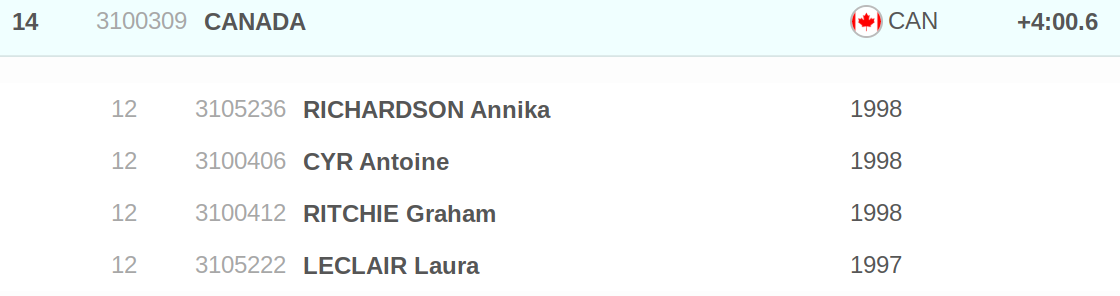
For the men, it is Antoine Briand, Philippe Boucher, Julien Locke, Julian Smith, Bob Thompson, Alexis Dumas, Antoine Cyr, and Graham Ritchie. Apart from morning sickness, a pregnant woman has to deal with heartburn, fatigue, sore muscles and much more. It is also difficult to get good rest at night as their tummy gets bigger. Towards this end, pillow manufacturers aimed to address the need and develop the kind of pillows that will facilitate a pregnant woman’s sleep and relaxation. Our review will focus on the best pregnancy pillows which can cater for your needs whilst taking into consideration different factors like material, size, shape, price and brand. Shop best pregnancy pillows online at Pregily.com – read reviews and shop now!
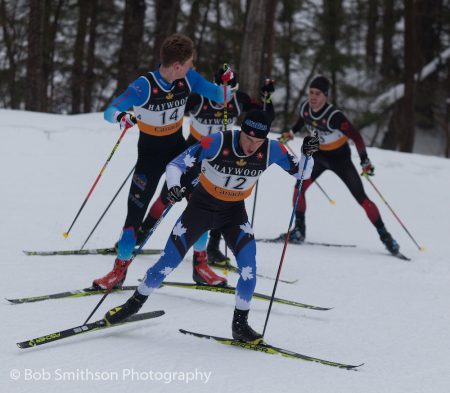
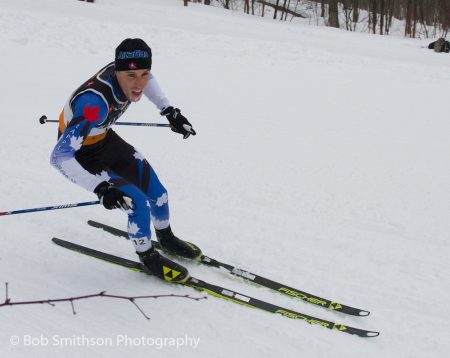
Julien Locke leading a sprint heat. (Photo: Bob Smithson)
The NorAm series went to Duntroon, Ontario, for the Canadian Eastern Championships: three days of varied weather, new race formats, and new faces on the podium, all hosted by Highlands Trailblazers.
Easterns is possibly the most storied ski race in Canada. Most years, it is the largest FIS event in North America. This year, the Polar Vortex froze out the travel ambitions for many families and lower budgets in the post-Olympic season persuaded many western teams to stay home. Despite these challenges, over 450 athletes braved the difficult road conditions to hit the start line.
Easterns was ringing in the changes this year. This may be the first ever NorAm where the men and women skied the same distance on the same courses in every event. The two-day pursuit reappeared for the first time at this level since 2000.
The two-day pursuit format was introduced in 1988. Based on the Gunderson start in Nordic Combined, there was an interval start classic race on the first day and a free technique pursuit on the second, with medals awarded for both days, but no time-of-day points for the second.
In 2002, the two-day pursuit was replaced with the same-day pursuit, with no medals for the classic portion and a two hour break before the skate. Beckie Scott won all three medals in this event at the Salt Lake Olympics. In 2003, this was changed to ‘continuous pursuit’, sometimes referred to as ‘pursuit without a break’. The format name was quickly shortened to ‘pursuit’, which confused people until 2011 when FIS acquired rights to the name ‘skiathlon’, allowing ‘pursuit’ to be used for the final day of a mini-tour. CCC wrote a history in 2011 to celebrate the new name.
In the summer of 2018, FIS dropped the skiathlon format, which brings us back to a format that most of the athletes racing today will not remember.
The weather also came out to play: -18 Celcius (C) and windy for official training, -12 C and sunny for the sprint heats, -9 C and 37 km/h winds for Saturday’s classic, and +3 C and freezing drizzle and rain for Sunday’s pursuit.
Women’s A final: Zoë Williams (Nakkertok), Laura Leclair (CNEPH), Mia Serratore (Big Thunder), Annika Richardson (TBay), Katie Weaver (Rocky Mountain Racers), Hannah Shields (Nakkertok)
Men’s A final: Julien Locke (CNST), Dominique Moncion-Groulx (Team R.A.D.), Antoine Briand (CNEPH), Andy Shields (Lappe), Étienne Hébert (AWCA), Angus Foster (TBay).
There are no official results or times for the sprints.
Friday started cold and sunny for the 1.5km classic sprints, a welcome relief after cold and windy weather on the official training day.
“After two small running hills at the beginning, the remainder was all double pole,” Julien Locke (CNST) wrote. “While the course was not as demanding as I would have liked, it was a good opportunity to use the upper body strength.”
The course worked well for Locke, as he won the qualifier by over 4 seconds.
Zoe Williams (Nakkertok) won her first career NorAm, two weeks after her first podium and narrowly missing the selection for World Championships.
“Today was very surprising,” she wrote to FasterSkier. “When I skied the course yesterday I wasn’t a huge fan and I didn’t think it played to any of my strengths. My qualifier was really messy but I pulled it together in the heats and felt I was able to get faster as the day went on!”
The women’s A final was chaotic. Each of the three women on the podium had their own view of the action.
“I talked to my coach (Kieran Jones) before the A final and our plan was to stay relaxed in the first half of the course, pick it up in the second half and push it into the finish. It worked out almost perfectly; I got caught up in a fall on the main uphill and lost contact with the leaders but was able to fight back in the second half of the course with Laura and Annika and as everyone jostled for the inside line into the finish I just picked the outside lane and hammered.” — Williams
“Honestly the A final was pretty bad. It was a cool race because everyone in the A final could race but I think we were all a little too excited (or tired). There were a lot of tangles and falls so no tactics there.” — Laura Leclair
“Tactics were pretty important in the final. I started out hard to get out in front to stay out of trouble on the downhill. Managed to make a gap but lost it in the final straight. It was really important to be strong with the double pole at the end.” — Mia Serratore
It was Serratore’s first NorAm podium.
The men followed with tactics that emphasized staying out of trouble.
“Briand set a strong pace in the first 400m up Honey and Sugar Shack hills. I followed him out to the Biathlon range and then hopped in front for the fast/icy turn. From there, I lead up the gradual Chicken Coop climb, through the twists around the wax rooms and to the line.” — Locke
“The final started fast with Antoine putting the pace in front. I think the top three skiers (Antoine, Julien and I) had a little gap after the climbing section of the course. Julien accelerated to pass Antoine before the fast downhill, I stayed in 3rd behind them. I took the inside on the 90 degree corner at the bottom of the downhill and move up to 2nd place. Following the downhill, like in the semi-final Julien put the hammer down double poling on the gradual climb and I was the only skier that managed to stick right behind him. I tried to change tracks and pass him on the last stretch but I could not find enough speed to overtake him.” — Dominique Moncion-Groulx
“I went all out from the gun and Julien took over at mid point. No real tactics from there on to be honest it was full gas racing.” —Antoine Briand
Some of the athletes were feeling the effects of racing the US SuperTour after the Bishop’s University NorAms.
“I had a dynamic first half of the qualifier but felt slow and I did not ski the second half well. I had good energy, change of gears and I felt solid through all the rounds. I’m happy with my speed in the heats and with a good final result. For a 3rd weekend of racing in a row, it’s fun to still feel energetic.” — Moncion-Groulx
“Coming back from a big win in Lake Placid at the US Super Tour last weekend, I was feeling confident for another classic sprint. Had a good qualification with the second best time and being on the podium at the end of the day is always satisfying.” — Briand
Interval Start Classic
Saturday brought in wind and warmer weather for the 10km classic race. The 5km loop had two main uphills immediately followed by downhills.
Williams said pacing mattered because “with only 4 main hills, lots of good rest, and a ton of double pole you had to keep pushing everywhere.”
Williams got her second win of the weekend in 35:46.09 minutes. “Super happy with it: stuck to my plan and had fun chasing people down. Mia started ahead of me and we skied the 2nd lap together which was awesome.”
Serratore finished second, 37.82 seconds back. Leclair didn’t get the benefit of timely splits or good rides, but was able to grab third at 1:18.40, just 0.18 seconds ahead of Annika Richardson.
“Because I was second to start, I was alone the whole race and didn’t see anyone,” Leclair wrote. “That was pretty hard because I didn’t know how fast the girls behind me were going. I had no bunny or rabbit. Anyway, the conditions and skis were good and it was an overall good race.”
Among the men, Alexis Dumas (CNEPH) came the closest to even splits, crossing the line in 30:04.8 for the win.
“I was able to ski really hard in the second lap and that’s where I made the difference. Also, my skis were super good. My wax tech and my coach did a great job today.” — Dumas
Shields was second, 16.67 back, after an error in the unofficial results was corrected.
“I felt flat racing today. Yesterday was a long day with the classic sprints and awards being late in the day so I was carrying fatigue,” Shields wrote. “In today’s race, I knew I didn’t have a great one but was surprised to see how far back I was when the initial set of results came out showing me in 7th place – almost a minute from the win.”
Boucher was happy with his third place, 21.57 seconds back.
“I think my skis and pacing played a lot in the outcome of the race. I decided to sacrifice some kick to have a better glide on the flat sections. Turns out it was the good call for me. I’m a little disappointed that I lost nearly 15 seconds on the leader in the last lap.” — Boucher
Skate Pursuit
Zoë Williams (101) and Annika Richardson ready to start the pursuit. (Photo: Marten Burns)
Sunday brought freezing drizzle replaced by rain which resulted in significant challenges in picking the right skis for the changing conditions. The start times for the skate pursuit are based on time back in Saturday’s classic race, with no bonuses awarded.
Leclair took her first senior NorAm win, starting third at 46 seconds back.
“My tactics for today were pretty simple,” Leclair wrote. “I wanted to start fast and catch the two girls in front of me. I put my head down, climbed and went hunting.”
“I felt super good and skis were wicked fast. After missing the first step of the podium on the two last races, it is nice to finish on the top.”
Zoë Williams in second place in Sunday’s pursuit. (Photo: Bob Smithson)
Saturday’s winner Williams started first and hung on for second. “Today was tough; didn’t have much left in me physically or mentally and it made the 15km a bit of a suffer fest.”
Annika Richardson moved up to third. “I was pretty hungry for a podium after being 4th the past two days. I have done 13 races in the past month so have felt like I have been running on empty for a little while,” Richardson wrote. “But, I really love skate distance races so was able to give it everything I had left.”
“I started with Laura Leclair who is an amazing skate distance skier. I stuck behind her until the first long downhill but she had really, really fast skis so I wasn’t able to stick with her for the rest of the race (though my skis were quite good) but managed to catch Mia Serratore by the end of the South 3.75 loop on the first lap.”
Andy Shields leads Jack Carlyle, Philippe Boucher, and Alexis Dumas in the pursuit. (Photo: Bob Smithson)
Jack Carlyle earned his first senior NorAm win as well, as the top four men neatly reversed their start order at the finish.
“Sunday was a great day,” Carlyle wrote. “Had some good jam in the legs and was able to push hard.”
“On the first lap the first four starters (Phil Boucher, Andy Shields, Alexis Dumas and I) came together as a pack, and we skied together for most of the race,” Carlyle wrote. “We took turns taking the lead throughout the race, and on the last lap I attacked with 3km’s to go and that’s when the pack broke up.”
Boucher started slowly in a strategy that earned him second place. “I decided to start easy on the first km. When I got dropped I decided to stay calm and kept skiing at my pace. When I rejoined the lead pack, I think I had more energy left than the other guys. I had awesome skis and that played a good role at being able to save energy. Jack attacked with 3.5km left, I stayed in his skis in the long hill. Only the two of us survived the attack. I died a few meters after the top. That’s how Jack got away with the win.”
Andy Shields looking ahead in the pursuit. (Photo: Bob Smithson)
Shields was still tired after two top tens and a third at the SuperTour the previous weekend, but felt better than Saturday. “Different weather today for sure. Ski selection was critical and was the main factor in determining who finished in what place – for the top 4 anyway. I felt ok with my race but my skis weren’t quick enough to complete. The wax was fine, just my ski fleet has a weak link in today’s conditions.”
Format Changes
None of the athletes commented on gender equality, but there were lots of opinions on what was, for most, their first two-day pursuit.
The wave start from the open women’s pursuit. (Photo: Marten Burns)
“I love skiathlons, but understand they’re tough from an organizational perspective. Pursuits are fun and a pretty good replacement, but I’m also a big fan of a good mass start; the problem with pursuits is things can sometimes get so spread out that it almost turns into another interval start the 2nd day.” — Williams
“I like two days pursuit but I really wish the sprint counted for something so that all race formats would be encountered.” — Leclair
“I’m not a big fan of two day pursuits, I think mini-tour with a sprint on the Friday is way more fun.
I’m missing skiathlon. It was a race I enjoyed and I don’t understand why we don’t race it anymore.” — Briand
“Pursuit starts are some of my favorite races. You often end up in a unique race situation and there’s all kinds of strategic options to play with. Lots of fun!” — Shields
“I really like racing, so I don’t mind. Skiathlon was a fun race but pursuits are fun too.” — Boucher
“I really like 3 day mini tours because it gives an advantage to those who are good at sprint and distance as well as skate and classic. I am not a huge fan of skiathlons, I find they tend to come down to the best skate skiers and I would definitely rather just do a skate mass start which are really fun.” — Richardson
“Love all racing formats, don’t have a favourite to be honest.” — Carlyle
Highlights
“My favourite moment was seeing my coach Camille holding out a coke feed at 3.75km to go, I really needed the boost of energy.” — Richardson was happiest on Sunday, and not just for her first podium.
“On the non-racing focused side, hanging out with the CNEPH crew! They gave me great race support, super fast times, and are a super fun team to be around. Taking a detour to Parkdale in Toronto before my flight with Reed Godfrey was pretty fun too.” — Carlyle
“It’s been -40 in Thunder Bay so I was happy to enjoy some sun and some warmer weather today.” –Serratore, on Friday’s -12 weather.
“Without a doubt the sprint final. It was such an exciting race and tons of fun. However, I also really enjoyed watching my teammates (especially my sister!!) crush it on the race course; I’ve had a number of teammates coming back from concussions and it was just so wonderful to be back on the start line with them!!” — Williams
“My favorite moment was definitely my win today because I surprised myself. I am happy with the sprint final as well.” — Leclair, who likes surprises. https://carnivorestyle.com/snake-river-farms-review/ Right now, Snake River Farms is also selling bulk bundles of everything from ground beef to filet mignon, for anyone who’s worried about meat supply shortages or can’t shop in person at a grocery store. Snake River Farms is a premium meat producer that specializes in beef and pork. Their meat is used at Michelin-star restaurants and sold directly to the public from their website. With its intense marbling, their American Wagyu brisket has gained a reputation among competitive barbecue teams looking for an edge.
“I liked the pursuit. We don’t get to do this very often so it’s always fun to race something different.” — Boucher
“It was a surprisingly beautiful day up at Highlands today. After being greeted by howling winds and -18, today’s sunny -12 was a treat to race in.” — Locke
Nakkertok rented a dog for the weekend! (Photo: Marten Burns)
Mia Serratore on the top of the final hill in the skate pursuit. (Photo: Marten Burns)
Canadian Eastern Championships wrapped up in Duntroon, Ontario, Sunday with the skate portion of the two day pursuit. Tthe men and women skied the same distance on the same course, a two lap 15km free technique pursuit. Start times were based only on Saturday’s 10km classic races, with no bonus points applied.
Highlands Nordic showed a lot of different weather over the weekend, slowly warming from -18 on Thursday to Sunday’s freezing drizzle changing to rain.
Alexis Dumas (CNEPH) kicked things off, 16 seconds ahead of Andy Shields (Lappe). Jack Carlyle (AWCA) and Philippe Boucher (CNEPH) started 5 and 8 seconds after Shields. On the second lap, Carlyle escaped from the group to win the pursuit with the fastest time of the day, 37:45.80. Boucher was second, 16.89 seconds back, followed by Shields (46.09) and Dumas (1:23.09). Sweetie massage chick getting fucked Horny Alexis Ford is into hardcore buggering Stepteen Anya Olsen licks stepmom Reagan Darling is tempting fellow with her tits Roxy Raye stretches her anus with a metal speculum and receives an anal reaming Kinky whore Melany loves big stuff in her pussy Cute and Tiny Blonde Halle nugget porn Whore wife Jodi West getting fucked by next door guy Ralph Long Chick receives both of her lusty fuck holes fucked Frisky blonde Kayla Green felt hard cock in her tight ass hole Independence fuck with freedom babe Phoenix Marie Playful bitches Rowan and Lorna try their new toys
In the women’s race, Laura Leclair (CNEPH) completed her medal set, winning the pursuit with the fastest time of the day, 44:03.80. Saturday’s winner Zoë Williams (Nakkertok) held on for second at 59.6 seconds. Annika Richardson (TBay) earned her first senior NorAm podium, 2:21.59 behind.
The NorAm weekend at Duntroon, Ontario, continued Saturday with an individual start 10km classic race, the opening half of the first two day pursuit at this level in many years.
The two day pursuit race format was replaced in 2002 with the same-day pursuit. This is the event in which Beckie Scott famously won all three medals at the Salt Lake Olympics. In 2003, the skiathlon format was introduced under the name ‘continuous pursuit’ which was later shortened to ‘pursuit’ before FIS acquired the rights to the name ‘skiathlon’.
In the summer of 2018, FIS dropped the skiathlon format, which brings us back to a format that most of the athletes racing today will not remember. In keeping with the spirit of change, men and women raced the same distance today, 10km, in relatively pleasant weather described by the jury as -9C and 37km/h winds.
Nakkertok’s Zoë Williams won for the second consecutive day in 35:46.09. Mia Serratore (Big Thunder) moved up one place to take second, 37.82 seconds back, to trade places with Laura Leclair (CNEPH) at 1:18.40. Annika Richardson (TBay) just missed the podium, 0.18 seconds behind Leclair.
Alexis Dumas (CNEPH) won the men’s race in 30:04.08, 16.67 seconds ahead of Andy Shields (Lappe) and 21.57 ahead of Philippe Boucher (CNEPH).
Sunday’s race is a 15km skate pursuit for both genders, using only the time differences from Saturday. Unlike the mini-tour format, no bonus seconds are given to the first three finishers and Friday’s sprint doesn’t count.
The wave starts at 12 minutes on the 7.5km loop.
The combination of an unusual format and the potential for rain should make for an interesting final day.
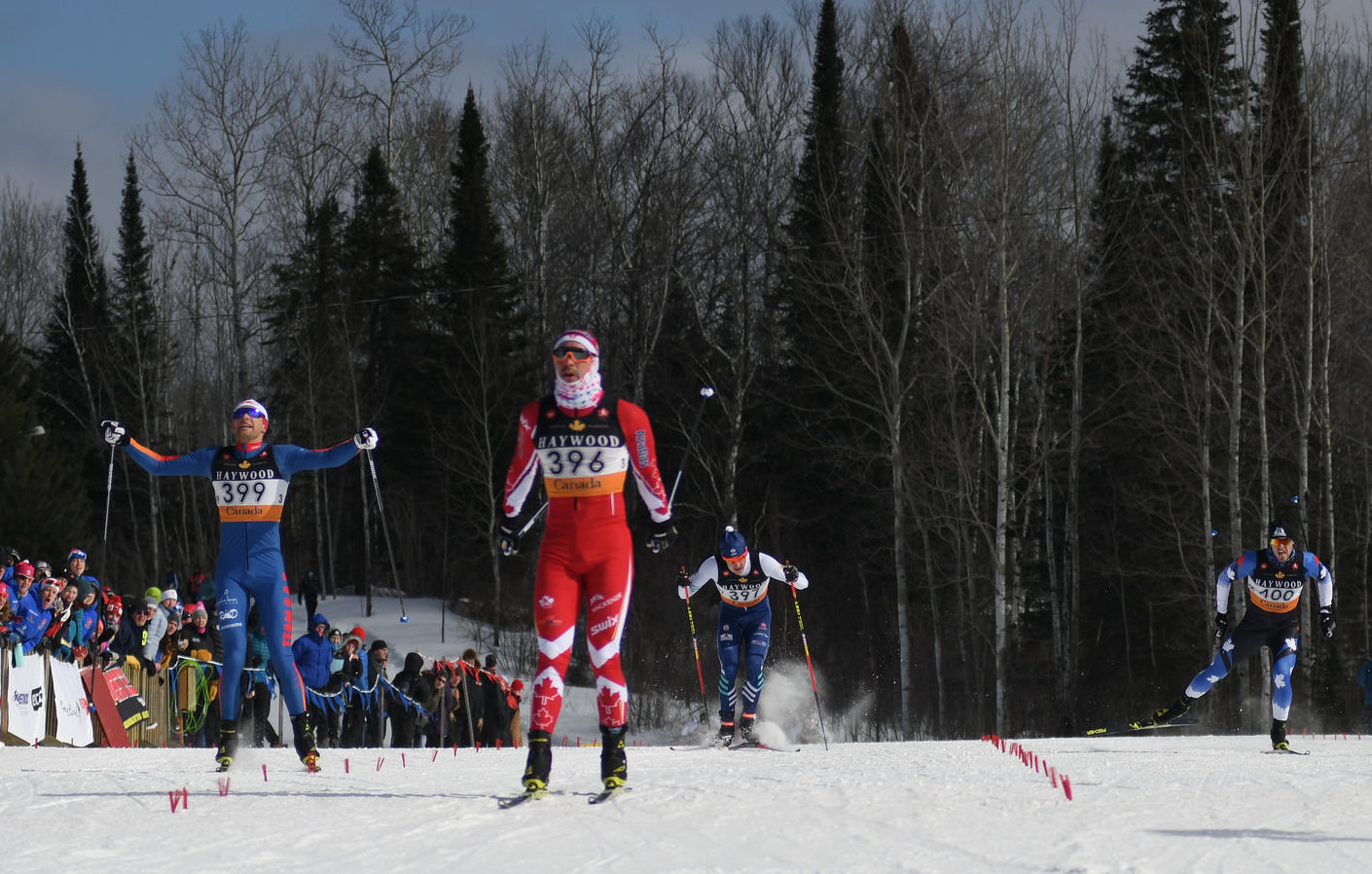
Jess Cockney (396) after winning the men’s 15 k freestyle pursuit at 2018 Canadian Ski Nationals, ahead of Ty Godfrey (l), Michael Somppi (r) and Evan Palmer-Charrette (second from r) in Thunder Bay, Ontario. (Photo: Doug Stephen)
Canadian Ski Nationals (Thunder Bay, Ontario): Freestyle pursuits and sprints
Ski Nationals continued Tuesday and Wednesday at Lappe Nordic in Thunder Bay, with 10- and 15-kilometer freestyle pursuits (based on Sunday’s 5/10 k classic interval starts) followed by sprints.
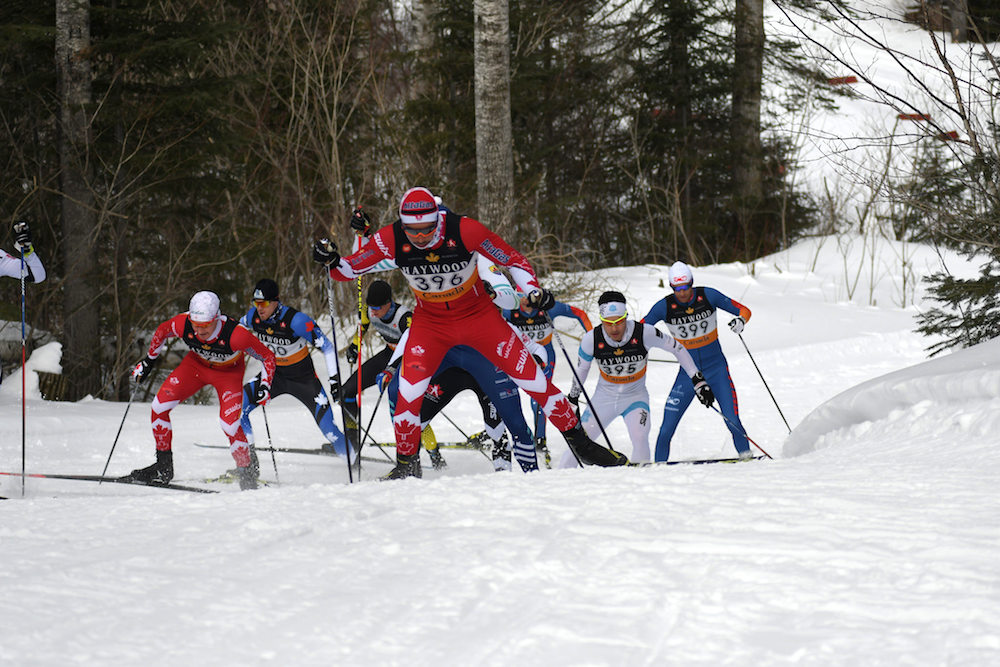
Jess Cockney (396) leading the men’s 15 k freestyle pursuit on Tuesday at 2018 Canadian Ski Nationals in Thunder Bay, Ontario. He went on to win the pursuit as well as the freestyle sprint the next day. (Photo: Doug Stephen)
On Tuesday, Jess Cockney of the Canadian World Cup Team and Alberta World Cup Academy (AWCA) raced to first in the men’s 15 k freestyle pursuit, up from sixth after the 10 k classic. His cumulative time for the two races was 1:04:06.7 hours, just 1.2 seconds ahead of Ty Godfrey of Team R.A.D. in second. (Godfrey previously placed ninth in the 10 k classic.) Michael Somppi, who grew up skiing with Lappe Nordic and now trains with the AWCA, completed the podium in third, 2 seconds behind Cockney, after placing 10th in the classic race.
Just behind Somppi, another local skier Evan Palmer-Charrette, of Lappe Nordic and the National Team Development Centre (NTDC) Thunder Bay, placed fourth in the pursuit (+2.8). Antoine Cyr and Alexis Dumas, both of the Pierre-Harvey National Training Centre (CNEPH), finished together in fifth (+11.5) and sixth (+11.6), respectively, ahead of Knute Johnsgaard (World Cup Team) in seventh (+13.4), Scott Hill of Barrie Cross Country (BXC) in eighth (+16.3), Reed Godfrey (Team R.A.D.) in ninth (+31.8), and Ryan Jackson (BXC) in 10th (+38.9).
The fastest 15 k skate time of the day was clocked by Somppi in 36:54.5. Ty Godfrey had the second fastest time of day, just 0.2 seconds back, while Cockney’s freestyle time ranked third fastest (+4.9).
Olivia Bouffard-Nesbitt (Rocky Mountain Racers) racing to second overall (first Canadian) in the women’s 10 k freestyle pursuit on Tuesday for her second national title of the week at 2018 Canadian Ski Nationals in Thunder Bay, Ontario. (Photo: Doug Stephen)
American Caitlin Gregg, of Central Cross Country (CXC), Team Gregg and Loppet Nordic Racing, won the women’s 10 k freestyle pursuit by more than a minute in 43:12.4, after placing second in the 5 k classic. The winner of Sunday’s classic race, Olivia Bouffard-Nesbitt of Rocky Mountain Racers (RMR) scored her second-straight title as the first Canadian in the pursuit, placing second overall, 1:03.4 behind Gregg. Annika Hicks (AWCA) was the second Canadian in third overall (+1:16.3), up from fifth in the classic race.
Gregg clocked the fastest 10 k skate time in 27:51.6, while Vézina was second fastest on the day, 1:06.5 back. Hicks had the third-fastest time, 1:07.3 back from Gregg.
On Wednesday, Cockney racked up his second-straight national title with a victory in the 1.4 k freestyle sprint final. Cockney edged Andy Shields (Lappe Nordic) by 0.83 seconds for the win in 2:39.87. Just three-hundredths of a second behind Shields, Palmer-Charrette reached the podium in third (+0.86), Somppi followed in fourth (+2.14), Julian Smith (NTDC Thunder Bay/National U25 Team) finished fifth (+4.3) and Sebastien Boehmler-Dandurand (Stefan Kuhn HP Team) placed sixth (+11.81).
Shields won the qualifier to start the day in 2:44.54, while Cockney was the second-fastest men’s qualifier, 1.39 seconds off Shields’s time. Shields went on to win his quarterfinal and place second in the first semifinal, while Cockney was second to Smith in both the fourth quarterfinal and second semifinal.
Maya MacIsaac-Jones (l) and Katherine Stewart-Jones (r) go head to head for the win in the women’s freestyle sprint final on Wednesday at 2018 Canadian Ski Nationals in Thunder Bay, Ontario. MacIsaac-Jones won it by 0.05 seconds. (Photo: Doug Stephen)
MacIsaac-Jones won the women’s skate-sprint final in 3:06:68, five-hundredths of a second ahead of Stewart-Jones in second. In a race for third, Maclean took it (+4.82), ahead of Gregg in fourth (+5.01). Hicks placed fifth (+7.22) and Zoë Williams (Nakkertok) was sixth (+9.12).
MacIsaac-Jones topped the women’s qualifier by 5.78 seconds in 3:12.87. Mathilde Petitjean of Club Nordique Mont Sainte-Anne (C.N.M.S.A.) qualified second, and Maclean was 6.42 seconds back in third.
MacIsaac-Jones then won the first quarterfinal and placed second to Stewart-Jones in the first semifinal. Stewart-Jones finished second to Bouffard-Nesbitt in the second quarterfinal, and Maclean won the second semifinal over Gregg, after finishing second to Gregg in the fifth quarterfinal.
Nationals conclude with 30/50 k classic mass starts on Saturday.
Patrick Stewart-Jones (l), skiing for his club team Nakkertok, and Scott Hill (r) of Barrie Cross Country (BXC) going head to head in the men’s classic team sprint on Saturday at Canadian Ski Nationals in Thunder Bay, Ontario. Nakkertok won and BXC placed second. (Photo: Doug Stephen)
Canadian Ski Nationals (Thunder Bay, Ontario): Team sprints + 5/10 k classic
Canada’s 2018 Ski Nationals opened this past weekend at Lappe Nordic in Thunder Bay, Ontario, with classic team sprints on Saturday followed by 5- and 10-kilometer classic interval starts on Sunday.
Nakkertok topped the podium in both the open men’s and women’s team sprints. In the men’s final, Nakkertok’s Dominique Moncion-Groulx and Patrick Stewart-Jones won by 1.95 seconds over Barrie Cross Country (BXC) in 14:50.79. BXC’s Ryan Jackson and Scott Hill teamed up for second place, and Skibec’s Alexis Morin and Antoine Brand raced to third (+2.57).
Katherine Stewart-Jones (22), skiing for her club team Nakkertok, while leading Annika Richardson (Hollyburn Ski Club) and Mathilde Petitjean (r) of C.N.M.S.A. during the women’s classic team sprint at 2018 Canadian Ski Nationals in Thunder Bay, Ontario. (Photo: Doug Stephen)
The Stewart-Jones family was also a big winner on Saturday, with Nakkertok’s Zoë Williams and Katherine Stewart-Jones (Patrick’s sister) racing to first in the women’s final in 13:04.72. They finished 2.37 seconds ahead of Katie Weaver and Annika Richardson of the Hollyburn Ski Club in second place, and Marie Corriveau and Mathilde Petitjean of Club Nordique Mont-Sainte-Anne (C.N.M.S.A.) raced to third (+7.42).
On Day 2 and the first official day of Canadian Ski Nationals, Hill (BXC) took his second-straight win of the weekend, topping the men’s 10 k classic with a time of 26:45.1 for his first senior national title. He finished 7.2 seconds faster than Alexis Dumas, of the Pierre-Harvey National Training Centre (CNEPH) in second, and an early race leader, Knute Johnsgaard of the Canadian World Cup Team, placed third (+12.0)
Johnsgaard clocked the fastest split at the race’s halfway point, while Hill’s 5 k time was almost 10 seconds slower. But over the final 5 k, Hill’s lap time was nearly 22 seconds faster than Johnsgaard’s. Dumas skied a consistent race, with the fourth-fastest first lap and second-fastest second lap.
Knute Johnsgaard (Canadian World Cup Team) racing to third in the men’s 10 k classic on Sunday at Canadian Ski Nationals in Thunder Bay, Ontario. (Photo: Doug Stephen)
Jackson (BXC) finished fourth (+14.7), and Jess Cockney of the Alberta World Cup Academy (AWCA) and Canadian World Cup Team placed fifth (+22.2). Leading the National Team Development Centre (NTDC) Thunder Bay on its home trails was Evan Palmer-Charrette in sixth (+24.8), and Lappe Nordic’s Michael Somppi (AWCA) placed seventh (+29.1). Gareth Williams of Telemark Nordic and the Canadian U25 Team finished eighth (+39.5), American Brian Gregg (CXC/Team Gregg/Loppet Nordic Racing) was ninth (+44.7), and Jack Carlyle (AWCA) 10th (+49.5).
Olivia Bouffard-Nesbitt of Rocky Mountain Racers (RMR) collected her first senior national title with a 13.3-second victory in the women’s 5 k classic. She finished in 15:07.5, ahead of American Caitlin Gregg (CXC/Team Gregg/LNR) in second, while Katherine Stewart-Jones (NTDC Thunder Bay) was the second Canadian and third overall (+17.9).
NTDC Thunder Bay had two in the top four with Alannah Maclean in fourth (+19.8). Annika Hicks (AWCA) followed in fifth (+22.2), Frédérique Vézina (CNEPH) was sixth (+30.8), Sophie Carrier-Laforte (Skinouk) seventh (+33.0), Maya MacIsaac-Jones (RMR/Canadian U25 Team) eighth (+37.4), Laura Leclair (CNEPH) ninth (+58.1), and Williams (Nakkertok) 10th (+1:07.2).
Nationals continue Tuesday with 10/15 k freestyle pursuits, followed by skate sprints on Wednesday and 30/50 k classic mass starts on Saturday.
Annika Richardson (l) with her Thunder Bay teammate Katherine Stewart-Jones on the “only sunny day” during Canada’s pre-Junior Worlds training camp last month in Praz de Lys, France. (Courtesy photo)
In an effort to showcase the North Americans who competed at last week’s International Ski Federation (FIS) 2018 Nordic Junior/U23 World Championships in Goms, Switzerland, we asked those qualifying athletes several questions about themselves — actually, we had them fill in the blanks. Here we have 20-year-old Annika Richardson, of the National Team Development Centre (NTDC) Thunder Bay, who represented Canada at her second Junior Worlds.
Last week, Richardson raced to 52nd in the freestyle sprint, 67th in the 5 k classic, and 15th with the women’s 4 x 3.3 k relay.
***
“My full name is Annika Meghan Richardson, but you can call me Young Rich.
I was born and raised on the West Coast (best coast) in Vancouver, and I learned to ski at Hollyburn in rain pants (most of the time).
Annika Richardson (NTDC Thunder Bay) racing to 12th in the freestyle sprint qualifier on Jan. 9 at NorAm World Juniors trials at Mont Sainte-Anne, Quebec. (Courtesy photo)
I spent the time between Mont Sainte-Anne trials and Junior/U23 Worlds thinking about catching up on school work.
The slipperiest (it poured with rain) workout I did in the last training year to prepare for this was the Canada 150 rollerski mass start with Caitlin Compton-Gregg and the NTDC women’s team.
This is my second time in Switzerland (in the last two weeks) and fourth time racing internationally, and so far it’s been full of crazy fast skiers.
One difference I’ve noticed between Switzerland and Canada is they don’t say sorry as much.
Skiing and racing in the Alps has been very snowy so far. Usually racing at altitude is a lactate party for me because when I’m racing I forget that it’s harder at altitude. There are lots of mountains around where I live in Vancouver but not really any in Thunder Bay.
One of the things I’m most excited about for Junior/U23 Worlds in Goms is the big hill in the skate sprint course.
One race I’m especially targeting there is the skate sprint qualifier.
I really hope I can chat/make friends with someone from Germany and ask them if they own a pair of Lederhosen.
My favorite thing at the breakfast where we are staying is definitely the strong coffee (finally).
Fondue is not something I have had the opportunity to try yet but I bet it’s delicious. The cheese here is quite abundant and there is tons of variety. And the chocolate is very, very rich and a bit too available.
If I had a totally free day here and didn’t have to worry about race fitness or training, I’d spend it practicing my downhill shredding skills on a powder day.
The best way to follow me on social media is on Instagram @annika.richardson.”
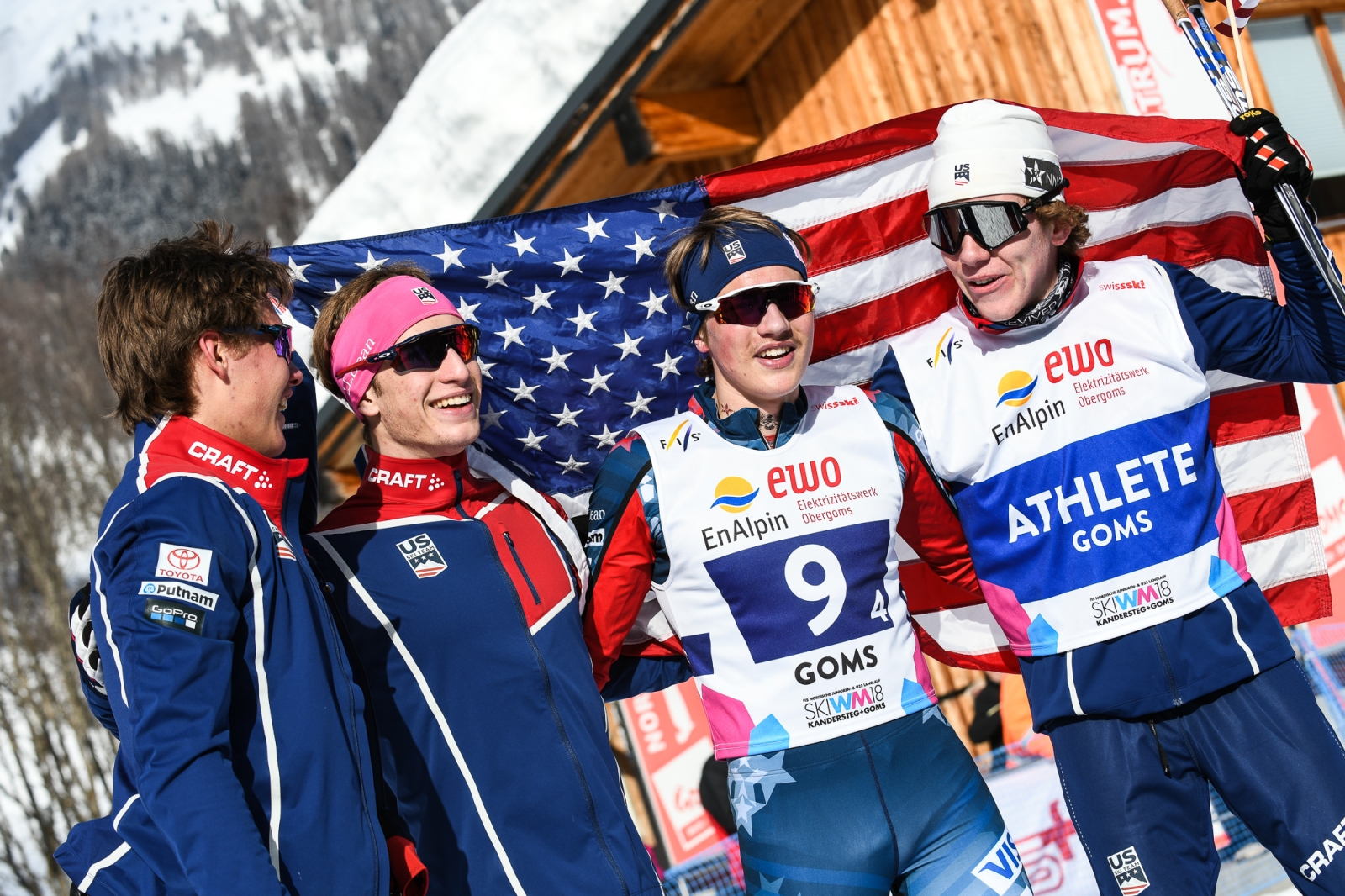
The U.S. men’s silver-medal relay at 2018 Junior World Championships in Goms, Switzerland, with (from left to right) Luke Jager, Hunter Wonders, Gus Schumacher, and Ben Ogden. (Photo: JWSC2018.ch)
(Note: This article has been updated to include comments from Americans Ben Loomis, Luke Jager and Gus Schumacher.)
Junior World Championships (Goms, Switzerland): Men’s and women’s relays
Two individual medals and a relay podium. That’s how the U.S. team fared this week at Junior World Championships in terms of a medal count, but the significance of its breakthroughs go way beyond the hardware.
Hailey Swirbul became the most successful American nordic skier at Junior World Championships with a silver and a bronze in the two women’s distance races. Then, on Saturday, the U.S. men took their turn in the spotlight, racing to second and almost first in the 4 x 5-kilometer relay for the best relay finish by an American team at Junior Worlds. Last year, the U.S. women placed third at 2017 Junior Worlds at Soldier Hollow in Midway, Utah.
Luke Jager started the team off on Saturday as the first classic leg, putting the U.S. men in sixth at the first exchange, 14 seconds behind Sweden in first.
While Sweden dropped to second on the next leg, the U.S. continued to move up, with Ben Ogden racing to fourth, 8.5 seconds out of first, behind Norway, Russia and France, respectively.
On the first freestyle leg, Hunter Wonders held the U.S. in fourth and tagged anchor Gus Schumacher in fourth, 31.3 seconds out of first. Norway continued to lead with France, and Russia skied about 5 seconds back in third with 5 k to go.
Schumacher then skied the fastest anchor leg to race up to second, passing France and finally Russia in the finishing straight, as he crossed the line 2.2 seconds behind Norway’s Jørgen Lippert — who eased up in the finish and secured the Norwegian gold with a total time of 50:04.2 minutes.
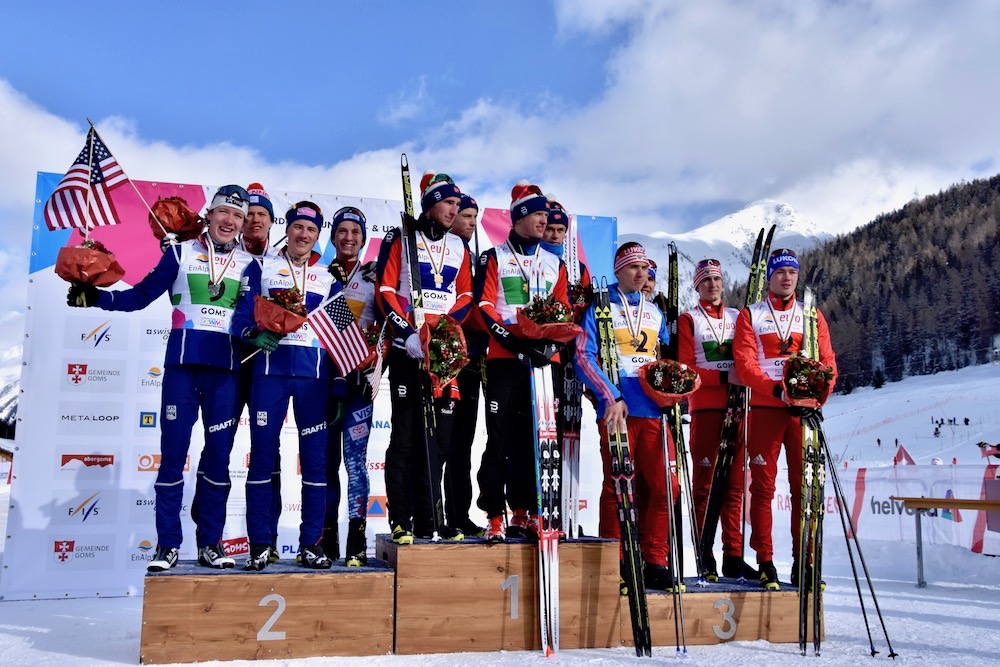
The men’s 4 x 5 k relay podium at 2018 Junior World Championships with Norway (c) in first, the U.S. (l) in second (Ben Ogden, Luke Jager, Gus Schumacher, Hunter Wonders), and Russia (r) in third. (Photo: Julia Kern)
The U.S. placed second, 3.3 seconds ahead of Russia in third (+5.5), and France finished fourth (+29.6).
Norway’s winning team included two men who won individual golds this week, Harald Østberg Amundsen (in the 20 k skiathlon) and Jon Rolf Skamo Hope (10 k classic), as well as Håvard Moseby and Lippert (who took bronze in two races).
Russia’s team was made up of Kirill Kilivnyuk, Sergey Ardashev, Yaroslav Rybochkin, and Alexander Terentev. Team France was Camille Laude, Hugo Lapels, Tom Mancini, and Pierre Tichit.
Canada placed 11th (+3:12.8) with Antoine Cyr, Ritchie Graham, Felix Longpre, and Etienne Hebert. Sixteen teams contested the men’s relay on the final day of Junior Worlds in Goms.
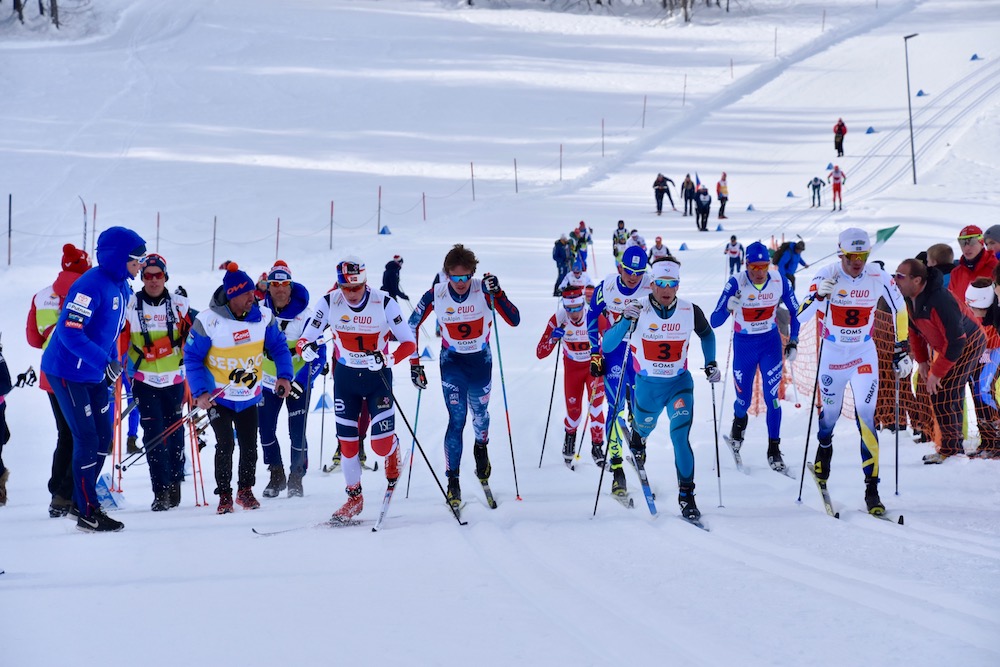
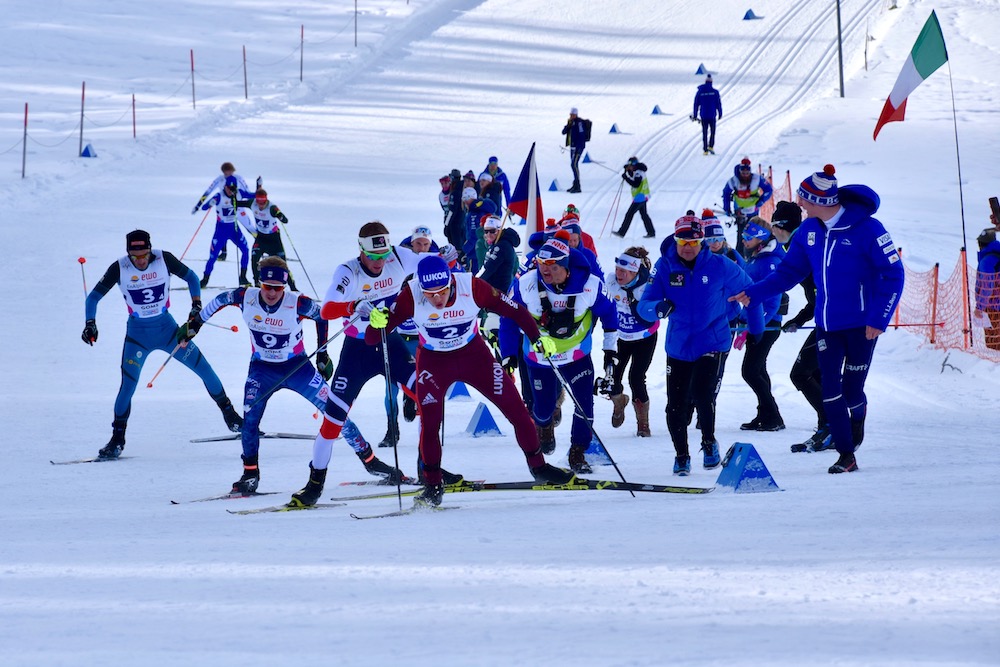
American Luke Jager (9) skiing with Norway’s Harald Østberg Amundsen (1), France’s Camille Laude (3), and Sweden’s Jacob Nystedt (8) during the first leg of the men’s 4 x 5 k relay on Saturday at 2018 Junior World Championships in Goms, Switzerland. (Photo: Julia Kern)
In an email, Jager, who turned 18 last month, explained that he was grateful for the opportunity to race at his first Junior Worlds.
“I barely qualified for this trip after a tough week in Anchorage so my options for starts were super limited,” Jager wrote. “I got the sprint start last week which was pretty horrendous and then a guaranteed spot on the relay team. So I had the whole week to prepare and rest. Watching the boys all week we realized that a medal could be possible and we started targeting that super closely.”
But over the last week, Jager hadn’t been feeling well.
“I was feeling really really bad in the days following the sprint and could barely get out and ski for 60 minutes each day,” he recalled. “I had actually told [U.S. Ski Team Development Coach Bryan] Fish that if I continued to feel as bad as I had been I was gonna sit out the relay. But I started feeling better and better throughout the week and was feeling really good this morning.”
He had previously asked Fish if he could ski the scramble leg.
“Bryan was stoked about it too so that decision was easy,” Jager explained. “This group of dudes is perfect for each leg of a relay so we barely even needed to discuss order. I am definitely a stronger classic skier so I was stoked to be able to get some redemption for my poor form in the last month.”
Schumacher, 17, explained he found out the relay order on Friday night and “really started to get excited about it,” he wrote in an email. “We had some foreign friends say that they thought we could do well so that really helped confidence.”
From the gun, Jager expected a fast pace and pushed to put himself in the lead group while trying to conserve energy and avoid any tangles He locked onto Norway’s Amundsen and by the last climb on the second lap, found that the group was beginning to string out.
“I was thankfully able to hold on just enough to maintain connection with the leaders and put Ben in a position where he could do his thing,” Jager wrote. “I would have liked to be a little further up in the group when I tagged off to Ben but the Swedes’ first skier had done so much damage in the last minutes that we were all in single file and pretty much in survival mode up the last climb.”
Russia’s Alexander Terentev leading Norway’s Jørgen Lippert, American Gus Schumacher (9), and France’s Pierre Tichit (3) up a climb in the final leg of the men’s 4 x 5 k relay at 2018 Junior World Championships in Goms, Switzerland. (Photo: Julia Kern)
Fast-forward to Schumacher getting tagged in fourth in the final exchange, 31.5 seconds behind Norway in first, 30.9 seconds behind France in second, and 26.2 seconds behind Russia in third. Despite the gap, he believed he could close it.
“I definitely thought those three were in reach, and I wanted to catch them, if for no other reason than to keep clear of 5th and 6th,” Schumacher wrote. “I focused on really holding steady for the first 2k, then starting to push more, and I was able to catch that lead pack and then recover with them for the last sprint, which did end up really hurting.”
While he had distanced himself from France and secured third by the final hill, he hadn’t anticipated catching Russia or Norway.
“By the time I got through the downhill corner, however, I was closing fast on the Russian and realized I was right there,” Schumacher wrote. “I popped around the last corner and was almost even with Russia, then after a few seconds of sprinting I pulled ahead and he slowed down and I knew I had it.”
While Jager explained he’s not one to get very nervous about racing, Saturday was completely different.
“… Watching the rest of the race progress was one of the most nerve wracking experiences of my life,” he wrote. “When Hunter tagged off to Gus I knew we were really really gonna be in the fight for a medal. I’ve been racing Gus for most of my life and I know when that kid is gonna throw down and produce a miracle and I could see it…
“This is something this group of guys has been dreaming of and training for for a really long time now,” he added. “To be able to watch that dream come into fruition today was indescribable. Probably the best day of my life since Cole Morgan added me on Snapchat. We came here this year to show the world that US skiing is the real deal and that we’re here to stay and I think we did that. To be able to be a piece of that history was an honor.”
“Experiencing the podium here has been so cool,” Schumacher wrote. “I thought it was possible, but actually getting it feels amazing. This whole trip has been really cool even without this success, it’s such an amazing place and the team is tight. I think individually I anticipated results maybe a little better, but this seems about right, and as a team I think we all surprised ourselves. Together we can make some big waves.”
Germany Wins Women’s Relay; U.S. 8th
In the women’s 4 x 3.3 k relay earlier on Saturday, Germany took the win by 8.6 seconds over Russia with a winning time of 39:17.4. Sweden finished third, 47.5 seconds out of first.
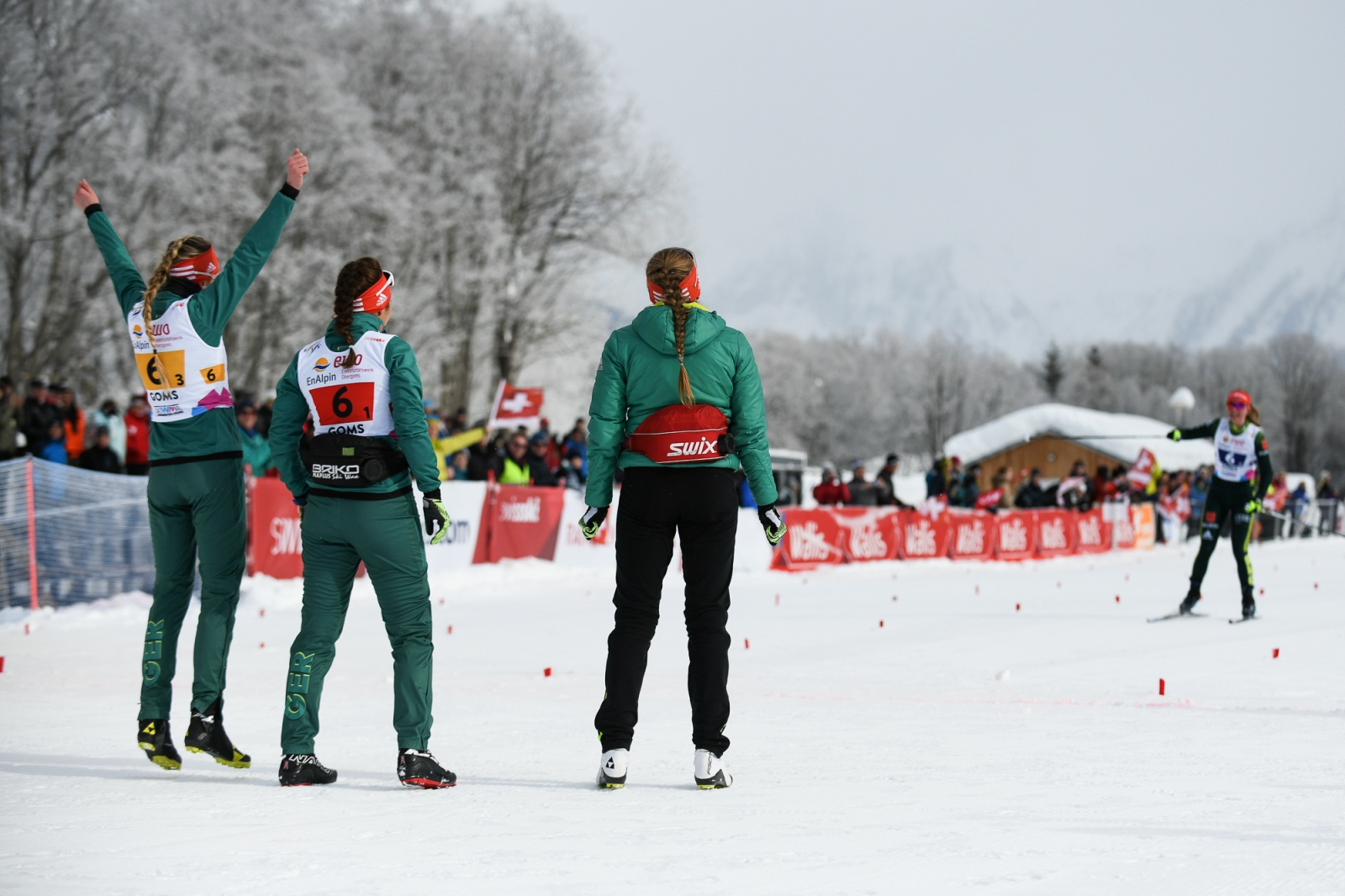
Germany’s Alexandra Danner, Celine Mayer and Lisa Lohmann await their teammate Anna-Maria Dietz at the finish of the women’s 4 x 3.3 k relay on Saturday at 2018 Junior World Championships in Goms, Switzerland. Germany placed first and Russia finished second, 8.6 seconds later. (Photo: JWSC2018.ch)
Germany (Alexandra Danner, Celine Mayer, Lisa Lohmann, Anna-Maria Dietz) improved from third on the first leg, to second on the second and third legs, and final first on Dietz’s anchor leg.
Russia (Polina Nekrasova, Hristina Matsokina, Nina Dubotolkina, Maya Yakunina) led the race from the first through the third and final exchange, before slipping to second at the finish.
Sweden (Tua Dahlgren, Frida Karlsson, Alicia Persson, Johanna Hagström) rebounded from 13th and more than a minute and a half back at the first exchange to tag in fourth and 28 seconds out of first thanks to Karlsson’s fastest second-leg time. By the final exchange, they were up to third and they held that position to the finish.
The U.S. women’s 4 x 3.3 k relay at 2018 Junior World Championships, with (from left to right) Hailey Swirbul, Kathleen O’Connell, Hannah Halvorsen, and Molly Gellert. They placed eighth on Saturday. (Photo: Julia Kern)
The U.S. placed eighth (+1:08.1) with Kathleen O’Connell, Swirbul, Molly Gellert, and Hannah Halvorsen. After O’Connell put them in eighth and about a minute back on the first leg, Swirbul skied them up to sixth with the second-fastest second leg, 30.1 seconds out of first. Gellert held onto that position on the first skate leg, but Halvorsen slipped two places on the anchor leg to finish eighth.
Canada finished 15th (+4:47.8) out of 16 teams with Hannah Mehain, Natalie Hynes, Annika Richardson, and Alexandra Racine.
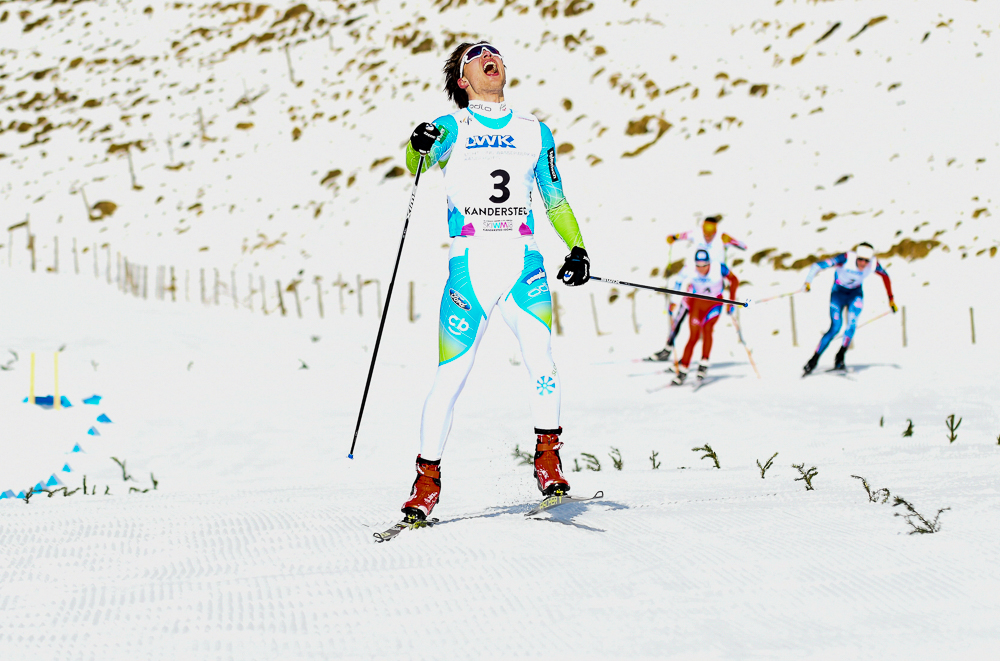
Slovenia’s Vid Vrhovnik (3) celebrates his win in the last nordic-combined competition of 2018 Junior World Championships, the individual normal hill/5 k, on Saturday in Kandersteg, Switzerland, while the Czech Republic’s Jan Vytrval, Austria’s Dominik Terzer and American Ben Loomis (r) battle for second. (Photo: JWSC2018.ch)
Nordic Combined Junior World Championships (Kandersteg, Switzerland): Normal hill/5 k Gundersen
In the final nordic-combined competition of Junior Worlds, American Ben Loomis nearly notched his second podium of the week, missing it by one-tenth of a second in fourth place.
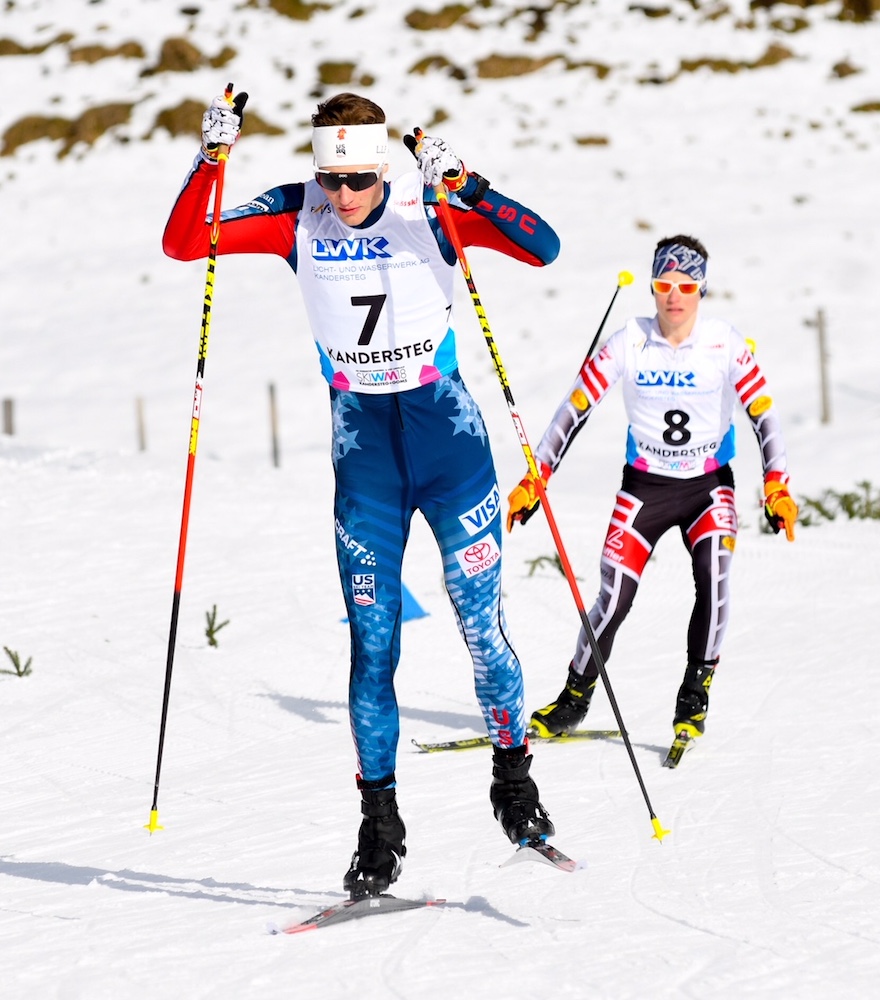
American Ben Loomis (7) leads Austria’s Johannes Lamparter during Saturday’s 5 k at 2018 Nordic Combined Junior World Championships in Kandersteg, Switzerland. Loomis went on to place fourth and Lamparter finished eighth. (Photo: Romina Eggert)
Slovenia’s 18-year-old Vid Vrhovnik won the individual normal hill/5 k Gundersen by 4.9 seconds over Austria’s Dominik Terzer. After posting the third-best jump on the 106-meter hill, Vrhovnik started the 5 k race 6 seconds behind Germany’s Luis Lehnert in first. Terzer jumped to second and started just 4 seconds behind, while the Czech Republic’s Jan Vytrval jumped to fourth and started 10 seconds back. Loomis jumped to seventh (just as he did on Tuesday before racing to third place) and started 27 seconds out of first.
“I was happy with my jump being closer in time to the front,” Loomis wrote in an email about his his jump, which put him about 10 seconds closer to the leaders than on Tuesday. “I didn’t feel quite as lucky with the wind. I was hoping to jump around the top 5, but 7th, only 27sec back was good, too.”
Over the two-lap 5 k, Vrhovnik battled with Terzer, while Lehnert slipped to seventh at the finish, 23.5 seconds behind. The Slovenian took the win by nearly five seconds over Terzer in 11:28.8, and Vytrval outlunged Loomis for third place (+5.4). Loomis placed fourth (+5.5), well ahead of Norway’s Einar Lurås Oftebro in fifth (+18.4).
Ben Loomis (USA Nordic) on the last day of 2018 Nordic Combined Junior World Championships in Kandersteg, Switzerland. He jumped to seventh and moved up to fourth in the 5 k. (Photo: Romina Eggert)
“I was able to catch places 3-6 on the first lap and ski with them through the beginning of the second lap,” Loomis wrote. “Towards the end of second lap I closed down on second place (Jan Vytral) with Dominik Terzer. On the last corner we packed up in positions 2-4.
“The finish started with a sharp downhill corner followed by a quick stretch less than 100 meters,” he continued. “I came into the finishing lanes in second but unfortunately took the wrong line and was passed by Dominik and never quite caught Jan in front of me.”
While he had been hoping for another podium, Loomis acknowledged that he was pleased to ski the fastest race time and “be battling at the front”.
“Overall I am leaving Switzerland with my goals accomplished and feeling satisfied,” he wrote. “It would have been nice to walk away with a double podium but I am still very happy with how to week went. This week has been a huge confidence booster going into the Olympics next week. I am very excited to represent my country and enjoy my time at the games. I am looking to have fun, take in experience and not overthink the results.”
Also for the U.S., Stephen Schumann placed 18th (+1:18.6), up one place from 19th in the jump, Jared Shumate finished 40th (+3:05.7), up from 48th in the jump, and Tucker Hoefler was 55th (+5:50.5), after jumping to 55th.
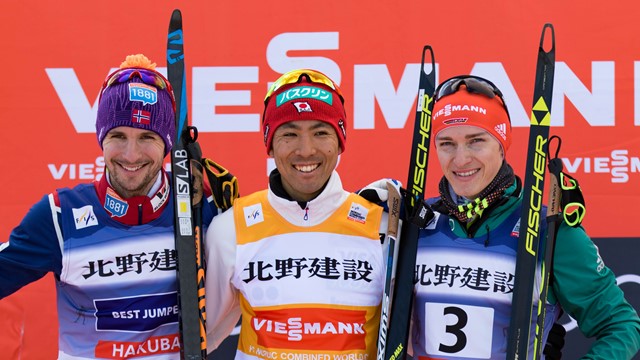
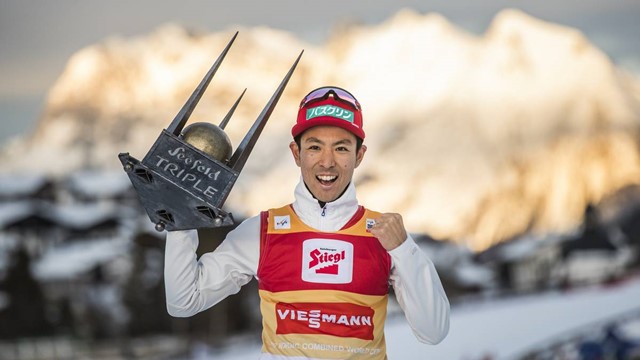
The podium at Saturday’s Nordic Combined World Cup in Hakuba, Japan, with Japan’s Akito Watabe (c) in first, Norway’s Jan Schmid (l) in second and Germany’s Manuel Faißt (r) in third. (Photo: FIS/Flawia Krawczyk)
Nordic Combined World Cup (Hakuba, Japan): Large hill/10 k Gundersen
Many of the winter-sports World Cups were off this weekend before the Olympics start in earnest a week from today in PyeongChang, South Korea, but not nordic combined, which had a World Cup stop in Hakuba, Japan.
There, local hero Akito Watabe took the win in 24:14.6 minutes, a whopping 1:12.6 minutes clear of Norway’s Jan Schmid in second. Germany’s Manuel Faißt placed third, 1:22 back, and Estonia’s Kristjan Ilves finished 52 seconds later in fourth (+2:14).
The lone American competing in Saturday’s 10 k Gundersen, Ben Berend achieved his first individual World Cup top 30, placing 23rd (+4:31.7) after jumping to 16th on Hakuba’s 134-meter large hill.
Watabe led from the beginning of the day after jumping to first, ahead ofIlves in second, Faißt in third, and Schmid in fourth. Watabe started the 10 k with a 16-second head start on Ilves, while Faisst started 52 seconds out of first and Schmid started 1:08 behind.
Berend started the 10 k with a 2:36 deficit to first, with five others within 10 seconds of him. His teammate Adam Loomis did not start the 10 k after jumping to 38th.
Another individual large hill/10 k Gundersen will be held on Sunday in Hakuba. The first nordic combined competition in PyeongChang, the individual normal hill/10 k, is set for Wednesday, Feb. 14.
The men’s 15 k freestyle podium at 2018 Eastern Canadian Championships in Gatineau, Quebec, with Jack Hegman (c) in first, David Norris (l) in second and Tad Elliott (r) in third. (Photo: Rob Smith)
NorAm Eastern Canadian Championships (Gatineau, Quebec): 10/15 k freestyle
Americans swept the podium in both the men’s and women’s freestyle individual starts on Saturday at Eastern Canadian Championships in races that count toward both NorAm and SuperTour standings.
According to unofficial results, Jack Hegman, of the Sun Valley Ski Education Foundation (SVSEF), won the men’s 15 k by 9.1 seconds over David Norris, of Alaska Pacific University (APU), in 35:44.9. Tad Elliott (Ski Club Vail) placed third (+38.7) just ahead of the top Canadian, Jack Carlyle, of the Alberta World Cup Academy (AWCA), in fourth (+41.7).
The U.S. occupied eight of the top 10 in the men’s race, with Kevin Bolger (SVSEF) in fifth (+45.0), Ben Lustgarten, of the Craftsbury Green Racing Project (CGRP) in sixth (+52.3), Brian Gregg (Team Gregg/LNR/CXC) in seventh (+57.0), Rogan Brown (SVSEF) in eighth (+58.1), Canada’s Scott Hill (Barrie Cross Country) in ninth (+1:14.7), and Eric Packer (APU) in 10th (+1:18.6).
The women’s 10 k freestyle podium at 2018 Eastern Canadian Championships in Gatineau, Quebec, with Rosie Frankowski (c) in first, Becca Rorabaugh (l) in second and Erika Flowers (r) in third. (Photo: Rob Smith)
After placing second in a 10 k freestyle at last weekend’s SuperTour in Craftsbury, Vermont, Rosie Frankowski (APU) won the women’s 10 k freestyle on Saturday in Gatineau by more than 30 seconds in 27:07.3. Her teammate Becca Rorabaugh (who won the Craftsbury 10 k skate as well as Friday’s classic sprint in Gatineau) placed second (+37.1) on Saturday, and Erika Flowers placed third (+1:26.4) for the third-straight race.
Frédérique Vézina, of the Pierre-Harvey National Training Centre, led the Canadians in fourth (+1:46.2), while America Liz Guiney (CGRP) placed fifth (+1:52.2), and Olivia Bouffard-Nesbitt (Rocky Mountain Racers) finished sixth (+1:56.4).
Also in the top 10, Kaitlynn Miller (CGRP) placed seventh (+1:57.8), Felicia Geisor (CXC Team) was eighth (+2:18.5), Zoë Williams (Carleton University) ninth (+2:39.6) and Annika Hicks (AWCA) 10th (+2:43.4).
Eastern Canadian Championships conclude Sunday with 10/15 k classic pursuits at the Nakkertok Nordic Ski Centre.
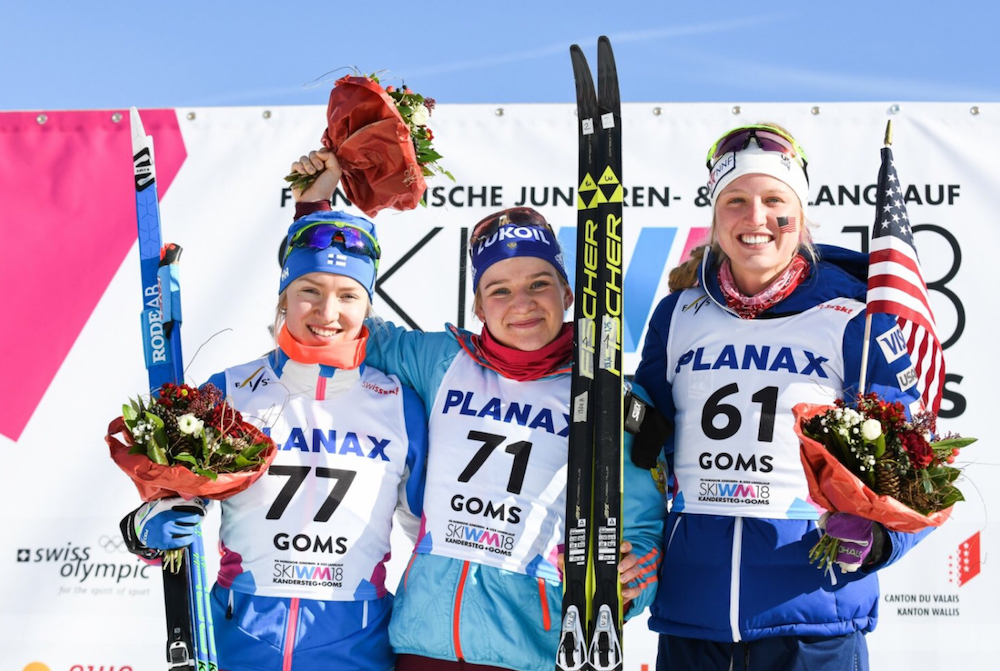
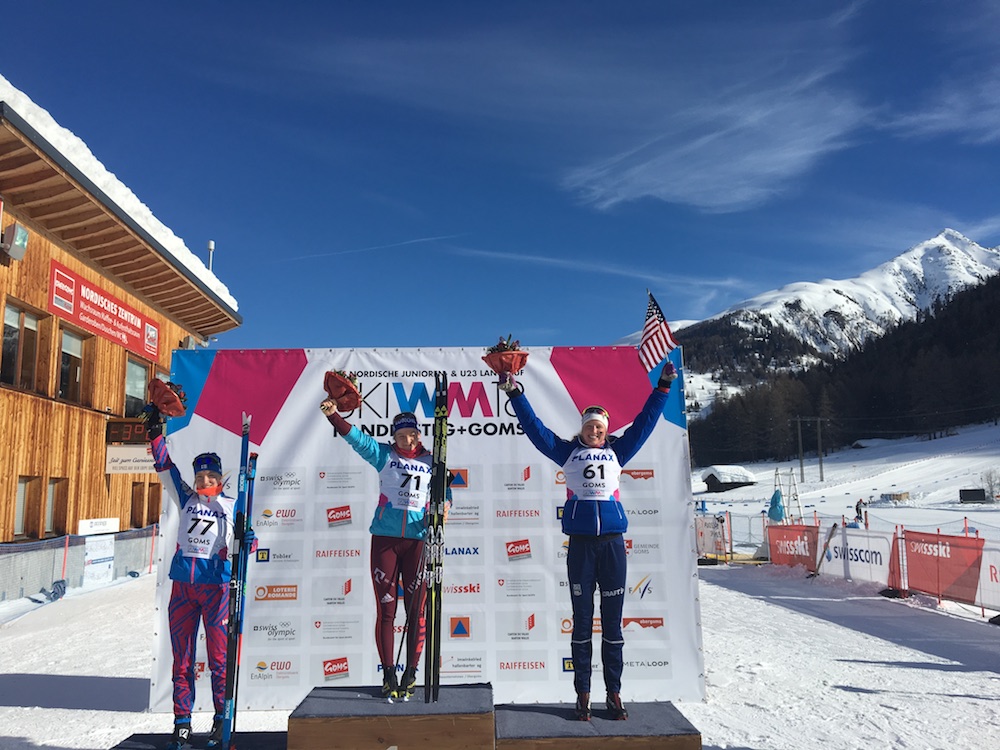
The women’s 5 k classic podium at 2018 Junior World Championships in Goms, Switzerland, with American Hailey Swirbul (r) in second, Russia’s Polina Nekrasova (c) in first, and Finland’s Anita Korva (l) in third. (Photo: JWSC2018.ch)
(This article has been updated to reflect that American Hailey Swirbul was in second for most of Tuesday’s 5 k race, not over one minute back as previously reported based on a live timing error. It has also been updated to include comments from Americans Hailey Swirbul, Ben Loomis, Stephen Schumann, and Gus Schumacher, Canada’s Antoine Cyr, University of Alaska Anchorage nordic head coach Andrew Kastning, and U.S. Ski Team Development Coach Bryan Fish.)
Junior World Championships (Goms, Switzerland): 5/10 k classic
Hailey Swirbul became the second American cross-country skier to earn an individual medal at Junior World Championships and first to take silver (Katharine Ogden claimed bronze in last year’s skiathlon) in the women’s 5-kilometer classic individual start on Tuesday in Goms, Switzerland.
Swirbul, a 19-year-old University of Alaska Anchorage sophomore, also tallied the best American finish at a Junior/U23 World Championships since Jessie Diggins earned silver in 2014 in the freestyle sprint. It was Swirbul’s second medal the last two Junior Worlds after she teamed up with Hannah Halvorsen, Julia Kern, and Ogden to take bronze in last year’s relay.
Going into this week’s championships, Swirbul, a Colorado native, explained she was aiming for a top 10 in one of the distance races. U.S. Ski Team Development Coach Bryan Fish pointed out that she wasn’t sure she’d feel up to racing on Tuesday.
“She had been feeling under the weather so she didn’t come up and ski yesterday,” Fish said on the phone Tuesday. “It was a little bit of a shock to Hailey herself that she skied so fast because there was some contemplation of whether she would race or not.”
“I made it a goal to stay relaxed and ski the race I would ski in a lower pressure race,” Swirbul wrote in an email. “I often find that I, and others, change their good race habits when at a high pressure event, so I was hoping to pace the race evenly and not start out too fast.
“The key for interval starts for me is to only think about skiing smoothly and powerfully for the first few kilometers of the race, and I’ve been discovering that that usually leads to decent splits throughout my race,” she continued.
She ended up racing to second place on Tuesday in the second race of 2018 Junior World Championships. The 61st starter (out of 84), Swirbul skied in second for most of the race, just behind Russia’s Polina Nekrasova, according toFish.
“She was basically tied for second and really had a strong second half of the course, and really skied solid in particular the last kilometer,” Fish said. “Always in the top five for sure, and well within striking distance [of the podium].”
The women’s 5 k classic podium at 2018 Junior World Championships in Goms, Switzerland, with American Hailey Swirbul (r) in second, Russia’s Polina Nekrasova (c) in first, and Finland’s Anita Korva (l) in third. (Photo: Bryan Fish)
She initially crossed the finish line in first place, more than a minute faster than the previous race leader. Her time remained faster than all but one of the women who started behind her — as Russia’s Polina Nekrasova (bib 71) took the win in 13:58.7 minutes, 14.4 seconds ahead of Swirbul.
Finland’s Anita Korva started 77th and finished third, 25.4 seconds out of first.
The Czech Republic’s Barbora Havlickova (bib 81) followed in fourth (+26.8), and Norway’s Kristine Stavås Skistad (bib 67) finished fifth (+31.9), and France’s Laura Chamiot-Maitra (bib 83) placed sixth (+34.9).
“… I honestly had no idea I was in the running for the podium during my race, because about 20 girls had yet to finish, so it wasn’t until the last girls came in that I knew I claimed a spot!” Swirbul wrote.
“It was a special moment when I ran down off of the course and I knew her split,” Fish said of Swirbul’s finishing time. “I knew she was sitting in second and they kept announcing and kept announcing, and I told her, ‘You will be second today,’ and it was kind of a combination facial expression of shock and elation. She really couldn’t believe it, but [I said], ‘You’ve got a big enough gap over third place and no one’s catching you.’
“It’s our best Junior Worlds result ever,” Fish added. “Last year was the first individual medal we had ever won or team medal at Junior Worlds and to follow that up with a silver is incredible.
“She was obviously on our podium relay last year, but she came in from U.S. nationals skiing well, qualified very high and she skied incredibly well today,” he explained. “Very fluid stride and did a great job shifting gears and doing a bit more running during the second half of the course.”
“The result hasn’t hit me yet,” Swirbul wrote. “It was beyond what I expected, so my brain is still catching up to the reality! I’ve been dreaming of racing how I know I could for the past 3 years or so, and this season has finally been my chance to break through. I’m so fortunate that things aligned for me on the day that really counted. I couldn’t have done it without Bryan Fish’s unwavering belief in us athletes, and my mom and dad’s support all these years, of course.”
Fish emphasized that while snow conditions have been “very, very good” and “very stable” in Goms, which received 1 1/2 meters (nearly 5 feet) of snow a week and a half ago, the waxing had been a bit challenging due to a temperature range of around -9 degrees to 5 degrees Celsius each day.
“I’m sure there were some teams on klister, some on klister covered with hard wax,” he said of Tuesday’s classic race. “Our techs did a really good job and they were clever with what they came up with when I heard what they were trying. … They’ve been right in the ballpark the last few days and I think they really dialed it in today, and it was impressive kick and glide. To get a podium you ned to have everything going right and I definitely think we had the skis in our favor.”
Halvorsen was the second-best American in 22nd on Tuesday, 1:10.1 out of first, Kathleen O’Connell finished 38th (+1:33.5) and Hannah Rudd was 59th (+2:24.1).
Canada’s Natalie Hynes placed 36th (+1:30.5), Hannah Mehain was 45th (+1:53.3) and Annika Richardson was 67th (+2:53.7). Catherine Reed-Metayer did not finish.
Hailey Swirbul (University of Alaska Anchorage) navigating a downhill while racing to second place in the women’s 5 k classic at 2018 Junior World Championships in Goms, Switzerland. (Photo: JWSC2018.ch)
Andrew Kastning, head coach of the University of Alaska Anchorage (UAA) nordic team, stayed up late the night before Alaska time to watch three UAA skiers (Swirbul, Rudd and Hynes) race on the Junior World Championships livestream.
“Hailey has made classic technique a priority since she stepped on UAA’s campus because that’s where she had the most potential for gain,” Kastning wrote in an email on Tuesday. “She has been working hard on a more powerful and smooth stride on the uphills while getting over elbow pain when double poling. The course looked like it played well to her strengths and that strategy.
“I saw one clip of her entering the big climb and could see that she was relaxed and striding really well,” he continued. “I knew then she was going to have a really good race.”
He noticed that the course had some intimidating downhills and corners, but he knew Swirbul wouldn’t have a problem navigating them.
“Hailey has a solid alpine skiing background and I figured if anyone would be willing to straight line the descents and flatten the corners then a massive amount of time could be saved,” Kastning wrote. “Hailey must have done that because she put 47 seconds on a Russian she was tied with at the high point. I was sort wondering if I was dreaming at moments and had to refrain from yelling and screaming because I’d wake up three daughters and a wife if I did. What a night, what a day. Seawolf Nation and USA are very proud this morning.”
Ogden 7th, Cyr 12th
In the men’s 10 k classic that followed, the excitement continued for Team USA, with 17-year-old Ben Ogden, of the Stratton Mountain School, racing to seventh in his Junior World Championships debut.
The men’s 10 k classic podium at 2018 Junior World Championships in Goms, Switzerland, with Norway’s Jon Rolf Skamo Hope (c) in first, Russia’s Sergey Ardashev (l) in second and Norway’s Jørgen Lippert (r) in third. (Photo: JWSC2018.ch)
Ogden started 72nd and crossed the finish line in first, 16.6 seconds faster than previous race leader Alexander Terentev of Russia. Six later starters ultimately bumped Ogden to seventh, and Norway’s Jon Rolf Skamo Hope took the win in 24:58.8, 40.5 seconds ahead of Ogden.
Russia’s Sergey Ardashev placed second, 9 seconds back, and Norway’s Jørgen Lippert reached the podium in third (+27.9). Norway put four in the top five and Russia had two in the top six, making Ogden the first non-Norwegian or non-Russian male finisher on the day.
According to race splits, Ogden skied an extremely consistent race, clocking the eighth, ninth or 10th fastest times throughout the 10 k.
Canada’s Antoine Cyr placed 12th (+1:07.7) in the second race of his career at Junior World Championships. Two days ago, he finished 30th in the freestyle sprint. Cyr, 19, started 78th and also skied a consistent race, hanging mostly within the top 12 throughout it.
“I knew that classic 10 km was good race for me,” Cyr wrote in an email. “On a good day I was hoping for top 30 but the course was hard and I knew that if I played it smart and paced myself I would be happy with my race.”
He focused on skiing powerfully on his first lap, with big strides and strong double poling, and tried to attack the A-climb and “punchy climb towards the end of the loop” on the second and last lap.
“A top 12 for us in Canada means a lot and with a 25th place in the [skate sprint qualifier] and a 12th place today I think it makes me realize that I have my place on the world level scene,” Cyr wrote. “… This race was a good redemption after my crash in the sprint. I am really happy with the results !!”
Gus Schumacher notched his second top 20 of the week in 17th (after placing 19th in the skate sprint), finishing 1:19.1 out first first, Hunter Wonders placed 22nd (+1:39.1), and Canyon Tobin was 37th (+2:17.2) for the U.S.
In an email, Schumacher, of Alaska Winter Stars, explained he had been aiming for a top 10.
“For this race I really focused on keeping the first quarter super relaxed and then picking it up after that,” he wrote of his pacing. “During the race I felt like I raced the first lap well but somewhere on the second lap I must’ve pushed just a little too hard and gone over my threshold, because I really faltered in the middle of that one on the big sprint hill. Other than that I felt like I skied the flats and most of the gradual uphills well, especially before 7.5k.”
Overall he added that he was “fairly satisfied … but I know that I can do better and that kind of hurts me. I just didn’t feel like I had the spark that I normally have towards the end of a race like this.” Moving forward, he had similar goals for the skiathlon and was excited for the relay.
Canada’s Etienne Hebert finished 44th (+2:42.3), Ty Godfrey was 57th (+3:29.5), and Felix Longpre 58th (+3:29.7) out of 96 finishers.
“It’s really exciting when you look at our day in general,” Fish noted. “We had two young boys with 2000 birth years; there was only three boys in the top 40 that had a 2000 year of birth and we had two. … That’s just really exciting for U.S. skiing in general, that we have athleetes showing up not just to participate, but to really perform.”
The men’s individual normal hill/10 k Gundersen podium at the first Day of Nordic Combined Junior World Championships in Kandersteg, Switzerland, with American Ben Loomis (r) in third, the Czech Republic’s Ondrej Pazout (c) in first, and Norway’s Einar Lurås Oftebro (l) in second. (Photo: Josh Parker)
Nordic Combined Junior World Championships (Kandersteg, Switzerland): Normal hill/10 k Gundersen
In the first competition of 2018 Nordic Combined Junior World Championships in Kandersteg, Switzerland (about 75 kilometers west of Goms), American Ben Loomis achieved the first podium of his career in his fifth Junior Worlds (counting his first in straight-up ski jumping), racing to third in the individual normal hill/10 k Gundersen on Tuesday.
Ben Loomis (USA Nordic) jumping to seventh on Tuesday at 2018 Nordic Combined Junior World Championships in Kandersteg, Switzerland. He went on to place third in the 10 k for his first Junior Worlds medal. (Photo: Josh Parker)
Loomis, a 19-year-old U.S. Nordic Combined national team member who grew up in Wisconsin, was recently selected to compete at his first Olympics next month in PyeongChang, South Korea. In an email, Loomis explained he found out just over a week ago, which motivated him to compete at a high level, but it didn’t change his plans or goals for his last Junior Worlds.
“My focus of the winter has always been the Junior World championships so my Olympic nomination has not changed my training in the last few weeks,” he wrote. “Going into this week, and for the last 2 years now my goal was always a podium finish.”
He started out Tuesday by jumping to seventh on the 106-meter “normal” hill, then started the 10 k race 38 seconds out of first.
“The hill here in Kandersteg is very new which is nice because it feels similar to other modern jumps,” Loomis explained. “I was satisfied with my competition jump but not 100% happy. There are still a few things I need to fix on the technical side of my jumping.”
The Czech Republic had the two best jumpers on the day, with Ondrej Pazout leading after the jump portion, followed by his teammate Jan Vytrval in second. Pazout started the 10 k with an 11-second head start on Vytrval and ended up holding off his challengers to secure gold, finishing first in 22:58.3. Norway’s Einar Lurås Oftebro raced from 10th after the jump to second at the finish, just 2.3 seconds behind Pazout, with the second-fastest 10 k time.
Loomis passed four skiers to finish third, 8.3 seconds out of first, with the third-fastest time. Norway’s Johannes Lamparter slipped from third to fourth overall (+16.2), and Vytrval finished fifth (+21.6).
“I knew with a good race a podium was still possible from 38 seconds back,” Loomis wrote. “The track here is really tough with technical decent which leaves good opportunity to make up time.”
Working within a group, he caught up to third place on the first of four laps and was up to second on the second lap.
American Ben Loomis (7) racing with Norway’s Einar Lurås Oftebro (l) during the 10 k Gundersen on Tuesday at 2018 Nordic Combined Junior World Championships in Kandersteg, Switzerland. Loomis went on to finish third for his first Junior Worlds medal and Oftebro placed second. (Photo: Josh Parker)
“We had 5 or 6 guys in this group and on the 3rd lap I took the lead,” Loomis explained. “Towards the last hill on the 4th lap, I made a move alongside Einar Oftebro. Einar was strong on the last stretch and able to beat me as well as almost catching the leader Ondra.
“Taking a step on the podium was an excellent feeling today,” he added. “I have been working very hard, especially towards this specific race for a long time now. Accomplishing this is a huge relief and very motivating for the future.”
The U.S. had two in the top 15 with Stephen Schumann in 13th (+1:29.1). Schumann was 29th after the jump and started the 10 k 1:47 out of first, then posted the fifth-fastest course time to pick off 16 places.
“Going into today I was really just hoping to put together a solid jump and a good race and hopefully finish within the top 10 like last year,” Schumann wrote in an email. “Unfortunately I did not have the jump I was hoping for. I was about 1 meter late off the end of the take off, taking away some of the power and height that my legs otherwise would have given me. Luckily the conditions on the hill were pretty consistent today so I knew about where I would be standing after jumping going into the race.”
Given his starting position, he believed a top 15 was within reach. He ended up catching Italy’s Aaron Kostner, who started 27th, and the two worked together to catch one group after another.
“I felt pretty good but he got me on the last lap,” Schumann wrote of Kostner, who finished about 20 seconds ahead of him in 11th place. “But over all it was a pretty good race and I finished with the 5th fastest time. Behind Aaron with the 4th fastest.
“Overall I feel that had I had a little bit better jump on the hill I could have contended for a top 10 maybe top 5 but was happy with my race and my 13th place finish,” he added. “Coming across the line I was pretty sure Ben had finished in the top 5 at least, as I could see him going up the last hill as I was staring down it. But when I actually crossed the line and saw him I could tell he had gotten to the podium and I was psyched for him, went and gave him a hug and congratulated him.”
Looking ahead to the rest of the week, Schumann’s hoping for a medal in the 4 x 5 k team event.
“And personally I hope to finish in the top 10 in the 5km race with a better jump and another solid race,” he wrote.
Also for the U.S., Jared Shumate placed 35th (+4:06.3), up from 49th in the jump, and Tucker Hoefler was 51st (+6:37.4), up from 53rd.
Moa Lundgren celebrates winning her first World Junior Championship after skating away from the field in the sprint in Ulrichen, Switzerland. (Photo: JWSC2018.ch)
(Note: This article has been updated to include comments from American Hannah Halvorsen.)
2018 World Junior Championships is off and running and two brand-new champions have been crowned. Moa Lundgren of Sweden took the women’s skate sprint title while the men’s final went to Tom Mancini of France.
On a perfect blue-sky day nestled deep in the Swiss Alps, the world’s best skiers under the age of 20 raced around a hilly sprint course with a few wicked corners. There were broken poles and pole-tosses; crashes; and a men’s final decided by just a tenth of a second.
“The competition was really high, and it was super cool to see so many high level skiers,” U.S. skier Gus Schumacher (Alaska Winter Stars) wrote in an email. “Nothing surprised me too much. I think it raced about as I expected, with even those crazy corners not being too unfair… my previous U18 trips and nationals races have exposed me to a big variety of tactics, so nothing was really new for me here.”
The narrow margin of the men’s final saw Mancini nip Norway’s Jørgen Lippert at the line.
“A very good race, I am very happy,” Mancini said in a TV interview after the race. “It’s a very good fight with the Norwegian and the Swiss. I am very happy. Sorry, I don’t speak English very good. I thank my family, my friends, and my coach. Voila.”
Third place went to Valerio Grond of Switzerland, who qualified in 21st position but skied aggressively to win his semifinal before landing on the final podium.
The results of the women’s final were somewhat delayed as Finland filed a protest, saying that third-place Frida Karlsson had obstructed Anita Korva, who ended up fourth. But the podium did not change. Lundgren had claimed a big win over Kristine Stavås Skistad of Norway.
Both the U.S. and Canada had a representative in the semifinals. For the U.S., Hannah Halvorsen (U.S. Ski Team/APU) qualified in fifth and then finished second in her quarterfinal, earning an automatic spot into the semis.
Once there, Halvorsen skied in third or fourth for much of the heat. Rounding the final corners she was still in fourth position and though she kept pushing, she couldn’t make up any ground on the women ahead of her. She ended the day in eighth, an improvement of a few places from her 11th-place result in the classic sprint at last year’s World Junior Championships in Utah.
“The skate sprint was my target race this year,” Halvorsen, 19, explained in an email. “My goal was to podium and I believed if everything went according to plan I was capable. I felt healthy and fit, my skis were fast, my mind was in the right place, but I didn’t make it happen. It is easy to mull over tactics and strategies and ‘what if’ situations, but I think the truth is that there are a lot of girls here that are just as fast, fit, prepared, and motivated as me, and I think some of them were sincerely better than me today. Even though I didn’t reach my goal, I feel proud to compete against the best girls my age and be right in the mix.”
She explained that she was excited about her strong qualifier. “It gives me a chance to see where I fall on an international stage,” Halvorsen wrote. “The top girls my age are starting to bridge the gap between world juniors and world cup, and I hope this qualifier gives me some idea of how much I need to improve to be fast enough to make world cup heats. Even though the top girls are faster than me, I can feel myself improving and getting closer.
“I had a lot of fun having the opportunity to race and feel good in the sprint,” she added. “One of the takeaways from this race was realizing how important it is to keep improving and to never settle. I am excited to build on this result and hopefully be stronger and faster next year. But right now, I mostly look forward to more racing this week and season.”
In the men’s field, Canada’s Graham Ritchie raced an impressive tactical quarterfinal. Qualifying in 25th, he was pushed to the back of his heat early thanks to taking the last choice of starting lanes.
“I’d say it was intentional that I stayed at the back,” Ritchie explained in an email. “I knew if I was going to have any chance, it would be to just hold onto the pack for as long as possible and then see where it would go in the end from there.”
Ritchie maneuvered his way towards the front and by the time the men hit the finishing stretch, he was speeding up and moved from fourth to second. A Russian athlete who had been among the leaders early in the heat crashed, leaving an extra opening.
“I was in fourth at the time when he fell and he was in front of me, so this had a pretty big impact on my result depending on how fast he would’ve been in the finishing stretch,” Ritchie wrote.
But regardless, Ritchie advanced to the semifinals, where he finished sixth in his heat for 12th overall.
“I was pretty shot for the second half of the [semifinal] and couldn’t hang on to the pack, but it was an amazing experience and lots of fun!” Ritchie wrote. “I was stoked to have made the semi’s and was happy with outcome! My main goal for today most importantly was to qualify. My stretch goal for the day was to make semis and get a top 12. Finishing in 12th place was a really incredible and eye-opening experience. I’m still trying processing it, the feeling of accomplishing this goal feels amazing and I am so thankful for this opportunity!”
“Great day for Graham today,” Ritchie’s coach at NTDC Thunder Bay, Timo Puiras, wrote in an email. “We were not expecting a top-12 result but it isn’t necessarily a surprise either… This result is definitely a big deal for Graham and the NTDC Thunder Bay program. The TBay program has had several athletes the past few years who I feel have the capacity for this kind of result so it feels great when it all comes together to happen. This result should serve as fuel for our other athletes to find the confidence to also have similar success.”
Schumacher of the United States was also in Ritchie’s quarterfinal, and ended up fourth in the heat and just over two-tenths of a second away from a lucky loser spot in the semifinals. But he did not advance and ended up 19th on the day.
“I was pretty confident in my speed,” Schumacher wrote in an email. “I knew that an eight second gap [in the qualifier] was small enough to be competitive in heats. My strategy was to just hang on up the first big hill and try to save my energy, then really punch it on the second hill. That strategy in my heat worked out pretty well. I thought I was a little too far back after the first hill, but I was able to come back and I had energy to really sprint up the end of the second hill.”
Canada’s Antoine Cyr, also qualified for the heats, and had a spectacular wipeout in his quarterfinal and ended up 30th after qualifying in 25th.
“I know that normally in the heats I am better [than in qualifying] and with the tight gap between all the juniors in the qualifier, it would give me a slight chance to go through,” Cyr wrote in an email. “On the top [of the first hill] I was in fourth place, right on their heels, but on the last uphill i got boxed in a little bit and could not accelerate fast enough. I found myself in fifth place. I went for it on the last corner knowing that I was taking a risk, and I crashed. I am bit bummed by the end of the day, but still really happy with a top 30. A first top-30 for me against the best in the world! I am not injured, just a couple of bruises – that snow was pretty hard packed, I can tell you!”
In the junior men’s sprint, Canada’s Reed Godfreyfinished a tough 31st, just 0.21 seconds out of making the quarterfinals. Etienne Hebertrounded out the Canadian finishers in 36th place (+11.81) in the qualifier.
“Our entire Junior Mens team definitely have the ability to qualify in the top-30 and after that it came down to good tactics and good finishing speed to move through the quarters,” Puiras wrote. “The Canadian team was super pumped with the results today and are in great spirits. It was a great way to start the championships. We are looking for more great results this coming week.”
Canyon Tobinwas 41st in qualification for the U.S. (+13.46), followed by Karl Schulzin 54th (+16.90) and Luke Jagerin 60th (+18.15).
In the junior women’s race, both Margaret Gellert and Sofia Shomento of the U.S. made the quarterfinals but failed to advance, finishing 18th and 23rd. Teammate Hannah Ruddfinished 35th in qualification, +18.15.
For Canada, Annika Richardsonfinished 52nd (+24.09), Catherine Reed-Metayer56th (+28.25), and Alexandra Racine69th (+37.27).
US Biathlon’s Lowell Bailey (l) and Susan Dunklee after teaming up for bronze in the single mixed relay at 2018 IBU Open European Championships on Sunday in Ridnaun, Italy. (Photo: Manzoni/NordicFocus)
IBU Open European Championships (Ridnaun-Val Ridanna, Italy): Single mixed & mixed relays
Susan Dunklee and Lowell Bailey teamed up for the final day of the 2018 International Biathlon Union (IBU) Open European Championships in Ridnaun, Italy, and raced to a bronze medal in the single mixed relay.
The American duo, both of which earned individual medals at last year’s IBU World Championships, finished just 9.1 seconds out of first, which went to Norway’s Thelka Brun-Lie and Vetle Sjåstad Christiansen. The Norwegians won in 35:39.6 with zero penalties and six spares. They took the lead after Brun-Lie’s second leg, where she cleaned both stages without spares.
France placed second, 8.6 seconds back, with Julia Simon and Emilien Jacquelin, who combined for no penalties and 11 spares. They led the first half of the race, but slipped to second behind Norway on Simon’s second leg.
Dunklee put the Americans off in second on her first leg, which she cleaned with a spare in each stage, then they slipped one place to third on Bailey’s first leg, where he cleaned as well and used three spares. In all, they used 10 spares and avoided the penalty loop, and finished half a second out of second place.
“Over Christmas, we trained a little bit with the French athletes, including Jacquelin,” Bailey said, according to a US Biathlon press release. “So I know that he has quite a fast finish, and I thought I am kind of an old man here, I should maybe try to go harder on the first part of the lap. But he stayed with me all the time and had me in the end.”
“It was a good opportunity to tune up the race shape, build some confidence and find that sharp feeling heading into the Olympics,” Dunklee told US Biathlon. “The single mixed relay is one of my favorite race formats and today was a blast!”
Canada’s Sarah Beaudry and Carsen Campbell placed eighth of 24 teams in the single mixed relay, finishing 1:03.6 out of first with just eight spares and zero penalties. In 11th after the first leg, they moved into eighth on Campbell’s first leg, which he cleaned with one spare. Beaudry then cleaned her second leg without any spares, and Campbell anchored them to eighth.
The U.S. entered a team in the mixed relay that followed, with Chloe Levins, Deedra Irwin, Paul Schommer, and Alex Howe placing 17th (+5:55.5) of 19 teams with no penalties and 12 spares.
Ukraine won the mixed relay to conclude the championships, with Yuliia Zhuravok, Iryna Varvynets, Artem Pryma, and Dmytro Pidruchnyi combining for zero penalties and six spares and finishing in 1:11:40.1.
Russia placed second (+11.7) with Victoria Slivko, Anastasia Zagoruiko, Evgeniy Garanichev, and Alexander Loginov combining for zero penalties and nine spares.
Norway followed in third (+33.2) with Emilie Ågheim Kalkenberg, Kaia Wøien Nicolaisen, Håvard Gutuboe Bogetveit, and Fredrik Gjesbakk combing for no penalties and just four spares.
U.S. SuperTour (Craftsbury, Vermont): 5/10 k freestyle
Two Alaska Pacific University (APU) athletes topped the podium on Sunday at the SuperTour in Craftsbury, Vermont, with David Norris winning the men’s 10-kilometer freestyle individual start in 21:54.9 and Becca Rorabaugh topping the women’s 5 k freestyle in 12:06.4.
Norris won the men’s race by 6 seconds over Canada’s Andy Shields (Lappe Nordic) and Kevin Bolger of the Sun Valley Ski Education Foundation (SVSEF) placed third (+15.8). Kris Freeman (Caldwell Sport) was the third American in fourth overall (+23.7), and three Canadians took fifth through seventh with Michael Somppi (Lappe Nordic) in fifth (+27.9), Evan Palmer-Charrette (NTDC Thunder Bay) in sixth (+37.5) and Scott Hill (Barrie Cross Country) in seventh (+37.6), ahead of Brian Gregg (Team Gregg/LNR/CXC) in eighth (+39.4), Tad Elliott (Ski Club Vail) in ninth (+44.3) and Jack Hegman in 10th (+50.4).
Rorabaugh won the women’s race by just 2.2 seconds over her APU teammate Rosie Frankowski in second, and Erika Flowers of the Stratton Mountain School (SMS) T2 Team placed third (+4.6). Two Craftsbury Green Racing Project (CGRP) skiers finished fourth and fifth, with Kaitlynn Miller in fourth (+12.1) and Liz Guiney in fifth (+22.5), Kelsey Phinney (SVSEF) was sixth (+25.8), and Canadians Olivia Bouffard-Nesbitt (Rocky Mountain Racers) seventh (+26.4) and Frederique Vezina (Pierre-Harvey National Training Centre) eighth (+36.0). Corey Stock, of the Bridger Ski Foundation (BSF) placed ninth (+39.9), and Felicia Geisor (CXC Team) was 10th (+44.4).
On Saturday, the Craftsbury Outdoor Center hosted its 37th annual Craftsbury Marathon, with Nils Koons winning the 48 k men’s race in 2:28:51.0 hours and Hannah Dreissigacker winning the 48 k women’s race in 3:01.48.7.
Hannah Halvorsen of the U.S. Ski Team and APU on the start line in Ulrichen, Switzerland, after finishing fifth in the sprint qualifier. (FIS screencap)
FIS Cross Country World Junior Championships (Ulrichen, Switzerland): Freestyle sprints
World Junior Championships kicked off today with freestyle sprints in Ulrichen, Switzerland. Moa Lundgren of Sweden claimed with women’s title by 1.89 seconds over Kristine Stavås Skistad of Norway in the final, with Sweden’s Frida Karlsson finishing third (+1.89).
Hannah Halvorsen of the United States qualified in fifth place before skiing to second in her quarterfinal heat. Halvorsen hovered around third or fourth place through much of her semifinal and was unable to snipe any spots in the finishing straight, ending up fourth in the heat and eighth on the day.
Fellow Americans Margaret Gellert and Sofia Shomento also made the quarterfinals, finishing 18th and 23rd, and Canada’s Hannah Mehain wound up 29th on the day.
The new men’s junior world champion is Tom Mancini of France, who nipped Norway’s Jørgen Lippert by just 0.10 seconds to take the win. Valerie Grond gave the Swiss crowd a thrill by making it all the way to the final and taking home bronze, despite qualifying in just 21st position. The Swiss junior narrowly edged France’s Vincent Buiatti for the final step on the podium.
Canada’s Graham Ritchie finished second in his quarterfinal after qualifying in 28th position, earning an automatic spot in the semifinals. There he finished sixth (+9.30 behind Mancini), winding up 12th on the day. Teammate Antoine Cyr also made the quarterfinals where he had an impressive crash, slinging off the trail and into the infield, finishing 30th on the day. For the U.S., Gus Schumacher was the lone qualifier for the heats. He finished fourth in his quarterfinal and was just 0.22 seconds away from a “lucky loser” spot in the semifinals. Schumacher finished 19th on the day.
In the junior women’s race, Hannah Rudd of the United States finished 35th in qualification, +18.15. For Canada, Annika Richardson finished 52nd (+24.09), Catherine Reed-Metayer 56th (+28.25), and Alexandra Racine 69th (+37.27).
In the junior men’s sprint, Canada’s Reed Godfrey finished a tough 31st, just 0.21 seconds out of making the quarterfinals. Etienne Hebert rounded out the Canadian finishers in 36th place (+11.81) in the qualifier. Canyon Tobin was 41st in qualification for the U.S. (+13.46), followed by Karl Schulz in 54th (+16.90) and Luke Jager in 60th (+18.15).
FIS Nordic Combined World Cup (Seefeld, Austria): Individual normal hill/15 k
Japan’s Akito Watabe after winning the 2018 Seefeld Triple Nordic Combined World Cup. He is the only athlete besides Germany’s Eric Frenzel to win the event. (Photo: FIS Nordic Combined)
On the final day of the Seefeld Triple, Japan’s Akito Watabe completed his sweep of the three-day weekend and Norway’s Jarl Magnus Riiber reached the podium for the third-straight day, placing second. Germany’s Fabian Rießle placed third for his second podium in the last two days.
Watabe jumped to first on the normal hill and started the 15 k Gundersen 48 seconds ahead of Riiber in second. He went on to win the race by 1:14.9 minutes in 34:58.6, becoming the only man besides Germany’s Eric Frenzel to win the Seefeld Triple in its five-year history.
After jumping to fifth, Rießle won a photo finish for third (+1:57.9), edging Germany’s Vinzenz Geiger by less than a tenth of a second. Geiger moved up from ninth in the jump to fourth overall (+1:57.9).
Norway’s Jørgen Graabak followed in fifth (+2:02.4),Frenzel placed sixth (+2:07.4), Norway’s Jan Schmid was seventh (+2:09.8), Finland’s Eero Hirvonen eighth (+2:13.5), Norway’s Espen Andersen ninth (+2:28.0), and Austria’s Mario Seidl 10th (+2:42.1) out of 28 finishers.
No Americans contested the final day of the Triple, the last World Cup before the 2018 Winter Olympics in PyeongChang, South Korea.
Jessie Diggins of the U.S. Ski Team (center) celebrates after winning the 10 k mass start freestyle in Seefeld, Austria, over Heidi Weng (left) and Ragnhild Haga of Norway. (Photo: FIS Cross Country/Twitter)
FIS Cross Country World Cup (Seefeld, Austria): 10/15 k mass start freestyle
In the final World Cup race before the 2018 Olympics, Jessie Diggins achieved the ultimate goal to give herself the utmost confidence heading into PyeongChang — winning the women’s 10-kilometer freestyle mass start at the World Cup in Seefeld, Austria, on Sunday.
The win was her first of the season and fourth individual victory of her career. Diggins, a 26-year-old U.S. Ski Team member, pulled it off by attacking on a long climb and leaving Norway’s Heidi Weng, Ragnhild Haga and Ingvild Flugstad Østberg chasing. While Diggins was several seconds ahead over the top and all alone on the long descent that followed, Weng and Haga worked to close the gap — and nearly did in the finishing stretch. But Diggins held them off, winning by 0.7 seconds over Weng in second place and 1 second ahead of Haga in third, and threw her fists down in celebration as she crossed the line first in 23:08.5 minutes.
“I just put my head down and it wasn’t pretty, but I just hammered,” Diggins told the International Ski Federation (FIS) in a televised post-race interview.
She was the only non-Norwegian in the top five, with Østberg in fourth (+8.7) and Marit Bjørgen in fifth (+16.7). Austria’s Teresa Stadlober placed sixth (+16.9), Norway’s Kari Øyre Slind was seventh (+19.1), and American Sadie Bjornsen placed eighth (+20.5), ahead of Switzerland’s Nathalie von Siebenthal in ninth (+30.3).
The U.S. had three in the top 15 with Kikkan Randall (U.S. Ski Team) in 14th (+48.5), and two more women in the top 30, with Caitlin Patterson (Craftsbury Green Racing Project) in 23rd (+1:00.7) and Liz Stephen (USST) in 29th (+1:18.2). Rosie Brennan (USST) finished 53rd (+2:26.9).
Emily Nishikawa led the Canadians in 35th (+1:36.5), followed closely by teammate Cendrine Browne in 37th (+1:36.6). Dahria Beatty finished 45th (+1:58.9).
Dario Cologna of Switzerland (center) won the men’s 15 k skate mass start in Seefeld, Austria, over Alex Harvey of Canada (left) and Martin Johnsrud Sundby of Norway (right). (Photo: FIS Cross Country/Twitter)
The Olympics are nearing and so Switzerland’s Olympic legend Dario Cologna is ramping up: after winning the Tour de Ski, he took another win in the 15 k mass start skate in Seefeld, Austria, on Sunday.
With much of the field staying relatively close together until the finish, Cologna nabbed the win by 1.4 seconds over Canada’s Alex Harvey, who took his second podium of the season in addition to also finishing third in the overall Tour de Ski.
Norway’s Martin Johnsrud Sundby was third (+2.9), then teammate Didrik Tønseth in fourth (+5.9) and France’s Maurice Manificat in sixth (+7.5).
The U.S. Ski Team’s Erik Bjornsen had a breakthrough day finishing ninth (+9.3), followed by Simi Hamilton in 12th (+12.4). Behind them, Scott Patterson placed 27th (+23.4), then Patrick Caldwell 49th (+1:26.2), Ben Lustgarten 55th (+1:42.7), and Tyler Kornfield 77th (+3:00.0).
Canada’s Devon Kershaw and Graeme Killick finished 30th (+26.5) and 31st (+27.4), respectively. Len Valjas placed 58th (+1:53.1), Knute Johnsgaard 82nd (+3:23.1), Bob Thompson 87th (+4:27.5), and Julien Locke 92nd (+4:56.9).
The third NorAm of the season in Mont Sainte-Anne (MSA), Québec, was also a Canadian selection event for next month’s Olympics in PyeongChang, South Korea, as well as Junior and U23 World Championships, which start later this month in Goms, Switzerland.
The original schedule of racing from Saturday, Jan. 6, to Tuesday, Jan. 9, with a backup race day on Wednesday had to be modified when Saturday and Sunday were colder than International Ski Federation (FIS) safety rules allow.
Cendrine Browne (CNEPH/Canadian National U25 Team) celebrates her decisive win in the women’s 15 k skiathlon on Jan. 8 at Mont Sainte-Anne NorAm Trials in Quebec. (Photo: Mario Walker/NorAm MSA 2018 Facebook)
The classic sprint was moved to Friday, Jan. 5, for the open categories only. The skiathlon was moved to Monday, the freestyle sprint moved to Tuesday, and the classic interval start races rescheduled for Wednesday.
The senior men’s races saw a new winner each day, while Cendrine Browne of the Pierre-Harvey National Training Centre (CNEPH) and Canadian National U25 Team won both women’s distance races (the 15 k skiathlon and 10 k classic) and placed second in the skate sprint. She also finished fourth in the classic sprint (and second in the classic-sprint qualifier) to essentially earn one of the remaining spots on the Canadian Olympic team.
Another CNEPH skier, Antoine Cyr was a big winner in the junior division, winning three out of four races.
While you’ve already heard about the news (and did you catch these Junior/U23 Worlds team announcements?), below you’ll find athlete quotes from each race day.
***
Classic Sprints
The most probable spot remaining on the Canadian Olympic team was reserved for the top female sprinter at trials in the same discipline that will be contested in PyeongChang: the classic sprint. Browne, who had spent the first month and a half of the season in Europe on the World Cup and considers herself much more of a distance skier, qualified second and finished fourth in the A-final to earn that spot.
World Cup team member Dahria Beatty, also of the Alberta World Cup Academy (AWCA), who had previously met qualifying criteria for PyeongChang, won both the qualifier and all of her heats. National team member Julien Locke (Canadian U25 Team/Black Jack) edged out Russell Kennedy (Team R.A.D.) for the A-final win, but Kennedy won the tiebreaker for an additional quota spot at the Olympics, if Canada gets it.
Dahria Beatty (401) of the AWCA/Canadian U25 Team en route to a win in one of her heats in the women’s classic sprint on Jan. 5 at Mont Sainte-Anna NorAm Trials in Quebec. (Photo: Mario Walker/NorAm MSA 2018 Facebook)
“It felt quite cold today with the wind and humidity but I believe it was only -14c. The course was in good condition.”
— Beatty (1st), on the conditions
“When I was doing my intervals on the course the day before the race I felt rushed and bogged down on the herringbone and steep striding sections. I made sure to really focus on how I was going to ski each section technically. On this course that allowed me to be relaxed in my qualifier and ski faster than if I was rushing. I am pleased that I was able to stick to my plan and the heats went well. I led my quarter and semi and then in the final I put myself in a comfortable position off the start and attacked on the climb and led the second half of the race”
— Beatty on strategy
“I didn’t have as much confidence in my fitness and I put a lot of pressure on myself to try to execute the perfect race. The snow was faster out of the track so that is where I tried to ski. I was out of the track and picked up a technique infraction around one of the final corners in my quarter final. I’m very disappointed in myself.”
— Olivia Bouffard-Nesbitt (Rocky Mountain Racers/Canadian National Team), about her first race in 11 months after an injury ended her 2016/2017 season early. She skied a strong semifinal to qualify for the A-final, but was disqualified for a technique infraction in her quarterfinal
Julien Locke (National U25 Team/Black Jack) qualifying second in the men’s classic sprint on Jan. 5 at Mont Sainte-Anna NorAm Trials in Quebec. (Photo: Mario Walker/NorAm MSA 2018 Facebook)
“I was quite relaxed coming into these trials. There was obviously a lot on the time, but at the end of the day, it’s just a ski race like any other. I knew that I had been racing well and was confident that I was in strong form. I was aware that both the qualifier and heats were up for consideration and was ready to fight hard in both.”
— Locke (1st in the A-final, 2nd in the qualifier), on his mental approach
“The track was in excellent condition yesterday. After having done a race-prep intensity Wednesday evening in slow, soft, heavily-falling snow, the track felt considerably easier on race day. The atmosphere on the course was fantastic. Lots of excitement and a wall of sound at the start and up the 2nd climb.”
— Locke
“I played the 1/4 final conservatively, following the Andy and Scott around the course before coming through on the final straight. I decided to be more offensive in the semi and started at a strong pace and skied from the front. With all of the twists in the 2nd half, I wanted to be out of trouble. It took a while to get the body feeling good but by the time the final came around, I knew that I was feeling strong. I pushed the pace from the start and attacked the course to the end. It was great to have the track to myself to just put my head down and ski fast.”
— Locke on his tactics
Russell Kennedy (Team R.A.D.) qualifying first in the men’s classic sprint on Jan. 5 at Mont Sainte-Anna NorAm Trials in Quebec. (Photo: Mario Walker/NorAm MSA 2018 Facebook)
“I have had good fitness this year so I used the first two heats to try some strategies knowing Julian has a really good end kick. That being said the whole final could have taken a win so I just wanted to make sure I was near the front so I could take a podium since I knew that would be my best chance.”
— Kennedy (1st in qualifying, 2nd in A-final)
“To be honest I don’t like reading criteria so I didn’t really realize how important it was. I was more interested in racing to my best ability and coming up with a course strategy with my coach Alain [Parent]!”
— Kennedy, on his mental approach
“Happy with my result. I was on crutches the day before and didn’t think I would be able to start so pretty happy with the outcome.”
— Evan Palmer-Charrette (NTDC Thunder Bay; 4th in the A-final)
***
Skiathlon
Canadian World Cup Team members Knute Johnsgaard (170) and Jess Cockney (179, behind) leaving the ski exchange halfway through the men’s 30 k skiathlon on Jan. 8 at Mont Sainte-Anna NorAm Trials in Quebec. (Photo: Mario Walker/NorAm MSA 2018 Facebook)
“It felt really good to take the win today. Even though I’ve met criteria for the Olympics I know people were starting to question my deserving of the spot, and rightfully so. I think I was letting that get to me until today when I finally just raced one for Knute and not to prove anything to anyone else.”
— Knute Johnsgaard (Canadian World Cup team; 1st) on winning the mental game
“We had a solid group of 5 or 6 guys right through most of the race and of that group I was pretty confident I could take it if it came down to a sprint.”
— Johnsgaard
Jack Carlyle (AWCA) leading Knute Johnsgaard (directly behind) and Graham Nishikawa (162) during the men’s 30 k skiathlon on Jan. 8 at Mont Sainte-Anne NorAm Trials in Quebec. (Photo: Mario Walker/NorAm MSA 2018 Facebook)
“I am very excited about the race today, this is my first time getting a senior podium on the NorAm and that means a lot to me. I tried to just sit in the group and stay relaxed on the classic portion, and for the skate I wanted to stay near the front of the group.”
— Gareth Williams (Telemark Nordic/National U25 Team; 3rd)
“I am really happy with how my race went today! Throughout the classic portion, all the racers stayed pretty close together. I kept my place near the front of the pack, taking advantage of the draft of the skiers in front of me to save energy. On the last uphill before the downhill finish I managed to pull away from the girl I was skiing with and from there it was just a sprint to the finish! Since we don’t have many opportunities to race Skiathlons in Canada I was happy I had the chance to race this one!”
— Natalie Hynes (Whitehorse Ski Club), who won junior women’s 10 k skiathlon to earn trip to Junior Worlds
Antoine Cyr (92) celebrates his first NorAm win in the junior men’s 20 k skiathlon on Jan. 8 at Mont Sainte-Anne NorAm Trials in Quebec. (Photo: Mario Walker/NorAm MSA 2018 Facebook)
“I found myself alone with about 30 sec lead on the chasing pack. After the exchange, I paced the 10 km well and was able to keep a strong lead. When I crossed the finish line I was guaranteed a spot for Europe !! I jumped in my mom and my sister arm (they came down all the way from Gatineau to see me) I was so happy and then I celebrated with the rest of the team.”
— Antoine Cyr (CNEPH), on earning a Junior Worlds spot with his first NorAm junior win
***
Freestyle Sprints
Dahria Beatty (AWCA/National U25 Team) racing to fourth in the women’s skate sprint qualifier on Jan. 9 at Mont Sainte-Anne NorAm Trials in Quebec. She went on to win the A-final for her second-straight NorAm sprint win. (Photo: Mario Walker/NorAm MSA 2018 Facebook)
“In today’s final, Maya [MacIsaac-Jones] started fast and Zina [Kocher] really attacked the climbs. I tried to make sure I was always sitting in 2nd or 3rd behind those two until the second last climb where I pushed the flat section at the top to go into the twisting downhill behind Zina. I was able to overtake Zina on the last little bump before turning back into the stadium, allowing me to take the best line into the finish.”
— Beatty (1st), on tactics
“I felt soooooo tired!!! After the quali, I was wondering if I should do the heats. But as discussed with my coach Louis [Bouchard], my preparation for OWG has started and this sprint was a part of it.”
— Browne (2nd), on feeling the pain on Day 3
“The final was rough, I got pushed and cornered but that’s part of the game in sprints! The tactic was to give everything I had left. I thought that maybe I would finish last of my heat because my legs were so heavy! But it turned out that I still had some energy left because I passed Maya and Zina in the last 150 meters to finish 2nd!”
— Browne
Zina Kocher (Foothills Nordic) in the women’s skate sprint on Jan. 9 at Mont Sainte-Anne NorAm Trials in Quebec. She finished third in the A-final. (Photo: Mario Walker/NorAm MSA 2018 Facebook)
“In the final though I wanted to be in 2nd or 3rd for the final downhill because the draft was so important. But it didn’t work out that way. I ended up first and so I just kept going as hard as I could, & then was passed on the downhill by Daria. So I just tried to get into her draft and hold on. I lost it a bit though in the turnaround & mini downhill to the straightaway finish line & Cendrine was in my draft and had a bit more to give than I did in the last stretch to the line.”
— Zina Kocher (Foothills Nordic; 3rd), on the tactics that got her to the podium
“Hannah Mehain led us off the start and there was some jostling for position between myself, Catherine [Reed-Métayer] and Hannah. It’s a good course to be out in front, or at least in the top two, so with Hannah making a big effort to lead the start I tucked in behind. I knew I had excellent skis thanks to our amazing support team so was confident that I would be able to make a move on the downhill and push over the small hill into the finish straight!”
“I’m happy with the heat skiing again today but I’m still needing to find the top level for the qualification. I’m confident I can get to the right speed but it hasn’t been totally there yet this year.”
— Jess Cockney (Canadian World Cup team; 1st)
Bob Thompson (303) leading his skate-sprint quarterfinal, ahead of Alexis Dumas (318) and Philippe Boucher (313) and others, on Jan. 9 at Mont Sainte-Anne NorAm Trials in Quebec. (Photo: Mario Walker/NorAm MSA 2018 Facebook)
“Olivier [Hamel] was strong today and led out both my Quarter and Semi-finals to some really quick heat times. In the final there were a couple crashes that worked in my favour so I was able to claim second spot on the podium despite running out of gas well before the finish line.”
— Andy Shields (Lappe Nordic; 2nd), on the heats
“The group stayed mostly together through the first two climbs with the main push happening on the long second climb. Knute had an unfortunate crash at the bottom of that hill and [Ricardo Izquierdo-Bernier] had a crash on the last downhill. I was then in third behind Andy with Jess in front and just a bit too far back to challenge Andy for second.”
— Bob Thompson (NTDC Thunder Bay; 3rd) on the A-final
***
Classic Interval Starts
Ricardo Izquierdo-Bernier (CNEPH) racing to first in the men’s 15 k classic on Jan. 10 at Mont Sainte-Anna NorAm Trials in Quebec. (Photo: Mario Walker/NorAm MSA 2018 Facebook)
“This morning I was pretty motivated after my fall in the final of the sprint yesterday. I started fast knowing the course well [having] trained on it the last weeks. This help me very much to pace myself! The second half I just tried to keep my pace to the finish.”
— Ricardo Izquierdo-Bernier (CNEPH; 1st), on using local knowledge to get his first senior win at NorAms and a trip to U23’s
“Just rushing to airport. Happy with my week overall in MSA. Shape is good. Skis were good. Will keep improving into Korea for Paralympics.”
— Graham Nishikawa (Canadian Para-Nordic Team; 3rd)
“What a weekend! I felt great and I know I will feel even better during the Olympics. My preparation is on point! I did not think that I would perform so well in the two sprints, that was a surprise for me!”
— Browne (1st)
Katherine Stewart-Jones (NTDC Thunder Bay/Canadian U25 Team) racing to second in the women’s 10 k classic on Jan. 10 at Mont Sainte-Anna NorAm Trials in Quebec. (Photo: Mario Walker/NorAm MSA 2018 Facebook)
“There was a lot on the line today and I left it all out there.”
— Katherine Stewart-Jones (NTDC Thunder Bay/U25 Team), after her second place earned her a trip to U23’s, and the possibility of PyeongChang
“What really did it for me in this race was the last double pole section about 1 km before the finish. I knew I needed to make up a couple of seconds so I double poled as quickly and as hard as I could using the circular double pole technique that my older sister Heather taught me.”
— Mehain (1st junior woman), who ensured a trip to Junior Worlds
“I felt no stress going into the race and I just wanted a fun race. It was sunny and super nice weather. so I decided to go as hard as I can for as long as I can and see what would happen. After 2 km I had a split and I was leading by 25 second.”
— Antoine Cyr (CNEPH; 1st junior man), on feeling relaxed on the way to his third win in three days
***
Did Not Start
On Friday, there were five DNS in the heats and another seven in the qualifier. The number of DNS rose by the day.
“I’m battling a cold and a calf injury I sustained on Thursday before the classic sprint in crash/pile up. I actually started [the skiathlon Monday] but shortly into it realized despite trying to tell myself it I was good to go it was the wrong decision to start given how my body is doing. As for the other 22 athletes, there certainly is a bug going around here. As well some people decided to rest given the change in schedule.”
— Palmer-Charrette
Olivia Bouffard-Nesbitt (Rocky Mountain Racers) racing to ninth in the women’s 10 k classic on Jan. 10 at Mont Sainte-Anne NorAm Trials in Quebec. (Photo: Mario Walker/NorAm MSA 2018 Facebook)
“There have been so many DNS’ this week! I think for everyone it has been partly strategic and partly due to health. These are trials races for everyone so a lot of people are trying to give themselves the best chance possible in their strongest event. Especially with everyone getting sick or feeling like they are getting sick or trying to fight through sickness, skipping a race meant one more day of recovery to prepare for the rest of the week. In my case, my body was not recovering from the sprint effort on Friday and I was also fighting off some action in my sinuses. I didn’t feel well enough race to Monday.”
— Bouffard-Nesbitt
“It’s a really tough set of races here which is probably why you’re seeing so many folks DNS. Starting three days straight of racing with the 30km yesterday saps the body in a big way. Our heats ended late in the afternoon today so there’s not as much time for recovery going into tomorrow’s 15km classic. All I can do is get the recovery wheels spinning in preparation for tomorrow’s 15km classic.”
— Shields
“I’m really happy with my classic sprint. I was feeling really good. Unfortunately that race was really exhausting because it was a super cold day, I’ve been fighting a cold since Sunday night which is tough considering how important this weekend was. Monday was rough, I was not feeling very good. I decided to take Tuesday off to rest and recover for today which paid off in the end.”
— Stewart-Jones
***
What Happens Next
“I was disappointed with how my season started and was struggling to find my race form during WC period 1, so I came home for Christmas to regroup and build up towards the Olympics in February. … I head back over to Europe Jan 15th for our Olympic prep camp and the Seefeld World Cup.”
— Beatty
Anne-Marie Comeau (Université Laval) racing to third in the women’s 10 k classic on Jan. 10 at Mont Sainte-Anne NorAm Trials in Quebec. With the best results after Cendrine Browne in the two distance races at trials, she is the next pick for the Olympic team. (Photo: Mario Walker/NorAm MSA 2018 Facebook)
“This week has been a huge disappointment for me but I’m still so eager to get more training in me and get to a point where I can deliver performances I know I’m capable of.”
— Bouffard-Nesbitt
“It’s hard to judge World Cup level racing until you’ve been there and seen how competitive it is for yourself. Some of the races in December where it looks like I’m getting crushed, I might have actually won a Noram, its a completely other world of competition over there. Nevertheless I think my shape is coming around for the games.”
— Johnsgaard
“This has guaranteed me a spot for U23 Worlds, but the following days are still important to ensure I can start in more than just the Skiathlon. Some of the stress has been released today but it will still be full charge into the next two days!”
— Williams
“The preparation for Pyeongchang is is coming along and seeing speed in the heats is encouraging and the 15km classic [on Wednesday] will be great training for my next block back in Canmore too.”
— Cockney (who changed his mind the next morning and skipped the classic day)
“On the DNS front. I didn’t race today so I could rest up as I am leaving for Dresden this afternoon for all the period 2 world cups. The trip is now, myself, Julien Locke, Dominique Moncion Groulx and Antoine [Briand]. Antoine was added after Russell [Kennedy] had to pull out due to sickness since the weekend. After Dresden we will have one day stop in Ramsau, then Slovenia, and then I will be in seefeld for a few days before the rest of the team arrives from Livigno.”
— Thompson on competing at this weekend’s Dresden World Cup
“I will be representing Canada from this Sunday all the way till 25 of February racing in Europe. A dream come true for me !! I can’t really believe it yet.”
— Cyr
Antoine Cyr (92) celebrates his first NorAm win in the junior men’s 20 k skiathlon on Jan. 8 at Mont Sainte-Anne NorAm Trials in Quebec. (Photo: Mario Walker/NorAm MSA 2018 Facebook)
France’s Martin Fourcade after winning the men’s 20 k individual at the IBU World Cup in Ruhpolding, Germany, by more than a minute on Wednesday. (Photo: IBU/Biathlonworld)
IBU World Cup (Ruhpolding, Germany): Men’s 20 k individual
For France’s Martin Fourcade, the difference between a miss on the last shooting stage of the men’s 20-kilometer individual International Biathlon Union (IBU) World Cup on Wednesday versus perfect shooting wouldn’t have ultimately changed his result in Ruhpolding.
Despite the one-minute penalty, which was tagged onto his total time after his lone miss of the day, Fourcade still won by a minute. The Czech Republic’s Ondřej Moravec, who started 2 1/2 minutes ahead of him in bib 18 (while Fourcade wore bib 23), had successfully cleaned every stage, shooting 20-for-20, and initially crossed the finish line first — about a minute and 23 seconds ahead of former race leader Simon Eder of Austria.
But Moravec’s moment in first was fleeting as Fourcade burst into the stadium, not yet letting off the gas, seconds after Moravec finished. Fourcade took the win in 44:27.9, 1:01 ahead of Moravec in second. To indicate how fast Fourcade’s last loop was, it’s worth noting that he was 30 seconds ahead of Moravec with 4 k to go. On that final 4 k loop, he doubled his time ahead of second place.
Fourcade’s win came four days after his last race in Oberhof, Germany, the 12.5 k pursuit, which he also won.
“We are in a biathlon routine now,” he said, according to an IBU press release. “It was hard to find strong motivation with not much recovery or training this week. … Today I wanted to beat my record of podiums in a row. Today was my 14th [individual podium, including last season] in a row and I am really proud of this. I am very happy with my competition as well. Ruhpolding is place that I really love and I am happy that I continued my success here.”
Norway’s Johannes Thingnes Bø achieved his eighth-straight podium in third, 1:06.3 behind Fourcade with a single miss on the last stage as well (0+0+0+1).
“I heard the speaker, so I knew Martin had missed,” recalled Bø, who started behind Fourcade in bib 29. “I knew if I could shoot clean, there was a small chance I could beat him. I tried and missed. That was my tactic: to go for the win, not save the podium.”
He left the range for the last time 48.3 seconds back from Fourcade in first.
Michal Krcmar (l) and Ondřej Moravec (r) after reaching the flower ceremony in fifth and second, respectively, on Wednesday at the IBU World Cup in Ruhpolding, Germany. (Photo: IBU/Biathlonworld)
Germany’s Roman Rees shot clean and placed fourth (+1:19.1) for his first-career World Cup top 10, and the Czech Republic had two in the top five with Michal Krcmar in fifth (+1:36.6) for his best result of this season.
For Moravec, second place marked his season best as well, after finishing outside the top 10 in previous races this season.
“This podium is really important for me,” he told the IBU. “My first trimester was really bad; my shape was not good especially for the shooting. I also missed a lot of the summer training so did not have the best preparation … I am very please at how I was able to focus and have success in this race.”
Austria’s Dominik Landertinger followed in sixth (+2:21.9) with one penalty and Eder ended up seventh (+2:23.8) with one miss as well.
While the one-minute penalty per miss did not faze Fourcade, it led several North Americans to drop out of top-20 contention, particularly Tim Burke (US Biathlon), who had been in 16th after cleaning the third shooting stage. Burke had cleaned his first stage then missed one on the first standing, but was back in the top 20 with a clean third stage. On the final standing, he missed his first two shots, causing him to look up for a moment to refocus. He cleaned the last three, but still ended up with two additional minutes of penalties that put him 36th at the finish, 4:35.0 out of first (0+1+0+2).
Sean Doherty (US Biathlon) racing to 31st to lead his team in the men’s 20 k individual on Wednesday at the IBU World Cup in Ruhpolding, Germany. (Photo: US Biathlon/NordicFocus)
Sean Doherty led the U.S. men in 31st after missing two targets between the first prone and first standing stages. Ranked 76th after the second stage, he recovered to 53rd after a clean third stage and then 32nd after hitting all five targets on his last stage (1+1+0+0). With two penalties, Doherty finished the race 4:13.6 back in 31st.
“I am happy with the race today,” Doherty said, according to a US Biathlon press release. “I left some room for improvement on the range. It was a big step in the right direction from last week. We had very fast conditions on the course today and our waxing staff did a great job as usual.”
All three U.S. starters finished in the top 40, with Lowell Bailey in 37th (+4:36.4) with three misses (0+2+0+1).
Biathlon Canada was led by Christian Gow in 34th (+4:30.7), for his career-best in a 20 k individual race. After starting in bib 2, he cleaned his first and third stages to put himself in 32nd with one stage to go, within 28 seconds of the top 20. But a miss on his last standing put Gow in 39th leaving the range for the last time, and he ended up 34th at the finish (0+1+0+1).
“My shooting was just OK today,” Gow wrote in an email. “I would have liked to hit one more for sure and then I would have been completely satisfied with the race. I felt more nervous than normal in the range, and my two misses were a direct result of being a bit hesitant on the shooting mat.
“I am pretty happy with today overall,” he added. “I think this is the best skiing I’ve had in an Individual race and my best placing as well. I do wish I could have one or two shots back, but overall I am happy.”
Also for Canada, his older brother Scott Gow finished 55th (+5:13.2) with three penalties (0+1+1+1), Brendan Green placed 78th (+6:53.7) with four misses (1+0+2+1), and Macx Davies was 91st (+8:02.4) with five penalties (1+1+3+0), out of 107 finishers.
The Gow brothers and Green raced Sunday in the men’s 4 x 7.5 k in Oberhof, where they placed 10th.
“Honestly, I have been feeling pretty tired after the 3 days of racing in a row last weekend,” Christian wrote. “Our travel wasn’t too bad, but it still didn’t feel like much of a rest day.”
The Ruhpolding World Cup continues Thursday with the women’s 15 k individual (starting at 8:30 a.m. EST on the Olympic Channel). Another men’s 4 x 7.5 k relay will follow on Friday, then the women’s 4 x 6 k relay on Saturday, and the men’s and women’s mass starts on Sunday.
The women’s 10 k classic podium on Wednesday at the NorAm trials in Mont Sainte-Anne, Quebec, with Cendrine Browne (1) in first, Katherine Stewart-Jones (2) in second, and Anne-Marie Comeau (3) in third. Dahria Beatty (l) placed fourth. (Photo: Cross Country Canada/Instagram)
The NorAm trials at Mont Sainte-Anne (MSA), Québec, concluded Wednesday with the 10- and 15-kilometer classic interval starts. On the line were NorAm points, U23 and World Championships invitations, and for the women, what may well be the last Olympic spot on the Canadian team.
The action started with the men’s 15 k classic, which Ricardo Izquierdo-Bernier of the Pierre-Harvey National Training Centre (CNEPH) won in 39.07.8 minutes to punch his ticket to U23 World Championships later this month in Goms, Switzerland. He won the race ahead of Scott Hill of Barrie Cross Country (BXC) in second, who skied a fast final lap to come within 6.9 seconds of first.
Canadian Para-Nordic teammates Graham Nishikawa and Brian McKeever finished third (+30.0) and fourth (+37.4), respectively, with Nishikawa as McKeever’s guide in Paralympic events having the edge in the interval-start race the two skied on their own (Nishikawa started 64th and McKeever 55th).
According to Nishikawa, the two have been entering NorAm events that fit into their preparation for the PyeongChang Paralympics. Nishikawa wrote a quick email on his way to the airport on Wednesday.
“Happy with my week overall in MSA. Shape is good. Skis were good. Will keep improving into Korea for Paralympics,” he wrote after his second distance podium of the week.
In the women’s 10 k classic, Cendrine Browne (Canadian National U25 Team/CNEPH) continued her strong showing at trials with her second victory and fourth top-four result, taking the win in 29:47.0.
Katherine Stewart-Jones, of the U25 Team and National Team Development Centre (NTDC) Thunder Bay, and Anne-Marie Comeau (Université Laval) were virtually tied for second after the first lap, but Stewart-Jones held the speed to take second, 39.2 seconds behind Browne and 24.3 seconds ahead of Comeau in third.
About 16 seconds later, Maya MacIsaac-Jones, of the U25 Team and Rocky Mountain Racers (RMR), finished fourth (+1:21.0) ahead of Dahria Beatty, of the Canadian World Cup Team and Alberta World Cup Academy, in fifth (+1:26.6).
The selection criteria are complex, but a quick calculation suggests that Comeau, who placed second to Browne in Monday’s skiathlon, gets the provisional women’s distance spot for the PyeongChang Olympics (since Browne already established herself as the sprint leader), and Stewart-Jones, who was fifth in the skiathlon, gets the U23 Worlds berth. Stay tuned for updates and official selections.
The junior men’s 10 k classic podium on Wednesday at the NorAm trials in Mont Sainte-Anne, Quebec, with Antoine Cyr (c) in first, Félix Longpré (2) in second and Étienne Hébert (3) in third. (Photo: Cross Country Canada/Instagram)
CNEPH’s Antoine Cyr took his third win of the week in the junior men’s 10 k, finishing in 25:57.3, well ahead of local Félix Longpré (MSA) in second (+48.2) and Étienne Hébert (AWCA) in third (+55.6).
In the junior women’s 5 k, Hannah Mehain (Sovereign Lake Nordic/National Junior Team) took the win in 15:22.7, just 2.7 seconds ahead of skiathlon winner Natalie Hynes (Whitehorse Ski Club/National Junior Team) and 15.0 seconds ahead of Tuesday’s skate sprint winner Annika Richardson (NTDC Thunder Bay/National Junior Team) in third.
The senior men’s NorAm skate sprint podium, with Jess Cockney (c) in first, Andy Shields (2) in second and Bob Thompson (3) in third, along with Olivier Hamel in fifth, Knute Johnsgaard in sixth and Ricardo Izquierdo-Bernier in sixth in Mont Sainte-Anne, Quebec. (Photo: Mario Walker/NorAm MSA 2018)
The Mont Sainte-Anne (MSA) NorAm weekend continued Tuesday with freestyle sprints, which counted toward Junior and U23 World Championships team selection only.
In the women’s 1.3-kilometer sprint, Dahria Beatty, of the Canadian World Cup Team and Alberta World Cup Academy (AWCA), won every heat to take her second win of the MSA NorAm, after winning Friday’s classic sprint. According to a timing error, in which the clock was started well before athletes left the start, the A-final was more than a minute slower than the fastest heat of the day (the second semifinal, which Cendrine Browne won in 3:34.33, ahead of Zina Kocher in second). Beatty won the final with a time listed as 4:39.44.
“Most definitely we did not ski that much slower, if it was slower,” Kocher wrote in an email after the race. “My legs were on fire & we were all fighting to give it everything!”
Monday’s skiathlon winner, Browne, of the national U25 Team and Pierre-Harvey National Training Centre (CNEPH), took second overall, 0.52 seconds back, and Kocher (Foothills Nordic) rallied for her first podium of the week in third (+2.44). The day’s fastest qualifier, Maya MacIsaac-Jones, of the U25 Team and Rocky Mountain Racers (RMR) finished the day in fourth (+2.93), Laura Leclair (CNEPH) followed in fifth (+4.78), and Sophie Carrier-Laforte (Skinouk) finished sixth (+30.43).
The junior women’s NorAm podium in Mont Sainte-Anne, Quebec, on Tuesday, with Annika Richardson (c) in first, Elizabeth Elliott (2) in second, and Catherine Reed-Métayer (3) in third. (Photo: Mario Walker/NorAm MSA 2018)
Annika Richardson, of the Canadian national junior team and National Team Development Centre (NTDC) Thunder Bay, won the junior women’s sprint in 3:42.10, ensuring a return to Junior World Championships this year. Elizabeth Elliott (Revelstoke Nordic) finished 3.27 second back in second, and junior qualification winner Catherine Reed-Métayer (Skibec/National Junior Team) reached the podium in third, 4.9 seconds back.
In the men’s 1.35 k skate sprint, World Cup Team member Jess Cockney won the A-final by a commanding 3.5 seconds in 2:56.39, ahead of Andy Shields (Lappe Nordic) in second. Bob Thompson (NTDC Thunder Bay) continued his consistent season in third place (+4.1). Olivier Hamel (CNEPH) followed in fourth (+8.93), Monday’s skiathlon winner Knute Johnsgaard (World Cup Team) finished fifth (+14.9), and Ricardo Izquierdo-Bernier (CNEPH) placed sixth (+35.77).
Johnsgaard won the qualifying round in 2:57.37, just 0.01 seconds ahead of Hamel in second. Thompson was 2.46 seconds back in third.
In the junior men’s A-final, Antoine Cyr (CNEPH) took his second consecutive win, finishing first in 3:03.81. Graham Ritchie (NTDC Thunder Bay) placed second (+1.2) and Étienne Hébert (AWCA) third (+1.99).
NTDC Thunder Bay teammates (from l to r) Sadie White, Lisle Compton, Annika Richardson, Katherine Stewart-Jones, Alannah MacLean, and Mia Serratore at Sovereign Lake near Vernon, B.C., last December. The entire women’s team qualified for World Cup Finals in Quebec City last March based on their strong performances on the NorAm circuit. (Photo: Sadie White)
Coming off a big showing at 2017 World Cup Finals last March in Quebec City, the Thunder Bay National Team Development Centre (NTDC) — which sent six women and two men to the season-ending finals — is raring to go this winter.
The 14-member team is based out of Thunder Bay, Ontario, right in the middle of Canada. And while it might be a long ways from water (as Canada’s westernmost Atlantic port, some 3,700 kilometers from the mouth of the St. Lawrence seaway), Thunder Bay has a storied history in cross-country skiing, largely deriving from Finnish immigrants. The Lappe Nordic Ski Centre, which will host 2017 Canadian Ski Nationals, and Tapiola ski trails (referenced in the workout below) are at the heart of that history.
Fast-forward to the present, NTDC Thunder Bay as one of Canada’s big-three national-team training centres continues to gain momentum with some of the nation’s top skiers, many of which are women. Katherine Stewart-Jones, the overall NorAm leader at the end of last season, was renominated to the Canadian national U25 Team this spring, and Annika Richardson and Lisle Compton are members of the national Junior Team.
The following dryland workout was co-written by Stewart-Jones, Richardson, Compton, Alannah MacLean, Sadie White, and Mia Serratore, with contributions from Angus Foster and head coach Timo Puiras. So while the NTDC Thunder Bay team is currently fine-tuning for the season on snow at Lappe, here’s a running workout for those of us in less wintery climates.
***
“At NTDC Thunder Bay, we are proud to have one of the largest and strongest women’s training groups in Canada. With six girls on the training centre, ranging from Junior to U23 to Senior Women, there is a wide range of strengths and specializations within the group.
NTDC Thunder Bay’s Annika Richardson (32), Katherine Stewart-Jones (34), Sadie White (33), Lisle Compton (behind) and Mia Serratore (35), and Lappe Nordic’s Hannah Shields (36), chase American Caitlin Gregg (31) out of the start of the inaugural Canada 150 Rollerski Race in downtown Thunder Bay on July 1, 2016. (Photo: Anna Buske)
During the training season, the goal is to build base fitness and speed to create a good foundation for the ski season. One way to develop fitness is with Zone 3 intensity. Our go-to threshold workout is running intensity on a 750-meter loop at the Tapiola Ski Trails.
Instead of your typical track running workout, we run multiple loops of a relatively flat, hard-packed dirt trail at a prescribed lap pace. The aim is to stay as consistent as possible throughout the entire workout and to have the most even lap times upon completion of each set. Depending on prescribed lap times, this may be a workout with a partner or it may be solo, but it is an opportunity to focus on your own workout without trying to compete at your training partner’s pace.
The Workout: Zone 3 running intensity
Purpose: Target Zone3/threshold energy systems and improve efficiency
Warmup:
Warmup: 15- to 30-minute run to wake the body up and get in the zone
Dynamic joint prep: Some dynamic stretching to loosen up and prepare the body to move well! Think lunge with a side twist, ABC’s, karaoke, downward dog – all of these help to elongate muscles, warm up your body, and reduce the possibility of injury
Activation sprints: A set of sprints to really get things moving and create a bit of lactate in the body. Aim for roughly 5 x 8 seconds with about 2 minutes of rest between each sprint, with a focus on being snappy and aggressive so that you go into a workout with a bit of fatigue and lactate in your muscles that you have to work through.
Determine max lap:
Prescribed pace or prescribed lap time is determined from the data acquired from the incremental-workload, running-treadmill test performed during the team’s testing camp in late May. The resulting calculated pace is the time that we must try and maintain for each lap throughout the workout. This pace is anaerobic threshold, or a pace that is “comfortably hard”. The prescribed pace is individualized for each athlete to ensure that the workout is completed according to that athlete’s running speed.
Periodically throughout the summer the team will run a “max lap” to recalibrate the prescribed pace. The max lap is one all-out effort of the 750 m loop.
Workout:
3 x 5 laps at your prescribed pace (depending on the athlete this can range somewhere between 2.5 to 3.5 minutes per lap) – pace should be comfortably hard for each athlete
Prescribed pace:
Maintaining a consistent pace for each lap will help to increase anaerobic threshold, the point at which your body gets tired at a steady state. Some athletes establish markers on the loop to get an idea of pacing (i.e. I have to pass this tree at 1:28 to run a 3:15 loop). We lap our watch for every loop in the set to monitor average heart rate per lap, and to see if that average increases, decreases or stays consistent throughout the duration of the workout. If you look like you are working too hard or your average heart rate increases drastically, the coaches will take a lactate. If it’s too high, you’re in trouble! Actually, [our coaches] Timo or Camille [Cheskey] will either read just your lap pace for the next set or you’ll be told to run alone because you were getting too competitive with your teammates.
Recovery: One easy lap and a quick drink break (approximately 5 minutes between sets)
Cool Down: Slow jog for 20-30 minutes with a couple surges into Zone 2 help to flush out all the lactic acid that built up in your legs throughout the workout. Some athletes will sit in the creek that runs beside the Tapiola trails as a form of cold tubbing.
The data from lap times and average heart rate is entered into a Google Drive document after each Tapiola workout. This serves as a tool to see lap time +/- the prescribed pace and heart rate across all laps and sets. All this data helps monitor how you are improving with each workout. If you’re capable of maintaining a consistent heart rate, then the pace will speed up for the next Tapiola intensity!
Annika Richardson, Lisle Compton, Sadie White, Mia Serratore, and Alannah MacLean in Ramsau, Austria, before their first session on a rollerski-specific paved track during a training camp this past September. The pink outfits were not coordinated. (Photo: Timo Puiras)
The goal of Tapiola is CONSISTENCY. Mental preparation and focus are the two keys for success. The pace is individually tailored to personal running speed to ensure that every athlete completes the workout at a speed that is best for them. However, this isn’t a workout where you can wing it. When you start to get tired by the last set, as you should be, maintaining good running technique and pacing requires conscious effort. Also, the athlete that runs the most consistent laps gets 10 points and a parrot sticker from Timo (a Finnish tradition).
Tapiola workouts start in June and we’ll run different variations of the workout described above about 6-10 times throughout the summer. It’s always surprising how much easier a Tapiola workout feels the second or third time you do it, even at a faster prescribed pace. It also has a big pay off in our running speed and fitness as we build into the training and racing seasons. This is one of our favourite workouts as part of NTDC Thunder Bay and why we wanted to share it with you!
Happy running!”
NTDC Thunder Bay teammates Lisle Compton (l) and Alannah MacLean during the first day of natural snowfall on Oct. 27 at Lappe Nordic near Thunder Bay, Ontario. (Photo: Grant Hall)