From the FasterSkier archive — posts syndicated from athletes’ and coaches’ own blogs between 2004 and 2012, kept online as published. Current coverage is at fasterskier.com.
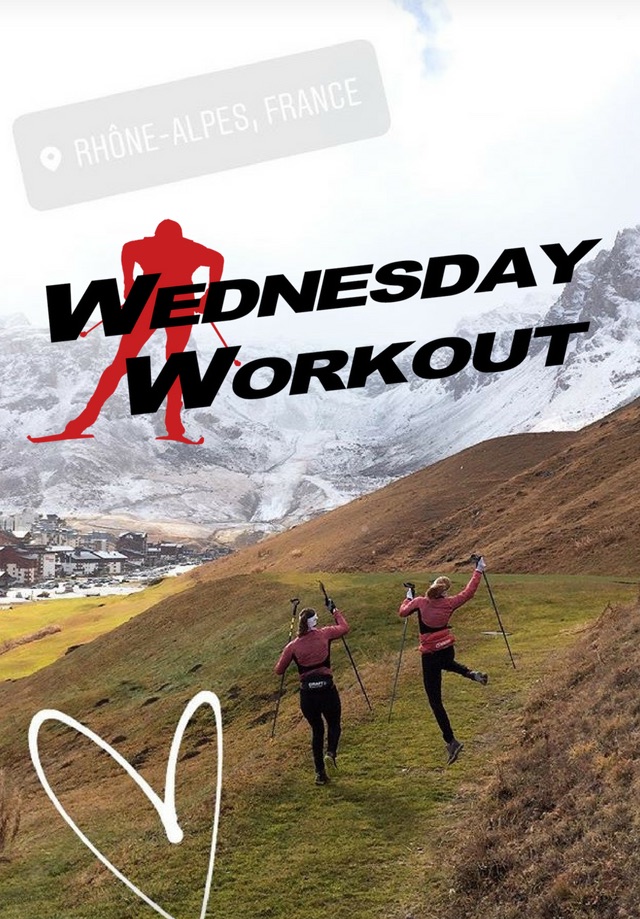
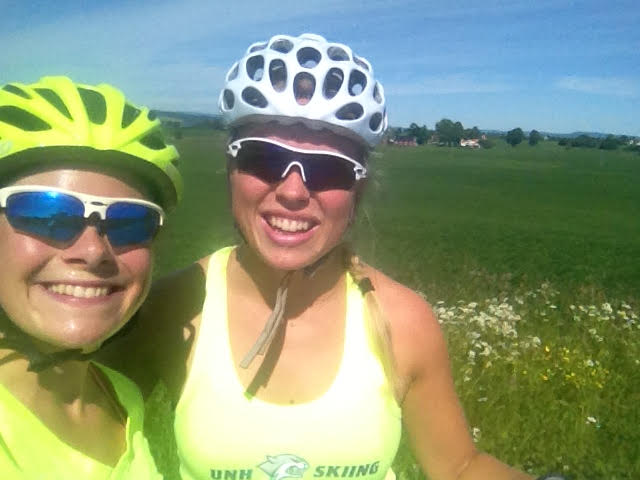
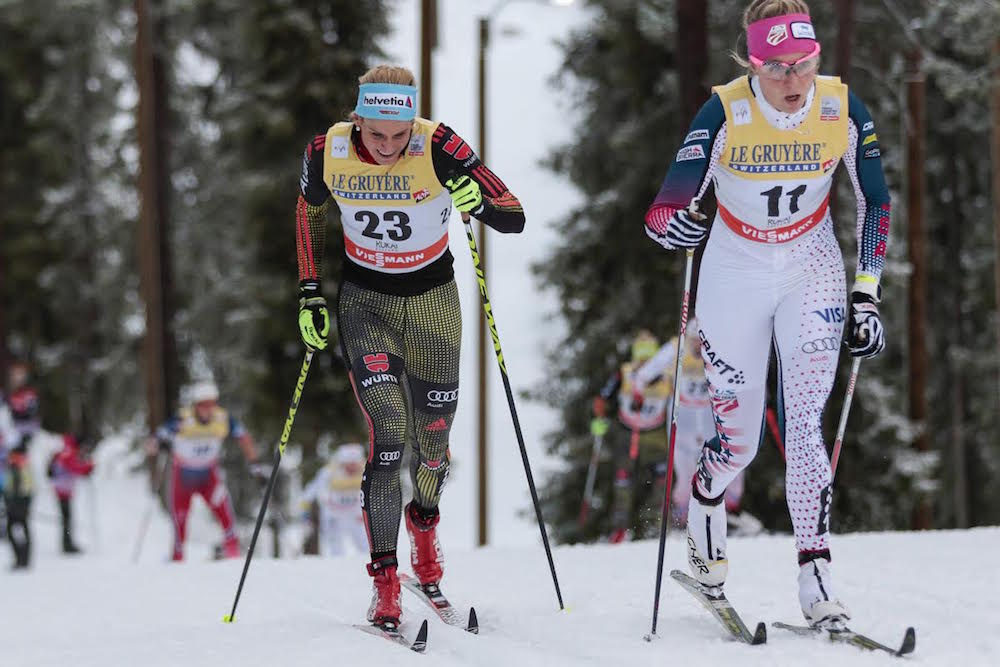
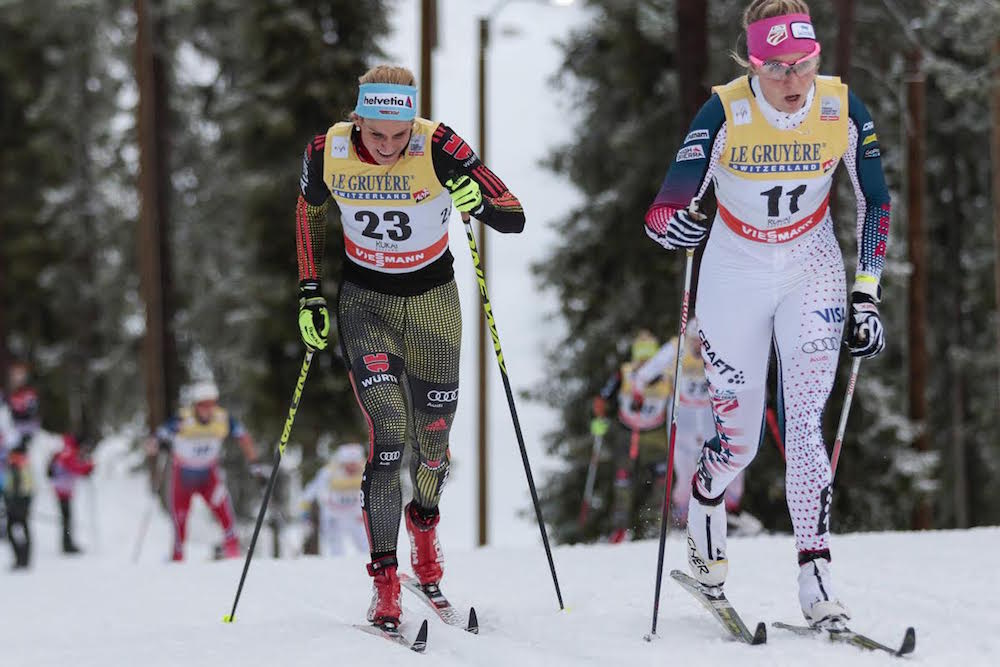
Nichole Bathe (l) and Annika Taylor, both American-born members of the British Nordic Ski Team, during a training session last fall in the Rhône-Alpes region of France. (Courtesy photo)
This week FasterSkier presents a workout from British national ski team members Nichole Bathe and Annika Taylor. Last season, both Bathe and Taylor competed overseas on Great Britain’s national nordic team. They were interviewed on the phone last fall and email this spring.
***
May. For some, it’s a month marked by caps and gowns and new beginnings. Last year, May was a month in question for Nichole Bathe. The Madison, Wisconsin, native had just graduated from the University of Alaska Fairbanks (UAF) with a degree in justice and social work. But immediately starting a nine-to-five job was not what she wanted to do.
During the school year, she had raced for UAF’s ski team, qualifying for three NCAA Championships and finishing as the top American in fourth place as a freshman. As a senior, she qualified for U23 World Championships in Midway, Utah. A few of Bathe’s coaches suggested that she continue her cross-country career after college.
“I had no idea what I was going to do at graduation in May,” said Bathe, now 23. “But I was always wondering what it would be like to focus on skiing as a whole, instead of having school in the way of that.”
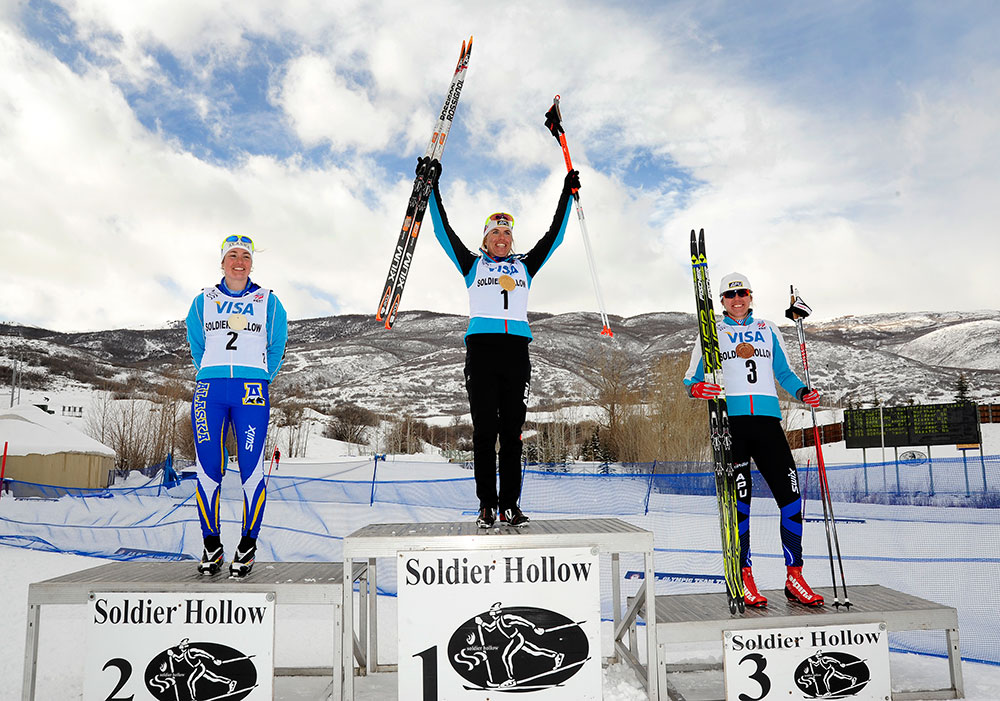
Nichole Bathe of the University of Alaska Fairbanks (l) as the second American in the classic sprint at 2014 U.S. nationals at Soldier Hollow in Midway, Utah. Rosie Brennan (c) finished first and Becca Rorabaugh (APU) placed third. (Photo: Tom Kelly/U.S. Ski Team)
By June of last year, Bathe made a phone a call. The recipient was Annika Taylor.
Taylor presented a unique situation in nordic sport. After growing up in Truckee, California, and graduating from the University of New Hampshire (UNH) with a chemistry degree in 2015, Taylor — a dual citizen – moved to Europe to ski for Great Britain’s national team, which is based in Lillehammer, Norway. (Taylor holds one passport through the United Kingdom and one through the United States, thanks to her father who is originally from the U.K.)
Bathe contacted Taylor because she shared a similarly unique family background. Both of Bathe’s parents hail from Britain, and since she was born in the U.S., Bathe is an American citizen.
If Bathe wanted, she could apply for dual citizenship and follow Taylor’s path, moving to Norway to ski for Britain. (Bathe only needed one of her parents to hold a valid British passport order to apply. Not all countries permit individuals to become dual citizens; the Czech Republic and Estonia, for example, require individuals to rescind one).
In their conversation together, Bathe asked Taylor about the logistics of moving to Europe. Taylor was reflective in her advice. She encouraged Bathe take into consideration not just the training she hoped to receive, but also the lifestyle changes she would have to make.
“When you move to a new country, you get challenged as a person,” Taylor, 24, explained.
During her first full year abroad, Taylor trained predominantly with a professional Norwegian team. Her teammates at the time spoke little English, she explained. While she had a background in basic Spanish, Taylor’s exposure to Norwegian was minimal when she arrived in Lillehammer.
The process of learning the language came gradually, she said. After a few months, Taylor had picked up conversational phrases. A few months after that, she purchased a grammar book to better her understanding of sentence syntax. Meanwhile, her primary language instruction stemmed from training sessions and talking to her teammates in Norwegian.
“When you’re out training with people and you’re out for three hours, you’re practicing constantly, asking questions and trying to explain yourself,” she said.
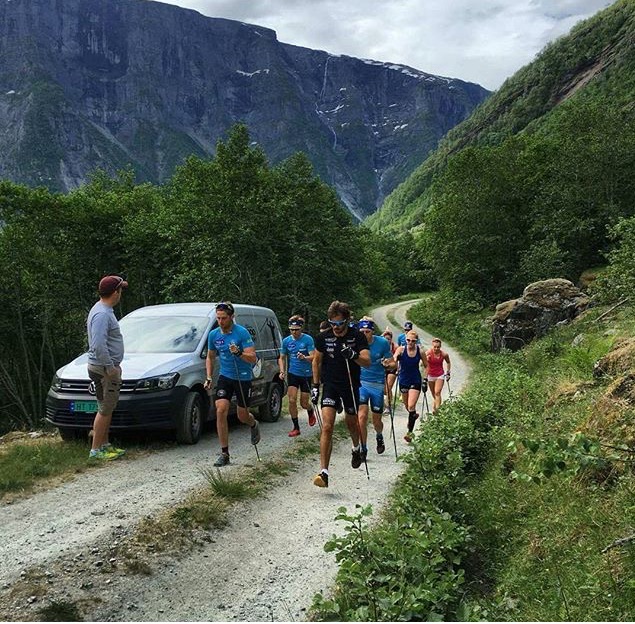
Annika Taylor (back right, in blue tanktop) during an elghuffs workout with Norwegian Coop talent team in 2016. (Courtesy photo)
In the end, Taylor said the language barrier was worth breaking through. She recalled a strength session she did with Norway’s Heidi Weng (now the two-time reigning overall and distance World Cup champion) and the confidence it gave her. Most importantly for her, Taylor was able to train with athletes who are World Cup regulars.
“I needed women who had international experience and not just experience in the U.S.,” Taylor said of her decision to join the British team.
After speaking with Taylor, Bathe realized she felt similarly. She had skied for Central Cross Country (CXC) program for the past nine years, returning each summer to train with the CXC Team, while a student at UAF. By the end of her college career, she’d tallied a fourth place, seventh, 12th, and 13th in the NCCA Championship races she’d contested. She’d competed at five U.S. senior nationals, finishing on the podium in third (as the second American) in the classic sprint in 2014.
But Bathe wanted to test herself outside the U.S.
“I felt that I was going to get the most out of taking a year or two to ski if I went all in and moved to Europe and had the chance to train with high-caliber people all the time,” Bathe said.
Bathe sent her application to the U.K. last spring, was granted dual citizenship and moved to Lillehammer in the early fall. Her application included proof of her parents’ original U.K. citizenship documents and Bathe’s U.S. birth certificate information.
“It’s actually pretty streamlined once they have all the information,” she explained.
This winter, Bathe earned a spot on the British national team. Her focus for the season remained on U23 World Championships in Goms, Switzerland. There, her best result was 37th in the 10-kilometer classic.
“I was lucky to race in Europe all year and really learned a lot about racing and just training in general,” Bathe wrote in an email. “Even though it wasn’t the year I had hoped for results-wise, it was a really useful year for me and I know now what I need to do to race faster and to just ski better in general.”
Taylor, who came into the season prequalified for the 2018 Winter Olympics, explained that she came down with an illness that plagued her from October through February. At her first Olympics in PyeongChang, South Korea, she finished 60th in the 15 k skiathlon and 75th in the 10 k skate.
“My body just didn’t have anything left to give in races,” Taylor reflected in an email. “I had to deal with a lot of feelings of ‘failure’ and push on past the disappointment of last season, but I am glad to report that I’m out the other side, loving training, looking forward to giving my best another season, while setting my sights on achieving a Doctor in Physical Therapy in my future!
“Athletes have ‘off years’- we are only human!” Taylor continued. “I definitely learned how to control the things I could control this past season, and learned to let go of the uncontrollable. It was a humbling experience and gave me a new empathy for those athletes that suffer from injury and illness on a regular basis!
“There’s something quite unique about the community of people and the resilience and determination, but also finesse that cross country skiing demands, that seems to shape quite interesting and well-rounded human beings. I think every athlete can recall a story of when their sport treated them to a ‘mountain-top’ experience and plenty of times where they experienced the low-lows that result when you dedicate your energy, time and emotion to something you love. It’s always a gamble to give something your all: you either succeed spectacularly or fail spectacularly, and somehow we keep coming back for more! It’s a cross country skier, human condition!”
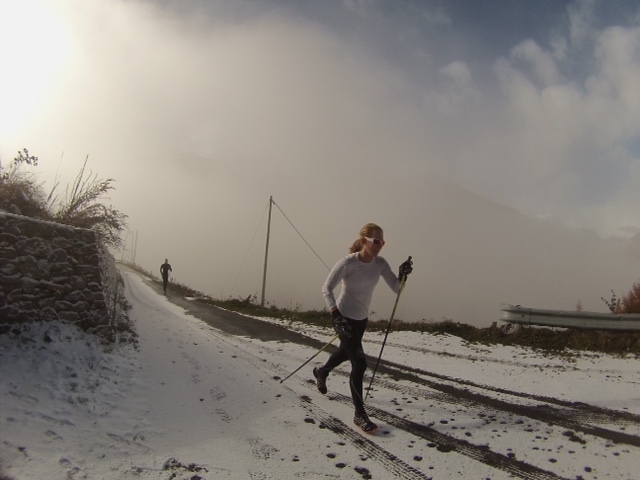
Annika Taylor of the British national team during a bounding workout.
For the upcoming season, both Taylor and Bathe plan to continue racing for Britain. Bathe spent some time in Wisconsin this spring before returning to Lillehammer for training. Taylor is currently spending some time in Truckee before returning to Scotland and eventually Norway. As of this spring, both women were fully funded by the team, leaving only housing and food as their primary expenses.
“The hardest part of this last season was just managing the disappointment in results,” Bathe explained. “Seeing your name at the bottom of a results page is a bit of a gut punch, at the beginning of the season that was tough but once I figured out how to handle that and understand that I wasn’t going to have the dream season I envisioned it became more of a learning season and a technique season.
“Looking to the future I’m excited to race again and am much better prepared for those slap-in-the-face races that happen when your newer to the World Cup,” Bathe added.
The two teammates recommended the following Norwegian “elghuffs” bounding workout:
The Workout: “Elghuffs” a.k.a. hard bounding/ski walking uphill intervals
Goal: Get a good Level 3-5 workout in “and not get dropped to hard by the Norwegians!”
When: Can be done 1-2 times a week through the fall
Where: Alpine hill
“We do it in a town called Hajfell which is just outside of Lillehammer at a downhill mountain bike and ski area,” Bathe wrote.
The set: 6 x 6 minutes Level 4
“Then we catch the gondola back down the mountain for free,” Taylor wrote. “Pretty sweet that Hafjell offers that to people who go on foot or bike up!”
Top tip: “Don’t start too hard; it will catch up to you by the top,” Bathe wrote.
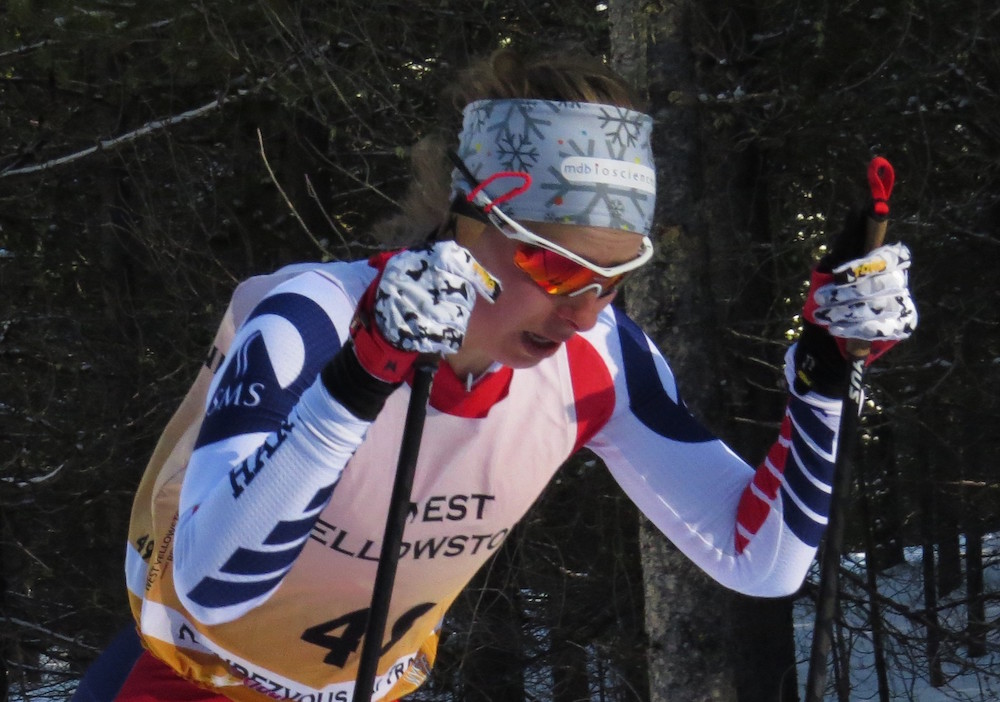
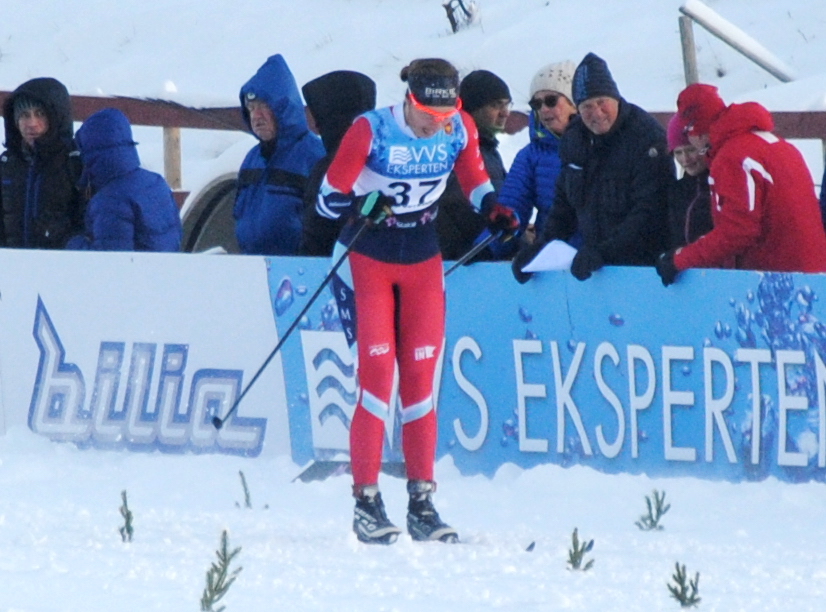
Anne Hart (SMST2) racing at last year’s 5 k classic FIS race in West Yellowstone, Montana, where she finished 12th. A year later, Hart placed 19th in the Beitostølen, Norway, 10 k freestyle race. (Photo: Ian Harvey/Toko)
In one weekend of racing, Anne Hart has already learned a lot, the types of things you can only learn from careful observation and reflection. And for Hart, a 25-year-old member of the Stratton Mountain School (SMS) Elite Team, the season doesn’t truly begin until Dec. 2.
After racing to 19th in the women’s 10-kilometer freestyle individual start on Sunday in Beitostølen, 2:41.9 minutes behind Norwegian winner Marit Bjørgen, Hart talked about being inspired by numerous speedy Norwegians there — many of which are gunning for a spot on Norway’s World Cup team.
Hart ventured to Norway earlier this month to jumpstart her season before heading back to the U.S. to race the SuperTour opener in West Yellowstone, Montana, Dec. 2-3. In two previous races in Beitostølen on Friday and Saturday, she finished 31st in both the 10 k classic and classic sprint.
On Sunday, she resolved to leave it all out there, just as she’d seen Norwegian World Cup regular Finn Hågen Krogh do.
“Today we were watching the men’s race [before our race], and we watched Finn Hågen Krogh halfway up the hill the last time, the third time. I kid you not, he just stopped, bent over and he went on and finished fifth,” Hart reflected. “He went out hard, he blew up, but he made up so much time at the beginning that he just had to make it in.”
That’s precisely what Hart’s been working on.
“I really just pushed it from the go,” she said of her race. “After watching the [top] women start the classic race [on Friday], and then watching how fast they go in the sprints [on Saturday], there is just no easy pace out there … You just keep on going, and you suffer. But the harder you suffer the faster it is over.”
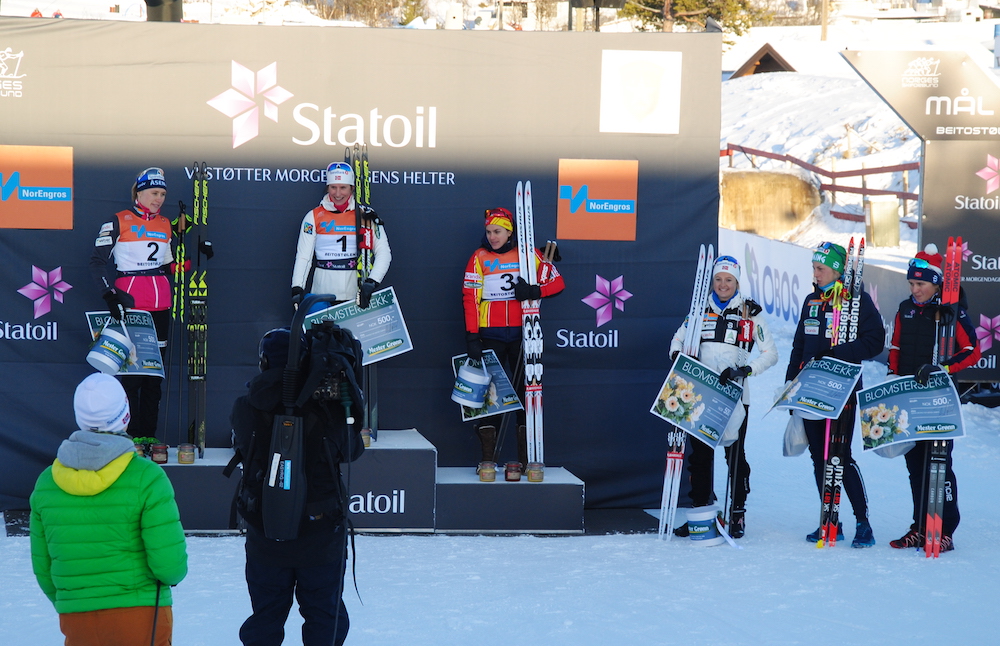
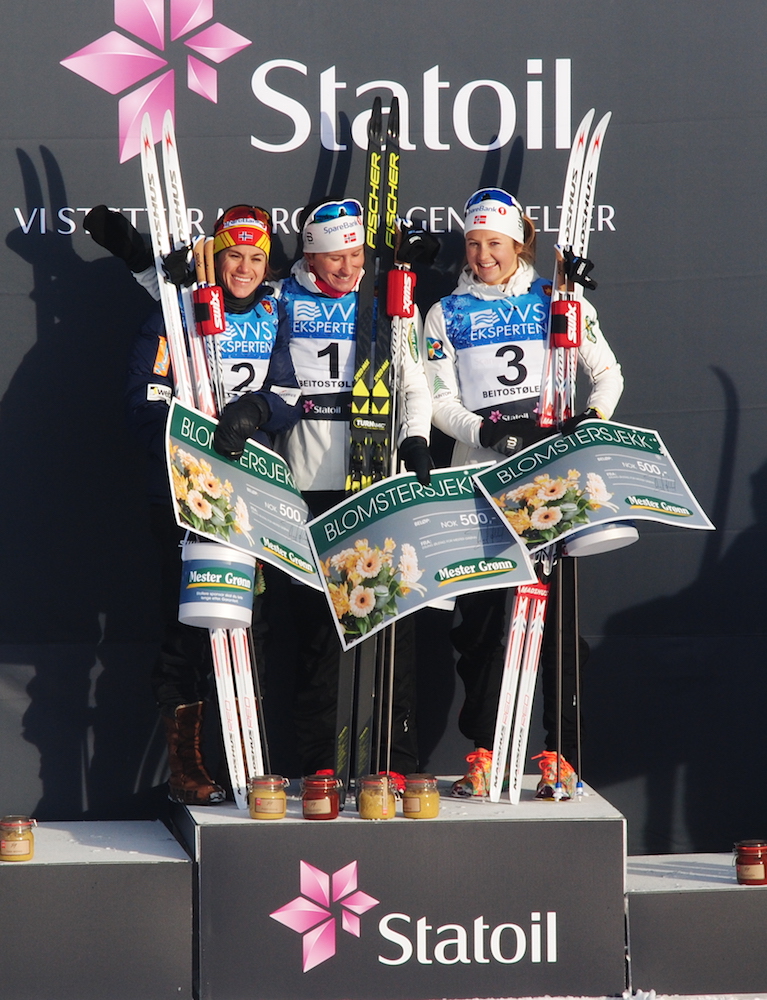
The women’s podium (and top six) after Sunday’s 10 k freestyle in Beitostølen, Norway, with Norway’s Marit Bjørgen (1) in first, Ragnhild Haga (2) in second, Heidi Weng (3) in third, Ingvild Flugstad Østberg in fourth, Astrid Uhrenholdt Jacobsen in fifth, and Tiril Udnes Weng in sixth. (Photo: Aleks Tangen)
Hart finished her 10 k, in what she described “beautiful skiing” conditions, in 26:37.1. Bjørgen raced to first for her second distance win of the long weekend in 23:55.2, 12.6 seconds ahead of Ragnhild Haga in second place. Norway once again swept the podium with Heidi Weng in third, 30.1 seconds behind Bjørgen.
“It’s a course that doesn’t have a lot of rest in it … basically I was just trying to V2 as much as I could, because I noticed that’s another thing they do over here,” Hart said. “It’s like riding a bike; it’s easier to go in a lower gear. … I know I am a stronger V2-er, and the longer I can V2 up the hills, I figured the better I would do overall. Then [I] backed off, worked on quick turnover, and then really tried to push the V2-ing.”
For much of the race, her split times hovered between 19th and 20th. But after a strong effort from 7 to 9.8 k, where she clocked the 15th fastest time in 7:58.2, Hart secured 19th, 8.5 seconds behind 18th-place finisher Silje Theodorsen, of the Norwegian National U23 Team, and 12 seconds ahead of 20th, which went to Norway’s Magni Smedås (Lillehammer Ski Club).
That stands as Hart’s best international finish outside of an Alpen Cup last season in Seefeld, Austria, where she notched two top 20’s. Each year, Norway’s season-opening FIS races in Beitostølen attract most of Norway’s top skiers and upcoming talent.
So 19th in Beitostølen is a big deal.
At the time of her post-race interview with FasterSkier, Hart wasn’t sure where she ended up. But she knew she pushed herself to the limit.
“I think last year I suffered from over-pacing, and it’s gonna hurt no matter what you do,” she said. “And I am very much of the mentality, for me anyways, to just go all in, no fear. And the worst thing that happens is you blow up.”
In terms of how her results in Beito will affect her moving forward, she said it was about building confidence with each race and “having faith in my training and my fitness. The worst feeling in the world is when you finish and are like, ‘Damn, I could have gone harder.’ I would much rather literally collapse out on the course.”
Great Britain’s Annika Taylor, who grew up in Truckee, California, and raced at the University of New Hampshire, placed 23rd (+3:09.9). Taylor, 24, finished 29th in the 10 k classic two days earlier
At the front of Sunday’s race, the final time between Bjørgen and runner-up Haga was what made the news. One Norwegian journalist asked Norwegian women’s team coach Roar Hjelmeset if “this was almost like a victory since the gap was so small”. He replied “no” but added that it was “a very good performance” for Haga.
Bjørgen started last in bib 63 and, as she typically does, clocked the fastest times through essentially every checkpoint and put more time into her competition with each passing kilometer. Haga’s time from 4.9 to 6.1 k was actually 2.5 seconds faster, but Bjørgen later told reporters that she expected a strong performance from her 26-year-old teammate.
“The race was acceptable,” she told NRK. “I was prepared for Ragnhild’s approach since she’s better at skating, but I felt like I was somewhat in control.”
Haga was pleased to hold on to second ahead of fellow World Cup Team members Weng (who ended up third) and Ingvild Flugstad Østberg in fourth (+32.3).
“I had hoped to kick harder from the start so that Ingvild wouldn’t catch up to me,” Haga told NRK. “I didn’t tighten up and was able to keep pushing. I couldn’t really do anything about Marit, but I was closer than normal.”
Both Weng and Østberg told NRK how impressed they were with Haga’s performance.
“Ragnhild has shown strength over a lot of years,” Østberg said.
Weng added that she was impressed Haga gave Bjørgen a fight for first place.
“[Haga] does this because she’s been able to train well over the course of long time, and she has done very well leading up to this season,” Hjelmeset explained to a group of reporters.
Krüger: ‘It’s a big deal’
In the men’s race, Norway’s Simen Hegstad Krüger took advantage of the optimal conditions — with temperatures between -6 and -9 degrees Celsius, firm tracks and a clear blue sky — to win the 15 k freestyle by 16.5 seconds in 32:59.6.
He did so after starting in bib 122 of 124 and taking control of the race at 2.1 k. Krüger led from that point on, clocking the fastest splits in every stretch except from 11 to 11.9 k. At the finish, he beat out the likes of fellow Norwegian World Cup Team members Hans Christer Holund in second, Hågen Krogh in fifth (+42.1), Sjur Røthe in sixth (+42.8), and Martin Johnsrud Sundby in seventh (+52.9).
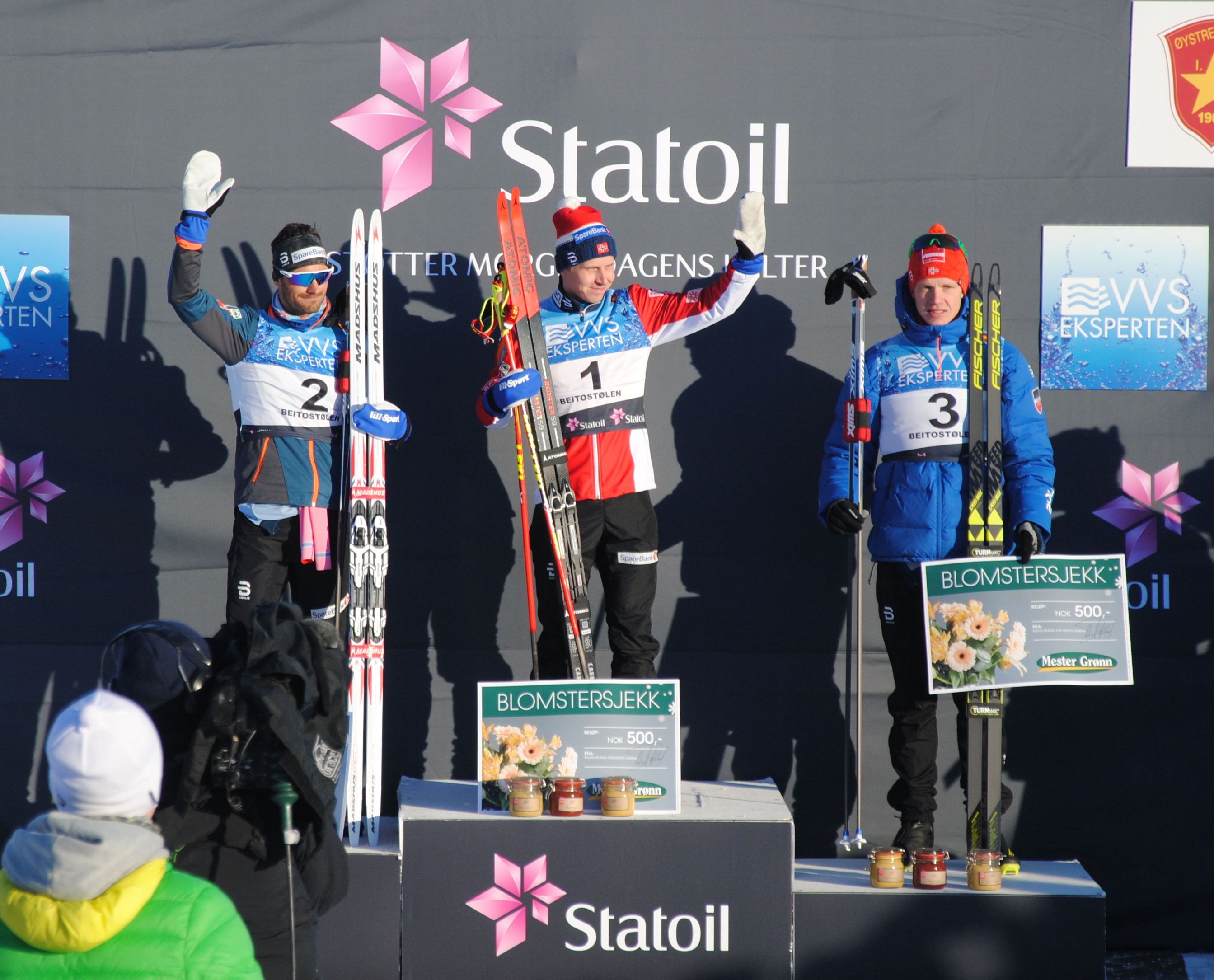
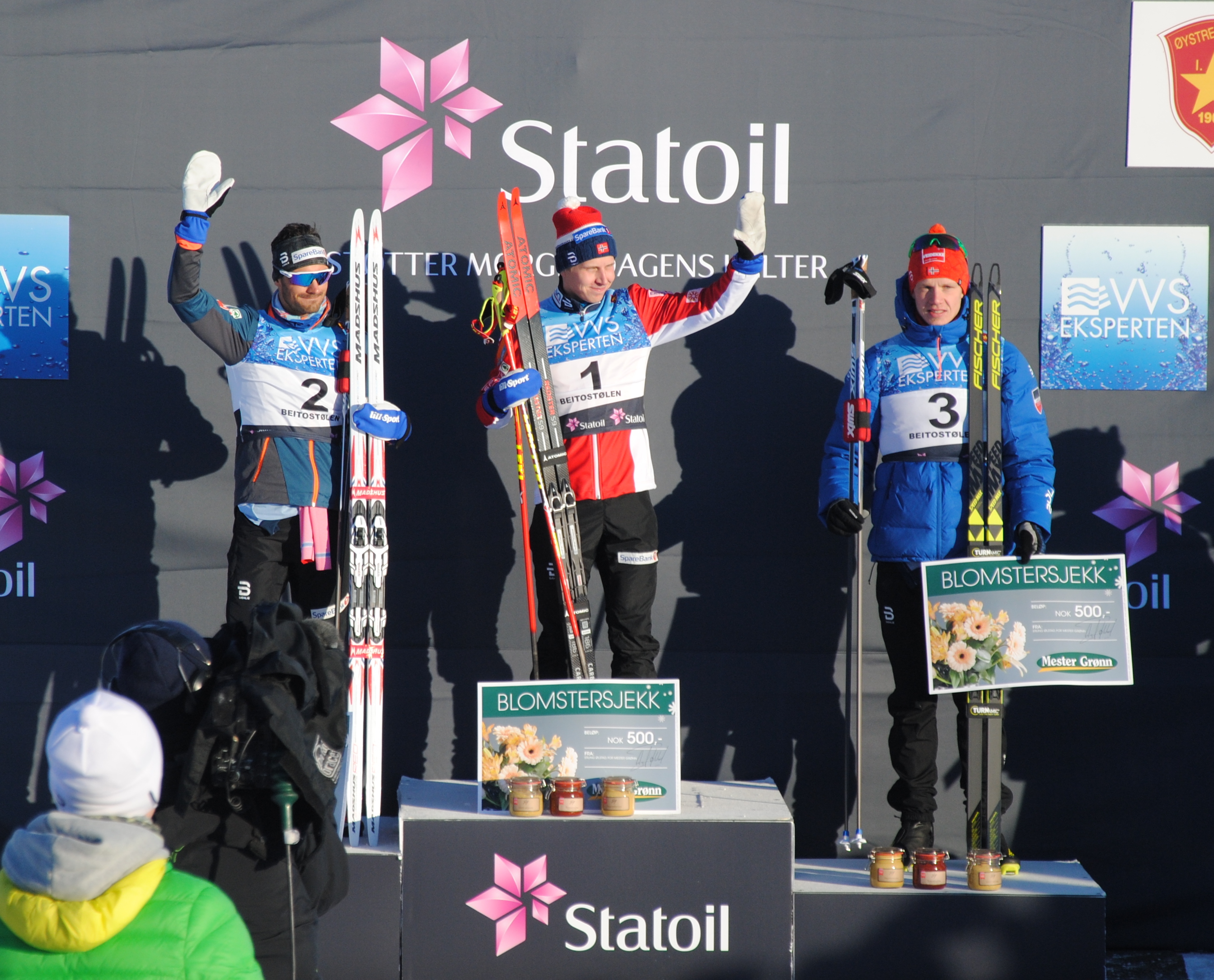
The men’s podium after Sunday’s 15 k freestyle FIS race in Beitostølen, Norway, with Norway’s Simen Hegstad Krüger (1) in first, Hans Christer Holund (2) in second and Jan Thomas Jenssen (3) in third. (Photo: Aleks Tangen)
“This is incredibly cool,” Krüger told NRK. “Even if it’s early in the season, it’s not common to win at this level. It’s a big deal when entire Norwegian elite is here.”
Notably, 21-year-old Norwegian Jan Thomas Jenssen, of Hommelvik Il, placed third (+30.7). He’s never raced on the World Cup.
“What should I say? This is amazing,” he told NRK, adding that the experience was “indescribable.”
Great Britain’s Andrew Musgrave raced to fourth place (+37.1) as the only non-Norwegian in the top 24. American Noah Hoffman was next in 25th (+2:09.6), and Andy Newell (U.S. Ski Team) finished 52nd (+2:56.0).
“It was better than the other day, a step in the right direction and I feel pretty good and looking forward to next weekend,” Hoffman, who finished 29th in Friday’s 15 k classic, told FasterSkier on Sunday. “Part of it is just having a race under my belt, but beyond that, I think on these more gradual courses I’m better at skating than I am classic, and the conditions were better for me today.”
While he was able to navigate traffic on the course by picking off several racers, Hoffman was frustrated with his “lapse of concentration” that caused him to clip a V-board on the biggest downhill and fall on his second lap.
“[I] went down really hard, lost my glasses, but at least I didn’t hurt myself,” Hoffman said. “Got a little bit of whiplash, I think I might be sore from it. … I probably lost 10 seconds. It was just silly. It still was a good effort and it doesn’t make too big of a difference.”
Andy Newell (c) racing to 52nd in the men’s 15 k freestyle FIS race on Sunday in Beitostølen, Norway. (Photo: Aleks Tangen)
Newell started out skiing around 70th and made his way up to 38th mid-race, but lost time over the final three kilometers to finish 52nd. When he spoke with FasterSkier immediately after, he was unsure of how he placed.
“I don’t think my time will be great, but it was a good workout and my body felt good despite being a little tired and sore from yesterday,” said Newell, who placed 16th in Saturday’s classic sprint. “It was a good training race, and these guys are so fast, and since skating is not my best, I just looked for a good feeling in the body. …. I think I have a little more in the tank. I can save that for next weekend.”
The World Cup opens next Friday, Nov. 24 with the three-day Ruka Triple in Kuusamo, Finland.
Of the four Canadian men that raced on Sunday, Scott James Hill of Barrie Cross Country (BXC) led them in 64th (+3:09.8).
“Today was good, a lot better,” said Hill, who placed 84th in Saturday’s sprint and 99th in Friday’s 15 k classic. “The classic race was kind of my first race and time trial of the year so I wasn’t expecting much, but today I felt like I was ready to race.
“I think everything worked out well,” the 23 year old continued. “I was never skiing alone other than maybe the first half lap, so I was always being pushed, which was really good.”
Ryan Jackson (Team Asker) followed in 102nd, Maks Zechel (Team Asker) was 113th, and Joey Foster (BXC) finished 118th.
Norway’s Marit Bjørgen racing to a 29-second win in Friday’s 10 k classic FIS race in Beitostølen, Norway. (Photo: Aleks Tangen)
(Note: This article has been updated to include comments from Nichole Bathe.)
BEITOSTØLEN, Norway — The question of whether Bjørgen or Weng will be the bigger name this season went in the favor of the former on Friday at Norway’s first big matchup of the season. Marit Bjørgen, now 37 and in her 20th World Cup season, won the first race of the three-day International Ski Federation (FIS) weekend in Beitostølen, starting last out of 56 women and finishing first in the 10-kilometer classic individual start, with 29.4 seconds between her and Weng in second place.
On a morning that marked the start of the 2017/2018 season in Norway, with temperatures just below zero and a snow squall during the women’s pre-race warmup, the snow covering the course appeared loose but ample.
Weng, the 26-year-old reigning Overall World Cup and Distance World Cup champion who started 30 seconds behind fellow Norwegian national-team member Bjørgen, told reporters after the race that she was satisfied with her performance, but could have skied better and “could have had better grip”.
For the first 2 kilometers of the race, Bjørgen’s pace was comparable to that of another one of her teammates, Ingvild Flugstad Østberg, who started just ahead of Weng. But halfway through the race, Bjørgen was nearly 22 seconds up on Østberg and 28 seconds ahead of Weng.
While Bjørgen continued to put seconds into her teammates in the final 5 k — blowing through the 7 k checkpoint 28 seconds faster than anyone else — Weng and Østberg battled for second. Weng clocked through 6.1 k just 2.7 seconds faster than Østberg and skied 5.1 seconds faster than her over the next 900 meters. Despite crossing the finish 11.6 seconds faster than Østberg, Weng’s time in the leader’s chair was short-lived, as Bjørgen finished 29.4 seconds faster with a winning time of 29:30.9 minutes.
The women’s 10 k classic all-Norwegian podium at Friday’s FIS race in Beitostølen, Norway, with Marit Bjørgen (c) in first, Heidi Weng (l) in second and Ingvild Flugstad Østberg in third. (Photo: Aleks Tangen)
Østberg claimed third, 41 seconds back and 10 seconds ahead of another Norwegian national team member Ragnhild Haga in fourth (+51.0). Norway swept first through 13th place with Kathrine Rolsted Harsem in fifth (+1:08.1), Astrid Øyre Slind in sixth (+1:27.5) and notably, sprint specialist Maiken Caspersen Falla in ninth (+1:54.3).
“Marit is superior,” Weng said in a post-race interview with NRK. “This is top level and I have to step it up.”
She added, “29.4 and 41 seconds is a lot, but Marit is not invincible.”
But even Bjørgen has to tell herself to ski relaxed for the first race of the season.
“I tried to stay calm and ski my way up to Weng,” Bjørgen told NRK. “Considering that she held the yellow bib [as the World Cup leader] last year, I think that’s pretty good.”
Bjørgen reflected that she could have skied the flatter parts of the course better.
“Heidi did well there, and it was fun to ski behind here and learn from her,” she said.
Norwegian national-team member Ragnhild Haga racing to fourth in the women’s 10 k classic FIS race on Friday in Beitostølen, Norway. (Photo: Aleks Tangen)
Fourth-place finisher Haga told reporters that she was pleased with her technical improvements in classic, which she has been working on for three years.
“It was fun, and I’m glad I was able to race at such a high level,” Haga said.
Three Americans, two of which race for Great Britain, finished 29th, 30th and 31st: Annika Taylor (+3:48.2) Nichole Bathe (+3:51.3) and Anne Hart (+3:51.4), respectively. Taylor was born in California and is a member of Great Britain’s women’s team, as is Bathe, who hails from Wisconsin and is also a member of the CXC Team. Hart, originally from Minnesota, races for the Stratton Mountain School (SMS) Elite Team in Vermont.
Since mid-September, Bathe, a recent University of Alaska Fairbanks graduate, has been living in Lillehammer, Norway, while training with the British national team.
“It’s been quite the transition especially from college racing but it has been such a great learning experience and makes me really exited for the season!” Bathe wrote in an email. “That was my first race of the season and I thought it went okay. I went out pretty hard which caught up to me in the end but overall I think it was a good start to the season.
“Typically I am more of a sprinter but in general I like classic more than skate and 5k classic is my absolute favorite race,” she added. “This winter I am focusing on U23s [World Championships] and skiing fast there especially in the sprint. I will mainly be racing in Europe this year. I am racing the Kuusamo World Cups and then heading onto the OPA and Scando Cup races!”
In an in-person interview with FasterSkier, Hart explained that she made a point to get on snow earlier this season and spent the last two weeks training in Sjusjøen, Norway. After this weekend, she’ll return to the U.S. for the first SuperTour races in West Yellowstone, Montana, Dec. 2-3.
“I’ve been told by just about everyone that this is more competitive than a World Cup in part because these are [the Norwegians’] major qualifying races [for the World Cup], or their only ones I think,” Hart said of Beitostølen. “So I just went out hard. I had great kick on my skis so I just was really working on skiing well because last year that was an area I think I just got really frantic.”
During training on Thursday, Hart skied one lap with Bjørgen.
“Yesterday I actually skied with — stalked — Marit on an easy lap, and I was just trying to imitate her skiing,” Hart said. “So I was just trying to think of her out there and obviously not quite as fast, but I was really psyched with how I skied everything well. I felt a little tired on the last bit, but again, I didn’t fall apart and I’m really pleased with that.”
American Anne Hart (SMS Elite Team) racing to 31st in the women’s 10 k classic FIS race on Friday in Beitostølen, Norway. (Photo: Aleks Tangen)
For Hart, the biggest difference she noticed in this initial race of the season was the fact that she was having fun.
“Last year I was just struggling the whole season to find that ‘fun’ gear, I guess, and today I was really enjoying the whole time and really pushing and not looking forward to the end,” she said. “Instead of thinking, ‘I have to make it another kilometer,’ it was like, ‘Oh my god, I only have a kilometer to go. I’ve gotta really give it all I’ve got.’ ”
For Canada, Isabella Howden, of the newly formed Barrie Cross Country (BXC), finished 53rd (+7:18.2). Afterward, Howden, who started 16th, recalled being passed by the five fastest women on her second lap, which she said was beneficial.
“That was pretty cool, seeing them and getting to stay with them on the downhills and copy their technique for as long as I could see them,” she said.
For Howden and some of her Canadian teammates, Beitostølen is familiar territory; they raced there last year. Regardless, she was in awe of the atmosphere.
“It’s so cool … all the kids up there cheering and there’s a whole crew around the corner with all their cowbells, like 10 of them,” she said with a laugh.
Sundby Pulls It Together
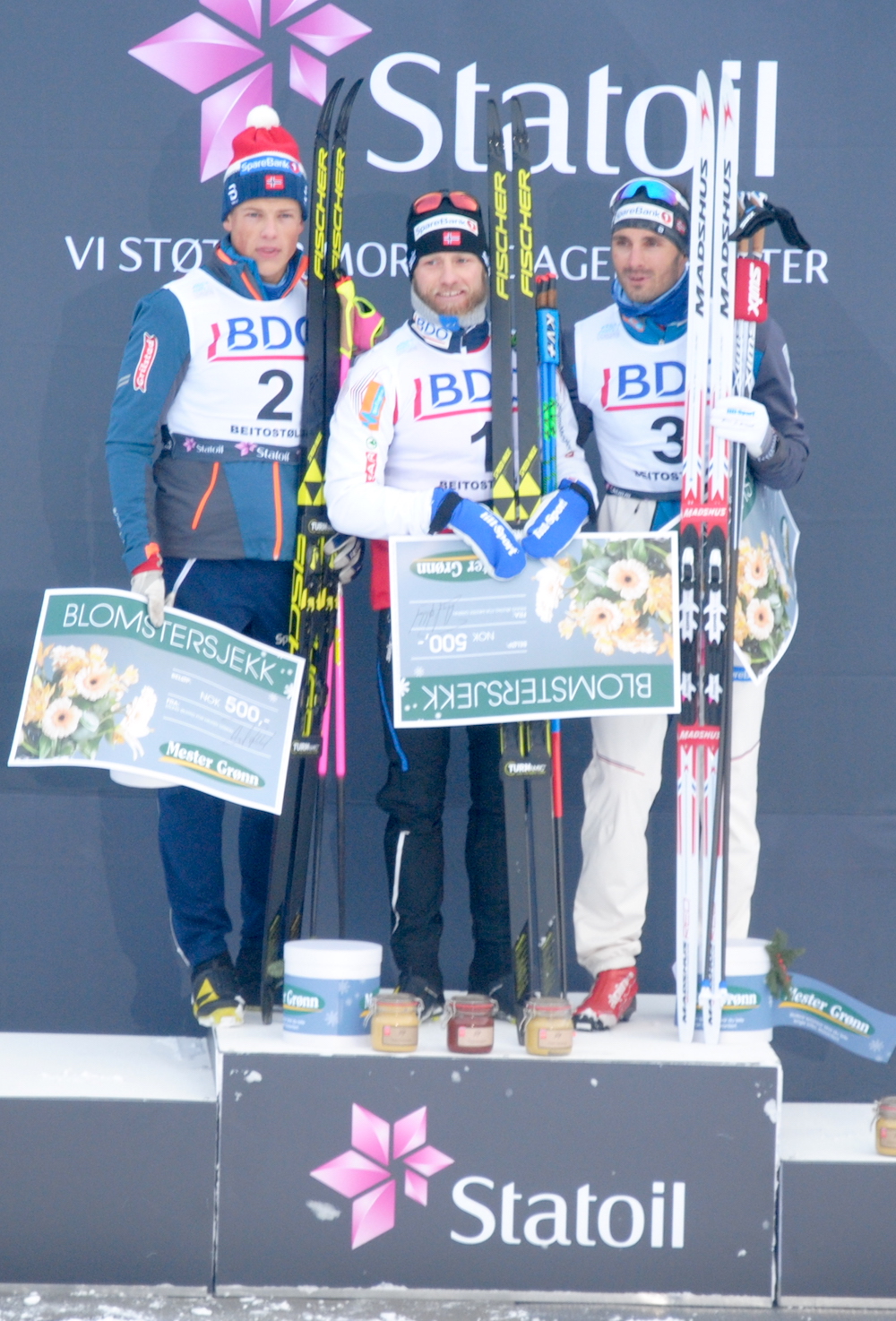
The men’s 15 k classic all-Norwegian podium at Friday’s FIS race in Beitostølen, Norway, with Martin Johnsrud Sundby (c) in first, Johannes Høsflot Klæbo (l) in second and Hans Christer Holund in third. (Photo: Aleks Tangen)
In the men’s 15 k classic individual start that followed, defending World Cup champion Martin Johnsrud Sundby took the win by 18.2 seconds over Norwegian teammate Johannes Høsflot Klæbo, who won last season’s Sprint World Cup at the age of 20.
Now 21, Klæbo is recognized as more of an all-around force, and on Friday, he led the men’s race up until the 4.9 k checkpoint. Sundby started last out of 158 men and trailed Klæbo until 6 k. But from that point on, the race was Sundby’s; at 9.8 k, he was 12.3 seconds faster than Klæbo in second place.
“I had to pull myself together,” Sundby told reporters after the race, explaining that he felt tired around 6 k. While the rest of his race required some extra effort, Sundby expressed contentment with his performance.
“This was something positive that I will take with me going into the season,” he said. “This was the first race of the season and it could have gone both good and bad. … It was so-so, I felt goofy skiing today, but that was also the case for everyone else.”
He attributed that awkward feeling to challenging conditions, “but that is also good practice,” he said. “I didn’t feel all that well in the first 5 k, but after that I was able to speed up and I felt that was able to control the race.”
And he did so without going too far into the pain cave.
“I didn’t have to dig as deep as I have done sometimes in the past,” Sundby said.
Sundby’s winning time of 38:57.2 was 18.2 seconds faster than Klæbo in second and 37 seconds clear of Hans Christer Holund in third. The top-seven men — all Norwegian — finished within 59 seconds of first. The women were a bit more spread out, with the seventh-place woman, Silje Theodorsen (Kvaløysletta Skilag), finishing 1:36.3 behind Bjørgen.
Holund clawed his way into the race after his 4.9 k time ranked 11th. With about 5 k to go, the Norwegian national-team member was up to fifth, and by 11.9 k, he was within reach of the podium in fourth place.
Didrik Tønseth ended up just 1 second off the podium in fourth (+38.0), while Johan Hoel (Åsen IL/Team Veidekke Oslofjord) placed fifth (+42.2), ahead of Simen Hegstad Krüger in sixth (+44.1) and Emil Iversen in seventh (+59.0).
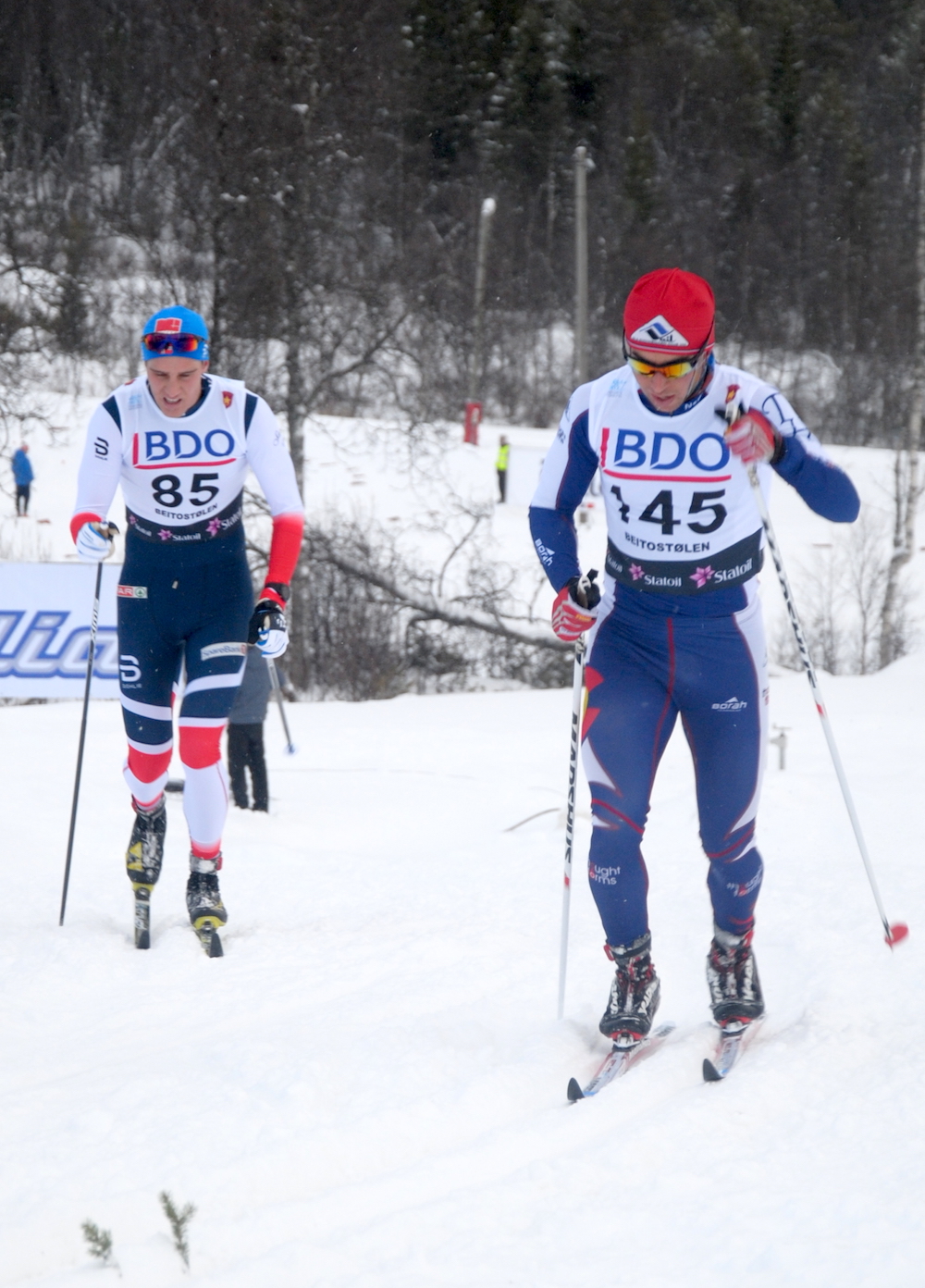
Noah Hoffman (r) passes Norway’s Torstein Bu during the men’s 15 k classic FIS race season opener on Friday in Beitostølen, Norway. Hoffman went on to place 29th, while Bu finished 75th. (Photo: Aleks Tangen)
The lone American in the race, Noah Hoffman placed 29th, 2:25 minutes behind Sundby. After a slow opening that put him in 47th at the 2.1 k mark, the former U.S. Ski Team member settled into a pace that put him within the top 30.
Afterward, he told FasterSkier that his performance was a good starting point. He started the race toward the back of the field in bib 145, just ahead of several top Norwegians.
“It was a little unfortunate that there was a big train that formed right behind me, and those guys didn’t catch me until less than a k to go,” Hoffman reflected. “I was hoping they’d get me a little sooner or not get me at all, but it was good.”
In terms of a race plan, he explained that he tried to ski with energy and build throughout the entire 15 k, which he felt he did.
“I got a little excited the second time up the big hill and maybe burned a little too much, but for the most part it was a good effort and I’m looking to build this for Sunday and then obviously into next weekend,” he said.
After Sunday’s second set of distance races in Beitostølen, the 10/15 k freestyle individual starts, Hoffman will race four weekends of World Cups as an invited member of the U.S. Ski Team (USST) for Period 1. He missed the objective qualifying criteria for renomination to the USST by one place (he ranked 51st in the World Cup at the end of last season) and is thus skiing independently this year, paying his own way (and paying his own wax technicians, Zach Caldwell and recently retired USST tech Peter Johansson) so that he can race in Europe.
“The early season is important for me this year because I don’t have guaranteed start rights for the whole winter, so I need to ski well,” Hoffman, 28, said. “And I believe I’ve done everything I can to prepare and I hope to see the results from that.”
Several Canadian juniors raced the men’s 15 k as well. Ryan Jackson led them in 97th (+5:16.8), followed by Scott Hill in 99th (+5:19.1), Joey Foster in 124th (+6:45.3), and Maks Zechel in 143rd (+8:25.5).
“It was hard out there today,” said Foster, a 21-year-old member of BXC, noting that he was still feeling the effects of travel after arriving in Europe a week ago. “Considering how I felt, the race was pretty good. … I started with what I thought was a pretty conservative pace and I got in with a good train of people, and I skied with them for almost the whole first lap, and from there I just kind of fell off pace. … I think my leadup to the race just wasn’t as good as it could’ve been, so I wasn’t feeling as crisp as I would’ve liked.”
The Beitostølen FIS races continue through the weekend with classic sprints on Saturday, which U.S. Ski Team member Andy Newell plans to race, and 10/15 k skate races on Sunday.
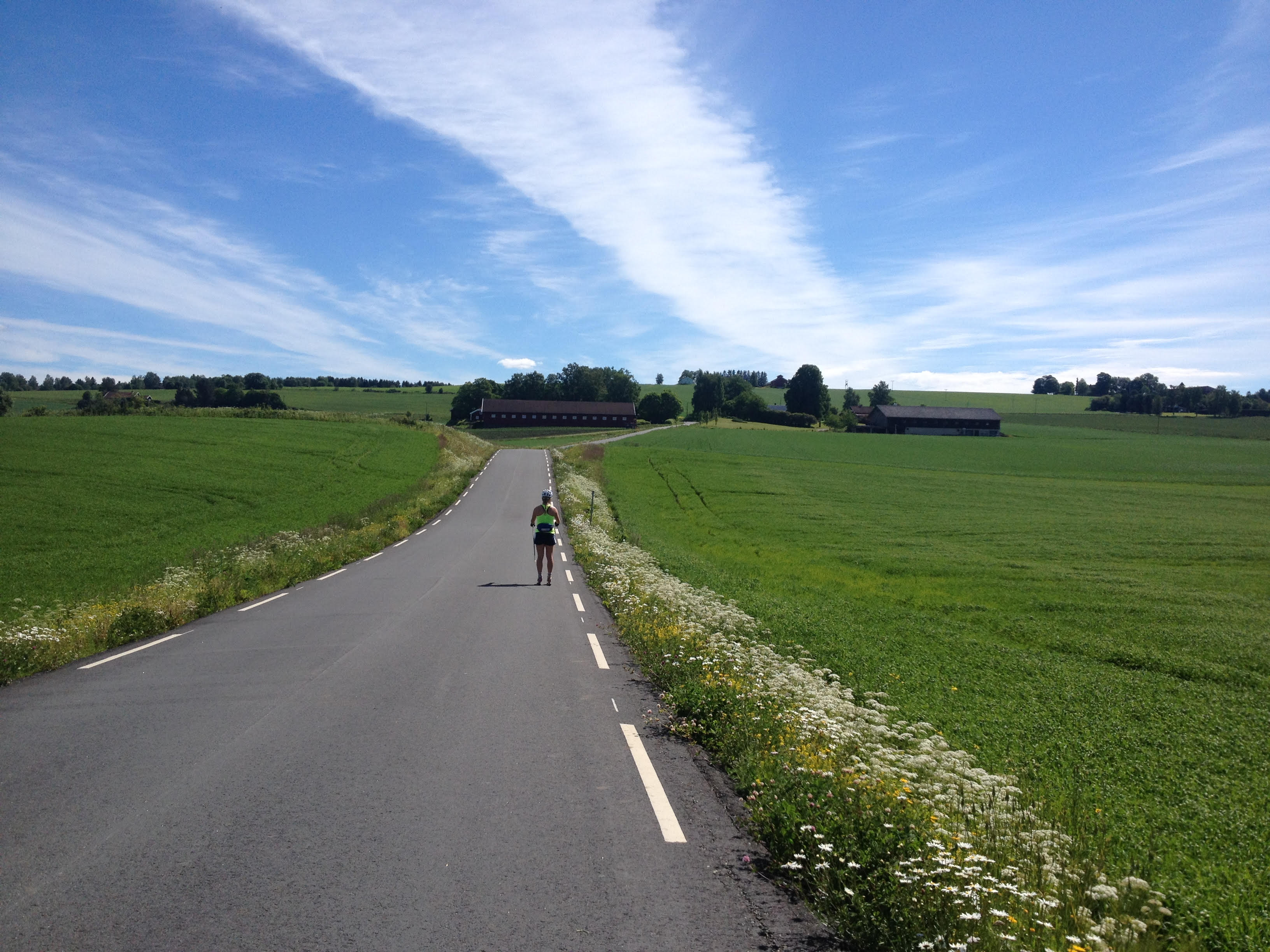
Rollerskiing around Hamar, Norway. (Photo: Annavitte Rand)
Talking about their summer plans, University of New Hampshire (UNH) skiers Annavitte Rand and Silje Wilson suddenly had what they called a crazy idea.
Wilson hails from Hamar, Norway, and Rand from Vermont. They both wanted something new out of this summer: Wilson wanted to train with other college skiers (and not just Norwegian club teammates), and Rand wanted to go somewhere new.
“Given that this is the summer before my senior year, I knew I wanted to make ski training with other racers a big focus in hopes of reaching some new goals during my final year at UNH,” Rand wrote in an email. “I was considering heading west after hearing great things about Bend and Sun Valley from friends and my cousin (a UVM skier). Silje and I had chatted a bit… and then we had a crazy idea of me going to Norway to live in Hamar with her and train together!”
And so she did. The pair have been palling around not only Hamar, but plenty of other places, too.
Silje Wilson en route to a win in the sprint at UVM Carnival this winter. (Courtesy photo)
“I’m so lucky to have one of my American teammates here, Annavitte, to train with and to explore Norway,” Wilson wrote in an email.
As with most training trips to new places, it’s not all about training. Rand took several weeks to go hiking with her sister, and is also considering the general lifestyle in Norway as she contemplates graduate school programs.
“Navigating unfamiliar roads and trying to integrate into a new culture while only having a few people I know in town has been awesome,” Rand said.
Rand is a former top-10 finisher at USSA Junior Nationals who had trained with the Green Mountain Valley School before heading to UNH, where she represented the Wildcats at four carnivals this season.
Wilson finished fourth in the 5 k classic at Dartmouth Carnival this season and anchored the winning 3 x 5 k relay the same weekend. She also won the sprint at the UVM Carnival – a non-NCAA qualifying event – and placed fourth in the 10 k classic there. Wilson was a member of UNH’s NCAA Championships team, which finished ninth.
Wilson and Rand answered a few questions about what it’s like to train in Hamar, just south of Lillehammer, during the summer. The following interviews have been edited and condensed.
FasterSkier: Silje, Where are you based this summer, what part of Norway? Is this the same area you grew up in, or is your training base away from your family home?
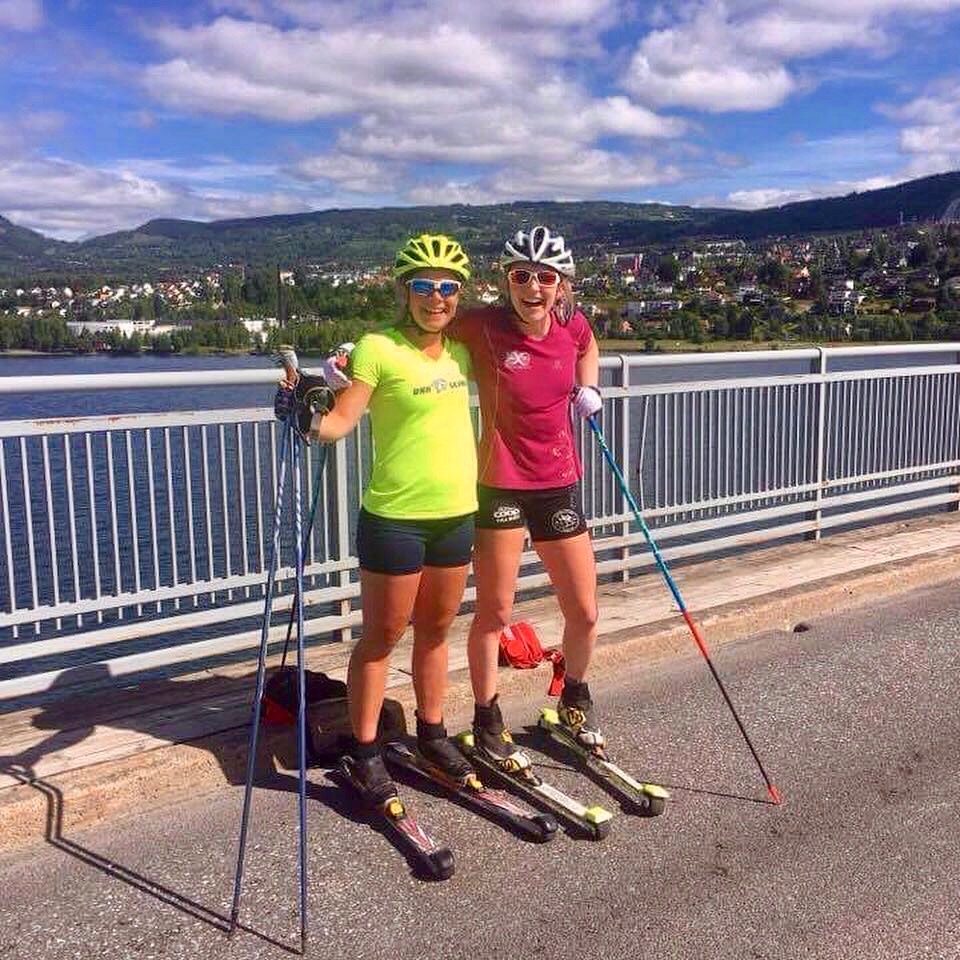
Annavitte Rand (left) and Silje Wilson out for a rollerski. (Photo: Annavitte Rand)
Silje Wilson: I am based in Hamar, which is 50 minutes by car from Lillehammer, and 90 minutes by car from Oslo. I grew up in Hamar, so it is very nice to train in a familiar area.
FS: For Americans who maybe only saw Oslo or Lillehammer on TV when watching World Cup races, what is your part of Norway like?
SW: Hamar is very much like Lillehammer. Parts of the Winter Olympics were held in Hamar, for example ice skating in the Vikingship (a huge athletic building that resembles a Viking ship lying upside down). Hamar has lots of farms, fields, a cute but small downtown, and Hamar lies by Norway’s largest lake, Mjøsa.
FS: Do you have a team that you are training with, or are most of your training sessions alone? How well do you know the other athletes and are they at a similar level to you?
SW: As I am the only senior women still competing and skiing on a high level here in Hamar, most of my workouts are by my self or with younger skiers. There are a couple senior boys here, but their level is pretty high, so I am closer to the 16-18 years old girls’ level. This summer I am lucky to have Annavitte here to train with.
Annavitte Rand (left) and Annika Taylor rollerskiing outside of Lillehammer. (Photo: Annavitte Rand)
Annavitte Rand: So far I have not trained with a specific group here in Hamar, though I am hoping to maybe join Silje’s ski club for some workouts in the future. Mostly I have been training with Silje or by myself (Silje has been a little sick these past few weeks). I actually just got back from a few days in Lillehammer training with former UNH teammate Annika Taylor [ed note: Taylor is now racing for Great Britain and based in Lillehammer]. In comparison to back home, I definitely feel there is more timidness in meeting new people here, so I can imagine that integrating into a new group may be a bit more difficult if I had no previous connections.
FS: How do you design your training – is it based on a plan from Cory at UNH? Are you adapting it at all to be able to match with other people/groups you might have opportunities to join?
SW: For the most part I follow the UNH ski team’s summer training plan, but I make some adjustments to make the training fit with how I feel and other summer plans.
AR: I have been following Cory Schwartz’s plan for the most part, though when I was in Lillehammer training with Annika, I joined her workouts. I think it may be hard for me to compare summer training groups, as I have never really been part of a bigger training group during the summer months.
FS: What’s different between American training and Norwegian training – or just between more “junior” and “senior” level training?
The Olympic ski jumps in Lillehammer, Norway. The region is a hub for elite competitors. (Photo: Annavitte Rand)
AR: I have noticed there is more focus on doing speeds during medium distance workouts. Just in the four days of training I had with Annika, two of our rollerskis included short speed work. And it is very focused speed work, not just a few 10-second pieces here and there. We analyzed how we felt with our technique after each speed. We have done some speedwork during the fall at UNH, but not in this same format, so I am excited to bring this back to the team.
FS: What’s the hardest workout you have done so far this summer?
SW: The hardest workout I’ve done so far this summer is running intervals up the steepest hill in Hamar that we call “Hell hill” among us skiers in the area (hælvetesbakken in Norwegian). It is so steep that it is hard to even walk/jog up the last and steepest part.
FS: Are there any absolute favorite places to run or bike or rollerski? Where were you most excited to show Annavitte?
SW: I was most excited to show Annavitte the beautiful rollerskiing around Furnes and Stange. The asphalt is great, the view over the lake Mjøsa is beautiful, and the peaceful farms and fields everywhere makes the long skis go by so fast.
AR: Yes, one of my favorite training sessions was a long rollerski with Silje from Hamar towards a town called Stange. We did a big loop that took us through many farm fields and along the large lake Mjøsa. It was a super sunny day and the pavement was perfect. It was really nice to stride out, work on technique, take in the views, and explore a surrounding area! Felt like a summer equivalent of an extra-blue day back home!
FS: More generally, how to the training opportunities in Hamar compare to New England?
AR: There definitely seem to be more ski focused training areas here because this sport is so popular in the region. One large racing venue is just a short drive from Hamar, and in the summer it is a great spot for mountain biking, bounding, and running in the bog. While in Lillehammer, I saw so many people rollerskiing each day, most of them on the roads leading to the rollerski track. I have heard of several rollerski races that happened this summer in other parts of the country, and it seems that many people go to ski on Sognefjellet during May and June, and maybe even now! So definitely more training opportunities overall, but I think that is mainly due to the fact that the nordic racing community is significantly larger here than in New England. And because so many professionals in the sport are training in this area – we saw Martin Sundby and his family at the rollerski track the other day! So awesome!
FS: Silje, what do you do when you are not training? Do you need to have a job?
SW: I did two summer classes online this summer. My plan was to get ahead by getting some discovery classes done. I will also work as a ski coach at Hamar Summer Ski Camp, and after that I will be a camp leader at a mountain camp for children.
FS: Annavitte, what about you? How are you funding this trip?
AR: In the first month of summer before I came here, I was lucky enough to continue work for a local photographer. Helping shoot at a wedding and assistant editing during that month has definitely helped fund this trip. But overall, it is important to be frugal and just take in all that is around you. We have been training out of Silje’s backdoor, using longer workouts on rollerskis and bike to explore the surrounding area, and then taking walks downtown after training to get to know Hamar.
FS: Norway is expensive.
AR: So much of training and traveling in a new place does not need to require big expenses. Food is quite expensive here though. It has been very special to enjoy several traditional meals with Silje’s family. But it is very possible to still eat healthy meals for less. A few items I have been feasting on include Wasa cracker bread, oats and some simpler muesli mixes, and something called Stabur-Makrell (mackerel fillet in tomato sauce). These are all quite inexpensive. Also, there are often student discounts on many activities and transportations. I think student train tickets are about 2/3 of the regular price.
A scene from Helgøya, Norway. (Photo: Annavitte Rand)
FS: What is the best part of Norwegian summer, aside from training?
SW: I love the long daylight. It never gets totally dark at night during the summer here in Norway. I also love going out on boat trips at both Mjøsa and the beautiful fjords south in Norway.
AR: One afternoon last week Silje had a friend visiting, and the three of us took their motor boat across the lake to and island called Helgøya. At the southern tip is a beautiful old farmstead and small cafe. It is a really special place! There was beautiful afternoon light across the fields, and we walked around for a bit before setting up a game called “kubb” on a small lawn. I think it is an old viking game, and though rudimentary, it is great entertainment!
FS: Silje, Annavitte has been to Norway now – do you plan to spend a summer training in the U.S. at any time?
SW: I would love to stay in the states one summer to train with U.S. skiers. I have many great teammates at UNH who live out west, and I am very curious to explore that part of the U.S.!
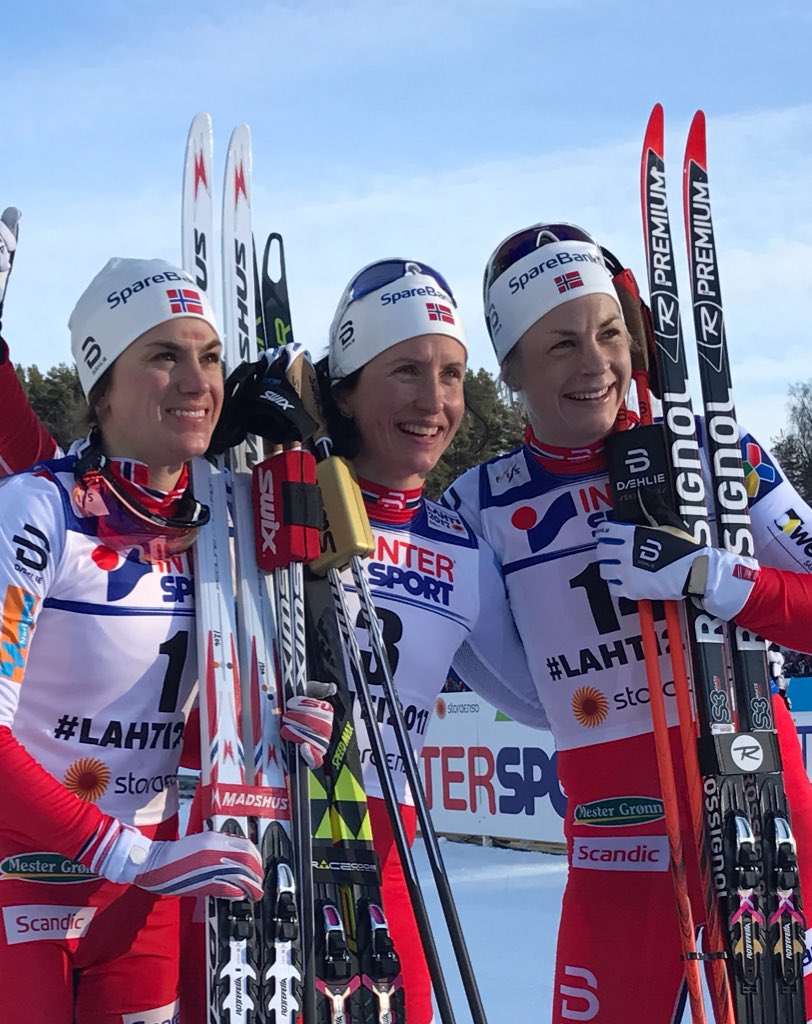
The all-Norwegian women’s 30 k freestyle mass start podium at 2017 Nordic World Championships in Lahti, Finland, with Marit Bjørgen (c) in first, Heidi Weng (l) in second, and Astrid Uhrenholdt Jacobsen (r) in third. (Photo: FIS Cross-Country/Twitter)
FIS Nordic World Championships (Lahti, Finland): Women’s 30 k freestyle mass start
Marit Bjørgen made it a four-peat on Saturday with her fourth gold and third individual win over the last week at 2017 Nordic World Championships in Lahti, Finland. (She previously won the 15-kilometer skiathlon, 10 k classic, and 4 x 5 k relay.)
The 36-year-old Norwegian closed out the championships with a 1.9-second victory in the women’s 30-kilometer freestyle mass start, finishing in 1:08:36.8 hours after setting the pace and leading a large group for much of the race. The group began to separate around 15 k, where it was down to 13 women with five seconds of first. At that point, Americans Jessie Diggins and Chelsea Holmes were within that lead pack.
While Holmes started to fall off the pace around 16 k, Diggins stuck with the leaders to the very end, only until four Norwegians broke away to race for the medals over the final kilometer.
With Bjørgen still charging hard up front, her teammates Heidi Weng, Astrid Uhrenholdt Jacobsen, and Ragnhild Haga followed, while Finland’s Krista Pärmäkoski trailed another second back in fifth and Diggins was one more second behind in sixth.
Bjørgen led the downhill into the stadium and skied away from her teammates before the finishing stretch, leaving Weng and Jacobsen to duke it out for second place. Weng got it by less than one-hundredth of a second, Jacobsen took bronze (+1.9), and Haga completed the Norwegian top-four sweep in fourth (+7.4).
Diggins passed Pärmäkoski and notched fifth (+10.4) for her career-best 30 k result. Pärmäkoski placed sixth (+11.3), Sweden’s Charlotte Kalla finished seventh (+13.9), Austria’s Teresa Stadlober was eighth (+15.5), Sweden’s Anna Haag ninth (+20.3), and Russia’s Yulia Tchekaleva 10th (+1:20.9) after edging Switzerland’s Nathalie von Siebenthal in a photo finish. Germany’s Stefanie Böhler placed 12th (+1:23.5) and Holmes finished 13th (+1:28.1) for her career best.
U.S. Ski Team member Liz Stephen placed 25th (+3:09.4), 6.6 seconds ahead of Canada’s national U25 Team skier Cendrine Browne, who notched a career best 26th (+3:16) in her first World Championships.
Holmes’s Alaska Pacific University (APU) teammate Jessica Yeaton, who races for Australia, finished 33rd (+4:32), Canada’s Dahria Beatty was 34th (+4:45.2), and American Caitlin Gregg 36th (+5:03.7).
Great Britain’s Annika Taylor, a California native, placed 38th (+6:19.4). Canada’s Emily Nishikawa was 40th (+6:41.5) and Katherine Stewart-Jones 41st (+7:18.6), and Brazil’s Jaqueline Mourão, who trains in Quebec, was 46th (+13:44.6) out of 47 finishers.
IBU World Cup (PyeongChang, South Korea): Women’s and men’s pursuits
The women’s 10 k pursuit podium at the IBU World Cup in PyeongChang, South Korea, with Germany’s Laura Dahlmeier (c) in first, Finland’s Kaisa Mäkäräinen (l) in second, and France’s Anais Bescond (r) in third. (Photo: IBU)
Coming off a fifth place in Thursday’s 7.5-kilometer sprint, Susan Dunklee held her position despite three penalties in the women’s 10 k pursuit on Saturday to finish fifth again at the International Biathlon Union (IBU) World Cup in PyeongChang, South Korea.
Germany’s Laura Dahlmeier racked up her second-straight win in as many races in PyeongChang (and sixth-straight, counting World Championships), finishing in 27:58.0 minutes with clean shooting. She was just one of four women out of 58 finishers that hit all 20 targets in Saturday’s four-stage race.
Finishing more than a minute later, Finland’s Kaisa Mäkäräinen placed second (+1:12.6) after starting fourth based on her sprint result. Mäkäräinen had two penalties, both in the first standing, but cleaned the other three stages (0+0+2+0). France’s Anais Bescond raced up from eighth at the start to third place (+1:18.9) at the finish, with a single penalty (0+0+1+0), while Norway’s Tiril Eckhoff missed her second-straight podium in fourth place (+1:32.0) after starting second but accumulating five penalties (1+2+1+1).
Eckhoff edged Dunklee, of the U.S., by half a second as Dunklee placed fifth (+1:32.5) with three misses (1+1+0+1).
Canada’s Rosanna Crawford rose from 30th to 19th (+2:49.1) for her best non-relay result of the season, with two penalties (1+1+0+0). Her teammate Megan Tandy also landed her first top 30 of 2016/2017 in 30th (+3:26.2) with two misses (1+0+1+0) after starting 39th. Also for Canada, Julia Ransom finished 44th (+4:18.4) after starting 41st and skiing four penalty loops (1+0+1+2).
Also for the U.S., Clare Egan finished 36th (+3:41.9) with three clean stages but three misses in her first standing (0+0+3+0), after starting 33rd. Joanne Reid slipped from 35th at the start to 52nd (+4:53.4), with five penalties (1+1+0+3).
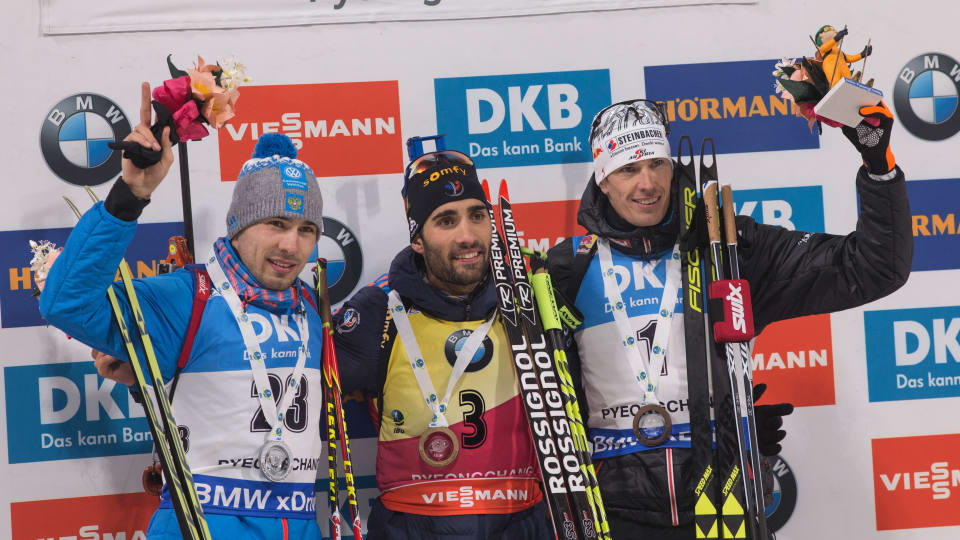
The men’s 12.5 k pursuit podium on Saturday at the IBU World Cup in PyeongChang, South Korea, with France’s Martin Fourcade (c) in first, Russia’s Anton Shipulin (l) in second and Austria’s Julian Eberhard (r) in third. (Photo: IBU)
[UPDATED] One day after locking up the overall World Cup title, Martin Fourcade was back at the top of the podium in the men’s 12.5 k pursuit in PyeongChang.
Fourcade started third, after finishing third in Friday’s sprint, then shot clean to win in 31:24.2. Russia’s Anton Shipulin, who started 23rd, also shot 20-for-20 to race up to second place, 34.5 seconds behind Fourcade, with the fifth-fastest course time. In comparison, Fourcade’s course time was third fastest.
Friday’s sprint winner, Julian Eberhard of Austria finished third (+36.7) after skiing three penalty loops (0+2+0+1). His teammate Simon Eder placed fourth (+1:03.2) after starting eighth and cleaning three stages before missing two on the last standing (0+0+0+2).
Russia’s Evgeniy Garanichev improved from ninth at the start to fifth (+1:09.5) with two penalties as well (0+1+1+0). France’s Simon Desthieux was sixth (+1:13.5), Austria’s Dominik Landertinger seventh (+1:20.3), Germany’s Benedikt Doll eighth (+1:20.4) with the fastest course time after starting 20th.
American Lowell Bailey was another 0.2 seconds back in ninth (+1:20.6), just ahead of Italy’s Lukas Hofer in 10th, who finished with the same time. Bailey previously tallied the third podium of his career on Friday, placing second in the sprint, but had two penalties on Saturday (1+0+1+0) to slip to ninth.
Also for the U.S., Leif Nordgren improved to 28th (+2:28.9) after starting 37th and shooting 19-for-20 (0+0+0+1).
Christian Gow shot clean to lead Canada in 32nd (+3:17.4), up from 56th at the start. His older brother Scott Gow slipped from 27th at the start to 43rd (+4:05.9) with five penalties (0+1+1+3), and Brendan Green followed in 44th (+4:09.8) with three penalties (2+1+0+0) after starting 28th.
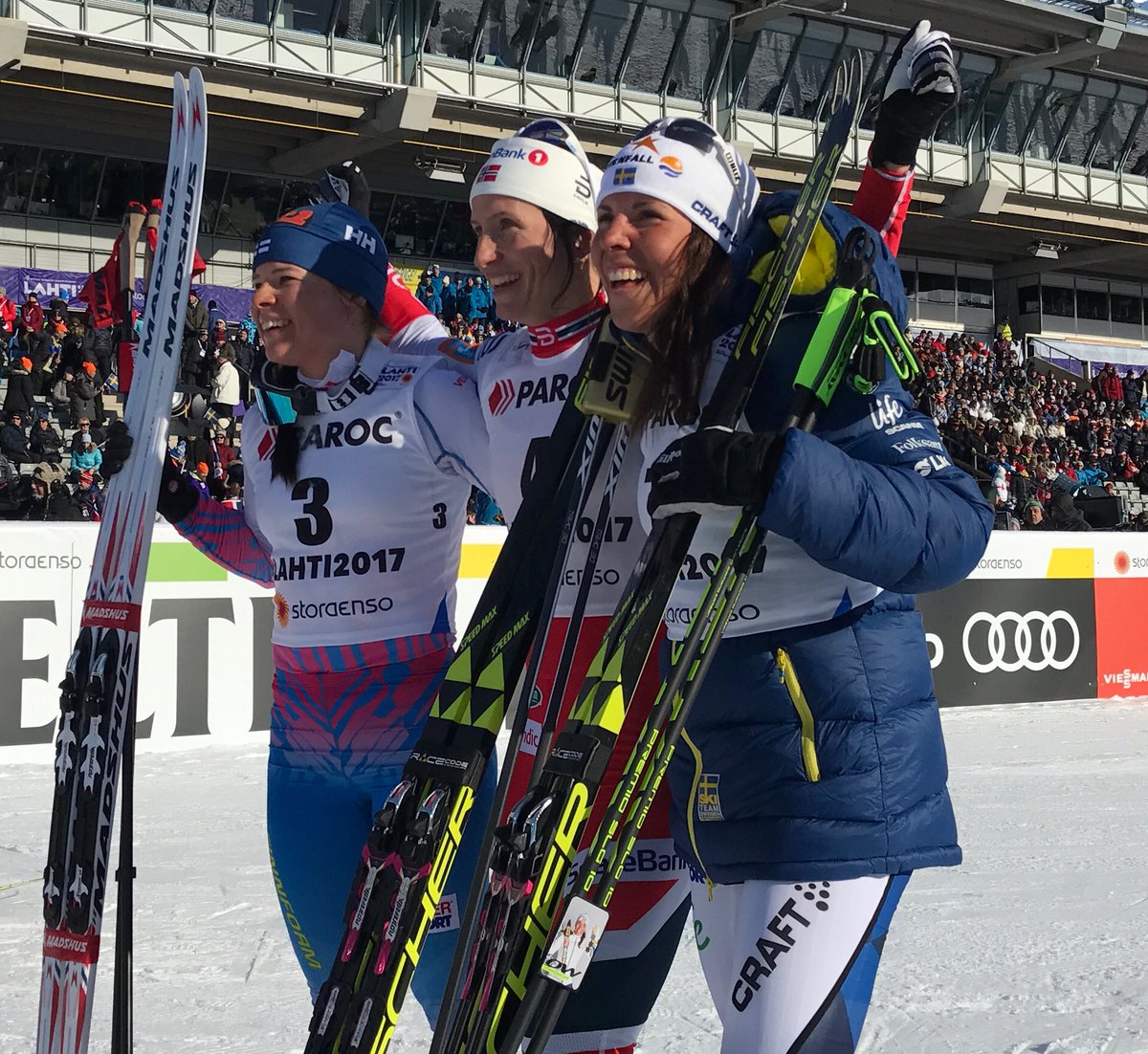
The women’s 15 k skiathlon podium at 2017 Nordic World Championships, with Norway’s Marit Bjørgen (c) in first, Finland’s Krista Parmakoski (l) in second, and Sweden’s Charlotte Kalla (r) in third on Saturday in Lahti, Finland. (Photo: FIS Cross-Country/Twitter)
FIS Nordic World Championships (Lahti, Finland): 15/30 k skiathlons
This one’s for you, kid.
Marit Bjørgen became the second relatively new mom to medal in the second race of 2017 Nordic World Championships on Saturday (after American Kikkan Randall earned bronze in Thursday’s freestyle sprint), racking up her 15th World Championships gold in women’s 15-kilometer skiathlon in Lahti, Finland. Bjørgen, a 36-year-old Norwegian team veteran, had her first child a little over a year ago.
In her first full season back, she led Saturday’s 7.5 k classic + 7.5 k freestyle race at the halfway point, where she clicked into her skate skis half a second ahead of Finland’s Krista Parmakoski in second. Parmakoski followed her across the finish for silver, finishing 4.8 seconds off Bjørgen’s winning time of 37:57.5 minutes. For Parmakoski, it was her first individual medal at World Championships after having previously earned four in team events.
Sweden’s Charlotte Kalla picked up her fourth-career World Championships medal in third place (+32.0), and Nathalie von Siebenthal placed fourth (+1:05) for the best result for a Swiss female cross-country skier since since Evi Kratzer earned bronze in 1987 in Oberstdorf, Germany.
Von Siebenthal edged Norway’s Heidi Weng in a photo finish, with Weng finishing another tenth of a second back in fifth (+1:05.1). Right behind them, Austria’s Teresa Stadlober notched sixth (+1:05.4), Russia’s Yulia Tchekaleva seventh (+1:05.7), Norway’s Astrid Uhrenholdt Jacobsen eighth (+1:11.1), Russia’s Anastasia Sedova ninth (+1:15.3), and Japan’s Masako Ishida 10th (+1:21.8).
Two Americans finished in the top 20 with Randall leading them in 17th (+2:09.2) and Liz Stephen placing 20th (+2:12.4). Rosie Brennan cracked the top 30 in 28th (+3:03.2) and Jessie Diggins did not finish.
A World Championships rookie, Cendrine Browne led Canada in 35th (+4:15.5), followed by Emily Nishikawa in 38th (+4:29.3) and Katherine Stewart-Jones in 40th (+4:38.1).
Annika Taylor, a 23-year-old California native who races for Great Britain, finished 41st (+4:49.7). She previously placed 38th in the freestyle sprint qualifier for her best result at her first World Championships.
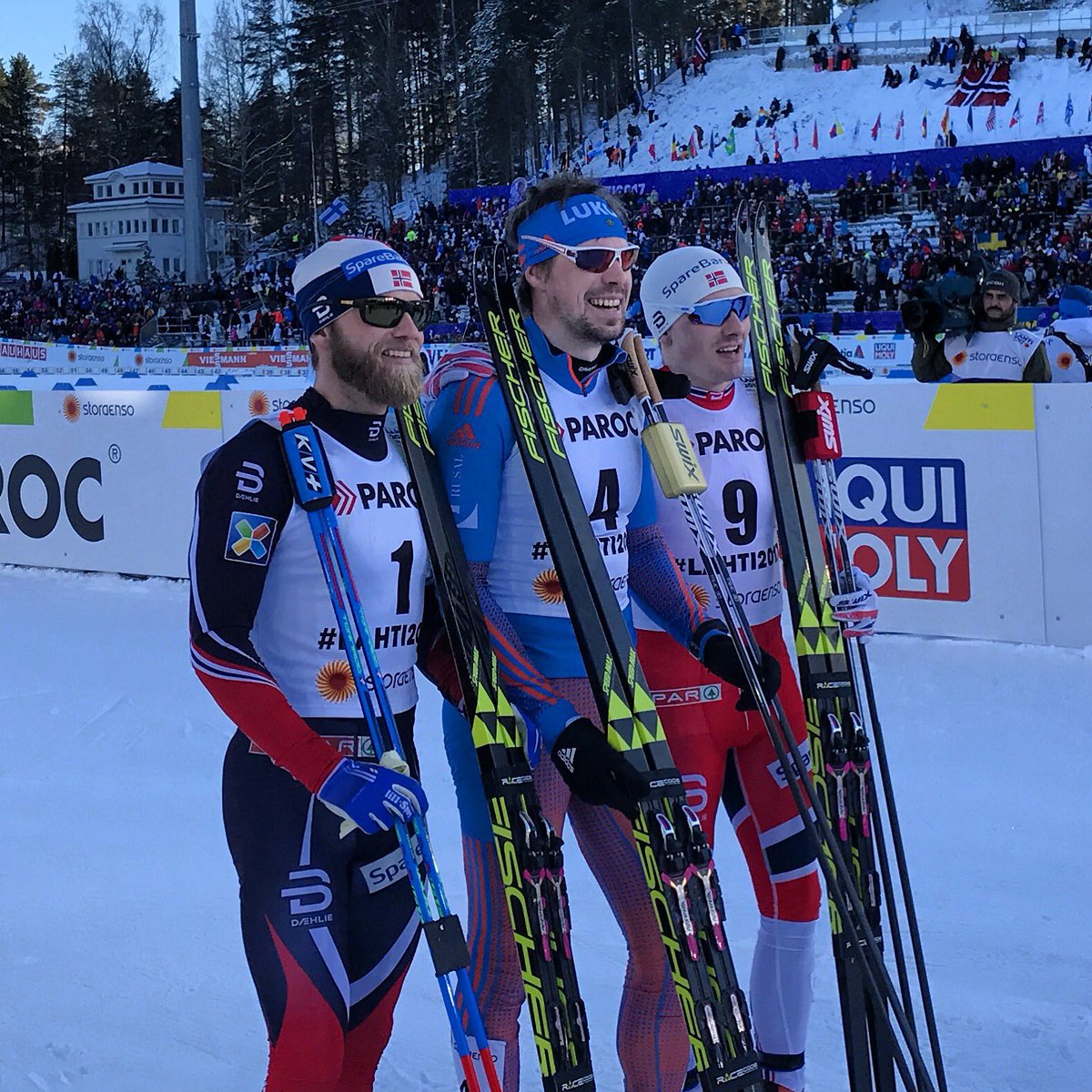
The men’s Nordic World Championships 30 k skiathlon podium, with Russia’s Sergey Ustiugov (c) in first, Norway’s Martin Johnsrud Sundby (l) in second and Finn Hågen Krogh (r) in third on Saturday in Lahti, Finland. (Photo: FIS Cross-Country/Twitter)
The men’s 30 k skiathlon that followed boiled down to a two-way battle for first between none other than Russia’s Sergey Ustiugov and Norway’s Martin Johnsrud Sundby. The two traded off leading throughout much of the race and together gapped the field around the 20 k mark.
Over the next 10 k, Ustiugov continued to drive the pace. On a pivotal climb less than two minutes before the finish, Sundby attacked, jump skating and seeming to put the hurt on Ustiugov. But that moment was over before it started when Sundby broke his pole against his ski tip and had to stop for a replacement.
The 24-year-old Ustiugov skied away to the win, uncontested yet powering down the finishing stretch to claim his first World Championships gold in 1:09:16.7 hours. He had previously earned bronze with the Russian men’s relay in 2013.
Sundby finished 6.7 seconds later, dropping his arms and head toward the ground as he did so. Norway’s Finn Hågen Krogh came out on top of a five-way fight for third, finishing fourth (+33.1), 31.8 seconds behind Ustiugov and 1.3 seconds ahead of his teammate Sjur Røthe. Krogh put himself in front and proved to have the most finishing kick, ahead of Røthe, Canada’s Alex Harvey (fifth, +33.3), Norway’s Didrik Tønseth (sixth, +33.5), and Sweden’s Marcus Hellner (seventh, +33.7). Russia’s Andrey Larkov fell off the group’s pace and placed eighth (+36.1), Finland’s Lari Lehtonen was ninth (+37.2), and Italy’s 24-year-old World Championships rookie Giandomenico Salvadori broke through in 10th (+37.3).
Three Canadians started the race, with Graeme Killick finishing 47th (+6:23.5) and Knute Johnsgaard 55th (+8:40.2) out of 63.
Tad Elliott was the top American man in 48th (+7:11.2), Kyle Bratrud (+7:16.5) placed 49th and Noah Hoffman 57th (+9:33.6). Ben Lustgarten did not start.
IBU Youth/Junior World Championships (Osrblie, Slovakia): Junior sprints
[UPDATED] Canada’s Megan Bankes and American Siena Ellingson landed in the top 20 of the junior women’s 7.5-kilometer sprint on Saturday at 2017 International Biathlon Union (IBU) Junior World Championships in Osrblie, Slovakia. Coming off a victory in Thursday’s 12.5 k individual, Bankes placed 13th and Ellingson achieved her best non-relay result in 18th at her fourth Youth/Junior Worlds.
Italy’s Michela Carrara won the sprint in 20:57.8 minutes with clean shooting (0+0) and the second-fastest course time. Norway’s Ingrid Landmark Tandrevold skied the fastest but came up 15.2 seconds short of gold with one prone penalty (1+0), which put her in second place. France’s Myrtille Bègue reached the podium in third (+31.5) with perfect shooting (0+0), and Austria’s Simone Kupfner shot clean as well for fourth place (+40.8), 9.3 seconds out of third.
Bankes was one of the first out of the gate in bib 4 and missed one on each stage (1+1) and skied the 14th-ranked course time. She ultimately finished 13th (+1:25.3) for her second-best result at her fourth Youth/Junior World Championships.
Ellingson started 19th and cleaned prone before missing one in standing (0+1), to finish 18th (+1:38.7) with the 20th-ranked course time.
Canada’s Nadia Moser scored her first top 40 of these championships in 31st (+2:16.4) with two misses (1+1), her teammate Emily Dickson finished 47th (+3:15.8) with one prone miss (1+0), and the second American racing, Nina Armstrong finished 65th (+6:11.5) with five penalties (2+3).
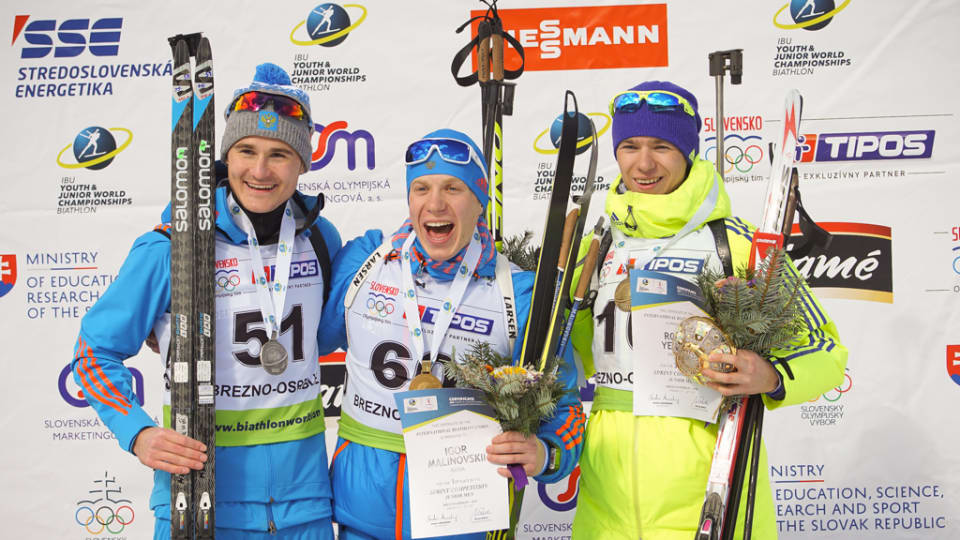
Russia had two on the podium in Saturday’s junior men’s 10 k sprint at IBU Junior World Championships with Igor Malinovskii (c) in first and Kirill Streltsov (l) in second, sharing the podium with Kazakhstan’s Roman Yeremin (r) in third in Osrblie, Slovakia. (Photo: IBU)
In the junior men’s 10 k sprint, Russia took the two top steps of the podium with Igor Malinovskii in first and Kirill Streltsov in second, after both cleaned the two-stage race.
Malinovskii started later in the field in bib 60 (out of 86) and bested his teammate’s time by 12.2 seconds, finishing in 24:32.2 minutes. Streltsov, who had started 51st and led until that point, took silver and Kazakhstan’s Roman Yeremin notched bronze (+24.9). Despite two misses on his first prone stage (2+0), Yeremin was an early race leader after starting 10th. He bested the time of Belarus’s Anton Smolski, who started fifth, by just 0.2 seconds for third. Smolski settled for fourth, ahead of Germany’s David Zobel (who previously took silver in Thursday’s 15 k individual) in fifth (+38.2).
Cody Johnson was the top American in 46th (+3:02.9), followed by Travis Cooper in 49th (+3:10.7), Cameron Christiansen in 80th (+5:32.4), and Peter Carroll in 82nd (+5:51.6).
Pearce Hanna led the Canadian men in 47th (+3:04.1), ahead of Trevor Kiers in 48th (+3:06.6), Zachari Bolduc in 54th (+3:25.4), and Jules Burnotte in 55th (+3:31.2).
Youth/Junior World Championships continue Sunday with the youth men’s and women’s pursuits.
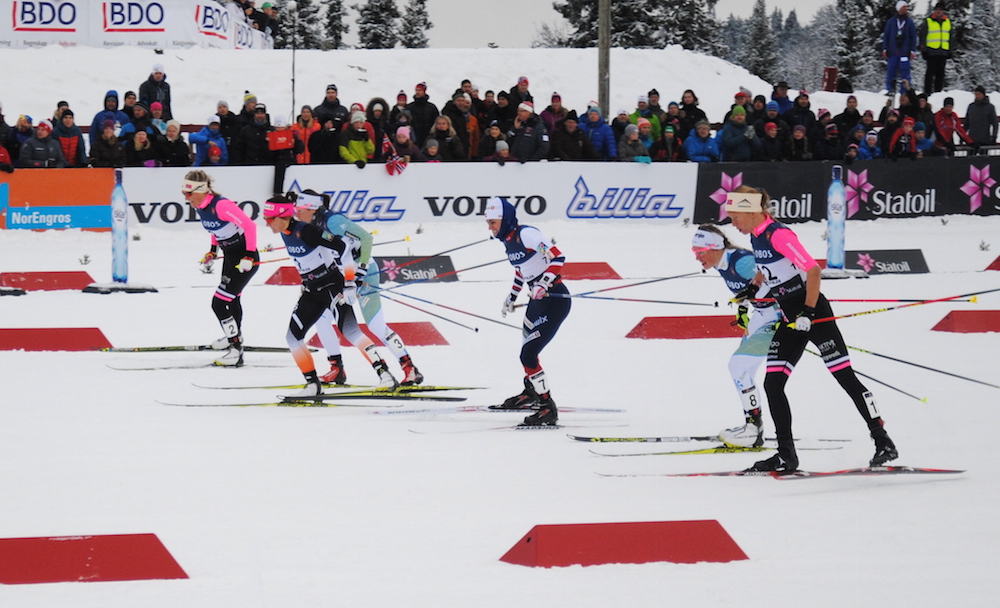
Norway’s Maiken Caspersen Falla (pink headband) leads out of the start of the women’s 1.2 k freestyle sprint final on Sunday in Beitostølen, Norway. (From left to right) Norway’s Mari Eide, Slovenia’s Vesna Fabjan, Falla, Norway’s Heidi Weng, Slovenia’s Anamarija Lampic, and Norway’s Silje Øyre Slind all reached the final. (Photo: Aleks Tangen)
BEITOSTØLEN, Norway — For the reigning Sprint World Cup champion who never lost a classic sprint last season (and placed first or second in all but one World Cup skate sprint), Sunday’s 1.2-kilometer freestyle sprint was about starting where she left off.
Norway’s Maiken Caspersen Falla did just that, qualifying first then cruising through the heats to win the women’s freestyle sprint on Sunday in Beitostølen. Part of a three-race series, it was held on the final day of Norway’s International Ski Federation (FIS) season-opening weekend — one weekend before the World Cup starts in Finland.
Falla, 26, took control of the day early, winning the prologue in 2:47.79 minutes. Afterward, she told NRK that she was satisfied with the result and that it was fun to race the sprint prologue. She carried her momentum through her quarterfinal and semifinal, advancing in the top two in each round, before beating Slovenia’s Vesna Fabjan in the final with a time of 2:42.3. Fabjan finished 0.2 seconds later in second, and Norway’s Mari Eide outlasted Heidi Weng for the final spot on the podium in third (+1.6). Weng, one of Norway’s top women who placed second in both distance races on Friday and Saturday, placed fourth (+2.4), while Slovenia’s Anamarija Lampic finished fifth (+3.2) and Norway’s Silje Øyre Slind was sixth (+5.2) in the final.
In an interview with FasterSkier on Saturday, Weng pointed that she didn’t qualify for the heats at last year’s sprint opener in Beitostølen. On Sunday, she qualified soundly in seventh, 4.2 seconds behind Falla.
Falla skated every heat with good control and technique, and kept her challengers from posing any real threats. Out of the start, the six finalists darted off the line at a high pace, and Falla immediately took control. Fabjan tried to challenge her in the final stretch, but Falla proved to be stronger. Her winning time in the final was the fastest of the day.
The prologue began at 8:30 a.m. and temperatures around -4 Celsius (25 degrees Fahrenheit). The highest-ranked athletes started first and the final standings already began to develop as the prologue came to an end. Falla, Eide and Fabjan clinched the first three qualifying places, just as they did in the final.
“I’m satisfied with the result and I’m happy to be in a sprint race again,” Falla told NRK after the race.
Of the 30 qualifiers, Norway’s 22-year-old Renate Bergset Tjetland was right on the edge in 30th (+18.26). Annika Taylor, who is originally from California but competes for Great Britain (while training with Norway’s Lillehammer Skiklub/Team Coop Talent), qualified in 27th, (+17.14). She started in the second heat and placed fifth, 12.1 seconds behind Weng, who won that quarterfinal.
“I’m happy about qualifying for the quarterfinal,” Taylor told FasterSkier afterward. “I feel like I got off to a good start and I tried to find the right lines, but I wasn’t able to follow in the final climb.”
The five quarterfinals starting at five minute intervals were won by Falla, Weng, Slovenia’s Katja Visnar, Eide and Fabjan, respectively. Slovenia’s Alenka Čebašek crossed the finish in second after Visnar, but was disqualified for an illegal lane change that impeded Norway’s Lotta Udnes Weng. Čebašek was relegated to last in the heat and 30th overall, while Lotta Weng advanced to the semifinals in second (where she went on to place fifth for 10th overall). Falla started out faster than everyone in her quarterfinal, but slowed down considerably in the final stretch, opening the door for teammate Astrid Uhrenhold Jacobsen to win the heat in 2:45.4, while Falla finished with the same time in second.
Falla seemed just as relaxed in her semifinal, which she won by 0.9 seconds over Heidi Weng.
“I thought it was a lot of fun and I’m really happy because I’ve never been in the final in Beito before,” Weng told journalists immediately after advancing to the final in second. “But I’m going to have to start better and work on keeping my speed up all the way when we get to the World Cup.”
Eide won the second semifinal by 0.2 seconds over Fabjan, while Lampic and Slind qualified for the final as lucky losers from the second semifinal in third (+0.6) and fourth (+1.0), respectively.
Canada’s Madison Fraser and Isabella Howden, both of Team Hardwood, placed 43rd (+29.12) and 45th (+43.07), respectively, in the qualifier.
Paddy Caldwell (Dartmouth/SMS/USST) racing to 21st in the men’s 15 k freestyle at U23 World Championships in Rasnov, Romania. (Photo: Logan Hanneman)
(Note: This article has been updated to include comments from Jasper Good, a U.S. Nordic Combined skier, and Annika Taylor, a California native who races for Great Britain.)
Twelfth, 13th, 15th. Those were the top results three Americans posted in Thursday’s competitions — between nordic combined and cross-country — at U23/Junior World Championships in Rasnov, Romania.
Jasper Good (U.S. Nordic Combined) racing to 11th in the normal hill/10 k individual competition at 2016 Junior World Championships in Rasnov, Romania. (Courtesy photo)
Jasper Good, a 19-year-old nordic-combined skier from Steamboat Springs, Colo., raced to 12th in the normal hill/5-kilometer Gundersen, finishing 1:13.3 behind winner Thomas Portyk of the Czech Republic, after starting 1:20 back. Portyk improved from second in the jump to win by 5.1 seconds in 11:01.5 minutes. Germany’s Terence Weber placed second and Estonia’s Kristjan Ilves, the jump leader, finished third (+5.4).
Good jumped to 14th then raced the seventh-fastest 5 k to climb to 12th. On Tuesday at junior worlds, he recorded his career best in his fourth World Championships: 11th in the normal hill/10 k.
“I wanted to put myself in the fight for a top 10 finish and I did that both days so to some degree I am happy with that,” Good wrote in an email on Sunday after the competitions. “Although I really wanted to break the top 10 I am happy as I was able to put two consistent competitions together. Both days were what I would call an accurate portrayal of my average level. I am happy that my average had me finishing in the top 15 on both days but a little disappointed I wasn’t able to have a slightly above average day to get me into the top 10.”
“With all of the challenges we were faced with this week between lack of snow, wind on the jump hill, and an excessive amount of schedule changes I am happy I was still able to move past it and perform when it mattered,” he continued.
Americans (from left to right) Ben Loomis, Stephen Schumann, coach Martin Bayer, Jared Shumate, and Jasper Good after an individual competition at 2016 Nordic Combined Junior World Championships. Not pictured: Koby Vargas. (Photo: Jasper Good)
In the normal hill/4 x 5 k team event on Friday, Good and fellow Americans Jared Shumate, Stephen Schumann and Ben Loomis placed sixth, about 5 1/2 minutes behind the Austrian winners. According to Good, that was his team-best result at junior worlds.
“I think the fact that our team event rank has been improving every year I have been on the team is a huge testament to the potential coming up in US Nordic Combined!” Good wrote.
He planned to finish the season with two more weekends of Continental Cup competitions.
In Thursday’s individual nordic-combined competition, three Americans followed Good with Koby Vargas in 32nd, Schumann in 38th and Shumate in 44th.
Friday also marked the last day of individual cross-country racing as well, Katharine Ogden of the Stratton Mountain School (SMS) and U.S. Ski Team (USST) finished 13th in the junior women’s 10 k freestyle individual start, two days after placing 13th in the 5 k classic. On Thursday, Ogden finished 1:11.4 behind Ebba Andersson of Sweden, the winner in 23:29.8.
Andersson won the 10 k skate (originally scheduled as a skiathlon, but changed before the championships because of low snow) by 29 seconds, ahead of Germany’s Katharina Hennig in second and 32.2 seconds ahead of Norway’s Tiril Udnes Weng in third. The fifth starter, Andersson consistently clocked the fastest splits in the four-lap race. Ogden started sixth and posted times that ranked within the top 15 for most of the race.
“The conditions were fast and icy with a little corn snow built up in some places,” Ogden explained in an email.
The course had frozen overnight, giving it a much different feel than the slow slush athletes had previously raced in this week.
“I struggle a little in faster conditions like that which is why I was focusing on really skiing bigger and getting more power as opposed to my usual fast tempo skiing,” the 18-year-old Vermont native continued. “I had high expectations going into this race and I was initially a little disappointed with how it went result wise. However, I am really psyched that I fought it out and raced as hard as I could in conditions that did not favor my strengths.”
“Katharine Ogden had an awesome day and was consistent in her race today as well as in the results,” USST Development Coach and trip leader Bryan Fishtold USSA. “She did a great job holding on to her place throughout the race.”
Also making the top 30 in the junior women’s race, Vivian Hett of Northern Michigan University (NMU) placed 30th (+2:06.3) for her career best in two world championships.
“My goal coming into the competition was to better my results from last year,” Hett, 19, wrote in an email. “I felt like last year didn’t do a great showing of the skier I would like to be and I feel as if I have improved that this year.”
In Rasnov, she achieved her first top 30 after placing 36th in the classic sprint at 2015 junior worlds in Almaty, Kazakhstan.
“My main focus today was to pace the race correctly,” Hett explained. “Being from sea level, I like to consider Romania at altitude even though it’s not very high up. We’re at about 3500ft at the race venue and I knew that if I went out too hard, I could possibly burn up. With that being said, it was my goal to ski the first lap smoothly and go from there.”
At the race’s halfway point, her split time ranked 23rd. By 7.5 k, Hett’s time was 25th fastest and she ended up 30th.
“The second half of the race was tough but I kept getting splits that I was in the mid 20s and that kept me firing,” she wrote. “I’m very happy with my results. It’s the best I’ve done at Junior Worlds and it makes all the summer and fall training worth it!”
Also representing the U.S. in the junior women’s race, two other NMU skiers Nicole Schneider and Sarah Bezdicek placed 40th and 46th, respectively.
Canada’s Hannah Mehain finished 54th, Natalie Hynes was 56th and Sadie White 59th.
In the 4 x 2.5 k freestyle relay on Friday, the U.S. junior women raced to eighth, 1:07.3 behind the Swedish winners, and Canada, with two athletes out sick, was unable to field a full team and did not finish.
Julia Kern (SMS/USST) started first for the U.S., putting the team in 12th at the first exchange, 15.3 seconds behind Russia in first.
“Julia had an awesome leg until she tangled with an Italian girl and fell,” Ogden explained in an email on Friday. “She gained back a bit of time but still tagged off in 12th place.”
Ogden raced the fifth-fastest second leg to improve to seventh, 16.4 seconds behind Sweden in first by the second exchange.
“I made up most of the places that I got by utilizing a quick V1 up some of the steeper pitches,” Ogden wrote.
Hett lost one position on the third leg and tagged off in eighth, 45 seconds behind Sweden, and Bezdicek kept the team in eighth through the finish, crossing the line 30 seconds after Italy in seventh.
“Our team was happy with our result,” Ogden explained. “It would have been awesome to have seen what would have happened if Julia hadn’t fallen but then again that’s totally just a part of the game and it happens.”
Sweden won the final race of the championships, with Emma Ribom, Elina Rönnlund, Andersson, and Jenny Solin, in 22:30.7. Norway was just 0.6 seconds away from gold in second place, and Russia finished third, 10.2 seconds behind.
Mehain skied the first leg for Canada, tagging Hynes in ninth, 10.6 seconds behind the leaders. Hynes then came through the second exchange in 12th before the team had to pull out of the race without two more athletes.
In the junior men’s 15 k freestyle on Thursday, Ian Torchia, another NMU Wildcat, raced to 15th for his best result of the week. In two Junior World Championships, it was his second-best individual result after placing 11th in the 20 k skiathlon last year in Almaty.
Ian Torchia (10) racing the first leg of the junior men’s 4 x 5 k relay at Junior World Championships on Friday in Rasnov, Romania. (Photo: Logan Hanneman)
“Coming into the week I had high goals and after the disappointment of 43rd in the [10 k] classic race I threw that race in the toilet and refocused for the skate,” Torchia wrote in an email.
“My strategy was to try and start out hard but I was missing a little pop today so I was lucky to get a ride off the eventual 6th place Russian Ivan Krillov,” he added. “I stayed on him thanks to my fast boards waxed by Justin Beckwith and the hard working tech crew. After he peeled off for his finish I gave it all I had in the last lap and held onto 15th.”
Torchia finished 1:24.2 behind the winner, Ivan Yakimushkin of Russia, who completed the six-lap race in 31:19.1. Yakimushkin won by 12.2 seconds over Norway’s Mattis Stenshagen in second place, and Russia’s Denis Spitsov was 29.2 seconds back in third.
“I was happy with my performance today as the icy fast power course with short steep climbs did not play to my strengths,” Torchia wrote. “I was originally disappointed with all the changes from a skiathlon to a 20k mass start to a 15k individual start but as a team we all adjusted and dealt with the ‘interesting’ conditions for all the races this week.”
According to Fish, “Ian Torchia did an excellent job in pacing his race and moving up,” he told USSA. “He kept charging hard throughout the race and eventually was able to move all the way up to 15th place, in a very competitive field.”
Joey Foster led Canada in 33rd, 2:22.5 behind the winner, for his best result in his debut junior worlds. Also for Canada, Philippe Boucher placed 39th, Ryan Jackson was 57th and Antoine Blais 61st.
Racing for the U.S., Cully Brown placed 41st, Zak Ketterson was 60th and Leo Hipp 74th.
Norway trounced the junior men’s 4 x 5 k relay on Friday by 47.7 seconds, winning in 43:07.5 with Stenshagen, Vebjørn Hegdal, Jan Thomas Jenssen, and Johannes Høsflot Klæbo.
Russia took silver and France earned bronze, 1:18.2 behind Norway.
Ian Torchia (c) in bib 10 racing the opening “scramble” leg for the U.S. junior men in Friday’s 4 x 5 k relay at Junior World Championships in Rasnov, Russia. The U.S. placed 11th. (Photo: Logan Hanneman)
The U.S. placed 11th (+3:21.5) with Torchia, Brown, Henry Harmeyer, and Ketterson. Canada finished 15th (+4:29.1) with Boucher, Foster, Blais, and Jackson.
“Scrambling for the relay tomorrow on such a narrow course is going to be hectic,” Torchia predicted on Thursday, adding he was “looking forward to mixing it up with the best.”
He tagged the U.S. in ninth after skiing the first leg, 12 seconds behind Norway in first. Brown held that position but slipped 57.4 seconds behind the leaders (Russia) by the second exchange. Harmeyer lost two places by the final exchange, tagging in 11th and 2:21.8 out of first, and Ketterson remained in 11th through the finish.
Canada opened with Boucher racing to 17th by the first exchange (+1:04.6), then Foster held that position and tagged Blais 2:04.5 out of first. Blais raced the 11th-fastest third leg to bring his team to 15th by the final exchange (+3:10.7) and Jackson kept them in 15th, about 30 seconds away from either 14th or 16th.
In the U23 men’s 15 k freestyle, Paddy Caldwell led the U.S. in 21st and Adam Martin placed 29th for the second-consecutive top 30’s for both Americans.
Caldwell, of the Dartmouth and Stratton ski teams, as well as the USST D-team, finished 1:34.2 behind the winner for his best result of the week.
Norway’s Simen Hegstad Krueger won it in 31:13.3, while France took second and third with Clement Parisse (+13.3) and Alexandre Pouye (+32.8), respectively.
“Today’s race was my main focus for the week,” Caldwell, 22, wrote in an email. “I had awesome skis out there — big thanks to all the wax techs for getting amazing skis. I did not feel as good as I had hoped out there today, my legs felt heavy and I couldn’t keep the distance pace that I usually aim for. With that the wheels started to come off the last few laps and I fell back quite a bit. I wanted to be up in that top five/ top ten spot but didn’t have it today.”
Paddy Caldwell (Dartmouth/SMS/USST) racing to 21st in the men’s 15 k freestyle at U23 World Championships in Rasnov, Romania. (Photo: Logan Hanneman)
After posting the sixth-fastest split at 2.5 k, Caldwell’s time stood up as the 12th fastest at 7.5 k, and by 12.5 k, he was down to 20th.
“He went out strong in the beginning and lost a little bit of time in the end, but he still showed a lot of promise in a very deep U23 field,” Fish told USSA.
Caldwell’s career best at a U23 or junior world championship was 10th in the 20 k skiathlon two years ago in Val di Fiemme, Italy. That was at junior worlds; last year at U23’s in Almaty, he placed 15th in the 15 k freestyle and 20th in the 30 k skiathlon.
Looking ahead to the rest of the season, Caldwell wrote that he’s “Not entirely sure what the rest of the season holds! But I am looking forward to spring series and whatever races I have between now and then!”
On Friday, Matt Liebsch announced that he had earned the final men’s spot for the U.S. at the Ski Tour Canada (STC) — the season-ending World Cups from March 1-12. U.S. Ski Team Head Coach Chris Grover previously explained in an email that either Liebsch or an outstanding performer at U23’s would earn that final spot.
American Adam Martin (second from left in bib 18) of Northern Michigan University racing to 29th in the men’s 15 k freestyle at U23 World Championships in Rasnov, Romania. (Photo: Logan Hanneman)
For Martin, who declined the U.S. team’s offer to compete at STC (instead choosing to focus on NCAA Championships in two weeks), he left U23 World Championships “quite satisfied,” as he considered classic skiing to be his strength.
“I started more aggressively than Tuesday,” Martin wrote on Thursday. “Fortunately, an Italian who was on his first lap caught me on my second lap, and I skied with him until the finish. This helped me dig deeper I think.”
He finished 2:01.6 behind the winner and one-tenth of a second out of 28th.
“Leaving the championships I’m optimistic,” Martin, 21, wrote. “I would really like to qualify again next year and race [at U23 World Championships] in Soldier Hollow.”
In his first world championships, Canada’s Jack Carlyle cracked the top 40 in 32nd (+2:10.4). Also for Canada, Alexis Dumas placed 38th, Scott James Hill was 42nd and Angus Foster finished 72nd.
Akeo Maifeld-Carucci of the Bridger Ski Foundation placed 39th for the U.S. and Kyle Bratrud (CXC) was 43rd.
American Heather Mooney racing to 42nd in the women’s 10 k freestyle at the U23 World Championships on Thursday in Rasnov, Romania. (Photo: FIS)
In the U23 women’s 10 k freestyle, Germany’s Victoria Carl claimed gold by in 23:14.1, 18.9 seconds ahead of Slovenia’s silver medalist Lea Einfalt and 27.1 seconds ahead of Russia’s Anastasia Sedova in third.
A California native and dual citizen of Great Britain, Annika Taylor (Sugar Bowl Academy Elite Team) achieved her first top 30 in two U23 World Championships, placing 30th, 2:06.8 behind the winner.
Taylor, 22, has spent most of the season racing World Cups for Great Britain. She led the British team in Rasnov, with Sarah Hale finishing 40th in Thursday’s 10 k skate. Earlier in the week, Taylor finished 34th in the 10 k classic and 36th in the freestyle sprint.
“I was really looking for a top-20 result at these championships, so I was left wanting more at the end of the week,” Taylor wrote in an email. “At the [World Cup] races in Falun, my body felt really good, most likely indicating a bit of a peak in performance, which then left me tired in the training week leading up to Romania. Although I didn’t achieve my results-based goal for the championships, I still had a few personal ‘wins’ of the week, including racing my 24th race of the 15-16 ski season, marking 4.5 months on the ski-traveling road, and seeing friends from the EISA carnival circuit!
“After 4 years at UNH focusing only on distance racing, this year has been a ‘relearning how to sprint’ year, and I’m excited to get to race a few sprints at the Tour of Canada!” she continued. “I’m also planning on racing Supertour Finals in Craftsbury (as long as my body keeps going after racing 8 races at the T of C).”
Canada’s Frédérique Vézina finished 35th (+2:35.6) for her best result of the week. Americans Felicia Gesior and Kelsey Phinney placed 38th and 39th, respectively, and Heather Mooney was 42nd and Kristen Bourne 44th for the U.S.
Canada occupied 45th through 47th, with Kendra Murray, Alannah Maclean and Sophie Carrier-Laforte, respectively.
“Overall, Romania was a positive and unique experience,” Taylor wrote. “I had so many laughs with my British teammates, shared plenty of hugs with Heather and Kelsey, played with stray dogs, visited Dracula’s castle, and even got a slight face-tan!”
On Saturday, most of the athletes planned to leave Romania. Ogden is headed to Ottawa, Canada, to compete in the eight-stage STC.
“Romania was an awesome experience and I think that I will definitely remember the stunning views of the Transylvanian alps,” Ogden reflected. “And I’ll probably remember all the crazy schedule changes and the heroic effort of the organizing committee to pull off this even with barely any snow.”
Simen Krueger won the men’s 15 k freestyle at 2016 U23 World Championships in Rasnov, Romania. (Photo: FIS)
Canada’s Antoine Blais (41) and Philippe Boucher (30) racing in a group with Norway’s Thomas Jan Jenssen (19), Italy’s Mikael Abram (8) and France’s Jules Lapierre during the men’s 15 k freestyle at Junior World Championships in Rasnov, Romania. (Photo: FIS)
Canada’s Jack Carlyle racing to 32nd in the men’s 15 k freestyle at U23 World Championships in Rasnov, Romania. (Photo: FIS)
Romania’s Florini Pripici leads Canada’s Angus Foster during the men’s 15 k freestyle at U23 World Championships in Rasnov, Romania. Foster placed 72nd. (Photo: FIS)
American Paddy Caldwell leads Switzerland’s Jason Rueesch during the men’s 15 k freestyle at U23 World Championships in Rasnov, Romania. Caldwell finished 21st. (Photo: FIS)
Bird’s eye view of the race course with Adam Martin, of the U.S., in bib 18. He placed 29th in the men’s 15 k freestyle at U23 World Championships in Rasnov, Romania. (Photo: FIS)
Kyle Bratrud (USA) racing to 43rd in the men’s 15 k at U23 World Championships in Rasnov, Romania. (Photo: FIS)
Kyle Bratrud of the U.S. leads a French athlete during the men’s 15 k freestyle at U23 World Championships in Rasnov, Romania. (Photo: FIS)
Italy’s Sebastiano Pellegrin leads American Kyle Bratrud into the finish of the men’s 15 k freestyle at U23 World Championships in Rasnov, Romania. (Photo: FIS)
Former UNH skier Annika Taylor (r) during an interview with FasterSkier at the 2015 SuperTour in Craftsbury, Vt., last year.
With the demanding race schedules of World Cup athletes, mid-season workouts have to be effective without adding too much training stress.
Roy Young, the British Nordic Head Coach, developed a sprint workout that utilizes short intervals on varying terrain to focus on specific techniques during each effort.
Young has guided the British team to some of the country’s best World Cup results yet, including his son Andrew Young’s historic bronze in the freestyle sprint in Toblach, Italy, earlier this season.
Annika Taylor, a member of the British National team and Sugar Bowl Academy Elite Team, is skiing her first season under Roy Young and especially enjoys this speed workout. After graduating from the University of New Hampshire as an All-American last spring, this season is Taylor’s first on the World Cup.
Annika Taylor (Great Britain) competing at the Tour de Ski In Lenzerheide, Switzerland.
“The workout focuses both on the neuromuscular (limb speed) required in sprinting and improving anaerobic capacity,” describes Taylor.
“I enjoy it because it is an efficient workout and that sprint improvement results after just a few focused sessions,” she added. “The most challenging part is keeping correct, efficient form and maintaining the same speed in the second set as was done in the first set.”
Taylor outlined an example of a freestyle workout that utilizes varying terrain to focus on transitions, V1, and V2 alternate.
The shortest intervals (20 seconds) are to be skied on a flat section of trail utilizing V1 to accelerate before transitioning to V2.
Next, the 30-second intervals are done on slightly downhill terrain into a slight uphill, with a focus on long V2 alternate strokes.
Finally, the focus of the 45-second intervals is changing V1 tempo in the transition from a gradual into steep uphill.
Taylor has also been working with exercise physiologist Kurt Rumley, from SportScotland Institute of Sport to develop a complete warmup for interval workouts and races which is described below.
Work into 4 minutes of Level 2, then easy ski for a four minutes.
Work into 3 minutes of Level 3 (10-15 kilometer race pace), then easy ski for 3 minutes.
Finally, work into full-on sprint race speed with 3 x 30-second efforts, with a few minutes rest in between each effort.
Speed Workout:
3 x 20-second, 2 x 30-second, 1 x 45-second efforts (with techniques as detailed above) followed by 10 minutes of easy skiing before repeating the progression for the second set.
Between each speed effort, take enough rest to get back to your starting point and for your heart rate to return to Level 1.
Cool down:
Finish with 20-30 minutes of easy skiing and foam rolling/stretching.
Annika Taylor, formerly of UNH, on her way to winning the women’s 5 k at the 2013 Snowshoe Thompson Classic at the Auburn Ski Club in Truckee, Calif. (Photo: Mark Nadell/macbethgraphics.com)
Although much of the focus of World Cup racing is on the stars from powerhouse skiing countries, the World Cup fields are filled with skiers who are working towards goals that don’t necessarily entail a podium. Racing on the World Cup is not always about the pursuit of medals but the experience itself.
For Annika Taylor, the World Cup experience hasn’t quite sunk in yet. Just six months after graduating from University of New Hampshire (UNH), Taylor, 22, found herself on the starting line of her first World Cup race in Kuusamo, Finland, in late November as the sole female representative of Great Britain.
A native of Truckee, Calif., Taylor holds dual British citizenship as her father is originally from the United Kingdom (her family now lives in Truckee). As a junior, she skied for California’s Auburn Ski Club and the Far West Ski Association, winning three California State Championships and notching three top-10 finishes at Junior Nationals. Taylor continued her ski career at UNH in Durham, N.H., under the guidance of head coach Cory Schwartz.
Annika’s first taste of international racing came in 2014 when she raced with the British national team at U23 World Championships in Val di Fiemme, Italy. Although she had inklings of future opportunities to race for Great Britain at that time, she realized she would need to continue to see improvement to make competing post-collegiately worthwhile.
These gains were realized in a breakthrough season her senior year, highlighted by a seventh-place finish in the 15 k classic at 2015 NCAA Skiing Championships. Earlier last season, she placed ninth in the 20 k classic mass start at U.S. nationals.
Upon graduating in the spring of 2015, Taylor was armed with both a chemistry degree, and the opportunity to continue skiing for Great Britain. Racing for the British team would mean more international competition and the chance to compete with the best skiers in the world on the World Cup — an opportunity she couldn’t pass up.
In May, Taylor joined the newly established Sugar Bowl Academy Elite Team based out of the Truckee/Tahoe region. The 2015/2016 season is the team’s debut as it aims to fill the gap left by the recently dissolved Far West Elite team and provide financial support, coaching, and training opportunities to its athletes.
After a summer training with the Sugar Bowl Elite Team as well as the British team in Scotland, Taylor started her first World Cup season in November with British Cross Country Head Coach Roy Young. Britain’s other female skiers opted not to race in Period 1 of the World Cup, leaving Taylor as the sole woman on the team. She joined a men’s contingent on the circuit, including recent World Cup bronze medalist Andrew Young.
FasterSkier caught up with Taylor about her World Cup experience over the holiday break. She spent the holidays training in Davos, Switzerland, sharing an apartment with U.S. Ski Team member Caitlin Gregg. The two met several summers ago, as Gregg visits Truckee in the summer to train at altitude and visit family.
After the holiday break, Taylor raced the first three stages of the Tour de Ski in Lenzerheide, Switzerland, before traveling to Östersund, Sweden, to compete in Scandinavian Cup races.
Annika Taylor racing for Great Britain in the World Cup freestyle sprint qualifier in Toblach, Italy. She placed 54th. (Courtesy photo)
FasterSkier: What is your favorite World Cup venue so far?
Annika Taylor: I really enjoyed Toblach [Italy]. They have a two-lap sprint course and I like V2 technique and I felt like it played to my strengths. And it was beautifully sunny so that always helps.
FS: What do you consider your best races so far on the World Cup?
AT: My best race was my first race: the classic sprint in Kuusamo [where she placed 50th in the qualifier]. It was best result so far and the whole experience came to fruition at that moment, too, so I’ll never forget that day. For everything to come together in the first race, I was really pleased with that.
The other races I was most pleased with were the opening races in Beitostølen, Norway. That’s where the Norwegian team started their season as well so it was World Cup caliber racing just with fewer countries. That was my very first taste of racing the best in the world so I was definitely a little star-struck that weekend.
FS:Do you prefer the sprints or the distance races?
AT: I would say distance has become my cup of tea. When I was a junior I was more of a sprinter but being at university for four years, I didn’t train much for sprinting. If I have a bit more sprint training in the next couple years I think I’ll really grow to enjoy it. Right now I do like distance racing a bit more. You can push yourself longer and harder and there is more time for tactical fixes. I like having that opportunity to turn things around.
FS: How is the intimidation factor racing the best skiers in the world?
AT: There’s definitely intimidation, but there’s also more a respect and awe for them. I am also just excited to be racing because I don’t have much pressure to perform this year. Obviously I want to ski fast, but I have to adjust to so many factors that I don’t have the energy to be nervous because I have to focus my energy on skiing the best I can technically, tactically, and physically in every race. But at the same time, there’s that moment that you think, “Woah, we are on the World Cup circuit, this is crazy.”
Annika Taylor (Great Britain) competed in the first three stages of the Tour de Ski In Lenzerheide, Switzerland.
FS: What was your favorite part of the Tour de Ski?
AT: My favorite part of the TDS has to have been the atmosphere and just the general excitement from both the fans and the athletes! You could sense the nervous energy bouncing around the wax cabins, and then going out to warm up on the race track with 12,000 fans (equipped with flags and cow bells) on the sprint day, with the sun shining down was a feeling I’ll never forget! Throughout the weekend fans and athletes enjoyed food vendors, opening ceremonies, performances from bands and dancers, and free swag. Cross-country skiing can feel a bit like an under-appreciated sport at times, but this was the polar opposite!
FS: What was the biggest difference racing the Scandinavian Cup races vs World Cup races?
AT: The Scandinavian cup races in Östersund were quite different from the World Cup races mainly in the sheer amount of racers competing in the Scandinavian cup (and the blisteringly cold -20 C temperatures compared with the mild temps felt at the World Cup venues recently). The level of competition is impressive in the Scandinavian cups as well, with the race leaders most likely fit enough to achieve a top-10 in a World Cup race.
FS: What race did you enjoy the most since the holiday break?
AT: I was quite pleased with how I skied the 10k freestyle race in Östersund! [She placed 21st.] Being back at low altitude made racing just that little bit “peppier,” and it was encouraging to be back in a field where I can be more competitive and “catch a ride” mid-race with the ladies racing around me.
FS: What are your goals for the season?
AT: My main goal this season is to race well at U23 Worlds because that’s where I can be the most competitive. But there are always goals week to week, even weeks I don’t have races I will focus on skiing technically well during each workout so that when my technique comes under pressure in a race, the foundation has been laid and I can ski technically well. I always have result based goals but this year is hard not really knowing what is going to happen competing against the best in the world. I can’t really measure success against them just yet.
At the Toblach 10 k classic Heidi Weng of Norway started behind me (in the interval starts) so my goal was to catch a ride with her when she passed me and match her technique, tempo and pace. The Norwegians know how to ski efficiently, ski fast and charge. That’s what I’m trying to learn this year is to find that extra level of intensity in a race necessary to do well at the World Cup level.
FS: Have you been enjoying the lifestyle?
AT: I wasn’t sure how I’d do because I chose not to go home for Christmas and I believe it will be a total of five and a half months on the road. I’m learning to be fine wherever I’m at with whomever I’m with, but also not feed into the ups and downs that go along with being an elite athlete. I’m actually addicted to the lifestyle because every weekend is a new experience. I’ve really enjoyed meeting new people and it has motivated me to learn bits of different languages.
FS: What is your schedule for the remainder of the season?
AT: Following the Scandinavian Cup, I will head to Ramsau, Austria to train for a few weeks. My next World Cup race in Lahti because Worlds will be there next year and I can get a feel for the course and the area. After that U23 Worlds in Rasnov, Romania then the day after fly out to Canadian Tour. Then I will race the Spring Series in Craftsbury, Vermont and finally home.
Sadie Bjornsen (r) of the U.S. Ski Team leads Germany’s Nicole Fessel (l) during the women’s 10 k classic pursuit on Sunday at the Ruka Triple World Cup in Kuusamo, Finland. Bjornsen started 11th and went on to place 14th. (Photo: Fischer/NordicFocus)
It’s easy to get caught up in results and what could have been. Ask Sadie Bjornsen. The 26-year-old U.S. Ski Team member was shooting for a top 10 in Sunday’s 10-kilometer classic pursuit at the World Cup in Kuusamo, Finland.
After putting herself in 11th to start the final stage of the Ruka Triple mini tour, Bjornsen considered 10th or better to be a reasonable goal. That is, until you factor everything else that typically happens in Kuusamo.
On Sunday, a mixture of rain and snow falling amid a windy, 32-degree morning, paired with a combination of natural and manmade snow on the course, made for a lot of variables. With that in mind, Bjornsen noted that it was imperative to stay positive.
She would know. Two years ago, she had her breakthrough result in the Kuusamo 5 k classic, placing seventh. The day before, Bjornsen qualified third in the classic sprint.
She ended up 17th overall in the 2013 Ruka tour. On Sunday, she posted a new personal best in the Ruka Triple in 14th overall. And while it wasn’t the top 10, it took a lot of work to get there.
“It was another fun, and extra challenging day of racing in Kuusamo,” Bjornsen wrote in an email after Sunday’s pursuit, in which she finished 14th, 2:05.6 behind Norwegian winner Therese Johaug.
She had started 35 seconds behind Johag. By 2.5, Bjornsen was about a minute back in 14th, and at the halfway point, she remained in 14th, about a minute and 24 seconds back. That’s partly because Johaug was putting a lot of time into the field; at 5 k, she had a 24.5-second gap to Norwegian teammate Ingvild Flugstad Østberg (who started with her).
But Bjornsen was also struggling.
“My first [2.5 k] lap was really hard, because I realized I had no kick in the track, and I felt like I was being passed by people constantly,” she recalled. “Finally, by the second lap, I pulled myself together, and decided to just ski outside of the track for the majority of the race, and then things worked out much better! I was even having a lot of fun on the final lap!
“Patience and optimism is the key on a day like today though, because there is such a variety of things that are going on,” Bjornsen added. “… I could have easily continued to struggle and drop after that first lap, but I gave myself a little smacking and realized I had to make my opportunity today.”
Sadie Bjornsen (c) skis with Sweden’s Hanna Falk (l) and Germany’s Nicole Fessel (r) during the women’s 10 k classic pursuit on the last day of the Ruka Triple in Kuusamo, Finland. Bjornsen placed 14th in the first World Cup and mini tour of the season. (Photo: Fischer/NordicFocus)
Instead of paying attention to the athletes near her, Bjornsen focused on doing her best with what she had available, she explained. That made her happier in the end.
It was also the key to her success, according to U.S. women’s coach Matt Whitcomb. After the race, he observed that the athletes who didn’t openly complain about how bad the wax was were the ones that fared best.
“Our athletes never complain about the wax midrace, but every now and then you hear another athlete yell in disgust about the wax,” he said. “… Everyone is slipping and sliding around this course and it was those that said, ‘This is what I’ve got, what do I have to do?’ [that succeeded.]”
“Sadie’s race was impressive, but also her reflection on the race was mature,” Whitcomb added. “She discovered after a lap that the way she was skiing wasn’t working. To get out of the tracks on the uphill gave her the biggest benefit. … She resettled, put in three really good laps and was able to hang onto a top 15.”
“There was no simple answer out there today, it was a challenge no matter what!” Bjornsen explained. “My wax tech did such an awesome job of keeping me relaxed and confident with what was going to happen, so I am so thankful for that!
“I am really stoked to finish with my best tour result ever,” she concluded. “I am really satisfied with the weekend, and I know there is more to come, and more ‘less challenging conditions’ to come as well!”
After Bjornsen, teammate Jessie Diggins started 19th, 47 seconds behind Johaug, and finished 38th (+3:17.4). She skied within the top 30 for the first 2.5 k before falling two minutes off the pace between 4 and 5 k.
“I struggled in these conditions, but it was an important step forward for me on the mental side of racing,” Diggins wrote in an email. “A few years ago, I might have heard that I was out of the top 30 and stopped skiing as hard as I could, but I never gave up and kept looking for those seconds out there, and I’m proud of that.”
A weekend after winning both FIS races in Gällivare, Sweden, including a classic sprint, Sunday’s classic distance result left Diggins disappointed, Whitcomb said.
“She’s made big progress on her classic skiing, but today’s conditions required the ability to really feather the kick,” he explained. The best classic skiers who could maintain their technique despite spotty kick tended to do better, he added
But Diggins wasn’t concerned.
“I feel that my fitness is in a good place for the start of the year, and when I let my body recover from the past few weeks of good training and the 5 races I did in the last 9 days I should see a fun boost!” she wrote.
The second-fastest U.S. woman in the pursuit, Rosie Brennan started 34th (1:09 back) and finished 34th (+3:08.5) with the 33rd-fastest time of the day.
“I had my eyes on the top 30 both for the tour and the time of day. I fell just short of both, but I guess I’m putting in my time so to say,” Brennan wrote in an email. “No one had perfect skis so it was all about finding ways to make it work. I started a little slow with some apprehension for both the downhills and my skis, but eventually started finding ways to make it all work.”
While her race had its ups and downs, “some laps I felt I had figured it out and other laps I felt like I couldn’t make anything work,” she explained, Brennan was ultimately pleased with her start to the season.
Emily Nishikawa of the Canadian Development Team skiing to 60th in the 10 k classic pursuit at the World Cup in Kuusamo, Finland. (Photo: Fischer/NordicFocus)
“I learned a lot over the weekend and got my mind back into ski racing which I think will set me up well for the coming weeks,” she wrote.
“She skied so steady in the mid 30s,” Whitcomb said of Brennan. “I know she’s a little disappointed, but points don’t come easy, particularly in Kuusamo and Lillehammer in these first two World Cups … I think it bodes well to Rosie’s trajectory.”
Also for the U.S., Ida Sargent — who placed seventh in Friday’s classic sprint — rose from starting 54th to finish 44th overall. Liz Stephen placed 59th, and Caitlin Gregg was 68th.
“I was really pleased with the whole process [this weekend],” Whitcomb said of his team. “… We really operated like medalists should … However, it wasn’t all fluffy like that. We had some disappointing results.”
“Overall, I feel good about where this team is,” Whitcomb said. “The good results weren’t completely absent this weekend … but we’re heading to Norway to prove we’re in better shape than we showed this weekend.”
Canada’s lone female competing in Kuusamo, Emily Nishikawa placed 60th (+5:11.8) after starting 63rd. Annika Taylor, a University of New Hampshire graduate and former Far West Nordic junior who’s now racing for Great Britain, went from 67th to 62nd overall (+5:33.7) in the tour.
The men’s podium in the 20 k freestyle mass start at the 2014 NCAA Championships in Soldier Hollow. (Photo: http://bertboyer.zenfolio.com) All proceeds from photo sales will be directly donated to NNF.
LAKE PLACID, N.Y. — Come Wednesday, the 148 best collegiate skiers in the U.S. will descend upon Lake Placid for the 2015 NCAA Skiing Championships. Hosted by St. Lawrence University, NCAA’s will serve as the premier collegiate races of the season as skiers aim for both individual and team success. The last time Lake Placid hosted the Championships was 33 years ago in 1982, when the national races were only for men.
The nordic portion of NCAA’s will take place on the trails of the Mt. Van Hoevenberg, the site of the cross-country events in the 1980 Olympic games. The first day of competition on Wednesday will comprise of the 5- and 10-kilometer women’s and men’s freestyle interval starts, while Friday will feature the 15/20 k classic mass starts. Conditions should be pristine in the Adirondacks as recent weather has provided ample snow and below average temperatures.
The 2015 NCAA Championships will have similar team favorites in 2014. At last year’s championships in Park City, Utah, the University of Denver dominated the nordic races to win the overall team title. With several departures from the Pioneers’ squad, however, other schools from the west and east will look to capture the trophy.
The University of Colorado enters the NCAA’s as the top-ranked team from the Rocky Mountain Intercollegiate Ski Association (RMISA). The Buffs earned the most combined points throughout the season and were recently crowned the RMISA regional champions. If that wasn’t enough to boost their pre-championships confidence, their history in the east certainly will. Colorado has won the last two national collegiate titles in the east in 2011 and 2013.
Utah and Denver followed close behind in the 2015 RIMSA points rankings and will likely be Colorado’s top competition in New York, while the University of Vermont will look to extend its Eastern Intercollegiate Ski Association (EISA) dominance to the national stage. The last time Vermont won the NCAA team title was in 2012 in Bozeman, Mont.
University of New Hampshire’s Annika Taylor races in the 2013 NCAA Championships.
The East:
If there are two skiers from the EISA to know before the start of NCAA’s, they are Middlebury College’s Heather Mooney and University of New Hampshire’s Annika Taylor.
With five wins apiece in the 2014/2015 season, Mooney and Taylor have shut out the rest of the eastern competition from the top of the podium. While their fight for eastern dominance will continue in Lake Placid, it remains to be seen how they will match up with the western and central women.
The Middlebury College women’s nordic team has qualified a full team for the first time in many years, including Mooney, Kelsey Phinney and Stella Holt. The trio has won many women’s nordic competitions throughout the season and will look to do the same in Lake Placid. If the recent EISA Regional Championships results are any indication — where Mooney and Phinney finished second and third, respectively, in the 15 k classic mass start — the Panthers are well on their way to their goal.
Paddy Caldwell (Dartmouth College) finishes the men’s 15 k freestyle in fourth place at the 2015 Cross Country Championships in Houghton, Michigan.
If the eastern women have been defined by two individuals, the region’s men are characterized by dueling schools — Vermont and Dartmouth. The Vermont trio of Rogan Brown, Jørgen Grav and Jack Hegman ended the eastern season ranked second, third and sixth, while Paddy Caldwell, Fabian Stocek and Silas Talbot took the first, fourth, and fifth spots.
Caldwell, who spent a large chunk of the season in Europe at the U23 World Championships in Almaty, Kazakhstan, enters as one of the favorites at NCAA’s. Last year, his best finish was fifth in the 20 k freestyle mass start. Talbot’s best finish at 2014 NCAA’s was 11th in the 20 k freestyle.
Brown’s best finish at the same championships was 13th in the 20 k freestyle, while Grav’s was 20th in the 10 k classic.
The West:
Rune Malo Ødegård of CU races to first in the 10 k individual classic at the 2014 NCAA Championships in Soldier Hollow. (Photo: http://bertboyer.zenfolio.com) All proceeds from photo sales will be directly donated to NNF.
If Caldwell wants to step atop the NCAA podium, he’ll have to overcome the RMISA frontrunners from the University of Colorado, Rune Malo Ødegård and Mads Ek Strøm. With the exception of one race, the two have alternated on the top rungs of the 2014/2015 RIMSA podium in every single competition. By the end of the regular season, Ødegård won five of 10 races while Strøm won four.
Ødegård is no stranger to NCAA’s as the Norwegian won two national titles in 2013 and 2014. His wins made NCAA history, as he is the first collegiate skier to repeat as an individual national championship in the classic discipline. Strøm earned his national title in the 20 k freestyle mass start in 2014.
While the two Buffs are the RMISA favorites, there are several other standouts to watch in this week’s races. German Moritz Madlener of DU and enters Lake Placid as the third-ranked westerner after earning bronze in four western qualifiers. The University of Utah’s Niklas Persson is another potential top finisher. The Ute finished third at 2014 NCAA’s in the 10 k classic. Mats Rudin Resaland of the University of New Mexico is also another top contender, and will look to improve on his bronze from last year’s 20 k freestyle.
The University of New Mexico’s Emilie Cedervarn is the top-ranked western woman after winning the last four RMISA races of the season. The Utes’ Veronika Mayerhofer is close behind for total wins in the west with three. Denver’s Sylvia Nordskar will look to repeat her podium performances from 2014 NCAA’s where she placed second and third. The Norwegian only raced the first four RMISA races this season. She won both the races in the Utah qualifiers and placed first and second at the Colorado invite before taking a six-race hiatus.
Other skiers to watch from the West are the Buffs’ Petra Hyncincova and the Utes’ Sloan Storey.
Central:
Kyle Bratrud of Northern Michigan University racing to 52nd in the men’s 15 k freestyle at 2015 World Championships in Falun, Sweden.
Kyle Bratrud of the University of Northern Michigan is the favorite from the central region after a successful season that saw him win the 15 k freestyle at the 2015 U.S. nationals and compete at the U23 World Championships in Almaty, Kazakhstan, followed by senior World Championships in Falun, Sweden.
Bratrud will look to overcome the fatigue of weeks of international racing and travel to fight for a spot on the NCAA podium. In 2014, he was the top American in the 10 k classic in sixth overall.
Joining Bratrud in the quest for collegiate success will be teammates Fredrik Schwenke and Erik Soderman. If the UNM trio can repeat their impressive performances from U.S. nationals, they have the possibility of leading the men’s nordic at NCAA’s. Last year, the men finished third overall in the 10 k classic and helped their coach, Sten Fjeldheim, earn 2014 national coach of the year.
Logan Hanneman of the University of Alaska – Fairbanks is another strong skier to watch from central.
Despite the graduation of Rosie Frankowski, the central women have a chance at top performances from NMU’s Jordyn Ross and Michigan Tech’s Deedra Irwin, among others. They will look to build on the region’s successful 2014 Championships to gain more starting spots in future national events.
Live timing will be available at BartTiming.com. FasterSkier will be on site for both days of nordic racing, so stay tuned for recaps from Wednesday and Friday.
The men’s mass start begins at the 2015 EISA Regional Championships (photo: Mt Van Hoevenberg)
Lake Placid, NY
Bright sun, perfect snow conditions and a torturous course with climbs around every corner: what more could you want to close out the regular season of EISA competition? Collegiate racers from across the area converged on the Olympic trails of Mt. Van Hoevenberg this past weekend for the EISA Regional Championships hosted by St. Lawrence University. While Regional performances were on the line, the events also served as a precursor to the NCAA Championships to be held on the same courses in less than two weeks time. Competitors were eager to test out the race course and measure their fitness as training narrows toward the final events of the season.
The men’s races were largely dominated by UVM and Dartmouth, and both events saw the return of Sophomore Paddy Caldwell to prime form after a few weeks back stateside following the U23 World Championships. The women’s field was again bested by Middlebury’s Heather Mooney and UNH’s Annika Taylor, who have battled back and forth all season.
The event schedule for the weekend mirrored that of the upcoming NCAA Championships: 5 and 10-kilometer freestyle individual-start races, followed by 15 and 20-kilometer mass start classical races.
Friday: 5/10km Freestyle
Cold conditions yet again, though sun and calm skies made for pleasant skiing as temps warmed throughout the day. The men’s race was a tale of two laps. The Ladies 5km race course is notorious for its climbing: one might describe the elevation profile as a glorified triangle, featuring sustained climbing with little recovery followed by a mostly non-technical descent back to the stadium. A flat lap lane in the stadium area provided only a brief mid-race respite for the men, who then had to set out once more into the woods to tackle the grueling climbs all over again.
UMPI racer Hilary Saucy begins the 5k freestyle on Friday (photo: Mt Van Hoevenberg)
After suffering his first freestyle loss of the season at the Middlebury Carnival, Dartmouth racer Paddy Caldwell returned to the top of the field on Friday, posting the fastest lap splits on both rotations around the course. He got the better of his closest skating rival, UVM’s Rogan Brown, by a whopping 37 seconds.
With the strongest race of his season, Dartmouth skier Jan Ketterson grabbed the final podium spot in 3rd.
Racers from UVM and Dartmouth ended up taking all spots in the top eight. Austin Meng of host St. Lawrence and Raleigh Goessling of UNH were the only two skiers to sneak into the top 10 among the sea of green suits with ninth and 10th place finishes, respectively.
With one lap of the tough course to test themselves on, the women’s race was no less daunting.
This second race came down to a familiar battle that has been playing out over race courses all season: Mooney vs. Taylor. With Taylor of UNH starting a minute behind her rival, the splits were in her favor, but on this first day it was Middlebury’s Mooney who took top honors, fending off Taylor by 16 seconds.
Despite the familiar scene in the top two spots, it was the women of UVM who truly dominated the majority of the top ten, taking places 3-6. Led by Stephanie Kirk’s podium performance, the Catamount women were a force to be reckoned with in the team score and certainly looked to be on top of their game when it counted.
UNH also put in a solid day. With Katrin Larusson inside the top ten and Maddy Pfeifer in 13th, the Wildcats followed the Catamounts in the team score and pushed the typically strong Middlebury women into third.
Saturday: 15/20km Classic
Conditions for classic racing could not have been better on Saturday, as a truly festive atmosphere surrounded the entire racing scene. The men faced four laps of the same daunting Ladies 5k loop, in sunny conditions warming from the single digits to the high teens.
A preview of events to come: SLU and UNH racers speed toward the finish past NCAA banners for next week’s Championship (photo: Mary B)
Dartmouth’s Paddy Caldwell tested the field early, opening a small gap before being absorbed in the stadium area and feed zone. It was during second half of the race that the pacing exam really began, as Caldwell accelerated into the climbs and emerged from the woods at the end of the third lap with a clear gap on his competitors. By the fourth lap Caldwell was out of sight of the field, and he cruised home uncontested for the win.
The chase pack consisted of around ten men, all UVM and Dartmouth racers save for Per Lindgren of UNH.
Lindgren yo-yo’ed off the chase pack at first, but as the group seemed to realize Caldwell would be uncatch-able they appeared to back off and begin a more tactical race for the remaining podium spots.
Those spots were eventually won by Jorgen Grav (UVM) in second and Fabian Stocek (DAR) in third, setting up another battle of green suits in the team score. By a narrow four-point margin it was Dartmouth who took the win over the Catamounts. The men of Williams College capped a strong season by placing third.
The women’s race broke apart as well, with racers stringing out and shifting position throughout the three laps of competition. At the front it was again Heather Mooney and Annika Taylor duking it out. Among a swarm of cheering fans and teammates, it was Taylor who emerged victorious in the final race of the EISA season.
Good friends and training partners this past summer in Truckee, California, Taylor and Mooney are good friends and were quick to congratulate each other on great races and a great EISA campaign, as both seniors capped their Carnival careers with dominant seasons.
In a close finish for the final podium spot, the Panthers picked up another strong result from Kelsey Phinney who, along with Stella Holt, helped the Middlebury women to the top team score of the day.
The UVM women were unable to match their dominant performance of the day prior, and fell to third in the team score behind Taylor and her Wildcat teammates.
—
Results for the entire weekend can be found via BartTiming
With the EISA season ending on Saturday, UVM earned their fifth-straight overall EISA Championship Victory. Also of note were the presentations of both the EISA Service award and EISA Coach of the Year award. Former long-time Williams head coach Bud Fisher received the EISA Service award, while UNH’s Cory Schwartz was recognized as EISA Coach of the Year.
The 2015 NCAA Championships, hosted by St. Lawrence University, will be held March 11-14 in Lake Placid. For more information, please visit the official event website by clicking HERE
MIDDLEBURY, Vt. — Cold temperatures have been the norm for this season of EISA racing. The Middlebury Carnival was no exception, as some of the coldest predicted temps of the season lead to changes in race schedules in hopes of maintaining a safe and fair event. New snow also came along with the cold temperatures, creating slow and grueling conditions for both Friday and Saturday’s competitions. The Tormondsen Family Race Course, site of action at the 2013 NCAA Championships, featured plentiful natural snow and pristine conditions. A 10-kilometer classic race was held on Friday for both men and women, while 5 and 10-kilometer freestyle races were contested on Saturday.
Friday: 10 k Classic
Eirik Fosnaes (UNH) and Hugo Fontaine (LAV) round a corner in the men’s 10k classic at Middlebury (photo: Silke Hynes)
A familiar scene took place in the women’s race on Friday: three racers battling it out for the win, while others chased for fourth. Despite the individual-start format, it was once again the trio of Heather Mooney (Middlebury), Annika Taylor (UNH) and Corey Stock (Dartmouth) claiming the podium. The Panther cheering squads were out in force, and on her home course Mooney prevailed by 10 seconds over Taylor. Stock settled for third, another 23 seconds back.
With the exception of occasional appearances by other strong racers, the top of the women’s field has been relatively consistent this season. Mooney, Taylor and Stock have finished on the podium in many of the past few races, with Mooney and Taylor taking the lion’s share of the wins.
Mooney led the Panthers to a win in the team score, though the women of Bates College were the only team to put three racers in the top 10 en route to second place. Hallie Grossman, Sadie James and Tara Humphries finished in fifth, eighth and 10th place, respectively, helping the Bobcats edge the UVM women by one point.
The men’s podium was a much closer affair, with the top three men separated by a mere eight seconds. Jorgen Grav of UVM took the top spot, with Dartmouth’s Silas Talbot taking second.
Not far behind was Laval’s Frederic Touchette, who ended up less than three seconds behind Talbot. The first three men had a clear gap to fourth, as classic specialist Per Lindgren picked up his third top-10 of the season in 4th, 26 seconds back.
Saturday: 5/10 k Freestyle
Annika Taylor skates to a win in the Middlebury 5km freestyle (photo: Silke Hynes)
While the thermometer may have read a little warmer than the low single-digits of Friday, a damp day and some wind made Saturday’s freestyle event feel quite frigid. Most racers, accustomed to such conditions after multiple weeks of battling the cold, were well-prepared with buffs, face-tape and overboots.
Through the cold snow it was Annika Taylor of UNH who took the win for the women, swapping places with Friday’s classic champion Heather Mooney of host Middlebury. Mooney nearly earned a sweep of the weekend, finishing less than three seconds from the win.
For the second day in a row Dartmouth racer Corey Stock took third, and the women’s podium players remained consistent for both days of competition.
In the men’s race, Rogan Brown of UVM continued an impressive streak of freestyle performances with a win over Dartmouth’s Paddy Caldwell. Recently returned from strong results at the U23 World Championships in Almaty, Kazakhstan, Caldwell was unable to match Brown’s pace and settled for second place.
Finishing on the podium for a second day in a row was Catamount Jorgen Grav who, along with Jack Hegman in fifth, gave UVM a decisive hold on the team score for the event. In fourth was Laval’s Frederic Touchette.
The EISA will take a break this coming weekend. The EISA Regional Championships will be held February 27th and 28th in Lake Placid, New York. Saint Lawrence University will host the events on the 1980 Olympic trails of Mt. Van Hoevenberg, and will also play host to the 2015 NCAA Championships two weeks later.
The above video is of the men’s 10 k individual start. Having trouble viewing the video? Watch here.
CRAFTSBURY, Vt. — Kris Freeman (Freebird) has been racing at high level for many years, and his veteran status showed on the trails of the Craftsbury Outdoor Center. As the 34-year-old prepares for his eighth World Championships – set to begin later this month in Falun, Sweden – he skied to his second win in as many days with a victory in Saturday’s 10 kilometer freestyle individual start.
Saturday welcomed warmer temperatures than Friday’s freestyle sprints, with racers facing 15 degree weather and lightly falling snow throughout the day. Although an inch or two of snow fell overnight, the course was hard-packed and fast for the SuperTour, EISA College, and Eastern Cup races.
Freeman skied a conservative first lap and trailed split-leader Rogan Brown of the University of Vermont at the 5 k mark. In the second lap of the race, Freeman powered through the challenging course to vastly overcome the deficit and finish with a time of 25:04.3. Brown was able to maintain a podium position and skied to second overall, 38.3 seconds behind Freeman. Brown was the top college skier and led a trio of Vermont skiers, including fifth and seventh place finishers Jørgen Grav and Jack Hegmen, to sweep the Dartmouth Carnival podium and win the day of college racing.
“I had a hot lap,” Brown said of his first lap in a post-race interview. “After that I focused on skiing smooth. I’ve always loved this course.”
In third was Alaska Pacific University’s Lex Trienen, who trailed Freeman by 1:04.0 as he crossed the finish line. He was followed by Grav (+1:05.4) in fourth and APU teammate David Norris (+1:13.9) in fifth.
In the women’s 10 k individual start Mary Rose employed similar tactics to Freeman. At her 5 k split Rose sat in third and trailed race-leaders Chelsea Homes of APU and Anja Gruber of Far West Elite by several seconds. With her finish time of 30:10.3, however, Rose outpaced the entire field by over 10 seconds.
“I was really focused on not having a negative split.” Rose said in a post-race interview. She explained one of her main motivations in Saturday’s race was to catch the women in front of her an not be caught by any starters behind her. Her strategy was to ski hard from the start and maintain the her speed throughout the course.
Behind Rose was a tie for second place between Stratton Mountain School T2’s Erika Flowers and University of New Hampshire’s Anika Taylor. With a time of 30:20.5, both Flowers and Taylor earned a rare equal placement and an even rarer podium tie. Taylor led the UNH Wildcats to earn the most points in the women’s nordic portion of the Dartmouth Carnival.
In fourth and fifth were Gruber and APU’s Becca Rorabaugh, who trailed Rose by 17.0 and 17.9 seconds. Holmes (+18.8) finished her day in sixth.
In the junior 5 k individual freestyle races, Russel Boswell of SMS won with a time of 14:11.1. He was followed by Adam Glueck (+4.1) of Ford Sayre and Walker Bean (+10.8) of Green Mountain Valley School (GMVS) in second and third.
Olivia Cunio of GMVS won the junior women’s 5 k with a time of 16:22.3. In second and third were Mae Chalmers (+37.7) of SMS and Kristen Miller (+37.7).
Although the Dartmouth Carnival concluded Saturday, SuperTour and Eastern Cup racing will continue Sunday with 5/10/15 k classic mass starts beginning at 9:30 a.m. EST. FasterSkier will be live streaming the races. Watch them here.
Men ascend the first climb of the 15k classic mass start at the 2015 UVM Carnival. Fabian Stocek (DAR) leads.
Editor’s note: We’re seeking collegiate contributors from across the U.S. If you’re interested in seeing your collegiate region and circuit represented with similar articles, and would like to contribute or know someone that would be interested in submitting recaps and photos, please email info@fasterskier.com.
***
The second weekend of EISA competition brought fans, family, athletes and coaches alike to the idyllic Trapp Family Lodge in Stowe, VT this past weekend for the UVM Carnival. Conditions in the mountain village were superb, with good snow covering nearly every inch of the trail system and great temperatures for both racing and spectating.
The 5-kilometer race loop for the weekend, known affectionately as “Morty’s Maze” in honor of renowned trail designer and all-around ski legend John Morton, is a favorite of many on the circuit. Smooth, steady ascents and twisting, entertaining downhill sections combine to make a fast, fun and challenging course for both disciplines.
On Friday racers took on 5 and 10-kilometer freestyle events, with 10 and 15-kilometer mass start classic events on Saturday.
Friday: 5/10k Freestyle
A cold week preceding this event meant fast, hard-packed conditions on race morning. Though a dusting of snow began early in the day and continued through some of the racing, warming temperatures lead to a slight glaze and a slippery gliding surface. As is common on this course, times would prove to be tight during the short freestyle events.
UVM skier Rogan Brown heads out on course en route to 2nd place in the men’s 10k Freestyle (photo: Silke Hynes)
Except for the men’s winner.
Less than a week removed from his dominant opening EISA freestyle event, the 10-kilometer test at the Bates Carnival, Dartmouth’s Paddy Caldwell surged to a staggering 1:08 lead over second place finisher Rogan Brown of host UVM. After sitting out the events of the previous weekend, the podium finish represented Brown’s first showing in the league this season.
Laval’s Frederic Touchette claimed the third step on the podium, denying Harvard’s Akeo Mayfeld-Carucci his second consecutive podium by a mere two-tenths of a second. The tight times continued down the results list, as third through eighth place were separated by less than 9 seconds.
The Dartmouth men were able to just edge UVM in the team title by three points. Caldwell’s victory was bolstered by Big Green skiers Fabian Stocek and Silas Talbot finishing seventh and 11th, respectively.
The women’s 5-kilometer freestyle event was nearly over in less than 14 minutes for winner Annika Taylor of UNH. After finishing second in both events the previous weekend to Middlebury skier Heather Mooney, Taylor came out swinging in Friday’s race and bested runner-up Mary-kate Cirelli of UVM by over 14 seconds. Mooney rounded out the podium in third, 10.8 seconds behind Cirelli.
The women of UVM were able to avenge the narrow loss by the Catamount men earlier in the morning by earning the top team score for the 5k race. Alayna Sonnesyn (5th) and Stephanie Kirk (7th) completed the scoring for UVM. Taylor’s victory led a strong showing by the UNH women, who took second thanks to three Wildcats in the top 11: Katrin Larussin finished eighth and Tristan Ramey finished 11th.
Saturday: 10/15-kilometer Classic
After a cold start to the racing season for most of the country, warm temperatures for the races on Saturday seemed to bring out an especially festive mood among everyone in attendance in sunny Stowe. For a venue notorious for brutal wind, the calm air certainly helped as well.
Warming and glazing tracks proved to be the waxing concern for the day, as temperatures rose steadily toward the freezing mark and the sun poked in and out of the clouds. With a long uphill into the finish, it was crucial to be able to push and stride hard for home at the end of a grueling mass start race.
The men raced first on the day, and for the first of three laps the pack stayed relatively close together. By the second lap it was mostly a handful of green suits pulling away from the field: racers from Dartmouth and UVM began to string out the field, along with several other representatives, most notably a strong presence near the front from the men of Williams College.
By the final lap Dartmouth’s Paddy Caldwell was charging away from his teammate Silas Talbot. Caldwell sealed the weekend sweep with a nearly 12-second cushion to Talbot, while UVM skier Tobias Trenkle outsprinted fellow Catamount Jack Hegman to earn his first collegiate podium.
Olivia Amber (CBC) leads eventual winner Annika Taylor (UNH) early in the race. Amber would go in to finish 8th in the event
The one-two punch of Caldwell and Talbot was aided by Big Green sophomore Fabian Stocek in fifth place to give the Dartmouth men another victory over UVM in the team score, with Williams rounding out the podium in third.
Another one-two was in store for the women’s race, although in this case it meant a repeat of the first and second-place finishers from the previous day. Like Caldwell earlier that day, UNH skier Annika Taylor broke away from her competitors to seal a sweep of the weekend events.
Skiing with smooth and relaxed form, Taylor excelled on gradual striding sections and bit-by-bit she increased her lead over the course of the second half of the race to cruise in for the win nearly 30 seconds clear of UVM racer Mary-kate Cirelli in second.
Corey Stock of Dartmouth picked up her second podium of the season, repeating her third-place finish from the classic mass start race at the Bates Carnival.
The team score for the women was quite close, with UVM edging UNH by a scant two points, and Middlebury another three points behind.
Competitors begin the 20k classic mass start at the Bates Carnival (photo: Silke Hynes)
Editor’s note: We’re seeking collegiate contributors from across the U.S. If you’re interested in seeing your collegiate region and circuit represented with similar articles, and would like to contribute or know someone that would be interested in submitting recaps and photos, please email info@fasterskier.com.
***
Most New England ski racers are familiar with the courses at Black Mountain of Maine, perennial host of events ranging from the high school level up to the National Championships. Most of those racers are also familiar with the old New England weather adage, “if you don’t like the weather, wait five minutes.” In classic East Coast fashion this first EISA competition, hosted by Bates College, featured a little bit of everything: cold, wind, sun and snowstorms…sometimes all within a single race.
Despite marginal coverage in places thanks to a January thaw, snowmaking, shoveling and other enthusiastic volunteer squads combined to create fair and exciting courses. All events were able to take place on full 5-kilometer loops. On Friday, “Chummy’s Loop” played host to 15 and 20-kilometer mass-start classic races. On Saturday, “Ray’s Loop” was the scene of 5 and 10-kilometer freestyle events.
Friday: 15/20k Classic Mass-start
A fast first kilometer of flat and downhill terrain caused both the women’s and men’s races to string out quickly. In each case, a lead pack of 10-15 skiers became established by the beginning of the second lap, with chasers eagerly battling for positions inside the top-30 and coveted points toward the NCAA Championships this year in Lake Placid, NY.
For the women, much of the lead pack consisted of racers from UVM, Dartmouth and Middlebury. Along various portions of the course leads would change, though there were no significant breakaways until the final lap.
Only a week removed from successful races at US National Championships in Houghton, MI, it was Heather Mooney of Middlebury and Annika Taylor of UNH who entered the final downhill into the stadium together with a clear gap to eventual third-place finisher Alayna Sonnesyn of UVM.
The women’s field heads out of the start during the 15k classic race (photo: Silke Hynes)
Taylor trailed slightly heading into the flat section and may have had an eye to slingshot into the lead down the final stretch, but once the double-poling ensued it was clear that the tall, powerful frame of Mooney would be too much to overtake.
Mooney sealed an individual victory for the Panthers, while the Catamount women of UVM topped the team score thanks to the podium by Sonnesyn (in her first EISA race), as well as sixth and eight-place finishes by Mary-kate Cirelli and Marion Woods, respectively.
The men’s race saw a similar situation form by the midpoint in the race, with a small pack of skiers breaking away from the rest of the field. A mid-race snow squall made conditions interesting, but did little to dramatically affect the outcome of the race.
One notable exception to the tactical skiing of the lead pack was Carleton racer Colin Abbott, who pushed away from the field early in the race and skied alone for much of the first three laps. At first glance, the name Carleton may be unfamiliar to some readers: located in Ottawa, the university was a guest of the Bates Carnival this season. Along with Universite Laval from Quebec City, the welcome addition of Canadian teams to the EISA circuit has added a new level of excitement and unique depth to the carnival events.
As the kilometers ticked away with Abbott still alone in front, the movement within the lead pack became more tense. Based on his recent success in distance and mass-start events, many spectators and coaches were likely all wondering the same thing: when was Paddy Caldwell (Dartmouth/USST) gonna chase this guy down?
Sure enough, the Sophomore from the Big Green made his move in the later stages of the race, catching up to Abbott and skiing with him up the brutal stretch of striding that encompassed the rear slope of the infamous “High School Hill”. Despite his push for the lead, Caldwell wasn’t able to surpass Abbott in the finish, crossing the line a few seconds behind.
The podium was completed by another racer from north of the border, Laval skier and former Canadian National Team member Frederic Touchette.
The Dartmouth men were able to take top honors in the team score, with Caldwell leading his teammates Fabian Stocek and Silas Talbot into fourth and sixth place, respectively.
Saturday: 5/10k Freestyle
After frigid temps the night prior and a windy morning with bitter wind chill values, the freestyle races on Saturday were postponed slightly. The wind barely died down for the women’s race, however, and competitors battled gusts in the stadium area strong enough to knock an unsuspecting racer off balance.
That was no problem for the Middlebury women’s team, who looked in absolute control of their technique and pacing on Saturday. Heather Mooney repeated her top performance on Friday to earn a sweep of the weekend, while her teammates Kelsey Phinney and Stella Holt crossed the line in sixth and tenth position, respectively. All three of Middlebury’s scorers looked particularly smooth, snappy and energetic despite the cold snow and wind.
Paddy Caldwell laps through during the men’s 10k freestyle (photo: Silke Hynes)
UNH skier Annika Taylor also continued a great opening carnival weekend, finishing just over two seconds behind Mooney for her second podium in as many days. Dartmouth skier Corey Stock rounded out the top three.
The wind began to die down and conditions sped up slightly for the men, who raced two laps for 10 kilometers. In his preferred technique, it was Paddy Caldwell’s race from start to finish. Using a smooth, efficient tempo on the climbs and breaking into his unmistakable and deadly-effective V2 on flatter sections, Caldwell powered to a 46-second victory over Harvard’s Akeo Mayfeld-Carucci.
Mayfeld-Carucci earned his top EISA finish with his second-place result, while the ever-consistent Silas Talbot of Dartmouth claimed third to give Dartmouth a strong presence on the podium.
The third racer from Dartmouth, Fabian Stocek, placed seventh to give the Big Green another team victory.
EISA racing continues next week at Trapp Family Lodge in Stowe, VT with host UVM.