From the FasterSkier archive — posts syndicated from athletes’ and coaches’ own blogs between 2004 and 2012, kept online as published. Current coverage is at fasterskier.com.
This coverage is made possible through the generous support of Marty and Kathy Hall and A Hall Mark of Excellence Award. To learn more about A Hall Mark of Excellence Award, or to learn how you can support FasterSkier’s coverage, please contact info@fasterskier.com.
Ben Ogden (USA) and Johannes Hoesflot Klaebo (NOR), (l-r) moments after their Semifinal crash in Drammen, Norway. (Photo: Nordnes/NordicFocus)
The greatest cross-country skier in history was lying on the snow, his arms wrapped over his face, his hands holding the back of his head, and the city of Drammen — where the man-made course magically appears on top of the streets, and Norwegian children crane from balconies to watch the racing — went very, very quiet.
Johannes Hoesflot Klaebo did not finish on Thursday. Neither did Ben Ogden. The gold and silver medalists from the Olympic sprint classic in Milano Cortina just last month, the two men who have defined this event all season, were tangled together on the hard-packed final downhill before the hairpin, while the semifinal raced on without them.
After the chaos of the semi-final, which took down the two fastest qualifiers, a 25-year-old Norwegian named Ansgar Evensen — who had changed into Skiathlon boots between the quarterfinals and semifinals because he felt so unsteady on his feet — surged from sixth place in the final to cross the line first.
Evensen won ahead of Jiri Tuz, the 21-year-old Czech who earned a career-best second place. Kristian Kollerud of Norway, racing in his very first World Cup start, took a remarkable third, and Harald Oestberg Amundsen, the 2024 overall World Cup champion, finished fourth.
It was the kind of day that maybe only Drammen — with its icy hairpin, its drafting effect, and its knack for producing chaos at precisely the wrong moment — could deliver.
Johannes Hoesflot Klaebo (NOR), Bernat Selles Gasch (ESP), Theo Schely (FRA), Ludek Seller (CZE), and Vili Crv (SLO), (l-r) in the first Quarterfinal. (Photo: Nordnes/NordicFocus)
Qualification and Quarterfinals
Klaebo’s dominance was apparent from the opening qualification. He posted a 2:24.88, nearly three seconds faster than Ogden’s 2:27.47, with the next 28 qualifiers separated by less than five seconds. That kind of gap on a world-class field in sprint qualification puts his dominance in perspective.
Klaebo, as he always does, chose the first quarterfinal heat. He won it easily — clocking 2:37.14 — compared to his qualifier, a notably conservative time that suggested he was managing his energy for the rounds ahead.
Simone Mocellini (ITA), Ben Ogden (USA), and Aron Aakre Rysstad (NOR), (l-r) in the second Quarterfinal. (Photo: Nordnes/NordicFocus)
Ogden, the lone American in the top 30, qualified second and chose Quarterfinal 2 alongside Italy’s Simone Mocellini and Norway’s Even Northug. He entered the bottom of the final climb up to the iconic finish on the steps of the Neo-Gothic Bragernes Church behind the leaders, but unleashed a powerful double-pole to charge into second place, advancing comfortably.
The quarterfinals also produced some early drama. Northug, who had been enjoying a strong sprint season, was disqualified from Heat 2 after receiving his second written reprimand of the season, this time for a classical technique infraction.
And quietly, in Heat 3, Evensen advanced as a photo-finish second behind Sweden’s Alvar Myhlback.
Ben Ogden (USA) and the medical team check on Johannes Hoesflot Klaebo (NOR). (Photo: Nordnes/NordicFocus)
The Crash
The first semifinal will be remembered for the crash.
Klaebo had won his quarterfinal from the front and appeared to be cruising. Ogden, too, looked comfortable. But on the icy final descent heading toward the hairpin around the fountain behind the start gates, the pack compressed. Klaebo held tight to the inside along the fencing, leaving him vulnerable when the skis began to cross. Contact was made. Ogden’s feet swept out from under him and fell right in front of the Norwegian. Klaebo had no place to go, skiing right into Ogden, which launched him into the air, spinning backward, ultimately hitting the back of his head on the hard-packed snow.
Ben Ogden (USA) walks off after the crash in the Semifinals. (Photo: Nordnes/NordicFocus)
Listening to the broadcast, the silence in Drammen was palpable. Ogden scrambled to his feet with only one ski still attached; Klaebo did not immediately follow. Replays showed Klaebo had not only hit his head on the hard snow, but may also have been struck in the head by a trailing ski as he fell. Both men would be listed as DNF — a designation almost never seen next to Klaebo’s name in a decade of dominance.
Anton Grahn of Sweden, who had been near the front, took the semifinal win. Tuz advanced automatically in second. Alvar Myhlback of Sweden finished third but would not be fast enough to advance as a lucky loser. The crash all but guaranteed that the top four finishers from Semifinal 2 would all advance to the final.
After the crash in Semifinal 1, Semifinal 2 with Harald Oestberg Amundsen (NOR), Kristian Kollerud (NOR), Jules Chappaz (FRA), Ansgar Evensen (NOR), Noe Naeff (SUI), and Davide Graz (ITA), (l-r) race for the finals. (Photo: Nordnes/NordicFocus)
Semifinal 2 and the Path to the Final
The second semifinal, then, was a race with diminished stakes but no shortage of quality. Chappaz drove the pace from the front and never relinquished it. Kollerud, the 21-year-old in his club racing suit, making his World Cup debut, finished an impressive second.
Behind them, Amundsen and Evensen advanced as lucky losers, separated by just hundredths of a second. The final would feature three Norwegians, a Frenchman, a Czech, and a Swede — but no Klaebo and no Ogden.
Entering the finish stretch. (Photo: Nordnes/NordicFocus)
The Final
Half the final field was under 23 years old. Tuz, Kollerud, and Grahn — all 21 — represented a generational shift on a day when the established order had been upended.
Tuz, perhaps emboldened by his semifinal crash survival, went hard from the gun, leading over the opening climb. It was a brave tactic from a young racer in only his second World Cup final. Behind him, the more experienced campaigners — Amundsen, Evensen, Chappaz — bided their time, trusting that the Drammen draft would bring them back and leave them well rested for the final climb.
It did. The group had reformed as they skied behind the fountain. As they navigated the icy turn, Grahn — who had been skiing near the front all day — lost his footing on the hairpin and crashed, his race effectively over. He would finish sixth on the day.
The final dash for the line. (Photo: Nordnes/NordicFocus)
Grahn’s fall opened a lane on the outside. Evensen, who had been sitting sixth, saw it and calmly worked his way around the dicy turn.
“When Anton fell in the last corner, I had every opportunity,” Evensen said afterward. “So I took it from fifth place to first on the final.”
What followed was one of the great finishing surges in Drammen’s long sprint history. Amundsen and Kollerud were locked in their own battle, focused on each other. Chappaz was charging. But Evensen — who had finished fourth on this same course back in 2023, who knew exactly how the final 50 meters of this city sprint played out — found a gear that nobody else could match.
Harald Oestberg Amundsen (NOR), Jiri Tuz (CZE), Kristian Kollerud (NOR), Jules Chappaz (FRA), and Ansgar Evensen (NOR), (l-r) had an exciting finish in Drammen. (Photo: Nordnes/NordicFocus)
He crossed the line first, fist clenched, pounding his chest. Tuz nipped Kollerud for second by four hundredths of a second. Amundsen was fourth, just 0.43 seconds off the win.
“It was super cool and I love to ski in Drammen,” Evensen said in a post-race interview with FIS, still catching his breath. “I had to change boots to my combi boots because I felt so unbalanced in the quarterfinal. But that’s how it is. Have to stay on your feet to win. And unfortunately for Johannes and Ben, they weren’t as stable today.”
Kristian Kollerud (NOR) waits for final confirmation of his podium. (Photo: Nordnes/NordicFocus)
Kollerud’s Debut
The feel-good story of the final belonged to Kollerud, who stood on the podium in his club racing suit — not the Norwegian national team uniform — soaking in a result he could not have imagined when he woke up that morning. A podium in your first World Cup start doesn’t happen. Except when it does.
He picked up a written reprimand for a classical technique infraction during the semifinals, but it was his first of the season and carried no further consequence. What will carry forward is the confidence of knowing he can compete with the best in the world.
Tuz, too, earned a career milestone. The Czech U23 athlete had made the final in Milano Cortina but never stood on a World Cup podium before Thursday. He now has a silver medal from Drammen.
Jiri Tuz (CZE) celebrates his podium in Drammen, Norway. (Photo: Nordnes/NordicFocus)
Standings and What’s Next
Klaebo’s DNF stung, but his World Cup position remains commanding. He leads the overall standings at 2,071 points (636 points more than Amundsen in second), the sprint standings at 835 points (283 points in front of Lars Heggen), and the distance standings at 936 points (128 points in front of Amundsen).
Barring further incident, Klaebo will sweep the overall, distance, and sprint crystal globes for the season.
Whether he gets the chance to race for them this weekend, however, is now in question. Norwegian national team doctor Ove Feragen told TV2 that Klaebo was taken to the hospital following the crash for precautionary testing related to the head impact. Feragen said Klaebo was conscious, in stable condition, and not believed to be seriously injured, but the severity of the fall warranted evaluation. His status for Saturday’s 50 k Freestyle Mass Start at the historic Holmenkollen in Oslo remains uncertain.
The season concludes with World Cup Finals in Lake Placid, New York, March 20-22, where Ogden and the American men will race in front of a home crowd. With four races left, a lot of exciting racing remains.
Feature stories like this one take time, access, and care to produce. If you value thoughtful storytelling and independent ski journalism, please consider becoming a Voluntary Subscriber. Your support directly fuels the work we do to cover the people, places, and moments that make our sport special.
Jiri Tuz (CZE), Ansgar Evensen (NOR), and Kristian Kollerud (NOR), (l-r) share the Classic Sprint podium in Drammen, Norway. (Photo: Nordnes/NordicFocus)
This coverage is made possible through the generous support of Marty and Kathy Hall and A Hall Mark of Excellence Award. To learn more about A Hall Mark of Excellence Award, or to learn how you can support FasterSkier’s coverage, please contact info@fasterskier.com.
Erik Valnes (NOR) and Johannes Hoesflot Klaebo (NOR), (l-r) crest the final climb before descending into the stadium during the World Cup Classic Sprint in Trondheim (NOR). (Photo: Modica/NordicFocus)
Johannes Høsflot Klaebo’s 100th World Cup win did not arrive with the roar he’d grown used to on this course.
Granåsen last March had been a cauldron—tens of thousands of fans in plastic ponchos, rain pouring sideways, the World Championships turning Trondheim into a temporary capital of the sport. Eight months later, on the first Friday of December, the same stadium felt smaller. The sky was already dim by early afternoon, the floodlights casting a clean, blue-white glare across sugary tracks. The weather had finally cooperated—no rain, firm snow, kick wax that actually bit—but the crowd was thin enough that you could hear individual cowbells and specific voices when the finalists swung into the stadium.
Still, the stakes were anything but small. Norway flooded the start list with a full Nations-Group, 12 men in red suits, all chasing the same thing: an Olympic ticket to Milano–Cortina. Russia’s return to the World Cup had been confirmed in principle earlier in the week, adding long-term uncertainty to an already cutthroat season, but there were no Russian suits on the start line in Trondheim.
And in the middle of it all, on the same course where he’d taken six gold medals at Worlds, Klaebo lined up for a classic sprint with 99 World Cup victories to his name and the chance to round the number off in his own backyard.
By the end of the afternoon, the number would be 100. The route there was messier—and more revealing—than the record book will show.
Ben Ogden (USA) on his way to posting the fastest qualification time. (Photo: Modica/NordicFocus)
A qualifier that flipped the script
The first jolt of the day came from the American side of the results sheet.
Ben Ogden, the 25-year-old Vermonter who has been quietly (and sometimes not so quietly) remaking the U.S. men’s sprint profile, didn’t just survive the qualification round—he beat the entire Norwegian armada on their home snow. Ogden set the fastest time of the morning, ahead of Johannes Hoesflot Klaebo in second and a 19-year-old Swede, Alvar Myhlback, in third.
For U.S. head coach Matt Whitcomb, the signal was as much about skis and process as it was about the scoreboard.
Norway had sent out its complete Nations-Group—extra men beyond the regular quota—12 in total, and every one of them qualified for the heats. To outski so many Norwegians in a Norwegian sprint, Whitcomb later pointed out, is not an accident. It takes real form and excellent skis.
Ogden’s own description of the qualifier sounded almost deliberately un-dramatic, as if he were trying to file the moment under “routine” before the day had even finished.
“They all feel the same for me, for the most part,” he said afterward. “I definitely knew I was having a good one, skiing pretty fast, but you never know till you cross the finish line. In the middle of the race, I don’t think about that too much—I just sort of think about the next hurdle… At the bottom of the hill, I think about getting to the top, at the top, I think about pushing hard into the downhill, and on the downhill, I think about skiing the corner at the bottom of the hill well. That’s kind of the way it goes mentally for me. I definitely felt good, felt strong. I just felt like I could push and push and push and still have some energy, so it’s a good feeling for sure.”
Behind him, the margins were tight everywhere. Gus Schumacher and Jack Young both hovered just outside the top 30; Kevin Bolger lurked not far behind.
JC Schoonmaker, representing APU and still the same powerful sprinter who has lived on the brink of significant breakthroughs for several seasons, slid into the heats in 24th.
If Ogden’s run lit the American side of the results board, Myhlback’s qualification told a different kind of story—a long-distance skier breaking into the sprint world by almost ignoring one of its foundational assumptions.
Alvar Myhlback (SWE) double poling the qualification (and heats) on skate skis in Trondheim (NOR). (Photo: Modica/NordicFocus)
The double-poling kid from Bjursås
On the face of it, a 1.4-kilometer classic sprint in Trondheim is not where you’d expect to see the aftershocks of Vasaloppet.
Myhlback, a 19-year-old Swede from Bjursås, arrived in Trondheim already something of a legend in a different corner of the sport. In March, he had become the youngest winner in the hundred-year history of the Vasaloppet, staving off the best of the Ski Classics field over 90 kilometers of classic racing and double-poling his way under the blue arch in Mora.
His recent résumé reads like a long-distance syllabus: victories at Vasaloppet, the Klarälvsloppet, Alliansloppet, and the Blink Classics roller-ski race, all in the three-hour-plus universe of Ski Classics racing.
Yet in Trondheim, he and the coaches around him made a choice that felt deeply rooted in that marathon background. While almost the entire field stuck to traditional classic setups—grip wax underfoot, long diagonal-stride climbs—Myhlback rolled to the start on skate skis, no kick wax, no plan to stride. His day would be decided on pure upper-body power and glide.
He stuck with that choice all afternoon. In qualification, he was third, just 0.24 seconds behind Klaebo and less than half a second behind Ogden, double-poling up the long climb where others were striding. In the heats, he doubled down, literally: double-poling on skate skis in a classic sprint, in a World Cup final, on a course where the kicks of Norwegian diagonal stride have defined the past decade.
That he advanced at all would have been a story. That he finished the day on his first World Cup podium, sandwiched between Oskar Opstad Vike (second place) and Lars Heggen (fourth place) in a final dominated by Norwegians, turned it into something else.
It also sharpened an old talking point: Norway’s legendary wax trucks versus a kid who effectively opted out of grip wax altogether, trusting that his marathon-honed double-poling engine could hang on a course built for diagonal stride.
Oskar Opstad Vike (NOR), JC Schoonmaker (USA), Amund August Korsaeth (NOR), Alvar Myhlback (SWE), (l-r) during their quarterfinal. (Photo: Modica/NordicFocus)
The corner that wouldn’t let go
If qualification belonged to Ogden and the chemistry of Norwegian wax trucks, the afternoon’s defining feature was a corner—and the way it kept finding Americans.
Granåsen’s men’s sprint course climbs from the start to a right-hand turn that looks elementary on a map and on television. It’s not an overtly decisive feature: no off-camber sweeping change of direction, no opportunities for bold attacks, just too early on the course to gain a significant advantage. Yet, over and over again, as head coach Matt Whitcomb later put it, “that corner“ has become a problem spot.
In the men’s quarterfinals, Schoonmaker arrived there in a good spot, charging with what Whitcomb described as “gas to burn.“
Then he tangled with Italy’s Simone Mocellini at the top of the climb, went down, and his day ended with a broken pole and a replay that U.S. coaches will be watching for years.
“Today was definitely a step in the right direction,“ Schoonmaker wrote afterward. “It builds some confidence for the next races and for the season. I feel good and feel like I’m skiing pretty well, but it’s just not quite coming together the way I would like. I’m happy with the spot I’m in at the moment.”
Italy’s Simone Mocellini and JC Schoonmaker (USA) crest the final climb before descending into the stadium, but they were out of contention to advance. (Photo: Modica/NordicFocus)
In an Olympic year, that kind of tempered optimism reads differently. Under the U.S. selection procedures for Milano–Cortina, an individual top-eight finish in one of the Olympic events—sprint classic, 10 k skate, 20 k skiathlon, 50 k classic—can lock in an athlete’s nomination through objective criteria. For sprinters like Schoonmaker and Ogden, these early-season classics are more than just race days; they’re auditions with permanent consequences.
Ogden’s quarterfinal, by contrast, looked like the blueprint for surviving that fraught middle of the course. He surged early, stretched his heat into a line, and controlled the race in a way that kept him clear of chaos. He won his quarter almost casually, looking like a man who had solved Granåsen’s puzzle.
Then the semifinal brought him back to the same corner.
Ogden selected quarterfinal five—the last men’s heat in the rotation, the one where recovery time before the semifinal is shortest. By the time he lined up again, he could feel the effort in his arms; the plan, he said, was to sit in the pack early and save his move for the big climb.
Instead, the day tightened around a single moment.
“In the semifinal, I was kind of feeling the quarterfinal in my arms a little bit,“ he said. “So I thought, all right, I’ll just sort of sit in the pack here and wait until that big climb and try and do what I do on that. But I kind of paid the price early on, getting tangled up in that corner. I don’t think Harald [Østberg Amundsen] obstructed me or anything of the sort—he just happened to step on my tip. And when that happens, people who have ski raced will know that your ski comes to a stop, and you can’t really move it. And then that kind of caused me to get spun around, and we both went down.”
Harald Oestberg Amundsen (NOR) and Ben Ogden (USA), (l-r) cross the line in their semifinal heat after the two tangled on the courses first corner. (Photo: Modica/NordicFocus)
“Definitely [a] frustrating way to end the day, especially when I was feeling so good. But these things happen. And there’s always tomorrow.”
Whitcomb, who has coached through more sprint generations than most of the field has been alive for, sounded almost exasperated with that stretch of trail.
“This is probably the most competitive sprint we’ll race all year, until Drammen,“ he said, noting that every team—not just Norway—is living with Olympic selection pressure this winter. “For us, that corner is not an important part of the race, but it keeps becoming one… It’s a place where you should be skiing stable, defending your space, not trying to drop into the stadium with maximum speed.“
The Americans, in other words, left Trondheim with film to study as much as with results to celebrate. Ogden’s ninth-place finish—best in the U.S. men’s camp and agonizingly close to that top-eight Olympic criterion—is both a milestone and a marker.
Alvar Myhlback (SWE), Lars Heggen (NOR), Johannes Hoesflot Klaebo (NOR), (l-r) battle down the finish stretch of the individual classic World Cup sprint final in Trondheim (NOR). (Photo: Modica/NordicFocus)
Five Norwegians, one Swede, and a milestone
By the time the men’s final lined up, the race had distilled into a different kind of pressure.
Norway had put five men into the last six: Klaebo, Oskar Opstad Vike, Erik Valnes, Lars Heggen, and Ansgar Evensen. The lone non-Norwegian was Myhlback, the kid on skate skis, bib 3 set alongside four pairs of Fischer classic boards and one more pair of Atomics.
On paper, the stakes were layered. For Klaebo, it was win number 100 and the chance to keep an almost absurd streak alive: seven straight wins in Granåsen sprints, counting Worlds.
For Vike and Evensen—both already rising up the sprint standings—a podium here, in the hardest sprint of the season and on home snow, would strengthen an Olympic case in front of national coaches who did not have unlimited roster spots to hand out. Under IOC rules, each nation can take a maximum of eight men and eight women in cross-country; FIS allows only four athletes per gender per event.
From the gun, it was clear this would not be one of Klaebo’s processions.
Vike drove the pace early, taking the field up the major climb and over the top with a small gap. Heggen, just 20 and already a three-time junior world champion, looked at home in the front half of the pack. Valnes hovered near Klaebo, doing what he has done for seasons now: protecting his status as Norway’s most consistently useful classic sprinter.
Klaebo, for once, did not look invincible on the climb. He came over the top under pressure, with Vike controlling the line, and Myhlback momentarily buried deeper in the pack.
Then, on the descent back into the stadium, the familiar pattern snapped back into place.
Whitcomb described what happened there with a kind of forensic appreciation: “Klaebo’s signature move, popping out of his tuck to give two short, almost invisible pushes, gaining just enough speed to own the entry into the turn.”
From there, the physics feels pre-written: better speed into the corner means better speed out of it, and better speed out of it means that when the straightaway arrives, the race belongs to him.
Vike held on for a second. Behind them, Myhlback produced one last, pulsing double-pole assault, hauling himself from sixth off the final corner past Heggen and Valnes to grab third—the lone white and blue Swedish suit in a sea of red, and his first World Cup podium.
The official result sheet will show a clean column of numbers: Klaebo first in 2:59.89, Vike +0.31, Myhlback +0.34, Heggen, Valnes, andEvensen rounding out the six. The messy part—the decisions that got them there—was already being replayed on screens in wax trucks and team vans before the snow had stopped squeaking.
Johannes Hoesflot Klaebo (NOR) celebrates his 100th World Cup victory in front of his home crowd in Trondheim (NOR). (Photo: Modica/NordicFocus)
“Number 100. I’m taking it here.”
When the stadium interviewer finally put a microphone in front of Johannes Hoesflot Klaebo, the question almost wrote itself: had he, as some had suggested, deliberately eased off in last weekend’s distance race in Ruka to engineer his 100th win on home snow?
Klaebo, grinning, swatted the idea away.
“Number 100. I’m taking it here,“ he said. “To take it and to also do it in a sprint—it’s special… I wish I could say that. But no, I didn’t. I just feel like it was a perfect place, and doing this at the start of the weekend is really good. Now we can really just enjoy the weekend and hopefully some more good racing the next couple of days.“
At 29, he is now the first man to reach 100 World Cup wins and only the second athlete overall, joining fellow Norwegian Marit Bjørgen, who finished her career with 114.
Whitcomb, who has been on the circuit for the entirety of Klaebo’s rise, sounded as if he were still trying to convince himself the story was real.
“It almost doesn’t seem like a true story,“ he said. “Given that he won every race at World Championships in his backyard, given that he won his 100th World Cup in his backyard… and yet he does it. And that’s, I guess, the point of this whole thing.“
Today’s win, he noted, was not a walkover. Klaebo was genuinely under pressure on the climb. He had to make the pass on the descent. For an athlete whose dominance can sometimes feel inevitable, that mattered—it turned the milestone into a race rather than a coronation.
Johannes Hoesflot Klaebo (NOR) jumps for joy after his 100th career World Cup victory. (Photo: Modica/NordicFocus)
Norway’s sprint cauldron—and everyone else inside it
For the Norwegian men’s team, Trondheim’s result sheet reads less like a celebration and more like a spreadsheet.
The host nation deployed its full quota: twelve athletes, all of whom qualified into the top 30.
Seven Norwegians made the semifinals. Five made the final. The internal competition for Olympic places—which Norwegian media routinely describe as more cutthroat than the Games themselves—tightened another notch.
Evensen, who podiumed in Ruka and again came close here, is building what looks suspiciously like a “you can’t leave me home“ dossier. Vike’s second place gives him a marker race in front of home coaches. Heggen, not long removed from the junior ranks, now has “World Cup final in Trondheim“ on his resumé. Valnes remains what he has been for several years: the quiet constant, who makes every relay debate harder.
All of it plays out under the exact challenging numbers that govern every other nation: eight men, eight women total; four start spots per event. In a year when Russia’s gradual reintroduction will eventually change World Cup standings, and when nations like Sweden are suddenly finding new men’s sprint stars in unlikely places, no Norwegian result feels expendable.
For the Americans, the lens is different but just as sharp. U.S. selection procedures put heavy weight on top-eight finishes in events that mirror the Olympic schedule; Ogden’s ninth today falls just outside that automatic tier but lands him firmly in the heart of the conversation as the season unfolds. Schoonmaker’s “step in the right direction,“ as he put it, is also a reminder that sometimes the key line on a selection sheet is not a single result but a trend—of qualification, of speed, of that “look in his eyes“ Whitcomb referenced.
And somewhere beyond the World Cup bubble, Myhlback’s coaches and sponsors in the Ski Classics universe are waking up to a fact they probably already suspected: the kid who won Vasaloppet isn’t only a marathoner. His decision to show up in Trondheim, on skate skis, for a classic sprint, and walk away with a podium is going to complicate every conversation about where he belongs.
Ben Ogden (USA) although a tangle during the first corner of the semifinals left him wondering what might have been there was a lot of positives today for Ogden in Trondheim (NOR). (Photo: Modica/NordicFocus)
A quieter Granåsen, and a long season ahead
As the stadium emptied on Friday evening, Granåsen sounded more like a training venue than a World Championships site: a few kids sliding around on the outrun, the soft hiss of sprinters cooling down, coaches trudging back to wax trucks under a sky already leaning toward night.
Inside those trucks and team rooms, the day’s big moments were already being analyzed into data points. For Klaebo, the milestone win will sit at the top of his personal mythology, another chapter in the story of a hometown kid who has somehow bent the sport around his own arc. For Norwegians like Vike, Evensen, Heggen, and Valnes, the Trondheim sprint will live on as Exhibit A, B, C, and D in Olympic selection debates that will stretch deep into January.
For Ogden and Schoonmaker, the corner that took them down will become homework—grainy replay clips, course maps, and, eventually, new lines in the U.S. sprint “playbook“ the team keeps for every World Cup venue.
And for Alvar Myhlback, who insists he is still a long-distance skier first, Trondheim may end up feeling like an interruption: a single day on a familiar course in Norway when he parked the marathon skis, rolled out on skate boards, and proved that his double-poling engine works just fine in the cramped, chaotic, oxygen-starved world of classic sprinting.
The World Cup moves on quickly—20k skiathlons on Saturday, 10k skate starts on Sunday, Davos and the Tour de Ski looming just ahead. But for one early-winter afternoon in Trondheim, on a course that is beginning to feel like the sport’s central stage, the story belonged to a corner, a kid on skate skis, and a 29-year-old Norwegian who somehow made history again in his own backyard.
Feature stories like this one take time, access, and care to produce. If you value thoughtful storytelling and independent ski journalism, please consider becoming a Voluntary Subscriber. Your support directly fuels the work we do to cover the people, places, and moments that make our sport special.
Oskar Opstad Vike (NOR), Johannes Hoesflot Klaebo (NOR), Alvar Myhlback (SWE), (l-r) take the individual classic sprint podium in Trondheim (NOR) – Klaebo’s 100th World Cup victory. (Photo: Modica/NordicFocus)
Prince of Quebec Alex Harvey and his protege on the Canadian team, Tony Cyr, check in with us after a three-day weekend of racing in Germany. We went kinda long. Also: We have a first-of-its-kind waxing and service report from U.S. Ski Team technician Eli Brown.
Let us know what you think: We’re at devon@fasterskier.com and nat@fasterskier.com. We’ll be back after another weekend of racing in Switzerland before the World Cup circuit heads to North America.
The 2022 FIS Junior/U23 World Ski Championships trip has been made possible through support from the National Nordic Foundation (NNF), which has identified this invaluable opportunity for developing athletes as one of its “Pillar Projects”. You can support the NNF and the next generations of America’s top skiers by making a donation here.
LYGNA, Norway – The second U23 event took place Saturday morning in the form of a 1.2-kilometer skate sprint. Qualification occurred under a sunny blue sky, with temperatures around 20°F, though moving into the heats it started to get cloudy as the wind picked up.
Moa Hansson of Sweden won the women’s qualifier in a time of 2:33.13. Abigail Jarzin (University of Utah/Salt Lake City, Utah) led the US women, finishing 43rd (+13.16). Behind her came Lucida Anderson(University of New Hampshire/Golden Valley, Minnesota) in 45th (+14.02), and Anabel Needham (Michigan Tech University/Houghton, Michigan) in 46th (+14.08).
Needham spoke to FasterSkier after the race saying, “it was a tough day, I was really hoping to possibly make heats, just felt a little tired. But the sprint course was so much fun. Super fast, and an actual sprint, so that was really cool.”
Anabel Needham races the freestyle sprint qualifier during the 2022 Junior World Ski Championships in Lygna, NOR. (Photo: flyingpointroad.com)
Rena Schwartz (Dartmouth Ski Team/Middlesex, Vermont) rounded out the US finishers in 54th, +17.95. For the Canadian women, Anna Pryce finished 35th, +10.98 back. Beth Granstrom was 44th, +13.35, Anna Parent 47th, +14.68 and Bronwyn Williams came in 52nd, +16.85.
Qualification for the men was won by Valerio Grond of Switzerland in 2:10.10. For the US, Gus Schumacher (Alaska Winter Stars/Anchorage, Alaska) and Noel Keeffe (University of Utah/Steamboat Springs, Colorado)advanced to the rounds, with 22nd and 29th places respectively. Jonny Hagenbuch (Sun Valley Ski Education Foundation/Ketchum, Idaho), the only other American U23 man competing, finished in 39th, +10.64 back. Canada had one qualifier in Pierre Grall-Johnson who finished 25th in the qualifier. Sam Hendry finished 56th for Canada, +16.54, Joe Davies 65th, +21.6 and Leo Grandbois did not start.
As usual, the women completed their quarterfinals first. The five rounds of heats saw a few broken falls, a crash or two, and the two lucky loser qualifiers coming from heat number three, Anna Grukhvina of Russia and Lisa Lohmann of Germany.
For the men, both Americans were competing in heat number four. Also in that heat was the second-fastest qualifier, Norwegian Ansgar Evensen, who won the skate sprint at Norwegian Nationals in 2020 (though notably Johannes Høsflot Klæbo did not race). Evensen broke the field apart on the first climb out of the stadium, with Czech skier Ondřej Černý keeping pace.
Those two remained clear of the field as they descended and entered the final “waffle hill”. Schumacher was in fifth, still in contact with Jaume Pueyo of Spain and Jan Stölben of Germany, while Keeffe followed. Into the finish straight, Schumacher executed a quick no-pole skate that brought him into fourth place and appeared to be a good lucky loser time. Keeffe finished 6th, +7.11 behind heat winner Černý (CZE).
Noel Keeffe (bib 29) and Gus Schumacher (bib 22) race the quarterfinal of the freestyle sprint during the 2022 Junior World Ski Championships in Lygna, NOR. (Photo: flyingpointroad.com)
“It was great, so excited to ski in a heat again,” said Schumacher after the race. Ultimately, heat five proved to be the quickest and Schumacher was bumped out of lucky loser position. Schumacher spent nearly the last month in Zhangjiakou, China, competing in his first Olympics. From there, he traveled with the US Ski Team to Helsinki. While the rest of the World Cup squad continued to Lahti for this weekend’s World Cup event, Schumacher flew to Oslo to meet up with the junior/U23 team.
When asked how the transition has been, Schumacher replied, “It’s incredibly refreshing, I can relax a lot more I feel like and it’s nice to be in Norway where there’s definitely more of a fun ski vibe, like it’s more about just doing it. It’s nice to be back with these guys, this team.” Comparing the wind today to the infamous gales of Zhangjiakou, Schumacher said, “It’s not as cold, but it is definitely picking up a little bit. But I’m fairly used to it, I’ve got my tuck dialed.”
With Canadian Grall-Johnson Pierre finishing sixth in his heat, all the North American competitors were out for the day.
In the women’s final, Moa Hansson continued her domination; after winning the qualifier, her quarter-final, and her semi-final, she took gold in the final as well. She was followed by bib 19, Monika Skinder of Poland. Nataliya Mekryukova of Russia rounded out the women’s U23 sprint podium.
Abigail Jarzin races the freestyle sprint qualifier during the 2022 Junior World Ski Championships in Lygna, NOR. (Photo: flyingpointroad.com)
The men’s final started with some drama as Jules Chappaz of France snapped a pole immediately out of the start gate. He quickly got a replacement and was able to move himself into fourth as the skiers entered the final hill. Though Grond (SUI) was out front, the pack was tight, and as they crested the hill, Chappaz (FRA) became tangled and fell, taking him out of contention. Grond held his lead to the finish to take gold. Runner-up was Denis Filimonov of Russia, followed by Magnus Øyås Håbrekke of Norway in third. Evensen (NOR) finished fourth.
Tomorrow the program switches back to the juniors in the morning, with a skate sprint for the U20 racers. That will be followed by a mixed-relay for the U23’s in the afternoon to conclude the week of racing here in Lygna.
Junior men’s quarterfinal action: For the U.S. (l-r), Luke Jager, J.C. Schoonmaker, and Gus Schumacher. (Photo: Doug Stephen)
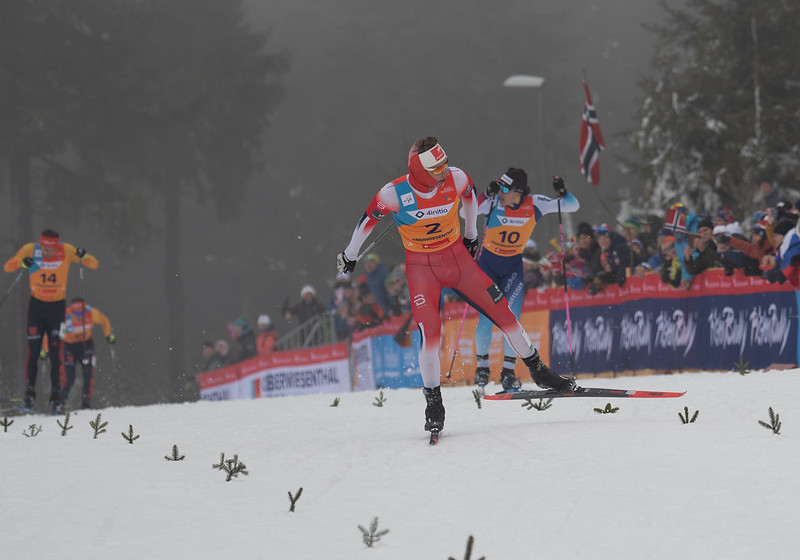
The monochromatic backdrop during the junior women’s sprint was the persistent theme in Oberwiesenthal, Germany — it bled right into the World Junior men’s 1.3 k freestyle sprint. For U.S. fans, in particular, this first event of four for the junior men possessed an element of tension. The tension, for those that follow, was seeded last year with an unequivocal success story that was the U.S. junior men’s run at the 2019 Junior Worlds in Lahti, Finland. The final collective chapter there capped with the 4 x 5 k relay win.
Today, again, was full of promise, and perhaps the pressure that comes with being a known quantity – otherwise called podium favorites, at this year’s event.
The U.S. put three skiers into the top-11 during qualification: Gus Schumacher was first in 2:26.34, ben Ogden third (+1.13), and J.C. Schoonmaker 11th (+4.76). Slotting into 21st for the U.S. was Luke Jager (+6.42).
Let’s start with Jager. He looked strong in the first quarterfinal, in which he was grouped with Schumacher and Schoonmaker. Leading into a short punchy hill, Jager appeared to lose his footing and tripped, coming to a standstill. He recovered to place fourth in the heat but was eliminated. Schumacher skirted by Jager when he stumbled and took the win. Schoonmaker was third and did not advance.
Ogden, in the fifth quarterfinal, cruised. He won by 2.32 seconds in earning his semifinal spot.
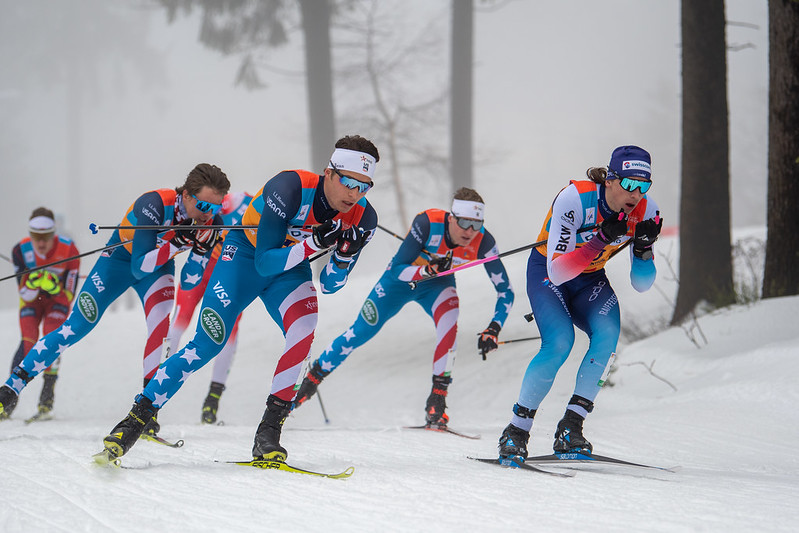
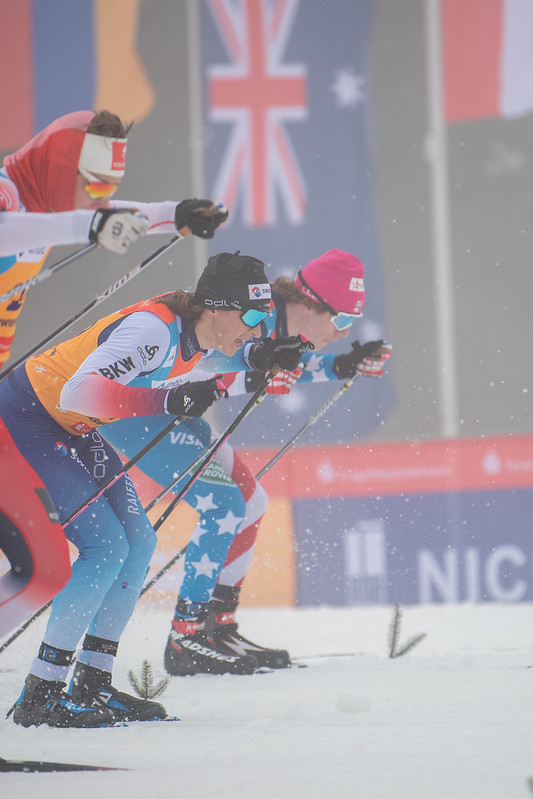
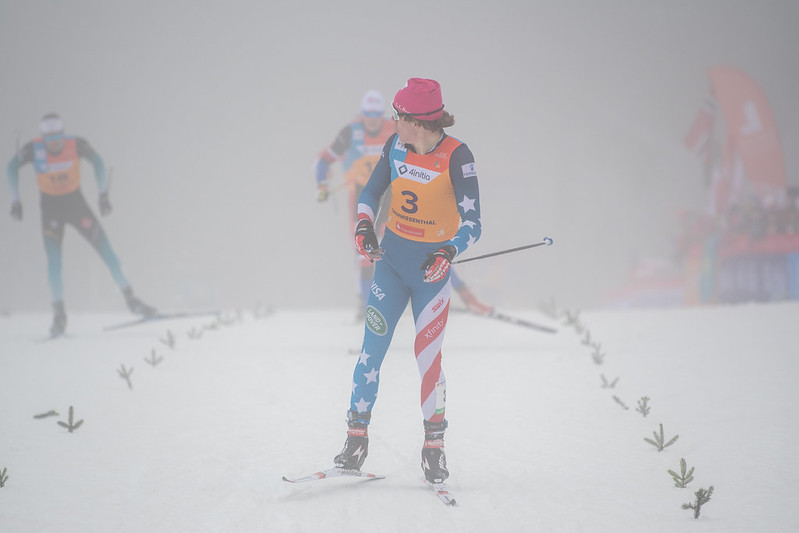
Ready. Set. Go. Ben Ogden (pink beanie), during the World Junior’s skate sprint. (Photo: Doug Stephen)
Ben Ogden on quarterfinal’s cruise control. (Photo: Doug Stephen)
In the first semi, Schumacher pushed from the back portion of the pack – never finding enough room to seize an opening. He came down the stretch positioning himself into third, 0.46 seconds back. However, in the slower of the two semis, he was unable to advance as a lucky loser.
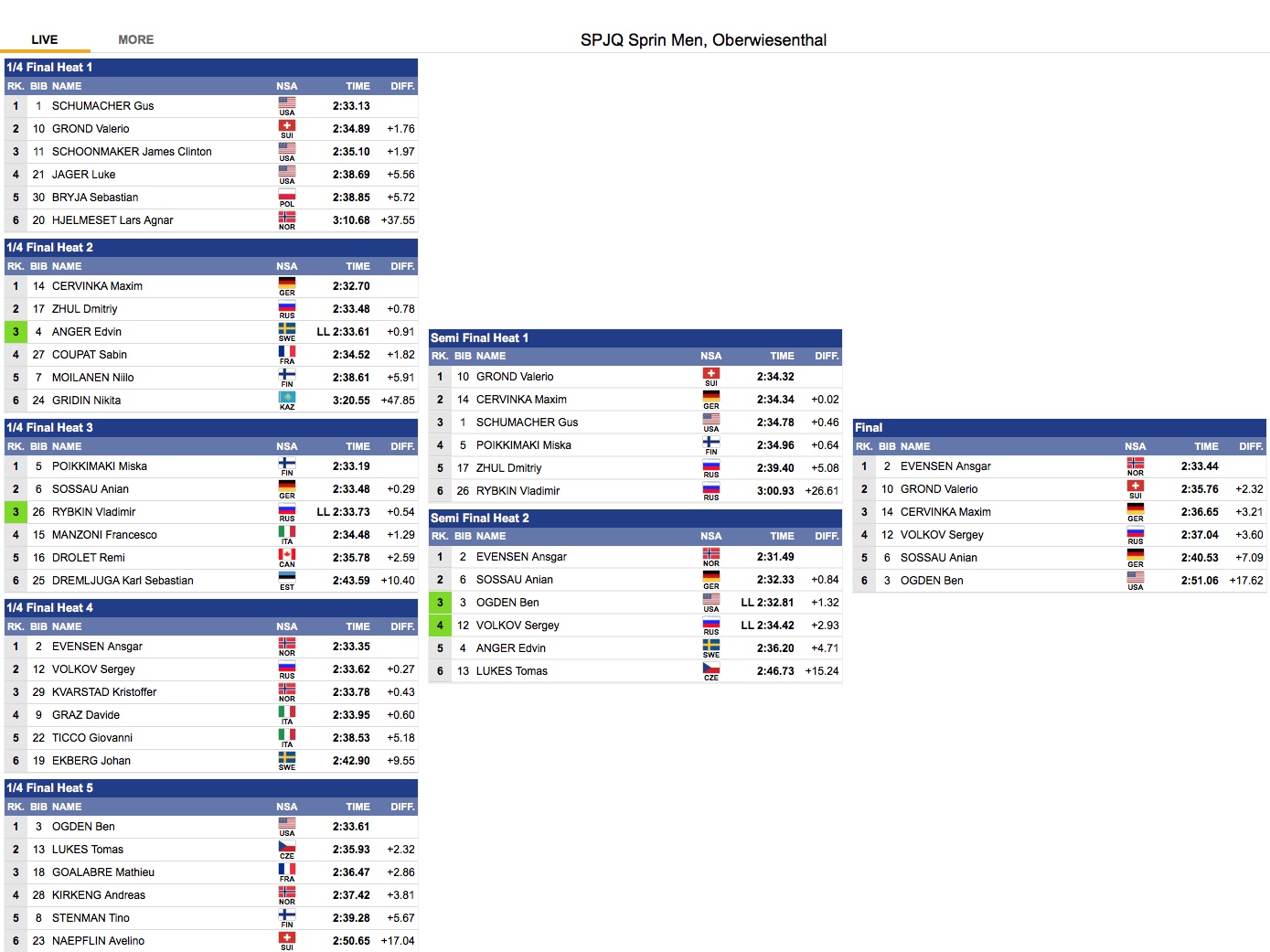
Ogden placed third in the second semi to take a lucky loser spot in the final. But Ogden, racing the fifth quarterfinal, and with a quick turnaround into the semis, ran on fumes in the final. He placed sixth in the final, 17.62 seconds off the winning pace of Norway’s Ansgar Evensen who won in 2:33.44. Switzerland’s Valerio Grond placed second (+2.32), and Germany’s Maxim Cervinka third (+3.21).
Norway’s Ansgar Evensen winning the World Junior’s skate sprint. (Photo: Doug Stephen)
In the final standings, Ogden was 6th overall, Schumacher 7th, Schoonmaker 13th, and Jager 18th. A stout day collectively for the American foursome.
Canada’s Remi Drolet, a student at Harvard, began his day by qualifying 16th (+5.76). Drolet placed fifth in the third quarterfinal to finish 23rd overall. Also for Canada, Thomas Stephen finished 36th, Xavier McKeever 44th, and Olivier Léveillé 49th.


 This coverage is made possible through the generous support of Marty and Kathy Hall and A Hall Mark of Excellence Award. To learn more about A Hall Mark of Excellence Award, or to learn how you can support FasterSkier’s coverage, please contact info@fasterskier.com.