Tag: Antholz-Anterselva

  • Unfazed by Windy Antholz, Lunder Locks Up Career-Best 21st

    Unfazed by Windy Antholz, Lunder Locks Up Career-Best 21st

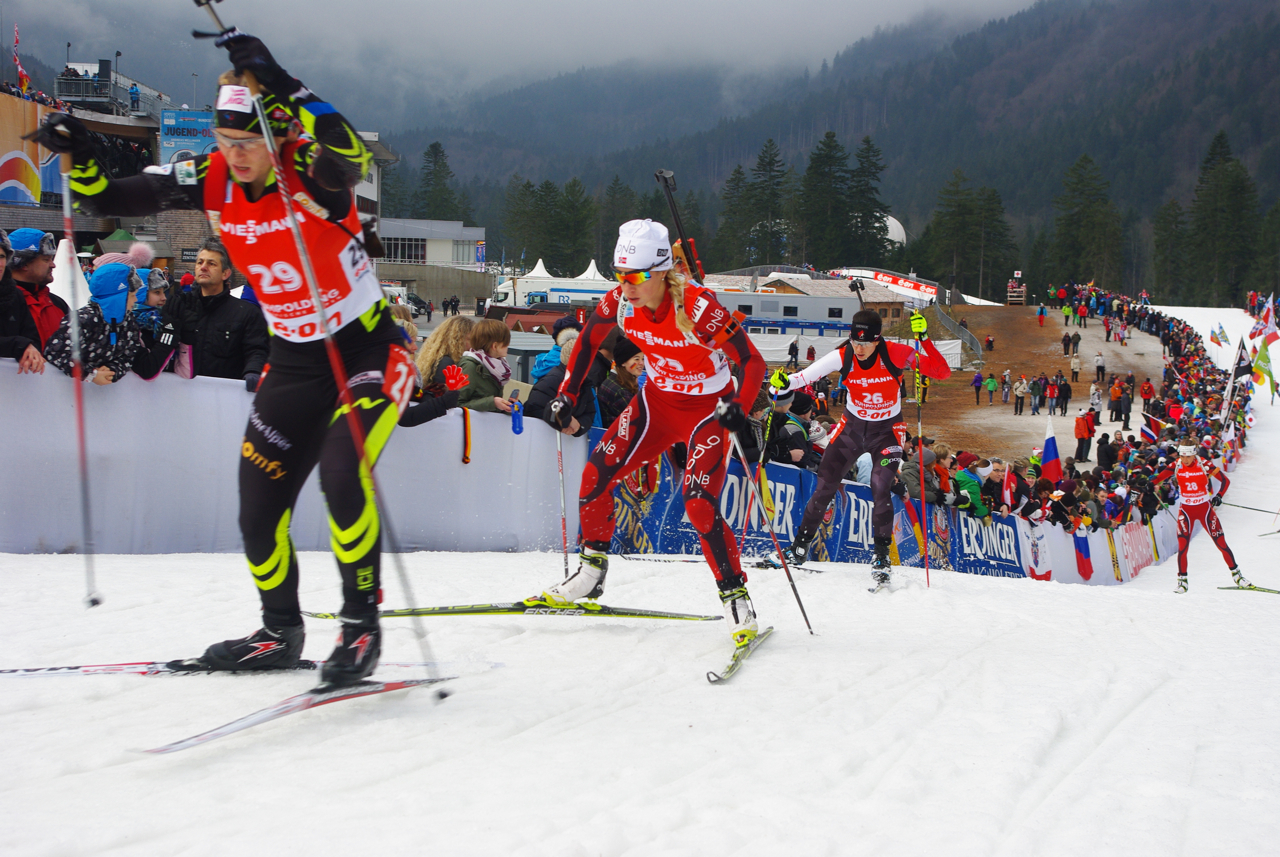
    Emma Lunder (Biathlon Canada) racing in last weekend's IBU World Cup in Ruhpolding, Germany, where she placed 89th. (Photo: Fischer/NordicFocus)
    Emma Lunder (Biathlon Canada) racing in last weekend’s IBU World Cup in Ruhpolding, Germany, where she placed 89th. (Photo: Fischer/NordicFocus)

    The next time your order a cup of joe, remember to be nice to the person on the other side of the counter; they could just be a World Cup skier. In a press release, Biathlon Canada was quick to point out that one of its national-team members, Emma Lunder, is a Starbucks barista in Canmore, Alberta.

    But on Thursday, thousands of miles away at the International Biathlon Union (IBU) World Cup in Antholz, Italy, Lunder raced to a career-best 21st in the women’s 15-kilometer individual race. It was her first time racing that distance. In fact, it was twice as long as the 7.5 k sprint she had done in eight of her nine previous World Cup starts (not counting relays).
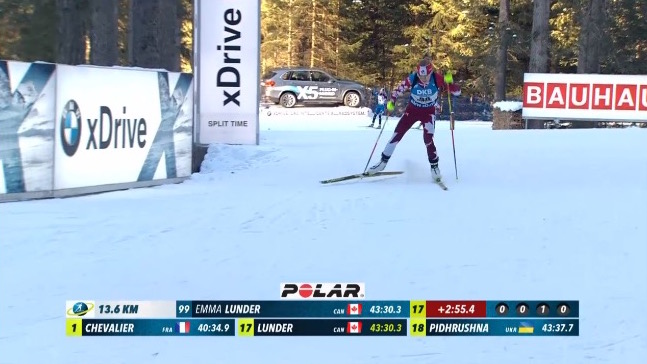
    Emma Lunder (Biathlon Canada) on course during the women's 15 k individual at the IBU World Cup in Antholz, Italy. (Photo: ARD broadcast screenshot)
    Emma Lunder (Biathlon Canada) on course during the women’s 15 k individual on Thursday at the IBU World Cup in Antholz, Italy. (Photo: ARD broadcast screenshot)

    The Biathlon Canada B-team member started last on Thursday, wearing bib 99. It’s a tall order waiting around that long in the longest-format race on the circuit, complete with four shooting stages, but the 25-year-old Lunder was generally unfazed.

    “I would say this year I am definitely used to starting in the fourth seed, and getting a hang of dealing with the wait,” she wrote in an email after Thursday’s race. “I quickly ski tested with our techs, zeroed my rifle and then headed back to our wax room where I lay on a pile of ski bags and read my book for 45 minutes before warming up.”

    Fortunately, the wait played to her favor. Gusting winds across the range gave most of the field troubles. But when Lunder set out on the course, those winds seemed to be less of an issue.

    “I had absolutely no wind when I zeroed, which I found made it easier to make corrections during the race,” she wrote of her pre-race target practice. “I think I had fairly consistent wind for both prone and standing, and was happy not to have any big gusts blowing me around!”

    Lunder explained that she had been working with her coaches and sports psychologist on improving her focus while shooting. She had struggled with her prone shooting over the last few weekends (including last week’s World Cup in Ruhpolding, Germany, and the IBU Cups in Martell, Italy, before that). On Thursday, Lunder was hoping to execute some new strategies.
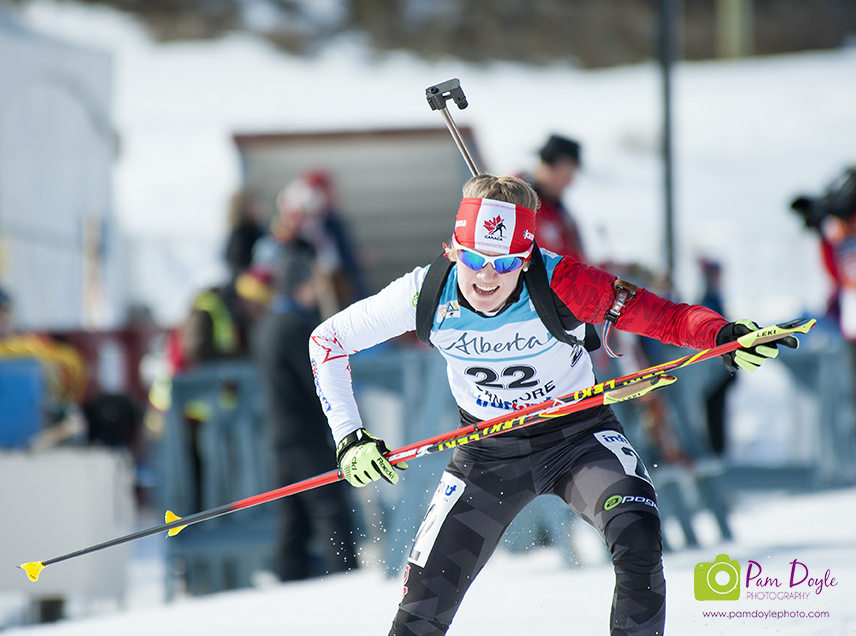
    Canada’s Emma Lunder leaving the range en route to second place in the IBU Cup 7.5 k sprint last season in December 2015 in Canmore, Alberta. (Photo: Pam Doyle)
    Canada’s Emma Lunder leaving the range en route to second place in the IBU Cup 7.5 k sprint last season in December 2015 in Canmore, Alberta. (Photo: Pam Doyle)

    With a clean first prone stage, she was already on par with a personal best as she left the range in 35th. (Lunder previously placed 30th in her first-ever World Cup three years ago in Pokljuka, Slovenia. With that result, she qualified for the 10 k pursuit, and went on to place 41st for her second-best result to date — up until Thursday.)

    Lunder then cleaned her second shooting and first standing stage to put herself in 10th halfway through Thursday’s race. But she had no idea where she stood. Fortunately, she had plenty of skiers within sight, after race organizers started the fourth seed — which included Lunder — in 15-second intervals (as opposed to 30 seconds between racers).

    “Skiing was a fun but extremely tough battle,” Lunder wrote. “… There were way more girls close to me that I could chase and ski with. … I actually wasn’t given any information of where I was until I’d finished in the range and was heading out for my last lap — I think the techs and coaches didn’t want to excite me before any of my shooting bouts, and I’m quite happy for it.”

    She missed her first and only target of the day on her second prone, which put her in 24th with two loops to go, and cleaned her final standing stage, moving her back up into 15th. Leaving the range for the last time, she realized she was in a best-ever position.

    “I really hoped I was fighting for points, and when I left the range after my last standing … I almost had an ‘oh crap’ moment because I knew I had to ski absolutely as hard as I possibly could for another 3km and I was already feeling the hurt,” she explained.
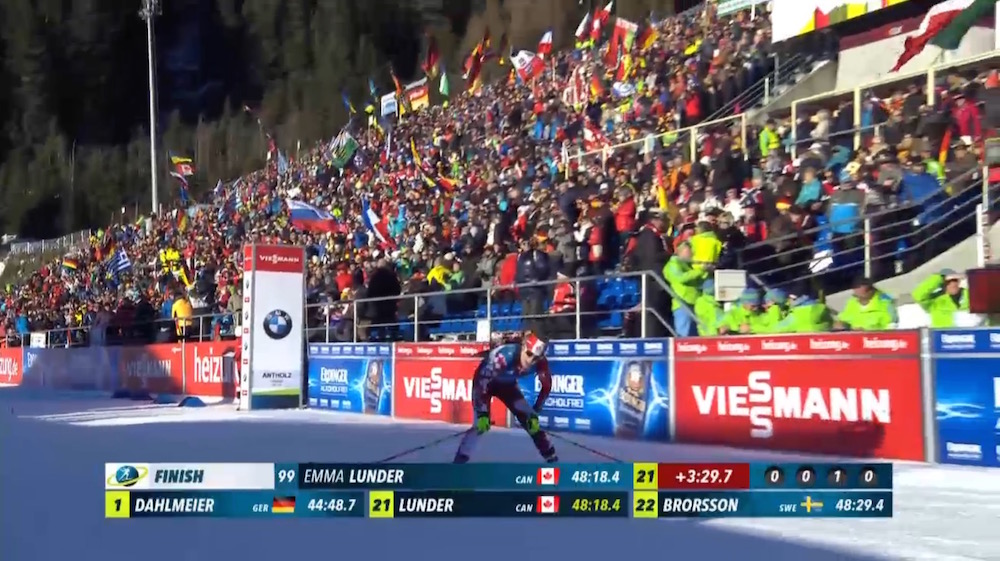
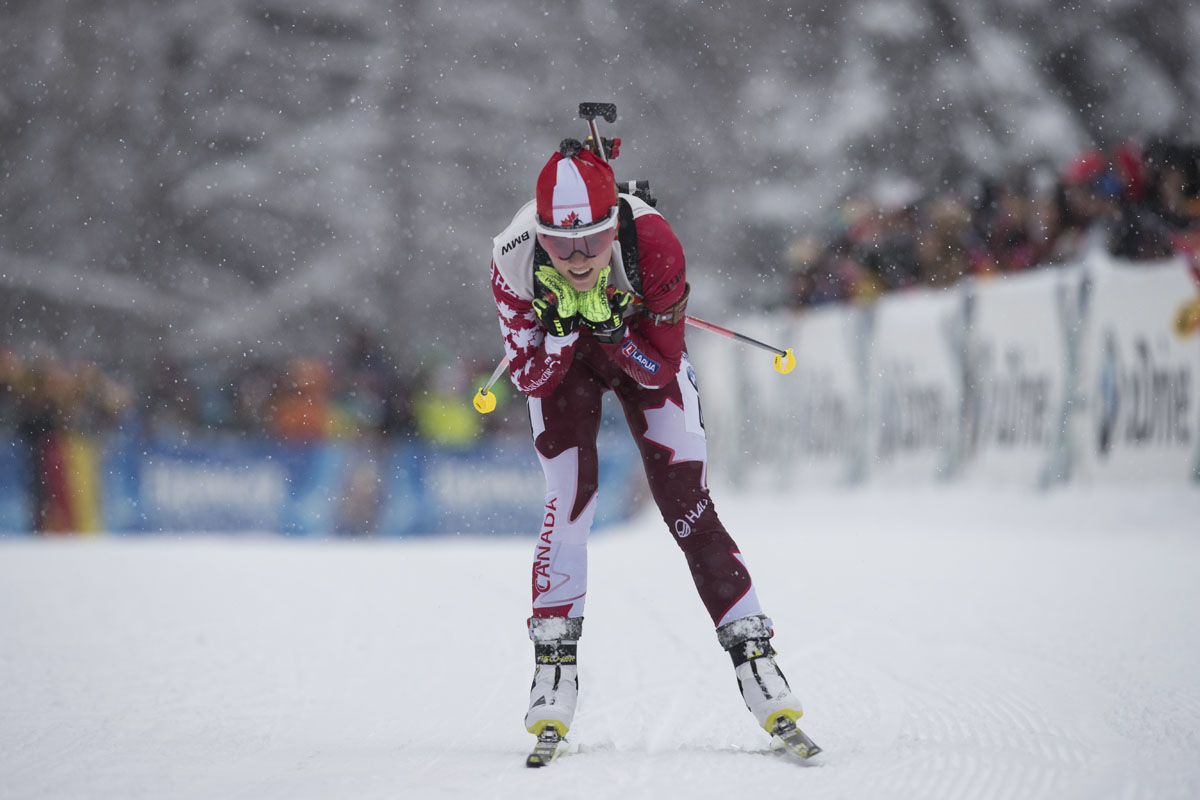
    Biathlon Canada's Emma Lunder finishing 21st for her career-best IBU World Cup result on Thursday at the women's 15 k individual (her first time racing that distance) in Antholz, Italy. (Photo: ARD broadcast screenshot)
    Canadian Emma Lunder, of Vernon, B.C., finishing 21st for her career-best IBU World Cup result on Thursday at the women’s 15 k individual (her first time racing that distance) in Antholz, Italy. (Photo: ARD broadcast screenshot)

    “We had really competitive skis today thanks to our hardworking wax-tech crew, and they were all over the place for my last lap, screaming for me to fight up every hill and they got me all the way to the finish line!” Lunder added. “I was feeling the pain for my whole last lap, and it turned into just trying to survive rather than really being able to fight, but I know I did absolutely everything I could on the skis today, and I am so, so happy with my race.”

    The Vernon, B.C., native ended up 21st, 3:29.7 minutes out of first, with one penalty (0+0+1+0). Lunder was one of just four out of 99 that shot 19-for-20. No one cleaned.

    The winner, Laura Dahlmeier of Germany, had two misses (1+1+0+0) — for a total of two minutes added to her finishing time. Dahlmeier secured the win in 44:48.7 minutes, thanks to perfect shooting in the last two stages. It was her 11th World Cup victory.

    “It was incredibly difficult today,” Dahlmeier told German broadcaster ZDF after starting 15th. “I tried to make it a little easier on myself. That’s why I twice went to the outmost positions [on the range]. But honestly it was just as windy, I had to fight just the same. It was hard to get into the race after those two misses. I just tried to do my own thing, and shoot clean in the end.”
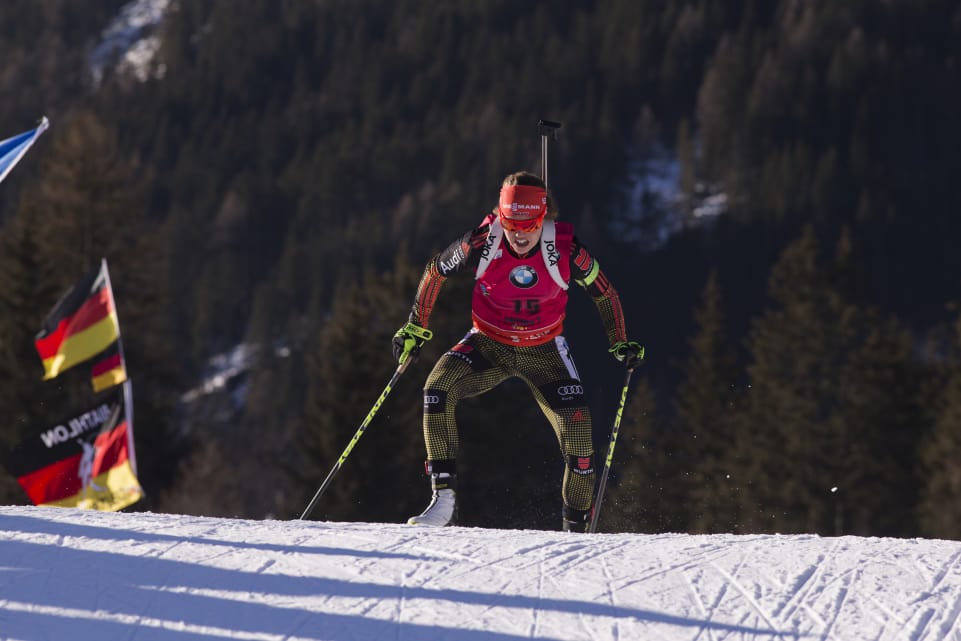
    Germany's Laura Dahlmeier racing to her 11th IBU World Cup win on Thursday in the women's 15 k individual in Antholz, Italy. (Photo: IBU)
    Germany’s Laura Dahlmeier racing to her 11th IBU World Cup win on Thursday in the women’s 15 k individual in Antholz, Italy. (Photo: IBU)

    Dahlmeier’s 11th World Cup win on Thursday gave her the overall World Cup lead and with it, the yellow bib, and allowed her to keep the red bib of the 15 k individual discipline leader.

    “It is a dream come true to win in this beautiful setting,” Dahlmeier said of sunny Antholz. “That I can keep the red jersey and get the yellow one back, it doesn’t get better than that.”

    Behind her France’s Anaïs Chevalier started 32nd and came within 3.8 seconds of Dahlmeier’s finishing time. Chevalier was one of the four women that missed just one target (0+1+0+0), along with third-place finisher Alexia Runggaldier of Italy (+46.0, 0+1+0+0).

    For Runggaldier, it was her first World Cup podium.

    “This morning I was a little anxious, and just thought, ‘Give it your best.’ I really wanted to qualify for the mass start [on Saturday],” she told ZDF. “I just told myself to do the best I can, just do that, and now I can’t believe it!”
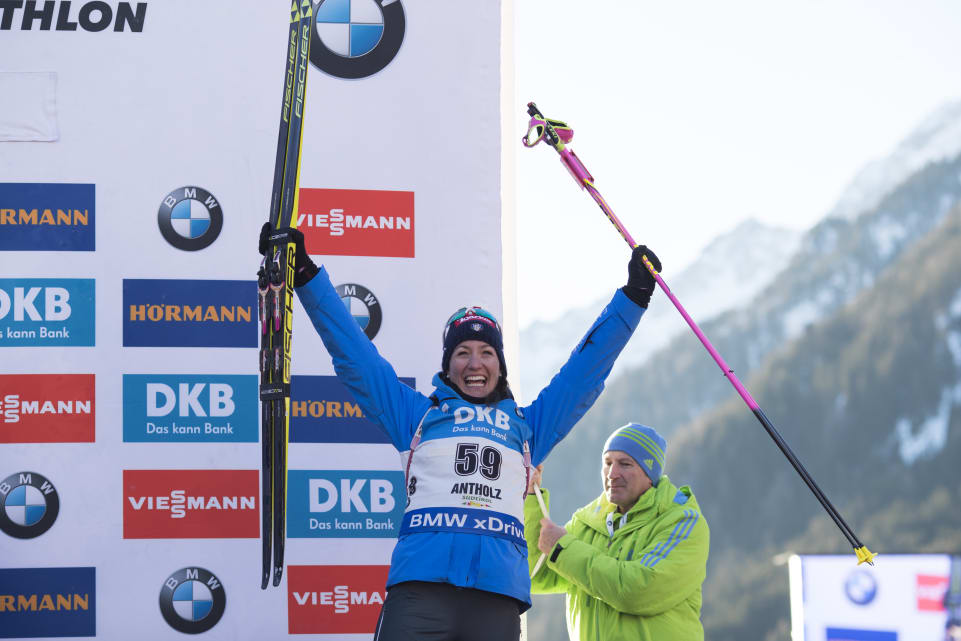
    Italy's Alexia Runggaldier celebrating her first IBU World Cup podium in third on Thursday at the women's 15 k individual in Antholz, Italy. (Photo: IBU)
    Italy’s Alexia Runggaldier celebrating her first IBU World Cup podium in third on Thursday at the women’s 15 k individual in Antholz, Italy. (Photo: IBU)

    The 25-year-old Runggaldier qualified for the 30-woman mass start based on that result. On Thursday, she said conditions weren’t easy even as a later starter in bib 59.

    “It has already been difficult the last few days,” she said of target practice during training. “Yesterday it didn’t work well for me, so today I just told myself to focus, 20 shots, four series. And my coach told me out on the course ‘be patient!’ and I just tried to execute that.”

    As for Lunder, she wrote that she was “extremely happy” with her shooting performance and pointed out that the last time she scored World Cup points was in 2014.

    “… To be just out of top-20 today feels pretty amazing,” Lunder wrote. “Today was a huge day for me on the range, and I think there’s still work to be done on the skiing side of things, but I know I’m headed in the right direction.”

    As of Thursday, Biathlon Canada had not made any formal announcement about its World Championships team.

    “Today I left it all out there so no matter what happens [with selections] I am super proud of what I accomplished in this race!” Lunder noted.

    Also on Thursday, Megan Tandy of Biathlon Canada’s A-team (officially the “Eh! Squad”) finished 33rd (+5:02.0) for a season best. She started 69th and shot four penalties (1+1+0+2) with the 61st-ranked overall course time.

    “I can easily say this is my slowest season since I was a Junior!” Tandy wrote in an email. “That being said I was really pleased with today’s race because it represented a baby step forward in both skiing (I didn’t feel dead tired racing today and actually enjoyed skiing which is a first this season) and on the result list as well. Finally some points — what a relief!”

    She described the wind as “up and down” with more wind for her first and last bouts, but “nothing unmanageable.”

    “I made fairly aggressive sight adjustments in prone. The women had quite windy conditions during training the 2 previous days so even though the conditions were challenging at times I felt confident about clicking,” Tandy reflected.
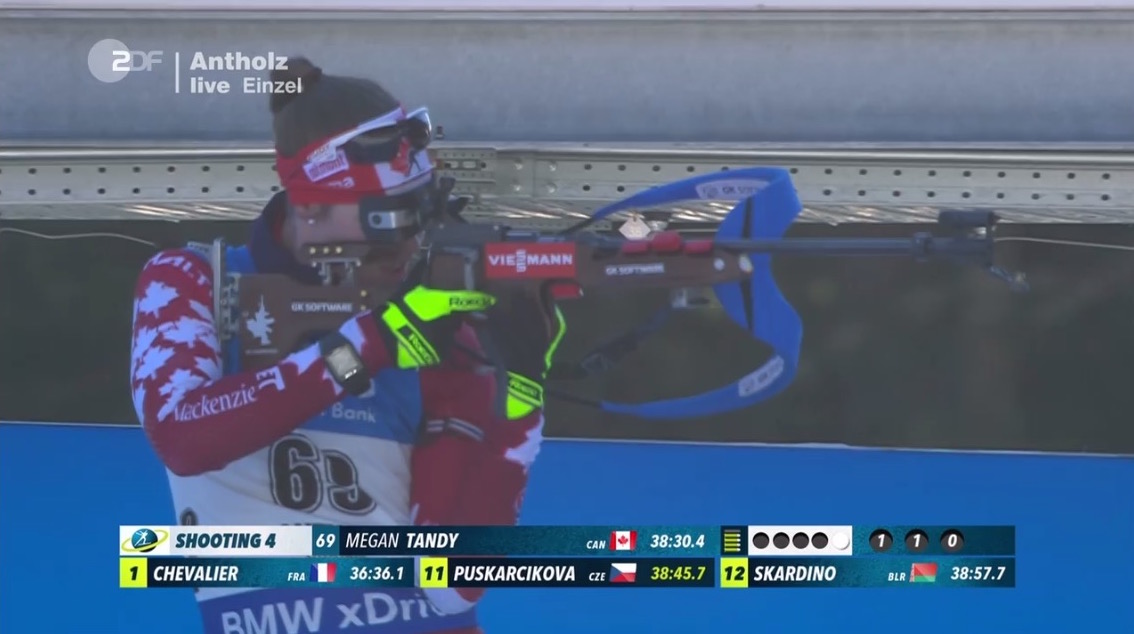
    Megan Tandy (Biathlon Canada) during her final shooting stage of the women's 15 k individual on Thursday at the IBU World Cup in Antholz, Italy. (Photo: IBU)
    Megan Tandy (Biathlon Canada) during her final shooting stage of the women’s 15 k individual on Thursday at the IBU World Cup in Antholz, Italy. (Photo: ZDF broadcast screenshot)

    After just two misses in her first two bouts and a clean third stage, Tandy was in contention for a top 30 with one shooting stage to go. In that final standing stage, she missed two, which left her disappointed.

    “I am still so angry with myself especially because I missed the last 2 shots and up until those misses the potential for a good race was there!” she wrote. “But thats biathlon for you! I didn’t really think about bouncing back after my last shooting — it was the last loop so I gave everything I had, simple as that!”

    Her final loop time was her fastest of the day, ranking 51st. At the end of the day, Tandy was pleased to feel “normal” again during a race.

    “It was such a pleasure compared to a lot of races this year where I feel like after the first 1km my only goal becomes to survive until the finish line,” she wrote. “Shooting I think I did good work in 3 of my 4 bouts, particularly reacting to the wind prone so I feel confident and am looking forward to the relay this Sunday!  6km is also going to feel short and sweet after that 15km!!”

    The women race a 4 x 6 k relay on Sunday in Antholz.

    Canada’s third woman on Thursday, Julia Ransom finished 55th (+6:28.2) with four penalties (0+3+0+1). Rosanna Crawford did not race, but tweeted after, “Well if I had to sit out today’s race and be a fan instead I sure am glad @emmalunds made it an exciting race to watch, finishing 21st for a new personal best! Lucky number bib 99! #gretzky #ANT17 #gocanada”

    Four U.S. women competed on Thursday, with Clare Egan leading the team in 59th (+6:58.6) with six penalties (1+4+0+1) that added six minutes to her finishing time. She started 80th and recalled some wind issues on her second shooting.

    “I had the fastest skis I’ve ever had in my life today, and three out of four good shooting stages,” Egan said, according to a US Biathlon press release, of her first, third and fourth stages. “Unfortunately, a stupid mistake in the first standing stage foiled any chance I had at a good result. I tried to shoot through gusting wind instead of waiting until I could take a good shot. I made a strong comeback from that point on, but 59th place is hardly what I was hoping for.”
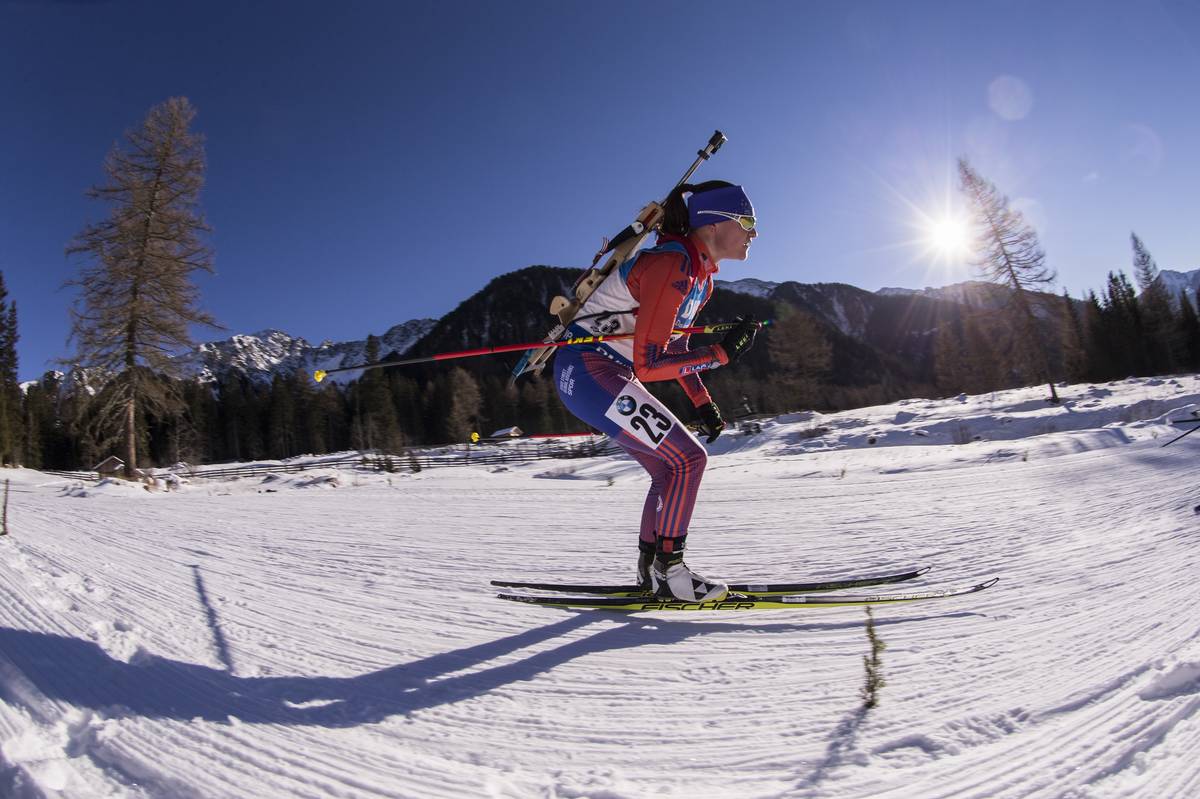
    Joanne Reid (US Biathlon) racing to 60th in the women's 15 k individual on Thursday at the IBU World Cup in Antholz, Italy. (Photo: USBA/NordicFocus)
    Joanne Reid (US Biathlon) racing to 60th in the women’s 15 k individual on Thursday at the IBU World Cup in Antholz, Italy. (Photo: USBA/NordicFocus)

    Her US Biathlon teammate Joanne Reid followed in 60th (+7:05.2), also with six misses (2+2+1+1). Reid started 23rd.

    “There were definitely some gusts out there today, and what could be tricky conditions if you didn’t adapt correctly to them,” Reid told US Biathlon. “Wind is a lifetime learning experience — every race, every range, every point, and every day is different, so you’ll never know exactly what you’re supposed to do, or what you should have done in any situation. Biathlon is by its very nature sinusoidal, and it’s unfortunate when those troughs hit us all at the same time.”

    Also for the U.S., Susan Dunklee started 46th and and finished 71st (+7:58.0) with eight penalties (0+4+2+2), and 21-year-old Maddie Phaneuf in bib 92 finished 81st (+9:18.9) with seven penalties (3+1+1+2).

    “I think as a team we displayed some incredible bravery out there,” Reid noted. “It can be mentally very tough to keep fighting when you know how many minutes you lost. I especially salute Susan for her ability to come back from races like this with incredible grace, considering the high expectations constantly placed upon her. And Maddie, of course, our youngest, who is trying to adjust to a whole different level of skiers in an unfamiliar environment. Everyone has to start somewhere, and it’s tough to remember that sometimes with veterans on the team like Tim [Burke] and Lowell [Bailey], who have been starting biathlon races for almost as long as Maddie has been alive.”

    “I know the four of us are eager to redeem ourselves in Sunday’s 4x6k women’s relay,” Egan said.

    Dunklee will have another individual shot in the last set of races before World Championships (Feb. 9-19 in Hochfilzen, Austria) this Saturday in the 12.5 k mass start, as Dunklee is ranked 17th overall in the World Cup.

    The men’s 20 k individual takes place Friday, starting at 8:15 a.m. EST. Watch it live on Eurovisionsports.tv.

    Results | Women’s mass start (provisional start list)

  • Weekend Roundup: No Norwegians, No Swedes, No Problem

    Weekend Roundup: No Norwegians, No Swedes, No Problem

    Susan Dunklee of the US Biathlon skied her way to a career best fourth place in Thursday's 7.5 k sprint in Antholz, Italy. (Photo: US Biathlon/Nordic focus)
    Susan Dunklee of the US Biathlon skied her way to a career best fourth place in Thursday’s 7.5 k sprint in Antholz, Italy. (Photo: US Biathlon/Nordic focus)

    World Cup action this weekend brought racers to Szklarska Poreba, Poland.  Despite the absence of the esteemed Scandinavians who were at their respective national championships, the excitement was high, especially for the North Americans who had an exceptional weekend.

    In Saturday’s sprint, Kikkan Randall used her extensive experience to tackle a tactical course and rocket her to victory in the 1.5 k freestyle sprint. Randall’s win marks her second sprint victory in two weeks. She bested Germany’s Denise Hermann who is currently ranked first in the World Cup Sprint rankings, and Slovenia’s Vesna Fabjan.

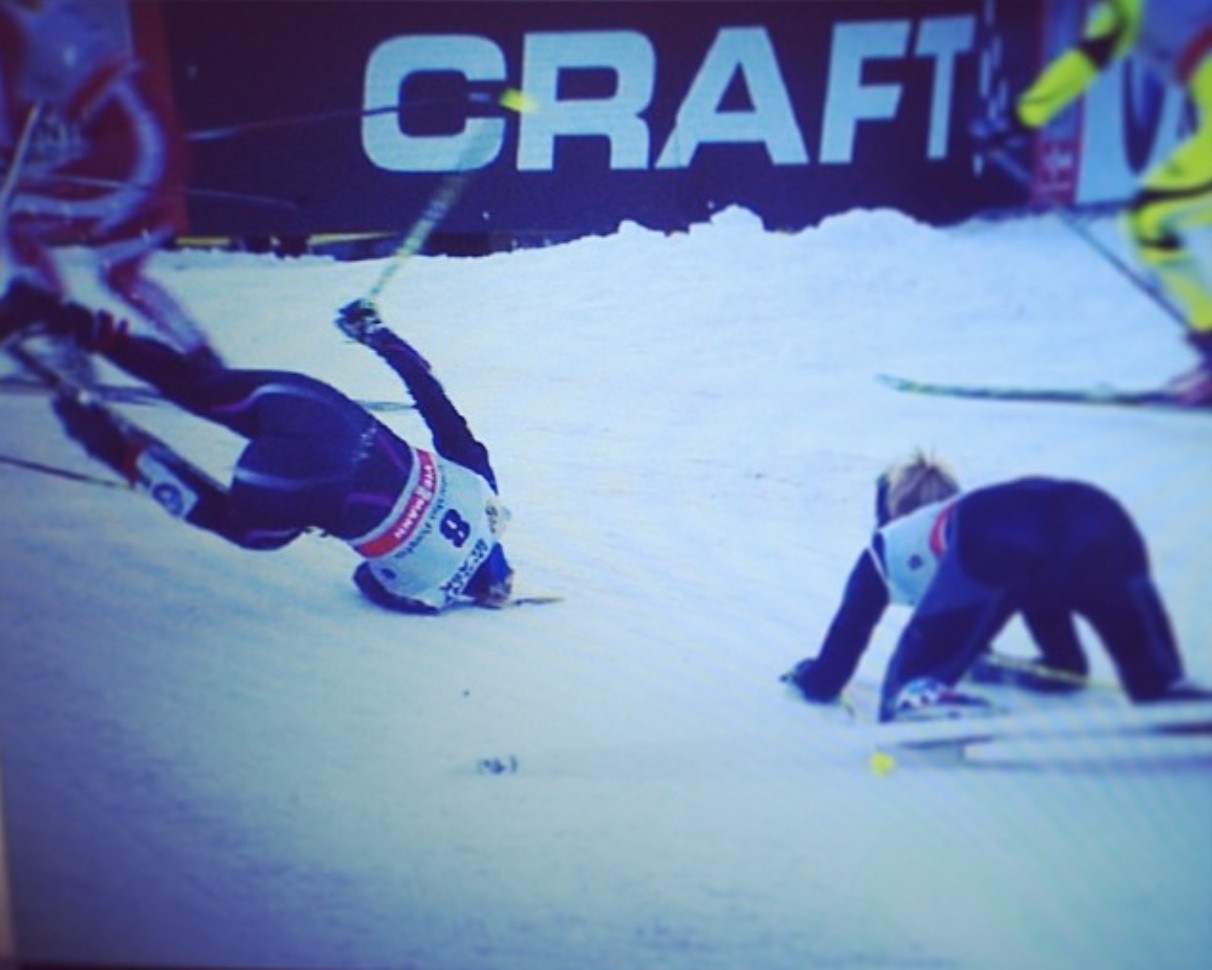
    Jessie Diggins (l) tumbling headfirst over Switzerland's Laurien van der Graaff, who fell right in front of her on the last turn of the women's 1.5 k freestyle sprint final at the World Cup in Szklarska Poreba, Poland. (Photo: FIS Cross Country/Instagram) http://instagram.com/p/jV7XJjrzzf/
    Jessie Diggins (l) tumbling headfirst over Switzerland’s Laurien van der Graaff, who fell right in front of her on the last turn of the women’s 1.5 k freestyle sprint final at the World Cup in Szklarska Poreba, Poland. (Photo: FIS Cross Country/Instagram) http://instagram.com/p/jV7XJjrzzf/

    Also in the final was American Jessie Diggins who finished fifth after being taken out by a fall from Lauren Van Der Graaff of Switzerland.

    American Sophie Caldwell finished seventh and Canadian Perianne Jones finished tenth after advancing to the semifinals.

    The North American’s continues their winning streak in the men’s race. Canadian Alex Harvey out-sprinted Germany’s Josef Wenzl and France’s Baptiste Gros for his first-ever individual world cup win.

    American Andy Newell was in medal contention until he had a nasty fall on the final hill of the A-final, knocking him down to sixth place.

    Sunday marked the 10 k and 15 k mass starts. The women’s race was handily won by birthday-girl Justyna Kowalcyk. She was followed by a pair of Russians, Yulia Tchekaleva and Julia Ivanova, who finished second and third.

    American Elizabeth Stephen finished sixth, followed by teammates Ida Seargent in ninth, Randall in 14th and Caldwell in 16th.

    The Russians were dominant in the men’s 15 k with Maxim Vylegzhanin and Evgeniy Belov taking the top two spots. They were followed by Alexey Poltoranin of Kazakhstan in third.

    The Canadians all finished in the top 10 with Harvey in fourth, Devon Kershaw in eighth and Ivan Babikov in ninth.

    In Biathlon World Cup action, American Susan Dunklee gave the best performance of her career finishing fourth in Thursday’s 7.5 k sprint in Antholz, Italy.

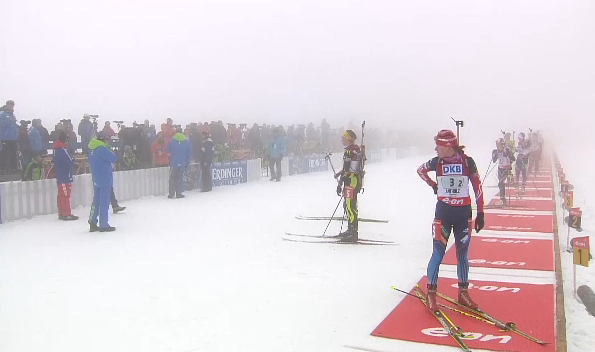
    The women mull around after the race has been called off.
    The women mull around after the women’s biathlon World Cup relay was called off in Antholz, Italy on Sunday.

    In the men’s 10 k sprint Brendan Green of Canada gave an impressive performance, finishing eighth. He was followed by American Lowell Bailey in 19th and Canadian Nathan Smith in 22nd.

    In Saturday’s 10 k pursuit, Dunklee finished 25th. On the men’s side Bailey finished 12th and Green finished 18th in the 12.5 k.

    Sunday brought the men’s and women’s relays. On the men’s side, the Canadians finished sixth and the American team did not start. The women’s race was cancelled mid-race due to thick fog.

    In nordic combined German Eric Frenzel, won all three of the weekend’s races in Seefeld, Austria and took the newly formed Seefeld Triple. American Bryan Fletcher finished the Triple in fifth. Teammate Billy Demong was just outside the top ten in 11th.

    Take a look below to see the various recaps and reports of everything you missed this past weekend!


    FIS Cross Country World Cup Szklarska Poreba, Poland

    Saturday’s 1.5 k freestyle sprints women’s report | men’s report | American women’s report

    Sunday’s 10 k and 15 k classic mass starts women’s report | men’s report | American women’s report | American men’s report

    IBU Biathlon World Cup Antholz, Italy

    Thursday’s 7.5 k sprint women’s report

    Friday’s 10 k sprint men’s report

    Saturday’s 10k and 12.5 k pursuits women’s report | men’s report 

    Sunday’s relays women’s cancellation report | men’s report

    FIS Nordic Combined World Cup Seefeld, Austria

    Preview

    Friday’s 5 k men’s video report 

    Saturday’s  10 k men’s video report

    Sunday’s 15 k men’s video report

    Domestic races: 

    Eastern Cup Rumford, Maine recap

    EISA Collegiate Races Waterville, Maine report | photos

    RMISA Collegiate Races Bozeman, Montana results

    CCSA Collegiate Races Day 1 recap | Day 2 recap

    Owl Creek Chase, Aspen, Colorado recap

  • Schempp and Hofer Win Antholz Sprint in Rare Tie, Green Skis to Best-Ever Eighth

    Schempp and Hofer Win Antholz Sprint in Rare Tie, Green Skis to Best-Ever Eighth

    Lowell Bailey in the World Championships pursuit. NordicFocus/USBA.
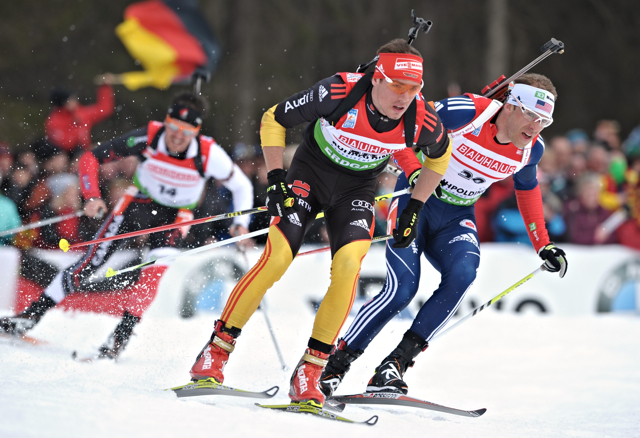
    Simon Schempp of Germany leads Lowell Bailey (USBA) in the 2013 World Championships pursuit. Schempp won Friday’s 10 k sprint in Antholz, Italy in a tie with Lukas Hofer. (Photo: NordicFocus/USBA)

    Simon Schempp and Lukas Hofer looked pretty chummy after the finish men’s 10 k sprint at the World Cup in Antholz, Italy this Friday. Maybe their laughter was a product of their relief of finishing a challengingly slow course, or maybe it was that both of them were on the podium for the first time this season. More likely, however, it was the fact they both sat atop that podium in a rare tie for first place having skied the 10 k in 22:44.9.

    Schemmp a member of the German national team had originally been declared the winner of the race, edging out Hofer by 0.3 seconds. However, upon review of the finish line back-up system, the German and the Italian were declared to have a tie.

    With a steady fall of snow and slow conditions, the race looked much different than the women’s 7.5 k sprint held Thursday.

    Despite having to slug through the slow snow, the first starter, Simon Fourcade of France, was able to ski a fast first lap and shoot clean to keep him in first place for much of the beginning of the race. But as the snow got faster and the skiers got stronger, Fourcade saw his position decline in the standings.

    One skier that contributed to Fourcade’s drop was Arnd Peiffer of Germany, who eventually finished in third. Starting in 27th position, Peiffer skied the fourth fastest first lap and shot clean in both prone and standing. His next two laps were slower, but they were enough to keep him in third.

    The podium was the first of the season for Peiffer, and he was pretty happy about it. ”This is a good feeling and it fills a hole in my resume,” said the German in a press release. “I have never finished third before!”

    lukas hofer WCH 2012 ind
    Italian Lukas Hofer skiing in the 2012 World Championships. Hofer tied Schempp for the win in Friday’s 10 k sprint in Antholz, Italy.

    Hofer came soon after Peiffer and was determined to leave everything on the course. An Italian hadn’t won a World Cup race in Italy since 1988, and while it often seemed there were more German and Norwegians in the stands than anyone else, a win in Antholz would not only be a personal triumph, but also a national one.

    A strong skier, Hofer clocked the fastest time on the course in the first lap. He shot clean in prone, and skied a fast second lap. Unfortunately for the 24-year-old his luck didn’t hold through the standing and he accrued one penalty.

    The setback didn’t stop Hofer as he skied his last lap. He skied agressively and crossed the line, 4.3 seconds ahead of Peiffer, then collapsed face-first into the blanket of newly fallen snow in the finish area.

    “What more can I expect as an athlete?” the Italian said of his result. “I had a really good race and am really happy.”

    Schempp who started 61st, raced with efficiency and purpose. The German skied the second fastest first lap, and the second and third laps were just as strong. His skiing, mixed with clean shooting, made for a lethal combination that earned him his first World Cup podium of the season and first career victory.

    The overall result could have been different, however. Coming into the finish, Schempp chose to take the same lane as a Czech skier in front of him, which caused him to slow considerably just before he crossed the finish line.

    Regardless, the German was very happy to have his first World Cup victory. “I am very satisfied with my race. It was an incredible day. Only first place was missing in my resume, so this is a good feeling; a perfect race,” he said in a press release.

    Canada's Brendan Green racing to 31st in the 10 k sprint at the IBU World Cup in Hochfilzen, Austria, earlier this month.
    Canada’s Brendan Green racing in 10 k sprint at the IBU World Cup in Hochfilzen, Austria, earlier this month. Green finished eighth in Friday’s sprint in Antholz, Italy.

    Canadian racer, Brendan Green, who just last week was racing in the IBU Cup, had a breakthrough result in Friday’s sprint, finishing in eighth place, a career best.

    Green, who sat out last season due to an injury that required double-back surgery, has made a significant comeback this year and nabbed the last spot on the Canadian Olympic team earlier this year.

    Before the Friday’s race Green was worried about the snowy and slow conditions because he was the 10th starter, meaning it was likely he would have a slower course.

    IBU world cup biathlon, sprint men, Antholz (ITA)
    American Lowell Bailey skiing in Friday’s 10 k sprint in Antholz, Italy. He placed 19th. (Photo: USBA/Nordic Focus)

    “Conditions were definitely tough to race in but I just tried to focus on the process of putting together the best race I could at that time,” Green wrote in an email. “Antholz can be a tricky and weird range for shooting, so again I just tried to be solid with each shot and not get too ahead of myself.”

    His mentality worked, as he was able to make it through the rounds of prone and standing shooting without missing a shot.

    On top of that, Green was feeling better and better as he skied along the course.

    “My skiing picked up with each lap throughout the race.  It’s hard to say how much of that was due to the track speeding up, or maybe just me getting more and more into my groove. Maybe a little bit of both. “

    At the end of the day, Green attributed his career best result to staying in the present and not thinking ahead. “Just getting the work done, one step at a time, one shot at a time.”

    Looking forward, Green feels confident going into Saturday’s pursuit and next month’s Olympics.

    “I’m definitely really happy with this result and the time frame that it has come in.  Hopefully it’s a sign that my shape is progressing in the right direction and that I can still improve in some areas before we head over to Sochi.”

    IBU world cup biathlon, sprint men, Antholz (ITA)
    American Tim Burke skiing in Friday’s 10 k sprint in Antholz, Italy. He placed 50th. (Photo: USBA/Nordic Focus)

    Green will be joined by teammate Nathan Smith and Americans Lowell Bailey and Tim Burke in Saturday’s pursuit.

    Bailey finished 19th in Friday’s sprint. He was followed by Smith in 22nd and Burke in 50th.

    Burke, who has said that the course in Antholz is one of his favorites, had an uncharacteristic tough day.

    “I am pretty disappointed with my race today on all levels.  My shooting was off with three penalties and I simply felt tired on the skis,” Burke wrote in an email.

    He now plans to solely focus on the Sochi games in order achieve his best-possible Olympic results, even if that means making some sacrifices in the meantime. “I will put my entire focus now on the Olympics so I will only start tomorrow if I feel 100% recovered. I have been a little flat in all of my races lately so I won’t push too much now with only a few weeks left before the Olympics.”

    Racing continues tomorrow in Antholz, with the women’s 12.5 k and the men’s 15 k pursuits.

    Results

  • Dunklee Becomes First U.S. Female Biathlete to Place Fourth in World Cup Since 1994; Bescond Gets First Win in Antholz

    Dunklee Becomes First U.S. Female Biathlete to Place Fourth in World Cup Since 1994; Bescond Gets First Win in Antholz

    Susan Dunklee of the US Biathlon skied her way to a career best fourth place in Thursday's 7.5 k sprint in Antholz, Italy. (Photo: US Biathlon/Nordic focus)
    Susan Dunklee of the US Biathlon skied her way to a career best fourth place in Thursday’s 7.5 k sprint in Antholz, Italy. (Photo: US Biathlon/Nordic focus)

    It was a day of firsts in the women’s 7.5-kilometer sprint on the trails of Antholz, Italy.

    For Anais Bescond of France, it was not only her first International Biathlon Union (IBU) World Cup victory of her career, but also her first podium.

    For second place finisher Andrea Henkel of Germany, it was her first podium of the season.

    For American Susan Dunklee who finished fourth, it was her career-best finish.

    With near-perfect conditions in the Italian Dolomite mountains, the women skied three times around the 2.5 k loop, shooting prone at 2.5 k and standing at 5 k.

    Norway’s 2013 World Champion and 2010 Olympic medalist, Tora Berger was an early front-runner. She started out conservatively, skiing the 22nd fastest time in the first lap, but after shooting clean in the prone and obtaining one penalty in the standing, Berger catapulted herself into the lead by skiing the fastest time in the third lap.

    Anais Bescond of France leads a train of competitors in a 2012 World Cup in Ruhpolding, Germany.
    Anais Bescond of France (l) leads a train of competitors in a 2012 World Cup in Ruhpolding, Germany.

    While she crossed the finish line in first, there were still 91 women left in the field of 105, and all of them were hungry for a spot on the podium.

    Despite the strong field, Berger was able to hold her fist place position for a short time, as Franziska Preuss of Germany and Teja Gregorin of Slovenia were unable to topple the Norwegian biathlon queen.

    Unfortunately for Berger, who eventually finished in sixth, American Susan Dunklee was on course. Coming off an less-than-satisfying week in Ruhpolding, Germany, Dunklee skied a strong first loop and cleaned prone, boosting her into second position. From there she continued improve her standing, shooting clean in the standing and garnering the fastest time in the race so far.

    The 27-year-old and Vermont native crossed the finish line in first place to the cheers of the crowd, giving an exhausted, yet exuberant “yeah!” before collapsing to her knees. Topping Berger by 1.8 seconds, it was looking like an excellent day for Dunklee.

    The crowd loved the American’s effort and cheered especially loud as she blew past them.

    “At the finish, the crowd was cheering like crazy,” she wrote in an email. “I remember this from my 5th place at Ruhpolding a couple years ago too. They seem to get electrified when an underdog does well.”

    Another crowd favorite, Bescond, was not far behind.

    The Frenchwoman, whose previous best World Cup finish had been fourth in Oslo last year, held nothing back. She ripped out of the gate, clocking the fastest time for the first loop and cleaned prone.

    She wasn’t quite as sharp in standing, obtaining one penalty.

    Susan Dunklee (US Biathlon) is all smiles after her fourth place finish in Antholz, Italy. (US Biathlon/Nordic Focus)
    Susan Dunklee (US Biathlon) is all smiles after her fourth place finish in Antholz, Italy. (Photo: US Biathlon/Nordic Focus)

    “With one miss I thought it was not possible for the podium, but I gave my best,” Bescond said in an IBU press release.

    It became apparent that her best was enough to top the rest of the field, and she crossed the line in first, 10.7 seconds ahead of Dunklee.

    Looking at the leaderboard in disbelief, Bescond thought that the results were incorrect.

    “I thought it was a mistake, but I was happy to see my name up there,” she said.

    Starting just behind Bescond, was second place finisher Henkel. She skied a strong and efficient race as she pursued Bescond. With fast skis and a clean shooting record, Henkel was able to leave behind a lackluster season to finish second, 6.7 seconds behind Bescond.

    A large part of Henkel’s success in the sprint was her ability to shoot cleanly.

    “I know that it is important for me to hit all of the targets to be on the podium,” Henkel said in a press release. “Today it worked out and then all I was just fighting in the last loop.”

    After Henkel there weren’t few were able to challenge for a position on the podium until Darya Domracheva of Belarus took the course.

    Domracheva skied an incredibly fast race that was only hindered by the standing shooting, in which she received two penalties.

    “I was very disappointed in my standing shooting; I think it was maybe too fast. But I am still happy to make the podium,” she told IBU.

    Thursday’s results demonstrate that Dunklee is a force to contend with going into next month’s Olympics in Sochi, Russia. Her previous best World Cup finish was fifth, which she notched in an individual 15 k at the 2012 World Championships in Ruhpolding, Germany. While she had been unable to match the result earlier this season, her best-ever finish shows what she’s capable of and where she’s planning on going.

    “At the finish, the crowd was cheering like crazy. … They seem to get electrified when an underdog does well.” — Susan Dunklee, fourth in Antholz World Cup sprint

    Not only today was a personal best for Dunklee, it was also the best World Cup result for a U.S. female biathlete since 1994. According to US Biathlon, in March 1994, Joan Smith finished fourth a World Cup sprint in Canmore, Alberta, Anna Sonnerup was second in a World Cup in the early ’90s, and Kari Swenson placed in the top four in the ’80s.

    “I went into today feeling very relaxed and very confident,” Dunklee wrote. “Shooting had been fantastic the last couple days in practice and the ski times were coming down in the last few races.  I was ready for a good result without wanting it too much.”

    Despite achieving her career best finish, Dunklee was slightly disappointed to not be standing on the podium. However, she plans on using the result to help her in the future, writing, “Nothing could be more motivating than being half a second off.”

    Looking forward to the remaining World Cup races in Antholz, Dunklee is excited to for Saturday’s pursuit. “[It] is going to be a blast,” she wrote. “I will be in a tight pack off the start with Andrea and Darya.”

    Canadian Megan Heinicke wrote in an email that she was “super happy” to see Dunklee on the podium.  “I know all of us fellow North Americans were cheering and are stoked for her!” she wrote.

    Susan Dunklee of the US Biathlon skied her way to a career best fourth place in Thursday's 7.5 k sprint in Antholz, Italy. (Photo: US Biathlon/Nordic focus)
    Susan Dunklee of the US Biathlon skied her way to a career-best fourth  in Thursday’s 7.5 k sprint in Antholz, Italy. (Photo: US Biathlon/Nordic Focus)

    The Canadian finished 46th in the sprint, qualifying for Saturday’s pursuit. She did her best to ski a clean focused race, but had trouble tapping into her explosive power.

    “Overall I am still disappointed with the ski time,” Heinicke wrote. “I had expected to feel better today than I did, but there are some good things to take out of it.”

    She cleaned her prone, then had two standing penalties.

    “My main goal is to focus on the separate things that need to come together and to mentally ‘stay in the moment,’ ” the 25-year-old wrote about the next World Cup races and the upcoming Olympics. “I believe I have trained well and think being relaxed, confident and focused is the key to bringing everything together.”

    American Sarah Studebaker was happy with placing 57th with two total penalties, one in each stage, coming off last weekend’s IBU Cup in Val Ridanna, Italy, which doubled as Olympic trials. She was officially named to her second Olympic team last Sunday.

    “Not worrying about qualifying I was able to just race, which was nice,” Studebaker wrote. “I did not feel 100% today after trials, but it was exciting to make the pursuit and especially to ski better than before Christmas.”

    “I truly believe we are the strongest and most professionally mannered biathlon team in US history. I am honored to be part of this group heading into Sochi.” — Susan Dunklee

    The rest of the North American squad finished out of qualifying in the top 60, with Canadian Rosanna Crawford placing 68th, American Annelies Cook in 70th, and Canadians Megan Imrie and Zina Kocher finishing 73rd and 83rd, respectively.

    The World Cup races in Antholz mark the last before the start of the Sochi Olympics. The fourth-place finish will give Dunklee confidence on the Russian course she finished seventh on last season.

    “I truly believe we are the strongest and most professionally mannered biathlon team in US history,” Dunklee wrote. “I am honored to be part of this group heading into Sochi.”

    Studebaker expressed similar sentiments about the American team.

    “I am so excited to be a part of the Olympic team,” Studebaker wrote. “It’s great to be heading back to the Olympics and especially with such a great group of women.  These races are really training for us and getting one more chance on Saturday is great.  We definitely have work to do before Sochi, but things are going really well for our team and we’re all looking forward to seeing what we can do at the Olympics!”

    Results

  • Canadians Tie Best-Ever Relay Finish with 7th; Rare Synergy as Both North American Teams Top-10

    Canadians Tie Best-Ever Relay Finish with 7th; Rare Synergy as Both North American Teams Top-10

    Jay Hakkinen skis through a corridor of fans while moving the U.S. from 18th up to 12th during the second leg of the World Cup relay in Antholz-Anterselva, Italy. Photo: NordicFocus/USBA.

    At the front of the race, Sunday’s World Cup men’s relay in Antholz-Anterselva was not especially exciting.

    Although the time gaps weren’t huge, there were few lead changes: after the first handoff, France took the lead and never looked back, remaining there for the rest of the race. After that point, Germany sat in second, Austria in third, and Russia in fourth: at each exchange, despite the intervening 7.5 kilometers, the scene was the same.

    A bit further back, however, the North American teams had a more interesting time.

    Brendan Green led things off for the Canadians, and he wasn’t in top form; Biathlon Canada reported that he was “under the weather.”

    “A hard day at the office for me – racing sick is never fun,” Green tweeted after the race to explain his split.

    The top-ranked Canuck used five spare rounds – almost half of the team’s total tally – to clean his ten targets, but thanks to the special rules that allow the extra bullets during relays, he managed to avoid skiing the penalty loop. Green also chalked up the fifth-fastest course time. He tagged off in 13th, roughly a minute behind the leaders.

    From there, the Canadians shot upwards, eventually reaching seventh place, tying their best-ever World Cup finish.

    The pivotal effort came from Jean Phillipe Le Guellec, who used only a single spare round and actually made up time on the leaders during the second leg.

    “JP did his thing and put the ball in our court,” teammate Scott Perras told FasterSkier.

    It was in his court in particular: as the third-leg racer, Perras took the tag from Le Guellec and was faced with the challenge of staying inside the top ten. While his ski time was competitive, Perras was unable to excel on the shooting range, using a total of four spare rounds and skiing the team’s only penalty loop.

    “I struggled in the prone and took a penalty loop, which hurts even more now,” Perras said, imagining what the team could have achieved with better shooting.

    By the time he tagged off, the Canadians had dropped one spot to ninth. Finally, Nathan Smith took over, and took the responsibility of turning a good result into a great one.

    Smith had just been promoted to the World Cup after racing on the IBU Cup earlier this season. There, he had collected a podium finish, a rarity for North Americans; in that sense, he had the experience to ski towards the front of the race.

    And even though the World Cup is much more competitive, Smith delivered. Like Le Guellec, he used only one spare round to drop his ten targets, maintained the same gap to the leaders, and moved up two spots to seventh.

    “[The result] matches the team’s personal best,” Perras said. “Seventh is awesome. We will take the positives from this one: considering everything, it’s a great result and I would not be surprised if results like this start to become regular.”

    Hakkinen working hard to make up ground. Photo: NordicFocus/USBA.

    The U.S. team joined the Canadians in the top ten, which in itself was historic; the two countries have not had simultaneous top-ten relay finishes in at least the last five years. For the Americans, the result was both encouraging and disappointing; like the Canadians, they racked up eleven spare rounds, which is too many to be competitive at the very top of the field.

    Lowell Bailey led off for the U.S. and had an uncharacteristically error-filled standing stage, using all three spare rounds and still skiing two penalty loops. He left the team in 18th – like Canada, not where it wanted to be.

    “Today was not my day in standing,” Bailey told FasterSkier. “My leg was going great until four misses with the first five shots in standing! I ended up with two loops and more than a minute behind the leaders. It was definitely a sub-par performance from my side.”

    Luckily, Jay Hakkinen and Tim Burke each turned in strong races, moving the U.S. up to 12th and then 8th. Hakkinen missed a single shot, which he easily remedied using a spare round.

    “I was happy with my leg, especially since it was high risk shooting in order to work my way forward,” he wrote in an e-mail. “I worked very hard this week on my skiing and shooting, and it helps my confidence going into the short break to have a good race.”

    Burke didn’t do quite as well on the range, using three spare rounds in standing, but had the fourth-fastest ski time among all third-leg racers was able to catapult his way past several more teams.

    Finally, habitual anchor skier Leif Nordgren took the tag and in doing so returned to action after a two-week break from the World Cup. That hiatus could explain that he was slightly off his game; usually a sharp shooter, Nordgren used four spare rounds.

    Bailey was still pleased with the youngest team member’s performance.

    “Leif, who hadn’t had an opportunity to race here yet, put down a solid anchor leg and kept us in tenth place,” he said.

    Nordgren anchoring the U.S. Photo: NordicFocus/USBA.

    And despite the ups and downs, Hakkinen said that the team was happy with their effort.

    “The relay showed our teams strength and potential, and a few of our weaknesses,” he explained, saying that they now had plenty to work on as the World Cup adjourns for two weeks.

    For Hakkinen, he’s look for a gain – even a small one – in his ski times when competitions resume in Oslo, Noway in February.

    “ Over the next week I will be with the team altitude training,” he wrote. “Looking
    towards Oslo, my top priority is to make the mass start. I have now been on two reserve lists, and in the last mass start they took two reserves but I was the third. Therefore, I hope to step up a level in the next World Cups.”

    full results

    Lowell Bailey follows Norway's Ole Einar Bjorndalen during the first leg of the relay. Photo: NordicFocus/USBA.
  • Domracheva Makes Up for Early Error With Surprise Ascent to Victory; Dunklee 27th in First World Cup Mass Start

    Domracheva Makes Up for Early Error With Surprise Ascent to Victory; Dunklee 27th in First World Cup Mass Start

    American World Cup rookie Susan Dunklee (bib 27) in the mix behind Marie Laure Brunet of France in the 15 k mas start. Photo: NordicFocus/USBA.

    Mistakes can be a powerful motivator.

    In Sunday’s 12.5 k mass start in Antholz, Italy, the two biathletes with the fastest course times were the ones who really, desperately wanted to make up for errors in the very first shooting stage of the day. In that prone stage, both and Darya Domracheva of Belarus and Kaisa Makarainen of Finland – currently ranked second and third in the world, respectively – missed two shots.

    In a mass start, missing even one shot in the initial stage can be disastrous. While there aren’t always attacks early, being off the back – way off the back – while the rest of the field coasts along, feeding off each other’s momentum, is decidedly difficult.

    After completing their required penalty loops, Makarainen and Domracheva sat in 25th and 26th in the 30-woman field, 50 seconds behind the leaders. The pair set to work, turning in the fastest times on the second lap.

    After that charge towards the front, Makarainen was again stymied, missing a total of five shots over four bouts on the range. Despite skiing the second-fastest time of the day, she was unable to move up higher than 11th place.

    Domracheva, however, made the effort part of a longer, steady ascent through the pack. After cleaning the second prone stage, she had improved to tenth. By midway through the third lap, she had moved into third.

    “I think that some bad situations like this make me stronger and give me more motivation,” Domracheva later said in a press conference.

    As Germany’s Magdalena Neuner and Slovakia’s Anastasiya Kuzmina followed the course out of the woods and wound their way through open fields and past a rustic alpine cabin, Domracheva ditched the chase pack and tried to cut into their lead, reducing the deficit to 21 seconds by the time she reached the crowded area surrounding the stadium.

    All three women cleaned, although Neuner lost a few seconds when her rifle jammed and she had to pause to remove a bullet. In the next kilometer, Domracheva cut another seven seconds out of the lead. By they time they hit the shooting mats, the Belorussian was only six seconds behind – the leaders hadn’t even started shooting.

    Spending so much energy chasing could have tired Domracheva, and the big question was whether she would be punished for her efforts in the final standing shoot, when athletes’ legs turn wobbly and their shots can become erratic.

    “It was just a fight between me and my targets, nothing more,” Domracheva said of the effort. “It is easy to say this, but hard to do.”

    Still, she managed to clean, and instead it was the leaders who choked. Kuzmina missed one shot and Neuner two. While they headed to the penalty loop, Domracheva took off, her victory all but certain.

    The next five athletes also missed shots, meaning that Kuzmina could ski to second and Neuner to third despite their late mistakes.

    For Kuzmina, who won the sprint at the 2010 Olympics but has not impressed so far this year, the podium finish was an important confidence boost as the season progresses towards World Championships.

    “It is unbelievable for me to be here,” she said in the press conference. “Today was good test for my shape. It know it is possible to fight with these strong women… I hope that I can come back for the rest of the season.”

    Still, the happiest of all was Domracheva, whose move from 26th to first was impressive and unexpected.

    “Antholz is a very good place for me,” she said. “It’s perfect for my technique.”

    * * *

    A single North American woman made the 30-woman field: Susan Dunklee was handed her first-ever mass start position after finishing 17th in Thursday’s sprint. By doing so, she became the first American woman this season to earn the honor.

    “I am excited for the mass start!” she wrote in an e-mail the morning of the race. “It will be a good learning experience for me, an opportunity to practice patience during a race.”

    Dunklee did just that; in the first loop, the American, who is capable to turning in top splits on her skis, relaxed in the middle of the pack. Despite the excitement that accompanies a mass start, she was calm on the shooting range and was one of just eleven women to clean the initial stage. She left the range in ninth.

    “As for sitting in the top ten on the second lap: I figured I’d give my parents a reason to get nervous back home,” she joked after the race. “They like to watch the instant results.”

    After that, Dunklee’s race became a roller coaster ride. She missed two shots in the second stage, dropping to 23rd, but then cleaned the third stage and moved back into the top 20.

    Through it all, she stayed focused.

    “The crowd was big and loud, but it felt like tunnel vision during race,” Dunklee said. “The world consisted of the track, the range, and the competitors around me.”

    In the final stage, her luck took another dive when she missed a devastating three shots.

    “The last stage certainly could have gone better, but I’m happy with where my head was while I was shooting it,” she told FasterSkier. “I was not over-thinking things or worrying about people around me.”

    After leaving the range in 28th, she passed a flagging Katja Haller of Italy and moved up to 27th by the finish.

    “I finished at my bib number and I can’t complain,” she said of the result.

    All in all, despite the disastrous final shooting stage, Dunklee found plenty of things to be positive about in the race – mainly, how she dealt with the added stress of the format, which is rarely contested in the U.S. and only several times a year on the World Cup.

    “It’s a great feeling to have cleaned two stages under that head-to-head pressure, the first one being especially important for maintaining a good place,” she said. “I felt relaxed on skis for almost the entire race- it helps me to have people to ski behind.”

    As for capitalizing on those two stages that she did clean?

    “Another time,” she wrote.

    Full results

  • Frustrated in Mass Start, American Men Regroup and Prepare for Relay

    Frustrated in Mass Start, American Men Regroup and Prepare for Relay

    Lowell Bailey finished 21st in today's 15 k mass start in Antholz, Italy. Photo: NordicFocus/USBA.

    Both Tim Burke and Lowell Bailey had their moments in Saturday’s mass start race in Antholz-Anterselva, Italy.

    After two shooting stages, Burke was in the top ten. After three, Bailey was 11th. But in the end, after four stages and 15 k of skiing, the Americans ended up in a race with each other – for 20th place.

    “It was an up and down race for me today,” Bailey wrote in an e-mail to FasterSkier. “I started out with one penalty in prone, which put me back into 28th place – the level is so high in this event that even one miss in the initial stage can put you in the back of the field. However, I was able to get back into the mix with two clean stages.”

    With only one biathlete in the 30-man field shooting clean (Michal Slesingr of the Czech Republic, who finished fifth), an early error would have been possible for Bailey to overcome. Unfortunately, however, he wasn’t able to keep it at one.

    “I missed my second and last shots during [the final] bout, which was definitely a disappointment,” he wrote.

    After two trips around the penalty loop, Bailey was in 18th, but he ran out of gas and slipped several places in the final three kilometers. Those loops, he said, were not part of his plan.

    “I felt good going into the race today,” Bailey explained. “I had a gameplan for the shooting range. And it just didn’t come together for the last stage.”

    Burke following eventual podium finisher Martin Fourcade of France. Photo: NordicFocus/USBA.

    Burke had an even tougher time on the range. After cleaning both prone stages and sitting in ninth, he had a disastrous initial standing bout, missing three shots, and dropped to 24th. Then, in his second standing stage, he missed two more.

    Despite all that, he had more juice in his legs than Bailey, and turned in the second-fastest closing loop of any skier in the field. That enabled him to move up four spots and outsprint his teammate at the finish.

    Good skiing, however, was no consolation for Burke, who has watched initial top-ten splits disappear on the back of shooting errors after blundering in one standing stage after another.

    “I am very frustrated with my standing shooting,” he told FasterSkier. “I have been working so hard on my shooting, but the results only seem to get worse with this added effort.”

    After the Antholz races finish up, World Cup will take a break before resuming in Oslo in early February. Burke will be hitting the trails for a significant block of training, but he won’t be using a rifle – at least initially.

    “For the break I am going to stay right here in Antholz so that I can get two full weeks at altitude,” he explained. “I will be working on putting in some hours after having so many races in the last three weeks. I think I also might try putting the rifle away for a few days, so that I can get a little mental recovery before the next races.”

    While he wasn’t happy with today’s effort, Burke was confident that if his shooting came together, he’d be able to turn in some of the best performances of his career.

    “I am very happy with how I feel skiing now,” he said. “My form is good enough for a podium performance.”

    Bailey, too, was looking forward to moving on from the disappointment of the mass start.

    “I need to take the frustration and channel it into focus for tomorrow’s relay,” he said. “We have a great team and I’m excited to show that to the rest of the world.”

    Andreas Birnbacher of Germany won a sprint finish with Anton Shipulin of Russia and Martin Fourcade of France to take his second World Cup victory of the season.

    Fourcade and Fredrik Lindstrom of Sweden had been leading going into the final stage, but each missed a shot, allowing Birnbacher and Shipulin to catch up after cleaning the stage. The four men skied the last loop together, providing the crowd with a thrill as the sprinted into the stadium the final time.

    The Canadians did not qualify any athletes for the 30-man race.

    Full results

    Bailey skiing through the stadium. Photo: NordicFocus/USBA.
  • France’s Dorin Holds Off Charging Domracheva for Relay Win; Canada Finishes 9th, Tying for Best in Years

    France’s Dorin Holds Off Charging Domracheva for Relay Win; Canada Finishes 9th, Tying for Best in Years

    The start of the women's 4 x 6 k relay in Antholz-Anterselva, Italy on Saturday. Photo: NordicFocus/USBA.

    It’s a testament to Darya Domracheva’s speed that even with a 30-second lead with two kilometers to go, French relay anchor Marie Dorin Habert – the 11th-ranked biathlete on the World Cup and no slouch herself – was terrified of being caught.

    “I was very worried!” Dorin exclaimed in a post-race press conference. “Darya is better than me at skiing.”

    Luckily for France, Dorin is a better shot than the Belorussian star. After three legs of the women’s 4 x 6 k relay in Antholz-Anterselva on Saturday, the French had a narrow lead over the Germans. While things behind her reshuffled, Dorin cleaned first prone, then standing, and left the range the final time with a lead of 21 seconds over Russia’s Olga Vilukhina and 34 over Domracheva of Belarus, who had used one spare round in each stage.

    Domracheva, however, isn’t one to let things rest. She churned her skis through the fresh snow that coated the trails. She turned in the fastest last loop by far, coming closer and closer to the French racer as the finish line drew closer.

    By the time she entered the stadium, the gap was down to just under five seconds. Given how much ground she had already made up, it seemed somehow conceivable that Domracheva could still steal the win. In the end, however, she came up short, crossing the line just 2.5 seconds behind Dorin.

    What doomed the Belorussian was her shooting: loading and using the spare rounds cost about ten seconds in each case.

    “I am happy that they used one more spare round than we did, or it would have been much closer,” Dorin said of the teams’ overall performance, implying that she may have been able to beat Domracheva in a sprint, which seems unlikely.

    “That extra shot was the difference – thank you Belarus!”

    The podium finishes were significant for both teams, as France had not won a relay since 2007 and Belarus has not finished better than third in recent memory. The Russian women won the only other relay that has been contested this year, and today finished third.

    The Canadian team of Megan Imrie, Zina Kocher, Melanie Schultz, and Rosanna Crawford finished 9th, tying the best women’s relay finish in the last five years.

    While their 14 spare rounds – which are legal to use only in relays, with athletes carrying three extra bullets for each stage, which they must load by hand before taking an extra shot at missed targets – the Canadians had among the worst shooting of the day. But by another measure, they had among the best. Despite using so many spares, the women never actually visited the penalty loop, unlike several of the other teams.

    “We escaped with no penalties again, but we know that we have so much more potential,” Crawford told FasterSkier in an e-mail. “With a few less spares we’ll be in the top six for sure.”

    Crawford had the best shooting on the team, missing only a single shot. Scramble leg Imrie used five spares to tag off in tenth place, then Kocher used four. Kocher, however – turned in the second-fastest ski time on the second leg, and was able to move the team up one spot.

    Schultz, who has little experience on the World Cup and like Crawford was pulled from the second-tier IBU Cup mainly for this relay, missed four shots and the team fell to eleventh before Crawford took over.

    Given a 63rd-place finish in Thursday’s sprint, Crawford seemed unlikely to be the hero of the day. But in that race, she had been fighting a lingering cold, and by Saturday she was back to her normal self.

    “Today was good skiing for me and we had amazing fast skis,” she said. “I love relays. They are short and sweet and I seem to be able to handle the pressure while shooting.”

    The relay finish brings Canada’s Nations Cup ranking to 14th; they finished last season in 20th. If the team can remain in the top 15, they will gain a quota spot in next year’s World Cup competitions.

    Studebaker en route to tagging off in 6th. Photo: NordicFocus/USBA.

    Further down the results sheet, the U.S. team finished 13th, which scramble leg Sara Studebaker said was disappointing.

    “Of course we’re not satisfied with 13th place,” she wrote in an e-mail. “We all know we can be higher up and we made some mistakes today that kept us out of it. But we’re learning from them and looking forward to the World Championships relay.”

    Studebaker herself turned in a good first leg, using a single spare round in each stage and tagging off in sixth. Despite struggling in individual races so far this year, she also turned in the seventh-fastest ski time among all leadoff racers.

    “I was a little nervous because the first loop started out really fast, but I was able to hang and then shoot well,” she said. “I was pleased with my effort and my ability to still push through the last leg. It felt really great being able to tag off in such a good position.”

    It was the third fast start Studebaker has contributed to U.S. relays this year, and the races seem to be among her best performances of the season.

    “I think one thing I benefit from a lot in relays is the first lap,” Studebaker said to explain the pattern. “I typically struggle to put together a strong first lap in my individual races, so having a group to stick with makes it much easier for me.”

    Anchor leg Dunklee. Photo: NordicFocus/USBA.

    The second and third Americans had a tough time on the range, with Annelies Cook and Tracy Barnes both hitting the penalty loop – Cook twice after using all six spare rounds, and Barnes once after using three. Their three combined penalty loops were the most in the field, and the team dropped to 14th.

    “I’m not really sure what was up with the shooting today,” Studebaker said. “Conditions weren’t that tough and not much different than the other days…but sometimes you just miss.”

    Anchor leg Susan Dunklee, fresh off her first top-20 in Thursday’s sprint, used only two spares and was able to gain one spot when she outsprinted Slovakia’s Lubomira Kalinova.

    full results