From the FasterSkier archive — posts syndicated from athletes’ and coaches’ own blogs between 2004 and 2012, kept online as published. Current coverage is at fasterskier.com.

Tag: Antholz relay

  • Russia’s Shipulin Prevails Again, Edges Germany for Relay Win; U.S. Ties Season Best

    Russia’s Shipulin Prevails Again, Edges Germany for Relay Win; U.S. Ties Season Best

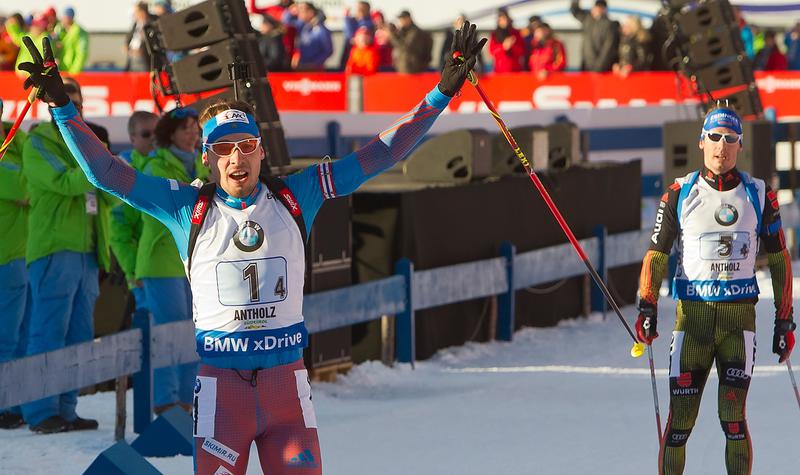
    Russia's Anton Shipulin (l) celebrates after holding off Germany's Simon Schempp to anchor Russia to the men's relay victory on Sunday at the IBU World Cup in Antholz, Italy. Shipulin outlasted Schempp by 1 second for the win. (Photo: IBU/Rene Miko)
    Russia’s Anton Shipulin (l) celebrates after holding off Germany’s Simon Schempp (r) to anchor Russia to the men’s relay victory on Sunday at the IBU World Cup in Antholz, Italy. Shipulin outlasted Schempp by 1 second for the win. (Photo: IBU/Rene Miko)

    Russia’s Anton Shipulin and Germany’s Simon Schempp have met multiple times on the final loop of an International Biathlon Union (IBU) World Cup race and duked it out for first, both in individual races as well as relays. In fact, they did so in Saturday’s pursuit in Antholz, Italy, where Shipulin prevailed by 10 seconds to claim his first victory of the season.

    On Sunday in the men’s 4 x 7.5-kilometer relay in the same packed arena with over 20,000 biathlon fans, Shipulin did it again to anchor a Russian team — with Maxim Tsvetkov, Evgeny Garanichev and Dmitry Malyshko — to first in 1:12:24.8, with no penalties and seven spare rounds.

    The German team, with Erik Lesser, Benedikt Doll, Arnd Peiffer, and Schempp, finished just 1 second behind, with one penalty but just four spares.

    “It has become sort of a tradition with me and Simon together on the last shooting range and then on the last lap,” Shipulin commented in the post-race press conference through a translator. “Honestly Simon becomes stronger and stronger every time, but today I would say I didn’t beat him physically, it was more about tactics. It is not a very long finish lane here, so I just made it tactically better to not give him a chance.”

    “Being on the podium shows that we are in good shape,” Malyshko said through a translator. “We will try our best at the World Championships [in Oslo in March] to show everybody that we are even stronger than in the World Cups.”

    “We trust in Anton, and Anton believes in the team,” one of Shipulin’s teammates added in an interview with the IBU.

    Schempp was not pleased with a situation that happened when he and Shipulin came into the arena, having to pass a lapped athlete from Japan just before the last turn, with Shipulin overtaking on the right but Schempp getting slightly blocked.

    “The lapped athlete ran in the middle of the track. The whole audience was yelling for him to go to the side. I don’t know, maybe he is deaf on his ears, or whatever he is doing,” Schempp told German broadcaster ARD. “With all the peace of mind he is running right between us, and that must not happen.”

    Asked if he thought a protest with the IBU would be an option, Schempp replied: “Nah, surely that would not go through. That result stands.”

    “I gave everything I had, it was a neat relay, and we were rewarded with the second place,” he added. “The Russians were very, very strong, especially Anton in the finish. We can live with that. It was a clear step forward in the relays [the German men’s first relay podium of the season]. Of course the end is a little annoying, but we can be satisfied.”

    The head coaches for German and Russia, Mark Kirchner and Ricco Gross, respectively, hugged and congratulated each other in the coaching zone after the race. Both 45 years old, they are former German teammates and won gold together in the men’s relay at the 1994 Olympics in Lillehammer, Norway. More recently, they were also colleagues, with Kirchner coaching the German men’s team and Gross being an assistant for the women at the 2014 Olympics, before Gross took an offer last summer to lead the Russian men’s team (after being “demoted” to the IBU Cup by the German Ski Federation).

    “It’s difficult to even pick the six best athletes for the World Cup,” Gross had told German newspaper FAZ in an interview published on Friday, just before Shipulin’s sprint victory. “I was extremely surprised in September when I watched the Russian championships for the first time, with more than 100 athletes. There is a giant talent pool … My target is the Olympic Games in 2018.”

    Norway opted to rest its usual starters Tarjei Bø and Emil Hegle Svendsen for the relay on Sunday, instead starting veteran Ole Einar Bjørndalen, Lars Helge Birkeland, Johannes Thingnes Bø, and Erlend Bjøntegaard.

    “They married and went on vacation,” Johannes Bø joked during the press conference when asked about the absence of his brother Tarjei and Svendsen.

    Thus it fell to the relatively inexperienced Bjøntegaard to anchor the team. Bø tagged  him with a 29.2-second lead over Russia, and 33.5 seconds ahead of Germany, with Shipulin and Schempp chasing after him.

    “Now it’s becoming really exciting. I wouldn’t like to be in the shoes of Bjøntegaard right now,” Germany’s third-leg Arnd Peiffer said during an interview with ARD while the race was still going on. “I think he has a lot of stress now, and I am curious what happens.”

    But facing this big challenge, Bjøntegaard did a good job skiing a fast first loop to return to the range still in first and only needing two spares in his prone shooting. Yet this still reduced his lead to 6.8 seconds over Schempp, who had shot clean, and 14.9 seconds to Shipulin, who required one spare.

    In the final standing shooting, the Norwegian needed two more spare rounds, while Shipulin and Schempp both remained clean and left the range just 0.5 seconds apart. They skied together until the finishing sprint, with Bjøntegaard securing the third place on the podium, 22.9 seconds after Russia, but securely ahead of the rest of the field.

    “With Emil and Tarjei, two of our best athletes were not in the relay,” Johannes Thingnes Bø said during the press conference. “I was hoping that we could make the podium, and we did. A perfect race for everyone on the team. Erlend and Lars Helge were called up last minute, but they were relaxed, and third place is good. It’s not easy for Erlend to go out with Schempp and Shipulin.”

    Behind Norway, Austria, with Sven Grossegger, Julian Eberhard, Simon Eder, and Dominik Landertinger, finished fourth (+1:01.7), with one penalty and 11 spare rounds.

    “Better shooting,” Simon Eder told the IBU in a video interview when questioned what it would have taken to reach the podium. “We always have the extra [penalty] loop. It’s not easy, it happens so fast. But we hope to manage it at the World Champs without it.”

    “The running shape is very good in the Austrian team,” Landertinger added. “And if the shooting is a little bit better we can make the podium.”

    France, starting without World Cup leader Martin Fourcade with a lineup of his older brother Simon Fourcade, Quentin Fillion Maillet, Simon Desthieux, and Jean Guillaume Beatrix, placed fifth (+1:39.3), with no penalties and 11 spares.

    U.S. Ties Season-Best 6th; Canada 11th
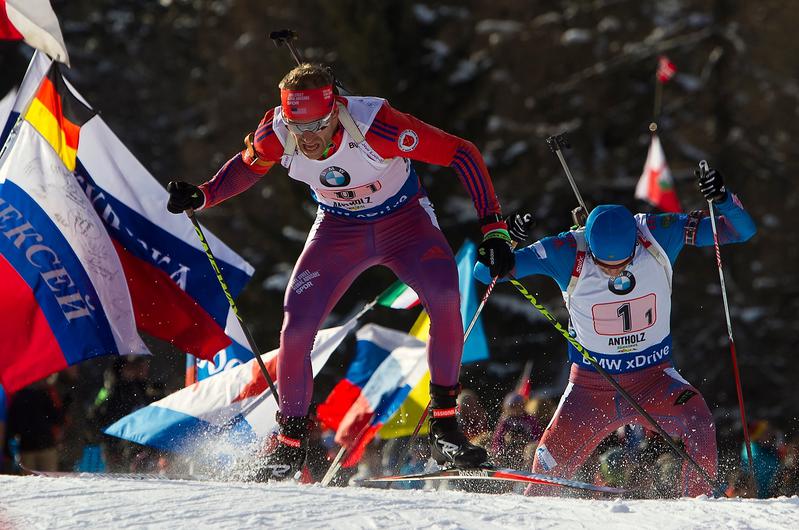
    Lowell Bailey (US Biathlon leads Russia's Maxim Tsvetkov during the first leg of the men's 4 x 7.5 k IBU World Cup relay on Sunday in Antholz, Italy. Russia went on to win and the U.S. finished 1:43.7 minutes back in sixth, tying a season-best team result. (Photo: IBU)
    Lowell Bailey (US Biathlon leads Russia’s Maxim Tsvetkov during the first leg of the men’s 4 x 7.5 k IBU World Cup relay on Sunday in Antholz, Italy. Russia went on to win and the U.S. finished 1:43.7 minutes back in sixth, tying a season-best team result. (Photo: IBU)

    On the last leg, Beatrix narrowly won out a race against American Sean Doherty, who crossed the finish less than five seconds later in sixth place, 1:43.7 behind the winners. The U.S. ended up with one penalty and 13 spares, and tied its season-best result after having achieved sixth in the relay a week ago in Ruhpolding, Germany.

    The Americans started the race in bib 6 with their now-usual lineup of Lowell Bailey, Tim Burke, Leif Nordgren, and Doherty, the same starters they had used at the World Championships in Kontiolahti, Finland, where the U.S. placed 14th in the men’s relay.

    Bailey briefly took the lead on the loop out of the arena, before two misses in his prone shooting stage required spare rounds and set him back to 15th, but still within 15.5 seconds out of the lead. With another spare in his standing stage, he still moved up five positions, and with the second-fastest, first-leg course time on his final loop, he tagged off in seventh, 20.8 seconds behind Germany’s Lesser.

    Burke held that position throughout his first loop, but two misses in the prone stage set him back. In the standing shooting, he used all three spare rounds to avoid the penalty lap, falling back to 14th before he made up ground again with a fast last loop (third-best course time) to tag Nordgren in ninth (+1:04.3).

    “Today proved that last week was not a fluke,” Burke said in a US Biathlon press release. “We are happy to be right in the mix with the ‘big’ biathlon nations but we still know that we are capable of more.”

    “I got the tag from Tim right with the Czech Republic,” Nordgren wrote in an email to FasterSkier. “For all of the first loop I just focused on staying nice and relaxed, trying to conserve as much energy as possible. Prone I wanted to be pretty aggressive and it worked out well.”

    After a clean prone shooting, Nordgren left the range in seventh place, virtually tied with a few other teams.

    “The second loop I left the range with Eder from Austria, again I was just tucked in with him saving energy,” Nordgren recalled. “Although I had super great skis today, so eventually on the downhill I put in a good transition and was pushing towards the French team in front of us.”

    After using two spare rounds in his standing stage, Nordgren still managed to move up to sixth place as some other teams, such as Italy and Switzerland, struggled on this leg, and handed off 1:04.5 minutes behind the leaders — about the same gap he had when he started.
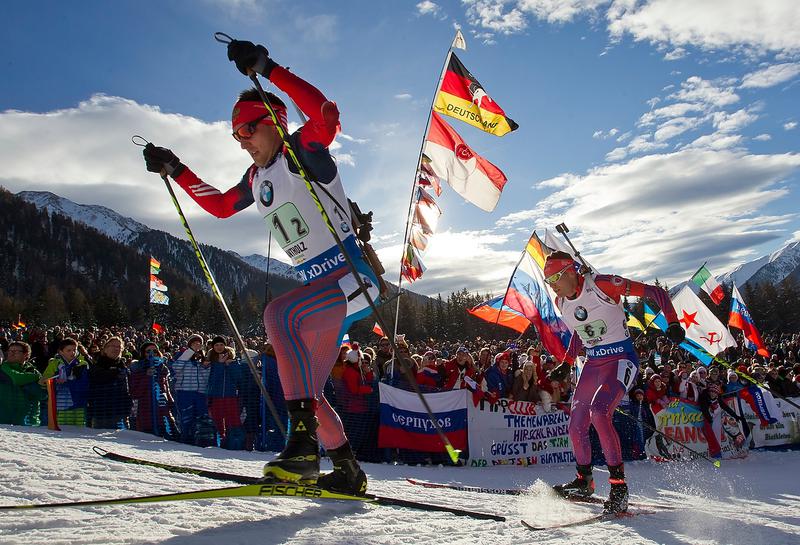
    Russia's Evgeniy Garanichev (l) leads Tim Burke (US Biathlon) during the second leg of the men's 4 x 7.5 k IBU World Cup relay in Antholz, Italy. (Photo: IBU/Rene Miko)
    Russia’s Evgeniy Garanichev (l) leads Tim Burke (US Biathlon) during the second leg of the men’s 4 x 7.5 k IBU World Cup relay in Antholz, Italy. (Photo: IBU/Rene Miko)

    “Standing was the only disappointing part about my race today, it was a bummer to have two mistakes, but I didn’t lose any places and I was quick with the extras,” Nordgren wrote. “I was surprised on the third loop, I actually had some energy to push. Eventually France passed me and got a small gap I couldn’t close.”

    Doherty kept the team in sixth on his first loop and through the first prone shooting, which he cleaned, reducing his gap to first by about ten seconds.

    “The conditions today were ideal,” Doherty wrote in an email. “The course was in great shape and there was no wind. The altitude here adds to the difficulty, but I also pushed hard on the second loop and I did not really hold it together on the range as I wish I could have.”

    By the final standing shooting he had moved to fifth, and was on the range behind Austria, with France nearby and Slovakia further behind. Austria’s Landertinger shot clean and finished first, while Doherty caused a penalty lap. But he only lost one position and still had France’s Beatrix in sight who had needed three spares.

    Doherty skied a fast final loop, almost closing a 20-second gap again, finishing sixth, 4.4 seconds behind France in fifth and 1:43.7 behind Russia.

    “I am a little bummed to have had that penalty because I was excited to fight for 5th. But overall 6th was secure,” Doherty wrote.

    “I am happy with another strong result,” Doherty added in the US Biathlon press release. “We were in the mix the whole time and even though I did not shoot my best the team did well. We are all looking forward to the next relay.”

    “As a team I think we’re happy with this race, but it was nowhere near a perfect race for us,” Nordgren wrote. “We still have more to give and will be looking for more in the relays to come.”

    Canada in bib 7 chose a lineup of Christian Gow, Nathan Smith, Macx Davies, and Scott Gow. Brendan Green had to sit out the relay because of back issues following his collision in Saturday’s pursuit, “which did not improve until race time,” according to Biathlon Canada head coach Matthias Ahrens. “We had to put Scott Gow in his place,” Ahrens wrote in an email.

    Younger brother Christian Gow jumped out to the lead after cleaning the initial prone stage, but on the next loop he lost some ground, crossing the next timing point in 11th, just 10 seconds out of first. After he required two spare rounds in his standing stage, Christian lost additional time to the leaders, but kept his position in the field, tagging off to Smith in 11th (+1:08.3).

    Smith, currently the highest-ranked Canadian in the overall World Cup, cleaned both stages for his first 100-percent shooting in a race this season. Reflecting on his race in an email, he said his ski shape was off — and it has been for the last couple days. Unable to move up in the field, he tagged Davies in 11th (+1:07.7).

    “I wanted to make up some spots and get our team up to the top 10. I knew it would mean some really good shooting,” Smith wrote in an email. “I’m really happy to finally have my first clean of the winter, especially after poor shooting in the other two races this weekend. On the other hand my skiing hasn’t been where it should for the last two weeks. I’m not sure why, I went from my best ski shape to my worst ski shape in literally 3 days. I have been struggling with back pain after a hard downhill crash in the Ruhpolding 20 km.”

    Davies went on to clean his prone stage and move into 10th, reducing the gap to the leaders to 41 seconds. In standing, he needed all three spares, which caused him to lose some time. Overall Davies skied the second-best course time of his leg (only behind Norway’s Bø), and handed off to Scott Gow in 10th place (+1:39.0).

    On the anchor leg, Scott needed two spares in his prone stage and one in standing, with Estonia’s anchor Ermits Kalev still passing him on the final loop. The Canadian crossed the finish in 11th, 5.7 seconds behind Estonia and 2:28.9 minutes behind Russia.

    Combined, the team had no penalty and required just eight spares. But 11th wasn’t exactly close to their season best: the Canadians finished sixth in Hochfilzen, Austria and 10th last week in Ruhpolding.

    “There were some good aspects of our relay: Christian’s first prone was amazing, my shooting, and Macx’s skiing,” Smith wrote. “Overall though I would say unfortunately it was not a good relay. A good race for us is top 6. The potential for a medal is there if everyone can put together their best race on the same day. Easier said than done.”

    The Biathlon World Cup resumes in two weeks on Canada’s home turf in Canmore, Alberta, with sprints on Thursday, Feb. 4 and Friday, Feb. 5, followed by mass starts on Saturday, Feb. 6, and single-mixed (1 woman, 1 man) and mixed (2 women, 2 men) relays on Sunday, Feb. 7.

    “I’m going to North America in a good mood,” Germany’s Peiffer said at the press conference. “The last three weeks were really exhausting. Now I had a good week here in Antholz, and I am looking forward to go to Canmore. I have never been there before. Maybe not as many [spectators] as in Ruhpolding or Antholz, but it’s nice to see a new place for biathlon.”

    “I will be in Romania for my last Junior World Championships,” Sean Doherty, 20, wrote, which will take place in Cheile Gradistei (Brasov, Romania) from Jan. 27 to Feb. 2. “So I will only be attending the Presque Isle World Cup [after Canmore].”

    Results

  • France Dominates Women’s Antholz Relay; Canada 13th; U.S. 17th 

    France Dominates Women’s Antholz Relay; Canada 13th; U.S. 17th 

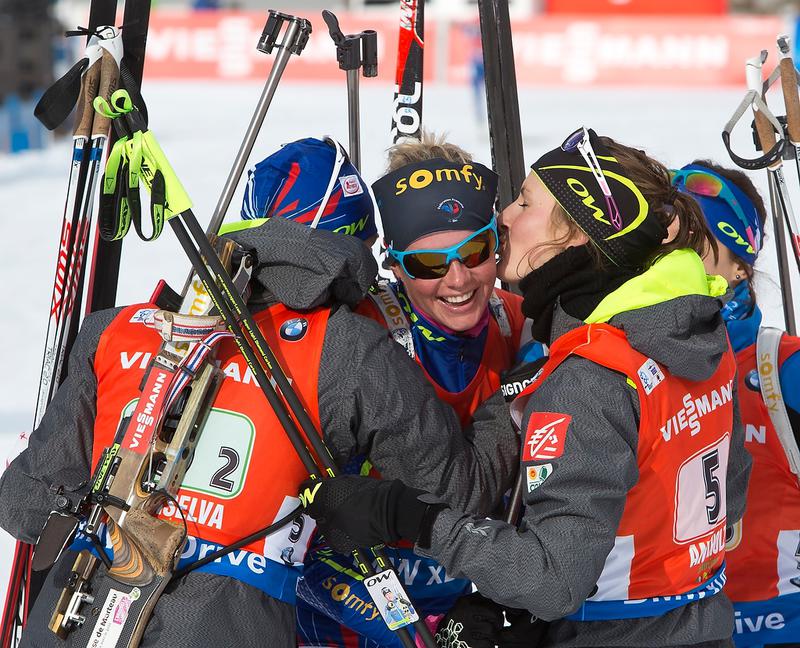
    The French women's 4 x 6 k relay team, including Justine Braisaz, Anaïs Bescond and Anaïs Chevalier, hugs and kisses anchor Marie Dorin Habert at the finish, after Habert secured their IBU World Cup victory by 17 seconds over the Czech Republic on Sunday in Antholz, Italy. (Photo: IBU)
    The French women’s 4 x 6 k relay team, including Justine Braisaz, Anaïs Bescond and Anaïs Chevalier, hugs and kisses anchor Marie Dorin Habert at the finish, after Habert secured their IBU World Cup victory by 17 seconds over the Czech Republic on Sunday in Antholz, Italy. (Photo: IBU/Rene Miko)

    After Ukraine, Germany and Italy occupied the podium in the first two International Biathlon Union (IBU) World Cup women’s relays of the season, on Sunday it was time for three other nations to shine in front of more than 20,000 fans in a packed arena in Antholz, Italy.

    On a beautiful day with blue skies, almost no wind, and surrounded by the spectacular mountain scenery of the South Tyrolean Alps, the French team with Justine Braisaz, Anaïs Bescond, Anaïs Chevalier, and Marie Dorin Habert shot well and skied fast to stay near the top throughout the 4 x 6-kilometer relay. Habert as the anchor received the tag with a 10.6-second buffer to Russia in second, then closed out the race with clean shooting in both stages, eliminating any chance of other teams challenging her.

    After she crossed the finish line in first for France with a time of 1:07.53.5, her teammates hugged her enthusiastically. Overall the French women shot no penalties and required just eight spare rounds.

    “It was a very nice race for the team,” starter Braisaz said during the post-race press conference. “I was a bit [too] excited on my first shoot. But it was a good experience to start the relay. And I am very happy today.”

    “A very happy end to my week,” her teammate Bescond told the media. “Today I felt very good on my skis. I think all of the team made a very good job.”

    “I am very tired, especially this week,” Habert said, reflecting on her season and the race. “It’s a very good thing to finish in the first position.”

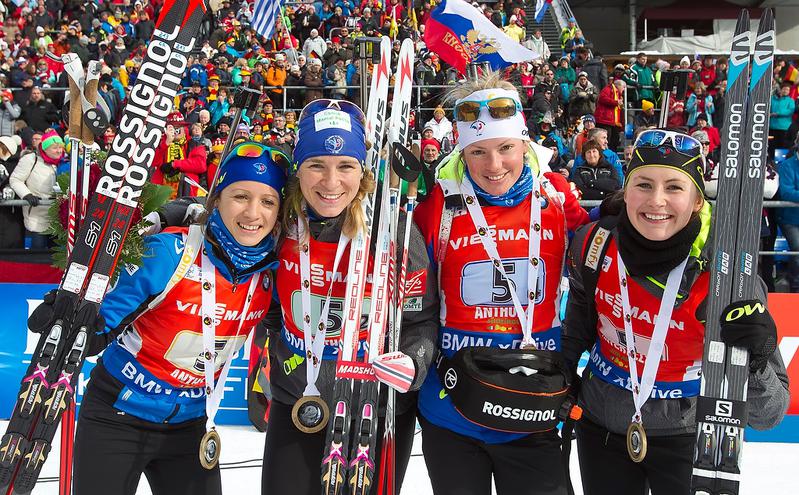
    The French women's relay after winning Sunday's 4 x 6 k IBU World Cup relay in Antholz, Italy. With Justine Braisaz, Anaïs Bescond, Anaïs Chevalier, and anchor Marie Dorin Habert (second from r). (Photo:  IBU/Rene Miko)
    The French women’s relay after winning Sunday’s 4 x 6 k IBU World Cup relay in Antholz, Italy. With Justine Braisaz (l), Anaïs Bescond (second from l), Anaïs Chevalier (r), and anchor Marie Dorin Habert (second from r). (Photo: IBU/Rene Miko)

    “This is the first time we tried our relay for the World Championships [in Oslo], so it’s important to [get] a good position to see that this formation of the relay is functioning,” she later said in another interview with the IBU.

    On the last loop, the Czech Republic, Russia and Italy battled for the positions on the podium, with Veronika Vitková able to create a small gap to secure second place for the Czech team, 17.2 seconds behind France.

    Initially, the outlook didn’t look good for the Czech Republic, after second-leg Lucie Charvátová skied two penalty laps and slipped to 12th at the exchange. Later she could be seen in the finish pen with tears in her eyes, while being consoled by team staff.

    “After my leg I didn’t think [it would be possible to come back], because I was such a bad shooter in each relay I started this year. So I was afraid, afraid all race, all year,” Charvátová, 22, said during the press conference. “I am so under pressure. So I am very happy, because those other girls are the best.”

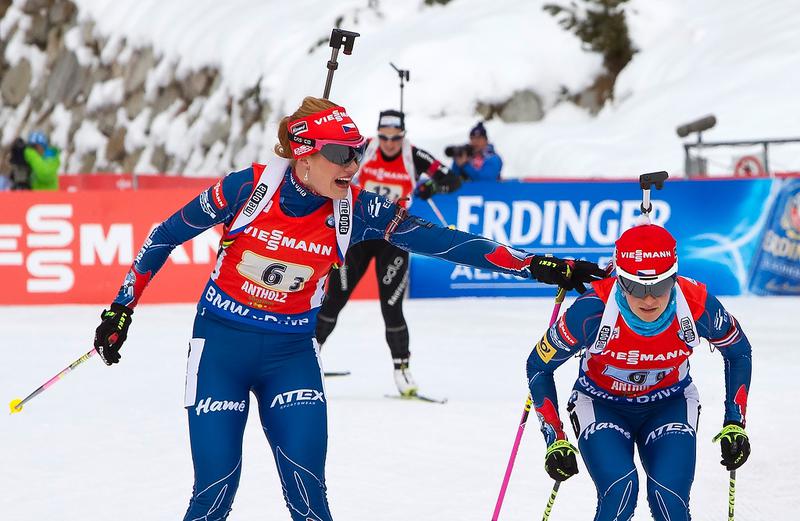
    Gabriela Soukalová (l) tags Czech teammate Veronika Vitková in fourth during the final exchange in the IBU World Cup women's 4 x 6 k relay. The Czech Republic team went on to finish second with just two spares from Vitkova. (Photo: IBU/Rene Miko)
    Gabriela Soukalová (l) tags Czech teammate Veronika Vitková in fourth during the final exchange in the IBU World Cup women’s 4 x 6 k relay. The Czech Republic team went on to finish second with just two spares from Vitkova. (Photo: IBU/Rene Miko)

    Her veteran teammates, World Cup leader Gabriela Soukalová and Vitková turned the race around with solid shooting and fast skiing, recording the best and fourth-best course times on their legs, respectively, to capture second. Overall, the team incurred two penalties and required seven spare rounds. It was the best performance for the Czech relay team this season, after two sixth-place finishes before.

    “It’s very surprising,” starter Eva Puscarciokova said during the press conference. “I am very happy today, because it was very hard after my race in Ruhpolding [Germany] when I went to the penalty loop.”

    Third place on the podium went to the Russian team with Ekaterina Shumilova, Anastasia Zagoruiko (who replaced Daria Virolaynen from the last relay in Ruhpolding), Ekaterina Yurlova, and Olga Podchufarova, finishing 21.2 seconds back, with no penalties and 10 spare rounds.

    Yurlova, Saturday’s pursuit winner, lifted her team from sixth to second, skiing fast — with the second-best course time of the third-leg skiers — and only needing two spares.

    “I am really happy about my leg, and especially about my standing [shooting],” Yurlova said at the press conference. “Because I am really, really tired after two competitions before. And now I was really afraid about my standing. It was all shaking, but I am really happy that I could do it clean. Overall I am really satisfied about this World Cup.”

    In the finishing stretch, Italy’s anchor, Dorothea Wierer, and Russia’s Podchufarova (who had beaten Wierer in the sprint last Friday) fought for third, as they had done earlier this season at the end of the relay in Ruhpolding, Germany, where Italy came out ahead. But this time, Podchufarova prevailed, to the huge excitement of her teammates who immediately ran into the finish area and piled onto her. Wierer crossed the line just 0.5 seconds behind (+21.7), after having made up nearly 15 seconds after the final shooting.

    “My only thought was to come into the finish in the third position,” Podchufarova said in the press conference. “I didn’t know at first that [Wierer] was behind me, only when I came into the stadium I saw it on the monitor. Then I tried my best to get the third place for the team.”

    “I wanted to go on the podium, but I was too [many] seconds behind,” Wierer said in a post-race interview with the IBU. “On the finish line I couldn’t anymore, because I was flushed pushing from the first loop, and in the final I had no more energy.

    “It was a really nice [weekend], but I am a little disappointed today,” she added with a laugh. “You want always more and more, that is the problem.”

    Norway, with Kaia Wøien Nicolaisen, Fanny Horn Birkeland, Marte Olsbu and Tiril Eckhoff, had been in third position behind France and Russia coming into the last shooting, but Eckhoff — a fast skier who has struggled with her shooting all season, hitting 68 percent of her standing targets — again had problems and ended up skiing a penalty lap. She finished fifth for Norway, 47.1 seconds back from France, with a team total of one penalty and 10 spares.

    “I had the opportunity and screwed it up. This was real sh*t. This was not the way I wanted to end [my] last World Cup race before the World Championships,” Eckhoff told Norwegian broadcaster NRK after the race, noting she and her coaches were aware of some technical corrections she still plans to implement.

    Ahead of the upcoming World Championships on their home turf in Oslo, the Norwegian women have yet to reach the podium since earning bronze in the relay at the 2014 Olympics.

    Arguably the biggest surprise of the day was Sweden, with Emma Nilsson, Mona Brorsson, Ingela Andersson, and Linn Persson, in sixth place (+50.5) just 3.4 seconds behind Norway, with no penalties and seven spare rounds.

    After the race, the Swedish women claimed they knew they were on a very good trajectory this season.
    “We expected it,” Brorsson said during in a group interview with the IBU.

    “We really thought we had a chance to be top six,” Andersson added.

    They credited their coach, Wolfgang Pichler, for their improved performance, after he helped several Swedish biathletes, such as Magdalena Forsberg, Helena Ekholm and Anna Carin Olofsson (now Zidek) reach Olympic and World Championship medals, before returning last summer after a stint with the Russian biathlon team.

    “I think that’s the big difference this year,” said Brorsson. “He always finds a way to motivate you. On the track, he is incredible. He knows what he is doing.”

    Ukraine, winner of the last relay in Ruhpolding and usually a team with very solid shooting performances, had some difficulties on the range on Sunday and finished ninth (+1:45.5). The team with Iryna Varvynets, Valj Semerenko, Olga Abramova (replacing Juliya Dzhyma) and Olena Pidhrushna stayed near the front for most of the race and Semerenko even exchanged in the lead. But Abramova needed five spares, and anchor Pidhrushna had to ski a penalty lap, setting them farther back (12 spares overall).

    Similarly, Germany had been in second place for both relays this season. On Sunday, with their regular anchor Laura Dahlmeier taking a break after a respiratory infection, the team struggled almost right out of the gate. Starter Karolin Horchler required five spare rounds and only narrowly avoided the penalty lap in her prone stage, leaving in last position at that time. She tagged off already a minute behind the best in 15th, before Miriam Gössner and Vanessa Hinz moved up a bit, but each incurred a penalty to slow down the chase. Anchor Franziska Hildebrand still managed to improve her team two positions on her leg, ultimately finishing 10th (+1:51.8).

    “I don’t know why, but my legs felt like a sewing machine today in standing, that hasn’t happened to me in a long time,” Gössner told German TV broadcaster ARD in an interview while the race was still going on. “I stood there, and already from the first shot my legs were shaking so much that I really didn’t have myself under control anymore. Even though I went slowly on the prior loop. I tried to fight and prevent the penalty lap, but unfortunately I did not succeed.”

    “My race was all right. All in all I am satisfied,” Hildebrand told ARD. “We somehow struggled a bit in Antholz. Next time it hopefully will be better again for us. There are weekends where not everything works out, and this was one of those.”

    Switzerland, with Saturday’s pursuit runner-up Selina Gasparin, started the relay very strong, with Gasparin tagging off in the lead, and her younger sister Aita Gasparin keeping the team in contention in fourth. Then two less-experienced skiers closed for Switzerland, with Irene Cadurisch tagging off in fifth place, before anchor Ladina Meier-Ruge faded a bit and lost two minutes to the front. They finished 12th with nine spares, one place ahead of Canada.

    Canada 13th, U.S. 17th

    After achieving her first-career top 20 in Saturday’s pursuit, Canada’s Julia Ransom had said her team was “fired up” for the relay, and that they were eager to reach the top six after feeling they had come close in ninth a week ago in Ruhpolding.

    Unfortunately on Sunday, the performance on the shooting range did not allow that to happen for the Canadian team with Ransom, Rosanna Crawford, Megan Tandy, and Zina Kocher.

    Starting as the scramble leg, Ransom missed two targets in her first prone stage, then required all three spares to clean them, narrowly avoiding the penalty but only leaving the range again in 18th position, already 41 seconds back.

    After skiing a fast second loop (with the third-best course time, seventh-best overall) and a clean standing shooting, she moved the team back up significantly and tagged Crawford in ninth place, 32.2 seconds behind the top.

    Crawford had two solid shooting performances, requiring one spare round in her prone stage and two in standing. Skiing the 11th-fastest second-leg course time, she brought her team close to the top six in seventh place, just 32.5 seconds out of first.

    Tandy skied a very fast first loop (fourth-best), and came through her prone stage with two spare rounds, leaving still in 10th position. After a slower loop, she then struggled in her standing position, and was unable to avoid the penalty lap (0+2, 1+3), losing a minute to the top. She tagged off in 13th place (+1:58.7).

    Kocher as the team’s anchor initially held 13th and had a solid first prone shooting with one spare round, but lost another minute on the next loop. In the final standing, similar to Tandy, she also ran out of spares and had to ski a penalty lap, leaving the range in 14th and more than four minutes behind the leaders. On the final loop she was able to pass Bulgaria’s anchor Daniela Kadeva, finishing 13th for Canada (+4:12.2 minutes) with two penalties and 15 spare rounds.

    In an email, Biathlon Canada’s head coach Matthias Ahrens explained that the team was packing up Sunday afternoon, driving to Munich, Germany, then flying back to Canada early Monday morning. The Canadian athletes could not be reached for immediate comment.

    “Women’s race started excellent with Julia and Rosanna, then unfortunately Megan and Zina could not match that Performance,” Ahrens briefly noted about the women’s result before leaving Antholz.

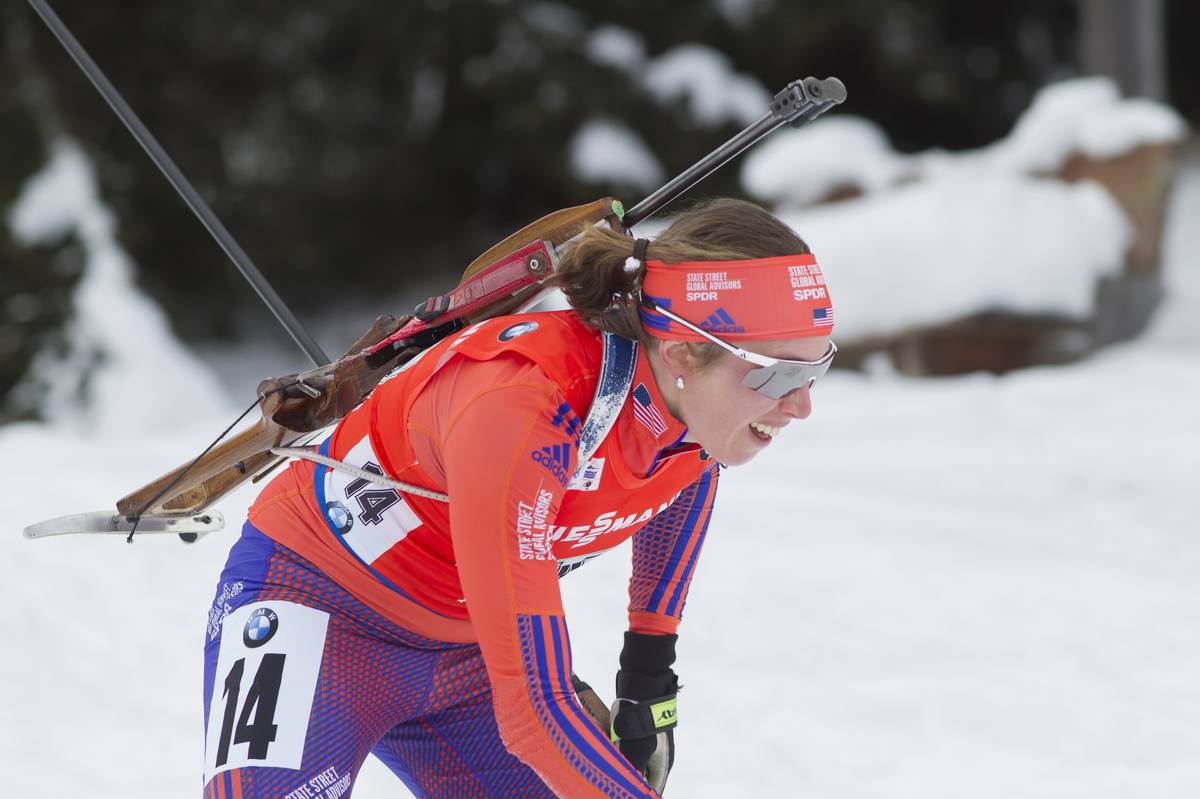
    Susan Dunklee (US Biathlon) used a total of four spares between two stages in the women's 4 x 6 IBU World Cup relay, handing off in 14th. (Photo: USBA/NordicFocus)
    Susan Dunklee (US Biathlon) used a total of four spares between two stages in the women’s 4 x 6 IBU World Cup relay, handing off in 14th. (Photo: USBA/NordicFocus)

    The U.S., with Clare Egan, Susan Dunklee, Annelies Cook, and Joanne Reid, adapted its lineup order a bit again on Sunday compared to the first two relays, with Egan starting and Cook moving to the third leg.

    “Today I got my first mass-start experience at the World Cup level,” Egan wrote in an email. “It reminded me of how much I thrive on head-to-head racing. The decision was made with the intent of giving me that head-to-head experience, both because it will be useful in the future for pursuits and mass starts, and because I think my coaches thought I would like it.”

    She skied at a steady pace in the middle of the field, and required just one spare in each of her shooting stages.

    “The altitude is a challenge here, for the skiing of course but also for recovering before the shooting,” Egan wrote of the biathlon trails situated some 2,000 meters (6,500 feet) above sea level. “The range approach does not provide rest, so I have been making rest for myself by skiing into the range extra easily.”

    “There was a light wind but it was constant, so with the correct sight adjustments the wind was not a factor,” Egan explained. “I had super fast skis and put them to good use passing people on course, but then despite using only one spare round per stage, I still lost places on the range to faster shooters.”

    On the last loop, Egan sped up her pace and skied the sixth-fastest course time of her leg, catching six other teams in front of her to hand off in 12th place (+53.9)

    “The highlight for me was on the last lap when I passed Team Germany,” she wrote.

    After receiving the tag from Egan, Dunklee set out fast with the best course time on her first loop, but then required three spare rounds in her prone shooting. After skiing her second loop at a slightly lower pace, she managed to miss only one target in standing. She slipped two spots to tag off in 14th (+1:10.1), with the third-best course time overall.

    Cook was initially able to hold that position, despite requiring two spares in her prone. Then in standing, she used all three spares and had to ski a penalty lap. That set her back to 18th place, more than three minutes behind the leaders. She tagged off still in that position (+3:36.7).

    In the second World Cup weekend of her career, Reid, 23, skied as the U.S. anchor for the second time. She posted the ninth-best course time on her first loop and managed to shoot clean in prone, but then was lapped by the top teams after another penalty in her standing. That kept Reid from skiing her last loop and ended the race for the U.S. in 17th place with two penalties and 14 spares. Estonia and Romania behind them were lapped as well.

    Next Stop: Canmore/Canada

    The IBU World Cup picks back up again in two weeks in Canmore, Alberta, with sprints on Thursday, Feb. 4 and Friday, Feb. 5, followed by mass starts on Saturday, Feb. 6, and single-mixed relay (1 woman, 1 man) and mixed relay (2 women, 2 men) relays on Sunday, Feb. 7.

    Several strong athletes will not make the trip overseas, notably several members of the Norwegian team, such as Eckhoff and Synnøve Solemdal, citing a focus on instead preparing for the upcoming World Championships.

    Sitting in second in the overall World Cup standings, Habert plans to be there to fight for more points: “Just five days to recover, and then we will fly to Canmore,” she said at the press conference.

    “We are still in discussion with the coaches about the best approach,” Germany’s Hildebrand told ARD. “In order to stand nicely relaxed and regenerated at the start in Oslo.”

    Note: The U.S. men placed sixth in the men’s 4 x 7.5 k relay to match a season best, despite using 13 spares and skiing a penalty lap, with Lowell Bailey, Tim Burke, Leif Nordgren, and Sean Doherty. Canada’s men, with Christian Gow, Nathan Smith, Macx Davies, and Scott Gow, placed 11th with eight spares and no penalties.

    Stay tuned for a complete report on the men’s race.

    Results