From the FasterSkier archive — posts syndicated from athletes’ and coaches’ own blogs between 2004 and 2012, kept online as published. Current coverage is at fasterskier.com.
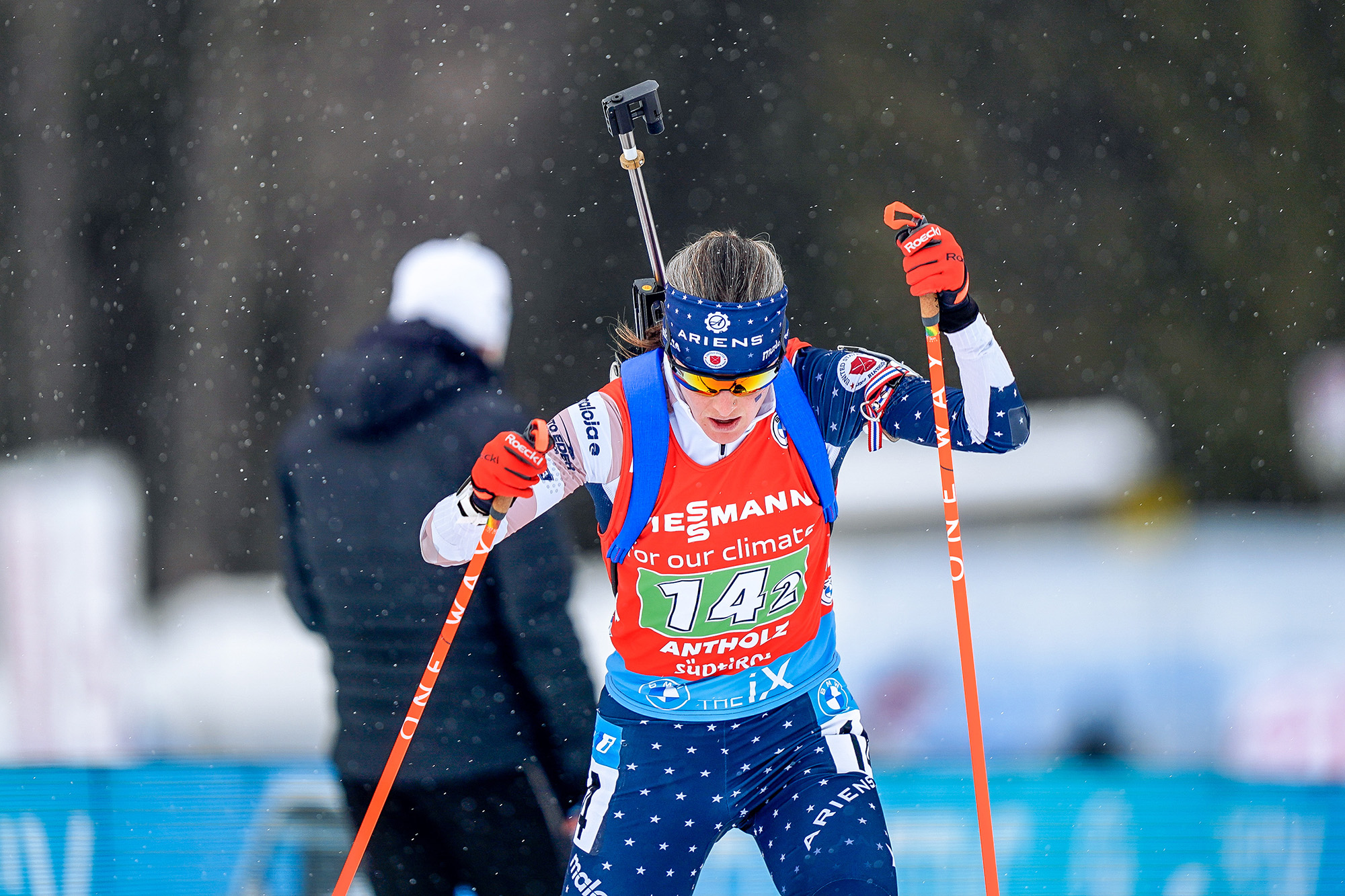
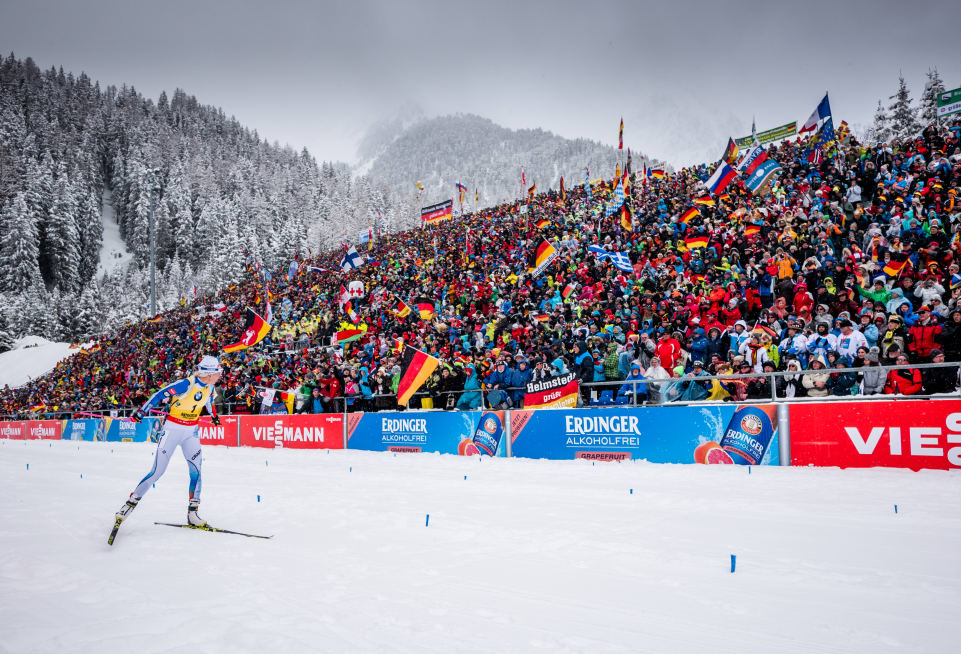
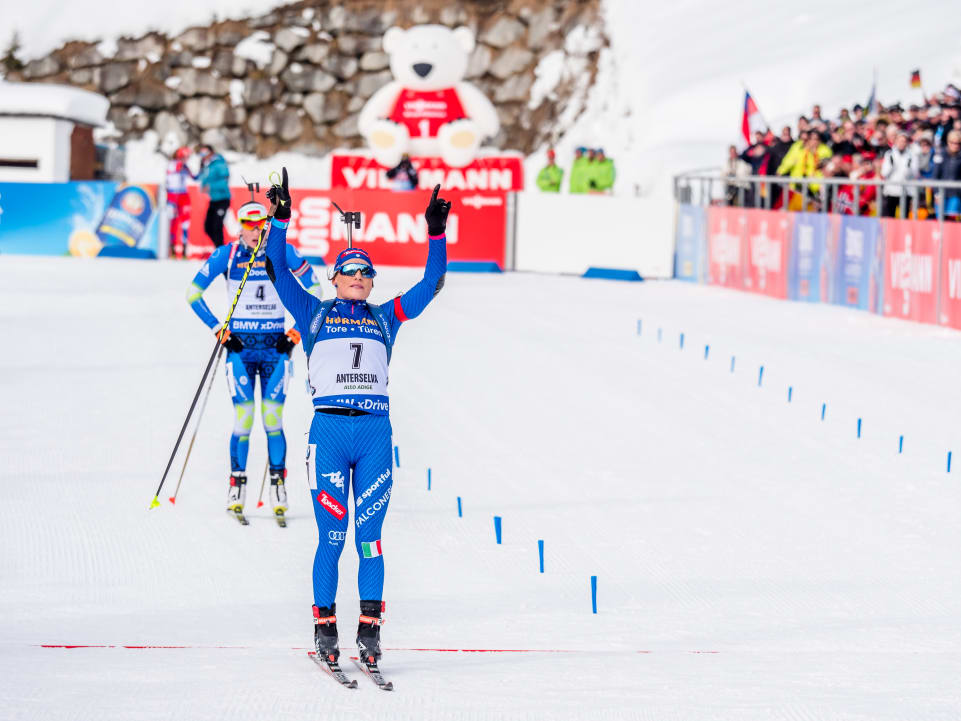
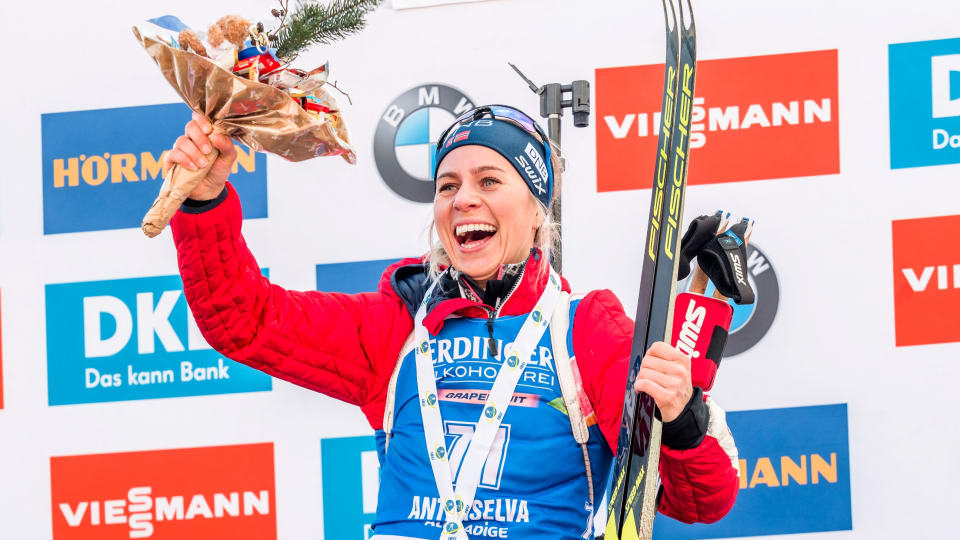
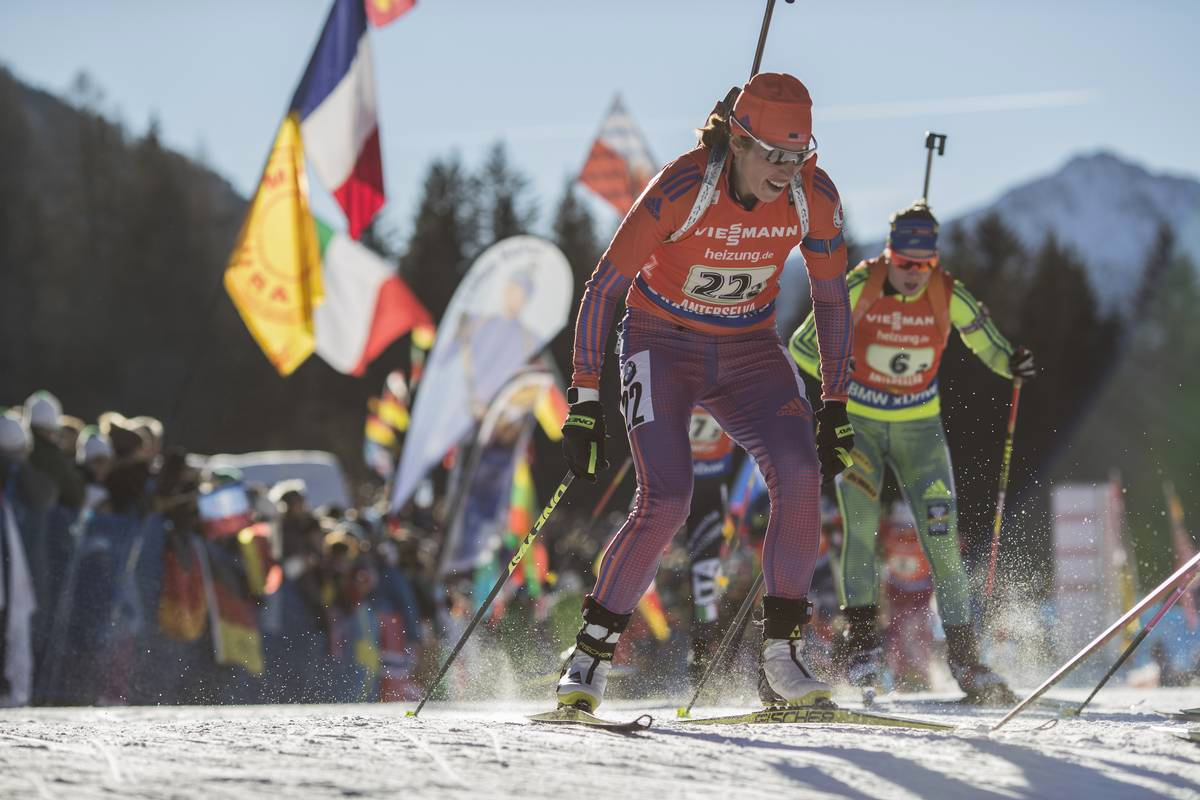
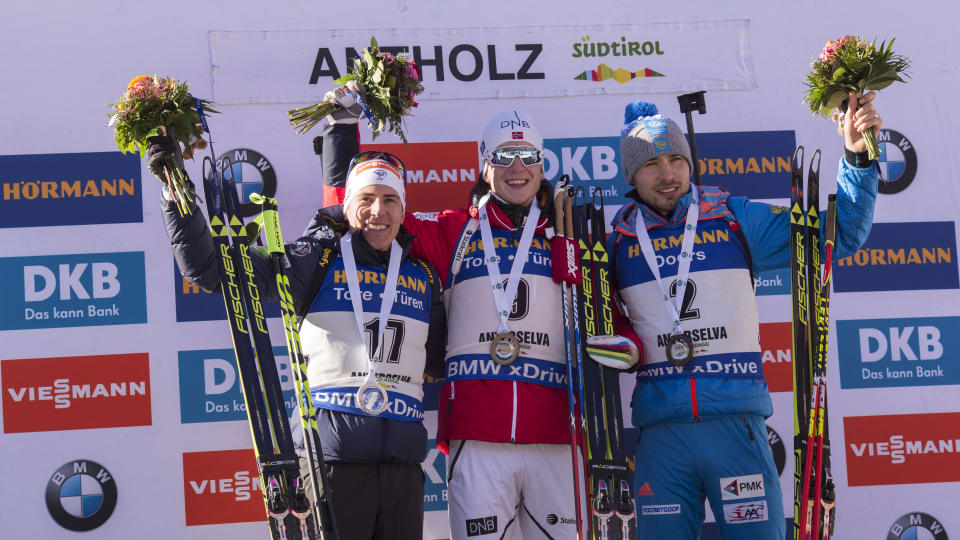
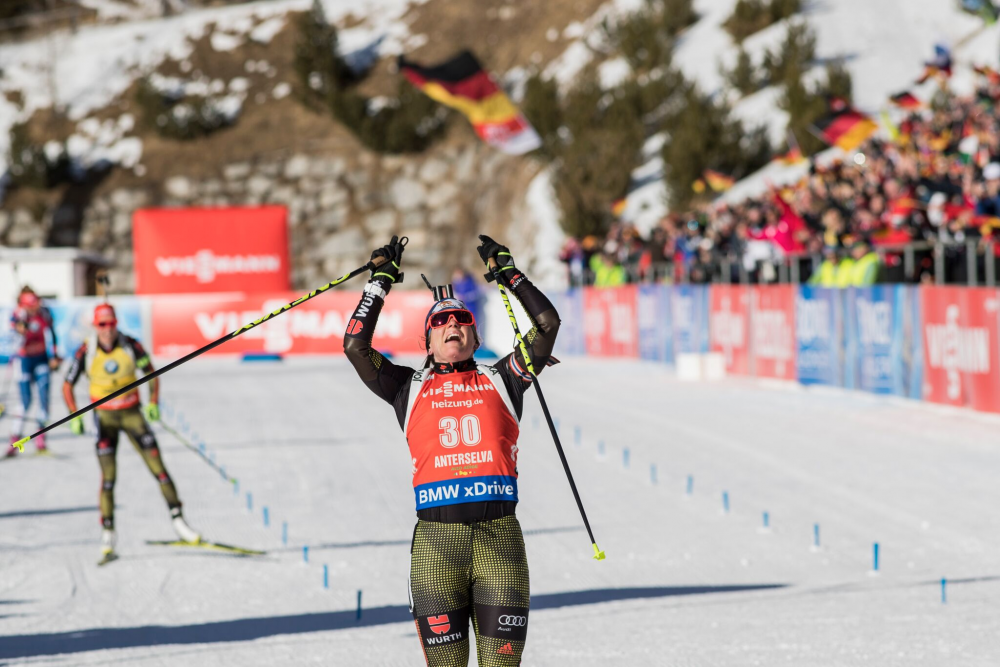
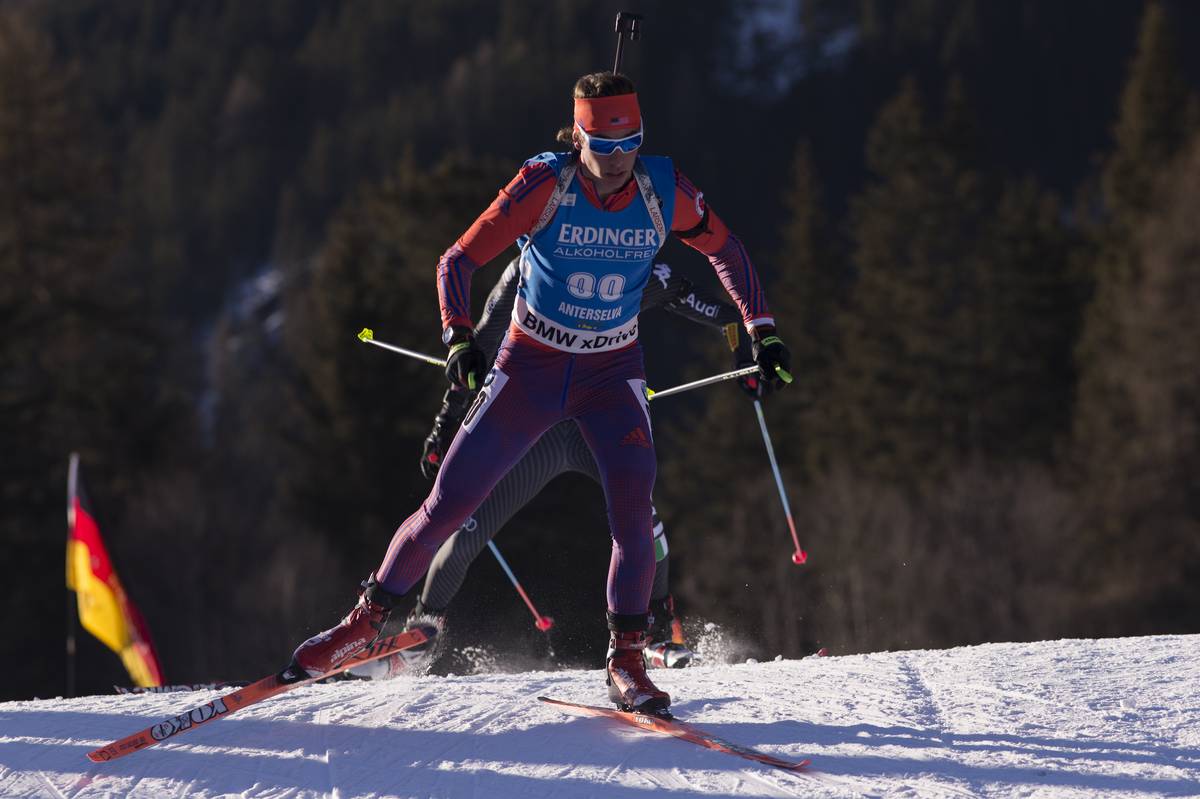
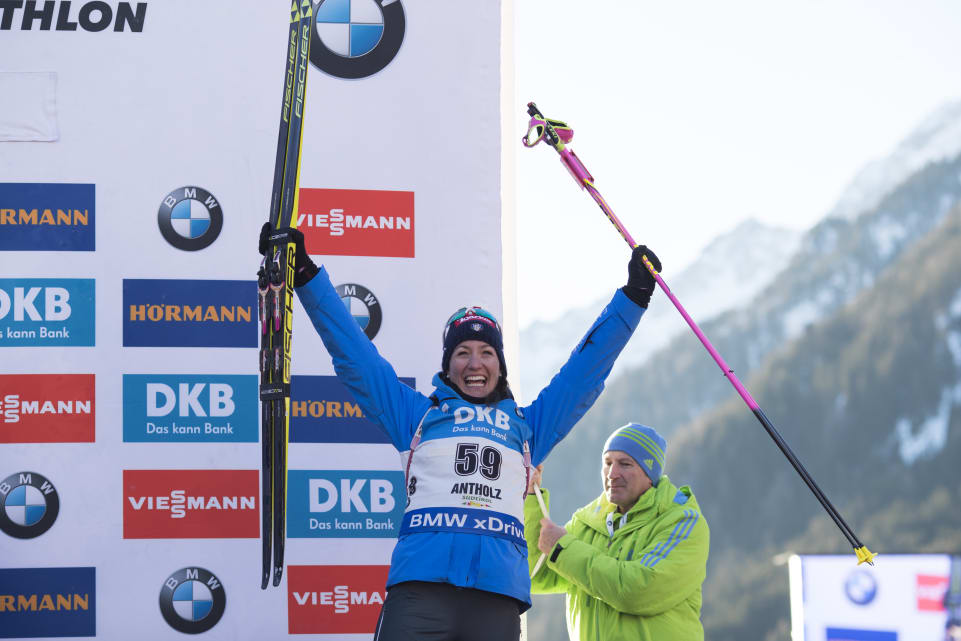
Joanne Reid (USA) celebrates historic relay result in Antholz (ITA). (Photo: NordicFocus)
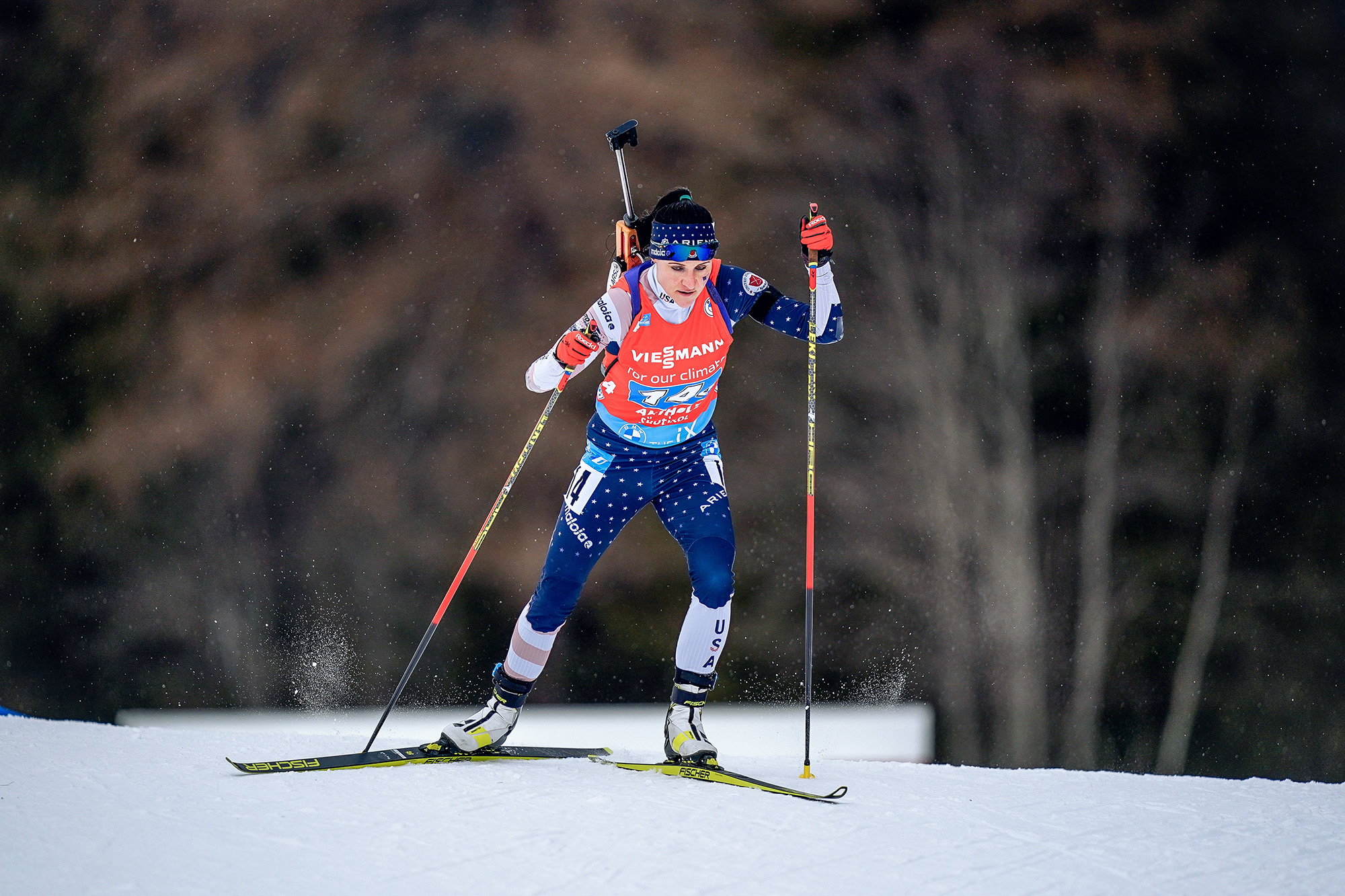
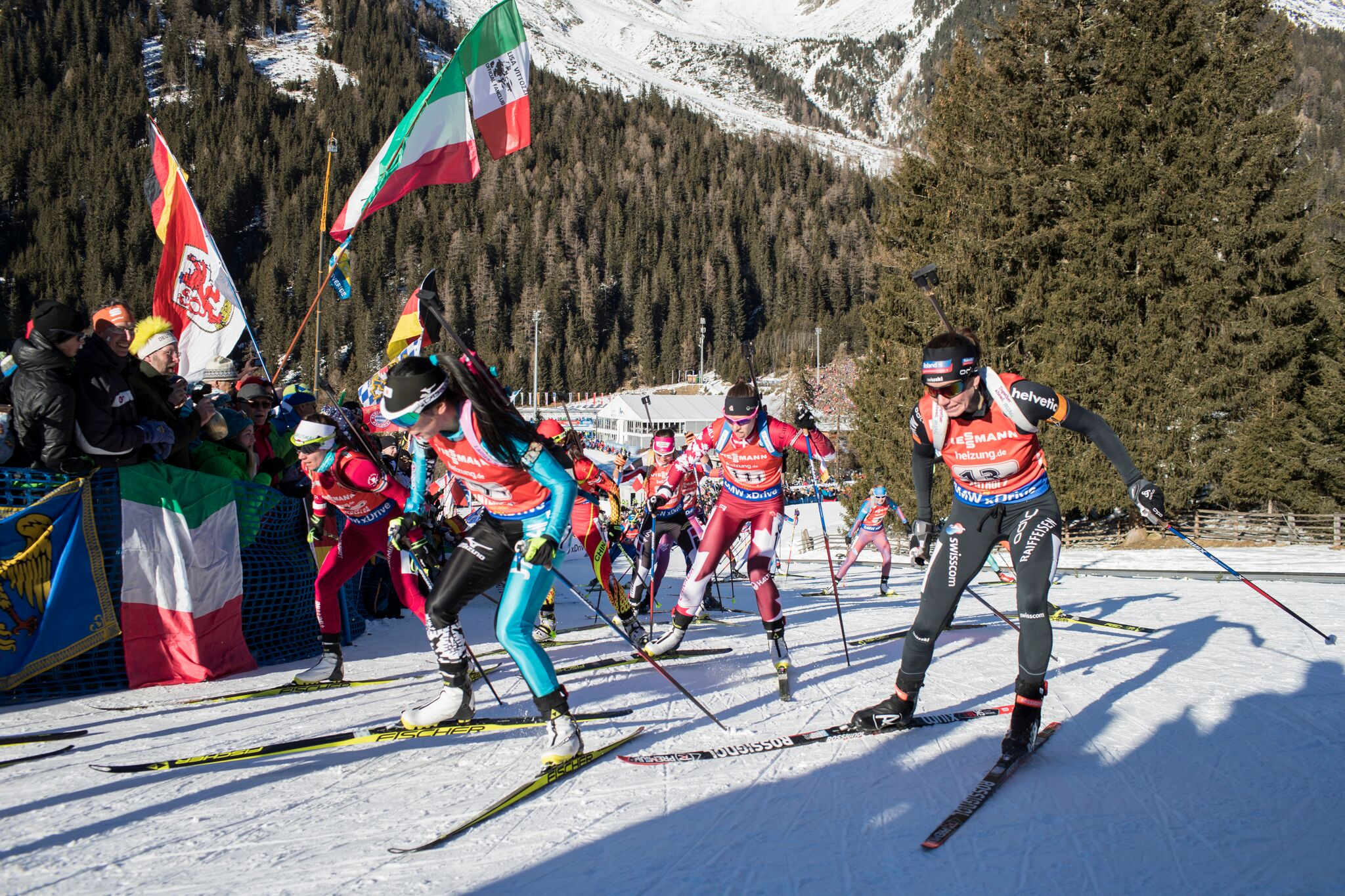
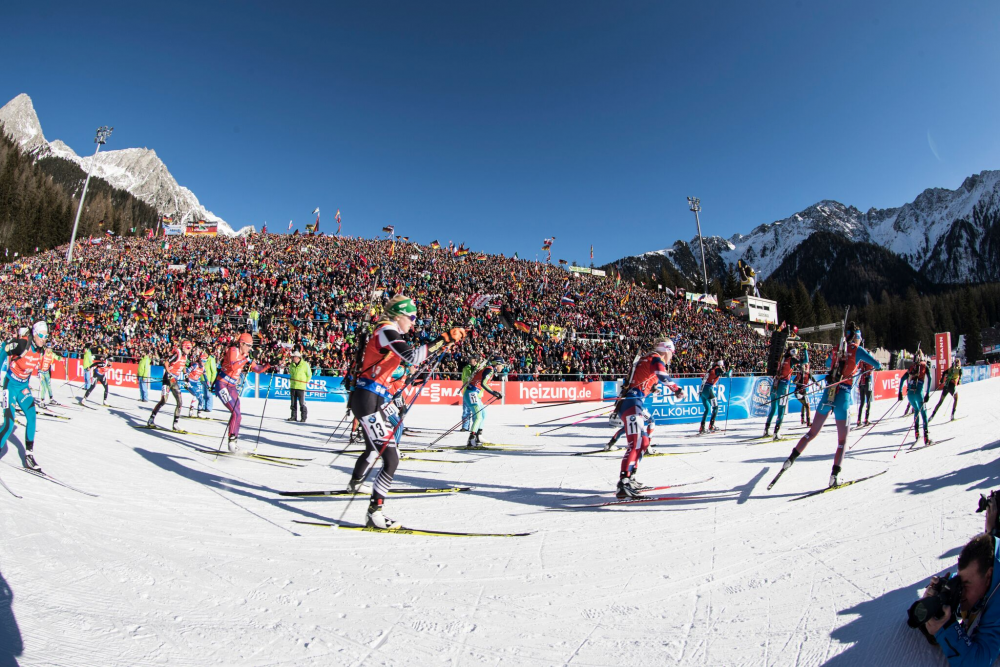
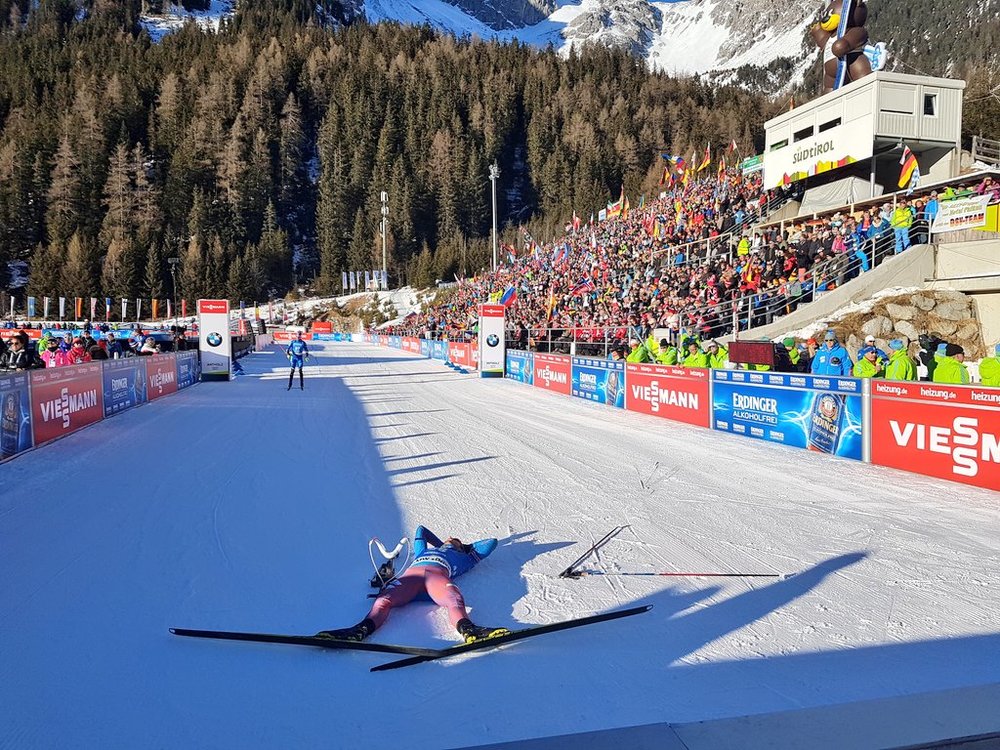
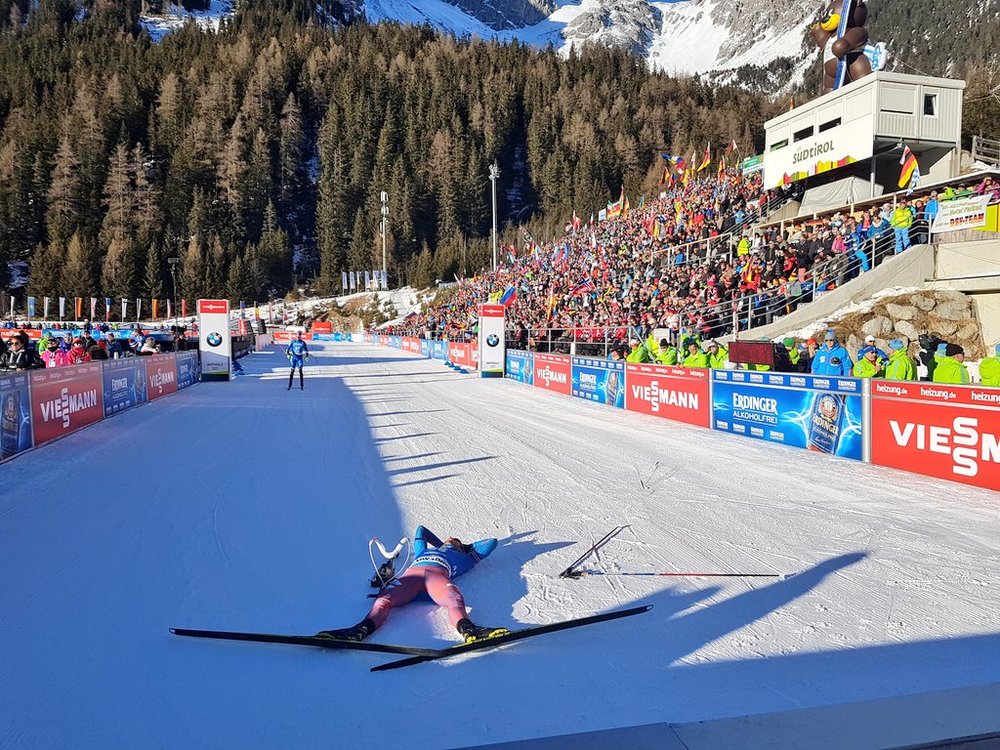
In the final women’s relay competition before the Beijing 2022 Olympic Games, the 14th ranked U.S. Women’s Biathlon Team raced to a fifth-place finish in Saturday’s 4×6-kilometer event at the BMW IBU World Cup in Antholz. It marked the best relay finish for the women’s team in a World Cup since 1994 when the U.S. took the silver medal in Canmore, Alberta, Canada. However, today’s performance bettered that race 28 years ago in terms of time behind as they finished 50.1 seconds back of first place today compared to 57.3 seconds behind in 1994.
“I’ve dreamed of a top-5 women’s relay for over a decade,” three-time Olympian Susan Dunklee (Craftsbury, Vt./Craftsbury Green Racing Project & USBA) said after the race.
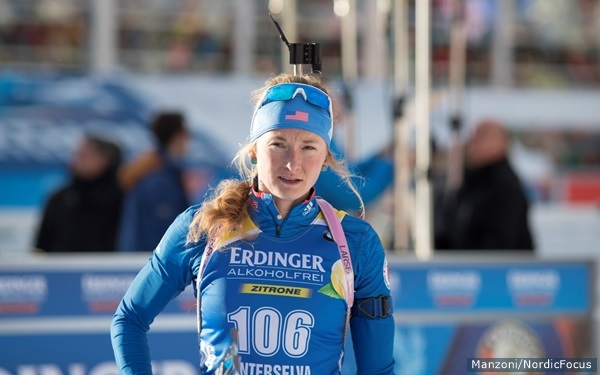
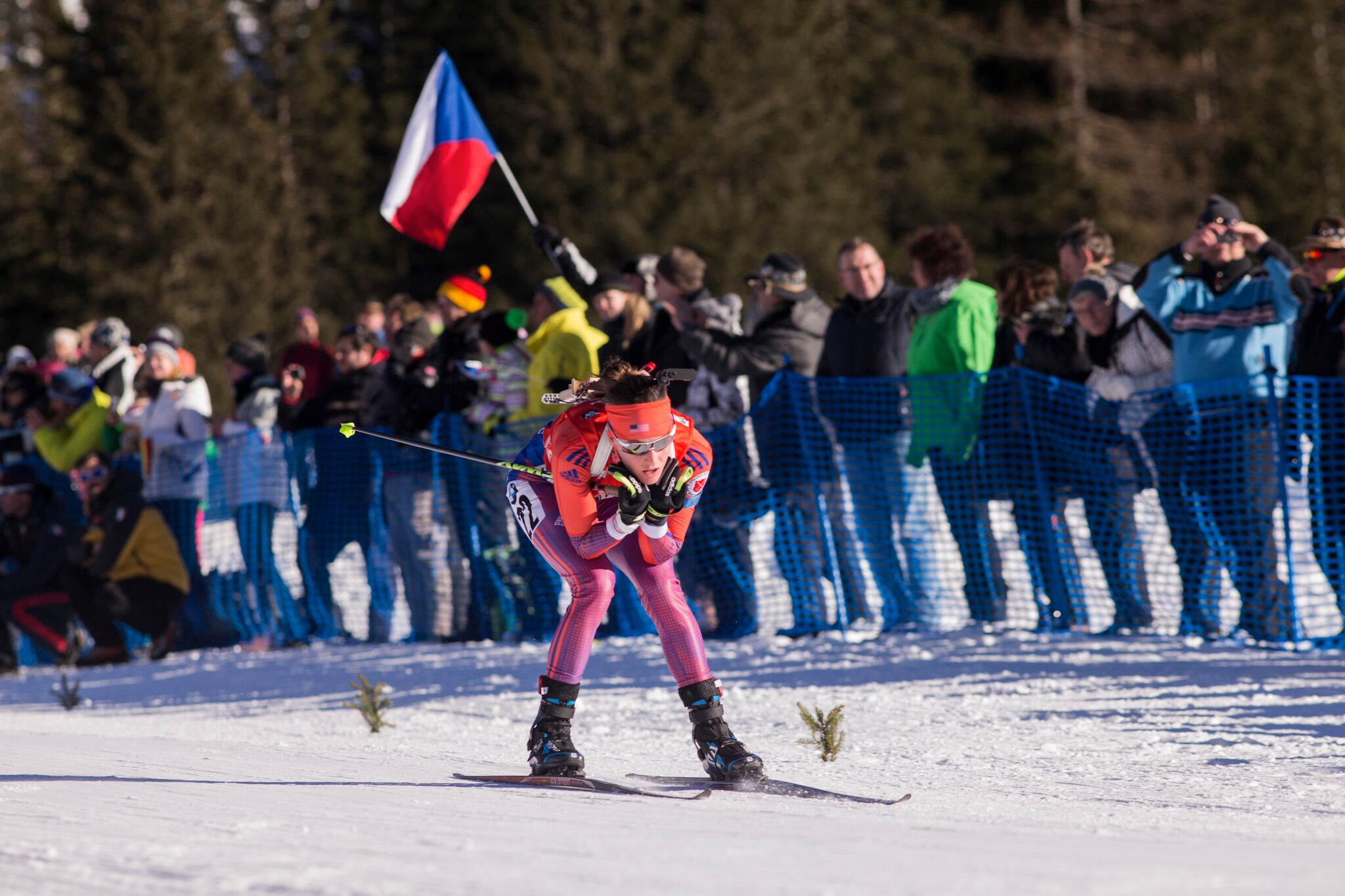
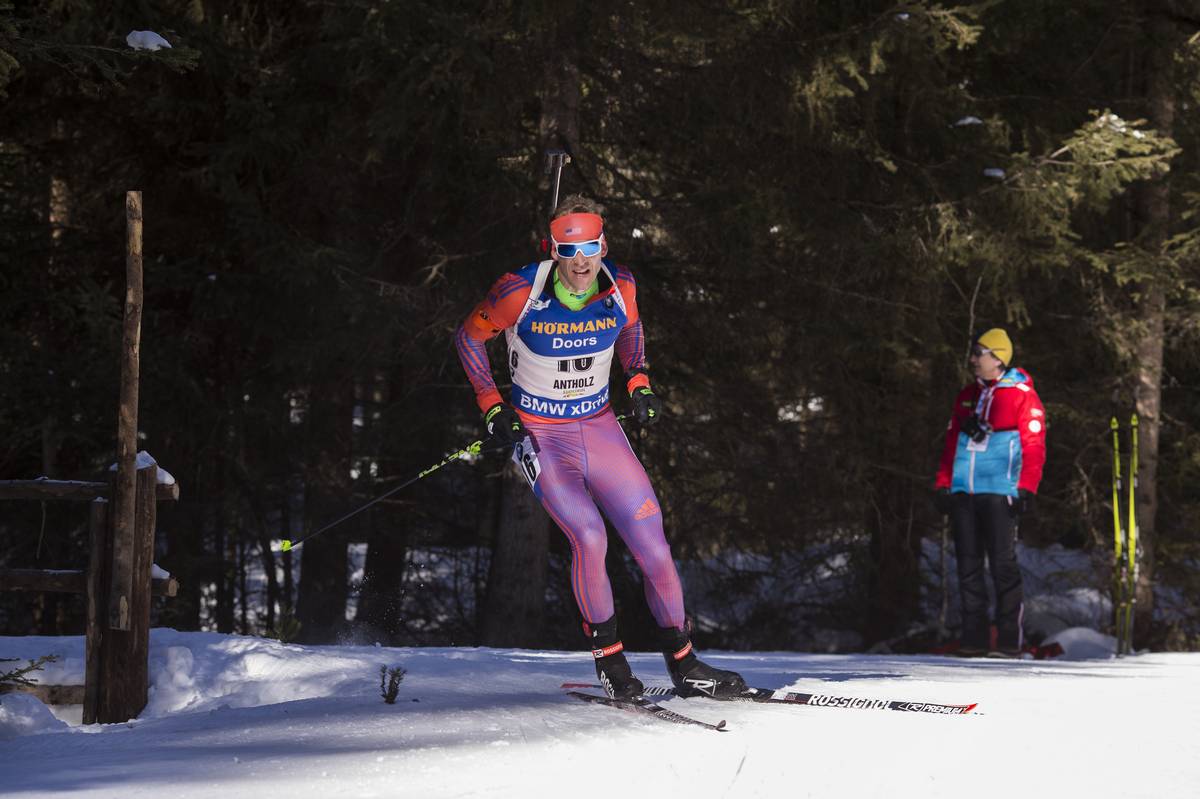
Susan Dunklee (USA) keeps the United States in it during the first leg of the relay in Antholz (ITA). (Photo: NordicFocus)
Dunklee kicked off the relay using one spare round in prone and two spares in standing. She made the first exchange with 2018 Olympian Clare Egan (Cape Elizabeth, Maine/Craftsbury Green Racing Project & USBA) with the U.S. team in 12th place, 41.6 seconds back of the leader.
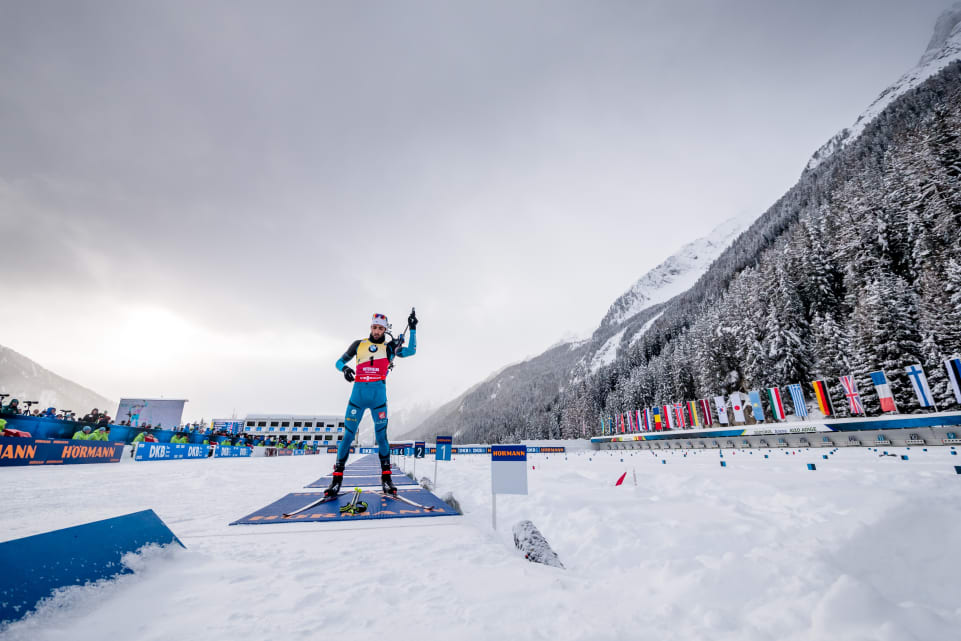
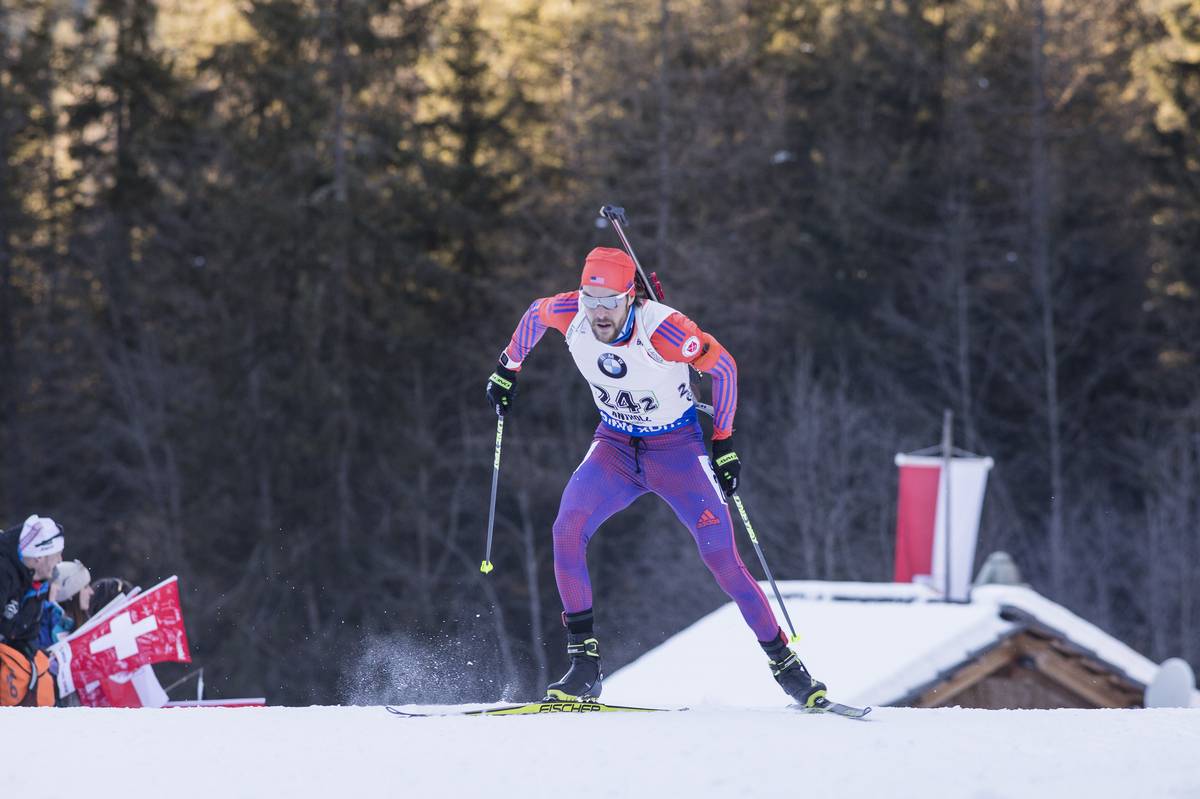
Clare Egan (USA) holds strong during the second leg of the relay in Antholz (ITA). (Photo: NordicFocus)
Egan, heading into her second Olympic Games, brought the American squad up to 10th place after needing three spares in prone and two in standing on her second leg.
“It’s great to improve on our sixth-place from last winter as we head into the Olympics,” said Egan, referring to last season’s World Cup relay performance in Nove Mesto, Czech Republic.
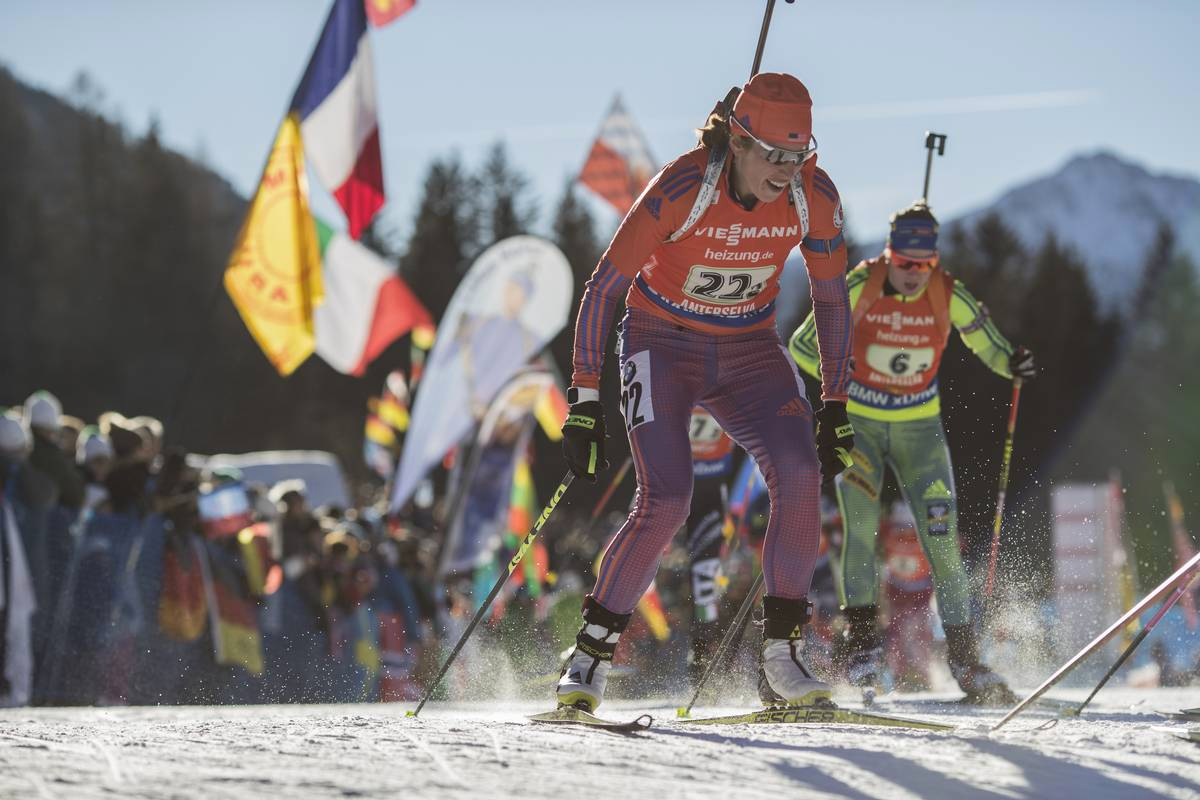
Deedra Irwin (USA) keeps the US team within striking distance during the third leg of the relay in Antholz (ITA). (Photo: NordicFocus)
Deedra Irwin (Pulaski, Wis./National Guard Biathlon & USBA), the lone rookie on this year’s Olympic team, went clean in prone and used three spare rounds in standing to vault the team into medal contention at the final exchange. Irwin tagged off the anchor leg to Joanne Reid (Grand Junction, Colo.) in seventh place, a mere 27.6 seconds out of first.
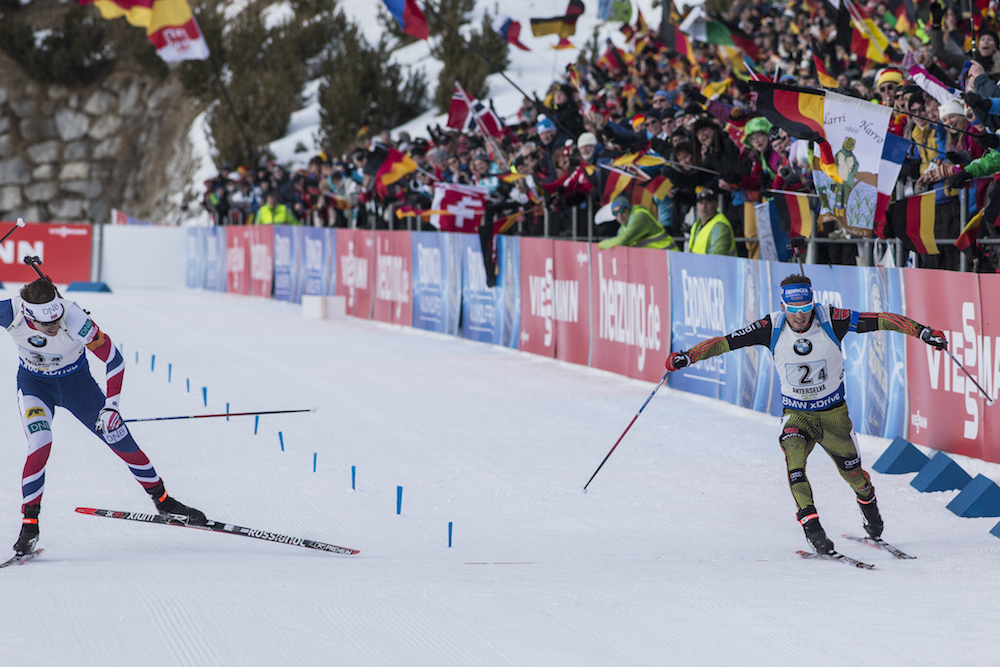
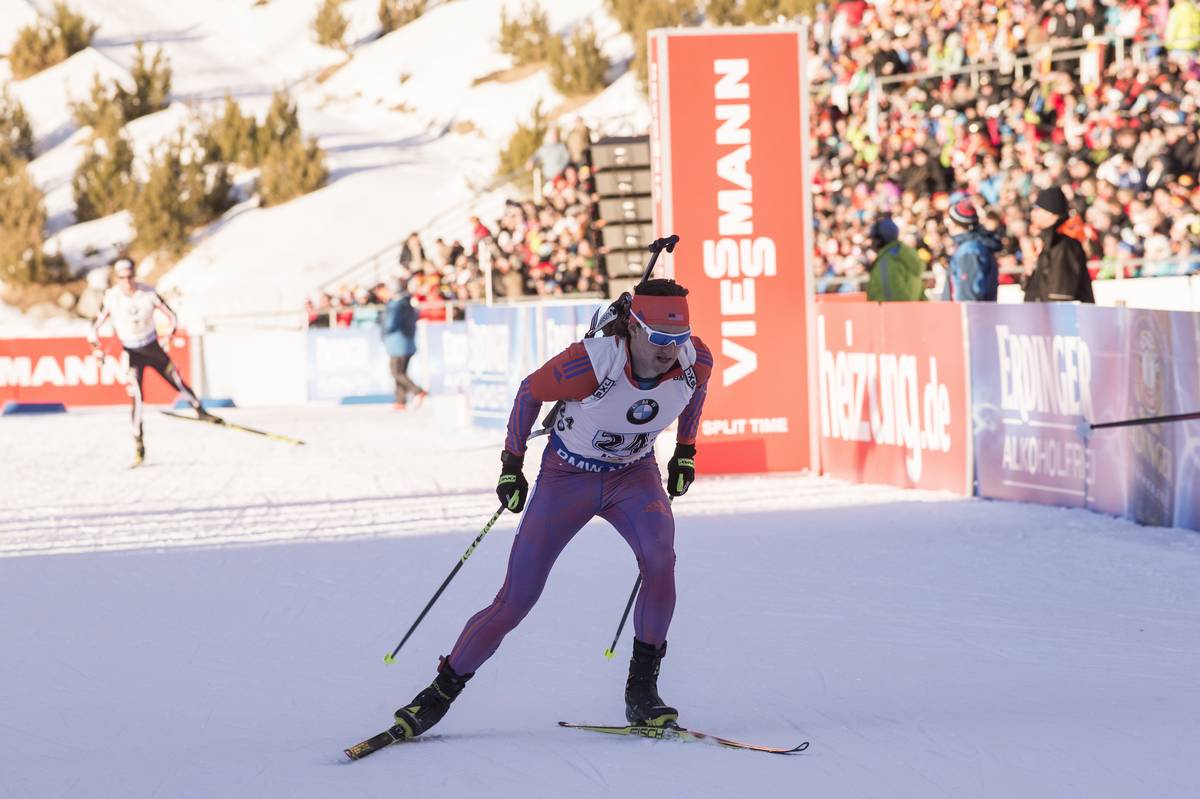
Joanne Reid (USA) anchors the US to 5th place in Antholz (ITA). (Photo: NordicFocus)
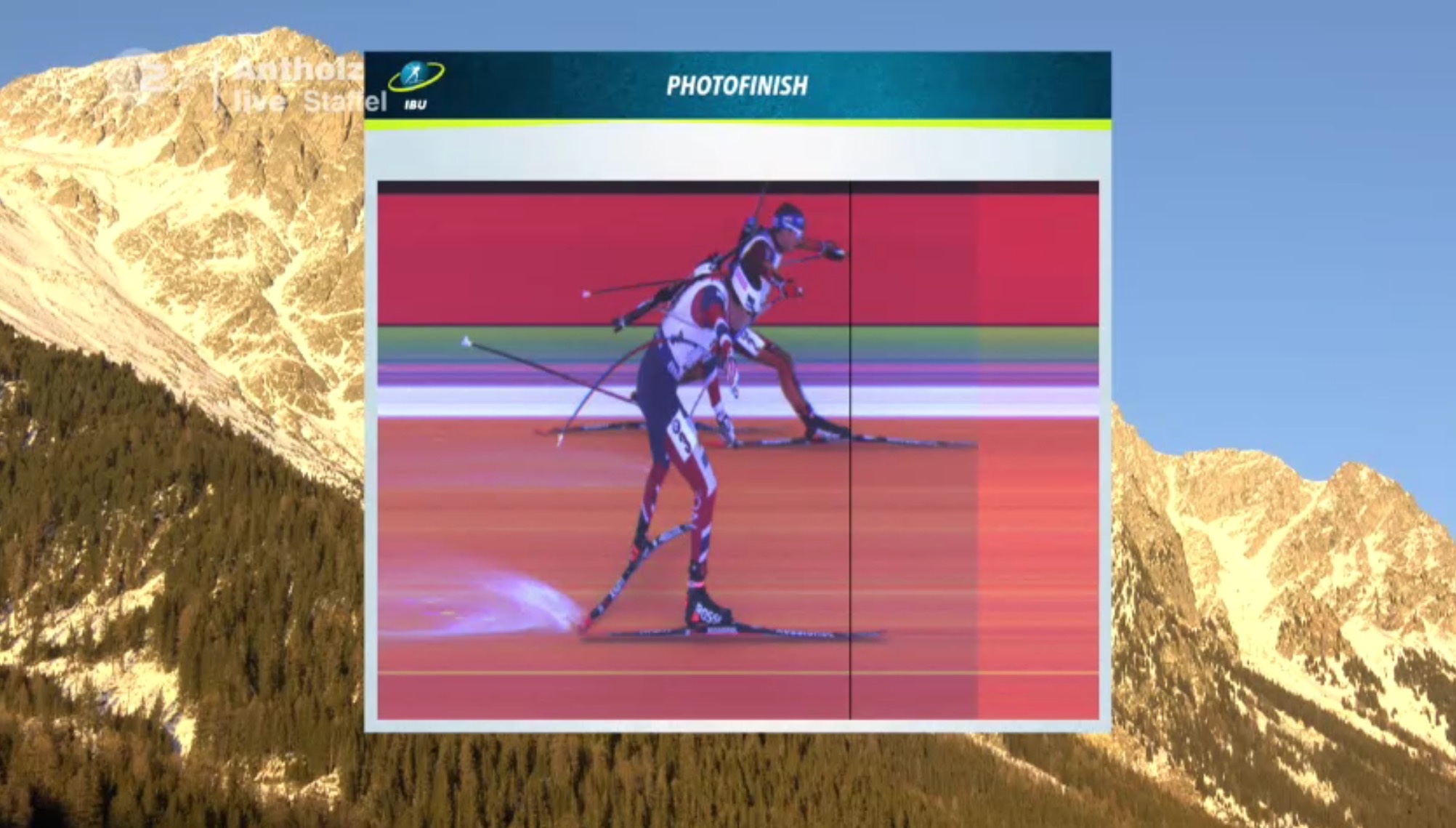
Reid, a 2018 Olympian, was solid on the range needing just one spare in prone and another in standing. She brought the team home in fifth place, 50.1 seconds back of gold-medal winning Norway. Russia took second and France edged Italy for third in a photo finish.
“I think it’s really encouraging that we were within 20 seconds of Italy and France – two of the top teams – with the same shooting,” added Egan.
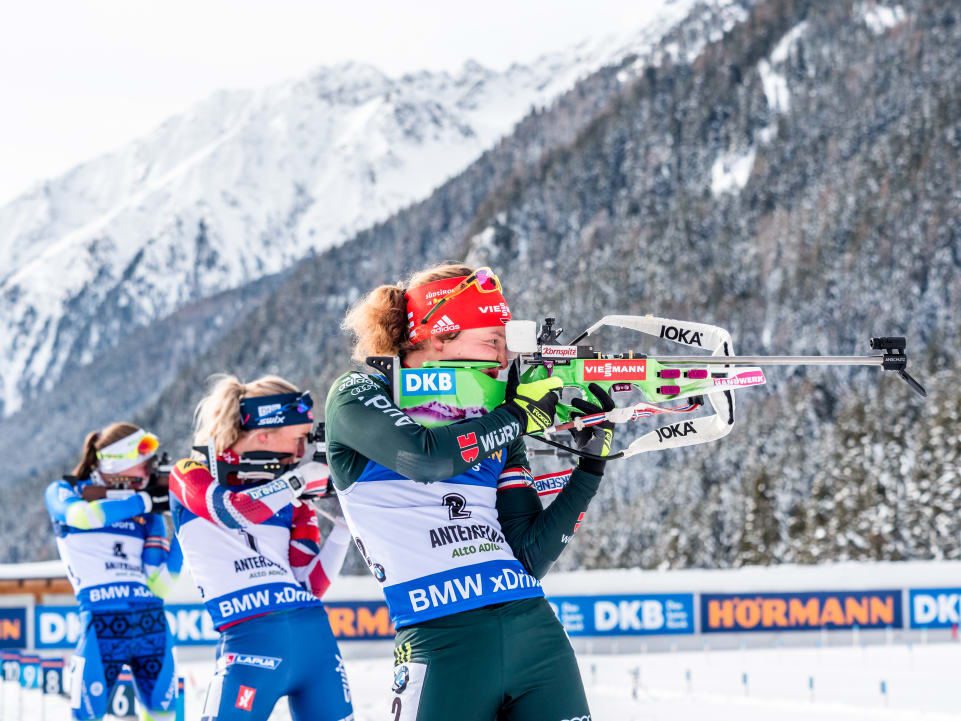
Joanne Reid and Deedra Irwin (USA), (l-r) celebrate at the finish in Antholz (ITA). (Photo: NordicFocus)
Earlier in the day, Paul Schommer (Appleton, Wis./Team Crosscut & USBA) finished 22nd in the men’s 15km mass start, the first mass start of his career.
The World Cup in Antholz wraps up Sunday with the men’s 4×7.5km relay followed by Egan competing in the women’s 12.5km mass start on the heels of her fourth-place finish in Friday’s 15km individual.
Catch the action live on Peacock with Chad Salmela and USBA President & CEO Max Cobb commentating live from Antholz. Download the IBU App to keep track of all your favorite athletes! BMW IBU World Cup – Antholz, Italy (all times Eastern)
Sunday, Jan. 23
6:15 am – Men’s 4×7.5km relay
9:15 am – Women’s 12.5km mass start
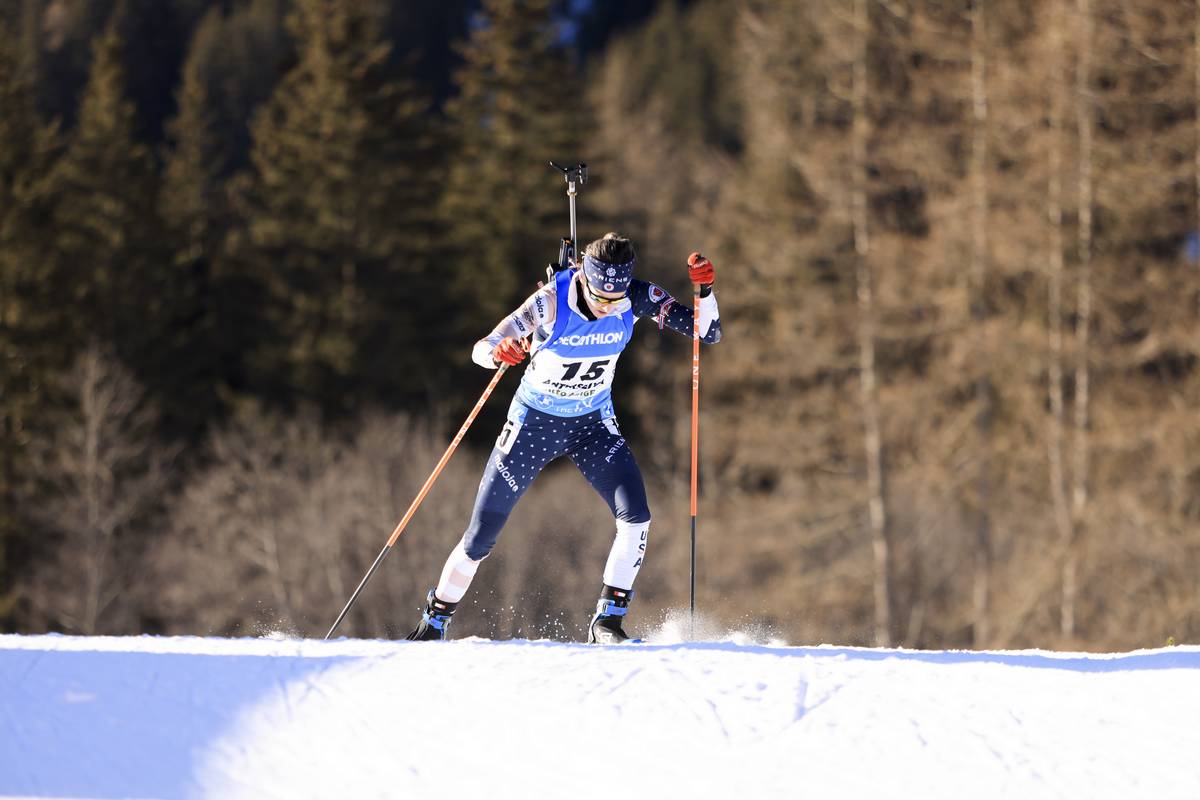
Clare Egan races to fourth place in the 15km Women’s Individual competition in Antholz, Italy. (Photo: NordicFocus)
Antholz, ITA – US Biathlon Team and Craftsbury Green Racing Project athlete Clare Egan (Cape Elizabeth, Maine) grabbed the second-best finish of her career with a fourth place in Friday’s 15km Women’s Individual competition in Antholz, Italy. The result comes after Egan went home for Christmas and skipped the Oberhof World Cup to prepare for the Beijing Games.
“The biggest challenge with my preparation has been staying positive and patient while I try to get my physical shape up to speed after a tough start to the season,”said Egan. “But I’m well-supported by the team around me so I never stop believing. I think my plan to go home for Christmas and then skip the World Cup in Oberhof to train here in Antholz at altitude has worked well for me.”
The last time Egan participated in the flower ceremony was in the same event in 2020 at the Pokljuka World Cup where she placed 6th. Being back in top form showed her she was on the right track after a disappointing 76th place last week in the Ruhpolding World Cup 7.5km Sprint race. Egan was inspired by Paul Schommer’s 9th place finish yesterday, and hopes her 4th can inspire the rest of her team to know they are on the right path ahead of the Olympics.
“Biathlon is a very difficult sport and the great thing about Clare is that she is resilient and perseveres,” said Women’s Head Coach Armin Auchentaller. “Hard work always pays off, the biggest thing is to believe in what you are doing.”
Egan certainly allowed the plan to play out in her favor, and her fourth place finish qualifies her for the Women’s 12.5km Mass Start on Sunday. But first, she’ll join forces with the rest of the US Biathlon Olympic squad for the Women’s Relay on Saturday.
“I am really looking forward to our relay tomorrow and my first mass start of the season on Sunday,” she said. “I just need to focus on recovering well now because it’s a lot of kilometers in three days!”
Rounding out Team USA’s finishes today were Deedra Irwin in 55th, Joanne Reid in 73rd, and Susan Dunklee in 88th.
Catch the action live on Peacock with Chad Salmela and USBA President & CEO Max Cobb commentating live from Antholz. Download the IBU App to keep track of all your favorite athletes!
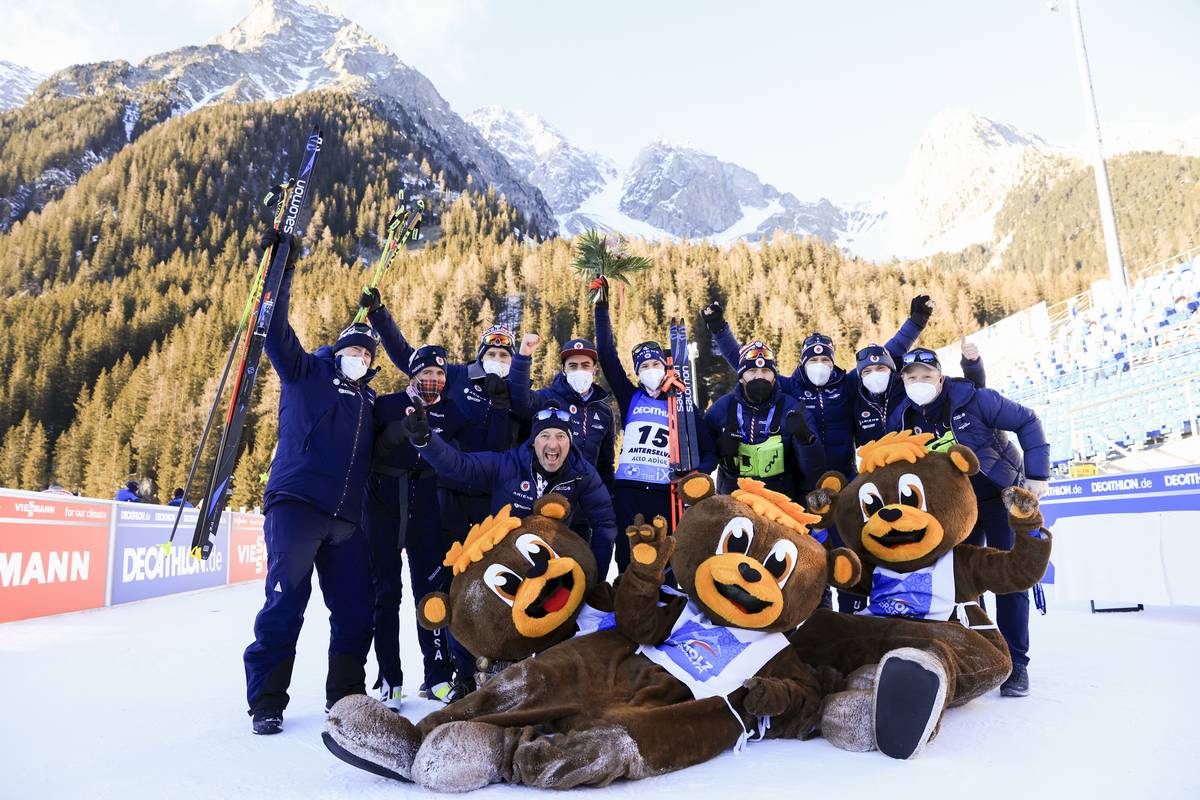
The US Biathlon team and staff (with a few mascots) celebrate a successful string of races in Antholz, Italy. (Photo: NordicFocus)
BMW IBU World Cup – Antholz, Italy (all times Eastern)
Saturday, Jan. 22
6:50 am – Men’s 15km mass start
9:00 am – Women’s 4x6km relay
Sunday, Jan. 23
6:15 am – Men’s 4×7.5km relay
9:15 am – Women’s 12.5km mass start
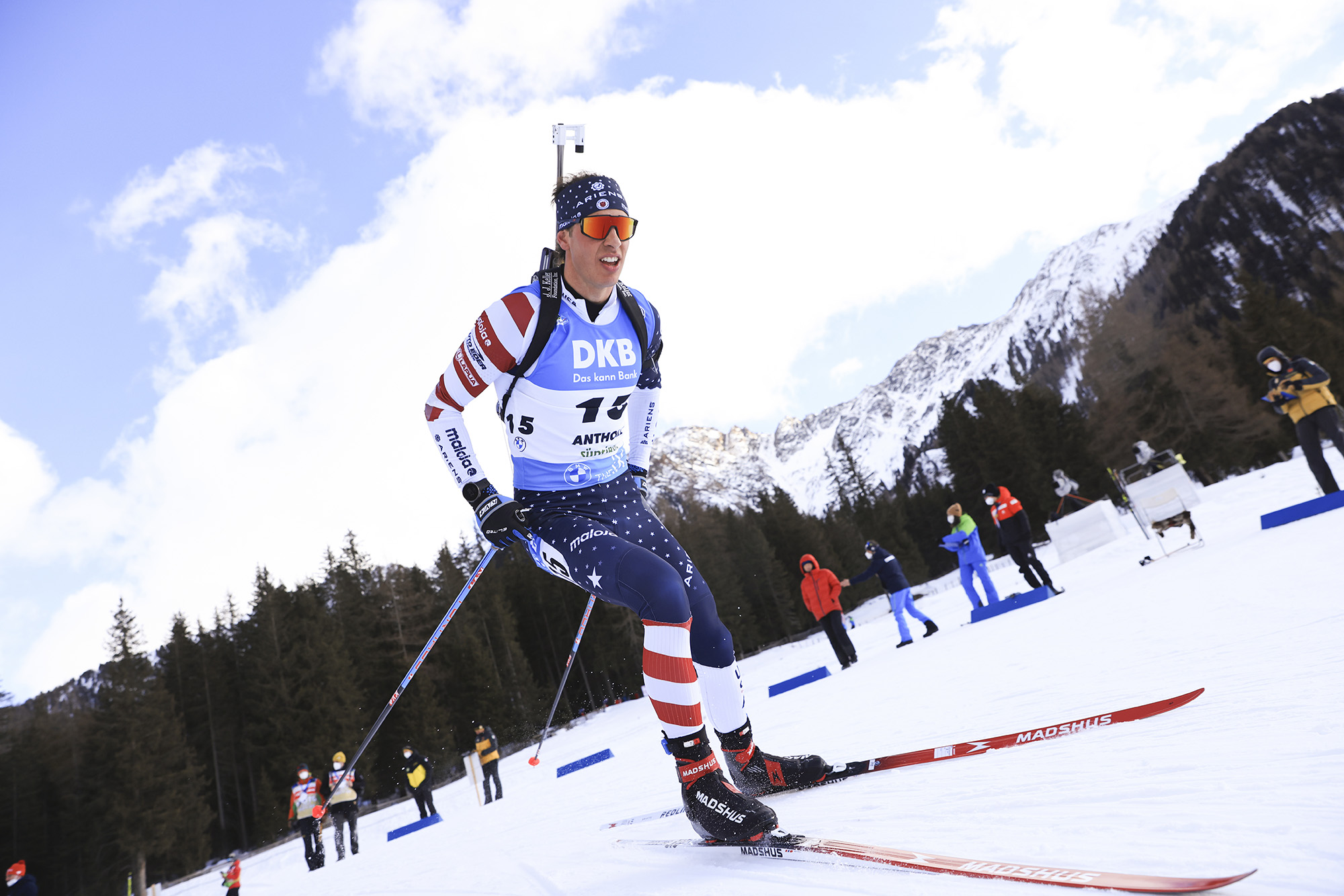
Paul Schommer (USA) 9th in Antholz (ITA). (Photo: Nordic Focus)
U.S. Biathlon Team and Team Crosscut athlete Paul Schommer (Appleton, WI) on Thursday added to his already stellar season with the first top-10 performance of his career. Schommer, who earlier this season qualified for his first Olympic Winter Games, placed ninth in the 20km Men’s Individual race in Antholz, Italy under gusting conditions and on one of the more challenging 20km courses on the IBU World Cup.
“Today’s approach was the same as it’s been all year – don’t do anything special,” said Schommer. “We have had great preparations this year and I believe we don’t have to do anything differently to get our best.”
The last time the US had a man place in the top-10 was Leif Nordgren’s 8th place in the 2020 World Championships 20km Individual, also in Antholz. Before that was Sean Doherty’s 10th place at the 2019 Soldier Hollow, Utah World Cup. Antholz is the final World Cup ahead of the Beijing Olympic Games and, as such, is an important tune-up for athletes as they head to China next week.
“There are many ways to achieve good individual performances, but consistent good team performances are built through a team culture,” said Men’s Head Coach Vegard Bitnes. “We have a team that is pushing each other everyday…Paul had a good biathlon race, from beginning to end. The whole team worked so hard today and I’m proud and humbled to be a part of that.”
With his ninth place finish, Schommer has qualified for the Men’s Mass Start event on Saturday – an invaluable experience for any athlete will be Schommer’s first World Cup Mass Start.
“It feels great [to qualify for the Mass Start]! I can’t wait!” said Schommer.
Also today, Jake Brown finished 34th, Leif Nordgren was 54th and Sean Doherty placed 70th. The Women’s Individual race is next up on Friday at 8:15am ET. Catch the action live on Peacock with Chad Salmela commentating live from Antholz. Download the IBU App to keep track of all your favorite athletes!
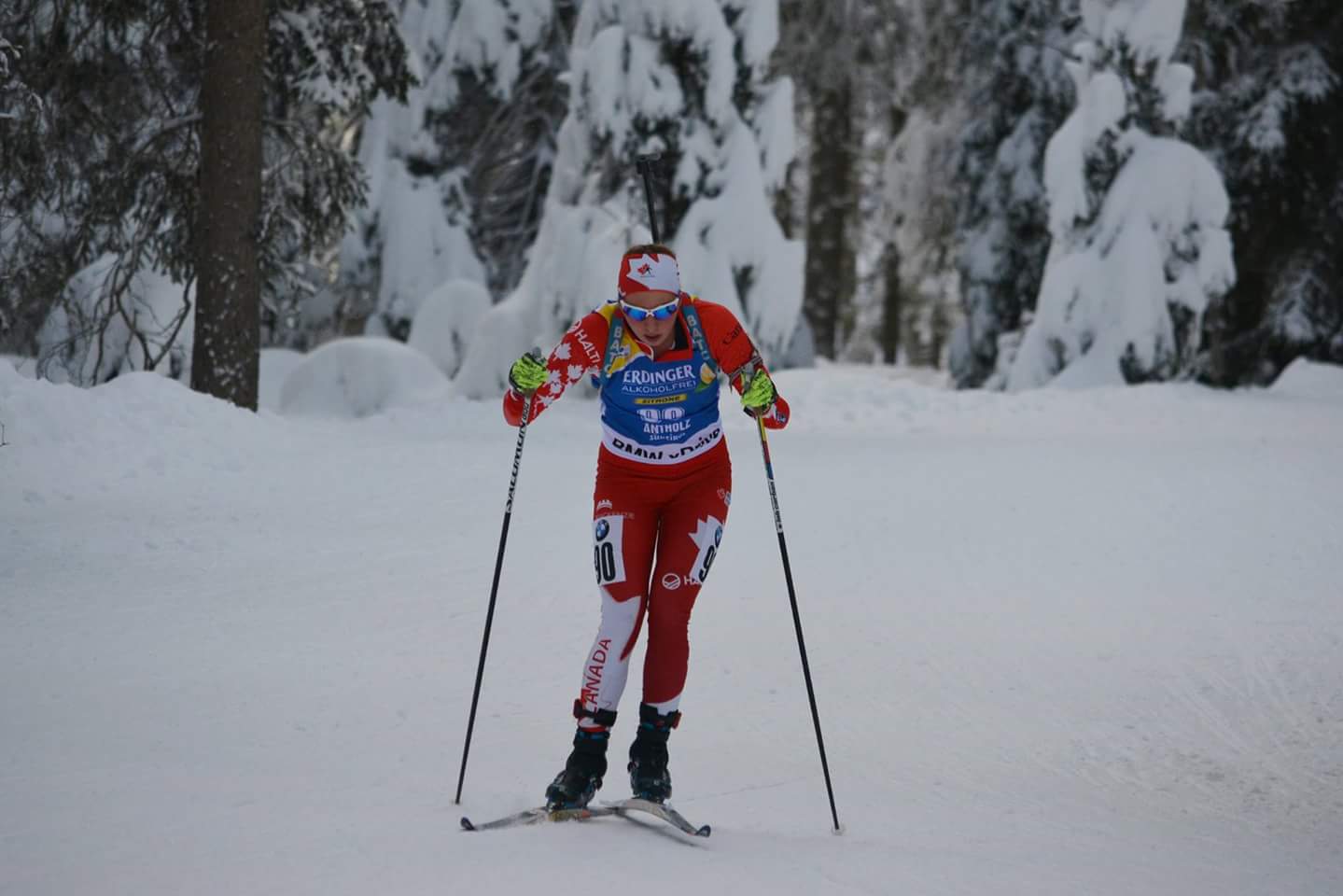
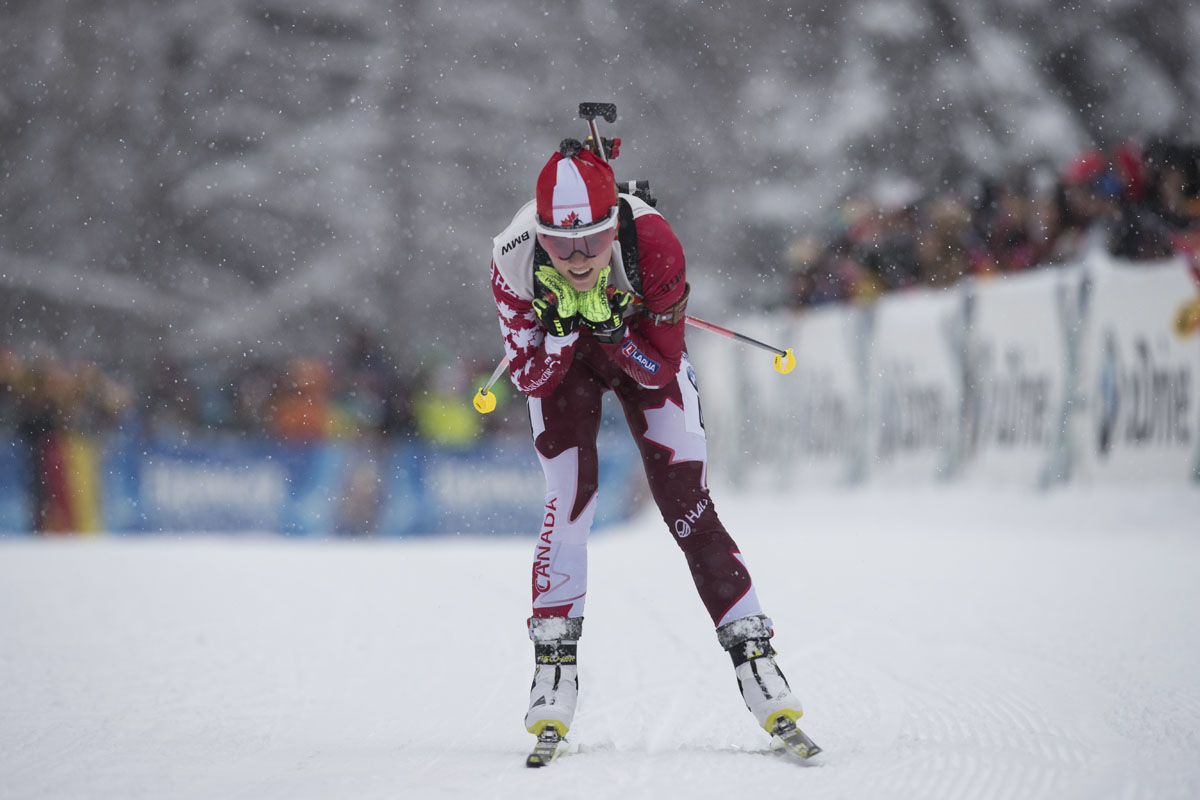
Nadia Moser of Canada in her first World Cup start in Antholz, Italy, this season. (Courtesy photo)
In an effort to showcase the North Americans competing at this week’s International Biathlon Union (IBU) 2018 Youth and Junior World Championships in Otepää, Estonia, we asked those qualifying athletes several questions about themselves — actually, we had them fill in the blanks. Here we have 20-year-old Nadia Moser, who is representing Canada at her second Junior World Championships. Moser started her season with four weekends worth of IBU Cup racing, and also got her first World Cup start in Antholz, Italy, where she finished 85th in the 10 k sprint.
On Thursday, Moser placed eighth in the junior women’s 12.5 k individual (+4:18.9 with three penalties) for her first top 20 in a non-relay event at Junior Worlds.
***
“My full name is Nadia Moser but you can call me Nadia.
I was born in Edmonton, Alberta, and raised in Atlin, British Columbia and Whitehorse, Yukon, and I learned to ski at… I don’t know exactly the age but I was pretty little.
I spent the time before Worlds training in Canada and Europe.
The windiest workout I did in the last training year to prepare for this was hiking to the top of Grotto Mountain on my own.
One thing I’m working on this season to improve my biathlon is ski technique.
This is my second time in Estonia and third year racing internationally, and so far it’s been interesting.
Canada’s Nadia Moser competing in the pursuit race at 2017 Junior Open European Championships in Nove Mesto, Czech Republic. (Photo: Emily Dickson)
One difference I’ve noticed between Estonia and the Canada is the landscape here is much flatter than Canmore.
One of the things I’m most excited about for World Youth/Junior Championships in Otepää is all of the races! I can’t target just one!
Watching the Olympics in the leadup to my own races was super exciting and inspiring. One of my favourite moments of the Games was watching Simon Schempp and Martin Fourcade sprint for the gold in the mass start.
I want to be like any super speedy animal, maybe a cheetah, because it would really help to be fast on race day.
At Worlds, I really hope I can chat/make friends with someone from any other country and ask them how they like racing in Estonia.
My favorite thing at the breakfast where we are staying is oatmeal/granola.
Before this trip, if you said “Estonia”, the first thing I’d think of would have been fish jello, because last year there was fish jello at the hotel I stayed at here (in Otepää).
Now that I’m here, I’m pretty sure something I’ll always remember will be fish jello.
If I had a totally free day here and didn’t have to worry about race fitness or training, I’d spend it exploring the science centre in Tartu.
The best way to follow me on social media is on Instagram@nadihaamoser.”
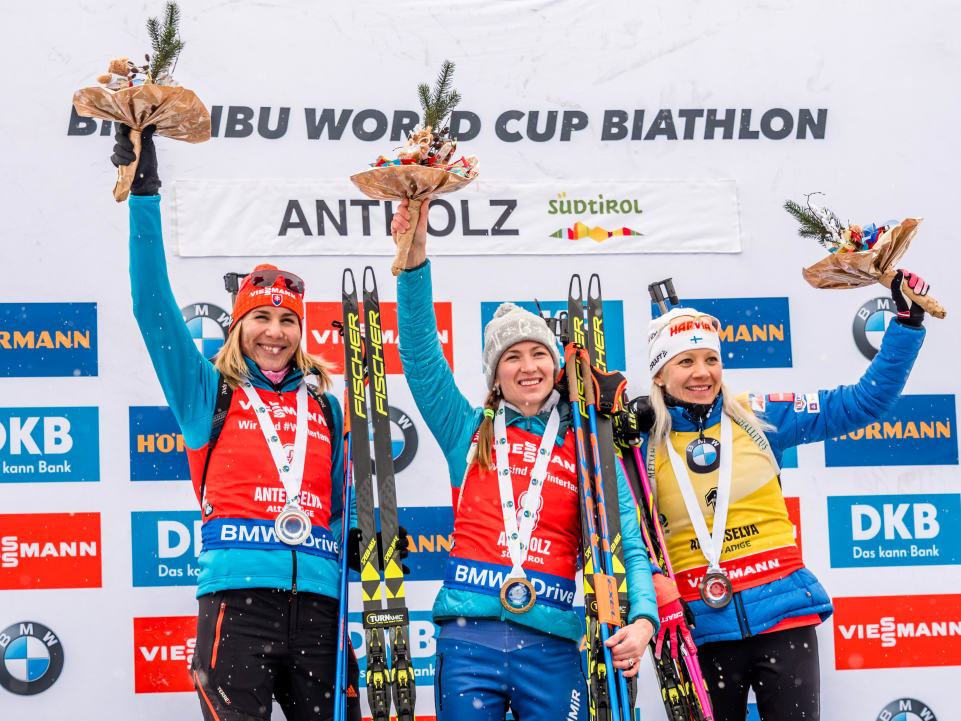
Darya Domracheva of Belarus (center) won the final World Cup race before the Olympics, a 12.5 k mass start in Antholz, Italy. Anastasiya Kuzmina of Slovakia was second and Kaisa Makarainen of Finland third. (Photo: IBU/Biathlonworld)
On Saturday, Darya Domracheva watched as second place in the World Cup pursuit skied away from her.
She had stepped on competitor Dorothea Wierer’s pole in the final corner of the 10 k pursuit in Antholz, Italy, and felt it unsportsmanlike to try to beat Wierer to the finish when the Italian had only one ski pole. So she let Wierer go and settled for third.
In Sunday’s World Cup mass start, Domracheva was rewarded by some combination of karma, skill, and hard work, and rounded that same corner to the finish line all alone in first place to claim her second win of the season.
Nobody shot better than Domracheva, and only six other women matched her single penalty loop. The Belarusian left the shooting range after the fourth and final stage with just a 3.3-second lead on Slovakia’s Anastasiya Kuzmina, who missed three shots in total and was coming out of the penalty loop as Domracheva skated past.
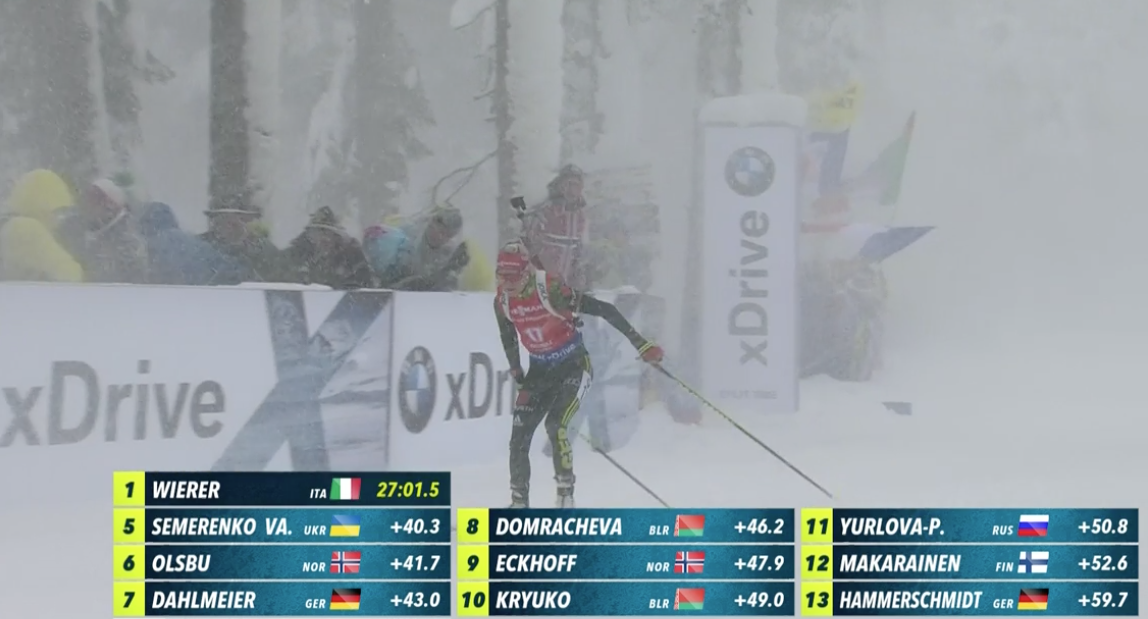
Germany’s Maren Hammerschmidt fights through thick snow in the forest during Sunday’s 12.5 k mass start in Antholz, Italy. (Eurovision screenshot)
“It was very tough race, and very slow snow conditions,” Domracheva said in a press conference of the abundant fresh snow that had fallen overnight and continued to fall off trees and onto the trails (and racers) during the competition. “So I understood from the start of the competition that it was really important to be focused on shooting today.”
But Domracheva was able to put the hammer down and extend the gap on Kuzmina, who had been the most dominant athlete of the first half of the season, and win by 11.9 seconds.
“I can say that today was quite a tough race for me,” Domracheva said. “The feeling was not so light. It was also not in the plan that here in Antholz would be very easy. So we are still in preparation, and it’s one very important step in my preparation for the next races.”
It was the last World Cup competition before the Olympics, where Domracheva will do her best to follow up on the three gold medals she won in Sochi in 2014.
Kaisa Makarainen of Finland fights to the finish line. (Photo: IBU/Biathlonworld)
Third place went to Kaisa Makarainen of Finland, who was frustrated by four missed shots and left the range (and penalty loop) the final time in eighth place. But in a stunning show of grit and speed, she charged past racer after racer; she had the fastest ski time of the day and that was particularly true on the last loop.
The Finn celebrated as she crossed the line 16.2 seconds behind Domracheva. That meant another podium – her fifth of the season – and two spots on Germany’s Laura Dahlmeier, thus hanging onto the yellow bib of the overall World Cup leader until racing resumes after the Olympics (which don’t count for World Cup points).
“I tried to ski as fast as possible and catch some places,” Makarainen said in the press conference. “I was not sure if I could catch the podium because it was quite a big gap. But I guess some other girls were more tired than me!”
Fourth place went to Norway’s Marte Olsbu (+22.6), fifth to Dahlmeier (+23.9), and sixth to her teammate Maren Hammerschmidt (+25.2).
Wierer had shot clean through three stages and led the race onto the shooting range the last time, to the thrill of the home crowd. But she missed two shots and ended the day in seventh, +29.4.
Fourcade Extends World Cup Lead with Another Win
While Norway’s Johannes Thingnes Bø came into the men’s 15 k mass start with two consecutive wins under his belt, he immediately missed two shots in the first prone stage, then two more in the next prone stage.
While Bø has turned in some of the most stunning performances on the World Cup this season, another man leads the standings, and that’s Martin Fourcade of France. Fourcade is nothing if not consistent and with only two missed shots in the mass start, he picked up his sixth win of the season.
Martin Fourcade of France leading the 15 k mass start in Antholz, Italy, where he picked up his sixth win of the season. (Photo: IBU/Biathlonworld)
“It’s good to find back this position in Antholz,” he said in a post-race press conference. “It’s only my second victory here. The first one was in the mass start in 2011, so it’s been a while and I’m very satisfied and happy to be back on top of the podium in Antholz.”
The last time Fourcade was off the podium was in the single mixed relay in Östersund, Sweden, in the very first race of the season, and the last time he was off the individual podium was back in Kontiolahti, Finland, in the second-to-last weekend of last season.
“The weekend was really nice,” Fourcade said. “I had not my best ski level on the first two competitions, but today felt really good on the skis and it gives me confidence for the Olympics… I want to keep my hunger from that last [bullet] I missed, to keep some things to work on for the Olympics.”
With the younger Bø out of the picture, the two men who ended up battling behind Fourcade were both still Norwegian: Tarjei Bø, the older brother in the family, and his teammate Erlend Bjøntegaard.
Tim Burke of the United States after finishing 22nd in the World Cup mass start in Antholz, Italy. (Photo: USBA/Instagram)
Former World Champion Bø won their sprint to the finish, crossing the line 2.8 seconds behind Fourcade (who had eased through the last few hundred meters after maintaining a big lead through the rest of the course), and Bjøntegaard picked up his first career podium in third (+5.1).
“It was quite fun actually,” Bjøntegaard said of his battle with Bø. “I’ve had a lot of hard sessions with that guy in the past two years. We were talking to each other on the fourth loop and the last loop, trying to exchange who was in front. I think that worked out quite well. I know that he is strong in the head, especially at the end, but I think I gave it a good shot and I really tried.”
After the Norwegians it was two Germans battling to the line, with Benedikt Doll taking fourth (+16.0) and Johannes Kuehn fifth (+18.3), each with two missed shots.
Johannes Bø struggled mightily against his five total penalties, and remarkably managed to make it up to sixth place, just 29.2 seconds behind Fourcade.
Laura Dahlmeier of Germany, Tiril Eckhoff of Norway, and Darya Domracheva of Belarus on the shooting range in the 10 k pursuit in Antholz, Italy, today. Dahlmeier went on to win the day. (Photo: IBU/Biathlonworld.com)
Norwegian biathletes started in the lead of both of today’s World Cup pursuits in Antholz, Italy, today, and one stayed there: Johannes Thingnes Bø cruised to a one-minute win over French rival Martin Fourcade, shooting a perfect 20/20 and flying on the trails. In the women’s race, his teammate Tiril Eckhoff had a few too many missed shots, and as she faded to fourth Germany’s Laura Dahlmeier surged to eventually claim a 17.3-second win over Dorothea Wierer of Italy.
Dahlmeier Finding Form as Olympics Near
Dahlmeier started second today behind Eckhoff, and shot 19/20 to take the win. Her only missed target was the last shot of her very first shooting bout; from then on she was perfect, and looked calm as she knocked down target after target, even in the last shooting bout as she went head to head with Eckhoff and Belarus’s Darya Domracheva.
“Pursuits are a real thriller,” Dahlmeier told German broadcaster ARD after the race, according to a translation. “The one who keeps her thoughts in check the best usually wins. I tried to shoot clean but had a miss right in the first stage. Then I tried to close the gap again, and in the third and fourth shootings it was incredibly suspenseful again. It was absolutely important to stay centered within yourself. And I am really really happy it worked out like this today.”
Behind her, the race for second place was intense. With Eckhoff missing two shots in the final shooting bout, she was out of contention. Domracheva had missed one shot and headed to the penalty loop; as she came out, Wierer – who had cleaned that last bout – joined her.
The two battled on the trails, with Domracheva initially leading but unable to drop Wierer, then Wierer passing her on the last big, open climb, but unable to drop Domracheva. In several stretches of the course, the two women were side by side, each skiing their hardest but unable to get any sort of gap.
Dorothea Wierer crosses the finish line in second place with just one pole, as Darya Domracheva – who stepped on her other pole – eases up and settles for third. (Photo: IBU/Biathlonworld.com)
Then rounding the final corner to the finish line, Domracheva – following Wierer closely – stepped on her competitor’s pole, pulling it off completely. In an act of sportsmanship, Domracheva hung back as Wierer skied with one pole down the finishing stretch to claim second place.
“I was before Darya, and it can happen – of course it was really [close] between us, and she took my pole, but it is like this when you are fighting,” Wierer said in a press conference, before adding that her competitor’s response to the incident was nice. “Thank you Darya!”
“Of course, it would be absolutely unfair from me if I would fight against an athlete with one pole,” Domracheva said in the press conference. “I was the reason that she lost it. So. Even so, I couldn’t be sure that I could be hear to this finish line. But anyway, it was not such a nice situation for us both, but I could not play it another way.”
Both women are on an upward trajectory, with Wierer picking up her third podium in the last five races, and Domracheva taking her third podium of the season. In the last ten races, the triple Olympic gold medalist has only been out of the top eight twice.
“I’m really happy today,” Wierer said. “Of course a lot of people expect a podium at home. It’s even more difficult – there are lots of things to do, interviews and appointments and everything. So it’s really stressful for me. But I felt really relaxed today, I felt comfortable on the skis and I think with two mistakes, it was okay, for today.”
Eckhoff crossed the line +1:09.9. Finland’s Kaisa Makarainen finished fifth, +1:18.4, after moving up from 26th place in the sprint thanks to just two missed shots. That means that she holds on to the overall World Cup leader’s bib.
Sixth place went to Kazakhstan’s Galina Vishnevskaya, one of just three women to shoot 20-for-20. Her result was accompanied by the news that the Kazakh team is still being investigated for doping materials found in Austria last year. The police carried out a search warrant of their team lodging and van in Antholz today, according to an International Biathlon Union press release.
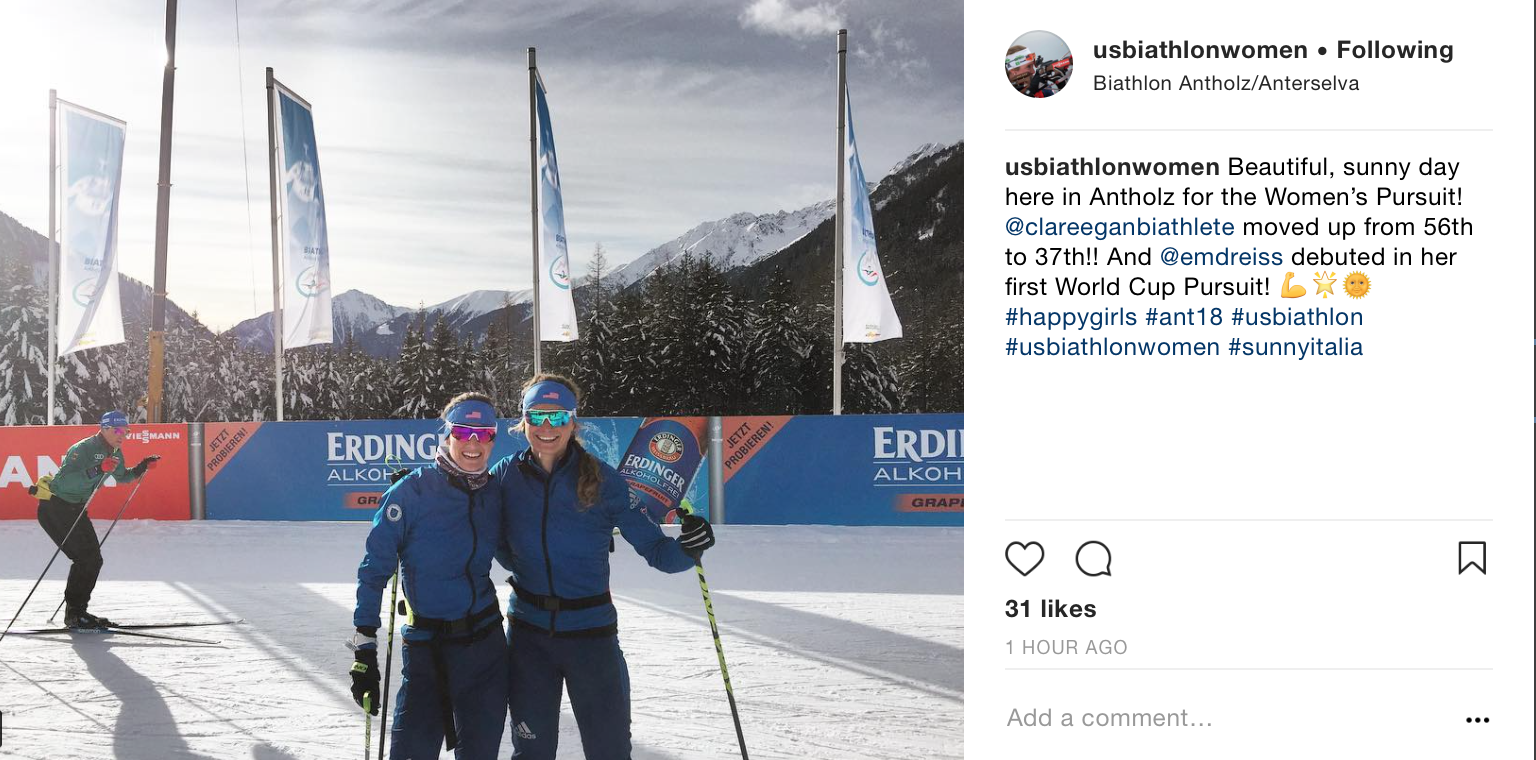
For the U.S., the top finish came from Clare Egan, who moved from 56th up to 37th despite three missed shots; she had the 22nd-fastest ski time of the day.
“I’m really happy with my skiing right now,” Egan wrote in an email. “I’m finally getting into race shape, just in time for the Games. Today I had the 8th fastest last lap, which is a personal best for me. I also believe I had the fastest skis out there. I was psyched to stay with Justine Braisaz all the way from the last shooting to the finish and I think if we hadn’t had to go around a few other people I could have gotten a better finishing Lane for the sprint.”
Emily Dreissigacker, competing in her first-ever World Cup pursuit, finished 56th (+6:27.2) with four missed shots.
“My strategy was really to just relax and try not to get too caught up in the excitement,” Dreissigacker wrote in an email. “I think I did a good job of that until my last shooting. That last standing I was definitely very tired going into it and it just felt very rushed and hectic, not relaxed at all. I think this was a good final weekend of racing before the Olympics. I definitely struggled with the altitude a little but overall I think it was good progress. I am looking forward to getting in a good training block in Ruhpolding before we head to Korea.”
Susan Dunklee sat out the pursuit with a cold. No Canadian women qualified for the event.
Bø Decimates Field in Men’s Pursuit, But Fourcade Still Leads World Cup
Bø started with a lead of 12.8 seconds over Fourcade, and it only got bigger. The pair have been battling all season and between them have taken every win so far but one – that went to Bø’s brother, Tarjei.
But today Fourcade didn’t look like a match for the Norwegian, who not only hit all his targets but also skied faster than the Frenchman, and gained a few seconds on the shooting range, too.
With Fourcade missing just one shot, by the finish the margin between the two men had grown to a whopping 1:00.5.
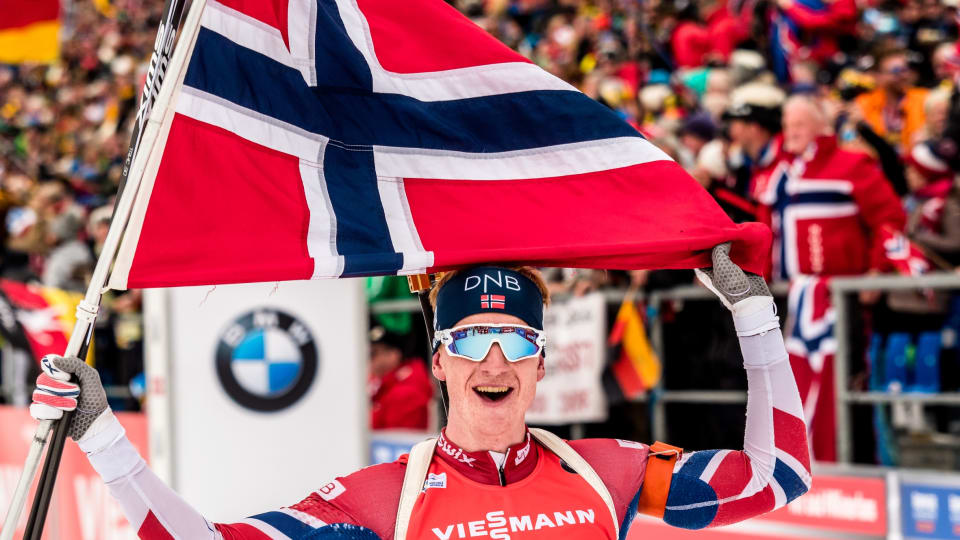
Johannes Thingnes Bø of Norway picked up his eighth win of the season. (Photo: IBU/Biathlonworld.com)
“Until the last shooting, anything is possible,” Fourcade said in a press conference. “But since the first shoot, I knew that I had to expect Johannes [to make mistakes] to be back in the competition. Today he was perfect. There’s nothing more to add…. I’m satisfied with what I did today. It’s not my best shape, but… I’m satisfied that I did a beautiful biathlon competition and a beautiful second place.”
Anton Shipulin of Russia moved from fourth into third place after the second shooting, and never relinquished this spot as his only penalty of the day had come in the first stage. He finished +1:18.4. Arnd Peiffer of Germany, who has started in third and missed one shot in the second stage, finished fourth, +1:47.5.
Fifth place went to Emil Hegle Svendsen of Norway, who cleaned all his targets to move up from 32nd.
Three men started for the U.S., with Tim Burke and Lowell Bailey both collecting just one penalty. That moved Burke from 43rd up to 21st in the pursuit, finishing +3:03.4.
“I feel like I may have been a bit too conservative on the range in some of my previous four-stage races this season,” Burke wrote in an email. “I went out there today with the goal of being more aggressive and getting my total range time back down to a more competitive time. Today was just one of those days when it clicked and I was able to carry through with the plan. I was in quite the group on the last lap but unfortunately was at the end of the group for the entire loop. I did not have the legs today to get around. Tomorrow I will have another chance in the mass start!”
Bailey moved from 41st to 35th (+3:54.8).
“Shooting was decent today, but I didn’t feel any better on the skis, unfortunately,” Bailey said in a U.S. Biathlon Association press release. “For now, I’ll take a rest day and get back to it on Monday with the preparation for the Olympics. I trust my training was good this season. Now, it’s just a matter of doing some quality training sessions over the next two weeks and focusing on the Olympics.”
Despite three misses, Leif Nordgren climbed from 50th to 44th (+4:40.8).
Norway’s Johannes Thingnes Bø racing to another win in the men’s 10 k sprint on a bluebird day on Friday at the IBU World Cup in Antholz, Italy. (Photo: Manzoni/NordicFocus)
IBU World Cup (Antholz, Italy): Men’s 10 k sprint
One prone penalty wasn’t enough to keep Johannes Thingnes Bø from his third-straight victory (and ninth this season, including relays) as the 24-year-old Norwegian won the men’s 10-kilometer sprint on Friday at the International Biathlon Union (IBU) World Cup in Antholz, Italy.
Bø started 42nd of 109 men and had to navigate tricky wind conditions, along with the rest of the field. After missing one target in the prone shooting, Bø left the range in third, 4.8 seconds behind the race leader at the time, Austria’s Julian Eberhard, and 2.6 seconds behind his Norwegian teammate Lars Helge Birkeland in second.
Throughout the race, Bø set the fastest course times and took a sizable lead over Birkeland and Eberhard after standing, which he cleaned and left the range 33.5 seconds ahead of Birkeland, who had also hit all five standing targets. Eberhard missed two to slip 1:11.6 minutes back.
Bø went on to cross the finish line in 23:19.3 minutes, faster than France’s Martin Fourcade (who started behind him in bib 48 and cleaned both stages), as Fourcade finished 12.8 seconds back in second.
The men’s 10 k sprint podium at the IBU World Cup in Antholz, Italy, with Norway’s Johannes Thingnes Boe (c) in first, France’s Martin Fourcade (l) in second, and Germany’s Arnd Peiffer (r) in third. (Photo: Manzoni/NordicFocus)
Germany’s Arnd Pfeiffer started 47th, just ahead of Fourcade, and raced to third (+42.2) with clean shooting as well.
“In the sprint, you almost always have to shot clean,” Bø reflected after, according to an IBU press release. “After my prone miss, I knew a podium would be hard, but you never know; you fight hard. With zero in standing, I knew there was a chance … I had the times from the start and knew I had good speed today … Martin is almost always stronger than me on the last lap, but today I was not tired.”
Fourcade pointed out that this was his best sprint result in Antholz, a high-elevation venue at some 5,200 feet above sea level, since 2011, “so I am pretty satisfied,” he told the IBU.
Pfeiffer told German broadcaster ARD that he latched onto Fourcade for the last loop.
“At least I was clean on the shooting range today, that was not so easy,” Pfeiffer said, according to a translation. “I am pretty proud I managed to do that today. This was not my best day on the course, even if the position might insinuate something else. I had to toil quite a bit, and was lucky that Martin came by for the final [loop], who also wasn’t in his top shape today.
“In the end of course the result was great, I haven’t been on the podium in an individual-start race so far this season,” Pfeiffer continued. “So I am happy about 100 percent shooting accuracy and hopefully being on the podium if everything works out.”
Russia’s Anton Shipulin missed the podium by about four seconds in fourth (+46.3) with one standing miss (0+1), France’s Emilien Jacquelin placed fifth (+53.7) with clean shooting, Birkeland ended up sixth (+1:07.8) with zero penalties as well, Eberhard was seventh (+1:21.7) with two misses (0+2), Russia’s Anton Babikov eighth (+1:27.8; no penalties), Vladimir Chepelin of Belarus ninth (+1:32.3; one penalty), and the Czech Republic’s Ondrej Moravec 10th (+1:35.4; no penalties).
US Biathlon’s Lowell Bailey racing to 41st in the men’s 10 k sprint at the IBU World Cup in Antholz, Italy. (Photo: US Biathlon/NordicFocus)
Three out of five Americans qualified for Saturday’s pursuit, with Lowell Bailey leading them in 41st (+2:22.0) after one standing miss (0+1). Notably, he had the fifth-fastest overall shooting time.
Tim Burke was just another 0.4 seconds back in 43rd (+2:22.4) with three penalties (1+2), and Leif Nordgren finished 50th (+2:33.1) with two penalties (1+1) and the second-fastest overall shooting time and third-fastest range time.
Macx Davies, who was selected to Biathlon Canada’s Olympic team, was the top Canadian in 66th (+2:58.2) with three misses (1+2). Carsen Campbell finished 82nd (+3:27.9) with two penalties (2+0), Matthew Hudec was 89th (+3:40.6) with one miss (0+1), and Aidan Miller 107th (+5:00.3) with five penalties (3+2).
The men’s and women’s pursuits will be held Saturday in Antholz at 7:15 a.m. for the women and 9 a.m. for the men EST. Watch live on the Olympic Channel.
Western Canadian Championships (Red Deer, Alberta): Freestyle sprints
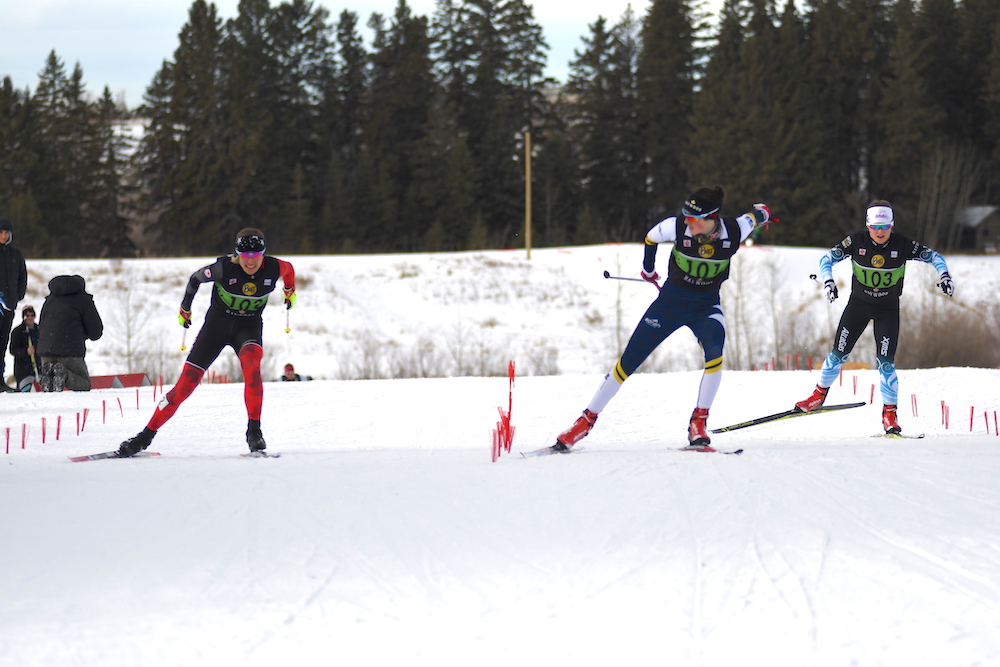
Olivia Bouffard-Nesbitt (c) holds off Zina Kocher (l) and Annika Hicks (r) to win the women’s 1.2 k freestyle sprint final on Friday at the NorAm Western Canadian Championships in Red Deer, Alberta. (Photo: Doug Stephen)
The NorAm series shifted west to to Red Deer, Alberta, for the fourth weekend of racing.
Olivia Bouffard-Nesbitt (Rocky Mountain Racers) won the women’s 1.2-kilometre freestyle sprint A-final in 3:09.12, edging out Zina Kocher (Foothills Nordic) and Annika Hicks (Alberta World Cup Academy) by 0.4 and 0.77 seconds, respectively. They qualified in the same order in a small women’s field of 20. Organizers opted to skip the quarterfinals and pinned the top 10 women from the qualifier in two semifinals.
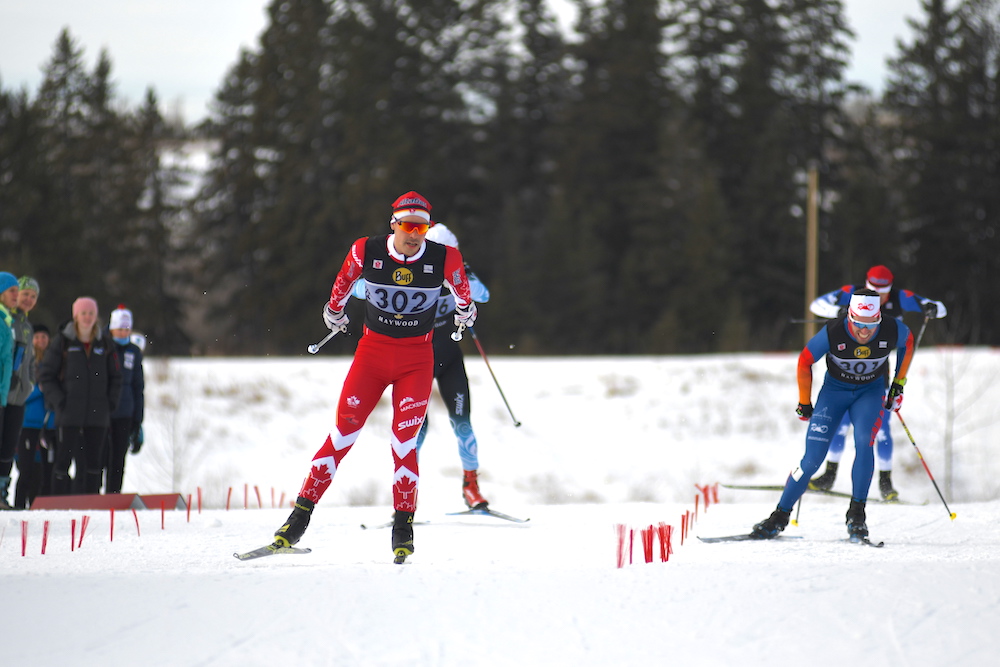
Jess Cockney (302) winning the men’s 1.2 k freestyle sprint final ahead of Russell Kennedy (r) on Friday at the NorAm Western Canadian Championships in Red Deer, Alberta. (Photo: Doug Stephen)
The men’s 1.2 k qualifier had 38 starters, and 22 advanced to the quarterfinals. After qualifying in second, 0.16 seconds off the top time set by Russell Kennedy (Team R.A.D.), Jess Cockney (Canadian World Cup Team) won his quarterfinal and semifinal and ultimately the men’s final in 2:24.29, 1.09 seconds ahead ofKennedy in second. PatrickStewart-Jones (Alberta World Cup Academy) grabbed his first podium of the season, taking third (+1.70).
Western Canadian Championships usually draw a smaller field than Easterns: more Canadians live within reasonable driving distance of Eastern Canadian Championships (hosted by Nakkertok in Cantley, Quebec) than live in all three times zones of western Canada combined.
With many of the top athletes in Europe doing final elevation camps for the Olympics and U23s/Junior World Championships, the Western Championships’ open and junior categories were particularly small this year with 287 athletes total.
Norway’s Tiril Eckhoff celebrates her first World Cup win (and first top 20) of the 2017/2018 season on Thursday after winning the IBU World Cup women’s 7.5 k sprint in Antholz, Italy. (Photo: IBU/Biathlonworld)
IBU World Cup (Antholz, Italy): Women’s 7.5 k sprint
So far this season, Norway’s Tiril Eckhoff had yet to crack the top 20 outside a relay in the International Biathlon Union (IBU) World Cup. That all changed Thursday when she won the women’s 7.5-kilometer sprint in Antholz, Italy.
She did so by hitting all 10 targets and besting the time of Germany’s Laura Dahlmeier by 12 seconds at the finish.
“I was very nervous for today,” Eckhoff, 27, told German broadcaster ARD in English after the race. “My shooting has been really bad, and I wasn’t qualified for the sprint at the Olympics, and that has been my plan the whole season for the Olympics. So I am very happy to manage to do a good race and a clean shooting today.”
Eckhoff started 71st out of 103 women, then went on to clean prone and standing and ski the second-fastest overall course time in the process. In doing so, she not only topped Dahlmeier, who started ahead of her in bib 22, but also the Czech Republic’s Veronika Vitkova, who started 21st and posted the second-fastest finishing time after Dahlmeier — until Eckhoff crossed the line. Both Dahlmeier and Vitkova also shot clean.
“I only got positive feedback so I was really happy,” Eckhoff said of trying to beat the times of both Dahlmeier and Vitkova. “I was thinking against Dahlmeier I had to ski really really fast. Now I was very happy to manage that.”
Germany’s Laura Dahlmeier racing to second in the women’s 7.5 k sprint at the IBU World Cup in Antholz, Italy. (Photo: IBU/Biathlonworld)
While Eckhoff finished in 21:05.3, Dahlmeier placed second (+12.0) and Vitkova ended up third (+20.6).
“I am very happy about my second place,” Dahlmeier told ARD. “That was a really good race today. I tried to shoot well, because in general the tendency in Antholz is to shoot a few too many misses, so I just tried to start out calm on the course and focus on the shooting.”
Asked specifically about Eckhoff, who’s previous best sprint result this season was 50th (and season best was 22nd in a 15 k individual race), Dahlmeier said, “You probably always have to account for a Tiril Eckhoff. She is a bit of a mixed bag on the shooting range, maybe I wouldn’t quite have expected her to twice get through clean, but when she manages to do that she is right at the top. And she proved that again today.”
Darya Domracheva of Belarus skied the fastest overall course time but had one standing penalty (0+1) that kept her from the podium as she finished fourth (+23.0), and France’s Anais Bescond shot clean to place fifth (+26.6).
Russia’s Ekaterina Yurlova-Percht placed a season-best sixth (+39.4) with clean shooting, Italy’s Dorothea Wierer was seventh (+40.0, one penalty), Switzerland’s Elisa Gasparin eighth (+52.6; no penalties), and Germany’s Franziska Hildebrand and Denise Herrmann ninth (+54.2, no penalties) and 10th (+56.2, one penalty), respectively.
US Biathlon started four of the five women on its Olympic team in Antholz, with Susan Dunklee leading all North Americans in 35th (+1:49.5) after a prone miss and another in standing (1+1). Clare Egan finished 56th (+2:17.0) with three penalties (2+1), Emily Dreissigacker shot clean and finished 59th (+2:26.8), thus qualifying for Saturday’s pursuit (which will be her first at the World Cup level) in the sprint top 60. Joanne Reid was the only American to miss the top 60 in 72nd (+2:43.6) with two prone misses (2+0).
Emily Dreissigacker was the last starter in the IBU World Cup women’s 7.5 k sprint on Thursday in Antholz, Italy. She went on to place 59th to qualify for her first World Cup pursuit. (Photo: US Biathlon/NordicFocus)
“I didn’t feel sharp on the skis and I struggled adjusting to the thin air of high altitude,” Dunklee said of the Antholz venue’s elevation around 1,600 meters (or 5,200 feet) above sea level, according to a US Biathlon press release. “I’m grateful to get another opportunity Saturday. I want to make the most of each race start as preparation for Korea. Three women in the pursuit – that’s a big step forward and a great place to see the team heading into the Games.”
“I definitely struggled with the altitude in the skiing, but I was really happy with my shooting and, of course, am very excited to have qualified for my first World Cup pursuit,” Dreissigacker said, according to the release.
“My shooting continues to be extremely disappointing,” Egan said. “But on the bright side I skied fast enough to give myself another chance on Saturday in the pursuit.”
Canada was led by Nadia Moser in 85th (+3:23.4) with two misses (1+1). Sarah Beaudry, who was recently named to Biathlon Canada’s Olympic team, followed in 87th (+3:30.4) with three penalties (2+1), and Megan Bankes finished 90th (+3:46.5) with four misses (1+3).
The Antholz World Cup men’s 10 k sprint takes place Friday at 8:15 a.m. EST.
In the penultimate chapter of a doping story which began nearly two and a half years ago, Italian biathlon relay World Champion Gottlieb Taschler and his son Daniel, an IBU Cup-level competitor, were convicted by an Italian court. Doping is a criminal offense in Italy and Daniel Taschler was convicted of using illegal methods, while his father was convicted of assisting and concealing the activities.
News first broke in late 2014 that the younger Taschler had been using the blood-boosting drug recombinant erythropoietin (EPO). He allegedly did so with the help of infamous “Doctor EPO” Michele Ferrari, a collaboration which was arranged by his father — who was then the Vice President for Sport of the International Biathlon Union (IBU), as well as the president of the Antholz-Anterselva World Cup Organizing Committee.
“Police used phone taps to listen in on conversations between Dr. Ferrari and Taschler,” CyclingNews.com reports. “Prosecutors believe they included instructions on how to take EPO and details of secret telephone numbers where Dr. Ferrari could be contacted. Taschler had pushed his son to work with Dr. Ferrari as a way to boost his athletic career.”
The elder Taschler stepped down from his IBU role after public pressure in December 2014, and the younger Taschler has not competed since then either.
“I have been shocked by the recent media reports alleging that I have been involved in doping and, even worse, that I have helped to organize performance enhancing substances for my son Daniel. This is simply not true,” Gottlieb Taschler wrote in an IBU press release at the time.
In 2016, the Italian Olympic Committee (CONI) arbitration panel found that Daniel Taschler had doped between 2010 and 2011. Both Taschlers received bans from participating in sport through June 2018.
A concurrent criminal case has also now been decided. Gottlieb Taschler was fined 4,000 Euros and Daniel 3,600, and they were sentenced to one year and to nine months of imprisonment, respectively, although the jail time was suspended. In both cases, the fines imposed by the judge were even heavier than those requested by state prosecutors.
The senior Taschler will have an uphill battle if he wants to regain his biathlon jobs, as the court also banned him for life from taking on any roles with CONI or with the Italian Winter Sports Federation, FISI. The IBU will have to decide on his fate separately.
The court also found Ferrari in violation, and fined him 4,500 Euros with 18 months of imprisonment, during which time he is not allowed to work as a doctor. Like the Taschlers, Ferrari saw his prison sentence suspended. He was also, however, ordered to pay a 15,000 Euro fine to the World Anti-Doping Agency.
Ferrari has been implicated in many doping scandals, most visibly in cycling; he worked with disgraced American cyclist Lance Armstrong, among others. He is serving a lifetime ban against working with the Italian cycling federation. This is the first time he has been convicted of a crime since doping became a criminal offense in Italy in 2000.
The Taschlers have said that they plan to appeal the decision.
US Biathlon’s Susan Dunklee ahead of Sweden’s Chardine Sloof during the second leg in the women’s 4 x 6 k relay at the 2017 IBU World Cup in Antholz, Italy. (Photo: USBA/NordicFocus)
As they had done in the first two relays this season, Germany and France occupied the top two positions on the podium in the women’s 4 x 6-kilometer relay on Sunday at the IBU World Cup in Antholz, Italy. And to the joy of over 20,000 raucous fans in the sunny arena, home team Italy claimed the third place. So far, so not very unusual.
But at the halfway point of the race, Susan Dunklee had moved the U.S. team into second position, just 33 seconds behind Germany in first. A potential surprise was in the air.
“Head-to-head shooting and hunting people down on skis are two of my favorite racing experiences, so I was thrilled with today,” Dunklee stated, according to a US Biathlon press release.
Starting the race in bib 22 out of the last start row, her teammate Clare Egan had slightly moved up on the course coming into the first prone stage, and with a clean shooting performance left the range in fourth place just 3.1 seconds behind the leaders.
US Biathlon’s Clare Egan on the course skiing the opening leg of the women’s 4 x 6 k relay at the 2017 IBU World Cup in Antholz, Italy. (Photo: IBU/Christian Manzoni)
“I rarely get to do mass starts but I love them,” Egan wrote in an email to FasterSkier. “I shot clean and was the first athlete off the mat so my plan worked. I just tried to position myself as best I could and then pass on the shooting range.”
She was able to keep up with the teams around her on the next loop, and with one spare in the standing shooting, she managed to hit all her targets, skiing back on the course in ninth place.
“Last week I also hit 9/10 targets, but then I had to use all three spares to get that last target down, because I got so nervous,” Egan explained. “So this week I really tried to prepare mentally for shooting my spares and it helped.”
On the final loop she managed to overtake the Austrian team while getting passed by Switzerland, and while Egan lost a bit more time to the French and German teams leading the race at that point, she tagged off to Dunklee in the ninth and just 21 seconds behind France and Germany.
Dunklee quickly began to close gaps and overtook several of the teams around her, including Sweden, Belarus, Slovakia and Norway.
“I felt sharper on skis than earlier this week,” Dunklee wrote in an email. “I think my body adjusted better to the altitude each day. I did not follow any sort of pacing plan today; I saw people ahead of me early and I went after them, and then held on as best I could on the last loop.”
In her prone shooting stage Dunklee needed two spares to hit all targets, leaving the range in fourth position. But she kept gaining ground on the loop and with a clean standing stage, while most of the athletes around her needed spares.
“I was disappointed to miss my last two shots in prone again, but standing felt good,” Dunklee wrote. “I took a few extra breaths before the first shot and then used an assertive cadence.”
Keeping Italy and Norway behind her on the final loop and only losing a few more seconds to Germany’s Maren Hammerschmidt, Dunklee tagged her teammate Joanne Reid in second (+32.9).
Reid, who is in her first full season with the US Biathlon World Cup team, was able to keep up with the leaders on the first loop, skiing close to the eventual podium finishers Anaïs Bescond of France and Alexia Runggaldier of Italy.
Reid cleaned the prone stage without any spares, but as most of the teams around her did the same, several teams remained close together. On the next loop, Reid was nearly able to hold her distance to the leaders, but was passed on the biggest climb by Ukraine’s veteran Valj Semerenko.
She may have invested a bit too much energy trying to keep up with the best teams on that loop, and in the following standing shooting Reid missed her first shots and eventually ran out of spares, having to ski twice through the 150-meter penalty lap to lose more than a minute and a half.
Reid tagged teammate Maddie Phaneuf in 13th position (+2:24.3). For Phaneuf, it was only her second time anchoring a U.S. World Cup relay.
“My very first World Cup two seasons ago, I anchored for our team (Susan Dunklee, Hannah Dreissigacker, and Annelies Cook) in Ruhpolding,” Phaneuf wrote in an email. “I remember our team did not have a very good race, and I got lapped.”
This time, it went better, especially due to her shooting performance only requiring one spare in standing (0+0, 0+1) and achieving a top-10 range time.
“I was pleased with my shooting today, especially coming out of the Individual race from earlier this week with so many mistakes,” Phaneuf explained. “The wind was much calmer on the range, which helped. The biggest thing for me was that I found myself less distracted by the atmosphere and more focused on my shooting, which I’ve been trying to deal with the past few races. It can be tough with all the TV cameras, excited crowds, and announcers!”
On the final loop Phaneuf was able to keep Slovakia’s Jana Gerekova behind her, but was unable to bridge the gap to two other teams due to a small mishap.
“By the last loop I was hanging with the Polish and Norwegian girls [Krystyna Guzik and Rikke Andersen], but I caught my ski on some fencing coming around a corner into a downhill and lost a lot of momentum,” she wrote. “I was really bummed, because then I lost the chance to draft these girls into the finishing stretch. But I am happy to see that my ski speed is improving with every race, and it’s making me more and more excited for World Championships in a couple of weeks.”
Back again in 13th place where she had begun, Phaneuf crossed the finish in 1:11:58.9 hours, 2:46.5 minutes behind the winners. The U.S. had two penalties and seven spares.
“Today was a great day for our team and I am proud of how all of my teammates performed and the effort they gave,” Dunklee commented. “We can see that we are not far off a top 10 or even better, and that is motivating.”
While the U.S. team faded back a bit in the second half of the race, several of the more experienced teams fought for the places on the podium.
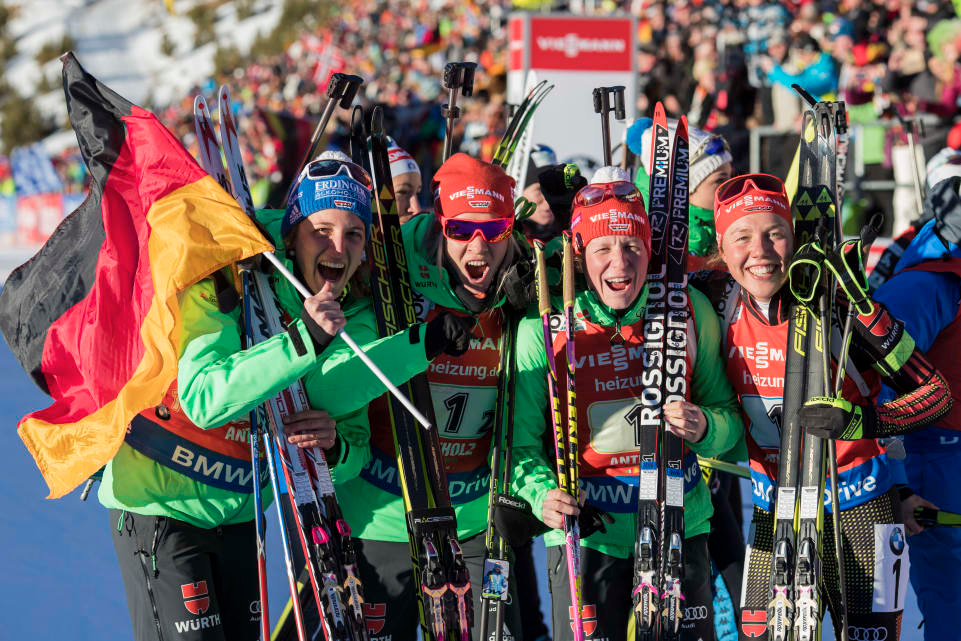
From left to right: Germany’s Vanessa Hinz, Maren Hammerschmidt, Franziska Hildebrand and Laura Dahlmeier celebrate their victory in the women’s 4 x 6 k women’s relay at the 2017 IBU World Cup in Antholz, Italy. (Photo IBU/Christian Manzoni)
Germany’s Laura Dahlmeier struggled to control her last shots, gasping heavily in the thin air of the Antholz biathlon arena some 1,600 meters above sea level during the final standing stage. But with her last spare, she managed to avoid the penalty lap and secured the victory for her team with Vanessa Hinz, Hammerschmidt and Franziska Hildebrand. Dahlmeier even had enough time to grab a flag from a fan on the finishing stretch before crossing the line in 1:09:12.4 hours, with 12 spares and zero penalties.
“That’s why you have six spares in the relay,” Dahlmeier said with a laugh when asked by German broadcaster ZDF about her shooting stages, where she needed five spares to clean. “And when you ski over the line in first, you can’t have done all that much wrong. I wasn’t actually scared [of a penalty lap], but I made it a bit too suspenseful with my shooting and was happy the other girls had given me a lead.”
Germany had also won the two prior relay races of the season in Pokljuka, Slovenia, and Ruhpolding, Germany.
“Three relay competitions in this season, three victories – of course that makes us the favorites for the World Championships,” Hildebrand said, according to an IBU press release. “I think as a team we are strong enough to handle this pressure.”
Crossing the line 24.2 seconds behind Dahlmeier, France’s Marie Dorin Habert comfortably secured second place for her team on the final loop, with eight spares and zero penalties. Despite requiring fewer spare rounds, the French team of Anaïs Chevalier, Justine Braisaz, Bescond, and anchor Dorin Habert was not quite able to keep up on the course on Sunday.
“Maybe at the last shooting, almost,” Bescond said at the press conference when asked if, during the race, she thought her team might claim the victory. “Unfortunately we were not strong enough to catch the German team today.”
Just like it was the third victory for Germany, it was also the third second-place finish of the season for the French women. “We are happy, but we want to beat Germany, maybe at World Championships,” Chevalier said at the press conference.
On the final round Italy’s Dorothea Wierer tried everything to get a podium on her home course, following two weaker performances in the individual and mass start races, but Ukraine’s 22-year-old Anastasiya Merkushyna didn’t make it easy for her, fighting back to take a small lead. But on the last small climb into the arena, Wierer broke her resistance, celebrating her third place when she skied into the arms of the teammates Lisa Vittozzi, Federica Sanfilipo and Runggaldier awaiting her. Like the other teams on the podium Italy had no penalty, and required nine spares.
“I was going away from the shooting range with Merkushyna,” Wierer commented in the press conference on her last loop. “I felt really good, and I don’t know if she was only playing with me, but she seemed not so strong on skis. But then she made a little sprint and I pushed so hard to keep [up with] her. And on the last uphill I made another sprint hoping she would not take me anymore, but I wasn’t sure.”
“We are not always shooting so well,” she said when asked about Italy’s chances for the World Championships relay. “But I think we are getting better and more confident. And I think we will beat the German and also the French team!”
“I am kidding,” she added with a laugh, turning to Germany’s Hildebrand sitting next to her. “I am not kidding!”
Ukraine’s relay with Yuliya Zhuravok, Yulia Dzhima, Semerenko and Anastasiya Merkushyna finished fourth (+37.5), with six spares and zero penalties.
Canada 18th Despite Strong Shooting
Biathlon Canada’s Megan Tandy (center, bib 11) skiing the opening leg of the women’s 4 x 6 k relay for the 2017 IBU World Cup in Antholz, Italy. (Photo: IBU/Christian Manzoni)
The Canadian relay of Megan Tandy, Julia Ransom, Emma Lunder, and Rosanna Crawford shot as well as some of the teams on the podium, requiring only eight spare rounds and incurring zero penalties, but could not keep up with the leaders.
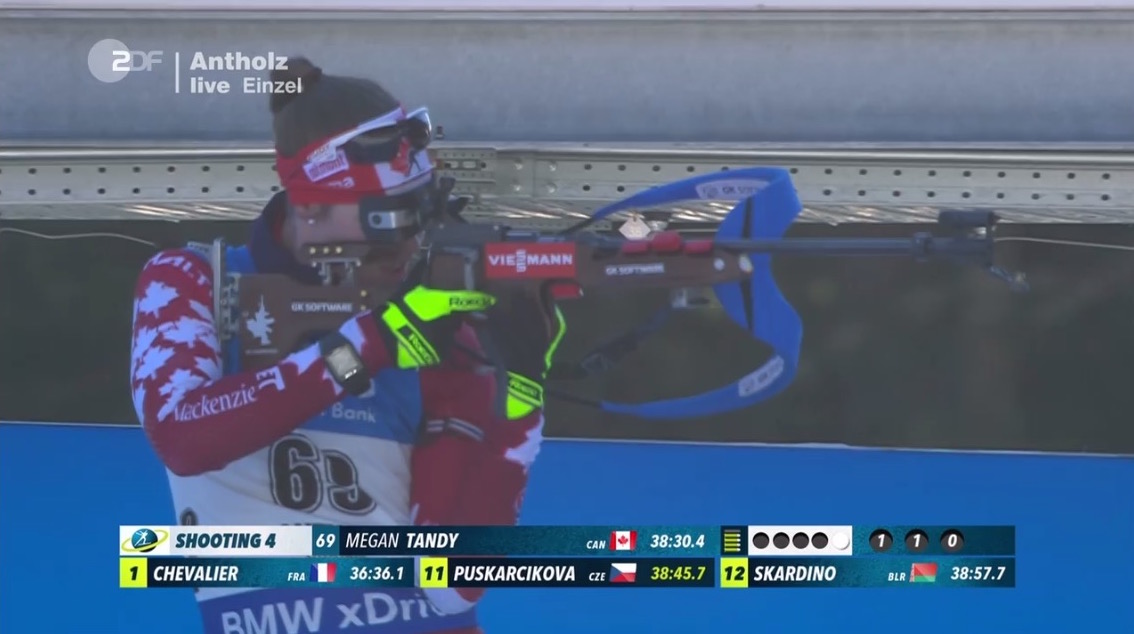
After starting in the fourth row in bib 11 and skiing close to the top group on the first loop, Tandy required four spare rounds (0+2, 0+2) setting her back early in the race. She improved by two positions on the final loop, but tagged off in 18th place, more than a minute behind the leaders. Ransom improved one place to 17th with two solid shootings (0+0, 0+1) but doubled the deficit, and Lunder kept them in that position with a clean standing before losing one spot again on her last loop (0+1, 0+0) to exchange in 18th. Crawford (0+2, 0+0) was only briefly able to move the team up to 16th place before losing those positions to China’s Xuelan Wang and the Czech Republic’s Veronika Vitková (who rested their star Gabriela Koukalová on Sunday) on the last loop to ultimately finish 18th (+4:12.1).
“I think we were hoping for another top 10 today,” Crawford wrote in an email. “Antholz even on a calm day has tricky shooting, the altitude and the flat run into the range I think catches people off guard. We had some good skis today but [it] just wasn’t enough to keep us in contention. We had some great results though this week, with Emma’s 21st [in the individual race] and Scott [Gow] making his first Mass Start.”
Recently struggling a bit to get her speed up to her level from last season, Crawford posted the 15th-ranked course time on the fourth leg of Sunday’s relay after an extended recovery.
“We had decided to change the training plan around because skiing was just getting worse and worse each race,” Crawford explained. “So I didn’t race the pursuit in Ruhpolding or the Individual here, took a few days off and kept this week really easy … So hopefully the rest I took will pay off for World Champs.”
The IBU World Cup now enters a two-week break ahead of the World Championships in Hochfilzen, Austria, which begin on Feb. 9 with a mixed relay.
During this period, there will also be the 2017 Open European Championships beginning this Wednesday in Duszniki-Zdrój, Poland, which several World Cup starters including representatives from the U.S. and Canada plan to race in.
The men’s 15 k mass start podium at the IBU World Cup on Sunday in Antholz, Italy, with Norway’s Johannes Thingnes Bø (c) in first, France’s Quentin Fillon Maillet (l) in second, and Russia’s Anton Shipulin (r) in third. (Photo: IBU)
Remember Norway’s Bø brothers? Younger Johannes Thingnes, who famously spray painted his rifle gold when he started winning International Biathlon Union (IBU) World Cups four seasons ago? And his older brother Tarjei, a two-time individual World Champion (in 2013 and 2011) who earned an Olympic gold with the 4 x 7.5-kilometer relay in 2010? Well, now they’re a little older, at 23 and 28 years old, respectively, and not on quite as hot of a streak as they were in recent seasons.
Despite struggling with illness, Johannes Thingnes (J.T. for short) has frequently been in the mix in World Cup races this season, and reached the podium as an individual (rather than in a team event) twice this season in the sprints in Östersund, Sweden, and Pokljuka, Slovenia.
But a win this season eluded him — until Sunday. Coming off a standout performance for his team in Saturday’s 4 x 7.5 k relay, in which he put Norway in first at the end of the third leg (and they ended up second), J.T. Bø was the only man to hit all 20 targets in Sunday’s 15 k mass start in Antholz, Italy, and he ended up winning by 3.7 seconds in 37:04.3.
“It means a lot. It’s been a long time since my last win,” Bø said, according to an IBU press release. “When you are not in your best shape and you don’t have the results that you want, it’s not easy to think positively. But I have maintained my aggression and my ambition to win.”
While he never led after the four shooting stages of the mass start, he put himself in front when it counted, passing France’s Quentin Fillon Maillet as they entered the stadium.
Leaving the range for the last time, he trailed Fillon Maillet in first by 1.7 seconds.
“I had to fight really hard to pass Fillon Maillet,” Bø said. “I was so bad before Christmas that I had to prove to everyone I am the favorite for World Championships.”
And he might have to represent his family at 2017 IBU World Championships in Hochfilzen, Austria. His brother Tarjei has been quoted as saying his chances of qualifying for the upcoming World Championships (which run Feb. 9-19) are slim. He told NRK that this is the toughest period he’s been through in some time.
“I was in good spirits before Christmas, but when I got a new blow, it was tough,” he said of his bouts with illness, according to a loose translation.
The second-place finisher on Sunday, Fillon Maillet was pleased with his near-perfect shooting. One miss in the first prone stage put him back in 22nd and nearly 30 seconds out of the lead, but three clean stages thereafter (1+0+0+0) moved the Frenchman into first by the final stage.
“The last couple of weeks I had problems with my shooting,” Fillon Maillet said, according to the IBU. “It’s all in my head. I have negative thoughts often. Today was good, and I hope to maintain this feeling during the World Championships.”
As for what happened in the finishing stretch, he wasn’t quite sure.
“It’s very odd, as I knew I had better skis than Johannes,” Fillon Maillet. “At the finish, he sprinted faster than me.”
Russia’s Anton Shipulin claimed third (+21.7) for his eighth-career podium, following up on his victory in the Antholz 20 k individual two days earlier.
Like Fillon Maillet, Shipulin shot 19-for-20, missing his shot in his second prone stage. That put him back in 15th with two stages to go, which he proceeded to clean (0+1+0+0) to move into third by the start of the last loop. There, he left the range 13.7 seconds after Fillon Maillet and about 12 seconds behind Bø.
“I don’t know why, but it was very tough today,” Shipulin reflected, according to the IBU. “Maybe it’s acclimatization that is kicking in, but I am happy to be on the podium.”
For the World Cup field, Sunday marked the final day of racing before World Championships (except for those racing at European Open Championships, which start this Wednesday in Duszniki-Zdrój, Poland).
Lowell Bailey (US Biathlon) en route to 16th in the men’s 15 k mass start on Sunday at the IBU World Cup in Antholz, Italy. (Photo: USBA/NordicFocus)
For all 30 men in the mass start, it marked the third-straight day of racing. American Lowell Bailey, who ranked 16th in the overall World Cup standings going into Sunday, was among that elite crew, along with Canada’s Scott Gow, who earned his first-ever start in that format with a career-best 17th place in Friday’s 20 k.
Bailey cleaned the first two stages of Sunday’s mass start to move into second after the second prone stage, 0.8 seconds behind Ukraine’s Dmytro Pidruchnyi in first, but missed one on each of the standing stages (0+0+1+1) to slip out of the top 10.
“I’ve worked a lot on my range efficiency, and that has been going well, especially in prone,” Bailey wrote in an email. “This is a tough range approach, with a short uphill, followed by a long flat. That, coupled with the fact that we are at a fairly high elevation, makes for a difficult range. I just tried to be prepared for that, and part of that preparation was taking quick, decisive shots. I’ve found that waiting with a long hold on this range doesn’t work for me!”
In his first standing, he simply took a “bad shot … way out to the left,” Bailey explained.
“I was a little too aggressive on the trigger uptake and let the shot go much too early, before I even came close to the hit zone!” he wrote. “The second miss was a smaller miss; just out of the target. Sometimes they fall your way, sometimes not.”
“I’m happy with the performance today, but hungry for better results,” Bailey wrote. “I set out this season with a goal of reaching the podium at least once; whether that’s at World Championships or anywhere else on the world cup tour. I’ve been excruciatingly close in several races during this first half. I’m happy with the fact that I’ve been consistent; but I’m not satisfied. I know I can do better… that will be the singular focus for these next two weeks of training heading into World Champs; fine tuning everything, trying to find that fraction of a percent improvement to reach the podium!”
Gow, wearing bib 30 in his first World Cup mass start, ended up 30th (+4:09.9) with four penalties (1+0+2+1).
“It was a very fun experience,” Gow wrote in an email. “I wish I could have been racing with the pack more often, but the little bit of time I did get with the group was great skiing.
“I’m not super pumped on my performance, but I’m not super disappointed either,” he continued. “I would love to have a few more hits today and a little more speed under my feet, but I think I was too gassed from the previous two days of racing to pump out anything spectacular. It was definitely a good learning experience, and I hope to improve upon it in the future. … I feel like I’m on the cusp of being more consistently in the top 30, and as long as I can maintain confidence in my skiing and shooting abilities I have a very good chance of accomplishing that goal.”
Gow explained that the Canadian team planned to stay in Antholz for another week of altitude and volume training before traveling to Seefeld, Austria, for some intensity and recovery before World Championships. There, he’s targeting the 10 k sprint, 20 k individual, and relay.
“I have had a lot of success in all three of those disciplines, and if I can crank out a good pursuit and qualify for another mass start that would be icing on the cake,” Gow wrote.
The photo finish for first in the IBU World Cup men’s 4 x 7.5 k relay on Saturday in Antholz, Italy, with Germany’s Simon Schempp (r) edging Norway’s Emil Hegle Svendsen (l) by 0.1 seconds. (Photo: IBU/Christian Manzoni)
For Germany and Norway, it was a two-way battle for first following the final exchange of the men’s 4 x 7.5-kilometer relay on Saturday at the International Biathlon Union (IBU) World Cup in Antholz, Italy.
There, thanks to third-leg Johannes Thingnes Bø, Norway had taken the lead by 17.7 seconds over Germany and built a 38-second gap to Russia in third. Ukraine was another nine seconds back in fourth, skiing just ahead of France and the U.S. in fifth and sixth through the exchange, respectively.
So for the U.S. in Saturday’s relay, the last one before 2017 IBU World Championships in Hochfilzen, Austria, next month, it was a fight for a team-best result — which would have been fourth.
Before we get to where they finished, let’s remember where the U.S. men’s relay started: in bib 24 of 25, at the back of the pack.
Lowell Bailey raced them into sixth at the first exchange and 8.6 seconds out of the lead, with Russia’s Maxim Tsvetkov reaching the exchange first. Bailey had skied the fifth-fastest course time on that leg and shot quickly to clean with one spare in each of his two shooting stages.
Eighth after the first prone stage, he moved into sixth after his standing shooting. One loop later, he tagged his teammate Leif Nordgren in sixth.
Leif Nordgren (US Biathlon) skiing the second leg of the men’s 4 x 7.5 k relay on Saturday at the IBU World Cup in Antholz, Italy. (Photo: USBA/NordicFocus)
Nordgren proceeded to jet into third after his prone stage, despite using two spares to clean.
“It was a big bummer to miss two in prone, but the rest of the group also missed so I was able to leave towards the front,” Nordgren explained in a US Biathlon press release.
He used one more spare to clean his standing stage and remained in third heading into his final loop. There, Nordgren’s lack of racing this season caught up to him (this was his fifth World Cup race of the season), and he tagged off in ninth, 27.6 seconds behind Russia’s Evgeniy Garanichev in fifth.
“In the last loop I was holding on for dear life,” Nordgren told US Biathlon. “Those other guys have a lot more racing under their belts this year. I have four [races], so that made for a hard loop.”
While Nordgren and teammate Tim Burke had a shaky tag, which Burke described as a “bit of a collision,” Burke was able to emerge from it unscathed. He went on to ski the fourth-fastest third leg to bring the U.S. to sixth.
“I felt solid on course today,” Burke wrote in an email, after posting the third-fastest course time for that leg.
He used three spares to clean prone — any more misses and he would’ve had to ski a penalty loop — and started his second loop in ninth. The next time in the range, Burke cleaned standing without any spares and set out on his last loop in seventh.
“I pushed hard all the way to the shooting point before prone, which, in hindsight, was probably a bit too aggressive,” he reflected. “For standing my goal today was stay aggressive and I was happy with how that worked out.”
Burke started his last loop with France’s Simon Desthieux. “We were able to really push on the last loop and pull the others back,” Burke explained. “I wanted to hand off to Sean with the group that would fight for third place.”
Burke tagged his teammate Sean Doherty in sixth, 11.6 seconds out of third and just 4.3 seconds behind fourth. Meanwhile, Norway had taken the lead after Bø’s standing stage with clean shooting (and after using just one spare to clean prone) while Russia dropped to third with a total of four spares from Dmitry Malyshko.
Germany’s third-leg skier Arnd Peiffer took the lead after a miss-free prone stage, and using one spare in standing, left the range just 6 seconds after Bø to bring Germany into second at the final tag, 17.7 seconds from first.
Over the last three loops and two shooting stages, Norway’s anchor Emil Hegle Svendsen and Germany’s final skier Simon Schempp drew closer, with both cleaning prone without a miss. At the start of the second loop, Schempp was within 12.7 seconds of Svendsen. Back in the range for the last time, Svendsen missed his second and fifth shots, requiring two spares, and Schempp needed one spare to clean, and the two set out on the final loop together, with Svendsen leading by 0.3 seconds.
The two went head to head all the way to the finish, where Schempp ultimately outlunged Svendsen in a photo finish by one-tenth of a second. He secured the win for Germany in 1:13:57.2 hours, and the team — with Erik Lesser, Benedikt Doll, Peiffer and Schemmp — used a total of seven spares to avoid the penalty loop.
“I gave it everything I had in the end, and wanted to attack a little earlier but [Svendsen] attacked incredibly up the bridge,” Schempp recalled in a post-race interview with ZDF. “I had a feeling that we crossed the line pretty much together. Then I had to wait what the computer would show as a result.”
“He was a little stronger,” Svendsen told NRK after. “I have no other explanation than that. I had to make sure I did not ski into him … so I lost a little momentum there.”
At the last World Cup relay in Ruhpolding, Germany, Norway won with Ole Einar Bjørndalen, Vetle Sjåstad Christiansen, Henrik L’Abee-Lund, and Svendsen. Russia finished second, Germany was third, and the U.S. was 12th.
“I think we presented ourselves with top ski speed today, and on the shooting range it clearly went better than in Ruhpolding, especially for me,” Lesser said, referring to his penalty and the team’s total of nine spares in the Ruhpolding relay (compared to Russia, which had two, and Norway with five spares in Ruhpolding).
“We still have those seven spares, I can remember the last time we became World Champions we only had two spares, so we definitely can get down there, but it was a cool final rehearsal,” Lesser said.
Norway took second with Lars Helge Birkeland, L’Abée-Lund (who brought the team from fourth to second at the second exchange), Bø, and Svendsen, after using nine spares.
Russia ended up third (+33.6), with Tsvetkov, Garanichev, Malyshko, and Babikov, with a team total of nine spares as well, and Ukraine pulled off fourth (+46.7) with just five total spares, with Artem Pryma, Sergey Semenov, Vladimir Semakov, and Dmytro Pidruchnyi.
Ukraine embarked on the last leg in fourth, 1:04 minutes out of first and just ahead of France in fifth and the U.S. in sixth.
On their first loop together, Doherty moved into fourth, trailing Russia’s Babikov in third by about eight seconds. With France’s Quentin Fillon Maillet, Doherty bridged the gap to Babikov, passing the Russian but remaining in fourth as the Frenchman skied into third.
In their prone stage, Doherty used one spare and Fillon Maillet cleaned to leave the range just ahead of him in fifth, while Doherty followed in sixth. Five teams continued to fight for the podium, with Ukraine’s Pidruchnyi leading them in third.
Pidruchnyi didn’t miss a shot in either stage to hold that position until his final loop, where Babikov passed him to claim the third spot on the podium, 12.9 seconds ahead of him.
Sean Doherty (US Biathlon) crossing the finish line in sixth for the U.S. men’s 4 x 7.5 k relay on Saturday at the IBU World Cup in Antholz, Italy. (Photo: USBA/NordicFocus)
In the final standing stage, Doherty and Austria’s Dominik Landertinger both used one spare and left the range in fifth and sixth, respectively. France dropped out of contention when Fillon Maillet had to ski a penalty lap.
“It was really exciting,” Doherty said of the last shooting in an interview with IBU TV. “The pace was really high. Came in and just tried really hard to focus on my own work, knowing there were some guys close in front and behind me. Luckily only one spare, and I was able to get out of there with staying out of the [penalty] loop.”
While Doherty left the range about three seconds ahead of Landertinger, the Austrian passed him during the first kilometer of their final loop. Landertinger extended his gap to Doherty to 12 seconds with less than half a kilometer remaining and anchored Austria to fifth (+49.2), 2.5 seconds out of fourth. Doherty finished sixth for the U.S. (+1:04.9), 15.7 seconds out of fifth.
Behind him, France’s Fillon Maillet finished seventh (+1:34.7). In all, Austria used eight spares and the U.S. had 10, but both avoided the penalty lap. France accumulated 14 spares and one penalty.
“Today’s sixth place was a very strong effort for the team,” Doherty told US Biathlon. “I am very happy to be skiing up in the mix and looking at the podium. There is still room to improve for World Championships, but it seems we are headed in the right direction.”
“Today we showed that we are competitive with the best in the world,” Bailey said in the same press release. “With 10 extra rounds, this is far from our best, but it is a big step in the right direction and exactly where we want to be heading into world champs.”
For the U.S., sixth was one place back from its team-best fifth, which it achieved with the same four men last year at the World Cup in Presque Isle, Maine.
“We are very satisfied with the result today,” Burke said. “With the exception of Lowell, it has been a bit of slow start for the rest of us with a mix of injuries and illnesses. This was definitely important for our confidence heading into World Champs.”
For every man on the team except Bailey, Saturday marked the last World Cup race before World Championships, which start Feb. 9.
Burke planned to stay in Antholz for the next two weeks to prepare.
“I feel like I am still not near my best, but at least I have been consistently in the mix the past two weeks,” Burke wrote. “Hopefully with a good training block over the next two weeks, I can still come to a higher level for World Championships.”
Bailey competed in Sunday’s 15 k mass start and finished 16th, 1:33.4 behind Norway’s Bø, who cleaned the four-stage race to win in 37:04.3. Bailey had two penalties in his last two stages (0+0+1+1), and in his first World Cup mass start, Canada’s Scott Gow finished 30th (+4:09.9) with four penalties (1+0+2+1).
The Canadian men’s relay finished 16th on Saturday (+4:13.8), with Christian Gow, Scott Gow, Macx Davies, and Brendan Green combining for two penalties and 11 spares. Both penalties came on Davies’s third leg. While the team was in 15th after Scott Gow’s second leg, they dropped to 18th on the third leg, but Green recovered two places to finish 16th.
Germany’s Nadine Horchler celebrates her first career victory in the women’s 12.5-k mass start on Saturday at the 2017 IBU World Cup in Antholz, Italy, after distancing herself from teammate Laura Dahlmeier (yellow bib) and the Czech Republic’s Gabriela Koukalová (far left). (Photo: IBU/Christian Manzoni)
“That’s just biathlon for you,” biathletes often like to say when trying to explain the drastic ups and downs that are typical in their sport, both within one race and over the longer timeframes of a season or even a career.
On Saturday in a surprising race outcome that should give hope to many biathletes on the fringes of the World Cup level struggling with these constant shifts, Germany’s 30-year-old Nadine Horchler achieved the first victory and first podium of her career in the women’s 12.5-kilometer mass start at the International Biathlon Union (IBU) World Cup in Antholz, Italy.
For years, Horchler had been in and out of the German World Cup team, frequently being relegated to the second-tier IBU Cup. Widely regarded as a consistent shooter, she struggled to get her skiing speed up to a level where she could be competitive in World Cup races.
At times, she had to deal with being replaced by her younger sister Karolin on the team, and lost her “cadre” status, having to train and race as a self-funded athlete.
But in beautiful weather conditions on Saturday, Horchler was not only one of two athletes to hit all 20 targets in the four-stage race, but also clung to the ski tails of Czech Republic’s Gabriela Koukalová on the last loop, the winner of the first two mass starts and last season’s overall World Cup champion.
Up the last short climb leading into the bustling Antholz arena with about 20,000 screaming spectators, Horchler passed Koukalová and put a small gap on her, celebrating as she crossed the finish line first in a time of 36:11.5 minutes.
“I just had to wipe away a tear because I am so happy,” Horchler told German broadcaster ZDF. “On the last loop I just went for it come hell or high water … I noticed I was still feeling relatively well and skied up to her. … On the downhills I looked behind me and saw the others were getting close and the two of us had to hurry. Then I just passed her and hoped I would get to the finish line. And then the whole stadium was shaking. I could no longer hear my own heartbeat or my breath. Incredible.”
On the finishing stretch, her teammate and current overall World Cup leader Laura Dahlmeier secured the second spot on the podium for Germany, finishing 3.1 seconds after Horchler with three penalties. Dahlmeier also caught and passed Koukalová, who finished third (+8.0) with two penalties.
“I can very well remember winning my first race,” Dahlmeier told ZDF in an interview while standing next to Horchler. “That is something very special for every athlete. I am happy that Nadine managed to show that today, that was a long time in the making. You can really see that we have a strong team, and it’s beautiful so many girls can fight for the positions at the top … She clearly was the number one today.”
“I am very happy, because the beginning of the race was very hard. I had to change my poles three times,” Koukalová explained at the post-race press conference. “I am very happy for my standing shooting … There was no chance to race with Laura, she was too close to me after the last shooting. And I had the expectation that Nadine is many times stronger than me for the finish, so that’s fine.”
Other overall World Cup contenders also had a good race, just missing the podium. Finland’s Kaisa Mäkäräinen, who had dominated the races in Ruhpolding, Germany, a week ago, finished fourth (+13.5) with four penalties and the best-ranked course time. Behind her, France’s Marie Dorin Habert took fifth (+19.0) with four penalties.
Racing in front of her home crowd, Italy’s Alexia Runggaldier followed up her first career podium in the 15 k individual on Thursday with a sixth place (+24.1) with one penalty. Sweden’s Anna Magnusson took seventh (+26.4) with one penalty for a career best, after leaving the range for the last time in third behind Koukalová and Horchler.
“I am really happy,” 21-year-old Magnusson told the IBU in an interview. “It was a crazy race, and so much fun to ski in the top … I was number three or four, and I knew there [were] many people behind me, so I just had to push myself really hard. I am really happy about the seventh place… In a couple of years we will be on top.”
Norway’s Kaia Wøien Nicolaisen in ninth place (+27.9) was the only other competitor besides Horchler without any misses, which helped her achieve her second-best World Cup result.
Starting in bib 30 at the back of the field, Horchler originally hadn’t qualified to compete in the elite mass start competition, but was called up from a “reserve standby list” thanks to her 19th place in the women’s individual race on Thursday, after Russia’s Olga Podchufarova had to cancel her start. Next up in line on the list would have been Biathlon Canada’s Emma Lunder, who achieved a career-best 21st in Thursday’s 15 k.
“I traveled here with a good feeling,” Horchler told ZDF. “In the individual I thought, ‘good place, but one miss too many,’ and today I just had nothing to lose. Yesterday I was very relaxed because I did not really expect to get a start, and so I am overjoyed today.”
Horchler’s previous best individual results had been two fifth places in a sprint and pursuit, also achieved in Antholz in one weekend of the 2012/13 season. Eager to qualify for the 2014 Olympics in Sochi she lost much of the season to overtraining, and already considered a career after biathlon completing an education as a nonmedical practitioner for psychotherapy.
But Horchler decided to give it one more shot, and last season won the overall IBU Cup (the equivalent to what Koukalová achieved for the World Cup) and a gold medal in the sprint at the 2016 Open European Championships in Tyumen, Russia, sharing the podium with her sister.
And despite those career highlights, she was not nominated to Germany’s 2016/2017 World Cup team, once again beginning her season on the IBU Cup before receiving her first call-up for the races in Oberhof, Germany, where she achieved 35th in the sprint and 17th in the pursuit. But the rollercoaster continued and in Ruhpolding she had to sit out again, before receiving another chance in Antholz when teammate Franziska Preuss got sick.
“I don’t know yet,” Horchler said at the press conference when asked what this victory could mean for her career. “It is amazing. Last week I was in the IBU Cup [in Arber, Germany], now I am here and I sit between Laura and Gabi, it’s unbelievable … My plan was that I drive to the [European Championships] on Monday, and now I don’t know.”
Now the late bloomer might even be a candidate for next month’s World Championships in Hochfilzen, Austria, which would only be the second team nomination of her career after one selection in 2013.
Dunklee Takes the Lead, Briefly
US Biathlon’s Susan Dunklee (bib 17, orange & purple suit) skiing past the crowded stands at the start of the women’s 12.5 k mass start at the 2017 IBU World Cup in Antholz, Italy. (Photo: IBU/Christian Manzoni)
US Biathlon’s Susan Dunklee, the only North American qualified for the women’s mass start, had the best first prone stage and briefly took the lead. In that first stage, she shot clean and second fastest of all competitors, returning to the course first, 2.7 seconds ahead of Russia’s Tatiana Akimova.
But similar to the last mass start in Oberhof two weeks ago, where Dunklee was third halfway through, she wasn’t able to hold it. In the next stage, the American missed two shots, falling back to 14th position. With three more misses (0+2+2+1) she fell back further to 25th, before being able to overtake France’s Anaïs Bescond on the final loop to finish 24th, 1:36.1 behind the winner Horchler. Dunklee skied the 16th-ranked course time overall.
“It was incredibly satisfying to shoot fast and clean and leave the range in first after the first shooting,” Dunklee said, according to a US Biathlon press release. “I hope to build on that in the future and follow it up with a better shooting percentage. My skiing is not at its sharpest; my body is feeling the strain of the high altitude and the intense race schedule.”
Leading a race before falling back with penalties. Winning a race you were not even originally slated to compete in. That’s just biathlon.
The IBU World Cup in Antholz concludes with the women’s 4 x 6 k relay and men’s 15 k mass start on Sunday.
Ben Lustgarten (Craftsbury Green Racing Project) with his $750-dollar check for winning the men’s SuperTour classic sprint on Saturday near Truckee, Calif. Stratton’s Ben Saxton (l) placed second and APU’s Reese Hanneman (r) was third.
Lustgarten, of the Craftsbury Green Racing Project, raced to a 1.58-second victory in the men’s A-final at the Auburn Ski Club in Soda Springs, Calif., finishing in 3:03.4. Ben Saxton, of the Stratton Mountain School (SMS) Elite Team, placed second, and Reese Hanneman, of Alaska Pacific University (APU), was third (+2.77).
Hannenman’s younger brother Logan also reached the final and placed fourth (+4.5), Dakota Blackhorse-von Jess (Bend Endurance Academy) was fifth (+5.86), and the third APU skier in the final, Tyler Kornfield sixth (+18.69).
Blackhorse-von Jess started the day off as the fastest qualifier in 2:58.8. Saxton qualified second, 4.1 seconds back, Logan Hanneman qualified third (+4.2), and Lustgarten fourth (+6.5). Blackhorse-von Jess went on to win his quarterfinal and place second in his semifinal, while Lustgarten and Saxton both won their quarterfinals and semifinals.
Jennie Bender (3) of the Bridger Ski Foundation leading Stratton’s Julia Kern (2) and Sun Valley’s Deedra Irwin (5) during the second women’s classic sprint semifinal at Saturday’s SuperTour near Truckee, Calif. Bender went on to win the semifinal, as well as the final.
In the women’s A-final, Jennie Bender of the Bridger Ski Foundation, coming off a classic sprint win at nationals, scored another victory in 3:29.07. She edged Craftsbury’s Kaitlynn Miller by just seven-hundredths of a second, and Stratton’s Julia Kern placed third (+3.42). Racing at home, Hannah Halvorsen (Sugar Bowl Academy) finished fourth (+3.88). Craftsbury had three in the women’s final with Caitlin Patterson in fifth (+3.93) and Heather Mooney in sixth (+27.35).
Miller proved to be the woman to beat throughout the day, winning the qualifier in 3:30.9, along with her quarterfinal and semifinal. Kern qualified second (+3.2) and Bender third (+4.6). Bender went on to win her quarterfinal and semifinal as well before facing off with Miller in the final.
NorAm Western Canadian Championships (Whistler, B.C.): 10/15 k classic
It was interval-starts day at Western Canadian Championships at Whistler Olympic Park and national-team veteran Emily Nishikawa completed the four laps of the women’s 10 k classic in 30:35.5 to win ahead of teammate Dahria Beatty, 16.5 seconds behind. Maya MacIsaac-Jones completed the national team and Alberta World Cup Academy (AWCA) sweep in third (+1:36.5).
Sovereign Lake’s Hannah Mehain, of the national junior team, was the top junior for the second-straight day in eighth overall (+3:22.1).
In the men’s 15 k, Lappe Nordic’s Andy Shields won the six-lap race in 40:34.2, showing some of the form that won him the NorAm overall last season. National-team member Jess Cockney collected his second-straight podium, finishing second, 4.3 seconds behind Shields. Evan Palmer-Charrette (NTDC Thunder Bay) completed the podium in third (+55.1).
FIS Cross-Country World Cup (Ulricehamn, Sweden): 10/15 k freestyle
The men’s 15 k freestyle podium at Saturday’s World Cup in Ulricehamn, Sweden, with Canadian winner Alex Harvey (c), Norwegian runner-up Martin Johnsrud Sundby (l), and Sweden’s Marcus Hellner (r) in third. (Photo: FIS Cross Country/Twitter)
First individual win of the season (second straight, after winning last weekend’s team sprint), fifth individual victory of his career. That’s the latest news on Canada’s Alex Harvey, who won the World Cup men’s 15-kilometer freestyle individual start on Sunday in Ulricehamn, Sweden, for his first victory in a 15 k skate race and fourth individual podium of 2016/2017.
To say Harvey is on a roll is an understatement. On Saturday, he beat Norway’s Martin Johnsrud Sundby by 6 seconds after starting a minute behind the Norwegian defending World Cup champion. Harvey’s fastest time across the line in 32:46.2 held up through 76 finishers, with Sweden’s Marcus Hellner coming somewhat within range after starting a minute behind him. Hellner ended up 14.3 seconds back from Harvey at the finish for third place, behind Sundby.
Switzerland’s Dario Cologna missed the podium by 0.5 seconds in fourth (+14.7), and Norway’s 24-year-old Daniel Stock broke through in fifth (+16.2) for his first World Cup top 20.
Great Britain’s Andrew Musgrave placed sixth (+18.7), Sweden’s Daniel Rickardsson was seventh (+25.0), Norway’s Finn Hågen Krogh eighth (+32.2), Russia’s Petr Sedov ninth (+33.9), and Japan’s Keishin Yoshida 10th (+34.2).
American Erik Bjornsen landed in the points as he tied Norway’s Simen Andreas Sveen for 28th (+1:09.2), leading fellow U.S. Ski Team members Noah Hoffman, who placed 41st (+1:28.8), and Simi Hamilton in 53rd (+1:56.2). Also for the U.S., Matt Gelso, the Period 1 SuperTour leader from the Sun Valley Ski Education Foundation (SVSEF) Gold Team, finished 68th (+3:00.3).
Harvey’s Canadian World Cup teammates Len Valjas finished 35th (+1:17.7) and Devon Kershaw 38th (+1:22.2). Knute Johnsgaard (Canadian U25 Team) did not start.
The women’s 10 k freestyle podium on Saturday in Ulricehamn, Sweden, with Norwegian winner Marit Bjørgen (c), Finland’s Krista Parmakoski (l) in second and Sweden’s Charlotte Kalla (r) in third. (Photo: FIS Cross Country/Twitter)
In her first World Cup race in over a month and at a brand-new World Cup venue, Norway’s 36-year-old Marit Bjørgen returned to her winning ways, topping the women’s 10 k freestyle on Saturday in Ulricehamn.
Bjørgen started 40th out of 61 finishers and took the lead from Finland’s Krista Parmakoski at the finish with a time of 23:46.3 minutes. Parmakoski, who started a minute ahead of her in bib 38, ended up second, 10.7 seconds back. Sweden’s Charlotte Kalla reached the podium for the second time this season in third (+24.9).
“It is always great to win,” Bjørgen said, according to an International Ski Federation (FIS) press release. “I stayed at home for five weeks and was training. It is great to come back with a victory. I know that the training I had done was good. It was an amazing atmosphere today by the course. There were people cheering everywhere.”
Norway swept fourth through sixth with Astrid Uhrenholdt Jacobsen in fourth (+25.7), Ragnhild Haga in fifth (+32.3) and Heidi Weng in sixth (+34.0).
American Jessie Diggins raced to seventh (+34.9), ahead of Sweden’s Hanna Falk, who recorded her best distance result in eighth (+36.4). Norway’s Ingvild Flugstad Østberg finished ninth (+44.8), and Germany’s Sandra Ringwald was 10th (+56.6).
“I didn’t have the snappy good feelings I was hoping to have in my body today, but it was a solid race,” Diggins wrote in a post-race email to FasterSkier. “It’s always hard when you know that on your best days you are capable of more, but at the same time we had great skis, and it was really fun for me to be able to ski with my teammates today!”
The U.S. had three in the top 20 and four in the top 30 with Sadie Bjornsen in 12th (+1:00.5), Liz Stephen in 16th (+1:07.3) and Rosie Brennan in 24th (+1:30.7).
Cendrine Browne as Canada’s lone woman in the race achieved 35th (+1:52.0) for her career best in an individual race. Also for the U.S., Kikkan Randall placed 40th (+1:59.6) and Liz Guiney of the Craftsbury Green Racing Project 52nd (+2:33.2).
The photo finish of the men’s 4 x 7.5 k relay on Saturday at the IBU World Cup in Antholz, Italy, with Germany’s Simon Schempp outlunging Norway’s Emil Hegle Svendsen. (Photo: ZDF broadcast screenshot)
For the U.S. men, top six was a target for the 4 x 7.5 k relay on Sunday in Antholz, Italy, according to US Biathlon Men’s Coach Jonas Johansson.
Mission accomplished. In the final team event before 2017 World Championships, Lowell Bailey, Leif Nordgren, Tim Burke, and Sean Doherty combined for sixth, finishing 1:04.9 minutes behind the German winners. The Americans used a total of 10 spares but avoided the penalty loop, as did the Germans who used seven spares to clean the eight-stage race and won it in 1:13.57.2.
Germany’s Simon Schempp narrowly outlasted Norway’s Emil Hegle Svendsen in the finishing stretch to secure the victory for Germany (with teammates Erik Lesser, Benedikt Doll and Arnd Peiffer) by one-tenth of a second. Norway finished second with nine spares and no penalties (with Lars Helge Birkeland, Henrik L’Abee-Lund, Johannes Thingnes Bø, and Svendsen), and Russia secured third (+33.6) with nine spares and zero penalties as well (with Maxim Tsvetkov, Evgeniy Garanichev, Dmitry Malyshko, and Anton Babikov).
Ukraine used a total of just five spares and had zero penalties for fourth (+46.7), and Austria took fifth (+49.2) with eight spares and no penalties, after Austria’s Dominik Landertinger skied away from Doherty on the final loop and finished 6.9 seconds ahead of him for fifth place.
For the U.S. men, sixth was close to their team-best fifth with the same lineup in last year’s World Cup relay in Presque Isle, Maine. The same group also took sixth in Ruhpolding, Germany, last year as well.
With all four making US Biathlon’s World Championships team, announced Saturday, they will likely be aiming for a best championships result early next month in Hochfilzen, Austria.
Canada (Christian Gow, Scott Gow, Macx Davies, and Brendan Green) finished 16th (+4:13.8) on Saturday with two penalties and 11 spares. Scott Gow skied them up to 15th by the second exchange but they dropped to 18th after Davies had two penalties on the third leg. With Green anchoring and using just one spare, they recouped two places before the finish.
In the women’s race, Germany’s Nadine Horchler achieved a lifetime dream with her first World Cup win, after starting in bib 30 and earning her start as a reserve athlete. Germany took first and second with Laura Dahlmeier in second, and the Czech Republic’s Gabriela Koukalova placed third. Susan Dunklee of the U.S. was the lone North American starter and finished 24th after leading at the start of the second loop.
FIS Nordic Combined World Cup (Chaux-Neuve, France): Individual large hill/10 k
Saturday’s Nordic Combined World Cup podium in Chaux-Neuve, France, with German winner Johannes Rydzek (c), German runner-up Fabian Rießle (l) and Japan’s Akito Watabe (r) in third. (Photo: FIS Nordic Combined/Twitter)
The first part of Saturday’s Nordic Combined World Cup individual large hill/10 k competition was a shining moment for U.S. Nordic Combined skier Ben Berend, who jumped to second for a total of 127.5 points, trailing only Norway’s Jarl Magnus Riiber with 139 points in Chaux-Neuve, France.
Berend flew farther than Germany’s Eric Frenzel, who jumped to third on the Chaux-Neuve large hill.
Later in the day, they started the 10 k Gundersen in that order, with Riiber heading out first, followed by Berend 46 seconds later, then Frenzel 53 seconds back in third.
Germany’s Johannes Rydzek started 1:15 minutes back in 12th and skied the fastest 10 k to take the victory at the finish (in 23:01.7). He held off his German teammate Fabian Rießle by 2.8 seconds for the win, after Rießle started sixth and 1:01 back. Japan’s Akito Watabe reached the podium in third (+5.7) after jumping to seventh and starting the race 1 second behind Rießle.
Frenzel ended up fourth (+8.3), and the fourth German in the top five, Björn Kircheisen improved to fifth (+22.6) after starting 11th.
Riiber dropped to 15th (+54.0), and Berend fell outside the top 30 to end up 32nd (+2:26.0) with the 39th-ranked course time.
Berend finished 12.2 seconds ahead of his U.S. teammate Taylor Fletcher, who placed 34th (+2:38.2) after the jump put him in 48th.
Bryan Fletcher was 49th after the jump but did not start the 10 k.
The Nordic Combined World Cup continues Sunday in Chaux-Neuve with another large hill/10 k.
Ski Classics #5: La Diagonela (Zuoz, Switzerland): 50 k classic
[UPDATED] Under “blue skies, no wind and perfect track conditions” in the Swiss Engadin Valley on Saturday, according to a Ski Classics press release, Russia’s Ilya Chernousov and the Czech Republic’s Kateřina Smutná won the men’s and women’s La Diagonela, respectively, in Zuoz, Switzerland.
Chernousov, of Team Pioneer Investments, and Tord Asle Gjerdalen (Team Santander) led a large pack of men into the final major climb on the 50 k course. There, Gjerdalen attacked and Chernousov matched him, accelerating away from his competitors up the last steep pitch to the finish, according to the press release. He finished in 2:03:39.6 hours, holding off Gjerdalen by 1.5 seconds, while Øystein Pettersen (Team BN Bank) finished third (+3.0).
In the women’s race, Smutná (Team Santander) pushed to break up the field around the halfway point, where the men caught the women. Britta Johansson Norgren (Lager 157 Ski Team) hung with Smutná, but lost contact over the last 5 k. After finishing second in the last two Ski Classics races, Smutná took the win by 1:03.2 minutes in 2:20:49.2. Nordgren finished second, ahead of Sara Lindborg (Team Serneke) in third, who finished more than three minutes later (+4:17.4).
Lowell Bailey (US Biathlon) racing to 10th for his second individual top 10 of the season on Friday in the IBU World Cup men’s 20 k individual in Antholz, Italy. Bailey led five U.S. men in the top 40. (Photo: USBA/NordicFocus)
(Note: This article has been updated to include comments from U.S. biathlete Paul Schommer.)
What’s the old saying? It doesn’t really matter what happens in December, as long as it all comes together three weeks before World Championships?
The tale of the US Biathlon men’s team goes something like that, with what started out as a skeleton crew of three men in December expanding to five men who finished in the top 40 a month and a half later on Friday in Antholz, Italy.
It was the first time in recent memory that the U.S. men have achieved such a feat. According to US Biathlon men’s coach Jonas Johansson, the 2012 International Biathlon Union (IBU) World Cup in Kontiolahti, Finland, was a big one as well, with four U.S. men in the top 16.
But all five starters scoring World Cup points in the top 40?
“This shows that there is great potential in the men’s squad right now,” Johansson wrote in an email on Friday. “And when the group gets stronger, each individual has to push harder each workout to fight for a start spot and this will make the team even stronger in the future.”
Lowell Bailey led the team in 10th in Friday’s 20 k individual — the longest individual race on the circuit. It was his second-best result of the season after placing ninth in the 12.5 k pursuit in December in Nove Mesto, Czech Republic. On the phone on Friday, Bailey explained the Antholz 20 k was a race he had been targeting.
Bailey racing to 10th on Friday in the IBU World Cup men’s 20 k individual in Antholz, Italy. (Photo: USBA/NordicFocus)
“I’ve been preparing for this race all season and especially over Christmas … so I’m glad to see that pay off,” he said.
Bailey started 25th out of 105 in the men’s field and proceeded to hit every target in the first three stages. That presented him with the very real possibility of a podium with one standing stage to go, but a miss there cost Bailey a minute and put him a few places back by the finish.
“You always wish that you could have one more shot, and of course it’s easy to look in an individual where that would put me, but I think all in all I was happy with the race,” he said.
While Bailey initially crossed the finish line in fifth, he was ultimately bumped to 10th, 1:39.1 minutes behind the winner, Russia’s Anton Shipulin.
“It’s a brutal 4 k course here with about a [kilometer] of climbing right out of the range, and I just tried to take it out fast, but also with the intention of keeping my speed throughout the race,” said Bailey, who posted the 26th-ranked overall course time and notably, the fourth-fastest shooting time.
Recalling his final loop, Bailey said he lost time on Germany’s Arnd Peiffer, who started first and ended up 8.7 seconds ahead of him in ninth, but was able to squeak ahead of another German, Benedikt Doll, who started fourth and placed 11th, 1.7 seconds back from Bailey.
“I’m happy with the result and psyched with the team result, too, because I think that bodes well for us in the relay tomorrow,” the 35-year-old Bailey said of the men’s 4 x 7.5 k relay on Saturday.
Career-best 17th for Canada’s Scott Gow
While Bailey notched his second individual top 10 of the season, Biathlon Canada’s Scott Gow achieved a career best in 17th, 2:37.7 back from Shipulin’s time, with a single miss in his second prone (0+0+1+0) and the ninth-fastest shooting time overall. Gow started 19th, and after two clean stages, he was in contention for a top 10.
“After my first two clean bouts, I told myself not to get too over confident and that I still had two bouts remaining,” Gow, 26, recalled in an email. “I put my focus into my skiing and tried to approach the range as mechanically as possible in an effort to remove any emotions from my normal procedure. Today it worked very well and I’m pleased that I was able to shut my brain down.”
Scott Gow (Biathlon Canada) on his way to cleaning his second-straight stage of the men’s 20 k individual on Friday at the IBU World Cup in Antholz, Italy. Gow went on to place 17th for a career best. (Photo: ZDF broadcast screenshot)
He described the range conditions as “extremely calm,” after training throughout the week in considerable wind.
“After watching the girls yesterday battling big gusts, I was fully prepared for a tough fight on the range,” Gow wrote, referring to the women’s 15 k individual on Thursday. “Fortunately we ended up with almost zero wind, and that lasted for the entire race.”
After initially finishing ninth, Gow was “somewhat confident” he could hang on to a top 20.
“I knew there were a lot of fast guys behind me who were shooting well,” he wrote. “… I had my fingers crossed to be in the top 16.”
He came close, within 5.6 seconds of 16th, but claimed 17th to beat his previous personal best of 18th (which he tallied twice: earlier this season in the Nove Mesto sprint and at last year’s World Championships in the 20 k individual).
“Today’s race was a big confidence boost,” Gow explained. “I still have some areas I can improve upon, but this result is a big step in the right direction. As long as I can stay healthy leading into [World Championships], train smart and stay focused I think I can have a good championships. I know the potential is there, now I have to start capitalizing more.”
Shipulin’s Special Place
On an afternoon with considerably easier shooting conditions than the women faced on Thursday, as Gow vouched for, Shipulin started 33rd and missed just one target on his second prone stage, just like Gow (0+0+1+0). The Russian posted the fastest range time and third-fastest course time to rocket to first at the finish (in 50:38.1 minutes) by a whopping 41 seconds over France’s Martin Fourcade, who started 28th and missed two (0+1+1+0). For Shipulin, it was his first World Cup win of the season and first career win in a 20 k individual.
Russia’s Anton Shipulin racing to his first IBU World Cup win of the season on Friday in the men’s 20 k individual in Antholz, Italy. (Photo: IBU)
“I have a special relationship [with this venue] because my first win was here in Antholz,” Shipulin said at the post-race press conference, according to a translator. “I can’t say it was easy today, but I would like to thank all the fans who were cheering for me. And I would like to thank Martin for giving me a chance.”
Fourcade, who ended up second, said Antholz’s altitude was challenging at some 1,600 meters (about 5,2500 feet) above sea level.
“Being back at altitude after two weeks in Oberhof and Ruhpolding was really hard,” Fourcade said at the press conference of the last two World Cups in Germany. “And even though I was in really good shape, today it was really painful.”
While he was skipping Saturday’s relay, Fourcade said he would be back for Sunday’s 15 k mass start (the select, 30-man race Bailey and Gow also qualified for).
“When everybody asks me why I don’t win in Antholz so much, I will try to do it on Sunday in the mass start,” Fourcade said.
Ukraine’s Sergey Semenov was an early leader after starting 16th. He held onto first until Fourcade finished 15.8 seconds faster, bumping him to second, and ultimately placed third, 56.8 seconds behind Shipulin. Semenov appeared to give every last ounce to the finish, stumbling before crashing headfirst across the line.
“Yesterday in our team meeting with our coach, we recalled the last time here in an individual,” Semenov said in English at the press conference. “And if I am not mistaken, my teammate was the winner, it was Sergei Sednev.”
(According to an Antholz organizing-committee press release, Sednev won that race during the 2009/2010 season. Sednev was later suspended for failing a drug test in 2013.)
“At the meeting I thought why not today? Why not to have a good result?” Semenov continued. “Because even without the wind, Antholz is a really tough place for the shooting, maybe because of the altitude, maybe because of the last meters before the shooting range. But even without the wind it’s usually quite a lot of misses here. So I just needed to do a good shooting, and I always feel good on the 20-kilometer races.”
Semenov cleaned three stages, like Bailey, before missing one on his last standing (0+0+0+1).
“Here, it’s not enough oxygen, and for the last shot I was just out of breath,” Semenov said. “I just needed to delay it and begin it one more time, but I was already in a hurry. And then I thought, ‘OK, I still had a good shooting, I still have a good opportunity to stay at the top.’ So I did my best on the last lap, and here I am!”
It was the 28-year-old Ukrainian’s first podium of the season and fifth of his career. Last year at World Championships, he placed third in the sprint in Oslo, Norway.
“I feel quite good,” Semenov said. “At the December World Cups, I had to start with an injury of my shins, so I was not really in a good shape, but now it’s OK, and from race to race I feel better and better.”
Nordgren Back in Top 30, Schommer Shines in World Cup Debut
Also coming back from illness and injury were two of Bailey’s U.S. teammates: Leif Nordgren and Sean Doherty, who finished 29th and 36th, respectively, on Friday. Nordgren was coming off surgery on a fractured toe and Doherty rebounding from mononucleosis at the start of the season.
Leif Nordgren (US Biathlon) racing to 29th in the men’s 20 k individual on Friday at the IBU World Cup in Antholz, Italy. (Photo: USBA/NordicFocus)
In an email, Nordgren, 27, explained that he was unable to train for essentially all of December, up until Dec. 24.
“I got back into training full time on the 24th,” he wrote. “I was healed enough by then that I didn’t have to take it easy at all, I could train the full amount. As of now my toe is fine for the most part, I’m missing a toenail so I have to be careful not to stub it or smash it and I have a problem with the joint bending in some directions but overall it’s fine. Skiing and running don’t give me any pain which is good.”
Friday marked Nordgren’s fourth World Cup race this season, after toughing it out in the season-opening relay in Östersund, Sweden, in late November, then returning to the circuit for last week’s races in Ruhpolding. There, he placed 71st in the sprint and 12th in the relay (with Bailey, Tim Burke and Doherty).
“Once I made it back to training I always had this race in mind,” Nordgren wrote of Friday’s 20 k. “I knew that I’d be pretty rough in Ruhpolding, but with those races under my belt I’d hopefully be in better shape this week. With the altitude this is a pretty tough 20km, my goal was to start very conservatively and ramp it up towards the end.”
After missing one shot on each of his first two stages, Nordgren cleaned the last two stages (1+1+0+0) to finish 29th (+4:00.1).
“I was skiing with some good guys on their final loops for my first few loops, so I made the decision to ski with them which may have hurt me in the end, but overall I’m happy with how I skied,” he reflected. “I would have liked to have one less miss, that would have meant a really good result for me. The two misses that I did have were bad errors that shouldn’t have happened, but that’s how biathlon goes.”
Johansson noted in his email that Nordgren needed “more races and hard workouts to get back to his normal race speed,” but he was well on his way.
“Really happy to see that Leif is back and also performs at this level already,” he wrote.
Nordgren was listed as a starter for the U.S. men’s relay on Saturday, along with Burke, who placed 34th (+4:36.5) with four misses (0+1+1+2) and Doherty, who finished 36th (+4:41.6) with three penalties (1+1+0+1), on Friday.
Paul Schommer, of US Biathlon’s National Development Group, racing to 33rd in his first IBU World Cup race, the men’s 20 k individual on Friday in Antholz, Italy. (Photo: USBA/NordicFocus)
However, ahead of Burke and Doherty, 24-year-old Paul Schommer, a US Biathlon development skier, raced to 33rd (+4:16.6) in his first World Cup race. He started 90th and cleaned three stages, missing two on his first standing bout (0+2+0+0).
“There’s a quote by Seneca, a great Roman Philosopher, that says, ‘Luck is what happens when preparation meets opportunity,’ ” Schommer wrote in an email to FasterSkier. “I think that pretty much sums up my success today. God has really shown me how to use some of the gifts He has given me in the last year, and today I was able to put that preparation to the test. After my first standing, I knew I just kind of let those two shots go. I just put them behind me, and concentrated on the next two stages one at a time. I just thought of it as another training session and making every shot count. I have also been shooting in a lot of wind lately so having almost no wind on the range today was super nice.
“There’s a quote by Seneca, a great Roman Philosopher, that says, ‘Luck is what happens when preparation meets opportunity.’ I think that pretty much sums up my success today.” — Paul Schommer, US Biathlon National Development Group, after placing 33rd in his World Cup debut
“The atmosphere here in Antholz is amazing and unlike anything I have ever experienced before,” he added. “However, for most of the race I was just in race mode and did my thing. I tried not to think about the fans, the cameras, and all the other things that could have distracted me. I just wanted to keep my focus on the task in front of me.”
“A really impressive race from Paul today,” Johansson wrote. “First WC start and he shows that he has the capacity to score WC points right away. He will learn a lot from just racing among the top athletes and I am sure that we will see a lot more from Paul in the next years.”
Back in early December, when the U.S., with just three men on the World Cup, was unable to field a men’s relay for Pokljuka, Slovenia, Schommer as the next man on the list seemed like a natural pick. But the “heavy travel and race schedule … did not justify getting someone out of the middle of a training block in Canmore,” U.S. Biathlon Chief of Sport Bernd Eisenbichler wrote in an email at the time.
He said it was important to consider the best options for an individual’s development, adding that the U.S. didn’t intend to miss more than one relay.
“After last season, I made two goals for myself,” Schommer explained. “The first landing a top 20 on the IBU Cup and the second, earning a World Cup start. After not being named to the World Cup team for the first trimester after the pre-World Cup camp in Canmore, I was a little disappointed but also knew it was not my last chance to earn myself a start on the WC. I just stayed focused, qualified for the IBU Cup and thankfully had good enough results in Martell and Arber to be called up for Antholz. Like I said, I set the goal of starting a World Cup early this spring, but when I actually found out I was going to be racing in Antholz, I was pretty excited to say the least.”
The U.S. men were back for the relay in Ruhpolding, where they finished 12th. With the same lineup in a slightly different order (with Nordgren and Burke swapping places), they’ll set out in bib 24 (of 25 teams) on Saturday. Bailey will start them off, Nordgren will ski the second leg, Burke the third, and Doherty the anchor.
“This is a strong relay team and goal is to fight for a top 6 finish,” Johansson wrote.
Canada, which earned bronze in the men’s relay at 2016 World Championships, listed Christian Gow, followed by Scott Gow, Macx Davies, and Brendan Green as its starters (in bib 10).
In Friday’s individual race, Green finished 75th (+7:09.6) with six penalties (2+1+2+1), and Christian Gow finished with the same time for 76th (+7:09.6) with four penalties (0+2+0+2). Davies did not start.
Russia’s Anton Shipulin after winning the men’s 20 k individual at the IBU World Cup on Friday in Antholz, Italy. (Photo: IBU/Twitter)
NorAm Western Canadian Championships (Whistler, B.C.): Freestyle sprints
[UPDATED] On Friday, the first day of the NorAm Western Canadian Championships at Whistler Olympic Park in Callaghan Valley, British Columbia, Dahria Beatty and Jess Cockney topped the women’s and men’s 1.2-kilometer freestyle sprint A-finals, respectively.
Beatty, of the Alberta World Cup Academy (AWCA) and Canada’s National U25 Team, started the day by qualifying in second, 0.31 seconds behind her fellow AWCA and U25 Team member, Olivia Bouffard-Nesbitt, who won the qualifier in 2:59.9.
Both Bouffard-Nesbitt and Beatty went on to win both their quarterfinal and semifinals before facing off in the A-final, where Beatty edged her teammate by 0.74 seconds. Beatty crossed the line in 3:02.89, Bouffard-Nesbitt took second and Katherine Stewart-Jones (NTDC Thunder Bay/NST U25 Team) raced from fifth to third in the finishing stretch for the final spot on the podium, 1.09 seconds behind Beatty.
In the men’s sprint, Cockney, of the Canada’s World Cup B-team, originally qualified second, just eight-hundredths of a second behind Dominique Moncion-Groulx (AWCA), who won the qualifier in 2:37.42.
While Moncion-Groulx advanced to the A-final with a second-place finish in his quarterfinal (behind Julien Locke, of the AWCA and U25 Team) and third place in his semifinal (behind Locke and Lappe Nordic’s Andy Shields, respectively), Cockney won both his quarterfinal and semifinal before winning the final in 2:33.56.
Locke took second, 0.81 seconds back, and Moncion-Groulx finished the day in third (+1.86). Just 0.17 seconds off the podium, Shields placed fourth.
The three-day Western Canadian Championships continue with 10/15 k classic interval starts on Saturday and freestyle relays on Sunday.
Russia’s Anton Shipulin took his first win of the season and five U.S. men scored points in the top 40 of the International Biathlon Union (IBU) World Cup men’s 20-kilometer individual on Friday in Antholz, Italy.
Lowell Bailey led the U.S. in 10th, one place off his season-best ninth. He finished 1:39.1 minutes behind Shipulin with a single miss (0+0+0+1) in the last stage, which ultimately took him out of contention for a podium.
Shipulin missed one as well, but in the third shooting (0+0+1+0) and posted the fastest time at the finish, besting France’s Martin Fourcade (0+1+1+0) by 41 seconds. Ukraine’s Sergey Semenov was an early leader in bib 16 and hung on for third (+56.8) with one penalty (0+0+0+1). Norway’s Ole Einar Bjørndalen recorded his best result of 2016/2017 in fourth (+1:04.9) with one penalty (0+0+1+0), and Germany’s Simon Schempp followed in fifth (+1:09.8) with two misses (0+1+0+1).
The second North American in the top 20, Canada’s Scott Gow achieved a career best in 17th (+2:37.7) with one penalty (0+0+1+0).
In his fourth World Cup race this season, American Leif Nordgren finished 29th (+4:00.1) with two misses (1+1+0+0). And then there was 24-year-old Paul Schommer in his World Cup debut, who raced to 33rd (+4:16.6) and cleaned three stages. Schommer had two penalties in his first standing stage (0+2+0+0) but finished the race without another miss.
Also for the U.S., Tim Burke followed Schommer in 34th (+4:36.5) with four penalties (0+1+1+2), and Sean Doherty was 36th (+4:41.6) with three misses (1+1+0+1).
Canada’s Brendan Green finished 75th (+7:09.6) with six penalties (2+1+2+1), and teammate Christian Gow clocked the same time in 76th (+7:09.6) with four penalties (0+2+0+2). Macx Davies did not start.
Currently ranked 16th in the overall World Cup standings, Bailey is listed on the provisional start list for Sunday’s 15 k mass start. Scott Gow also made the 30-man list based on his result on Friday. On Saturday, the men will race a 4 x 7.5 k relay. Start lists for the relay were not immediately available.
Emma Lunder (Biathlon Canada) racing in last weekend’s IBU World Cup in Ruhpolding, Germany, where she placed 89th. (Photo: Fischer/NordicFocus)
The next time your order a cup of joe, remember to be nice to the person on the other side of the counter; they could just be a World Cup skier. In a press release, Biathlon Canada was quick to point out that one of its national-team members, Emma Lunder, is a Starbucks barista in Canmore, Alberta.
But on Thursday, thousands of miles away at the International Biathlon Union (IBU) World Cup in Antholz, Italy, Lunder raced to a career-best 21st in the women’s 15-kilometer individual race. It was her first time racing that distance. In fact, it was twice as long as the 7.5 k sprint she had done in eight of her nine previous World Cup starts (not counting relays).
Emma Lunder (Biathlon Canada) on course during the women’s 15 k individual on Thursday at the IBU World Cup in Antholz, Italy. (Photo: ARD broadcast screenshot)
The Biathlon Canada B-team member started last on Thursday, wearing bib 99. It’s a tall order waiting around that long in the longest-format race on the circuit, complete with four shooting stages, but the 25-year-old Lunder was generally unfazed.
“I would say this year I am definitely used to starting in the fourth seed, and getting a hang of dealing with the wait,” she wrote in an email after Thursday’s race. “I quickly ski tested with our techs, zeroed my rifle and then headed back to our wax room where I lay on a pile of ski bags and read my book for 45 minutes before warming up.”
Fortunately, the wait played to her favor. Gusting winds across the range gave most of the field troubles. But when Lunder set out on the course, those winds seemed to be less of an issue.
“I had absolutely no wind when I zeroed, which I found made it easier to make corrections during the race,” she wrote of her pre-race target practice. “I think I had fairly consistent wind for both prone and standing, and was happy not to have any big gusts blowing me around!”
Lunder explained that she had been working with her coaches and sports psychologist on improving her focus while shooting. She had struggled with her prone shooting over the last few weekends (including last week’s World Cup in Ruhpolding, Germany, and the IBU Cups in Martell, Italy, before that). On Thursday, Lunder was hoping to execute some new strategies.
Canada’s Emma Lunder leaving the range en route to second place in the IBU Cup 7.5 k sprint last season in December 2015 in Canmore, Alberta. (Photo: Pam Doyle)
With a clean first prone stage, she was already on par with a personal best as she left the range in 35th. (Lunder previously placed 30th in her first-ever World Cup three years ago in Pokljuka, Slovenia. With that result, she qualified for the 10 k pursuit, and went on to place 41st for her second-best result to date — up until Thursday.)
Lunder then cleaned her second shooting and first standing stage to put herself in 10th halfway through Thursday’s race. But she had no idea where she stood. Fortunately, she had plenty of skiers within sight, after race organizers started the fourth seed — which included Lunder — in 15-second intervals (as opposed to 30 seconds between racers).
“Skiing was a fun but extremely tough battle,” Lunder wrote. “… There were way more girls close to me that I could chase and ski with. … I actually wasn’t given any information of where I was until I’d finished in the range and was heading out for my last lap — I think the techs and coaches didn’t want to excite me before any of my shooting bouts, and I’m quite happy for it.”
She missed her first and only target of the day on her second prone, which put her in 24th with two loops to go, and cleaned her final standing stage, moving her back up into 15th. Leaving the range for the last time, she realized she was in a best-ever position.
“I really hoped I was fighting for points, and when I left the range after my last standing … I almost had an ‘oh crap’ moment because I knew I had to ski absolutely as hard as I possibly could for another 3km and I was already feeling the hurt,” she explained.
Canadian Emma Lunder, of Vernon, B.C., finishing 21st for her career-best IBU World Cup result on Thursday at the women’s 15 k individual (her first time racing that distance) in Antholz, Italy. (Photo: ARD broadcast screenshot)
“We had really competitive skis today thanks to our hardworking wax-tech crew, and they were all over the place for my last lap, screaming for me to fight up every hill and they got me all the way to the finish line!” Lunder added. “I was feeling the pain for my whole last lap, and it turned into just trying to survive rather than really being able to fight, but I know I did absolutely everything I could on the skis today, and I am so, so happy with my race.”
The Vernon, B.C., native ended up 21st, 3:29.7 minutes out of first, with one penalty (0+0+1+0). Lunder was one of just four out of 99 that shot 19-for-20. No one cleaned.
The winner, Laura Dahlmeier of Germany, had two misses (1+1+0+0) — for a total of two minutes added to her finishing time. Dahlmeier secured the win in 44:48.7 minutes, thanks to perfect shooting in the last two stages. It was her 11th World Cup victory.
“It was incredibly difficult today,” Dahlmeier told German broadcaster ZDF after starting 15th. “I tried to make it a little easier on myself. That’s why I twice went to the outmost positions [on the range]. But honestly it was just as windy, I had to fight just the same. It was hard to get into the race after those two misses. I just tried to do my own thing, and shoot clean in the end.”
Germany’s Laura Dahlmeier racing to her 11th IBU World Cup win on Thursday in the women’s 15 k individual in Antholz, Italy. (Photo: IBU)
Dahlmeier’s 11th World Cup win on Thursday gave her the overall World Cup lead and with it, the yellow bib, and allowed her to keep the red bib of the 15 k individual discipline leader.
“It is a dream come true to win in this beautiful setting,” Dahlmeier said of sunny Antholz. “That I can keep the red jersey and get the yellow one back, it doesn’t get better than that.”
Behind her France’s Anaïs Chevalier started 32nd and came within 3.8 seconds of Dahlmeier’s finishing time. Chevalier was one of the four women that missed just one target (0+1+0+0), along with third-place finisher Alexia Runggaldier of Italy (+46.0, 0+1+0+0).
For Runggaldier, it was her first World Cup podium.
“This morning I was a little anxious, and just thought, ‘Give it your best.’ I really wanted to qualify for the mass start [on Saturday],” she told ZDF. “I just told myself to do the best I can, just do that, and now I can’t believe it!”
Italy’s Alexia Runggaldier celebrating her first IBU World Cup podium in third on Thursday at the women’s 15 k individual in Antholz, Italy. (Photo: IBU)
The 25-year-old Runggaldier qualified for the 30-woman mass start based on that result. On Thursday, she said conditions weren’t easy even as a later starter in bib 59.
“It has already been difficult the last few days,” she said of target practice during training. “Yesterday it didn’t work well for me, so today I just told myself to focus, 20 shots, four series. And my coach told me out on the course ‘be patient!’ and I just tried to execute that.”
As for Lunder, she wrote that she was “extremely happy” with her shooting performance and pointed out that the last time she scored World Cup points was in 2014.
“… To be just out of top-20 today feels pretty amazing,” Lunder wrote. “Today was a huge day for me on the range, and I think there’s still work to be done on the skiing side of things, but I know I’m headed in the right direction.”
As of Thursday, Biathlon Canada had not made any formal announcement about its World Championships team.
“Today I left it all out there so no matter what happens [with selections] I am super proud of what I accomplished in this race!” Lunder noted.
Also on Thursday, Megan Tandy of Biathlon Canada’s A-team (officially the “Eh! Squad”) finished 33rd (+5:02.0) for a season best. She started 69th and shot four penalties (1+1+0+2) with the 61st-ranked overall course time.
“I can easily say this is my slowest season since I was a Junior!” Tandy wrote in an email. “That being said I was really pleased with today’s race because it represented a baby step forward in both skiing (I didn’t feel dead tired racing today and actually enjoyed skiing which is a first this season) and on the result list as well. Finally some points — what a relief!”
She described the wind as “up and down” with more wind for her first and last bouts, but “nothing unmanageable.”
“I made fairly aggressive sight adjustments in prone. The women had quite windy conditions during training the 2 previous days so even though the conditions were challenging at times I felt confident about clicking,” Tandy reflected.
Megan Tandy (Biathlon Canada) during her final shooting stage of the women’s 15 k individual on Thursday at the IBU World Cup in Antholz, Italy. (Photo: ZDF broadcast screenshot)
After just two misses in her first two bouts and a clean third stage, Tandy was in contention for a top 30 with one shooting stage to go. In that final standing stage, she missed two, which left her disappointed.
“I am still so angry with myself especially because I missed the last 2 shots and up until those misses the potential for a good race was there!” she wrote. “But thats biathlon for you! I didn’t really think about bouncing back after my last shooting — it was the last loop so I gave everything I had, simple as that!”
Her final loop time was her fastest of the day, ranking 51st. At the end of the day, Tandy was pleased to feel “normal” again during a race.
“It was such a pleasure compared to a lot of races this year where I feel like after the first 1km my only goal becomes to survive until the finish line,” she wrote. “Shooting I think I did good work in 3 of my 4 bouts, particularly reacting to the wind prone so I feel confident and am looking forward to the relay this Sunday! 6km is also going to feel short and sweet after that 15km!!”
The women race a 4 x 6 k relay on Sunday in Antholz.
Canada’s third woman on Thursday, Julia Ransom finished 55th (+6:28.2) with four penalties (0+3+0+1). Rosanna Crawford did not race, but tweeted after, “Well if I had to sit out today’s race and be a fan instead I sure am glad @emmalunds made it an exciting race to watch, finishing 21st for a new personal best! Lucky number bib 99! #gretzky #ANT17 #gocanada”
Four U.S. women competed on Thursday, with Clare Egan leading the team in 59th (+6:58.6) with six penalties (1+4+0+1) that added six minutes to her finishing time. She started 80th and recalled some wind issues on her second shooting.
“I had the fastest skis I’ve ever had in my life today, and three out of four good shooting stages,” Egan said, according to a US Biathlon press release, of her first, third and fourth stages. “Unfortunately, a stupid mistake in the first standing stage foiled any chance I had at a good result. I tried to shoot through gusting wind instead of waiting until I could take a good shot. I made a strong comeback from that point on, but 59th place is hardly what I was hoping for.”
Joanne Reid (US Biathlon) racing to 60th in the women’s 15 k individual on Thursday at the IBU World Cup in Antholz, Italy. (Photo: USBA/NordicFocus)
Her US Biathlon teammate Joanne Reid followed in 60th (+7:05.2), also with six misses (2+2+1+1). Reid started 23rd.
“There were definitely some gusts out there today, and what could be tricky conditions if you didn’t adapt correctly to them,” Reid told US Biathlon. “Wind is a lifetime learning experience — every race, every range, every point, and every day is different, so you’ll never know exactly what you’re supposed to do, or what you should have done in any situation. Biathlon is by its very nature sinusoidal, and it’s unfortunate when those troughs hit us all at the same time.”
Also for the U.S., Susan Dunklee started 46th and and finished 71st (+7:58.0) with eight penalties (0+4+2+2), and 21-year-old Maddie Phaneuf in bib 92 finished 81st (+9:18.9) with seven penalties (3+1+1+2).
“I think as a team we displayed some incredible bravery out there,” Reid noted. “It can be mentally very tough to keep fighting when you know how many minutes you lost. I especially salute Susan for her ability to come back from races like this with incredible grace, considering the high expectations constantly placed upon her. And Maddie, of course, our youngest, who is trying to adjust to a whole different level of skiers in an unfamiliar environment. Everyone has to start somewhere, and it’s tough to remember that sometimes with veterans on the team like Tim [Burke] and Lowell [Bailey], who have been starting biathlon races for almost as long as Maddie has been alive.”
“I know the four of us are eager to redeem ourselves in Sunday’s 4x6k women’s relay,” Egan said.
Dunklee will have another individual shot in the last set of races before World Championships (Feb. 9-19 in Hochfilzen, Austria) this Saturday in the 12.5 k mass start, as Dunklee is ranked 17th overall in the World Cup.
The men’s 20 k individual takes place Friday, starting at 8:15 a.m. EST. Watch it live on Eurovisionsports.tv.
Biathlon Canada’s Emma Lunder finishing 21st for her career-best IBU World Cup result on Thursday at the women’s 15 k individual (her first time racing that distance) in Antholz, Italy. (Photo: ARD broadcast screenshot)
IBU World Cup (Antholz, Italy): Women’s 15 k individual
In her first-ever 15-kilometer individual race, Canada’s 25-year-old Emma Lunder captured a career-best 21st at Thursday’s International Biathlon Union (IBU) World Cup in Antholz, Italy.
The last time Lunder scored World Cup points was at her very first IBU World Cup in 2014 in Pokljuka, Slovenia. There, she placed 30th in the sprint and went on to finish 41st in the pursuit, which stood as her best World Cup finishes — until Thursday.
In the women’s 15 k individual, a four-stage race that penalizes one minute for every missed shot, Lunder was one of the best shooters out there, shooting 19-for-20, missing one shot on her second prone stage (0+0+1+0). Out of 99 competitors, Lunder was one of four who missed just one. No one cleaned all four stages.
Lunder started last in bib 99 and ended up 21st at the finish, 3:29.7 minutes behind winner Laura Dahlmeier of Germany, who won in 44:48.7 with two one-minute penalties (1+1+0+0).
Dahlmeier started 15th and battled windy conditions for the victory, with a time that was 3.8 seconds faster than France’s eventual runner-up Anais Chevalier, who started 32nd and missed one (0+1+0+0). Italy’s Alexia Runggaldier notched her first World Cup podium in third (+46.0) after starting 59th and missing just one target as well (0+1+0+0).
“I was extremely happy with my shooting performance and hitting 19/20 targets on a tough day!” Lunder wrote in an email. “I think I had fairly consistent wind for both prone and standing, and was happy not to have any big gusts blowing me around!
“… To be just out of top-20 today feels pretty amazing,” she continued. “Today was a huge day for me on the range, and I think there’s still work to be done on the skiing side of things, but I know I’m headed in the right direction.”
Also for Biathlon Canada, Megan Tandy tallied a season-best individual result of 33rd (+5:02) despite four penalties, including two on her last standing stage (1+1+0+2), and Julia Ransom placed 55th (+6:28.2) with four penalties (0+3+0+1). Rosanna Crawford did not race.
Clare Egan was the top American in 59th (+6:58.6) with six penalties (1+4+0+1) that added six minutes to her time, and US Biathlon teammate Joanne Reid was right behind in 60th (+7:05.2) with six misses as well (2+2+1+1). Susan Dunklee in bib 46 started at the tail end of the group that appeared to face the windiest conditions, and finished 71st (+7:58.0) with eight penalties (0+4+2+2). Maddie Phaneuf finished 81st (+9:18.9) for the U.S, with seven penalties (3+1+1+2).
The men’s 20 k individual starts Friday at 8:15 Eastern time. Watch it live on Eurovisionsports.tv.
Lowell and Erika Bailey and baby Ophelia out for a ski on Frozen Thunder in Canmore, Alberta. (Courtesy photo)
Welcome to “17 Questions for 2017″, where we are catching up with American and Canadian national-team members before the beginning of the winter season.
***
Last year was Lowell Bailey’s 11th season on the competing on the World Cup, and he again proved his big-game chops. Two years after finishing 8th in the 20 k individual at the Sochi Olympics, a best-ever finish for a U.S. biathlete, Bailey notched a tenth-place result in the 15 k mass start at 2016 World Championships in Oslo.
1. Biggest change in your life in the last five or so months since the ski season ended?
My wife Erika and I became the parents of a beautiful baby girl, Ophelia, on June 15th 2016! In addition to that monumental life change, I took a new job helping to fundraise for Crosscut Mountain Sports Center, a yet-to-be-built world-class biathlon/xc training and outdoor recreation center in Bozeman, Montana.
2. Biggest change in your training?
I’ve worked closely with the USBA coaching staff to create a training plan which allows me to stay closer to home. I’ve incorporated much more stroller-jogging into my recovery workouts as well 😉
3. Major areas of improvement you’ve seen so far?
Bailey doing some kid-friendly training. (Courtesy photo)
I’ve focused on improving my shooting speed and consistency. Every world cup biathlete has ups and downs in their ski speed throughout the season. The key to success is maintaining a consistently high level of accuracy on the shooting range so that, when you do hit your peak, you can also rely on your shooting.
4. Whom you’ve been working closest with this offseason (coaches or training partners)?
I’ve worked closely (albeit remotely between Lake Placid and Sweden) with Per Nilsson. On the ground, we have a great group of motivated coaches and athletes in Lake Placid. It’s a very lively, motivating training center these days!
5. Best trip in the last five months (and why)?
I think I’m currently on it! Erika, Ophelia, and I are in Canmore, Alberta for the National Team pre-season on-snow camp. Frozen Thunder has been in great shape and I love the area. It’s been great having the whole family here (see attached pic).
6. Favorite cross-training?
Trail running. We have great trail running in the Adirondacks and this summer I was able to explore some new places out west. I did some trail runs with the Bridger Biathlon Club kids and it was amazing to see so many passionate, fun-loving kids hooked on biathlon and enjoying the Great Outdoors.
7. Favorite non-athletic activity or pastime this summer?
The family and I spent our free time at my wife’s grandmother’s camp; a tiny little cottage tucked into the trees on the shore of Moose Island on Lake Placid lake. It is definitely one of those places where time stands still, the iPhone stays in the backpack, and the stars shine a little bit brighter at night.
8. Song that was your jam this summer?
“Ophelia” by THE BAND! I grew up with their music and have always loved the group. After our daughter was born, I felt obligated to go back and re-discover their entire catalogue.
9. All time favorite race moment?
Lowell Bailey en route to finishing 10th in the World Championships mass start in Oslo, Norway, in 2016. (Photo: JoJo Baldus)
Last year at World Champs in Oslo, Norway. The Mass Start was one of the races I’ll always remember; staying up front through the entire race until the very end. It was thrilling, heartbreaking, exhilarating, and confirmed in an instant why I still love this sport after so many years.
10. First thing you pack in your bag when you leave for Europe?
Coffee filters and a one-cup coffee maker.
11. Venue/event you’re most excited to visit this season?
I always enjoy our time in Antholz, Italy, one of the most beautiful places to race on earth. I’m also looking forward to seeing the new course changes in Pyeong Chang.
12. Who will win the World Cup title this year?
Martin Fourcade is always a safe bet!
13. Biggest sacrifice you feel you’ve made choosing this career path?
Biathlon is an incredible career path, but I’ve always understood that it is just one of thousands of incredible career paths. I think the biggest sacrifice in pursuing anything is that by saying “yes” to that one thing, you are saying “no” to something else. I’m constantly confronted with situations – a family reunion, a concert, a fly-fishing trip – that I have to forego on account of my training and competition schedule. It’s just what you have to do as a full-time professional athlete.
14. If you could change one thing about your sport, what would it be?
I would eradicate doping from biathlon. With the recent McLaren Report findings, we now see just how unscrupulous the actors, how advanced their capabilities, and how pervasive their effect has become on our sport. We are quickly approaching a watershed moment; the moment when we either decide to take the controversial, albeit necessary, actions required to rid our sport of doping forever, or quietly sit by and watch biathlon descend further into a state of corruption and deceit.
15. What did you have for breakfast this morning?
The Nordie Trifecta: Eggs, granola, yogurt!
16. In 5 years, I’ll be ____?
Standing on the deck of the newly-built Crosscut Mountain Sports Center, sipping a micro-brew with Erika and the rest of the Crosscut Boardmembers, while smiling youth biathletes and XC skiers race around the Crosscut stadium below!
US Biathlon A-teamers Leif Nordgren (l) and Sean Doherty hiking in Antholz, Italy, last month. “When the self timer works to perfection,” Nordgren captioned the photo on Instagram. (Photo: Leif Nordgren)
Revving the engine to the US Biathlon team van past Italian road signs and the distant Dolomite peaks of northeastern Italy. Swimming and fishing off Slovenia’s southwestern shores. Rollerskiing the streets of Östersund, Sweden, while under the watchful eye of your coach. Competing in Norway’s famed Blink rollerski festival against local favorites like Ole Einar Bjørndalen and the backdrop of an exuberant crowd.
With six weeks in Europe behind them and one more to go, these are only a few of the adventures US Biathlon teammates Leif Nordgren and Sean Doherty have accomplished this summer during their seven week, self-made training camp they’ve hashtagged: “#theadventuresofskidandpants.”
“On the team we all have little nicknames that we call each other; one of Sean’s nicknames is skid, and one of mine is pants,” Nordgren explained in an email, adding that he and Doherty have been good friends for a few years now. “There’s stories behind both names but they’re both quite long. It had a funny ring to it, and all of our teammates thought it was pretty funny as a hashtag, so we kept it going.”
Sean Doherty looks out at a breathtaking view in Italy’s Dolomites. “… Just a small skid in a big world,” US Biathlon teammate Leif Nordgren captioned the photo on Instagram. (Photo: Leif Nordgren/Instagram)
The spark for global travel and training ignited after Nordgren and Doherty spent most of last summer training at their home base in Lake Placid, N.Y. Desiring something different this offseason — and knowing that the US Biathlon’s European training camp would once again take place in Ruhpolding and Oberhof, Germany, from Aug. 21 to Sept. 11 — the duo decided to pack their bags early and begin their adventures abroad five weeks before the start of camp. The greatest gain they expected by leaving the U.S. was the opportunity to training with other teams.
“Last summer, we were kind of stuck training in Lake Placid a lot,” Nordgren said on the phone from Ruhpolding. “So with all that time in Lake Placid last year, we wanted to expand our boundaries a little bit, to get out of Lake Placid, come to Europe, see what other teams are doing for training, jump in with them when we could, but mostly just get out and experience new stimuli and train in other cool places with new people.”
The two other US Biathlon national team members, Tim Burke and Lowell Bailey, opted to stay in the states for most of the summer.
“Tim is in the process of building a house right now, Lowell just had a baby girl back in June,” , Nordgren wrote in an email. “So both of those guys had things to do back at home that kept them from wanting to be gone in Europe for half the summer.”
Nordgren and Doherty’s seven-week training block began with Blink, three days of various cross-country and biathlon rollerski competitions, from July 27-30 in Sandnes, Norway. This year’s events included an elite biathlon mass start and an elite biathlon sprint, as well as an uphill climb. Both Nordgren and Doherty competed in all three elite events. In a lighthearted, pre-race “shooting duels” competition before the mass start, Nordgren reached the final and ranked 11th overall. In the sprint the next day, both Nordgren and Doherty made it to the quarterfinals.
“The first week we were up in Norway at the Blink rollerski festival, which was a good opportunity to get some high-level races in with a lot of Norwegians, a couple Swedes, a couple Germans, and a lot of the French national team too,” Nordgren said. “Unfortunately neither of us had very good races there, but the experience was good all the same.”
US Biathlon’s Sean Doherty (l) and Leif Nordgren training at a shooting range in Sandnes, Norway, in July. (Photo: Leif Nordgren)
The next destination for Nordgren and Doherty was Östersund, where they spent two weeks training with US Biathlon Men’s Coach Jonas Johansson in his hometown, as well as a few former and current Swedish Biathlon national-team members.
“There is a team called Team Östersund and it’s made up of a lot of national-team athletes and former national-team athletes that have kind of declined their spot on the national team to train more on their own,” Nordgren explained. “So we did a couple of training sessions with them.”
Saying goodbye to Scandinavia, the two flew to Munich, Germany, hopped in a team van and drove down to Antholz, Italy, for another week of training.
“The team has a van here that stays in Germany where most of our staff are from and our manager let us take that for the weeks we were [in Italy],” Nordgren said.
“One of our goals [in Antholz] was to train a little bit with the Italian team,” he added. “Unfortunately, I think they had just gotten back from a training camp and so a lot of them were a little tired, so none of the intensity training sessions really aligned like we thought they were going to. Those workouts we went ahead and did by ourselves. That was kind of a bummer, but again it was nice to get a change of scenery, and Antholz is a beautiful place to train in the summer.”
After Antholz, they took a three-day break before meeting back up with the rest of their teammates for two final weeks with the US Biathlon national team in Germany.
“We went down to the coast in [Piran] Slovenia, which is about a three-hour drive from Antholz,” Nordgren said. “We met a couple friends down there who hooked us up with one of their friends one day to do a little fishing and swimming … After that we came up here to Ruhpolding and met up with the team, and it’s been kind of normal training back with the team since then.”
Leif Nordgren (r) captures a photo of himself and US Biathlon teammate Sean Doherty during a road ride in Antholz, Italy, last month. “When training doesn’t suck,” Nordgren captioned the photo on Instagram.
Back in Germany, Nordgren acknowledged that much of his and Doherty’s ease in travel and accommodation along the way derived from their team budget.
“The team was able to set aside a little bit of a budget for us,” he said. “At Blink, the organizers put us up at one of the hotels. In Östersund, we actually stayed right at the venue at Camp Södergren. They have a couple of apartments there that they normally rent out to university students during the school year and they rented us one for two weeks … and then when we were down in Italy, we had a hotel.”
With about a week left of their adventure abroad, Nordgren is satisfied with the training he’s logged, but is also looking forward to returning back to Lake Placid. The final camp on the national team’s schedule before race season will take place in Canmore, Alberta at the end of October.
“I’m not sure I would do seven weeks away again, but it’s been a good time,” Nordgren said. “Sean were talking about if we were to do it again, I think we would probably go like one less place. So maybe [go] from Norway straight down to Italy, or something like that, just to be a little more stationary and get a feel for one place a little more because there has been quite a lot of travel. But both of us, I know, have had a great time even though it has been a long time away.”
Doherty could not be reached for comment.
During a three-day recovery period in Piran, Slovenia, in August. (Photo: Leif Nordgren)
During a three-day recovery period in Piran, Slovenia, in August. (Photo: Leif Nordgren)