From the FasterSkier archive — posts syndicated from athletes’ and coaches’ own blogs between 2004 and 2012, kept online as published. Current coverage is at fasterskier.com.
Three-time Olympian, gold and silver medalist, long-time chair of the World Anti-Doping Agency’s Athlete committee, Officer of the Order of Canada, company founder and CEO, the list of Beckie Scott’s achievements is both lengthy and remarkable, and those included here only scratches the surface. In the nordic world specifically, Scott made history as the first North American woman to earn a medal at the Olympics in cross-country skiing. She has also been a long-time advocate and voice in anti-doping. In recent years, Scott’s focus and attention has shifted to the creation of Spirit North, a non-profit organization using the power of sport to improve the health and well-being of Indigenous youth in Canada.
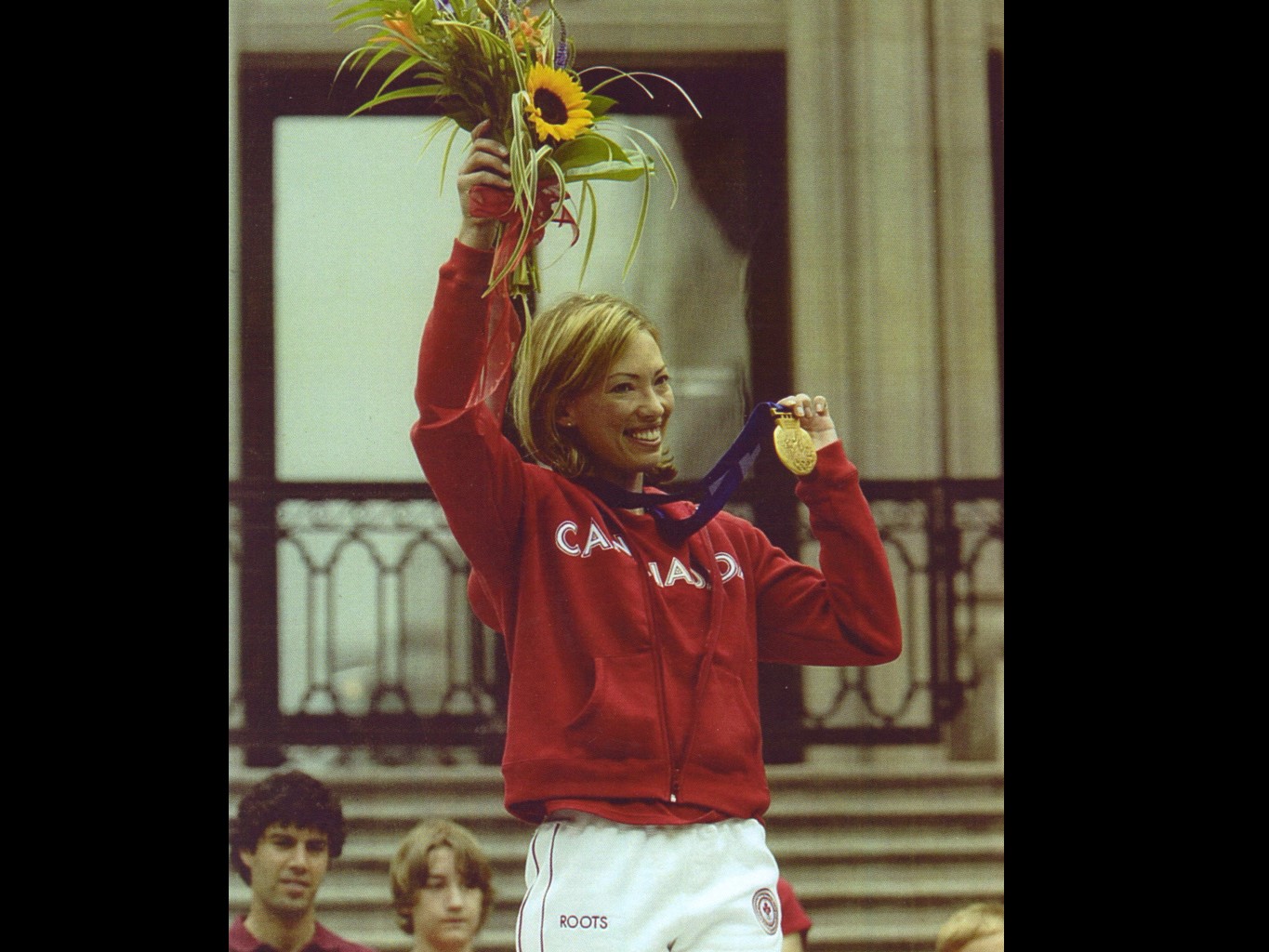
Beckie Scott displays her Olympic Gold medal from the 5 + 5 k pursuit at the Salt Lake Winter Games in 2002. She finished third but when the two women who finished in front of her were caught doping, Scott was awarded the gold in 2004. (courtesy photo)
The inspiration for founding this organization came after her retirement from ski racing, as Scott was invited to be an ambassador in a learn-to-ski program in northern Alberta funded by an oil and gas company that sponsors Cross-Country Canada.
“I started traveling up to these communities in northern Alberta for a number of years,” shared Scott, “the majority of which were indigenous, and I saw, for the first time, the realities of life there for community members, but particularly for the kids.”
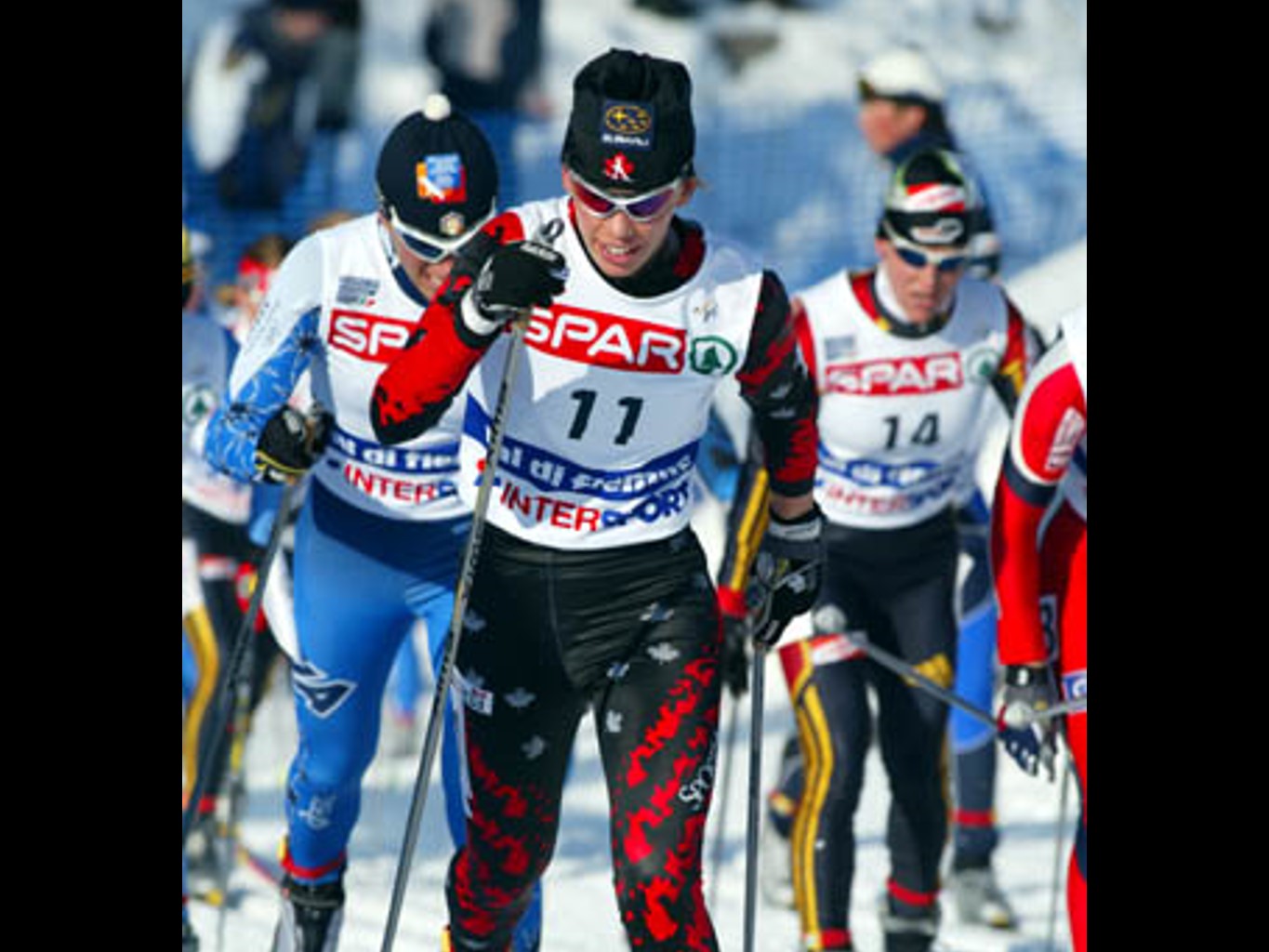
Beckie Scott racing in Val di Fiemme, Italy (courtesy photo)
Struck by how little there was in the way of sport and recreation, whether by virtue of the remoteness of the community, lack of infrastructure, or poverty, Scott noticed how many barriers there were for children in these communities to access sport.
“And yet, in parallel, when we would do this program, I was seeing this universal experience that kids have when they take part in sport,” continued Scott, “which is, just loving being out there, having fun, just walking a little taller because they’ve learned a new skill, all those great transformative benefits that come with being able to have that opportunity.”
Happy kids head out for a Spirit North event (Photo: Spirit North)
After a number of years with this program, she gradually came to the realization that the program should be something more, it could be bigger, it could be better, and it should be its own organization. In 2017, Scott made it an independent entity, rebranded and renamed it, and thus, Spirit North was born.
The motivation and realization for this move was also partially spurred by the publication of the Truth and Reconciliation Commission report, published in Canada in 2015. The TRC came about after the Indian Residential Schools Settlement Agreement, to facilitate reconciliation among former students, their families, their communities and all Canadians. From 2007 to 2015 the TRC traveled throughout Canada, hearing from over 6,500 witnesses, and in June 2015 at its closing event in Ottawa, they presented an executive summary of the findings in a multi-volume final report. This report also included 94 “calls to action” to further reconciliation between Canadians and Indigenous peoples.
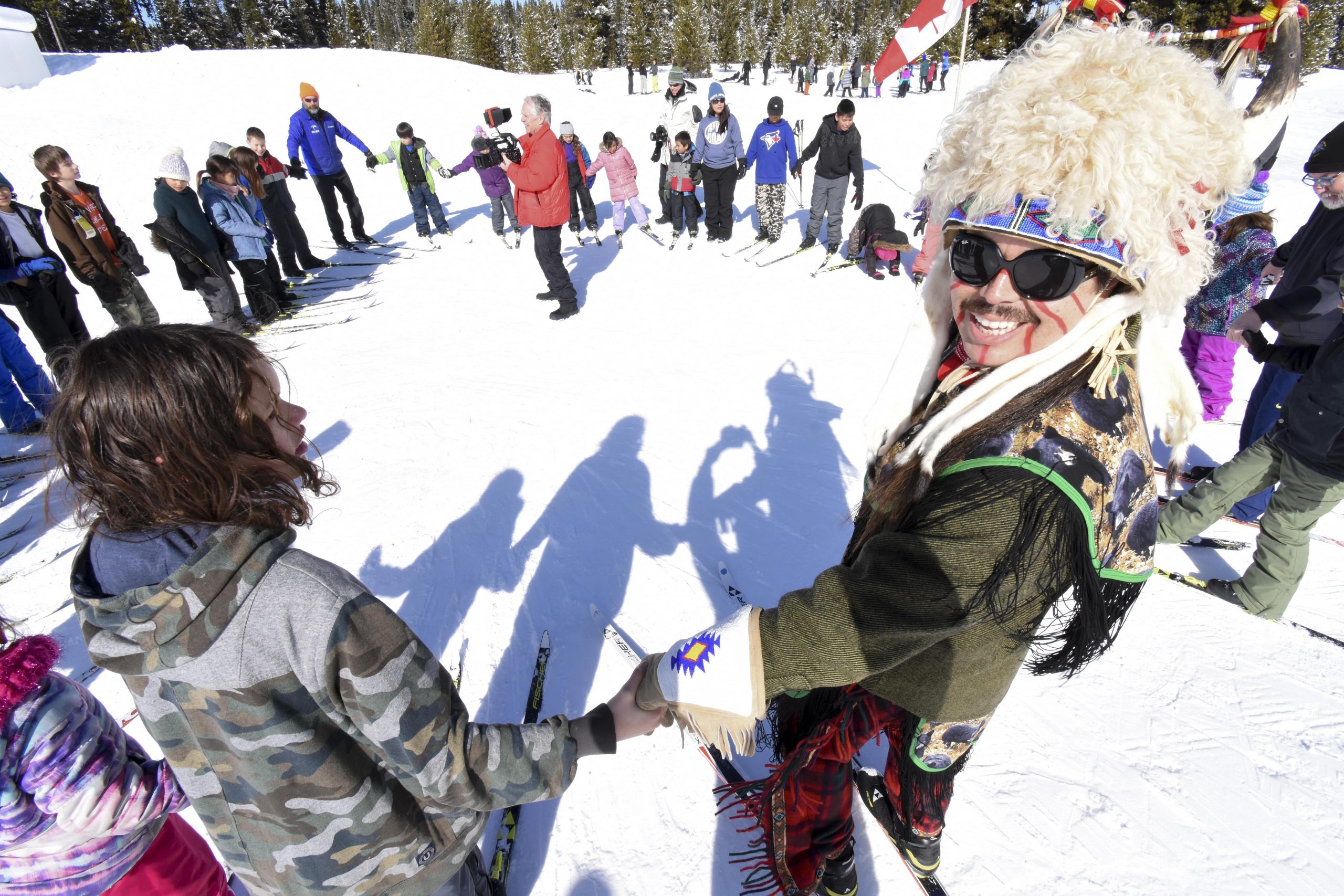
Levi Bent, a Spirit North coach, leads an event with a group of skiers (Photo: Spirit North)
“I think the Truth and Reconciliation Report was really a turning point for a lot of Canadians,” reflected Scott, “the legacy of residential schools and the intergenerational trauma, and the damage that was done, it lives on today. Those calls to action were really aimed at primarily non-Indigenous people starting to take steps to reconcile and to heal the harms of the past.”
Among the 94 calls to action were some specifically mentioning or targeting sport. The Spirit North website highlights three of them: Number 19, relating to the legacy of health, and Numbers 89 & 90, relating to sports and reconciliation.
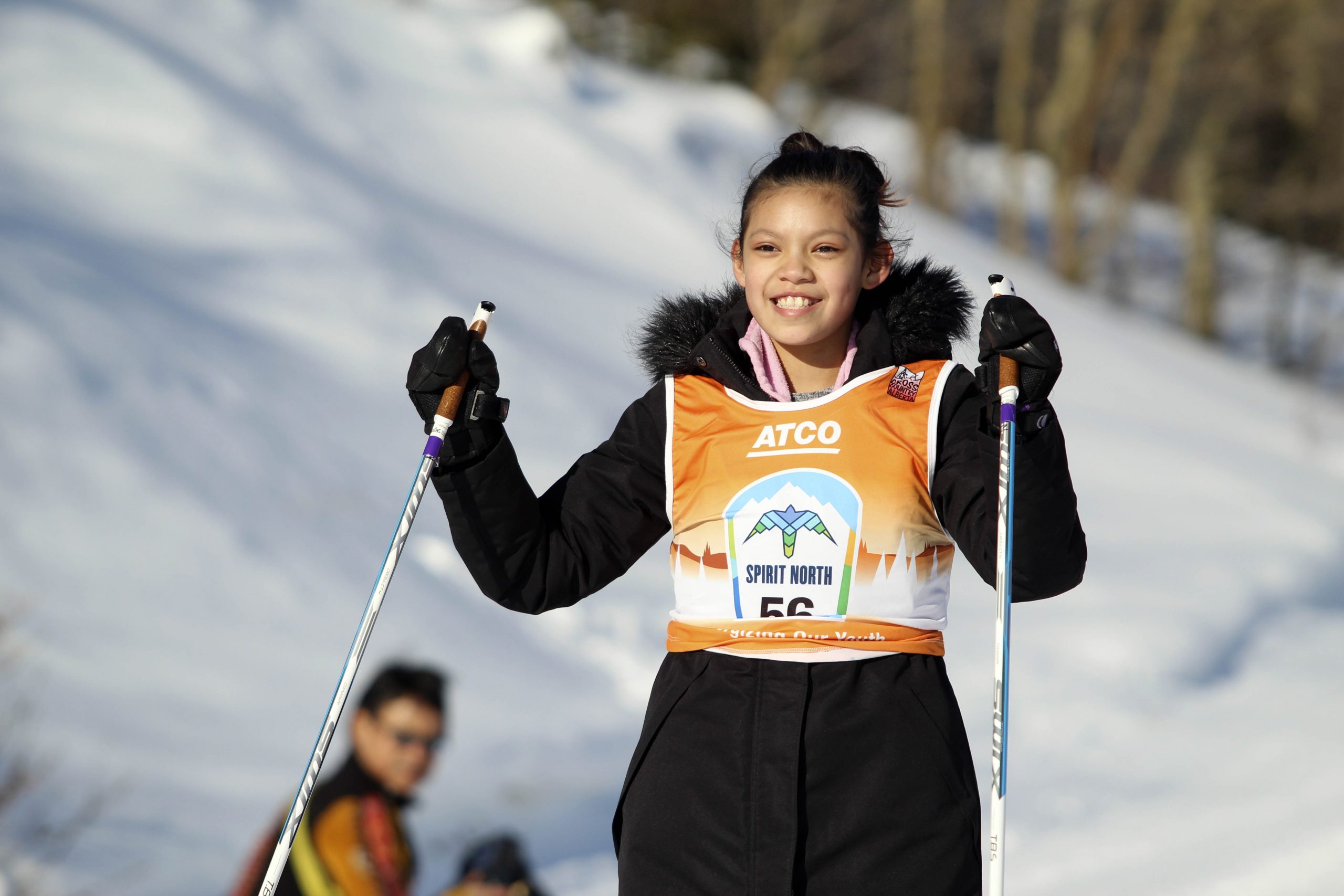
A participant enjoying the sunshine and snow at a Spirit North event (Photo: Spirit North)
“It was really incredible to see sport in there,” said Scott, “Of course, I know that as a former athlete how valuable sport has been in my own life, not just as a professional pursuit, but in terms of life skills, friendships, and opportunities. To think that we can contribute to reconciliation through this platform, that is really at its heart a very simple concept – it’s activity, it’s play, it’s sport, and it’s something that all kids should have the opportunity to benefit from. I think it was really inspiring to know that we are part of this whole movement toward reconciliation with Indigenous peoples in Canada.”
Initially cross-country skiing was the only sport offered in the Spirit North programs, but when they started to get interest and questions about expanding beyond winter, the list of offerings started to expand.
“It really grew, it just exploded this last year to include everything from rock climbing, to equestrian, to skateboarding,” said Scott, “basically, if a community indicates interest in another sport and we have the capacity to meet that interest, we will do it. One of our primary goals and objectives is to ensure the experiences are really enjoyable for kids and make sure that they have a great time, and if they want to try a new sport and it’s beneficial, then we’re open to exploring it.”
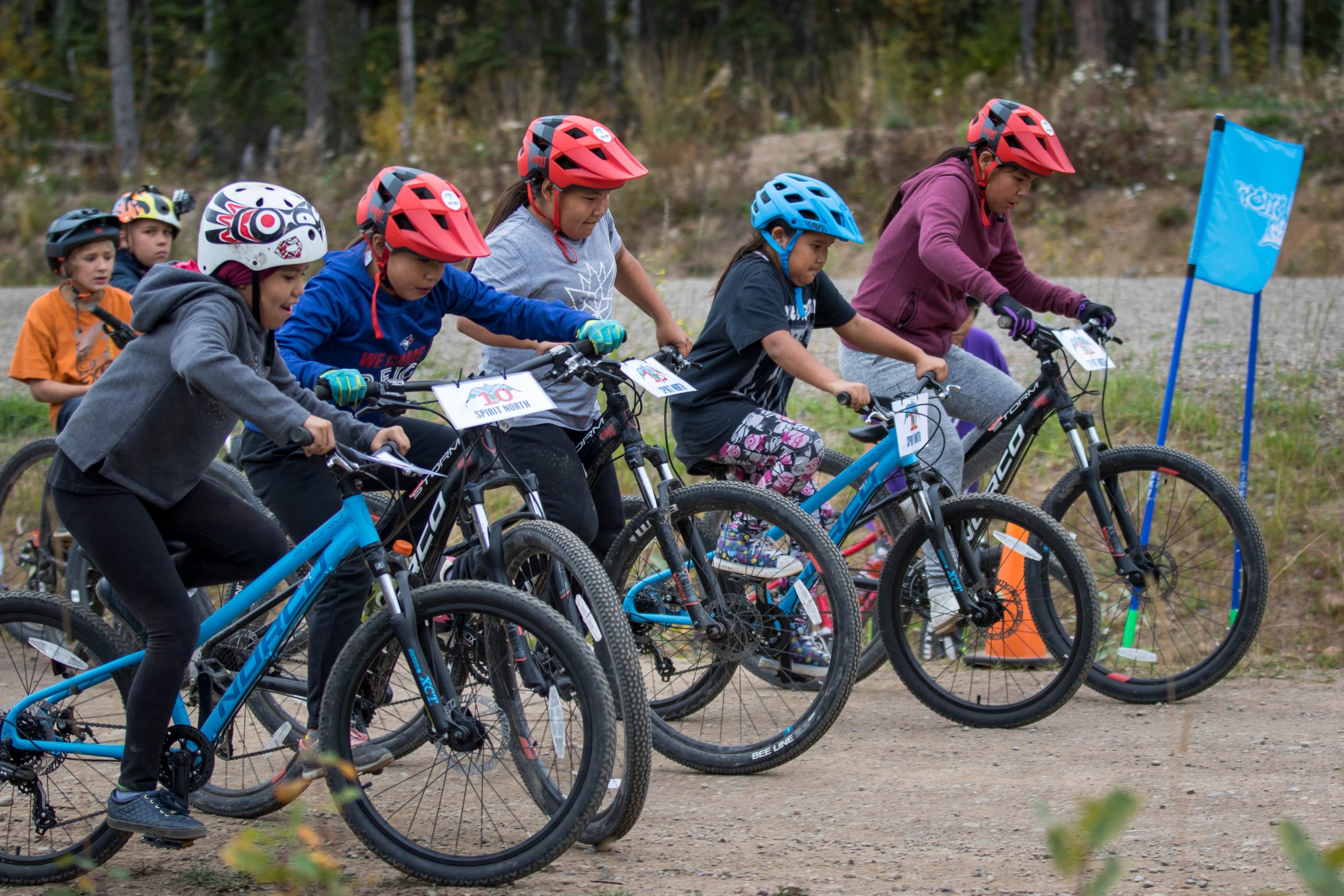
Spirit North participants work on their mountain biking skills, one of the sports added to the program. (Photo: Spirit North)
In the last year, 77 schools took part in Spirit North programs across six provinces and territories. Scott explained that they have a number of different models for programs within a community but primarily, the relationships start with what she calls a “co-creation process.” This includes meeting with the community members, teachers, elders, families or whoever is interested.
“Really, it’s a discovery,” explained Scott, “just learning what their values, beliefs, traditions, and knowledge are, and what are the barriers and then the program design is developed in collaboration with the communities. It’s very much a partnership.”
After this, the Spirit North program rolls out with a leader who is local if possible, if that capacity isn’t there, then they bring in a coach from an outside or neighboring community to lead programs.
“Every program looks a little bit different in every community, because it’s community driven,” said Scott. “We have been in communities for ten years now, there’s no cutoff date, or time we transition out,” she continued, “I think one of the reasons for success is relationship building, we just really commit to the community in terms of long-term relationships and delivering programs for as long as they want or need us there.”
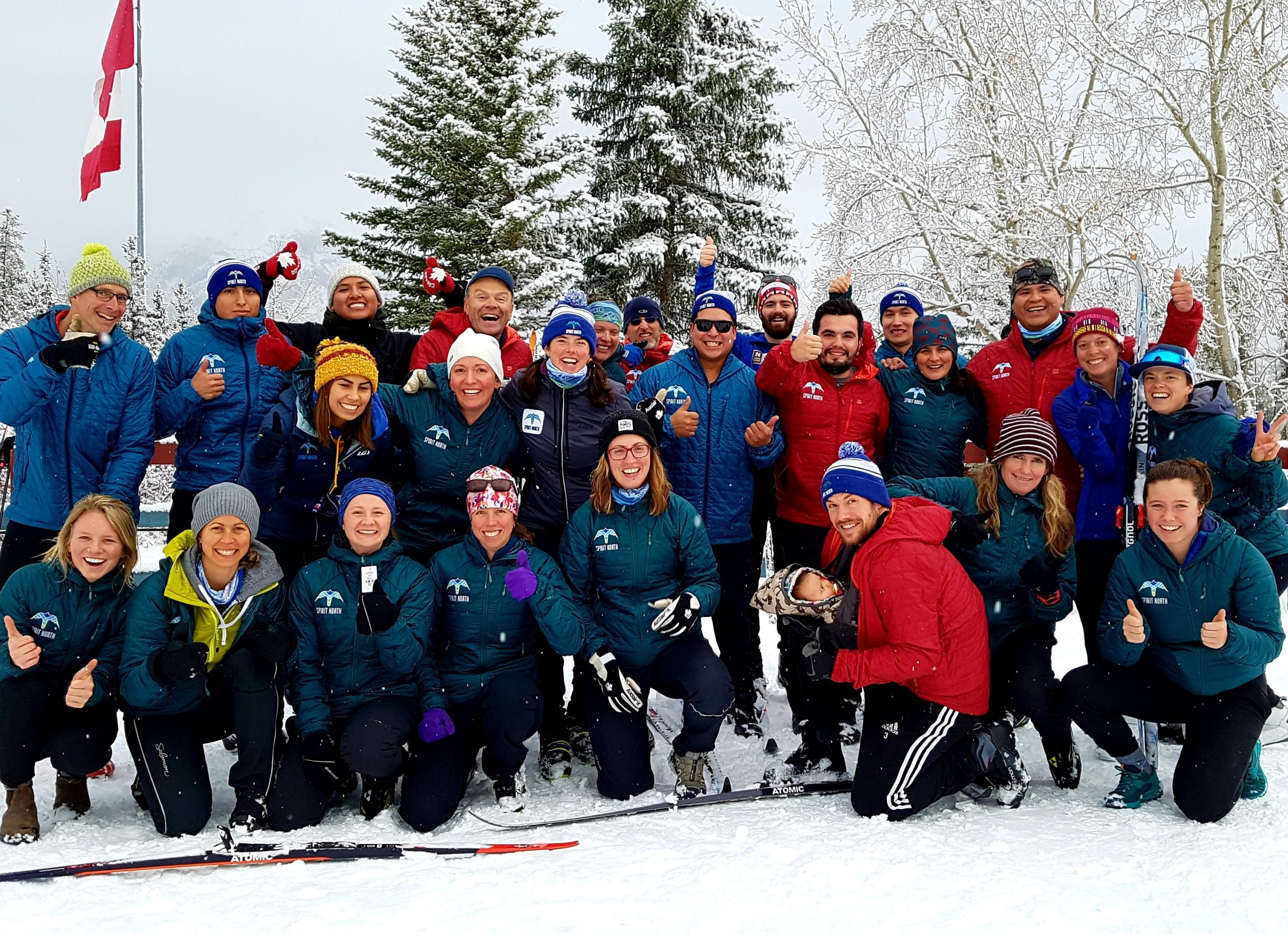
Spirit North leaders gather for a team photo (Photo: Spirit North)
It hasn’t all been smooth sailing. When asked about the learning process, Scott laughed, “I started a nonprofit really with no idea how to start, and so the learning curve was extremely steep.” However, with the help of a great team of people to lean on and provide advice and guidance, she was able to get the program off the ground. “I don’t think I could have known how much work it was going to be,” reflected Scott, though she was quick to say that it has all been worthwhile and very rewarding. “I think one of the biggest challenges we have is the challenge of every charitable organization, which is fundraising, you have to keep the lights on, and the programs running, and coaches paid.”
This has been particularly challenging during COVID. “We really have two jobs here,” said Scott, “raising money, and running programs, and raising money during COVID has been a challenge for a variety of reasons.” As with most non-profits, their fundraising success ebbs and flows. “We’re lucky and we feel fortunate, we’ve got some great backers, but growth and expansion as we go forward requires more funding. So it’s a constant sort of push and pull or a balance to try to maintain,” Scott concluded.
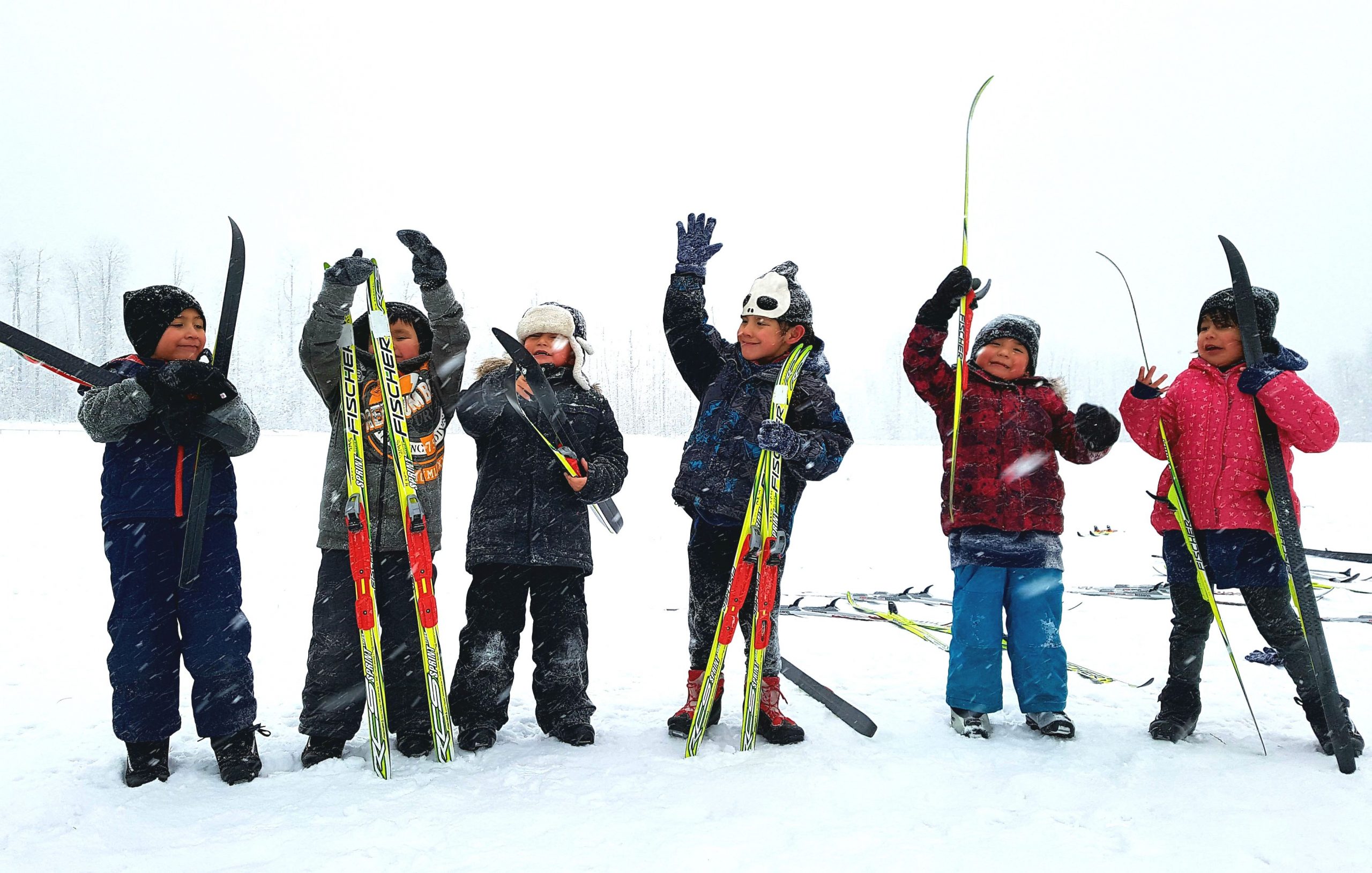
Enthusiastic little skiers show off their fischer skis, taking part in a Spirit North program (Photo: Spirit North)
On the flip side, Scott said the rewards from her efforts come in two parts, heartwarming individual stories, and the cast of extraordinary quality who work for the organization.
“We have coaches across the country now, who will send in a note or a text about a kid in the program who’s just completely transformed,” said Scott, “it’s so heartwarming and it never gets old… when we know that this program has touched them in a positive way, and it has made a difference in their life, that’s the most rewarding thing I think we could ask for.”
Regarding her team, Scott said, “the cast of people that have come to the organization – it’s been really extraordinary to see the quality of our team grow over the years, and I feel very fortunate to have the team around us that we do, running these programs, people who are really truly talented, but also caring and committed to the cause.”
As the Spirit North programs continued to grow, Scott reflected particularly on the satisfaction she draws from seeing kids participate in and enjoy Nordic skiing.
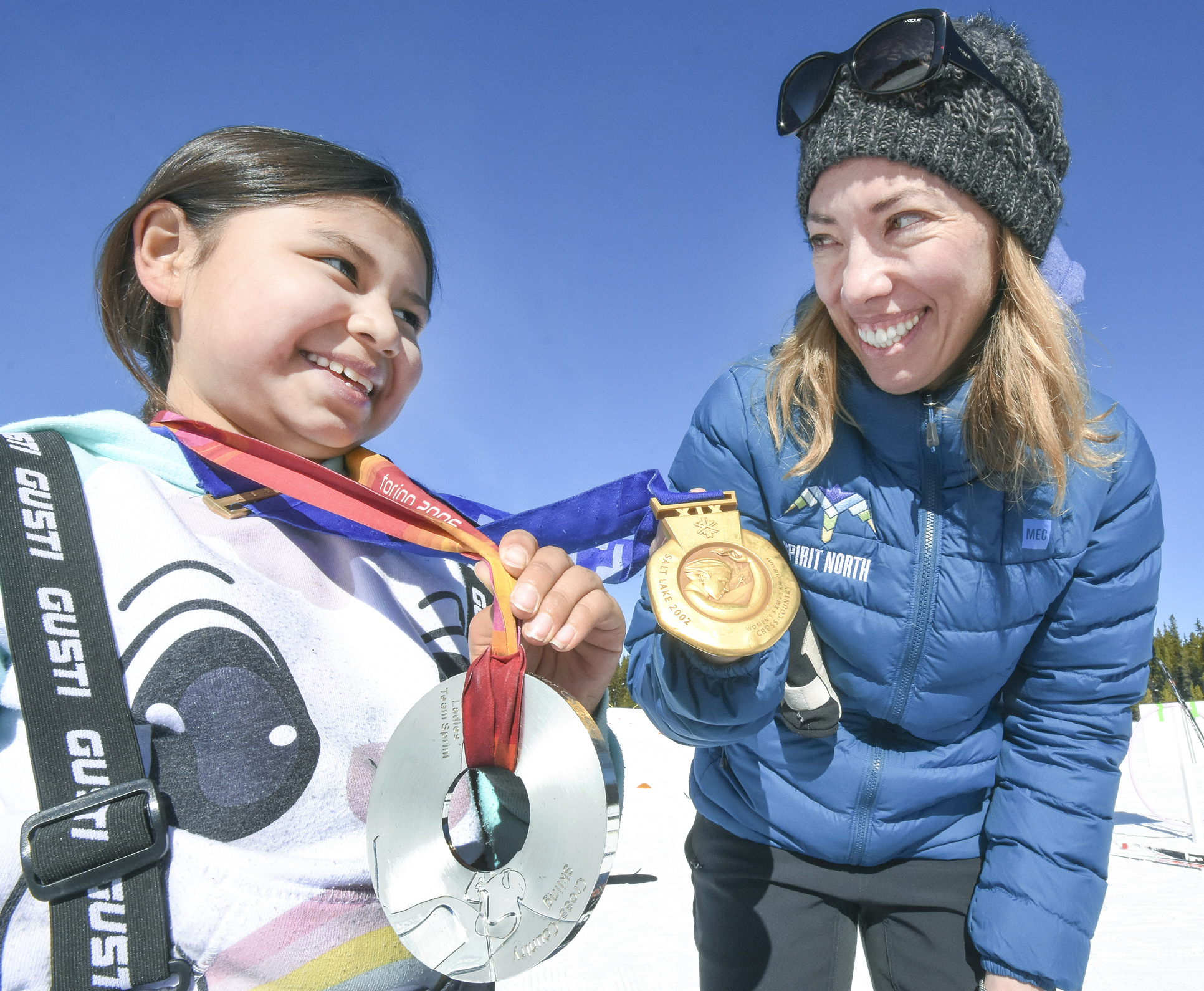
Beckie Scott shares her silver and gold Olympic medals with a Spirit North participant. (Photo: Spirit North)
“I think for me, it’s always so heartening and inspiring to see kids enjoying the sport that I love the most, and have grown up loving,” she concluded, “and just to have seen the sport, carry me through all these different phases of my life has been really something remarkable.”
To find out more about Spirit North or to make a donation, you can visit their website here.
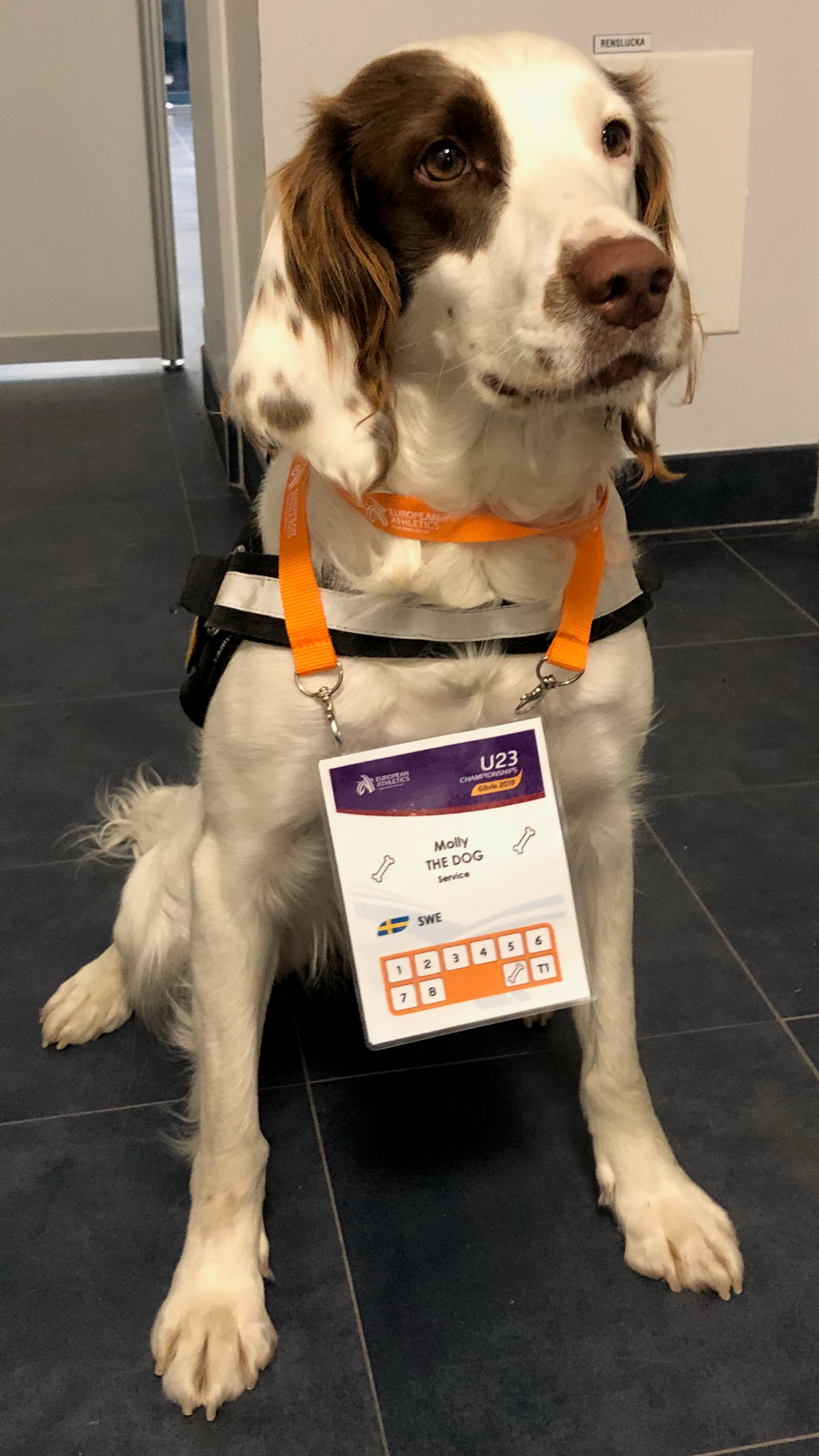
Molly is a rare dog, although let’s go with this premise, all dogs are good. But some, like Molly, might be slightly better. Hailing from a working line of Springer Spaniels in Northern Ireland, Molly now resides in Sweden with her caretakers, Joanna and Michael Sjöö. Both are part-time doping control agents with the Swedish Sports Federation.
Molly is six years old and also works a part-time gig with the Swedish Sports Federation.
With a keen sense of smell, Molly is highly trained. She’s tasked with detecting certain banned substances that allow athletes to improve their performances. Think drug-sniffing dog — like at customs — but the anti-doping variety. Molly’s work-life orbits around assisting with doping controls at training camps or sporting events.
Dogs, for example, can be trained to detect substances excreted in sweat, and falling blood sugar levels from the breath of a diabetic. However, those types of biological marker sniff-tests are not part of Molly’s repertoire. So when Michael and Joanna collect urine and blood samples, those samples are lab tested for banned substances. Molly cannot perform the magic of detecting autologous blood doping or EPO use. That’s beyond her job description.
Molly plays an altogether different role. She detects substances an athlete might be carrying or storing like testosterone and some steroids in powder, liquid, and gel form. The full complement of Molly-detectable banned substances remains a secret. Molly, as it stands, remains the doyenne of anti-doping K-9s: as far as we know she’s the first of her kind.
Swedish biathlete Sebastian Samuelsson and Molly. (Photo: @dopinghundenmolly Instagram)
We were tipped off to Molly’s fine work when Sebastian Samuelsson, a star Swedish biathlete, was visited by Molly during an out-of-competition doping control visit. Like many athletes before him, Samuelsson posed for a photo with Molly.
When Molly makes a visit, as she did with Samuelsson, Molly’s success depends on the commitment of her caretakers.
“One problem is you have to train the dog, the other is you have to find the right people that like dogs and can take care of them, help them perform, and do the necessary maintenance training,” said Michael Sjöö from his home in Sweden where Molly resides. “It’s a responsibility with much necessary work because Molly has to be trained a couple of times every week. We have to get out, even if we don’t want to. I mean, for her it’s fun, it’s playing. And we have to do the play, so she loves it.”
At home, Molly enjoys several lounging spots: all comfortable, yet differing in amounts of direct sun and proximity to people. By all measures, Molly is just a regular dog, except when it’s work time.
“We go unannounced into dressing rooms and locker rooms and all these different places like airports when teams land so Molly can sniff bags arriving at the terminal,” said Michael Sjöö. “At a larger competition or training area Molly can always sniff the athlete’s bags in warm-up areas or locker room, so it usually is quite easy for us to do the work. 99.5% of the athletes, when we are coming, they really think it’s good because Molly sends a good message.”
Molly can sniff bags, but according to her handlers, they are unable to search bags without an athlete’s permission. Either way, When Molly detects a banned substance, the bag’s owner is identified and a doping control test is ordered.
Doping controls are used to either catch dopers or deter athletes from doping in the first place. Those measures have proven imperfect. Molly presents an opportunity to improve the interface between doping control agents and athletes. Doping controls can be an invasive but necessary part of anti-doping. When doping control agents show up with a cuddly Springer Spaniel, the edge is taken off.
“Because of Molly, during doping control, we get much better contact with the athletes. She diffuses any possibly tense situation,” Joanna Sjöö said
Team Molly: Joanna and Michael Sjöö with Molly. (Courtesy photo)
Although Michael and Joanna could not discuss any “positive” sniff tests attributed to Molly, they did claim Molly has deterred potential cheaters. They mentioned that on several occasions at a competition or training area, an athlete has noticed Molly then picked up their respective bag and briskly walked away.
“When we see that we always try to find who that person is,” said Joanna Sjöö. “And we send the information to our investigation department, and then the department, for example, gives permission to test that person. So when Michael and I are with Molly and investigating an area and we notice that someone is actually leaving the area, we try to investigate that.”
Several anti-doping agencies have inquired about Molly. Michael and Joanna emphasize that Molly is an investment requiring resources to make her an effective work dog. Molly, for example, completed a rigorous six-month training program while living full-time with a customs agent.
Despite her attention from the media and athletes, it is a dog’s life for Molly. A little work, a little play, a good home. She fights the good fight. Good Molly.
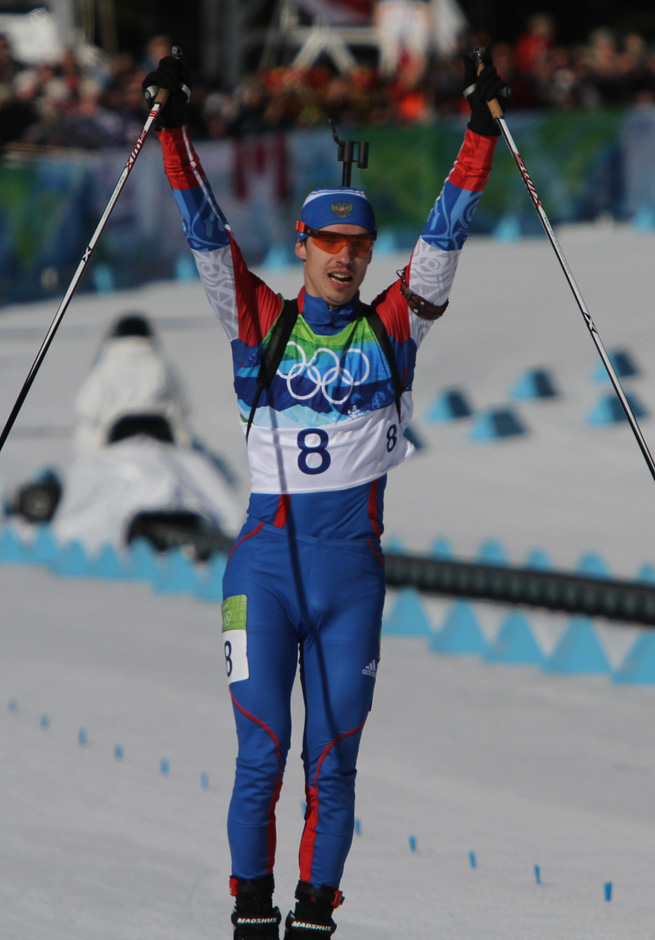
Sergei Ustyugov of Russia celebrates his victory in the 15 k biathlon mass start in the 2010 Olympics in Vancouver, Russia.
Covering doping in sports like biathlon and cross-country skiing here in North America can make one feel self-rightous. The U.S. and Canada run clean systems if positive doping tests are the benchmark for suspicion. As far as we can tell, there’s been a single case involving a North American nordic sport athlete. In 1987, an American caused a stir after the 1987 Nordic World Championships in Oberstdorf, Germany. Kerry Lynch, a nordic combined skier, admitted to “bloodpacking”. (A glance into U.S. athletics and cycling, however, tells a different story altogether.)
Then there’s Russia! Russia! Russia!. Just right there, an appeal to doping angst with the use of an “!”, and a trifecta of “Russia” as if from a far far away time in our recent political history.
This week the Court for Arbitration for Sport’s anti-doping division ruled former Russian biathlete Evgeny Ustyugov guilty of an anti-doping rule violation. The ruling’s technical underpinnings turned on abnormalities in Ustyugov’s Athlete Biological Passport. He doped and was able to evade detection. His results from January 2010 until the completion of the 2013-2014 season were stripped. These include gold medals won at the 2010 and the 2014 Olympics.
Six years after the Sochi Games, a decade since Vancouver, the slow churn of justice in sport advances.
Since the Sochi Olympic flame smudged out and whistleblowers helped tease apart the deep-state Russian doping enterprise, FasterSkier has covered the case. And just this week I used an image of 2014 50 k freestyle Olympic champion Alexander Legkov as a lead photo for a doping related article. Too cynical a choice for a doping story photo? Maybe.
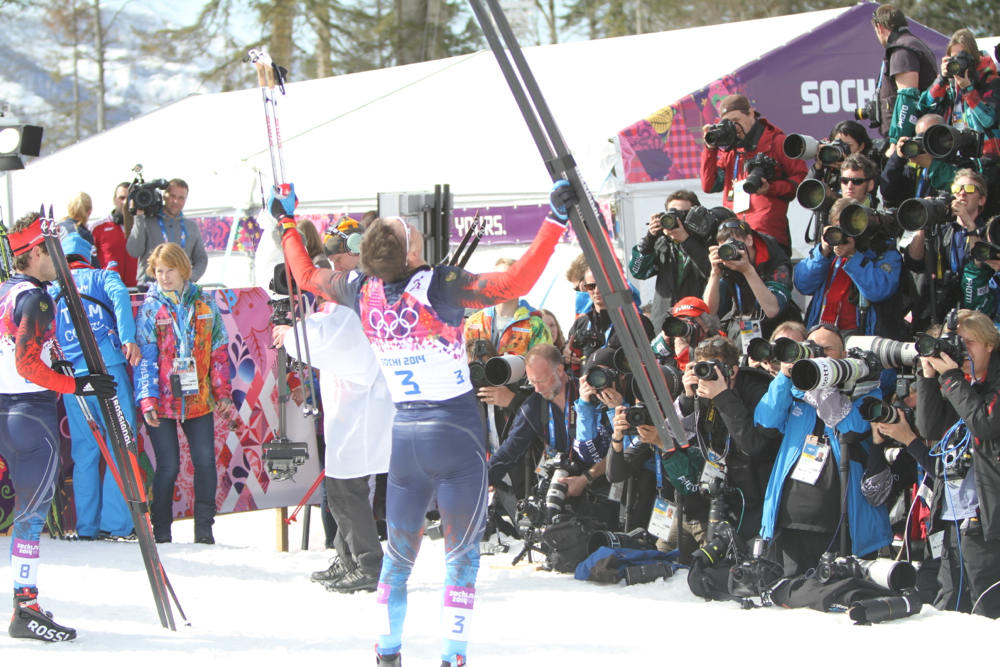
Alexander Legkov after winning the Olympic 50 k in 2014.
Legkov went through his own doping adjudication twists – he was implicated as an athlete who benefitted from Russia’s systematic doping program. Legkov was eventually cleared in a 2018 CAS decision and his 2014 gold medal was reinstated. At first appearance, the image of Legkov used in the earlier story is similar to others we have seen before: the euphoria of winning gold. But we all know, positive tests or not, CAS decision or not, the haze of Sochi doping evidence provides a “guilt by association” backdrop. That’s a tough bias to suppress.
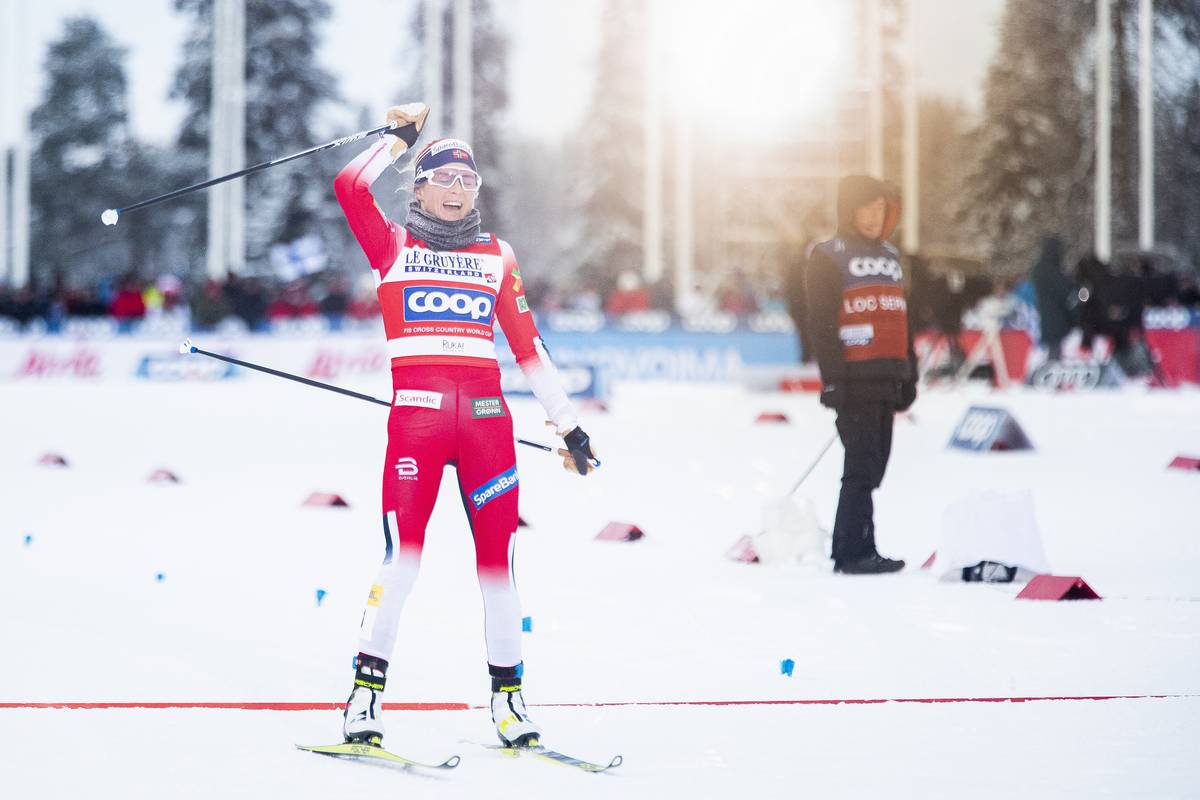
Therese Johaug winning last season in Ruka, Finland. (Photo: NordicFocus)
Initially, Johaug was handed a 13-month ban by the Norwegian Ski Federation, which FIS appealed. She was eventually given an 18-month ban by CAS and missed the 2018 Olympics. Back on the scene beginning the fall of 2018, Johaug dominated distance racing. She claimed the 2019 distance World Cup globe and the Overall World Cup in 2020.
Right upfront, the authors of the study, Ulrik Wagne and Elsa Kristiansen, use terms like “national identity” and “national performance” to describe how humans often tend to bundle athletic prowess with how they think and feel about their home country. Chants of “U.S.A. -U.S.A.” anyone? Sports and identity commingle.
About Norway’s Johaug coverage the study’s authors write, “the media often propagate the claim that the administrative systems both monitoring and helping elite athletes have failed. Accordingly, the responsibility for the failure is transferred from the individual to the governing organisational level.” That’s jargon claiming the system failed Johaug.
Sweden, a country similar in its affinity for cross-country skiing, took a harder line against both Johaug and Norway. The authors claim, “Swedish discourses seem in favour of strict liability; thus, the issue of guilt can be ascribed to the individual athlete, who accordingly needs to receive a ban, and to Norwegian anti-doping policy, which is not as consistent as one would expect, and therefore requires a thorough investigation.” In other words, the main Swedish narrative was Johaug failed herself and Norway is no beacon of clean sport. (Prior to Johaug’s positive, claims of abusing asthma medication to boost athletic performance rattled Norwegian skiing.)
In some ways, the findings reinforce our propensity for tribalism. In this case, the national flag waving kind when international sport is used as a proxy for nation-state status. Norway became an easy foil for Sweden after projecting itself for years as above the temptation to dope. So maybe it’s no surprise that some Norwegian media showed a bias and deflected blame away from Johaug. And similarly, there’s no shock that some Swedish media asserted Johaug and a complicit system were at fault.
The analysis of Johaug’s doping coverage reveals that some media outlets were easily wrapped up in the game of asserting the superiority of one Scandinavian state over the other. Soft-power flexed just to the side of the ski tracks.
Which brings us back to Russia. With the Ustyugov ruling, all we can say is score one for the newly minted Biathlon Integrity Unit. Sport comes clean, eventually.
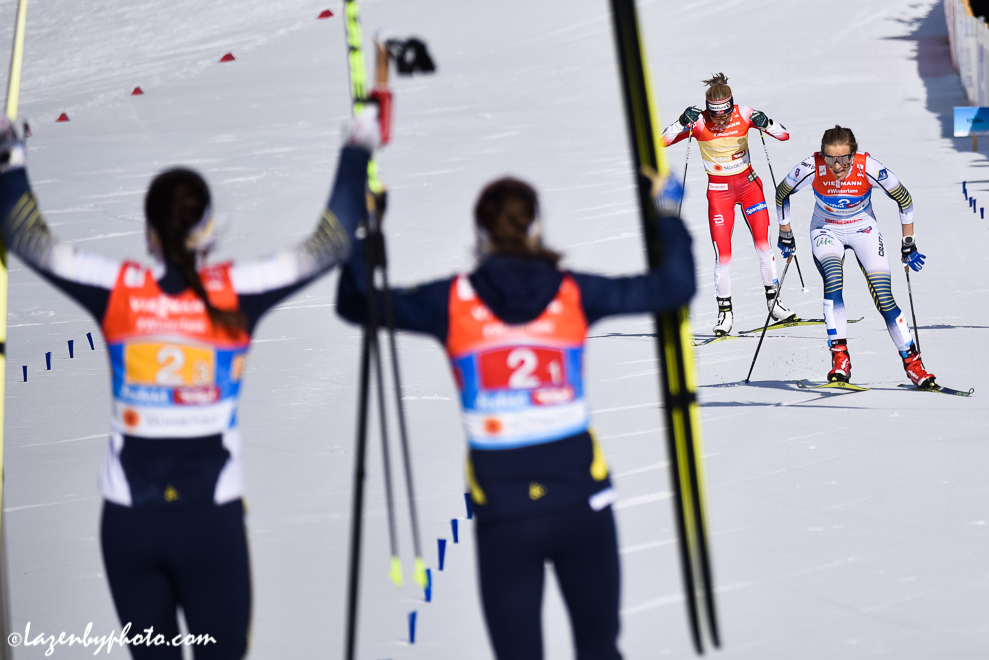
Holding off Norway’s Therese Johaug is Sweden’d Stina Nilsson during the 2019 World Championship 4 x 5 k relay in Seefeld, Austria. (Photo: John Lazenby/lazenbyphoto.com)
As for remaining unbiased on the tracks and settling scores, the stakes were high when Norway and Sweden went head-to-head in the 2019 World Championship 4 x 5 k relay. Johaug faded late in the final leg while Swedish speedster Stina Nilsson closed out down the final straight for the win. Nilsson has since switched to biathlon. Johaug continues to crush. The facts are this: all biases aside in Norway and Sweden, it was a lovely race and worth a re-watch.
Last week Matt Futterman of The New York Times wrote two stories of interest to readers of FasterSkier. One piece was titled “Winter Sports Athletes Are Crisscrossing Europe for Races. Is That a Good Idea?” Futterman advanced this story on Twitter with the following statement: “It’s a really strange moment for the Olympic winter sports schedule to begin. All you have to do is everything medical experts have been telling us to avoid.”
It’s a really strange moment for the Olympic winter sports schedule to begin. All you have to do is everything medical experts have been telling us to avoid. via @NYTimeshttps://t.co/rFUaheiwfl
The article highlights the alpine World Cup, which began last week, and the soon to begin cross-country and biathlon World Cups as athletes, coaches, and organizers tiptoe amidst the pandemic.
That’s knee-deep skepticism in the first roughly140 words of this story. (Futterman, after all, has “Skeptic” listed as a personality trait on his Twitter profile.) As we surge into November, the NYT’s stories illuminate colliding social forces confronting the culture of elite winter sports. There’s Covid-19 and the accompanying down-throttle of the global sports infrastructure engine. Fanless races. Regular COVID testing. Strictly controlled access to the playing field. There’s also, as Futterman evaluated, a significant decrease in testing from anti-doping agencies.
“With winter sports that are considered high risk for doping about to begin their World Cup seasons and the rescheduled Tokyo Olympics only eight months away, antidoping officials say the need to get testing back to previous levels is critical,” explained Futterman. “This is particularly essential at competitions, they say, since those offer the best chance — given current travel restrictions — to catch athletes using illegal stimulants that have an immediate effect on performance.”
Some eye catching words were “winter sports that are considered high risk for doping”. Look no further than 2019 in Seefeld, Austria when several cross-country athletes were arrested and eventually penalized for serious doping offenses. Cross-country skiing and biathlon, historically, are those high risk winter sports.
In 2003, researchers wrote, “These data suggest that blood doping is both prevalent and effective in cross-country ski racing, and current testing programs for blood doping are ineffective.” The authors were referring to a review of blood tests already collected from anti-doping entities as far back as the 1989 Nordic Ski World Championships. The article, “Abnormal Hematological Profiles in Elite Cross-Country Skiers: Blood Doping or?”, published in the Clinical Journal of Sport Medicine, found the likelihood of blood doping prevalent amongst those within the sharp-end of the race field.
Again, in 2018, researchers examining newly released testing data confirmed “suspicious blood values” from previously tested cross-country skiers. None of this may be news, but it’s worth reflecting upon as anti-doping agencies have curtailed testing since last March.
Of late, the U.S. Anti-Doping Agency (USADA) has been one of the more transparent anti-doping agencies. USADA updates weekly the number of doping tests administered to U.S. athletes under its auspices and makes that information public. In March, as a response to changing travel dynamics and social distancing, USADA began what it called “mission critical” testing. In other words, the scale of in and out-of-competition testing was reduced.
For comparison, in 2019, USADA reported a total of 117 tests in biathlon, 74 of them during Q1. USADA aggregates skiing and snowboarding as one sport that includes all disciplines under the U.S. Ski & Snowboard umbrella. Altogether, those sports accounted for 309 tests in 2019, including 152 in Q1 alone.
USADA has released 2020 testing numbers for Q1. According to USADA, these include six tests total for biathletes, all taken out-of-competition. For the ski and snowboard sports, 67 tests were administered in Q1. Comparing Q1 in 2019 to Q1 in 2020, that’s a reduction of 68 tests in biathlon, and 85 in skiing and snowboarding over a similar period. (The International Biathlon Union held a World Cup in Feb. 2019 at Soldier Hollow that may have increased in-competition testing for U.S. athletes. USADA reports 42 in-competition tests for biathlon for Q1 2019, when the event was held. In 2018, USADA reported no biathlon in-competition tests for Q1-Q3.)
FasterSkier has reached out to USADA to learn about testing numbers for Q2 and Q3 in biathlon, and skiing and snowboarding. We’ll update this story if those data become avaiable. However, the general trend in testing is downwards. USADA reports a total of 3452 tests across all sports the first 90 days of 2019, and 2060 tests over the same period in 2020. That’s a reduction of 40.4 percent.
All this is to say that USADA, considered by many to be an anti-doping agency with integrity, has scaled back testing. By extension, one may assume that most of the nations involved in anti-doping have reduced testing too. Using the U.S. as an example is not to insinuate biathletes or cross-country skiers in the U.S. are doping, it is simply reliable data that tells a story of testing constraints. If reduced testing is happening here, it’s likely worse in nations with less anti-doping oversight.
Futterman’s Tweet rings loud and it’s worth stating again: “There is no way to sugarcoat this — 2020 was a great year to dope and not get caught.”
Followers of track and field will know the men’s 10,000-meter world record was broken on Oct. 7 by Uganda’s Joshua Cheptegei. The previous world’s fastest for men in the 10,000 was set in 2005. The same day, Ethiopia’s Letesenbet Gidey broke the world record in the women’s 5000m race – a record that stood for 12 years. Fast track, fast conditions? Primed racers with little fatigue? It’s all possible. So too are the more cynical explanations associated with decreased anti-doping oversight.
***
For reference, we have provided the public USADA testing information for three U.S. athletes: U.S. Biathlon’s Susan Dunklee, and Simi Hamilton and Jessie Diggins of the U.S. Ski Team. Depicted in the data below are USADA anti-doping tests. During the season when athletes are traveling and/or racing, other entities like the International Ski Federation (FIS), or the International Biathlon Union (IBU) in Dunklee’s case, may also test athletes. This is not a comprehensive list detailing the number of times each respective athlete has been tested. The testing information is included to provide a frequency comparison of USADA testing before and during the pandemic.
In this episode, we hear from a familiar voice – someone, in fact, we’ve heard from recently on the podcast, former elite cross-country skier Noah Hoffman. Post-race career, Hoffman has been deeply involved in the anti-doping movement as an educator, lobbyist, and content creator. This conversation is from Hoffman’s content creation side. A few months back the US Anti Doping Agency (USADA) posted a six-plus minute video interview between Hoffman and Dr. Edwin Moses – a famed track and field athlete, anti-doping reformer, and voice for equity in sport.
This episode features the full unreleased 30 plus minute interview – one where Moses discusses how best to empower athletes and build racial equity. This is an opportunity to hear one of the most fearless voices in sports. Along with his activism, Moses is a two-time Olympic gold medalist in the 400 m hurdles. Those are a few of his storied athletic accolades. He’s an icon.
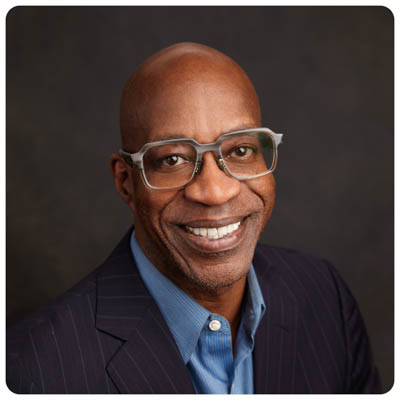
Dr. Edwin Moses. (Photo: USADA.org)
Off the track, Moses speaks for the rights of athletes. His is among a rarefied list of athletes who have chosen to challenge the power brokers in Olympic sport. He served on and chaired WADA’s Education Committee. He held true to his values while serving WADA as an outspoken critic seeking institutional reforms from within. He was a key figure in developing drug testing protocols, and he served on the IOC’s Athlete Commission, Medical Commission, and Ethics Commission. Today, Moses holds an Emeritus Chair with USADA where he continues his fight.
With a kowtow to Zach Caldwell and Noah Hoffman, we are repurposing their recent video conversation about anti-doping reform. On Nordic Nation, you’ll find just the audio. If you are more visual by nature, you can find the video here.
Hoffman is a former longtime U.S. Ski Team member. Caldwell is Hoffman’s former coach and runs Vermont based Caldwell Sport.
In this conversation, you’ll get solid details about anti-doping policy in the U.S. and abroad. Think of this as an advanced level remote learning opportunity to up your game when discussing anti-doping affairs. From Noah’s involvement with Global Athlete, to details on the Rodchenkov Act, USADA, and efforts to magnify athlete voices via labor unions, Caldwell and Hoffman cover lots of ground.
For those that have followed Hoffman’s career, this is an opportunity to hear him as he emerges as a nascent expert in anti-doping policy. It is easy to envision Hoffman leading international clean sport efforts in the years ahead.
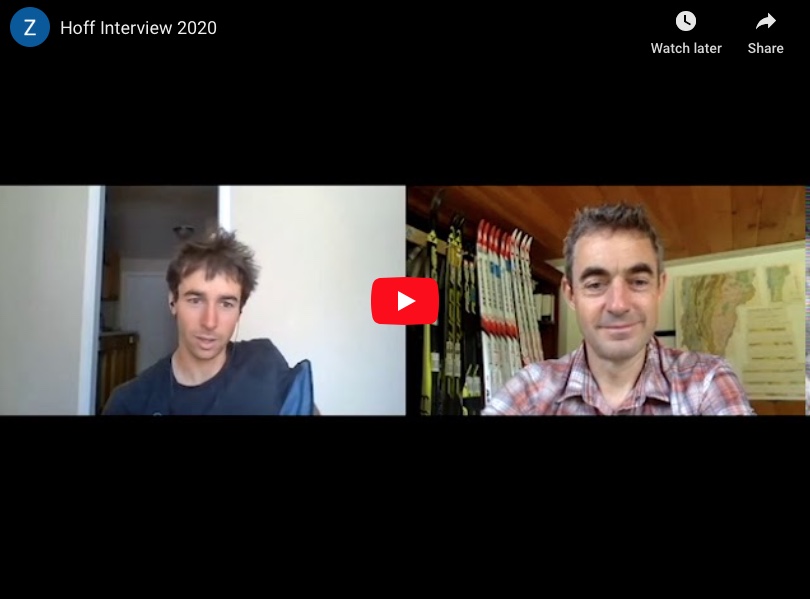
Noah Hoffman (left) and Zach Caldwell (right). This is a screenshot of the video, clicking the white triangle will not prompt the video to begin.
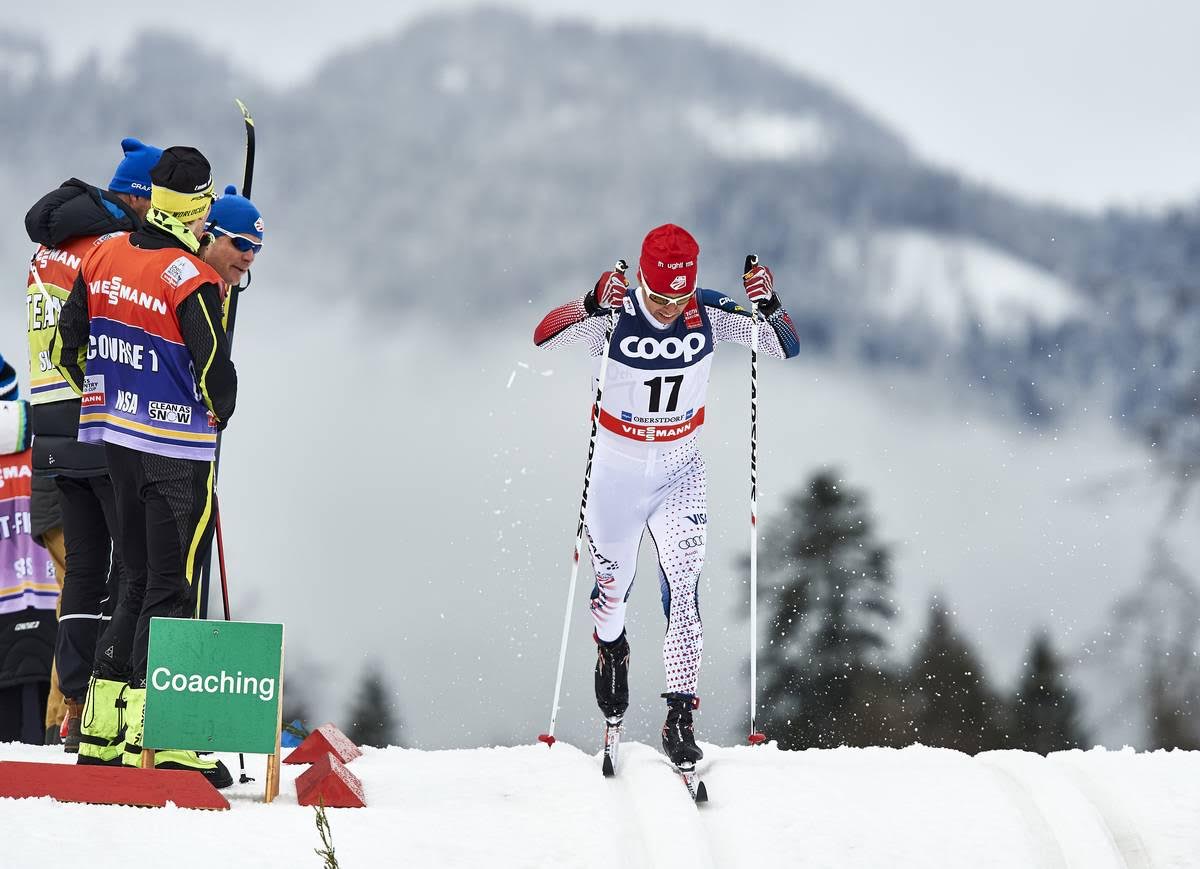
Noah Hoffman (U.S. Ski Team) racing to 35th in the 30 k skiathlon at the Olympics in Sochi, Russia.
As we all know, the COVID-19 global pandemic has left the world scrambling to adapt to the many challenges of slowing the spread of the virus. In the world of Olympic sports, the ripple effect has disrupted the efforts of anti-doping agencies worldwide to conduct the athlete testing normally relied upon to hold athletes accountable to abiding by the rules surrounding banned and controlled substances. Most international antidoping agencies have halted testing since mid-March as the invasive and close-contact nature of collecting samples posed a threat to both athletes and testers.
This causes concern that athletes inclined to cheat might abuse the situation, taking advantage of the opportunity to use illegal substances to improve their performance potential when competition is able to resume.
To address the lack of testing, the US Antidoping Agency (USADA) rolled out a pilot virtual testing program called Project Believe 2020 where athletes could provide a urine sample and blood spot test with an antidoping agent present on a zoom or FaceTime call.
For further insight into this topic, FasterSkier connected with two-time Olympian and long-time US Ski Team Member Noah Hoffman, who has become involved with USADA’s antidoping education program since retiring from skiing. Hoffman also recently wrapped up his second year at Brown University and we discuss his academic interests and the experience of being a college student during the COVID shutdown. Thanks for listening.
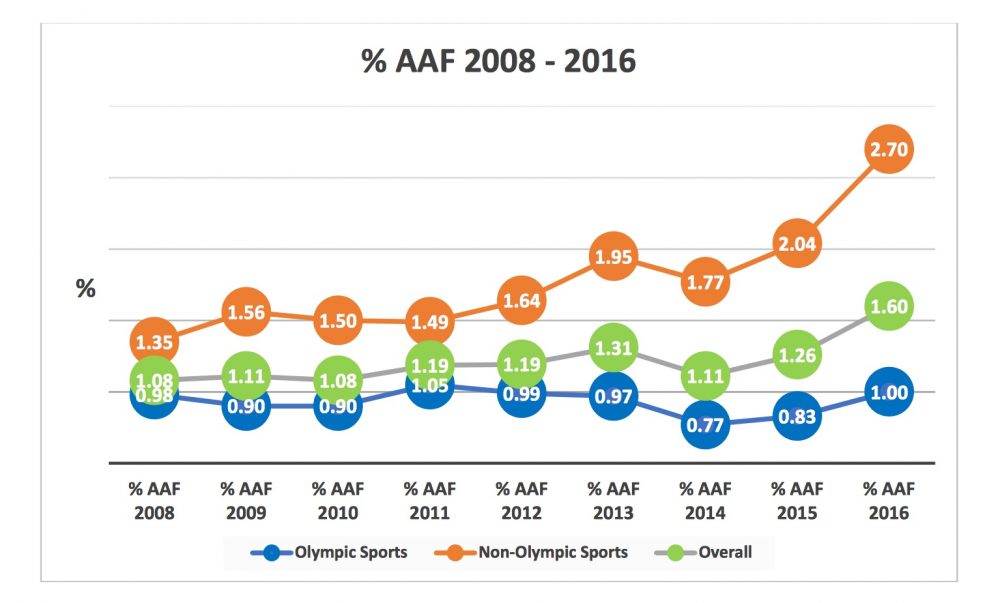
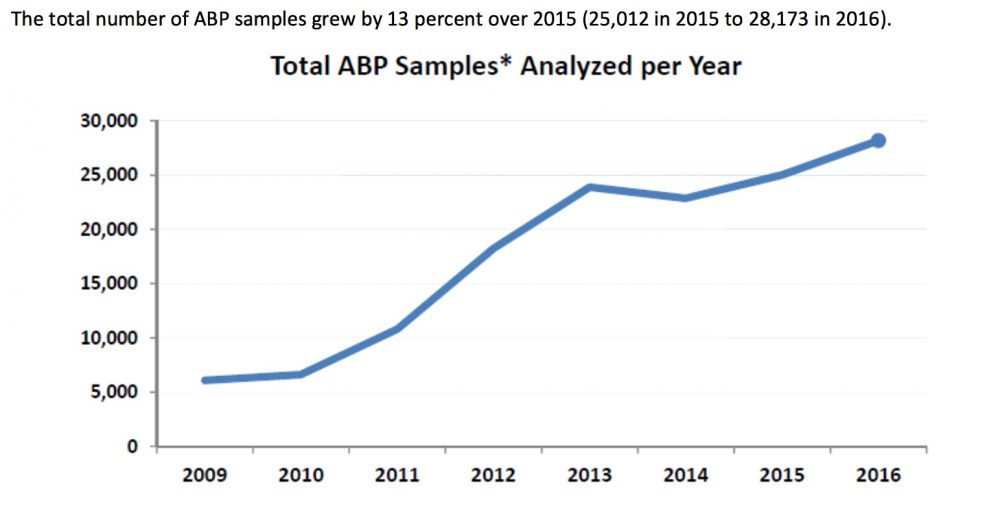
A year and more has elapsed since a doping scandal rocked the 2019 cross-country World Championships in Austria. Over that time, we have learned a bit more about what transpired at the micro-level. In the broader picture, those covering doping in sport often scour The World Anti-Doping Agency’s (WADA) annual release of a voluminous document titled “Anti-Doping Testing Figures”. The data dump runs hundreds of pages. Looking for figures on the number of tests per sporting discipline, type of test, governing body administering the test, on and on, it’s in there. The WADA report also discloses the number of AAFs (adverse analytical findings which indicate the presence of a banned substance) and ATFs (atypical findings that warrant more testing and follow up.) Useful information if one is trying to glean how pervasive doping might be in a chosen sport and how effective the tests are.
If you’ve ever read those reports and you’re convinced athletes dope in nordic sport, then this much is true: very few athletes produce AAFs or ATFs.
The International Ski Federation (FIS) released its own annual Anti-Doping Testing Figures on April 15, which it called “detailed FIS testing statistics”. To call this detailed is over reach.
The information does, however, provide the total number of FIS administered tests and disaggregates the numbers into “out-of-competition” and “in-competition” subcatagories for the 2019-2020 season. FIS catalogs the number of urine tests, ESAs (urine and blood tests which test for erythropoiesis-stimulating agents – think red blood cell boosters), blood tests, and specific tests for athlete blood passports (APB).
FIS reports a total of 606 in-competition tests this season with 332 of those specific to cross-country skiing (or roughly 55 percent of the total). In-competition tests for cross-country skiing broke down as follows: 170 urine tests, 112 ESAs, one blood test, and 49 blood passport tests.
For out-of-competition tests, FIS conducted a total of 2205 tests, with 1278 specific to cross-country (or roughly 58 percent of the total). For cross-country, FIS administered 302 urine tests, 245 ESAs, 151 blood tests, and 580 blood passport tests.
FIS accounts for a portion of the overall testing in cross-country skiing. National Anti-Doping Agencies, like USADA, are also responsible for testing athletes both in and out-of-competition.
Without running through all the numbers, cross-country accounted for the majority of tests within the FIS family of sporting disciplines: cross-country, nordic combined, ski jumping, alpine skiing, freestyle skiing, and snowboard. Although the data released from FIS tells a story, it really is an intro or first chapter at best. There’s no indication of the number of AAFs or ATFs.
Although it appears that FIS is doing its job, if that means administering tests, then we have no idea if these tests catch dopers. Although the evidence may be lurking out there, it is our understanding that the skiers caught in Seefeld at the 2019 World Championships who had been practicing autologous blood doping – transfusing one’s own blood – never flagged an AAF. And according to FIS reports, some of those same athletes arrested in Seefeld were concurrently using hGh.
We are glad for the testing. We just simply want to know if the testing is effective and does its intended job of deterring would-be-dopers. With the figures released in April by FIS, we simply do not know and neither do athletes who race clean.
2018 WADA Anti-Doping Testing Figures
The 2018 Anti-Doping Testing Figures from WADA, the more thorough analysis of testing metrics, reveals the breadth of testing and the paucity of positives — which may be a good sign. Then again, it might not. (2018 is the latest data set publicly available from WADA.)
In cross-country skiing, a total of 2916 in and out-of-competition urine and blood tests were administered. These tests found a total of seven AAFs. (From Table 2: Total Samples Analyzed in AIOW Sport/Disciplines (Urine and Blood)).
In cross-country skiing, 187 total hGh isoform tests were conducted (blood) with a single out-of-competition AAF. (Table 30)
In cross-country skiing, 272 total hGh biomarker tests were conducted (blood) with no AAFs. (Table 31)
In 2018, FIS specifically collected 228 hGh biomarker samples – the vast majority of those were collected out of competition — with no AAFs. (Table 19)
A total of 1448 Athlete Biological Passport samples were collected for cross-country in 2018. (Table 4).
WADA’s Explanation of their hGh tests, quoted from WADA’s Q & A page.
HgH Isoform: “WHAT IS THE HGH ISOFORM DIFFERENTIAL IMMUNOASSAYS (THE ‘ISOFORMS APPROACH’)?
Since the total levels of hGH secreted into circulation vary naturally, are widely fluctuating over time and may be influenced by several factors not associated with doping, it is practically impossible to develop an anti-doping test based simply on the measurement of increased total hGH concentrations. However, doping with recombinant hGH (recGH) alters the naturally constant proportions between the different isoforms of hGH present in blood of an individual. The hGH Isoform Differential Immunoassays were developed to detect these changes in the proportions of different hGH isoforms after recombinant recGH injection.”
HgH Biomarker: “WHAT IS THE HGH BIOMARKERS TEST (THE ‘MARKERS APPROACH)?
hGH affects the expression of many different proteins which may serve as biological markers of hGH activity. These include markers of hGH action in the liver such as IGF-I, as well as markers of hGH action on soft tissue collagen turnover, such as the N-terminal peptide of procollagen type III (P-III-NP). The measurement of these two hGH markers in serum may serve to uncover the manipulation of the hGH/IGF-I axis independently of the doping substance used, be it recGH or other agents used to increase circulating hGH [for example analogs of GH-releasing hormone (GHRH), hGH secretagogues such as GH-releasing peptides (GHRP) or even hGH gene doping]. The detection and quantification of such biomarkers of hGH activity constitute the rationale of the indirect method for detection of doping with hGH, referred to as the ‘markers approach’.”
VG’s article was not part of an official FIS press release. The FIS is scheduled to discuss how Covid-19 may impact next season at a later date. However, Mignerey was frank in his comments, and discussed worst case scenarios. (FasterSkier used Google Translate to pull quotes from the piece, which was written in Norwegian.)
Mignerey noted that if full travel restrictions remain in effect, producing a World Cup series will be nearly impossible. Further, the article states that if cross-border travel restrictions are lifted, but gatherings are limited to 100 people or less, the race season could be in jeopardy.
Here’s a translated quote regarding quotas on the size of gatherings: “If there is regulation with a maximum of 100 people allowed in the same place, then there will be no World Cup, but with regulation of 500 or 1000 people, it is possible with runners, support equipment, organizer and media.”
According to the translated article, VG published the following bullet points relating to what Mignerey is positing for next season.
“These are some of what the race manager has on the drawing board:
If travel regulations are such that people cannot move from their own country, the World Cup is impossible.
If there is quarantine travel regulation, we can move from country to country with some world cup races.
It may be appropriate to separate men and women. A weekend with men and one with ladies. Or, for example, we can have men for two weeks in Norway, then two weeks with the ladies in Finland for not having too many in the same place at the same time. Everything is on the table.
Tour de Ski should start in the Christmas season, but is uncertain. It may be appropriate to have the entire tour in the same country so that we do not spread the virus.”
Mignerey also expressed that the possibility of running some events with no fans in attendance. This policy would add some complexity to the pending schedule, as some venues allow fans to attend for free, while other local organizing committees generate revenue through ticket sales. (This past season, Oslo authorities banned spectators from the main Holmenkollen stadium area. However, along the unregulated portions of the course outside the stadium, the course was lined with fans.)
Reminder, this interview with Mignerey conducted and posted by VG was not an official FIS press release.
After the athlete provides a video tour of the bathroom, proving no other individuals are present, “Off camera, the athlete gives a urine sample into a supplied container.” This is a change from the standard protocol for collecting a urine sample, in which the athlete urinates “under direct observation” of a doping control officer or witnessing chaperone of the same gender. (with a link to: https://www.usada.org/sample-collection-process/urine/)
The article goes on to discuss the pitfalls of virtual testing, and efforts to mitigate those downsides. For now, with travel restrictions in place and anti-doping authorities across the globe limited in their face-to-face reach to observe athletes when tested (as is the norm), virtual testing may become the short-term new normal.
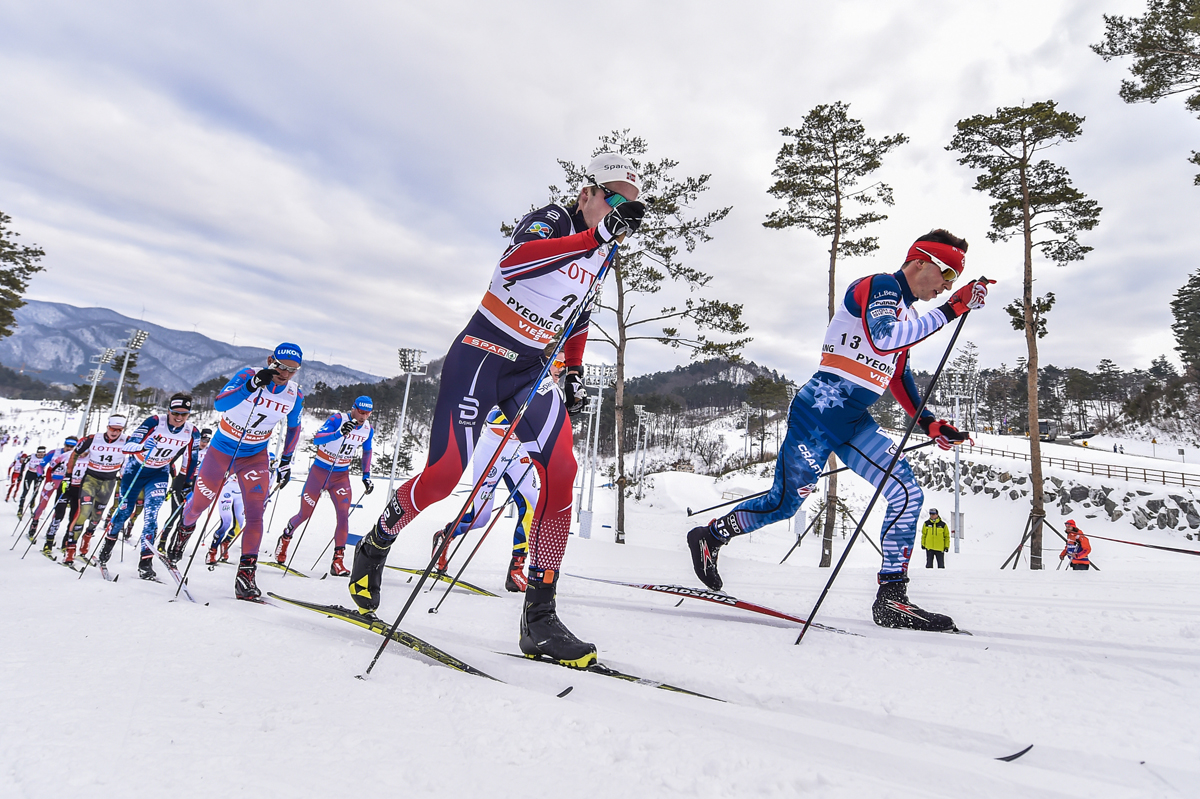
American Noah Hoffman (r) racing alongside Norway’s Daniel Stock during Saturday’s 30 k skiathlon at the 2017 World Cup in PyeongChang, South Korea. (Photo: Fischer/Nordic Focus)
Noah Hoffman, retired athlete, and current sophomore at Brown University is part of the movement to upgrade anti-doping enforcement. On October 28, he posted a blog highlighting why he supported the Rodchenkov Anti-Doping Act (RADA). RADA is federal legislation that will criminalize doping. More specifically, as Hoffman notes, it criminalizes doping conspiracies involving international sporting events like the Olympics and World Championships.
Here are the details of RADA as highlighted by Hoffman in his October 28 post:
The Act will
Criminalize doping conspiracies that target international sporting events
International jurisdiction extends to any sporting events that has
1 or more U.S. athletes and 3 or more international athletes competing
AND
is a signatory to the WADA code
AND
has a sponsor that does business in the U.S. OR sells rights to be broadcast in the U.S.
If the act is passed, the U.S. would be able to apply broad discovery tools when it comes to investigating doping schemes: Tools that carry with them the financial and investigatory weight of the federal government. Although RADA unanimously passed in the House, it has not been voted upon in the Senate. But just the prospect of the pending legislation already has WADA speaking out against it. In fact, the AP reported that the IOC and WADA have hired a Washington D.C., lobbying firm to “discuss” the legislation.
It appears WADA and the IOC are concerned about the extraterritorial powers potentially given to the U.S. when it comes to pursuing doping syndicates abroad.
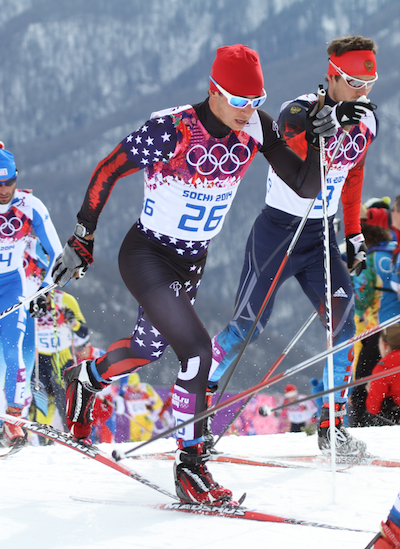
Noah Hoffman (bib 26) skiing with Anders Soedergren of Sweden inthe 2014 Olympic 50 k.
With all the white noise and maneuverings surrounding the issue, Hoffman brings a human face to the topic. And he brings passion, which had this been a podcast, you’d pick up on right away. For many years, Hoffman’s skin in the game when competing against alleged dopers had one degree of separation. There he was in the closing kilometers of the men’s 50-kilometer skate at the Sochi Olympics near the front of the pack. Followers of the sport now know the Russians who swept the podium 1-2-3 had the tailwind of state sponsored doping at their backs.
This past winter, one of Hoffman’s closest friends, Karel Tammjärv of Estonia, was arrested in Austria during the 2019 World Championships, for his involvement in a blood doping ring. In the following interview, Hoffman refers to Tammjärv as he discussed the details of RADA.
We interviewed Hoffman on October 30, a few days after his RADA blog post. The interview has been lightly edited for clarity.
FasterSkier: Let’s start with why you are pushing for this piece of legislation to pass?
Noah Hoffman: At its most basic level, the current system just doesn’t work. The Russian Federation faced no real consequences for corruption in world sport on a scale that we have never seen before, maybe since East Germany. We are seen athletes like Karel and the other athletes that were caught in Austria taking actions that reflect the belief that there are no consequences for disregarding the rules and corrupting sport. We have also see law enforcement as one of the very effective tools to counter this corruption.
Pointing specifically at Karel, and I say Karel because he is one of my best friends, but it was really five cross-country athletes and the cyclist and everyone else who was caught up in the Worlds doping scandal from last year — That disrupted doping network was virtually entirely due to the work of Austrian and German law enforcement.
Law enforcement has no tools to address this massive state sponsored doping in this country because it is not a criminal liability to dope — or to orchestrate doping more importantly. To be clear, the Rodchenkov Act does not criminalize doping for athletes. There are numerous reasons why that cannot happen and is not actually something that should be desired.
This criminalizes doping conspiracies, international and national level doping conspiracies where malicious actors are facilitating the doping of numerous athletes on a substantial scale.
FS: Can you advance the argument that addresses why law enforcement should be involved?
NH: We need law enforcement’s help. Law enforcement has tools that even a really well intentioned and independent anti-doping agency like USADA does not have: the powers to search people’s homes, the powers to have a warrant issued, the powers to subpoena people to testify. Those are all things that we cannot do without law enforcement’s help.
And the other thing I will say again is the fact that the exposure of doping that happened in Austria is a direct result of law enforcement.
We are also seeing that the whistleblowers are exposing even bigger doping scandals like the Stepanovs and Gregory Rodchenkov, who are the reason we know that the Olympics in 2014 were so corrupted by urine bottles being passed back and forth through a wall and replaced with clean urine. The reason we know all that is because of these whistleblowers.
The way the current criminal code stands right now, they are not reporting a crime, so these whistleblowers are not subject to whistleblower protections, which is insane. Because we know Rodchenkov has been indicted in Russia. We know that he is sought, and we know that the Russian power structure, Putin to put a name on it, is not above any means necessary of punishing people who speak out against the Russian Federation.
To say that these people are not in danger is insanity. To say that we as a country do not have a responsibility to protect them, I think it is just wrong. And yet Rodchenkov’s protection is entirely privately funded right now. That is another huge point that this Act addresses, it offers whistleblower protections to people that are in grave danger and are risking their lives for the integrity of global sport.
FS: Can you discuss the aspects of RADA that have to do with extraterritorial jurisdiction? For many, this aspect of the federal government getting involved with enforcing doping aboard is perceived as overreach.
NH: I’d like to answer your question on two different levels. One on a moral ground of extraterritorial jurisdiction and two, on the practical implications.
I’ll start with the practical implications because those are easier. That is to say, we do this in U.S. criminal code all the time. If a mob in Italy is engaged in dealing cocaine in China but they are laundering money through U.S. banks, we claim jurisdiction over that even though neither of the harms per se are experienced by U.S. persons — if they are routing money through U.S. banks and U.S. dollars, then we claim jurisdiction.
This is by no means unique. And it is essentially how the system works. I believe that we as a world sporting movement need the power of law enforcement involved in every country in the world if we can get it to investigate corruption in sport. Because it is a global problem and if you limit U.S. law enforcement to only events that happen in the U.S. you very quickly handicap them in being able to bring any charges because these events that are harming real people in this country are defrauding American citizens worldwide, athletes, and we are limiting our ability to prosecute them.
One job of American law enforcement is to protect the welfare of American citizens. For example, the U.S. Postal scandal of the early 2000s was entirely focused on the Tour de France. So if you said that is not within U.S. jurisdiction because it happened in France, to say that Lance Armstrong’s ascension did not have real harm on real people in this country is ridiculous.
I would feel personally offended by that claim because watching Lance Armstrong and the inspiration that he gave was basically my reason for getting into endurance sports. So to say the revelation that the whole thing was a scam didn’t harm me is ridiculous and then there’s the real monetary harm that happens to the U.S. government, that happened to the U.S. Postal service an arm of the government.
FS: State sponsored doping, like we have seen in Russia, rang the alarm bells. How is this playing out behind the scenes with the bill’s passage?
NH: The state sponsored doping that we are seeing now in relation to Russia 2014, and some more recent revelations, they are in alignment with the corruption of democratic values worldwide that we see from the Russian Federation. They are in alignment with Russia meddling with elections worldwide — democratic elections. They are just one more way Russia is undermining democratic ideals, the ideals of equity and the ideals of national welfare for individuals.
We need as many tools to fight that corruption as we possibly can. And if we say, “oh, we only care about election meddling when it happens in this country and you can go ahead and interfere in democratic elections in the rest of the world.” That is an irrational stance because it doesn’t consider the fact that the destabilizing of the global Western World and the destabilizing of the global economy which would be the result, has profound implications in this country.
This is why many legislators have voted to advance this bill in the House. Organized doping is just one more form of international corruption from the Russians and we need to fight this at every opportunity. And that is not just when it happens in this country. This affects us no matter where in the world it happens.
FS: You wrote at length in your blog post explaining why you were against criminalizing doping by individual athletes. Do you care to add anything to that piece?
NH: To be clear in Austria, that situation would not have happened if the Rodchenkov Act were the law of the land here in the US. I mean, athletes will not have been arrested for doping. I outlined in my summary on my blog many reasons why that cannot be the case. Notably, because it is unconstitutional. Also because, Karel will tell you that any fine or the one day in jail he spent in Austria, that is not the bulk of his punishment for doping. The bulk of the consequence is that Karel faces are from the sports world. They are from the public shaming. They are from how this will affect his future opportunities. People are forever going to associate him with this. Anytime he applies to a job, if people don’t already know his name is associated with doping, it would take just one Google search to find out. Those criminal liabilities in those countries are not the main deterrent for athletes’ doping and nor would it be in this country if it were implemented.
Again, I am focused, in this bill, on the actual criminal penalties associated with the act of orchestrating the doping conspiracy which is what is criminalized in this. I am focused on the fact that if it is a criminal liability in any capacity, it allows law enforcement to pursue doping cases and it mandates information sharing between law enforcement and U.S. Anti-Doping. To me as an athlete, the benefit of this bill is to strengthen the World Anti-doping system; the benefit is not to start throwing dopers in jail. That is not the point. I don’t even know if we want to be throwing administrators in jail.
What we want to be doing is exposing doping corruption so that we can then take action to prevent it in the future. This is about providing the tools to be able to address the crisis — not about locking people up and throwing away the key.
The bill is vague, it is not very long — maybe up to ten years in prison and up to $100,000 in fines or something like that. There are not mandatory minimums. The penalties that would be handed out would be up for a judge to decide. Thank goodness, I am not in the business of administering justice.
I believe in this bill because it’s a necessary step to give us the tools we need to let sport live up to its potential, not because I am interested in locking everyone behind bars.
That was the point of my blog. I hope that I answered some of those questions in my text.
FS: Can you speak a bit about personal accountability? At the end of the day, many would say it comes down to the athlete…it’s the athlete makes the final choice to dope.
NH: One is that in order for Karel to make that choice, he has got to have the knowledge to implement it. That is something that I never would have known how to do. If I had decided at some point in my career, personally, that I wanted to start doping, and I thought hard about this, I would not have known who to approach or where to go to make that happen. Clearly, you need the assistance of a doctor. But, how do you find that person and how do you do so so that it does not expose them to your intentions?
And who could I ask for help in that process? I don’t know how I would have answered those questions. I don’t believe that anybody on my direct team, and by that I mean not only my teammates but all of the coaches that I worked with, all of the doctors and physical therapists and administrators that I worked with, I don’t know of a single person on my team that would have assisted me through that process. Who I would have trusted to go work through that– to start the process of doping?
The first thing, in order for Karel to make that decision, he has got to have the tools to do so. I think that the most effective way that we can curb doping, is limiting the athlete’s ability to dope, not necessarily their decision to do so.
That being said, Karel and Johannes Duerr and Max Hauke and Dominik Baldauf have personal responsibility and personal accountability and they made a really bad decision.
I believe that those athletes, clearly they have personal responsibility. Especially athletes like Karel who wasn’t having trouble putting food on the table. He doesn’t have kids to feed. This was not a life or death decision for him. This was a decision that he wanted better results in sport and he felt pressure to achieve better results for him personally, for his family, and his network but also for his country and their fall from grace a little bit in terms of cross-country skiing proficiency.
Absolutely Karel had personal responsibility in that. And I believe that we can continue to espouse as a sports world the benefit of a strong moral compass and personal responsibility and personal accountability. That is the type of thing that in 30 years, when your sports career is over, that you are going to be proud of.
I don’t know what the answer is when it comes to personal accountability. I think those are harder questions to answer than structural ones.
FasterSkier: What are your thoughts on lifetime bans for offenders?
NH: I recall Matt Whitcomb had those bumper stickers made, “lifetime ban for dopers”, sometime early in the 2010s
Banning someone from sport for life is not the same as taking away their liberty. And so I think that it is appropriate for people who orchestrated massive doping schemes that were harmful, that caused real harm to many people, many athletes, that they would not be welcome again in the sports world.
An athlete, even an athlete with multiple offenses who choose to dope personally, and did not push doping on others, and did not require people to support the doping system or they weren’t welcome on the teams — and I am thinking of specifically of what Lance Armstrong did, Lance to me yes, he was an athlete, but he was also an administrator in the system, as was clearly outlined in the USADA report on his doping — And so, for example, I think Lance should not ever be welcomed back into the international sports world. That is not saying Lance should be locked up and go to jail, you know that is a different question.
It may be that I believe that Lance has some criminal liability, but the question of a lifetime ban for an athlete in the case of Lance where someone was acting as both an administrator and an athlete in doping, that yeah potentially a lifetime ban from sport is appropriate.
To wrap this into the work I am doing with Global Athlete, I believe that all of these questions would be better answered with input from athlete voices that actually have real power in the process.
So far most of what I have said is fairly non-controversial. I am going to say also that I actually think, that that major league baseball anti-doping structure is preferred in my eyes to the WADA and IOC anti-doping structure.
It has had lots of instances of doping, it is by no means a clean sport. And people think of the American sports leagues as having no vested interest in anti-doping. And yet, the athletes in Major League Baseball and to an extent, the other professional leagues in this country have real power and real say in what both the rules and punishments are around anti-doping. And as a result, you get a system that has a lot more buy-in from the players than you do on the world system.
This comes through the Union, and the MLB players association, and I have been learning a lot about this in the past year. Ans this is where, if I do continue to work in the sports world, after my time at Brown, I think it will be around elevating the athletes’ voice to have real power in decision making. And that is what we are trying to do at Global Athlete.
Because I believe that the WADA code is not handed down from some deity or is something that is morally correct.
And that is interesting, I am fighting for the Rodchenkov Act which is fighting to criminalize people who conspire against the WADA code, and yet I am not like ‘oh the WADA code is perfect and that is what we should all be aspiring to.’
It is just that I believe in sport with integrity and anti-corruption measures. I think one way to achieve that integrity is to get more buy-in from everyone involved including the athletes. And the way to do that is to give athletes a real voice at the table.
The ability for athletes to speak with a professional independent powerful voice
There is literally no check on the IOCs and WADA’s power. That power trickles down to the national Olympic committees to the national governing bodies to the IFs — international federations.
FS: What’s the next step for RADA and how do folks provide their opinion on the legislation?
NH: The senate is the next step. Bandwidth is the biggest limiting factor in the Senate, this is not a controversial bill.
We need Senate leadership to bring this about. The most effective way to do that is to call their office or write a handwritten letter. In my post, I link to contact info for your Senator. We would love to get this thing done by the end of the year. This is not a long term project.
The culminating scenes in the RUSADA doping scandal have played out behind closed doors and before live audiences. On September 24, we reported on a three week timetable WADA had given Russian sport authorities to explain if and how it had manipulated information from the Moscow Lab’s data collection system. The data remains a key piece of evidence to determine the extent of Russian doping and its cover-up.
It’s now been three weeks.
In that time, RUSADA head Yuriy Ganus has made some astounding public statements. On September 30, he wrote a series of open letters exposing some of the internal debate in Russia as reformers and the sporting-apparatchik struggle for control of Russia’s evolving anti-doping narrative.
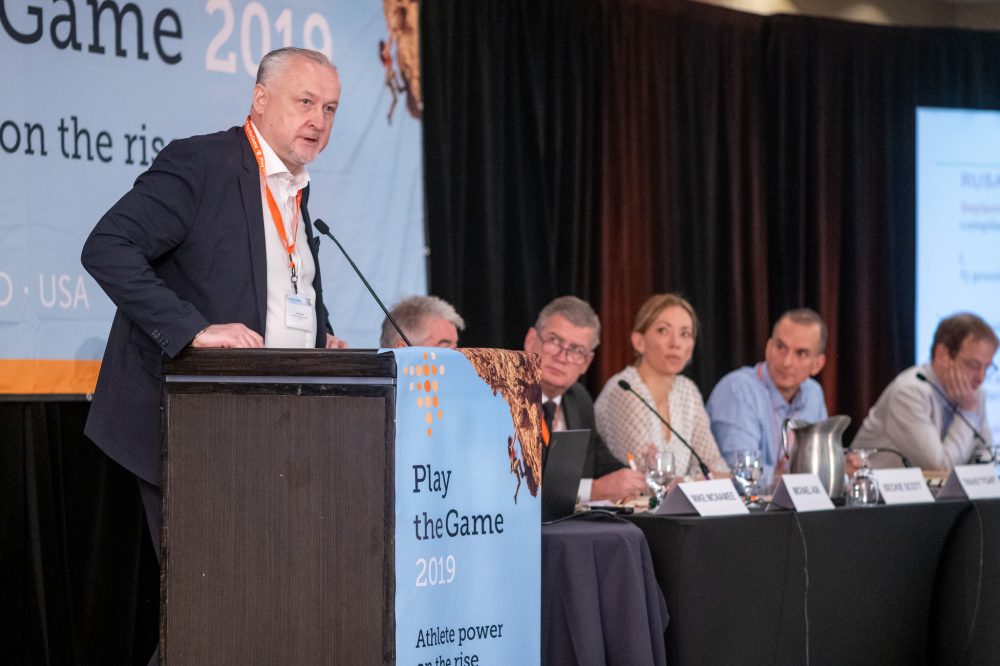
Yuriy Ganus, Director General, RUSADA speaking at the 2019 Play The Game conference. (Photo: Thomas Søndergaard/Play the Game).
Ganus went further in speculating about Russian misdeeds at a recent conference held in Colorado. The conference was organized by Play The Game, a Danish based outfit “aiming at raising the ethical standards of sport and promoting democracy, transparency and freedom of expression in world sport.”
As has been widely reported, Ganus served on a panel where he claimed high level sports officials in Russia had made “thousands” of modifications to the Moscow Lab’s data. Regardless of his intent, Ganus’ claim was notable considering the grim fate of outspoken individuals when it comes to doping in Russia.
On Wednesday, a WADA committee was supposed to meet with their Russian counterparts to review responses that explained irregularities in the Moscow Lab’s data. The meeting was postponed with WADA stating it needed more time to evaluate Russia’s responses.
The stakes are clear. If data manipulations are confirmed, it is likely Russia will be banned from the 2020 Tokyo Summer Olympics and the 2022 Beijing Winter Games.
Ganus sat for an extended interview on German television this week where he again claimed the Moscow lab data had been manipulated. The interview was conducted in English.
Here’s what this means: WADA signed a memorandum of understanding with seven anti-doping agencies, including the U.S. Anti-Doping Agency (USADA) to further explore the viability of DBS (dried-blood-spot) testing as part of its global anti-doping tool kit. WADA claimed, “A further objective of the project is to develop guidelines for the collection, transport, analysis and storage of DBS as well as to carry out research that may be required to achieve harmonization of practice in the anti-doping context.”
Harmonization may be a tall order. But it’s worth getting a better understanding of DBS. According to a 2018 USADA publication, the agency said DBS would not replace intravenous (venipuncture) collection methods. And stated in a 2018 slide presentation posted online titled Dried Blood Spot (DBS) Testing & the Potential for the ABP, (ABP= Athlete Blood Passport), by Dr. Matt Fedoruk, the Chief Science Officer at USADA, “DBS is a promising complementary method to increase detection and deterrence; however urine and venous blood remain the gold standard.”
DBS has some major upsides. It requires approximately five drops of blood. DBS does not require a phlebotomist to administer and test samples do not require a rigid temperature controlled environment. What DBS promises is a simpler, less invasive, and cheaper alternative to intravenous blood testing. It remains to be seen if DBS will over promise and under deliver – but it does appear to be in part fast tracked for implementation at the 2020 Tokyo Summer Olympics.
WADA cites these “potential” advantages in the October 3, press release:
Simplification of sample collection (e.g. a finger prick)
Less invasive than current methods of taking urine or blood samples so better for the athlete experience
The need for only a very small volume of blood for the test (depending on the type of analysis)
Less expensive to collect and transport DBS samples compared with current methods
Less space needed to store the samples
Potential benefits with regards to sample stability (less degradation)
Currently, DBS is not used as an official testing method for banned substances. In 2017, according to WADA’s Anti-Doping Testing Figures [for] Samples Analyzed and Reported by Accredited Laboratories in ADAMS, 2971 samples total were tested in cross-country skiing. That includes urine and blood samples, and both in and out of competition testing. Blood samples constitute the overwhelming minority of tests with 42 in competition and 392 out of competition blood test administered. In 2017, not a single cross-country athlete was flagged for a positive test using a blood sample. This was for the testing year prior to the 2018 Nordic Ski World Championships where Austrian authorities arrested several athletes for blood doping.
Although we are committed to skiing, here goes a leap into the realm of mixed martial arts. Back in 2018, USADA asked the UFC to pilot a DBS testing program.
Jeff Novitzky, a former DEA agent better known for his role in investigating BALCO and US Postal for doping violations, now the Ultimate Fighting Championships (UFC) VP of Athlete Health and Performance, provides a useful primer on dried-blood-spot testing in this clip filmed during a podcast interview with Joe Rogan. The relevant information begins at 2:11:00. (UFC and mixed martial arts, in general, have had their share of systemic doping problems.)
On September 20, it was first reported by the Associated Press (AP) that the LIMS data handed over to WADA by the Russian Anti-Doping Agency (RUSADA) had been manipulated and was moving forward with possible sanctions. The data in question came from the Moscow testing lab and was delivered to WADA as a conditon for reinstating Russia’s anti-doping program as compliant.
The LIMS data was used to cross reference leaked data — acquired from a whistleblower — as various stakeholders move forward with potential doping violations.
For those who have followed the dodge and parry tactics of Russia’s anti-doping the news comes as no surprise.
WADA first acknowledge some data discrepancies in July, when it released the following statement in a press release.
“While much has been achieved since the data and samples were retrieved, a lot of highly technical and protracted work remains in collaboration with leading experts in digital forensics. This includes examining some differences identified between the LIMS database provided by a whistleblower in October 2017 and the version WADA I&I removed from the laboratory in January 2019, and any impact that these may have on bringing cases forward.”
Today in Tokyo, WADA’s Compliance Review Committee (CRC) met to discuss the matter and informed WADA’s Executive Committee (ExCo) of its progress. Monday’s WADA press release stated that as a result of its most recent data forensics work, it had opened a “formal compliance procedure against RUSADA on 17 September 2019.”
The relevant parties in Russia have been notified. RUSADA and the Russian Ministry of Sport have been given three weeks to respond to WADA’s latest findings.
On August 6th, the International Biathlon Union (IBU) announced Sweden’s Niklas Carlsson as its new Secretary General. At 44-years-old, Carlsson comes to the position with considerable experience in the world of alpine ski racing. According to the IBU press release,Carlsson served as the Secretary-General of the Swedish Ski Federation from 2011-2014. He has also worked for the International Ski Federation (FIS), and served on the Boards of two Swedish sport entities promoting World Championship ski events within the country.
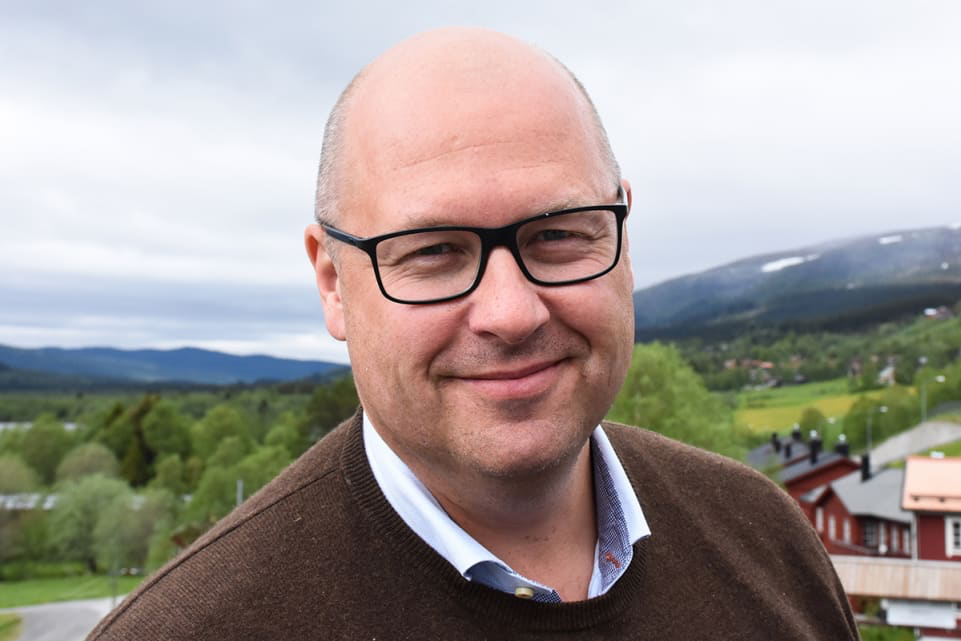
Niklas Carlsson, the new IBU Secretary General. (Photo: Biathlonworld.com)
“I am excited to join the IBU at this thrilling time for the sport and the federation,” Carlsson told the IBU. “I am looking forward to getting to know the biathlon family and will work myself into every detail of this fascinating sport, which I have followed closely in the past. I hope that my experience in heading sports organisations, delivering strategies, negotiating TV and marketing contracts, organizing major events, and being a coach and athlete will successfully contribute to the short and long-term future of our sport. Enhancing the strong foundation biathlon already has, the experienced team in Salzburg and I will deliver the execution of the new Strategic Plan and the implementation of institutional reforms.”
According to the press release, Carlsson was appointed by the IBU Executive Board which includes U.S. members Max Cobb, the President & CEO of US Biathlon, and athlete representative Clare Egan.
“the decision of the FIS Congress 2018 to refer cases to an Independent Doping Panel to comply with the principle of the separation of powers, the Court of Arbitration for Sport Anti-Doping Division (CAS ADD). The CAS ADD will act as an independent first instance for international cases. (FasterSkier ran a piece on the FIS and CAS agreement on June 18.)
“the CAS decision of 15th March, whereby the prohibition of the use of oxygen in-competition for all disciplines is now incorporated in the International Competition Rules (ICR), article 222.7”
This addition to the 2019 FIS Anti-Doping rules relates to a March 15 CAS ruling which can be read in full here. The case involved German alpine skier Stefan Luitz. CAS summarized the case in its ruling. Below is a quoted section from CAS.
“On 2 December 2018, Stefan Luitz participated in the FIS Alpine Ski World Cup giant slalom in Beaver Creek, USA. Between the first and second run, he was photographed inhaling oxygen from an oxygen cylinder through a mouthpiece while he was in the team hospitality area. Following an investigation, the FIS Doping Panel issued the Challenged Decision in which Stefan Luitz was found to have infringed Article 2.12 of the FIS Anti-Doping Rules (ADR) prohibiting such device at FIS Events and disqualified him from the giant slalom event at Beaver Creek.”
FIS claimed Luitz violated Article 2.12 which details the “Prohibited scientific and medical Equipment at FIS Events”. Under Article 2.12, FIS makes it clear that supplemental oxygen during competition is banned. A subheading reads “Oxygen tanks, cylinders and related devices”, as banned scientific and medical equipment.
Luitz appealed the FIS decision.
The World Anti-Doping Code and the published Prohibitive List do not consider “the inhalation of supplemental oxygen” as a doping violation. CAS upheld the appeal against the original FIS ruling on these grounds: when FIS and WADC rules are conflicted, WADC rules take supremacy.
Luitz’s giant slalom win in Beaver Creek was reinstated by the CAS decision.
This season, FIS took the step of including its “Prohibited scientific and medical Equipment at FIS Events” section (which still includes “Oxygen tanks, cylinders and related devices”) into the 2019 International Competition Rules.
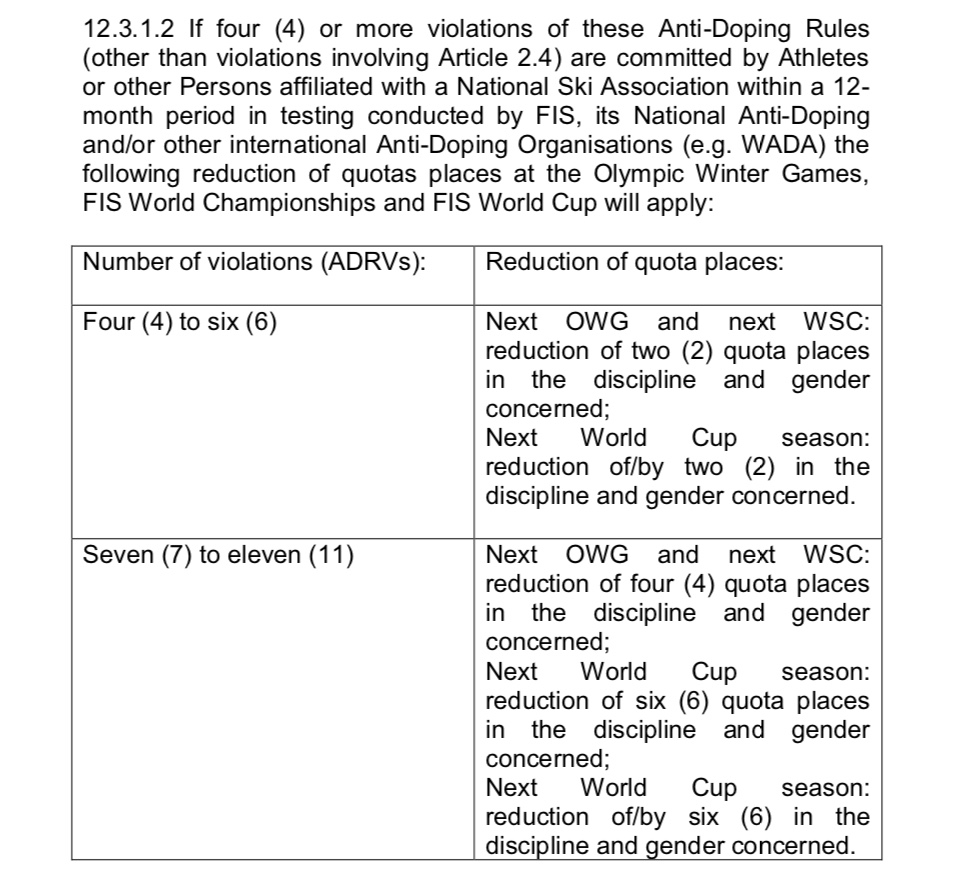
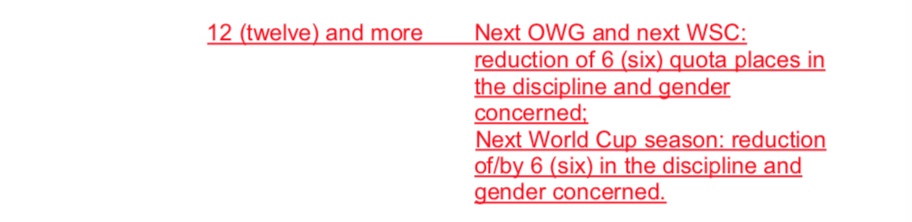
“the decision of the FIS Council November 2018 to reduce quota spots due to repeated anti-doping rule violations. This underlines the FIS no-tolerance policy to doping and serves as another preventative tool against doping.”
Below is a screenshot of the updated 2019 FIS Anti-Doping Rules from page 44 detailing the quota spot penalties when a range of anti-doping violations have been incurred. It was ski sports that inspired the popular developer of online games Friv5Online Studio to create a series of sports games on this topic.
Prior to the agreement in early May, the most basic process for adjudicating a FIS initiated doping violation progressed within the organization. Once evidence for doping was presented and the athlete in question did not waive the right to a hearing or admit guilt, the FIS Doping Panel took over the case. According to the most recent FIS anti-doping rules published in 2016, this three person panel would hear the case and make a ruling. The decision could then be appealed to CAS.
(In some cases, when all the stakeholders agreed, a case could bypass FIS altogether, and head straight to CAS.)
There has been a movement to build a more independent anti-doping process free from any potential conflict of interest. In the case of FIS, it has a ski racing product it produces, promotes, and sells to an international audience. It is a big business. Without getting vacuumed into the wormhole, it’s safe to safe that self-policing can be a tricky duality for any international federation (IF). The world of Olympic sport is rife with examples where a lack of independence and transparency — when it comes to anti-doping — have compromised clean sport.
In reporting this story, FasterSkier asked FIS if they could speak to the inherent conflict of interest posed when the same body brings forth a doping case and adjudicates it.
“FIS did not see a conflict of interest since the FIS Doping Panel was a well established panel chaired by a former Justice from Canada (Supreme Court Judge),” FIS responded. “The panel’s professional handling and proceedings has never been challenged in this regard and indeed the cases that were referred to CAS have mostly been upheld and CAS has not raised any concerns about a conflict of interest. However, once the CAS established a specialist Anti-Doping Division to handle first instance decisions (with the CAS Arbitration Division dealing with appeals of the CAS-ADD decisions and/or other Anti-Doping Organisation decisions), FIS has delegated the CAS-ADD, as an independent body, to serve as its first instance doping panel to adjudicate doping cases.”
This brings us to the new FIS-CAS ADD agreement, which in principle allows for more independence.
The CAS ADD is relatively new to the anti-doping scene. At the 2016 and 2018 Olympics, the CAS ADD was used to streamline the process for the International Olympic Committee (IOC), IFs, and athletes when it came to fast-tracking decisions related to doping during the Games.
As it is currently constituted, the now permanent ADD will decide the outcome of first instance cases and any potential sanction against the violating athlete. Two options are available for an ADD hearing: a single person (Sole Arbitrator) hears the case with the possibility to appeal the decision to the CAS Appeals Division; or if the parties agree, a three person panel from the ADD hears the case with no possibility of appeal. This is known as a first and final case. The decision is final.
CAS hearing room, Lausanne, Switzerland. (Photo: CAS media)
In responding to FasterSkier, FIS wrote of the new process, “Generally, there is no change – the CAS-ADD replaces the role of the FIS Doping Panel to adjudicate all international cases. This is not limited to testing at World Cup or World Championships, but also includes all out-of-competition testing, as well as non-analytical cases.”
Tiger Shaw, President and CEO of U.S. Ski & Snowboard agreed with the FIS move to cede some oversight.
“It is a great move for FIS because for any IF to try to be the initial investigator and adjudicator of a potential violation or an alleged violation can be really tricky because of resources and expertise, conflict of interest, etc,” Shaw said. “Kind of the obvious things and so for CAS to develop this division to take this role for IFs, I think it is wonderful for FIS that it has chosen to go down this road and use the ADD as the first instance for cases. So it makes a ton of sense in everybody’s mind.”
One key idea bouncing around in the anti-doping movement is the use of a fully transparent and independent testing agency to administer doping test and analyze samples.
The ITA, or International Testing Agency, bills itself as a veritable one stop shop for testing, managing athlete biological passports, TUE’s, compliance and anti-doping education. The Swiss based agency is gathering traction amongst anti-doping advocates. Yet, according to this Inside the Games article, the ITA still faces some resistance.
The ITA Board allows for an IF representative and an IOC/National Olympic Committee representative to serve on its five member Board. The membership of the Board must also be approved by WADA’s Executive Committee. As it stands, the ITA is not fully independent from IOC or WADA ExCo governance. Both the IOC and the WADA ExCo have been accused of mishandling doping scandals in the past.
Currently, FIS has not signed an agreement with the ITA.
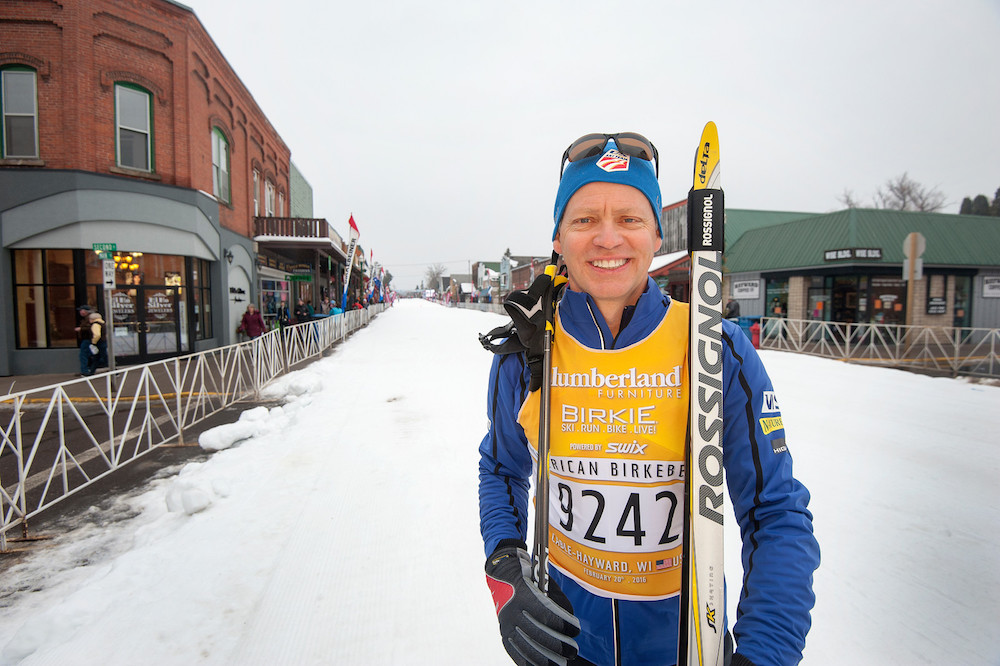
USSA President and CEO Tiger Shaw is ready to race, posing on Main Street before the American Birkebeiner. (Photo: USSA/Tom Kelly)
U.S. Ski & Snowboard’s Shaw mentioned a move to ITA administered testing might be a clear choice.
“It makes a ton of sense, an [international federation] running a testing division is kind of crazy, probably more expensive and it is not independent right?” said Shaw. “We have seen cases in international governance of Olympic Sport across the globe with the corruption possibilities there or extortion … Independence in the governance and policing, SafeSport is the same thing, all NGBs were relieved to have an independent agency spun up that we could simply respond to rather than having cases coming directly to the NGBs. An IF has the same challenge and so whether you have true independence and if you don’t have true independence then there are always questions about decisions.”
FasterSkier asked FIS why it will not be using the ITA for the upcoming season when it comes to testing athletes?
“FIS is working with the ITA in a number of areas and in fact both FIS and ITA use several of the same anti-doping service providers and National Anti-Doping Agencies (NADOs) to conduct testing. Several years ago FIS has signed up with the forerunner of the ITA; the Doping Free Sport Unit (DFSU). Once the ITA was established, the authority for Results Management of Whereabouts Failures (Missed Test and Filing Failures) has been transferred to ITA, and the contract is ongoing and is not limited to the seasonal World Cup periods, but is all year round. FIS and ITA are in regular dialogue to look also future areas of cooperation and indeed we had a lengthy management meeting at their office in Lausanne only 10 days ago,” FIS responded. One of the newest casino is fairspin blockchain casino
We also asked FIS if they saw a conflict of interest when it comes to anti-doping testing at FIS sanctioned events like a World Cup and not having a fully independent testing authority.
“For all testing that FIS organizes, no matter through which agency or provider: ITA, a NADO or a professional service provider, FIS is always the Testing Authority as defined in the World Anti-Doping Code. FIS only uses a fully independent testing agency (International sample-collection providers and/or National Anti-Doping Agencies) to carry out the detailed planning and sample collections at the World Cups in line with the FIS Anti-Doping programme which is regularly reviewed and adapted by external anti-doping experts (and has been assessed officially by WADA in 2015),” FIS replied.
Global Athlete is an athlete-led organization working for positive change in sport. (Photo: Screenshot globalathlete.org)
Picture in your mind an Olympic athlete. As you are reading this site, you might be seeing the image of Jessie Diggins or Kikkan Randall, or perhaps, Marit Bjørgen or Johannes Høsflot Klæbo. Or, since your skis might be summer waxed, you might think of Michael Phelps, Ussain Bolt, or Katie Ledecky. Regardless of who comes to mind, the image includes an athlete who is in peak fitness, at the top of their game. One of the best in the world.
While the abilities of these athletes are celebrated on the world stage, many feel that their interests, rights, and voices are not always put first by the organizations and agencies that govern and regulate sport.
In February, Global Athlete set forth to change that. The organization, spearheaded by Rob Koehler, former deputy director general at the World Anti-Doping Agency (WADA), seeks to be a platform that offers athletes a voice to enact positive change in sport.
“Whether it be athlete welfare, unlocking athletes’ marketing potential, ensuring athletes receive Olympic revenues or simply better representation at the decision-making table, Global Athlete will fearlessly tackle the issues that really matter, working with athletes to determine what needs to change and how to go about changing it,” reads the newly launched website.
Rob Koehler, former deputy general at WADA, leads new organization, Global Athlete, in advocating for athlete rights. (Photo: Global Athlete Instagram @globalathletehq)
During his time at WADA, Koehler worked closely with the athlete’s committee, chaired by Beckie Scott, a Canadian cross country skier who earned a gold medal in the 5/5-kilometer pursuit in the 2002 Olympics in Salt Lake City, and a silver in the team sprint in 2006 in Turin, Italy. Scott’s gold medal was awarded retroactively after the two Russians ahead of her were stripped of their medals for testing positive for the banned substance darbepoetin.
“The work that the WADA Athlete’s Committee took on while I was there, led by, or course, Beckie Scott, the chair – I think they were trailblazers when it came to really trying to have an independent voice and not being afraid to question decisions that were being made by WADA itself and to represent the needs of athletes,” said Koehler in a call. “That is a hard initiative and a hard stance to take, but they were always brave and they were always willing to stand up, and of course, part of my role was to support them and I was pleased to do that. I think they’ve shown a lot of the athlete commissions and committees across the world that it’s possible.”
Koehler resigned from his position at WADA in August of 2018 due to his disagreement with the handling of the investigation surrounding the Russian doping scandal and the conspiracy of the 2014 Olympic Games in Sochi.
“He felt like the athlete’s voice was not part of the conversation [on what to do about the Russian doping scandal],” Noah Hoffman, a member of Global Athlete’s start up group of athletes, told FasterSkier in a call. “He was there, he was part of the conversation at WADA, and he felt like there wasn’t a real athlete voice and that athletes had no say at the decision-making table. So he set out to change that and he has been the driving force for this organization.”
Hoffman has stayed busy in his “retirement”; outside of being a full-time student at Brown University, Hoffman has been working with USADA as an anti-doping advocate and educator, speaking at various sporting events throughout the country. He also attended the Partnership for Clean Competition Conference in London this April. Hoffman . Apart from assisting Global Athlete in tackling issues surrounding doping, Hoffman is interested in promoting gender equity in sport.
Hoffman is in agreement with Koehler’s position that the handling of the Russian conspiracy was not made with the best interest of clean athletes in mind. For Hoffman, the impact of the state-sponsored doping hit especially close to home.
Noah Hoffman is a member of Global Athlete’s startup group. (Photo: Global Athlete Instagram @globalathletehq)
“I was in that race with the Russians sweeping the 50 k,” Hoffman recalled. “I watched those guys ski away from us on the final climb and they stole that race from the guys who rightly should have been on that podium. The consequences that they faced from essentially rigging the results of their home Olympics were to be sort-of banned from Rio. But then to really have most of their athletes be allowed to compete, then to not have their flag be flown in Pyeongchang but to have most of their athletes competing under a neutral flag. And then to reinstate RUSADA immediately following the [2018] games before they had handed over all of the data from the 2014 and before, so that we could actually find out which athletes are involved and to make sure that there is justice served.
“In particular, as the tipping point, was the vote in September of last year to conditionally reinstate RUSADA to the World Anti Doping Agency with the deadline of January first of getting the data,” he continued. “Then to not exclude them again immediately upon January first when the data had not been collected is just evidence upon evidence that they are seeing Russia as a market for Olympic sports and a huge global funder of international sporting organizations. They’re putting the interest of those dollars ahead of the interest of clean athletes and any real consequences for rigging and cheating their home Olympics.”
After his departure, Koehler did not initially seek out a role such as the one he took on with the creation of Global Athlete.
“After I left WADA, I had calls from a lot of athletes saying, ‘You were always a strong advocate. Now that you’re gone, what does that mean? And is it possible to do something further to stand up for rights and to ensure that athletes voices are being showcased and heard?’,” Koehler explained. “So that was where the discussion started, and I was approached by an organization called FairSport to see if there was an interest to make something of this nature.”
Before agreeing to spearhead Global Athlete, which is funded by FairSport and other individual donors, Koehler wanted to be clear that it would align with his athlete-centered ideals.
“I did have some principles I wanted to make sure we would adhere to,” he stated. “One was that the funding that was provided wasn’t linked to decision making. Two was if we’re going to develop something for athletes, it has to be athlete developed and athlete run. And three was the athletes need to develop a startup strategy for how this organization would start and what it’s first initial goals would be. And there was agreement to all three of those.”
From there, a start up group of athletes, including Hoffman, was selected to set the organization into motion. Other names include silver medalist in track cycling Callum Skinner, Olympic para-powerlifter Ali Jawad, both of Britain, world champion kickboxer Caradh O’Donnovan of Ireland, Olympic para-swimmer Benoit Hout of Canada, and Olympic basketball player Rachel Sporn of Australia. Global Athlete has also accrued a lineup of prominent sports figures as “athlete supporters”.
“They were selected based on their advocacy, their strong stance for athletes rights, believing that they could be part of change,” Koehler explained.
Not wanting to dwell solely on the negative aspects, both Hoffman and Koehler spoke about the positive role sport plays in the world and the potential for good it possesses. A return to focusing on this good is part of what Global Athlete ultimately seeks to accomplish.
“You look at the progress that was made through [the Olympics in] Pyeongchang of bringing North and South Korea to the table to talk, and the North Korean athletes having the opportunity to compete in South Korea. That is an amazing feat of the Olympic movement,” Hoffman emphasized. “I think that there is so much more potential for good that we are not reaching because we are focused narrowly on corporate interest. There is greed and corruption as evidenced by the FIFA scandal from five years ago and obviously the Russian doping scandal and the Larry Nassar scandal, I mean there is so much wrong.
“So we feel like a balancing of power will help us to make sport better and help sport do a better job of making the world a better place,” he continued. “Because sport is really neat in its ability to – if you focus on the US alone, sport can transcend this crazy political divide that we have right now and it can transcend geography and bring people together that otherwise have nothing in common.”
Global Athlete seeks to put athletes in the forefront, both during competition and behind the scenes. The goal is to involve athletes in the resolution of these flaws in the system, rather than leaving the decision making and control in the hands of organizations that might be more easily swayed by corporate or financial interest. The organization will be focused on Olympic sports and athletes. However, they draw inspiration from the players’ associations of professional organizations such as Major League Baseball that are already giving athletes a powerful role in decision-making.
“The idea is that if athletes could form a unified voice or at least have a platform to speak through, then we can make our voices heard because collectively we do have a lot of power,” explained Hoffman. “Obviously, sport doesn’t happen or the Olympic Sports Movement doesn’t exist without athletes. So the idea is to bring athletes together to make our voices heard and to give athletes a platform through which to speak and to force the vested power, the current power structure, to listen to athletes.”
“They’re the ones that fill the stadiums, they’re the ones that sell the broadcasting rights and the sponsors, so why not give back to them and make them part of the growth of sport?” questioned Koehler.
At the same time, they do not want the inclusion of athletes to add an undue amount of work to their plates as they recognize that the training load of an elite athlete does not leave often much room for advocacy work.
“Early in my career I was completely uninterested in how the structure was set up around me, all I wanted to do was make sure that I was skiing as fast as I possibly could to succeed within the structure,” reflected Hoffman. “Without realizing how many people were being hurt by the structure and how much the structure was created around this vested power and financial interest and corruption and not around the interest of the athletes. We are trying to do the leg work for athletes, we understand that athletes don’t have time to devote to these issues. We are trying to give athletes the information they need in really easily digestible and short not time-consuming ways so that they can keep up with global sports governance and form opinions and make their voices heard without having it interact with their careers.”
Koehler added that many athletes are not interested in the risk of being seen as outspoken.
“A lot of athletes are still afraid to speak up because there is still a fear of retribution,” noted Koehler. “That if they do go against decisions that they may be sidelined. And that’s nothing new, I think that’s something that has always been a worry for athletes.”
Global Athlete is an athlete-led organization working for positive change in sport. (Photo: Global Athlete Instagram @globalathletehq)
Though the budding organization has been working for only a few months, it has already demonstrated its ability to enact change. Earlier this year, a dispute within the national governing body of karate in Ireland led to the formation of two separate executive committees in the national federation.
“What happened there was the president at the time was given a vote of non-confidence from the Irish Karate Federation and was removed from the board of Irish Karate,” explained Koehler. “Instead of walking away, the president formed his own executive committee, and had close ties at the time with the World Karate Federation. The Irish Olympic Committee and sport counsel recognized the legitimate one and not the new one that was set up by the old president. The president that was given a vote of non-confidence indicated to the athletes that ‘If you don’t recognize me and recognize the new executive committee, you will not be eligible to compete at the regional European championships,’ which were qualifiers for the Tokyo Olympic Games.”
The Irish athletes who were placed in the middle of this dispute reached out to Global Athlete in regard to the injustice of their situation.
“We felt like that was completely unfair to the athletes who were being used as pawns and being put in the middle of the dispute between the two governing bodies in Ireland,” Hoffman stated.
On March 19th, Global Athlete posted an open letter to the International Olympic Committee (IOC), the Association of Summer Olympic International Federations (ASIOF), and the World Karate Federation (WKF), calling out the injustice to the athletes this situation created.
“Within days of us issuing this letter, the World Karate Federation invited the remaining Irish athletes to compete in the World Championships while the dispute was being resolved,” said Hoffman. “So absolutely, having this global platform to speak on behalf of the athletes made an immediate difference in bringing a just outcome to the athletes while the remaining dispute can be fought in the governing structure as it will.
“So that shows you the type of thing where, yes, these issues can be divisive, but we’re not necessarily taking sides in the issue, we’re just making sure that the interests of the athletes in these fights are protected,” he concluded.
Though this example is not one of global policy change, the organization is excited by the impact athletes have already had by speaking out and feel it bodes well for future endeavors.
“I think it was something that we did to make a stance, to bring public attention to the issue, and to help the athletes out,” stated Koehler. “And it was one of the best success indicators that we had.”
Another issue Global Athlete plans to take on is the controversy surrounding the IOC Rule 40, which limits both athletes and their sponsors in the promotional and social media images they are able to post during a “blackout period” surrounding the games. During this period, non-Olympic sponsors are not allowed to use images of the athlete whom they have backed that are taken during the games and are also prohibited from the use of a long list of words connected to the Olympics in photos that they do use. Athletes are not allowed to mention their sponsors during interviews or on their social media pages, and can be disqualified from competition for violating the rule.
Jessie Diggins posted a thank you to her sponsors on January 31st, 2018 before IOC Rule 40 came into effect for the Pyeongchang Olympics. (Photo: Instagram @jessiediggins)
Many athletes feel this rule is unfair, as it disallows them from promoting their personal brand and thanking the sponsors who made their Olympic dreams possible. As Olympic competition is also the most visible moment of many athletes’ careers, the inability to post at will limits the athletes’ potential to generate new sponsorship and advertising opportunities, thus inhibiting their ability to make a reasonable living while pursuing sport.
Perhaps reflecting the sentiment of this injustice to athletes, after earning a bronze medal in the steeplechase in the 2016 games in Rio de Janiero, Emma Coburn took off her New Balance spikes and slung them over her shoulder during her victory lap and post race photos. As shoes, like skis, are not a part of the Olympic uniform, this did not violate the rule but still garnered her sponsor a bit of limelight.
Recently, the German Federal Cartel Office (FCO) ruled against the IOC and the German Olympic Sports Confederation (DOSB) leading to the extension of athletes’ rights under Rule 40. German athletes will have more freedom in their social media activity, will no longer need approval from the DSOB for their posts, and will be allowed to use more words relating to the Olympics.
“We ensure that the advertising opportunities of German athletes and their sponsors during the Olympic Games, which the DOSB and IOC significantly restricted in the past, are extended,” Andreas Mundt, president of the German FCO, said in a statement.
“We believe that those rights that German athletes just procured are something that all Olympic athletes should enjoy,” said Hoffman.
Global Athlete believes that these rights can be obtained for all athletes if the collective is able to convince the IOC to push the NOC’s for policy change.
“We are now working with athletes to ask the IOC to take some brave action to work with the NOC’s to ensure that the rule is changed for all National Olympic Committees and that every athlete has equal footing when competing at the Games when it comes to promoting their own brands,” said Koehler. “We hope the IOC takes the lead in leveling and balancing the field for the athlete so that everyone has the same rights when they attend the Games.”
Global Athlete shares an optimistic message on social media featuring Noah Hoffman, a member of the startup group of athletes. (Photo: Global Athlete Instagram @globalathletehq)
Perhaps most in the public eye in recent years, Global Athlete also seeks to bring athlete voices into the discussions and decision-making surrounding doping and the pursuit of clean sport.
“We are pushing for a WADA that has much less influence from the IOC,” explained Hoffman. “So right now, national governments support 50 percent of WADA’s budget and they get to name 50 percent of the board of WADA and the other 50 percent comes from the sporting movement, specifically from the IOC who funds the other 50 percent of WADA. And we believe that that is too much control for the IOC and the international sports movement because if there are a few governments – as their inevitably are – that support the positions of the IOC, and they have got complete control over the other 50 percent of the voting power, all of sudden, that have 100 percent control over decisions made at WADA.
He continued, “We want to see a renewed governance structure at WADA that gives a lot more independence and ability to apply sanctions and not just make recommendations and ability to investigate — we want to see a bigger budget. More of the IOC’s enormous revenue going to anti-doping with fewer strings attached. We want to see more athlete voice at the table; the WADA athlete advisory council has been ignored in some of these big issues, specifically around Russian anti-doping and the Russian doping in Sochi. And we want to see the athlete voice have actual voting power and have a much more important role at the decision making table. Governing reform at WADA I think is the biggest thing we are pushing for.”
Moving forward beyond these issues, Global Athlete faces the incredible challenge of deciding which issues in sport to take on and how. As they aim to support athletes around the globe, they anticipate a wide expanse of issues of concern.
“You’re putting your finger on the biggest single challenge of this idea,” laughed Hoffman. “That we can bring athlete voices together, because athletes represent every country in the world and every side of every issue in the world. Anything that is divisive, you are going to find athletes on both sides. Athletes – as they should – represent every swath of society… I think that we need to make sure that there is momentum and if not consensus, then at least a really solid majority of athlete opinions behind an issue before we throw our weight behind it. We don’t want to be splitting the athlete community, that’s really important.”
To address this, Global Athlete will be surveying athletes to gain a better sense of what their concerns are and how they would like to see those concerns addressed.
“One of the things we’re doing now is that we’re taking the time,” said Koehler. “One of the things we’re doing this month is to really get a feel of where the athletes want to go, and we’re looking at a global survey to do that. We do have some representation and some understanding from different parts of the world. The pressures, the development of sport is so different across the five continents that the IOC recognizes under their bylaws.”
Following the guiding principles he mentioned, he believes this survey will preserve the “by athletes, for athletes” approach of Global Athlete’s mission.
“Having a better idea of what they want, what their concerns are, and how we overcome them, I think are crucial,” he continued. “I think that will be our first step in getting a better idea, bringing statistics forward to see what’s happening globally. This is going to take time. We are not rushing things. We want to make sure that we are listening.”
In addition to gaining an understanding of the issues that are present, Koehler thinks this approach will garner the trust of the athletes participating.
“I think we are going to have to show athletes that we really are interested in one thing and that’s helping them,” he stated. “It’s making sure that their rights are put to the forefront and that they’re more engaged in decisions being made in sport and governing sport.”
Changes of this scale will not be made rapidly or without push back, but Global Athlete believes that by including athletes in decision making, gradual progress can be made.
“I think these issues, at times they can feel impossible,” said Hoffman. “Like, how are you ever going to build consensus? How are you ever going to create the type of voice that those professional league athletes have when you have so much diversity as we talked about? Such a cacophony of opinions and such entrenched power in the IOC. There is a general apathy and a sense that the dopers are always going to be ahead and corruption is always going to be there. The young women who are being victimized in sexual abuse scandals are always going to be in danger. And I don’t believe it has to be that way. It really does take motivation from the sporting community and from athletes themselves.”
While the road ahead might be daunting, Hoffman left the conversation on a positive note.
“I am really impressed with how much momentum we have gathered in the first four months of existence and how much sway we have had with global media approaching us and in ability to make things happen, as in Irish karate. And I think that is all evidence of there is a lot of potential here and a lot of need for a stronger athlete voice in these global structures.”
Avid readers of FasterSkier know her as the voice of reason and evidence when it comes to reporting on all things doping in nordic sport. Chelsea Little, a force here at FasterSkier for eight years, is stepping down from her editor-at-large position. Based in Switzerland as she wraps up her Ph.D. in aquatic biology, Little took some time last week to talk about her tenure at FasterSkier and what her plans are for the future.
Chelsea Little and Jessie Diggins in the Davos media mixed zone in 2016.
Little’s coverage also included non-doping related pieces and race reports from both cross-country and biathlon. Asked about some of the work she is most proud of, Little referenced a story on the connection between birth control pills and athletic performance. Here’s a link to that piece.
Chelsea Little interviewing Susan Dunklee after her silver medal at the 2017 IBU World Championships. (Photo Max Cobb)
“Play True” is the World Anti-Doping Agency’s (WADA) outward appeal to athletes, coaches, doctors, a myriad of handlers and advisers, and, ironically, anti-doping labs to keep sport clean.
On one hand, “Play True” could be interpreted as a baseline demand, something educators might instill in elementary students. But it also reads like a plea; for fans of the sport and most importantly participant athletes themselves, there’s a lot to lose when athletes “Play False”.
The sharpened teeth behind words like “Play True” are the tests administered to detect doping and potential bans for positive tests, although WADA’s anti-doping arsenal also includes a confidential digital hotline for individuals to file claims of suspected doping.
On Oct. 25, WADA released its annual testing numbers in a massive document titled “2016 Anti-Doping Testing Figures.” The report itemizes every sample tested by the 34 WADA-accredited labs in 2016 and uploaded into WADA’s Anti-Doping Administration and Management System (ADAMS). The information includes all in- and out-of-competition tests on both athlete urine and blood, and results for Athlete Biological Passport (ABP) blood analysis.
The 2016 report does not include data or discussion of Anti-Doping Rule Violations (ADRVs). A discussion of 2016 ADRVs is expected sometime in 2018. The report does include the number of Adverse Analytical Findings (AAF) and Atypical Findings (ATF).
Here’s the simple appetizer before the full course: an AAF occurs when a sample contains a prohibited substance. An ATF, according to WADA, indicates that “while there may not be an adverse analytical finding, there may be some suspicion according to the results and that further analysis or investigation should be conducted.” After an ATF is investigated, it could lead to a negative result (the suspicion was not warranted), an AAF (something was found), or it may be canceled.
WADA stresses that in reading and interpreting 2016 Anti-Doping testing Figures report, “one single result does not necessarily correspond to one athlete. Results may correspond to multiple findings regarding the same athlete or measurements performed on the same athlete; such as, in the case of longitudinal studies of testosterone.”
Also, the number of AAFs in the 2016 testing report will not correlate directly to the number of ADRVs in 2016. Among other reasons, that is because some AAFs end up being explained by the athlete having a Therapeutic Use Exemption (TUE).
The Report’s Findings
% AAF 2008-2016 from the 2016 from WADA’s 2016 Anti-Doping Testing Figures report. (Photo: Screenshot from 2016 Anti-Doping Testing Figures report, Samples Analyzed and Reported by Accredited Laboratories in ADAMS)
It’s worth mentioning again the length and comprehensiveness of this report. FasterSkier created a Google spreadsheet to better understand testing results in three sports we cover: biathlon, cross-country skiing and nordic combined. This process simply allowed FasterSkier to compare testing analysis in these sports more efficiently, and you can see the spreadsheet yourself at the link above.
WADA articulated what it felt were the report’s highlights. The anti-doping watchdog advertised what it called a “noteworthy” development: that the total number of AAFs increased from 1.2 percent in 2015 to 1.6 percent in 2016. WADA also qualifies the total increase in positive tests as “partly related” to AAFs attributed to Meldonium — that drug was placed on the prohibited list in January 2016 without much consideration of how long it might stay in athletes’ bodies, or whether athletes had enough advance warning to stop taking the drug.
At the same time, WADA noted that the total number of samples tested decreased from 303,369 to 300,565 from 2015 to 2016. WADA claimed that despite the downturn in the total number of tests, the administration and efficacy of its tests contributed to the higher AAFs total in 2016 compared to 2015.
Totals
Starting with biathlon, there were 1688 total samples tested: 671 were in-competition urine samples, 39 in-competition blood samples, 859 out-of-competition urine samples, and 119 out-of-competition blood samples. Of those 1688 samples, 16, or 0.9 percent of the total, were considered AAFs (seven in-competition AAFs and nine out-of-competition AAFs, all from urine samples).
Cross-country skiing accounted for 2135 total samples tested. 623 were in-competition urine tests, while 19 were in-competition blood tests. 1163 were out-of-competition urine tests, 330 out-of-competition blood tests. The sport had a single in-competition AAF and eight out-of-competition AAFs — again, all derived from urine samples. Out of all the cross-country samples tested, 0.4 percent were AAFs.
Nordic combined had 393 total tests. Eighty-eight of those were in-competition urine tests, six were in-competition blood tests. According to the WADA report, out-of-competition urine tests accounted for the majority of samples taken; 245 urine samples were analyzed and 54 out-of-competition blood tests were recorded. Nordic combined had two confirmed AAFs — both from in-competition urine tests. Of all the nordic-combined tests, 0.5 percent were AAFs.
How exactly should we read these tea leaves? It has been well-documented in the mainstream media, as well as in documentaries like Icarus, that historically, the anti-doping system can be gamed. Methods other than drug testing have shown that between 15 and 40 percent of elite athletes have intentionally doped at some point. With the low rate of AAFs in the three sports highlighted by FasterSkier, biathlon, cross-country and nordic combined, a few basic conclusions can be made.
With the low rate of AAFs in the three sports highlighted by FasterSkier, biathlon, cross-country and nordic combined, a few basic conclusions can be made: the possibility of doping and skiing undetected remains, but if the “Play Fair” mantra works, the majority of athletes are training and racing clean.
Tests for Blood Doping
Of importance to policing endurance sports like biathlon, cross-country and nordic combined is increased implementation of WADA’s Technical Document for Sport Specific Analysis (TDSSA). The TDSSA demands that certain sports conduct a mandatory minimum of tests to screen for specific drugs.
For both biathlon and cross-country, the TDSSA calls for enhanced testing for Erythropoiesis Stimulating Agents (ESAs) — think EPO. There’s also a required testing minimum for Growth Hormone (GH) and Growth Hormone Releasing Factors (GHRFs). As of January 2017, the current TDSSA calls for 60 percent of all samples in biathlon and cross-country to be tested for ESAs and 10 percent for GH and GHRF’s respectively.
Partly because of this, the 2016 WADA Anti-Doping Testing Figures report also includes data about specific tests conducted on urine and blood samples – like the ESA or GH tests.
ESAs stimulate red blood cell production in the body. Several ESAs are available, the one most closely followed in endurance sport being recombinant erythropoietin (EPO). Both anecdotally and in research, EPO has been shown to boost endurance, power thresholds and recovery. When it comes to those willing to cheat in endurance sport, ESAs are a go-to. They appear to work.
As a result, WADA has emphasized the testing of both urine and blood for ESAs in sports where an ESA would benefit. It follows that the majority of total samples tested in biathlon and cross-country are comprised of ESA tests. (ESA testing in nordic combined did not constitute a majority of the specific tests administered.)
ESA testing accounted for nearly 63 percent of all the tests in biathlon. In biathlon, 469 in-competition urine tests and 592 out-of-competition urine tests for ESAs were administered with no AAFs. The number of in- and out-of-competition blood tests for ESAs were far less. There were 29 in-competition ESA blood tests and 17 out-of-competition blood tests. Again, not a single sample flagged an AAF.
For cross-country, 1107 samples were tested for ESAs — comprising almost 52 percent of the total 2135 cross-country samples tested in 2016. Like biathlon, nearly all of these samples were from urine samples. 316 tests were from in-competition urine tests and 735 from out-of-competition urine tests. Eight in-competition blood tests and four out-of-competition blood tests were screened for ESAs in cross-country. No AAFs for ESAs were documented in cross-country.
Like biathlon and cross-country, nordic combined was void of any AAFs in their ESA testing pool. Thirty-two in-competition urine and 106 out of competition urine ESA tests occurred in nordic combined. No in-competition blood tests and one out of competition blood test for ESAs were administered. ESA testing made up 35 percent of the total test in nordic combined.
Prohibited Substances Used in Nordic Sport
Reflecting back on the total number of AAFs reported in biathlon, cross-country and nordic combined (16, 9 and 2, respectively), WADA did, however, provide information on the drug class of those AAFs.
In biathlon, 14 of those AAFs were flagged in the Hormone and Metabolic Modulators drug class, whereas two were in the Diuretics and Other Masking Agents drug class. That’s maybe not surprising as meldonium is a metabolic modulator, and there was a burst of findings of meldonium in early 2016, with Ukrainian biathlete Olga Abramova as just one example. Several of the athletes were ultimately cleared without sanctions.
For cross-country, there was one AAF in the Anabolic Agents drug class, two in the Beta-2 Agonist drug class (which includes asthma medications), five in the Hormone and Metabolic Modulators drug class, one in the Stimulants drug class, and one in the Glucocortico-steroids drug class were noted.
In nordic combined, the two AAFs were both in the Stimulants drug class.
Athlete Biological Passport (ABP)
Total ABP Samples Analyzed per Year 2008-2016. (Photo: Image capture from WADA 2016 Anti-Doping Testing Figures report)
In recent years, ABPs have been established throughout the sporting world. Rather than a method to catch an athlete at a particular competition or out of competition training block, ABPs are more longitudinal in nature. WADA is upfront about the intended function of ABPs. The fundamental principle of the Athlete Biological Passport (ABP) is to generate a baseline of data for specific biological markers in an athlete. For example, each athlete’s testosterone and hematocrit levels are tracked over time. When an ABP test is taken, the purpose is to determine if any of the biological markers sampled are elevated or inconsistent – a big red flag – compared to that baseline.
WADA also clarifies that anti-doping organizations can pursue an ADRV simply based on an atypical ABP. No adverse analytical finding is needed to pursue a doping violation when an ABP is suspect.
In biathlon, 960 total ABP samples were analyzed: eight in-competition and 952 out-of-competition. The testing authority responsible for testing 645 of those out-of-competition samples was the International Biathlon Union (IBU).
Cross-country accounted for 883 total ABP samples; 88 in-competition and 795 out-of-competition.
Nordic combined amassed 224 total ABP samples; 21 in-competition and 203 out-of-competition.
Conclusions and Opinions
Stating the obvious, the anti-doping crusade evolves. The 2016 testing report’s substance lies in its depth and breadth. Although no athlete names are publicly associated with specific ATFs and AAFs in the report, a better understanding of how WADA and the global “Signatories to the [WADA] Code,” are advancing clean sport can be gleaned.
Broadly speaking, the report’s findings indicate that the testing of athletes’ blood may be a misuse of resources.
An article at the Sports Integrity Initiative titled “WADA 2016 Test Figures P1: Blood tests are not catching dopers” reveals a key pattern in the report. The article’s author, journalist Andy Brown, calls attention to the following: when considering all summer and winter Olympic sports together, 3,200 in-competition blood tests were run, but only 17 AAFs resulted. Out-of-competition testing was far more routine, with 12,443 blood tests run. Under that massive testing net, only 11 AAFs were returned.
Disaggregating the AAF return on blood tests in the winter Olympic Sports may raise more questions than it answers. The 197 total in-competition blood tests performed in the winter Olympic disciplines amassed no AAFs. There were no AAFs for the 1,104 out-of-competition blood tests on the winter side, either. Blood testing is more costly, and data indicates it may not have its desired effect as a doping deterrent.
The Slovenian biathlon team of Klemen Bauer, Teja Gregorin, Andreja Mali, and Jakov Fak after winning silver in the 2012 World Championships mixed relay in Ruhpolding, Germany.
Slovenian biathlete Klemen Bauer has competed in nine World Championships and three Olympics, landing just one spot away from a medal in the sprint in Vancouver in 2010. He has a handful of top-10 World Cup finishes to call his own.
Bauer has also been a prominent voice for fair and ethical sport, speaking out in support of the anti-doping process and more recently participating in a campaign to eradicate sexual abuse from sport.
Bauer tweeted cryptically when the International Olympic Committee (IOC) announced that one athlete had been caught doping when samples from the 2010 Olympics were re-tested this year using up-to-date analytical methods. When it was announced that Gregorin was the athlete in question, he tweeted, “Sad, mad, & disappointed.”
Klemen Bauer of Slovenia (right) racing at an IBU World Cup in Hochfilzen, Austria, in 2013.
In a press conference after the news was released, Gregorin said, “I sincerely apologize to all who have been affected my actions in any way.”
Among those affected are, obviously, Gregorin’s competitors, some of whom have voiced their own anger. But her teammates are also affected. Bauer, along with Andreja Mali and Jakov Fak, won mixed relay silver at 2012 World Championships. It remains to be seen whether that result will be invalidated.
Besides that, the Slovenian team’s reputation is affected.
“I feel bad for her other teammates, like Klemen, who has been at this for a long, long time, and it would seem that he will be the victim of speculation surrounding the case,” said U.S. veteran biathlete Lowell Bailey. “That’s just the natural tendency. ‘Well, if there’s one case, then how did she do it? Why did she do it? Who was helping her?’ All those questions come up.”
“Klemen is like a lot of other athletes – he is really a really hard-working, motivated, determined athlete,” U.S. veteran Lowell Bailey said in an interview last week. “He has always been a person that understands the seriousness of what it takes to be a career biathlete, but also understands that there’s a balance there. He has a son, Axel, and a family, and he has that personal balance that is important for a lot of the elder statesmen of the biathlon world. He’s a great guy and I have always enjoyed competing against him and with him.”
Bauer agreed to answer some questions about the Gregorin case and how it is affecting him and his team. The lightly edited interview is presented below, followed by more context from Bailey.
Klemen Bauer of Slovenia (right) chasing Martin Fourcade of France in the 20 k individual at 2017 IBU World Championships in Hochfilzen, Austria. (Photo: Glen Crawford)
FasterSkier: When did you hear about this case and what was your reaction? Were you with the team at the time, or did you have to process this all on your own?
Klemen Bauer: We (athletes) were informed a week before the public announcement. First reaction was shocking and frustrating. Then I was really mad and sad about it. I was on my own at the time. We were all back home.
FS:I guess you have known Teja for a long time.
KB: Yeah. I’ve known her since I was a little kid. She started in the same local club, training with her father. We were training mostly together (at training camps) for the past eight years.
FS:Would you have thought someone could do something like this with nobody else finding out?
KB: I think it’s an easy job to do it without anybody knowing it — as long as it’s a matter of an individual, which it was in Teja’s case.
FS:Do you think or do you worry that this violation by Teja will also affect your reputation? Slovenia’s reputation?
KB: Absolutely. That was actually one of my first biggest concerns. All the good stories we [Slovenian biathlon] have created in the past 8-10 years were destroyed in a moment. Well, hopefully it won’t be that cruel as I think — At this point I find it crucial to expose that it was an act of a single individual athlete. Me personally, I don’t like teams who were involved into doping scandals, so I can imagine the response of the athletes after this. But as I said, I really hope they will realize the rest of us are far away from what happened.
FS:Have you talked to any athletes from other teams/countries since the news came out?
KB: Not really.
FS:What about Teja, have you talked to her?
KB: Not at all. I have no intention to. I will wait for her to come in and explain (apologize).
FS:Has this affected your training for the upcoming season?
KB: It was hard to fall asleep first few couple of days after the news, but the training went well. Sometimes I even got an extra boost, when thinking about it – my anger came out.
FS:What about your attitude?
KB: In general after any doping scandal, my morale goes down. I would rather give up right away. But let’s say I still kind of believe in fair, clean sport (which is very naive), and probably that’s what still keeps me in sport. After recent events I’m even more determined to prove that a good result can be done in a fair, clean way.
FS:Is there anything else you would like to say about this situation, to fans of the sport for instance?
KB: I’d like to emphasize to have faith in our small team — most of other athletes are still young — and not to judge us by the act of one individual.
FS: Is this something you would have said in the past, when an individual from another team was caught?
KB: There are countries doing it [doping] on national level (supported by their government), and there are individuals. Of course a single act usually leads to suspicion of the whole rest of the team even if not so. I might be a little more careful about my judgment after this incident.
Bailey could sympathize with Bauer to some extent – the American had no idea that Gregorin had been doping, and he did not indicate that he’d ever had suspicions of the Slovenian team, who he called “always really friendly and open.”
It got more personal for Bailey when he pulled up that athletes’ petition during the interview and realized that Gregorin had signed it, adding her voice to demands for stronger anti-doping policies.
“That’s troubling to see from someone who had three positive tests – that, in my mind, represents knowingly committing an anti-doping rule violation,” he said. “To be quite honest, she was an athlete who I had a lot of respect for. She came from a smaller country in terms of biathlon and had some really impressive results. I always looked at her as an example of an athlete who was working hard within the rules. So it’s a feeling of betrayal to have something like this come out.”
Bailey emphasized that Gregorin deserves due process. When the case is over, competitors and fans may know more about how and why she decided to dope.
“I stand steadfastly behind every athlete having due process – there has been a lot of discussion about just treatment of alleged doping cases,” Bailey said. “I totally support that. I support due process and quick and fair and just proceedings. I hope that her case is treated that way. But it’s really sad. It’s really unfortunate to see that happen.”