From the FasterSkier archive — posts syndicated from athletes’ and coaches’ own blogs between 2004 and 2012, kept online as published. Current coverage is at fasterskier.com.
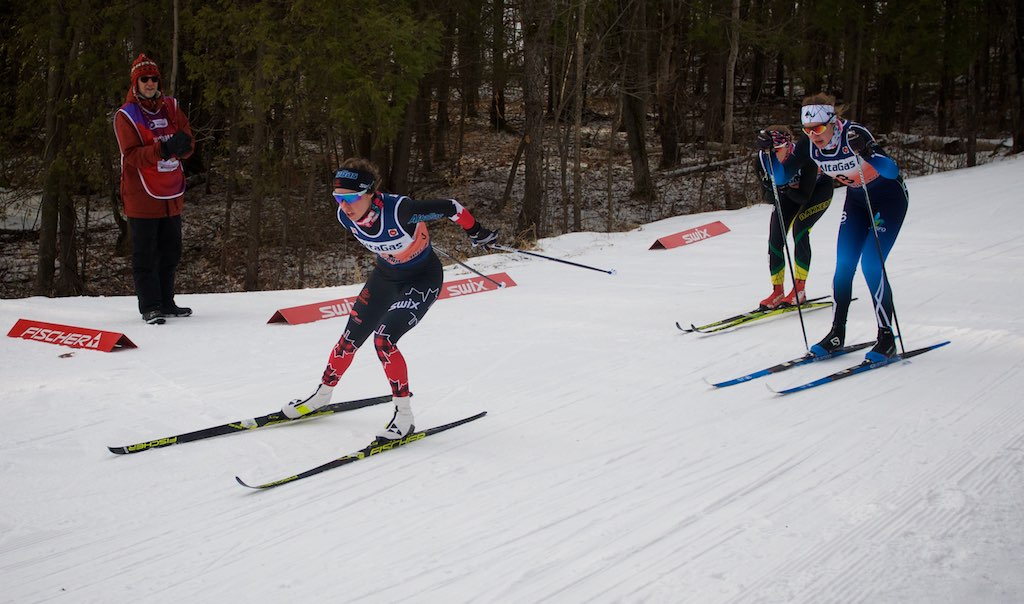
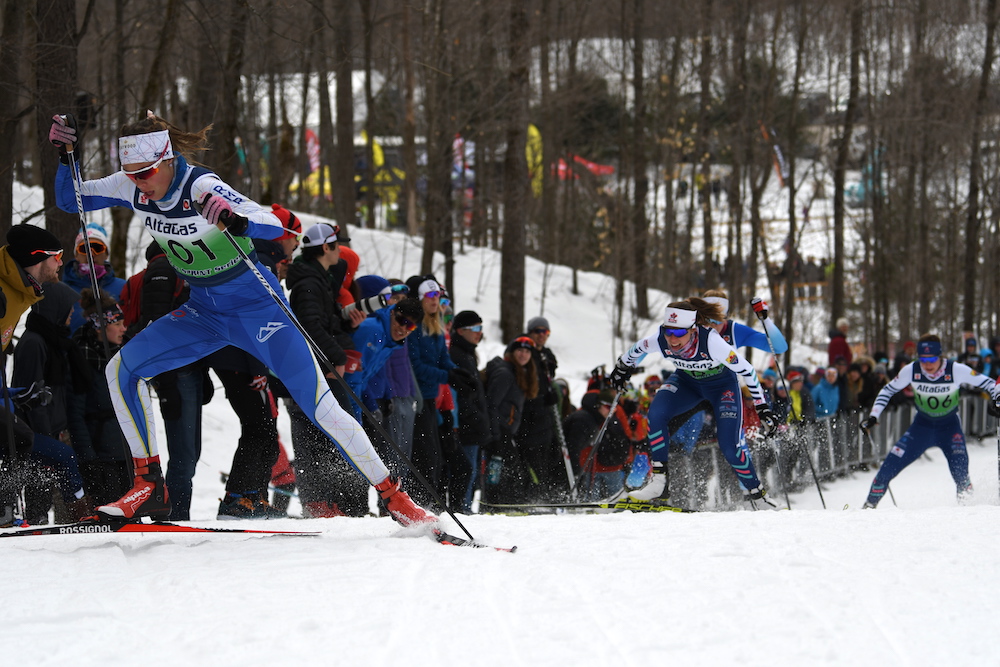
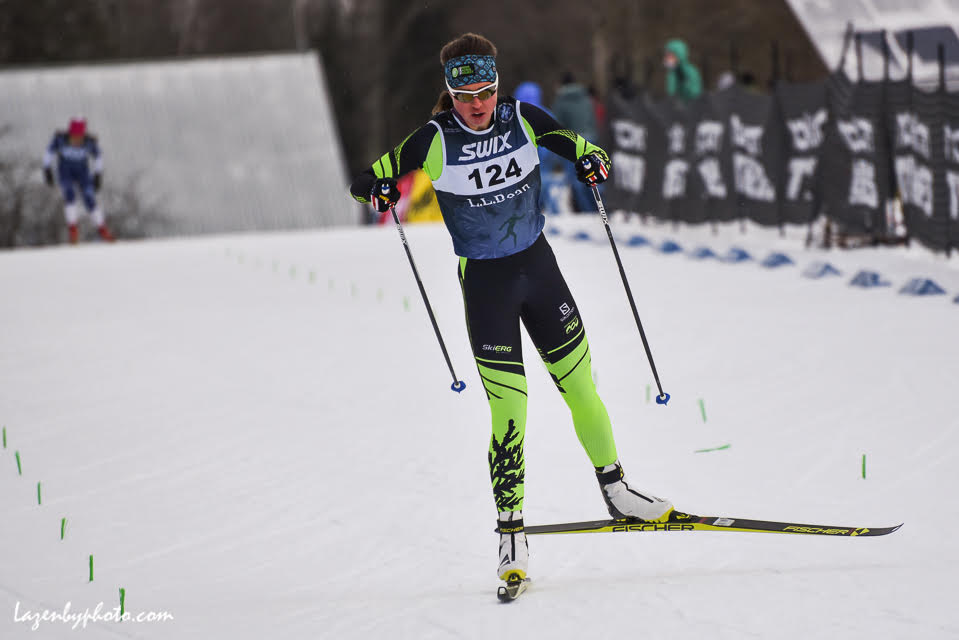
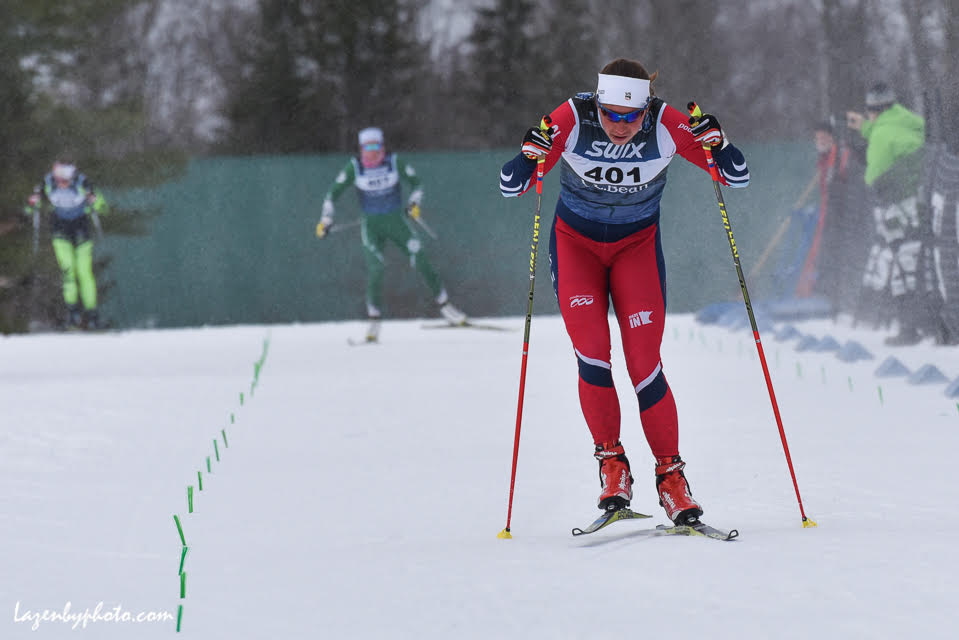
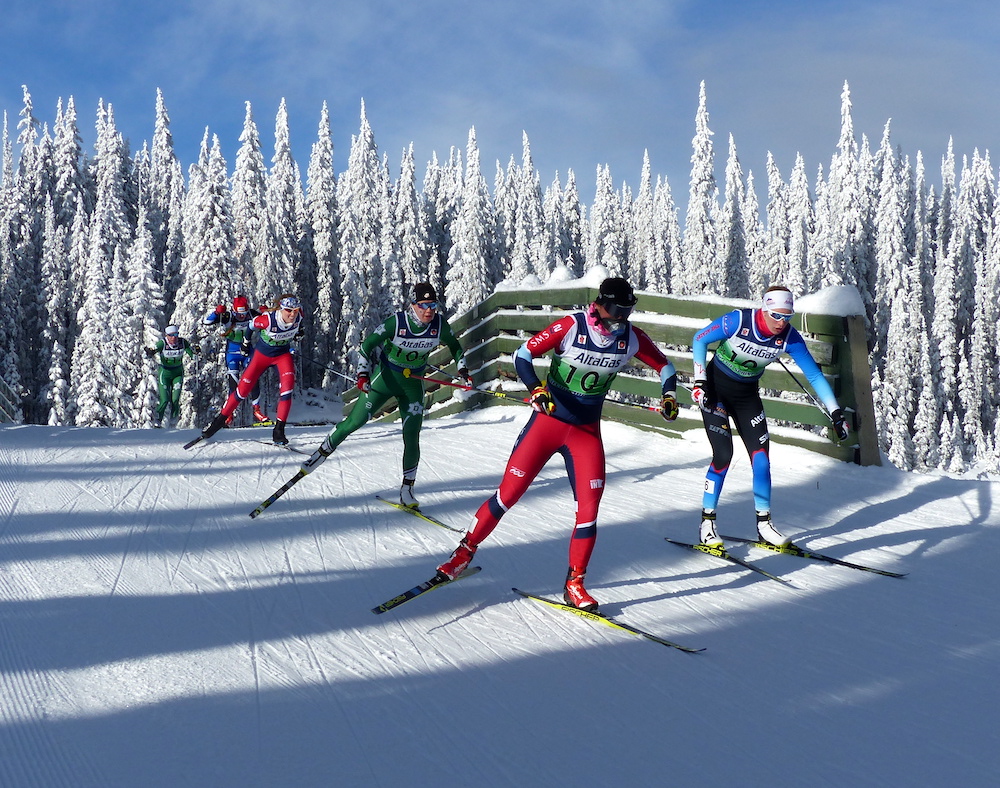
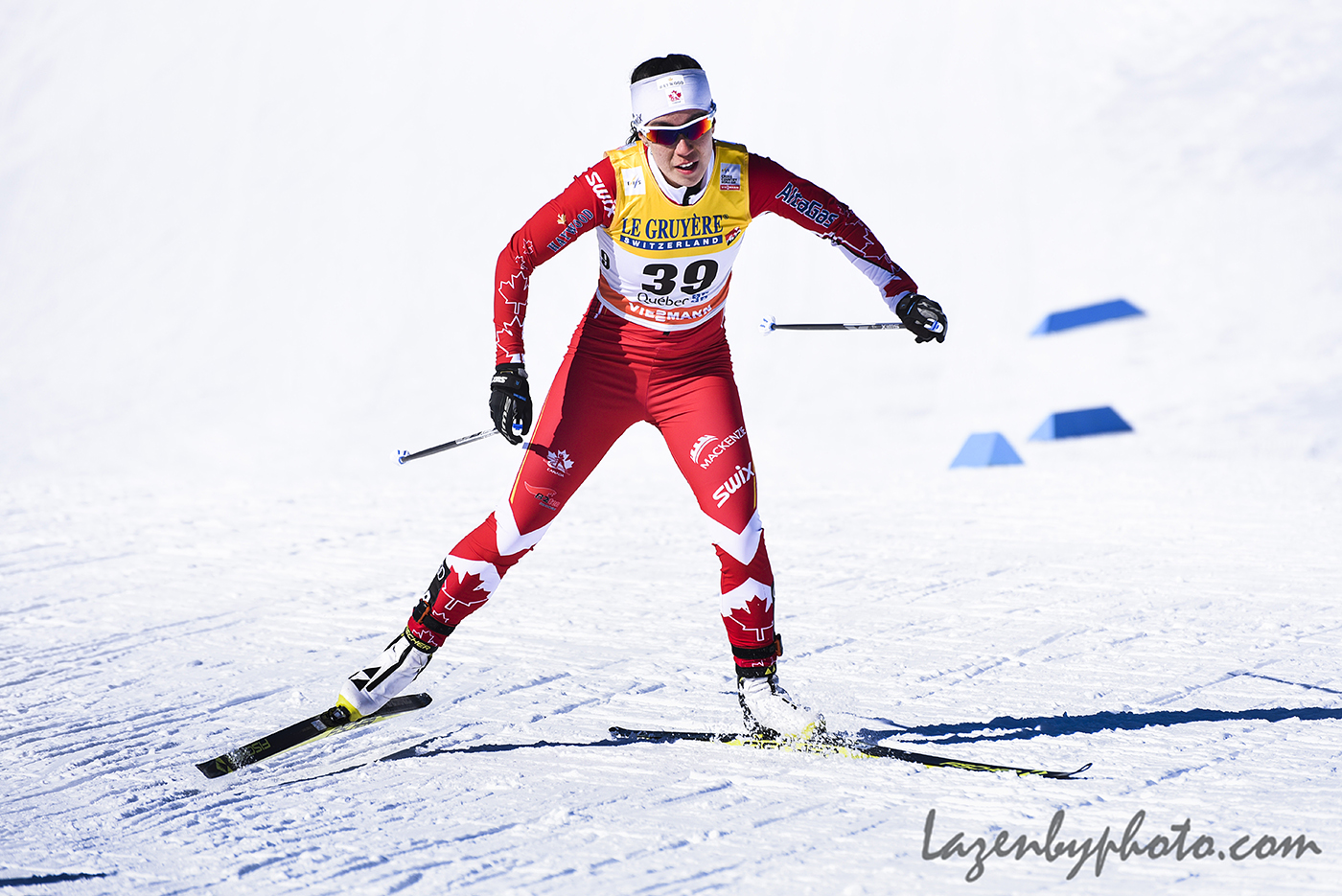
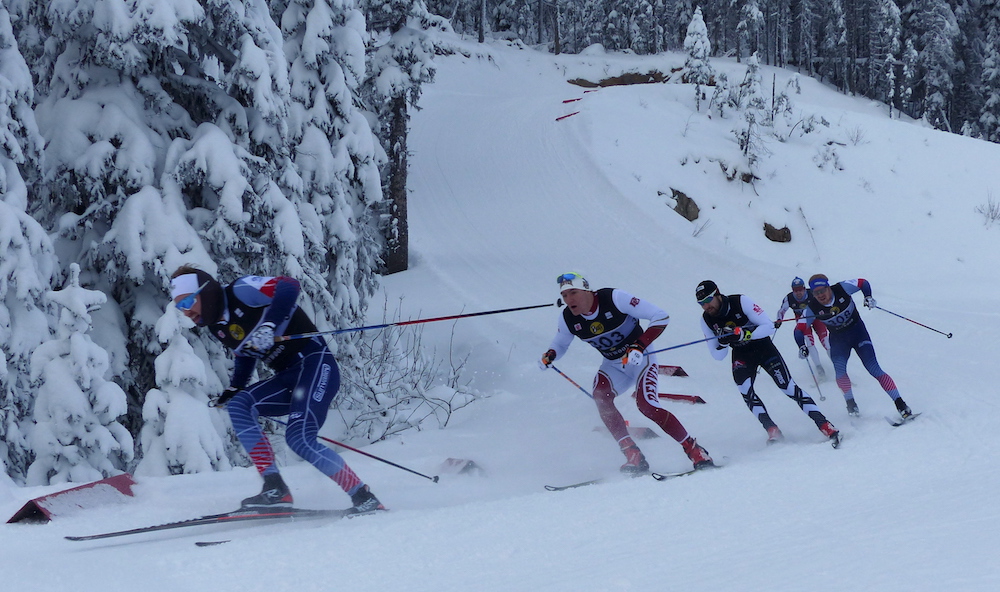
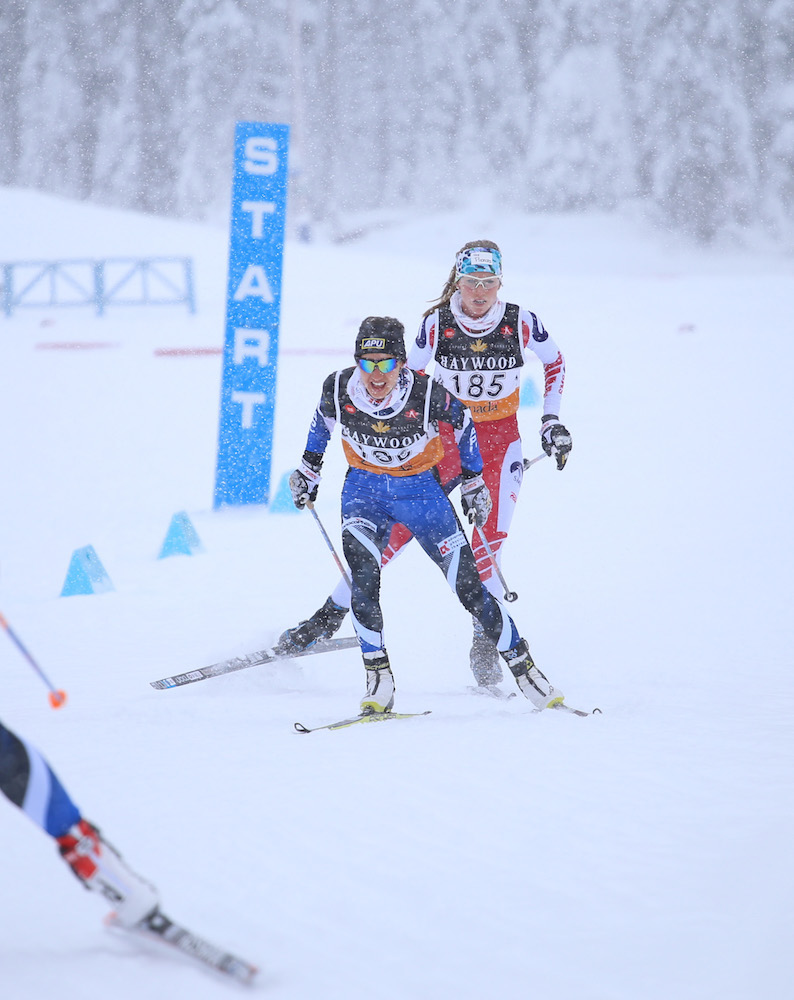
Katherine Stewart-Jones leads a sprint heat on her way to domination. (Photo: Robert Smith)
The NorAm circuit moved east to the Nakkertok trails for three days of racing jointly hosted by Nakkertok Nordic, Club Skinouk, Chelsea Nordiq, and Kanata Nordic. Friday featured classic sprints, Saturday interval start free, and Sunday interval start classic.
The event was also the Candy Cane Cup for the younger categories, as well as Ontario Cup 1 and Coupe Québec 1. 374 athletes in the U16, U18, and Open categories competed on Friday with many more younger athletes racing Saturday and Sunday.
Nordiq Canada’s Jeff Ellis was there and has once again shared the full-length post-race interviews. Photographer Robert Smith has galleries for each day, so keep scrolling.
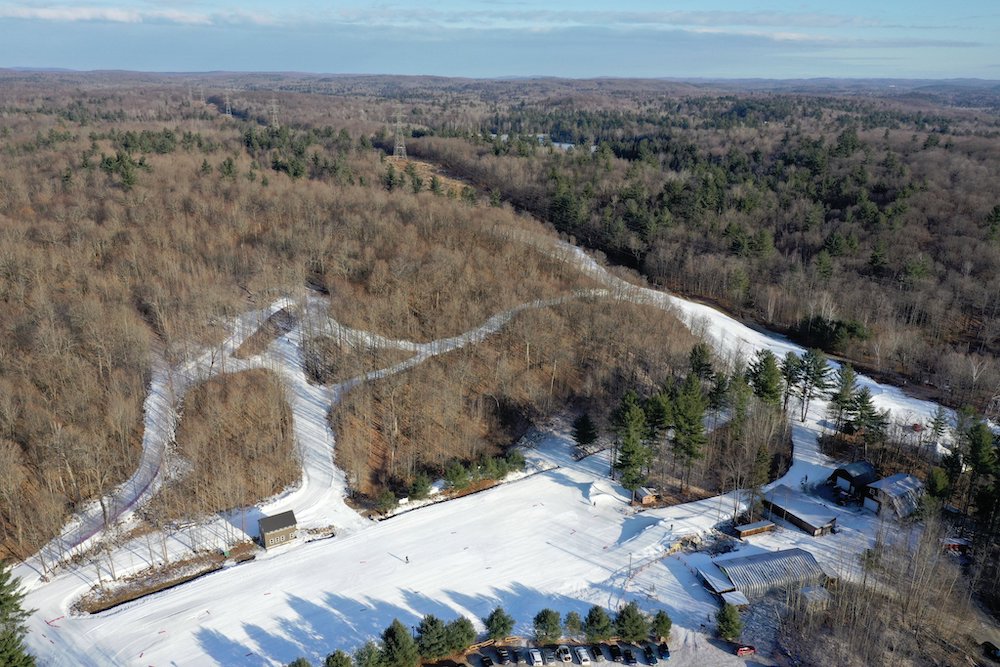
Nakkertok had over 3km of trail open thanks to their snowmaking, with a 2.5km loop used for the distance races.
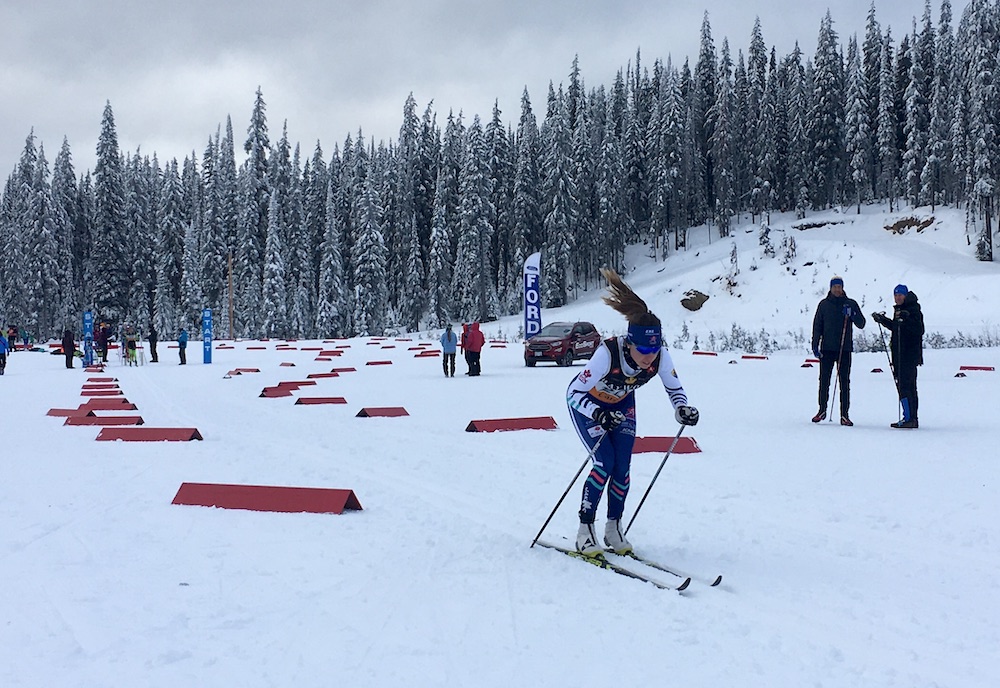
The ‘NakkerTrak’ at Nakkertok before the 2019 NorAm weekend. (Photo: Natural Fitness Labs)
On the women’s side, it was the KSJ show, with home-grown national team member Katherine Stewart-Jones winning all three days.
In the sprint, Stewart-Jones finished in 3:19.96, comfortably ahead of AWCA’s Maya MacIsaac-Jones and RMR’s Katie Weaver at 2.43 and 3.93 seconds back respectively. The podium trio were the top three qualifiers, but in reverse order.
Stewart-Jones steamrolled the field in the free 5km, 36.8 seconds ahead of Laura Leclair in second and 39.9 seconds before Cendrine Browne, both of CNEPH.
The trend continued on Sunday, with Stewart-Jones finishing the classic 10km in 28:52.1, 1:18.1 ahead of Skibec’s Andrée-Anne Théberge and 1:29.8 ahead of AWCA’s Annika Richardson.
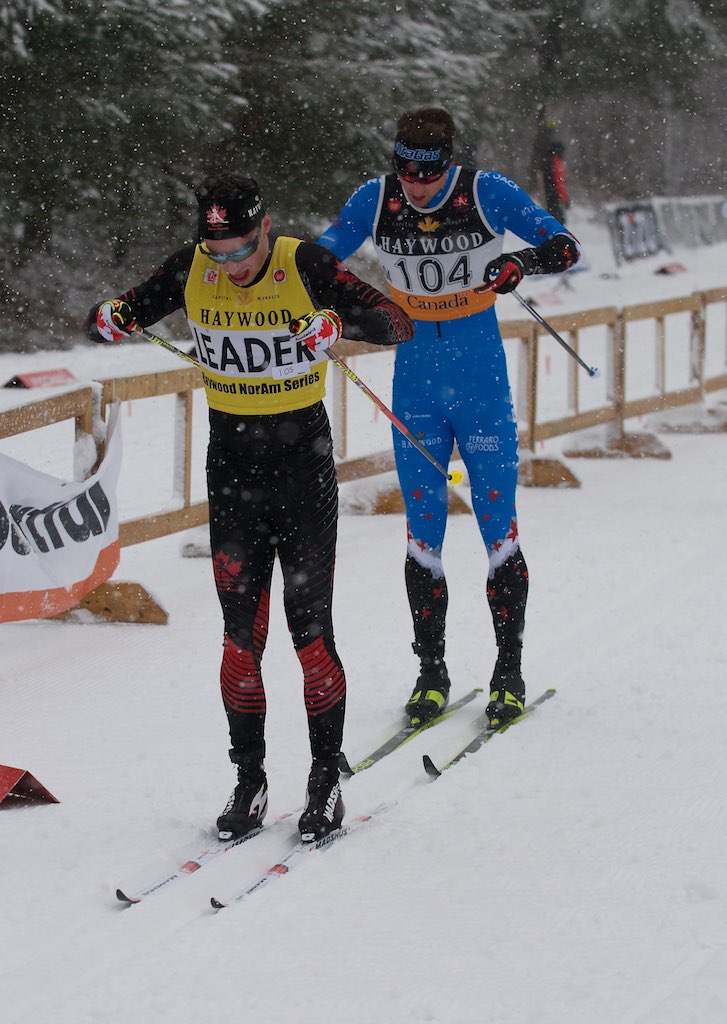
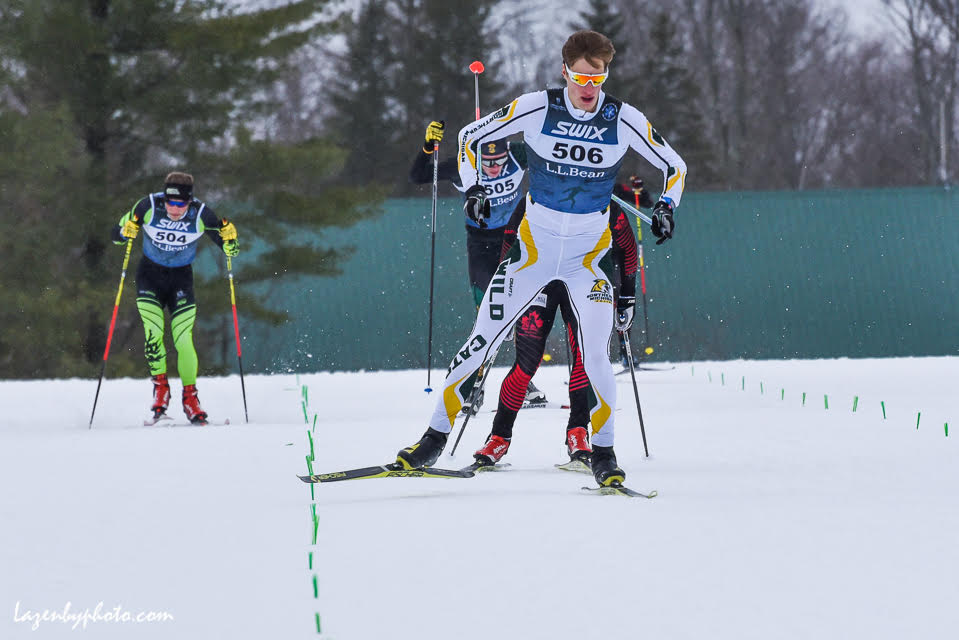
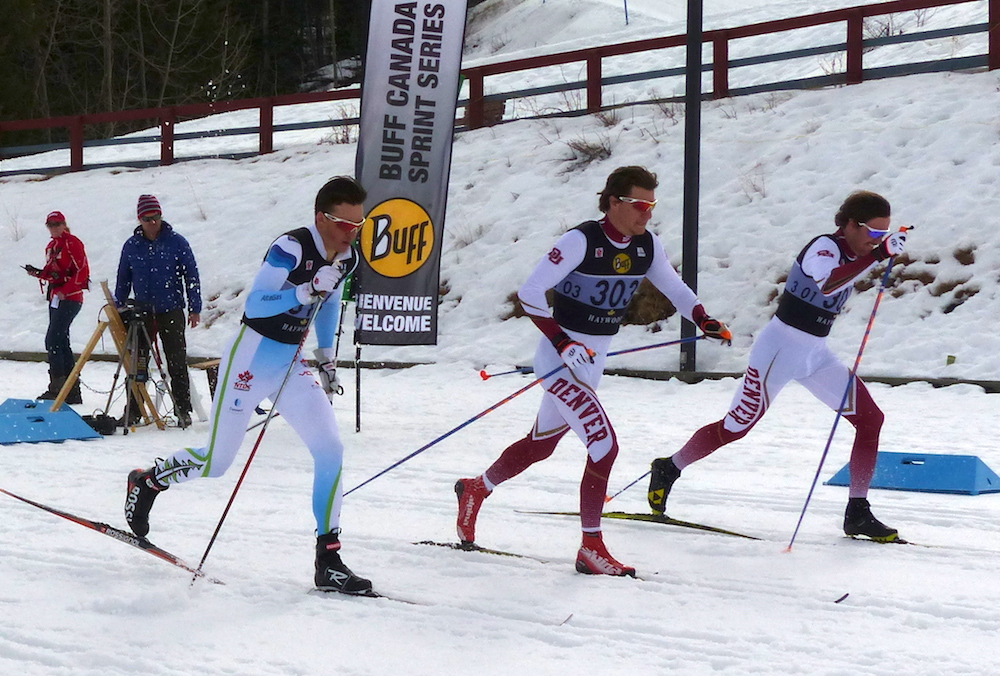
Antoine Cyr leads Julien Locke in the interval start classic. (Photo: Robert Smith)
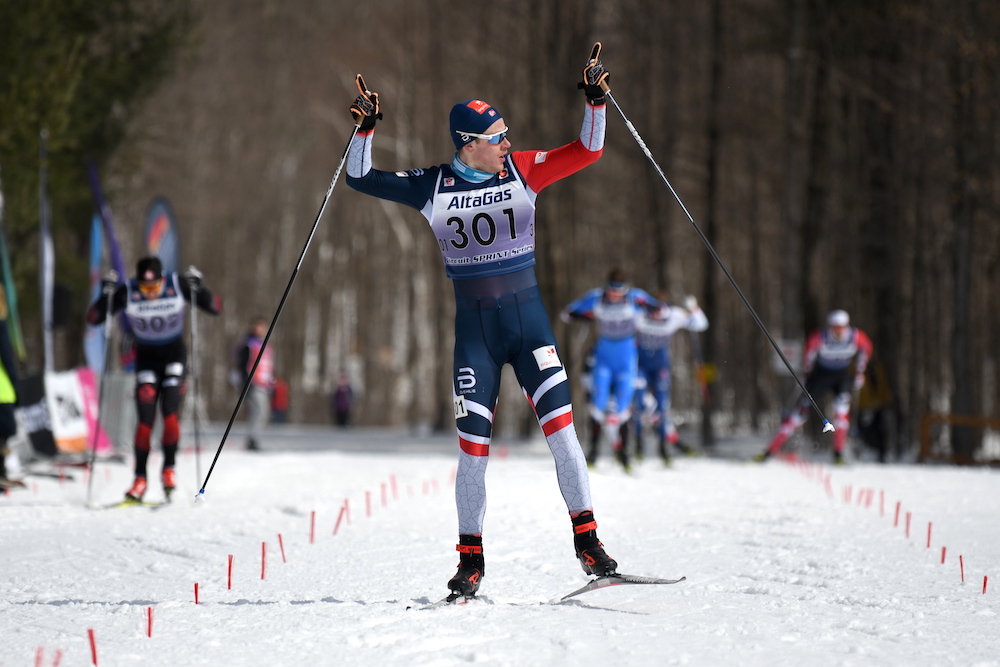
For the men, Hardwood’s Bob Thompson kicked the weekend off with a sprint victory in 3:12.71, followed by national team member Antoine Cyr at 0.36 seconds and his CNEPH teammate Antoine Briand at 0.63.
On Saturday, Cyr won the free 10km in 22:10.4, 20.9 seconds ahead of Fondeurs Laurentide’s Ricardo Izquierdo-Bernier and 32.8 seconds clear of Team R.A.D.’s Evan Palmer-Charrette.
Palmer-Charrette stepped up to finish the weekend on top of the podium, winning the 10km classic in 24:43.8. National team member Julian Smith was second at 6.2 seconds followed by Cyr at 14.4 seconds.
For many Canadians this season, the big focus is on the Mt. Sainte Anne (MSA) NorAm in January, which is the Junior and U23 World Championship trials. That series is also a path to World Cup starts. As a result, a number of athletes chose the nearer of the two December NorAm races and skipped the other to reduce travel. Over 30 western Canadians drove to Sun Valley for the SuperTour event instead of flying to Nakkertok.
“I think that it’s good for younger athletes to chase high competition for development,” Stewart-Jones wrote in response. “It makes more sense for them to travel less too. This year, for most of the younger athletes and even a lot of the older ones, the focus is on trials in MSA in January so there is a lot of time to prepare for their optimal race performance.”
Stewart-Jones moved from Nakkertok to Canmore this training year, resulting in new training partners and a new personal coach, national team head coach Erik Bråten. That also meant returning to Nakkertok required two extra flying days and the associated illness risk.
“If I hadn’t been trying to get the COC spot locked up for the rest of the season I would have most likely gone to Sun Valley too.”
There is a complicated calculus to getting World Cup starts in Canada. The COC leader gets FIS-guaranteed starts and financial support from the host organization for each race weekend. Keeping the COC leader bib for the season would mean more and cheaper time on the World Cup for Stewart-Jones. Dahria Beatty and Emily Nishikawa chose to race period 1 in Europe instead, with Beatty qualifying for the next WC trip selection by placing 25th in the Davos sprint on Saturday.
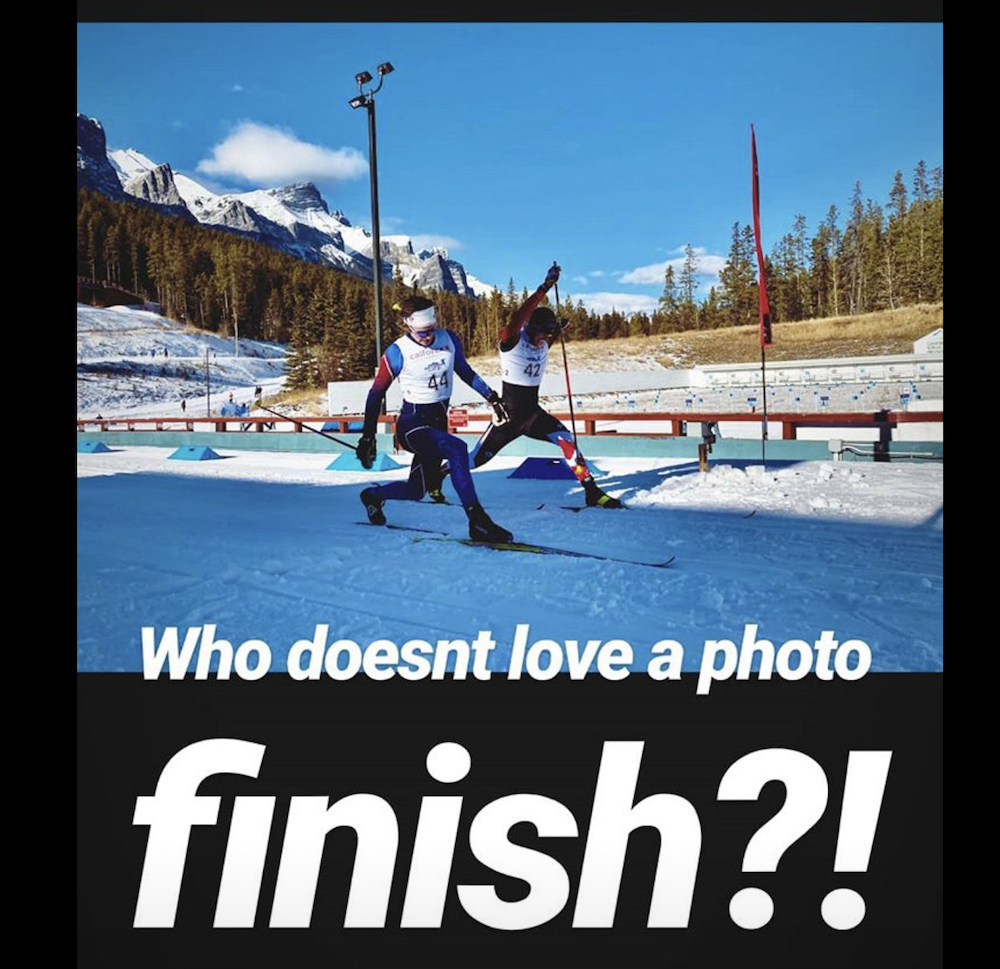
Junior Tyson Green (Caledonia) outsprints Mark Arendz (NPST) in a third round King’s Court heat. (Photo: @NordiqCanada instagram)
Nordiq Canada hosted the annual kick-off to the race season at Canmore Nordic Centre on November 13th. The ‘Nordiq Thunder’ races are an opportunity to put on a bib and test fitness and are not being used for trip selection this year. The full press release follows the two winner’s interviews, below. Results for both days are on zone4.ca
CANMORE, Alta.—Antoine Briand and Maya MacIsaac-Jones were crowned the king and queen of the annual Nordiq Thunder King’s Court Sprints on Wednesday in Canmore, Alta.
Born just two days apart, the 24-year-olds hammered the pace up and down hills on the challenging 1.4-kilometre track throughout the qualifying round, and in each of the three head-to-head heats, under a blue-sky morning at the Canmore Nordic Centre.
The unique King’s Court race is a no knockout format that gives athletes opportunities to race – handling category sizes of nine-to-24 racers in three rounds, with up to four athletes per heat. The goal of the format is to have athletes compete against a variety of similarly skilled racers, men and women mixed in each heat, that benefits skill development. By the final round, the fastest athletes are generally competing in the all men and all women’s final, with the slower athletes in the lower finals.
That certainly held true on Wednesday for both men’s and women’s brackets.
Racing on skate skis for the qualifying round and in the final, Briand of Sept-Iles, Que., was the fastest qualifier leading the men into the senior head-to-head heats. After struggling to find his top gear in the first round, Briand put the pedal down in the second and final heat where he edged out Olympian and three-time World Cup medallist, Andrew Newell of the United States, for top spot on the podium. Bob Thompson, of Thunder Bay, Ont., placed third.
“In some ways this means nothing and, in some ways, it means everything. I am happy to win today,” said Briand. “It was an interesting battle. I played it wise going fast on the flats and the downhill. I wanted to do good and win today. It was important for my confidence to get this one.”
A motivated Maya MacIsaac-Jones was determined to kick her season off with a strong start. Qualifying in second spot, the Athabasca, Alta. resident put her summer training to the test with a hard-fought battle through the women’s heats where she went head-to-head with National Ski Team member, Dahria Beatty of Whitehorse, in the final two rounds.
While Beatty led the Canadian duo into the finishing stretch in the second round, it was MacIsaac-Jones who double-poled relentlessly to make up the ground and edge the Olympian at the line.
“That format is so great in terms of getting ready for the race season and having a good tune-up,” said MacIsaac-Jones. “I think it is one of the best formats for sprinting out there. You have to go as hard as you can in every heat, and you aren’t saving anything for the final. It is perfect.”
A rematch was set for the senior women’s final.
Beatty and MacIsaac-Jones were quick off the start line, darting up the steep climb out of the stadium. Playing chase around the rolling terrain, it was the determined MacIsaac-Jones taking the lead this time on the final downhill, and she never looked back, securing her spot on the golden step of the senior women’s podium.
“I had a lot of fire in me this training season. It definitely is what is keeping me in this racing season. Things have been feeling really good overall this year. Today is another check mark on everything that I’ve been doing in training is working so far.”
Joe Davies, of Whistler, B.C., was the top junior men’s sprinter. Jasmine Drolet, of Rossland, B.C., opened up a sizeable gap to handily win the junior women’s title.
Nordiq Canada is holding its annual season-opening race series for the majority of the nation’s male and female cross-country skiers, thanks to the Canmore Nordic Centre’s annual snow preservation project, Frozen Thunder.
In an effort to provide Canada’s Nordic athletes with the ability to train on snow at home in October and early November, the Frozen Thunder initiative stored enough snow under a thick layer of sawdust to insulate it over the summer months, allowing them to cover the 1.4-kilometre of trail.
Modeled after snow preservation projects in Europe, the Canmore Nordic Centre was the first to take on the project in North America – and is subsequently the first to open its trails on the continent each year – providing another critical resource for Canada’s high-performance Nordic sports.
Nordiq Canada is the governing body of para-nordic and cross-country skiing in Canada, which is the nation’s optimal sport and recreational activity with more than one million Canadians participating annually. Its 60,000 members include athletes, coaches, officials and skiers of all ages and abilities. With the support of its valued corporate partners – Haywood Securities Inc., AltaGas, Swix and Lanctôt Sports– along with the Government of Canada, Canadian Olympic Committee, Canadian Paralympic Committee, Own the Podium and B2Ten, Nordiq Canada develops Olympic, Paralympic and world champions. For more information on Nordiq Canada, please visit us at www.nordiqcanada.ca.
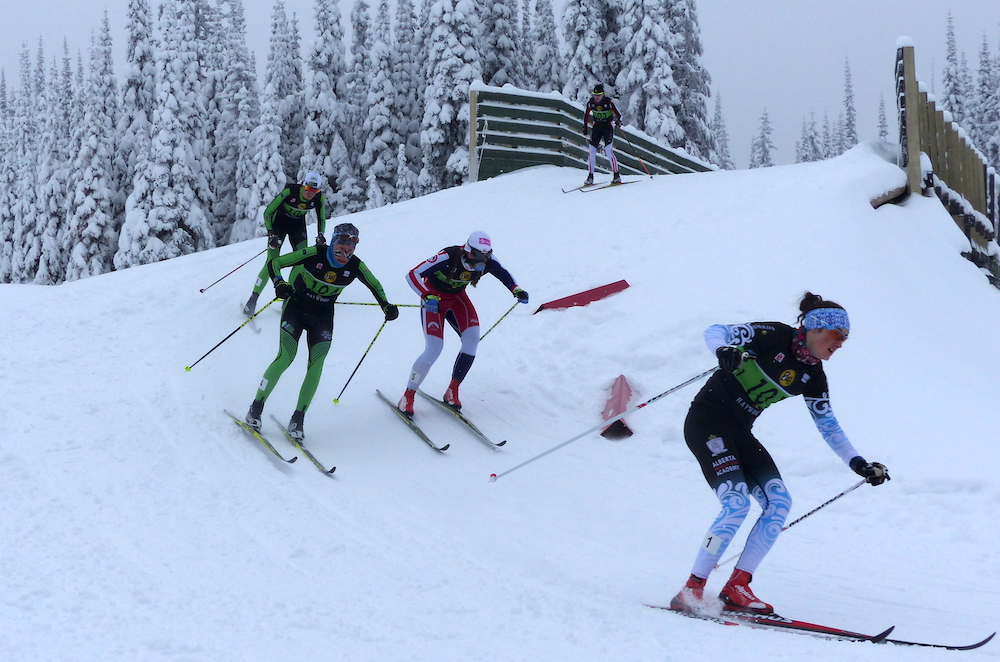
Maya MacIsaac-Jones attacked on the final hill to win. Behind, Katherine Stewart-Jones leads Dahria Beatty and Annika Richardson. (Photo: Doug Stephen)
This article has been updated with final WCF selections and a video of the sprint A finals.
Nationals rolled on at Nakkertok trails with free technique sprints on Saturday. The women raced a 1.3km course while the men added one more hill for 1.4km. The jury described the conditions as ‘soft icy’, which seems to mean ‘fast spring skiing’ with a soft layer over a firm base.
Maya MacIsaac-Jones (CNST) took her second consecutive national sprint title by jumping clear on the final climb to earn a solo victory in 2:46.62. Dahria Beatty (CNST) led the pack into the finish 2.87 seconds later with Katherine Stewart-Jones (CNST) at 3.27 seconds and Cendrine Browne (CNST) at 3.47.
Germany’s Julia Richter took fifth for the University of Utah at 4.82 followed by Annika Richardson (NTDC TBay) at 5.31.
“Going into the final,” MacIsaac-Jones wrote, “I knew that my offset was strong so I made the decision to attack on the final climb, which worked out as planned!”
Maya MacIsaac-Jones leading the A final. From left to right, Julia Richter (104, red), Cendrine Browne (113), Dahria Beatty, and Katherine Stewart-Jones pursue. (Photo: Doug Stephen)
MacIsaac-Jones is ending her nationals on a high, as she makes a planned shift to focus on World Cup finals next Friday. “I’m so happy with my race today, this is the best I’ve felt all year. It’s been a rocky season, and this is really motivating for me going into next year.”
The conditions made for fast racing, but the A final was different.
“It went out pretty slow,” Stewart-Jones wrote, “because no one wanted to lead on the first climb because there was significant draft on the next downhill.”
Browne, who is usually described as a distance specialist, now has 4th in every event at nationals.
“My qualifier was not so great, so I didn’t know what to expect in the heats,” Browne told the LOC. “Fortunately, I felt really good in the heats and I managed to squeeze myself up to fourth place today. Really happy with that, usually not a sprinter, so yeah, good day for me.”
***
Norwegian junior Haakon Skaanes wins the sprint ahead of Antoine Briand. (Photo: Doug Stephen)
In the men’s A final, the Norwegian theme from today’s World Cup sprint in Falun flowed into Canada. Norwegian national team junior Håkon Skaanes (Strindheim IL) won the qualification and all his heats to take the A final in 2:45.69.
Antoine Briand (CNEPH) finished alone in second, 2.54 back, to become the Canadian champion. Julien Locke (CNST) out-sprinted the rest to take third and the silver medal at 5.60 seconds. Julian Smith (NTDC TBay) completed the Canadian podium at 5.73. Lenny Valjas (CNST) was fifth at 6.08 ahead of Norwegian junior Albert Sunde Oehlschlaegal (Sjåstad v Lier IL) at 6.26.
Briand, who qualified second 1.05 behind Skaanes, was happy with his first Canadian title.
“Today’s race, I’ve been thinking about it for the past eight, nine months,” he told the LOC. “I was really strong today, from the start of the day, qualification this morning and every heat I was feeling good.”
Briand didn’t wait for others to set the stage.
“In the final, I went really hard in the first uphill,” Briand wrote. “My coach shouted on me that the gap had opened. So me and the Norwegian guy who won kept going hard until the end. I couldn’t follow him the second time we went up but I managed to stay 2nd.”
Julien Locke (317) takes third, ahead of Julian Smith (305), Lenny Valjas (308) and Albert Sunde Oehlschlaegal (behind Locke). (Photo: Doug Stephen)
“For me,” Smith wrote in an email, “I was really confident in my skis so I was trying to settle into 3rd place going into the first downhill, and then move into second during the second climb. This allowed for drafting on the final descent. … I did let one too many people between me and the finish line on the last climb and then was not quite able to close the gap in the end.”
This nationals is not just the largest in recent memory, but also one of the most competitive. Unusually, there are only two Canadians on the World Cup circuit in Falun, with everyone else here in Nakkertok. The addition of the Norwegian juniors and NCAA athletes added speed to the mix.
“I have never been to a Canadian National Ski Championships where the field is so deep, with National Team members, competitive domestic racers and so many international racers,” Smith wrote.
Racing continues Sunday with sprints for the younger age groups and an invitational for even younger athletes. Sunday has 507 racers on the start list compared to 194 finishers and 12 DNS on Saturday.
World Cup Final Qualification
Twelve athletes have already qualified, leaving seventeen spots to be decided at nationals: 8 men and 9 women.
The criteria was summarized after the pursuit race. The races that count are the sprint, the individual start classic, the pursuit, and pursuit time-of-day.
Twelve athletes were already named to the World Cup Final team:
Alex Harvey, Lenny Valjas, Emily Nishikawa, Dahria Beatty based on World Cup or Olympic results.
Katherine Stewart-Jones and Jack Carlyle (AWCA) as COC leaders.
Cendrine Browne, Maya MacIsaac-Jones, Russell Kennedy (Team R.A.D.), Scott Hill (Hardwood), and Evan Palmer-Charrette (Team R.A.D.) by qualifying for World Championships.
Rémi Drolet (Black Jack) with a top ten at World Juniors.
What follows is an interpretation of the criteria. CCC will announce the definitive list Sunday night at La Soirée, along with the new CCC branding.
Update: At the Sunday evening event, Nordiq Canada (the organization formerly known as CCC) announced the final selections.
For the women, it is Annika Richardson, Anne-Marie Petitclerc, Sadie White, Marie Corriveau, Zoë Williams, Hannah Mehain, Frédérique Vézina, Alannah Maclean, and Laura Leclair.
For the men, it is Antoine Briand, Philippe Boucher, Julien Locke, Julian Smith, Bob Thompson, Alexis Dumas, Antoine Cyr, and Graham Ritchie. Apart from morning sickness, a pregnant woman has to deal with heartburn, fatigue, sore muscles and much more. It is also difficult to get good rest at night as their tummy gets bigger. Towards this end, pillow manufacturers aimed to address the need and develop the kind of pillows that will facilitate a pregnant woman’s sleep and relaxation. Our review will focus on the best pregnancy pillows which can cater for your needs whilst taking into consideration different factors like material, size, shape, price and brand. Shop best pregnancy pillows online at Pregily.com – read reviews and shop now!
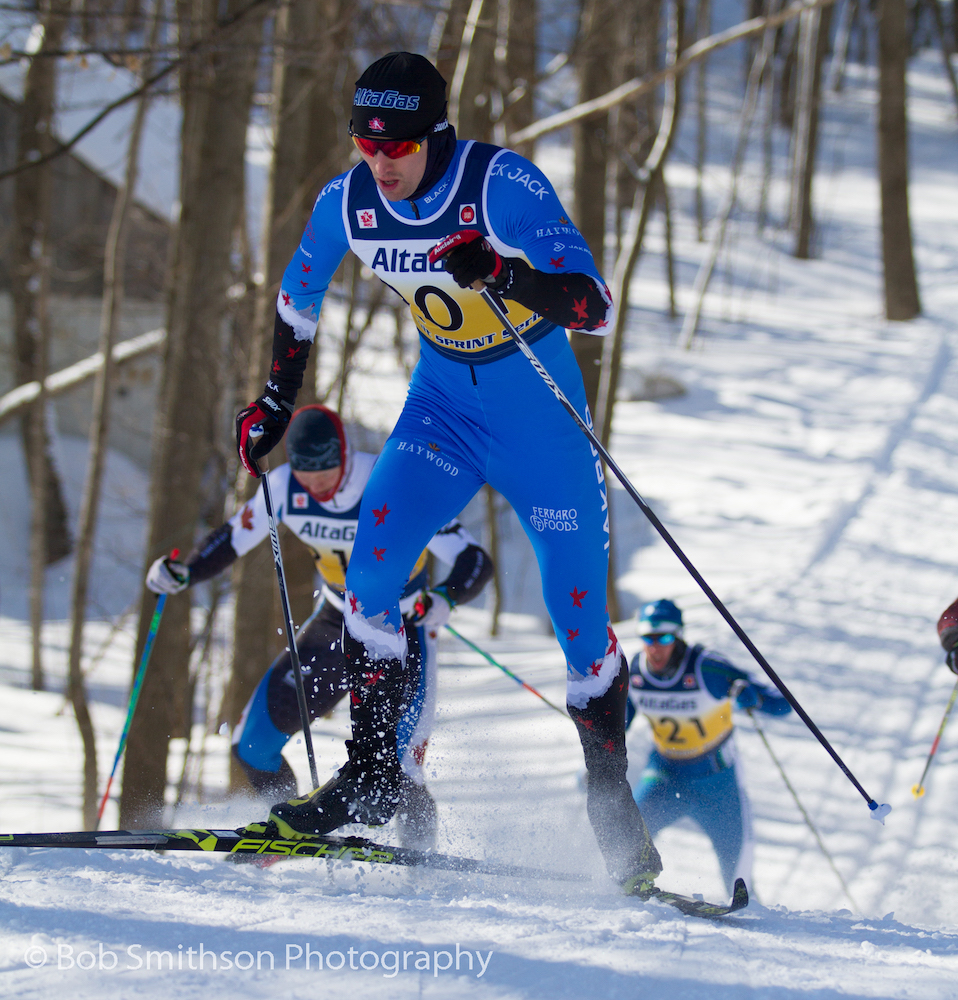
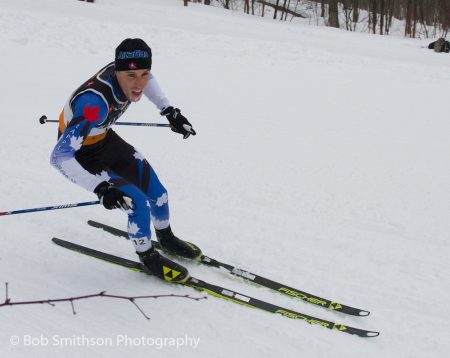
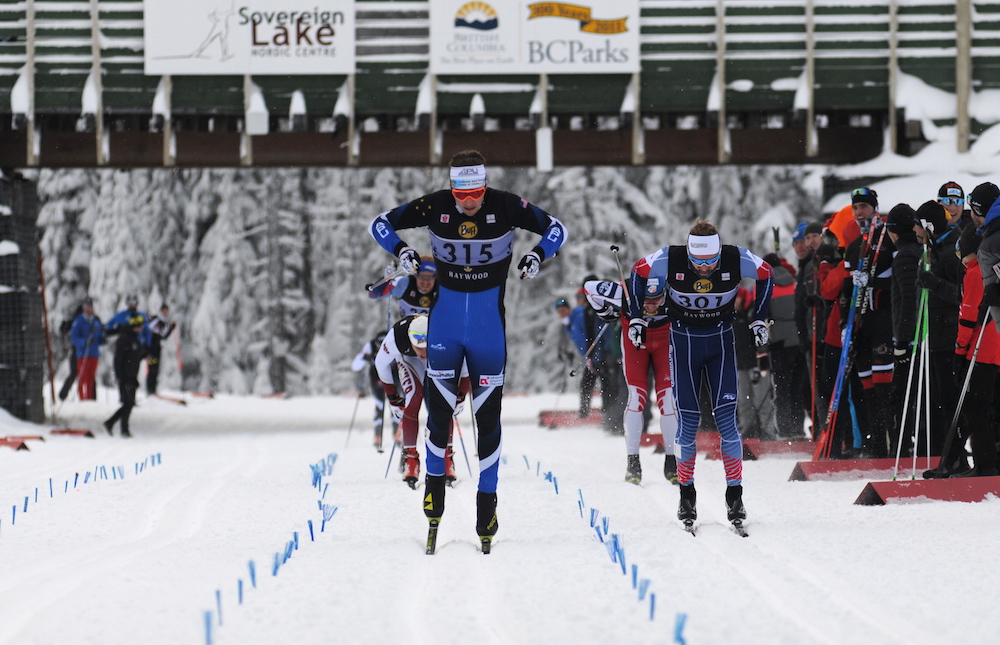
Julien Locke leading a sprint heat. (Photo: Bob Smithson)
The NorAm series went to Duntroon, Ontario, for the Canadian Eastern Championships: three days of varied weather, new race formats, and new faces on the podium, all hosted by Highlands Trailblazers.
Easterns is possibly the most storied ski race in Canada. Most years, it is the largest FIS event in North America. This year, the Polar Vortex froze out the travel ambitions for many families and lower budgets in the post-Olympic season persuaded many western teams to stay home. Despite these challenges, over 450 athletes braved the difficult road conditions to hit the start line.
Easterns was ringing in the changes this year. This may be the first ever NorAm where the men and women skied the same distance on the same courses in every event. The two-day pursuit reappeared for the first time at this level since 2000.
The two-day pursuit format was introduced in 1988. Based on the Gunderson start in Nordic Combined, there was an interval start classic race on the first day and a free technique pursuit on the second, with medals awarded for both days, but no time-of-day points for the second.
In 2002, the two-day pursuit was replaced with the same-day pursuit, with no medals for the classic portion and a two hour break before the skate. Beckie Scott won all three medals in this event at the Salt Lake Olympics. In 2003, this was changed to ‘continuous pursuit’, sometimes referred to as ‘pursuit without a break’. The format name was quickly shortened to ‘pursuit’, which confused people until 2011 when FIS acquired rights to the name ‘skiathlon’, allowing ‘pursuit’ to be used for the final day of a mini-tour. CCC wrote a history in 2011 to celebrate the new name.
In the summer of 2018, FIS dropped the skiathlon format, which brings us back to a format that most of the athletes racing today will not remember.
The weather also came out to play: -18 Celcius (C) and windy for official training, -12 C and sunny for the sprint heats, -9 C and 37 km/h winds for Saturday’s classic, and +3 C and freezing drizzle and rain for Sunday’s pursuit.
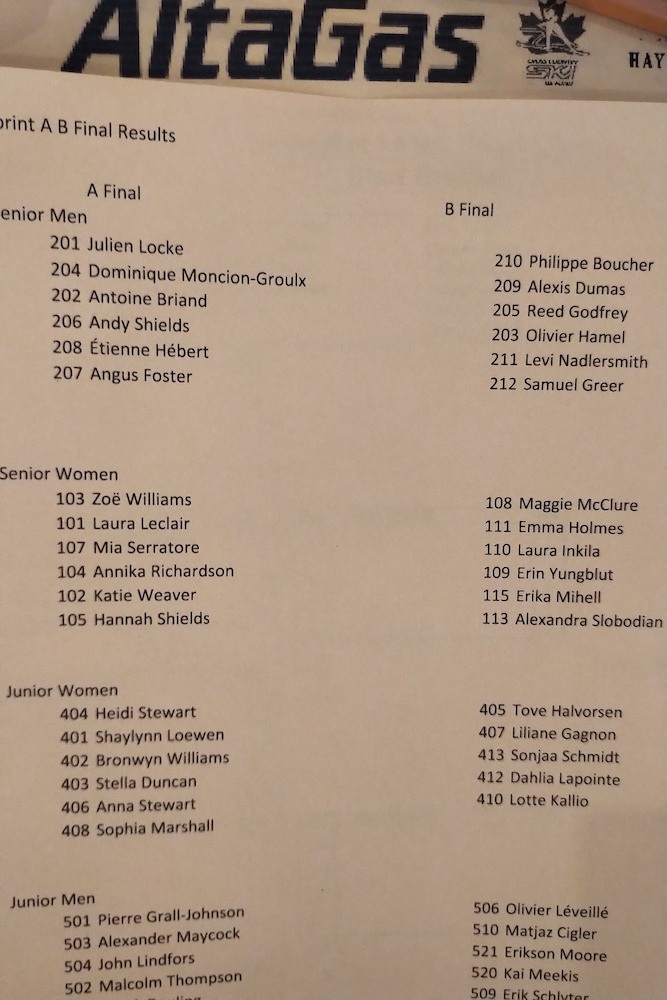
Women’s A final: Zoë Williams (Nakkertok), Laura Leclair (CNEPH), Mia Serratore (Big Thunder), Annika Richardson (TBay), Katie Weaver (Rocky Mountain Racers), Hannah Shields (Nakkertok)
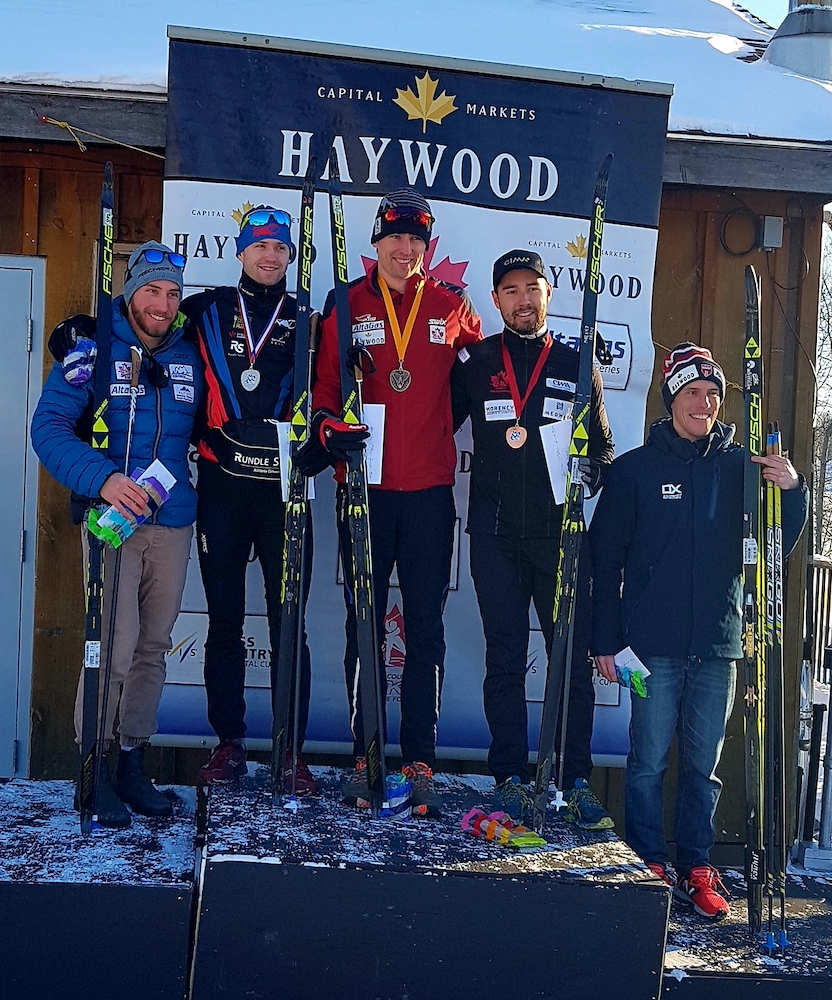
Men’s A final: Julien Locke (CNST), Dominique Moncion-Groulx (Team R.A.D.), Antoine Briand (CNEPH), Andy Shields (Lappe), Étienne Hébert (AWCA), Angus Foster (TBay).
There are no official results or times for the sprints.
Friday started cold and sunny for the 1.5km classic sprints, a welcome relief after cold and windy weather on the official training day.
“After two small running hills at the beginning, the remainder was all double pole,” Julien Locke (CNST) wrote. “While the course was not as demanding as I would have liked, it was a good opportunity to use the upper body strength.”
The course worked well for Locke, as he won the qualifier by over 4 seconds.
Zoe Williams (Nakkertok) won her first career NorAm, two weeks after her first podium and narrowly missing the selection for World Championships.
“Today was very surprising,” she wrote to FasterSkier. “When I skied the course yesterday I wasn’t a huge fan and I didn’t think it played to any of my strengths. My qualifier was really messy but I pulled it together in the heats and felt I was able to get faster as the day went on!”
The women’s A final was chaotic. Each of the three women on the podium had their own view of the action.
“I talked to my coach (Kieran Jones) before the A final and our plan was to stay relaxed in the first half of the course, pick it up in the second half and push it into the finish. It worked out almost perfectly; I got caught up in a fall on the main uphill and lost contact with the leaders but was able to fight back in the second half of the course with Laura and Annika and as everyone jostled for the inside line into the finish I just picked the outside lane and hammered.” — Williams
“Honestly the A final was pretty bad. It was a cool race because everyone in the A final could race but I think we were all a little too excited (or tired). There were a lot of tangles and falls so no tactics there.” — Laura Leclair
“Tactics were pretty important in the final. I started out hard to get out in front to stay out of trouble on the downhill. Managed to make a gap but lost it in the final straight. It was really important to be strong with the double pole at the end.” — Mia Serratore
It was Serratore’s first NorAm podium.
The men followed with tactics that emphasized staying out of trouble.
“Briand set a strong pace in the first 400m up Honey and Sugar Shack hills. I followed him out to the Biathlon range and then hopped in front for the fast/icy turn. From there, I lead up the gradual Chicken Coop climb, through the twists around the wax rooms and to the line.” — Locke
“The final started fast with Antoine putting the pace in front. I think the top three skiers (Antoine, Julien and I) had a little gap after the climbing section of the course. Julien accelerated to pass Antoine before the fast downhill, I stayed in 3rd behind them. I took the inside on the 90 degree corner at the bottom of the downhill and move up to 2nd place. Following the downhill, like in the semi-final Julien put the hammer down double poling on the gradual climb and I was the only skier that managed to stick right behind him. I tried to change tracks and pass him on the last stretch but I could not find enough speed to overtake him.” — Dominique Moncion-Groulx
“I went all out from the gun and Julien took over at mid point. No real tactics from there on to be honest it was full gas racing.” —Antoine Briand
Some of the athletes were feeling the effects of racing the US SuperTour after the Bishop’s University NorAms.
“I had a dynamic first half of the qualifier but felt slow and I did not ski the second half well. I had good energy, change of gears and I felt solid through all the rounds. I’m happy with my speed in the heats and with a good final result. For a 3rd weekend of racing in a row, it’s fun to still feel energetic.” — Moncion-Groulx
“Coming back from a big win in Lake Placid at the US Super Tour last weekend, I was feeling confident for another classic sprint. Had a good qualification with the second best time and being on the podium at the end of the day is always satisfying.” — Briand
Interval Start Classic
Saturday brought in wind and warmer weather for the 10km classic race. The 5km loop had two main uphills immediately followed by downhills.
Williams said pacing mattered because “with only 4 main hills, lots of good rest, and a ton of double pole you had to keep pushing everywhere.”
Williams got her second win of the weekend in 35:46.09 minutes. “Super happy with it: stuck to my plan and had fun chasing people down. Mia started ahead of me and we skied the 2nd lap together which was awesome.”
Serratore finished second, 37.82 seconds back. Leclair didn’t get the benefit of timely splits or good rides, but was able to grab third at 1:18.40, just 0.18 seconds ahead of Annika Richardson.
“Because I was second to start, I was alone the whole race and didn’t see anyone,” Leclair wrote. “That was pretty hard because I didn’t know how fast the girls behind me were going. I had no bunny or rabbit. Anyway, the conditions and skis were good and it was an overall good race.”
Among the men, Alexis Dumas (CNEPH) came the closest to even splits, crossing the line in 30:04.8 for the win.
“I was able to ski really hard in the second lap and that’s where I made the difference. Also, my skis were super good. My wax tech and my coach did a great job today.” — Dumas
Shields was second, 16.67 back, after an error in the unofficial results was corrected.
“I felt flat racing today. Yesterday was a long day with the classic sprints and awards being late in the day so I was carrying fatigue,” Shields wrote. “In today’s race, I knew I didn’t have a great one but was surprised to see how far back I was when the initial set of results came out showing me in 7th place – almost a minute from the win.”
Boucher was happy with his third place, 21.57 seconds back.
“I think my skis and pacing played a lot in the outcome of the race. I decided to sacrifice some kick to have a better glide on the flat sections. Turns out it was the good call for me. I’m a little disappointed that I lost nearly 15 seconds on the leader in the last lap.” — Boucher
Skate Pursuit
Zoë Williams (101) and Annika Richardson ready to start the pursuit. (Photo: Marten Burns)
Sunday brought freezing drizzle replaced by rain which resulted in significant challenges in picking the right skis for the changing conditions. The start times for the skate pursuit are based on time back in Saturday’s classic race, with no bonuses awarded.
Leclair took her first senior NorAm win, starting third at 46 seconds back.
“My tactics for today were pretty simple,” Leclair wrote. “I wanted to start fast and catch the two girls in front of me. I put my head down, climbed and went hunting.”
“I felt super good and skis were wicked fast. After missing the first step of the podium on the two last races, it is nice to finish on the top.”
Zoë Williams in second place in Sunday’s pursuit. (Photo: Bob Smithson)
Saturday’s winner Williams started first and hung on for second. “Today was tough; didn’t have much left in me physically or mentally and it made the 15km a bit of a suffer fest.”
Annika Richardson moved up to third. “I was pretty hungry for a podium after being 4th the past two days. I have done 13 races in the past month so have felt like I have been running on empty for a little while,” Richardson wrote. “But, I really love skate distance races so was able to give it everything I had left.”
“I started with Laura Leclair who is an amazing skate distance skier. I stuck behind her until the first long downhill but she had really, really fast skis so I wasn’t able to stick with her for the rest of the race (though my skis were quite good) but managed to catch Mia Serratore by the end of the South 3.75 loop on the first lap.”
Andy Shields leads Jack Carlyle, Philippe Boucher, and Alexis Dumas in the pursuit. (Photo: Bob Smithson)
Jack Carlyle earned his first senior NorAm win as well, as the top four men neatly reversed their start order at the finish.
“Sunday was a great day,” Carlyle wrote. “Had some good jam in the legs and was able to push hard.”
“On the first lap the first four starters (Phil Boucher, Andy Shields, Alexis Dumas and I) came together as a pack, and we skied together for most of the race,” Carlyle wrote. “We took turns taking the lead throughout the race, and on the last lap I attacked with 3km’s to go and that’s when the pack broke up.”
Boucher started slowly in a strategy that earned him second place. “I decided to start easy on the first km. When I got dropped I decided to stay calm and kept skiing at my pace. When I rejoined the lead pack, I think I had more energy left than the other guys. I had awesome skis and that played a good role at being able to save energy. Jack attacked with 3.5km left, I stayed in his skis in the long hill. Only the two of us survived the attack. I died a few meters after the top. That’s how Jack got away with the win.”
Andy Shields looking ahead in the pursuit. (Photo: Bob Smithson)
Shields was still tired after two top tens and a third at the SuperTour the previous weekend, but felt better than Saturday. “Different weather today for sure. Ski selection was critical and was the main factor in determining who finished in what place – for the top 4 anyway. I felt ok with my race but my skis weren’t quick enough to complete. The wax was fine, just my ski fleet has a weak link in today’s conditions.”
Format Changes
None of the athletes commented on gender equality, but there were lots of opinions on what was, for most, their first two-day pursuit.
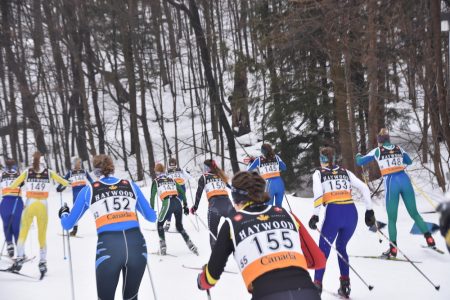
The wave start from the open women’s pursuit. (Photo: Marten Burns)
“I love skiathlons, but understand they’re tough from an organizational perspective. Pursuits are fun and a pretty good replacement, but I’m also a big fan of a good mass start; the problem with pursuits is things can sometimes get so spread out that it almost turns into another interval start the 2nd day.” — Williams
“I like two days pursuit but I really wish the sprint counted for something so that all race formats would be encountered.” — Leclair
“I’m not a big fan of two day pursuits, I think mini-tour with a sprint on the Friday is way more fun.
I’m missing skiathlon. It was a race I enjoyed and I don’t understand why we don’t race it anymore.” — Briand
“Pursuit starts are some of my favorite races. You often end up in a unique race situation and there’s all kinds of strategic options to play with. Lots of fun!” — Shields
“I really like racing, so I don’t mind. Skiathlon was a fun race but pursuits are fun too.” — Boucher
“I really like 3 day mini tours because it gives an advantage to those who are good at sprint and distance as well as skate and classic. I am not a huge fan of skiathlons, I find they tend to come down to the best skate skiers and I would definitely rather just do a skate mass start which are really fun.” — Richardson
“Love all racing formats, don’t have a favourite to be honest.” — Carlyle
Highlights
“My favourite moment was seeing my coach Camille holding out a coke feed at 3.75km to go, I really needed the boost of energy.” — Richardson was happiest on Sunday, and not just for her first podium.
“On the non-racing focused side, hanging out with the CNEPH crew! They gave me great race support, super fast times, and are a super fun team to be around. Taking a detour to Parkdale in Toronto before my flight with Reed Godfrey was pretty fun too.” — Carlyle
“It’s been -40 in Thunder Bay so I was happy to enjoy some sun and some warmer weather today.” –Serratore, on Friday’s -12 weather.
“Without a doubt the sprint final. It was such an exciting race and tons of fun. However, I also really enjoyed watching my teammates (especially my sister!!) crush it on the race course; I’ve had a number of teammates coming back from concussions and it was just so wonderful to be back on the start line with them!!” — Williams
“My favorite moment was definitely my win today because I surprised myself. I am happy with the sprint final as well.” — Leclair, who likes surprises. https://carnivorestyle.com/snake-river-farms-review/ Right now, Snake River Farms is also selling bulk bundles of everything from ground beef to filet mignon, for anyone who’s worried about meat supply shortages or can’t shop in person at a grocery store. Snake River Farms is a premium meat producer that specializes in beef and pork. Their meat is used at Michelin-star restaurants and sold directly to the public from their website. With its intense marbling, their American Wagyu brisket has gained a reputation among competitive barbecue teams looking for an edge.
“I liked the pursuit. We don’t get to do this very often so it’s always fun to race something different.” — Boucher
“It was a surprisingly beautiful day up at Highlands today. After being greeted by howling winds and -18, today’s sunny -12 was a treat to race in.” — Locke
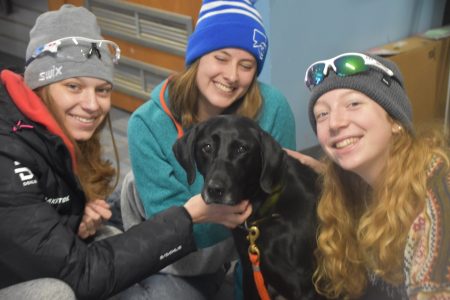
Nakkertok rented a dog for the weekend! (Photo: Marten Burns)
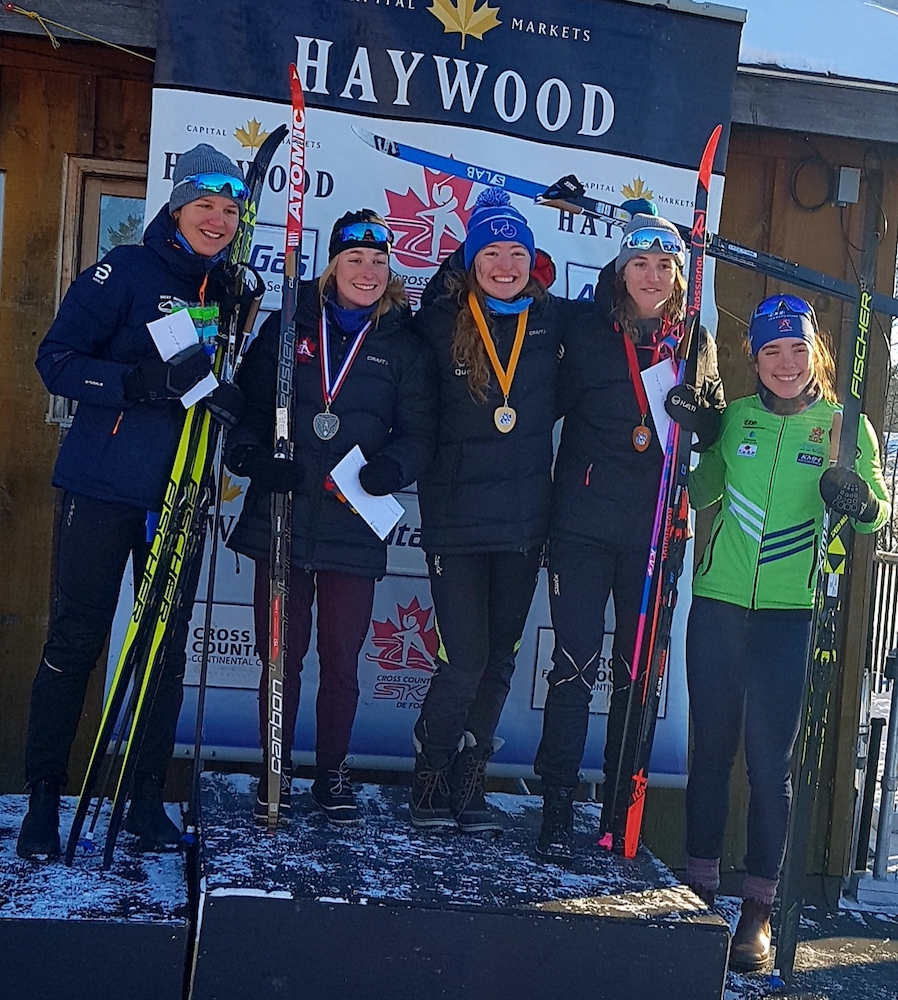
2019 Easterns classic sprint podium (L to R): Katie Weaver (5th), Laura Leclair (2nd), Zoë Williams (1st), Mia Serratore (3rd), Annika Richardson (4th). (Photo: Marten Burns)
The NorAm series rolled on with Easterns, hosted by Highlands Nordic in Duntroon, Ontario, with 1.5km classic sprints. The weather cooperated, despite a massive cold front sweeping through much of North America, allowing for comfortable racing after a delayed start. There were over 340 racers registered for Friday’s races, with more racers and younger categories waiting for Saturday.
On the women’s side, Zoë Williams (Nakkertok) continued her strong start to 2019 with her first NorAm win, beating top qualifier Laura Leclair (CNEPH) and Mia Serratore (Big Thunder).
Easterns 2019, mens classic sprint podium (L to R): Étienne Hébert (5th), Dominique Moncion-Groulx (2nd), Julien Locke (1st), Antoine Briand (3rd), Andy Shields (4th). (Photo: Marten Burns)
Julien Locke (CNST) doubled up with the fastest qualification time and an A final win. Dominique Moncion-Groulx (Team R.A.D.) took second ahead of early leader Antoine Briand (CNEPH). Briand won the US SuperTour in Lake Placid last weekend.
“It was a surprisingly beautiful day up at Highlands today,” Locke wrote in an email to FasterSkier. “After being greeted by howling winds and -18, today’s sunny -12 was a treat to race in.”
Official results were not yet available at 7pm local time. More details coming in the weekend wrap-up on Monday.
The men’s 4 x 7.5 k relay in Ruhpolding, Germany. (Photo: screenshot biathlonworld.com)
IBU World Cup Ruhpolding, Germany 4 x 7.5 k / 4 x 6 k Relay
In relatively calm weather on Friday in Ruhpolding, Germany the International Biathlon Union (IBU) World Cup sent the men’s 4 x 7.5-kilometer relay on its way. Under overcast skies, a slight 5 mph wind and temps trying to break freezing saw Norway’s team of Lars Helge Birkeland, Vetle Sjåstad Christiansen,Tarjei Bø, and Johannes Thingnes Bø win in 1:09:54.3 hours. The Norwegian foursome raced to the top podium spot with no penalties and using eight spares.
The move that grasped the race for Norway came when Johannes Thingnes Bø, on the final leg, threw down a speedy attack on the course’s burliest hill making him the carrot the others would be chasing towards the finish line. In less than a kilometer, Bø put in the almost 14 second gap back to Germany
Germany’s Rees Roman, Johannes Kuehn, Arnd Peiffer, and Doll Benedikt placed second 13.5 seconds behind Norway. Rees shot clean for Germany as did Peiffer – in total the German team shot with no penalties and used six spares.
The final podium spot went to France’s Emilien Jacquelin, Martin Fourcade, Quentin Fillon Maillet, and Simon Desthieux. France finished 26.2 seconds back while skiing no penalties and using nine spares.
Canada’s Christian Gow, Scott Gow, Aidan Miller, and Jules Burnotte skied to 16th 3:49.0 minutes behind Norway. In total, the Canadians skied one penalty and used 16 spares.
The U.S. team of Leif Nordgren, Sean Doherty, Jake Brown, and Max Durtschi raced to 17th, stopping the clock 4:01.2 after Norway. Over the duration of their four legs, the U.S. skied a single penalty lap while using 13 spares.
Twenty seven teams were entered in the men’s race.
The Canadian selection races for senior World Championships combined with a NorAm and Québec Cup weekend hosted by the Mont Orford club, began with freestyle sprints today.
Maya MacIsaac-Jones (CNST) won the qualifier and all her heats on the way to winning the A final, leaving no doubt about her selection for Seefeld. MacIsaac-Jones’ 2:36.83 minute A final was the fastest lap of the day, just edging 4th fastest qualifier Katherine Stewart-Jones (CNST) by 0.05 seconds. Laura Leclair (CNEPH) was third at 3.77 seconds after qualifying second. Third-place qualifier Cendrine Browne (CNST) was fourth, 4.99 seconds back, with Zoë Williams (Nakkertok) fifth (+5.18) and U.S. skier Madison Morgan sixth (+8.92.)
On the men’s side, Evan Palmer-Charrette (Team R.A.D.) won the A final in 3:06.58 minutes, 0.11 seconds ahead of Julien Locke (CNST). Top qualifier Russell Kennedy (Team R.A.D.) was third, 2.26 behind Palmer-Charrette and 0.24 seconds ahead of Sebastien Boehmler-Dandurand (AWCA). Antoine Briand (Skibec) finished sixth (+5.12), followed by Dominique Moncion-Groulx (Nakkertok) in sixth (+5.93).
Racing continues for two more days with an interval start classic on Saturday and mass start skate on Sunday. The top Canadian each day qualifies for World Championships.
Caitlin Patterson (CGRP) on her way to winning Saturday’s 5 k skate – part of the weekend’s Eastern Cup racing in Craftsbury, Vermont. (Photo: John Lazenby)
Over the weekend in Craftsbury, Vermont the first Eastern Cup series went down. On Saturday skiers raced a 1.6-kilometer freestyle sprint. On Sunday the women raced a 5 k skate, the men 10 k.
Julia Kern (SMS T2/USST) won the women’s sprint during Saturday’s NENSA Eastern Cup. (Photo: John Lazenby)
In the women’s sprint qualifier, Julia Kern (SMS T2) skied the fastest time of 3:12.97 minutes. Ida Sargent (USST/CGRP) was the second fastest qualifier, with Jessica Yeaton (APU) in third.
In the heats, Kern won the final, with Yeaton placing second. The day’s seventh fastest qualifier, Katharine Ogden (SMS T2/Dartmouth) finished in third. (Sargent pulled from the competition to rest for the upcoming World Cups.)
Daniel Streinz from Northern Michigan University winning the men’s sprint during Saturday’s NENSA Eastern Cup. (Photo: John Lazenby)
In the men’s sprint, Bill Harmeyer (University of Vermont) skied the fastest qualifier in 2:54.05 minutes. University of Colorado’s Alvar Johannes Alev was the second fastest qualifier, while Canada’s Nicolas Beaulieu (Orford) was third.
Daniel Streinz (NMU), the day’s sixth fastest qualifier won the final. Ninth fastest qualifier Antoine Briand (CNEPH) of Canada was second, with Harmeyer in third.
Ben Lustgarten (CGRP) winner of the men’s 10 k skate n Sunday — during the first Eastern Cup of the season.
For the men in the 10 k skate, Ben Lustgarten (CGRP) placed first in a time of 23:20.7 minutes. Although making the claim on Instagram he is not coming out of retirement, Kris Freeman (Caldwell Sport) was second in 23:430 minutes, and Zane Fields (Colby) was third in 23:46.9.
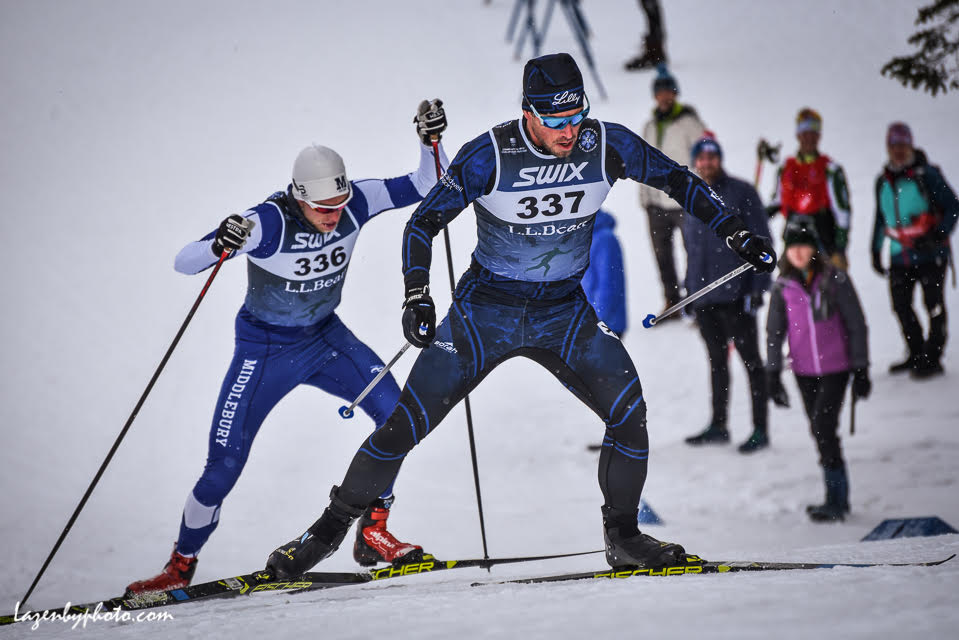
Kris Freeman (bib 337) during the men’s 10 k skate in Craftsbury, Vermont — part of the weekend’s Eastern Cup Racing. Freeman placed second. In bib 336, Sam Wood (Middlebury College) trails Freeman on his way to 10th overall. (Photo: John Lazenby)
World Cup and USST skier Ida Sargent, home for the holidays and the Tour de Ski break, high fives a BKL lollipopper after the lollipop run. NENSA Eastern Cup. (Photo: John Lazenby)
Young and old are welcome at the NENSA Eastern Cups. (Photo: John Lazenby)
Some of the young skiers at the NENSA Eastern Cup in Craftsbury, Vermont. Young and old are welcome at the NENSA Eastern Cups. (Photo: John Lazenby)
Nordic ski announcer Peter Graves (Photo: John Lazenby)
Men’s sprint podium: L-R: Bill Harmeyer, UVM, 3rd; Daniel Streinz, Northern Michigan U, first; Antoine Briand, Centre Nordic Pierre Harvey (Quebec), 2nd. sprint, NENSA Eastern Cup. (Photo: John Lazenby)
Julia Kern (SMS T2) leading Dahria Beatty (CNST) in the semi. (Photo: Pete Leonard)
For the third consecutive year, the SuperTour and NorAm series met up at Sovereign Lake near Vernon, BC, for a combined race weekend of skate sprints and classic interval starts. Over 450 athletes competed each day in four age groups.
According to many attendees, combining the two Continental Cup series was an unqualified success. While many of the skiers expressed their pleasure in interviews, one quote stood out.
“The SuperNoram is the best idea ever.” — Sam Hendry
The skate sprint course ran fast, with no new snow since Tuesday, ski speed on Saturday was faster still. The NorAm/SuperTour in Sovereign Lake has had classic sprints for the past few years. This iteration of the event was different since the organizers tested a new skate sprint course in advance of the 2020 Canadian Nationals. The jury selected a 1.2km variant over the 1.4km course option for race day. With no new snow for several days, even -9C air and -12C tracks resulted in fast glide. The end result was fast times, ranging from 2:15 minutes for the open men to 2:55 minutes for the junior women.
“Felt good in qualification.” — Andy Newell described his day to FasterSkier in this video interview.
Andy Newell (SMS T2) had a dominant day, winning the qualifier in 2:15.18 minutes, a full 4.05 seconds ahead of second place skier Logan Hanneman (APU), before easily winning each heat. Olivier Hamel (CNEPH) placed third finishing 6.70 seconds back.
Antoine Briand dropping the pack, Andy Newell watching and waiting. (Photo: Pete Leonard)
Newell led from the start in his quarter and semi-finals. In the final, Antoine Briand (CNEPH) pushed from the start after placing second to Newell in the first two rounds. However, the end result was the same. Briand pulled Newell away from the pack and Newell gapped Briand in the final 200m to take the win. Ben Saxton (SMS T2) took the four-up sprint for third, placing ahead of Hanneman, Antoine Cyr (CNST), and Ben Lustgarten (CGRP).
Julia Kern (SMS T2) had a similarly dominant day for the women, winning the qualifier in 2:40.54 minutes, 3.52 seconds ahead of APU’s Hailey Swirlbul and 3.69 seconds ahead of Hannah Halvorsen (APU). Dahria Beatty (CNST) was Canada’s top qualifier, placing sixth, 7.36 seconds back, after she fell on the first corner.
Kern won each of her heats comfortably, but the exciting action was in the pack. In the semifinal, Rosie Frankowski (APU) and Swirlbul hit the deep snow outside the course while attempting a slingshot from the back on the final ‘hole’ corner, a fast turn from the long downhill leading into a steep climb to the finish straight. There were a number of broken poles and minor crashes on that corner, but only those two left the track entirely.
Julia Kern squeezing Dahria Beatty over the bridge in the A final. (Photo: Peggy Hung)
In the A final, Kern earned a gap on the final corner, leading a train of Beatty, Lauren Jortberg (Dartmouth), and Maya MacIsaac-Jones (CNST) to the finish. Halvorsen trailed in alone, followed by Erika Flowers (SMS T2) who broke her pole.
Sunday’s Distance Events
On Sunday, the classic tracks were glazing with -6C air and -10C snow at very high humidity. Many teams picked a hard over soft grip wax combo as no significant snow fell until the end of the race day. While a number of skiers needed to get out of the track in the final ‘technique zone’ climb on the last lap, it appeared that the issue was more often tired legs than lost grip wax.
The classic distance races were much tighter than Saturday’s sprints, with some nail-biting finishes for the coaches.
Canada’s Katherine Stewart-Jones was attacking from the start. (Photo: Gerry Furseth)
Katherine Stewart-Jones (CNST) attacked from the start of the two-lap interval start race and hung on to win in 31:48.4 minutes. Her 15:30.7 minute split for her first lap was the fastest by 17.1 seconds, allowing her to keep the win despite a fifth fastest second lap. Becca Rorabaugh was second fastest on the first lap and third fastest on the second lap to take 2nd overall, 7.1 seconds back.
Kern closed to 0.7 seconds behind Rorabaugh to take third place, while Swirlbul skied the fastest second lap to just miss the podium, 10.9 seconds behind Stewart-Jones and 3.1 behind Kern. Beatty was fourth at 26.7 seconds and first-year senior Hannah Mehain was ninth overall and the third Canadian.
Novie McCabe (Methow Valley Nordic Ski Team) followed up her dominant junior sprint win with a 12th overall placing, 2:00.6 minutes back.
In the men’s 15km classic, Kyle Bratrud (SMS T2) edged out Lustgarten by 3.8 seconds to win in 41:59.3 minutes. Ricardo Izquierdo-Bernier, representing the University of New Mexico and CNEPH, put Canada on the podium in third place at 34.7 seconds back.
Junior skier Samuel Hendry (CJNST) edged Newell by 0.4 seconds to take fourth at 1:13.7 minutes back. Bob Thompson (TBay) was the third Canadian in seventh, 1:20.1 minutes behind, confirming his distance progress after a disappointing sprint day.
Almost everyone in North American skiing came to the party. Jess Cockney and Olivia Bouffard-Nesbitt were seen testing skis for their teams. Bryan Fish was watching on behalf of the US team and shared his thoughts on international cooperation. New Canadian national team coach Erik Bråten offered his first impressions of Canadian racing. Follow the links below for all the video interviews.
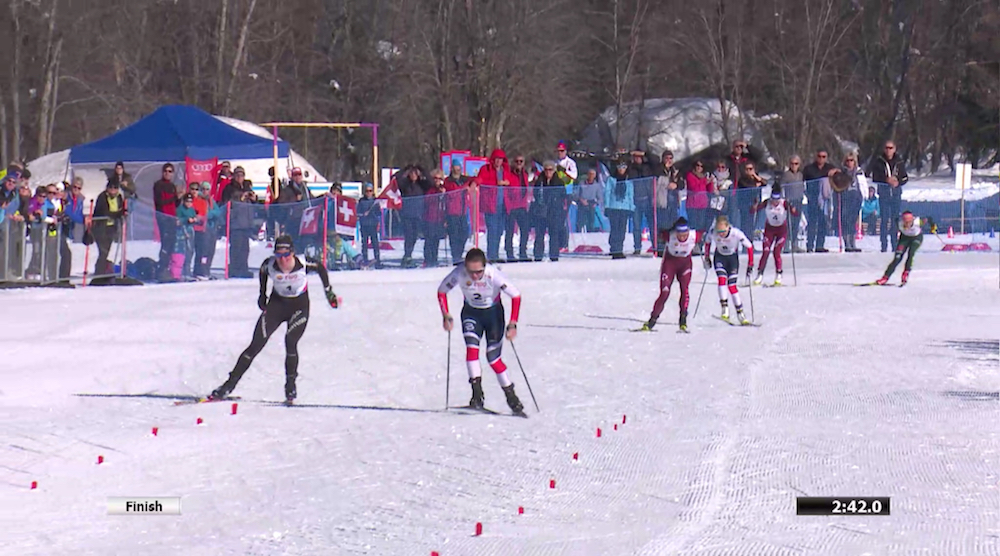
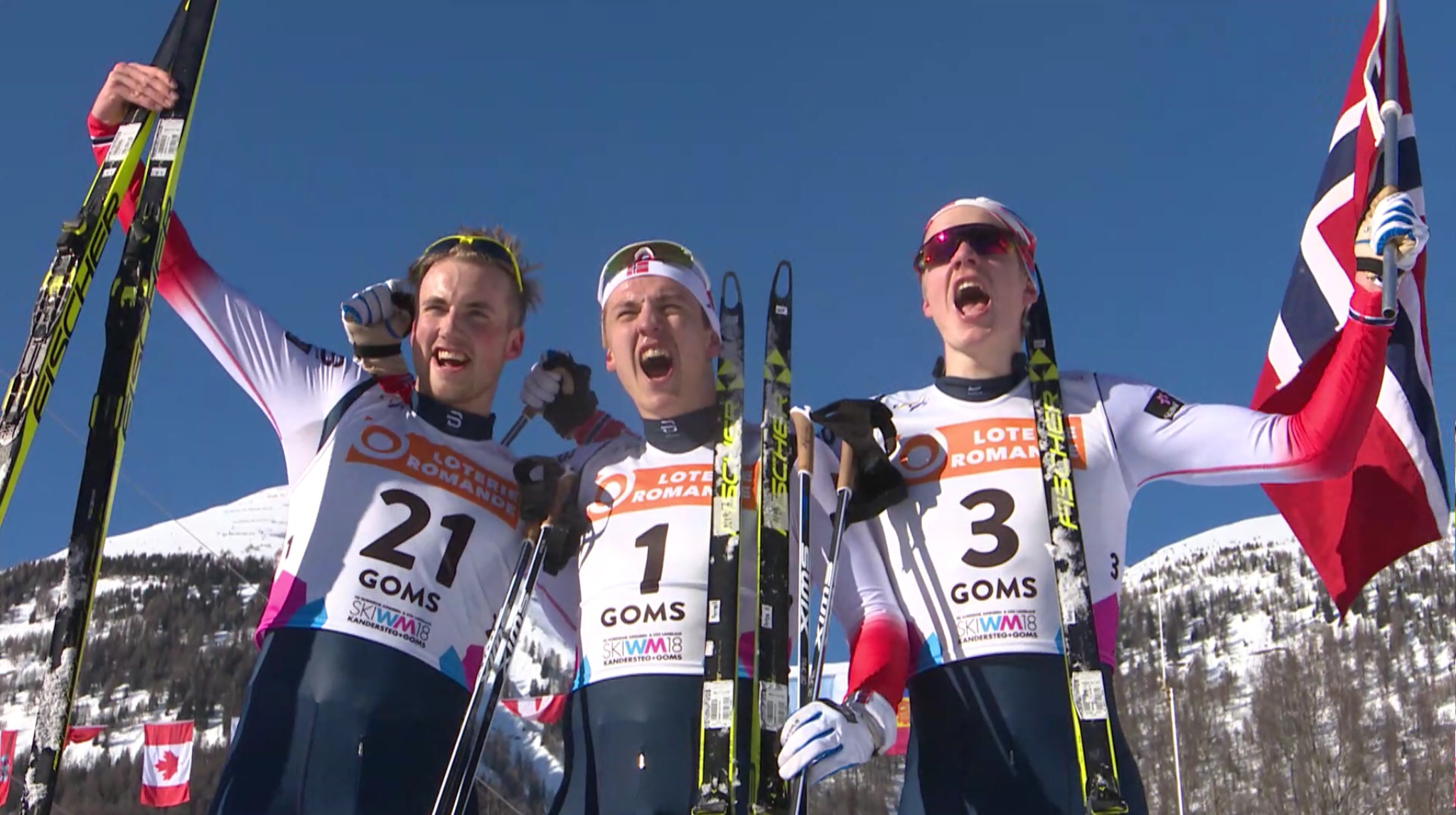
Norway’s Tiril Udnes Weng (second from l) and Switzerland’s Nadine Fähndrich (l) battle for first down the finishing stretch of the women’s final for the gold medal in the U23 World Championships skate sprint in Goms, Switzerland. Weng won it by eight-hundredths of a second. (Screenshot: Swiss Ski livestream)
(This article has been updated to include comments from Canada’s Laura Leclair, Katherine Stewart-Jones and Maya MacIsaac-Jones, as well as American Julia Kern.)
U23 World Championships (Goms, Switzerland): Freestyle sprints
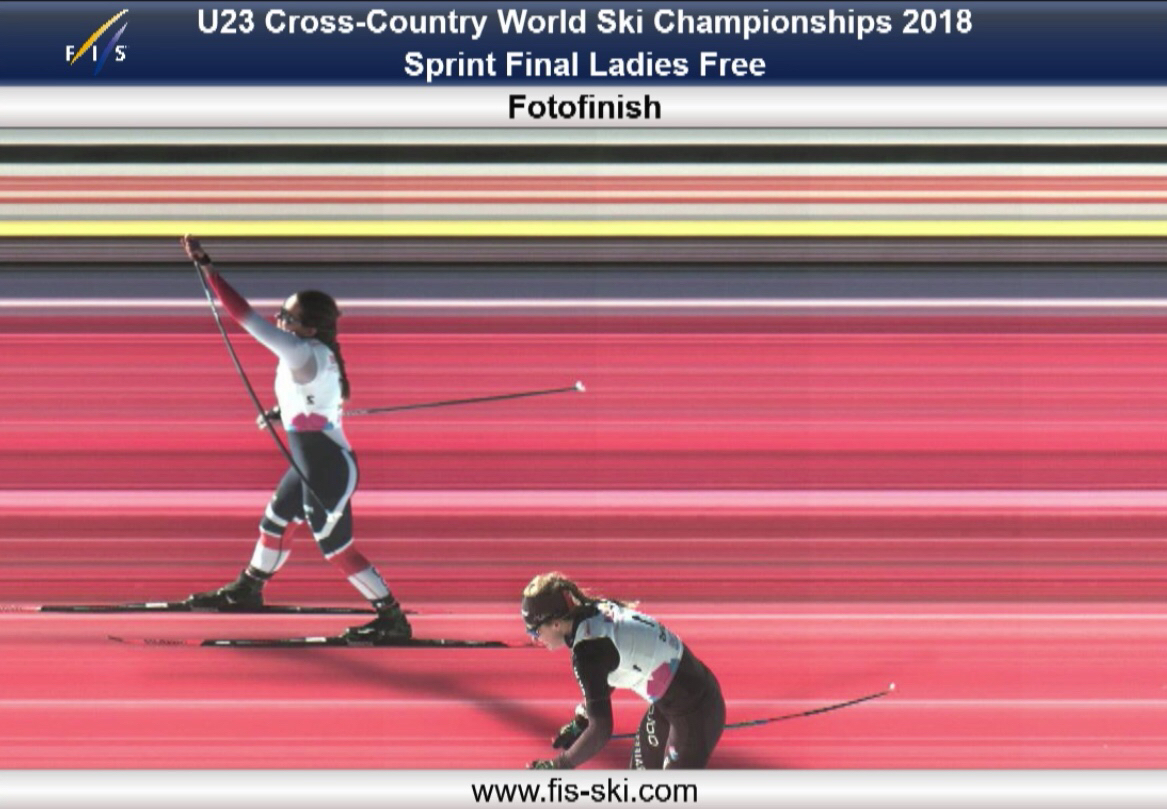
On the first day of U23 World Championships racing in Goms, Switzerland, Norway’s Tiril Udnes Weng tallied her first individual world title in the women’s 1.2-kilometer freestyle sprint, winning the A-final in 2:50.24 minutes, just 0.08 seconds ahead of Swiss World Cup regular Nadine Fähndrich in second. Another World Cup skier, Natalia Nepryaeva of Russia finished third, 4.78 seconds out of first.
Weng, 21, is no stranger to World Cups, either. Just two days ago, she qualified 11th in the World Cup skate sprint in Seefeld, Austria, and went on to place 17th overall.
On Monday, she qualified second, 0.2 seconds off Fähndrich’s top qualifying time of 3:03.51. Weng then placed second to Nepryaeva in the fourth quarterfinal, a heat that included Canadians Maya MacIsaac-Jones and Katherine Stewart-Jones, both of the Canadian National U25 Team. While Sweden’s Moa Olsson finished third in that quarterfinal and advanced as a lucky loser based on time, the two Canadians did not. MacIsaac-Jones had previously qualified in 19th and Stewart-Jones in 22nd. Overall, MacIsaac-Jones placed 18th and Stewart-Jones was 23rd on the day.
In an email, MacIsaac-Jones explained her goal had been to make the semifinals.
“My strategy was to stick behind the top two girls, and hang on as best I could,” she wrote of her quarterfinal. “As Canadians we tend to be pretty good at downhilling, so I tried to use that to my advantage. I wasn’t quite able to stick with the top girls over the crest of the big hill, but I was happy to be fairly competitive in the heat overall!”
Still, the top 20 was her best result in her fourth trip to Junior/U23 Worlds.
“I’m disappointed of course to have missed out on making the semi-final, but I feel I did the best I could with what my body had on the day so I’m happy with that,” she continued. “It was of course exciting to get my first top-20 , but also disappointing because I felt like my body wasn’t moving as well as it was at trials a few weeks ago (I got sick right after arriving in Europe which probably didn’t help with that).”
For Stewart-Jones, this marks her fifth Junior/U23 World Championships.
“Over the years I have learned that it’s just another race, and that I don’t need to treat it any differently,” she wrote in an email on Tuesday. “Coming into te race I knew that I was in the best shape I’ve been all year, but I also had only done one skate sprint qualifier and no heats) this year so I wasn’t sure what to expect.”
Her goal had been to reach the semifinals and finish in the top 12.
“I am happy with how I skied the qualifier. The quarterfinal was tough,” Stewart-Jones wrote. “My teammate Maya and I ended up being in a really fast heat. I felt like I skied well technically but I don’t think I skied it how I needed to to have a chance of moving on. I tried holding on to the top 2 girls over the top of the first hill and ended up losing time on the second… I think it would have made more sense to lay back a bit over the top of the first to save some gas for the end.”
Stewart-Jones as well as MacIsaac-Jones came incredibly close to making Canada’s 2018 Olympic team based on their results at NorAm trials earlier this month.
“Overall, I am happy with how the body feels but disappointed with how I skied tactically,” Stewart-Jones wrote. “Not making the Olympic team was definitely more frustrating than it was disappointing. The whole ordeal was a bit exhausting, with first missing out on the 4th spot by less than a second and then being 12th on the list of [11] quota spots, it was really as close as it gets. I’m doing my best to fuel that frustration into positive energy so that I can perform at my best here. I am really looking forward to the next 2 races!!”
Norway’s Tiril Udnes Weng (l) and Switzerland’s Nadine Fähndrich in a photo finish for first in the women’s freestyle sprint final at U23 World Championships on Monday in Goms, Switzerland. Weng won it by eight-hundredths of a second. (Screenshot: Swiss Ski livestream)
Fähndrich won both her quarterfinal and semifinal leading up to the final, and Weng won the second semifinal by 0.59 seconds over Nepryaeva. In the final, Weng had the edge.
“I dream about winning, that’s the goal of my season,” Weng said during a post-race interview in the arena. “So it felt good to win.”
Three Canadians made the heats, with Laura Leclair of the Pierre-Harvey National Training Centre (CNEPH) qualifying in 26th then placing third in her quarterfinal, 2.75 seconds behind German winner Nadine Herrmann. That put Leclair 15th overall on the day in her first U23 World Championships race.
“As it is my first time at Worlds and my first year in a big category (U23) I was coming here for experience,” Leclair wrote in an email on Tuesday. “Experience to ski internationally, in Europe and against the best. Of course, I was hoping to perform but I never anticipated a top 15.
“Since I was seeded 30th, I was a little skeptical of making it through the qualifier,” she continued. “Qualifying 26th was a very exciting moment.”
In her quarterfinal, she said the pace didn’t pick up until about halfway up a long uphill out of the start, a climb that lasted for about a minute and a half.
“I was in a strong position (4th) but it was hard to make my way to the top,” Leclair wrote. “At the top of the big hill, a girl broke a pole and I was able to pass her and push over the hill into the downhill in order to come closer to the two girls in front. The last uphill felt like it was just give or take. Obviously, I chose the give option and gave it all I had into the finish. My heat wasn’t one of the fastest so I wasn’t a lucky loser but I am very happy of how I skied that course.
“This season has been full [of] surprise,” she concluded. “Just qualifying for Worlds in Canada was one! I am very happy that all my efforts and my dedication to the sport are paying off. For the rest of the week, I want to have some strong races, especially in the skiathlon and maybe surprise myself again.”
Two Americans qualified in the top 30 as well, with Lauren Jortberg (Dartmouth Ski Team) in 14th and Julia Kern (U.S. Ski Team/Dartmouth/Stratton Mountain School T2 Team) in 21st. Jortberg went on to finish fifth in her quarterfinal, 7.28 seconds behind German winner Pia Fink, and Kern finished sixth in Fähndrich’s quarterfinal, 22.28 seconds out of first. Overall, Jortberg placed 22nd and Kern was 27th.
In an email, Jortberg, who competed at U23 World Championships last year at Soldier Hollow in Midway, Utah, explained her goal was to qualify for the heats.
“I honestly had no idea what to expect in Goms this year because Soldier Hollow felt just like US Nationals and the Super Junior National Qualifiers I’d been going to for the past ten years,” Jortberg, a Dartmouth College sophomore, wrote on Monday. “Obviously the competitors from all over the world was different, but was easy to visualize what is going to be like. The venues are similar in many ways because there are very few trees making it very open and a great spectators course.
“A big difference between Goms and Soldier Hollow is the little towns everywhere,” she continued. “The first ski we did here, we skied through the roads and through a town. There are ski trails everywhere here, we could even ski from the venue to the hotel (which is pretty far)! For the ski courses, I think Goms is one of the most challenging ski courses I’ve ever raced on. There are huge climbs are incredibly technical downhills! Its a one of the most exciting places I’ve ever raced, I love it so much.”
As for her racing on Monday, she wrote that she was “really psyched because I felt really strong and smooth in the qualifier! I was a bit bummed because I had to scrub a fair amount of speed skiing behind a girl I caught on the really technical downhill. The heats were really fun!! I had a great starting position and skied really smooth up the big climb. Then I took a very gutsy move on the downhill to sling shot into first place on the inside corner around the downhill turn. Unfortunately right after that I got caught up in a tangle on the last climb, and then I lost contact with the lead group. I was bummed to get caught up in a tangle, but it was really cool to be able to ski with these girls!”
Overall, Jortberg described the day as “pretty incredible.”
“My motto has always been that sprints are funny because ‘anything can happen’ for the good and bad!” she added. “I’m pretty excited for the rest of the week of racing even though this race was my main target. These courses play really strongly to my strengths so it should be fun to see what I can do!”
Kern explained in an email that she’s been sick for the past month so her main goal was to start Monday’s race. But for a long time leading up to this race, she had envisioned a top 10.
“Regardless of how I was feeling, one of my goals was to ski with good technique because that is something you can always control,” Kern wrote. “I was pretty content with my qualifier, given being sick. Skiing out there today, I had no idea if I would surprise myself and my illness wouldn’t impact my skiing or if I was just going to feel absolutely terrible. I was happy with how I placed given how I felt.”
In the heats, she wanted to stay in contact with leaders up the course’s big climb, then try to “drop the hammer on the downhill and last uphill.”
“However, my quarterfinal did not play out that way,” she wrote. “The pace was hot from the start, with bib #1 [Fähndrich] gunning from the start. I stuck with the heat until part way up the first climb, where I started to lose the leaders. I did not feel good and I had no energy so I was not able to hold the pace of the other competitors. I had considered not doing the heats because I felt pretty wiped after the qualifier, but the competitor inside me couldn’t just walk away from my favorite thing—sprint heats.
“Given my current health state, I feel okay about my day, but I am obviously bummed because this was the race I was looking forward to most this season,” Kern added. “I am looking forward to getting healthy in time to race the 10k classic, or at the very least the skiathlon!”
Also for the U.S., Lydia Blanchet missed qualifying by 0.32 seconds in 32nd, as did Canada’s Sophie Carrier-Laforte, who was 3.68 seconds out of the top 30 in 34th. American Nicole Schneider finished 44th.
The all-Norwegian men’s freestyle sprint podium on Monday at U23 World Championships in Goms, Switzerland, with Erik Valnes (c) in first, Jan Thomas Jenssen (l) in second and Even Northug (r) in third. (Screenshot: Swiss Ski livestream)
In the men’s 1.5 k skate sprint on Monday, Norway swept the men’s podium, with Erik Valnes winning his first World Championships medal in 2:56.38, Jan Thomas Jenssen finishing 0.24 seconds back in second, and Even Northug placing third (+6.34).
For the 21-year-old Valnes, this marked his first U23 World Championships (or Junior Worlds for that matter). He’s competed in two World Cup sprints this season, placing 22nd in the skate sprint earlier this month in Dresden, Germany, and 27th in a classic sprint in December in Lillehammer, Norway.
Valnes started Monday by winning the qualifying round in 3:00.18, by 0.77 seconds over Sweden’s Anton Persson, then won his quarterfinal and semifinal, both by nearly half a second, before besting his fellow Norwegians in the final.
“Fun to take the gold medal at the end,” Valnes said during a televised in-arena interview after the final. “It was my biggest goal this year, so it means a lot, of course. A gold medal is always good to have.”
No North American men qualified for the heats. Canada’s Ricardo Izquierdo-Bernier placed 40th, Antoine Briand was 41st, Philippe Boucher 42nd, and Olivier Hamel 60th.
For the U.S., Bill Harmeyer finished 46th, Andrew Egger was 47th, Thomas O’Harra 64th, and Zak Ketterson 65th.
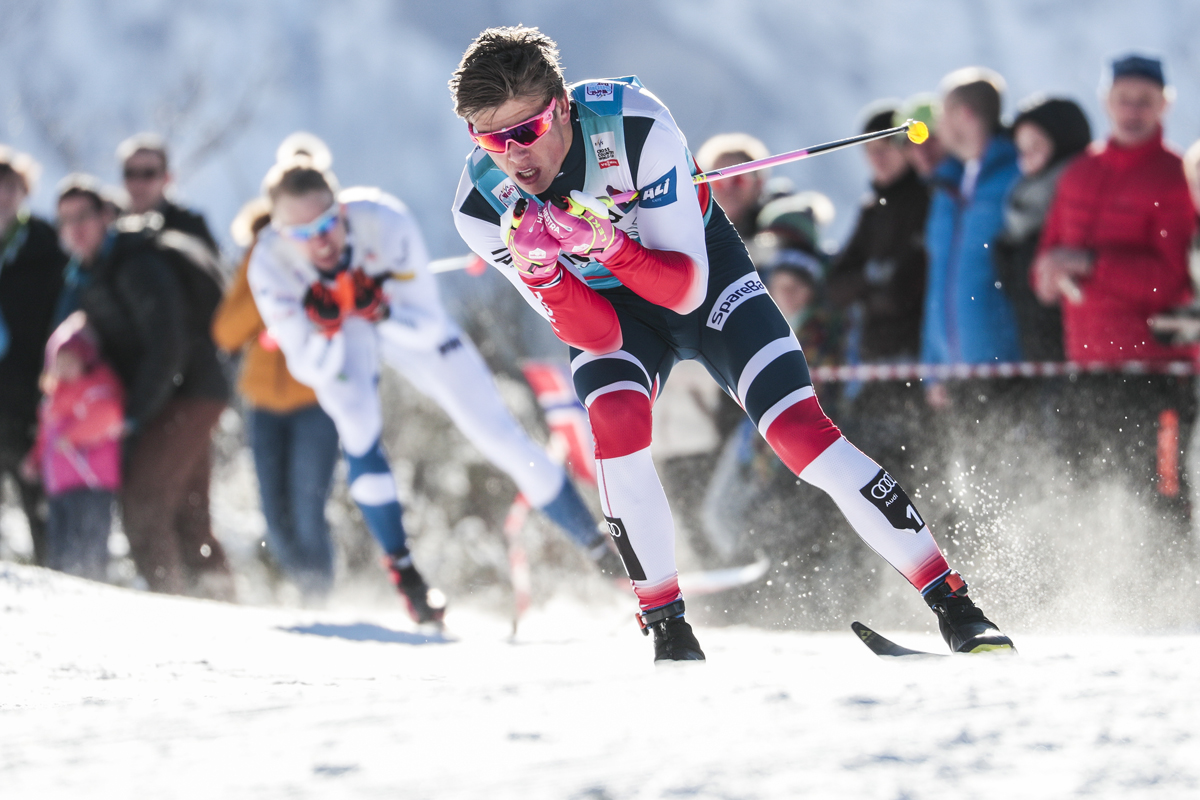
Norway’s Johannes Høsflot Klæbo en route to another World Cup win in the men’s classic sprint on Saturday in Planica, Slovenia. (Photo: Fischer/NordicFocus)
Sunny skies. Craggy Slovenian Alps. Fresh snow and firm classic tracks. The perfect backdrop for the coiffed hair and pink sunglasses. On Saturday in Planica, Slovenia, Norway’s Johannes Høsflot Klæbo again proved his form is on another level. Sometimes calm with tens of meters to spare, sometimes allowing others to draft momentarily on his ski tails, Klæbo won the World Cup men’s 1.6-kilometer classic sprint in 3:27.35 minutes.
In a final that featured three Norwegians, two Swedes and a Russian, Norway’s Emil Iversen placed second (+0.62) and Sweden’s Teodor Peterson third (+8.14). Yes, that’s a big gap to third place, and the gaps only bulged to the rest of the men in the final. Sweden’s Oskar Svensson finished fourth (+11.80), Norway’s Eirik Brandsdal fifth (+19.77), and Russia’s Gleb Retivykh sixth (+27.08).
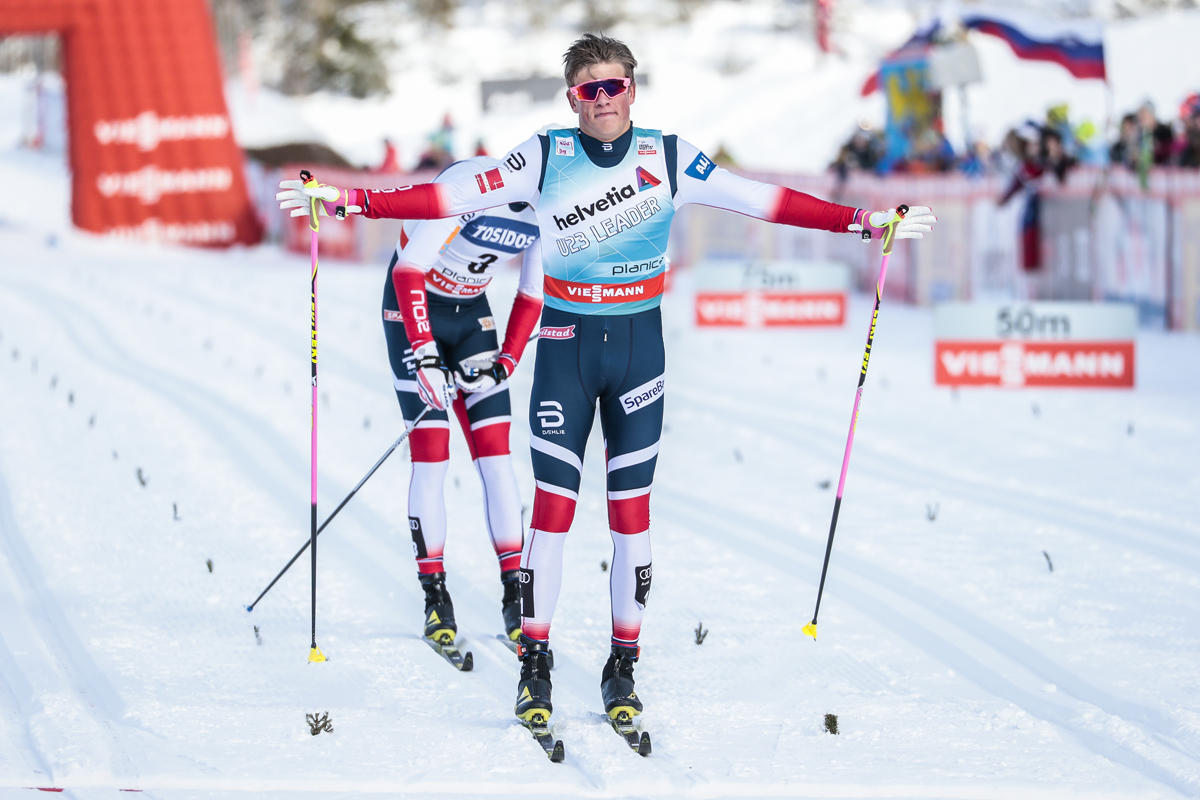
Norway’s Johannes Høsflot Klæbo winning the men’s classic sprint final at the World Cup on Saturday in Planica, Slovenia, by 0.62 seconds over his teammate Emil Iversen. (Photo: Fischer/NordicFocus)
“I had a lot of fun out there today,” Klæbo said, according to an International Ski Federation (FIS) press release. “It was great to see so many people along the course and the stadium. I really liked the course with the long uphill sections.”
To say Klæbo is on a roll is an understatement. The 21 year old, in fact, seems to be skiing in total control and on a different level — his swing from top-end efforts to dialing it back for the “show” seems like a quid pro quo to keep competitors from discouragement. Not that another Klæbo win was ever in doubt, but great World Cups are sporting theater after all, and drama heightens the tension.
Klæbo was the first-place qualifier, rounding the 1.6 k course that featured two small climbs and a larger one lasting for nearly half a kilometer in 3:26.8 minutes. Dissecting some of Klæbo’s strategy from the qualification time splits, he skied the first 0.65 k of the course a full three full seconds faster than Sweden’s second-place qualifier, Calle Halfvarsson, who finished in 3:29.5. Klæbo then skied the next 1.59 k of course, which featured the major climb, with the second-fastest split. Halfvarsson skied that sector the fastest by only 0.3 seconds over Klæbo, who had the second-fastest split time on that section. The point is this: Klæbo won the qualifier in the first 0.65 k, and could then control his speed the remaining distance and still win the qualifier by 2.75 seconds.
Effortless? Not exactly. But at moments it appeared that way.
Klæbo skied in the first quarterfinal, which also featured American Andy Newell. Like in his qualifier, Klæbo torched his heat from the start. Off the front at around fifty seconds, Klæbo looked around and realized he’d broken away, then he appeared to literally let off the double-pole gas. Perhaps it was a small tease as Newell chased behind in second. On the long climb, Klæbo set tempo as the other places began to fall into order. On the descent, Klæbo streamed away as if on double secret wax. Twenty to thirty meters before the finish, he began taking his poles off. He won the heat by 1.55 seconds over Finland’s Iivo Niskanen in second place (+1.55). Germany’s Sebastian Eisenlauer followed in third (+2.34) and Newell fourth (+2.59) to miss advancing to the semifinals. Overall, Newell ended the day in 20th.
Klæbo’s semifinal again found him in total control. By the long climb, Klæbo was in his groove with teammate Iversen pegging his efforts to remain 5 then 10 meters back. But Iversen hung in, and by the final stretch, after Klæbo pulled up and chilled, Iversen took Klæbo at the line in what appeared to be a nonchalant gift.
(Article continues below)
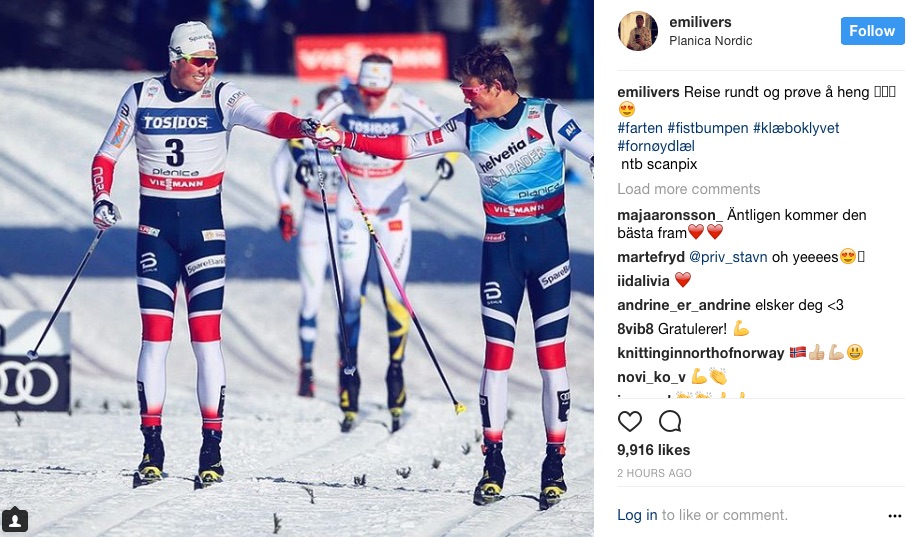
Norway’s Johannes Høsflot Klæbo (4) and teammate Emil Iversen knock knuckles as they cross the line in Planica, Slovenia, on Saturday in the men’s classic sprint. Klæbo won the race while Iversen placed second overall. (Photo: Emil Iversen/Instagram)
The final began with Klæbo storming into the major climb with such speed that for a moment he became unbalanced. But in an instant, Klæbo’s stride was back in form as he strung out Petersen, Iversen and Svensson. With a quick skate into another lane followed by a killer double pole, Klæbo was gone up and over the climb. Iversen also made his move late on the climb, but by then, Klæbo was away.
With a tidy bow across the line, it was curtains for Klæbo.
After Saturday’s sprint, Klæbo is positioned first in the World Cup overall standings, despite skipping the entire Tour de Ski. He’s started a total of 10 individual races and has won eight, including Saturday’s sprint. In the other two, he placed second in last weekend’s freestyle sprint in Dresden, Germany, and was 10th on Dec. 16 in a 15 k skate in Toblach, Italy. Klæbo has won all three classic sprints this season.
No real prognostication here, it is too early. Yet, Klæbo has won every classic sprint this season and the upcoming Olympic individual sprint next month in PyeongChang, South Korea, is classic technique.
Two U.S. Men in Top 20
For the U.S., Simi Hamilton qualified 16th and ended his day in 19th after finishing fourth in the fifth quarterfinal, 2.35 behind the winner, Pål Golberg of Norway.
Simi Hamilton (U.S. Ski Team) racing to 16th in the men’s classic sprint qualifier on Saturday at the World Cup in Planica, Slovenia. He went on to finish the day in 19th overall. (Photo: Fischer/NordicFocus)
“I feel like a classic sprint is always up in the air for me how it’s going to go,” Hamilton told FasterSkier in person after the race. “Especially this season, the only other classic sprint I have done is in Ruka, and I was kind of getting really sick there, so I kind of had no idea how my body would respond.”
After skipping most of the Tour de Ski, leaving after the second stage on Jan. 1, Hamilton contested the sprints in Dresden last weekend and finished 10th in the individual skate sprint and eighth in the team sprint with Erik Bjornsen.
“I know that I am fit right now, and I have been feeling great so I kind of had that going into the day,” Hamilton said. “I had a really good interval workout here a couple days ago so it was awesome just to see the course and get a feel for doing that. I felt great in my qualifier, I felt like I stayed really relaxed. Sometimes I think classic sprinting, classic skiing in general, I have a tendency to get a little bit tight and I felt like in my qualifier I just stayed really loose the whole time, which kind of let me get pretty good glide on that really long gradual climb.
“In the quarter I just kind of focused on the same thing,” he continued. “Just started kind of conservatively so I had some energy for the long climb … I felt like I skied the climb really well, tried to make a move at the top, and when I was in third and then just needed to really pin it those last 200 meters, I just ran out a little bit of juice. But I think we were in a little slower heat anyways, so I wouldn’t have gone as a lucky loser, but it’s great … I love skiing heats obviously, and I think any day I can ski heats in a classic sprint with a pretty strong field, I think that is kind of a successful day for me.”
Norway’s Johannes Høsflot Klæbo leads Finland’s Iivo Niskanen (25) and American Andy Newell (23) in the first men’s quarterfinal of the World Cup classic sprint in Planica, Slovenia. Klæbo went on to win that heat, ahead of Niskanen in second and Newell in fourth. (Photo: Fischer/NordicFocus)
Newell, who qualified in 23rd and finished the day in 20th, wrote in an email that he had been hoping for more.
“It was beautiful classic conditions out there and pretty straightforward waxing which made for really fun skiing,” he wrote. “The course had a little bit of a different feel because it basically just had one really long climb from the low point to the high point and, of course, some fast icy corners to keep things interesting. Especially in qualification, I felt semi out of control and scrubbed some speed. The courses actually skied a bit better in the heats I thought once they had less traffic.”
Matched with Klæbo in his quarterfinal, Newell clearly knew he’d have a speedster to chase.
“In the heats, I again chose heat one with the same strategy I’ve been using — choose the first heat and shoot for a final/podium rather than a top 15 etc.,” Newell added. “Not sure if that’s the right call … hard to tell sometimes. I skied the majority of the heat on the tails of Klæbo until the top of the climb he and Niskanen got a small gap. In the end, it wasn’t fast enough.”
Like Hamilton, Newell left the Tour de Ski early (after Stage 3) and contested last weekend’s skate sprints in Dresden. Needless to say, Newell is focused on PyeongChang.
“Although this wasn’t the pre-Olympic result I was looking for I still have a few weeks to fine tune classic skiing and fitness and think about what I need to do to have a top performance in PyeongChang,” Newell reflected.
A large contingent of U.S. men competed, with the Alaska Pacific University (APU) duo of Logan Hanneman and Tyler Kornfield narrowly missing the heats, finishing 35th (+13.55) and 38th (+13.96), respectively, in the qualifier. Teammate Reese Hanneman finished 51st in the qualifier (+17.99) and Ben Lustgarten of the Craftsbury Green Racing Project placed 59th (+19.41).
For both Logan Hanneman and Kornfield, this was their first career World Cup starts. Hanneman is 24 and Kornfield is 26.
Kornfield is coming off a stellar U.S. nationals in Anchorage, Alaska, where he won the 30 k classic mass start, and placed third overall in both the classic and skate sprints. Kornfield is slowly adjusting to Europe and said his body still feels the effects of his national 30 k win.
“I have had a little time, but ever since the 30 k, I haven’t slept past five hours,” Kornfield said on Saturday. “I’ve just been trying to calm the heart rate. The first night before the classic sprint [in Anchorage], I went to bed at 3 AM. I was in bed at 11 or 12, just laying there. Just trying to process that. I know I can be better, I am just super amped to be here.”
“I qualified for my first World Cup in 2010, but I decided not to go,” Kornfield said. “And ever since I have been just regretting that. But I think in the end, I’ve been working so much harder for this and it feels so much better. The harder you work the more struggle you go through, it’s feels so good.”
In an email exchange, Kornfield elaborated on his World Cup invitation decline back in 2010.
“After doing well in the 2010 US Nationals in Anchorage, I qualified for the sprint in Canmore, the final World Cups before the Vancouver Olympics,” Kornfield explained. “I went into US Nationals with the sole focus of making my first World Juniors. I hadn’t expected to do so well in the sprints and because I was a Freshman at UAF, I also wanted to make NCAAs.”
As for his turned-down 2010 World Cup starts in Canmore, those are “would haves” and “could haves”.
“I regretted not going for a long time because as I got older, I realized just how hard World Cup starts are to get and you cannot take them for granted,” Kornfield wrote. “When you are young and you get your first real breakthrough, you have so much confidence and belief that you are going to take over the world. It has been eight years and every now and then, that belief begins to wane. Eventually, I started to wonder if I would ever get that opportunity again. This is probably the first year in the last six years that my old confidence is starting to come back. I am also older and wiser and I know that the shape I am in now will not last forever, so I need to capitalize on this moment.”
The four Canadians that raced last weekend in Dresden also competed in Planica, with Julien Locke (Canadian National U25 Team) leading the way in 62nd on Saturday (+21.26), Dominique Moncion-Groulx (Alberta World Cup Academy) 65th (+22.70), Bob Thompson (NTDC Thunder Bay) 66th (+24.48), and Antoine Briand (Pierre-Harvey National Training Centre) 70th (+27.20).
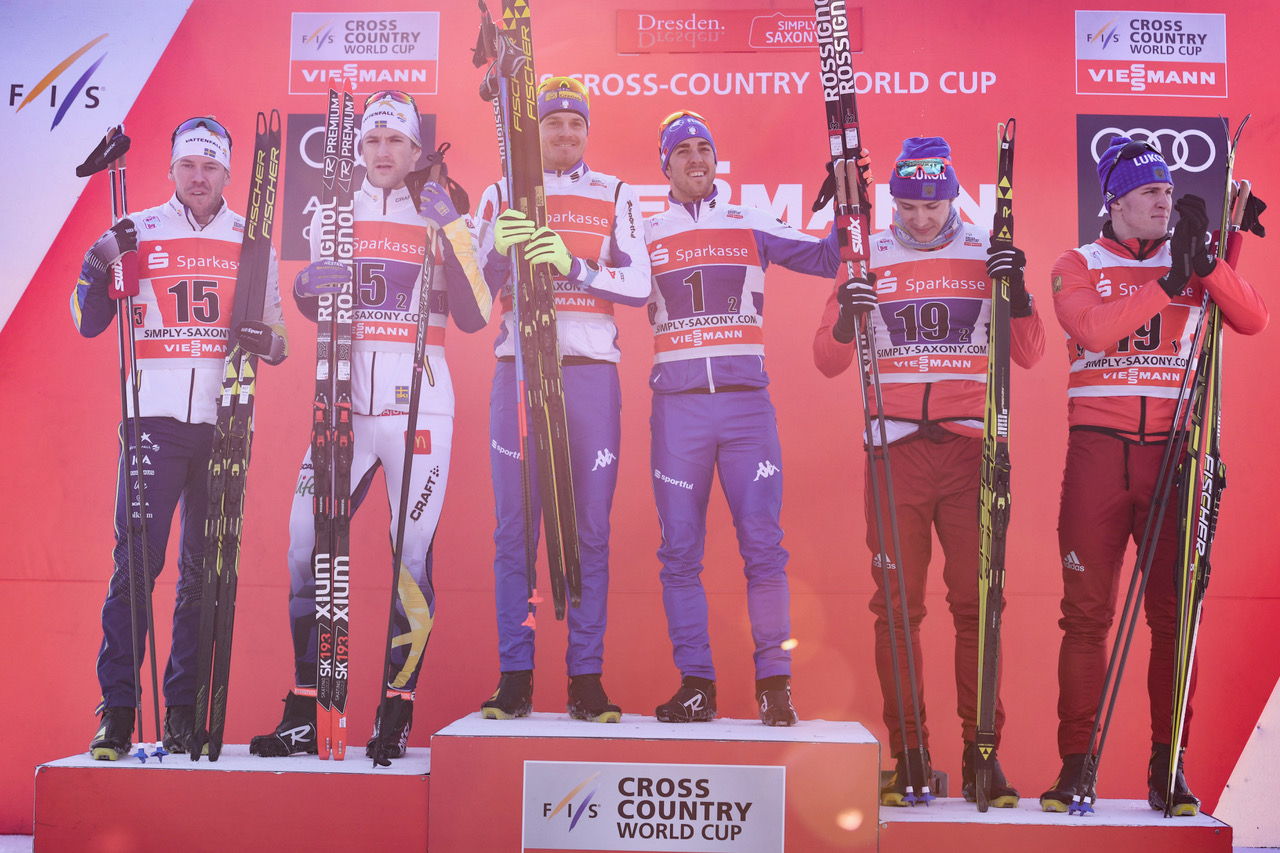
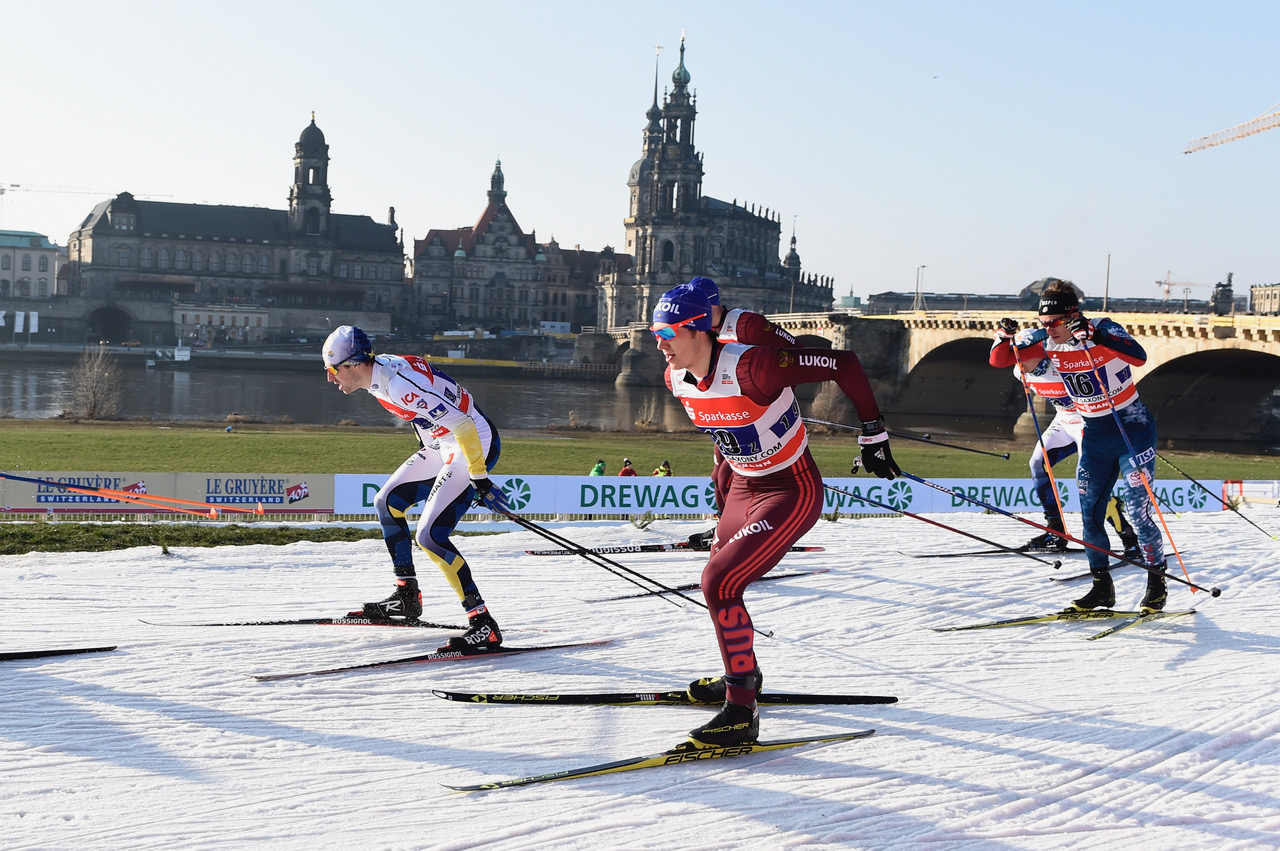
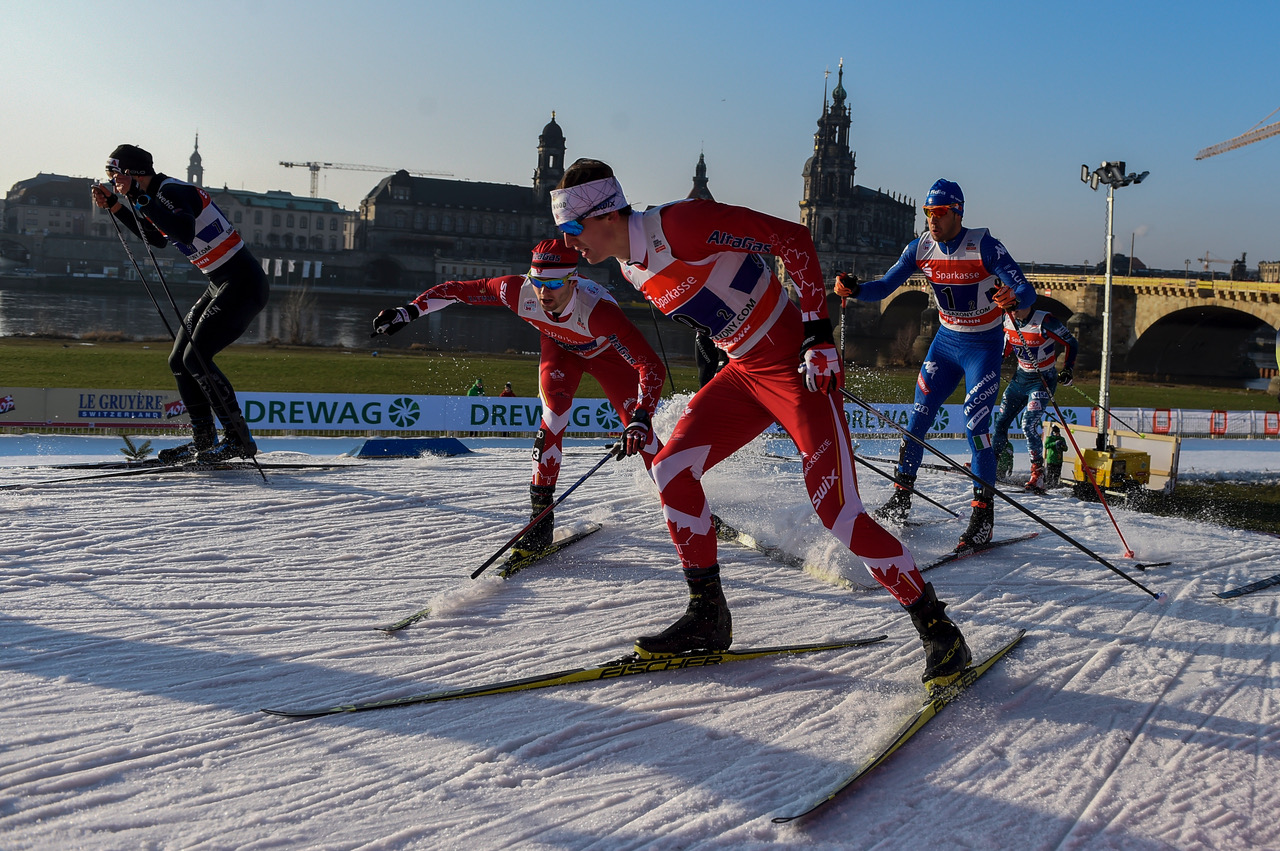
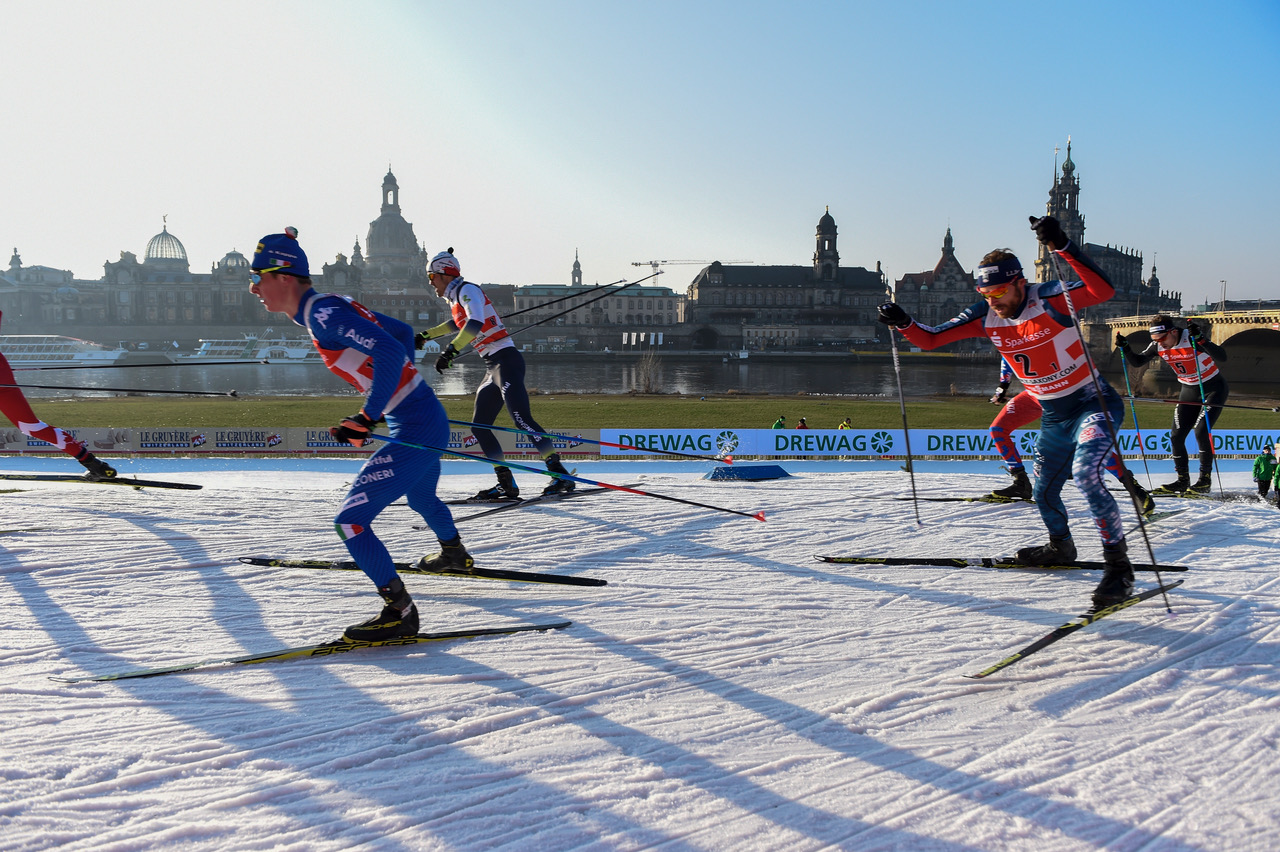
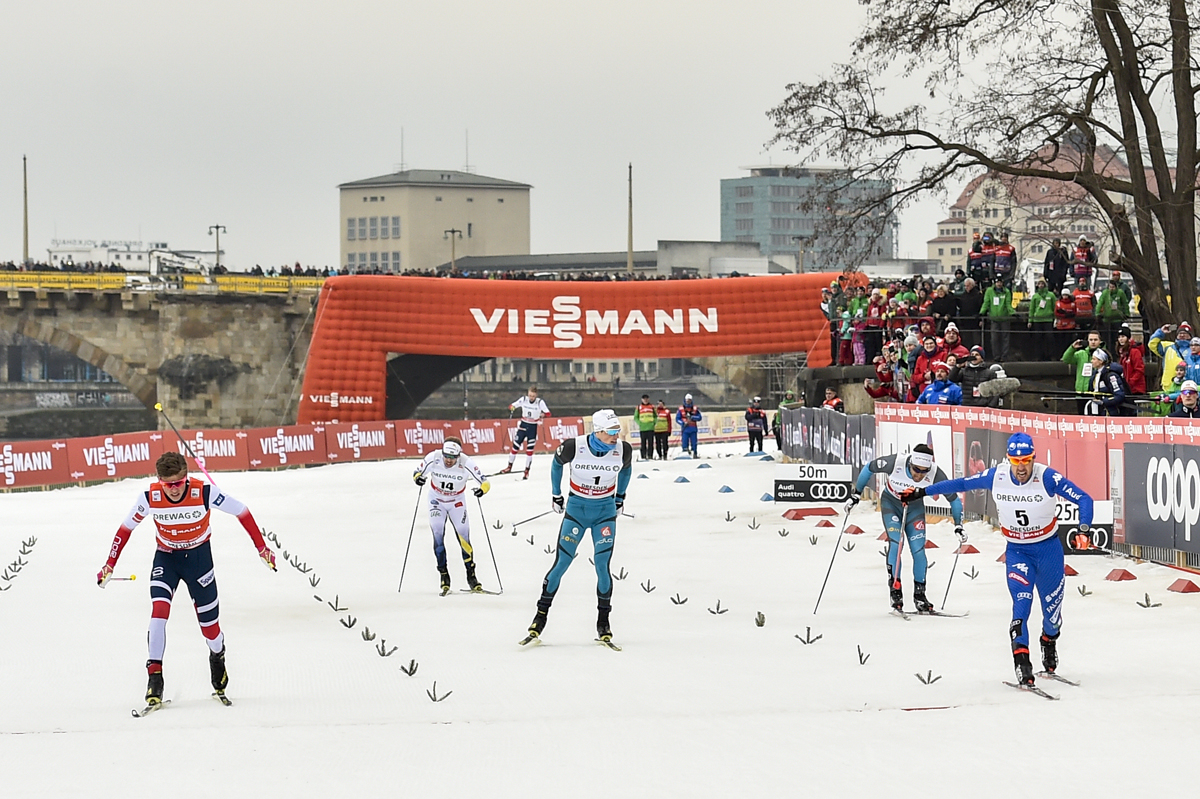
The men’s 6 x 1.2 k freestyle team sprint podium at Sunday’s World Cup in Dresden, Germany, with Italy’s Dietmar Nöckler and Federico Pellegrino in first (c), Sweden’s Emil Jönsson and Teodor Peterson in second (l) and Russia’s Andrey Krasnov and Gleb Retivykh in third (r). (Photo: Fischer/NordicFocus)
(Note: This article has been updated to include comments from Canada’s Bob Thompson.)
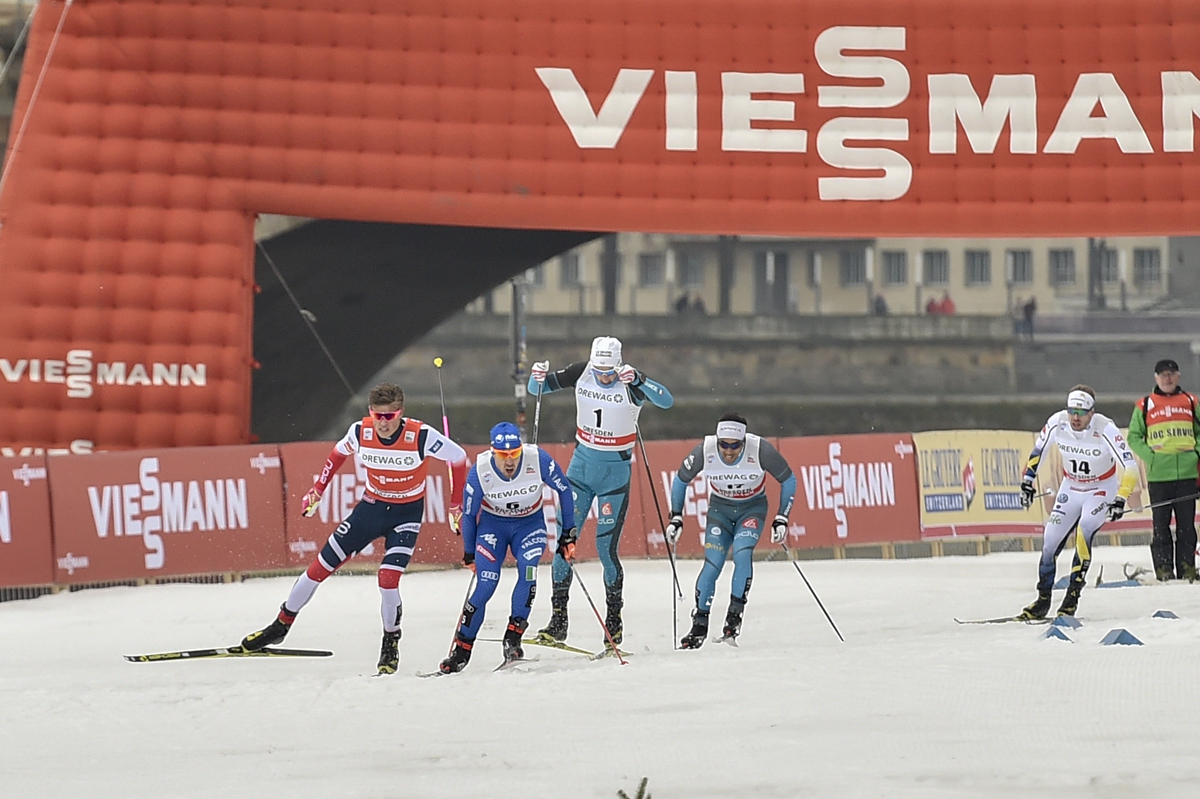
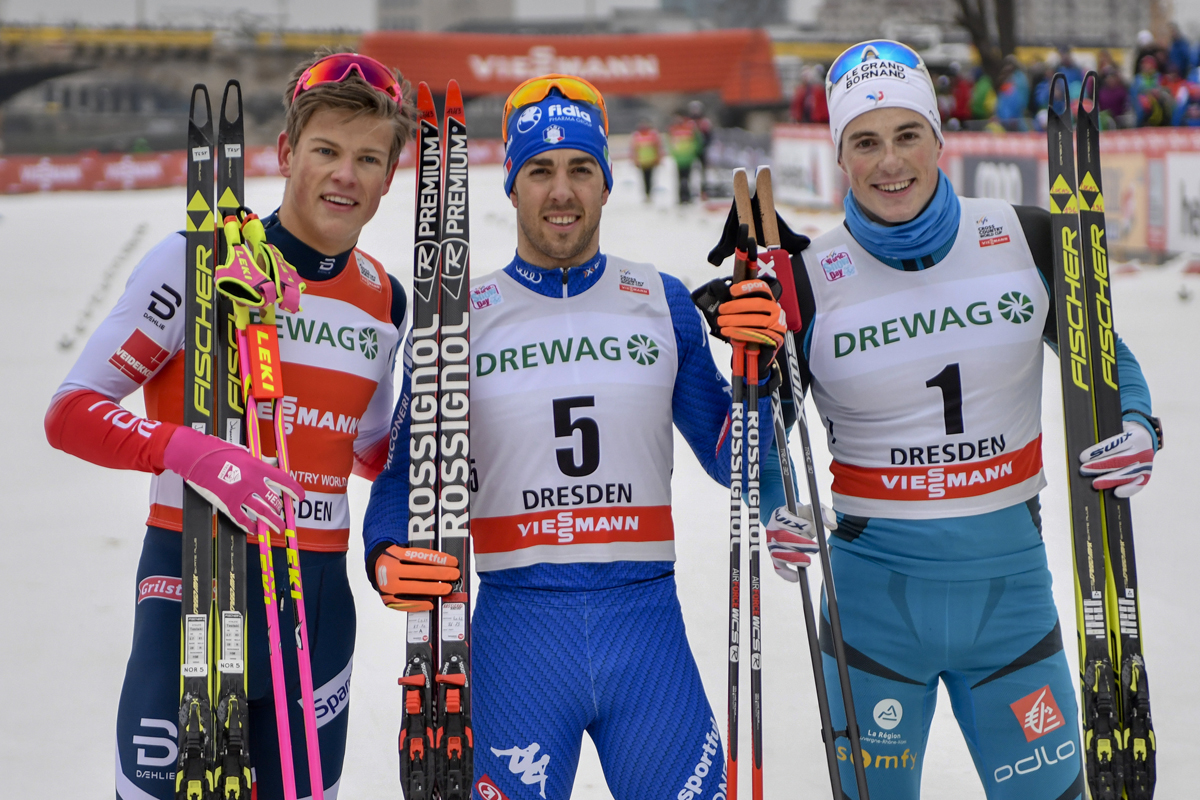
Federico Pellegrino’s winning move in the men’s 6 x 1.2-kilometer freestyle team sprint on Sunday wasn’t exactly the same as yesterday when the Italian attacked on the final climb of the individual skate sprint.
“Yesterday on the right side and today I tried on the left side and it was OK,” Pellegrino said in a post-race interview with the International Ski Federation (FIS).
By “OK,” Pellegrino meant perfect.
“Today everything was perfect, even the sun was super,” he said after winning his second race in as many days with team-sprint partner Dietmar Nöckler. “We can continue like this to the Olympics then catch the gold.”
A number of teams were looking to do exactly as the Italians did on Sunday on a tightly woven city sprint course in the heart of Dresden, Germany. This race marked the last team sprint before the Olympics, which starts in less than a month in PyeongChang, South Korea. The Olympic team sprint, set for Feb. 21, is also freestyle. Sunday was the first team sprint so far of the 2017/2018 season.
Pellegrino locked it up after Nöckler came through the last exchange in fifth, 2.6 seconds behind Sweden’s Emil Jönsson in first. On the final lap, Pellegrino chased Sweden’s Teodor Peterson and Switzerland’s Roman Schaad, before Pellegrino made his move past Schaad in first heading into the final rise before the stadium. The attack was just slightly before the one he executed to win Saturday’s skate sprint over Norway’s Johannes Høsflot Klæbo.
“I had to use it,” he said of the move.
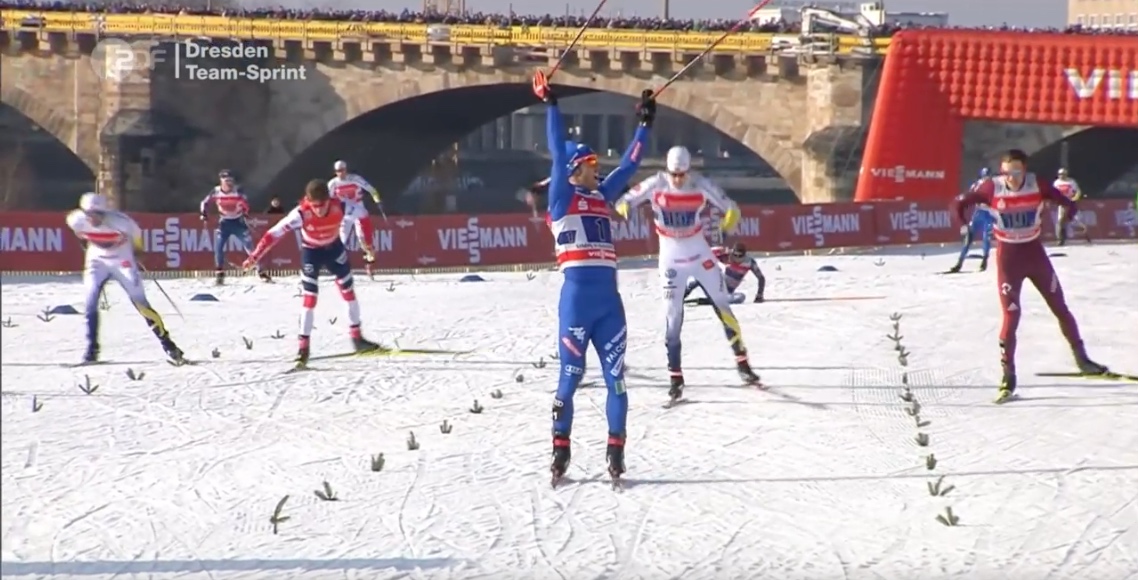
Federico Pellegrino (front) celebrates across the line as he anchors Italy to a freestyle team sprint victory for his second-straight win at the World Cup in Dresden, Germany. Behind him, Sweden I’s Teodor Peterson (second from r) and Russia’s Gleb Retivykh (r) battled for second, and Sweden II’s Karl-Johan Westberg (l) and Norway’s Johannes Høsflot Klæbo (second for r) jockey for third. American Simi Hamilton (on the ground) is seen trying to recover from a crash. (Screenshot: ZDF broadcast)
First over the top, Pellegrino pushed farther ahead of Peterson in second while Schaad, Russia’s Gleb Retivykh, Sweden II’s Karl-Johan Westberg, Klæbo, and American Simi Hamilton chased in third. Hamilton went down when he collided with Klæbo just before the finish line, but was able to get up and finish eighth, 14.28 seconds behind Italy in first.
Pellegrino sealed the deal in 12:18.31, and Peterson crossed 1.07 seconds back for Sweden I in second place. Russia’s first team, with Andrey Krasnov and Retivykh, placed third (+1.23), just ahead of Switzerland I (Jovian Hediger and Schaad) in fourth (+1.45), Norway I (Kasper Stadaas and Klæbo) in fifth (+1.93), and Sweden II (Johan Häggström and Westberg) in sixth (+1.94). Italy II (Stefan Zelger and Giacomo Gabrielli) placed seventh (+7.31) ahead of the U.S. (Erik Bjornsen and Hamilton) in eighth.
“When I arrived at the finish line, I could go slow and had some time to look to the people and say thank you for a great day,” Pellegrino told German TV broadcaster ZDF. “I had really good fun here in Germany!”
“He showed all the world that today he is the strongest athlete on the track,” Nöckler said while standing next to his teammate Pellegrino in a televised interview with FIS. “And today we were both on the podium so we’re really happy.”
Bjornsen, Hamilton in the Mix
The U.S. men were in contention to the finish, with Bjornsen putting them in third on the second-to-last leg. Norway’s Stadaas had been given a 1.3-second lead at the fourth exchange by his teammate Klæbo (who had previously made his way back into first after Stadaas tagged him in fifth). While Stadaas widened the gap for the first half of his last loop, Bjornsen led the chase, skiing several seconds behind him in second place.
In an in-person interview with FasterSkier, Bjornsen recalled being tentative in the semifinals, where he and Hamilton finished fourth but advanced as lucky losers with a fast-enough time.
“Going into the final, I was feeling good and I wanted to use my aerobic capacity,” Bjornsen said. “As soon as Simi handed off to me, I was kind of in the back end of that group and Norway had a good lead and I was like, I’m just gonna go for it.”
Hamilton had tagged him in eighth, 2.5 seconds behind Norway in first. About halfway through the next 1.2 k loop, Bjornsen had bridged the gap to Stadaas, but brought a large pack of racers with him.
“I went to the outside and was able to pass my group of like six or so, and I bridged up to Norway and tried to hit that corner pretty hard, then it kind of hit me,” Bjornsen said. “I was tired, that group had caught up to me and unfortunately I had pulled — some people jumped on the back of me, so then they kind of went by me, but I was able to hand off in third so I was happy with that. We were in the mix today.”
Sweden’s Jönsson took the lead over the last rise before the stadium, and Switzerland’s Hediger slotted into second, coming through the exchange 0.9 seconds after Jönsson. Bjornsen tagged third, 2 seconds back.
American Simi Hamilton (r) chasing Russia’s Gleb Retivykh (19) and one of two Swedish teams the second semifinal of the men’s 6 x 1.2 k freestyle team sprint at the World Cup in Dresden, Germany. (Photo: Fischer/NordicFocus)
From there, Hamilton kept himself in contention in the top five, hanging just behind Pellegrino and Peterson as the large group approached the finish. In the middle with several races on either side of him, Hamilton went down, hard, but stood back up again and finished eighth.
“My crash wasn’t too terrible, but I did break Klæbo’s pole with my face and got a bunch of carbon fiber splinters in my upper lip. So once I got that cleaned up I was okay,” Hamilton wrote in an email. “Whacked my head a bit too, but I’ll be fine.”
He explained that he and Bjornsen had made a game plan to “ski towards the front, stay out of crashes, and figure out how the semifinal was going to play out while racing,” he wrote. “I thought we both skied the semi well, although I think I could have been a bit more aggressive on my last lap and done more skiing that would have assured us a spot into the final. But it turned out okay.”
In the final, “Erik did an awesome job keeping us at the front and I just focused on doing the same for him,” Hamilton wrote. “He turned in a hell of a last leg, tagging me in 3rd for my last lap.”
Bjornsen was pleased with his last lap, but would have like to have been first through the final exchange.
“I wish I had a little higher speed that I could push past people quicker, but I find when I’m up against the best, my talent or whatever is to kind of press hard for a while,” Bjornsen said. “… So I just tried to send it hard for 45 seconds and it seemed to work out. I wish I could’ve handed off in first, but I’m happy to be in the mix there.”
On the final lap, Hamilton recalled “a decent sized gap up to first and second, I think mostly because those were the only two teams that had perfect tags on that last exchange,” he wrote.
Unsure whether to ski all out on his last of three 1.2 k efforts, while simultaneously pulling along competitors like Pellegrino and Klæbo, Hamilton focused on skiing fast, but not to his max.
“On the far end, Pellegrino went by me and by that point we were really close to making contact with the top two,” he wrote. “I thought we were totally in the hunt for a podium until somehow I lost a second on the plateau [after the last hill] with about 15 seconds of racing left. “I don’t know how I lost it, if it was just entirely my fault or if something happened like I got punched from my line, but I am pretty bummed about it because that was where I felt like I let the podium slip through our hands,” Hamilton continued. “Coming in to the finish lanes, I got tripped up with Klæbo and my skis got clipped as were skiing for the same lane. It wasn’t intentional and he’s a very clean racer, but it was definitely a bummer to not be able to sprint it out for 3rd, 4th, or 5th with those other guys.”
As for Norway, Klæbo told Germany’s ZDF he was out of the race at the start of that last lap: “After the last exchange it was too difficult, the gap was too large to the guys in front,” he said.
Overall, Hamilton concluded that it was a great and interesting weekend of racing at a new venue in Dresden.
“I think they could make some big improvements to the course with making it more technical, flowy, and wider, but I hope they continue to hold sprints here in the future,” he wrote.
Canada had two teams in the first semifinal of the men’s 6 x 1.2 k freestyle team sprint at the World Cup in Dresden, Germany, with Canada I’s Julien Locke (near) skiing just ahead of Canada II’s Dominique Moncion-Groulx, who caught an edge just ahead of Italy’s Federico Pellegrino (second from r) and American Ben Lustgarten (behind Pellegrino), over the top of a climb. (Photo: Fischer/NordicFocus)
While the Bjornsen and Hamilton as the U.S. Ski Team’s first team on Sunday were the lone North Americans to reach the men’s final, Canada came close with Bob Thompson and Julien Locke.
“The main points of our plan was make sure we stayed in the lead group and to take any easy opportunities to make up positions whenever we saw them,” Thompson, of the National Team Development Centre (NTDC) Thunder Bay, wrote in an email. “I started first as we were confident I could hang on to the pace and then after Julien’s excellent performance yesterday we felt he would have good speed to finish.”
The two ultimately finished seventh in the first team-sprint semifinal, just one place behind Great Britain’s James Clugnet and Andrew Young. The Brits advanced to the final as lucky losers in sixth, 1.85 seconds behind Norway’s Stadaas and Klæbo in first, becoming the first team from Great Britain to reach the final in a World Cup team sprint. (In the final, they finished behind the U.S. in ninth, 14.68 seconds out of first.)
After Thompson tagged Locke (Canadian National U25 Team/Black Jack Ski Club) in eighth in the last exchange of their semifinal, Locke picked off one place to finish seventh, 0.39 seconds behind Great Britain’s Young.
“The third leg just started going from the exchange and I was able to hang on to the back and then dodge around the French teams who both crashed,” Thompson explained. “So I was able to tag off to Julien solidly in the mix of the lead pack. Julien had a pole break on the small hill with just 200m to go and had to free skate in, so the .15 seconds from making the final hurts a bit.
“I’m happy with how we raced,” he continued. “We both stayed controlled and I think we had the pace well enough. I believe I skied it as well as I could have and being right up with those guys feels great.”
The Americans’ second team of Andy Newell and Ben Lustgarten crossed the line 0.57 seconds later for eighth place (+2.81) in that semifinal. Newell had put them in second place at the last exchange, just 0.11 seconds out of first.
“I felt good on my last leg and was able to make some moves and tag Ben in the lead going into the final lap,” Newell wrote in an email. “He skied really well to stay close to the leaders. If we were even less than a second faster I think we would have moved on as [lucky losers] instead of Sweden 2 and USA 1 from the next semi. So we were a bit unlucky there but it was a fun race.”
American Andy Newell (2) chasing Italy II’s Stefan Zelger (in blue) during the first semifinal of the men’s 6 x 1.2 k freestyle team sprint at the World Cup in Dresden, Germany. (Photo: Fischer/NordicFocus)
Previously, Newell had tagged Lustgarten in fourth at the first exchange, then Newell found himself back in 10th and almost 2 seconds back after his second leg.
“Ben and I tried to ski up toward the front half of the pack but had a small crash on our second tag,” Newell explained.
“The [second] handoff wasn’t clean but I got Newell just in time,” Lustgarten, of the Craftsbury Green Racing Project, recalled in an in-person interview with FasterSkier. “But there is so much happening and I obviously don’t have that much experience in this event, so it was just like a learning experience and trying to ski well. … On my last lap, Klæbo and Pellegrino went by and I am not really at that level yet so I didn’t really expect anything. I just tried to go as hard as I could.
“I haven’t done a team sprint in eight years maybe, so it was a whole new kind of experience,” Lustgarten explained. “And obviously all these guys are so fast and strong that it was just an insane event.”
Canada’s second team of Antoine Briand (Pierre-Harvey National Training Centre) and Dominique Moncion-Groulx (Alberta World Cup Academy) finished 13th in the first semifinal, 26.20 seconds out of first. Notably, Moncion-Groulx skied the fastest second leg of the race to bring them from 12th after the first exchange to sixth.
The World Cup has two more weekends of racing before the Olympics, with all-classic races next weekend in Planica, Slovenia (classic sprint and 10/15 k classic individual starts), followed by freestyle races in Seefeld, Austria, on Jan. 27-28 (skate sprints and 10/15 k freestyle mass starts).
Bjornsen said he was unsure whether he’d race next weekend in Planica, potentially opting for a training block before the Olympics instead.
“I still have to talk to [U.S .SKi Team Head Coach Chris] Grover about which races I’m going to start at the Olympics and so if it looks like I’ll have a full schedule at the Olympics then I’ll try to do a training block,” Bjornsen said.
Hamilton wrote that he was planning on racing the classic sprint in Planica, and was headed to Ramsau, Austria, with his teammates for a couple days of training first.
According to Thompson, the four Canadians that raced in Dresden were also on their way to Ramsau, Austria, where they’ll train until Tuesday and then continue on to Planica.
Italy’s Federico Pellegrino (5) getting a ski tip ahead of Norway’s Johannes Høsflot Klæbo (l) for the men’s freestyle sprint final win on Saturday at the World Cup in Dresden, Germany. France’s Lucas Chanavat (1) placed third for the second-straight World Cup sprint, another Frenchman Richard Jouve (second from r) placed fourth, Sweden’s Emil Jönsson (second from l) was fifth, and Norway’s Even Northug (behind) took sixth after breaking a pole out of the start. (Photo: Fischer/Nordic Focus)
How do you beat Norway’s Johannes Høsflot Klæbo at his competition-crushing game? Take him by surprise with minimal time to recover. Italy’s Federico Pellegrino did just that on the last uphill rise of the 1.2-kilometer sprint course on Saturday in Dresden, Germany.
Dresden, a historic city in eastern Germany, debuted its brand-new course along the Elbe River on manmade snow amid damp conditions and temperatures above freezing throughout the day. Pellegrino had done what he needed to advance through the rounds, clocking the first-fastest time in the qualifier, 2.9 seconds behind France’s Lucas Chanavat in first, then placing second in his quarterfinal and third in the first semifinal. Klæbo won that semi by 0.16 seconds over Chanavat in second and 0.3 seconds ahead of Pellegrino in third. With a fast-enough time, Pellegrino moved on to the final, where he met the 21-year-old Klæbo again.
“I knew that at the beginning of the race, I’m becoming a little bit old so the younger Klæbo and Chanavat were faster than me,” Pellegrino, 27, said of the final in a post-race interview with the International Ski Federation (FIS). “So I just had to wait, but I wanted to attack in the longer race to the finish line.”
The race from his point of attack might have seemed like an eternity, but in actuality, it was about 500 meters before the finish. Klæbo and Chanavat had burst out of the start at lightning speed, skiing “shoulder to shoulder,” as Chanavat later said in a press conference, and slightly gapping the four skiers behind them — one of which was Pellegrino.
While Klæbo pushed the pace up front, Pellegrino kept the two leaders close, skiing just a couple strides back. France’s second man in the final, Richard Jouve slotted into fourth behind him and Sweden’s Emil Jönsson — in his first final in a year — followed in fifth. Behind them, Norway’s Even Northug (Petter Northug’s 22-year-old brother) worked to fasten a new pole after breaking his on the starting gate. That took him out of the race from the gun.
Chanavat attempted to get ahead of Klæbo on a tight righthand corner, but Klæbo held the inside line and his position. Coming out of that corner, Pellegrino latched on to Chanavat and brought the rest of the group with him. Shadowing the two leaders’ every move, Pellegrino accelerated just before the final rise, taking just three V2 pushes to get to the top.
Norway’s Johannes Høsflot Klæbo (l) and Italy’s Federico Pellegrino (second from l) jockey for position just before the finish of the men’s freestyle sprint final at the World Cup in Dresden, Germany, while France’s Lucas Chanavat (1) and Richard Jouve chase, followed by Sweden’s Emil Jönsson (14). (Photo: Fischer/NordicFocus)
Even with Klæbo, the Italian took another push to move ahead and left Klæbo chasing. With about 75 meters to go, they began their all-out showdown to the finish, side by side, with Pellegrino staying just ahead to cross the line first in 1:52.77 minutes. Klæbo was just 0.18 seconds back in second and Chanavat 0.98 seconds behind in third.
“When I will have grandchildren this will be the story I am going to tell them, that I beat Johannes,” Pellegrino said, according to a FIS press release.
It was his first World Cup victory in nearly a year since winning a freestyle sprint in Falun, Sweden, late last January, and his 10th career individual World Cup win.
“Klæbo is a really good guy because if he wanted to he could stop me,” Pellegrino told FIS. “… He tried to stay stay quiet to let me go … he’s really good to continue to win.”
In the four sprints Klæbo’s contested this season, Saturday marked his first loss (he did not compete in the Tour de Ski, opting for a training block instead and racing at Norwegian nationals in Vang, Norway, where he won the classic sprint).
“It was a tough one,” Klæbo said of Saturday’s final. “Me and Chanavat was trying to go pretty hard from the start of the final, and I think both of us went a little bit too hard. … I’m satisfied with second place here but I have to do something else to beat him next time.”
Two seasons ago, Pellegrino was the overall Sprint World Cup champion. Last season, it was Klæbo as both the U23 and Sprint World Cup Champion.
The men’s freestyle sprint podium on Saturday at the World Cup in Dresden, Germany, with Italy’s Federico Pellegrino (c) in first, Norway’s Johannes Høsflot Klæbo (l) in second, and France’s Lucas Chanavat (r) in third. (Photo: Fischer/NordicFocus)
“I always try to do my best; if the best means the victory it’s great,” Pellegrino said, according to FIS. “It was a really good show. I prefer courses with more hills. Yesterday I changed the way I was thinking about the race.”
“He was clever,” Klæbo said in an interview with NRK. “He skied like this in the semi and quarterfinal. Our strategies differed slightly.”
While Pellegrino kept himself in contention in the heats by skiing from behind, Klæbo did as he usually does, by leading with a pace few, if anyone else, could match. Klæbo qualified second, 0.15 seconds off Chanavat’s top qualifying time of 1:50.42, then won his quarterfinal by a clear-cut margin of 0.6 seconds over Switzerland’s Roman Schaad. Chanavat won his quarterfinal by 0.12 seconds over Pellegrino, then hung with Klæbo once again in the semifinal.
At the last World Cup sprint in Lenzerheide, Switzerland, the first stage of the Tour de Ski, Chanavat placed third in the skate sprint.
“I did my best and I competed to try to get the victory today, but I was a lot focused on Johannes,” Chanavat, 23, said at the press conference. “So I was surprised when Pellegrino came pretty strong on the side in the race.”
He added that the gap between him and Klæbo is getting closer. “So I’ll try to keep it shorter,” Chanavat said.
Jouve finished 0.25 seconds off the podium in fourth, 0.98 seconds behind Pellegrino, Jönsson finished fifth (+2.36), and Northug sixth (+12.04).
Hamilton 10th, Locke 15th
American Simi Hamilton made it to the semifinals and finished the day in 10th overall after placing fifth in the second semi, 0.38 seconds behind Jönsson in first. That heat ended in a three-way photo finish for first, which Jönsson took ahead of Northug (+0.01) and Jouve (+0.04). Those three men advanced to the final, but Hamilton and Norway’s fourth-place finisher in that semifinal, Pål Trøan Aune (+0.23) did not.
American Simi Hamilton (front) leads Germany’s Sebastian Eisenlauer during their quarterfinal of the men’s 1.2 k freestyle sprint at the World Cup in Dresden, Germany. (Photo: Fischer/NordicFocus)
Before that, Hamilton had qualified in 15th and finished second to Norway’s Fredrik Riseth in his quarterfinal.
“It was a really cool venue, great course,” Hamilton told FasterSkier in person after the race. “But it was really tight the whole way around so it was hard. My starts aren’t that good right now and so my quarter, I was basically trying to start as fast as I could and I still was second or third out of the blocks, so I wasn’t feeling super confident after that.”
Going into the semifinals, he decided not to worry about his start and concentrate on moving up later in the course.
“What ended up happening around that corner, I just couldn’t get around anyone,” Hamilton recalled. “Every time you get an opportunity to make a move, it gets shut down almost immediately, so that was really frustrating, but I was happy with how my body is feeling right now, and it’s fun to get into the heats.
“I am always way more comfortable skiing towards the back of the pack and then making a definite move somewhere on the course, so unfortunately for me like this course doesn’t favor doing that too well,” he continued. “You can’t afford to ski at the back and then pass four five people, not enough room or time.”
He added that he enjoyed how different the Dresden course was in comparison to other, much hillier World Cup terrain.
“I think the only super-short flat course we race like this was in Milan [Italy] years ago, so its fun just doing something different,” he said. “The crowd is awesome here.”
U.S. Ski Team Head Coach Chris Grover observed that Hamilton was at a disadvantage trying to move up from behind on Dresden’s course.
“He made it work in the quarterfinal,” Grover told FasterSkier. “He’s so good when he gets that opening to go. I think we saw in the semifinal that he would be starting to go and then get blocked. And again after the corner, started to go, and got blocked. And under the bridge, started to go, and then got blocked. It’s nobody’s fault, nobody obstructed him or anything like that, it’s just not a course with many passing options. The guys are so well-matched, in a semifinal or final it becomes that much harder. So he’s a little bit frustrated, but I think he’s in good shape.”
Andy Newell (U.S. Ski Team) racing to 18th in the men’s freestyle sprint qualifier at the World Cup in Dresden, Germany. He went on to finish sixth in his quarterfinal for 27th overall. (Photo: Fischer/NordicFocus)
Two Americans qualified for the heats in the top 30, with Andy Newell finishing 18th in that preliminary round, but Grover noted the U.S. team’s qualifiers overall were “uncharacteristically poor”.
“To have Erik Bjornsen just miss the qualification, to have Kikkan [Randall] just miss the qualification, to have the four athletes who did go in not have the best qualifications, something was a little bit missing,” he said.
(Bjornsen placed 32nd and Randall 34th in their respective men’s and women’s qualifiers. Bjornsen was 0.23 seconds out of 30th.)
Newell’s run ended in the quarterfinal, after he initially took the lead, ahead of Canada’s Julien Locke, but slipped to sixth on the second half of the course.
“Andy didn’t have the best start, but he got himself to first and he was able to take the best line,” Grover reflected.
He wasn’t sure why Newell then dropped to the back of the group, and Newell wrote in an email that he wasn’t sure what happened, either.
“Felt like I was able to accelerate to the front well but then managed to get swarmed before the last little bump and then it was extremely tough to pass before the finish,” Newell wrote. “I should know better than to let myself get stuck in the middle… on narrow tracks like this if you get stuck in the middle with guys on either side you can’t get a full push and thats how you get swarmed, bad tactics on my part.”
“Tomorrow should be fun, fast, and wild,” he added of Sunday’s freestyle team sprint. “Hopefully I’ll be able to be more aggressive tomorrow 🙂 Looking forward to it.”
Julien Locke (Canadian U25 Team/Black Jack) racing to 16th in the men’s freestyle sprint qualifier at the World Cup in Dresden, Germany. He went on to place third in his quarterfinal for 15th overall, his best World Cup result. (Photo: Cross Country Canada/NordicFocus)
He finished his quarterfinal in sixth, 1.54 seconds behind Northug in first, for 27th overall. Meanwhile Locke hung with Northug and Jouve up front and finished third, 0.62 seconds out of first and just 0.18 seconds out of second.
While second place in that heat would have put him in the semifinals, 15th overall was still a career best for Locke, of the Canadian U25 Team and Black Jack Ski Club. Last March at World Cup Finals in Quebec, he placed 20th in the freestyle sprint. And just over a week ago at the NorAm Olympic trials in Mont Sainte-Anne (MSA), Quebec, Locke, 24, won the classic sprint final, but missed out on a potential Olympic spot by one place after qualifying second (the tiebreaker) behind Russell Kennedy (Team R.A.D.).
The individual top 30 was the second of Locke’s career. Fresh off of competing in Canada, he arrived in Dresden a day and a half ago.
“… A little bit of a tight schedule, but body feels great, and super-fun course out there with all these spectators,” Locke told FasterSkier after. “And yeah, short, very short. It was close to 1.1 [kilometers] and definitely the shortest sprint race I have ever done.”
“I was prepared to hit it hard here and I was hoping for sure to get into the heats and then get into the rounds,” he added. “I don’t like getting knocked out, but I am content with how today went.”
Bob Thompson (NTDC Thunder Bay) racing to 50th in the men’s freestyle sprint qualifier at the World Cup in Dresden, Germany. (Photo: Fischer/NordicFocus)
Three other Canadian men met the Cross Country Canada (CCC) selection criteria for Dresden, where Bob Thompson (NTDC Thunder Bay) finished 50th in the qualifier (+8.67), Dominique Moncion-Groulx (Alberta World Cup Academy) 59th (+9.99) and Antoine Briand (Pierre-Harvey National Training Centre) 60th (+10.12).
(Note: CCC High Performance Director Thomas Holland explained in an email that Briand was added as the fourth man, based on the U23 selection list, after Kennedy had to relinquish his starts in Dresden due to illness.)
For the U.S., Period 2 SuperTour leader Ben Lustgarten (Craftsbury Green Racing Project) finished 49th (+8.64) out of 67 men.
“I thought I skied well — usually this stuff is my weakness,” Lustgarten said after. “It’s like icy and slushy so usually when it’s like that skate skiing, I get off balance, but I was like trying really hard to stay focused and ski big. I only got bogged down a little bit on the big hill, but … I was only nine seconds out of first, so I think that is really good. I am really happy with that.”
The U.S. and Canada each have two teams entered for Sunday’s freestyle team sprint on the same course in Dresden, with Bjornsen and Hamilton (United States I), Newell and Lustgarten (U.S. II), Thompson and Locke (Canada I), and Briand and Moncoin-Groulx (Canada II).
“It’s going to be wild out there,” Lustgarten said. “[The Dresden organizers] pulled it off; they had to shorten the course a little bit because they didn’t have enough snow … but it was good. It’s the shortest sprint I have ever done in my life by far.”
The women’s freestyle sprint podium on Saturday at the World Cup in Dresden, Germany, with Sweden’s Hanna Falk (c) and Maja Dahlqvist (l) in first and second, and American Sophie Caldwell (r) in third. (Photo: FIS Cross Country/Twitter)
FIS Cross Country World Cup (Dresden, Germany): Freestyle sprints
For her second-straight World Cup sprint, Sophie Caldwell of the U.S. Ski Team reached the podium in the women’s 1.2-kilometer freestyle sprint on Saturday in Dresden, Germany.
Caldwell placed third in the final behind Sweden’s Hanna Falk, who won it in 2:11.02 minutes, and Maja Dahlqvist, also of Sweden, who placed second (+0.23). Caldwell and Dahlqvist both lunged in a photo finish for second, which Dahlqvist took by 0.07 seconds.
Also in the final, which included four Swedes, Switzerland’s Laurien van der Graaff finished fourth (+0.58), and Sweden’s Anna Dyvik followed in fifth (+0.68) and Stina Nilsson sixth (+7.56) after tripping.
Falk started the day by winning the women’s qualifier in 2:06.34, by just 0.02 seconds over Nilsson in second. Caldwell qualified 11th (+2.02). and another American Ida Sargent made it into the heats in 14th (+2.44). Kikkan Randall missed the top 30 by 0.6 seconds in 34th (+6.57), Julia Kern placed 38th (+7.78), and Caitlin Patterson, of the Craftsbury Green Racing Project (CGRP), was 40th (+8.56) out of 49 women in the qualifying round.
Sargent finished fourth in her quarterfinal, 043 seconds behind Sweden’s Ida Ingemarsdotter in first, to finish the day in 17th overall.
For Caldwell, who went on to advance in second in her quarterfinal and third in her semifinal, the podium came after she finished second in the last World Cup skate sprint (the first stage of the Tour de Ski) on Dec. 31 in Lenzerheide, Switzerland.
Her boyfriend and fellow U.S. Ski Team member Simi Hamilton came close to reaching the men’s 1.2 k sprint final on Saturday after qualifying in 15th then placing second in his quarterfinal and fifth in the second semifinal, 0.38 seconds behind Sweden’s Emil Jönsson in first.
France’s Lucas Chanavat won the qualifier in 1:50.42, 0.15 seconds ahead of Norway’s Johannes Høsflot Klæbo in second. Hamilton was 4.32 seconds back in the qualifier, and his U.S. teammate Andy Newell also qualified in 18th (+4.91). Erik Bjornsen missed qualifying by 0.23 seconds in 32nd (+6.15) and Ben Lustgarten (CGRP) finished 49th (+8.64) out of 67 men.
The women’s freestyle sprint podium on Saturday at the World Cup in Dresden, Germany, with Italy’s Federico Pellegrino (c) in first, Norway’s Johannes Høsflot Klæbo (l) in second, and France’s Lucas Chanavat (r) in third. (Photo: FIS Cross Country/Twitter)
While Hamilton’s day ended in the semifinals, putting him 10th overall (and Newell finished sixth in his quarterfinal to place 27th overall), Italy’s Federico Pellegrino timed his attack perfectly in the final, challenging Klæbo for the win down the finishing stretch. The Italian took it by 0.18 seconds in 1:52.77, Klæbo placed second and Chanavat third (+0.98).
France and Norway had two men in the final, with France’s Richard Jouve placing fourth (+1.23), Sweden’s Jönsson taking fifth (+2.36) for his best individual World Cup result since December 2016. Norway’s Even Northug finished sixth (+12.04) after breaking his pole out of the start.
Canada’s Julien Locke of the National U25 Team and Black Jack Ski Club had a career-best day, finishing 15th overall. He qualified 16th (+4.61) then placed third in his quarterfinal, crossing the line just 1 second behind Norway’s Fredrik Riseth, who won that heat. Hamilton was second in that quarterfinal, 0.67 seconds back.
Also for Canada, Bob Thompson (NTDC Thunder Bay) finished 50th in the qualifier (+8.67), Dominique Moncion-Groulx (Alberta World Cup Academy) was 59th (+9.99) and Antoine Briand (Pierre-Harvey National Training Centre) 60th (+10.12).
Germany’s Laura Dahlmeier, Franziska Preuss, Denise Herrmann and Franziska Hildebrand (left to right) celebrating their win in the women’s 4×6-kilometer relay at the 2018 IBU World Cup in Ruhpolding, Germany. (Photo: IBU/Biathlonworld)
IBU World Cup (Ruhpolding, Germany): Women’s relay
The teams from Germany and Italy dueled for the top position all race in Saturday’s 4 x 6-kilometer women’s relay at the IBU World Cup in Ruhpolding, Germany. Cheered on by some 20,000 home-crowd fans, Germany’s anchor Laura Dahlmeier stayed on the ski tails of Italy’s Federica Sanfilippo after the last shooting stage, then passed her before the last major climb and held a narrow lead around the rest of the course to cross the finish line first in a time of 1:08:47.0 hours, with Italy 2.9 seconds behind. German had a team total of zero penalties and nine spares.
“It’s incredibly fun to win in front of this audience here today,” Dahlmeier told German broadcaster ZDF in an interview right after the race, according to a translation. “I think this will boost our whole team morale. We showed today that we are a team to be reckoned with in relays. It was just a nice race.”
Germany with Franziska Preuss, Denise Herrmann, Franziska Hildebrand, and Dahlmeier was never more than 30 seconds behind the pace, even though Hildebrand temporarily fell back from leading the field to tagging off to Dahlmeier in fourth position.
“My race held all kinds of surprises today,” Hildebrand told ZDF with a laugh. “It started with a fall on an icy patch 100 meters after it began… Then I dropped my pole, also had to exchange the replacement one, and then three spares [in prone] to avoid the penalty. Today everything conspired in my race.”
Italy with Lisa Vittozzi, Dorothea Wierer (coming off a victory in the individual race on Thursday), Nicole Gontier and Sanfilippo had the best shooting performance of the day, with no penalty and just three spares.
“That last loop with Laura was really tough,” Sanfilippo said in the press conference. “I gave my best, I tried all for my team. I knew that I can be strong on the last loop. I tried to attack, but Laura was a little bit stronger. But I am also really happy that we finished in second place, I think that was really important for our team.”
Sweden with Linn Persson, Mona Brorsson, Anna Magnusson and anchor Jenny Öberg was third, 17.2 seconds back, with no penalty and five spares. Brorsson and Öberg managed to move the team up to the podium positions, for the second one in a row following a third place from Oberhof, Germany, a week ago. Before that, the Swedish women’s team had been on a six-year hiatus from those lofty positions.
“It’s cool to be on the podium again,” Persson said in the press conference.
“This is like our second home and there were a lot of Swedes here, so we had big support during the race on the tracks,” Brorsson added.” That was an advantage for us.”
Just a few seconds off the podium, Norway with Synnøve Solemdal, Tiril Eckhoff, Ingrid Landmark Tandrevold and Marte Olsbu was fourth (+23.1, with no penalty and nine spares), with Olsbu outsprinting Poland’s anchor Weronika Nowakowska on the finish stretch (+24.5, with no penalty and five spares). For both teams it was their best relay result of the season so far.
Switzerland with the three sisters Elisa, Selina and Aita Gasparin reinforced by Lena Häcki surprisingly led the race at the third exchange after Selina had moved them in front, but her youngest sister Aita could not hold that position, falling back with a penalty lap in the last standing stage to finish eighth (+1:37.1, with one penalty and 11 spares).
Biathlon Canada’s team of Emma Lunder, Julia Ransom, Sarah Beaudry, and Rosanna Crawford started the race with a setback after Lunder incurred a penalty in her prone stage, leaving the range in 23rd position at the end of the field and already almost a minute behind the leader. She managed to limit the gap with a clean standing stage to exchange still in 23rd position and 1:47 back.
Taking over Ransom then remained clean in both stages to move the team up to 17th, tagging off 2:14 behind. Beaudry only required one spare in her prone stage (0+1, 0+0) to improve to the 12th position even making up 3 seconds to the leaders.
Then Crawford, fresh off her first career podium in the individual race on Thursday, managed to also shoot clean in both stages and overtook the teams from Slovakia and Ukraine while further decreasing the gap to finish the race in 10th position, 1:56.7 back, with one penalty and just four spares.
“Things were a bit softer and slushy today compared to the individual, but nothing too bad,” Crawford commented on the conditions in an email to FasterSkier. “There was quite a bit of wind on the range, which I think was tricking people, the wind flags weren’t showing much but I had to make 6 left correction during zero [target practice].”
“Today was a solid showing from our team,” she added regarding their result. “Everyone cleaned standing, I think we can be really happy of this race, and take some real confidence going into the Olympic relay.”
Previously this season Canada had finished the relay in Oberhof, also Germany, in 14th position, and the first one in Hochfilzen, Austria, in ninth.
For US Biathlon with Susan Dunklee, Clare Egan, Emily Dreissigacker, and Joanne Reid, it was the first women’s relay of the year after missing out on the first two races of the season in this discipline.
Thus starting at the very end of the field, veteran Dunklee moved up through the pack and got through the prone stage with one spare. But then she had to fight against a penalty lap in her standing stage requiring all three spare rounds, leaving the range in 12th position. With the fastest course time on the opening leg, she managed to slightly decrease the gap to 21.6 seconds and made up three positions to exchange in ninth place.
Egan missed the first two shots in her prone stage, but hit the targets with her spares leaving the range over a minute back. She followed that up by cleaning her standing stage and left the range 1:29.5 back, then only lost five more seconds on the last loop to exchange in 14th.
Dreissigacker also needed just one spare in her prone shooting, but then incurred two penalties in her standing stage, doubling the gap and falling back to 19th position at the exchange and 3:51 back.
Anchor Reid needed three spares on her leg (0+2, 0+1) and managed to still overtake the teams from China and Finland to finish 17th, 4:57.7 behind Germany, with two penalties and 13 spares overall.
“Finally we had a full team and raced a relay!” Dunklee wrote on Instagram. “Competing on a foreign continent has its challenges.”
Ski Classics (Seefeld, Austria): 60 k Kaiser Maximilian Lauf
The men’s podium at the Kaiser Maximilian Lauf 60 k Ski Classics marathon in Seefeld, Austria, with Norway’s Tord Asle Gjerdalen (c) in first, Sweden’s Andreas Holmberg (l) second, and Russia’s Ilya Chernousov (r) third. (Photo: Visma Ski Classics)
At the third Ski Classics event of the 2017/2018 season, the 60-kilometer Kaiser Maximilian Lauf on Saturday in Seefeld, Sweden’s Britta Johansson Norgren (Lager 157 Ski Team) and Norway’s Tord Asle Gjerdalen (Team Santander) took the women’s and men’s victories, respectively.
Johansson Norgren and Japan’s Masako Ishida (Team Koteng) broke away shortly after the start. The two went back and forth for a while until Johannson Norgren gapped Ishida in the Leutasch valley. While Ishida was caught by a chase pack with Sara Lindborg (Team Serneke), Kari Vikhagen Gjeitnes (Santander) and Lina Korsgren (Åre Ski Team), she reined Johansson Norgren back in on the long climbs after the valley. Ultimately, Johansson Norgren took the win in 2:49:16.0 hours, while Lindborg claimed second, 37.5 seconds back. Ishida finished third (+58.9), Gjeitnes placed fourth (+1:40.7) after injuring her ankle about 2 k before the finish, and Korsgren fifth (+2:05.1).
The women’s podium at the Kaiser Maximilian Lauf 60 k Ski Classics marathon in Seefeld, Austria, with Sweden’s Britta Johansson Norgren (c) in first, Sweden’s Sara Lindborg (l) second, and Japan’s Masako Ishida (r) third. (Photo: Visma Ski Classics)
“It was my plan to go full speed from the beginning,” Johansson Norgren said, according to a Ski Classics press release. “I knew Ishida will go fast in the climbs, but I felt strong from the beginning. It was really hard skiing alone in the valley, and when Ishida caught me up, I wasn’t sure if I could win the race. But the last part of the course was perfect for me and I had no problems securing the victory today.”
The Leutasch valley was the turning point of the men’s race as well, where Vinjar Skogsholm (Team Parkettpartner) and Andreas Holmberg (Team Serneke) broke away from the pack and had built a 90-second gap on the chase group as they left the valley. There on the first climb out of the valley, Holmberg pushed the pace and dropped Skogsholm, while Gjerdalen and Ilya Chernousov (Bauer Ski Team) worked to catch Holmberg up front. They caught him 3 k before the finish and Gjerdalen was first across the finish line in 2:27:49 hours, 14.8 seconds ahead of Holmberg in second.
Chernousov finished third (+32.0), Ermil Vokuev (Russian Marathon Team) was fourth (+1:07.6), and Anton Karlsson (Lager 157) fifth (+1:08.2).
“I didn’t like the fact that we gave too much leeway for Holmberg and Skogsholm,” Gjerdalen said, according to the press release. “I’m happy that Ilya helped me in our attempt to catch up with Holmberg, but I wasn’t really sure if we were going to make it. You never know how the other person is feeling in the front, what kind of skis he has and what goes on in his mind. But I managed to win today and it feels great to be back on the top.”
In the overall “Champion” standings, Nordgren leads with 450 points, 110 ahead of Lindborg in second. Gjerdalen is first in the men’s champion standings with 330 points, 50 points ahead of Morten Eide Pedersen in second.
The Ski Classics tour moves to Zuoz, Switzerland, next weekend for the 65 k La Diagonela.
The start of the men’s 50 k freestyle mass start last week at Canadian Ski Nationals in Canmore, Alberta, with Graeme Killick (1) at the front (Photo: W. James MacLean).
CANMORE, Alberta — Canadian Nationals went to Canmore for 2017 and Canmore delivered. Famous for challenging courses, well-trained volunteers, and erratic weather; the Canmore Nordic Centre showed all three at their best during the eight-day event.
Each day delivered warm sun, cold winds, snow flurries, and warm winds (often all occurring in a single race lap) to more than 600 racers. The first races each morning were held on fast, transformed snow that transitioned to slow and soft in the afternoon. While 30 of Canada’s top skiers missed the first two days of racing, with a new relay cross event and freestyle interval starts, while competing at World Cup Finals in Quebec City, the real action was in the younger categories with more than 100 racers in each.
Retired biathlete Zina Kocher and Para-Nordic Ski Team guide Graham Nishikawa collected the open category national titles, while the University of Denver’s Moritz Madlener, a U.S. student from Germany, won the overall.
On Tuesday, March 21, most of the World Cup Finals racers arrived in time to compete in the 10/15 k classic interval starts, with Devon Kershaw and Emily Nishikawa recovering to take the open-category gold medals.
The next day, Emily Nishikawa took her second-straight title in the classic sprint, despite being visibly tired in her fifth race in six days. All six women in the A-final had completed in Quebec three days earlier. While the three medalists were posing for a photo, one was overheard saying, ‘We have two days off!’
In the men’s A-final, Madlener took the overall victory ahead of his University of Denver teammate Dag Frode Trollebø. Evan Palmer-Charrette placed third overall, and as the top Canadian, he earned the national title.
Thursday held classic sprints for the younger categories and Friday was a rest day for the volunteers.
Saturday, March 25, brought the 30/50 k freestyle mass starts, with Emily Nishikawa completing her hat trick and another World Cup Team member Graeme Killick showing off some little-known sprinting talent to win his first 50 k.
(See also: the race analysis link for each day. Want to know who was climbing fastest? Descending fastest? Slowest? Won the climbing prime? It is all here for the distance day.)
Quotes
On the importance of nationals
“When I was a juvenile, I just had learned so much meeting the national team skiers, seeing them ski around, see what they do for warmups, how they race. … So I just want to be here for the next generation and be able to meet anyone who wants to say hi.” — Emily Nishikawa (Canadian World Cup Team)
“We had 110 girls at the Fast and Female event yesterday. It was really amazing to see so many girls out there. I hope that everyone’s enjoying their nationals and gets some inspiration from watching myself, and Emily, and Graeme, and everyone else who’s been racing overseas race. Especially, too, some of those juniors who had the opportunity to do the World Cups in Quebec. For everyone else in Canada to be able to race them and see where they end up and have that as a marker is really exciting.” — Dahria Beatty (AWCA/National U25 Team)
“We use these as training races, we need to stay competitive with the best in the country, and that’s what we’re here to do.” — Graham Nishikawa (Canadian Para-Nordic Ski Team guide for Brian McKeever)
On winning a national championship
“It’s my fifth race in six days, so I’m really tired, but I couldn’t be happier right now. To win two back-to-back national titles yesterday and today is really cool.” — Emily Nishikawa, after the sprint
“It was a tough end to the season, but nice to finish on a positive note here. It is incredible to win all three.” — Emily Nishikawa, after two rest days
“Awesome to be Canadian champion, surprise for sure in a classic sprint for me. Definitely not quite the Canadian field you’d see at a lot of Canadian nationals, a lot of guys sick and injured after World Cups on the weekend, but awesome nonetheless.” — Evan Palmer-Charrette (NTDC Thunder Bay)
“I’ve never won the 50 before. I’ve have medals in the other races … I’m super happy to get a 50 k win, that’s something that’s been a big goal of mine. I didn’t feel so good coming into this week, so I’m just really happy that it worked out today.” — Killick (World Cup Team)
“It feels great. Super good race for me on Sunday [March 19] and I’ve had a great week overall.” — Graham Nishikawa
On the races
“I wouldn’t say I’m a sprinter, but today with these soft, slushy conditions, it kind of played into my favour. I love classic sprinting, I always have.” — Emily Nishikawa, after winning the sprint
“I had a good tactic for the final downhill, I found some faster snow outside the track. I did a little slingshot off Dahria. She’s usually so good at tactics, I was thinking, ‘What would Dahria do today?’ and did what she would normally do.” — Emily Nishikawa, after the sprint
“The prologue was really tough. We had a very tough race yesterday, so the prologue was just getting through it. And then I recovered better than I thought, it got better from each heat to the next.” — Moritz Madlener (University of Denver), after winning the men’s sprint A-final
“The prologue was very tough. I had a good one, but it was definitely easier in the semifinal. Actually, at the end of the final it was more of a distance race than a sprint race. I think people were hurting a lot, there were very tough conditions, we had sugar snow up our legs, and I was just trying to get up the hill as fast as possible.” — Dag Frode Trollebø (University of Denver), who placed second overall in the sprint A-final
“I tucked in behind the two guys from Denver. I knew they were going to put in a surge on the climb. I went inside to try and go past them, but they were smart, took the two outside tracks which were still there, inside was really soft. I cut over to get behind them, but I lost a couple metres and just wasn’t able to get that back.” — Palmer-Charrette, after placing third overall in the sprint, first Canadian
“I double poled the qualification, it was a good decision for me, I ended up ninth. Very good quali for me. I just can’t describe the heats, it was so perfect for me today. It was perfection, from the start to the end.” — Antoine Briand (CNEPH), after placing fourth overall in the sprint, second Canadian
“Canmore is one of the toughest places to race. The hills are relentless and it suits my skiing. I attacked on the wall of the last lap, which is the toughest part of the course. I was trying to save some energy before that. I just went for it, and didn’t look back.” — Emily Nishikawa
“Emily won in the end going up the wall. She put on a hard sprint, and I, well, I haven’t really been training [laughs]. My legs seized halfway up and I was like, OK, let’s just get to the finish line.” — Zina Kocher (former Biathlon Canada national team member), after placing second to Nishikawa in the 30 k freestyle mass start
“Six [races] in eight, nine days. I’m pretty tired, I had no idea how my legs would react to the race, but I allowed myself to surprise myself, and better than I thought. The legs were good.” — Frédérique Vézina (CNEPH), after placing third in the 30 k
“Probably shouldn’t have started. I went hard off the start, tried to stay with the group, and was absolutely exhausted today. I was already dropped off the pack by the sprint prime, so I tried to go for it. After that, I just skied out the course, I wasn’t really racing anymore, I didn’t have anything left. I just tried to finish it, it’s never fun to drop out at the end of the season, so I thought it was worth skiing it out. It’s a nice day at least to ski, so many people cheering me on.” — Beatty, who placed 12th overall in the 30 k freestyle, and second in the “Queen of the Wall” climbing prime, behind Sophie Carrier-Laforte
“I don’t think I’ve ever beaten Andy [Shields] in a sprint. He’s got some speed. I knew it was my only shot, I tried attacking a couple of times and never really had the energy to go away with it, so I just decided to sit in and see what happened. Luckily, Shields had a good attack on the last climb there [pointing] and I was able to, he pulled us away from third place. It was just between us on the finish. I wasn’t counting on myself in the sprint, for sure.” — Killick, after outlasting Shields for the 50 k win
“I’m happy with how it ended up, but I felt pretty not in control the whole way. Early on, I had some energy so I tried to push it and then that was maybe a bit much. It’s hard to break away when the group comes back on the downhills, so it’s kind of tough for that. I’m just happy with how it ended up.” — Killick
“Graeme, he’s got some good chops [in sprinting]. That’s not the first time he’s outsprinted me to the end. He had the jump on me with the draft, and his skis were a little quicker than mine as well. I’m happy to be on the podium, would have been nice to get the win, but G-Kill had the tactics and he had the jam to stay with it when I pushed it on the last two climbs. He skied the tactics a little better than I did, I guess, and got the win.” — Andy Shields (Lappe Nordic), after placing second in 50 k freestyle
NTDC Thunder Bay’s Evan Palmer-Charrette racing to third place in the A-final to collect the national title as the first Canadian. (Photo: Peggy Hung)
The start of the men’s 50 k freestyle mass start last week at Canadian Ski Nationals in Canmore, Alberta, with Graeme Killick (1) at the front.(Photo: W. James MacLean)
Emily Nishikawa leads the pack out of the start in the women’s 30 k freestyle mass start (Photo: Peggy Hung)
NTDC Thunder Bay’s Michael Somppi leads the way after one lap in the men’s 50 k freestyle mass start. (Photo: W. James MacLean)
Graeme Killick pushing the pace as the lead pack approaches the wall climb in the 50 k freestyle mass start. (Photo: Peggy Hung)
Graeme Killick with the big prize. (It isn’t enough to have the strength to win a 50 k. You have to be able to lift the trophy at the end!) (Photo: Peggy Hung)
After six races in nine days, Jess Cockney is pressed into service to keep the prizes from blowing away. (Photo: Peggy Hung)
CNEPH’s Frédérique Vézina taking the bronze medal in the 30 k freestyle mass start. (Photo: Peggy Hung)
The eventual podium finishers on lap two of the men’s 50 k freestyle, with Graeme Killick (1), Andy Shields (2), Michael Somppi (3), who went on to finish in that order. (Photo: Peggy Hung)
Zina Kocher leads Emily Nishikawa in the 30 k freestyle mass start at the 2017 Canadian Ski Nationals. (Photo: Peggy Hung)
In contention for the junior men’s classic sprint title, AWCA’s Michael MacIsaac-Jones’s (second from left) crashed just before the finish of the A-final. (Photo: Peggy Hung)
Moritz Madlener (University of Denver) powers through the slush to defeat teammate Dag Frode Trollebø while Evan Palmer-Charrette finished as the top Canadian in third. (Photo: W. James MacLean)
Emily Nishikawa takes the sprint title ahead of Dahria Beatty (centre) and Katherine Stewart-Jones. (Photo: W. James MacLean)
Young skiers came from all over the country to represent their clubs and test their progress. Whitehorse’s Natalie Hynes is following the tracks of Emily Nishikawa and Dahria Beatty. (Photo: W. James MacLean)
Nationals is a club event. In the 50 k, the first and last finishers were both Ptarmigan Nordic members. Phil Meagher and Graeme Killick are all smiles afterwards (Photo: Gerry Furseth)
The start of the men’s 1.3 k classic sprint A-final at 2017 Canadian Ski Nationals on Wednesday in Canmore, Alberta, with Evan Palmer-Charrette (l) with the University of Denver’s Moritz Madlener (303) and Dag Frode Trollebø (301). Madlener went on to win, Trollebø placed second and Palmer-Charrette third. (Photo: Peggy Hung)
2017 Canadian Ski Nationals (Canmore, Alberta): Classic sprints
Emily Nishikawawon her second-straight race at Canadian Ski Nationals in Canmore on Wednesday, topping the women’s 1.3-kilometer classic sprint in slushy conditions for her second national title in as many days.
Emily Nishikawa (Canadian World Cup Team) racing to 38th on the final day of 2017 World Cup Finals on Sunday in Quebec City, the women’s 10 k freestyle pursuit. Wednesday at Canadian nationals marked her fifth race in six days. (Photo: John Lazenby/Lazenbyphoto.com)
Nishikawa, of the Canadian World Cup Team, initially posted the third-fastest qualifying time, 2.92 seconds behind qualifying winner Andrea Dupont (Rocky Mountain Racers), while junior Katie Weaver (Hollyburn Ski Club/NST Junior Team) qualified second (+0.43).
Nishikawa went on to win both her quarterfinal and semifinal before besting five others in the women’s A-final in 4:00.86 minutes. Dahria Beatty, of the Alberta World Cup Academy (AWCA) and Canadian U25 Team, finished 2.79 seconds later in second place and Katherine Stewart-Jones (NTDC Thunder Bay/NST U25 Team) followed in third (+3.14). Also reaching the A-final, Annika Hicks (AWCA) finished fourth (+21.37), and Sophie Carrier-Laforte, of the Pierre Harvey Training Centre (CNEPH) placed fifth (+45.63) and Alannah MacLean (NTDC Thunder Bay) did not start.
“Today with these soft, slushy conditions, it kind of played into my favour,” Nishikawa told FasterSkier in person on Wednesday. “I love classic sprinting, I always have. To pull enough energy together today was really great.
“It’s my fifth race in six days, so I’m really tired, but I couldn’t be happier right now,” she said. “To win two back to back national titles yesterday and today is really cool.”
In the junior women’s A-final, Annika Richardson (NTDC Thunder Bay/NST Junior Team) took the win in 4:05. Her Hollyburn club teammate, Weaver placed second (+4.48) and NTDC Thunder Bay teammate Lisle Compton finished third (+7.4). Also in the A-final, Zoë Williams (Nakkertok/NST Junior Team) placed fourth (+11.37), Hannah Mehain (Sovereign Lake Nordic/NST Junior Team) fifth (+25.75) and Catherine Reed-Métayer (Skibec/Quebec Ski Team) sixth (+1:05.44).
In the senior men’s 1.3 k sprint, Moritz Madlener beat his University of Denver teammate Dag Frode Trollebø by 0.5 seconds for the A-final win in 3:12.56. Madlener started the day by qualifying in third, 1.6 seconds behind Trollebø, the fastest qualifier, while Joey Foster (Team Hardwood) qualified second (+0.88).
Madlener went on to win both his quarterfinal and semifinal. So did Evan Palmer-Charrette (NTDC Thunder Bay), who qualified 14th and ended up third in the final, 3.76 seconds behind Madlener. With Madlener hailing from Germany and Trollebø from Norway, Palmer-Charrette was the top Canadian, ahead of Antoine Briand (CNEPH) in fourth (+10.53), Knute Johnsgaard (AWCA/NST U25 Team) in fifth (+12.65), and Michael Somppi (NTDC Thunder Bay) in sixth (+13.4).
“I tucked in behind the two guys from Denver,” Palmer-Charrette explained of his tactics in the final. “I knew they were going to put in a surge on the climb. I went inside to try and go past them, but they were smart, took the two outside tracks, which were still there; inside was really soft. I cut over to get behind them, but I lost a couple metres and just wasn’t able to get that back.”
Despite finishing behind them, Palmer-Charrette as the first Canadian earned his first national title at the age of 22, after rebounding from compartment-syndrome surgery last summer.
“[I] trained really hard after that,” he said. “It’s been a great year. … Awesome to be Canadian champion, surprise for sure in a classic sprint for me. Definitely not quite the Canadian field you’d see at a lot of Canadian nationals, a lot of guys sick and injured after World Cups on the weekend, but awesome nonetheless.”
Most notably, Canadian World Cup sprinter Len Valjas did not race.
Étienne Hébert (Quebec Ski Team/NST Junior Team) won the junior men’s A-final in 3:22.09, edging Nicolas Beaulieu (Orford/Quebec Ski team) by 0.55 seconds, and third-place finisher Larkin Wasmuth (Fort Saskatchewan Nordic Ski Club) by 0.68 seconds. Michael MacIsaac-Jones (AWCA) was in contention for a podium before crashing in the soft snow just before the finish. He ended up fifth (+11.63), behind American Nick Matelich (Bridger Ski Foundation) in fourth (+10.55) and ahead of Antoine Blais (Quebec Ski Team/NST Junior team) in sixth (+16.77).
The next senior races will be the long-distance freestyle mass starts on Saturday.
APU’s Reese Hanneman (315) leading down the finishing stretch of the Sovereign Lake NorAm/SuperTour men’s classic sprint final on Dec. 10, with Sun Valley’s Cole Morgan (r), the University of Denver’s Moritz Madlener (behind Hanneman), Stratton’s Ben Saxton (behind Morgan), and Sun Valley’s Matt Gelso (behind Madlener) chasing. (Photo: Doug Stephen)
VERNON, B.C. — It might’ve been the first Canadian NorAm of the season, but the Americans made it all about themselves in what also doubled as their second stop on the U.S. SuperTour circuit this past weekend at the Sovereign Lake Nordic Centre.
U.S. skiers kept Canada off the podium in the classic sprints and freestyle intervals starts on Saturday, Dec. 10, and Sunday, Dec. 11, with Olivia Bouffard-Nesbitt, of the Alberta World Cup Academy (AWCA) and Canadian U25 Team, coming closest in fourth on Day 1.
On Saturday, Bouffard-Nesbitt started off the very first NorAm race, a 1.2 k classic sprint, with a qualifying win. She went on to advance in second in her quarterfinal and third in her semifinal, before finishing fourth in the A-final, 1.49 seconds out of first.
American Julia Kern of the Vermont-based Stratton Mountain School (SMS) Elite Team (formerly the T2 Team) won the women’s final in 3:17.04, after qualifying fifth and placing second in both her quarterfinal and semifinal. Kern led two Craftsbury Green Racing Project (CGRP) teammates, Liz Guiney and Kaitlynn Miller, in second (+0.67) and third (+0.91) on the podium, respectively.
Olivia Bouffard-Nesbitt (AWCA) leads the Americans through the bridge turn in the women’s classic sprint A-final on Saturday, Dec. 10, at the Sovereign Lake NorAm/SuperTour. Stratton’s Julia Kern (second from r) made a tactical choice more than a minute earlier, which gave her the inside position on Craftsbury’s Kaitlynn Miller (l) and the advantage she needed to win. (Photo: Peggy Hung)
Bouffard-Nesbitt led the six finalists into the finishing straight after opening up a wide gap at the top of the second climb.
“Yeah, those Americans,” Bouffard-Nesbitt told FasterSkier after the race. “I was in first until we hit the final finishing straight, and then I just got out-double poled by three of the girls.”
Kern, a U.S. Ski Team Development Team member and Dartmouth student, credited tactical choices for her victory.
“In the quarterfinal, I made the mistake of not taking the outside, which turned into the inside turn on the second downhill,” Kern said.
The second downhill on Sovereign’s sprint course has a gentle right turn leading into a high-speed left, followed by the long climb and then two sharp left turns to the finish. Keeping control of the inside for the last three turns gave Kern the ideal position to take the second skied-in finish lane to cross the line first.
Guiney followed Kern to second, leaving Miller with the fresh snow in lane three.
“I was in third the first half of the course, just stayed in the mix,” Miller said of the final. “I really like the striding hill at the end.”
Despite being slowed in the final straight, Miller loved the conditions.
“This course is really nice, the conditions are awesome,” she said. “I love all the fresh snow. We had really great skis today, so that always helps.”
While Bouffard-Nesbitt was disappointed that there wasn’t a Canadian on the podium, she was happy with her day.
“I haven’t really sprinted this year,” she said, referring to a stress fracture in her foot that put her on crutches for several months this summer. “The intensity I’ve done since I’ve been back on my feet has been almost exclusively controlled Zone 3.”
The fourth American in the top five, Jennie Bender of the Bridger Ski Foundation (BSF) qualified third and finished fifth overall (+3.8). The SuperTour leader after West Yellowstone’s first two races of the season, she was disappointed with fifth.
“It was a tough field out there,” Bender said. “It’s a really short course, lots of turns, three different 180-degree turns. I kind of got swallowed up on the last downhill and lost a little gusto.”
Asked if she was tempted to double-pole the course, Bender laughed and said, “I was! I might of been interested to do it during the qualifier, but I was third, and yeah, I’ll keep the striding.”
A third Craftsbury skier in the A-final, Heather Mooney qualified ninth and went on to finish sixth in the final (+19.84).
“It’s a really fun course, fun with lots of transitions,” Mooney said. “Off the start of the final, I was really excited that we had three from our team. I just didn’t quite have it at the beginning, caught back up a little bit, but I was definitely on and off the back of the pack. Came in last, but it was a good day.”
All six of the women’s B-finalists were American, with Becca Rorabaugh of Alaska Pacific University (APU)ultimately placing seventh, Erika Flowers (SMS Elite) eighth, Mary O’Connell (CGRP) ninth, Jessica Yeaton (APU) 10th, Mary Rose of the Sun Valley Ski Education Foundation (SVSEF) 11th, and Anne Hart (SMS Elite) 12th.
“I definitely wasn’t skiing as fast as I would like to be,” MacIsaac-Jones said, “but I am definitely just happy to be racing and on snow.”
She was eliminated after placing fifth in her quarterfinal and skipped the 10 k freestyle on Sunday for a distance training session instead.
***
The men’s final on the first downhill at the Sovereign Lake NorAm/SuperTour on Dec. 10 near Vernon, B.C. Sun Valley’s Cole Morgan leads Denver’s Moritz Madlener, CNEPH’s Antoine Briand, Sun Valley’s Matt Gelso, and Stratton’s Ben Saxton Saxton in pursuit of APU’s Reese Hanneman (not shown). (Photo: Peggy Hung)
The men’s classic sprint shared the same 1.2 k course and the same American domination of the podium after a semifinal crash took three Canadians out of contention.
Reese Hanneman (APU) double poled to the win in 2:38.08 after qualifying 15th. Cole Morgan (SVSEF) and Ben Saxton (SMS Elite) rounded out the podium in second (+0.87) and third (+1.92), respectively.
“I had a really bad qualifier, for me. I chose a classic ski,” Hanneman said of his qualification round. “But I think [grip wax] was much slower, as the heats showed.”
He described the A-final as fast from the start.
“I had a decent start; I was in second behind Cole up until the top of the first climb. I made a pass, double poled by him, and I was kind of leading into the big climb,” Hanneman recalled.
“Then he and I were side by side, one and two, with a little gap. Then up the steep pitch, he took the lead and I tucked in behind him and just followed him over the bridge. I was able to close down the gap and then pass him and then turn on the jets coming in the final double-pole section.”
Morgan, who won the qualifier and was one of the four others on skate skis in the final, was also pleased with his tactics.
“I did the same tactic as I did in every heat, try to be in second place coming into the big downhill before the last hill,” Morgan said. “[I] was able to lead over the top, but didn’t have the same finish as Reese did.”
Saxton double poled all four laps, as did Hanneman, Morgan and many of the top men.
“I think that was the faster call, but it was definitely a physical task those last heats there,” Saxton said.
Another double poler in the final, the University of Denver’s Moritz Madlener ended up fourth (+1.92) after qualifying third.
“Considering how much we trained the last couple of weeks, it was a great result,” he said.
For Madlener, who is originally from Germany, this marked his first visit to Canada.
“This is German territory. The last time there was a World Cup here, the first five were Germans,” he said, probably not realizing that it was 11 years to the day since that 30 k pursuit event.
The lone finalist on grip wax, Matt Gelso (SVSEF) finished fifth (+3.88) after winning his crash-marred semifinal. Antoine Briand of the Pierre-Harvey National Training Centre (CNEPH) was the lone Canadian in the A-final, with a lucky loser time that was faster than Gelso’s winning time from the other semifinal.
Angus Foster (309) untangles himself after a semifinal crash at the Sovereign Lake NorAm/SuperTour on Dec. 10, as his NTDC Thunder Bay teammate Evan Palmer-Charrette tries to get his breath back. The ski through the bib belongs to Simon Lapointe. (Photo: Shelley Woodman)
For a few Canadian athletes, the crash in the second semifinal was the defining moment of the day. Only 50 metres into the race, Gelso used his inside position in the tight pack to pull in front of Angus Foster, of the Thunder Bay National Team Development Center (NTDC), but Gelso skied over Foster’s ski, triggering a chain reaction.
“[Gelso] got through, but I went down, had two other Canadians go down with me,” Foster said after. “Probably the hardest crash we’ve ever had.”
Foster fell sideways in front of NTDC teammate Evan Palmer-Charrette.
“I just got unlucky, [Foster] fell right in front of me, and I just pitchforked over him, got the wind knocked out of me pretty bad,” Palmer-Charrette said. “Unfortunate, but that’s racing.”
CNEPH’s Simon Lapointe was the third skier in the tangle. Lapointe got up quickly, but a broken binding required him to wait for a coach to run over with a spare ski.
Palmer-Charrette was slow to get up, leaving Foster pinned in place. Foster finished the heat with three holes in the back of his race bib and likely a few ski-shaped bruises underneath.
Lapointe, one of the top Canadians sprinters, was the most frustrated with the semifinal crash. He left the finish area with a quick French-language “nothing to say” before going on to win the B-final by 1.06 seconds over Palmer-Charrette in 2:43.31.
None of the three Canadians protested to the jury member at the finish. Asked directly about whether there was cause for a protest, Foster said “That wasn’t a clean move, but that happens. People make mistakes. Still frustrating, but….”
Gelso was surprised to find only one skier with him at the top of the second climb. “We both went for a track at the same time, and I don’t know what happened,” Gelso said later, “but I’ve been on both ends of that.”
Everyone interviewed spoke favorably of the combined NorAm/SuperTour weekend.
“It’s really nice to get some deeper fields, to get the Americans and Canadians racing together,” Foster said. “It wasn’t so fun to watch the podium here.”
APU’s Scott Patterson leading Canadian junior Ty Godfrey (Team R.A.D.) during the men’s 15 k freestyle interval start on Sunday, Dec. 11, at the Sovereign Lake NorAm/SuperTour. (Photo: Peggy Hung)
Day 2 at Sovereign proved to be more populated with Americans sweeping the top five and nearly the top 10 in the men’s and women’s distance freestyle interval starts.
In the men’s 15 k, Scott Patterson (APU) topped the field by 13.2 seconds with a winning time of 40:00.2. Gelso reached the podium in second — his third this season in four SuperTour races — and Tad Elliott (Ski Club Vail) placed third (+26.6).
The U.S. swept the top eight with Brian Gregg (Team Gregg) in fourth (+54.8), Paddy Caldwell (SMS Elite/Dartmouth/USST) in fifth (+1:20.5), Ben Lustgarten (CGRP) in sixth (+1:27.4), Madlener in seventh (+1:31.3), and Kyle Bratrud (CXC Team) in eighth (+1:33.5).
Russell Kennedy of the Canmore-based Team R.A.D. was the top Canadian* in ninth (+1:38.8), and John Hegman (SVSEF) finished 10th (+1:44.2).
(*While Kennedy lives and trains in Canada, he is originally from Truckee, Calif.)
Out of 112 finishers in the men’s race, nearly 50 were American, and two were Australian national team members.
“Gelso’s definitely in good shape so it was good to hear splits out there that I was leading,” Patterson said. He started in bib 94 behind Gelso in bib 80.
“Fifteen k skate’s kind of been my game, one race I can always fall back to and know I can ski pretty fast,” Patterson added.
Asked about the event doubling as a SuperTour, he said it added competition.
“I would have loved to see the Canadians in West [Yellowstone], but it’s a weird course, makes sense to skip it,” he said of the SuperTour’s usual first stop on the circuit (one of the few places in the U.S. with reliable early season snow) at the Rendezvous Ski Trails in West Yellowstone, Mont. The SuperTour opener was originally scheduled for Bozeman, Mont., which would have been a NorAm as well, but moved because of low snow.
“It’s always fun to have a bunch of people that you don’t know all that well,” Patterson added. “This is my first time in Silver Star and it’s been great. Real winter, and we’ve been lacking that in Anchorage [Alaska].”
After spending a good chunk of last season in Europe on the World Cup, Patterson noted that even those venues tend to rely on manmade snow.
“It’s nice to have dumping snow out here,” he said.
“I think the third lap, things started to slow down,” Patterson added about the race itself. “I was getting ice through my glasses and eyes. It made things feel a little more closed in, feel like it’s snowing harder. I think it slowed down a little bit, but maybe that’s just getting tired, too.”
Sun Valley’s Matt Gelso (front) charging a false flat on his first lap of the men’s three-lap 15 k freestyle on Dec. 11 at the Sovereign Lake NorAm/SuperTour, followed by Welly Ramsey (Ford Sayre). (Photo: Peggy Hung)
Gelso recalled a slower last lap as well, but was pleased with his effort.
“It’s a great course, and it was fun,” he said.
Gelso was strongly in favor of combining the two North American circuits whenever possible, recalling a conversation he had with some U.S. and Canadian national-team members at 2015 World Championships.
“Devon Kershaw and a bunch of the Canadians and Americans were staying in the same hotel, and we were talking about how cool … instead of having one Canadian, one American that goes to the World Cup on the Continental Cup, why [doesn’t the International Ski Federation] give North America three spots for Canada and the US, and all of our races are together?” he said. “Sometimes it will be three Americans, sometimes it will be three Canadians, sometimes it will be two and one, whoever’s racing fast. The more we are racing together, I think the better we’re going to fare internationally.”
“I mean, we’re friends with these guys, we know who they are,” Elliott said of racing with Canadians. “Michael Somppi, Kevin Sandau, they’ve been visited us at U.S. nationals last year. Silver Star’s gorgeous, great skiing, great course, well-run races, so it’s always a pleasure to visit here.”
Elliott, a former U.S. Ski Team distance skier, described feeling surprised with his effort on Sunday after what he called a “great sprint” in West Yellowstone (in which he placed 14th) followed by a head cold, which forced him to skip the West Yellowstone distance race.
“I rested all week indoors, and I felt incredible today,” he said.
Kennedy in ninth called his race a solid start, but had hoped to finished a “little higher up.”
“The U.S. guys are skiing super-strong right now, you could just see it out there,” Kennedy said. “I thought I was skiing pretty well, and then got some splits off of Gelso, and OK, they’re moving. I am hoping when we have [World Championships] trials in Park City, we’ll be a little bit more up there, but we’ll see. It’s good to have that competition, too. You can’t rest anywhere, you have to push everywhere, so that’s good.”
Asked about the NorAm/SuperTour combo, he was also positive.
“It’s good for us to have the extra competition and it’s good to race new faces,” Kennedy said. “Especially in sprints, you get used to the same tactics from the same people. When you have someone new, it’s nice to have to adjust your tactics and be prepared for what they’re going to do when you don’t know them as well. In distance, it’s really cool to have new guys to chase. I can kind of know the Canadians, what’s happening with them, but I was chasing down David [Norris] today, and he kind of surprised me how strong he was on the last lap, it was good to have that extra push, for sure.”
The second-fastest Canadian man of the day, Alexis Dumas (CNEPH) placed 15th (+2:13.1).
“I feel really fast on the one-skate, and the uphill was good, too,” Dumas said after. “I improved a lot my offset this summer, so it was good for this course.”
In terms of season goals, he’s looking to qualify for U23 World Championships, where he’d like to achieve a top 20.
***
Chelsea Holmes leads Erika Flowers at the 5 k mark of the women’s 10 k freestyle interval start on Sunday, Dec. 11, at the Sovereign Lake NorAm/SuperTour. (Photo: Marie-Éve Bilodeau-Corriveau)
In the women’s 10 k, Chelsea Holmes (APU) took the win in 30:42.9, topping the time of the race’s previous leader, Katharine Ogden (SMS Elite) by 13.4 seconds. Stratton had two on the podium with Flowers in third, 36.4 seconds back from Holmes.
“The course was really hard, but my techs and coaches gave us really good skis,” Holmes said after. “Today, I had the most amazing team, all the boys finished and they were cheering so hard.”
Holmes started 30 seconds after Flowers and 1 minute behind her APU teammate Rosie Frankowski.
“Chelsea started right behind me, and her and Frankie [Frankowski] and I all skied together for most of it, which made it a lot more fun cruising through the snow,” Flowers recalled. “We had a good little crew going, so it was hard, but hard with friends.”
Frankowski finished with Holmes and 59.9 seconds off her winning time in sixth place, behind Gregg in fourth (+40.8) and Rose in fifth (+51.7). APU had three in the top seven with Rorabaugh in seventh (+1:09.8). Craftsbury’s Guiney placed eighth (+1:17.9), Deedra Irwin (SVSEF) was ninth (+1:18.4), and Kern, Saturday’s sprint winner, 10th (+1:24.8).
For the second day in a row, Bouffard-Nesbitt was the top Canadian woman, placing 13th (+1:51.8). Of the top 20, the U.S. swept all but three places: 13th, 18th with NTDC’s Annika Richardson, and 20th with Sovereign Lake’s own Hannah Mehain. (Both Richardson and Mehain belong to Canada’s Junior National Team.)
“I’ve never had an easy race at Silver Star,” Bouffard-Nesbitt said after Sunday’s 10 k. “It was really hard as usual. To be honest, all morning, I feel pretty wrecked from yesterday’s race. Whole body, that sprint really took a toll on me. I was kind of just trying to play the hand I was dealt the best I could, make the most of it. I think I’m happy with it.”
Asked how she felt about being the top Canadian for the second-straight day, albeit outside the top 10, she replied, “Let’s say, bittersweet. Obviously, we want to have Canadians represented at the top of these fields, among the Americans, but of course I’m happy to be top Canadian.”
Regardless, she was glad to have the competition.
“We not coming here to have easy wins; we’re coming here to be challenged,” Bouffard-Nesbitt said. “I’m very happy to have them here, and I’m very happy when they can show us what fast racing looks like.”
Sixty-two women finished the distance race, and about half were American. Most of the NorAm field is headed to Rossland, B.C., for next weekend’s NorAm, which is not a SuperTour and will not count toward the U.S. Ski & Snowboard Association’s (USSA) national ranking list.
Olivia Bouffard-Nesbitt of the Alberta World Cup Academy (AWCA) leads the American train around the bridge corner into the finish straight in the A-final of Saturday’s NorAm classic sprint at Sovereign Lake in British Columbia. She went on to finish fourth behind Julia Kern (second from r), Liz Guiney (back left) and Kaitlynn Miller (l), respectively. (Photo: Peggy Hung)
Welcome to The Rundown, your quick primer of need-to-know information about the day’s racing. We’ll be updating this digest as the day goes on with additional results, photos and quotes. The Rundown is NOT a race report; stay tuned for complete race reports later today with interviews from the day’s top racers.
***
Canadian NorAm/U.S. SuperTour at Sovereign Lake: Classic sprint
[UPDATE] U.S. skiers filled the open category podiums on the first fully North American NorAm event in recent years on Saturday at Sovereign Lake near Vernon, B.C. With NorAm points, SuperTour points and FIS points on the line there was a great turnout of the top skiers.
In the open women’s 1.2-kilometer classic sprint, Julia Kern of the Stratton Mountain School (SMS) won in 3:17.04 after qualifying fifth. Liz Guiney of the Craftsbury Green Racing Project (CGRP) finished second, 0.67 seconds back, and her CGRP teammate Kaitlynn Miller rounded out the podium in third (+0.91). Olivia Bouffard-Nesbitt (Alberta World Cup Academy) was the top Canadian in fourth (+1.49) and the lone Canadian in the final. Jennie Bender (Bridger Ski Foundation) placed fifth (+3.8) and Heather Mooney was sixth (+19.84).
On the same 1.2 k course, Reese Hanneman (Alaska Pacific University) made up for his 15th qualifying time to take the men’s final win in 2:38.08. Cole Morgan of the Sun Valley Ski Education Foundation (SVSEF) took second in the final (+0.87) after winning the qualifier, and Ben Saxton (SMST2) was third (+1.92). Matt Gelso (SVSEF) finished fifth (+3.88), after precipitating a semifinal crash that took three Canadians (Angus Foster, Simon Lapointe and Evan Palmer-Charrette) out of contention, but didn’t result in a protest. The lone Canadian man in the final, Antoine Briand (Pierre-Harvey Training Centre) placed sixth (+11.98).
Susan Dunklee being hoisted up by her US Biathlon support team at the IBU World Cup in Pokljuka, Slovenia, after tying her career-best result in a pursuit. Dunklee placed fifth on Saturday for a season best as well. (Photo: USBA/NordicFocus)
Another day at the front of the pack, and another day of (nearly) perfect shooting for Susan Dunklee, who raced from 11th to fifth for her first flower ceremony (top six) of the season at the IBU World Cup in Pokljuka, Slovenia.
Dunklee (US Biathlon) cleaned the first three of four stages in Saturday’s 10-kilometer pursuit to move into second with one standing stage remaining. In that final shooting stage, she had her first miss of the day, yet still left the range in second, 22 seconds behind Germany’s Laura Dahlmeier in first. Dunklee finished out the race with the 21st-ranked course time on the last loop (her first-loop time was the fastest in the 56-woman field) and placed fifth, 24.1 seconds behind Dahlmeier — who won her second-straight race in Pokljuka. Dahlmeier finished first in 30:43.1 despite two prone misses on the second stage, which put her as far back as fifth (0+2+0+0). Finland’s Kaisa Mäkäräinen finished second, 16.8 seconds back, with two penalties as well (0+0+1+1), and Eva Puskarcikova of the Czech Republic reached the podium in third (+18.7) with a single miss followed by three clean stages (1+0+0+0). One spot ahead of Dunklee, reigning World Cup champion Marie Dorin Habert of France clawed her way up to fourth (+18.8) after starting 17th, with one penalty (0+0+1+0).
For Dahlmeier, it was her 10th World Cup victory and fifth in a pursuit.
“My motto is ‘Scheiß da nix, dann feid da nix’,” Dahlmeier told Germany’s ZDF, which vaguely translates to “Don’t worry be happy,” or “Just do it.”
“That was worth gold today. I was a bit surprised about my two misses in prone. Apparently I already had an aberration in the first stage, then I clicked [adjusted the sights] and was a bit surprised that the two misses still happened,” she added. “… Then came the standing shooting, and there I tried to keep calm again. The race is only over once you cross the finish line, and that became true again today. I am happy that the race flipped again like this.”
Canada’s Julia Ransom cleaned three consecutive stages before missing two on the last standing. She finished 34th for the second day in a row, 2:33.5 behind Dahlmeier. Rosanna Crawford placed 49th with three penalties (2+1+0+0) and Clare Egan of the U.S. was 56th with six misses (2+0+1+3). Canada’s Megan Tandy, with seven penalties (1+1+3+2) did not finish.
In the men’s 12.5 k pursuit, the first man out of the start, Martin Fourcade of France, held his lead to the finish, hitting all 20 targets and winning in 30:27.4. Norway’s Emil Hegle Svendsen rose from fourth at the start to second at the finish (+6.0) with clean shooting as well, and Russia’s Anton Shipulin placed third for the second-straight day (+6.2), with one penalty in the last stage (0+0+0+1).
Friday’s sprint runner-up, Johannes Thingnes Bø of Norway, ended up fourth (+48) with two misses on the last stage (0+0+0+2), Germany’s Simon Schempp placed fifth (+59.8) after starting sixth, and had one miss (0+0+1+0), and Michael Rösch of Belarus cleaned for sixth place (+1:21.0) after starting 16th.
Lowell Bailey (US Biathlon) finished 18th (+2:01.6) for the second day in a row, with one prone penalty in the first stage (1+0+0+0).
Biathlon Canada’s Christian Gow picked off two places for a new career best in 31st (+2:41.7) with a single prone penalty (0+1+0+0).
Tim Burke placed 42nd (+4:09.8) for the U.S. (after starting 53rd) with five standing penalties (0+0+2+3), Canada’s Scott Gow finished 48th (+4:39) with five misses as well (2+1+0+2), and the third Canadian in the race, Brendan Green was 57th (+5:36.4) with five penalties (+5:36.4).
Norway’s Ingvild Flugstad Østberg (c) won her first World Cup race of the season on Saturday in the 15 k freestyle individual start in Davos, Switzerland. Joining her on the podium: Norway’s Heidi Weng (l) in second and Finland’s Krista Parmakoski (r) in third.
Norway’s Ingvild Flugstad Østberg is back on top of the podium after a 7.9-second win in Saturday’s 15-kilometer freestyle in Davos, Switzerland, over — you guessed it — her teammate Heidi Weng.
Østberg started 38th (out of 59) and led at every split to take the win in 37:44.4, her first this season and her first in a 15 k. Weng started a minute ahead of her in bib 36 and ended up second, while Finland’s Krista Parmakoski notched third (+16.7) for her third podium of the season, ninth in her career and second skate podium.
The next fastest woman, American Jessie Diggins finished 37.6 seconds off the podium in fourth (+54.3), ahead of Russia’s Yulia Tchekaleva in fifth (+1:00.5) and Switzerland’s Nathalie von Siebenthal in sixth (+1:05.6). Ragnhild Haga of Norway was seventh (+1:10.8), Finland’s Riitta-Liisa Roponen eighth (+1:21.4), Italy’s Ilaria Debertolis ninth (+1:32.2), and Sweden’s Anna Haag 10th (+1:35.5).
The U.S. had two in the points with Liz Stephen in 28th (+2:17.5). Kikkan Randall was 2.3 seconds outside the top 30 in 33rd (+2:30.2), and Caitlin Patterson placed 44th (+3:21.6). Rosie Brennan did not start.
Emily Nishikawa led Canada in 34th (+2:33.5) for her best result this season, Dahria Beatty was 42nd (+3:15.2), and Cendrine Browne 54th (+4:07).
Weng remains the Overall World Cup leader by 70 points over Østberg, Parmakoski ranks third, and Norway’s Marit Bjørgen, who is not competing this weekend in Davos, is currently fourth.
[UPDATE] In the men’s race earlier on Saturday, Martin Johnsrud Sundby racked up another victory in Davos’s 30 k freestyle, beating his fellow Norwegian Anders Gløersen by 13.7 seconds with a winning time of 1:07:31.6 hours. Gløersen took second for his first podium in a year (he was third in the Davos 30 k last December) and Finland’s Matti Heikkinen reached the podium for his second-straight race in third (+25.7).
Canada’s Alex Harvey placed 12th (+1:29.4) and his teammate Graeme Killick notched 21st (+2:24.2) for his second-best World Cup result (after placing 19th in a skiathlon last March at the Ski Tour Canada).
Devon Kershaw was the next top North American in 43rd (+3:52.9), six seconds ahead of the lone American in the race, Noah Hoffman in 44th (+3:58.9). Canada’s Andy Shields placed 64th (+6:33.9).