From the FasterSkier archive — posts syndicated from athletes’ and coaches’ own blogs between 2004 and 2012, kept online as published. Current coverage is at fasterskier.com.
We had to take a break after our three-week Olympic sprint, but we’re back to catch up on a couple of weeks of World Cup racing.
Devon and Nat take a quick run-through of events in Sweden, Finland and Norway. We’ll be back after the marathons at Holmenkollen.
Reach us at devon[at]fasterskier.com and nat[at]fasterskier.com.
A reminder: This is a homegrown podcast done by two guys working long hours and late nights. We also paid real money to be in Italy for the Olympics. If you can, support the show and FasterSkier’s ongoing coverage with a voluntary membership.
Help Support Our Olympic Coverage!
FasterSkier had our own Nat Herz on the ground at the Olympics, which, to be honest, was a very big financial lift for us. If you value the thoughtful work and access FasterSkier provides at championships like this one, please consider becoming a Voluntary Subscriber. Your support directly fuels the work we do to cover the people, places, and moments that make our sport special.
This coverage is made possible through the generous support of Marty and Kathy Hall and A Hall Mark of Excellence A Hall Mark of Excellence Award. To learn more about A Hall Mark of Excellence Award, or to learn how you can support FasterSkier’s coverage, please contact info@fasterskier.com.
The Men’s 20 k Skiathlon gets underway in Falun, Sweden. (Photo: Authamayou/NordicFocus)
With fresh snow overnight and temperatures hovering just above freezing, it was the kind of conditions that keep ski technicians guessing and athletes second-guessing. A week removed from the Olympics in Italy, the World Cup resumed for the second day with a 20-kilometer Skiathlon on a course that rewards patience and punishes weakness.
And while viewers looked on, whether to witness something historic or something new, Johannes Hoesflot Klaebo won again.
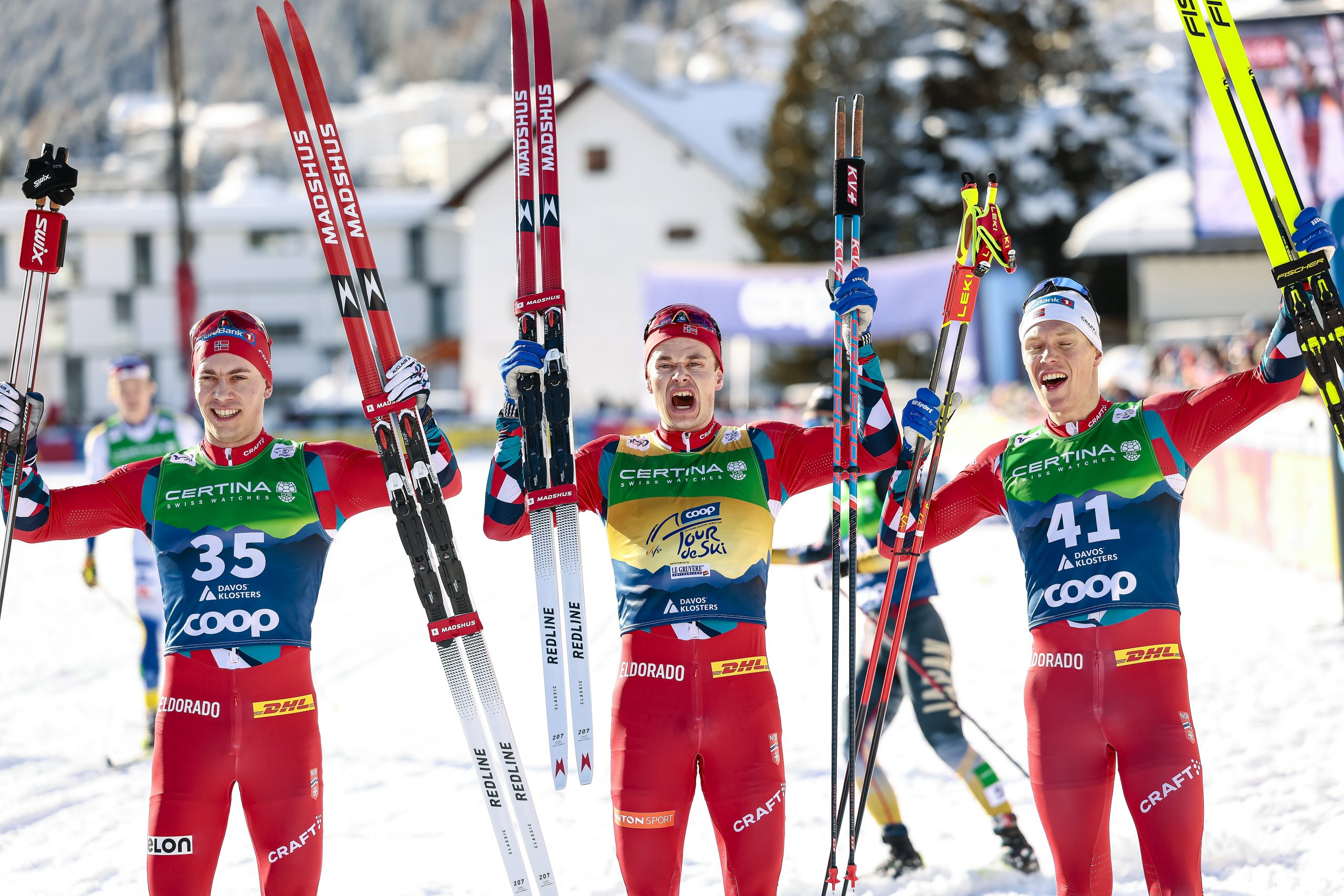
Klaebo covered the 10 k classic and 10 k freestyle in 48:41.8, edging teammate Harald Oestberg Amundsen by 0.7 seconds and Martin Loewstroem Nyenget by 0.8 seconds in a Norwegian podium sweep. The victory extended one of the most remarkable streaks in modern cross-country skiing and tightened his grip on the overall standings and, maybe more importantly for the remaining season-long narrative, extended his lead in the FIS distance ranking for the Distance Crystal Globe.
The race was familiar and predictable, with Nyenget driving much of the pace, Amundsen staying close, and Klaebo remaining measured in the pack. When the decisive move came in the final sprint, Klaebo, once again, not only had the answer, but made it look easy.
“This was a tough one,” Klaebo graciously said on the FIS broadcast after the race. “I think Martin was very strong today. I think he was in the front almost for 20 k.”
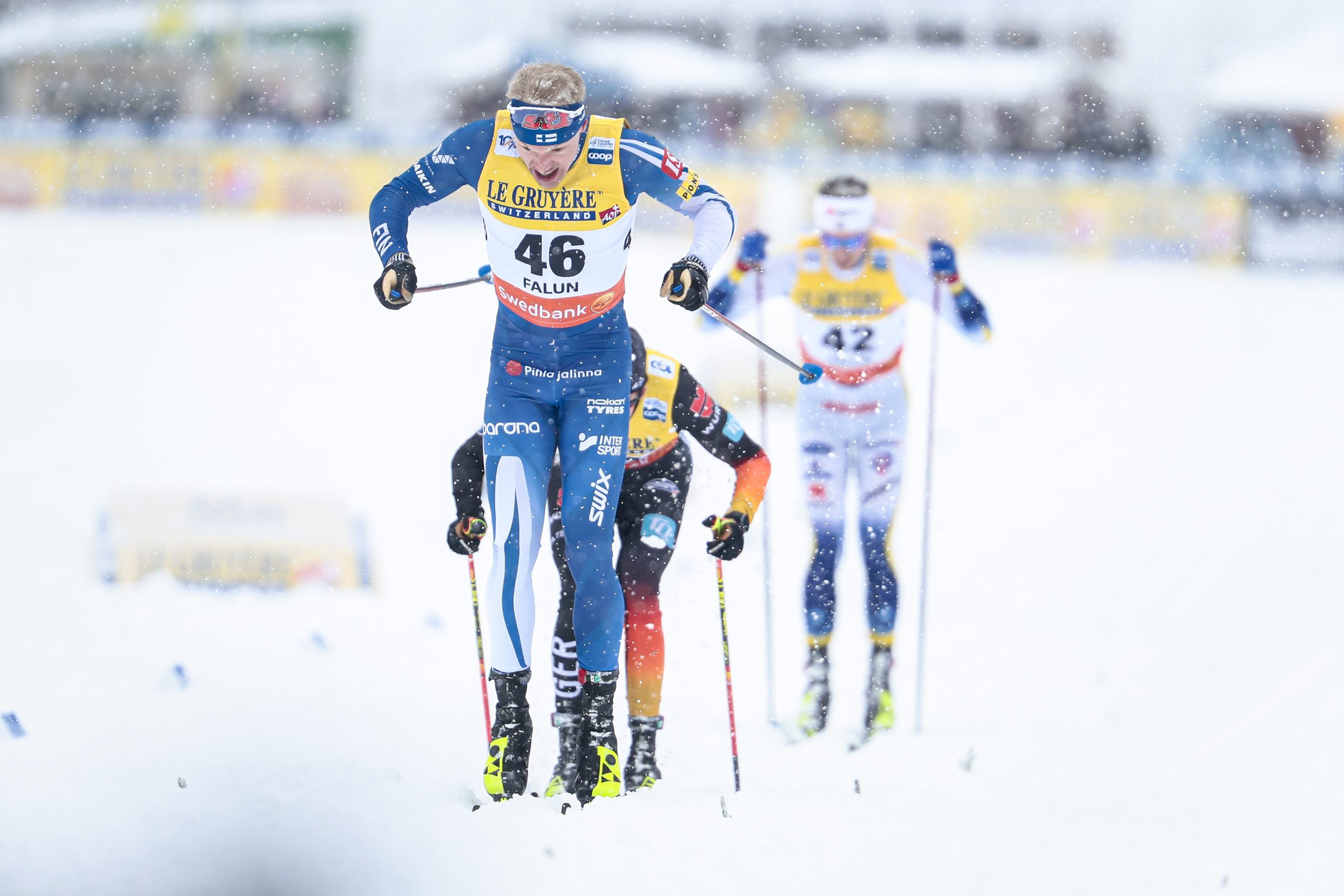
Martin Loewstroem Nyenget (NOR) leads, Andreas Fjorden Ree (NOR), Johannes Hoesflot Klaebo (NOR), Harald Oestberg Amundsen (NOR), and the rest of the field at a frenzied pace at the beginning of the Men’s 20 k Skiathlon in Falun, Sweden. (Photo: Thibaut/NordicFocus)
Classic Leg: Bonus points that created a breakaway
The men opened with three laps of the 3.4-kilometer red course, climbing the Mini Mördarbacken each time. Conditions sat just above freezing, with fresh snow complicating the classic wax call. Athletes chose between traditional kick wax and zero-skis, the latter relying on a texture sanded into a softer base material underfoot.
The pace was honest from the gun. At 5.4 kilometers, where bonus World Cup points were on offer, Nyenget and Klaebo pushed hard, with Klaebo claiming the maximum 15 bonus points, followed by Nyenget and Amundsen. That acceleration fractured the field.
A lead group of Norwegians formed with Nyenget, Amundsen, Klaebo, and Andreas Fjorden Ree. Arsi Ruuskanen of Finland and Savelii Korostelew, competing as a neutral athlete, also managed to maintain contact. Behind them, a gap had opened to a chase pack led by American Gus Schumacher.
By the end of the classic leg, the leaders had established a gap that would prove decisive.
Martin Loewstroem Nyenget (NOR) continued to set a fast pace at the front of the Men’s Skiathlon. (Photo: Authamayou/NordicFocus)
The Exchange and the Mördarbacken
Transitions in a Skiathlon are rarely glamorous or decisive, but a skier can lose contact with the lead if they don’t stay calm. Amundsen executed a clean ski exchange and briefly looked poised to dictate terms once the field switched to the blue 5-kilometer skate loop.
That loop includes the full Mördarbacken, a long, layered climb that television struggles to do justice. The ascent, which parallels the ski jumping landing hill, builds in segments, steepening before easing slightly when it cuts across the slope, then rising again one last time. It is not just a memorable climb in name, but once you have skied it, you will never forget the ‘Murder Hill.’
Nyenget continued to press the pace up front. Klaebo, as he often does, sat tucked in, attentive and measured.
On the first lap of the skate course, the lead group remained six, with the four Norwegians, Ruuskanen, and Korostelew. By the second ascent of Mördarbacken, it was effectively a three-Norwegian affair with Korostelew, Ree, and Ruuskanen fading slightly and fighting to limit losses and eventually finishing fourth, fifth, and sixth, respectively.
Behind them, the chase pack raced for seventh.
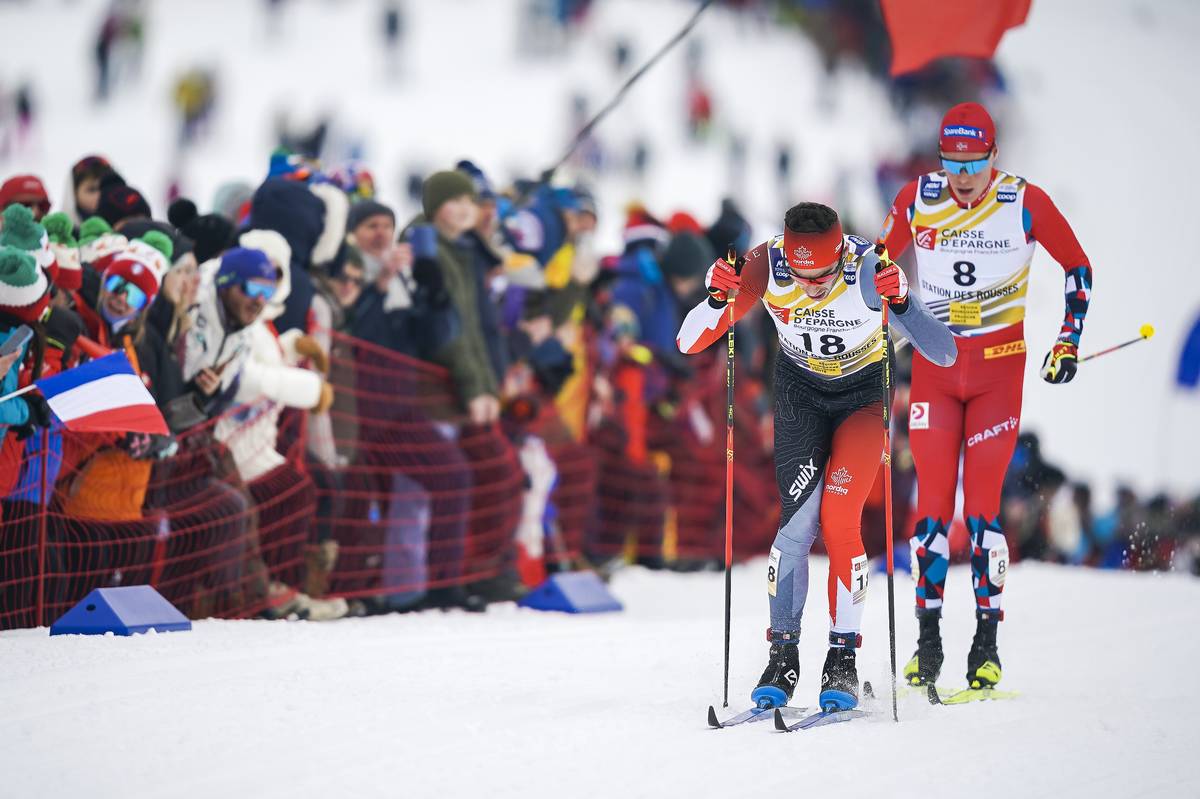
Martin Loewstroem Nyenget (NOR), Johannes Hoesflot Klaebo (NOR), and Harald Oestberg Amundsen (NOR), (l-r) crest the second to last climb. (Photo: Thibaut/NordicFocus)
The Finish
With less than a kilometer remaining, the three Norwegians — Klaebo, Amundsen, and Nyenget — remained locked together. Nyenget, who historically has the least sprint speed, had done the bulk of the visible work, setting the tempo on both classic and skate sections.
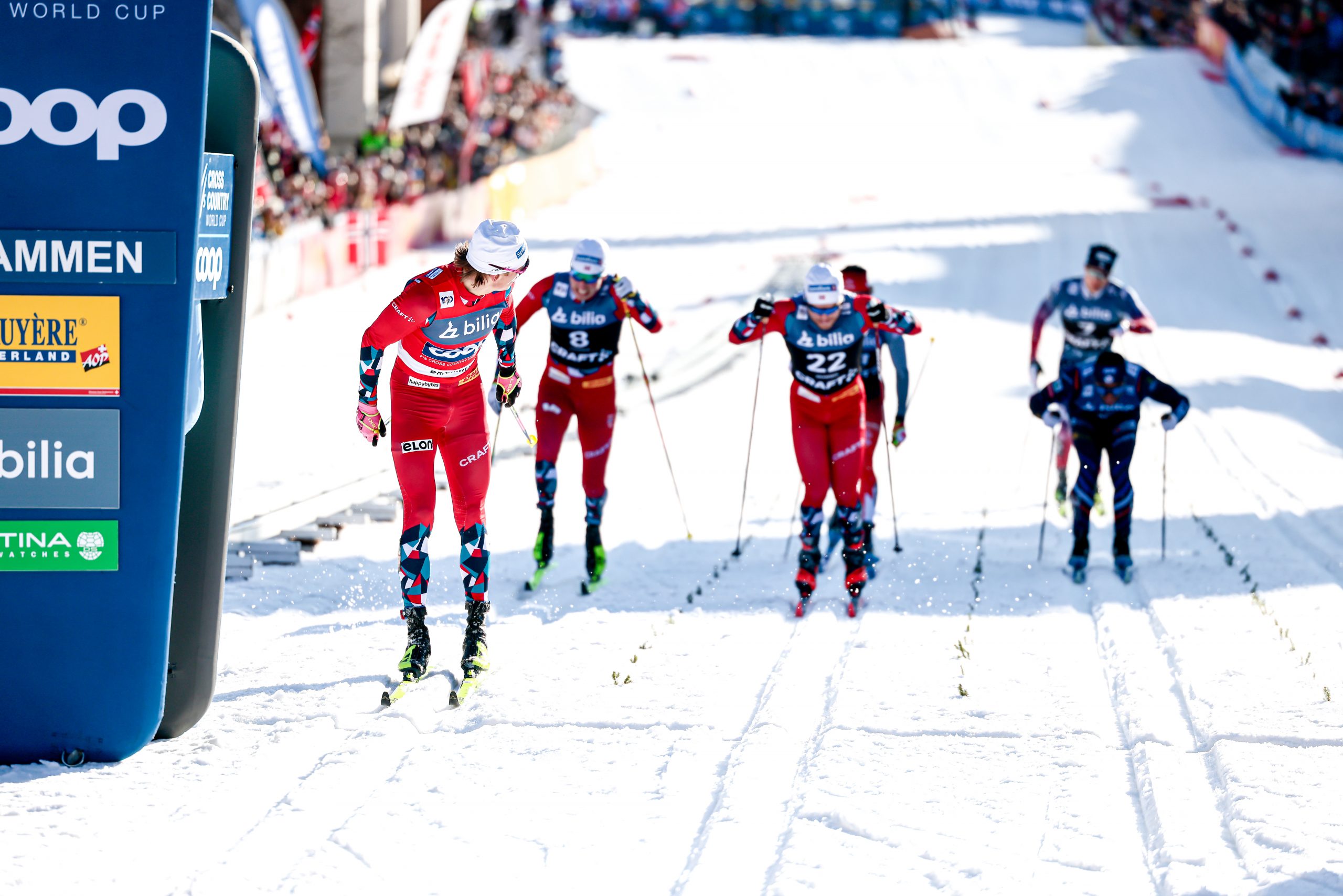
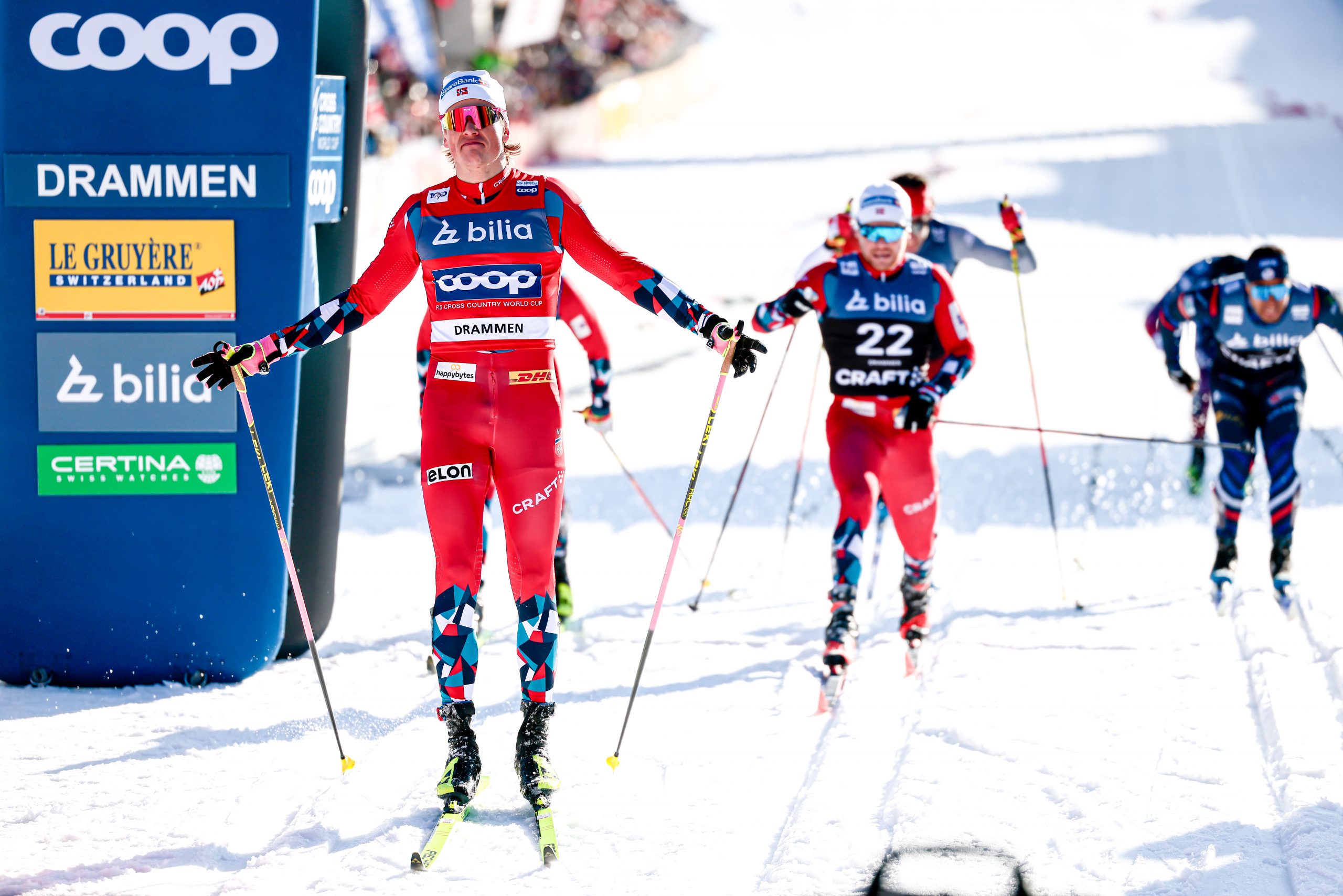
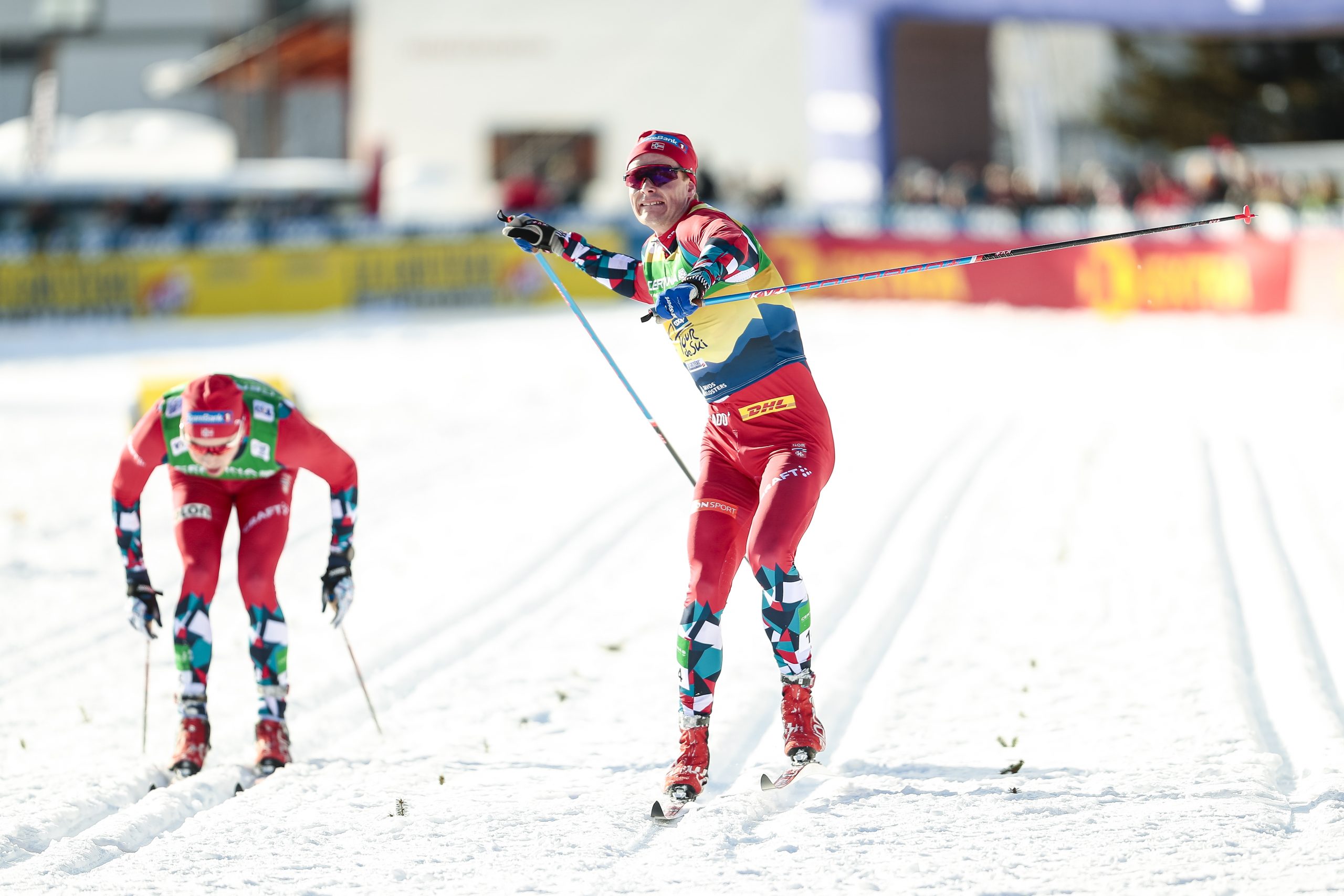
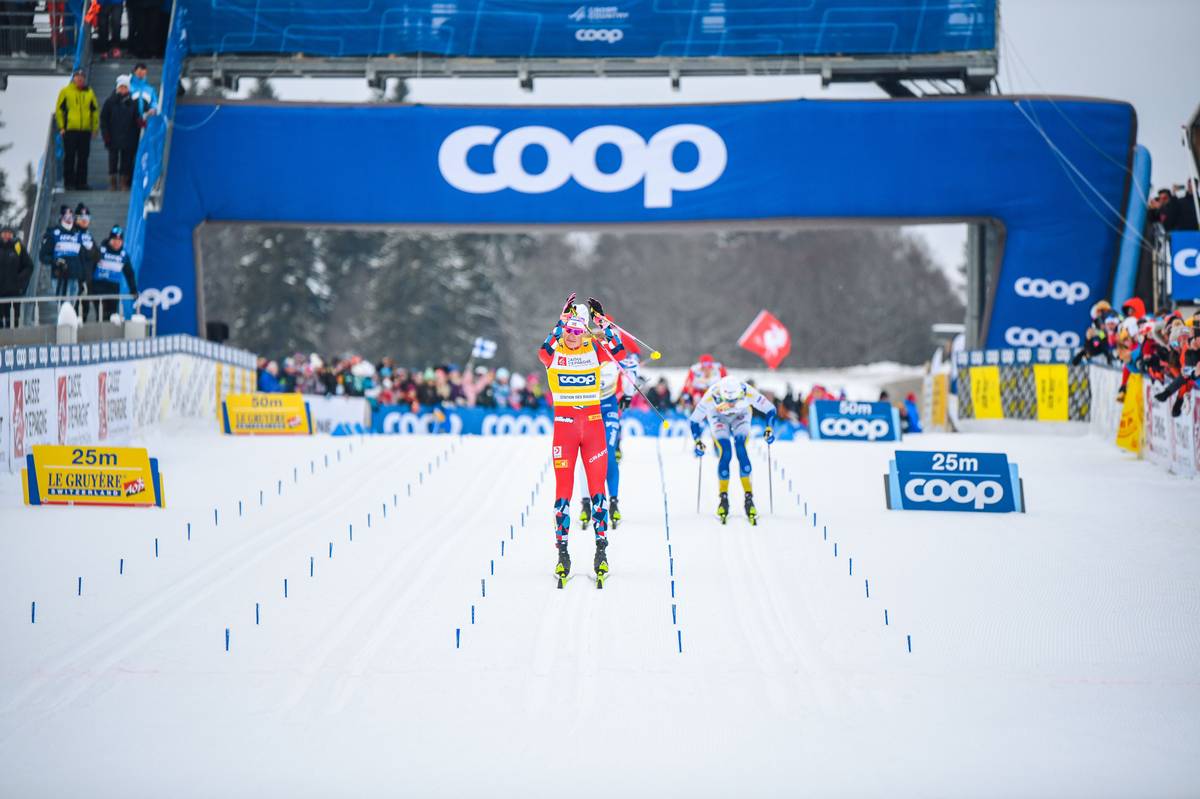
At the top of the final climb before descending into the stadium, the trio jockeyed for position, no one wanting to lead only to be overtaken by those in the draft. Nyenget took the lead, but was predictably passed by Klaebo on the far side of the stadium, and at the line, it unfolded as it so often does, Klaebo easing up to wave to the crowd with Amundsen outsprinting Nyenget behind him.
“It was very hard,” Klaebo said during his post-race interview with FIS on the broadcast. “But at the end, I managed to keep up with [Nyenget] and managed to do a good last sprint at the end.”
The margins were small. The pattern was not.
Klaebo now has 12 consecutive victories across World Cup and Olympic competition. The last race he entered without winning was the final climb of the Tour de Ski, where he managed his effort to secure the overall title rather than contest the stage.
“To be honest, I don’t think I have a goal anymore for this season,” he said. “I think the main goal is completed, and now I’m just going to enjoy the last races and see how it goes.”
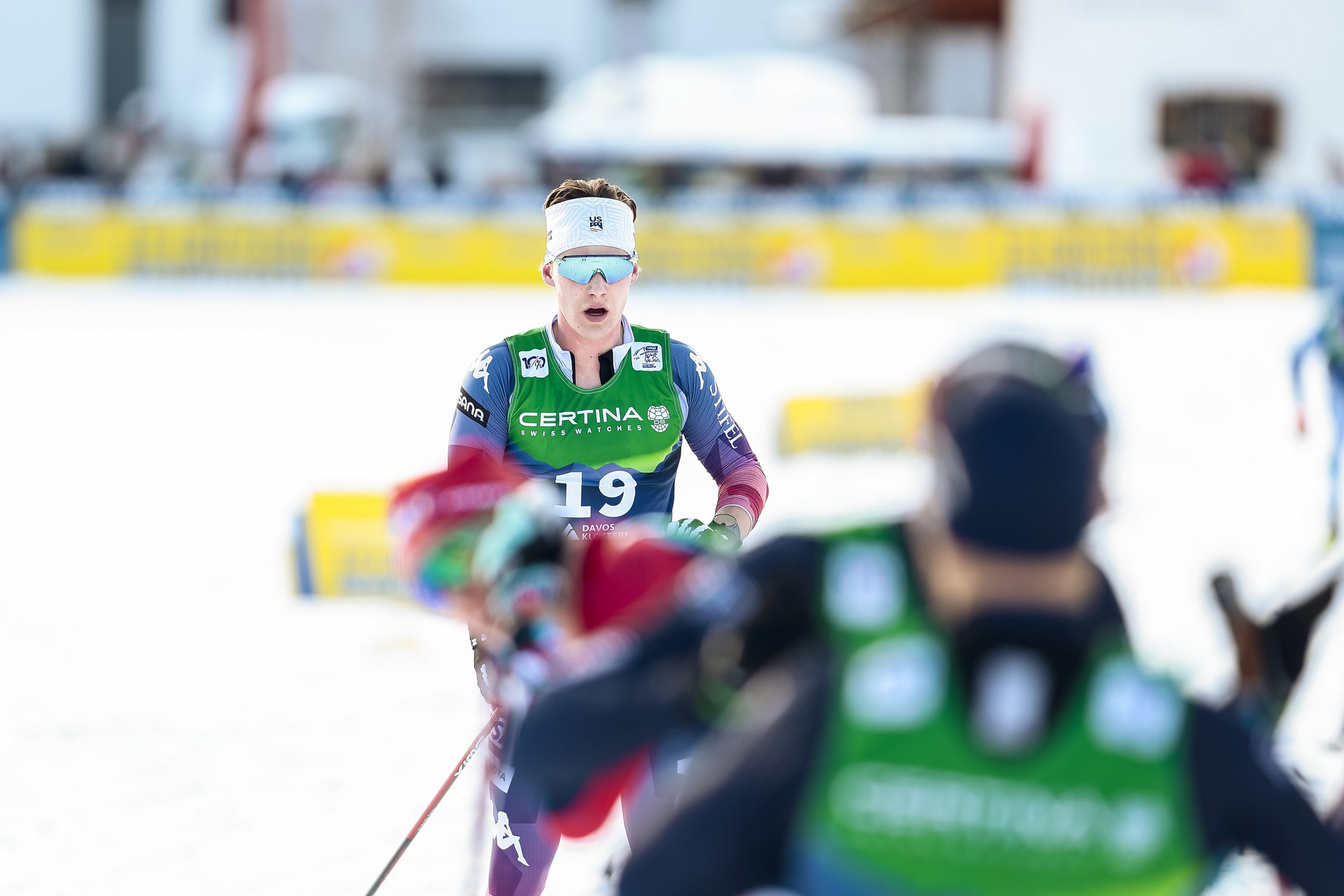
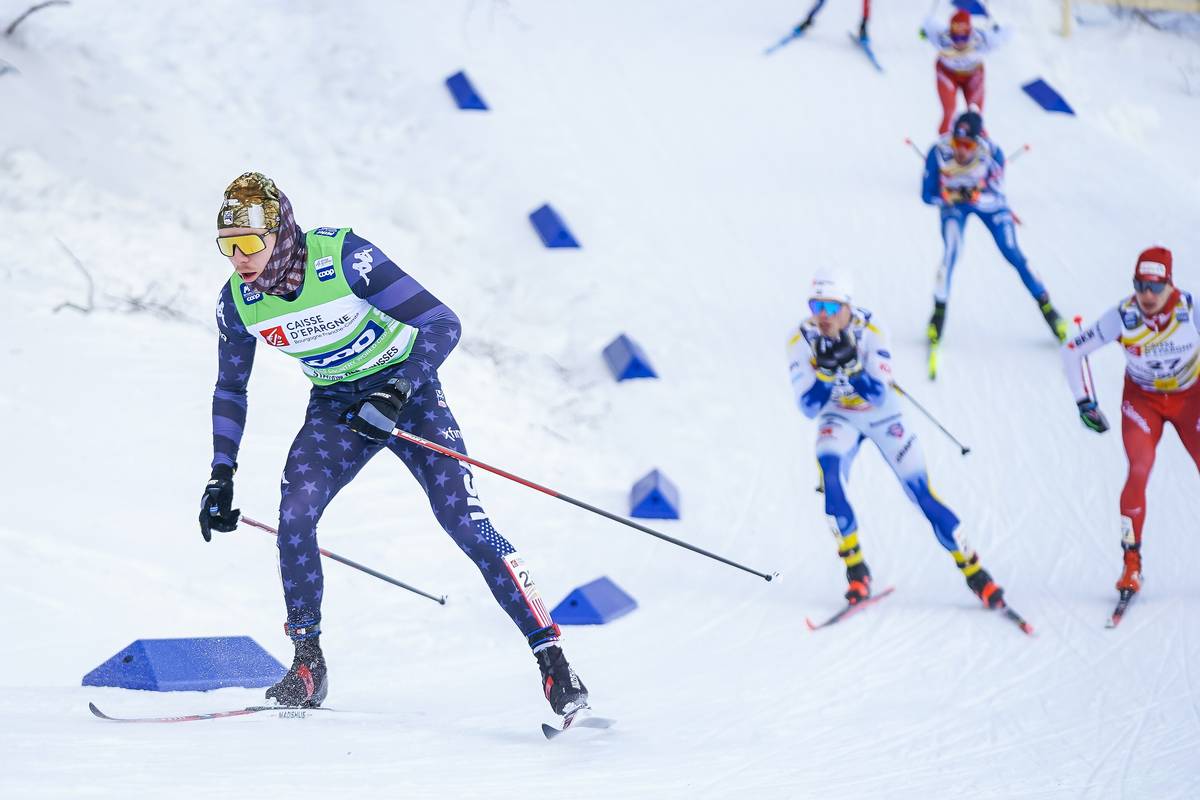
Gus Schumacher (USA) seemed to do the majority of the work at the front of the chase pack. (Photo: Authamayou/NordicFocus)
Schumacher: Fast Skis, Hard Hills
Gus Schumacher finished seventh in 49:38.6, 56.8 seconds behind Klaebo and spent much of the day managing a gap that opened during the classic leg and never fully came back.
The decisive acceleration came when the Norwegians lifted the tempo in pursuit of bonus points. Schumacher felt it immediately.
“In the classic, when it got fast, my kick was not great, so it was hard to fight for anything,” he said. “I was kind of just getting up the hills, but the pace was fast the whole time.”
He believed the separation was coming regardless.
“I think that gap was going to open at some point, no matter what,” he said. “Just because of how they were skiing from the start, mostly Nyenget, I think.”
Schumacher was on zero skis for the classic portion.
“I was on zeros. I think most people were on zeros,” he said. “Some people looked good, and I don’t know, there’s some variation there for sure.”
On the flats, he felt competitive.
“The gliding sections were great for me. My skis were really fast,” he said. “But the hills were tough.”
After the exchange, Schumacher exited the stadium aggressively and led the chase group for stretches on the first lap of the skate course. The leaders, however, continued to gain time on the full ascent of Mördarbacken.
Asked to describe the climb, Schumacher was more measured than dramatic.
“Honestly, compared to a lot of the other climbs they do, I feel like it’s not horrible,” he said. “I enjoy it partly because it’s not insanely long and it’s got some steps to it.”
That does not mean it is easy.
“It definitely climbs pretty far and has some steep parts,” he said. “But as far as big climbs go, that’s one of my faves.”
What does it demand?
“Same as other climbs,” he said. “Just fitness, technique, poise… the whole deal.”
Kevin Bolger (USA) during the classic leg, on his way to 36th place on the day. (Photo: Authamayou/NordicFocus)
Bolger: Boxed In Early, Fighting Back Late
Kevin Bolger finished 36th in 51:12.8, but his race was shaped early.
“It’s always hard to feel the pace when you start mid to back of the field,” Bolger wrote in an email afterward. “I’ve always tried to just relax, let the stringing out happen, and take the gaps where they form and make some jumps.”
He later learned from Gus Schumacher that the leaders had opened aggressively from the gun.
“I heard they started quite hard,” Bolger said. “So I think it was just a hot pace from the start and things just naturally spread out.”
For Bolger, the defining moment came within the first lap of the classic leg.
“Unfortunately, I got stuck behind Andrew Musgrave and went from mid pack to last after the first lap,” he said. “So it was a lot of work to catch back up after that.”
In a Skiathlon, that kind of early compression can cost dearly. Once the field stretches, passing becomes energy-intensive, and the leaders ease the pace.
The waxing decision, at least, felt clear.
“Waking up and seeing the fresh snow and the temperature around zero, it was clear it was going to be zeros,” Bolger said. “But you never know what the techs are mixing up in the truck. As you run out to the start, you look around to see what other people have under their skis.”
Bolger chose zero skis and was confident in the call.
“I went with zeros, and I was very happy with that decision,” he said. “Tim Baucom and I did some good testing and landed on zeros because they were running the best for me, and I was super happy with that.”
By the time the race shifted to the skate leg, the front group was already out of reach. Still, Bolger felt he had something left.
“I was really happy with my classic leg,” he said. “Even with getting stuck early and having to work to catch back up, finishing that classic leg with the energy I had, I knew I could put together a good skate.”
The full Mördarbacken climb on the blue loop remained the critical point.
“I think everyone knows when that massive climb is in the mix, that’s a very critical part of the course and a tipping point for a lot of people,” Bolger said. “If I can get up that hill with the group, I’m in. Once there’s separation, the chances of that coming back are small.”
He described the climb bluntly.
“She starts pretty gradually, and you feel confident at the bottom,” he wrote. “But she turns boys into men real quick, or men into boys quick at the top.”
In soft conditions, with lactate building, the final pitch can expose anyone.
“It’s hard to keep the legs moving when the lactate’s flowing,” he said. “It’s really hard to describe it, but that’s the best way to say it.”
JC Schoonmaker (USA) finding joy in the distance racing as he builds fitness and experience with the longer races. (Photo: Thibaut/NordicFocus)
Schoonmaker: Finding Value in the Distance
JC Schoonmaker finished 58th in 52:40.4, but the placement did not tell the full story of his day.
“The longer distance was pretty tough, but also fun to do that kind of race again,” Schoonmaker wrote afterward. “Even though it was a tough day and not my best race, I find a lot more enjoyment in a 20 k like that, where I’m 60th or whatever, than a sprint qualifier where I’m 35th. Cool to push yourself and ski in a pack.”
Falun’s Skiathlon rewards positioning and sustained pace more than sharp accelerations. For Schoonmaker, the takeaway was direct.
“Today shows me that I probably need to have a bit more pace to be competitive in these longer races,” he said. “Just overall need to be fitter and stronger than I am right now.”
He felt competitive through the classic leg, especially in tricky waxing conditions hovering around freezing.
“The conditions were a bit tricky for sure,” he said. “Whenever zeroes are in the mix as well as wax, it can be a little stressful.”
Schoonmaker chose kick wax rather than zero skis, a minority decision in the field.
“I ended up going on wax, and I think I was probably one of the only guys in the field to do that, so I was a bit nervous at the start,” he said. “But they worked great for me, and I think I made the right call.”
The transition to skate proved costly.
“I felt more competitive in the classic leg, had a bit of a blow up as soon as we switched to skating, and found my flow after a bit, but just lost too much time right after the transition there,” he said.
Then came the full Mördarbacken climb, twice.
“The Mördarbacken is a tough one, I think mostly because it’s just so long,” Schoonmaker said. “It has a lot of grade fluctuations, which I think is cool in a hill and a bit of a grind, but I like the way it skis.”
Other American Finishers:
Hunter Wonders – 47th place
Zanden McMullen – 61st place
Antoine Cyr (CAN) on his way to a top ten. (Photo: Authamayou/NordicFocus)
Canada: Cyr Inside the Top Ten
Antoine Cyr led the Canadian contingent, finishing 10th. It was a controlled race from Cyr, who held position through the classic leg and limited losses on the climbs during the skate.
Other Canadian Finishers:
Olivier Leveille – 53rd place
Remi Drolet – 54th place
Max Hollmann – 55th place
Sasha Masson – 66th place
Johannes Hoesflot Klaebo (NOR) charges for the win once again at the end of the Men’s Skiathlon in Falun, Sweden. (Photo: Authamayou/NordicFocus)
The Larger Arc
Falun is more than just another stop as it will host the 2027 World Championships. It is also a venue that rewards discipline. The gradual terrain away from the stadium invites packs, and the big climbs around the ski jumping hill expose any fitness weaknesses.
For Klaebo, it was another example of restraint followed by precision.
He leads the overall standings. He leads the sprint standings. The distance standings remain mathematically contested, but days like this narrow the space for drama as we move towards the final races.
After sweeping the Olympics, one might have expected a pause, yet there has not been one.
In Falun, the snow was fresh, the wax calls uncertain, and the climbs unforgiving. The result, however, was familiar.
And with three weeks remaining before the World Cup finale in Lake Placid, what now remains is not a question of whether Klaebo has delivered a historic season, but how complete it might become.
Feature stories like this one take time, access, and care to produce. If you value thoughtful storytelling and independent ski journalism, please consider becoming a Voluntary Subscriber. Your support directly fuels the work we do to cover the people, places, and moments that make our sport special.
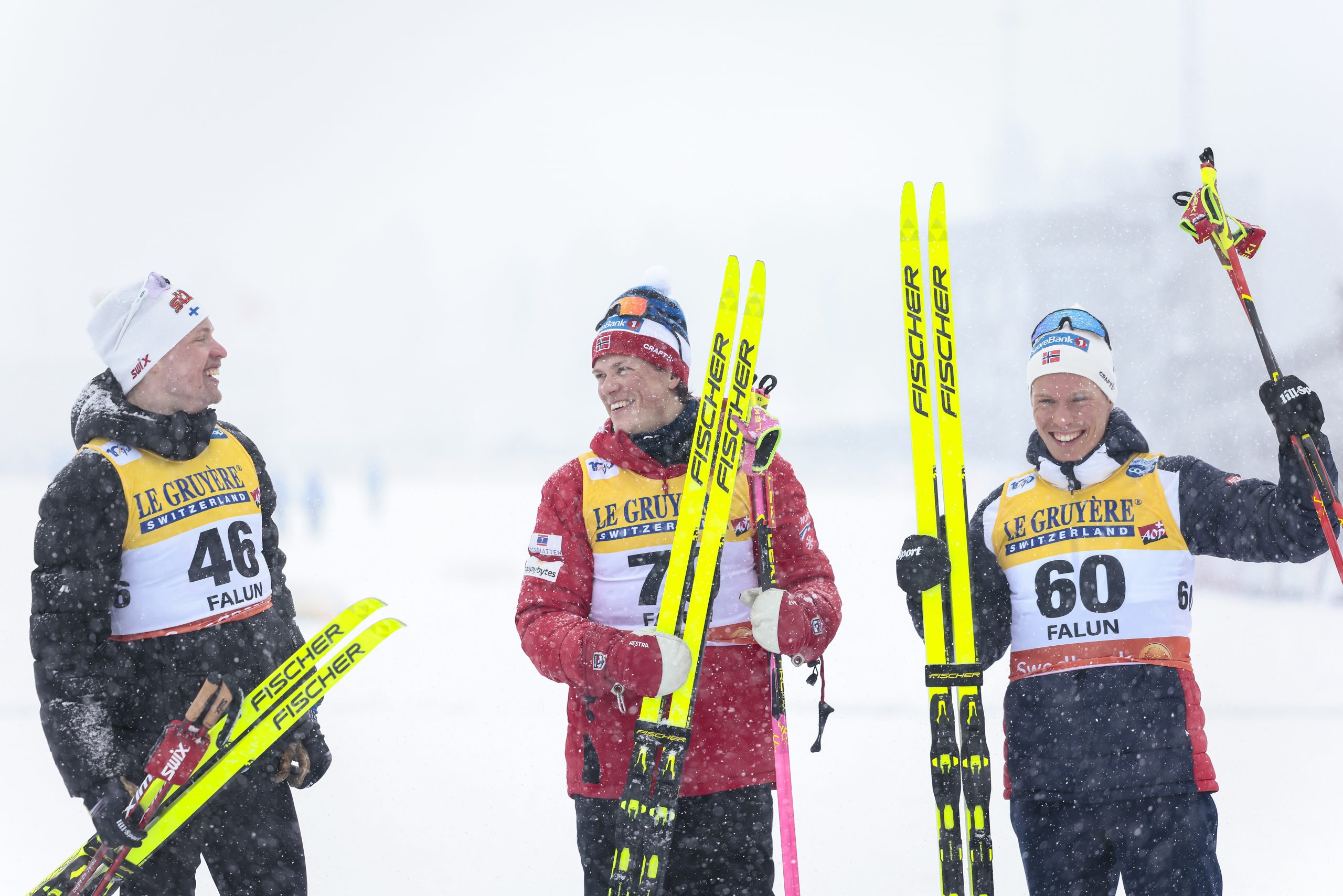
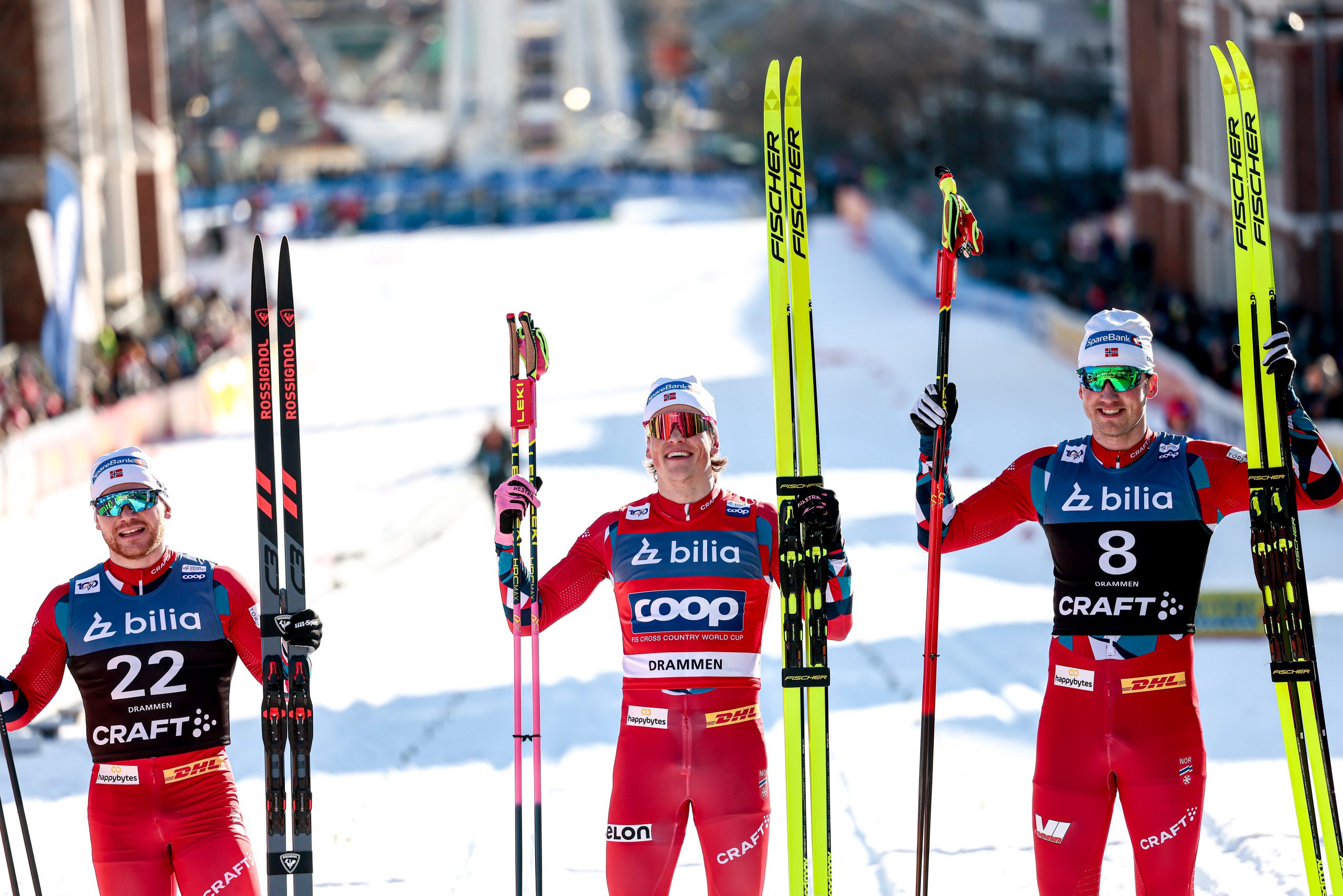
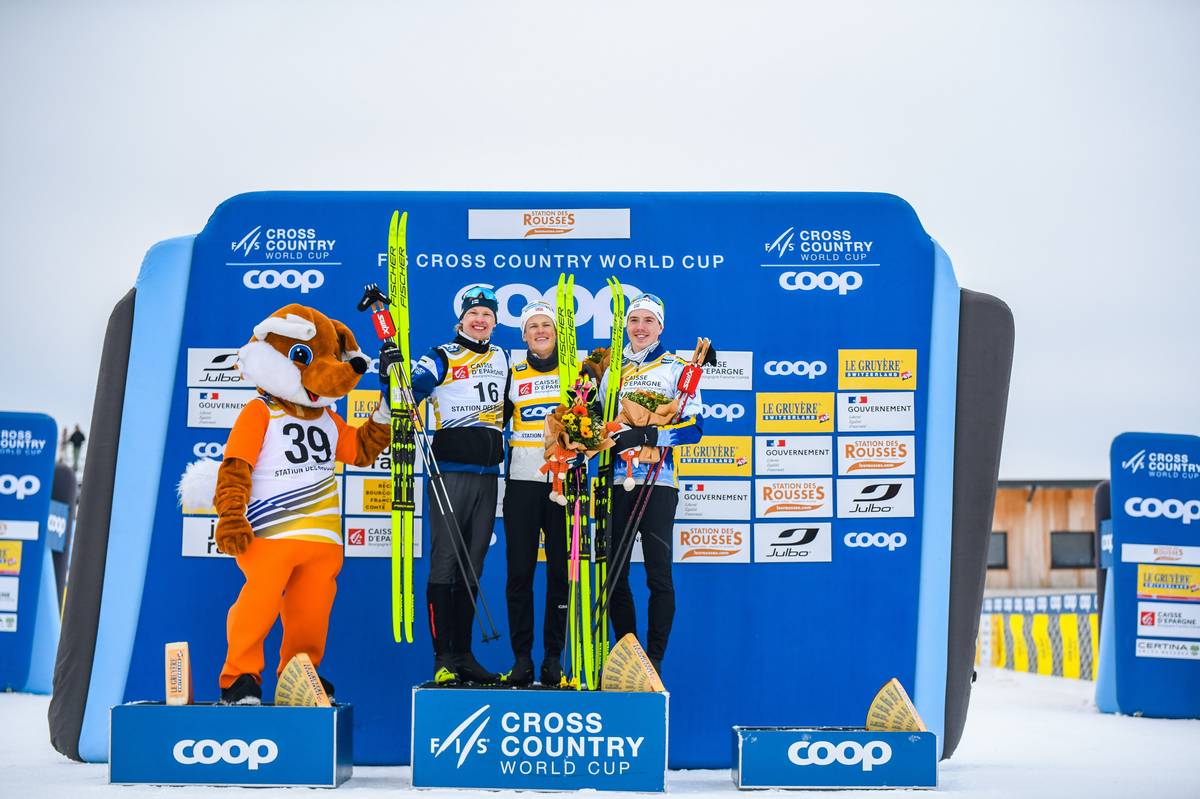
Norwegians Harald Oestberg Amundsen, Johannes Hoesflot Klaebo, and Martin Loewstroem Nyenget (l-r) share the Men’s 20 k Skiathlon podium in Falun, Sweden. (Photo: Authamayou/NordicFocus)
We’ll keep it short and sweet: Here’s a recap of the men’s 50 k. It was a fun race to watch and left us with a lot to discuss.
We’ll be back after Sunday’s race. Reach us at devon[at]fasterskier.com and nat[at]fasterskier.com. We’re really grateful for all the support during the Olympics — thanks for notes and encouragement.
A reminder: This is a homegrown podcast done by two guys working long hours and late nights. We’re also paying real money to be here in Italy. If you can, support the show and FasterSkier’s ongoing coverage with a voluntary membership. We’re also offering a bonus during the Olympics: a WhatsApp group with notes on Nat’s experiences in Italy, the food he’s eating, interview transcripts and more.
Send nat[at]northernjournal[dot]com a confirmation of your voluntary membership and the number he should use for WhatsApp and we’ll get you signed up. You can also Venmo him directly at @nat-herz if a membership isn’t for you. We’re suggesting a minimum of $10, but we also won’t turn anyone away who wants to join because of an inability to pay.
Help Support Our Olympic Coverage!
FasterSkier will have our own Nat Herz on the ground at the Olympics, which, to be honest, is a very big financial lift for us. If you value the thoughtful work and access FasterSkier provides at championships like this one, please consider becoming a Voluntary Subscriber. Your support directly fuels the work we do to cover the people, places, and moments that make our sport special.
This article was made possible through the generous support of our voluntary subscribers who have helped put our Nat Herz on the ground at the Olympics. If you value coverage like this, please support FasterSkier with a voluntary subscription.
Martin Loewstroem Nyenget (NOR #3) and Emil Iversen (NOR #4) lead during the opening kilometers of the Men’s Olympic 50 k in Tesero, Italy. (Photo: Barbieri/NordicFocus)
TESERO, ITALY — Sprint races can be dazzling, relay legs can be heroic, but the 50 k, especially classic, is where cross-country skiing gets carved into stone. The 50 k Classic turns strength, technique, and endurance into history, myth, and lore.
On Saturday afternoon in Val di Fiemme, Johannes Hoesflot Klaebo skied into that mythology.
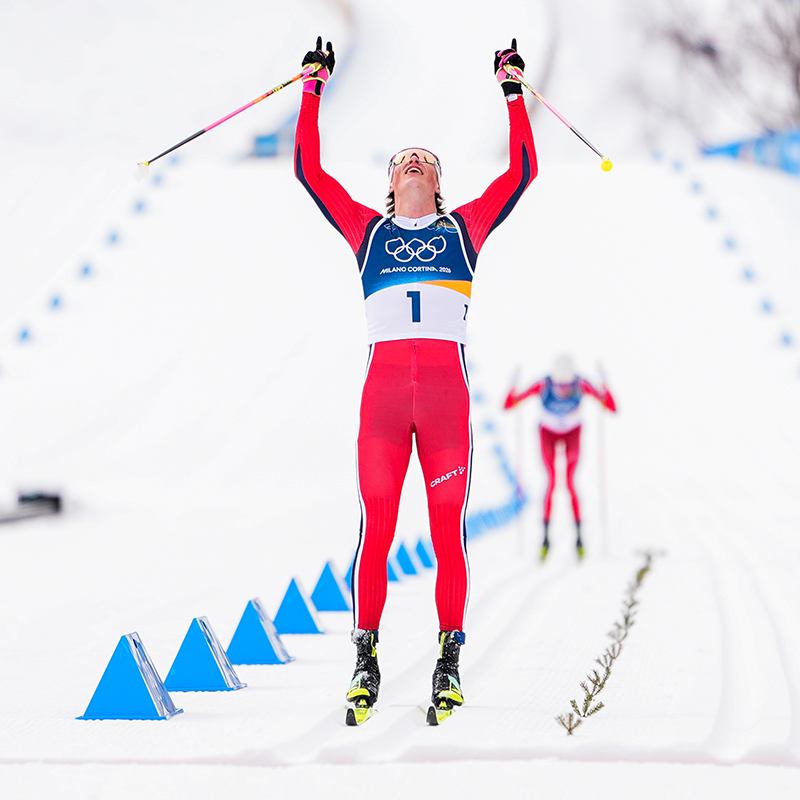
By winning the Olympic 50 k Classic, Klaebo completed a sweep of six gold medals at these Games — six events, six victories — something no Winter Olympian had ever done before. The sprint prodigy who has built his reputation on ferocity over 1.5 kilometers now owns the sport’s most traditional crown.
“I don’t think I even could have dreamed about this,” Klaebo said afterward.
“In Norway, they say you must win a 50 k to become a man.” Klaebo said, smiling in the post-race press conference, “I think I am that now.”
Johannes Hoesflot Klaebo (NOR) both the Olympic 50 k gold and a clean sweap of these games. (Photo: Vanzetta/NordicFocus)
Feeling the significance
The 50 k Classic is the most prestigious event in the sport with a long and storied history, and over 100 years of these championships, no one had ever put their skis on to start this race, trying to win an unprecedented 6th gold medal in one Olympic Games. But Klaebo had proven last year he could, winning six races at the World Championships on his home trails in Trondheim, Norway.
The historic attempt was larger than cross-country skiing, too. American long-track speed skater Eric Heiden won five gold medals at the 1980 Winter Olympics in Lake Placid, New York. Klaebo was attempting to do something no athlete had ever done before at the Winter Olympics.
Savelii Korostelev (AIN #12), Iivo Niskanen (FIN #7), Martin Loewstroem Nyenget (NOR #3), Johannes Hoesflot Klaebo (NOR #1), Harald Oestberg Amundsen (NOR #2), Emil Iversen (NOR #4), (l-r) during the early stages of the 50 k. (Photo: Vanzetta/NordicFocus)
The potential spoilers
Going into the race, the heavy favorites were without a doubt the Norwegians with Klaebo, his training partner Emil Iversen, Harald Oestberg Amundsen, and Martin Loewstroem Nyenget. However, others had to be considered as potential spoilers for the historic moment, among them, athletes on the French team, including Mathis Desloges, Hugo Lapalus, Victor Lovera, Finland’s Iivo Niskanen, American Gus Schumacher, and the Independent Neutral Athlete (AIN) Savelii Korostelev. Though it was a long shot, these other nations’ athletes could, potentially, battle for the win or at least a podium spot.
Johannes Hoesflot Klaebo (NOR), Emil Iversen (NOR), and Martin Loewstroem Nyenget (NOR), (l-r) turned the 50 k into a three-man race. (Photo: Vanzetta/NordicFocus)
The Shape of the Race
The Olympic course in Tesero is not subtle. Seven laps with relentless climbing. Among them, the featured hill, the Zorzi Climb, waits like a toll booth each time the skiers re-enter the stadium.
Heading into the race, there were 65 men on the start list, but Italy’s Federico Pellegrino, Finland’s Ristomatti Hakola, and America’s Ben Ogden all scratched.
Once the race started, the first lap went by without much drama, though the field began to stretch. As they entered the stadium after one loop, over 30 skiers were within 20 seconds of the lead. By the end of lap two, that front pack had reduced to 20 skiers within 23 seconds of the lead, and on lap three, things really began to take shape.
Early on in lap three, two favorites, Niskanen (FIN) and Amundsen (NOR), who had been at the front of the race, pulled out. The French favorites and American Schumacher also began to lose contact with the front-runners. Only Korostelev was able to maintain contact until even he could no longer keep up with the three top Norwegians.
Martin Loewstroem Nyenget (NOR) did much of the work at the front. (Photo: Vanzetta/NordicFocus)
By the middle of the race, there were three
By lap four, it was unmistakable: Nyenget, Iversen, and Klaebo were alone, three red suits moving in steady formation.
From the stadium, the mood was less frantic than historic, almost strangely calm.
“The sun shone down… as if God had ordained the great Klaebo, winning his six in a row… I mean, it really was a beautiful day,” said FasterSkier’s Nat Herz, who was on the ground in Tesero. “I think people were just pretty relaxed watching this three-man Norwegian time trial as it went around the course… These guys have the best technique, the best materials, the best skis, the best fitness, and they did exactly what they set out to do.”
The crowd was not roaring every lap. It was watching. Waiting.
“Nyenget and Klaebo definitely gave everyone a good show, and it was tense to see. Was Klaebo going to be able to do this incredible accomplishment?”
There was little theatrics in their separation from the field — no dramatic surge, no visible cracking. Just a grinding tempo that only they could sustain.
Even the question of ski exchanges became a collective calculation. While much of the field ducked into the pit lane for fresh skis after lap four, the Norwegians skied past the ski exchange zone each lap.
A Norwegian train. (Photo: Barbieri/NordicFocus)
“Martin made the choice of not changing skis,” Klaebo said. “Emil and I just followed because we didn’t want to gamble.”
In long races, fortune often hides in such decisions. The snow was changing; the sun had warmed the surface. Fresh skis could have been salvation or ruined a chance at gold.
“I think it was the right decision,” Klaebo said in the press conference afterwards about the three Norwegians not switching skis.
Johannes Hoesflot Klaebo (NOR) makes history as he crosses the line of the Men’s 50 k Classic. (Photo: Barbieri/NordicFocus)
Saving Something for the Hill
Through lap six, Nyenget did much of the visible work. Klaebo shadowed him, conserving every drop of energy he could.
“I wish I was able to help them a little bit,” he said. “But when they asked me if I could go in front, I said no, because I was too tired.”
It was not false modesty, Klaebo’s Olympic schedule had been more than the other two and fifty kilometers taxes even those who make winning look inevitable.
“My plan today was just try to save as much energy as possible,” he said. “I needed to play on my strength… the last few hundred meters.”
On the final lap, Klaebo came to the front, as if to take measure of the other two Norwegians, but in doing so, he created a gap on Iversen. Was the race for gold now just down to two? The answer was yes, as the rubber band had clearly been snapped for Iversen, who began to drift backwards from the leading pair.
The decisive moment arrived where many had expected it would: on the Zorzi Climb. On the preceding descent, Klaebo rose from his tuck, adjusted his pole straps, and as they exited the sweeping left-hand turn at the base of the final climb, Klaebo pulled alongside Nyenget before beginning to accelerate. Not explosively — this was the closing act of a two-hour effort — but with the control of someone who knew exactly how much he had left.
Nyenget followed for a few strides. Then he did not.
Behind them, Iversen skied alone to bronze, sealing a Norwegian sweep.
A moment of reflection at the finish for Johannes Hoesflot Klaebo (NOR). (Photo: Barbieri/NordicFocus)
A Private Moment
At the finish, Klaebo crossed the line and sat down alone on the snow. There was no theatrical collapse, only a quiet reckoning.
“For me, it’s the best feeling, the last 200 meters before I cross the finish line knowing that I’m going to win,” he said.
This Olympics, he suggested, had been built on deliberate choices, in training, in team structure, in how he and his father organized his life around the sport.
“He has probably sacrificed as much as I have done,” Klaebo said of his father.
Sacrifice is not his preferred word. He calls them choices. But the effect is unmistakable: a skier who once seemed specialized has become complete.
Emil Iversen (NOR) enjoys his bronze medal and the sunshine after a lot of hard work to get back to the front of the sport and this moment. (Photo: Vanzetta/NordicFocus)
Racing in His Time
For the rest of the field, competing in the Klaebo era carries a strange duality, almost a frustration braided with admiration.
“Of course, a bit,” Nyenget said when asked whether it is annoying to race alongside him.
“But it’s more motivating as well. [Klaebo] is pushing us to be better every day.”
Iversen echoed the sentiment.
“I think it’s just fun to compete with the best skier ever,” he said.
Across these two weeks, Klaebo has made dominance look procedural, yet his rivals know the margins are real, the preparation exhaustive. He bristles at the idea that this is inevitable.
“I like myself way better when I’m winning than when I’m losing,” he said.
Gus Schumacher (USA) gave everything he had to this sixth race at these Winter Olympic Games. (Photo: Vanzetta/NordicFocus)
The American Effort
For the United States, the 50 k carried a different emotional weight.
Gus Schumacher, who had spent the early races in these Games chasing form and momentum before winning silver in the Team Sprint with Ben Ogden, finished 13th. He described the psychological toll of racing in every event.
“There’s been a pretty heavy mental load the last two weeks,” Schumacher said. “If I’ve got a flame, it was ripping a couple days ago… halfway through the race, it felt like a little candle.”
He has raced all six events, too, though with different outcomes.
“I really don’t understand how you can ski 50 k so well and also sprint so fast,” Schumacher said of Klaebo. “I don’t really feel like there’s another athlete in the world that can compare to that scope of athleticism.”
Hunter Wonders (USA) also pushed his body to its limits in the race. (Photo: Vanzetta/NordicFocus)
Hunter Wonders placed 35th and spoke candidly about the physical reckoning.
“I’m alive barely,” Wonders said. “I didn’t think I was gonna finish there for a little while.”
Cramps seized him in waves — hips, hamstrings, forearms — and yet he finished.
“I completed a race that four years ago I was really chomping at the bit to be able to compete in,” he said.
Antoine Cyr (CAN) “gave everything” to the final men’s race in the Olympics. (Photo: Barbieri/NordicFocus)
The Canadian Outcome
Canada placed two men inside the top 20.
Antoine Cyr finished 11th, just outside the top 10 he had targeted.
“I gave it everything,” Cyr said. “It’s such a hard course.”
He pointed to the Zorzi Climb and the long drag back to the high point of the course after coming through the stadium, efforts that stretch toward six minutes, rare in modern championship layouts.
“It’s really tough,” he said.
Thomas Stephen finished 17th, steady and controlled in conditions that demanded patience. While he did not step into the medal conversation, his result underscored the depth Canada has built in distance racing and marks what is possible in future years.
Martin Loewstroem Nyenget (NOR), Johannes Hoesflot Klaebo (NOR), and Emil Iversen (NOR) (l-r) share the Milano-Cortina Olympic Winter Games 50 k Classic podium in Tesero, Italy. (Photo: Barbieri/NordicFocus)
What Remains
Klaebo plans to rest for a few weeks before racing again in Lake Placid.
“That’s the plan,” he said.
There will be time later to measure what six-for-six means, how it reshapes record books, and how it reframes conversations about the greatest Winter Olympians. For now, it exists as a bright fact in the thin mountain air.
The 50 k endures because it asks the oldest question in endurance sport: what is left?
On Saturday, Johannes Hoesflot Klaebo had something left. Enough to attack on the final climb once more. Enough to once again finish alone down the final meters. Enough to make something mythical and historic feel ordinary and predictable.
FasterSkier will have our own Nat Herz on the ground at the Olympics, which, to be honest, is a very big financial lift for us. If you value the thoughtful work and access FasterSkier provides at championships like this one, please consider becoming a Voluntary Subscriber. Your support directly fuels the work we do to cover the people, places, and moments that make our sport special.
Emil Iversen (NOR), Johannes Hoesflot Klaebo (NOR), and Martin Loewstroem Nyenget (NOR) come through the stadium to the delight of the crowd. (Photo: Vanzetta/NordicFocus)
This coverage is made possible through the generous support of Marty and Kathy Hall and A Hall Mark of Excellence Award. To learn more about A Hall Mark of Excellence Award, or to learn how you can support FasterSkier’s coverage, please contact info@fasterskier.com.
Martin Loewstroem Nyenget (NOR) came back to World Cup racing, posting the fastest time in the 10 k Interval Start Classic in Oberhof (GER). (Photo: Authamayou/NordicFocus)
On Sunday morning in Oberhof, the snow had the kind of sheen that tells the truth before the clock ever does. It glittered under a clean winter sun, polished by a freeze–thaw cycle that left the tracks fast, brittle, and unforgiving. At 823 meters, tucked into the Thuringian Forest, the course looked generous from a distance—wide lanes, long sightlines—but it was the sort of generosity that disappears the moment a skier commits to a mistake. The margins here were not loud. They were sharp.
This was the men’s 10-kilometer Classic Interval Start, a format that does not tolerate theater. There would be no pack to hide in, no draft to borrow, no tactical stalemates to blame. Every thirty seconds, a skier pushed out of the start gate alone, carrying only his pacing plan, his skis, his poles, and whatever composure he had managed to preserve through an Olympic build that has been compressing time for months. Period Three had begun. The calendar was no longer abstract.
Classic skiing in these conditions demands restraint masquerading as confidence. The climbs are short but decisive; the downhills are technical enough that speed becomes a negotiation rather than a gift. Grip must be trusted without being tested. Push too hard too early, and the skis slide away beneath you; hesitate, and seconds vanish into the ice. It is possible—common, even—to ski very hard here and still ski poorly.
Iivo Niskanen (FIN) was formerly the king of the 15 k Classic and showed he is one of the best in the 10 k Classic in Oberhof (GER). (Photo: Authamayou/NordicFocus)
The interval start turns this dynamic inward. The course does not change for you, but your relationship to it does. You pass athletes who started ahead of you and are passed by those who did not. You hear split times shouted from the side of the trail—sometimes accurate, sometimes not—and you decide whether to believe them. In Oberhof, where artificial snow breaks down as the sun rises and the grooves lose their bite, the course becomes a moving target. Early starters gamble on freshness; later starters trade glide for information. No one gets everything.
Absent from the start list were some of the sport’s most reliable reference points. Norway’s biggest names were racing at home, their national championships pulling them away from this quiet, consequential weekend, or focused on a pre-Olympic training block. Their absence opened space on the results sheet, but not relief. If anything, it sharpened the test. Without familiar benchmarks, the race would be defined less by expectation than by execution.
The 10 k classic has become a strange distance in modern cross-country skiing—short enough to reward urgency, long enough to punish impatience. It asks skiers to operate just below the edge of recklessness and to stay there for more than twenty minutes. In Oberhof, that edge was particularly thin. The tracks shone. The corners demanded respect. The kind of mistake that costs half a second in softer snow could cost five places here.
Erik Valnes (NOR) on his way to third and another statement to the Norwegian Olympic selection committee in Oberhof (GER). (Photo: Authamayou/NordicFocus)
For the Americans, this was the last weekend considered in Olympic team deliberations, a fact everyone knew and no one needed to say out loud. The weight of it showed up not in desperation but in discipline. There were no grand gestures in the start lane. What mattered was whether an athlete could trust the work he had done and let the race unfold on its own terms.
One by one, skiers disappeared into the forest, double-poling through the opening flats before settling into the rhythm that classic skiing requires when it is done well: patient climbs, clean transitions, downhill speed carried without panic. The clock ticked. The sun climbed. The track began to change.
By the time the later starters reached the first split, the course had already started to tell its story. Early leaders came back. Conservative openings paid dividends. The race did not break open so much as it clarified itself, revealing who could manage the terrain without forcing it—and who could not.
In an interval start, there is a particular moment when the race stops being about possibility and becomes about reckoning. It arrives quietly. A skier hears that he is catching someone he should not be catching. Another learns that the pace he thought was safe is not. In Oberhof, that moment came late and all at once, when the day’s best classic skier finally aligned patience with power and turned control into separation.
By the finish, the gaps would look clean and decisive. They always do. But the truth of this race lived earlier, in the choices made on icy corners and rolling climbs, in the decision to ski smooth instead of merely hard. Oberhof did not demand brilliance. It demanded honesty.
Martin Loewstroem Nyenget (NOR) on his way to the win. (Photo: Reichert/NordicFocus)
A Course That Reveals Its Verdict Slowly
The first skiers through the opening kilometers set times that looked sharp but provisional, the kind that exist only until the course and the day reveal themselves. The early splits came quickly, then stalled. The ice underneath the tracks was still holding, but the sun was beginning to soften the surface just enough to punish excess force. The race was already sorting itself by feel rather than bravado.
Martin Loewstroem Nyenget (NOR) navigates the sugary snow in Oberhof (GER). (Photo: Authamayou/NordicFocus)
Nyenget’s Patience Turns Into Separation
When Martin Løwstrøm Nyenget finally entered the picture, it was without urgency. His opening lap was measured, almost quiet, the sort of start that invites doubt if one is inclined to look for it. But Nyenget had not come to Oberhof to prove speed in the first five kilometers. He had come to test something else.
“I hadn’t planned to open very hard,” Nyenget said afterward in an interview aired on the FIS World Cup broadcast. “I’ve been training really hard for the last four weeks, so I didn’t quite have the speed on the first lap. But as soon as I heard that I was catching people, I started to feel really strong, and I knew I had something extra for the day.”
The catching began gradually, then decisively. Where others tightened under the strain of the second lap, Nyenget loosened. His skiing did not change in form, only in intent. The double pole grew heavier, the transitions cleaner. On a course that demanded constant negotiation, he removed the argument.
By the final kilometers, the race had become unmistakable. Nyenget was no longer racing the field so much as confirming what the course had already suggested. He crossed the line alone, the margins behind him clear and earned, his victory built not on dominance but on patience applied at exactly the right moment.
“It’s fantastic to be back,” Nyenget said. “The longer I keep going in my career, the more fun I have racing. The training part isn’t always that fun anymore, so it’s great to be here in Oberhof with good conditions and really enjoy racing again.”
An American Throughline: Skiing Well, Not Just Hard
Behind him, the podium filled with familiar names and familiar styles — Iivo Niskanen (FIN +13.8) in second and Erik Valanes (NOR +14.5) in third — skiers who understand how to survive a day like this without surrendering it. The gaps were tight, the order decisive. It was the kind of race that leaves little room for argument afterward.
For the American men, the story unfolded less in places gained than in choices validated.
Zanden Mcmullen (USA) making one final statement to the US Olympic Team selection committee in Oberhof (GER). (Photo: Authamayou/NordicFocus)
McMullen Finds His Shape Again
Zanden McMullen arrived in Oberhof carrying momentum that had begun to take shape weeks earlier at U.S. Nationals. There, his skiing had looked settled again — confident without being rigid, aggressive without being rushed. In Oberhof, that trend continued.
“I feel like I’ve started to find myself again, which is really reassuring,” McMullen said. “I think I was fully capable of skiing like this earlier in the season, but I needed a little more racing and confidence under my belt. This weekend feels like the tip of the iceberg.”
His approach to the race was deliberate. Rather than forcing the issue early, McMullen allowed the course to come to him, focusing on terrain management rather than constant pressure.
“My goal today was just to ski well through the terrain of the entire course,” he said. “Earlier this season, when I felt like I needed to force a good result, I wasn’t skiing well — I was skiing very hard, but not well. Today I focused on skiing smooth and fast rather than just hard, and I think that really paid off.”
There were moments of vulnerability — a slight lapse near the end of the first lap — but McMullen recognized it in time to convert restraint into opportunity.
“I was able to use that extra energy to ski hard and fast through the second half of the race,” he said.
McMullen finished 18th, a result that read plainly on paper but carried deeper meaning inside an Olympic season defined by accumulation rather than singular peaks.
“I know I’ve done what I can,” he said. “I’m happy to be back where I left off last year before I got sick. Now I can shift my focus to preparation. Olympic qualification is just the first step. I have very big goals for the Games themselves.”
Hunter Wonders (USA) continued his 10 k Classic form he showed at US Nationals in Oberhof (GER). (Photo: Authamayou/NordicFocus)
Hunter Wonders and the Familiar Language of Classic Distance
For Hunter Wonders, Oberhof reinforced something that has been quietly consistent in his career: when the race is a classic distance interval start, the task tends to make sense. There is clarity in pacing, in grip management, in the slow accumulation of pressure rather than the sudden chaos of a sprint.
Wonders skied into the points again, backing up his showing from U.S. Nationals with another disciplined performance on snow that rewarded trust over impulse. In conditions where early aggression often came undone later, his race held together. The opening kilometers were controlled, the middle steady, the final lap about preservation rather than rescue.
That continuity mattered. In a field where seconds dissolved quickly into places, Wonders avoided the kind of oscillations that define fragile races. He neither chased the early benchmarks nor retreated from them. Instead, he stayed within a rhythm that allowed the course to do less damage than it did to many around him.
On a day when classic specialists quietly rose, Wonders looked like one — not flashy, not forced, but coherent from start to finish.
Luke Jager (USA) celebrated his birthday weekend in Oberhof (GER) with a top 30 in the 10 k Classic. (Photo: Authamayou/NordicFocus)
Luke Jager and the Discipline of Attention
A few minutes later, Luke Jager crossed the line inside the top 30, finishing a race that mirrored his own quiet trajectory. Though the calendar had marked it as his birthday weekend, the day itself passed without ceremony.
“My main goal was just to be fully immersed in the experience,” Jager said. “To focus on doing my best and skiing each section of the course as well as I could.”
On a course where margins evaporated quickly, that focus mattered.
“The margins were definitely thin, but they always seem to be on the World Cup these days,” he said. “It doesn’t really help to stress about that, so I try to keep my attention on what’s right in front of me, so that when I cross the finish line I can say I found as many of those little margins as I could.”
John Steel Hagenbuch (USA) striding his way to 52nd place. (Photo: Authamayou/NordicFocus)
John Steel Hagenbuch and the Cost of Precision
For John Steel Hagenbuch, Oberhof was less forgiving, finishing in 52nd place. Fast, icy tracks compress the margin for error until technique, pacing, and decision-making overlap completely. There is no room to separate them. When one slips, the others tend to follow.
Hagenbuch’s race never unraveled dramatically, but it never fully unlocked either. The speed was there in moments; the continuity was harder to hold. In an interval start, that can be enough to drift backward without a single obvious mistake to point to afterward.
Classic skiing on firm conditions is often less about what goes wrong than about what never quite arrives. A corner taken cautiously becomes a gap. A climb approached defensively compounds over kilometers. Oberhof exposed those small hesitations with clarity.
Still, there were pieces to build from. Hagenbuch moved efficiently through the terrain, and his ski handling held under pressure. What the race demanded next — and what it withheld — was the seamless connection between intention and execution that defines skiing at this level.
Zachary Jayne (USA) raced his first World Cup races of his career in Oberhof (GER). (Photo: Authamayou/NordicFocus)
A ‘Welcome to the League’ Weekend
For Zach Jayne, the weekend carried a different weight. After a breakthrough performance at U.S. Nationals, Oberhof marked his first exposure to the full scale of World Cup racing — the cameras, the movement, the relentless compression of time and attention.
“After a good week at Nationals, I’m honestly pretty disappointed with my first few World Cup starts,” Jayne said. “I’m grateful to be here racing against some of the best in the world, but I really wanted to do something with my starts.”
What surprised him most was not the pace but the environment.
“There’s just a lot more going on — cameras, people, spectators,” he said. “For me, that translates into more stress, and I’m still learning how to manage that.”
Still, Jayne was clear-eyed about the lesson.
“I definitely had my ‘welcome to the league’ moment this weekend,” he said. “Now I have something bigger and better to shoot for.”
Antoine Cyr (CAN) on his way to a top 30 finish in Oberhof (GER). (Photo: Authamayou/NordicFocus)
The Canadians: Cyr Steady, Ritchie Searching
Canada arrived in Oberhof with different objectives but shared terrain.
Antoine Cyr delivered another composed World Cup performance, finishing inside the top 30 on a course that rewarded calm decision-making. His skiing carried the marks of experience: stable pacing, clean transitions, and an understanding of when to let speed come rather than chase it.
In fast conditions, Cyr avoided the trap of overreaching. His race did not hinge on a single sector or surge but on the absence of mistakes — a strategy that proved effective as the track continued to glaze and soften through the day.
For Graham Ritchie, the race served a different function. Returning to World Cup competition after a disrupted season, Oberhof was less about result than recalibration. The course asked questions he is still working back toward answering: how much risk to take, how much speed to trust, how long it takes to feel at home again in this environment.
Ritchie skied through to the finish without drama, but the gaps reflected the difference between re-entry and fluency. On a day when the margins punished uncertainty, Oberhof made clear how narrow the corridor back to comfort can be.
What Oberhof Demanded
By the time the final starters finished, the course had softened just enough to underline its earlier warnings. The results sheet settled into place. Some athletes left Oberhof with confirmation, others with questions, all with fewer places left to hide.
“It feels like everything is important right now — every part of the preparation,” Nyenget said. “Today, the goal was just to focus on the task. But of course, it’s a step closer to the bigger goal.”
In Oberhof, the task had been clear all along: ski well, ski honestly, and let the rest follow.
Feature stories like this one take time, access, and care to produce. If you value thoughtful storytelling and independent ski journalism, please consider becoming a Voluntary Subscriber. Your support directly fuels the work we do to cover the people, places, and moments that make our sport special.
Iivo Niskanen (FIN), Martin Loewstroem Nyenget (NOR), and Erik Valnes (NOR), (l-r) share the 10 k Classic Interval Start in Oberhof (GER). (Photo: Authamayou/NordicFocus)
This coverage is made possible through the generous support of Marty and Kathy Hall and A Hall Mark of Excellence Award. To learn more about A Hall Mark of Excellence Award, or to learn how you can support FasterSkier’s coverage, please contact info@fasterskier.com.
Richard Jouve (FRA), JC Schoonmaker (USA), Elia Barp (ITA), Lucas Chanavat (FRA), Gus Schumacher (USA), and Lars Heggen (NOR), (l-r) during the FIS Tour de Ski Classic Sprint quarterfinals in Val di Fiemme (ITA). (Photo: Vanzetta/NordicFocus)
There are places in cross-country skiing where the scenery tries to soften the message. Val di Fiemme is one of them: chalets tucked into the folds of the valley, the geometry of the Dolomites, the sense that the world is being held in a wide, cold palm. But on Saturday—Stage 5 of the Tour de Ski—the athletes arrived with that gentler Italy already behind them. Toblach, with its familiar corridors of speed and fatigue, was gone. The rest day was gone, too. And in its place sat something more specific and more unsettling: a brand-new sprint course built not for tradition, but for February.
For the first time, the World Cup sprint field raced the exact Olympic sprint track that will be used at Milano-Cortina 2026. That matters not because athletes need more “practice,” but because courses have personalities, and this one introduced itself like a handshake that squeezes a little too long. It asked for patience in the technical sections, then demanded commitment on a long climb that made everyone reveal something—fitness, timing, ski choice, nerve. And it did all of that during the Tour de Ski, a stage race where every extra match struck comes with a price tag at the bottom of Alpe Cermis.
It was, in other words, the kind of sprint that is only a sprint if you insist on calling it that.
Edvin Anger (SWE) leads his quarterfinals in Val di Fiemme (ITA). (Photo: Vanzetta/NordicFocus)
A course that changes the definition of “sprint.”
The men’s sprint qualification—one lap, individually, no drafting—made the opening statement. Johannes Høsflot Klæbo (NOR) posted the fastest time in 3:17.64, immediately establishing that the new Val di Fiemme sprint course rewards the kind of controlled power that can climb without unraveling.
Behind him, the qualification list already hinted at the day’s theme: capacity mattered. The climb mattered. And a handful of skiers who sometimes feel squeezed by short, sharp sprints found themselves looking at something longer, more elastic, more survivable.
That was the feeling Gus Schumacher (USA) described when he stepped away from the finish area and tried to name what this course was asking for.
“It’s pretty long… it favors a guy like me,” Schumacher said. “The length, having a long climb, helps me… capacity.” He paused, then gave the most accurate label anyone offered all day: “It feels like a sprint for… yeah. I mean, yeah, it’s not a distance course.”
Schumacher wasn’t the only American to qualify well. In fact, the U.S. men placed four athletes in the top 14 of qualification: Ben Ogden was 8th (3:21.53), Zak Ketterson 11th (3:22.08), J.C. Schoonmaker 13th (3:22.26), and Schumacher 14th (3:22.32).
That’s the kind of qualification spread that usually sets a team up for a day of opportunity—multiple rolls of the dice, multiple chances to land someone in the semifinals where the sport’s real math begins.
But the sprint format never promises fairness. It only promises structure.
Zak Ketterson (USA) during qualification. (Photo: Vanzetta/NordicFocus)
How the day works: one lap to qualify, one lap to survive
The men’s sprint unfolded the way sprint days do: qualification narrowed the field to 30, then the heats began.
Five quarterfinals. Six skiers per heat. One lap each.
Advance by placing in the top two—or by being one of the two fastest “lucky losers” across all heats.
Then two semifinal heats, same rules. Then a six-man final.
Every lap is a new decision-making problem. Every lap is also a chance to get boxed in, bumped out of rhythm, or forced into the wrong line at the wrong moment.
If qualification is a test of horsepower, the heats are a test of spatial intelligence.
And on this course, spatial intelligence was complicated by a finishing sequence that bred uncertainty: a long downhill run-in that made it hard to know whether to lead, draft, or gamble on timing.
That was Zak Ketterson (USA)’s main takeaway.
“This course finishes in such a long, fast downhill,” he said. “So it’s like, do you lead and then hope you don’t get passed, or do you go in third or fourth and hope that the draft is good enough?” The group, he explained, tried different strategies. “No one really found something that worked.”
Ketterson described a moment that will sound familiar to anyone who has ever felt a sprint slip away at the worst possible time: “I was in first at the top of the hill… skied really hard into the downhill, put in some super hard pushes, and still just got kind of swallowed up.”
What the course offered—passing opportunities on the climb—it took back in the late-run chaos of speed and positioning.
Lars Heggen (NOR), JC Schoonmaker (USA), Lucas Chanavat (FRA), Elia Barp (ITA), and Gus Schumacher (USA), (l-r) during their quarterfinals in Val di Fiemme (ITA). (Photo: Vanzetta/NordicFocus)
Quarterfinals: when good qualification isn’t enough
The official final results show a blunt fact: none of the four U.S. men who advanced to the quarterfinals made it through to the semifinals. Schumacher finished 19th overall, Ketterson 18th, Ogden 17th, and Schoonmaker 22nd, all eliminated in the quarterfinal round.
That’s the story in the statistics. The story as a race day was more complicated: a series of heats where the differences were small, where a late shove of speed could turn into nothing if the line closed, where the “right” choice was often only identifiable after it was too late to make it.
J.C. Schoonmaker (USA)—whose comments matched Schumacher’s in tone—captured the frustration of a quarterfinal where the movement simply didn’t happen.
“I was okay. I felt all right,” he said. “It was just a little… I didn’t really know how to play it in the end.” He described entering the downhill in fourth and finishing fourth—close enough to feel like you were in the race, far enough to be done. “Maybe less movement than before, which is good,” he added, sounding like someone trying to find the useful part of a disappointing outcome.
Ketterson, too, framed the day as reconnaissance: “We’re really lucky to have this practice since we’re gonna get to race here again in a month… hopefully we learn something.”
That line—practice—is never said casually in January. It’s a word you use when you want to turn a miss into preparation.
Antoine Cyr (CAN), Harald Oestberg Amundsen (NOR), Ben Ogden (USA), and Simone Mocellini (ITA), (l-r) sprint for the finish line during the quarters. (Photo: Modica/NordicFocus)
The Canadian near-miss: Antoine Cyr, 15th
For Canada, the day held a performance that belonged in the center of the narrative.
Antoine Cyr (CAN) qualified 24th (3:23.74) and advanced to the heats, then raced well enough to finish 15th overall, just missing progression into the semifinals.
Fifteenth is a strange place in sprinting: too high to dismiss, too low to celebrate, close enough to the semifinals that the what-ifs come easily. It also matters inside the Tour because athletes like Cyr are not only sprinting for the day—they’re managing the Tour’s overall clock, and every effort has to be weighed against the climb that ends this race.
In a field loaded with sprinters, all squeezed by the Tour’s cumulative fatigue, Cyr’s result was one of the cleaner statements of form: he belonged in the mix, and he was nearly through.
Johannes Hoesflot Klaebo (NOR) showed he didn’t need to find someone’s draft to win; he could claim the win during the last climb. (Photo: Modica/NordicFocus)
The final: Klæbo wins, the course makes its point
If the quarterfinals were chaos and calculation, the final delivered clarity.
Johannes Høsflot Klæbo (NOR) won the men’s classic sprint in 3:21.28, with Jules Chappaz (FRA) second (+3.11) and Anton Grahn (SWE) third (+3.14).
Behind them, Ansgar Evensen (NOR) placed fourth, Lars Heggen (NOR) fifth, and Jan Stölben (GER) sixth.
Klæbo’s win did not read as a normal sprint win, where the whole story is a final straightaway. This felt like a course that paid out earlier than that—on the climb, on the willingness to push, on the ability to arrive at the downhill with both speed and options.
And it’s worth noting what the result sheet shows about the men who made it out of the semifinals and into that final: this was not a day dominated solely by pure short-sprint specialists. The course asked for more, and the finalists were the ones who could give it.
Gus Schumacher (USA) during qualification in Val di Fiemme (ITA). (Photo: Modica/NordicFocus)
What it means for the Tour: Schumacher in the mix, Cermis ahead
With the sprint finished, the Tour de Ski narrative tightened. The decisive climb up Alpe Cermis was no longer “upcoming”; it was practically audible.
The most current men’s overall standings posted by FIS list Klæbo in the lead, with Heggen second and Mattis Stenshagen (NOR) third.
Gus Schumacher (USA) appears 7th overall on that list, and Antoine Cyr (CAN) 12th overall—a significant position heading into the Tour’s final confrontation with gravity.
(For U.S. readers tracking the broader picture: the overall standings list shows Ben Ogden 24th, Zak Ketterson 36th, Kevin Bolger 43rd, J.C. Schoonmaker 48th, and Jack Young 70th.)
That overall placement is why Schumacher’s post-race tone mattered so much. He sounded like someone who sees tomorrow not as a survival exercise, but as a legitimate racing day.
Asked how he felt physically and mentally going into the final climb, Schumacher didn’t hedge. “Feeling good. Definitely got to push. I’ve got a lot of energy left,” he said. “Today wasn’t too hard, especially on the legs, which is nice.”
Then the part that reveals what the Tour does to athletes: it turns them into calculators of effort. A sprint can be hard on the lungs and nerves without stripping the legs. That matters on Alpe Cermis, where every athlete arrives with a different version of fatigue.
Schumacher made his intentions plain: “Obviously, I’m going to race aggressively.” He added a piece of perspective that’s easy to overlook: “I actually haven’t really raced it feeling like myself, healthy, since my first year on the World Cup… I feel like I’m in really good shape and I’m excited to push and try to stay near the front.”
In a Tour de Ski, that kind of confidence is itself a resource.
Not everyone sounded like that.
Simone Mocellini (ITA), Ben Ogden (USA), Roman Alder (SUI), and Antoine Cyr (CAN), (l-r) in their quarterfinals. (Photo: Vanzetta/NordicFocus)
Ben Ogden: The honest cost of sprinting in a Tour
Ben Ogden (USA) gave the other side of the ledger—the part that usually stays hidden behind finish-line smiles and polished mixed zone answers.
“Definitely frustrating,” he said. “A little drained physically and mentally, to be completely honest.”
He didn’t claim emptiness; he just didn’t claim abundance. “There’s some energy still there,” he said, “not a crazy amount.”
Ogden described his current skiing with a clarity that is both discouraging and useful: “I feel like strength and fitness are okay when it comes to sprinting, but the tactics are just still a struggle.” He called it a “blow to the confidence,” then separated that from tomorrow: not necessarily a blow to what the final climb will be.
His plan for Alpe Cermis wasn’t romantic. It was practical. “Tomorrow is what it is,” he said. “Just sort of putting my head down and getting it done.”
And then, in the simplest possible terms, he described the Tour de Ski’s last stage: stay connected early; endure late. “Try to stay connected to the bottom of the hill. And once the hill starts, it’s whatever you got. And then when it’s done, at least it’s done.”
That line is not optimism. It’s accuracy.
Maybe the most interesting moment of the day was when Jules Chappaz (FRA) started celebrating to the crowd before the finish line while Anton Grahn (SWE) almost stole second with a tremendous lunge. (Photo: Modica/NordicFocus)
What Saturday really was: Olympic reconnaissance under Tour pressure
Stage 5 didn’t decide the men’s Tour de Ski. But it clarified it, in a way that felt almost clinical.
The Olympic sprint course in Val di Fiemme is not a nostalgic sprint track. It doesn’t let everyone arrive together and sort it out in a final straight. It makes decisions earlier. It forces athletes to choose between leading and drafting, between saving and committing, between the clean line and the crowded one.
For the Americans, the day contained both promise and frustration: four men qualifying in the top 14 is a sign of depth and form, even if the quarterfinals didn’t deliver the advancement they were chasing. For Canada, Antoine Cyr’s 15th-place result was the sort of near-breakthrough that keeps a season’s story alive—one more push, one more opening, and the semifinal door swings the other way.
Jules Chappaz (FRA) and Anton Grahn (SWE) made the podium order exciting at the line. (Photo: Modica/NordicFocus)
And above all, hovering over it all, was the climb that ends the Tour: Alpe Cermis, an alpine ski slope repurposed into a cross-country crucible, where technique becomes something closer to posture and grit.
Saturday gave the field one kind of truth—the truth of speed, positioning, and compressed opportunity. Tomorrow will provide the other kind: the truth of endurance, suffering, and the ability to keep moving when the course stops pretending it wants you to.
The Olympic Classic Sprint rehearsal is behind them. Whatever each athlete learned on Saturday—about skis, about lines, about courage on the climb—will be carried into February, but for now, the one place the Tour de Ski never lets anyone hide is tomorrow. Alpe Cermis awaits!
Feature stories like this one take time, access, and care to produce. If you value thoughtful storytelling and independent ski journalism, please consider becoming a Voluntary Subscriber. Your support directly fuels the work we do to cover the people, places, and moments that make our sport special.
Jules Chappaz (FRA), Johannes Hoesflot Klaebo (NOR), and Anton Grahn (SWE), (l-r) sharing the Classic Sprint Podium in Val di Fiemme (ITA). (Photo: Modica/NordicFocus)
This coverage is made possible through the generous support of Marty and Kathy Hall and A Hall Mark of Excellence Award. To learn more about A Hall Mark of Excellence Award, or to learn how you can support FasterSkier’s coverage, please contact info@fasterskier.com.
Johannes Hoesflot Klaebo (NOR) paced the Tour de Ski 20 K Classic in Toblach (ITA) to perfection. (Photo: Vanzetta/NordicFocus)
By mid-morning in Toblach, the cold had settled into the valley in that particular Dolomite way—dry, bright, and unforgiving. The stadium clock read 10:30 a.m., the tracks were hard-packed, and the Tour de Ski—never gentle, always exacting—had reached a moment where patience mattered as much as power. Stage 4’s men’s 20-kilometer classic pursuit would not be decided by theatrics. It would be decided by discipline.
From the first push out of the starting line, Johannes Høsflot Klæbo made that clear.
The Norwegian leader skied as if tethered to an internal metronome, clicking off splits that barely wavered across five laps of the 4-kilometer loop. Behind him, the race congealed into a dense, minute-long chase—ambitious but realistic, orderly but never comfortable. Inside that group, Gus Schumacher did what pursuit racing rewards: work when it mattered, wait when it didn’t, and finish inside the race rather than on its margins.
Johannes Hoesflot Klaebo (NOR) on his way to first place on the 20 K Classic Pursuit. (Photo: Vanzetta/NordicFocus)
Klæbo’s Quiet Authority
Klæbo entered the day with the yellow bib and skied as though intent on keeping it uncontested. At 4 kilometers, he led in 9:11.8; at 8 kilometers, 18:23.4; at 12, 27:34.6; and at 16, 36:53.3—the first three splits almost exact to the tenth. He crossed the line in 46:01.7, never once letting the chase compress to a threatening distance.
Second place belonged to Mattis Stenshagen (+51.1), who skied the most assertive race of those behind Klæbo and briefly tested the cohesion of the chase on the fourth lap’s long climb. Third went to Edvin Anger (+59.8), tied on time with Italy’s Federico Pellegrino, whose classic form looked as efficient as it did economical. Emil Iversen finished fifth (+1:00.2), matching Schumacher stride for stride to the line.
That minute—barely more than a breath in Tour de Ski terms—defined the race.
Gus Schumacher (USA) did much of the work early to bring the chase into one pack behind Klaebo. (Photo: Vanzetta/NordicFocus)
Schumacher in the Middle of It
Schumacher finished sixth, also +1:00.2, part of the decisive chase that refused to fracture even as the course repeatedly asked for answers. The result came less than 24 hours after his 5 k freestyle win in Toblach, and the transition—emotionally and physically—was not trivial.
“It was a little bit tough, honestly,” Schumacher said. “This pursuit started at 10:30 a.m., and I haven’t woken up before eight in probably a month because all our races have been so late. … I definitely enjoyed the win, but the focus was to refocus right away. It’s another new day, and this race was really important for the Tour.”
Inside the race, Schumacher was not hiding. He described closing the gap to Iversen after the early climbs and doing much of the work that consolidated the group—an effort he acknowledged with pride. “I did most of that work, which I’m actually pretty proud of,” he said. What he didn’t do was overreach. “I wasn’t trying to catch Klæbo or anything,” Schumacher added. “Even though some of the guys might have been thinking that.”
The fourth lap told the story. Stenshagen pressed hard on the long climb out of the stadium, stretching the elastic just enough to test resolve. Schumacher bent but didn’t break. Over the top, the group exhaled. The fifth lap came fast—but not frantic—and Schumacher found himself boxed in late, a tactical note he filed away rather than lamented.
“With the overall standings so tight, I don’t think it’s worth thinking about it too much,” he said. “I’m sitting in third right now, and top ten is definitely still the goal. … Everyone from second through ninth is so close that it really comes down to focusing day by day.”
That may be the most Tour de Ski answer of all.
Gus Schumacher (USA), Emil Iversen (NOR), Edvin Anger (SWE), and Lars Heggen (NOR) worked together to prevent Klaebo from extending his lead. (Photo: Vanzetta/NordicFocus)
A Chase by Committee
Behind Schumacher, the chase’s cohesion owed as much to restraint as to strength. Lars Heggen (seventh, +1:00.3) and Benjamin Moser (eighth, +1:00.8) rounded out a group that included Harald Østberg Amundsen (ninth, +1:03.1). No one bridged to Klæbo; no one detonated the pack behind. The race’s geometry stayed intact.
That stability mattered in a Norwegian context. With Olympic selection pressure already humming and only a few men’s spots still unsettled, Toblach functioned as both race and audition. Stenshagen’s second place was emphatic. The Tour does not reward one-off brilliance. It rewards survivability.
Ben Ogden (USA) finding his classic distance form. (Photo: Vanzetta/NordicFocus)
The Americans: Process Over Panic
Further back, the pursuit revealed its less visible truths. Ben Ogden finished 29th (+3:03.3), a result that reads well on paper and even better when you hear how he raced it.
“The biggest challenge is always the start,” Ogden said. “For me, it was about trying to pace the race properly, even when people were moving ahead of me early. … I started with a pack, then a bunch of them dropped me, and I just kind of let that happen, knowing I’d be able to catch some of them later—which I did.”
That in-and-out rhythm—sometimes lonely, sometimes crowded—is pursuit racing in the middle of the field. Ogden framed it honestly. “Racing in a tight group is obviously more fun,” he said, “but you really have to pace yourself and try not to lose unnecessary time in a Tour, especially when you’re already a little tired.”
For Zak Ketterson, who started deep in the order, the early kilometers were chaos by design. He finished 42nd (+3:55.1), but the route there mattered.
“The wave is really challenging, especially starting in bib 70,” Ketterson said. “Five or six seconds have already passed before I even reach the start line. The first two laps were chaos, and I was just trying to stay relaxed and avoid trouble.”
He did move forward—damage control after a Stage 2 crash that had already cost him minutes. “It was nice to move up a lot today,” Ketterson said, “but the classic sprint on Stage 5 is definitely the main focus now.”
Ketterson also addressed the jury’s written reprimand for use of a banned technique in a marked stride zone—a penalty that did not disqualify him but appears in the official record. “The technique violation came from double poling in a stride zone,” he explained. “I changed tracks to pass someone, and the motion of doing that ended up being a double pole.”
For Zak Ketterson (USA), the Tour de Ski hasn’t exactly gone as he had hoped, but today in the pursuit, he showed his form from earlier in the season. (Photo: Vanzetta/NordicFocus)
When the Day Turns on a Ski
Kevin Bolger finished 51st (+4:18.6), a result shaped by circumstance rather than strategy. Bolger had been patient by design, content to let early red-lining pass him by before advancing after lap two. Then a ski broke.
“I like to settle in, and then after lap two start working my way up the field,” Bolger said. “I was just about to do that today when someone merged into my track and broke my ski, which cost me close to a minute. That was pretty disappointing.”
Before that moment, his choices had been sound. Toblach’s two main climbs invite early commitment to kick wax, and Bolger leaned into it. “It was an easy choice to really feel the kick wax early,” he said. “The skis were feeling great, and I was really excited about how I was going to start moving up the field.”
Bolger’s broader view was measured, almost cheerful in its realism. “This Tour isn’t quite as massive as some of the past ones,” he said. “It’s about gaining confidence and fitness, as long as you’re able to absorb it after the Tour.” Olympic energy is present, he acknowledged, but not consuming. “At the end of the day, I’m just trying to race fast.”
J.C. Schoonmaker placed 56th (+4:42.7), while Jack Young finished 80th (+8:07.2), both navigating a day where patience was mandatory, and opportunities were earned in inches rather than meters.
Andrew Musgrave (GBR) and Antoine Cyr (CAN), (l-r) moving up through the field together. (Photo: Vanzetta/NordicFocus)
Canada: Trials Done, Work Ongoing
Canada’s men arrived in Toblach with their Olympic trials already behind them and the Tour serving a different purpose. Antoine Cyr led the way in 13th (+1:54.5), with Thomas Stephen 28th (+3:02.6) and Xavier McKeever 30th (+3:08.1). The emphasis now is accumulation—fitness, familiarity, resilience—rather than immediate results.
Context at the Margins
The Tour de Ski has a way of narrowing options without warning. On Thursday morning, one Norwegian men’s Olympic hopeful, Oskar Opstad Vike, withdrew close to start time, a reminder that the margins between readiness and retreat are thin, especially in an Olympic year. Toblach did not create that pressure; it merely revealed it.
Mattis Stenshagen (NOR) was excited when he crossed the finish line as if he knew he had shown the Norwegian Olympic selectors enough to make the team. (Photo: Modica/NordicFocus)
What the Splits Say
A look at the time checks explains why the race felt so controlled. Klæbo’s advantage barely fluctuated. The chase group’s gaps among themselves were measured in seconds—Schumacher, Iversen, Anger, and Pellegrino trading fractional advantages without a decisive rupture. Further back, time losses accrued not in dramatic collapses but in quiet inefficiencies: a missed pack, a broken ski, a moment of over-enthusiasm.
The course profile—five laps, 137 meters of total climb—rewards restraint. Toblach does not forgive impatience.
A broken ski for Kevin Bolger (USA) didn’t prevent him from showing his form in Toblach (ITA). (Photo: Vanzetta/NordicFocus)
Looking Ahead
Stage 4 did not reshuffle the Tour so much as clarify it. Klæbo remains the reference. The men chasing him know exactly how much ground they have—and how little room there is to gamble it away. Schumacher’s position near the top of the standings is real, earned through effort and discretion. Behind him, athletes like Ogden, Ketterson, and Bolger are racing a Tour that asks for perspective as much as speed.
Val di Fiemme awaits with its own demands and, this year, Olympic resonance. But Toblach offered a simpler lesson. In a pursuit, the clock is visible; the choices are not. The best skiers make the hard ones look easy—and the easy ones count.
Fastest Skiers on the Day – Men (Top 15, Net Time Only)
This ranking removes pursuit start gaps and shows who skied the fastest 20 km classic on Stage 4.
Day Rank
Athlete
Nation
Net Time
1
Edvin Anger
SWE
45:39.5
2
Simen Hegstad Krüger
NOR
45:44.0
3
Federico Pellegrino
ITA
45:45.5
4
Mattis Stenshagen
NOR
45:51.8
5
Emil Iversen
NOR
45:51.9
6
Gus Schumacher
USA
45:52.9
7
Truls Gisselman
SWE
45:58.5
8
Antoine Cyr
CAN
45:59.2
9
Hugo Lapalus
FRA
46:00.5
10
Johannes Høsflot Klæbo
NOR
46:01.7
11
Benjamin Moser
AUT
46:03.5
12
Savelii Korostelev
AIN
46:04.5
13
Harald Østberg Amundsen
NOR
46:07.8
14
Andrew Musgrave
GBR
46:13.6
15
Lars Heggen
NOR
46:17.0
Net time calculated as finish time minus individual pursuit start offset.
Places 3-7 where this close for Federico Pellegrino (ITA), Edvin Anger (SWE), Gus Schumacher (USA), Emil Iversen (NOR), (l-r) after 20 K in Toblach (ITA). (Photo: Modica/NordicFocus)
Love Stories Like This? Help Keep Them Coming.
Feature stories like this one take time, access, and care to produce. If you value thoughtful storytelling and independent ski journalism, please consider becoming a Voluntary Subscriber. Your support directly fuels the work we do to cover the people, places, and moments that make our sport special.
This coverage is made possible through the generous support of Marty and Kathy Hall and A Hall Mark of Excellence Award. To learn more about A Hall Mark of Excellence Award, or to learn how you can support FasterSkier’s coverage, please contact info@fasterskier.com.
Gus Schumacher (USA) and the rest of Heat 2 climb over Toblach’s iconic feature during the 5 K Freestyle. (Photo: Modica/NordicFocus)
The Tour de Ski has always asked skiers to live with imperfect information. You race hard when you’re tired. You make decisions based on feelings and instincts, while coaches are screaming ‘splits.’ You tell yourself the only honest thing in a stage race: don’t do anything you can’t recover from tomorrow.
On Wednesday, the Tour leaned fully into that uncertainty — and then amplified it.
Stage 3, a 5-kilometer freestyle, arrived with a new wrapper: four separate mass-start heats, each sent off at a different time, with final standings determined only after all heats were complete and all times were combined. The spectacle was real — a small parade of high-speed skating races rather than one long pageant — but the competitive implications were sharper than the format’s novelty suggested. Skiers weren’t simply racing the men next to them. They were racing an invisible standard set by athletes they couldn’t see, in heats that could be slower or faster for reasons that had nothing to do with any one skier’s fitness.
If that sounds like chaos, it wasn’t. Not for Gus Schumacher.
Schumacher (USA) didn’t treat the new format as a novelty or a gamble. He treated it like a solvable problem — and in doing so, he won the stage in 9:35.4, claiming the second World Cup victory of his career and stamping his authority on a Tour de Ski day that felt, at times, like a controlled experiment.
Behind Schumacher, Austria’s Benjamin Moser was second (+0.2), and Norway’s Lars Heggen — the U23 skier who helped turn Schumacher’s heat into a metronome — was third (+0.6).
And here is the detail that will define how this stage is remembered: the top seven overall finishers all started in the same second heat, the heat that began at 11:48:45. In a race decided on aggregate time, that start time became a kind of gravitational center — the heat where cooperation, pace, and intention converged into the day’s fastest runway.
Ben Ogden (USA), JC Schoonmaker (USA), Remi Drolet (CAN), and others follow Johannes Hoesflot Klaebo (NOR) during the third heat of the 5 K Freestyle. (Photo: Modica/NordicFocus)
The Format: Four Races, One Result — and a Quiet Incentive to Collaborate
The four start times — 11:30:00, 11:48:45, 12:07:30, and 12:26:15 — didn’t just separate the field. They separated narratives. In one heat, the pace would be relentless and communal; in another, it might be cagey, tactical, or simply a touch less urgent. In a normal mass start, you can afford to be patient. In a normal 5K interval start, you can measure yourself against the clock. On this day, you had to do both — without complete visibility into either.
U.S. head coach Matt Whitcomb framed it simply: the 5K has been absent from the World Cup menu for long enough that today was “unknown territory,” and athletes had to be ready to adapt. “Nobody really knew what to expect,” he said — not because the course was mysterious, but because the format forced a different kind of decision-making.
Whitcomb also emphasized that heat assignments weren’t random theater. They were determined by overall Tour standings after two stages, via a snake-draw system written into the rules — in other words, the groups were structured, and the group you landed in mattered.
That mattered most in the heat Schumacher found himself in — and, crucially, in the way he decided to race it.
Gus Schumacher (USA) leads Heat 2 during Stage 3 of the Tour de Ski in Toblach (ITA). (Photo: Vanzetta/NordicFocus)
Heat 2 Becomes the Day’s Engine
By the time Schumacher’s heat went off at 11:48:45, the day already had shape: one race had happened, a set of times had been posted, and the Tour’s new experiment had revealed its first truth — you could win your heat and still lose the stage.
Schumacher and his heat-mates didn’t merely acknowledge that truth. They embraced it.
“I think my heat-mates and I realized that having a fast heat was the biggest picture,” Schumacher said afterward. “I was prepared to be 10th in the heat if it meant we were fast.”
That sentence — prepared to be 10th if it meant we were fast — is the kind of thing athletes say when they’re not racing for ego. It’s what they say when they’re racing for an outcome.
Schumacher described how the plan became practical: “We were able to trade leads also with Ben Moser’s help and keep the pace fast without too much effort before the hills, then actually continued to work together even better than I thought we would from there into the finish.”
Whitcomb confirmed the same dynamic from the outside: Schumacher “reached out to Lars Hagen and Ben Moser and came up with a plan,” and the result was “well orchestrated trading off of the lead,” the kind of collaboration you don’t often hear described so plainly in a World Cup race. In a typical mass start, you hide. In a typical interval start, you suffer alone. In this format, the fastest solution was neither — it was to share the work early and arrive at the decisive sections with enough fuel to race, not just survive.
And the split data makes the story legible.
At 1.7 km, Schumacher hit 2:54.2. Moser was 2:54.4. Heggen was even quicker at 2:53.5. The heat was not strolling into the race; it was setting terms.
At 2.7 km, Schumacher reached 4:59.6, and the heat’s front remained dense and alive. By 3.1 km, Schumacher was at 6:16.4 — still close enough to the line that the stage would be won in the last two kilometers, but far enough out that the wrong decision on the climb would show up in the final time like a bruise.
Schumacher’s last 1.9 km — from 3.1 km to the finish — was the sharpest of the podium trio, and among the best in the field. He closed in 3:19.0, a finish that wasn’t just a sprint, but a controlled acceleration from a high baseline.
This is what it looked like in practice: a heat that refused to turn into a chess match. A group that made the race fast enough to matter. And a skier — Schumacher — who could do the work and still finish.
Gus Schumacher (USA) and Benjamin Moser (AUT) lead other Stage 3 top finishers to the line in Toblach (ITA). (Photo: Modica/NordicFocus)
The Podium: Schumacher Leads, Moser Hangs, Heggen Announces Himself
Schumacher’s stage win — 9:35.4 — put him at the center of the day’s story, but the day’s podium also revealed how perfectly the format could reward the right combination of collaboration and individual capacity.
Moser (AUT), second at 9:35.6, was integral to the heat’s pace-making. Heggen (NOR), third at 9:36.0, wasn’t a passenger either — he was part of the mechanism.
Schumacher was explicit about what the format rewarded him for. “Sometimes I feel like a jack of all trades and a master of none,” he said, “but high-speed skating with an element of required distance capacity is a place where I can excel. I think Minneapolis had that too.”
It’s the kind of description that links two very different wins — one on home snow in Minneapolis in a 10K Freestyle Interval Start, the other here, in a four-heat 5K puzzle — without pretending they are the same. What connects them, Schumacher suggested, is the ability to ski fast in a way that isn’t fragile: pace you can sustain, not just ignite.
“I’ve been feeling good, but I’m still building momentum,” he said. “Today definitely helped.”
Benjamin Moser (AUT), Gus Schumacher (USA), Mattis Stenshagen (NOR), (l-r) worked together to claim the podium of the 5 K Freestyle. (Photo: Vanzetta/NordicFocus)
Where the Race Was Won: The Climb, the Urge to Go Early, and the Last Kilometer
If Heat 2 was the engine, the course still demanded decisions — and it punished some of them.
J.C. Schoonmaker (USA), who would finish 29th, described the mental load of the format in a way that felt honest rather than polished. “The new format just changed the way I thought about things because I felt I needed to be prepared for lots of different scenarios,” he said. “I probably haven’t done a 5K since high school… I was just trying to be ready for whatever came and be ready to react to it.”
Schoonmaker pinpointed the moment that mattered: “On the big climb, I sensed that things were starting to stretch out a bit, so that was where I decided I needed to make a move. It was a bit early in hindsight because our heat ended up staying together, and I got pretty tired in the very end and lost some positions.”
That’s the stage’s second truth: in a format like this, you can race aggressively and still end up punished by the math. An early move that might win you your heat can also drain the last 400 meters you need to protect your time — the thing that actually counts.
Ben Ogden (USA), 20th, offered the same theme from a different angle. He admitted he didn’t dictate his heat’s tempo — and that, in hindsight, he wished he had done more when he felt capable.
“I didn’t really dictate the pacing in my heat,” Ogden said. “I let Klaebo and Stenshagen really dictate the pacing, and I just held on as best I could.”
Then the key sentence — the one that tells you how easy it was, in this format, to race the wrong race: “It’s hard to remember that it’s sort of us versus them a little bit in that race format rather than just trying to win your group.”
Ogden noted that his heat’s final kilometer became a bit of a one-man chore: “Pellegrino led for most of the last K… down through the corners and stuff. I think it would have been better if we’d been trading off leads.”
In other words, the format quietly rewards heats that turn into rotating pacelines and punishes heats that turn into sprints for pride.
Schumacher’s heat was a paceline that never forgot the clock.
Ben Ogden (USA) and Johannes Hoesflot Klaebo (NOR), (l-r) leading Heat 3 of the 5 K Freestyle in Toblach, Italy. (Photo: Vanzetta/NordicFocus)
The Americans: A Day of Depth Under a Day of Headlines
Schumacher’s win was the headline, but the U.S. team’s men didn’t only deliver a winner. They delivered a set of performances that made the result feel like something sturdier than a single bright point.
Here’s where the Americans landed on the day:
1st: Gus Schumacher (USA) — 9:35.4
20th: Ben Ogden (USA) — 9:45.4
29th: J.C. Schoonmaker (USA) — 9:46.2
41st: Zak Ketterson (USA) — 9:48.9
42nd: Jack Young (USA) — 9:49.1
79th: Kevin Bolger (USA) — 10:08.9
Whitcomb framed the broader men’s story as an execution day — athletes moving up within their heats and carrying out their plans — and in a stage race, that matters. You can’t win a Tour de Ski on one beautiful moment if you give it away everywhere else. You win it by repeatedly doing things that don’t make headlines: staying attached, eating enough, recovering enough, skiing smoothly when you’re cooked.
Schoonmaker, in particular, gave a clear explanation of how the heat system changed the burden of responsibility. “For someone like me, the group I was in played a big part in my result,” he said. “As someone with not a ton of distance prowess, I didn’t have much responsibility to lead, so I was able to sit in the back and wait.”
Then, without making excuses, he told the truth about the dependency built into the format: “That basically made it so my overall time was in the hands of the top guys — but with that being said, it also does take fitness to stay with them.”
It’s a nuanced defense of the format — and also a subtle admission that it can be cruel. It can make your best decision feel like passivity. It can make your best fitness feel like waiting.
Schoonmaker ended with the line the sport’s decision-makers will want to hear: “It’s a cool balance of tactics and fitness, sprinting and distance, and I hope they keep this format around.”
Johannes Hoesflot Klaebo (NOR) was the fastest in Heat 3, but that was only good enough for 12th place overall on the day. (Photo: Modica/NordicFocus)
Norway: The Pressure Cooker Is Always On
Norway, as ever, arrived in Toblach with depth so thick it looks almost unfair from the outside — and with selection pressure that turns every race into a referendum.
Johannes Høsflot Klæbo (NOR) finished 12th in 9:44.0, a day when his 12th place looked strange even when the format explained it. Emil Iversen (NOR) was 8th in 9:42.5. Harald Østberg Amundsen (NOR) finished 17th in 9:44.7. Andreas Fjorden Ree (NOR) was 9th in 9:42.6.
But the real Norwegian story at the sharp end was Heggen — third — and the way his podium was tied to a heat that chose to cooperate rather than conserve. In the Olympic year, Norway’s selection picture isn’t just about who can win on a given day. It’s about who can be trusted to perform across formats, courses, and chaos — and this format delivered chaos with a stopwatch.
If you are a coach trying to build a roster for Milano-Cortina, you probably liked what you saw from athletes who could do the work and still finish — athletes who could be generous early and ruthless late. That’s not a ski cliché. It’s a trait.
Antoine Cyr (CAN) led the way for the Canadian men on a strong day in Toblach (ITA). (Photo: Vanzetta/NordicFocus)
Canada: After Trials, Into the Fire — and Right on the Doorstep of the Top 10
Canada came into the Tour de Ski after holding Olympic trials at home — a different rhythm than many of their European rivals — and Stage 3 gave the Canadian men a tidy set of results that will matter both psychologically and practically.
Antoine Cyr (CAN) led the Canadians in 11th (9:43.8), with Xavier McKeever (CAN) 13th (9:44.2) and Max Hollmann (CAN) 14th (9:44.3).
In a race where the top seven all came from one heat, those placements have extra weight: they suggest Canada wasn’t simply lucky with a draw. They were close enough to the best to make the math uncomfortable. They were within seconds — the kind of seconds that, in a Tour, can turn into minutes if you don’t recover, and can turn into opportunity if you do.
And because this format was so dependent on heat tempo, these results also reinforce a quieter Canadian strength: the ability to race within a fast-moving group and stay composed enough to cash it in at the end.
Benjamin Moser (AUT), Gus Schumacher (USA), Lars Heggen (NOR), (l-r) celebrate the podium in Toblach (ITA). (Photo: Modica/NordicFocus)
A Stage That Felt Like a Debate About the Sport — and a Race That Still Had to Be Won
The Tour de Ski has always been, in some sense, a referendum. It’s a referendum on endurance. On recovery. On whether your season has enough structure to survive a week of high heart rates and thin margins.
This stage was something else too: a referendum on presentation. On whether cross-country skiing can be made to feel urgent to people who don’t already love it.
FIS itself framed Stage 3 as a premiere — the first Heat Mass Start event of its kind at the World Cup level — and pointed directly to fan engagement as a key motivation for the format shift.
Whitcomb put it less diplomatically in his own way: in his view, whether the format stays should be determined by what fans think, because “what the fans think dictates whether or not the sport survives in some regards.” He described traditional, interval starts as difficult for casual viewers — not because the racing isn’t real, but because it can be hard to feel the tension without context.
Wednesday’s format was designed to create tension. You could see the effort. You could see the decisions. You could see the finish. And then you had to wait — which is its own kind of tension — to learn what it meant.
But none of that changes the simplest truth of Stage 3: Schumacher still had to win it.
He had to be strong enough to take pulls. Smart enough to strategize and invest in cooperation. Calm enough to accept a plan that might have left him “10th in the heat” if the math demanded it. And then, at the end, he had to be fast in the most old-fashioned way — a finish that doesn’t care about format innovation, that doesn’t care about start times, that doesn’t care about how clever you were at 1.7 kilometers.
It cares only about what you have left when the line is close enough to hurt.
Three nations working together, one shared podium for Benjamin Moser (AUT), Gus Schumacher (USA), Lars Heggen (NOR), (l-r) in Toblach (ITA). (Photo: Modica/NordicFocus)
The Tour Moves On — and the Final ‘Hill’ Looms
Schumacher, already looking forward, kept his gaze where Tour de Ski veterans always keep it: on what the next stage demands.
“Those time gaps are tight,” he said. “I’ll keep taking it day by day and especially try to ski well tomorrow and keep in mind how important that hill climb will be.”
That’s the Tour in one sentence: tight gaps, day by day, and a hill that doesn’t care how good you felt yesterday.
The new 5K heat format gave the Tour a jolt of spectacle, yes — but it also gave us something more interesting: a day that rewarded not only fitness, but the willingness to race in a way that made sense for the structure of the event.
Schumacher understood it. His heat executed it. The numbers validated it.
And now the Tour moves on with the usual debts: tired legs, shifting standings, and the knowledge that in a stage race, the best days are never purely celebrations. They are also investments — and the bill always comes due tomorrow.
Feature stories like this one take time, access, and care to produce. If you value thoughtful storytelling and independent ski journalism, please consider becoming a Voluntary Subscriber. Your support directly fuels the work we do to cover the people, places, and moments that make our sport special.
This reporting costs money. Please support this coverage with a voluntary subscription (below) so FasterSkier can provide this level of access to the sport we all love year-round.
It’s race season, baby. It’s also Thanksgiving week, at least in America. Tune in to learn how to avoid turkey legs while you’re racing and for a full recap of last weekend’s competitions in Sweden and Norway. Didn’t know the name Andreas Ree before Sunday? We’ll catch you up. Julia Ystgaard, Canada’s World Cup coach, joins us to break down her team’s solid performances, as well.
It’s also the time of year when we remind you that we need your help to keep this podcast running, along with the rest of the site. Please consider a voluntary membership — options available here.
This coverage is made possible through the generous support of Marty and Kathy Hall and A Hall Mark of Excellence Award. To learn more about A Hall Mark of Excellence Award, or to learn how you can support FasterSkier’s coverage, please contact info@fasterskier.com.
Iivo Niskanen (FIN) and Johannes Hoesflot Klaebo (NOR) at the finish line of Falun’s World Cup 10 k Classic in which Klaebo claimed his 15th victory of the 2023-2024 World Cup season. (Photo: Modica/NordicFocus)
The guy is just unbelievable . . . on a day when steady snow fall, swirling winds, and temperatures just above freezing would seem to allow fewer racing advantages for Johannes Hoesflot Klaebo (NOR), still he bested the best Classic skier in the world—Iivo Niskanen (FIN)—in a 10 k Classic Individual Start. Coasting to a 22 second win over Niskanen and Martin Loewstroem Nyenget (NOR), Klaebo delivered the 15th individual World Cup win of his 2023-2024 season, and the 83rd win of his remarkable World Cup career.
“With the snow and the conditions and everything, it was a really tough one,” said Klaebo in post-race comments. “The season so far has been really good. I’m looking forward to finishing it up tomorrow.”
Finishing eighth on the day, Harald Oestberg Amundsen (NOR) succeeded in protecting his lead in the World Cup Overall standings. While Klaebo took back 31 points from Amundsen with today’s race victory, Amundsen has proven to be a master of damage control in recent races. Amundsen maintains a lead of 112 points—a comfortable gap ahead of Klaebo as they enter tomorrow’s final World Cup race of the season. In order to snatch the World Cup Overall title from Amundsen, Klaebo would need to win tomorrow’s 20 k Mass Start—AND win all the bonus points—while Amundsen would finish no better than 39th. Sport is a crazy environment, and the mathematics suggest that such a turnaround remains possible, though only if disaster strikes Amundsen. Even Klaebo is not likely to wish for that sort of conclusion.
Antoine Cyr (CAN) skied to another impressive finish—11th place—in a breakthrough season. (Photo: Modica/NordicFocus)
Canada’s Antoine Cyr delivered a tremendous 11th place finish in Falun. Other Canadian finishers included Xavier McKeever 45th, and Sam Hendry 66th. American finishers included Gus Schumacher 24th, Zanden McMullen 27th, Zak Ketterson 41st, Scott Patterson 68th, Peter Wolter 84th.
Iivo Niskanen (FIN) was one of the leaders at every mid-race checkpoint, but his post-race comments implied that he may have chosen poorly when it came to skis for Falun’s tricky conditions. (Photo: Modica/NordicFocus)
10 k Classic Individual Start
The women’s race (earlier in the day) was skied on zeros (skis prepared by roughing up the kick zone with sandpaper). With similar conditions for the men’s race—temperatures near freezing, swirling winds, falling snow, and deteriorating tracks—the men’s teams seemed likely to make similar equipment choices.
Niskanen had the disadvantage of the earliest start position among the contenders, so he was forced to go it alone—and on skis that he later described as having been the wrong choice. Klaebo, Niskanen, Martin Loewstroem Nyenget (NOR), and Henrik Doennestad (NOR) continued to top the mid-race checkpoint standings with Klaebo coming through third in the first few checkpoints, then establishing himself at the top of the leader board at 4.3 k. From then on, Klaebo would lead at all intermediate checkpoints, eventually coasting across the line for a 22 second win over runner-up Niskanen and third-place Nyenget.
Canadian, Antoine Cyr, delivered a fine race result (11th), benefitting from the opportunity to follow eventual fifth place finisher, Henrik Doennestad (NOR). Cyr reset his own efforts as Doennestad passed, and tailed him gamely all the way through the finish line. It was brave, cagey racing on Cyr’s part.
Harald Oestberg Amundsen (NOR) measured his efforts and controlled his pacing throughout the day, making sure that his World Cup Overall lead remained protected. (Photo: Modica/NordicFocus)
Amundsen maintains a lead in the overall standings, so he is the skier in the field with much to lose. His expertly executed race could be seen in his chosen strategy: start slow, and gradually increase the pace. Amundsen’s checkpoint splits: 18th, 20th, 16th, 14th, 7th, 5th. It was evident that Amundsen managed his effort to make sure he would not blow up. How remarkable it is to watch athletes at the top of their game as they seek to measure their efforts and control circumstances.
Iivo Niskanen (FIN), Johannes Hoesflot Klaebo (NOR), Martin Loewstroem Nyenget (NOR), (l-r), the podium of the Men’s 10 k Classic Individual Start in Falun, Sweden. (Photo: Modica/NordicFocus)
This coverage is made possible through the generous support of Marty and Kathy Hall and A Hall Mark of Excellence Award. To learn more about A Hall Mark of Excellence Award, or to learn how you can support FasterSkier’s coverage, please contact info@fasterskier.com.
Rosie Brennan (USA) had a great day in Drammen, finishing third. (Photo: NordicFocus)
The World Cup moved to its second to last venue today as racers competed in the Drammen, Norway, City Classic Sprints. Over the years, Drammen has taken on an aura all its own as it serves as a transition between the crushing Holmenkollen marathon and the final weekend of the race season. Drammen is unique in many ways. It happens inside the center of a city, it has a course which is considered very tight by World Cup Sprint standards, and it can often determine the winner of the Sprint Crystal Globe. Coming on Holmenkollen’s heels, it can also often have a start list where many of the top racers are absent.
But today, most of the stars were present to shine as a great deal was at stake. Entering today’s race, Jessie Diggins had a 159 point lead in the Overall competition over Linn Svahn (SWE). With a potential of 115 points going to today’s winner, Diggins needed to avoid being shut out of the finals like she was just a little over a week ago in the Lahti Sprints. And, with three races coming up next weekend in Falun—offering a total of 345 points—it was critical for Diggins to continue to keep Svahn at bay.
Jessie Diggins (USA) was able to make the heats, but Linn Svahn (SWE) continued to eat away at Diggins’ Overall lead. (Photo: NordicFocus)
Svahn would not only be trying to gain ground on Diggins but also trying to also secure her Sprint title. Coming into the race she had a 178 point lead in the Sprint competition over Kristine Stavaas Skistad (NOR). A strong showing today could mathematically wrap up the Sprint crown. But also on Svahn’s to do list was to chip away at Diggins’ lead.
But at the end of the day, the Diggins-Svahn battle was overshadowed by Rosie Brennan’s (USA) performance. Brennan was able to advance out of the quarterfinals—finishing second—move forward from the semifinals as a lucky loser, and ski a strong race in the finals to reach the podium and finish third. Finding triumph toward the season’s end was a sweet moment for Brennan who has been frustrated by her performances the last several weeks.
“[I’m] honestly very surprised,” Brennan commented. “At the end of the season, everyone is on their last ropes, and you never know what the body is going to give you, I’m really happy, it was really nice to have a podium again.”
She acknowledged the stress of racing so soon after Holmenkollen. “I was glad it was today and not yesterday,” Brennan said. “I felt really bad yesterday. I think that extra day helped compared to last year, but you just never know what the body will do. I really enjoy Drammen, I think it’s one of the best World Cups we do.”
But the Diggins-Svahn dance continued to keep everyone’s attention. Svahn finished second today, while Diggins was unable to advance out of the quarterfinals—finishing 16th—after being impeded by Emma Ribom (SWE) in their heat. Svahn’s success and Diggin’s bad luck combined to further tighten the battle for the Overall Championship. Diggins’ lead was reduced to only 102 points. Ribom’s interference led to her disqualification which did provide some consolation for Diggins, moving her up in today’s results, and giving her an extra two points.
“It was tough, my body felt really good,” Diggins said after the race. “Two things happened that were not great…I got trapped on the inside, it was frustrating, we weren’t going fast enough, and I knew it, I couldn’t get out. And I needed some better glide on the downhills. I did everything I could, but I think I need to have a stronger double pole and be more aggressive out of the start.”
Svahn’s second place finish gave her a 176 point lead in the Sprint standings over Kristine Stavaas Skistad (NOR). With only 115 Sprint points left in the season, Svahn’s performance secured her Sprint Crystal Globe.
On the men’s side, Johannes Hoesflot Klaebo (NOR) had a chance to wrap up his sixth Sprint crown. Going into the race he held a 141 point lead over teammate Erik Valnes (NOR). A win today would lock up the crown for Klaebo. After claiming a landmark victory last weekend in Holmenkollen, any other racer might have been questioned about how much fight he would have left in him only two days later. With Klaebo, none of the normal concerns seem to apply. So, as usual—and despite Sunday’s effort—he would be the prohibitive favorite. Klaebo qualified first, and went on to win the Sprints. Going into next weekend, he takes a 190 point lead over Valnes, and has mathematically sewn up the Sprint crown yet again. “I had so much fun, I love this race,” Klaebo said, but he is not optimistic about his chances in the Overall competition. “I think I’m a little too far back, so I’ll be super happy with today’s races.”
North American men had a day to celebrate. While no North American men reached the podium, Antoine Cyr (CAN) finished fourth, and American J.C. Schoonmaker took sixth.
“It feels great to be back in the finals,” Schoonmaker noted. “I would have loved to put up more of a fight in the end, but it’s some pretty fast guys in there and they don’t make it easy.”
It was a thrilling day in Drammen, and with so much riding on today’s race the pressure was high and was only accentuated by the narrow Drammen course where things can quickly go sideways.
Linn Svahn (SWE) and Kristine Stavaas Skistad (NOR), (l-r) would battle for first place all day. (Photo: NordicFocus)
Drammen Women’s Quarterfinals
Svahn served notice early that she was still in the hunt by qualifying first. Rosie Brennan also had a good qualifier, finishing third.
Kern and Brennan were in the first quarterfinal together facing Skistad. In a difficult field, Brennan was able to advance by finishing second. Kern had to wait, having finished third, while her fate as a lucky loser was decided.
Svahn chose the second heat and left little to chance as she went out early to win her heat. She had already achieved part of today’s goal by gaining 13 points on Diggins by qualifying first while Diggins qualified eighth. While Svahn had a lot of math on her mind, Skistad skied in total control, appearing to exert very little energy, to finish second in the heat.
Julie Myhre (NOR), Katharina Hennig (GER), Lena Quintin (FRA), Jessie Diggins (USA), Anna Svendsen (NOR), Emma Ribom (SWE), (l-r) in the quarterfinals. Ribom was disqualified for impeding Diggins. (Photo: NordicFocus)
As has been her strategy all season, Diggins elected to race in one of the last quarterfinals, choosing the fourth heat. Early on, Diggins sat comfortably in third place tucked in behind the two leaders. As the group came around the final turn into the finishing straightaway Diggins had dropped to fourth. She was never able to gain contact with the leaders Emma Ribom (SWE) and Julie Myhre (NOR) who finished first and second. Myhre had an impressive race after falling out of the starting gate and recovered to appear to take second.
For Diggins, her day was over, and she would now have to wait and see how many more points Svahn could eat into her lead. But, after the heat was over Ribom was handed a yellow card and was disqualified from the race for obstructing Diggins. Ribom’s disqualification automatically advanced Diggins in the standings and gained her additional points, while Myhre was moved into first place. But Ribom’s disqualification didn’t allow for Diggins to advance to the next heat. Ribom would sit on the sidelines for the rest of the day, while Diggins had to watch and wonder about what might have been.
Drammen Women’s Semifinals
In the first heat Brennan faced off against Skistad, Svahn, and Frida Karlsson (SWE). Svahn was the first one to break from the field and take the lead, which hadn’t been a winning formula today. Skistad was right on Svahn’s ski tails, and was able to easily slingshot past Svahn, who then returned the favor by rebounding past Skistad. The pair crossed the line 1-2. Brennan finished fourth and would have to wait for a lucky loser position, which she ultimately won along with Karlsson.
Kern was in the second semifinal with Nadine Faehndrich (SUI) and Johanna Hagstroem (SWE). Faehndrich and Hagstroem took the victory with Kern finishing third, but it wasn’t enough for her to advance as a lucky loser.
Kristine Stavaas Skistad (NOR) (center) appeared to dispatch the competition with ease in Drammen. (Photo: NordicFocus)
Drammen Women’s Final
The women’s finals featured Svahn, Faehndrich, Skistad, Hagstroem, Karlsson, and Brennan. Skistad went out to the front early to set the tempo alongside Svahn. As Skistad slowed slightly, Svahn went to the front which tactically was not the best place to be. Svahn realized that, and then significantly slowed the pace. Faehndrich took advantage of the cat and mouse games to go to the front. However, her strategy didn’t work as Svahn and Skistad were able to slingshot past her. As they approached the finish, Skistad found an extra gear and easily pulled away from Svahn. During the back and forth, Brennan was able to fight her way to the front to finish third.
The first men’s quarterfinals featured Klaebo and Zanden McMullen (USA). It was a fast heat as Edvin Anger (SWE) quickly jumped into the lead. But no one could keep pace with Klaebo who effortlessly double poled to the victory. McMullen finished fourth to for the moment, preserve a lucky loser opportunity.
Another American Zak Ketterson was in the second heat. He would have a difficult task as he faced Frenchmen Richard Jouve and Lucas Chanavat. Ketterson gave American fans a thrill as he led for the first half of the race. But he couldn’t maintain the lead and it was Jouve and Sivert Wiig (NOR) who advanced.
Antoine Cyr (CAN) finished fourth in the Drammen Sprints. (Photo: NordicFocus)
The third heat saw two North Americans, Antoine Cyr (CAN), and JC Schoonmaker (USA) taking on Overall leader Harald Oestberg Amundsen (NOR). Amundsen immediately went to the front and established a large gap over the rest of the field. But the dynamics of the Drammen course worked against him as the pack was able to swallow him up. It was Ansgar Evensen (NOR) and Cyr taking the victory. Schoonmaker finished third and was now in the lucky loser position displacing McMullen.
James Clinton Schoonmaker (USA) (right) finished sixth. (Photo: NordicFocus)
Drammen Men’s Semifinals
Klaebo was in the first semifinal alongside Richard Jouve (FRA), Erik Valnes (NOR), Evensen, Amundsen and Wiig. It was Klaebo and Jouve out front early with Klaebo clearly dominating. He once again easily went on to the victory with Jouve finishing second.
Two North Americans—Schoonmaker and Cyr—were in the second semifinal. Haavard Solaas Taugboel (NOR) took the early lead. The race changed quickly when Valerio Grand (SUI) broke a pole and was pushed to the back near the beginning of the race. Even Northug (NOR) and Taugboel finished first and second. Cyr and Schoonmaker finished third and fourth, and both advanced as lucky losers.
For Johannes Hoesflot Klaebo (NOR) things seemed effortless as he glanced back at the competition. (Photo: NordicFocus)
Drammen Men’s Final
The two North Americans in the finals—Schoonmaker and Cyr—would face Klaebo, Northug, Jouve, and Taugboel. Jouve went out to the lead early along with Klaebo, who took an unusual outside line. As Klaebo navigated along the outside, Schoonmaker was pushed to the back.
Johannes Hoesflot Klaebo (NOR) had another day where everything he did seemed to work like magic. (Photo: NordicFocus)
As the skiers came around the final hairpin turn Klaebo was in second, but in a sleight of hand he surged to the front and once again dispatched the competition without anyone seeming to understand exactly how he did it. Cyr went on to finish fourth while Schoonmaker was sixth.
Drammen had lived up to its billing as the lead for the Overall championship between Diggins and Svahn tightened substantially. Sprint titles were determined, and North Americans had an outstanding day.
Prince of Quebec Alex Harvey and his protege on the Canadian team, Tony Cyr, check in with us after a three-day weekend of racing in Germany. We went kinda long. Also: We have a first-of-its-kind waxing and service report from U.S. Ski Team technician Eli Brown.
Let us know what you think: We’re at devon@fasterskier.com and nat@fasterskier.com. We’ll be back after another weekend of racing in Switzerland before the World Cup circuit heads to North America.
We’re in deep to the Tour de Ski now, after a couple of legitimately rad days of racing in Davos, Switzerland. Mikael Gunnulfsen of Norway joins us to talk about the stunning performance of Henrik Doennestad, and of course we catch you up on the latest successes of Americans Jessie Diggins and Rosie Brennan and, oh yeah, Gus Schumacher.
Get at us at nat@fasterskier.com and devon@fasterskier.com. We’ll be back once the athletes hit the top of the Alpe Cermis.
This coverage is made possible through the generous support of Marty and Kathy Hall and A Hall Mark of Excellence Award. To learn more about A Hall Mark of Excellence Award, or to learn how you can support FasterSkier’s coverage, please contact info@fasterskier.com.
Harald Oestberg Amundsen (NOR) wins the 20 k Classic Pursuit in Davos, Switzerland: sweet redemption after an untimely fall took him out of yesterday’s Freestyle Sprint quarterfinal. (Photo: Modica/NordicFocus)
Winter endurance sports represent a quandary: training for endurance events requires that athletes push themselves repeatedly toward exhaustion . . . a condition that makes them especially susceptible to transferable illnesses. Influenza caught up with Johannes Hoesflot Klaebo who never even started the 2024 Tour de Ski. Ben Ogden (USA) caught the cold that’s been coursing through the Stifel U.S. Ski Team; he was forced to drop out of the Tour de Ski while standing third overall and wearing the Points Leader’s jersey. This morning in Davos, Switzerland, it was Gus Schumacher who fell ill and was forced to withdraw. Only a few hours after his personal-best World Cup finish (fourth in the Stage 4 Men’s Freestyle Sprint), Schumacher was out of the tour.
Zanden Mcmullen (USA) finishes the 20 k Classic Pursuit in Davos, Switzerland. With sickness having swept through Team USA, McMullen and Scott Patterson (USA) are the only American men remaining in the Tour de Ski. (Photo: Modica/NordicFocus)
Canadian, Antoine Cyr, started the Pursuit in 19th place overall. He fought to secure a place in a group led early-on by Amundsen and Pellegrino, allowing Cyr to fight his way to a tremendous seventh place finish. Olivier Leveille was the only other Canadian finisher in 41st. Julien Locke (CAN) did not start the day’s racing. Only Zanden McMullen (USA) and Scott Patterson (USA) remain in the field for Team USA. Patterson finished the day 24th, with McMullen 28th.
Harald Oestberg Amundsen (NOR) was appearing edgy: slamming his poles on the ground after an untimely fall in yesterday’s sprint competition, wearing the bib of the Tour de Ski leader, but definitely wanting more reward—and respect—than he was getting, Amundsen began today’s 20 k Pursuit looking like a man seeking redemption. He would get it, storming through the finishing straightaway for an impressive victory over his countryman, Henrik Doennestad. In what has become common occurance, a third Norwegian rounded out the podium: Martin Loewstroem Nyenget.
Norway may have swept the podium (again), but there were more national choices among the contenders including Beda Klee (SUI) who finished sixth, Friedrich Moch (GER) who finished fifth, and Hugo Lapalus who finished fourth (only a tenth of a second off the podium).
Harald Oestberg Amundsen (NOR) exults at the finish line ahead of his countryman, Henrik Doennestad. Amundsen’s victory in the 20 k Classic Pursuit solidifies his position at the top of the Tour de Ski overall standings with just two more stages remaining. (Photo: Modica/NordicFocus)
20 k Classic Pursuit
After a morning snowstorm that profoundly affected the Women’s Pursuit, the Men’s Pursuit was contested on a Classic track that more accurately resembled old fashioned ski racing—fluffy snow, irregular tracks, lower racing speeds, and long laps through the woods. The snowstorm that buffeted the Women’s Pursuit had abated, but new snow would still affect the Classic tracks and the ability of the wax techs to produce fast skis. Fortunately, the entirety of the Davos valley was in shadow by race time, so there would be no sunny patches for wax technicians to anticipate.
With the start order being determined by placings in the prior day’s Sprint competition, gaps between starters were quite narrow—and the earliest starters were sprinters rather than endurance skiers. The day’s first starter, Lucas Chanavat (FRA) had been accused of “sandbagging” in the last Pursuit stage of the Tour de Ski: slow-walking much of the race course in an attempt to save his energy for later sprint stages. With today’s World Cup cameras focused solidly on him (as the day’s first starter), Chanavat began the race with a more honest effort, focusing his efforts on acquiring the Bonus Points available at 3.4 k. He managed to hold his lead, crossing the Bonus Points line just a ski-length ahead of Edvin Anger (SWE). His mission accomplished, Chanavat quickly pulled up after that checkpoint, resuming a pedestrian pace more closely resembling the way he had raced in the Pursuit event last Saturday. Chanavat would ultimately finish the day’s 20 k race distance, but in 79th place, nearly eight minutes behind the leaders.
Anger—a much more accomplished distance skier than Chanavat—continued on alone, pursued at a distance by a group that included Pellegrino (third in overall standings), Haavard Solaas Taugboel (NOR), Matz William Jenssen (NOR), Erik Valnes (NOR), and Lauri Vuorinen (FIN). The group including Amundsen and Cyr followed only a few more seconds behind.
Anger still held a 30 second lead at 8.6 k, but by end of the first of two laps his lead had evaporated. Soon after, he was swallowed up by a 15-man group led by Amundsen. Ultimately, Amundsen and Henrik Doennestad (NOR) got away from the field, sprinting to the finish line where Amundsen out-sprinted Doennestad by less than a second. Their countryman, Nyenget, managed to hold off a hard-charging Lapalus for third.
Amundsen continues in the Tour de Ski leader’s jersey, but now with the measure of respect to which he believes he is due. The Tour seems Amundsen’s to win or lose, with only two distance-race stages remaining (including Sunday’s daunting climb up Val di Fiemme’s Alpe Cermis).
Henrik Doennestad (NOR), Harald Oestberg Amundsen (NOR), Martin Loewstroem Nyenget (NOR), (l-r) celebrate another all-Norwegian podium after the Tour de Ski 20 k Classic Pursuit in Davos, Switzerland. (Photo: Modica/NordicFocus)
Canada threw down an impressive fifth place finish in Friday’s men’s 4×10 k relay, finishing just seconds from the medals. We caught up with the team afterwards in the mixed zone — here are our interviews with, in order, Tony Cyr, Graham Ritchie and Olivier Leveille. (We interviewed scramble leg skier Xavier McKeever earlier in the day, which is why he’s not featured in this clip.)
We’ll be back tonight with a recap of the women’s 30 k. Stay with us. You can reach us at devon@fasterskier.com and nat@fasterskier.com.
This World Cup coverage is made possible through the generous support of Marty and Kathy Hall and A Hall Mark of Excellence Award. To learn more about A Hall Mark of Excellence Award, or to learn how you can support FasterSkier’s coverage, please contact info@fasterskier.com.
Johannes Hoesflot Klaebo (NOR) approaches the finish line ahead of Italy’s Federico Pellegrino. (Photo: Modica/NordicFocus)
Three races: three medals. Johannes Hoesflot Klaebo (NOR) pursues the history that is available to him, but the history he pursues is likely to be marked with an Asterisk. He is one of the few skiers scheduled to compete in every event at these World Championships, and he is expected to medal in every event. Even so, Klaebo, himself, reminded reporters that Saturday’s silver medal in the 30 k Skiathlon was his first World Championship distance medal. He hasn’t always enjoyed this sort of dominance. And while many of the very finest skiers are here in Planica, many of the very finest are not. If Russian skiers were at these World Championships, Klaebo might still be collecting medals, but the racing would be quite different. As it is, the Russians languish at home, their exclusion from these championships (and from theWorld Cup tour) coming as a result of their government’s invasion of Ukraine. The championships go on without them, leaving predictable foregone conclusions: Norway the team to beat, Norway the favorite for victory, Norway on the podium, Norway with the gold. These are the World Championships of Cross Country Skiing . . . and Norway is the team to watch.
Antoine Cyr (CAN), and Graham Ritchie (CAN) celebrate their fourth place finish in the Team Sprint at the FIS Cross Country World championships in Planica, Slovenia. (Photo: Modica/NordicFocus)
Team Norway—Klaebo and compatriot Paal Golberg—did not disappoint in the Team Sprint, holding off second place Federico Pellegrino and Francesco de Fabiani of Italy, and third place Renaud Jay and Richard Jouve of France. Among North American teams, Canada was truly remarkable with Antoine Cyr and Graham Ritchie finishing fourth, while Ben Ogden and JC Schoonmaker of the United States finished tenth.
Men’s Team Sprint
Having watched the success of Julia Kern (USA) and Jessie Diggins (USA) in the earlier Women’s Team Sprint, it came as no surprise to see Schoonmaker following the example that had earned bronze for his teammates. Schoonmaker moved early to take the first position into the long rolling downhill at the beginning of the Planica course. Golberg and Jay were quick to counter the move, and Golberg went to the front of the pack on the climb with Jay in tow. Schoonmaker held third through the climb, but Golberg’s arrival at the front had subdued the field. Whereas the women’s race had gone full bore from the gun, the men’s race settled into a slightly more tactical affair. Schoonmaker handed off to Ogden in fifth place, with the pack tightly bunched.
For the next four exchanges, the Americans did their best to hang on, while the stars did battle at the front. Various accelerations, small attacks, defensive coverages, and tactical speedings and slowings led to the three fastest teams—Norway, Italy, France—pulling away from the field (pursued doggedly by Sweden and Canada). In the end, Pellegrino tried to impress his will on Klaebo in the final leg, but the Norwegian was simply too strong, too fast, too resilient. Into the final hill, Klaebo ignited the hint of promise that had been there all along, skiing away from Pellegrino in a final sprint.
Federico Pellegrino (ITA) skis into the embrace of his teammate, Francesco de Fabiani, earning silver in the World Championships Team Sprint. (Photo: Modica/NordicFocus)
Pellegrino’s move on the final climb had landed the Italians second on the podium in definitive fashion. France was third, while Canada—on the back of a strong final closing move from Graham Ritchie—moved into fourth place on the day just ahead of Sweden. The United States moved down to 10th to finish inside the top ten.
While much had been expected of Norway, it was Canada that exceeded expectations:
“This was team sprint together, and we’ve set up a game plan that’s worked for us in the past,” said Ritchie. “We decided to not change anything today and see if we could knock off another position and it worked out for us.”
“We have a good plan,” said Cyr. “Normally, I go in the first leg and move through the pack to get Ritchie in a good position so we push in the last lap. Today it really worked. Being out of the medal again is hard, but we will get there one day . . . It makes you feel like in a couple more years, we will get there.”
Ritchie summed up the experience of the Canadians: “I had one guy to reel in on the last leg, and it was a good one. I had the whole lap to try and catch him, and was confident that I could . . . Seeing Jouve over the last bump gave me the motivation. We can see [the podium], it’s right there.”
Federico Pellegrino (ITA), Francesco De Fabiani (ITA), Johannes Hoesflot Klaebo (NOR), Paal Golberg (NOR), Richard Jouve (FRA), Renaud Jay (FRA), the Team Sprint podium at the FIS Cross Country World Championships in Planica, Slovenia. (Photo: Modica/NordicFocus
If you’re reading this, you already know: Jessie Diggins and Julia Kern teamed up to deliver a bronze medal for the U.S. at the World Championships in Slovenia. We’ve got a full breakdown and oh yeah, there was a men’s race, too, and a standout Canadian result.
The championships is rolling along; email your notes and questions to devon@fasterskier.com and nat@fasterskier.com.
This World Cup coverage is made possible through the generous support of Marty and Kathy Hall and A Hall Mark of Excellence Award. To learn more about A Hall Mark of Excellence Award, or to learn how you can support FasterSkier’s coverage, please contact info@fasterskier.com.
Scott Patterson (USA) powers to a 12th place finish in the World Cup 20 k Mass Start in Les Rousses, France. (Photo:NordicFocus)
Ski racers know steep hills: the stomp up the first climb in the Swedish Vasaloppet, Wave 8 of the American Birkebeiner on “B**** Hill,” the race-changing “Russian Hill” on Lake Placid’s 1980 Olympic trails. The Les Rousses World Cup course has one of those hills, steep enough to reduce the world’s best skiers to a waddling, stuttering herringbone. Coming within the first 500 meters of the course, this hill was the defining feature of a 3.3 km loop that the World Cup field completed six times today en route to finishing a 20 km classic mass start. A hill like this becomes strategic: hit it hard and the hill could break up the field, string out the pack, perhaps even break Johannes Hoesflot Klaebo (NOR) who has looked surprisingly mortal this weekend in Les Rousses. Don’t let it come down to a final sprint. Beat him on the hill.
Easier said than done . . . Les Rousses’ hill indeed took its toll. By the final lap, only six skiers remained in contention. And among them was Klaebo, initiating a push into the check-point that marked the summit of the hill, then slowly returning to the pack like he’d just completed an interval. Iivo Niskanen’s (FIN) attempt to break away on the next hill came far too late. Klaebo had survived the climbs, had forced the race to finish on his terms, and so launched his race-winning sprint in time to have it all wrapped up as he entered the stadium. He waved and bowed to the Les Rousses crowd, extending his win streak in classic distance races to four, matching similar streaks by Alexander Bolshunov (RUS), Vladimir Smirnov (KAZ), and Bjorn Daehlie (NOR). Niskanen climbed onto the podium in 2nd place, while William Poromaa (SWE) finished third, earning his second podium of the weekend.
North American racers also excelled: The sole Canadian starter, Antoine Cyr, finished eighth, continuing his string of top ten finishes, while Scott Patterson (USA) finished 12th. Other American finishers included Ben Ogden 37th, Zak Ketterson 47th, Peter Wolter 54th, and Finn O’Connell 57th.
Johannes Hoesflot Klaebo (NOR) waves to the crowd on his way to winning Sunday’s 20 k classic mass start in Les Rousses. Klaebo ended a weekend where he struggled back to the top, outsprinting a six-man lead group. (Photo: NordicFocus)
The tactics played by Klaebo did not change the reality for the rest of the field in Les Rousses. There was still a grinding, grueling fight for places up and down the field, which kept attention on the finish-line long after the lead pack finished. The first of these pitched battles was between Cyr and Martin Loewstroem Nyenget (NOR) who traded turns in 7th and 8th place through the bulk of Sunday’s action. Loewstroem would take the edge in the end, but Cyr’s 8th place finish marked his third top-10 result in a month on the World Cup (after two top tens during the Tour de Ski), an auspicious sign of form from the young Quebecois skier.
Antoine Cyr (CAN) trades places with Martin Loewstroem Nyenget (NOR) during the 20 k classic mass start. Loewstroem outsprinted Cyr for 7th place, but Cyr’s 8th place marked his third World Cup top ten in the last month. (Photo: NordicFocus)
Then there was the main chase group behind Cyr which included another pack of skiers vying for top 10 spots. Among them was Patterson, who had held strong as the pack strung out to give himself a chance at a top ten. “I recognized that this course was pretty hard and expected the pack to spread out relatively early,” Patterson said. “Right from the start, my tactic was to hold position pretty high and fight to stay with the leaders. My group lost the leaders on the fourth lap, at which point I was able to shift into a more stable race pace and pick off stragglers from the lead pack.”
On the last climb of the big hill, Patterson made his move to the front of the pack, but was unable to break away any further. The back half of the course mitigated his strong showing on the uphill sections of the course, and he found himself in a sprint to gain every place he could. Friday’s World Cup winner, Harald Oestberg Amundsen (NOR) and Beda Klee (SUI) established a gap on the American, but Patterson came up the better against Frenchmen Clement Parisse to earn a 12th place finish on the day. Of his finish Patterson said, “I’m pretty psyched with the 12th today. I feel that I’m building momentum as this season progresses, but classic always seems to come a little slower for me. Today’s result is one of my best classic races outside of World Championship and Olympic races so I am pleased with that. My goals for the season are focused on the longer events around World Championships and Holmenkollen, but it is nice to see that I have decent form and pace in 20km races as well and feel that I’m still moving up.”
Scott Patterson (USA) leads the chase pack during the 20 K classic mass start Sunday. Patterson finished in 12th place, the top American on the day. (Photo: NordicFocus)
Ogden began his racing day clad in the Green Bib of the best young (U23) skier on the World Cup. Ogden would finish 37th, relinquishing the Green Bib to William Poromaa (SWE) after the Swede’s double podium weekend in Les Rousses. The U23 standings —1) Poromaa, 840 points, 2) Ogden, 744 points, 3) Friedrich Moch (GER), 720 points—set up what is likely to be a season-long battle in the young skier competition. That is notable in that it helps explain Ogden’s choice to skip the U23 World Championships currently happening in Whistler. Ogden would be the first American to win the young skier competition (which became an independent classification in 2014-15). Gus Schumacher (USA) took 2nd place in the young skier competition during the 2020-21 season.
Ben Ogden—wearing the Green Bib of U23 World Cup Overall leader—on his way to a 37th place finish. Ogden is locked in a tight battle for the best young skier competition with William Poromaa (SWE), who finished third and claimed the right to wear the Green Jersey next week. (Photo: NordicFocus)
In post-race interviews, Johannes Hoesflot Klaebo indicated that it was a “lot of hard work coming into this weekend, so it feels good to end it with a win.” There may have been a hint on where Klaebo is headed as the calendar turns from January to February this coming week. A month out from World Championships, it’s notable that Les Rousses happened in the middle of the last chance for athletes to put in a bigger block of training before tapering into Planica. While the best skier was off his game for the first part of the weekend in Les Rousses, he came away from the weekend with a win. A win is a win, of course, but with a deliberate eye towards Planica, it might just mean something more for the Norwegian. Even on a course capable of reducing the dynamic beauty of skiing to a plodding waddle, the world’s best skier could push through towards grander, bigger things to come.
Men’s podium (and a French fox) at Sunday’s 20 k Mass Start Classic in Les Rousse. 1st) Johannes Hoesflot Klaebo (NOR), 2nd) Iivo Niskanen (FIN), 3rd) William Poromaa (SWE). (Photo: NordicFocus)

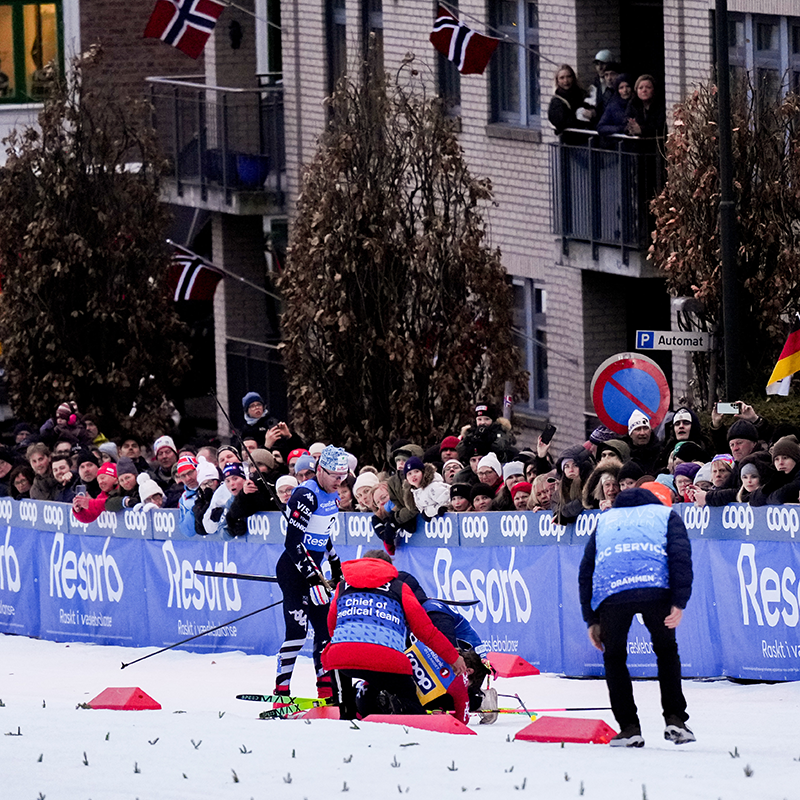


 This coverage is made possible through the generous support of Marty and Kathy Hall and A Hall Mark of Excellence A Hall Mark of Excellence Award. To learn more about A Hall Mark of Excellence Award, or to learn how you can support FasterSkier’s coverage, please contact