From the FasterSkier archive — posts syndicated from athletes’ and coaches’ own blogs between 2004 and 2012, kept online as published. Current coverage is at fasterskier.com.
Cory Schwartz (r) is entering his 33rd year as head coach at the University of New Hampshire. (Photo: FlyingPointRoad)
When Cory Schwartz entered his final year of school at the University of New Hampshire, he had no idea that he would spend over three decades in Durham after his graduation in 1982.
The 2014/2015 season will mark Schwartz’s 33rd year with the Wildcats, where he has led his team to 24 top-ten places at the NCAA Championships as head coach.
In 1981, Schwartz was unsure where life after college would take him. In fact, he had never really considered coaching until the head coach at the time, Buzz Davis, asked him to be his assistant during his fifth year of school. Davis acted as the head of the women’s team and Schwartz did most of the heavy lifting for the men’s team.
The following year, Davis left the position and Schwartz took over as head coach. The rest is history.
Looking back at his coaching career, Schwartz, 55, says that several moments stand out to him.
One such moment is when his team earned its an all-American honor with Mike Hussey in 1985. Hussey along with several other skiers at the time helped the New Hampshire men’s program rival that of the top eastern-ski programs at the time, namely Vermont and Dartmouth.
“Those guys were competing against the powerhouse of that time which was Vermont,” Schwartz said. “The first time we beat Vermont, it was one of those special days that you remember.”
Another fond memory from his 33 years of coaching came in 2013 when senior Anya Bean earned an all-American honor at the NCAA Championships in Middlebury, Vt.
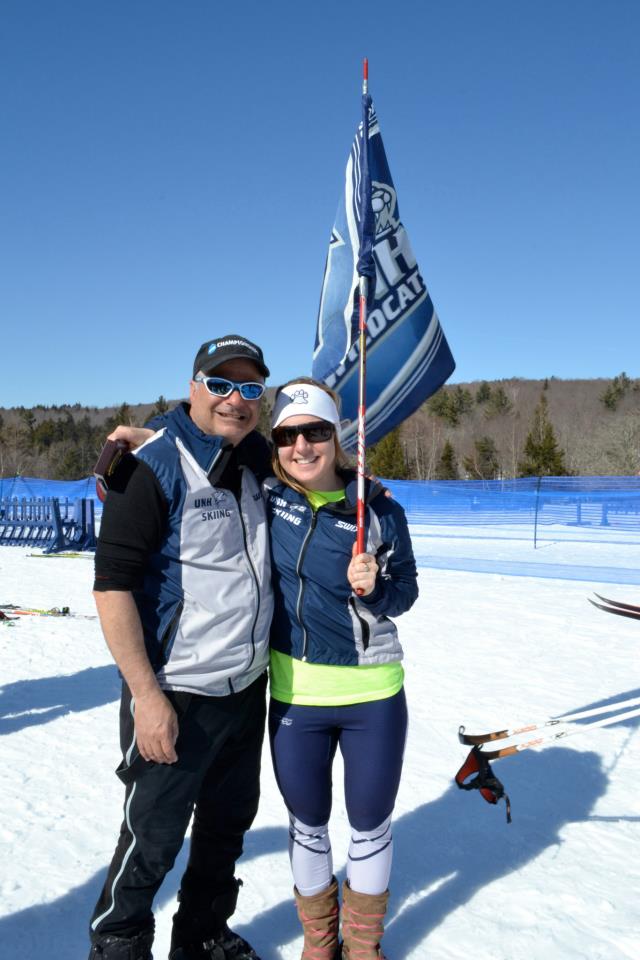
Cory Schwartz (l) and Anya Bean (r) pose with the University of New Hampshire flag. (Photo: Cory Shwartz)
While her placement was exciting for Schwartz, the moment was even more special because of the personal relationship he had developed with the New Hampshire skier. Bean, whose father had skied with Schwartz on the New Hampshire team some 30 years before, had suffered the loss of her mother the previous year.
“Just to see her finish that race and hug her dad was one of those moments that you are just going to remember for a long time,” Schwartz said.
When Bean’s mother, Jennifer Caldwell, passed away after a long battle with cancer in the winter of 2012, the UNH skiers were racing at Senior Nationals in Rumford, Maine. Schwartz drove the team down to Caldwell’s funeral to join Bean, despite the fact that they were racing the next day.
“That meant so much to me,” Bean said.
According to Bean, Schwartz creates a team dynamic that fosters growth as both a skier and as a person.
“The camaraderie that UNH establishes is unlike any other team,” she explained. “Everyone is really close and Cory does a really good job of creating that dynamic.”
Schwartz explained he likes to keep a close relationship with all his athletes and described himself as a hands-on coach. According to Schwartz, that’s what has kept him going for the past three decades.
“I think that’s what keeps me interested in coaching,” he said. “I can see that growth between myself and the athletes, whether it’s while they are on campus as an athlete or afterwards, it is fun to continue that relationship.”
He added that the uniqueness and camaraderie of the college ski community has helped make his time there incredibly rewarding.
“If you go to other athletic events, whether it is soccer lacrosse or football, I don’t think you see anything else like after a ski race,” he said. “Everyone puts on a bib and does their best job to represent their school and then afterwards it’s amazing to see the camaraderie between the teams and athletes. It’s just a fun atmosphere to be in. I think that’s what make’s all us older coaches young – we live of the energy of our skiers.”
As he gets older he knows that one day he’ll need to give the head-coaching reins to someone else, but according to Schwartz that day isn’t coming anytime soon.
“If I can continue to relate to the athletes and I can continue to enjoy the college competition atmosphere, I’ll keep on going,” he said. “Until I look in the mirror and say, ‘Hey it’s time to hand this off to someone younger.’ ”
Women’s 15 k freestyle mass start winner, Joanne Reid holds up the University of Colorado’s first-place trophy at the 2013 NCAA Skiing Championships on Saturday at the Rikert Nordic Center in Ripton, Vt.. (Photo: Flyingpointroad.com/All photo sales benefit NNF.)
RIPTON, Vt. – Joanne Reid knows exactly what it takes to win. The University of Colorado senior has been no stranger to the podium in her four years at Boulder, placing third as a sophomore at the 2011 NCAA Skiing Championships.
But this season was an exception. In 10 total Rocky Mountain Intercollegiate Ski Association (RMISA) races, Reid won eight of them. Her unrivaled dominance made the 20-year-old from Palo Alto, Calif., the clear-cut RMISA MVP.
The question was: how would she fare against eastern-collegiate skiers on what was essentially their home turf at Rikert Nordic Center in Vermont? On Thursday, in the first of the two-day nordic NCAA Championships, Reid placed fourth in the women’s 5 k classic individual start. It was the first time she hadn’t made the top two all season.
Saturday was a different story. With teammate Eliska Hajkova, Reid was confident they could get out front in the 15-kilometer freestyle mass start and stay there. Just as they’d done all season (including when they swept the podium with teammate Maria Nordstrom at regionals), they planned to feed off each other to achieve what they both wanted: the podium.
Joanne Reid leads her Colorado University teammates, Eliska Hajkova (4) and Maria Nordstrom (9) early in Saturday’s 15 k freestyle mass start at the 2013 NCAA Championships. Reid won by nearly 27 seconds and Hajkova was second. (Photo: Flyingpointroad.com)
The CU seniors led from the start: Reid in a blue headband, Hajkova in a pink one. The way they were skiing, that was one of a few ways you could tell them apart.
Changing leads throughout the first and second laps, Reid took charge for good on the third and final loop around a twisty, turning and technical 5 k course. Hajkova remembers her dropping the pack – with Marine Dusser of the University of Alaska-Anchorage (UAA) and Mary O’Connell (Dartmouth College) – on the third of several hills.
“She kind of went and we couldn’t follow,” said Hajkova, who hails from the Czech Republic. “We were, like, falling apart.”
About a half kilometer from the finish, Reid entered Rikert’s spectator-packed stadium in first without any contenders in sight. She cruised around the field’s final curve more than 30 seconds ahead, grabbed a CU flag a few hundred meters before the finish, and carved some turns while making her way across the line.
Reid finished in 38:17.8 for her first NCAA title, 26.8 seconds ahead of Hajkova, who outlunged Dusser for second. The RMISA MVP runner-up, Dusser placed third for the second-straight race at NCAAs, 0.4 seconds behind Hajkova.
Colorado University’s top-two sweep put the Buffs in prime position against the University of Vermont (UVM) for the combined alpine-nordic NCAA team title. Trailing by 54 points to start the day, CU overtook UVM by 16 points after the women’s race.
Thanks to some solid men’s performances in the following 20 k, CU rolled to a 43-point victory over the University of Utah (which put three men in the top five) and topped UVM by 56 points. Last year, UVM edged CU for the team win, but in 2011, CU took it.
“Our girls were not such a surprise because they were consistent and forming all season,” said CU head coach Richard Rokos, who’s in charge of both the university’s alpine and nordic programs. “I was a little surprised that UVM didn’t put a little more resistance on us.”
Joanne Reid (University of Colorado) with her mom Beth after winning Saturday’s 15 k skate mass start for her first NCAA title at the 2013 championships in Ripton, Vt. Beth Heidin won a NCAA nordic title at the 1983 championships. (Photo: flyingpointroad.com)
With Reid, it was somewhat of a blast from the past. Her mother Beth Heiden skied for UVM and won the 1983 NCAA Nordic Championships. Before that, she was the all-around world speed skating champion in 1979, the 1980 world road cycling champ and a bronze-medalist speed skater at the 1980 Olympics.
“I saw her at the finish line and it was great,” Reid told BuffZone.com. “It’s cool that we have both now won NCAA individual titles … Every time I go skiing with her, they just list all her awards so now I have one that she has. I just need a few more world championships in other sports now to catch up.”
Reid’s uncle, Eric Heiden, won five gold medals at the 1980 Olympics, and set four Olympic records and a world best there. According to the CU website, he was the only athlete in the history of speed skating to have swept five events in a single Olympics.
University of Colorado-Boulder seniors Joanne Reid (l) and Eliska Hajkova celebrate placing first and second, respectively, in Saturday’s 15 k freestyle mass start at the 2013 NCAA Championships at Rikert Nordic Center in Ripton, Vt. (Photo: Flyingpointroad.com)
On Saturday, Reid put down a commanding performance of her own and said she couldn’t have done without her teammate.
“It’s always better if I can have this one right next to me,” she said of Hajkova. “That’s what makes it really complete.”
After a somewhat relaxed first lap, the CU women led a group of four the last two loops with Dusser and O’Connell, who placed fourth.
“I was more comfortable in front and I just kept skiing how I felt,” Reid said. “I guess I ended up in front.”
Hajkova said they had “great skis,” which Dusser noticed early on. The former French national-team biathlete wasn’t having as much luck with hers.
“I tried to keep my energy and stay behind Eliska,” Dusser said. “But she was a better sprinter. I was tired at the end so she beat me by not a lot, but that’s a race.”
A 2011 NCAA champion in the 15 k classic, Hajkova said placing second to Reid was about as much as she could’ve asked for after struggling to get healthy since last fall.
“I couldn’t dream for more,” Hajkova said. “If I had been second to somebody else, and Joanne didn’t win, it would be a little bit sad, but this, I’m just on top of my happiness.”
Dusser, too, was thrilled with another podium in her first NCAA Championships. Unsure what her plans are next year, she’s hoping to ski another year at UAA, but said it depends whether she can get another scholarship.
“I would like to stay in Alaska,” Dusser said. “It was out too quick with biathlon and I don’t regret. I really like nordic skiing; I really like the spirit of NCAA race. It’s a lot of fun and people are really nice and I like my team.”
Thursday’s runner-up, O’Connell finished 33.3 seconds behind Dusser (1:00.5 after Reid). Silje Benum of Denver University was fifth (+1:03.2) and the University of New Hampshire’s Anya Caldwell Bean was another 5.4 seconds back in sixth.
“Top ten I thought it would be awesome,” Bean said. “But I didn’t really know what to expect.”
She avoided several crashes, but top contenders like Elizabeth Guiney (UNH), Anja Gruber (UVM) and Annie Pokorny (Middlebury College) did not. Guiney placed 16th, Gruber ended up 21st and Pokorny did not finish after falling on a downhill less than two kilometers into the first lap.
After hitting a tree in Thursday’s 5 k and knocking her hips out of alignment, Pokorny wasn’t sure she would be able to compete Saturday. Finally able to bend at the waist again that morning, she decided she could.
“It would’ve been fine if I stayed on my feet,” Pokorny said while watching the men’s 20 k on crutches.
She completed the first lap, but ultimately did not finish. After an initial look at her injury, Pokorny believed she had bruised her femur.
Women’s 15 k freestyle mass start podium at 2013 NCAA Championships at Rikert Nordic Center in Ripton, Vt. From left to right: Annie Hart (Dartmouth/8th), Anya Caldwell Bean (UNH/6th), Mary O’Connell (Dartmouth/4th), Marine Dusser (UAA/3rd), Joanne Reid (CU/1st), Eliska Hajkova (CU/2nd), Silje Benum (DU/5th), Rosie Frankowski (NMU/7th). (Photo: Flyingpointroad.com)
As for the rest of the field, Rosie Frankowski of Northern Michigan University placed seventh, Dartmouth’s Annie Hart was eighth, Utah’s Rose Kemp (who also fell) was ninth, and Denver’s Makayla Cappel finished 10th.
At the end of the day, the happiest coach had to be Rokos. He said getting his alpine and nordic teams to combine for a national title was tricky, especially because of the nature of downhill racing.
“On the nordic side, it’s a race to go and ski your best and race fast,” Rokos said. “In alpine, all year long we go pretty much the same until NCAA Championship and then we put them in a dilemma, ski fast but finish, and there is no compromise between those things.”
He told his alpine squad they had to finish and was proud of those athletes for using such discipline. And while UVM beat CU on the downhill runs at Middlebury College’s Snow Bowl, the Buffs made up for it at Rikert.
“Every single person on the team made a great contribution,” Rokos said of Colorado’s 18th NCAA victory, his seventh with the team since 1991. “It’s teamwork and it came that way.”
He also credited the team’s success to head nordic coach, Bruce Cranmer, in his 13th season with the Buffs.
“Both Eliska and Joanna are in their last year; they were maturing athletically throughout all their career with CU and they have a great coach,” Rokos said. “[He] did a great deal of work with them and it paid off.”
In the days and weeks leading up to the Nordic events of the 1980 Olympic Games in Lake Placid, snow was hard to come by. Thanks to the dedicated efforts of the local community, mostly consisting of heavy shoveling and snow-moving, the Olympic races were contested, and some of the more memorable races in the history of the sport took place.
Most notable may have been Thomas Wassberg’s narrow .01 second victory over Finnish skier Juha Mieto in the 15-kilometer event. Wassberg’s immense efforts in the final moments of the race led to an extraordinary and captivating result, and the closest race in Olympic history.
A few days before the races of the St. Lawrence Carnival, the opening weekend of the EISA racing circuit, it was hard not to dwell on those same imposing factors: a lack of snow and a narrowing window of time.
Though the East had been treated to a good amount of snow over the holidays, a warm spell over the recent weekend had left the trails at Mt Van Hoevenberg patchy, icy and pock-marked with mud and dirt.
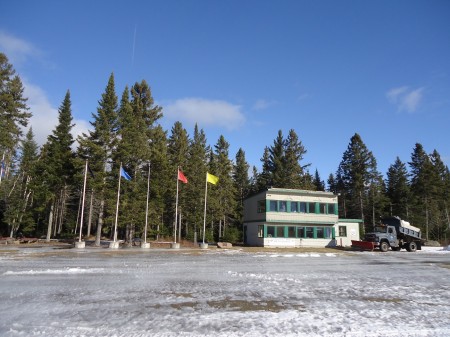
The stadium complex at Van Hoevenberg Tuesday morning
“The stadium was an ice-skating rink,” said Margaret Maher, head coach of the NYSEF (New York Ski Education Foundation) Nordic team, and the event’s Chief of Competition. “We knew we were going to have to make adjustments.”
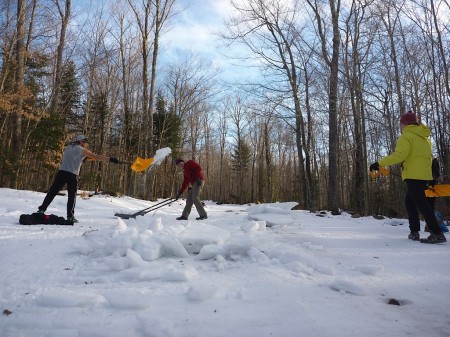
Those adjustments came in the form of massive snow-moving and shoveling efforts in the early part of the week, not unlike the work leading up to the 1980 Olympics.
The Olympic Regional Development Authority (ORDA) used heavy machinery and trucks to move snow from further parts of the Olympic Sports Complex into the stadium area. Grooming equipment was then used to spread and level the snow.
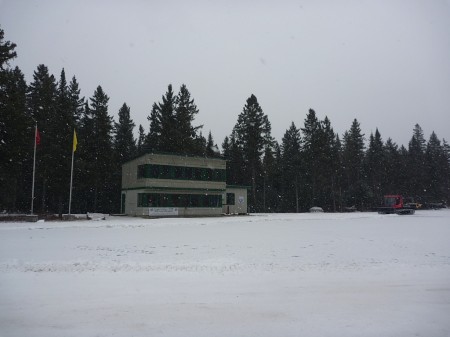
As the week progressed, snow from both human efforts and natural causes brought the stadium up to its usual mid-winter appearance
Meanwhile, members of NYSEF and the St. Lawrence University ski team walked the trails with shovels and rakes, using what little snow lay in the woods to cover bare patches of trail. Students at nearby North Country School shoveled snow on the network of trails across the road on Van Hoevenberg’s Biathlon network to allow for public use during the race weekend.
Members of the St. Lawrence University Ski Team shovel snow onto the East Hill trail on Tuesday afternoon
By Wednesday afternoon a 4.5k loop had been completely restored to racing quality. The few inches of snow that fell throughout the week helped to solidify a fair and fully snow-covered course. Though it was not the loop initially planned for Friday’s distance races, the trail was long enough to keep the original 3 (women) and 4 (men) laps intended for the events, with only minimal loss of total distance. The races went off without issue.
Friday: 15/20k Skate
Racing began Friday morning, featuring interval-start races of 18 kilometers for men and 13.5 kilometers for women. Cold temperatures resulted in a delayed start, and at the end of the long day two University of Vermont skiers stood atop each podium.
After a Sophomore year plagued by health issues, Scott Patterson used a renewed summer of training and motivation to return to the top form that saw him win the first EISA Carnival he ever raced in, the St. Lawrence Carnival of 2011. Patterson’s racing shape seemed eerily better at the 2013 edition of the SLU Carnival, however, as he took the win by over 2 full minutes. Patterson started fast and never looked back, holding the fastest lap splits for each of the 4 laps and essentially pulling thirty seconds further ahead of the field and second place finisher Silas Talbot (Dartmouth) with each successive trip around the course. The Big Green was also represented on the podium by Scott Lacy, who helped lead the Dartmouth men to a narrow victory over the UVM men in the team score. Rogan Brown (UVM) and Steve Mangan (Dartmouth) rounded out the top 5.
Both UVM and Dartmouth showed impressive depth, collectively taking 9 of the top 10 places. Ben Lustgarten of Middlebury, who placed 7th, was the only skier to break up the UVM/Darmouth grouping.
Scott Patterson won Friday’s race with plenty of time to spare. Photo: C.J. Feehan. EISAskiing.blogspot.com
Temperatures warmed only slightly for the women’s race, where Vermont’s Anja Gruber took the victory to give the Catamounts an individual sweep of Friday’s races. Gruber’s margin of victory was not quite as dominant as Patterson’s, however, and the ladies of the University of New Hampshire put together a strong scoring trio directly behind her. Anya Bean, Annika Taylor and Elizabeth Izzo took places 2 through 4, respectively, giving UNH a solid victory in the team score.
With a finish that likely turned many heads, Bowdoin Junior Kaitlynn Miller rounded out the top 5. Miller’s 5th was the best Bowdoin women’s result in the school’s history, and a result that matched Walt Shepard’s two 5th-place finishes during the 2008 season for the best Bowdoin finish ever, male or female.
“We knew that Kaitlynn was in great shape,” said head Bowdoin coach Nathan Alsobrook on Saturday, “but yesterday’s race exceeded our highest hopes.”
With the cold spell ending overnight, the racing continued with faster conditions on Saturday.
Saturday: 3k Prologue
Saturday’s races were originally scheduled to run as classic sprints, but the lack of snow depth and course availability led organizers to work out an alternative race format. During the early stages of the week, when low-snow still posed a threat, several ideas were presented.
“Ethan [Townsend, head SLU coach] and I tossed around several ideas, including a skate sprint and a mixed-gender relay,” said Maher of Saturday’s race options. “Ultimately it came down to the size of the stadium we could create and the finish area we could use.”
The result? A relatively new race format adapted from the World Cup and Tour De Ski. Several small modifications were made to the 4.5k race loop from the previous day, resulting in a 3.2k “Prologue” event. This was the first time a race of this distance had been featured on the EISA circuit.
While some jokingly referred to the event as an “Epilogue” due to it being the second and last race of the weekend, the competition itself was approached very seriously by the racers, and included many close finishes.
Scott Patterson made it 2-for-2 on the weekend, winning the men’s race in 8 minutes flat. Jordan Buetow of Bates followed 4.5 seconds behind, looking relaxed and using his considerable height to generate noticeable speed on the course’s flatter sections. Cole Morgen of UVM took the final step of the podium, 2 seconds behind Buetow.
Peter Hegman (UVM) and Thomas Rabon (Dartmouth) completed the top-5, with the UVM men earning the top team score.
In the women’s race the University of New Hampshire continued its strong start to the 2013 season. The local crowd at Mt. Van Hoevenberg had good reason to celebrate as the results became official: hometown skier Elizabeth Izzo, who hails from Lake Placid and skied for the NYSEF before becoming a Wildcat, took her first EISA Carnival victory. “’Lizzo” completed the loop on her home course in 9:12.6, exactly one second ahead of runner-up Anja Gruber (UVM), who collected her second podium finish of the weekend. Another relative local originally from Queensbury, NY, Carly Wynn (Dartmouth) took the bronze just .3 seconds behind Gruber.
Anya Bean (UNH) and Annika Taylor (UNH) moved down the ranks only slightly from their podium performances the day prior to round out the top 5 and again give the UNH women the top team score.
EISA racing continues next weekend on a brand new trail network. Quarry Road in Waterville, Maine will play host to the Colby Carnival for the very first time. The event website can be found by clicking below.