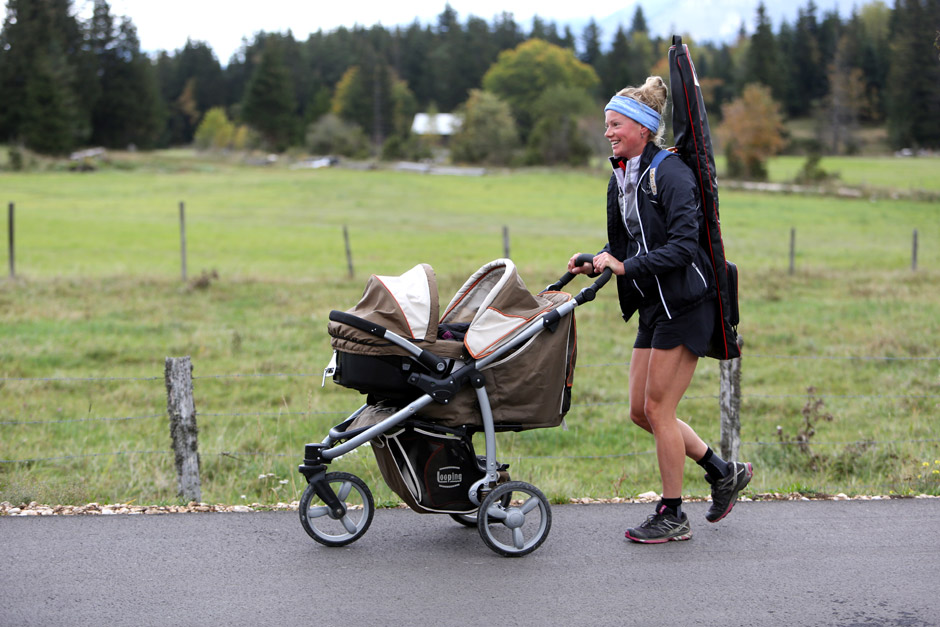
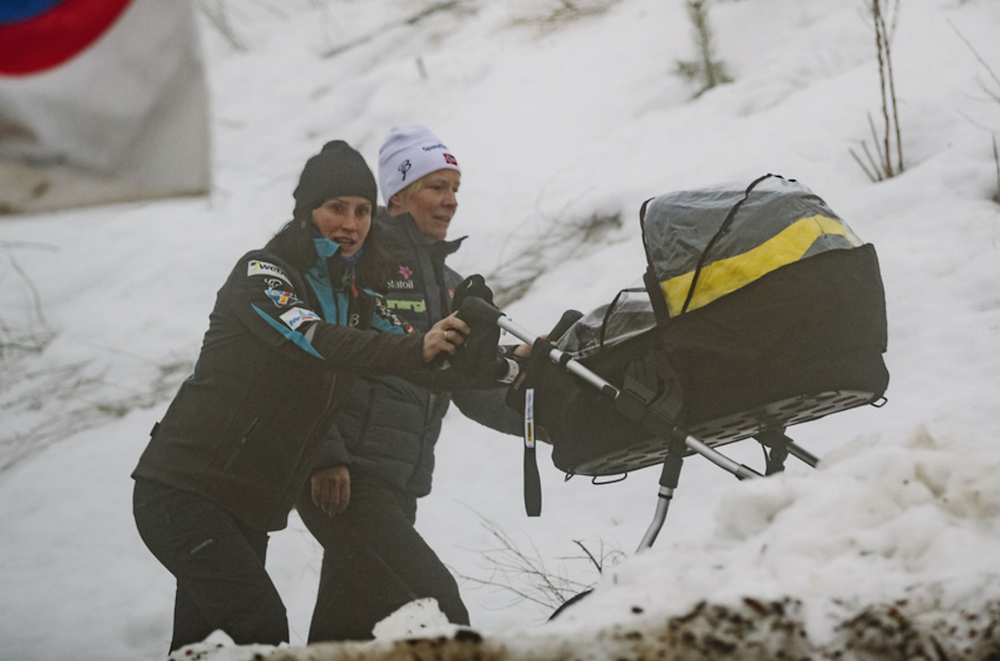
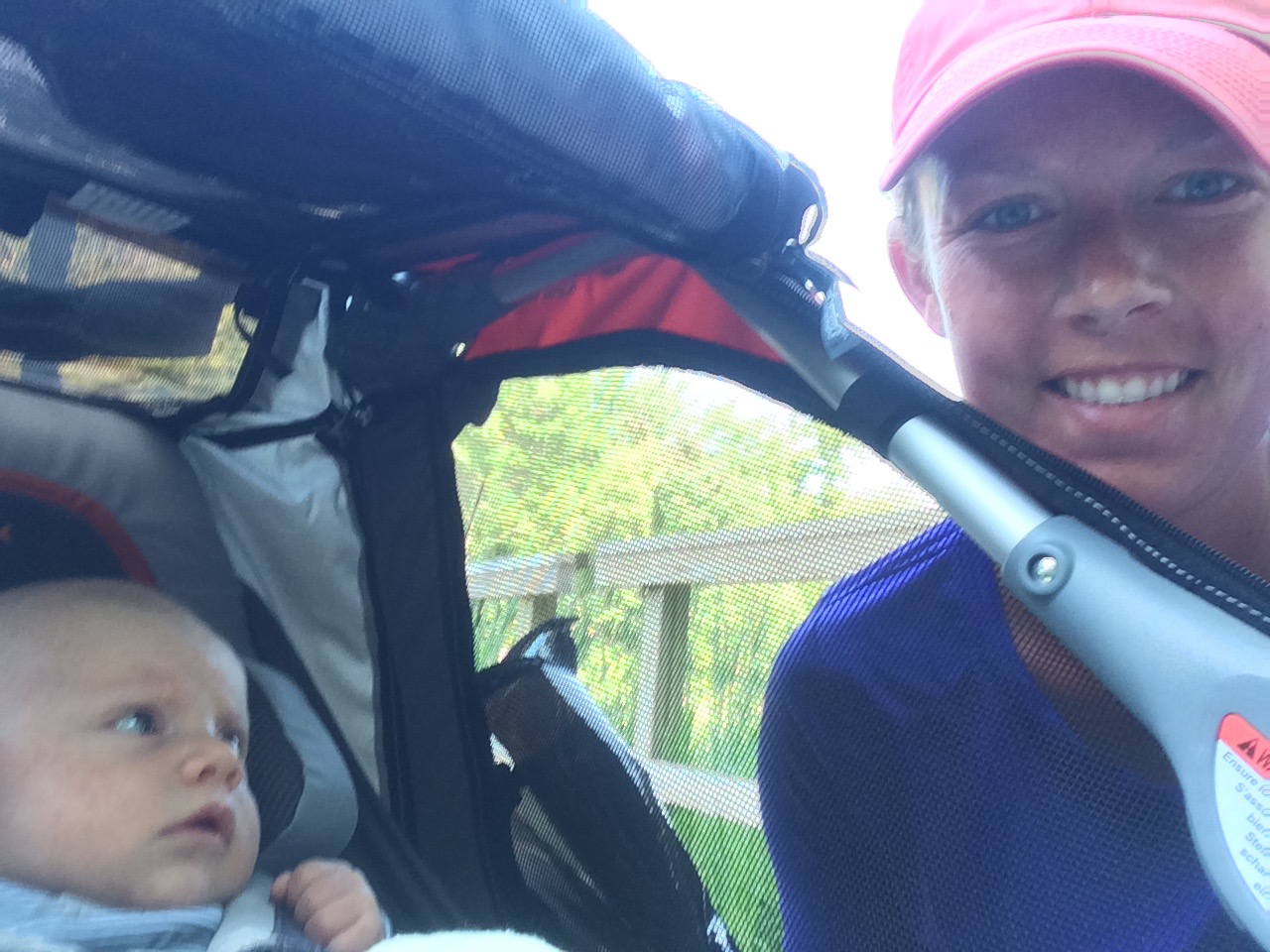
Marit Bjørgen of Norway (l) gets in some early season hill climbing with the stroller in preparation for the 2016 NYC Stroll-a-thon. (Photo: SportoweFakty)
Ready. Set. Stroll. When 7,000 contestants charging carriages hit the streets of New York City (NYC) this year at the 2016 NYC Stroll-a-thon, a few nordic names may find a new race niche that has nothing to do with snow. Especially if the U.S. Ski Team’s Kikkan Randall and Norway’s Marit Bjørgen steer a stroller the same way they ski.
After side-stepping the 2015/2016 World Cup season, Bjørgen and Randall will release nine months of curbed competitive edge at the debut marathon event — presented by the New York Road Runners organization — which promises competitors 26.2 miles of the steepest inclines and most tactical turns in stroller racing.
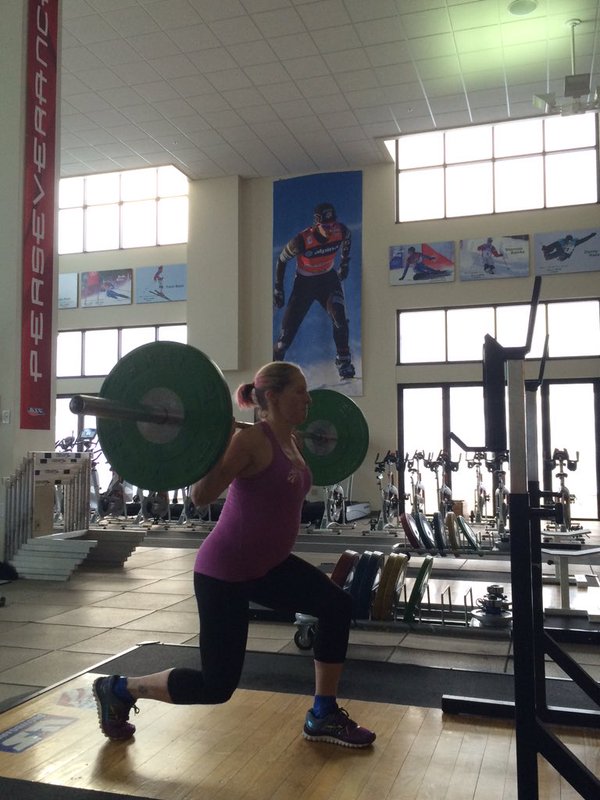
U.S. skier Kikkan Randall sets early season squats as preparation for the NYC Stroll-a-thon taking place this May. (Photo: Kikkan Randall/Twitter)
Open only to parents who can cover the course with their child in a carriage (*see more detailed rules and regulations below) the NYC Stroll-a-thon is scheduled to take place May 2, 2016 — though Randall admits her April due date will be cutting it close.
“I’m as strong as I’ve ever been,” Randall said in a phone interview.
“My main concern is switching to the spring training cycle, which for me includes a 50-percent increase in stroller hours and a sizable volume jump for Bean,” she explained, confirming recent rumors that she and husband Jeff Ellis have made the decision to name their child ‘El Bean’ — Bean for short — a decision primed by one of Randall’s sponsors, L.L. Bean, which offered to pay for the child’s college education if Randall and Ellis could find a way to christen the child after the company.
With a three-month head start of stroller steering on Randall, Bjørgen will no doubt prove a force to be reckoned with at this year’s NYC Stroll-a-thon.
But Bjørgen is not the only nordic skier who is well practiced in the art of carving the streets with their child and carriage.
Norwegian nordic superstar, Øystein Pettersen, better known as “The Sausage,” has also confirmed his entry in the event. He and his son, who was born this July 2015, have spent much of this winter ski season meditating their moves for the marathon course.
“It will be tough challenge, for sure” Pettersen wrote on Twitter. “But baby boy and I are ready to bring the burn.”
Also competing in the event is French biathlete Marie Dorin Habert, coming off two individual gold medals at 2016 IBU World Championships, and the U.S. Paralympics Nordic Development Coach, BethAnn Chamberlain.
French biathlete Marie Dorin Habert getting training for the upcoming NYC Stroll-a-thon. (Photo: DauphieNordique)
Selecting the Right Stroller
The NYC Stroll-a-thon, which follows the same a point-to-point course for the NYC running marathon, tests racer’s stamina and steering skills, making savvy stroller selection critical for participants looking to win.
Bjørgen will sport the lightweight Kolcraft Cloud 2015 stroller, which features an adjustable canopy, shock absorbing front swivel wheels, and foam padded handles. Weighing in at only 11.4 pounds and earning an average rating of 4.3 stars, this model remains one of the best hill climbers in the industry.
However, the Cloud’s strongest selling point is also its weakness. Without much weight in the front, the Cloud makes wieldy turns, which heightens the chance of blowing a crucial course curve.
Yet, Bjørgen finds herself more well-suited for technical steering, preferring to gamble with race technique tactics than lost time on an incline.
Randall will run Bjørgen’s rival carriage, the BOB Sport Utility Stroller. The fixed front wheel and treaded tires necessitate more aggressive driving, but Randall prefers the stroller stability and top of the line suspension system for Bean.
Pettersen on the other hand will opt for the industry’s heaviest hitter, the ŠKODA stroller, an ATV-style stroller designed by a Czech automotive company. At two meters tall with complete high suspension and brake systems, it’s no surprise Pettersen will choose ŠKODA.
*Rules, Regulations and Registration:
A few of the most unique rules that apply to the 2016 NYC Stroll-a-thon are summarized below.
Children must be legitimate: competitors may not enter carriages carrying children that are not their own.
Contestant’s child must be in good health upon crossing the finish line; vitals will be checked.
Weight added to the stroller in order to enhance downhill speed is not permitted.
To register or learn more about the 2016 NYC Stroll-a-thon, click here
FasterSkier editor Alex Kochon is signed up for the inaugural event but she isn’t expecting to contend with the elites. “My 10-month-old puts me at a severe weight disadvantage, especially on the uphills,” Kochon said. “I love the little guy and all, but we can’t compete with those newborns.”
Kevin Sandau, a former Canadian national team member and Alberta World Cup Academy athlete, was named head coach of the Canadian National and World Cup teams on Friday. (Courtesy photo)
Cross Country Canada (CCC) is serious about developing its coaching pipeline and hiring in-house, as evidenced by its most recent decision to hire former athlete Kevin Sandau as head coach of the Canadian National Ski Team.
Wadsworth planned to step down following Canadian Ski Nationals, which ended in Whitehorse, Yukon, last Saturday. Sandau’s hiring was confirmed by CCC High Performance Director Tom Holland less than a week later.
“Kevin applied for the position as soon as it became available, and he’s as good as anyone we can think of at this point,” he continued. “He has some impressive video filming, editing and website-design skills, so we see those as huge assets to the team.”
When asked specifically about Sandau’s foray into acting, Holland chose not to comment.
A Canmore local, the 27-year-old Sandau grew up skiing on the nordic trails in Kananaskis Country just outside Calgary and got his start with Foothills Nordic Ski Club. He was named to the national senior team in 2010 and spent the last several seasons training with the Alberta World Cup Academy, but debated continuing his ski career last year upon not being renominated to the national team.
“It was a tumultuous few weeks following that news, where he debated whether or not to end his ski career,” reads his bio on the AWCA website. “After much internal debate, and discussion with coaches and teammates, Kevin became determined to continue racing and set his focus on this year’s Tour de Canada.”
Sandau placed 43rd overall in the Ski Tour Canada, and ended his season in fifth in the men’s 50-kilometer classic mass start at nationals in Whitehorse.
He describes himself on his Twitter profile as a “Canadian cross country skier, celebrity chef wannabe and aspriring film guy living in beautiful Canmore/Calgary Alberta.”
“Obviously I’m really excited,” Sandau told FasterSkier of the opportunity to coach both Canada’s senior national and World Cup teams. “I don’t have much experience coaching at this sort of level but I feel like my practical experience on the domestic circuit and top-50ish on the World Cup is what really sets me apart from the rest. You learn a lot of racing in the back of a World Cup, it’s like the best seat in the house, and you can watch firsthand the whole race as it unfolds, at least for a little bit.
“Cross Country Canada and I had our differences this past year, but I think that is all behind us now. I’m not here to stir up controversy or open up old wounds, I’m here to get a job done and make Canada great again,” he added.
And how has the reaction been so far?
“The support has been phenomenal,” Sandau said. “Just today Tor Arne Hetland, who coached this team during the 2014/2015 season and now leads the Norwegian National team called me up to congratulate me. Well at least I think it was to congratulate me. He was mostly speaking in Norwegian and he was laughing pretty hard.”
Asked what his plans are for the national team, Sandau said his “first executive order” will be about broadening and strengthening the national-team program.
“There are a lot of skiers in Canada that have come up just shy of the NST selection standard and if I’ve learnt anything from movies, you need to give these guys a shot at the real deal,” he said. “For example our own jackrabbit mascot Klister, he’s got the drive to go for 2018 and beyond. Hell, I’d probably like to race at the Olympics in 2018 too, and maybe I could see if my new position gives me that sort of perk. Chances are we probably won’t be sending a full team so there will be some open spots.”
Outgoing coach Wadsworth could not be reached for comment. Sources said he had gone on vacation with his family, and upon hearing the news, buried his head in the sand and refused to take it out.
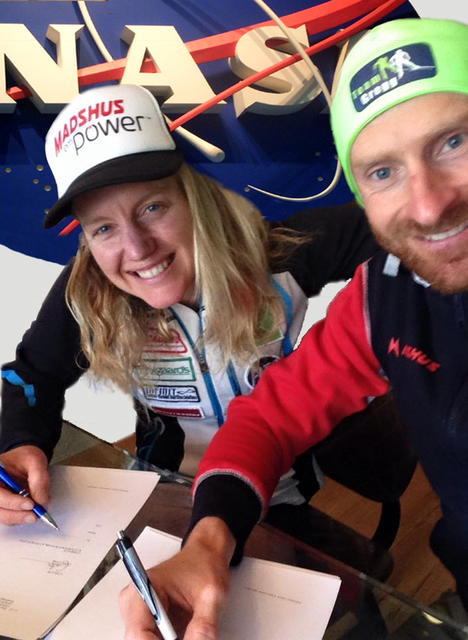
Husband and wife Brian (r) and Caitlin Gregg recently signed an agreement with NASA to conduct a series of training blocks at zero gravity starting in June.
Brian and Caitlin Gregg of Team Gregg have penned an agreement with the National Aeronautics and Space Administration (NASA) to conduct a series of training blocks at zero gravity. Extensive research has been completed on the benefits of high-altitude training, but very little is known about the effects of space on endurance performance.
“We have found success with blocks of training at altitude and when the opportunity to explore a partnership with NASA came up we decided to look in to it,” Caitlin said. “We both have always wanted to travel to space. Although, we still have a lot of steps to take before the trip to the International Space Station (ISS).”
The ISS orbits about 200-250 miles above the earth and at that altitude, Earth’s gravity is about 90 percent of what it is on the planet’s surface.
Caitlin Gregg during NASA’s initial testing in a microgravity pool earlier this week in Florida. (Courtesy photo)
The Greggs were reached in Florida, where they are conducting initial testing and training with the astronauts in their specialized pool, which simulates micro gravity.
“The pool is really quite a strange feeling,” Caitlin explained. “The greatest challenge will be not losing too much speed, since all movements are so slow.”
“Water is relatively dense fluid and is available in huge quantity, so we can simulate microgravity in a pool by putting an astronaut into a suit and adjusting that suit’s weight until it neither floats nor sinks — making it neutrally buoyant,” explained resident scientist Kumar Harshit. “Once neutral buoyancy is established all the objects can move freely as in micro-gravitational field. The pool used to train astronauts for spacewalk at ISS, is 202 feet long, 101 feet wide, and 40 feet deep. Equipment which have higher density are covered by Styrofoam.”
Brian is of particular interest for NASA in this endeavor as he is a twin. His brother Chad will be monitored before, after, and during the study to help quantify the effects of space on the body.
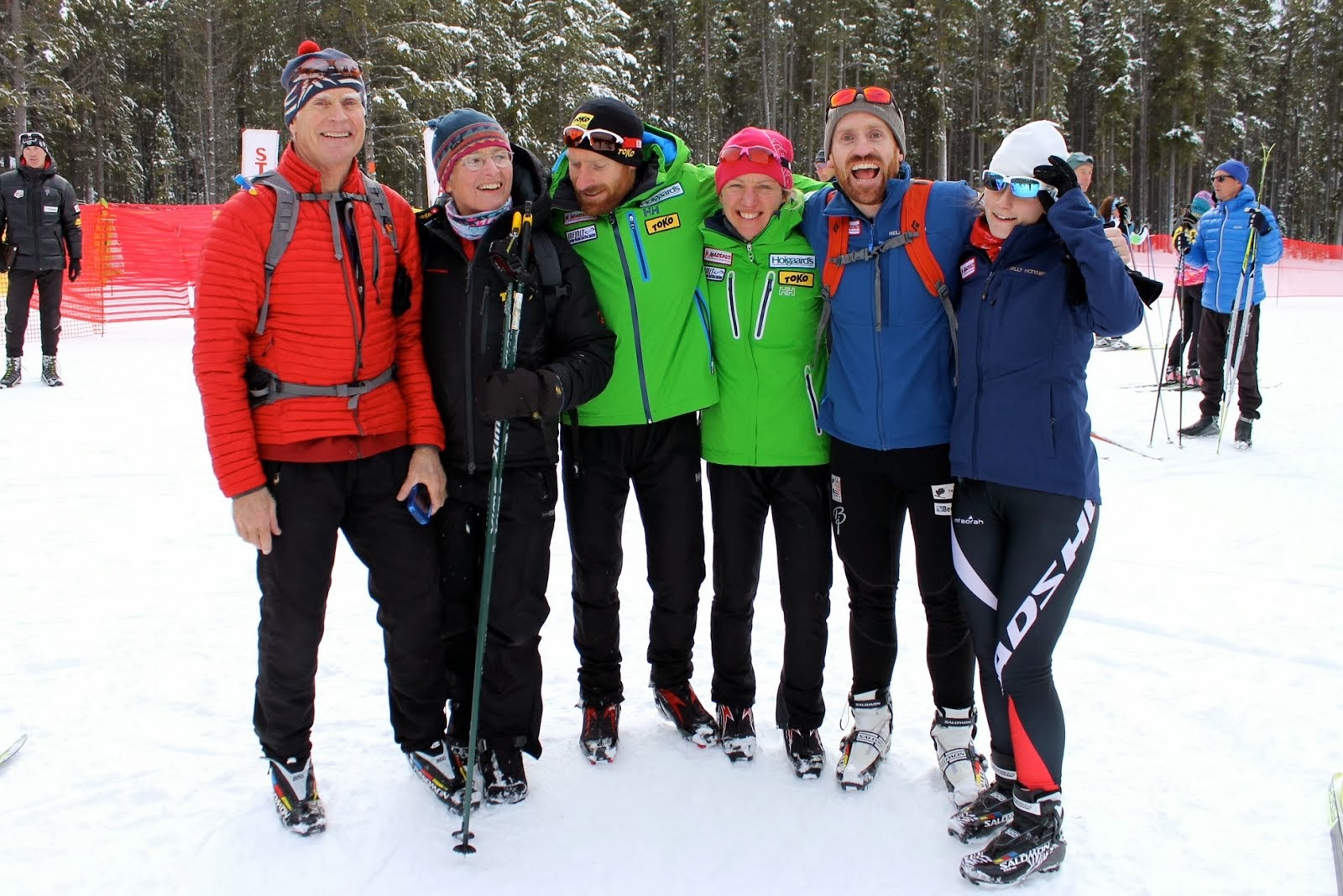
The extended family of Team Gregg, with Brian and Caitlin in green, and Brian’s twin brother Chad (second from r) along with parents Jim and Jan (left and second from l), and Chad’s wife Alieta (r) in 2013 in West Yellowstone, Mont.
“Concept2 has actually designed a specialized travel SkiErg that we will be bringing with us to the space station for our training,” Brian said.
This exercise tool will remain on the space station for all to use and has the Russians in particular excited.
Initially one of the sticking points for the agreement was that the Greggs’ dog Lahti need to be able to join them for the trips.
“We spend a lot of time away from him and I have really been looking forward to spending time with him,” Caitlin said.
NASA conceded to let the pup join them to the space station, but were unable to agree to the costs and risks of bringing him home. Ultimately the Greggs decided to leave Lahti at home.
If everything goes smoothly the Greggs will be looking at some super-high altitude time at zero gravity in the beginning of June after completing an on-snow training camp in Bend, Ore. The ISS camp would be 12 days with another possible camp in early August where they will look to avoid the high temperatures and humidity of the dog days of summer.
“This is truly and exciting opportunity and their are still a lot of unknowns. We should know a lot more by tomorrow, April 2,” Brian said.
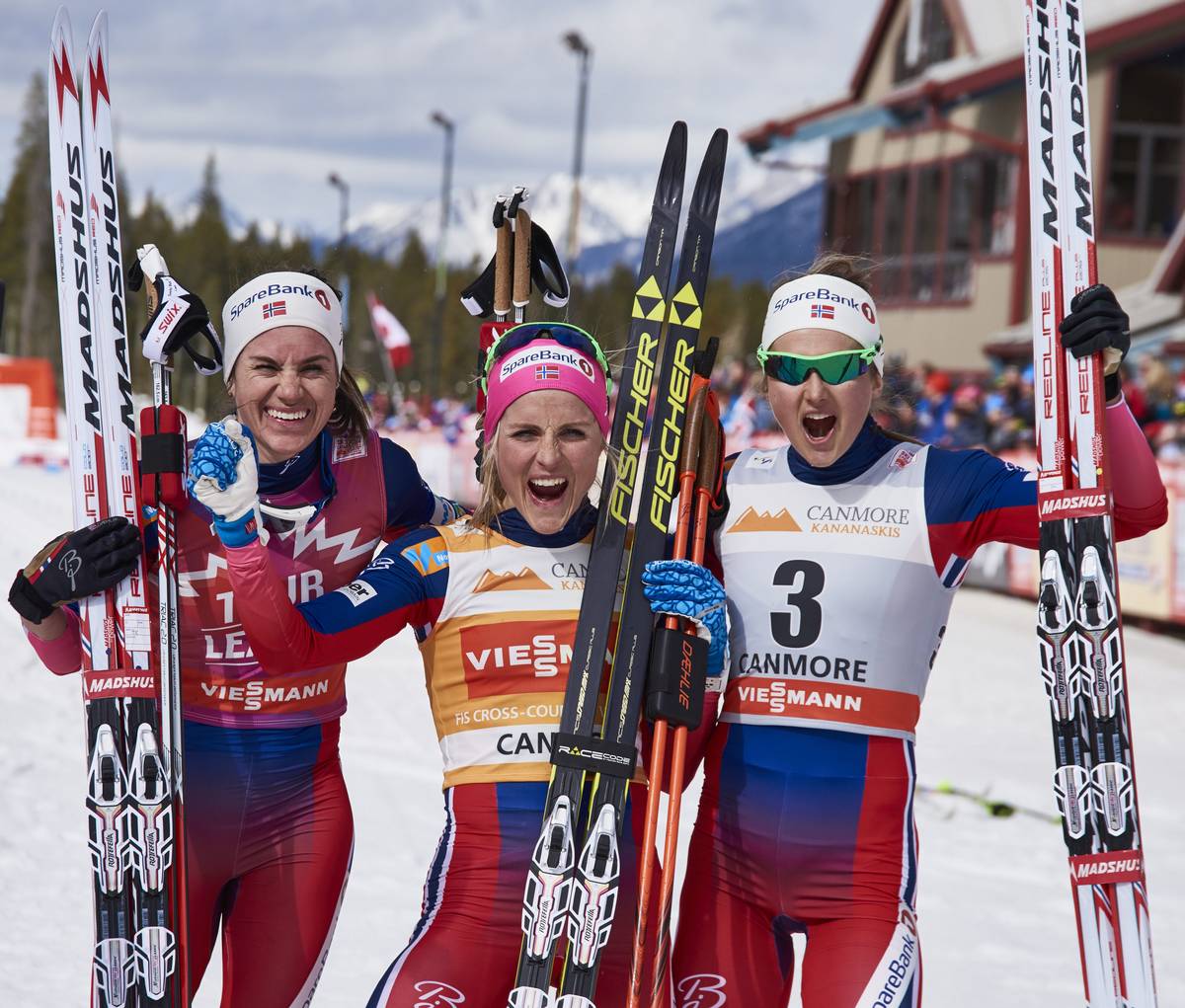
These ladies love Canada! The all-Norwegian women’s Ski Tour Canada final podium, with Therese Johaug (c) in first, Heidi Weng (l) in second and Ingvild Flugstad Østberg (r) in third. (Photo: Madshus/NordicFocus)
The International Ski Federation (FIS) was skeptical at first. But they’ve been won over faster than they ever could have believed — and now World Cup cross-country ski racing is not only returning to Canada more quickly than expected, but it will also revisit the U.S. for the first time since the 2002 Salt Lake City Olympics.
After the success of the Ski Tour Canada and some challenging snow situations in Europe during the 2015/2016 season, FIS has announced that the entire next World Cup season (2016/2017) will be held in North America.
“There are a wide variety of venues with reliable snow, and television viewers and sponsors turned out to love the wide, cinematic shots of racing in the Western landscape,” FIS Marketing Director Murg Staples told FasterSkier in an exclusive interview.
“We’ve been working on ways to have a more competitive World Cup given the Norwegian dominance in recent years,” FIS Race Director Peter Masters said. “While Martin Johnsrud Sundby and Therese Johaug still won the Ski Tour Canada, there were great performances by the American and Canadian teams. These teams are getting so close, and we think that giving them this season where they have something extra to get excited for and so many hometown fans cheering will both grow the development base for these countries and help them take that last step to the level where they are challenging Norwegian dominance. After all, Sweden wasn’t much help this year.”
But Staples has changed his tune, in part due to the snow challenges in Europe and also due to good television ratings for the Ski Tour Canada.
NRK, the station airing the Ski Tour Canada for Norwegian audiences, reported pulling in over a million viewers for weekend racing. Norway has just over five million citizens. The final men’s pursuit set a record for the NRK2 station; no other program had ever had as many viewers.
And so a tourism boom for Alberta was born, as was a brand new plan for the upcoming World Cup season. The tour will open on Frozen Thunder in Canmore, Alberta, before traveling to Birch Hill in Fairbanks, Alaska, then down to Anchorage, and over to Sovereign Lake, British Columbia, to wrap up period one before the holidays.
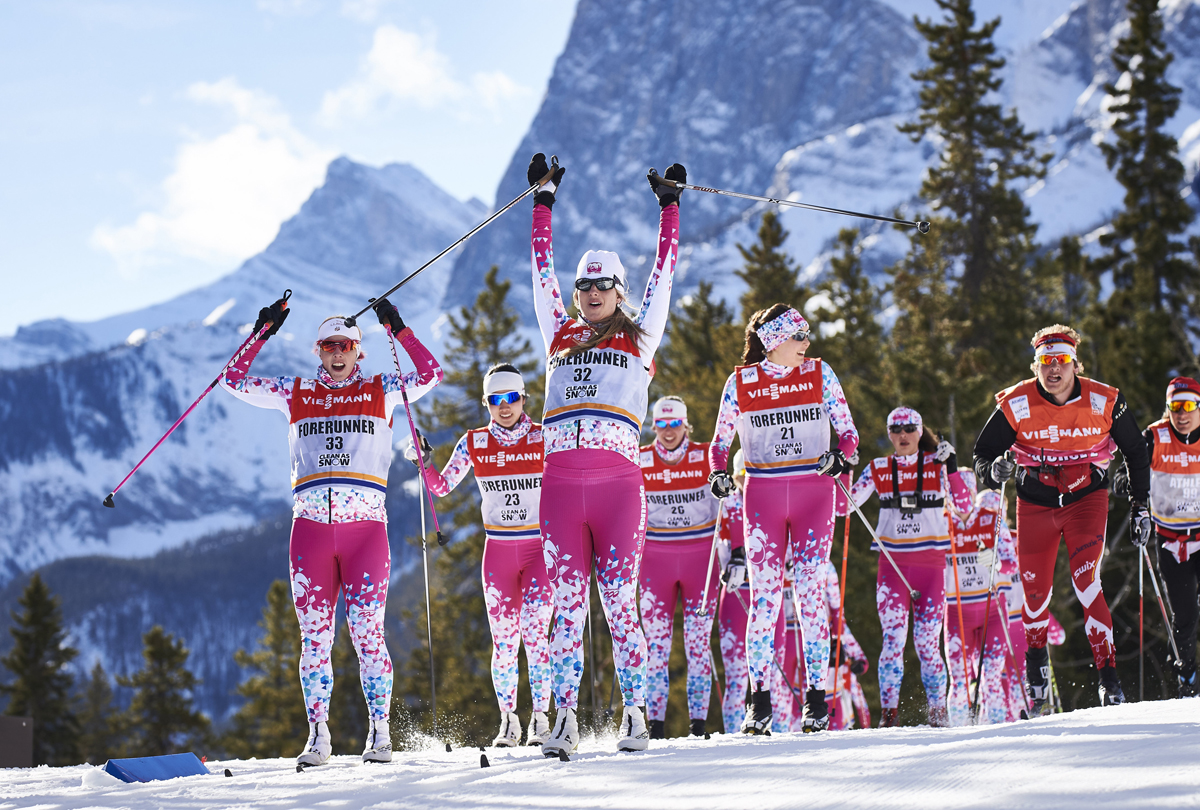
Former Canadian racer Chandra Crawford (with arms up) and U.S. Ski Team member Kikkan Randall (l) will have something to celebrate next winter when the entire World Cup season is held in Canada and the U.S. (Photo: Fischer/NordicFocus)
“Having a World Cup in my hometown will be some extra motivation to get back to racing after my pregnancy,” Kikkan Randall said.
The snow for the sprint course at Kincaid Park will reportedly be dyed pink in her honor.
In order to have all facets of the nordic World Cup open together, as is now traditional, the large hill jump at the Calgary Olympic Park will be redesigned and resurfaced, the zip line taken down this summer, and jumpers may begin training there as early as July, a representative of WinSport told FasterSkier, on the condition of anonymity.
The usual Tour de Ski block will be moved to the American Rockies, with racing in Sun Valley, Idaho, Steamboat Springs, Colo., and then finishing at the Olympic stadium at Soldier Hollow, Utah.
“With the Ski Tour Canada last year, it only seemed fair to send the next Tour south to the U.S.,” Masters explained. “We thought about having the racers simply race overland from Sun Valley to Soldier Hollow, but we realized that the U.S. is a lot bigger than Europe and the distances would be a little too far.”
Staples added that he would be working with the Sundance Film Festival to try to get some celebrities to attend the final weekend before they hit of the movie circuit.
“[Leo] Dicaprio is a big fan of skiing,” Staples said. “Watching the sport is something he can share with those European models he’s always with. It’s one of the reasons he’s so against climate change and has become a big environmentalist. Having him and a few others in the crowd would be great marketing and we might finally get on the pages of Us Weekly.”
After hosting IPC World Championships two years ago, Cable, Wis., is excited to host the FIS World Cup; the American Birkebeiner has been moved forward several weeks to coincide, much like when the Norwegian Birkebeiner was made a World Cup in 2002.
“We’ve known for years that the Birkie was more important than any European race,” Jan Anderson of Pine Lake, Wis., told FasterSkier. “It’s nice to get some recognition. Those European newcomers should have to start in wave nine, though.”
The World Cup will then move to Thunder Bay, Ontario. The Houghton-Hancock airport in Michigan looks forward to handling all of the ski bags and wax boxes when the World Cup visits the Michigan Tech trails in late January.
The circuit will then take an Eastern swing, starting with the city sprint in New York City’s Central Park that USSA executives have long been hoping for. The tour will then wind through Gatineau Park outside of Ottawa, Ontario; to Craftsbury Common, Vt. (“Even if there’s no snow anywhere else, those guys will find a way,” Staples said); Waterville Valley, New Hampshire; and Mont Sainte Anne, Quebec.
Both Kris and Justin Freeman have been immediately reinstated on the U.S. Ski Team to contest their home World Cups, while the Centre National d’Entrainement Pierre Harvey has doubled its budget to try to ensure a Quebecois win on home turf.
The season will conclude in Whitehorse, in Canada’s Yukon Territories. Whitehorse’s successful hosting of 2016 Haywood Ski Nationals is what flipped the cards in their favor.
“The Canadians did a phenomenal job of hosting the Ski Tour Canada, although of course they would never boast about it,” FIS President John Specter said. “Plus, I realized that eating any doughnuts which are not maple-glazed is a huge waste. Visiting Canada was a life-changing experience and I hope that many ski fans from around the world get that same chance next season.”
Simi Hamilton (l) hugs fellow U.S. Ski Team member Jessie Diggins after both placed third in their respective freestyle sprint finals at the World Cup in Gatineau, Quebec, the first stage of the Ski Tour Canada. (Photo: John Lazenby/Lazenbyphoto.com)
It appears Jessie Diggins could be recovering sooner than previously thought, or at least she’s extremely optimistic, as the 24-year-old U.S. Nordic Ski Team member just signed a contract with Dancing with the Stars, an American dance-competition show, for the fall of 2016.
Both Diggins and Simi Hamilton, also of the U.S. Ski Team (USST), agreed to commit themselves to the nationally acclaimed reality TV series from mid-September through late-November of this year. That will affect training and the beginning of their respective World Cup seasons, but the two said it’s worth it.
“I’ve been waiting for this kind of breakthrough all of my life,” Diggins told Entertainment Tonight. “It’s great being a cross-country skier and all, but DWTS? This is unreal.”
After both Diggins and Hamilton achieved multiple World Cup podiums this past season, Hamilton told ET this is a move to further the recognition of his sport.
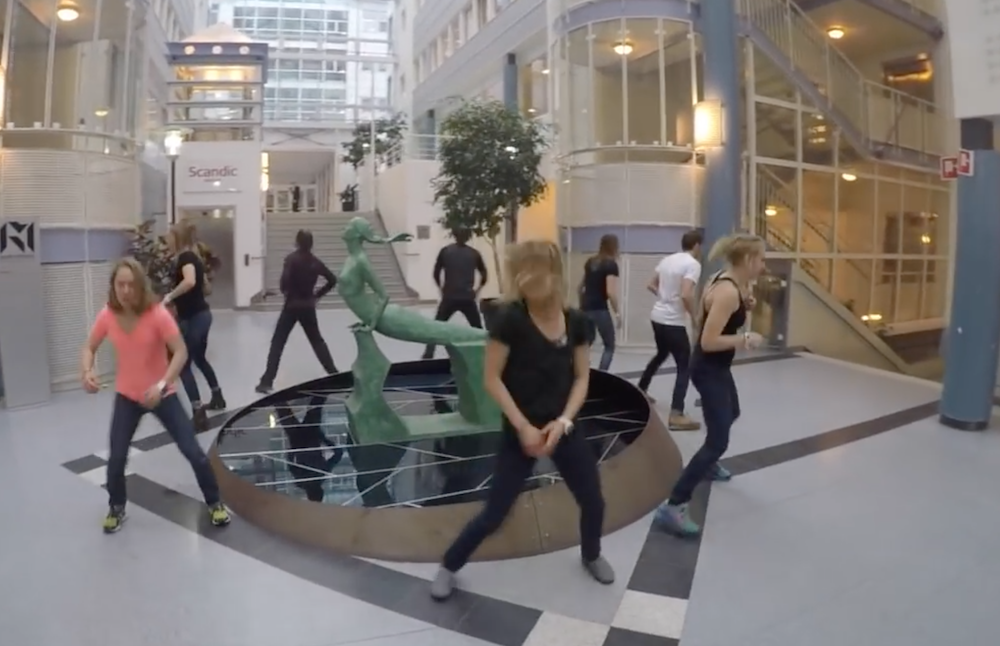
Jessie Diggins (black T-shirt) leading the dance troupe during a mall scene of the U.S. Ski Team’s most recent ‘I’m Ready’ video.
“I mean, they [DWTS] first heard about us because of our smash-hit ‘I’m ready’ music video, which went viral during the Ski Tour Canada, but once they learned more about us, they realized we actually have talent,” said Hamilton, who produced the video. “Personally, I’m not doing this for the money. It’s a short break in the training season, yes, but it’s a huge step for cross-country ski recognition in the U.S.”
The U.S. Ski Team’s ‘Uptown Funk’ video, which Hamilton also produced last year, received more than 80,000 views on YouTube.
Diggins and Hamilton will each reportedly be paid $125,000 dollars for appearing on the show. The contract involves six weeks of filming in Los Angeles, which isn’t exactly an ideal location for on-snow training, but U.S. Head Coach Chris Grover said he understands.
“I think it’s fantastic,” Grover told FasterSkier. “Jessie and Simi are both incredibly gifted athletes as well as dancers, and it’s time to show the world that. … Simi’s right, we’re here to grow the sport. If that means a little show business here and there, we can make that sacrifice.”
But how will this affect training?
“I think it will be about good time management,” Diggins told FS. “I’ve talked to my coach, and the plan is to stick to my normal training routine five days a week. The other two, I’ll dance my face off.”
Hamilton plans to go in raw.
“I’ve never had official dance training and I think that’s what the producers want,” he said. “The more green I am the better. So I won’t be taking any lessons this summer.”
While the network would not comment on celebrities slated for future shows, there have been rumblings about a few of the acts that will join the two U.S. Ski Team members, including David Letterman, Missy Elliott, Paul Rudd, Demi Lovato, Sarah Michelle Gellar, and Freddie Prinze Jr.
It’s all fun and games until it’s not anymore. Jessie Diggins was photographed mid-air during a so-called “jump photo” with the U.S. Ski Team. She landed on Ben Saxton, which may have complicated her injury. (Photo: FlyingPointRoad)
After an eventful and successful 2015/2016 campaign, the U.S. Ski Team (USST) has recently suffered a number of injury-related setbacks. Less than a week after finishing the season, Jessie Diggins suffered a severe posterior kneecap dislocation (PKD syndrome) while jumping in the air for a team photo.
“I have no idea what happened,” a confused Diggins tweeted from her bed in Afton, Minn. “I LOVE the jumping photo and usually they love me right back. … It’s hard to describe this feeling … It’s kinda yucky!!!”
Returning Diggins to form is a top priority for the USST, so the best medical minds in the country have been brought in to address her injuries. Leading the team of surgeons, physiologists and psychiatrists is Dr. Richard Fitzwell, a world-renowned orthopedic surgeon and sports medicine specialist, from the Mayo Clinic, Rochester, Minn.
“This is a very important and complicated case,” said Fitzwell. “The mechanism of injury here is difficult to determine. Unfortunately we do not have any video of her landing, only a useless still photo of Jessie jumping in the air. Our current best theory is that the longitudinal sheer forces between the tibia and femur created by impacting the ground produced microscopic tearing of the tendons and surrounding musculature of the kneecap.
“A limited number of these impacts would likely have been inconsequential, but the pointless repetition of this process had an additive effect,” he continued. “Even for an elite athlete, the repeated loading and unloading of these ligaments with similar, unpredictable force vectors can cause degeneration of the connective tissue and long-term functional instability. Jessie’s knee was basically a ticking bomb.”
Fitzwell added, “In my practice I regularly counsel and caution athletes of all level to be careful while taking these ‘jump photos.’ People think that they are funny, harmless activities, but in addition to being very played out, they are actually quite dangerous. No serious athlete with any dignity should ever do them at any time. I understand that in this day and age there are lots of media pressures, but it is in your best interest as an athlete to simply instruct the paparazzi to take a photograph of you standing still on the podium holding your skis like a normal person. It’s a safety issue.”
Sadly, the timing of this injury couldn’t be worse as Diggins is still feeling the effects of her high ankle sprain suffered while attempting to learn the dance moves to a local junior-high production of “The Music Man.” Further compounding the problem is the fact that her recovery was also still not complete from a very bizarre incident in which her pony tail became ensnared in a bird cage at a family cabin in Eli, Minn., requiring a series of skin grafts, weaves and extensions. This latest injury was thusly a most unwelcome setback for the normally upbeat Diggins.
Misfortune has also befell the men’s squad: Noah Hoffman developed a Staph infection immediately following this past weekend’s races in Craftsbury after suffering a severe paper cut playing a heated game of Settlers of Catan with his girlfriend at a Utah laundromat.
“It was a bit of a trade-off,” noted the ever-stoic Hoffman. “I finally have clean underwear, which I like, but it is a shame than my body is now covered with oozy, pus-filled sores. I knew I shouldn’t have used the laundromat restrooms.”
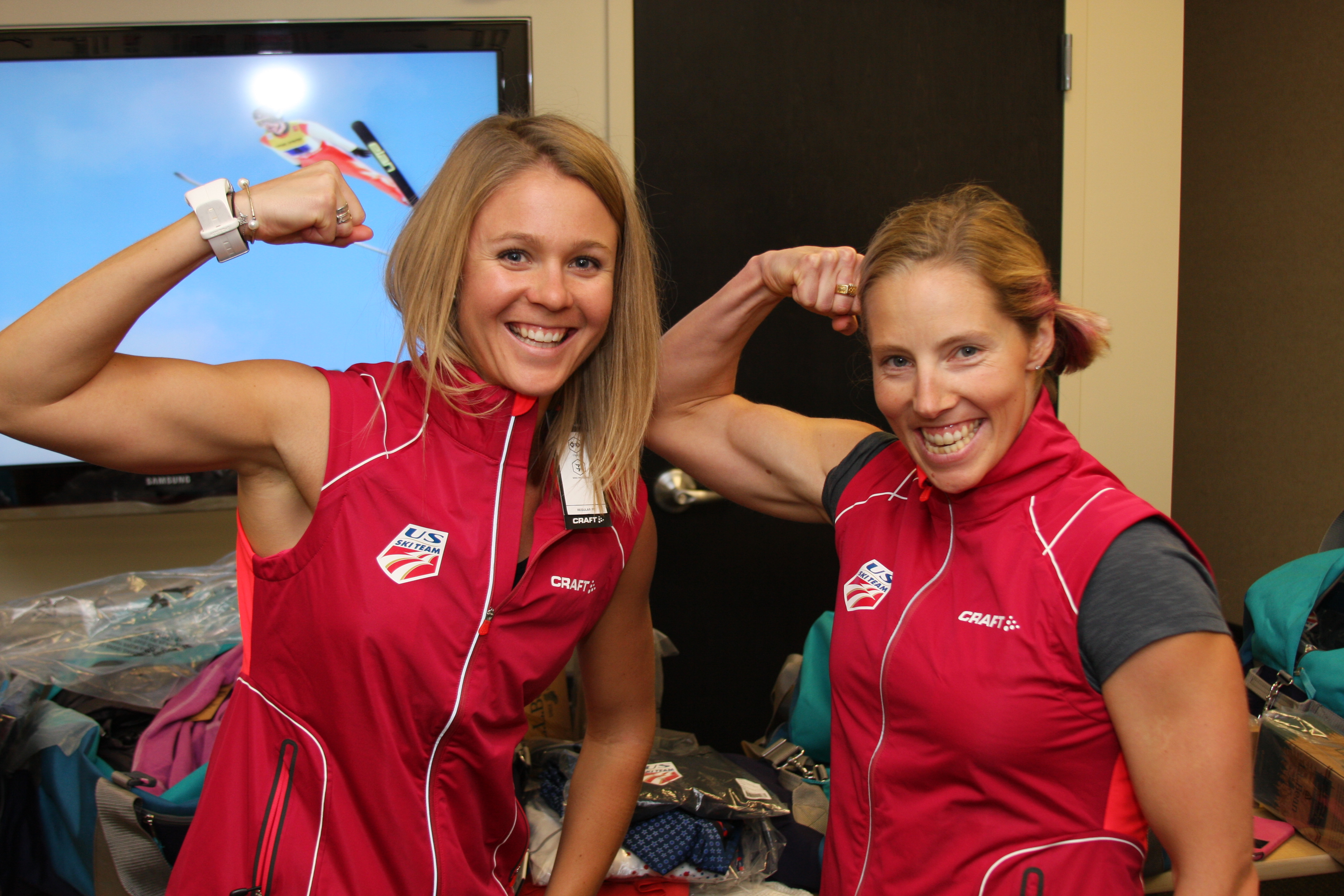
Kikkan Randall (r) and Sadie Bjornsen, Erik’s older sister, showing off their “guns”. (Photo: Greg Clarke/Craft)
Erik Bjornsen also fell victim to this alarming trend when he damaged several ligaments in his wrist and elbow while attempting to arm wrestle Kikkan Randall, who is almost full-term in her pregnancy, at the Burlington airport Red Carpet Club.
“It’s been a tough few days,” explained an exasperated U.S. Ski Team Head Coach Chris Grover. “We’ve had a real run of bad luck and this feels like I’m seeing Déjà vu all over again for the second time.”
Luke Bodensteiner, USSA Executive Vice President for Athletics, was alpine skiing at a luxury resort in the Swiss Alps and unavailable for comment.
The FIS Cross Country World Cup is bringing back wooden skis this year and making them a requirement for two of the stops on the circuit, along with bamboo poles and pine tar. This could be part of a growing trend to eliminate modern high-tech waxes, skis and poles, and its causing a ruckus. (Photo: Etsy)
Longer, slower, wider. That could be the slogan for future World Cup seasons based on the outcome of the International Ski Federation (FIS) Cross Country Committee’s spring meeting. According to a press release, as part of a test event this coming season in 2016/2017, World Cup competitors will be required to use wood skis and bamboo poles for two of the stops on the circuit and a total of five days of racing.
For ski prep, modern high-tech waxes will also be banned for these World Cups. Only pine tar and non-fluorinated klister and hard wax will be permissible.
“FIS is concerned about the rising cost of competing on the World Cup and at the Olympics,” FIS Cross Country Racing Director Petter Menagerie said in an interview. “It’s our hope that this will trickle down to the club level as well.”
The test events, including all three days of the season-opening Ruka Triple mini tour in Kuusamo, Finland, and Holmenkollen 30/50-kilometer classic races in Oslo, Norway, later in the season, are also expected to boost television ratings and build hype for the pre-Olympic year.
But according to a source who requested anonymity, the real reason for the wooden-ski mandate is FIS’s consternation over the success of athletes double poling to podiums in distance classic races. That hypothesis could not be confirmed by press time.
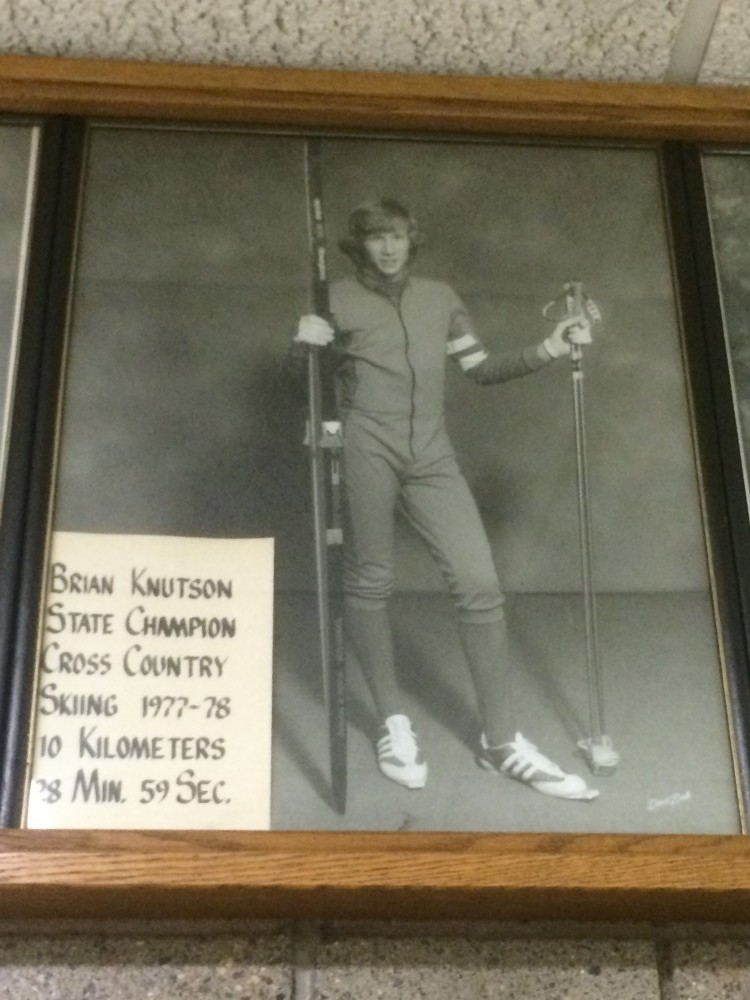
Minnesota state champion Brian Knutson with his race-winning gear from the 1977/1978 season (Photo: Matt Liebsch)
The announcement caught the industry by surprise.
A spokesperson for Fischer Sports said the company was “aware of the rule changes and researching the most state-of-the-art methods to comply with the new rules.”
Asked when consumers could expect a prototype, the spokesperson said, “We’re on it.”
Woodski roller ski president Peter Breu admitted that he has been in negotiations with unnamed ski companies wishing to learn of the magic of Woodski’s laminated roller ski shafts.
“I won’t name names, but you would know them all, and they are all dying to learn what we know about the qualities of wood…,’ ” Breu said.
“As a nordic buyer at Gear West, this new rule change has me concerned,” said Matt Liebsch, director of nordic sales and service at Gear West in Long Lake, Minn. “At SIA [SnowSports Industries America], I was not shown any wood skis but luckily our owner, Brian Knutson, has a garage full of old wooden racing skis. I have been fielding calls daily from top World Cup teams inquiring about buying the pair he won the Minnesota State meet on back in 1978. At this time Brian is still unwilling to sell that pair and his childhood memories attached with it.”
Athletes are taking novel approaches to fill their quivers for next season. U.S. Ski Team member Sophie Caldwell has asked her grandfather John Caldwell to give her his skis from the 1952 Winter Olympics. But she’s had to fight with John Caldwell’s nephew Zach, who wants the same skis to test stone grinds.
1960 Olympian Joe Pete Wilson announced that he plans to sell sell his quiver of wooden skis on eBay to the highest bidder. Sites like Etsy and Craigslist are also reportedly preparing for increased demand in antique equipment.
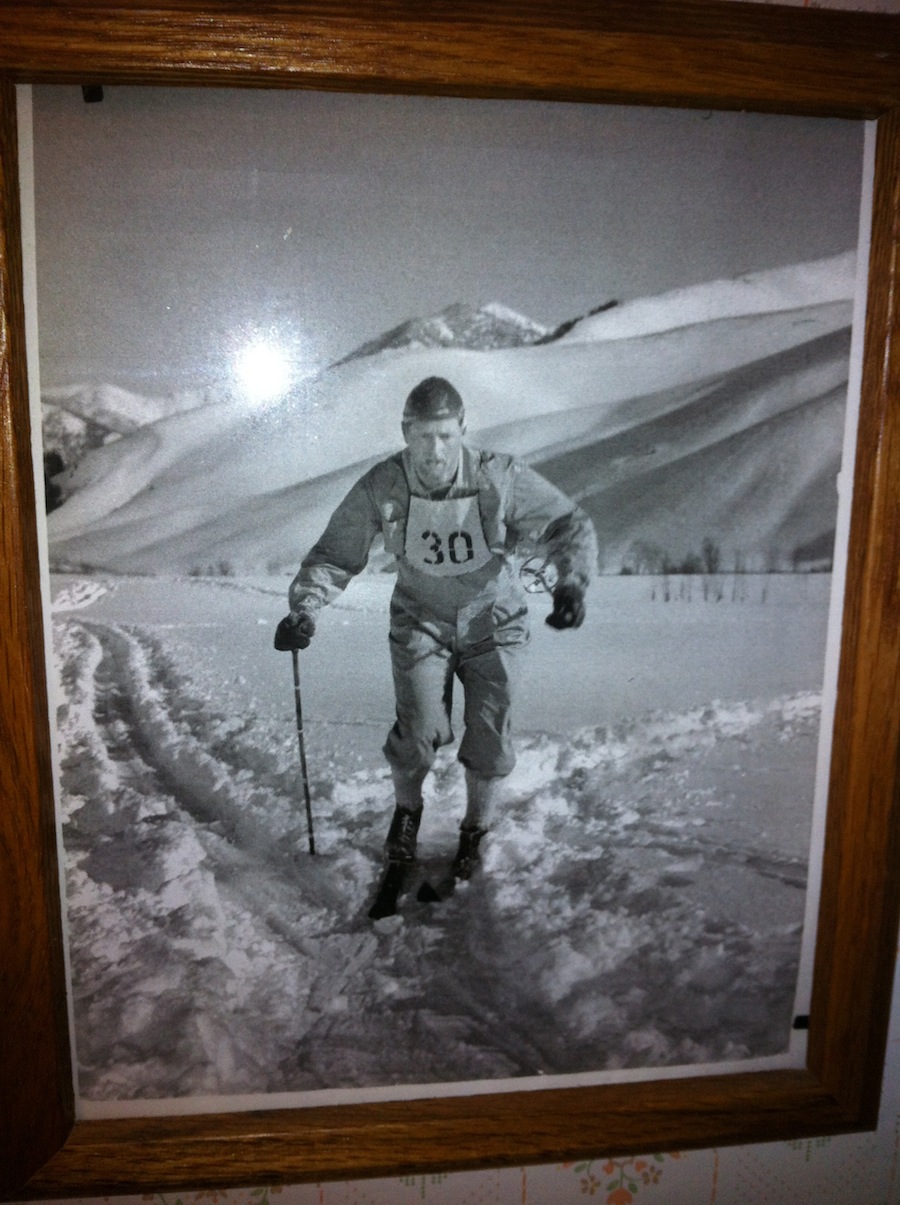
Chummy Broomhall, a 1948 and 1952 Olympian born in Mexico, Maine, and a member of the Chisholm Ski Club in Rumford, Maine, since the 1930s, is seen here on his “skinny” skis. While FIS Cross Country is making similar wooden skis a requirement for test events this season, some wonder if they’ll eliminate grooming technology from the World Cup as well.
In Farmington, Maine, the Maine Ski Hall of fame was burglarized on Thursday night. Thieves stole several pairs of wood cross-country and jumping skis. In Finland last week, the Lahti Ski Museum was broken into and Laasanen antique skis were stolen.
FIS Nordic Combined is anticipated to initiate similar test events in its World Cups.
“I’m all about making the sport simpler, but there’s also something to be said about evolving technology,” U.S. Nordic Combined Head Coach Dave Jarrett said. “Safety on the [jump] hill should be a primary concern. Are we really going to go back to the dark ages?”
The International Biathlon Union (IBU) has not yet indicated it will go down this road.
“For sure, retro is a thing,” said US Biathlon’s Lowell Bailey, a member of the IBU athlete advisory committee. “But wooden skis? How are you going to skate on those? What’s next, black-powder biathlon?”
But US Biathlon President and CEO Max Cobb had a different take.
“Wood skis are a great idea, at least for the novelty factor if nothing else,” he commented. “I think biathlon should take it further, at least for one of the World Cups, to pay homage to its origins. At the next IBU general meeting, I’m going to recommend black-powder muskets in place of the current biathlon rifles, and buckskin race suits and coonskin caps!”
FIS did not confirm whether there would also be a limit on the number of skis an athlete can carry around on the World Cup circuit. However, in an effort to make the sport greener, competitors will only be offered a single replacement pole to be used for the entire season. This could mean many athletes competing with only a single pole during the second half of the season — and for the designated World Cups, it will have to be bamboo.
“I think the bamboo-pole requirement is a great way to help keep the traditional stride and glide technique alive although I will miss the strength and lightness of carbon fiber poles,” Brian Gregg wrote in an email.
With its line of tar-based kick waxes, Finland’s Start appears to be the best-situated for the new regulations. Gallium, Holmenkol and Swix are reportedly joining forces in a lawsuit against the pine-tar rule, to be heard in the Court of Arbitration for Sport.