From the FasterSkier archive — posts syndicated from athletes’ and coaches’ own blogs between 2004 and 2012, kept online as published. Current coverage is at fasterskier.com.
In this episode we put the elusive Fast Big Dog, known in the business world as Jon Schafer, in front of the mic for his answers to the 17 Questions for 2017. It brings a conclusion to the FasterSkier interview series run last fall before the start of the 2016/2017 cross-country, nordic combined and biathlon race seasons.
Schafer is knee deep in the nordic scene as high performance director for USA Nordic Sport, a supporter of many aspiring skiers, and a huge Evel Knievel devotee — note Schafer’s race suit.
The logo of the Olympic Games 2024 Candidate City Los Angeles. Its organizing committee may need to tweak it slightly (give her some ski poles and skis) if L.A. ends up getting the nod the 2026 Winter Olympics as well. (Photo: LA24.org)
In 2022, Beijing will become the only city that has hosted both Summer and Winter Olympic Games. But sooner than expected another unlikely city might join that rank: Los Angeles.
L.A. is currently one of only two remaining candidate cities to host the 2024 Summer Olympic and Paralympic Games, the other one being Paris. The winner will be determined at the next International Olympic Committee (IOC) general session in Lima, Peru, in September of this year.
But recently, the IOC Executive Board has become worried about a bidding process it fears is too expensive, too elaborate, and “produces too many losers” in the words of IOC President Thomas Bach. Under the current circumstances, otherwise highly qualified cities often don’t want to bid again for future Olympics after coming up short in an IOC session, and cities at least in many democratic countries are ending their candidacies under pressure from lost popular votes.
For the 2024 Olympics, cities such as Hamburg, Rome and Budapest withdrew their bids from consideration after political opposition, leaving only L.A. and Paris to choose from.
And for the 2022 Winter Games, the IOC ultimately was left with another two-horse race between Beijing and Almaty, Kazakhstan, after cities such as Oslo and Munich withdrew their bids.
For example, if the Olympics were to be held in Munich, virtually no costly “white elephant gift” venues never to be used again after the two-week Games would have had to be built, a plight suffered by several recent Olympic host cities. The region already hosts World Cup events every year (e.g. in Ruhpolding for biathlon, Oberstdorf for cross-country skiing and ski jumping, Garmisch Partenkirchen for alpine skiing, Königsberg for bobsled, and Inzell for speed skating). Only one or two athlete villages and a media center would have had to be built providing sorely needed new real estate. But in 2013, a majority of citizens still voted against the Olympic project. That certainly has given the German-born IOC President Bach reasons to worry about the future of the Olympics, after a plan called Agenda 2020 failed to spark significant changes.
So now the IOC has publicly pondered plans to award multiple games at the same time as soon as during this year’s session, reportedly offering the loser of the 2024 Olympic bid the next Summer Games in 2028 automatically. But Los Angeles and especially Paris were not fond of that idea. “We have only one objective and that is to host the Games in 2024,” the chairman of Paris’ candidature Tony Estanguet said at a media event in London last week.
Within the IOC, L.A. is widely considered to have presented a sound plan to host the 2024 Games on a reasonable budget without too much new construction required. Paris might have the tradition speaking for it, hosting the 2024 Olympics exactly 100 years after it already did so in 1924, but for the City of Angels, it would also be the 40-year anniversary of the 1984 games.
Now the overlords of the IOC have come up with a follow-up suggestion: Los Angeles could also host the 2026 Winter Olympics, saving costs associated with the bidding process, and profiting from synergies in the back-to-back organizing and broadcasting of the event. Reportedly the IOC’s main media partners NBC and Discovery Communications, which holds the TV and internet distribution rights for Europe, are in favor of the plan. The same is true for key “Olympic Partner” sponsors such as Coca Cola, McDonalds, Visa, GE, P&G, and Samsung.
The advantages are clear: the same Olympic village, only one new media center, only having to create sufficient hotel and transportation capacity once, the same security concept, the same ticketing solution, and so on. The IOC even promises to pass on a larger percentage of its revenue share to the host city in case of a successful double-bid without “double-dipping”.
Of course there is one obvious problem: L.A. has a temperate climate year round with no snowfall, and is a city where people are so accustomed to warm weather conditions that they freak out even over a little rainstorm or when temperatures drop to 50 degrees Fahrenheit. The downtown L.A. weather station only recorded measurable snowfall three times in 1882, 1932 and 1949 since official weather records were kept, with the last one elsewhere in the L.A. basin in 1962.
“At first, of course I also thought it was a really weird idea for our city to host a winter sports event,” Los Angeles mayor Eric Garcetti, a fourth-generation Angeleno who has never experienced snowfall in his city, told FasterSkier. “But IOC President Bach has since convinced me that having natural snow is not really a prerequisite to hosting Winter Olympics anymore. Beijing doesn’t get any snow with regularity, either, and Sochi has the same climate as the Mediterranean Sea. They even have palm trees on the oceanfront, just like us. Many of the events are indoors on ice rinks anyway, and the outdoor ones can be hosted in the mountains just a few hours by car or bus away.”
“People don’t realize that a number of NBA arenas also double as NHL hockey arenas,” basketball legend and 1992 Olympic gold medalist Ervin “Magic” Johnson said, an advisor to the L.A. 2024 Organizing Committee and president of basketball operations of the LA Lakers. “We have that here in L.A. for the Kings playing their home games in the Staples Center, and for the Lakers we just cover up the ice with a hardwood floor. The same in Boston, or even in very hot cities like Phoenix. With modern technology that’s no problem at all!”
Similar to how the Rosa Khutor Alpine Resort east of Sochi played a big role for the 2014 Olympics, hosting all alpine, biathlon, ski jumping and cross-country events, Los Angeles would have to rely on more mountainous venues for those sports. Mammoth Mountain could be an option with some experience hosting international snowboard and freeskiing events and secure snow for cross-country due to its higher altitude, potentially the resorts around Big Bear Lake closer to the city, and a bit farther away Squaw Valley and Lake Tahoe are also under consideration, according to sources close to the LA 2024 Candidature City Committee.
Just last month, the FIS Alpine Ski World Cup returned to California for the first time in 19 years with a women’s giant slalom and slalom at Squaw Valley Alpine Meadows. U.S. Ski Team star Mikaela Shiffrin did not disappoint her many fans, sweeping the two races on the Red Dog run.
“We never anticipated hosting both summer and winter games back-to-back, but this is such an exciting opportunity,” explained Casey Wasserman, chairman of the LA 2024 Committee and CEO of the Wasserman Media Group, a sports and entertainment company. “It would save a lot of financial and environmental resources for these two games, not having to build a new village, a new arena for the opening ceremony, and so on. And luckily we have some huge winter sports competency on our leadership team already.”
That experience mainly comes in the form of Angela Ruggiero, the chief strategy officer for the LA 2024 Committee and an ice hockey Hall of Famer and four-time Olympian who won gold in 1998, silver in 2002 and 2010, and bronze in 2006.
Other past and future U.S. Olympians were both surprised and excited when they heard the news of a potential candidacy by the California city.
“I’m from Palo Alto and have really no emotional connection to LA,” US Biathlon’s Joanne Firesteel Reid wrote in an email to FasterSkier. Reid is a 2008 Junior Olympics gold medalist, US Biathlon senior team member, daughter of U.S. Olympian Beth Reid and niece of speed skating Olympic champion Eric Heiden. “For now I have my mind set on the 2018 and maybe the 2022 Olympics. But it would be crazy fun for California to host a major biathlon and winter sports event, so I am all for it.”
That thought was shared by 19-year-old U.S. Ski Team development team member Hannah Halvorsen, of Truckee, Calif. She competed at last year’s 2016 Youth Olympic Games in Lillehammer, Norway.
“Olympics in California, that alone is just an amazing dream,” she wrote. “Who knows? I might just be peaking at that point.”
Figure skater Mirai Nagasu even hails from Los Angeles County, and alpine skiers Julia Mancuso and Travis Ganong — also born in Truckee — live in Squaw Valley for part of the year. Both were excited about the possibility to see Olympic races potentially happening in their hometown, though the four-time Olympic medal winner Mancuso cautioned those games would come too late for her anyway, as she plans to likely retire after the 2018 Olympics in PyeongChang, South Korea.
“I will have to watch those games from the stands or from my couch like a normal person,” she laughed. “But I would love to play even a minor role in bringing Olympic games to my hometown. The organizing committee can sign me up if they need some social media promotion. I have tons of selfies and hours of ski video footage from the mountains around Lake Tahoe, I even got married there.”
The last time the U.S. hosted an Olympics was in 2002 in Salt Lake City, Utah. The last time North America has hosted an event was more recently in Canada in 2010 in Vancouver, British Columbia.
Opposition to the IOC’s plans are expected to come from cities who also considered bids for the 2026 Olympics and were surprised by the seemingly sudden potential overhaul of the whole bidding process, such as Innsbruck (Austria), Stockholm (Sweden) and Helsinki (Finland), or the region around Sion (western Switzerland). Almaty might take another shot after losing to Beijing for the 2022 Games, with Sapporo, Japan, also reported as another candidate city from Asia that already hosted games in the past.
For North America, Calgary also had initial plans to submit a bid, with the city council approving a $5 million dollar budget in June 2016 for an exploratory phase. Now the host city of the 1988 Winter Olympics was caught off-guard by the possibility another major city on the continent could vault to the forefront of the candidates in the bidding process.
“Honestly, we were feeling really positive the way things were trending before this announcement,” said John Furlong, CEO of the 2010 Olympics in Vancouver and a current advisor to the Canadian Olympic Committee. “But L.A. potentially getting the 2026 Winter Olympics by default? That came out of nowhere. This has got to be a joke or something.”
Thailand’s beaches will host the season-opening World Cup races in late November 2017. (Photo: Wikimedia Commons)
With Kuusamo’s sudden cancellation of the season-opening Ruka Triple in November, FIS formally announced a schedule change for the start of the 2017/2018 World Cup season. The season’s first event will be a mini tour in Thailand.
Yup, Thailand. A dedicated committee of ski enthusiasts recently committed to organizing a three-stage mini tour on the outskirts of Bangkok, Thailand, in late November 2017.
“I bought a Snow Factory in 2015. At first, we thought people would be interested in snowboarding,” said Roman E. Conti, an expatriate American entrepreneur based in Bangkok. “That was fine, we made a lot of money with people snowboarding in a lame halfpipe. Then we heard that Kuusamo pulled out, and we thought, ‘Hey, why not bring nordic skiing to southeast Asia?’ ”
World Cup skiers, get some beach skis. You’re going to Thailand. (File photo)
The race format follows the footsteps of earlier mini tours, but with a twist. The opening 1.5-kilometer freestyle sprint and 5/10 k classic races will be on manmade snow, courtesy of the Snow Factory. But the pursuit will be a 10/15 k, point-to-point freestyle beach ski from Chonburi to Bang Phra.
“We have 100-percent confidence that we can provide a good ski surface,” Conti said.
According to the manufacturer, the Snow Factory can blow snow in temperatures up to 80 degrees. The Mount Van Hoevenberg Nordic Center in Lake Placid, N.Y., is currently leasing one of these snowmaking contraptions and has been blowing snow most days since last November. (More details on that in another story.)
According to Peter Masonry, race director for International Ski Federation (FIS) Cross-Country, “FIS is building on the enthusiasm behind new Winter Olympics venues like Sochi and PyeongChang. This is a historic move to expand nordic skiing into the Southern Hemisphere.”
He added that FIS would suspend regulations governing minimum climb for this event.
Reactions in the ski community varied depending on the location. FasterSkier’s Editor-at-Large, Chelsea Little, road-tripped to Scandinavia on a special fact-finding mission.
“I don’t want to go there,” moaned Martin Johnsrud Sundby. “Thailand is even farther away than Quebec! Why can’t all the World Cup races be in Scandinavia and central Europe?”
“Do they even know what blueberry soup is over there?” asked Finnish world champion Iivo Niskanen. “And what is beach skiing?”
Unnamed sources indicated that major ski manufacturers were scrambling to develop skate skis with a camber specifically suited for moist sand. Swix and Rode are developing klisters that will work at temperatures up to 95 degrees.
FS caught up with Andy Newell as he wrapped up a pre-Spring Series workout at Prospect Mountain in Woodford, Vt. “Thailand? I’m stoked!” he said. “The surfing is really sweet!”
Further north in Vermont, FS found Sophie Caldwell working at great uncle John Caldwell’s maple sugaring operation.
“I love winter, but it’d be nice to have a break from cold weather,” Caldwell said as she heaved logs in to sugarhouse the wood stove. “I’m all for a trip to Thailand, sounds great!”
In Alaska, the FS web of spies [sic] journalists found Rosie Brennan doing laps on Eagle Glacier. “Thailand? That’s sweet.” Asked about the beach race, she showed a writer her ski bases. “Look at this,” she said. They were streaked with a runny mix of klister, dirt and oxidation. “I have to hassle with klister in Alaska for six weeks every summer. And I mean, it’s really not about the klister or beach skiing, I can’t wait to see what Thailand is all about.”
According to Swedish Olympian Marcus Hellner, an athlete caucus will push to replace the beach skiing stage with a swamp run. But Masonry said that FIS would stand firm on the race format. Tacitly acknowledging that fact, the national teams of Norway, Finland and Switzerland have already planned two-week summer training camps at the Jersey shore.
The baby room at the 2017 Ulricehamn World Cup in Sweden. FIS is going to need a bigger space for all the pooches and cats they’re about to allow on tour. (Photo: Kikkan Randall/Instagram)
Ever an equality advocate, Kikkan Randall is spearheading an effort to allow Fido and friends to accompany their World Cup pet owners on the circuit.
“I was just blown away by the level of support myself and other new parents had on the circuit this year, thanks to FIS’s new childcare initiative,” Randall, an International Ski Federation (FIS) athlete representative, U.S. Ski Team member and mother of a nearly 1-year-old child, told FasterSkier in an exclusive interview on Saturday morning.
“A lot of my teammates have fur babies at home, including myself, and I know how hard it is to leave them for months on end,” she continued. “They should have the same rights as humans.”
A few months ago, Randall sent a survey to her World Cup cohorts to see if there was interest in a pet daycare program. Resoundingly, the answer was yes, she said.
“I couldn’t believe how many of us had dogs, cats, ferrets, you name it,” she said. “I’m not sure how much FIS can accommodate, but anything is better than nothing.”
She approached FIS with the idea and was surprised that the federation took it seriously.
“I had to be very careful with my wording and our requests,” Randall said with a laugh. “I mean, we’re not asking for a zoo, but we would like trained specialists taking care of our pets on a daily basis, giving them walks and lots of belly rubs while we’re out doing our jobs.”
According to Randall and FIS Cross-Country Special Operations Officer Amanda Fritz, pet-care services could be implemented for the 2017/2018 season.
“We still have a lot of details to work out, but we plan to discuss this proposal at the FIS Congress meetings this summer,” Fritz said on the phone.
Asked what animals are being considered and whom this service would be extended to, Fritz explained that cats and dogs are solely on the table at this time.
“We don’t have the space and staff to care for animals other than felines and canines, and even then, they need to be well-behaved, housebroken, and play well with others,” she said. “I think we’re going to have to put the cats and dogs in separate buildings anyways, and definitely away from the kids. As fun and cute as it would be to let them all play together, it’s simply not realistic. Perhaps we can have play dates and field trips.”
The service will be available to athletes in the Red Group (World Cup top 30), which also have food and lodging paid for by FIS. If an athlete is on the edge or teetering on that Red Group status, they can bring their fluffy friend and pay for pet-sitting for a nominal fee, Fritz said.
“We haven’t determined the cost yet,” she added.
And what about the travel required to get the pets from one venue to the next, especially the long journey from North America to Europe (and vice versa), or from anywhere to PyeongChang, South Korea?
“That responsibility falls on the athlete,” Fritz said.
Randall explained that there are, of course, workarounds.
“If your dog or cat isn’t huge and destructive, apply to have them as a therapy pet and put them in the seat with you,” she said of flying with pets. “I’d never put my cat in cargo.”
Randall and her husband Jeff Ellis plan to bring their cat, Kikkananimal’s Animal (who currently has dyed-pink fur), to Europe with them and baby Breck next year.
“I can’t wait to have the whole family together next year,” she said. “It was so hard leaving our first baby at home. Now he’ll be part of the team, too.”
FIS is reportedly on the lookout for world-class pet handlers. Qualifications include previous pet babysitting experience, no allergies, a rabies shot, and a death-grip on leashes.
“Our biggest concern is having another poodle get loose on the trails, like we saw in Quebec,” Fritz said of the episode on the last day of World Cup Finals. “You need to have a strong handle on dog walking. Beyond that, we need to know that these animals are being taken care of with the utmost diligence. These are World Cup athletes’ animals, not just some mutts off the street.”
FasterSkier will post more updates as they become available.
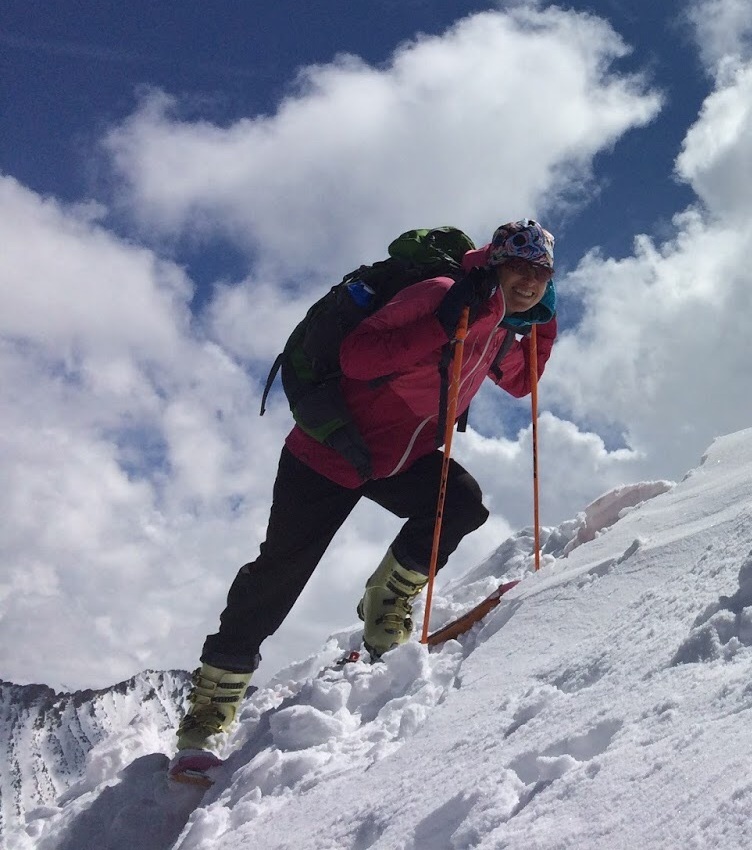
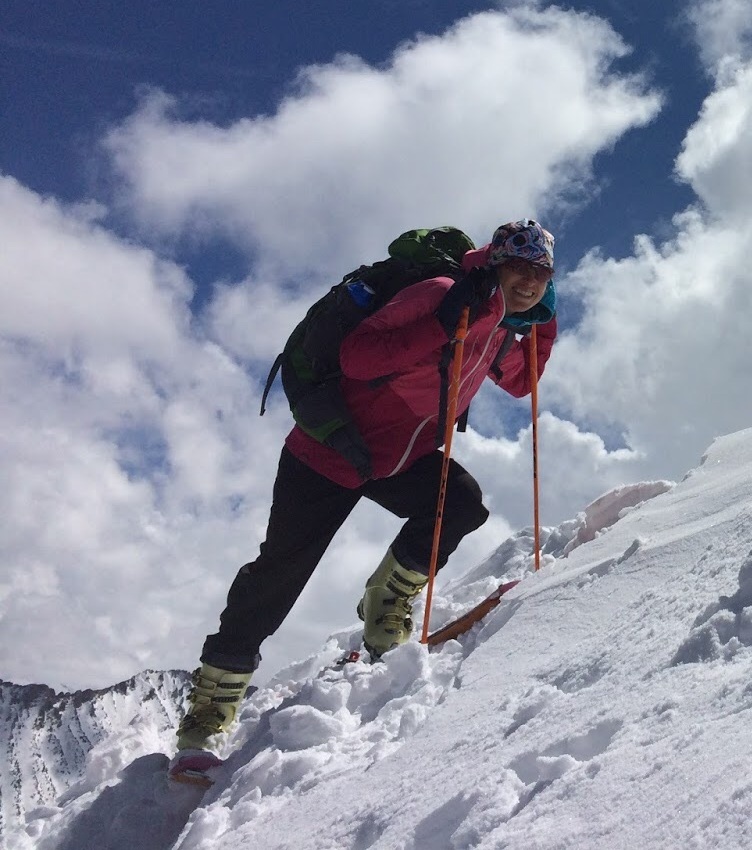
Liz Stephen (U.S. Ski Team) on a backcountry ski tour in Colorado in April 2016. (Photo: sophiecaldwell.blogspot.com)
Liz Stephen has made a name for herself as one of the best uphill climbers in the world on the cross-country World Cup circuit, frequently achieving her best performances of the season in the final stage of the Tour de Ski up the grueling Alpe Cermis climb on a ski slope in Italy. She placed second for the time of day up the climb again this year, her fourth time to do so.
“I want to win this thing before I retire,” Stephen told FasterSkier in January. “So we’ll see, maybe a little extra training for it specifically next year.”
FasterSkier recently learned that the 30-year-old Vermont native, who was introduced to cross-country as a young alpine skier at Burke Mountain Academy, plans to take her uphill climbing skills and indomitable fighting spirit to the next step. After next season (2017/2018) and the 2018 Winter Olympics in PyeongChang, South Korea, Stephen plans to professionally take up the sport of ski mountaineering.
Despite the fact that ski mountaineering (“skimo” for short) sprung out of cross-country skiing, the race formats and equipment slightly differ between the two sports.
“Individual” skimo races can last one to three hours and include up to 2,000 meters of total climb, multiple ascents and off-piste descents in difficult terrain, as well as steep sections where the skis have to be carried in a rucksack harness on the back. There are also fast-paced sprint races lasting just around three minutes on a ski slope, and long-distance team races with a partner as well as relays.
“I just love the concept of that sport. It looks so hard but also so much fun,” Stephen said after being glued to the online broadcasts of 2017 Ski Mountaineering World Championships in Piancavallo, Italy. “They only ski steep uphills for hours, which is just my thing, and while the downhill sections are a bit scary I can finally put my high-school background in alpine skiing from Burke to good use.”
The skis used for skimo are wider and heavier than cross-country skis and have steel edges, but the boots and skis are lighter than the ones mostly used in alpine skiing. While skiers can use any technique, there frequently are no tracks, so the typical climbing style looks similar to diagonal classic cross-country skiing. On the steep ascents racers don’t use kick wax, but synthetic “skins”, before taking them off for the downhill sections, often just stuffing them under their spandex race suits for re-use on the next ascent. They also wear helmets for protection.
Stephen, who still regularly goes alpine and backcountry skiing in the offseason for fun, said she especially looks forward to the team events and a discipline called “The Vertical”, a format usually “carried out on well packed snow with the whole race taking place with skins under the skis in a single, long ascent,” according to the International Ski Mountaineering Federation (ISMF).
A separate entity from the International Ski Federation (FIS), the ISMF has professionalized the recreational sport of skimo with regular World Cup tour and biannual World Championships. The races are becoming increasingly popular in central and western European countries bordering the Alps, such as Italy, France, Spain, Switzerland, and Germany. And the sport has also been gaining traction in North America.
One of the most prominent athletes in skimo is Spain’s Kilian Jornet Burgada, an elite skier and mountain runner who became known in the U.S. to a wider audience when he won the 2015 Mount Marathon race in Anchorage, Alaska, in a record time. A year later, Alaskan elite cross-country skier David Norris broke that record.
Skimo is not yet an Olympic sport, but the ISMF is hoping to soon make it one, with a potential demonstration to the International Olympic Committee (IOC) as soon as the 2018 PyeongChang Olympics.
At those Games, Stephen still plans to compete in cross-country, targeting individual races as well as a medal in the women’s relay.
“I feel like I won gold already with this team,” Stephen told FasterSkier in an interview during the Nordic World Championships this season in Lahti, Finland. “I think it is more about these friendships and these inspiring teammates that I am around every day. They are why I ski, and I couldn’t be happier to just be a part of the team.”
This time next year, Stephen will be making the transition to a new team and a new sport. While she said she’ll miss her friends, she said training solo won’t be a problem as she’s done that for years based out of Park City during the offseason.
In the ISMF World Cup’s overall rankings, there aren’t any senior U.S. skiers currently in the top 30. However, the U.S. team did post multiple top-15 results at this year’s World Championships, and 15-year-old Quinn Simmons of Durango, Colo., even earned a bronze medal in the cadet (youth) sprint race.
“There’s definitely going to be a learning curve for Liz, like quickly skinning the skis without any help from ski techs, or carrying them over steep sections using ropes and crampons,” U.S. senior national team coach Joe “Pale Thunder” Howdyshell said on the phone. According to his bio, he’s a self-described “jorts-wearing, whiskey-drinking, creative-swearing badass coach.”
“But she seems like a hard-working, passionate athlete, and given her enormous endurance and experience as an alpine racer, I know she’ll be a huge asset to our skimo family,” Howdyshell continued.
And at the ripe age of 31 next year, she’ll be one of the younger ones on the U.S. senior women’s team, most of which is over the age of 30.
“I am so fired up about PyeongChang and going out on the highest note possible,” Stephen said of her cross-country career. “Then onto higher mountains and hopefully, even bigger things.”