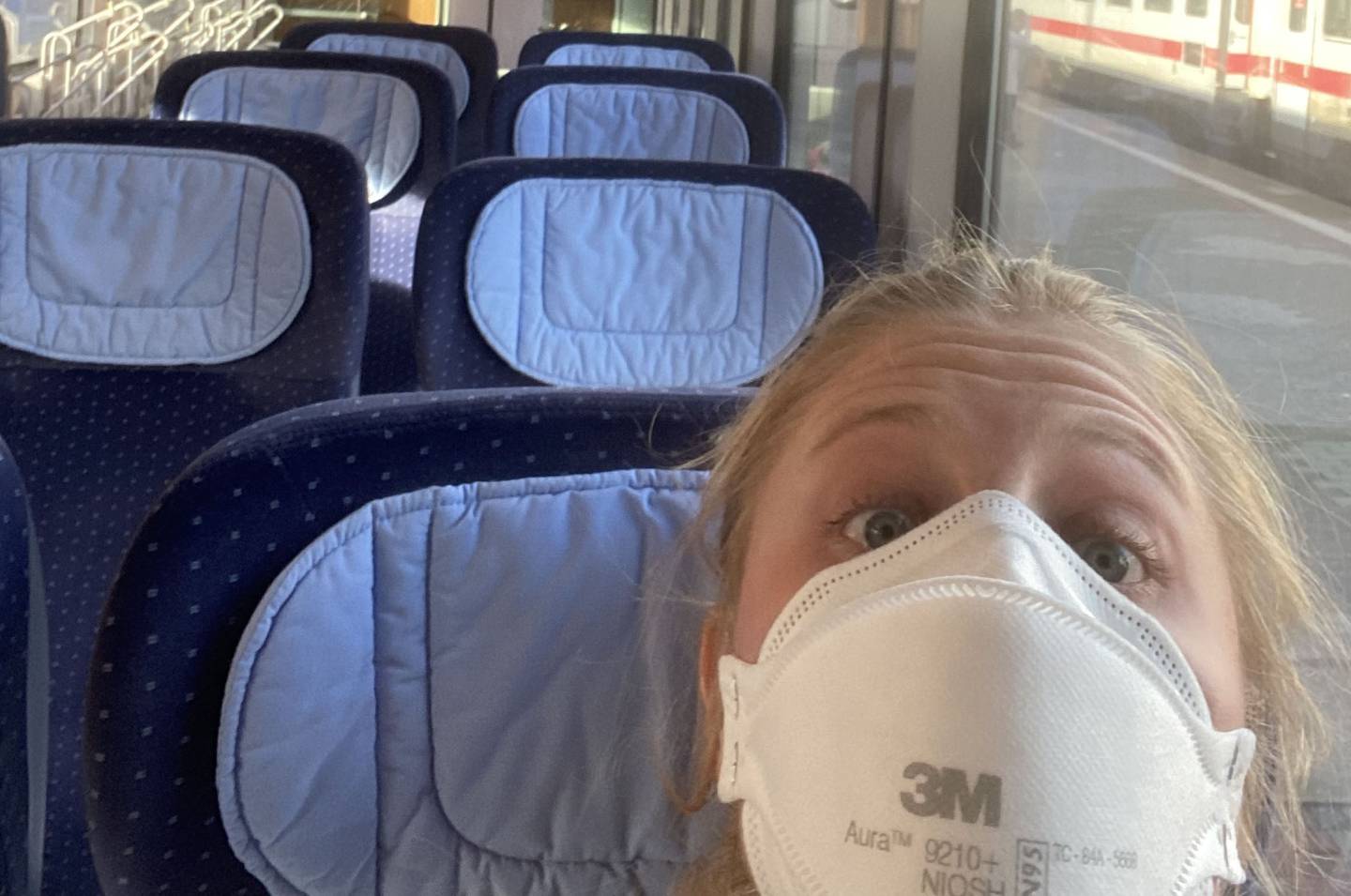
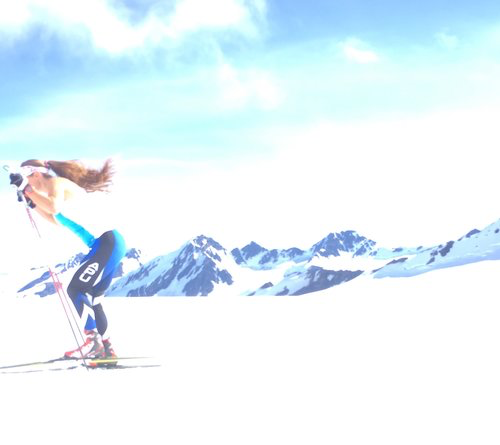
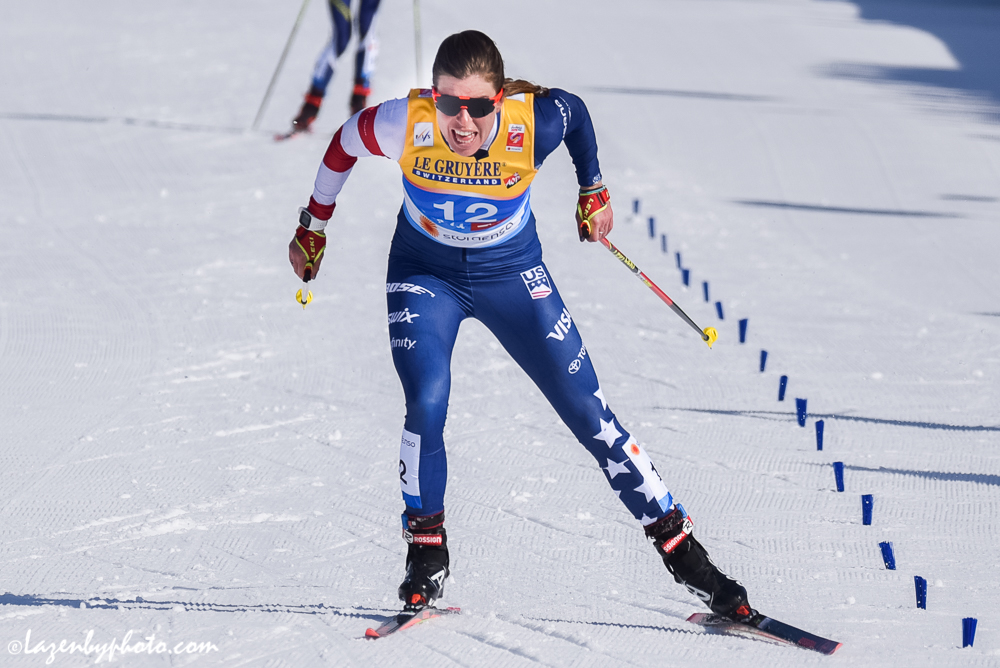
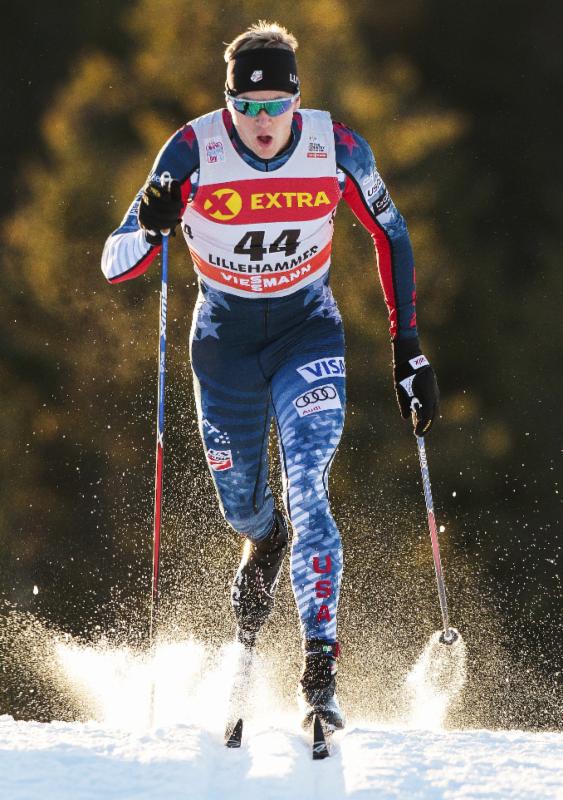
Hailey Swirbul searched out an empty train car to ride in while trying to avoid infection with the omicron variant on her way to a ski town in Austria this month. Swirbul is one of a number of Alaska athletes taking rigorous COVID-19 prevention measures to avoid derailing their hopes of competing in the Winter Olympics in Beijing. (Courtesy photo)
This article originally appeared on Wednesday January 19th, 2022 in the Anchorage Daily News. Reposted with permission.
The organizers of next month’s Winter Olympics in Beijing have imposed a rigorous regime of testing, quarantines and isolation for incoming athletes and staff.
Among the casualties is Steve Patterson’s pickleball game.
Patterson has two adult children, Scott and Caitlin, who grew up in Alaska and are both Olympic hopefuls in cross-country skiing.
They’re planning to prepare for the games from their parents’ home in Montana. Which means the whole family is being careful to avoid any contacts that could invite the coronavirus into their home — potentially derailing access to China for Scott, 29, and Caitlin, 31.
The Patterson siblings are two members of what’s currently one of America’s most COVID-conscious demographics: aspiring Olympians with plans for Beijing.
China, with its “zero COVID” policy, has draconian requirements for anyone flying into the country for the Games. They start with two negative lab tests just to get on the plane to China, followed by another immediately upon arrival at Beijing’s main airport.
A positive test would disrupt teams’ meticulously laid plans for travel and training, and even asymptomatic cases would almost certainly force athletes to miss flights and competitions for which they’ve trained for years.
As a result, Alaska athletes and others involved with the Olympics are going to great lengths to stay free of omicron as the variant spikes across the U.S. and the globe — even with training and competition schedules that include inevitable cross-country or intercontinental travel.
“This experience that I’ve dreamed of my entire life is sort of now just grounded in stress, more than anything,” said Luke Jager, a 22-year-old Anchorage cross-country skier likely to be named to the Olympic team. “I’m sure at some point, being over there, it’ll kind of set in. But right now, the challenge of not getting COVID feels just as big as the challenge of even qualifying for the Games did.”
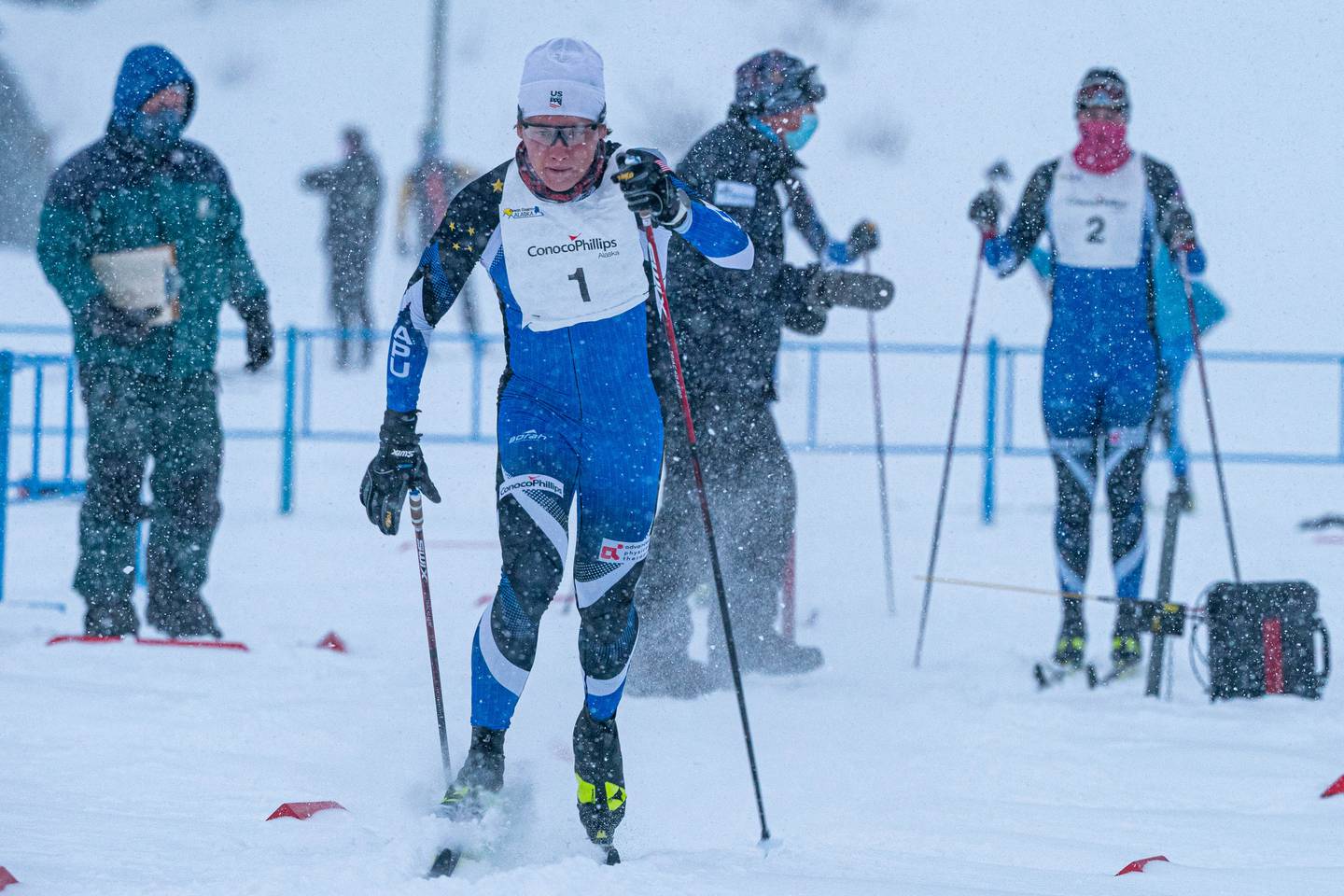
Luke Jager starts a race at Anchorage’s Kincaid Park in 2020. (Loren Holmes / ADN)
Chris Grover, the Anchorage-raised program director for the U.S. cross-country ski team, recently returned home to Idaho from the European racing circuit.
He spent his first few days with his in-laws, rather than with his family, to avoid catching the coronavirus from one of his children who’d had a potential exposure.
Meanwhile, one of the athletes that Erik Flora coaches at APU, he said, has even been wearing masks around and sleeping in a different room from their romantic partner.
“That’s the commitment that probably tops just about everything,” Flora said. “You’re messing with the human spirit at that point.”
More than a half-dozen cross-country ski racers with Alaska ties have a good chance to make the American Olympic team when it’s named Thursday — joining two curlers, a hockey player and a figure skater as some of those destined for Beijing from the 49th state.
In interviews, the skiers and coaches describe taking Olympic-level anti-omicron precautions. But each faces a unique set of risks, depending on their circumstances.
Hailey Swirbul also trains with APU in Anchorage; she planned to return from European racing to Alaska for a pre-Olympic camp, where she could spend time with her boyfriend and dog.
But after catching a cold, Swirbul, 23, decided to stay in Europe and avoid two rounds of major international travel.
After three train rides — sporting an N95 mask, with no breaks for eating or drinking onboard — Swirbul arrived in Austria for pre-Olympic training. There, she and her teammates broke into smaller groups that don’t mix indoors.
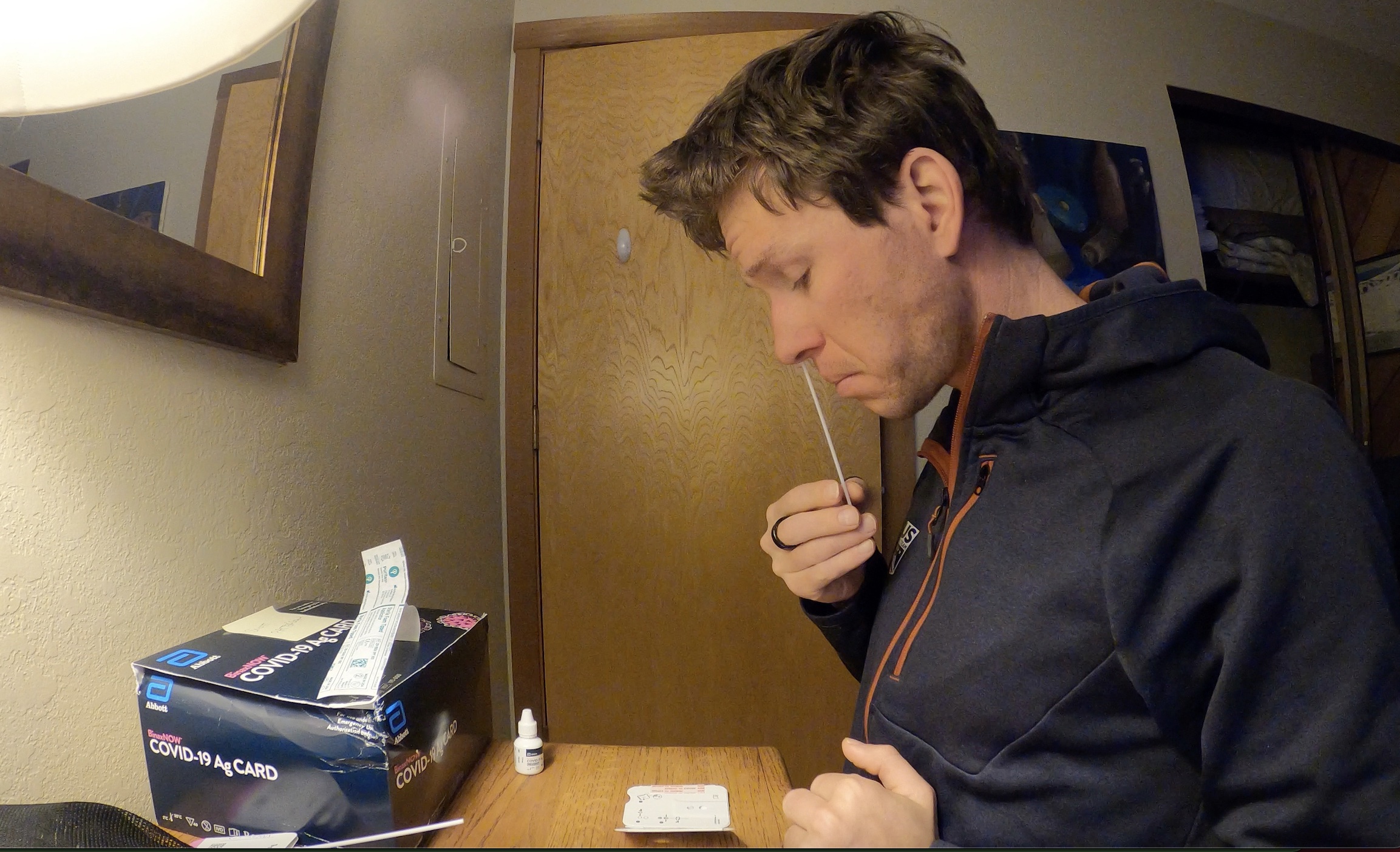
Scott Patterson self-administers a COVID-19 rapid test. (Courtesy photo)
The athletes take rapid antigen coronavirus tests every day, retrieve meals cooked by a team chef, bring them back to their living quarters and eat only after washing their hands. Swirbul got in the habit of climbing out a window to leave her apartment, rather than walking through a shared space that would require her to don an N95.
She also turned down an invitation to meet a friend, outdoors, for hot chocolate. And “definitely no grocery stores — we haven’t been in those since we’ve been here,” Swirbul said in a Zoom interview.
Jager has suffered through much more of a saga. Outside of international competitions, Jager races for the University of Utah, and he had to return from top-level European racing a few weeks ago to compete in collegiate events in the U.S.
When he arrived, the coronavirus was circulating among his team, so he couldn’t move back into his house. In a phone interview last week, he described staying in the vacant home of friends of his girlfriend’s parents before a race series in Idaho.
“They get back tomorrow night. So, we’re trying to find some other place to stay because we’re trying not to see anybody,” he said. “I’ve been nomading, pretty hard.”
Jager returns to Europe this week for a training camp in Italy with the American team, then will fly to Beijing from Switzerland.
JC Schoonmaker, another likely Olympic team member who competes for University of Alaska Anchorage, is on a similar program to Jager, except he traveled and lived with his collegiate team during races in the western U.S. this month.
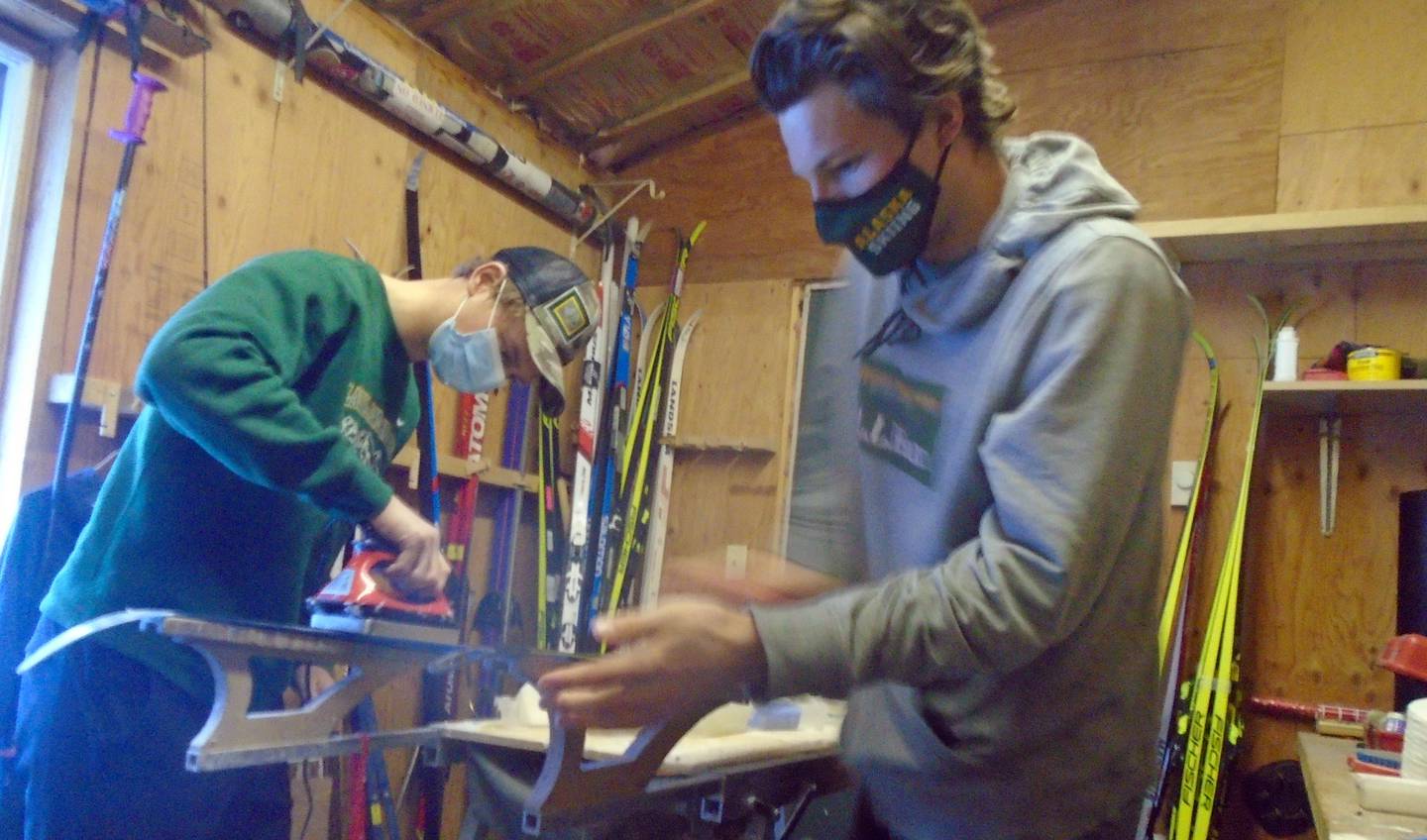
JC Schoonmaker, right, and a teammate tune skis Friday, January 14, 2022, before a weekend of racing in Idaho. Schoonmaker is one of a number of Alaskans taking rigorous COVID-19 prevention measures to avoid derailing his hopes of competing in the Winter Olympics in Beijing. (Adam Verrier)
Schoonmaker’s coach, Trond Flagstad, said the UAA coaches are doing all the shopping; they enter the athletes’ houses to drop off groceries only while wearing masks.
“It’s definitely risky, but I’m pretty confident,” Schoonmaker said. “And I really do trust my teammates — I think they’re doing a good job.”
Aside from presenting obvious logistical problems, the coronavirus has affected the skiers in subtler ways, too.
It’s forced them to keep their support networks at a social distance, whether that’s partners, family members or friends. And with coaches taking on more risks, like grocery shopping, it’s also harder for them to work closely with their athletes, or even to drive them to races in vans.
Added all up, it makes for an especially grueling, and isolating, build-up to what was one of the most pressure-filled experiences in athletics even before the pandemic.
“It really weighs on me,” said Rosie Brennan, a medal hopeful who trains with APU in Anchorage. “It’s honestly harder than preparing yourself to race.”
With the Games, and the negative tests required to enter China, approaching, each swab presents aspiring Olympians with a new reason to worry — especially with the awareness that omicron may present itself without symptoms.
“You know how it is when you’re a skier: You’ve got stuff coming out of your throat and you’re always blowing your nose and stuff,” said Jager. “You’re like at 7,000 feet, you’re like, ‘Maybe I’m a little tired today and I just blew my nose a couple extra times. Definitely could be low-level symptoms of COVID.’”
One silver lining for the Alaska ski racers, in the final days before the games begin: They’re not alone.
One of Norway’s top cross-country skiers, Heidi Weng, made tabloid headlines in that country when she said she wouldn’t be seeing her boyfriend before Beijing.
And Maja Dahlqvist, a Swedish cross-country superstar, has to stay at least 6 feet away from her boyfriend, American cross-country skier Kevin Bolger. That applies even as their teams hold separate pre-Olympic training camps on the same trails in Italy.
“I mean, of course we wish we could hold hands or hug,” Bolger said in an email. “But both knowing what is on the line, we will survive until after Beijing.”
It goes without saying or writing, but I’m writing it anyway with a nod to a certain beloved Bay Area band: What a long strange trip it’s been — (at only six months).
Becca Rorabaugh of the APU Elite Team. (Photo: beccarorabaugh.com)
Becca Rorabaugh (31), based in Anchorage and training with the APU Elite Team, has a creative tool set to assist with the grind we all find ourselves in. And she’s handled this trip with grace. Although art is associated with the right side of the brain, as a top-level cross-country skier, Rorabaugh harnesses the totality of the cerebral matrix. Symmetry in principle, however, does not categorically mean the balance persists in practice during trying times.
“I have been thinking about how art and the coronavirus have interacted this summer for me,” Rorabaugh said. “I think a good part of it has been that in the studio I feel like I can control everything. But even then, in my art, the unexpected things happen. And at first, it’s easy to be disappointed in work that does not match my intended outcome. But often you come back and look at it later and you see the value in it either as a learning experience or as something different. You actually can see that maybe there is a new direction there.”
With an undefined season likely coming this winter, Rorabaugh explained that her creative process, where outcomes are often unplanned, has helped her cope.
“I am trying to apply this line of thought to this coming ski season which might be valuable because I feel like it is going to look a little strange,” she added. “And when you are training it is nice to imagine the venue you are trying to aim for and be really focused in that way. It can be kind of tough when you don’t have that kind of direct progression. But, I feel like experiences in art like that, the unexpected things, will hopefully help me see value in it, in a different kind of ski racing season.”
Rorabaugh painting along Birch Creek near Central Alaska. (Photo: courtesy photo)
Growing up in Fairbanks, Rorabaugh has skied and pursued art since she was a child. She took AP art classes in high school and has been designing ski race t-shirts for Fairbank’s town race series since she was 12.
Rorabaugh attends Dartmouth College where its quarter system allows for time away for the ski-focused student-athlete. She has only a single quarter left for her degree. However, there is a requirement that she spend her senior spring quarter on campus. As both a studio art and environmental studies major, she says she is in fact looking forward to that final on-campus residency. She’ll be part of a senior art showcase. Additionally, she has a set of grandparents living close to the school. Rorabaugh explained she opted for a studio art major since she plans on eventually attending architecture school, and at Dartmouth studio art is often the pathway to that career.
“So it has been a great excuse to do a lot of studio art courses,” said Rorabaugh.
For a time, as skiing became all-consuming, she deviated from her fine artwork. “I would say for a little while I lost track of my art while trying to be a mono-dimensional focused cross-country skier. But then I would say about 2016, and I have to say that Instagram probably helped with this, I started noticing the aesthetic qualities of the places we were training. And we were doing a lot more mountain running that summer. It was a real sunny summer in Anchorage, which is rare, and it was all beautiful mountain runs. I feel like social media makes you hunt for images subconsciously. I was spending more time noticing these aesthetically pleasing images and actually thinking I should paint this — this is valuable.”
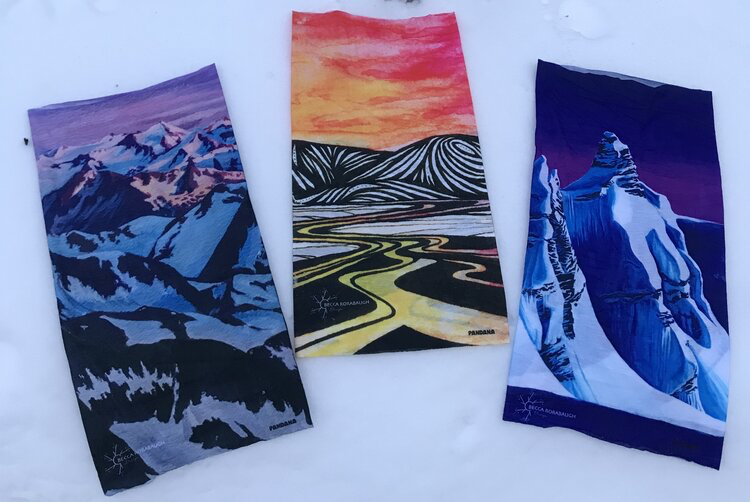
Rorabaugh helps offset some of the cost of her training and race travel by selling art. In the past few years she has created Pandanas, essentially custom buffs featuring her art.
“The Pandanas are another kind of challenge because trying to come up with colors and patterns that work well wrinkled up and come together with a big image can be a puzzle,” Rorabaugh said.
Rorabaugh’s Pandanas
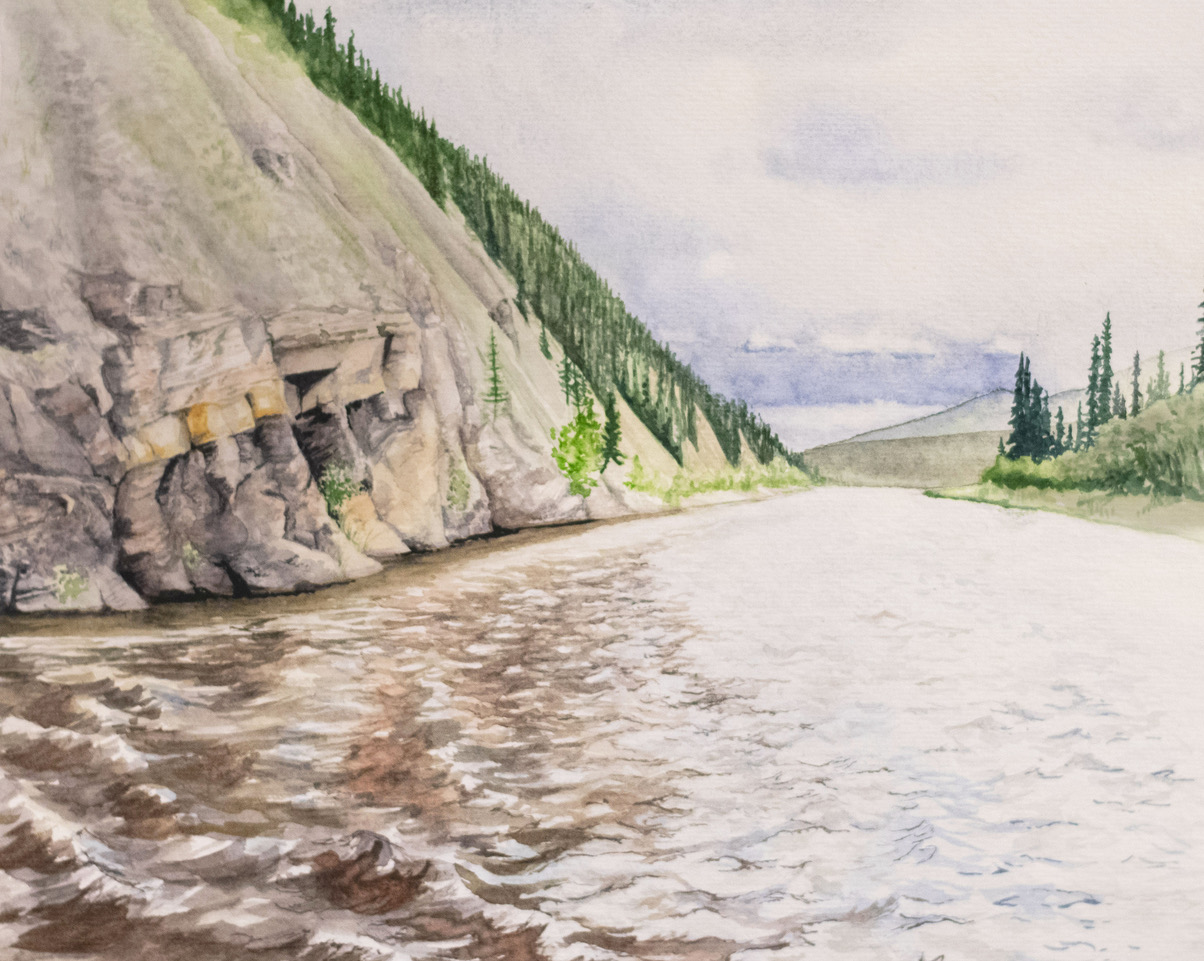
This spring and summer, with the funkiness of Covid-time which allowed for more time at home, she has begun completing a series of pieces related to a Bureau of Land Management (BLM) residency project. In the fall of 2018, Rorabaugh was one of several creatives to be chosen for a BLM float down Birch Creek near the remote town of Central Alaska. During the float, she sketched, painted watercolors, and journaled about the experience. In return, when Rorabaugh is finished with her art inspired by the trip, the BLM will feature a selected art piece which will be on loan for a year. The BLM can, as Rorabaugh explained, reproduce the art and use the likeness in perpetuity.
That week-long trip in 2018 was planned as a recovery week. Yet the sedentary trip was a bit much. “It was a little bit surprising to me that I got antsy probably about halfway through,” said Rorabaugh. “I consider myself a less ansty skier, but it came out for sure. More so now since I have done it for so long – physical endorphins have become kind of addiction I guess. I definitely think that against my better judgment and perception of myself, I get cranky if I do not do a workout. I don’t think there is any way to avoid that after training for this long. Despite my best efforts.”
Part of Rorabaugh’s BLM project: Birch-Creek-Watercolor
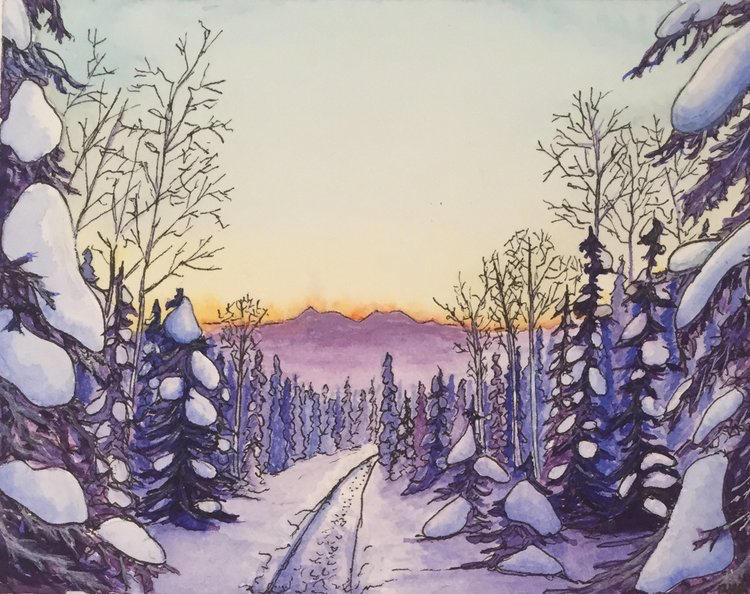
A notebook size watercolor from Rorabaugh’s BLM project: Birch-Creek-Watercolor
During a time when she and her APU teammates have modified large group training protocols, there is still the training grind. A process that becomes quotidian in the best of times. Art, Rorabaugh said, complements her training life as she finds a vision for her work.
“I like to think I can pursue realistic oil painting at the same time as graphic design and doing more abstract work for my senior seminar project at school,” she said. “I don’t think I have settled on a specific direction yet. The process of making art and the process of training are somewhat similar for me. It is a self-motivated and sometimes frustrating effort and I get really absorbed in what I’m doing and become focused in on it. Time slows down. It is a similar kind of process for both. I see a lot of parallels in how you go about it. Although for me, when I am doing artwork at home, it is more self-guided, I don’t have a training plan. I do think if I am focused too hard on ski training I lose touch a little bit with my creative side. I have to kind of decide to wake it up and use it again.”
Back in 2015, prior to her first go at a World Championships, Rosie Brennan was asked this: What’s your biggest motivation while racing?.
“I am most motivated by wanting to show that my hard work was worth it, that I did everything I could to go as fast as I could,” Brennan replied at the time. She was twenty six years old then, and now at 30 years old, the Park City native grinds away, still doing the hard work.
Rosie Brennan of the U.S. placed 10th in the women’s World Championship 15 k skiathlon in Seefeld, Austria. (Photo:John Lazenby/lazenbyphoto.com)
Brennan, a current member of the U.S. Ski Team’s A-Team, has had an on-again off-again career with the national team. She has, however, been a rock on the APU elite team where she’s surrounded herself with some of the nation’s top cross-country athletes.
In 2018, despite being nominated to the Olympic team, she developed a nagging virus that sapped her energy. She eventually returned to form — last season her best World Cup campaign to date. She ranked 27th in the distance standings and popped a career best sixth place in the Davos, Switzerland 10-kilometer skate.
We spoke to Brennan for the podcast as she finished up a ski team training camp based in Park City. We spoke about her recovery from illness and her role as an athlete representative at U.S. Ski & Snowboard.
No longer the young guy on the U.S. Ski Team, at 26 years old, Erik Bjornsen often carries high expectations on his shoulders. And frankly, they are strong shoulders. After a summer and fall of solid training, the younger of the two Bjornsens on the U.S. Ski Team (his sister Sadie is a teammate) has high expectations for this Olympic year. Rather than a product of stats and results, Bjornsen is a believer in himself. He studies the sports’ stars, analyzing what makes them technically efficient. He makes the hard workouts count. It’s a method Bjornsen hopes will serve him well in a tightly packed World Cup men’s field.
Erik Bjornsen leads fellow U.S. Ski Team member Noah Hoffman during the men’s 15 k freestyle pursuit at Stage 4 of the 2015 Ski Tour Canada in Quebec City. (Photo: FlyingPointRoad.com/NNF)
Bjornsen jumps to Europe on Nov. 15. He won’t be dipping his toe into the race season — his first races of the season will be the World Cup’s Ruka Triple mini tour in Finland from Nov. 24-26.
Erik Bjornsen (Photo: Toko/NordicFocus)
Nordic Nation spoke to Bjornsen on Oct. 25 from his home in Anchorage, Alaska. The discussion covers sprinting and distance, his growth as a skier, and yes, how he’d like to see FasterSkier improved. Who would have thought the youngest Bjornsen would like to see a bit more nordic gossip on the FS site? With that in mind, old news we know, Bjornsen was engaged this summer.
“When you wake up in the morning, Pooh,” said Piglet at last, “what’s the first thing you say to yourself?”
“What’s for breakfast?” said Pooh. “What do you say, Piglet?”
“I say, I wonder what’s going to happen exciting today?” said Piglet.
Pooh nodded thoughtfully.
“It’s the same thing,” he said.
— A.A. Milne, Winnie-the-Pooh
Breakfast, as you learned in elementary school (or more recently from Ryan Gosling), is The Most Important Meal of the Day. That’s likely true for anyone. It is emphatically true for skiers. Whether you’re training once a day or three times a day, 100 hours a year or 1,000, it all starts with breakfast. If training is the foundation for racing, and proper nutrition is the foundation for proper training, then it logically follows that breakfast is the foundation for, well, everything.
Kikkan Randall in the kitchen “getting ready and fueled” in the fall of 2014. (Photo: Twitter)
Certain types of breakfast tend to get all the press. Pretty much everyone is a fan of second breakfast. J.R.R. Tolkien explains that hobbits eat second breakfast as the second of their six daily meals – after (first) breakfast and before elevenses. Thomas Mann, in The Magic Mountain, ups the ante, discussing not only second breakfast but also, remarkably, third breakfast. Robert McCloskey, in the seminal 1941 children’s book Make Way for Ducklings, underscores that second breakfast is best in the animal kingdom as well; his Mr. and Mrs. Mallard follow around the late-morning duck boat until they get “another breakfast, better than the first.” Everyone, it seems, is a fan of second breakfast.
There is no question that everyone is a fan of pancakes (and their close relative, the waffle). Turning from early-20th-century literature to the modern institution of the 21st-century skier blog, it is clear that there could not be a skier blog – or maybe even skiers – without pancakes or waffles.
And a generation earlier, before the term blog had even been invented, Luke Bodensteiner, at the time a struggling Olympic hopeful, wrote in Endless Winter: An Olympian’s Journal of downing 18 (!) “steaming hot buttermilk pancakes” one morning in September 1993, then crushing a 50-kilometer rollerski followed by a 12-mile run. Plus ça change.
This is not an article about second breakfast. Nor is it even an article about pancakes. This is an article about what athletes eat for real breakfast on real weekdays. Training day or rest day, at home or abroad, every elite athlete has a food that they’re comfortable with. And once they’ve found it, they tend to eat that food every. single. day. (Except for Lex Treinen, who wrote that he “never actually [has] the same breakfast every day,” but he’s an outlier among the athletes surveyed for this article.) If ski racing is, ultimately, about controlling the things you can control and trying to get a good outcome from the things you cannot, then breakfast becomes one more thing that can be effectively controlled.
Starting with Alaska, we asked skiers with the Alaska Pacific University Nordic Ski Center elite team to share an honest picture of their average breakfast for a weekday training day and describe what they eat. Here’s what they told us:
“My typical breakfast is a three-egg omelette with Canadian bacon, mushrooms, peppers, onions, spinach, and cheese and two pieces of wheat toast with cinnamon sugar. Together with an Americano.” (Note: Not Randall’s actual omelette/photo via Wikimedia Commons)
“I was out of eggs so normally one would be this concoction [pictured] – peanut butter, banana, and honey – and the other would be a poached egg on top of toast with jam. Just the right combo of carbs, protein and fat to keep me going and ensure that I don’t have a growling stomach 1 hour later……”
Honorable mention: On marathon race mornings, Holly makes “a big bowl of 50k oatmeal (peanut butter, banana, raisins, yogurt, salt, honey),” plus two cups of coffee.
“My normal breakfast is oatmeal, yogurt, almonds, fruit slices (apple, banana, berries), spoonful of peanut butter, honey. Sometimes I will substitute some sort of cereal throughout the week to break up the oatmeal. Today I used Pumpkin Flax Seed cereal.”
“Omelette and oatmeal with blueberries”
“Everything bagel with raspberry jam; 2 eggs over medium; coffee with foamed milk”
“Apple, organic peanut butter, and cookie dough; black coffee”
“Two eggs, rice, beans, shredded cabbage, and salsa”
“Everything bagel with raspberry jam and fried eggs on top; oatmeal with mixed berries; coffee, black.”
A panorama view of the classic course at the second-annual Qaniq Challenge Jan. 16-17 in Valdez, Alaska. (All photos: Gavin Kentch)
By Gavin Kentch
VALDEZ, Alaska — Sometimes it’s easy to lose sight of the “cross-country” part of cross-country skiing. Particularly in this winter of discontent, when a lot of your training time ends up being spent doing 2.9-kilometer laps around a snowmaking loop.
Sometimes it’s important to travel for five days so that you can spend less than two hours racing, but do so on a course that goes from a mountain overlook to the shores of the Pacific Ocean.
Sometimes, surreally, the country’s second-richest ski race is held in Valdez, Alaska, in the middle of January, and gives away a purse of $10,000 dollars to a field of 36 racers. Sometimes it’s just time to take a road trip with your mom. This is the story of all of those events.
Dramatis personae
Holly Brooks finished her racing obligations in China a few days before this race, returned from China to Washington to visit family, flew back to Alaska on Thursday, then drove to Valdez on Friday before racing the Qaniq Challenge on Saturday. I assume this is basically a normal week for her. Other local athletes carpooled with each other for the over 300-mile drive from Anchorage to Valdez.
Personally, I traveled with my mom, because I am just that cool. (Also, I needed her to chauffeur me across southcentral Alaska: My car is a 1989 Toyota Camry, named Teakettle, which at 27 years old is more venerable than at least half the modern-day World Cup field, not to mention the advent of FIS points. I suspect that Teakettle would literally be unable to drive over Thompson Pass, and so to leave Valdez by road when the weekend was over. And the next ferry back to Whittier wasn’t until a week later.) Her husband, Jim Bouchard, got the other front seat.
Of the three of us, my mother is a good sports mom, who spent my childhood waking up very early on very many occasions to drive me to a variety of endurance sporting events. She once drove six hours one way, in the evening after work, to pick up my little brother after he had been struck by lightning on a solo bike trip outside of Tok, Alaska. My stepfather spent decades living by himself in a log cabin he built off the road system, about 30 miles south of Denali. He was a national age group champion at the 1992 Masters World Cup held in Anchorage. And as for me? Well, not to pull rank, but I have previously been described on this website as “a nothing-special recreational skier.”
‘Getting here is half the challenge’
Valdez is slightly over 300 road miles from Anchorage, a drive of approximately six hours, depending upon winter driving conditions. (This assumes that spectacularly massive avalanches do not close the only road into town for over two weeks.) I decided we should take the ferry there, saving hours’ worth of driving – the ferry leaves from Whittier, a little over an hour’s drive south of Anchorage.
A waterside view of the old apartment building in Whittier, a “city” in the Valdez–Cordova census area of Alaska. As of 2014, the population estimate was 217, according to Wikipedia. The city is also a port for the Alaska Marine Highway and known as the Gateway to Prince William Sound.I may or may not have also harbored fantasies in which an avalanche closed the Richardson Highway the day before race weekend, harming no one, but nonetheless preventing all the real skiers from getting there in time for the race, and then I won the first prize of $3,000 dollars. This did not happen.
My mom and Jim arrived at my house in the predawn darkness on Jan. 14. With some difficulty, we added my skis and ski accoutrements to the car, then carved out space for me in the backseat.
We left my driveway shortly after 9 a.m. It was not exactly light out, but by this point in the year at least sunrise was within an hour. We headed toward the Seward Highway. We had a combined 11 pairs of skis, six pairs of poles, and five pairs of ski boots. Plus snacks. The car was packed. The gas tank was full. Nothing could go wrong.
It was shortly discovered that certain parties had forgotten to pack their wallet, containing, crucially, the state-issued identification necessary to board the ferry. Words were exchanged. A backtrack was undertaken. Houses were returned to. A wallet was obtained, and with it a legitimate form of ID. We set off once more in stony silence, now calamitously late, making plans to do the long drive the next day and ruing the not-small amount of money now wasted on ferry tickets. We decided to try to drive to Whittier anyway, and to hope that the ferry was somehow running late.
We drove down Turnagain Arm under low fog and amber skies, the water in the fjord smooth as glass. Last month, this stretch of road was closed due to 91 mph winds. Also, a semitruck had been blown over on its side and completely off the road. Also, the tunnel that we intended to drive to, in order to reach Whittier, in order to get on the ferry, had been closed.
That did not happen today. We could not see more than 100 feet above the ground as we drove along the Arm, but all the roads were passable. We arrived at the designated snow-plowed field, in seemingly the middle of nowhere, to queue for the 11:30 a.m. opening of the tunnel to Whittier, having long since missed our intended 10:30 a.m. opening, and still assuming that we were about to miss the ferry altogether. At least we could have lunch in Whittier before returning.
(N.B.: I have not fact-checked this final statement. It may literally not be possible to buy a restaurant meal in Whittier on a Thursday in winter. I’ll figure this out next trip.)
We were met by a wonderful sight: a handful of cars sat in the field ahead of us, still waiting for the 10:30 tunnel opening. An Alaska Department of Transportation message board slowly scrolled the reason for the delay: “Please stand by. Tunnel will reopen when smoke is purged.”
I have never been so grateful to drive through an icy, slippery, claustrophobic five-mile long tunnel cut into the mountains that apparently had had rogue smoke in it just a few minutes before.
We emerged, blinking, into the light, and into the town of Whittier, Alaska.
Whittier is a special place. For one, it is the rare settlement that was literally founded where it is because the weather there is always bad. For another, there are virtually no private houses in Whittier; all of the town’s residents live inside the same large apartment building.
For the first few decades of Whittier’s existence, everyone in Whittier lived inside the Buckner Building, a seven-story concrete apartment building erected by the U.S. Army shortly after World War II (see photo above). Later, that building was abandoned.
The new apartment building in Whittier, Alaska.Now everyone lives in the much more colorful Begich Towers, a few hundred yards away from its predecessor. (The concrete hulk of the Buckner Building lives on, standing sentinel over the Valdez waterfront. It gained passing fame a few years ago when two bros descended its asbestos-choked stairwells on downhill skis.) We marveled at the Ghosts of Whittier Past and Present, and drove the car onto the M/V Aurora.
The ferry ride took six hours. It was amazing. The sun was out. Prince William Sound was, atypically, placid and still. Snow-covered peaks shimmered over hillsides of spruce trees cascading down to the water.
At one point, I literally said, “Oh look, yet more dolphins are playing around the bow of the boat. How nice.” I felt like an athlete going over to London for the 1912 Olympics, although there was no track set up on the deck for us to exercise on. And I guess they had fewer glaciers. And more alcohol. Seriously, though, it was probably the most sublime day I have ever spent on a boat in my life.
The M/V Aurora, an Alaska Marine Highway System ferry.Valdez
Valdez is also a special place, though for different reasons than Whittier. It has an average annual snowfall of 300 inches, for one, and two to three times that just up the road in Thompson Pass.
It is also home to the southern terminus of the Trans-Alaska Pipeline System, which undergirds what remains of the state’s suddenly fragile economy. Valdez’s taxes on the pipeline itself make it shockingly wealthy, a lucrative petro-state enclave even within resource-dependent Alaska. (This also explains why Valdez was able to essentially move $10,000 dollars of oil tax money from its own coffers to the pockets of young elite cross-country skiers, which actually feels to me like a pretty positive development.)
A street view in Valdez, Alaska, last month.Standards of what is normal change when you live in such an environment. When I spoke with Qaniq Challenge race director Darryl Verfaillie about ten days before the race, his talk of contingency plans and water drainage made me assume that snow coverage for the race courses was marginal at best.
After inspecting the trails in person after we got to town, I learned that their coverage ranged from a low of one foot of base to a high of at least three feet. As Anchorage suffers through its second low-snow year in a row, Valdez was looking like a pretty good place to be a cross-country skier.
Valdez has also had a relatively snow-sparse winter, at least for Valdez. Therefore, the piles of cleared snow filling spare lots around town were only one to two stories high. These towers stood guard over a neat gridlock of residential streets (Valdez was essentially rebuilt from scratch following the 1964 Good Friday earthquake), where virtually every house was flanked by multiple snowblowers and snowmachines.
Valdez is also the type of place where there are still pay phones. Or maybe not pay phones per se, just telephones in public spaces that permit one to make free calls to anyone else in town. (I don’t know if this institution is common in the states. It persists in Alaska.) It was very pleasant. There was admittedly not too much going on on a Thursday evening in January.
Valdez is also the type of place where there are still pay phones. Or maybe not pay phones per se, just telephones in public spaces that permit one to make free calls to anyone else in town. (I don’t know if this institution is common in the states. It persists in Alaska.)
A royal welcome
I don’t want to be obsequious, but race organizers were beyond accommodating of the skiers. Late on Thursday night, recently arrived in town, I politely emailed the race director, making a tentative inquiry about whether I might be able to find any waxing facilities during the day on Friday. He wrote back at 6:30 a.m. Friday morning, putting me in touch with the local cross-country ski coach (go Valdez Buccaneers!). We were ensconced in the ski team wax room by midmorning.
On multiple occasions, during the middle of the school day, a very clearly not-high-school-age skier walked through the halls of Valdez High School, carrying a large ski bag over his shoulder and bags of waxing supplies in both hands. There were irons, vials, strange powders, an extension cord or two sticking out, and of course the large ski bag. In different contexts, it could be described as suspicious. No one batted an eye.
The royal treatment continued at the Friday-evening racers’ meeting.
“Will there be indoor waxing available tomorrow morning?” someone (me) asked.
“I don’t know, do you want it?” said the race director.
“Uh, yeah,” I said, “if that’s possible, thanks.”
“Okay,” said the RD. “We’ll have someone open the Teen Center for you by 8 a.m.”
And so Jim and I waxed our skis for the classic race inside, warm and dry, with numerous outlets and a bathroom and music. For a ski race on the road, it was paradisiacal.
It was that sort of weekend; everyone could not have been more accommodating. Or maybe I just have really extravagant demands when it comes to ski waxing.
Actual racing: Day 1 (classic)
I previously wrote a real article about the real skiers here. I saw some of these real skiers, if briefly, on race day. Lex Treinen came past me at one point, an unsurprising occurrence in the classic interval start. He was going very, very fast, and even said hi to me by name as he nimbly stepped around me and re-entered the tracks, all while going approximately Mach 9. I had scarcely registered his presence before he was past me. I was impressed.
Trailside view from the classic race course on Day 1 of the Qaniq Challenge.I was also impressed by the army of volunteers and support staff that the race had mustered. I think there were literally as many volunteers and support staff on course as there were racers. Road crossing? They had four people there, including one to hold up traffic on each side, and real, groomed snow across the road.
There was a section where all racers had to do two loops around a 3 k lap, and to help count the number of laps, they had two people at that intersection. One, with a clipboard, counted laps for each racer; the other, with large flags, would direct each racer to head around for another lap or to go back down the course when they approached this junction, as if they were directing an airplane taxiing up to the jetway. If memory serves, I passed six on-course checkpoints during the approximately 15 k race. It was impossible to take a wrong turn.
It was not, however, impossible to fall down. In an impressive display of consistency, I did so twice, once on each lap, in the same place each time. (That place was a six- or seven-foot wide section of trail, presenting the first of two extremely tight corkscrewed turns, with substantial exposure on either side. Alaska is an exciting place to be a ski racer.)
I learned while doing interviews after the race that Tyler Kornfield, an inestimably more talented skier than me, had also fallen twice, in the same place I had. And unlike me, he was wearing skate boots. That made me feel better.
The Pacific Ocean from classic course.After around 50 minutes of skiing, and going from a scenic mountain overlook down to the shores of the Pacific Ocean and back, I approached the finish. I crossed the finish line, immediately began feeling the effects of the longest all-double-pole race in my life, and teetered over to the edge of the finish area to collapse in the snow. I lay on the ground. After a few minutes, I tried to pick my head up, but I was still dizzy, and things were still spinning, so I lay back down. I was not unhappy.
A woman, a local resident who was volunteering with the race, came over. She was wearing a knee-length fur parka that probably cost roughly as much as the entire purse for the weekend’s race. It was one of the most beautiful things I have seen in my life.
She looked down on me not unkindly. “Are you still breathing, hon?” she asked me. I looked up at her. I attempted to form the words, “Thanks, I’m fine.” I met with some success.
It is sort of uncomfortable to sprawl on the ground with one’s skis still on. (Shoutout to my APU Masters coach Galen Johnston, who took my skis off for me unasked while I convulsed on the ground following a recent Besh Cup.)
“Do you think you could help take off my skis?” I said. “Just pull up on the bindings.” She knelt down and began, with great enthusiasm, to pull on my entire foot. “That’s okay,” I said, “don’t worry about it. Maybe you could just help me get up.” This fur-clad vision graciously reached down, gave me a hand, and helped me stand upright again. I was suddenly very conscious of having just finished racing. I tried very, very hard not to get snot, spittle, extruded Apple-Cinnamon Hammer Gel, or any other form of race-induced effluvia on her beautiful jacket.
“Sorry about your boots,” she said. “I’m really more of a hockey mom.”
Eventually, I found my bag, put on every piece of spare clothing I had brought (temps were in the 20s above, but humid maritime cold is cold-cold), and set out for an attempt at a cooldown. I skied part of the way with Holly. At one point, I confessed to her, “I’ve actually never raced on consecutive days before. What do I do in the 23 hours before the next race?” She graciously told me what I should do. Her advice (get warm, dry, and food immediately; active cooldown; warm shower; stretching and jog later that day) was not rocket science, but was much appreciated.
Actual racing: Day 2 (skate)
The start/finish area of skate course at the Qaniq Challenge.Day 2 was a skate race. They took everyone’s first day results, re-seeded the field based on classic time, then had a chevron start for the mass start skate race. There were little numbered placards alongside the tracks in the start area to help everyone line up correctly. It was adorable.
The chevron start, which I may never encounter again in my life, made me feel like a real ski racer. Lining up behind Dylan Watts and Holly did not change this sensation.
The gun went off, and I very quickly felt like less of a ski racer. I guess I’m not very good at starting races fast. Apparently I’m more of an interval-start specialist (says the Masters racer who has done precisely two interval-start races in his life, counting the previous day’s classic race).
Two to three minutes into the race, places #1-4 (the top four guys) were quickly pulling off the front in the lead pack. Places #5-8 (Holly, overall winner Rosie Frankowski, and two male citizen racers) were coming together into a chase pack. I moved up into ninth overall, and took aim at shortening the gap of ten feet that had opened up between me and eighth. In a sudden moment of prescience, I saw the next 45 minutes unfolding before me. I told myself, “You’d better catch this train, or you’re going to spend the entire rest of the race skiing by yourself.”
I did not catch the group. I did ski the entire rest of the race myself. I caught glimpses of the chase pack ahead of me, at greater and greater distances, until as late as 8 k into the race. They were moving very fast, taking turns trading off the lead on a pancake-flat, all-V2 course. They looked like they were having fun. They looked like they were happy. I hoped they were happy.
I was not unhappy; I was skiing, and skiing is fun. But it is more fun when you can see. I think it was colder than I realized; soon my eyes were watering profusely, and I was having a hard time making out the trail, the time on my watch, or anything else.
I had previously been telling myself things like “get forward” and “weight on the balls of the feet,” giving myself technique cues like Jessie Diggins lite (very lite), and at least trying to stay focused while I skied along entirely on my own.
But soon my thoughts became slightly less focused. Like, “my eyes are really cold right now. I really can’t see. I wonder if I’m doing them permanent harm? Like that musher who just got airlifted out of the Kusko 300 sled dog race because she frostbit her eyeball. Is that what’s happening to me right now? Man, I hope I’m okay?” These were understandably valid concerns. They were not particularly effective as technique cues.
(My eyes were ultimately fine. They hurt more when I finished, and again when I shut them to go to sleep that night, and they were bloodshot as hell for a few days later, but that was all.)
I eventually emerged from my solitary ski through the woods and back to the finish line. I did not appreciate it at the time, but apparently they had sent out a PistenBulley during the race to re-groom the start/finish area and take out the set tracks from the chevron start. It was that sort of race weekend.
I crossed the finish line, returned my race bib to Woman in Beautiful Parka, and once more put on every piece of clothing I had brought. This time, it wasn’t enough. I shivered through a ten-minute cooldown, then went inside the old trap range building that had a roaring fire going and served as race headquarters. I stood immediately behind the massive stove, slowly picked the ice out of my thawing beard, and regaled a very patient Dylan Watts with stories of my race while learning what had happened up front. It sure beat getting into Teakettle and turning on the heater that no longer actually produces any appreciable heat whatsoever.
After the race
I headed home for food and a shower. Around the time I was deciding between a nap and writing up my race article, Holly, only furthering her role as worldwide ambassador for cross-country skiing, was back on skis, leading a free clinic for local high school kids. I’m sure this is just what her fellow two-time Olympian Kobe Bryant does for his post-game recovery regimen. (My Holly Brooks hero worship notwithstanding, I should emphasize that she was joined by the rest of the APU Elite Team and associated skiers that were in town, including Frankowski, Lauren Fritz, Paul Kovacs, Dylan Watts, Treinen, and Kornfield. Pretty good day to be a novice skier in Valdez.)
That night, the awards banquet was held in a local bar, The Fat Mermaid. Ten thousand dollars was redistributed from oil money to impoverished elite skiers. Lex and Rosie posed with oversized $3,000 checks.
Awards went five deep per gender. There were also prizes for the fastest locals, and for the fastest skier over 50 (shoutout to my stepfather). That’s 13 awards among 36 racers, or over a third of the field. Also, we all got good pizza, and one free drink ticket each. Also, they had applause not only for the sponsors and volunteers, but also for the press (me). It was a good awards banquet.
Heading the home
The next morning, it was time to go home. It was tough to leave, but we were wrapping up a five-day trip so that I could ski for a combined 101 minutes, so it was probably time. About half the field went backcountry skiing in Thompson Pass on the way home. We headed straight back to Anchorage, so that I could get back to my exceptionally patient wife and our two young girls.
Before we left, we had breakfast at the Totem Inn; poor Jim was yearning for meat after three mornings of oatmeal.
The Totem Inn was very… Alaskan. Of the twenty people in the restaurant on this Monday morning, nineteen of them were men. My mother stood out, because she was the only woman. I stood out, because my race T-shirt, pretty pink sports watch, and choice of tea over coffee clearly marked me as Not An Oilpatch Worker. (My stepfather did not stand out; people who have lived in the woods for three decades also look like they could work at the pipeline terminal.)
The inn’s motto, I have since learned, is, “Where everything about us says, ‘Alaska!’” I applaud their honest marketing.
We hit the road soon after. It was a different experience than the ferry – think six hours of trying to avoid the stench of unwashed ski gear and citrus solvent emanating from the ski bags wedged against my perch in the backseat – but Interior Alaska in midwinter is starkly beautiful, and an amazing contrast to the Sound.
By 4 p.m. I was back home in Anchorage, with its two inches of snow in my front yard, a world away from Valdez and its towering snow piles. By that evening my 3 ½ year old, having heard stories of my race weekend, was playing “cross the finish line and fall down.”
Skiing is also, in many ways, an intensely democratic sport. (Let’s elide for a moment the fact that Norway has like a billion World Cup wax techs to the U.S.’s handful – and that’s not counting another dozen or so under the aegis of Great Britain – and that some countries may be more equal than others.)
Sometimes you buy your first-ever race suit secondhand from Holly Brooks, then the next winter find yourself lining up immediately behind her in a mass start race. Sometimes you find yourself double-poling through a gorgeous valley as fast as you can, with the only other skier visible in front or behind you the quickly disappearing form of Lex Treinen. And sometimes, the local high-school kids race against regional high schools one weekend in the Valdez Invite, then against the APU Elite Team the next weekend in the Qaniq Challenge, all on their home course. Skiing is special like that.
(Photo: Gavin Kentch)
(Photo: Gavin Kentch)
(Photo: Gavin Kentch)
(Photo: Gavin Kentch)
(Photo: Gavin Kentch)
(Photo: Gavin Kentch)
(Photo: Gavin Kentch)
***
About the Author: Gavin Kentch lives in Anchorage. He skis with the Alaska Pacific University Masters team, plays with his two adorable daughters, and occasionally works as a solo attorney. He was probably on snow this year before you were.
The APUNSC men pushing each other during the final workout of their Eagle Glacier training camp from July 6-11. Becca Rorabaugh explained that the group collectively skied about 1,000 kilometers that day. (Photo: Zuzanna Rogers)
Every summer, the Alaska Pacific University Nordic Ski Club (APUNSC) takes full advantage of Eagle Glacier, just south of Anchorage and some 5,700 feet above Girdwood, Alaska, holding on-snow camps there multiple times throughout the offseason. The APU Elite Team, with head coach Erik Flora, recently completed a camp on the glacier, and while conditions for the last day’s 50-kilometer ski softened and slowed as expected, athlete Becca Rorabaugh explained how she survived the 30-mile workout: “Beautiful weather and fabulous crunchy snow at the start…” she posted on Instagram on July 11. “Knowing I was approaching my 50km goal kept me focused through the slushy last bit.”
Here is the 26-year-old Rorabaugh’s recap of the ultimate over-distance ski, which, she points out, can also be done on dry land (i.e. rollerskis):
***
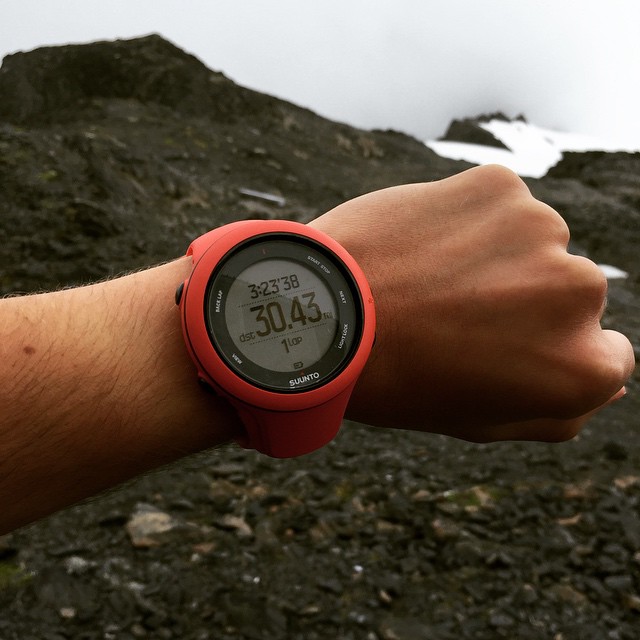
My Suunto Ambit3 at the end of our workout: 30 miles is 50km, and a goal achieved! “#APUNSC #eagleglacier #lastonelongone” (Photo: Becca Rorabaugh/Instagram)
At last week’s APUNSC Elite Team glacier camp there were many hours trained and as a result, many tired athletes. After a week of hard work the last day is always a 3-hour ski. This can be either a fantastic opportunity to duke it out with teammates and see what you have left, or a really rough prospect to handle. Especially if the snow looks like it’s going to get really soft, it can be a tough workout.
The benefits of doing a long final workout are worth the slush-fest, and the effects rely on fatigue that has built throughout the week. If you’ve ever finished a long race and found that you lacked the snappy finishing kick that you were looking for, this is for you.
Flora sat us down beforehand and talked about trying to keep our movement quality throughout the workout, saying that making good race-like motions was paramount to skiing many hours. If we could find a way to make those high-quality movements even without access to the easy energy of fresh ski-specific muscles, we could recruit and hone the sequence of secondary muscle groups. Those are the muscles you’re relying on at the end of a race, and they’re difficult to train. The secondary ski muscles only engage when the primary ones cannot do the work, so you have to be fatigued to train secondary muscle sequence and recruitment. Keeping good technique throughout the workout reinforces good technique at the end of races, when you need it the most.
The power of having positive teammates that push you! From left to right: APU’s Becca Rorabaugh, Sadie Bjornsen, Zuzanna Rogers, and Rosie Frankowski during a water break. (Photo: Zuzanna Rogers)
This last Saturday the day dawned clear and crusty, which on Eagle Glacier means two things. 1: The snow is going to be really crunchy and fast when you start, and 2: if it doesn’t cloud over and start raining soon, you will be skiing on mashed potatoes by 10:00AM.
Sadie Bjornsen and I began talking about trying to get 50km of skiing in, something made possible by the crusty skiing in the beginning, and I was excited to keep track of our progress using my new Suunto Ambit3. We estimated 50km to be six laps of the course, and we turned out to be within a kilometer or two of accurate.
I always ski better throughout the workout if I feel that I am aggressively pursuing a goal, whether that’s a time, a distance, or just hanging on to my Alaska Pacific University Nordic Ski Center teammates for dear life. Starting into a long workout with a sense of purpose really sets the tone, and we started with strong intentions of skiing 50km. We skied 4 loops in the first half of the time, just trying to get in some kilometers before the crust broke down. The final two loops took almost twice as long as the first ones: once the crust breaks on a sunny Eagle Glacier day, it really disappears!
“I always ski better throughout the workout if I feel that I am aggressively pursuing a goal, whether that’s a time, a distance, or just hanging on to my Alaska Pacific University Nordic Ski Center teammates for dear life.” — Becca Rorabaugh, APU Elite Team member
The second half, in soft conditions and with tired legs, is the part that really counts. This is where thinking about a single cue like ‘let your hands swing up’ makes the biggest difference. It’s where technique breakthroughs occur because you’re so tired that you let yourself try different things. Your usual neural sequences are shakier, and you’re able to ingrain new things. At times like that, when you’re pushing the limits of good focused movement, having a defined finish line helps keep motivation. Perhaps most importantly, skiing with friends lets you know whether your technique is working. When you have to make subtle adjustments to keep up, you make the kinds of innate technical improvements that you can find again on race day.
If you’re doing this workout in town, you can still benefit from a long rollerski at the end of a big week. The second half is still the key part, and it’s still important to focus on a single cue. I always recommend doing it with people that push you a little because that’s when you learn to hang on for dear life, adjust movements, and finish strong. Knowing you can ski well when you’re tired will give you the confidence to push at the end of any tough race, be it the Birkie, US Nationals, or the Tour de Ski.
50 k Over-Distance Training Ski Checklist
– Focus on high-quality, race-like motions (and secondary muscle groups if you’re tired from previous workouts)
– Maintain good technique to ensure you’ll have similar technique at the end of a long race
– Get out early to avoid deteriorating conditions (i.e. snow- or weather/heat-related)
– Start with a sense of purpose (you are going to complete 50 k!) and remember that intention when you start to fatigue, especially in the second half of the workout
– Bring a buddy: “Skiing with friends lets you know whether your technique is working.” And pick people that can challenge you.
Most of the 2013/2014 Alaska Pacific University (APU) Elite Team, except for Kikkan Randall and Sadie Bjornsen. (Photo: Reese Hanneman/engineroommedia.net)
Note: This is the fourth preview in our series on U.S. elite teams, which we’ve dubbed the “The 12.” We asked coaches to tell us what’s new and whom to look out for in the coming season and will publish additional previews in the coming weeks in no particular order.
Team: Alaska Pacific University (APU) Nordic Ski Center
Coaches: Erik Flora (head coach/director), Eric Strabel (university and junior coach), Sam Sterling (elite-team assistant and junior coach), Mike Matteson (head wax technician), Don Haering (wax tech), Tazlina Mannix (elite team admin/physical therapist), Zuzana Rogers (physical therapist), Michael Henrich (massage therapist)
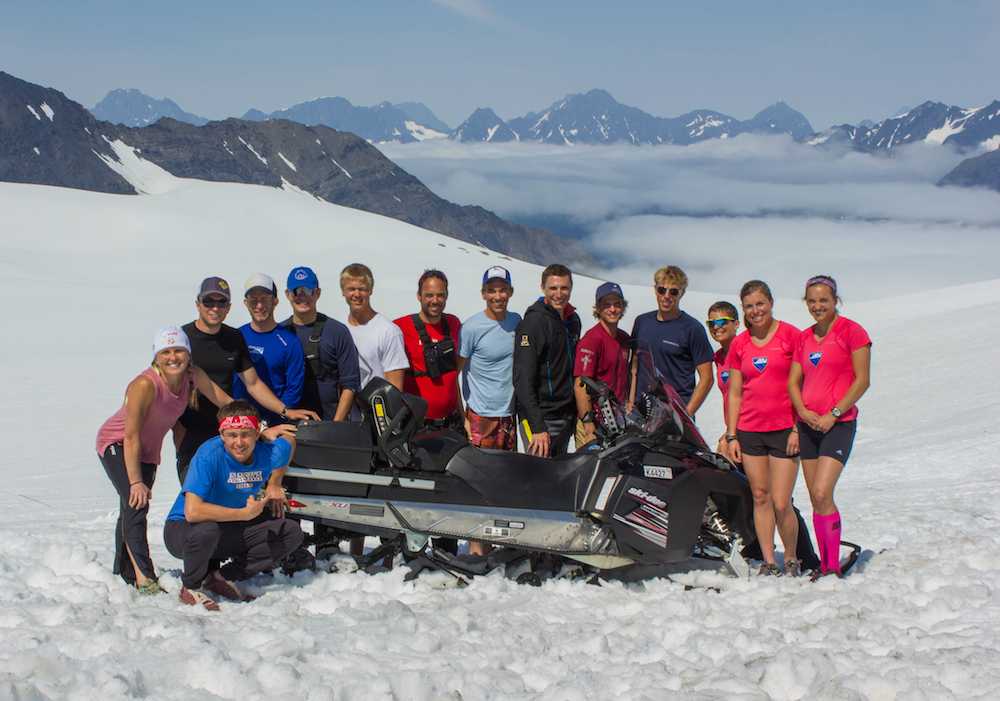
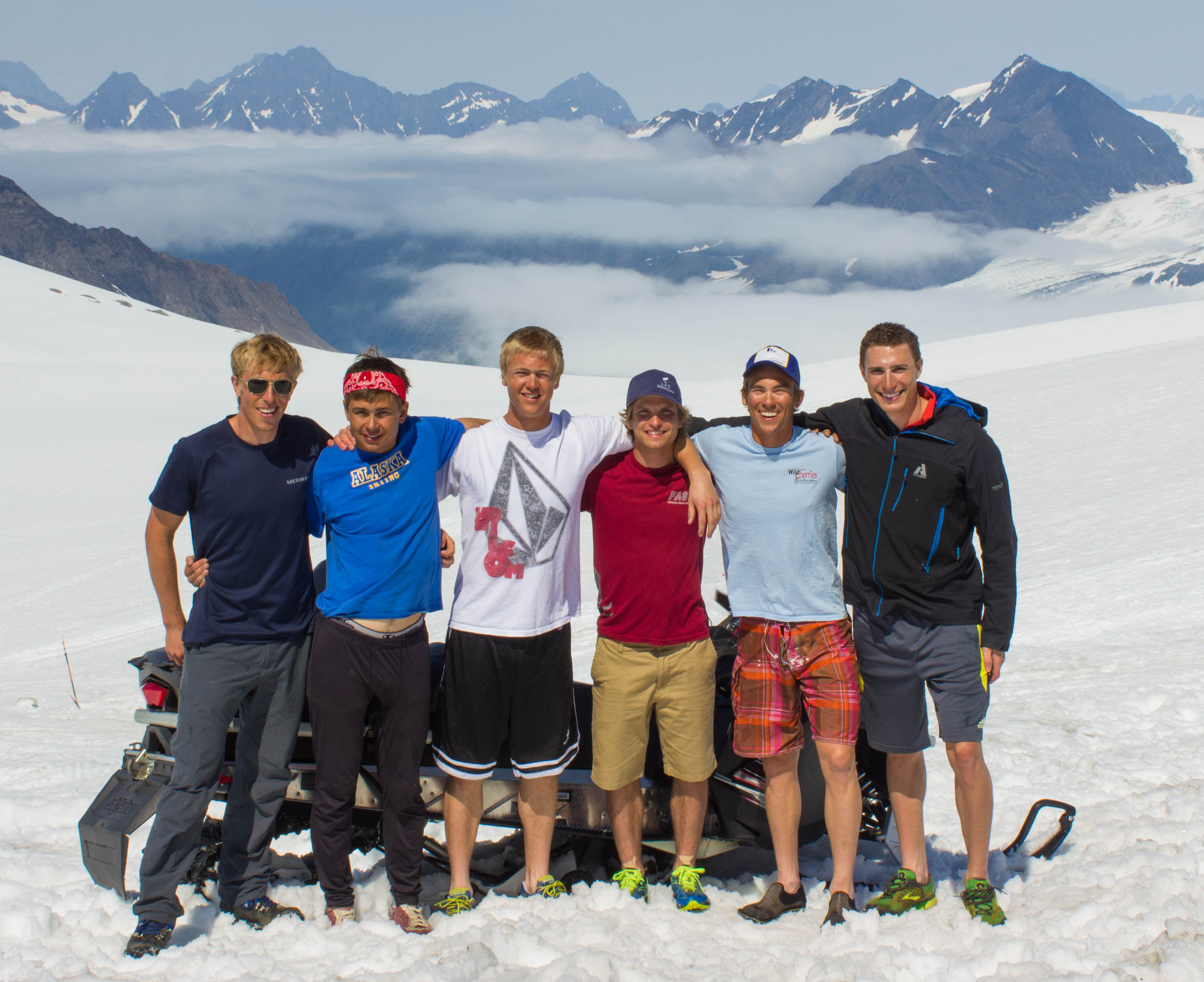
The new APU men’s elite team on the glacier in late June. From left to right: Peter Kling, Lex Treinen, Erik Bjornsen, David Norris, Reese Hanneman, and Tyler Kornfield. (Photo: Reese Hanneman/engineroommedia.net)
Elite roster: Erik Bjornsen (U.S. Ski Team), Reese Hanneman, Peter Kling, David Norris*, Lex Treinen, Tyler Kornfield;
Kikkan Randall (USST), Holly Brooks (USST), Sadie Bjornsen (USST), Rosie Brennan, Kate Fitzgerald, Becca Rorabaugh, Lauren Fritz
*An incoming senior at Montana State University (MSU), Norris is training with the APU Elite Team before returning to his collegiate program in the fall. In an email, he wrote that he plans to join APU full time next season.
University team: Forrest Mahlen, Jack Novak, Thomas O’Harra, David McPhetres, Garth Schulz, Andre Lovett, Fischer Gangemi;
Sarah Cresap, Celia Haering, Kinsey Loan, Greta Anderson
Seven new guys joined the APU Elite Team this year, plus David Norris, who’s training with the team this summer before his senior year at MSU.
“We are excited with the level and attitude of our new men,” coach Erik Flora wrote in an email. “It is a very strong training group.”
Flora is all about keeping consistency – with the size of his team from year to year, the ratio of skiers to coaches, and the number of males and females on his elite squad.
This season, the women’s team was full (with 11 athletes between the elite and university teams, which train together), he explained in an email.
“I believe in long-term commitment,” Flora wrote. “Typically the longer the coach/athlete relationship, the more successful. … Our goal is to have good training groups. Some years we have more girls, some years more boys. The first goal is good athletes to make good training team.”
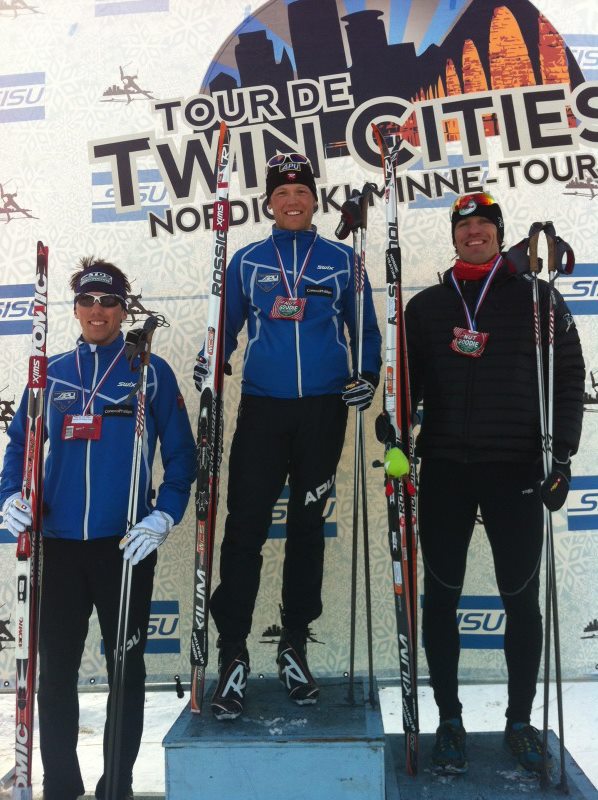
Former APU teammates, Mark Iverson (c) and Brent Knight (l) on the podium at the 2013 Tour de Twin Cities SuperTour in Minneapolis after placing first and third, respectively. Torin Koos (Bridger Ski Foundation/Rossignol) was second. (Photo: Lauren Fritz)
Who’s missing: Mark Iverson, 31, who’s shifted his focus to his Skinny Raven race-timing business, according to Flora. “I am so proud of Mark with the dedication it took to make an incredible performance jump last season,” Flora wrote.
Despite a back injury that took him out for much of February, Iverson placed third in the SuperTour Finals skate prologue in Soda Springs, Calif. He notched his first SuperTour victory in Minneapolis and went on to place second at the Boulder Mountain Tour.
Brent Knight made the Salomon Mountain Running Team this summer and will be focusing on that. “He will have a different approach this season,” Flora wrote. “I am sure we will see Brent fighting for top places again on the U.S. circuit.”
Dylan Watts has taken on the role of coach/athlete and will continue to compete, especially in distance events; Erin Phillips and Erika Klaar have also become APU coaches as well, with Phillips coaching the development program (12-14 year olds) and Klaar assisting the elite and junior teams. Sarah Falconer is also missing from the roster.
Top results last season: Who could forget Randall’s gold medal with fellow U.S. Ski Team member Jessie Diggins in the freestyle team sprint at World Championships in February? Randall, 30, also won her second-straight Crystal Globe in dominating the World Cup sprint rankings, and became the first U.S. woman to make the overall World Cup podium (she was third).
One of the U.S. Ski Team’s new A-team athletes, Holly Brooks during a recent training camp Eagle Glacier near Anchorage, Alaska. (Photo: Reese Hanneman/engineroommedia.net)
Brooks, 31 was promoted to the USST A-team this season in her second year on the squad. She broke through early at the World Cup in Gällivare, Sweden, where she placed fifth in the 10 k freestyle individual start.
Sadie Bjornsen, 23, cracked the World Cup top 10 when she placed ninth in a freestyle sprint in March in Lahti, Finland, and placed fifth with USST teammate Ida Sargent in the classic team sprint at the pre-Olympic World Cup in Sochi, Russia.
Her brother Erik, who turns 22 this weekend, was called up to the USST B-Team this spring after a gold and two silvers at U.S. nationals in January, a top 50 in the 15 k freestyle at World Championships, and an overall SuperTour Finals victory at the end of the season.
Brennan, 24, won the overall SuperTour to secure World Cup starts next fall, and Hanneman, Rorabaugh, Fritz and Fitzgerald all made their World Cup debuts in Canada last season.
According to Flora, Iverson, Knight, Kling, Cresap, Novak, and Celia Haering all had personal-best performances in either the SuperTour or at U.S. nationals, and Loan made steady progress. Mahlen went to Junior World Championships in Liberec, Czech Republic, where he placed 27th in the 10 k skate.
“I am really proud of last season,” Flora wrote. “Most important is that we watched everyone get better, from Elite World Cup athletes to Juniors team members. We had outstanding individual awards and team awards including NNF Cup and our Junior Team won the Club award at Junior National Championships.”
Coach’s Comment: Flora’s pleased with how training has started off, with two out of three or four on-snow camps in the bag. (The team recently trained on Eagle Glacier near Anchorage at the end of June, and is off to the glacier again July 22 to August 5.)
“Training is working, so we focus on making subtle adjustments,” he wrote. “We focus on individual athletes goals. I believe a goal should be what gets you out of bed in the morning and ignites a fire in the eyes. So goals are varied from performance oriented to task or preparation based. Most important is the goal brings a challenge and is fun to chase after. My goal this year is to help guide preparation, help educate athletes in learning about training, and most of all provide an environment where athletes can chase their goals. It is going to be fun!”