From the FasterSkier archive — posts syndicated from athletes’ and coaches’ own blogs between 2004 and 2012, kept online as published. Current coverage is at fasterskier.com.

Tag: apu masters

  • Masters Minds: Life at 71 on Two Artificial Knees: 2019 World Masters

    Masters Minds: Life at 71 on Two Artificial Knees: 2019 World Masters

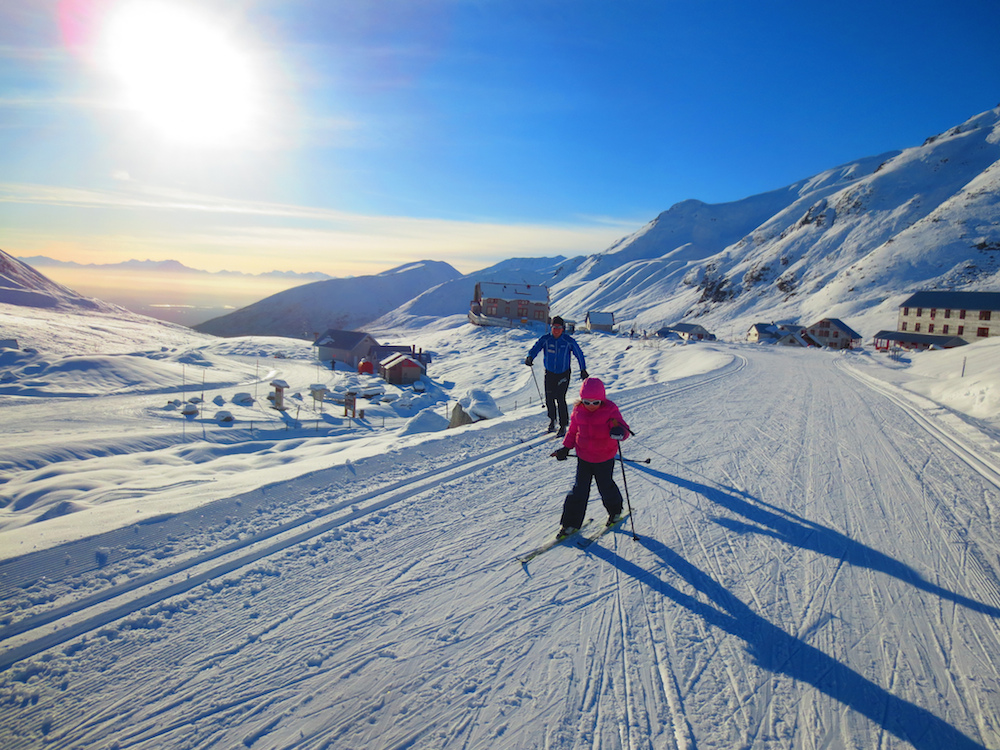
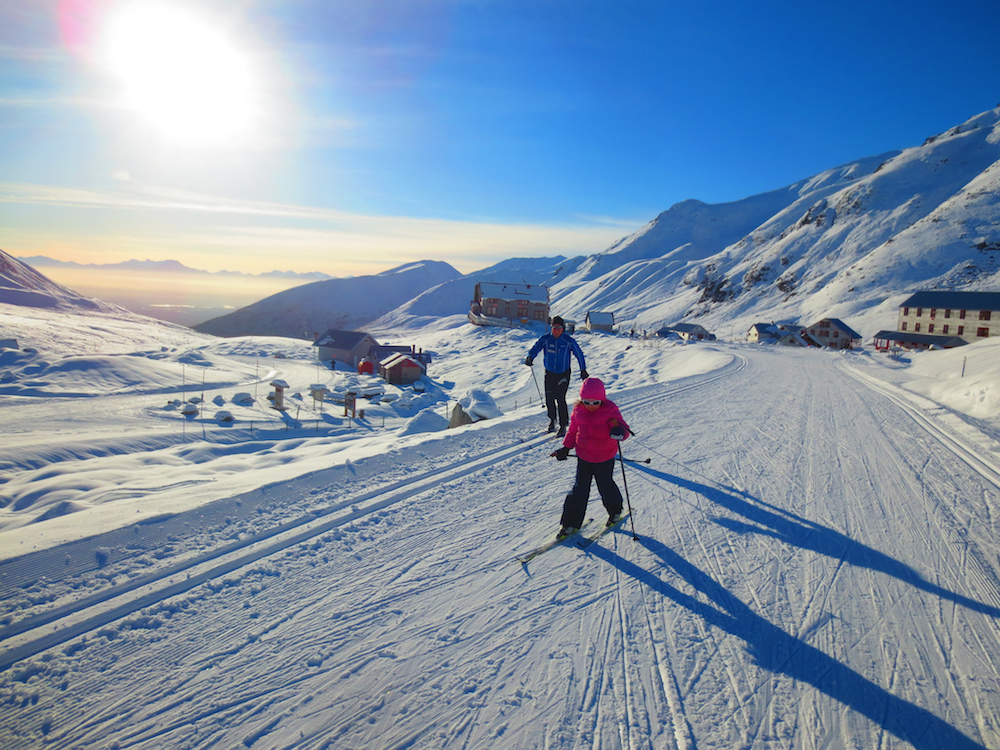
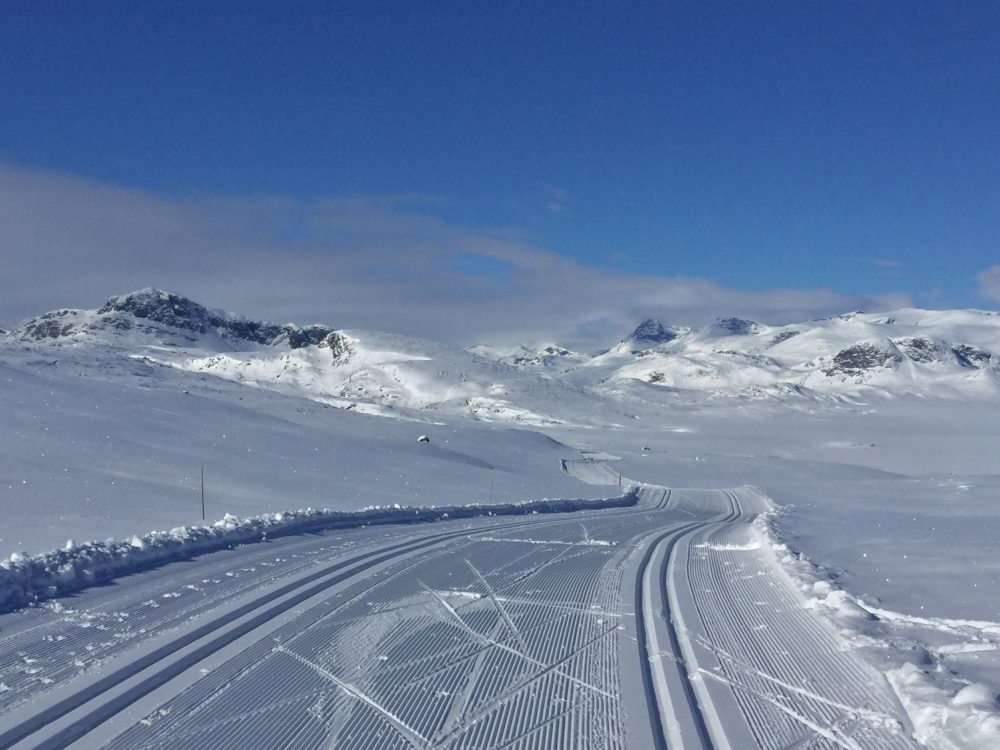
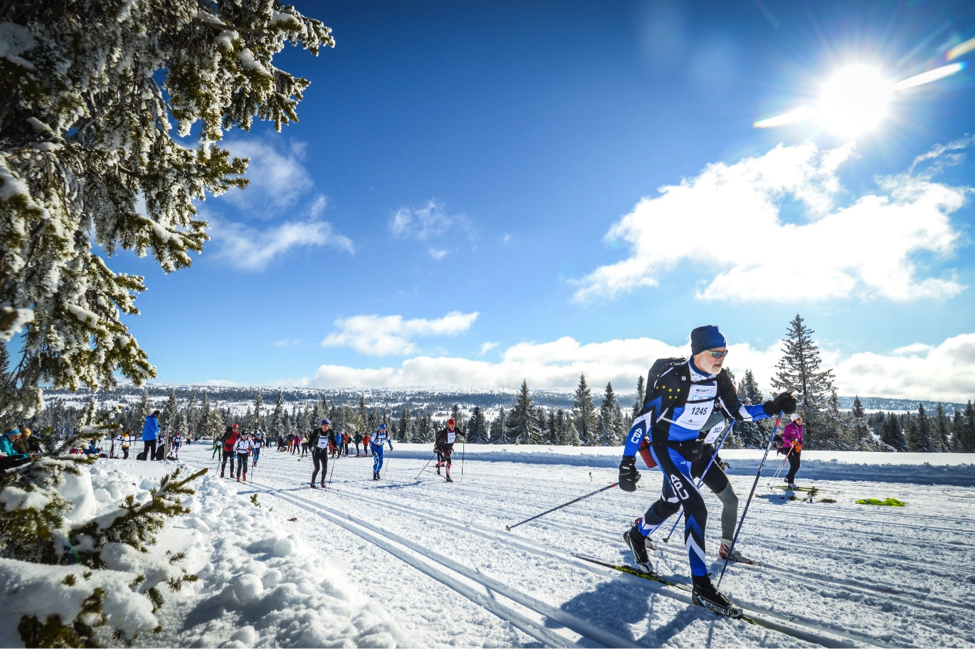
    Mountain views on the ski trails above Beitostølen, Norway, in March 2019. (photo: Gavin Kentch)

    Editor’s note: John Wood is a septuagenarian racer who lives in Eagle River, Alaska, outside of Anchorage. Four years ago he wrote a first-person Masters Mind piece for FasterSkier detailing his return from a full knee replacement to winning his age group at the American Birkebeiner classic race 18 months later. This article provides an update on what happened next, including competing at the 2019 Masters World Cup in Beitostølen, Norway, following a second knee replacement.

    This article is part of FasterSkier’s Masters Minds collection, an occasional series of dispatches from skiers aged anywhere north of 30. Are you a masters skier who loves your club? Submit camp or training recaps, announcements, or stories to info@fasterskier.com with the subject line “Masters Minds.” Articles can be first-person accounts, or written from an observatory standpoint with comments from others.

    * * *

    By John Wood

    I have skied three competitive cross-country relay races in my life.

    The first was at the 1965 Junior Nationals in Bend, Oregon, where I represented the Alaska Region. The second was at the 1989 U.S. Masters National Championships in Telemark, Wisconsin, where I also represented Alaska. The third, when I was 71 years old, was this March at the 2019 World Masters Cross Country Championships in Beitostølen, Norway, where I represented the USA in the M9 age class for skiers aged 70–74. A fact unknown to my international competitors in Norway was that I was skiing on two recent total knee replacements, which is the rest of this story.

    In April 2015, I wrote an article in FasterSkier explaining how my right knee wore out, was replaced in 2013, and how I recovered and won my age group in the 2015 American Birkebeiner. In early summer 2015 I was feeling really good about my recent Birkie and decided that I should “defend” my age group win. So I signed up for the 2016 Birkie and made my travel and housing arrangements.
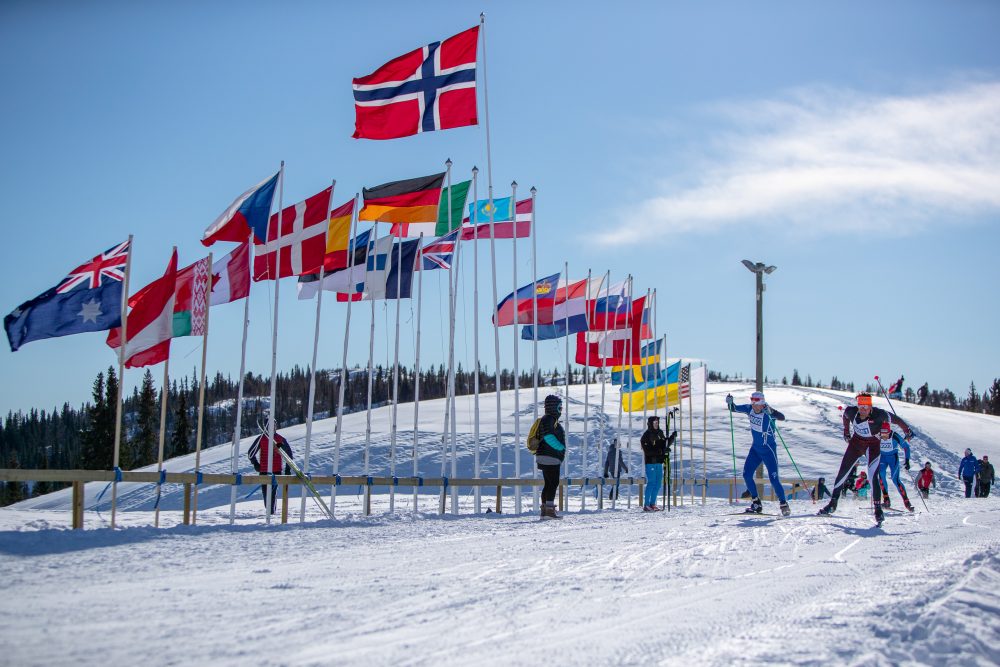
    Aleksandr Pushkarev of Russia (left) leads Marco Mosconi of Italy (right) and Christophe Blanchet Nicoud of France (rear) past the flags at the edge of the stadium as they approach the finish line in the M4 10 k freestyle race at World Masters in Beitostølen, Norway, in March 2019. (photo: courtesy MWC 2019)

    As the summer progressed and turned into fall my left knee, which I had relied upon for all of those years that my right knee was bad, now had to “keep up” with my new artificial right knee that could go like gangbusters while participating in such activities as hiking, rollerskiing, and snow skiing. My doctor had told me prior to my right knee replacement that my left knee was also pretty much worn out and would also need to be replaced at some point in the future, and he was right! Over about a month it began to swell, click, and generally make my life miserable. Doctor Eli Powell at Orthopedic Physicians Alaska in Anchorage confirmed my suspicions, and we scheduled surgery on the left knee for January 2016. My Birkie plans went out the window.

    Dr. Powell’s total replacement of my left knee with a Stryker “Triathlon Total Knee System” on January 14, 2016, was uneventful from a medical point of view. I was discharged two days later, and my life on two artificial knees began. First order of business was surgery rehab.

    Initially, the recovery path paralleled my right knee replacement 2 1/2 years earlier.  I quickly progressed from full-time crutches, to part time, to no crutches at all by day 23. An interruption came when I was jolted awake by a magnitude 7.1 earthquake in the middle of the night on day 11. As I tried to jump out of bed my wife literally pushed me back down, afraid I would stumble and fall in my medicated/disoriented state. Fortunately, the violent shaking duration was short and our house undamaged.

    Physical therapy progressed smoothly, and I reached the gold standard of a 120-degree knee bend on day 30. Other milestones followed in succession: first 15-minute outside walk, first drive to town, suspension of pain meds, and, blessedly, a full night’s sleep. I did my first half-hour ski on level ground on day 67, and was discharged from physical therapy on day 68.

    As the days went by, the soft tissue surrounding my left knee and atrophied leg began to strengthen. Some days felt better than others. My left hip began to protrude, the first visual lingering effect of a body imbalanced and overcompensated by long-term bad knees that had finally been corrected. I experienced lingering aches and soreness in the left knee area after exercise or just standing around. I began to resort to an over-the-counter knee brace. Over the course of the summer the puffiness in the knee gradually decreased, as did my knee brace use. At about 9 months post-surgery I was able to complete a 3 hour hike up and down Mt. Healy with my 10-year-old grandson.

    When snow came in November and I returned to skiing, using a knee sleeve and compression tights, I experienced a knee “sting” that would dissipate in the evening. At my one-year post-op visit, the doctor said that my x-rays looked great, and I was discharged. I received the usual advice that I could participate in all the physical activities that I wanted, except for contact sports and running, and that pain and discomfort should be my limiting guide. I was further counseled that my residual pain should recede, and I should try to function with minimal knee support.
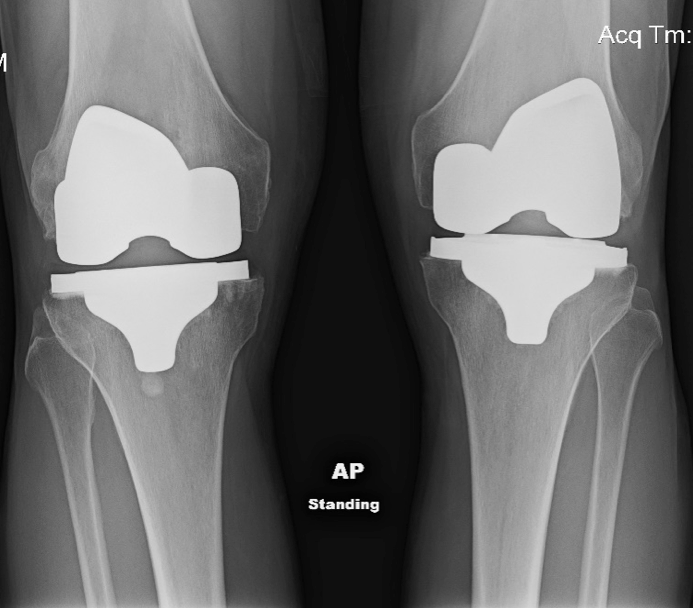
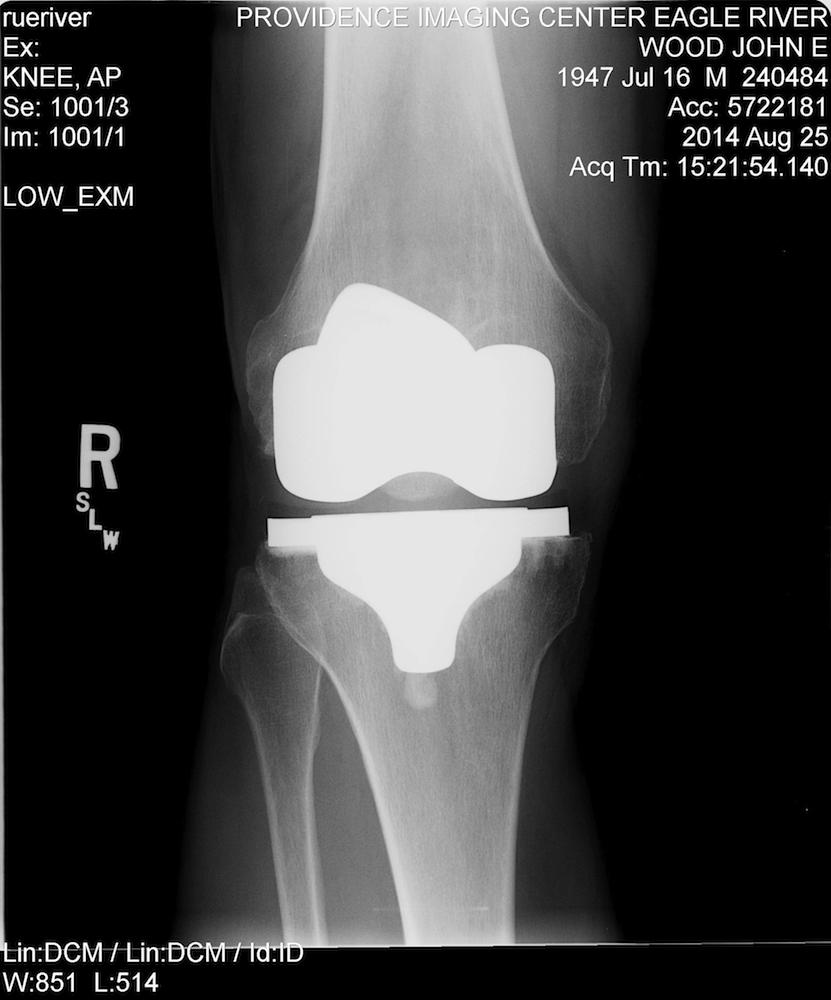
    X-ray image of John Wood's knees one year after left knee replacement. (courtesy photo)
    X-ray image of John Wood’s knees one year after left knee replacement. (courtesy photo)

    For the rest of the 2016/2017 winter I competed in a couple of my favorite local ski races, although fitness was an issue. Also, I experienced lapses in proprioception caused by my knee’s replacement – I would plant a pole on a ski and suddenly fall.  

    In April 2017, about 15 months after the replacement, I begin to see Dr. Zuzana Rogers, P.T., to receive treatment for lingering body imbalances, proprioception issues, and muscle pains in my left knee area. Dr. Rogers skillfully diagnosed the root cause of most of my problems and devised specific physical therapy routines as treatment.  

    During the period from summer 2017 till spring 2018, I continued to recover from the lingering effects of surgery and long-term body imbalances. My strength was slowly coming back, although much slower than with my previous right knee replacement. I discovered that my body’s immune system  was not as stellar as it was prior to the two knee replacements. I was now susceptible to all the garden variety colds and flus that I never used to get. Through trial and error I discovered that a good antidote was to stay more rested by taking one or two days per week off from systematic training. In other words, train smart!

    In early April 2018, my wife Cathy strongly encouraged me to enter the 2019 World Masters Cross Country Ski Championships (“WMC”) to be held in Beitostølen, Norway. I decided if I am ever going to enter the WMC, I might as well go to the birthplace of cross-country skiing and compete with the world’s best!

    I immediately contacted John (J.D.) Downing, American Cross Country Skiers (AXCS) national director, and signed up to be part of the United States contingent for Beitostølen. This enabled me to take advantage of all of the AXCS trip planning such as housing, meals, and all of the racing logistics. With the help of APU Masters coach Galen Johnston, I developed a training program based on about 450 training hours per year (I had loosely been doing about 350 hours per year prior to coping with knee replacements for the last five years), and integrated solo training alongside three formal group workouts a week with the APU Masters group.
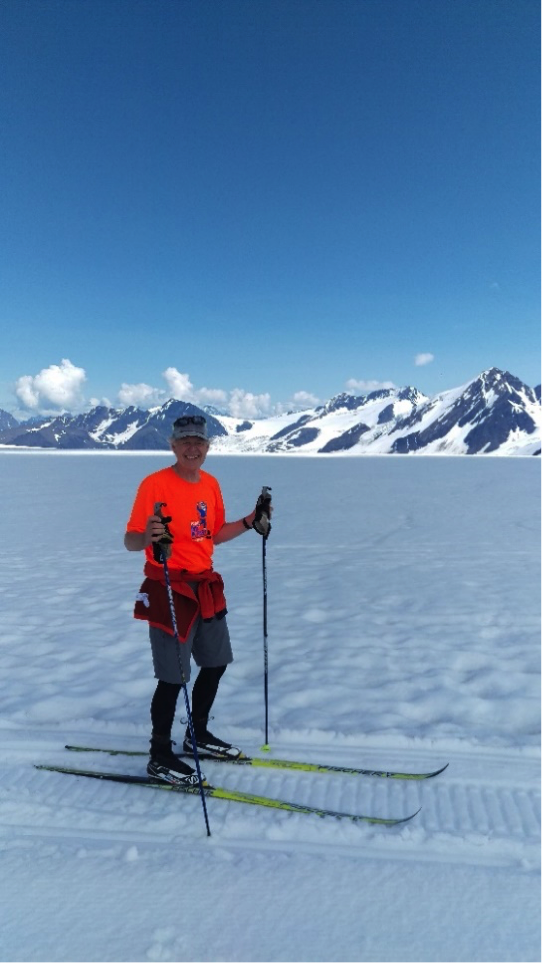
    John Wood at APU Masters Eagle Glacier Camp, Alaska, in July 2018. (courtesy photo)
    John Wood at APU Masters Eagle Glacier Camp, Alaska, in July 2018. (courtesy photo)

    Galen and I tried to design a program that worked within the challenges imposed by two artificial knees. With swelling and aching no longer a problem, we tried to place an emphasis on fitness and ski-specific strength. Sometimes my knees would feel cranky and tell me to take an extra day off or dial back on the intensity of my workouts. I needed to further balance my training hours with weather fluctuations, family commitments, and rest. This often involved walking a fine line!

    My typical summer training week was one day of strength and four or five days of a combination of hiking with poles, modified ski bounding, rollerskiing, road biking, and mountain biking, including one intensity session per week. I attended a four-day APU Masters Eagle Glacier training camp in July. [Ed. note: Or, as it happened, a five-day training camp, after all the athletes were weathered in for an additional 24 hours due to high winds.]

    On-snow training began on October 30, 2018, following the first substantial snowfall in southcentral Alaska. A typical on-snow training week consisted of one day of strength and four or five days of skiing, one of which was intensity. Overall, early-season snow conditions in the area were pretty good. Local racing started in December; I competed in six events ranging in distance from 5 to 30 kilometers, and the results were encouraging. My training continued to go well, and by March I was as fit as I was going to be!

    During the middle of the winter Zuzana Rogers also helped with a final tune-up of my body imbalances and proprioception issues, which had improved substantially over the last year.  

    As World Masters approached, the scope of the event took shape.  There would be about 1200 competitors from 28 nations in attendance and about 120 competitors in my M9 age group.  Two other “younger” skiers from my APU Masters group were also going, as well as about a dozen other Alaskans.

    At the advice of APU head coach Erik Flora, I arrived in Norway a few days prior to the AXCS main 200-person contingent in an effort to get my body used to the 10-hour time change from Anchorage. Night was day and day was night!
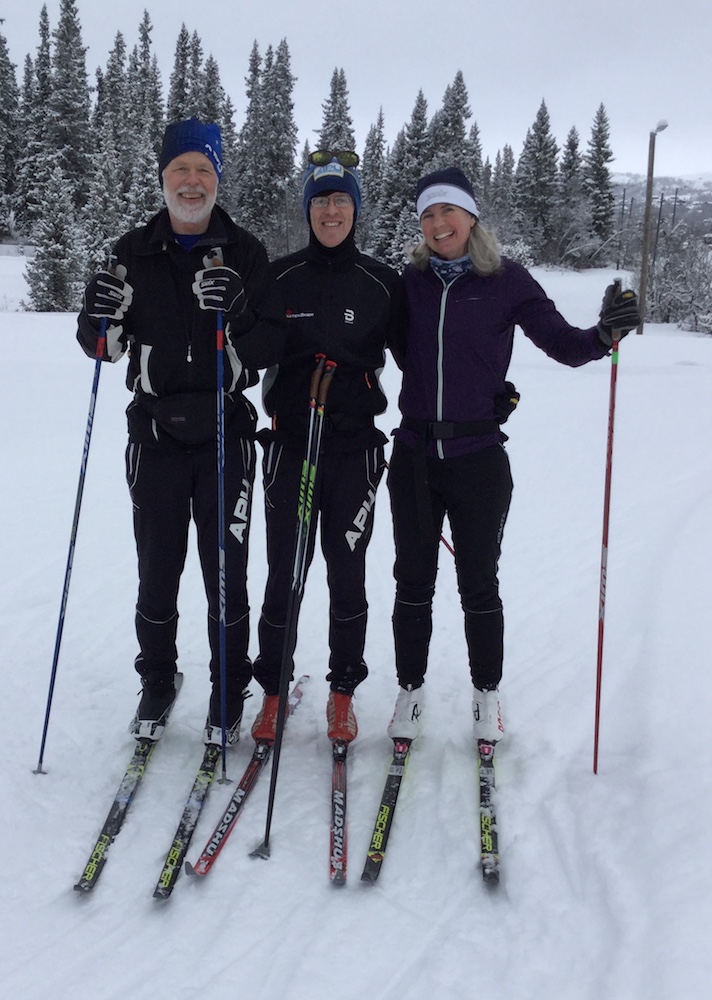
    From left, APU skiers John Wood, Gavin Kentch, and Shannon Brockman on the course at World Masters in Beitostølen, Norway, March 2019. (photo: courtesy John Wood)
    From left, APU skiers John Wood, Gavin Kentch, and Shannon Brockman on the course at World Masters in Beitostølen, Norway, March 2019. (photo: courtesy John Wood)

    The “resort” town of Beitostølen is in the foothills at about 3000 feet in elevation, and is at almost precisely the same latitude (61 degrees north) as Anchorage. The town’s official permanent population of 400 annually hosts World Cup or FIS-level competitions, and seemed to seamlessly accommodate the thousand-plus athletes of the WMC contingent that descended upon it in early March. It seemed like all 200 American skiers were staying at or near the Radisson Blu hotel in central Beitostølen and eating meals there, and it was fun to see and chat with my fellow American teammates every day.

    February weather in Beitostølen had been quite warm, and the snow had settled to a hard, dirty snowpack. Fortunately, the weather changed literally as my bus drove into the Norwegian mountains out of Oslo and it began to snow. It continued to snow almost daily for my entire 18-day stay, creating great skiing and easy wax conditions.

    My first competition was the 15-kilometer classic race. Because of my results in the 2015 American Birkebeiner classic, I had a few “seed” points that put me ahead of other first-time racers, so I was able to start in the front third of the M9 chevron.

    As 56 competitors assembled prior to race start it was hard not to be intimidated by the number of fast-looking, spandex-covered skiers speaking foreign languages. Many were veterans of previous World Masters races and friends with each other, and I couldn’t understand a word of what they were saying! But, even though I was a World Masters rookie, I was excited because I was finally going to test my fitness level and new knees against the world’s best M9 skiers.

    After the starter’s gun went off it was a mass sprint for the stadium end and start of the double-track racecourse. My APU Masters group had been working on race warmups and starts, so I felt well prepared to surge. I ended up in a good position at the end of the stadium, but was immediately engulfed by a wave of skiers heading onto the trail at an all-out race pace effort.

    Our club has a loose motto of “no guts, no glory,” so I too headed off at a crazy fast-paced tempo trying to stay in the mix of front skiers. I soon realized I had to back off a bit and ski within myself, work my technique, and ski to my strengths. At every change in terrain I would mentally check my knees, then check the technique, and finally the effort. Did I need to back off, maintain, or crank it up?

    The 15 k racecourse consisted of three separate 5 k loops and was covered with skiers from the M7 and M8 races, as well as some stragglers from the day’s first six races. Some skiers were faster and some slower, and in my maximum-effort tunnel vision it was impossible for me to tell how I stood in my age group wave. Near the end of the race there were some long, steep uphills, where I passed a number of skiers. I later learned that I had ultimately finished in eleventh place in the M9 race, one second out of tenth.

    Wow! What an effort at a crazy fast pace, and the knees came through in fine shape! Those front guys sure could ski fast! I kept asking myself what was I doing wrong that I couldn’t keep up? [Ed. note: Wood was the top American in this race, by nearly five minutes. His finish in the 15 k classic was the single best percent-back performance by any of his APU Masters teammates in the entire race series.]

    After coming off that emotional high it was time to rest – eat – rest some more, and mentally prepare for the next event. Everybody in the USA contingent had a race story to tell and it was fun to compare notes. We were all in awe of the high level of competition and the continuous all-out effort needed to be competitive. European guys and gals play for keeps!

    Two days later I competed in the 10 k freestyle race. I have only been able to really skate ski since my second knee replacement, and had no illusions. My technique was sketchy but improving, and I figured that since I was at the WMC I should compete in a skate race. My goal was to have a clean run with maximum effort, regardless of finishing position.

    As the race began, skis and poles were flying everywhere so I let the fast guys go by and settled into a sustainable rhythm. Nearing the end of the race, after successfully negotiating a sharp turn at the bottom of a screaming downhill, I felt I was doing pretty good and congratulated myself on a job well done. Time to transition from V2 to V1 and drop the hammer on the last uphill into the stadium. Out of the blue, proprioception struck. I planted my right ski pole on my right ski, and went down in a heap! I had been skiing at the head of a loose pack of five, and suddenly found myself in the middle and out of steam. Needless to say, I finished at the back of the group in 24th place. 
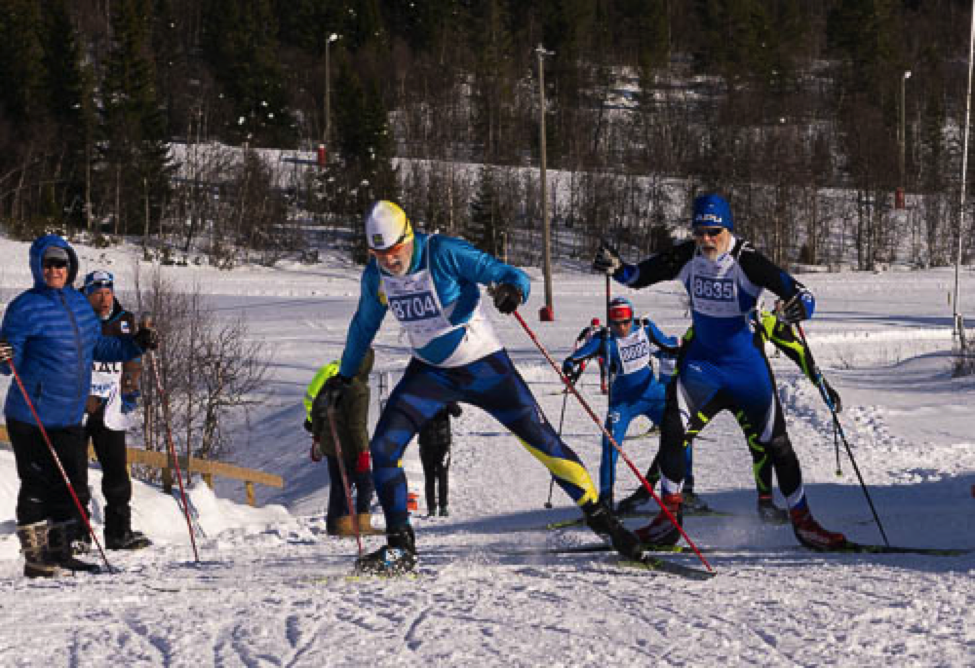
    APU skier John Wood (bib 8635) coming up the final hill into the stadium after an ill-timed fall, 2019 World Masters, Beitostølen, Norway. (courtesy photo)
    APU skier John Wood (bib 8635) coming up the final hill into the stadium after an ill-timed fall, 2019 World Masters, Beitostølen, Norway. (courtesy photo)

    I had qualified with Team USA to ski either classic or skate in the relay midway through the race week, but quickly removed my name from consideration for the skate leg. Didn’t want to have more proprioception difficulties in the relay with three teammates counting on me!

    JD chose me to ski the scramble leg, which was the first of two classic legs in the 4 x 5 k relay. At our team meeting prior to the race, my teammate and World Masters veteran Phil Mahoney confided to me that I should not feel bad if I couldn’t keep up with the pack since the world’s best M9 skiers were also skiing in the scramble leg. I was a bit intimidated, but this was why I came to World Masters, to compete with my age groups best, and I was determined to give it my all! Fifteen skiers representing fifteen teams (between M9 and M10 combined) were in my wave start, and when the gun sounded the adrenaline hit and off we went!

    I was third at the end of the stadium and maintained fourth through most of the 5 k lung-burner. Approaching the stadium, in spite of JD’s vociferous cheering, I slipped a couple of places and tagged off to Phil 25 seconds out of third. I was so spent that I just about fell over. My knees did great; during the race, I never gave them a thought. Just all-out racing.

    The next morning, I discovered that the light cold I had developed had turned into a nasty head cold that left my nose running like a spigot. My immune system apparently couldn’t take the stress of back-to-back top level competitions. I skipped that day’s 30 k classic race and hoped an extra day’s rest would help me feel better for the 55 k Norwegian Birkebeiner, three days later and a couple hundred kilometers away.

    On the morning of the Birken, my cold symptoms seemed minimal and I felt better. As my 70-and-older wave started, I went out with the lead group up the initial 10 k sustained climb heading out of Rena. Big Mistake!! I ran out of gas after about seven kilometers, my nose started flooding again, and I was forced to ski at what seemed like a crawl until about 17 k to go, when I picked up after drinking a cup of Coke at a feed station. I skied conservatively on the long downhills approaching Lillehammer, since I was unfamiliar with the course and didn’t want to fall. Boy, was I happy to cross the finish line, and was really surprised when I learned that I had finished in the top third of my age group.
    APU skier John Wood (right foreground) roughly midway through the Norwegian Birkebeiner, March 2019. (courtesy photo)
    APU skier John Wood (right foreground) roughly midway through the Norwegian Birkebeiner, March 2019. (courtesy photo)

    After a day of recovery in Lillehammer I returned to Anchorage, a 27.5-hour trip home. My World Masters adventure had concluded and my new knees came through with flying colors. I had met my goals of being first American and in or near the top half of my age group in all 4 races. As icing on the cake, in three out of the four races I was the first North American skier in my age class.

    It’s now summer in Alaska, the snow is gone, and the skis are put away. It’s time for mowing the grass and paddleboarding in the lake. And it’s time for reflection. Having your knees wear out and being replaced doesn’t necessarily mean the end of a person’s lifestyle. It’s all about knowing and understanding the limits of your new knees and working within these limits. Do what you want to do. 

    It would be fun to do the World Masters Championships again someday. I now know that my new knees are not my limitation. Maybe I could figure out a way to tweak my training to take my performance up a notch. Maybe my competitors would get old and slow down a bit. Maybe, maybe…

    John is a 72-year-young master skier who has lived in Alaska since before statehood. He has competed in cross-country skiing intermittently since being introduced to the sport at age 16 while in high school by the legendary coach and skier Dick Mize.

  • Wednesday Workout: Skate Speeds and Acceleration with APU Masters

    Wednesday Workout: Skate Speeds and Acceleration with APU Masters

    APU Masters camp in action on Eagle Glacier near Girdwood, Alaska, in July 2015.  (Photo: Jim Falconer)
    APU Masters camp in action on Eagle Glacier near Girdwood, Alaska, in July 2015. (Photo: Jim Falconer)

    It’s not just a truism that one of the best ways to get good at going fast is to practice going fast. At least that’s the principle that Alaska Pacific University Nordic Ski Center (APU) coach Galen Johnston brings to bear when working with his athletes, no matter their age level or experience.

    Johnston, 26, was born and raised in Talkeetna, Alaska, and is a lifelong Alaskan. He has been coaching skiing in some capacity for the last nine years, with athletes ranging from 5 years old (the Polar Cubs group of the Anchorage Junior Nordic League youth ski program) to 86 years old (locally famous octogenarian Reno Deprey, who skied the 55-kilometer 2015 classic Birkie in a healthy 5:47 at age 85 and has a ski race named after him in his native Maine). He is currently entering his third year of full-time coaching with APU, where he oversees both the Devos and the Masters groups in a total of ten practices per week.

    APU Devos stretch from sixth through eighth grade, or approximately age 11 to 14. APU Masters are 30 and up. In this Wednesday Workout, Johnston breaks down a recent workout from APU Masters that has benefits for anyone at any point on the several-decades spectrum of Masters skiers.

    The workout

    1. Full warmup
    2. 5 x 35-45 seconds Level 5 (L5) rollerski skate sprint, over a course with one 180-degree turn and one corner. (Course should be in an empty parking lot, or somewhere else where it is safe to rollerski at speed.) Brief rolling recovery between each sprint interval.
    3. 4-5 minutes full easy moving recovery after the first five sets
    4. 5 x 35-45 seconds L5 skate sprint (that is, repeat step 2)
    5. Cool down

    The warmup: This should be a full warmup, as long as 45 minutes out of a 90-minute workout. Starting very easy, then, Johnston says, “Ending with up into L2, nothing more than that. You can throw some easy 10-15 second speeds in there if you need to warm the body up a little bit more than that, then rolling into these. With that in mind, if you’re not feeling particularly warmed up, just take the first one a little bit easier, just let things come around.”

    Skate speeds: The course should be about 35 to 45 seconds, depending on skier speed. But there’s a lot going on within that relatively brief time: “Sprint off the line, go down 50 meters, swing a 180 degree turn, sprint back, and then around another corner and accelerate to the top of the parking lot,” Johnston says.

    Recovery: Between each of the five sprints in the first set, recovery is just “enough time to glide back to the start, get your breathing slightly back under control, and roll again” for the next sprint. But after doing the first set of five sprints, take a full four to five minutes of easy moving recovery. The goal of this intermezzo is to flush out the muscles somewhat and hit the second set of five sprints ready to go with good energy and quality movements.

    Cool down: As much as you can within a 90-minute workout window, before – in a nod to the reality of Masters training – going back to work/kids/job/life.

    Technique thoughts for this workout

    Johnston discussed the reasoning behind this workout with FasterSkier following the cooldown. He noted the gap that develops within even just the opening few minutes of an Anchorage Cup (citizens race), in which the APU Elite Team skiers and local collegiate skiers almost immediately start to distance themselves from even the fastest citizen racers.

    “Why is that gap there?” Johnston mused. “A lot of it just comes down to being able to relax at speed. If you can create speed efficiently, you can sink the body weight into the poles and into the glutes and move off of that, and use that to create speed – great. As soon as you get thrown back onto the heels … most of the time when people start doing speedwork you get thrown into the heels and you stay really static. And so – in its simplest form, [you should be] letting yourself drop, and letting yourself stand back up. Get all the way up, get all the way down. And making sure that you’re not just stuck back on your heels as you do those sprints. If you feel like your quads are blazed out after the first one, maybe change up how you’re doing that.”

    Johnston adds, “Today one of my big points was to be able to relax at speed, and be able to create speed without working that hard, and how that separates kind of the elite skiers from that next echelon of skiers.”

    Theory and practice

    This workout “tries to accomplish several things,” Johnston continued. “One is acceleration. So you have accelerating off the line, accelerating out of the turn, and then accelerating around another turn – kind of to work on, how to accelerate efficiently. The other is just the agility of the turning, being comfortable turning at speed. And as – today we didn’t do it as a group. Some days we’ll do it as a group of four or five skiers together, so that we get comfortable with that idea of cornering around something sharp with other people there. That one is easier to do on snow with more people.”

    (The previous week had featured an analogous but not identical workout on classic rollerskis, where each interval went out as a group sprint – six Masters skiers, 10 total sprints, zero serious carnage. Plus a great opportunity to practice sprint starts.)

    So why put Masters skiers through an L5 workout on rollerskis on unforgiving pavement, when even college skiers can crash and burn? Because sprinting is a great way to raise the athlete’s high-end speed, which can have benefits for skiing efficiency at any speed.

    “This is a Level 5 workout,” Johnston notes. “It doesn’t necessarily need to be an all-out sprint, especially if you’re doing it on rollerskis and you’re not comfortable with that upper-end speed, but that is a big component of what this workout brings. The fact that it is Level 5, essentially an all-out sprint, with it being short, with it being in a group, really drives home how efficiently you’re sprinting. Most people will have technique issues crop up when they’re sprinting that they wouldn’t find in daily skiing – especially skiers that are used to training a lot of Level 1, Level 2, Level 3, they have a very small window of speed, and they can’t really go over that Level 3, that’s their ceiling. So doing a Level 5 workout raises that ceiling, allows us to move efficiently, and move efficiently faster.”

    Looking ahead to a more endurance-focused training block later in the fall (Anchorage skiers are reliably on snow by the first week of November, even in southcentral Alaska’s recent snow-sparse winters), Johnston reiterates that his goal of this workout “is to raise the ceiling of what everyone’s capable of for speed.” With an eye to the future, the idea is that “so when we do more of our L3, L4, that those workouts can happen at a higher speed than they otherwise would have. Still going to be the same heart rates, same effort level, but because of working that ceiling up with the L5 work [now], those L3 and L4 workouts actually happen at a faster speed.”

    Speedwork for the Masters athlete

    “I think a lot of Masters skiers are a little tentative on their skis,” Johnston observes. “For anything – for downhills, for skiing fast, for sprinting, for anything like that – a lot of it is just a comfort issue. So the more that we enforce going fast as part of a fun, comprehensive workout, the more that comfort level comes up. So whether that’s bombing down a steep downhill, whether that’s sprinting, if we’re comfortable with speed, and comfortable with stuff happening fast, it allows us to react to stuff more quickly. And I work with that a lot with Devos, and obviously when you’re 12 years old you can faceplant and it’s no big deal, but you can get kind of the same thing in a more controlled environment for Masters – just avoiding as many falls. Being willing to push your limit a little bit on comfort, for speed – when you get into a race, when you’re skiing in a pack of 20, 50, 100 people, you’re not as worried about it. You’re able to concentrate on your own race, and not concentrate on the fact that you’re about to get taken out by 100 other people who may or may not be as skilled on their skis.”

    Johnston concludes by reflecting on the decades-wide range of athletes he works with on a daily basis. “What’s neat is that you see that, from Devos to Masters, people all respond to very similar things. Specifically for Masters, age 30 to 85 is a huge age span – but everyone is dealing with relatively the same things. Technically, most people are pretty ingrained in their technique, so that takes a lot of time to bring that around. And speedwork is one of the things that really breaks everybody out of that mold. It’s something that most people never do. So when you go to ski fast, you have to learn how to ski fast.”

  • The Qaniq Challenge: Travelogue Edition

    The Qaniq Challenge: Travelogue Edition

    A panorama view of the classic course at the second-annual Qaniq Challenge Jan. 16-17 in Valdez, Alaska. (All photos: Gavin Kentch)
    A panorama view of the classic course at the second-annual Qaniq Challenge Jan. 16-17 in Valdez, Alaska. (All photos: Gavin Kentch)

    By Gavin Kentch

    VALDEZ, Alaska — Sometimes it’s easy to lose sight of the “cross-country” part of cross-country skiing.  Particularly in this winter of discontent, when a lot of your training time ends up being spent doing 2.9-kilometer laps around a snowmaking loop.  

    Sometimes it’s important to travel for five days so that you can spend less than two hours racing, but do so on a course that goes from a mountain overlook to the shores of the Pacific Ocean.  

    Sometimes, surreally, the country’s second-richest ski race is held in Valdez, Alaska, in the middle of January, and gives away a purse of $10,000 dollars to a field of 36 racers.  Sometimes it’s just time to take a road trip with your mom.  This is the story of all of those events.

    Dramatis personae

    Holly Brooks finished her racing obligations in China a few days before this race, returned from China to Washington to visit family, flew back to Alaska on Thursday, then drove to Valdez on Friday before racing the Qaniq Challenge on Saturday.  I assume this is basically a normal week for her.  Other local athletes carpooled with each other for the over 300-mile drive from Anchorage to Valdez.

    Personally, I traveled with my mom, because I am just that cool.  (Also, I needed her to chauffeur me across southcentral Alaska: My car is a 1989 Toyota Camry, named Teakettle, which at 27 years old is more venerable than at least half the modern-day World Cup field, not to mention the advent of FIS points.  I suspect that Teakettle would literally be unable to drive over Thompson Pass, and so to leave Valdez by road when the weekend was over.  And the next ferry back to Whittier wasn’t until a week later.)  Her husband, Jim Bouchard, got the other front seat.

    Of the three of us, my mother is a good sports mom, who spent my childhood waking up very early on very many occasions to drive me to a variety of endurance sporting events.  She once drove six hours one way, in the evening after work, to pick up my little brother after he had been struck by lightning on a solo bike trip outside of Tok, Alaska.  My stepfather spent decades living by himself in a log cabin he built off the road system, about 30 miles south of Denali.  He was a national age group champion at the 1992 Masters World Cup held in Anchorage.  And as for me?  Well, not to pull rank, but I have previously been described on this website as “a nothing-special recreational skier.”

    ‘Getting here is half the challenge’

    Valdez is slightly over 300 road miles from Anchorage, a drive of approximately six hours, depending upon winter driving conditions.  (This assumes that spectacularly massive avalanches do not close the only road into town for over two weeks.)  I decided we should take the ferry there, saving hours’ worth of driving – the ferry leaves from Whittier, a little over an hour’s drive south of Anchorage.

    A waterside view of the old apartment building in Whittier, a “city” in the Valdez–Cordova census area of Alaska. As of 2014, the population estimate was 217, according to Wikipedia. The city is also a port for the Alaska Marine Highway and known as the Gateway to Prince William Sound.I may or may not have also harbored fantasies in which an avalanche closed the Richardson Highway the day before race weekend, harming no one, but nonetheless preventing all the real skiers from getting there in time for the race, and then I won the first prize of $3,000 dollars.  This did not happen.

    My mom and Jim arrived at my house in the predawn darkness on Jan. 14.  With some difficulty, we added my skis and ski accoutrements to the car, then carved out space for me in the backseat.

    We left my driveway shortly after 9 a.m.  It was not exactly light out, but by this point in the year at least sunrise was within an hour.  We headed toward the Seward Highway.  We had a combined 11 pairs of skis, six pairs of poles, and five pairs of ski boots.  Plus snacks.  The car was packed.  The gas tank was full.  Nothing could go wrong.

    It was shortly discovered that certain parties had forgotten to pack their wallet, containing, crucially, the state-issued identification necessary to board the ferry.  Words were exchanged.  A backtrack was undertaken.  Houses were returned to.  A wallet was obtained, and with it a legitimate form of ID.  We set off once more in stony silence, now calamitously late, making plans to do the long drive the next day and ruing the not-small amount of money now wasted on ferry tickets.  We decided to try to drive to Whittier anyway, and to hope that the ferry was somehow running late.

    We drove down Turnagain Arm under low fog and amber skies, the water in the fjord smooth as glass.  Last month, this stretch of road was closed due to 91 mph winds.  Also, a semitruck had been blown over on its side and completely off the road.  Also, the tunnel that we intended to drive to, in order to reach Whittier, in order to get on the ferry, had been closed.

    That did not happen today.  We could not see more than 100 feet above the ground as we drove along the Arm, but all the roads were passable.  We arrived at the designated snow-plowed field, in seemingly the middle of nowhere, to queue for the 11:30 a.m. opening of the tunnel to Whittier, having long since missed our intended 10:30 a.m. opening, and still assuming that we were about to miss the ferry altogether.  At least we could have lunch in Whittier before returning.

    (N.B.: I have not fact-checked this final statement.  It may literally not be possible to buy a restaurant meal in Whittier on a Thursday in winter.  I’ll figure this out next trip.)

    We were met by a wonderful sight: a handful of cars sat in the field ahead of us, still waiting for the 10:30 tunnel opening.  An Alaska Department of Transportation message board slowly scrolled the reason for the delay: “Please stand by.  Tunnel will reopen when smoke is purged.”

    I have never been so grateful to drive through an icy, slippery, claustrophobic five-mile long tunnel cut into the mountains that apparently had had rogue smoke in it just a few minutes before.

    We emerged, blinking, into the light, and into the town of Whittier, Alaska.

    Whittier is a special place.  For one, it is the rare settlement that was literally founded where it is because the weather there is always bad.  For another, there are virtually no private houses in Whittier; all of the town’s residents live inside the same large apartment building.  

    For the first few decades of Whittier’s existence, everyone in Whittier lived inside the Buckner Building, a seven-story concrete apartment building erected by the U.S. Army shortly after World War II (see photo above).  Later, that building was abandoned.  

    The new apartment building in Whittier, Alaska.Now everyone lives in the much more colorful Begich Towers, a few hundred yards away from its predecessor.  (The concrete hulk of the Buckner Building lives on, standing sentinel over the Valdez waterfront.  It gained passing fame a few years ago when two bros descended its asbestos-choked stairwells on downhill skis.)  We marveled at the Ghosts of Whittier Past and Present, and drove the car onto the M/V Aurora.

    The ferry ride took six hours.  It was amazing.  The sun was out.  Prince William Sound was, atypically, placid and still.  Snow-covered peaks shimmered over hillsides of spruce trees cascading down to the water.  

    At one point, I literally said, “Oh look, yet more dolphins are playing around the bow of the boat.  How nice.”  I felt like an athlete going over to London for the 1912 Olympics, although there was no track set up on the deck for us to exercise on.  And I guess they had fewer glaciers.  And more alcohol.  Seriously, though, it was probably the most sublime day I have ever spent on a boat in my life.

    The M/V Aurora, an Alaska Marine Highway System ferry.Valdez

    Valdez is also a special place, though for different reasons than Whittier.  It has an average annual snowfall of 300 inches, for one, and two to three times that just up the road in Thompson Pass.

    It is also home to the southern terminus of the Trans-Alaska Pipeline System, which undergirds what remains of the state’s suddenly fragile economy.  Valdez’s taxes on the pipeline itself make it shockingly wealthy, a lucrative petro-state enclave even within resource-dependent Alaska.  (This also explains why Valdez was able to essentially move $10,000 dollars of oil tax money from its own coffers to the pockets of young elite cross-country skiers, which actually feels to me like a pretty positive development.)

    A street view in Valdez, Alaska, last month.Standards of what is normal change when you live in such an environment.  When I spoke with Qaniq Challenge race director Darryl Verfaillie about ten days before the race, his talk of contingency plans and water drainage made me assume that snow coverage for the race courses was marginal at best.  

    After inspecting the trails in person after we got to town, I learned that their coverage ranged from a low of one foot of base to a high of at least three feet.  As Anchorage suffers through its second low-snow year in a row, Valdez was looking like a pretty good place to be a cross-country skier.

    Valdez has also had a relatively snow-sparse winter, at least for Valdez.  Therefore, the piles of cleared snow filling spare lots around town were only one to two stories high.  These towers stood guard over a neat gridlock of residential streets (Valdez was essentially rebuilt from scratch following the 1964 Good Friday earthquake), where virtually every house was flanked by multiple snowblowers and snowmachines.

    Valdez is also the type of place where there are still pay phones. Or maybe not pay phones per se, just telephones in public spaces that permit one to make free calls to anyone else in town. (I don’t know if this institution is common in the states.  It persists in Alaska.)  It was very pleasant.  There was admittedly not too much going on on a Thursday evening in January.

    Valdez is also the type of place where there are still pay phones. Or maybe not pay phones per se, just telephones in public spaces that permit one to make free calls to anyone else in town. (I don’t know if this institution is common in the states.  It persists in Alaska.)

    A royal welcome

    I don’t want to be obsequious, but race organizers were beyond accommodating of the skiers.  Late on Thursday night, recently arrived in town, I politely emailed the race director, making a tentative inquiry about whether I might be able to find any waxing facilities during the day on Friday.  He wrote back at 6:30 a.m. Friday morning, putting me in touch with the local cross-country ski coach (go Valdez Buccaneers!).  We were ensconced in the ski team wax room by midmorning.

    On multiple occasions, during the middle of the school day, a very clearly not-high-school-age skier walked through the halls of Valdez High School, carrying a large ski bag over his shoulder and bags of waxing supplies in both hands.  There were irons, vials, strange powders, an extension cord or two sticking out, and of course the large ski bag.  In different contexts, it could be described as suspicious.  No one batted an eye.

    The royal treatment continued at the Friday-evening racers’ meeting.  

    “Will there be indoor waxing available tomorrow morning?” someone (me) asked.

     “I don’t know, do you want it?” said the race director.  

    “Uh, yeah,” I said, “if that’s possible, thanks.”  

    “Okay,” said the RD.  “We’ll have someone open the Teen Center for you by 8 a.m.”

    And so Jim and I waxed our skis for the classic race inside, warm and dry, with numerous outlets and a bathroom and music.  For a ski race on the road, it was paradisiacal.

    It was that sort of weekend; everyone could not have been more accommodating.  Or maybe I just have really extravagant demands when it comes to ski waxing.

    Actual racing: Day 1 (classic)

    I previously wrote a real article about the real skiers here.  I saw some of these real skiers, if briefly, on race day.  Lex Treinen came past me at one point, an unsurprising occurrence in the classic interval start.  He was going very, very fast, and even said hi to me by name as he nimbly stepped around me and re-entered the tracks, all while going approximately Mach 9.  I had scarcely registered his presence before he was past me.  I was impressed.

    Trailside view from the classic race course on Day 1 of the Qaniq Challenge.I was also impressed by the army of volunteers and support staff that the race had mustered.  I think there were literally as many volunteers and support staff on course as there were racers.  Road crossing?  They had four people there, including one to hold up traffic on each side, and real, groomed snow across the road.  

    There was a section where all racers had to do two loops around a 3 k lap, and to help count the number of laps, they had two people at that intersection.  One, with a clipboard, counted laps for each racer; the other, with large flags, would direct each racer to head around for another lap or to go back down the course when they approached this junction, as if they were directing an airplane taxiing up to the jetway.  If memory serves, I passed six on-course checkpoints during the approximately 15 k race.  It was impossible to take a wrong turn.

    It was not, however, impossible to fall down.  In an impressive display of consistency, I did so twice, once on each lap, in the same place each time.  (That place was a six- or seven-foot wide section of trail, presenting the first of two extremely tight corkscrewed turns, with substantial exposure on either side.  Alaska is an exciting place to be a ski racer.)

    I learned while doing interviews after the race that Tyler Kornfield, an inestimably more talented skier than me, had also fallen twice, in the same place I had.  And unlike me, he was wearing skate boots.  That made me feel better.

    The Pacific Ocean from classic course.After around 50 minutes of skiing, and going from a scenic mountain overlook down to the shores of the Pacific Ocean and back, I approached the finish.  I crossed the finish line, immediately began feeling the effects of the longest all-double-pole race in my life, and teetered over to the edge of the finish area to collapse in the snow.  I lay on the ground.  After a few minutes, I tried to pick my head up, but I was still dizzy, and things were still spinning, so I lay back down.  I was not unhappy.

    A woman, a local resident who was volunteering with the race, came over.  She was wearing a knee-length fur parka that probably cost roughly as much as the entire purse for the weekend’s race.  It was one of the most beautiful things I have seen in my life.

    She looked down on me not unkindly.  “Are you still breathing, hon?” she asked me.  I looked up at her.  I attempted to form the words, “Thanks, I’m fine.”  I met with some success.

    It is sort of uncomfortable to sprawl on the ground with one’s skis still on.  (Shoutout to my APU Masters coach Galen Johnston, who took my skis off for me unasked while I convulsed on the ground following a recent Besh Cup.)  

    “Do you think you could help take off my skis?” I said.  “Just pull up on the bindings.”  She knelt down and began, with great enthusiasm, to pull on my entire foot.  “That’s okay,” I said, “don’t worry about it.  Maybe you could just help me get up.”  This fur-clad vision graciously reached down, gave me a hand, and helped me stand upright again.  I was suddenly very conscious of having just finished racing.  I tried very, very hard not to get snot, spittle, extruded Apple-Cinnamon Hammer Gel, or any other form of race-induced effluvia on her beautiful jacket.

    “Sorry about your boots,” she said.  “I’m really more of a hockey mom.”

    Eventually, I found my bag, put on every piece of spare clothing I had brought (temps were in the 20s above, but humid maritime cold is cold-cold), and set out for an attempt at a cooldown.  I skied part of the way with Holly.  At one point, I confessed to her, “I’ve actually never raced on consecutive days before.  What do I do in the 23 hours before the next race?”  She graciously told me what I should do.  Her advice (get warm, dry, and food immediately; active cooldown; warm shower; stretching and jog later that day) was not rocket science, but was much appreciated.

    Actual racing: Day 2 (skate)

    The start/finish area of skate course at the Qaniq Challenge.Day 2 was a skate race.  They took everyone’s first day results, re-seeded the field based on classic time, then had a chevron start for the mass start skate race.  There were little numbered placards alongside the tracks in the start area to help everyone line up correctly.  It was adorable.

    The chevron start, which I may never encounter again in my life, made me feel like a real ski racer.  Lining up behind Dylan Watts and Holly did not change this sensation.

    The gun went off, and I very quickly felt like less of a ski racer.  I guess I’m not very good at starting races fast.  Apparently I’m more of an interval-start specialist (says the Masters racer who has done precisely two interval-start races in his life, counting the previous day’s classic race).

    Two to three minutes into the race, places #1-4 (the top four guys) were quickly pulling off the front in the lead pack.  Places #5-8 (Holly, overall winner Rosie Frankowski, and two male citizen racers) were coming together into a chase pack.  I moved up into ninth overall, and took aim at shortening the gap of ten feet that had opened up between me and eighth.  In a sudden moment of prescience, I saw the next 45 minutes unfolding before me.  I told myself, “You’d better catch this train, or you’re going to spend the entire rest of the race skiing by yourself.”

    I did not catch the group.  I did ski the entire rest of the race myself.  I caught glimpses of the chase pack ahead of me, at greater and greater distances, until as late as 8 k into the race.  They were moving very fast, taking turns trading off the lead on a pancake-flat, all-V2 course.  They looked like they were having fun.  They looked like they were happy.  I hoped they were happy.

    I was not unhappy; I was skiing, and skiing is fun.  But it is more fun when you can see.  I think it was colder than I realized; soon my eyes were watering profusely, and I was having a hard time making out the trail, the time on my watch, or anything else.

    I had previously been telling myself things like “get forward” and “weight on the balls of the feet,” giving myself technique cues like Jessie Diggins lite (very lite), and at least trying to stay focused while I skied along entirely on my own.  

    But soon my thoughts became slightly less focused.  Like, “my eyes are really cold right now.  I really can’t see.  I wonder if I’m doing them permanent harm?  Like that musher who just got airlifted out of the Kusko 300 sled dog race because she frostbit her eyeball.  Is that what’s happening to me right now?  Man, I hope I’m okay?”  These were understandably valid concerns.  They were not particularly effective as technique cues.

    (My eyes were ultimately fine.  They hurt more when I finished, and again when I shut them to go to sleep that night, and they were bloodshot as hell for a few days later, but that was all.)

    I eventually emerged from my solitary ski through the woods and back to the finish line.  I did not appreciate it at the time, but apparently they had sent out a PistenBulley during the race to re-groom the start/finish area and take out the set tracks from the chevron start.  It was that sort of race weekend.

    I crossed the finish line, returned my race bib to Woman in Beautiful Parka, and once more put on every piece of clothing I had brought.  This time, it wasn’t enough.  I shivered through a ten-minute cooldown, then went inside the old trap range building that had a roaring fire going and served as race headquarters.  I stood immediately behind the massive stove, slowly picked the ice out of my thawing beard, and regaled a very patient Dylan Watts with stories of my race while learning what had happened up front.  It sure beat getting into Teakettle and turning on the heater that no longer actually produces any appreciable heat whatsoever.

    After the race

    I headed home for food and a shower.  Around the time I was deciding between a nap and writing up my race article, Holly, only furthering her role as worldwide ambassador for cross-country skiing, was back on skis, leading a free clinic for local high school kids.  I’m sure this is just what her fellow two-time Olympian Kobe Bryant does for his post-game recovery regimen.  (My Holly Brooks hero worship notwithstanding, I should emphasize that she was joined by the rest of the APU Elite Team and associated skiers that were in town, including Frankowski, Lauren Fritz, Paul Kovacs, Dylan Watts, Treinen, and Kornfield.  Pretty good day to be a novice skier in Valdez.)

    That night, the awards banquet was held in a local bar, The Fat Mermaid.  Ten thousand dollars was redistributed from oil money to impoverished elite skiers.  Lex and Rosie posed with oversized $3,000 checks.

    Awards went five deep per gender.  There were also prizes for the fastest locals, and for the fastest skier over 50 (shoutout to my stepfather).  That’s 13 awards among 36 racers, or over a third of the field.  Also, we all got good pizza, and one free drink ticket each.  Also, they had applause not only for the sponsors and volunteers, but also for the press (me).  It was a good awards banquet.

    Heading the home

    The next morning, it was time to go home.  It was tough to leave, but we were wrapping up a five-day trip so that I could ski for a combined 101 minutes, so it was probably time.  About half the field went backcountry skiing in Thompson Pass on the way home.  We headed straight back to Anchorage, so that I could get back to my exceptionally patient wife and our two young girls.

    Before we left, we had breakfast at the Totem Inn; poor Jim was yearning for meat after three mornings of oatmeal.

    The Totem Inn was very… Alaskan.  Of the twenty people in the restaurant on this Monday morning, nineteen of them were men.  My mother stood out, because she was the only woman.  I stood out, because my race T-shirt, pretty pink sports watch, and choice of tea over coffee clearly marked me as Not An Oilpatch Worker.  (My stepfather did not stand out; people who have lived in the woods for three decades also look like they could work at the pipeline terminal.)

    The inn’s motto, I have since learned, is, “Where everything about us says, ‘Alaska!’”  I applaud their honest marketing.

    We hit the road soon after.  It was a different experience than the ferry – think six hours of trying to avoid the stench of unwashed ski gear and citrus solvent emanating from the ski bags wedged against my perch in the backseat – but Interior Alaska in midwinter is starkly beautiful, and an amazing contrast to the Sound.

    By 4 p.m. I was back home in Anchorage, with its two inches of snow in my front yard, a world away from Valdez and its towering snow piles.  By that evening my 3 ½ year old, having heard stories of my race weekend, was playing “cross the finish line and fall down.”

    What it all means

    Cross-country ski racing is a beautiful, amazing, rewarding, and sometimes surreally random sport.  Sometimes your local Masters ski coach turns out to actually be really good at skiing, and goes on to compete in two Olympics.  Sometimes your local masters-degree candidate turns out to actually be really good at skiing and shooting, and is racing on the World Cup in her eighth biathlon race ever.  Sometimes your local elite skier almost cripples himself in a scary fall in the mountains, then wins a national title six months later.  Stuff happens.

    Skiing is also, in many ways, an intensely democratic sport.  (Let’s elide for a moment the fact that Norway has like a billion World Cup wax techs to the U.S.’s handful – and that’s not counting another dozen or so under the aegis of Great Britain – and that some countries may be more equal than others.)

    Sometimes you buy your first-ever race suit secondhand from Holly Brooks, then the next winter find yourself lining up immediately behind her in a mass start race.  Sometimes you find yourself double-poling through a gorgeous valley as fast as you can, with the only other skier visible in front or behind you the quickly disappearing form of Lex Treinen.  And sometimes, the local high-school kids race against regional high schools one weekend in the Valdez Invite, then against the APU Elite Team the next weekend in the Qaniq Challenge, all on their home course.  Skiing is special like that.

    ***

    About the Author: Gavin Kentch lives in Anchorage.  He skis with the Alaska Pacific University Masters team, plays with his two adorable daughters, and occasionally works as a solo attorney.  He was probably on snow this year before you were.

    Author Gavin Kentch (Photo: Krystal Moulton)

  • Masters Minds: From a Bum Knee to a 2015 Birkie Age-Group Win

    Masters Minds: From a Bum Knee to a 2015 Birkie Age-Group Win

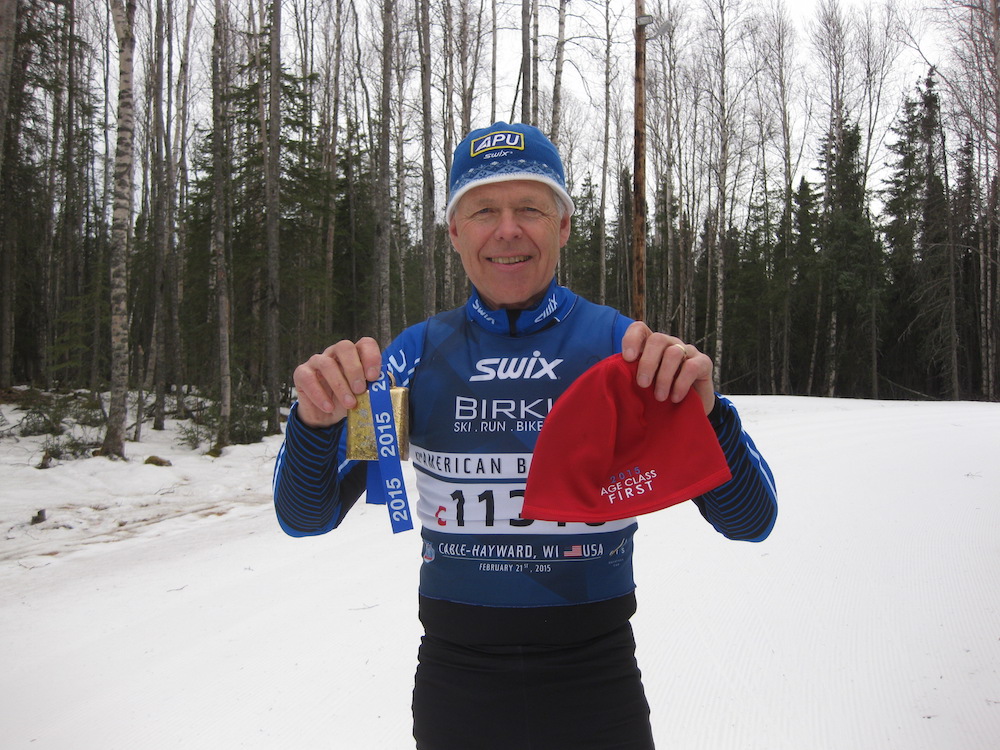
    John Wood, of Anchorage, with his first-place hat and cowbell after winning his age group (65-69) in the 2015 American Birkebeiner 54 k classic in February in Hayward, Wis. (Courtesy photo)
    John Wood, of Eagle River, Alaska, with his first-place hat and cowbell after winning his age group (65-69) in the 2015 American Birkebeiner 54 k classic in February in Hayward, Wis. (Courtesy photo)

    My name is John Wood, I am 67 years old, and have lived in Alaska since I was 11.  On Feb. 21, 2015, I skied to an age-group win in the 65-69 year old classic division of North America’s largest cross-country ski race, the American Birkebeiner.  I placed first out of 112 male skiers in the 65- to 69-year-old age group and 164th out of 2021 competitors that completed the 55 kilometer classic race course. Eighteen months prior to the 2015 Birkie, I underwent total right-knee replacement surgery; this is my story.

    It all began a few years ago when, on my 60th birthday, I joined the Alaska Pacific University (APU) masters cross-country ski training group. I was new to the APU program, but I was not new to competitive cross-country skiing, having competed on team Alaska in the 1965 Junior Nationals in Bend, Ore.,  and the former Alaska Methodist University ski team in the mid 1960s.  However, I drifted away from the sport after moving to Fairbanks and enrolling in engineering school.  A serious knee injury in a soccer game when I was 21 and before modern knee-surgery techniques brought my competitive athletic career to an end.

    After the injury and as the years went by, I continued to live the active Alaskan lifestyle, which included things such as dog mushing, hunting, fishing, and chasing after my growing children. During this time, the size of the brace on my right knee grew larger and larger as the number of arthroscopic cleanouts to my knee approached the number of fingers on my right hand. Consequently, my lifestyle was becoming less active as my mobility decreased.

    Training with the APU group reversed this trend. It was a pleasure to be back on skis on a regular, structured basis, and I enjoyed the comradery of the APU masters group and coaches.  My clunky knee brace allowed me to ski the classic technique OK, but skating continued to make the knee hurt. As my fitness level rose, I began to achieve local age-group racing success in the classic technique events.

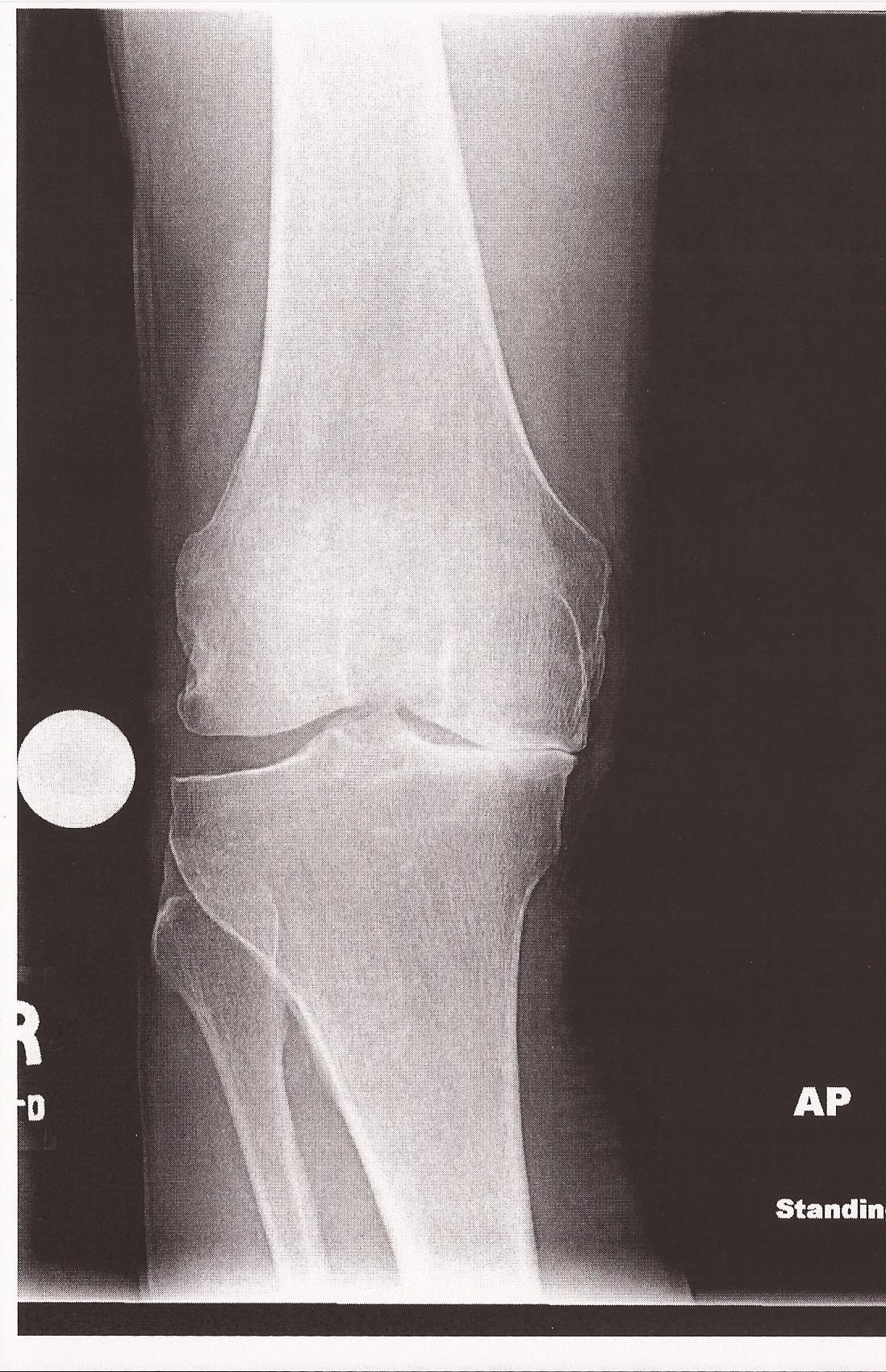
    Right knee prior to surgery.  Note the bone-to-bone contact and lower leg angle. (Photo: John Wood)
    Right knee prior to surgery. Note the bone-to-bone contact and lower leg angle. (Photo: John Wood)

    During the summer of 2012, I turned 65 and decided that it was time to seriously consider a knee replacement. The dull pain in the knee was constant and my footprints left in fresh snow showed the right foot pointed off at an angle to the right of my direction of travel. I had grown tired of living with a large knee brace.

    The plan that I came up with was to first ski the 2013 American Birkebeiner 54-kilometer classic race, wind down my ongoing work as a consulting engineer, spend time with my wife and family at our favorite summer fishing holes, then have the knee replaced.  I scheduled surgery for Aug. 22, 2013.

    The surgery took place as scheduled and was performed by Dr. Powell and his able staff at Alaska Orthopedic Surgery in Anchorage.  I was released from the hospital after three days and was pretty much in a residual anesthetic fog for the first week. I discovered that my body did not tolerate pain medication well, and as a result, I quit taking all but the weakest ones and pain was my constant companion.

    During the second week, my flexibility and mobility started to get better, and my mental edge returned. Rehabilitation began upon returning home, and by the second week became the focus of my life; knee bending machine six-plus hours a day and rehab exercises three times per day.  At the beginning of the third week, I began out-of-home therapy and on Day 19 was able to take my first steps without crutches. By this time, I had lost 15 pounds and was down to my high-school weight, which is to say that my appetite had not yet returned.

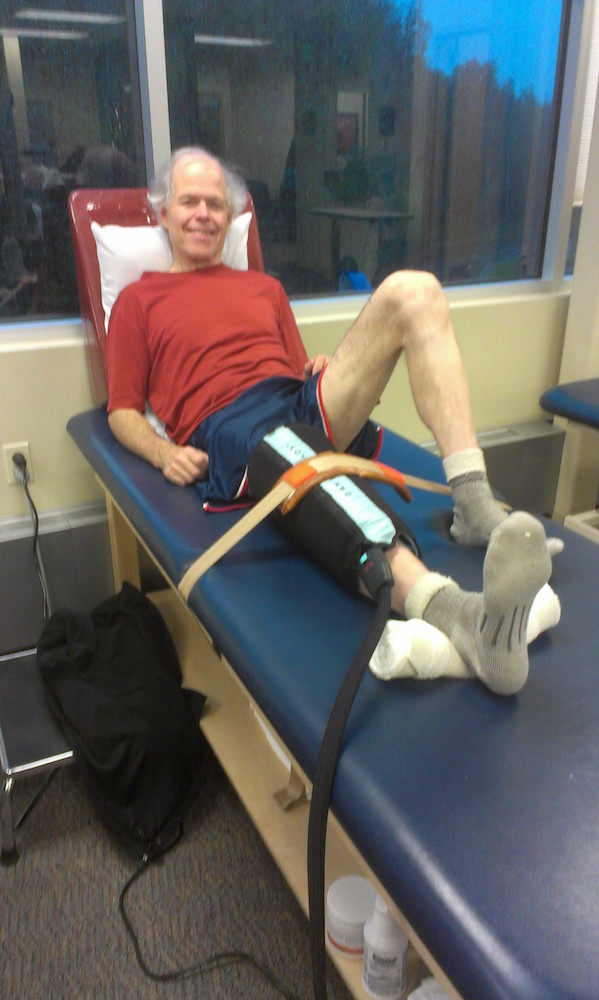
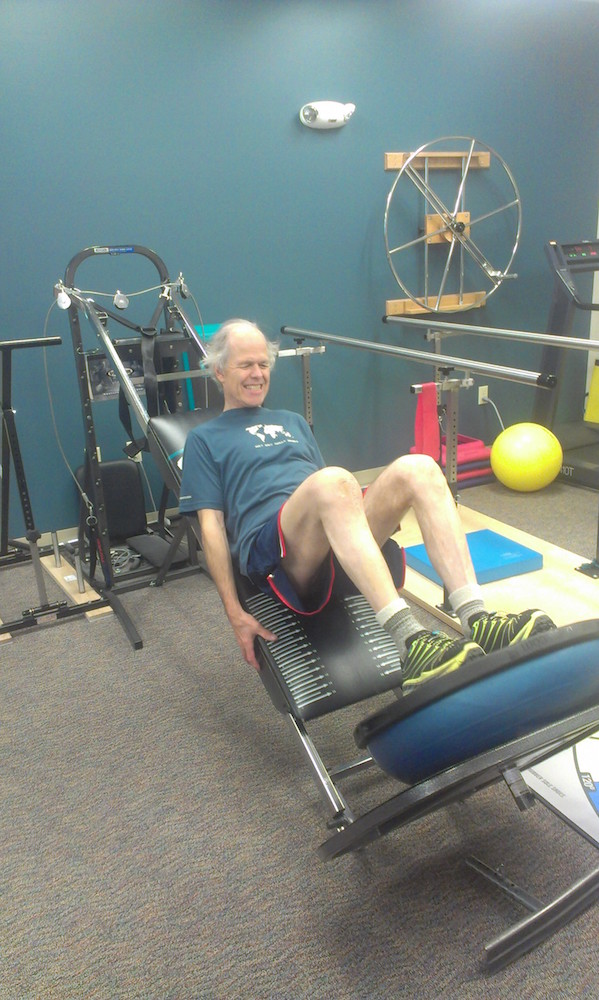
    Wood undergoes physical therapy after his right-knee replacement. (Courtesy photo)
    Wood undergoes physical therapy after his right-knee replacement. (Courtesy photo)

    Slowly, so slowly it seemed, I made steady progress.  During the third week I was able to peddle a stationary bicycle; the fourth week I began to climb down stairs without using a handrail. During the seventh week, I reached a real milestone and was able to bend my knee 120 degrees (with a lot of help from my physical-therapist friend Mark).  During the eighth week, I began walking as far as my body allowed and started to participate in APU strength-training days.  My appetite and weight started to return.

    During this time my whole body was adjusting to the new knee alignment; first my ankle hurt, then my hip hurt, then my back hurt, then all three together, and finally … the pain stopped! Similarly, the soreness in the connective tissue surrounding the knee was gradually subsiding.  After 12 weeks, I quit taking all anti-inflammatory medication and started to feel like a real person again. The best thing was that I had not worn a knee brace since rollerskiing the day before surgery.

    Another thing I had to overcome was getting my brain to realize, spatially, that my right leg and foot were now aligned differently. This caused all sorts of stumbles and trips, and I had to consciously place every right footstep. It was a real accomplishment when I finally could walk, unaided, in the dark.

    At 13 weeks, my new knee and I took our first 20-minute ski in the front yard, and over the next few weeks I graduated to the local ski trails. By 19 weeks, I had begun to ski easily with the APU masters skiers in the regular workouts, and in week 25, I participated in my first interval session.  Finally, during week 28, I participated in the year-end Oosik Classic ski festival that is disguised as a year-end race.  My knee was almost back!

    Right knee at one-year checkup (Photo: John Wood)
    Right knee at one-year checkup (Photo: John Wood)

    Every year a group of skiers from the APU Nordic Ski Club masters and elite programs travel to Wisconsin to participate in the American Birkebeiner ski race.  In May 2014, my new knee and I got the itch to return to the 2015 Birkie with the APU contingent. When I registered for the race I discovered, to my delight, that I qualified for the first classic wave, and through good fortune was able to secure a room in a B&B in Hayward near the finish line. The stars were moving into alignment.

    I began to take my offseason three-day-a-week APU training sessions more seriously. Weights were added to the routines during strength sessions, intensity sessions in the hills were run/walked with poles and, to my delight, I discovered that I could skate roller ski! Both of these activities were done for the first time in at least 30 years. Weekly over distance workouts were with a group either on road bikes or mountain hikes.

    Snow and skiing arrived on the hills behind Anchorage on schedule in mid-October, but disappeared three weeks later. November was brown and barren, so training returned to hill bounding, speed hiking and mountain biking. Privately, I was concerned about my training and developed a self-imposed on-snow deadline of Dec. 1 … no snow, no go for the Birkie.

    Wood pushing his limits in rehab (Courtesy photo)
    Wood pushing his limits in rehab (Courtesy photo)

    On Nov. 28, the day after Thanksgiving, it started to snow and the local Anchorage trails and Independence Mine trails were once again skiable. My Birkie plans were saved. Training took on a regular schedule again, with a typical APU masters group week including a strength day, an “intensity day,” a technique day, an over distance day, and one or two “off” days.  Snow conditions continued marginal in Southcentral Alaska, but the recently installed snowmaking loop at Kincaid Park was now in service and proved to be a reliable standby venue.

    During December and January, before the February taper, I averaged 31 hours per month on snow and participated in five local citizens races ranging in distance from 2 kilometers to 30 k. I was particularly happy to be able to ski both classic and skate legs of a 15 k duathalon race. My fitness level was as good as it was going to get.

    Before I knew it, mid-February had arrived and off to Hayward I went.

    Race day dawned to 10 degrees and light snow. I arose at 5 a.m., ate breakfast with several other skiers who were also staying at the B&B, was driven to a skier pickup point, and arrived at the start area via shuttle bus an hour prior to my 8:10 a.m. start. Although flurries lingered at the race start, several inches of fresh snow from the previous day had been packed by the trail setters overnight and the trail, although not particularly fast, was firm.  Thousands of skiers were milling around trying to stay warm and everyone took their turn standing in long lines to use the Porta Potty for the last time.

    As my wave time approached, I put on my ski boots, removed my warmups, put all of my non-race paraphernalia in the bag provided to race participants at bib pickup, and placed it in the waiting vans to be hauled to the finish line. I moved to the racer-holding area, put on my skis, and self-seeded myself into a lane in the middle of the first wave which consisted of 278 skiers.

    Soon the flag was dropped and skiers at the front of the lanes were off. Those of us in the middle had to wait a few seconds ’til the skiers in front began to move out, then we, in turn, could begin. After about 100 yards my lane came to a sudden halt, and a guy about half a dozen skiers in front of me hollered that he forgot to wax his skis, and began to look around for a way to exit to the sidelines. The problem was that skiers were streaming by in the lanes on either side, and nobody in our lane could move!

    Finally I found a skier gap in an adjacent lane, hopped in, and got around the stalled skier. Off I went, now moving at the same steady-but-slow speed as all the other skiers that I could see up and down the trail.

    After a couple of kilometers the trail necked down into four lanes, then three, and the skiers began to separate. After about 5 k, I was able to slowly pick up my speed to a more comfortable level and didn’t have to expend precious energy by going around slower skiers in the unused lanes that contained fresh, slow snow.  At some point near the 26 k mark where the classic trail merged with the skate trail, the three lanes became two and favored the left side. Passing slower classic skiers on the right side now meant jumping out of the classic lane and dodging among the skate skiers in their lane. What a blast!

    As the race progressed, I really concentrated on working the transitions while conserving energy on the uphills. I skied the more challenging downhills conservatively, not wanting to instigate a high-speed fall and land awkwardly on my new knee and risk an injury.  This tactical decision to conserve energy allowed me to open-up my double poling during the flatter second half of the race, where I continued to work my way up through those in front of me.

    I had an immense sense of elation as I crossed the temporary wooden Highway 63 overpass and skied up Main Street and across the finish line in a time of 3:39. I had finished strong!

    After I retrieved my drop bag I walked the four blocks to my B&B, where I removed my APU ski suit that was frosty and frozen from the energy drink that I had splashed down my front while drinking on the move. I sat in a hot shower, savoring the moment with a bottle of cool refreshment. I didn’t know how I placed, but I did know that I felt good about my race and new knee. Nothing was hurting and my entire body was pleasingly tired.

    Later, one of the young ladies who was also staying at the B&B showed me on her smartphone how I placed: first in the 65-69 year age group by four minutes. Boy, was I happy and excited … a dream come true! That evening, when I picked up my monogramed first-place age-group hat and engraved cow bell the events of the day finally sunk in. New knee, Birkie classic age-group win.

    I owe a great big “thank you” to the efforts of a lot of people that contributed to my Birkie success: Dr. Powell’s most professional surgery team, PT Mark and his staff’s patience with my rehab whining and complaining, great coaching from my APU masters coaches Greta [Anderson] and Galen [Johnston], and most importantly the unfailing support from my fantastic wife Cathy.  What a wonderful life!

    ***

    Masters Minds series: Are you a masters skier who loves your club? Submit camp or training recaps, announcements, or stories to info@fasterskier.com with the subject line: “Masters Minds”. Articles can be first-person accounts or written from an observatory standpoint with comments from others.

  • Masters Minds: Early Season in Southcentral Alaska

    Masters Minds: Early Season in Southcentral Alaska

    Most years, skiers of all ages find their snow legs again at Independence Mine. Here five-year-old Scout Gramse edges M1 racer Dylan Watts (October 2013) (Photo:  Shannon Gramse/APU)
    Most years, skiers of all ages find their snow legs again at Independence Mine State Historical Park in Alaska. Here, 5-year-old Scout Gramse edges M1 racer Dylan Watts in Oct. 2013. (Photo: Shannon Gramse/APUNC)

    Masters from around the world, we want to hear from you! FasterSkier is seeking dedicated masters contributors from various clubs and regions, including any and all skiers who aren’t quite pro or collegiate skiers anymore (or ever — as we know how many catch the bug later in life!) Whatever your level of skiing, if you can write, please do! 

    Submit camp or training recaps or announcements to info@fasterskier.com with the subject line “Masters Minds”. Articles can be informal, first-person accounts or written from an observatory standpoint with thoughts from others, like below.

    ***

    Part of the joy and the pain and, ultimately, the poetry of a lifetime of skiing is how the sport focuses one’s attention on natural processes that are both cyclical and unpredictable. This year Southcentral Alaska caught its first real snow on Oct. 20, and early season skiing has been great, but not in the usual ways or places.

    First grooming honors go to the Nordic Ski Association of Anchorage, who, thanks to extensive summer trail work and an innovative approach with a light homemade drag pulled by an ATV, miraculously transformed a scant four inches into fine skiing at the Hillside Park in Anchorage. A few more inches fell higher up, in Chugach State Park, where early-season skiers along Powerline Pass witnessed a pair of grizzly bears fighting over a dead bull moose.

    Skiing has also been good south of Anchorage in the resort town of Girdwood, where a beautiful and challenging new 5 k system winds among stately hemlocks in a spectacular mountain valley. Completely absent from the scene, however, has been Southcentral Alaska’s traditional go-to early season hotspot, Hatcher Pass, which has missed the region’s minimal early snow thus far. Nonetheless, as if by habit, masters’ minds and talk have turned frequently of late to this special place.

    Completely absent from the scene, however, has been Southcentral Alaska’s traditional go-to early season hotspot, Hatcher Pass, which has missed the region’s minimal early snow thus far.  

    There must be many spectacular snow bowls high in Alaska’s Talkeetna Mountains, where remnant Pacific storm systems (usually!) roll like slow breakers into jagged peaks and arctic chill, but only one such wonderland, Hatcher Pass, is accessible via a plowed road, and it is a goldmine. And an actual gold mine.

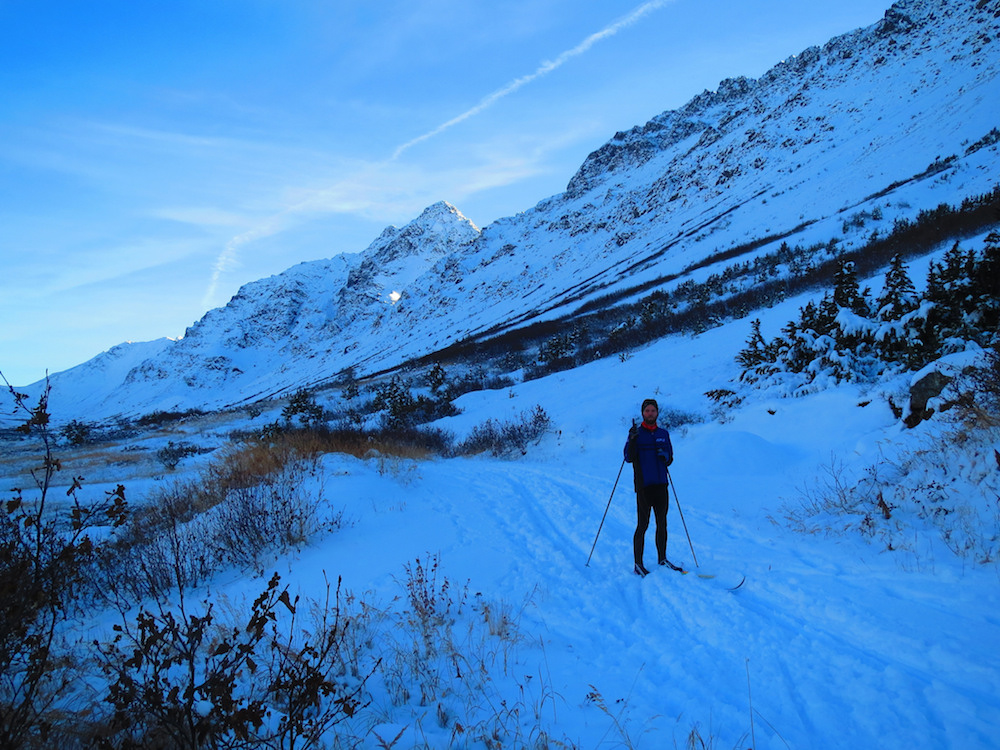
    It's not Hatcher Pass, but he'll take it. Shannon Gramse begins a new ski season in Chugach State Park on October 21, 2014. Skiers shared this valley with a pair of brown bears feasting on a bull moose. (Courtesy photo)
    It’s not Hatcher Pass, but he’ll take it. Shannon Gramse begins a new ski season in Chugach State Park on October 21, 2014. Skiers shared this valley with a pair of brown bears feasting on a bull moose.


    The surrounding mountains are born of the Castle Mountain Fault, a major geological fracture the access road crosses, much lower, as it begins to climb through the canyon of the Little Susitna River, but the road itself owes its existence to Robert Hatcher’s discovery of gold in the area in 1906 and the subsequent development of Independence Mine, in its heyday a vibrant industrial complex served by miles of tunnels and over 200 employees, some of whom took advantage of the area’s excellent skiing, both for fun and transportation.

    Independence Mine closed in 1951 but the skiing continued, with skiers often staying in the abandoned buildings. In the late 1960s Hap Wurlitzer opened the incomparable Hatcher Pass Lodge about one kilometer below the mine complex, and the onetime mine manger’s house, built in 1936 for the Stoll family, also served for a time in the 1970s as a skiers’ inn.

    In 1974 the mine was placed on National Register of Historical Places, and since 1980 the buildings and surrounding 270 acres comprise Independence Mine State Historical Park. Grand plans for enormous ski resorts at Hatcher Pass have never materialized, thankfully. Today, thanks to incredible grooming by the Mat-Su Ski Club, skiing is hotter than ever. Early-season skiing at Independence Mine is easily among the best in America and a beloved southcentral Alaskan fall ritual.

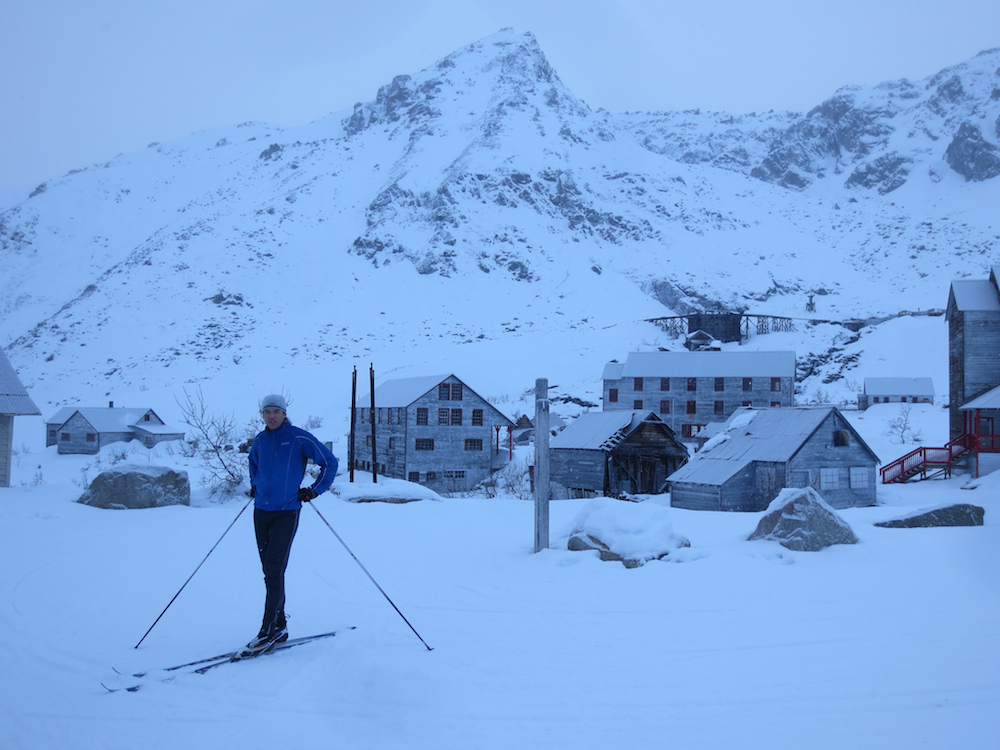
    The 800-foot climb from Hatcher Pass Lodge at the end of the road up to the historic mine seems an important part of that ritual for many Alaskan masters and a good gauge of fall fitness, if a bit of a rough welcome back to snow. At the mine, three interconnected loops totaling several kilometers, zero meters of which are horizontal, weave amid clapboard buildings, the mess hall, offices and machine shops, dormitories, all painted silver with red trim, some three stories tall, many with covered porches, and fascinating ruins, including crumbling mine car trestles, waterways, and enormous generators.  Imagine skiing through an Old West ghost town turned collectible Christmas village.

    Imagine skiing through an Old West ghost town turned collectible Christmas village.

    Skiing at Independence Mine is typically excellent season-long, but it’s busiest in the fall, as many area skiers take the opportunity for an early start on challenging terrain.

    A typical early-season skiing scene: APUNSC Master Travis Rector pauses while skiing Independence Mine in October 2013.
    A typical early-season skiing scene: APUNSC Master Travis Rector pauses while skiing Independence Mine in October 2013.


    Longtime Alaska Pacific University Nordic Center (APUNC) Masters coach Dylan Watts advises, “You can normally add three to four weeks to your ski session if you’re willing to make the drive. This makes it ideal for getting a feel for the snow and skis again. Plus the kilometer-long uphill right at the start really gives a boost to your fitness. After a few weekends skiing up and down you can feel an improvement both in confidence and ability on the skis as well as improved strength and stamina.  The area also offers a variety of consistent grades both on straights and turns all within a compact area, making it ideal for working on different techniques and skills.  It really is an ideal place if you’re looking to build form and fitness on cross-country skis.”

    Mike Truskowski, M5 racer, middle-school teacher and coach, adds: “To make things even more interesting, there is no place to hide from your friends, so everyone can see how you’re doing.  Just when you think that you’re skiing a good loop, watch out behind you: That person calling ‘Hup ’ could be an Olympic skier, a national champion, or just your buddy who worked harder than you this last summer.”

    That buddy might be M4 racer and Anchorage optometrist Jim Falconer who also enjoys the challenge and the area’s special beauty: “A ski at Independence Mine in October usually marks the beginning of the ski season for me.  After the season’s first significant snow in the mountains, it’s an almost spiritual experience to go up there and ski in that environment — it feels like another world.  And since it’s mostly up and down without much in the way of flat terrain, skiing there is a real test of the fitness you are carrying into the ski season from your summer training.”

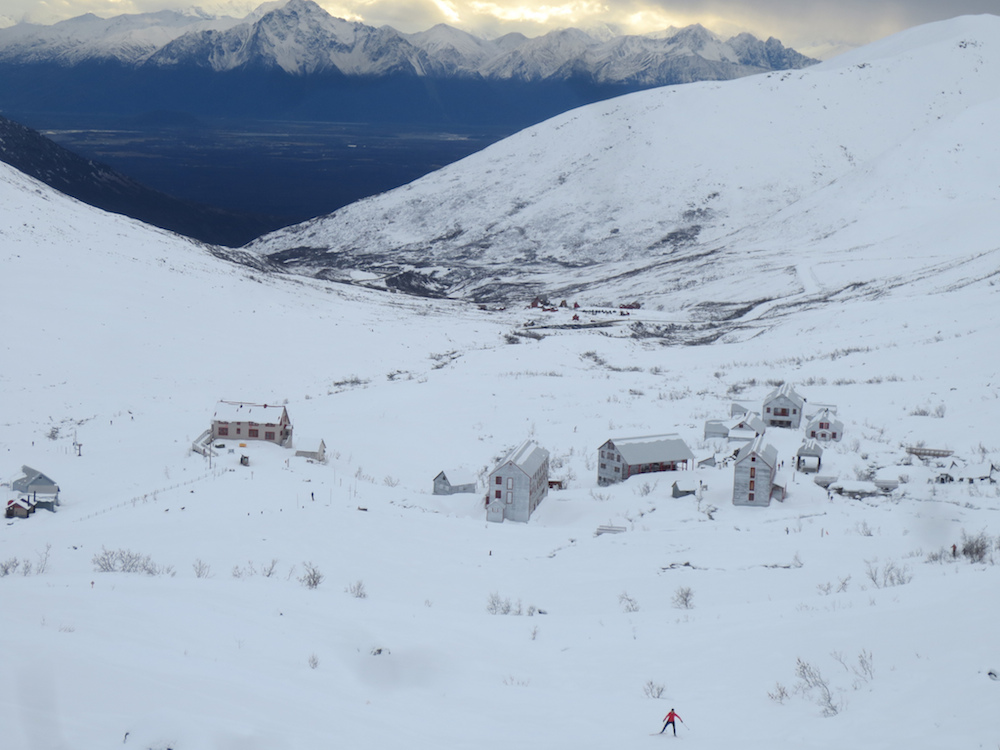
    Independence Mine as seen from the top of the groomed trail system in November 2013.
    Independence Mine as seen from the top of the groomed trail system in November 2013.

    According to Mat-Su Ski Club President Ed Strabel, over the past nine years, grooming at Independence mine has begun on a mean date of Oct. 13. Strabel, father of Mount Marathon champion Eric Strabel, and his ski club colleagues are passionate about spinning frequent heavy snowfalls into set tracks and corduroy.

    “Our dedicated all volunteer, unpaid groomers do most of the grooming at night to give the snow time to setup before the skiers arrive,” Strabel says. “While our tracked ATV’s are vastly superior to a snowmachines for grooming, big snowfalls (over 12 inches) are a challenge and the trail will be a bit punchy because we can’t get the pounds per square inch of a PistenBully.  Wind can also be a big headache because we don’t have a six-way blade to take out drifts.  Last year we had a 30″ snowfall followed by high winds.  The whole area was almost featureless.”

    But such devotion isn’t  completely altruistic: “All our groomers are skiers, too, and we want to ski also,” he adds, “The toughest part our volunteer groomers have to cope with, other than getting a groomer unstuck, is resisting the urge to grab our skis and go skiing on our handy work immediately after we finish grooming.”

    While it’s true that the light can be flat, the weather awful, the kick waxing weird, skiing at Independence Mine is always an exceptional experience. On a clear day, the views and surrounding  mountains are mind-bendingly beautiful. The old mine is interesting in any weather. Maybe best of all, those first few weekends back on skis up there are in many ways a reunion, or re-formation, of our community, from masters to kids to Olympians, and everyone is smiling.

    While it’s true that the light can be flat, the weather awful, the kick waxing weird, skiing at Independence Mine is always an exceptional experience.

    When asked via email what he thinks about when he thinks about skiing Independence Mine, Coach Watts’ answer is perhaps evocative enough and instructive enough to quote in full and call it good:

    “For me I really like the uniqueness of skiing at a historic hard rock mine. Skiing around the old buildings, it is hard not to let the mind reflect on the history of the mine, the miles of tunnels dug with great labor chasing gold. Kick, glide, kick, glide.  The process that put that gold in place. Keep the arms pumping. On to the history and future of resource development in Alaska. Dance off the feet as you herring bone the steep hill. Then on to the beauty of the peaks all around. Watch the plowed-up snow in the corner. The ubiquitous of petroleum products on every person out skiing: clothing, skis, wax, boots.  Tuck lower.  Watching people ski up as I fly down the hill. They look fit.  How nice to see the whole family out skiing. Must be the first day on skis for them.  Kick up some spray at the bottom to show off a little. Back to kick, glide, kick, glide.  It is pretty easy to have three hours of hard skiing fly by and let the mind mediate, wonder, and marvel at the world and life on it.”

    ***

    About the Author: Shannon Gramse is a longtime member of APU Nordic Ski Center’s Masters Program. When he’s not skiing, he’s thinking about skiing while being a father and a husband and a professor at the University of Alaska Anchorage.

  • APU Masters On-Snow Camp on Eagle Glacier June 28-July 1

    APU Masters Camp:

    June 28-July 1

    This summer APU is hosting a masters on-snow ski camp at the Thomas Training Center on Eagle Glacier. Come experience glacier training, just as APU’s Elite team and Olympians Kikkan Randall, Holly Brooks, Erik and Sadie Bjornsen make their seasons.

    Skiers are made in the summer.
    “Skiers are made in the summer”

    The camp is coached by APU Elite coach Erik Flora, Don Haering and Greta Anderson. Erik has coached at Olympic and World Championship levels, including three time Overall World Sprint Champion. Don and Greta are APU Master coaches and skied for the APU Elite-University Team. Snow camp will be from the evening of June 28 to the morning of July 1, including 4-5 ski sessions.

    Camp includes classic and skate techniques. There is opportunity to ski a lot, plus take part in technique discussion and video review. Cost $775. Includes skiing, coaching, housing, and food. Space is limited. Addition fee for helicopter transport, approximately $220.

    Please contact Greta Anderson (gretaanderson13@gmail.com) for registration.

    Eagle Glacier (Photo: APU)
    Eagle Glacier (Photo: APU)
    Eagle Glacier (Photo: APU)
    Eagle Glacier (Photo: APU)