From the FasterSkier archive — posts syndicated from athletes’ and coaches’ own blogs between 2004 and 2012, kept online as published. Current coverage is at fasterskier.com.
Ben Ogden (USA) celebrates as he crosses the finish line with an Olympic silver medal, the first medal for the U.S. men in the sport in fifty years. (Photo: Vanzetta/NordicFocus)
This essay by Jim Galanes was written on the evening of the Olympic Men’s Classic Sprint in Val di Fiemme, when Ben Ogden won silver to become the first American man in 50 years to medal in an Olympic cross-country skiing event. It was drafted from the race course that same night and is being published now, several weeks later, as a reflection from someone who has witnessed multiple generations of American skiing.
~ ~ ~ ~ ~
A friend texted and reminded me as we were standing on the course for the sprint race, in Val di Fiemme, that it had been 50 years and five days since Bill Koch won his silver medal in Seefeld, Austria, at the 1976 Olympics.
I was at those Games as a Nordic Combined skier, 20 years old learning the sport, I was trail side 4-5 kilometers from the finish cheering Bill on. In fact, I got so caught up in the moment that I nearly missed my own ski jumping training window and had to hustle back to squeeze in my final practice jumps before competition. Bill’s performance mattered, not just for the result, but for what it signaled about what American skiers could do on the world stage.
Fast forward five decades (and five days), and I found myself in a remarkably similar position, but as a spectator, back on course, watching Ben Ogden put together what I believe was the most complete race of his career , tactically, psychologically, and physiologically, on the same Val di Fiemme tracks that have tested athletes for the past 30 years.
Johannes Hoesflot Klaebo (NOR) and Ben Ogden (USA), (l-r) crest the final climb before descending into the finish during the semifinals. (Photo: Barbieri/NordicFocus)
Let’s be clear. Racing against Johannes Høsflot Klaebo is a different challenge altogether. He is, quite simply, the dominant sprinter of this era. Everyone knows that. But if there is someone willing to challenge him, to pressure him early rather than concede, Ben is one of the few with the courage and competitive instinct to do it.
Ben has always been an aggressive racer. We’ve all seen the pattern before, going out hard, sometimes, too hard in qualification or early rounds, only to lose just enough capacity to not be a factor when it matters most. That’s not an athletic flaw. It’s the learning curve of a young athlete figuring out how to apply fitness in international competition.
This time was different.
With an early start in qualification, Ben laid down a fast, aggressive time that held up until Klaebo edged it. What stood out wasn’t just the speed; it was the control, the discipline, and the focus. Ben skied the lower sections with restraint, clearly managing energy so he could handle the Zorzi climb effectively and carry speed over the top. From our vantage point near the finish, you could see those who had overcooked that climb and the early sections of the course. Those athletes crested without momentum, struggled to accelerate on the descent, and had difficulty navigating the soft, wet corner into the finishing straight.
Ben didn’t have that problem.
We couldn’t see the full climb directly, but the stadium screen told the story. He attacked decisively, created separation, and more importantly, did it without being frantic or over his limits. Still, the coach in me wondered whether that effort would cost him later. History makes me cautious.
As the rounds progressed, it was obvious the conditions were deteriorating. The snow got slower each heat. Times drifted up significantly, and the race began to perhaps reward athletes with deeper aerobic reserves and better efficiency rather than pure power. In softer conditions, maintaining effective kick can become a limiter. Some athletes compensated with excessive upper-body work. Ben, by contrast, maintained clean mechanics and consistent pressure and pace through the race
In the semifinal, Johannes Hoesflot Klaebo (NOR) was first across the line, while Ben Ogden (USA) was outlunged by Lauri Vuorinen (FIN) and needed a lucky loser spot to advance to the finals. (Photo: Vanzetta/NordicFocus)
In the semifinal, we positioned ourselves on the first uphill. Klaebo and Ogden came through side by side. Partway up, Klaebo glanced over, the kind of look experienced racers give when they recognize a real contender, as if to say OK-lets go. The front group, Klaebo, Ogden, and Vuorinen, quickly separated from the field. No one could break it open on the final climb, and it came down to the finishing sprint, where Ben placed third and advanced as a lucky loser out of the faster semifinal.
Not dramatic. Just composed. Exactly what he had to do.
By the final, the track had slowed even more. Once again, Ben committed from the gun, but not recklessly. On the Zorzi climb, he and Klaebo distanced the rest of the field, turning the race into a two-man contest for gold and silver. Over the final roller, Klaebo made the decisive move, a couple of double poles, as he has done here numerous times, and created the separation he needed. Ben held second convincingly ahead of a very strong Norwegian contingent.
Here’s my takeaway.
Ben has adjusted tactically. But this wasn’t just better tactics. This was the performance of an athlete who arrived. The fitness is there. The psychological composure is there. The tactical judgment has caught up to his physiology. At the end of the race he was spent as he should have been. That wasn’t miscalculation; that was full commitment.
Ben Ogden (USA) celebrates on the podium with his Olympic silver medal. (Photo: Vanzetta/NordicFocus)
Fifty years ago, Bill Koch’s medal showed that an American could belong at the front of international cross-country skiing. Performances like this suggest we are entering another period where that idea is no longer an exception.
On the men’s side, athletes like Ogden, Gus Schumacher, Ketterson, Wonders, McMullen, and Schoonmaker, the talent is real. The depth of talent is unquestionable. The question is no longer whether they can compete. The question, as always in endurance sport, is whether they can improve their consistency of their performance, continue to build, stay healthy, and keep progressing.
That part never gets easier. We can do it if we can continue to support and improve the club programs that have developed these athletes.
Jim Galanes, Peter Davis, and Peter’s granddaughter. (Photo: Joyce Allgier)
As a side note, this is the first Olympics I have been to since 1994, more than 30 years. It has sort of been like old home week, bumping into friends who had just skied in the World Masters in Sampada, Italy. Spending an hour with Rick Kapala in the food court line while discussing many of what we both see we need to work on to the keep the sport progressing. Connecting briefly with former Olympians Judy Rabinowitz, Trina Hosmer, and her husband Dave, old ski and bike riding friends from Stowe. On the last day, I was also able to meet with Peter “Giant” Davis and his wife, Nancy, on the side of the trail. Peter was an athlete on the US Ski Team in the 70’s, a coach at Telemark Academy, and later at the Lyndon Nordic Ski Center. The first residential programs for junior cross-country skiers in the country.
Gus Schumacher fans. (Photo: Joyce Allgier)
We also enjoyed meeting some of Gus Schumacher’s friends, family, parents, and others. It is fun to see so many old soldiers of the sport still around and enjoying the time watching U.S. skiers compete on the world stage. It was great to see and know so many other US ski fans who were there that I did not get to see personally. Most of all, having a young APU skier who I had never met come up and thank me for founding the APU program that is giving her the opportunity to pursue her dreams. The success we are seeing today and what we need to do in the future is built upon an understanding of what we have done in the past and a clear vision of what we need to do in the future to move forward.
Picture of Vermonter Bill Koch celebrating his winning the FIS Overall WC crown with a very happy coach, the late Mike Gallagher. A very special moment. (Photo and caption courtesy of Peter Graves)
A clear vision of the future should require an understanding of where we have come from, and what we have done in the past. It is interesting that some of those who have been influential in the past are still engaged in the sport. Maybe a curse of old age, or maybe relevant, that we see the past as a building block for the future. As I look back in my lifetime in the sport, understanding where we are today would not have been possible without the likes of John Caldwell, Sven Wiik, two of the earliest coaches in the sport who helped create coaching for aspiring athletes. Athletes, like Gray, Gallagher, Rockwell and Elliot who laid the foundation in international competition and inspired my generation. The Southern Vermont quad of Koch, Caldwell, Galanes and Dunklee took the next steps, along with women like Spencer, Owen, and Rabinowitz. The next generation of athletes like Kemppel, Bauer, Freeman, and Randall, who, despite a multitude of challenges and inadequate support from the US Ski Team, produced some excellent results.
In 1996 I established Gold 2002 program in Anchorage, later I brought into APU to become APU Nordic Ski Center. I established this program to create a better (a different) or alternative pathway that would provide athletes with full-time coaching and a base level of support to keep athletes skiing after college or have an alternative pathway to the NCAA route. Many more of these so-called pro teams followed in the coming years. We now have strong club programs in every region of the country. Those programs have been critically important to the success we have enjoyed over the last decade or so. We need to support and help those programs to continue to improve and expand so we can have even more athletes ready to perform when they step on the World Cup and Olympic stage. Perhaps the biggest hurdle these days. It is possible that we just need to find the best pathway to make the next steps in developing athletes.
Help Support Our Olympic Coverage!
If you value the thoughtful work and access FasterSkier provides, please consider becoming a Voluntary Subscriber. Your support directly fuels our work to cover the people, places, and moments that make our sport special.
Ben Ogden (USA), Johannes Hoesflot Klaebo (NOR), and Oskar Opstad Vike (NOR), (l-r) share the 2026 Olympic Winter Games Classic Sprint podium in Tesero, Italy. (Photo: Vanzetta/NordicFocus)
The men’s Classic Sprint heats got started with quarterfinal number one at the US Nationals Cross-Country Ski Championship at Mt Vanhoevenberg in Lake Placid NY. (Photo Nancie Battaglia)
The last day of the U.S. National Cross-Country Ski Championships in Lake Placid arrived the way honest days in this sport often do. The snow at Mt. Van Hoevenberg had been churned and scoured by a week of racing and changing weather, its surface no longer pristine but revealing, the kind that gives little for free. Legs were tired. Arms were tender. Expectations had been trimmed back by accumulated kilometers and decisions already made.
For the men lining up for the classic sprint, this was not simply a final chance at a national title. In an Olympic winter, nothing is ever only what it claims to be. The sprint was an audition—not necessarily for Olympic selection, but for relevance. For future start rights. For the ability to say, credibly, that range still exists.
Sprint qualification, in particular, has a way of stripping sport down to its essentials. No drafting. No hiding. One lap to explain yourself. As has been said all week about sprints, it does not matter how clever you are in the heats if you cannot arrive there in the first place. In Lake Placid, that truth shaped the day from the first starter onward.
Fin Bailey (UVM) makes his way up the Lake Placid sprint course’s signature climb. (Photo Nancie Battaglia)
Qualification: where the day declares itself
Qualification mattered here in a way that went beyond podiums and medals. With sprint start rights in the World Cup largely determined by qualification speed, the men knew exactly what was at stake. If this were a sorting mechanism, it was a blunt one.
The fastest man through the course was John Schwinghamer, whose time at the top of the board set the early benchmark. But the story quickly widened. Pierre Grall-Johnson followed closely, and then Will Koch, who would soon become central to the day’s most unusual tactical thread, placed third.
A few seconds farther back sat a cluster of names that told a deeper story: athletes with distance pedigrees, athletes chasing U23 selection, athletes managing fatigue from a long week and still trying to produce speed on demand.
Among them was Zanden McMullen, who qualified tenth, solid but not dominant. “The qualifier felt a little off,” McMullen admitted. “I didn’t feel smooth and thought I skied poorly through the terrain. I was happy to qualify and have another chance to improve on the day.”
That, in retrospect, was the quiet warning shot.
Classic striding versus powerful double poling was one of the key storylines in the men’s Classic Sprint. (Photo Nancie Battaglia)
A decision made in minutes
If qualification is the most honest part of sprinting, it is also where improvisation sometimes reveals itself. Koch arrived at the start line with little margin and even less certainty.
“I was already pretty tired going into the classic sprint,” Koch said. A bonk midway through the 20-kilometer freestyle earlier in the week had drained his reserves, and classic sprint had never been his strength. “With about ten minutes to go before my qualifier, I still couldn’t get my classic skis to kick.”
The decision that followed was not theoretical. Koch asked his coach to prepare a pair of skate skis — not as a backup, but as a commitment. He reached the start with roughly 90 seconds to spare, hoping that strength alone might be enough to advance.
Third in the qualifier erased doubt immediately. “When I ended up third, I knew it was the right call,” he said. “I never even tested a classic ski the rest of the day.”
The gamble would ripple through every round that followed.
Will Koch (SVSEF) powered through the qualification and heats, double poling on skate skis. (Photo Nancie Battaglia)
Heats: when fatigue starts to speak
Classic sprint heats at Mt. Van Hoevenberg reward clarity. The course offers opportunities, but they are conditional. Mistime a move, and the course and competition punish hesitation. Get trapped behind the wrong skis, and speed evaporates.
Koch’s plan was simple and exhausting: lead early, create space before the climb, and survive long enough for glide to matter again. “If I could crest the climb with the group, my skis would be fast enough to carry me through,” he explained.
For a time, it worked exactly as intended.
But others were playing different games.
Zach Jayne arrived at the sprint with a different set of calculations. Already qualified for U23 Worlds and carrying a narrow SuperTour points lead, his goals were layered. “I wanted to finish strong,” Jayne said. “I also wanted to make the final so I could displace other U23 athletes and help ensure my teammate Max Kluck made the trip.”
Jayne, Koch, and teammate Carl Rune all opted to double-pole the heats on skate skis, a choice that paid dividends early. “It worked really well in the quarterfinal,” Jayne said. “But as the rounds went on and fatigue built, I was definitely wishing I’d brought a pair of klister skis.”
That fatigue — cumulative, unrelenting — became the quiet theme of the afternoon.
Zanden McMullen (APU) showed he had made the right calculations for himself in the final, creating a gap on the large climb, which he was able to maintain on the final downhill. (Photo Nancie Battaglia)
Trusting kick in uncertain snow
While some chased glide, Max Kluck made a different bet. His week had been defined by nerves more than novelty. “I was more nervous than I’ve been in years,” Kluck said. “I knew my U23 spot was on the line.”
The snow tempted experimentation, but Kluck resisted. “I was pretty certain I wanted to stay on classic skis unless the weather took a major turn,” he explained. “I stuck with my gut.”
The reward came immediately. In the quarterfinals, Kluck ran the climb with confidence, kick biting cleanly while others labored, arms already beginning to pay the price. “I figured I might be able to make double-poling work once,” he said. “But I didn’t think I could personally do it four times.”
His solution was economy. By trusting his wax and striding more often, Kluck preserved his upper body for the finishing straight — a detail that would matter later.
UVM’s Fin Bailey was showing he was on form and a threat for the podium throughout the heats, but his final got off to an unlucky start with a broken pole. (Photo Nancie Battaglia)
The final: legs versus arms
By the time the final assembly was complete, the calculus was visible even from the sidelines. The men who had double-poled all day carried speed — and fatigue. Those who had relied on kick carried legs.
McMullen understood the equation precisely. “Going into the final, I knew the few boys that double-poled all day would be tired,” he said. “My plan was to keep them in reach before the final climb and then gap them.”
Snow conditions had continued to degrade, wind and rain complicating grip and timing. McMullen’s classic skis, however, remained reliable. “Our classic skis felt good,” he said. “I didn’t think there was a need to try and double-pole the race.”
When the decisive climb arrived, McMullen did not hesitate. He strung together clean transitions, trusted his kick, and separated decisively. “I felt really fresh still at the start of the final,” he said. “I knew I would be able to run away with it.”
Behind him, the chase unfolded exactly as predicted. Koch’s glide carried him, but the cost of four rounds of double-poling showed. Kluck’s restraint paid dividends, his saved arms helping him close strongly. Jayne fought valiantly through fatigue, his earlier work for teammates already done.
McMullen crossed the line alone — a national champion not because he had chased novelty, but because he had waited for the moment that mattered.
Zanden McMullen (APU) comes to the finish of the Classic Sprint with his second national title in as many days at the US Nationals Cross-Country Ski Championship at Mt Van Hoevenberg in Lake Placid, NY. (Photo Nancie Battaglia)
What the result actually means
The men’s classic sprint did not reshape Olympic selection overnight. Sprint specialists were unlikely to be named from Nationals alone. But the race clarified something subtler and perhaps more important.
It showed who can adapt under stress. Who can make decisions when plans unravel? Who understands that qualification speed opens doors long before medals do?
For Koch, the day was a revelation. “The classic sprint was a really pleasant surprise to end the week,” he said, even as he acknowledged that broader goals remained unmet.
For Jayne, consistency mattered more than headlines. “I don’t race to prove people right or wrong,” he said. “I know what I’m capable of.”
For Kluck, the outcome was tangible. “Securing my U23 spot was the biggest goal of my season,” he said. “Locking it down here feels incredible.”
And for McMullen, the victory was both affirmation and invitation. “I hope people know now that I’m an all-around skier,” he said. “And I hope the Olympic selection committee knows I have a lot of potential to succeed at the Olympics.”
Zanden McMullen (APU) first place, Will Koch (SVSEF) second place, and Max Kluck (UU) third place at the US Nationals Cross-Country Ski Championship Classic Sprint at Mt Vanhoevenberg in Lake Placid NY. (Photo Nancie Battaglia)
A quiet ending, honestly earned
As the course emptied and the equipment was packed away, Mt. Van Hoevenberg returned to stillness. Another Nationals was complete. Another set of arguments had been made — not loudly, not always cleanly, but honestly.
Sprint racing, especially in January of an Olympic year, has a way of revealing truths athletes might prefer to delay. Qualification does not negotiate. Fatigue does not compromise. Decisions, once made, echo through every climb and corner that follows.
On this final day in Lake Placid, the men who listened closely to their bodies, their skis, and the snow underfoot, were the ones who left with something lasting.
Feature stories like this one take time, access, and care to produce. If you value thoughtful storytelling and independent ski journalism, please consider becoming a Voluntary Subscriber. Your support directly fuels the work we do to cover the people, places, and moments that make our sport special.
What was truly on display this week at the US Nationals Cross-Country Ski Championship at Mt Van Hoevenberg in Lake Placid, NY was not only that cross-country skiing is an awesome sport, but the community that embodies it is something worth celebrating. (Photo Nancie Battaglia)
The US National Championships got started yesterday with the 10 k Classic Individual Start in Lake Placid, NY. Hunter Wonders (#369 – APU) took top honors in the men’s race. (Photo: Nancie Battaglia)
On a January afternoon in Lake Placid, Mt. Van Hoevenberg did what it has always done best: it asked skiers to be honest.
The 10-kilometer classic individual start is not a format that rewards theater. It doesn’t care how good you looked in warm-up, how confident you sounded the night before, or how convincing your season-long narrative might be. It rewards pacing that’s brave but not reckless, technique that doesn’t unravel under strain, and the ability to keep making good decisions when your legs are trying to renegotiate the terms of the day.
This year, the U.S. National Cross-Country Ski Championships opened with that race—two laps on the 5-kilometer loop—and the timing was no accident. In an Olympic winter, Nationals is never just Nationals. It’s an argument. It’s a week where results don’t merely “count,” they accumulate, and the accumulation becomes the story that follows athletes into selection meetings, petitions, and—if all goes right—onto a plane headed for Italy.
Will Koch (SVSEF) on his way to 8th place on the day. (Photo: Nancie Battaglia)
The Course: Where You Can’t Afford to “Blow Up”
The Van Hoevenberg course is famous for being “fair,” but fairness in skiing is rarely gentle. The climbs arrive in layered sequences—sections where you can press, sections where you can survive, sections where you can lose seconds simply by being a fraction late to a gear change. There are places to win time, and places where you simply try not to hemorrhage it.
Hunter Wonders described the central problem precisely after the finish:
“It has some big hills. And I really think that in this course you can’t afford to blow up. If you blow up, you’re just going to bleed so much time.”
That idea—bleeding time—was the hidden refrain of the day. Not because athletes were exploding spectacularly, but because this loop punishes any lapse in restraint. It is a course that rewards a mind that stays intact.
Corbin Carpenter (UAA) on his way to 10th place in the 10 k Classic at US Nationals. (Photo: Nancie Battaglia)
Men’s Race: Seconds as a Selection Language
At the front of the men’s race, the margins compressed into something almost absurd: a national title decided in a space so small it could be measured in one imperfect corner, one extra step of herringbone, one pole that slips just slightly at the wrong moment.
Hunter Wonders won the men’s 10 k Classic National Championship. Behind him, the podium fight came down to an almost unnerving closeness. The story wasn’t simply that the race was fast; it was that it was tight—tight enough to turn pacing into the defining skill.
Wonders’ post-race reflection didn’t sound like someone who had “controlled” the race so much as someone who had managed it correctly, which is often the same thing in interval start racing:
“Yeah. So going through it never really felt like it was my day. I knew it was going to be a competitive one, and I knew that it would just come to good skis, good feelings in the body, good pacing, and I’m just really happy that I was able to pull it off.”
He returned to pacing again, emphasizing that his strategy wasn’t about heroics, but about avoiding the one mistake that the Van Hoevenberg loop will magnify:
“I think pacing was the biggest challenge for me today… So I was trying to take it out hot to where I could be competitive but not blow myself up.”
What made Wonders’ win especially convincing was how he described staying committed to his plan and then finishing with intent when the splits told him the race was available:
“I never really changed my race plan mid-race. But I did get some good splits, especially near the end, so I just tried to finish as hard as I could.”
And then, because it’s 2026 and everyone knows what this week represents, he said the part that matters most:
“And then, of course, U.S. Nationals does carry some heavy weight in an Olympic year. And I’ve been thinking about this race since the races in Anchorage ended, so I’m just really happy to have it behind me.”
He wasn’t pretending the pressure isn’t real:
“I definitely felt the pressure, and I’m going to continue to feel the pressure throughout the rest of this Nationals. But I think I have good momentum going, and I have good confidence. I know that I’m in shape, and everything else just kind of hopefully falls into place over the next week.”
The finish-line truth of the men’s race is that it created a kind of selection tension that will hang over the rest of the week: the top contenders weren’t separated by a narrative gap. They were separated by seconds.
Luke Jager, who finished second, captured what that tightness means on this course and in this moment:
“Yeah, crazy how close the times were! The course is cool because there are so many different gears in the climb that people can all have different focus spots and still end up so close together at the finish line. It is really cool, fair racing like that.”
That line—different focus spots, same finish—explains why the top of the results can look like a near-tie without being random. You can ski this course well in different ways. But you still have to ski it well.
Jager also spoke directly to the Olympic subtext without overplaying it:
“I’m not naive enough to say that the Olympics aren’t on all of our minds, but I’m also really having fun just trying to do my best and working to solve the puzzle of how to perform on any given day. Italy would be sweet, but I’m super thankful for this opportunity to even be feeling that pressure at all. It’s been fun to have such a big challenge.”
And then the warning embedded in the closeness:
“The close times just show me that you can’t take anything for granted, and each race could be someone else’s day. Fun to have to try and be as dialed and prepared as you can every day when the stakes are high.”
In other words, this wasn’t a day that “settled” anything. It made the next races more consequential.
Hailey Swirbul (APU) on her way to a national title in the 10 k Classic at US Nationals in Lake Placid. (Photo: Nancie Battaglia)
Women’s Race: Swirbul’s Return, and a Course That Doesn’t Flatter Anyone
If the men’s race was defined by a razor-thin margin, the women’s race had a different feel: not less intense, but shaped by a performance at the front that felt like a statement. And the words that followed from the winner did not sound like someone who had stumbled into a good day; they sounded like someone who had been building toward a day like this for a long time.
Hailey Swirbul framed her win as the visible outcome of a longer experiment:
“Winning this race felt like finally getting to watch the outcome of a long experiment unfold! I’ve wanted to approach this season from a place of curiosity to see if I can get fitness and strength back after a 2.5-year hiatus. It has felt so rewarding to get stronger and remember how it feels to race and go hard again.”
She described the way racing itself can re-teach an athlete what “hard” feels like:
“Each race or hard interval session reminds me what it feels like a little bit more.”
And then she said what almost everyone in the finish area seemed to be thinking, whether they admitted it or not:
“This course is legit. I didn’t hear the words ‘I felt good out there!’ come out of a single person’s mouth! It was a battle of self against hill.”
That sentence carries the whole day inside it: not a battle against other people, exactly, but against the course’s capacity to strip away pretense.
Hailey Swirbul (APU) charges up one of the many climbs on that Lake Placid course behind Virginia Cobb (#120 – DAR) and Marit Flora (#76 – UAA). (Photo: Nancie Battaglia)
Swirbul’s race plan—at least as she described it—was deeply personal in its logic. Not a copy of someone else’s pacing, not a response to what she imagined others were doing, but an attempt to ski in a way that matched her strengths:
“I tried to ski true to myself. I wanted to use momentum and my own body weight the most effectively I could to get around that course as fast as I could- regardless of how the pacing looked for others.”
And because it’s an Olympic year, she made the subtext explicit:
“I have my eyes on an Olympic Team spot, and I’m going to continue to fight for it until the team is officially named. I’m not thinking beyond this week of racing here at Nationals. One step at a time, staying present…”
Then the line that reminds you why athletes keep doing this:
“…and enjoying getting to live this life and see so many people from old racing days— it’s a good life.”
Novie McCabe’s post-race comments carried a tone that felt especially relevant to this week: gratitude, yes—but also a clear-eyed description of how fragile a season can feel, and how an athlete can build stability by focusing on what can be controlled.
“It meant a lot to be starting today for sure! I think that being a bit unsure of whether I’d be starting these races made me feel pretty grateful for the opportunity to go out there and give it my best today.”
She described the emotional mix honestly:
“There were, of course, lots of doubts and some nerves going in as well, but I really tried to just enjoy the skiing and made that my main goal going into it.”
And she emphasized that conditions and course feel matter—not as excuses, but as context:
“The conditions were insanely nice today, which helped, and this course is one of my favorites!”
On pacing, McCabe described a strategy rooted in self-knowledge:
“Honestly, I kinda just went out as hard as I could within reason, and tried to relax and hold onto it. I know the splits don’t really make it look that way, haha, but I am not the fastest starter, so it is usually best for me to go out at what feels like a pretty hard pace.”
Then she explained the architecture of her day: not results goals, but process goals. She made a point that’s easy to dismiss until you remember what an Olympic week does to people:
“Being focused on process goals going into a race really helps me develop a framework for success.”
She listed those goals with specificity—how she wanted to feel, what she wanted to focus on, what she wanted her mind to do when discomfort arrived:
“…going out hard but comfortable and trying to hold it, skiing well (not skiing hard), be the focus of the day, keeping up the positive self-talk, and finding the good and noticing what is going well throughout the race.”
And on Olympic pressure, she offered a perspective that will sound familiar to anyone who has ever had a season disrupted by health or inconsistency:
“I think it has honestly helped me out in terms of handling self-imposed Olympic qualification pressure to not have had the best lead up and be pretty unsure of what I would be doing as far as racing goes this year…”
She described her focus as narrower—day by day—because it has to be:
“…it has taken some of my focus off of results… It has just kind of led to an approach where I take it day by day, and don’t really think much further into the future than that.”
That isn’t resignation. It’s an operating system. And it’s one that often works, especially on a course where you can lose time in the exact moment you start racing the future instead of the hill in front of you.
Rosie Fordham (UAF) leaving it all on the course on her way to 7th place overall. (Photo: Nancie Battaglia)
Samantha Smith: A Double Life and a Very Real Result
Samantha Smith’s presence near the top of the women’s results came with a storyline that’s unusual even in American ski racing: balancing elite cross-country skiing with Division I soccer at Stanford, and arriving at the heart of ski season off a long NCAA tournament run.
She spoke about the short transition plainly:
“Yes, that’s correct, that our soccer team’s long run into the NCAA tournament has made for a much shorter transition to the season. I’ve only been on snow for a few weeks, so I know my ski fitness is improving every day.”
She described the emotional carryover of playing for a national title—how it can become fuel rather than a distraction:
“Playing in the National Championship was an amazing experience—we were so close to winning it all. It was a tough way to end such a great season. I’m taking that fire from our final game and pouring it into my skiing.”
And she framed her path as something she’s embracing, not defending:
“I know my path is different from others, but I’m doing what I love, and I think there’s a lot to be said for staying true to that. I’m trying to take everything step by step, live in the moment, and focus on what I can control!”
On the scrutiny that comes with missing ski events earlier in the season, she emphasized the lessons she’s drawn from doing two sports seriously:
“…for me, I feel like there’s actually a lot I can pull from the two sports and use it to my advantage.”
She described last year as a “trial year” and explained how she’s adjusted:
“I needed that test phase to figure out what works and what doesn’t work. I made some adjustments this year in training, switching things up a bit, and I feel like that’s helped me a lot going into this season.”
She credited Braden Becker for helping with training and coaching through the fall:
“I owe a huge thank you to Braden Becker, a retired skier, who’s now a grad student at Stanford. He helped me a lot with training this fall, and it honestly made a world of difference…”
And then she returned to the mental challenge of this week—high stakes, lots of uncontrollables—and the philosophy that keeps an athlete from spiraling:
“…I’m just trying to focus on what I can control—my attitude and effort.”
Finally, she addressed the question of what a distance result might “say” about her:
“I was happy with today’s result… I think today’s race was a good indication of my trajectory for the rest of the week and the rest of the season.”
And she framed versatility—distance and sprint—as part of the argument she wants to make this winter:
“…hopefully showcase some of my versatility in different distances and disciplines, which I think can be important for big competitions like the Olympics.”
Alayna Sonnesyn (Team Birkie) on her way to 10th place overall. (Photo: Nancie Battaglia)
Why This Week Matters So Much
For the men, the arithmetic of Olympic selection is already partly written—and partly unresolved. At present, the United States is allotted seven men’s quota spots for the Olympic team, with the possibility that an eighth could roll down following this weekend’s World Cup races in Oberhof, Germany. That uncertainty is where much of the tension at U.S. Nationals resides.
It is also where most of the speculation comes from—so take it for what it is, informed but unofficial. The six American men who recently raced the Tour de Ski appear, by any reasonable reading of the criteria, to be on solid ground. Each currently ranks in the top 45 on the FIS World Cup sprint and distance overall lists, the threshold set by the US Ski Team that meets the objective requirements for Olympic selection.
Within that group of six, there is also ample sprint depth to cover the four available starts in the individual classic sprint and to form a competitive two-man sprint relay. As a result, Tuesday’s Freestyle Sprint at Nationals is likely to carry less weight for those athletes racing in Lake Placid with dreams of making the Olympic roster. Instead, the races most likely to function as closing arguments—particularly if an additional quota spot materializes—were Sunday’s 10 k Classic and Thursday’s 20 k Freestyle Mass Start. For at least one man, and potentially two, those performances may determine whether this week in Lake Placid becomes a footnote or a turning point.
On the women’s side, the picture is far less settled—and far more fluid. The United States has eight Olympic quota spots available, but only a portion of them is considered secure. Jessie Diggins—if it were ever in doubt—has already satisfied the objective criteria by finishing in the top eight in World Cup races that are part of the Olympic schedule. Julia Kern and Rosie Brennan also appear well-positioned, based on their respective rankings on the sprint and distance overall lists.
That still leaves as many as five remaining spots to be determined, drawing from a complicated blend of results across Period One on the World Cup, the SuperTour events in Alaska, and, critically, U.S. Nationals this week in Lake Placid. For those athletes, Nationals is not simply a domestic championship. It is an audition, a data point, and—in some cases—the clearest remaining path onto the Olympic team.
John Steel Hagenbuch (DAR) on his way to 5th place overall on the day. (Photo: Phillip Belena/EISA)
Grover: “There’s Going to be Space”… and then the Paperwork
US Cross-Country Ski Team Director Chris Grover offered perhaps the clearest explanation for why the opening races at Nationals feel unusually charged—not because they deliver final answers, but because they create space. Space in which athletes can move themselves from the margins of the conversation toward its center.
The story, as Grover framed it, is not simply who wins. It is what a result permits: what doors it opens, what arguments it strengthens, and how it positions an athlete within the broader, inevitably imperfect machinery of Olympic selection.
As Grover put it in an interview with FasterSkier, U.S. Nationals does exactly that—it creates room:
“…it’s going to be a great story because there’s space. There’s going to be space on both the men’s squad and the women’s squad, by the looks of it, for athletes to qualify from Nationals, to have great U.S. Nationals and come over, especially on the women’s side…”
That space, however, is not filled automatically. In an Olympic year, it is accompanied by paperwork, petitions, and deliberation—an acknowledgment that performance, while central, is rarely the entire story.
Grover outlined the petition process that follows Nationals, a step that often receives less public attention but carries significant weight:
“…all athletes who want to be considered for discretionary selection… We’ll put in an application. Or a petition rather, where they will kind of write out what their case is, why they should be considered…”
Those petitions, Grover explained, are then evaluated by a selection committee—six people tasked with translating results, trends, and context into final decisions:
“…we have the six-person selection committee that will pick the team. So as a committee, we’ll read everybody’s application, and then we, as a committee, will decide whether we want to elevate somebody using Coach’s discretion to be selected.”
Even the arithmetic of quota spots, Grover noted, is subject to forces beyond any one athlete’s control. On the men’s side, the possibility of an additional spot remains unresolved:
“…it’s after Oberhof… qualification for nations also closes on January 18… and at that point a spot [might be] available…”
Which is to say: timing matters. So does patience.
Taken together, Grover’s explanation underscores a truth that every athlete racing this week understands intuitively. Lake Placid does not merely crown national champions. It produces evidence—sometimes decisive, sometimes ambiguous—for a selection process that will soon harden from theory into reality. And once it does, the margins that feel abstract today will become permanent.
Ava Thurston (#45 – DAR) on her way to 6th place overall on the day. (Photo: Phillip Belena/EISA)
What Sunday Actually Did
The first day of Nationals did not select the Olympic team. It did something subtler and, in some ways, more powerful: it established the tone of the week.
On the men’s side, it proved that the domestic field is not going to give anyone breathing room. Wonders’ win was decisive in the only way that matters in interval start racing: he was fastest when everyone had to ski alone. But the closeness behind him reinforced Jager’s point—each race could be someone else’s day. In a week like this, that’s not a platitude. It’s a forecast.
On the women’s side, Swirbul’s victory felt like a day where preparation and belief finally aligned. But even she framed the week properly: one step at a time, staying present, not thinking beyond Lake Placid. McCabe and Smith offered two different versions of the same survival skill: build a framework, focus on process, control what you can, and let results become the output rather than the obsession.
If there was a single emotional throughline, it was this: the athletes weren’t pretending the Olympics weren’t there. They were trying, in different ways, to keep that fact from hijacking the work.
A Conclusion in the Shape of an Interval Start
There’s a particular quiet that follows an interval start classic race—not silence, exactly, but the hush of athletes doing their internal accounting. A national championship can feel like a celebration. In an Olympic year, it can also feel like a deposit: something placed into the larger selection ledger, something that will matter later, in rooms the athletes won’t be in, in conversations they can’t control.
What makes Lake Placid different—what makes Mt. Van Hoevenberg feel so permanent—is that it refuses to dramatize any of this. It simply asks the same thing of everyone: ski two laps honestly, manage the climbs, keep your head when your legs get loud, and finish without bargaining.
Wonders said he felt the pressure—and expects to keep feeling it. Jager said the closeness means nothing can be taken for granted. Swirbul described a long experiment that finally yielded its outcome. McCabe described building success from process, not prediction. Smith described a life lived between two sports, and a focus narrowed to attitude and effort.
Taken together, those aren’t just post-race quotes. They’re the first chapter of the week.
And in an Olympic winter, first chapters matter—because the next race arrives quickly, and the story keeps writing itself, one start at a time.
Love stories like this? Help keep them coming.
Feature stories like this one take time, access, and care to produce. If you value thoughtful storytelling and independent ski journalism, please consider becoming a Voluntary Subscriber. Your support directly fuels the work we do to cover the people, places, and moments that make our sport special.
When Novie McCabe spoke with FasterSkier early last month, she was looking out the window of her place in Anchorage, waiting for winter to finally take hold. “We’re patiently waiting on snow,” she said. “But today might be the day.“
Outside, the ground was still in its in-between phase—too brown for grooming, just white enough that fish-scale skis could work if you were stubborn and optimistic about it. Alaska in November often asks skiers to hover in that liminal space: ready but not yet racing; fit but not yet tested; hopeful but not naïve.
This week, the waiting ends—at least for the top domestic circuit. The U.S. SuperTour season opens in Fairbanks and continues in Anchorage next weekend, but McCabe hopes her body will allow her to join the field. After a long, uncertain stretch, simply lining up for even one race would mark a meaningful step forward. The timing makes this the right moment to trace how she has arrived at this threshold, and how the places she has lived—Methow Valley, Salt Lake City, Anchorage, Europe—continue to shape the skier she is becoming.
Laura, Sean, and young Novie McCabe. (Photo: Courtesy Photo)
The Valley That Built Her
The story begins in the Methow, where winter is less a season than an identity. “I grew up in the Methow Valley, which is like a small valley in north central Washington with a pretty big ski community,” McCabe recalled. “I think we have the most Ks in North America or something when the skiing is good.“
Her mother, former U.S. Ski Team athlete Laura McCabe, and her mother’s longtime friend Leslie Hall helped build the Methow Valley Nordic Club from scratch. McCabe grew up inside the culture they created: open, community-driven, relentlessly outdoorsy, and—maybe most importantly—fun.
“I was lucky enough to have a really big group of kids my age who all just kind of happened to be really close friends,” she said. “We would all just be active together and spend a lot of time outside… backpacking trips all the time together.“
Skiing was less a pursuit than a language. Practice might include ultimate frisbee on skis or just exploring terrain with no agenda beyond movement. “That was the main thing that got me so excited about skiing—the community,” she said. “It was just what all my friends did.“
These early years formed more than her fitness. They gave her a worldview: skiing should be joyful, shared, and balanced.
“Stay Behind Us—It’s Supposed to Be Easy”
That mindset came directly from her mother’s coaching style. “My mom… would do all the sessions with us,” McCabe said. The education was intuitive, rooted in feel rather than metrics.
“It was very feeling-based,” she said. “Like, in L3 you should be able to talk to me and give me a sentence back at least when I ask you how you’re feeling.“
Heart-rate monitors were used only sparingly—tools to complement the athlete, not dictate behavior. “We maybe did lactates once or twice the whole time I was in high school,” she said.
One lesson, in particular, stuck with her. During easy sessions, her mom and Leslie Hall would say:
“You guys have to stay behind us because it’s supposed to be easy.”
The rule was simple, but the philosophy was profound: fundamentals come from awareness, not pressure.
McCabe laughs that even today, in anything resembling an ultra-distance test, the result might still tilt toward her mom: “She might have the upper hand in anything longer than 50 k.“
Novie McCabe during the 20 k Classic at the NCAA Championship hosted by Saint Laurence University in Lake Placid in 2023. McCabe controlled a pack that also contained her teammates, Sophia Laukli and Sydney Palmer-Leger. McCabe led the UU women, who finished 1st, 3rd, and 5th, on the day that propelled the Utes to their 4th consecutive NCAA Championship. (Photo: (c) Nancie Battaglia).
Utah and the COVID Bubble
By the time she left the Methow, McCabe was ready for a bigger arena. She chose the University of Utah for its coaching, competitive team environment, and growth opportunities.
“At that stage in my life, I was pretty ready for it,” she said.
Her first year unfolded in the disruptive isolation of COVID—a strange, surreal time that somehow fostered uncommon cohesion.
“It was the heart of COVID isolating, but honestly, kind of in a fun way,” she said. “We were just hanging out as a team all of the time.“
Despite Utah’s reputation as an NCAA powerhouse, she never felt crushed by expectations. “It didn’t feel like a high-pressure situation,” she said. “They were there to help us get the best out of ourselves.“
She balanced training with academics, majoring in political science and minoring in economics. Even then, she was thinking beyond skiing.
Novie McCabe skiing for APU. (Photo: Courtesy Photo)
Leaving Eligibility on the Table
After her third year, she made a difficult decision: she left Utah with two years of NCAA eligibility remaining.
“I just felt kind of ready to move on from the NCAA,” she said. The experience had been positive—”I think everyone should go NCAA… It’s so fun and great for development,”—but the structure had become limiting.
She wanted freedom: to race World Cups without constant travel back to the U.S., to pursue her development without logistical whiplash.
“I wanted the freedom to race as many World Cups as I wanted during the season and not fly back and forth so much.“
Once she accepted that her path needed to diverge, the next step was obvious.
Novie McCabe and Luke Jager. (Photo: Courtesy Photo)
Anchorage and the APU Reboot
Anchorage had already become a meaningful place—she had been coming there every summer since her first year at the University of Utah. Her partner, Luke Jaeger, is from there. And she had trained with APU coach Erik Flora for years.
“It honestly wasn’t even much of a decision,” she said.
Flora’s coaching became a stabilizing force. “Erik Flora is really awesome when things are going wrong,” she said. “He knows how to help athletes sort through challenges… It’s never a linear path to success in skiing or any sport.“
APU offered a training environment grounded in trust and peer excellence. “This year there is a pretty big girls’ group,” she said. “Kendall Kramer, Quincy Donley, Annabel Needham, Haley Swirbul, we have a big crew.“
Training with athletes like Rosie Brennan and Swirbul created a layered mentorship:
“They have been and are some of the best in the world.“
Anchorage became the center of her athletic and personal rebuild.
Novie McCabe joined by family and friends for a climbing adventure. (Photo: Novie McCabe)
The Year Without Racing
McCabe didn’t race at all last winter, more or less. At the time, she explained this as part of a balance project—but in reality, the situation was more complicated.
“I have historically been kind of bad at the balance thing,” she said. “My happiness is sometimes quite dependent on skiing.“
That year became a forced reset, with significant emotional and physical consequences.
“I think I’ve gotten better at it,” she said. “I’ve found some things that I really do like to do outside of skiing.” She mentioned baking, cooking, reading, and spending time outside in ways that weren’t tied to training logs.
Yet she was still searching for answers.
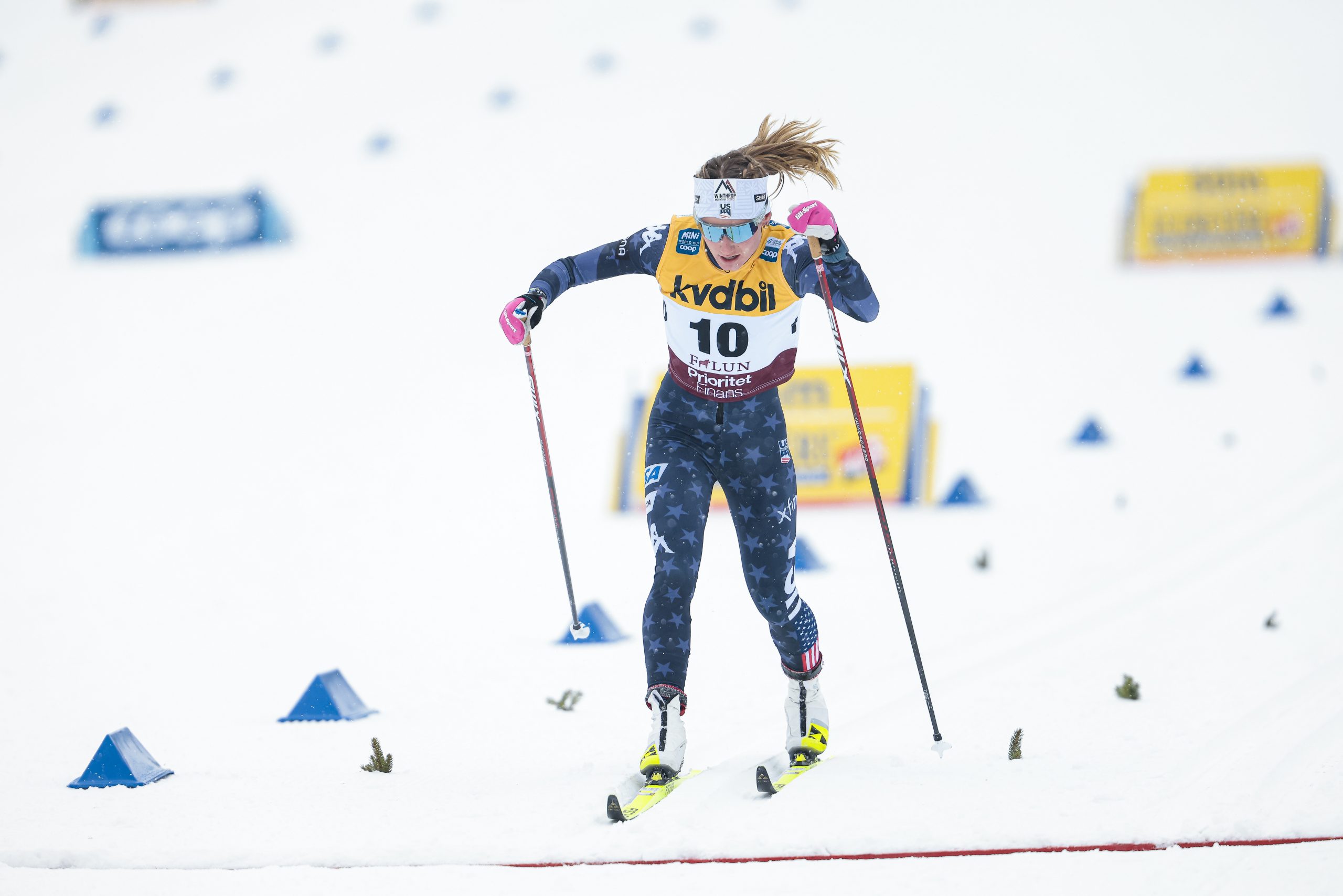
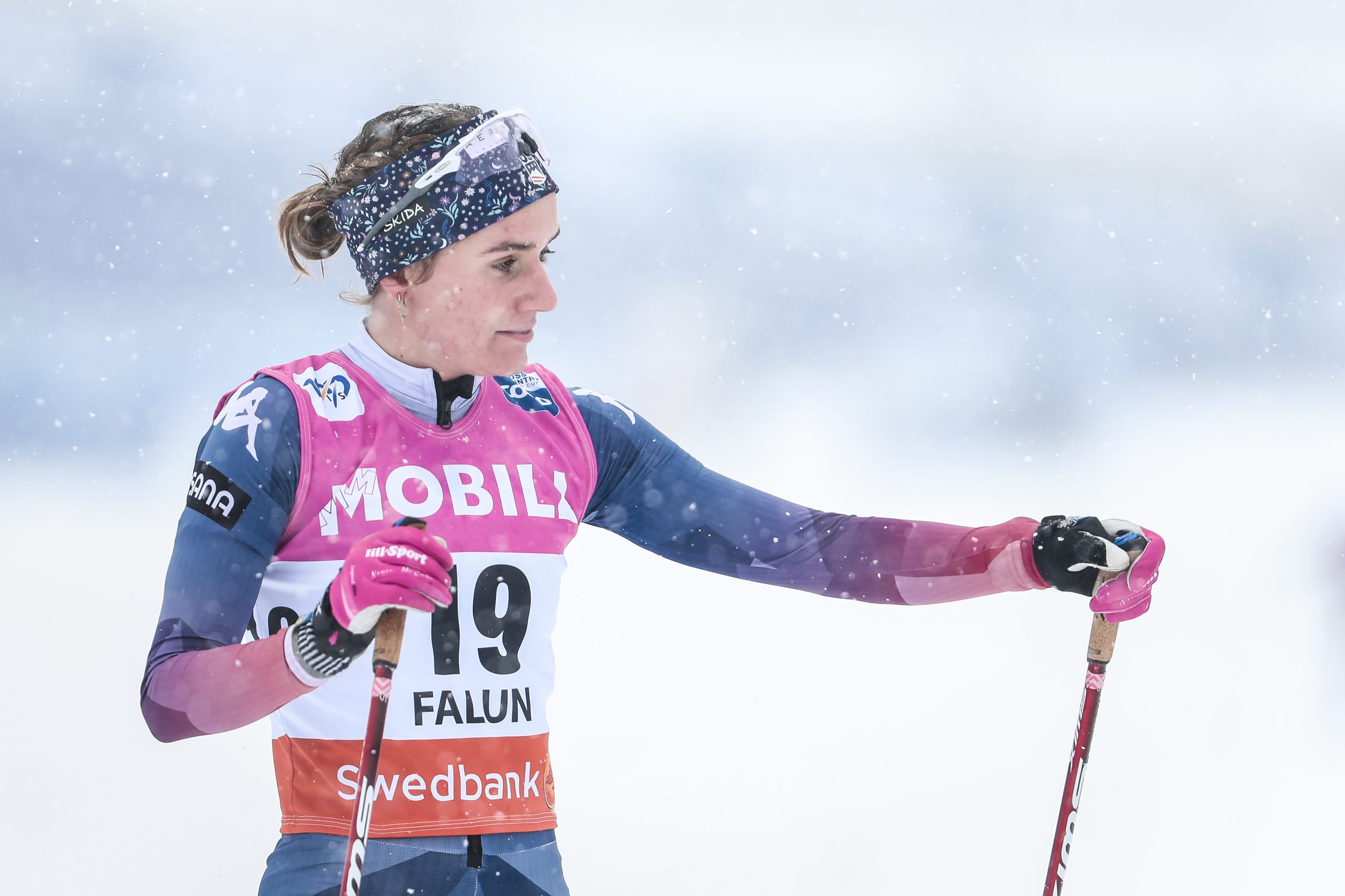
One of Novie Mccabe’s (USA) career highlights was her top 15 finish in Falun, Sweden in a Classic race. (Photo: NordicFocus)
A Quiet Battle Behind the Scenes
After our original conversation, McCabe followed up with more context—an important layer we had not fully jumped into earlier. For the past two years, she has been navigating what she called “some mystery health challenges,” a swirl of symptoms that worsened last fall to the point where racing no longer felt possible.
“The best guess of most of the doctors I have seen is some sort of post-viral or chronic fatigue thing,” she wrote, “possibly combined with some issues keeping my celiac and Hashimoto’s in check, but I am still not really sure what is going on to be honest.“
She spent the winter searching for stability rather than start lines.
“I have taken a pretty cautious approach to training this year and just been trying to build back into it super slowly and give a lot of extra attention to rest and recovery,” she said. “And I do feel like I made some solid progress.“
Even now, she remains cautious. “The past two weeks have been a bit of a step backward,” she said. She’s not entirely sure she will race in Fairbanks. Her hope is modest: “One race there and one race in Anchorage, just to give myself a bit more recovery between hard efforts.“
Still, the optimism in her message is unmistakable.
“It means a lot to be back in a place where racing seems like more of a possibility.“
“I will definitely consider it a win if I get to do some racing this year and make some more progress toward feeling like myself again.“
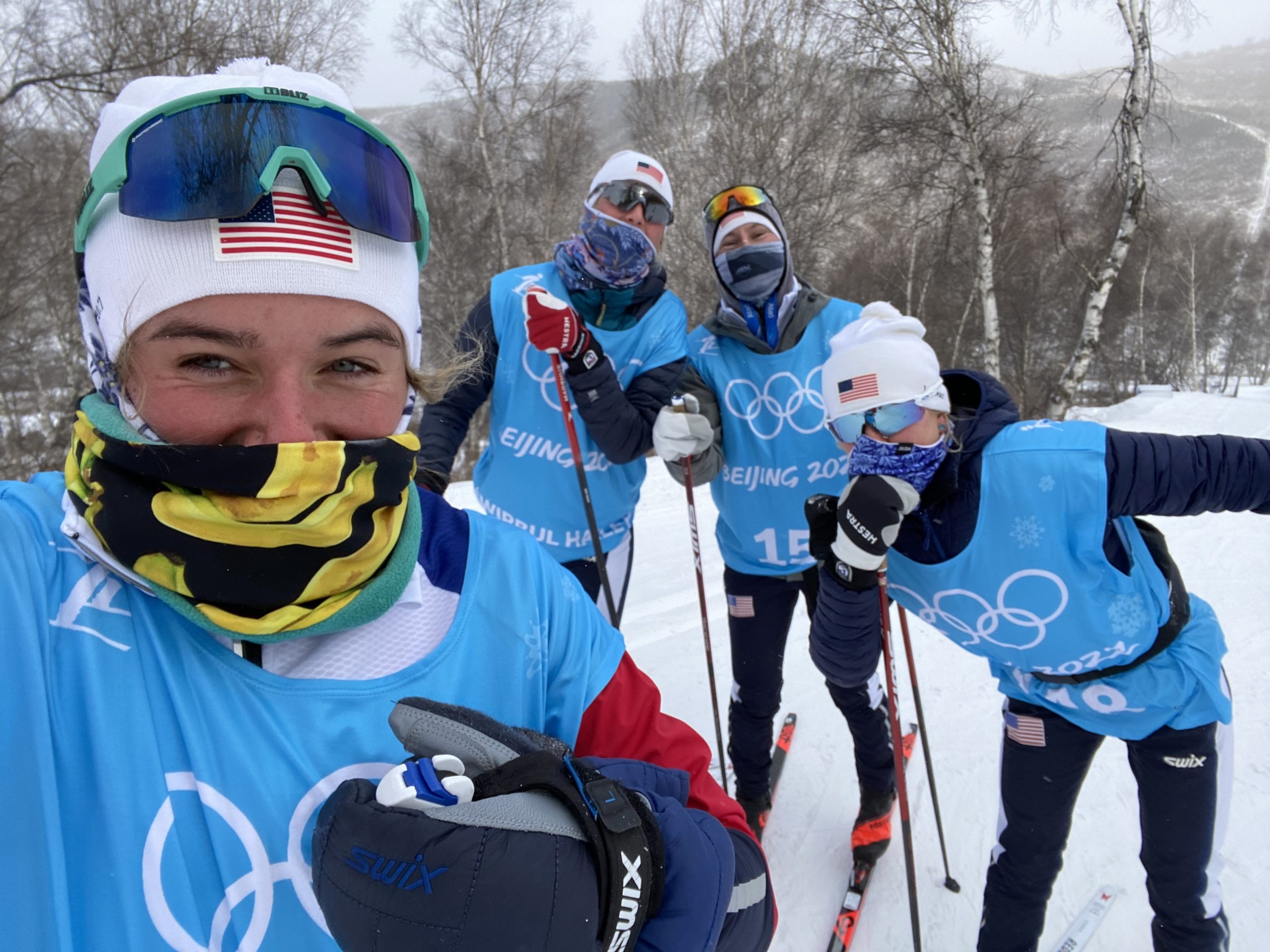
McCabe credits her teammates with helping her develop the traits that won her recognition. Here she is training in Beijing with Hailey Swirbul, Hannah Halvorsen, and Sophia Laukli. (Photo: Novie McCabe)
Team USA on the Road
The U.S. Ski Team’s culture is widely celebrated—glitter, dance videos, and road-trip camaraderie. McCabe grew up watching those clips.
“I would see their dancing videos from the World Cup and be like, ‘That just looks like the best time ever.’”
But she knows now that joy is a decision, especially when you’re far from home. “Sometimes you have to decide that it’s going to be a good time,” she said. “Everyone does an excellent job of being good teammates.“
That environment matters, especially in challenging seasons.
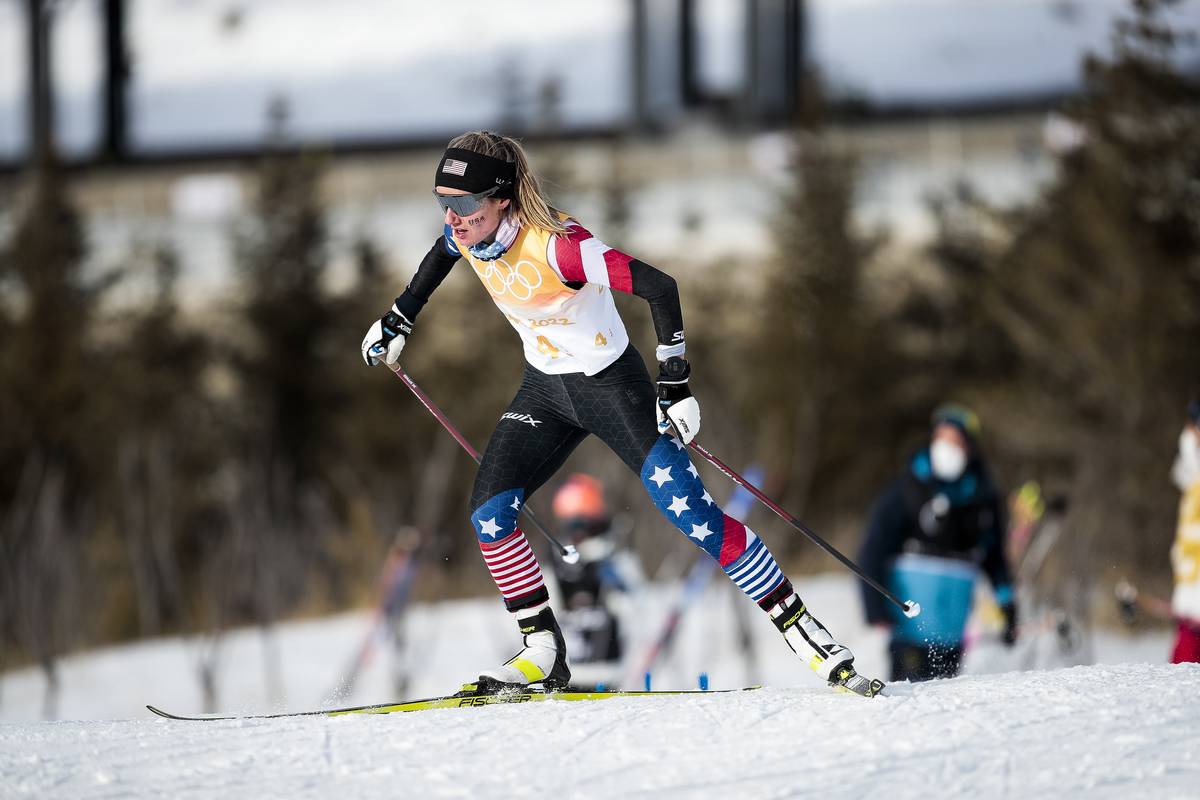
Novie McCabe skates a strong third leg for Team USA in the 4 x 5 k relay at the Beijing Olympics in 2022. (Photo: NordicFocus)
Europe: Brown Cheese, Ferris Wheels, and Perspective
Her memories of Europe arrive in flashes of color rather than race results.
“I love brown cheese,” she said. “You can get it here, of course, but it’s not as good.“
She recalls Trondheim at Christmas—”Ferris wheel and everything“—and moments where she stepped outside the hotel room and let herself experience the place.
These glimpses matter because they remind her of what she still wants from her career: a stable return to the World Cup, a chance to live in that rhythm again.
And through all her travels, she keeps a single talisman:
“Katherine Ogden made me a crochet octopus one year… I’ve brought it along as a good luck charm ever since.“
Novie McCabe after the World Cup 10k in Falun, Sweden, in 2024. (Photo: NordicFocus)
The SuperTour Returns — and She Hopes to Join It
Which brings the story back to this week, and the opening races of the season. “I haven’t started a season domestically in like four or five years,” McCabe said. But she’s doing this season differently.
She is hopeful she will race—one race in Fairbanks, one in Anchorage, if her body allows. More than anything, she wants to be thoughtful and patient.
“My main goal is to make the Olympics,” she said. But this winter, her priority is health. “Being able to race and stay healthy and recover… that would look like a win for me.“
The Olympic qualification system is, as she put it, “really complicated“—top-45 overall rankings, top-8 results, SuperTour contingencies. But she isn’t thinking that far ahead yet.
She’s thinking about one start line. One bib. One race that feels like progress.
Becoming Who She Meant to Be
If you fast-forward five years, she still knows exactly where she wants to be.
“I, for sure, dream about being one of the best skiers in the world,” she said. “I hope to be able to compete with the best one day.“
She also knows this path no longer looks how she imagined it “four years ago.” But she has something she didn’t have then: perspective, patience, and a grounded sense of herself.
Back in Anchorage early last month, the snow hadn’t fully arrived. It mirrored her season ahead—close, possible, not yet certain. The SuperTour begins this weekend, and McCabe is on the edge of stepping back into the environment she loves.
Maybe in Fairbanks. Maybe in Anchorage. Maybe later.
But the hope is real. The joy is returning. And somewhere in her bag, the crocheted octopus is still waiting.
Love Stories Like This? Help Keep Them Coming.
Feature interviews like this one take time, access, and care to produce. If you value thoughtful storytelling and independent ski journalism, please consider becoming a Voluntary Subscriber. Your support directly fuels the work we do to cover the people, places, and moments that make our sport special.
The first flakes had finally settled on the branches behind Rosie Brennan’s window in Anchorage. “Yeah, finally,” she said, turning from the screen toward the light outside. “God, it was slow to come, but we are getting there.” Snow matters in November for any cross-country skier. Still, for Brennan—now entering her fifteenth season on the U.S. Ski Team—it has always represented something deeper: familiarity, grounding, the landscape she moves through on her own terms.
Independence, more than victory or longevity, is the quiet force running through her career. Long before she became an Olympian or a World Cup all-arounder, before the podiums and the endurance of her late-blooming rise, she was a kid in Park City who needed space—space to move, explore, test herself, figure out where she belonged. Ski racing would give her a path, but the structure of the World Cup would also challenge the part of her that had always craved autonomy.
Rosie Brennan (USA) celebrates after finishing 2nd in the 10 k classic race in Ruka, Finland in 2023. The result was Brennan’s first classic World Cup podium of her career. (Photo: Nordic Focus)
“I’m a very independent person,” she told me. “So to suddenly be told what your day is gonna look like every single day is mentally… exhausting for me.” It’s the kind of line that quietly explains everything: her training, her rituals, her late-career resilience, and the internal negotiations required to live five months of every winter inside a system built around tight schedules, shared spaces, and routines she cannot control.
That independence—both threatened and defended—shapes the story of Brennan’s life in skiing as much as any result sheet.
“From the FasterSkier Archives: While I never actually went cross country skiing with my Dad, he was incredibly influential in his love for the outdoors and ability to truly enjoy life. My dad taught me to alpine ski and mountain bike, both were activities in which he challenged me and was always up for a race. I don’t know if my mom will ever get over just how much I ski like him. My dad had a great ability to do things in a big way in order to maximize the enjoyment out of each adventure and he did so with incredible passion. I can’t say I have fully learned this yet, but his spirit and enjoyment of life certainly are in me and I think often about how to embrace this a little more each day. At the very least, I have learned to be very passionate about the things I love. My favorite place in the world is the Southern Utah desert and I think my love for the desert stems entirely from family fun, particularly with my Dad.”
A Childhood of Motion
Brennan grew up in Park City, not in some improbable ski-wilderness origin story, but in a family that valued movement the way others emphasize music lessons or math tutoring. “Everyone did outdoor activities,“ she said. “We were pretty typical in that sense.“ Winters were alpine ski weekends. Summers meant hiking and biking. Gymnastics arrived because she liked the conditioning. Soccer came because she could run “a whole game.”
She was athletic but not yet an athlete. “I participated in soccer,“ she said, without pretense. “I won’t say I was crazy competitive in that. And same with gymnastics—I didn’t compete at all, but I really loved it.”
What she loved about gymnastics, specifically, she said, was the work:
“I think it was more, actually, just the strength component… the actual conditioning part. That’s what I really liked.”
The shift toward cross-country skiing came from her mother, whose winter rule was simple: pick an activity. “She was the one who just kept suggesting, ‘You should try the Nordic team,‘” Brennan said. “Finally, I was like, well, I got no better idea, so fine, I’ll try it.”
If her mother’s persistence nudged her toward snow, the 2002 Salt Lake Olympics made the possibility feel real. Brennan was in seventh grade. Her family hosted a Nordic combined athlete. Youth camps sprang up everywhere across Utah.
“I think a lot of it was subconscious,“ she said. “But that obviously had a massive impact on my wanting to pursue other things.”
Then came the moment that still feels slightly mythical in her telling: she found skiing, and skiing made sense to her in a way nothing else had.
“I could see the path forward,“ she said. “It was just… really motivating to me.”
The First Signs of Something
Her early results were small but decisive. “I actually won my first race, but there were only two people in it,“ she said, laughing. “But I honestly think that was kind of powerful for me. Like, oh—if I can beat one person, I can probably beat some other people.”
Within two years, she went from missing Junior Nationals to winning all the distance races at JOs. She remembers calling her mom.
“Mom, I won.” “No, you didn’t.” “No—really, I did.”
When Brennan made World Juniors and cracked the top ten, she earned her first spot on the U.S. Ski Team. It felt surreal, but the reality is that she wasn’t fast because of some stroke of talent. She was fast because she’d been training with boys for years, trying to keep up. “It was one of those social situations in which it’s like, keep up or don’t have friends,“ she said. “So I was like, all right, I’m keeping up.”
Her team was small, her training unorthodox. “I did quite high intensity for junior,“ she said. “But very low volume.“ Meanwhile, she ran fall seasons because running was what she could control.
Autonomy was already the central language of her development.
Rosie Brennan (DAR) Lake Placid SuperTour 2011
The Dartmouth Choice
By the time she visited colleges, Brennan had become a known junior—national team member, World Juniors top-10 skier, and a real recruit. Her first choice was Colorado. They didn’t offer a scholarship. Dartmouth didn’t offer scholarships either, but it did offer something better: Cami Thompson-Graves.
“Her investment was in me and not, like, an NCAA title,“ Brennan said. “That was very obvious… she was willing to help me manage all of it.”
Dartmouth gave her what she needed: an independent women’s team after training primarily with men, a coach who saw the whole person, and a program flexible enough to accommodate a U.S. Ski Team schedule. She raced all four years, graduated in the traditional four, absorbed the mentorship of teammates like Ida Sargent, Sophie Caldwell, and Erica Flowers, and even shared training space with Susan Dunklee.
Dartmouth let her remain the version of Rosie that worked.
But the World Cup—its structure, its relentless pacing—would test that.
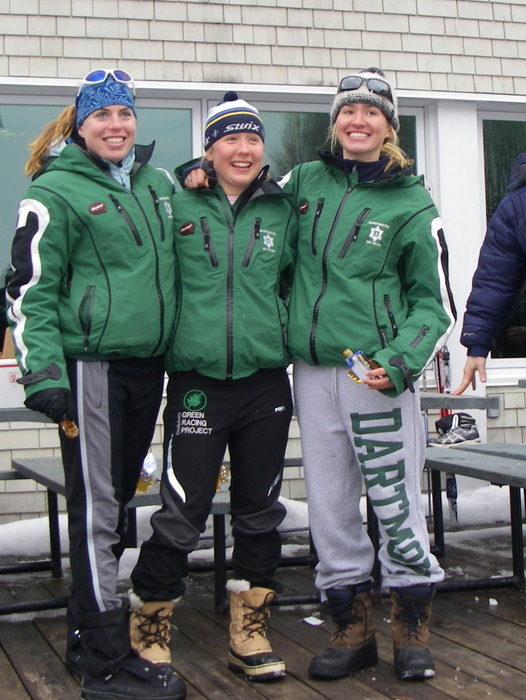
Rosie Brennan, Ida Sargent and Sophie Caldwell of Dartmouth, March 2010
Learning to Live in Europe
Her early World Cup years were steady—no fireworks, no collapses. She attributes the eventual breakthrough to something simple: time. “If you think about someone who starts at five,“ she said, “they’re good at 22. That’s the same number of years it took me. It just skewed by a decade.”
But the other part of her progression came from learning how to survive Europe.
“I mean, I finally had trained at a consistently high volume,“ she said. “But I also found it just took a long time to figure out how to manage in Europe.”
What was so hard about it? Not the racing. Not the waxing. Not the altitude.
It was the loss of personal freedom.
“To suddenly be told what your day is gonna look like every single day is exhausting for me,“ she said. “The freedom of being able to jump in your car and go somewhere—that’s gone for like five months.”
The World Cup removes the choice of when you sleep, where you eat, andhow you move through your day. Athletes share hotel rooms, team vans, dining halls, training sessions, and travel itineraries. It works beautifully for some. For Brennan, it was disorienting.
There were no models for how to do it differently. “The example they have is Jessie,“ she said. “She thrives on the road. She’s happy as she can be living in a bag for five months.“ But if you are not Jessie Diggins, Brennan said, “that’s really hard.”
So she began—to use her word—to “navigate.”
“I learned to get pretty good at the bus schedule,“ she said. She found bakeries in every town. She found grocery stores that sold the one piece of candy she liked in that country. She found trails “maybe off the beaten path“ that she returned to each year. She learned to take mountain days, not for training but for sanity.
These rituals were tiny, private rebellions—the things she could choose inside a world where most things were selected for her.
Rosie Brennan and coach Erik Flora (APU) ski on the World Championships sprint course in Trondheim on Wednesday, February 26, 2025. (Nathaniel Herz/FasterSkier)
A Coach Who Understands Her
If Europe tested her independence, her relationship with APU Head Coach Erik Flora reinforced it.
“He has been, like, everything for me,“ she said. “He’s kind of saved my life many times over.”
What she means is that Flora understands her wiring. He sees what she cannot always express.
“He has this ability to just watch you train and know exactly what’s going on in your life,“ she said.
That sensitivity carried her through some of the most challenging years of her career. During Covid, Flora couldn’t travel much; last season he could only watch occasional race film. It wasn’t enough. Brennan needed someone who knew her patterns—her real patterns—not just her splits.
“When I was in the thick of it last winter,“ she said, “he wasn’t there… that’s why ultimately I did end up coming back [to Anchorage]. I needed some of that support.”
Their relationship—its longevity, its trust—became essential when her body began to unravel.
Rosie Brennan (USA) after finishing the 10 K Classic at the FIS Nordic World Ski Championships in Trondheim (NOR). (Photo: Modica/NordicFocus)
A Year the Body Wouldn’t Cooperate
For a year now, Brennan has dealt with a medical mystery—post-viral symptoms likely tied to Epstein-Barr reactivation. “It just, like, really screwed up a bunch of my internal systems,“ she said. “My endocrine system has been shot.“ The effects were unpredictable: inability to push hard, severe inflammation, poor recovery, andmuscle shutdown during intensity.
“Last season I was struggling with… I just had zero ability to use my muscles to push hard,“ she said. “I was just racing on base fitness.”
It wasn’t one bad race. It was the absence of the feeling she loved most that was most frustrating.
The Training Fix
She and Flora tried to solve it through training, but even threshold sessions wiped her out. “It was more the duration part that was killing me,“ she said. They tried sub-threshold work. They tried controlled sessions. Nothing stuck.
So they invented something new: Sub-one-minute Level 4 efforts, hundreds of them, designed to keep neuromuscular pathways awake without triggering overload.
“Basically, what I’ve been doing is what I call micro intervals,“ she said. “I do go level four, but under a minute, many times.”
Strength? Gone. “Strength was destroying me,“ she said. “So I haven’t done any weight-room strength.”
Endurance? Reduced to what she could handle. “I got to a place where I was like, all right—I’ll have to be super excited when I get to go for an hour.”
Most of the battle, though, wasn’t physical.
“There were many times this last year that I have seriously contemplated walking away,“ she said. “I actually tried pretty hard to in August.”
But Flora kept calling—checking in, refusing to let her disappear into the uncertainty.
“I guess I’m not getting away that easy,“ she said.
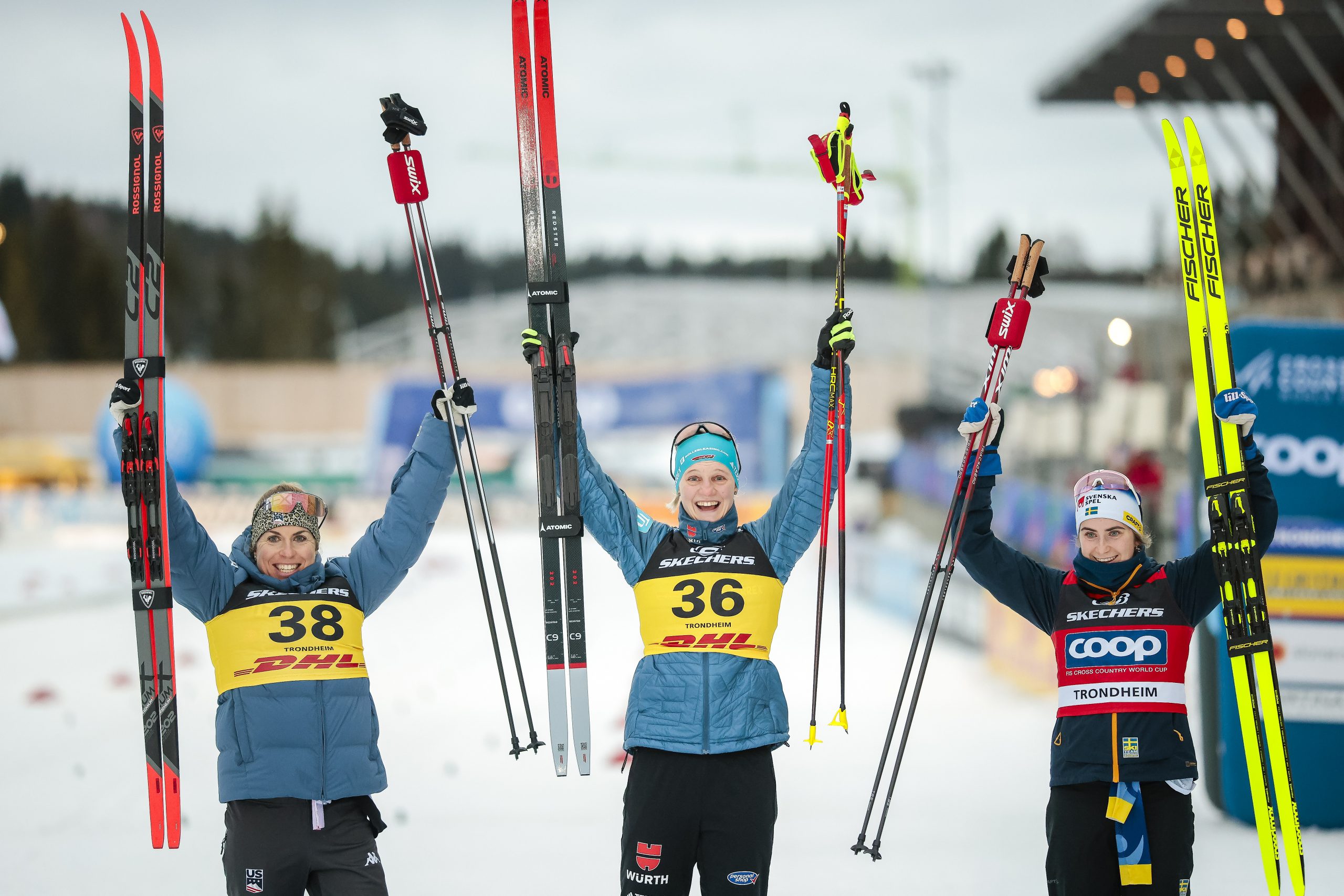
Brennan took second in the 10-k Classic in Trondheim in 2023. Rosie Brennan (USA), Victoria Carl (GER), Ebba Andersson (SWE), (l-r) 10km podium in Trondheim (NOR). (Photo: Modica/NordicFocus).
Why She Keeps Going
When asked what pulls her back to the sport each day, Brennan didn’t talk about results, medals, or even the Olympics.
She spoke of the feeling.
“I truly love the feeling of being able to push myself,“ she said. “It gives me this sense of freedom that I can’t find anywhere else.”
Freedom—that word again. Not competition. Not performance. Not success. Freedom.
It’s the sensation she’s chased since she was a kid, running entire soccer games simply because she could. It’s the sensation skiing first gave her at 14. It’s the sensation the World Cup often constrains, and the sensation her body has withheld for a year.
But it’s also the sensation that makes her keep trying.
She has leaned heavily into mental work this year. Meditation, mindset projects, and conversations with a U.S. Ski Team sports psych, as well as a teammate who has faced similar issues.
“I was very motivated by her,“ Brennan said. “It was cool that she was taking this time to strengthen her brain, too.”
The process has made her reflective, grounded, andmore self-aware than at any point in her career.
Rosie Brennan (USA), shares a podium moment with coach Matt Whitcomb in Ruka, Finland in 2023. (Photo: NordicFocus)
Leaving for Finland, and What Comes After
Now, on the eve of the World Cup opener, Brennan is set to travel to Finland. She will not race everything. “Maybe two races a weekend,“ she said. They’ll experiment. Observe. Adjust. She plans to return to Utah for Christmas, meet with her medical team, and decide what the rest of the season should look like.
“It’s possible I try to race, and it’s a disaster,“ she said. “We may have to totally redo the plan.”
She won’t do the Tour de Ski—too risky. The goal is simply to get to the Olympics “in the best way possible.“
The million-dollar question, of course, is whether this will be her last year.
“I don’t really know,“ she said. “Most likely something will look different next year. Whether that involves racing or not, I’m not totally sure.”
But she’s proud of the career she’s built. Proud of navigating Covid. Proud of her longevity. Proud that she became a true all-arounder.
“That was definitely a big career project,“ she said. “When I finally did that, it felt really big.”
Rosie Brennan races the individual freestyle sprint qualifier during the 2022 Olympic Winter Games in Zhangjiakou. (Photo: NordicFocus)
Holding Her Own
What emerges from Brennan’s story isn’t a tale of triumph or decline. It’s the portrait of a person who has made peace with the complexity of the life she leads.
She has learned how to navigate Europe—not by loving it, but by building rituals that let her remain herself within it. She has learned to trust her body even when it betrays her, and to trust her coach when she doesn’t trust herself. She has learned that the World Cup isn’t designed for independence, and that independence—her independence—is worth defending.
She has also learned that racing is only part of who she is. She’s a geography major who loves the Arctic for its unique beauty, a mountain person who seeks out quiet trails, and a traveler who can always find a town’s best bakery.
And she’s someone who, after a year of medical uncertainty and near-retirement, still wants one more chance at the feeling she can’t find anywhere else.
That, ultimately, is why she’s boarding the plane.
Because even in a world that demands structure, she is still defining her own path.
Love Stories Like This? Help Keep Them Coming.
Feature interviews like this one take time, access, and care to produce. If you value thoughtful storytelling and independent ski journalism, please consider becoming a Voluntary Subscriber. Your support directly fuels the work we do to cover the people, places, and moments that make our sport special.
We don’t yet know if this season is Brennan’s final curtain call, where she will ski off into the sunset, but we do know she has nothing left to prove.. (Photo: Nordic Focus)
Kikkan Randall (l) and Jessie Diggins listening to the U.S. national anthem after being awarded their 2018 Olympic gold medals from the freestyle team sprint in PyeongChang, South Korea. (Photo: FlyingPointRoad)
Kikkan Randall competed in her first World Cup race in 2001, and her last in 2018. In between, she won 14 World Cup races, three Sprint Cup Crystal Globes, three World Championships medals, and one Olympic gold medal accompanied by one very enthusiastic broadcast call from Chad Salmela. She appeared in television ads, received the Skis to the City from the mayor of Anchorage, and had an ice-cream flavor named after her. And long before she brought cross-country skiing to the attention of The New York Times and The Guardian, she was mentioned on FasterSkier over 2,000 times. (The first-ever hit on this site seems to date to November 2002, a two-paragraph recap of the West Yellowstone sprint. Other podium finishers included Brooke Baughman for the women, and Lars Flora and then-junior skier Andy Newell for the men.)
This is presumably not Randall’s final appearance in FasterSkier; if nothing else, tune in next week for Part 2 of this interview. But it may be one of the last times she talks with FasterSkier while she still appears on the “current World Cup athletes” page of the International Ski Federation (FIS) site.
Note: The following story is based on an in-person interview with Randall in late April. FasterSkier’s narrative is in bold; everything else is a direct quote from Randall.
Let’s go back to the beginning, way back. Randall has said that she was all of five years old when, sitting in her grandparents’ living room, she “decided right then and there I wanted to go to the Olympics.”
But where does that drive come from? What makes a kindergartener form such a belief, even one with Olympian role models within the family? (Randall’s aunt and uncle, Betsy and Chris Haines, were American nordic Olympians in 1976 and 1980.) To answer this question, Randall goes even farther back, to 1983, to a time when the infant who would one day become the world’s fastest woman on skis was experiencing the first tantalizing glimpses of mobility on her hands and knees.
I gotta think there’s some innate thing in my personality that orients me [toward being that driven]. My parents have a story of being at a picnic when I was just learning to crawl and putting me down on the grass, and there was a playground about 200 feet away. And I just started crawling toward the playground. And my parents were like, Well, we’re going to see how far she goes, expecting that I’d get a little ways and then look back.
And I never looked back. I went all the way to the playground. And at another point, some woman from the picnic went over and picked me up, and was like, ‘I can’t believe you’re letting this kid go off.’ And my parents were like, ‘We just wanted to see how far she would go.’
Kikkan Randall (bib 136) runs in a community race in Anchorage, Alaska, in the mid-1980s. (Photo: KTVA 11 screenshot)
So there’s obviously something, I think in my personality, that makes me want to go after what I want. But I also grew up with amazing role models. I mean, within my own family, my aunt and uncle went to the Olympics, so I already had a great example of what the Olympics was, how possible it was. And then my parents, who always supported me, told me to chase after what I wanted to do, to not really put limits on it, and then allowed me to kind of chase after what I was interested in.
But then instilling along the way that once you commit to something, you do it and you don’t give up, and the most important thing is giving your best and all those things.
And then growing up in a place like Anchorage, where I grew up doing all these different activities, and around people where as a girl I never felt like I had less opportunity, that there was anything less possible. If anything, because I saw so many strong women athletes around me, I wanted to be a strong woman athlete myself, and set an example for others. So when no American woman had won a medal, it’s like, Well, we need a women’s medal. We gotta be on par with the men.
So really, just a great supportive environment and always just a drive. And always a lot of self-confidence. I’m not sure where that came from, exactly, I think I just developed that over time, but that really helped, too.
To find the first FIS race of Randall’s career, it helps to set the FIS database to show 100 results per page. And even then, you have to click through to the sixth page of results to find the beginning. That’s right: Randall competed in, loosely defined, nearly 600 FIS races in her career (counting sprint qualification and finals results separately, as the database does).
The first-ever FIS race was a 15-kilometer interval start classic race at U.S. Nationals held at “Wasatch State Park,” better known as 2002 Winter Olympics site Soldier Hollow. It was January 10, 2000. The Y2K Bug had thankfully not caused the world to end 10 days earlier. The Billboard Hot 100 number one song was “Smooth,” by Santana. AltaVista, valued at roughly $2.3 billion, was the dominant internet search engine, though challenges from an ascendant young company named Google were on the horizon.
From left to right: Nina Kemppel, Jim Stray-Gundersen and John Farra gathering with Team USA for Opening Ceremony at the 1992 Olympics in Albertville, France. (Photo: Peter Hale)
Randall had just turned 17 years old. She was in her junior year of high school, and had never raced this distance before. Nonetheless, she finished 12th out of 59 FIS finishers.
The podium in this race was made up of Beckie Scott, Nina Kemppel and Rebecca Quinn (now Dussault). Kemppel was born in 1970, and once raced against Nancy Fiddler. Other finishers in this race were born in the 1960s. Every finisher had a FIS number that starts with a 1. Randall’s been doing this for a long time.
Randall is handed a results sheet that dates from the Clinton administration, and is asked if she remembers anything about this race. The reminiscences immediately begin.
Oh yeah, my first time at senior nationals. It was my first 15 k ever. And I started second to last. And because I had never raced 15 k before, and it was individual start, I was quite intimidated. And it was one 15 k loop; that was one of the last times they had such a long loop.
It was a classic race, and I remember skiing up the first k, and noticing that there were chunks missing from the track. It happened to be one of those conditions where, right around freezing, are you klister, are you hardwax? And the reason why there were chunks missing is because people are icing so bad that they would have to stop.
And so, I was just like, Oh man, am I going to survive this 15 k? And I skied around, and thankfully we got the skis pretty well; I never had any major icing issues. And at points I lost kick, but I made it through. It was a pretty exciting first experience, and then I was pretty amazed to finish so well. [Randall came down to earth slightly in her second-ever FIS race, a 5 k skate two days later, finishing 48th.]
Fast forward just over a year later, to January 2001, when Soldier Hollow was again the setting for Randall’s first-ever World Cup race, a skate sprint. Czech skier Kateřina Neumannová had the fastest time in qualifying; Norway’s Bente Skari won the final.
Randall notched a 24th in qualifying, which at the time left her eight spots out of making the heats. She was the third American in the 53-racer field, behind Kemppel in 17th and Tessa Benoit in 20th. Benoit’s final entry in the FIS database is from 2002. Again, Randall has been doing this for a long time.
Randall is once again handed a printout of the results sheet, and asked what she remembers.
I scored World Cup points, and that was pretty exciting. And that’s when they only took the top-16 into the finals [of a sprint race]. So I was pretty happy with 24th; of course I wanted to be in the heats. I do remember that as my first World Cup. But it’s crazy that it was 17 years ago.
[A reporter notes, upon looking at the results, that Randall’s competitors in this race included Ukrainian skier Irina Terelia, who was born in 1966 and is now 52 years old.]
Norway’s Bente Skari (l) and Mathias Fredriksson of Sweden with their crystal globes after winning the 2003 Overall World Cup. (Photo: Flickr Creative Commons)
Wow. I mean, what’s pretty impressive, though, is like these were some of the biggest names that I grew up hearing about in the sport, that I got to race against. So I remember getting Bente Skari’s autograph, Stefania Belmondo’s autograph, like on my hat at this World Cup. So, pretty fun. And all of a sudden people are looking at the results listing [and seeing Randall’s 1982 birth year] going, ‘Oh my god, ’82, that’s so old.’
While the first World Cup race, at age 18, proved an auspicious beginning, there was nonetheless a learning curve involved in making the jump to international competition. Randall’s second-ever World Cup start, a classic team sprint at Torino four years later in January 2005, was respectable enough; she and teammate Wendy Wagner went out in the semifinals, but avoided placing last by finishing 12th out of 14 teams.
But the following month brought the third World Cup start and first World Cup distance race of Randall’s career, a 10 k interval start freestyle in Reit im Winkl, Germany. Randall was one of two Americans in the race, along with Rebecca Dussault. Randall started with bib 6 in a field of 70, reflecting FIS distance points that were not particularly low. (Marit Bjørgen started last.) Randall finished 70th out of 70, dead last, behind athletes from China, Japan and Lithuania. She was 80 seconds back from 68th place, and nearly 5 minutes back from the winner over 10 k. It was a 154-point FIS result. “It was a rough day for the North American teams,” FasterSkier observed.
It was raining.
So even Randall has finished a race dead last, and questioned herself along the way. (As the saying goes, DFL is better than DNF. But the latter status prevailed at World Championships later that month; Randall did not get the chance to anchor the women’s 4 x 5 k relay team when the Americans were lapped and pulled from the course during the third lap of four. The American women are now consistent relay podium threats. Randall’s been doing this a long time.)
Randall is asked what her thought process was at the time – not what she thinks now, 13 years later, when success was eventually achieved and her whole career can now retrospectively follow a ready narrative arc of struggle and redemption, with Olympic gold as the final chapter. But rather what she thought then, when there was no U.S. women’s ski team, and she was spending her winters going back and forth between North America and Europe, working to build a path that didn’t really exist yet.
Initially it was fine to get those kinds of results, because I had this approach that, OK, well, I’m gaining experience, I’ve still got more training to do, and I am going to get there someday. But then after you’d been around it a little while, it did feel hard, and that result in Germany, finishing last… I mean, I remember just being kind of in a really miserable state at that point and just – I was missing home, I wasn’t enjoying the racing, I fought with myself that whole race to keep myself from quitting. And just wondering if this is what I really wanted to continue doing.
But thankfully, within all those kind of tough results, there were always a couple of high points that encouraged me that I was making the right progress. And I think that progress is what just kind of kept me going, OK, let’s see this out a little bit longer, let’s go a little bit more.
And I was really enjoying the lifestyle of it, I was able to start getting sponsors, which allowed me to make it a lifestyle, so it wasn’t a complete sacrifice. I was doing school along the way. It took a lot of convincing of my grandfather over the years, that this was a worthwhile pursuit, because he was supportive of me making the Olympics, but then once I did it was more like, ‘You’ve made the Olympics, now it’s time to finish your degree and become a professional.’ And I had to keep saying, ‘No, I think I can be good at this, I want to keep trying.’
Randall, in her second Olympics, just before the finishing stretch of the classic sprint at the 2010 Winter Games in Vancouver, British Columbia.
And I kept pushing the ski team to develop more of a woman’s team. And I would say — I always had this 10-year projection, which was going to be like the Vancouver Olympics — that by Vancouver, I want to be in a position to win a medal. And even when it was just a few years away, and I still wasn’t even that close, somehow I was able to just stay patient and stay motivated and keep going.And I really think, being able to just pull out those small successes – I kept this Excel spreadsheet of my FIS points of races, and I would put in the FIS points that I got, the time back from the leader, comments about the race. And at the end of every season I could see, like, well maybe the results weren’t that spectacular, but I’m progressing, I’m moving forward. So I used things like that also, to just kind of help keep me pushing forward.
And I just also had this – I don’t know where I got it from, but just kind of this thinking that it was all building. That every year you train, the platform gets stronger and you keep going. And at some point you do hit a tipping point, and you start to break through. And that was so true.
“I just had this thinking that it was all building. That every year you train, the platform gets stronger, and you keep going. And at some point you do hit a tipping point, and you start to break through. And that was so true.”
I would say, prior to 2006, I was starting to wonder, but then in 2006 I had that breakthrough that then carried me another few years before the next breakthrough, and then it just kind of kept going. And now the younger athletes that are coming in – well, we just have such a better system, a better understanding, just the confidence that it’s possible. So I feel like the athletes now don’t have to go through it quite like I did, and have to really go, ‘Can I do this?’
But I had to remind a lot of these girls when they first came on the scene, when they would get their high-flying result and then go back to being in the fifties or whatever, and going, ‘Ah, you know, I’m not successful.’ It’s like, ‘No, this is a long game, and just be focused on making steady progress, and you’ll get there.’ And they have.
Despite this perspective gained through experience, Randall largely demurs when asked now what advice she would impart to a mid-2000s Young Kikkan. Rather, she suggests that the journey itself was important, and that the need to experiment along the way to figure out what worked best helped her with the rest of her career.
We’ve obviously learned a lot now about what’s possible in the realms of training, and kind of what types of training and what experience is the most important, and maybe I knew some of it early on, but a lot of it was experimentation. I maybe could have put myself in a position to be more successful earlier in my career had we known then what we know now – but at the same time, I think it was so important for me to go through that experimentation, and it really maybe helped with the longevity of my career, to have been able to do it this long.
So I would love to go back and have a conversation with Young Kikkan, and just get to hear firsthand the ambition and the thought of what was it gonna be like back then, because you kind of lose that exact memory of what you were feeling back then over the years. But I just think it’s so cool that, despite not knowing, I just had all those ideas, and it would just be so fun to see that now. But I don’t know that I would have a lot of advice, other than just, ‘go for it.’
Randall is asked what she is proudest of, other than results, as she looks back on her career. She immediately identifies as the highlight her role as one of many in contributing to a culture shift in American skiing.
(Randall is perhaps being somewhat modest here; it has been the thesis of several publications, including FasterSkier, Outside Magazine, and Peggy Shinn’s new book, that, while Matt Whitcomb’s coaching was certainly important in bringing about this change, it was Randall’s consistent drive that singlehandedly elevated the level of American skiing, raising expectations and creating a path for others to follow.)
I’m proudest of the culture shift that I think we created in American skiing. The women’s team gets kind of the most attention, and what we’ve been able to do with that, just raising the level of every single person on the team, to a point where we are just so competitive internationally now.
I’m not going to take total credit for that, because I think there were a lot of important things that came together, and Matt Whitcomb’s leadership has been super important in that, but playing a role in helping make that happen is a super-special part of it for me.
Matt Whitcomb with Sadie Bjornsen and Sophie Caldwell in Seefeld, Austria, this winter. (Photo: Garrott Kuzzy / LumiExperiences.com)
And then also seeing the effect it’s had for all of our young skiers – like I said, they’re coming into a world now where just their confidence is so much higher, our understanding of the training is so much better, our support system in Europe and all that’s really well developed. And just kind of helping build that – beyond just the results, I’ve always been interested in how to make our sport better, and so being able to do some leadership on the FIS Athlete Commission, being able to work together with our coaching staff, the U.S. Ski Team staff, to develop more resources, and just make it a better system overall.
And I think that’s why, coming into this fifth Olympics, while I was excited to have another shot at a medal, the medal was not the end goal. It was more about, like, Hey, look how far we’ve come. I could feel incredibly proud of that, I get to be a part of this one more time. So just remembering to take it all in and enjoy it, because it’s almost over.
[Randall is asked whether that, perhaps counterintuitively, made it easier to win a medal.]
Probably, yeah. Because in Sochi, in contrast, I was under so much pressure, both from outside expectations and also from myself, that I was figuring out how to manage it for the first time. I had no one to look to to figure out how to do it, you know, we didn’t have a system created to deal with it. And it was all about the medal, and only about the medal. So this time it was just, like, Yeah, there’s a shot at a medal, we know it’s a possibility, but I’m just happy to be here, and going to take every chance I get to race and make the most of it. And no matter what happens, I can end my career feeling really good about it.
Randall is asked the obvious follow-up question: what she is proudest of from her career among the category of results. Tellingly, her answer to this question is one-half the length of the non-results question that preceded it, and is similarly focused on team accomplishments over individual accolades.
Randall (l) and Bjornsen (second from r) on the podium after taking silver in the World Cup team sprint in Düsseldorf, Germany, in December 2011. (Photo: Kieran Jones)
I mean, that first relay in Gällivare, in 2012 – that one stands out as just such an amazing memory, just because of watching all the team members come together, and what that meant for everybody, and following it up in Lillehammer a year later with another relay podium, those were amazing. Starting to get on the team-sprint podium with Jessie and Sadie, because Sadie and I got on the podium in Düsseldorf, I think in 2011. It’s always the team things that come to mind.
I mean, the individual things were really exciting there for a while, like winning a World Cup, winning the World Championships medal, but the team events have taken precedence far beyond that. So the gold medal from Val di Fiemme five years ago has really been the highlight, and now we just get to add an Olympic gold medal to it.
Speaking of team events, and of gold-medal success, it is worth noting that both international championship golds, Val di Fiemme and PyeongChang, came in team sprints. The symbolism is obvious, almost too perfect for a team that has elevated team above all else. Randall is asked what it means that both those medals came in team events.
I think it’s a greater accomplishment than any individual medal we could have won, because it takes developing a team to be able to make that happen. And our approach on the U.S. Ski Team has always been that there’s such a team aspect. We all just celebrate and know just how much effort it takes from so many individuals to come together. It’s not just the athletes, it’s the coaching staff, it’s the technical staff, it’s the club systems that are supporting us all along. So to win a medal in a team event is just so validating and appropriate because it just represents the work that has collectively happened to bring that medal forward.
And the individual results have been fun too, but like I said, it just means so much more. And it’s so fun to go through the process of winning a championship like that, and you get to share it with somebody. You know, you get to go through, ‘Oh my god, can you believe we’re doing this?’ And you get to be up there, and holding the flag together, and sharing the story from multiple points of view. So I think it’s the best we could have had, because now that can go out and inspire a continuation of this culture we’ve kind of created.
It’s so fun to see your teammates succeed and do well, whether it’s an individual or when we collectively come together and do well. And in cases when I’ve been on the sidelines, been not on the team, and just going out and cheering my teammates on.
And that was what was so amazing about our Olympic gold in PyeongChang is that our entire team was lined up along the fence there. And any one of those girls could have been in our place. It was a really tough decision to decide who the team was going to be, and so the fact that they came out and supported us so hard, when I know it was tough for some of them to not be on the team, but they were able – they knew what an important part they played in making that medal happen, and they were there to celebrate with us. And that just means the world to Jessie and myself.
And finally, speaking of teams, Randall is asked what her domestic team, Alaska Pacific University Nordic Ski Center, has meant to her and her career. The answer reveals the perhaps unexpected role that an Anchorage estate planning attorney played in the development of domestic and international cross-country skiing over the past 20 years… if Randall’s mother had been working somewhere else in spring 1999, then Erik Flora’s program might not have sent 10 athletes to PyeongChang in spring 2018.
It’s fun to look back and think about the fork in the road essentially that I was at at the end of my sophomore year [of high school]. Because up until that point I was on the running track. I wanted to run NCAA Division I, and I was training every December for Foot Locker U.S. Nationals, and it was at the end of my sophomore year that my running coach was moving out of town, and therefore I needed a new training group in the summer.
And it just so happened that my mom was working as an attorney with Trigg Davis, who had happened to become friends with Jim Galanes, and knew that Jim was starting a new program. And he said, ‘Hey, I think Kikkan should meet Jim,’ and then Jim ended up hiring Frode Lillefjell, who was fresh off of his NCAA career, to help start this new program. I was going to join [Alaska] Winter Stars, and I ended up joining APU instead.
Kikkan Randall during a high-school track race in Anchorage, Alaska, in the 1990s. (Photo: KTVA 11 screenshot)
And right away, Frode was a coach that just made you feel like anything was possible and just taught us – it was my first time ever rollerskiing, and he made us doublepole only that first summer, which crushed me at the beginning, but then I got really strong.
Right away, too, Jim was just like, ‘You know, I think U.S. skiers can be successful, but I think we’re going about it in the wrong way. When skiers do NCAA, they just can’t train enough, and we think if you stay in an environment where you can focus on – where training and race experience is the number one goal, and then you fill in school where it fits, we think this can be a new model that can be successful.’
And so, by chance, kind of getting hooked into that system, and then when I graduated from high school, my first goal was to make the Olympics, and then I was going to go to school somewhere else. And then Jim and the coaches at the time were like, ‘Why don’t you consider taking classes at APU, and doing things here?’ And I entertained that idea, and started some classes here in the fall, and within a couple months I realized what a perfect fit it was for me. Because I was interested in the international track. Even though there was no path of success, I just felt like, ‘That’s what I want to try to chase, but I love that I can go to school along the way.’
And so getting pulled into that, and then really being in a such supportive environment, where I had coaching day to day, I had training partners, I had access to the glacier, I had early skiing in the fall, late skiing in the spring, and I got to do it all where I grew up. So I had this amazing support system already in place.
And there was a lot of work that Jim did early on behind the scenes, when the U.S. Ski Team was excited about my results, and wanted me to come and live in Park City, and Jim said, ‘No. She’s got a great system up here, we’re going to keep her here where we know things are working.’ And he advocated and provided that support, and I was able to continue here.
And then when Erik took over the program in 2006, we just kind of kept that going forward. And I’ve always loved the idea of being a part of a team and a club that I can be with when I’m training, and then there was kind of this seamless transition to then go be a part of the national team, and be able to pursue those kinds of races, but always have this connection to APU.
And I’ve loved that it’s – it’s not just a 10-member Elite Team, it’s a community program. I’ve always enjoyed the Masters in the program, who really took the financial burden of supporting the program early on, and still contribute so much. And then of course I was part of the Junior program, which has then developed even further down [to the Devos], and knowing that those kids now get to be in a great program that then has a connection to what’s possible. So it’s been cool, and I’ve been happy to see the program really just develop and flourish, because I just really believed in the concept of it from the start.
Coming next week: ‘The Exit Interview (Part II): Looking Forward’
* * *
Disclosure: The author is an Alaska Pacific University masters skier who grew up in Anchorage in the same generation as Randall; they skied together in Anchorage Junior Nordic in the early 1990s.
Thomas O’Harra (Alaska Pacific University) racing at 2018 U.S. Cross Country Championships last month at Kincaid Park in Anchorage, Alaska. (Photo: Ariana O’Harra)
In an effort to showcase the North Americans who competed at last week’s International Ski Federation (FIS) 2018 Nordic Junior/U23 World Championships in Goms, Switzerland, we asked those qualifying athletes several questions about themselves — actually, we had them fill in the blanks. Here we have 21-year-old Thomas O’Harra, of Alaska Pacific University, who represented the U.S. at his first U23 Worlds (after competing at three Junior Worlds).
Last week in Goms, O’Harra placed 43rd in the 15 k classic and 64th in the freestyle sprint.
***
“My full name is Thomas O’Harra, but you can call me Thomas.
I was born and raised in Anchorage, Alaska, and I learned to ski at the age of 5.
I spent the time between U.S. nationals and Junior/U23 Worlds training and getting ready for school.
The chase for third place during men’s 50 k freestyle at the 2017 U.S. Distance Nationals last March in Fairbanks, Alaska. Thomas O’Harra (123) leads, followed by Patrick Caldwell (103), Adam Martin (105), Eric Packer (119), Tyler Kornfield, and Tad Elliott. (Photo: Max Kaufman)
This is my second time in Switzerland and seventh time racing internationally, and so far it’s been fantastic.
One difference I’ve noticed between Switzerland and the U.S. is the chocolate is much better.
Skiing and racing in the Alps is pretty great. Usually racing at altitude is fun for me because I enjoy steady grinding. There are many mountains around where I live.
One of the things I’m most excited about for Junior/U23 Worlds in Goms is the opportunity to race against this level of competition again.
One race I’m especially targeting there is the 30 k skiathlon (specifically, the second half).
I really hope I can chat/make friends with someone from Norway and ask them if they think Klaebo is as cool as most Americans.
My favorite thing at the breakfast where we are staying is I can eat as much as I’d like.
Fondue is bread and cheese, my friend. The cheese here is stinky. And the chocolate is milk.
If I had a totally free day here and didn’t have to worry about race fitness or training, I’d spend it taking pictures and taking the tram up to the mountaintops.
The best way to follow me on social media is on Instagram @thomasoharra.”