From the FasterSkier archive — posts syndicated from athletes’ and coaches’ own blogs between 2004 and 2012, kept online as published. Current coverage is at fasterskier.com.

Tag: APU

  • The New JC Schoonmaker: Sharper, Calmer, and Ready for the Moment

    The New JC Schoonmaker: Sharper, Calmer, and Ready for the Moment

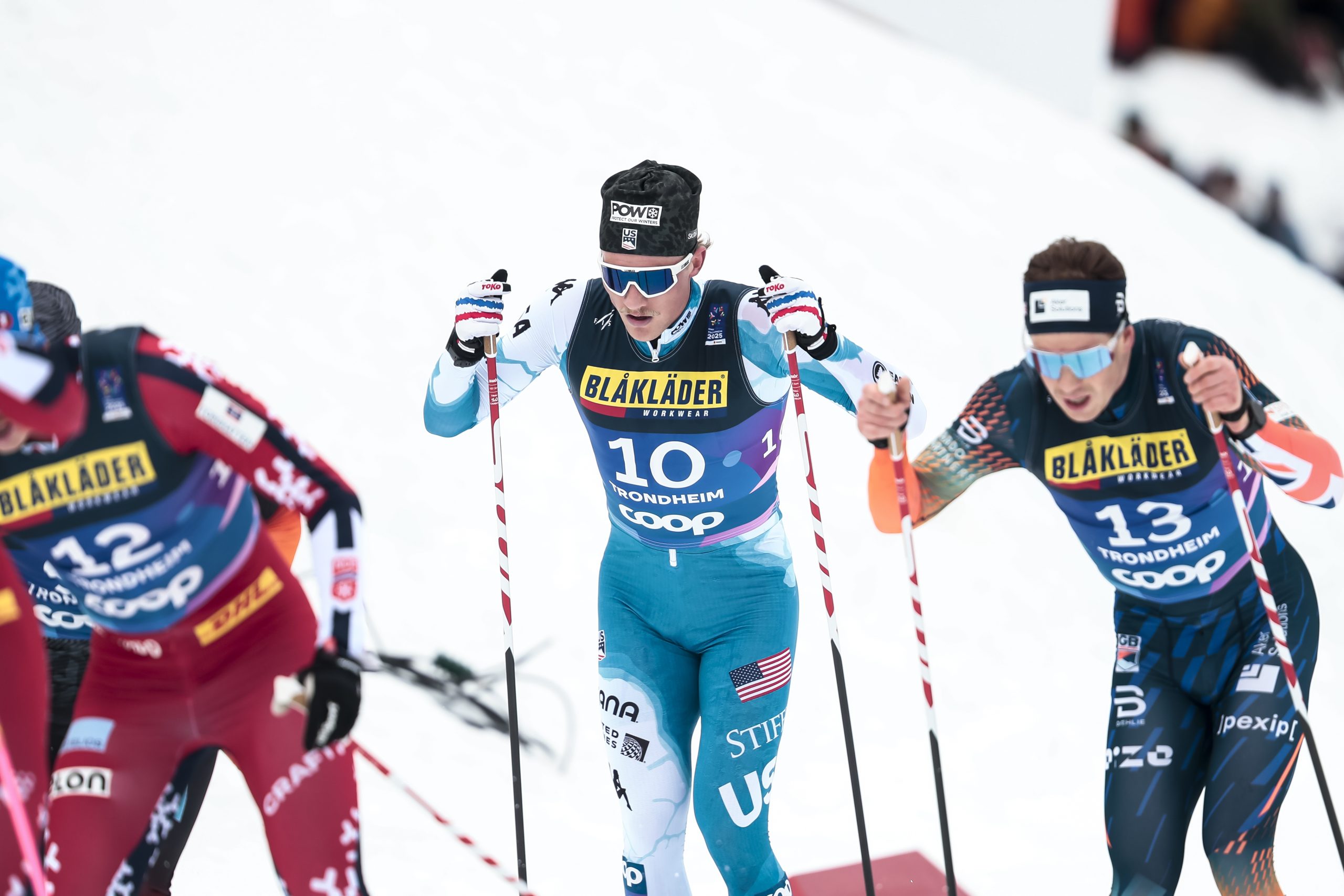
    When JC Schoonmaker talks about his earliest memories of ski racing, he doesn’t begin with speed or snow conditions, or the particular magic of gliding across winter trails. He starts, instead, with raffles. “I just remember as a kid, there’d be raffles after every race that I would be so stoked for,” he says. “Trying to get a prize, like a new pair of gloves or a hat.” It is an unexpectedly tender snapshot of a skier now known for his explosive starts and the sharp, angular drama of World Cup sprint heats. But it is also revealing. Long before Schoonmaker was on national team radars, long before he was analyzing sprint tactics or refining breathwork, he was simply a boy who loved showing up at races, surrounded by friends, snow, and the possibility of leaving with a hat.

    Schoonmaker grew up in Tahoe, a place where winter sport is woven into the fabric of childhood. Yet unlike many of the region’s rising athletes, he was not funneled into Alpine skiing or a single disciplinary track. Instead, he moved constantly—and in every direction. “Both my parents were super athletic, into sports,” he says. “So from a really early age, I was just doing tons of different stuff: soccer, downhill skiing, and Nordic skiing. I played lacrosse. A little bit of baseball.” The variety shaped him in ways he didn’t appreciate at the time: balance from soccer, strength from downhill, elasticity from lacrosse, and a developing sense of rhythm from all of it.

    Meanwhile, the Nordic community in Tahoe was small enough to feel intimate yet substantial enough to provide him with peers, mentors, and a place to grow without suffocation. “Joining a Nordic team for me was super fun because I got to go out and ski with friends,” he says. “It was kind of my first experience racing.”
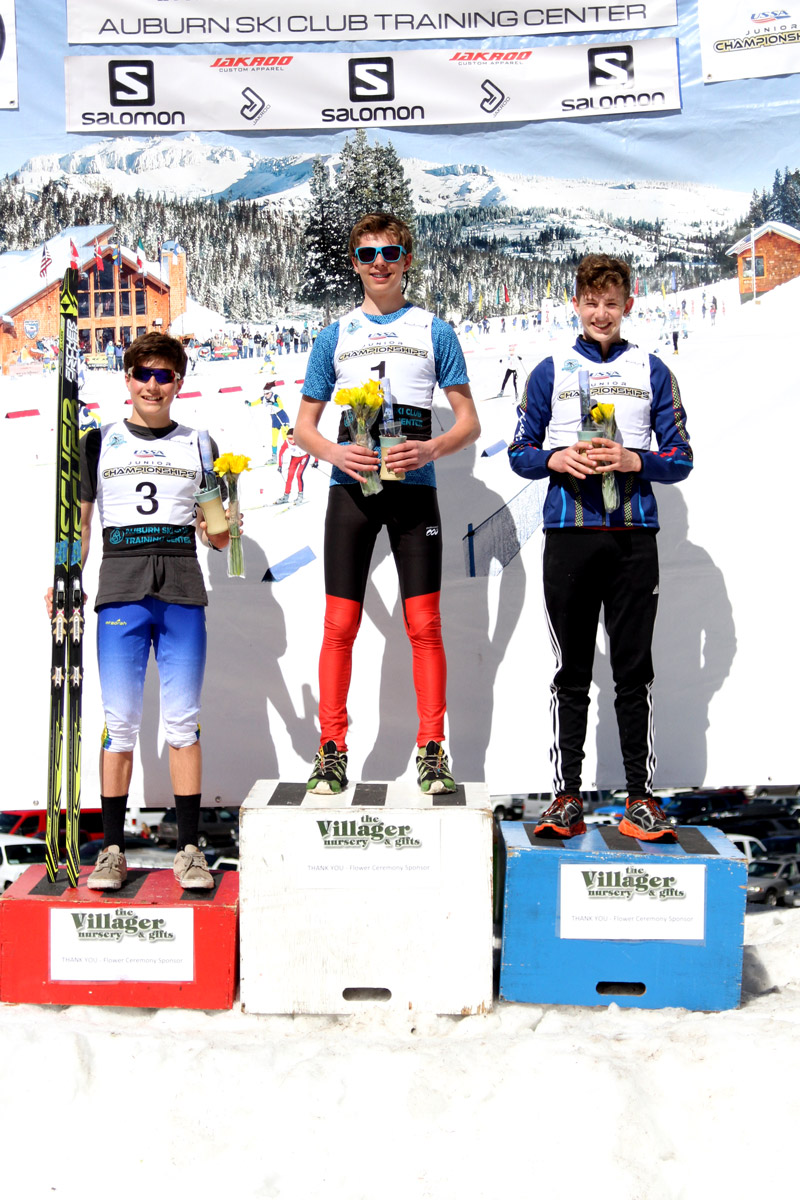
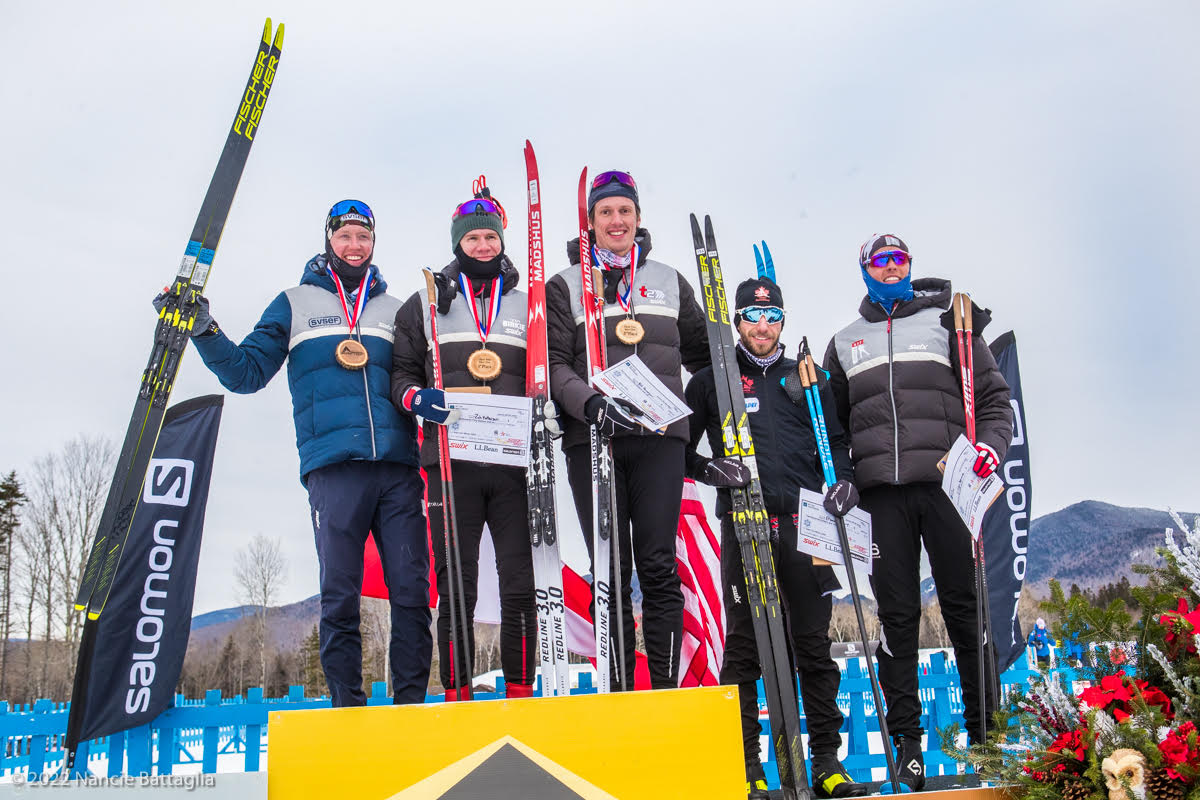
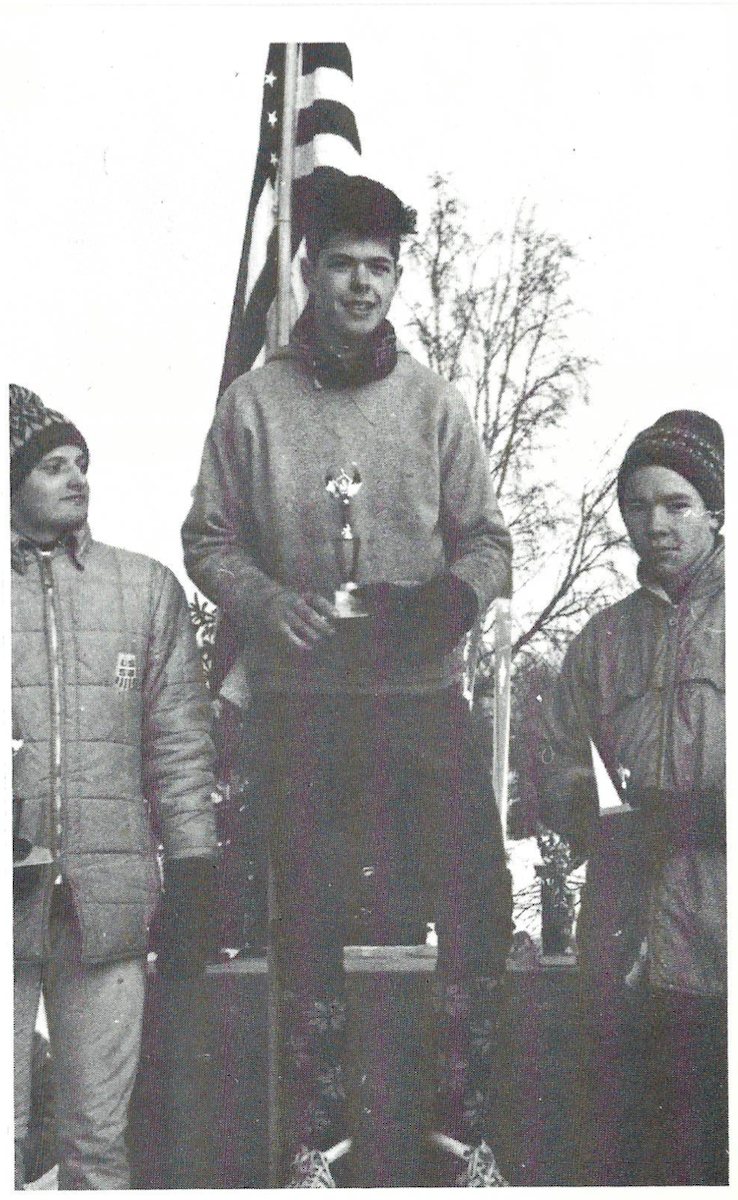
    The U16 men’s podium from the 5 k Classic Mass Start at 2015 U.S. Junior Nationals at Auburn Ski Club in Soda Springs, Californial. JC Schoonmaker took home third place. (Photo: Mark Nadell/MacBeth Graphics)

    Early Validation in Soldier Hollow and Truckee

    It wasn’t until he traveled outside his region that Schoonmaker realized how he measured up. On a Far West trip to Soldier Hollow—his first time racing beyond his local bubble—he surprised himself. “I think I got third in the first race… then I won the second one,” he recalls. “I didn’t even really know it was a big deal, but all the older kids on the trip were… really excited for me.” Their reaction revealed something he hadn’t yet recognized: that his potential extended well beyond his local podiums.

    A similar revelation arrived at Junior Nationals in Truckee, where home snow became a proving ground. He had hoped to earn All-American status, although the early races had gone poorly. “All the first races didn’t really go super well,” he says. “I had high expectations.” Yet in the final individual race before the relay, he stepped onto the podium. “Somehow onto the podium and got third,” he says. “That gave me a bunch of confidence… really helped me.” It was not just affirmation but a directional sign. Skiing was becoming more than an activity. It was becoming a path.
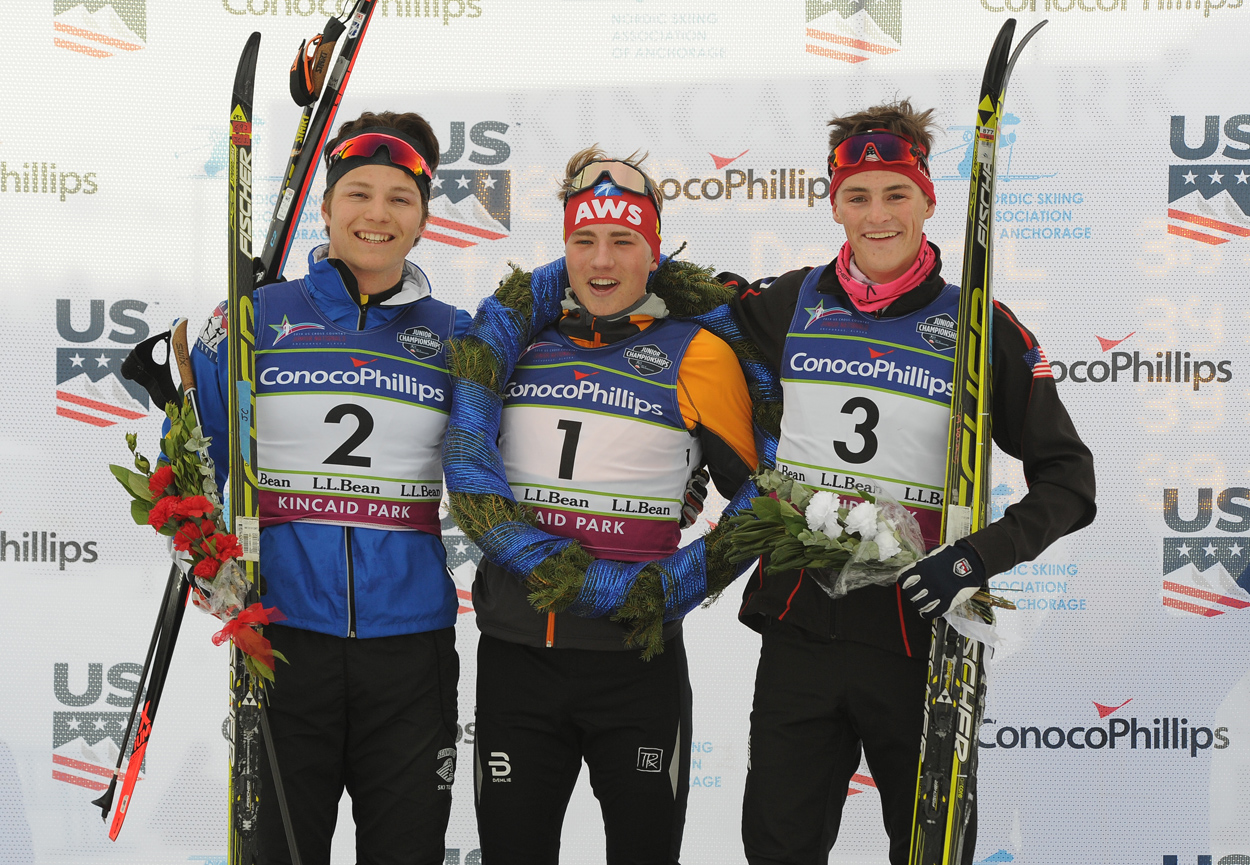
    Gus Schumacher (Alaska Winter Stars/Team Alaska), center, won the U20 men’s 15K classic mass start race at the 2019 U.S. Ski & Snowboard Cross Country Junior National Championships at Kincaid Park. J.C. Schoonmaker (UAA-Auburn Ski Club/Far West), left, was second, followed by Cameron Wolfe (Ski and Snowboard Club Vail/Rocky Mountain), right.  (Photo: Michael Dinneen)

    Choosing Anchorage and the Power of the Right Environment

    Despite his junior successes, Schoonmaker’s college recruiting process was sobering. His age cohort was stacked—Gus Schumacher, Luke Jager, Canyon Tobin—and their achievements overshadowed many strong skiers. “My top choice was UVM, and I just didn’t get a spot there,” he says. “I didn’t have a ton of options.” But an unexpected opportunity appeared when a Tahoe friend encouraged him to consider the University of Alaska Anchorage. He visited, and something clicked. “I’d say that’s the best decision I ever made,” he says. “I ended up coming to an excellent team… It’s an awesome place for skiing.”

    Anchorage wasn’t glamorous, but it was grounding: clear air, big terrain, and a training culture built on consistency rather than spectacle. Under coach Trond Flagstad, Schoonmaker’s skiing matured—his engine, his technique, and his confidence—all while laying the foundation for a collaborative coaching story that would shape his rise.


    A Uniquely Collaborative Coaching Path

    Schoonmaker’s development is defined by the unusually harmonious network of coaches who supported him. In Tahoe, he trained with Will Sweetser, whose workout creativity brought nuance to his summer training. At UAA, Flagstad built his fall rhythm with threshold work and bounding. In the winter, U.S. Ski Team coaches—Matt Whitcomb, Kristen Bourne, and Chris Grover—stepped in with race-day craft and a national pipeline. And now, in Anchorage, he works with Eric Flora at APU, whose daily presence has brought structure and clarity.

    “I feel like I didn’t even really have to do much in the way of balancing that,” he says. “Trond, Will, and Matt… kind of just took that on themselves.”

    That kind of multi-coach collaboration is rare. Instead of conflicting philosophies, Schoonmaker received overlapping layers of expertise, each building on the others. He remembers one of Sweetser’s signature interval sets with particular fondness: “Twenty seconds L5… forty seconds rest… forty seconds L5… then six minutes of threshold. A cool blend… essential for getting you ready for doing sprints on the World Cup.” Flagstad brought heavy doses of fall bounding at L4. Whitcomb and Bourne added race sharpness. Flora, finally, aligned everything. “Having him at World Championships last year made it feel like just a practice in Anchorage,” Schoonmaker says.

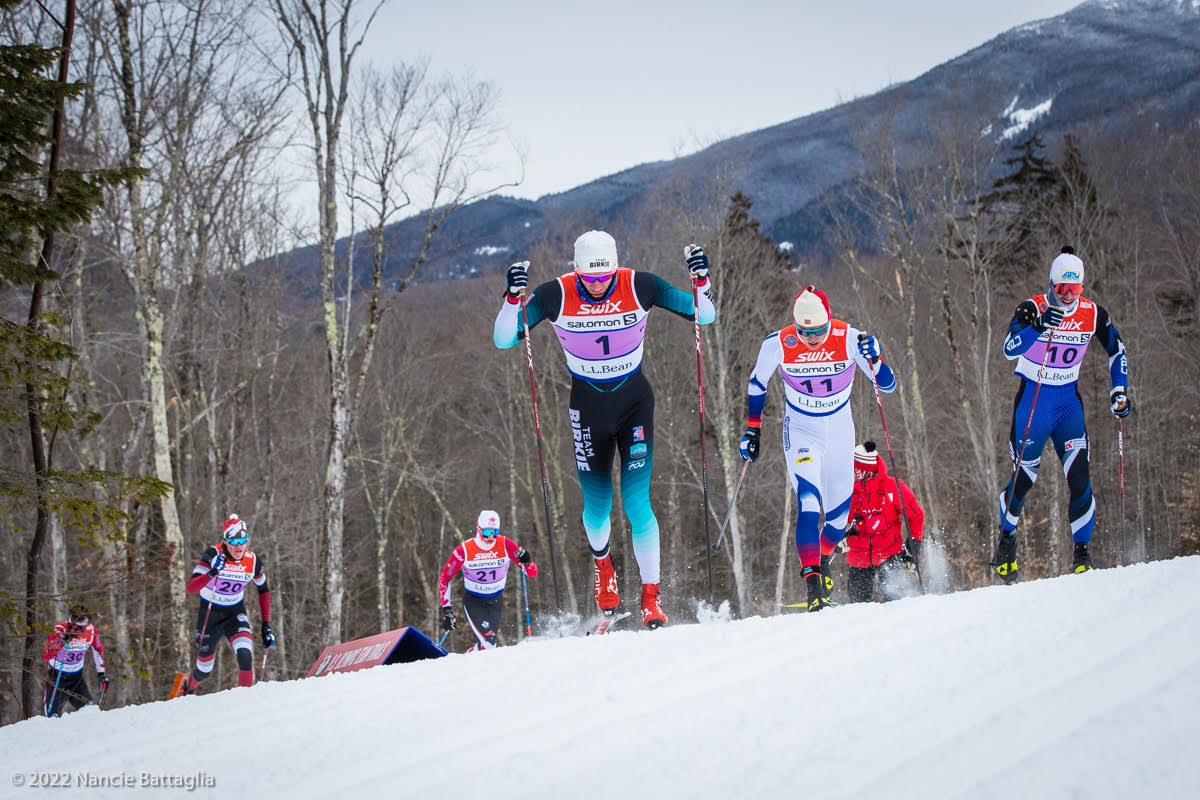
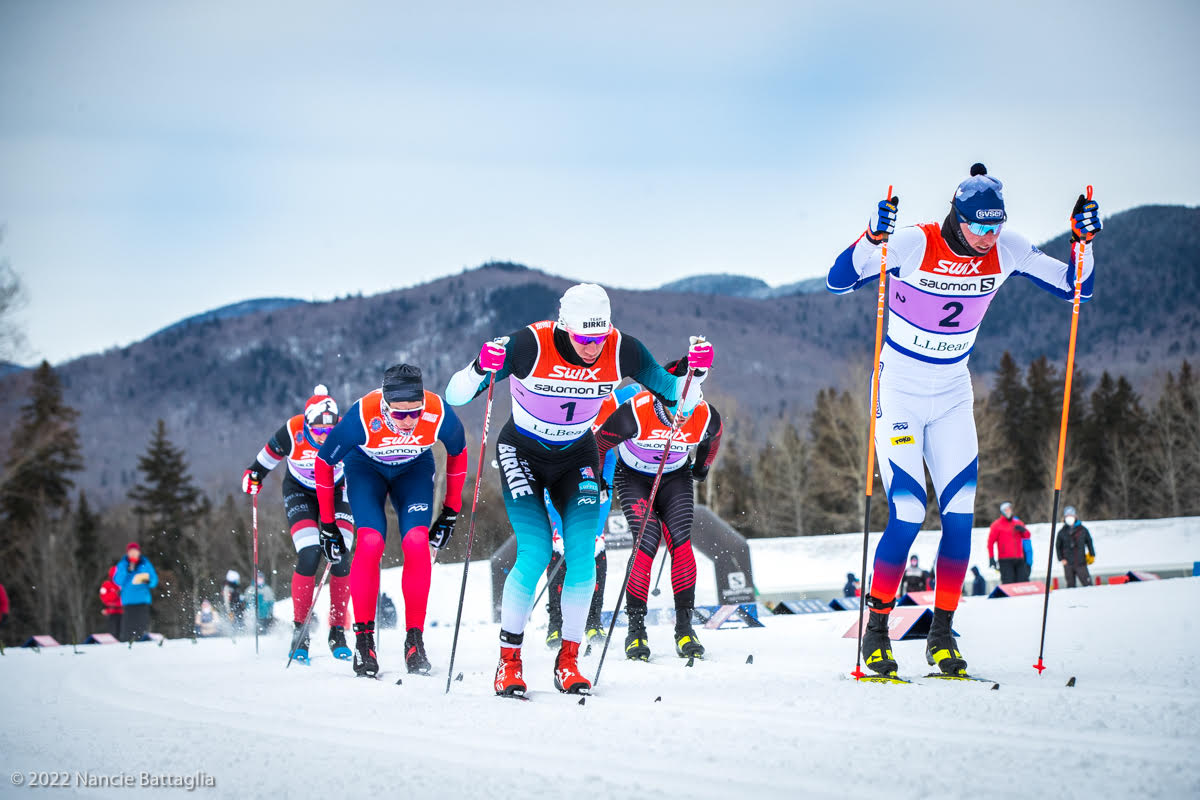
    JC Schoonmaker (bib #1) at the 2020 Senior Nationals in Houghton Michigan. (Photo: Reese Brown)

    The Unexpected World Cup Start That Changed Everything

    The first moment when Schoonmaker truly understood the trajectory he was on came suddenly. At U.S. Nationals in Houghton, Michigan, in 2020, he won the sprint qualifier. It was exciting, but he didn’t assume it meant anything beyond that day’s result. Then his assistant coach, Marine Dusser Bjornsen, approached him with unexpected news. “She was like, ‘Oh yeah, you’re gonna get World Cup starts from that,’” he recalls. “And I was like, ‘What? No way.’” His passport was expiring, his bags were unprepared, and within days, he was on a plane to Dresden.

    Stepping into the World Cup for the first time felt surreal. “I wasn’t even really worried about those being my first World Cups,” he says. “I was mostly just hoping to get to go over there.” The qualifiers felt manageable; the heats were startling. “Racing against those dudes in the heats… was just a whole other level. A different beast.” Still, he never felt crushed by the moment. “We were just having fun,” he says. “It wasn’t crazy high expectations.” That experience didn’t instantly transform him, but it recalibrated his sense of where he belonged.

    APU: A Training Collective That Became Home

    When Schoonmaker finished college and committed to training full-time in Anchorage, it wasn’t only because of Flora’s coaching. It was because the environment felt like home. “Luke coming back… Gus joining… Zan and Michael… it was such a good team,” he says. “A lot played into it… but mostly that stuff.” APU is one of the few places in the country where the majority of the national team trains together throughout the year, creating a rare sense of continuity on the World Cup.

    Yet even in a group that suits him so well, Schoonmaker knows he needs occasional solitude to stay balanced. “I definitely find times during the summer where I’m pretty excited to do an interval session by myself,” he says. “I grew up training alone in Tahoe.” Winter, of course, is different. “You’re living with this group of people for the entire winter,” he says. “Sometimes it is hard to find time to yourself.” But the team understands him. “Everyone knows whatever’s best for you is what’s best for the team.”

    A New Kind of Training: Mindfulness and Sprint Awareness

    This year, Schoonmaker added something he had never practiced formally: daily mindfulness training. “Some breath holds… super simple, just five minutes of mindfulness,” he says. “Focusing on my breath, trying not to let my thoughts wander.” The shift wasn’t driven by physical shortcomings, but by an honest assessment of where he needed to grow tactically. “In sprint heats… I’ve tended to have my head down, thinking about my technique… rather than, ‘I need to get this position around this corner.’”

    Mindfulness gave him a way to sharpen his presence during races and training. During intervals, he began noticing moments when his focus drifted. “My mind starts thinking about what I’m gonna have for lunch,” he admits. “I’m getting better at bringing myself back… loosen up, ski relaxed.” The work is subtle, internal, and mostly invisible, yet deeply connected to the kind of racer he wants to become.


    Passing It On: What He’d Tell the Next Generation

    If Schoonmaker were speaking to a group of juniors in Tahoe today, he would know exactly what he would emphasize. “I love this puzzle of trying to get better every day,” he says. “Focus on the small things you can control… let the cards fall where they fall.” But he would also add a piece of training wisdom gained from experience. “I almost feel like I got a little too caught up in L1 and L3,” he says. “Walking up hills on classic skis isn’t getting you better at classic skiing. You have to ski fast to get better at skiing fast.” It is the kind of message that cuts through both trends and dogma.


    Life on the Road: Davos, Oslo, and a Simpler Suitcase

    Schoonmaker’s favorite destinations reflect a balance of beauty and familiarity. Davos stands out. “I’d love to go there when I’m not getting ready for the Tour de Ski… explore it a little more,” he says. He also holds a soft spot for Oslo. “That’s a special spot. I always feel like I’m having a really good time there.” On race mornings, he keeps things simple: “Probably a couple eggs and a few pieces of toast with jam.” And he no longer travels with the heaviest item from his early career. “I brought over an Xbox… took up, like, 12 pounds in my bag,” he laughs.

    Schoonmaker and girlfriend, Emma Ribom (SWE). (Photo: Courtesy Photo)

    Olympic Season: Ambition, Clarity, and the Calm Before the Heats

    Despite the stakes of the Olympic year, Schoonmaker hasn’t reinvented his approach. “I honestly haven’t been doing anything different,” he says. “I’m more excited to be healthy and head into Period 1 feeling good.” But his goals are not small. “My goals would be to win a medal,” he says. “That’s what I’m shooting for.” A chance to race the relay again is just as meaningful. “The relay in Trondheim was super fun,” he says. “I would love to get another chance.”

    As for the individual sprint, his ambition is both grounded and bold. “If I could make the final… that would be a solid day,” he says. “But I do feel like I can win a medal.” Few athletes can express that kind of aim with such composure. Schoonmaker delivers it as calmly as if he were describing a morning ski.
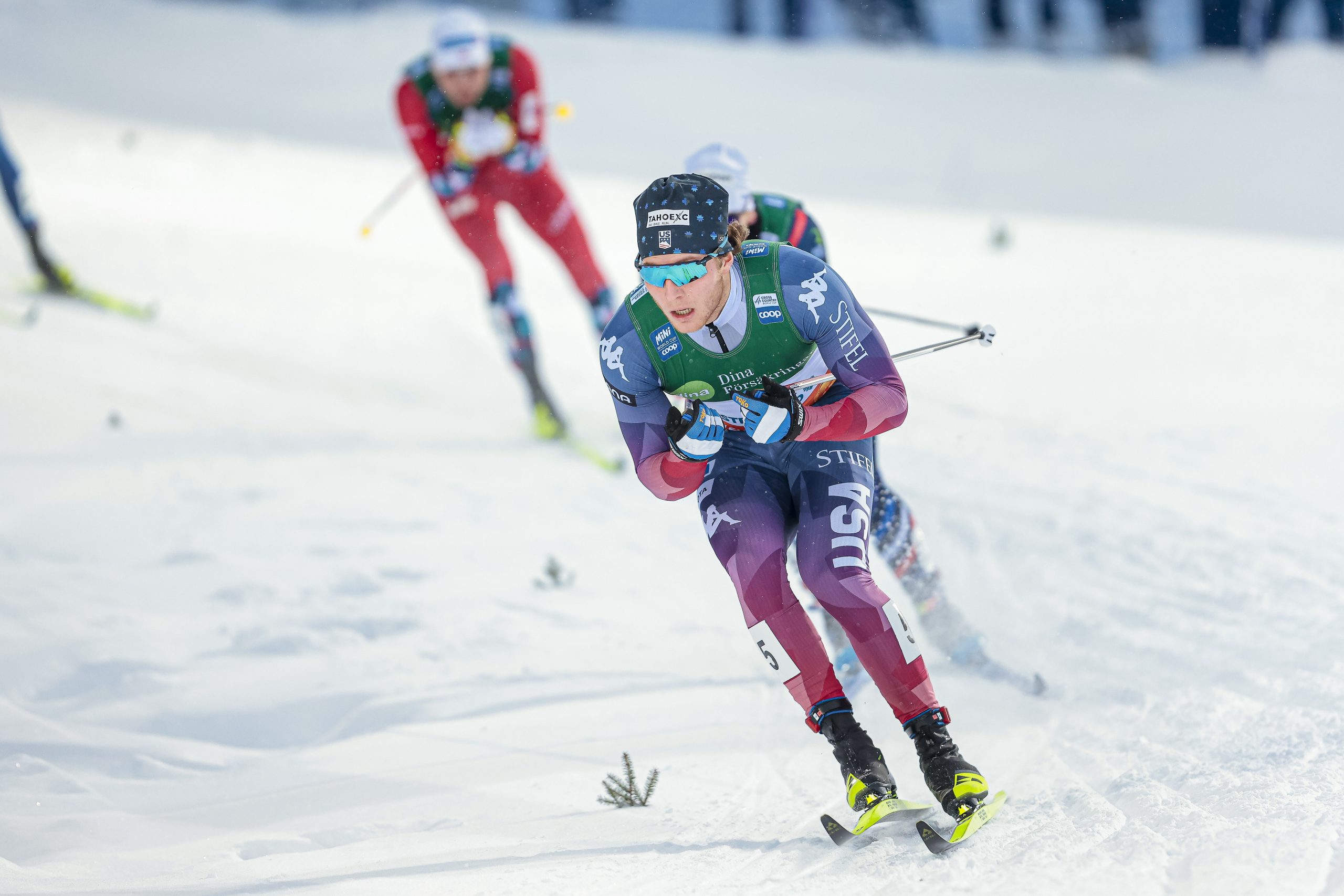
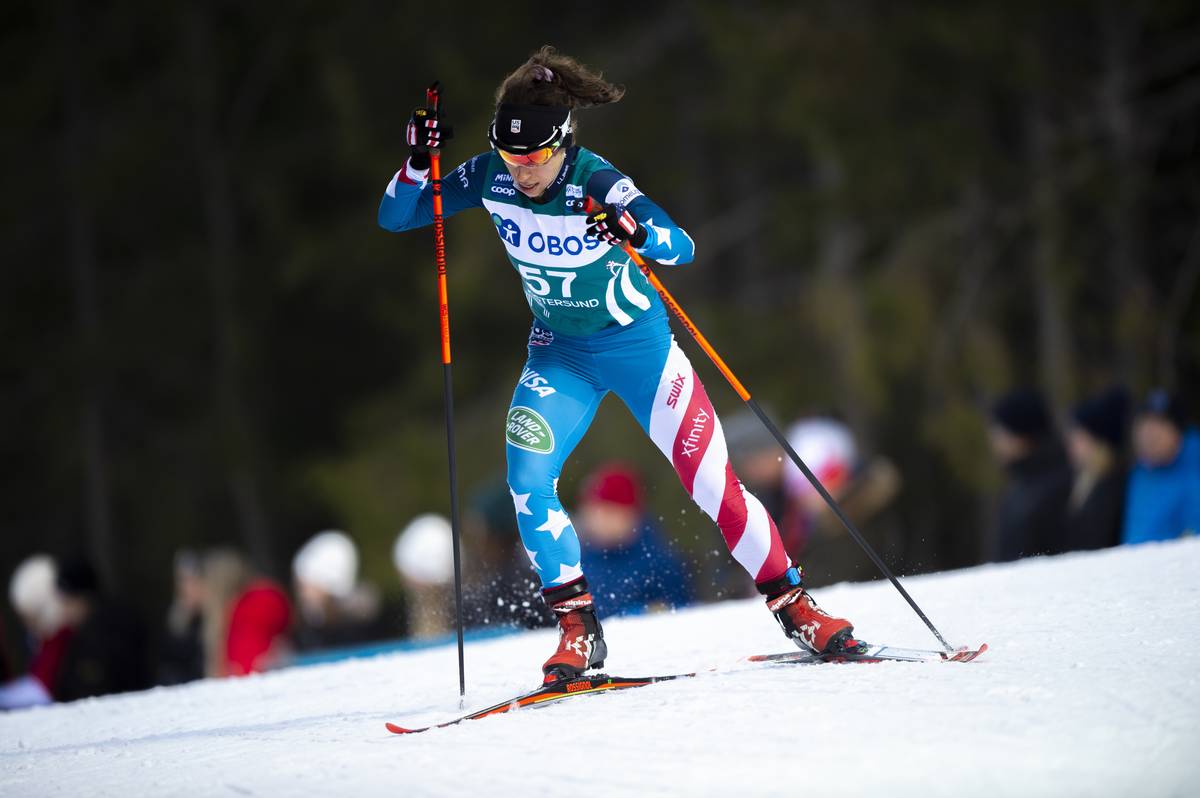
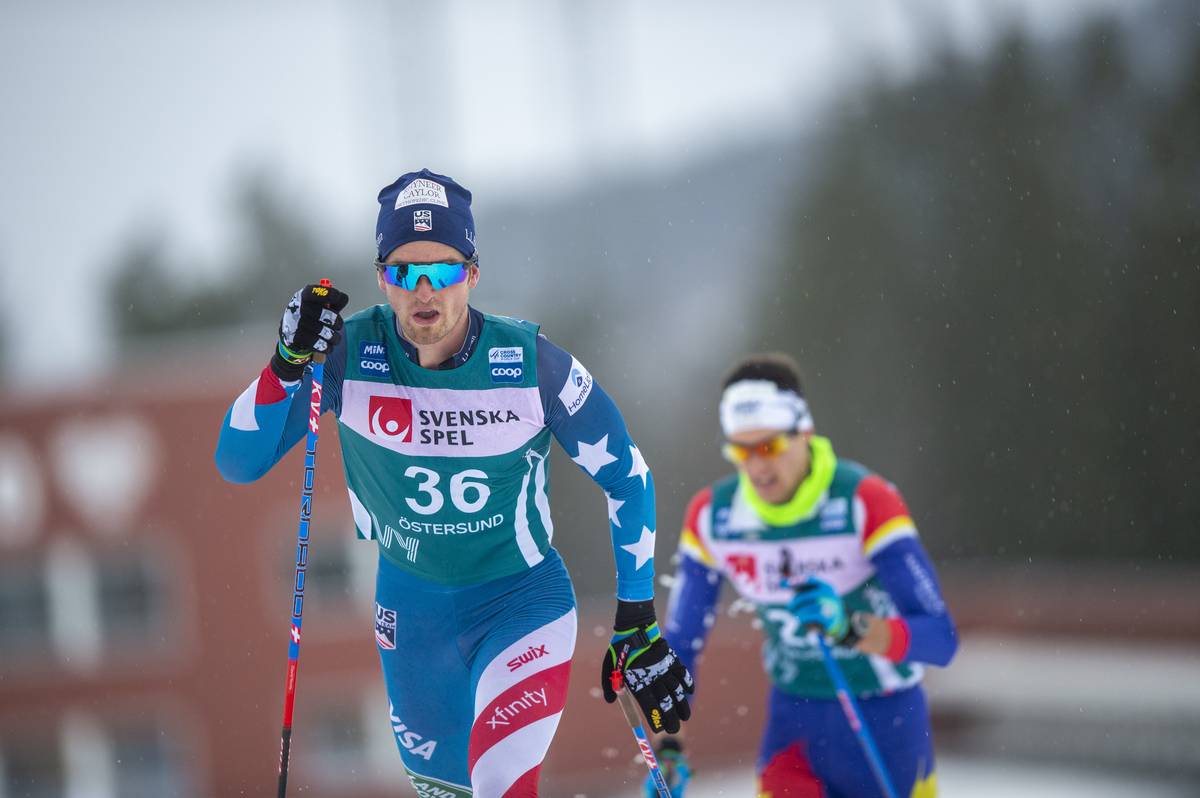
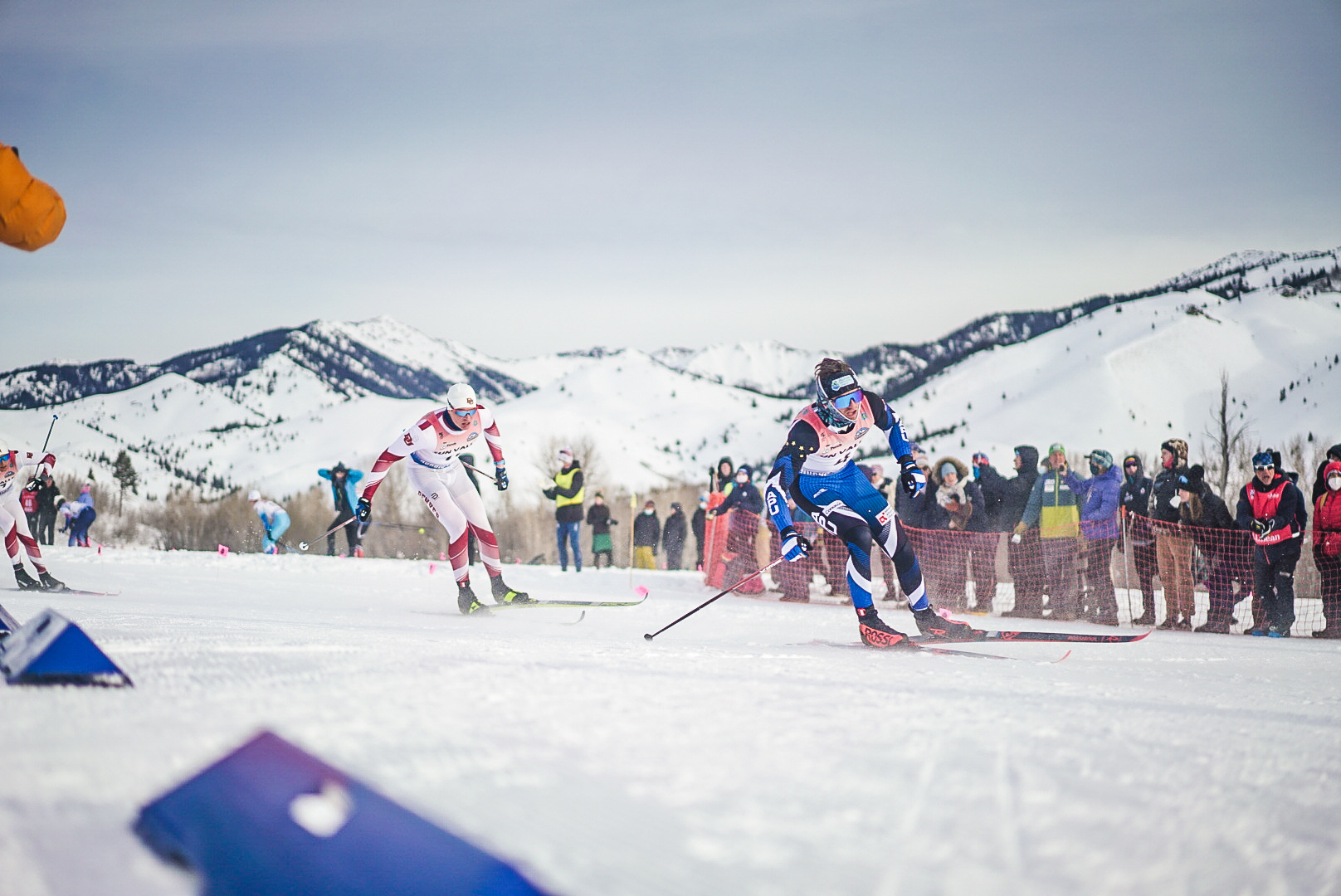
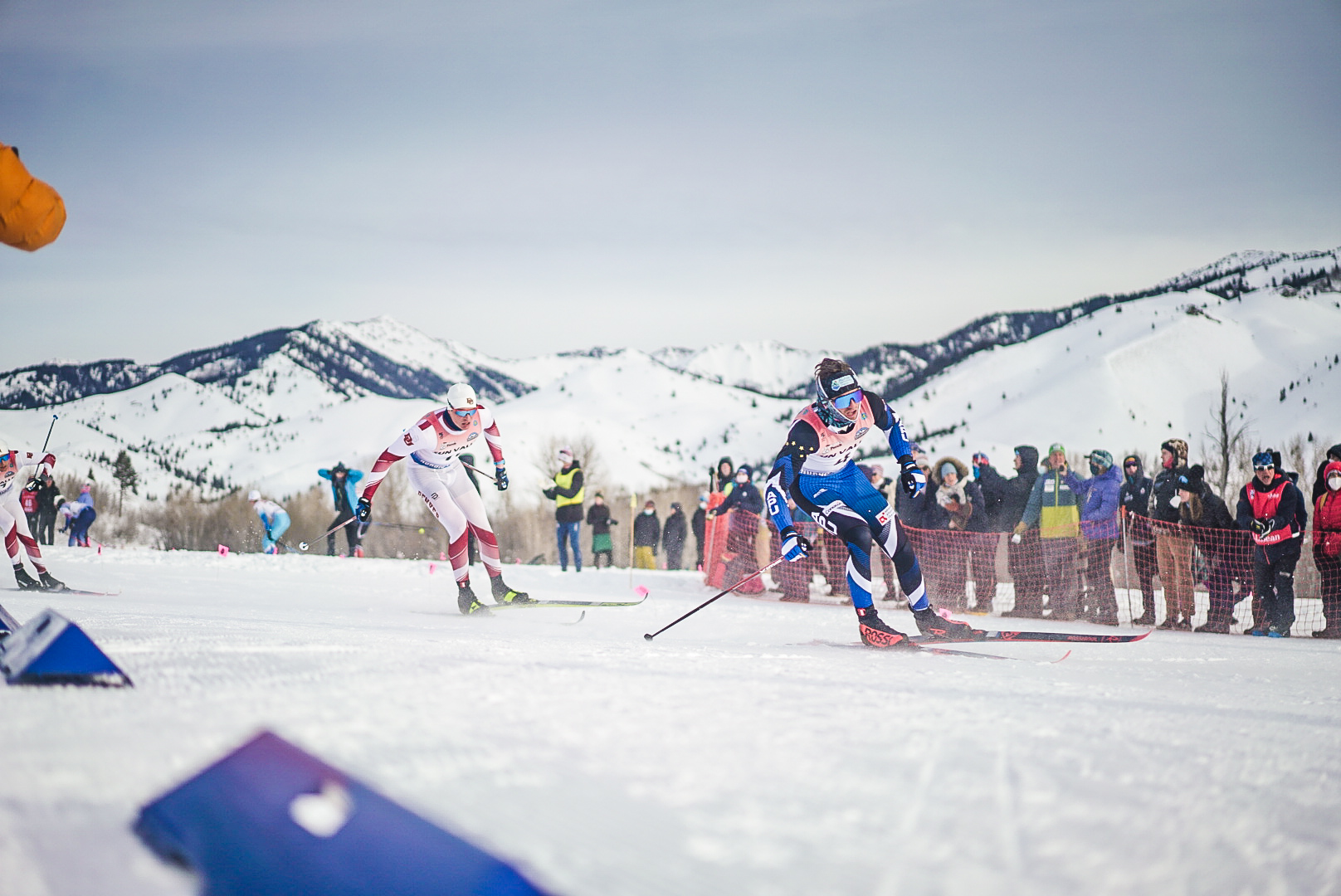
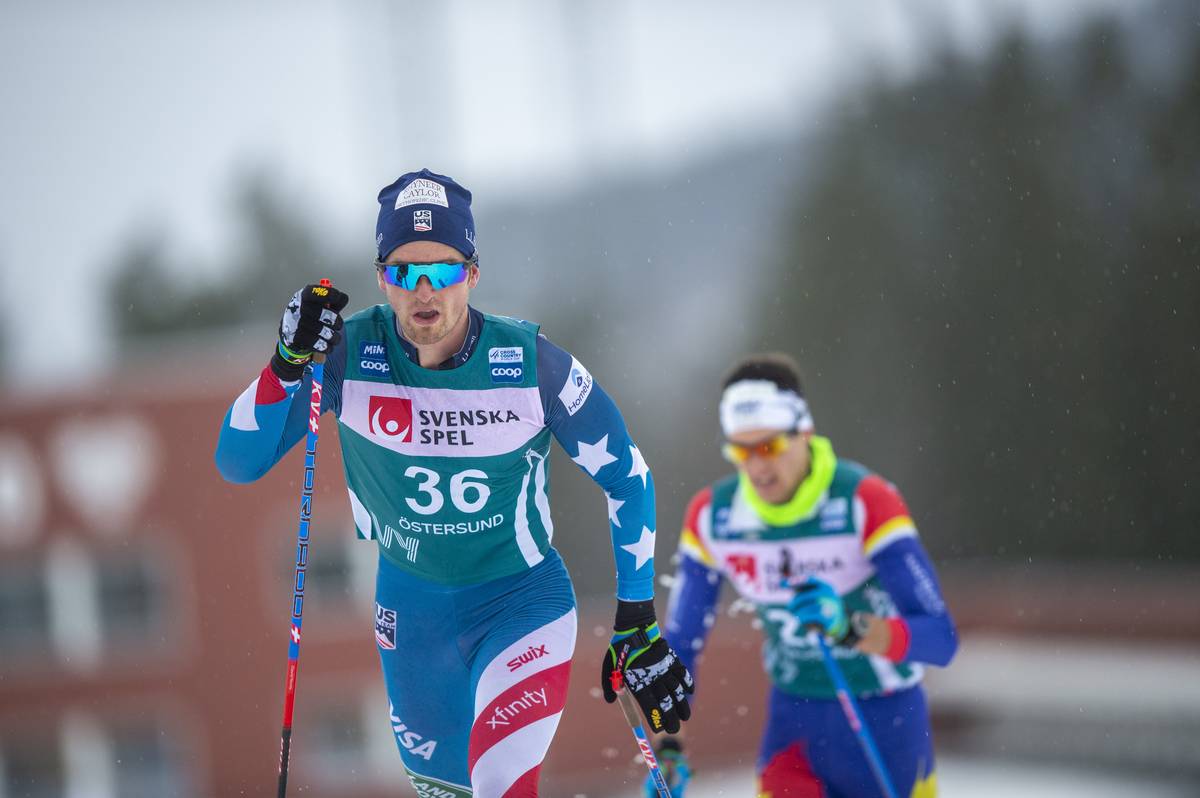
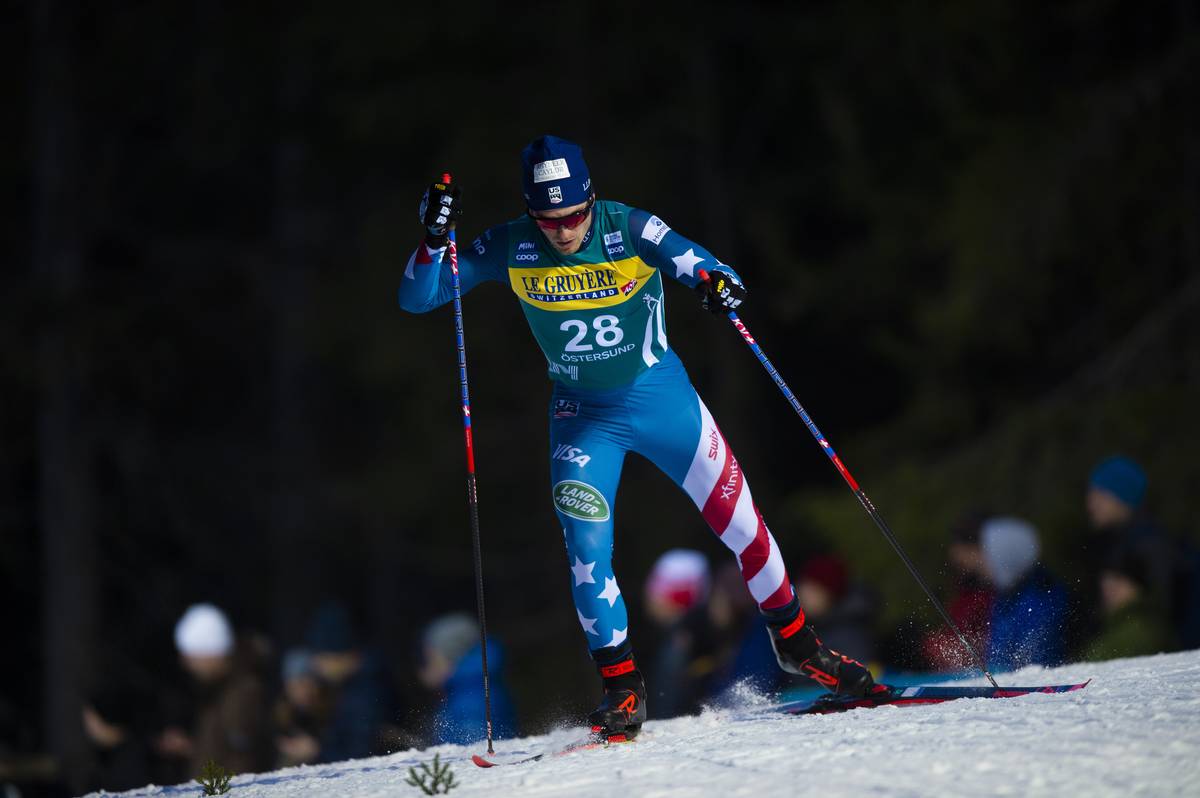
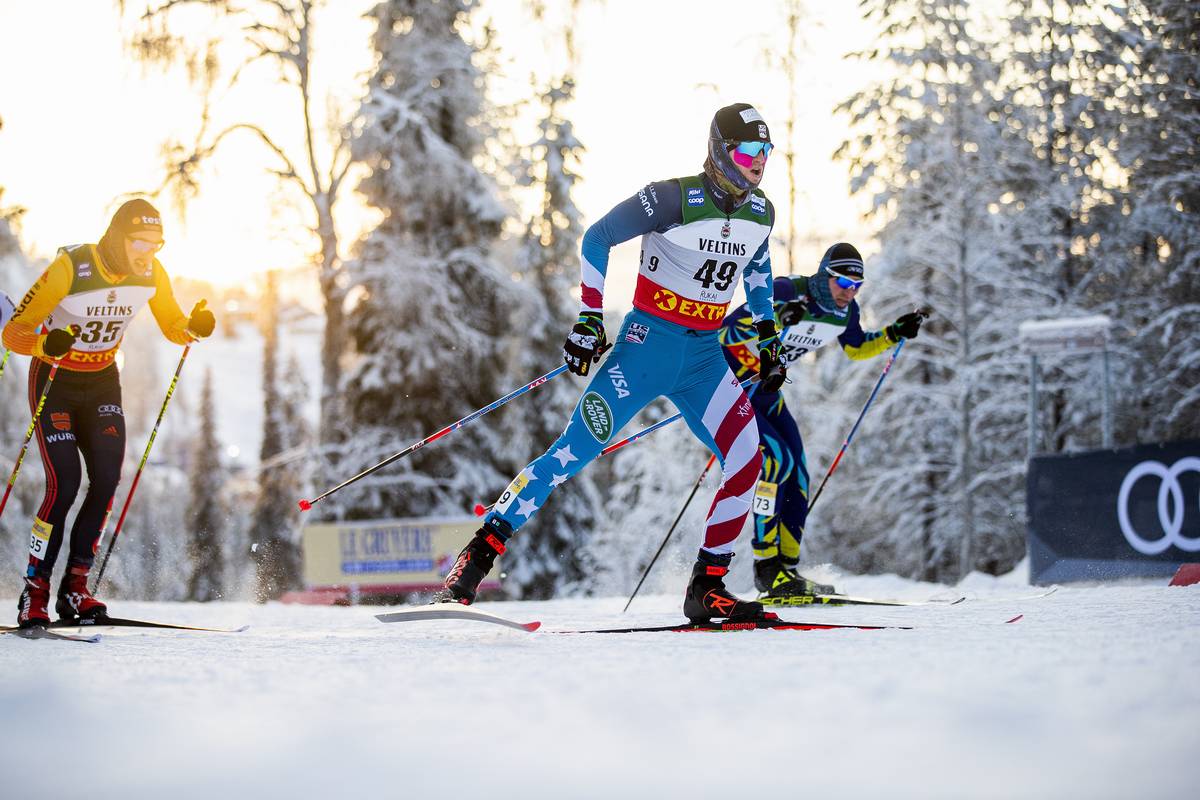
    JC Schoonmaker (USA) had a breakout day in Oestersund (SWE) in 2023, reaching the podium for the first time. The American took third place. (Photo: NordicFocus)

    Where He Stands Now

    What stands out most about Schoonmaker at this moment is not bravado, but clarity. He is no longer the boy who raced for raffle prizes, nor the college skier unsure of his place, nor the rookie dragging an Xbox through European airports. He has become something steadier, more self-aware, and more intentional. A sprinter with composure. An athlete with perspective. A competitor capable of holding his ambition lightly without losing its sharpness.

    Presence, for Schoonmaker, is not stillness. It is an ongoing process of tuning himself to the shifting rhythms of a sprint heat, listening to what his mind and body are telling him, and moving through the season with intention rather than urgency. If he keeps his head up—literally and figuratively—this may be the season when the skiing world begins to see not only what he has built, but why it was built this way.


    Love Stories Like This? Help Keep Them Coming.

    Feature interviews like this one take time, access, and care to produce. If you value thoughtful storytelling and independent ski journalism, please consider becoming a Voluntary Subscriber. Your support directly fuels the work we do to cover the people, places, and moments that make our sport special.

    Join the FasterSkier community!


  • Finding Flow: Gus Schumacher on Training Smarter, Staying Healthy, and Loving the Process

    Finding Flow: Gus Schumacher on Training Smarter, Staying Healthy, and Loving the Process

    This World Cup coverage is made possible through the generous support of Marty and Kathy Hall and A Hall Mark of Excellence Award.  To learn more about A Hall Mark of Excellence Award or to learn how you can support FasterSkier’s coverage please contact info@fasterskier.com.

    Gus Schumacher and J.C. Schoonmaker on Eagle Glacier last month. (Photo: Matt Whitcomb)

    When Gus Schumacher talks about training these days, he sounds more like a craftsman than a workhorse. There’s less emphasis on grinding and more on rhythm — on knowing when to push and when to back off. “I think I’ve just gotten better at kind of knowing what is worth my energy,” he says. “Every day matters a lot, but every day doesn’t have to be as hard or as perfect as the schedule would beg.”

    At 25 years old, Schumacher is entering his athletic prime with a perspective that feels both grounded and ambitious. A native of Anchorage, Alaska, he’s already made history: in 2020, he became the first American male to win an individual gold medal at the FIS Junior World Cross-Country Championships, and in 2024, he captured his first World Cup victory — a breakthrough 10 k Freestyle win in Minneapolis that electrified the home crowd and made him the youngest American man ever to win a World Cup distance race and the first U.S. man to win a distance World Cup event since Bill Koch in 1983.

    Those milestones bookend a journey defined not by burnout or obsession, but by evolution. Schumacher has traded maximum volume for sustainable excellence, chasing consistency instead of chaos.

    From Peaks and Valleys to a Smoother Rhythm

    Three years ago, Schumacher’s training logs told a story of wild swings — massive weeks followed by deep recovery troughs. “In the past, I was probably in the 90-hour range (total training hours for a four-week block) pretty frequently,” he says. “Now it’s more in the lower 80s … my balance was more like 20, 23, 35, 10 to 12 hours a week … and now it’s 18, 21, 25, 15, 16 … just a smoother process.”

    It’s a subtle but meaningful shift: fewer rest days, less volatility, and a steadier tempo. “I don’t take as many off days, either,” he adds. “When I was younger … it was helpful to have those big stimulus days. But as I’m older … if I do a really big day, it’s maybe harder on me.”

    The old model — massive stimulus followed by deep rest — has given way to something more balanced. “I want to feel good most of the time, not just occasionally amazing and then wrecked for days,” he says. “It’s more of a steady hum than a spike.”

    Off into the Alaskan wilderness. (Photo: Rudy Schumacher)

    Consistency Over Carnage

    One of the most evident signs of Schumacher’s maturity is his decision to stop “thrashing” himself in pursuit of arbitrary numbers. “In the past, I would come to a priority day and it would be super hard … and I’d still want to hit an hours goal, cramming training into places where it maybe wasn’t appropriate,” he says. “Now … I’m less inclined to do that and more inclined to just drop an afternoon session and not worry that much about the two-hour hit on weekly volume.”

    He’s also embraced a more intuitive recovery model. “The feel comes before those things,” Schumacher says of his data tracking. “Sometimes I’ll feel a little off … and then a day or two later the HRV (Heart Rate Variability) will come down … so the first feelings while you’re training are important.”

    Over time, that awareness has become central to how he navigates fatigue. “HRV is objective, but sometimes it’s low because of other things,” he explains. “It’s good to recognize why you might feel a certain way and how to change that.”

    Utah Camp and a Smooth Summer

    When we spoke, Schumacher was three days into a two-week U.S. Ski Team camp in Utah, training alongside his APU teammates JC Schoonmaker, Luke Jager, Zanden McMullen, and Michael Earnhart. “We’re on our third day of National Team camp,” he said. “It’s great energy here.”

    That steady energy mirrors his summer. After illness derailed his 2024 training for nearly six weeks, this year brought the opposite: uninterrupted rhythm. “Last year I was sick for six weeks in August and September, and this year it’s been going really smoothly,” he says. “My health has been super good … I’ve been doing a lot more breathwork … and that’s helped quite a bit.”

    The contrast is stark — and instructive. For Schumacher, staying healthy through the summer is no longer just luck; it’s the product of restraint, awareness, and self-trust.

    Gus Schumacher with his girlfriend, Olivia Carrier, enjoying the Alaskan view during a workout. (Photo: Amy Schumacher)

    Hard Work, Soft Edges

    Even as he’s refined his volume and recovery, Schumacher hasn’t softened his competitive edge — just redirected it. “Not a lot of days to really redline it,” he says. “In the summer … I just don’t feel like it’s that worth it. … I’ve definitely stayed away from having a full session that’s just full power.”

    He describes one workout — 10 × 1-minute efforts — as emblematic of his current philosophy. “It’s not about dying at the end of each rep,” he explains. “The first one we did, I felt super good and did sort of go ballistic … and I was fried in the afternoon and for a day or two.”

    The lesson? “When you feel really good, holding back a little bit … because that good feeling is not necessarily gonna come through in the recovery,” he says. “To get the stimulus from a 10 × 1-minute workout, you don’t need to be on your hands and knees. Having an interval or two where you really push is good … but it shouldn’t be always.”

    Fueling with Intention

    Schumacher’s fueling strategy mirrors his training philosophy: steady, structured, and practical. “I probably do 30 to 60 grams an hour for two-to-three-hour workouts,” he says. “Our races aren’t really long enough to be super dependent on that … but in training it’s really important just to keep the glycogen stores up.”

    For long races, he’s methodical. “During a 50 k, I’ll definitely go for at least 60 grams an hour … I’ve done even 90 for 50 k’s,” he says. And sprint days have their own rhythm: “I’ll do a gel after I do my warm-up intensity … eat a solid meal after the qualifier … and definitely gel before the quarters … and then one in between everything.”

    Spear fishing. (Photo: Alex Lee)

    Season Goals and the Long View

    This fall marks Schumacher’s sixth full World Cup season. He’ll depart for Europe on November 18, with an eye toward the Skiathlon, Team Sprint, and 10 k Skate as his primary Olympic events. “Those are probably my big three,” he says.

    He’s also keeping perspective on success. “There are a lot of ways to be successful,” Schumacher says. “To go and be healthy would be a big success … it’d be really cool to ski well for the people who’ve already planned on being there.”

    And the reward. (Photo: Olivia Carrier)

    That balance — ambition without anxiety — defines his approach. “I’ve definitely got my mind on a medal at the Olympics,” he admits, “but that doesn’t define success for me. Being in the top 10 overall would be cool … but I’m sort of not loving defining it too much. … I just want to be executing as well as I can and keeping healthy and cool-headed.”

    After the Tour de Ski, Schumacher plans a 10-day reset at home in Alaska before returning to Europe for altitude training and the final push to the Olympics. “Getting away from the madness for a bit,” he says, “makes me hungrier when I come back.”

    Learning to Flow

    “I want to keep going as long as it feels reasonable,” Schumacher says when asked about his future. “The next phase is learning more about how my mind and body are at their best. What makes my mind happy is often what makes my body feel good too.”

    That mindset — introspective, curious, and confident — underscores everything he’s building toward. “I feel like I’m learning myself more every year,” he says. “Everything gets easier, but I keep getting faster … better at getting into flow state.”

    He pauses, then adds: “There are more times now where I just feel like I’m doing a workout that’s hard or long, and I’m able to really relax and enjoy it. I’m excited to bring that to racing.”

    Is Gus looking at flow state? (Photo: Olivia Carrier)

    Advice for the Next Generation

    When asked what he’d tell younger skiers chasing their own dreams, Schumacher smiles. “A big part is just going through the motions and making the mistakes,” he says. “To do that, you have to be happy and enjoying it — having good friends around and making sure it’s not just every day you show up dreading how hard it’s going to be.”

    He insists that skiing well starts with loving the process. “The day-in, day-out is not that painful or difficult,” he says. “If you’re doing it right … it should be enjoyable pretty much all the time.”

    And perhaps his most mature insight: “Not every day has to be perfect … those bumpy days … that’s what leads to the good days down the road.”

    Toward Flow & Beyond

    Gus Schumacher’s transformation is not a retreat from ambition — it’s its maturation. At 25, he has already built a resume many would envy: Junior World gold, a landmark World Cup win, and upward movement in the World Cup standings. But he now embraces an athletic philosophy that values rhythm over rupture, feeling over forced, and resilience over recklessness.

    “Those best days happen when you’re just kind of there for the game … to keep that going … to enjoy it … and not lose track of these times before they’re gone,” he says.

    It’s a voice of calm in a sport often defined by extremes. Whether or not the Olympic hardware arrives, Schumacher’s style — grounded, evolving, and rooted in joy — already feels like a victory.

    For Gus Schumacher, exploring the mountains of Alaska isn’t training, it’s a lifestyle. (Photo: Gus Schumacher)
  • Fast Tracks: World Champs—Gus Schumacher’s Coach, Erik Flora, On The Men’s Skiathlon

    Fast Tracks: World Champs—Gus Schumacher’s Coach, Erik Flora, On The Men’s Skiathlon

    This reporting costs money. Please support this coverage with a voluntary subscription (below) so FasterSkier can provide this level of access to the sport we all love year-round.

  • Fast Tracks: World Champs—Fireworks On the Skiathlon Course for Gus Schumacher

    Fast Tracks: World Champs—Fireworks On the Skiathlon Course for Gus Schumacher

    This reporting costs money. Please support this coverage with a voluntary subscription (below) so FasterSkier can provide this level of access to the sport we all love year-round.

  • Fast Tracks: World Champs—Gus Schumacher Reflects on His First Day

    Fast Tracks: World Champs—Gus Schumacher Reflects on His First Day


    This reporting costs money. Please support this coverage with a voluntary subscription (below) so FasterSkier can provide this level of access to the sport we all love year-round.

  • Nordic Nation: Prioritizing mental health and rediscovering passion with Hailey Swirbul

    Nordic Nation: Prioritizing mental health and rediscovering passion with Hailey Swirbul

    In this episode, we chat with Hailey Swirbul, who – at just 24 years old – has been competing at the top end of the sport for quite some time. A bronze medal in the 4 x 3.3k relay at the 2017 Junior World Championships in Soldier Hollow put Hailey – and relay teammates Julia Kern, Hannah Halvorsen, and Katherine Ogden – on the map in a big way in US Skiing. Hailey has gone on to spend the better part of the last four years racing on the World Cup, earning 48 World Cup starts and one individual podium in the 10k skate in Davos in 2020. She’s currently preparing for the upcoming World Championships in Planica, Slovenia, which starts on February 22nd. 

    Following last year’s Beijing Olympics, Hailey opened up about the contrast in expectation versus reality in the Olympic experience, and how the high stress, high pressure environment of life in Europe, particularly in the lead-up to the Olympics, negatively impacted her mental health and felt increasingly unsustainable. She questioned whether she wanted to keep skiing at all, but eventually decided to keep at it, with a new approach. She took a full time engineering job in the summer, and decided to forego period one and two on the World Cup, racing the SuperTour and US Nationals domestically instead. 

    Hailey Swirbul enjoys her time in the leader’s chair after a solid performance in the 10k skate in Davos in December 2021. (Photo: NordicFocus)

    As we discuss, this approach has rejuvenated her love for the sport and her motivation for the training and sacrifices it requires. And, it’s contributed to an outstanding season of racing, both domestically and internationally. She remains the SuperTour Leader as of recording, having earned a spot on the podium in all but one event, and swept all four events at the National Championships in Houghton, MI in early January. She seamlessly transitioned back onto the World Cup in Les Rousses, FRA where she raced into the semifinal of the classic sprint, followed by a top-20 result the following day in the 20k mass start classic. She qualified for the sprint heats again the following weekend in Toblach, ITA, was 26th in the 10k free the next day, and capped off the long weekend by scrambling for the US women’s relay team, which ended the day in bronze medal standing.

    Thanks for listening, and thanks to Concept2 for supporting this podcast. 

    Hailey Swirbul pushes to the finish of the 10 k individual start classic during the 2022 Olympic Winter Games. (Photo: NordicFocus)
  • Q & A with New Faces on the US Ski Team: Michael Earnhart

    Q & A with New Faces on the US Ski Team: Michael Earnhart

    U.S. Ski & Snowboard recently announced its U.S. Ski Team nominations for the 2022-23 season. Of the 22 athletes named to the team this season, six were not on the previous year’s roster, either newly named or renamed: Michael Earnhart, Walker Hall, Zak Ketterson, Will Koch, Finn O’Connell, and Sammy Smith.

    To help fans get to know these new(er) faces, FasterSkier is doing a series of interviews, providing insights into the factors that have contributed to development, progress, and growth for these athletes last season. In this installment, we talk with Michael Earnhart following his nomination to the U.S. Ski Team on its D-Team. Earnhart discusses growing up skiing in Alaska, his successes as a junior, and what to expect as he joins the U.S. team alongside Junior World Championship teammates this season.

    Michael Earnhart playing with his dog around his hometown of Anchorage Alaska. Earnhart was recently nominated to the US Ski Team D-Team. (Photo: Michael Earnhart).

    FasterSkier/Ben Theyerl (FS): Can you just tell us a little bit about yourself? Where are you from, who have you skied for in the past and who are you skiing for now?

    Michael Earnhart (ME): I’m from Eagle River, Alaska, which is just outside of Anchorage. I trained with Alaska Nordic Racing, and then last year moved into Anchorage to train full-time with APU (Alaska Pacific University). I’ve just been trying to stay in Anchorage and Alaska as much as possible because I really think it’s the best place to be a skier in the U.S.

    I’ve also gone on two different U.S. Ski Team trips. I started out with the Nordic Nations Cup (U18) and then I’ve gone to World Junior Championships (World Juniors) the past two years in a row, with this past year being the World Junior Championships that helped me qualify for the U.S. Ski Team.

    FS: I wanted to hop in right there, congratulations on officially joining up with the U.S. Team. Can you take us through the process that led you to this point – when did you think that joining the national team was a goal you could realistically set for yourself? And what was the process of reaching that goal once it was set?

    Michael Earnhart. (Photo: Michael Earnhart).

    ME: In the beginning, I was just into running through elementary and middle school, and just wanted to be competitive in skiing for the running aspect of what I was doing, not really thinking about skiing so much. My freshman year of high school I made it to JNs (Junior Nationals) and ended up getting a Top-10 which was when I was like ‘wow, you know, this skiing thing is really cool.’

    From that point on, I started focusing more on skiing and got lucky because I was naturally talented to some degree. But I worked hard and was able to make my first international trip (the U18 Nordic Nations trip). That was my first time wearing the red, white, and blue, and I very much went ‘yep, this is what I want to do.’ I wanted to wear that U.S. race suit full time.

    FS: Did you make it out to Bend camp this spring? How was the first experience joining up with the team?

    ME: I did make it out and it was really fun. Those people on the team are some of the nicest people I know, and so it was good to spend time with them in general, but being at a camp where the goal is to put in some big volume was super beneficial to my training. You also get to just learn different techniques for training from everyone and you’re really motivated. It was all super great.

    FS: I’d also note some of those people you’re joining the team alongside. Will Koch and Walker Hall are both joining the D-team with you, and you have experience racing with them at Junior Worlds, but primarily from competing against them in the past. What has the experience been reaching the point of your career where your top competitors are becoming your teammates?

    ME: It’s definitely interesting. I’ve known these guys for years as competitors. Like I think I used to in the summer months be thinking things like ‘ok, how do I beat Walker [Hall]?’ And now this summer, I’m living with him and we’re training together. We both want to do well on the international level, and so it makes sense and I’m really excited about it.

    Earnhart as part of the US U18 Nordic Nations Team. ((Photo: Jane Mittelsteadt).

    FS: You mentioned that you’re skiing for APU, which gives you plenty of examples of U.S. Ski Team members to look up to. You’ve already said that you think Anchorage is the best spot for you to be training, and being from there, I was wondering if you have any reflections on what about it makes it that way?

    ME: There’s a lot. You can train at sea-level, and you can train at altitude. You have snow from October through May. We have great roller skiing in the summer and good running temperatures then too. It also stays fairly moderate temperature-wise – like Fairbanks gets too cold to ski sometimes. So, it boils down to access and climate.

    I would also add that the community is just really large – there’s more skiers than just APU out here. We’ve got older people, middle-aged people who get out on the ski trails too and give us a lot of support.

    Michael Earnhart taking part in Anchorage’s NordicX event last April. (Photo: Ophira Group / NordicX)

    FS: Let’s back up and talk about this past season. If you take us back to last Fall, what were your goals going into this season?

    ME: My goal was to make Junior World Championships again, and then just perform as well as I could there. Making the [US Ski Team] D-Team was on my mind, but I didn’t want to set any specific numbers results-wise that I thought would get me there. I didn’t want to say that I had to get a top-15 at Worlds or go for the win or whatever, it was just going to be do whatever I could to get myself onto the D-Team.

    FS: I did notice that after Junior Worlds you chose to race in Minneapolis at Junior Nationals (JNs), and you dominated that U20 category. What was your thinking in doing that versus say, going to OPA Cup finals?

    ME: There were a couple things going on there, but I think the big thing was that it was my last year as a junior so I may as well go have some fun with the guys that I’ve grown up skiing with in Alaska. I wanted to have one more fun time at JNs and I knew I could potentially win some races. I wanted to have a kind of “finish” to my time as a junior and mark it by spending time with the people that have helped me along the way the last four or five years in skiing.

    FS: Quick follow-up: Any comments on the choice of a mullet in Minneapolis?

    ME: You know, I started doing that a couple years ago. I like the idea of growing your hair out all winter to cut it for spring racing. I had a friend cut my hair in the hotel bathroom the night before the first race, and well, I thought it looked pretty good, so…

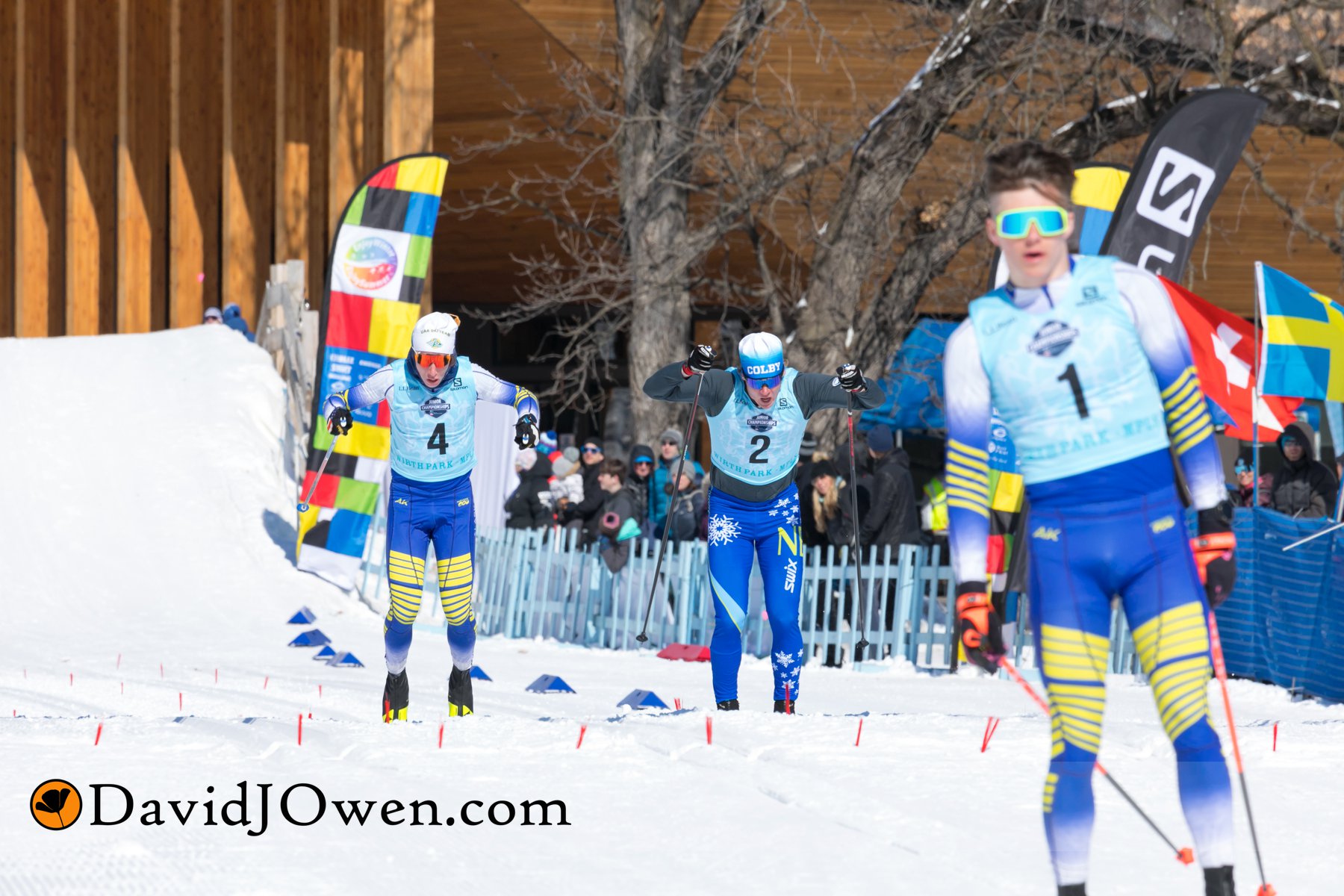
    Michael Earnhart (bib 1) rocking the mullet in question at 2022 JNs in Minneapolis. (Photo: David J Owen Photography)

    FS: I think we all did. If you could pick one highlight from this season, what would it be?

    ME: For me, that’s pretty easily the relay at Junior Worlds. Even though we only got 3rd place when we wanted to win. I felt like it showed that the generation that came just before us, yes, they could get the US a gold medal and make history. But we’re here too, able to get a podium. I think it shows that US skiing is here to stay – we’re going to keep getting better. I’m really proud of having been a part of that.

    FS: That brings us up to this training year. What are you thinking your goals are individually this next season? And what do you want to accomplish alongside those team members that you’re joining the U.S. Ski Team with?

    ME: It’s hard to say right at the moment. I’m kind of at a weird age now being a first year U23, especially when we have so many fast U23s on the team already. I don’t have any specific goals set yet. I just really want to have a productive training year and race as fast as I can. Maybe some top-10s at U.S. Nationals – if you’re looking for a number, I’d put that out there.

    I just want to be as close to winning as I can, and any race that I do, just race hard.

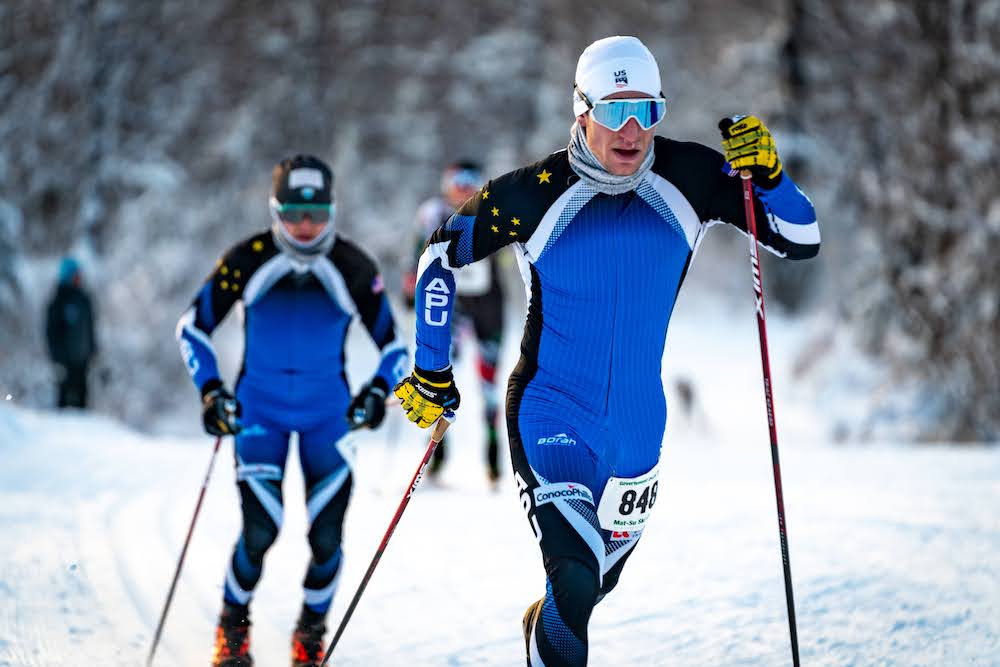
    Michael Earnhart skiing in the suit of his home club Alaska Pacific University (APU). (Photo: Tobias Albrigtsen / @untraceableg).

    FS: All sounds good to me. Thanks so much for helping us get up to speed, and good luck next season!

    ME: You bet, thank you.

  • Nordic Nation: 2022 SuperTour Champion Rosie Frankowski in Transition

    Nordic Nation: 2022 SuperTour Champion Rosie Frankowski in Transition

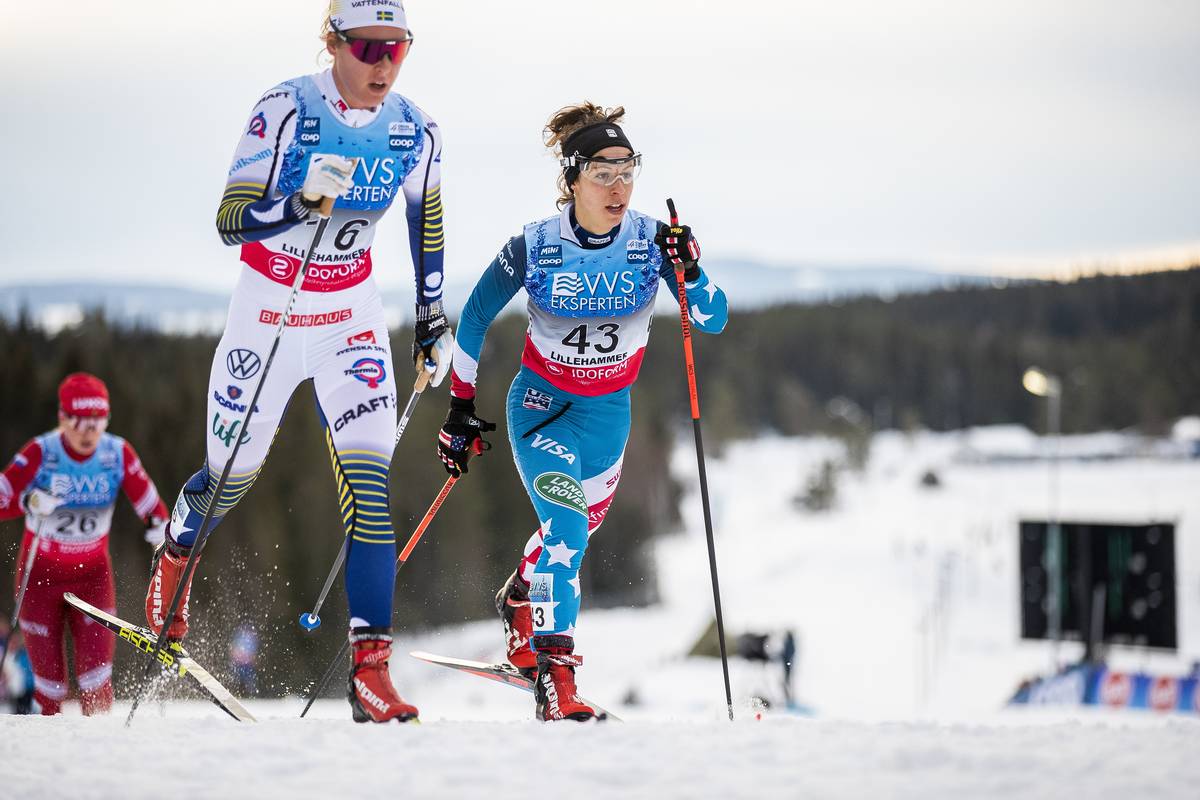
    Rosie Frankowski races a December 2019 skiathlon World Cup event in Lillehammer, NOR. (Photo: NordicFocus)

    The Olympic Dream. 

    Perhaps the opportunity to compete at the highest level of sport would not be as sought-after and revered were it not for the inherent scarcity of opportunities to achieve it. This year, only eight women and six men were able to represent the United States in cross-country skiing in Zhangjiakou, down from a total of twenty – 11 women, 9 men – who were selected for PyeongChang in 2018. 

    Among those who came up just shy was 30-year-old Rosie Frankowski, who has spent the last eight years training with APU under head coach Erik Flora. Frankowski is a 2018 Olympian and 2019 World Championship competitor, finishing inside the top-30 in both places – 21st in the 30 k classic in Korea and 24th in the 15 k skiathlon in Seefeld. 

    Rosie Frankowski skis through wet falling snow to win the women’s 10k at the opening SuperTour weekend in Duluth, MN. (Photo: Jordan Woods/Woods Creek Productions)

    After strong early season results that included two wins and three third place finishes in early season SuperTours, Frankowski lined up in Soldier Hollow for a two-week stretch of racing that felt like it was for all the marbles. As many women had already met the objective criteria for team selection via results on the World Cup, it was only the final few spots that remained open for domestic racers; in the hungry pool all fighting for these spots via some combination of U.S. Nationals, Sun Valley SuperTour, and Tour de Ski results were Frankowski, Caitlin Patterson, Alayna Sonnesyn, Katharine Ogden, Novie McCabe, and Sophia Laukli. 

    As Frankowski describes in this episode, her opening races – the freestyle sprint and the 20-kilometer mass start skate – of U.S. Nationals went remarkably well; despite being known as a distance specialist, she won the sprint qualifier and finished sixth in the final, then won the race for second place in the 20 k skate, behind Rosie Brennan who had dropped the field from the start. From there, Frankowski faced a series of challenges – slick skis and variable klister conditions in the 10 k classic, a fall in the classic sprint, and a sublexed shoulder in the opening race in Sun Valley. 

    Rosie Frankowski on course during a February 2020 World Cup in Östersund, SWE. (Photo: NordicFocus)

    The official team nominations for the 2022 Beijing Olympics were released the following week, and Frankowski was named as the second alternate for the women’s team. Five months later, Frankowski finds herself at a transition point in her career. It’s not a cut and dry retirement as she has earned Period I starts on the World Cup and has other race objectives next winter, but it’s a shift in focus as she and her partner prepare to relocate from Anchorage, AK to Durango, CO. 

    In this conversation, Frankowski shares the highlights and challenges of the 2021-22 race season, and provides invaluable insights into the experience of spending her career as a “bubble athlete”, fighting for international race opportunities and team selection, while juggling the financial realities of supporting her professional ski racing career. She reflects on her time with APU, and discusses defining success when surrounded by “more-accomplished” teammates, and how she expects the ratio of mountain running to ski-specific training to shift after this transition.

    Thanks for listening and thanks to Concept2 for supporting this podcast.

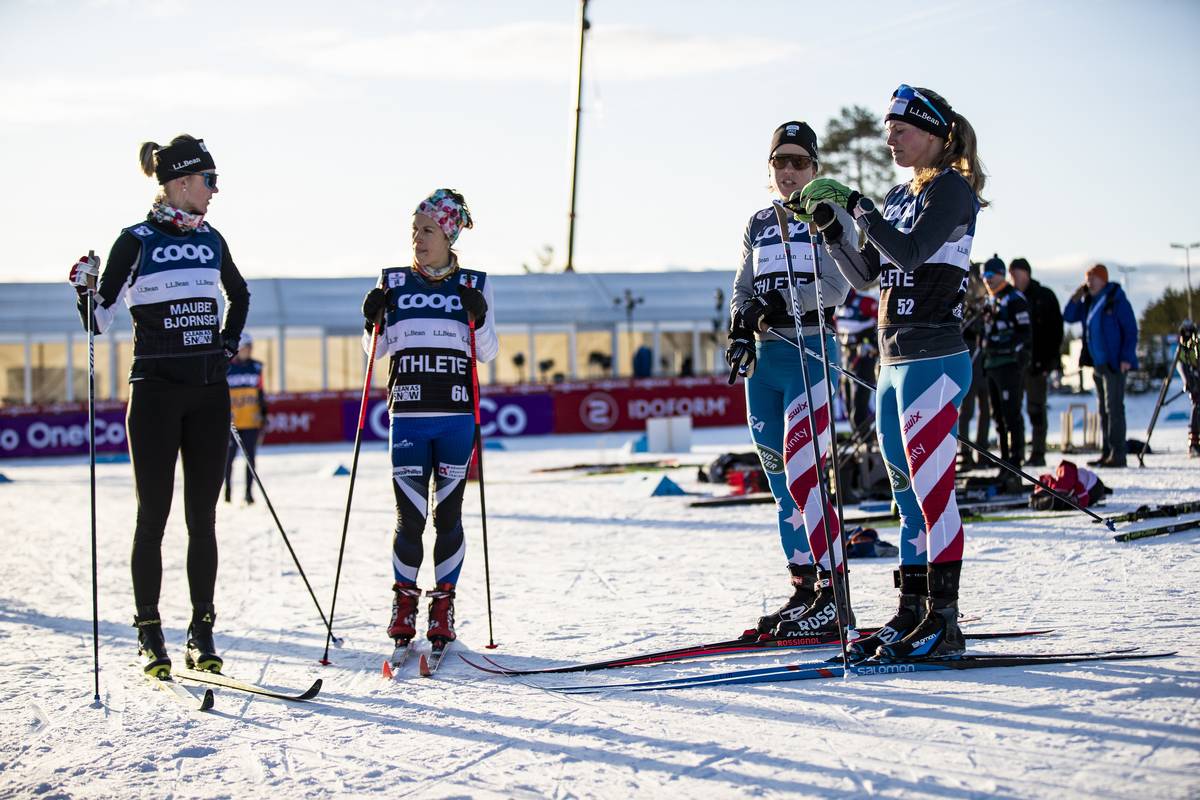
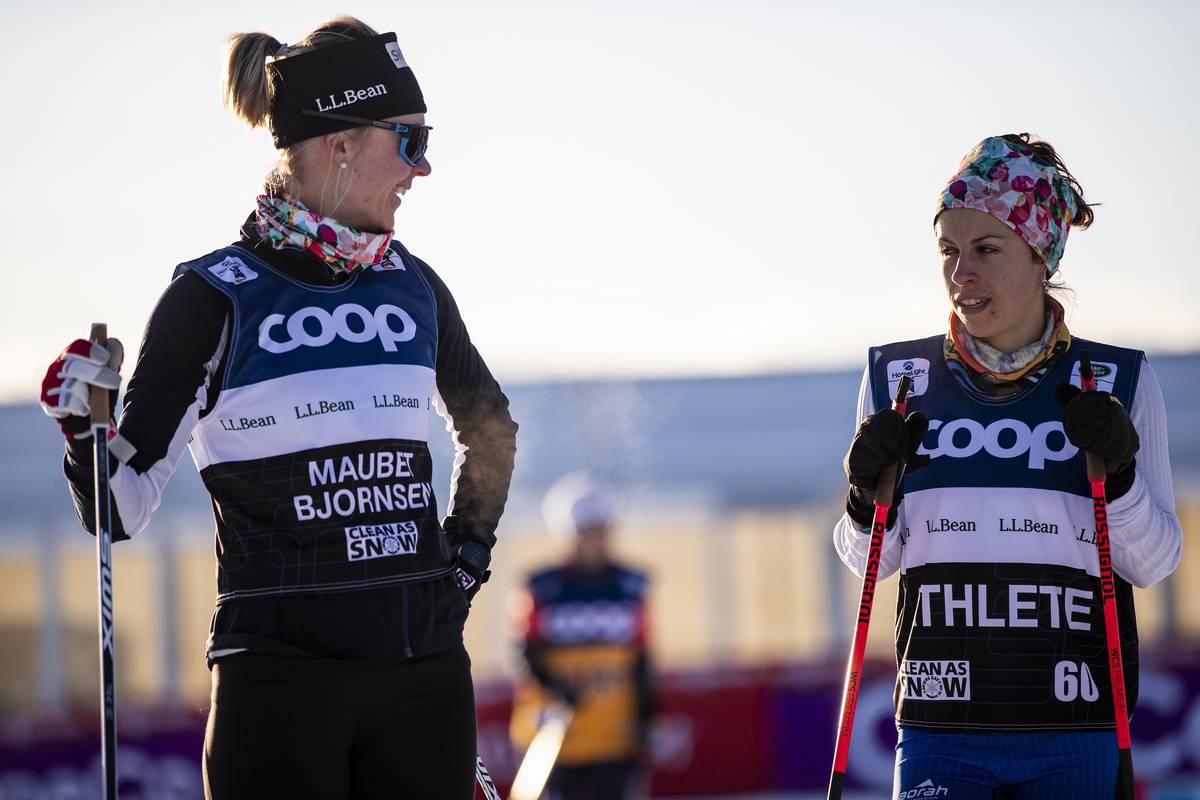
    Scenes from a training day in Lillehammer in December 2019. From left to right, Sadie Maubet Bjornsen, Rosie Frankowski, Rosie Brennan, and Jessie Diggins. (Photo: NordicFocus)
  • Cross Country With a Twist: NordicX Event Lights Up Anchorage 

    Cross Country With a Twist: NordicX Event Lights Up Anchorage 

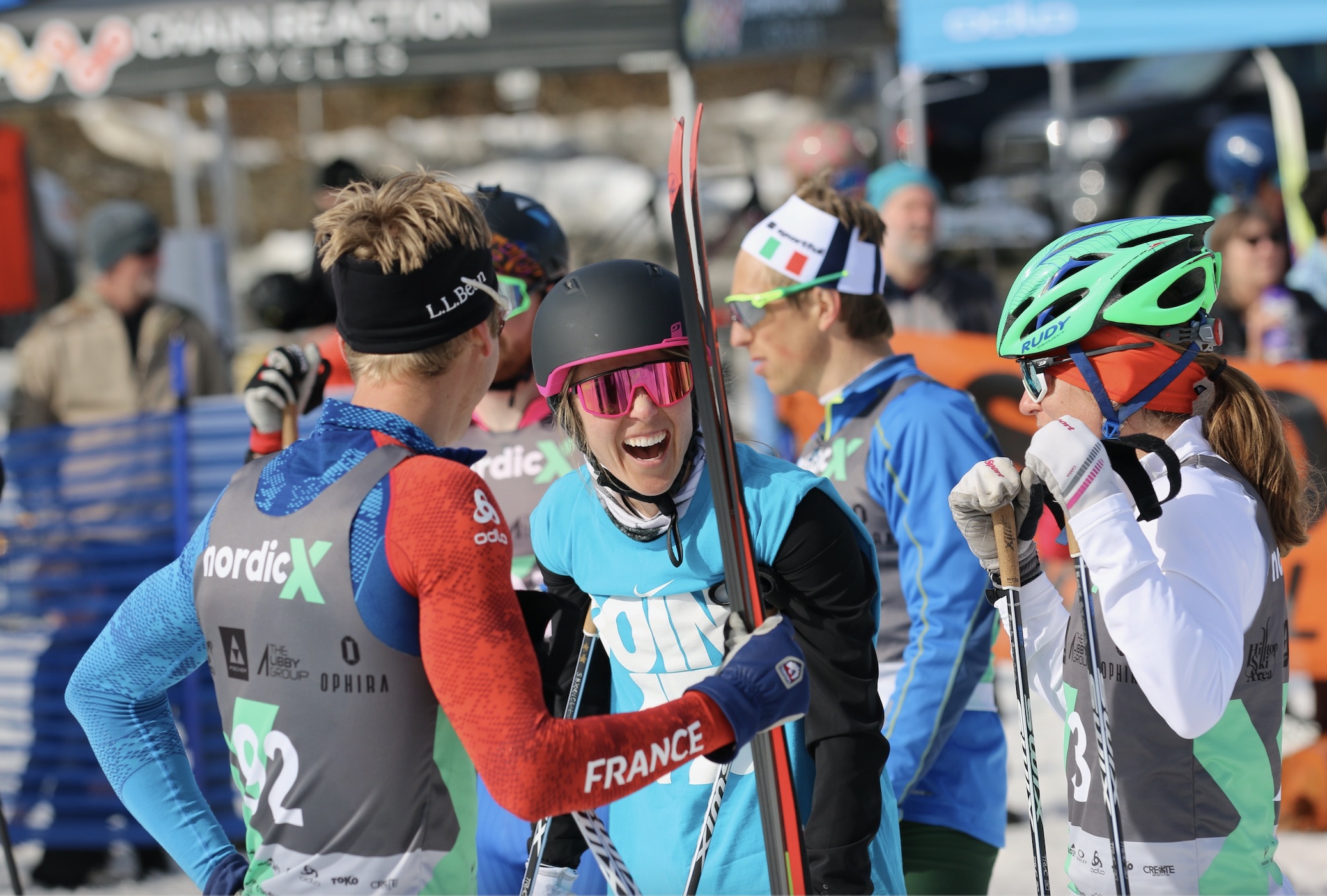
    Erik Bjornsen, Sadie Bjornsen Maubet, and Rosie Brennan enjoy a very different race atmosphere at NordicX. (Photo: Eric Maurer / NordicX)

    What comes to mind when you think of a cross country ski race? Depending on your location and how you choose to interact with the sport, there are likely a variety of answers to the question, but it’s likely that there are some common themes. 

    “Cross country events are pretty much all the same when you boil them down, you know?” said retired US Ski Team member and 2018 Olympian Reese Hanneman. “It’s a test of endurance and speed over a set course, and it’s timed, and you’re usually out there in the woods alone. And I mean, that’s what cross country [racing] always will be, but I always felt like there was room for more.”

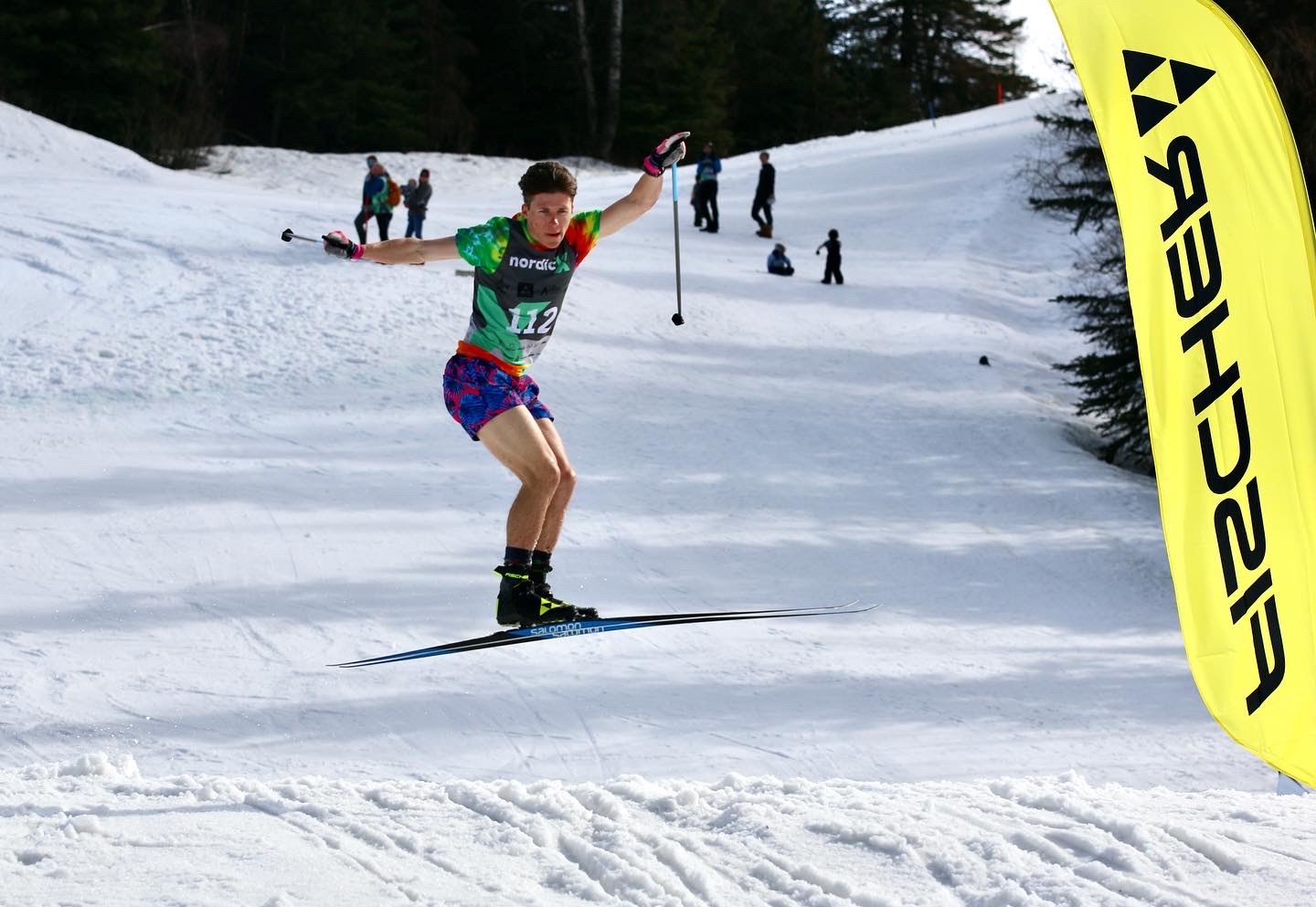
    In what he described as “living out [his] 10 year old dream”, Hanneman set out to break this mold. His dream came to fruition on April 2nd in his home of Anchorage, Alaska, as cross country skiers from the junior level to recent Olympians careened down the slopes at Hilltop Ski Area, rounding tight turns, skating uphill, and catching air – with some not-so-graceful landings – off of jumps before finishing amidst a festival atmosphere at the base. The event was NordicX, an untimed, head-to-head “nordic-cross” event where style points on the final kicker into the finish might earn you a lucky loser spot in the next round. 

    “I knew that there was a lot of appetite for [an event like] that because every time I coach kids, which has been quite a bit over my career, I see that same energy and excitement for hitting jumps and sessioning little whoopty-dos or tabletops. And basically, there’s no cross country event that caters to that.” 

    One of many kids enjoying the features on course and in the Kiddie Cross terrain park at NordicX. (Photo: Eric Maurer / NordicX)

    While Hanneman wanted a non-traditional event, he was not looking to eliminate the character or skills of cross country skiing altogether. He pulled from his experience competing in the 2016 Red Bull Nordix event at Lake Louise in Alberta, where he raced against other top international skiers including Norway’s Petter Northug and his US Ski Teammate Andy Newell.  

    “It was so fun and it was so crazy and scary and fast. And I was like, ‘Man, I need to bring this to Alaska.’”

    In creating his own event, he said he wanted to navigate the “delicate balance of new, exciting, and extreme, but also staying true to cross country skiing. It’s one thing to build a little booter next to the xc ski trail and ski ’round and ’round hitting it with your friends, and it’s another to try and package that experience into a full-on event that offers excitement for all ranges of skills and ages.”

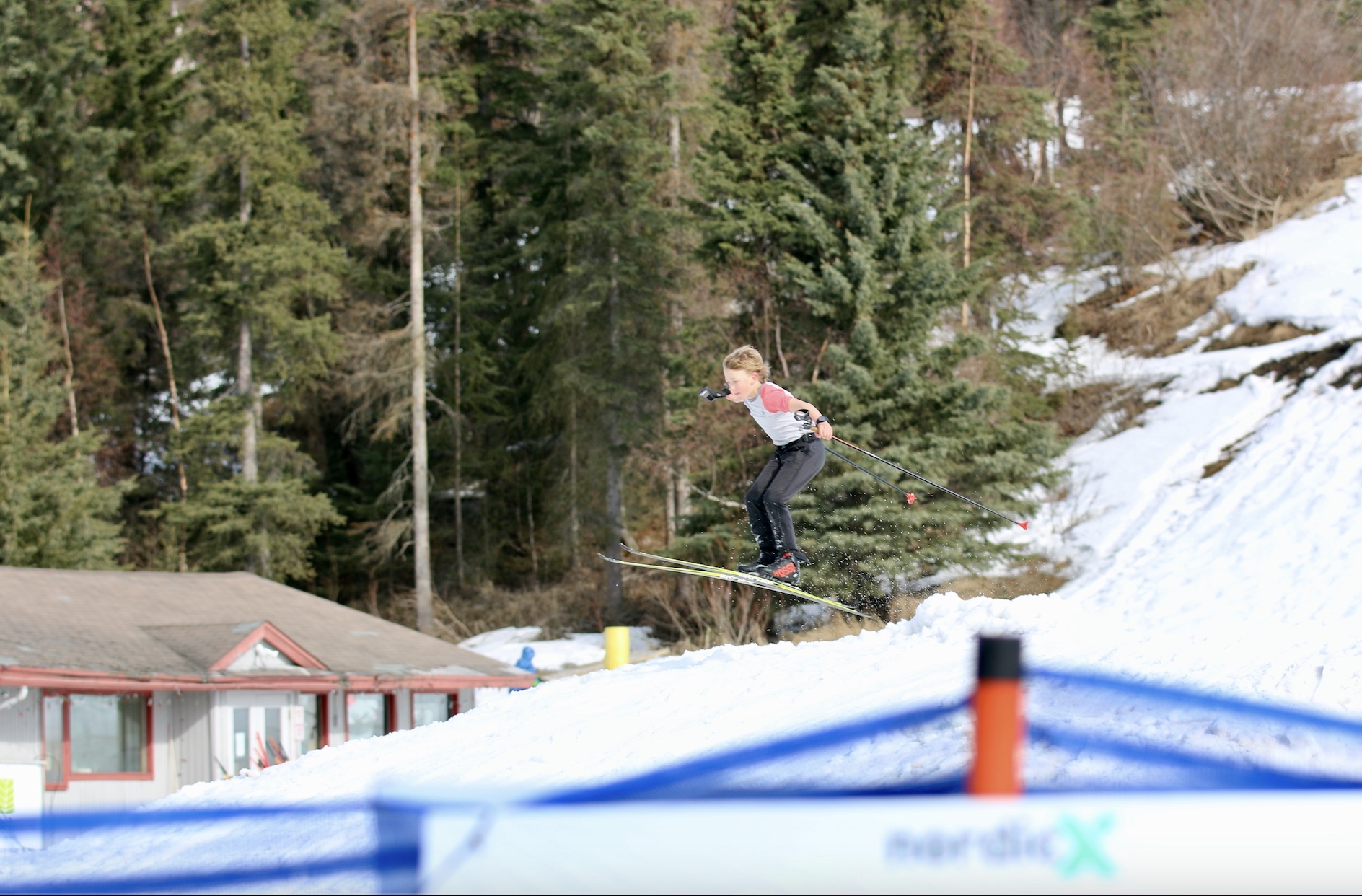
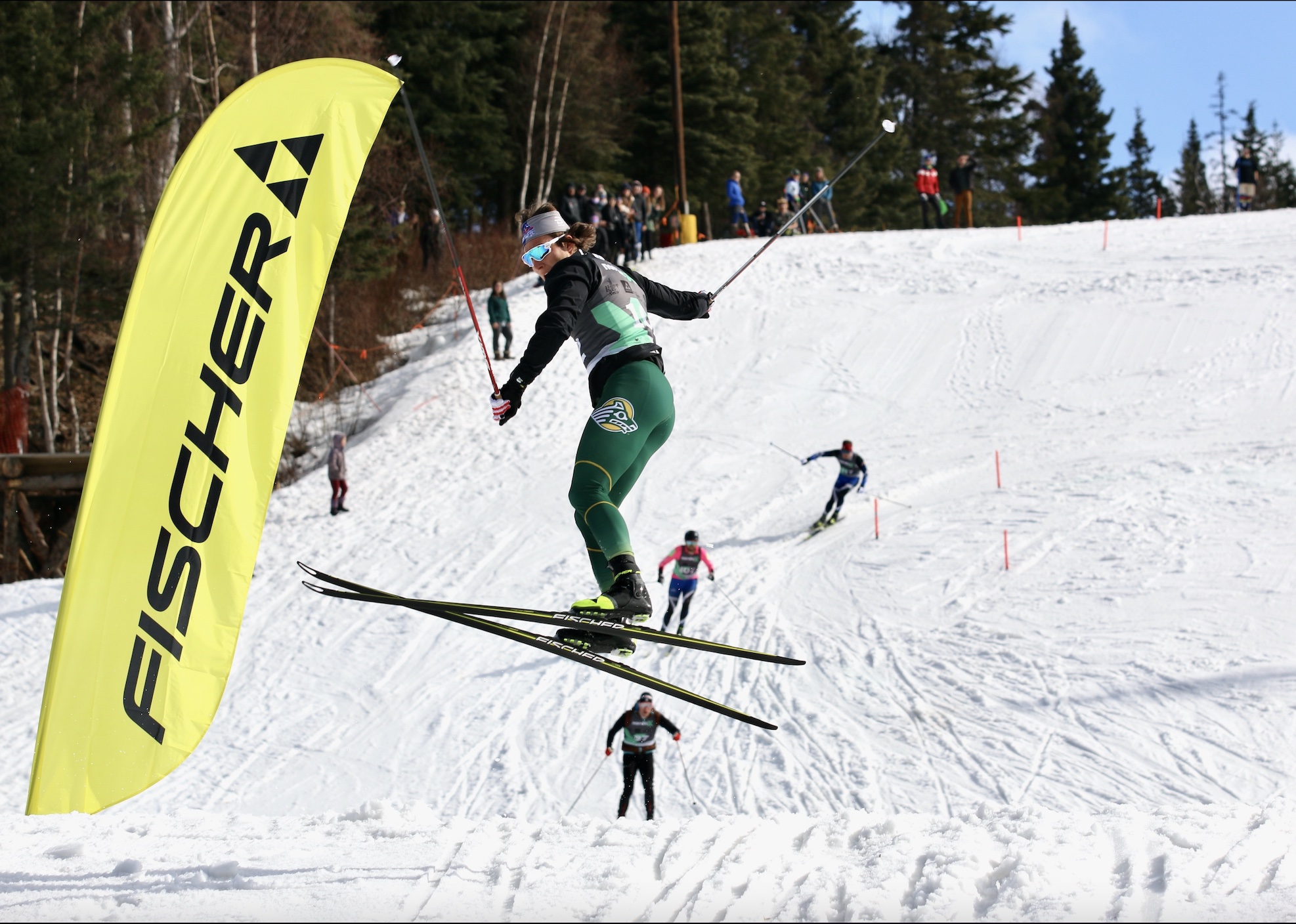
    JC Schoonmaker does a 360 into the finish at NordicX. (Photo: Eric Maurer / NordicX)

    “I knew it needed the right venue,” Hanneman continued. “I wanted something ‘net downhill’ because otherwise I felt like it would be too similar to other xc races, a loop with the same start and finish meant that in order to have a huge downhill you would need a huge uphill. But I also wanted it to be ‘cross country’, so that it truly rewarded good cross country skiers, and so that cross country skis were truly the best tools for the job.” 

    As the course and conditions hinged on both the weather and Hilltop’s grooming, an official course map was never set. To ensure the event catered to skiers beyond the nucleus of elite skiers based in Anchorage, an A-, B-, and C-Line was established on each of the features, making air-time not requisite and allowing athletes to select a route that felt safe, at the expense of simply forgoing the fastest line, which might pay off in the end if it kept the racer upright with equipment intact. 

    Holding to the spirited theme of the event, Hanneman described it as “a freestyle event in both feel and in practice,” meaning there were no official course maps, no timing, and plenty of subjectivity in the results. Get sendy and try to 360 off the final kicker into the finish only to crash and stall out before the line? Style points – you just became the lucky loser and can move on. Flooded legs from the uphill sprint section cause you to catch an edge off the drop and yard sale? The crowd loved it – lucky loser spot for you also. 

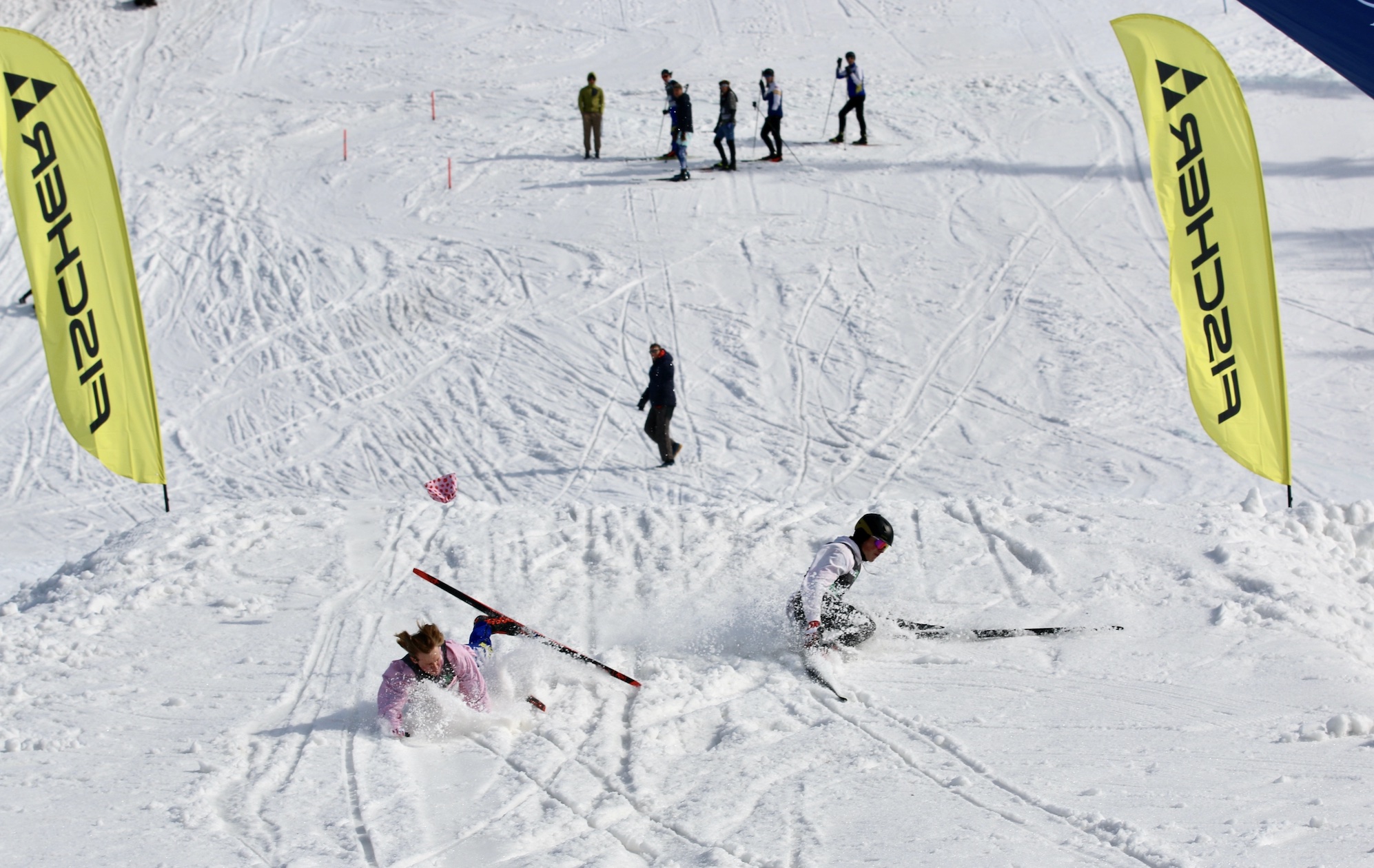
    Not everyone stuck the landing at the finish of NordicX… (Photo: Eric Maurer / NordicX)

    No official prologue seeded athletes; after a few hours where skiers could preview the course, the event simply kicked off with heats of six in the quarterfinal, splitting the 100 athletes between open and junior men’s and women’s categories. Among the field were six Olympians: alphabetically, Erik Bjornsen, Rosie Brennan, Hannah Halvorsen, Logan Hanneman, Sadie Bjornsen Maubet, and JC Schoonmaker, most of whom ended up on the podium at the end of the day. Next year, Hanneman hopes to include additional categories for parents, masters skiers, etc. 

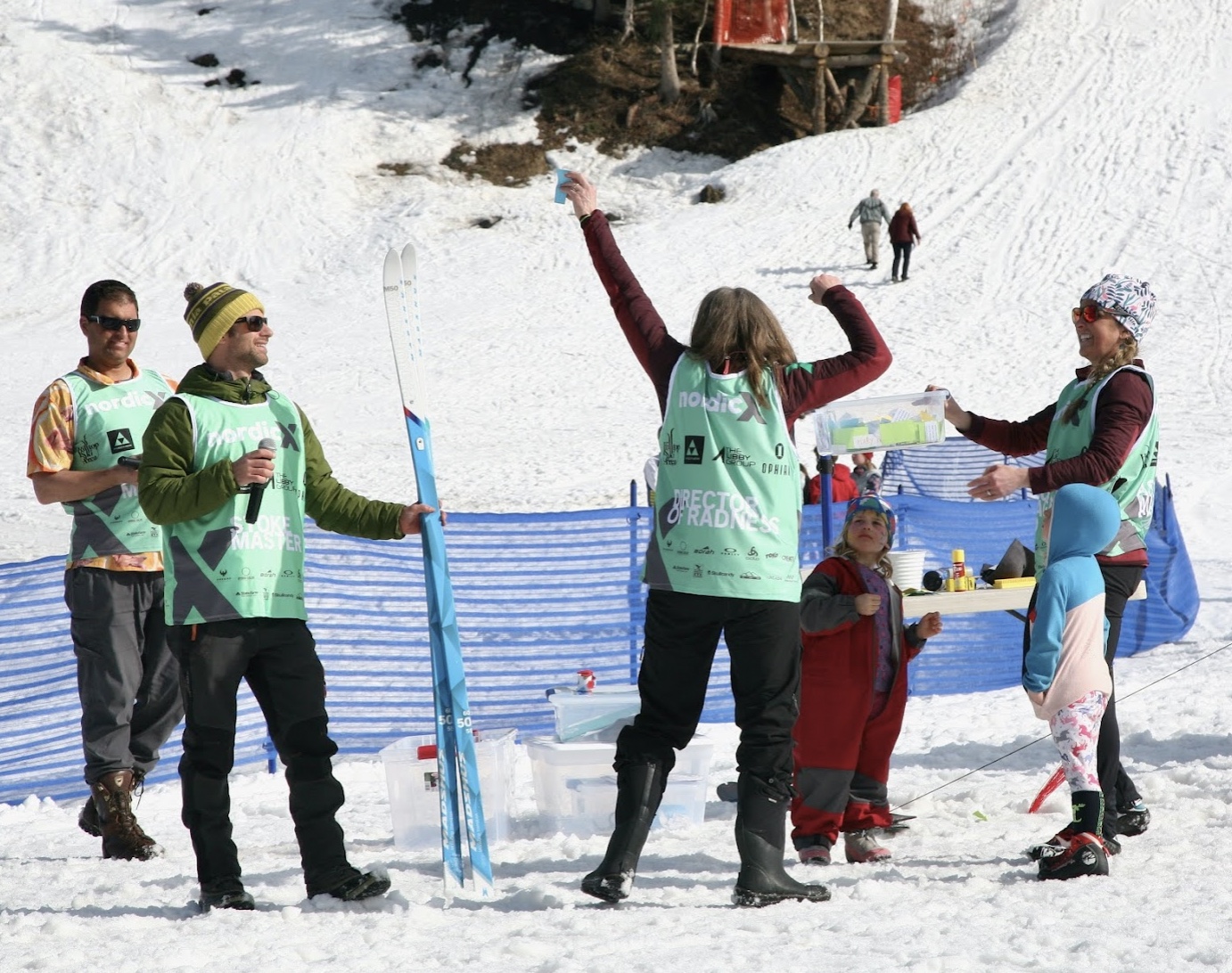
    For those who weren’t up for racing or couldn’t quite match the on-ski agility of Maubet or Schoonmaker, a continuous stream of raffles offered plenty of alternative opportunities to win. A DJ fed the energy at the base, while emcees Rob Whitney and Lee Bolling kept the momentum alive between heats, announcing the winners of numerous prizes from sponsor companies like Odlo, Fischer, Oakley, Skull Candy, Toko, and more.  

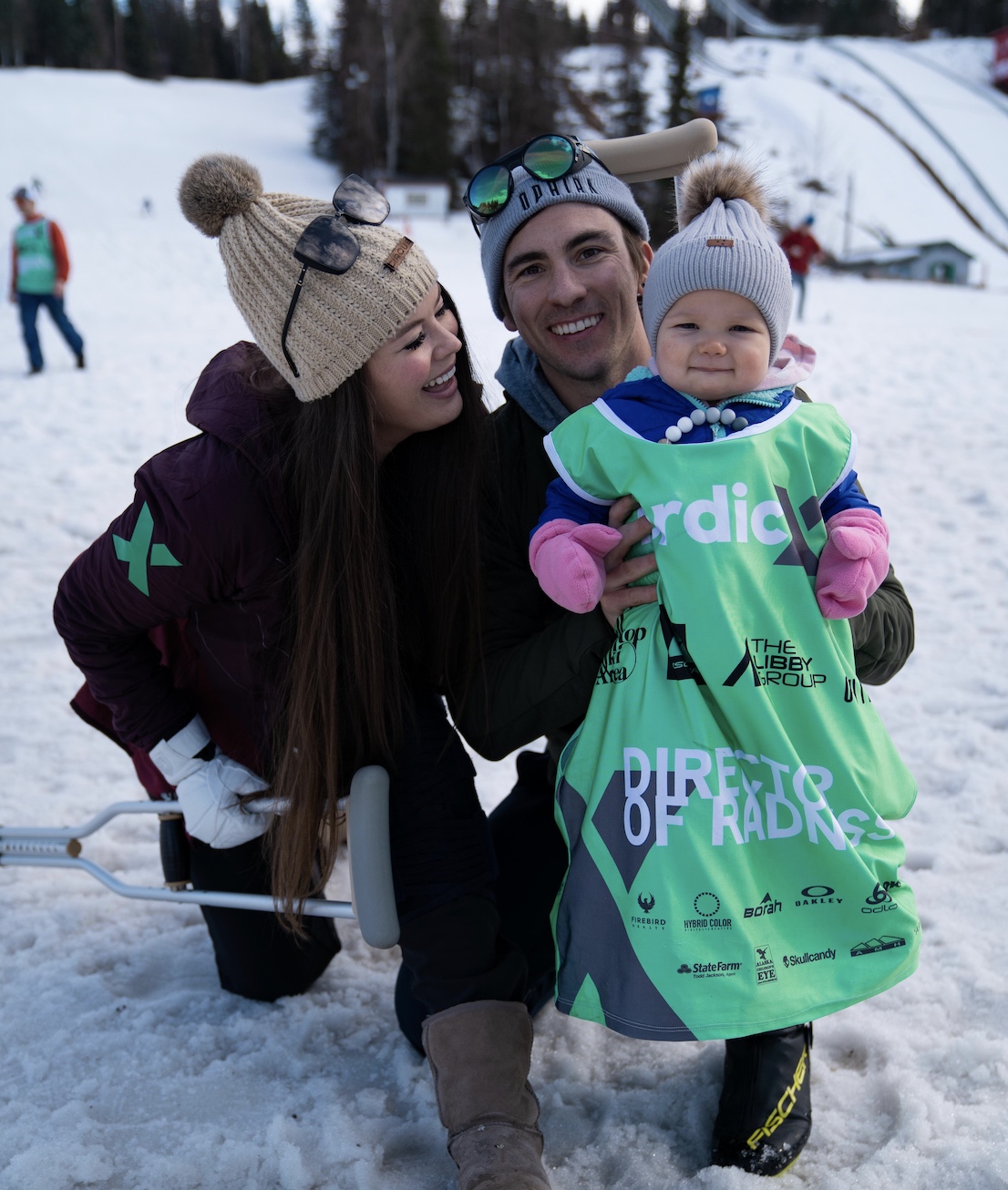
    Emcees, director of radness, associate director of send: keeping the energy high at the base with continuous prize drawings. (Photo: Eric Maurer / NordicX)
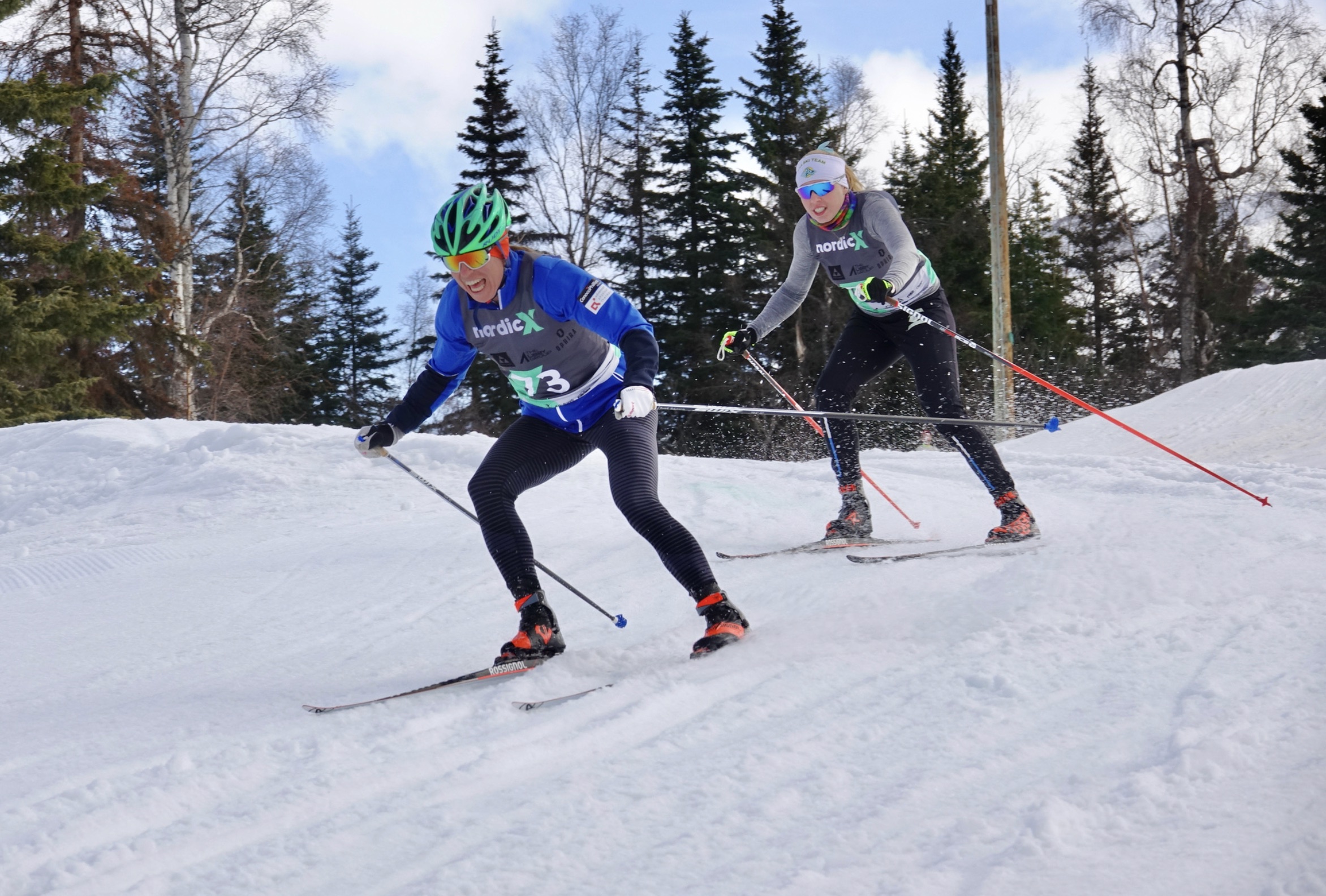
    Rosie Brennan charges around a tight turn as she races through the heats at NordicX. (Photo: Russell Hood / NordicX)

    Though these factors added to the festival atmosphere at the base, spectating alone was plenty exciting. In particular, the finish of the senior men’s final was one to watch. 

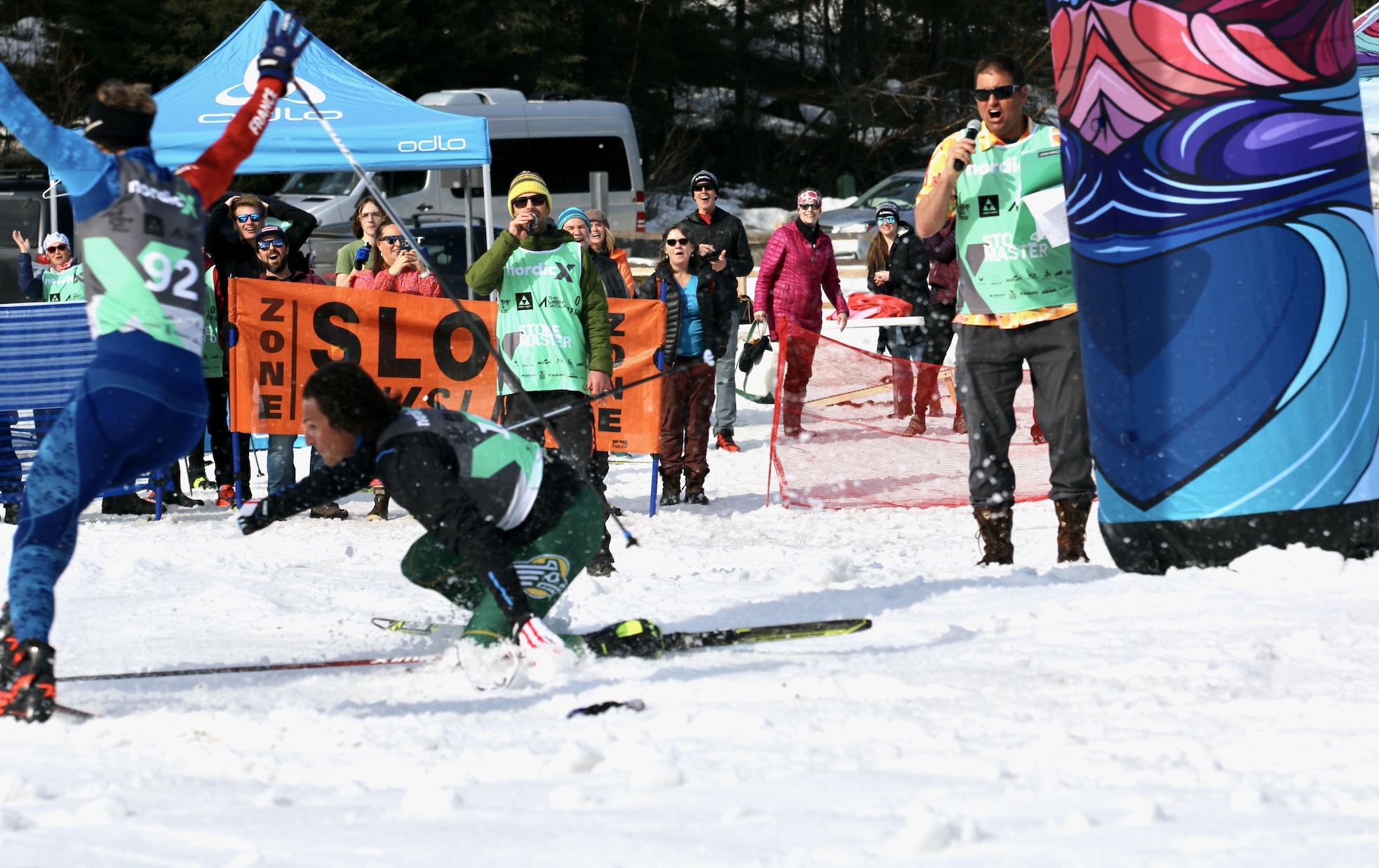
    “You couldn’t have scripted a better finish,” Hanneman laughed. “You had JC Schoonmaker, who’s one of the fastest sprinters in the world right now, and Erik Bjornsen, who was just on fire all day back from retirement. [They were] just completely sending it and just flying through this final steep slalom section, and Erik is trying to catch JC, and JC is trying to hold him off. They go to the finish, over this big table top, and everyone’s holding their breath. JC goes off it and does this massive spread-eagle.” 

    But he didn’t stick the landing. Landing a little too far in the backseat, Schoonmaker’s skis washed out from underneath him, leaving him sliding across the snow toward the inflated archway that marked the finish. He stalled out just before reaching the line.

    “Erik is coming at Mach 50, about to beat him to the line. JC has to roll over and, like, flops [his skis] over the line.”

    Erik Bjornsen sticks the landing, but JC Schoonmaker flops over the line first for the win.a (Photo: Eric Maurer / NordicX)

    From a photo finish, Schoonmaker was awarded the victory, with Bjornsen narrowly taking second. U20 APU athlete Michael Earnhart skied to third, taking the final podium step.

    “NordicX was one of the most fun races I’ve participated in,” wrote Schoonmaker after the event. “It took me back to middle school building jumps with my friends and seeing how far we push the skinny ski boundaries. Everyone who took part in putting the race on did a great job and with the spectators who came out, it really just had a good vibe to it. Everyone was having a great time and I’d definitely like to do it again. My highlight was watching some of the younger skiers before the race who were hitting the last jump doing 360’s and backflips and seeing how pumped up they were to be there.”

    The men’s NordicX podium: JC Schoonmaker came out on top in a dramatic photo finish with Erik Bjornsen, while Michael Earnhart took third. (Photo: Ophira Group / NordicX)

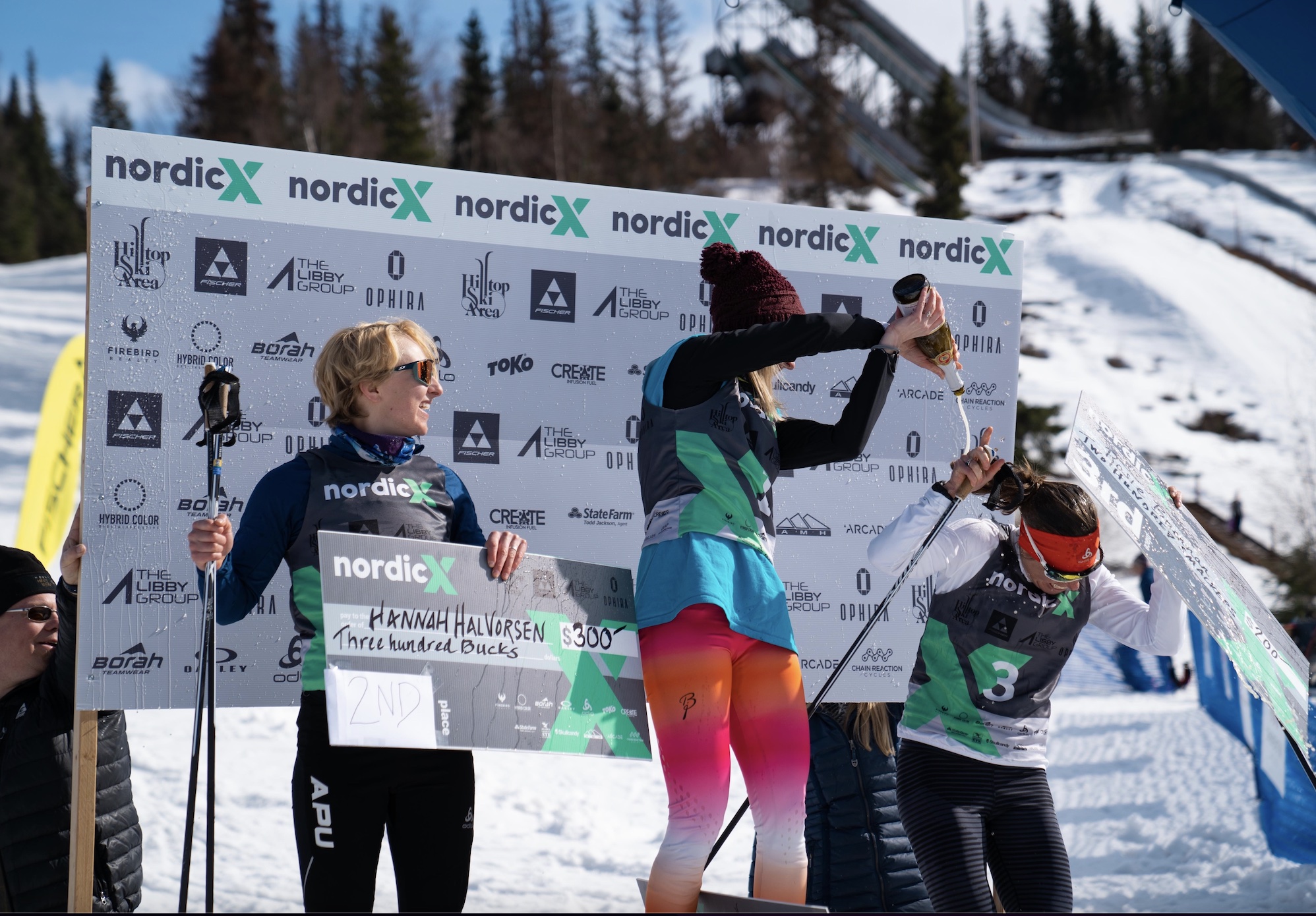
    In the senior women’s senior division, it was a current and former APU athlete sweep, with Sadie Bjornsen Maubet taking the win ahead of Hannah Halvorsen in second and Rosie Brennan in third. 

    “Nordic X was a super fun event, with a fun new twist to nordic skiing, and nordic ski spectating,” wrote Bjornsen Maubet. “Reese did an amazing job of dreaming up this super fun and social way to share our sport with our community… I relied on my thirty years of spending most of my days on nordic skis to attempt to gracefully make it down the little jump park. Though incredibly inspired by all the young kids catching tons of air, and throwing font and back flips, I figured I better save those moves for another life. The day was full of tons of laughs, cheers, and excitement. It felt special to put a bib on beside my previous teammates, and participate in the fun. 

    “I look forward to watching this spectator friendly event grow in the Anchorage Community. I think my husband had the most fun of us all, as he showed up with his chainsaw without the blade, some flares, and wearing a hat that said  ‘Make the Bjornsen’s Great Again’. He was the cheering squad of the day, representing his French blood and the famous French Team Valoche cheering squad.” 

    The women’s podium at NordicX: Sadie Bjornsen Maubet took the top spot ahead of Hannah Halvorsen and Rosie Brennan. (Photo: Ophira Group / NordicX)
    When you can’t spray, pour. Winner Sadie Bjornsen Maubet shares a champagne celebration with third place Rosie Brennan. (Photo: Ophira Group / NordicX)

    For Hanneman, there were also a number of smaller highlights he’s enjoyed looking back on. While marking the course with food coloring, he loved watching skiers riding the lift to the top of the course on their skinny skis, and seeing athletes from 13-year-olds to veteran racers sessioning the course to dial in their lines and strategize. During the heats, he watched a number of young athletes gain confidence, and perhaps some additional skills, after working through initial trepidation surrounding the new race experience. 

    “There were some juniors who you could see at the start of the day were pretty intimidated by the last part of the course, which was really steep and had some sharp slalom turns,” Hanneman explained. “It was definitely challenging their skill level. And by the end of the day, like they were coming through and just ripping, and they were having so much fun and you could tell they had gotten a lot better just in a couple hours.”

    One of many kids enjoying the features on course and in the Kiddie Cross terrain park at NordicX. (Photo: Eric Maurer / NordicX)

    For those 12 and under and too young to compete on the full course, there was a “Kiddie Cross” course, which included banked turns, tabletops, a rhythm section, and a number of other terrain park features for kids to play on and session.

    “The parents love it, right? Because the parents are just sitting there in the sun, watching their little kids just love cross country skiing.” 

    He commented that he had friends who had been trying to sell their child on cross country skiing but felt like it was a hard sell compared to downhill skiing. “They were like, ‘Oh, man, I’ve been trying to get her out on their cross country skis all year and they don’t want to go,’ and they brought him to this event and their kids were like on their on their cross country skis just doing laps up the hill 1000 times so they could go back and hit the jumps again. So for me, that right there is like the essence of this event.”

    A pair of NordicX racers ride the chairlift with their skinny skis. (Photo: Andre Horton / NordicX)

    In reflecting on the event and its impact on the local cross country ski community, Hanneman felt it added “a shot of energy… I mean, there’s so many cool races out there, but this is just a little bit different. And I think it gets people excited.”

    While the biggest air and most impressive skill was seen from the elite racers, Hanneman kept coming back to the youth participating in the event, highlighting that it really was his boyhood dream to see an event like this in Alaska. 

    “Something like this would have probably excited me for a whole year like knowing that it was coming. And I think the more people that we get excited about cross country skiing the better, because I think it can be a really fun sport, but, let’s be honest, sometimes it has this perception of being kind of slow and boring, and hard.”

    He described it as the type of event that could nudge skiers with that perception to give it a try, opening their eyes to what’s possible and how fun the sport can be. While there are perhaps other locations in the US that might be a candidate to host, Hanneman also explained why Anchorage is an ideal location for NordicX.

    Spectators catch the NordicX action from the base of the Hilltop Ski Area in Anchorage. (Photo: Eric Maurer / NordicX)

    “We have a huge ski market here, massive participation in high school skiing, and obviously a ridiculous number of elite-level racers here.” 

    On all accounts, the first year of NordicX was a success, which begs the question: what are the plans for next year? 

    “So many people came up and were like, ‘I can’t wait for next year.’ And I’m like, ‘Oh, man, I don’t know.’ I haven’t necessarily committed, you know? This was a crazy undertaking.”

    Since retiring from professional ski racing, Hanneman has been investing his time and energy in starting and serving as CEO for the PR agency, Ophira Group. He and his wife also welcomed a baby girl in March, 2021, and he’s remodeling their family home. He expressed that pulling off the inaugural event was already “pushing the limits” of what he should take on.

    Balancing CEO and family life with NordicX planning, Reese Hanneman hosts the xc ski event of his childhood dreams. (Photo: Ophira Group / NordicX)

    “I do want to say thank you to the team that we put together which includes Lauri Bassett (exec. administrator at Cross Country AK) and Rob Whitney, and the people at Hilltop, because without them, this absolutely would not have happened.”

    As for next year, “people are too excited about it for it to not happen again.” And he wants to see it happen for a second year. To pull it off, he anticipates putting together a larger team to more evenly distribute the workload, “just so that we can all maintain a healthy NordicX-life balance.”

  • David Norris: Missing out on 2022 Olympic Team selection, “making the best of it”, and what’s to come.

    David Norris: Missing out on 2022 Olympic Team selection, “making the best of it”, and what’s to come.

    David Norris skis to 34th in 15 k classic pursuit in Östersund, Sweden in February, 2020. (Photo: NordicFocus)

    It’s hard not to root for David Norris. 

    Often affectionately described by Devon Kershaw as a “grinder”, the humble 31-year-old Fairbanks, AK native has been an eternal underdog, despite consistently performing among the best American distance racers of his generation on the World Cup. Highlighting his career, Norris has finished in the top-20 three times during his appearances in the 2019 and 2021 World Championships. His best result arrived in last year’s Championships in Oberstdorf, Germany, where he placed 16th in the 50 k classic and 17th in the 30 k skiathlon. 

    Although Norris has been routinely been offered World Cup starts over the last five seasons, he has consistently hovered in the liminal space just behind the cutoff when it comes to selection to the U.S. Ski Team, whose age based-criteria becomes tougher to achieve over time. Given his birth year of 1990, Norris needs to be ranked in the top-40 in the world according to his FIS points from the previous season to be named as a B-Team athlete. In 2020, the margin by which he came up short was incomprehensibly small; a mere 0.88 FIS points, equivalent to eleven seconds in a single race during the season, left Norris ranked 43rd in the distance standings in March of that year.

    Without financial support from the US Ski Team, Norris forged on, relying solely on his personal sponsors.

    Read more on age-based criteria here, or take a deep dive into FIS points and Norris’ circumstances here. 

    Then, as the 2020/21 World Cup season loomed the following November, Norris contracted COVID-19. At the time, there was little information available on how elite athletes should return to training and competition following a coronavirus infection and what the risks of an expedited return might be. While more is available currently, the message has not changed: use caution and take it slow. 

    Consequently, Norris sat out Period 1 and the Tour de Ski, making his World Cup return in late January 2021, finishing 32nd in his first race back – a 30 k skiathlon in Lahti, Finland, roughly one month shy of the Oberstdorf World Championships. Despite two top-20 finishes in Oberstdorf, where he was also the second American, behind only his APU teammate Scott Patterson, Norris was again left off the US Ski Team in the spring of 2021. The decision inspired one of his competitors, Craftbury’s Ben Lustgarten, to pen an OpEd to campaign for Norris’s ex post facto discretionary nomination to the team. 

    David Norris fist bumps a competitor after finishing 17th in the 30 k skiathlon during the 2021 World Championships in Obsertdorf, Germany. (Photo: NordicFocus)

    Heading into the 2021/22 season, Norris had a goal of making the Olympic Team, but he knew that, once again, the odds were not likely to be in his favor. The US had just five guaranteed quota spots for Beijing, with a likely sixth on the table.

    If you’ve found your way to this story, you likely know how Norris fared.

    After a solid summer of training, Norris started upon his usual trajectory of sub-optimal early season races, which generally progress to peak race results in February and early March. In November, Norris was 37th in the 15 k freestyle pursuit in Ruka, Finland, skiing the 27th-fastest time of day, but he never cracked the top-30 to score World Cup points in Period 1. Heading back to the States to race in the U.S. Cross Country Ski Championships in Soldier Hollow in January, his results began to trend upward. Though he’s always excelled in distance, he took 7th in the freestyle sprint, after qualifying second. Then, two days later, he was second in the 30 k mass start skate, 11 seconds behind winner Scott Patterson. 

    Twelve days later, in the final race weekend before the Olympic qualification period ended on January 16th, Norris won a 15 k individual start classic at the Lake Creek Nordic Center in Ketchum, ID.

    David Norris leads the way through a corner on his way to a win in the SuperTour 15k mass start classic in Sun Valley. (Photo: Tobias Albrigtsen / @untraceableg)

    On January 20th, U.S. Ski & Snowboard announced the 2022 Olympic Cross Country Team, and Norris’ name was not on the list.

    This background is not intended to imply Norris should have made the 2022 Olympic Team. Rather, the intent is to highlight his candidacy to frame an interview on Friday, February 25th, the day before the 2022 American Birkie, in which Norris discussed the experience of falling short of his Olympic goal, how he “made the best of it”, and what his next steps are as he begins to shift his focus away from the World Cup.

    Returning to the team announcement, Norris explained that although he was disappointed, not being selected was not a surprise given the selection process that had been outlined. He shared that “there was no dialogue at all” with US Ski Team coaches leading into the announcement, but that it also had never felt “closed”, either. 

    Following his second place finish in the 30 k skate in SoHo, Norris had written to FasterSkier “Every season I ski much stronger in February and March, so I’m sure good form is on the horizon, but that doesn’t help me achieve my goals when I need to be skiing well right now. All I can do now is focus on the 15 k classic coming up and then rest and prepare for the next races.”

    As he acknowledged, an emphasis was placed on strong early-season results, which he did not post, and he had not expected that his historic championship results would be factored into decision making. That said, as a distance skier, looking at a Games which would be held at altitude on challenging courses that would “basically reward people who are very fit”, it was difficult to recognize he’d never have the opportunity to put his strengths on display.

    “It was tough,” Norris said simply. “Seeing that the criteria kind of rewarded 15 k races, when two out of four individual races [at the Olympics] were 30 and 50 k for the men. And yeah, I was aware of it all, but it kind of sunk in just during the Olympics and watching.” 

    Of the six men who met the outlined objective criteria and were named to the Olympic team, four were primarily sprinters: JC Schoonmaker, Kevin Bolger, Ben Ogden, and Luke Jager. However, each started in either the 15 k classic or the 4 x 10 k relay, in addition to the two distance racers, Patterson and Gus Schumacher. 

    “But I still cheered my heart out for the guys who made it,” Norris added emphatically. “I don’t hold anything against the guys who are nominated. All congratulations to them — no personal difference against those guys. Everyone who went is a good friend, and I’m stoked for them.”

    APU teammates Scott Patterson (left) and David Norris (right) head to the start of the men’s 30k mass start freestyle at the 2022 U.S. Cross Country Championships in Soldier Hollow, UT. (Photo: Tobias Albrigtsen / @untraceableg)

    When weather shortened the men’s 50 k skate to a 30 k, Norris watched his APU teammate Patterson race to 8th place, an historic result for the American men, second only to Bill Koch who earned an Olympic silver medal and a 6th-place finish in Innsbruck, AUT in 1976. As mentioned previously, roughly six weeks prior, Norris had finished 11 seconds behind Patterson in a 30 k mass start skate at a similar elevation in SoHo. Though four start spots were available for each nation in the Olympic 30 k, Patterson was the only American in the race that day. 

    Never one to say “woe is me”, Norris chose not speak directly to the experience of watching that race. Instead, he recognized that he was not the only strong and fit American distance skier who did not make it to Zhangjiakou. 

    “There were such limited spots for the men’s quota that, no matter what happened, good skiers were gonna get left behind. But yeah, just given that three out of four individual races are distance, and the relay’s distance, it was kind of a bummer to see them not give any priority or emphasis to distance where we could have accumulated probably the best results. I think the 30 k (skate) at Nationals and 15 k (classic) at Lake Creek in Sun Valley, kind of showed where the fitness stacked up in the U.S. field. And I think mass starts are one of those places where you can’t really hide your form — you see how fit people are. And yeah, Scott and I are really similar and we train together, and I think it just kind of came down to –

    I trained for chasing a goal of a top 10 at the Olympics, and it was far harder to make the team than to actually probably reach that goal… But it’s just limited spots and tough how it came down.”

    David Norris wins the 15 k mass start classic in Sun Valley, ahead of his APU teammates, Hunter Wonders and Scott Patterson. (Photo: Tobias Albrigtsen / @untraceableg)

    Norris is not the first person to be left off an Olympic team who was perhaps qualified and deserving of a spot. Every four years, FasterSkier reports on those just behind the cutoff, which often sparks impassioned responses from fans supporting athletes on both sides of the bubble. 

    For Norris, this means outreach and support from a number of athletes who had been in the same situation and could share perspective from a place further removed from the moment. 

    “People have been super encouraging. One of the guys who made it based on the criteria but wasn’t taken four years ago reached out and said, ‘Use this as your secret weapon — you chase goals and come up short. And that’s kind of the way it works out more often than not, and you learn a lot from from that.’ Based on some of the encouragement from people in similar spots, it was really reassuring to hear their words and realize that the last four years or the last eight years pursuing a goal, it wasn’t a waste just based on a single selection. 

    And maybe there’s been moments where I have to kind of lie to myself that that’s the case, but I genuinely believe it. I don’t regret going for the Olympics, and then coming up short on my goal, it’s all been a positive experience for me.”

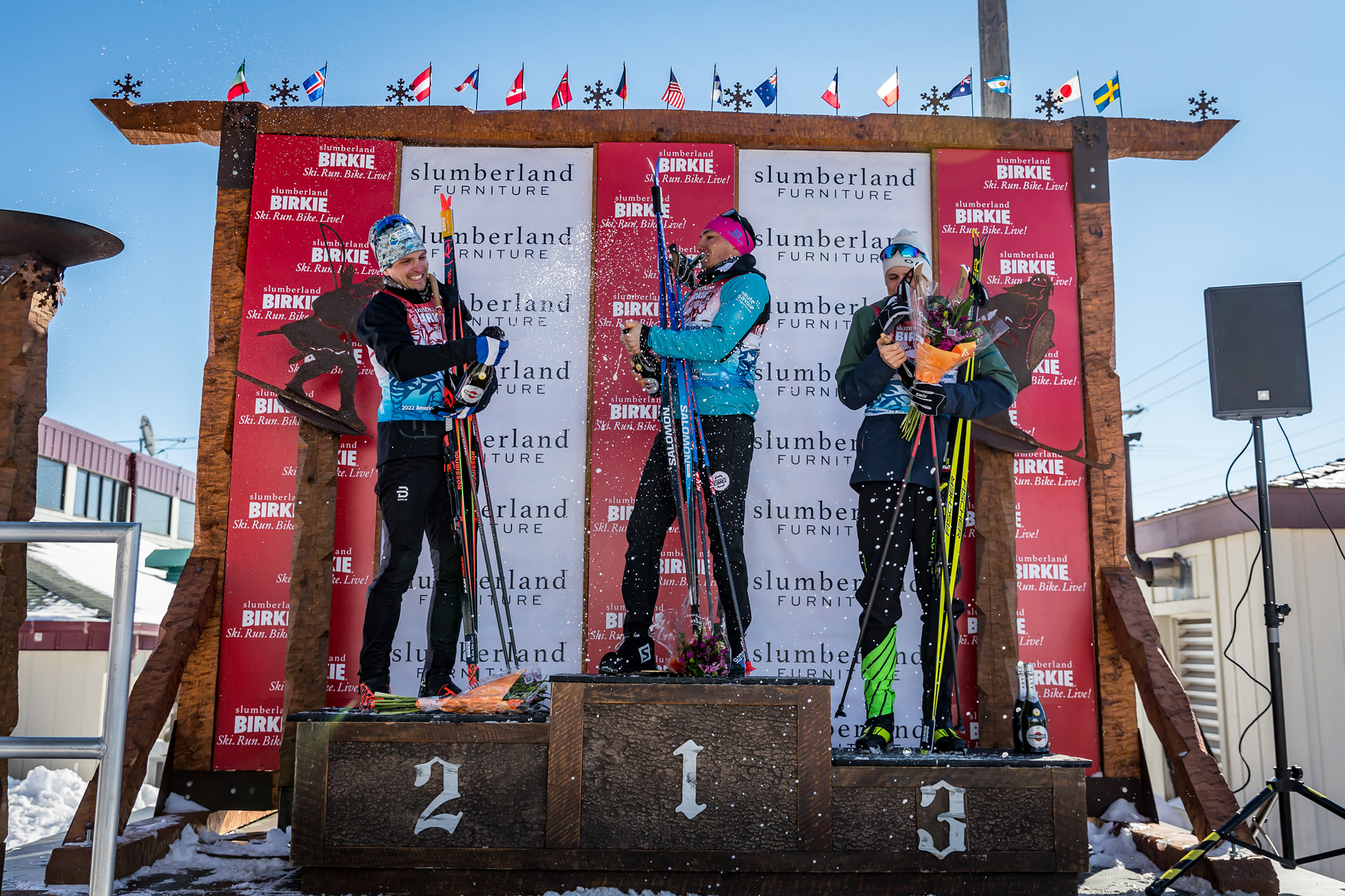
    Champagne spraying on the 2022 men’s American Birkebeiner podium, where David Norris (left) was edged out by France’s Gerard Agnellet in a boot slide at the finish. (Photo: ©2022 American Birkebeiner Ski Foundation)

    In the post-Olympic 50 turned 28 k episode of the Devon Kershaw Show, guest Kris Freeman, who spent years at the top of American men’s distance skiing, was critical of the American program’s lack of support of men’s distance skiing. Freeman pointed out that Patterson was the “only guy of his generation that got any U.S. Ski Team support.” He then added, “in the last six years, it’s been like, ‘Well, we got [Gus] Schumacher and Luke [Jager], let’s just wait till they come up.’”

    Though perhaps in a less outspoken and direct manner, Norris affirmed Freeman’s sentiments, acknowledging the challenge many of this country’s top distance racers have faced in funding the career longevity often required to reach peak potential as an endurance athlete. 

    “I couldn’t do it without my personal supporters because there’s nothing coming from the national team. And there is definitely that sense of, like, Scott’s in the system. They’re hanging on to him, and he’s producing awesome results. But then, yeah, I think Freeman’s words are pretty accurate, I guess.” 

    Norris pointed to the U.S. Ski & Snowboard mission as a root of the challenge. The header on the cross country team page states: “We’re built around one common goal—provide the right resources for athletes who are inspired to be the Best in the World.” Though he was seen as one of the best in the US, his trajectory was arguably not one that was likely to produce Olympic or World Championships medals, a focal point of U.S. Ski Team selection criteria.

    The introduction to these criteria reads: “The U.S. Ski Team will select only the most qualified athletes with the greatest possibilities for winning medals in future World Championship and Olympic Winter Games competitions. Selection criteria will stress performance in the Olympic Winter Games, World Cup and the U23/World Junior Championships in the 2021-22 season. Selection criteria will also stress progress toward individual performance markers, set forth by the U.S. Ski Team coaches, which point toward international success.”

    David Norris cracks the top-20 with a 17th place finish in the 2021 World Championship 15k/15k skiathlon in Oberstdorf, Germany. (Photo: NordicFocus)

    The statement perhaps clarifies the philosophy that has kept Norris from meeting objective criteria for the team. Though he has been an asset to the distance program, and was likely to post some of the top American distance results during the Games, his potential to earn future medals was lower than a younger budding athlete with strong World Juniors results, like Schumacher or Jager. While this could be sensible from a long-term investment perspective, it may also push some of the top distance athletes out of the sport at young ages, typically thought to be prior to when one reaches his or her physical peak for endurance racing.

    One might look at Rosie Brennan who at 33 years old, and after having been left off the U.S. Ski Team on two separate occasions, is coming off a second season as a regular podium threat, with a growing list of top-10 results and a string of performances in Zhangjiakou that, though just shy of a medal, were collectively among the all-time top-three Olympic performances by an American cross country skier. Without Diggins’ results in PyeongChang and Beijing, they’d be the best. 

    Or, on the other side of the coin, Kyle Bratrud had won four National Championship titles between 2015 and 2020, and placed 31st at the 2019 World Championships, popping a World Cup top-30 a weekend later, but he retired at 26, in part because US Ski Team support seemed unlikely and the costs associated with starving for the World Cup didn’t check out in the cost-benefit analysis.

    Read and listen to more on Bratrud’s take on development pathways, support and age-based criteria, and retirement here. 

    “It’s kind of brutal, over the last four years, to have had the best [American distance] result [in the 50 k at] World Champs in Seefeld, and two top-20s at World Champs last year. Half the men’s team was discretioned [onto the US Ski Team] last year, and to not get any support through those years…” 

    Norris started and stopped a few times, carefully weighing how much he wanted to say to the small tightly-knit ski community, before laughing that he was beginning to ramble. He then continued, “I think the Olympics kind of showed that… I feel like people are wondering what happened with some of the results, but I think you could have predicted that by looking at their course profile and the altitude and how people performed in similar settings. And it seems like it’s really good to invest in the young guys but also to give support to the older guys and have us produce good results helps pave the way as well. And it seems like that aspect is getting severely neglected. And if Scott were to quit next year, then there’s a huge gap to fill.” 

    David Norris on course during a 2022 SuperTour race weekend in Sun Valley, ID. (Photo: Tobias Albrigtsen / @untraceableg)

    After competing in the SuperTour races in Sun Valley with his APU teammates, Norris found himself in limbo. He recognized he was highly unlikely to be named to the Olympic team, but had not received information or been contacted by US Ski Team coaches to confirm that this was the case. 

    “Before the nominations were announced, we [essentially] knew the team [that was] going based on COVID protocols.” 

    APU teammates Patterson and Brennan both raced in Sun Valley, along with Scott’s older sister Caitlin Patterson, who trains and races with the Craftsbury Green Racing Project and was also named to the Olympic team. Brennan returned to her childhood home in Park City, while the Pattersons headed to Bozeman, MT to create a lockdown bubble with their parents.

    Seeing the writing seemingly on the wall, Norris also headed to Bozeman, where his partner Jess Yeaton’s parents currently reside. Both Norris and Yeaton graduated from Montana State University in Bozeman, and he calls the area his “favorite training grounds.” With ideal conditions and nice weather, Norris cleared his head while logging hours on trail. 

    “Since I didn’t have the Olympics to focus on or peak for, I just took advantage of the good skiing there and was skiing like four to five hours a day, just enjoying being in the sun and, kind of, having the like stress and the weight off my shoulders of the Olympics. It was kind of cool, because I think I skied so much, I just realized that I ski because I love it not because of one single goal or because I’m trying to prove anything to anyone or, you know, make one person proud. It was good, just to ski and enjoy it.”

    Norris looked at the calendar and saw that he could hop into both the Boulder Mountain Tour in Sun Valley and a 30 k classic at Crosscut in Bozeman. And though he thought he might have “overcooked” himself logging all those hours in Bozeman, Norris won both races.

    “The past few weeks skiing with friends assures me that I love skiing and all the people involved in it… and that’s why I do it,” Norris wrote in a post-race Instagram post. 

    David Norris and his partner Jessica Yeaton prepare for the American Birkie after Yeaton returned from competing for Australia at the 2022 Beijing Olympic Winter Games. (Photo: Instagram @grandmasternorris)

    “I think he’s having a really good time, actually,” Norris’ partner Yeaton told FasterSkier in an interview in Zhangjiakou during the Games. “Going around and racing all these races, and he’s just been reconnecting with people. I truly do think he is enjoying it… I think it’s definitely been a big bummer for him, but he’s also — he’s the best at making a good situation out of anything. He’s just not a negative person by nature. He’s out there racing all these races, having fun… there’s definitely something good that’s come out of the spring for him, for sure.” 

    As the time of the call was within 24 hours of the Birkie start, it was yet to be seen that Norris, the 2016 Birkie champion, would this year take second in a thrilling showdown on Main Street in Hayward, WI, losing to Gérard Agnellet of France in a boot slide at the finish. Norris had scaled back on the self-indulgent distance skis in Bozeman, foreshadowing what would come with the following explanation.

    “After the [Boulder Mountain Tour], I kind of shut it down and kind of found enjoyment in being a little lazier. And I think that should give me some fresher legs for the Birkie, I hope.”

    A week after the Birkie, Norris and Yeaton took home a matching set of wins, and massive chocolate Easter bunnies, at the Tour of Anchorage.

    David Norris and his partner Jessica Yeaton, both APU athletes, won the 2022 Tour of Anchorage. (Photo: Instagram @jjyeaton)

    His next steps remain in flux.

    “Since there’s not really a spot for a 20th to 10th place skier — like, [US Ski & Snowboard] doesn’t want that on their team, it seems — I’m kind of not that incentivized at all to spend time on World Cup and keep fronting a bill from the U.S. Ski Team.” 

    With this shift in focus, Norris remains open-minded, explaining that his ski racing plans next winter somewhat hinge upon where Yeaton finds a physical therapy job once she finishes her clinical rotations to complete a doctoral program through University of New Mexico. The two will be stationed in Colorado and Utah through the fall, which may set Norris up for opportunities to compete in trail running races that have not previously fit into his ski preparation plan. 

    Norris has a track record of strong finishes in Alaska mountain running races. Amidst three wins, he holds the course record at the infamous Fourth of July Mt. Marathon race in Seward, beating a time posted by the seemingly superhuman alpinist phenom Kílian Jornet of Spain, and has won the Cirque Series race at the Alyeska ski resort along with a smattering of other regional trail running events.

    “I’ve never wanted to spend money on running because I’ve always just put any money I’ve earned and sponsorship dollars towards skiing. And you know, there’s plenty of races in Alaska, so I didn’t need to travel, but now I’ll be at altitude in Colorado and Utah. There’s so many races to jump into.” 

    Should they end up spending next winter in a location that allows for quality ski training, Norris anticipates that he’ll continue to race, but the focus will be different. 

    “I think our lifestyles are such that we would be training a ton, just because that’s what we enjoy doing. And then I would 100% keep jumping into races. But my goals are definitely changing… So probably do less [international racing] and just enjoy ski racing and do it more locally.”

    David Norris on his way to winning the 2022 Boulder Mountain Tour in Sun Valley, ID. (Photo: Nils Ribi Photography / Boulder Mountain Tour)
  • Alaska physical therapist is one of USST’s secret weapons in Beijing

    Alaska physical therapist is one of USST’s secret weapons in Beijing

    ZHANGJIAKOU, CHINA — Just about everyone involved with the U.S. Ski Team has a story about physiotherapist Zuzana Rogers fixing some weird corner of their body.

    “I had a dislocated cuboid bone, and she diagnosed it over Skype and essentially talked me through repositioning it, and I was better,” said Holly Brooks, the retired Olympic cross-country skier from Alaska. “It was insane.”

    Eli Brown, one of the team’s ski technicians, thought he had an Achilles tendon problem.

    “She worked on me for five minutes and gave me this, like, grab-onto-the-side-of-my-groin type of claw move, and it fixes it all the way down,” he said. “It’s like magic voodoo.”

    Zuzana Rogers, an Alaska-based physical therapist, poses for a photo at the finish line at the cross-country skiing venue at the Beijing Winter Olympics, where Rogers is volunteering with the U.S. Ski Team. (Nathaniel Herz/FasterSkier)

    Eleven-ish months out of the year, Rogers operates an Anchorage physical therapy clinic that caters to runners and skiers. 

    But she’s also become a trusted asset of the U.S. Ski Team, which flew her to China for a volunteer gig working with cross-country athletes at the Olympic Games this month. She’s one of some 20 Americans working with the team behind the scenes — coaches, support staff and ski technicians who athletes call indispensable to their performances here.

    As the team’s physical therapist, Rogers helps the Olympians recover from injuries, strains and the inevitable tweaks that crop up over two-and-a-half intense weeks of racing. 

    Volunteer physical therapist Zuzana Rogers snaps a picture with Jessie Diggins and her crystal globe, after Diggins earned the overall World Cup title in March 2021. (Photo: Instagram @zuzana.rogers.physio)

    The job also involves an array of less glamorous tasks, like carrying athletes’ bags, choreographing start times and logistics and making sure people are fed and hydrated. 

    “It’s a very stressful vacation,” Rogers said. “A working and very rewarding vacation.”

    Rogers took a circuitous path to her work with the ski team, which she’s been doing for about a decade.

    She grew up as a downhill ski racer on socialist Czechoslovakia’s and Slovakia’s national team, then was recruited to compete for University of Alaska Anchorage. She still doesn’t know what exactly led to UAA’s coach to cold-call her at home.

    “I didn’t speak any English,” Rogers said. “So, I graciously deferred for one year and made an effort to learn a little bit more.”

    The call was a huge opportunity to leave the country, and Rogers ended up as a three-time all-American. Afterward, she took her interest in medicine to physical therapy school, and she started working with skiers through Alaska Pacific University’s club team, which has brought her to camps on the Eagle Glacier above Girdwood.

    The work with the U.S. team at events like the Olympics and the Tour de Ski are a chance for her to get experience with elite athletes — and to trade knowledge with other members the squad’s medical support staff, like massage therapists and doctors.

    It’s also a chance to watch the athletes perform from a few yards away.

    “It gives you that adrenaline rush — especially knowing the background of the athletes and how much work they put into it,” she said. “It gives me shivers down the spine.”

    Athletes at the Games said that Rogers, in addition to being a skilled physical therapist, adds a warm and reassuring presence to the U.S. team — particularly for younger skiers in the frenetic environment of the Olympics.

    “She’s just really confident — she’s been around for so much,” said Luke Jager, 22, a U.S. sprinter competing at his first Games.

    Luke Jager races a freestyle sprint in Davos, Switzerland in December, 2021. (Photo: NordicFocus)

    “You come to her after a race, or between a qualifier and heats, and she’s like, ‘Here’s what we need to do,’” said Ben Ogden, 22, another Olympic rookie. 

    Coaches said that physical therapists like Rogers can also be an important outlet for athletes.

    “They’re some of the people that have the best opportunities, sometimes, to talk. Because the athletes are just on the table,” said Matt Whitcomb, the U.S. Ski Team’s head coach at the Olympics. “A lot of times, particularly on a race day, the coaches are up at the venue. And maybe the athletes don’t want to talk to us.”

    Whitcomb called Rogers a “catch” who he hopes will keep working with the American team for another decade. That seems likely, even if Rogers is only a volunteer.

    “We don’t get paid with money, but we get paid with other means,” Rogers said. “And I would not change it for anything.”

    The team behind the medal. Physiotherapist Zuzana Rogers (bottom right) celebrates Jessie Diggins silver medal performance in the 30 k skate with the US squad. (Photo: NordicFocus)
  • Ketterson and Ogden Take Classic Sprint Win on New Tracks at Mt Van Hoevenberg

    Ketterson and Ogden Take Classic Sprint Win on New Tracks at Mt Van Hoevenberg

    By Rachel Bachman Perkins and Ben Theyerl

    After a brief break, the SuperTour picked up in Lake Placid this weekend, with a fluoro-free Period III kicking off with a 1.5-kilometer classic sprint. The frigid forecast called for overnight lows of -5 Fahrenheit, with a wind chill as low as -23F. Highs during the day were only predicted to climb into the low single digits. Qualifiers were scheduled for 10/10:45 am, with quarterfinals for the open men beginning at noon – hopefully, enough time for a few degrees of warmth to reach the trails. 

    The weekend competitions would be hosted on Mt. Van Hoevenberg’s new World Cup trails, which are paved for rollerski use in the summer, and played host to NENSA’s “Keys to the Castle” sprint event in September. For those familiar with the venue, the new courses are tucked into the north-facing hillside, just south of the 1980 Olympic stadium and biathlon range. The new serpentine loop intersects with the final Ks of the classic “Ladies 5” outer loop, but overall remains closer to the stadium to allow access to the recently improved snowmaking system. 

    Jessie Diggins (SMS T2/USST) pushes over the climb during the final round of the Keys to the Castle sprint. (Photo: Matt Whitcomb)

    With a large reservoir and advanced technology, this new World Cup loop can be made winter competition ready within four days, though Van Hoevenberg’s nearly 50k of open trail might suggest that coverage is not currently an issue.

    There was praise for the course from many athletes, including those that have seen both Lake Placid, and everywhere in the world beyond Lake Placid. 

    “It raced much more like a world cup course!” said Alayna Sonnesyn (SMS), in an email to FasterSkier. Katharine Ogden (SMS) too, said of the course, “it was WAY more fun than the old one…[which] was pretty flat.”

    The course designers at Lake Placid seem to have carefully been taking notes on what makes sprint racing exciting over the course of its evolution as a discipline in the sport. An historic venue for American skiing, these developments may be a long-time coming for Mt. Van Hoevenberg, but it’s clear that they were executed with mastery so VanHo can continue to expand upon its legacy in the decades to come. 

    This course featured a long, final uphill climb to test a skier’s mettle, then a short, technical downhill into the finish to test their tactical brains. And in between; transitions, transitions, and more transitions.

    Becca Rorabaugh (APU) said of this : “The final climb always turned into a drag race, and I liked the pitch because it favored a bit of a stride over an all-out run. Skiers still had to be alert through the downhill and finish, though; positions often changed in the stadium.”

    The weekend, hosted by the Olympic Regional Development Authority (ORDA) in Lake Placid, also served as the second NENSA Eastern Cup weekend. Thus, senior athletes from American elite clubs lined up alongside regional junior racers, eastern collegiate racers, and Canadian athletes who traveled from Quebec, Ontario, and beyond. 382 athletes, 176 women and 206 men, on the start lists for the qualifier, and separate heats were run for the U18/U20 and U16 categories. 

    Without livestream, FasterSkier has relied on live timing and athlete interviews to shed light on how the sprint races unfolded. 


    Men’s 1.5-kilometer Classic Sprint

    After returning from a stint in Europe where he raced the Tour de Ski, Team Birkie’s Zak Ketterson set the mark in the men’s qualifier, stopping the clock at 3:04.79. Sun Valley’s Peter Holmes skied the next fastest time in qualification (+0.72), while Étienne Hébert was just behind in third (+1.41). Hébert hails from Quebec and currently trains at the Centre National d’Entraînement Pierre-Harvey (CNEPH), based at Mont Ste Anne.

    Each of these men moved smoothly through the rounds, with Ketterson getting edged out by Bill Harmeyer (SMS T2) in the first semi, and Homes and Hébert going 1-2 in the second. Racing in the second semi saw a tighter spread and faster times, bringing Julien Locke (Black Jack Ski Club) and Logan Diekmann (BSF Pro) who had finished a close third and fourth, respectively, along to the final as lucky losers. 

    Zak Ketterson (Team Birkie) leads his heat during the 1.5-kilometer classic sprint in Lake Placid. (Photo: © 2022 Nancie Battaglia)

    The final featured a tight finish among the top four men, with Ketterson off the front to finish in 3:04.71, earning his second consecutive classic sprint victory. Ketterson had dominated the classic sprint in Cable, WI, and stood at the top of the SuperTour leaderboard, thereby earning start spots for the Tour de Ski. The timing of the Tour caused him to miss the subsequent classic sprint in Soldier Hollow, UT. 

    During the Tour, his first World Cup starts, Ketterson was less than a second shy of qualifying for the classic sprint heats in Oberstdorf, Germany, and had been roughly five second out of the Top-30 the day prior in a 15k skate. He was the only American on the men’s team to finish the Tour. After the Tour, Ketterson made a quick turnaround to attend the weekend of distance racing in Sun Valley, Idaho, where his results (15th in the 15k classic and 34th in the 10k free) were far below what might be expected from him. 

    Zak Ketterson races the freestyle sprint qualifier in Lenzerheide, SUI, the first event of the 2021/22 Tour de Ski. (Photo: NordicFocus)

    In a post-race email to FasterSkier, Ketterson shared how he felt about the Tour and what the recovery process has been like for him. 

    “The Tour de Ski was a fantastic learning experience with lots of ups and downs. I am pretty happy with my performance on the Tour given it was my first time on the World Cup, but I definitely think I will be faster next time around now that I have had the experience. Post Tour I was incredibly empty, both physically and mentally. To have to change gears pretty much immediately after the last stage of the Tour and head straight to Sun Valley for some super competitive SuperTour races at high altitude was definitely a recipe for disaster on my body. I felt like I was just going through the motions and my body wanted nothing to do with those races.

    “​​These last few weeks at home in Minneapolis provided me with some long-overdue recovery. My hunch after some really lackluster racing in Sun Valley was that there was no need to overthink anything and that the issue was probably just that I was tired. I took time at home to mentally and physically reset and started to feel a lot more like myself as the Placid races approached. Today, it all came together and I felt a lot more race-ready.”

    Ketterson also commented on the improvements that have been made at the Mt Van Hoevenberg venue, explaining how it supports the growth and elevation of domestic skiing.

    “I am blown away with the venue at Mt. Van Hoevenberg! The venue truly feels like it’s ready for World Cups, or even another Olympics. It’s really inspiring to see big investments into nordic skiing venues in the United States, and I can’t stress enough how big it is for us athletes. I can’t wait to come back to Lake Placid sometime later to really experience this place because I think it’s so awesome here.”

    Behind Ketterson, just 0.26 seconds separated second through fourth in the men’s final. Holmes won the boot slide to snag second (+0.72), while Harmeyer took the final podium spot in third (+0.92). Hébert was just 0.06 seconds shy of the podium, ending the day in fourth (+0.98).

    The men’s final of the 1.5-kilometer classic sprint, the first event of the weekend of SuperTour racing hosted by Mt. Van Hoevenberg in Lake Placid. (Photo: © 2022 Nancie Battaglia)

    Harmeyer provided insights into his approach to the day, along with insights into the moves that contributed to the excitement at the finish line.

    “I felt really good in the heats today,” he wrote via email. “The course was certainly difficult and tactical. Placement in the group was really important and that was especially apparent in the final. We had a group of four dudes going over the top of the final climb into the long descent before the finish. It was an absolute scramble trying to get into the tracks on that final downhill. At one point, I had my left ski in the right part of the track and Étienne had his right ski in the left side of the track. Not easy to squeeze two guys going 30+ mph into a single track but somehow, I came out ahead which was just enough to lunge at the finish for third.”

    During Period I, Harmeyer took third in the classic sprint final in Cable, and was just off the podium in fourth the weekend prior after the freestyle sprint in Duluth, MN. After qualifying in fifth, a crash in the quarterfinal left him 24th in the freestyle sprint in Soldier Hollow during the U.S. Cross Country Championships. A few days later, he was 51st in the 15k classic. In the Soldier Hollow SuperTour classic sprint, Harmeyer qualified in fourth, and just missed the final to end his day in eighth. 

    Reflecting on the season as a whole, Harmeyer wrote, “I had a really good start to the season with some strong races in the Midwest. But overall, things have been frustrating. I’ve been struggling with some cold weather triggered exercise induced asthma that got really bad after the first supertours in the Midwest. I continued to struggle with it through a disappointing Senior nationals and decided to take a bit of time off to reset, recover and do some testing. I’m hopeful the worst is behind me and that I’ve got some good protocols lined up to prevent anything from happening in the future. My primary goal for the remainder of the season is to win the Stowe Derby, specifically the derby meister.”

    Wrapping up with a comment on the venue, Harmeyer added, “The new courses at Lake Placid are sweet! The sprint course is incredibly tactical but also rewards tough, explosive skiing. I had an absolute blast out there in the heats. The distance courses are hard but I’m excited to be doing a mass start on those for this Sunday. Overall, Van Ho has done a great job with course management and their snowmaking to put together some killer courses.”

    After a gap, Diekmann crossed the line in fifth (+5.81), while Locke rounded out the men’s final in sixth (+9.11). 

    The men’s SuperTour classic sprint podium on a frigid day of racing at Mt Van Hoevenberg near Lake Placid, NY. (Photo: © 2022 Nancie Battaglia)


    Women’s 1.5-kilometer Classic Sprint

    The women’s field began right where it left off in SuperTour classic sprints, with the winner of the last race at Soldier Hollow, Katharine Ogden, (SMS) finishing the qualifier in first place (3:40.49). She was followed by Lauren Jortberg (BSF Pro Team) in second (+2.2), and Ava Thurston (Mansfield Nordic Club) in third (+6.1). The qualifier indicated, again, the overall strength of the field that has characterized this year’s SuperTour, with the heat qualifiers all within 30-seconds of each other (26.0 seconds to be exact).

    That field remained tight in the quarterfinals as well. All five quarterfinals saw winning times within a mere five seconds of one other, with Katharine Ogden turning in the fastest time of the round at 3:42.77, and Alayna Sonnesyn winning her heat in 3:46.12. 

    Katharine Ogden (bib 1) races her way through the classic sprint heats during the SuperTour race weekend in Lake Placid. (Photo: © 2022 Nancie Battaglia)

    Ogden commented to FasterSkier that she “didn’t really have any strategy in particular. I find that it is better for me to make strategy in the moment during sprint heats because you never know what’s going to happen out there… I just tried to conserve as much energy as possible in the quarter and semi.” It would pay off later on.

    Meanwhile, also progressing to the semifinals was the APU one-two punch of Rosie Frankowski and Becca Rorabaugh out of quarterfinal 2. Despite being primarily known as a distance racer, Frankowski, came into today leading the SuperTour sprint classification and “set a blistering pace,” according to teammate Rorabaugh. With it, she pulled the duo into the semifinals together.

    After all the quarterfinals were through, the semifinals were set with a who’s-who at the top of the SuperTour sprint standings, rounded out by Canadian Katie Weaver (Hollyburn XC Ski Club) and Minnesotan Margie Freed (Craftsbury).

    The first semifinal featured a battle between two SMS T2 teammates, Katharine Ogden and Alayna Sonnesyn, and two APU teammates, Rosie Frankowski and Becca Rorabaugh. Frankowski again set the pace for the heat, with teammate Rorabaugh commenting that “[Rosie] is so strong on the uphills that she pulls the whole heat to a faster time.” Frankowski, however, couldn’t quite outlast Ogden and Sonnesyn, who used the downhill after the final climb to launch into the first two positions. Ogden won the heat in a time of 3:39.23, with Sonnesyn and Frankowski in second and third, respectively, by less than a second. Rorabaugh finished fourth, but along with Frankowski won the lucky loser spots into the finals – setting up another round of the SMS-APU duel.

    In the other semifinal, a close battle throughout yielded a win for Lauren Jortberg (3:45.15)  and a second place for Erika Flowers (+0.90). The result sent another teammate pairing into the finals, with both skiers coming from Bridger Ski Foundation (BSF).

    The women’s classic sprint final takes to the tracks in Mt. Van Hoevenberg. (Photo: © 2022 Nancie Battaglia)

    At Lake Placid – a place that has over the past century proved to be able to gather the entire world around skiing – it was perhaps appropriate that the women’s final would bring together three teams from across the American continent. Two from Vermont (SMS), two from Montana, two from Alaska (APU), and away they went!

    Katharine Ogden commented that the field didn’t waste any time: “It was pretty hard from the gun, as per usual.” 

    Rorabaugh, meanwhile, made a change in strategy, deciding to follow her teammate Frankowski more closely in the early part of the race. “I was trying to stay closer to the front of the pack since I had let a large gap form in the semifinal that I couldn’t make up,” she explained.

    That adjustment was one that helped create a pack that was tight throughout the race, and that was a bit harder to find a position in.

    Sonnesyn commented that this led to her having to adjust. “I had great energy but got tangled up a few times on the second hill, so I really had to ski from behind in the second half of the race,” she wrote. “Luckily, I had great skis and remained calm and was able to push through the final stretch.”

    In that final stretch, on the final hill, a “drag race,” as Rorabaugh described it, ensued. It was instigated by Ogden, who saw the final climb as the place to make her move, and made it. She came over the top in first place.

    “[I] got lucky,” she told FasterSkier. “Pat [O’Brien, SMS T2 head coach] had provided me with some really fast skis that allowed my move to stick going back down the hill.”

    Perhaps it wasn’t all luck though. Ogden came across the finish line in first place (3:40.13) after winning the qualifier, her quarterfinal, and her semifinal. It was an all-around dominant performance for one of the U.S. brightest stars in the classic sprint.

    Katharine Ogden wins the women’s 1.5-kilometer classic sprint in Lake Placid, NY. (Photo: © 2022 Nancie Battaglia)

    Meanwhile, Becca Rorabaugh had powered through the transition into the final downhill and came up with the reward of second place (+3.40), She was followed by Alayna Sonnesyn, who remained cool, calm, and collected as she skied her way through the pack to third place (+4.29).

    The final was rounded out by fourth place Rosie Frankowski (+4.74), fifth place Lauren Jortberg (+5.63) and sixth place Erika Flowers (+17.77).

    The women’s classic sprint podium on day one of SuperTour racing in Lake Placid, NY. (Photo: © 2022 Nancie Battaglia)

    The result was reached at the end of an exciting day that encapsulated the beauty of ski racing – with excitement and energy perfectly juxtaposed against the extreme absence of that energy in the air. Preparing for cold temperatures that are forecasted again for the 10k freestyle mass start tomorrow, the top finishers today all expressed that the temps are part of the appeal in the northeast this weekend.

    From Rorabaugh, “I don’t mind cold temperatures – I grew up in Fairbanks, Alaska!”

    From Sonnesyn, “I like to think the Midwesterner in me prepared well!” 

    And from Ogden, the perfect Vermont tip: “As Sverre [Caldwell] told us last night, tricky race conditions can work to your advantage if you prepare better than anyone else. Wise man :)”


    Results

    Qualification: Men | Women

    Sprint Brackets


  • Letters to My Younger Self: John Wood and Returning to a Lifelong Sport

    Letters to My Younger Self: John Wood and Returning to a Lifelong Sport

    Leaders at the halfway point of the 2012 Tour of Anchorage 25k classic race. From left, with local high school and year of graduation: Max Romey, Service ’12; John Wood, East 1965; Henry Loeffler, West ’13; Matt Falconer, Dimond ’13; Max Robicheaux, East ’15. (courtesy photo)

    Editor’s note: We are thrilled to have John Wood start off our new series here at FasterSkier, “Letters to my younger self.” Lauren Fleshman provided the modern locus classicus for this genre, and John has written a superb, ski-specific first installment for this site. He sets a pretty high bar, but the general theme of this series is clear: If you were writing a letter to your younger self, what would you want to tell them about skiing, life, or skiing and life?

    John Wood has been an Alaska resident since age 11. He is an age-group champion in the American Birkebeiner (first out of 112 men in the 65–69 division of the 55-kilometer classic race a few years ago), and is a multiple-time age-group winner in just about every ski race in southcentral Alaska. At the 2019 World Masters Cup in Beitostølen, Norway, John was the top American in his age group in every race, including an 11th-place finish, out of roughly 100, in the fiercely competitive M9 15k classic. The photo that he submitted for this article of the 2012 Tour of Anchorage 25k classic (above), in which he is going head to head with athletes 50 years his junior in a race where he finished fifth out of 304 overall, represents #lifegoals for masters athletes everywhere.

    The other athletes mentioned in this essay constitute a who’s who of Alaskan skiing. Dick Mize was a 1960 Olympian in biathlon, a two-time NCAA nordic team champion, six-time World Masters champion, and did more than anyone else to help bring Anchorage’s world-class trail system into existence. Tom Besh would go on to ski on the U.S. Ski Team, be the first full-time ski coach for the University of Alaska Anchorage, and found numerous races that still exist, including the iconic Crow Pass Crossing. The modern-day Alaska JOQ races, Besh Cups, are named after him. Jim Mahaffey founded the nordic teams at University of Alaska Fairbanks and what is now Alaska Pacific University, the Tuesday Night Race Series in Anchorage, and the Equinox Marathon in Fairbanks, after arriving in Anchorage in 1950. He coached at least six Nordic skiing Olympians. The APU campus trail system is named after him. Mize and Mahaffey, now in their 80s and 90s, respectively, are still alive; Besh died in a small plane crash in 1993. John lives in Eagle River, Alaska, outside of Anchorage.

    By John Wood

    I just finished reading FasterSkier’s brilliant interview with Greta Anderson. A karma flowed from this wonderful article and distant memories of my high school and early college days in the 1960’s begin to wash over me and I began to write:

    Building a successful cross country skier takes time and vision, the willingness to set goals, then work for intermediate milestones on the way to the ultimate goal.

    Building a successful cross country skier takes patience, the patience to work through bad days, sickness, subpar results.

    Building a successful cross country skier takes more than natural ability. A successful skier needs an intense desire and single-minded dedication to succeed, have the discipline to forgo late nights with associated “extracurricular” activities, and have or develop the ability to organize so there is sufficient time for class, studies, training and rest.  

    Building a successful cross country skier takes a support team that starts with parents and family then extends to coaches, friends, club and community. 

    Finally, and perhaps most importantly, success in skiing is just as much about the journey and “enjoying the ride” as it is climbing to the top of the podium.

    *   *   *

    Anchorage street scene, ca. 1965. (photo: U.S. National Archives/public domain)

    In the beginning (1962), I was a runty little high school freshman in Anchorage, Alaska. My family had been living on a remote homestead and I had been homeschooling for several years and had few friends. We had just lost all of our personal possessions in a disastrous fire that totally destroyed our homestead home. Our family had a hard time making ends meet and my paper route supplied most of my clothing money and all of my spending money. Plus, most of the other students in my classes were growing and I wasn’t! I wasn’t shy, but I definitely was not very athletic.  

    Then something changed… in 1964 during my junior year I had Dick Mize for a P.E. teacher. I also started to grow… YAY!! I turned out for the hockey team, but soon switched to the cross country ski team because I was so inspired by Mr. Mize, who was also the ski coach. I knew nothing about skiing other than my neighbor, Tom Besh, was on the team and he talked about skiing all the time. For $5 I bought a pair of GI “white elephant” skis and cut them narrower to a profile that I traced from Tom’s race skis. My athletic ability blossomed with my height and by the end of the season I was consistently the fifth man on the East High school ski team.

    The March 27, 1964, Good Friday (magnitude 9.2) earthquake hit just after the ski season completed and really shook things up in southcentral Alaska. As the months went by life slowly returned to normal; the highlight of the summer was when Tom and I, at the last minute, signed up and raced in the very first Junior Mount Marathon race, where I placed fourth. [Tom would go on to win the 1965 junior race, and the senior race three times.]

    Damage to Fourth Avenue, Anchorage, Alaska, caused by the 1964 Good Friday Earthquake. The author was shopping in a business one block beyond the foreground of this photo about one hour prior to the earthquake, looking for a white dinner jacket to rent for his upcoming high school Junior Prom. (photo: public domain/USGS)

    During my senior year in 1964-65 my skiing continued to improve, and I was third in the state meet and was a member of Alaska’s second full Junior National team, competing in Bend, Oregon. By this time, skiing and running had become second nature to me and I expected to be in the competitive mix every time I approached the start. I had risen to the top echelon of the Alaska junior talent pool.  

    Picture from the 1965 East High School Yearbook: John on the podium at a local race. (courtesy photo)

    Success began to come easily, perhaps too easily. I could ski hard during the day, dance and party hard at night, and wolf down an occasional meal between activities. I was taking advanced “college prep” courses and didn’t need to study much in order to make decent grades (B average). In retrospect, I was not developing good life habits necessary to sustain any kind of a career in collegiate skiing.

    1965 Alaska Junior National Team, Alpine and Nordic. John is third from right and was a member of the 4×5 relay team that placed 4th out of 15 teams entered. Second from left is Tom Besh, for whom Alaska’s JOQ race series, Besh Cups, is now named. (courtesy photo)

    After high school graduation I worked as a laborer for a company that made concrete precast manholes that were used to help replace the sewage systems damaged by the earthquake. I worked hard all day and caroused till late at night. Skiing was far from my mind, even though a lot of my friends entered and placed at the top of the Junior Mt Marathon race that summer. According to my father, college was for study and any extra time was for work so you could scrape enough money together to pay for the next semester. Sports were for losers who were not academically preparing themselves for being gainfully employed, and “everybody knew” these young men were headed for the Army.

    Well, in the fall of 1965 I only had enough money to attend the local college, Alaska Methodist University (“AMU”), and live at home. So I became an undisciplined college freshman trying to participate in all the wonderful new activities available at college while continuing to work part time at the precast shop. About this time something else happened. We were required to take a P.E. class during the fall semester, and I took cross country running along with the basketball team members (the only organized intercollegiate sport at AMU). I was beating those guys by minutes in our time trials, and I was approached by the instructor and asked if I wanted to ski cross country for AMU, even though they didn’t yet have a team or coach. So, driven by my love of skiing, I started to train by myself with no plan or goals or sponsorship.  

    Picture of article from Anchorage Daily Times, December 27, 1965. As John notes: “Included in the field were four future USA Olympians (Williams (1968), Morgan (1972), Martin (1972) and Britch (1972), one future member of the USA 1979 World Championship biathlon team (Alligood) and at least three NCAA All-Americans (Besh (1970), Chesnut (1971) and Morgan (1972)). Britch and Morgan also went to the World University Games in 1972.”

    I won most of the local Junior races till the end of January, when my too-busy lifestyle and a lingering illness combined with overtraining caused my results to slide precipitously. I was physically beat and mentally flamed out. I quit training and finished the school year on a real down note.

    After the end of the semester I got a job in the mountains on a BLM cadastral survey crew for the summer. We worked eight hours per day, six days per week, and my job was to operate a large chainsaw and clear the trees and brush so the instrument man could have a clear view down the survey line and the distance measurers (chainmen) could measure the distance. Operating a large chainsaw while hiking up and down the mountains every day made me really tough!

    The summer flew by and in early September I was off to the University of Alaska in Fairbanks to study Mining Engineering. Mining engineering was and still is a very difficult major that combines aspects of engineering principles, geology, and mining-specific engineering with a heavy dose of upper mathematics and mineral preparation. That first year my mornings were filled with classes and afternoons with three-hour “labs.” Due to a class conflict I had no lab on Wednesday but had one on Saturday morning. Not much time for anything but attending class and study.

    Fairway Union 76 service station, famous for its fake palm trees, Fairbanks, Alaska, ca. 1960. (photo: Wikimedia Commons/public domain)

    I made a lot of new friends and one of them who knew my athletic background bet me that I couldn’t run the Equinox Marathon that’s held annually [in Fairbanks] in mid-September. Even though I hadn’t run a step for many months (other than fast hiking in the mountains most days at work to get to where we had finished the night before), I felt strong and thought I had it in me to run the entire distance – 26+ miles that includes running up and down Ester Dome twice.

    On race day I laced up my ROTC canvas Converse tennis shoes and stepped to the starting line behind what looked to be the fast runners. Off they went at the gun, and I followed behind in the masses at a fast jog. After a while, I felt my body dropping into its familiar mile-eating pace so I allowed myself to “open it up” and started to pass hundreds of runners. Up Ester Dome and down the other side, turn around and back up again. At the top somebody told me I was in the top 10, and I was so excited that I bounded down the Dome.

    At the bottom there were a few more miles to go, and all of a sudden I felt really tired. During the summer work I had trained myself not to drink during the workday but to take lots of fluids in the morning and when I returned to camp at night.

    I had not been taking any fluids at the aid stations; I had never been in a race where they were offered.

    But with about three miles to go I was so thirsty that I had to have fluids, so I drank a glass of sugar water. Bad move, it came right back up, I got the dry heaves, and it was all that I could do to keep running and keep putting one foot in front of another. I did pass another competitor just prior to the end and found out I finished fifth overall! The small stainless steel engraved candy dish trophy for fifth place is my most cherished athletic possession.

    My most cherished trophy, 5th place in the 1966 Equinox Marathon. (courtesy photo)

    I really felt good about myself and after I recovered from the race effort I tried to turn out for the ski team. I could only train on Wednesday and Saturday afternoons, and I soon became disheartened, lost interest, and dropped out.

    In 1968 I decided to spend the summer in Anchorage and got a job surveying. I ran into a couple of old ski friends who were off-season training for Mt. Marathon, and they talked me into running the race with them. I trained for about three weeks and got ninth place! (After not running or training since my Equinox Marathon days some 20 months previously.) Well, fresh from that most positive experience I decided to train for the rest of the summer and try to win the Equinox Marathon that fall. Trouble is, when I was playing soccer about three weeks later, a week after my 21st birthday, I experienced a major tear of the medial meniscus in my right knee and ended up having surgery after experiencing a “locked knee.” I have never been able to run another competitive running race. 

    Some of the guys and girls that I knew from high school and AMU that stuck with skiing in college and trained during the summer became either NCAA All-Americans or Olympians, or both.

    Me, I just couldn’t get my athletic life together beyond an occasional flash of brilliance.

    *   *   *

    Fast forward 39 years (1968–2007). I had been living a comfortable, if somewhat sedentary typical middle class Alaskan lifestyle, interrupted by occasional periods of regular physical activity. The Iditarod dog team was gone by the middle of 1986 and our children had left home and begun careers of their own. [Note that John’s “typical” and “sedentary” lifestyle included finishing the Iditarod sled dog race four times between 1978 and 1986. Also, within this period the school formerly known as Alaska Methodist University had renamed itself as Alaska Pacific University. – Ed.] 

    John Wood approaching Nome in the 1979 Iditarod Trail Sled Dog Race, with ten dogs in harness. (courtesy photo)

    So when I turned 60 I decided to treat myself to a winter “subscription” to the Alaska Pacific University Nordic Ski Center (APU) masters ski program, which provides top-notch coaching that tailors modern cross country ski training methods to the older bodies of masters skiers. I thrived and finally felt in my element. I was able to enjoy the big picture athletic preparation and feel good about the “whole me.” My coaches and fellow master skiers were, and continue to be, great and plain-ol nice people and a real pleasure to be around.  

    It is now 2021, I am 74 years young and have lived a full life with a successful career. I have no regrets, wouldn’t change a thing in my life, and have always tried to make the best with the hand of which I was dealt. I have been married for 52 years to my wonderful wife Cathy, whom I met in structural geology class at college. She continues to be my “reality check” and is the steadying influence on our extended family. Any excesses that I may have indulged in during my younger years have now disappeared in my rear view mirror.

    John warming up for the start of the 2017 Tour of Anchorage 25k classic race. (courtesy photo)

    Sooooo, after 13 + years with the APU program and the numerous age-group competition successes that flowed (for example see my two previous FasterSkier articles, “Life at 71 on Two Artificial Knees: 2019 World Masters” and “From a Bum Knee to a 2015 Birkie Age-Group Win”), if I could reach back in time and advise my former self as a young man living in a parallel universe 56 years ago, the advice that I would offer contains many of the elements that I would give to my grandchildren now:

    “Kid, don’t think you know it all, ’cause you don’t! You have just graduated from high school, are full of yourself, and are headed somewhere to college. What do you want to do for a job for the rest of your life? Not sure? You can either enter college as “undeclared” or take a flier on a major and change if you find that’s not you.  

    Do you want to ski in college? First you need to do a “gut check” and ask yourself if you really want to commit to being the best skier you can be, at least till after college. If the answer is “yes” then you need to come up with a plan to get through college while competing and training in a year-round program while not getting drafted into the military and going to Viet Nam. Finally, you need to convince your parents that you have a plan that will work and it’s the best thing for you and everything will turn out just fine and you will be successful in life. The best way for them to show that they love you is to let you stick to your plan!

    Well, you have decided to go to engineering school and ski, and you don’t have any money other than what you make in the summer and part-time work at school.  There are no ski scholarships at any colleges that I know of, and few schools that offer mining engineering and intercollegiate skiing that you can afford, so that limits the choices to exactly one, the University of Alaska (Fairbanks). Don’t try to get through in four years, plan on taking five or six. Take fewer classes per semester so you have time for some part-time work as well as time to train and recover. 

    Since all eligible age males that are not full time students are now getting drafted into the military (and headed for Viet Nam), you will need to have a plan up front for your military service. Several options to explore immediately are:

    • Take ROTC for four years in college, but before committing determine if you can put off active service until after the extra year(s) needed to graduate. Contact your old friend Sven Johannsen, the USA Biathlon coach at Fort Richardson, and tell him you will take him up on his offer to “get you onto the Biathlon Team” after graduation, or before if you get “drafted” in your fifth or sixth academic years. Alternatively, if you decide you want to, go to Viet Nam and “give ’em hell”. There is always the possibility the war will be over when you are ready to serve.
    • Talk to the National Guard. Some of your friends have signed up and find that they have been able to serve locally and can continue their college education with only a few interruptions.

    Commit to being a student athlete once you have sorted out your college and military plan. Have single-minded dedication to school and skiing and don’t fill your cup too full.  Be happy and have fun with what you are doing and be frugal with your money … you are barely scraping by. Save regular late-night carousing and extracurricular activities for later. I know it doesn’t seem like it, but there will be plenty of time for that after graduation. And who knows, once you have achieved a track record of academic success you might be able to garner those valuable academic scholarships that helped your parallel universe self to stay in school and graduate.

    Finally, when you are older you will find that you will look back upon college with fond memories. You got an education and prepared for a career, you got to ski on the collegiate ski team with its associated travel to the United States for competition, you learned how to live a balanced life while having a ton of fun, and you made friendships and memories that will last a lifetime. Trust me, these things are priceless and can never be replaced.”

    If you are interested in submitting a letter to your younger self, please contact us at info@fasterskier.com with questions or for more information. We envision providing submissions with light editing for clarity and house style, but not making significant substantive changes. Don’t be scared by John’s credentials; we’d love to hear from you even if you’re not one of the best age-group skiers in the country!
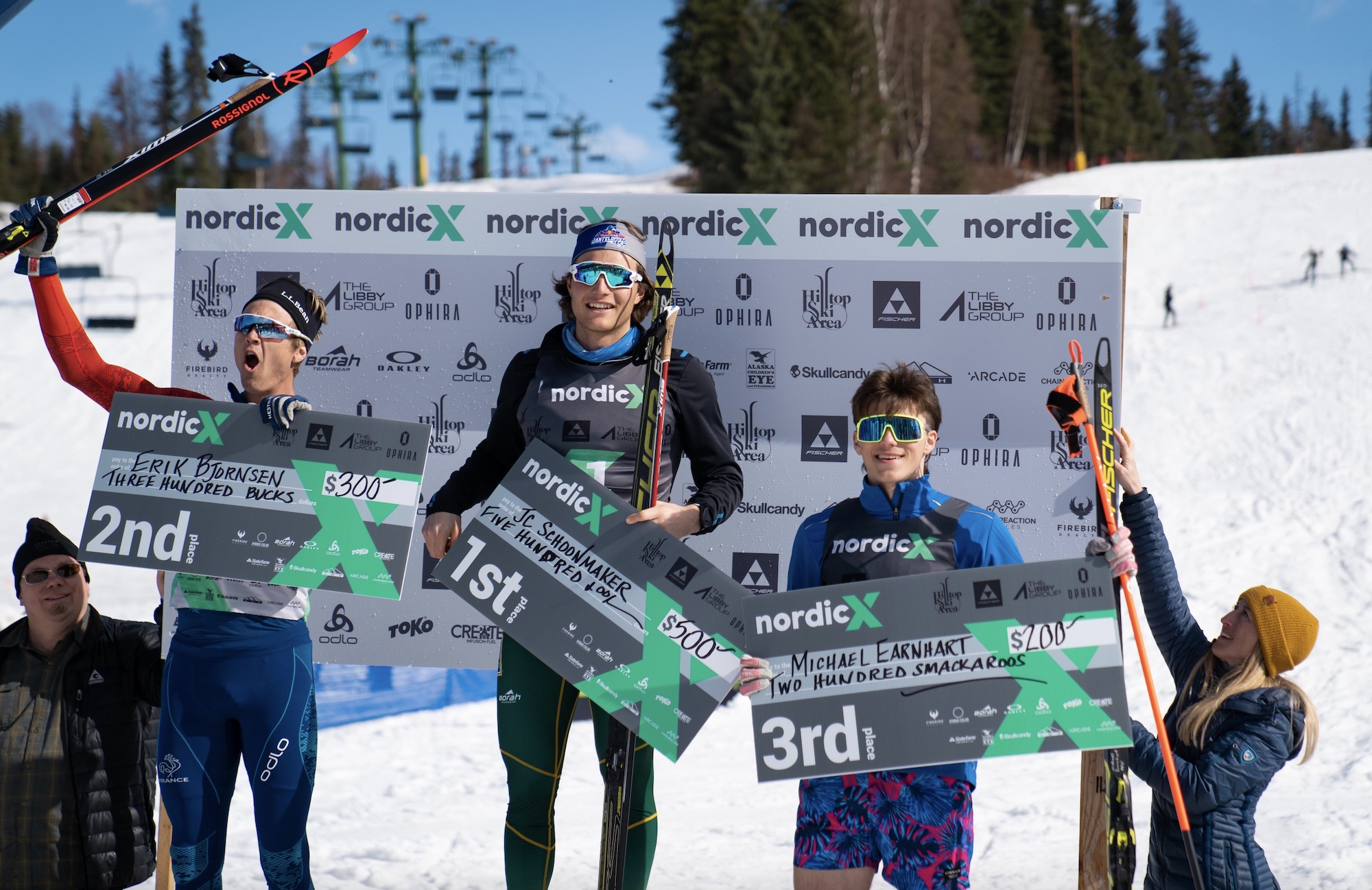
  • Elite Team Preview: APU

    Elite Team Preview: APU

    The APU Elite Team gathers for morning practice on the Hillside trails, Anchorage, Nov. 12, 2021. (photo: courtesy APUNSC)

    Team name and location: Alaska Pacific University Nordic Ski Center (APU, or APUNSC); Anchorage, Alaska

    Coaches: Erik Flora (head coach/director), Jack Novak (assistant coach)

    Current roster: Penny Smyth, APUNSC Marketing & Communications, writes:

    “Women’s Team: Rosie Brennan (USSS A Team), Hailey Swirbul (USSS A Team), Hannah Halvorsen (USSS D Team), Rosie Frankowski (World Cup Alternate), Becca Rorabaugh, Anna Darnell, Annie Gonzales, Marit Flora, Lily Pannkuk, Zoe Noble

    “Men’s Team: Logan Hanneman (USSS B Team), Scott Patterson (USSS B Team), David Norris (World Cup Start), Hunter Wonders (USSS D Team), Zanden McMullen (USSS D Team), Luke Jager (USSS D Team), Tyler Kornfield, Michael Earnhart, Thomas O’Harra, Forrest Mahlen, Garrett Butts, Ari Endestad, Karl Danielson, Bjorn Halvorsen, Chip Schoff”

    A total of nine APU athletes will be starting Period 1 World Cup races this season, though as we approach the Ruka opener later this week Smyth advises, “Scott [Patterson] won’t be joining the team until Lillehammer,” the season’s second race weekend, “due to hand injury.”

    Who’s new or who’s moved on: Smyth writes, “Sadie Maubet Bjornsen, a two-time Olympian and World Cup skier, retired after last year. We have some new skiers that have grown up through the APU Nordic program join the Elite Team, including Marit Flora and Lily Pannkuk. New to the men’s team is Bjorn Halvorsen, younger brother of Hannah Halvorsen!”

    Who’s still on this team, or otherwise involved in American skiing, from when we did this in 2012: Rosie Brennan, Becca Rorabaugh, Forrest Mahlen (athletes); Jack Novak (APU assistant coach); Greta Anderson (USST D-Team coach); Dylan Watts (Mt. Bachelor Ski Education Foundation head nordic coach); Kikkan Randall (Nordic Skiing Association of Anchorage Executive Director)

    Hailey Swirbul (left, third overall) and Rosie Brennan (first, wearing the yellow bib as World Cup overall leader) after the women’s 10 k skate in Davos, December 20202. (photo: Modica/NordicFocus)

    Top results last season: Brennan was fourth in both the overall World Cup and distance standings, and for one magical weekend in December was the best skier in the world, winning back-to-back races in Davos. She became the second American woman ever to wear the yellow bib, after Maubet Bjornsen, and kept it for roughly a month. It was a well-deserved coming-out party for the longtime APU athlete (note that she was also on this team nine years ago) currently in her third separate stint on the U.S. Ski Team, after most recently being cut in 2018 after she raced poorly in PyeongChang while unknowingly suffering from mono.

    Behind her, Swirbul finished the season ranked 23rd overall in the World Cup (21st for distance) and 4th in the U23 standings, picking up her first World Cup podium along the way, which she shared with Brennan. Maubet Bjornsen stayed home in Anchorage for the first half of the season, placed 10th in her first World Cup race in a year after returning to Europe, then at World Championships came within a combined 3.17 seconds of coming home from Oberstdorf with two medals.

    Swirbul, Maubet Bjornsen, and Brennan formed the first three-fourths of the American women’s relay team at World Champs, which came 0.8 seconds away from medaling. Norris recovered from Covid to post some of his best results yet, including 16th and 17th at World Champs, and Patterson had his best season in years, highlighted by a 10th in the World Champs 50 km; the two of them formed half of the American men’s relay team in Oberstdorf. (The team sent seven athletes total to World Championships.) Jager was a tantalizing 0.09 seconds out of the heats in his World Cup debut. Hanneman made three World Cup heats and finished the year ranked 29th in the Sprint Cup standings. Halvorsen returned from a year of grueling rehab from a car accident to finish 23rd in her first race back in two seasons – which was not an OPA Cup or a local citizens race but rather the World Cup sprint in Dresden.

    Hunter Wonders races at Government Peak Recreation Area, Palmer, Alaska, Nov. 14, 2021, in the season-opening Race to the Outhouse #1. David Norris is behind him. (photo: Eric Strabel for APUNSC)

    Domestically, Jager, Wonders, and Maubet Bjornsen won the December Anchorage JOQ races that were the unofficial U.S. Nationals west (also on a podium in these races: McMullen, Mahlen, and Frankowski), and Frankowski and Kornfield picked up a combined four podium finishes at the American Birkebeiner, including Frankowski’s win in the classic race.

    Smyth adds, “Locally, races happened for the rest of the elite team, where we had numerous podium sweeps and a Tour of Anchorage podium sweep in the women’s 50K with Rosie Frankowski (1) Becca Rorabaugh (2) and Anna Darnell (3) and then in the men’s 50K Tyler Kornfield (1) and Thomas O’Harra (2).”

    APU head coach Erik Flora, Independence Mine, October 2021. (photo: courtesy APUNSC)

    Coach’s comments: “The APU Elite team is more than 25 skiers strong. We had a great summer of training with a majority of the U.S. Ski and Snowboard D-Team joining us. U.S. Ski and Snowboard coaches joined the Elite team in July for training sessions, which was positive for the team! This brought some young energy to the daily grind along with a fun group to work with. October brought early snow in Hatcher Pass to finally get on skis for training with early November snow in town to follow. We feel ready for the race season to happen and are excited to see what the races bring moving into an Olympic year!”
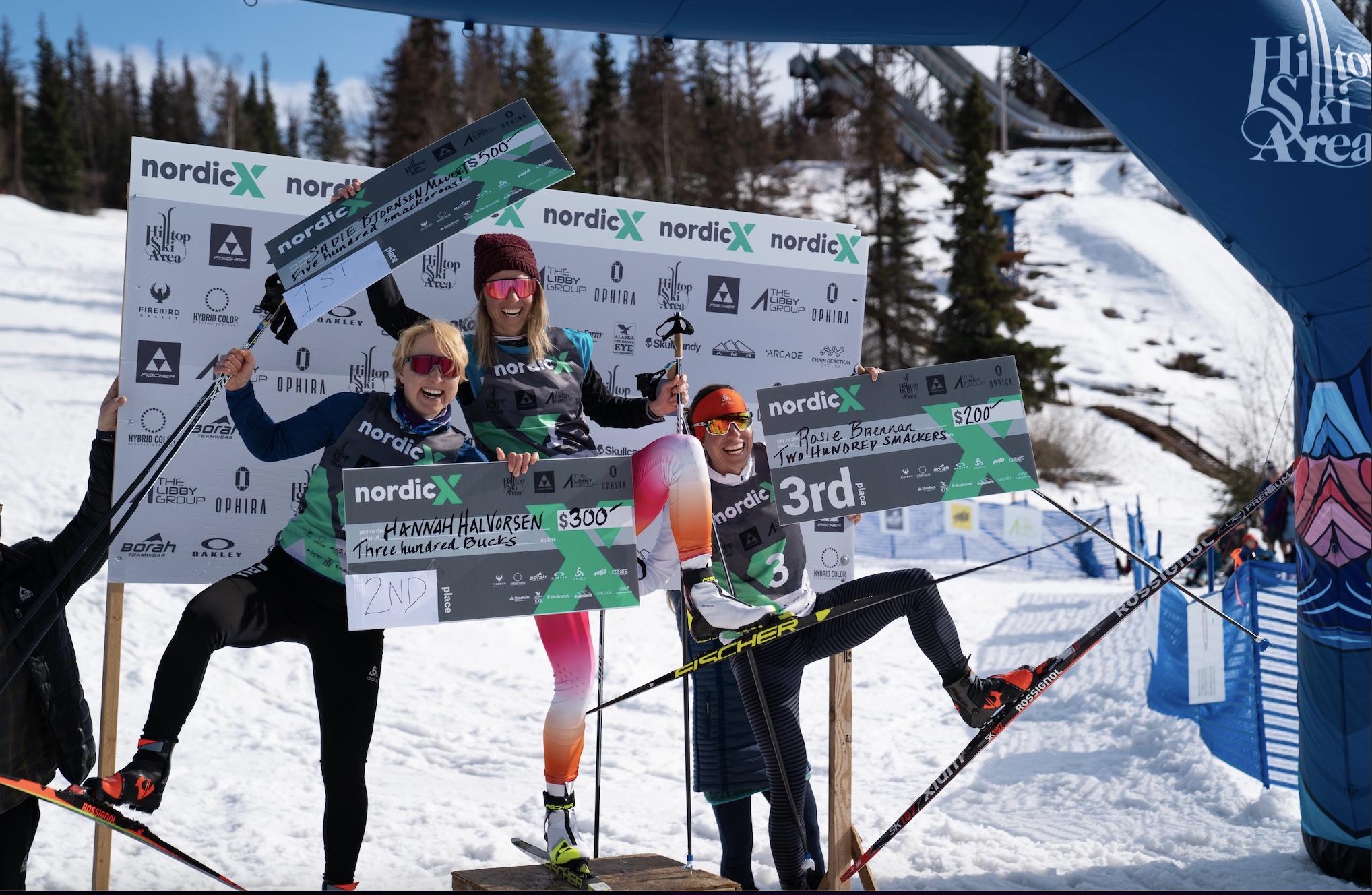
    Hailey Swirbul (second from right, pink elbow sleeves) tags off to Sadie Maubet Bjornsen (far right) after the opening leg in the women’s 4 x 5 km relay at FIS nordic world ski championships, Oberstdorf, March 2021. (photo: Modica/NordicFocus)

    Related coverage: Rosie Brennan profile; Sadie Maubet Bjornsen retirement piece; Erik Flora profile from 2017; Ben Lustgarten op-ed on David Norris’s non-selection to the U.S. Ski Team

    Previously in this series: BSF | SMS | Team Birkie | Sun Valley

    Disclaimer: I live in Anchorage, and have trained with the APUNSC Masters program for eight seasons and counting. On the one hand, the Masters group has been an important part of my personal and athletic life for many years now; on the other hand, on a day-to-day basis the Masters team has basically nothing to do and no overlap with the APU Elite Team, and is not coached by Elite Team coach Erik Flora. I don’t receive free gear from APU, or anything in that vein, in exchange for writing about the APU Elite Team.

  • Schumacher and Brennan Lead the Way in Season-Opening Race to the Outhouse

    Schumacher and Brennan Lead the Way in Season-Opening Race to the Outhouse

    Rosie Frankowski, left, and Hailey Swirbul race at Government Peak Recreation Area, Palmer, Alaska, Nov. 14, 2021, in the season-opening Race to the Outhouse #1. (photo: Eric Strabel for APUNSC)

    GOVERNMENT PEAK RECREATION AREA, above Palmer, Alaska — High-end nordic ski racing was last seen in this country in mid-April, when a bevy of national-team members who call Alaska home competed in a pair of FIS races in mid-winter conditions, followed by a more vernal 2,000’ hill climb the following weekend. Less than seven months later, as Alaska kicks off another season of ski racing, little has changed: the country’s deepest domestic fields, single-digit temps, and fierce competition. The 2021/2022 American race season is officially underway. 

    The Mat-Su Ski Club has hosted the season-opening Race to the Outhouse #1 somewhere in the Matanuska–Susitna Valley, above Palmer, Alaska, for the past 13 years now. Typical locations are Archangel Road and Independence Mine. The race course at Archangel ends with a 240-meter climb; the race course at Independence Mine starts with a 145-meter climb over the first 1.8 kilometers. Both feature an eponymous state parks outhouse near the finish line. Neither is exactly FIS-legal.

    This year, poor road conditions on the upper mountain caused by recent heavy snowfall necessitated a last-minute change to Government Peak Recreation Area, or GPRA, elev. 1,000′. 

    When the snow cleared and the new venue was announced on Friday morning, this year’s race was somehow even harder. The Government Peak 5k FIS course has 38.2 meters of gain per kilometer, on par with the Lahti World Cup course (38.5) that has hosted multiple World Championships. It has a height difference of 81m, more than Ruka or Lillehammer or Lahti or Falun or Oberstdorf or frankly most venues. After Sadie Maubet Bjornsen skied here for the first time, in October 2020, she called these “the most legit ski trails I have ever skied in the US,” and pronounced the venue World Cup-ready.

    Hunter Wonders races at Government Peak Recreation Area, Palmer, Alaska, Nov. 14, 2021, in the season-opening Race to the Outhouse #1. (photo: Eric Strabel for APUNSC)

    Overnight temperatures on Friday of nearly zero, rising to only 7° F in time for Saturday’s race, did not make the snow on an already difficult course ski any faster.

    Rosie Brennan (USST/APU) was unfazed by the slow snow, covering two laps in 32:18.4 to take a commanding win in the women’s 10-kilometer mass start classic race. She was followed by Hailey Swirbul (USST/APU, +2:44.6), who was 0.7 seconds ahead of Rosie Frankowski (APU). Fourth place was another Olympian, Australian–American dual national Jessica Yeaton (Australia National Team/APU).

    “I was looking for an opportunity to practice racing and shake some cobwebs off on the snow,” Brennan wrote to FasterSkier on Saturday. “It was absolutely incredible what Mat-Su Ski Club pulled off for us today. From one surprise storm they were able to set classic tracks on a 5k homologated loop. I honestly can’t think of a better way to get a good test race in than that. I am very grateful for the community support and effort to help get us ready to race before leaving. I am really happy with my effort and was able to find some race feelings and some good movements on snow. I am feeling on track and ready to hit the road.”

    Swirbul sounded similar sentiments, writing, “I was hoping to get a good workout in and practice pacing. I don’t think time trials have to be great to have a good effect and shake some of the cobwebs out. Good to go hard with some great teammates!”

    From left, David Norris, Gus Schumacher (red AWS suit), Hunter Wonders, and Tyler Kornfield charge up the first hill out of the stadium at Government Peak Recreation Area, Palmer, Alaska, Nov. 14, 2021, in the season-opening Race to the Outhouse #1. (photo: courtesy APUNSC)

    For the men, Gus Schumacher (USST/Alaska Winter Stars) took the win in the 10 k classic, crossing the line in 29:29.2 in the mass start race. He was closely followed by Hunter Wonders (USST/APU) and David Norris (APU), 0.8 and 2.4 seconds back, respectively.

    Schumacher had much the same reaction as Swirbul, writing to FasterSkier, “Today was mostly just to shake off some cobwebs and get a sense for where my race fitness is at. It went really well; I felt good and it was fun to end up ballpark where I want to be. It gives me some confidence just to have a solid race under my belt before travel.”

    The World Cup athletes were concentrated in the 10 k classic. In the men’s 5k skate, Oskar Flora led a strong junior field to take the win in 15:50.4, followed by Liam Chisholm (+36.0) and Kyle Fischer (+54.7). In the women’s 5k classic, it was Meredith Schwartz first in 18:59.6, Alison Arians (Schwartz’s mother) 43.6 seconds back, and Tuva Granøien in third, 1:25.8 back.

    In the men’s 10k skate, JC Schoonmaker (USST/UAA) led a small field to the finish in 29:35.1. He was followed by local juniors Skyler Amy and Cole Flowers in second and third several minutes later.

    Anna Engel (45:26.7) appears to have been the only woman who did the 10k skate.

    *   *   *

    The races were a robust test of athletes’ fitness on a challenging course. They were also somewhat of an epistemological puzzle: Is it really an early-season race if you’ve been on snow for nearly two months already? Snow came to the Chugach foothills above Anchorage, ca. 2,000 feet, on September 24. By the time that early-season storm was melting out, race-skis skiing was online at Independence Mine – this photo was taken on October 10:

    Groomed trails at Independence Mine, above Palmer, Alaska, Oct. 10, 2021. (photo: Gavin Kentch)

    An Anchorage- or Palmer-based athlete in a position to drive could have logged seven full weeks on snow by the time race day dawned. APU head coach Erik Flora had 30 hours on snow by Halloween. Climate change is undeniably present in southcentral Alaska, but its effects in this La Niña winter have so far been kind to skiers. 

    Making the question of “what type of race is this, anyway” even more complicated was the depth of the fields. Alaska’s World Cup skiers are off to Europe soon, but not yet, and turned out in force for Saturday’s race – four out of five athletes on the U.S. Ski Team A-Team raced, and a total of six athletes who will be starting on the World Cup this fall were in the field (potentially seven depending on what happens with alternates).

    Becca Rorabaugh races at Government Peak Recreation Area, Palmer, Alaska, Nov. 14, 2021, in the season-opening Race to the Outhouse #1. (photo: Eric Strabel for APUNSC)

    FasterSkier unofficially calculates the race penalty for the men’s race as 23.7, and as 30.3 for the women, if these had been sanctioned as FIS races. U.S. Nationals, in Soldier Hollow in January, will likely have a higher number, reflecting the fact that the country’s fastest athletes are typically racing in Europe in January. Two out of three women on Saturday’s podium have World Cup podiums to their name; the third was 21st in the Olympics. For the men, Schumacher, Wonders, and Norris would not be surprising picks for the 2022 Winter Olympics American men’s relay team. Was this a free, low-key fun run involving a line in the parking lot to sign a waiver and pick up safety pins for your bib, or was it an unofficial U.S. Nationals? It’s complicated.

    Racing continues in Alaska next weekend with the start of the town race series at Fairbanks’ Birch Hill ski area, then over Thanksgiving with races at Government Peak (the first annual Turkey Trax race) and Birch Hill (the 57th annual Turkey Day Relays). Domestic FIS racing gets underway in West Yellowstone the same weekend. The Midwest racing calendar at SkinnySki.com is currently unavailable, but the Duluth SuperTour races on December 4-5 are a notable early-season event. In New England, the NENSA calendar begins with the Quarry Road Opener on December 5. Wherever you are and whatever your local racing scene looks like, think snow.

    Results for all races

    (N.b., the results are slightly idiosyncratic, reflecting a free, low-key event in which athletes could choose between doing a 5k and a 10k up to the moment of the finish lane vs. lap cutoff. This manifests as all racers for both distances being listed together in a single results sheet, which is then further sorted by wave and gender. My sense of what’s what is: In the 10 a.m. men’s wave, places 9–11 did the 10k; in the 10 a.m. women’s wave, all athletes did 5k; in the 10:02 a.m. men’s wave, first place did the 5k and everyone else did 10k; in the 10:02 a.m. women’s wave, places 1–4 did 5k and the rest did 10k; in the 10:04 a.m. wave, places 23 and 24 for the men, and 9th place for the women, did 10k; everyone in the 10:06/10:08/10:10 a.m. waves did 5k, except that 8th place in the 10:06 a.m. classic did 10k.)

  • Sadie Maubet Bjornsen Retires: Career Highlights and the Final Race (Part II)

    Sadie Maubet Bjornsen Retires: Career Highlights and the Final Race (Part II)

    Sadie finishes third in the women’s 10-kilometer freestyle pursuit at 2018 World Cup Finals in Falun, Sweden. (Photo: Fischer/NordicFocus)

    Part I of this article examined Sadie Maubet Bjornsen’s childhood, World Cup debut, and the injuries that she overcame along the way. This article, Part II, starts with a frank look at some of the challenges of being an American World Cup skier, then discusses her overall career highlights, her final World Championships earlier this year, and what comes next.

    In addition to the injuries, there are some challenges to life on the World Cup circuit, particularly as an American away from home for so long. Sadie is clear-eyed about these drawbacks, reflecting, “World Cup racing has its shine, but certainly there are things that are really tough. For me the toughest thing was always being away from home for that long, and then when things were more serious with Jo it was being away from him for that long. I would say, I managed the pressure of feeling like I needed to do well by having school. I think that was such a savior for me through the process. I think I never got too terribly wrapped up in doing perfect racing. I think the other thing that was really important for me was I developed some close friendships with my teammates. We had some things to talk about aside from ski racing. I think having these partnerships with people you are racing with makes you think about things aside from ski racing and having the capacity to laugh and not having everything result focused.”

    APU teammates Sadie Maubet Bjornsen and Rosie Frankowski chat trailside during a training day before World Cup races in Lillehammer Norway in December, 2019. (Photo: NordicFocus)

    There are also challenges to being an aspiring American junior skier in 2021, and to seeing the levels of performance that have become seemingly routine – as a ski nation, we’ve come a long way from the early-Randall period, when a single top-30 result would cause the FasterSkier comments section to fill up with jubilant congratulations. While this is hardly the fault of any current World Cup athlete, the rousing American success can make it daunting for juniors trying to keep up. Sadie is asked what she would say to a hypothetical American junior following pro skiers on social media, and thinking to herself something like, “If I’m not training 700 hours a year at age 17 or I’m not on a World Juniors relay podium team by age 18, I’m a complete failure; that’s what it takes to be successful on the national team these days.”

    Sadie has thoughts on this: “I think there will always be a standard to compare yourself to. I think that is how the world works, and the more things go on social media, the more visual that standard is. I think that is going to be our biggest challenge going forward. When I was younger, I did not even know who World Cup athletes were; I did not watch the World Cup. I hardly knew what cross-country skiing was, so I had a really soft entrance into what I wanted to accomplish. I think that before people go too far, I think they have to work on the true goal-setting process. And that sounds funny, but it is as simple as, ‘Okay, I want to get better next year. I am training 450 hours right now.’ Well, of course you are not going to train 800 hours next year. Instead, you need to take the time to identify, Where am I, where do I want to go. You need to be sure you are not just skipping that whole process and just using a standard to compare yourself to.

    “I think really working on the goal-setting process from a young age and identifying yourself as an individual is really important, because we will always be comparing ourselves to some standard like, ‘Do you I have a six pack, I do not have a six pack at all, everyone seems to.’ You know what, not everyone is going to have a six pack. Or, ‘Everyone seems to be training at 800 hours, but I take 400.’ Again, not everyone does that, not everyone can. I think that we just have to be – as a junior you just have to recognize that not everyone is the same and you are never going to escape the comparison game. But that is what is going to help you create your own path, is being able to identify your strengths and your goals. I think that is such a necessary part that can be easy to skip when all you think about is where you want to go.”

    * * *

    Sadie’s words are wise, but this is a retirement article, so we’re going to move on to where she ended up going: to the top of the sport, or very close to it. She was on the U.S. Olympic team in 2014 and 2018, and all six American World Championships teams from Oslo in 2011 through Oberstdorf in 2021.

    Sadie Bjornsen skis the second classic leg in the women’s 4 x5 k relay at the Sochi Olympics in 2014.

    Sadie was on American relay teams 14 times in senior-level international competition, half of them at the Olympics or World Championships. There have been five times in, well, ever that the U.S. women notched a podium finish in a World Cup relay; Sadie was on the team for four of them. Each time, she skied the second classic leg, historically where each nation places its strongest classic skier in an attempt to string out the field. She filled the same role in two Olympic relays and three World Championships (2017–21), too, after skiing the scramble leg in 2013 and 2015.

    And while Sadie won her World Champs medal in the classic team sprint, at Lahti in 2017, she was the first alternate for the epochal skate team sprint, at Pyeongchang in 2018, winning universal praise from her coaches and teammates alike for the poise and magnanimity with which she handled being, in effect, the first person left off this team. (Her blog post about this moment is better written and more insightful than anything in this article: “A small piece deep inside my heart crumbled at the same time, knowing that I had missed such an amazing opportunity,” Sadie wrote after the fact, while also lauding the team and its accomplishments with surpassing grace.) She would later team up with Rosie Brennan for the skate team sprint in Oberstdorf this March, coming one ill-timed “that’s sprint racing” final-leg tangle away from contending for a medal there as well.

    Sadie Maubet Bjornsen in her yellow World Cup leader’s bib and her new wax tech, Per Erik Bjornstad of Norway, in November 2019.

    Oh, and she was also the first American woman ever to wear the yellow overall World Cup leader’s bib, early in the 2019/2020 season, followed this past season by first Brennan and then Diggins, marking a moment when she literally did reach the top of her sport. (Other moments: the four separate times that she posted the fastest time in a World Cup sprint qualification, two in sprint and classic.) She earned the yellow bib by placing third in a sprint and fourth in a 10 k on successive days in Ruka. And she ranked 16th or higher in the overall World Cup standings for five consecutive years, often slightly higher in sprint than in distance but with strong results in both disciplines.

    table: Gavin Kentch for FasterSkier

    As this (partial) palmarès shows, Sadie is an exceptionally well-rounded athlete – balanced, even. In fact, she was the first American ever to post a podium finish in all four World Cup disciplines (classic sprint, freestyle sprint, classic distance, freestyle distance) and is still one of only two to do so, with Diggins being the other. (Diggins got there first if you count a “time of day podium” in a pursuit race as a standalone classic distance podium, which most people probably would not.) She retires as the second most well-rounded or broadly competitive American skier ever, after only Diggins.

    This “career slam” was a longtime goal for Sadie.

    “Since I was a young girl I always used to get so frustrated when somebody would tell me that I was just a sprinter,” Sadie notes, “or I was just a distance skier, or anything like that. I hated being identified by something; I wanted to be the person that could do it all. As I progressed and made the national team, I remember there being this talk about this classic deficit, and when will Americans have ‘real’ classic skiers. That used to make me so mad because I did not feel like we had any classic skier specialists, I thought we were all just skiers! So there are always these little motivators that push me to keep improving all elements in my skiing and it has been something that has been a personal goal.
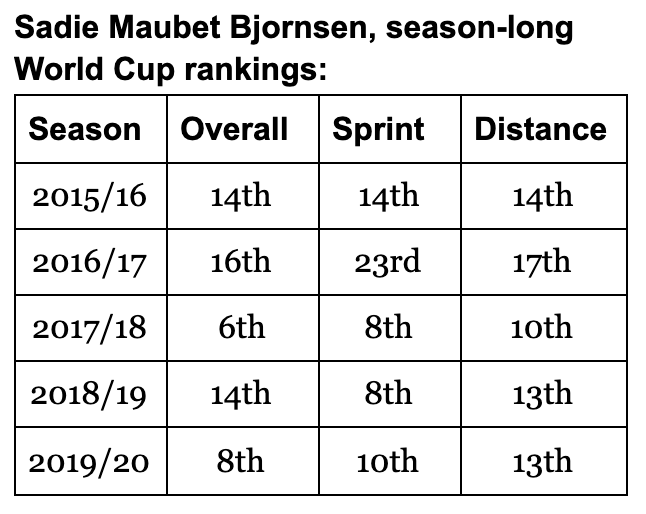
    Sadie racing in the FIS Ski Tour 2020 in Trondheim, Norway. (Photo: NordicFocus)

    “It is hard to be the first to do something on our team, because everyone is so darn good. It feels like they have kind of reached a level already before you. So that was kind of my own personal thing, that was going to be my goal. I did not really feel like it was specifically anybody else’s at the time. That was going to be my thing, to be the one who was going to do everything. I could be ready to be on the podium on any given day, I could be on the relay on any given distance or any given position, and so I started slowly working towards that mission. Part of doing it – I can’t remember what came first, getting the yellow jersey or when I got that sprint podium, because that completed the cycle; I can’t remember what it was. But for both of those moments, the achievement I felt was so huge because I knew it was the thing I had been working on. So it definitely gave me a lot of happiness just knowing there was no limit to what I could do. It could be any given day, any given race, so that is actually my greatest achievement is accomplishing that.”

    Finally, here’s longtime USST coach Matt Whitcomb on what Sadie brought to the starting line on race day: “I’m feeling grateful for Sadie’s commitment to a long career with the team, but this retirement hurts a lot. The first time I met her was in 2007 at World Juniors in Tarvisio, Italy, so my entire existence with the U.S. ski team has had Sadie as a part of it. She’s one of those athletes that keeps coaches coming back every year. Her style of racing is an inspiration to watch; she can really hurt herself. Coaches and scientists talk a lot about the importance of athletic talent, but they don’t talk enough about the importance of being willing to access that 100% effort. Anyone has that choice, but it’s not so easy. I’ve never heard Sadie say, ‘I think I could’ve gone a little harder.’ If she’s on the starting line, she’s there to give it. As I look back on her career, I know she could not have tried harder. She did her best, and that deserves a standing ovation.”

    This undated, uncredited photo is the oldest image of Sadie in the current FasterSkier image library. It seems to be from the 5 k classic at 2008 World Juniors in Italy. Sadie placed 24th in the interval-start race, 59.7 seconds behind winner Therese Johaug.

    * * *

    However, not all goals come true – as a wise person named Sadie Maubet Bjornsen once said, sometimes you have to announce a goal that is “really risky and really scary and really intimidating to say.”

    And so, as Sadie recently wrote on Instagram, hearkening back to summer 2020 and her decision to dedicate herself to one more year of training, “Last summer I danced between hanging up my skis, or continuing on. There was one last goal I wanted to accomplish not just for myself, but for the team that taught me what it meant to dream bigger than big. This goal was an Olympic/World Championship 4×5 podium. I knew in my heart we were forming into the strongest relay team we had ever had, and I felt the need to lay it all on the line for my team in @oberstdorf2021.”

    From left, APU athletes Rosie Frankowski, Sadie Bjornsen, Hailey Swirbul, Becca Rorabaugh, and Caroline Brisbois maintain a healthy distance while skiing at Hatcher Pass on May 13, 2020. (photo credit: courtesy Sadie Bjornsen)
    Sadie training at Hatcher Pass in Alaska (with, from left, APU teammates Rosie Frankowski, Sadie, Hailey Swirbul, Becca Rorabaugh, and Caroline Brisbois) in May 2020, Covid-era social distancing in effect. (photo credit: courtesy Sadie Bjornsen)

    Sadie continued on for one more year, one more season of intervals in the sun and ODs in the rain and logging her total tendon load following each workout. She stayed in Alaska in the summer while the world shut down for Covid. She was on snow early in the fall. She skied a ton. She trained hard. She stayed home in Anchorage through all of World Cup Period I, all of Period II (Tour de Ski), and the first half of Period III to better peak for World Champs. She donned a mask and flew over to Europe in mid-January, after doing just one citizens race and two Anchorage FIS races that winter, and promptly placed 10th in her first World Cup race in nearly a year – despite having abstained from hard intensity for the previous five weeks while nursing a back injury. She would finish 15th, 15th, and 4th in her next three World Cup races, then 11th in her first race at World Champs. All the pieces were in place.

    When race day dawned in Oberstdorf, it was the 15th, and final, international relay of Sadie’s career. While there was, technically, one race remaining at World Champs, the 30-kilometer classic two days later, her teammates knew that this was the race she had stayed in the sport for. As she had told them the previous summer, “I am staying one more year with ski racing and this is why.”

    Put another way, Sadie had literally dedicated one year of her life to ski for less than 15 minutes – one last classic leg on one last American women’s relay team, “for the team that taught me what it meant to dream bigger than big.” Try not to get goosebumps while you read that.

    Her teammates were not unappreciative of her dedication. Their mindset going out to the start line, Sadie recalls, was, “okay, if we can see when we tagged each other, we know we did not give enough.” She adds, “We all knew how invested we were and I really felt like that was the strongest ski race we had ever had, and the most ready we had ever been.”

    Sadie Maubet Bjornsen (far right, green bib 5) is tagged by Hailey Swirbul in the women’s 4x5km relay in Oberstdorf. (photo: Modica/NordicFocus)

    After a year of preparation, Sadie’s relay leg – the second classic leg, one last time – took her 14 minutes and 40.5 seconds. She took the handoff from Hailey Swirbul in eighth after the chaos of the scramble leg, 13 seconds out of third. Halfway through her 5-kilometer leg, she was still 11 seconds off the podium. Less than a kilometer later, she had moved the Americans up into third. She would tag off in fourth, 0.3 seconds out of third, having done precisely what she needed to do to help her team. 

    If you watch the replay, it is very plausible to conclude that Sadie could not indeed see by the end of her leg.

    If you’re reading this website, you probably know what happened next: Sadie tagged off to Rosie Brennan for leg three; Brennan pushed hard but was unable to drop anyone around her, tagging off to Diggins in a virtual tie for third; Diggins took off for her anchor leg alongside Finnish anchor Krista Pärmäkoski; Diggins skied her heart out; it wasn’t quite enough; Finland took the bronze, with the U.S. 0.8 seconds back in fourth. It was the American women’s, and Sadie’s, fourth fourth-place finish in the last five World Championship relays. Between the relay and the team sprint, Sadie would leave Oberstdorf a combined 3.17 seconds out of taking home two medals and realizing this whimsical GIF after a year of training.

    Sadie digging deep on leg two of the 4 x 5 k relay. (Photo: NordicFocus)

    Sadie has no regrets: “We wanted to go to the point where we could not even see where we were going anymore,” she reflected on the relay after the season ended. “I think we literally did that. There were no regrets with that day. … It’s just an achievement in itself to know that there are no regrets. Of course you feel different when you also get the medal but I am so glad I came back for another year. This just felt different than any of the other relays I have been part of so it was certainly worth it.” Sometimes you have to set dream goals that scare you.

    * * *

    Sadie spent her ski career setting results goals, but she also spent it pursuing a rigorous course of study. She earned two degrees – not a double major, but two separate B.A. degrees – from Alaska Pacific University (the school, not the eponymous domestic ski club), in accounting and nonprofit management. She has embarked on coursework for her M.B.A. She has passed the first of four sections of the fiendishly difficult Uniform CPA Examination to become a certified public accountant, and sat for the second section last weekend.

    She studied in the team van by headlamp while driving to and from Hatcher Pass for early-season skiing. She attended class remotely from all around the world, years before “Zoom” became a part of everyone’s lexicon. The former NCAA athlete did, in fact, go pro in sports, but she ably laid the groundwork to go pro in something other than sports now that her ski career is over.

    To hear Sadie tell it, these academic demands helped, rather than hindered, her ski career. She explicitly says that doing both at the same time helped her to stay in “a perfect balance”: “When I was trying to do the best that I could in school, when you have the personality that you’re just, like, a bit of a perfectionist, it’s easy to kind of get out of balance. So for me, with ski racing, it was easy to try to perfect every single thing. And when it couldn’t happen, I would really struggle. And so school always provided that balance for skiing, and skiing provided that balance for school. And so I never looked at it that I was like, doing either of them imperfectly. I was just in a perfect balance of challenging myself both physically and mentally. So I think that it just took the pressure down enough to do both of them really well.”

    Sadie Maubet Bjornsen (left) and Rosie Brennan (right) stride in sync during the 2020 Tour de Ski in Toblach, Italy. (Photo: NordicFocus)

    Balance sometimes comes at a cost. The World Cup end-of-season celebration, notorious as the first time in months when a group of the most highly disciplined athletes on earth can finally let their hair down? She pre-gamed for that by signing on to class. The morning of her first ever Olympic race? Class was at 7:30 to 9:30 p.m. Alaska time the night before, which was 5:30 to 7:30 a.m. Sochi time. Sadie, who woke up early to attend the class, appreciated the timing, as only someone who has negotiated balky European wifi for a decade can: “That was great, because that’s before anybody wakes up and breaks the internet or shuts you down.”

    “That is what makes things so rewarding,” Sadie reflects on the school–skiing balancing act, “is working really hard at them and giving up things for them. Again, it was something that worked really well for me to do them together.”

    Verrier, the UAA volunteer coach and longtime friend, makes similar observations.

    “Sadie said something to me recently that I’ve been thinking about a lot,” Verrier wrote to FasterSkier this spring. “She told me that the most unpleasant and darkest time in her ski career was when she decided to put everything else aside and focus solely on being a professional ski racer. That approach just didn’t work for her at all. She found that she actually needed something else – her academic studies – to keep the skiing from becoming too ‘heavy.’ When she recently started working toward becoming a CPA, while still ski racing, she immediately felt much ‘lighter’ – and more successful. When I think back to when I was first getting to know Sadie at UAA, it all starts to come together and make a lot of sense to me. I don’t think she’s ever been one who thrives best with a singular focus. I think Sadie’s at her best in more complex environments. Whether it’s focusing on academics and athletics at the same time, or having chronic health issues thrown up in front of her skiing goals, I think Sadie’s most at home when there’s more than one thing going on at a time. And I don’t think I realized that about Sadie when she was a freshman at UAA. And maybe she didn’t either.”

    Another consistently strong performance by Sadie Maubet Bjornsen (9th) at the 10-kilometer skate race in Davos, Switzerland, in December 2019. (Photo: NordicFocus)

    Everyone needs to figure out the version of balance that works well for their lives. For Sadie, this ultimately involved earning multiple degrees and studying for one of the most difficult professional licensing exams out there. Here’s Verrier again: “Now that she’s shifting her focus to a career in accounting, she recently told me she’s totally loving the challenge of being the ‘minnow’ again, instead of the ‘shark.’ And when she says it, you can see her eyes light up and you know she’s enjoying starting something new that she feels she’s not very good at yet.”

    * * *

    So, what’s next? For the immediate future, prepping for the CPA exam is pretty much a full-time job. Sadie passed one section, out of four, this spring, and just sat for the second section. Eventually, she will have passed all of Auditing and Attestation, Business Environment and Concepts, Financial Accounting and Reporting, and Regulation, and will be qualified to work in any of a broad range of fields, from assurance and attestation services to forensic accounting to regulatory compliance.

    She has already started a business, Bjornsen Bookkeeping, and is providing simple accounting services on the side in addition to studying. She is also transitioning to a life in which she has to specifically carve out time to exercise outdoors, as opposed to automatically doing so twice daily for her job. “Being physically active used to be my job, so it was easy,” she recently wrote on Instagram in a post advocating for physical activity through local group Healthy Futures. “In the past month I have learned how easily a busy day doesn’t include activity… and it makes me feel horrible!”

    Sadie plans to stay in Alaska for the time being; it is a good place to be active outside. “I do plan on staying in Anchorage and staying involved in this community despite the fact that I am done racing as a professional athlete,” she says. “I found it really inspiring this winter that Holly Brooks is still racing. She is not the Olympic athlete that she was six years ago, but she is still out there enjoying the process and racing with no shame and I found that so inspiring this winter. I also hope that I can stay involved without having such a high standard as I would have had as a professional athlete.”

    Sadie Maubet Bjornsen at a Healthy Futures community event, ca. 2017 (photo: Instagram/Anchorage Salmon Run)

    An Anchorage citizens race can often boast five former Olympians in the field; Sadie may make it six. She may also continue to lend her presence to the various outreach groups and activities – Fast and Female, Healthy Futures, Tuesday Night Races – that have ensured that hundreds of kids in Anchorage already have a signed Sadie poster on their walls, or have had her lead warmups before their race.

    And finally, speaking of kids, when Sadie spoke with FasterSkier for a 2016 profile, she answered the “where do you see yourself in five years” question with, “Anywhere in the world, hopefully starting a family.” It’s now five years later. While Sadie and Jo’s personal life is their own and this is emphatically not intended as a birth announcement, it seems safe to say that, should children indeed be in the picture some time soon, Sadie is well qualified to take on the prodigious balancing act that is modern motherhood.

    * * *

    Disclaimer: Anchorage is a small town, and Sadie and I are both affiliated with the same club program, Alaska Pacific University Nordic Ski Center. Over the years, Sadie has signed multiple posters for my children (okay, also for me as well); I have trained with her a handful of times in APUNSC program-wide bounding sessions; and my wife and I are currently hiring her husband to do light handyman work at our house. If you conclude from all of this that I cannot be completely unbiased toward her, that is, frankly, correct. However, I promise that anyone on the FasterSkier team, let alone anyone involved in American skiing over the past fifteen years, would speak of Sadie in roughly the same glowing terms that I have done here. That does not mean that this article is unbiased; it does suggest that it is representative.

    * * *

    Further reading (if this wasn’t enough):

    Anchorage Daily News: This January, local photojournalist Marc Lester wrote and photographed a superb photo essay on Sadie’s approach to what she knew at the time was her final season of World Cup skiing

    Alaska Public Media: Earlier this winter, Sadie spoke with Adam Verrier for local public radio show Outdoor Explorer, pairing with UAA/USST skier JC Schoonmaker in an hour-long episode entitled “Starting and ending World Cup ski careers”

    Nordic Nation: Sadie spoke with Jason Albert for the FasterSkier podcast in 2018 about the “Sadie System,” the approach she took to managing tendon load and overall life balance alongside of competing as a professional skier

    U.S. Ski & Snowboard: Sadie spoke with Tom Horrocks immediately after this season for an interview that is a far shorter version of this article and that provides a fine complement to some topics discussed here

    NBC New York, “Sadie Bjornsen and Jessie Diggins explain cross-country skiing with Legos”: A delightful two-minute video that is precisely what the title promises. Plus, your chance to see Sadie enact a finish-line lunge using Lego characters.

  • Balanced to the End, Sadie Maubet Bjornsen Retires (Part I)

    Balanced to the End, Sadie Maubet Bjornsen Retires (Part I)

    Sadie Maubet Bjornsen (left) skis alongside Yana Kirpichenko (RSF) in the 30 k classic in the 2021 World Championships in Oberstdorf. The race closed out Maubet Bjornsen’s international race career. (Photo: NordicFocus)

    To classic ski, and to do so well, requires an athlete to perform an almost stupidly large number of tasks at the same time. You have to move two arms, two legs, and two ankles in alternation, in almost infinite variations depending upon the snow, the wax, the course, and your remaining energy. You have to mediate between power and finesse, kick and glide, stimulus and weight transfer. In short, you have to balance a whole lot of things.

    If you’re this country’s most beautiful classic skier of the past decade, you’re going to have a pretty darn good sense of balance. If you’re going to train at international levels while also earning multiple degrees… and call into class the morning of your first Olympic race… and earn World Cup podiums in all disciplines… your sense of balance is going to be off the charts.

    If you can do all these things, your name is Sadie Maubet Bjornsen, who retired from professional skiing after this year’s World Championships in Oberstdorf. If you’re anyone else, read on for a look at her career, and what she brought to American nordic skiing over the past decade-plus.

    * * *

    Sadie’s ski career had humble if bucolic beginnings in Washington’s Methow Valley. She skied, of course. The Methow is a pretty good place to do so. She attended an Olympic homecoming parade for neighbor Laura McCabe after Nagano, and realized that the Olympics were something you could do.

    But she also ran and biked and played in the woods, and worked on construction sites moving boards around, and in general had an active and, well, balanced childhood. She didn’t rollerski till high school. She trained 250 hours as a high school freshman, up to only 380 as a senior (some high-level American juniors now train twice as much). The humorless application of a rigid and dogmatic training schedule it was not.

    “I am not a good ski racer because of what I have done in the past five years, but because of the way I was raised,” Sadie noted in an April phone interview with FasterSkier. (Such a childhood seems pretty well suited to making ski racers; her younger brother, Erik Bjornsen, was also a longtime member of the national ski team.)

    Sadie was not unskilled at skiing; she represented the U.S. at World Juniors at Kranj, Slovenia, in 2006, alongside future USST teammates Liz Stephen and Morgan Arritola. But, tellingly, those races in 2006 are the very first FIS races in her profile; she hadn’t been, say, shuttling between U.S. Nationals and RMISA from a young age. Sense of balance, indeed.

    Sadie decided to continue skiing in college, heading north to join head coach Trond Flagstad and volunteer assistant coach Adam Verrier on the ski team at the University of Alaska Anchorage in fall 2008. On paper her results were hardly bad – she was third at 2009 NCAA Championships in the 5-kilometer classic race, for example, slightly ahead of Rosie Brennan, Caitlin Patterson, and Sophie Caldwell Hamilton, and her coaches were thrilled for her potential – but things were not going well for her as she began life as a college student. When she moved across the street to Alaska Pacific University, or APU, after the 2008/2009 season, it was as a somewhat broken athlete.

    Sadie (bib 17) competes at 2009 NCAA Championships in Rumford, Maine, for UAA. (photo: Trond Flagstad)

    “I came in [to APU] kind of as a broken, injured race car,” Sadie recalls. “I could not train for more than 30 minutes and I was not training much, under 500 hours, and somehow [APU head coach Erik] Flora believed in me. I have no idea why; I still wonder that to this day, what gave him the belief because I was not racing well the year that I came here. I had had my worst season ever, I dropped out of college and I had my worst season ever because like I said, I need balance. He took a chance on me, and I remember telling him I wanted to make the World Championships team. And that was certainly a laughable thing to say, but he was totally supportive and he designed a program for this girl who could only train 30 minutes at a time.”

    Reader, she made the World Championships team. She made the team for Oslo, in 2011; for Val di Fiemme, in 2013; for Falun, in 2015; for Lahti, in 2017; for Seefeld, in 2019; and for Oberstdorf, in 2021. She also made two Olympic teams in that time, in 2014 and 2018. We’ll have more on her results later, but that’s a heck of a CV for someone who couldn’t train for more than 30 minutes at a stretch two years before her first World Cup podium.

    * * *

    Sadie, of course, did not know that any of this would come to pass when she toed the line in her first-ever World Cup weekend, a skate sprint and 10 k classic in Drammen, Norway, in February 2011. 1.2 kilometers for the qualifier, go as fast as you can, top 30 athletes make the heats and get to keep on racing. Everyone else goes home.

    There were 71 athletes in the field that day. Maiken Caspersen Falla of Norway won qualifying. Kikkan Randall won the final. Sadie, then 21 years old, finished 42nd, nearly two seconds out of qualifying – frankly, in sprint racing, at least a 1.2-kilometer sprint covered in roughly 2:16, that’s not particularly close. Sadie’s name appears nowhere in this website’s contemporary race writeup, not even a half sentence at the end giving a cursory listing of other North Americans who also raced.

    Sadie in her inaugural World Cup weekend, in February 2011, in the 10 k classic. (There are no photos of her in the sprint qualifier in the FS database.) This photo was originally captioned, “Sadie Bjornsen (USA) with her sharp classic form.”

    Was Sadie surprised that she didn’t make the heats? Oh yes.

    “I had a really strong memory from that first one,” she now reminisces. “I remember crossing the line after the sprint and going up to [USST head coach Chris] Grover and saying, ‘There is no way I did not qualify. I think the timing is wrong.’

    “I cannot believe how sure I was of myself at that age, because now I look at the young kids and think, Wow, how do they think they can win? That is incredible, I think I missed that! I was not thinking that I was winning, I was just sure that I had qualified. I think there is something to be said about being young, just having so much confidence. After asking him, ‘Did they mess up?’ my next question was, ‘What did I do wrong? Where did I lose that time, because I know I did it perfectly!’ He went on to explain, ‘Oh, well, in this finishing stretch there is a lot of time you can lose,’ and so on. 

    “It was a little bit of a learning experience for me. It turns out World Cup skiing is pretty darn fast, I just had no idea.”

    Less than a year later, Sadie was standing on the World Cup podium: Sadie Bjornsen and Kikkan Randall, second, team sprint, Düsseldorf, Germany, December 2011. It was the first World Cup team sprint podium in American history. FasterSkier’s race recap was headlined “Americans pull off surprise second,” and expressed sentiments such as, “the American pair, while talented, was going to have to have a good day to make the final.” No insult was intended, it was just a very, very different era in American skiing.

    Randall (L) and Bjornsen (R) on the podium in Düsseldorf, Germany, December 2011. Team Sprint World Cup silver. Photo: Kieran Jones

    Both athletes, when asked about this race a decade later, independently sound similar notes as they recall this moment: Randall was the seasoned veteran with multiple podiums to her name who knew what she was doing; Sadie was the 22-year-old rookie who had never made the World Cup sprint heats in her life, with a 34th in qualifying on the same course the day before serving as her previous highwater mark through that point in her career.

    Here’s Randall, in a recent email to FasterSkier: “One great memory was in 2011 when Sadie and I teamed up for the World Cup team sprint in Düsseldorf. In between the semis and finals Sadie was so nervous she could hardly sit still. I managed to fall asleep for a few minutes and she couldn’t believe I was able to be so calm. Once we got out on the snow, Sadie found her composure and we went on to win the silver medal together for the first ever World Cup team sprint podium result.”

    And, in much the same vein, here’s Sadie, earlier this spring: “I would say Kikkan did the brunt of the work in that race but it was like a race car driving race. All I had to do was stay on my feet. Somehow I did that and she had that killer finishing sprint. But it was a great moment.”

    (For historical perspective, here’s Sadie’s quote to this website in December 2011, from the race writeup linked above: “It’s the greatest thing to happen so far! It hasn’t even sunk in yet! It helps to have a sprint champion like Kikkan on your team, that’s for sure.”)

    Hindsight is, famously, 20/20, and we all know now that both athletes would earn a World Championships medal in this event within their careers, Randall in 2013 and Sadie in 2017 (in each case teaming up with Jessie Diggins). But what was Sadie thinking at the time?

    U.S. Ski Team teammates Jessie Diggins (l) and Sadie Bjornsen celebrate their bronze medal in the women’s 6 x 1.3-kilometer classic team sprint at the 2017 Nordic World Championships in Lahti, Finland. (Photo: John Lazenby/Lazenbyphoto.com)

    “I definitely did not expect that,” she says now, “and I would say that was a shiny moment before the next three years of near misses. I think it took me about three years to consistently qualify top-30. … I do remember that podium being like, Oh wait! I might actually be good after all! You know, World Cup racing does not make you feel good about yourself when you are never racing top 30. That Düsseldorf podium was definitely the thing that fueled me for the next three years as I went through the tough process of making the steps to being a World Cup racer.”

    * * *

    This process is tough for any World Cup skier; any athlete competing at this level is working her butt off to excel in a sport where small margins mean medals. But few athletes did this work against such a consistent backdrop of injury and limitations as Sadie dealt with throughout her entire career.

    When Sadie was 16 years old, she took an antibiotic, Levaquin, that had been prescribed for a sinus infection. It had enduring and devastating effects: “it had this side effect of permanent damage to your tendons and your ability for your tendons to recover,” as Sadie puts it.

    Sadie Bjornsen, of APU and the U.S. Ski Team, during a SkiErg interval workout at her home in Anchorage, Alaska. She didn’t have to do this workout in sandals or some other form of heel-less shoe, as was sometimes the case. (Courtesy photo)

    The result was, in Sadie’s words, “continuous injury” for the next 15 years of her life, variously manifesting as, among other things, foot tendonitis and/or elbow tendonitis and/or knee tendonitis – these are sort of important joints and body parts for a pro athlete. Most World Cup skiers spend, in round numbers, 40 percent or more of their average annual training hours running. Some years, Sadie couldn’t run at all. Some years, it was SkiErg, and aqua jogging, and ski walking, or even skipping, sometimes in 30-minute increments or less when that was all that her body could handle, as many times a day as she could manage and her tendons could bear. Sadie estimates that she was able to consistently run for only around a fifth of her competitive career.

    It seems slightly dismissive to call all of this “injuries” – an injury is typically something that you come back from, recover from, and move on, maybe even stronger than before. Sadie’s tendinopathy was far more endemic, insidious, ever-present. You don’t have an independent blank in your training log for “overall tendon load,” in which you carefully estimate the strain placed on each of several large tendon groups in the body, with an eye to curtailing or cancelling the next day’s training session if that cumulative load is too high, a decade after a broken bone. You don’t literally drill a hole in the back of your ski boot a decade after a stress fracture. There are injuries, and then there’s continuous injury.

    Sadie recovers after the 10 k interval start skate at this year’s World Championships in Oberstdorf. (photo: Modica/NordicFocus.)

    Whatever you call it, it would be blithe to dismiss its deleterious effects on Sadie’s career: In a sport defined by physical performance, any limitation on what you can do, physically, is not going to help you, physically. But mentally, or conceptually, or holistically, or on some other facets that help to make up a complete athlete? The entirety of Sadie’s career makes a profound argument that there are some silver linings to be found here.

    Here’s Adam Verrier, the longtime UAA volunteer, reflecting on these issues. He doesn’t quite say “talent needs trauma,” a shorthand for the notion that talented potential is often well-served by some form of challenge, but it’s close:

    “As I’ve watched Sadie’s athletic career and her academic path, it’s become clear that she really enjoys the process of trying to accomplish a goal that is so challenging that she doesn’t know whether she’ll be able to succeed or not,” Verrier wrote to FasterSkier. “Sadie’s tendon problems have been a constant throughout her entire career, and they’ve hampered her training to the extent that she can’t train in the ‘typical’ way at all.

    She’s relegated to lots of aqua-jogging and Ski-erging, and I don’t mean to talk shit about aqua-jogging, but it’s not the typical path to the World Cup ski podium. 

    “I’ve sometimes wondered, though, whether Sadie would have done as well as she did if she didn’t have her health problems. I’ve wondered if her chronic tendon issues have put up the roadblock that she’s needed – as a foil – something to fight against. I wonder if her chronic tendon issues are the thing that’s made this whole thing interesting for Sadie and has kept her attention throughout her ski career and has, in fact, enabled her success. I recently asked her about that, and she agreed that perhaps the whole experience would have been less interesting and compelling if she could run a lot and rollerski a lot, like most everybody else.

    “Sadie’s a problem solver by nature, and she has the patience and the resolve to take on big goals and try to find a way over, around, or through the roadblocks to reach her ultimate goal. Watching Sadie’s career over the years, the thing that has stood out for me has been her willingness to embrace difficult challenges and go into the fight with one hand tied behind her back.”

    Randall, writing separately, observed almost exactly the same thing: “I don’t think I can recall a time when Sadie wasn’t dealing with an injury,” she told FasterSkier. “Yet she never let the injuries be setbacks or excuses. She was always so determined and creative in finding ways to train in alternative ways and she made the adversity into her own magic. Her example helped influence a positive can-do culture on our teams. … Sadie got so good at managing her alternative training and I wonder if it actually gave her an advantage in the long run. Kind of like tying one hand behind your back and then all of the sudden having two hands to work with. It takes incredible mental fortitude and belief, but it has its upsides too. You could say that is Sadie’s super power!”

    And, just to complete the trifecta, here’s Sadie herself on this issue: “Things have never been steady, smooth sailing for me. But sometimes that is what created who I was. It actually forced me to make my brain the strongest muscle in my body, and I think we do not always train the brain enough. We think about training our quad muscles or our arm muscles the best, and so something that was a bit of a challenge to me actually created some strength of its own.

    Sadie Bjornsen (USST/APU) rollerskiing at Soldier Hollow in Midway, Utah, in 2014, a loop course unlike the one-way uphill climbs on the Anchorage Hillside. (Photo: USSA)

    “It definitely was unbelievably frustrating when I am on the tenth injury of the summer, I am having to do my own thing and I cannot come to normal training, and I have to make Flora carry my classic skis in the car because I can only ski for 30 minutes and I will be way out on the Hillside and cannot get back to my car. Often I just felt like a pain in the butt, like why does this keep happening to me? It was something that I always had to work around and I think that it actually made me stronger in the end. Because when I did have the chance to race, it was such a gift, it was never something that I took for granted because I never knew that I was going to actually show up and be able to do it.”

    Sadie continues, “A part of being injured all the time is you have to learn to forget it, or not let it hold you back. I would not say I ever truly conquered that, but I made sense of it. I do remember summers where … literally I would not classic ski the whole entire summer. Or, I believe, there was a summer that it was skating. I do remember when you are showing up at Ruka [for the opening World Cup weekend], I had not been able to ski for basically two months before I showed up. I had literally had to hole out the back of my boot. I showed up to the organizers and asked permission to modify my equipment, and my tech just took a knife and made a bolt hole out the back. Then I went out the next day and I won the qual. Nobody believed it, I did not believe it, but I think that fight that keeps you pushing through injuries gives you so much power.”

    U.S. Ski Team and Alaska Pacific University teammates Sadie Bjornsen (r) and Kikkan Randall during a ski-walking workout on Gasline in fall 2016. (Photo: courtesy Sadie Bjornsen)

    Call it what you will – flexibility, response to adversity, talent needs trauma – but these themes came to a head in summer 2016. Randall had just had a baby, developed diastasis recti during pregnancy, and didn’t get back into running until six or seven months after Breck’s April birth. Sadie was suffering from worse tendinopathy than usual, and couldn’t run. Or classic ski. And so that summer, the two of them ski walked up Gasline, a rolling, five-mile climb at the edge of Anchorage, at least, literally, 100 times. Meet at Glen Alps, stash a car, carpool down to Hillside, ski walk up, drive back down to Hillside. Repeat. Watch out for bears.

    “Sadie and I did a bunch of Gasline and alternative training sessions” that summer and fall, Randall recalls. “I remember it being so nice to have those workouts to talk and push each other and feel like we weren’t totally alone and away from the team. It almost didn’t seem like we were missing anything because those workouts were so enjoyable and productive. I appreciated the time to spend one-on-one with Sadie and get to have fantastic conversations, and jokes.”

    “We had to come up with something to talk about all 100 days,” reminisces Sadie. “It takes about an hour and 20 minutes to walk up that hill and there are bears along the way so we had to be loud. I remember bonding with her that year like I never had and developing an incredible friendship with her. I think we both went through it that summer because she was coming back from having a kid and you know there are challenges with that. … I think that day after day we believed that it did not matter that it was weird or different or imperfect, we both were bonding together knowing that we could make it happen. … It definitely is a great example of being in an individual sport with a team. I bet we both carried each other a bit that year.”

    Sadie Bjornsen (r) tends to her U.S. teammate Jessie Diggins after Diggins outlunged Sweden’s Stina Nilsson (not shown) for the bronze medal in the women’s 6 x 1.3-kilometer classic team sprint on Sunday at the 2017 Nordic World Championships in Lahti, Finland. (Photo: John Lazenby/Lazenbyphoto.com)

    After ski walking through summer and fall of 2016, both athletes would medal at World Championships in Lahti in spring 2017 – Randall in the individual skate sprint, Sadie in the classic team sprint, skiing in a technique that she literally had been unable to do all summer.

    “When I did have the chance to race,” Sadie says now, “it was such a gift. It was never something that I took for granted because I never knew that I was going to actually show up and be able to do it.”

    At the time, a day after the medal in Lahti, Sadie gave an interview to FasterSkier in which, referring to setting the goal of medaling in this event when she couldn’t even classic ski, she said, “If you don’t have those dream goals, then maybe you don’t belong here, because you’re not reaching for the highest level. … Or maybe you’ll never reach this level, because you never put something out there that was really risky and really scary and really intimidating to say, even. And I think that’s really important in making this step, and maybe even a really integral part of our team.”

    In part two: some not-so-glamorous parts of the World Cup grind; Sadie’s overall career accomplishments; and why she trained for one more year to race for 15 minutes.

  • David Norris: Post-Covid and Easing into a Hopeful Winter

    David Norris: Post-Covid and Easing into a Hopeful Winter

    David Norris skiing in last season’s Tour de Ski. (Photo: Nordic Focus)

    This is part one of a two-part story about U.S. skier David Norris who was recently diagnosed with Covid-19. Part-one explores how Norris experienced the illness, whereas part-two will look into some of the medical literature around athletes and COVID and how Norris plans to build fitness post-illness.  


    There’s been drama this season on the World Cup. The opening act was the superb racing in Ruka – it was exactly the fist-bump we needed. The closing act from Finland, a knee-buckle winnowing of the World Cup field as Norway, Finland, and Sweden pulled back from racing World Cups.

    For the U.S. Ski Team, Ruka served, as is typical with the now podium-pedigree women’s team, as a warm-up for some and an exclamation point for others. Rosie Brennan skied to fifth overall in the series and popped a third-best time of day in the final skate pursuit. For the men, Gus Schumacher and JC Schoonmaker arrived sprint-ready with Schumacher proving at 20, he’s capable of moving into the top-30 in any discipline. And Scott Patterson, rebounding after a down year in 2020, raced to a 23rd fastest time of day in the 15 k skate pursuit. 

    On the original list of starters for the U.S. was David Norris (30). The APU skier and best U.S. distance skier on the World Cup last season was scratched. In his moxy-filled performances last season, Norris appeared primed for a breakthrough. 

    Norris will be absent from the World Cup through at least December and most of January. He informed FasterSkier that he was confirmed positive for Covid-19 on November 13. Mask-wearing, social distancing, and handwashing were all part of his Covid-19 avoidance strategy.  

    Norris’s subtle symptoms began on November 7 with a low-grade stuffy nose. 

    “I had an interval scheduled for that day when I sensed something was up,” said Norris. “ I was up in Fairbanks training. It was subtle enough that each of those days I was stuffy, I contemplated doing intervals and I was like, ‘maybe I’m a little bit on edge.”

    With his experience training through a virus and cratering, Norris now embraces caution. He pushed the intervals back a few days.  

    “This wasn’t even a COVID consideration,” he added. “Having a stuffy nose, I did not even think about COVID, I just thought I was training a lot. At the time I was simply living with my parents and going to Birch Hill to train and going back to the house. I just really didn’t think I had any exposures.”

    On the morning of the 9th, Norris lost his sense of smell, something we know now is a hallmark symptom of a Covid infection.

    “I woke up and ground coffee and didn’t smell it at all,” Norris said. “I’d heard from a friend of mine who contracted COVID that his red flag was that he could not smell his scented Chap-Stick as he applied it. Then I started running around sniffing everything in the kitchen. And so at that point, I knew I needed to go get tested. In my parent’s house, I began continually wearing a mask and keeping my distance from them.”

    Norris ceased skiing mid-week on the 11th out of precaution. The confirmed positive came two days later, on Friday Novenber 13. 

    During those few days Norris continued skiing, he said those were the times he felt best. He skied easily, by sensation, during which he felt more himself. When not skiing, he endured headaches, mild fogginess, and occasional nausea. 

    He soon heard back from several doctors and academics affiliated with the APU program and was advised to cease all exercise. “They pretty much suggested that I should have stopped exercising the second I lost my sense of smell,” said Norris about the medical advice he received. “Once I received the positive I stopped exercising completely. My energy was OK. I think it was a good call. I felt better.”

    According to medical literature, Covid-19 symptoms run the full gamut. Depending on the person and their underlying conditions, some experience no symptoms, while others suffer quick onset pneumonia and other devastating diagnoses. Norris was lucky.   

    “I never had an actual fever when I checked and I was able to sleep 10 or 11 hours and then still take a nap in the middle of the day and I wasn’t training at all,” he said. “And mostly I just had a bad headache for about a week straight. So, for me, I wasn’t concerned about prolonged risk or damage because it wasn’t the most severe cold, by far, that I have experienced compared to previous illnesses.”

    David Norris racing at the Holmenkollen 50 k last season. (Photo: NordicFocus)

    ***

    What follows is an interview with Norris on December 3. 

    FasterSkier: After your positive, what did your doctors recommend in terms of rest and exercise?

    David Norris: They said I had mild to moderate symptoms. And so there was a recommendation for zero exercise until 10 days from the last symptoms. It’s hard to identify what my last symptom was because I guess I’m feeling good, but then periodically throughout the day, my chest might hurt. Then I think, is that a symptom or am I just this kind of sore from the lingering virus?

    So with my stuffy nose, I think I gave it 12 days before I started exercising again just to give it the extra wiggle room and it seemed like there was no rush to do anything. I could do more harm than good by getting back to training. And the training – the recommendation was to just do 45 minutes of L1, very easy, nothing remotely hard.


    FasterSkier: L1 recovering from COVID, does that look like you’re simply walking up any hill?

    DN: Yeah, I guess in terms of skiing everything is pushed or dialed back. So if the terrain is flat I might be V1-ing across, and on a hill that I normally just ski right up, I might do the coach’s skate. But it wasn’t like I was straining to ski easily. I did that for a whole week, just one session per day for roughly 45 minutes to an hour. Right now, the second week, I do a morning session for an hour. In the afternoon I’ll ski 45 minutes to an hour. Easy again.


    FasterSkier: Let’s circle back to the chest pain, since Myocarditis, or inflammation of the heart, can be one symptom of the virus. That condition is also associated with shortness of breath, chest pain, a decreased ability to exercise. I’m sure you have read about it. So is that something you are mindful of?

    DN: I received feedback from different doctors and academics in the APU program. Some were very pro-testing and scans while others said that process usually just leads to more tests. I ended up getting an EKG and then did some blood labs that are specific to cardiac damage. The cardiologists told me that the echocardiogram was fine. The biggest risk of dying post-COVID, evidently, is sudden death in an athlete. The specialist said something about not being able to detect that in an echo. But, one of the results or complications from myocarditis would be sudden death.

    They also explained if I was at risk I would have a reduced EF, which stands for ejection fraction. The cardiologist said that he told me he’s never heard of an athletic person with sudden death. And then they checked my troponin levels, and they said that would normally be high if you have myocarditis.  


    (According to the Mayo Clinic, ejection fraction refers to “the percentage of blood that’s pumped out of a filled ventricle with each heartbeat.” Troponin is a protein found in heart muscle cells. Troponin usually is not found in the blood. When the heart muscle is damaged, Troponin is released and diffuses into the bloodstream where it can be detected.)


    David Norris racing in the 2020 World Cup in Östersund, Sweden. (Photo: NordicFocus)

    FasterSkier: It sounds like you are meeting all the benchmarks to be tentatively cleared? 

    DN: Yeah. And, any of the big red flag type concerns, none of my scans or pictures showed those. Without finding those red flags, we decided to just make a very controlled and conservative return to exercise. By doing a very gradual build-up, the thought is if there is something more to catch it, you’ll discover it during that gradual build-up versus just jumping back into intervals and time trials. 


    FasterSkier: How are your lungs or is that of concern to you? Maybe you have not had symptoms linked to lung function? 

    DN: I never had a cough. And I, I would say, I never felt anything like shortness of breath. And honestly, I haven’t secretly done three minutes hard to test myself. I haven’t done any formal tests to see what my lung volume is, so I don’t have any gauge, other than just when I have skied easy, nothing seems wrong.


    FasterSkier: I’m sure you have been asked a million times – do you know how you might have contracted the virus?

    DN: I don’t know of anyone COVID positive who I have been in contact with. It is possible I got it while traveling though. I flew from Anchorage to Fairbanks, and before I flew to Fairbanks I had a negative COVID test. But anytime I’ve been in public I’ve been careful with not touching stuff and keeping my distance from people. 


    FasterSkier: OK, some personal history that might relate to how conservative you say you are taking your recovery. Your senior year of college, in 2014, you trained through a lingering virus and were pretty much fried for about a year. If this is accurate, how are you informed by that experience?

    DN: That’s pretty much accurate. I guess as a motivated athlete I could tend to ignore those chronic symptomatic things like a week or two of a stuffy nose or a sore throat. I would go for an entire month before I just said I need to bag it and get recovered. So my senior year of college, I ended up taking from about November 1 through February 1 off, and then by Spring Series, I raced to fourth place in the 15 k skate. And up to that point, that was my best 15 k skate result at the national level. 

    Having gone through that experience, it is nice to have that, because I know it gives me confidence that I can be patient and not stress about losing fitness. I just need to take care of my body and health and when everything seems to turn around, it doesn’t take that long to get back to race shape after so many years of training. I know that three months of low volume training doesn’t set you back that much.

    FasterSkier: For a lot of people, not exercising can be a real stressor. And to take significant time to re-balance and heal is a non-starter for some, there’s the constant fear that you are de-tuning and will never be “fast” again. You know everyone has an athletics success window. But I can see how what you experienced in college can be valuable. That all said, I know you were given starts for at least Period I. What might the World Cup look like for you moving forward? But maybe I am getting ahead too much. 

    DN: I still have big goals for myself for individual World Cup performances and World Championships this season. That was the season goal, World Champs, but also to put me in a position to be on track for making the Olympics next year. 

    I mean getting good results would be great. That’s always great. But now my mind has shifted to just thinking about getting healthy, and building fitness this season, whether or not I race.

    Erik Flora’s tentative plan, assuming I don’t have any negative side effects to training, has me building up to Christmas. After Christmas, I can build in high intensity and time trials. And if the World Cup selection committee decides to give me starts after the Tour de Ski, I would go to Lahti and Falun and hopefully, I would be selected for World Championships.

    That being said, having contracted COVID and seeing that racing isn’t everything, it is just hard to know. Even by the end of January, maybe the right decision is to just stay home and try not to catch COVID for a second time.

    I’m going to prepare and train to aim for those World Cups and World Championships. But then I’ll have to assess, assuming I get those opportunities and decide what is the best move.


    David Norris of the U.S. during the 15 k skate, Stage 1 of the Ski Tour 2020. (Photo: NordicFocus)

    FasterSkier: How were you feeling before all this? You are coming off a very solid year internationally.

    DN: I felt good. I was confident. I had adjusted my training to try to come into Ruka a little hotter than in normal years with the plan to just come home for Christmas, and you know get through Period I with all the COVID stress and then come home and reassess.

    I felt better than other falls, thinking that I wanted to be set for the first distance race in Ruka. I felt really good in early November, doing intervals and just all the training was really good. Through early October I intentionally trained through quite a bit of fatigue as I was carrying a lot of load. Fitness-wise, I was just coming around in early November where I was starting to get fresh and feel sharp. That was part of why I had the confidence to not do intervals on those days that I just had a stuffy nose because things were moving in the right direction. I know it’s not going to hurt me to do one less interval set in this 10-day block. 


    FasterSkier: What do you say to younger athletes who may get sick themselves? It sounds like you have a lot of patience but you also had an adverse experience when you were a senior in college.  

    DN: My junior coach in Fairbanks, he always said have the confidence to take a day off. I think that’s true. But at the same time, if you know that you’re training super hard when you’re healthy and you’re consistent with your training, as the fall approaches and you’re in the racing season, and knowing that I trained my ass off in the summer, all that gives me the confidence to take a day off and not stress about a small interval session. 

    My advice is that if you work hard when you’re healthy and when you’re supposed to train hard, then you should be confident that when you are sick, know you have the base to take a day off. When you feel like you might be catching a cold or even when you’re coming back from a cold and you feel ready to do an interval set, maybe, wait one extra day, and then do the interval set. 

    That was always the advice from the assistant coach, this Norwegian guy — he said in Norway when you showed up to practice and you told your coach you’re ready to do intervals after an illness, the coach would say, “Ok, you’ll do it in two days.”


    FasterSkier: What type of medical follow-up might you do?

    DN: I think I’ll do some more blood labs again, towards the end of December. Other than that, unless I get adverse effects from the increased training, I don’t think I would do extra scans. 


  • Art, Speed, and Becca Rorabaugh

    Art, Speed, and Becca Rorabaugh

    It goes without saying or writing, but I’m writing it anyway with a nod to a certain beloved Bay Area band: What a long strange trip it’s been —  (at only six months).  

    Becca Rorabaugh of the APU Elite Team. (Photo: beccarorabaugh.com)

    Becca Rorabaugh (31), based in Anchorage and training with the APU Elite Team, has a creative tool set to assist with the grind we all find ourselves in. And she’s handled this trip with grace. Although art is associated with the right side of the brain, as a top-level cross-country skier, Rorabaugh harnesses the totality of the cerebral matrix. Symmetry in principle, however, does not categorically mean the balance persists in practice during trying times. 

    “I have been thinking about how art and the coronavirus have interacted this summer for me,” Rorabaugh said. “I think a good part of it has been that in the studio I feel like I can control everything. But even then, in my art, the unexpected things happen. And at first, it’s easy to be disappointed in work that does not match my intended outcome. But often you come back and look at it later and you see the value in it either as a learning experience or as something different. You actually can see that maybe there is a new direction there.”

    With an undefined season likely coming this winter, Rorabaugh explained that her creative process, where outcomes are often unplanned, has helped her cope. 

    “I am trying to apply this line of thought to this coming ski season which might be valuable because I feel like it is going to look a little strange,” she added. “And when you are training it is nice to imagine the venue you are trying to aim for and be really focused in that way. It can be kind of tough when you don’t have that kind of direct progression. But, I feel like experiences in art like that, the unexpected things, will hopefully help me see value in it, in a different kind of ski racing season.”

    Rorabaugh painting along Birch Creek near Central Alaska. (Photo: courtesy photo)

    Growing up in Fairbanks, Rorabaugh has skied and pursued art since she was a child. She took AP art classes in high school and has been designing ski race t-shirts for Fairbank’s town race series since she was 12.  

    Rorabaugh attends Dartmouth College where its quarter system allows for time away for the ski-focused student-athlete. She has only a single quarter left for her degree. However, there is a requirement that she spend her senior spring quarter on campus. As both a studio art and environmental studies major, she says she is in fact looking forward to that final on-campus residency. She’ll be part of a senior art showcase. Additionally, she has a set of grandparents living close to the school. Rorabaugh explained she opted for a studio art major since she plans on eventually attending architecture school, and at Dartmouth studio art is often the pathway to that career. 

    “So it has been a great excuse to do a lot of studio art courses,” said Rorabaugh.

    For a time, as skiing became all-consuming, she deviated from her fine artwork. “I would say for a little while I lost track of my art while trying to be a mono-dimensional focused cross-country skier. But then I would say about 2016, and I have to say that Instagram probably helped with this, I started noticing the aesthetic qualities of the places we were training. And we were doing a lot more mountain running that summer. It was a real sunny summer in Anchorage, which is rare, and it was all beautiful mountain runs. I feel like social media makes you hunt for images subconsciously. I was spending more time noticing these aesthetically pleasing images and actually thinking I should paint this —  this is valuable.”

    Rorabaugh helps offset some of the cost of her training and race travel by selling art. In the past few years she has created Pandanas, essentially custom buffs featuring her art. 

    “The Pandanas are another kind of challenge because trying to come up with colors and patterns that work well wrinkled up and come together with a big image can be a puzzle,” Rorabaugh said. 

    Rorabaugh’s Pandanas

    This spring and summer, with the funkiness of Covid-time which allowed for more time at home, she has begun completing a series of pieces related to a Bureau of Land Management (BLM) residency project. In the fall of 2018, Rorabaugh was one of several creatives to be chosen for a BLM float down Birch Creek near the remote town of Central Alaska. During the float, she sketched, painted watercolors, and journaled about the experience. In return, when Rorabaugh is finished with her art inspired by the trip, the BLM will feature a selected art piece which will be on loan for a year. The BLM can, as Rorabaugh explained, reproduce the art and use the likeness in perpetuity.

    That week-long trip in 2018 was planned as a recovery week. Yet the sedentary trip was a bit much. “It was a little bit surprising to me that I got antsy probably about halfway through,” said Rorabaugh. “I consider myself a less ansty skier, but it came out for sure. More so now since I have done it for so long – physical endorphins have become kind of addiction I guess. I definitely think that against my better judgment and perception of myself, I get cranky if I do not do a workout. I don’t think there is any way to avoid that after training for this long. Despite my best efforts.”

    Part of Rorabaugh’s BLM project: Birch-Creek-Watercolor


    A notebook size watercolor from Rorabaugh’s BLM project: Birch-Creek-Watercolor

    During a time when she and her APU teammates have modified large group training protocols, there is still the training grind. A process that becomes quotidian in the best of times. Art, Rorabaugh said, complements her training life as she finds a vision for her work.    

    “I like to think I can pursue realistic oil painting at the same time as graphic design and doing more abstract work for my senior seminar project at school,” she said. “I don’t think I have settled on a specific direction yet. The process of making art and the process of training are somewhat similar for me. It is a self-motivated and sometimes frustrating effort and I get really absorbed in what I’m doing and become focused in on it. Time slows down. It is a similar kind of process for both. I see a lot of parallels in how you go about it. Although for me, when I am doing artwork at home, it is more self-guided, I don’t have a training plan. I do think if I am focused too hard on ski training I lose touch a little bit with my creative side. I have to kind of decide to wake it up and use it again.”

  • David Norris: On the Hunt

    David Norris: On the Hunt

    David Norris racing in the 2020 World Cup in Östersund, Sweden. (Photo: NordicFocus)

    The razor-thin margin for national team selection in the U.S. played out again this season with David Norris (29) not discretioned onto the U.S. team – the sporting actuaries stated he lacked future medal potential. 

    On both sides of the aisle, making the team or not, the platitudes didn’t cushion the blow for a skier who has doggedly pursued endurance speed for over a decade. Norris earned his first national championship podium with a third place in 2011’s 15 k classic. With seven senior national podiums to his credit, Norris is the sort of grind it out athlete who finds no need for social media boasting or self-affirming flattery from “likes”.   

    Norris was the U.S. go-to on the distance World Cup this season. He spent the entirety of his race calendar in Europe with five individual World Cup top-30s to his credit. As was documented by Gavin Kentch, Norris was a near miss for a 2020-2021 U.S. Ski Team (USST) nomination. Norris was the top-ranked U.S. distance skier the past two seasons.

    David Norris racing in Nové Czech Republic. (Photo: NordicFocus)

    For skiers like Norris on the nationa team bubble, and aging themselves into tougher and tougher objective criteria to earn full funding as a USST member, Norris had some important decisions to make. He could have taken the odds of playing the FIS point game and returned for the 2020 Senior Nationals. That path would have likely presented fewer barriers to earn the points necessary for a USST nomination. Abroad, he would need to consistently earn top-30s on the World Cup. 

    Norris committed to the Tour de Ski foregoing the ticket to Houghton for Senior Nationals. His choice premised on gaining international success and raising the standard of U.S. men’s skiing 

    David Norris on a sucessful sheep hunt during a 2019 trip to the Eastern Alaska Range. (Photo: Courtesy David Norris)

    Having grown up in Fairbanks, Alaska, and rooted in epic cross-country hunts on foot or skis, Norris understands his unsettled place in the broader ecosystem of making ends meet. On the skiing front, he saw three elite peers in Ben Lustgarten, Kyle Bratrud, and Erik Bjornsen retire this year. All were under 30 and all had won national championships during their careers. All felt they had tapped out on their potential for improving and landing on the side of medal potential. 

    When speaking on the phone this April, Norris equated his depth of disappointment in not being named to the national team with a missed opportunity to take a Dall sheep on a hunt a few years back. For Norris hunting is a full-immersion endeavor. 

    He had pursued a sheep and was closing in on a clean shot. From a distance he was unable to discern if the sheep was legal for the take: a legal ram must be aged properly with horn shape, the most common method used for aging during a hunt. Norris hesitated. There was no trigger pull.  

    “I was just inexperienced enough that I was so cautious of not shooting an illegal ram,” said Norris. “I knew that would ruin my trip more than coming home empty-handed. But once I got home and between the photos I had taken and talking to people and seeing some horns in my hands, the sheep I was looking at and had stalked was clearly legal. It crushed my soul.”

    Norris knows soul crushing as much as top-of-the-podium elation. Back in 2018, he missed out on qualifying for the Olympics by mere seconds in a closely packed sprint finish in the men’s 30 k at nationals.   

    As the pandemic took hold this spring, Norris spent mid-March through the end of May in Bozeman, Montana with his partner Jessica Yeaton. He has since returned to Anchorage for organized training with his APU team. Norris has reset and set goals of competing on the World Cup next year, qualifying for the 2022 Olympics, and notching a top-15 in Beijing.

    David Norris racing in Ruka Finland. (Photo: NordicFocus)

    Those goals remain a reality as the skier made steady-state improvements on the World Cup this season. Norris credits his APU mates with his progress since joining the team six years ago.     

    “On our APU team it is not really discouraging to get beat on by each other because you know everyone is actually really legit,” Norris said. “Most guys on the team have podiumed at SuperTour. Luke Jager was beating up on people at World Juniors and the same when Gus Schumacher joins us. We all know Bjornsen’s results and Scott Patterson’s 11th place at the Olympic 50 k. 

    “With APU, to my benefit, I can go a month without dominating a single workout because on a given day Luke will throw down on the double pole workout and Scott can bound up a hill ridiculously fast and everybody has their own strengths. And particularly when their strength lines up with my weakness it challenges me and pushes me. I am super grateful to those guys and their abilities.”

    Part of Norris’s job is finding success beyond the SuperTour. In discussing his full season on the World Cup, Norris said this season was more conducive to training and racing fast while living abroad. 

    “I think where people struggle and where I struggled in the past is just the mental side of it between being happy and getting along with everybody and feeling like you have purpose everyday – that kind of struggle,” Norris said. 

    Norris is a professional accountant. He found purpose this year using his non-racing skills. While traveling on the World Cup, he was able to work remotely for his online accounting clients. The daily routine of accounting work filled a void between twice a day workouts and long stints in hotels. According to Norris, his business, Front Range Financial LLC, gave him more structure.

    Norris said he has plenty of work during the race season to cap his billable hours to 40 per month, and still afford himself time to train and recover. He recently completed his MBA to complement his accounting acumen. However, he’s reluctant to tap into his inner entrepreneur and grow the business. His priority is finding balance with an emphasis on meeting his racing goals.

    The fact remains, Norris would have been relieved with a national team nomination and the more stress free situation of not having to raise 25 to 30 thousands dollars to sustain his World Cup racing as a non-funded athlete. That’s when his accounting and results sheet come in handy. With spreadsheets, a phone contact list, and an easygoing manner, Norris will work the phone and pound the Anchorage pavement keeping the dream alive.