From the FasterSkier archive — posts syndicated from athletes’ and coaches’ own blogs between 2004 and 2012, kept online as published. Current coverage is at fasterskier.com.
Coaches: Erik Flora (head coach/director), Jack Novak (assistant coach)
Current roster: Penny Smyth, APUNSC Marketing & Communications, writes:
“Women’s Team: Rosie Brennan (USSS A Team), Hailey Swirbul (USSS A Team), Hannah Halvorsen (USSS D Team), Rosie Frankowski (World Cup Alternate), Becca Rorabaugh, Anna Darnell, Annie Gonzales, Marit Flora, Lily Pannkuk, Zoe Noble
“Men’s Team: Logan Hanneman (USSS B Team), Scott Patterson (USSS B Team), David Norris (World Cup Start), Hunter Wonders (USSS D Team), Zanden McMullen (USSS D Team), Luke Jager (USSS D Team), Tyler Kornfield, Michael Earnhart, Thomas O’Harra, Forrest Mahlen, Garrett Butts, Ari Endestad, Karl Danielson, Bjorn Halvorsen, Chip Schoff”
A total of nine APU athletes will be starting Period 1 World Cup races this season, though as we approach the Ruka opener later this week Smyth advises, “Scott [Patterson] won’t be joining the team until Lillehammer,” the season’s second race weekend, “due to hand injury.”
Who’s new or who’s moved on: Smyth writes, “Sadie Maubet Bjornsen, a two-time Olympian and World Cup skier, retired after last year. We have some new skiers that have grown up through the APU Nordic program join the Elite Team, including Marit Flora and Lily Pannkuk. New to the men’s team is Bjorn Halvorsen, younger brother of Hannah Halvorsen!”
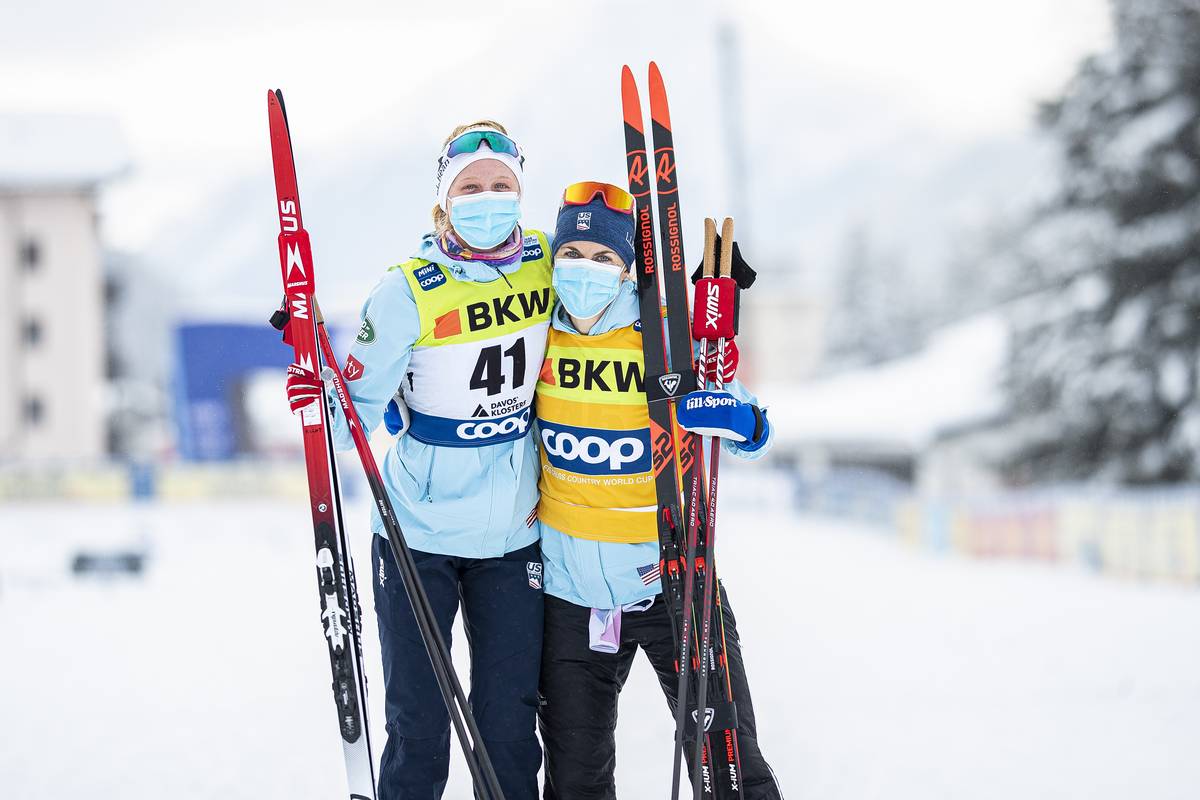
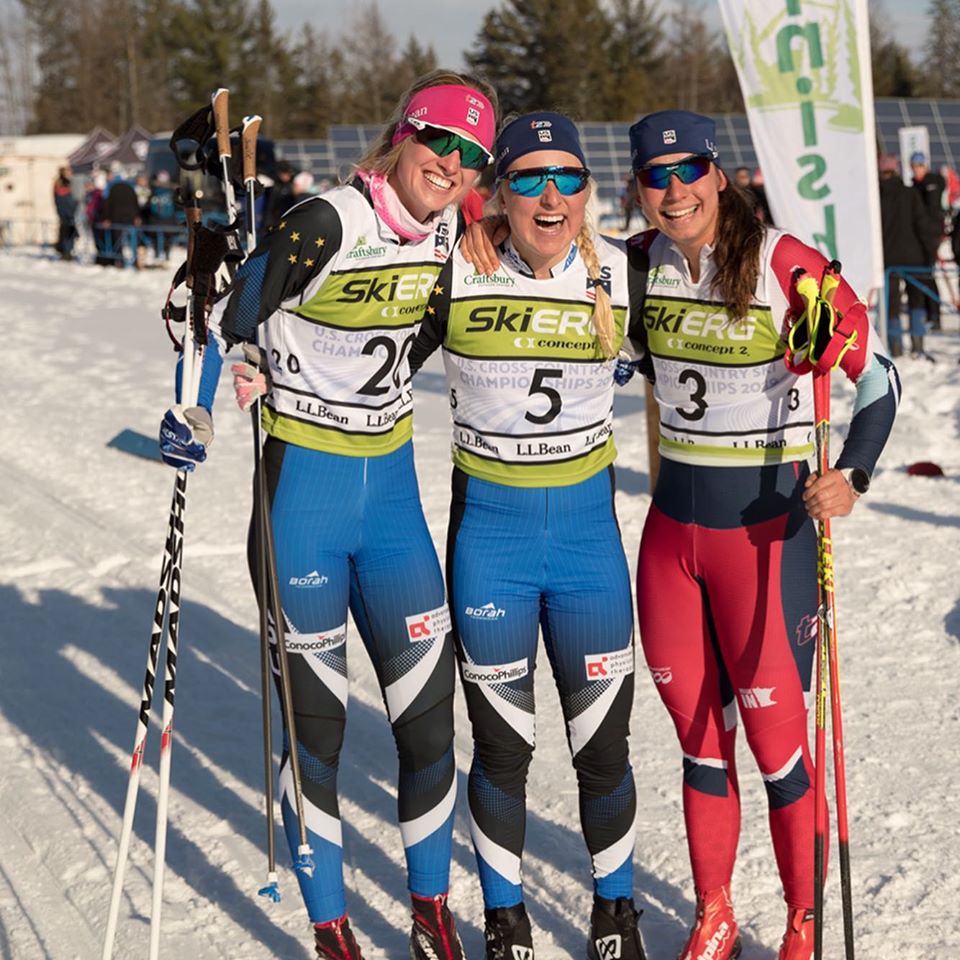
Hailey Swirbul (left, third overall) and Rosie Brennan (first, wearing the yellow bib as World Cup overall leader) after the women’s 10 k skate in Davos, December 20202. (photo: Modica/NordicFocus)
Top results last season: Brennan was fourth in both the overall World Cup and distance standings, and for one magical weekend in December was the best skier in the world, winning back-to-back races in Davos. She became the second American woman ever to wear the yellow bib, after Maubet Bjornsen, and kept it for roughly a month. It was a well-deserved coming-out party for the longtime APU athlete (note that she was also on this team nine years ago) currently in her third separate stint on the U.S. Ski Team, after most recently being cut in 2018 after she raced poorly in PyeongChang while unknowingly suffering from mono.
Behind her, Swirbul finished the season ranked 23rd overall in the World Cup (21st for distance) and 4th in the U23 standings, picking up her first World Cup podium along the way, which she shared with Brennan. Maubet Bjornsen stayed home in Anchorage for the first half of the season, placed 10th in her first World Cup race in a year after returning to Europe, then at World Championships came within a combined 3.17 seconds of coming home from Oberstdorf with two medals.
Swirbul, Maubet Bjornsen, and Brennan formed the first three-fourths of the American women’s relay team at World Champs, which came 0.8 seconds away from medaling. Norris recovered from Covid to post some of his best results yet, including 16th and 17th at World Champs, and Patterson had his best season in years, highlighted by a 10th in the World Champs 50 km; the two of them formed half of the American men’s relay team in Oberstdorf. (The team sent seven athletes total to World Championships.) Jager was a tantalizing 0.09 seconds out of the heats in his World Cup debut. Hanneman made three World Cup heats and finished the year ranked 29th in the Sprint Cup standings. Halvorsen returned from a year of grueling rehab from a car accident to finish 23rd in her first race back in two seasons – which was not an OPA Cup or a local citizens race but rather the World Cup sprint in Dresden.
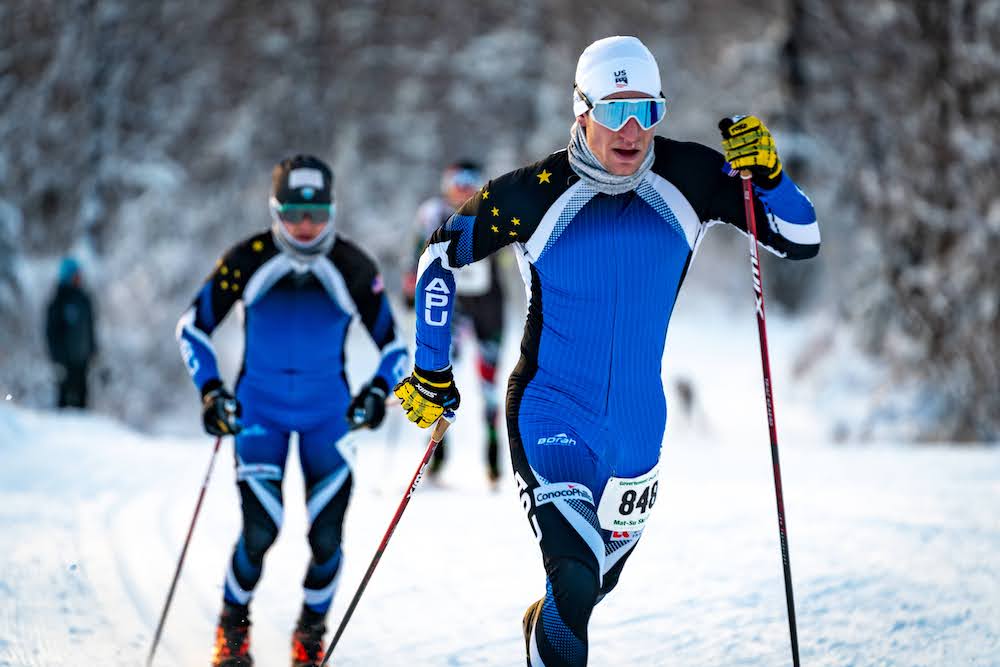
Hunter Wonders races at Government Peak Recreation Area, Palmer, Alaska, Nov. 14, 2021, in the season-opening Race to the Outhouse #1. David Norris is behind him. (photo: Eric Strabel for APUNSC)
Domestically, Jager, Wonders, and Maubet Bjornsen won the December Anchorage JOQ races that were the unofficial U.S. Nationals west (also on a podium in these races: McMullen, Mahlen, and Frankowski), and Frankowski and Kornfield picked up a combined four podium finishes at the American Birkebeiner, including Frankowski’s win in the classic race.
Smyth adds, “Locally, races happened for the rest of the elite team, where we had numerous podium sweeps and a Tour of Anchorage podium sweep in the women’s 50K with Rosie Frankowski (1) Becca Rorabaugh (2) and Anna Darnell (3) and then in the men’s 50K Tyler Kornfield (1) and Thomas O’Harra (2).”
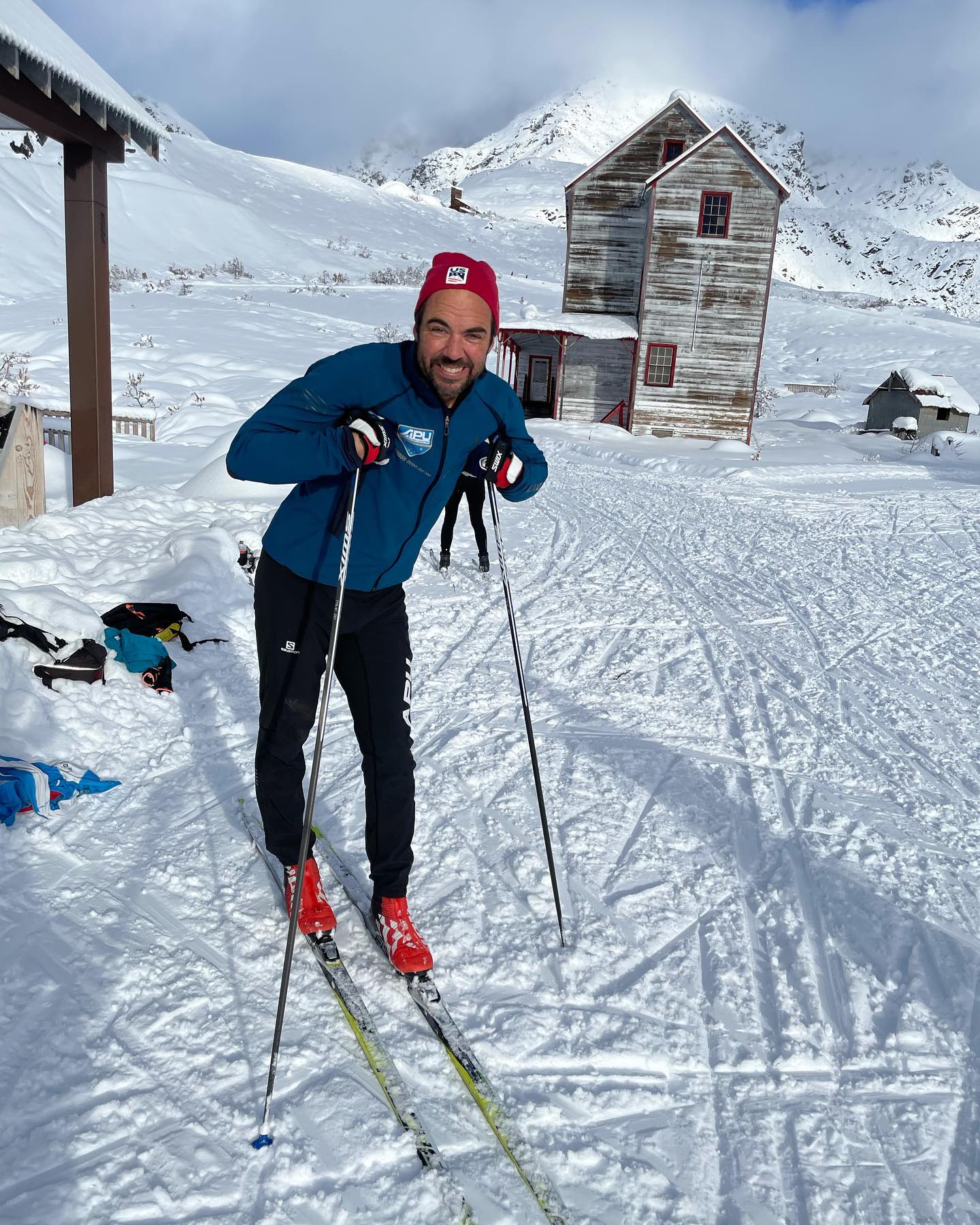
APU head coach Erik Flora, Independence Mine, October 2021. (photo: courtesy APUNSC)
Coach’s comments: “The APU Elite team is more than 25 skiers strong. We had a great summer of training with a majority of the U.S. Ski and Snowboard D-Team joining us. U.S. Ski and Snowboard coaches joined the Elite team in July for training sessions, which was positive for the team! This brought some young energy to the daily grind along with a fun group to work with. October brought early snow in Hatcher Pass to finally get on skis for training with early November snow in town to follow. We feel ready for the race season to happen and are excited to see what the races bring moving into an Olympic year!”
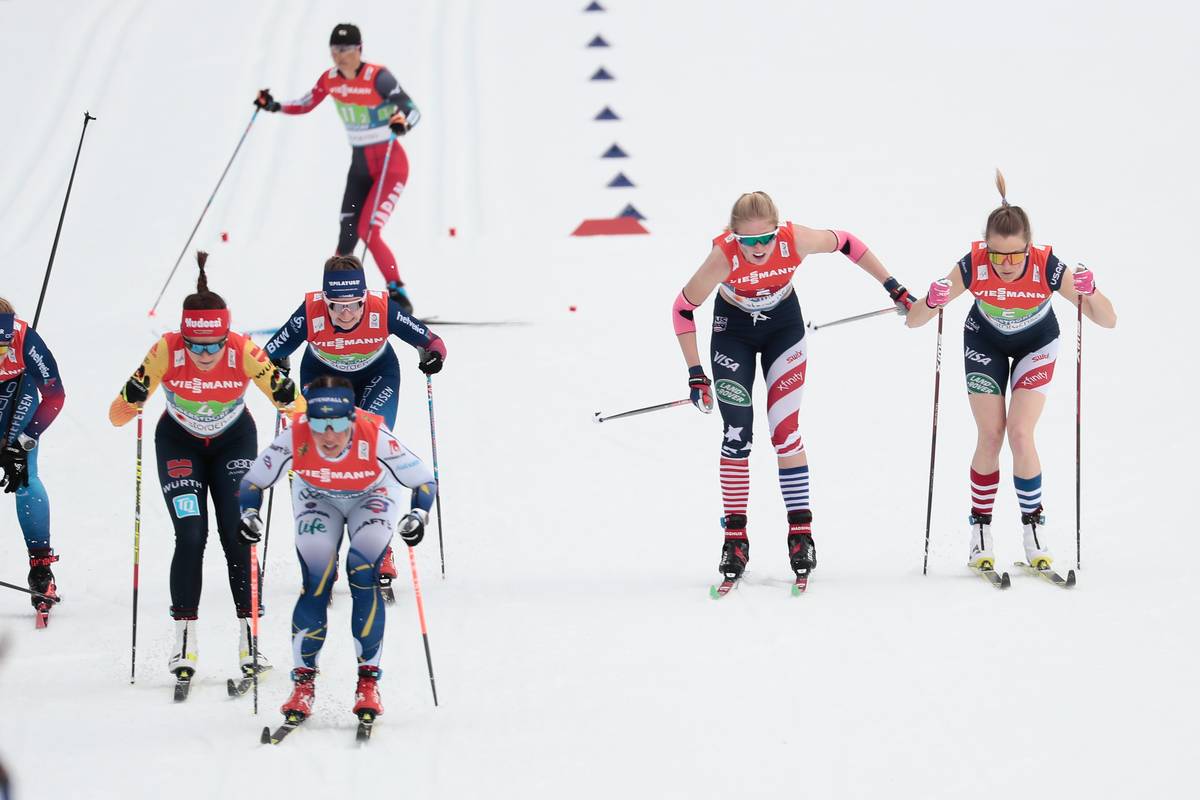
Hailey Swirbul (second from right, pink elbow sleeves) tags off to Sadie Maubet Bjornsen (far right) after the opening leg in the women’s 4 x 5 km relay at FIS nordic world ski championships, Oberstdorf, March 2021. (photo: Modica/NordicFocus)
Disclaimer: I live in Anchorage, and have trained with the APUNSC Masters program for eight seasons and counting. On the one hand, the Masters group has been an important part of my personal and athletic life for many years now; on the other hand, on a day-to-day basis the Masters team has basically nothing to do and no overlap with the APU Elite Team, and is not coached by Elite Team coach Erik Flora. I don’t receive free gear from APU, or anything in that vein, in exchange for writing about the APU Elite Team.
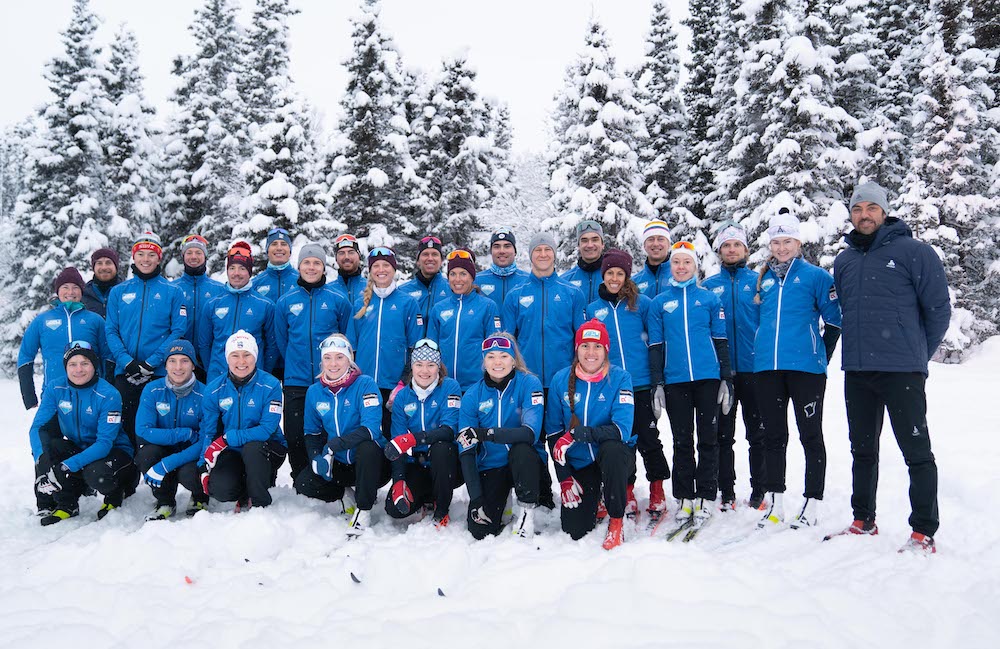
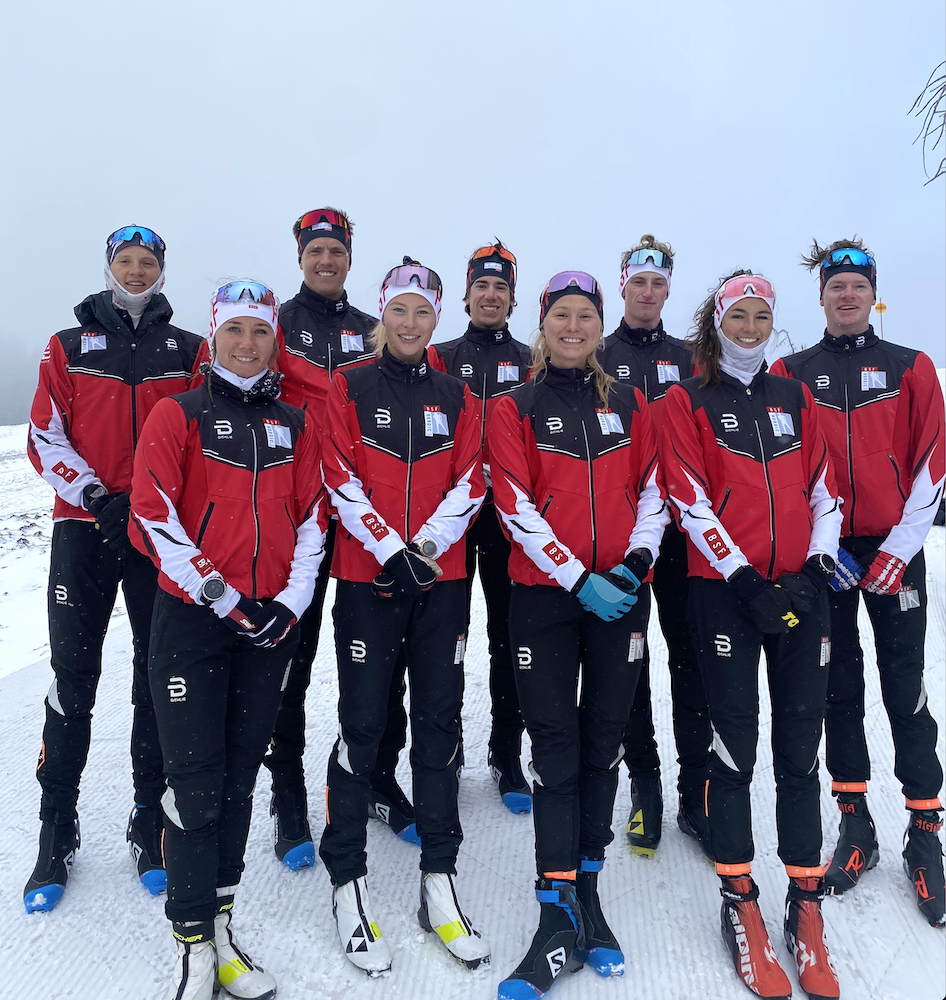
The 2021 Bridger Ski Foundation squad. (photo: courtesy BSF)
We tend to highlight World Cup races on this website, but those results, and those athletes, don’t happen in a vacuum. Skiers are made in the summer, as the well-worn saying accurately has it, and summer training means time spent with a domestic ski club. So we’re going to be highlighting the athletes on several prominent American ski clubs over the next few weeks, only a small portion of whom will be starting on the World Cup this fall.
If World Cup skiers are the pinnacle of a pyramid, then their club teammates are the indispensable supporting layer just beneath them. Go back and peruse one of Jessie Diggins’s multiplepostshighlightingthe importance ofherteam. Diggins doesn’t say, “I’d like to thank my teammates who ski with me on the World Cup, and only those teammates.” Diggins instead, of course, just says, “I’d like to thank my teammates.” There’s not much place for pedigree when you’re digging deep in bounding intervals in July, months and miles away from snow-covered European race courses.
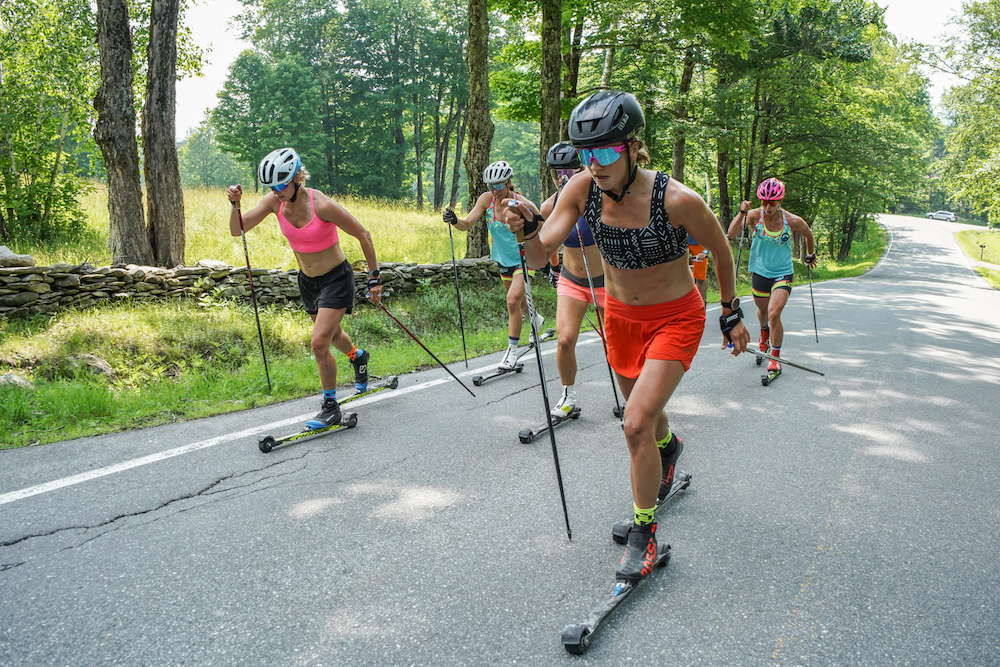
Stratton Mountain School athletes, including Alayna Sonnesyn, far right, rollerskiing in Vermont in summer 2021. (photo: courtesy SMS)
This isn’t just an attempt to make club skiers feel good, either. Consider Caitlin Gregg’s World Championships bronze in 2015, Chelsea Holmes’s 13th in the 2017 World Championships 30km, Rosie Frankowski’s 21st in the 2018 Winter Olympics 30km. None of them was on the national team at the time of this breakthrough result; all of them were “just” club skiers. There are larger, complicated questions here about the interplay between the domestic race circuit and the World Cup when it takes so much time and money to travel between America and Europe, and World Cup–based skiers seldom race SuperTour-based skiers head-to-head, but it seems fair to say that some Americans racing at home are comparable to some Americans racing overseas.
(It also seems fair to say that the fact that Holmes was the third alternate on that memorable day, and got the start only after two U.S. Ski Team athletes, who were also her club teammates, turned it down, speaks to some of these larger questions.)
All that said, please enjoy our preview of six domestic ski clubs and their athletes, starting tomorrow and continuing over the next several weeks.
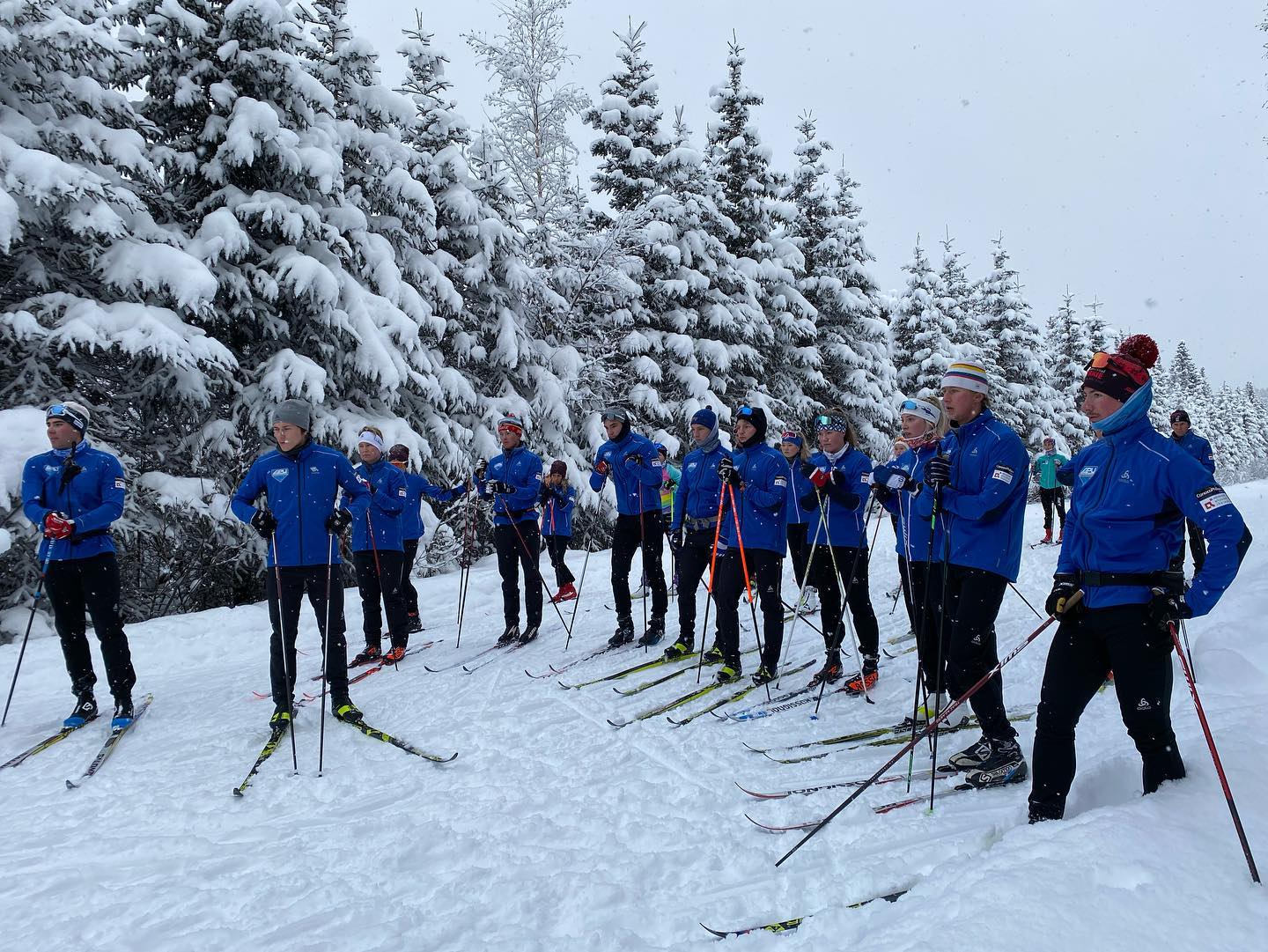
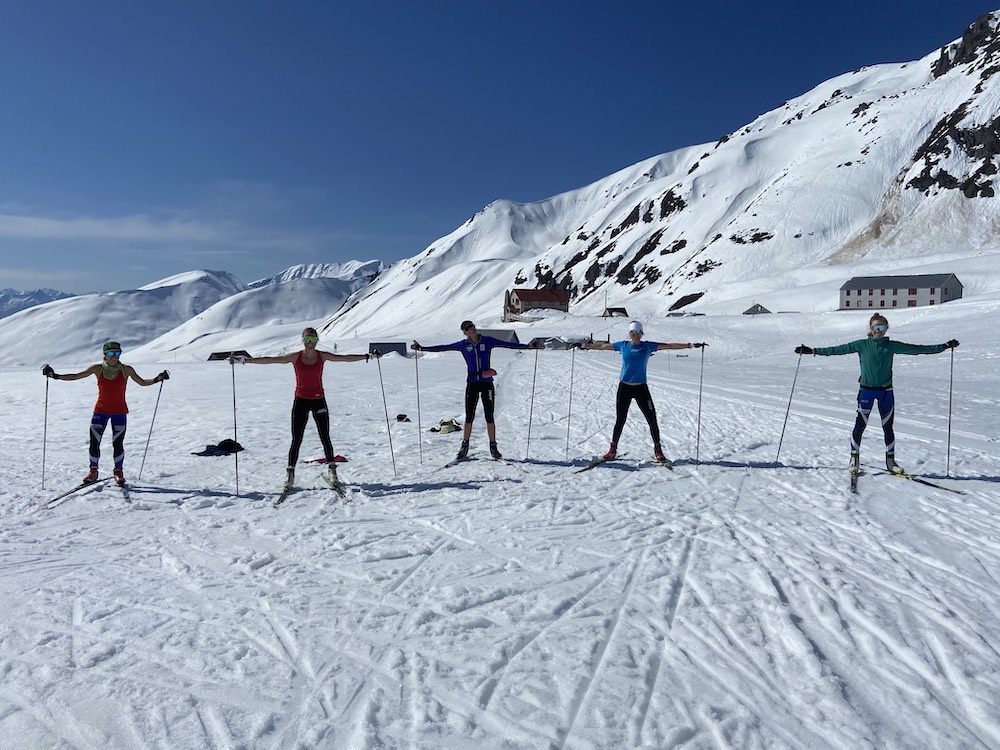
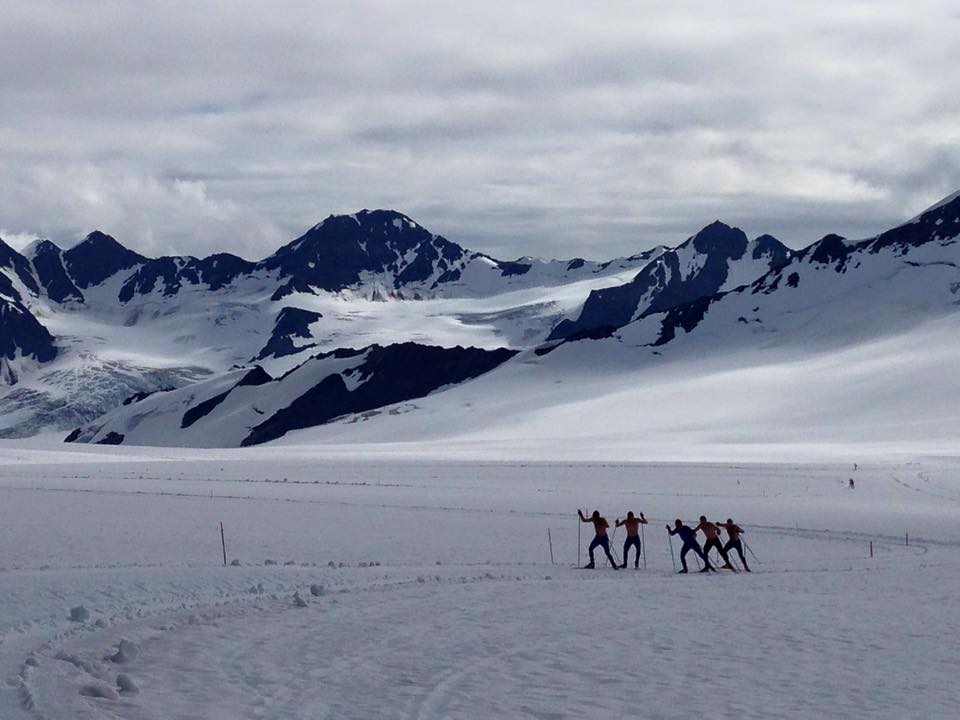
APU athletes maintaining early-pandemic social distancing, Hatcher Pass, May 13, 2020. (photo: courtesy Sadie Maubet Bjornsen)
This is not the first time that FasterSkier has written such a preview, but it is the first time in a few years. And compared to prior installments in this series, the ecosystem of American skiing has become notably more homogenous, at the same time that American skiing has become more successful. Here are the six clubs that we will preview this fall:
Alaska Pacific University Nordic Ski Center
Bridger Ski Foundation
Craftsbury Green Racing Project
Stratton Mountain School
Sun Valley Ski Education Foundation
Team Birkie
And here are the twelve clubs featured in, for example, summer 2012 (links to the whole series are at the bottom of this article from November 2012, if you’d like to really go down memory lane for a bit):
Alaska Pacific University Nordic Ski Center
Bend Endurance Academy
Bridger Ski Foundation
Craftsbury Green Racing Project
Central Cross Country (CXC)
Far West Farm Team
Maine Winter Sports Center
Methow Olympic Development
SMS T2 Team
Ski and Snowboard Club Vail Team HomeGrown
Sun Valley Ski Education Foundation (SVSEF) Gold Team
XC Oregon
Twelve is, obviously, more than six; spare a thought for Bend Endurance Academy, Far West Farm Team, Maine Winter Sports Center, Methow Olympic Development, Team HomeGrown, and XC Oregon as high-level American club teams (and, sort of, CXC Elite, though Team Birkie is in many ways its spiritual heir, with Caitlin and Brian Gregg as the through line).
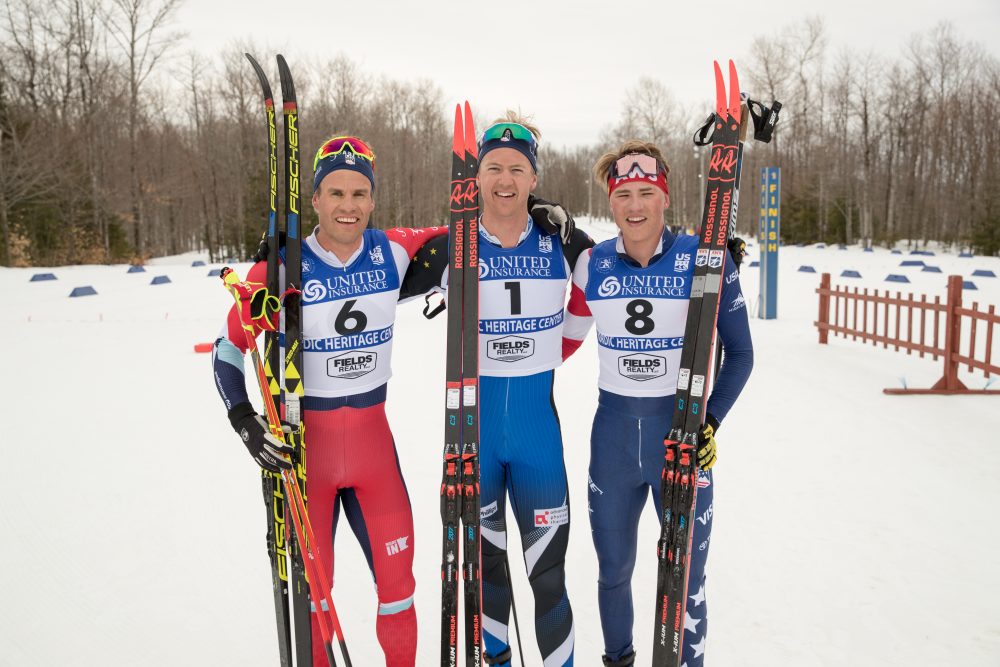
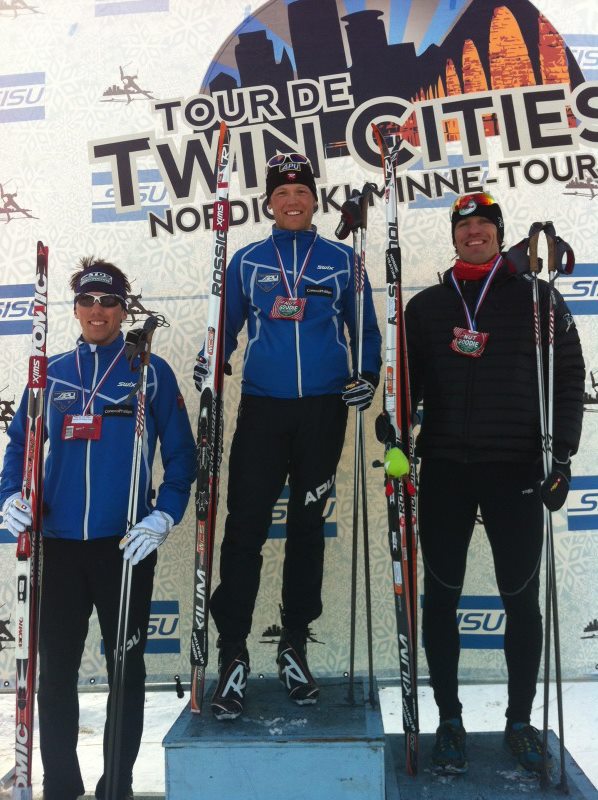
The men’s podium for the 2019 15-k mass start classic during the Super Tour Finals in Presque Isle, Maine. Erik Bjornsen (USST/APU, center) took the win ahead of Simi Hamilton (USST/SMST2, left) and Gus Schumacher (USST/Alaska Winter Stars, right). (Photo: U.S. Ski & Snowboard – Reese Brown)
We’ll leave it to you to debate whether this is “good,” “bad,” or neutral – whether it is good that more high-level skiers are training in consort in larger groups; bad that fewer coaching ideas or philosophies may have the chance to be heard, and that athletes outside four regions of the country have to travel to find a team (those members of the U.S. Ski Team A-Team who originally hail from Utah, Colorado, California, or Minnesota, for example, which currently describes four-fifths of the A-Team, had to leave home to find a club team); or neutral because improved American results justify a homogenization of the domestic training landscape, regardless of what might have been lost along the way. Maybe some of all of the above.
But regardless of the merits of this shift, it’s worth noting that things change. At the turn of the century, the best ski program in Alaska was the college team at University of Alaska Anchorage. In summer 2010, an ascendant Diggins was the nucleus of a strong CXC team, alongside Caitlin Compton (now Gregg), Jennie Bender, Tad Elliott, Garrott Kuzzy, Brian Gregg, and Matt Liebsch. In fall 2012, this site wrote, surveying the prior season’s SuperTour racing, “Central Cross Country (CXC) was indisputably the best all-around team last year.” And it alluded to the potential of a new group forming at Stratton Mountain – which was at that point still just potential, because the team had officially formed only earlier that year. Indeed, this article, entitled, “With Elite Team, Stratton Aims To Create ‘Hotbed of Skiing’ in Southern Vermont,” was published in 2012. (Spoiler alert: this worked.)
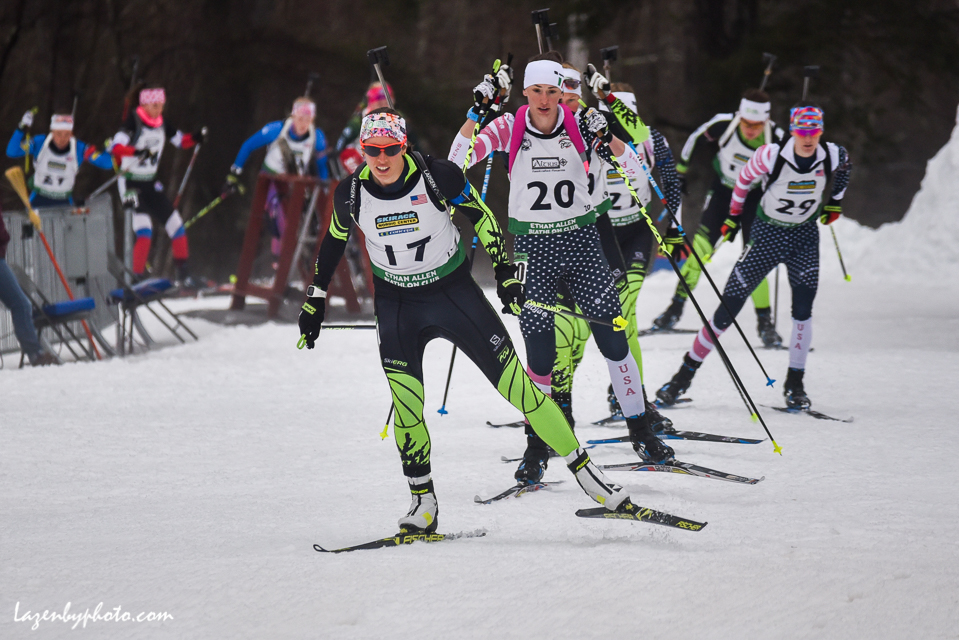
Craftsbury Green Racing Project athlete Susan Dunklee (bib 17) leads a pack including multiple CGRP suits at USBA Nationals in March 2019. (Photo: John Lazenby/lazenbyphoto.com)
Now we’re at a point where APU* or SMS frequently send six athletes each to a World Cup race or global championship, where there are currently eight national team athletes in one club alone (APU), and no current U.S. Ski Team members primarily based in the Midwest. No one knows what this list will look like in another decade, but for the time being, six clubs is decidedly fewer than twelve clubs.
Please enjoy the first preview, coming tomorrow.
* Disclaimer: I live in Anchorage, and have trained with the APUNSC Masters program for eight seasons and counting. On the one hand, the Masters group has been an important part of my personal and athletic life for many years now; on the other hand, on a day-to-day basis the Masters team has little to do and no overlap with the APU Elite Team, and is not coached by Elite Team Coach Erik Flora. I don’t receive free gear from APU or easier interval assignments from my Masters coach, or anything in that vein, in exchange for writing about the APU Elite Team.
This series comes to FasterSkier from the Alaska Pacific University Nordic Ski Club.
A Day in the Life: APUNSC is checking in with Elite Team members of the course of the next few months to get a glimpse into what life looks like for elite athletes as training starts up again during a global pandemic.
Today we check in with Thomas O’Harra (24), an APUNSC member since 2007 when he joined the APU DEVO program. Thomas received his undergraduate degree from APU in 2017 and has continued on working towards a Master of Arts degree, set to graduate in 2020. Thomas qualified for his first World Cups this season!
Where are you right now? What have the restrictions been? Are they now changing?
I am currently in Anchorage, AK. I have been here since March 15th, when I got back after the cancelled World Cup Sprint Tour. I was initially under a 14-day quarantine, and Alaska was under a hunker-down order that has since been lifted. In the past few weeks, Alaska has gone back to pretty much normal, minus wearing masks and social distancing.
How did your season end? Were there any race cancellations that affected your season?
I had just qualified for my first World Cup races, traveled all the way to Quebec, and woke up (on my birthday) to learn that the Minneapolis World Cup had been cancelled. We spent the rest of the day in limbo before the US and Canadian teams withdrew from the races, at which time we bought tickets to fly home the next morning. In addition to the World Cup tour being cancelled, I was really looking forward to Spring Nationals in Silver Star; a few teammates and I were going to arrive a couple of days early and have a mini training camp!
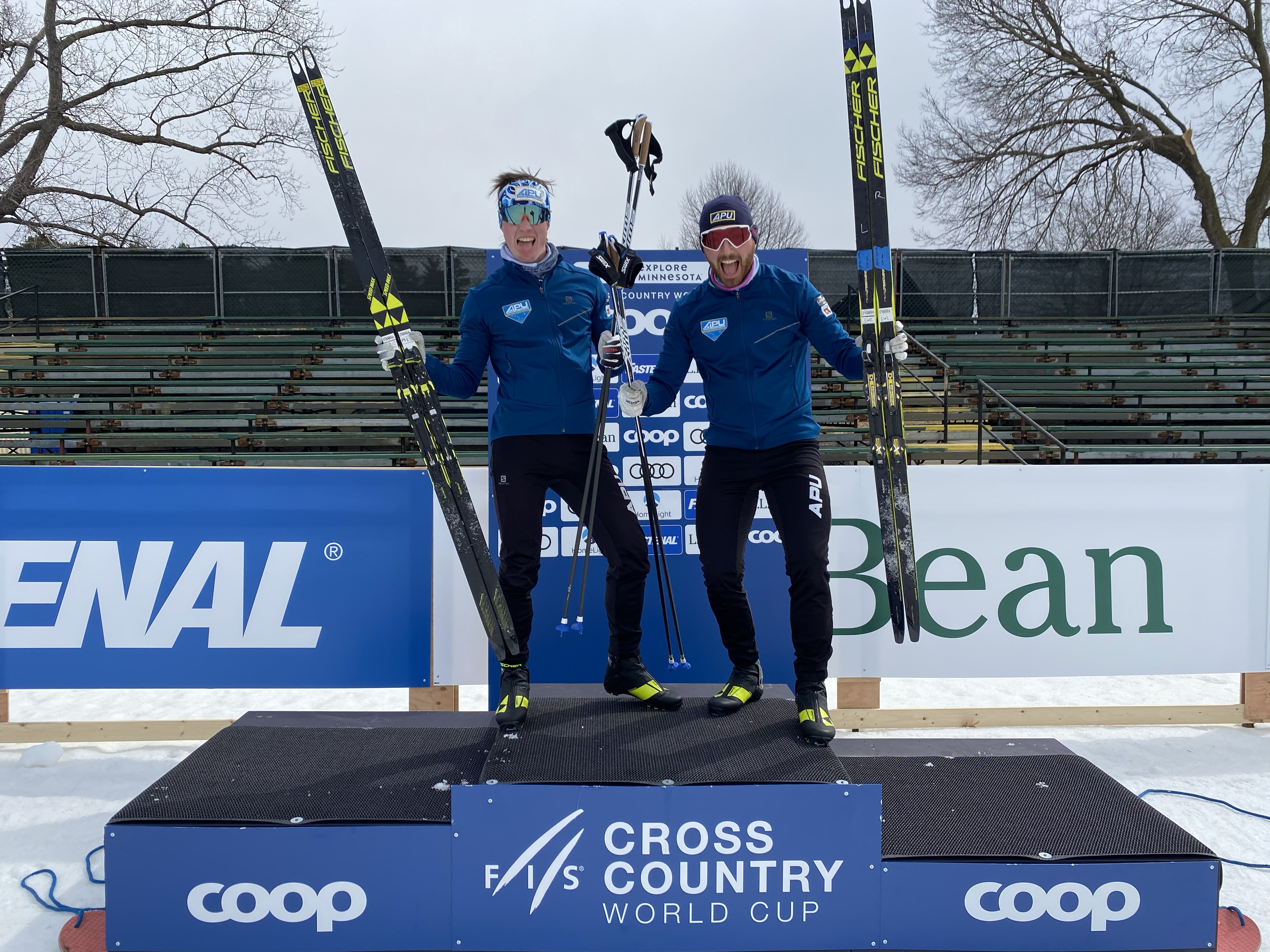
Enjoying the course and podium at the Minneapolis World Cup venue after learning that the event had been cancelled. (Photo: Thomas O’Harra)
What is a highlight of the ski season you did have?
I would say that the highlight of my season was definitely qualifying for the World Cup Sprint Tour, though it was made possible by racing my way into one of the sprint finals at US Nationals in Houghton, which is my best result so far!
(Racing at US Nationals Photo: Thomas O’Harra)
How have you planned around the unexpected end to the season? Did you do anything to “finish” out the season or jump into summer training early?
When I got home, I was in a bit of disbelief over everything that had happened during the previous four days, but I really wanted to take advantage of the amazing spring skiing that we still had in Anchorage. NSAA groomed until mid-April, we had an amazing sea-level crust season, and then Mat-Su Ski Club groomed at Independence Mine until mid-May! I tried to ski as much as I felt like for a few weeks before taking a short break. Everyone seemed to be on different plans, but I just tried to enjoy the phenomenal skiing we had.
Enjoying some fantastic crust skiing after the season ended early. (Photo: Thomas O’Harra)
What activities are you doing to keep yourself busy outside of training?
I have been working mostly. I also (like everyone else in the world) acquired a sourdough starter and have been baking bread with my girlfriend. Additionally, I have been reading more. I recommend The Uninhabitable Earth by David Wallace-Wells; it is a good read and a way not to forget that we are still amid a climate crisis in addition to the pandemic.
What did your workout look like today?
Today I did some rollerski speeds in the morning and then a distance run in the afternoon.
Do you have any indoor/at home workouts you are doing?
I actually started doing core this spring, mostly because I have not been able to get into a gym to do any lifting. For me, core is one of the more difficult workouts to get motivated for.
Without knowing what the future has in store, has it been challenging to keep up the motivation to train? Where are you getting that motivation? What motivates you to keep training?
I enjoy getting out to train, and I am currently operating on the assumption that we will have a season this coming winter. If we don’t get to race, I will deal with that in November. For now, it is summer and I am just excited to be healthy and able to spend time outside.
How are you keeping in touch with friends/family/teammates?
During April, our team used Zoom to keep in touch, and I have done the same with family. That being said, I live a few blocks away from my parents, so I have been able to see them frequently.
What has been your biggest challenge in relation to Covid-19 and how are you tackling it?
Honestly, I feel like life is almost normal for me. I am able to train every day and be outside, and I have been able to work (albeit on Zoom, which was difficult in its own way).
What are your plans from here? What things do you have in store for a summer that will include many restrictions?
I plan to keep training and hopefully do a little adventuring in a tourist-free Alaska, a chance that I might not get for a long time. I also have some off-grid adventure ideas that I’d like to accomplish, so we will see what happens!
Do you have any helpful advice in dealing with the changing times?
Just take everything day-to-day. I am not thinking about planning, or what might or might not happen in a month, but instead, I am focusing on getting out and training quality sessions every day.
Enjoying the mountains and the close to home adventures. (Photo: Thomas O’Harra)
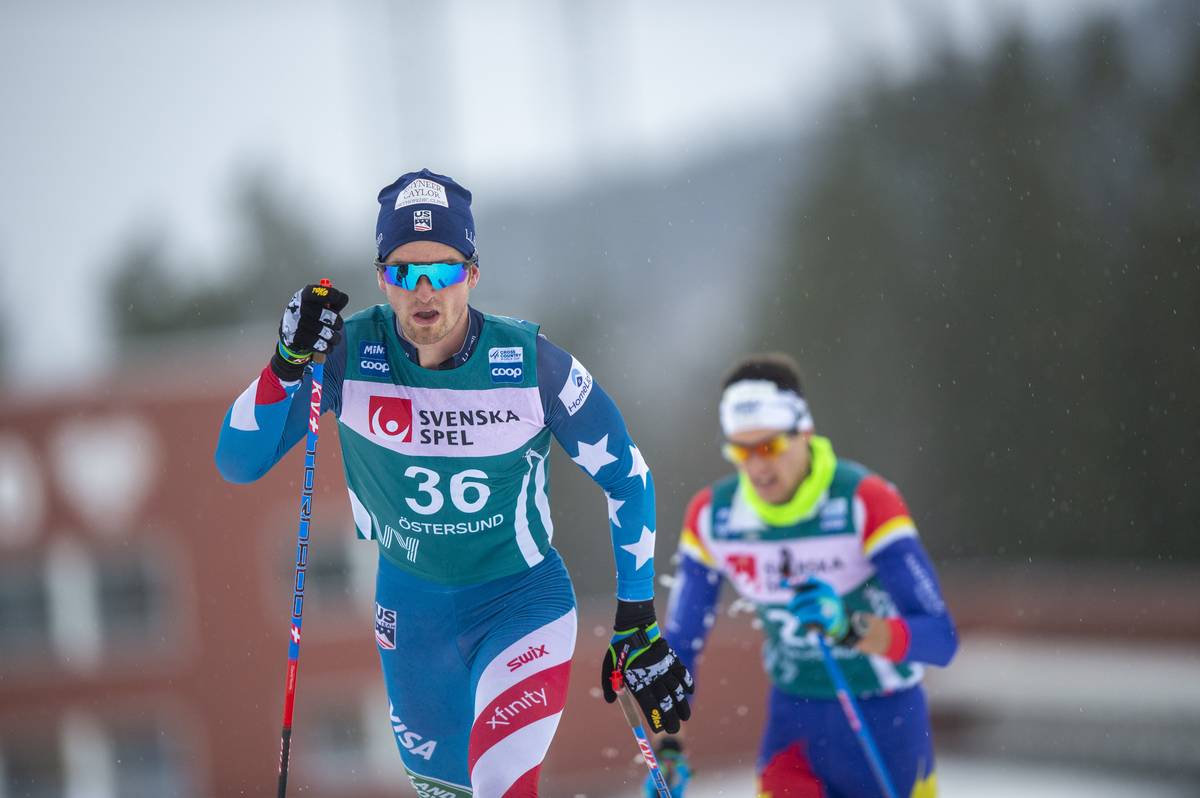
David Norris racing in the 2020 World Cup in Östersund, Sweden. (Photo: NordicFocus)
The razor-thin margin for national team selection in the U.S. played out again this season with David Norris (29) not discretioned onto the U.S. team – the sporting actuaries stated he lacked future medal potential.
On both sides of the aisle, making the team or not, the platitudes didn’t cushion the blow for a skier who has doggedly pursued endurance speed for over a decade. Norris earned his first national championship podium with a third place in 2011’s 15 k classic. With seven senior national podiums to his credit, Norris is the sort of grind it out athlete who finds no need for social media boasting or self-affirming flattery from “likes”.
David Norris racing in Nové Czech Republic. (Photo: NordicFocus)
For skiers like Norris on the nationa team bubble, and aging themselves into tougher and tougher objective criteria to earn full funding as a USST member, Norris had some important decisions to make. He could have taken the odds of playing the FIS point game and returned for the 2020 Senior Nationals. That path would have likely presented fewer barriers to earn the points necessary for a USST nomination. Abroad, he would need to consistently earn top-30s on the World Cup.
Norris committed to the Tour de Ski foregoing the ticket to Houghton for Senior Nationals. His choice premised on gaining international success and raising the standard of U.S. men’s skiing
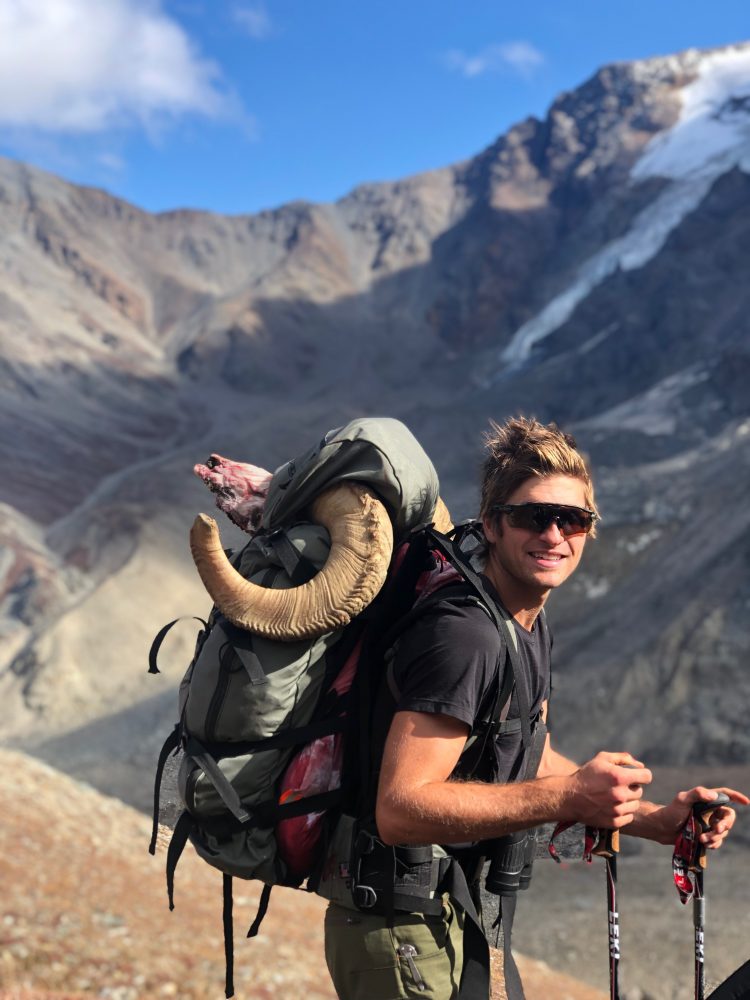
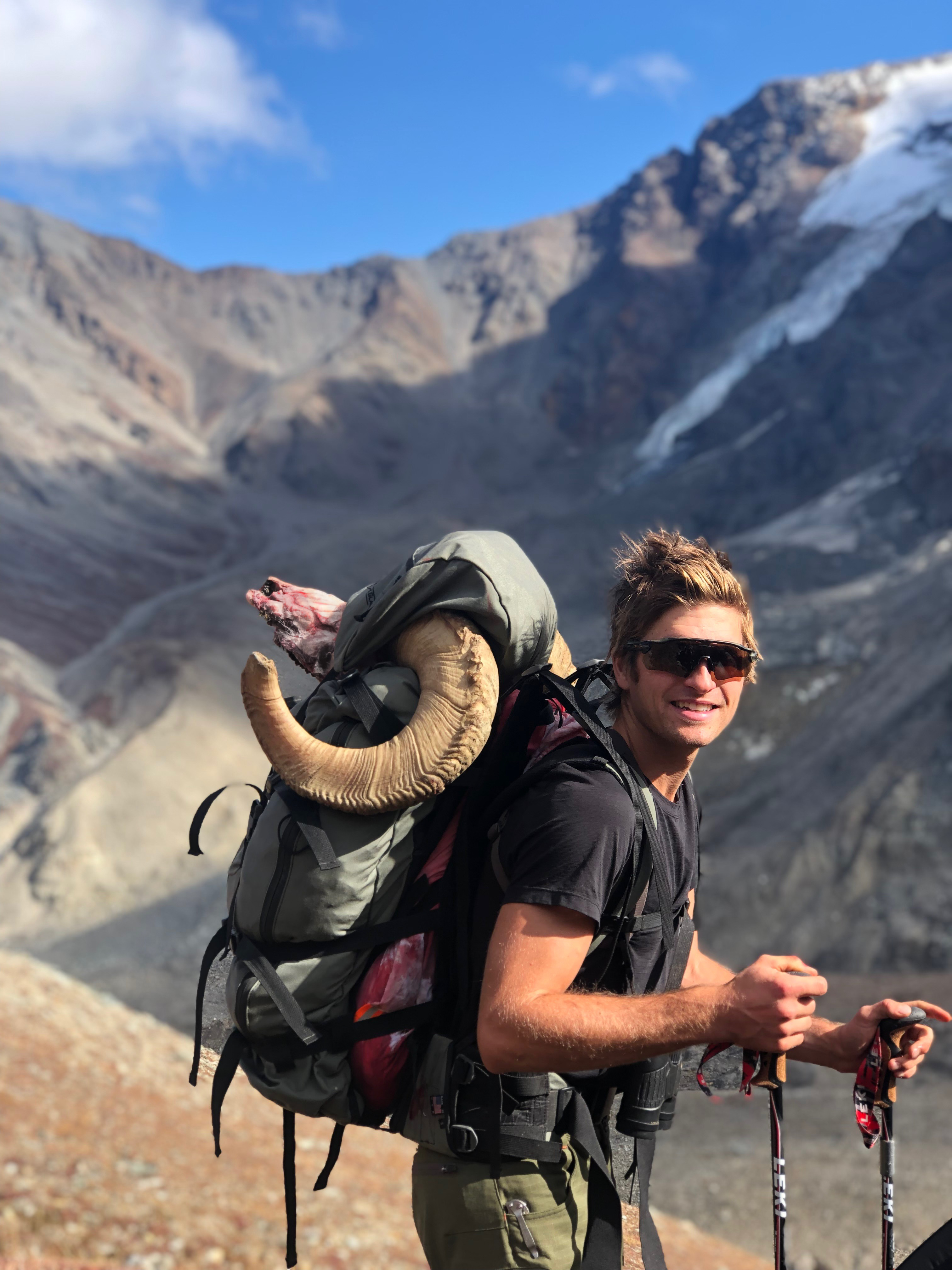
David Norris on a sucessful sheep hunt during a 2019 trip to the Eastern Alaska Range. (Photo: Courtesy David Norris)
Having grown up in Fairbanks, Alaska, and rooted in epic cross-country hunts on foot or skis, Norris understands his unsettled place in the broader ecosystem of making ends meet. On the skiing front, he saw three elite peers in Ben Lustgarten, Kyle Bratrud, and Erik Bjornsen retire this year. All were under 30 and all had won national championships during their careers. All felt they had tapped out on their potential for improving and landing on the side of medal potential.
When speaking on the phone this April, Norris equated his depth of disappointment in not being named to the national team with a missed opportunity to take a Dall sheep on a hunt a few years back. For Norris hunting is a full-immersion endeavor.
He had pursued a sheep and was closing in on a clean shot. From a distance he was unable to discern if the sheep was legal for the take: a legal ram must be aged properly with horn shape, the most common method used for aging during a hunt. Norris hesitated. There was no trigger pull.
“I was just inexperienced enough that I was so cautious of not shooting an illegal ram,” said Norris. “I knew that would ruin my trip more than coming home empty-handed. But once I got home and between the photos I had taken and talking to people and seeing some horns in my hands, the sheep I was looking at and had stalked was clearly legal. It crushed my soul.”
Norris knows soul crushing as much as top-of-the-podium elation. Back in 2018, he missed out on qualifying for the Olympics by mere seconds in a closely packed sprint finish in the men’s 30 k at nationals.
As the pandemic took hold this spring, Norris spent mid-March through the end of May in Bozeman, Montana with his partner Jessica Yeaton. He has since returned to Anchorage for organized training with his APU team. Norris has reset and set goals of competing on the World Cup next year, qualifying for the 2022 Olympics, and notching a top-15 in Beijing.
David Norris racing in Ruka Finland. (Photo: NordicFocus)
Those goals remain a reality as the skier made steady-state improvements on the World Cup this season. Norris credits his APU mates with his progress since joining the team six years ago.
“On our APU team it is not really discouraging to get beat on by each other because you know everyone is actually really legit,” Norris said. “Most guys on the team have podiumed at SuperTour. Luke Jager was beating up on people at World Juniors and the same when Gus Schumacher joins us. We all know Bjornsen’s results and Scott Patterson’s 11th place at the Olympic 50 k.
“With APU, to my benefit, I can go a month without dominating a single workout because on a given day Luke will throw down on the double pole workout and Scott can bound up a hill ridiculously fast and everybody has their own strengths. And particularly when their strength lines up with my weakness it challenges me and pushes me. I am super grateful to those guys and their abilities.”
Part of Norris’s job is finding success beyond the SuperTour. In discussing his full season on the World Cup, Norris said this season was more conducive to training and racing fast while living abroad.
“I think where people struggle and where I struggled in the past is just the mental side of it between being happy and getting along with everybody and feeling like you have purpose everyday – that kind of struggle,” Norris said.
Norris is a professional accountant. He found purpose this year using his non-racing skills. While traveling on the World Cup, he was able to work remotely for his online accounting clients. The daily routine of accounting work filled a void between twice a day workouts and long stints in hotels. According to Norris, his business, Front Range Financial LLC, gave him more structure.
Norris said he has plenty of work during the race season to cap his billable hours to 40 per month, and still afford himself time to train and recover. He recently completed his MBA to complement his accounting acumen. However, he’s reluctant to tap into his inner entrepreneur and grow the business. His priority is finding balance with an emphasis on meeting his racing goals.
The fact remains, Norris would have been relieved with a national team nomination and the more stress free situation of not having to raise 25 to 30 thousands dollars to sustain his World Cup racing as a non-funded athlete. That’s when his accounting and results sheet come in handy. With spreadsheets, a phone contact list, and an easygoing manner, Norris will work the phone and pound the Anchorage pavement keeping the dream alive.
This series comes to FasterSkier from the Alaska Pacific University Nordic Ski Club
A Day in the Life: APUNSC is checking in with Elite Team members of the course of the next few months to get a glimpse into what life looks like for elite athletes as training starts up again during a global pandemic.
APUNSC is also running a fundraiser in which the Elite Team is working towards skiing 1,000 kilometers as a team to raise awareness of road safety and promote healthy lifestyles. Each pledge of $50 = 1 Kilometer skied.
Today we check in with Hailey Swirbul (21), a silver and bronze medalist from the 2018 World Junior Championships and three-time National Champion. Hailey hails from El Jebel, CO and has been a member of the APUNSC elite team for two years. She is working towards a degree in civil engineering from the University of Alaska Anchorage.
Where are you right now? What have the restrictions been? Are they now changing?
I am in Anchorage, Alaska. Restrictions have mostly been lifted for Covid here with businesses reopening. People are still required to quarantine upon entering the state, but otherwise, social distancing is still in place.
How did your season end? Were there any race cancellations that affected your season?
My last races were in Oberwiesenthal Germany at U23 World Championships. I had traveled to Quebec for the North American sprint tour where the rest of the races got cancelled for the season (Quebec, Minneapolis, and Canmore).
Hailey Swirbul racing at U23 World Championships.
What is a highlight of the ski season you did have?
My highlight was scoring my first World Cup point in Davos, SUI, and scoring WC points in all types of races- classic & skate, sprint & distance. I also like learning what life on the road is like on the World Cup.
How have you planned around the unexpected end to the season? Did you do anything to “finish” out the season or jump into summer training early?
I kind of let the season end when the world decided to end it. I jumped into my Alaskan spring of backcountry skiing, Nordic skiing, and playing outside. I didn’t stress about training extra just because the season ended but probably trained more than I would have just by being outside so much.
Making do with a shortened season by getting in some good backcountry adventures. (Photo: Courtesy Hailey Swirbul)
What activities are you doing to keep yourself busy outside of training?
I have been very busy with a part time engineering research job, fishing, and cooking new things!
Baking delicious treats in my free time. (Photo: Hailey Swirbul)
What did your workout look like today?
My workout today was a 3-hour skate roller ski OD with my teammate Rosie and a short 50-minute mountain bike ride with the dog in the afternoon.
Enjoying being able to train with teammates. (Photo: Hailey Swirbul)
Do you have any indoor/at home workouts you are doing?
I have reallyyyy been struggling to motivate for at home strength sessions without a good gym set up. But when I’ve got to get it done, I’ve been doing squats holding the dog, dips on the side of the couch, and I’ve found a great pull up bar branch of a tree!
Without knowing what the future has in store, has it been challenging to keep up the motivation to train? Where are you getting that motivation? What motivates you to keep training?
It can be tough to motivate for me to train sometimes, but that lack of motivation mostly stems from my schedule with my new job. Ive always liked the structure of training, and that aspect hasn’t changed for me. I’m treating this year as a normal build up to winter and assuming races will go on as planned.
How are you keeping in touch with friends/family/teammates?
I see teammates at outdoor training sessions, and try to FaceTime my family or friends when I can!
What has been your biggest challenge in relation to Covid-19 and how are you tackling it?
My biggest challenge has been keeping my mental health in a good place and keeping structure in my life. It has been difficult for me to get little things done without a strict deadline or meeting time, etc. so I let those things pile up.
What are your plans from here? What things do you have in store for a summer that will include many restrictions?
I’m going to keep training as normally as possible and get outside as often as I can! I think fishing, camping,100 and hiking are great things to do with my quaran-team! I might not be able to leave the state as I had planned, but AK isn’t a bad place to be stuck 🙂
Enjoying vacations close to home. (Photo: Hailey Swirbul)
Do you have any helpful advice in dealing with the changing times?
It’s okay to not be okay during these crazy times. Be patient with yourself.
From left, APU athletes Rosie Frankowski, Sadie Bjornsen, Hailey Swirbul, Becca Rorabaugh, and Caroline Brisbois demonstrate a healthy distance while skiing at Hatcher Pass on May 13, 2020. (Photo: Courtesy Sadie Bjornsen)
Although the training cycle has officially begun, it decidedly has a different vibe and look. Adding some complexity to our short-term new normal are a crosshatch of state, county, and city regulations as it relates to mitigating the community spread of Covid-19. The core question elite cross-country ski programs are asking is this: How can we most responsibly promote safe and effective training for their athletes?
(The United States Olympic & Paralympic Committee (USOPC) has released a document titled Return to Training Considerations Post-COVID-19 This document provides useful information for organizations reopening.)
FasterSkier reached out to four programs in the U.S. — the Craftsbury Green Racing Project (CGRP), Stratton Mountain School’s SMS T2 team, SVSEF’s Gold Team, and Alaska Pacific University Nordic Ski Center’s Elite Team to gauge how athletes can train within the context of their regional social distancing guidelines. The answers are complex. And as each respondent stated, no one single person or group has all the right answers other than to stay informed and err on the side of safety.
Craftsbury Green Racing Project
Head CGRP coach Pepa Miloucheva responded to our query. Craftsbury’s team is located in Northeastern Vermont, a rural and isolated region. When Miloucheva responded on May 8, the Craftsbury Outdoor Center remained closed to the public. Along with key staff, those GRP athletes and coaches that live on campus year-round continued to be in residence. This group includes coaches and athletes from the ski, biathlon, and rowing teams.
“Most of us that didn’t go anywhere this spring have been in strict isolation since March — no store trips or anywhere else. Skiers and biathletes live in the same house, their food is ordered through the center, athletes cook in the house and do train together, but still try not to be in more than 2-3 people groups,” explained Miloucheva.
Several athletes were home with their families. Among them were Akeo Maifled-Carucci and Caitlin Patterson — both had been with their respective families in Bozeman, Montana. They returned to Craftsbury in mid-May. Miloucheva wrote that returning athletes will be quarantined for two weeks before they are allowed to move into team housing and join group practices.
“We do not share any buildings use with the rest of the center staff and if any work-related interactions are only by keeping a safe distance, wearing masks, and following all safety rules and regulations. This said, honestly we don’t have much of those really, we pretty much just interact between ourselves right now.”
According to Chris Mallory, Gold Team head coach, his core unit of skiers have not had group training sessions for the past two months. However, with the canceled racing in March, Mallory said several of his athletes extended their on-snow training north of their home base in town. Like many adapting to the modified season, high volume was the trend for March and April training.
“It was unfortunate the race season got cut short, but it allowed for two months of big volume to finish out the season,” Mallory emailed. “So we’re starting up training a little later than normal this year and for now, coaches are directing workouts remotely. We’re looking to get programming going closer to normal in June, but some things will be structured differently.”
Mallory explained that training group size will be kept below 10 athletes and the norm of committing in a team van will be held off for the near future.
“So we won’t have big cross-team training sessions for a while, unfortunately. We’ll also pick training locations such as Trailheads which are off the beaten path or sections of the bike path which see less traffic for rollerskiing, so physical distancing can be easier to achieve. We might have a partner gym opening up in a week which will allow for some strength training to occur for our Gold Team, but we’re also putting some effort into creating an outdoor strength area outside the Lake Creek ski hut as well.”
SMST2
SMST2 skier Ian Torchia on a recent VT. ride. (Photo: Courtesy Ian Torchia)
Nestled in southern Vermont, the Stratton Mountain School offers an idyllic campus for the SMST2 team. This spring, as the pandemic and its accompanying restrictions unfolded, the state-mandated that both residents and non-residents traveling into Vermont must self-quarantine for 14 days. That rule was recently extended until June 15.
Some SMST2 athletes are currently out of state, while others, like Ian Torchia, have remained in the Stratton area since the end of the season. Ben Ogden and new SMST2 skier Bill Harmeyer returned to their Vermont homes to remotely finish out the academic year at the University of Vermont.
“Initially we were thinking where do you want to be for a two-week self-quarantine,” Patrick O’Brien, SMST2’s head coach said in a call. “Thankfully we also thought about where do people want to be for an extended period of time this spring. And many people already had plans in place — knowing we may be in this for a longer period of time than we were thinking at the beginning of March.”
As June approaches, O’Brien explained that he too has begun defining how training will look, and how to best integrate athletes into specific training groups.
“First and foremost in my mind is what can we legally do, what can we responsibly do, and what are the creative solutions that we can come up with? And understanding again that no one here has a crystal ball; we can look at models, we can look at forecasts, we can monitor the situation but it is going to be a moving target,” said O’Brien. “So really what we are trying to do is find a balance. We are trying to be fully compliant and very safe and cautious and also monitor the situation locally.”
Harmeyer, who had been self-quarantined in Burlington, drove to Stratton recently to begin his full-time training. Due to his limited exposure while in Burlington, he was allowed to integrate with a small training group. Ben Saxton, on the other hand, recently flew back to Vermont from the Midwest. According to O’Brien, he is self-quarantining for the required 14 day period.
For the time being, O’Brien envisions training groups organized around pods – another word he used interchangeably for families. Athletes living together will be considered training pods where they are able to be in close proximity to one another. O’Brien acknowledged this arrangement will be closely monitored and reassessed.
“We need to track and see what seems responsible for group training, but again we want to make sure people are safe and healthy and if we operate in these small groups, and everyone in that group is a ‘family member’, then we know that they are OK to go out and do stuff together. What we want to do is be creative in our approach to these challenges, but really we want to be reasonable.”
Although Vermont’s shelter-in-place order was extended to June 15, it currently allows for outdoor exercise.
“Every challenge presents an opportunity,” O’Brien said. “We are not going to jump on a plane and go to a bunch of different training camps. That doesn’t prevent us from having high-quality training locally. It presents an opportunity. And reaffirms a model of working together and training together.”
Alaska Pacific University Nordic Ski Center
Anchorage is typically a very good place to be a cross-country skier. While so much else has changed in the world this spring, this fact has remained a reassuring constant for the athletes of the Alaska Pacific University Nordic Ski Center (APUNSC) Elite Team, as well as the greater Anchorage ski community. There was seasonal weather, both snow and cold, in the second half of this winter, leading to a sea-level snowpack that lingered well into April. Trail grooming is performed by a nonprofit group, Nordic Skiing Association of Anchorage, that relies on voluntary donations rather than mandatory trail passes while grooming on public land, so grooming continued unabated through March and into late April. And public health-wise, Alaska’s isolation, coupled with a relatively aggressive early response, has led to, so far, consistently low COVID-19 numbers throughout the state, currently the lowest gross numbers of any state and the third-lowest per-capita infection rate behind Hawaii and Montana.
Hailey Swirbul (APU/USST) skis at Hatcher Pass on May 13, 2020. (photo credit: Sadie Bjornsen)
Put it all together, and APU athletes were enjoying groomed skiing at sea level through April 23, with world-class crust skiing coming on line around the time the in-town ski season was winding to a close. (Any April training happened unofficially and in smaller groups, in deference to both the overall training schedule and health mandates in effect at that time. Although a group of four APU athletes did hunker down together in the APU Ski House starting in mid-March, forming a de facto family unit and training group in which half the people were a member of the U.S. Ski Team.) A 75-minute drive away, fellow nonprofit Mat-Su Ski Club has been grooming the trails at Independence Mine, in the Hatcher Pass area, since last October 5… and with a snowpack that currently measures around four feet, is still going. It’s hard to prove a negative, but APU skiers currently enjoy ready access to what are likely the only groomed nordic trails on the entire continent right now.
We have learned that the logistics of keeping our athletes safe while following COVID-19 state mandates has been at the forefront of the APUNSC program. Our core is based around health and wellness, and the safety of our program members is our top priority at all times, similar to other ski communities. APUNSC has had an advantage of having trails and snow on the mountains minutes from our doors to continue training, even in times of quarantine.
“Nordic Ski Center Elite training program began on May 1. We were fortunate that State of Alaska quarantine and social distancing mandates began to lessen at the beginning of May, allowing the Elite Team to be able to begin training in smaller groups outside in the mountains. The Elite team wore face mask or buffs and kept the mandated 6-10 ft separation while outdoors.
“At first, groups of 20 were allowed to hit the trails with a mandated 6-10 feet of separation for active workout sessions. We wore masks when training and avoided crowded parking lots and trailheads where we could.
“Once phase 2 [of state health mandates] hit a week ago, it allowed now the entire Elite Team to be able to head into the mountains to train and ski. Hatcher Pass has been an area where Crust Skiing is at its best with longer days and blazing sunshine. The grooming has been incredible thanks to the work of Nordic Ski Club of Anchorage and the Mat-Su Ski club. The Elite athletes still uphold the 6-10 ft separation when training. The athletes are happy to be together as a team again, and with that comes the responsibility to treat allowances with respect and not take it for granted. We are living and training as athletes in a time where our community could fall back to strict quarantine.
“We’ve stayed away from indoor training as a team in gyms, as not only is the safety of our team top priority, but the team has excelled in their own in-home conditioning and in getting outside to hit the trails. Only if necessary, for some athletes rehabbing, will we recommend using an indoor gym for conditioning and training.
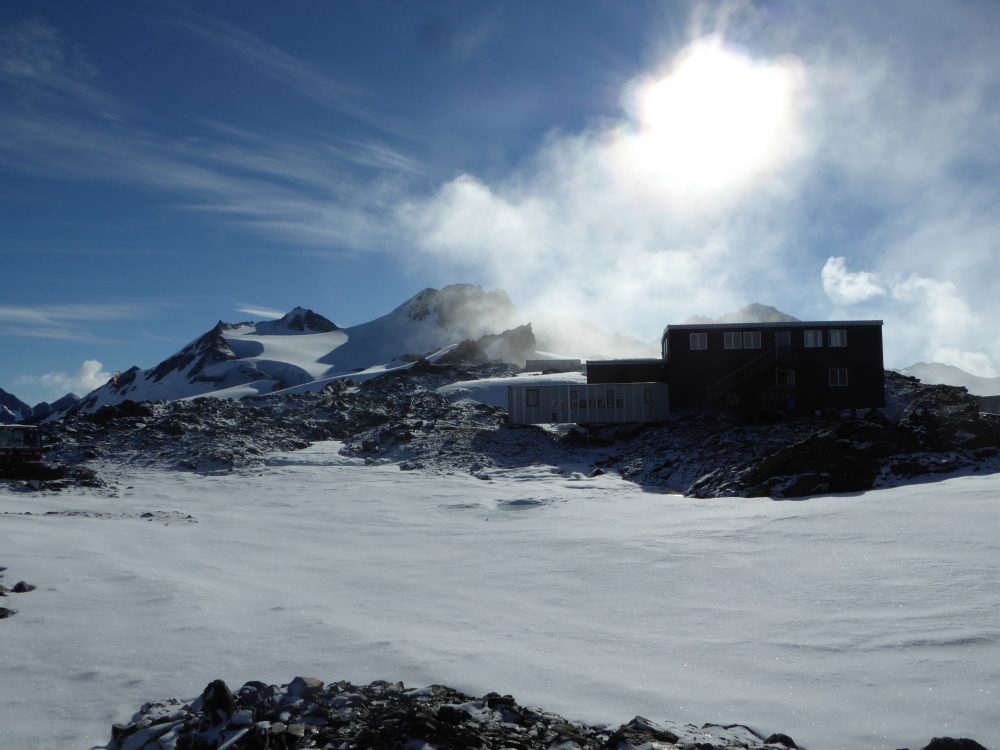
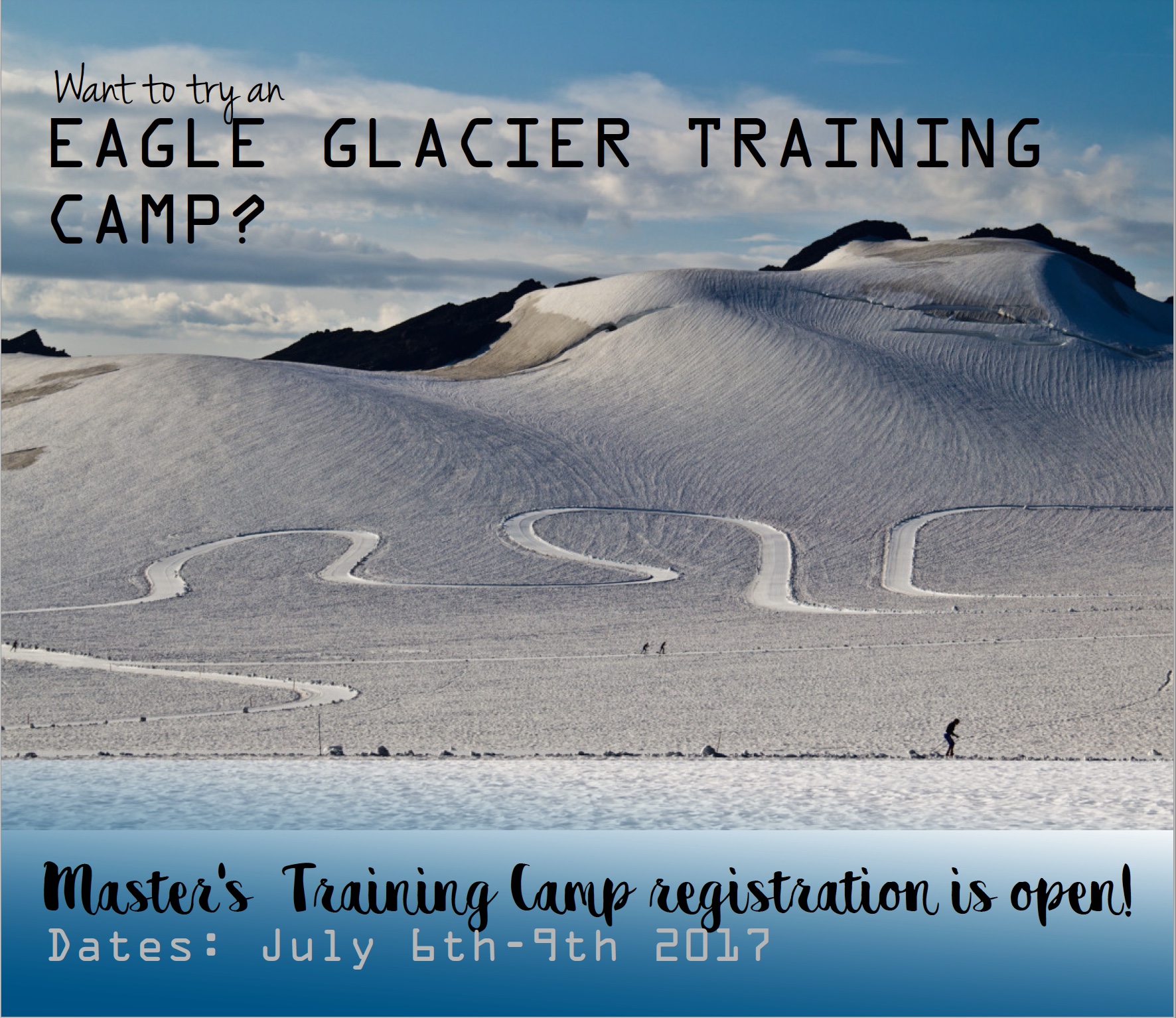
“APU Nordic Ski Center typically runs 3 elite training camps [each summer] on Eagle Glacier at the Thomas Training Facility outside of Girdwood, Alaska. We will revisit whether Glacier camps will resume based on the climate of COVID-19 Adjustments.”
(For any Outside readers salivating over the prospect of May skiing and thinking of booking a cheap plane ticket north, please note that a 14-day quarantine requirement remains in effect for anyone traveling into Alaska from out of state, and that Alaska State Parks is likely to plow the road up to Independence Mine in early June.)
Rosie Frankowski (right) racing this winter in Lillehammer, Norway. (Photo: NordicFocus)
This series comes to FasterSkier from the Alaska Pacific University Nordic Ski Club
A Day in the Life: APUNSC is checking in with Elite Team members of the course of the next few months to get a glimpse into what life looks like for elite athletes as training starts up again during a global pandemic.
Today we check in with Rosie Frankowski (28), a 2018 Olympian, 2019 World Championship team member, and SuperTour podium regular. Rosie hails from Minneapolis and has now been a member of the APUNSC elite team for 6 years. She has a Masters in Public Administration from Northern Michigan University and a Masters of Business Administration from Alaska Pacific University where she is also an adjunct professor.
Where are you right now?
At home in Anchorage, Alaska.
How did your season end? Were there any race cancellations that affected your season?
My ski season didn’t end early because I had already planned to head to South America and Mexico to do a series of running races, trail races, and marathons. I ended my ski season after the Ski Tour 2020 and flew from there to Minneapolis and then directly to Mexico to run a marathon on March 1. Although my ski season didn’t end early, all the running races I had planned after that in Patagonia and Peru were canceled towards the end of March. I, then, had to emergency fly from Mexico City back to Anchorage and give up a multi month trip.
Rosie Frankowski racing at the 2019 World Championships.(Photo:US Ski Team)
What is a highlight of your ski season?
The highlight was doing Period 1 World Cup. Going to a bunch of places I hadn’t been before was a big challenge and I’m proud of myself for tackling it. Also, getting to race in some iconic places like Lillehammer and going to Finland for the first time. That was a good experience for my life and ski career.
I also had a lot of fun doing the Alley Loop race in Crested Butte. It was a low key race, but really fun to be back in the American Nordic ski community. Being part of a citizens event and seeing how much fun everyone has at them was great.
What was it like “moving” or resettling during a pandemic?
That was absolutely crazy. We decided at midnight we were going to fly out of Mexico City at 5 AM the next morning to Anchorage. Luckily my boyfriend’s parents live here so we were able to stay with his mom while we tried to find a place to live and a car.
I was let go of the job I had had for the last four years because I was an event planner and there were no more events. I had to find a new job as well. All of this during a pandemic when you aren’t supposed to be going to peoples’ houses or contacting strangers was crazy and quite stressful.
Maybe by luck we were able to find a place to live and buy a car right before things became very restricted here. Once we had a place to live, we were able to work remotely. It was definitely an added obstacle in the already stressful process of trying to find a place to live. It wasn’t very easy, but it did all work out.
What does a typical day look like now? How have you planned around the unexpected change of plans in your life? Will we see you on the race trails this winter?
My life is similar to what a normal day would look like because we are lucky up here in Alaska and have been able to use the trails. I go out running or skiing in the morning. The biggest difference is not being able to carpool with teammates which as a big fan of car pooling has been killing me. I’ve been getting into some podcast to keep me entertained and luckily gas is really cheap right now.
I train in the morning, come home, eat lunch, work at my job remotely, similar to most Americans right now, and then train again in the evenings. The biggest change has been working remotely and sharing the space in the apartment with other people working remotely. That’s always an interesting challenge.
I will be on the race trails this winter. I hope we are able to have races this winter as usual, fingers crossed. You will see me out there if there are races to be at!
Crust skiing at Hatcher Pass. (Courtesy photo)
What activities are you doing to keep yourself busy outside of training?
That’s been the biggest change for me. I am very social and I love going to breweries or going to listen to music and I planned events for downtown Anchorage in my last job so attending community events is a huge part of what I love about life so the social restrictions have been hard.
We’ve had a lot of outdoor fires so we can stay 6 ft apart and catch up with friends that way.
I attempted to get into yoga which sometimes works and sometimes I just can’t sit still long enough, but it does help to relieve some stress.
Since my trip to South America was cancelled, I’ve been practicing my Spanish and playing ukulele.
I’ve been obsessed with trying to grow cilantro. I have about 12 plants in different parts of my house and really babying them. I take them inside at night so they think it’s night which is a problem in Alaska when it’s so light, plants tend to go to seed quickly.
What did your workout look like today?
I went to Sadie’s house and rollerskied with her around town. We’ve been skiing on snow so we haven’t done much rollerskiing so I’m just easing into that now.
Everything went well and nothing was broken so that’s good!
Do you have any indoor/at home workouts you are doing?
I’ve been doing elements of strength from home. I find some core videos online which is entertaining and sometimes very difficult.
I go to a park across the street to do some lunges and push ups and things so the neighbors probably think I’m crazy, but that’s the gist of getting things done at home right now.
Without knowing what the future has in store, has it been challenging to keep up motivation to train? Where are you getting that motivation? What motivates you to keep training?
I think it has been challenging to keep up motivation to train especially for more ski specific goals. Luckily the spring brings new energy for running and hiking so I’ve been motivated to do that, but I have been struggling to find motivation to get out on rollerskis or even real skis sometimes. I’ve been focusing less on the idea that this is for a specific race and focusing more on the fact that this is me getting to be outside for two hours today, to get sunlight and fresh air. Then taking that day by day so I’m not focused so much on progressing towards a specific goal but on enjoying the outdoors. I’m lucky enough to call that my job and everyone else that has to work from home is spending 8-9 hours inside their home and I get to go outside and call that work.
How are you keeping in touch with friends/family/teammates?
Mostly through FaceTime and Zoom. We had Zoom meetings with the girls team while we weren’t able to train together. Most of my friends and family live in the lower 48 so I generally only get to see them once a year anyhow so that hasn’t been that different. Having fires outside and being able to be 6 feet apart has increased my marshmallow consumption but has also provided a good social outlet.
What has been your biggest challenge in relation to Covid-19 and how are you tackling it?
The biggest challenge has been the uncertainty and stress in not knowing what the future holds. I had planned to be on this trip until early July. I had been planning it for two years and sold my car and moved out of my house, planned to do all these running races and really take a deep breath away from skiing. But I have really fallen back into the pattern of being a ski racer which isn’t bad, but I had really wanted to take that space and gain some perspective and I didn’t get to do that. Emotionally and psychologically it was hard to not feel like I was taking a step backward when I had to come back and not be progressing in my life or athletic endeavors. That’s been something that’s been stressful. I’m still working through it day by day. I have a new job which has been challenging me and hopefully helping me grow. I have been trying to figure out a plan for the upcoming ski season that is different and focusing less on the World Cup and planning more races in the U.S. that I find fun. I have plans for running races in late summer/early fall if they happen so focusing some on the running aspect this summer as well to shift my mind a bit and focus on more than ski only goals.
Running trails in Mexico. (Courtesy photo)
What are your plans from here? What things do you have in store for a summer that will include many restrictions?
Hopefully I will get to do some races. I’m trying to take advantage of the fact that I will be here all summer and might not have camps so doing some adventures that I haven’t been able to do and those that are a little more off the grid with less people around. I am also looking forward to growing a garden because I will be around and foraging for mushrooms and salmon fishing and really taking advantage of the Alaskan lifestyle.
Do you have any helpful advice in dealing with the changing times?
Take it day by day. There are good days and bad days and don’t beat yourself up if you have a few bad days in a row and need to cry it out.
This series comes to FasterSkier from the Alaska Pacific University Nordic Ski Club.
A Day in the Life: APUNSC is checking in with Elite Team members of the course of the next few months to get a glimpse into what life looks like for elite athletes as training starts up again during a global pandemic.
Today we check in with Hunter Wonders (21), a member of the 2018 silver medal-winning 4 x 5 kilometer Junior World Championship Men’s Relay Team and 2020 US National Classic Sprint Champion. Hunter was born and raised in Anchorage and has been a member of APU since he joined the junior program as a kid. Hunter was just nominated for the U.S. Ski Team for the first time last week!
Where are you right now?
I’ve been living at the ski house at APU since the season ended.
Enjoying Alaska (Photo: Hunter Wonders)
How did your season end? What races were cancelled that you were planning to do?
My season ended in Oberveisenthal, Germany with the U23 Relay. I was hoping to race the Quebec and Minneapolis World Cups and then on to World Cup Finals in Canmore. Those were going to by my first World Cups so it was hard to get so close and not be able to race.
Despite a turbulent finish to the season, what is a highlight of last season?
My highlight was getting top 10 at U23s in the 15km classic race.
Hunter Wonders racing at U23 World Championships.(Photo: Doug Stephen)
What does a typical day look like now? How have you planned around the shortened race season?Did you start up training early or try to finish out the season from home?
After I got home, I needed to step back and did some backcountry ski adventures and took it chill for a of couple of weeks. Starting in mid-April, I started to get back into things and ramp up my hours and now I am just building back into all training modes.
What activities are you doing to keep yourself busy outside of training?
I’ve been getting lots of firewood, backcountry skiing and now the trails are dry enough to get some mountain biking in.
What did your workout look like today?
Today we did a 40 min warm-up and then into running progression. We did 60, 45, 30 seconds at 3k pace to work on the elasticity in running.
Do you have any indoor/at-home workouts you are doing?
I’ve just been doing my normal core routine. Chopping wood is a great workout to do at home.
Without knowing what the future has in store and having a shortened season with little to no closure, has it been challenging to keep up the motivation to train? Where are you getting that motivation? What motivates you to keep training?
I just got named to the D-team which has been a big goal of mine. I really want to keep going and progress and show that I deserve to be in that spot. That has provided good motivation during this time.
How are you keeping in touch with friends/family/teammates?
I had a couple of friends that I was able to exercise with at a social distance and after I did my two-week isolation upon returning to the U.S. I joined my family here in Anchorage.
Enjoying Alaska (Photo: Hunter Wonders)
What has been your biggest challenge in relation to Covid-19 and how are you tackling it?
I’m definitely scared of getting it so I haven’t been to a store in a couple of weeks and I work hard to keep social distancing to keep things more in my control.
What are your plans from here? What does the rehab road look like for you moving forward?
I’m just taking it day by day and week by week. Camps might get cancelled, but everyone is going to be in the same boat so we will just have to keep training and do what we can.
Do you have any helpful advice in dealing with the changing times?
Stay as flexible as possible. Don’t get too set on doing something because it might not happen in the end.
This series comes to FasterSkier from the Alaska Pacific University Nordic Ski Club
A Day in the Life: APUNSC is checking in with Elite Team members of the course of the next few months to get a glimpse into what life looks like for elite athletes as training starts up again during a global pandemic.
Today we check in with Hannah Halvorsen (22), a member of the 2017 bronze medal winning 4×3.3km Junior World Championship Women’s Relay Team and SuperTour sprint podium regular. Hannah hails from Truckee, California and has been a member of the APU Nordic Ski Center since 2017. Hannah was hit by a car in November (read here) causing her to miss the entire race season, but has been diligently working on her rehabilitation and her return to more typical cross country ski training.
Where are you right now?
Truckee, California where I have been for about the last month.
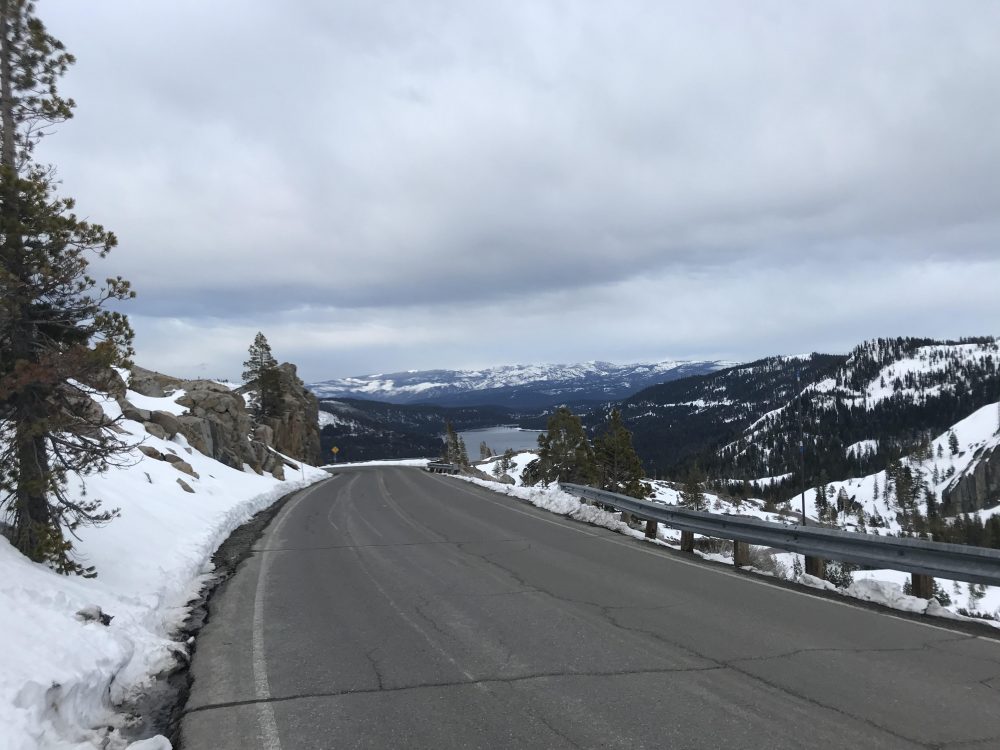
Looking down on Donner Lake and Truckee from Donner pass. (Photo: Hannah Halvorsen)
How have closures or other interruptions due to Covid-19 affected you and your rehab? I know you were planning to be at the Minneapolis World Cup to help showcase the sport and cheer for your teammates and that obviously didn’t happen, but I have to imagine it’s also been tricky getting physical therapy and gym access over the last two months.
That’s exactly it. I’ve been kind of socially quarantined for awhile since I haven’t been on the race circuit and haven’t been with my teammates, but the additional quarantine of gyms being shut down has been challenging. Everything I need to do and can do is gym-related so I was pretty shut down with my rehab. Tschana (U.S. Ski Team strength coach) made a strength plan for me with the things I have at home that is quite impressive. I have a telehealth PT session once a week. I have my computer camera on while I show her my exercises and she helps me that way. It’s crazy how well we’ve been able to make it work, but it’s all pretty strange. Tschana is really good at what she does. I have a very well rounded strength plan with just the few things I have at home and it’s not an easy strength session. The PT has been able to make all my exercises using chairs or stairs. I think it would be really bad if I didn’t have a good PT or strength coach, but they have been so helpful.
Even though you weren’t on the race trails this winter, do you have a highlight from the winter? What have been some of your biggest breakthroughs in rehab this winter?
One of the bigger breakthroughs was being able to walk again. It was so limiting not being able to walk. I had to wait five weeks for surgery due to my brain injury. So I had an extra five weeks when I was on crutches. You really take for granted simple things like going to grab a glass of water. I just last week I started being able to run again for only 10 minutes, but it feels like I’m finally moving forward.
What does a typical day look like now?
I do quite a bit of PT. I do strength a couple of times a week and a lot of walking. I can only run 10 minutes a day so I walk the rest of the time. It’s really pretty here, so it’s nice to be out and now I have started biking. Between that and online school, that takes up most of my day.
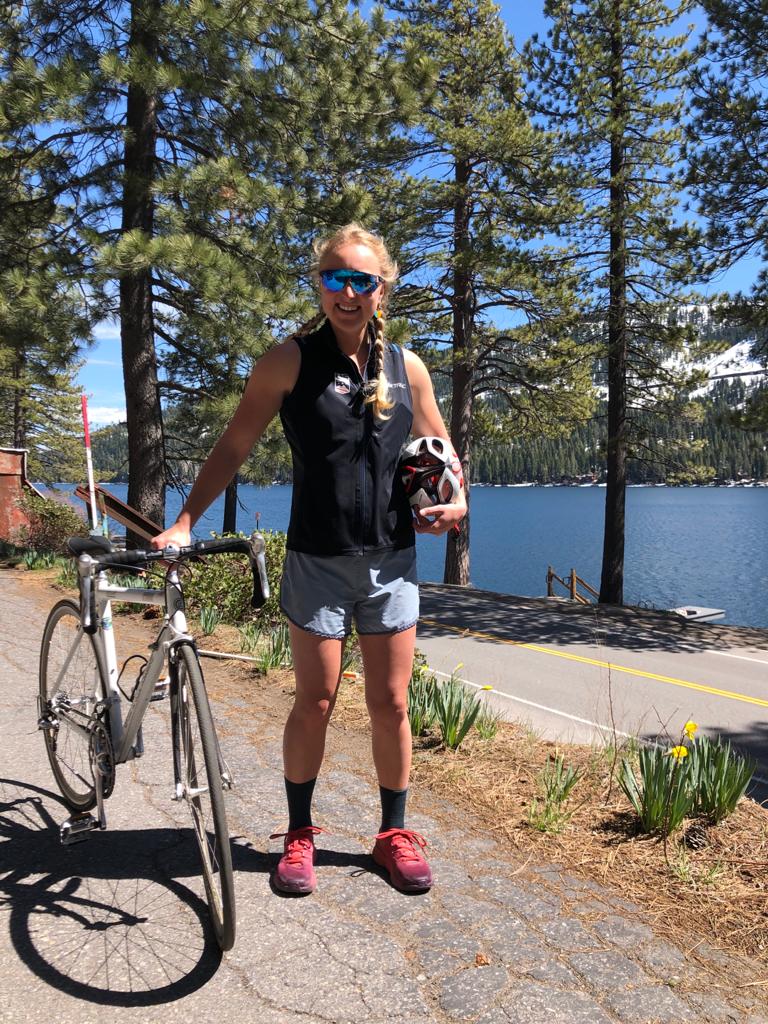
Getting out for a bike ride. (Photo: Hannah Halvorsen)
What activities are you doing to keep yourself busy outside of training and rehab?
I’ve been reading and listening to music. I’ve been getting really into puzzles too. I’ve made bread a few times, but I can’t really say it’s a regular hobby. I am on Donner Lake so I hang out on the dock.
What did your workout look like today?
I walked around the lake and picked up trash along the way. I have been working on some thank you notes and then I have strength.
Do you have any indoor/at-home workouts you are doing?
I do lunges with my back leg on a band held between two chairs. I do a lot of neurocognitive training so I have a half a foam roller that I balance on while I play catch or bounce balls.
Working on neurocognitive skills. (Photo: Hannah Halvorsen)
You have been hit with numerous big life changes over the last year, has it been challenging to keep up the motivation to train or rehab? Where are you getting that motivation? What motivates you to keep going?
It’s actually affected me the opposite way. Things had been relatively steady for a couple of years and you almost get too comfortable and stuck in the monotony. Having big changes have made me realize how fortunate I am to travel and train and be with my teammates. The goals I have are things I really care about and are more clear. I really want to get to a point where I can train with my teammates and travel again. That motivates me. I build a bit of motivation from the underdog spirit as well. When you are doing well sometimes it’s hard to not feel like you are just trying not to fail. When something like this happens you get the spirit of just wanting to prove you can get back and sometimes that makes things a little easier.
How are you keeping in touch with friends/family/teammates?
I’ve been keeping in touch quite a bit. We’ve had some zoom meetings with the APU women’s team. I’ve been texting with a lot of friends. In many ways, we have had more spring communication than usual as we often go our separate ways in the spring, but it feels weird not to be with people. I miss that.
Checking in on my grandma from a safe distance. (Photo: Hannah Halvorsen)
What are your plans from here? What does the rehab road look like for you moving forward?
I just got the green light to start double poling on May 1 and by June I should be allowed to stride and in July skate. Those are the big ones, but throughout that time, each week I’m bumping up the amount I can run or do other activities as long as things are still going well. So far things have been smooth!
Excited to get back to racing, skiing, and my teammates! (Photo: Courtesy Hannah Halvorsen)
Do you have any helpful advice in dealing with the changing times?
When things change some people respond by feeling overwhelmed or stressed which becomes negative and some people can respond to change by figuring what they can get out of the change even if it is stressful. I have been trying to figure out what I can do with the extra time and fewer variables. It can make days quite routine, but a lot of things we want to work on don’t happen from one big effort, but from doing it every day and this extra time and routine allows me to work on something every day.
Erik Bjornsen crossing the line in the 2019 15 k skate pursuit in Ruka, Finland. (Photo: NordicFocus)
Bright lights in PyeongChang. The men’s second semifinal of the Olympic freestyle team sprint was a career highlight moment for Erik Bjornsen. Fourteen teams would crowd the start lanes with Martin Johnsrud Sundby in bib 1. The Norwegian was paired with Johannes Høsflot Klæbo: The duo blessed with Sundby’s stamina and his younger counterpart’s break-from-the-pack speed.
With Simi Hamilton racing the second, fourth, and sixth legs for the U.S., and Bjornsen leading off, the semi was a chance to not only advance to the finals, but establish some mojo amidst an Olympic field. Hamilton and Bjornsen both possess slower tempo big-power generating F-350 type motors that belie the meters gobbled up with each cycle of their cadence.
As Bjornsen was tagged for the fifth of six legs, he locked on to France and Norway to position himself in rarefied company. PyeongChang’s Alpensia sprint course packed a punch. The course’s second climb it’s Everest – a drawn out leg burner. Pulsing into that climb, France’s Maurice Manificat, Sundby, and Bjornsen had already separated from the field. Midway up, Bjornsen subtly shifted gears, moved to the left of Manificat, and dropped the two steely veterans by 10 and then 15 meters pushing over the top.
It was a Stars-and-Stripes flex.
Bjornsen tagged Hamilton in first by nearly five seconds. The pair went on to qualify for the final and placed sixth overall in an event eventually won by the Sundby-Klæbo pairing.
(Video of Bjornsen’s breakaway on the 5th leg.)
“It was interesting, I think that everybody knew what I was capable of in the field when I made those moves,” said Bjornsen when reflecting on career highlights. “I remember one of the strongest memories I have from racing is when I made that move against Sundby. And after the race, as we were starting the final in PyeongChang, he turned and looked at me for a while, and I could tell that he was thinking ‘what is this kid bringing to the final’? He eventually got the gold medal with Klæbo, and he is looking at this American guy, and I think that was one of the coolest feelings I have ever had — knowing that this legend was looking at me, and thinking, ‘what is this guy about to bring to the biggest performance of our lives?’”
The U.S. men’s team has been overshadowed by a dominant women’s program for going on a decade. Through that time, the men’s distance program has seen the end of Kris Freeman’s reign and the emergence of Noah Hoffman and Erik Bjornsen. Hoffman retired in 2018. With Bjornsen announcing his retirement last month at twenty-eight years old, a void remains. As one generation bleeds into the next, Bjornsen is an anchor point for all those speedy juniors we’ve heard of. An affable athlete who set the American distance skiing bar for the past five years.
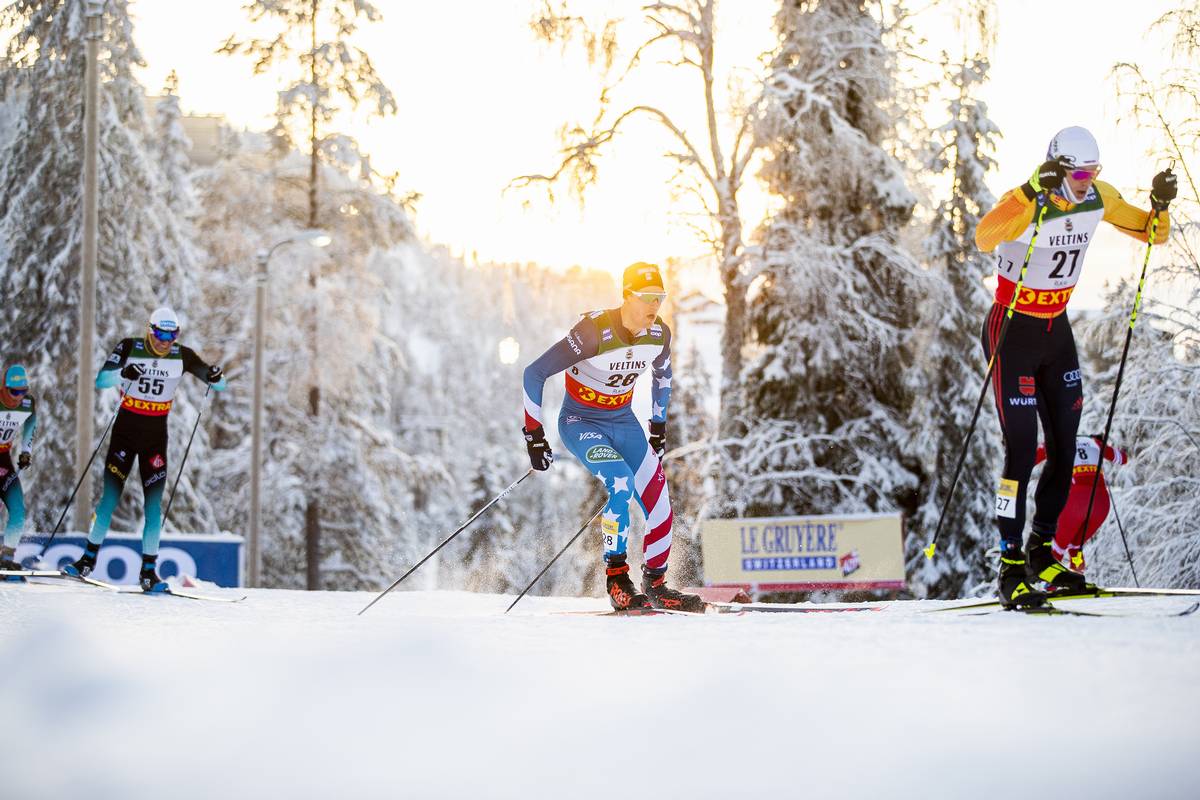
Erik Bjornsen of the U.S. (bib 28) during the 2019 15 k skate pursuit in Ruka, Finland. In bib 27, Sebastian Eisenlauer (GER) leads Bjornsen. (Photo: NordicFocus)
Bjornsen often shouldered the pressure for a team and broader community starved for that dominant distance performance by a U.S. male — a World Cup podium or a championship medal to validate the personal quest and the vicarious desire from some fixated on top-3 hardware. Making the top-30 on the men’s World Cup is a herculean task. Bjornsen first passed that threshold with an 18th place in 2014 during a 15 k classic (his marquee event), in Toblach, Italy.
In January 2018, he surpassed that 18th place, which up to then was a career best individual mark on the World Cup, with a ninth place in Seefeld’s 15 k mass start skate. He peaked individually at the World Championships with an 18th and 17th, respectively, in the 2017 and 2019 Worlds in the 15 k classic.
The manifestation of steady improvement was Bjornsen’s calculus for remaining in the game. And the wait and wait for results beyond his stream of top-30s and top-20s was arduous. Even on the best of days, all things must align for the breakthrough.
“Definitely, my last couple of years, I was really hungry for great results, like everybody that puts so much into the sport,” said Bjornsen. “I was ready to make that next level. But I was moving towards the end of time I wanted to put into the sport and I really wanted to make the progress every year that I knew what I was capable of. There are so many variables in nordic skiing that I was just frustrated not to put it together more on the days when it was so tough. My thing was 15 k classic — that is where I could put together a top performance. That’s four 15 k classics a season, you are trying for your top performance in those four or five and also nailing the wax and also nail everything on that day. So I am proud of the results that I had but I was frustrated like any World Cup athlete. I was just definitely hungry for more at the end.”
The World Cup came to an end for Bjornsen in December after he raced the opening weekends in Ruka, Finland, and Lillehammer, Norway. Yet, the decision to retire from World Cup level competition came after the 2018-2019 season if he did not, in his words, “step-up”.
After a solid summer of training, Bjornsen was blunt about his 2019-2020 World Cup campaign. “I am going over to the World Cup to make a step forward, or call it a career,” he said.
He placed 25th overall in the Ruka triple. The following weekend in Lillehammer’s 15 k/15 k skiathlon he had a reason for optimism. At the same venue with the same race format in 2017 Bjornsen had placed 20th. This year, he initially raced near the sharp end. But as the temps warmed a degree or two, his skis began to ice. He faded to 39th. The plug was pulled.
Bjornsen explained that U.S. World Cup regulars leave bags on the wax bus after each season, a stash of clothes and items to rely on when they arrive for the season each November. “I had left a bag over there basically for the last five or six years,” said Bjornsen. “On the last trip, I packed that one up. I didn’t know if I would be coming back.”
Having grown up skiing in Washington’s Methow Valley, Bjornsen followed the usual path of success: solid Junior Nationals, World Junior Teams, a second place in the 2011 U.S.Nationals 20-kilometer classic, and his first senior championship two years later in the 15 k skate. USST D-team, B-team, and then A-team. Although the family fostered two future Olympians, (you know this but older sister Sadie is a USST veteran) Bjornsen’s parents moved to the Methow when a new alpine ski area was in the works. As luck would have it, the planned downhill area never materialized.
Erik Bjornsen (APU/USST) and Matt Gelso (SVSEF) headed up Hermod’s Hill for the final time at the end of the 15 k freestyle at the 2013 U.S. Nationals. Bjornsen took his first career national title and Gelso finished third.
The Bjornsens live on the more secluded Mazama end of the Methow. Mazama sits at the base of a closed-in-winter State Highway 20 which snakes its way up to Washington Pass and alpine paradise. Drive any direction but south in the winter from Mazama and it’s a snowy dead end. One road during those cold months serves as a diversion into Winthrop and further south to Twisp. The region’s storied cross-country trails provided another outlet. Within walking distance of Bjornsen’s neighborhood were endless ski trails and families falling in love over and over again with the sport. Sean and Laura McCabe and Leslie Hall (Laura McCabe and Hall are former USST members) lived nearby and were constant reminders that sliding on snow without a gravity assist had merits.
With his two older sisters, the Bjornsens joined the local ski club. It was a steady stream of hand me downs terminating at Erik. As Bjornsen became more serious, he relied on Scott Johnston as his primary coach. Johnston is known as fastidious and established a serious training regime for Bjornsen.
“I learned a lot from him,” said Bjornsen. “He took the time to explain everything about skiing and also the physiology side of things. I started to understand the ways of training and training plans. He brought my curiosity out and made me think about each and every workout.”
By the time Bjornsen was in his late teens, Sadie had moved to Anchorage to ski race as a student-athlete for the University of Anchorage Alaska (UAA). When it came time for a post-high school decision in 2010, Erik chose to attend UAA too. Both Bjornsens ultimately aborted their UAA paths after earning NCAA All-American status and began taking opportunities on the World Cup as they trained with APU. APU, an emerging powerhouse team, was coached by Erik Flora and championed by Anchorage’s Kikkan Randall.
Erik Bjornsen on his way to second at the 2011 NCAAs in Stowe, VT.
With a cohesive training group at APU and the steadiness of Flora, both Bjornsens blossomed. Erik earned his first World Cup start on Dec. 7, 2012 in Québec. A few days later in Canmore, he popped a 36th place in the 15 k classic. Along the way, he won six national championships and was a member of the U.S. Ski Team for seven years.
“When Erik first came in, I could see this young, talented skier that was excited about skiing, and he really enjoyed racing,” said APU’s Flora. “And when he first came in, I thought, Okay, if I can help him with his training, and help him reach the next level in fitness, that seemed like an opportunity that was an easy one to help him get toward his goals. And as he retires, you know, there was a certain point where Erik went from being in a place where talking about daily training was constructive, to where Erik absorbed all of that over the years, to the point where Erik knew how he wanted to train, and he had the foundation for it.”
During the later part of his career, Bjornsen had enough know-how and self-knowledge to write his own training plans with the occasional check in or hands-on training session with Flora.
Bjornsen imprinted the cycle in his muscle memory. He attended USST camps, looped around on the Eagle Glacier during the summer, and locked in for a lengthy stint as a World Cup regular. The bag he eventually snagged off the wax bus this past December was left in Europe for five seasons or so, during which he raced at two Olympics and four World Championships.
Erik Bjornsen (APU) during the 2020 U.S. Nationals men’s 15 k skate. (Photo: Reese Brown)
At the 2014 Olympics, Bjornsen contested five of six events as the youngest member of the team at 22 years old. Sochi was a time he recalls fondly not so much for a “media-worthy” result, but for the pure novelty of it. Big eyes. The Olympic rings. An international career yet to unfold. “It was just so fun, everything around it was great,” said Bjornsen.
What was also great were the Hamilton-Bjornsen prospects in the team sprint. It’s one thing to prognosticate and imagine a team sprint medal on the men’s side. On paper and on snow this was no pipe dream. Other teams had the luxury of mixing and matching athletes over the years. When sprinting three laps, a total of roughly 4.5 k full tilt, the combo of stamina and 100 meter close out speed is rare. Deep teams can play around, shuffle a deck, optimize for those parameters when naming a team sprint duo. Someone falls ill, insert A for B. Someone has an off year, change X for Y.
For Hamilton and Bjornsen, the USST was all in. Sixth in Sochi. Sixth in PyeongChang. Fifth at the 2017 World Championships. Better than coming close, these two provoked legitimate medal hope. And better, the two were good friends. They were not simply two speedy specimens tolerating one another for a material outcome.
Walking through the mixed zone in PyeongChang after their finals, on a night when Jessie Diggins and Kikkan Randall won a historic gold 30 minutes prior, Hamilton and Bjornsen were consummate pros. There’s was a no-bullshit interview post-race. In tight quarter racing, Bjornsen had tumbled during the second leg after tripping on another skier’s tails. A tough-to-rebound-from-mishap on the tightrope of Olympic sprinting.
“It was super disappointing when I went down, but I mean, it was only halfway through the race and I just got up, and that’s for sure not going to be the end of it for us today,” Bjornsen said to FasterSkier at the time. “Unfortunately, I kind of felt like I let the team down there a bit. I think that was one mistake that may have made a huge impact on our race today, but you know, that’s ski racing, that’s the way it goes sometimes. Unfortunately, it’s at the Olympics.”
Hamilton immediately responded by focusing on the asset that is Bjornsen.
“In absolutely no way did Erik let any of us down, especially me,” Hamilton said. “I watched that on the big screen, I have been at a lot of team sprints on the World Cup, World Champs, Olympics, that always happens to someone, and 99 percent of the time, that person, especially if it’s in the finals, just gives up, whether it’s the first leg, second leg, third leg, they just give up. And Erik, he never does that, no matter what happens to him, what happens to us, he just fights ’til the absolute very end.”
The U.S. team for the men’s 4 x 7.5 k relay in Beitostølen, Norway (2018). From left to right, Erik Bjornsen, Simi Hamilton, Scott Patterson, and Kevin Bolger. (Photo: Aleks Tangen)
This was, as Hamilton and Bjornsen knew, their best career opportunity for a hallmark medal. They both made eye contact with reporters — their disappointment palpable. This was clear: The two men had a deep bond forged over countless laughs and near misses. More than anything, the two could trust one another to bring their best.
“It’s hard to put into words the impact that Erik not only had on our team, our program, and XC skiing in general over the years, but also the impact that he had on me as my teammate and my friend,” Hamilton emailed when asked about Bjornsen’s retirement. “He grew to become one of my closest friends and I’m confident we’ll remain as such for the rest of our lives. Within the team, Erik defined what it meant to be a genuinely supportive teammate and he was the first person to celebrate any success that someone within our group had. His unwavering selflessness was evident as he always put his teammates, our coaches, and the staff before himself. I think in a way his successes and accomplishments went very much unnoticed because being genuinely happy and supportive of everyone around him always came before the desire to highlight his own results and market his own extraordinary talents. I’ve never laughed harder after hearing some of his witty remarks and jokes over the years and he always lent a tone of humor to any situation, no matter how serious everyone else was taking themselves. I’m grateful for so much that ski racing has given me over the years, but being on the team with Erik lands close to the top of the list of things I’m most grateful for.”
Erik Bjornsen (USA) racing in the semifinals of the 2014 Olympic team sprint.
It’s also hard to imagine that a force such as Bjornsen would have successes and accomplishments go unnoticed. Such is the atmosphere of quick turnaround news cycles amidst the backdrop of a national women’s team setting an incomprehensibly high watermark of podiums weekend after weekend.
“You have to understand, it is like getting beat up over there if you are not achieving what you know you are capable of,” Sadie Bjornsen mused. “Erik has put in a lot of time doing so. I believe Erik is a top-10 World Cup racer. I don’t just believe it, I actually know it.
“But, in order to achieve that, I don’t want to say it is different in the men’s than the women’s field, but the men, it is to me, just a little more thick on the top. When I have an off day I am generally in the 20s. When I have an on day, I am in the top-10. It is a lot less fun when you have an off day and you are in the 50s or 60s and you have an on day and you can be top-10. That is a big difference.”
Sadie said her respect for Erik stemmed from his investment in a plan and holding himself accountable to it. “I really respected his confidence in that plan. What it showed me is that he believes in himself and he knows what he is capable of. He did not think of himself as a 50th place racer, he thought of himself as better. At the end of day, if someone achieves that confidence, that is huge.”
With Bjornsen’s departure from the team in December, he set forth to race several marquee domestic skate marathons. Although it afforded North American based skiers a chance to toe the line with a generational talent, for Bjornsen it was an opportunity to touch base with the many friends he had connected with during his years as a ski racer. Call it an unofficial retirement tour.
Bjornsen said he didn’t come into the races expecting to win since he had modified his training to savor simple on-snow moments. He emphatically claimed that this past winter had been one of his most “fun” yet.
There’s a prevailing mythos in sport: The peak performance, like Bjornsen dropping Sundby and Manificat, are the highlight reel’s apogee. Those instances all have their place. They send chills. But what about the 99.9 percent of the time when that person was off-stage, not performing? That matters.
“Thinking about this, an athlete like Erik retiring makes your chest kind of heave,” Matt Whitcomb, the U.S. Ski Team’s Head Coach said. “You are trying to suppress emotions because he has been such an important part of my life as a coach. He is one of those people that makes being a coach so great. Makes these 120 consecutive days on the road tolerable because he is such a great guy. … He is the kind of the guy that has your back and everybody needs people like him.”
Lightness and humility are attributes many peers associate with Bjornsen. He was, according to Sadie, unequivocally as much a support mechanism for her as she was for him. The shoulder to lean on tilted in both directions. Outside his immediate family, Erik’s even keeled perspective became an integral piece of the U.S. Ski Team’s European based unit.
Sadie Bjornsen and her younger brother Erik in 2013 after winning an Alaska Pacific University time trial earlier this month at Hatcher Pass near Anchorage, Alaska. (Photo: Courtsey Sadie Bjornsen)
“The role Erik played on the team is easily overlooked,” said Sadie. “We can never talk about it enough. We got a breath of it without Erik the rest of this past winter. That position was really missed. That person who is always enthusiastic, always positive, always having a game, making light of everything. Erik took on that role really young, he was not going to hide anything. He was going to admit when he was struggling or whatever it was. That is a talent when spending four and a half months on the road. That is a long time. It is your family that you are living with, and it is difficult to maintain a positive outlook all the time.”
There was no bitterness in Erik Bjornsen’s statements or tone when we spoke. He seemed ready with open arms for his next chapter. He did, however, mention a teaser of a thought experiment. “It would have been, at times, super fun to have Kris Freeman at his peak come around 10 years later and I could have skied alongside him. That would have been sweet. We could have pushed each other well.”
We can all imagine the mutually beneficial pacing that may have developed. The mentioning of Freeman was only a fleeting whiff of a “what if” moment. The rest, his thoughts of the World Cup, his training principles, his discussion of not meeting some of his expectations, seemed rooted in the past just months after stepping away from the life he’s known since his teens.
“It would have been fun to be racing on the podium,” said Bjornsen. “But one thing I noticed just from watching my sister so closely, is I don’t think you get any more happiness. I always really enjoyed racing and being over there even though maybe her results were 10 to 15 places on average higher than mine. It really doesn’t make any difference except maybe a bit financially. In the end, I got as much joy out of it than a guy that would have been on the World Cup podium.”
Erik Bjornsen – 2016 vintage classic skiing powerhouse. (Photo: NordicFocus)
This series comes to FasterSkier from the Alaska Pacific University Nordic Ski Club.
A Day in the Life: APUNSC is checking in with Elite Team members over the course of the next few months to get a glimpse into what life looks like for elite athletes as training starts up again during a global pandemic.
Today we check in with Tyler Kornfield (29), a 2018 Olympian and 3x National Champion who was born and raised in Anchorage, Alaska. Kornfield has been a part of the APU Nordic Ski Center for 7 years.
Where are you right now?
I am in Anchorage where I have been since the season abruptly ended in March. I feel fortunate to have moved into a spacious home last fall that has made spending more time at home more enjoyable, not to mention it’s very close to the trails!
Enjoying the good ski conditions around Anchorage (Photo: Rosie Brennan)
How did your season end? What races were canceled that you were planning to do?
My season unknowingly ended after the American Birkebeiner in late February. I flew to Utah to train for the World Cups in Quebec, Minneapolis, and Canmore. My training went great and I flew to Quebec City feeling very prepared. Things started changing around the globe very quickly and I remained trying to prepare while also trying to gauge the situation. Ultimately, Quebec City and all the rest of the remaining World Cups were canceled and I flew back to Anchorage.
Despite a turbulent finish to the season, what is a highlight of last season?
My highlight was racing the Oberstdorf World Cup sprint because World Championships is there next season. It was a great opportunity for me to race the course and really ingrain all the things I will need to work on over the course of the summer to be able to compete at the World Championships. It has subsequently kept me more motivated in these challenging times as I have a very clear goal and skills I need to build in mind from my experiences racing on that specific course.
Tyler Kornfield racing in Oberstdorf. (Photo: US Ski Team)
What does a typical day look like now? How have you planned around the shortened race season?
Today was the first day of the training season for me so I have started getting back into a normal training routine. Fortunately, this isn’t impacted too heavily by the restrictions. I am able to get up early and go for a training session, which luckily was a crust ski today. The biggest difference in my day is that I do my part-time engineering job from my house rather than the office. Then I will head out the door for a run this afternoon and then some home strength. Gyms have not opened up so we have been slowly trying to accumulate some at-home gym equipment and get creative with what we can use. Today will be the first day trying to do a whole session so we will see how it goes.
With so much good skiing in Anchorage, I decided to take advantage of spending more time on snow so I skied quite a bit until the trails melted and then took a small break before starting in on a new training season.
Taking advantage of the ski training despite a short race season. (Photo: Rosie Brennan)
There have been many ups and downs both from the shortened season, many life restrictions and the natural change of season, but exercise seemed to be my best coping method.
What activities are you doing to keep yourself busy outside of training?
My girlfriend and I have joined the growing trend of making sourdough bread. We were determined to make our own starter, which took some trials but we’ve now been cranking out some bread. I have also been planning our garden and trying to do some yard work to get outside. Lastly, we have also started making kombucha, although that takes some time so we don’t have a finished product yet…
Learning to make sourdough bread. (Photo: Rosie Brennan)
What did your workout look like today?
I went on a crust ski with a few teammates. We are limited to a group size under 20 as of today and maintaining a 10ft distance from others while exercising. Crust skiing is an easy activity to do this as you can ski anywhere there is snow so we don’t have to follow one another in a long single-file line! We went for a long one as the conditions were good and the sun felt nice.
Do you have any indoor/at home workouts you are doing?
I built a TRX in our garage to keep up on core. I will be trying to do a little core every day and incorporate that into my daily routine.
Homemade TRX in the garage. (Photo: Rosie Brennan)
Has it been challenging to keep up the motivation to train? Where are you getting that motivation? What motivates you to keep training?
It has been challenging. It’s difficult when you don’t know what the race season is going to look like, but I have to go into things thinking my race season will be the same and focus on the goals I have set. I want to race at the World Championships in Oberstdorf and will be using that as motivation to get out the door.
How are you keeping in touch with friends/family/teammates?
We have been doing some zoom meetings with teammates and family about once a week. Spring is normally the time that we are able to let loose a bit and visit with friends outside of training so I have been really missing that aspect of spring.
Figure 6 Staying in touch with family through ski Easter egg hunts. (Photo: Rosie Brennan)
Do you have any helpful advice in dealing with the changing times?
I have tried to minimize my time reading the news and focus on the things that I can control such as social distancing and finding a routine that most closely resembles what life used to look like while being safe.
Kikkan Randall explores new rollerski terrain in Penticton, B.C., earlier this month, following her family’s move to Canada. (Photo: Kikkan Randall/Instagram)
As discussed last week in Part I of this interview, Kikkan Randall’s first-ever FIS race (that is, a race sanctioned by the International Ski Federation) occurred at U.S. nationals at Soldier Hollow in January 2000. Randall was 17 years old, the single youngest finisher in the race. Other athletes had been born in the 1960s and are now at least 48 years old. Randall raced in a first-generation Gold 2002 training suit for the fledgling Alaska Pacific University (APU) ski program. Every skier in the race had a FIS number starting with a 1.
Fast-forward 18 years and nearly 600 FIS races later. Randall’s final FIS race was the 30-kilometer classic mass start at 2018 Spring Series this past March in Craftsbury, Vermont. She crossed the finish line in third, leading out a four-racer chase pack to claim the final podium spot in the final race of her career. She followed U.S. Ski Team (USST) teammate Jessie Diggins and USST and APU teammate Sadie Bjornsen, who took first and second in a tight finish.
Randall was the oldest skier in the race by five years. She was the only athlete whose FIS number started with a 1; everyone else’s FIS number began with a 3. Earlier that week Randall’s competitors in the 10 k freestyle included Anchorage junior Molly Gellert (23rd overall), who had not yet been born when Randall did her first FIS race.
And even among the 30 k podium finishers, Diggins famously got Randall’s signature on a piece of cardboard at 2008 Junior Nationals in Anchorage, after Randall had run out of posters to sign before Diggins got to the front of the line. Bjornsen likewise looked up to Randall as a junior skier, then moved to Alaska to train with her at APU. Randall’s been doing this for a long time.
And when it was over, and when Randall had crossed her final finish line, she stood on the podium in a bespoke pink USA/APU suit, and sprayed champagne over her teammates. The next morning, she woke up as something other than a professional skier for the first time in nearly 20 years. She celebrated by leading a Fast and Female session in the area a few days later.
And, perhaps most significantly of all, she inspired an ice-cream flavor in her honor. Gold & Glory debuted at Anchorage microcreamery Wild Scoops in early April, in advance of a “Welcome Home Olympians” celebration in nearby Town Square. The concoction involved “a sweet cream base with homemade GOLDen Graham toffee crunchies + pink strawberry sauce streaks,” store owner Elissa Brown explained on Instagram. “Topped with pink sprinkles and ‘gold medals’ while supplies last.”
The ice-cream honor was the only thing in a month of awards and media attention that threatened to make the preternaturally poised Randall lose her focus. “Wow,” said a clearly surprised Randall upon being asked by a FasterSkier reporter about the significance of having an ice-cream flavor named for her. “That’s quite an honor. I do love ice cream; I’ll have to go check that out.”
Gold & Glory Kikkan Randall commemorative ice cream at Wild Scoops microcreamery in Anchorage, Alaska. (Photo: Julie Kentch)
Later that afternoon, Randall headlined the Welcome Home celebration for 16 local Olympians and Paralympians who had competed this year in PyeongChang. (Thanks to Paralympic alpine skier Andrew Kurka and his PyeongChang gold and silver, there were a healthy three Olympic medals in attendance. Another dozen or so local former Olympians joined the crowd, including skiers Nina Kemppel and Adam Verrier.)
Randall rode in on a pink fire truck. She joined the cheerleaders from her high school alma mater, East Anchorage High School, in dancing to the school fight song. She accepted the Skis To The City from Anchorage Mayor Ethan Berkowitz, then sprayed a pink streak in Hizzoner’s hair. She listened as Alaska’s senior senator, Lisa Murkowski, praised the accomplishments of all the Olympians and told them that Alaska was proud of them.
Finally, Randall took the microphone and addressed a crowd of hundreds filling Town Square on a blustery, raw, sub-freezing April afternoon. Hordes of local junior skiers clambered on to the snowbanks immediately in front of the stage to gaze up at her, Anchorage Junior Nordic hats on their heads and rapt admiration in their eyes.
“This is so amazing for us,” Randall said, “to come back to Alaska, finally, after a long and hard season traveling the world, to come back and get to celebrate with all of you guys that have been such an important part of making this gold medal and this Olympic team happen. We couldn’t be more proud to represent the state of Alaska.”
She praised the support of the community and of her teammates, and detailed all the contributions from others that had made success possible.
Randall ended her remarks by forecasting a bright future for American skiing: “It’s been a fairytale ending to an amazing journey. And now that my career’s coming to a close, I can’t wait to see what this next generation is going to do. Because they know it’s possible, we know we have the community and the support system to make it happen, and they’re going to take this far beyond. This may be the first medal in women’s cross-country, but it’s not going to be the last.”
So that’s what’s next for U.S. skiing, but what’s next for Randall? Part II of this interview answers those questions.
Note: The following story is based on an in-person interview with Randall in late April. FasterSkier’s narrative is in bold; everything else is a direct quote from Randall.
So, what comes next? Randall largely answered this question last fall; go back and review the second half of this FasterSkier article for the full version of this answer.
The short version is that she’s going to serve on the International Olympic Committee (IOC) Athletes’ Commission, take on a larger role with Fast and Female, and finish up her MBA through Alaska Pacific University (the school, not the ski team). Oh, and by the way, along with husband Jeff Ellis, parent their son, Breck Stuart Randall Ellis, while settling into the family’s new home in Penticton, British Columbia. And maybe it’d be nice to earn a living, too.
Randall is asked whether the preview version of her new career, as written out last fall, is still accurate. Here’s what she had to say:
Yes. That’s still the tentative plan.
The gold medal, of course, has opened up some new opportunities to do some more motivational speaking, which I really enjoy doing, and would love to have a couple opportunities nationally a month to do that.
So that’s one part adding to the mix, and then the IOC role has turned out to be a little more than I knew I was getting into. I didn’t realize I would be on the USOC [United States Olympic Committee] Board of Directors, and so actively involved with other groups that kind of funnel into the IOC. So figuring out how to manage the time commitment there, given that it’s all volunteer.
And my source of income, which has been racing, is now shifting, so figuring out how to do all these things that I’m passionate about, and I love, and I want to contribute to, but still be able to provide for my family.
… And then realizing there’s only 24 hours in a day, and I want to be a good mom, and I want to be physically active, and still see my husband, and do all these other things. So it’s going to be – after the last 20 years being pretty darn predictable, it’s now a whole new scheduling challenge and energy-management challenge. But, there are so many good things to look forward to, that I think will help me transition out and give me really good focus, new passions.
I’ve heard that some athletes really struggle after they retire because you are so passionate about your sport, and it gives you so much structure and daily accomplishment, that when you don’t have that anymore, you can really just kind of go into a mental tailspin. So having these great things already lined up that are going to be really engaging and fun to work on I think will be really helpful.
Randall may be understating things somewhat when she talks about the structure and daily accomplishment of being a full-time athlete; she has trained twice a day, 48 weeks a year, for most of the past 20 years, and duly recorded every workout. That’s a lot of daily structure.
But there is also a certain broader rhythm to the seasons that attaches to this lifestyle – starting up training again in May, volume in June, intensity in the fall, and so on. Randall is asked, in an interview conducted in late April, what it is going to feel like to not be beginning a new training year next week on May 1, or to spend a complete summer uninterrupted by training blocks on Eagle Glacier, or to spend mid-November somewhere other than far northern Scandinavia for pre-World Cup races. Randall is quick to acknowledge the magnitude of the change, while still concluding that it’s time to move on.
You know, I’ve been surprised at how quickly I’m starting to realize that it’s gonna feel pretty weird. I did my last race, just coming up on the one-month mark, and, while I’ve been excited to finish a great career, to be able to now go and do new opportunities and things, it is kind of settling in, the fact that I won’t have the excuse to go out and train twice a day, and do all these exercises. And most importantly, that I won’t be meeting up with my teammates, who have really just become such close friends, and coaches and everything.
So I know it’s going to be a pretty dramatic stretch, and April has been kind of a free pass, in that it’s always kind of the time of year when we are flexible. It’s felt pretty normal so far, but as next week starts, and summer drags on, I’m sure it’s going to be pretty strange.
But all good things come to an end, and I think it’s still the right time to transition out, so it just gives me a greater appreciation for what I’ve been able to do, and recognizing what parts of that life I want to continue forward – you know, I want to stay active and fit, and it’s just going to be a new challenge of how to figure out how to do that, while balancing everything else.
That challenge, for an elite athlete, often involves coming to grips with the fact that they still love moving and being outside, yet by definition will spend the rest of their life older and slower than when training was their full-time job.
Two models for how to negotiate this post-career period (which, it should be noted, represents multiple decades and the majority of one’s life) are suggested, the Adam Verrier model and the Nina Kemppel model, corresponding to two local former Olympians.
Briefly put, Verrier moved to Anchorage after his college ski career ended, qualified for the 1994 Olympics, then stayed in Anchorage and basically never stopped racing. He has won nearly every notable trail race in southcentral Alaska, and placed on the podium of the 50 k Tour of Anchorage, the unofficial citizens race championship for the state of Alaska, eight times between 1995 and 2007, including three victories.
Kemppel, by contrast, raced in four Olympics from 1992–2002, then ultimately returned to Anchorage after earning an MBA outside of Alaska. She has lived here for years, and presumably remains quite active, but does not seem to have entered an official running or skiing race since returning to Anchorage. “I’ve become more and more of a weekend warrior because of my job,” Kemppel told the Anchorage Daily News in a 2012 article noting her return home.
Randall is asked with which pole of post-career racing she envisions being more closely aligned.
I probably hope for something in between. I am already recognizing that with family commitments and some of the – I mean, the gold medal changed the reality a lot, in terms of what opportunities are available, and my position with the IOC is going to be very busy. So while I love the idea of just staying super-fit and doing all that, it’s going to be a challenge to be able to do that. But I also love being able to be active every single day, so I hope to be able to build that into my new life.
As far as racing goes, I don’t have any real plans in the near future. I’ve always been interested in trying some mountain biking stuff, and I think it’d be cool to dabble with some new sports. There’s a big triathlon community down in B.C. where we’re going to be, so maybe that’s something to get into. [Randall has at least one victory and four runner-up finishes in Anchorage’s Gold Nugget Triathlon, one of the largest and longest-running women’s-only triathlons in the country.] Having races in the future is a good motivation for just making sure you get out the door every day, and you have a plan of what you’re working towards. So I like that idea, but I don’t need to necessarily keep racing at a high level all the time.
And ski racing-wise, it would be fun to do some events I’ve never done, like the Birkie and stuff, but I don’t know at what level I’ll be racing.
But I do really enjoy racing, I love the opportunity to just get out there with everybody, put the bib on, and go push yourself, so I think I’ll continue to do some of it.
[Randall has often spoken of shifting into a race gear or finishing gear when she is racing well, or of being unable to make that shift when she is not. She is asked what it’s going to be like, two months or two years from now, when she’s at the point in a race when all of her training and experience tell her that it’s time to make that shift, but her body won’t let her do what her mind wants to.]
I’m sure that’s going to be tough. Thankfully the number of years I’ve been competing, I think I do have a nice window of time where that’s not going to just disappear overnight. But I can tell already, in the last month where I haven’t done a whole lot, and all of a sudden jumping into doing things a little harder again, it’s like, Whoa, what are you doing? So yeah, I’m sure it’s going to be tough to not be as fit as I would have been in the last 20 years… but that’s just the way it goes.
That world-class fitness was not easily won. Over the course of her career, Randall increased her annual training hours consistently and substantially, from roughly 300 in high school to nearly 800 by the height of her career, adding in intensity along the way. “You hadn’t trained hard enough if you hadn’t started crying,” Randall once told Outside Magazine of 2008, “the year of intensity.” (It is worth noting that 2008 also saw Randall undergo two surgeries for the blood clot that nearly killed her. But they were both in April, so presumably she didn’t miss too much training. She would win her first World Championships medal, Liberec, Czech Republic, in February 2009.)
But when asked what she won’t miss about this lifestyle, the first thing Randall mentions is not the staggeringly difficult Level 4 bounding workouts, but rather the simple quotidian drudgery of preparing for and completing two workouts a day, every day, over and over and over again.
I think always having to do two workouts a day. Over the last couple of years, especially once we had Breck, it was hard at times, to just go, I’ve got to change my outfit again, I’ve got to go out there, maybe the weather’s not great, and I know I’ve got two hours to log. And just putting in the amount of time out there – it got tough. So some of that part I won’t miss, just having to do it all the time.
Having the time open and available for new things now, not having to just constantly change outfits – into training clothes, out of training clothes. And traveling with so much gear. It’s just been nice to do a couple trips now where I just pack a couple things, and off you go, not have to drag a ski bag all around the world.
The APU men pushing each other during a workout at an Eagle Glacier training camp, July 2015. (Photo: Zuzanna Rogers)
Going up on the glacier was always – it was such a great training environment, and it was such an amazing resource to have, but you could never really appreciate it in the moment when you’re up there. When you’re on Day 2, and you’re staring down five more days of just what you know is going to be a lot of hard training, and just knowing you have nowhere to go, you’re stuck up there, you’re away from your family. And so, I won’t miss, again, just having to do that … at the same time, I think I’m quickly going to miss the opportunity where I got to do that.
So it all comes into perspective: When you’re in the midst of it, you can’t wait to be done with it and not have to do it anymore, but then quickly you realize, like, what a cool opportunity it was.
Now that Randall is no longer in the midst of it, she has one heck of a formidable resource: 20 years’ worth of training logs and data. And she has saved all of it, too, starting with a log provided by her high school coach, Harry Johnson, at the East High Cross-Country Team, and continuing through to more recent versions contained in an array of spreadsheets.
Unsurprisingly for an athlete who has spent much of her career raising others up along with her, Randall is decidedly magnanimous when asked what she plans to do with all this training data.
Erik [Flora] has all my logs, so he has all that data, and he’s of course free to use it however he sees fit. The U.S. Ski Team also has all my logs. I know they’ve already integrated a lot of stuff into their planning for the development pipeline, and kind of what we’ve learned.
So yeah, it’s all open and available to those guys to use because I hope that my career can help just make the road better for the next group coming through. Because I learned a lot off of what people before me did, and what worked for them and what didn’t work for them, and then we kind of progressed that forward. And I think already we’ve been able to create a totally better training environment than when I even started. So keep pushing it forward, and I’m glad that that information’s out there.
And it’s pretty fun to be able to get to the end of it now, and look back over the progression and the work, and what went well, what didn’t, and all that stuff.
And I’m so glad that I recorded all that, because part of my log, too, is comments on training every day, and that in a sense is a diary for me, because I haven’t really recorded that anywhere else. And now that my career spans so long, it’s so nice to be able to go back and read through that, and realize what was going on in my life day-to-day, through all the years and the training. And it also helped my relationship with my coaches, to best understand what was going on with me, and to be able to adapt the training around that.
While presumably no athlete has ever said that the physical hardware itself was the point or the telos – as opposed to the hard work that went into winning a race, the pride of accomplishment, the friendships made along the way, etc. – the fact remains that Randall’s personal trophy case is extensive. There’s an Olympic gold medal, for one. But also three World Championships medals. And three Sprint Cup Crystal Globes. And a medal for third overall in the 2012/2013 World Cup standings. And 29 World Cup podium medals.
Randall is asked where all these awards currently are, and what she plans to do with them.
I’d love to find ways to get it out there. It’s been so fun, just carrying around the gold medal already, sharing it with everybody; it’s something for people to see, to look at. One of my crystal globes is at the L.L.Bean store in a case, so that’s already kind of being shared. The other two right now are just kind of sitting at home in their carrying cases. And I’m not sure exactly where my World Championships medals are; they’re packed somewhere in the move. But it would be fun to, I think, have some displays out, share it around.
Kikkan Randall with her third consecutive Sprint World Cup Crystal Globe, 2014. (Photo: Fischer/Nordic Focus)
Because, now that we’re kind of starting fresh with the new home in B.C., and as Breck grows up, and Jeff has some incredible accomplishments of his own, I would love our family space to be a little bit about our future, and not so much about my past in particular. So if I can get my awards in places that can inspire others, and people can share that piece of history, I think that would be better than just having it at my home somewhere.
I’d love to see something here at APU, to really celebrate the connection of what we do with the ski team, so that everyone knows about it, gets to feel a part of it. And then the Alaska Sports Hall of Fame, of course, at the airport is a pretty cool demonstration, and who knows where else in town we can have some sort of display maybe. Anchorage certainly deserves a lot of the credit for this.
As Randall observed, her focus in life is currently on the future of her family. But it’s worth noting that her husband, Jeff Ellis, was no athletic slouch himself; he was a World Cup skier for Canada who scored a podium in an Alpen Cup race as well as multiple podia in NorAm races. All of which begs the question, what will Randall and Ellis do when an 8-year-old Breck tells them he wants to do a local running race, or an 11-year-old Breck announces he wants to join a junior ski team?
I would like to follow a lot of the lead that my parents had for me, in that they really felt like they wanted to let me direct the choices. And so when I got interested in something, and wanted to do it, I was welcome to try it.
And then the rule was, once I signed up for something, I was committed to that for at least that season. And a lot of times, I would get excited, sign up for something, and then get into a few days of practice and go, ‘Yeah, I don’t think I want to do this.’ But my parents were like, ‘No, you committed to it, so you’re going to see it through to the end of the season. And then once the season is over, if you want to move on to something else, you’re more than welcome.’
So I think I’d like to follow a similar thing with Breck – introduce him to some things that, you know, both Jeff and I are interested in, because we’d love to let him have a similar experience, but let him guide it. If he’s interested, he can keep doing it; if not, he can move on to something else, and just kind of learn that, once you commit to something, you’ve got to see it through.
And then we’ll just see where it goes from there. I hope to be supportive of whatever direction he takes, and if he gets excited about competitive things and training and wanting to take that route, just support him along the way. So we’ll see.
And finally, the woman who was, famously, the only mom on Team USA at PyeongChang (less fun fact: it was ultimately too expensive for Randall and Ellis to bring Breck to South Korea with them, and he spent the Games with his grandparents in Canada), who nursed an infant from birth through the first month of the 2016/2017 World Cup season and who spent two winters traveling through Europe with a child and a ton of baby gear in tow, is asked how much 2-year-old Breck understands about Mommy’s job.
I think the coolest part right now is, because he’s not necessarily going to be aware of the specifics of what I do, he’s just been around it. He enjoys watching people ski by, he wants to put on skis himself and try it. He’s just kind of being unconsciously subjected to the lifestyle and the people, and that’s been really fun.
And the night before the team sprint, I was Facetiming with him – he was back in Canada with Jeff’s parents – and I said, you know, “Tomorrow Mommy’s got a big race at the Olympics, do you have anything to say?” And he just said, “Gooooooooo!”
And I think he was saying “go,” because my mother-in-law has coached him a little bit to say “Go go Mommy!” So he was kind of saying “go,” but at the same time it almost sounded like, “Gooooooold!”
And last year at World Championships, when he was just 10 months old, he was playing with the bronze medal, and then this year I gave him the gold medal, and he actually kind of looked at, and then he just dropped it and walked away. And since then he’s seen it around a lot, so he’s getting a little bit more interested in it … but he won’t realize what it is for a while, but I think it will be really cool to show him that he was a part of it, and it will be interesting to see what his take on it is later on.
I know that Kateřina Neumannová – I thought it was such a cool moment, and I was there in Torino when she won the 30 k, and her two-year-old daughter came running out to the finish area. I just always loved the image of that.
So a couple years ago, when I first got my pink Kikkan poles, she got in touch and said, “Kikkan, I need a pair of your poles.”
I’m like, Kateřina Neumannová’s getting in touch with me? Like, ‘Whoa, you’re my hero.’ And she’s like, ‘My daughter just absolutely thinks you are amazing, you are her favorite racer, and if I can get a pair of your poles for her birthday, she’s trying to decide between tennis and ski racing right now, and I’m hoping she’ll choose skiing, hoping that this will help.’
And I was like, ‘But does your daughter know who you are? And she’s like, Yeah, it’s kind of a she could care less who I am kind of thing, I’m just her mom.’
[Randall sent the poles to Neumannová. They were appreciated:]
https://www.instagram.com/p/zo3zfijSt7/
So it will be funny to see what Breck’s reaction is to it all. I think it’s cool that he got to be a part of it, and we’ll get to show him the pictures and everything. But what he’s going to really grow up with is knowing me as his mom, beyond the career. So the focus gets to be on our family and on him.
* * *
Disclosure: The author is an Alaska Pacific University masters skier who grew up doing Anchorage youth sports in the same generation as Randall; they skied together in Anchorage Junior Nordic in the early 1990s.
U.S. Ski Team members Jessie Diggins (l) and Kikkan Randall hold the American flag during a victory “lap” down the homestretch after placing second and third, respectively, in the women’s freestyle sprint at 2017 Nordic World Championships in Lahti, Finland. (Photo: John Lazenby/Lazenbyphoto.com)
ANCHORAGE, Alaska — Kikkan Randall is approaching a season full of lasts: her final season as a full-time athlete, her final season on the World Cup, and, she hopes, her fifth and final Olympics. Her main focus these days is resolutely on the future, but she took some time earlier this month to speak with FasterSkier about her summer training and what comes next.
Summer training
Randall’s final summer of training was anchored by the same thing as most of the 17 summers before it: multiple weeklong training camps on Eagle Glacier, the Alaska Pacific University (APU) facility in the Chugach Mountains above Girdwood, Alaska. But this summer saw Randall take only two trips to the glacier, instead of the three camps attended by most of the APU team.
In place of a third glacier camp, Randall traded a short helicopter ride for a long plane flight and traveled to Sweden for a 12-day training camp with the Swedish national team. It was Randall, fellow U.S. Ski Team (USST) member Liz Stephen, and 10 women from the Swedish team, Randall explained in a phone interview.
https://www.instagram.com/p/BXk2D1rj0W2/
Randall began her trip with three days in Östersund, Sweden, with Anna Haag and Stephen, who was coming from the Blink rollerski festival in Gjesdal and Sandnes, Norway. Then came three days in Åre with the full Swedish national team, as well as USST Women’s Coach Matt Whitcomb. The remaining days of camp were spent with the full Swedish team near Vålådalen. The whole thing made for a “really sweet” 12-day training block, Randall recalled.
American skiers were hardly receiving invitations to train with Scandinavian national teams at the start of Randall’s career, but such exchange programs are now relatively commonplace. This was not Randall or Stephen’s first such trip to Sweden, and Jessie Diggins joined the Norwegian national team for a camp last summer.
“I think it’s also a strong testament to our nation, and our program as a good partner to Norway as well,” Whitcomb previously said about the invitation, as well as speaking highly of both Diggins and the Norwegians.
“We’re all training at a high level now,” Randall says when asked whether she sees similarities or differences between American and Swedish training. “We’re all doing very similar types of training, loads of training.”
But even if the training quality and quantity are comparable, the logistics are different, reflecting the simple fact that the U.S. is more than 20 times larger than Sweden, with top-level skiers spread out across five time zones and thousands of miles.
“The real difference for me and what stands out is just the lifestyle of it,” Randall reflects, “and how the Scandinavians never have to travel more than three or four hours away from home. They get together for camps once every three weeks. They’re in camp but they’re these shorter camps and then they go home. Whereas for us, we have the geographical challenges of so much more travel, that when we get together, we have to get together for longer to make it worthwhile, but that of course changes the exact kind of training we can do within a camp, so that part’s varied a little bit.”
The difference isn’t just academic, but rather bears on the type of training that can be done in a group environment. “This camp we went to was an aggressive training schedule,” Randall notes, “and I don’t think it would be smart to necessarily take that schedule and bring it back to the U.S. and replicate it because just the way we live is a little different.”
https://www.instagram.com/p/BXay55rD8oi/
Randall found a valuable training stimulus from the camp, and appreciated the chance to “rub elbows with those guys, be like, OK, I may train a little differently, but I’m on track, versus having to wait seven months between race seasons and not knowing where the heck you are.”
But even more than the reality check on training and fitness, she says that it helps to have local friends in Europe when the Americans are on the road and living out of a suitcase for four months at a stretch.
“I think the biggest benefit” of this offseason training exchange “is that we get to know them as people,” Randall notes. “When we’re on the World Cup, then all of a sudden we have these friends on other teams. If we do need a weekend off and want to go to a home, we can go home with them and get a little break or we see them and we go out for jogs together. It’s pretty cool because I’ve developed lifelong friends now and I look forward to continuing to visit beyond just these training years. I think that shared experience is what really makes it special to me.”
The final World Cup season and the Olympics
It’s tough for any American skier to spend that long away from home. But Randall, with husband Jeff Ellis and support from family members on both sides, is upping the logistical ante by bringing along a toddler. The couple’s son, Breck Stuart Randall Ellis, turns 18 months old next month, and will be spending his second winter on the World Cup circuit.
“Our plan is to pack up early November and head over as a family,” Randall says of their approach for the 2017/2018 season. “We’ve got most of the winter figured out. We’ve got a few more apartment-style accommodations lined up this year. We know with a busy year-and-a-half-year-old, it’s going to be a little harder to contain him in a hotel room. We’re trying to set up the best kind of situation for our family.”
https://www.instagram.com/p/BMy2IR8A_q3/
Randall and Ellis have most of the winter already dialed in, but there’s still one large hole left in their schedule: PyeongChang. “The challenge we’re really wrestling with right now is with what to do about the Olympics,” Randall notes.
Randall is certain that she wants to have her child with her in South Korea if at all possible. “Ideally I’d have Breck at the Olympics,” she says.
Looking back to the 2017 World Championships, Randall says, “I think that was a really positive force having him with me at Lahti, but it’s looking to be exorbitantly expensive to be able to have him in South Korea nearby. We’re looking for accommodations, figuring out can we possibly afford this, and if not, what are some other options? We don’t have a clear answer on that one yet. Outside of that we’re looking forward to a totally fun winter altogether.”
It’s no secret to any parent that traveling with kids is tough. Alaska parents arguably learn this as well as anyone, just because it’s so darn far to travel anywhere from The Last Frontier. (Figure three hours’ flying time from Anchorage to Seattle alone, in the shortest flight that most Alaska kids ever take. And forget driving; that’s a 2,400-mile roadtrip.) It’s tempting to think that a four- or five-time Olympian would have an easier time of things, but Randall recounts challenges and choices that are relatable to any parent.
“It’s an interesting dilemma,” Randall analyzes, “just thinking about it from all sides, because on one hand, it was my choice to have a baby and with that comes different logistical challenges than when you don’t have children. At the same time, I am a strong contributing member of this team, I hope I can contribute to some Olympic medals, and for me to perform at my best, like I said, it was always a really positive influence to have Breck around while I was competing at the World Championships. It would be awesome if I could be able to have him there with me so that I could be in the right state of mind and perform really well. It’s, ‘Do I need to shoulder all the cost myself or can I get some support from the [United States Olympic Committee] or from the U.S. Ski Team?’ At this point it’s going to be fairly challenging to make it happen on our own.”
Complicating matters for anyone who hopes to stay outside of official athlete housing, as of this spring the PyeongChang area was reportedly facing a severe shortage of Olympic accommodations. These problems had not been alleviated as of earlier this month.
Skiing and parenting
Randall speaks candidly about the tradeoffs of doing her job effectively versus being available to her child, a balancing act instantly familiar to any parent. Breck was not with her in Sweden for last month’s 12-day training camp; Randall and Ellis “felt like that wasn’t a super-long stint,” and Breck was able to stay with Ellis and grandparents in Canada while Randall focused on training in Sweden. Randall was also solo at spring camp in Bend (also 12 days), and at each of the two Eagle Glacier camps (6–7 days each).
https://www.instagram.com/p/BY4X5ePHdm9/
“It has actually been a pretty challenging summer,” Randall notes. “I’ve had to be away from him a lot more than I had to be last year. I think I’m willing to do this now because I know it’s my last season. I can’t imagine doing it really any longer.”
She continues, “I’m glad he’ll be with me most of the winter and in Park City [at a USST training camp next month], because it’s getting tougher and tougher to be away, even though it’s nice for training and recovery and sleep and rest. I definitely miss him.”
If athletic training is, generally, a balancing act, then training while parenting is a balancing act while riding a unicycle backwards and juggling flaming knives. If those knives could at any moment start having a meltdown because they couldn’t find their preferred socks or a favorite toy. (Good thing Randall knows how to ride a unicycle.) Choosing between having your child be with you or with a supportive spouse is one such tradeoff. Choosing between more effective recovery and more effective parenting is another such tradeoff, one that Randall has to negotiate at least twice a day as a parent and an athlete.
“The hardest part for me,” Randall analyzes, “is when I’m tired and I come home [from training] and I know that the most productive thing for me is to recover, take a nap, get some time off my feet, to make the next workout effective and do my job, in a sense. But I also have this little boy who wants my attention and I love spending time with him, and it’s been a challenge this summer to navigate that and find a happy medium. I think some days I end up being more of a mom and some days I can, with the support of my husband and my parents, I can be a focused athlete.”
Randall and Ellis have made it work for a year, but Randall doesn’t want to have to make those choices much longer. “Like I said, I can wrap my mind around doing this one more year to make a final push at this Olympics, but that’s why I can’t think about doing it any longer, because I want to be able to not have that dilemma anymore.”
https://www.instagram.com/p/BHGIHlggsXM/
(Randall perceptively acknowledges that this dilemma never really goes away: “I know that while I look forward to not having the restrictions of a ski racer’s life for my family next year, I know that there’ll be, getting back to a more normal life of a job and wanting to fit in training and family and how all that’s going to work. I think it’s an issue a lot of parents face.”)
After PyeongChang
Randall remains committed to her goals for this season, and is working hard to achieve them. But she has also begun to think about what happens next.
So what to do following a nearly two-decade career as a professional athlete? Get involved in athlete representation, of course.
Randall is one of six athletes currently running for two open spots on the International Olympic Committee (IOC) Athletes’ Commission, a representative body established in 1981 for the purpose of representing athletes and their concerns within the IOC context. The commission’s mission is “to ensure that the athletes’ viewpoint remains at the heart of the Olympic Movement decisions,” says its website.
Elections will be held in February 2018 during the Olympics.
Randall has spent many years as a cross-country representative to the FIS Athletes’ Commission, which plays a comparable role relative to the International Ski Federation (FIS), but has not previously served on the IOC commission.
“Why do you want to do this?” Randall is asked.
“That’s a good question,” she replies. “Because it is an eight-year commitment. … I definitely asked myself if I want to go from being committed to a ski racer’s life, finally be retired from competition, and then go right into another eight-year commitment, but I really have enjoyed the athlete representation work I’ve done over the last eight years. I think to take that experience and expand it to the IOC level would just be really interesting.”
Randall has a politician’s poise as she explains why she wants to continue her involvement with the Olympics: “I think now is a great time to get involved and help strengthen the Olympic movement, get it back to a point where it’s being a good force in the world, because I want to see the Olympics still be important for my children, still be important for your children,” she tells a FasterSkier reporter who is also a parent. “I don’t want to see the Olympics go away. I’m hoping I can blend my experience having been an athlete at four Olympics, hopefully number five coming up, and then also having worked on the other side, representing the athletes, being in the business side of the sport, and I just think it would be a really cool way to stay involved.”
But she also seems authentically committed when she talks about the potential of the Olympics as a force for good.
“Bringing the world together every two years for an Olympic Games just creates so much goodwill amongst our global community and it inspires everybody to really find the best in themselves in a fair and clean way, which I think is really good for humanity.”
Norway’s Astrid Uhrenholdt Jacobsen, another candidate for the IOC Athletes’ Commission, racing to bronze during the women’s 10 k classic at the 2017 Nordic World Championships in Lahti, Finland. (Photo: John Lazenby/Lazenbyphoto.com)
As noted, there are six Winter Olympics athletes in the running for two open spots on the Athletes’ Commission. The other five candidates are Spanish skeleton racer Ander Mirambell, Finnish hockey player Emma Terho, Chinese long-track speedskater Zhang Hong, Italian luger Armin (“Il Cannibale”) Zöggeler, and Norwegian cross-country skier Astrid Uhrenholdt Jacobsen.
Randall does not reject a suggestion that the presence of both her and Jacobsen could to some extent split the “Nordic vote.”
“By having two cross-country skiers in the mix, it does have the potential to dilute the vote,” she notes. But she continues, “I think you can also look at it as we now have two ponies in the race. Both of us in the election and there’s probably a better chance that a cross-country athlete will make it to the IOC Commission. That’s good odds.”
Randall is quick to call Jacobsen, with whom she has previously trained on Eagle Glacier as an invited guest of the North American Women’s Training Alliance, an “accomplished person,” who “put a lot of thought into taking on this role.” But she diplomatically notes that Jacobsen “is coming from one side of getting involved in the athlete representation side, at least in an international way, for the first time. I’m coming from the side where I’ve been involved. It’ll just be interesting where people land on who they want to put forward.”
What comes next: Retirement and Canada
First things first, Randall officially plans to retire after this season. “I haven’t done an official press release,” she notes, “but I’ve definitely talked about it to plenty of people. Most people know that’s my plan.”
That leaves Randall and her family (Ellis has spent the past five years working as marketing support manager for the World Cup, but would presumably no longer want to spend all winter in Europe without his wife and son) needing jobs, and a place to do them.
What she’ll be doing next year is “also a very good question,” Randall says. “We’ve been talking about that as a family for a while.”
Randall notes that Ellis “has been very supportive,” pointing out that he moved to Alaska 10 years ago for her sake and has supported her once he retired from his own ski career. “We’ve always talked about once I retire from skiing to be open to chasing some career opportunities for him,” Randall notes. “He’s Canadian; maybe that meant moving to Canada and experiencing that for a while.”
The couple were exploring their options this spring when “an opportunity fell into our lap”: Ellis was invited to apply for a job with Swagman, a bike rack company based in Penctiton, British Columbia, about a four-hour drive east of Vancouver.
“It was total long shot because they were looking to fill the position in April of this year,” Randall notes. But Ellis applied anyway, “just to see what would happen.” He got the job. They were willing to hold it open for him for roughly a year, till April 2018, if he would be willing to move there. Penctiton it is for the Randall–Ellis family.
(Ellis was born in Orangeville, Ontario, and is a Canadian citizen. As the child of an American and a Canadian, Breck has dual citizenship. Randall is working on the immigration paperwork to gain legal residency in Canada as the spouse of a Canadian national.)
While Ellis works for Swagman, as well as parenting, Randall will be pursuing at least two other projects, as well as parenting.
Kikkan Randall (left) and former Canadian national team member Chandra Crawford (32) leading the Fast and Female forerunners before the classic sprint at Stage 5 of the 2016 Ski Tour Canada in Canmore, Alberta. (Photo: Fischer/NordicFocus)
For one, she wants to be able to devote more attention to Fast and Female, a nonprofit sports advocacy group that, its website explains, aims at “keeping girls healthy, happy and active in sports through their teens by introducing them to inspiring athlete role models.” (You may have seen one of their Champ Chats in a ski community near you, particularly if you are the parent of a preteen or young teenager girl.) Randall is the U.S. leader of an international organization that was founded by Canadian skier Chandra Crawford in 2005.
“We’ve kept the U.S. side in a maintenance mode for the last few years,” Randall notes of Fast and Female, “since my time’s been limited, but since now that I can work on it more full time, I look forward to helping grow the U.S. organization maybe to the level that they’ve been operating in Canada. That’s a project on the horizon, depending on how this IOC athletes’ election goes. Should I get that position, that’s going to be a commitment. I want to be able to be flexible around that.”
And for another, she plans to finally get that degree. Randall graduated summa cum laude from East Anchorage High School in 2001 [around the time of the below throwback photo], then has been working on her undergraduate degree in business from Alaska Pacific University (the school, not the ski team) ever since.
https://www.instagram.com/p/BDtGVFmDSqk/
Randall has three classes left at this point. She plans to combine that with a flexible MBA program that recognizes the value of work experience, and to graduate from APU, with both a bachelor’s and a master’s degree in hand, by 2019.
Randall will attend the APU classes through a mix of online learning and intensive class blocks held in Anchorage. She looks forward to staying involved with the Anchorage and APU ski communities, and hopes that the MBA program “kind of creates a blend, allows me to move on to our next step … but also keeps me connected” with Anchorage as she goes through this period of transition.
Looking back and looking ahead (mostly just ahead)
But Randall has a lot of things to get through first in the next six months: her last Park City camp, her last World Cup season opener, (presumably) her last Olympics, her last World Cup race, and so on.
She’s spending much more energy these days training hard than stopping and reflecting, though the significance of some of these “lasts” isn’t lost on her. “I’ve got big goals I’m working towards this year,” she says. “I have my head down a lot of the time working toward that. Though when I was leaving the glacier, knowing it was the last camp, it hit me a little bit.”
But then she adds, “I really do want to take this year in, enjoy it, of course, leave everything I have on the table. I think I have a good perspective now. I got a little practice run the year I was pregnant because I stepped away from the racing season and I got to really appreciate what I love about racing and about training and about my team. This last two years, I think it’s given me the perspective to slow down a little bit and enjoy it because it will be over before we know it.”
Bottom line, Randall says, “Everything I love to do I get to do one more time, and everything that has been hard and maybe I don’t love doing, I only have to do it one more time.”
Randall made this final comment while driving back from the day’s first workout on a blustery and raw Tuesday in September. She made no mention of the weather, but it was a day when the first big fall storm of the season was rolling out of the Gulf of Alaska; a cold rain fell all day, temperatures stayed in the 40s, and the local paper warned of winds gusting to 45 miles per hour, nearly twice that in the mountains. Going back to her freshman year of high school, Randall has trained through the last 21 Alaska autumns.
Gavin Kentch (APU) climbs back up to the training center on Eagle Glacier, in the Chugach Mountains, Alaska, during APU Masters Camp in July 2017. (Photo: Jim Falconer)
By Jason Somers
Introduction: Welcome to the jungle
My quads were burning from too much snowplowing. My coach’s words were echoing in my head: “You are most stable when tucking.” I willed, begged, and pleaded with my legs to assume the position, but being in this aerodynamic position also meant I would go fast, too fast, because at the moment I had one small problem – I couldn’t see where I was going.
This small problem could likely be overcome but combined with the fact that I was careening down a trail on Alaska’s Eagle Glacier in a July snowstorm, I had to keep the trail markers to my right or risk going off the trail. Not a big deal except that going off the trail meant I could in theory fall through a previously unknown crevasse, the big one that would lead me all the way to China in a horrific tumble, if I were ever to be seen again.
My mind began to wander. I pushed out of my mind my imagined eulogy that included the requisite nod to global warming and my major contributions to society at large, such as eating large quantities of breakfast tacos. I imagined a bronze cowboy hat statue with a ski hat on top that would commemorate the first loss of life by stupidity on the glacier. Also, of course, celebrities I never met like Eddie the Eagle would attend and say it was a shame. Kikkan Randall would be there, her hair colored extra bright pink.
Was this a death-defying 70-percent gradient that I was attempting? No, it wasn’t, but I was most certainly a nerd. A nerd well over his head. I am also a stubborn nerd so this meant I came equipped with nerd glasses, which were now so badly fogged after having gone through rain, sleet, and snow that they were more of a blindfold. I could barely make out the trail markers, I was flying blind, the skis began to pick up more speed, I knew the trail turned but when, and would I have enough time to turn with it?
Oh, and there was one more thing that made it especially intimidating: They don’t have these conditions or trails, or even snow, where I am from in Southern Texas. Yes, I, am a rollerskier who had not seen snow in four years, and this is my story.
Day one of camp: Welcome to Alaska
As my Egyptian Lyft driver courteously bid me farewell, I walked with my bags toward the small group gathered in the parking lot of Alaska Pacific University (APU) in midtown Anchorage, Alaska. The evening before I had flown into Anchorage and traveled from the airport with my mouth agape with awe at the large peaks towering above. My Airbnb host had been a Russian grandmother who insisted on playing me videos of Russian folk songs, as she sang along with tears in her eyes. This was turning out to be a memorable trip already.
A helicopter approaches the landing zone at Eagle Glacier, in the Chugach Mountains, Alaska, during the 2017 APU Masters Camp in July. (Photo: Gavin Kentch)
As introductions were made in the parking lot I considered it a rousing success that no one burst out in uncontrollable laughter when I told everyone that I was from San Antonio, Texas. The acceptance continued as we drove 45 minutes down Turnagain Arm to Girdwood in the APU van. Fragile ego still relatively intact, it was now time for the first of many firsts to come, a helicopter ride to Eagle Glacier.
As any rollerskier in a southern climate will tell you, there are a few questions you get asked by strangers repeatedly. Unlike bicycling in Texas, in which you may be the recipient of a special howdy in the form of a beer can thrown from a pickup truck, most folks are genuinely curious about your rollerskis.
When you are a rollerskier from Texas, at a premier skiing camp held at a world-renowned training center at almost 6,000 feet in the Chugach Mountains, you get asked questions, too. Number one goes something like, “How the hell did you hear about this place?” Answer: FasterSkier and athlete blogs (Noah Hoffman’s posts from 2013 and 2014 being a standout), and an APU promo video. An email to the world’s best nordic ski coach, Erik Flora, and the next thing you know you are flying in a red helicopter so small it looks like a good gust of arctic air could smack it into the side of a mountain.
Thanks to FasterSkier’s own Gavin Kentch, who insisted that I sit up front; I experienced my first ride to the clouds in the front of our Alpine Air helicopter and felt like I was going to fall through the glass bubble around me. I snapped pictures like a Japanese tourist in Washington, D.C., during the cherry blossom bloom. My adventure was just starting, but as I would find out soon enough, getting there was the easy part.
Secrets revealed
Secrets: we all have them. But how many of us have real, dark, dirty skiing secrets? Well, I do, and they were going to be revealed in an utterly uncomfortable guilt-wrapped blanket of embarrassment followed by an epic explosion. Assumptions are dangerous also, especially if they help to keep your secret a secret. I had those, too, and I was leaning on them heavily already. Day 1 of skiing would reveal all the cracks in my rollerski kingdom, but the real meltdown would come the next day.
The ski trails are faintly visible (in the background in the shade) from the second-story window of the Thomas Training Center above Eagle Glacier, in the Chugach Mountains, Alaska, during APU Masters Camp in July 2017. (Photo: Gavin Kentch)
But first came room assignments. I would have three roommates in a dorm room with two bunkbeds.
My first roommate would be Jeremy Littell, a USGS brainiac who studied climate change, something I might have wound up doing minus a few missteps and stutter steps in another direction. Jeremy would join myself and several others for a mountain run the day after camp; he struck me as someone who was very fit, and unsurprisingly he turned out to be a speedy skier.
Next was Tom Corbin, with a skiing and ski coaching pedigree that looked like a Who’s Who of the history of American skiing, including decades of coaching and many years spent chasing an Olympic berth. Tom was such an animal that despite hip replacements and blown knees, he was out there everyday ripping it. He also complimented me at the end of the camp on my progress. I told him that coming from someone of his stature it meant a lot to me, and I really meant it.
My other roommate was someone FasterSkier readers would recognize immediately, but I did not see the moniker through the bling at first. Whispers that there was another FasterSkier contributor at the camp led me to suspect and then realize that the author of the very article that led me to buy my last pair of rollerskis was bunking next to me… the man, the legend, the myth – Fast Big Dog, or FBD.
“It’s all about how you look.” — FBD
“It’s all about how you look,” he shouted to Gavin, part of the lively back and forth between the two. With that it was settled.
In case anyone wondered, and I had, FBD is not just an irreverent authorial persona. He is exactly the same in real life as in his writing. There are few skiers who have their own monogrammed “Team FBD” tights and can pull it off. FBD really will throw down at any time, and if you thought it was all bravado, you would be mistaken – he was out skiing longer than anyone else for nearly every session on the glacier. The day after camp, he came away victorious in the T-Bar Row showdown in the APU weight room, though he was then crushed by all of the locals in his ill-advised rollerboard challenge.
FBD was also generous in his encouragement of my progress, and spoke kindly about me at the end-of-camp sharing circle when Erik Flora asked us to share our reactions to camp. But before we could get to the kumbaya and the warm cuddly feeling of all surviving a sufferfest together, I had some dark secrets that were about to be revealed, some assumptions to be utterly disproven, and a near breakdown to weather. Nordic skiing has a way of exposing the rawness that lies beneath, and I was about to be exposed and the curtain was going to be pulled back – way back.
Onto the snow. For the first time in four years.
Time to get on skis. The first ski was classic skiing on the first afternoon.
Some background: I am primarily a rollerskier now, but the memory of snow after four years of asphalt still lingers. I went shuffling around years ago on a whim in Vermont when I used to live there, and after that I borrowed my neighbor’s ancient three-pin skis and used them in a field across the street from my converted farmhouse. Some years later, I took up classic skiing in Ukraine after I decided to stay around six more years after serving in the Peace Corps. Skiing in Ukraine consisted of making a track yourself and skiing back in it if you wanted to get home through the woods a little sooner before you froze to death.
Looking down toward Girdwood and Turnagain Arm from the Thomas Training Center above Eagle Glacier, in the Chugach Mountains, Alaska, during 2017 APU Masters Camp in July. (Photo: Gavin Kentch)
I got into rollerskiing in Texas after I moved back when, by some kind of water-into-wine miracle, I came across Roller Ski Texas, a group founded and organized by a Russian expat named Phillipp Dimitriev, who felt he could bring rollerskiing to Texas’s churro-loving masses by buying pneumatic wheeled skate skis and giving away free lessons. After a while when one day everyone looked at me and asked what are we going to do today and I completely made something up, I became the coach.
The takeaway from this is that although I had some experience with classic skiing on snow, it was always in cold snow conditions and was never in groomed tracks. This was one of my secrets, but I could rollerski in my sleep, I trained everyday… “What could possibly go wrong?” I thought, as I laced up my boots to hit the trail, preparing to plummet 200 vertical feet from the edge of the glacier down to the “stadium” area and start of the main loop.
Little did I know I was doomed from the start.
I realized I was in trouble just seconds into the descent. I was not used to the speed. There were no hills in Texas that could simulate this; I managed to get to the bottom but this is where the fun really began.
My assumption surrounding my secret had been that classic rollerskiing was just like skiing, or at least almost like skiing. Stories of developing a late kick from too much rollerskiing I passed off as unicorn stories spread by misanthropic ski snob haters. Time to go up.
The minute I started to climb out of the stadium, going up a steady uphill in klister conditions at 65 degrees and sunny, I slipped, and then I slipped again, and then I slipped so hard I nearly faceplanted. Where was the kick? Was my coach just messing around when he applied the klister, did he secretly apply butter or motor oil after I left the wax Conex?
I now encountered an additional problem – my poles were sinking almost to the handle. This was made worse when I slipped especially badly. I quickly developed a strategy of trying to excavate my poles by widening the crater so that my basket would be released. About halfway through the first lap my pole came back up out of the snow without a basket on the end; already frustrated beyond belief and in not in one of my prouder moments, I just kept going.
I was slipping so much in the tracks that I could only sometimes find a kick outside of the track. The pole without a basket made things more challenging because that pole would sink much deeper and consistently than the other. I found myself mostly sliding down most of the downhills on my face. My temper was flaring. I was lashing out at myself and cursing the snow gods.
APU Coach Galen Johnston was “part David Blaine and part Dr. Phil with a six pack”
By the end of the first lap I met up with my coach, APU Development and Masters Coach Galen Johnston. Proving himself to be part David Blaine and part Dr. Phil with a six pack, Galen went about assuaging my self-directed assault on myself while simultaneously running off the little devil perched prominently my shoulder whispering a long spew of the negative poison Kool-Aid that I had been drinking.
“I’m so frustrated with myself,” I remember telling him. Galen promptly proceeded to take a look at my scissor kick flailing that I was trying to pass off as skiing and got to work. He quickly began to work with me on proper positioning, finding and feeling the kick, and making smaller movements while increasing the cadence. Pure Genius.
He also takes photographs: APU coach Galen Johnston (r) gets a shot of Shannon Brockman (far left) in the stadium and gear drop area of Eagle Glacier, in the Chugach Mountains, Alaska, during 2017 APU Masters Camp in July. (Photo: Dan Libbey)
The next lap I started feeling less slip, and the next after that I had begun to feel like a skier; I was still skiing without a basket, but I felt stronger with each lap. Galen skied with me, encouraged me, and even helped me nail a downhill that seemed to be my nemesis.
Somehow I survived the first day. Even though I had improved greatly, my confidence was badly shaken. I thought about the hours of intervals, distance, and hills I did on rollerskis; the strength training, swimming, and cycling that had led me to believe I would somehow be competitive with a group of lifelong racers. Call it ignorance, but I still had an inkling of hope that the next day, with our first skate ski session in the morning, would be different… instead, after today’s black eye and ensuing attitude adjustment I would nearly have a breakdown the next day that found me questioning my very reasons for coming to Eagle Glacier.
Because sometimes the first skate skiing of your entire life happens on glacial slush at 6,000 feet
The next morning I found myself at the bottom of the first climb, ready to open up the skate skiing. I was ready, or so I thought. Here, now, I would redeem myself.
My rollerskiing group in Texas was a skate skiing club, I coach skating technique, I’d done it in front of the cameras for local news stations, I was sure that my upper body strength from years of training would help me… but somewhere my biggest deep dark secret was gnawing at me.
I had never skated on snow of any kind in my entire life.
You see, even though I had never skied on soft slushy snow in a track on classic skis – I had never skated on snow of any kind in my entire life. Since classic had been a disaster, my assumption that rollerskiing could simulate skiing was hanging by a thread.
As I started up the first hill [the “first hill” at Eagle Glacier gains roughly 100 meters total over a series of rolling up and downs, though mostly ups – Ed.], the first problem I noticed was that I spend very little time doing V1 rollerskiing. In Texas, the “hilliest” terrain I can still full V2 on my medium-speed Marwes. I practiced V1 based on some video I had seen online, but mostly this was just jump skating the tops of hills.
At Eagle you are either going up or going down, and going up for me meant skiing V1 for a long time. I began to notice immediately that my glide was virtually nil, so I began poling harder to compensate, which just sunk my poles deeper into the soft snow and decreased whatever glide I was getting even further. As soon as I pointed my skis out in a V-stance, my right abductor began to ache. A war injury from my soccer years, it would get worse as I went on before finally turning into a stabbing pain near the end of the lap that reminded me repeatedly that I was 41 years old and going up a steep hill at nearly 6,000 feet.
It was about this time that I began to feel the altitude. Despite moving almost slow enough to fall over, I noticed that my heart rate was highly elevated. Even though I was constantly reminding myself to breathe, I found myself stopping repeatedly on every hill. I vowed to get through the first lap, and I did, but I called it quits after that. I was too demoralized to seek out a coach; I felt utterly broken.
Later that evening, I began to question why I had come to this camp. I had come to get some on-snow time, but also, being highly competitive, I came to measure myself against others. It was not just the four years of training in 100-degree, 80-percent humidity since I had last seen snow that had prepared me for this. I had also spent six years before that skiing by myself in Ukraine.
Fresh snowfall surrounds the Thomas Training Center above Eagle Glacier, in the Chugach Mountains, Alaska, during 2017 APU Masters Camp in July. (Photo: Gavin Kentch)
Skiing had always been a place where I could find solace, peace, satisfaction, and happiness when I couldn’t find it elsewhere. Now it suddenly seemed like my greatest demon. Everything I had done before seemed for naught. It felt like I was just learning how to ski, like the tables had been turned and suddenly I was one of the beginner athletes I coached in Texas. About this time I thought of my family, my 18-month-old. I wondered how they were doing. I began to miss them. To complicate my crisis of conscience, others in our group were regularly seen texting and talking on their phones… I checked my phone and found that I had no service. I was at an all-time low.
Some time before heading out for the classic afternoon session. Berit Flora offered me her phone so that I could call my family. Berit was affectionately referred to as the camp mom for her powers of making sure everyone was doing well and well fed, and her gesture in that moment seemed to give me new lifeblood. A dark cloud seemed to float away from above my head.
(I had the pleasure and honor of later having dinner with Berit and her husband Sam and others after the camp finished. Both Berit and Sam (who are Erik Flora’s septuagenarian parents) were out there skiing every day, and had plenty of history in the form of great stories to add to mealtime discussion. Sam also drove me to my Airbnb room after camp, to Alaska Mountaineering and Hiking to return my rented skis, and to the airport. Their hospitality and kindness will not soon be forgotten.)
About this time I began to reevaluate my goals. There were other reasons to come to this camp, such as receiving some of the best coaching from some of the best coaches in the world. Also I could personally gain from coaching because my first ski taught me I had more to learn than I realized. Also, if I could ski these conditions I could come away with some newfound confidence (maybe getting through it was the moral victory) as well as a desire to get on snow more often; more snow time was something that became apparent immediately that I needed.
The wall of fame inside the Thomas Training Center on Eagle Glacier. From left, the APU Juniors (teenage girls), APU Elite Team, 2014 Masters Camp, North American Women’s Training Alliance (American and Canadian athletes, plus Norwegian skier Celine Brun-Lie), and Man Camp (APU and USST men), among many others, have all left their mark. (Photo: Greta Anderson)
I also reminded myself of how few people get an opportunity to ski here, the names of elite athletes written on on the walls serving as gentle reminders of the caliber of skiers who typically come to Eagle. I vowed to take in the beautiful scenery more, and to receive as much coaching as possible. Once I put the shattered pieces of my ego aside I began to enjoy myself again.
The next classic session I felt especially good and was able to catch Brandy Stewart (an elite skier from Montana) and Gavin, two skiers well above my level, on a climb. I was immediately dropped on the first descent, but it was something Galen would bring up on the last night. Credit to Galen, but also to Dylan Watts, the best cook/competitive skier/coach in the world, who jury-rigged a really sweet basket on my left classic pole. Feeling like I was skiing with two poles really made a difference.
After talking to Erik Flora the night before, he immediately found me the next morning. I got to ski with him for a while, which made my day, and made it apparent what I need to work on for the future.
It was not lost on my me how much it would cost me to have the best coach in any other sport work with me one on one; the experience was priceless. A shooting lesson from Gregg Popovich or a tackling lesson from Bill Belichick I could never afford, even if they were willing to take the time. And yet Erik seemed to enjoy coaching me; that dedication and love for coaching is something that I hope I can duplicate with my rollerskiers. I tried to listen to everything he was telling me technique-wise, but when he skied in front of me I couldn’t help but imagine how hard it was for him to ski that slow; he is an amazing skier and within seemingly a second or two after the lesson ended he was out of sight, moving on to find and coach the next athlete.
Morals and acknowledgments
There plenty of others who gave me the courage to continue on and improve each day. Both of the FasterSkier crew gave me encouragement throughout, and everyone seemed to lift each other up with a kind word or two on the trail. Special thanks to Jeffrey Lynn, my hilarious dishwashing buddy that made the time spent doing chores enjoyable. Jeffrey was there to become a better skier to be able to ski with his son. I watched him put on Moleskin and heaps of duct tape to cover his blisters every day – you were inspirational to me.
Special thanks to Galen, who even loaned me his skis, and to him and the APU Masters Group who let me join two of their workouts after camp. I truly felt like a part of the APU Masters skiing community, and I don’t recall ever feeling that much energy and excitement from working out with anyone else.
I’d come far during the camp, from skiing alone in the woods in Ukraine, to braving the heat in Texas, to V1’ing up a glacier. I had come great distances to see, taste, and feel the ultimate. The ultimate venue, ultimate beauty (yes, Alaska is probably the most beautiful place I have ever seen), ultimate coaching, and ultimate community.
It was only fitting that after coming from humble obscurity and a truly off-the-radar outpost like San Antonio, and overcoming some pretty personal lows, the helicopter I flew out of was bringing up two of our nation’s greatest skiing stars, Kikkan Randall and Sadie Bjornsen. They got out of the helicopter, with an NBC cameraman dressed more for L.A. weather than for Alaska filming every step they took.
Total stars in our sport, they both smiled and waved. Sadie offered a quick handshake and Kikkan smiled and said hello, looking exactly like the Fischer ski poster of her on the second floor of the Thomas Training Center had suddenly come to life. If I would have had the time without the helicopter ready to lift off, and it wouldn’t have been so loud, I might have introduced myself: “Hi, I’m Jason, a skier from San Antonio.”
— Gavin Kentch contributed
***
Masters Minds series: Are you a masters skier who loves your club? Submit camp or training recaps, announcements, or stories to info@fasterskier.com with the subject line “Masters Minds.” Articles can be first-person accounts or written from an observatory standpoint with comments from others.
Have you ever wondered what summer training on Eagle Glacier is all about? Have you heard stories from your kids, friends or Elite athletes about the wonders of summer skiing? Well here is your chance to try it for yourself!
As of this publication we have 9 remaining slots, so don’t wait! You don’t want to miss out on this awesome opportunity.
Please RSVP to APU Masters Coach Galen Johnston at johnstonnordic@gmail.com to reserve your spot and receive a registration link.
The APUNSC men pushing each other during the final workout of their Eagle Glacier training camp from July 6-11. Becca Rorabaugh explained that the group collectively skied about 1,000 kilometers that day. (Photo: Zuzanna Rogers)
Every summer, the Alaska Pacific University Nordic Ski Club (APUNSC) takes full advantage of Eagle Glacier, just south of Anchorage and some 5,700 feet above Girdwood, Alaska, holding on-snow camps there multiple times throughout the offseason. The APU Elite Team, with head coach Erik Flora, recently completed a camp on the glacier, and while conditions for the last day’s 50-kilometer ski softened and slowed as expected, athlete Becca Rorabaugh explained how she survived the 30-mile workout: “Beautiful weather and fabulous crunchy snow at the start…” she posted on Instagram on July 11. “Knowing I was approaching my 50km goal kept me focused through the slushy last bit.”
Here is the 26-year-old Rorabaugh’s recap of the ultimate over-distance ski, which, she points out, can also be done on dry land (i.e. rollerskis):
***
My Suunto Ambit3 at the end of our workout: 30 miles is 50km, and a goal achieved! “#APUNSC #eagleglacier #lastonelongone” (Photo: Becca Rorabaugh/Instagram)
At last week’s APUNSC Elite Team glacier camp there were many hours trained and as a result, many tired athletes. After a week of hard work the last day is always a 3-hour ski. This can be either a fantastic opportunity to duke it out with teammates and see what you have left, or a really rough prospect to handle. Especially if the snow looks like it’s going to get really soft, it can be a tough workout.
The benefits of doing a long final workout are worth the slush-fest, and the effects rely on fatigue that has built throughout the week. If you’ve ever finished a long race and found that you lacked the snappy finishing kick that you were looking for, this is for you.
Flora sat us down beforehand and talked about trying to keep our movement quality throughout the workout, saying that making good race-like motions was paramount to skiing many hours. If we could find a way to make those high-quality movements even without access to the easy energy of fresh ski-specific muscles, we could recruit and hone the sequence of secondary muscle groups. Those are the muscles you’re relying on at the end of a race, and they’re difficult to train. The secondary ski muscles only engage when the primary ones cannot do the work, so you have to be fatigued to train secondary muscle sequence and recruitment. Keeping good technique throughout the workout reinforces good technique at the end of races, when you need it the most.
The power of having positive teammates that push you! From left to right: APU’s Becca Rorabaugh, Sadie Bjornsen, Zuzanna Rogers, and Rosie Frankowski during a water break. (Photo: Zuzanna Rogers)
This last Saturday the day dawned clear and crusty, which on Eagle Glacier means two things. 1: The snow is going to be really crunchy and fast when you start, and 2: if it doesn’t cloud over and start raining soon, you will be skiing on mashed potatoes by 10:00AM.
Sadie Bjornsen and I began talking about trying to get 50km of skiing in, something made possible by the crusty skiing in the beginning, and I was excited to keep track of our progress using my new Suunto Ambit3. We estimated 50km to be six laps of the course, and we turned out to be within a kilometer or two of accurate.
I always ski better throughout the workout if I feel that I am aggressively pursuing a goal, whether that’s a time, a distance, or just hanging on to my Alaska Pacific University Nordic Ski Center teammates for dear life. Starting into a long workout with a sense of purpose really sets the tone, and we started with strong intentions of skiing 50km. We skied 4 loops in the first half of the time, just trying to get in some kilometers before the crust broke down. The final two loops took almost twice as long as the first ones: once the crust breaks on a sunny Eagle Glacier day, it really disappears!
“I always ski better throughout the workout if I feel that I am aggressively pursuing a goal, whether that’s a time, a distance, or just hanging on to my Alaska Pacific University Nordic Ski Center teammates for dear life.” — Becca Rorabaugh, APU Elite Team member
The second half, in soft conditions and with tired legs, is the part that really counts. This is where thinking about a single cue like ‘let your hands swing up’ makes the biggest difference. It’s where technique breakthroughs occur because you’re so tired that you let yourself try different things. Your usual neural sequences are shakier, and you’re able to ingrain new things. At times like that, when you’re pushing the limits of good focused movement, having a defined finish line helps keep motivation. Perhaps most importantly, skiing with friends lets you know whether your technique is working. When you have to make subtle adjustments to keep up, you make the kinds of innate technical improvements that you can find again on race day.
If you’re doing this workout in town, you can still benefit from a long rollerski at the end of a big week. The second half is still the key part, and it’s still important to focus on a single cue. I always recommend doing it with people that push you a little because that’s when you learn to hang on for dear life, adjust movements, and finish strong. Knowing you can ski well when you’re tired will give you the confidence to push at the end of any tough race, be it the Birkie, US Nationals, or the Tour de Ski.
50 k Over-Distance Training Ski Checklist
– Focus on high-quality, race-like motions (and secondary muscle groups if you’re tired from previous workouts)
– Maintain good technique to ensure you’ll have similar technique at the end of a long race
– Get out early to avoid deteriorating conditions (i.e. snow- or weather/heat-related)
– Start with a sense of purpose (you are going to complete 50 k!) and remember that intention when you start to fatigue, especially in the second half of the workout
– Bring a buddy: “Skiing with friends lets you know whether your technique is working.” And pick people that can challenge you.
Kids excited to ski at the start of the day at the fourth-annual Lickety-Splits Ski Camp for Kids on Dec. 22 in Kincaid Park in Anchorage, Alaska. (Courtesy photo)
Last Monday, 150 bright-eyed kids got a chance to ski with 23 top US athletes at the 4th Annual Lickety-Splits Ski Camp for Kids. The camp offered the opportunity for kids to spend the afternoon playing games and learning to ski from some of the best skiers in the country.
Tyler Kornfield, the founder of Lickety-Splits, noted “This year’s camp was the best yet. Since the beginning, we have had between 100 and 140 kids [per year] and this year, we had a record of over 150.”
The Lickety-Splits camp is a way for elite Alaskan athletes to give back to the community and get kids excited about skiing, Kornfield explained. “Among the coaches, eight ski professionally, 19 skied or are skiing in college, and they represent many of the ski clubs in Alaska.” Kornfield himself is a two-time US National Champion and professional athlete with the Alaska Pacific University Nordic Ski Center.
Konfield noted “The priority of the camp was to get the kids outside and having fun while having solid role models to look up to.” The camp was free to attend, and open kids ages 7-13.
Lickety-Splits focuses on a younger age range than Fast and Female, and unlike Fast and Female, is open to both boys and girls.
“When I was planning and starting Lickety-Splits, I based a lot of it off of Fast and Female because they do an amazing job. The priority of my camp was to get the kids outside and having fun while having solid role models to look up to.”
Caitlin Patterson (Craftsbury GRP) pulls a train of happy skiers at the mushing station at the Lickety-Splits Ski Camp for Kids on Dec. 22 at Kincaid Park in Anchorage, Alaska. (Photo: Lickety-Splits)
At the camp, the kids practiced technique, played games, and even participated in a mini race. Lex Treinen, also an athlete with APUNSC, was the coach of the uphill/downhill station where kids learn basic climbing technique and practiced slalom turns on the descents.
“My favorite part of doing this is meeting all the kids, seeing their excitement for skiing, and helping inspire the next generation of athletes”
Kornfield’s goal, ultimately, it to get more kids interested in skiing early on. “This is a crucial age group for getting them excited to ski before moving on to middle school and high school.”
Kornfield himself followed that path, skiing with Alaska Winter Stars, UAF, and ultimately APU. “We designed the camp to connect kids with more athletes like me who came up the same pipeline.”
The camp is slated to be held again next year in mid-December.
Eric Packer and a group of kids enjoy some recovery food at the end of the ski at Lickety-Splits Ski Camp for Kids on Dec. 22 in Anchorage, Alaska. (Courtesy photo)
Caption: 2014 APUNSC Masters Camp (L to R): Kathy Christy, Dan Libbey, Berit Flora, Coach Erik Flora, Sam Flora, Gavin Kentch, Coach Don Haering, Gil Lund, Coach Greta Anderson, Shannon Gramse. (All photos: Shannon Gramse/Flickr)Masters from around the world, we want to hear from you! FasterSkier is seeking dedicated masters contributors from various clubs and regions, including any and all skiers who aren’t quite pro or collegiate skiers anymore (or ever — as we know how many catch the bug later in life!) Whatever your level of skiing, if you can write, please do!
Submit camp or training recaps or announcements to info@fasterskier.com with the subject line “Masters Minds”. Articles can be informal, first-person accounts or written from an observatory standpoint with thoughts from others, like below.
***
By Shannon Gramse
The gods of American skiing have gathered on Eagle Glacier over the past few weeks, but July started off with a very different group of skiers at this world-class training facility 5,000 feet above Girdwood, Alaska.
From June 28 to July 1, Alaska Pacific University Nordic Ski Center (APUNSC) held its third-annual Masters Glacier Camp, hosting nine skiers ranging in age from their 30s to their early 70s. Skiers enjoyed outstanding coaching, good weather and excellent fresh summer snow over a few days that were part-hardcore training session, part-fantasy camp, part gathering of family and friends.
Helicopter service to and from Eagle Glacier above Girdwood, Alaska.Eagle Glacier is permitted by the U.S. Forest Service as a special use Olympic development facility, and while Pyeongchang may be decidedly out of reach for these nine older athletes, it could be argued that no group of Eagle Glacier skiers — this month or ever — will have more fun.
This year’s Masters Camp was coached by APUNSC mastermind Erik Flora, who was recently named U.S. Olympic Committee National Coach of the Year, and assisted by Don Haering and Greta Anderson, elite skiers turned APUNSC masters coaches.
“I’m a nothing-special recreational skier,” said APUNSC master skier Gavin Kentch. “To have access like that to the same facilities and coaching as the best skiers in the world is obviously something that you don’t get in other sports.”
Kentch, who at 32 was by far the youngest athlete at camp, saw immediate benefits from his time on Eagle Glacier. “I made more progress as a skier in just a few days than I would have thought possible. I’ve been skiing nearly all my life, and skate skiing for over 20 years now. In just a few days, we came up with some technique changes that bordered on the epiphanic.”
“In just a few days, we came up with some technique changes that bordered on the epiphanic.” — Gavin Kentch, APUNSC master and Eagle Glacier camper
Coach Anderson said such epiphanies are by design. “Due to the camp environment we can share a lot of ideas and technique concepts with instant trial and feedback in a relatively short window of time,” she said. “On Eagle we have nothing but time to discuss, share and implement technical improvements.
“The Stadium” on Eagle Glacier“It can be incredibly motivating after a month of ski walking/bounding and rollerskiing for the body to be reminded, ‘Oh hey, this is why we are bounding,’ ” Anderson continued. “That can be a really great boost in confidence and motivation. It’s also a great way to break up the summer training, give the joints a rest, and get in some high-quality skiing on challenging terrain in conditions that aren’t otherwise experienced in Alaska — which are relatively soft and wet or klister conditions.”
And ice the Gatorade-and-Geritol narrative. Like the elites, summer on-snow training is an important step toward these skiers’ upcoming race seasons, including, collectively, the Norwegian and American Birkebeiners, the 350-mile Iditarod Trail Invitational, and highly competitive age-group rankings in local events such as the Tour of Anchorage and the Anchorage Cup race series. Then again, these athletes are a reminder that skiing at a relatively high level has its own intrinsic rewards.
More important in the end than race results is the active, outdoor lifestyle that undergirds one’s experience on race day, an ideology reflected by the APUNSC Masters Program goals: “to develop cross-country ski skills, improve fitness, and promote skiing in the community.”
The facilities at Eagle Glacier overlook the Chugach and Kenai mountain ranges.
Compared to elite-glacier camps, Masters Camp was more individualized and less structured. As Coach Anderson put it, “Elite camps tend to be very structured and goal-oriented. In contrast, our camp for Masters this year was all about skiing many kilometers and learning as much as each individual desired. Whereas elite athletes tend to finish their recommended time skiing each day and head inside to recover for the next session, masters this year had four days to ski their legs off as much as they wanted.”
A typical day at glacier camp started with a big breakfast and instruction on waxing, structure, or technique, then a two-to-three hour skating session on the immaculately groomed 10 K course.
It snowed three feet on the glacier in June, so the skiing was fantastic, despite a relatively sparse winter and spring in Southcentral Alaska. After a tough morning of skating — elevation effects, big terrain and soft snow conspire to make glacier skiing especially exhausting — skiers returned to “The House” for lunch, naps, and World Cup videos while the indomitable coaches scrubbed the skate lanes and set track with the facility’s PistenBully 100 for a late afternoon red-klister classic ski session. Athletes were free to ski at their own pace, for as long as they wished, and 40-50 k days were the norm.
“My main goal for the camp was just to get in a lot of time on snow,” said Kentch, “because of the self-evident training benefits, but mostly because I just really, really like to ski. So I went in hoping to have a lot of fun skiing for a lot of hours. I skied 12 hours in five sessions, and had a blast in the process, so I’d say it was a successful camp.”
Dessert on the glacierEvenings were filled with hearty family style meals, saunas and hours of stories and ski talk. The special sense of warmth and intimacy at this year’s camp had a lot to do with the presence of Flora’s parents, Sam and Berit, both internationally competitive ski marathoners, and longtime family friend and onetime Norwegian national-level racer Gil Lund. Tales from the trail and memories of races and ski trips of yore were intertwined with reflections on parenting, family, the passing of time and tradition.
“One of the best parts of the trip was just the chance to spend more time with my coaches and teammates,” said Kentch.
Coach Anderson echoed those feelings. “Master skiers generally have other things going on in life — jobs, families, home improvement projects, and cabins just to name a few. Sharing that really special period of time — a trip of a lifetime for some and a highlight in their year for others — is the greatest feeling,” she said.
***
About the Author: Shannon Gramse is a longtime member of APU Nordic Ski Center’s Masters Program. When he’s not skiing, he’s thinking about skiing while being a father and a husband and a professor at the University of Alaska Anchorage.
Most of the 2013/2014 Alaska Pacific University (APU) Elite Team, except for Kikkan Randall and Sadie Bjornsen. (Photo: Reese Hanneman/engineroommedia.net)
Note: This is the fourth preview in our series on U.S. elite teams, which we’ve dubbed the “The 12.” We asked coaches to tell us what’s new and whom to look out for in the coming season and will publish additional previews in the coming weeks in no particular order.
Team: Alaska Pacific University (APU) Nordic Ski Center
Coaches: Erik Flora (head coach/director), Eric Strabel (university and junior coach), Sam Sterling (elite-team assistant and junior coach), Mike Matteson (head wax technician), Don Haering (wax tech), Tazlina Mannix (elite team admin/physical therapist), Zuzana Rogers (physical therapist), Michael Henrich (massage therapist)
The new APU men’s elite team on the glacier in late June. From left to right: Peter Kling, Lex Treinen, Erik Bjornsen, David Norris, Reese Hanneman, and Tyler Kornfield. (Photo: Reese Hanneman/engineroommedia.net)
Elite roster: Erik Bjornsen (U.S. Ski Team), Reese Hanneman, Peter Kling, David Norris*, Lex Treinen, Tyler Kornfield;
Kikkan Randall (USST), Holly Brooks (USST), Sadie Bjornsen (USST), Rosie Brennan, Kate Fitzgerald, Becca Rorabaugh, Lauren Fritz
*An incoming senior at Montana State University (MSU), Norris is training with the APU Elite Team before returning to his collegiate program in the fall. In an email, he wrote that he plans to join APU full time next season.
University team: Forrest Mahlen, Jack Novak, Thomas O’Harra, David McPhetres, Garth Schulz, Andre Lovett, Fischer Gangemi;
Sarah Cresap, Celia Haering, Kinsey Loan, Greta Anderson
Seven new guys joined the APU Elite Team this year, plus David Norris, who’s training with the team this summer before his senior year at MSU.
“We are excited with the level and attitude of our new men,” coach Erik Flora wrote in an email. “It is a very strong training group.”
Flora is all about keeping consistency – with the size of his team from year to year, the ratio of skiers to coaches, and the number of males and females on his elite squad.
This season, the women’s team was full (with 11 athletes between the elite and university teams, which train together), he explained in an email.
“I believe in long-term commitment,” Flora wrote. “Typically the longer the coach/athlete relationship, the more successful. … Our goal is to have good training groups. Some years we have more girls, some years more boys. The first goal is good athletes to make good training team.”
Former APU teammates, Mark Iverson (c) and Brent Knight (l) on the podium at the 2013 Tour de Twin Cities SuperTour in Minneapolis after placing first and third, respectively. Torin Koos (Bridger Ski Foundation/Rossignol) was second. (Photo: Lauren Fritz)
Who’s missing: Mark Iverson, 31, who’s shifted his focus to his Skinny Raven race-timing business, according to Flora. “I am so proud of Mark with the dedication it took to make an incredible performance jump last season,” Flora wrote.
Despite a back injury that took him out for much of February, Iverson placed third in the SuperTour Finals skate prologue in Soda Springs, Calif. He notched his first SuperTour victory in Minneapolis and went on to place second at the Boulder Mountain Tour.
Brent Knight made the Salomon Mountain Running Team this summer and will be focusing on that. “He will have a different approach this season,” Flora wrote. “I am sure we will see Brent fighting for top places again on the U.S. circuit.”
Dylan Watts has taken on the role of coach/athlete and will continue to compete, especially in distance events; Erin Phillips and Erika Klaar have also become APU coaches as well, with Phillips coaching the development program (12-14 year olds) and Klaar assisting the elite and junior teams. Sarah Falconer is also missing from the roster.
Top results last season: Who could forget Randall’s gold medal with fellow U.S. Ski Team member Jessie Diggins in the freestyle team sprint at World Championships in February? Randall, 30, also won her second-straight Crystal Globe in dominating the World Cup sprint rankings, and became the first U.S. woman to make the overall World Cup podium (she was third).
One of the U.S. Ski Team’s new A-team athletes, Holly Brooks during a recent training camp Eagle Glacier near Anchorage, Alaska. (Photo: Reese Hanneman/engineroommedia.net)
Brooks, 31 was promoted to the USST A-team this season in her second year on the squad. She broke through early at the World Cup in Gällivare, Sweden, where she placed fifth in the 10 k freestyle individual start.
Sadie Bjornsen, 23, cracked the World Cup top 10 when she placed ninth in a freestyle sprint in March in Lahti, Finland, and placed fifth with USST teammate Ida Sargent in the classic team sprint at the pre-Olympic World Cup in Sochi, Russia.
Her brother Erik, who turns 22 this weekend, was called up to the USST B-Team this spring after a gold and two silvers at U.S. nationals in January, a top 50 in the 15 k freestyle at World Championships, and an overall SuperTour Finals victory at the end of the season.
Brennan, 24, won the overall SuperTour to secure World Cup starts next fall, and Hanneman, Rorabaugh, Fritz and Fitzgerald all made their World Cup debuts in Canada last season.
According to Flora, Iverson, Knight, Kling, Cresap, Novak, and Celia Haering all had personal-best performances in either the SuperTour or at U.S. nationals, and Loan made steady progress. Mahlen went to Junior World Championships in Liberec, Czech Republic, where he placed 27th in the 10 k skate.
“I am really proud of last season,” Flora wrote. “Most important is that we watched everyone get better, from Elite World Cup athletes to Juniors team members. We had outstanding individual awards and team awards including NNF Cup and our Junior Team won the Club award at Junior National Championships.”
Coach’s Comment: Flora’s pleased with how training has started off, with two out of three or four on-snow camps in the bag. (The team recently trained on Eagle Glacier near Anchorage at the end of June, and is off to the glacier again July 22 to August 5.)
“Training is working, so we focus on making subtle adjustments,” he wrote. “We focus on individual athletes goals. I believe a goal should be what gets you out of bed in the morning and ignites a fire in the eyes. So goals are varied from performance oriented to task or preparation based. Most important is the goal brings a challenge and is fun to chase after. My goal this year is to help guide preparation, help educate athletes in learning about training, and most of all provide an environment where athletes can chase their goals. It is going to be fun!”
APU with its 2013 NNF Cup awarded on the last day of SuperTour Finals in Truckee, Calif. (Photo: Mark Nadell/MacBeth Graphics)
NNF Cup 2013 won by APUNSC
The NNF Cup winner for the 2012/2013 season is the Alaska Pacific University Nordic Ski Center. The NNF Cup is awarded annually to the top domestic club on the USSA SuperTour circuit. APU showed impressive depth in its program by roughly doubling the points of Craftsbury, the 2nd place team. What was equally impressive was APU athletes gained these points with US based SuperTour racing while also amassing unprecedented results on the European World Cup circuit. Two athletes spent the full season on the World Cup, three athletes had World Cup top 10 results, and four raced at the World Championships. To top it off, APUNSC member Kikkan Randall won her second consecutive World Sprint Cup title, and also a World Championship Gold medal with Jessie Diggins (SMS/T2).
Here are some quotes from the APU skiers and coach:
“Winning the NNF cup this year was a really big honor for our team, it shows team depth. It’s really fun to be a part of such a strong team, it makes training so much easier when you see all of your teammates pushing so hard for the same goals.” – Erik Bjornsen
“It has been such a special accomplishment as a team to win the NNF cup. Every individual can have their own personal achievements; but the ability to be the best as a team means the very most. It goes to show how important each athlete, each coach, and each member of this club has contributed to a larger success.” – Sadie Bjornsen
“Winning a award that is a result of a team effort is a huge honor. It speaks to the hard work everyone involved with APUNSC does every day and shows the tremendous depth our team has built over the recent years. I am ecstatic to have had the opportunity to be part of such a great club.” – Rosie Brennan
“Winning the NNF Cup is a tremendous honor and speaks to the depth and strength we’ve been working hard to build in the APU program over the last decade. It was really inspiring to see success throughout our club at every level and we are very proud to be bringing the cup back to celebrate with our whole team.” – Kikkan Randall
“It has been such a special accomplishment as a team to win the NNF cup. Every individual can have their own personal achievements; but the ability to be the best as a team means the very most. It goes to show how important each athlete, each coach, and each member of this club has contributed to a larger success.” – Sadie Bjornsen
“It is an honor to be awarded the NNF cup. This season we had numerous personal best from world champions, world cup, USSA junior club award, and super tour results. What is really special about the NNF cup is that it is a team award. I believe it takes a strong team to excel in cross country skiing. I am proud of my team for bringing home the cup!” – Erik Flora, Head Coach
NNF Cup 2013 final standings
1) APUNSC 3139
2) Craftsbury 1545
3) SVSEF 1161
About the NNF Cup
While Nordic Skiing is considered an individual sport, no athlete can do it alone. Just ask Kikkan (APU), Jessie (Stratton), or Noah (Ski and Snowboard Club Vail). Our ski clubs support our skiers and our sport from first time skiers to elite racers and masters. They are the foundation of the sport we love in communities from Boston to Minneapolis/St. Paul to Wausau, Durango and Fairbanks. The NNF Cup was started to promote competition between clubs and recognize the top club in the country though head to head racing.