From the FasterSkier archive — posts syndicated from athletes’ and coaches’ own blogs between 2004 and 2012, kept online as published. Current coverage is at fasterskier.com.
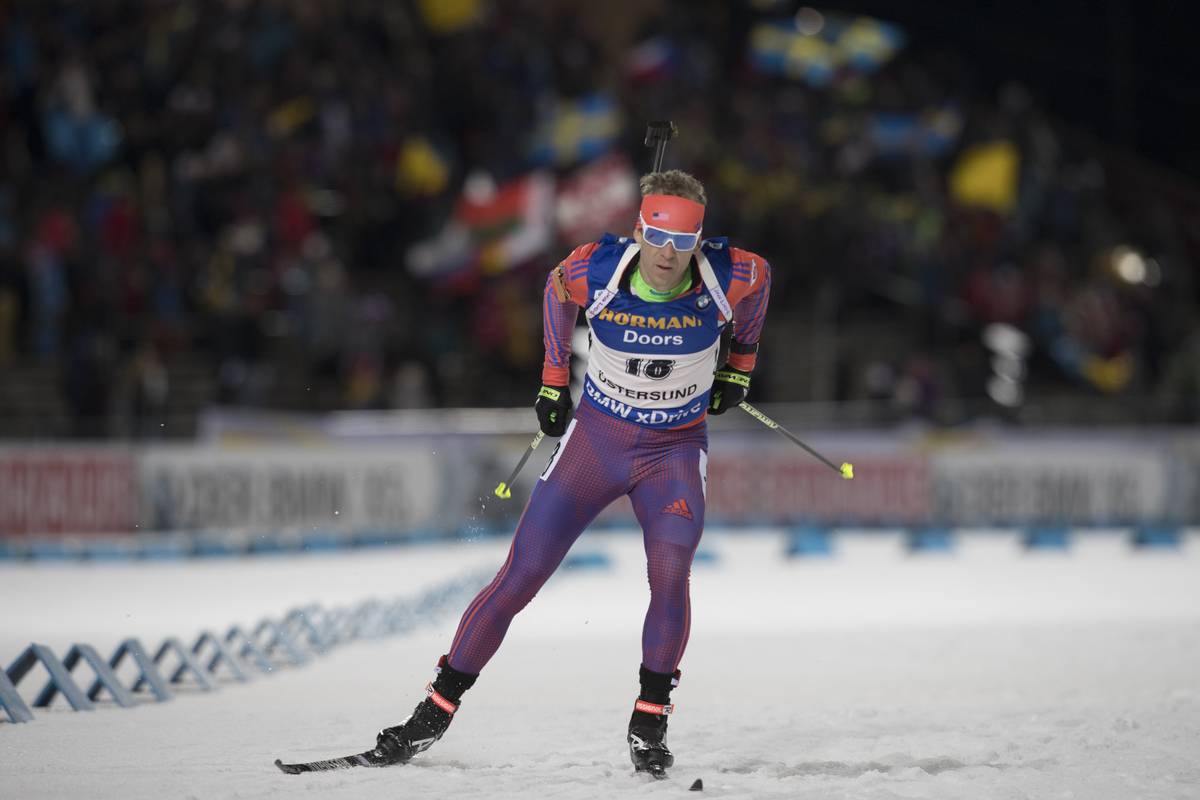
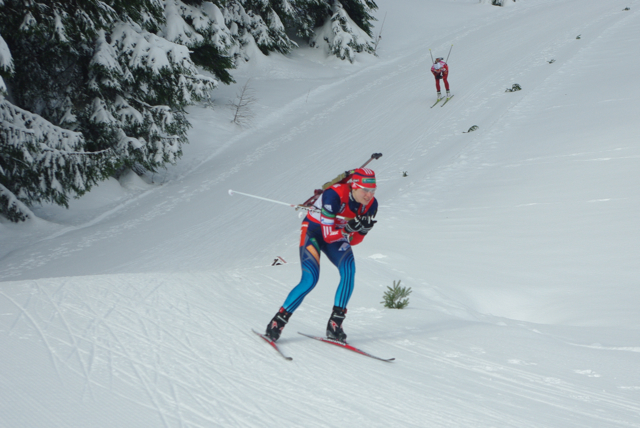
Lowell Bailey (US Biathlon) racing to 15th in the men’s first individual IBU World Cup race of the 2016/2017 season, the 20 k individual on Thursday in Östersund, Sweden. (Photo: USBA/NordicFocus)
Lowell Bailey is the dad of a six-month-old baby girl. Tim Burke celebrated his two-year anniversary earlier this fall. Both are US Biathlon team veterans, and at 35 and 34 years old, respectively, they’re still lighting up the International Biathlon Union (IBU) World Cup.
The teammates and training partners, based out of Lake Placid, N.Y., finished one place and 2.1 seconds apart on Thursday, with Bailey ending up 15th and Burke 16th in the first men’s individual World Cup race of the season: the 20-kilometer individual in Östersund, Sweden.
While Bailey accumulated four penalties in the four-stage race, he posted the 11th-fastest overall range and shooting times out of 103 finishers, and his course time ranked 25th overall.
“Your ski speed is always a little bit of an unknown going into the first race of the season,” Bailey said, according to a US Biathlon press release. “I’m happy to start off with decent ski speed and I hope I can build on this race going forward from here. I’ve worked throughout the training session on increasing the speed in the shooting setup (before any shots are fired) so I’m happy to see the overall range time where it is.”
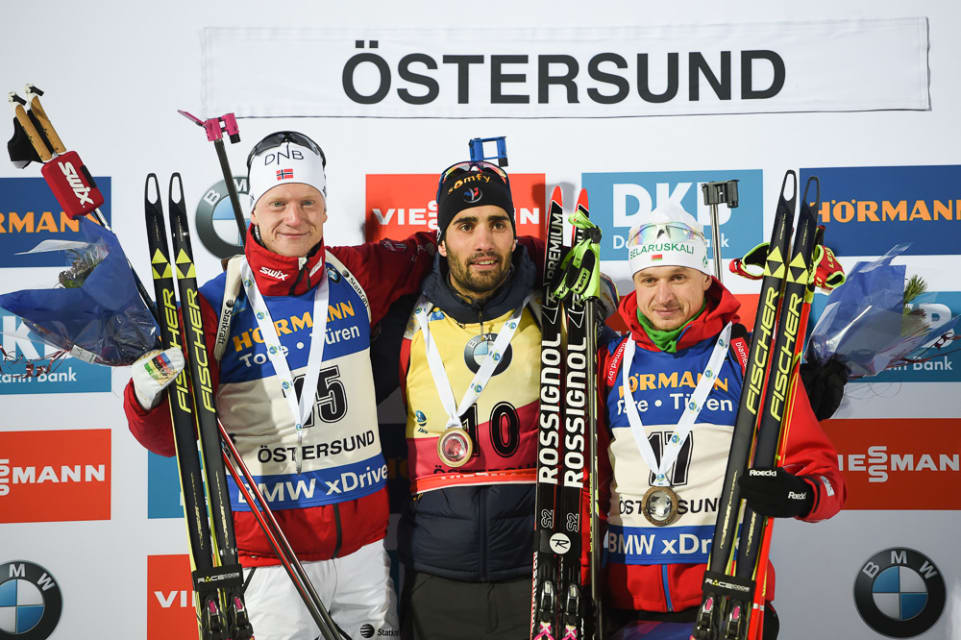
It was another windy day in Östersund, without a single racer hitting all 20 targets. The 10th starter and reigning overall World Cup champion, Martin Fourcade of France, took the individual win in 51:33.8 with two misses (0+2+0+0). He held off Norway’s Johannes Thingnes Bø (the 15th starter) by 29.5 seconds. Bø cleaned three-straight stages, but two penalties on the last standing cost him the win (0+0+0+2) and he settled for second.
The men’s 20 k individual podium in the first IBU World Cup of the 2016/2017 season, with winner Martin Fourcade (c) of France, Norway’s Johannes Bø (l) in second and Vladimir Chepelin (r) of Belarus on the podium for the first time in third. (Photo: IBU/BiathlonWorld.com)
“I knew I had the chance with 15 hits after the first three stages, but there was so much wind,” Bø told German TV broadcaster ARD. “I just tried to fight hard. but not hard enough. Two misses and I lost the first place. That was not so good, but the three first [stages] and overall it was a good race.“
Meanwhile, Vladimir Chepelin of Belarus was one of three finishers with just one miss (1+0+0+0), and he finished third (1:24.3 behind Fourcade) for his first World Cup podium, despite clocking the 43rd-ranked course time.
Germany’s Florian Graf, who started 94th, was on track for a podium with three clean stages, but one miss on the last standing put him in eighth at the finish (+2:33.6).
“In our hotel room, we joked about skiing in the top ten and shooting clean,” Graf told ARD. “Of course I would not have expected that it works out so well today, but I am overjoyed to have such a debut.”
Norway had three finish in the top five with Lars Helge Birkeland in fourth (+2:10.5, three misses) and Ole Einar Bjørndalen in fifth (+2:16.7, three misses).
But the main story of the day was once again Fourcade, who, like Bailey, is also a dad.
Asked what was more important, his life with his 14-month-old daughter or winning the first individual race of the season, Fourcade replied, “If I say the victory my wife would probably kill me. Or my daughter would kill me in a few years, too. So yeah, you can’t compare. Biathlon is my passion, is my job, but my daughter is my life now. Nothing to compare,” he told ARD.
In terms of the race itself, he said he was pleased.
“It was a long preparation and this was a good answer about my shape after the test in Sjusjøen and the win in single mixed [relay],” Fourcade said after his second win in as many races this season, and 48th individual World Cup victory (50 including two Olympic golds in 2014). “There is a difference with being able to win and actually winning, so I am very happy.”
And then there was the question of whether his main goal is a sixth overall World Cup title.
“That is what I trained for, that is what I hope I will get,” Fourcade said. “But this is biathlon. Today I had a good form with challenging wind conditions, but you can also lose quickly. It’s just one race, and there are about 30 more coming. I am very happy about today. I will enjoy this victory, my 50th World Cup victory. That is something I wouldn’t have dreamed about and I will enjoy it today.”
In bib 18, Bailey started directly behind Chepelin, the third-place finisher, and cleaned both prone stages, but missed two on each standing bout.
“It was pretty gusty in the range and you really had to concentrate on making quality shots,” Bailey told US Biathlon. “I’m happy with the prone performance but definitely wish I could have a few of those standing shots back.”
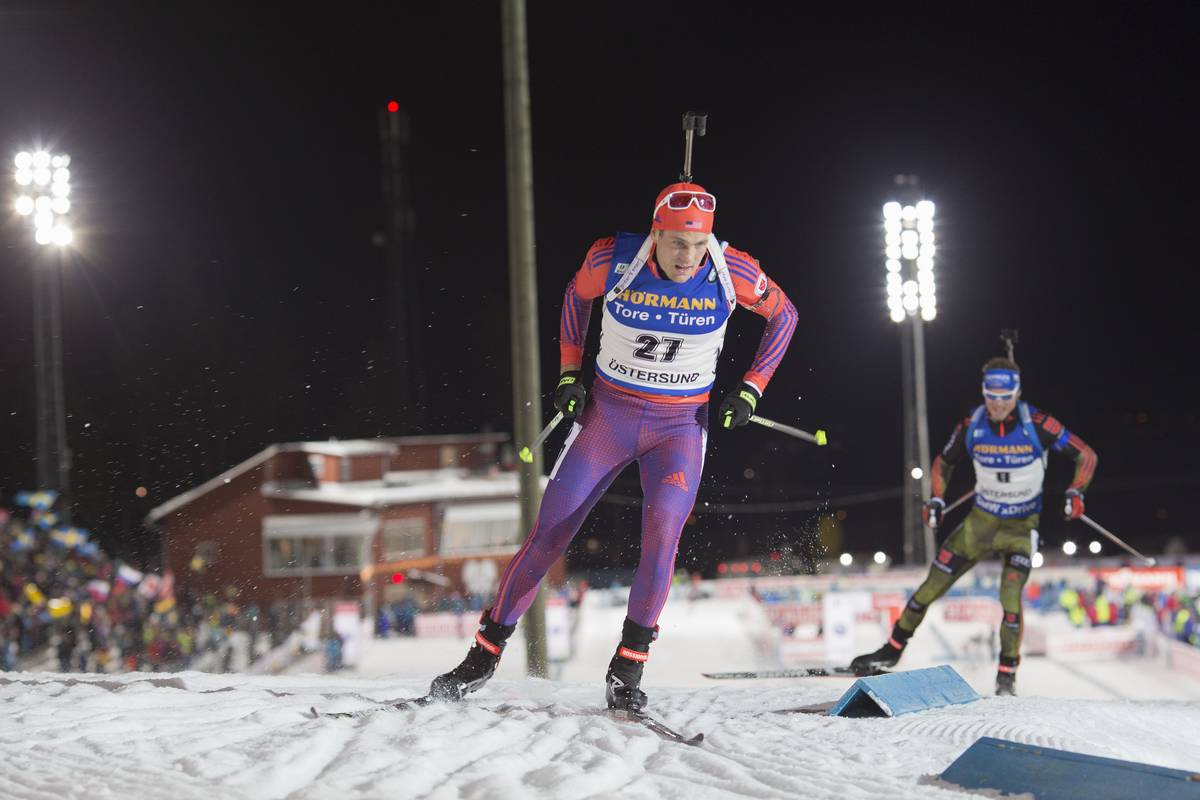
US Biathlon’s Tim Burke (27) racing to 16th in the men’s first individual IBU World Cup race of the 2016/2017 season, the 20 k individual on Thursday in Östersund, Sweden. (Photo: USBA/NordicFocus)
Burke in bib 27 started off with a clean prone as well, followed by two standing misses then another clean prone. In the final stage, he had one more penalty for a total of three (0+2+0+1) and finished 2.1 seconds back from Bailey, 3:54.6 behind Fourcade, and 0.2 seconds ahead of 19th-place Ondrej Moravec of the Czech Republic.
Burke has tallied three podiums in Östersund, most recently in 2013/2014, when he placed third in a sprint. In 2009/2010, he finished second in an 20 k there and third in the sprint.
“I’m not really sure why Östersund has been a good venue for me,” he told US Biathlon. “Maybe it’s because of the tricky shooting conditions, which is something that I typically like. Unfortunately, I felt really flat on the course today. I should have been able to reach the top 10 today with that shooting, but I just did not have it on the tracks today. Hopefully my legs will rebound for Saturday’s sprint.”
On Thursday, he made a point to shoot slower than usual in the windy conditions. His range time ranked 31st overall.
“I decided to just take my time on the range and that worked out today,” Burke said.
Also for the U.S., Russell Currier, who qualified for World Cup starts less than a week ago in an IBU Cup sprint, finished 54th (+7:04.5) with six penalties (1+1+2+2).
Nathan Smith led the Canadians in 43rd (+5:36.8) with three penalties (1+0+1+1). Among his teammates, Scott Gow finished 60th (+7:30.4, five misses), Macx Davies was 62nd (+7:34.6, four misses), Brendan Green was 89th (+10:20.1, eight misses), and Christian Gow 99th (+12:52.8, eight misses).
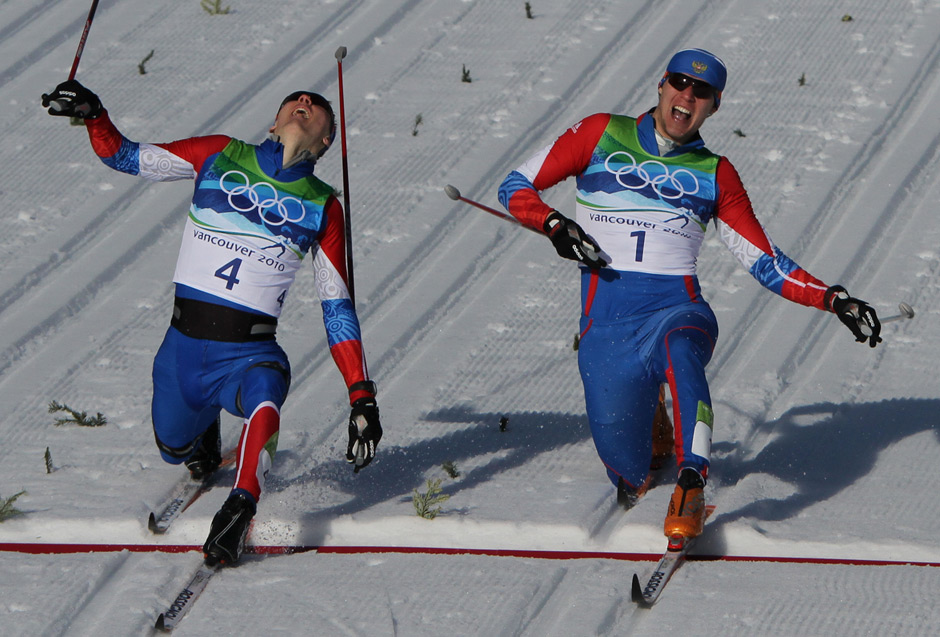
Russia’s Nikita Kriukov (l) and Alexander Panzhinskiy placed first and second in the men’s sprint at the 2010 Olympics in Vancouver, B.C. Russian Minister of Sport Vitaly Mutko recently told Russian media that the entire cross-country ski team was doping at those Olympics: “Of course, I knew all about this, they were all doing the doping,” he said. There are several ways in which the team allegedly avoided positive doping tests.
Allegations in the documentary opened a new possibility for how Russian sports officials avoided positive tests by doped athletes: did they use the Anti-Doping Administration and Management System, ADAMS, to learn when their athletes would be tested and warn staff who might be able to help athletes avoid positive tests?
“The ADAMS doping control database provided to [Anti-Doping Organizations] is an essential tool for managing both an in- and out-of-competition doping control program,” the World Anti-Doping Agency (WADA) explains on its website. “Coordination of doping control programs in the ADAMS system helps to avoid duplication of testing efforts and harmonizes communications between testing authorities, sample collection agencies as well as WADA accredited laboratories.”
But it may have been used for something else.
Government Interference
The 35-minute piece put together by journalist Hajo Seppelt primarily focused on what Russia should have to do in order to send athletes to the upcoming 2016 Summer Olympics in Rio de Janeiro, Brazil.
After widespread indignation over the last year about rampant doping in Russia, Seppelt questioned whether Russia was making a good-faith effort to change. Collusion had been revealed in several of his previous documentaries, as well as by pieces in The New York Times, Sunday Mail, 60 Minutes, and by the World Anti-Doping Agency Independent Commission.
This time, Seppelt revealed more than ever about the involvement of the Ministry of Sport and specific government officials in covering up doping so that Russian athletes could compete – with great success – on the international stage.
Buried in the documentary was an allegation that for two winter sports, the Ministry of Sport had worked to warn coaches and athletes before visits from doping control officers.
The allegations involved Minister of Sport Vitaly Mutko and his anti-doping advisor Natalia Zhelanova, and came from a document signed by Grigoriy Rodchenkov, the former head of the Moscow anti-doping laboratory who has since fled to the U.S. and cooperated with The New York Times.
“Zhelanova deliberately evaded and undermined Test Distribution Plans of [International Ski Federation] and [International Biathlon Union]. Usually, RUSADA was informed two or three days before their [doping control officers] should collect samples from the Russian national team. [Name redacted] immediately notified Zhelanova, then the latter notified Head coaches, and the national team had change location, just escaped.”
Zhelanova was a member of the WADA Finance and Administration Committee from 2010 until 2015.
The documentary notes that not everyone approved of this policy. RUSADA Executive Director Nikita Kamaev apparently registered his concern, telling Zhelanova that “RUSADA was losing credits” in terms of respect and credibility.
The ADAMS system is used by anti-doping agencies for a variety of purposes. One of the main uses is for athletes to report where they are living, training, or staying, a so-called “whereabouts” report.
If a doping control officer comes for a visit and the athlete cannot be located where they said they would be, it is considered a whereabouts violation. Three such violations over the course of 12 months can lead to a suspension from competition.
But another use of ADAMS is for the multiple authorities which test athletes to report and coordinate their efforts. For instance, an athlete is subject to testing by both their international federation and their national anti-doping organization.
“Where reasonably feasible, testing shall be coordinated through ADAMS or another system approved by WADA, in order to maximize the effectiveness of the combined testing effort and to avoid unnecessary repetitive testing,” the 2015 World Anti-Doping Code states.
This use of the system actually addressed complaints by athletes that they were tested to often and too disruptively, according to International Biathlon Union (IBU) Vice President for Medical Issues Jim Carrabre.
“Each nation has access to that data for their national athletes in the IBU test pool so that we minimize the probability of having two separate test authorities test an athlete on the same day,” he wrote in an email. “We each could still choose to do this if we wished but the benefits would be minimal. This was earlier a major complaint by athletes from many countries, and this access in ADAMS improved this complaint immensely.”
FIS Anti-Doping Administrator Sarah Fussek explained the use of the ADAMS system slightly differently.
“If you do register an exact mission in ADAMS beforehand, another organisation can only see this planned testing if the testing organisation has set explicit access in ADAMS for this purpose for each individual organisation,” she wrote in an email on Saturday. “At FIS this is currently not the case for any [national anti-doping agency] and vice versa.”
FIS does register tests in ADAMS once they have been completed.
But he confirmed that all of the tests ordered by the IBU were not only carried out by RUSADA, historically, but were also entered into ADAMS where RUSADA could access them.
“RUSADA could therefore notify internally any one if they had intentions of cheating the system,” he wrote. “This could have occurred but they would have had to check the system regularly if they wanted to know IBU test plans on Russian athletes when they were tested outside Russia. I presume that this was not done or otherwise we would have not caught the ones that we did.”
That’s why even aggressive testing by international federations could have been circumvented by individuals or agencies in Russia: whereabouts violation in reverse.
And, if this was the mechanism used by Zhelanova to warn teams before testing occurred, it could potentially have jeopardized testing by any international federation using ADAMS to pre-register its tests with the national anti-doping organization, as was encouraged by WADA.
Aggressive Testing, For Good or For Naught
Some federations have had concerns about Russian anti-doping efforts for years.
The International Ski Federation (FIS) caught a number of Russian cross-country skiers doping in the mid- to late-2000s, and in June 2010 sanctioned the Russian Ski Association. After fining the federation $185,000, FIS declined to press further sanctions and in November 2010 wrote in a press release that the federation had taken “positive steps” in anti-doping.
At the same time, FIS was avoiding relying on RUSADA to carry out testing missions to a large extent, instead relying on companies which train doping control officers and do the sample collection themselves.
“There was quite a lot of testing missions which were coordinated with [the Russian Anti-Doping Agency, RUSADA], but most were carried out by the FIS-appointed doping control agency with their own personnel and equipment,” FIS Secretary General Sarah Lewis explained to FasterSkier in May. “Most samples were transported to a different laboratory, in Lausanne or Cologne or somewhere else. We weren’t in the position that they could be manipulated in the Moscow laboratory.”
In an email on Thursday, FIS Anti-Doping Administrator Sarah Fussek said that the organization also did not usually notify RUSADA if and when tests were going to take place.
“With the exception of a handful missions, testing in Russia was carried out by a private sample collection provider,” she wrote. “We did have a couple of joint missions some years. Otherwise FIS testing did not give notice to RUSADA when conducting missions within Russia.”
As such, Fussek was confident that the FIS testing program was adequate to ensure that Russian athletes were mostly not cheating.
“Keeping in mind that you can never guarantee that every athlete is clean, we strongly believe that our programme covered testing in the country well and that we did all possible efforts to achieve a regular at home testing on Russian athletes (who most time of the year travelling on the World Cup circuit, plus training camps outside Russia and are tested there regularly as well),” she wrote.
“In the years three years prior to Sochi, the new administration in [the Russian Biathlon Union], Mr Mikhail Prokorov and Mr Sergei Krushenko, were verbally and financially committed to antidoping,” Carrabre wrote. “I had personal meetings with them and they went from one of the countries with the least number of internal antidoping tests to the country with the most number of internal tests in IBU. This effort was appreciated by myself and IBU and was, in my opinion, a large step in the right direction. I even publicly commended the RBU for this action. As I also said publicly, the number of tests does not always equal quality tests so the IBU would not decrease its efforts despite the testing of the RBU.”
The increased number of tests did catch some regional-level athletes, but no Russian Biathlon Union testing ever led to the suspension of a national-team athlete.
IBU testing, however, did, in particular when they tested outside of Russia. As Fussek had noted, athletes spend almost the entire winter, as well as periods of the offseason, training and competing in Europe, offering ample time to take many anti-doping samples.
“No national or international level athletes were ever found with their testing,” Carrabre said of the Russian Biathlon Union. “It was therefore surprising that the IBU would catch several of their athletes in the year prior to Sochi with testing performed outside of Russia while their athletes were at international training camps.”
Superficial Admissions of Guilt
The Ministry of Sport denied that they had interfered with RUSADA business in any way – or that such interference would even be possible.
“How can I exert influence there?” Mutko asked, rhetorically, in the new ARD documentary. “What influence can we exercise on the personnel of the anti-doping organizations?”
Just two days before the documentary aired, Zhelanova had done a question-and-answer session on Twitter, where she stressed that Russia was changing. The full exchanges from June 6 can be found on her twitter feed.
And Zhelanova seemed to admit that even today, it is difficult for doping control officers to do their jobs. U.K. Anti-Doping, which took over testing in Russia after RUSADA was stripped of its authority, reported in May that 40 percent of the tests it was supposed to carry out were impossible because they couldn’t locate the athlete.
Evading a sample or refusing to give a sample are both considered Anti-Doping Rule Violations, the same as a positive test or three missed whereabouts.
The current procedure for testing seemed to still be under negotiation. U.K. Anti-Doping had reported that Russia requested 30-day notice before testing of any athletes in military areas, which is clearly not standard operating procedure in the world of anti-doping.
“We agreed a procedure with WADA to help doping inspectors to carry out their important jobs,” Zhelanova tweeted in response to Rachel Axon of USA Today.
But what is there to discuss? In 2006, the Russian Federation ratified the International Convention Against Doping in Sport, under the purview of the United Nations Educational, Scientific, and Cultural Organization (UNESCO).
Article 12 states,
“States Parties shall, where appropriate:
(a) encourage and facilitate the implementation by sports organizations and anti-doping organizations within their jurisdiction of doping controls in a manner consistent with the Code, including no-advance notice, out-of-competition and in-competition testing…”
The 2015 World Anti-Doping Code further states that “Each government will take all actions and measures necessary to comply with the UNESCO Convention.”
After the documentary aired on Wednesday, Zhelanova was less than thrilled.
“I was very upset and disappointed by the allegations made against me in the recent @ARDde documentary,” she stated in a series of tweets. “These claims are untrue and are made by 1 disgraced person who disagreed with me on the importance of fair & clean sport. I really believe in the fight against doping and dopers and am doing everything I can to create change and restore trust. Reforms are under way but our system won’t be perfect immediately – cultural change takes time.”
Irina Starykh racing in Hochfilzen, Austria, last December, is one of three Russian biathletes caught using EPO in the last 12 months. While this has led to the conclusion that Russian biathlon has a systematic doping problem, a new documentary alleges that the problem is much worse and much more widespread.
When Russian biathlete Alexander Loginov was provisionally suspended last week after a year-old sample tested positive for the blood-doping drug recombinant erythropoietin (EPO) using a new method, many weren’t surprised.
The question was, why does this keep happening to Russia? One interesting commentary by Evgeniy Slyusarenko of the Russian sports website Championat explained that in Western Europe and North America, the responsibility for performance lies on the athlete, who must make decisions for themselves and accept the consequences. On the other hand, in Russia, athletes are expected to follow orders – in fact, everyone is expected to follow the orders from their higher-ups. And it is not the bosses who get fired when there are doping scandals. The bosses only get fired when there are no Olympic medals.
A new documentary aired on German broadcaster ARD last night alleges that though the roots of the Russian doping problem are just as Slyusarenko described, it goes much deeper. Noted journalist and documentarian Hajo Seppelt found evidence of not only state-sponsored doping, but routine cover-up procedures in place to avoid scandals involving high-profile athletes. Unknown and up-and-coming athletes were not so lucky, and were discarded by the system after a positive test.
You can find the hour-long documentary here, if you have VPN or a location-unblocker, and if you understand German.
Seppelt was compelled to investigate Russian doping after the 2014 Olympics, in part after it was revealed that Russian cross-country skiers were using xenon gas as a performance-enhancing measure.
“I wanted to report to a much greater degree on doping in Russia,” Seppelt told ARD in an interview. “Research in March. I could not expect at the time that the story would evolve like this. We must assume that in Russia a state-supported doping system exists with a big cover-up machine that pulls the strings in the background.”
Many of the central messages in the documentary come via a pair of whistleblowers who contacted Seppelt: 800-meter runner Yuliya (Rusanova) Stepanova, and her husband Vitaliy Stepanov, who used to work for the Russian anti-doping agency RUSADA.
The pair claim that not only would officials cover up positive tests by star athletes, for instance by “making a mistake” in the labwork to justify throwing out the results, but that athletes were also told to keep “clean” urine samples in their freezers to use for doping tests.
The documentary also shows a video clip recorded on a cell phone, in which London 2012 800 meter gold medalist Mariya Savinova admits to using oxandrolone, a prohibited anabolic steroid.
Several other athletes went on the record about not only doping and the availability of illicit performance-enhancing drugs, but also shady financial practices used by Russian federations, sometimes through shell companies.
Some of the allegations have also been reported on by other journalists. For instance, it was French newspaper L’Equipe which initially wrote that Russian marathon champion Liliya Shobukhova had paid her own federation a bribe to avoid a doping ban. After paying, she raced in the 2012 Olympic marathon – but when she failed to finish, the federation banned her after all.
Multiple Russian sports and anti-doping officials have categorically denied the claims.
“You should be very careful about putting too much faith into these athletes’ claims,” the head of Moscow’s doping control lab, Grigory Rodchenkov, said according to The Guardian. “These people are experiencing the biggest catastrophe of their lives.”
Seppelt disagrees.
“I did not think that there was still any system, in 2014, which has so many parallels to what was formerly done in East Germany,” he said in his ARD interview. “All this is topped by the capitalist characteristics of a commercialized elite sport system that is the status quo in Russia.”
And as for why no Russian athletes tested positive in Sochi? That’s no accident, he concludes.
“The facade has little to do with the reality of the thing,” he said. “In our film, you will see that both the Russian Anti-Doping Agency, the Doping Control Laboratory in Moscow, and sporting organizations operate what is obviously a system for the protection of national interests and the cover-up of doping to a significant extent… in my view it’s just window dressing.”