From the FasterSkier archive — posts syndicated from athletes’ and coaches’ own blogs between 2004 and 2012, kept online as published. Current coverage is at fasterskier.com.
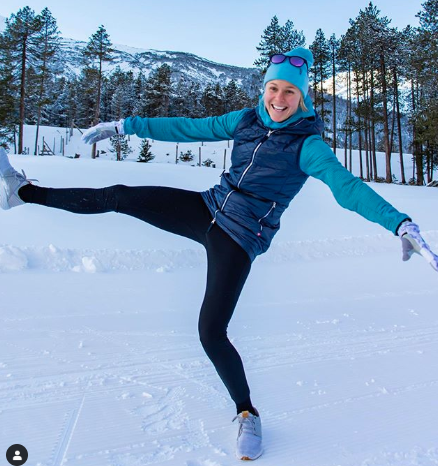
Sadie Maubet Bjornsen demonstrates the range of motion available in Skhoop’s “The Sadie” vest. (Photo: Instagram @sbjornsen)
We’ll be publishing a few select gear reviews moving forward. It’s not business as usual for FS or readers: we are posting gear reviews as a brief respite from grim news. We know minds are on more serious Coronavirus related issues.
‘Tis the season for layering. Here in Colorado, the high altitude sun wrestles with the snow packed mountains to create highly variable temperatures. One moment the sun is shining and I’m stripping down to a tee shirt, the next an afternoon winds pick up, the sun dips behind a ridge, and my core temperature begins to plummet.
Named for Skhoop sponsored U.S. Ski Team member and two-time Olympian Sadie Maubet Bjornsen, the versatile vest is the perfect intersection of lifestyle and performance wear. Breathable yet warm, fitted yet unrestricting, stylish yet functional.
It was love at first zip, though I was uncertain whether the length would be comfortable while skiing. For me at roughly 5’5”, a size small vest hits mid-thigh, gently hugging my hips. Despite my skepticism, I did not experience any decrease in mobility in skate or classic. There is also a two way zipper to conveniently add additional range of motion if needed.
The nylon shell blocks wind, while a stretch fabric panel on the back increases breathability, helping regulate body temperature while skiing. This vest will surprise you — it’s warmer than it looks, but won’t overheat you when the temperature or your heartbeat starts to rise.
Sophie Caldwell strides it out while wearing Skhoop’s “The Sadie” vest. (Photo: Instagram @sophiecaldwell)
Apart from its performance on the ski trail, the Sadie vest looks great over jeans, corduroys, or leggings as a casual everyday layer. The deep zippered side pockets fit a cell phone or the random odds and ends you need to stuff in there while at the playground with your toddler. It’s sleek design fits comfortably under a coat on cold days, potentially lengthening your protection and making you question why you never realized an insulated layer over your bum could keep your whole body so warm.
You can also feel good about the impact your purchase has on the environment. The vest is filled with PrimaLoft Eco Insulation, a synthetic material produced from 70% recycled fibers. The environmentally friendly DWR coating repels moisture and dirt, preventing falling snow or sweat from soaking in, and keeping the vest looking clean even after leaning against the road-sprayed car.
Skhoop is based in Åre, Sweden (home of the sprint hill climb stop during this season’s Scandinavian Ski Tour) where founder Sissi Kewenter originally sewed an old down jacket into a skirt to keep her bum and legs warm on chilly morning walks with her dog. Skhoop now offers a full line of warm and cozy clothing from insulated skirts, vests, and jackets to wool leggings and Scandinavian style sweaters.
You can find Skhoop products at retailers throughout the snowy parts of the United States, or order online. The Sadie vest retails for $239.
The author, wearing Skhoop’s “the Sadie” vest, crests a climb on the Spring Gulch Nordic Trails near Carbondale, CO.
Åre, Sweden — the site of the national (alpine) ski area in Sweden. Also the site of Stage 3 of the Ski Tour 2020’s skate sprint. Short at 0.66 k, but oh so steep with a finishing climb with slopes at 28 percent. Yah! 28 percent. Maybe part sideshow, maybe not. Either way, athletes had to get themselves to the top. In what was a leg-burning affair, for a one-off event, it was sporting entertainment.
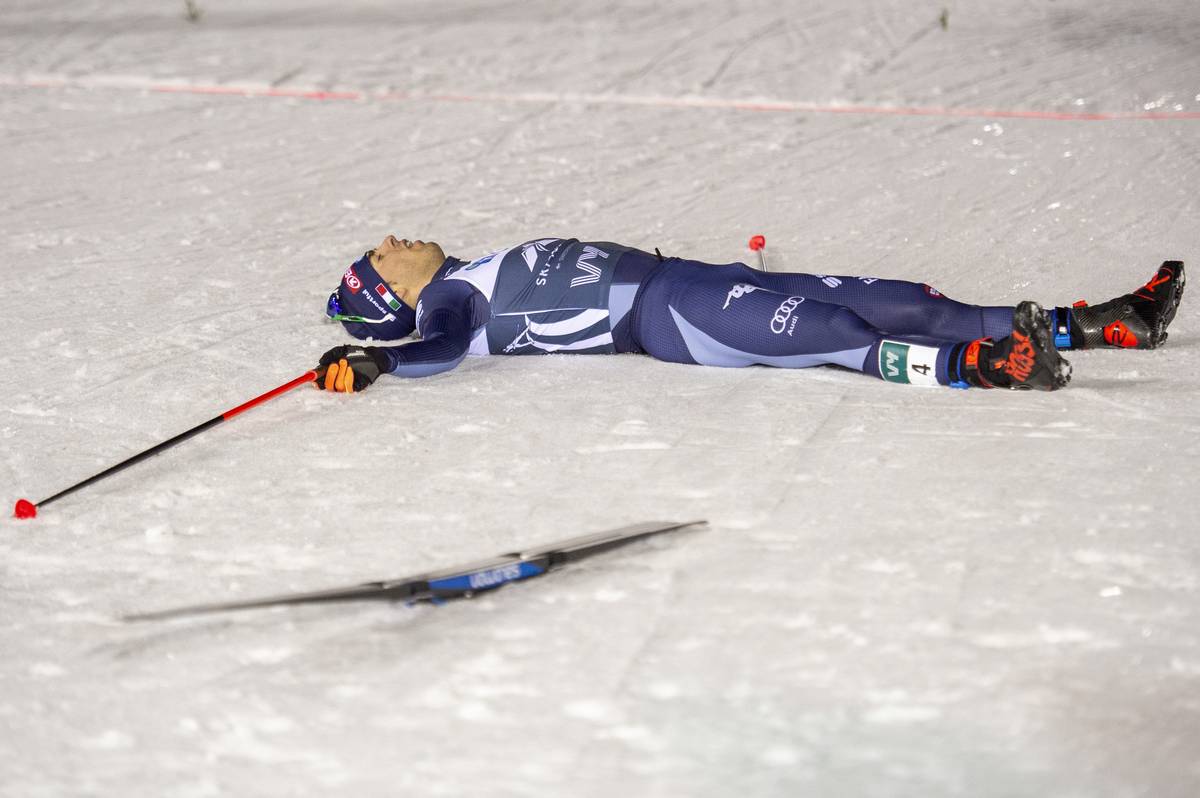
Italy’s Pellegrino: totally spent. He placed second overall in the Stage 3 Ski Tour 2020 sprint. (Photo: NordicFocus)
Let’s explain. The format was basic, a freestyle sprint. Otherwise, that’s where sprints as we know it ended. The 0.66-kilometer course shot off from the start up a gradual V2-able climb. It then rounded a left-hander where athletes descended what looked like a salted banked turn found in a X-Games terrain park. Down to the course’s bottom zoomed the skiers. Then things turned skyward. The course ascended a mini-Alpe Cermis lasting around one-minute for the men, to the finish atop the climb. The climb was the defining characteristic of the terrain: athletes suffered up a downhill ski slope gaining roughly 60 meters in altitude before the finish line. Calling the final ascent punchy would be an understatement. Grinding. Grueling. Leg-cement-inducing is more appropriate.
The Åre sprint hill climb in profile. (Photo: Screenshot FIS Broadcast)
Perhaps a sprint sideshow? That could be argued. But hosting an event at the base of the Swedish National Alpine hill with amenities for fans, of which there were plenty, and bountiful options for climbing terrain, we’ll let others debate the merits of hosting a climb-fest sprint.
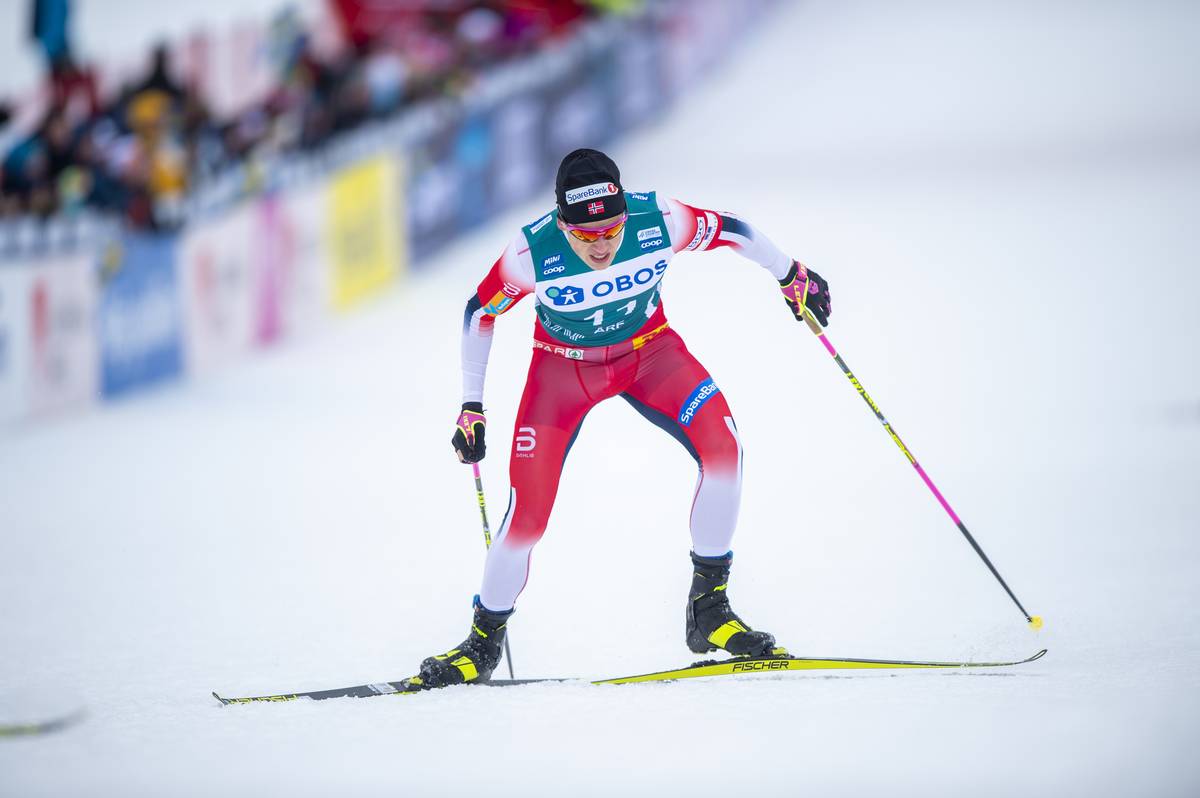
Johannes Høsflot Klæbo of Norway in Åre, Sweden on his way to winning Stage 3 of the Ski Tour 2020. (Photo: NordicFocus)
But some things haven’t changed: Johannes Høsflot Klæbo qualified in first covering the course in 1:49.64. That’s right, a quick and snappy 0.66 k, despite the big vert. Klæbo continues to deal with broken fingers and a thus far lackluster Ski Tour 2020. He placed 31st in Stage 1 and 25th in Stage 2. He came into Stage 3 ranked 25th overall in the Ski Tour, 2:05 behind the leader, Norway’s Stage 2 winner, Pål Golberg.
For his part, Golberg laid down the second-fastest time in qualification, 2.58 seconds back. Alexander Bolshunov of Russia, by all measures the pre-Ski Tour favorite, qualified in 23rd (+8.59).
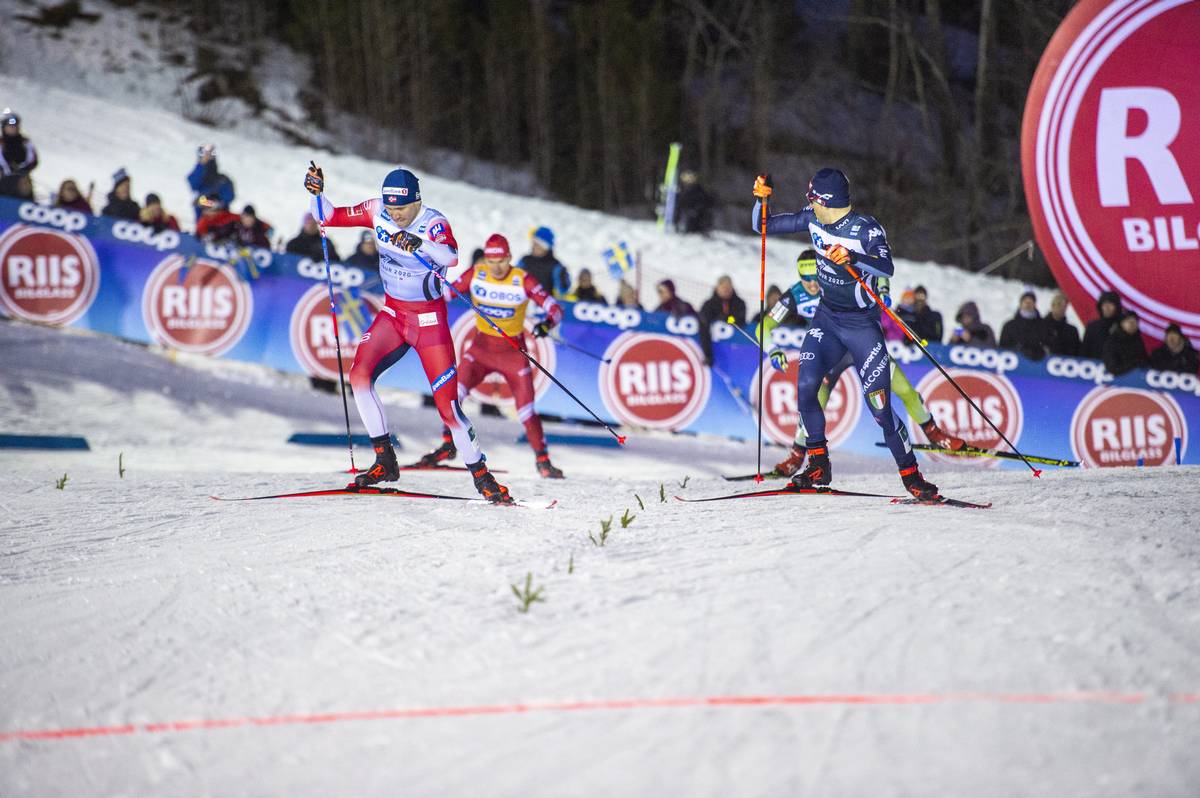
Pål Golberg of Norway and Italy’s Federico Pellegrino into the finish. (Photo: NordicFocus)
In the second semifinal, rounding the corner on the first and notably mild climb, Italy’s Federico Pellegrino took the inside line over the top. In bib 11, Norway’s Simen Hegstad Krüger came through in second, followed closely by Bolshunov who had advanced as a lucky loser.
Krüger took an aggressive line and cut off the advancing Russian. As this transpired, Krüger tumbled as their skis crossed. Bolshunov continued with Krüger going between his legs. Bolshunov now sat in fifth as he crested the hill. Krüger snapped a pole and grabbed a spare just prior to the descent. (He eventually received a yellow card for his cut-off move.)
Golberg won the semi, with Pellegrino in second. Bolshunov never recovered and placed fourth, 1.92 seconds behind Golberg. Bolshunov finished the day in eighth after being eliminated.
Although 8th on the day, Russia’s Alexander Bolshunov sits second overall in the Ski Tour 2020 after three stages. (Photo: NordicFocus)
Outside of the peculiar course, a stumble here and there, Klæbo and his astounding pull away acceleration in the final was the story. He advanced by winning the first quarterfinal and the first semi. He won that semi by only 0.52 seconds over France’s Jay Renaud. What became evident was that Klæbo was holding back and had not dialed his tactics.
In the final that featured Klæbo, Pellegrino, Renaud, Golberg, Lucas Chanavat of France, and Norway’s Erik Valnes the charade was over.
Chanavat led into the final climb with Pellegrino off to his right, a meter back, with Klæbo shadowing on the other side. Then Pellegrino upped the pace and pulled ahead with Klæbo settling into his draft. Chanavat took charge of the climbing lane to the left. For a moment, Klæbo must have been inhaling extra oxygen, as he fell slightly back.
But as the trio passed under the red sponsor arch, Klæbo shot off. For every single V1 cycle Pellegrino completed, Klæbo threw in two hop-skates. As he rounded to the left atop the climb, Klæbo looked back on a 20-meter gap. “Mamma mia” they must have been saying in Italy.
Italy’s Pellegrino: totally spent. He placed second overall in the Stage 3 Ski Tour 2020 sprint. (Photo: NordicFocus)
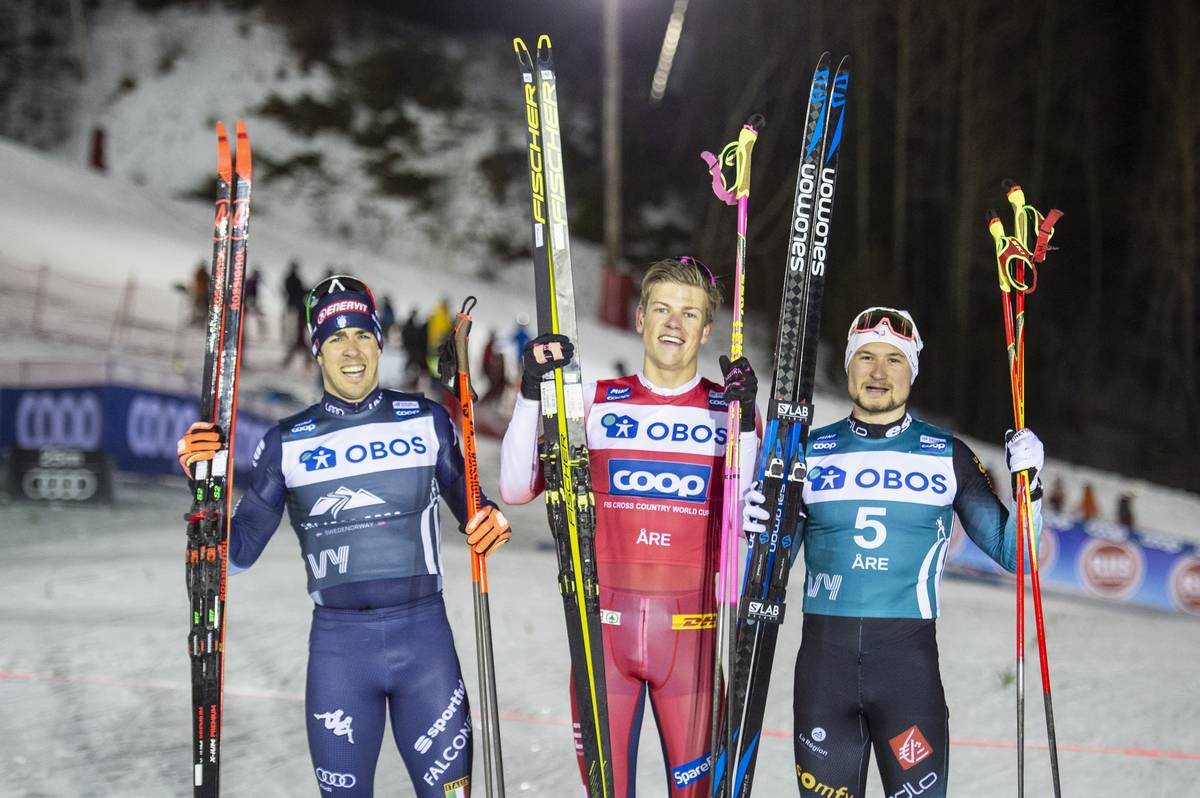
Klæbo won the final in 2:02.63. Pellegrino was second (+2.39), and Renaud third (+3.70). Golberg was fourth (+14.46), Chanavat fifth (+26:39), and Valnes sixth (+1:05.62).
Time to chill at the finish: Johannes Høsflot Klæbo of Norway. (Photo: NordicFocus)
“It was a real suffer-fest,” Klæbo told FIS after the race. “It was a lot of fun. At the end I was just trying to push all out. I turned my head on the last climb and it was a huge gap. … It was good to get the confidence again and fight for the podium. … At the end, I was just trying to push all out. I turned my head on the last climb and it was a huge gap. In the end, it was really fun.”
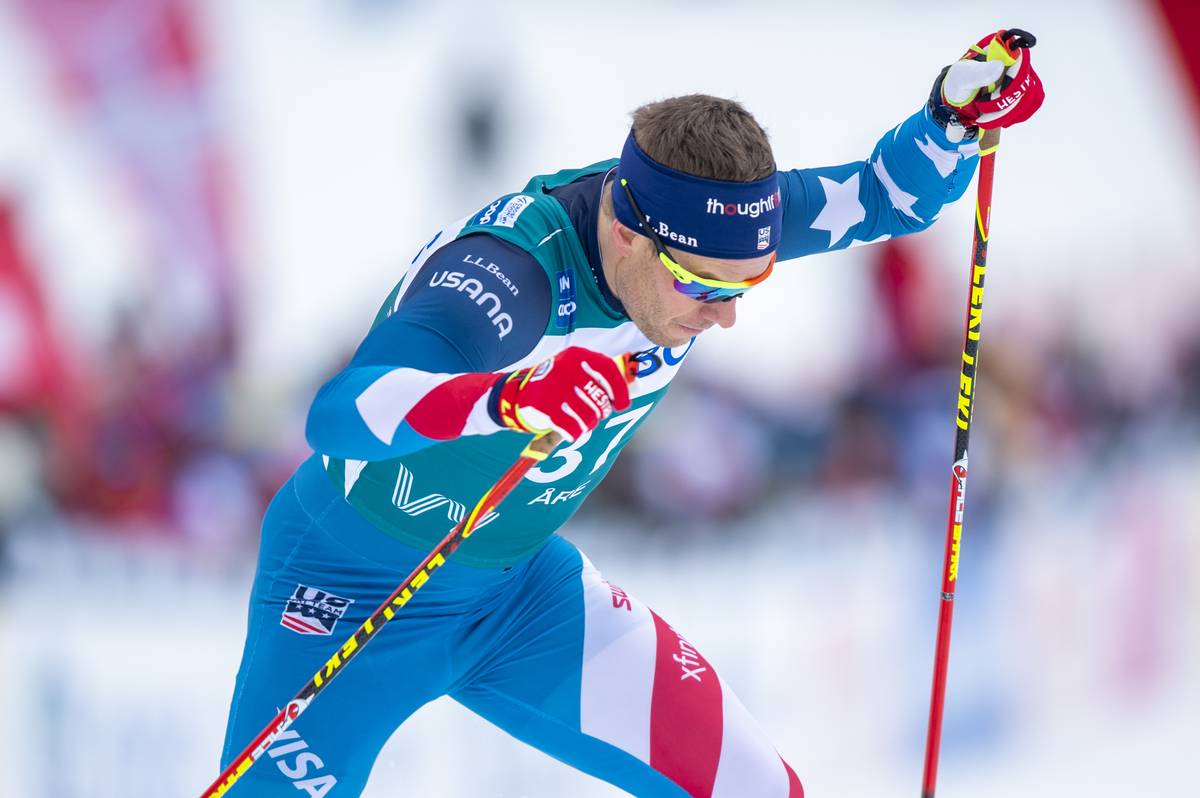
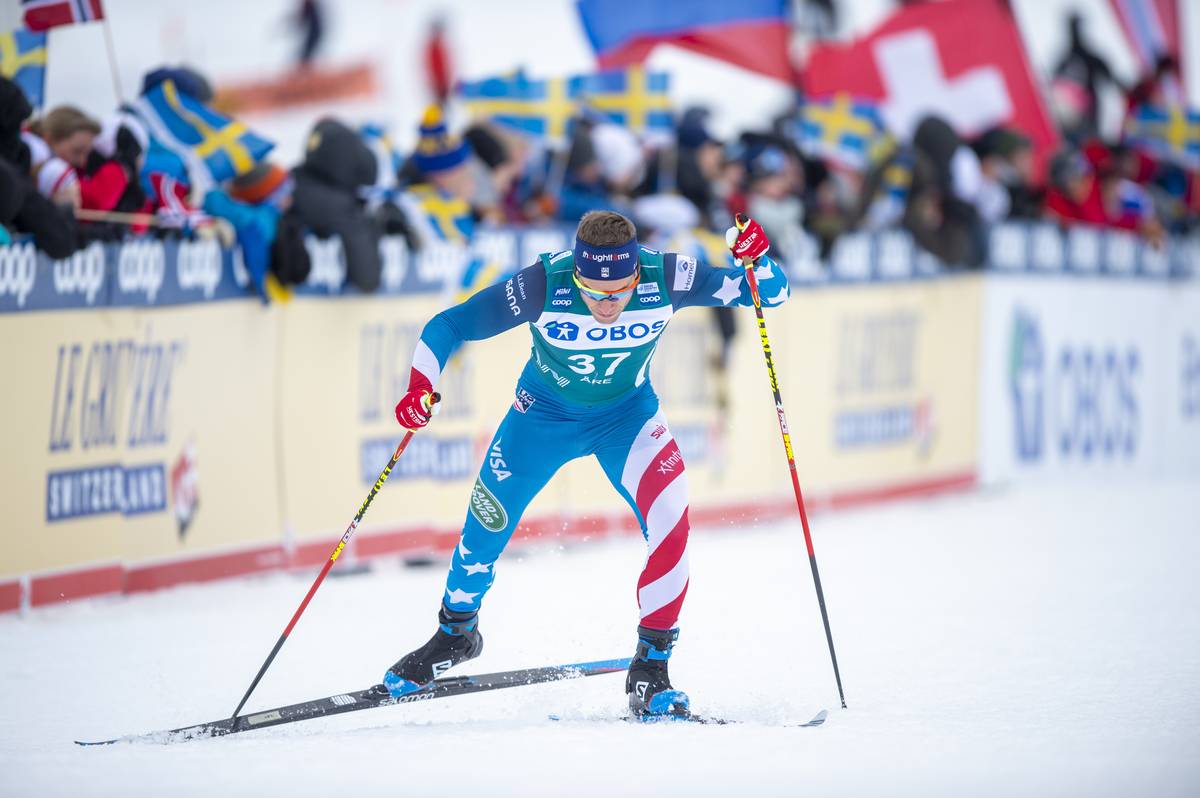
For the U.S. Simi Hamilton was the lone North American who advanced into the heats qualifying in 17th (+7.12). Hamilton skied to third (+2.27) in the second quarterfinal which was won by Russia’s Denis Spitsov in 2:04.14. The Aspen, Colorado native placed 14th in the final standings. (Below we have included an extended post-race interview with Hamilton. In the interview Hamilton discussed his injuries, and his return to racing World Cup sprints.)
The U.S. Ski Team’s Simi Hamilton in Åre, Sweden. (Photo: NordicFocus)
Post-race interview with Simi Hamilton
In his return to World Cup sprinting, Simi Hamilton skis to 14th overall on Stage 3. (Photo: NordicFocus)
Logan Hanneman placed 45th on the stage, Kevin Bolger 60th, David Norris 65th, and Ben Lustgarten 81st.
Post-race interview with U.S. World Cup Coach Matt Whitcomb
For Canada, Russell Kennedy finished in 73rd, Evan Palmer-Charrette 75th, Alexis Dumas 76th, and Ricardo Izquierdo-Bernier 78th.