Corresponding with a social media post from Johannes Høsflot Klæbo, the Norwegian news outlet NRK reported yesterday that each of the men’s national team sprinters who competed in Lahti last weekend has tested positive for COVID-19. Head sprint coach Arild Monsen told NRK that Håvard Solås Taugbøl was the first to test positive on Monday, followed by Erik Valnes, Pål Golberg, Sindre Bjørnestad Skar and Johannes Høsflot Klæbo on Tuesday. According to Trondheim regional newspaper Adresseavisen, the final Norwegian sprinter who raced in Lahti, Even Northug, has also been affected.
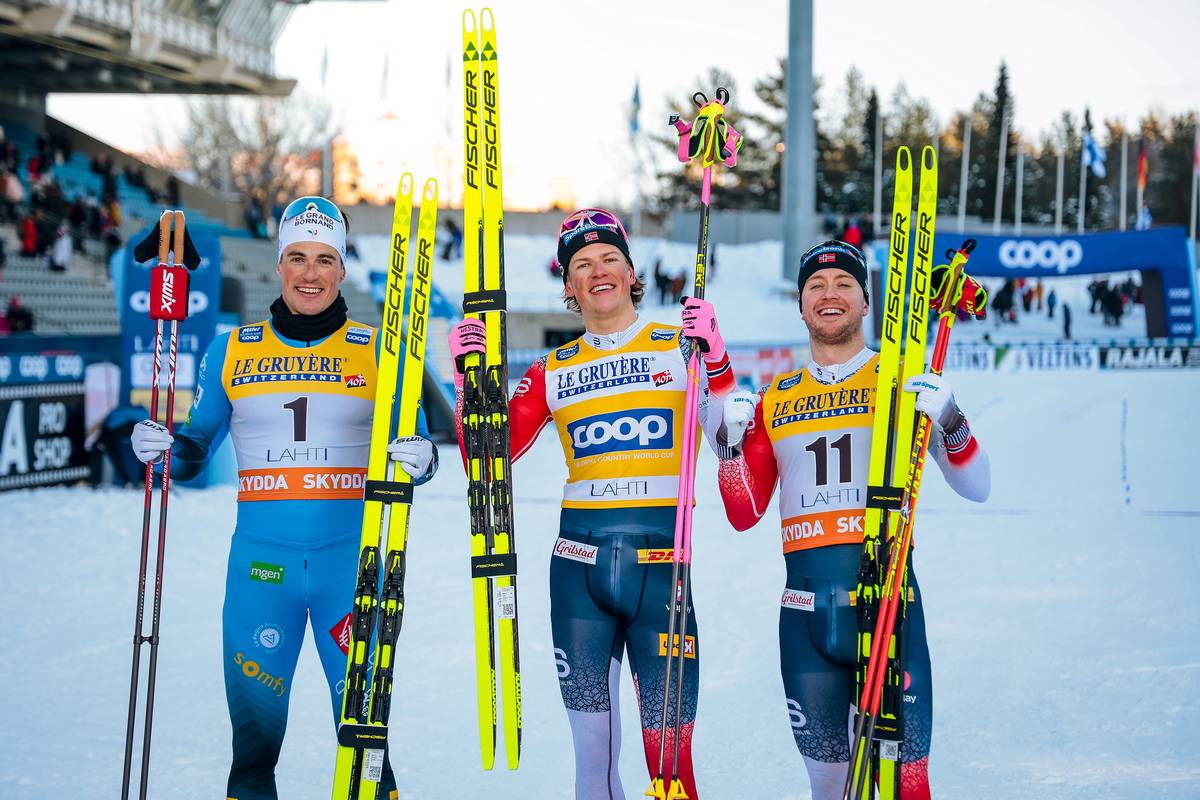
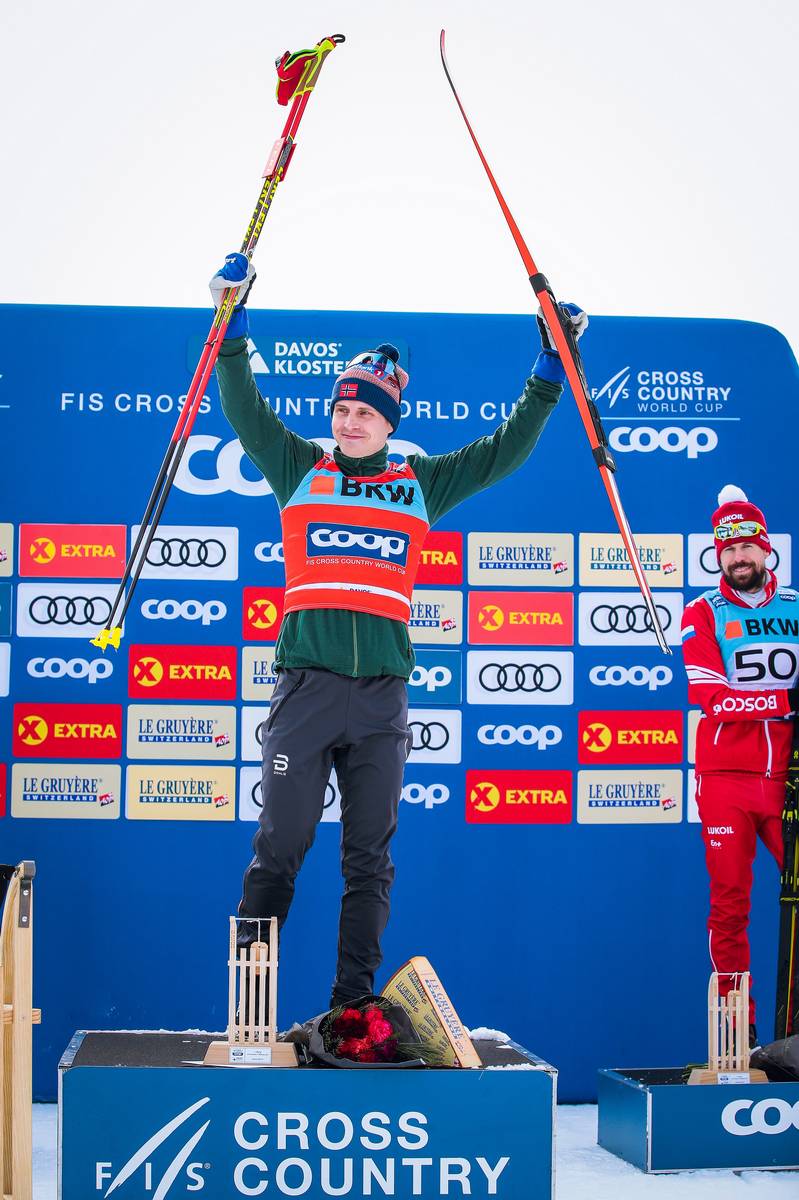
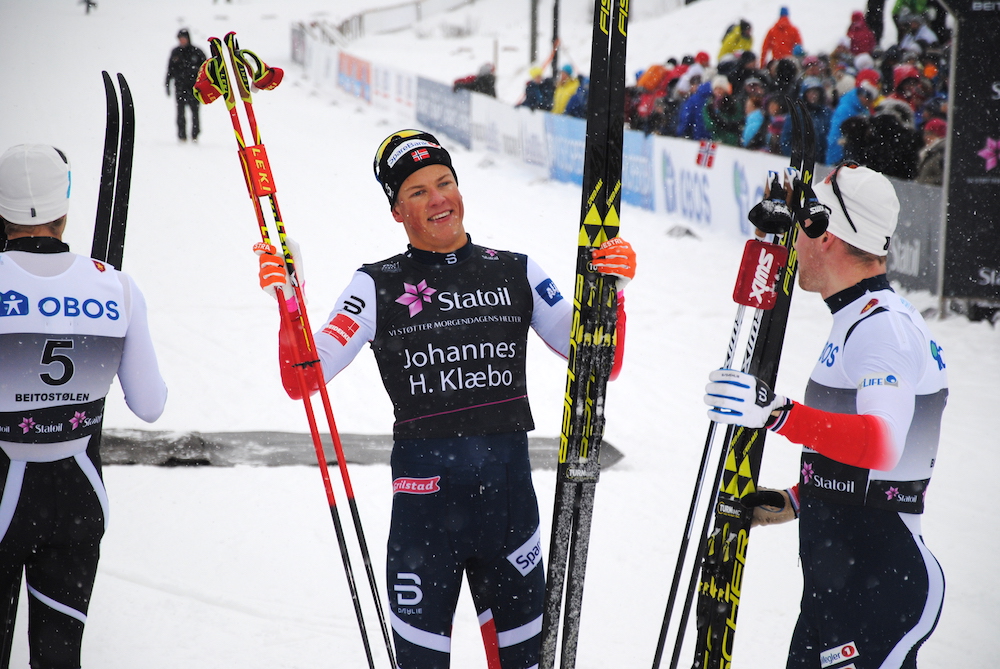
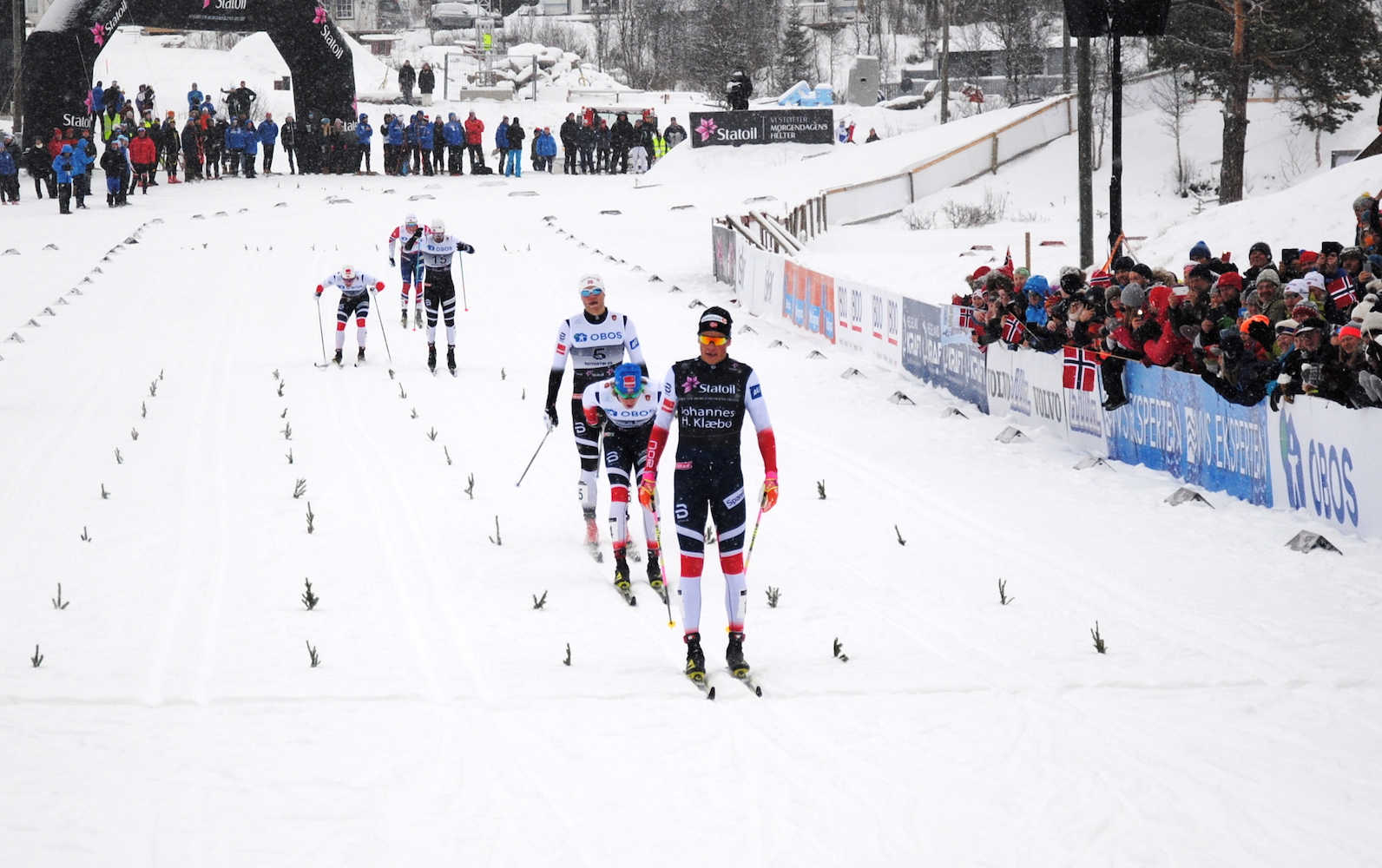
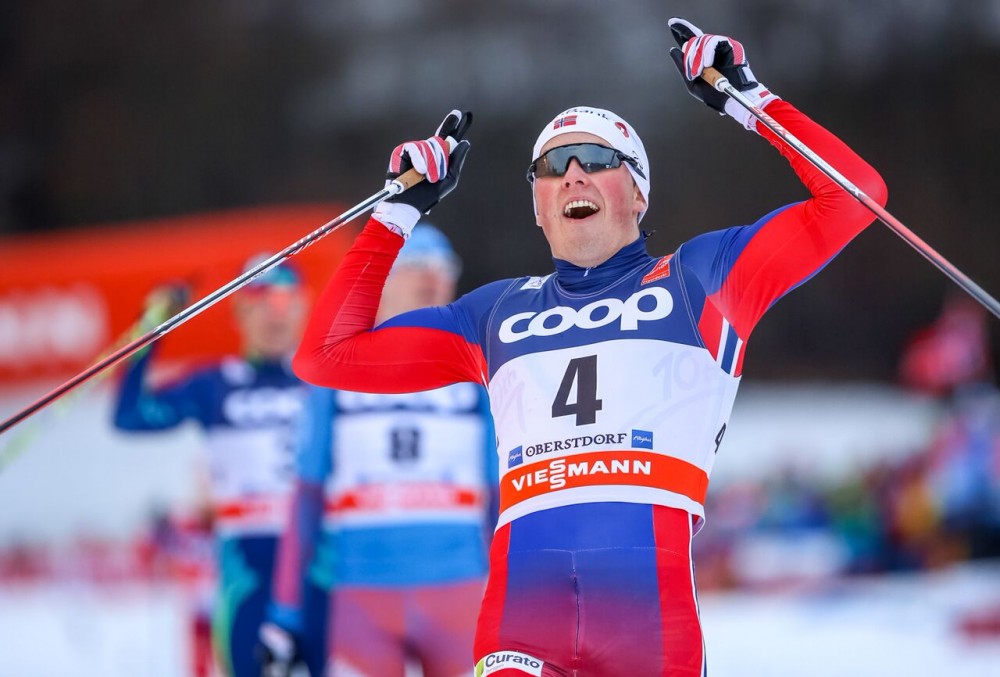
Johannes Høsflot Klæbo (NOR) takes the win in Lahti’s freestyle sprint ahead of Lucas Chanavat (FRA) and Sindre Bjørnestad Skar (NOR). (Photo: NordicFocus)
“It must have occurred in and around the stay in Lahti,” Monsen explained to NRK. “Håvard was the one who noticed symptoms on Monday. The others have little or no symptoms.”
Given the proximity to the upcoming sprint races in Drammen, Norway, Monsen indicated that these men would not be attending the competitions.
“What happens after that, we just have to look at. It’s boiling in many fields in the world now. This is smaller than other things, even though it is [disappointing] for those they concern,” Monsen continued.
At this time, no other athletes from the Norwegian program who attended the competitions in Lahti have tested positive. While the transmission link between the sprinters is clear, some athletes participated in both sprint and distance races, including Klæbo, who won the freestyle sprint and took second in the 15 k classic.
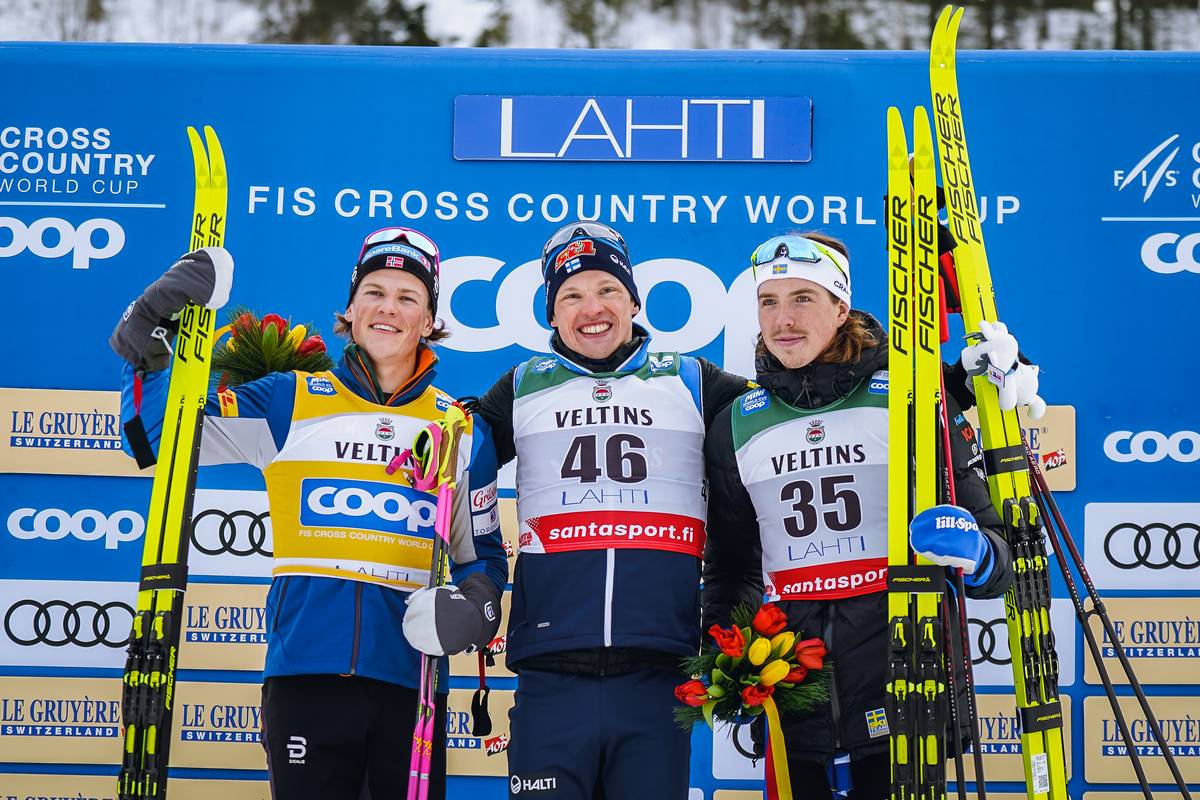
The men’s 15 k classic podium in Lahti: Iivo Niskanen (FIN) took the win in his signature event, ahead of Johannes Høsflot Klæbo (NOR) and William Poromaa (SWE). (Photo: NordicFocus)
Team doctor Øystein Andersen indicated to NRK that the original source of the outbreak remains unknown.
“It’s hard to say [how this began],” Andersen said. “Everyone came from their own bubbles before this race, after they returned home from the Olympics. We must now first map out whether there are more [positive cases] and conduct infection tracking, so that we avoid more infection.”
As the World Cup Finals slated for March 18-20th currently remain listed as “canceled” on the FIS calendar, it is unclear whether these athletes will be able to compete on the World Cup again this season.
Klæbo told NRK that “most indications are that the season is over,” however, the loss of competition would not significantly impact his season outcome. Klæbo currently leads the World Cup overall standings by nearly 500 points over Russia’s Alexander Bolshunov, who is also unable to compete as FIS banned athletes from Russia and Belarus from competition for the remainder of the season. The next closest athlete to Klæbo is Finland’s Iivo Niskanen, who sits nearly 800 points back with limited scoring opportunities remaining. As the Falun World Cups feature a mixed relay and team sprint, this leaves two sprints and two distance races, worth 100 World Cup points each, currently confirmed on the FIS calendar.
If World Cup Finals are held at an alternate venue, athletes could score a maximum of 50 points per day, with the opportunity for up to 200 bonus points should they win the three-day mini-tour.
This still leaves fewer than 800 points on the table, and as such, it looks like Klæbo will win the overall World Cup regardless of whether he competes again this season.
Klæbo also leads the World Cup sprint standings with a 210 point lead over Richard Jouve, and is 237 points of third-ranked Lucas Chanavat, both of France. Classic sprint events are scheduled for Drammen on Thursday, followed by another classic sprint in Falun on Friday, March 11th. If World Cup Finals take place, there will be a third sprint opportunity there, raced freestyle. This leaves 200 points available without the World Cup finals, and 250 including them.
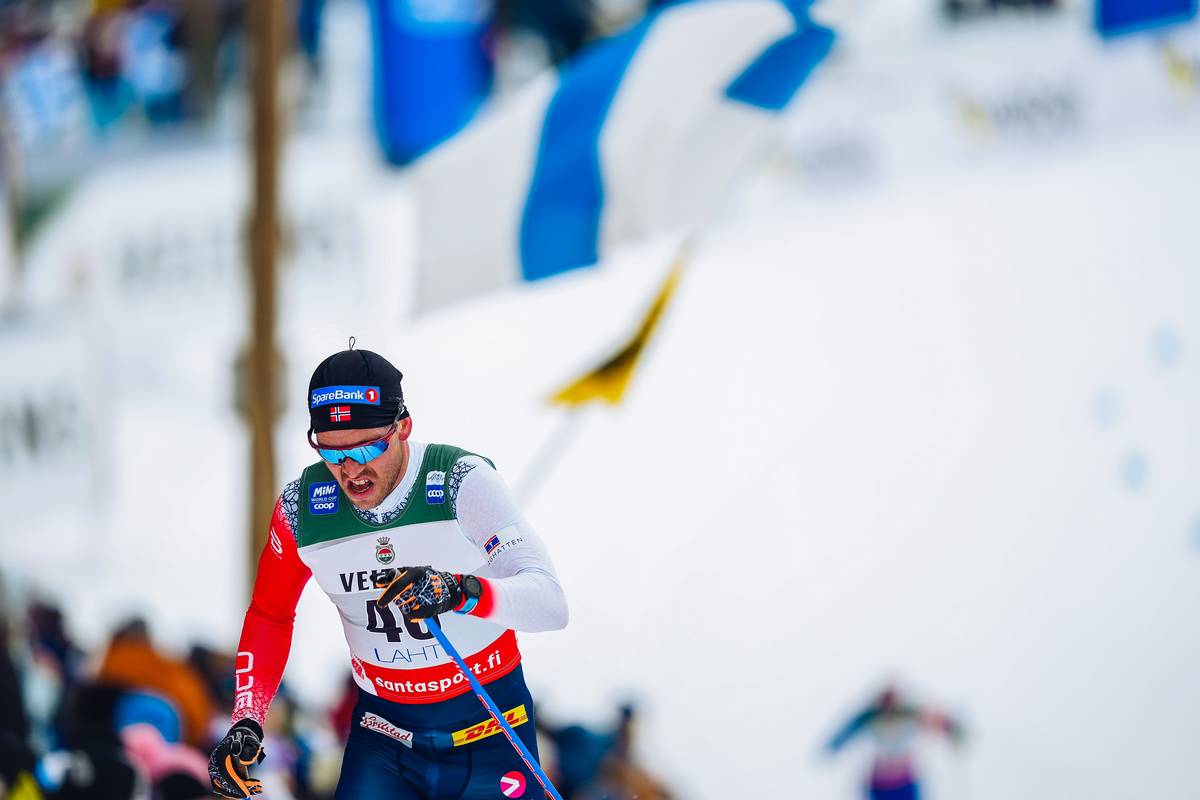
Norway’s Pål Golberg tested positive for COVID following the weekend of World Cup racing in Lahti. (Photo: NordicFocus)
“There is nothing to do but take it easy,” Pål Golberg said to NRK. “It’s [disappointing] that it’s coming now, but we can be very happy that we managed to avoid more infection in the camp before the Olympics when people became infected in Seiser Alm.”
On what is next, Golberg continued, “If I do not develop symptoms, it may be relevant to go to Falun next weekend. And then there are many [domestic] races over the late winter. Then we will see if it is worth it.”
The Planica World Cup cancellations this month brought the skiing world to the perilous edge of what it feared most, but hoped wouldn’t happen – the central focus of this ski season, and the sport’s biggest moment, the Olympics – affected by the Omicron COVID-19 variant. Over the last week in the Italian Alps, the sport went over that edge. This Olympics, as with everything in the world right now, will have to deal with the frustration, confusion, and all around uncertainty that’s de rigueur during this pandemic.
On January 23rd, NRK first reported that Norwegian national team sprint coach Arild Monsen had tested positive while at the team’s pre-Olympic camp in Seiser Alm, Italy. That set into motion a close contact, self-isolation, and testing regime with the stakes very clear – if athletes tested positive, suddenly the Olympics would be up in the air.
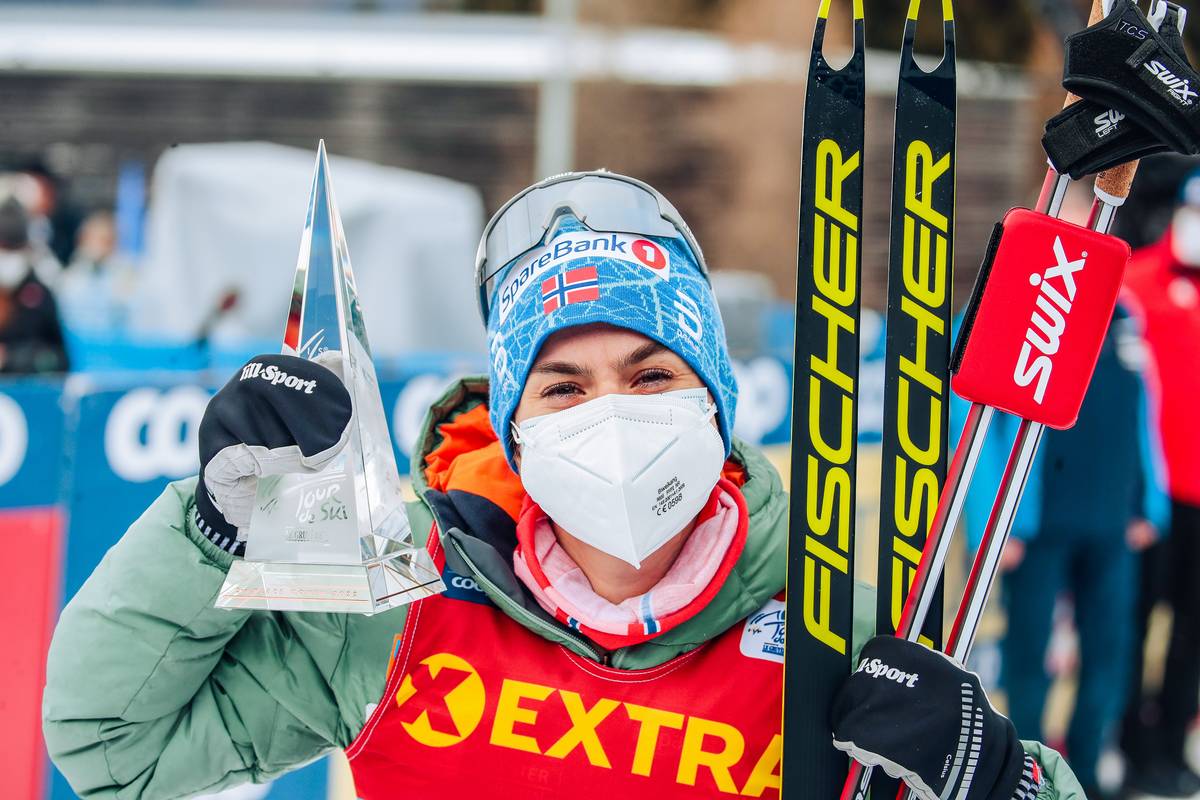
Aided by a win in the final hill climb, Heidi Weng took third place in the 2021/22 Tour de Ski overall standings. (Photo: NordicFocus)
On Tuesday the 25th, despite the best efforts of the team, Heidi Weng and Anne Kjersti Kalvå tested positive for COVID. Close contact tracing led to an announcement from the Norwegian Ski Federation that the scheduled charter flights for the Norwegian Men’s Team on today were canceled.
The story has since followed two lines of development. First, new cases that are still emerging from the outbreak at the Norwegian National camp in Italy, and second, the Norwegian Ski Federation’s plans to get athletes to Beijing in time for their first competition on February 5th.
On the former the latest update, as reported again by NRK today, is that Simen Hegstad Krüger has tested positive for COVID. Krüger’s test is the first within 10 days of the start of Olympic competition, meaning that the 2018 gold medalist of 30-kilometer skiathlon will not get the chance to defend his title. The news has hit the Norwegian team hard. In a statement to NRK, teammate Hans Christer Holund said “It’s terribly sad. A lot of hard work is behind getting to the Olympics, then it goes in the sink, and it is very sad for Simen.”
Simen Hegstad Krüger had a commanding win in the 15-kilometer skate in Davos in December, 2021. (Photo: NordicFocus)
As to travel plans, The Norwegian Ski Federation announced its updated plan to get their athletes to Ziangjiakou just hours ago. The men’s team will now fly direct from Verona, Italy to Beijing on a chartered flight on January 30th. The women’s team will follow suit out of Zurich, Switzerland on February 1st. That cuts out a trip back to Norway that was planned for the National Team before flying to Beijing. It also assumes no new infections in either the men’s or women’s teams. In NRK’s report, Espen Bjervig, National Team Manager, explained that the plan reflects “so many unknown factors. You never know what will turn up around the next turn. But you just have to cut through.”
Bjervig also pointed out that the plan is designed to move along with the COVID situation that is now underway in the Norwegian camp. “Fortunately, it is flexible with the girls. There are charter flights every day from Zurich between February 1st and 4th. The scheme for the boys presupposes that no infection appears.”
It is a big assumption, but one that allows there to be hope that for the individual athletes, and for ski fans alike, these Olympic games may be the exciting showcase of the world’s best skiers – many of whom are from Norway – that we have all looked forward to watching together.
Norway’s Johannes Høsflot Klæbo celebrates his first win of the season on Saturday in the men’s 1.5 k classic sprint FIS race in Beitostølen, Norway. (Photo: Aleks Tangen)
BEITOSTØLEN, Norway — A year ago, 20-year-old Johannes Høsflot Klæbo leapt onto the scene with a season-opening skate-sprint win in Beitostølen. Before that, he made waves at 2016 U23 World Championships, winning gold in the skate sprint, 10-kilometer classic and 4 x 5 k relay. But until last season, Klæbo, a member of Norway’s national U23 team, was hardly a household name to those outside of Norwegian skiing circles.
That all ended in Beito. Klæbo landed on the podium in the first World Cup sprint of the 2016/2017 season, placing third in the classic sprint in Kuusamo, Finland, and accumulated half a dozen podium finishes throughout last winter. He capped the season as the men’s U23 World Cup champion as well as the Sprint World Cup winner.
Now a full-fledged member of the Norwegian Sprint World Cup Team, Klæbo, who turned 21 last month, returned to Beitostølen to post a second- and first-place finish so far in two International Ski Federation (FIS) races there. He started his season off by taking second in Friday’s 15 k classic, 18 seconds behind reigning Overall World Cup champion Martin Johnsrud Sundby.
On Saturday, Klæbo won the 1.5 k classic sprint in Beitostølen without so much as a blemish, winning the qualifier to start the day then topping each of his heats en route to the final.
Norway’s Johannes Høsflot Klæbo crossing the line first for the win in the men’s classic sprint final on Saturday at the FIS season-opener in Beitostølen, Norway. (Photo: Aleks Tangen)
Up against five other Norwegians in the final, Klæbo raced to first once more in 3:50.4 minutes, finishing 1.1 seconds ahead of runner-up Kasper Stadaas. World Cup sprinter Eirik Brandsdal followed in third (+1.8), Fredrik Riseth was fourth (+6.4), Sondre Turvoll Fossli crossed in fifth (+6.7), and Emil Iversen was sixth (+9.2).
“My goal was to ski a good race,” Klæbo told a group of reporters after. “I wanted to get away from the pack towards the end and luckily the gap remained until the end.”
Iversen called attention to the young Norwegian while speaking with reporters after the race. “There has never been a talent like him,” Iversen said.
With snow starting to fall just before the men’s qualifier, Klæbo fared best on the course, racing to a 3.07-second qualifying win over Riseth with a time of 3:39.76.
Norwegian sprint coach Arild Monsen emphasized Klæbo’s ability to accelerate in and out of turns.
“Cross-country skiing has seen some development in recent years with specific techniques in specific zones, and Johannes has developed an ability to take advantage of that,” Monsen told a group of reporters. “We saw that very clearly today. The trick is to technically skilled when you’re tired and he’s able to do that almost to point where we don’t understand how.”
Klæbo went on to win his quarterfinal by 0.5 seconds over Norway’s Gjøran Tefre, then his semifinal by 0.2 seconds over Brandsdal. U.S. Ski Team member Andy Newell faced him in the quarterfinal, where Newell finished fourth in the heat, 3.7 seconds behind Klæbo and 2.6 seconds behind Norway’s Emil Nyeng in third. Newell missed advancing to the semifinals and finished the day in 16th overall.
“I knew we were going to have a fast heat because Klæbo had set a pretty strong pace from the first hill on, so we were really close to lucky losers,” Newell told FasterSkier in a post-race interview. “The second heat was just barely faster.”
With his second Beitostølen sprint victory, Klæbo told NRK that he was glad to get this race under his belt.
“This felt good, and I’m glad that sprint is up and running,” he said. “This was a good race considering what will happen next weekend.”
The World Cup kicks off next weekend in Kuusamo with a classic sprint on Nov. 24, followed by 15 k classic and 15 k freestyle races for the men on Nov. 25 and 26.
The lone American man in Saturday’s race, Newell qualified in 11th, 10.86 seconds off Klæbo’s time.
“Felt good in qualification, skis weren’t perfect because it started snowing just before,” Newell told FasterSkier after. “Skis were fast, but not quite enough grip, so we did a little re-wax for the heats.”
He noted that he’s been working with Fischer in Beitostølen as he’s there without his team (the rest of the U.S. Ski Team is currently training in Rovaniemi, Finland).
For the first 300 meters of his quarterfinal, six skiers started at a relaxed pace with Klæbo and Newell at the back of the pack leading into the the first downhill. While both were able to work their way to the front on the first climb, Newell lost steam on the second-to-last hill, “Danskebakken” (Danish hill).
“I was stuck in the back up the first hill, so I had to burn a match to get to the front, which probably made me a little tired for the last hill,” Newell reflected.
With what he called “great grip” up the big climb, he felt like he was dragging a bit over the top.
“I was definitely getting a little tired on the flat part over the top,” he said. “Because it’s the first sprint, maybe I wasn’t aggressive enough in the transitions, maybe it’s because the skis were a little draggy, but it seemed like I would get passed by somebody or two people going into each hill.”
With enough grip on the climbs, he would pass those racers back.
“So tried to finish strong but not quite there, but it’s a long season and hopefully the body will feel a little better in Kuusamo,” Newell said. “It’s all good, just training so looking forward to the World Cup.”
Out of the 30 men who qualified for Saturday’s sprint heats, only two were not Norwegian: Newell and Great Britain’s Andrew Young (who qualified 22nd). Young went on to finish the day in 23rd overall after finishing fifth in his quarterfinal.
Falla Stuns with Late Attack
Maiken Caspersen Falla (l) leading the women’s final up a climb, along with fellow Norwegian national team member Astrid Uhrenholdt Jacobsen (in green) during the women’s 1.5 k classic sprint FIS race on Saturday in Beitostølen, Norway. (Photo: Aleks Tangen)
In the women’s race, Maiken Caspersen Falla controlled the women’s race in a similar fashion to Klæbo, winning the qualifier, quarter, semi, and ultimately, the final.
In the final, Falla, who won last year’s Beitostølen skate sprint as well as her second-straight Sprint World Cup Crystal Globe, skied with the pack until the final climb where she made her move before entering the final stretch alone. Falla, 27, finished 3.7 seconds clear of anybody in 3:01.1. In another all-Norwegian final, Mari Eide placed second and Astrid Uhrenholdt Jacobsen claimed third (+4.8). Tiril Udnes Weng placed fourth (+6.7), Kari Vikhagen Gjeitnes was fifth (+11.1) and Ane Appelkvist Stenseth was sixth (+18.5).
Falla started the morning with a qualifying win in 2:54.86, 1.77 seconds ahead of Slovenia’s Katja Visnar in second. She didn’t slow down much for the heats, racing to first in each in 3:01.7, 3:02.3 and 3:01.1, respectively.
“I felt that it went better and better and it’s wonderful to have that feeling when you’re sprinting,” Falla told NRK after.
After watching her attack and pass three women on the final hill, NRK commentator Fredrik Aukland called her “the best sprinter in the world”.
When asked if this performance was good enough to win any race in the future, she told a group of reporters, “I hope so, of course. There is finishing hill already next weekend that is kind of similar to this one and I have practiced running up hills a lot so it’s obviously fun to test it in a race.”
Teammates with Newell on the Stratton Mountain School (SMS) Elite Team, Anne Hart raced to 31st for the second day in a row, missing qualifying in the top 30 by 0.28 seconds.
“I am happy about my qualification,” she told FasterSkier immediately after her race, before she knew whether her time was fast enough for the heats. “The course is a lot faster than yesterday, good condition.”
Hart started the qualifier third out of 58 women, just ahead of Visnar in bib 4. Her time was 17.55 seconds back from Falla’s.
“I skied with Katja Visnar and she is really good classic sprinter,” Hart said. “… It feels really good to be able to ski with all these World Cup skiers.”
Nichole Bathe, who was born in the U.S. but is racing for Great Britain, finished 33rd (+19.26), about 2 seconds out of the top 30.
Canada’s Isabella Howden of Barrie Cross Country (BXC) finished 58th (+57.28) in the qualifier. In the men’s qualifier, her teammates Joey Foster and Scott James Hill finished 74th (+32.45) and 84th (+36.64), respectively, and fellow Canadians Ryan Jackson and Maks Zechel (who are training in Norway with Team Asker) finished 97th (+43.99) and 102nd (+48.48), respectively, out of 109.
The Beitostølen weekend concludes with 10/15 k freestyle individual starts on Sunday.
Norway’s 24-year-old Emil Iversen celebrates his first World Cup win in the 1.2 k classic sprint at Stage 4 of the Tour de Ski in Oberstdorf, Germany. (Photo: Marcel Hilger)
OBERSTDORF, Germany — In front of some 4,300 spectators in the Ried arena and around the course at the site of the 2005 World Championships, Norway’s Emil Iversen achieved the first World Cup victory of his career in the men’s 1.2-kilometers classic sprint final on Tuesday.
The fourth of eight stages in this year’s Tour de Ski (visiting Oberstdorf for the fifth time since the Tour began 10 years ago) challenged racers with a difficult course, which was partly due to the precarious snow conditions on the artificial loop, thinly veiled by a few flakes that had fallen during the prior nights on the surrounding slopes. The sprint races on a course with mostly just three groomed classic tracks saw a number of crashes, many on a steep downhill section and left hairpin turn with mushy snow. However, most of those happened in the women’s race, with athletes resorting to the snowplow technique and becoming obstacles for those who did not.
Emil Iversen (r) leads his quarterfinal with fellow Norwegian Niklas Dyrhaug (20) during the men’s 1.2 k classic sprint at Stage 4 of the Tour de Ski in Oberstdorf, Germany. Dyrhaug was relegated to last in the heat for a technique violation. (Photo: Fischer/NordicFocus)
“I am so excited to win today. I am really surprised to be first,” the 24-year-old Iversen said during the post-race press conference.
At the first sprint of the Tour last week in Lenzerheide, Switzerland, Iversen failed to advance from the qualifying stage in the freestyle sprint. On Tuesday, he qualified fourth, won his quarterfinal (ahead of Kazakhstan’s Alexey Poltoranin in second*) and advanced to the final as a “lucky loser” in his semifinal — the third finisher with a fast-enough time after Russia’s Sergey Ustiugov, who won that semifinal, and Poltoranin, who again automatically advanced in second.
Earlier this season, Iversen, a former Norwegian U23 development team member, missed being named to Norway’s senior national team. He had not finished in the top 10 in a World Cup yet this season before Tuesday.
But Norwegian superstar Petter Northug was not surprised by the success of Iversen, expecting a breakthrough of the teammate with whom he has also been sharing hotel rooms with during this Tour. Last season, Iversen raced in two skate sprint finals in Lillehammer, Norway, and Rybinsk, Russia, where he finished sixth in both races.
Norway’s Petter Northug qualified fifth and went on to place fifth in the final of the 1.2 k classic sprint at Stage 4 of the Tour de Ski in Oberstdorf, Germany. He still ranks second overall in the Tour behind teammate Martin Johnsrud Sundby. (Photo: Marcel Hilger)
“I have kept him in the reins. He is a better skier than he is a roommate,” Northug joked in an interview with NRK, according to a translation.
“I’m not surprised. He should have been on the national team a long time ago, but … his development stopped a little bit two years ago,” Northug continued. “I think he has figured out now what is right. Now he is where he should be, and he can do everything from sprint to longer races. He’s going to be skiing on the national team next year.”
The two trained together this past offseason, and Northug admitted that Iversen repeatedly beat him in interval sessions.
At breakfast Tuesday morning, Iversen reportedly proclaimed he would win, according to Norwegian sprint coach Arild Monsen.
“It was said with a bit of gallows humor, but then he comes here and impresses all,” Monsen told NRK.
Iversen later insisted that he didn’t mean it as a joke, but still did not actually expect the victory.
Finishing 1.03 seconds behind him in the final, Ustiugov took second place after Iversen gathered enough speed out of the final downhill to gap the field, slingshotting past Ustiugov and Poltoranin to take the lead. The Norwegian held it down the finishing stretch, while Ustiugov and Poltoranin battled for second. Ustiugov edged him by 0.37 seconds, and Poltoranin took the final podium spot in third (+1.4).
“Ustiugov set the speed after the start and I tried to keep up,” Iversen recounted at the press conference. “I was first on the top and I thought I could go for the podium. I chose a good line in the downhill and to the finish, but I am still very much surprised to win.”
With the win, Iversen moved into 10th in the overall Tour standings.
“It is good to be on the podium, but I am little bit tired of losing to a Norwegian all the time,” Ustiugov said in the press conference via a translator. “I made a mistake in the last downhill and lost speed. That probably cost me the victory today.”
Norway’s Martin Johnsrud Sundby qualified 11th and went on to place fourth in the final of the 1.2 k classic sprint at Stage 4 of the Tour de Ski in Oberstdorf, Germany. Now, he not only leads the overall Tour standings, but topped the Tour’s sprint standings as well. (Photo: Marcel Hilger)
Fourth place went to Norway’s Martin Johnsrud Sundby, thereby defending his fairly comfortable lead in the overall Tour standings, 1:33.6 minutes ahead of Northug in second. Sundby also claimed first in the Tour’s sprint standings (ousting Italy’s Federico Pellegrino, who failed to make the semifinals when he placed third in his quarterfinal).
Ustiugov moved into third overall in the Tour (+1:56.9), bumping Norway’s Finn Hågen Krogh to fourth (+2:13.4), after Krogh planted his own pole between his legs and tumbled out of the start in in his semifinal. Krogh skied the rest of the semifinal alone in sixth, finishing nearly 39 seconds behind Sundby, who won that heat.
The top North American in the Tour standings, Canada’s Alex Harvey finished 15th to improve one spot into eighth overall (+3:22.2).
Northug finished fifth in this sprint, 10.32 seconds after Iversen, and for once was not the main focal point of the media assembled in Oberstdorf.
But he later claimed that he had not even gone all-out in the final, already happy with the bonus seconds he had collected, and instead tried to help Iversen.
“We discussed the positions out on the track if it was going quiet,” Northug told NRK. “I said that I wasn’t going to go into the basement [pain cave] in the finals, and that he just had to yell at me to get a lane if it went fast. I did not come to war.”
However, this tactical plan wasn’t necessary. Northug was positioned in the back of the pack for much of the final, and Iversen got the job done on his own merit.
Also out of position to fight for the podium, Germany’s 25-year-old local fan-favorite Sebastian Eisenlauer placed sixth (+14.19), for his best career result. Eisenlauer hails from a town just a few miles down the valley from Oberstdorf, so racing in front of his family and friends left him stoked.
“I deliberately saved my strength for today,” he told German TV broadcaster ARD after the race. “But I could have hardly dreamed it would work out so well. That was wicked cool.”
The best North American of the day was Canadian Len Valjas in 10th overall, advancing through the qualifier and quarterfinals, before being eliminated in his semifinal. He came in fifth in a stacked field that included all three eventual podium finishers.
His teammate Harvey narrowly missed advancing from his quarterfinal in third. For the U.S., Andy Newell placed 17th after finishing fourth in his quarterfinal.
The Tour continues in Oberstdorf on Wednesday with 10/15 k classic mass starts on a 2-kilometer loop, extending the sprint course with additional hills. This race replaces the originally scheduled skiathlons, which organizers deemed too difficult to prepare given the lack of snow conditions.
*Norway’s Niklas Dyrhaug was relegated to last in Iversen’s quarterfinal after initially placing second. The jury ruled he committed a technique violation (i.e. skating). That put him 30th on the day and 14th in the Tour (+4:29.2), and allowed Poltoranin to automatically advance to the semifinal in second.
— Alex Kochon contributed reporting
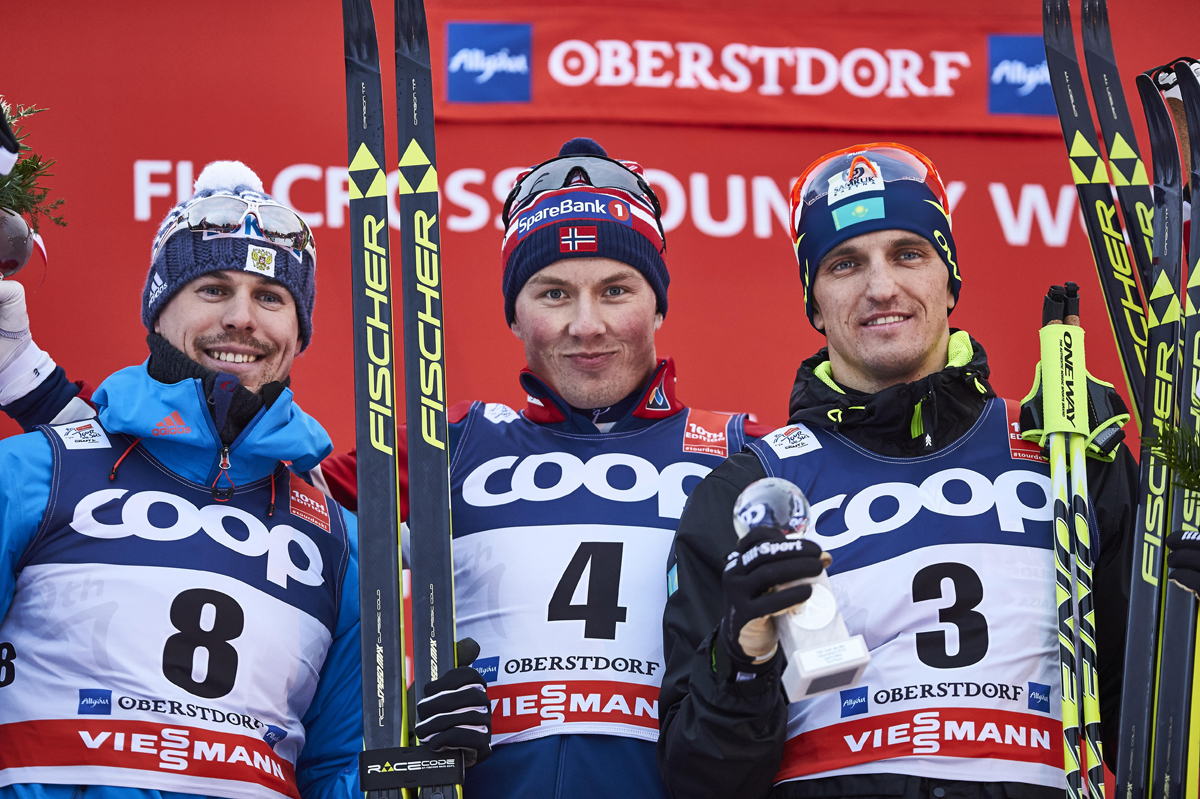
Norway’s Emil Iversen (c) on the podium after winning his first World Cup at Stage 4 of the Tour de Ski in Oberstdorf, Germany. Russia’s Sergey Ustiugov (l) placed second and Kazakhstan’s Alexey Poltoranin (r) was third. (Photo: Fischer/NordicFocus)
OSLO, NORWAY – “I’ll gladly do a Bradbury if I manage to win the gold medal at the Holmenkollen Worlds,” said Emil Joensson (SWE), referring to the Australian speedskater who won Olympic gold when all of his competitors crashed. Joensson is not at all satisfied with the Holmenkollen sprint course.
The racers are concerned about a climb inside the stadium where they ski behind the biathlon range. At this point, the course is only seven meters wide, compared to nine meters for the rest of the course.
“You can’t really ski two abreast through this bottleneck, which will cause accidents, or someone has to give,” reigning World Champion Ola Vigen Hattestad (NOR) said to Norwegian newspaper vg.no.
Chief of Course Hermod Bjoerkestoel says the whole issue is the result of a misunderstanding. Hattestad does not buy it.
“All you need is half an hour and an excavator, and the problem would be solved,” Hattestad argued.
Last Thursday, the International Ski Federation (FIS) conducted their final inspection of the courses, and FIS Cross-Country Race Director Jürg Capol said the sprint course is within the specifications, although he did admit the critical curve is on tight side.
World Championship favorite Petter Northug Jr is also unhappy with the course’s climb. He also complains about the “camel hump” obstacle the skiers have to maneuver on the last descent into the stadium.
Joensson agrees
Sweden’s top sprint racer Emil Joensson agrees with Northug and the Norwegian skiers. The World Championships sprint race could be determined by crashes, wrestling and the subsequent protests. But isn’t this par for the course in sprint racing?
“Yes, you could argue that. But the Holmenkollen course is actually unreasonably peculiar, and that’s something that will be evident in a variety of mass start events there,” Joensson said.
As a result of the course configuration, the final stretch to the finish is very short and also very fast, as the racers will enter it from a descent.
“The course construction makes this incredibly risky and left up to chance. You really need to be where you want to be in that last curve, or you’ve already lost the race,” Joensson said.
But then again, you wonder if you really want to be leading into the stadium, risking that someone else glides past you, cuts you off, and literally parks your effort. At the pre-Worlds event last February, the Norwegian medal hope Oeystein Pettersen fell after he was involved in an incident with Joensson, among others. Pettersen requested Joensson be disqualified.
“But the video replay of the incident showed that it was in fact Pettersen who caused the crash by colliding into Emil [Joensson]. But for the Worlds, you can surely count on Kamikaze skiers vying for that lead position coming into the critical curve,” said Swedish sprint coach Arild Monsen.
“And if Emil falls, what does it matter if the other dude gets disqualified? There is no rerun of the race,” Monsen added.
Need a lot of luck
Just like they did before the 2010 Olympics, the Swedish sprint team has analyzed the course down to the last inch.
“I know that you’ll need a good amount of luck to win the sprint race here. With this kind of final stretch, anything can happen. It could easily be something like that short track speed skating event at the Olympics where the Australian won because everyone else crashed,” Emil Joensson said.
It was Bradbury who won the gold medal at the 2002 Olympics when the leaders in the final heat crashed, allowing him to glide peacefully into a gold medal despite being the slowest racer in the heat.
The 2015 World Championships in Falun, Sweden, will be Joensson’s first home-turf championship. He said he hopes the courses there will be fairer than the Holmenkollen course appears to be. Joensson played an important role in securing the championships for Falun at the FIS Congress in Turkey this summer, when the organization voted to award the 2015 event to Sweden.
From Langd.se, October 8, 2010 By Kjell Erik Kristiansen, translation by Inge Scheve