From the FasterSkier archive — posts syndicated from athletes’ and coaches’ own blogs between 2004 and 2012, kept online as published. Current coverage is at fasterskier.com.
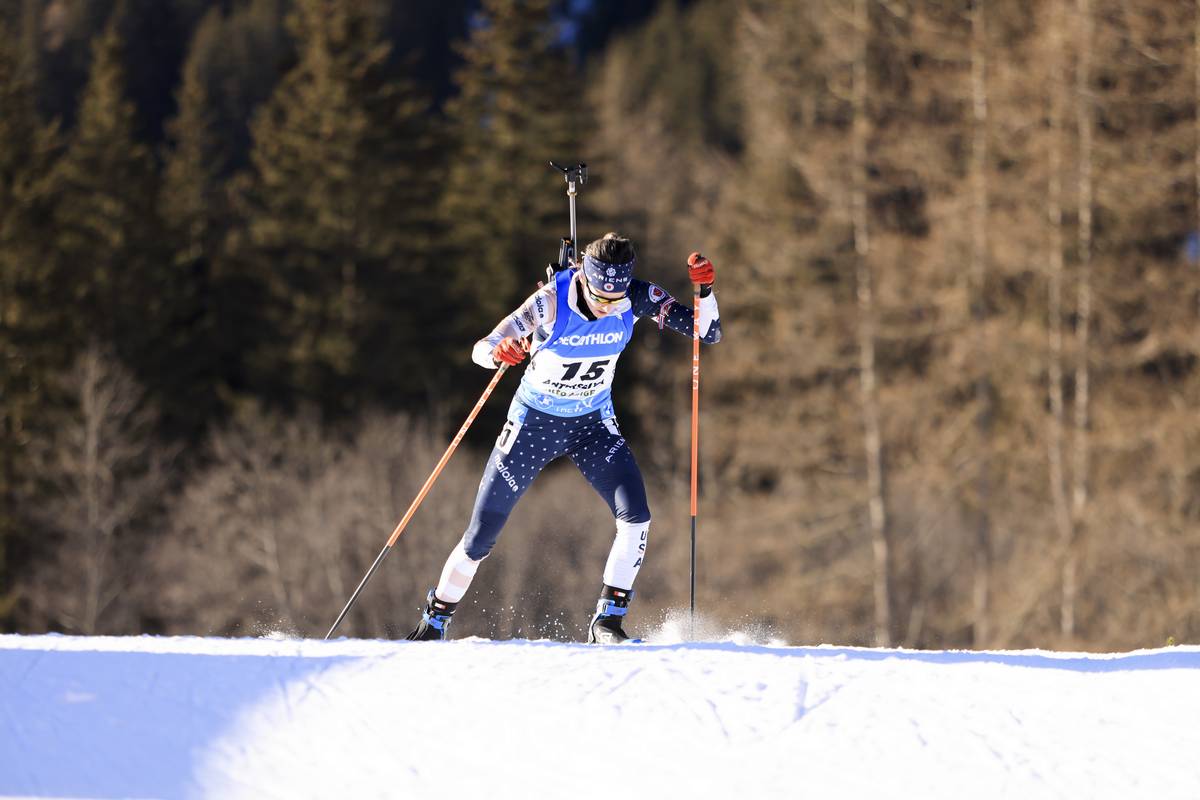
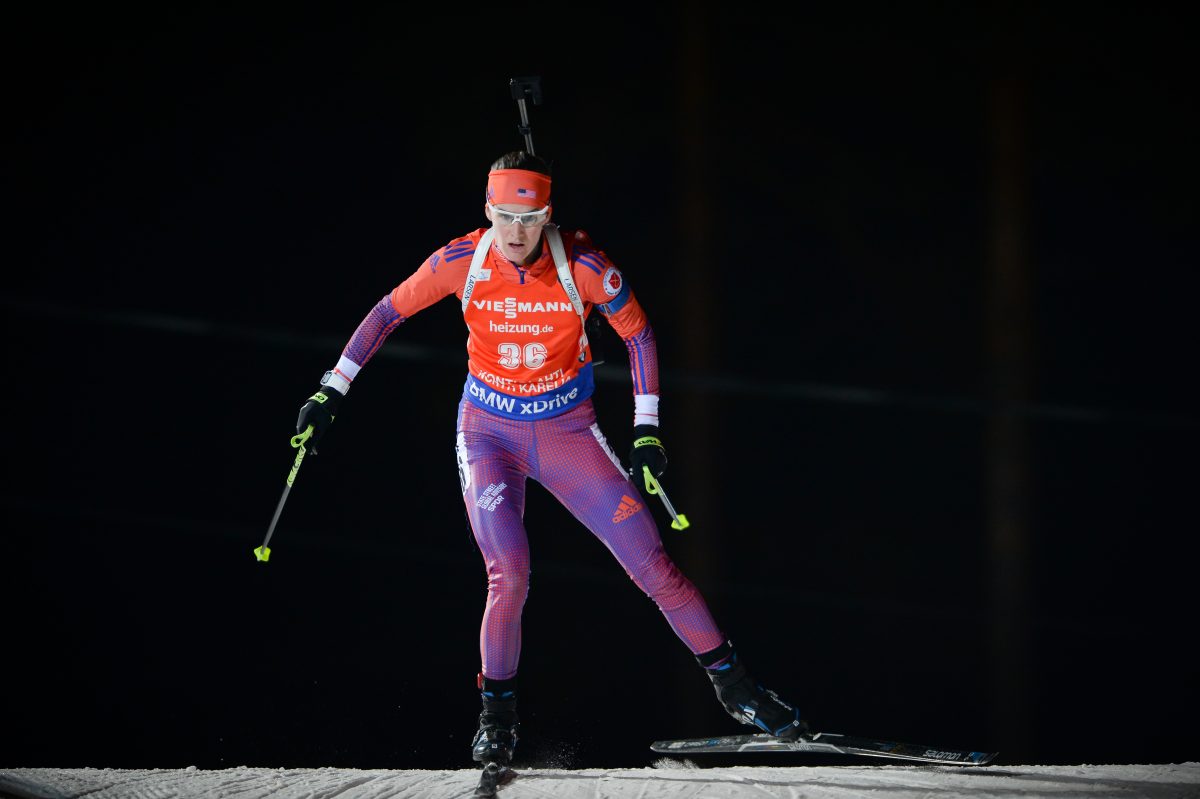
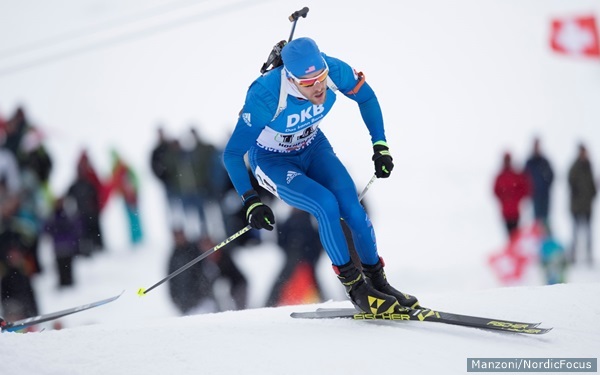
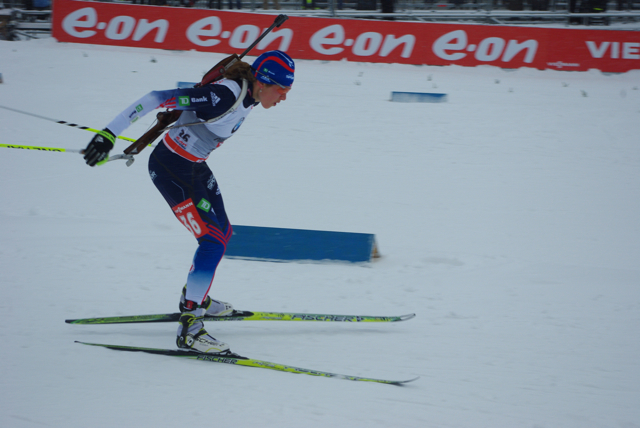
Clare Egan races to fourth place in the 15km Women’s Individual competition in Antholz, Italy. (Photo: NordicFocus)
Antholz, ITA – US Biathlon Team and Craftsbury Green Racing Project athlete Clare Egan (Cape Elizabeth, Maine) grabbed the second-best finish of her career with a fourth place in Friday’s 15km Women’s Individual competition in Antholz, Italy. The result comes after Egan went home for Christmas and skipped the Oberhof World Cup to prepare for the Beijing Games.
“The biggest challenge with my preparation has been staying positive and patient while I try to get my physical shape up to speed after a tough start to the season,”said Egan. “But I’m well-supported by the team around me so I never stop believing. I think my plan to go home for Christmas and then skip the World Cup in Oberhof to train here in Antholz at altitude has worked well for me.”
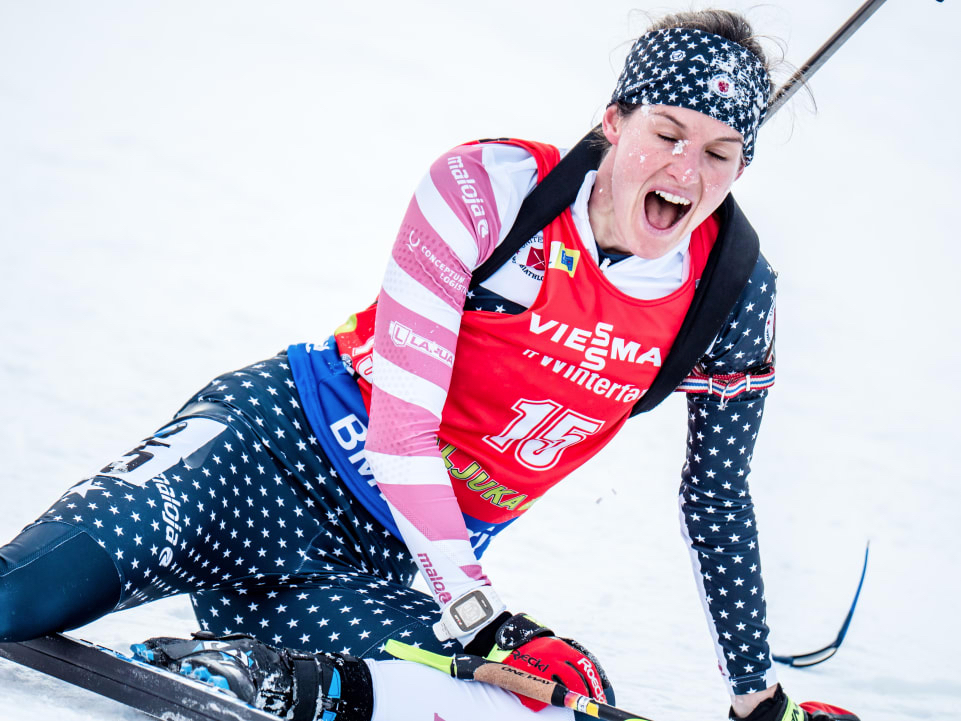
The last time Egan participated in the flower ceremony was in the same event in 2020 at the Pokljuka World Cup where she placed 6th. Being back in top form showed her she was on the right track after a disappointing 76th place last week in the Ruhpolding World Cup 7.5km Sprint race. Egan was inspired by Paul Schommer’s 9th place finish yesterday, and hopes her 4th can inspire the rest of her team to know they are on the right path ahead of the Olympics.
“Biathlon is a very difficult sport and the great thing about Clare is that she is resilient and perseveres,” said Women’s Head Coach Armin Auchentaller. “Hard work always pays off, the biggest thing is to believe in what you are doing.”
Egan certainly allowed the plan to play out in her favor, and her fourth place finish qualifies her for the Women’s 12.5km Mass Start on Sunday. But first, she’ll join forces with the rest of the US Biathlon Olympic squad for the Women’s Relay on Saturday.
“I am really looking forward to our relay tomorrow and my first mass start of the season on Sunday,” she said. “I just need to focus on recovering well now because it’s a lot of kilometers in three days!”
Rounding out Team USA’s finishes today were Deedra Irwin in 55th, Joanne Reid in 73rd, and Susan Dunklee in 88th.
Catch the action live on Peacock with Chad Salmela and USBA President & CEO Max Cobb commentating live from Antholz. Download the IBU App to keep track of all your favorite athletes!
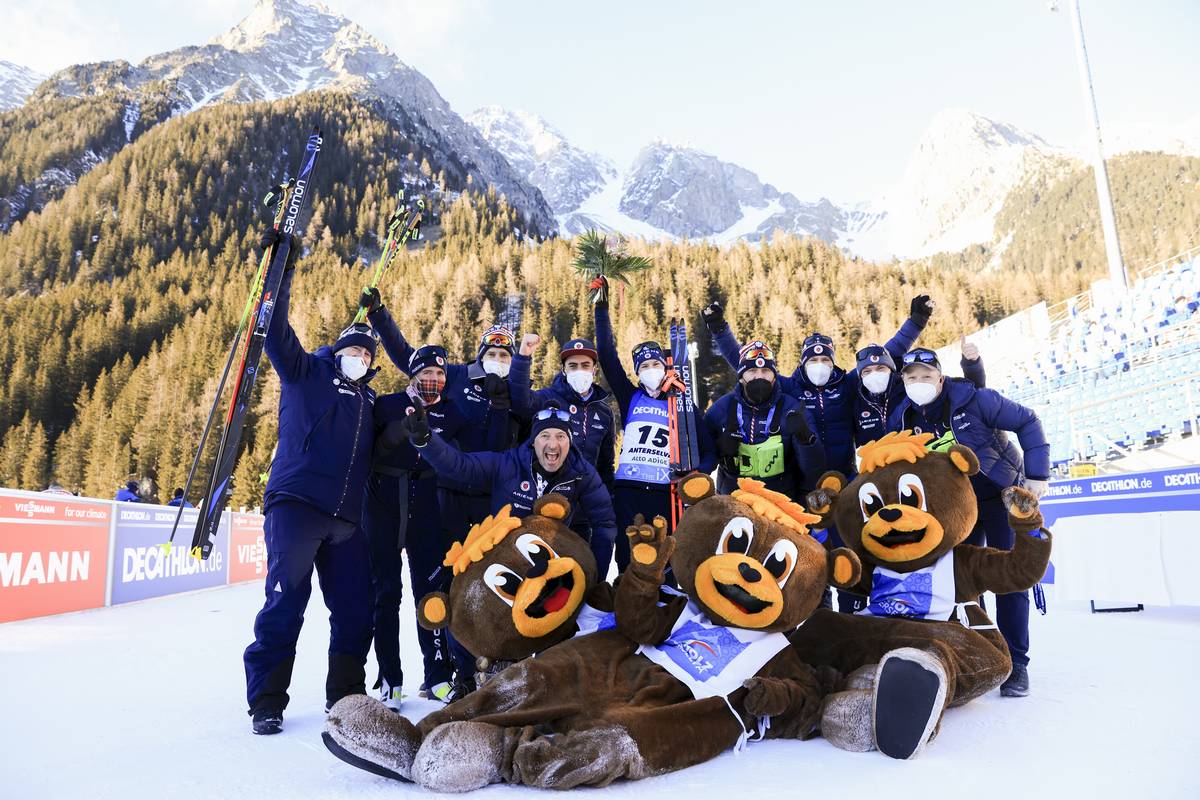
The US Biathlon team and staff (with a few mascots) celebrate a successful string of races in Antholz, Italy. (Photo: NordicFocus)
BMW IBU World Cup – Antholz, Italy (all times Eastern)
Saturday, Jan. 22
6:50 am – Men’s 15km mass start
9:00 am – Women’s 4x6km relay
Sunday, Jan. 23
6:15 am – Men’s 4×7.5km relay
9:15 am – Women’s 12.5km mass start
This press release, written by Bill Kellick, was originally posted at TeamUSA.org.
Oct. 27, 2021, 8:47 a.m. (ET)
(NEW GLOUCESTER, MAINE) – US Biathlon has announced the roster for the Pre-World Cup On-Snow Camp in Obertilliah, Austria, as well as the roster for the first two IBU Cup competitions of the 2021-22 season.
The Pre-World Cup Camp will begin November 11 with athletes joining National Team Coaches Armin Auchentaller and Vegard Bitnes for on-snow training ahead of the first BMW IBU World Cup races in Oestersund, Sweden, beginning November 27.
The women’s roster is led by 2022 Olympic Team qualifiers Susan Dunklee (Craftsbury, Vt./Craftsbury Green Racing Project & USBA), Clare Egan (Cape Elizabeth, Maine/USBA), 2018 Olympian Joanne Reid (Grand Junction, Colo.), Deedra Irwin (Pulaski, Wis./National Guard Biathlon Team & USBA) and Kelsey Dickinson (Winthrop, Wash./Craftsbury Green Racing Project).
Susan Dunklee racing to 8th in Nové Město’s sprint. (Photo: NordicFocus)
The men’s roster includes two-time Olympians Leif Nordgren (Hinesburg, Vt./National Guard Biathlon & USBA) and Sean Doherty (Center Conway, N.H./National Guard Biathlon & USBA). They will be joined by Paul Schommer (Appleton, Wis./Team Crosscut & USBA), Jake Brown (Saint Paul, Minn./Craftsbury Green Racing Project & USBA) and Vasek Cervenka (Grand Rapids, Minn./National Guard Biathlon & USBA). Brown is pre-qualified for the World Cup team.
The final roster for the first two BMW IBU World Cups of the season will be announced at the end of the camp.
Named to the Team USA roster to compete at the IBU Cup events in Idre, Sweden (Nov. 25-28) and Sjusjoen, Norway (Dec. 1-4) are Chloe Levins (Rutland, Vt./USBA), Hallie Grossman (South Burlington, Vt./Craftsbury Green Racing Project) and Lina Farra (Heber City, Utah/National Guard Biathlon Team) on the women’s team, and Max Durtschi (Ketchum, Idaho/Team Crosscut & USBA), Vincent Bonacci (Salt Lake City, Utah/Team Crosscut & USBA) and Luke Brown (Saint Paul, Minn./Team Craftsbury Green Racing Project).
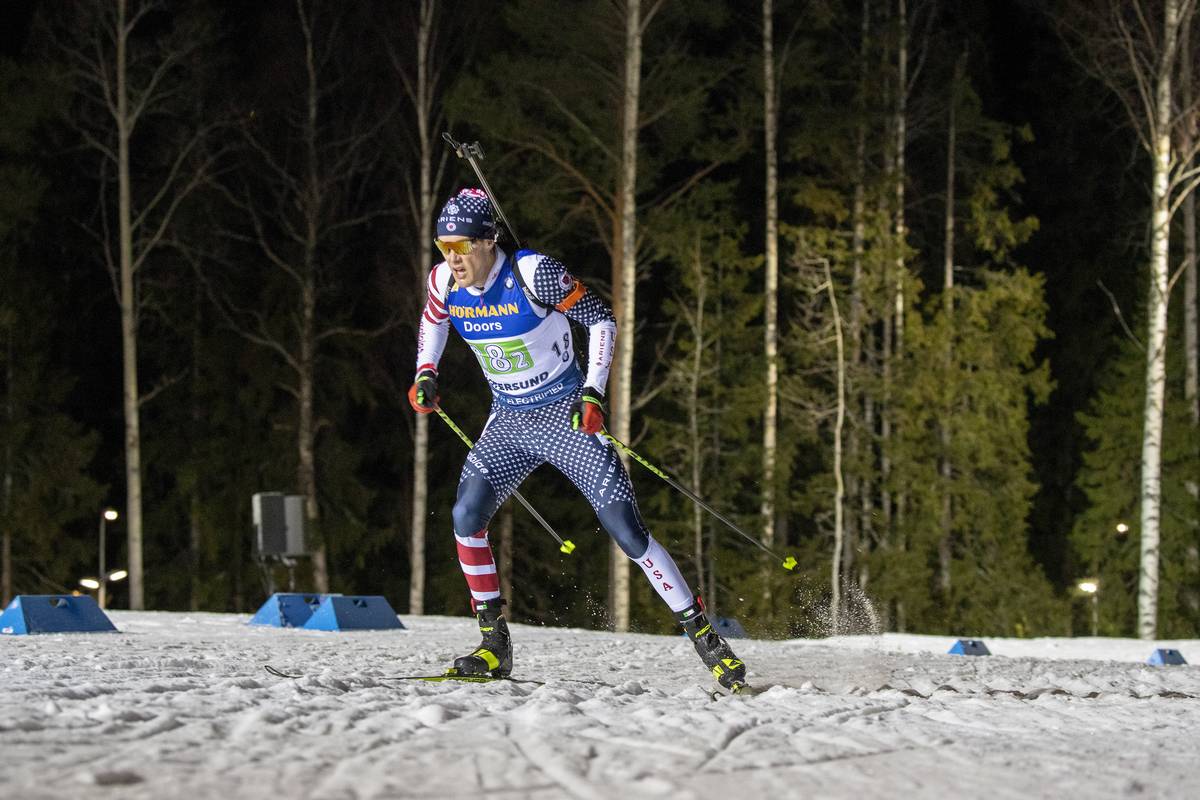
Leif Nordgren during the IBU World Cup 4 x 7.5 k relay in Ӧstersund, Sweden in December, 2019. (Photo: NordicFocus)
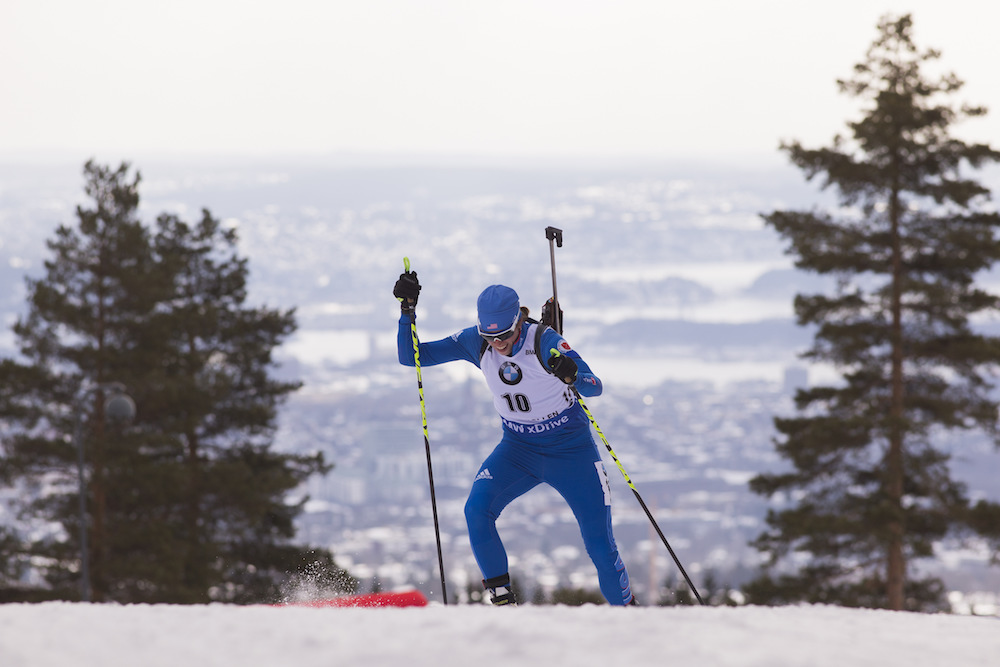
Clare Egan during training in Antholz, Italy. (Photo: NordicFocus)
Press Release from US Biathlon: By Bill Kellick
After back-to-back IBU World Cup events in Oberhof, Germany, the U.S. Biathlon team and the rest of the world’s best biathletes are headed for Antholz, Italy, for the final World Cup races before the IBU Biathlon World Championships. This week’s BMW IBU World Cup event, running Jan. 21-24, will consist of individual races, mass starts and relays.
Antholz played host to last year’s world championships and the U.S. team enjoyed a banner competition with Susan Dunklee winning a silver medal in the women’s sprint, adding to her silver medal in the mass start three years earlier. Other Team USA highlights from last year’s world championships in Antholz were an eighth-place finish in the men’s relay, and a career-best eighth place on 20-for-20 shooting by Leif Nordgren in the men’s 20km individual.
“Oberhof took a lot out of the athletes these past two weeks,” said U.S. Biathlon Women’s National Team Coach Armin Auchentaller. “These first days in Antholz we have been taking it pretty easy to recover from the past two weeks. We hope for some good races here in Antholz which historically fits us pretty well.”
If anyone should know Antholz, it’s Auchentaller, who resides in the northern Italian town. And through him, the U.S. Biathlon team has come to know the trails of Antholz well through off-season training sessions there.
“It feels like my home course more than anywhere else and I’m looking forward to using that experience to my advantage,” says Clare Egan who trained in Antholz the entire month of September as well as 10 days over the recent holiday break.
“The team has spent a lot of time there over the years because of the fact that Armin lives there,” added U.S. Biathlon Director of High Performance Lowell Bailey. “We’re looking forward to this virtual home-course advantage. Antholz is a great place, a great course, and it is sure to produce some exciting racing.”
Coming off two weeks of racing on the difficult tracks of Oberhof, which had been altered to host the world championships in two years, U.S. team members are looking forward not only to racing in the familiar confines of Antholz this weekend, but also to the sunshine that usually accompanies competition in the Antholz valley.
“Oberhof suits my climbing prowess but Antholz suits my altitude soul,” noted Joanne Reid. “I had a really great time racing in Oberhof, and I’m also looking forward to racing here.”
“I’m looking forward to sunshine,” said Jake Brown. “Through Armin I think we all feel some sort of special connection to this valley.”
Added Paul Schommer: “I really like the course here with longer gradual climbs and some rolling transitions. That, coupled with some cold hard tracks, and I think it provides a great opportunity for great race results.”
This week marks roughly two months on the road for most of the U.S. Biathlon team. A long stretch by any means but made significantly longer due to all the necessary COVID precautions and safety measures put in place by the IBU around the World Cup competitions.
“Bubble life has been going really well,” said Deedra Irwin. “The IBU has done an amazing job containing active cases. Our team guidelines have been very effective against COVID. Also, no one on the team has gotten any major ‘normal’ sicknesses either.”
Most of the team’s feelings around the restrictive protocols can best be summed up by Brown, who says, “I like racing, so the more I race the more sane I feel.”
The Antholz World Cup offers the final tune-up before the IBU World Championships begin in Pokljuka, Slovenia, on Feb. 10, and coaches and athletes alike are keen on fine-tuning their efforts this weekend in Italy.
“My advice going forward, as always, is to be proud of and continue doing the things that are good, target and improve the things that can be better,” said Shooting Coach Matt Emmons. “Champions pick themselves up and commit to improving.”
“I think the men’s team has been building some momentum in the relay and I would love to see us have a great performance here,” added Schommer.
Following this week’s racing in Antholz, the team will enjoy some well-deserved rest days before beginning the world championships pre-camp in Antholz. The team will head directly to the world championships in Pokljuka on Feb. 7.
The BMW IBU World Cup events in Antholz run Jan. 21-24, with the following schedule (all times Eastern):
Thursday, Jan. 21 8:15 am – Women’s 15km individual
Friday, Jan. 22 7:15 am – Men’s 20km individual
Saturday, Jan. 23 7:10 am – Women’s 12.5km mass start
9:05 am – Men’s 4×7.5km relay
Sunday, Jan. 24 6:45 am – Women’s 4x6km relay
9:05 am – Men’s 15km mass start
All events will be streamed live on Peacock with some events on the Olympic Channel and NBCSN. Find full schedule HERE.
Let’s catch up with the IBU World Cup and the action from Saturday and Sunday in Pokljuka, Slovenia.
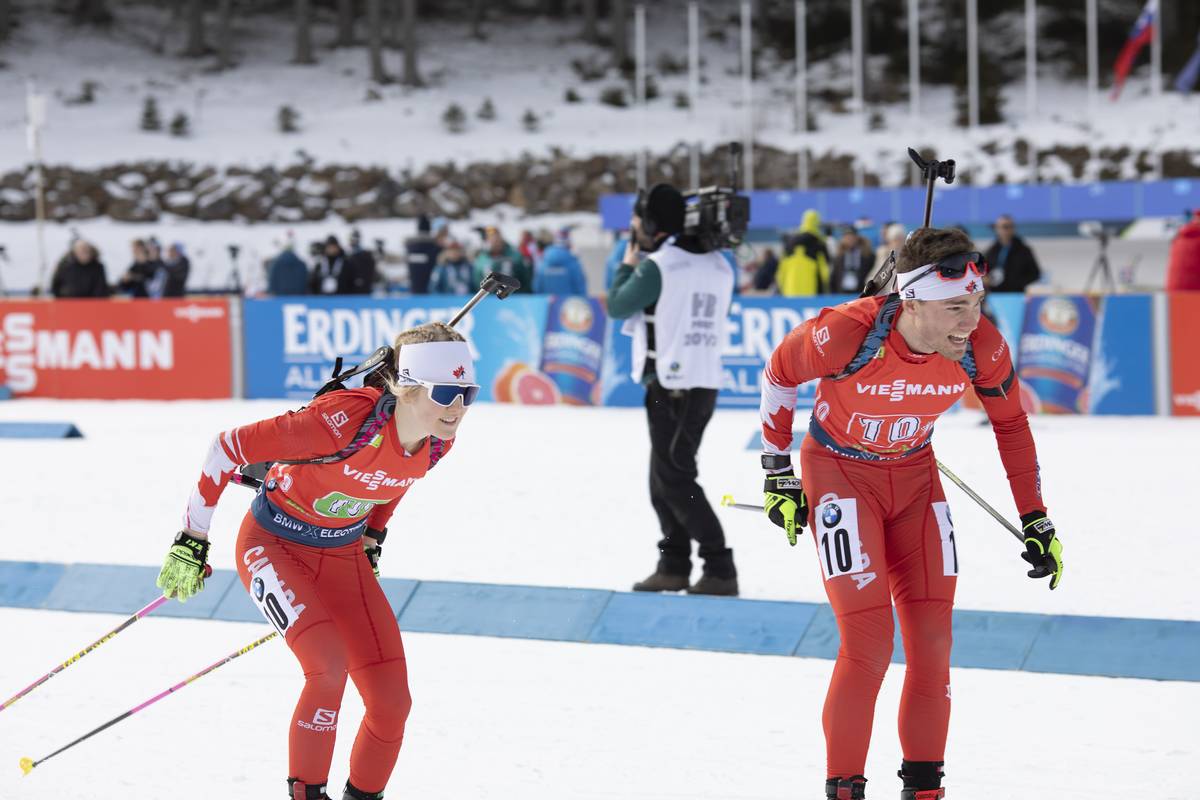
Emma Lunder and Christian Gow, (l-r) during the IBU World Cup biathlon, single mixed relay, in Pokljuka (SLO). The team placed fourth overall. (Photo: NordicFocus)
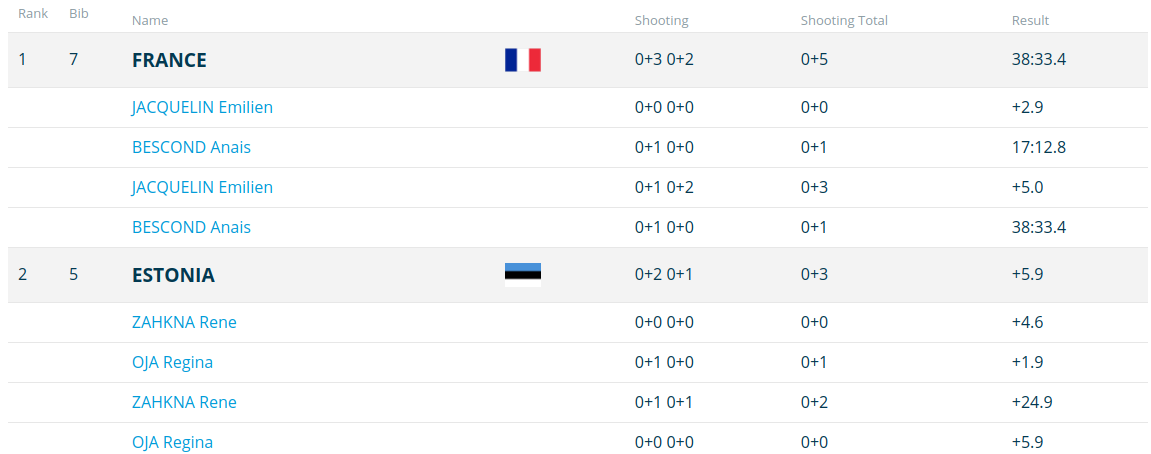
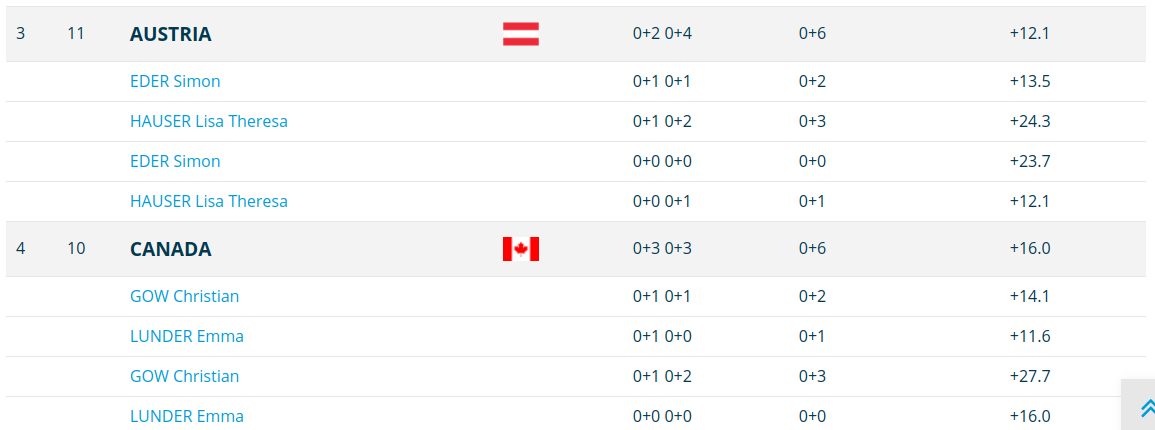
First up, the single mixed relay, in which teams of two are paired with each skier racing two legs and shooting two stages per leg. France took the win in 38:33.4 minutes shooting 0+5. The big news from the relay for North America, was Canada’s fourth place result. Christian Gow and Emma Lunder were 16 seconds back from first place France after shooting 0+6.
Jake Brown and Joanne Reid for the U.S. placed 23rd (+4:15.1; 0+14).
And it is worth mentioning, 26 different nations comprised the 26 team field. Which brings to mind a cool post on Twitter from the International Biathlon Union, and it speaks to the exciting nature of the sport. The Estonian team included Rene Zahkna, who placed 101st in last Thursday’s 20 k individual race. Two days later it was podium time.
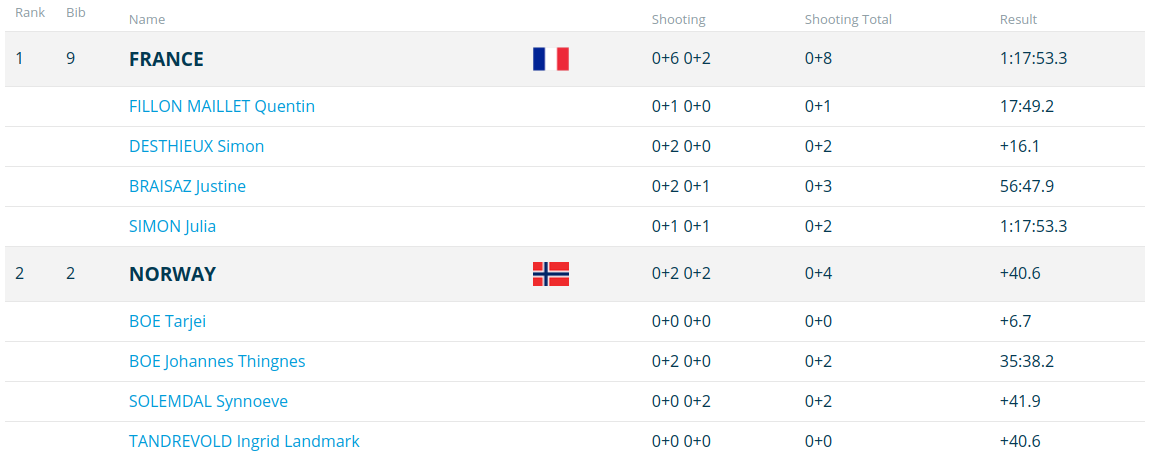
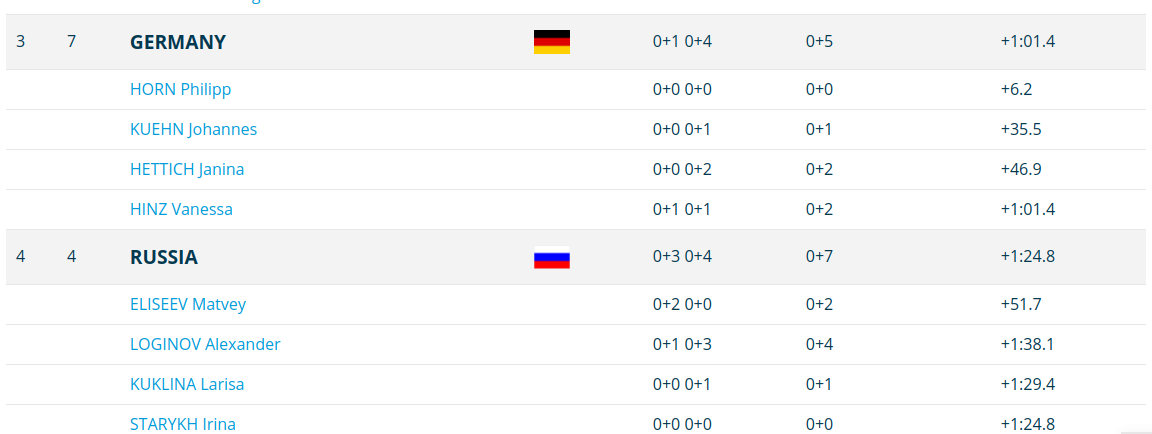
Next up, the 4 x 7.5 k mixed relay, which France won in 1:17:53.3 making it a clean sweep for the nation on relay day.
The U.S. team of Leif Nordgren, Sean Doherty, Susan Dunklee, and Clare Egan placed 12th (+4:10.6; 2+12). Canada’s Jules Burnotte, Scott Gow, Emily Dickson, and Megan Bankes raced to 18th (+6:47.5; 4+10).
The relay had 25 teams from 25 different nations represented.
France’s Quentin Fillon Maillet won Sunday’s 15 k mass start in Pokljuka, Slovenia. (Photo: NordicFocus)
And… on Sunday in Pokljuka, the racing began with the men’s 15 k mass start. No Johannes Thingnes Bø or Martin Fourcade on the podium’s top step: France’s Quentin Fillon Maillet placed first in 36:21.5 shooting 0+0+1+0. Germany’s Benedikt Doll placed second (+10.0 0+1+0+0), and yes, Johannes Thingnes Bø was on the podium in third (+10.3; 1+0+0+1).
Fourcade retains the IBU World Cup’s leader’s bib with 601 points. Fillon Maillet is second with 532 points, and Bø is third with 482. Bø sat out much of January’s racing for the birth of his first child.
No North American men qualified for the mass start race.
Egan raced to 26th (+3:31.8; 0+1+1+1) and Lunder to 29th (+4:12.5; 2+1+1+0).
Norway’s Tiril Eckhoff still leads the World Cup overall with 524 points, Dorothea Wierer of Italy is in second with 509 points, and Öberg sits in third with 456 points.
Racing on the IBU World Cup takes a hiatus for a bit. The 2020 IBU World Championships begin in Antholz, Italy on February 12th.
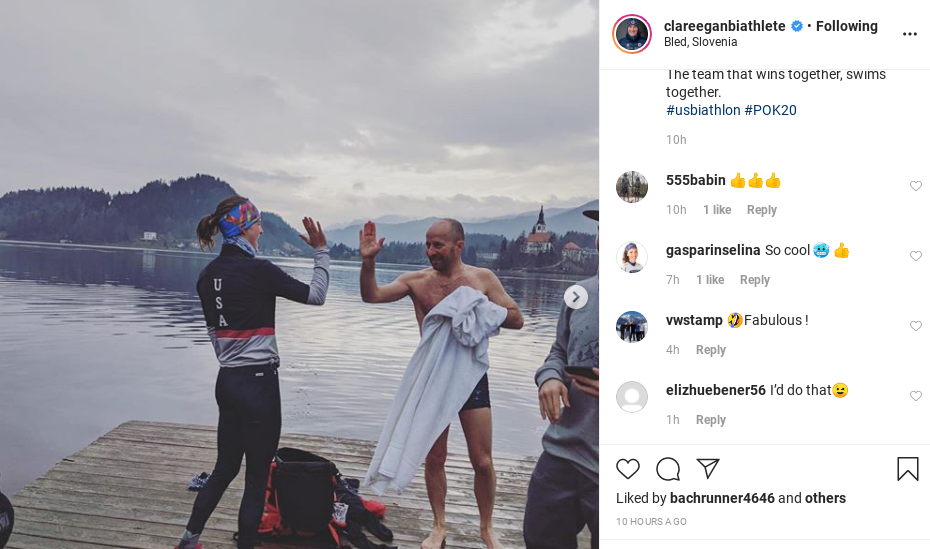
So we will leave on a light note as we piggyback on Egan’s Instagram account. She noted that U.S. Biathlon’s women’s coach Armin Auchentaller made a bet that he would “jump in the lake if anyone gets a top-10!”.
He took the plunge after Egan’s 6th place. Auchentaller may be onto something, The New Yorker recently called cold plunges a subversive joy.
The cold plunge. (photo: from @clareeganbiathlete on Instagram)
With the 2018/2019 season officially in the rearview, FasterSkier is running a series of articles highlighting some of the players and performances from the season. This honor goes to the North American coach who most deserves recognition for their impact on the trajectory of their athletes.
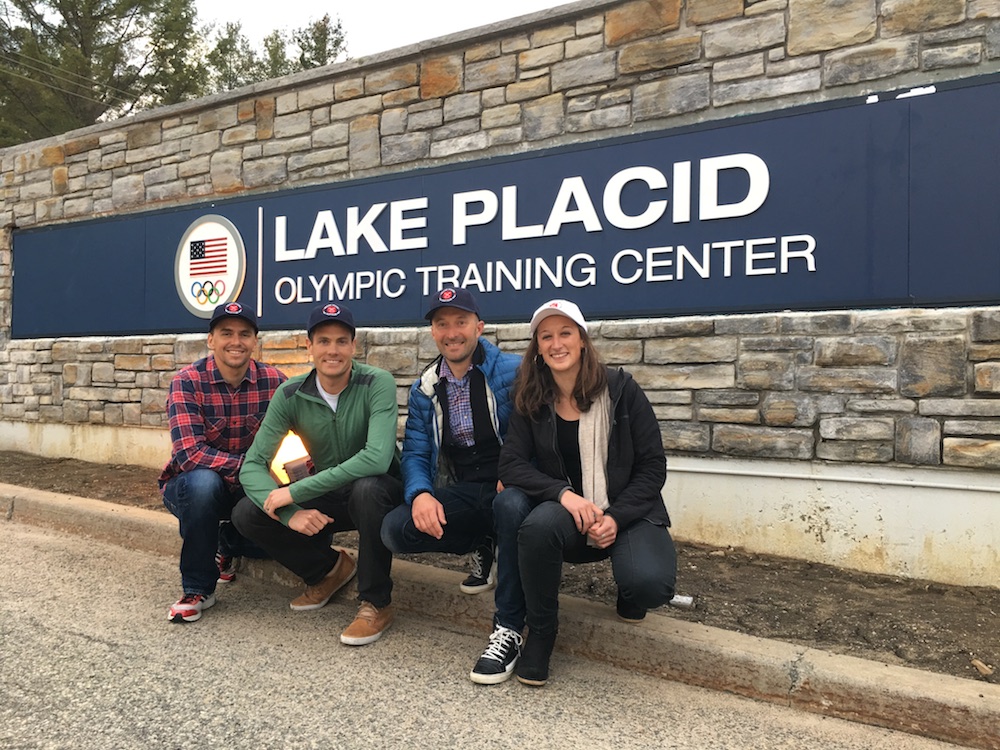
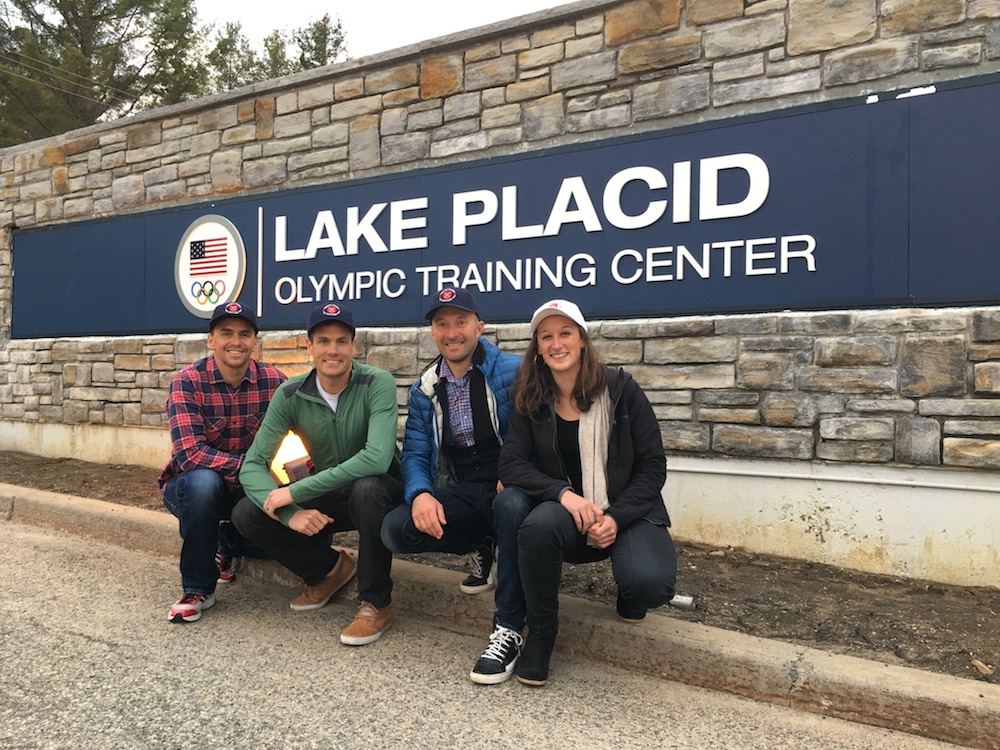
The newest additions to US Biathlon’s coaching and sport-development staff (from left to right): Michael Greis, Tim Burke, Armin Auchentaller, and Danika Frisbie as seen on May 1 outside the Olympic Training Center in Lake Placid, N.Y. (Photo: US Biathlon)
In April of 2018, Armin Auchentaller was hired to lead the U.S. Women’s Biathlon team. The position was not totally new for Auchentaller as he had worked with the U.S. team from ‘09 through the 2014 Olympics in Sochi as a shooting coach. In the interim, Auchentaller worked with the Swiss Biathlon Team. Prior to becoming a coach, Auchentaller competed in biathlon in his home country of Italy.
Auchentaller described his style as being hands-on and direct.
“I just cannot stay there in a corner and look at some things where I see ‘this can be better’, I just jump in and tell them,” Auchentaller stated in an interview during a training camp in Lake Placid last August. “And if they are alone [without a coach] here, then it’s obvious that I help them. I am a coach.”
The effect Auchentaller’s approach had on the team was rapidly apparent as the season held career best finishes and a multitude of top-10 finishes for his athletes. Perhaps the most noteworthy improvements were seen in Clare Egan, who placed in the top-10 three times including her third place podium finish at the IBU World Cup Finals in Oslo, and Joanne Reid who had a single top-10.
While his methods have certainly impacted these newer athletes, his impact was also felt by more veteran athletes, like Susan Dunklee who has been competing on the IBU World Cup since 2011. At 34th in the overall standings, Dunklee was the second-highest ranked American behind Egan who was 18th. Dunklee scored two World Cup top-10s, both in Oberhof, Germany. She ended her season with a clean sweep of the USBA National Championships.
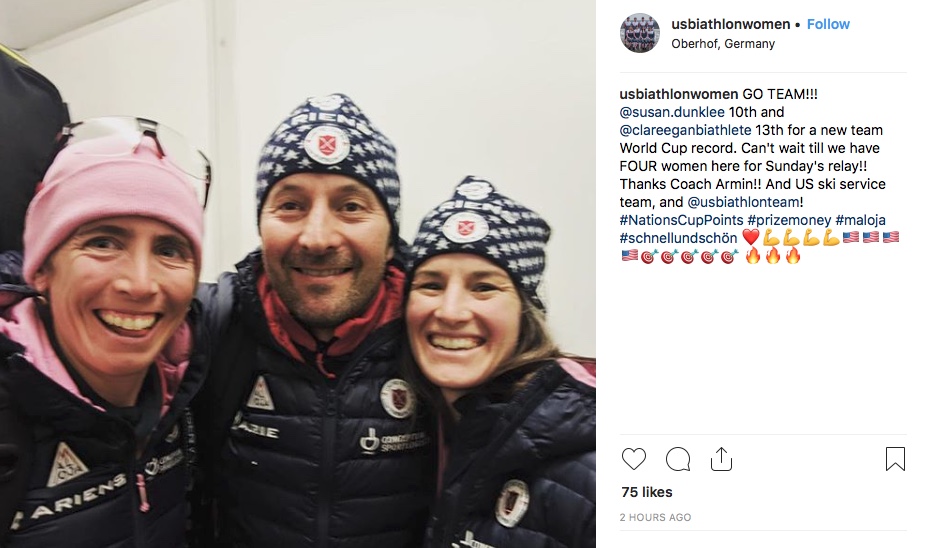
Stoked Biathletes after a record setting day. From left to right, Susan Dunklee, women’s coach Armin Auchentaller, and Clare Egan. (Photo: @usbiathlonwomen screenshot)
“I feel incredibly grateful to work with him,” wrote Dunklee in an email. “Working with Armin far surpassed my expectations. He’s a people person who connects well with all different personality types. He’s inclusive and he’s a collaborator. This summer we overlapped with the USST ladies for a camp in Lake Placid. Armin and Matt Whitcomb were soon going to the bar and waterskiing together and suddenly the biathlon women found ourselves training alongside Sophie, Jessie and company during interval sessions. Of course, this makes so much sense, yet in the past, it rarely happened. Armin understood the value of it and he made it happen.”
Auchentaller crafted a training regime that was designed to garner steady improvements in his team. He also sought to create opportunities for the athletes to work and grow together as a team in training.
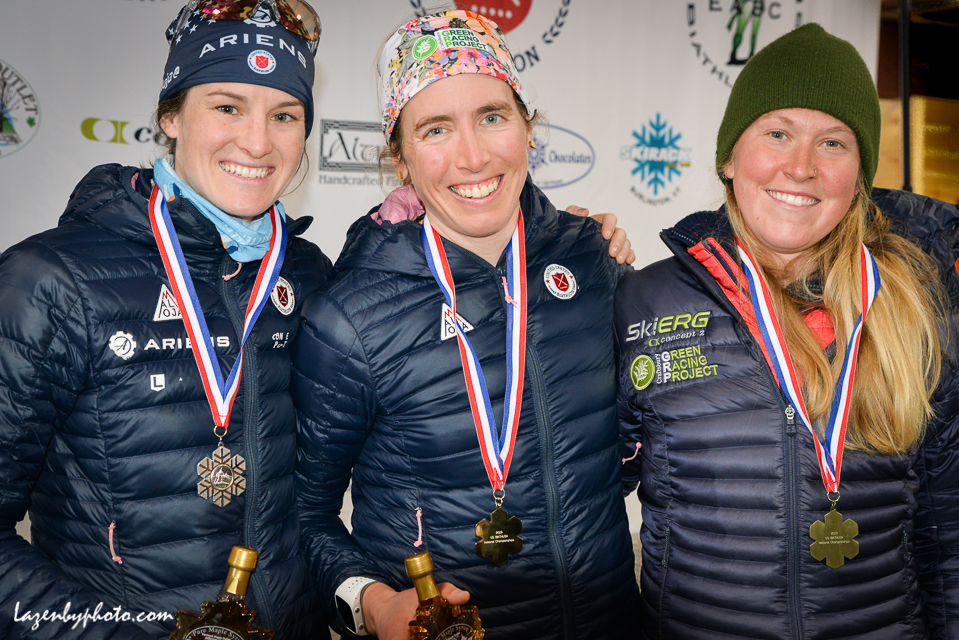
The podium from Friday’s USBA National Championship 7.5 k sprint (l-r): Clare Egan in second, Susan Dunklee in first, and Kelsey Dickinson in third. (Photo: John Lazenby/lazenbyphoto.com)
“They are all different characters, but they have built in this short time a good group atmosphere, they seem to be a good team now and they go along really well, they help each other, and that is a good start point to get better also in the team itself,” Auchentaller said during the Lake Placid camp.
While the workload was challenging for the athletes, Auchentaller was mindful of how the women tolerated the training both physically and emotionally to ensure an optimal outcome.
“Armin pushes us hard and has high expectations,” explained Dunklee. “I’ve never had a coach who made me dryfire for an hour after dinner every night during a high volume camp and that was tough. However, he is also smart enough to see when we are near our breaking point and flexible enough to make individual adaptations when needed. He’s a good listener, asks for our input and trusts our judgment, which is absolutely crucial for experienced athletes. He has a wealth of technical knowledge about shooting and ski technique, but he would also step back sometimes and ask us to observe and coach each other. I think those exercises made us into a stronger team. We learned to rely on each other, trust each other, and build each other up.”
After a successful 2018/2019 season, Auchentaller will certainly have the momentum to build from as he continues to guide and train his athletes in their preparation this summer. We look forward to seeing his effect on their continued progress and the upward trajectory of U.S. Biathlon in the years to come as the foundation for success is strong. Three different women this year placed in the top-15 on the IBU Cup, the tier of international racing just below the World Cup. Additionally, from a team perspective, the women’s 4 x 5 k relay at this year’s IBU World Championships remained in second place for much of the race. It also marked the first time three different U.S. women placed in the top-10 at the World Cup level during a single season.
US Biathlon’s Clare Egan in Antholz, Germany during the IBU World Cup in January. (Photo: @clareeganbiathlete Instagram screenshot)
Having the season you hope for and actually having that season is the rarefied magic of sport.
“I am having the season I hoped for but didn’t expect,” US Biathlon’s Clare Egan said in a telephone call on Jan. 30th. “I got the balance right for the first time since I started training full time. Since for eight years — three of which were devoted to cross-country and five of which were devoted to biathlon. I never got the balance right between my training and my rest and my focus.”
Reflective and cerebral, Egan took the time last Spring to gauge her future in the sport. It was this writer’s sense that after her final race at the PyeongChang Games Egan would pursue other opportunities — the grind, the up and down results taking their toll. Not having the season she hoped for, despite eternal optimism, had taken its course.
“The biggest thing that I didn’t predict was the liberation I felt having the Olympics behind me,” said Egan as she discussed her reasons for not retiring from elite level competition. “It allowed me to look on my sport with a fresh mindset that was no longer obsessed with meeting certain qualification criteria. But rather just about learning and improving and trying to be the best biathlete I can and doing it for fun, for myself. So I just thought I’ve worked so hard now I can have this sort of victory lap year that’s just for myself and with a real growth mindset.”
Egan’s commitment to another round of training and competitions were grounded in several notable changes at US Biathlon. Armin Auchentaller, a native of Italy, took over the coaching responsibilities for the U.S. women’s team. US Biathlon also changed their training paradigm to a camp focus rather than in-residence day to day training amongst the US Biathlon cohort. Based in Europe, Auchentaller and the women’s team gathered stateside for intermittent but intense windows of group training. Egan explained the model as two weeks in a camp, followed by a week of solo training and a week of rest and recovery.
“That worked so much better for me, so much better,” said Egan. “It enabled me to work way harder than I have before because it was a finite amount of time. It was like ‘ok you have twelve or fourteen days here and you are going to be doing triple sessions’, you know like two physical training sessions and an evening dry fire shooting session. I’ve really pushed the limits with my training but then I had two weeks when I was training on my own and if I had to, I often trained at 10:30 and 5:30. I slept in. I listened to my body. I practiced things I had been taught. I worked on stuff.”
Stoked Biathletes after a record-setting day. From left to right, Susan Dunklee, women’s coach Armin Auchentaller, and Clare Egan. (Photo: @usbiathlonwomen screenshot)
The nebulous “worked on stuff” was an atypical comment from Egan that she clarified. The “stuff” she worked on was remedying what she said was a lack of internalizing what she had been taught and learned. With the day-to-day team training model, Egan said she never could slow down to hard-wire new ideas and techniques.
“We were on every day all the time,” Egan described. “It was never like now you are learning and now you are going to practice what you learned. It was just always constant input.”
US Biathlon’s new system allowed Egan to decelerate and process what she was learning. And as is Egan, with her trait of drilling down into specifics, just as the conversation was drifting to a new topic she highlighted an ah-hah moment she had experienced. She relayed how in the past she had focused on meeting the minimum criteria – the game of doing just enough to make a championship team or bump up to the World Cup.
“I caught myself focusing on the minimum,” said Egan. “Like what is the bare minimum that I absolutely have to do to make this team. Anytime you talk about a qualification standard you are looking at the minimum. That’s the ground.”
If you are aiming high, and the hurdle is set low, an athlete runs the chance of doing just enough to clear the hurdle. Or, if things don’t align, just enough to trip the hurdle in an attempt to clear it.
“Then I overheard a meeting that one of my teammates had with a coach, and his team meeting was like ‘well my focus is this race I really want to win this race.’ I was like ‘oh my god’, my meeting didn’t sound at all like that. It was all about the minimum things that I want to do. Where his was, ‘here is my top goal and I am aiming for this and I am aiming high’. I didn’t really realize how damaging that was or that I was even doing it until I heard what an alternative might sound like.”
Clare Egan (US Biathlon) racing at the 2017 IBU World Cup in Kontiolahti, Finland. (Photo: USBA/NordicFocus)
For now, Egan is focused well beyond the bare minimum and has embraced what she is calling a growth mindset where she imagines herself far surpassing the goal of barely grazing the hurdle. This is where the idea of envisioning the top goal takes on more critical import.
Last April, the IBU’s headquarters were raided. As a result, then IBU President Anders Besseberg and Secretary General Nicole Resch eventually stepped down. For years the IBU had been battered by a reputation of cronyism and corruption. A sporting federation tasked with protecting athletes and promoting sport appeared more concerned with payoffs rather than the bottom line of fair competition and working on behalf of athletes.
In March of last year, prior to the raid of the IBU headquarters in Austria, Egan was elected Chair of the IBU Athlete’s Committee. Her term will last until 2022 regardless of her competition status.
“Dedicated to engagement and to the mobilization of the athlete community and the ensuring that athletes are at the core of what our organization is doing,” is how Egan summarized her task and mission as the Athlete Chair.
What was not lost on Egan was the real impetus for change at the IBU: external examination and a blunt police raid.
“I think there has been a lot of substance behind the good PR,” Egan said. “And I mean all of this is because the IBU got exposed. The IBU headquarters got raided by the police in April. Our, former president and former secretary general are under criminal investigation. We had to clean house. … We had to do that to save the organization. It didn’t come just because we were like ‘oh darn. We should change this for the better’. The organization was forced to change.”
Egan cited past proactive stances from IBU athletes like signing petitions and making public statements about doping reforms and relocating the planned 2021 IBU World Championships away from Tyumen, Russia as small yet successful measures. And most recently, the IBU Athlete’s Committee sent an early January letter to the WADA Executive Committee and the IOC’s Athlete Committee regarding RUSADA’s non-compliance status.
“I am really proud of what our committee did and it was not a public action per se but we made a pretty strong statement with all four signatures from the athlete committee colleagues on it and sent that to the WADA athlete’s committee and the IOC athlete’s committee prior to the WADA Executive Committee vote on January 22nd regarding RUSADA compliance,” said Egan. Our statement just mirrored the WADA athletes committee statement which was that non-compliance was the only acceptable outcome for athletes.”
The athlete’s voice at the IBU has been further empowered under Egan’s leadership. In September at the IBU Congress, an athlete seat at the IBU Executive Board table was formally set aside for Egan as she serves as the current Chair of the IBU Athlete’s Committee.
Along with that reform, the IBU has commissioned an external review into the details of the April police raid and connections to the IBU leadership. According to Egan, an athlete representative also serves on that oversight body.
“We are in a good way,” Egan said. “And it is just important that as we continue making these improvements and athletes continue to have that oversight and continue to be involved and don’t lose sight of how important it is. Because what got us to the disaster of this past April, I guess, was that athletes were in the backseat.”
No surprise, Egan is in the driver’s seat helping forge that new path for the IBU. And she is committed to her own path and having the season she hoped for.
Egan races next on the IBU World Cup this Thursday at the Soldier Hollow venue in Midway, Utah.
Stoked Biathletes after a record-setting day. From left to right, Susan Dunklee, women’s coach Armin Auchentaller, and Clare Egan. (Photo: @usbiathlonwomen Instargram screenshot)
The International Biathlon Union (IBU) came off a two-week break for the holidays today in Oberhof, Germany. The women raced the 7.5-kilometer sprint under mostly calm conditions on a course that had received fresh snow. The fir trees lining Oberhof’s ski tracks were loaded down from recent storms that have passed through the region.
The relatively calm and non-blizzard conditions were noted by US Biathlon’s Susan Dunklee in an email to FasterSkier.
“The sun peeked out in Oberhof this afternoon, truly a seldom occurrence,” Dunklee wrote. “The last couple days we trained in a blizzard but today the wind was relatively calm. The tracks were glazed but not too deep.”
In a clean shooting blitz, Italy’s Lisa Vitozzi earned her first career IBU World Cup win in a time of 22:34.6 minutes. With the shooting range flags sitting noticeably stagnant, clean shooting was also the pattern for the remaining two podium spots.
Anais Chevalier from France finished in second place, 5.3 seconds back, for her best result of the season. Hanna Öberg of Sweden was third after crossing the finish line 15 seconds back.
Beyond her clean shooting in her two shooting bouts, Vitozzi had the second fastest and third fastest course times for her first and second ski loops respectively. Vitozzi’s third lap was the 11th fastest.
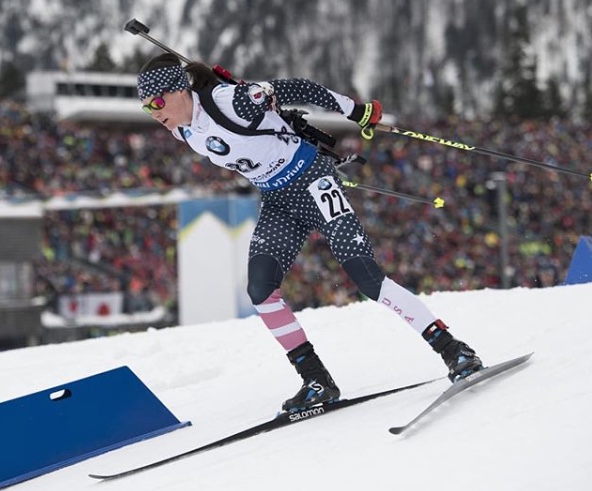
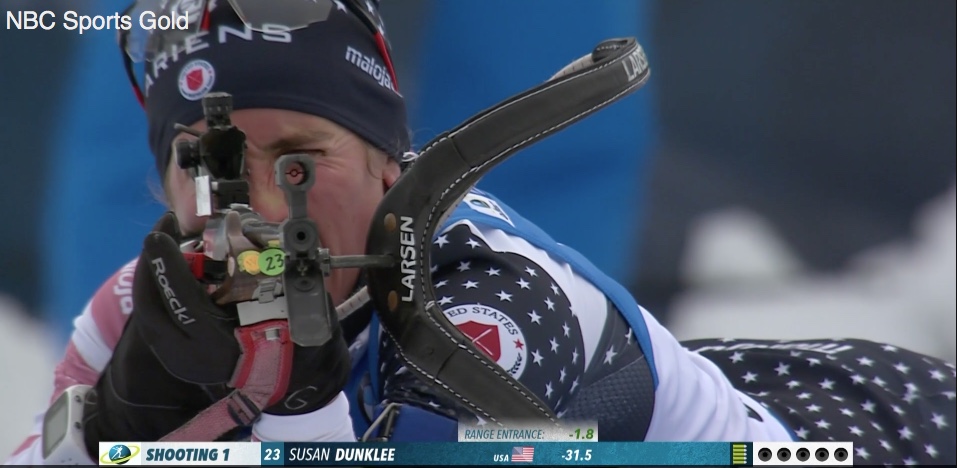
Susan Dunklee on the range during Thursday’s sprint in Oberhof, Germany. (Photo: NBC Gold screenshot)
The U.S. women’s biathlon team posted two top-15 performances on the day. Thirty-two-year-old Susan Dunklee placed a season-best 10th place while the thirty-one-year-old Egan placed 13th.
“I can’t remember a time when the US has put two women in the top 13 of a World Cup,” Dunklee wrote. “It has been a lot of fun to watch Clare come alive this season after years of hard work and it’s exciting to join her with a great result today.”
Prior to the holiday break, Dunklee’s best individual result was in Pokljuka, Slovenia’s individual race where she placed 11th after amassing a single penalty.
On Thursday, Dunklee was 40.8 seconds off the winning time while skiing one penalty loop after missing a single target in her prone stage. Dunklee’s performance displayed consistent ski speed and efficiency on the range. Her first ski lap was the 13th fastest, her second ski loop ranked 29th and her third ski course time improved to the 17th fastest.
Dunklee’s range times (defined by the time at the shooting range) were ranked ninth and 20th for her first and second shooting bouts in Thursday’s sprint.
“I spent the holiday break in Austria with the Canadian team and got in a high quality training block. It sure is nice to not have to fight jetlag right now,” Dunklee added. My shooting speed benefited a lot from working alongside the Canadians. My ski speed sometimes takes weeks to sharpen during the season and I think it is finally getting there.”
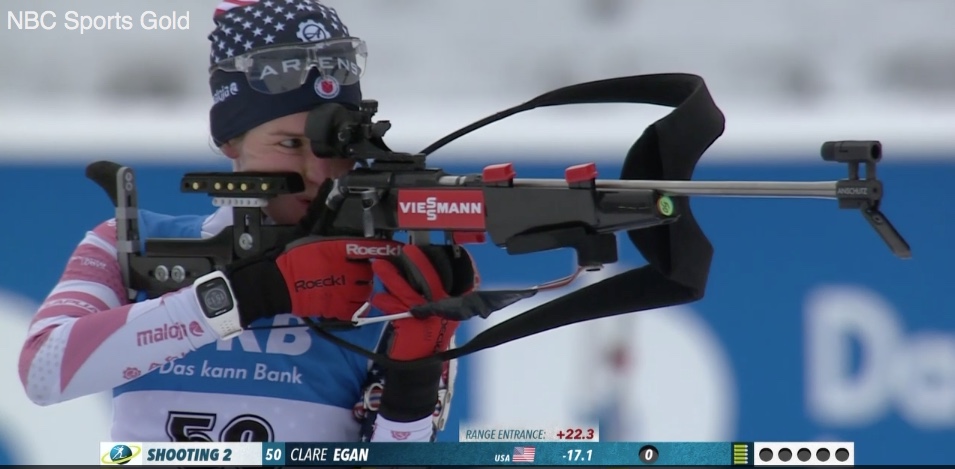
Clare Egan during her second shooting stage in Oberhof’s sprint on Thursday. (Photo: NBC Gold screenshot)
Today was one of my best results and yet it felt normal- and that’s a great feeling,” wrote Egan.
Her return to competition on Thursday was seamless despite the break. Her skiing and shooting showed no rust.
“My race today was definitely a ‘blowing-out-the-cobwebs’ experience,” Egan emailed. “But I still managed a top-20 ski time, only +:35. It’s very motivating to know that even on a day when I don’t feel great skiing, I am competing with the best.”
On Thursday, Egan’s 13th place was a result of her finishing 49.0 seconds back in a field of 100 starters.
“Today was a great day for both Susan and me- the first time that US Biathlon has had two women in the top-15 (AS FAR AS WE KNOW!),” Egan continued. “We are both competing at a high level right now, so it will be exciting to work together in Saturday’s pursuit to move up. The top 20 starters (today’s top 20 finishers) are all within 1 minute, so in a 10k race with 4 shooting stages, anything is possible.”
For Canada, Emma Lunder placed 46th (+1:49.2, 1+1), Rosanna Crawford 56th (+2:06.3, 1+1), Megan Bankes 87th (+3:07.9, 1+1), and Sarah Beaudry 89th (+3:21.2, 2+1).
Lunder and Crawford both qualified for the pursuit.
The women race again in Oberhof on Saturday in a 10 k pursuit.
The newest additions to US Biathlon’s coaching and sport-development staff (from left to right): Michael Greis, Tim Burke, Armin Auchentaller, and Danika Frisbie as seen on May 1 outside the Olympic Training Center in Lake Placid, N.Y. (Photo: US Biathlon)
This season, the US Biathlon Association (USBA) hired on two new coaches; 47-year-old Armin Auchentaller from Italy and Germany’s 42-year-old Michael Greis. Auchentaller’s primary duties are with the women’s team whereas Greis will focus on the men.
The U.S. team comes off the retirements of two of its steady-stars; Lowell Bailey and Tim Burke. (Burke was hired in May as USBA’s athlete development manager.) The hiring of the two coaches is part of a plan to reinvigorate veterans like Susan Dunklee and continue to develop athletes like twenty-three-year-old Sean Doherty – a four-time World Junior Champion.
Sean Doherty (US Biathlon) racing to 14th in the 10 k sprint for a season-best individual result at the 2018 IBU World Cup in Oslo, Norway. (Photo: USBA/NordicFocus)
FasterSkier connected with Auchentaller last summer in Lake Placid. As he guides the women’s team, he will remain European based, travelling back to the U.S. for specific training camps. Married and the father of two teenage girls, Auchentaller foresees the arrangement as beneficial, with the on-season travel minimized due to the mostly European based IBU World Cup schedule.
Auchentaller is no stranger to the USBA, he was brought on as the shooting coach in 2009 and remained with the team through the 2014 Olympics. From 2014 to the PyeongChang Olympics, Auchentaller worked with the Swiss elite biathlon team.
“You know, it’s a small family, the biathlon family is a small family, so the training itself doesn’t change that much,” Auchentaller said about the differences he has seen working with different national programs. “There are some little things which might be a little different depending also on the training background they had in the past years. So training, training philosophy, training science is pretty much universal in the whole world. It’s just a matter of how you apply different things to the group you have right now to work with. The bigger change is the mentality, so that’s nice. Languages, and, you know, Switzerland is for sure different than Italy, and Italy is different than US culture, but that makes it really nice for me at least to see those differences and everybody has a good culture, there is no bad culture.”
The women’s team Auchentaller inherits is a stable of committed biathletes. Susan Dunklee has been the team’s top performer for years, Clare Egan has emerged into a top-ten skier this early season, Joanne Reid and Emily Dreissigacker are proven World Cup talents.
“It was interesting when I started before the first camp, it was a little of, um, how do you say that I wasn’t sure what to expect how motivated they could be or are,” Auchentaller reflected. “But it turned out that they are really motivated. … So, if they continue like they work now, they will have some personal bests. I would say, we don’t talk about podiums and these things, but its to reach at least your personal best for the first thing. So they are all different characters, but they have built in this short time a good group atmosphere.”
Susan Dunklee (US Biathlon) racing to fourth in the women’s 7.5 k sprint at the 2018 IBU World Cup in Oslo, Norway. It was her best individual result of the season by two places. (Photo: USBA/NordicFocus)
“The experience level in the team is for sure huge, it’s a lot of difference, so it’s also a balance to find the right balance between all of those capacities, all those characters, that makes it nice also,” Auchentaller said. “If they respect each other, if they have a lot of respect, they will help each other and grow as a group. It’s an individual sport, but if you grow as a group in the single trainings, you will be better also for your own results.”
Auchentaller also admitted he sees himself as a generalist when it comes to assisting any biathletes during training – that includes biathletes on the men’s team.
“I just cannot stay there in a corner and look at some things where I see ‘this can be better’, I just jump in and tell them,” Auchentaller stated. “And if they are alone here, [without a coach] then it’s obvious that I help them. I am a coach. It’s the profession I have, so you just ask if you can help them, and it’s pretty normal for me.”
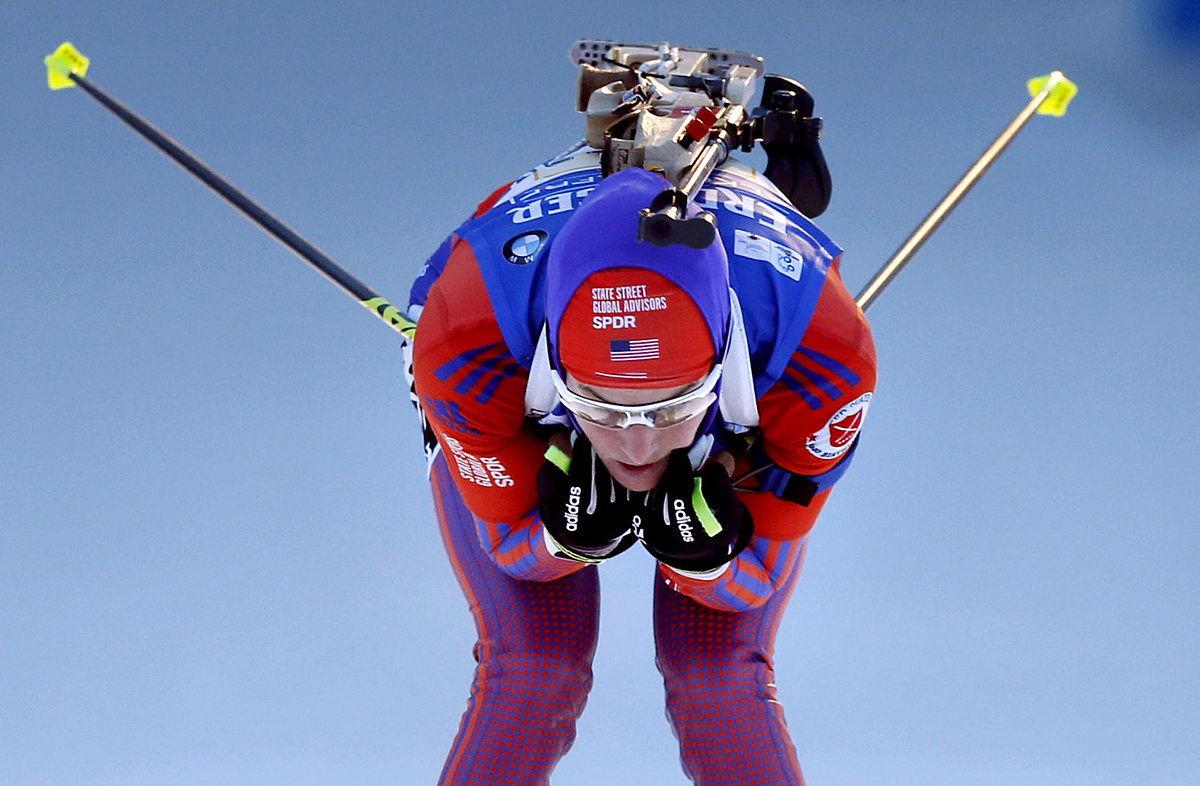
Clare Egan (US Biathlon) tucking and gliding during a 2015 IBU World Cup. She finished the 2015/2016 season ranked 66th overall. (Photo: USBiathlon/NordicFocus)
Greis comes to the US Biathlon team as a storied three-time Olympic champion for Germany. Having retired from competition six years ago, Greis most recently coached Swiss junior biathletes based in and around Lenzerheide, Switzerland. His work with the U.S. men’s team will evolve as he learns the capacities of each athlete.
“I ’ll try to understand how my athletes have trained in the past and then develop their individual capacity,” Greis emailed this November about how he spent his first dryland season with the men’s team. “The foundation is the key: Matt Emmons [our shooting coach] and I worked on a great execution in shooting in order to improve the hit-percentage. Also in endurance training, we logged a lot of rollerski training to increase efficiency and improve the routine in combo sessions.”
Greis guided the men’s A and B teams during the off-season, but his primary responsibility will be those on the World Cup this winter.
“During the winter I am mainly responsible for World Cup with a good communication with the IBU-Cup team in order to change athletes if they compete well,” Greis said.
Greis comes from a system and a nation where in winter, biathlon is king. The proximity to biathlon specific training venues is relatively easy compared to North America. Yet, Gries noted some key differences between a European and American based model. In places like Germany, a biathlete can join the army or police force and still be able to focus nearly all their time on biathlon. In the U.S., athlete funding can be tenuous, the training venues and athletes dispersed across widespread regions.
Those factors complicate communication and inhibit easy scheduling for group training.
Acknowledging those limitations, Greis has immersed himself in a U.S. system that now focuses on camps to help team bonding and create efficiencies when athletes live as far away as Colorado from the hub of U.S. biathlon training in Lake Placid.
“US Biathlon tries to support the athletes in the best way,” Greis wrote. “We try to organize a lot of camps in order to train together and learn from each other. And it’s also important that Lake Placid, Craftsbury, Soldier Hollow continues to invest in the infrastructure to develop a great training venue. I think it would also be a good idea if cross-country and biathlon would work more to bring more kids into nordic sports.”
Leif Nordgren (US Biathlon) skiing the second leg of the 2017 IBU World Cup men’s 4 x 7.5 k relay in Hochfilzen, Austria. The U.S. men ended up ninth overall out of 26 teams. (Photo: IBU/NordicFocus)
Last season, the men’s team placed 13th in the IBU World Cup Nation’s. With Bailey and Burke gone, Gries said in the short-term, matching that 13th this season is a modest objective.
“Our goal is to take the same place in the Nation Cup as last year and each athlete should improve his individual performance in the overall season,” Gries said. “None of my team took a top-ten career result so far – this is also an individual goal for each.”
The IBU World Cup continues in Hochfilzen, Austria on December 13.
Clare Egan after placing sixth in the IBU World Cup’s 10 k pursuit in Pokljuka, Slovenia. (Photo: Biathlonworld.com)
Over the weekend in Pokljuka, Slovenia U.S. Biathlon’s Clare Egan marked a breakthrough. During the IBU World Cup’s 10-kilometer pursuit on Sunday, with a single shooting penalty, Egan placed sixth (+1:22.4, 0+0+1+0). She also raced the fastest time for the ski portion of the race.
Kaisa Mäkäräinen of Finland won the race in a time of 29:16.9 minutes.
Prior to her sixth place, Egan’s top result was a 13th place during last season’s IBU World Cup sprint in Kontiolahti, Finland.
If Egan, who has been in the sport since 2013, needed a boost to remain committed, this weekend was it. Before she placed sixth on Sunday, Egan was 15th in Saturday’s 7.5 k sprint. Again, in that race, she was able to match her blistering ski speed with near flawless shooting— Egan had one penalty in the sprint.
Fans of the sport might be surprised to find an American name other than Susan Dunklee’s so high in the standings. It appears Egan might be too.
“I am frankly amazed with my skiing,” Egan wrote in an email to FasterSkier. “I knew I was in great shape, but this week my ski times were 11, 6 and today 1st. I think small changes and improvements in my training are coming together to make this big difference. The most important factor in my performance is our new women’s coach, Armin Auchentaller. He is the right coach for me.”
As any biathlete can attest, the variables within the sport are many. Small changes here and there — minute tweaks that may account for a modest percent change in mental and physical performance. That can mean a jump from say a 16th place to a sixth place.
One stat jumps out already for Egan. She has vastly improved her accuracy on the shooting range. According to the IBU’s data, in 2015-2016 she shot 79 percent. The next two seasons trended downward with a 78 percent in 2016-2017, then 74 percent last year. In Pokljuka, although the sample size is small with just a short series of races to draw from, Egan shot with 84 percent accuracy.
“There are a lot of things- some are major structural changes like having a camp schedule rather than training daily in Lake Placid, others are more nuanced like having more fun doing my sport with Armin and a galvanized and unified team,” Egan wrote about some of the new concepts U.S. Biathlon embraced this past off season.
Egan’s results on the IBU World Cup have improved since she began in 2014-2015, her first year on the circuit. Since then, she has been ranked 96th, 67th, 56th , and most recently, 63rd last year. During each one of those four years, Egan showed promise.
She has had six top-30’s outside her 16th during the 2015/16 season, and the already mentioned 13th last season. Steady progress and intermittent nuggets of top-20 success were enough hope to sustain Egan through another cycle of training loads, recovery, and shooting sessions.
Sunday’s 6th place, flower ceremony, fastest ski-time of day in Pokljuka, Slovenia remains the medicine of the fickle sport of biathlon. Egan scored her dose.
“I was not expecting this,” Egan wrote. “But my first Biathlon coach, Algis Shalna, told me that it usually goes best with 0% expectation and 100% focus.”
The focus hasn’t shifted. Expectations may have changed.
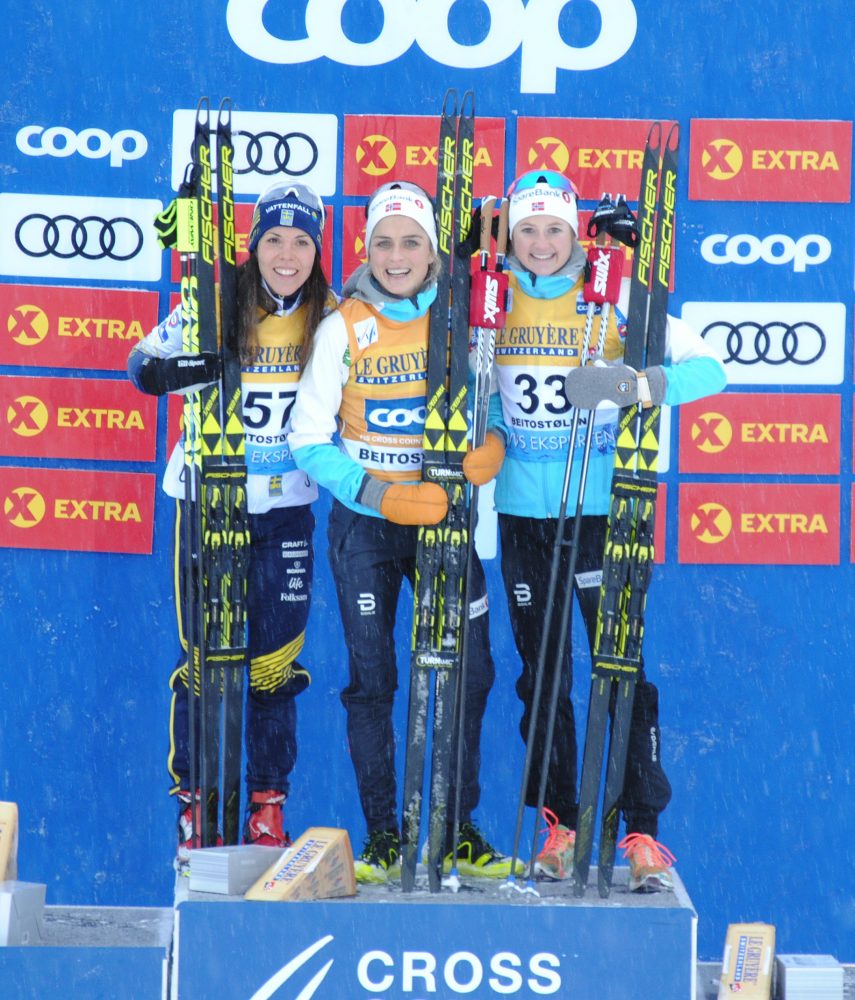
The Women’s podium from the World Cup 15 k freestyle in Beitostølen, Norway. Norwegian Theresa Johaug (center) was first, Sweden’s Charlotte Kalla (left) second, and Ingvild Flugstad Østberg (right) of Norway third.
FIS World Cup Beitostolen, Norway 15 k/30k Freestyle Individual Start
With snow falling and trees covered with fresh snow, Beitostølen, Norway’s wintery essence was on full display during the women’s 15-kilometer freestyle individual start on Saturday.
Keeping her distance win-streak alive was Norway’s Therese Johaug who won her fourth World Cup distance race of the season making it four for four in 2018/2019.
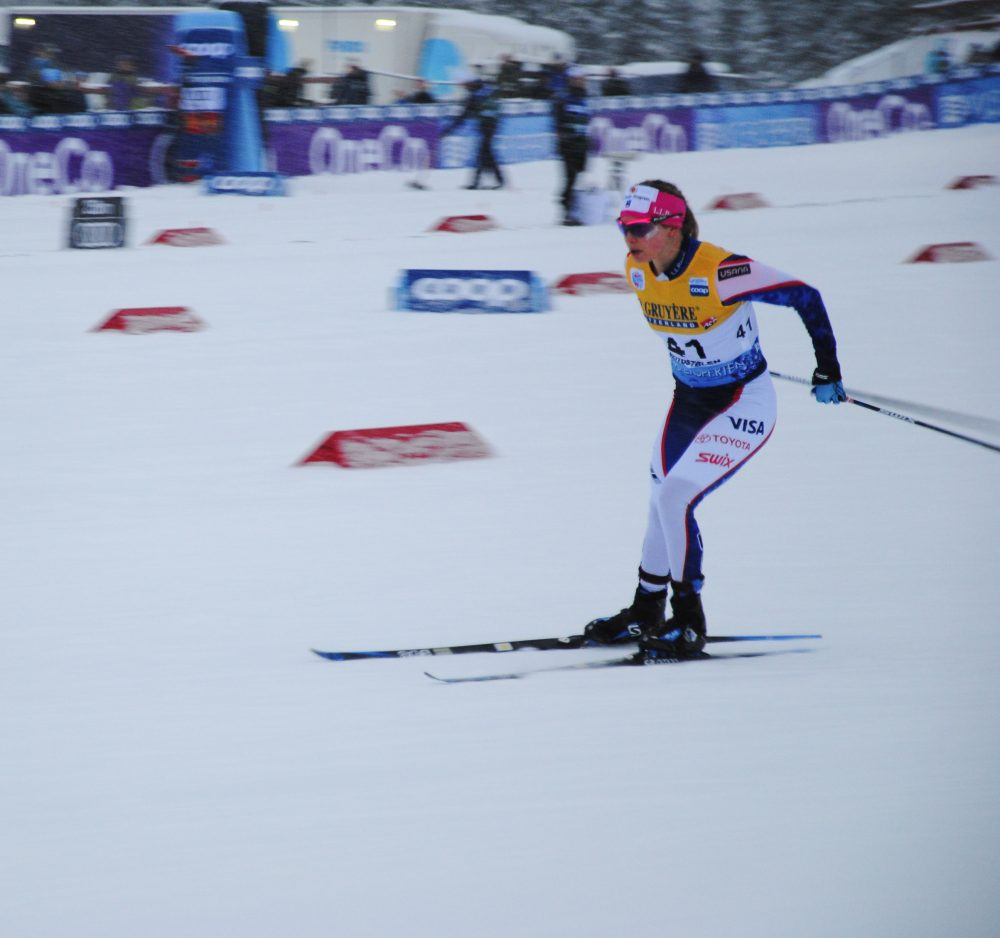
Jessie Diggins of the U.S. Ski Team on her way to eighth place during Saturday’s 15 k freestyle in Beitostølen, Norway.
Johaug won in a time of 38:39.8 minutes. The only blip of egalitarianism on the tracks was at the first time check at 1 k, where Johaug was tied for the best time with Russia’s Natalia Nepryaeva. Otherwise, Johaug gradually pulled away from the fifty-eight finishers by the time she crossed the finish line.
Sweden’s Charlotte Kalla placed second (+1:05.9), and Ingvild Flugstad Østberg of Norway was third (+1:06.1).
U.S. Ski Team (USST) athlete Jessie Diggins finished in eighth (+1:29.6) for her first top-10 result of the season. Sadie Bjornsen (USST) placed 13th (+2:22.9), Rosie Brennan 15th (+2:33.9), Caitlin Patterson (CGRP) 32nd (+3:46.0), and Kaitlynn Miller 50th (+5:02.8).
Canada entered a women’s team for the first time this season. Emily Nishikawa of the Canadian National Team (CNT) was the best placed Canadian in 34th (+4:01.6). Cendrine Brown (CNST) was 38th (+4:16.4).
Sitting atop the men’s overall World Cup this season after Saturday’s racing is Russia’s Alexander Bolshunov. The young skier is a killer in the sprints and distance events. But it is perhaps Norway’s Sjur Røthe who has impressed the most this season in the distance events. Røthe has a slight seven-point lead in the distance overall.
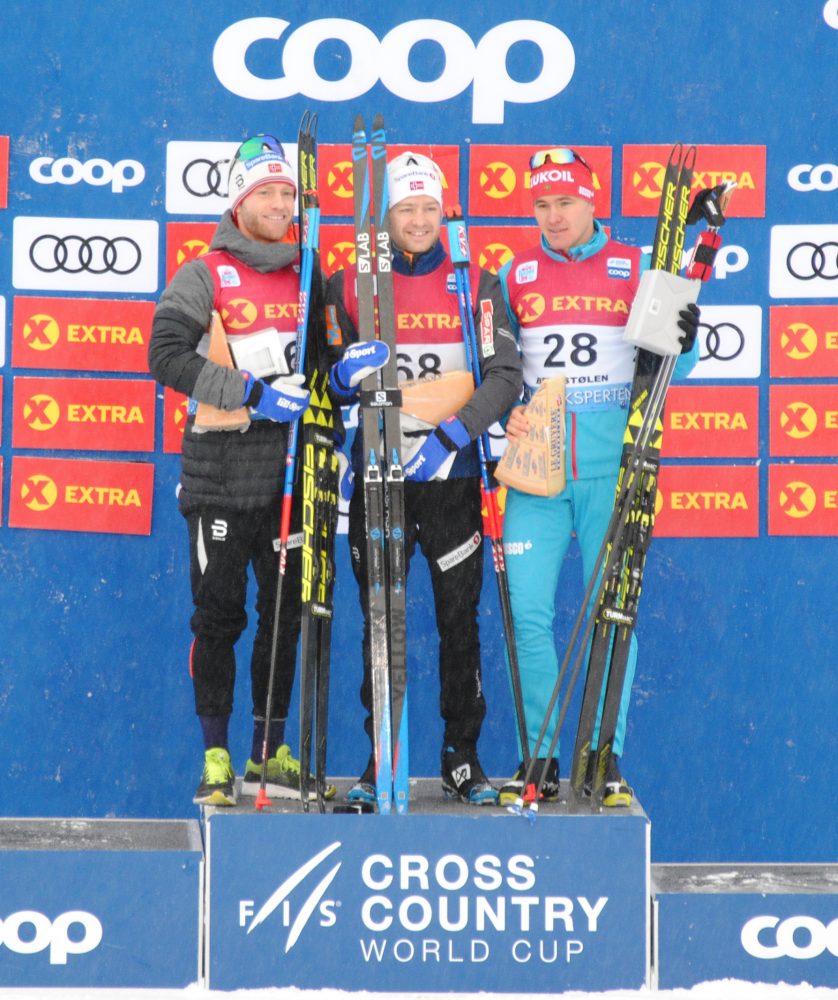
The men’s podium from the 30 k freestyle individual start in Beitostølen, Norway. Sjur Røthe (center) placed first, teammate Martin Johnsrud Sundby (left) second, and Russia’s Andrey Melnichenko (right) third.
Røthe won Saturday’s 30 k skate individual start in a time of 1:09:53.5. It was his second World Cup victory this year. Teammate Martin Johnsrud Sundby, with his first podium of the season, placed second (+35.2), Russia’s Andrey Melnichenko was third (+49.2). For the twenty-six-year-old Melnichenko, it was his first career World Cup podium.
Canada’s Alex Harvey was the best placed North American in 13th (+1:49.8). Also skiing for Canada, Andy Shields finished in 63rd (+7:05.6).
Scott Patterson (USST)was the best-positioned skier for the U.S., placing 47th (+4:32.7). David Norris (APU)skied to 51st (+5:13.3.) Erik Bjornsen (USST) was 52nd (+5:14.9), Adam Martin (CGRP) 59th (+6:14.8).
Egan Leads North Americans in 15th Place in Pokljuka Sprint.
Just before her race on Saturday, US Biathlon’s Clare Egan seemed to be in a relaxed mood and could be seen on the broadcast joking with other athletes and posing for pictures in the warm-up zone. Starting into the women’s 7.5-kilometer sprint in an early group in bib 26, Egan began the race fast and still managed to shoot clean in her prone stage.
She kept near the top at the split times during this early phase of the race.
“I am skiing way faster than I have in past years,” Egan commented on her improved course time in an email to FasterSkier, which in past seasons occasionally had prevented her from achieving positions in the points or qualifying for pursuit and mass start races. “I think my previous best ski time was in the 20’s, but my average was probably in the 50’s. So to have 11th ski time in the Individual [on Thursday] and the 6th today is a very significant improvement for me. It means that I can now aim for the flower ceremony, and even the top of the podium.”
In the standing shooting stage she then missed her very last shot of the race, having to ski once through the 150-meter penalty lap. After another fast final loop she came to the finish in fourth place. But after several athletes who began the race later finished ahead, she was pushed down in the standings, ultimately ending her day in 15th position (+1:08.8, 0+1). According to Egan she only narrowly missed a career-best result, having finished in 13th place in the sprint in Kontiolahti, Finland, during the last season.
“Today I would have been 4th or 5th if I had hit my last shot,” Egan wrote. “Overall my shooting is there, and now my skiing is too, so I just need some more races to get comfortable in this position. I really fought for my last two shots today and I got the 9th one and I’m very happy about that. Also my prone was perfect and I don’t take that for granted. I am focusing on the positive things and learning what I can to do better next time… which is tomorrow!”
Behind Egan, her teammate Susan Dunklee also had drawn a spot in the first start group starting early in bib 2, and remained clean in the prone stage as well. But in her second shooting she incurred two penalty laps, and ultimately ended her race day finishing in 45th place (+1:50.4, 0+2). The third U.S. starter, Joanne Reid, finished 57th with two penalties (+2:06.8, 1+1).
“Our whole women’s team did excellent training and it is paying off: last year at World Cup 1, zero American women qualified for the pursuit, whereas all three of us did today,” Egan commented.
She also credited their revamped coaching staff around which centers around Armin Auchentaller. Auchentaller spent the last few seasons coaching the Swiss women’s team.
“And it’s worth noting that with Susan’s 11th place in the Individual, we’ve now had two women go in the top-15 already in the first two races of the year (which is likely a first for US Biathlon). We are proud of ourselves and motivated to keep climbing. As usual, our ski service team is on fire. Tomorrow we’ll go for it again in the pursuit!”
For Biathlon Canada it was a difficult day on the shooting range overall, with Megan Tandy posting the best result in 73rd place (+2:46.6, 0+2). Her teammates Rosanna Crawford finished 77th with four penalties (+2:52.1, 2+2), Nadia Moser was 88th (+3:42.1, 2+2) and Megan Bankes was 99th (+4:39.6, 1+4). All missed qualifying for the pursuit on Sunday.
About a minute ahead of Egan, the race was won by Finland’s Kaisa Mäkäräinen in a time of 20:08.1 minutes, with no penalties.
“I enjoyed today,” last season’s Overall World Cup winner Mäkäräinen commented in thepress conference. “I really tried to be confident. … Of course it gives you a lot more energy when you shoot clean. I know if I shoot clean that I can fight for the top positions. … But I still had to work hard and had a good last loop.”
In the finish she was 14.8 seconds ahead of Italy’s Dorothea Wierer, who also had no miss and recorded the fastest shooting time on the range on Saturday, but couldn’t match her Finnish rival on the course. Hitting all targets as well, Justine Braisaz of France finished third (+42.1, just two days after ending the individual race only in 82nd place with seven penalties. That’s the ups and downs of biathlon. Also shooting clean and just off the podium was Braisaz’s teammate Julia Simon in fourth place (+44.6), for her first top-ten result in a World Cup. Wierer’s teammate Lisa Vittozzi was fifth with one penalty (+46.9, 0+1).
Julia Kern (SMS) leads Dahria Beatty (CNST) into the final straight in the A final. (Photo: Peggy Hung)
Sovereign Lake Noram/SuperTour, Vernon, BC
North American racing resumed with free technique sprints at Sovereign Lake. The first weekend of the NorAm series was also the second weekend in the SuperTour.
SMS’s first year senior Julia Kern continued her strong start to the season, winning the qualifier and the A final and looking dominant throughout. National team member Dahria Beatty kicked off her season with a crash in the qualifier, but got up to finish 7th. Dartmouth and AWCA’s Laura Jortberg was in third, followed by national team member Maya MacIsaac-Jones. APU’s Hannah Halvorsen was fifth and Stratton Mountain School’s (SMS) Erika Flowers trailed in last after breaking a pole on the final downhill corner.
Andy Newell leads Antoine Briand into the finish straight in the A final. (Photo: Peggy Hung)
On the men’s side, Andy Newell (SMS) continued the American domination, winning the qualifier in 2:15.180, 4.050 seconds ahead of APU’s Logan Hanneman, before winning all of his heats comfortably. Antoine Briand represented for Canada and the Centre National d’Entrainment Pierre Harvey (CNEPH), placing second to Newell in every heat. Ben Saxton (SMS) completed the podium, edging out APU’s Logan Hanneman in a four way battle for third. Antoine Cyr (CNST) and Ben Lustgarten (Craftsbury Green Racing) trailed in two ski lengths behind.
“It was a cascade of issues,” jury member Dave Dyer told FasterSkier.
The short, short version is that the timing system has a number of redundant systems to detect errors. While the timing team was working on an unrelated issue, two athletes tied exactly. There are two sets of results zone4: the provisional (timed to 1/1000ths of a second) and the official (timed to 1/100th of a second). The bib list was generated from one list and the zone4 live timing database was populated from the other, with the two skiers who were tied shown in different order. From this point on, all the backup systems indicated errors and everything had to be hand checked. The results were right, the right athletes advanced, but live timing was switched off and delays ensued.
Full details and video interviews will be in Monday’s event wrap-up.
The newest additions to US Biathlon’s coaching and sport-development staff (from left to right): Michael Greis, Tim Burke, Armin Auchentaller, and Danika Frisbie as seen on May 1 outside the Olympic Training Center in Lake Placid, N.Y. (Photo: US Biathlon)
(Press release)
LAKE PLACID, N.Y. (May 1, 2018) — U.S. Biathlon is pleased to announce the addition of two new national team coaches. Armin Auchentaller returns to the U.S. team after coaching the Swiss women’s biathlon team for several years. The Italian comes from the Antholz valley famous for hosting a World Cup every year and being a major biathlon center. German Olympic champion Michael Greis also worked for the Swiss biathlon team and joins the U.S. Team as the men’s head coach. The two head coaches arrived Monday at the Lake Placid Olympic Training Center with U.S. Biathlon Chief of Sport Bernd Eisenbichler for a tour of the facilities and to meet with athletes and staff.
Former German biathlete and three-time Olympic gold medalist Michael Greis racing at 2007 IBU World Championships in Antholz-Anterselva, Italy. (Photo: Wikipedia)
Also starting their work in May are two new members of the sport development staff: four-time Olympian Tim Burke as athlete development manager and Danika Frisbie as sport program manager.
As the athlete development manager, Burke, who officially starts work on May 21, is responsible for leading efforts to increase the quality of training and performance for developing athletes and clubs across the U.S., including youth and junior elite athletes, post-collegiate athletes, and existing and aspiring coaches and program leaders. Burke is the main interface between USBA and regional coordinators and clubs, facilitating stronger collaboration in creating more competitive opportunities for developing athletes. He will work closely with Frisbie to focus USBA initiatives and resources on strategic development goals.
Just a month after retiring from a two-decade-long career that saw him wear the yellow bib and win a world championship silver medal, Burke is motivated by the opportunity before him.
“I’m very excited to have the opportunity to pass on the knowledge that I gained during my biathlon career,” he said. “As an athlete, you are often quite focused on your own training and racing schedule. Now I have the perfect chance to ‘pay it forward.’ I am motivated to get more athletes involved with biathlon and to give those athletes everything necessary to reach their full potential.”
As sport program manager, Frisbie is responsible for promoting the sport of biathlon by supporting development of programs and events to increase athlete/coach participation and engagement in the sport. She will also be responsible for sport education resources, organization of domestic racing events and festivals, and establishing regular communications to members, athletes, and coaches. Frisbie will also serve as a coaching assistant supporting national and development team training, and will work on a daily basis with National Team staff, including Burke, to plan and execute strategic development goals.
“I think interest in biathlon and nordic skiing in America is at an all-time high,” said Frisbie, who competed in biathlon as a junior and has held various coaching positions since, including being the U.S. Biathlon coach intern since June 2017. “It’s a real privilege to be asked to join the team at this time and begin working towards increasing opportunities for participation and competition in this sport over the next four years.”
“I’m very excited for the new teams starting their jobs today,” said Eisenbichler. “With Armin Auchentallar we have a coach coming back who’s worked five years with us from 2009-2014. He’s done a really good job with the Swiss women’s team and we think he is the absolute right person for our women’s team to develop them further. Michael Greis was a super successful athlete and will greatly help our young men’s team develop in the coming years. Combined with the additions of Tim Burke and Danika Frisbie who will focus their efforts on the development side, there are exciting times to come for U.S. Biathlon.”
Hannah Dreissigacker (center) in the thick of it, leaving standing in eighth place behind Megan Heinicke of Canada.
HOCHFILZEN, Austria – Lanny Barnes has done a lot of relays before. But the 31-year-old had never quite found herself in the position she had today: going into the anchor leg of the 4 x 6 k World Cup relay, the United States was in seventh place, less than a minute and a half behind the leading team from Ukraine and only 40 seconds from the podium.
“The other three girls they did an awesome job of putting me right up in there,” she said. Barnes proceeded to hit all of her targets and the U.S. finished eighth, by far the best result of any of the racers’ careers. The previous best was tenth place in Antholz, Italy, last season.
Coming in with bib 17, a 16th-place ranking in the Nations Cup, and tough results the day before when none of the women made the top 60 in the sprint, the United States definitely wasn’t expected to make the top eight. It seemed like it would be especially tough with Annelies Cook, the team’s number two athlete, sitting out. Luckily the Americans are traveling with five women, so both Barnes and Hannah Dreissigacker, who had been expecting to fight each other for a chance in the relay, got to start.
To have the depth to finish eighth without one of the relay team’s traditional members? That’s certainly something new.
“It says a lot about the women’s program,” Barnes said. “We’re on our way up and even though we had a really disappointing day yesterday, it was good to come back and have a decent result today.”
For various reasons, the team really needed a strong result to get their mojo back. The most obvious was the sprint yesterday, which was mainly hampered by poor shooting: except for Barnes, the other three starters (Susan Dunklee, Cook, and Dreissigacker) all had four penalties.
Not so today, when the team used just three spare rounds between all of them over the course of eight shooting stages.
“It’s a really great statement what they are doing today,” shooting coach Armin Auchentaller said midway through the third leg. “They are awesome today – they have no penalties in prone and they’re in a good spot. They are fighting hard on the track out there and it’s really nice to see them perform in this way. It’s for sure for all of them a great confidence-booster and this will bring them forward.”
Susan Dunklee playing catch-up on her last lap. The Americans’ opening racer, she tagged off in 11th.
But there were other things, too. Dreissigacker, Barnes, and Sara Studebaker are competing for two starting positions in individual races (Cook and Dunklee have the first two of the Americans’ four-woman quota). Studebaker had to sit out the sprint, which was something of a blow. Dreissigacker has been on the bubble for basically her whole international career and is constantly trying to get results good enough to hang onto her starting spot. And Barnes is attempting a comeback after compartment syndrome surgery.
So for these women in particular, it was mission accomplished. The team member who has been on the circuit the longest, Barnes was helped out by a bit of history when she found herself setting out on course in seventh place. She showed why she was a staple of U.S. teams for so long as she was calm, collected, and perfect on the range – as well as the fastest shooter in both of her bouts – despite intense pressure.
“It was especially great to have the opportunity to do the relay here – I think I’ve cleaned every relay I have ever done here, so it gave me a little confidence in the shooting,” Barnes said. “Especially when it’s head to head and there’s a lot of pressure, because when I was coming into the range on the last loop, I could still hear the top girls just leaving. So I was really excited to have that pressure, to know that I have to hit them or else we’re dropping back, way back.”
Skiing the third leg, Dreissigacker bounced back hard from her disappointment the day before. She cleaned prone, used a single spare in standing, and skied the eighth-fastest time of all the third-leg racers.
“It’s such a relief that I can actually hit my prone targets,” she said. “This is what I have been wanting to do – to mix it up with other fast girls. And this was such a good opportunity to do that. It was just fun. That’s what biathlon is about, when it’s really a race and you’re moving back and forth. I hadn’t really gotten that chance yet [this season], so it was awesome.”
And Studebaker came out of the gate with a vengeance after missing out on Friday’s action. She didn’t need any spare rounds to clean her targets.
“Personally, it was a little bit of both,” she said when asked whether the extra rest day was a benefit or a detriment. “I was bummed not to race yesterday and I need races to get into feeling better, but at the same time it made me more hungry today to go out there and really get it… It was definitely the race that I was hoping to have after sitting out yesterday. Clean shooting, and I got to ski around some fast people.”
By the time Studebaker was finished and Dreissigacker took over, the team was in 13th. That sounds about like their usual relay results – unspectacular. But in fact, it was the perfect setup for a run towards the top.
“It was a really good place,” Dreissigacker said. “13th doesn’t sound that great but we were right with a lot of people. They really weren’t far ahead. It was the perfect opportunity to think that there’s not a lot of pressure, but they are right there and I can ski with them and shoot better than them.”
For someone like Dreissigacker, who has relatively little World Cup experience and has to treat each race like a trial to keep her spot, the relay was something of a comfort, rather than being an added stress.
“Honestly, I think I race a lot better when I’m not super, super nervous and really putting a lot of pressure on myself,” she said. “I definitely really want to do my best for the team, but having other people being a part of it too takes some pressure off and it really allowed me to just relax and say, okay, this is my focus. And then do that, just ski with that girl who is right there.”
Dreissigacker said that last night in their prep work the women “didn’t dwell on” their disappointing results in the sprint. Instead, they treated the relay like a new opportunity.
“First of all we always want to finish higher than our bib,” Studebaker said. “But it was the first relay and we’re trying some different stuff. Susan was scrambling [for the first time], and Annelies isn’t feeling great so she’s sitting out, so we were just hoping to get that relay feel and come together as a team and have a good result. We haven’t had the best team results usually, so we thought we’d try to turn it around here.”
Seems like it worked
“It was really awesome to start out the first relay like that,” Barnes concluded. “It was fun.”
Lowell Bailey on course in Hochfilzen. Despite frustrating conditions, he finished 16th.
HOCHFILZEN, Austria – The U.S. biathlon team was left frustrated after today’s 7.5 and 10 k World Cup sprints, although for very different reasons.
In the women’s race in the morning, early starters had a disadvantage as the fresh snow that fell overnight and into the morning hadn’t been skied in much. Wind was also an issue on the range and Susan Dunklee, Annelies Cook, and Hannah Dreissigacker all had four penalties. Lanny Barnes escaped with one, but in part because of her early start seed was left out of the pursuit like her teammates. All the women finished in the 60’s and 70’s.
“The wind was a little stronger than during zeroing, but it wasn’t strong enough that I wanted to take clicks,” Dunklee said of the conditions. “Maybe I regret that in retrospect. And I couldn’t even feel where the misses were.”
In the men’s race, the tables were turned. Snow was forecasted to stop, but instead it intensified partway through the race, much to the detriment of later starters. Leif Nordgren, who had the American spot in the first seed group, didn’t start because he has been sick. That left the team without a single man in the favored conditions.
“The guys who started early today definitely had a little bit of an advantage, especially on the first two loops,” shooting coach Armin Auchentaller lamented.
That doesn’t mean that there weren’t any good races. Despite everything, Lowell Bailey finished 16th and Tim Burke 24th.
“We can’t control the weather, it’s not possible, but we have to take the positive things out of this race,” Auchentaller said.
Bailey was perhaps more frustrated than anyone. He had clean shooting over the two stages, yet started smack in the middle of the field, just when the snow started coming down with a vengeance. Later it let up a bit so some athletes were able to have a better last lap. Not Bailey.
“I can’t believe the weather,” he said as his timing chip was removed at the finish. “I just can’t.”
But Auchentaller found plenty of positives to focus on for Bailey, namely that clean shooting.
“He had really great shooting, which is important,” he said. “That should for sure give him a lot of confidence. It’s a good sign – it’s always important to keep it together at the range [when things aren’t going well]…. When Lowell was out was when it was the worst.”
Burke had it a little better. Despite his two penalties in standing, he was able to stay in the top 30.
“It’s really unfortunate that it started snowing so hard just five minutes before I started,” he said. “It started glazing up a little bit more again at the end, but the first loop was really slow. I actually felt a lot better today than I did last week. I don’t know if the results will show that, but I’m pretty happy with it.”
For both men, another positive is that they are in good position for the pursuit on Sunday. Many other top racers also failed to make the top ten or even the top 20: Anton Shipulin, Dmitry Malyshko, and Evgeniy Ustyugov of Russia; Fredrik Lindstrom of Sweden; Simon Eder, Dominik Landertinger, and Daniel Mesotitsch of Austria; Jakov Fak of Slovenia; Andreas Birnbacher of Germany.
All, like the U.S. men, will be looking to move up, so there may be some fast-moving trains jetting towards the front.
“The pursuit will be interesting, for sure,” Burke said. “Everyone will be racing in fair conditions.”
Jeremy Teela finished 65th with two penalties and Sean Doherty 99th with five.
Jay Hakkinen, Leif Nordgren, and Lowell Bailey shooting at the Chiemgau Arena in Ruhpolding, Germany on Monday. The Americans are in their second week of a training camp before heading to Oberhof.
RUHPOLDING, Germany – At the Chiemgau Arena on Monday, the U.S. biathlon team was surrounded by something it doesn’t always experience in training: a cacophony of shots that didn’t belong to them.
With the German women’s team, the Ukrainian national team, and juniors from France and Germany on the range, as well as a group of German men doing a non-shooting sprint workout, training was quite a bit busier than your typical biathlon practice in America – and actually had more attendees than many domestic races.
Despite all that, it is actually a quieter experience than the same camp last year.
“Last year the Italians were here, and the Estonians as well, which is always neat, but there’s just nobody here this year,” said World Cup racer Sara Studebaker. “I do know that Andrea Henkel [of Germany] is going to join us for this coming week, but we’ve pretty much been on our own. It would have been nice if there were other teams here.”
And actually, said shooting coach Armin Auchentaller, that was the plan. It just didn’t work out.
Russell Currier attacking his speedwork in the stadium.
“Last year it was much more busy on the range and we had an international competition with the other teams, which this year was not possible,” he explained as the other coaches watched the last few Americans finish their rounds. “Initially we wanted to take these athletes to the German championships, but they got postponed when we had already planned this trip. So this year we did the time trial just between us.”
Still, both athlete and coach agreed: the atmosphere here is a lot different than in the U.S., and that’s one of the main reasons to come over here.
“Lake Placid is a great place to train, but you can’t compare it to having a World Cup venue with a roller loop on it,” Studebaker laughed. “You can rollerski on the trails that you race on in the winter, and just do the same stuff, pretty much… to be able to have that, it just feels a lot more similar to winter. And the pavement is so smooth!”
Auchentaller thought that it was productive for the athletes to get out of their usual shooting range and into a new one (the World Cup visits Ruhpolding every year, so it’s not exactly unfamiliar). Even at a basic level, shooting here requires adjustments: Lake Placid has an uphill approach to the range, whereas the Chiemgau Arena features a slight downhill.
While Auchentaller is considered the shooting expert, he still resides in his native Italy and sees the athletes for about five camps outside of the competition season, this session falling right in the middle. The rest of the time, the Americans work mainly with women’s coach Jonne Kahkonen, who does live in Lake Placid and supervises the entire training group stateside.
Head coach Per Nilsson also lives in his home country, in this case Sweden, meaning that Kahkonen usually supervises a large group in Lake Placid with the help of Patrick Coffey. Only the “A” team athletes, however, were invited to Germany this summer, and Nilsson, Kahkonen, Auchentaller, and High Performance Director Bernd Eisenbichler have all been present for most of the camp, giving the athletes more direct interaction with coaches than they usually receive.
Annelies Cook during her speedwork.
Up and down the range, the space behind the firing line was filled with coaches scoping out their athletes’ shots, then holding up magnetic boards with a diagram of a target and five small markers showing the position of each of the athlete’s bullets. A healthy proportion of those scopes were trained on the Americans.
“It’s always good to have fresh eyes on you, and to have a couple of people on the range, and a few out on the trails,” Studebaker said, before adding that the team has actually grown in one way. “This year it’s bigger for the women, we’re three instead of two over here, which is really nice!”
After a warmup, the team did speedplay: skiing an easy loop of six to ten minutes without a rifle, then skiing through the range to grab their guns before gradually ramping up to full speed over the course of a 25-second stretch in front of the stands. The athletes would hold their top gear for about five seconds before easing back and skiing into the range to shoot. The workout consisted of ten sprints for both the men and women; Auchentaller pointed out that doing level-one shooting combinations, while skiing easy, was pretty pedestrian for biathletes who have been training as long as the national team members, so adding speed into the equation was important in order to gain consistency in races.
One thing Auchentaller was particularly excited about was the annual trip to Salzburg, Austria, that the team had made the previous week. In a state-of-the-art shooting lab at the university there, the athletes tested their shooting using force plates and measures of trigger pressure. Today, the team will receive the results of the tests and Auchentaller can gain a few new ideas for what to tell his athletes to work on.
U.S. coach Armin Auchentaller adjusts Susan Dunklee’s stance as she readies for a standing shooting stage.
“From these tests we get out little, little, little things like the pressure on the back plate, or how they work on the trigger and how their balance is,” he explained. “It’s not so much for the elite athletes right now – it’s little tiny things, and usually the last details are the most difficult to work on. But we are pretty happy to have the opportunity to go to Salzburg.”
That’s not to say that the biathletes aren’t trying bigger changes, too. On Monday a few were testing out new eye shields to keep the sun from affecting their vision on the range, or adjusting and exchanging parts on their rifle sights.
Besides the trip to Salzburg, the team has a few more things to look forward to. In this, their second of two weeks in Ruhpolding, they’ll contest an annual uphill time trial: “We’re looking forward to that, to see the progress there,” Auchentaller said. Then the biathletes will spend a week in Oberhof, Germany – a center of sport in Germany’s east compared to Ruhpolding’s role in the west – and train and test skis in the ski tunnel there.
All in all, the camp offers athletes like Studebaker plenty to look forward to as they work their way through the summer at home.
“I was definitely ready to get out of Lake Placid,” she said. “It’s always nice to have a little bit of a change; you get into a little bit of a rut with training if you’re out running on the same roads and skiing on the same roads. It’s really nice to come and do something different, especially since it’s so beautiful over here in the summer. We get to be here in the winter all the time, but to see another side of it is really cool.
“We’re staying in a little different place this year, over in Inzell, which has some different trails to explore,” she added. “So it’s a similar feeling but it’s a bit different. It’s definitely a fun camp though – you work hard, but you enjoy it.”
Jay Hakkinen (standing), Susan Dunklee, and Tim Burke shoot on Monday.
Lowell Bailey (r) taking a corner with Simon Schempp of Germany and Ole Einar Bjørndalen of Norway in the first leg of the men's 4 x 7.5 k relay. Photo: NordicFocus/USBA.
RUHPOLDING, Germany – The U.S. men’s relay team had high hopes coming into Friday’s 4 x 7.5 kilometer relay.
At last year’s World Championships in Khanty-Mansiysk, Russia, the team turned in one of the most surprising relay performances of the week, placing sixth after losing a photo finish with Italy just 38 seconds behind the victorious team from Norway. The Americans had been seeded 14th and not considered a threat in the race.
Bailey and Schempp attack a hill together.
This year, expectations were raised. The U.S. started the exact same team they used in the relay last year. The three veterans on the squad, Lowell Bailey, Jay Hakkinen, and Tim Burke, had all finished in the top ten in World Cup competition this season, and were having much better years than in 2011. Anchor Leif Nordgren, the team’s youngest member, had missed much of the season due to illness and finished a frustrating 81st in his lone World Championships start, but seemed to be on the upswing.
But in the end, said Nordgren, things just didn’t come together the way they had in Khanty-Mansiysk, where shooting conditions had been challenging and the team’s errors were matched or surpassed by those of other squads.
“It takes all four guys having decent races on the same day, and that’s hard to do in biathlon,” Nordgren said. “It wasn’t a disaster, but we know we can do better. That’s kind of the way all the relays have gone this year.”
The U.S. placed tenth, and the general consensus from both athletes and coaches was that it was a good result – not great, and not bad. The Norwegians won again, but this time the Americans trailed them by more than three minutes.
“It was not the best day on the range, but we were able to clean everything, so it was an average performance,” said U.S. shooting coach Armin Auchentaller, referring to the fact that the team avoided the penalty loop thanks to 14 spare rounds. “In the end it was a good tenth place, but we know we can do much more and our potential is for sure top six. But we are cautious about that, so we are kind of happy.”
Hakkinen leaving the range.
Lowell Bailey had led the team off with a strong scramble leg, cleaning prone easily and using a single spare round in standing. He spent much of the race skiing in packs and keeping close track of his competitors’ pacing; like many scramble legs, this relay started out with large groups of racers skiing in close quarters, even after two shooting bouts. Bailey tagged off in seventh, 13 seconds behind leader Anton Shipulin of Russia.
“Lowell had a world class performance for sure,” Auchentaller said. “He’s our first guy, and he always does a good job.”
The others, Auchentaller said, used “a few too many spare rounds.” That trend started with Hakkinen, who during the second leg needed all three spares in each stage to turn his targets white. He lost about a minute on the leaders and tagged off in 11th.
When Burke took over, he was able to improve on that slightly, using only two spares in each stage. He also turned in the third-fastest ski time of all the third-leg racers, and climbed up two spots to ninth.
While Burke was happy with his skiing, he told FasterSkier at the finish line that he was frustrated with the spare rounds. Like Auchentaller, he classified the team’s performance up to that point as fairly average, but not the great effort they had hoped for.
Burke approaching the first hill.
When Nordgren took over, he couldn’t produce the fireworks that had moved the U.S from eighth to sixth in Khanty-Mansiysk. But did about as well as the team could have hoped given that the individual race had been his first top-level competition since World Cup four in Oberhof in early January. Nordgren cleaned prone with no spares, then used all three in standing; he skied the 12th-fastest anchor time in a race that he said was fairly tactical.
“On the first two loops I went fairly easy to stay with the guys who were around me, and the last loop I went as hard as I could,” he said. “I went a little too late; I should have gone with the Czech guy [Odrej Moravec, who moved from 12th to ninth] from the beginning, right out of the range, but I didn’t know where he was going to pass… but it was good.”
Overall, Nordgren was happy with his performance.
Nordgren setting off on the anchor leg.
“It was a good race for me – I had maybe one too many extras in standing,” he said. “My legs were shaking like mad, and I think I was fairly lucky to get that last one down.”
Auchentaller said that despite the three spares, Norgren had actually come “close to cleaning” the standing stage; his last shot in his original clip had split, meaning that part of the bullet hit the black part of the target, but not enough to turn it white. He then needed the spares to finish his work.
“He had a solid anchor leg I must say, I am really proud about him,” Auchentaller said.
While the team considered their performance merely okay, both Burke and Nordgren said that as expected, the relay had been a lot of fun, perhaps more so than the individual races.
“It was great,” Burke said. “There were so many people out there, all around the course. It was so loud that you couldn’t even really hear what the coaches were telling you.”
Not that it posed a problem on Saturday.
“What are they really telling you?” Burke laughed about mass-start racing. “You just try to go as hard as you can.”
Sara Studebaker leading things off for the U.S. mixed relay team. Photo: nordicfocus.com / USBA.
Biathletes on the IBU World Cup circuit hit up Hochfilzen, Austria for the second straight weekend after poor snow conditions in France forced the cancellation of a scheduled weekend there. While doubling up in Hochfilzen wasn’t too exciting, U.S. biathlete Lowell Bailey said that it wasn’t as bad as he’d expected, either.
“The second week of racing here in Hochfilzen turned out to be quite a bit different than the first even though we were racing identical race formats on identical courses,” he wrote on his blog.
While FasterSkier provided coverage of most of the races, there were bits and pieces we didn’t include in our race reports, as well as accounts from athletes and coaches who were out of contact due to travel following the races on Sunday. Here’s a roundup.
Canadian Results in the Pursuit
FasterSkier didn’t cover the women’s pursuit on Saturday, but two Canadian women finished in the top thirty. The first was Megan Imrie, who started 25th after a career-best finish in the sprint and then moved up to 24th. What was more surprising was that Zina Kocher, who had started 50th, managed to make her way up to 30th despite having four penalties. Kocher skied the 6th-fastest time in the whole race. Here’s what she wrote in an e-mail to FasterSkier on Sunday:
It was an excellent day for our women’s team because I can’t remember when the last time two of us made top 30! The conditions were definitely a bit tricky – there was some wind, and before the race it was dumping snow. Once we started the snow eased up though.
I approached the race knowing that I had great opportunity to move up by staying in control. I was determined to move up as much as possible right from the get go as there was a good train of athletes right ahead of me. I knew that the techs have been doing a wicked job here in Hochfilzen, and that my skis were going to be fast in this new snow.
In the shooting, I had blocks of ice for hands in both prone stages and had to be very careful squeezing the trigger as I couldn’t feel anything. Fortunately, my hands warmed up by standing and I tried to be more aggressive and automatic. I would have been more satisfied with a few more hits, but it is what it is. After my last standing I gave it everything I possibly could to make up as many spots possible.
U.S. Places 14th in Mixed Relay
Sunday brought a mixed relay, which was something of a roller coaster ride for the U.S. (see race report).
Sara Studebaker skied the scramble leg, and with perfect shooting and solid times on the trails stayed in the top ten and within striking distance of the top five.
“Sara did an awesome job yesterday and had her best race in this season,” U.S. shooting coach Armin Auchentaller told FasterSkier. “This is good for her confidence and she will improve for sure in the next World Cups.”
Next up was Annelies Cook, who cleaned prone and left the range in second place. But while she was psyched about her own performance, she also knew why it was possible: Studebaker.
“I was super psyched that Sara had such a good one and she put me in a great spot,” Cook explained. She also told FasterSkier about her race strategy: “I had to make sure not to get too excited as is typical for me so I just tried to relax behind some of the faster girls.”
Cook had just moved up from the IBU Cup, biathlon’s second tier of coordinated international races, which made her performance all the more impressive.
“Annelies did a really good job, and it was also for good for her confidence,” Auchentaller said. “It was difficult for sure for her coming from the IBU Cup and to perform right away, but she did.”
After Cook had to relay on spare rounds to clean in standing and with the men, Tim Burke and Leif Nordgren, having more trouble on the range, the team dropped to 14th. But Auchentaller was still enthusiastic.
“The boys tried to close the little gap and tried to push all the way to the shooting range and went for it in the shooting. Overall the boys had an amazing start this season. The relay from yesterday gives us confindence for the future- we definitely can do a top-ten result very soon. We can see clearly the potential for that.”
Canadians Aim For Top-Six, Shoot, Score
With each member of their relay team notching top-thirty performances so far this season, and with powerhouse Norway sitting the event out, the Canadians stated a goal to finish in the top six.
“Feeling great for the mixed relay today,” Kocher wrote in an e-mail the morning of the race. “We have a strong team and we really have the potential to finish in the top. All four us need to focus on the process, and stay in control.”
Imrie, Kocher, Brendan Green, and JP Le Guellec did just that, tagging off as high as fourth at one point before slipping back to sixth. Here’s what Kocher wrote to FasterSkier after the race:
“We were ecstatic in the warmup/finish area (Megan, Rosanna [Crawford], Marco [Marc-Andre Bedard], myself and massage therapist Scott) when Brendan shot clean again. He hasnt missed a shot in sprints and relays this trimester. And we called him our superhero. I’m thrilled that we showed today that we have the ability as a team to be in the top 6, not just as individuals. And that is an inspirating, motivating confidence booster for the entire team. Not just the athletes but support staff and pyramid around us that help us get there.”
As for her own race, Kocher had some adventures with mechanics:
Standing shooting was going super until those last two shots. I had some trouble loading one of my spares- it got stuck in my chamber and I wasted some time fixing this and loading another round. And when I missed one of my extras I felt a bit stressed, and my legs were shaking as the lactate pooled! Thoughts of ‘focus you better hit this because you are not doing a penalty loop today’ flashed through my brain!
Kocher did drop the last target and the team avoided the penalty loop completely.
Here’s how Imrie described the result:
The relay ended in a great result for us. Everyone put everything they had into this race today. Zina’s ski time was one of the best of the day, Brendan was an absolute professional out there, and JP was, as usual, a rock solid anchor under pressure.
I got involved in a tangle leaving the mass start, but I didn’t panic about it. The accordion effect on the first climb was so huge that I was back in the pack immediately, stress free. Shooting was just alright- I wanted to be more aggressive the whole way through the race, and I did that.
The prize ceremony was an early Christmas present for the team.
Finally, anchor skier JP Le Guellec had this to say:
The whole week end was a high for Canadian biathlon I think. From the races on the World Cup, finishing with a strong mixed relay (6th), but also on the IBU Cup – 3rd and 4th places, and 4th on their mixed relay also. As a whole, I think the team will be able to enjoy the vacation and be able to focus on quality training. For me, it’s definitly a good way to head back home. Leaving on a “team high” like this is pretty priceless.