
From the FasterSkier archive — posts syndicated from athletes’ and coaches’ own blogs between 2004 and 2012, kept online as published. Current coverage is at fasterskier.com.

Tag: Artem Maltsev

  • A Russian Sweep on Day 3 in Ruka; Schumacher Advances to 11th

    A Russian Sweep on Day 3 in Ruka; Schumacher Advances to 11th

    This World Cup coverage is made possible through the generous support of Marty and Kathy Hall and the A Hall Mark of Excellence Award. To learn more about A Hall Mark of Excellence Award or to learn how you can support FasterSkier’s coverage please contact info@fasterskier.com.

    By Ryan Sederquist

    It was another very cold day in Ruka, Finland. Temperatures hovered between -19 and -23.2 degrees Celsius around the course, rising to -18.6C by the start of the men’s 15-kilometer freestyle pursuit. In response to the conditions, the Norwegian men’s team decided to pull from competition, which created confusion at the start line. 

    For context, the women’s event, which was scheduled to take place first, had been postponed because temperatures were below the legal cutoff of -20C shortly before their schedule start. It is unclear whether other teams or organizers were privy to conversations happening among the Norwegian team, however, coaches had made the decision along with athletes and team doctors to withdraw despite the thermometer showing a temperature above the cutoff at race time. 

    With little time before the start, the Norwegians were missing from the field and the individuals working the start gate were scrambling. Perhaps the only ones having no trouble keeping warm, the officials at the start could be seen waving their arms, jumping, yelling, and sprinting around in an apparent search for the Norwegian team. Ultimately, the stadium announcer notified the field that all members of the Norwegian team who were scheduled to race were missing, and eventually, the clock simply started without them. 

    “It is based on the fact that it is terribly cold here,” Norwegian coach Eirik Myhr Nossum told the Norwegian news source NRK about the decision to withhold the team. “It may be skiing that is just inside the rules, but they think it was terribly cold yesterday and felt it in their lungs. They know they have important weekends ahead of them. They did not want to take any chances in the cold here.”
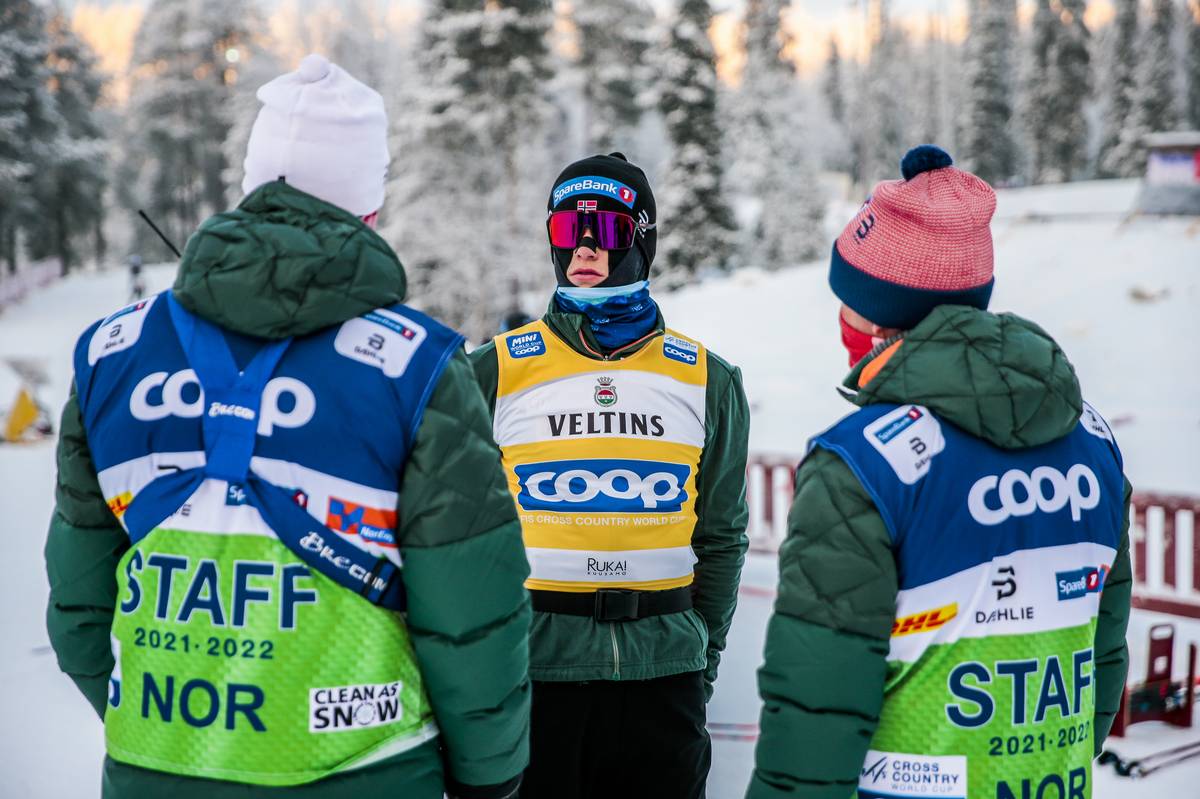
    After warming up, Johannes Høsflot Klæbo decided along with team staff to withdraw from competition in Ruka due to conditions. (Photo: NordicFocus)

    Sprint coach Arild Monsen said Johannes Høsflot Klæbo, Pål Golberg and Erik Valnes wanted to get a feel for the course before making a call. In communicating with a doctor present, they all agreed to not go. 

    “It is too cold. It’s within the cold limit. But the long-term effects that it can have on the respiratory tract … Then we came to the conclusion that they try with a little breathing on the heating. But we did not want this, there will be many other matches later,” the coach said to NRK in justifying the decision. (NRK comments have been translated to English.)

    Yesterday’s classic winner, Iivo Niskanen, also chose to withdraw from the competition, and felt the race should have been canceled altogether. When asked by NRK, he said, “Yes, it should be [cancelled]. It is 75 kilometers per hour in the descents here and it is completely safe above 20 degrees below zero. So it is not good for the athletes nor before the Olympics.”

    With Niskanen out, the clock ticked away for eight seconds until Alexey Chervotkin blasted away from the start pen. Alexander Bolshunov, wearing bib three, was still putting on his skis when he slowly skated out of the gate without his pole straps on, three seconds after his scheduled start time. After the frenzy of action and realization that all systems were go, the race proceeded more normally. 

    However, the absence of this group of men paved the way for Russian dominance. The group of three Russians – Chervotkin, Bolshunov, and Sergey Ustiugov – quickly assembled upfront. By the end of the first of six 2.5-kilometer laps, Ilia Semikov and Ivan Yakimushkin had joined them. 
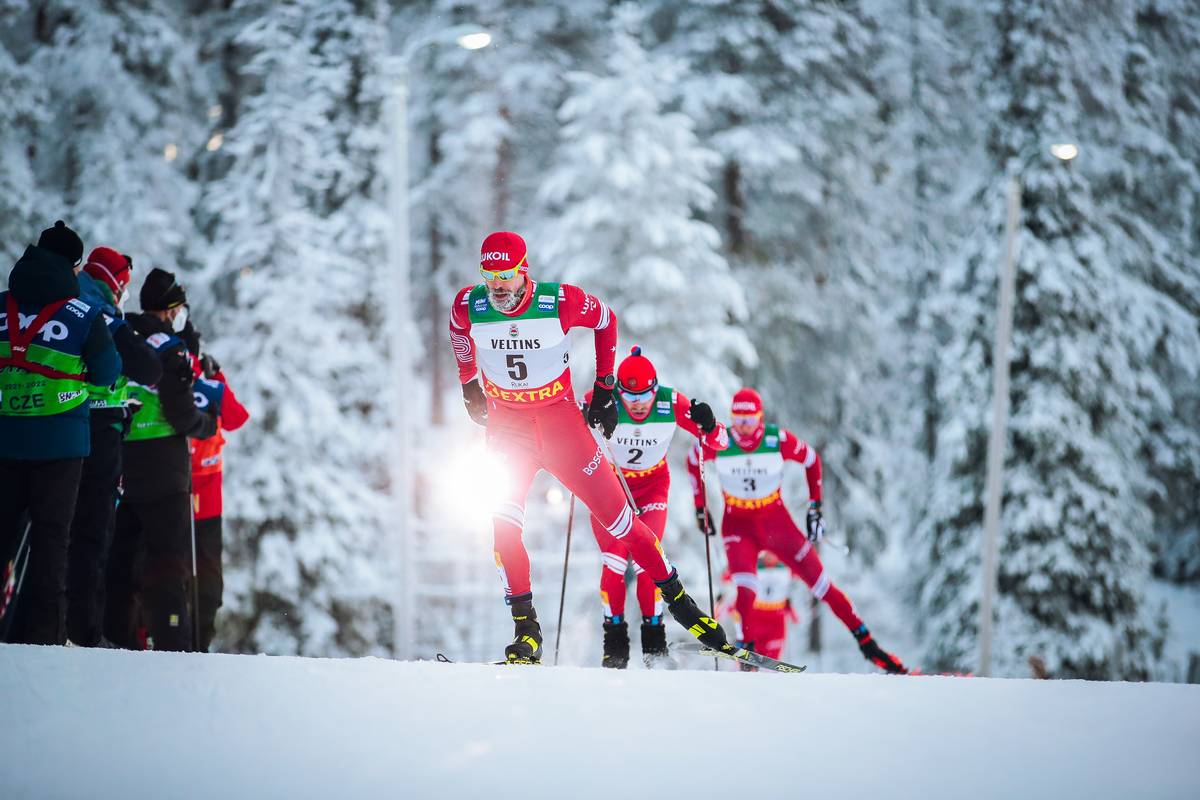
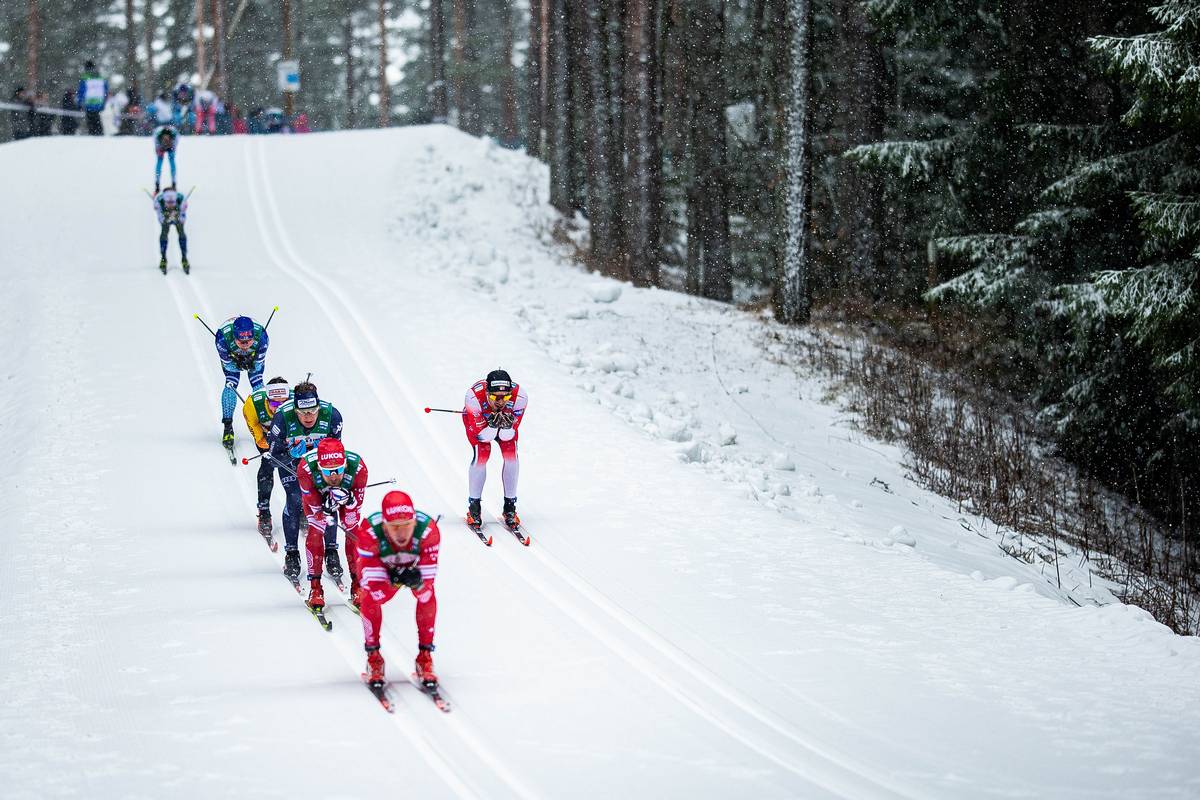
    A train of red lycra. A bearded Sergey Ustiugov pulls Russian teammates Alexey Chervotkin and Alexander Bolshunov during the 15k freestyle pursuit in Ruka. (Photo: NordicFocus)

    Behind the group of red was a chase group of Canadian Antoine Cyr, Frenchmen Hugo Lapalus, the Czech Republic’s Michal Novak, and Germany’s Lucas Boegl. Cyr, who finished a career-best 11th yesterday, continued his strong showing in the skate, holding the sixth place position for the first quarter of the race. 

    While the Russians at the front appeared to be out for a steady-state workout – not altogether easy, but with an earnest threshold-like tempo perhaps for no other reason than to preserve warmth and get off the course as soon as possible – several chase groups emerged. Behind the five Russian leaders, fellow Russian Artem Maltsev was working to close the gap to within 29 seconds through the 5-kilometer checkmark. He towed Cyr, Lapalus, Boegl, and Novak along with him. Behind that peloton was another group of five athletes, led by Francesco De Fabiani. Finally, Gus Schumacher, who started in bib 31 but moved up throughout the race, was guiding a final group of 11 athletes. 
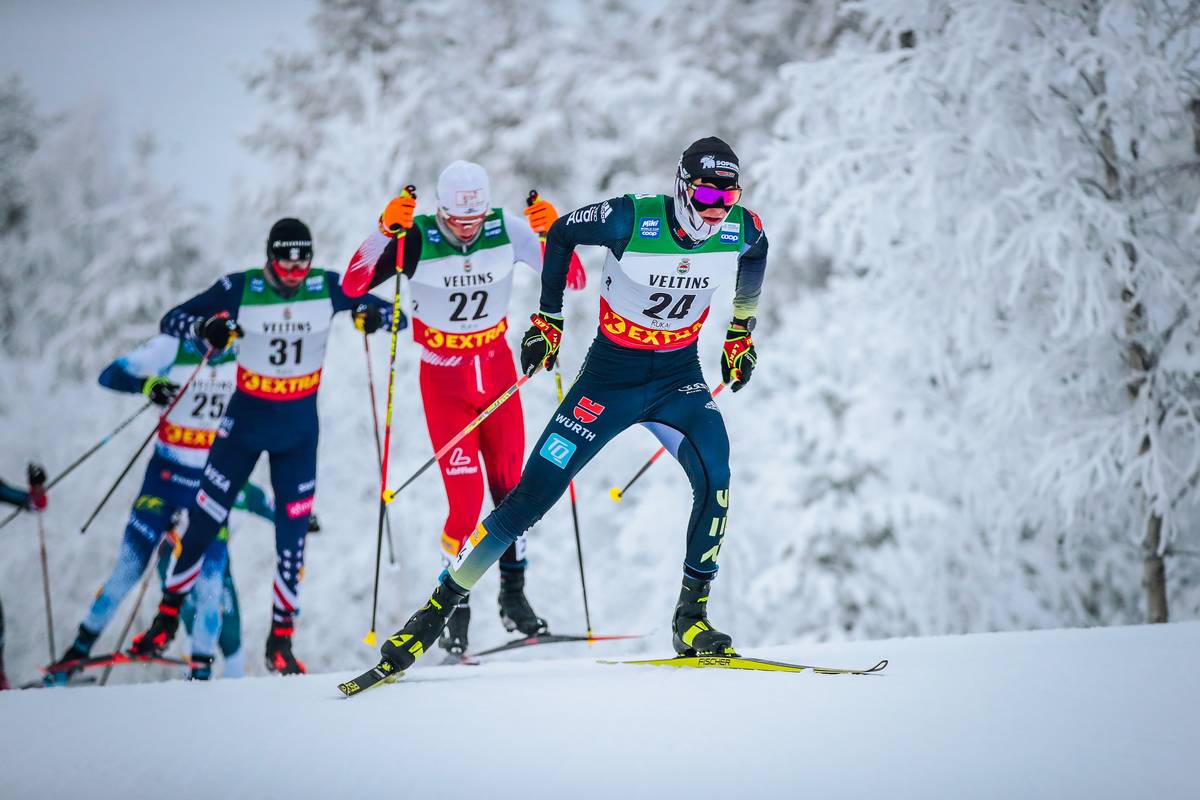
    Working in a group, Gus Schumacher (bib 31) skis his way into 11th, just 0.5 seconds out of the top-10, during the 15k freestyle pursuit in the final stage of the Ruka mini tour. (Photo: NordicFocus)

    The primary deciding move of the race came 16 minutes in when Maltsev pushed hard to bridge the gap to the leaders. He brought Michal Novak and Lucas Boegl with him, but the Canadian Cyr was fading and left behind. 

    This group was on the upswing, steadily gaining ground on the leaders. Among this pack was Schumacher, who continued to take advantage of the drafting effect. 

    By 10-kilometers, it was a group of six Russians plus Boegl and Novak in front, with Cyr and Lapalus holding on for dear life 16 seconds back, and the 10-member train, with Schumacher and Canadian Olivier Leveille at the caboose, just 19 seconds behind them. 
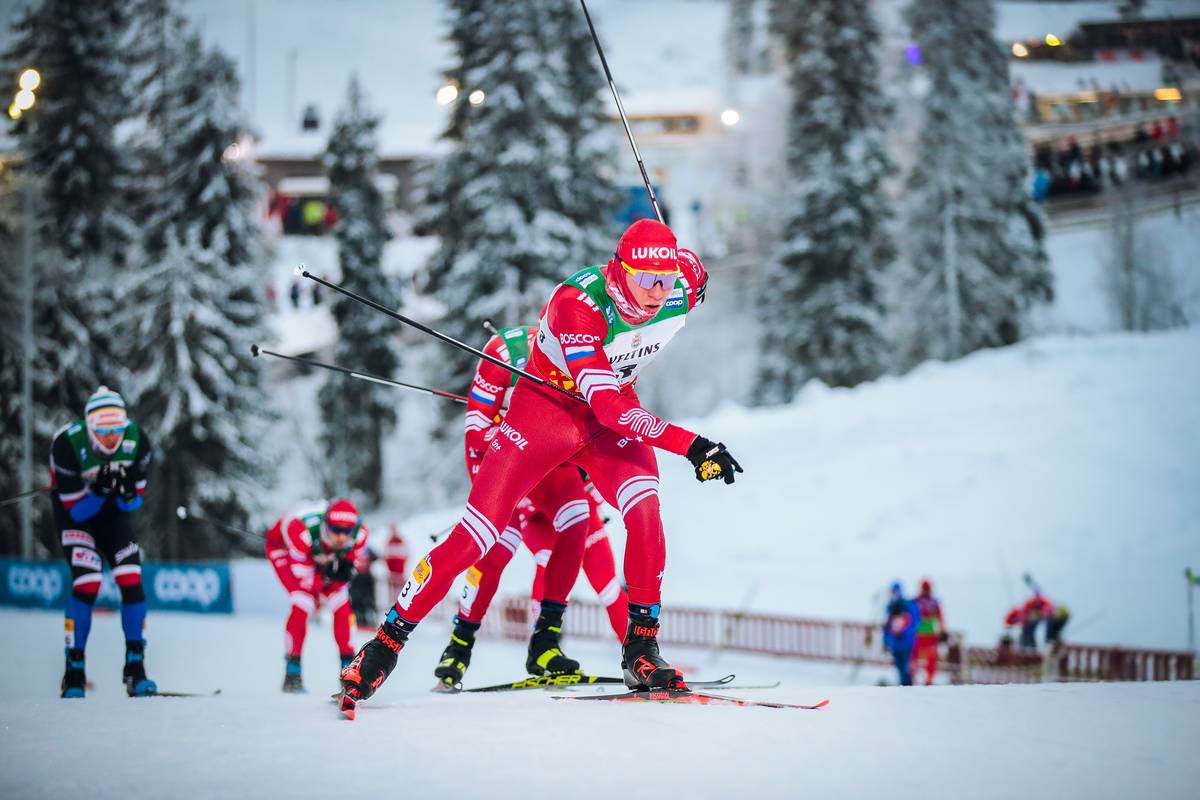
    Alexander Bolshunov on his way to win the 15k freestyle pursuit on day 3 of the Ruka Triple. (Photo: NordicFocus)

    Approaching the penultimate stages of the race, Bolshunov remained relaxed and seemingly content to let Yakimushkin lead, responding to his surges and allowing his teammate to block the wind. 

    The 25-year old Novak, who was 54th in the distance standings last year and 13th in the sprint standings, appeared strong and capable of disrupting a Russian sweep of the podium. 22 minutes into the race, wearing a Gunde Svan Swix beanie in lieu of a team cap – presumably for additional warmth – the Czech athlete went to the front. 

    Alexey Chervotkin, who was second in the 15k classic, fell steadily backward in the rankings during the subsequent 15k freestyle pursuit in Ruka. (Photo: NordicFocus)

    Coming into the bell lap, however, it was Bolshunov who emerged to take the lead in the descent into the stadium. At this point, with pace increasing, the lead pack was down to seven, having dropped Chervotkin. The chase group remained 39 seconds back, but Schumacher, who started with a 1:42 disadvantage, had closed it to 47 seconds as he sat in 15th. 

    With 1.4 kilometers to go, Bolshunov turned up the effort, charging up a hill. Novak appeared unable to respond to this surge, leaving the four Russians to settle things for themselves at the line. The gap of 2.7 seconds would not hold, though, as all four contending upfront – Bolshunov, Maltsev, Yakimushkin, and Ustiugov – paused to decide who would lead out on the final, critical downhill. Taking advantage of the moment of indecision, Novak decided to make one final run at glory. He burst into the lead down the hill, but was caught again as the five men headed into the deciding final sprint uphill.
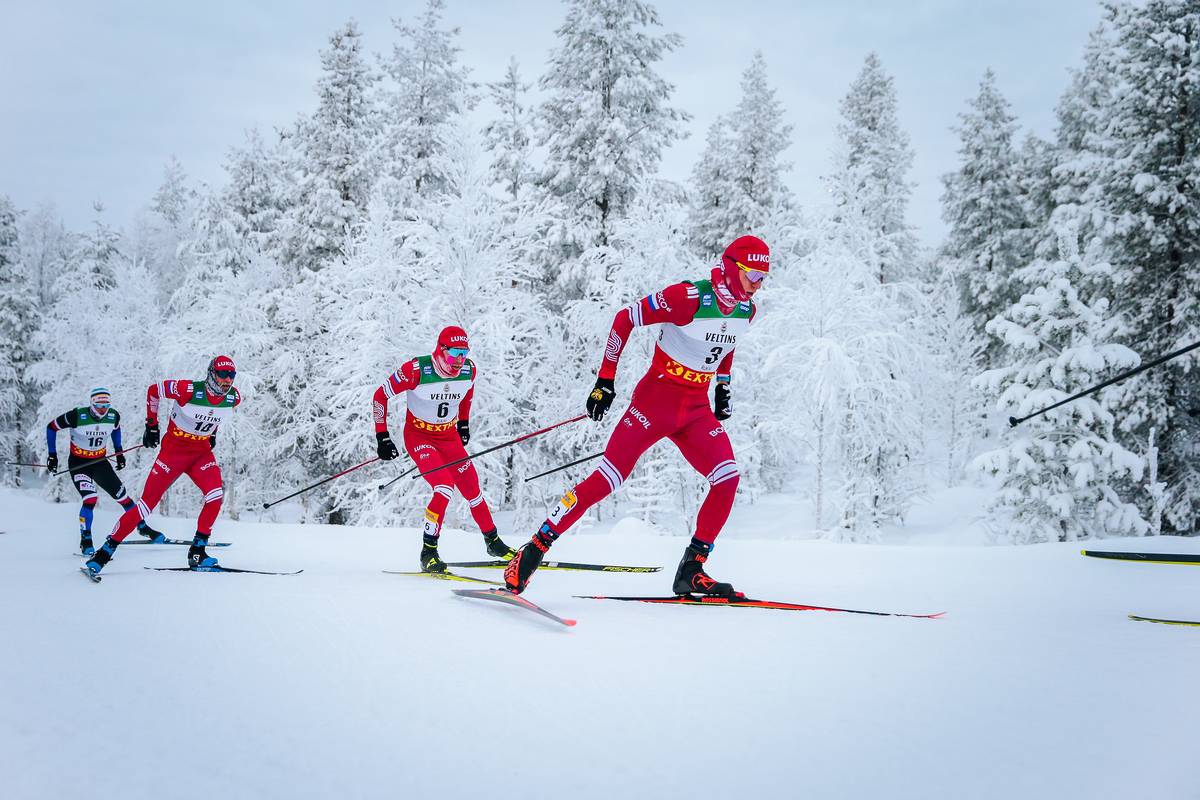
    Bolshunov leads the way in the 15k skate pursuit in Ruka. (Photo: NordicFocus)

    Bolshunov and Ustiugov demonstrated the purest and most efficient hop skating, and separated from the others. Looking for an inside line, Ustiugov just didn’t have the speed to overtake the 24-year old two-time defending overall globe winner. As they headed into the straightaway, Bolshunov glided comfortably across the line for the win, followed by Ustiugov (+0.5) and Maltsev (+0.7), who never faltered after charging hard to close the gap between racers. Yakimushin (+5.3) made it a one-through-four run of Russians, but a fifth place finish for Novak (+9.2), whose previous best individual finish to date was a 9th place sprint from Ulricehamn, Sweden last February, ruined the Russians’ ability to achieve a cross-country running “perfect score.”
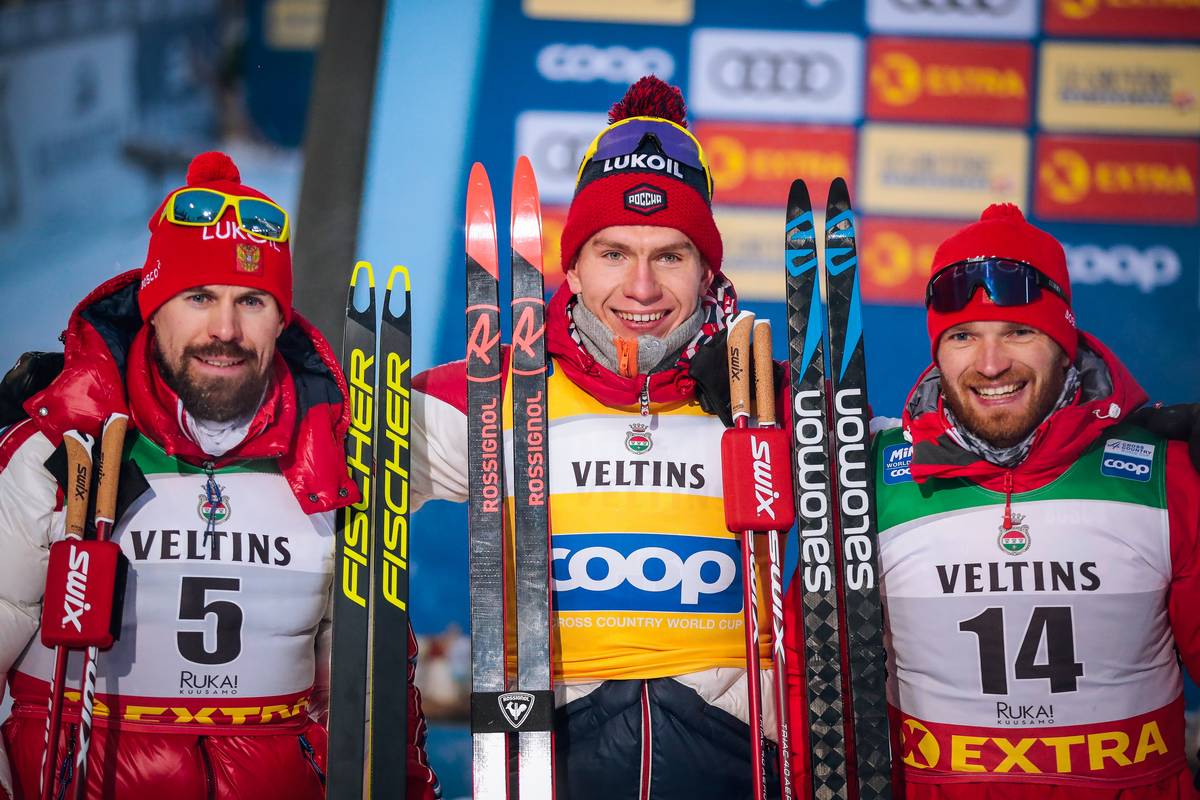
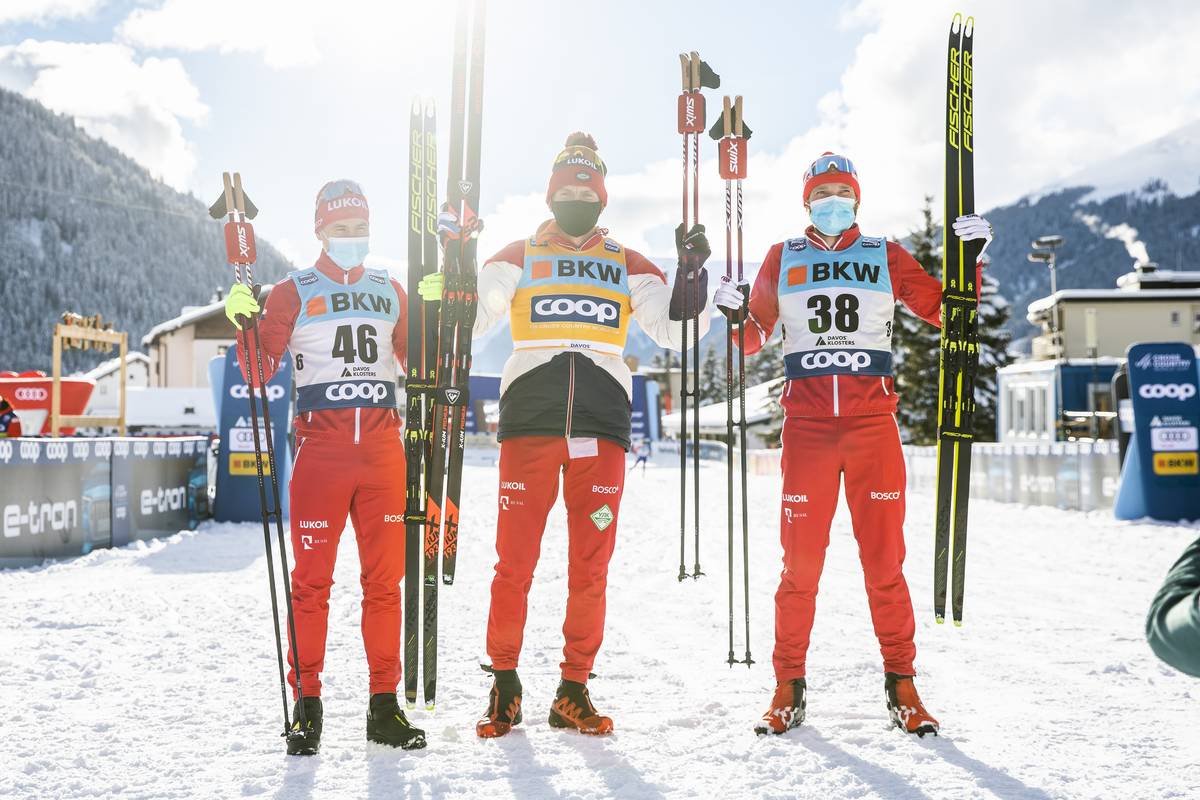
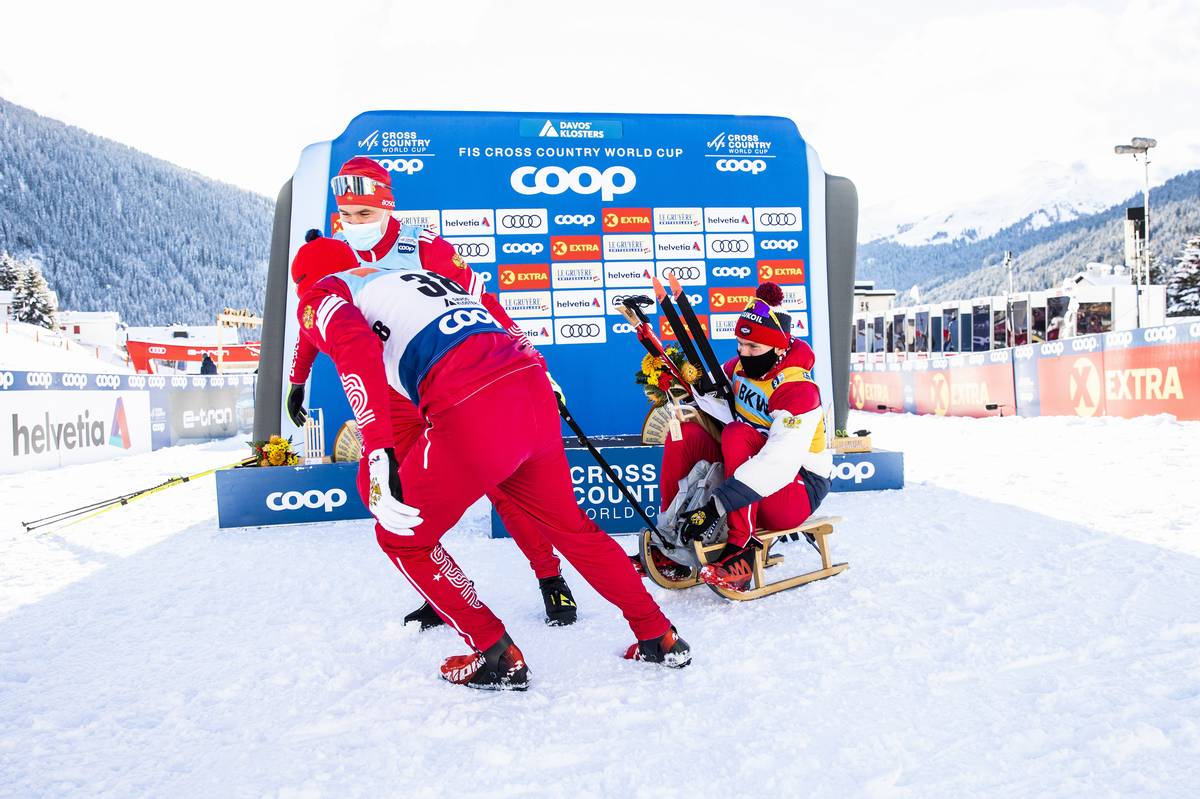
    It was an all-Russian podium on Day 3 of the Ruka mini-tour. Alexander Bolshunov took the win ahead of Sergey Ustiugov (left) and Artem Maltsev (right). (Photo: NordicFocus)

    At the finish line, Bolshunov spoke through a translator and discussed how the confusion at the start led to a few unknowns, but ultimately, when the race started, the game plan was still the same. 

    “I still made the task to do the best I could and I am really happy with the victory,” he said of the situation. 

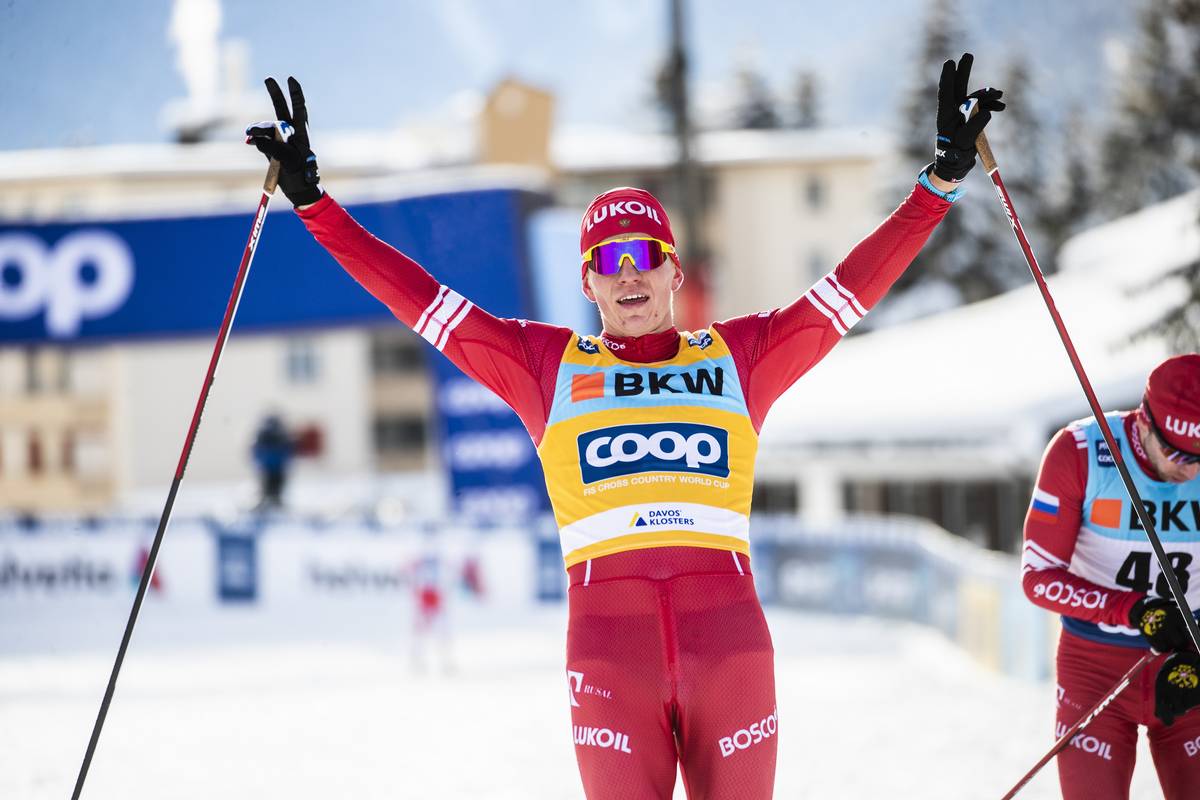
    Alexander Bolshunov wins his first World Cup of the 2021-22 season in the 15k skate pursuit in Ruka. (Photo: NordicFocus)

    Surging in behind the initial group of finishers was American Gus Schumacher, who would climb all the way to 11th place (+58.2). He was only half of a second out of the top 10, as he was unable to overtake De Fabiani in the final sprint, but he did claim top North American honors, passing Antoine Cyr (+58.8) in the closing stretches. Cyr ended his day in 12th.
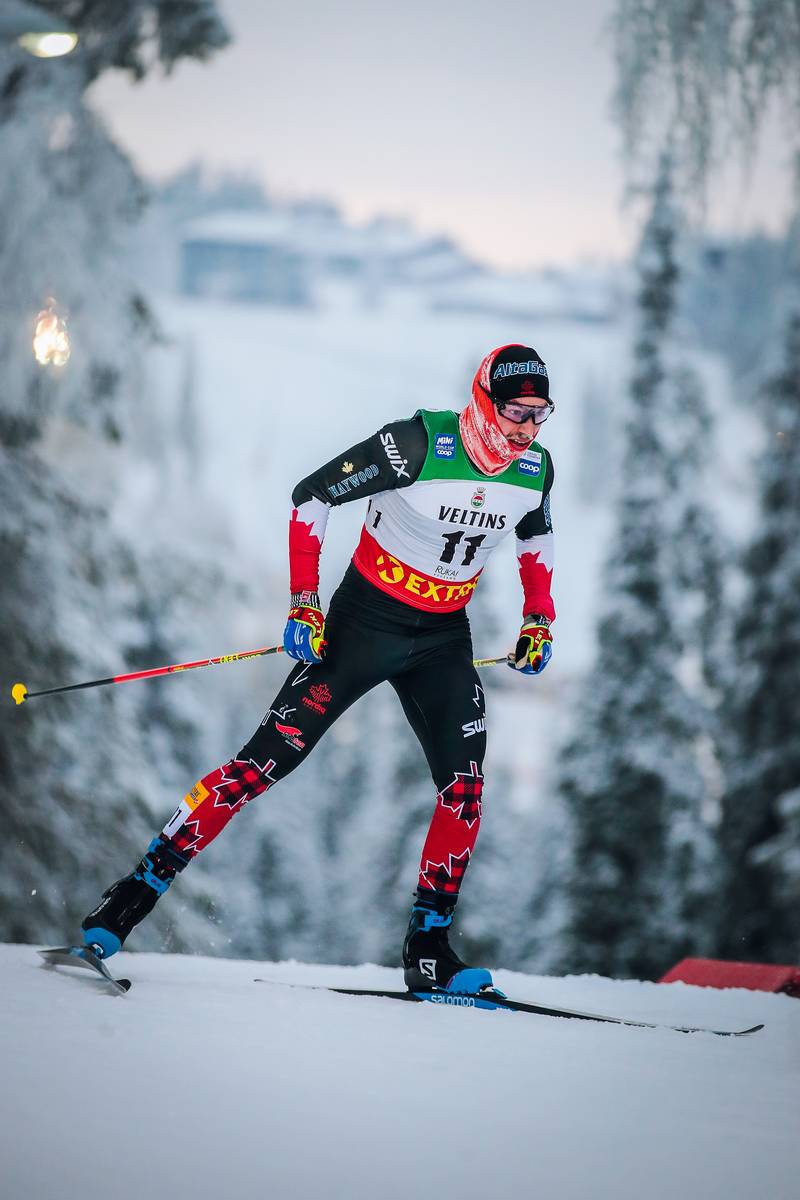
    With back to back Top-15 finishes, Nordiq Canada’s Antoine Cyr is 12th in the 15k freestyle pursuit in Ruka. (Photo: NordicFocus)

    In a post-race interview, Schumacher explained his race plan, including how he considers the athletes around him as potential rides that he may use during the opening laps. He also discusses how he was able to lean on fast skis to take advantage of downhills and drafts, conserving his energy to hang onto the other strong men in his group. Having been in cold weather and on snow in Alaska before heading to Europe, Schumacher provides additional insight into his management of the conditions.
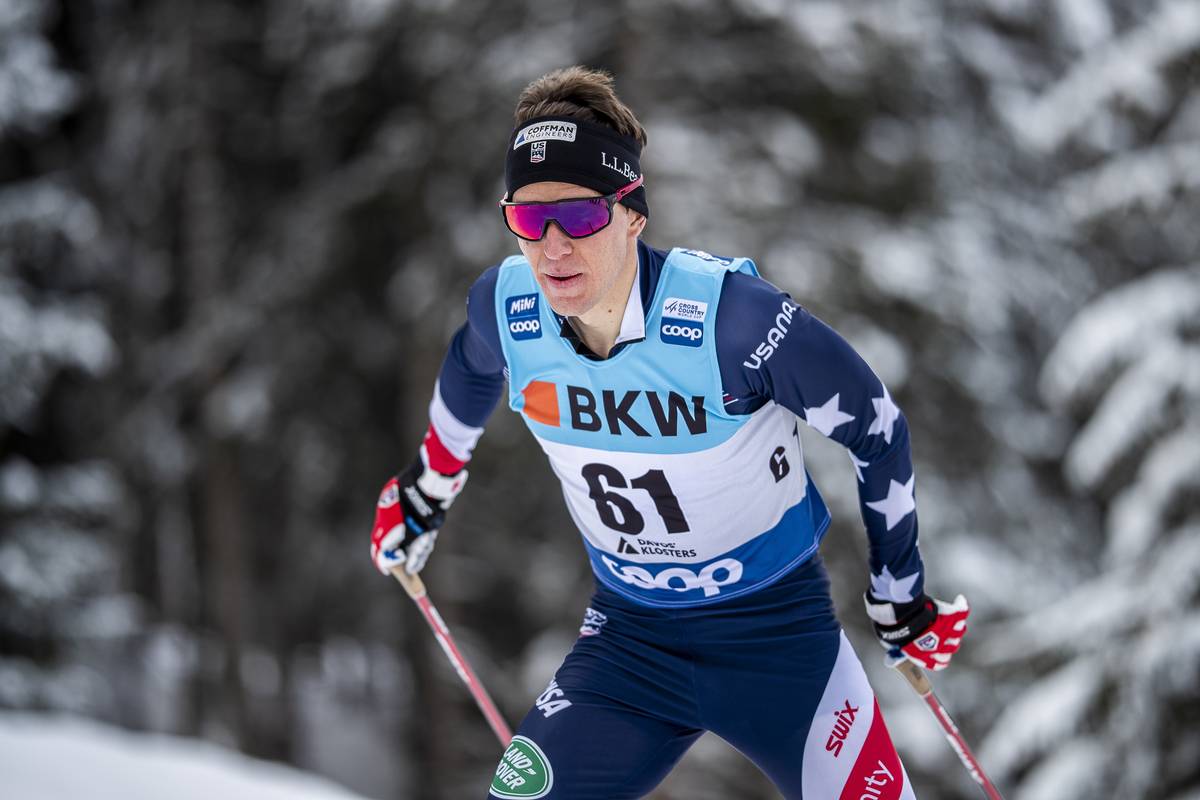
    Gus Schumacher skis to 11th place in the frigid 15k freestyle pursuit in Ruka. (Photo: NordicFocus)

    Completing a strong showing for Canada, Olivier Leveille (+1:00.7) finished in 17th followed by Russell Kennedy in 21st  (+1:39.9).

    The American contingent, largely made up of Alaskans, showed no fear in the face of the cold temps. David Norris (+2:35.1) finished in 37th, Zanden McMullen (+2:46.0) was 40th, and Hunter Wonders (+3:33.0) was 45th. Ben Ogden (+4:52) and Luke Jager (+5:38) rounded things out in 55th and 60th places, respectively. 

    Hunter Wonders on course during the 15k freestyle pursuit in Ruka. (Photo: NordicFocus)
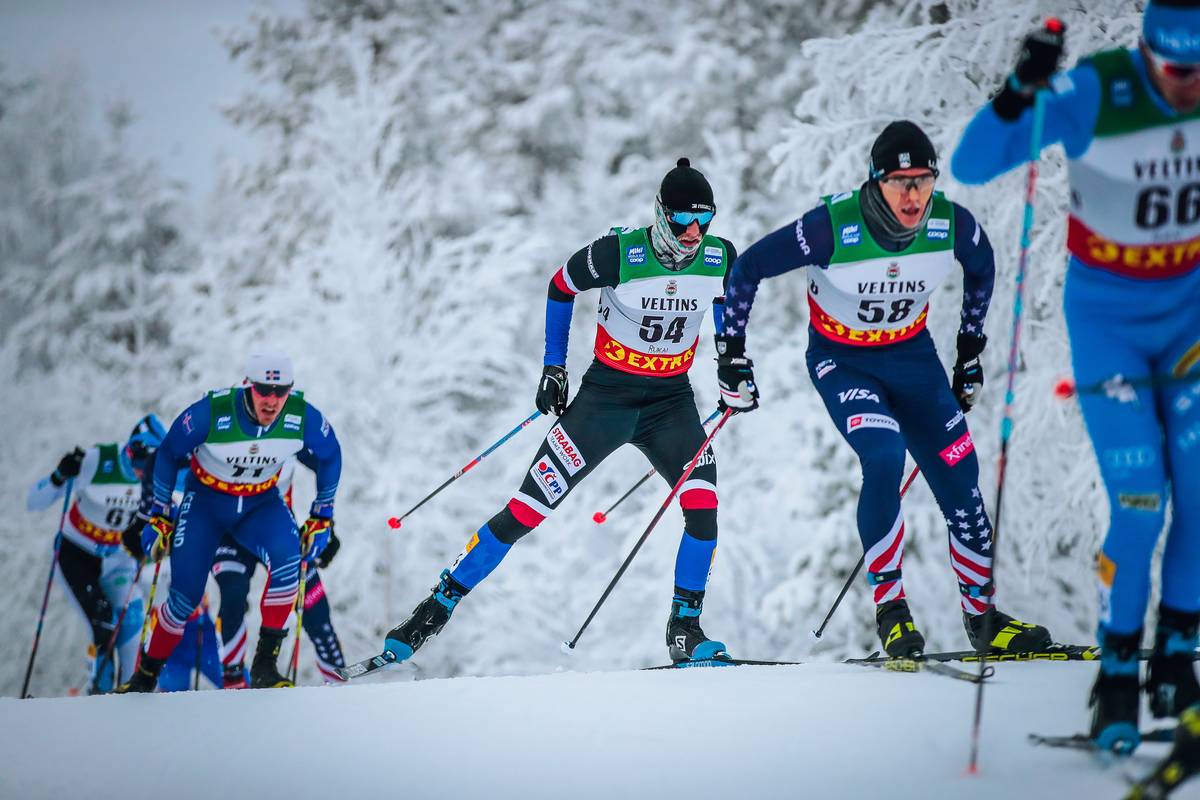
    Ben Ogden (bib 58) works with a train of athletes during the 15k freestyle pursuit in Ruka. (Photo: NordicFocus)

    Men’s Final Results

  • Bolshunov Widens his Lead in the Tour de Ski, Manificat Lands Another 15 k Skate Podium in Third (Updated)

    Bolshunov Widens his Lead in the Tour de Ski, Manificat Lands Another 15 k Skate Podium in Third (Updated)

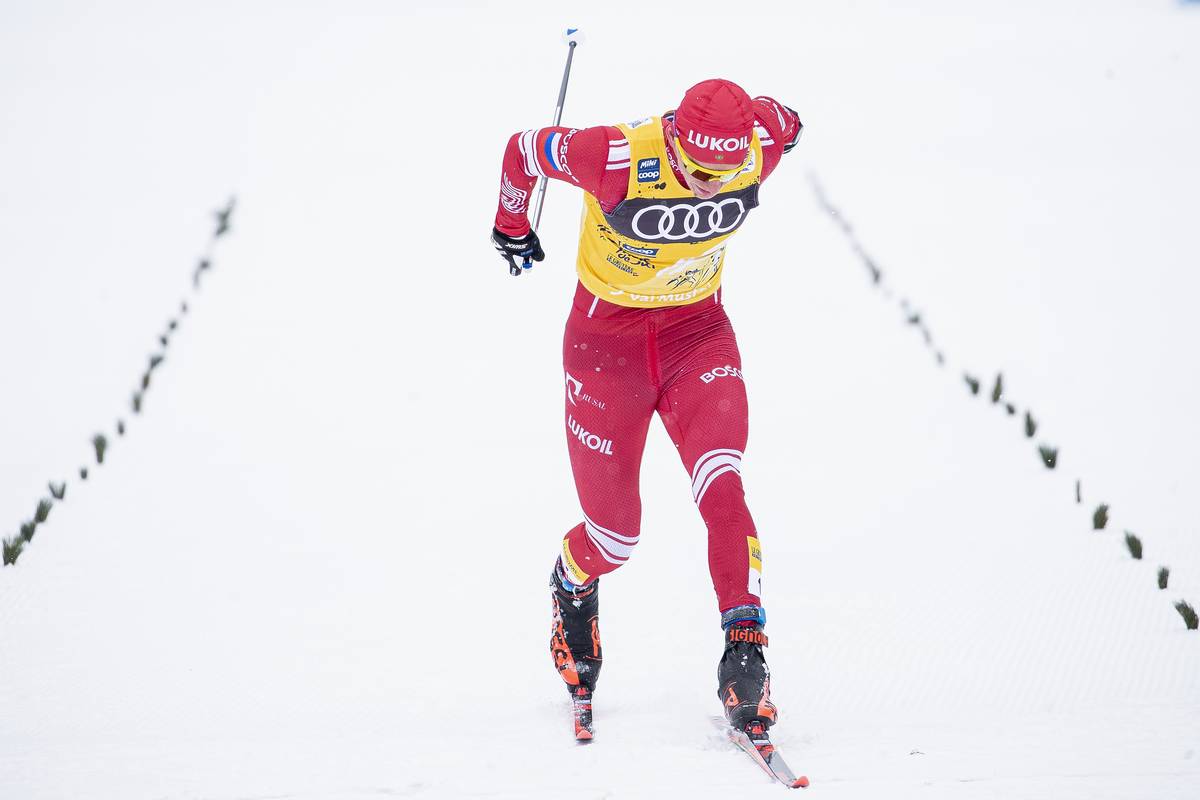
    Alexander Bolshunov (RUS) lunges for the line with no challengers in sight. Photo: Nordic Focus

    This World Cup coverage is made possible through the generous support of Marty and Kathy Hall and their A Hall Mark of Excellence Award. To learn more about A Hall Mark of Excellence Award or to learn how you can support FasterSkier’s coverage please contact info@fasterskier.com.

    Accompanied by the constant soundtrack of distant cowbells, Alexander Bolshunov of Russia steadily worked his way through the fog, four times around the 3.3 k course to maintain a lead that was never threatened, completing the race in a time of 32:11. He started today’s skate pursuit with a margin of one minute ahead of teammate Artem Maltsev (RUS). When the race concluded Bolshunov had ceded only 6.3 seconds, despite skiing alone the entire way. In the winner’s post-race interview with FIS, when asked whether the race felt as easy as it looked, Bolshunov replied (through a translator), “[I] wouldn’t say it was easy, the last laps [I] had to work really hard. But still [I’m] really happy to take the win with good distance.”

    This is the third podium for Bolshunov in this Tour de Ski alone. In ten World Cup races this season, he missed a podium only twice, when he placed fourth in Ruka’s classic sprint and fourth again in Dresden’s skate sprint. With the Norwegians remaining off the World Cup, for now, he remains peerless.


    Payday for Alexander Bolshunov (RUS) after his second victory in two days. Photo: Nordic Focus

    Initially, the followers’ chase was mounted by Russia’s Maltsev and Dario Cologna of Switzerland for the first 7.4 k. Cologna was the third starter today, but he quickly ate up the 11 seconds margin to Maltsev. As the race evolved, Maltsev began to pull away, eventually crossing the finish line in second place, +53.7 seconds behind Bolshunov. According to the FIS database, Sunday’s second place was Maltsev’s second career World Cup podium. He also won a bronze in the 2018 Olympic team sprint. 

    Artem Maltsev (RUS) crosses the line for his second podium of the season, he finished 3rd in the 15 k skate in Davos. Photo: Nordic Focus

    Cologna (SUI), who is the first man to have won three 15 k Olympic gold medals in a row and should consider this distance a specialty, was caught by Maurice Manificat of France, Ivan Yakimushkin of Russia and Denis Spitsov of Russia at 8.9 k. Gradually Manificat (FRA) worked his magic, 15 k skate events being something of a favorite for him, and he finished third +1:10.07 behind Bolshunov. With an elapsed race time of 31:42.1, Manificat also had the second fastest time of the day.

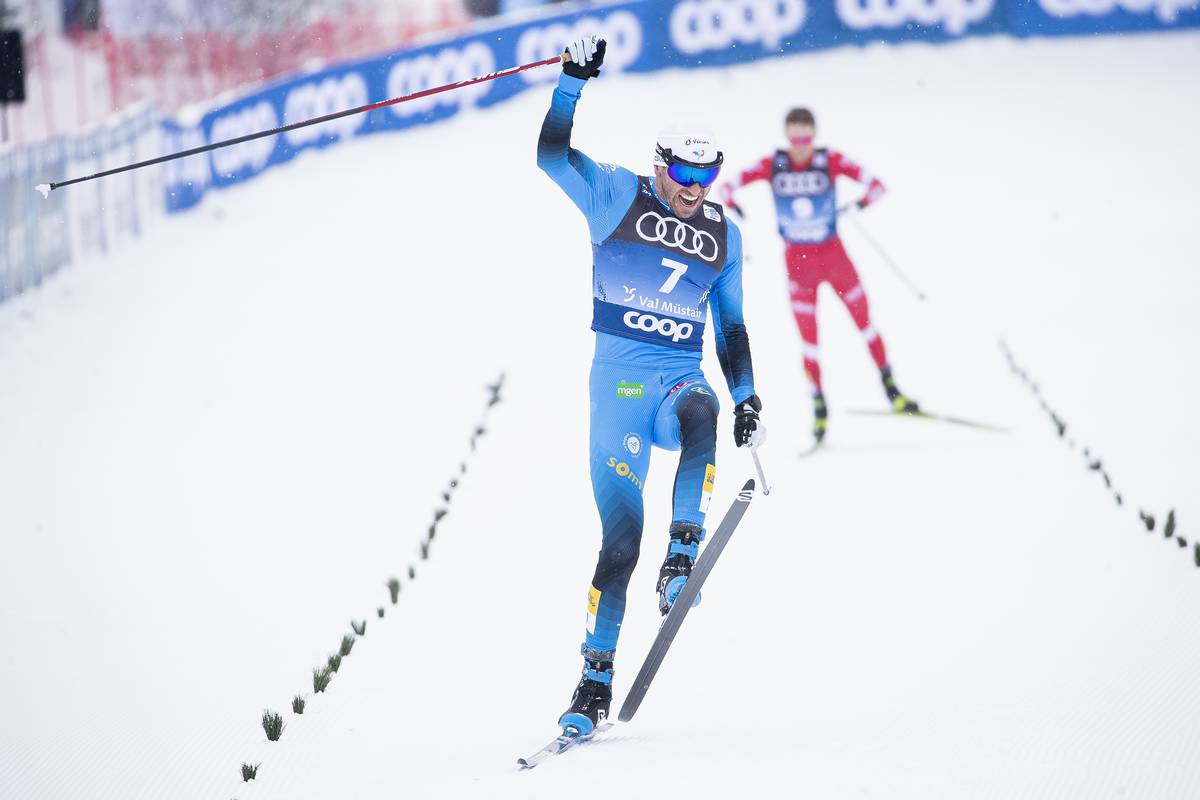
    Maurice Manificat (FRA) with his signature celebration over the finish line. Photo: Nordic Focus

    Spitsov (RUS) followed closely behind in fourth, earning the fastest time of the day with his performance (31:41.8). +23.5 seconds back from Spitsov, Yakimushkin (RUS) outsprinted Cologna (SUI) and they fell into 5th and 6th position. Friday’s sprint winner, Federico Pellegrino of Italy, held his own despite not having a reputation as a distance skier, to finish in 8th. 

    Federico Pellegrino (ITA) on his way to an 8th place finish, ahead of the French trifecta battling behind him. Photo: Nordic Focus

    Gus Schumacher was the first American out of the gates. In bib 35 he started +2:55 behind Bolshunov. When he crossed the line, 36:15 minutes later, he had gained three places to lead the American men and finish in 32nd, with the 28th fastest time of the day, earning him his third World Cup points of the season. “My strategy today was based mostly around consistent pacing,” wrote Schumacher in an email, “I wanted to avoid a big loss of energy, so I tried to make smart decisions regarding whether or not to respond to attacks. Moving forward, I’m mostly focused on recovery and taking each day as a new day, a new race to continue improving. I know that I have 5 more races to try to work up the field.”

    Gus Schumacher (USA) pushes the finishing stretch. Photo: Nordic Focus

    Scott Patterson, who started in the first wave (+3:22) with bib 46, also gained several places and finished 38th. Patterson skied his way to the 24th fastest time of the day in a time of 33:09.9. Simi Hamilton finished 47th and Kevin Bolger rounded out the U.S. men in 55th. 

    Simeon Hamilton (USA) and Kevin Bolger (USA), (l-r) cross the line. Photo: Nordic Focus

    Overall Tour Standings: 

    With his victory today, Bolshunov’s overall lead in the Tour is +0:53 seconds ahead of Maltsev in second. Manificat moved into third position (+1:07) followed by Spitsov (+1:10) and Cologna (+1:34) in fourth and fifth respectively. The Tour now moves to Toblach, Italy where racing continues on Tuesday (January 5th) with a 15 k interval start skate race. 

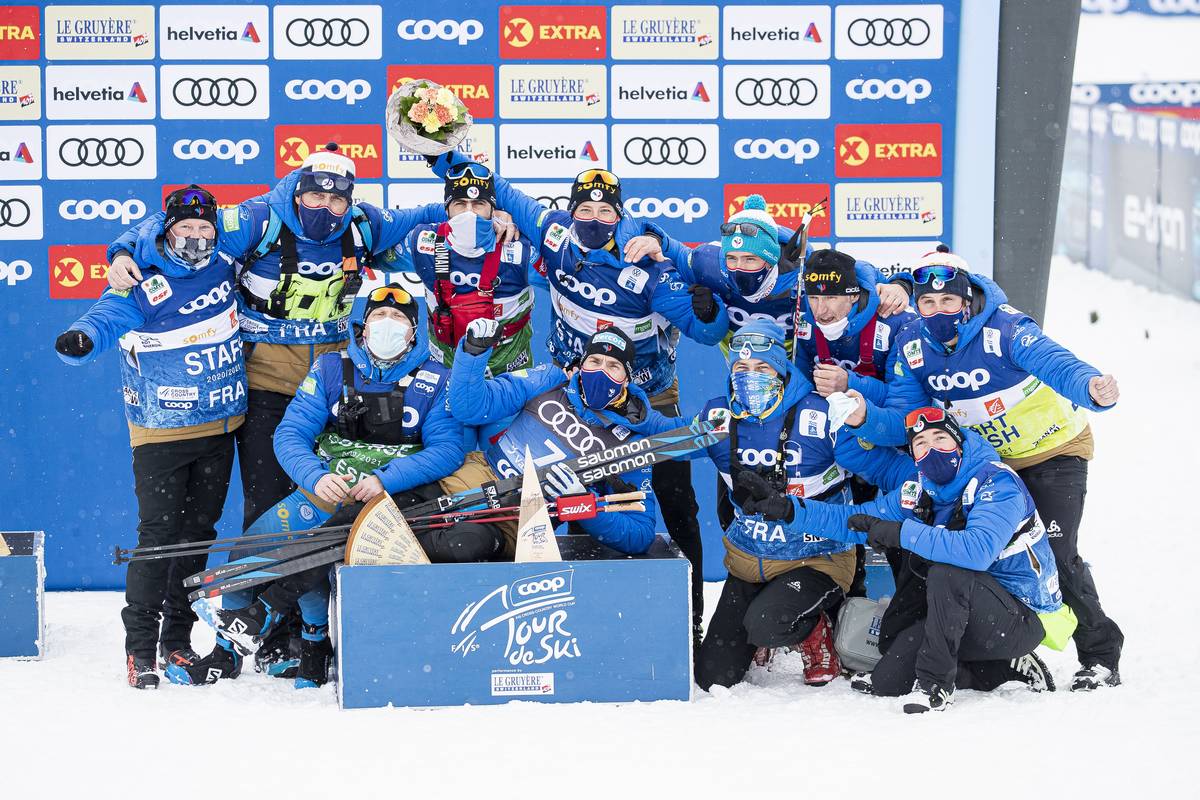
    A happy group of Frenchmen celebrate Manificat. Photo: Nordic Focus

    Results: 

    Stage 3 Results | Men’s TdS Overall Standings

  • Russian Sweep in Davos 15 k Skate: Scott Patterson Leads U.S. in 16th

    Russian Sweep in Davos 15 k Skate: Scott Patterson Leads U.S. in 16th


    Alexander Bolshunov (RUS) celebrates his victory – 15km men, Davos (SUI). Photo: NordicFocus

    This World Cup coverage is made possible through the generous support of Marty and Kathy Hall and their A Hall Mark of Excellence Award. To learn more about A Hall Mark of Excellence Award or to learn how you can support FasterSkier’s coverage please contact info@fasterskier.com. 

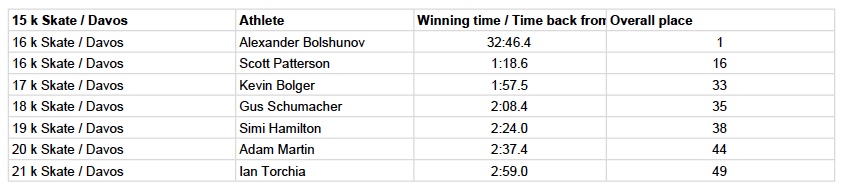
    In warming temperatures and through clearing skies the men battled their way three times around the challenging 5-kilometer course in Davos. With the noted absences of Norway, Sweden, and Finland, today’s 15 k individual skate title was arguably Alexander Bolshunov’s of Russia for the taking. And take it he did, with a time of 32:46.4, putting himself more than 30 seconds ahead of his fellow countrymen and the remaining field. Completing the Russian sweep of the podium were Andrey Melnichenko in second place and Artem Maltsev in third. 

    Bolshunov started out strong and only grew stronger. At 2.2 k he was leading by a sliver of time, 1.6 seconds, at 5 k that gap had widened to 16.4 seconds. By 10 k he was 26.3 seconds up on Melnichenko (RUS). Not laying off the gas he continued to push on, finishing with a lead of 32.2 seconds. In a post-race interview with FIS Bolshunov spoke through a translator, saying, “The plan was to go all the loops equally and keep the high pace. He is very happy with the performance of the team and hopes they will keep the high pace until the World Championships”. 

    The Davos 15 skate playground: Andrey Melnichenko (RUS), Alexander Bolshunov (RUS), Artem Maltsev (RUS), (l-r). (Photo: NordicFocus)

    Melnichenko maintained solid splits in second place through the entire race, Dario Cologna of Switzerland came within one second at 5 k but ultimately dropped more than 43 seconds to finish 14th. Melnichenko posted the second-fastest time two weeks ago in Ruka in the 15 k skate pursuit, prior to that, his last individual podium was the 3rd fastest time in the final stage of the Tour de Ski, the notorious hill climb up the Alpe Cermis in Val di Fiemme, Italy. 

    For Maltsev (RUS), today’s third-place finish is his first individual World Cup podium. His previous top distance result was 6th place in Toblach during a Tour de Ski stage, skate 15 k. 

    Scott Patterson (USA) on his way to a top-twenty finish. Photo: Nordic Focus

    Scott Patterson was the first finisher for the American men in 16th place. “This is my fourth year racing the 15k skate in Davos”, Patterson wrote in an email to Faster Skier. “It is the first year that I actually felt like I had something to give. The last 3 years, it felt like I started out slow and faded, whereas this year I started strong and held on pretty well. I’m psyched on the result from today and looking forward to more racing soon.”

    Last year Patterson finished 51st in this same event in Davos. Back in 2018, Patterson began a tear at the PyeongChang Olympics. In three individual events, he placed 18th in the 30 k skiathlon, 21st in the 15 k skate, and 11th in the 50 k classic mass start. He continued his top-20 pattern in Oslo’s 2018 50 k skate, with a solid 16th place. A year later in Oslo, he was 19th in the 50 k classic. Last season, Patterson pulled himself from the World Cup early on and raced domestically for the remainder of the winter. His form and confidence took a hit as he was unable to connect the dots and repeat his 2018 run. Early this year, Patterson is finding his way into the top-30. He concluded the Ruka weekend with the 23rd fastest time of the day in the 15 k skate pursuit.   

    In reference to watching fellow APU/USST members Rosie Brennan and Hailey Swirbul achieve the podium just hours before the men’s race Patterson wrote, “I watched the women crush on TV and then our guys van arrived at the waxing truck about when they were getting back there. It was quite a celebratory mood and felt like a little pressure that we had to do something impressive as well. Also, seeing those types of performances is always a good indication that our wax techs have done a great job. Once I was warming up though, I was able to get back in the zone and focus on my own racing.”

    Kevin Bolger (USA) posting his best-ever World Cup distance result. Photo: Nordic Focus

    Post-race interview with Kevin Bolger. 

    Just outside the top thirty were Kevin Bolger (33rd) and Gus Schumacher (35th). This is Bolger’s best distance finish to date, his previous top distance result being in a stage race in Québec in 2019 where he placed 44th in a 15 k classic mass start. Simi Hamilton, Adam Martin, and Ian Torchia rounded out the finishes for the U.S. men in 38th, 44th, and 49th, respectively. 
    Post-race interview with U.S. Head Coach Matt Whitcomb discussing the men’s racing. 


    Results: Men’s 15 k

  • With a Klæbo Anchor Leg – Norway Claims 4 x 7.5 k Relay in Lahti

    With a Klæbo Anchor Leg – Norway Claims 4 x 7.5 k Relay in Lahti

    Sunday, for the men’s 4 x 7.5-kilometer relay in Lahti, Finland the scene was decidedly more fitting for winter sport: The race began amidst falling snow despite bare firs and hardwoods lining the course. It’s been a sparse winter in Lahti. 

    Eleven teams contested the relay, with ten nations represented; Russia fielded two teams. The U.S. was not represented. 

    First leg pack racing in Lahti, Finland. (Photo: NordicFocus)


    Russia II’s Andrey Sobakarev and Russia I’s Ilia Semikov leading out the first leg of the men’s 7.5 k relay in Lahti. (Photo: NordicFocus)

    For the first 7.5 k leg, Russia I’s Ilia Semikov and Russia II’s Andrey Sobakarev animated the sharp end with several pulses of energy to make a slinky of the pack. Norway’s Pål Golberg took some commensurate pulls too. The calories expended broke this into a front group of six teams at the first exchange separated by 2.4 seconds. The teams came through in this order: Norway, Russia I, Germany, Finland, Russia II, and Italy. Switzerland and Sweden, who had been loosely attached to the pack here and there, had popped – coming through roughly 20 seconds back.

    Leg 1 of the men’s 4 x 7.5 k relay in Lahti, Finland: Pål Golberg (NOR), Ilia Semikov (RUS), Lauri Vuorinen (FIN), Bjoern Sandstroem (SWE), Beda Klee (SUI), Giandomenico Salvadori (ITA), (l-r). (Photo: NordicFocus)

    The second leg played out much like the first, with the Russian teams, Norway, Italy, and Finland maintaining a gap. Finland’s Iivo Niskanen kept Finland in the hunt, and Russia II’s Alexey Chervotkin took a runner through the 13.6 k time check – otherwise the drama was subdued. 

    Through the woods, a leading Iivo Niskanen of Finland. (Photo: NordicFocus)

    During the first skate leg, the front group ballooned modestly to seven with the addition of Germany beyond the original six teams. As the third leg skate moved towards the tag off for leg four, Finland had popped for good, and coming down into the stadium for the tag, it became a five team affair, with Russia I, Russia II, Germany, Norway, and Italy coming through in that order. Switzerland tagged off in sixth (+6.9). 

    Artem Maltsev of Russia II taking the pull: fourth leg of the men’s 4 x 7.5 k relay in Lahti, Finland. (Photo: NordicFocus)

    During the fourth leg the Russians gave several hungry digs. But on the first pass through Lahti stadium at 25 k with a long glide out speeding into the lap area, Norway’s anchor, Johannes Høsflot Klæbo, clearly sported the slickest pair of skate skis as he moved to the front with little friction under his feet. And we all know how Klæbo can close. 

    At 27.5 k, the start of the last lap, Germany was no longer in the podium game. Five teams came through in a line led by the indomanable Klæbo. For the final 2.5 k lap, Klæbo killed the pace initially and then Russia I’s Andrey Melnichenkov tried in earnest to pull away and thin out the latched on Klæbo, Italy’s Stefan Zelger, and Switzerland’s Roman Furger. To no avail. Like he’s done before in countless sprints, Klæbo tapped into his vast stores of fast twitch muscle fiber and pulled away in the home stretch for the Norway win in 1:09: 53.

    Norway’s combo of Golberg, Hans Christer Holund, Sjur Røthe, and Klæbo momentarily reclaimed the men’s relay title over Russia -the Russians had won the last two relays, one in Lillehammer this season, the other in Ulricehamn, Sweden last year. 

    Switzerland’s Beda Klee, Dario Cologna, Jason Rueesch, and Furger placed second (+1.2), and Russia I’s Semikov, Alexander Bessmertnykh, Denis Spitsov, and Melnichenkov were third (+1.7). 

    For the Swiss, this was thier first men’s World Cup relay podium in nearly a decade.

    “Russia has won the previous two relays, it was time to take the throne back,” Golberg told FIS after the race. 

    Klæbo’s comments to FIS post-race underscored his finish speed gift. “In the start it was quite high speed and I think that all of the other guys saw that it was really difficult to get a gap,” Klæbo said of his leg. “So I was just in the front and slowing the pace down, it was almost just like training, it was a really slow pace. But in the end it was all-in and I think it was a really fun and interesting race.” 

    Racing continues in Drammen, Norway on Wednesday with a classic sprint. 

    Results

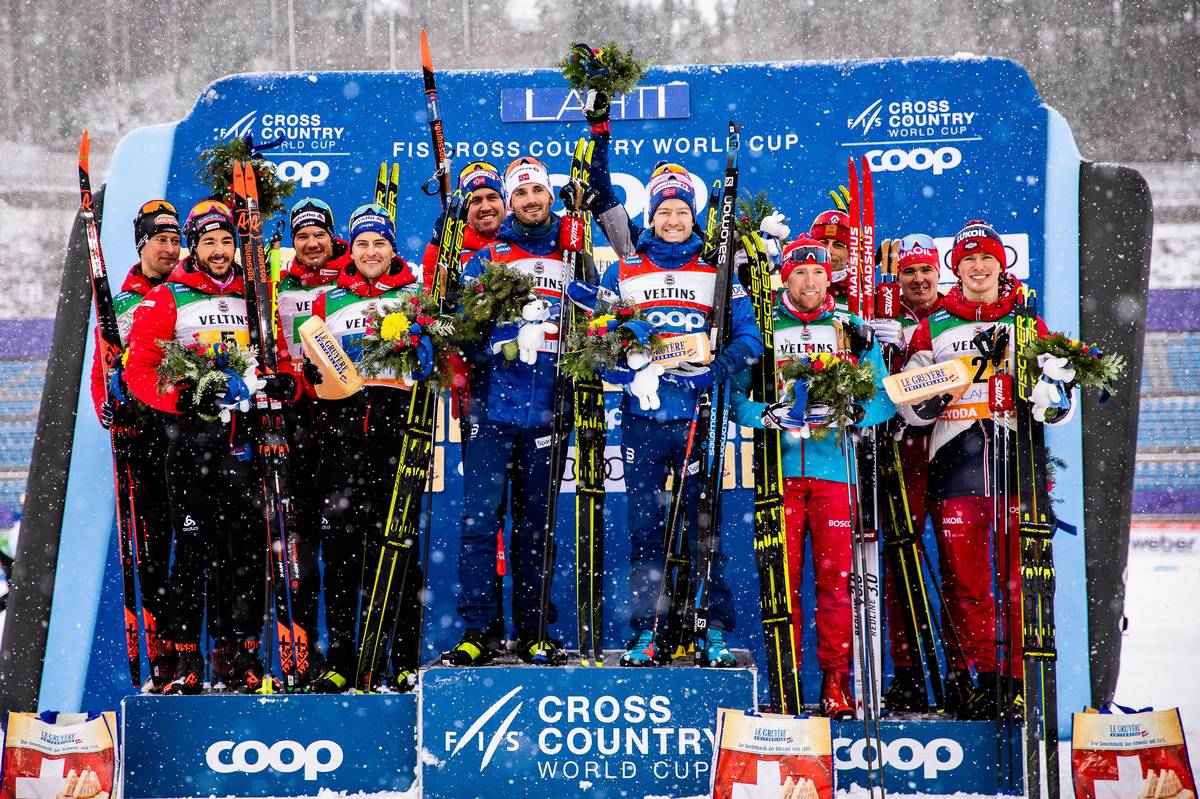
    The men’s 4 x 7.5 k podium in Lahti, Finland:
    Switzerland second, Norway first, and Russia I third (l-r). (Photo: NordicFocus)


  • Russian Teams Take the Top Two Spots in Ulricehamn; U.S. in 13th

    Russian Teams Take the Top Two Spots in Ulricehamn; U.S. in 13th


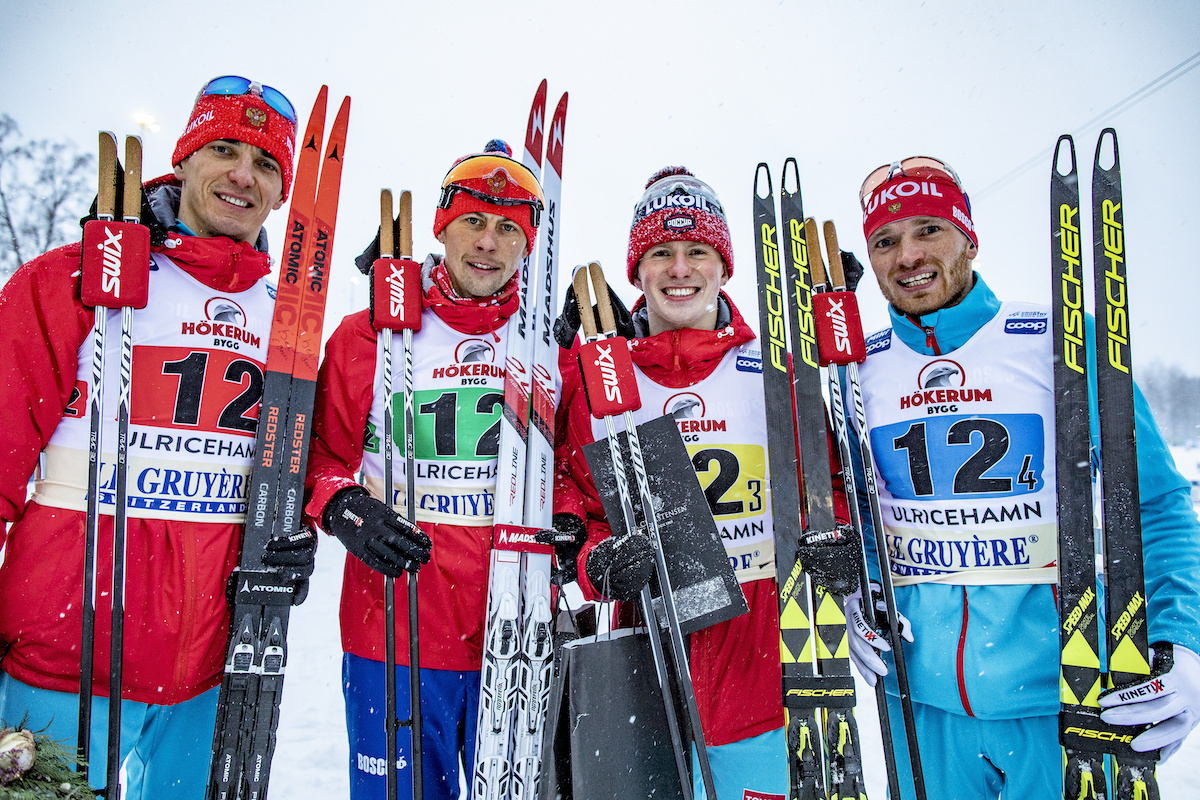
    The Winning 4 x 7.5 k Russian relay team at the Ulricehamn, Sweden World Cups: from left to right, Evgeniy Belov, Alexander Bessmertnykh, Denis Spitsov and Artem Maltsev. (Photo: Fischer/Nordic Focus)

    Today in Ulricehamn, Sweden, the men skied a 4 x 7.5- kilometer relay in unsettled conditions. Racers dealt with harsh conditions as the wind howled and heavy snow fell. With a softened course, it appeared most teams struggled with kick on the steeper climbs.

    Scott Patterson of the U.S. Ski Team (USST) commented on the conditions via email, “the race conditions were interesting with both falling snow and blasting wind. The organizers re-groomed the course in between the women’s and men’s races which did improve things, but the downhill corners were chopped up and soft.”

    Russia II took the victory today in a time of 1:17:53.2 minutes with Evgeniy Belov, Alexander Bessmertnykh, Denis Spitsov and Artem Maltsev.

    The winning team was followed closely by their teammates on Russia I; Andrey Larkov, Alexander Bolshunov, Andrey Melnichenko and Sergey Ustiugov.

    Atypically, Norway had a rough start to the day – more on this in a bit — but the entire team put in a massive effort to claim third place. The Norwegian team consisted of Hans Christer Holund, Didrik Tønseth, Sjur Røthe and Simen Hegstad Krueger.

    The Russian teams lead the entire race, flip-flopping between leaders. Russia I and II worked together throughout, but Russia II had superior fitness. With each Russia II surge, Russia I was unable to match the pace. In the closing k’s, Russia II charged for the finish. Russia I couldn’t hold on. Russia I finished 20.8 seconds behind.

    During the initial lap of the scramble leg, the entire field remained close-knit. Only at the start of the second lap did both Russian teams, along with Sweden I, begin to gap the field. The Russians were able to hold this lead throughout the race. As the race progressed, and the pacing screws turned, Sweden was unable to match the Russians as they faded to place fifth overall (+1:39.6).

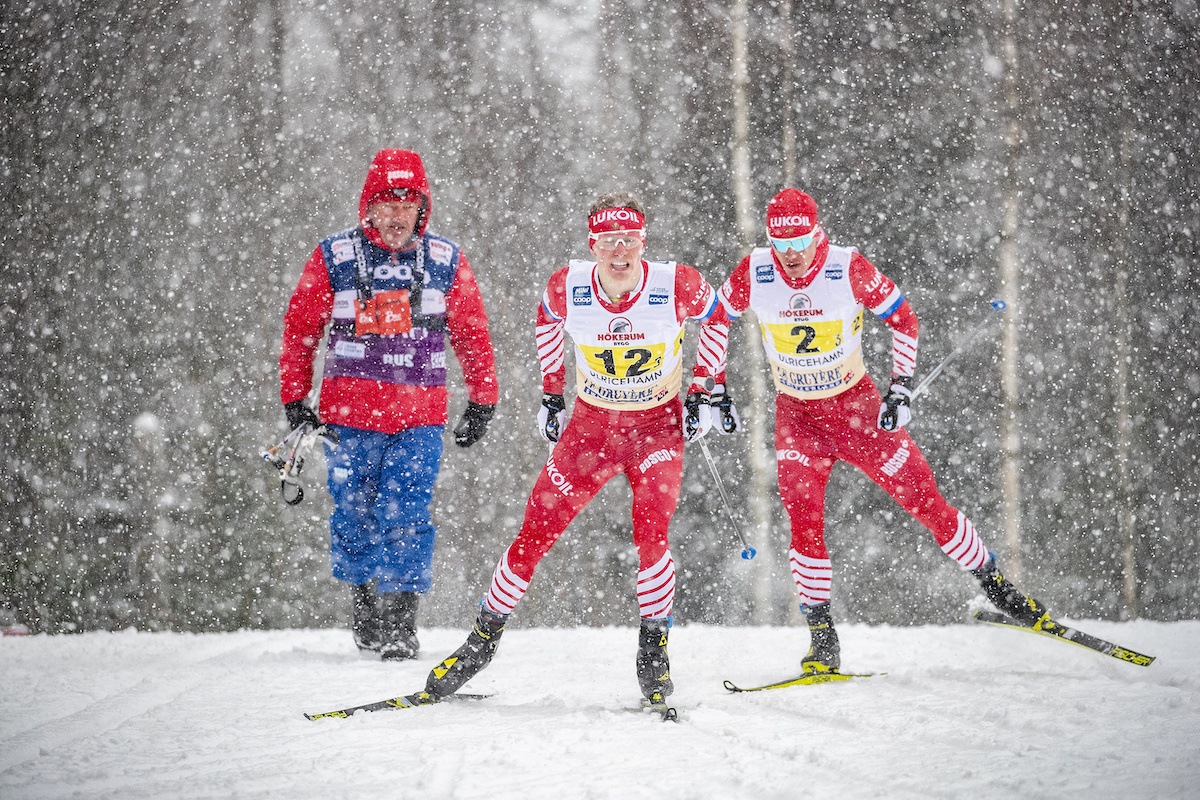
    Russia’s Denis Spitsov (bib 12) and Andrey Melnichenko (bib2) leading the men’s 4 x 7.5 k relay in Ulricehamn, Sweden. (Photo: Fischer/Nordic Focus)

    USST Head Coach Chris Grover commented on the Russian team’s performance this season. 

    “I mean they’ve been super strong all season, we certainly saw that up in Beitostolen and Lillehammer and the Tour,” Grover remarked over the phone. “It does seem like there are a lot of really good things going on with their program from a service perspective. They just had extraordinary skis race after race after race, especially in classic legs. It is very noticeable that they are doing a fantastic job on the service side and they obviously have a lot of depth and a lot of great athletes that have been coming up for a long time.”

    The Norwegian team, as strong as they were, fell back during the first classic leg. It was a gradual decline for Holund throughout his 7.5 k effort. Coming into the first exchange, Norway was sitting in 12th place.

    During Norway’s second leg, Tønseth made gains. He tagged Norway off in fourth place, giving his teammates a chance at the podium. Røthe, the third skier for Norway hammered to put his team within eyesight of third, which at the time was held by Lari Lehtonen of Finland.

    By the end of his leg, Roethe had caught, passed and dropped Lehtonen, putting Norway solidly in third place. Krueger, the Norwegian team’s anchor, was able to hold third place until the finish. According to FIS, Norway has been on the podium in every men’s distance relay for the last 12 years.

    The U.S. relay team, Erik Bjornsen, Scott Patterson, David Norris, and Benjamin Lustgarten finished 13th overall (+4.10.8). 

    During the first two legs, the U.S. team sat in the top-10. Bjornsen skied a strategically strong race, skiing smoothly towards the front of the pack. For the remainder of the race, the U.S. bounced bouncing between eighth and 13th place.

    The U.S. Ski Team’s Erik Bjornsen during December’s  4 x 7.5 k relay in Beitostølen, Norway. (Photo: Aleks Tangen)

    Bjornsen commented on the team’s strategy going into the race, “Our tactics were to try and stay with the group for as long as possible. We knew we weren’t going to be fighting for a podium spot today, just with where everyone is at right now. We also know this is good practice for World Champs so we used it as another opportunity to learn. We’ve set a goal as a men’s team to get a top 8. In a few years with some strong younger guys coming up, maybe that could be a top 5. Once you’re getting top 5’s then anything is possible when it all comes together.”

    Bjornsen chose to race only the relay this weekend in preparation for World Championships which begin in three weeks. His conservative approach to race stars this weekend left him feeling fresh for Sunday’s relay.

    “Erik did a great job, stayed in the fight for a long time there and it may be one of Scott’s better classic races. He did a really good job of holding steady with the group that he was in,” Grover commented.

    This was Norris’s first World Cup since the U.S. National Championships concluded in early January.

    “Coming off of Nationals I feel fit and healthy,” Norris told FasterSkier. “I got here Thursday night and I am glad I got two hard races in before a training camp in Davos. I am going to Davos tomorrow. This gives me plenty of time to adjust and prepare for the Cogne World Cup and World Championships.”

    The U.S. team has a distance and sprint training camp planned for the next two weeks until the World Cup in Lahti, Finland on Feb. 9. The Lahti races include a skate sprint and team sprint, with no distance races scheduled until Cogne’s races starting on Feb.16. These training camps are in preparation for the World Championships in Seefeld, Austria.

    Men’s Results

  • Sunday Race Rundown: Ulricehamn, Antholz, and Lake Placid (Updated)

    Sunday Race Rundown: Ulricehamn, Antholz, and Lake Placid (Updated)

    The winners of the 2019 4 x 5 k relay in Ulricehamn, Sweden: (l-r) Norway’s Astrid Uhrenholdt Jacobsen, Therese Johaug, Heidi Weng, and Ingvild Flugstad Østberg. (Photo: fis-ski.com screenshot)

    FIS World Cup Ulricehamn, Sweden 4 x 5 k / 4 x 7.5 k relay

    The sun rises, the sun sets, and Norway wins the women’s 4 x 5-kilometer relay in Ulricehamn, Norway on Sunday. For the 11th time in a row, a Norwegian women’s team bested the world in the storied race format.

    Heidi Weng, Therese Johaug, Astrid Uhrenholdt Jacobsen, and Ingvild Flugstad Østberg won in a time of 57:06.3 minutes. For the first tag, nine teams came in separated by 8.1 seconds. Johaug, skiing the second leg for Norway, opened a gap of 9.3 seconds over Russia I by the 10 k mark.

    The time back to second-placed Sweden I stretched to 37.4 seconds by the finish.

    Sweden I’s team consisted of Evelina Settlin, Ebba Andersson, Charlotte Kalla, and Jonna Sundling.

    Finland I placed third (+41.2) wth Laura Mononen, Krista Pärmäkoski, , Riitta-Liisa Roponen, and Evelina Piippo.

    The U.S. team of Sadie Bjornsen, Rosie Brennan, Caitlin Patterson, and Jessie Diggins finished in sixth (+1:26.6).

    Women’s Results

    In the men’s 4x 7.5k relay, Russia II and Russia I came away in first and second place respectively.
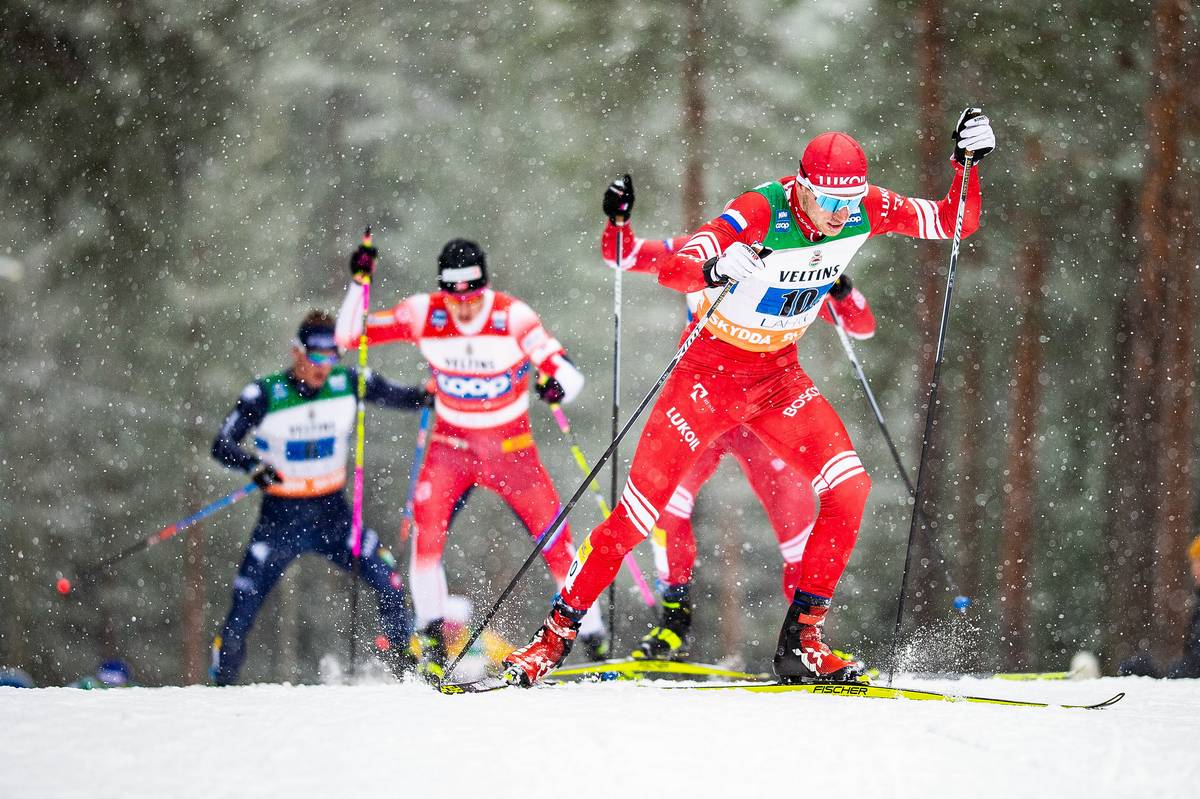
    Russia II’s team of Evgeniy Belov, Alexander Bessmertnykh, Denis Spitsov, and Artem Maltsev won in a time of 1:17.53.2 hours.

    Russia I’s Andrey Larkov, Alexander Bolshunov, Andrey Melnichenko, and Sergey Ustiugov finished 20.8 seconds back.

    In third was Norway, 35.8 seconds behind. Hans Christer Holund, Didrik Tønseth, Sjur Røthe, and Simen Hegstad Krüger, Norway’s foursome, were 35.8 seconds back. On the first leg, at 9.7 k, Norway was in ninth place, with a 43.1-second deficit.

    The U.S. team of Erik Bjornsen, Scott Patterson, David Norris, and Ben Lustgarten placed 13th (+4:10.8).

    Men’s Relay Results


    ***

    IBU World Cup Antholz, Germany 12.5 k / 15 k Mass Start

    On Sunday in Antholz, home country athlete Germany’s Laura Dahlmeier won in 35:32.8 minutes while skiing a single penalty lap during her first prone stage. The Czech Republic’s Marketa Davidova placed second (13.1, 0+0+1+0), with Vanessa Hinz of Germany in third (+16.4 1+0+0+0).

    “It’s a fantastic feeling to be right at the top again,” Dahlmeier told the IBU. “I started very badly and I felt slow. But I came back strongly and I remained virtually without error in the shooting. It was a good weekend for me.”

    US Biathlon’s Clare Egan raced and shot to 15th overall, 1:05.8 back, with two penalties in her first prone stage, otherwise she shot clean.

    Rosanna Crawford of Canada placed 28th (+3:50.2, 0+1+3+1).

    Women’s Results

    In the men’s 15 k mass start, there was one new development: Johannes Thingnes Bø of Norway did not win.  He did, however, place second to France’s Quentin Fillon Maillet. He won the race in 34:39.4 seconds while shooting clean in all four stages. Depositing between PLN 60 and PLN 199, we will receive a bonus of 125% of our deposit (a maximum of PLN 1,600), as well as a package of 50 free spins Vulkan Bet on the Doom of Dead slot machine. On the other hand, if we deposit at least PLN 200, we will get 100 free spins after the game as a reward, as well as a bonus of as much as 200% of our own deposit (a maximum of PLN 2,800 to visit).

    Bø was 14.3 seconds back in second place, with a single miss in each of his standing stages. Germany’s Arnd Peiffer was third (+24.6, 0+0+0+0).

    Christian Gow of Canada was the sole North American in the race. He placed 27th (+3:22.5, 1+1+0+1).

    Men’s Results

    ***

    Lake Placid SuperTour 10 k/15 k mass start classic

    Kaitlynn Miller (CGRP) won the women’s 1o k classic mass start in 36:12.7 minutes. Coming in 2.9 seconds back was Jessica Yeaton (APU/Australian National Team) in second place. In third, skiing for Dartmouth, was Katharine Ogden (37:27.8).

    Women’s Results

    Kyle Bratrud (SMS T2) won the men’s 15 k classic mass start in 46:41.3 minutes. In second place was Adam Martin (CGRP) who raced to a time of 46:55.0. Canada’s Andy Shields (Lappe Nordic) placed third in 47:41.6.

    Men’s Results


  • Spills and Thrills as Norway I wins Men’s Team Sprint in Dresden

    Spills and Thrills as Norway I wins Men’s Team Sprint in Dresden

    The men’s team sprint podium from the Dresden, Germany World Cup team sprint: From left to right, Norway II in second, Norway I first, and Russia I third. (Photo: fis-ski.com screenshot)

    A strip of imported snow along the Elbe river, iconic architectural reminders of old-world Europe’s city-scape in Dresden, Germany, Lycra, speedy skiers, and teams of two: all the ingredients for the men’s 1.6-kilometer freestyle team sprint.

    With tight pack skiing a function of the the relatively flat Dresden ski loop, the ten teams in the final attempted to play stay-out-of-trouble-skiing for the six total laps. But with a crowded tag area and tight corners where skiers abruptly bled speed, mix ups and tumbles occasionally picked skiers out of the front scrum.

    Coming into the final tag, 8 k into the race, the top-seven teams came through the time check all within 2.63 seconds of one another.

    Norway II, Italy I, Russia II, Norway I, France I, Russia I, and Great Britain sped through with the remaining three teams in the finals, Switzerland I, Austria I, and Australia I within closing distance to the leaders.

    Intermittently contracting and spreading out, no decisive moves to splinter the group materialized until the last lap.

    In the team sprint, it’s not simply the fastest one or two lap skier who prevails — each athlete, during their three respective legs (each leg consisted of three laps), was required to mentally focus and push the boundaries of their aerobic and anaerobic engines for 4.8 k total.

    On that last lap, the pull away move was simple enough. 

    Leading much of the final k was Norway I’s Sindre Bjørnestad Skar, the winner of Saturday’s skate sprint in Dresden. Skar kept out trouble, positioning himself at the front. He then shifted into a sixth or seventh gear no other skier could match.

    Up to the point Skar began to channel his reserve of booster-fuel, it appeared it could have been one of several teams across the line first. But approximately 4.6 k into Skar’s pathway to the finish line, his top effort was simply too much. he was on another level of endurance-sprint fitness as he closed out the win. 

    Skar along with his teammate Erik Valnes won the final in 22:38.72 minutes. 

    Sindre Bjørnestad Skar in front to finish first for Norway I during the Dresden, Germany World Cup team sprint on Sunday. (Photo: ZDF screenshot)

    But behind Skar, a four team whirlwind charged down together on the finish. A photo-finish captured the moment to decide the final standings. In second (+0.75) was Norway II’s Pål Golberg and Eirik Brandsdal, Russia I’s Artem Maltsev and Gleb Retivykh third (+0.80).

    Fourth place, 1.01 seconds back, went to Roland Schaad and Jovian Hediger of Switzerland. Russia II’s Andrey Krasnov and Alexander Terentev were fifth (+1.04).

    Great Britains’s James Clugnet and Andrew Young placed sixth (+3.17).

    Right in the middle of the the finishing lane mix, possibly fighting for podium scraps was Italy’s Federico Pellegrino. He appeared to catch his tip on another skiers ski-tail and took a spill. He and teammate Dietmar Nöckler placed 10th in the 10 team final. The Italian duo won last season’s team sprint in Dresden.


    https://www.youtube.com/watch?v=5AkfrAn3dBg&feature=youtu.be

    Canada’s Bob Thompson and Len Valjas placed seventh (+2.46) in the first semi-final and did not advance to the final. It was the same fate for the only U.S. team entered in the men’s team sprint. Andy Newell and Erik Bjornsen placed 10th (+3.66) in the second semi, and failed to make the finals.

    Canada placed 15th in the final standings, the U.S. 19th.

    In bib 15, the U.S. Ski Team’s Erik Bjornsen navigates the crowds during Dresden, Germany’s team sprint on Sunday. (Photo: Garrott Kuzzy)

    Results

  • Sunday Race Rundown: Dresden Team Sprints & Oberhof Relays (Updated 2 x)

    Sunday Race Rundown: Dresden Team Sprints & Oberhof Relays (Updated 2 x)

    Racing in bib 4 for the U.S., Julia Kern keeps pace in the women’s team sprint during the Dresden, Germany World Cup on Sunday. (Photo: Garrott Kuzzy).

    FIS World Cup Dresden, Germany 6 x 1.6 k Freestyle Team Sprint

    The first World Cup team sprint of the season was run amidst drizzle and the Dresden, Germany city-scape as the women raced a total of six 1.6-kilometer laps.

    Round and round on the looping course, the pace was a mix of tactically subdued speeds with sustained bursts of energy to break the pack.

    After all the speed changes and exchanges with one athlete tagging off to the next, it came down to a 1.11 second difference between first place Sweden I and the three closet teams chasing from behind that ended in a photo finish.

    Sweden I’s Stina Nilsson and Maja Dahlqvist won in a time of 24:02.5 minutes. Sweden II’s Ida Ingemarsdotter and Jonna Sundling placed second (+1.11), and Norway I, with Eide Mari and Maiken Caspersen Falla in third (+1.11).

    U.S. I, featuring Julia Kern and Sophie Caldwell placed fourth (+1.11) after the photo finish was reviewed.

    The U.S. entered a second team, consisting of Ida Sargent and Hannah Halvorsen. That duo contested the first semi-final, the same semi as U.S. I, but did not advance after placing fourth (+5.44). The top-three teams from each semi advance to the final, along with the next four fastest teams which are the combined “lucky losers”. Today, the second semi was the faster of the two. The four lucky loser team advancing to the final all originated from the second semi.

    Sargent and Halvorsen ended up 11th overall.

    No Canadian team was entered in the race.

    Semi-Final Results | Final Results

    In the men’s 6 x 1.6 k skate team sprint race, Norway I and Norway II took the top two podium spots.

    In a lunge at the line, Norway I’s Erik Valnes and Sindre Bjørnestad Skar won the final in 22:38.72 minutes. Pål Golberg and Eirik Brandsdal of Norway II placed second (+0.75) and Russia I’s Artem Maltsev and Gleb Retivykh third (+0.80).

    Canada’s Bob Thompson and Len Valjas placed seventh (+2.46) in the first semi-final and did not advance to the final. It was the same fate for the only U.S. team entered in the men’s team sprint. Andy Newell and Erik Bjornsen placed 10th (+3.66) in the second semi, and failed to make the finals.

    Canada placed 15th in the final standings, the U.S. 19th.

    Men’s Semi-final Results | Final Results


    ***

    IBU World Cup Oberhof, Germany 4 x 6 k / 4 x 7.5 k Relay

    In the women’s 4 x 6 k relay, Russia placed first in a time of 1:18:46.4 hours. Evgeniya Pavlova, Margarita Vasileva, Larisa Kuklina, and Ekaterina Yurlova-Percht made up the team that used eight spares on their way to the win.

    Germany placed second (+33.5) with two penalty loops and 10 spare rounds. Karolin Horchler, Franziska Hildebrand, Franziska Preuss, and Denise Hermann comprised Germany’s second place team that had two penalties while using 10 spares. The Czech Republic’s Lucie Charvatova, Veronika Vitkova, Marketa Davidova, and Eva Puskarcikova placed third (+36.7) with 1 penalty loop and six spares.

    The top spot for the podium came down to the final leg, when Yurlova-Percht pulled out the win when Hermann skied two penalty loops. The Russian used three spares but escaped with no penalties to take the lead out of the shooting range on the final ski loop.

    Susan Dunklee, Clare Egan, Joanne Reid, and Emily Dreissigacker all represented the U.S.  and placed 12th (+5:35.8) while skiing five penalty loops and using 16 spares.

    Canada’s Sarah Beaudry, Emma Lunder, Megan Bankes, and Rosanna Crawford finished in 13th (+5:58.8) with four penalty loops and 15 spares.

    Women’s Relay Results

    Russian also claimed the men’s relay, winning in a time of 1:20:54.3 hours. The winning team of Maxim Tsvetkov, Evgeniy Garanichev, Dmitry Malyshko, and Alexander Loginov skied no penalty laps and used six spares on their way to victory.

    Antonin Guigonnat, Simon Desthieux, Quentin Fillon Maillet, and Martin Fourcade raced for France. The French team placed second (+1:01.1) while skiing a single penalty lap and using eight spares.

    Austria’s Tobias Eberhard, Simon Eder, Dominik Landertinger and Julian Eberhard placed third (+2:18.6) with one penalty lap and using seven spares.

    Canada’s Scott Gow, Christian Gow, Jules Burnotte, and Brendan Green and the U.S. team of Leif Nordgren, Sean Doherty, Travis Cooper, and Max Durtschi were eventually lapped. Neither team was given an official finishing time.

    Canada was ranked 18th in the final standings, the U.S. 19th.

    For both relays today, the snowy weather and tough course conditions made for a strenuous day of shooting and skiing.

    Men’s Relay Results

  • Kalla Continues to Dominate in Gällivare; Russia Sweeps Men’s 15 k Classic

    https://www.instagram.com/p/BbpElh6gxkx/?taken-by=kalla_87

    Note: This article has been updated to include comments from Sweden’s Charlotte Kalla.

    For the second day in a row, Charlotte Kalla, a name synonymous with the yellow and blue of Sweden, stood atop the podium, placing first in the women’s 10-kilometer classic International Ski Federation (FIS) race on Saturday in Gällivare, Sweden. On Friday, Kalla won another individual-start race, the 5 k freestyle, by a margin of 8.8 seconds. She more than doubled that time gap by the finish of Day 2, winning the 10 k classic in 27:55 minutes, 17.7 seconds ahead of Russia’s Yulia Tchekaleva in second place. Natalia Nepryaeva, also from Russia, skied to third, 40.9 seconds back of Kalla.

    “I am feeling good and I think I am where I should be at this moment,” Kalla wrote in an email. “I had a good feeling on the classic race and handle the condition well. On Friday I opened hard and tried to push hard all the way.”

    Known as a skate powerhouse, Kalla has improved her classic skiing and is now a double threat. “I have improved my classic technique the last years,” Kalla explained. “When I am in shape it doesn’t matter if it is skating or classic. I am glad I managed to ski well in the condition we had. It was a little bit soft because of the snowfall.”

    Although a home FIS event for Sweden, Russia secured six of the top-10 spots with Sweden settling for three. Japan’s Masako Ishida, the only non-Russian or Swede outlier in the top 10, placed fourth (+1:02.4). Russians Anna Zherebyateva raced to fifth (+1:08.8) while teammate Yulia Belorukova was sixth (+1:12.8).

    Sweden took the next two spots with Stina Nilsson in seventh (+1:20.9) and Anna Haag in eighth (1:20.9). Russia rounded out the top 10 with Anatasia Sedova placing ninth (+1:24.1) and Mariya Guschina in tenth (+1:25.0).

    Sweden’s Ida Ingemarsdotter, a World Cup regular, placed 11th (+1:30.6).

    Kikkan Randall was the only U.S. Ski Team member at the race, and a day after finishing eighth in the 5 k skate, she finished 15th (+1:48.1) on Saturday. In an email, Randall explained that snow had fallen continuously for the last 24 hours in Gällivare.

    “Conditions were pretty nice, the track was a little soft and a lot of racers here made the pole track a little punchy,” she wrote.

    Considering the massive time-zone shift from her home in Anchorage, Alaska, to Central European Time, it appears Randall is adjusting well.

    “I felt decent today, not too tired from the jet lag or yesterday’s race. I wanted two back-to-back races to get ready for next weekend’s triple World Cup opener,” she wrote, referring to the first three World Cup races in Kuusamo, Finland, starting Friday, Nov. 23.

    Throughout Saturday’s 10 k, Randall steadily improved her overall placing: she was 32nd at 4.2 k, 23rd at 6.8 k and locked into 15th by 9.2 k.

    “It was definitely good to race a 10km classic today,” Randall wrote. “I had trouble really digging into my race gear on the first lap today. I think I was skiing a little stiff and not carrying my momentum down the track. Nepryaeva [the third-place finisher] caught me going into the 2nd lap and that was the jumpstart I needed. I was able to match her pace for most of the rest of the race and it helped me find better technique and tempo.

    “I wanted to be a little stronger today but I got some really important feedback on where I’m at and what I need to work on as the race season progresses,” she added. “My fitness feels pretty good and now it’s just a matter of fine-tuning.”

    Emily Nishikawa was the only Canadian entered on Saturday and finished in 51st (+3:39.3). Sixty-nine women started the race, 38 from Sweden, 17 from Russia, seven from Japan, two from Switzerland and Estonia, and one each from the U.S., Canada, and Poland.

    Yesterday’s 12th-placed skier, Russian Evgenia Shapovalova, who was recently handed down a lifetime Olympic ban by the International Olympic Committee (IOC), did not start the race.

    Russia Sweeps

    In Friday’s 10 k skate in Gällivare, only Swiss star Dario Cologna kept the Russians from sweeping the top nine by placing third. In that race, Evgeniy Belov and Sergey Ustiugov of the Russian national team finished first and second, respectively.

    Saturday was a different race, a 15 k classic, but with a similar thread and no Cologna as a Russian foil.

    The Russian men finishing in unison to take first, second and third in the men’s 30 k skiathlon, the final race of 2017 U23 World Championships at Soldier Hollow in Midway, Utah. Alexander Bolshunov (8) was deemed the winner, Alexey Chervotkin (1) was second, and Denis Spitsov (11) third. (Photo: FlyingPointRoad.com)

    It was Russia, Russia, Russia.

    Alexander Bolshunov, winner of the 30 k skiathlon at 2017 U23 World Championships, won the race in 37:13, one second ahead of Maxim Vylegzhanin in second. Alexey Chervotkin was third (+5.1).

    Classic specialist, Kazakhstan’s Alexey Poltoranin finished fourth, 13 seconds off the podium, and Cologna placed fifth (+22.1).

    Despite being on Swedish soil, the rest of the top 10 became a mostly Russian affair. Russian teammates Alexey Vitsenko and Artem Maltsev placed sixth (+29.5) and seventh (+37.4), respectively, Sweden’s Calle Halfvarsson interrupted the trend by tying Russia’s Evgeniy Belov for eighth (+38.0), and Russia’s Alexander Bessmertnykh took 10th (+40.1).

    There’s a pattern: Russia took 14 of the top-20 places. Twenty-eight of 126 starters were from Russia, with the vast majority of the field being Swedish. Outside of the top 10, Sweden’s Daniel Rickardsson was the next-best Swede in 12th (+49.6).

    Devon Kershaw (World Cup Team), who finished 12th on Friday, once again led Canada in 20th (+1:06.7). At 6.8 k, Kershaw was ranked 15th, and at 9.6 k he was down one spot to 16th. By the 11.4 k checkpoint, he began slipping further in the standings.

    “Today was a tough one,” Kershaw wrote in an email. “I felt pretty good but conditions were soft, so you had to really feather it (the technique) – especially on the climbs.  Pacing wise I think I was doing pretty well, but in the last 2.5km today I was missing any semblance of a kick to the finish and ended up conceding a few seconds to those around me, knocking me from about 15-16 to 20th.”

    Although an interval start race, Kershaw never found a strong pacing partner. “I was skiing alone – no help at all today,” Kershaw wrote of his solitary effort. “It would have been so helpful! Especially that last lap when things get tough. But in individual start races, you need to learn to do it alone. So good to try and get used to that “time trial” feeling.”

    Three other Canadians competed, with Graeme Killick (World Cup Team) finishing 50th (+2:32.3), Jack Carlyle (Alberta World Cup Academy) 91st (+4:06.1), and Brian McKeever (Para Nordic Team) 110th (+5:16.0).

    As of press time, Fasterskier could not confirm if the International Ski Federation (FIS) held an emergency meeting to discuss the involvement of IOC-banned Russian skiers in FIS-sanctioned races. Of the six IOC-sanctioned Russian skiers, four are men: Belov, Vylegzhanin, Alexander Legkov, and Alexey Petukhov. All four skiers raced on Friday, however, Legkov and Petukhov (and Shapovalova, one of the two women sanctioned by the IOC) did not contest Saturday’s race.

    Racing continues in Gällivare on Sunday with classic sprints.

    Results: Women | Men

  • Kalla, Belov Top Gällivare FIS Opener; Randall 8th, Kershaw 12th

    Kalla, Belov Top Gällivare FIS Opener; Randall 8th, Kershaw 12th

    Sweden’s Charlotte Kalla racing to a win in her first race of the 2017/2018 season, the women’s 5 k freestyle in Gällivare, Sweden, on Friday. (Photo: Sporteventgallivare/Instagram)

    Sweden’s Charlotte Kalla and Hanna Falk went 1-2 in Sweden’s season-opening International Ski Federation (FIS) race on Friday in Gällivare, with Kalla winning the women’s 5-kilometer freestyle by 8.8 seconds in 12:58.1 minutes. Falk, her teammate on the Swedish women’s team, placed second and Russia’s Yulia Belorukova took the third spot on the podium, 10.3 seconds out of first.

    The host nation had three in the top four, with Ida Ingemarsdotter in fourth (+16.1). Switzerland’s Nathalie von Siebenthal finished fifth (+17.8), Russia’s Yulia Tchekaleva placed sixth (+23.4), and Russia’s Natalia Nepryaeva was seventh (+25.0).

    Kikkan Randall of the U.S. Ski Team raced to eighth (+27.2), just ahead of Sweden’s Evelina Settlin in ninth (+32.0) and Russia’s Anna Nechaevskaya in 10th (+33.5). Japan’s Masako Ishida was just 0.3 seconds out of the top 10 in 11th.

    In an email, Randall explained that she decided to venture to Europe earlier this year to get some racing in ahead of the World Cup.

    “We also wanted a little extra time to let Breck adjust to the 10hr time change!” she wrote of her 1-year-old son, who will be traveling the World Cup circuit with Randall and her husband, Jeff Ellis, this winter.

    (Article continues below)

    Most of the U.S. Ski Team arrived in Rovaniemi, Finland, on Thursday, Nov. 16 (with the exception of Andy Newell, who is racing this weekend in Beitostølen, Norway, with Noah Hoffman). The rest of her teammates planned to train at the Santasport Olympic training center in Rovaniemi until Nov. 21, when the entire team will meet up in Kuusamo (also known as Ruka), Finland — the site of next weekend’s World Cup opener.

    “I’m happy with my start today,” Randall wrote of Friday’s race. “It took my a couple km’s to get going today but I felt like I was finding my rhythm in the 2nd half of the course.  It’s my first hard session this week after the travel over so today was a good jolt!  It was a competitive field and I was satisfied to be in the mix.”

    Ninety-two women raced the Gällivare 5 k skate, compared to 56 women on Friday in Beitostølen (Norway’s FIS season-opener). Randall planned to race the 10 k classic on Saturday in Gällivare, then skip Sunday’s classic sprint.

    “It’s great to be back around other World Cup skiers again and I’ve always liked Gällivare so it’s nice to be back here,” she wrote. “My former wax tech lives here and has been taking great care of us. … Looking forward to meeting up with the team in Ruka next week.”

    With 46 Swedes and 23 Russians accounting for most of the women’s field, Canada’s Emily Nishikawa put herself in the mix in 26th, 54.9 seconds behind Kalla. Nishikawa’s Canadian World Cup teammate Dahria Beatty placed 56th (+1:38.3).

    For Nishikawa, who’s known as a distance skier, the top-30 result was notable in that a 5 k falls somewhere between a sprint and a distance race.

    “5km is such a hard distance, and it is over so fast, but it is a lot of fun,” Nishikawa wrote in an email. “I have been able to work on my sprinting a bit more this summer as I have been injury free, so I’m looking forward to seeing more speed in my racing this season.”

    She planned to race all three days in Gällivare, including Sunday’s sprint.

    “With these races, I am just hoping to fine tune my fitness and get some hard intensity in to feel sharp for the upcoming World Cup races,” added Nishikawa, who’s entering her fifth World Cup season as a leading member of the Canadian women’s World Cup Team. “Today’s race was a really hard effort and I am happy with how I skied today.”

    The 12th-ranked Russian woman on Friday, Evgenia Shapovalova, who was recently banned for life from future Olympics, placed 22nd.

    Belov Bests Ustiugov

    In the men’s 10 k freestyle on Friday, another one of the Russians sanctioned by the International Olympic Committee (IOC), Evgeniy Belov won in 23:08.5. He was 6.5 seconds faster than his Russian teammate Sergey Ustiugov, who placed second. Ustiugov is the defending Tour de Ski champion and Overall World Cup runner-up.

    Switzerland’s Dario Cologna placed third, 7.6 seconds out of first, and Russia swept fourth through ninth, with Sweden’s Marcus Hellner following in 10th (+36.4). Out of the five actively competing skiers the IOC sanctioned earlier this month, all five raced on Friday in Gällivare, which was legal considering FIS had not ruled they can’t.

    Four of those skiers are men. In addition to Belov, Maxim Vylegzhanin placed 14th (+43.2), Alexander Legkov followed in 15th (+45.9) and Alexey Petukhov finished 23rd (+56.7) out of 157 finishers on Friday.

    Devon Kershaw (front) training with U.S. Ski Team sprinter Andy Newell in Sjusjøen, Norway, last week. (Photo: Noah Hoffman)

    Ahead of them, Canada’s Devon Kershaw ended up 12th (+39.9), tying another Russian Artem Maltsev (who is not on the IOC-banned list) with identical times.

    “My stance on the whole Russian fiasco is unchanged,” Kershaw wrote in an email, referring to a previous email he wrote to FasterSkier earlier this week when asked how he felt about the IOC-banned Russians competing in FIS events. “I find the entire thing both disturbing and hilarious. The fact that FIS is risking their credibility like this makes no sense to me. Apparently there will be an emergency meeting of sorts tomorrow about it (with FIS I’m assuming but I haven’t heard much about it) – so we’ll have to all wait and see what they come up with.

    “As for seeing Belov win – I mean, that’s no surprise,” Kershaw continued. “He’s shown that he’s a force when he’s in form. But yeah, the fact that he and others have been recently banned for life by the IOC are winning races after that news came out just shows the Mickey Mouse club that our sport has become.”

    As for his own race, Kershaw wrote that he felt great about it. The course suited him well without too much hard climbing. “… You kind of need to be pushing the whole way around. I really like courses like that,” he wrote.

    The conditions, however, with about 10 to 15 centimeters of new snow from the early morning that continued into the race, made the course slower, which Kershaw found to be more challenging.

    “But that is another reason why I am so satisfied with the effort today. Individual start skating in soft conditions? Not my favourite, so I’m happy how I was able to execute things,” he wrote. “For me to be in the mix in a 10km skate like that feels great. I had good energy all race and hit my technical goals for the race too, so I have to be satisfied.”

    Kershaw and the rest of Canada’s Period 1 World Cup team arrived in Gällivare last Sunday. Over the last week, they’ve been testing equipment and getting into a race routine ahead of the World Cup opener, he explained.

    “I changed various things with my training this year so it’s exciting to see how my body feels in the beginning of a new season,” Kershaw wrote. “… My goals are really to just be calm and execute well – which means going into the racing with no expectations other than to ski as technically well as possible while working on the whole pacing thing (which can be challenging at the beginning of the season when you don’t have that many races in the body). I’ll look to have another well executed race tomorrow and the results will be what they will be.”

    Canada’s NorAm leader at the end of last season, Russell Kennedy (Team R.A.D.) was the next-best Canadian in 48th (+1:35.7), followed by Len Valjas (World Cup Team) in 49th (+1:37.0). Jack Carlyle (Alberta World Cup Academy) placed 67th (+2:07.2), Julien Locke (National U25 Team) was 72nd (+2:10.9), Graeme Killick (World Cup Team) 90th (+2:32.2), Brian McKeever (Para Nordic Team) 97th (+2:39.0), and Jess Cockney (World Cup Team) 119th (+3:10.7). Knute Johnsgaard (World Cup Team) did not start.

    Racing continues in Gällivare this weekend with 10/15 k classic individual starts on Saturday followed by classic sprints on Sunday.

    Results: Women | Men

  • Retivykh Wins Again in PyeongChang; Newell & Hamilton 4th in Team Sprint

    Retivykh Wins Again in PyeongChang; Newell & Hamilton 4th in Team Sprint

    The men's freestyle team sprint podium at the PyeongChang World Cup on Sunday in South Korea, with France's Lucas Chanavat and Baptiste Gros in second (l), Russia's winning team of Gleb Retivykh and Andrey Parfenov (c) in first, and teammates Nikita Kriukov and Artem Maltsev (r) in third. (Photo: Fischer/NordicFocus)
    The men’s freestyle team sprint podium at the PyeongChang World Cup on Sunday in South Korea, with France’s Lucas Chanavat and Baptiste Gros in second (l), Russia’s winning team of Gleb Retivykh and Andrey Parfenov (c) in first, and teammates Nikita Kriukov and Artem Maltsev (r) in third. (Photo: Fischer/NordicFocus)

    France has never won a World Cup team sprint, neither for men nor women, classic nor freestyle.

    And its team will have to wait a bit longer for that time to come. But France was oh-so-close on Sunday, with Baptiste Gros and Lucas Chanavat racing against the Russian duo of Andrey Parfenov and Gleb Retivykh in the men’s 6 x 1.5-kilometer freestyle team sprint in PyeongChang, South Korea.

    Chanavat, last year’s U23 world champion in the freestyle sprint, tried to attack on the last steep climb but could not gap Retivykh decisively. Then he positioned himself behind the Russian on the downhill into the arena that will host next year’s Olympic Winter Games, shaking out his arms before tucking into the draft. Coming out of the final left turn, he managed to push up next to him on the finishing stretch, but Retivykh lunged over the line a ski boot ahead for the victory in a time of 19:34.11, with Chanavat just 0.03 seconds behind.

    “I did not know in the finish if we won until Andrey told me,” Retivykh told the International Ski Federation (FIS), according to a press release. “It was just as hard skating as it was in classic the other day.”

    But the French duo was not too disappointed after narrowly missing the victory.

    “Romantic meal to celebrate this first podium of the year! We will bring back a good memory of Korea and be strong for next year,” Gros posted on his Facebook page, according to a translation, at 4 a.m. local time with a picture of him and Chanavat wolfing down two cups of noodles.

    “Second in the Team Sprint World Cup in Pyeongchang with my teammate Baptiste Gros (Showing his last drop of rage sinking in his beard)!” Chanavat commented on his Instagram account with a picture of both men smiling. “Next step: be prepared for the world championships in Lahti!”

    Russia’s second team of Artem Maltsev and Nikita Kriukov secured the third position on the podium (+5.52).

    “It feels absolutely great to be back on the podium,” Kriukov told FIS. “For me it’s a very important step on the way back to the top.”

    It was Retivykh’s second victory of the weekend after also winning the men’s invidual classic sprint on Friday, and Russia improved their statistic to become the most successful nation in this event with seven victories in World Cup freestyle team sprints, which have only been contested 25 times so far.

    The U.S. Ski Team’s first team, with Andy Newell and Simi Hamilton, finished fourth, 24.23 seconds behind, after being unable to challenge for the podium on the last leg.

    The Norwegian team of Daniel Stock and Mathias Rundgreen initially crossed the line before the Americans, but was disqualified for an error on the penultimate exchange only tagging off at least a meter behind the allowed zone. Perhaps hoping a later protest might be successful, they kept skiing and finished the race, with no coach or event official stopping them.

    Earlier in the day, Newell and Hamilton had won their semifinal, half a second ahead of the Swedish team of Robin Norum and Gustav Erikson, while Russian’s Parfenov and Retivykh advanced in third (+0.53).

    “For me, I felt great in the semifinal, and in the final,“ Newell said on the phone after. “The semifinal was a lot more enjoyable, because it’s a very challenging course with a lot of climbing, and the pace was just relaxed enough that I was able to make moves when I wanted, and control when I wanted to control. I was able to come in and tag Simi in second to start his final leg, we were able to win that semi, and that was great.”

    In the men’s race, 14 teams advanced to the final round: the top-four teams from each semifinal heat, plus six more teams with the best times.

    Simi Hamilton (U.S. Ski Team) racing to 12th in the men's classic sprint qualifier on Friday at the PyeongChang World Cup in South Korea. He went on to finish 17th overall after crashing in his quarterfinal and finishing fourth in that heat. (Photo: Fischer/NordicFocus)
    Simi Hamilton (U.S. Ski Team) racing to 12th in the men’s classic sprint qualifier on Friday at the PyeongChang World Cup in South Korea. He went on to finish 17th overall after crashing in his quarterfinal and finishing fourth in that heat. (Photo: Fischer/NordicFocus)

    In the final, Newell and Hamilton initially stuck with the leaders on the first legs, with each racer having to ski a total of three 1.5 k loops, tagging off repeatedly.

    They were only 2.4 seconds back heading into the fifth leg, before Newell lost contact with the top four, which included Norway.

    “It was interesting, because there were so many quality distance skiers,” Hamilton said on the phone. “It definitely became evident what their strategy was, especially in the final, they kept the pace really high the whole time. That was tough.”

    “In the final it was pretty intense from the get-go,“ Newell agreed. “I know Norway and one of the Russian teams were really trying to push the pace in the first leg. It was pretty challenging, really tough. I felt pretty solid until the last lap, and then I lost contact coming over the hill, and it was kind of windy and snowy out there, so as soon as you lost contact, it was hard to regain it. It was a real leg burner. Unfortunately, that took us out of podium contention, we did end up finishing fifth, and then the Norwegian team was disqualified, so we got fourth. It was a fun day, a great workout, and a great way to practice that event on the Olympic trails.“

    Not helping matters was that Hamilton had to race with an upset stomach.

    “I don’t know if it’s something I ate or drank, so my energy wasn’t 100 percent, but I still really wanted to race hard,” he said. “It was a good opportunity to get a good result here with diminished fields. I definitely felt better racing than I thought I was going to, but it was for sure a pretty tough day. The course is really hard, it’s long, it’s got a couple of really big climbs, but it skied really well and we had great skis. Andy and I are pretty proud having put in a solid effort, maybe not one of our very best, but a good one for sure. We’re both encouraged by good fitness right now, leading into this little training block before World Champs.”

    The team-sprint discipline, which is the newest on the World Cup circuit, is still rarely on the competition schedule. And only two freestyle team sprint races had been held in Asia previously, both in Sapporo, Japan, for a 2006 World Cup and for the 2007 World Championships. But it seems to be a popular format to test new venues.

    “I don’t know why they are doing this, but every pre-Olympic weekend at least since Vancouver [for the 2009 World Cup respectively the 2010 Olympics] has always been sprint, skiathlon, team sprint”, U.S. Ski Team distance skier Noah Hoffman said on the phone last week, before his trip to Korea.

    Now it was PyeongChang’s turn in the test weekend for the 2018 Olympics. Hoffman did not race on Sunday, but the U.S. was able to start a second squad with Matt Gelso (Sun Valley Ski Education Foundation) and Scott Patterson (Alaska Pacific University).

    American Matt Gelso (24) racing to 19th in Saturday's 30 k skiathlon at the PyeongChang World Cup in South Korea. (Photo: Salomon/Nordic Focus)
    American Matt Gelso (24) racing to 19th in Saturday’s 30 k skiathlon at the PyeongChang World Cup in South Korea. (Photo: Salomon/Nordic Focus)

    In their first World Cup team sprint, the duo managed to advance through the semifinal finishing fifth, 13.86 seconds behind the French team that won the heat.

    “In the semi, our goal was to simply get in the top four for an automatic advance into the finals,” Patterson wrote in an email. “The pace went out moderate for the early laps and there were enough weak teams later in that it was somewhat easy to secure a high finish. Things spread out a little on the last lap for both Matt and I and we were able to advance even with a close finish for fifth.”

    “Scott and I had a hard semifinal,” Gelso wrote. “The pace was very fast from the start so it was very tiring by the end. I felt completely exhausted on the final lap and was concerned with how bad my legs felt that the final would be very bad.”

    But despite feeling tired, the duo managed to hang on in the final and improved by two positions on the last two legs to finish ninth (+54.85),

    “The final broke apart really early,” Patterson explained. “I think for both of us it was kind of survival mode and see if we could get any last drops out of our muscles. Norway and Russia pushed it hard from the gun. I’m not the fastest starter and got caught up behind a Belarusian [Michail Semenov] so I could not chase quite as much as I wished. By the top of the first hill I was bleeding time. From there it was mostly finding our own battles. The Canadians were in it for a bit, but eventually it was between the Germans [Thomas Wick and Andy Kühne] and us. It was a good fight for both legs and happily we took it in the end.”

    Germany placed 10th (+55.13) after Gelso won the finish sprint against Kühne, pushing out of the draft on the finish stretch and raising his left arm in a small celebration as he crossed the line.

    “The team sprint today was very fun as Scott and I were able to be in the mix, get into the final, and ski solid through the race,” Gelso wrote. “Not an outstanding result but a good, solid, fun day on the race course with ample opportunities to make things happen.”

    Canada’s Len Valjas had the chance to become the first athlete in a long time to win two consecutive  team sprints, after winning last month’s freestyle team sprint in Toblach, Italy, with teammate Alex Harvey.

    Teaming up with Jess Cockney for Sunday’s race (who had placed 10th in the sprint on Friday while Valjas finished fourth), the duo placed sixth (+4.1) despite a broken pole in the second semifinal, which Newell and Hamilton won.

    In the final, Cockney and Valjas were initially able to keep in sight of the leaders, tagging off in ninth in the first exchange, only five seconds back. By the race’s halfway point, they were 10th (+21.0), before falling to the back of the field and losing significant time. They went on to finish in 13th position, 1:38.2 behind the winners.

    Valjas and Cockney could not be reached by press time to determine if they had fallen back due to a crash, more broken poles, or were simply running out of energy after racing on a very demanding sprint course all weekend.

    The World Cup goes on break for a week before resuming Feb. 18-19 in Otepää, Estonia, with freestyle sprints and 10/15 k classic races, in the last World Cup before 2017 World Championships in Lahti, Finland.

    — Gabby Naranja and Jake Ellis contributed

    Results

  • Sunday Rundown: PyeongChang, Soldier Hollow & Eastern Canadian Champs (Updated x3)

    The women's 4 x 3.3 k relay podium on the final day of 2017 Junior World Championships at Soldier Hollow in Midway, Utah, with Russia (c) in first, Italy (l) in second, and the U.S. (with Hailey Swirbul, Julia Kern, Hannah Halvorsen, and Katharine Ogden) in third. (Photo: FlyingPointRoad.com)
    The women’s 4 x 3.3 k relay podium on the final day of 2017 Junior World Championships at Soldier Hollow in Midway, Utah, with Russia (c) in first, Italy (l) in second, and the U.S. (with Hailey Swirbul, Julia Kern, Hannah Halvorsen, and Katharine Ogden) in third. (Photo: FlyingPointRoad.com)

    FIS Nordic Junior World Championships (Midway, Utah): Junior relays

    Hailey Swirbul, Julia Kern, Hannah Halvorsen, and Katharine Ogden on the podium. That’s right. Two days after Ogden became the first American to earn an individual medal at Junior World Championships, those four U.S. junior women listed above did the same, placing third in the 4 x 3.3-kilometer relay on the last day of 2017 Junior World Championships at Soldier Hollow in Midway, Utah.

    The team credited their lucky socks, similar to the red-white-and-blue striped socks the U.S. women’s World Cup team wears for relays and team events.

    “We gave everything we got,” Kern said in a televised post-race interview.

    “It’s the dream,” Ogden said.

    In fourth at the last exchange, Ogden anchored the team to third, 25.8 seconds behind Russia, which won in 34:45.3 minutes with Polina Nekrasova, Lidia Durkina, Anna Zherebyateva, and Mariya Istomina.

    Italy placed second (+20.6) with Martina Bellini, Anna Comarella, Francesca Franchi, and Christina Pittin.

    Canada finished 12th (+4:41.3) with Natalie Hynes, Lisle Compton, India McIsaac, and Annika Richardson.

    [UPDATED] In the junior men’s 4 x 5 k relay that followed, Norway’s Thomas Helland Larsen outlasted Russia’s Vladislav Vechkanov by 0.4 seconds for the team win in 49:36.1.

    Norway’s gold-medal team included Herman Martens Meyer, Jon Rolf Skamo Hope, Harald Østberg Amundsen, and Larsen, while Russia took silver with Egor Kazarinov, Kirill Kilivnyuk, Yaroslav Rybochkin, and Vechkanov.

    France rounded out the podium in third (+1:05), with Martin Collet, Camille Laude, Hugo Lapels, and Arnaud Chautemps.

    The U.S. finished ninth (+4:28.8) with Bill Harmeyer, Kam Husain, Wyatt Gebhardt, and Hunter Wonders, and Canada followed in 10th (+5:21.6) with Antoine Blais, Ryan Jackson, Philippe Boucher, and Gareth Williams. Twelve teams finished the men’s relay, the final race of 2017 Junior World Championships.

    Results: Women | Men

    ***

    FIS Cross-Country World Cup (PyeongChang, South Korea): Freestyle team sprint

    The women's freestyle team sprint podium at the PyeongChang World Cup on Sunday in South Korea, with Sweden's Elin Mohlin and Maria Nordström (c) in first, Norway's Anna Svensen and Silje Øyre Slind (l) in second, and USA I's Ida Sargent and Sophie Caldwell (r) in third. (Photo: FIS Cross Country/Twitter)
    The women’s freestyle team sprint podium at the PyeongChang World Cup on Sunday in South Korea, with Sweden’s Elin Mohlin and Maria Nordström (c) in first, Norway’s Anna Svensen and Silje Øyre Slind (l) in second, and USA I’s Ida Sargent and Sophie Caldwell (r) in third. (Photo: FIS Cross Country/Twitter)

    The U.S. women had one team on the podium and one just 0.35 seconds off of it on Sunday in the World Cup 6 x 1.4-kilometer freestyle team sprint in PyeongChang, South Korea.

    USA I, with Sophie Caldwell and Ida Sargent, skied in third for most of the race and ultimately finished third, 6.11 seconds behind Sweden’s Elin Mohlin and Maria Nordström in first (in 20:37.11 minutes). Norway took second, 1.71 seconds back, with Anna Svensen and Silje Øyre Slind, while USA I edged USA II, with Caitlin Patterson and Liz Stephen for third. Patterson and Stephen ended up fourth (+6.46), ahead of Slovenia’s Katja Visnar and Anamarija Lampic in fifth (+14.46).

    Fifteen women’s teams competed on Sunday, with 10 of them reaching the final. Canada placed 14th overall with Annika Hicks and Sadie White.

    In the men’s 6 x 1.5 k freestyle team sprint, Russia’s Gleb Retivykh picked up his second win in in PyeongChang, after winning Friday’s classic sprint. He teamed up with Andrey Parfenov for the victory in 19:34.11, beating France (Baptiste Gros/Lucas Chanavat) by 0.03 seconds in a photo finish.

    Russia had two teams on the podium with Russia II’s Artem Maltsev and Nikita Kriukov in third (+5.52). Andy Newell and Simi Hamilton (USA I) fell off the leaders’ pace to finish fourth (+24.23), 18.71 seconds off the podium.

    USA II, with Scott Patterson and Matt Gelso, finished ninth (+54.85) in the final, and Canada’s Jess Cockney and Len Valjas placed 13th of 14 teams.

    Results: Women | Men 

    ***

    NorAm Eastern Canadian Championships (Cantley, Quebec): 15/20 k freestyle pursuits

    SMS Elite's Anne Hart catching Nakkertok's Zoe Williams in the interval start classic, day two of Eastern Championships. (Photo: Ian Austen)
    SMS Elite’s Anne Hart catching Nakkertok’s Zoe Williams in the interval start classic, day two of Eastern Championships. (Photo: Ian Austen)

    The NorAm mini tour at the Nakkertok Nordic Centre wrapped up with freestyle pursuits.

    In the men’s 20 k, AWCA’s Russell Kennedy posted the fastest time of 53:42.68 to move up from third to take the overall victory in 1:33.22.  Lappe Nordic’s Andy Shields started first but couldn’t hold off Kennedy, finishing 36 seconds behind with a 6th best time, 1:01.46 slower. AWCA’s Dominique Moncion-Groulx wrapped up a strong weekend with the fourth best time of day, 37.92 back, to take third overall, 58.53 behind Kennedy.

    SMS Elite’s Anne Hart won the women’s 15 k pursuit in dominant style, starting first and winning time of day in 47:36.10 for an overall time of 1:17:39. AWCA’s Maya MacIsaac-Jones started third and finished second with the second best time of day, 31.36 seconds back for a combined deficit of 51.39 seconds. CNEPH’s Sophie Carrier-Laforte started second and ended third, 2:14.81 down after a sixth best time of day 2:05.47 back.

    Results: Pursuit | Full Weekend

  • Russian Men End Junior Worlds on Ultimate High; Swedish Women Squeak by for Relay Win

    Russian Men End Junior Worlds on Ultimate High; Swedish Women Squeak by for Relay Win

    The Russian men's relay celebrates their third victory in four races at 2013 Junior World Championships in Liberec, Czech Republic. (Photo: Liberec2013)
    The Russian men’s relay celebrates their third victory in four races at 2013 Junior World Championships in Liberec, Czech Republic. Dmitry Rostovtsev (r) anchored the team’s win Sunday after winning two individual distance races this week. (Photo: Liberec2013)

    If you knew nothing about the competitors at the International Ski Federation (FIS) Junior World Championships throughout the last week in Liberec, Czech Republic, all you had to look for were the blue-and-red suits with white Adidas stripes. Those were the Russians, and man, were they fast.

    Russia's three-time 2013 Junior World Champion, Dmitry Rostovtsev
    Russia’s three-time 2013 Junior World Champion, Dmitry Rostovtsev

    Led by 19-year-old anchor Dmitry Rostovtsev, who won two of three individual world titles just days earlier, the Russian men rallied to a resounding victory in 4 x 5 k relay, beating runner-up Norway by 18.7 seconds in 45:35.5.

    The Russians faltered just once – during the second leg – when two-time 2013 Junior Worlds silver medalist Artem Maltsev fell 12.6 seconds out of the lead into fourth. Alexey Chervotkin had put the Russians in first early, and Maltsev tagged off to Roman Tarasov, who brought them back up front. At the final exchange, Rostovtsev surged ahead with a four-second lead on Norway’s anchor Haavard Solaas Taugboel.

    The Norwegians (Bjørn Vidar Suhr, Simen Hegstad Krueger, Magne Haga, and Taugboel) hung in for silver, more than 30 seconds ahead of Sweden in third (+52.2) out of 19 teams. With Oskar Svensson, Marcus Ruus, Oscar Ivars, and Rasmus Hornfeldt, the Swedes led after the second leg, but dropped 19.4 seconds off the pace in the third leg and remained in third thereafter.

    “To win gold medal with the team is always something special, ” Rostovtsev said in a Liberec 2013 press release.

    He previously won two Junior Worlds titles in this year’s 10 k freestyle and 20 k skiathlon. Maltsev, who stuggled during his classic leg Sunday, was the runner-up in both individual distance races.

    “The boys did their best on their leg so I could control the race but I still wanted to ski fast and secure the victory, ” Rostovtsev added.

    Rostovtsev and Maltsev defended their relay title from last year’s Junior Worlds in Erzurum, Turkey, where they beat Kazakhstan by nearly 45 seconds. Norway, with Taugboel, was third in the 2012 relay.

    “I knew Rostovtsev is a tough guy; he is very strong, ” Taugboel said. “In the second 2.5 km lap he went away so fast, I just did not have enough power. I am satisfied with the silver medal. I have not been in a best shape during the championships, so it is a great satisfaction for us.”

    It was the Norwegians’ first silver of the week, and Sweden made the podium for the first time at this Junior Worlds.

    “I am very happy for the bronze medal, ” Swedish anchor Hornfeldt said. “Everybody gave the best performance of the week so we deserve the medal today. I felt pretty good. I saved same energy for the last uphill!”

    Men’s results

    Swedish Women Oust Russia

    The Swedish women's relay celebrates its Junior Worlds victory with anchor Stina Nilsson. (Photo: Liberec2013)
    The Swedish women’s relay celebrates its Junior Worlds victory on Sunday with anchor Stina Nilsson. (Photo: Liberec2013)

    The women’s 4 x 3.3 k turned out to be less predictable, with Sweden’s Stina Nilsson giving Russian Nadezhda Shuniaeva a run to the finish. Trailing Shuniaeva closely in second at the last exchange, Nilsson charged ahead late to seal the Swedish victory by 2.2 seconds in 35:41.1. It was Nilsson’s second win of the week after she claimed the classic-sprint title last Monday.

    She repeated the feat with the help of teammates Julia Svan, Sofia Henriksson and Jonna Sundling, and Russia took second of 14 teams with Alisa Zhambalova, Natalia Nepryaeva, Anastasia Sedova and Shuniaeva. Germany was third, 50.3 seconds out of first, with Laura Gimmler, Katharina Hennig, Julia Belger, and Victoria Carl. The 5 k freestyle champion, Carl collected a different medal in every event she competed in this week, including silver in the classic sprint.

    Early in Sunday’s relay, it became clear that the race would likely boil down to two teams: Russia and Sweden. With Nepryaeva, Russia built its biggest lead of 2.9 seconds after the second exchange. Sweden stuck in second and Germany was nearly 30 seconds back in third.

    Sweden’s Sundling then latched on to Sedova on the third leg, closing within 0.4 seconds of her at the last tagoff. Not long after winning silver in a World Cup team sprint in Liberec a couple weeks ago, Nilsson made a late surge to capture the victory on Sunday.

    “It is amazing to win the relay, ” the 19-year-old said. “I knew I would be strong in the finish and I was confident I could go for victory. The whole team did a great job. We have a big potential for the future.”

    After she helped Russia win last year’s Junior Worlds relay, 13.4 seconds ahead of Sweden (with Henriksson, Sundling and Nilsson), Shuniaeva said silver was a “very good result.”

    “I gave my best in the last leg but Stina was very fast in the finish,” she added.

    Germany’s Carl was also satisfied with her team’s finish.

    “I am very happy for the bronze medal,“ Carl said. “We have a young team and it is a great success for us. It gives us big motivation for the future work.”

    Women’s results

    The Swedish women's team gets a taste of gold at Junior World Championships after placing second to Russia in last year's relay. (Photo: Liberec2013)
    The Swedish women’s team gets a taste of gold at Junior World Championships after placing second to Russia in last year’s relay. (Photo: Liberec2013)
  • Stadlober Takes Gold, Russian Men Monopolize Junior Skiathlon Podium

    Stadlober Takes Gold, Russian Men Monopolize Junior Skiathlon Podium

    Theresa Stadlober (AUT) on her way to winning the women's 10 k skiathlon in Liberec, Czech Republic, on Friday. Photo: Liberec2013.
    Theresa Stadlober (AUT) on her way to winning the women’s Junior World Championships 10 k skiathlon in Liberec, Czech Republic, on Friday. Photo: Liberec2013.

    Teresa Stadlober (AUT) ignored the Russian script to take the junior women’s skiathlon (5 k classic/5 k skate) in a time of 27:13.0 in Liberec, Czech Republic. Stadlober kept a strong challenge by Nadezhda Shuniaeva (RUS) at bay to become Austria’s first junior world champion this week.

    Stadlober, 19, began the classic leg strongly by delivering the second fastest split, which she would later leverage to salvage a sluggish ski change and the surging Nadezhda (RUS), whose skate split bettered Stadlober’s by 21.8 seconds.

    Nevertheless, she showed her mettle and held on to surpass her silver medal in the 5 k freestyle.

    The junior women's skiathlon gets underway in Liberec. Photo: Liberec2013.
    The junior women’s skiathlon gets underway in Liberec. Photo: Liberec2013.

    “It is unreal, what has happened today,” Stadlober said. “After the silver medal I hoped to be in the top three. There were many good skiers out there today. I am just happy.”

    Success is in her bloodline. Stadlober is the daughter of Alois Stadlober, a relay world champion from Ramsau in 1999.

    Stadlober normally considers herself a classic specialist, commenting that “I thought I was better in classic but today I felt very good in the free technique.”

    Unsurprisingly, a duo of strong Russian athletes made up the rest of the podium.

    The Russian challenge began with the field-best classic split of Alisa Zhambalov (RUS), who narrowly edged out Stadlober’s (AUT) time by 1.2 seconds to take third overall.

    After Zhambalov’s strong leg, her teammate Shuniaeva (RUS) took over in spectacular fashion. Trailing Zhambalov by 31 seconds, Shuniaeva unleased a vicious skate leg, beating her teammate by 35.2 seconds but ultimately running out of track to overtake Stadlober.

    A bronze-medalist in Ezrum, Turkey last year, Shuniaeva was pleased, saying “Last year in Ezrum I was third in the skiathlon and I am happy I could improve my performance. I like the tracks in Liberec. It was a tough competition. I tried to follow Teresa in the last lap but she was too fast. I am happy for the silver medal.”

    In third, Zhambalov (RUS) finished in a time of 27:23.9, and was equally jubilant to be a medal-winner.

    “It is the biggest achievement so far in my career, my first individual medal. It feels great to be the third fastest in the world,” she said.

    Seventy-one participants started the competition on Friday and four dropped out, the victims of cold conditions and a brutal course.

    Slotting into fourth place behind Zhambalov (RUS) was another Russian woman, Anastasia Sedova, who managed the fastest ski exchange.

    Linn Eriksen (NOR) recovered from a 31st place in the 5 k freestyle earlier in the week to finish 5th, a remarkable turnaround.  Behind Linn was Julia Svan, daughter of Gunde Svan, who began the classic leg in a strong 3rd position before fading in the skate leg.

    Julia Belger (GER) was seventh, Stina Nilsson (SWE) 8th, Katharina Hennig (GER) 9th, and Jonna Sundling (SWE) 10th.

    Racing concludes Sunday with the relay competition.

    Results Junior Women’s Skiathlon


    Dmitry Rostovtsev (RUS) leading his teammates through the skate portion of the junior mens skiathlon. He led a Russian sweep of the podium on Friday at Junior World Championships. Photo: Liberec2013.
    Dmitry Rostovtsev (RUS) leading his teammates through the skate portion of the junior mens skiathlon. He led a Russian sweep of the podium on Friday at Junior World Championships. Photo: Liberec2013.

    Simen Hegstad Krueger (NOR) was two meters short of breaking the Russian podium hegemony. But try as he might, he couldn’t bridge that gap.

    The Russian dominance continued on Friday in the junior men’s skiathlon (10 k classic/10 k skate) in Liberec, Czech Republic.  Dmitry Rostovtsev (RUS) took the victory in a time of 47:40.2. It was Rostovtsev’s second gold medal of the championships.

    “It is amazing to win another gold medal,” he said.  “There were five of us skiing together. It was a tactical race in the free technique part. I tried to save some energy for the last.”

    Rostovtsev, victorious. Photo: Liberec2013.
    Rostovtsev, victorious. Photo: Liberec2013.

    That he did, taking a comfortable margin over his teammate Artem Maltsev (RUS) of 3.9 seconds. Alexey Chervotkin (RUS) claimed the bronze medal in a time of 47:45.4, outkicking the surging Kreuger.

    The Russians trio of Rostovtsev, Maltsev, and Chervotkin set a blistering pace from the gun, shredding the field down to a small group of five with Kreuger and Martin Weisheit (GER) hanging on.

    “In the classic part I gave a few meters to the leading Russians,” Krueger explain.  “But I was quickly up in the lead group for the skating leg.”

    Krueger claimed the fastest skate split of the field, but the energy he expended making contact with the Russians after the classic leg left him empty. When the remaining four skiers — three Russians and Krueger — hit the final hill before the finish, he had nothing left.

    “In the last long uphill on the last lap the Russian took a few meters out of me,” he said. “They (the Russians) were strong in the uphill. I wanted to close the gap but my body stiffened. In the finish it was all I could do to stay on my feet.”

    After Krueger faded, it left the Russians to battle it out themselves. Maltsev, the silver medal winner, did his best to overtake Rostovtsev, saying “I wanted to win today but Dimitry was stronger in the last lap.”

    Chervotkin, the bronze medalist, was simply happy with a podium.

    “(A) bronze medal at the Junior World Championships is (the) biggest success of my career so far. It feels great. It has given me extra motivation for the next training,” he said.

    Despite all the Russian success at these championships, they’re still hungry.

    “It is great to have my teammates on the podium,” Rostovtsev said.  “It is a great victory for Russia. We are looking forward to the relay and we want to win again.”

    Simen Krueger of Norway was fourth, and Martin Weisheit (GER) finished fifth, both losing contact with the blistering pace of the Russians in the final uphill. Magne Haga (NOR), had the fastest equipment change of the field but finished sixth.

    Antii Ojansivu (FIN) was seventh, Roman Tarasov (RUS) eighth, Clement Parisse ninth, and Moritz Madlener (GER) was tenth.

    Results Junior Men’s Skiathlon


  • Carl Rises to Gold in Junior Worlds 5 k; Russia’s Rostovtsev Wins 10 k in Liberec

    Carl Rises to Gold in Junior Worlds 5 k; Russia’s Rostovtsev Wins 10 k in Liberec

    The women's 5 k freestyle podium at Junior World Championships on Wednesday in Liberec, Czech Republic. German Victoria Carl (c) was first, Austria's Teresa Stadlober (l) was second and Russia's Anastasia Sedova took third.
    The women’s 5 k freestyle podium at Junior World Championships on Wednesday in Liberec, Czech Republic. German Victoria Carl (c) was first, Austria’s Teresa Stadlober (l) was second and Russia’s Anastasia Sedova took third. (Photo: Liberec2013)

    Germany’s Victoria Carl was happy with silver on Monday. Imagine how she felt Wednesday, on the second day of competition at the FIS Nordic Junior World Ski Championships in Liberec, Czech Republic, when she won the 5-kilometer freestyle individual start by 4.3 seconds.

    The 17-year-old had a tough time describing it.

    “I fulfilled my dreams and hopes with the silver medal in the sprint,” Carl said in a Liberec 2013 press release. She finished second in the preceding classic sprint final by 1.9 seconds to Swedish World Cup skier Stina Nilsson.

    “I cannot describe how happy I am about the gold medal today,” Carl continued. “I still cannot understand and I can’t fully comprehend what I have achieved. It is a great day for me.”

    After starting 72nd out of 76, Carl posted the fastest split at the halfway point on the two-lap course. Sweden’s Julia Svan, the daughter of four-time Olympic gold medallist cross-country skier Gunde Svan, was in the hunt through that point, starting 60th and holding the lead at 2.5 k. Svan ended up ninth, 22.3 seconds behind Carl, who won in 12:35.3.

    “I am happy with my position,” Svan said. “It is my first championship, and I also had some health problems last year and hardly competed at all. Dad was considering coming to Liberec, but I persuaded him to stay home.”

    Austria’s Teresa Stadlober captured second (+4.3) and Russia’s Anastasia Sedova was third (+11.4).

    “I did not expect to be on the podium today but I hoped for a good result,” said Stadlober, who turns 20 next week. She was fourth at the 2.5 k checkpoint.

    “I got the split times from the coaches almost each 200 meters,” Stadlober added. “It’s a great achievement for me. For the next competition I hope to be again in top three.”

    After winning gold in the 2012 Youth Olympic Games 5 k classic last year, Sedova, the sister of World Cup skier Peter Sedov, was pleased with third on Wednesday on what she considered a tough course. Temperatures were cold around -8.5 degrees Celsius (16 degrees Fahrenheit).

    “I started slower and was around 13th place after the first intermediate. In the second 2.5 km lap I speeded up and could go for a bronze medal,” Sedova said in the press release. “It feels great to be on the podium.”

    Russia had four in the top eight, with Natalia Nepryaeva in fifth trailing Slovenia’s Lea Einfalt, who was fourth. Jonna Sundling (SWE) was sixth, Nadezhda Shuniaeva (RUS) was seventh and Viktoriya Kalinina (RUS) took eighth. After Svan in ninth, Germany’s Julia Belger was 10th.

    Canadian Cendrine Brown of the Pierre-Harvey National Training Centre (CNEPH) in Quebec was 16.5 seconds out of the top 10 in 15th (+40.3).

    Junior World racing continues Friday with 10 and 20 k skiathlons.

    Women’s 5 k results

    ***

    The men's 10 k freestyle podium at Junior World Championships in Liberec, Czech Republic: Russia took first with Dmitry Rostovtsev (c) and second with Artem Maltsev (l) and German Martin Weisheit was third. (Photo: Liberec2013)
    The men’s 10 k freestyle podium at Junior World Championships in Liberec, Czech Republic: Russia took first with Dmitry Rostovtsev (c) and second with Artem Maltsev (l) and German Martin Weisheit was third. (Photo: Liberec2013)

    Russia dominated the junior men’s 10 k freestyle with 19-year-old Dmitry Rostovtsev beating teammate Artem Maltsev by 16.8 seconds. Rostovtsev competed the three-lap course in 23:32.5, 17.5 seconds ahead of Germany’s Martin Weisheit in third.

    Kazakhstan’s Sergey Malyshev raced to an early lead at 3.3 k, but fell to the fourth-fastest time after the second lap. He ended up sixth behind Simen Hegstad Kruger (NOR) in fourth and Roman Tarasov (RUS) in fifth.

    At 6.6 k, Rostovtsev, who started last, took over – already more than 13 seconds faster than his teammate, Maltsev, who had led up to that point.

    “I hoped to win today,” Rostovtsev said in the press release. At last year’s Junior Worlds in Erzurum, Turkey, his best individual result was fourth in the 20 k skiathlon.

    “I felt strong and could ski technically well. I got all the information about split times from my coaches and it helped me a lot to find a good rhythm. I followed my coaches advice to start easy and speed up the tempo in the second and third laps.”

    Maltsev, 19, who had the third-fastest time on the first lap and edged Weisheit by 0.8 seconds for silver, was happy with his performance.

    The men's 10 k individual freestyle finish at Junior World Championships in Liberec, Czech Republic. (Photo: Liberec2013)
    The men’s 10 k freestyle finish at Junior World Championships in Liberec, Czech Republic. Russian Dmitry Rostovtsev (98) won the individual start by 16.8 seconds over teammate Artem Maltsev. (Photo: Liberec2013)

    “I gave everything I had in the last 3.3 km,” Maltsev said. “I try to ski fast but I got tired towards the end. I felt very good during the whole competition. Of course I hoped for victory but I am happy with silver.”

    A gold medallist in the 7.5 k freestyle at the 2011 European Youth Winter Olympic Festival in Liberec, Weisheit in his second Junior Worlds was generally pleased with how things played out Wednesday.

    “I did not feel that good in the first lap but then I could find a good pace and ski for bronze medal,” the 19-year-old said. “I think I have laid down a good base for my future career. For the next competition, which will be skiathlon, I hope to be top 3 or 6. I am little bit weaker in the classic but if I stay with the group then everything is possible.”

    He was seventh in the event last year in Erzurum.

    Four Russians occupied the top seven on Wednesday, with Alexey Chervotkin in seventh. He was followed by two Norwegians in eighth and ninth, Magne Hagaa and Haavard Solaas Taugboel, respectively. Roman Schaad led Switzerland in 10th.

    Men’s 10 k results

    Junior Worlds 10 k skate champion Dmitry Rostovtsev (RUS) after the finish. (Photo: Liberec2013)
    Junior Worlds 10 k skate champion Dmitry Rostovtsev (RUS) after the finish. (Photo: Liberec2013)
  • Ustiugov Takes Third Straight Title in World Junior Skiathlon

    Ustiugov Takes Third Straight Title in World Junior Skiathlon

    Ustiugov leading the charge up the hill out of the stadium.

    ERZURUM, Turkey — With his third gold medal of the week in Friday’s 20 k skiathlon, Sergey Ustiugov (RUS) has taken on the aura of a new Russian ski star being born. A Norwegian duo took the early lead and briefly appeared to finally have the energy to disrupt Russia’s dominance of this week, but Ustiugov soon took over and, together with compatriot Artem Maltsev (RUS), Russia once again took the top two spots on the podium. Sindre Bjoernestad Skar (NOR) was third.

    “The race was perfect for me.  I was in front from the start and I felt very strong,” said Ustiugov. “I realized it would be my day, my victory.”

    Ustiugov was elated but humble in the press conference following his race. When asked if his winning streak a these World Junior Championships had him thinking ahead to becoming the next great Russian skier, he laughed, but shook his head and said no.

    The mass-start skiathlon was an exciting one to watch, as for much of the race, the three leaders each seemed within striking distance of the win.

    “It was a difficult competition today with many contacts between the skiers,” said Maltsev. “I am happy I survived without a collision.”

    “Sergey was pushing hard and I was following him… Sindre Bjoernestad Skar was following me closely. He was only three seconds behind.”

    Ustiugov (RUS) leading the pack during the classic leg. Photo: Reese Hanneman.

    In preparation for the Erzurum championships set at high altitude, the Russian squad trained for 17 days at 2,000 meters in Bulgaria prior to coming to Turkey. With the performances they’ve churned out so far, the camp has clearly paid off.
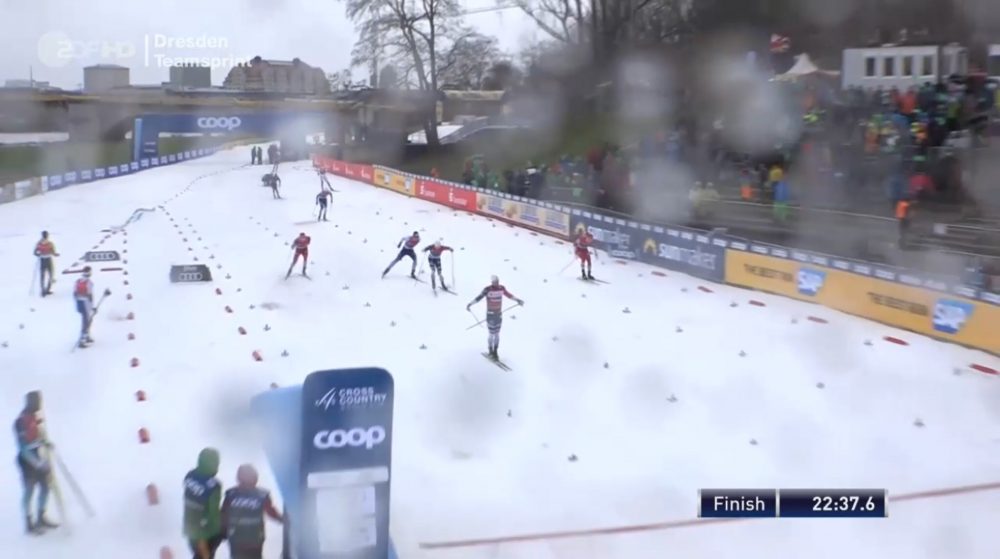
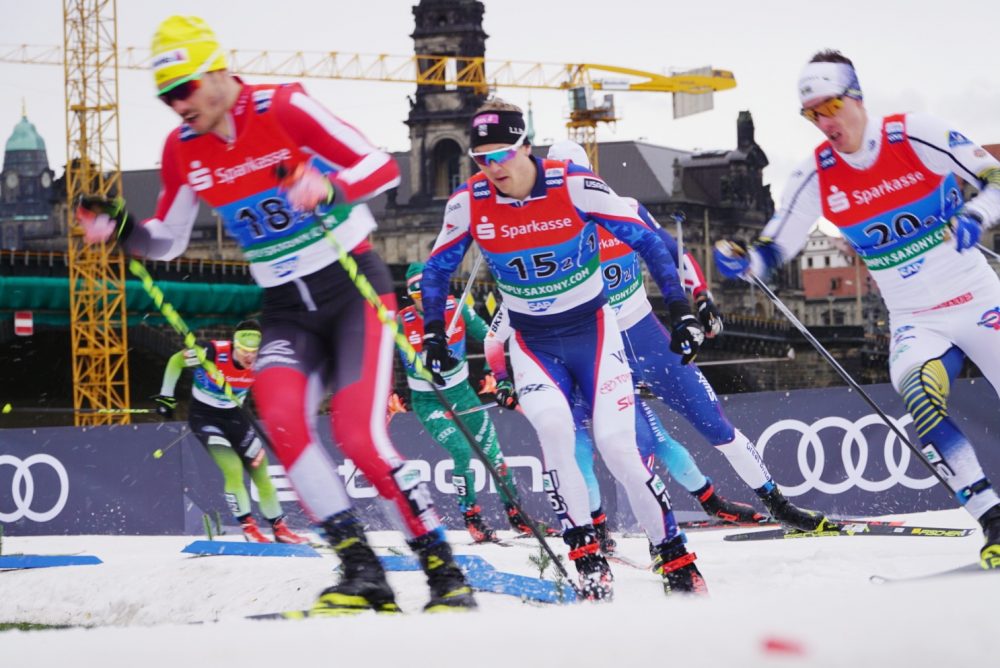
    The skiathlon consisted of eight laps—four classic and four skate—with one prominent climb each time around. None looked as strong or as efficient as the Russians. One coach observed at the top of the course that as everyone else was sputtering and out of breath on the big ascent, Ustiugov and his teammates appeared to be hardly working at all.

    Skar did his best to hang on, but in the end didn’t have the gas to respond to Ustiugov and Maltsev’s closing speed.

    “I tried to keep up with them but in the seventh lap, Sergey and Artem were going so fast. I was just standing with my eyes open,” said Skar, illustrating his point with a dumbfounded look.

    Unlike the Russians, Norway’s junior squad decided against an altitude camp prior to Erzurum, so as not be overtired for the long-term.

    “I did not have a chance. I am not used to competing at such a high altitude,” said Skar. “If we were lower I would have gone much harder. But here I had to be careful.”

    The Russians are the clear favorites to win the relay on Sunday, but Skar is hoping to give them a run for their money.

    “Russians are big favorites, but if we Norwegians all of us have a great day, we can be there as well. I will try to deliver my best and fight for victory,” Skar said.

    The pack skiing out of the stadium on the first lap. Photo: Reese Hanneman.

    Richards Leads Canadian Contingent in 20th; Hanneman 23rd

    Geoffrey Richards (CAN) skied a smart efficient race on Friday, sitting back before the exchange and waiting until his stronger skate technique to move up in the pack.

    “[My] plan was to ski conservative in the classic portion and stick around 35th,” said Richards, who ended up skiing around 45th in the beginning.

    From there, the he wanted to “have a good exchange and use the big climb on the course to move up the positions,” said Richards. “I ended up feeling pretty tired on the second and most of the third skate lap but threw down on the last time around and passed about six people on the climb.”

    In describing the race experience in Kandilli, where the altitude makes the climbs that much more painful, Richards said that he “definitely feels like I’m hanging on the back for the most part, although [I] felt a lot more in control with the skate, but still was running a little scared for the whole race.”

    Canada’s head coach Eric de Nys thought Richards had skied a smart race, and executed his plan to the T.

    “It worked out really well for him,” said de Nys.

    “And we beat the Americans,” he joked. “They beat us yesterday but we got ‘em today.”

    Logan Hanneman (USA) skied his best race of this week with a 23rd-place finish. In contrast to Richards’ race, he sat consistently in the top-20 for most of the 20 k.

    “I just locked on the lead pack in the classic and let them pull me around,” said Hanneman. “For the skate, they pulled away a little and then it was just—survive to the finish line.”

    Hanneman was pleased with the way his first skiathlon turned out.

    “My goal was to hang with them for the class and who cares what happens, as long as you try to hang with them… I did that, and survived.”

    The next North American was Alexis Turgeon (CAN), who skied to 31st place. Knute Johnsgaard (CAN) was 49th, Mike Vigers (USA) finished 54th, Will Wicherski (USA) was 57th, and Forrest Mahlen (USA) was 72nd.

    Results