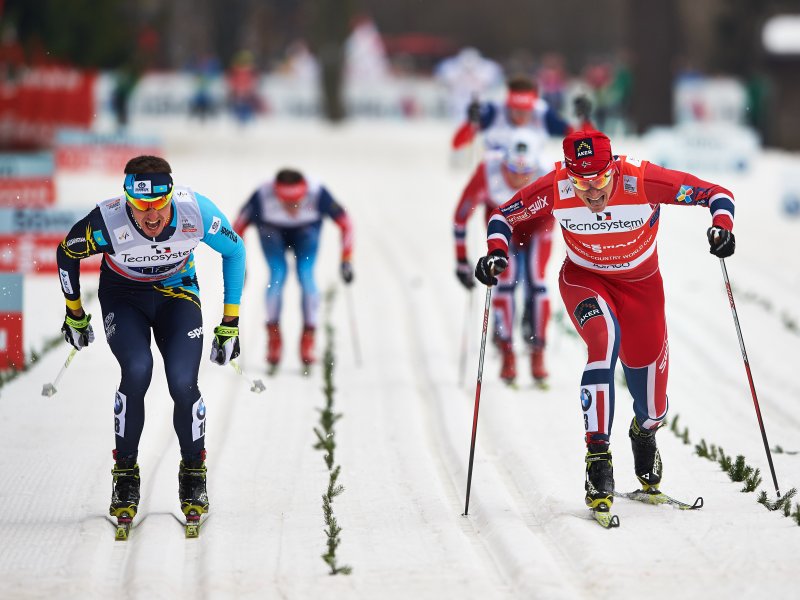
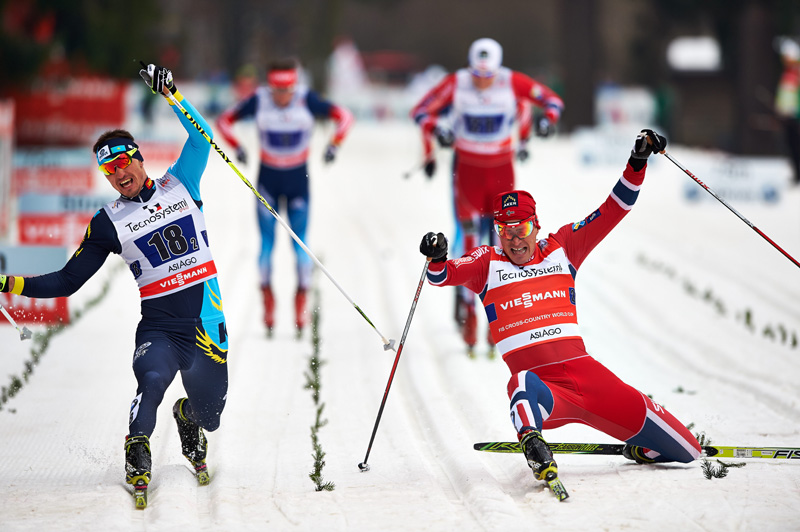
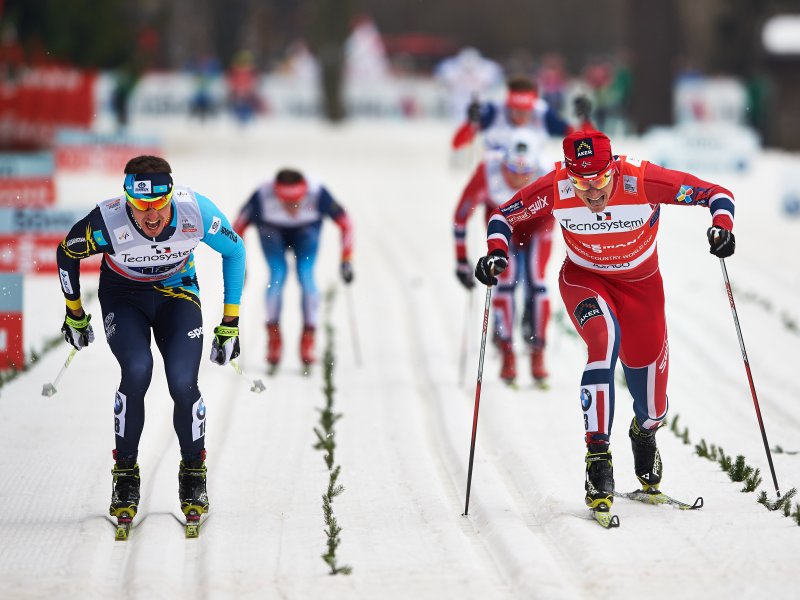
Norway’s Ola Vigen Hattestad (r) lunging for the win over Kazakhstan’s Alexey Poltoranin in the men’s World Cup team sprint in Asiago, Italy. (Photo: Fisher/NordicFocus)
This weekend was all about classic sprinting as World Cup racing continued in Asiago, Italy. Justyna Kowalczyk dominated Saturday’s sprint race, remaining unbeaten this year in the classic sprint discipline. Anne Kyllönen of Finland finished second with Norwegian Maiken Caspersen Falla in third.
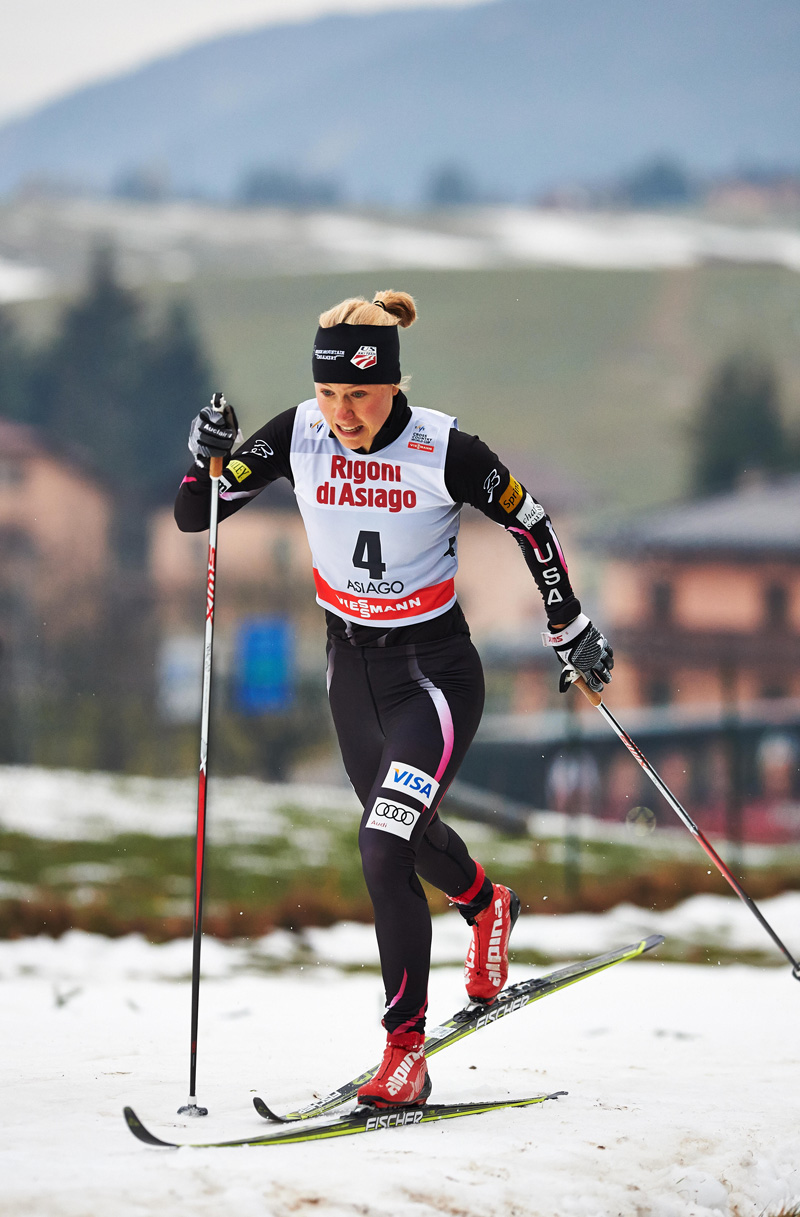
After a slow start to the season Ida Sargent jumped back into the mix. She was the lone American to make the semifinals, ultimately finishing 10th. Sadie Bjornsen, Kikkan Randall, and Sophie Caldwell all made the quarterfinals and finished in the top 25. Canada’s Dasha Gaiazova finished 14th.
Ida Sargent (US Ski Team) racing to her first top 10 of the season in the 1.25 k classic sprint in Asiago, Italy. (Photo: Fischer/Nordic Focus)
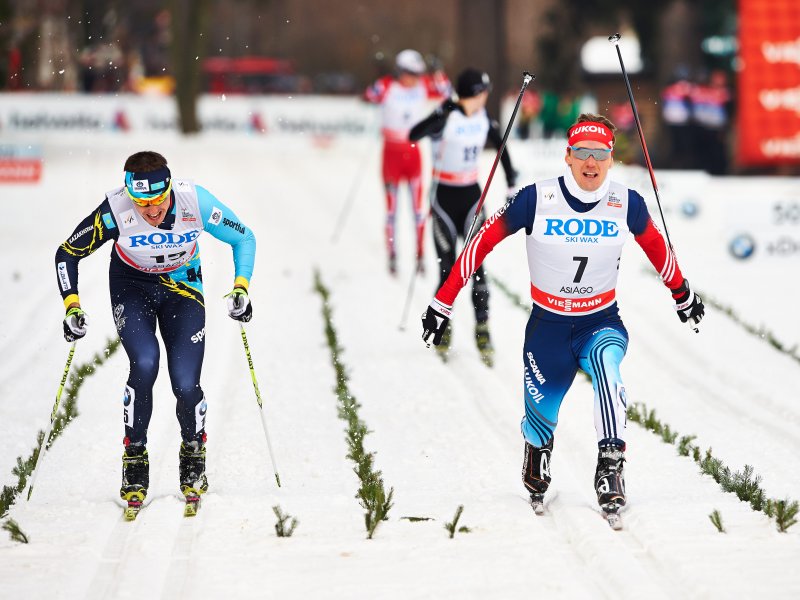
On the men’s side, Russian Nikita Kriukov out sprinted Kazakh Alexey Poltaranin at the finish to take the win. Gianlucca Cologna of Switzerland was third.
American’s Simi Hamilton and Andy Newell finished 23rd and 25th. Newell, who qualified fifth, raced in the same quarterfinal as Hamilton. The two were unable to work together and advance to the semis.
The team sprints proved to be just as exciting. On the men’s side, Norway dominated with Norway I and Norway II finishing first and second. Kazakhstan finished .02 behind Norway I to place second. The Canadian duo of Devon Kershaw and Alex Harvey finished 11th. Newell and Hamilton finished 12th.
The two American teams were both in the Women’s final. Randall and Bjornsen finished 5th and Caldwell and Sargent finished 8th. Finland won followed by Norway and Germany.
In the Nordic Combined World Cup in Schonach, Germany Brian Fletcher was the only American to compete in Saturday’s 10 k. Taylor Fletcher, Todd Lodwick, and Brett Denney joined him in Sunday’s 10 k. The American’s finished ninth, 31st, 44th, and 51st.
Nordic Combined World Cup, Schonach, Germany: recap
Kikkan Randall (US Ski Team) leads Laurien Van Der Graaff during the women’s 6 x 1.25 k classic team sprint final on Sunday at the World Cup in Asiago, Italy. Randall’s team, USA I, went on to place fifth, Switzerland was seventh and USA II was eighth. (Photo: Fischer/Nordic Focus)
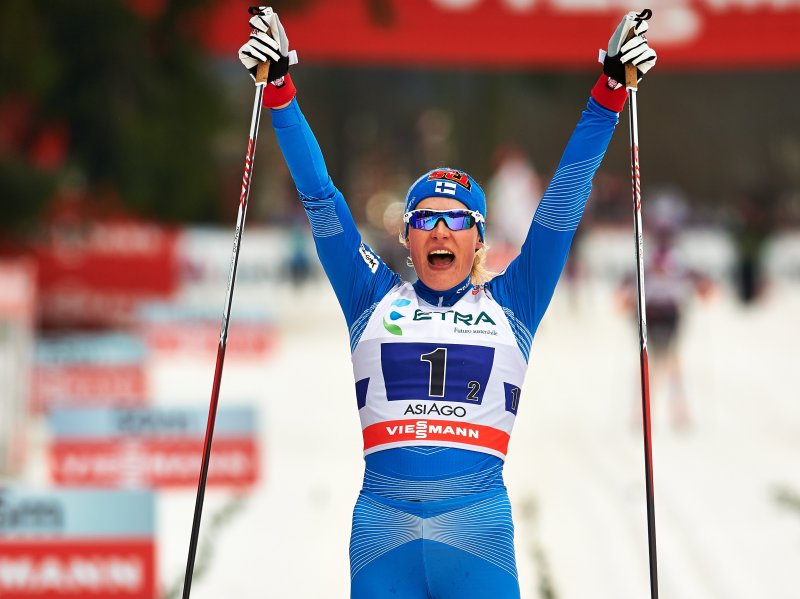
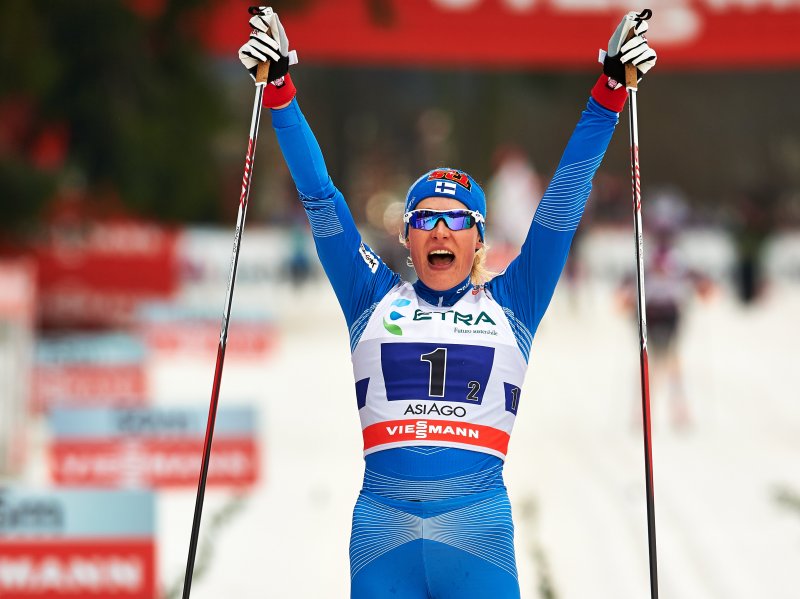
Finland’s Anne Kyllönen celebrates another classic team sprint victory on Sunday after she and Aino-Kaisa Saarinen won the World Cup 6 x 1.25 k event in Asiago, Italy, by nearly 10 seconds over Norway. (Photo: Fischer/Nordic Focus)
You know what they say about the Finns; those women are good at team sprints.
Aino-Kaisa Saarinen and Anne Kyllönen dominated Sunday’s 1.25-kilometer classic team event at the World Cup in Asiago, Italy, giving a lesson to more than 20 other teams on how to get out front and stay there.
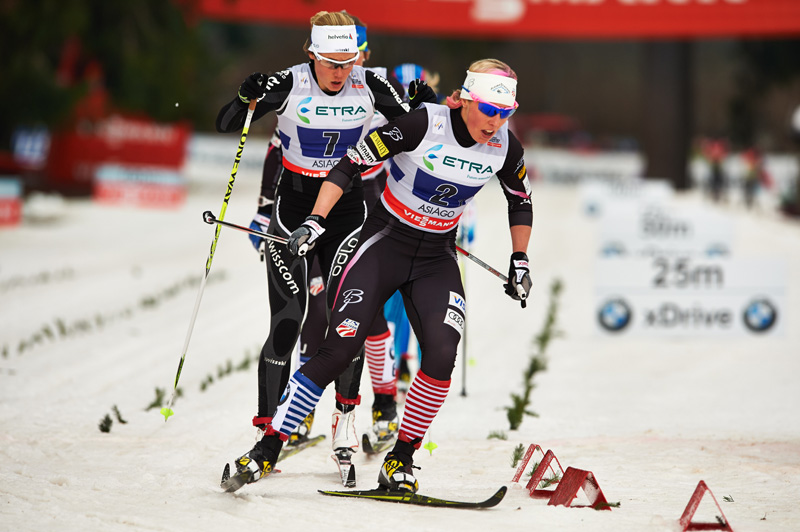
Fellow US Ski Team members Sadie Bjornsen (front) and Ida Sargent (r) go head to head in Sunday’s 1.25 k classic team sprint final at the World Cup in Asiago, Italy. Together in the semifinals, both American teams made the final as well. (Photo: Fischer/Nordic Focus)
The duo won their semifinal ahead of two American teams – Ida Sargent and Sophie Caldwell for USA II, and Sadie Bjornsen and Kikkan Randall for USA I, respectively. The three broke away on the last of three legs, Finland won, USA II automatically qualified in second and USA I skied fast enough to get a lucky-loser spot.
Earlier in the heat, Caldwell and Randall shook off an inadvertent collision, in which Randall went down and Caldwell skied on, at the end of their first leg. As the two converged around a 180-degree corner before the exchange, Randall fell Karolina Grohova of the Czech Republic came up from behind and “toppled over me,” Randall said in a phone interview. With a “little raspberry” on her hip, she got up quickly, tagged Bjornsen, and the two made up the 10-second deficit to Finland and their American teammates up front.
Despite what happened behind them, Finland was in control from start to finish on Sunday. They advanced to the final without any major stresses and started that race in second, following Norway’s No. 1 team by 0.2 seconds into the first exchange. The 26-year-old Kyllönen then charged to the front of the pack and the Finns held their own for the rest of the race.
By the second-to-last exchange, Saarinen had given Finland a 4.4-second lead on Norway’s Ingvlid Flugstad Østberg and Maiken Caspersen Falla. The cat-and-mouse game between Finland and Norway, with Germany another five seconds back in third, was losing its allure. Finland was getting away, Norway was going to have to hold off Germany’s Katrin Zeller and Denise Herrmann, and the Americans were going to have to fight for fourth.
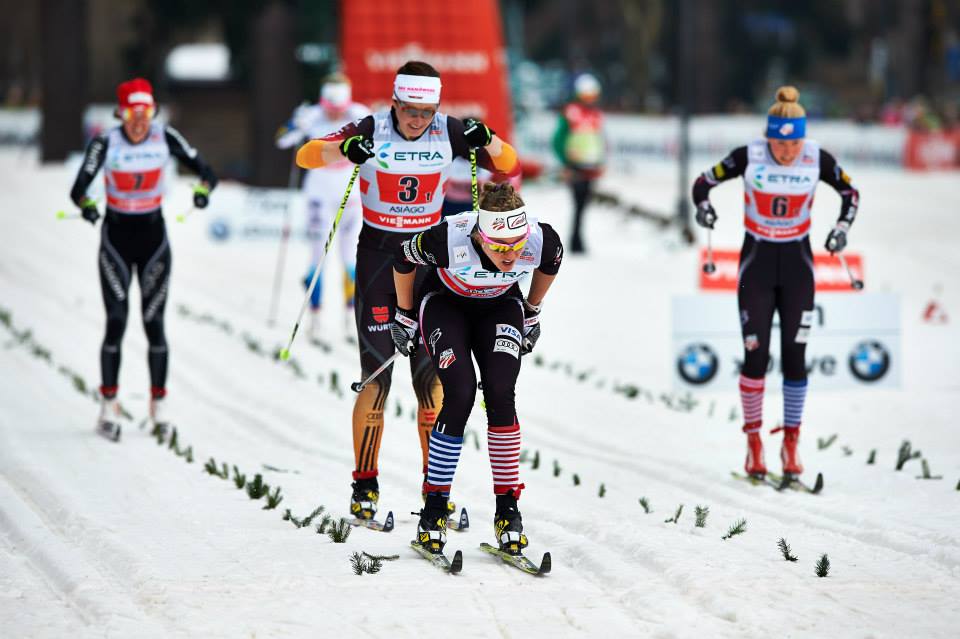
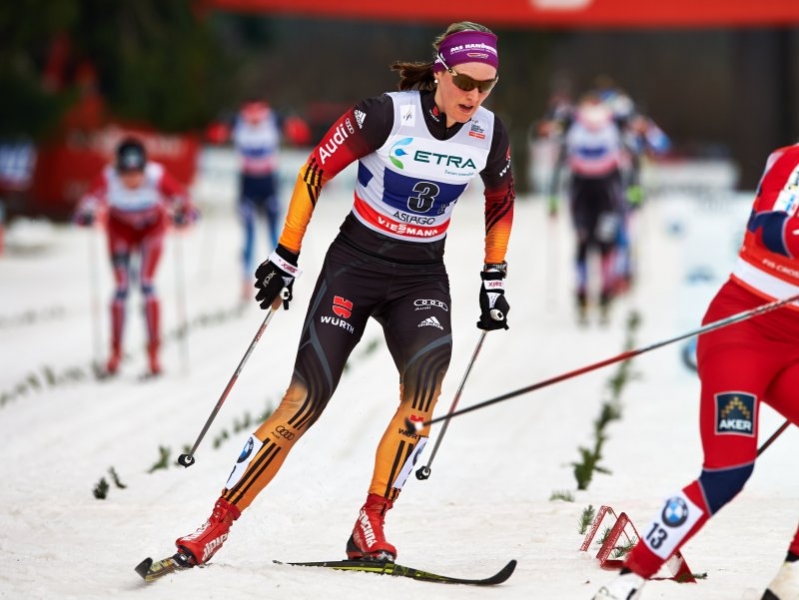
Denise Herrmann anchored Germany I to third, just 0.3 seconds behind the Norwegians in second in the Asiago World Cup classic team sprint. (Photo: Fischer/Nordic Focus)
As Kyllönen sealed the Finnish victory in 19:15.72, Norway I hustled for second, 9.68 seconds back. Falla barely edged Herrmann, who pushed for second and ended up third, 0.34 seconds behind Falla. Norway II’s Kari Gjeitnes and Celine Brun-Lie stayed in front of the U.S. and Russia to place fourth (+11.53), and Randall anchored USA I to fifth, 18.48 seconds after Finland and 19 seconds ahead of Russia II’s Julia Ivanova and Anastasia Dotsenko.
Switzerland took seventh with Bettina Gruber and Laurien Van Der Graaff (+19.25), and Sargent and Caldwell ended up eighth (+20.56).
“It is great to be back on the top of the World Cup podium,” Saarinen, a 34-year-old World Cup veteran embarking on her third Olympic, told FIS.
The last time she stood on top of the podium in World Cup or Olympic event – team or individual – was 2009.
“It’s been a great day not for only for me but for Finland,” she added. “Anne was very strong today.”
Last February, Kyllönen teamed up with Mona-Liisa Malvalehto to win the pre-Olympic classic team sprint at the World Cup in Sochi, Russia. That was a good sign then; this is even better now less than 50 days out from the 2014 Olympics.
“Finland was very strong but hopefully in February we can be stronger,” Østberg told FIS after achieving her first podium of the season.
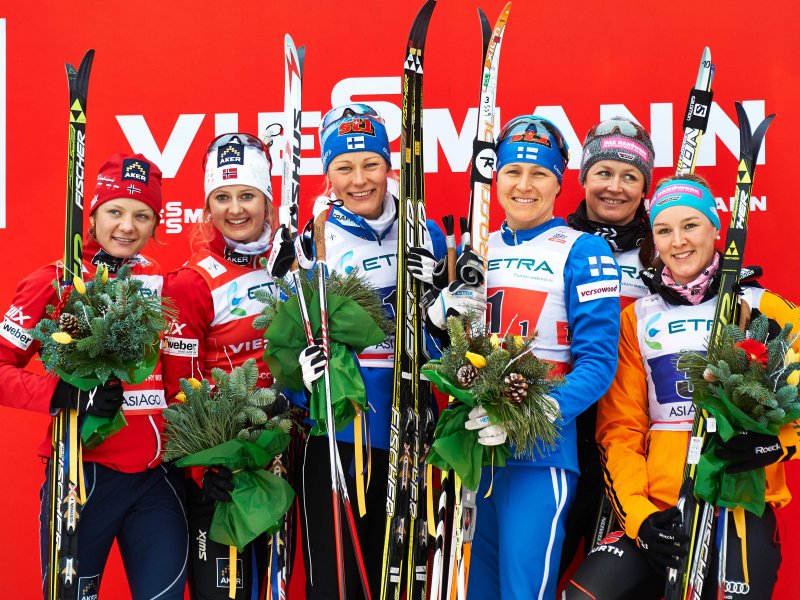
The men’s classic team sprint podium at the Asiago World Cup in Italy on Sunday: Finland’s Anne Kyllönen and Aino-Kaisa Saarinen (c) won, Maiken Caspersen Falla and Ingvlid Flugstad Østberg (l) placed second, and Germany’s Denise Herrmann and Karin Zeller (r) were third. (Photo: Fischer/Nordic Focus)
The Norwegians remained within 1 ½ seconds of Finland through four laps until Saarinen dropped Østberg on her final lap.
Gruber opened strong to put Switzerland in third through the first leg, but Van Der Graaff drifted to six before Gruber could bring them back to third on her second leg. After her third time around, Gruber tagged in eighth behind USA II in seventh. USA I was fourth with one lap to go, 2.3 seconds behind Norway I in third and 12.2 seconds behind the Finns.
With nearly five seconds to play with, Kyllönen extended her gap to bring the victory home, refusing to let up.
“I was very tired all day, but that was a very good race,” Saarinen said.
“They went hard from the gun and kept the level high,” Randall said.
She and Bjornsen fell behind on the second leg, with Bjornsen tagging her in ninth and Randall recovering to fifth before the second-to-last exchange. At the Sochi team sprint last season, Bjornsen and Sargent placed fifth.
“I am confident that both teams could be in the runnings for a medal if everything went golden!” Bjornsen wrote in an email about Americans’ competitive team combinations. “But that is how we light the fire. First we find a possibility on a ‘perfect day,’ and then we have that perfect day, and the confidence brings even more!”
Third in the Sochi team sprint behind Russia in second, Canada’s Perianne Jones and Dasha Gaiazova finished eighth in their semifinal for 16th overall.
Look familiar? Kazahstan’s Alexey Poltoranin (l) placed second for the second-straight day at the Asiago World Cup in Italy, as Ola Vigen Hattestad (r) secured the Norwegian victory in the 6 x 1.65 k classic team sprint. (Photo: Fischer/Nordic Focus)
The way things were shaping up in the men’s 6 x 1.65-kilometer classic team sprint final at the World Cup in Asiago, Italy, it could’ve been anybody’s race.
Yes, Norway’s Eldar Rønning and Ola Vigen Hattestad were generally leading the 10-team pack on Sunday, and yes, the top-four combination was often something like Norway, Russia, Norway, Russia (with each nation having two teams in the final), but you couldn’t count teams like Sweden and Kazakhstan out.
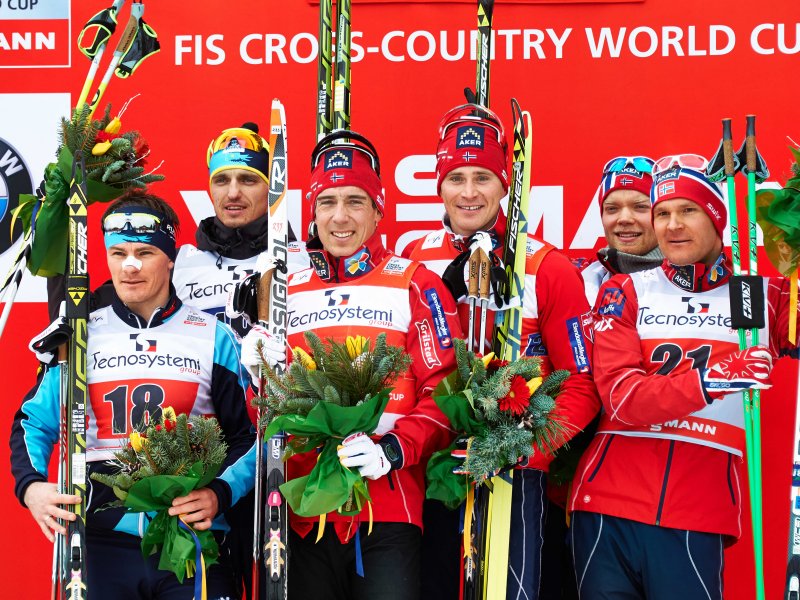
The men’s classic team sprint podium at the Asiago World Cup in Italy on Sunday: Norway I won with Eldar Rønning and Ola Vigen Hattestad (c), Kazakhstan’s Nikolay Chebotko and Alexey Poltoranin (l) placed second, and Norway II was third with Eirik Brandsdal and Øystein Pettersen. (Photo: Fischer/Nordic Focus)
While Sweden’s first starter, Teodor Peterson clocked the fastest leg in each of his rounds, his teammate Simon Persson repeatedly dropped several places after every exchange. Without their original starter in Emil Jönsson, who had to scratch because of a sore back on Sunday morning, Sweden slipped from first to sixth, second to sixth, and finally third to fifth.
They weren’t a threat to Norway’s first team of Rønning and Hattestad, which won the first semifinal over Russia’s Alexander Panzhinskiy and Nikita Kriukov, but the Kazakhs were.
Second in their semifinal after Norway II’s Øystein Pettersen and Eirik Brandsdal, Kazakhstan’s Nikolay Chebotko and Alexey Poltoranin sat patiently around fourth early in the final, then rose to second by the fourth of five exchanges.
Just 0.6 seconds behind Rønning at the start of his last lap, Chebotko held his position until planting his pole between his legs and toppling over. Kazakhstan dropped from second to sixth, and it seemed their hope for a podium was slipping as the rest of the leaders skied into the exchange zone.
Podium? The thought probably never crossed Poltoranin’s mind as he waited for the tag just a couple hundred meters later. He was going for the win. Norway’s Hattestad would have to try to stop him.
After getting the tag in fifth, Poltoranin made up nearly 5 seconds on the leaders, including Hattestad up front, followed by Kriukov, Persson and Brandsdal.
Maxim Vylegzhanin lifted Russia II into the top four, but he and teammate Dmitriy Japarov were later disqualified for a “violation of classical technique rules,” likely skating on the mostly double-pole course. At least half the men’s field raced on skate skis, including most of the top men’s finalists.
Coming out of a sharp corner on a long descent, Kriukov’s pole strap broke, but he quickly got a replacement and resumed his spot amongst the top five with Norway I, Russia II, Norway II, Russia I, and Kazakhstan.
With 800 meters remaining, Poltoranin took a shortcut to second, cutting in on the inside lane around a tight turn. Most everyone had to snowplow on the final corner to avoid crashing in the sugary, melting snow, but Poltoranin remained in position to challenge Hattestad – who was still leading – to the finish.
Hattestad didn’t have to look back. He needed to go hard the last 100 meters to the finish. Committed to a central lane, the Norwegian double poled like mad while Poltoranin jumped into the left lane behind him, which was considered one of the fastest in the homestretch.
It may have been faster as Poltoranin came within centimeters of Hattestad, but the Norwegian held him off, throwing his leg across the line and winning in a photo finish in 24:47.4.
“I did not know we had won until I saw Eldar come running towards me,” Hattestad told VG Nett, according to a translation.
“It’s fun to win with only five centimeters,” said Rønning, who initially put Norway I in third, just 0.7 seconds behind Russia II up front.
After the first tag, Hattestad brought the team to first, where they remained fractions of a second ahead of anyone else for the rest of the race.
Norway II finished third, 2.17 seconds after Kazakhstan in second, but dropped as far back as seventh during the second leg, when Japarov fell on one of the last downhills and took out Pettersen. Brandsdal lifted them back to third with the fastest-course time for that leg, and Pettersen tagged him in fourth for the final lap.
“Good day: back on the podium in WC, argue with a good Russian (became friends again), Christmas holidays and given away flowers to a little girl,” Pettersen tweeted after the race, according to a translation.
“It is the best result of the season and I am very happy for that,” Pettersen told FIS. “Luckily we could get back. Team sprints are never easy.”
Russia’s Nikita Kriukov (r) edges Alexey Poltaranin (KAZ) for the individual classic sprint victory on Saturday in Asiago, Italy. (Photo: Fischer/Nordic Focus)
They are especially tough one day after an individual classic sprint on the same soupy course in similarly warm (41-degree) temperatures. Poltoranin, who was just short of a victory behind Kriukov on Saturday, said he recovered well with some physio work.
“Ola Vigen Hattestad is a very strong sprinter, but I think if we were not double poling in the finals, I would have had a chance to beat him,” said Poltoranin, who has placed second in his last three World Cup races.
While he sat out the Davos World Cup last weekend, Poltoranin was second to Norway’s Pål Golberg in the 15 k classic on Dec. 7 in Lillehammer, Norway.
Last season at the pre-Olympic World Cup classic sprint in Sochi, the Russians won on their home turf with Japarov and Vylegzhanin. Sweden’s Peterson and Jönsson placed second and Germany was third with Axel Teichmann and Tobias Angerer.
(Teichmann teamed up with Tim Tscharnke for Germany I on Saturday, placing fourth in their semi and narrowly missing the final for 10th overall. Germany II’s Angerer and Alexander Wolz finished 12th of 15 teams in the first semifinal.)
Russia’s No. 2 team of Alexey Petukov and Kriukov notched fourth last winter in Sochi, Norway’s Pettersen and Petter Northug placed fifth, and Kazakhstan’s Chebotko and Poltoranin finished sixth.