Tag: asiago team sprint

  • Both U.S. Women’s Teams Advance to Asiago Final for Fifth and Eighth; Canada 16th

    Both U.S. Women’s Teams Advance to Asiago Final for Fifth and Eighth; Canada 16th

    Kikkan Randall (US Ski Team) leads Laurien Van Der Graaff during the women's 6 x 1.25 k classic team sprint final on Sunday at the World Cup in Asiago, Italy. Randall's team, USA I, went on to place fifth, Switzerland was seventh and USA II was eighth. (Photo: Fischer/Nordic Focus)
    Kikkan Randall (US Ski Team) leads Laurien Van Der Graaff during the women’s 6 x 1.25 k classic team sprint final on Sunday at the World Cup in Asiago, Italy. Randall’s team, USA I, went on to place fifth, Switzerland was seventh and USA II was eighth. (Photo: Fischer/Nordic Focus)

    A little bump here, scratch there and the U.S. women are just fine coming out of Sunday’s classic team sprint at the World Cup in Asiago, Italy. It was just unfortunate they collided together.

    With two teams in the same semifinal of the 6 x 1.25-kilometer race, the Americans were well aware of the risks. The anchor for the first U.S. team, Kikkan Randall had a slightly sinking reaction when she saw that her US Ski Team counterparts – Ida Sargent and Sophie Caldwell for USA II – were put in the same heat.

    “I was like, ‘Oh man, of course the two teams are together in the semifinal,’ ” Randall said on the phone after Sunday’s race.

    Oh well, better go out and see if they can go 1-2 to automatically qualify for the final.

    The teams started the semifinal together with Randall’s teammate Sadie Bjornsen heading out with Sargent and Finland’s Aino-Kaisa Saarinen. All three made their way toward the front, and tagged off in good position through the first exchange. As Randall was about to complete her first lap, she rounded the final 180-degree corner with Caldwell.

    Bjornsen was waiting for her on the outside lane; Sargent was on the inside.
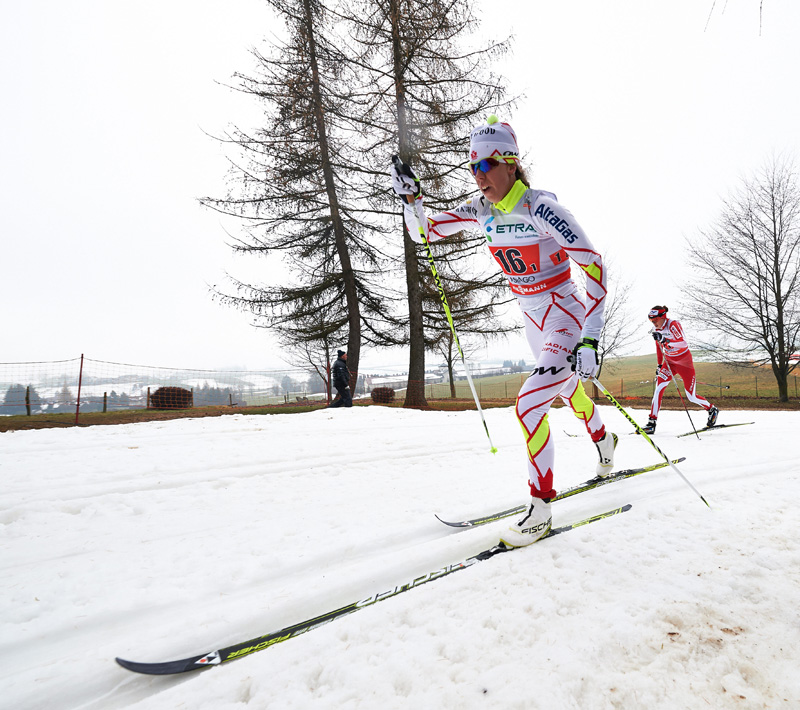
    Canadian World Cup Team member Perianne Jones striding in the second women's semifinal of the 6 x 1.25 k classic team sprint on Sunday in Asiago, Italy. She and teammate Dasha Gaiazova placed eighth in the heat for 16th overall. (Photo: Fischer/Nordic Focus)
    Canadian World Cup Team member Perianne Jones striding in the second women’s semifinal of the 6 x 1.25 k classic team sprint on Sunday in Asiago, Italy. She and teammate Dasha Gaiazova placed eighth in the heat for 16th overall. (Photo: Fischer/Nordic Focus)

    “Sophie started to cut to the inside … and we ran into each other,” Randall explained. “I fell down, Sophie made it through and then a Czech girl [Karolina Grohova] came through and toppled over me. We had to ski our way back after that.”

    Randall got up as fast as she could and skied into the tag zone, sending Bjornsen on her way.

    “That probably put us 10 seconds back,” Randall said. “Sadie had to ski pretty hard on her second leg.”

    But the 24-year-old Bjornsen caught the leaders and all was right again for Team USA. Led by Finland’s Anne Kyllönen, Caldwell and Randall broke away with her on the final lap, and the three finished first, second and third, respectively.

    “Coming into the finish, I wasn’t too concerned,” Randall said of placing third, just short of automatically qualifying for the final in second. “I was pretty sure our heat was going to the be fastest. Most of lucky losers came from our heat.”

    Teams like Canada didn’t fare as well. Perianne Jones and Dasha Gaiazova raced to eighth of 12 teams in the second semifinal, beating Poland in ninth, but it wasn’t enough to get them into the final. In both the women’s and men’s semifinals, the first heats were considerably faster – a direct result of the deteriorating conditions on the 41-degree Fahrenheit morning.

    Organizers salted the course that morning, making it firm enough to give Randall a raspberry on her hip when she went down in the semifinal, but repeated skiing on it ultimately broke the course down.

    For Canada, the race was Jones’ second World Cup appearance this season after Saturday’s individual sprint. She spent the first period of the World Cup at home in Canmore, Alberta, managing a genetic condition that causes too much iron in her body. Jones said she changed her diet to more of a vegetarian base, which she was OK with, and she was gaining her energy back.

    Third at last season’s pre-Olympic World Cup classic team sprint in Sochi, Russia, Jones and Gaiazova had to settle for 16th overall on Sunday.

    The Final

    Meanwhile, both American teams advanced to the final, where Finland once again set a blistering pace. Bjornsen moved to the front of the group of the first climb, with Finland’s Saarinen and Norway’s Ingvlid Flugstad Østberg, and Sargent tucked in directly behind Bjornsen.
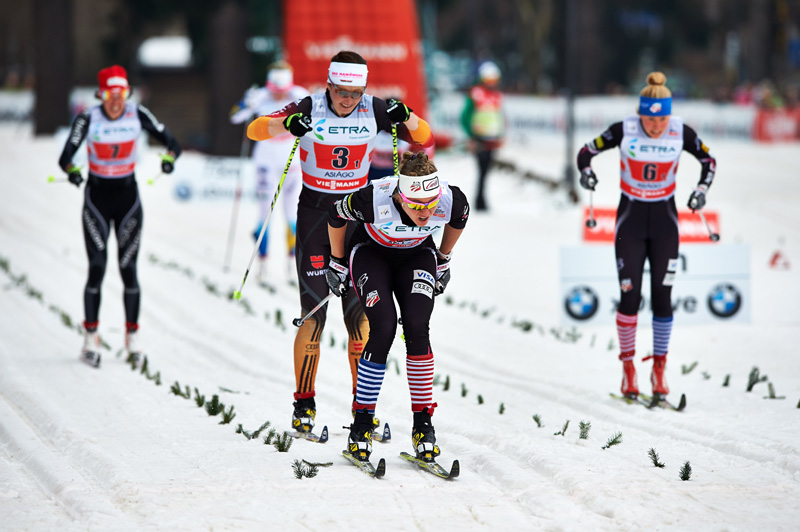
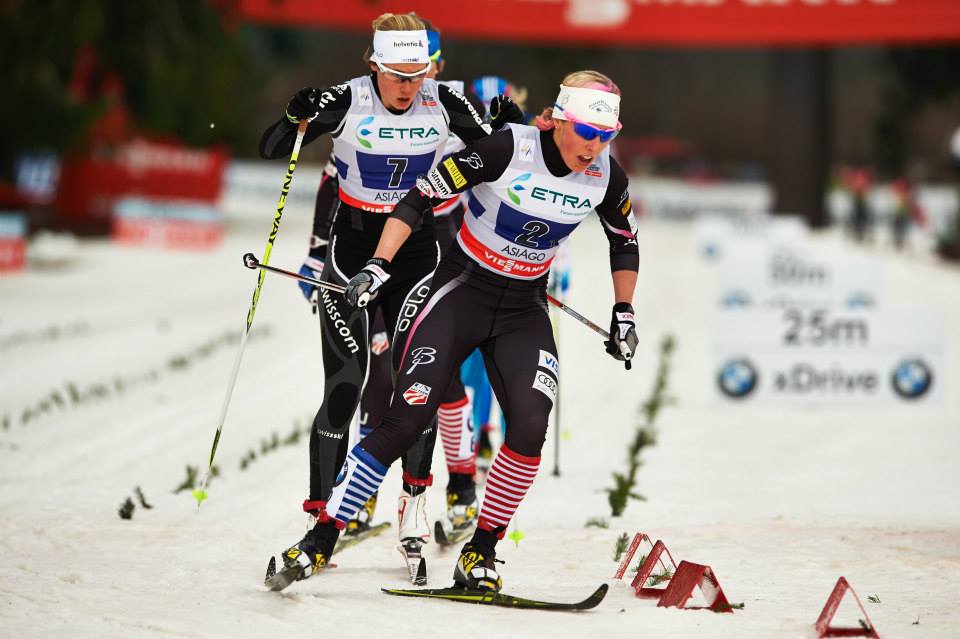
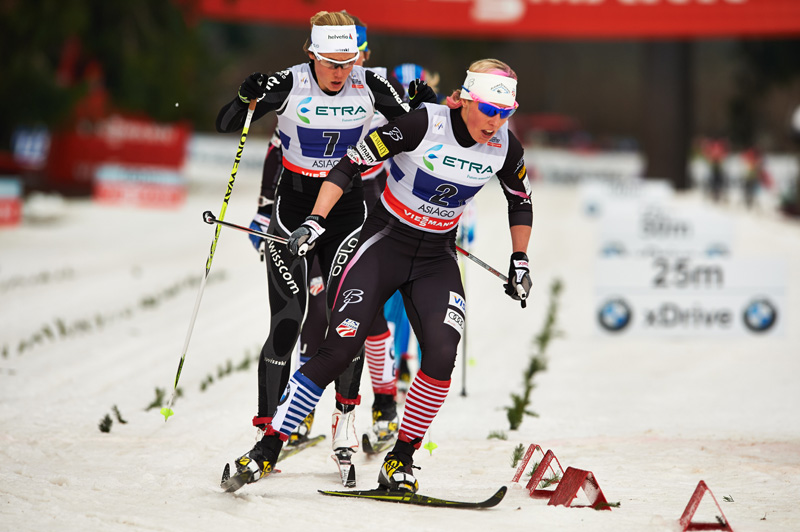
    Fellow US Ski Team members Sadie Bjornsen (front) and Ida Sargent (r) go head to head in Sunday’s 1.25 k classic team sprint final at the World Cup in Asiago, Italy. Katrin Zeller of Germany (7) chases Bjornsen. (Photo: Fischer/Nordic Focus)
    Fellow US Ski Team members Sadie Bjornsen (front) and Ida Sargent (r) go head to head in Sunday’s 1.25 k classic team sprint final at the World Cup in Asiago, Italy. Katrin Zeller of Germany (7) chases Bjornsen. (Photo: Fischer/Nordic Focus)

    “I’m pretty sure I skied every leg of both the semifinal and final either right in front, right behind, or next to Sadie,” Sargent wrote in an email. “She is such a strong classic skier so it was awesome to ski with her.

    “The pace was fast from the start and it was probably the most aggressive race I have ever skied so kind of a battle the whole time,” she continued. “I never found a great rhythm and constantly felt like it was stop and go and finding room to move but definitely great experience.”

    Once again, the Americans inadvertently tussled – this time getting tangled over the top of the climb – and they had to work their way back to the pack.

    “I got caught out of the tracks skiing in the middle on the second and last climb of the course and went from at the front to dead last in the matter of a few meters,” Sargent wrote.

    Østberg held a narrow 0.2-second margin on Saarinen through the first exchange, and Switzerland’s Bettina Gruber tagged in third (+0.4), Julia Ivanova of Russia II was fourth, Norway II’s Kari Gjeitnes fifth, and Bjornsen in sixth, 2.9 seconds off the lead. Sargent tagged another second back in ninth, with Sweden II’s Magdalena Pajala and Germany’s Katrin Zeller in front of her.

    “I think both of our teams were in contact first leg, but kind of toward the back,” Randall explained. “I tried multiple times to look for a place to move up but it was hard because people were moving around a lot … The pace was really high through the whole race in the final.”

    With the third-fastest lap time for her leg, Caldwell tagged Sargent in seventh, and Randall sent Bjornsen off six-tenths of a second later in eighth.

    “We were right in the thick of things in the final, so it was a little frantic,” Caldwell wrote in an email. “There was a lot of changing of positions. … I tried to follow people stride-for-stride on the ups and then be smart about lane choice and push hard over the tops. There was a lot of really gradual striding and people like the Finns are really good at that, so it was cool to be able to try to chase them.”

    On the second leg, the two teams lost contact with Finland and Norway up front as the leaders gapped third place by nearly five seconds. For the Americans, the fight would be for a podium as they chased Germany and Norway II.

    Fourth through the last exchange, 2.3 seconds behind Norway II and 12.2 seconds behind Finland up front, Randall anchored the team to fifth. Norway II’s Celine Brun-Lie had put on a strong last lap to come within 1.5 seconds of third, putting USA I nearly 7 seconds back from fourth and 18.48 seconds off Finland’s winning time of 19:15.72.

    With Caldwell, USA II finished eighth, 1.31 seconds behind Switzerland in seventh and 20.56 behind the winners.

    “I was very happy with the weekend and we ended on a good note with two women’s teams in the final,” Caldwell wrote. “There weren’t very many countries who had two teams in the final, so I think that says a lot for how far we’ve come!”

    “It was so much fun – and even more fun to ski with teammates out there!!” Bjornsen wrote. “I was really happy how it went – and I am confident that both teams could be in the runnings for a medal if everything went golden! But that is how we light the fire. First we find a possibility on a ‘perfect day,’ and then we have that perfect day, and the confidence brings even more!”

    Randall said that she and Bjornsen lacked their top gear after Saturday’s sprint, where Bjornsen skied the fifth-fastest qualifier and ended up 16th and Randall placed 20th overall.

    “We were a little tired and didn’t have full power to stay with that opening pace through the race,” Randall said. “We’re moderately satisfied with today, but we know we can [do] better.”

    Perhaps the most exciting takeaway for the Americans was that they have two teams that can be in the mix and make the final.

    “It was great to go through the motions today and it’s great that both teams skied so strong,” Randall said. “No matter what combination you put us in we’re going to be successful.”

    As seven of her teammates prepare for the Tour de Ski (Caldwell, Jessie Diggins, Liz Stephen, Holly Brooks, Noah Hoffman , Andy Newell, and Simi Hamilton), which opens Saturday in Oberhof, Germany, Randall is taking 2 ½ weeks for a training block in Davos, Switzerland. Sargent will join her, and neither will race the Tour. Randall learned last year that she needs to take time during the season to “make sure all the gears are there for Sochi.”

    Despite feeling a little off this weekend, she said it’s been a solid first World Cup period with three podiums in four weekends.

    “I think I actually skied a little bit better today; I felt like my double poling was stronger, my semifinal was stronger,” she said. “It wasn’t what I totally hoped for this weekend, but I know there is a little bit more when I’m feeling 100 percent.”

    Bjornsen also opted for training over the Tour and arrived in France on Sunday night to spend the holidays with her boyfriend. She’ll train there for the next two weeks.

    “It is my first holiday away from home – so it will be different – but nice to spend it with Jo!” Bjornsen wrote.

    Caldwell plans to race the first three or four stages of the Tour, after spending the holidays with her family in Ramsau, Austria. Her parents, brother and sister all watched her in Asiago.

    “It’s tough to be away from home for so long, but having them here is the best Christmas present I could ask for,” Caldwell wrote.
    Results

  • Canadian, U.S. Men Miss Final at Asiago Classic Team Sprint

    Canadian, U.S. Men Miss Final at Asiago Classic Team Sprint

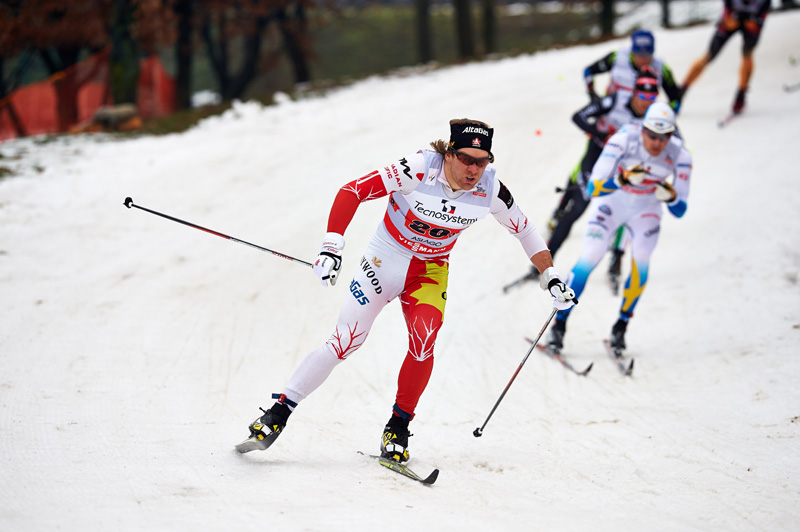
    Canadian Alex Harvey leads Andy Newell of the U.S. (r) and some others up a climb on the 1.65 k course in Asiago, Italy, during Sunday's classic team sprint. Neither Canada nor the U.S. advanced out of the semifinal after placing fifth and sixth, respectively. (Photo: Cross Country Canada/Nordic Focus)
    Canadian Alex Harvey leads Andy Newell of the U.S. (r) and some others up a climb on the 1.65 k course in Asiago, Italy, during Sunday’s classic team sprint. Neither Canada nor the U.S. advanced out of the semifinal after placing fifth and sixth, respectively. (Photo: Cross Country Canada/Nordic Focus)

    It was a disappointing day in Asiago, Italy, for the U.S. and Canadian men in Sunday’s classic team sprint, with neither team making the 6 x 1.65-kilometer final. Both Canada I, with Devon Kershaw and Alex Harvey, and USA I, with Simi Hamilton and Andy Newell, were in the same semifinal — the second one, which proved disadvantageous on a balmy 41-degree day.

    As the temperatures warmed and salted snow became more chewed up, ski times slowed. Only the top three teams from the second men’s semifinal advanced. Canada placed fifth, 6.64 seconds out of qualifying and 8.87 seconds behind Norway II’s Øystein Pettersen and Eirik Brandsdal, who won the heat in 24:53.04 and went on to place third in the final. The Canadians ended up 11th overall.

    Devon Kershaw in the  classic team sprint semifinal at the World Cup in Asiago, Italy. Kershaw and his teammate, Alex Harvey, went on to place fifth for Canada I, a few places short of qualifying for the final. (Photo: Fischer/Nordic Focus)
    Devon Kershaw in the classic team sprint semifinal at the World Cup in Asiago, Italy. Kershaw and his teammate, Alex Harvey, went on to place fifth for Canada I, a few places short of qualifying for the final. (Photo: Fischer/Nordic Focus)

    Germany’s Axel Teichmann and Tim Tscharnke were a second faster in than the Canadians in fourth, missing the cut for the final along with the U.S. in sixth (+9.68), which was 12th overall.

    With snow piled about 8-meters wide on a golf course, the 1.65 k loop included many tight turns and challenging transitions to keep the racers on their toes. That wasn’t a problem for guys like Hamilton.

    “[It was] a great technical course in my book,” he wrote in an email. “Fun, rolling terrain with lots of tight turns and good transitions. There were no crashes in our race that I know of, but I’m actually pretty surprised by that. I guess there was no real place to build up a lot of speed, so that probably helped.”

    Conditions were variable, with the course deteriorating with each passing skier and each passing minute. The decision to salt the course that morning made the track a little faster, according to racers. The firmer snow also made double poling a more efficient choice, as poles don’t punch through the soft snow as much. Nevertheless, the course did not hold up throughout the second semifinal and racers — male and female — had to ski outside the track for the fastest method.

    “I think we were at a bit of a disadvantage being randomly seeded into the second semifinal,” Hamilton wrote. “Even though conditions were much better, the course was still breaking down a fair amount each lap it got skied. The fact that five out of the six lucky loser teams came from the first semifinals in both the women’s race and men’s race speaks to this.”

    Indeed, variable conditions caused teams to keep all options open for an even higher degree of gamesmanship.

    “Teams were really checking each other out and making last-minute decisions depending on what the competition was doing,” Newell wrote in an email about the conundrum of skate vs. classic skis. “It was kind of fun.”

    “We had classic skis and skate skis ready to go in our box, thinking I might stride my first leg and then switch to double-pole for the last two laps,” Newell wrote.  “But I was feeling strong so I yelled to [my coach] at the last minute to bring out the skate skis before Simi came into the first tag.”

    Canadian Jess Cockney (Alberta World Cup Academy) leads teammate Devon Kershaw (l) down a hill in the second semifinal of the Asiago World Cup classic team sprint on Sunday in Italy. (Photo:Cross Country Canada/Nordic Focus)
    Canadian Jess Cockney (Alberta World Cup Academy) leads teammate Devon Kershaw (l) down a hill in the second semifinal of the Asiago World Cup classic team sprint on Sunday in Italy. (Photo: Cross Country Canada/Nordic Focus)

    The U.S. team had a strong start, with Hamilton taking an early lead. Newell maintained the position, coming into the second tag less than half a second behind  Brandsdal of Norway, but Hamilton slipped to the fifth on the next leg.

    “I’m a little disappointed with a tactical decision I made in my second lap,” Hamilton wrote. “My thought going in to the race was that it would be smart to go double pole/stride/double pole so as to give my arms a bit of a rest in between two consecutive 4 min double pole loops. But the course definitely lends itself to being much faster on skate skis and I should have just stuck with double pole for all three of my legs.”

    He had a “great start,” setting the pace with Pettersen on the first leg. “On my second leg, I used too much energy trying to stay with the double polers (I ended up double poling about 90% of the lap on my classic skis anyway), and lost valuable energy in that round,” he added.

    Newell fought them back into second on his second leg, but Hamilton could not hold the pace and the team slipped again to fifth entering Newell’s anchor leg. He found himself unable to hold the gain back the lost ground, and slipped back one more spot to sixth place after being passed by Canada’s Alex Harvey.

    “Norway, Kazakhstan and Sweden had [pulled ahead at this point,] with Canada, Germany, and us chasing,” Newell continued. “Before the exchange I told Harvey we needed to push the pace hard in order to … just try to get the time down in order to make [lucky loser]. I tried to set a fast pace, leading Germany and Canada for most of the lap, but it wasn’t quite enough.”

    Harvey was disappointed to not make the final, but felt good about his personal performance with the first-, third- and second-fastest lap times.

    “I had a good day … it was a pretty solid outing,” he wrote in a message. “The track was slowing down quite a bit, so it was pretty hard to qualify as a lucky loser out of the 2nd semifinal heat. [I’m] a bit bummed out to not make the final, but personally I took a lot of confidence out of the weekend.”

    Harvey had the 13th-fastest qualifying time in Saturday’s individual classic sprint before being disqualified for skating on his skate skis. On Sunday, Harvey and Kershaw used classic skis for the first leg and skate skis for the next two, on the logic that they could stay with the double-polers for the first leg while saving their arms for the final two legs.

    Harvey and Kershaw are the defending classic-team sprint world champions (from 2011) and placed fourth in the freestyle event at 2013 World Championships last season.

    Kershaw started them off Sunday by tagging in eighth, and Harvey turned in a fast lap to bump them into third, making what he described as a “good move” on the main climb. Kershaw slipped back one place on the next leg to the fourth. Harvey fought back, moving the team into first, making yet another “move over the top on the main uphill.”

    However, it was not enough, as Kershaw slipped again back to fifth place. But Harvey still felt strong going into the anchor leg.

    “[Germany’s] Tim Tscharnke passed me in the last little downhill, but then I got Andy in the final stretch,” he explained. “I still had good energy. I think I had the second best time there so I was happy about that. But I was hoping it would be enough for lucky loser.”

    Rounding out the North American finishes, Canada II’s Jess Cockney (Alberta World Cup Academy) and Lenny Valjas placed 13th in the same semifinal (+1:18.8) for 24th overall. USA II’s Torin Koos (Bridger Ski Foundation and Mikey Sinnott (Sun Valley Ski Education Foundation) went from 10th early to 15th in the first semifinal for 28th overall.

    Looking Forward to Sochi

    Comparing Asiago’s team sprint to the upcoming Olympic classic team sprint in Sochi, Russia, isn’t exactly comparing apples to apples.

    “Sometimes the team sprints are tricky because of the changing snow conditions and lucky loser spots,” Newell wrote. “This course isn’t very representative of Sochi, so I think we will have a better shot on a different course with more stable conditions.”

    Hamilton explained that the Sochi course includes “two extremely long climbs separated by a couple of really fast downhills,” he wrote. “I think that the Sochi course will be much more straightforward … everyone will be striding (no crazy double pole vs. striding questions to be answered there). I think that with those long climbs, as long as each team member can focus on skiing those hill as well as they can, the race will just come down to pure fitness and pain tolerance. I think today there was a lot of tactics at play, which is always awesome to have in a race, but Sochi will be more straightforward.”

    First, he’s looking forward to another World Cup team sprint in Nove Mesto before the Olympics.

    The Holidays

    Newell, Hamilton and four of their teammates (Noah Hoffman, Liz Stephen, Kikkan Randall and Holly Brooks) will spend the next few days in Davos, Switzerland, before the start of the Tour de Ski next Saturday in Oberhof, Germany.
    “The skiing is still really good here and we’re looking forward to a couple of good training days over Christmas,” he wrote after arriving in Davos. “It seems like an extremely quick turnaround, but Davos is always a great place to find rest, great training, good food, and good holiday company even if for only a few days.”
    Canada is also in Davos for the holiday break.  Their plans? “Gift exchange with the Yanks tomorrow,”  Harvey wrote.
    — Alex Matthews contributed reporting
    Results: Semifinals | Finals