From the FasterSkier archive — posts syndicated from athletes’ and coaches’ own blogs between 2004 and 2012, kept online as published. Current coverage is at fasterskier.com.
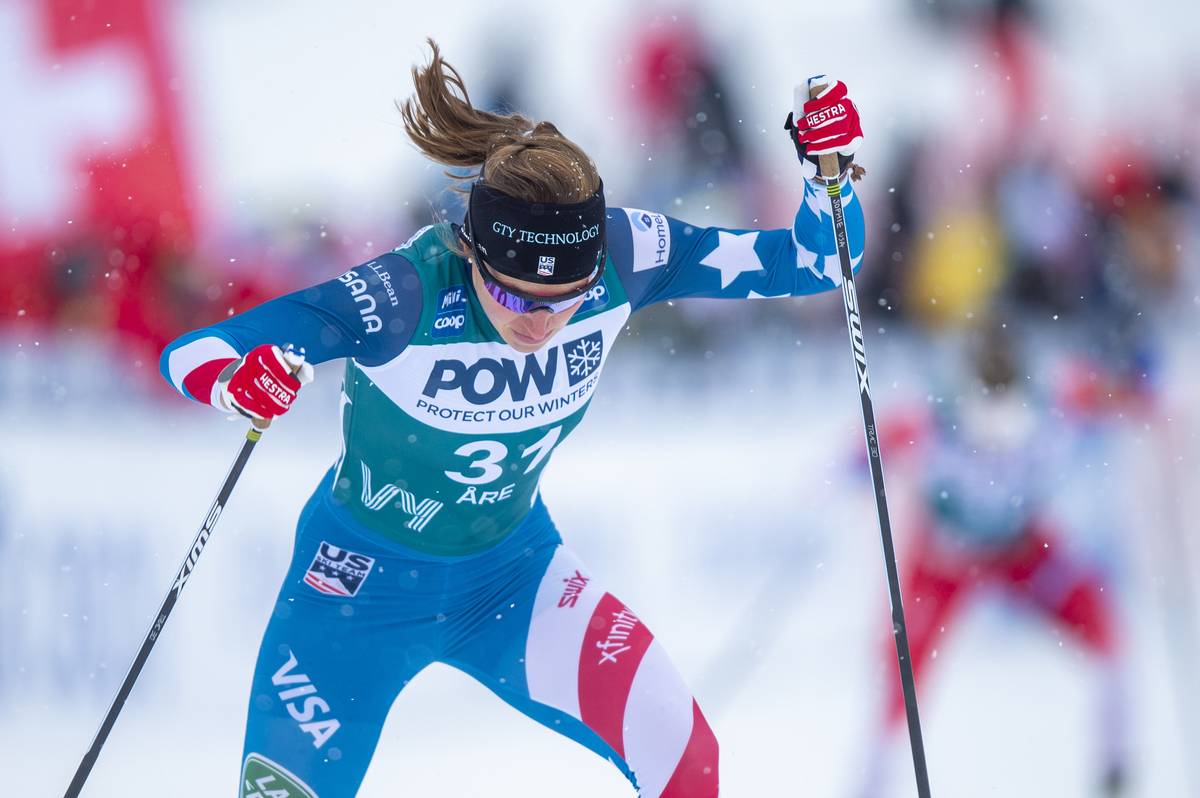
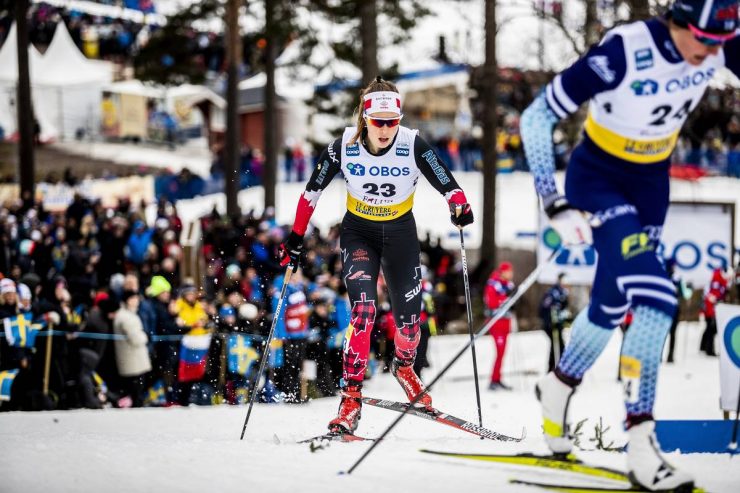
When Therese Johaug wins a sprint qualifier by 4.5 seconds and Sophie Caldwell qualifies in 23rd, you know it is not your average course. Held at the Swedish national alpine ski area in Åre, today’s event seemed to blend the infamous climb up the Alpe Cermis in the final stage of the Tour de Ski with skier cross on perhaps the shortest but toughest sprint on the World Cup.
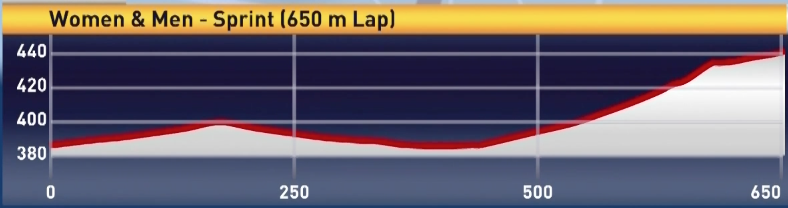
A gradual uphill start led skiers to a fast downhill into a swooping banked turn to the left. The course then ascends a pitch as steep as 28% up the base of the alpine hill, climbing nearly 60 meters within the final 200 meters of the course. Athletes would then need to walk back down to the start area.
The Åre sprint hill climb in profile. (Photo: Screenshot FIS Broadcast)
Though less than 700 meters in total length, nearly half the usual distance, the course took the women roughly two and a half minutes, on par with a usual sprint time.
The event drew a roaring crowd, with fans lining the course, their yells and gaps echoing as athlete’s skied by. After the race, Matt Whitcomb recognized the event organizers for putting together a unique stage and drawing so many energetic spectators.
Post-race comments from Matt Whitcomb.
With Johaug at the top of the qualification list were Heidi Weng (NOR), Greta Laurent (ITA), Linn Svahn (SWE), and Laura Mononen (FIN), the most diversity in nations among the top five in the tour so far. This result also added mystery and excitement as it could be anyone’s game. Weng is a top distance skier, Laurent and Svahn are most recognized for their sprint performances, and Mononen normally hovers on the border of the top-30 FIS point scorers list, a relative unknown.
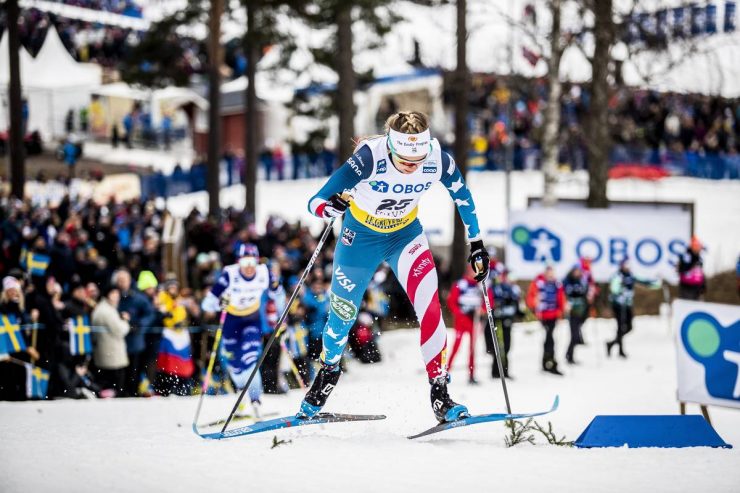
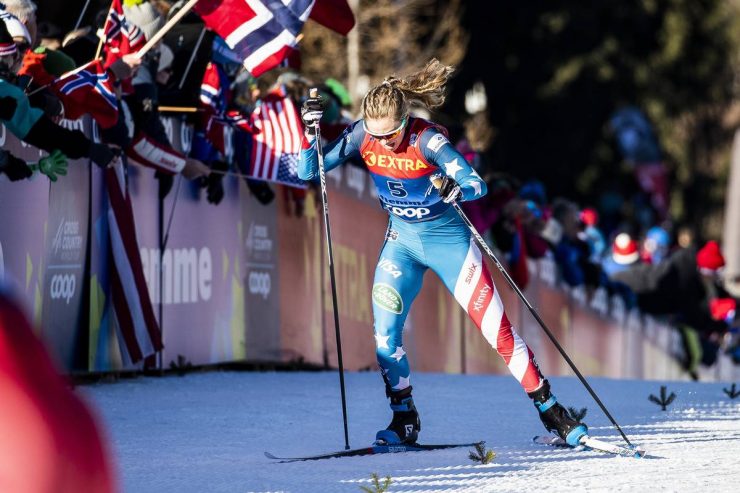
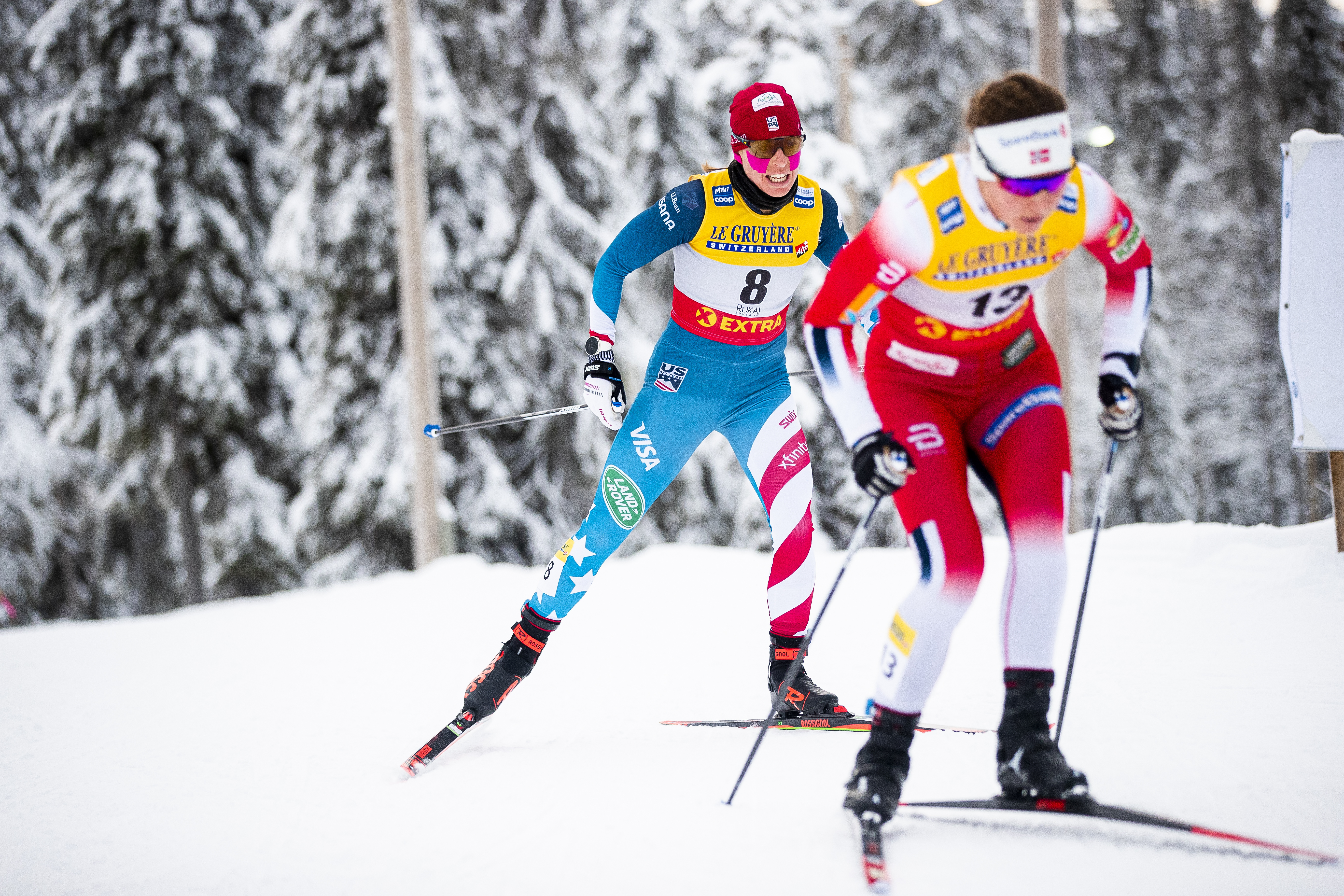
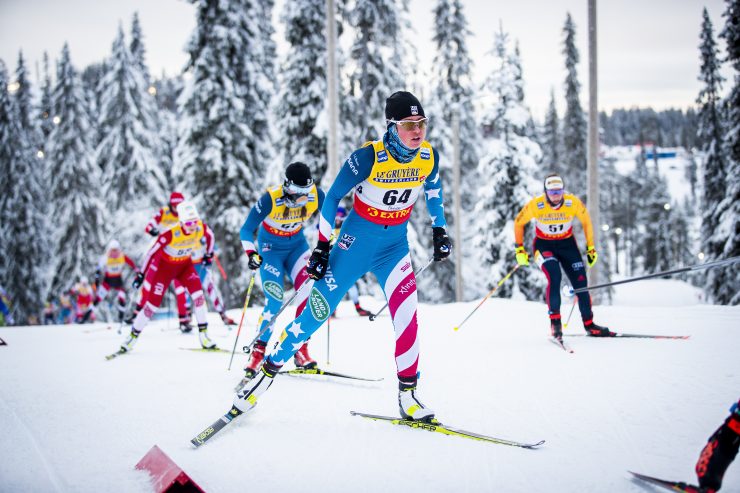
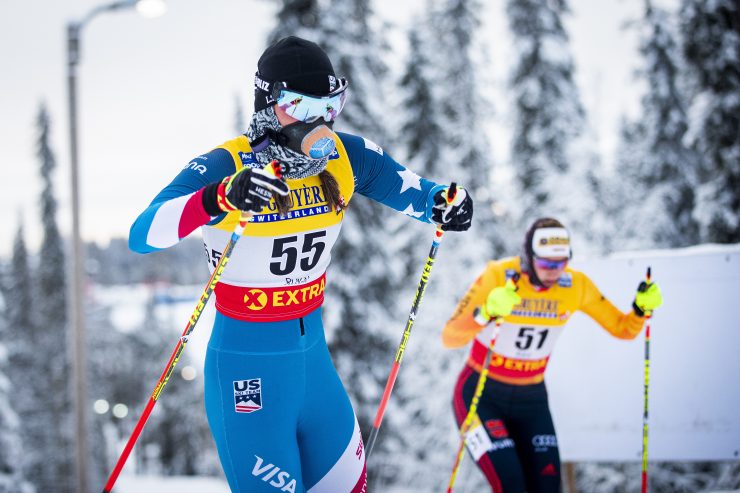
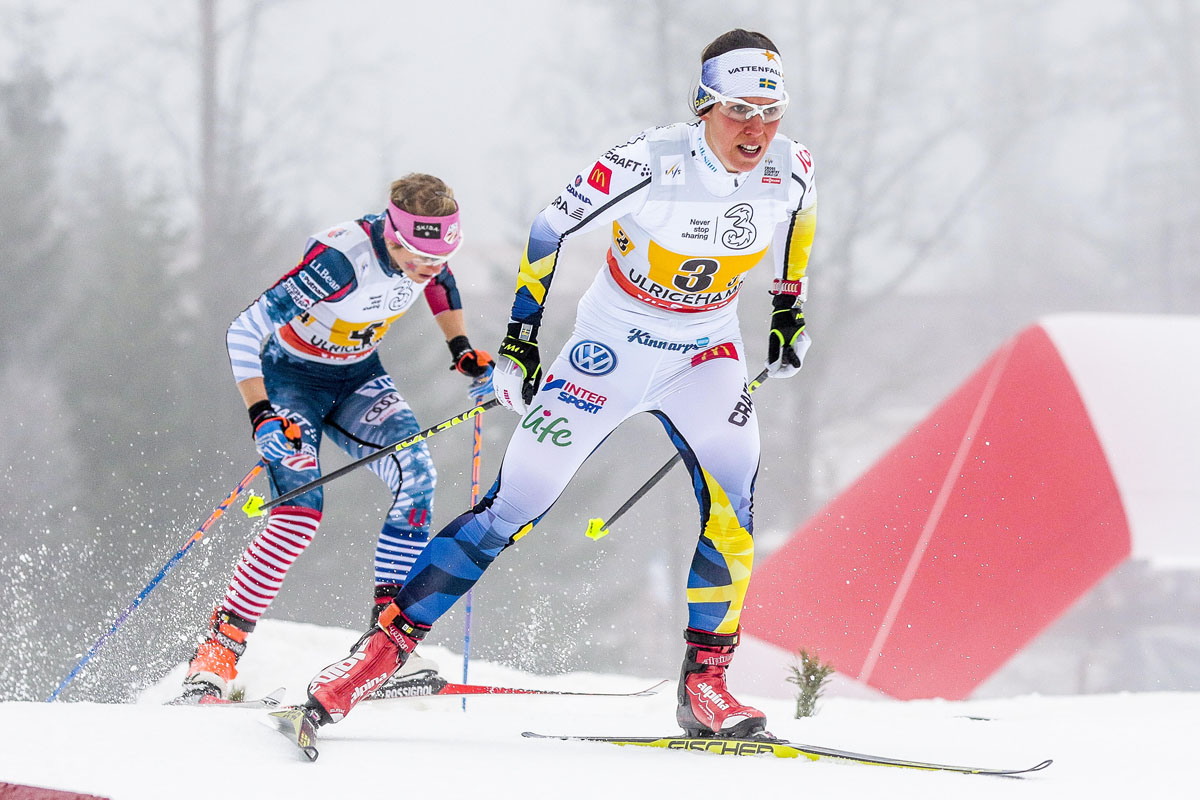
Rosie Brennan climbs to the top American result in qualification during the Stage 3 “sprint”. (Photo: NordicFocus)
Rosie Brennan was the top American qualifier in 14th, followed by Jessie Diggins in 17th, Julia Kern in 18th, Sadie Maubet Bjornsen in 21st, and Caldwell in 23rd.
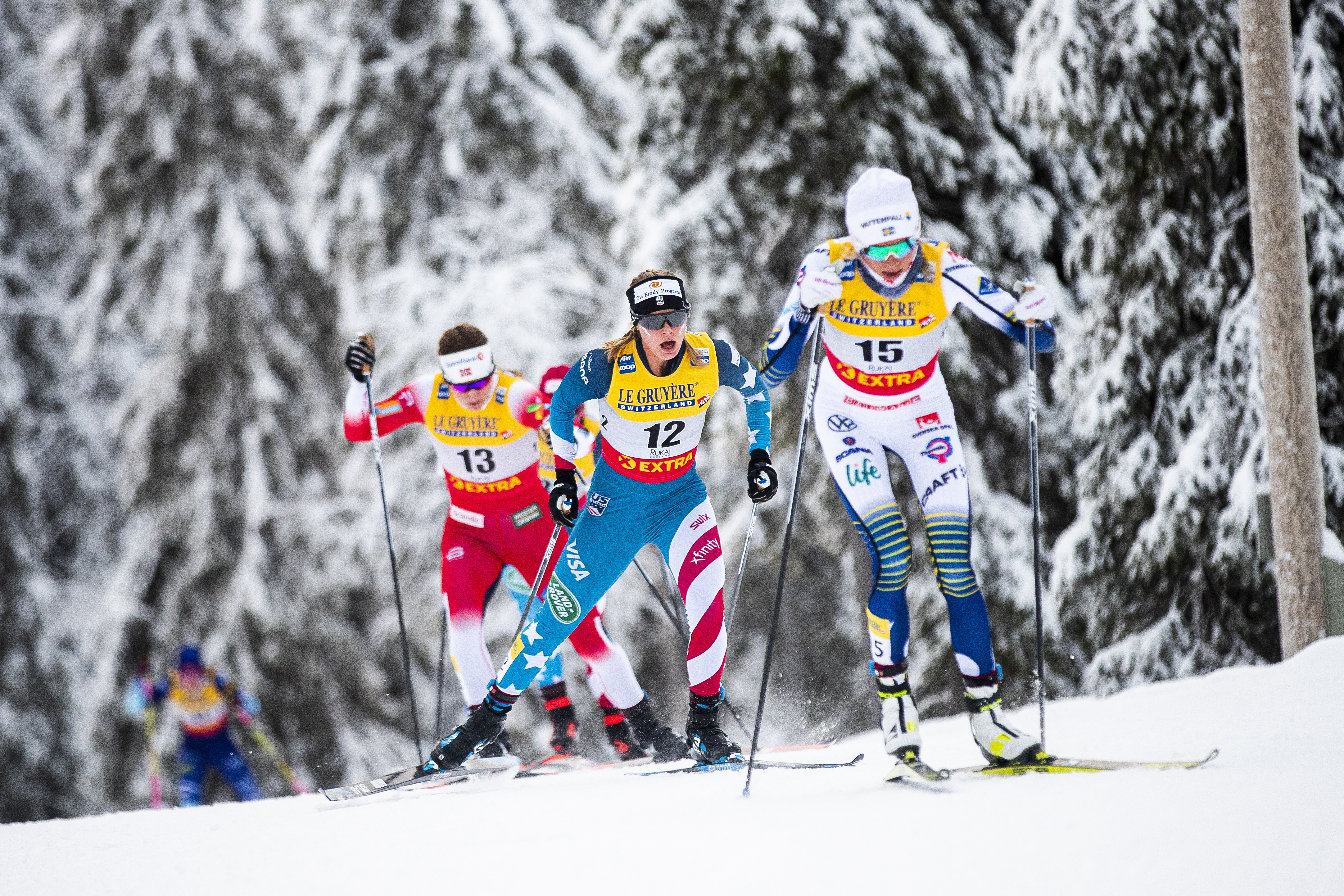
Racing in the second wave of the quarterfinal, Diggins and Brennan took the pace out hot, trying to create a gap over the two top qualifiers, Johaug and Weng. Diggins led the way over the gradual climb and into the downhill, fearlessly flying into the banked turn with high speed. Riding up the berm to the outer lip of the curve, Diggins stayed in control, though only just.
Brennan and Diggins were still in the lead beginning the hill climb, but the two high-tempo Norwegians were gaining quickly. Weng and Johaug overtook the Americans midway up the climb, but Diggins did not let them get away. Maintaining contact, she crossed the line within 1.5 seconds of the Norwegians and advanced as lucky loser, her early effort to push the pace making it the fastest of the five heats.
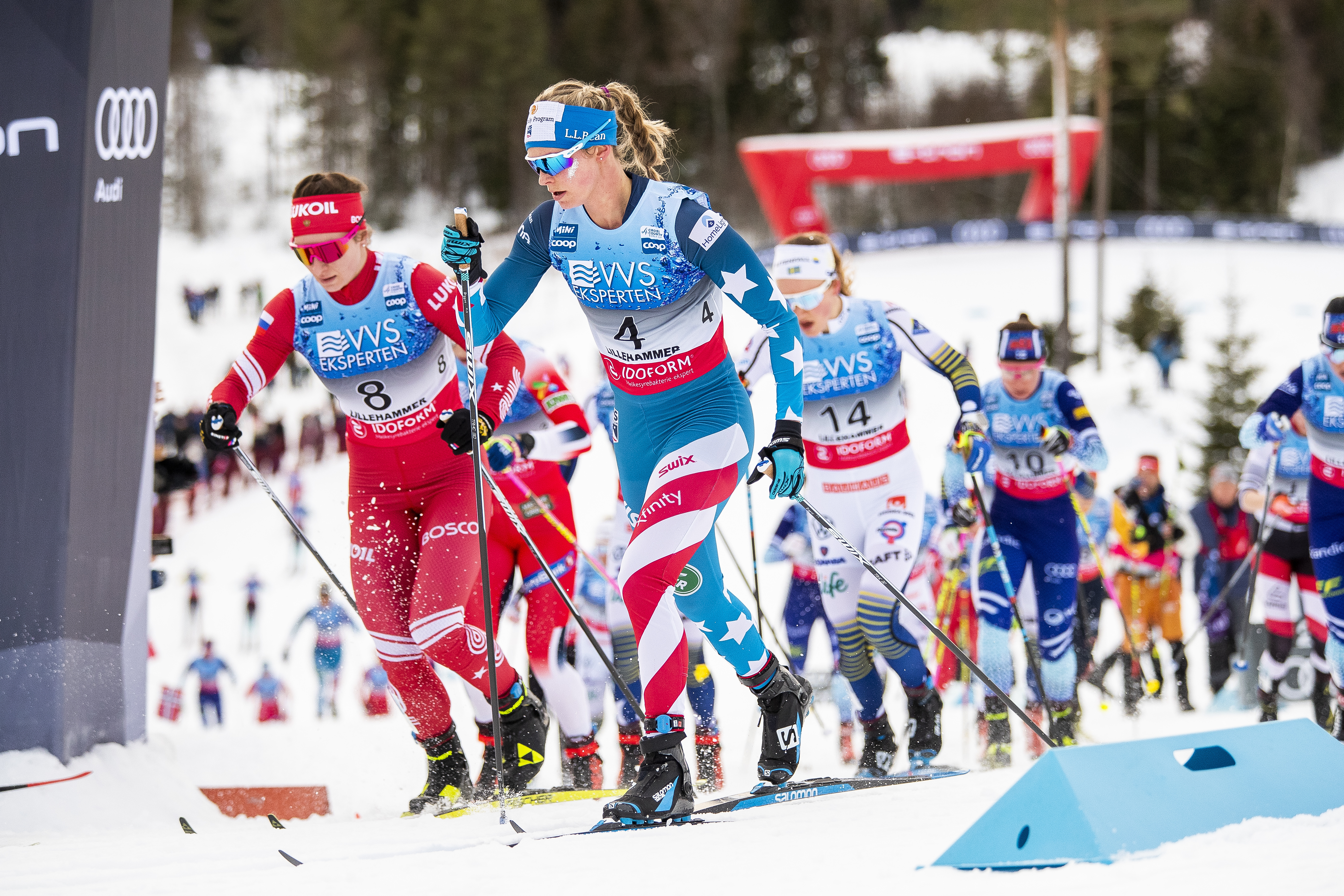
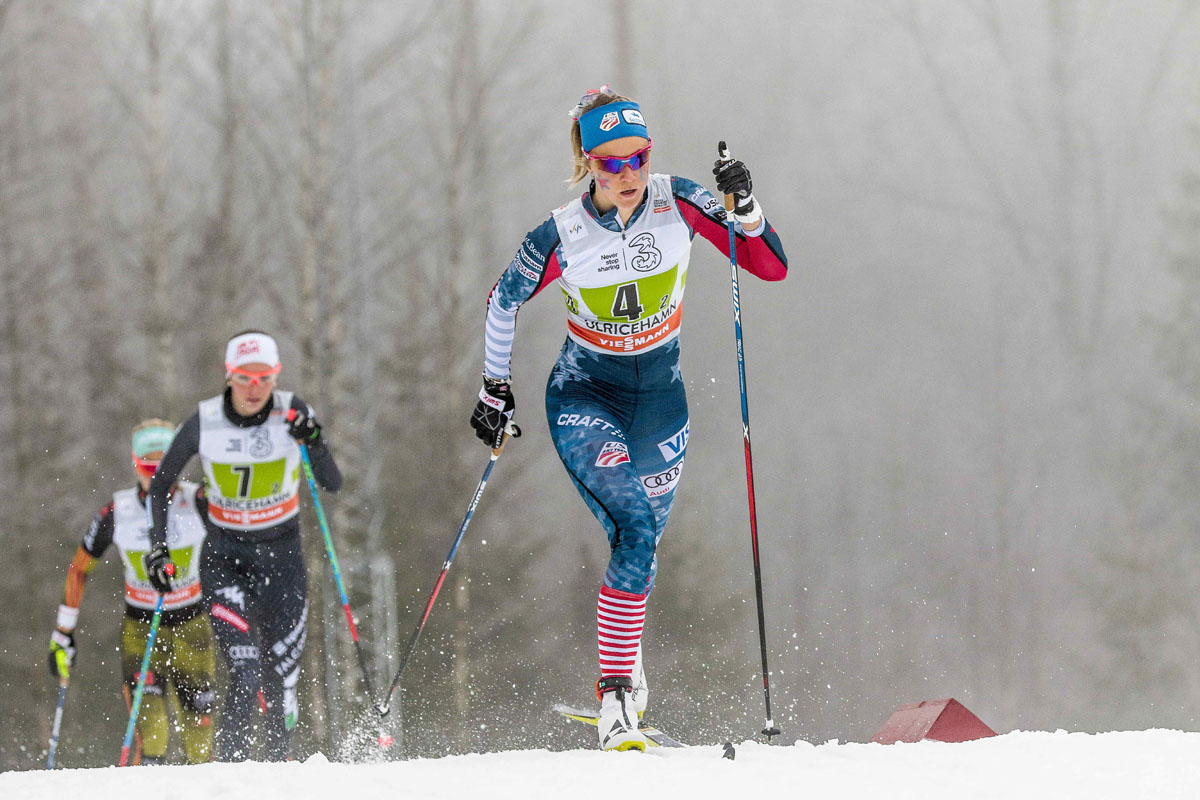
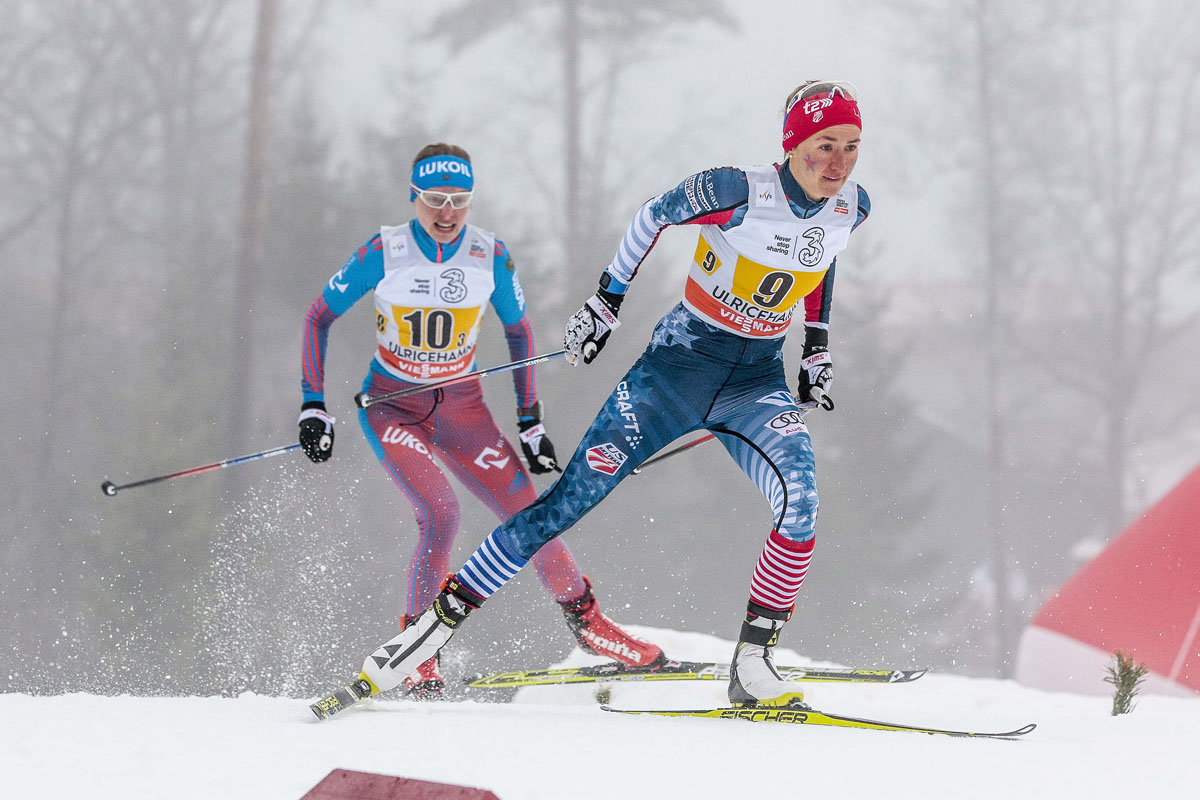
Diggins attacks the hill climb during the Stage 4 sprint in Åre, Sweden. (Photo: NordicFocus)
Brennan fell back to fifth in the heat and did not advance. She ended her day in 22nd.
Maubet Bjornsen and Kern raced in the fourth heat, finishing fourth and sixth, respectively. Maubet Bjornsen’s final rank was 20th.
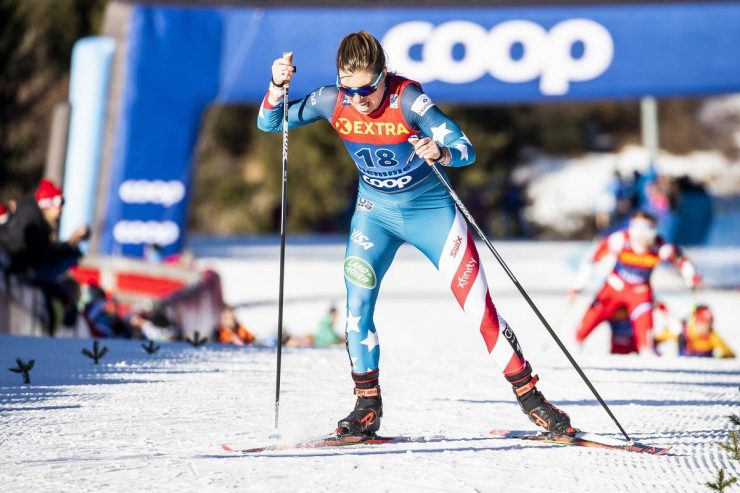
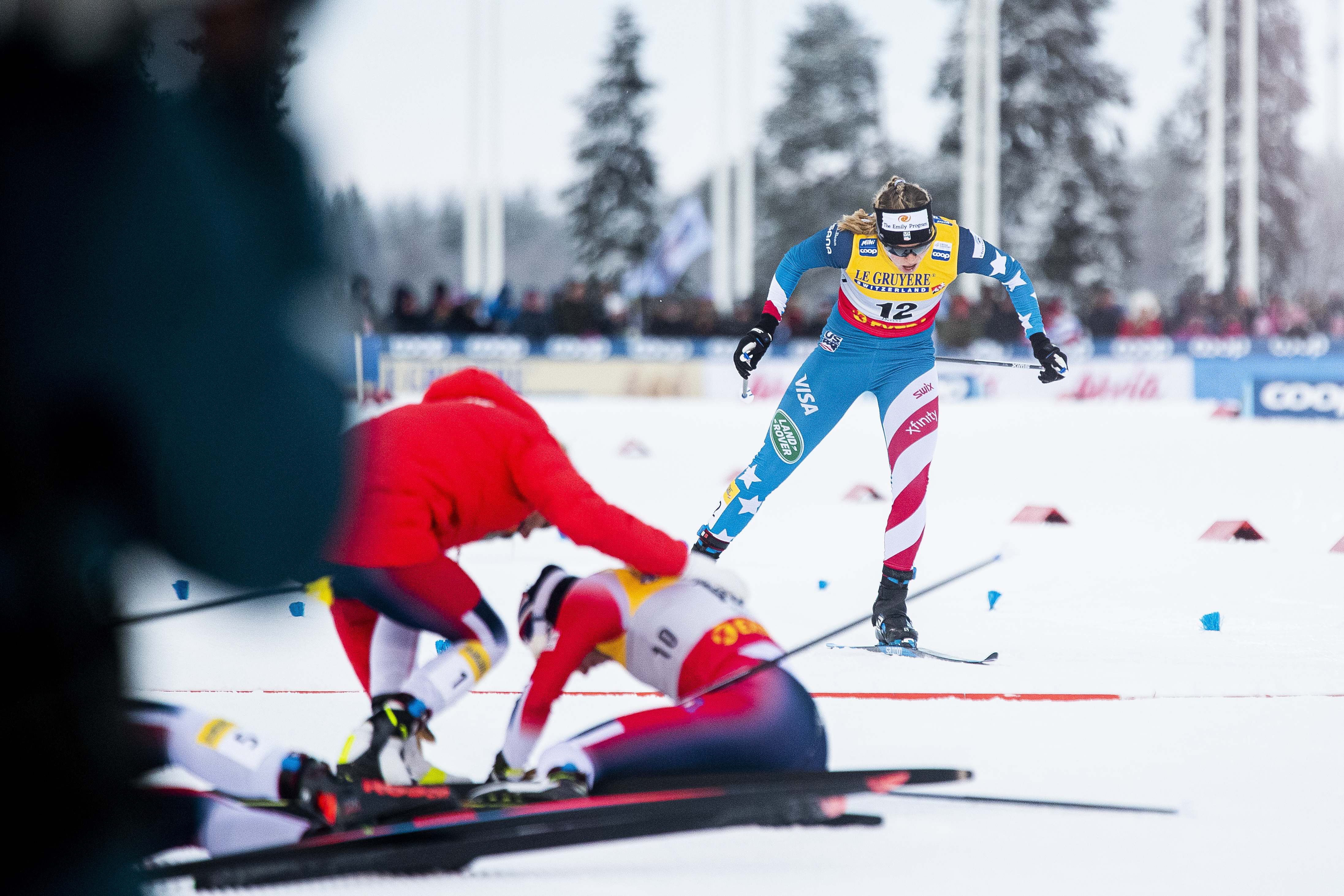
At the start of the last quarterfinal round, Caldwell skied off the front, navigating the banked turn with ease and picking up momentum as she approached the base of the hill in V2. Caldwell stayed near the front through the climb, her technique smooth and controlled. As the course curved and leveled to the finish, it was Mononen and Caldwell at the front. They crossed the line together, immediately folding with hands on their knees in anguish.
If this is what the finish of the quarters looks like, what will happen as the deep burn of cumulative fatigue starts to sink in?
In the semis, Diggins faced off again with Johaug and Weng. Rather than flying off the front, Diggins sat in the middle of the pack over the first climb, hooking 180 degrees left and dropping into a tuck heading into the banked downhill.
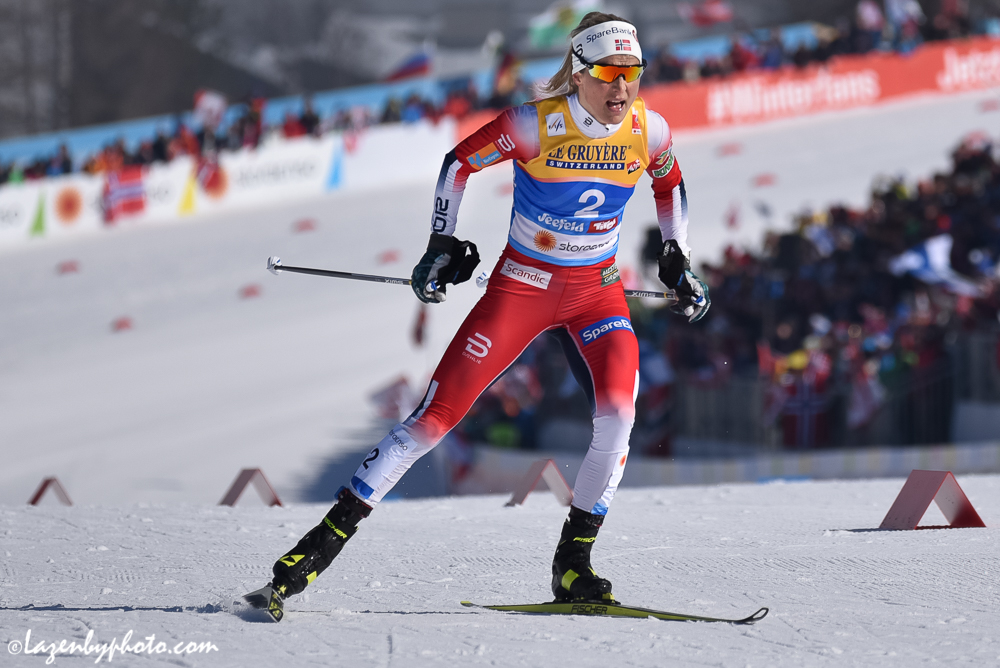
Johaug was last into this turn and last to the base of the climb, but she was far from out of the race. Jump skating up the left side of the course, Johaug rocketed from the back of the pack to the lead, edging out Weng to win the round.
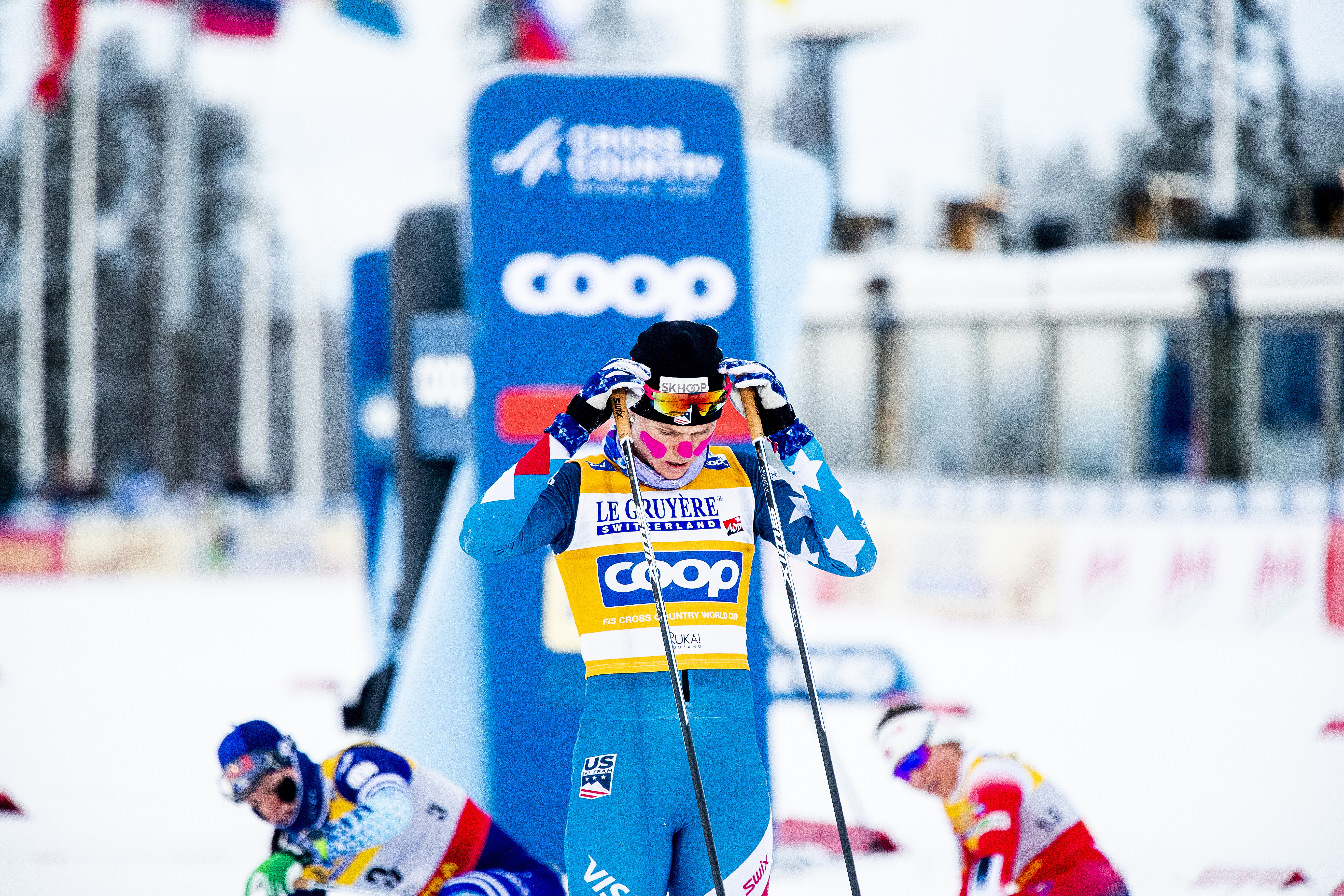
Diggins fell off the pack at the base of the climb and finished last in the heat, and 11th for the day.
Relaxed, smooth, collected, per usual, Caldwell rounded the banked turn in second and was in the mix at the base of the climb. Then it was over.
At the front, Svahn, Astrid Urenholdt Jacobsen (NOR), Laurent, and Mononen stepped powerfully up the climb. In the final meters, Svahn was at the front with Laurent close on her tails looking like a lock for second, until a last second surge by Jacobsen snuck her just ahead of the Italian at the line. As the heat was slower than the first, only Svahn and Jacobsen advanced.
After falling off the pack, Caldwell took last in the heat and ended the day in 12th.
Breaking down the lineup in the final, you’ve got two pure distance skiers with a history of outstanding results in the TdS hill climb, Johaug and Weng, alongside their teammate, Jacobsen, an all-arounder skewed toward distance. These three women paired with three sprinters, Svahn, Jonna Sundling (SWE), and Nadine Faehndrich (CHE). A World Cup cocktail.
The Swedes took the lead at the start of the final, shooting around the banked curve and into the climb. Johaug, again, the last to the base of the hill.
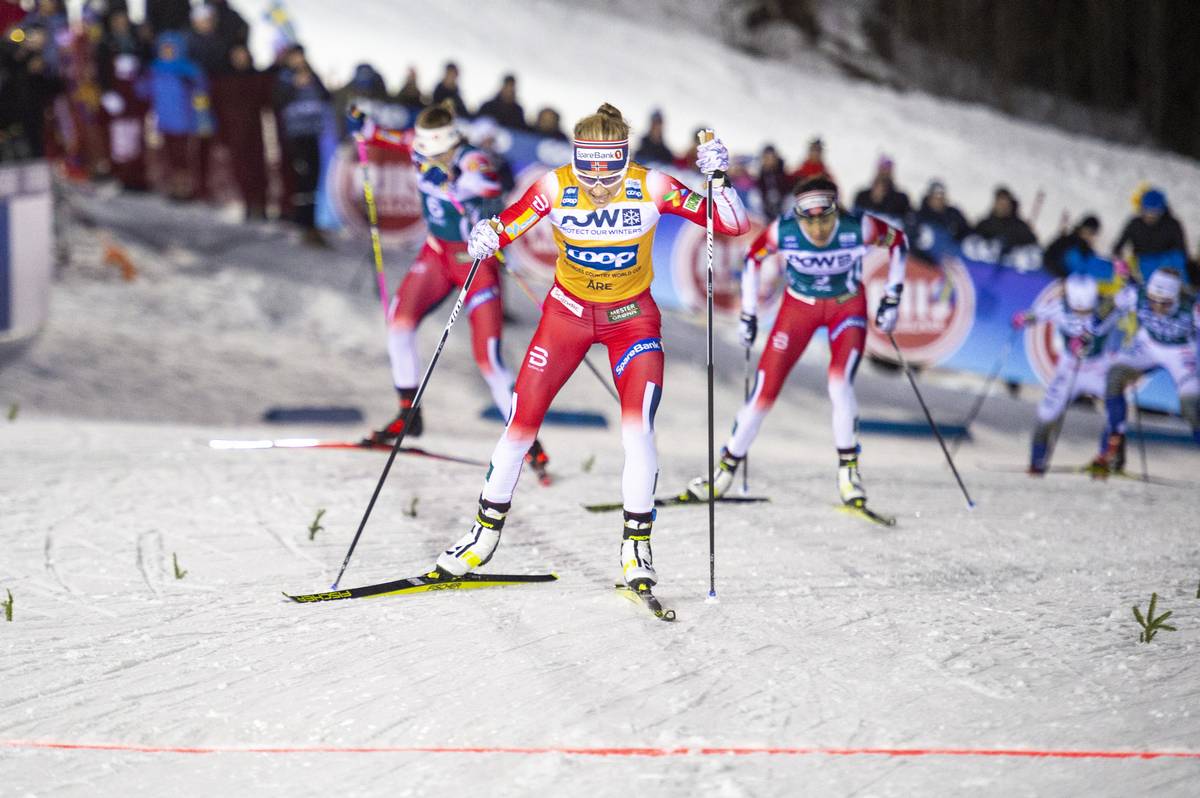
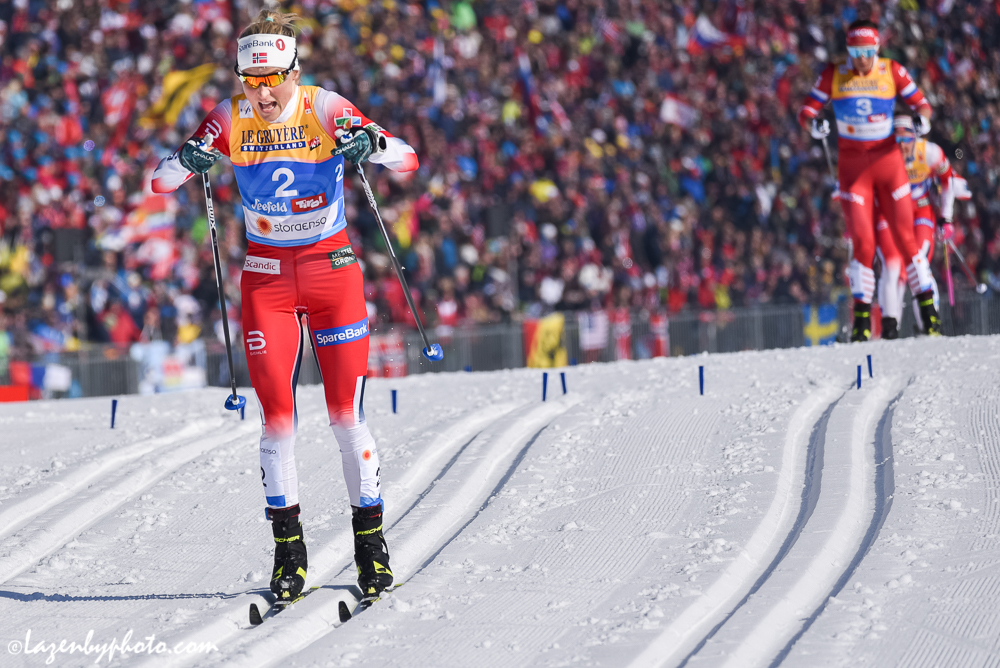
As the grade increased, Weng and Jacobsen accelerated up the right side of the course, while Johaug repeated her uphill attack as she weaved through the other women to the front. The Norwegians skied three abreast as they passed under the Audi e-tron arch toward the steepest pitch, shortly before the finish.
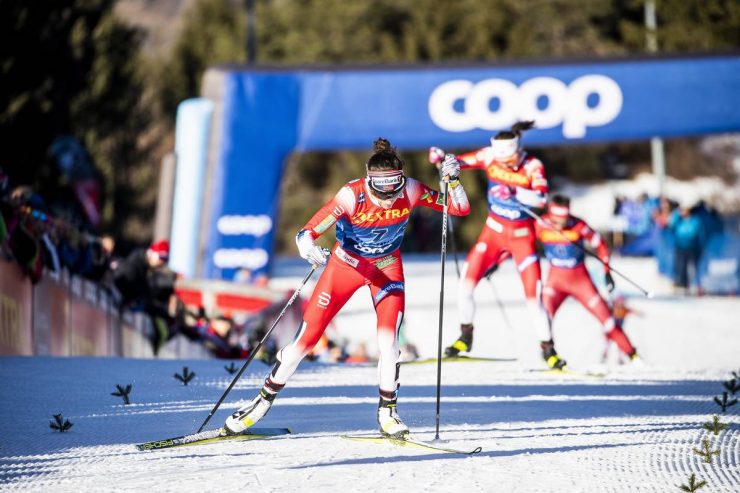
Therese Johaug leads Heidi Weng and Astrid Urenholdt Jacobsen through the final meters of the sprint hill climb. (Photo: NordicFocus)
Increasing her tempo and beginning to jump skate, Johaug rounded the final bend in the lead with the win locked up. Her teammates, Weng then Jacobsen, crossing behind her in second and third, respectively.
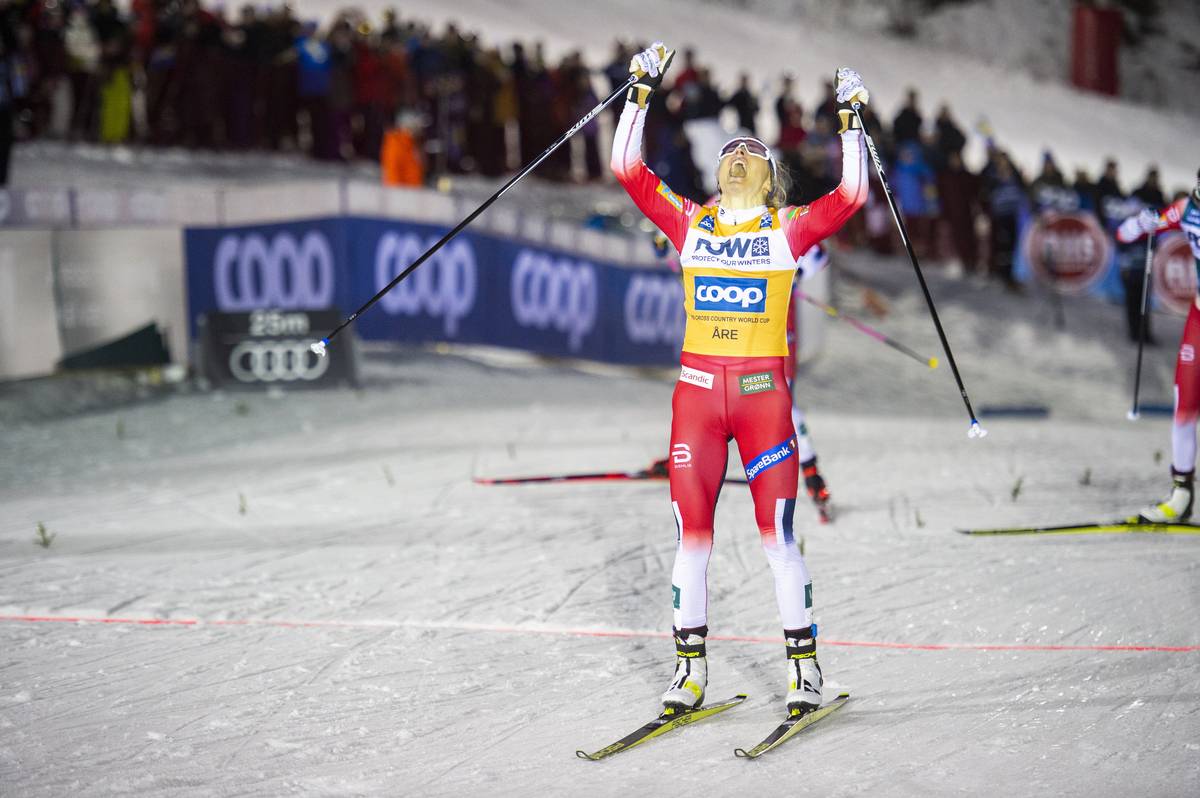
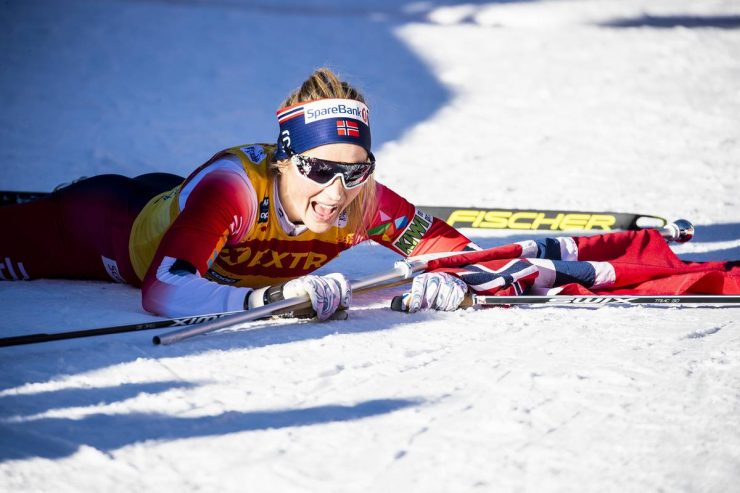
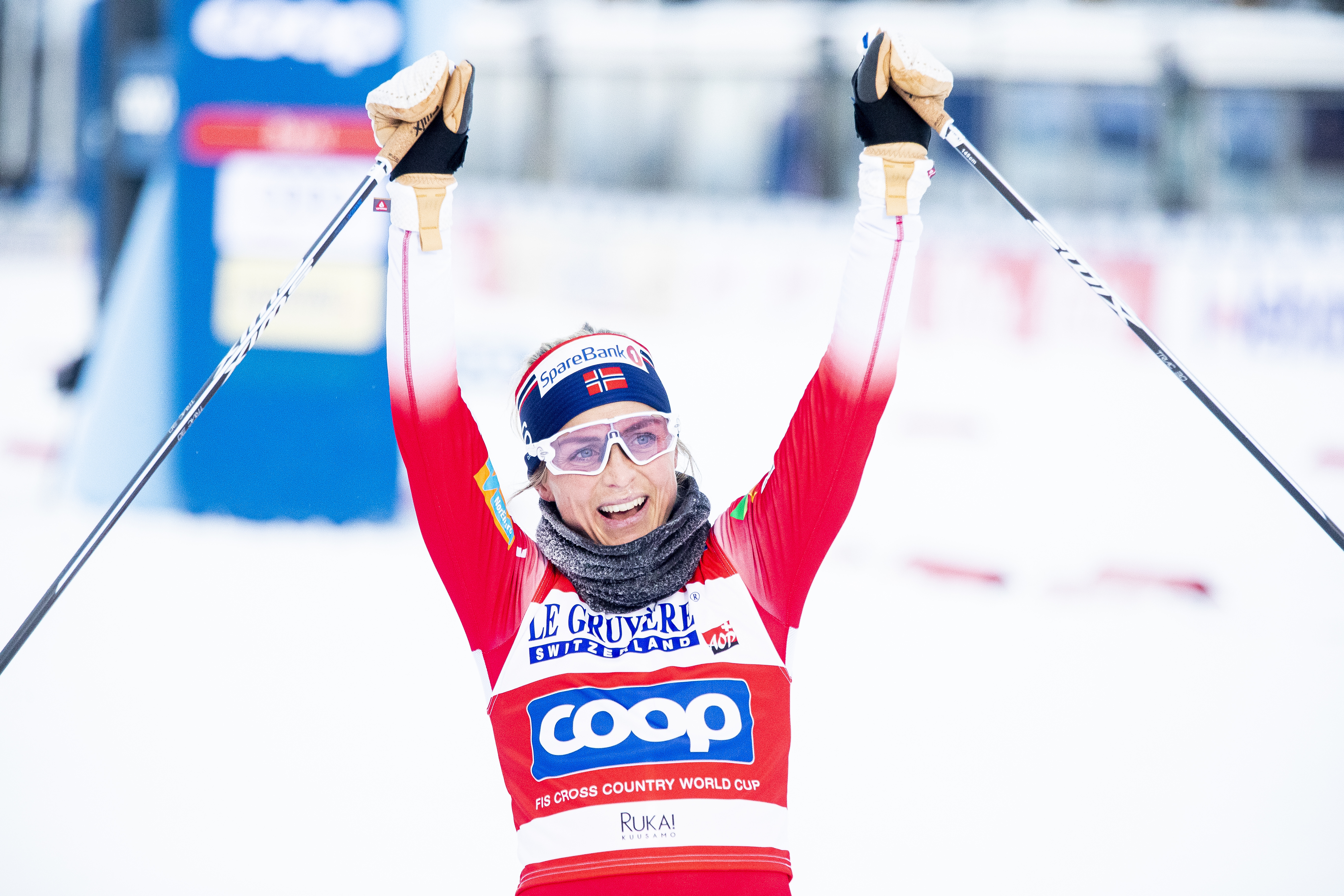
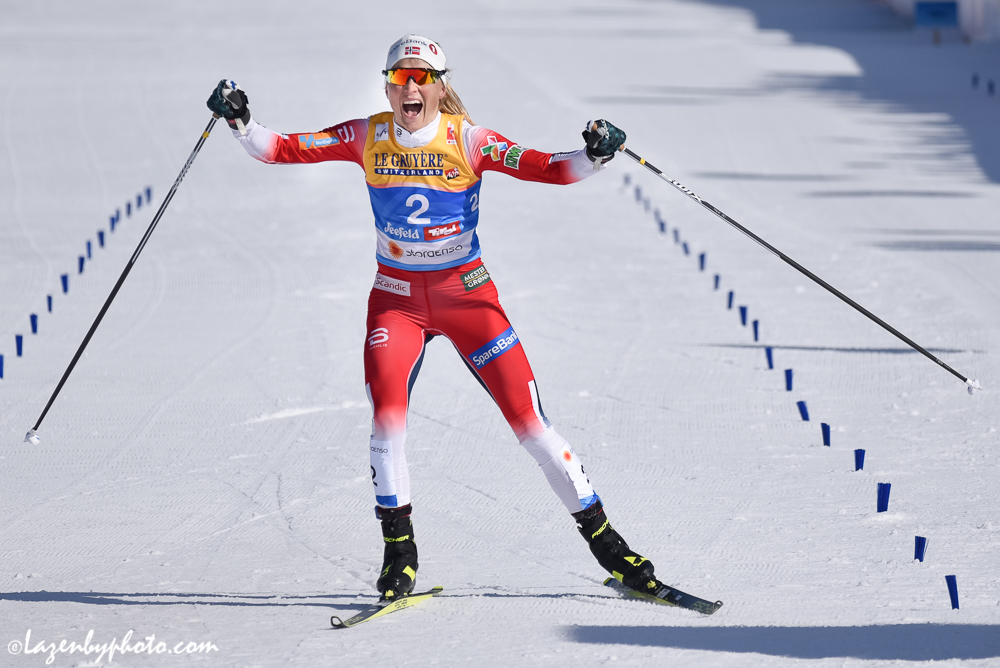
As the other wobbly-legged women collapsed, writhing in agony with faces turned toward the snow, Johaug raised her arms in celebration, her lungs still functional enough to let out a loud yell. She looked as though she had just completed a particularly successful interval session, a much different appearance than the others.
Therese Johaug takes Stage 3 of the FIS Ski Tour 2020. (Photo: NordicFocus)
“It was a crazy race,” smiled Johaug as she spoke with FIS at the finish. “But, as you know, I love uphills, and today as well was my day. Of course, you cannot call it a sprint race, but for me, it means a lot to stand atop the podium and I worked really hard for that, so I’m really happy.”
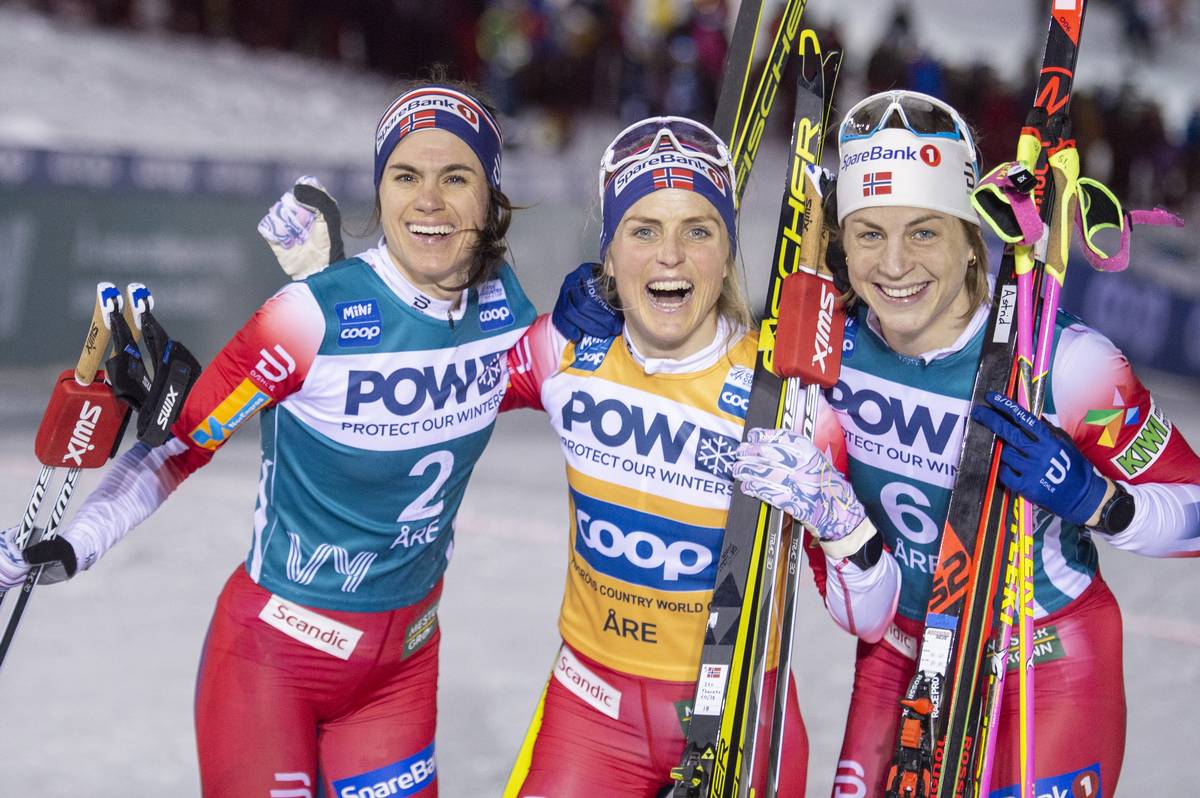
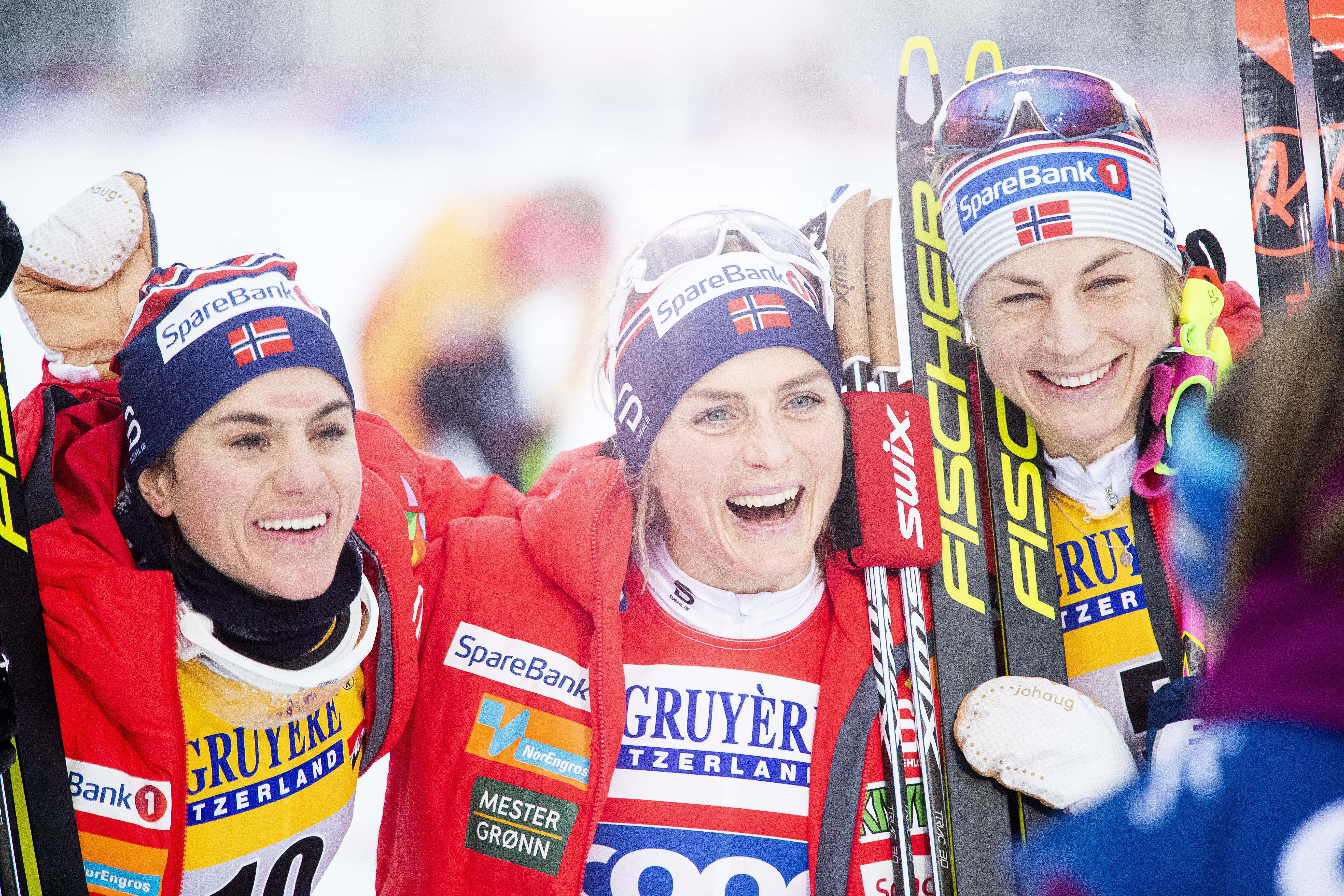
The third straight all-Norwegian women’s podium of the FIS Ski Tour 2020. (Photo: NordicFocus)
Commenting on the event in a post-race email, Caldwell wrote:
“Today was a very different kind of sprint. I wasn’t sure what to expect, but when we checked out the course yesterday, I was pretty shocked that we were literally going up an alpine hill! I had never done anything like this because and I know I have the potential to flood, so I wanted to make sure I did some pacing for my qualifier. It didn’t end up being a ripping fast qualifier, but it was good enough and I was honestly psyched to qualify on a course like this that doesn’t exactly play to my strengths.
“In my quarter I tried to get out fast and ski the technical corner how I wanted to and then I just focused on finding the faster snow and leaving a little left for the end. I was really happy with how my quarter went and on a course like this, making the semi final is a really good day for me. I also left everything I had in my legs on the course, so unfortunately in my semi final, even though I didn’t feel like I was breathing very hard, my legs weren’t exactly moving. So that was pretty different from a normal sprint where I usually feel like I can keep pretty good legs and energy through the final. Now it’s time for some recovery before the next stage!”
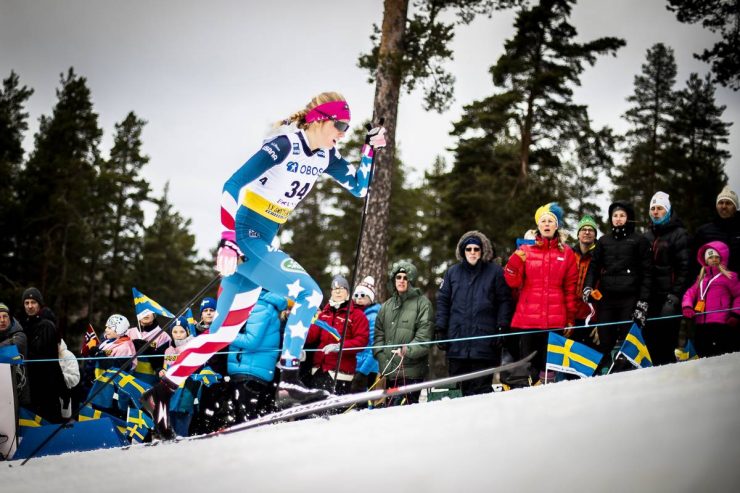
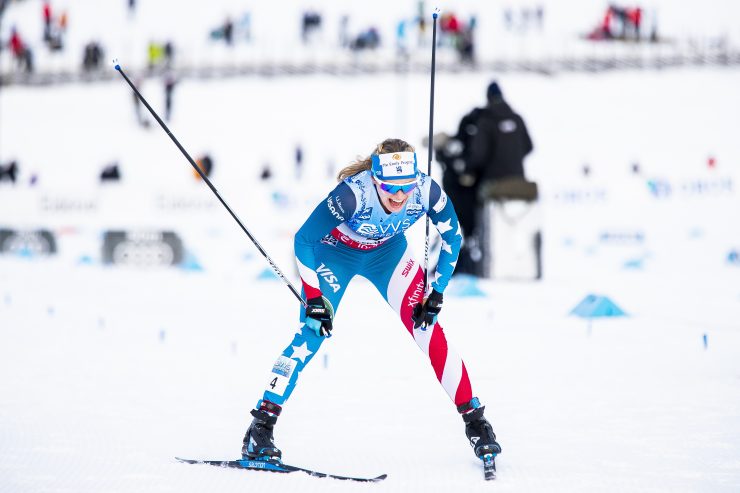
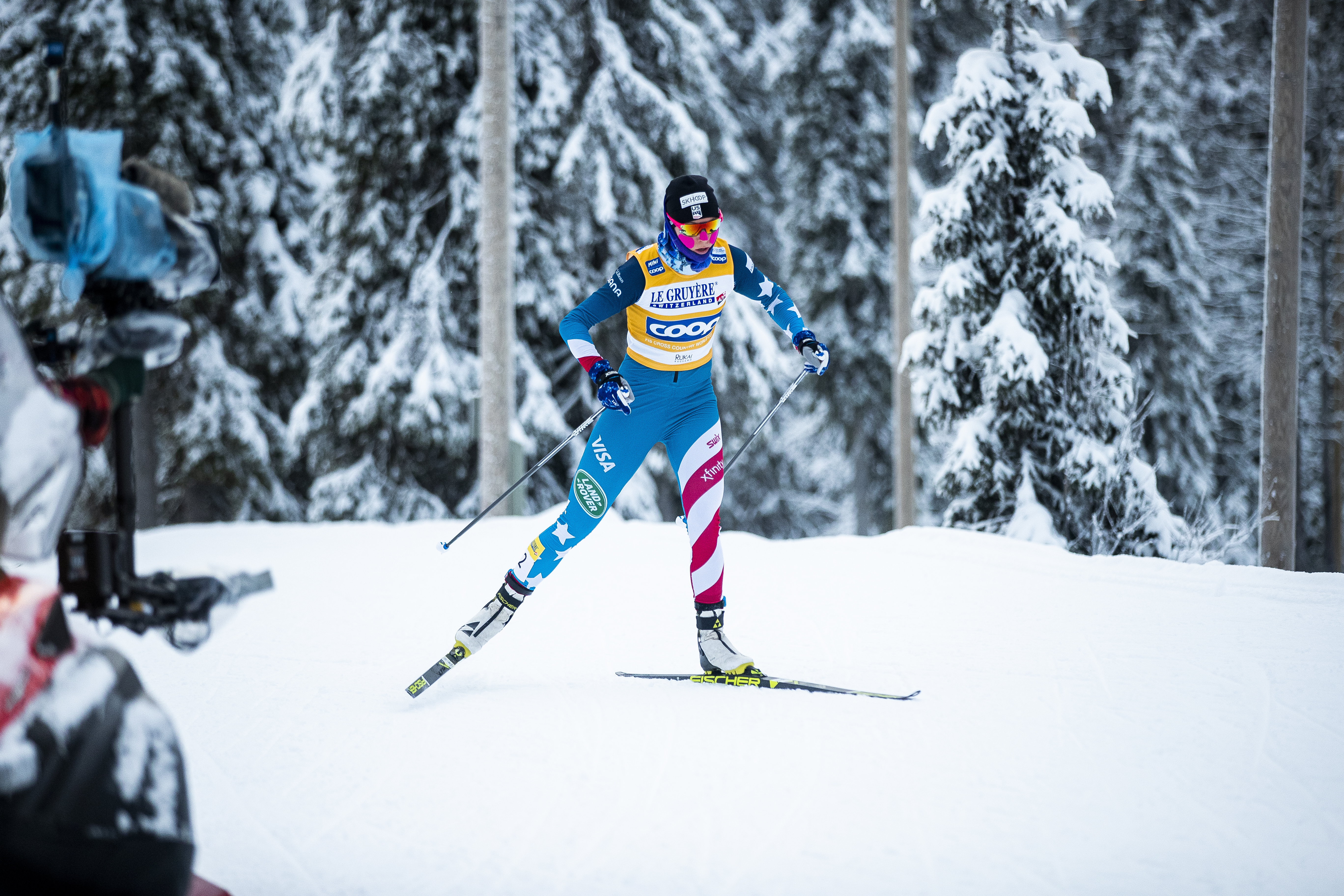
Head down and grinding, Sophie Caldwell skis to 12th place in Åre. (Photo: NordicFocus)
Outside the heats, Alayna Sonnesyn skied to 42nd (+17.24) in the qualifier, followed closely by Hailey Swirbul in 43rd (+17.31). Caitlin Patterson finished 46th (+19.76), Rosie Frankowski 56th (+23.55), and Katherine Ogden 59th (+27.58).
Racing for Canada, Katherine-Stewart Jones was the top qualifier in 34th (+15.56), followed by Cendrine Brown in 45th (+18.88), and Emily Nishikawa in 49th (+20.04).
In a post-race call, Whitcomb provided further insight into the women’s day, expressing that the his athletes were “quite positive” about the result, but impressed by the difference in feelings between qualification and the quarterfinal.
Whitcomb also explains that because of impending weather, the planned 38-kilometer point to point race across the Sweden-Norway from Storlein to Meråker may not be possible. The backup plan is a 15 k race for both men and women on an approximately 3 k loop in Meråker.
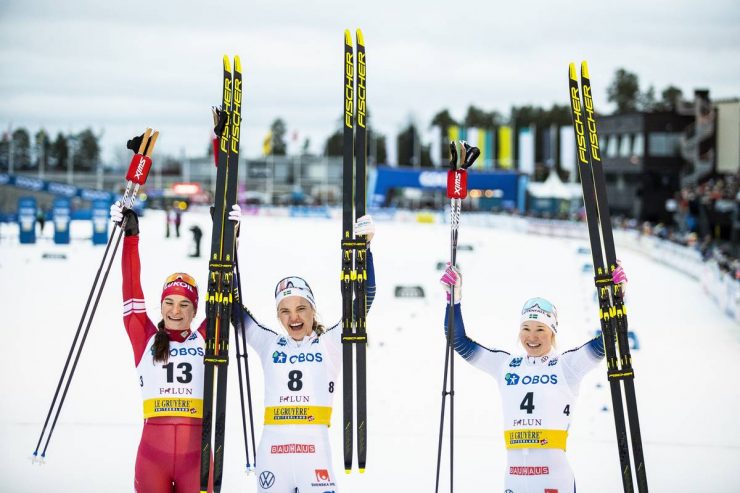
The women’s podium in Falun, Sweden. Linn Svahn (SWE) took the win ahead of Natalia Nepryaeva (RUS) and Jonna Sundling (SWE). (Photo: NordicFocus)
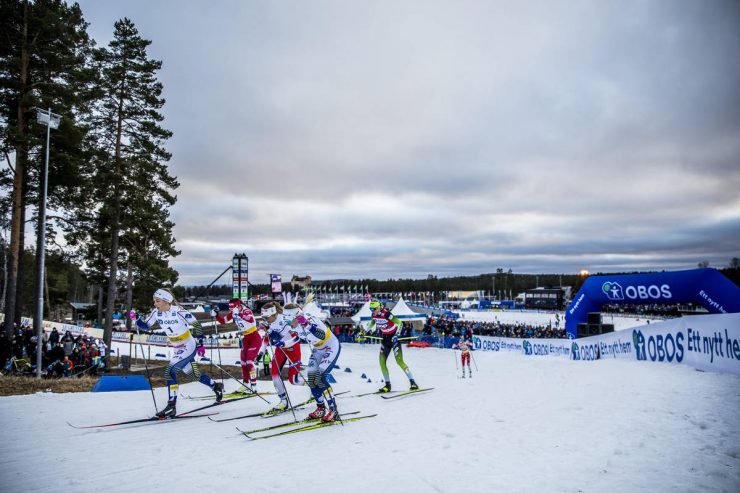
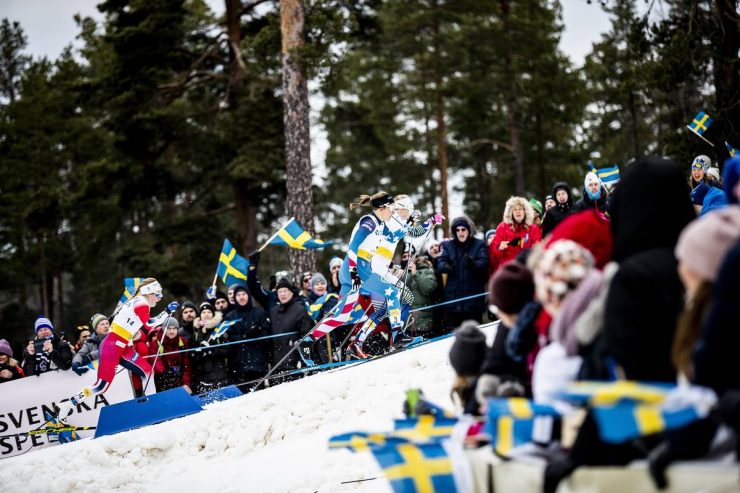
Not the backdrop one might expect from Scandiavia in mid-winter, rather, green grass, bare ski jumps, and a ribbon of snow were found in Falun, Sweden. However, what was lacking in snow was made up for by a densely packed crowd of cheering fans, erupting as athletes flew by in the women’s classic sprint.
An occurrence that might meet our expectations is that the Swedish women showed up on home turf. Johanna Hagström won the qualifier in 3:15.96, followed by Anna Dyvik. Sweden also took 4th, 5th, 8th, 9th, and 10th. Yes, seven of the top ten qualifiers were from Sweden. Only Sophie Caldwell, Ane Appelkvist Stenseth of Norway, and Anamarija Lampic of Slovenia in 3rd, 6th, and 7th, respectively, were the outliers from other nations.
Sophie Caldwell chases Anna Svendsen (NOR) and Jonna Sundling (SWE) during the quarterfinal of the classic sprint in Falun. (Photo: NordicFocus)
Five of the seven continued on to the semifinals, along with four Norwegians who weren’t going to back down easily. To round out the remaining three nations, Sophie Caldwell advanced to the semis as a lucky loser after a photo finish with Sweden’s Jonna Sundling in the first heat, which was won by Russia’s Natalia Nepraeva. Lampic moved on by taking second in the next heat.
Fast racing in the semi-final of the 2020 classic sprint in Falun, Sweden. (Photo: NordicFocus)
The intensity ramped up in the stacked first heat of the semi: Nepryaeva, Lampic, Hagström, Jonna Sundling (SWE), Maiken Caspersen Falla (NOR), and — perhaps unexpected in a sprint semi — Therese Johaug. Nepryaeva led the charge with Sundling and Hagström. The pack took the troublesome corner fast, but the women kept their composure, with Nepraeva shooting out of the turn with high speed. She held the lead all the way into the stadium as a group of Lampic, Sundling, and Falla duked it out for the remaining spots in the final.
In the final sprint, Lampic and Sundling created a gap to Falla, surging to a photo finish. Lampic took second, Sundling third, and Falla crossed a second behind in fourth. As the pace was hot, all four women moved on.
Sophie Caldwell matches Sweden’s Jonna Sundling stride for stride up the climb in Falun. (Photo: NordicFocus)
For Caldwell, the next round was spicy. With a misstep on a punchy climb, Sweden’s Anna Divyk dropped to her knee, catching Caldwell’s arm and pole with hers and robbing some of the American’s momentum. Climbing halfway, Caldwell was trapped on the inside of a left turn. Skis were stepped on, racers were slipping, but she made it through. Calm and collected, she dropped into a tuck and glided into third as they headed for the final climb.
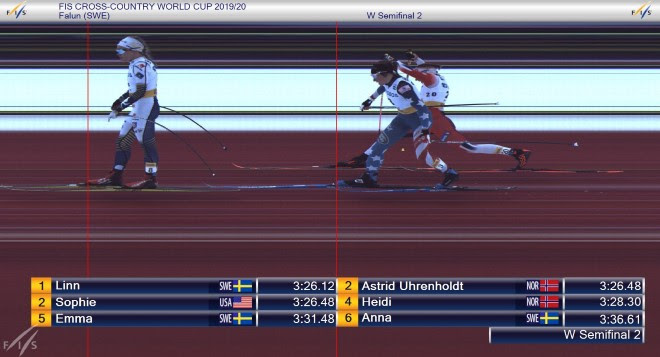
Attacking the double pole sprint down the straightaway, Caldwell challenged Norway’s Astrid Jacobsen for the second guaranteed spot in the final. Caldwell threw her boot early, with Jacobsen’s foot matching hers at the line for a photo finish. After review, the two could not be differentiated. It was declared a perfect tie, down to the hundredth. Though their times were too slow for a lucky loser, both women advanced, making it a final of seven women.
Captured. A perfect tie between Sophie Caldwell and Astrid Jacobsen during the semifinal of the classic sprint in Falun. (Photo: Screenshot FIS-ski.com)
Six women across, with the second lucky loser, Falla, in the second row behind Svahn. And off they went.
The two Swedes, Svahn and Sundling, led the charge into the first climb, Lampic occupying the outside lane. Around the sweeping turn they went unscathed, Sundling continued to push the pace up the next climb, with Lampic losing grip alongside her. The lead group was four deep in the final climb and into the downhill towards the stadium.
Three across, Svahn, Sundling, and Nepryaeva powered down the final stretch as the crowds leaned in with bated breath. In the final meters, Svahn crept just ahead of the other two, throwing her boot for the win in 3:23.54. At her heel, the boots of Sundling and Nepryaeva slid across in a photo finish. It was deemed that the Russian was 0.02 seconds ahead of the Swede, taking the second spot on the podium. Both women were within a tenth of a second of Svahn.
By a boot, Linn Svahn takes her third World Cup victory as Johnna Sundling crosses just behind. (Photo: NordicFocus)
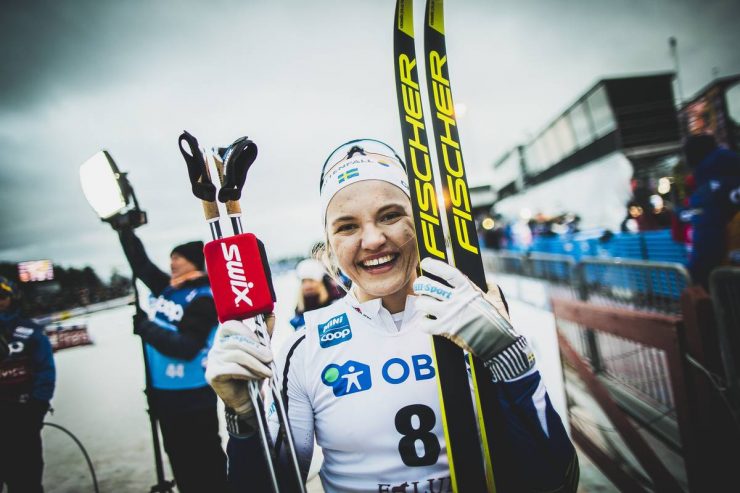
Linn Svahn takes the win in Falun, Sweden. (Photo: NordicFocus)
“It’s fantastic. I wanted to win so, so much today,” gushed an out of breath Svahn during her interview with FIS. “I pushed so hard on the final, and managed to win. Before the start, I saw Maiken behind me and I thought, ‘What is happening?’ So it was special, but so nice to compete in my hometown and to win. And to get Jonna on the podium as well, we are a strong team.”
A unique statistic, Svahn is the second woman to win three individual World Cup sprints before her 21st birthday, which she celebrates in September.
Lampic took the fourth spot in the final (+0.93), followed by Falla in fifth (+3.70). Jacobsen and Caldwell had fallen off the pace by the halfway mark. They finished sixth (+7.00) and seventh (+8.46), respectively.
After the race, Caldwell discussed her three week training block in Seefeld, Austria, interrupted by the races in Oberstdorf, Germany, where she finished fourth. She also spoke to the tangle with Divyk and how she stayed relaxed in order to ski the downhill well in order to reconnect with the group. She also discussed the evolution of her career and the effect of her plans to head back to Vermont after the FIS Ski Tour, missing the city sprints in Drammen, Norway to focus on the sprints in Quebec and Minneapolis.
Post-race interview with Sophie Caldwell.
Three victories before her 21st birthday, Linn Svahn strikes again in Falun, Sweden. (Photo: NordicFocus)
Three other Americans headed into the heats with Caldwell. Sadie Maubet Bjornsen qualified in 11th. Racing in the 4th heat, Maubet Bjornsen tucked into the middle of the group. As they reached the swooping icy found along the downhill halfway, the women began pumping the brakes to stay upright, and Maubet Bjornsen was nearly slingshot off course into the banner lining the outer edge of the turn. She regained her composure and made it through the remaining turns with more speed. However, she was not able to catch the leaders and finished 4th in the heat, 17th overall.
“I always struggle a bit in these conditions, so I didn’t have a star performance, but felt proud that I fought back even after coming dangerously close to falling on the fast, crazy corner,” Maubet Bjornsen emailed after the race. “At one point I feel like I skied the side of the fence, so I sure hope Bode Miller was watching me try to reinact his famous move!
“Despite a 17th place classic sprint, I am still believing in my body’s ability to feel sharper and shaper going into the Tour de 2020. Sometimes when I have been training at altitude, it takes my muscles a bit to get firing on high speed. The Swedes sure managed to find that speed today, so I will have to kick it into gear quickly to keep up! I look forward to another wild ride tomorrow for the 10k mass start. My goal is to stay on my feet, and find some of my gears that I know are in there!”
Jessie Diggins fights through the quarter final of the classic sprint in Falun, Sweden. (Photo: NordicFocus)
Jessie Diggins was the next American qualifier in 25th. She too finished 4th in her heat, ending the day in 20th. In a post-race call, Matt Whitcomb explained that Diggins was fighting a “tweaked neck”, but with the help of Zuzanna Rogers, the team therapist, it is showing improvement.
Whitcomb provided further insight into Diggins’ day, her likelihood to rebound tomorrow, and how the course and conditions affect the type of athlete that can excel on the tracks of Falun.
Post-race interview with Matt Whitcomb.
Hailey Swirbul qualified just behind Diggins in 28th for her third set of World Cup points. She landed in the top-30 on both days in Davos, Switzerland. Swirbul raced in the first heat with Caldwell, where she finished 5th in the heat and 25th for the day.
Hailey Swirbul charges the hill for the 28th fastest qualifying time in Falun, Sweden. (Photo: NordicFocus)
“I am learning so much with every World Cup race this season,” wrote Swirbul in a post-race email. “I thought my skis and support were great today on the tricky course. It was sweet to race in a heat with Sophie and learn from the best in the world up those climbs! I hope to get another opportunity to mix it up in the heats soon.”
Outside the points, Alayna Sonnesyn qualified in 46th (+23.45), followed by Caitlin Patterson in 47th (+23.50).
For Canada, Maya Macisaac-Jones qualified in 23rd and raced in the fifth heat, which was won by Svahn. She was fifth in the heat, ending her day in 24th.
Canada’s Maya Macisaac-Jones chases Katri Lylynpera (FIN) during the quarterfinal of the classic sprint in Falun. (Photo: NordicFocus)
Also bearing the maple leaf, Dahria Beatty qualified in 37th (+17.03), followed by Cendrine Browne in 43rd (+22.96), and Katherine Weaver in 48th (+23.62).
Therese Johaug: queen of the hill. (Photo: NordicFocus)
The fateful Alpe Cermis. The 10-kilometer capstone of the Tour de Ski, athletes complete the 1.5 k sprint loop before following the river valley down to the base of the alpine hill, climbing steeply for nearly 400 vertical meters to the finish. Bodies aching with the cumulative fatigue of the tour, racers are totally spent at the finish of the event. Crossing the line, they collapse with their faces pressed into the snow gasping for air and writhing in lactate-induced misery.
And so it was today.
First, a look back on Tours of the past. Unlike in the men’s event, the fastest skier up the Alpe Cermis has been the overall tour winner over the last four years.
Last year, Ingvild Flugstad Østberg was the fastest up the hill climb in 35:15.0 to take the overall win. Østberg was 42 seconds faster than the next skier, Krista Pärmäkoski of Finland. In 2017 and 2018, Heidi Weng was the first up the mountain by a similar margin. And four years ago in her most recent tour performance, Therese Johaug dusted the field, winning the day by a margin of 1:25.9. That’s nearly double the already large differential of her teammates.
Dubbed by Devon Kershaw an “once in a generation athlete,” Johaug has over 100 career podiums to her name, over 50 of which have been wins.
With this insight, it seemed safe to bet on Johaug in the final stage. However, the Norwegian superstar has proved to be beatable in this tour, much to everyone’s surprise.
Johaug was out-sprinted by Østberg in the final meters of the 10-kilometer classic pursuit in Stage 4, and the next day, she missed her first distance podium since she took 5th in the 5k skate in Toblach during Stage 4 of the 2016 Tour de Ski. (Johaug missed the 2017/18 and 2018/19 seasons while serving an 18-month ban after testing positive for the anabolic steroid clostebol, which was contained in a lip cream she used after sustaining a severe sunburn.)
Heading into the final stage, the overall standings looked like this: Norway’s Astrid Jacobsen trailed Johaug by three seconds. Natalia Nepryeava lurked 14 seconds back, and Ingvild Flugstad Østberg was 23 seconds back. Ranked as the top American, Sadie Maubet Bjornsen sat in 8th (+1:58), with Jessie Diggins 11th (+2:53).
The infamous climb up the Alpe Cermis. (Photo: Screenshot FIS Broadcast)
Historically, the event has been run in pursuit format: the first person to the top of the hill wins. This round features a mass start format; racers will need to drop and gap their chasers to earn time in the standings. Identifying rank in the overall standings required lots of quick math to follow the flux in deficits; eleven seconds between Jacobsen and Nepryaeva heading into the final stage, nine seconds between Nepyraeva and Østberg, and so on.
One final note before we begin: Ebba Andersson of Sweden, who was ranked 6th in the standings (+1:07), withdrew from the Tour before the final stage.
As expected, the pace went out conservatively around the sprint loop. Racing on a narrow band of man-made snow that frequently contrasted the bare ground and asphalt beside it, Johaug stepped to the front, a string of her teammates that included Heidi Weng, Østberg, Jacobsen, and Nepryaeva.
As they hit the hill, Johaug put her head down and got to work. She quickly created a gap to Heidi Weng and Østberg, who at first were willing to match the effort early in the climb, but quickly laid off, unwilling to succumb to temptation and risk flooding their legs with lactate too early.
It became a race for second place and a race against the clock. In the lead, Weng pulled Østberg and Nepryaeva up the hill, a gap to the next skiers.
Heidi Weng (NOR) races for second place up the Alpe Cermis with Ingvild Flugstad Østberg (NOR) and Natalia Nepryaeva (RUS) chasing. (Photo: NordicFocus)
With Jacobsen nowhere in sight, Nepryaeva and Østberg fought for podium positions. At 9 k, Weng led Østberg by roughly four seconds, followed by an equivalent gap to Nepryaeva. Though Østberg matched Weng stride for stride, the Norwegians were not able to pull away from the Russian.
Meanwhile, Johaug steadily chugged up the hill, on her own by over a minute. As the grade mellowed in the final 200 meters, she had energy left to ski V2, her technique masking the fatigue she must have felt.
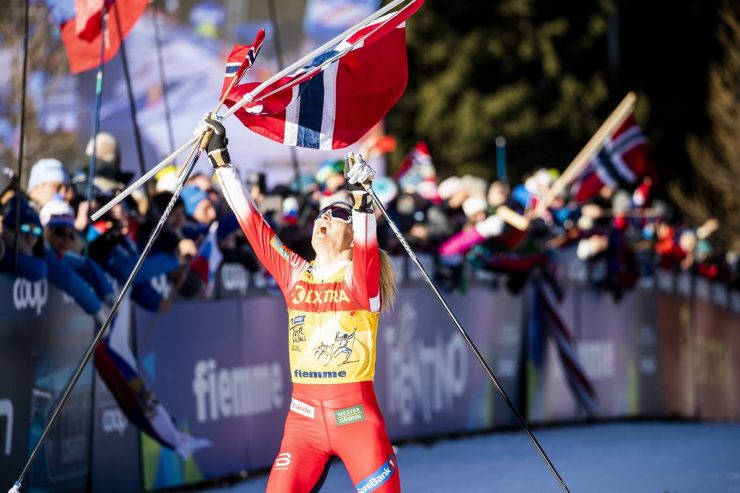
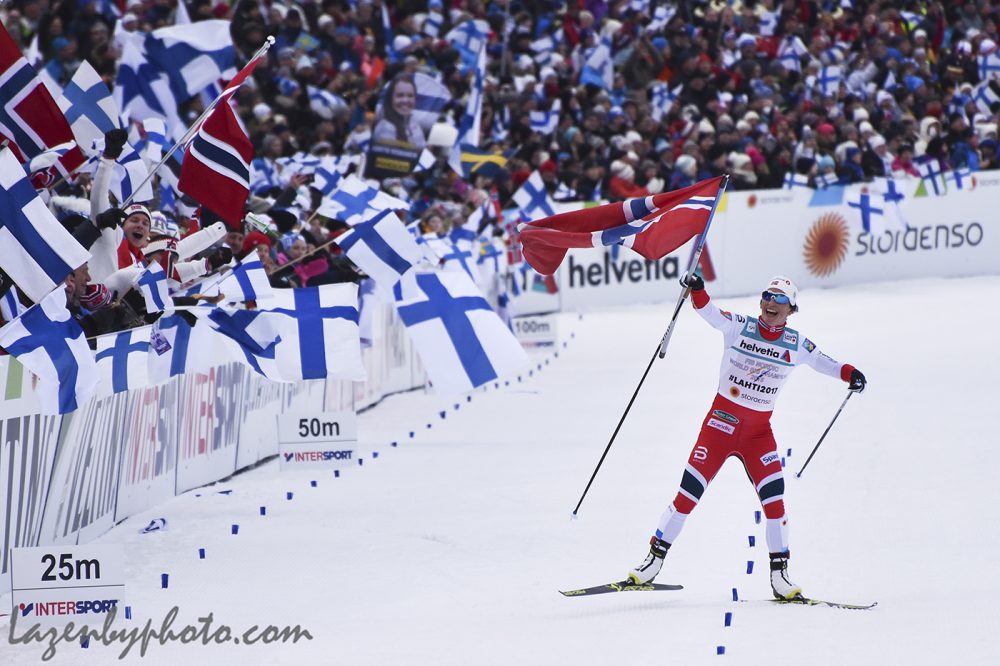
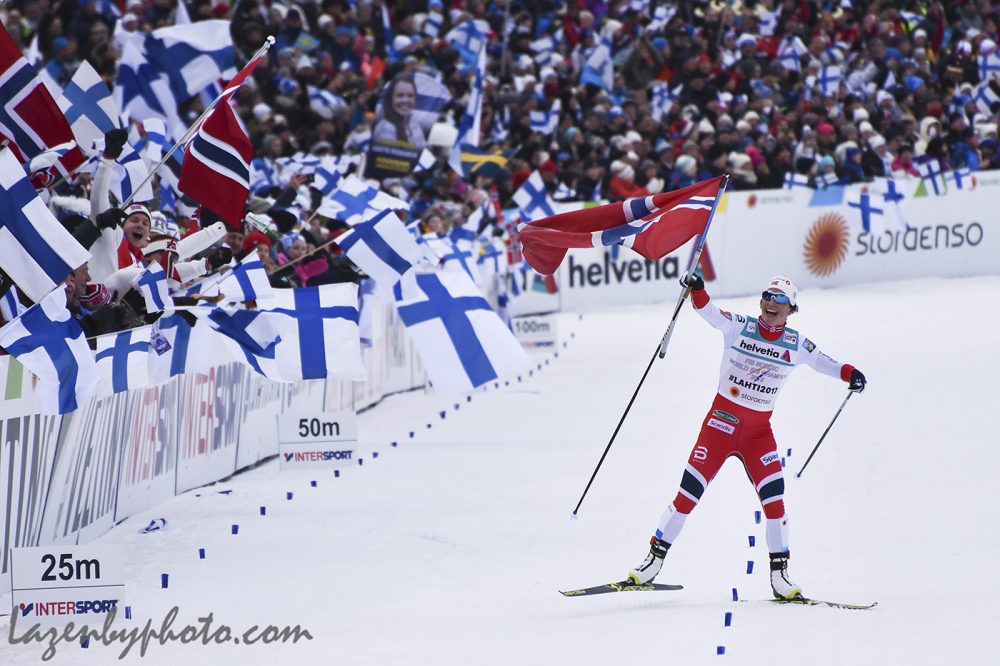
Waving the Norwegian flag high, Johaug shrieked with joy and relief as she stopped the clock at 34:21.6.
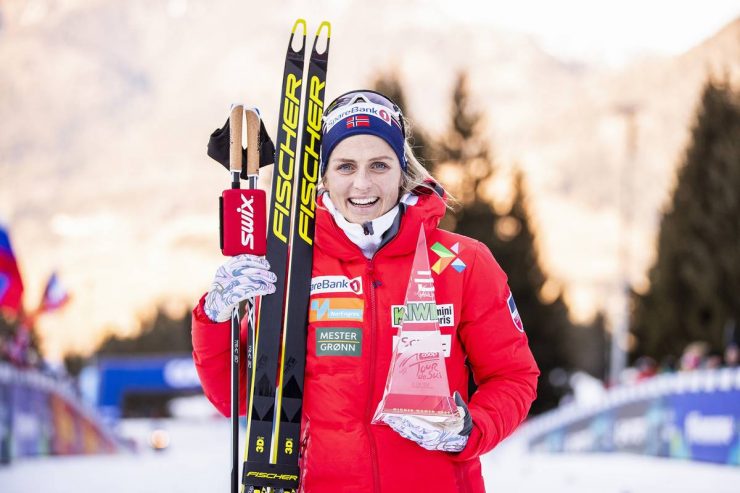
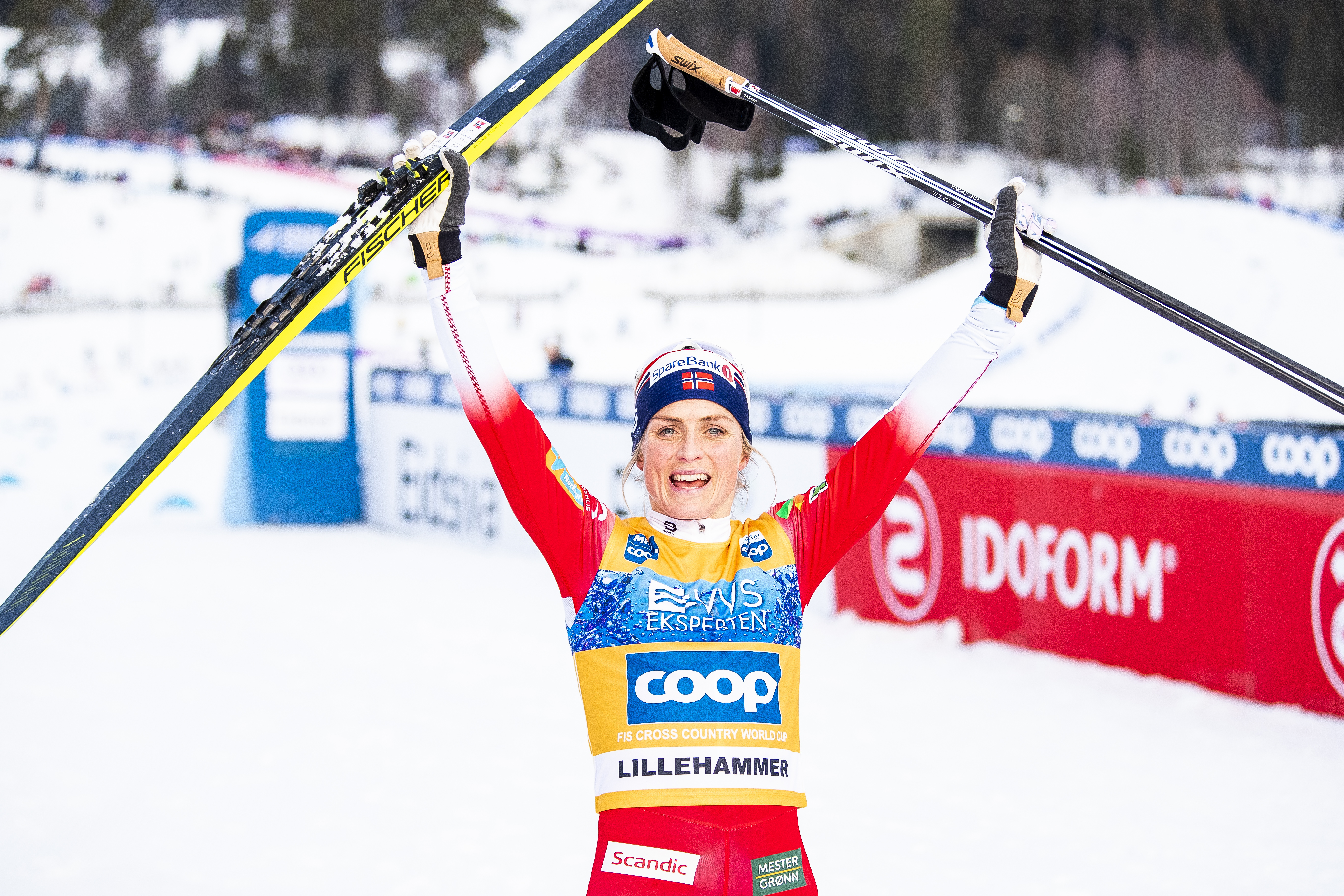
Therese Johaug celebrates her stage and overall victory at the finish of the 2019/2020 Tour de Ski. (Photo: NordicFocus)
A hard earned rest for Therese Johaug after winning the hill climb and taking the overall victory in the 2019/2020 Tour de Ski. (Photo: NordicFocus)
“I’m really, really happy now. My goal was, of course, when I’m going down here to fight for first place in the overall and today I do it. It has been seven hard days, but I am really, really happy now to come up here. I’m really looking forward to end this Tour de Ski because you wake every morning and are so nervous, but tomorrow I’m free.”
Firing on all cylinders, Heidi Weng crested the steep pitch, powering through the gradually ascending final meters for second (+50.3). Østberg followed in her wake for third (+54.5), followed by Nepryaeva in fourth (+57.1).
Throwing a boot to minimize her time back, Natalia Nepraeva finished 4th in the hill climb and 2nd in the overall 2019/2020 Tour de Ski. (Photo: NordicFocus)
So how did it all shake out? Therese Johaug took the overall Tour with an aggregate time of 2:28:18.6. Nepraeva landed the second spot on the podium (+1:11.1), followed by Østberg in third (+1:17.5). Weng finished 4th (+1:37.3), with Jacobsen behind her rounding out the top 5 (+2:13.4).
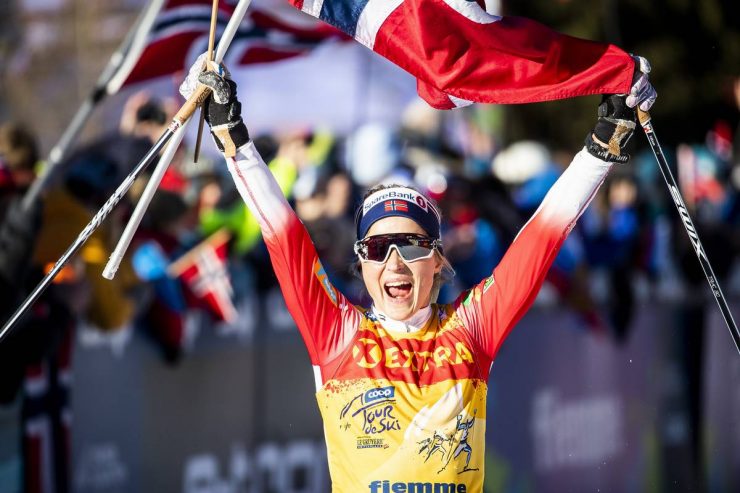
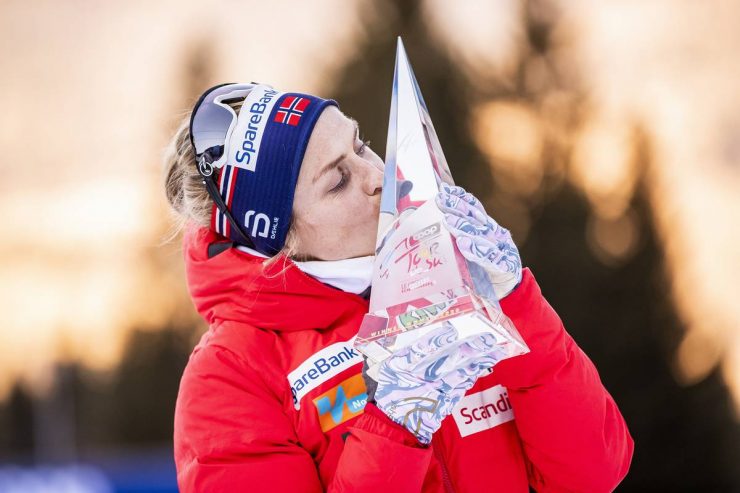
Theresa Johaug: 2019/2020 Tour de Ski champion. (Photo: NordicFocus)
First to the top of the Alpe Cermis, Therese Johaug (NOR) takes the overall victory in the 2019/2020 Tour de Ski. (Photo: NordicFocus)
Winding along the Marcialonga in the lead group, Diggins kept her position in the top ten throughout the day. At first, she trailed Jacobsen, Theresa Stadlober of Austria, and Charlotte Kalla of Sweden as they began the climb, but Kalla and Jacobsen fell off the pace.
Losing contact with Stadlober, Diggins was in the unfortunate position of skiing alone. Despite having no one to chase, she climbed steadily, sitting in 6th at 9 k with her teammate Rosie Brennan closing from behind.
Pure grit: Jessie Diggins ascends the final meters of the Alpe Cermis hill climb in 6th. (Photo: NordicFocus)
Holding her position, Diggins crossed the line for 6th (+1:51.1), chipping time off her deficit in the overall standings. With the hill climb, Diggins leapfrogged into the top 10, finishing 9th in the overall (+4:44.1).
“Today I was happy with my climb; I think I managed to pace it right so that I could keep moving up the hill steadily without blowing up – a line that is hard to find, but pretty crucial to get right! I had good energy and it’s nice to know that my fitness is in a good place even at the end of the tour,” Diggins wrote.
“Overall, this tour has been challenging in that I had many races where my fitness and effort weren’t reflected in the results. But I was proud of how I carried myself, contributed to having a positive team atmosphere and stayed positive without ever giving up, on the days when I had competitive skis but more important, on the days when I did not. It took a lot of positive energy, but now I can leave the Tour really proud of my mental toughness and ready to soak in all the hard work I put out there!”
Brennan and her teammate Sadie Maubet Bjornsen sat in the mid-teens at the base of the climb. As the grade increased, Brennan left Maubet Bjornsen and began picking off the women in front of her. Brennan advanced from 15th at the base of the climb to finish 7th (+1:58.0).
Rosie Brennan climbs to 7th place in the final stage of the 2019/2020 Tour de Ski. (Photo: NordicFocus)
In the overall standings, Maubet Bjornsen bumped up one spot into 7th (+4:40.6). Brennan finished 15th in the Tour (+7:11.0), and Ogden 28th (+12:26.5). 41 women finished the Tour.
“Wow, it feels good to make it to the top of that climb,” Maubet Bjornsen emailed. “I think it is safe to say, making it up that alpine slope after six hard days of racing is quite possibly the most physically painful thing I experience. Just crossing the line is such an achievement. This is only my third time I have made it, so it still feels just as exciting as the first one!
“This tour has had its ups, downs, and painfully near misses. Despite the rollercoaster, I feel like I gained confidence in my fitness and my skiing throughout the process. Not only that, I had my best ever Tour de Ski finish, ending in 7th place.
“No doubt I will come away from this tour both physically and mentally tougher!
“Thank you to the support crew who allowed it to happen, and thanks for all the cheers of encouragement both on the tough and wonderful days!”
The 2019/2020 Tour de Ski podium: Therese Johaug (NOR) took the win ahead of Natalia Nepryaeva (RUS) and Ingvild Flugstad Oestberg (NOR) in third (l-r) . (Photo: NordicFocus)
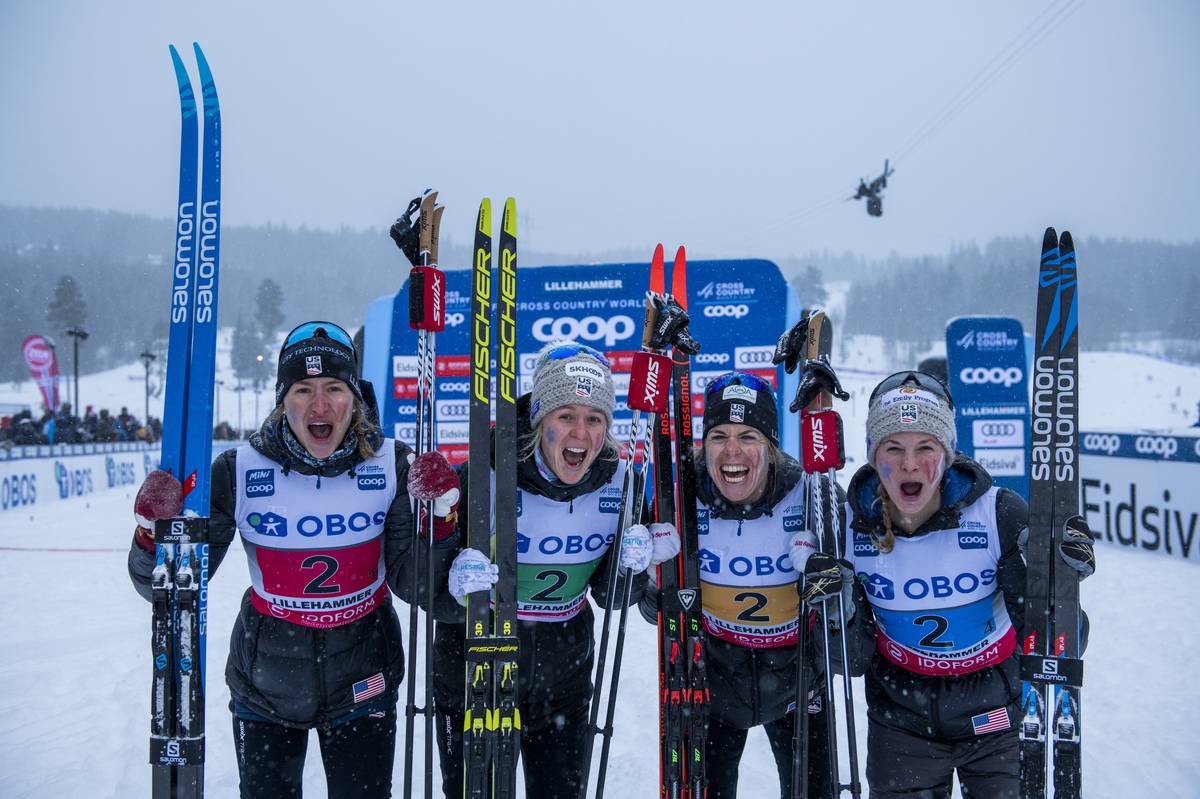
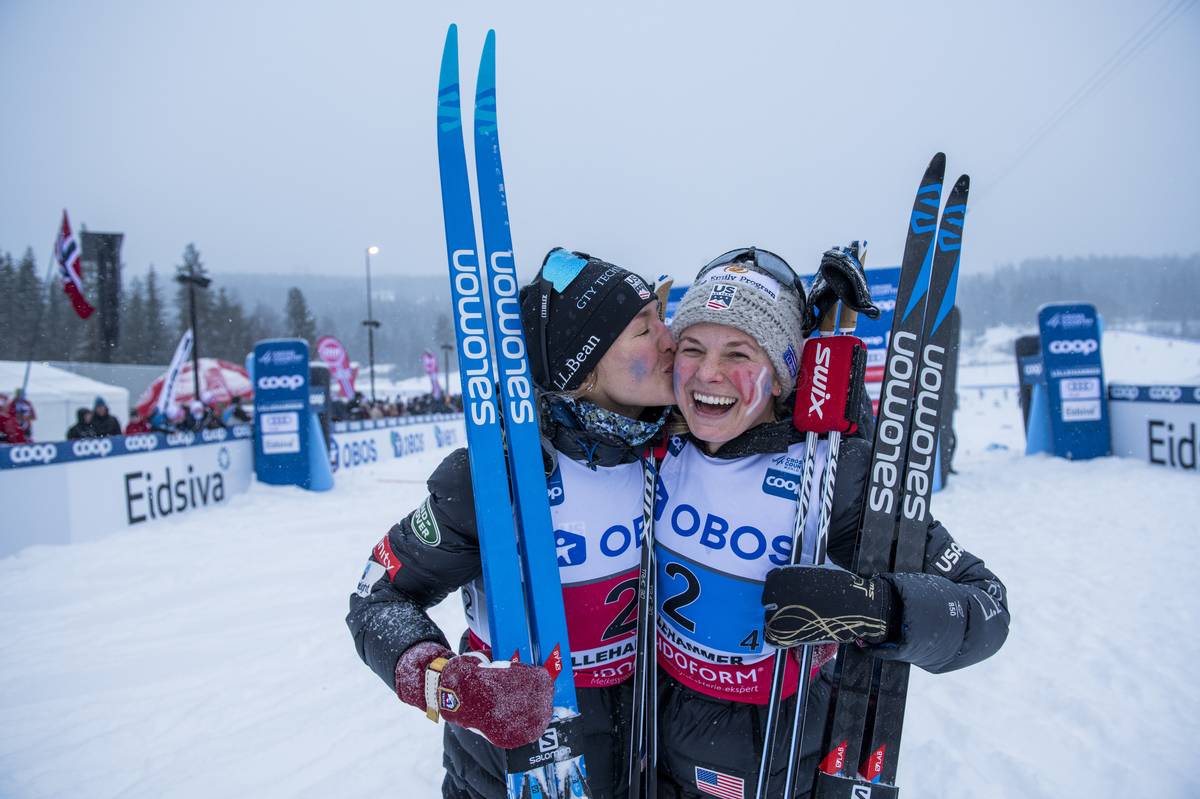
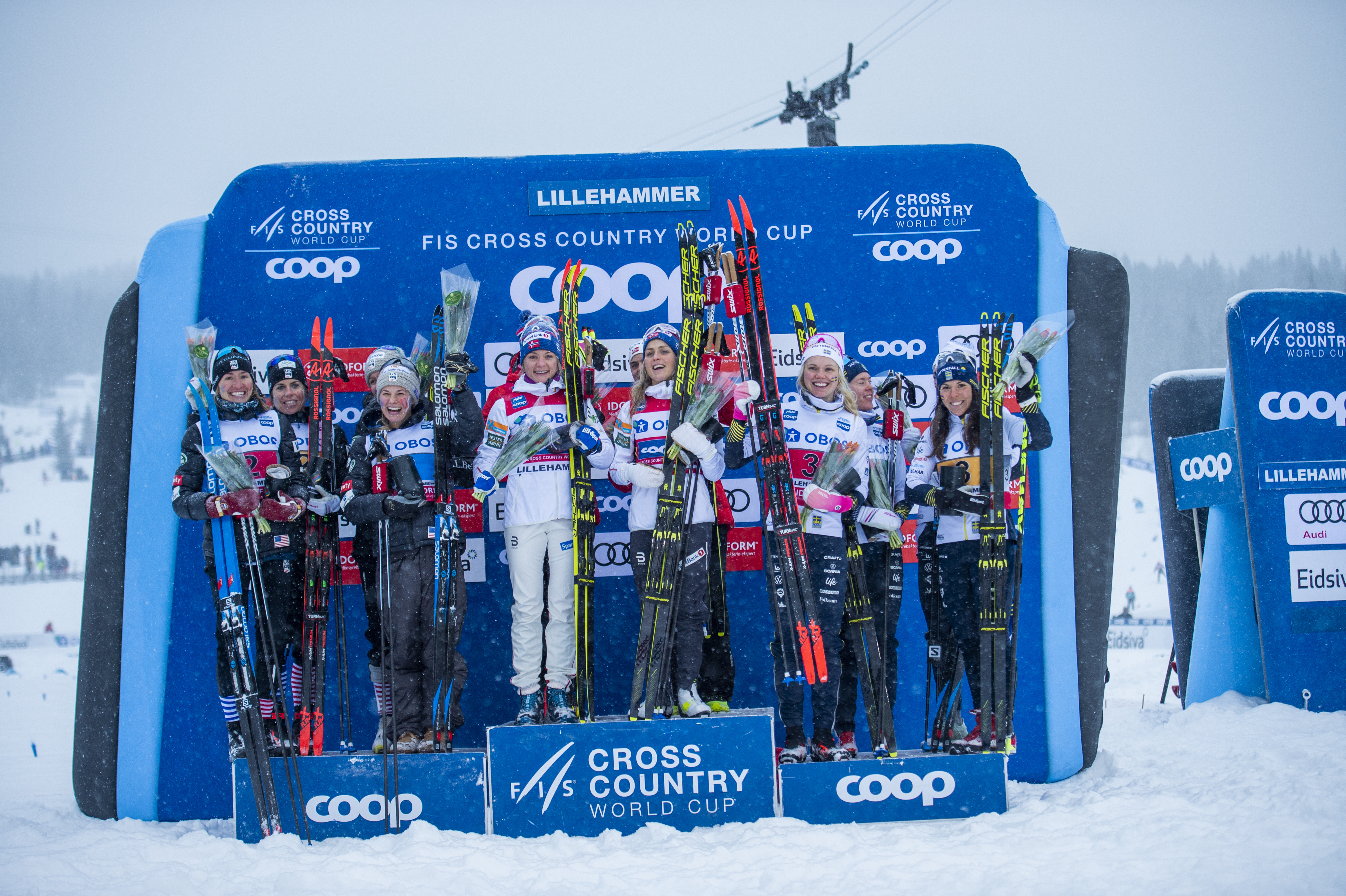
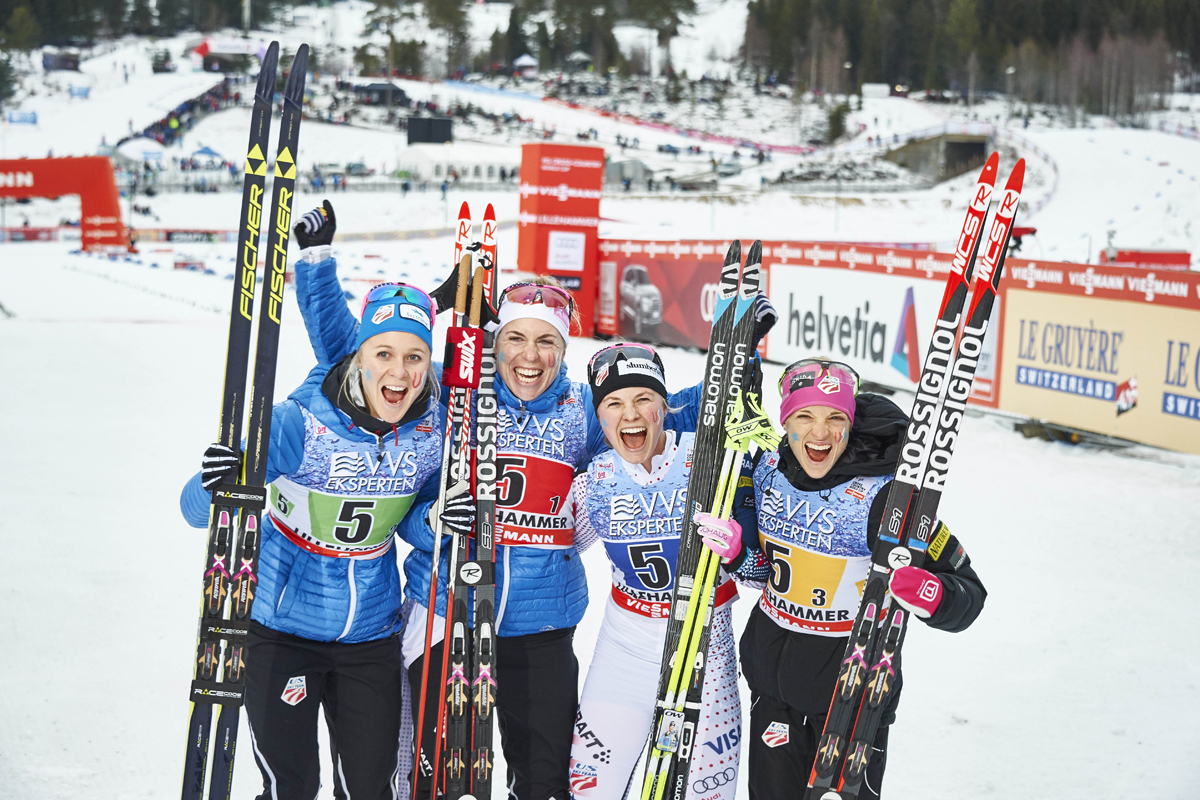
Team USA celebrates their hard fought second place finish at the 2019 4 x 5-kilometer relay in Lillehammer, Norway. (Photo: NordicFocus)
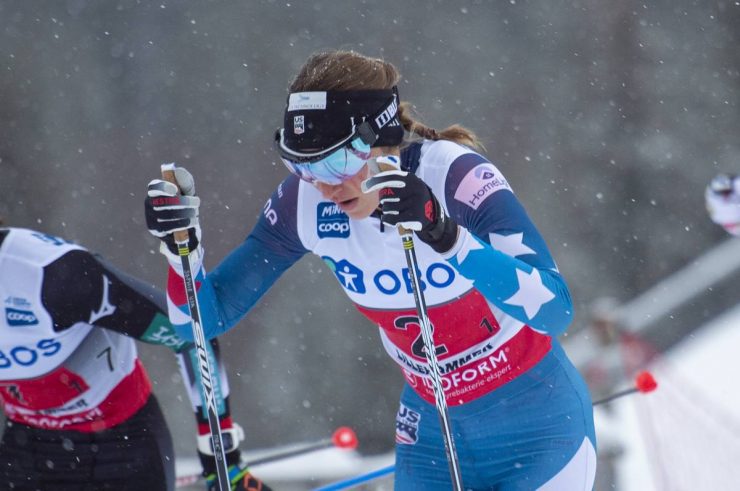
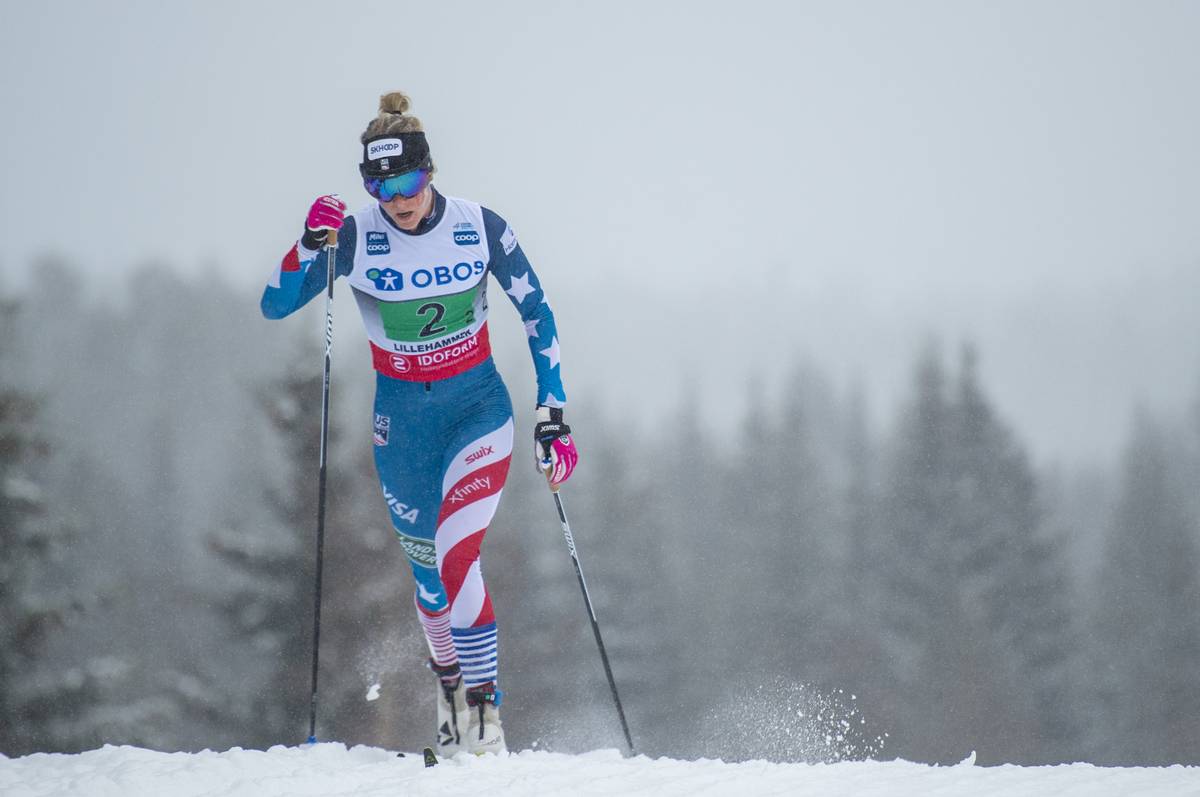
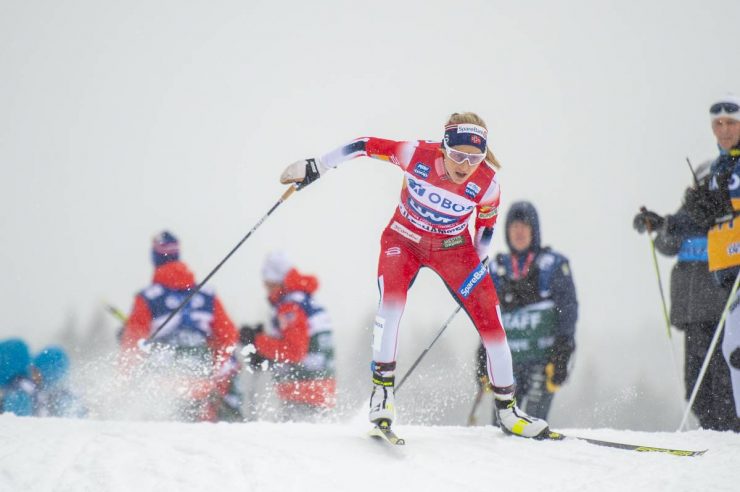
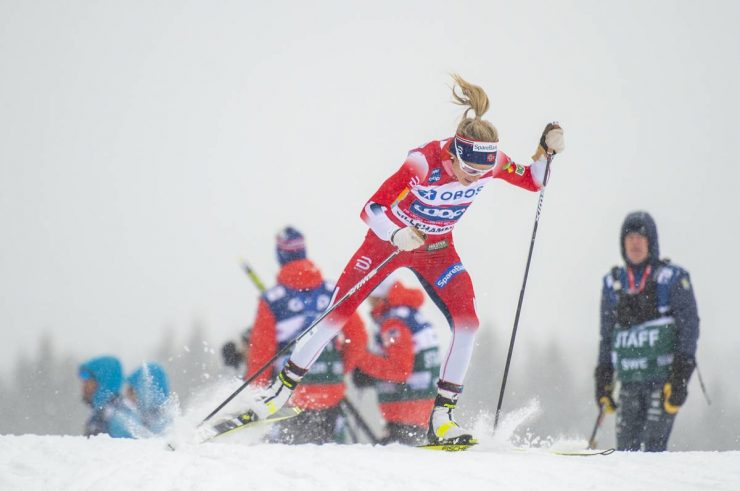
Athletes warmed up amidst fat falling snowflakes as a storm blanketed Lillehammer, Norway. The gun fired, and a flurry of this snow clouded the boots, poles, and relay socks as a wave of skiers strode their way up and out of the Birkebeiner Stadium for the first leg of the women’s 4 x 5-kilometer relay.
With outstanding performances in the first two World Cup race weekends, it is clear that the U.S. women are hot. They made their fitness and strength evident in back to back performances; three in the top 20 on day one in Ruka, three in the top 15 on day two, and three in the top ten in the final stage. Again in yesterday’s skiathlon, 2nd, 8th, 16th, Jessie Diggins, Sadie Maubet Bjornsen, and Rosie Brennan showed that they were ready to throw down in the relay and compete for a top-spot. With an 11th place finish in the classic sprint in Ruka and experience in the relay, Sophie Caldwell was selected for the fourth spot.
Despite this depth, the U.S. has struggled to land on the podium in the relay. Last year during the World Championships in Seefeld, a similar team (Julia Kern raced in Caldwell’s position) battled to rebound from eleventh a challenging first leg. Maubet Bjornsen and Brennan clawed up the ranks to hand off to Diggins in sixth, who could only pick off one additional team while struggling in the heat. The foursome finished fifth.
During the PyeongChang Olympics the year prior, Caldwell, Maubet Bjornsen, Kikkan Randall, and Diggins also raced to a gutsy fifth place finish, the best Olympic relay result for the United States. Here also the Americans struggled during the scramble leg. Caldwell started strong, knowing that on a good day she belonged with the leaders, but fell off the pace in the second half of her leg, tagging off over a minute behind in eleventh. Could the U.S. put together four strong legs in Lillehammer?
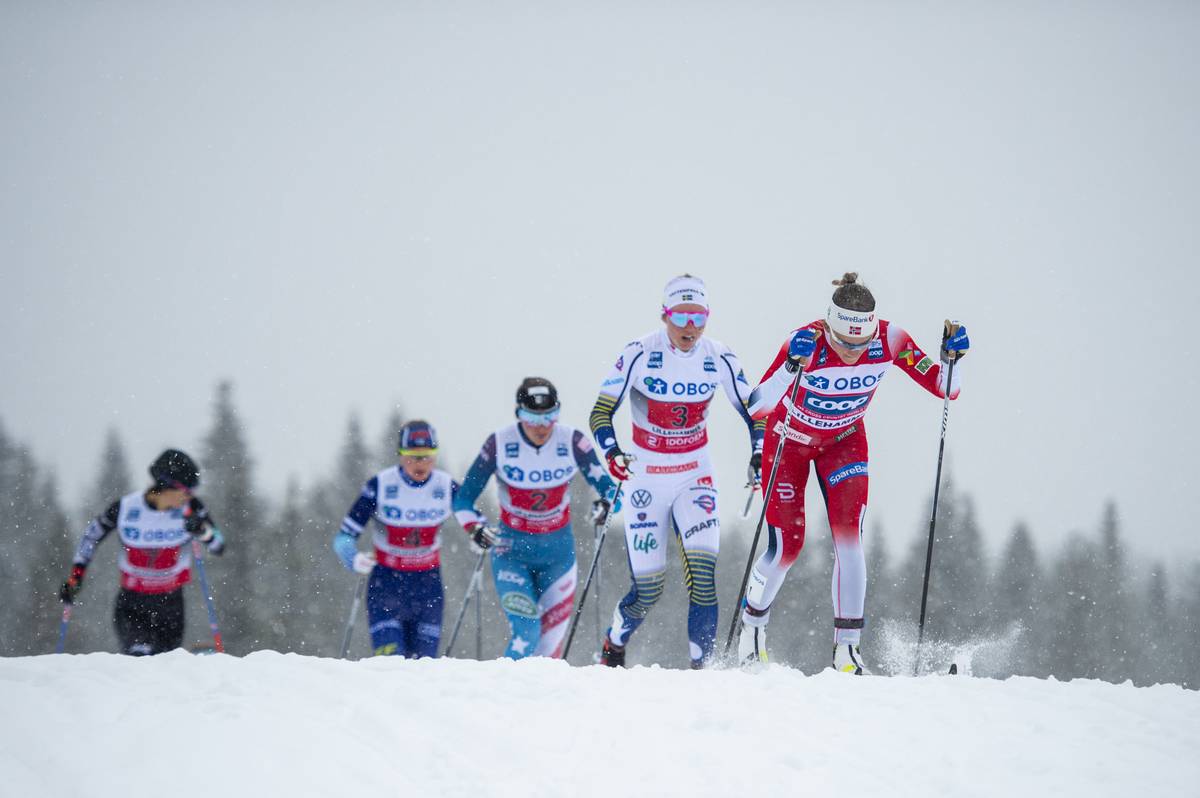
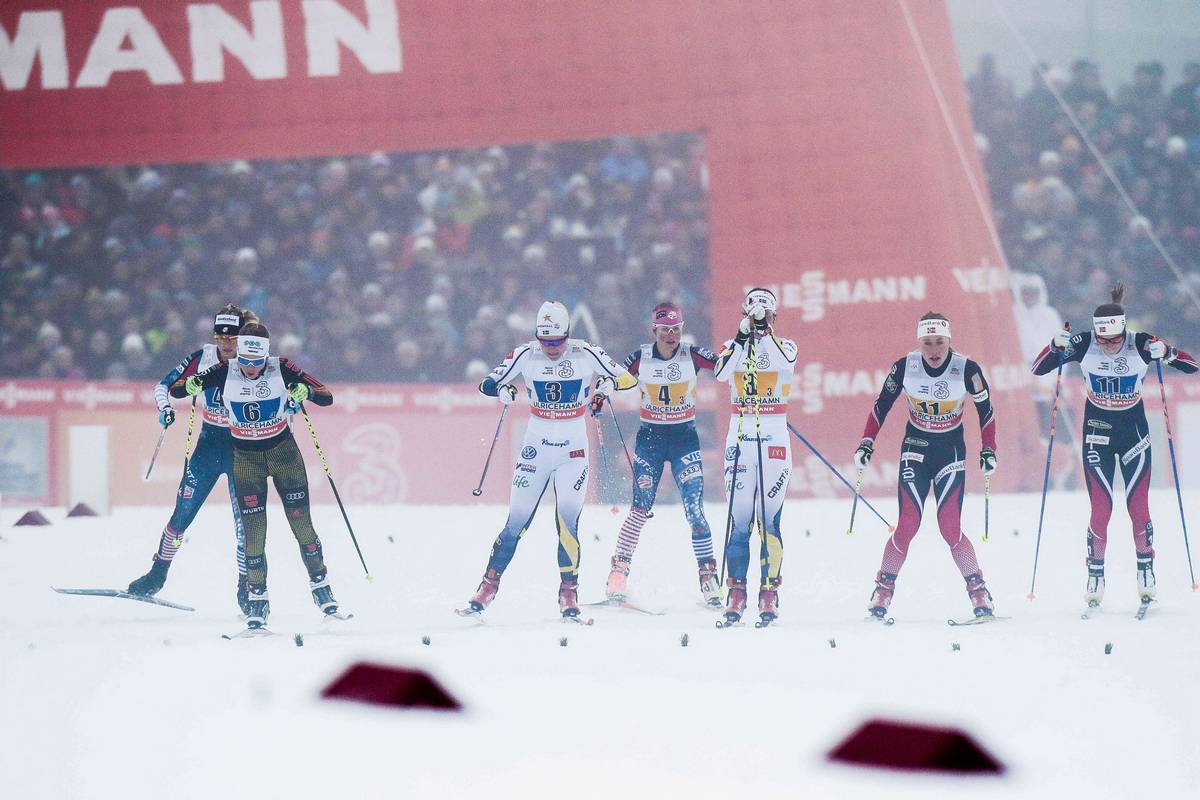
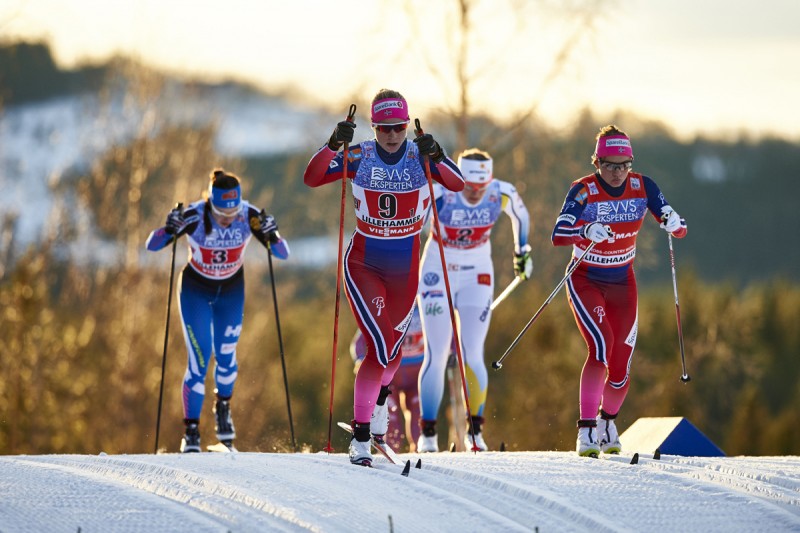
Norway’s Maiken Caspersen Falla leads the charge ahead of Emma Ribon (SWE) and Sophie Caldwell (USA) during the 4 x 5-kilometer relay in Lillehammer, Norway. (Photo: NordicFocus)
Norway’s sprint champion Maiken Caspersen Falla kicked off for the home team, asking her competitors to keep pace or be left behind. She explained to FIS after the race that her strategy was to stay out front to avoid accidents in the tough conditions.
After the first 2.5 k lap, there were six teams matching Falla’s effort, but skiers appeared unduly taxed by racing through the deep soft snow. Where yesterday they kicked up the tracks on the grueling hills for which the Lillehammer course is known, today, women spent more time running outside them in the loosely packed powder, burning matches left and right.
By the first exchange, only four remained with Norway: Finland, Sweden, Japan, and Russia I. Despite matching Falla stride for stride and keeping the U.S. in great position through 3.3 k, Caldwell succumbed to fatigue and fell off the lead along with the Russia II team. She tagged off to Maubet Bjornsen in seventh with a 26 second deficit.
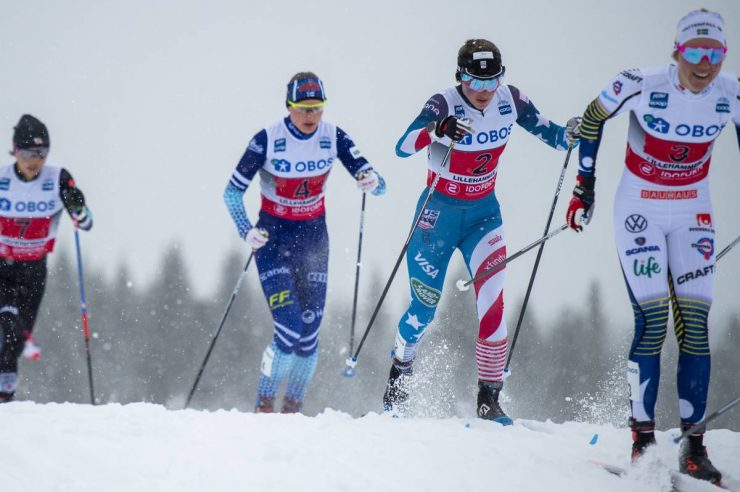
Sophie Caldwell skis with the leaders during the scramble leg of the 4 x 5-kilometer relay in Lillehammer, Norway. (Photo: NordicFocus)
Sophie Caldwell skis with the leaders during the scramble leg of the 4 x 5-kilometer relay in Lillehammer, Norway. (Photo: NordicFocus)
Post race interview with Sophie Caldwell.
In the second classic leg, Finland’s Kerttu Niskanen challenged Astrid Jacobsen of Norway for the lead, with Sweden and Russia on their tails. Niskanen overtook the Norwegian after the first lap, Jacobsen unable to keep pace.
“I was struggling really hard, but it was a good fight,” Jabosen told FIS after the finish.
Maubet Bjornsen attacked the course, quickly overtaking the Russia II team and moving into fifth. As she climbed, head coach Matt Whitcomb could be heard shouting encouragement.
Sadie Maubet Bjornsen charges to advance USA’s position in the second leg of the 4 x 5-kilometer relay in Lillehammer, Norway. (Photo: NordicFocus)
Post-race interview with Sadie Maubet Bjornsen
“Come on buddy! You’ve got this, Sadie! Keep your eyes on ‘em, Sadie!” Whitcomb cheered as she closed the gap to Sweden.
By the second exchange, Niskanen had begun breaking apart the field, leaving Jacobsen and Natalia Nepraeva of Russia trailing seven seconds behind. After an equivalent gap, Sweden tagged their first skater, with the Maubet Bjornsen holding strong in fifth 13 seconds behind.
Norway has won the last eleven World Cup relays and was not ready to go down without a fight, particularly in their home country. They deployed their ace in the hole, Therese Johaug, who exploded off the front. She rapidly took back the lead and didn’t look back, creating a cushion of nearly 50 seconds within 5 k.
“I had a really good race today,” Johaug told FIS. “Especially these conditions are perfect for me and also these hard tracks are perfect. I feel I did a really good job today and the rest of the team also did really good work. We are really happy to be first place.”
Therese Johaug surges to create a comfortable lead for Norway during the third leg of the 4 x 5-kilometer relay in Lillehammer. (Photo: NordicFocus)
Therese Johaug surges to create a comfortable lead for Norway during the third leg of the 4 x 5-kilometer relay in Lillehammer. (Photo: NordicFocus)
Skating for the U.S.on the third leg, Rosie Brennan maintained Maubet Bjornsen’s progress through the field, quickly overtaking Russia 1 and gaining on Finland. She spent over a kilometer simply grinding on her own, leaving nothing behind to advance her team. She made contact with the Finns by the 3.3 k checkmark and accelerated to leave them behind.
“Relay’s are so fun and also stressful because you never know what’s going to happen until it’s over so it requires everyone to give their best no matter what place or what is happening around you,” Brennan wrote in an email to several news outlets. “Sadie tagged me off in a place where I could visually see teams in front which was exactly what I needed to get a solid chase going on. I love the grind of slow days so I just started to grind away and realized quickly that I was gaining time so I just kept the grind going.”
Brennan tagged off to the anchor, Diggins, in third place just nine seconds behind Sweden.
“I was working hard to catch Sweden and couldn’t quite get there but at least tagged off to Jessie with them in sight and she’s not someone you want to race against on relay day so I had full faith in her ability to reel them in,” Brennan explained. “The Lillehammer relay was my first podium back in 2015 so it felt good to not only be back, but to upgrade by one. I am super happy with my leg and really happy for all the girls work out there today. “
Post-race interview with Rosie Brennan
With Johaug’s sizable gap, Heidi Weng hammered through the course without looking back for pursuers. She stopped the clock at 1:02:22.4 for Norway’s 12th consecutive World Cup win. The team has not been beaten since February, 2011 when the Italians were victorious in Rybinsk, Russia.
With Sweden in her sights, Diggins accepted the challenge of working the U.S. into second. By the halfway mark, she closed the gap to the youngest member of the Swedish team, Moa Lundgren. Diggins launched a high tempo attack on each hill, pulling away from the fading Swede. The American charged relentlessly through her final lap, crossing the line with a 20 second gap over Sweden. U.S.A. finished 48.9 seconds behind Norway.
The scrambler and the anchor of the 4 x 5-kilometer relay in Lillehammer, Norway. USA finished second. (Photo: NordicFocus)
Post-race interview with Jessie Diggins
FasterSkier spoke with Matt Whitcomb following the race to discuss the selection process, the team’s performance, and the team’s early standout performances. For the U.S., the puzzle is not so complex that podiums are an impossibility. Whitcomb noted that placing athletes in high-stress situations in a scramble leg, despite the possibility of losing contact with the leaders, is simply a risk inherent to sport.
Post-race interview with Matt Whitcomb on the selection process.
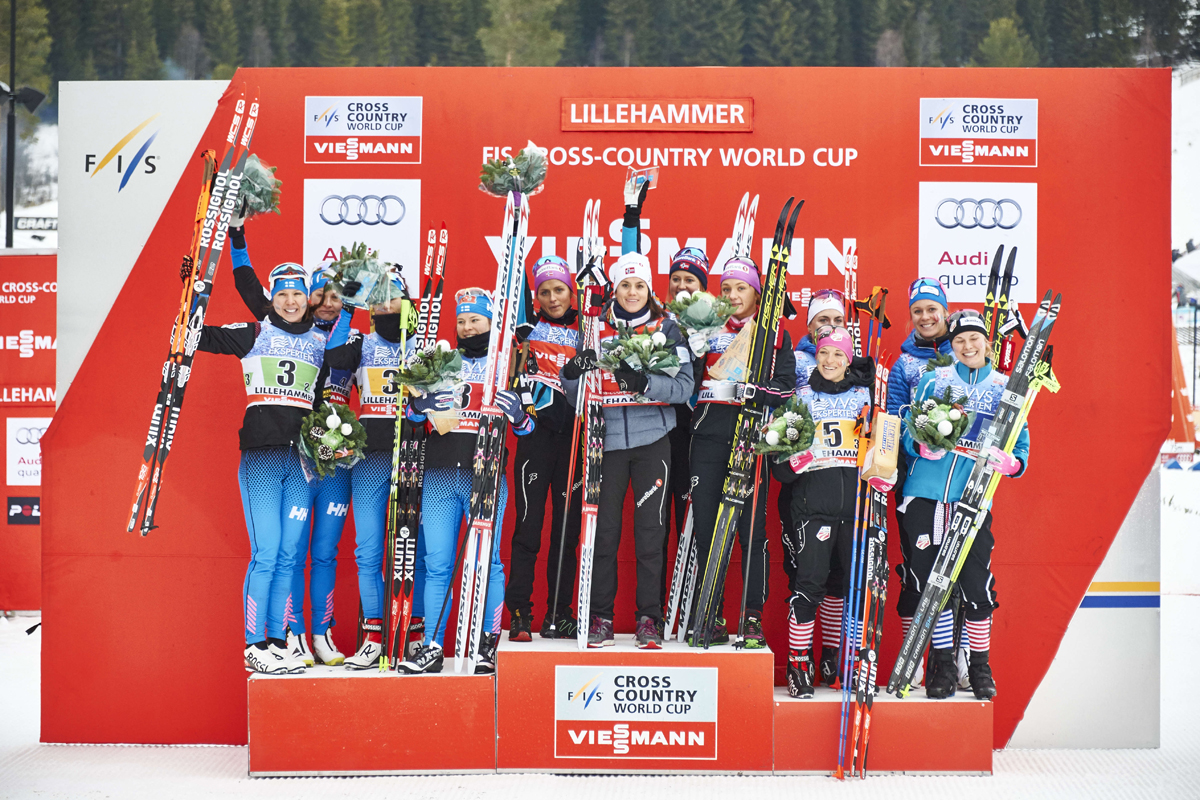
The women’s podium of the 4 x 5-kilometer relay in Lillehammer, Norway. The home country took the win with the United States in second and Sweden in third. (Photo: NordicFocus)
Whitcomb explained the role that depth plays in an overall relay performance and the top three splits of the second through fourth American skiers.
Post-race interview with Matt Whitcomb on the overall relay performance.
Jessie Diggins leads the chase pack on her way to a second place finish in the 7.5/7.5-kilometer skiathlon in Lillehammer, Norway. (Photo: NordicFocus)
Whitcomb reflects on Diggins’ performances in Lillehammer, contrasting it to the previous year. He comments on the season training and performance plan, and the positive energy that the outstanding women’s performances has given the team.
Post-race interview with Matt Whitcomb on Post-race interview with Matt Whitcomb on Diggins’ skiathlon performance and the team’s early season success.
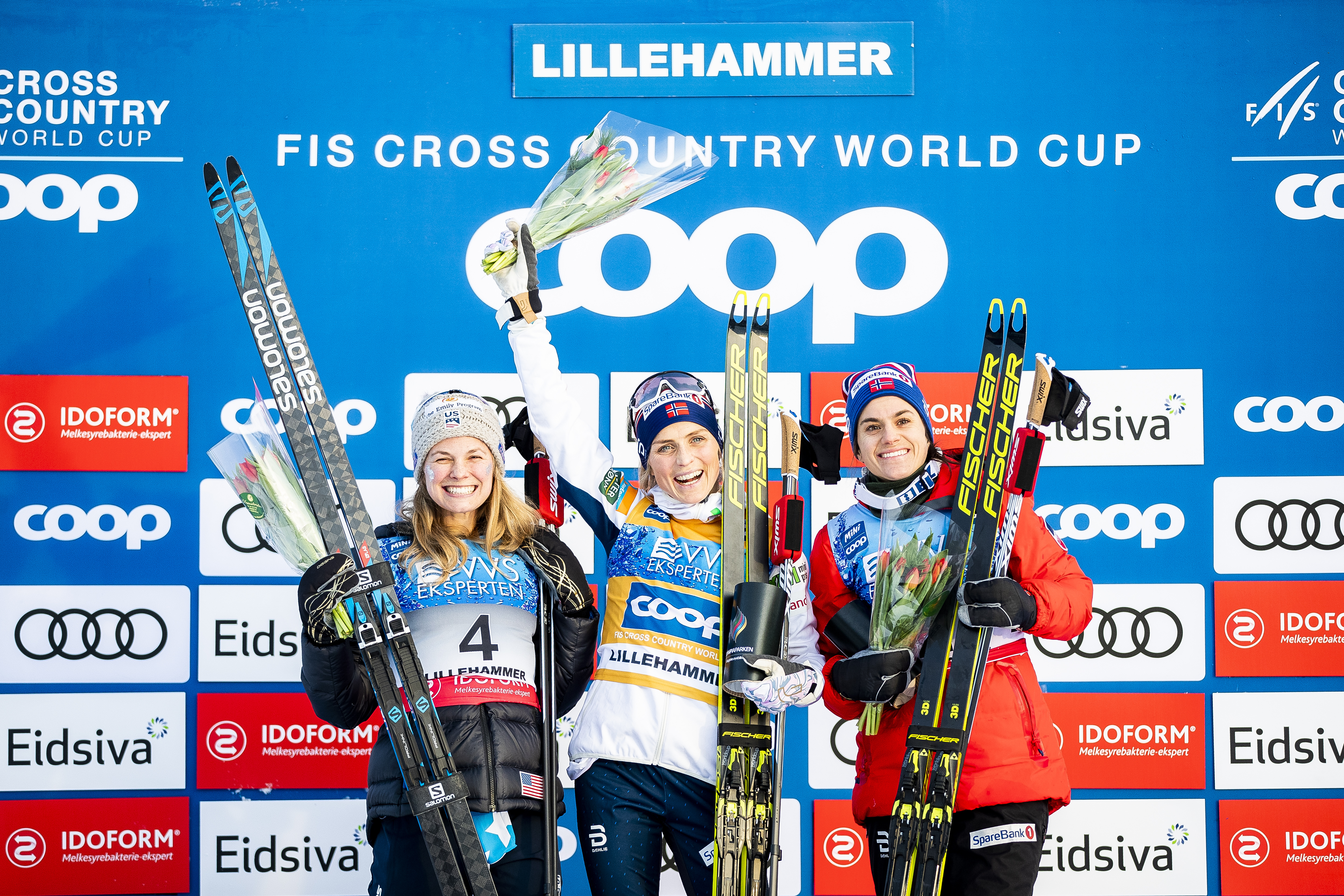
The women’s podium of the 2019 7.5k/7.5k skiathlon in Lillehammer, Norway. Therese Johaug (c) took first, Jessie Diggins second (l), and Heidi Weng third (r). (Photo: NordicFocus)
This week’s episode of the Therese Johaug show featured a clinic in her signature event, the 15-kilometer mass start skiathlon in Lillehammer, Norway. Before today, the two-time World Championship gold medalist had made the podium in 13 of her 14 World Cup skiathlon starts (six of those were wins), failing only in Oberstdorf, Germany during the 2011 Tour de Ski.
Her strategy was familiar. Johaug set the pace from the gun, attacking the first climb out of the famed Birkebeiner stadium. She pulled away from the field with her usual high tempo ferocity. She created a nearly 14 second gap by the 2.4 k checkpoint, which expanded to 30 seconds at the halfway mark.
Coming into the exchange zone, Johaug ripped open her pole straps with her teeth as she glided into her gate. She then stepped out of her classic skis into skate without pause. Celebrating as she skied through the stadium 7.5 k later, Johaug stopped the clock at 42.35.3. Her lead had grown to over a minute.
Therese Johaug celebrates her victory on home turf at the 15-kilometer skiathlon in Lillehammer, Norway. (Photo: NordicFocus)
Notching her seventh World Cup victory in the skiathlon and her 100th career World Cup individual distance podium, Johaug is closing on Marit Bjørgen’s record of eight skiathlon wins and 110 podiums. This was news to Johaug when she spoke to FIS at the finish.
“That was a big surprise to hear,” she said with raised eyebrows. “It was really good to celebrate with a first place today and also in my hometown, Lillehammer. It was a really good day today. My skis were perfect and my shape has been really good after [the Ruka Triple in] Kuusamo, so I could just go out there and enjoy it because I didn’t feel that I used so much energy. I am really happy.”
Based on Johaug’s trajectory, it does not seem to be a question of if, but when these records will be broken — the latter possible within the 2020 season. Just over half (51) of her World Cup podium finishes have been wins, and she has not failed to land on the podium in a distance race since before her doping suspension in 2016. She won every individual distance race during the 2018/2019 season. She was beaten only once and that occurred on the icy tracks of the Plains of Abraham during the World Cup finals in Québec City where Stina Nilsson, who began the pursuit start race with a lead of 1:45, held her off for 10 k. Johaug still skied the fastest time of that day.
Hot off a strong showing in Ruka, a duo of candy-cane striped left legs led the charge in the chase pack, namely Jessie Diggins and Sadie Maubet Bjornsen. The Americans stayed stride for stride at the front with Norway’s Heidi Weng and Russia’s Natalia Nepryaeva through the 3.5 k checkpoint, when Diggins took hold of the pace and surged to begin spreading out her peers. With Diggins went Weng and her Norwegian teammate Astrid Jacobsen, along with a string of Swedes: Moa Lundgren, Charlotte Kalla, and Emma Ribon.
Jessie Diggins charges from the exchange zone ahead of Norway’s Heidi Weng and Astrid Jacobsen during the 15-kilometer skiathlon in Lillehammer, Norway. (Photo: Aleks Tangen)
Diggins entered and left the exchange zone ahead of her competitors, closely followed by the Norwegians and Swedes. The American pressed her foot to the accelerator, again surging to spread the chase group. Weng matched Diggins’s tempo and energy on the climb away from the stadium and tucked into her draft on the descent into the woods.
From there, the lead exchanged hands a few times leading into the fourth and final time up the longest climb with two k’s to go. Devon Kershaw referenced this hill when he explained is one of the hardest courses on the World Cup, featuring crippling climbs where skiers “will fall apart”.
It was here that Diggins made here move. She stepped around the Norwegian, out matching her tempo as they climbed steeply and transitioning into a strong V2. Trusting her downhill strength, Diggins continued to hold off her pursuer through the descending 400 meter reprieve.
In a flash of V1, Diggins dropped Weng for good on the final steep climb with 500 meters to go. She flew down into the stadium and powered down the straightaway to a comfortable second place finish (+1:08.3), eleven seconds ahead of Weng.
After sliding across the line, Diggins collapsed in relief. Johaug, who by this time had caught her breath and donned her puffy jacket, gave the American an encouraging and celebratory pat on her back.
“I was trying to keep up with you and I was like, ‘Buh bye.’” Diggins laughed as she congratulated Johaug.
Jessie Diggins celebrates her second place finish at the 15-kilometer skiathlon in Lillehammer, Norway. (Photo: NordicFocus)
Jessie Diggins gasps for air after solidifying her second place finish at the 15-kilometer skiathlon in Lillehammer, Norway. (Photo: NordicFocus)
Post-race interview with Jessie Diggins.
After fading from the lead chase group, Maubet Bjornsen tucked in patiently with an international group that included Theresa Stadlober of Austria and Krista Pärmäkoski of Finland, hovering just outside of the top 10. After the exchange, Stadlober, Pärmäkoski, and Maubet Bjornsen began steadily moving up in the standings, catching Kalla and Jacobsen. By the finish, Pärmäkoski had worked her way into 4th place, Stadlober 7th, and Maubet Bjornsen 8th (+1:43.9).
“I generally prefer classic as opposed to skate, but I had new and fun feelings today,” Maubet Bjornsen wrote in an email to several news outlets. “Not only did I enjoy the skate portion more, but I felt really strong climbing. I am walking away from today with new confidence, and excitement. To finish the day within sight of the podium fight on a less than perfect day is a good sign.”
One final push across the line for Sadie Maubet Bjornsen at the 15-kilometer skiathlon in Lillehammer, Norway. Maubet Bjornsen finished 8th. (Photo: NordicFocus)
Post-race interview with Sadie Maubet Bjornsen.
Taking a similarly patient approach, Rosie Brennan steadily turned up the dial in her race, cautious of burning too many matches early in the grueling terrain. At 4.6 k, Brennan sat in 21st, moving up one spot before the exchange. She picked up another two spots by 11.3k, and another two by the finish. Brennan crossed the line in 16th (+3:10.0).
“Today was a solid race, not my best and certainly not my worst,” wrote Brennan to several outlets. “I was struggling in the classic, just not finding the relaxed good feelings you want. I couldn’t hang with the front group, which I was disappointed by, but after I switched to skate, I found better feelings and was able to pick some people off. Unfortunately, I let a little too big of a gap open up to the big group in front so there was only so many people pick off. This course is one of the hardest on the circuit and you really have to be on your A-game to pull of good things here. I wasn’t quite there, but I am satisfied with the result given my feelings out there.”
Rosie Brennan during the 15 k skiathlon in Lillehammer, Norway. (Photo: NordicFocus)
Post-race interview with Rosie Brennan.
Outside the top-30, Rosie Frankowski (APU) finished 33rd (+4:14.1) and Caitlin Patterson 46th (+5:36.0).
Ruka, Finland looked quintessentially Nordic at the start of the 10-kilometer freestyle pursuit. December at 66 degrees north: temperatures in the low teens (F), flat Northern light, frosted pines looking as though they were spray-coated with foam. Athletes warmed up in puffy jackets with mittens, neck warmers, and taped faces while crowds huddled with cups of soup.
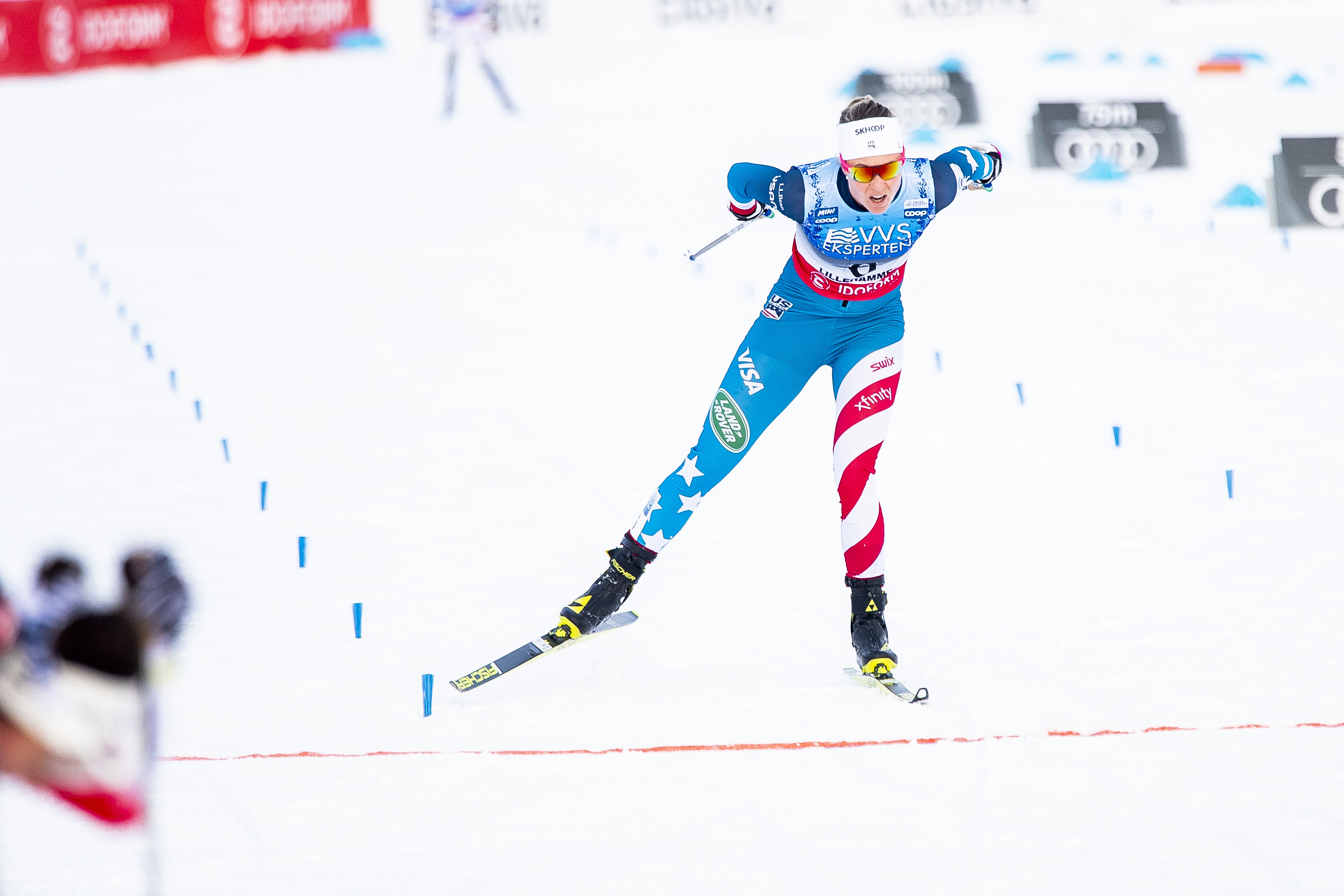
First out of the start and racing in a balaclava and mittens, Norway’s Theresa Johaug attacked the course from the gate. Steadily turning up the dial on each of the four 2.5 k loops to cross the line over a minute ahead of her peers, the 31-year-old distance phenom quickly made the event a race for second place.
Norway’s Therese Johaug dominated the field in the pursuit distances races in Ruka, Finland. (Photo: NordicFocus)
“I felt I was really strong today,” Johaug told FIS about her performance. “I heard that Heidi was fast behind me, but in the end I had a little bit more power and I also win the race today. I’m really happy.”
She also described her skis as “excellent” and thanked her wax technicians for their handiwork.
Chasing in red for an all-Norwegian podium, Johaug’s teammates Heidi Weng and Astrid Jacobsen worked together to steadily pick off the athletes wearing lower bib numbers. Weng, who started in tenth, 1:03 behind Johaug, made up 17 seconds to catch Jacobsen. By the 5-kilometer mark she was ranked 5th and closing on Finland’s Krista Pärmäkoski.
Weng finished second (+1:11.13), followed closely by Jacobsen (+1:13.3).
“It’s fantastic,” Johaug said of the Norwegian trio. “We have three girls top three and it’s a long time since this has happened before. We are so happy.”
The all-Norwegian women’s podium after the 2019 10-kilometer skate pursuit in Ruka, Finland. From left to right, Heidi Weng (2nd), Therese Johaug (1st), and Astrid Jacobsen (3rd). (Photo: NordicFocus)
Ascending the final climb before the stadium, Weng looked reminiscent of the version of herself who charged up the Alpe Cermis to take home the 2018 Tour de Ski (TdS) victory. She had the second fastest Time of Day (ToD), outmatched by Johaug by a margin of only 8.3 seconds.
The 28-year-old was the 2017 and 2018 overall World Cup winner, landing on the podium 21 times each year. After the 2018 TdS, Weng seemed to lose a gear and though she held onto the overall World Cup win, performances that were lackluster relative to her former prowess ensued. She left the 2018 PyeongChang Olympic Games empty handed and finished the 2019 season ranked 16th with no podium performances.
Four Norwegian women landed in the top ten, but so did three Americans: Sadie Maubet Bjornsen, Jessie Diggins, and Rosie Brennan.
Today was icing on the cake for Maubet Bjornsen who wore the yellow overall World Cup leader bib. She maintained her second place start position through the first half, then was overtaken by the pack of Pärmäkoski, Weng, and Jacobsen. Maubet Bjornsen stayed with these women through the 7.5 k checkpoint, but could not hold off the hungry Norwegians. Maubet Bjornsen ended the day in 4th (+1:27.9).
Sadie Maubet Bjornsen skis alone during the 2019 10-kilometer freestyle pursuit in Ruka, Finland. (Photo: NordicFocus)
“It was another fun and final day of racing here in the tour,” wrote Sadie in an email to several news outlets. “What an honor to head out on the course in the yellow bib, that sure was fun! I found myself quite distracted off the line because I had a broken binding and my foot was sliding around on my ski, which left me so worried I was going to lose my ski on one of the downhills.
“After I made it around the first loop in one piece, I was able to forget about it, and focus on the task at hand. As I rounded the corner on the second lap, still alone, I caught sight of the huge group hunting right behind me. My plan going into the race was to hang as absolutely tough as I could if anyone caught me, and be in a place to sprint for the finish since that is my strength. As the group caught me the third lap, I jumped on, and held on for dear life. In the final lap when Heidi started attacking on the uphill, I did my absolute best, but started sinking back slowly.”
Despite ceding two positions, Maubet Bjornsen held off the remainder of the field. Hers was the 14th fastest time of day.
Sadie Maubet Bjornsen catches her breath amidst the finish line carnage after the 2019 10-kilometer freestyle pursuit in Ruka, Finland. (Photo: NordicFocus)
“I knew my strength would be coming over the top of the climb, and just as I clawed myself back to Astrid and Heidi, they made another surge leaving me just out of their draft for the final descent into the sprint climb. As I sprinted up that climb the final time, it was with all the energy stores I had left. I managed to cross the line, fourth in the tour. My goal was to be able to fight for the podium today. While I came just shy for a second day in a row, it is still a huge step to finish a tour in 4th! I look forward to taking some new confidence, and run with it this winter!
“Now it is time to do some resting, recovering, and traveling to Norway for our second weekend of racing. With the way my teammates are skiing right now, we should have a SUPER fun relay event ahead!!”
On the hunt, Jessie Diggins moves up through the field during the 2019 10-kilometer freestyle pursuit in Ruka, Finland. (Photo: NordicFocus)
Matching Weng’s spirited hunt, Jessie Diggins had an outstanding performance, advancing from her 12th place start position by seven positions to finish three seconds behind her teammate for 5th place (+1:30.9). Known for her skate talent and energy, Diggins hammered the course with a high tempo, skiing the third fastest time of day, 20.9 seconds off Johaug’s split.
“Any day I can land a TOD podium is a great day, so I’m really happy with how it went!” wrote Diggins in an email. “I just went out charging as hard as I could today, looking to hunt people down, and skied without putting any pressure on myself. It was cold out there, but having grown up in Minnesota, I just loved that and felt right at home! My skis were great today and I really applaud the wax team and coaches for working so hard every day of this season, since we arrived for pre-camp in Beito. I’m so proud of how hard they work and how well they have tackled every weather condition.”
Not landing on the overall podium right away is nothing new for Diggins. Last season, Diggins did not finish inside the top-10 until her seventh race and did not stand on the podium in an individual race until the Tour de Ski.
One last push across the line for Jessie Diggins during the 2019 10-kilometer freestyle pursuit in Ruka, Finland. (Photo: NordicFocus)
“I always work my way into the season and this year is no different,” she explained. “But it was a great surprise to feel so awesome today and to see a TOD podium. With no [world championships] or Games, this year I’m excited to focus on making each and every weekend that I race an absolute all-out effort, and I’m also looking forward to having so many tours this season because I think they are a ton of fun and a great challenge for the body and the brain.”
Closing out the top ten, Rosie Brennan slid back from her 8th place starting position into 10th (+2:15.3). Fighting for every second, Brennan skied a strong race, losing a four positions in the first half, then climbing back up ahead of Sweden’s Jonna Sundling and Russia’s Natalia Nepryeava before crossing the line.
Rosie Brennan catches a ride with a Tiril Udnes Weng of Norway during the 2019 10-kilometer skate pursuit in Ruka, Finland. (Photo: NordicFocus)
“I had a tough starting position with big gaps in front of me and a small gap to the chasers behind me,” Brennan wrote to several outlets. “When the chasers caught me, I tried to follow but struggled to stay with the pack. I recollected and had a better second half of the race, passing back a few girls. It was far from my best race, but I am satisfied with the fight I put up and really thrilled to have opened the World Cup with a 10th in the Ruka Triple. That far exceeds my expectations for the weekend. It’s certainly time for a little rest after a big opening weekend and hopefully trying to find more speed in the coming weeks.”
Outside of the top-30 and in a tight spread, the remainder of the American women advanced from their start positions, including the newest members of the ranks. Julia Kern moved from 55th to 49th (+5:13.1) and Hailey Swirbul jumped from 66th to 54th (+5:32.8). Caitlin Patterson ended her day in 52nd (+5:21.6) and Rosie Frankowski in 56th (+5:35.9).
Caitlin Patterson leads her teammate Julia Kern during the 2019 10-kilometer freestyle pursuit in Ruka, Finland. (Photo: NordicFocus)
A masked Julia Kern on course in frigid temps during the 2019 10-kilometer freestyle pursuit in Ruka, Finland. (Photo: NordicFocus)
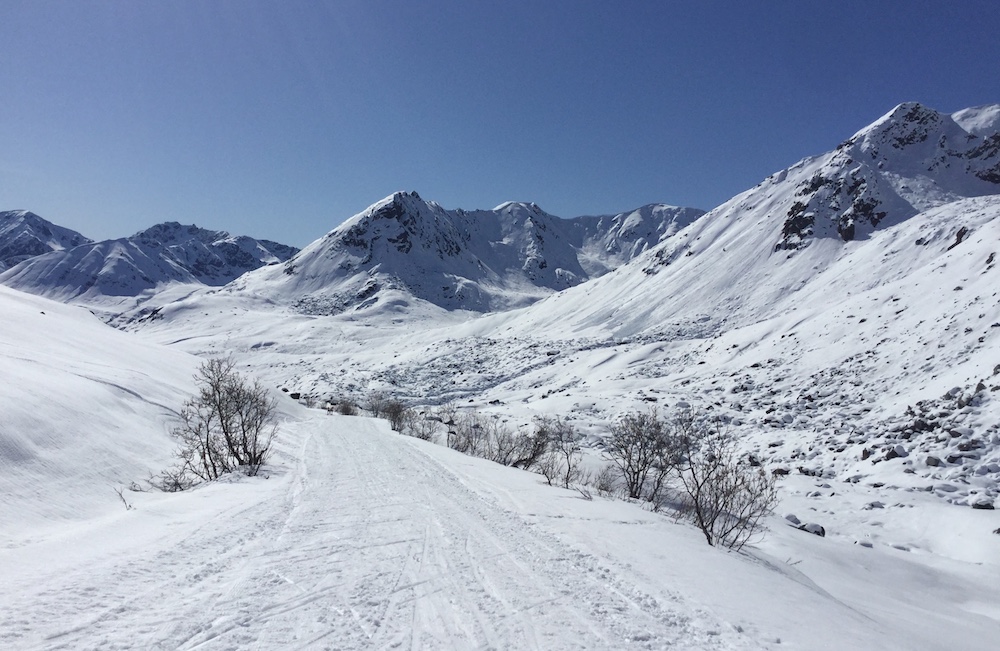
David Norris (APU) and Luke Jager (University of Utah) (very small skiers on trail in center background) ski up Archangel Road, Talkeetna Mountains, Alaska, on May 1, 2019. (photo: Gavin Kentch)
If you’re reading this website, you’re probably well aware that the nordic skiing training year begins on May 1. In a sport where most races happen between November and March, and demand of athletes that they repeatedly race to the point of nearly losing consciousness, the preparation for race season had better start a long time before that. As the well-worn, but accurate, saying has it, skiers are made in the summer.
Embracing the start of May – either May 1 per se, or a conveniently located Monday a few days on either side of that date – as Skier’s New Year is nothing new. Indeed, here’s Luke Bodensteiner, at the time a struggling Olympic hopeful, in the opening lines of his book Endless Winter: An Olympian’s Journal, describing a training day 26 years ago this week: “Monday, May 3: Salt Lake City, Utah. This is it. Training begins today for the 1994 ski racing season. The focus this year is on the Winter Olympics to be held in Norway in February, but the season won’t end until the final races are over in April. … It isn’t like I ever really stopped training, but now instead of pick-up basketball and soccer, back-country alpine skiing and the odd midnight kayak trip with my roommates, training has to get serious. … My little black wristwatch suddenly rules my day.”
Or here’s a notably ambitious Cory Smith, in the ur-skier blog “Somewhere Between Obscurity and Oblivion,” writing on April 26, 1999, while acknowledging that he was doing so five days earlier than custom and generic expectation would suggest: “April 26: Yes, I know that it is still April, but I am writing in my May journal. That is because today is the official start of the 1999-2000 training year. To preserve a sense of continuity it is just easier to assume that May is the first month of the year and squeeze a couple extra April days into the month. I hope this doesn’t screw up your crop planting or biological clock or anything. So what did I do to kick off the year? I went for a run. I know, it’s not very exciting, but you have to start somewhere. Besides, I am only supposed to be training 8-12 hours per week this month, so I shouldn’t do too much the first day. But at last I am underway and ready to prepare for an even better winter next year.”
Or here’s Noah Hoffman, writing on April 30, 2014, in a post entitled, “Start of the Training Year”: “Today was my first scheduled training day of the year. … I started my two hour double pole outdoor roller ski session (Double poling is the only outdoor roller skiing I’m allowed to do right now.) before 7 a.m.” (Andhere’s the follow-up, from May 1: “I am SORE today! Yesterday was my first real training day of the year. It was all upper body based (with a two hour double pole and strength), and now I can barely lift my arms.”)
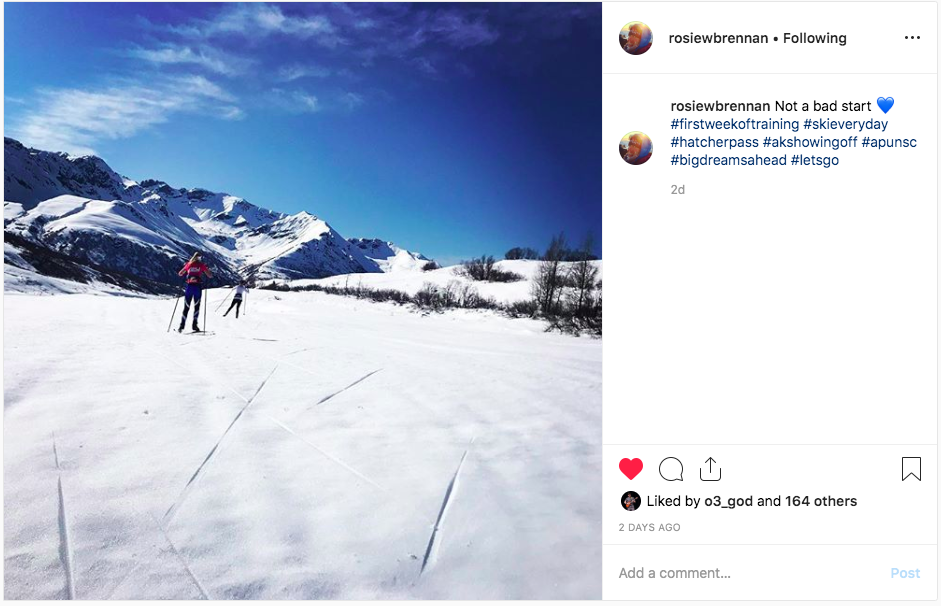
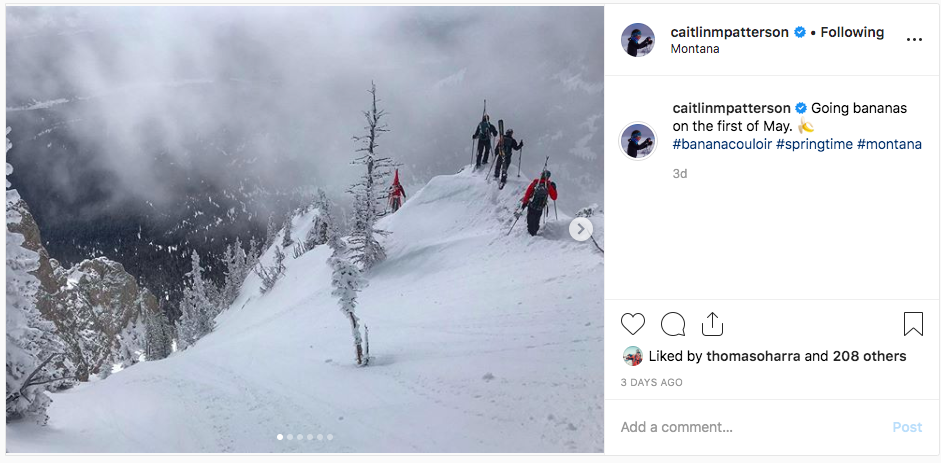
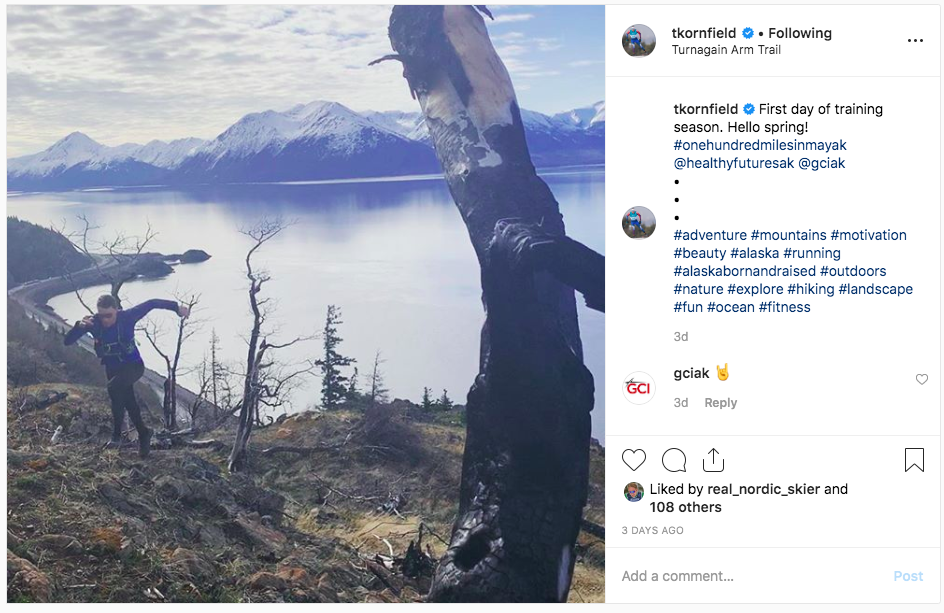
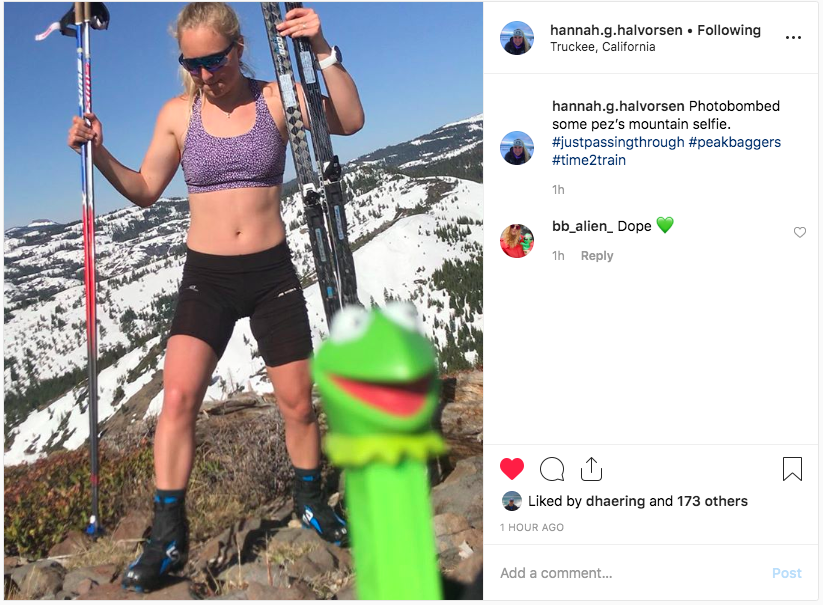
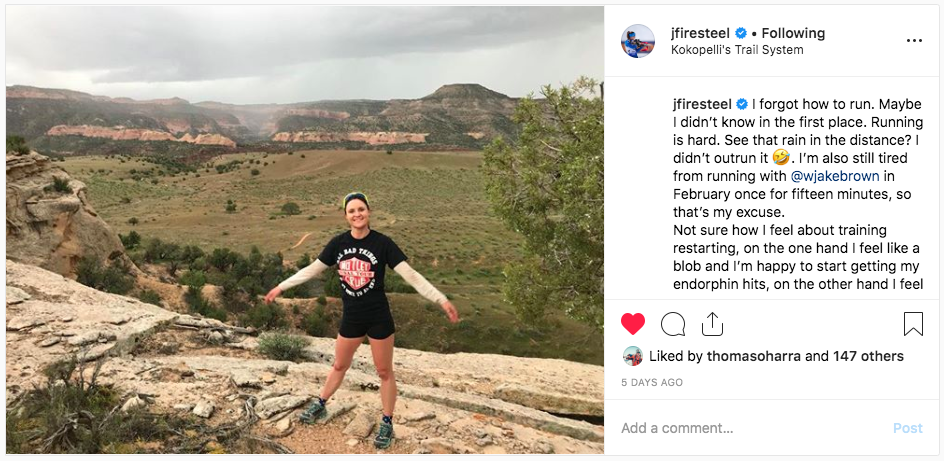
While Instagram has largely replaced blogs (or a book (!)) as the platform of choice, the message has changed far less than the medium: Early May is perpetually a time for new beginnings, new hopes, big plans, and maybe a self-effacing crack about being out of shape or needing to go find one’s rollerskis. Here is a look at how an unscientifically selected group of athletes marked the occasion online, with the only emphasis being on athletes who were posting about new training rather than about new sponsors (corporate sponsors being more characteristic of European skiers than their impoverished American counterparts):
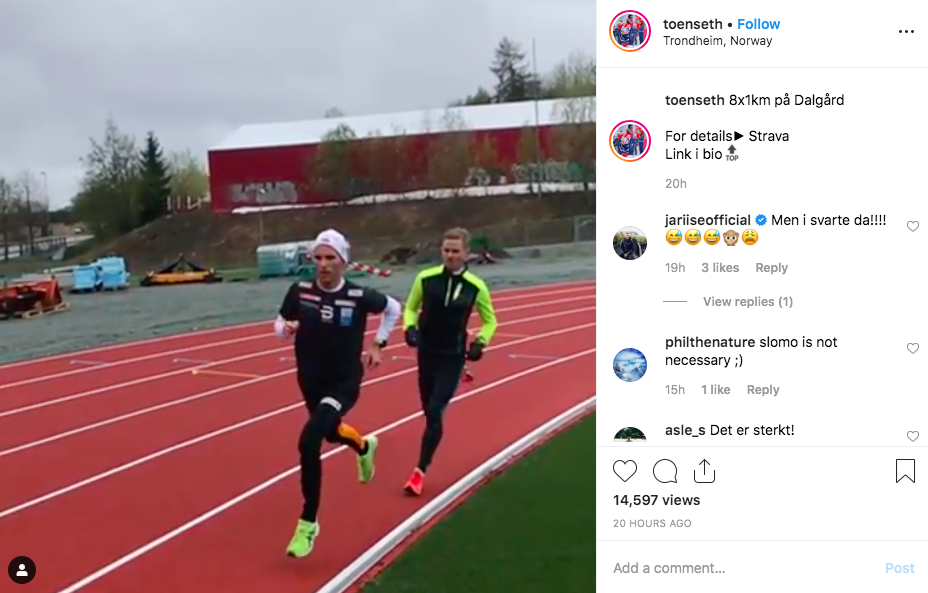
(per Strava link in bio: splits of 3:06, 2:59, 2:56, 2:55, 3:01, 2:59, 2:57, 3:03, with 80-90 seconds recovery. 2:55/km is a 4:42 mile pace, for those of us who measure skiing in km but running in mi. And what were you doing at 8:47 a.m. Saturday morning?)
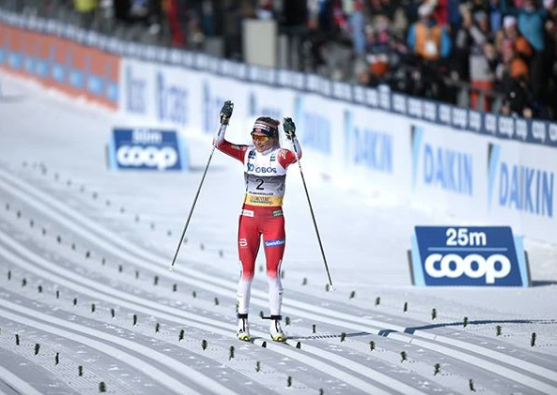
Therese Johaug (center) celebrates at the flower ceremony after winning the women’s 30 k classic race at the Holmenkollen. Russia’s Natalia Nepyreava (l) took second, and Sweden’s Ebba Andersson (r) finished third. (Photo: Screenshot FIS-Ski.com)
Skies cleared and the sun shined on the 30-kilometer mass start classic at the Holmenkollen. When not surrounded by tall pines, racers were offered beautiful vistas of Oslo and the cold blue fjord on which Norway’s capital is built. While the Sunday crowd pales in comparison to the masses who attended the men’s event on Saturday, plenty of tents still lined the course to house families of fans camped out for the weekend. The snowbanks lining the course continued to bear the scars of carved benches lined with pine boughs and snow pits dug around small fires. Norwegian flags flew in abundance as Therese Johaug ran away with yet another distance victory, stopping the clock at 1:18:54.5.
Unlike the men’s race which was decided in the final kilometer, Johaug made it clear that she would win her third race at the Holmenkollen, her second with classic technique. With her wins in 2013 and 2016, she is tied for second-most wins with Larissa Lazutina of Russia who retired in 2002 and her teammate Julija Tchepalova who retired in 2009. Only Marit Bjørgen has earned more wins in Oslo with seven victories.
The race unfolded as nearly every other distance race Johaug has entered this season, including the 30 k freestyle at the World Ski Championships in Seefeld just over one week prior. Johaug separated herself from the pack early and built a gap of nearly a minute by the halfway mark, then continued to expand that lead by the finish. She showed little sign of fatigue and her technique never faltered as she soared through the classically Norwegian track, weaving through the woods, passing by a statue of a troll, and looping around the chapel before rolling past the modernist yet historic ski jump through the stadium. She now joins Bjørgen in the exclusive club of women who have won the 30k at both the Holmenkollen and the World Championships within the same year; Bjørgen has done this twice.
Therese Johaug celebrates her victory in the final meters of the women’s 30 kilometer classic race at the Holmenkollen. (Photo: Screenshot Instagram @fiscrosscountry)
Johaug is a resident of Oslo, so her victory was won in front of her home crowd. The champion trained relentlessly on the tracks at the Holmenkollen and the surrounding trail system of Nordmarka during her suspension with the hope of returning with a season like she has had.
“It’s really special,” Johaug told the International Ski Federation (FIS). “The last two years I’m training so much on these tracks and have a lot of hard sensation out there. So I know the tracks really good, but it was amazing to ski here. There was a lot of people around the track and I love to ski the Holmenkollen.”
While she was aware of the gap that she had on the other women, she did not see that as a reason to slow her pace.
“The coaches give me some information that I have a lot of seconds in front of the rest, but I just have focus on myself and to just have fun out there,” she said. “And the last time in front of the stands I just look up and see all the people that are cheering at me. It means a lot in my heart.”
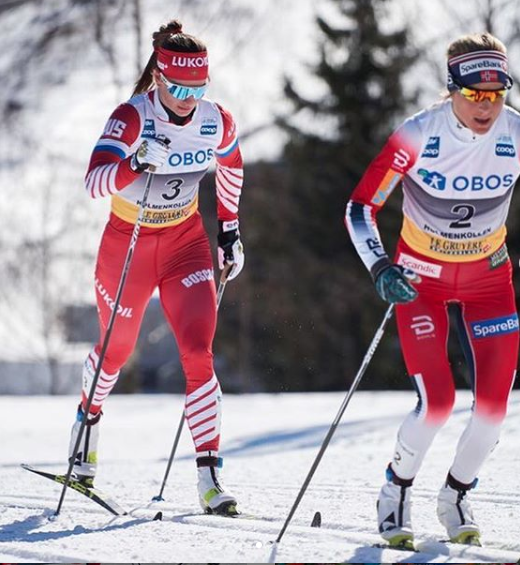
Natalia Nepryeava of Russia (bib 3) chases Therese Johaug (bib 2) in the opening kilometers of the women’s 30 kilometer classic race at the Holmenkollen. (Photo: Screenshot Instagram @russianskiteam)
Behind the peerless leader, the battle for the remainder of the podium spots was decided much later. Natalia Nepryava of Russia was the only skier who made an attempt to stay with Johaug in the first lap. But she fell off the pace and raced mostly alone in front off a group of Ebba Andersson and Charlotte Kalla of Sweden, Ingvild Flugstad Østberg and Astrid Jacobsen of Norway, and Katharina Hennig of Germany, with Krista Pärmäkoski of Finland chasing from behind.
While she was never able to make significant headway on the gap Johaug created, Nepryeava held her position in second steadily, never looking over her shoulder to the women in pursuit behind her.
In the final lap, Kalla led the chase pack with a small gap, but she was reeled in by Østberg and Andersson. Østberg was hungry for her second podium finish after placing second in 2016. Østberg and Andersson passed Kalla with less than five kilometers to go, and continued to surge, drawing ever closer to Nepryeava.
Though they continued to gain on the Russian, Andersson and Østberg were not able to close the gap to Nepryeava, who finished on her own in second (+1:45.9). The Norwegian and the Swede charged through the final kilometer, double poling fiercely to the finish neck in neck. With a throw of her boot, Andersson edged out Østberg at the line, taking third (+1:49.9) with Ostberg inches behind in fourth (+1:50.1).
Three Americans competed in the Holmenkollen, but none were able to crack the top-30. Rosie Brennan (APU) was the top American finisher in 33rd (+7:57.0), followed by her APU teammate Rosie Frankowski (+9:40.2). Kaitlin Miller (CGRP) finished 42nd (+13:43.7). No Canadian women entered the race.
Amidst a strong season during which she has cracked the top 10 twice, one of which was earned during the World Championships in the 15 k skiathlon and the other in the 10 k skate in Davos, and has skied inside the FIS points 13 times in individual events, this result was not what Brennan was looking for.
“I’m a little disappointed, that wasn’t really what I hoped for,” Brennan told FasterSkier in the mixed zone. “I just didn’t have much fight, and I didn’t think my skis were very good, and I’m a little tired from World Champs still. It was a lot of racing and we did a 30 k a week ago.”
Brennan kept her performance today in perspective as it was not her primary objective.
“My goal was World Champs so I had to give everything I had there and I’m happy with that,” Brennan shared. “I hoped I would have more energy but I didn’t, so onto the next.”
Frankowski, who finished 31st last year at the Holmenkollen, had a tougher time keeping this in perspective.
“It was hard. I just didn’t feel good,” she stated simply.
Today was Frankowski’s fourth World Cup start this season. Her best result, and only top-30, took place in the 15 k skiathlon at the World Championships. The 27-year-old Minneapolis native took 21st in the 30k classic race during the 2018 Olympics in PyeongChang.
“The climbing was good for me,” Frankowski commented on the highlights of a tough day. “I like the long climb better than the church loop, the church loop is always really hard. I wish it was skating.”
As the race strung out, Frankowski lost contact with the skier ahead of her, but remained several seconds ahead of the women behind. With the exception of passing a few competitors, she remained largely in no man’s land, a tough position to be in during a long race where drafting and working off of others can be so valuable.
“I didn’t ski with – literally no one,” expressed a frustrated Frankowski. “After the first 5 k, I couldn’t even – I saw like two girls the whole time in front of me…The crowd’s always good here, so at least you get a lot of cheers which is cool.”
She added that skiing alone is not always bad, but today it was not in her favor.
“Most of the time I like it, but today, I think I just was battling my own head, so it made it harder than if you could ski with someone and be distracted,” she explained. “Every person that I caught, which was only two, but they were going so slow that – I passed them on the long climbing section, so we weren’t skiing together at all.”
Both Brennan and Frankowski felt that their wax techs were not able to find the “magic balance”, as Brennan called it, when it came to kick and glide on the frozen tracks in Oslo. Both felt their skis were average and despite the ability to exchange for a new pair, never had an optimal pair that allowed sufficient kick up the long climbs without sacrificing glide on the equally long descents.
“30k is weird, especially classic,” Frankowski concluded. “I feel like sometimes you’re battling your skis, so you can’t go as hard as you want. I gave everything I had today, so that was good.”
While originally hailing from Perth, Australia, Jessica Yeaton has been primarily based in Alaska for the last 15 years. She is a teammate of Frankowski and Brennan at APU, but also skis for the Australian National Team. Yeaton has primarily raced in the Super Tour circuit this season, heading to Europe to race in Lahti in preparation for the World Championships. Yeaton raced in the individual sprint, the 15 k skiathlon, the 10 k classic, and the 30 k skate in Seefeld, with her best result taking place in the skiathlon where she placed 22nd, just behind Frankowski.
“My rest and recovery since Seefeld has gone well so I was really looking forward to racing today, and I am super happy to have made the top 30,” wrote Yeaton in an email. “My wax techs did a great job with the skis, and I was very fortunate that Madshus helped me with a second pair of skis for the exchange- so I had competitive skis for the whole race.
“It was a gorgeous, sunny day with tons of fans cheering out on course – this will definitely be a venue to remember!” she concluded.
Racing in Norway continues Tuesday on the streets of Drammen with a classic sprint.
Therese Johaug of Norway taking the women’s World Championship 15 k skiathlon win in Seefeld, Austria. (Photo:John Lazenby/lazenbyphoto.com)
An emotional Therese Johaug of Norway stood atop the podium after the 15-kilometer skiathlon in Seefeld, Austria. While the race seemed to be decided during the second of two classic laps where Johaug began to pull away, the title has taken much longer to achieve. This moment was one she has been hoping for since she last earned the title during the 2015 world championships in Falun, Sweden. Johaug was unable to compete in the 2017 championships in Lahti or the 2018 Olympics in PyeongChang as she was serving an 18 month suspension after using a medicated lip balm containing the banned steroid clostebol.
“It’s been a big dream for me to come here to Seefeld for a long time now,” Johaug told the International Ski Federation (FIS) as she held back tears. “I’m looking forward for these championships for two years. The last time I was in the World Championships was in Falun, it’s four years ago now. I’m training so much and working so much for this. All the team around me have helping me everytime, so I’m really happy. The waxer team they were awesome today, I had so good skis, I could just fly out there.”
This victory was not unexpected; the well-decorated Norwegian has won each of the eight distance race that she has entered this season by a large margin and has over 50 world cup victories to her name. She adds this gold medal to a collection of three others in the skiathlon, a gold in 2015, silver in 2013, and bronze in 2011, and is now tied with her former teammate, Marit Bjørgen, for the most world championship medals in the event.
The day’s winner, Therese Johaug of Norway, at the start of her second classic lap during the women’s World Championship 15 k skiathlon in Seefeld, Austria. (Photo: John Lazenby/lazenbyphoto.com)
Johaug commanded the race from the gun, her powerful and flawless technique driving her ahead at a pace no other skier could match. At the exchange, she switched into her skate skis calmly and confidently, exiting the zone smoothly in just seconds. At this point, Johaug had nearly 30 seconds on the women chasing her, and 7.5 k later when she stopped the clock at 36:54.5, she was nearly a minute ahead.
Behind her also wearing red lycra was a battle for silver and bronze as a group containing Ingvild Flugstad Østberg and Astrid Uhrenholdt Jacobsen of Norway, and Natalia Nepryaeva of Russia chased the leader. When Johaug took the race out fast, the threesome went with her in the first kilometers of the race, separating themselves from the larger chase pack behind. When Johaug began to pull away, the three women stayed together, exchanging the lead frequently as they covered ground.
Therese Johaug of Norway during the skate leg of the women’s World Championship 15 k skiathlon in Seefeld, Austria. (Photo:John Lazenby/lazenbyphoto.com)
It was not until a final climb brought the trio to a hairpin turn before descending into the stadium for the final sprint that Østberg moved to the front and began to make her run for second place. She crested the hill with a small gap ahead of Nepryeava, with Jacobsen not far behind. Østberg flew into the stadium in a no pole skate, switching to V2 as she clinched her position in second place (+57.6). She crossed the line and into the awaiting arms of her teammate, Johaug, where she collapsed and began to let out shrieks of joy and relief. Her silver is her first individual world championship medal.
Nepryeava crossed the line in third (+58.7), Jacobsen fourth (1:02.0).
Rosie Brennan of the U.S. placed 10th in the women’s World Championship 15 k skiathlon in Seefeld, Austria. (Photo:John Lazenby/lazenbyphoto.com)
Three of the four American competitors landed in the top 30 with Rosie Brennan in 10th (+2:01.8), Julia Kern 19th (+2:55.5), and Rosie Frankowski 24th (+3:00.6). Caitlin Patterson finished just outside in 34th (+3:54.5).
With added variables and little experience in the event, it can be difficult for athletes to set expectations in a skiathlon. Today’s outstanding results came as a bit of a surprise to the American women who went in optimistic, but without positive experiences to look back on.
“Skiathlons are tricky because we just don’t do that many so you never really know what’s going to happen or how you’re going to feel, especially once you switch skis,” Brennan told FasterSkier in a call. “Last year the skiathlon at the Olympics was literally the worst race of my life, so it’s been a while since I’ve had a good one, so I was a little nervous.”
Julia Kern in bib 35 during the classic leg of the women’s World Championship 15 k skiathlon win in Seefeld, Austria. Kern placed 19th overall. (Photo:John Lazenby/lazenbyphoto.com)
It was the second skiathlon Kern had completed; she was not happy with her result in the first and in the most recent one she entered at U23’s, she had to drop out due to illness. Her top-20 finish exceeded her expectations today.
“I had no idea what to expect, but I was really excited,” said Kern in a call. “My goal was top-40 and on a good day maybe a top-30, but I didn’t really know what to expect and my goal for today really was just to ski hard and see what I could do.”
Brennan found herself amidst a larger chase pack behind the threesome of Østberg, Nepryeava and Jacobsen. This group worked together through the 7.5 k classic half, then began to spread after the exchange.
“My goal was just to stay in the pack and be as relaxed as possible and see what else was left once we switched [to skating],” Brennan shared. “I’m really happy with how I skied tactically, I think it was one of the better races I’ve done tactically, that’s not usually my forte.
“The only regret I have is that I kind of forgot that in skiathlons, once you switch skis, that first k or so it’s super important to find the right group, but it’s also the most nerve-wracking k because you never know how your legs are going to feel once you switch skis,” she continued. “And I actually felt pretty good, so I wish I had pushed that first k in the skate a little harder to be in the front end of that chase group instead of the back end because I kind of wasn’t paying attention when that pack broke up. And the skate leg was a lot faster and flatter, so it was a little challenging to ski away from people, so the group you got in in that first few k really determined where you would be in the end.”
After the split mentioned, a group containing 2018 Olympic gold medalist Charlotte Kalla and Frida Karlsson of Sweden, Heidi Weng of Norway, Krista Pärmäkoski of Finland, and Anastasia Sedova of Russia pulled ahead of the remainder of the pack. These women finished fifth through ninth.
“I found myself in still a good group, and so I realized pretty quickly that it was going to be hard to ski away,” Brennan explained. “But I didn’t really want to sprint with four people, so I tried to make a move on the far hill and I think it dropped one girl, but it wasn’t really what I hoped for. So then I decided that then I would settle and have faith in my sprint finish. And I had really great skis, so I was able to draft well off the sprint downhill into the stadium and kind of play a good tactic into the finish and bust a move on that last little climb. So I was really psyched with how that worked out and how I skied that section.”
Brennan’s result is her second top 10 finish of the season, her first coming in the 10k freestyle race in Davos. The APU skier also raced in the World Championships in both 2015 and 2017, but today was her best result in an individual race. This progress is especially rewarding after a season hampered by illness. Brennan was diagnosed with mono at the end of the 2018 race season after a slew of less than satisfying results.
“I’ve been really psyched. After last year, I didn’t know if I would ever be able to ski fast again or even if I was going to keep skiing,” Brennan reflected. “So it was kind of an interesting summer, but I was able to have a really good training group at home and just focus in on what I needed to do, and that was really successful. I started feeling better and better as the summer went on and started getting more and more confidence and hopes for what the season to come would bring.
“And knowing that I was not on the national team and had to earn all my start spots, I wanted to come into Period 1 ready to race,” she continued. “I was really happy with that [plan], I did that really well and each weekend got better in period 1, so that was super successful. Then, because I had done that, I felt like I needed to take a break and do another training block to be ready for the championships since they were so late [in the season]. So I took some time and did quite a bit of training. I think that made me a little flat in the first two world cups when I came back, so I was a little nervous that my form had left me, but I was feeling good and my training had gone well, so I guess I had a hint of optimism. But I’m glad to feel like my form did come back and I’m racing at the level that I was in Period 1, so I think my plan worked really well. I’ve been really excited with all of that.”
Kern started the race with a slightly different plan than Brennan. The beginning of the race played out differently than she anticipated, but she quickly adjusted her tactics.
“I had a feeling it was going to start out pretty hot since I figured that Johaug would push the pace early, so things would string out,” explained Kern. “My plan was to start out fast and settle in, but I ended up – it was hard to pass people in the start, so I kind of just stayed relax the first climb, then in the second lap began to push the pace a bit. Once I got through the transition, I saw it as a new race, just skating.”
The start of the women’s World Championship 15 k skiathlon win in Seefeld, Austria. (Photo:John Lazenby/lazenbyphoto.com)
While her start was not as fast as she expected, she took advantage of her confidence and speed on downhills to move ahead in the second half.
“I had the absolute fastest skis out there – they were insanely fast, the techs did an amazing job,” she said gratefully. “So even on the uphills if I would get dropped a little, I skied the downhills super well. A lot of people were skiing the downhills scared and my skis were so fast that I would catch and pass people every downhill. So it was this sort of cat and mouse game where on the uphills I would try to hang on and keep it as close as possible, then on the downhills just shoot by people. So it was really fun skiing knowing I had insanely good skis and that the techs had given us the best skis out there, so I could just focus on hanging on as long as I could on every climb.”
It was Frankowski’s first start in a World Championships. Earlier in the season, Frankowski won a pair of 10k’s while racing domestically on the Super Tour, one in classic and one in skate, and took second at the 20k skate at US Nationals.
“It was fun out there today,” wrote Frankowski in an email. “I felt much better in the skate portion of the skiathlon, but would have preferred a but slower conditions – there were some scary downhills. A big thank you to the techs for some good skis and the weather gods for bringing out the sun again for the race.”
Canada’s Katherine Stewart-Jones skied to 39th (+4:19.8), Cendrine Browne 40th (+4:25.2), and Maya Macisaac-Jones 54th (+8:53.4).
Racing continues tomorrow with a classic team sprint.
It wasn’t the wire-to-wire triumph that Norway sometimes achieves, but the pre-race favorites got the job done despite a scare midway through, thanks to dominant skiing by Ragnhild Haga and smooth strength from anchor Marit Bjørgen.
Norway took gold in the 4 x 5 k relay by two seconds over Sweden in 51:24.3 minutes. Olympic Athletes from Russia took bronze (+43.3), Finland fourth (+1:02.6), and the United States fifth (+1:20.5).
The first leg went out with Natalia Nepryaeva of Russia setting a blistering pace, fracturing the field almost immediately. A number of racers tried to stay with her only to get shot off the back of the pack. Taking a different pacing strategy, Slovenia’s Anamarija Lampic made up ground in the final section of the first leg to tag off in second, with Norways’ Ingvild Flugstad Østeberg third, all within a few seconds of each other.
Part of Nepryaeva’s fracturing of the field led to U.S. lead skier Sophie Caldwell getting dropped, to tag off 1:01.5 minutes back in 11th place.
In the second leg, Charlotte Kalla of Sweden and Kerttu Niskanen of Finland clocked the fastest times, making up 24.4 and 9.9 seconds that had been lost to Russia and Norway by their teammates Anna Haag and Aino Kaisa Saarinen, respectively. In the meantime, Astrid Uhrenholdt Jacobsen of Norway had a disastrous relay leg and notched just the eighth-fastest split time, falling to fourth.
Yulia Belorukova of Russia continued to lead the race on that second leg, but Kalla tagged off at the end of the classic portion just 1.4 seconds back, and Niskanen in third (+10.1). Sadie Bjornsen made up three places to tag off in eighth (+1:05.2).
Jacobsen tagged Haga 29.8 seconds out of first. From that point, Haga gradually reeled in the leaders over the course of the 5 k skate leg. It was an absolutely dominant performance, with the fastest split time by 24.7 seconds in a less than 12-minute race.
Sweden’s Ebba Andersson led Russia’s Anastasia Sedova for the whole leg and stayed clear of the field, but Haga — the gold medalist in the 10 k skate — made up enough ground to finish her effort in third, 3.4 seconds back.
That was more than enough for Bjørgen to work with, and she and Swedish anchor Stina Nilsson quickly dropped Anna Nechaevskaya of Russia and set off on their personal duel for gold. Bjørgen led the whole way, but could not make any decisive move to drop the Swede. Instead, over the top of the climb she had about a second, which Nilsson could not close on the downhill or the final flats into the finishing straight: gradually, Bjørgen just added a meter and another to her lead and crossed the line with gold.
Nechaevskaya continued to lose time on the leaders, but still held on to bronze. Krista Pärmäkoski skied an aggressive effort for Finland to pass the team from Switzerland, which had been in fourth after strong legs from Laurien van der Graaff, Nadine Fähndrich, and Nathalie von Siebenthal. But 21-year-old Lydia Hiernickel was unable to keep the pace and Switzerland dropped to seventh by the finish, getting passed by not only Parmakoski and Jessie Diggins, but also Sandra Ringwald of Germany. The Germans finished sixth (+1:49.4) and Switzerland seventh (+1:51.5).
Kikkan Randall had skied the third-fastest split of the field (behind Haga and Andersson) in the third leg to bring the U.S. into sixth, and Diggins also skied the third-fastest split (behind Bjørgen and Nilsson) for her leg to bring the team up to fifth at the finish.
The Canadian team of Dahria Beatty, Emily Nishikawa, Cendrine Browne, and Anne-Marie Comeau placed 13th (+4:50.3) of 14 teams.
The women’s biathlon 12.5 k mass start medalists at the 2018 Olympics in PyeongChang, South Korea, with Slovakia’s Anastasiya Kuzmina (c) in first, Belarus’s Darya Domracheva (l) in second, and Norway’s Tiril Eckhoff (r) in third. (Photo: IBU/Biathlonworld)
Not even a miss in the final stage could keep Slovakia’s Anastasiya Kuzmina from her third medal of the 2018 Olympics, this time gold, in the women’s 12.5-kilometer mass start on Saturday at the Alpensia Biathlon Center.
Kuzmina took charge early in the five-loop race, leading Germany’s Laura Dahlmeier into the range for the first prone shooting stage. There, Kuzmina cleaned all five targets quickly to get back out on course in first, while Dahlmeier missed one to slip out of the top 20, while several other athletes cleaned.
Kuzmina went on to hit every target over the next two shooting stages to distance herself from second place, and even with a miss on the last standing stage, she left the range 24.7 seconds clear of Darya Domracheva of Belarus in second.
Domracheva had put herself in second with clean shooting in the first two stages, then dropped to fifth with a miss on the third stage. Italy’s Dorothea Wierer was up to second by the fourth shooting after three clean stages, then fell back to seventh with a miss on the last standing.
There, Domracheva cleaned to get back into silver-medal contention, 9.3 seconds ahead of Norway’s Tiril Eckhoff in third.
Heading into the final downhill into the stadium, Kuzmina had enough time to grab a flag from one of her team’s staff members running alongside the trail. She crossed the finish line first in 35:23.0 minutes without anyone close for her third-career Olympic gold (after winning the sprint at the 2010 and 2014 Games).
Domracheva skied on her own to second, 18.8 seconds behind, for her first medal of the 2018 Games (and fifth of her career after winning three races at the 2014 Olympics).
Eckhoff, who had skied two penalty laps, took third, 27.7 seconds behind Kuzmina, while Italy’s Lisa Vittozzi held off Sweden’s Hanna Öberg, Wierer and Belarus’s Nadezhda Skardino for fourth place (+45.6). Öberg placed fifth (+46.5), Wierer was sixth (+47.3), and Skardino seventh (+47.9), ahead of Norway’s Marte Olsbu in eighth (+51.6), France’s Marie Dorin Habert in ninth (+57.9) and Finland’s Kaisa Mäkäräinen in 10th (+1:00.9). Dahlmeier, who had won two races and placed third in another at these Olympics, finished 16th (+1:47.1) with two penalties (1+1+0+0).
Marit Bjørgen carrying the Norwegian flag as she crosses the line first for Norway’s 100th World Championship win during the women’s 4 x 5 k relay at 2017 Nordic World Championships in Lahti, Finland. (Photo: John Lazenby/Lazenbyphoto.com)
Welcome to World Cup Windup, where we check in with the top-10 teams from last year’s FIS Cross Country World Cup tour before the season starts with the Ruka Triple in Kuusamo, Finland, on Nov. 24.
NORWAY
Overall in Nations Cup Last Year: First, by a landslide: 13,383 points to 7,053 by runner-up Sweden.
Women’s Ranking 2016/2017: First
Men’s Ranking 2016/2017: First
Norway’s Heidi Weng leading her teammates Ingvild Flugstad Østberg (middle r), Marit Bjørgen (middle l) and Sweden’s Stina Nilsson (far left) during the women’s 10-kilometer freestyle mass start in La Clusaz, France, last December. (Photo: Fischer/Nordic Focus))
Who’s Back:
Overall World Cup winners Martin Johnsrud Sundby and Heidi Weng; Sprint Cup winners Johannes Høsflot Klæbo and Maiken Caspersen Falla; World Cup race winners Finn Hagen Krogh, Emil Iversen, Sindre Bjørnestad Skar, Pål Golberg, Eirik Brandsdal, Ingvild Flugstad Østberg, and Marit Bjørgen, And that’s just the skiers who won World Cups last season. There’s also other folks like, oh, Petter Northug and Astrid Jacobsen, who didn’t pick up individual wins last season but are probably pretty hungry.
Who’s Missing:
Therese Johaug. The world champion and two-time World Cup overall champion is still sitting out a doping ban for using a lip cream containing a prohibited steroid.
Other than that, athletes usually don’t retire just before an Olympics, so pretty much everyone is back.
Pre-Season Results:
None of the national team members have raced at the pre-World Cup competitions so far, but Chris Andre Jespersenpicked up a win in Bruksvallarna, Sweden. Look for many more Norwegians to compete at their home opener in Beitostølen this coming weekend.
The second World Cup stop of the season is in Lillehammer, so the Beitostølen races will also likely determine who gets to compete as part of the “nations group” there, the host country’s extra bunch of quota spots.
Recent Drama:
Oh, there’s always something, isn’t there? For Norway, it’s about the Olympics. With just four starting spots per race and so many top skiers, it will be a tough fight to get named to the Olympic team.
Norway’s Emil Iversen crashes in the finishing stretch while Finn Hågen Krogh (2) leads Finland’s Ristomatti Hakola (10), Martti Jylhae (4) Canada’s Alex Harvey (13), and Poland’s Maciej Starega (22) during the second men’s skate-sprint semifinal on Feb. 23 at FIS Nordic World Ski Championships in Lahti, Finland. (Photo: Dustin Satloff)
Emil Iversen, for instance, remembers how he fell twice at last year’s World Championships, including in the team sprint, where he ruined a good chance at a win given to him by teammate Johannes Høsflot Klæbo. He says he is feeling good, but he wants to redeem himself from Lahti and that’s no easy feat. “Everyone says they have never been stronger,” he told NRK. “Being in the squad should be within reach, but getting all the race starts I want will be incredibly hard.”
Astrid Jacobsen, meanwhile, has changed her training and is in some ways imitating alpine skiers, focusing more on balance. “It’s hard to believe that you can improve oxygen capacity or become more persistent by exercising even more,” the 30-year-old said. “I have a thorough fitness already. I think there’s more to gain by catching up with new things… If I get a little better in this area and get better on the skis, I can be a little more efficient. Better efficiency will produce much better results than better capacity would.”
Otherwise, a few skiers are not in the shape they’d like to be in at this point in the season.
Finn Hagen Krogh is congratulated by his teammates after anchoring Norway to gold in the men’s 4 x 10 k relay on March 3 at World Championships in Lahti, Finland, 4.6 seconds ahead of Russia in second place. (Photo: John Lazenby/Lazenbyphoto.com)
Didrik Tønsethgot a bad concussion after a rollerski crash in Livigno, Italy, in early September, and had to miss a considerable amount of training. (Reminder: always wear a helmet while rollerskiing!) He skipped a recent high-elevation training camp because he sometimes still has headaches; he is otherwise doing some hard training again. Tønseth was part of the gold-medal relay team from 2017 World Championships but is worried about qualifying for the Olympics. “It’s a season where you have to do well before Christmas,” he told NRK, according to a translation. “It already counts from Kuusamo… so there is no favorable situation. I’m not completely satisfied.”
Best Social Media Presence:
The Norwegian ski stars generally don’t use Twitter much, but a few have great Instagram presences.
Unsurprisingly, the Norwegian who is best at conveying his brand on social media might be Petter Northug. When the IOC made the decision to disqualify several Russian athletes from the 2014 Olympics for doping – including the silver-medal men’s relay team – this was the response from Northug, who had anchored the Norwegian relay team which had finished fourth, failed to medal, and otherwise caused great soul-searching in the country:
Given the drama over who will anchor the men’s relay team in 2018, Northug is taking even one more laugh with this post.
But if it’s not satire and gamesmanship you’re after but rather smiles and a peek inside the women’s team, who from this perspective seem to be genuine friends, follow Heidi Weng on Instagram.
U.S. Ski Team members Jessie Diggins (l) and Kikkan Randall hold the American flag during a victory “lap” down the homestretch after placing second and third, respectively, in the women’s freestyle sprint at 2017 Nordic World Championships in Lahti, Finland. (Photo: John Lazenby/Lazenbyphoto.com)
ANCHORAGE, Alaska — Kikkan Randall is approaching a season full of lasts: her final season as a full-time athlete, her final season on the World Cup, and, she hopes, her fifth and final Olympics. Her main focus these days is resolutely on the future, but she took some time earlier this month to speak with FasterSkier about her summer training and what comes next.
Summer training
Randall’s final summer of training was anchored by the same thing as most of the 17 summers before it: multiple weeklong training camps on Eagle Glacier, the Alaska Pacific University (APU) facility in the Chugach Mountains above Girdwood, Alaska. But this summer saw Randall take only two trips to the glacier, instead of the three camps attended by most of the APU team.
In place of a third glacier camp, Randall traded a short helicopter ride for a long plane flight and traveled to Sweden for a 12-day training camp with the Swedish national team. It was Randall, fellow U.S. Ski Team (USST) member Liz Stephen, and 10 women from the Swedish team, Randall explained in a phone interview.
https://www.instagram.com/p/BXk2D1rj0W2/
Randall began her trip with three days in Östersund, Sweden, with Anna Haag and Stephen, who was coming from the Blink rollerski festival in Gjesdal and Sandnes, Norway. Then came three days in Åre with the full Swedish national team, as well as USST Women’s Coach Matt Whitcomb. The remaining days of camp were spent with the full Swedish team near Vålådalen. The whole thing made for a “really sweet” 12-day training block, Randall recalled.
American skiers were hardly receiving invitations to train with Scandinavian national teams at the start of Randall’s career, but such exchange programs are now relatively commonplace. This was not Randall or Stephen’s first such trip to Sweden, and Jessie Diggins joined the Norwegian national team for a camp last summer.
“I think it’s also a strong testament to our nation, and our program as a good partner to Norway as well,” Whitcomb previously said about the invitation, as well as speaking highly of both Diggins and the Norwegians.
“We’re all training at a high level now,” Randall says when asked whether she sees similarities or differences between American and Swedish training. “We’re all doing very similar types of training, loads of training.”
But even if the training quality and quantity are comparable, the logistics are different, reflecting the simple fact that the U.S. is more than 20 times larger than Sweden, with top-level skiers spread out across five time zones and thousands of miles.
“The real difference for me and what stands out is just the lifestyle of it,” Randall reflects, “and how the Scandinavians never have to travel more than three or four hours away from home. They get together for camps once every three weeks. They’re in camp but they’re these shorter camps and then they go home. Whereas for us, we have the geographical challenges of so much more travel, that when we get together, we have to get together for longer to make it worthwhile, but that of course changes the exact kind of training we can do within a camp, so that part’s varied a little bit.”
The difference isn’t just academic, but rather bears on the type of training that can be done in a group environment. “This camp we went to was an aggressive training schedule,” Randall notes, “and I don’t think it would be smart to necessarily take that schedule and bring it back to the U.S. and replicate it because just the way we live is a little different.”
https://www.instagram.com/p/BXay55rD8oi/
Randall found a valuable training stimulus from the camp, and appreciated the chance to “rub elbows with those guys, be like, OK, I may train a little differently, but I’m on track, versus having to wait seven months between race seasons and not knowing where the heck you are.”
But even more than the reality check on training and fitness, she says that it helps to have local friends in Europe when the Americans are on the road and living out of a suitcase for four months at a stretch.
“I think the biggest benefit” of this offseason training exchange “is that we get to know them as people,” Randall notes. “When we’re on the World Cup, then all of a sudden we have these friends on other teams. If we do need a weekend off and want to go to a home, we can go home with them and get a little break or we see them and we go out for jogs together. It’s pretty cool because I’ve developed lifelong friends now and I look forward to continuing to visit beyond just these training years. I think that shared experience is what really makes it special to me.”
The final World Cup season and the Olympics
It’s tough for any American skier to spend that long away from home. But Randall, with husband Jeff Ellis and support from family members on both sides, is upping the logistical ante by bringing along a toddler. The couple’s son, Breck Stuart Randall Ellis, turns 18 months old next month, and will be spending his second winter on the World Cup circuit.
“Our plan is to pack up early November and head over as a family,” Randall says of their approach for the 2017/2018 season. “We’ve got most of the winter figured out. We’ve got a few more apartment-style accommodations lined up this year. We know with a busy year-and-a-half-year-old, it’s going to be a little harder to contain him in a hotel room. We’re trying to set up the best kind of situation for our family.”
https://www.instagram.com/p/BMy2IR8A_q3/
Randall and Ellis have most of the winter already dialed in, but there’s still one large hole left in their schedule: PyeongChang. “The challenge we’re really wrestling with right now is with what to do about the Olympics,” Randall notes.
Randall is certain that she wants to have her child with her in South Korea if at all possible. “Ideally I’d have Breck at the Olympics,” she says.
Looking back to the 2017 World Championships, Randall says, “I think that was a really positive force having him with me at Lahti, but it’s looking to be exorbitantly expensive to be able to have him in South Korea nearby. We’re looking for accommodations, figuring out can we possibly afford this, and if not, what are some other options? We don’t have a clear answer on that one yet. Outside of that we’re looking forward to a totally fun winter altogether.”
It’s no secret to any parent that traveling with kids is tough. Alaska parents arguably learn this as well as anyone, just because it’s so darn far to travel anywhere from The Last Frontier. (Figure three hours’ flying time from Anchorage to Seattle alone, in the shortest flight that most Alaska kids ever take. And forget driving; that’s a 2,400-mile roadtrip.) It’s tempting to think that a four- or five-time Olympian would have an easier time of things, but Randall recounts challenges and choices that are relatable to any parent.
“It’s an interesting dilemma,” Randall analyzes, “just thinking about it from all sides, because on one hand, it was my choice to have a baby and with that comes different logistical challenges than when you don’t have children. At the same time, I am a strong contributing member of this team, I hope I can contribute to some Olympic medals, and for me to perform at my best, like I said, it was always a really positive influence to have Breck around while I was competing at the World Championships. It would be awesome if I could be able to have him there with me so that I could be in the right state of mind and perform really well. It’s, ‘Do I need to shoulder all the cost myself or can I get some support from the [United States Olympic Committee] or from the U.S. Ski Team?’ At this point it’s going to be fairly challenging to make it happen on our own.”
Complicating matters for anyone who hopes to stay outside of official athlete housing, as of this spring the PyeongChang area was reportedly facing a severe shortage of Olympic accommodations. These problems had not been alleviated as of earlier this month.
Skiing and parenting
Randall speaks candidly about the tradeoffs of doing her job effectively versus being available to her child, a balancing act instantly familiar to any parent. Breck was not with her in Sweden for last month’s 12-day training camp; Randall and Ellis “felt like that wasn’t a super-long stint,” and Breck was able to stay with Ellis and grandparents in Canada while Randall focused on training in Sweden. Randall was also solo at spring camp in Bend (also 12 days), and at each of the two Eagle Glacier camps (6–7 days each).
https://www.instagram.com/p/BY4X5ePHdm9/
“It has actually been a pretty challenging summer,” Randall notes. “I’ve had to be away from him a lot more than I had to be last year. I think I’m willing to do this now because I know it’s my last season. I can’t imagine doing it really any longer.”
She continues, “I’m glad he’ll be with me most of the winter and in Park City [at a USST training camp next month], because it’s getting tougher and tougher to be away, even though it’s nice for training and recovery and sleep and rest. I definitely miss him.”
If athletic training is, generally, a balancing act, then training while parenting is a balancing act while riding a unicycle backwards and juggling flaming knives. If those knives could at any moment start having a meltdown because they couldn’t find their preferred socks or a favorite toy. (Good thing Randall knows how to ride a unicycle.) Choosing between having your child be with you or with a supportive spouse is one such tradeoff. Choosing between more effective recovery and more effective parenting is another such tradeoff, one that Randall has to negotiate at least twice a day as a parent and an athlete.
“The hardest part for me,” Randall analyzes, “is when I’m tired and I come home [from training] and I know that the most productive thing for me is to recover, take a nap, get some time off my feet, to make the next workout effective and do my job, in a sense. But I also have this little boy who wants my attention and I love spending time with him, and it’s been a challenge this summer to navigate that and find a happy medium. I think some days I end up being more of a mom and some days I can, with the support of my husband and my parents, I can be a focused athlete.”
Randall and Ellis have made it work for a year, but Randall doesn’t want to have to make those choices much longer. “Like I said, I can wrap my mind around doing this one more year to make a final push at this Olympics, but that’s why I can’t think about doing it any longer, because I want to be able to not have that dilemma anymore.”
https://www.instagram.com/p/BHGIHlggsXM/
(Randall perceptively acknowledges that this dilemma never really goes away: “I know that while I look forward to not having the restrictions of a ski racer’s life for my family next year, I know that there’ll be, getting back to a more normal life of a job and wanting to fit in training and family and how all that’s going to work. I think it’s an issue a lot of parents face.”)
After PyeongChang
Randall remains committed to her goals for this season, and is working hard to achieve them. But she has also begun to think about what happens next.
So what to do following a nearly two-decade career as a professional athlete? Get involved in athlete representation, of course.
Randall is one of six athletes currently running for two open spots on the International Olympic Committee (IOC) Athletes’ Commission, a representative body established in 1981 for the purpose of representing athletes and their concerns within the IOC context. The commission’s mission is “to ensure that the athletes’ viewpoint remains at the heart of the Olympic Movement decisions,” says its website.
Elections will be held in February 2018 during the Olympics.
Randall has spent many years as a cross-country representative to the FIS Athletes’ Commission, which plays a comparable role relative to the International Ski Federation (FIS), but has not previously served on the IOC commission.
“Why do you want to do this?” Randall is asked.
“That’s a good question,” she replies. “Because it is an eight-year commitment. … I definitely asked myself if I want to go from being committed to a ski racer’s life, finally be retired from competition, and then go right into another eight-year commitment, but I really have enjoyed the athlete representation work I’ve done over the last eight years. I think to take that experience and expand it to the IOC level would just be really interesting.”
Randall has a politician’s poise as she explains why she wants to continue her involvement with the Olympics: “I think now is a great time to get involved and help strengthen the Olympic movement, get it back to a point where it’s being a good force in the world, because I want to see the Olympics still be important for my children, still be important for your children,” she tells a FasterSkier reporter who is also a parent. “I don’t want to see the Olympics go away. I’m hoping I can blend my experience having been an athlete at four Olympics, hopefully number five coming up, and then also having worked on the other side, representing the athletes, being in the business side of the sport, and I just think it would be a really cool way to stay involved.”
But she also seems authentically committed when she talks about the potential of the Olympics as a force for good.
“Bringing the world together every two years for an Olympic Games just creates so much goodwill amongst our global community and it inspires everybody to really find the best in themselves in a fair and clean way, which I think is really good for humanity.”
Norway’s Astrid Uhrenholdt Jacobsen, another candidate for the IOC Athletes’ Commission, racing to bronze during the women’s 10 k classic at the 2017 Nordic World Championships in Lahti, Finland. (Photo: John Lazenby/Lazenbyphoto.com)
As noted, there are six Winter Olympics athletes in the running for two open spots on the Athletes’ Commission. The other five candidates are Spanish skeleton racer Ander Mirambell, Finnish hockey player Emma Terho, Chinese long-track speedskater Zhang Hong, Italian luger Armin (“Il Cannibale”) Zöggeler, and Norwegian cross-country skier Astrid Uhrenholdt Jacobsen.
Randall does not reject a suggestion that the presence of both her and Jacobsen could to some extent split the “Nordic vote.”
“By having two cross-country skiers in the mix, it does have the potential to dilute the vote,” she notes. But she continues, “I think you can also look at it as we now have two ponies in the race. Both of us in the election and there’s probably a better chance that a cross-country athlete will make it to the IOC Commission. That’s good odds.”
Randall is quick to call Jacobsen, with whom she has previously trained on Eagle Glacier as an invited guest of the North American Women’s Training Alliance, an “accomplished person,” who “put a lot of thought into taking on this role.” But she diplomatically notes that Jacobsen “is coming from one side of getting involved in the athlete representation side, at least in an international way, for the first time. I’m coming from the side where I’ve been involved. It’ll just be interesting where people land on who they want to put forward.”
What comes next: Retirement and Canada
First things first, Randall officially plans to retire after this season. “I haven’t done an official press release,” she notes, “but I’ve definitely talked about it to plenty of people. Most people know that’s my plan.”
That leaves Randall and her family (Ellis has spent the past five years working as marketing support manager for the World Cup, but would presumably no longer want to spend all winter in Europe without his wife and son) needing jobs, and a place to do them.
What she’ll be doing next year is “also a very good question,” Randall says. “We’ve been talking about that as a family for a while.”
Randall notes that Ellis “has been very supportive,” pointing out that he moved to Alaska 10 years ago for her sake and has supported her once he retired from his own ski career. “We’ve always talked about once I retire from skiing to be open to chasing some career opportunities for him,” Randall notes. “He’s Canadian; maybe that meant moving to Canada and experiencing that for a while.”
The couple were exploring their options this spring when “an opportunity fell into our lap”: Ellis was invited to apply for a job with Swagman, a bike rack company based in Penctiton, British Columbia, about a four-hour drive east of Vancouver.
“It was total long shot because they were looking to fill the position in April of this year,” Randall notes. But Ellis applied anyway, “just to see what would happen.” He got the job. They were willing to hold it open for him for roughly a year, till April 2018, if he would be willing to move there. Penctiton it is for the Randall–Ellis family.
(Ellis was born in Orangeville, Ontario, and is a Canadian citizen. As the child of an American and a Canadian, Breck has dual citizenship. Randall is working on the immigration paperwork to gain legal residency in Canada as the spouse of a Canadian national.)
While Ellis works for Swagman, as well as parenting, Randall will be pursuing at least two other projects, as well as parenting.
Kikkan Randall (left) and former Canadian national team member Chandra Crawford (32) leading the Fast and Female forerunners before the classic sprint at Stage 5 of the 2016 Ski Tour Canada in Canmore, Alberta. (Photo: Fischer/NordicFocus)
For one, she wants to be able to devote more attention to Fast and Female, a nonprofit sports advocacy group that, its website explains, aims at “keeping girls healthy, happy and active in sports through their teens by introducing them to inspiring athlete role models.” (You may have seen one of their Champ Chats in a ski community near you, particularly if you are the parent of a preteen or young teenager girl.) Randall is the U.S. leader of an international organization that was founded by Canadian skier Chandra Crawford in 2005.
“We’ve kept the U.S. side in a maintenance mode for the last few years,” Randall notes of Fast and Female, “since my time’s been limited, but since now that I can work on it more full time, I look forward to helping grow the U.S. organization maybe to the level that they’ve been operating in Canada. That’s a project on the horizon, depending on how this IOC athletes’ election goes. Should I get that position, that’s going to be a commitment. I want to be able to be flexible around that.”
And for another, she plans to finally get that degree. Randall graduated summa cum laude from East Anchorage High School in 2001 [around the time of the below throwback photo], then has been working on her undergraduate degree in business from Alaska Pacific University (the school, not the ski team) ever since.
https://www.instagram.com/p/BDtGVFmDSqk/
Randall has three classes left at this point. She plans to combine that with a flexible MBA program that recognizes the value of work experience, and to graduate from APU, with both a bachelor’s and a master’s degree in hand, by 2019.
Randall will attend the APU classes through a mix of online learning and intensive class blocks held in Anchorage. She looks forward to staying involved with the Anchorage and APU ski communities, and hopes that the MBA program “kind of creates a blend, allows me to move on to our next step … but also keeps me connected” with Anchorage as she goes through this period of transition.
Looking back and looking ahead (mostly just ahead)
But Randall has a lot of things to get through first in the next six months: her last Park City camp, her last World Cup season opener, (presumably) her last Olympics, her last World Cup race, and so on.
She’s spending much more energy these days training hard than stopping and reflecting, though the significance of some of these “lasts” isn’t lost on her. “I’ve got big goals I’m working towards this year,” she says. “I have my head down a lot of the time working toward that. Though when I was leaving the glacier, knowing it was the last camp, it hit me a little bit.”
But then she adds, “I really do want to take this year in, enjoy it, of course, leave everything I have on the table. I think I have a good perspective now. I got a little practice run the year I was pregnant because I stepped away from the racing season and I got to really appreciate what I love about racing and about training and about my team. This last two years, I think it’s given me the perspective to slow down a little bit and enjoy it because it will be over before we know it.”
Bottom line, Randall says, “Everything I love to do I get to do one more time, and everything that has been hard and maybe I don’t love doing, I only have to do it one more time.”
Randall made this final comment while driving back from the day’s first workout on a blustery and raw Tuesday in September. She made no mention of the weather, but it was a day when the first big fall storm of the season was rolling out of the Gulf of Alaska; a cold rain fell all day, temperatures stayed in the 40s, and the local paper warned of winds gusting to 45 miles per hour, nearly twice that in the mountains. Going back to her freshman year of high school, Randall has trained through the last 21 Alaska autumns.
Astrid Uhrenholdt Jacobsen (far right) in the lead pack of the women’s 30-kilometer freestyle mass start at 2017 World Championships in Lahti, Finland, along with (from left to right) fellow Norwegians Marit Bjørgen and Heidi Weng, and Sweden’s Charlotte Kalla. (Photo: John Lazenby/Lazenbyphoto.com)
In this Wednesday Workout, we’ll focus on the non-academic side of Jacobsen’s calculus: her quest for endurance and her stick-with-attacks speed.
Jacobsen shares an idea for athletes training for this upcoming winter’s Masters World Cup in Minneapolis or other hallmark races like Sun Valley’s Boulder Mountain Tour. In fact, if any mass-start race where there’s a pulse of pace when the leaders try to gap the field is on your calendar, this workout could keep you in the hunt. It works for Jacobsen, it might just work for you.
Sweden’s Charlotte Kalla leads Norway’s Therese Johaug and Astrid Uhrenholdt Jacobsen in the final kilometers of the 15 k skiathlon at the 2015 FIS Nordic World Ski Championships in Falun, Sweden. (Photo: Flyingpointroad.com)
“The sessions I feel develops me the most at the time are level 3 intervals with short sprints in the middle or to finish the interval,” Jacobsen wrote in an email. “It helps me work on my ability to follow attacks in sprint — or mass start competitions … To make this interval with good quality you need to be sure to not race faster than level 3, with is similar to the speed you keep in a 30km. Then you are able to hit your max speed for the sprints. If you start out too hard the sprints will be slower and the whole session more like a level 4. Takes discipline to make this training with high quality, But it has made me a better mass start skier.”
The Workout
Jacobsen explained that her usual session when completing this workout involves 6 x 8 minutes on a rollerski track or rollerski treadmill.
“To make this interval with good quality you need to be sure to not race faster than level 3, with is similar to the speed you keep in a 30km,” Jacobsen explained. “Then you are able to hit your max speed for the sprints. If you start out too hard, the sprints will be slower and the whole session more like a level 4. It takes discipline to make this training with high quality, But it has made me a better mass-start skier.”
About midway through the interval, Jacobsen puts in a burst of sprint-worthy speed.
“After 4 minutes, I will do a 10-second sprint, then go back to level 3 speed for almost 4 minutes and finish the interval with a new sprint,” Jacobsen wrote. “I break until my heart rate is below 100, 1-2 min.”
Way back it seems now, in 2012, an op-ed appeared in The New York Times. Titled “The ‘Busy’ Trap,” the op-ed is a serious and somewhat comical riff on how ‘busy’ we all are. If your day’s schedule is defined by overscheduled, then you too are ‘busy’.
In this episode of Nordic Nation, we interview Astrid Uhrenholdt Jacobsen. At 30 years old, Jacobsen is a longtime member of the venerable Norwegian national ski team — and she’s truly busy. Her career on the World Cup has spanned a decade, bookended by her first World Championship medal in 2007 in Sapporo, Japan (a sprint), and three 2017 World Champ medals in Lahti, Finland. There, Jacobsen placed third in the 10-kilometer classic and 30 k skate and was part of the winning 4 x 5 k relay.
Norway’s Astrid Uhrenholdt Jacobsen on her way to bronze during the women’s 10 k classic at the 2017 Nordic World Championships in Lahti, Finland. (Photo: John Lazenby/lazenbyphoto.com)
If you’re too busy for this episode of Nordic Nation, hook up the headphones, go ahead and multitask — carve out 51 minutes and 51 seconds for the Astrid chronicles.
The all-Norwegian women’s 30 k freestyle mass start podium at 2017 World Championships in Lahti, Finland, with Marit Bjørgen (c) in first, Heidi Weng (l) in second, and Astrid Uhrenholdt Jacobsen (r) in third.
Marit Bjørgen taking Norway home for a win in the 4 x 5 k relay in Ulricehamn, Sweden. (Photo: Fischer/Nordic Focus)
Another women’s 4 x 5 k World Cup relay, another Norwegian win.
Yawn? Not so fast. While the team of Ingvild Flugstad Østberg, Heidi Weng, Astrid Jacobsen, and Marit Bjørgen may have picked up the victory, the women’s race in Ulricehamn, Sweden, was anything but dull.
For one thing, it was the closest race in 23 months, going all the way back to the 2014 Olympics where Sweden took gold. The top four teams all finished within 10 seconds of one another – a far cry from the more recent Norwegian victories by 30 or 40 seconds or even well over a minute.
And for another thing, the race for second place was a nailbiter. After trailing the leaders by 11 seconds at the first exchange, the German and American teams had clawed their way back into the fight for the podium. So by the time 19 kilometers had gone by, it was Hanna Falk of Sweden, Sandra Ringwald of Germany, and Jessie Diggins of the United States flying into the stadium to the finish together.
All were highly motivated. It is Falk’s home course, and the very first time her club has hosted a World Cup.
“It was again a great experience,” Falk told FIS. “I was motivated by the audience.”
For Germany, being in that group of three meant the potential for the team’s best finish in three or even seven years.
And for the United States? Well, the U.S. women are always game for a relay, and Diggins is always game for a fight.
Jessie Diggins skiing the anchor leg for the United States. (Photo: Salomon/Nordic Focus)
In the end, though, Diggins was boxed at the back of the group coming into the finishing straight. She had to choose an outside lane and couldn’t quite catch Ringwald and Falk.
The German edged the hometown favorite for second place, earning Germany their best relay finish since 2010.
“It was in my head that I absolutely did not want to become fourth today,” Ringwald told German broadcaster ZDF. “And then I just thought: killer instinct for the end, just keep at it! When Hanna [Falk] started her first attack I tried to somehow fight, and then on the last meters I knew that finish stretch suits me pretty well. And I just gave it all I had, and then it worked out for a second place.”
She crossed the line 8.8 seconds behind Bjørgen and Norway. Falk took Sweden to third, +9.0, and Diggins and the United States were left in fourth, +9.2.
“Of course we were hoping to be on the podium,” U.S. Ski Team Head Coach Chris Grover said in an interview. “So it’s hard when you’re that close to the podium, within a few hundredths of a second, and then not able to be on the podium. But all the women skied really well.”
U.S. Women Strong, But Can’t Crush the Course
The consensus from the U.S. team was that all four members of the first squad – the U.S. also fielded a second team, which finished 12th – skied well, but that the course wasn’t especially suited to them.
The classic portion of the relay (the first and second skiers) did ascend a major climb that had featured in the individual 10 and 15 k freestyle races on Saturday. But the skate course skipped that hill, and instead was rolling and flatter.
Sadie Bjornsen bringing the U.S. back up toward the leaders on leg two. (Photo: Fischer/Nordic Focus)
Rosie Brennan kicked things off for the U.S. She lost contact with the lead group (both Norwegian teams, Ida Ingemarsdotter of Sweden, and Anamarija Lampic of Slovenia), but tagged in fifth place, just 11 seconds back.
“I didn’t have the best start, but found my groove about half way through and was able to pull back some time in the second half,” Brennan said in a USSA press release. “I will always want more when it’s a relay because I want to be the best for my teammates, but I am satisfied with today and now know exactly where I need to put in some work to be better next time.”
From there, Sadie Bjornsen took over.
“I knew I needed to be somewhat patient closing that gap,” Bjornsen said. “Thinking back to Lillehammer when a similar thing happened, I tried to close the gap in one kilometer and I exploded. I was trying to be a bit more conservative for the first part today, and it all worked out well.”
By partway around the loop, Bjornsen and Germany’s Steffi Boehler had bridged up to the chase group. Heidi Weng of Norway had taken off, putting 15 seconds on the rest of the field – Norway never faltered after that – but the American and German teams were now skiing with Sweden, Slovenia, and the second Norwegian team.
“Once we finally did catch the group it was a bit challenging because there really wasn’t anywhere you could pass,” Bjornsen said. “There were just two lanes.”
Coming into the stadium she took the lead, but it still wasn’t what she had hoped for – and she wasn’t able to drop the other skiers.
“I was double poling as hard as I could coming down that hill, while others were tucking,” Bjornsen said. “It was the only way to get around. It was impossible to pass, which I knew the classic legs were the only places to make a break, so for that reason I was wondering how it could be possible to go around those girls, but yeah. It was what it was.”
“The goal is always to be as close as possible after the classic leg, and to put our skaters in contention for the podium,” Grover said. “Rosie and Sadie did exactly that. They brought it in right in contact with the second-place team.”
The inability to create gaps was something that would come back to haunt the Americans on the next two legs, as the race transitioned to skating. Charlotte Kalla of Sweden tried to move and break up the chase group, but the U.S. racer Liz Stephen stayed right on her – and then the rest of the group caught up too.
Charlotte Kalla of Sweden and Liz Stephen of the United States trying to make a break for it. (Photo: Fischer/Nordic Focus)
“Kalla took it out hot — I tried to stay with her, and then Ragnhild [Haga, of Norway] and [Germany’s] Victoria Carl caught up,” Stephen said. “It was a really hard course to pass on because the draft was pretty amazing. There’s just no real long hill to showcase fitness, or to make any moves on, and I think you saw that in both the men’s and women’s races today. But it was a really fun race to do, and I feel like I skied really well, especially tactically well, which is not always my strong suit.”
Later, Stephen tried to up the pace herself, but similarly failed to get a gap. On the particularly fast course, the draft effect was just too strong.
“Today I had to think about the best way for me to ski the course,” she explained. “I skied the uphills really well, and as fast as I could. But we weren’t able to fully break the group, Charlotte and I. I led some of the downhill, flat stuff, and I felt like I was really moving,and speeding people out — but then there were three people right up on me again. Once you realize what’s going on, you have to play to your strengths, so I knew that I needed to just hang with the girls.”
By the time Stephen tagged off, Slovenia had dropped out of the group and it was a four-way race for second place, about 16 seconds behind the leading Norwegian team.
Diggins took the tag and the lead of the group. But she, too, was unable to ski away from her competitors, although Kari Øyre Slind of the second Norwegian team did drop back.
“For my leg, it felt like a chess match,” Diggins wrote in an email. “After watching Charlotte and Liz racing so well but seeing the drafters in their pack still clinging on, I knew my usual strategy of going all out was unlikely to work. I did the best I could with how it played out, but I feel like my fitness wasn’t reflected well in this particular race. It was a huge drafting course and it was exceedingly hard to drop people in the skate leg.”
Coming down the final downhill to the finish, Diggins was in back of Falk and Ringwald and trying to get past. She couldn’t, and dropping down to the finishing straight didn’t have an immediately obvious choice of finishing lanes. She eventually had to swing wide to the left. Despite a hard sprint to the finish, Ringwald and Falk got there first.
“In the sprint finish, we fell short by a quarter of a second,” U.S. Ski Team women’s coach Matt Whitcomb said in a USSA press release. “Jessie felt like she made a tactical mistake with her positioning, but she also did a lot right out there. She skied great. We’ll take a look at the footage to learn from the race for each athlete. I know she’d like to do it again, and the good news is that she will.”
While the U.S. didn’t make the podium – a goal which had been made easier by a disastrous start by Finland, almost always a podium contender – the women seemed philosophical about the day.
“We all had these little things that we wish we could have improved, but the thing about the U.S. relay team is that the harder the course is, the better for us,” Bjornsen said. “Today was a challenging course; it was really hard to make breaks on the skate legs. On the classic legs, I think if it would have been an even more challenging course it would have been better. Every course is different, and you want to be the best on every single course, but I think all four of us, all eight of us, really, finished the race today feeling… we wanted to be on the podium, of course, but feeling no crush of confidence out there. We all feel confident going into the next relay.”
A Second U.S. Team Toes the Line
It’s not often that the U.S. has two relay teams in a race, but that happened in Ulricehamn. Kikkan Randall, Ida Sargent, Sophie Caldwell, and SuperTour leader Liz Guiney finished 12th, +3:03.0, after losing a finishing-stretch battle with the Russia I team.
Sophie Caldwell skiing leg three for the second U.S. team. (Photo: Fischer/Nordic Focus)
“It was really cool,” Grover said. “We had eight women so we were really hoping to field two teams, but you’re always worried that somebody’s going to get sick or something. But we were lucky that everyone was healthy and ready to go. That was cool. I wish we could do that more often.”
Randall had been 10th at the first tag, just 29 seconds behind the leaders and 18 seconds behind fifth-place teammate Brennan.
Sargent then took over and skied the eighth-fastest time among second-leg skiers, losing only 24.6 more seconds on Weng.
“I was really happy with how I felt today and had a lot of fun racing,” Sargent wrote in an email. “I skied solo for the whole race except for when [Finland’s Anne] Kylloenen caught me around the 4km mark, so we skied the last kilometer together. It was a very tough course to ski by yourself because there was a lot of flat and some long gradual downhill sections that would have been a lot easier to be in the draft or working with someone else during those sections… Considering that I was skiing solo I was really happy with how close I stayed to the leaders. I haven’t done many distance races this year so I wasn’t sure what to expect.”
After that, Sophie Caldwell brought the team to 11th, and Guiney, in her first World Cup relay, to 12th.
“I think the travel and excitement of the weekend caught up to me a bit,” Guiney wrote in an email. “I was mostly excited to be able to start on a World Cup relay, so I didn’t have any expectations beyond getting to the finish as fast as I possibly could. Skiing alone in a relay is always tough, so I just tried to focus on skiing each section as well as I could. Of course, I was really hoping to stay in front of the Russian team, but their last leg caught me with around 1 k to go. While I was able to stick with her until the finish, I didn’t quite have the sprint to get around her in the lanes.”
“Being on a team with Liz Guiney in her first World Cup weekend was also a blast!” Sargent, a Craftsbury Green Racing Project teammate of Guiney’s, wrote.
The men’s 4 x 7.5 k relay podium at the World Cup in Ulricehamn, Sweden, with Norway (c) in first, Sweden (l) in second, and Canada (r) with with its best-ever men’s relay in third. (Photo: FIS Cross Country/Twitter)
FIS Cross-Country World Cup (Ulricehamn, Sweden): 4 x 5 k and 4 x 7.5 k Relays
Norway notched back-to-back team victories in the women’s and men’s relays on Sunday at the World Cup in Ulricehamn, Sweden, with Finn Hågen Krogh securing a win in themen’s 4 x 7.5 k relay by 0.5 seconds over Sweden’s Calle Halfvarsson and Canada’s Lenny Valjas. With two kilometers remaining, nine teams were within 3.8 seconds of first. Krogh outlasted both Halfvarsson and Valjas in the finishing stretch, as Sweden placed second and Canada third for its best-ever relay result, according to a Cross Country Canada press release, besting its fifth-place finish from 2012 (with then-anchor Ivan Babikov, now a Canadian World Cup coach).
Krogh teamed up with Simen Hegstad Krüger, Martin Johnsrud Sundby and Anders Gløersen and finished in 1:06:47.5, while Sweden placed second with Daniel Rickardsson, Johan Olsson, Marcus Hellner, and Halfvarsson.
For Canada, with Devon Kershaw, Alex Harvey, Knute Johnsgaard, and Valjas, it was Harvey’s third-straight World Cup podium, Valjas’s second-straight team-event podium, and national U25 Team member Johnsgaard’s first podium.
“I have been waiting my whole career for this,” Kershaw said, according to a FIS press release. “All the guys did a great job today.”
The U.S. placed 10th (+1:16.5) with Andy Newell, Erik Bjornsen, Noah Hoffman, and Simi Hamilton.
The Norwegian women’s team (center) won the 4 x 5 k World Cup cross-country relay in Ulricehamn, Sweden, by 8.8 seconds over Germany (left), with home team Sweden (right) edging the United States for third.
Earlier on Sunday, the women’s 4 x 5 k relay didn’t break apart until the second leg, but Norway still proved its dominance over the ski world with a win to start the day.
After the group of Ingvild Flugstad Østberg and Lotta Udnes Weng (Norway), Ida Ingemarsdotter (Sweden), and Anamarija Lampic (Slovenia) more or less stayed together on the first relay leg, Heidi Weng made a break for it, giving Norway a 16.8-second lead at the second tag. The Norwegian team never looked back and after the race Weng and teammates Østberg, Astrid Jacobsen, and Marit Bjørgen were able to climb to the top step of the podium.
The race for second place, though, wasn’t resolved until the finish line. Sweden, Slovenia, Norway’s second team, the United States, and Germany were all in contention at various points in the race.
On the last leg, Jessie Diggins of the U.S., Sandra Ringwald of Germany, and Hanna Falk of Sweden battled it out, dropping Kari Øyre Slind of Norway. The three shot to the finish line together, with Diggins stuck behind the other two. Ringwald eventually won the sprint finish by 0.2 seconds over Falk, with Diggins another 0.2 seconds back in fourth.
That gave Ringwald, Katharina Hennig, Stefanie Boehler, and Victoria Carl a second-place result, one of Germany’s best since taking silver at the 2010 Olympics. (The team won bronze at the 2014 Olympics.)
Ingemarsdotter, Falk, Charlotte Kalla, and Sofia Henriksson took the third step of the podium. Rosie Brennan, Sadie Bjornsen, Liz Stephen, and Diggins were left to settle for fourth.
The second U.S. team, of Kikkan Randall, Ida Sargent, Sophie Caldwell, and SuperTour leader Liz Guiney finished 12th after skiing in 8th and 9th earlier in the race.
NorAm Western Canadian Championships (Whistler, B.C.): Relays
[UPDATED] This season brought a changeup to the Western Canadian Championships with a three-person relay event in response to athletes’ request to add “fun” events to the NorAm series.
While 146 teams finished in 17 categories, it was Ontario winning the open men’s 3 x 7.5 k in 50:32.9 (Bob Thompson, Jack Carlyle and Andy Shields) and B.C. dominating the open women’s 3 x 5 k in 41:09.47 with three juniors (Katie Weaver, Anna Goodwin and Hannah Mehain).
The masters men and juvenile girls categories included the most teams, with 15 and 14, respectively.
FIS Nordic Combined World Cup (Chaux-Neuve, France): Individual large hill/10 k
Sunday’s Nordic Combined World Cup podium in Chaux-Neuve, France, with German winner Fabian Rießle (c), German runner-up Johannes Rydzek (l), and Germany’s Eric Frenzel (r) in third. (Photo: FIS Nordic Combined/Twitter)
On Sunday, after the large hill jump and 10 k ski, Germany swept the podium in the second event of the NoCo World Cup in Chaux-Neuve, France. Fabian Rießle placed first in 22:44, and his German teammates Johannes Rydzek skied to second only 2.2 seconds back, and Saturday’s winner Eric Frenzel was third (+7.9).
(Frenzel leads the NoCo World Cup, Rydzek is second overall, Rießle is third.)
Norway’s Jarl Magnus Riiber flew the farthest with 139.8 points. Franz-Josef Rehrl from Austria jumped to second with 135.7 points while his teammate Bernhard Gruber jumped to third with 131.7 points.
Magnus faded to 23rd (+47.5) in the 10 k ski. Rehrl started 15 seconds back from Magnus and placed 17th overall (+31.5). Gruber maintained a top-ten, placing 9th (+13.5), after starting 32 seconds behind first place jumper Magnus.
While the top three jumpers all dropped back in the ski, it was a day of catch up for the German’s after the jumping portion.
Rießle ranked eigth after the jump and earned 128.7 points, he began the ski 0:44 back. Rydzek placed 11th in the jump with 126.9 points, while Frenzel jumped to fourth with 131.4 points.
The only U.S. skier entered in Sunday’s event was Ben Berend. The U.S. Nordic Combined skier jumped to 13th with 126.8 points — starting the ski 0:52 behind Magnus. Yet Berend couldn’t capitalize on his strong jump, he dropped to 37th (+2:06) after the ski.
The Nordic Combined World Cup continues next Friday in Seefeld, Austria.
Norway’s Astrid Jacobsen (r) leads Liz Stephen (U.S. Ski Team), Switzerland Bettina Gruber, and U.S. Ski Team members Jessie Diggins, Holly Brooks and Ida Sargent during threshold intervals at the 2013 North American Women’s Training Alliance (NAWTA) camp in Anchorage, Alaska. (Photo: Matt Whitcomb)
For this week’s workout, we bring you one of the best threshold workouts U.S. Ski Team Women’s Coach Matt Whitcomb said he’s ever seen — back in 2013. That’s not to say this workout is outdated, and the kind of training environment nearly a dozen top-level athletes created at the 2013 North American Women’s Training Alliance (NAWTA) camp in Anchorage, Alaska, was one other teams and clubs can try to emulate. All it takes is a quality all-around effort and well-thought-out terrain choices. Read original article here.
***
[circa July 2013]
The third-annual North American Women’s Training Alliance (NAWTA) camp began this week in Anchorage, Alaska, and on Tuesday morning they completed a threshold workout that ended with a lot of high-fives in the van and left U.S. Ski Team women’s coach Matt Whitcomb pretty happy.
“Today’s threshold workout was the best threshold workout I’ve seen out of this group of women since I’ve been working with the team,” he said on the phone, as the group began their afternoon strength session.
Kikkan Randall, Jessie Diggins, Liz Stephen & Co., are joined at this camp by Alaska Pacific University skiers, National Training Group athletes, and decorated Norwegian Astrid Jacobsen, Switzerland’s Bettina Gruber and Canada’s Chandra Crawford. The workout is one that Whitcomb and APU head coach Erik Flora have repeated over the last few years in order to work specifically on high-speed skiing in the middle of a threshold session.
The keys to accomplishing this goal are two-fold: the choice of terrain, and the presence of a group to ski with. It was his team’s skilled pack skiing that Whitcomb thinks set Tuesday’s session apart from the rest, but the rolling hills are a critical ingredient to the goal of the entire workout.
“It’s not so much emphasizing going harder, it just emphasizes patterning your muscles, neurally, to fire faster,” Whitcomb explains. “I think a lot of times, certainly my tendency as been to prescribe intervals that are a bit too slow. We might be nailing the percentage of your max heart rate and the proper lactate right on the money, but the pace is just too slow — you’re going uphill, uphill, uphill, and a lot of times when we find hard terrain we go hit intervals there.”
To encourage speed variation while staying within threshold, the workout should be done on a stretch of pavement that includes gradual uphills, flats and gradual downhills, which “systematically [builds] some pace development intervals into your session,” Whitcomb says.
“It doesn’t need to be incredibly hard — today was roughly threshold and above during bursts of speed — but it was about the terrain that helped push the pace for us.”
The Workout:
20-30 minute warm up*
4-6 x 7-10 minute L3 intervals (3 minutes rest) on fast terrain that incorporates gradual uphills, flats and gradual downhills. Most interval sessions use hard and grinding terrain, great for building capacity but not so great for higher pace development. The key to this workout is in the choice of terrain.
20-30 minute cool down*
*Do a warm up and cool down that allows you to focus on the intervals. “Sometimes a mistake can be made where people are going after volume in addition to high intensity on interval days,” Whitcomb says.
Don’t do try to multi-task for this workout. “Warm up only the minimum that your body requires,” he continued. “You want to make sure your muscles are ready to go, and build into the intervals if you have to — you don’t want to pull any muscles or get injured — but a 45 minute warm up is too long, as is a 45 minute cool down. Keep them concise and focus more on the on-time.”
Frequency:
Every two to three weeks in the summer, with increasing frequency to every 10 days as fall approaches. “A workout like this is in addition to L4 intervals, time trials, speeds, ODs,” Whitcomb said. “It’s just another small component, another ingredient to throw in the bag and mix it up.”
Variations:
Shorter recovery time as the season goes on, or longer recovery when at altitude — “just to make sure the on-time is what’s being emphasized,” Whitcomb says.
Pre-determined sprint preems that accomplishes a similar break from straight threshold, forcing athletes to go from threshold, into race pace, then back into threshold when they cross certain preem markers in the interval.
On Tuesday, the women did this session on a stretch of bike path in Anchorage’s Kincaid Park. They chose a section of rolling terrain that was about 7-10 minutes long going either way. The group started their first interval in one direction, which took about nine minutes, took their three-minute recovery, and then skied back the other way to the start, which took about seven minutes.
The 2013 North American Women’s Training Alliance group after a well-executed workout in Anchorage, Alaska. (L to R) Kate Fitzgerald, Kikkan Randall, Liz Stephen, Astrid Jacobsen (NOR), Ida Sargent, Holly Brooks, Bettina Gruber (SUI), Jessie Diggins, Emily Hannah, Annika Miller. (Photo: Matt Whitcomb)
From a coaching perspective, this workout shows Whitcomb things that don’t surface in regular threshold intervals.
“I think when we started doing this it taught us that the speed didn’t really change as much as we thought it would when the terrain asked for higher speed,” he said. “You try and go faster and your muscles simply didn’t want to move faster. It wasn’t a matter of being at your max heart rate, people were well within threshold, but they just didn’t want to fire those muscles faster. But the body fortunately adapts pretty quickly to a group session like this and you see pretty notable progress in your speed in just a few weeks.”
So what made Whitcomb call Tuesday’s workout, in particular, the best threshold session he’s ever seen from his team?
In addition to their raw speed — “they were really flying” — Whitcomb noticed they skied better together within the pack than they have before.
“Everyone spent some time leading, some time sandwiched cycling in the spin wash in the middle of the pack, and it was really unlike this group perhaps in the past — you know, you establish a pecking order and somebody’s out there hammering off the front all day, maybe somebody switches out if they get tired, somebody is flying off the back all day because they’re struggling,” he said.
“And today instead it was much more this series of incessant attacks at the front where you’d recover a little bit, spend some time in threshold in the pack, and then you’d work your way to the front and use your good feelings and your recovered state to push the pack and pull everybody along at a faster rate. It looked more like watching a cycling race today, to be honest, and that’s kind of a new thing particularly in girls skiing, I think. The mass starts [sometimes] just getting strung out from 100 m into the race, and I think we’re moving in the direction of more pack skiing. And as we can improve our skills within the pack were going to be better suited for those days when the women’s pack does stay together.”
The Norwegian national women’s team and U.S. Ski Team member Jessie Diggins (second from right) during a classic rollerski workout late last month in Norway. (Photo: Roar Hjelmeset)
Update: This article formerly read that the Norwegian national team training camp took place in Farstad, Norway. The camp was actually held in Svarstad Vestfold, Norway and the article has been updated accordingly.
Booking a plane ticket for a 10-hour overnight flight seldomly stirs airline passengers to jump for joy. Yet when current U.S. Ski Team member Jessie Diggins clicked the ‘buy’ button for a red-eye flight to Oslo, Norway, departing June 18, she couldn’t contain her excitement. The Afton, Minn., native had spent plenty of time lunging to the line competing against Norway’s fastest nordic women, but the opportunity to work out with them as a training partner and short-term teammate was altogether new.
Diggins’s Norwegian Ski Federation (NSF) camp invite stemmed from a conversation she had with Norway’s women’s coach at the time, Egil Kristiansen. Following the final races of the Ski Tour Canada this past March in Canmore, Alberta, Diggins, 24, approached Kristiansen and asked about the possibility of joining one of their camps. Despite his initial response, she remained determined in convincing him the value of international shared training experiences.
Norway’s Ragnhild Haga (l) and Maiken Caspersen Falla (r) with U.S. Ski Team member Jessie Diggins at the top of a mountain hike during one of the Norwegian team’s camps in late June. (Photo: Jessie Diggins)
“I said, ‘Hey, you know I’m always looking for ways to make summer training exciting, new and adventurous, and if you have a spot open at any of your camps, I would really love to come,’ ” Diggins recalled on the phone Monday, back at her training base in Vermont.
“The coach laughed, and then I was like, ‘No, I promise I’ll have a great attitude.’ And we started talking and he was like, ‘You know, we we’re actually thinking we might start inviting a new athlete to camps,’ ” she explained. “Previously the [Norwegian team] never really did that.
Three months later, Diggins found herself opening a forwarded email from the new Norwegian women’s coach Roar Hjelmeset with a list of available national-team camps for her to attend.
“They sent [U.S. women’s coach] Matt [Whitcomb] the official [invite] … and I booked my ticket the next day,” Diggins said. “I flew to Oslo on the night of the 18th … and I stayed with Astrid [Uhrenholdt Jacobsen] then I drove with her and Roar to the camp.”
Diggins kicked off her weeklong adventure with a rollerski in Drammen, Norway, the site of her first World Cup race before the Oslo World Championships in 2011.
“It was really funny that my first World Cup race happened to be this place where I was [now] coming to do intervals with the Norwegian girls,” Diggins said.
After that, athletes piled into the vans and made the remaining 45-minute drive up to Svarstad Vestfold, Norway, where the rest of the camp took place. During the next six days, Diggins immersed herself in the team’s workouts, discovered the difference between the Norwegian women’s training plans and those of the U.S. women, and baked banana bread with the team.
“If you’re a guest at a camp, you go there willing to work,” Diggins said. “At least I can do that. I’m willing to work, I’m ready to be there, I’m ready to just be jumping. Whatever they do, I’ll do, too. And that was really fun; that was the best part … I just tried to be as much a part of the team as possible.”
Team ‘Norge’ Sample Workout: Distance rollerski, ending with pickups
Length: 2 hours
End with: Set of 5 x 10-second pickups, done about three-fourths of the way through the workout. Start head-to-head for the pickups.
Diggins’s Top-Three Takeaways from Training with Norway:
1. Training is Training. “The biggest thing I found out right off the bat was that there really ARE no training secrets. In all the big ways, we train exactly the same as the Norwegians, which was really awesome (and reassuring) to find out,” Diggins wrote in a blog post. “The training plan for the camp was almost identical to one we would have at our training camps – a mix of long slow distance training, L3 and L4 intervals, strength and speed training.”
2. Don’t Be Afraid to Take Charge. According to Diggins, the Norwegian women hold eight camps throughout their training season, with two weeks “on their own” in-between. Post-training camp, the Norwegian women evaluate their own needs and write their own training plans for those two weeks in between camps. “The Norwegian girls, they are their own main coach in between camps,” Diggins said, “which I think is really cool because at the end of the day, you are the one in your body. You’re the only one who knows, oh, my legs are really tired, I shouldn’t do bounding I should just double pole or something. So I think it’s really cool that they take charge that way.”
3. Tally Your Worth as a Teammate. “The skill and ability to be a great teammate is often under-valued but can make the biggest difference in how you look back on your career and feel about your work as an athlete,” Diggins wrote on her blog.
Therese Johaug of Norway celebrates her 13th win of the season, in the 5 k classic in Falun, Sweden. (Photo: FIS/Instagram)
The last interval-start race in Falun was one the Norwegian women’s team would probably rather forget.
At FIS World Championships last year, snow began falling during the 10 k skate and the Norwegians, heavily favored for medals, picked the wrong wax. Heidi Weng led the team in 22nd, a huge disappointment, as Swedes and Americans carried the day.
In Saturday’s five kilometer classic World Cup in Falun, the Norwegians more than made up for their previous disaster, with Therese Johaug claiming an 18.6-second lead over Weng. Ingvild Flugstad Østberg placed third, +29.2, edging out teammate Astrid Jacobsen, who ended up fourth +29.6.
The U.S. Ski Team’s Jessie Diggins proved once again that she is a force to be reckoned with on the tough Falun loop, finishing fifth +37.2. Teammate Sadie Bjornsen was close behind in seventh, +44.8.
“It was my best classic race I’ve ever had,” Diggins said in an interview.
Just like at World Championships, it was a gray and dreary day in central Sweden. But for Johaug, gray skies were pushed away by the joy of a particularly sweet win: it was her first in the 5 k interval start format.
Despite skis that looked like they were slipping early on, she blazed around the loop and up the brutal Moerderbacken hill.
“This is not my favorite distance,” Johaug told Norwegian broadcaster NRK. “But I’m in crazy good shape at the moment, and it’s fun to show that I can do a little good in the slightly shorter races as well.”
It was the 13th win of the season for Johaug – an impressive tally. Only fellow Norwegians Marit Bjørgen and Bente Skari have ever had a season so dominanting: Bjørgen won 14 times one year, and Skari 15 as well as an especially successful season with 17 wins.
But with a 10 k skate mass start scheduled for Sunday, a 15 k skiathlon in Lahti the following weekend, and then the whole of the Ski Tour Canada, it’s likely that Johaug will add to her 2016 tally.
It’s just another symbol of the Norwegian women’s dominance this season.
“we won’t become any better by just despairing about that,” Steffi Boehler, the top German finisher in 10th place (+51.0) told German broadcaster ARD. “We just have to take it step by step, and aim for that third spot on the podium. I think there is more possible than we sometimes dare to do.”
Østberg pushed Jacobsen off the podium by just the narrowest of margins, and was losing steam as she crossed the finish line.
“I had to fight against myself today to keep pushing,” she told FIS. “In the end I had nothing left. It’s another podium for me which is incredible and I am very satisfied with that and also a little tired.”
Jacobsen knew exactly where those four-tenths of a second came from: when she tried to overtake Maria Nordström of Sweden (a former University of Colorado racer), who had started a bib ahead of her, on the Moerderbacken hill.
According to Jacobsen, Nordström was herringboning up the hill and then jumped back into the track as Jacobsen began to overtake her.
“I was very annoyed because it happened at a point on the track where you are stiff if you fail to keep the rhythm,” Jacobsen, who was crying after finishing, told Norwegian daily Dagbladet.
Stay tuned for a full report on the North American finishers.
The U.S. women celebrate third place in Sunday’s 4 x 5 k relay at the World Cup in Lillehammer, Norway. (From l to r) Sadie Bjornsen, Rosie Brennan, Jessie Diggins, and Liz Stephen. (Photo: Fischer/NordicFocus)
Note: This article has been updated to include the U.S. women’s third-place finish at the Lillehammer World Cup in Dec. 2013.
Amidst stunning conditions of bright sun and a dangerously icy track at the Birkebeiner Stadium in Lillehammer, Norway, the Norwegian women’s all-star first relay team of Maiken Caspersen Falla, Ingvild Flugstad Østberg, Therese Johaug, and Heidi Weng, notched another seemingly effortless victory in the women’s 4 x 5-kilometer World Cup relay on Sunday.
Taking the win by almost two minutes over second place Finland’s Krista Parmakoski, Kerttu Niskanen, Laura Mononen, and Anne Kyllönen, the Norwegians may have won the race, but the Americans stole the show.
As Norway’s first team reveled in victory, they had to stop their celebratory hugs to turn and witness the crowd roar in both surprise, and applause, as the U.S. Ski Team’s Jessie Diggins flew past Ragnhild Haga of Norway’s second team, careened down the final hill, into the finishing stretch, snatching the final podium spot from Haga by 1.4 seconds.
Approaching the top of the last short climb before the stadium, Diggins saw a tall figure jumping up and down, swinging their poles in circles around their head, “like a cowboy,” she recalled in a post-race group phone interview with her teammates: Rosie Brennan, Sadie Bjornsen and Liz Stephen.
It was U.S. Ski Team (USST) Women’s Coach Matt Whitcomb, and he was giving her the go-ahead to go for it in the final meters. “I was like, ‘Yes, this is what I live for!’ … and I just hammered,” she said.
On a day where the downhills appeared to equal a life or death decisions on bulletproof ice and uphills hurt just as bad as the day before, Team USA’s women showed the world once again they can ski with the best. Knowing this drive and the precarious track conditions, USST Head Coach Chris Grover explained the prerace strategy as the following:
“In this case, we knew that is was going to be an absolute battle and that anything was possible, so one strategy was just to keep our head in the game and know that at times we might be up and that at other times we might be down, but to just keep our heads in the game and to keep fighting back and fighting back,” he said.
After the first leg, the U.S. team already had its work cut out for them.
Brennan skied smooth through the first large climb at 1.2 k, moving through the time check on the heels of Norway’s Falla and Sweden’s Ida Ingemarsdotter. From there, she lost the pace on the downhills.
On the phone, Brennan explained that they, “woke up to some extremely icy snow conditions,” and she “was quite terrified to be honest.” However, her uphill pace was not far from the leaders’ and she was able to hand off “close enough for these girls [her teammates] to have somebody in sight to go chase.”
From left to right: Finland’s Krista Parmakoski, Norway II’s Astrid Uhrenholdt Jacobsen, Sweden’s Ida Ingemarsdotter, Norway I’s Maiken Caspersen Falla during the first leg of the 4 x 5 k relay in Lillehammer, Norway. (Photo: Fischer/NordicFocus)
At the first exchange Norway’s second-team skier, Astrid Uhrenholdt Jacobsen, led Falla of Norway I by 6.1 seconds, closely followed by Ingemarsdotter of Sweden and Parmakoski of Finland. Brennan tagged Bjornsen for the second classic leg in seventh, 49 seconds back from Jacobsen.
From there the race for first appeared over. Norway’s Østberg dropped the hammer, skiing away from Finland and Norway II, putting them 21.5 and 36.6 seconds down at the second exchange.
For Team USA and Bjornsen, the second leg meant hanging tough and staying upright. Bjornsen said she “got a little over excited at the beginning and tried to close the gap to Germany and Russia in the first k.” She spent the “next 2.5 k trying to hold on for dear life,” recover, and more importantly, make it safely down the icy hills with “completely flooded legs.”
When asked how she managed to hang on despite the excitedly fast start, Bjornsen painted a target on the back of the Norwegians and Swedes.
“Anytime you see a red [Norway] or white [Sweden] suit, man, you just find another gear because those are the two people you’re gunning for normally,” she said.
Before handing off to Stephen, the first skate leg, Bjornsen skied the fifth-fastest second leg, and tagged off 1:29.9 behind the Norwegian leaders, in a pack with Russia’s second team (+1:21.3), Germany (+1:21.7), Sweden (+1:23.5).
Halfway through the first skate leg, Norway II, skiing in third place, looked vulnerable. Falling from only 36.6 seconds back at the exchange to 1:16.0 at the 2.5 k mark; Stephen was also closing the gap, now only down 31.5 seconds to third place.
“I was focused on the uphills. This course couldn’t be much better for someone like me who likes to climb,” Stephen said. “My goal was to just drop them on the first uphill [Germany and Russia].”
Stephen explained her strategy going into her leg. Skiing the third-fastest third leg, she mimicked Bjornsen’s motivation, “You see the white suit and you go for that, and when you look up and see a red suit, you really go!” Closing out her 5 k, the red suit of Norway’s second team hovered a tantalizing 21 seconds away.
At the front, Johaug showed her form from the previous day, skiing the fastest third leg and extending Norway’s lead to 1:04 over Finland at the final exchange.
Second-place Finland continued to ski in no-man’s land, maintaining its distance ahead third — 45.5 seconds at the third exchange — but unable to gain ground on Johaug, dropping to over a minute back at 1:04.
In the battle for third, Stephen handed off to Diggins in fifth, 3.6 seconds behind defending Olympic and World Championship gold medalist Charlotte Kalla.
Diggins quickly passed Kalla up the long climb on the first of two laps, and focused on Haga for the second lap.
Just over 3 k into her race, Diggins caught Haga and the two skied neck and neck.
Diggins dropped her on the last big uphill. “I didn’t look back so I had no idea if she was there or not,” she said.
Coming in toward the stadium, Diggins described the atmosphere as “a total adrenaline rush. The people on that last hill were so loud because I was coming in with a Norwegian. You’re in so much pain, but you just can’t feel anything…”
Diggins closed out the fourth leg with the second-fastest skate leg of the day and fastest final lap of any team.
The U.S. women ended up third, their best result in a four-person relay since Kikkan Randall, Bjornsen, Stephen, and Diggins placed third in the 2013 Lillehammer World Cup relay two seasons ago. Before that, Holly Brooks, Randall, Stephen, and Diggins broke through with the first U.S. relay podium at the November 2012 World Cup relay in Gallivare, Sweden.
The women’s 4 x 5 k relay World Cup podium in Lillehammer, Norway, on Sunday, with Norway I in first (c), Finland in second (l) and the U.S. in third (r). (Photo: Fischer/NordicFocus)
“It speaks volumes to do it here,” Bjornsen said. “We have this belief that it can be any number of the four people on this relay team and it’s totally possible.”
“We’re definitely a team that’s known for our skating on the women’s side — we saw that yesterday in the skiathlon,” Grover said. The U.S. had four women in the top 30. “We know that if we can be close in classic then we can really have a chance in the last couple legs of skating to get to the podium.”
He added that the service team nailed the wax. “We had incredible skis, incredible kick, fantastic glide, for sure, some of the best skis in the field today, both for the women and for the men,” Grover said. “It was really a big effort not only from the group of women and the guys, but also from the entire staff. I’m super proud of everybody performed today.”
What was perhaps most important to the four women was the fact that they recognized not all of them had perfect days.
“Maybe it wasn’t perfect; it was just solid,” Stephen said, adding that both Norway and Finland are “catch-able” — not out of reach.
“Today was really special. I’m so proud of these girls,” Stephen added. “I can really relate to Rosie’s fear of downhills; I think we’re both struggling on it … and I’m really proud of her for that. … When you put relay socks on Jessie Diggins, it’s like a different person. It’s a really fun thing for me to touch her butt and watch her go. Sadie… she kicks ass and is just so solid.
“It’s a really fun team; it’s changed. There’s been a few members changing over the years, but being back on the podium, it’s a real thing to stand on that block and to get a brick of cheese that weighs more than half your team together.”
— Alex Kochon and Katie Madden contributed reporting