From the FasterSkier archive — posts syndicated from athletes’ and coaches’ own blogs between 2004 and 2012, kept online as published. Current coverage is at fasterskier.com.
We’re done and dusted at the Olympics after a rockin’ women’s 50 k — the first-ever at the Games. Devon and Nat smash out a recap of the epic breakaway and the knock-down-drag-out battle for bronze.
We’ll be back next week. Reach us in the mean time at devon[at]fasterskier.com and nat[at]fasterskier.com. We’re really grateful for all the support during the Olympics — thanks for notes and encouragement.
A reminder: This is a homegrown podcast done by two guys working long hours and late nights. We’re also paying real money to be here in Italy. If you can, support the show and FasterSkier’s ongoing coverage with a voluntary membership.
Help Support Our Olympic Coverage!
FasterSkier will have our own Nat Herz on the ground at the Olympics, which, to be honest, is a very big financial lift for us. If you value the thoughtful work and access FasterSkier provides at championships like this one, please consider becoming a Voluntary Subscriber. Your support directly fuels the work we do to cover the people, places, and moments that make our sport special.
This article was made possible through the generous support of our voluntary subscribers who have helped put our Nat Herz on the ground at the Olympics. If you value coverage like this, please support FasterSkier with a voluntary subscription.
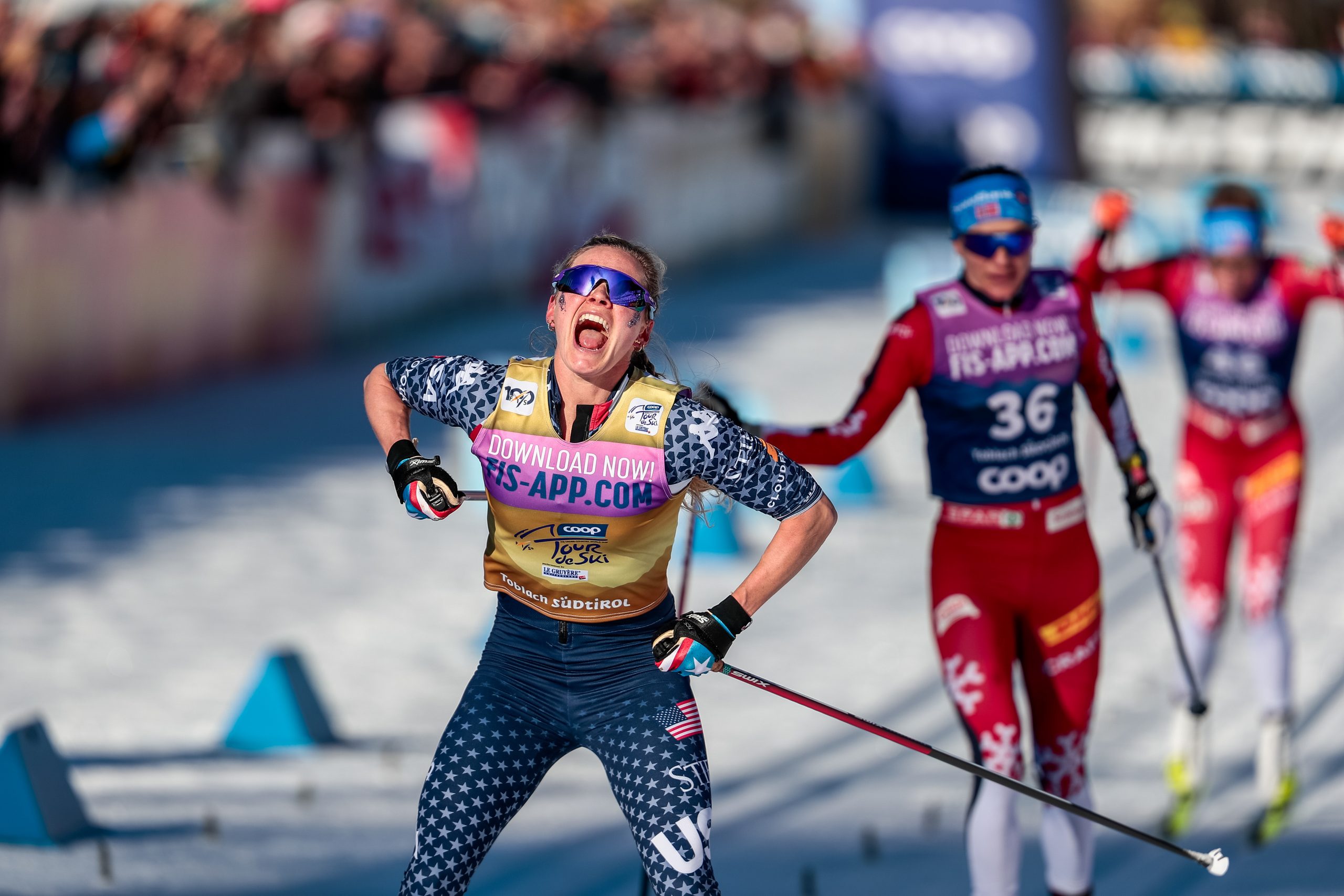
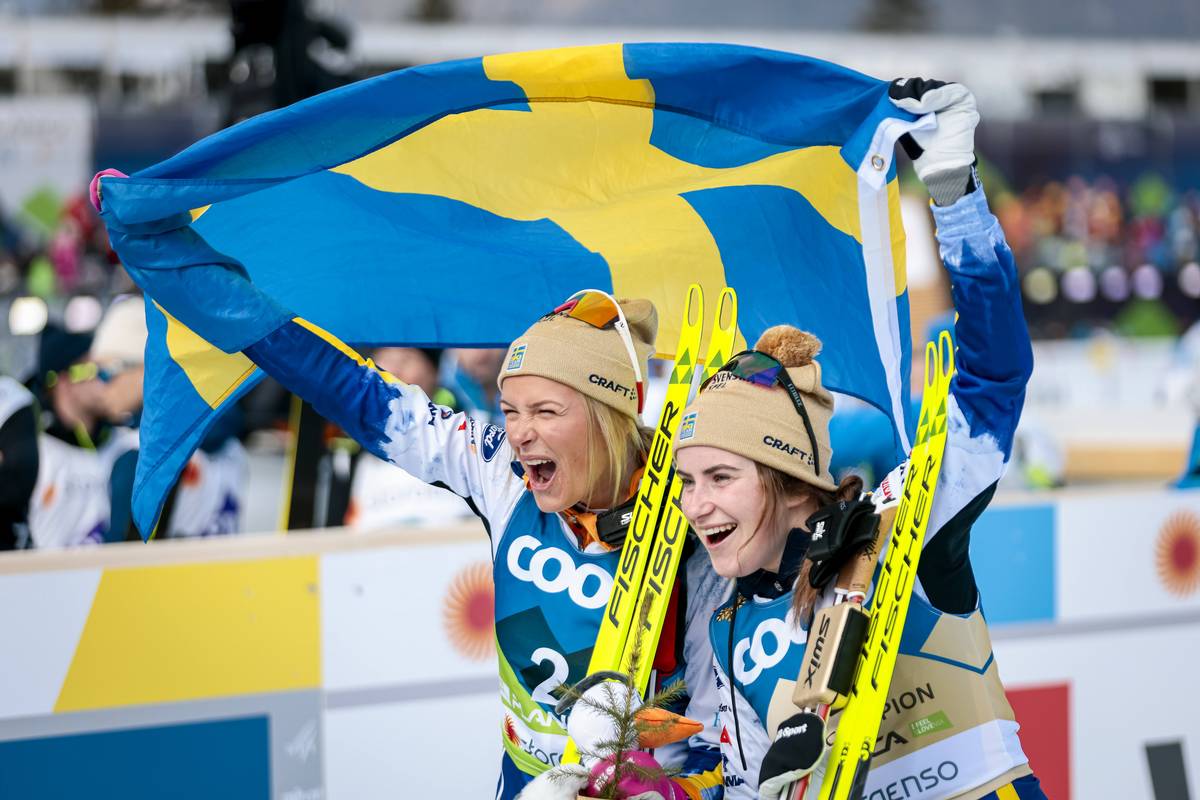
Joy at the end of a trying Olympiad: Ebba Andersson (SWE) celebrates her victory in the Olympic 50 k Classic. (Photo: Vanzetta/NordicFocus)
TESERO, ITALY — Two weeks of Olympic cross-country ski racing all comes down to this . . . fifty grueling kilometers of this, to be precise; a distance that women have raced only a few times on the World Cup and/or World Championship schedule, but a distance at which they are able to truly show their skills, their tenacity, and their ability as cross-country skiers.
These Olympics began with lofty expectations—in some cases, outrageously lofty—placed upon many skiers: Karlsson was seen as likely to win four golds: she started strong (winning gold in both the Skiathon and the 10 k Freestyle), but found herself benched by illness in the 50 k. Ebba Andersson was seen as a threat to topple her Swedish teammate, Karlsson, only to find herself toppled in a famously awkward and memorably catastrophic fall that cost Sweden the gold medal in the Team Relay. Jonna Sundling was billed as the best sprinter in the world (and was seen as likely to steal a medal in the Skiathlon, as well). Her moment in the Sprint spotlight was stolen by her own teammate, the rejuvenated Linn Svahn. And numerous mainstream reporters myopically favored Jessie Diggins to medal in all six events. After all, she’s the defending World Cup Overall Champion, right? And she’s currently leading the World Cup standings in both Overall and Distance, isn’t she? Reading those stats would seem to suggest that she’s the best skier in the world . . . and she may actually be that best skier, but the only skier who consistently lives up to such superlative headline predictions is the unmatchable Johannes Hoesflot Klaebo (who won all six of the men’s events here in the Olympic Winter Games of Milano-Cortina).
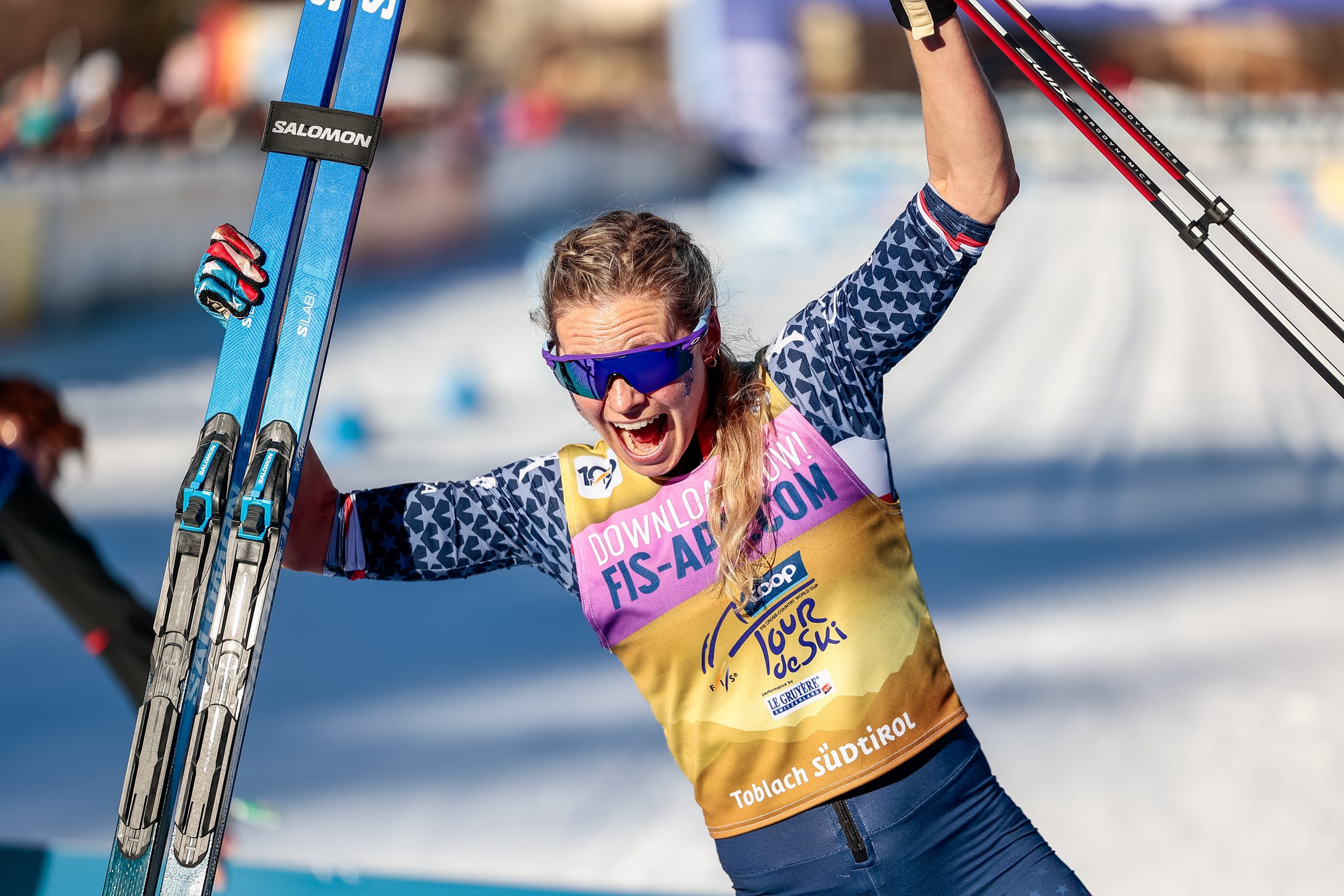
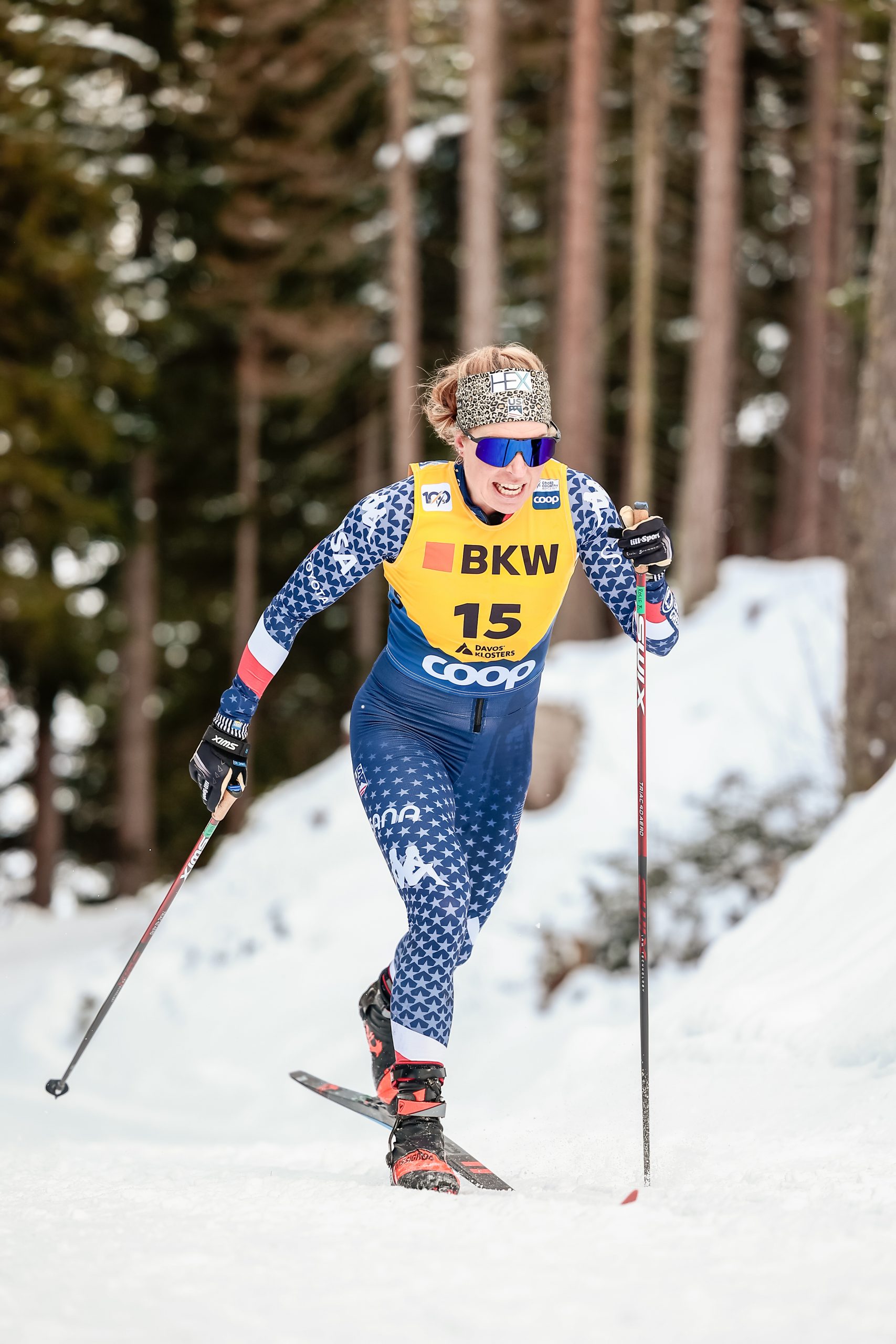
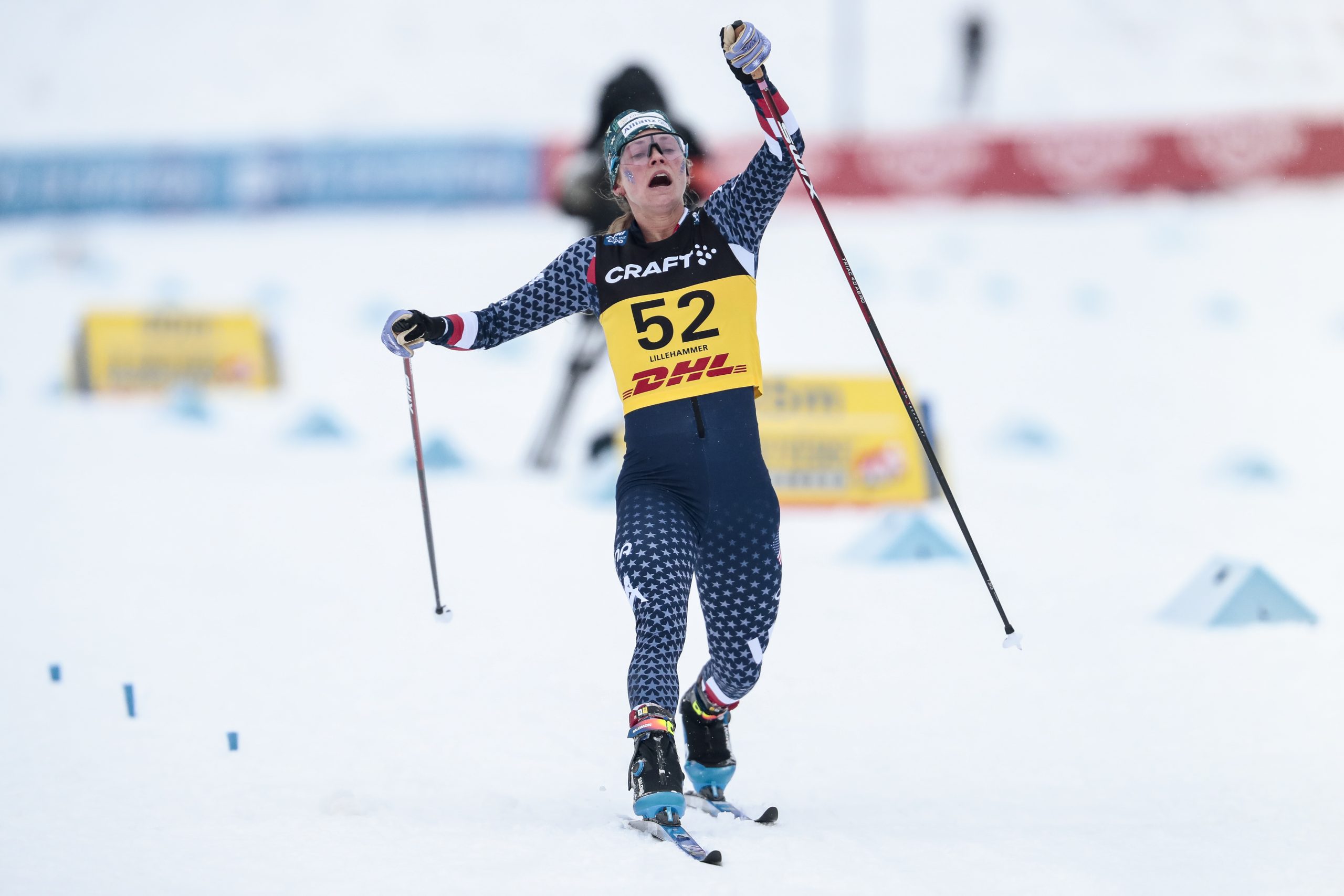
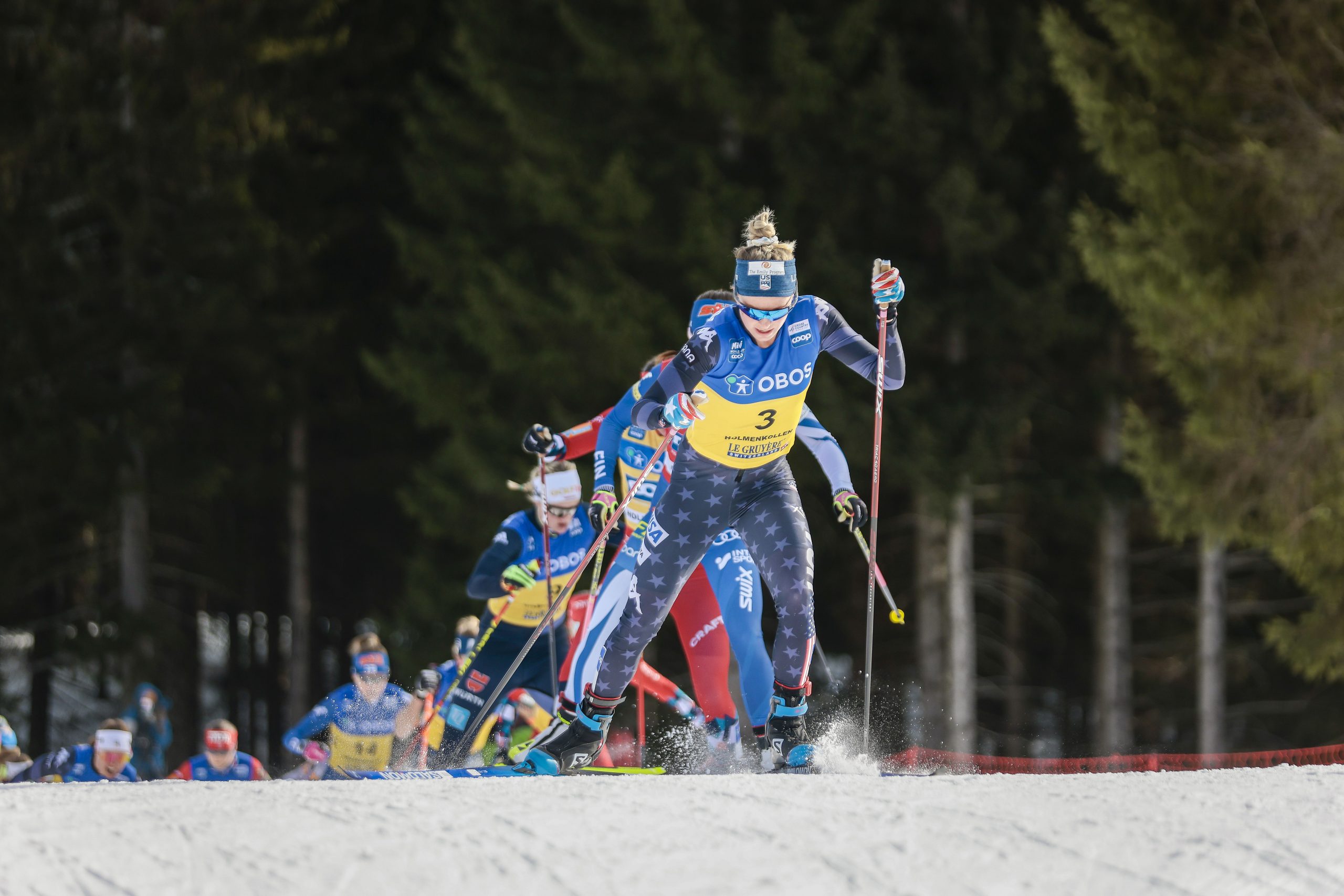
Jessie Diggins (USA) showed the sort of resilience and courage fans have come to expect, overcoming a disastrous ski exchange to race her way back into medal contention. (Photo: Barbieri/NordicFocus)
Diggins would fight through an unfortunate ski change, and endure a long struggle in returning to the group of bronze medal contenders, only to find herself gapped on the final uphill. Diggins would finish fifth behind fourth place, Kristin Austgulen Fosnaes. Ahead of them, Andersson would ski brilliantly and tirelessly to claim gold, well ahead of of Weng, and minutes clear of the third place performance from an elated Nadja Kaelin (SUI).
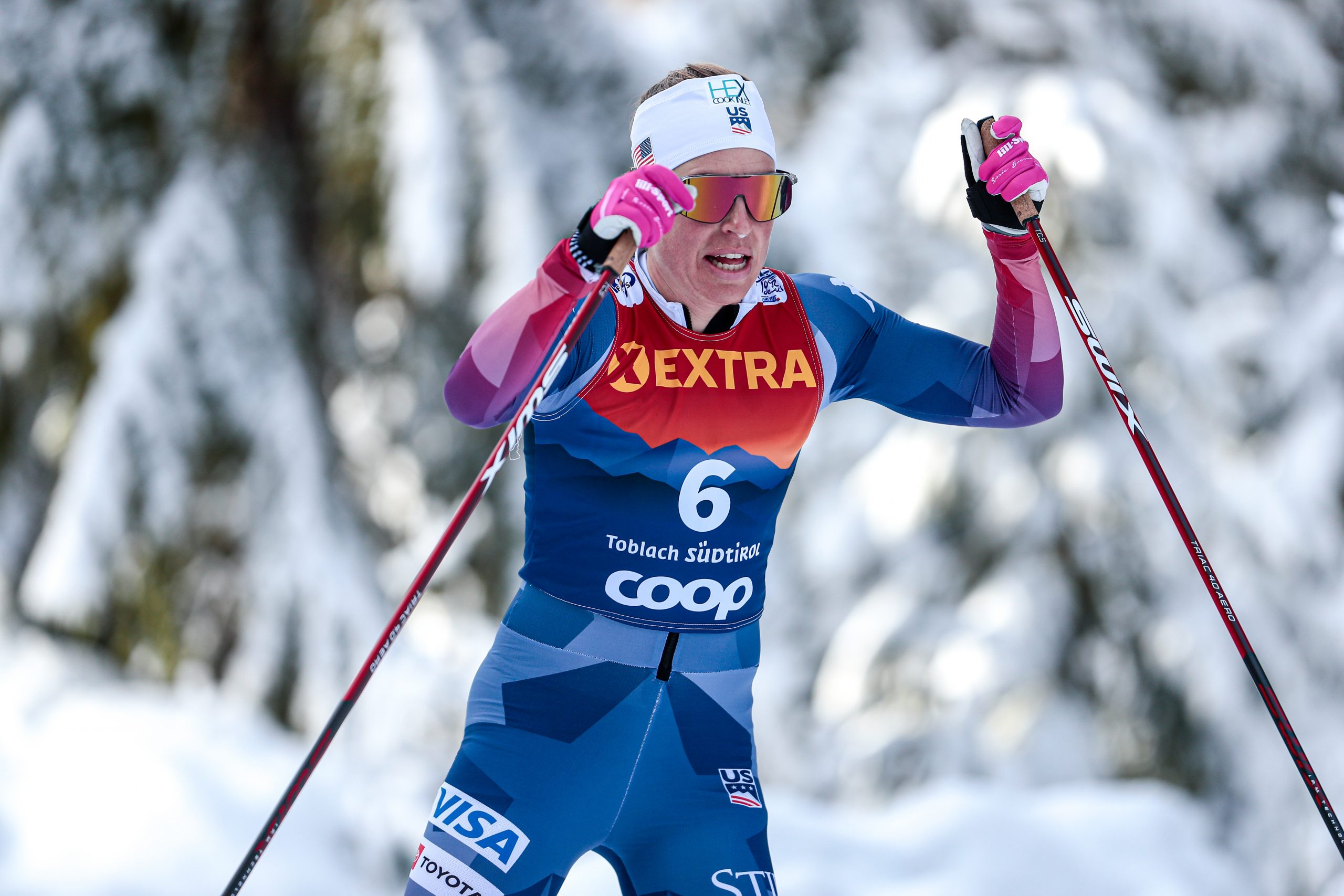
“If you had told me even a year ago, I’d be in the fight for a bronze medal in a 50k classic, I would not have believed you,” said Diggins. “It’s taken so much work from so many people for so many years to get here, and I’m just really proud of it.”
Among other Americans, Rosie Brennan would finish 16th. Hailey Swirbul would cross the line in her comeback Olympics to finish 20th while Kendall Kramer would finish 27th. Canadians would place all their finishers in the top 30: Jasmine Drolet 18th, Sonjaa Schmidt 26th, Katherine Stewart-Jones 28th, and Amelia Wells 29th.
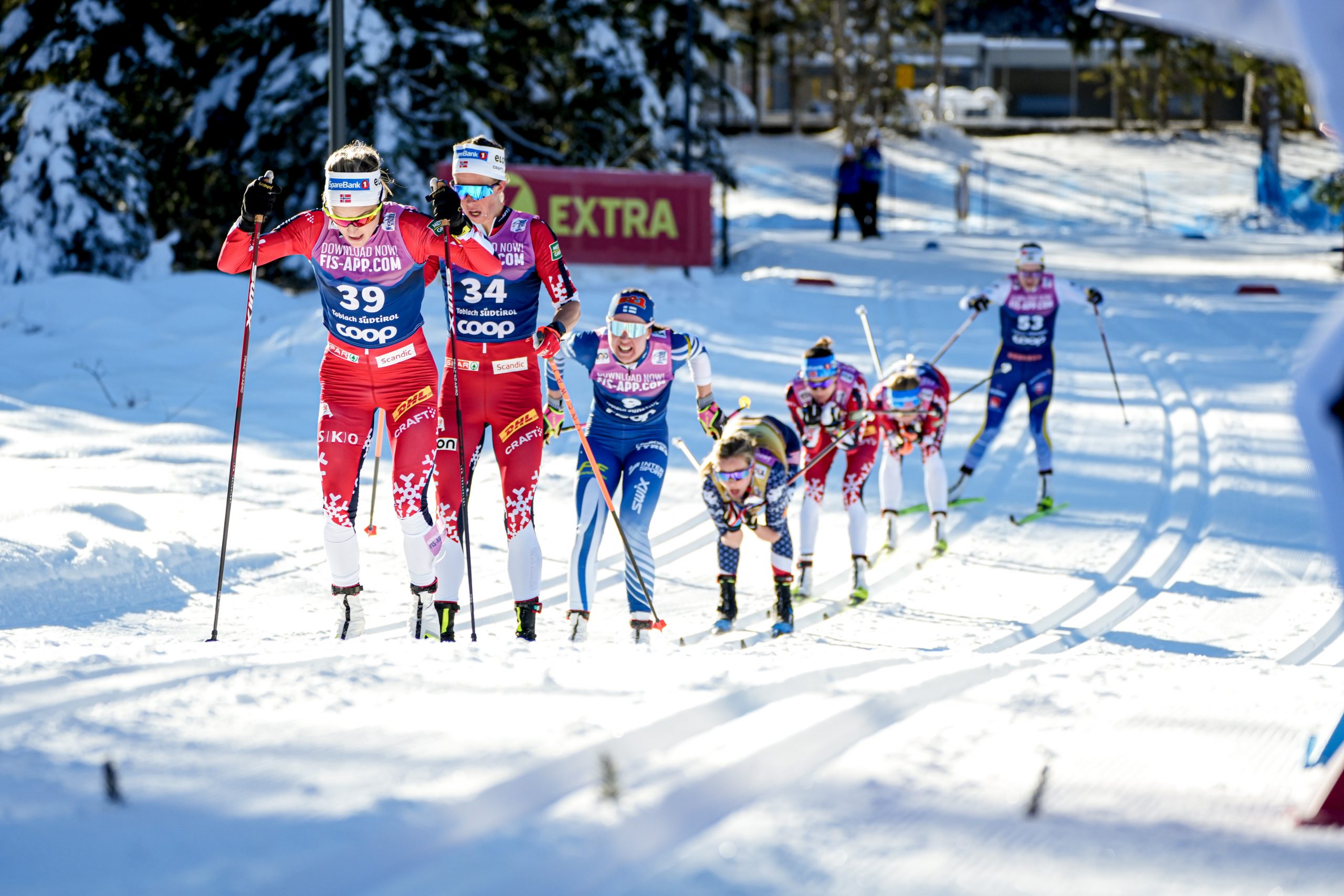
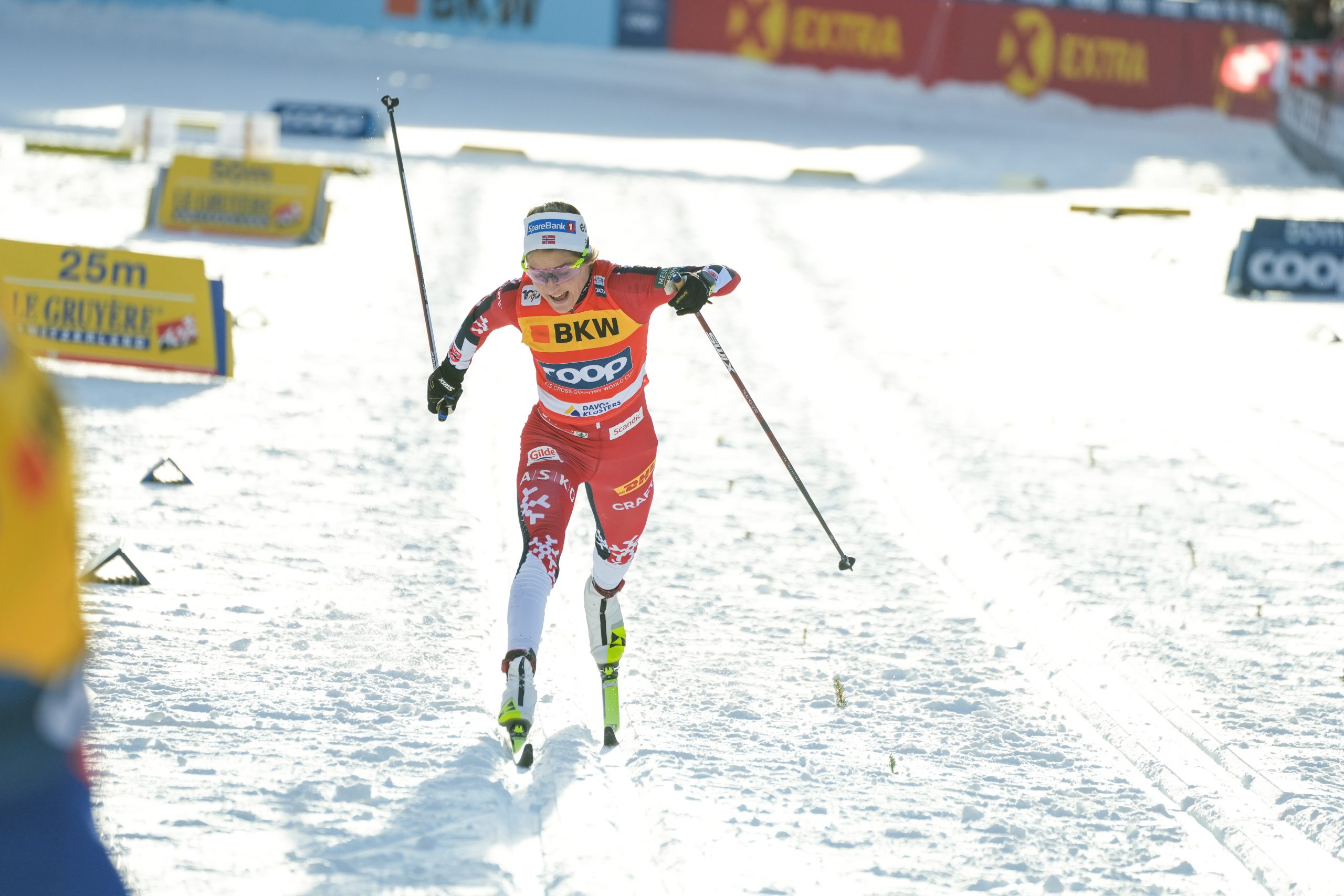
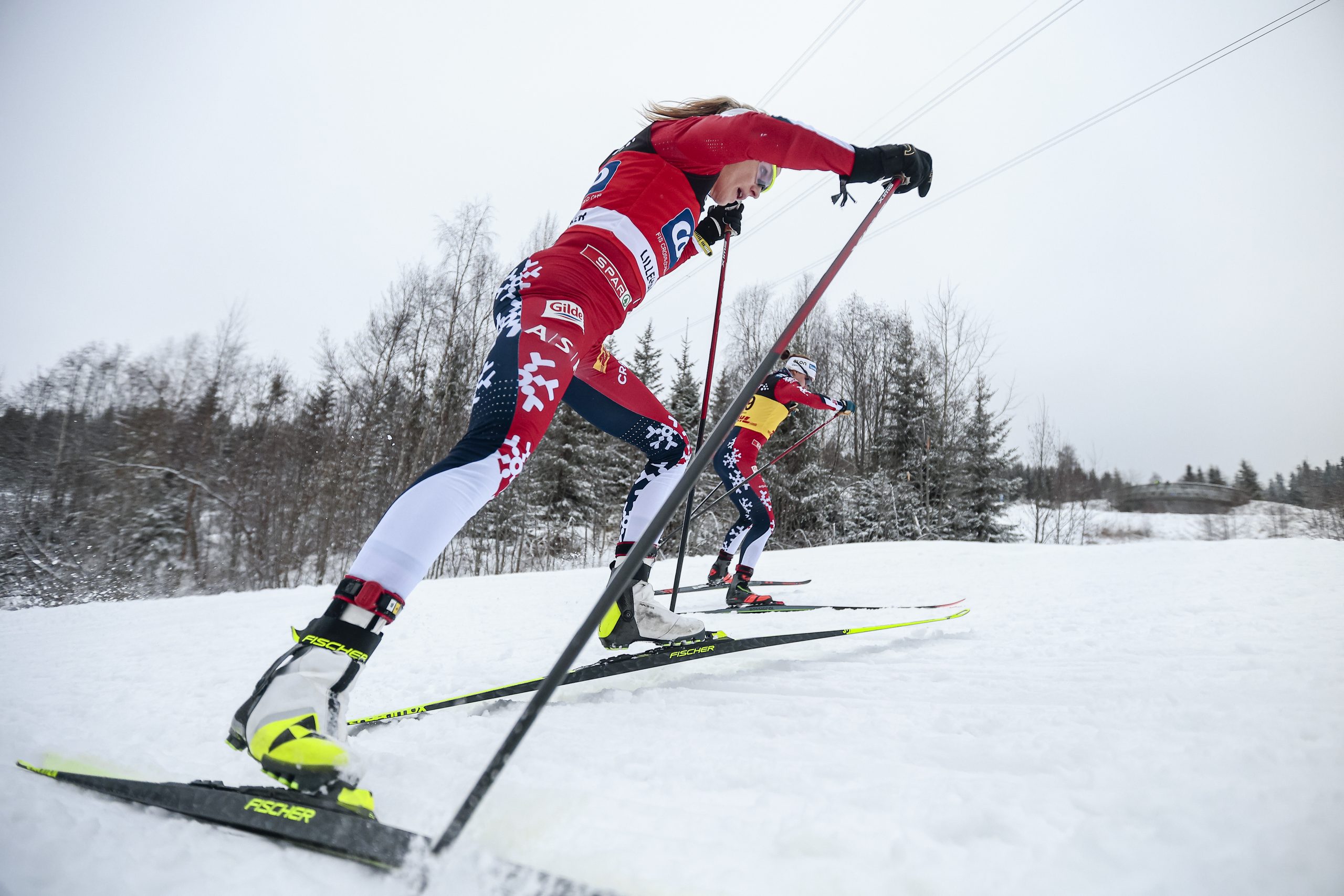
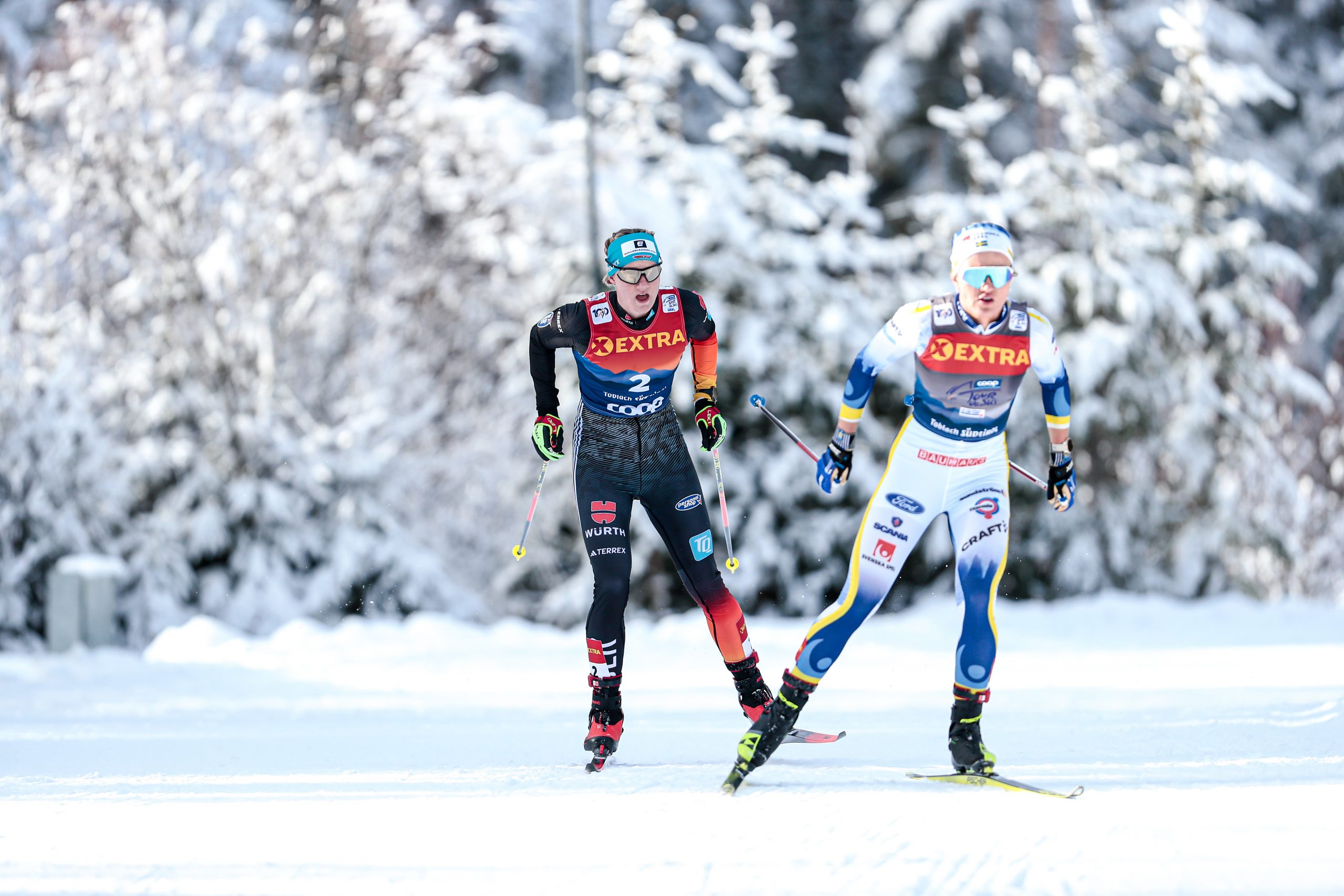
Olympic 50 k: Heidi Weng (NOR), and Ebba Andersson (SWE), set the pace from the beginning. (Photo: Vanzetta/NordicFocus)
Women’s 50 k Classic
Pre-race intel reported that Sweden’s Frida Karlsson had taken ill, and was choosing not to race in today’s 50 k. Without Karlsson’s singular presence to push the pace (as she did during her dominant victory in last season’s World Championship 50 k in Trondheim), the race was left without a known direction or strategy. Like Karlsson, Sundling was a DNS, reducing the chances that the medals would be decided in flat-out sprints. Weng hoped to duel it out with Diggins and Andersson down the final kilometers.
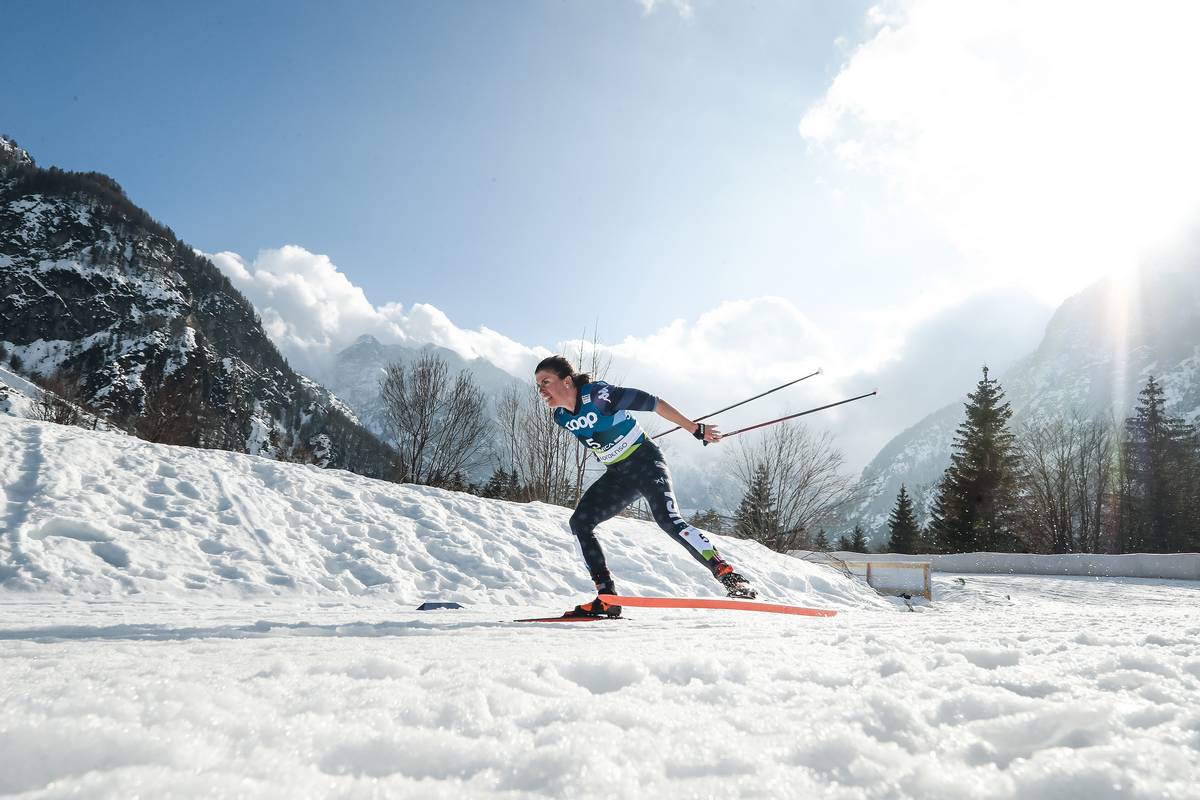
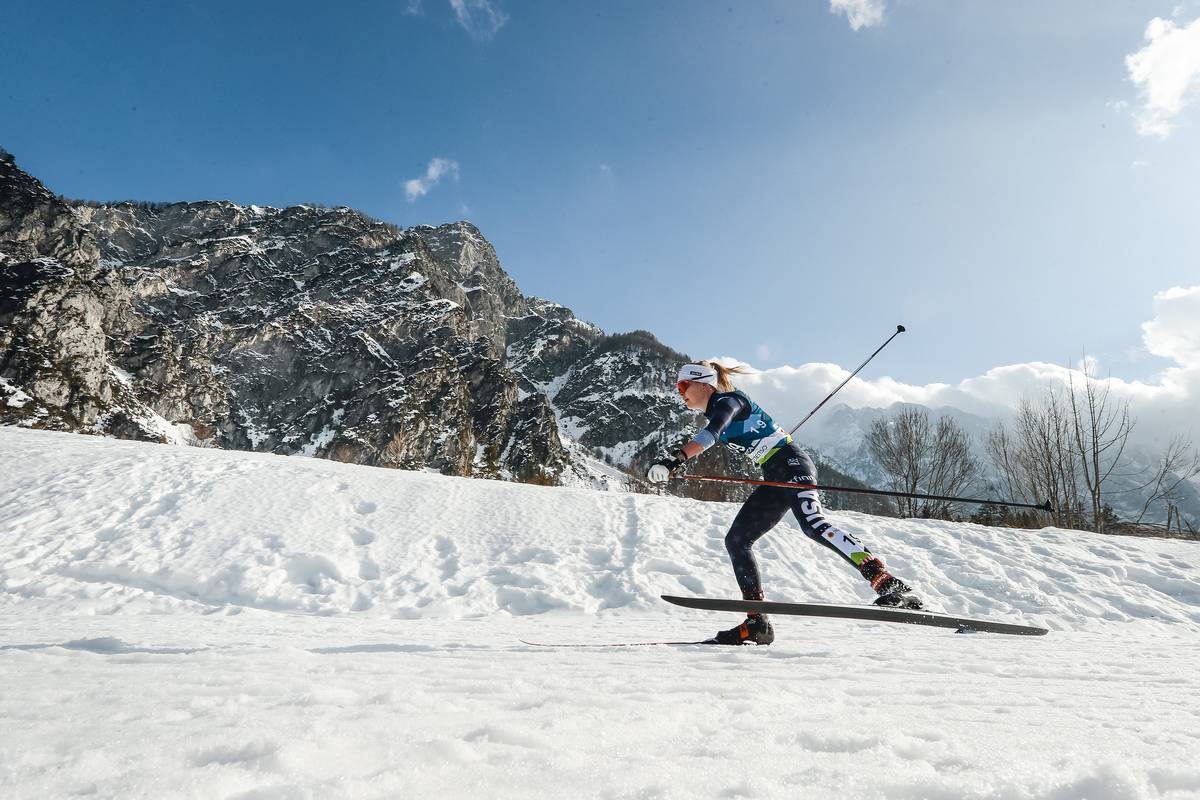
The Olympic 50 k is conducted in a mass start format, seven laps of 7+ kilometers/lap raced in the Classic technique. On an unseasonably warm day—40 degrees (Fahrenheit) and sunny skies—waxing and base prep were likely to play outsize roles in the results. Within the first three kilometers, a lead group of a dozen skiers—containing all the prime contenders—began to ease off the front. The early pace was made by Andersson, followed by Weng, Diggins, Teresa Stadlober (AUT), and Astrid Oeyre Slind (NOR). Val di Fiemme’s challenging hills quickly began whittling away at the lead group as Andersson continued driving the pace, stringing out Weng and Diggins in her wake. Slind inexplicably pulled up on a challenging climb, stalling other contenders behind her including Kerttu Niskanen (FIN), Johanna Matintalo (FIN), and Dariya Nepryaeva (AIN). Slind would drop out of the race only a few kilometers later, a frustrating result for a skier who had entered these Games with such high hopes..
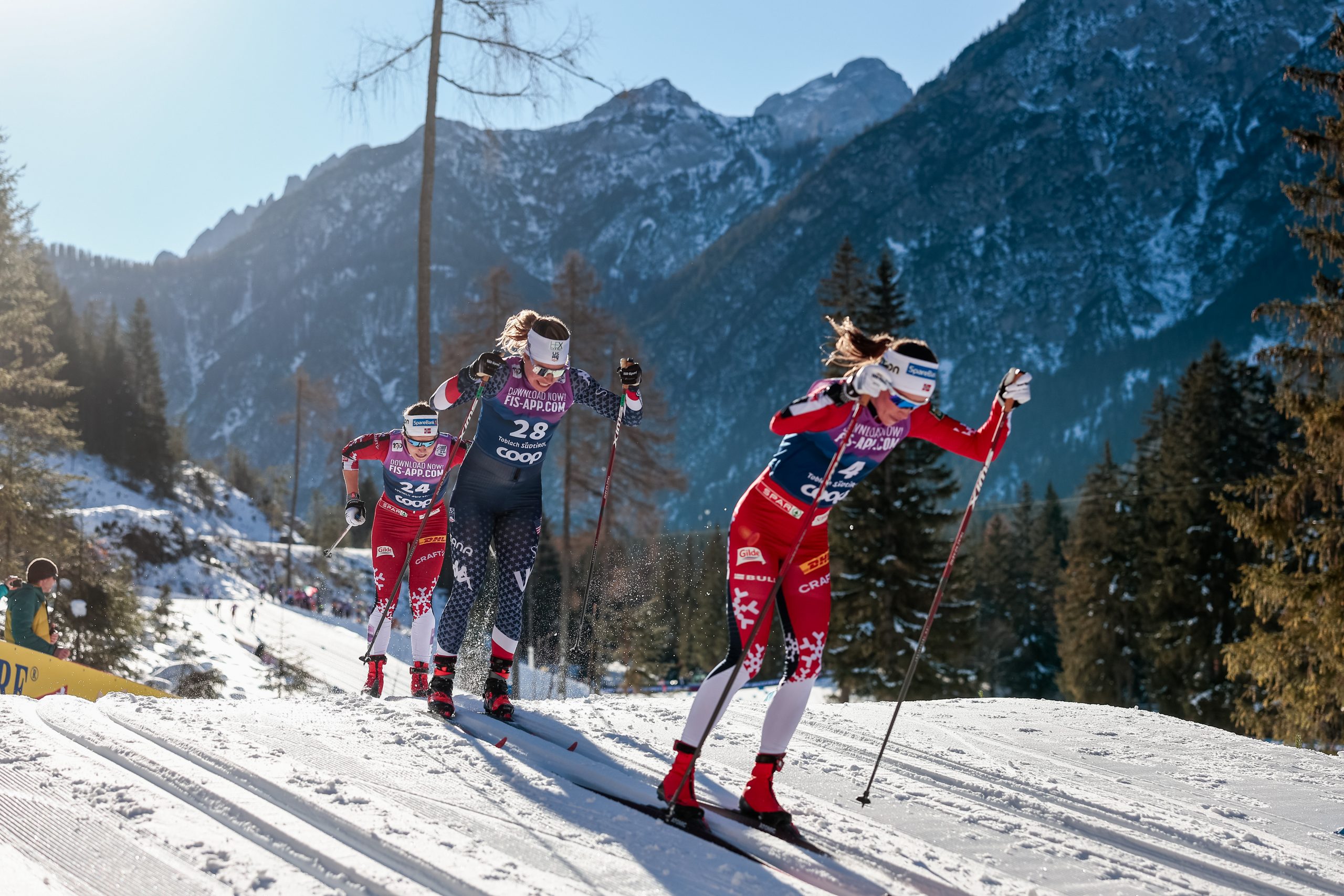
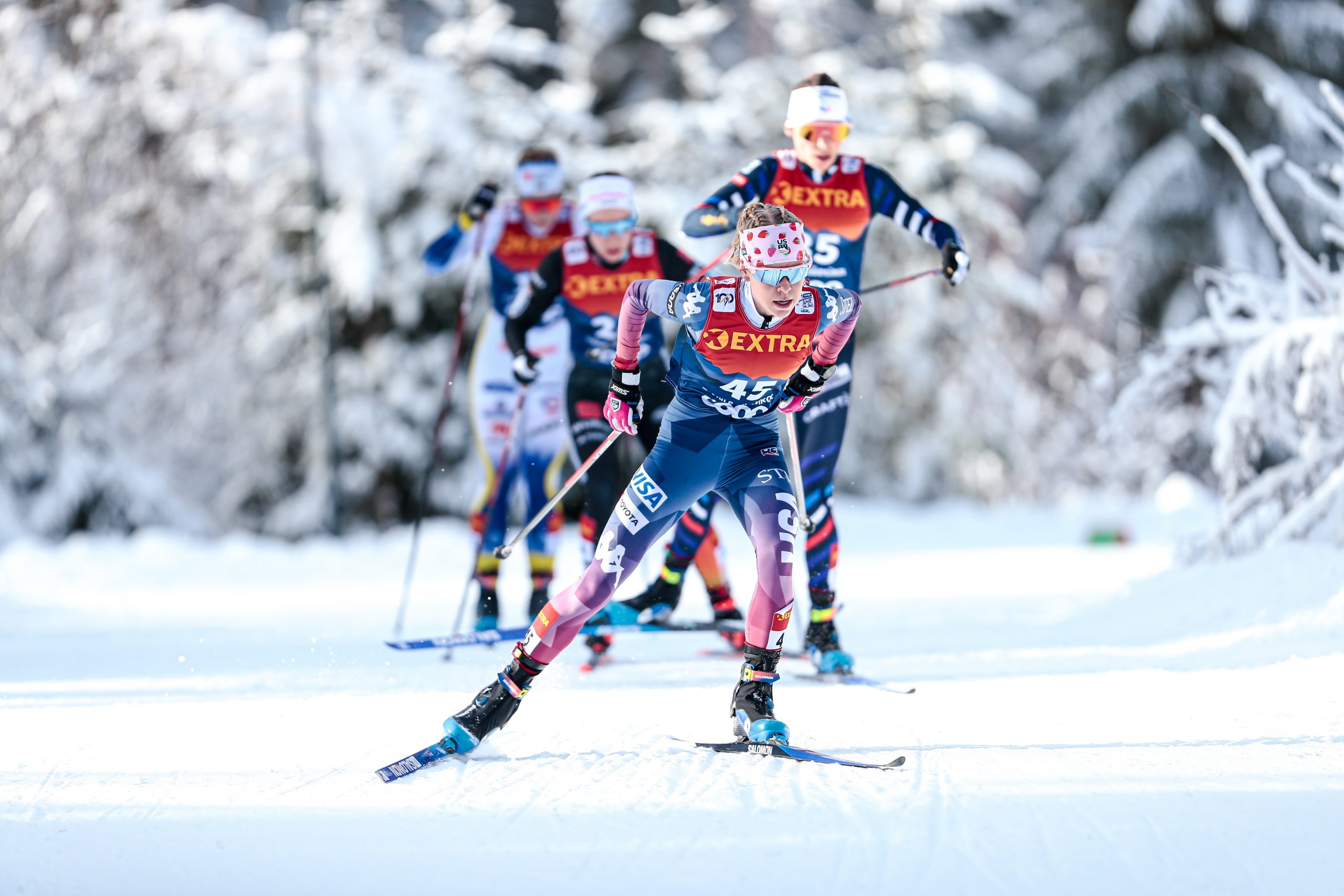
Jessie Diggins (USA) was an early animator in the Olympic 50 k. After a troublesome ski exchange, she’d come back to be part of the battle for the bronze medal (ultimately won by Switzerland’s Nadia Kaelin). (Photo: Barbieri/NordicFocus)
By 8.5 kilometers, a solid chase group would form involving Fosnaes, Niskanen, Matintalo, and Karoline Simpson-Larsen (NOR). At the front, the lead group had been reduced to three—Andersson, Weng, and Stadlober—as Diggins began to show the strain of he early pace. Even Stadlober had begun to wobble as the chasers continued to concentrate their pursuit.
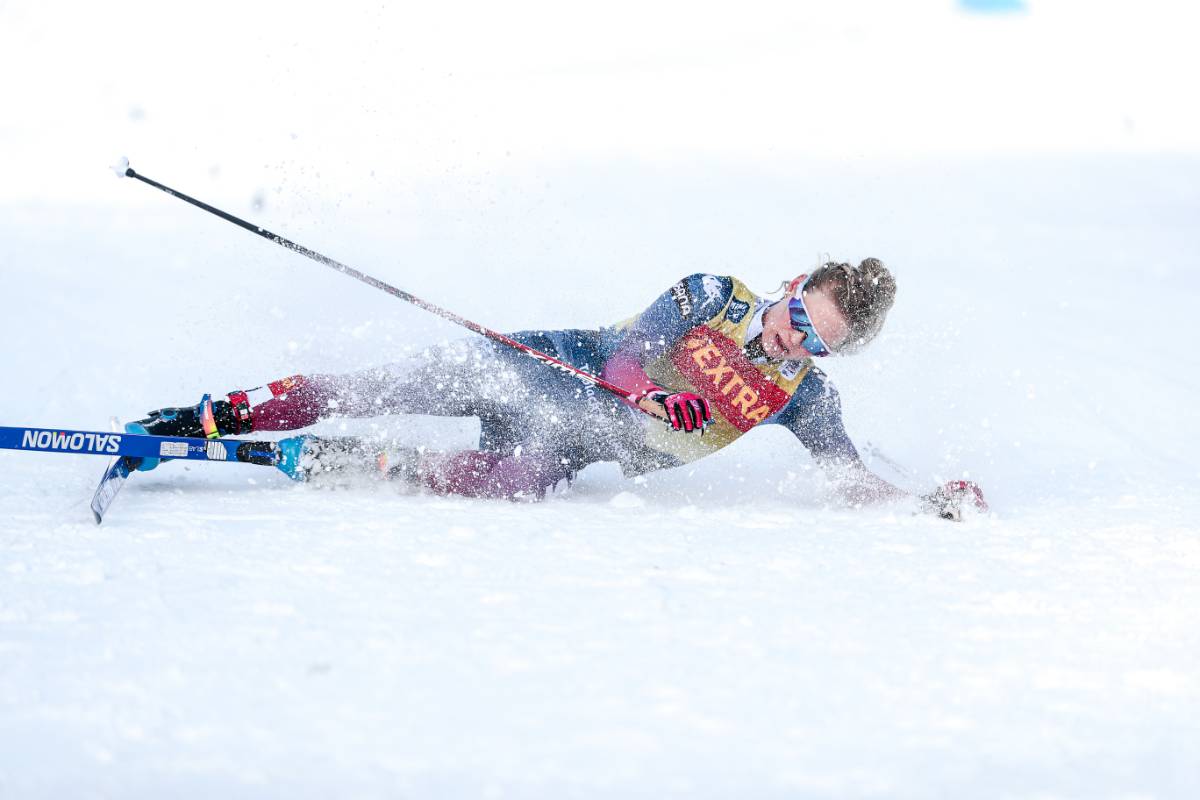
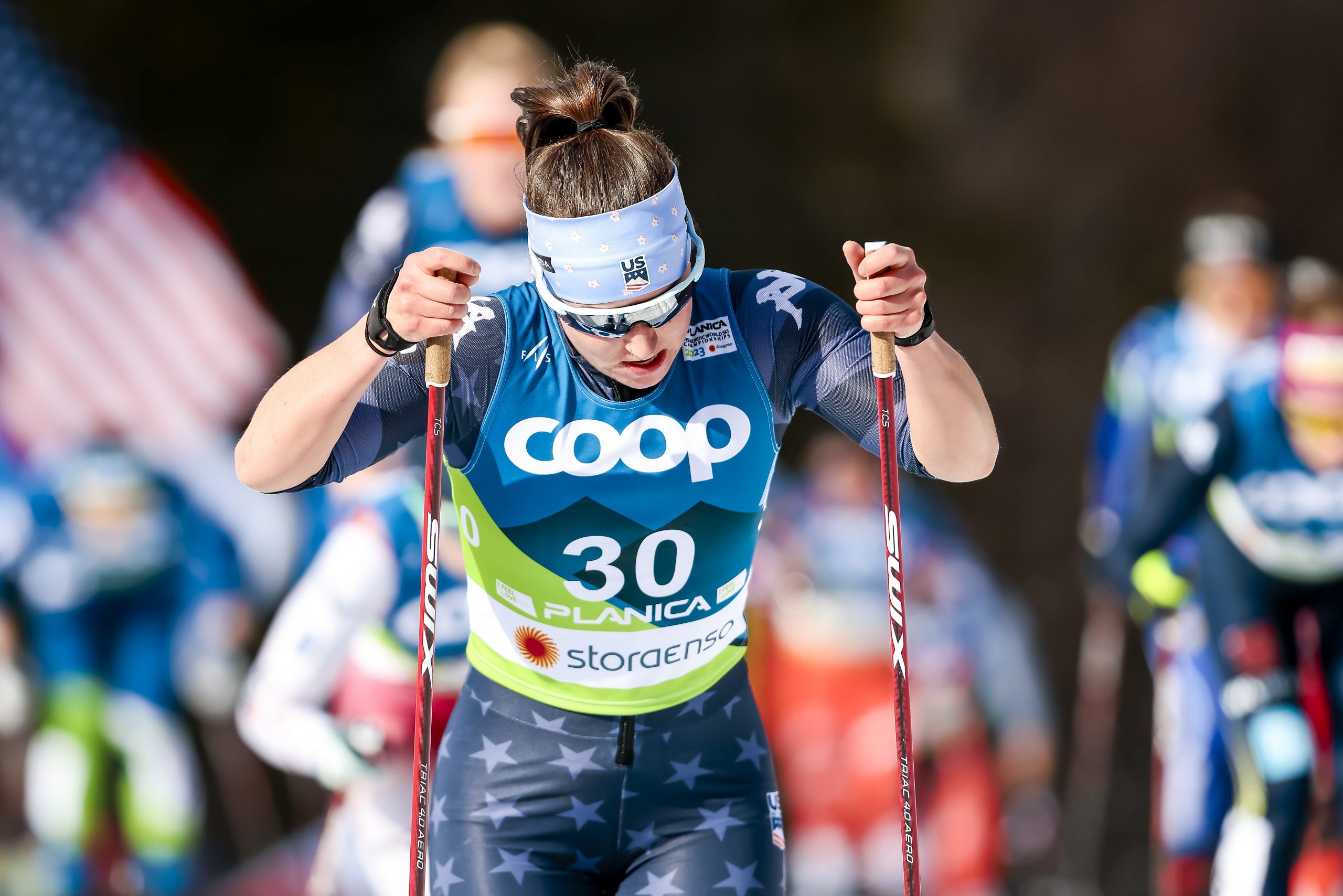
Diggins was the first of the contenders to switch skis (at the 14.4 kilometer mark at the end of the Lap 2). She immediately regretted her decision as her klister-waxed skis tripped her dramatically on her way out of the exchange zone. Stumbling along the track—gasping and yelping audibly—Diggins lost considerable time, finding herself dropping to ninth place, 1:11 behind the leaders. Diggins would need to rely on her new skis working their way into the conditions, in the hope that they would ultimately provide an advantage. But even more time had been lost to the leaders who, themselves, had not shown any dissatisfaction with their own skis.
“I knew I had to switch early,” said Diggins. “I’m so glad I did. It was just a really gritty race. Literally every muscle in my body started cramping with three laps to go. So I can confidently say I could not possibly have tried harder or gotten more out of my body.”
“After that first pair of skis, she switched pretty early,” said US coach, Kristen Bourne. “But we also had a lot of confidence in that second pair . . . so we also had a lot of confidence giving her the the go-ahead to switch.”
The race settled into a few slow-developing stories:
Weng and Andersson were off the front, deciding gold between them.
Stadlober raced on alone in bronze medal position, but she found the gap behind her being eaten into by Niskanen and Fosnaes.
Diggins had fallen from contention, though her fortitude and pride were likely to prevent her from dropping out of her final Olympic event.
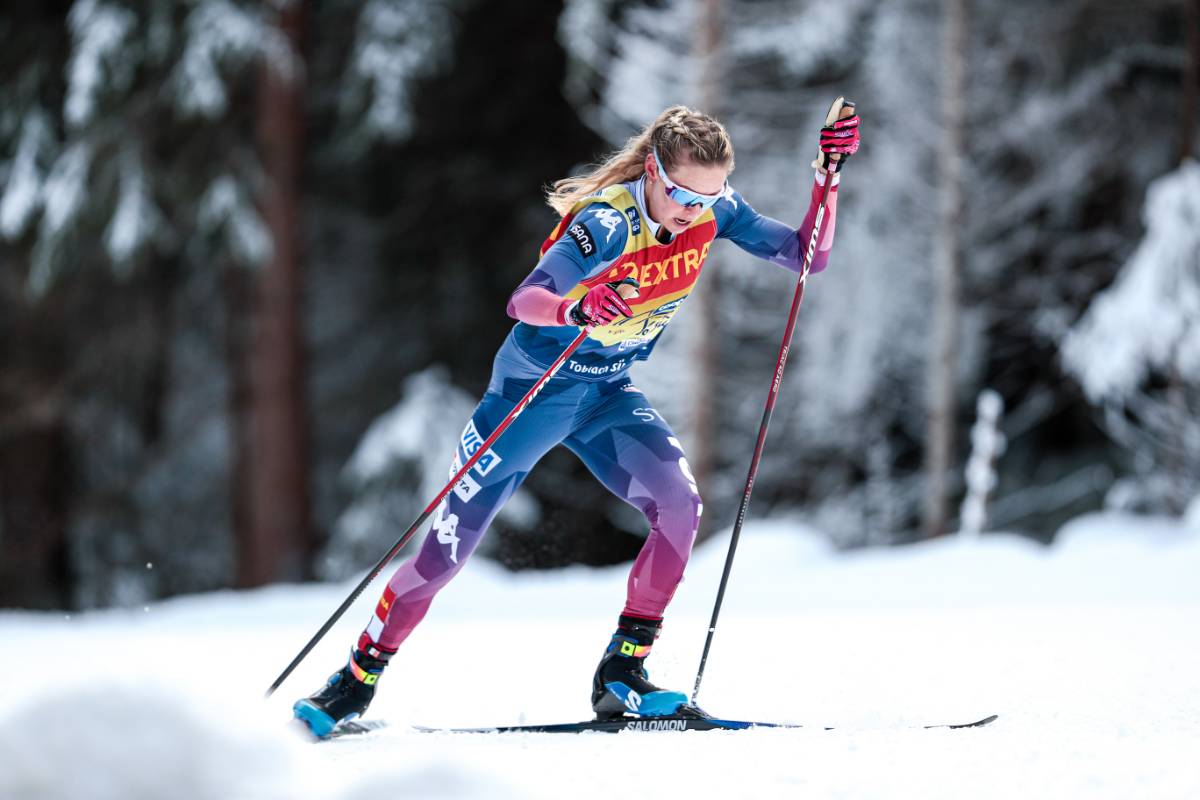
And then Diggins began coming back . . . maybe she began overhearing all of us commentators wondering if she might drop out of this race. That may be just the sort of motivation that Jessie Diggins needs. Diggins drove to the tails of Fosnaes and Niskanen. Together, they closed the gap to Stadlober who was pursuing better traction in the the snow outside the Classic tracks. While Diggins’ skis may have been a disaster in the first few meters after the exchange, it’s possible they were proving to have been a shrewd decision.
Andersson and Weng changed skis at the end of the fourth lap, where Andersson was pitched over her ski tips by her own sticky kick wax. At the end of lap four, Diggins had moved into bronze medal position as the chase group entered the stadium. Fosnaes was the only skier who opted to exchange skis. Stadlober, Kaelin, and Niskanen continued in pursuit of Diggins.
Soon after 30 kilometers, Andersson found her skis to be an advantage over Weng’s. By 34.2 kilometers, Andersson had opened a 20 second gap. She was still 45 minutes from the finish line, but Andersson was beginning to stretch her advantage.
Now in a group with Niskanen, Fosnaes, Kaelin, and Stadlober, Diggins may have sensed that her best chance to claim the bronze medal was not to be found in breaking away (thereby risking blowing up, herself) but to sit with this group in anticipation of a bunch sprint that would favor her own abilities. With two laps remaining, the chase group had decisions to make. Among those racers, only Diggins had already changed skis. Among this group, it was likely that someone would stop to make the change. If they did, they could find a late-race advantage, or they might find themselves giving up an advantage (in the time spent changing skis) that would be impossible to overcome. Kaelin, Stadober, and Niskanen all chose to change skis. Ultimately, all the chasing skiers would regroup, and immediately start considering their strategies. Diggins was the sprinter in the group; her advantage would be realized if the group came to the finish line together. Stadlober, Niskanen, Fosnaes—those are not sprinters—their only chance would be to drop Diggins and Kaelin before the finish line approached. Two laps to go . . .
And who the heck is Eliza Rucka-Michalek? The young Polish skier had been chasing all by herself for the last 40 kilometers. She finally connected with the chase group midway through he final lap, but would find that the efforts expendeded in reahing this group would be too costly to allow her to attack again. Rucka-Machalek would cross the line eighth.
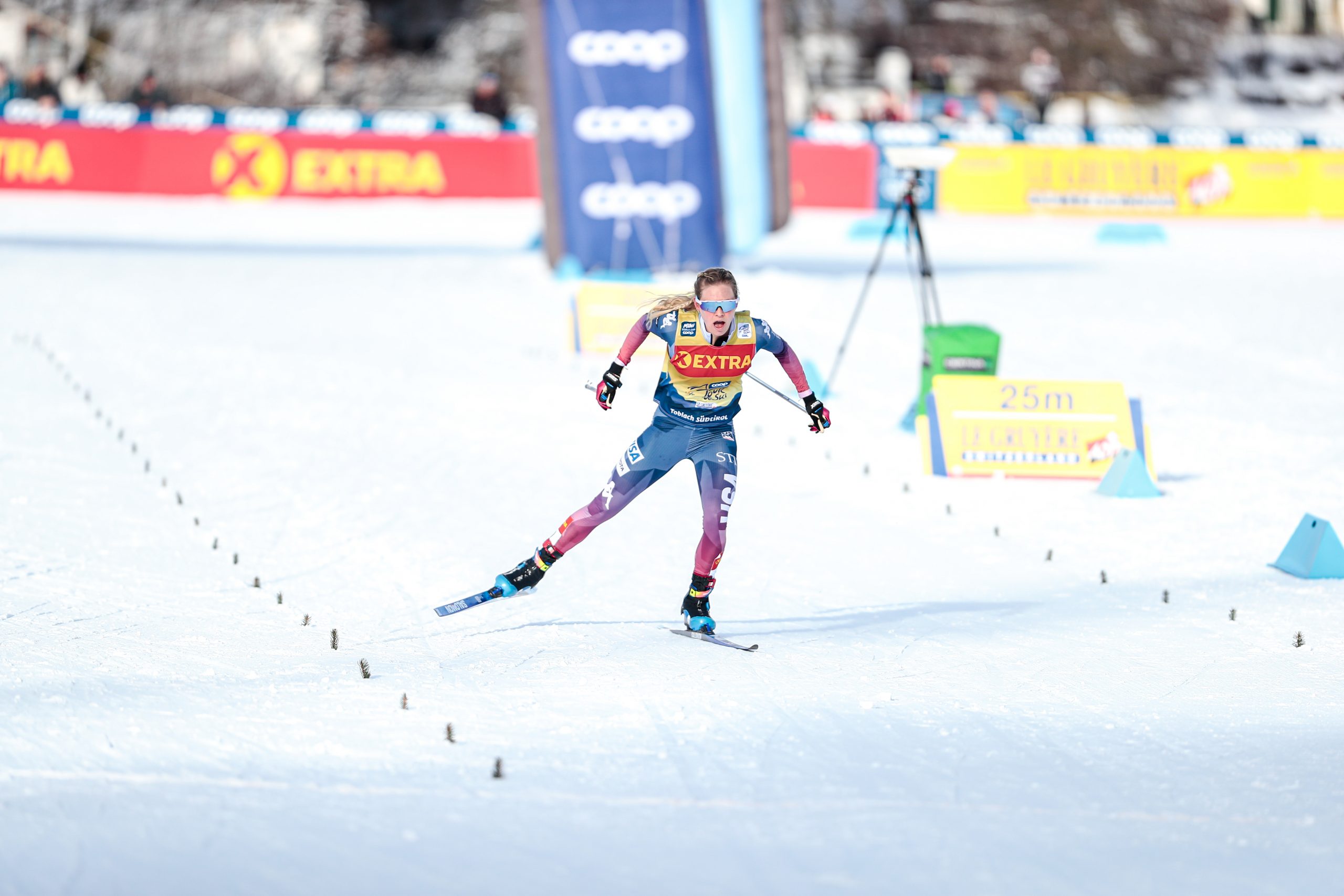
The final kilometers were led out by Kaelin who was followed by an exhausted, but game, Fosnaes. Diggins shadowed them both, but the final climb would be excruciating for all. Kaelin had the best traction on the Zorzi climb; Fosnaes slipped a bit, as did Diggins who lost momentum when she stepped out of the tracks behind Fosnaes. Kaelin would maintain her advantage over the top of the climb, holding on for bronze, followed by Fosnaes and Diggins.
“I’m so grateful for our entire staff behind the scenes,” said Diggins. “They have been like, putting my body back together so that I could be out there today fighting. And I just, I wanted to do that for them. I wanted them to know like, ‘Hey, I am so grateful. Like, I’m gonna finish this. I’m gonna leave it all out there.’ And honestly, the most special thing was that I got to hug my mom on the side of the course before the race, and it’s just so cool to know that they were here for my last Olympics, and I got to end it on a beautiful day in a venue that I love so much. I’m just really proud of this last Olympics and really grateful and really happy, and I’m leaving here just full of joy and probably needing a new body.”
“I mean, we’re super proud of this team,” said Bourne. “And to walk away from this Olympics being like our most successful ever by having a variety of people—three different people—getting Olympic medals is, excuse my language, but #%&!@ insane! And I mean, man, we’re just super proud and stoked to keep the season going after a little bit of rest.”
Friends and rivals: Heidi Weng (NOR) and Ebba Andersson (SWE). (Photo: Vanzetta/NordicFocus)
Weng raced bravely and strategically in what may have been her final Olympics. She would claim silver, falling just short in her own quest for individual Olympic gold.
Andersson would continue extending her lead—20 seconds, 40, 60, 90—to claim a gold medal to go along with her three silvers earned at these Games. Here at the end of an Olympic campaign that found her hitting the deck again and again—including that spectacular somersault and subsequent one-ski scooter-pushing during the disastrous (though ultimately silver-medal-winning) Swedish relay—Andersson raced across 50 grueling kilometers to find glory at the finish line. Individual Olympic gold was finally hers, as well as respect and redemption after days of trials and tribulations.
FasterSkier will have our own Nat Herz on the ground at the Olympics, which, to be honest, is a very big financial lift for us. If you value the thoughtful work and access FasterSkier provides at championships like this one, please consider becoming a Voluntary Subscriber. Your support directly fuels the work we do to cover the people, places, and moments that make our sport special.
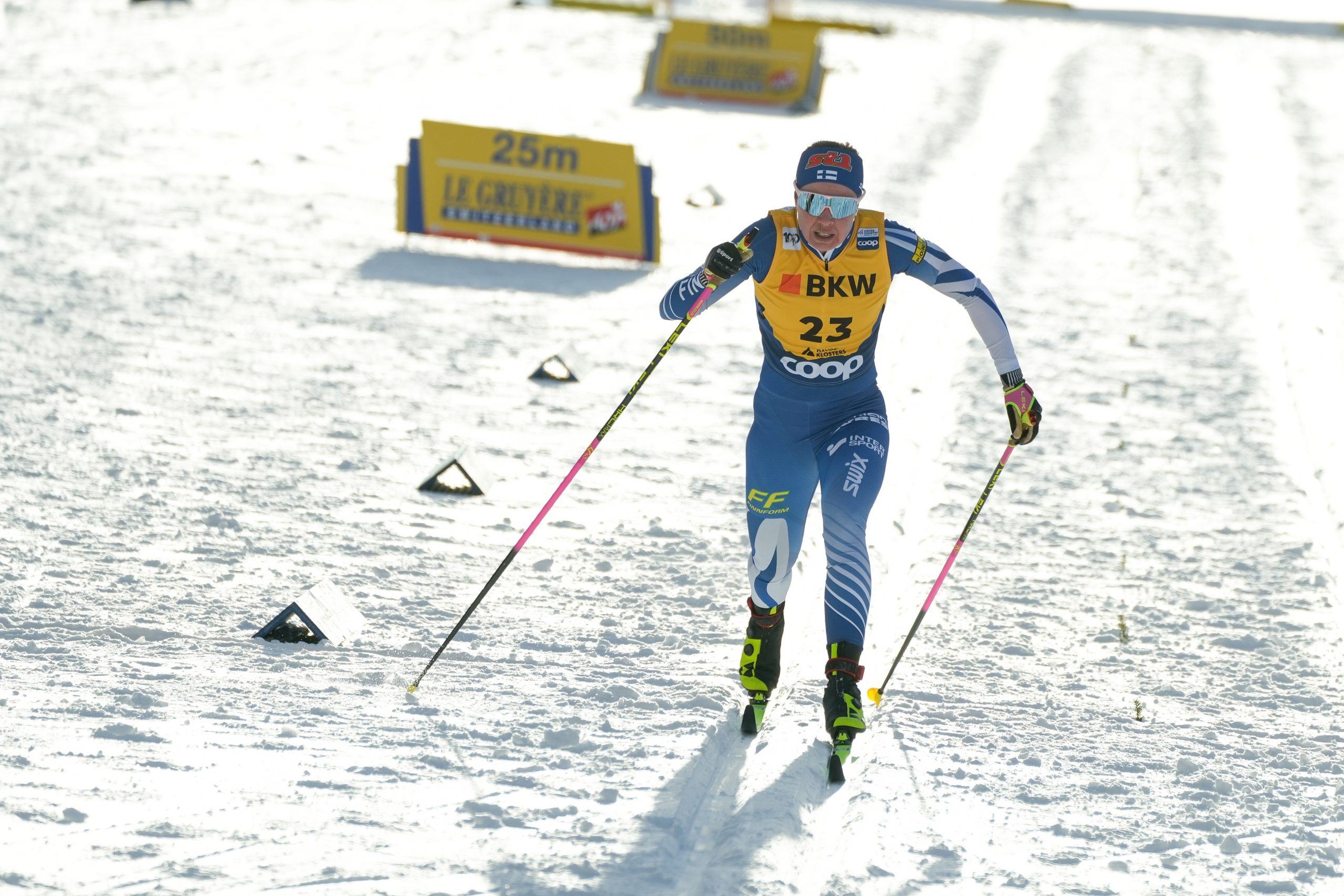
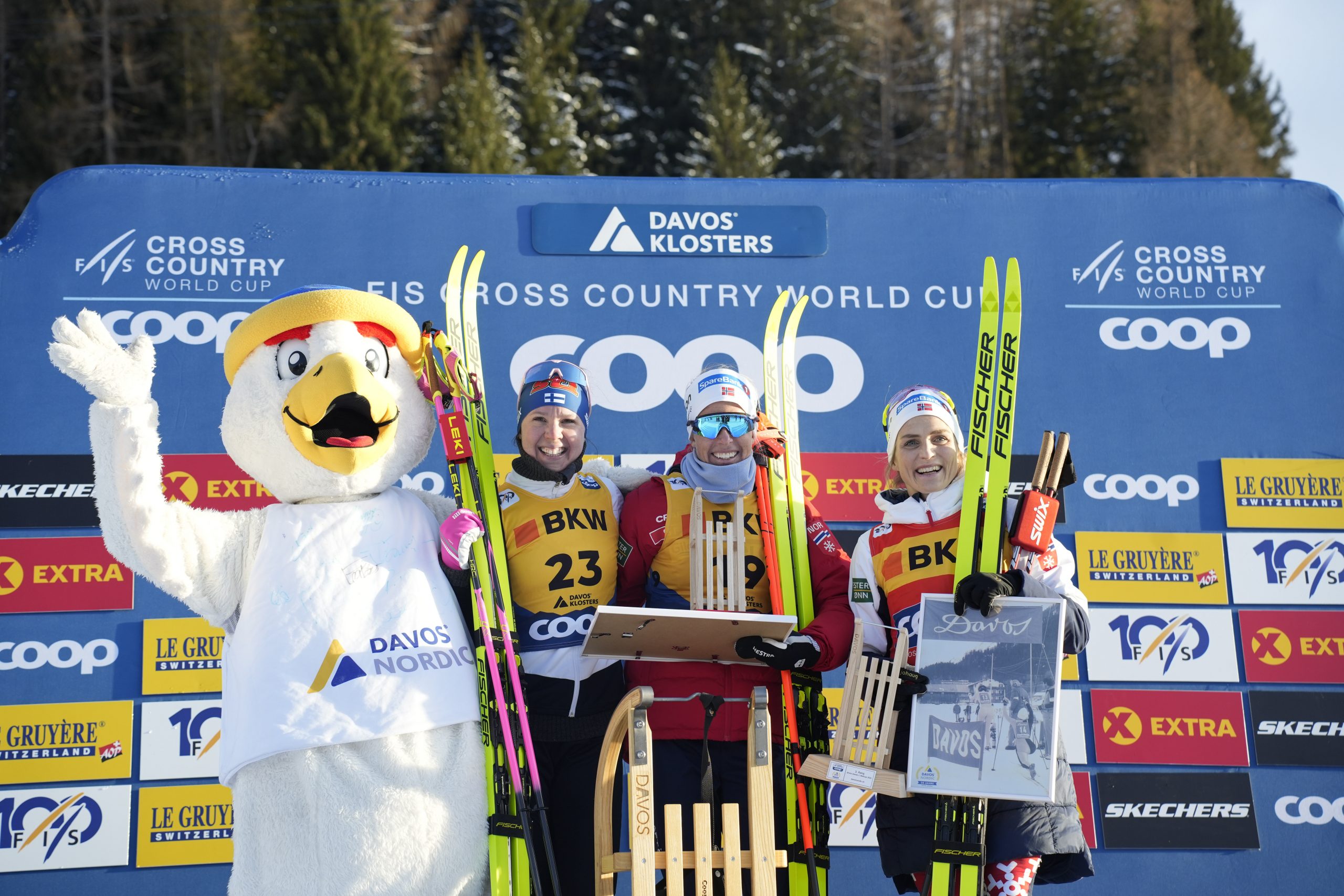
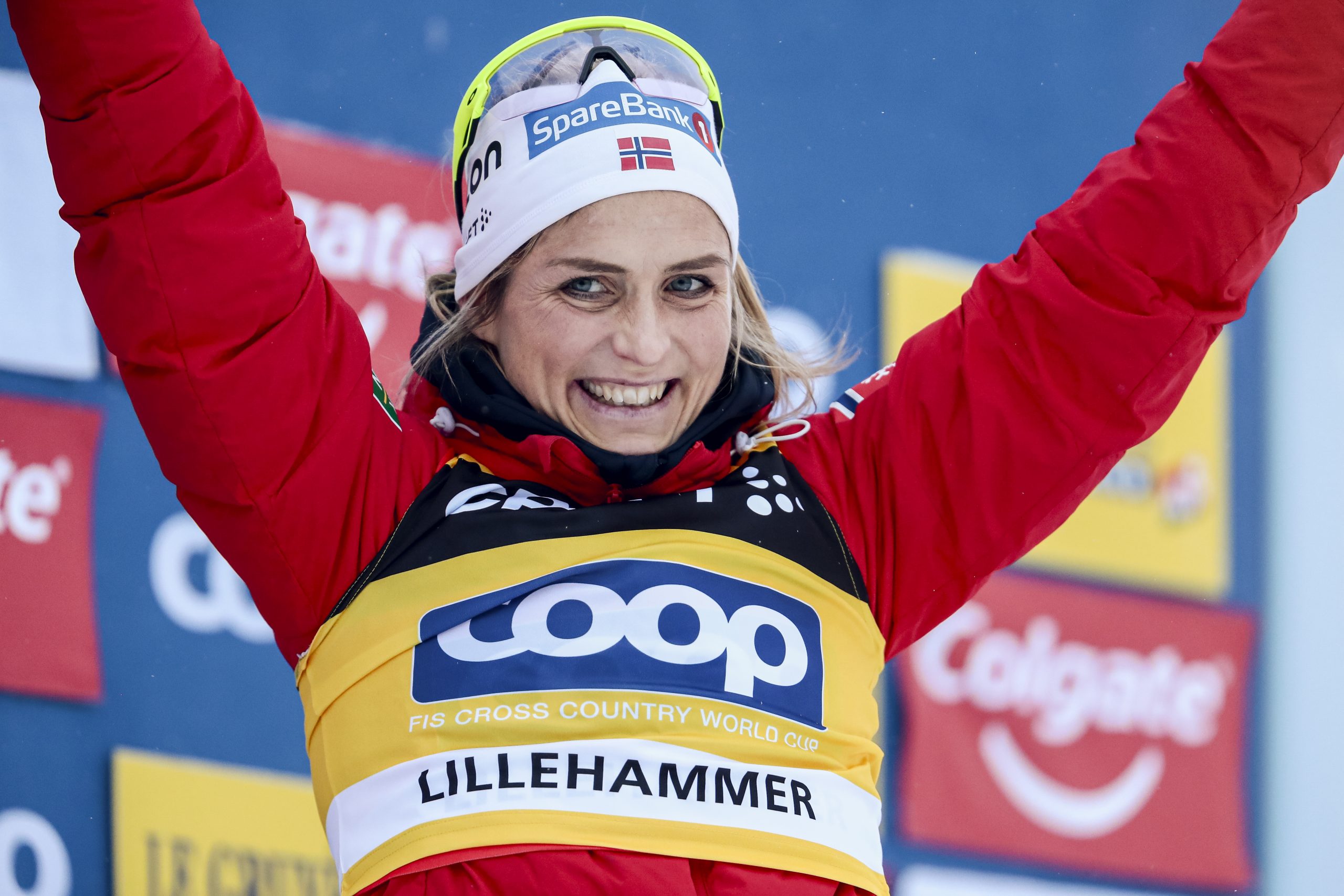
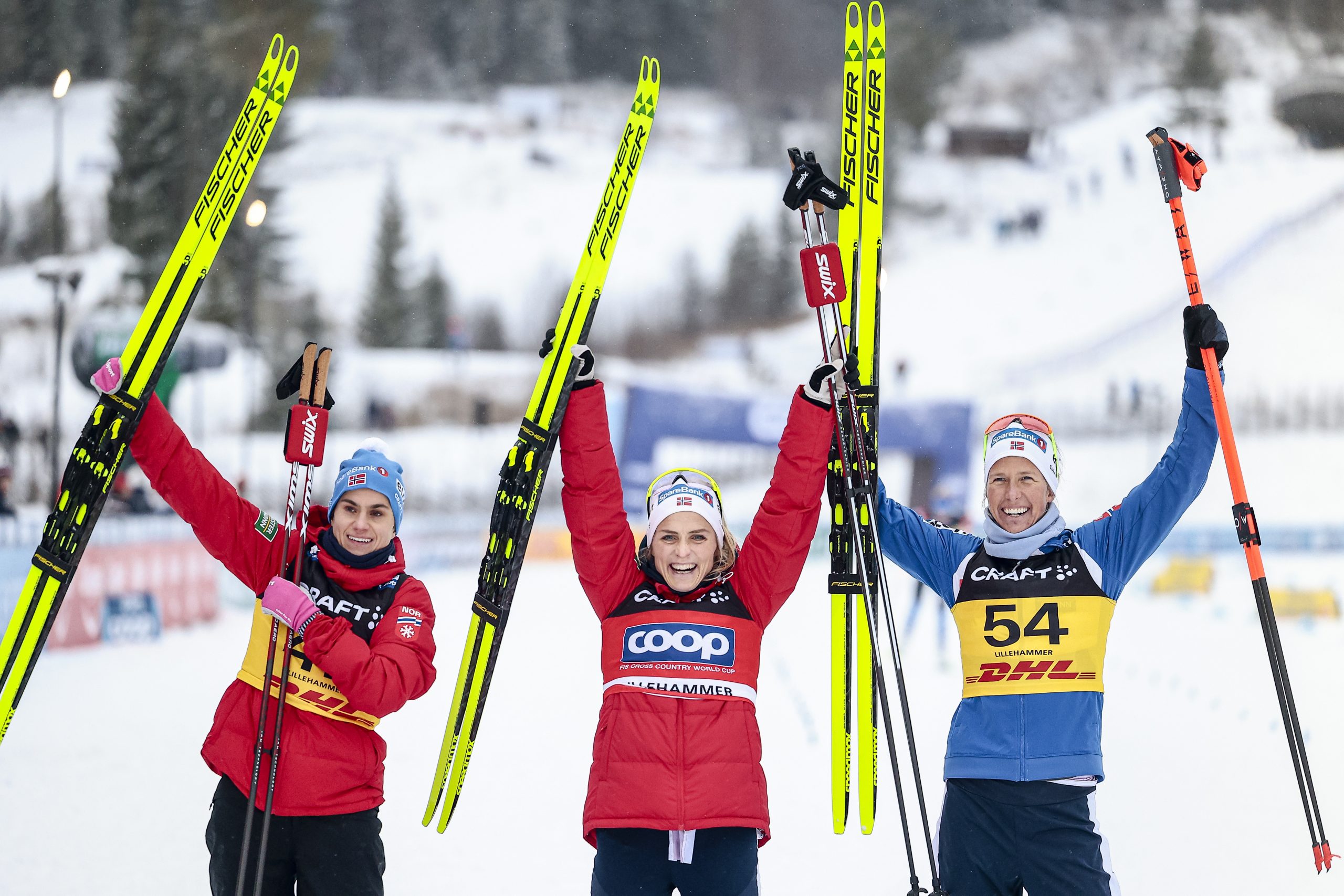
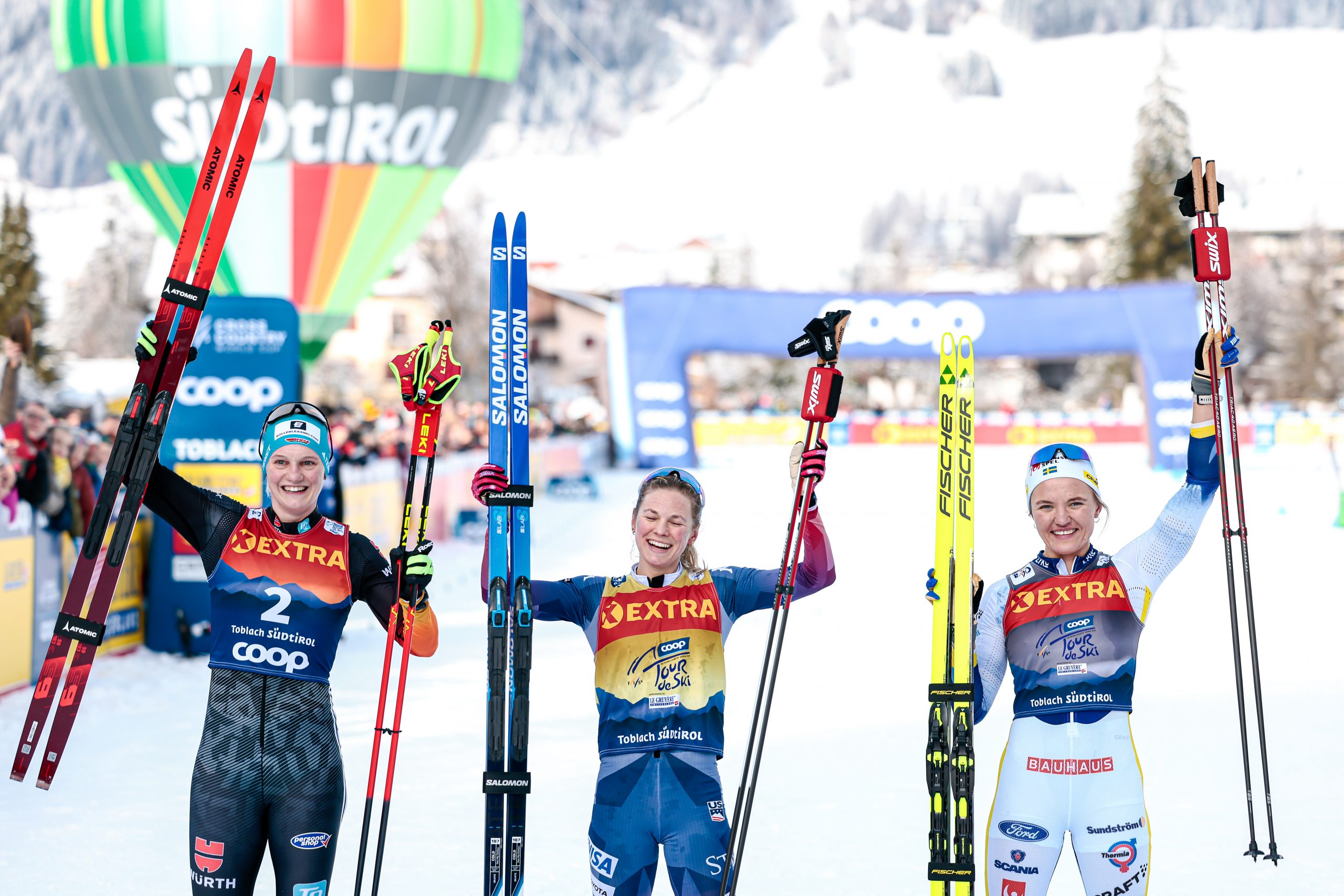
Heidi Weng (NOR), Ebba Andersson (SWE), Nadja Kaelin (SUI), on the podium of the Women’s 50 k Classic Mass start, the final cross-country event of the 2026 Olympic Winter Games in Milano-Cortina. (Photo: Barbieri/NordicFocus)
This coverage is made possible through the generous support of Marty and Kathy Hall and A Hall Mark of Excellence Award. To learn more about A Hall Mark of Excellence Award, or to learn how you can support FasterSkier’s coverage, please contact info@fasterskier.com.
Jessie Diggins (USA) was once the best in the world at racing the 5 k distance. She still is . . . (Photo: -Vanzetta/NordicFocus)
At one point early in her career, Jessie Diggins (USA) had become the pre-eminent World Cup racer at the 5 k Freestyle. She was fast, she could endure bucket-loads of lactate, and she could suffer like nobody’s business: perfect for the demands of the 5 k. Today’s result makes it look like she’s probably still the best at this distance, though it’s a race that’s hardly ever contested anymore in international racing. Diggins probably had it in her mind that she could post a win—if her heat was strong, if their strategy was sound, if everyone did their job, and if her 5 k skills remained intact. In the end, it was the speed of Diggins’ heat—and the intensity with which she led it—that made the difference, as all the podium places were claimed by that heat. Diggins first, Ebba Ribom (SWE) second, Moa Ilar (SWE) third, Leonie Perry (FRA) fourth, and Alison Mackie (CAN) fifth.
Diggins is a gamer; it was no surprise to see her embracing this new race format even before racing had begun. “It was just five k,” Diggins remarked” . . . “You’re going to gain or lose ten seconds.” In typical Jessie Diggins fashion, her perspective on the day seemed to be It’s a ski race. Let’s all just have fun!
Inventing an Event . . .
It’s a race . . . they’re filling World Cup podiums and delivering World Cup points and awarding event prize money. The field would be taking it seriously, even though a majority of the racers probably didn’t know what to make of it.
A recent press release claimed that this 5 k Mass Start format was “introduced to boost excitement.” Well, if our sport is in such dire need of a boost in excitement, then we should try to do something about that. What other format innovations could boost excitement? Perhaps the notion of full-contact Nordic racing—pads, helmets, a penalty box, the occasional dropping of the gloves. Maybe we should consider adding “Sharks and Minnows” to the roster of Olympic, World Cup, and World Championship events? How about a jump? Some aerials? A little air-time? Recent Eastern Cup Sprint races (a Junior Nationals qualifying event) conducted at New Hampshire’s Holderness School included a jump at the top of a small downhill slope. A few of the best skiers hit the jump well, and looked good doing it. The majority of skiers looked shaky, apprehensive, terrified. And a predictable number of racers ended their day splayed at the bottom of the hill as their rivals sped up the trail. At least it made for good spectating—and I suppose that was the point. Imagine how much better it could have been if we’d incorporated a hoop of fire on the jump, as well?
“My plan is to survive the 5 k,” said Astrid Oeyre Slind (NOR) the winner of yesterday’s 10 k classic event. “I think that will be a fun, but maybe a little bit chaotic, race.”
Tour organizers seem to think that adding novelty events is just what Nordic skiing needs to be more exciting for its viewing audience. The 5 k Mass Start Heat also adds the benefit of potentially re-shuffling the deck so that lesser skiers get a chance to shine. Certainly that’s exciting for fans of those lesser skiers. But for the true contenders, that’s gotta be incredibly frustrating, especially when World Cup points and potential Olympic qualifications are on the line.
Katherine Sauerbrey (GER), Nadja Kaelin (SUI), and Helen Hoffmann (GER) lead the pack in Heat 1 of the 5 k Mass Start in Toblach. (Photo: Vanzetta/NordicFocus)
Heat 1—11:15.7
In pre-race start-lists, FIS described today’s event as taking place in four heats of 20 skiers per heat. The composition of those heats selected skiers from multiple seeded groups (a few fast skiers, a few middle skiers, a few skiers from the tail end of the field) to fill out the heats in a relatively fair fashion. Intermediate Sprint bonuses were offered for both the Sprinters and the Climbers. The rest would be settled on the race course. Somebody say 1, 2, 3, go . . .
Rydzek led out Heat 1, taking the Sprint points at a line across the trail atop Toblach’s arch-shaped building. Thereafter, Frida Karlsson and Moa Lundgren committed to setting the pace. But at the crucial point in Heat 1, the surprising attacks came from Switzerland’s Kaelin sisters (Nadija and Marina), and Germany’s Helen Hoffman and Katherine Sauerbrey. If the overall Tour contenders needed this to be a fast heat, then their decision to leave the pace-making to lesser-known Swiss and German skiers may not have been the most effective strategy.
Nadia Kaelin would hold on for the heat win in 11:15.7. Behind her, regular contenders struggled to remain in contention: Jasmi Joensuu (FIN) in 8th place, Frida Karlsson (SWE) 13th, Coletta Rydzek (GER) 16th, Johanna Hagstroem (SWE) 18th.
“We saw a lot of surprises in these competitions,” said on-air commentator, Chad Salmela. “A lot of names that we didn’t necessarily expect to see at the top of the order.” You can say that again, Chad . . .
Astrid Oeyre Slind (NOR) made as much pace as she could, leading Kristin Austgulen Fosnaes (NOR) and Julia Kern (USA), both of whom would finish the day in teh top ten. But Slind’s pace would prove no match for Diggins. (Photo: Vanzetta/NordicFocus. Every downloaded picture is fee-liable.
Heat 2—11:01.0
The second heat included contenders like Astrid Oeyre Slind (NOR), Maia Dahlqvist (SWE), Kertuu Niskanen (FIN), Kristin Austgulen Fosnaes (NOR), Heidi Weng (NOR), and Julia Kern (USA). After a little bit of early speed provided by the logical contenders, the pace making was taken over by Julie Pierrel (FRA) and Pia Fink (GER). Time was slipping away for the overall contenders trapped in the languid pace of Heat 2 as the Sprint bonus points line passed with the leaders trailing Heat 1 by three seconds. The contenders could try charging to the front to take over the pace, but such a lactate-ploouted effort might ruin them for days to come. Well, Slind ain’t scared of a little lactic aid; she stormed to the front at the halfway mark followed by Fosnaes, Weng, Fink, and Kern.
Kern’s potential in upcoming Olympic events rests solidly on her probable pairing with Diggins in the Team Sprint. Kern’s job in that event will be simple: don’t get dropped. If her performance in today’s Heat 2 is any indication, her current level of fitness is preparing her well for that challenge. She went to the front (a bit too early), but was overtaken at the finish line by Dahlqvist. They were followed by Slind, Fink, and Austgulen-Fosnaes. The finishing time was considerably faster than Heat 1, but they’d need to wait to see what times later heats would produce.
Eva Ingebrigtsen (NOR) kept the pace high in Heat 3. Diggins benefited from that pace, and launched forward to expand upon it. (Photo: Vanzetta/NordicFocus)
Heat 3—10:51.2
Diggins was joined in Heat 3 by the remaining Swedish contenders—Moa Ilar, Emma Ribom, and Ebba Andersson—though Diggins’ pre-race conversations with Norway’s Ingrid Bergene Aabrekk and Eva Ingebritsen made it seem like she’d be relying on other recruited allies to keep the pace high. Diggins could be seen talking up the strategy of the day—volunteering to start fast, but intending for others to come forward to cycle through at the front. Obviously, she was hoping the heat would be a fast one. The strategy may have been markedly different for Tour Sprint Leader, Kristine Stavaas Skistad, who was probably intending to sit at the back and stay out of trouble. Skistad may have been the wearer of the Sprint Leader’s jersey, but the likelihood of Skistad being the final winner of that distinction (awarded at the end of the Tour de Ski atop the Alpe Cermis) is extremely low. She just wanted to make it to the next Sprint stage where she hoped to claim another World Cup win.
True to her original intent, Diggins flew off the starting line. Diggins was racing her last-ever World Cup 5 k Mass Start Heat race in Toblach (in Diggins’ farewell season, everything identifies as a “last-ever”), but if Diggins was relying on someone else to help with the pace-making, she’d need to let someone else lead. The Swedes volunteered as Diggins settled back into the pack for a moment of precious recovery. It may be just that—her ability to recover—that makes Diggins such a threat in mass-start racing. The rest of the field would do well to remember that when mass-start races (the Skiathlon and the 50 k) are run during the Olympics of Milano-Cortina.
Canada celebrated the fifth place finish of Alison Mackie (CAN), just the sort of celebration FIS may have had in mind when they added the 5 k Mass Start Heat to the Tour de Ski schedule. (Photo: Modica/NordicFocus)
Just as she’d been instructed to do, Ingebritsen led through the Sprint bonus line. While Diggins’ start had been lightning fast, the pace of Heat 3 had begun fading by this point, no longer the fastest at the Sprint bonus. Ingebritsen had done the job that Diggins had proposed before the race. Now it was time for Diggins to take over again. She did so with authority, racing through the Climbers’ bonus points and flying down the descent toward the finish. Diggins was just magnificent today. She set the early pace, she set the pace in the middle of the heat, and she totally dropped everyone else on the final uphill to post a finishing time a full nine seconds faster than any other heat. She was followed across the line by Ribom, Ilar, and by tremendous efforts from Leonie Perry (FRA) in fourth and Alison Mackie (CAN) in fifth.
“I love it!” Diggins could be heard exclaiming to Ingebritsen in the finish area after the heat concluded. “You gotta do it, and you went for it. I love it!” Diggins’ strategy had worked . .. and it was nice that she also said “Thank you” to Ingebritsen.
At the tail end of Heat 3—a minute and a half behind the leaders—Skistad out-sprinted Aleksandra Kolodziej of Poland to avoid being the last one across the finish line.
Heat 4 would prove to be a slow heat. Any pace or progress Teresa Stadlober (AUT) needed she was forced to create on her own. (Photo: (Modica/NordicFocus)
Heat 4—11:13.6
Stadlober drew the short straw, and a starting position in a weak heat. Stadlober is no sprinter, but she has proven to be both cagey and capable as a racer in mass start events. Though she was joined in Heat 4 by Nadine Faehndrich (SUI), Julie Bjervig Drivenes (NOR), and Karoline Simpson-Larsen (NOR), none of them really appeared poised to pull Stadlober to a finishing time that could rival Diggins’ performance in Heat 3.
Drivenes led out the pace, followed by Faehndrich and Stadlober. But early checkpoints revealed that their efforts already placed them outside the top 20 compared to earlier heats. Gina del Rio (AND) led through the Sprint bonus, and continued on beyond the line. But del Rio’s pace was not what was needed for the contenders languishing in Heat 4 to make up time. Knowing her Olympic potential is on the line in every event, Simpson-Larsen went to the front. But her prospects were not bright: she was volunteering to race alone and un-assisted for the rest of the distance. Ultimately, Stadlober re-took the lead and powered across the finish line one second ahead of Simpson-Larsen. Imagine Stadlober’s disappointment when it was announced that all her work and all her effort resulted in her placing no better than 17th (22 seconds slower than the. winner)?
On-air commentator, Kikkan Randall remarked on the “intrigue” created by this format, one in which the finishing time is what matters, but in which each skier will either benefit from, or be victimized by, the pace of their heat. For any number of today’s participants, that seems to me to be less a source of intrigue, and more a source of consternation. Regardless, Diggins was without doubt the skier who was most able, most prepared, and most intentionally poised to capitalize on today’s circumstances. Ultimately, Diggins added 11 seconds to her Tour de Ski lead over Slind, a margin that now stands at 50 seconds. That could certainly prove significant when the course turns upward on the final climb up Alpe Cermis.
In the end, it appeared that Diggins and Slind were the only two contenders who understood how things could work today. They both drove the pace as hard as they could, they both proved their fitness and their mettle, and they finished with a distance between them that might not have been much different if today’s race had been conducted in interval start format. Other skiers jumped in and delivered great results, and that is truly wonderful for them, for their fans, and for the event organizers. Maybe old curmudgeons like me, too, will come to love this event in the future. Regardless, I’ll be betting on Jessie Diggins if ever this event is run again.
“It was fun to feel that excitement with other friends and countries on the World Cup,” Diggins recalled. “I think that was an unexpected delight of the format.”
Racing Continues—and the Alpe awaits
Tomorrow in the Tour de Ski will see the staging of the second odd event in a row—the 20 k Pursuit—a race that gives a head start to those who are already leading, and rewards them (with World Cup victories!) for winning a race in which they were given a head start. Don’t get me started . . .
Heat 3 takes it all: Emma Ribom (SWE), Jessie Diggins (USA), Moa Ilar (SWE) on the podium after the Tour de Ski 5 k Mass Start Heat. (Photo: Modica/NordicFocus)
This coverage is made possible through the generous support of Marty and Kathy Hall and A Hall Mark of Excellence Award. To learn more about A Hall Mark of Excellence Award, or to learn how you can support FasterSkier’s coverage, please contact info@fasterskier.com.
While the rest of Norway’s women’s team struggled to find form, Astrid Oeyre Slind (NOR) dominated the Tour de Ski 10 k Classic in Toblach. (Photo: Vanzetta/NordicFocus)
The Tour de Ski seems originally to have been designed to reward the efforts and abilities of the best all-around skiers. If that’s truly the case, then it comes as no surprise when Jessie Diggins is naturally one of the skiers who rises to the top of Tour standings. All-around skier, indeed: she’s a fearsome sprinter (she won a gold medal in the Olympc Team Sprint, afterall), a true force at 10 k races (whether Freestyle or Classic), a tactically-savvy mass-start racer, and a gutsy climber. There are a lot of great skiers entered in the Tour de Ski field, but none of them possess an overall package that compares to the one Diggins has developed during her career.
And when we speak of Diggins’ career as a phenomenon that has “developed,” we truly mean it. Perhaps more than any other skier, Diggins has transformed herself from a skier-with-potential at the beginning of her career, to the every-event-contender whom we watch today. Do we all remember when a youthful Jessie Diggins was an up-and-coming Sprinter who was often foiled by her own recklessness and/or awkwardness? Can we all recall when Diggins only real chance at World Class performance in a Distance race was in the now nearly-extinct 5 k distance? Well, that’s not the same Jessie Diggins who’s racing today . . .
Continuing to improve when you’re already so near the top is no small feat. Jessie Diggins (USA) has spent an entire career developing and progressing as an athlete and a skier. Nowhere is that more evident than in her prowess as a contender in the 10 k Classic Interval Start. (Photo: Vanzetta/NordicFocus)
The day began in Toblach with the Tour de Ski lead resting on the shoulders of Sprint specialist, Kristine Stavaas Skistad. Skistad was not expected to end the 10 k Classic Interval Start still in possession of the leader’s jersey, which would pass on to Jessie Diggins (USA) following her third place performance. Diggins was preceded in today’s results by 10 k winner, Astrid Oeyre Slind (NOR), and runner up Teresa Stadlober (AUT) in a race that saw many other Tour contenders falter. Going into today’s race, much would’ve been expected of Distance skiing stars like Sweden’s Frida Karlsson, Ebba Andersson, and Moa Ilar. Likewise, Norway’s roster included stars of its own like Heidi Weng and the revelation of Davos, Karoline Simpson,Larsen. However, all those skiers turned in middling—or athletically ill-conceived—performances resulting in a Tour de Ski field that really only involves two main contenders for the overall crown: Diggins and Slind.
Diggins was not expected to linger behind the Tour’s early leaders: Sprint specialists, Kristine Stavaas Skistad (NOR), and Coletta Ryddzek (GER), and she donned the leader’s bib soon after the conclusion of the day’s racing. Heading into tomorrow’s rest day, Diggins’ new lead—after the Tour’s first Distance event—will afford her a considerable cushion when racing re-commences on Wednesday.
Canadian skiers were largely absent from Period 1 World Cup events while they competed back home in Canada for Olympic Team selections. Now that their Olympic roster has been established, Team Canada is back in the mix. Alison Mackie finished today’s 10 k ranked 34th, followed by Jasmine Drolet 43rd, Liliane Gagnon 57th, Olivia Bouffard Nesbitt 75th. The only other American still entered in the Tour de Ski—Julia Kern—finished the day in 41st.
When asked about her freshly evident prowess as a Classic skier, Diggins was smilingly circumspect. “I still love skating more,” Diggins laughed. “But, when it all comes together, and you have awesome skis like I had today (thanks to our team), it is super fun to just be power-striding out there. I really like this course because a lot of it is this beautiful power-striding. And to me, that is a fun Classic course!”
Ever since a disastrous wrong-turn cost her an Olympic medal in 2018, Teresa Stadlober (AUT) has remained a sentimental fan favorite. Her performance in Toblach’s 10 k Classic Interval Start showed that she may contend for medals once again in Milano-Cortina. (Photo: Vanzetta/NordicFocus)
Karlsson Flies, and Burns
Karlsson went out hot, stretching to an eight second advantage over Slind by 2.1 kilometer mark. Karlsson’s done that before, and it’s worked in the past, but later splits would show that Karlsson’s blazing start had been impetuous, and her advantages established early on were rapidly being stripped away. At five kilometers, it was Slind who had established a gap of five seconds over Stadlober, followed seven seconds later by Karlsson. Slind was charging, Stadlober was chasing, Karlsson was fading.And Digins hadn’t even started yet . . .
Tour leader, Skistad, lost a full minute in the first two kilometers . . . but her job wasn’t to contend in today’s 10 k; it was to survive until the staging of the next Sprint event. She did this pretty well, finishing 62nd on the day, less than three minutes behind the leader.
Fast out of the start, but fading noticeably by the two kilometer mark, Frida Karlsson (SWE) seems yet to have found her her form in the Tour de Ski. (Photo: Vanzetta/NordicFocus)
Karlsson had thrown down a blazing start, bu at the two kilometer mark, Karlsson’s wheels fell off. Slind began eating into her lead, then establishing a commanding lead of her own. The race turnaround was so striking that Slind managed to catch Karlsson (who had started 30 seconds earlier) around the the 8 kilometer mark.
When Diggins took to the course, she opened conservatively, trailing Slind by two seconds at the first time check. Five seconds behind by 1.7 kilometers. Four seconds at 2.1 kilometers.
When Slind crossed the finish line, she posted a seven second advantage over the courageous Stadlober. Only a few contenders remained out on the course, and Slind settled into the leader’s chair to witness their progress. Except for Slind and Stadlober, the other Distance specialists struggled to prove their pedigrees. Karlsson faded throughout the day to finish 35 seconds behind Slind. Ilar trailed the leader by 41 seconds, with Weng ending the day 48 seconds behind. Andersson followed 53 seconds behind, well out of contention. The revelation of Davos—Karoline Simpson-Larsen—finished the day in 14th place, trailing by nearly a minute.
Jessie Diggins (USA) celebrates her third-place performance in Toblach’s 10 k Classic Interval Start. Her steady, career-long progression to the top of every event—including today’s Classic interval start— is a rarity in the world of cross-country skiing. (Photo: Vanzetta/NordicFocus)raining through these races?
On-air commentators surmised that Team Sweden might be “training through” these races, describing a situation in which those skiers may not yet have cut back on training at all, sacrificing their potential in these races in order to delay their ultimate taper toward Olympic events of Milano-Cortina. Maybe they’re training through (that would be bold), maybe they’re not . . .
“I think every athlete approaches it differently,” Diggins said. “For me, I back down slightly right before the Tour because I need to have enough energy to hit each race really hard in order for the training load of the Tour, itself, to really punch through.”
After the completion of Tour de Ski Stage 2, Diggins maintains a healthy 39 second lead over Slind, 45 seconds over Rydzek. Diggins’ other primary rivals are farther back: Ilar at :53, Karlsson at 1:22, Weng at 1:33, Andersson at 1:41. Those are big gaps, and deficits that will be difficult for distance specialists to make up in what is already the shortest Tour de Ski ever staged. If Slind is to catch Diggins, she’ll need to whittle away at Diggins lead in upcoming distance races, post a career-best result in the upcoming Classic Sprint (she’s entirely capable of that), and dust the field up Alpe Dermis. Slind is the kind of skier who can do all that . . . but she’s not likely to receive Diggins’ willing cooperation along the way.
“Yesterday (after the Sprint competition) I was really tired in the evening, ” Diggins admitted. “But, I knew we weren’t going to race until (3pm) in the afternoon. I was like, ‘Sweet, I have basically 24 hours to recover (followed by) a day off!’ . . . There’s some fatigue, but when you’re in really good fitness you can bounce back enough that the day off in the Tour should be enough.”
“You literally never know how you’re goin to feel, day to day,” said Diggins. “That’s the beauty and the frustration of the Tour: we only really control just so much, and you do what you can with what you have.”
A rest day is on the Tour de Ski schedule Tuesday, followed on Wednesday by the 5 k Mass Start (to be conducted in heats). The World Cup has never seen such a race before, and it’s thought that almost anything can happen. Tune in Wednesday . . .
This coverage is made possible through the generous support of Marty and Kathy Hall and A Hall Mark of Excellence Award. To learn more about A Hall Mark of Excellence Award, or to learn how you can support FasterSkier’s coverage, please contact info@fasterskier.com.
Therese Johaug (NOR) lives only minutes away from the trails at Holmenkollen above Oslo, Norway. In the World Cup 20 k Classic Interval Start, she gave her hometown crowd the victory they’d hoped for. (Photo: Modica/NordicFocus)
In the weeks closely following the conclusion of each year’s Tour de France (the world’s preeminent bicycle stage race), the winners and contenders undertake a tour of “criterium” events, races staged in those European locations where fans are mad for cycling, but where the stages of the Tour were not held. The fans get a chance to see their heroes, to witness firsthand the shape and form and fitness of those who triumphed under such challenging circumstances. By that time, the finishers of the Tour de France are totally exhausted, absolutely spent, emotionally and athletically drained. But while the three grueling weeks of the Tour may have sapped their energy, it also instills in them a level of fitness and capability that enables them to race on auto-pilot, and at levels of otherworldly excellence.
Usually, Holmenkollen, Norway would play host to the most eagerly anticipated ski races of any World Cup season. But the World Championships were just last week—those were the races that the athletes circled on their calendars, those were the races that Norway lined up to see. For perhaps the first time, it was possible that Holmenkollen would become an afterthought. This year, Holmenkollen would be a criterium rather than a national celebration. The brightest stars of the cross country firmament were scheduled to be be on the starting line, but it remained to be seen just how much sparkle and and spirit those stars would have left.
Therese Johaug (NOR) had overturned her life—re-prioritized skiing over family and business and normal life—so that she could win again at Trondheim. Holmenkollen was to have been her criterium event, her victory lap. Things hadn’t play out as scripted.
Jessie Diggins (USA) so under-performed at the World Championships that she could barely bring herself to address the media. Of all the skiers in the Holmenkollen field, Diggins was the one still with something to win as she continued in her quest to capture the World Cup Overall and World Cup Distance Crystal Globes. Would she have been able to recover from the exhaustion and disappointment of Trondheim?
Ebba Andersson (SWE) was contending for the win in Trondheim’s World Championship 50 k Mass Start when an untimely crash ended her chances. She returned to racing in Holmenkollen where she finished third, only to have her placing nullified after disqualification for technique violations. (Photo: Modica/NordicFocus)
Ebba Andersson (SWE) had crashed, tragically, while in position to possibly win Trondheim’s 50 k. Would she find herself drained on Holmenkollen’s 20 k course? Or would she be on fire?
And Frida Karlsson—she who endured and dominated the historic 50 k in Trondheim—she elected to skip Holmenkollen’s 20 k Classic. All through the World Cup season, Karlsson had been mostly absent. Injury had kept her off the race course, and her ambitions at Trondheim had narrowed the focus of her training. With her World Championship victory having been achieved—and with little else for Karlsson to accomplish in the overall World Cup standings—it appeared that she might have called it a season.
Astrid Oeyre Slind (NOR) already has four victories in this World Cup season. Only a blazing performance from Therese Johaug prevented Slind from adding a fifth win at Holmenkollen. (Photo: Modica/NordicFocus)
20 k Classic
The course at Holmenkollen offered a distance that was actually somewhat shorter than 20 kilometers—three 6.2 kilometer laps on a sunny day with temperatures hovering just above freezing. Waxing would be fairly straightforward, but all skiers would find themselves slipping wherever deep shadows alternated with bright sunshine on the course. And all of them would be racing in Holmenkollen with the weight of Trondheim’s historically significant and athletically draining 50 k Freestyle still throbbing in their exhausted legs.
In the end, Holmenkollen’s 20 k Classic Interval Start provided a stage on which another thrilling World Cup was contested. Johaug went out like a rocket, only to find herself challenged at early checkpoints by Astrid Oeyre Slind (NOR) who also had disappointing World Championships performances to make up for. Slind had already won a 20 k Classic in this World Cup season, but Johaug was not to be denied, separating herself from her Norwegian rival in the later checkpoints and driving on to a 16.5 second victory. Andersson had the disadvantage of an earlier start position, but she would race bravely to finish third, 31.9 seconds behind Johaug. Ultimately, a jury decision found that Andersson had committed technique violations on the course; her second “yellow card” of the season resulted in disqualification, elevating Victoria Carl (GER) to third place.
Among Americans, Diggins would ski solidly and with great energy to finish 10th. Rosie Brennan was 17th, Sydney Palmer-Leger 38th, Sammy Smith 44th. Canadian finishers included Alison Mackie 28th, and Katherine Stewart-Jones 31st.
Holmenkollen was to have been Johaug’s victory lap. While she may not have brought a slew of World Championship gold medals to show off in front of her hometown crowd, she did deliver the sort of dominance that she has so often displayed on the trails of Holmenkollen.
“I’m just smiling out there!” said Johaug. “Today was my day, but it was a really hard fight with Astrid. She was really strong today.”
This coverage is made possible through the generous support of Marty and Kathy Hall and A Hall Mark of Excellence Award. To learn more about A Hall Mark of Excellence Award, or to learn how you can support FasterSkier’s coverage, please contact info@fasterskier.com.
Jessie Diggins (USA) won her first Classic race today and stretched her Tour lead. (Photo: NordicFocus)
Watching the Tour de Ski is like looking at a giant pendulum swinging back and forth. Yesterday, on day one, the pendulum swung to the favor of skiers with sprinting talent. Jessie Diggins (USA) made the most of that swing by gaining the maximum number of bonus seconds winning the Freestyle Sprint. She came into today’s 15 kilometer Classic Mass Start race with over a minute lead on Therese Johaug (NOR) and Heidi Weng (NOR). Today, those skiers without Sprinting legs would try to ride the pendulum back as it swings to Distance racing.
Jasmi Joensuu (FIN) and Nadine Faehndrich (SUI) also made the most of yesterday’s Sprint. At the start of the day, they sat in second and third respectively, seven and 15 seconds behind Diggins. Whether Joensuu and Faehndrich could hang with the Distance skiers remained a big question mark. But there was no question about what Johaug and Heidi Weng had in mind going into the day. Their mission would be to do whatever it took to eat into Diggins minute plus lead. That was the only certainty heading into the day. Already this season we’ve seen the two work together in Distance races, and that was a distinct possibility going into today’s race.
But the Distance skiers’ plans to gain time on Diggins today imploded when in a shocking turn of events Diggins was the one grinding down the Classic skiers and took her first World Cup Classic victory outdueling all of the big Scandinavian names. Johaug and Astrid Oeyre Slind (NOR) tried to punish the field throughout the race, but every time they made a move, Diggins answered closing any gaps they created with her world best downhill technique.
Jessie Diggins’ (USA) persistence was rewarded when after 340 World Cup starts she took her first Classic victory. (Photo: NordicFocus)
When the pendulum had swung back towards the Classic Distance skiers, it was shockingly Diggins who was at the top having not only withstood the pendulum swing but actually managed to come out on top. Classic phenom Kerttu Niskanen (FIN) took second place with Slind finishing third. H. Weng held on for fourth, and in another shocking turn of events, Johaug ended up sixth, clearly defeated at the end of the race.
After the race Diggins was ecstatic. “It’s really cool. It took me 340 World Cups to get here. This is why you never give up. I’ve been working so hard on Classic skiing my whole life, and it’s really emotional to finally do it. It took a lot of tries. I’m so thankful to my team because they gave me perfect skis. They were fast and I had the grip, so on the last hill I could go. It was just pure magic. It was really cool. I came into this in a really good head space. I’m healthy, I’m happy, loving what I’m doing, it’s an amazing team atmosphere. It’s going to be a big party in the truck today.” Diggins added that, “this summer I put in so much work on my double pole, so much work trying to improve my power and my strength. I feel like being able to sprint like that yesterday and finish like that today … I didn’t know if I had that in me, and I had to work really-really hard to get there, and I had a lot of help from a lot of people. I had perfect skis, and I feel like this victory is as much for the wax techs as it is for me.”
Other American finishers were Rosie Brennan in 14th, Julia Kern 31st, Sophia Laukli 46th, and Alayna Sonnesyn 50th.
It was a good day for Brennan but, “I’m definitely still far from where I want to be,” Brennan said after the race. “At this point, I’m just putting my best foot forward every day and doing the best I can to keep finding myself and you’ll know when I’m back, and I’ll leave it at that.”
The top Canadian finisher was Katherine Stewart-Jones in 34th. She was followed by Liliane Gagnon in 35th.
Today was the day for Therese Johaug (NOR) (number 39) to close the gap on Jessie Diggins, but it turned out to be Diggins’ day. (Photo: NordicFocus)
Women’s 15 kilometer Classic Mass Start
Conditions were described as perfect for the start of the women’s 15 kilometer Classic mass start with firm deep tracks. By virtue of winning yesterday’s race, a hatless Diggins was in the front row of starters alongside Joensuu and Faehndrich. Almost immediately at the start Classic expert Niskanen went to the front. One of the Tour favorites Johaug—because of her poor sprinting performance—started toward the back of the pack in bib 39 and spent the first kilometers double poling outside the track on the edge of the course to move toward the front. After only six minutes into the race at the 2.3 kilometer mark Johaug had pushed at a frenzied pace and worked herself to the front of the pack to take the lead.
Today was also an excellent day for Rosie Brennan (USA) (number 28) who finished 14th. (Photo: NordicFocus)
At the 3.3 kilometer mark there was a bonus Sprint where Joensuu went to the front to take the maximum Sprint points. Johaug and Faehndrich were with her with Diggins sitting calmly in 10th only a couple of seconds off the lead.
At the start of the second lap Johaug had pushed back to the front with Niskanen and Diggins trailing right behind her. Also having moved to the front was another Tour favorite H. Weng. At 5.2 kilometers there was another bonus section— this one was a bonus section for climbers. Johaug went through first, but Diggins was right by her side, now followed closely by Norwegian Distance standout Slind.
At the 6.1 kilometer mark Slind and Johaug decided to make their first serious break and established a gap on the group. Diggins quickly went to the front of the chase group as the two Norwegians in a matter of a couple of seconds were able to develop a measurable gap. But as she so often does, Diggins was able to close the gap on the downhills. It was a theme which was repeated several times throughout the race.
But even though Johaug and Slind hadn’t gained ground on Diggins, they had broken up the pack and there was now a defined lead group of about a dozen skiers. While the pack pulled away Slind and Johaug continued to throw in a burst of speed to try and pull away. And amazingly at the bottom of downhills Diggins would glide up onto the backs of the Norwegians. It had to have been incredibly frustrating for the lead pair to see their hard work evaporate at the bottom of every downhill as Diggins magically appeared right beside them.
At the 7.5 kilometer halfway mark Johaug was still out front with a pack of proven Classic performers around her. Niskanen, Slind, and Weng joined Diggins at the lead pack along with Teresa Stadlober (AUT), Krista Parmakoski (FIN), and Linn Svahn (SWE). At this point, the lead pack looked like a Scandinavian Classic all-star team with Diggins somehow hanging with them.
At 8.6 kilometers Niskanen took the lead with Johaug right behind her. But the big news at this point was that Johaug had not been able to blow open the race. She had used a lot of energy at the beginning of the race to scratch her way from the back of the pack to take the lead and it looked like she was paying the price.
As the racers hit the 11.2 kilometer mark the pattern which had been established throughout the race repeated itself again. Johaug and Slind led a group of nine skiers at the front pushing the pace on the uphills creating a gap, with Diggins then closing the gap on the downhills. Several times it looked like the lead duo were going to pull away, and each time Diggins closed on them on the downhills.
With only 1.4 kilometers left the lead field was down to seven skiers with Slind still pushing the pace. But try as they might the leaders couldn’t drop Diggins who tenaciously hung with the lead group as they entered the final downhill leading into the stadium.
Jessie Diggins (USA) (left) put in a furious double pole at the finish to take the win. (Photo: NordicFocus)
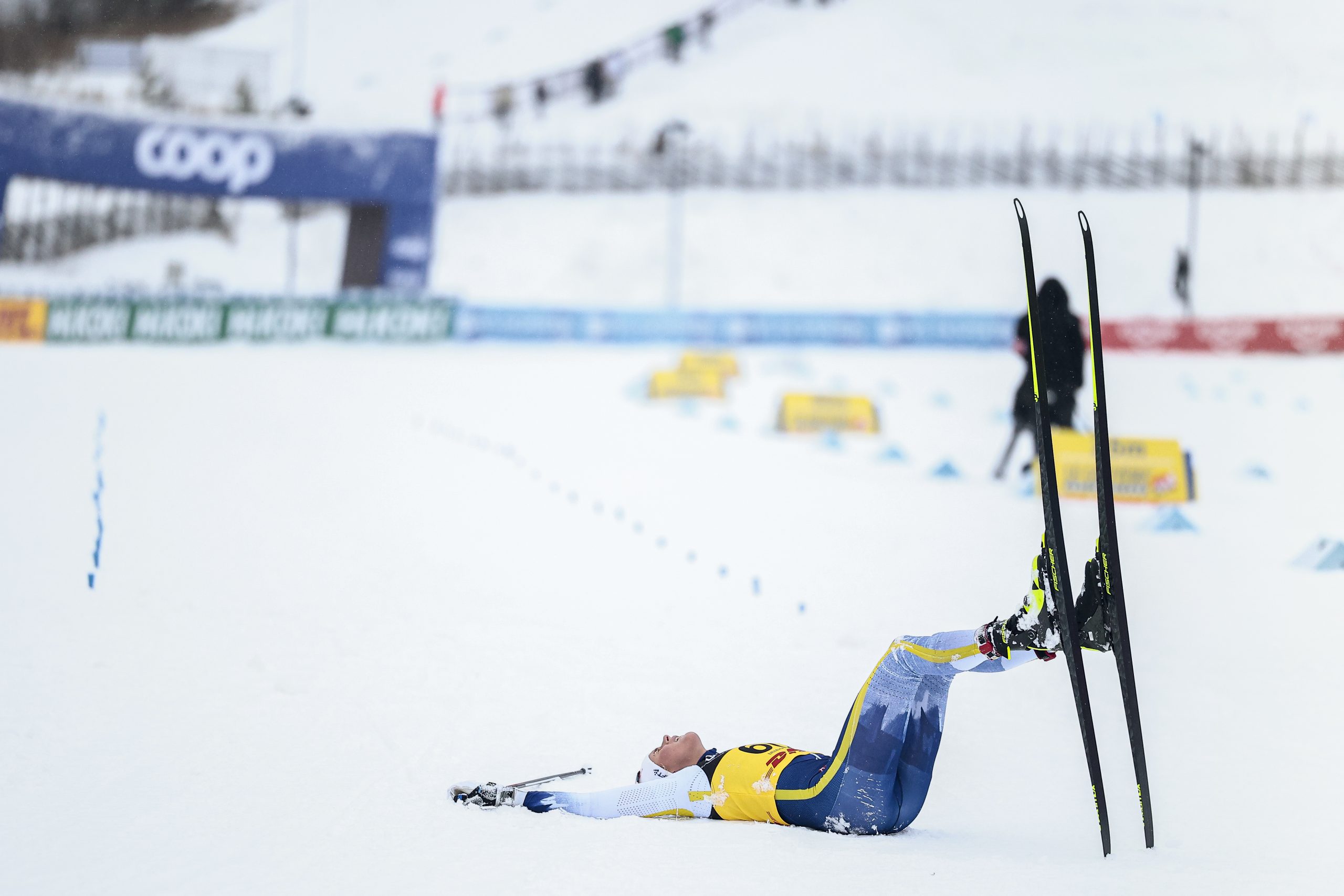
At this point, it was already mission accomplished for Diggins. As long as she stayed upright until the finish, she would have preserved her Tour lead, which was at the start of the race really all the American team was hoping for. But Diggins wasn’t satisfied with just maintaining her Tour lead. She could sense that she had the opportunity to make personal history. On the final climb she put in a massive turn of speed and took the lead over the field. Shockingly none of the other leaders could respond to Diggins’ burst. The first to crumple was Johaug who couldn’t take the pace and dropped off the field. Diggins frenetically double poled to the finish as Niskanen and Slind tried to stick with her, but they couldn’t and Diggins dropped the rest of the field. She crossed the finish line first, exhausted, laying on the snow with the knowledge that not only had she defended her Tour lead, but that she had just won her first World Cup Classic race! It was a shocking and incredibly satisfying victory.
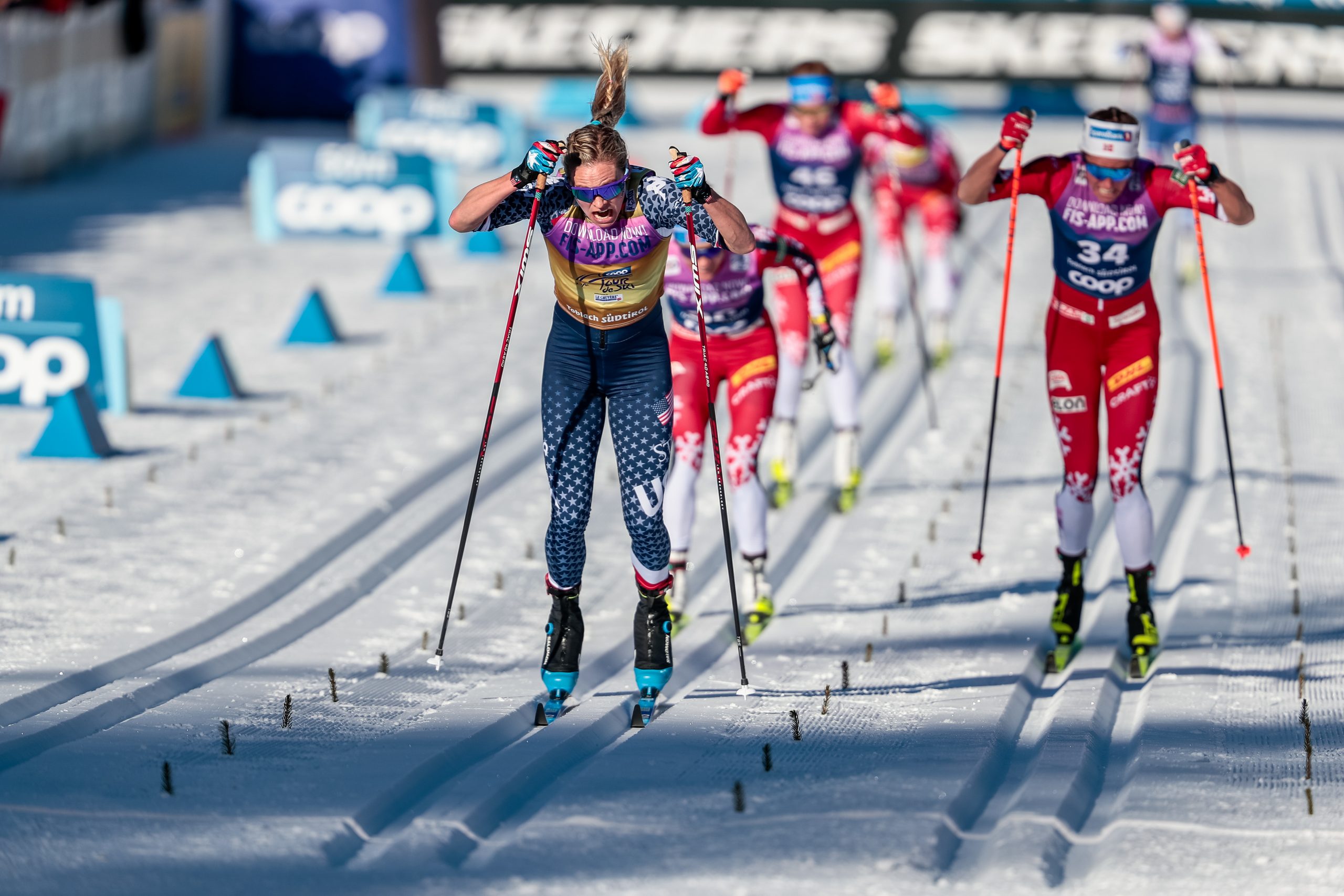
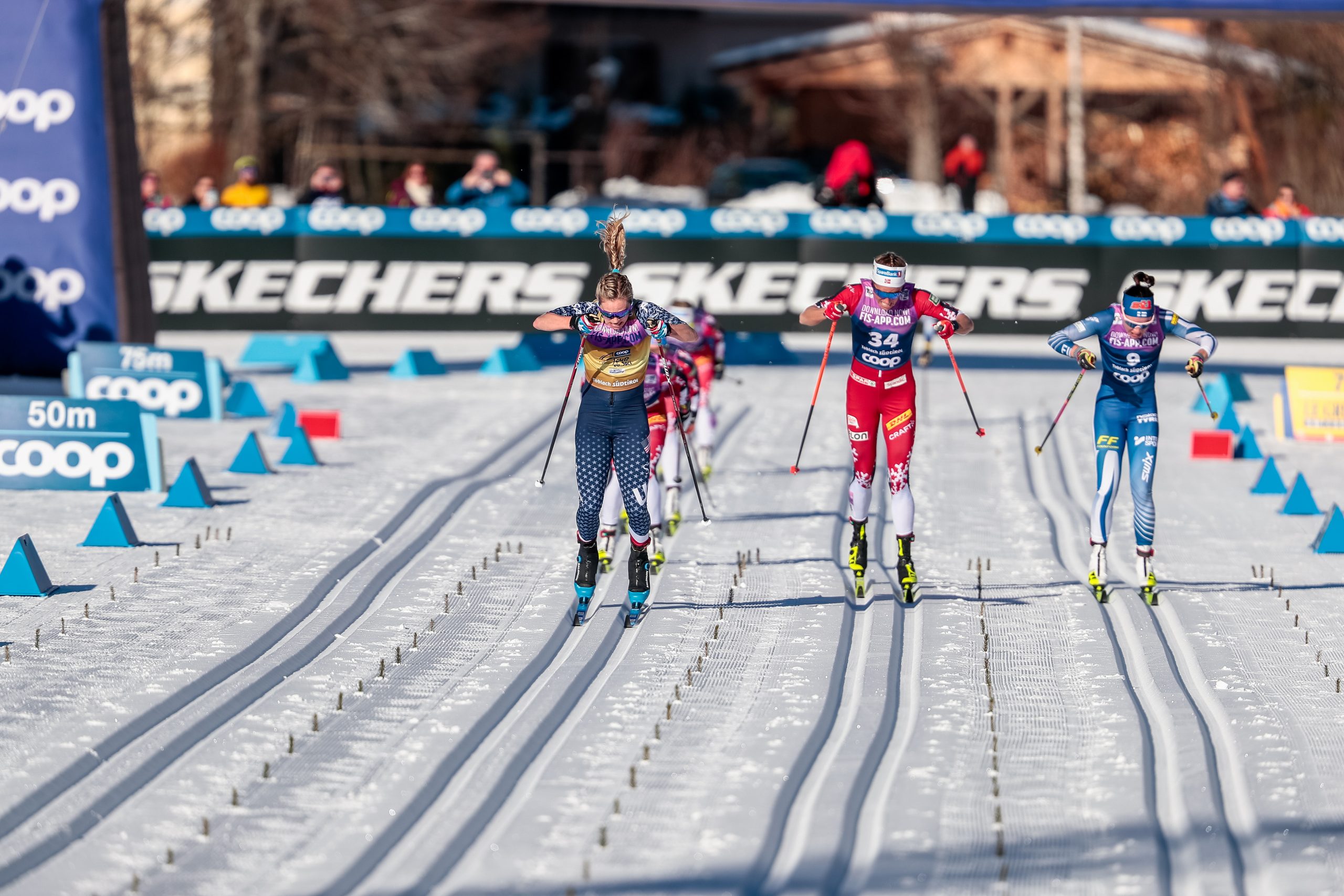
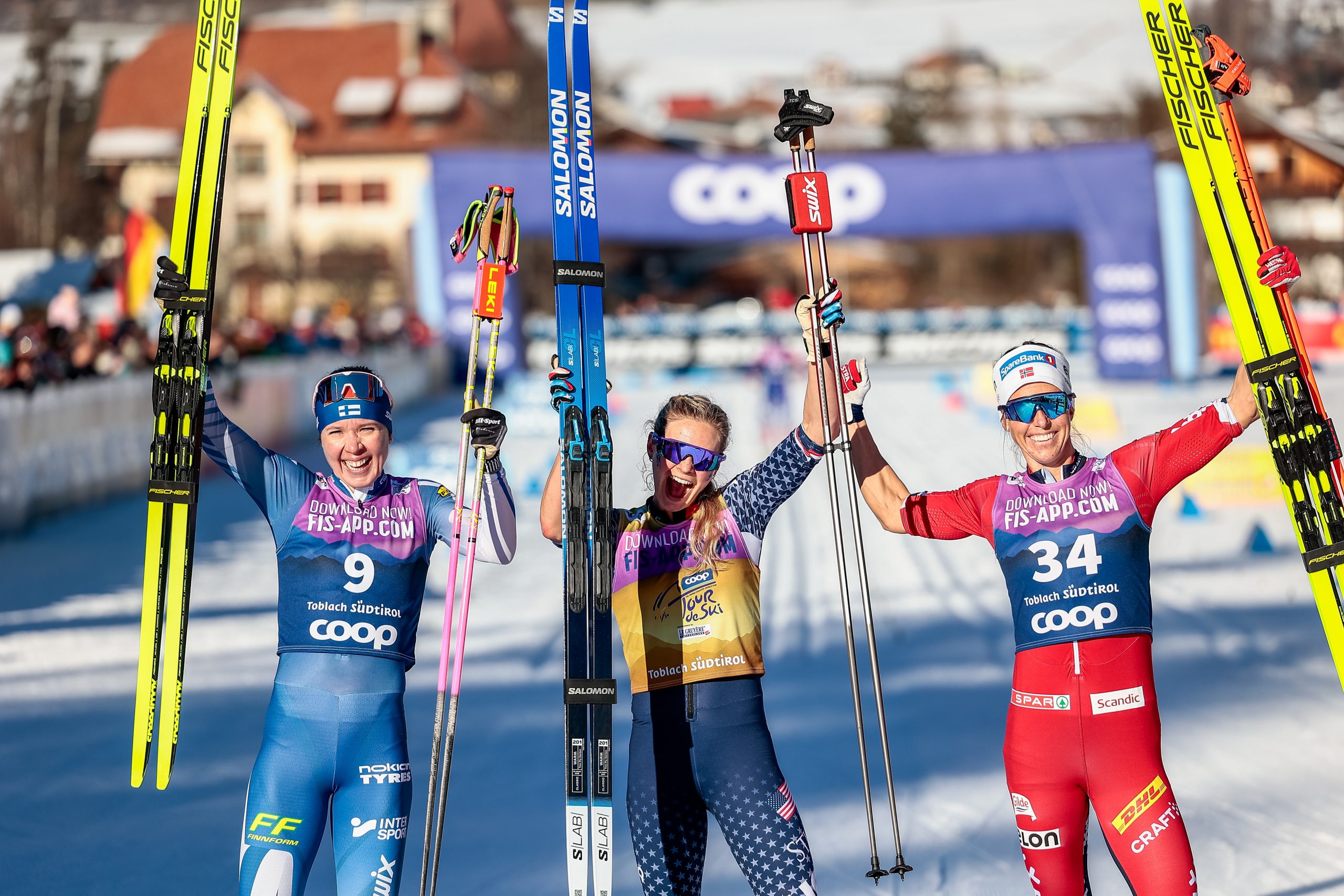
Jessie Diggins (USA) (far left) outdueled two skiers known for their Classic prowess, Astrid Slind (NOR) (number 34) and Kerttu Niskanen (FIN) (number 9), to take the win. (Photo: NordicFocus)
Not only had Diggins defended her lead, but she had beaten the Scandinavians at their own game, Classic skiing. It had to be a dagger through the heart of the Distance skiers chasing her as they were doubtlessly counting on gaining time on their rival today only to end up losing more time to Diggins. It was a monumental achievement for Diggins and the entire American team, and a crushing blow to the rest of the field.
After today’s heroics, Diggins had expanded her lead in the Tour. She now holds a 38 second advantage of Niskanen, and is over a minute ahead of Slind, H. Weng and Johaug.
It’s vacation time. We hear from some of the U.S. Ski Team men holed up in their Christmas cottage in Davos, Switzerland — featuring a new lightning round quiz segment — and Devon and Nat take us through the weekend’s results. Happy holidays: We’ll be back during the Tour de Ski.
Questions, comments, want us to use less (or more) profanity? Reach us at devon@fasterskier.com and nat@fasterskier.com.
This coverage is made possible through the generous support of Marty and Kathy Hall and A Hall Mark of Excellence Award. To learn more about A Hall Mark of Excellence Award, or to learn how you can support FasterSkier’s coverage, please contact info@fasterskier.com.
As cowbells and horn music echoed through the course, the women’s 20 k classic marked the final competition before athletes enjoy a brief rest ahead of the Tour de Ski later this month. However, the start list for today’s race was missing several notable names, hinting that some top competitors may still be opting for a conservative start to this World Championships season.
Astrid Oeyre Slind (NOR) earned her first-ever World Cup victory. (Photo: NordicFocus)
Many had written off the top position on the podium as an easy win for Therese Johaug (NOR), a skier renowned for her dominance in distance events and current leader of the distance standings. With key Swedish athletes like Frida Karlsson, Ebba Andersson, Linn Svahn, and Jonna Sundling sitting out, as well as Heidi Weng (NOR), the start list for today’s competition was shorter than usual.
This created an opportunity for others to challenge for the podium. On the final day of the Davos World Cup, it became evident who was feeling the effects of the weekend’s racing. With many top athletes strategically opting to skip Friday and Saturday’s sprint competitions, tired legs certainly played a role in today’s performances.
Victoria Carl (GER), Astrid Oeyre Slind (NOR), Krista Parmakoski (FIN), Kerttu Niskanen (FIN), Kristin Austgulen Fosnaes (NOR), Katharina Hennig (GER), and Teresa Stadlober (AUT), who have all achieved consistent top-15 results in distance events this season, were waiting for an opportunity to advance onto the podium. Perhaps having known this, none of these athletes started Saturday’s sprint. For Americans Jessie Diggins and Rosie Brennan, who competed in both the sprint qualifier and heats yesterday, the additional fatigue may have posed a slight disadvantage.
The podium was largely decided from the outset of today’s competition, as Johaug, Slind, and Niskanen established an early lead that steadily grew throughout the race. Johaug led through most intermediate checkpoints but began losing ground after the 16.5 k checkpoint. Slind, meanwhile, maintained her momentum and accelerated through the final kilometers to secure her first-ever World Cup victory, finishing 10.1 seconds ahead of Niskanen. Johaug crossed the line in third, 13.5 seconds behind Slind.
Diggins and Brennan skied comfortably, finishing 7th and 8th, respectively, to secure spots in the top-10. Other American finishers included Sydney Palmer-Leger in 28th, Haley Brewster in 35th, and Alayna Sonnesyn in 37th. Canada’s Katherine Stewart-Jones also skied to a 22nd place finish.
Rosie Brennan (USA) skied a strong and consistent race, finishing 8th overall (Photo: NordicFocus)
“Today, I definitely wanted to just feel like I was in the race, and able to push when I wanted to and hold pace throughout,” Brennan shared following the competition. “I feel when I am racing at my best, that puts me in the fight.”
As Team USA eases into the season, these early races may highlight room for improvement, especially given the team’s recent transition to on-snow training. “I don’t think I was quite there today,” Brennan reflected, “but it was definitely a step in the right direction for me. I felt a bit more open and able to ski the way I wanted to and find some ability to push a bit out there. I think I’m still missing that top end that will hopefully bring me closer to where I want to be, but all you can ask for is a step in the right direction.”
Women’s 20 k Classic Individual Start
While Johaug was a strong favorite entering the competition, the other podium spots were open for new names to step up today, with some of the strongest World Cup distance skiers missing from the start list. Early starters Niskanen, Slind, Brennan, and Hennig maintained similar splits through the first five kilometers, with Niskanen and Slind gradually pulling away to build a steady lead over the others. By the 9.3 k checkpoint, Niskanen and Slind had established a commanding 45 second advantage over Brennan and Hennig, positioning themselves as clear contenders for the podium.
Kerttu Niskanen (FIN) delivered an impressive performance, posting strong splits that secured her a second-place finish on the podium. (Photo: NordicFocus)
In many ways, the podium positions were already decided within the first few kilometers of the race. The early lead by Niskanen and Slind, combined with Johaug’s well-established strength in distance events, solidified the trio as podium contenders. By the second half of the competition, it was clear that the podium was out of reach for the chasing pack. At the 16.5 k checkpoint, Slind, Niskanen, and Johaug held a lead of more than 30 seconds over Carl and Parmakoski, and a 1.5-minute lead over early contenders Brennan and Hennig.
The specific order on the podium remained uncertain until the final moments of the race. While Johaug may have dominated this competition two years ago, her return this season left more to be decided. Though she established an early lead through the initial checkpoints, Niskanen also positioned herself as a strong contender in the middle kilometers. Only second to Johaug, Niskanen’s lead over Slind grew to 7 seconds around the 12.4 kilometer checkpoint.
Between 14 and 16 kilometers, Slind shifted into high gear, steadily closing the gap on Niskanen and ultimately overtaking her. From there, Slind continued to build her lead through the final kilometers of the competition.
Spectators held their breath through the final kilometers of the day, watching Johaug’s narrow lead over Slind dwindle. By the 16.5-kilometer checkpoint, Johaug was just 1 second ahead, a margin that shrank to 0.5 seconds by 18.5 kilometers. In the final stretch, Johaug couldn’t maintain her pace, dropping back to finish 13.5 seconds behind Slind and 10.1 seconds behind Niskanen, settling for third place.
Therese Johaug (NOR), adorned in the red bib as the reigning distance leader, struggled to maintain her dominance in today’s race, fading in the final kilometers to finish third. (Photo: NordicFocus)
With Johaug out of the way, Slind skied to her first-ever World Cup victory after 59 race starts and five podiums. “I can’t really believe it,” Slind shared following the race. “I never thought this would happen and at least not when Therese is back in the start. I thought I was fighting for second place the whole time and suddenly I realized this could be a win. I don’t know what to say.”
Outside the podium, positions in the top-10 saw more movement throughout the competition. Carl had a strong start, achieving some of the fastest splits early in the race. An exciting battle unfolded between Carl and Johaug in the opening kilometers, with Johaug leading by 3.2 seconds at the first checkpoint before Carl reclaimed the advantage by the 4.2-kilometer mark, edging ahead by 1.1 seconds.
As the race progressed, Johaug extended her lead over Carl, who contended for a position in the top-5 against Parmakoski. However, Carl began to fall off the pace around the 15-kilometer mark and ultimately dropped back during the final lap. In the end, Parmakoski skied to a 4th place finish and Carl followed closely behind in 5th.
Teammates Diggins and Brennan joined Carl in the battle for top-5 positions. Diggins posted strong splits early in the race but appeared to be fading by the 16-kilometer checkpoint. As one of the few top-athletes who competed in all three competitions this weekend, including all three sprint heats, it’s likely this may have been one of the few occasions in which Diggins ran out of steam. Brennan with strong splits throughout, maintaining her position in the top-10. “I was happy with my pacing, I held very consistent through the whole race which is always a good thing,” Brennan shared with FasterSkier.
Kerttu Niskanen (FIN), Astrid Oeyre Slind (NOR), and Therese Johaug (NOR) claimed the podium in the Davos women’s 20 k classic individual start race. (Photo: NordicFocus)
This coverage is made possible through the generous support of Marty and Kathy Hall and A Hall Mark of Excellence Award. To learn more about A Hall Mark of Excellence Award, or to learn how you can support FasterSkier’s coverage, please contact info@fasterskier.com.
Jessie Diggins (USA) was in the hunt for a podium all day, but fell just short. (Photo: NordicFocus)
To state the obvious, team Norway does not need any help on the World Cup circuit. But as this weekend’s racing moved to Lillehammer, Norway—home of the 1994 winter Olympics— that’s exactly what they were going to get a big helping hand of. In today’s race—the 10 kilometer Freestyle Individual Start—not only would Norway have the home field advantage, but because of the host nation’s start quota, the Norwegian women would bring 12 racers to the start. The American women would also get a slight start advantage since one of the perks of Jessie Diggins’ (USA) Overall Championship is that the team receives an extra start bib and would therefore be able to field eight racers.
But when it comes to the Individual Start it’s not so much quantity as quality that counts. And among the highest caliber skiers that everyone would be keeping their eyes on, there would likely be a battle between Jessie Diggins, Frida Karlsson (SWE), Heidi Weng (NOR) and Therese Johaug (NOR) for the podium. In 2022 Diggins won this same race in Lillehammer, so she was hoping for a bit of history to repeat itself. She was also coming off an impressive victory in the 20 kilometer Freestyle last Sunday in Ruka, Finland. Diggins’ strength is Freestyle, she’s proven her abilities in Individual starts, so the stars were aligned for a compelling and taut race with high hopes for Diggins to stay on a roll.
The snow conditions were tricky with a mix of artificial and natural snow. “It was super interesting,” said Diggins. “We got this beautiful snow fall overnight, which really put me in the holiday spirit, and it was mixing down with the artificial snow. It was super tricky. I actually felt like my skis were feeling really good. That said, Norway clearly knocked it out of the park today. I think my skis compared to the rest of the field were really really good, and I’m super grateful for our techs, because every single day they’re working super hard … sometimes you have the best skis in the whole world, and sometimes you don’t. You just have to go out there and race as hard as you can.”
While the anticipation around Johaug’s return has been huge, so far, she has appeared mortal. In last weekend’s 10 kilometer Individual Start Classic in Ruka, Karlsson ground Johaug into the snow beating her by a walloping 46 seconds.
There was no stoppingTherese Johaug (NOR) today as she led a Norwegian sweep. (Photo: NordicFocus)
But there was no beating back Johaug today as she went out fast and kept a blistering tempo all race long to take the win beating Heidi Weng by 11 seconds. Astrid Oeyre Slind (NOR) rounded out the podium for a Norwegian sweep. It was a dominating performance by Johaug and by team Norway as Johaug put her stamp on the race from start to finish. After the race she commented that “I’m so happy. It was a tough week after Ruka. I’m so- so happy. Johaug then commented on negative statements about her in the Swedish press. “Today I showed them.” She certainly did, as today’s victory not only put her on the top of the podium, but also on top of the distance and overall standings.
Diggins ended up finishing fifth, 48.7 seconds behind Johaug and only five seconds off the podium. Other American finishers were Sophia Laukli in 15th, Rosie Brennan 31st, Julia Kern 34th, Alayna Sonnesyn 35th, Sydney Palmer-Leger 47th, Haley Brewster 55th, and Renae Anderson 68th.
The top Canadian was Katherine Stewart-Jones in 38th. Liliane Gagnon was 49th, and Sonjaa Schmidt was 56th.
It was a tough day for Rosie Brennan who revealed in a bit of a bombshell to FasterSkier after the race that, “I’m dealing with an unknown injury that significantly impacted my race today.” She continued that, “it’s stressful and at the moment right now, I don’t have any other information to share. I will be working with our medical staff to figure out a plan moving forward.”
The 10 Kilometer Freestyle Individual Start
When Johaug took to the course, she wasted no time establishing her frenetic tempo. Diggins went out six skiers after Johaug putting her in the perfect position to mark one of her key rivals. But it was Karlsson who went out last amongst the best skiers and would have the best view to gauge her competitors’ performances.
Sophia Laukli (USA) had a good day finishing 15th. (Photo: NordicFocus)
When Sophia Laukli (USA) came through the 3.5 kilometer time check she established a new lead at that point taking a six second advantage over Kristin Austgulen Fosnaes (NOR). “I think a longer race could suit me better but I still feel like I can perform well in 10kms, especially with courses like Lillehammer,” said Laukli. “But you have to be very dialed (in) with tactics and skis since there’s very little room for mistakes when it is a shorter race, but on a good day I think I can do very well in a 10km.” Laukli’s skating looks to be more finely tuned this winter. “I have worked a lot on my skate skiing this summer and learning to ski with a bit more power and efficiency. I’ve always been a skier with high frequency so focusing more on using my strength and engine together and a bit slower frequency to be more efficient has really helped me improve.”
There was some more good news for team USA as when Brennan crossed the timing mark she was in fifth place, but that would be the high point of the day for Brennan as she was clearly having trouble coping with her newly revealed injury. Both of the Americans were quickly displaced as the top skiers came through the time check. When H. Weng came through she established a new lead by over 21 seconds, and it looked like it might be enough for her to stay out front. But no one could withstand the onslaught of Johaug as she established yet another new mark putting in over seven seconds on H. Weng at 3.5 kilometers. After Diggins came through, she was in fourth, 16 seconds behind Johaug and nine seconds behind H. Weng. But Diggins would drop to fifth after Karlsson was able to use her start place strategically and came through half a second behind Weng in third place.
Rosie Brennan (USA) had a tough day finishing 31st. (Photo: NordicFocus)
Johaug continued to press her advantage and when the skiers reached 4.8 kilometers, she had a six second lead over H. Weng, 14 seconds over Karlsson, and 19 over Diggins. Laukli had been pushed down to ninth place, 37 seconds back, and Brennan had quickly slipped into 18th place, 51 seconds off of the lead.
Johaug was relentless as she crossed the 5.6 kilometer mark and stretched her advantage over H. Weng to nine seconds. When Diggins crossed the mark, she was in third, 17 seconds behind H. Weng and 27 behind Johaug. But Karlsson would again displace Diggins and drop her into fourth with Astrid Oeyre Slind (NOR) nipping at her heels, only three seconds behind Diggins. At this point, just a little past the half waymark, Johaug had the race firmly in her grasp, with Diggins battling to hang on to a podium.
Therese Johaug (NOR) (foreground), raced at her signature high tempo pace the entire race. (Photo: NordicFocus)
As the 8.3 kilometer timing mark approached H. Weng had tried to turn things up a notch and crossed in the lead, but it didn’t last long, as Johaug quickly eclipsed her time as she came through extending her lead to 13.9 seconds. Diggins was now 35 seconds behind H. Weng and 43 behind Johaug. But more importantly, shortly after Diggins went through the time check Astrid Oeyre Slind (NOR) came through and pushed Diggins into fourth by five seconds, then after Karlsson moved through, she found herself sitting in fifth.
It would take a huge effort by Diggins to reach the podium. But Diggins wasn’t keeping track of where she stood compared to her competition. “I pay almost no attention (to competitors’ split times), said Diggins. “This maybe is just a Jessie thing, but I actively try to ignore splits. I essentially try to approach every race like it’s a three second battle for the win amongst 38 people. I’m always just trying to race as hard as I can and cross that finish line with nothing left. It’s not like if I hear I’m winning by 20 seconds I back off. I don’t change my race approach based on the splits because you don’t know what’s going to happen. For me a lot of the satisfaction I get out of racing is knowing that I have dug deep and I’ve gone to the bottom of the well. That has nothing to do with other racers, or times, or the clock.”
Heidi Weng (NOR) has returned to championship form, but she couldn’t quite keep with Johaug’s pace. (Photo: NordicFocus)
Weng was the first of the contenders to cross the finish line and she came in with over a 51 second lead. But Johaug was still on course. As she went up the final climb, Johaug showed no signs of relenting as her tempo continued to be manic up the final hill. H. Weng could only look on helplessly as she saw her teammate blasting through the course. When Johaug crossed the line, she was 11 seconds up on H. Weng with Diggins and Karlsson still on the course.
When Diggins crossed the finish, she was third, 37 seconds behind H. Weng and 48 by Johaug. But with Slind and Karlsson lurking, the outcome was still to be determined, and it didn’t look like Diggins had put enough time into either skier to hold onto a podium finish. Slind crossed the finish five seconds ahead of Diggins who was moved off the podium into fourth place. It would now be up to Karlsson to break up a Norwegian podium sweep.
Frida Karlsson (SWE) just missed out on the podium by three seconds. (Photo: NordicFocus)
As Karlsson approached the final stretch, it was obvious that she wouldn’t be in the top two and was fighting for third. She put in a furious V-2 push in the last 100 yards, but it wasn’t enough as she couldn’t close the gap on Slind and finished three seconds off the podium. Karlsson’s finish forced Diggins into fifth, but she finished just a scant 5 seconds from the podium.
So as the World Cup returned to Norway, it was also a return to Norwegian dominance with the home team sweeping the podium in an impressive performance on friendly soil. Two Norwegian veterans, Johaug and H. Weng, looked like they did at their career best and the rest of team Norway looked ready to dominate as well. After the final racer finished, Norway had taken eight of the top 13 spots.
Lillehammer 10 kilometer Freestyle Individual Start Results.
This coverage is made possible through the generous support of Marty and Kathy Hall and A Hall Mark of Excellence Award. To learn more about A Hall Mark of Excellence Award, or to learn how you can support FasterSkier’s coverage, please contact info@fasterskier.com.
Jessie Diggins (USA) slides through the finishing area after leaving everything out on the course. She turned what could have been a tactical day into a dominating performance. (Photo: NordicFocus)
As the world rings in the New Year, the U.S. Stifel Cross-Country team was hoping that flipping the page on the calendar wouldn’t flip their momentum. The team has been on a roll. On the men’s side, Ben Ogden sat in third overall in the Tour de Ski (TDS) standings going into racing today. On the women’s side, the picture was even brighter: Jessie Diggins (USA) sat atop the TDS standings, seven seconds ahead of Victoria Carl (GER), and 11 seconds ahead of Linn Svahn (SWE). Rosie Brennan (USA) was in sixth, only 24 seconds away from a podium spot.
In Monday’s 20 k Freestyle Pursuit, Diggins would put her first place standing on the line. The Pursuit race is an exciting format: the skier with the overall lead starts first and then each successive skier starts after them, separated by the amount of time they are trailing in the overall standings. For Diggins—who has made a career of chasing down skiers—it meant she would be the one being chased. With Carl and Svahn starting so close to Diggins, it was expected that the competition for the top spot would be fierce throughout the race, and that Carl and Svahn would work together to quickly chase down Diggins.
But for Diggins, today’s race in Toblach turned into another signature moment in her career. She started the race like she was shot out of cannon and never let up for one second. She turned in one of the most dominant performances of her career, and never let the rest of the field get close to her. Tactics and strategy were tossed aside. Early on, Diggins sent a message: if the rest of the field wanted to catch her, they would have to pay a mighty high price to do so.
Jessie Diggins (USA) started only seven seconds ahead of the next competitor, but set a blistering pace. No one could catch her. (Photo: NordicFocus)
Diggins ended up winning by over 46 seconds, extending her lead over Carl. Ultimately, the fastest skier on the day was Astrid Oeyre Slind (NOR), but it was definitely Diggins who dominated the field.
For Rosie Brennan, it was a difficult day. She ended up losing significant time and finished over two minutes behind Diggins. She is now 15th in the Tour. Sophia Laukli had the ninth fastest time of the day, and now stands 21st in the Tour, 3:13 off of the lead. Novie McCabe had the 25th fastest time and is in 27th place, with Julia Kern 44th, and Samantha Smith 47th.
There are no Canadian women left competing in the Tour.
Women’s 20 k Freestyle Pursuit
At the beginning of the race, Svahn quickly closed the gap on Carl. They would ski together to try reeling in Diggins, but Diggins had other ideas. She put her foot to the accelerator right from the start, and in the time it took for Svahn to close on Carl, Diggins had already put six seconds on the pair. The pace of Diggins’ start was ferocious: a mere 1.4 kilometers into the race, she had lengthened her lead to 21 seconds. It was clear that all the potential strategies of group racing were off the table for her; she would go hard from the start and push the entire way. By 4.4 kilometers, Diggins had extended the lead to 28 seconds over the chase group. It was like a heavyweight prize fighter coming out and throwing nothing but haymakers right from the start. It was hard to believe the intensity of Diggins start, and it was a reasonable question to ask whether Svahn and Carl were going to give up on catching Diggins and concentrate on the fight for second, or whether Diggins had gone out too hard?
At every time check Jessie Diggins (USA) increased her lead over the two chasers behind her. (Photo: NordicFocus)
At every time check, the gaps just kept getting larger. In a mere seven tenths of a kilometer, Diggins had put another six seconds on the chasers, and was now up by almost 35 seconds! The longer the race went on, the more Diggins appeared to be skiing in a world of her own. More time checks; more of a gap. At 8.8 kilometers she was over 40 seconds ahead of Svahn and Carl.
Behind Diggins, Svahn and Carl were not giving each other an inch. They continued to ski within a second of each other and were 30 seconds ahead of the chase group behind them.
Rosie Brennan had a tough day. She started the day only 24 seconds off of the podium, and ended up in 15th spot over a minute off the podium. (Photo: NordicFocus)
As Diggins was continuing to surge, Brennan was beginning to slip. She had started 28 seconds behind Carl and was now almost a minute back. Brennan ended up having a tough day. “I did what I believed was the best prep over the break,” said Brennan. “For whatever reason my body isn’t responding the way I hoped. If there’s one thing I’ve learned about the tour is that things can change on a dime so I’m doing my best to move on and keep hope.”
Diggins was relentless in imposing her will on the field; her lead just continued to grow and at 13.2 kilometers it was over 53 seconds. As long as Diggins could keep herself together, the only remaining questions would be whether the second chase group could close on Carl and Svahn to challenge them for the podium, and whether any of the women in the second group could put time into Diggins .
As Diggins continued to punish the field, Carl and Svahn were fighting to keep the remaining chasers behind them. At 14.6 kilometers they had a 24 second lead over the rest of the field. The second chase group of Frida Karlsson (SWE), Heidi Weng (NOR), Emma Ribom (SWE), and Astrid Oyre Slind (NOR), began to turn the screw and increased their pace. They were gaining time on Carl and Svahn and were even starting to put a little time into Diggins.
Carl and Svahn continued to work together, but their lead over the chasers had been reduced to a scant 10 seconds. With only 2.4 kilometers left, it appeared they would be swallowed up by the other chasers, who were now close enough where they could see Carl and Svahn. Meanwhile, the two chasers were giving every ounce of energy to hold off the second chase pack with Karlsson at the lead of that group.
Victoria Carl (GER), Linn Svahn (SWE) skied almost the entire race together until Carl pulled away just before the finish. (Photo: NordicFocus)
With half a kilometer to go, Carl decided that it was time to commit her last reserves into play to avoid being caught up in a sprint finish. She pushed ahead of Svahn to create a gap of six seconds. Simultaneously, the second chase group was putting in a big surge and gaining time on everyone. While she had the race in hand, Diggins was losing a bit of her cushion in the overall TDS standing to some of the women in the chase group.
The chase pack soon had swallowed up Svahn, though Carl’s earlier strategy of separating herself from the pack was now paying dividends.
Diggins charged into the finish, winning by forty-six seconds over Carl, who was able to maintain her separation going into the stadium and crossed the line two seconds ahead of the chase pack. As the remaining pack of skiers charged to the finish, Svahn and Sundling surged to the front in an all-out sprint with Svahn bettering Sundling in a photo finish.
It was a glorious, gutsy day for Diggins, and race fans had been treated to an enthralling spectacle.
“That was so hard.” Diggins commented after the race. “I went out and skied as hard as could. I wanted to ski a brave race; try and go out hard and see what I could hold.” Without being asked, Diggins answered whether she had gone out too hard. “I was blown out the last two laps,” she said. “I couldn’t really feel my legs, but I did hear my family out there cheering and a lot of other families from the U.S., and that kept me going. I just kept looking for every second. I crossed the line with nothing left, and that was the goal.”
Diggins also revealed that she had a bit of drama before the race’s start. While practicing on a fast icy downhill she took a dramatic tumble. “I slid maybe 100 meters,” she said, admitting that she even needed to change out her poles before the start. “I got it out of the way . . . It had me running scared in the race. I guess it got me going.”
Sophia Laukli (USA) delivered the ninth fastest time of the day, improving her position to 21st overall in the 2024 Tour de Ski. (Photo: NordicFocus)
Impact of Tour de Ski Standings
Even with as good a day as Diggins had holding off the field, she actually lost some time to the skiers in the chase group. Slind (NOR), Karlsson (SWE), and Weng (NOR) all ended up with slightly faster race times than Diggins. But Diggins’ TDS lead is still substantial. She now leads Victoria Carl by 47 seconds, and Svahn and Sundling (SWE) by 48 seconds. Slind and Heidi benefited today from skiing in the pack, and while they didn’t cross the finish line first, they are lurking 52 and 53 seconds back. It’s a considerable lead for Diggins, but certainly not insurmountable.
The next stop on the Tour is Davos, Switzerland. The American team has generally performed well there. “I’m excited to go back to Davos,” said Diggins. “That’s a hard Sprint, so it will be day to day.”
It was a thrilling day of racing for fans and for team USA.
Diggins didn’t have the fastest time of the day, but she put a big gap on Carl and Svahn to expand her lead in the 2024 Tour de Ski. (Photo; NordicFocus)
This coverage is made possible through the generous support of Marty and Kathy Hall and A Hall Mark of Excellence Award. Learn more about A Hall Mark of Excellence Award—or about supporting FasterSkier coverage—by contacting info@fasterskier.com.
Andrew Musgrave (GBR) gave his fans reason to cheer in the long Blink 23 race. Here he is shown in a skate race the next day. (Photo: NordicFocus)
The Blink 23 roller-ski competition is this weekend. It’s most famous for the giant uphill climb known as the Lysebotn Opp. On the other end of the spectrum are the distance events. On Thursday the men and women competed in a 50 kilometer roller ski race.
In the men’s race, perennial World Cup crowd favorite Andrew Musgrave (GBR) took first place by sprinting away from the field. Thomas Joly (FRA) was 25 seconds behind Musgrave, followed closely by Petter Northug (NOR).
Astrid Oeyre Slind (NOR) took first place in the 50 kilometer race at the Blink 23 Festival. (Photo: NordicFocus)
The women’s race was won by Astrid Oeyre Slind (NOR), who won by over a minute. In second was Lotta Udnes Weng (NOR), and in third was Anikken Alnaes(NOR)
This World Cup coverage is made possible through the generous support of Marty and Kathy Hall and A Hall Mark of Excellence Award. To learn more about A Hall Mark of Excellence Award, or to learn how you can support FasterSkier’s coverage, please contact info@fasterskier.com.
Jessie Diggins (USA) set the pace for much of the Holmenkollen 50 k, winning five of six intermediate sprints in her pursuit of additional FIS World Cup bonus points. (Photo: Modica/NordicFocus)
“It’s the right message that we want to send to young girls all over the world: you work just as hard as the guys, you train just as much, you should get to race the exact same races.” Jessie Diggins
History was made today by an entire field of finishers: a daunting distance, a hard-fought battle, equality demonstrated, acknowledgment confirmed. Ragnhild Gloeersen Haga (NOR), Astrid Oeyre Slind (NOR), and Jessie Diggins (USA): theirs was the podium, and the distance, and the accomplishment that will be remembered. That this day has been so long in coming is cause for critical reflection; that this day has finally arrived is cause for celebration. The women’s FIS World Cup field has finally been allowed to race the Holmenkollen 50 k, and our sport is better for it.
That women were capable of racing such distances at such competitive intensities was never in doubt. That women train as hard as men was never up for debate. Still, what has been required is a day when the skiing world—and the media world—not only acknowledges those facts, but actually gets a chance to see them proven. Today, at Holmenkollen, was that day.
“Wow, what a day!” noted Rosie Brennan (USA). “We’re moving forward, and working for equality, and being progressive; that’s something I was willing to fight for today.”
“A race like the 50 k really embodies the spirit of Nordic skiing as a whole,” said American Hailey Swirbul. “It’s about going into the woods, covering a lot of ground as fast as you can, and being supported by a really amazing community. [It was] a beautiful day to make history with some awesome, bad ass women.”
Diggins led all Americans in finishing third—barely outsprinted across this historic finish line by Gloeersen Haga and Slind. Among other Americans, Rosie Brennan earned a hard-fought seventh, Hailey Swirbul 25th, Alayna Sonnesyn 30th. Canada’s Katherine Stewart-Jones finished 16th.
Holmenkollen 50 k
The women’s field is familiar with the challenges of the Holmenkollen course, having raced this course as a 30 k distance many times before. Today’s race, though, involved six laps of this famed course over a distance of fifty kilometers, a distance usually reserved for flatter, less-challenging marathon races. Today’s race wasn’t just longer than normal, it was entirely different.
It was evident in scenes framed by broadcast TV cameras that the pace of the race heated up quickly. The early pace was often driven by lesser-known Norwegians—Margrethe Bergane (former Junior World Champion) and Nora Sannes—who seemed determined to make the race fast and difficult. American skiers made the initial selection with Diggins winning the initial bonus sprint two places ahead of Tiril Udnes Weng, her rival in the race for the season-long Overall World Cup.
The six World Cup sprint bonuses would define much of the action in the early laps—racers knew that there were 90 total points available to any skier who could win all six intermediate sprints (nearly as many points as winning the day’s race, outright). Much was at stake for contenders for both the Overall Crystal Globe and the Distance Globe: Diggins, Weng, and Kerttu Niskanen (FIN) would be locked in that secondary battle the entire day. Diggins won the first bonus sprint (with Weng third). Diggins won the second bonus sprint (Niskanen second, Weng third). It became clear that Diggins was willing to gamble on pursuing the sprint bonuses even at the risk of undoing her chances of winning the day’s race. It was a bold maneuver, and one that paid off in Diggins markedly reducing her points-deficit to Weng in the Overall.
Ambitious young Norwegians—and intermediate sprint opportunities—animated the first half of the race, interrupted briefly by the opportunity taken by most racers to switch to fresh skis at the end of lap three. Diggins skis seemed especially fast, allowing her to flow efficiently into an 11-woman lead group that began forming: Slind (racing in her club suit rather than the familiar Norwegian team suit), Patricija Eiduka (LAT), Eveliina Piipo (FIN), Kerttu Niskanen (FIN), Nora Sannes (NOR), Tiril Udnes Weng (NOR, Margrethe Bergane (NOR), Theresa Stadlober (AUT), Brennan, Diggins, and Gloeersen Haga. Ultimately Piipo, Niskanen, Hagga, Eiduka, and Brennan would fall back, leaving a lead group of six that was mostly paced by Diggins (whose moves were marked closely by Weng).
The historic Holmenkollen race venue above Oslo, Norway provided the stage for more skiing history as Women’s World Cup competitors were finally able to race the 50 k distance. (Photo: Modica/NordicFocus)
The lead group came through the stadium at the beginning of the final lap: Bergane, Diggins, Stadlober, Haga, Slind, Sannes, Weng . . . with Weng beginning to dangle as the lead group approached the final bonus sprint. Diggins was second to cross the sprint line for the final set of bonus points, looking around at the field to check her status for the final kilometers. She’d earned 87 World Cup bonus points, and reduced her deficit to season leader, Weng. Her cumulative totals were also enough for her to displace distance leader, Niskanen. Diggins had already accomplished much, but an historic finish line was looming, as well. The distance and the effort had taken their toll:
“By the end I was pretty much cramping everywhere,” Diggins recalled. “The arches of my feet, the inside of my knee, my quad, my hip, my lats, and my triceps. Pretty much all the muscles you use for skiing. I was honestly thrilled to find myself in the sprint-out, fighting for the win . . . it was so awesome to be part of that.”
After two hours and thirteen minutes of intense racing, the race came down to a sprint for the line. Gloeersen Haga outsprinted Slind and Diggins, all of them finishing with half a second of one another. Haga had come back from mid-race deficits to display the sort of form that won her the Olympic gold in the 10 k Freestyle at PyeongChang. It was sweet vindication for a skier who has often been overlooked in recent years . . . and a sweet form of redemption for generations of skiers who have been doubted and overlooked for far too long.
Hailey Swirbul (USA) checks an historic goal off the list: the Holmenkollen 50 k. (Photo: Modica/NordicFocus)
“It was so so cool to finally get to do this race,” said Diggins. “I’ve spoken very passionately about this before; I think it’s the right message that we want to send to young girls all over the world: you work just as hard as the guys, you train just as much, you should get to race the exact same races.”
“First 50 k ever in the books,” said Swirbul. “I am really stoked to be able to check that goal off the list!”
Women’s Holmenkollen 50 k Freestyle Mass Start RESULTS
Exhaustion, relief, redemption . . . and history. Ragnhild Gloeersen Haga (NOR) at the Holmenkollen finish line. (Photo: Modica/NordicFocus)
This World Cup coverage is made possible through the generous support of Marty and Kathy Hall and A Hall Mark of Excellence Award. To learn more about A Hall Mark of Excellence Award, or to learn how you can support FasterSkier’s coverage, please contact info@fasterskier.com.
As dominant as Swedish women’s racing has been this season, it’s hard to imagine that a Swedish woman has never won a Skiathlon at the World Championships. The Swedish women were looking to break that streak; given the incredible run they have been on, it seemed that the odds were in their favor.
But Norway was still lurking, hoping to upset Sweden’s shot at history. The Americans were also waiting in the wings with Rosie Brennan (USA) vying to claim America’s first gold medal in an individual distance event at a World Cup Championship.
Jessie Diggins (USA) took the day off: as she had said in her pre-World Championships press conference, she did not intend to ski every race. U.S coach Chris Grover informed FasterSkier that she will be skiing the team sprint tomorrow along with Julia Kern. He also shared the news that J.C. Schoonmaker and Ben Ogden would be the men’s team.
After a warm day of racing, it was Sweden coming out on top again with Ebba Andersson taking the victory. She was followed by teammate Frida Karlsson. In a feel good story, Astrid Oyre Slind (NOR), who was called up to race as a last minute replacement, finished third. Slind is a long-distance specialist, competing on the Ski Classics tour, and in the warm Planica weather she stood out as she cut off her tights and turned them into shorts.
Rosie Brennan (USA) sharing the story of her struggles with teammate Sydney Palmer-Leger (USA) after the Skiathlon’s completion. Brennan’s broken binding spoiled what had been a promising day for the American. (Photo: NordicFocus)
The Americans’ day was mixed with success and heartbreak. Rosie Brennan had a soul rattling outing. While she was skiing with the leaders, a binding broke and her ski fell off. She ended up finishing 19th. Newcomer Sydney Palmer-Leger had a breakout day finishing 20th. Haley Swirbul was 26th, followed by Sophia Laukli, 29th.
For Canada, Katherine Stewart-Jones was the top finisher in 25th. Behind her were Jasmine Lyons 34th and Olivia Bouffard-Nesbitt in 40th.
Women’s 15 kilometer Skiathlon
It was a very warm day for the Women’s 15 k Skiathlon, as temperatures bumped up against the 50 degree mark. Most racers shed their hats, some took off their gloves, and in Slind’s case, converted her tights into shorts. According to U.S. coach Chris Grover, course officials decided to salt the course the night before the race.
While course conditions were the subject of much post-race discussion, Grover said that he thought, “in general, for how warm it was…the course was probably in as good as shape as it could have been.”
The day began with high hopes for the U.S. With Jessie Diggins resting, Rosie Brennan became the default front runner for team USA.
At the beginning all looked very good for the Americans. One kilometer into the race, skiing the classic section, Brennan was toward the front with Kerttu Niskanen (FIN) and Krista Parmakoski (FIN) setting the early pace. They were in a group with Frida Karlsson (SWE), Ebba Andersson (SWE) and Delphine Claudel (FRA).
Throughout the early stages, Brennan looked extremely strong and jockeyed for position with the leaders. Niskanen was still setting the pace using her classic technique prowess to try and establish an advantage before the transition to skating.
Rosie Brennan (USA) gamely stayed in the race after her binding broke and tried to make up time in the skate portion of the Skiathlon. (Photo: NordicFocus)
By the 3.8 kilometer mark, Andersson moved to the front of the pack with Slind joining the leaders. Brennan was right in the mix in eighth place, skiing with the leaders, and appeared to be skiing the race she wanted to.
It was at about the five kilometer mark that the wheels came off for Brennan—literally. As she was going through a corner, her binding broke sending her ski flying. Brennan immediately collected her ski and pushed herself along with one foot as the leaders sped away from her. After the equipment failure, Brennan moved from being in the front of the field to being forty seconds behind the leaders. By the time she reached the ski exchange, she was over a minute behind the lead. It was a deficit which would be impossible to overcome.
When the leaders reached the ski exchange, Andersson, Karlsson, Slind and Ingvild Oestberg (NOR) were in a virtual dead heat.
As the skate portion of the race unfolded, Andersson began to assert herself, putting a six second gap on Karlsson with Niskanen and Slind about 20 seconds behind. Anderson continued on a grinding pace which the rest of the group could not match. At 10 kilometers she had put another 10 seconds on Karlsson, but then Andersson fell on a downhill and opened the door for teammate. But Karlsson couldn’t take advantage of the fall as Andersson jumped to her feet quickly and only lost a few seconds. Karlsson was able to stay in touch through the 13 kilometer mark, but couldn’t make any progress reeling Andersson in. At about the 14 kilometer mark, Andersson found another gear which no one else could match, and she extended her lead to almost 20 seconds.
At the finish, Andersson was comfortably in the lead, finishing 22 seconds ahead of Karlsson. Slind had hung on to finish third about 48 seconds back, making her last second race call up a heartwarming story.
But, after the race, all the talk was about Brennan and what could have been.
In the reporters’ mix zone, Brennan—always the consummate professional—took events in stride when she elaborated about her days’ problems. “Everyone was putting on the brakes, and I did too, and I caught some slush and the binding came off the ski. It makes it kind of hard to go when you have only one ski.” Despite her equipment issues, Brennan sounded energetic and optimistic. She commented that her bad luck seemed to attract a great deal of media attention. With a mix of humor and irony she said while laughing that, “this is the most I’ve ever been stopped in the mix zone, and for one of the worst races…I don’t know what that says about the state of the world. People should be more concerned with the good things, not the bad things. Today is a day we can all forget about.” Brennan hadn’t initially realized that the binding had come off and tried to put the ski back on. After figuring out that her equipment was broken, she found coach Jason Cork for a replacement ski. But the damage was done: the pace at the front didn’t slacken and there was no catching up. Brennan had contemplated stopping, but just for a moment. “When you show up at a Championship, you’re here to represent your country and you always give it your all until the end. I decided to keep fighting until the finish. I felt great up until that point.” Brennan was not injured from the impact.
U.S. coach Matt Whitcomb was about three minutes away from Brennan when she fell. He said, “Jason [Cork] got her one of her skis…it did have race wax on the glide zones. But the time was lost, and you’re no longer in contact with people skiing your pace.” He continued that, “we’re grateful that she’s ok…we can move past this. She looked great [before the fall] and was controlling the pace up the hills.”
Grover told FasterSkier that, “She was skiing really well when this happened.” From the team perspective it hurts, but Grover elaborated that “it is part of sport…everyday there are some favorites that end up with some bad luck.”
Sydney Palmer-Leger (USA) provided the highlight for team USA. She finished 20th in her first World Championship race and her first Skiathlon. (Photo: NordicFocus)
Brennan’s disappointment was tempered some by the standout performance of Sydney Palmer-Leger (USA), who finished 20th. Today was Palmer-Leger’s first World Championship race and first Skiathlon competition ever. She told FasterSkier that she was able to avoid the crashes which claimed so many skiers. She said that her background as a bike racer helped her prepare for the Skiathlon. “The transition went pretty well. I’m used to calming myself down.” She continued that “the corners were sketchy…you needed to carry speed through the corners, not slow down. I don’t think snow plowing was the best move.” She added that, “I just turned 21, so getting top 20 at my first World Champs is pretty amazing.”
Grover added that the team took solace in Palmer-Leger’s performance. “It was definitely the high point of the day,” Grover said. “It was really fun to see that half way through the classic section she was just off the lead group, so she was really holding her own.”
Sophia Laukli (USA) overcame her own adversity to finish 29th in the Skiathlon. (Photo: NordicFocus)
Sophia Laukli also had her difficulties, falling twice. Her 29th place performance was all the more remarkable, as she shared with FasterSkier that she broke a pole on the second crash.
After the dust had settled, broken equipment repaired and collected, the day would be remembered as a continuation of Swedish dominance, a breakout performance by a new American star, and thoughts of what might have been for Rosie Brennan.
Frida Karlsson (SWE), Ebba Andersson (SWE), (l-r) celebrate Sweden going 1-2 in the women’s Skiathlon in Planica, Slovenia (Photo: NordicFocus)
Ebba Andersson wins the World Championships skiathlon followed by a strong Frida Karlsson, with a surprise third by a Norwegian with a cinderella story. We break the race down and cover Rosie Brennan’s ski mishap.
We’ll back back with more after Sunday’s team sprint. Send us your questions at devon@fasterskier.com and nat@fasterskier.com.
Larisa Shaidurova, Polina Medvedeva, and Svetlana Nikolaeva, all of Russia, lead the 15k pursuit at U-23 World Championships
Halfway through the 15k women’s pursuit at the U-23 World Championships, the Russians appeared to have everything under control. Skiing three abreast on their second of four trips up the big climb here, there didn’t seem to be a way for anyone to get around their sea of blue suits.
But when they switched to skate skis, the Russians’ grip on the race disappeared as quickly they had taken it, snatched by a pair of Norwegian women, Hilde Lauvhaug and Astrid Oeyre Slind. Working together, the two blew the race apart, and after shattering the field, Slind powered away from her teammate on the last hill to take the win. Svetlana Nikolaeva salvaged the day for the Russians by finishing third.
After her fifth-place finish in Thursday’s classic distance race, Canada’s Brittany Webster flirted with another top-five today, making the lead group of nine when the pack split up on the third lap. She said that effort was a bit much for her, however, and after Slind and Lauvhaug got away, it was all Webster could do to keep it together to win the sprint for eighth place over Aurelie Dabudyk (FRA) and Britt Ingunn Nydal (NOR).
“I didn’t have much left,” she said.
Sadie Bjornsen was the top American finisher, in 26th. She was sitting 17th after the classic leg, but lost nine places during the second half of the race. Becca Rorabaugh was skiing near Bjornsen at the transition after a rough start, but she said she fell after the exchange and lost a lot of ground, leaving her in 31st place at the finish.
Ida Sargent and Kate Fitzgerald were the two other American starters; they ended in 34th and 38th, respectively.
In an interview with FasterSkier after the race, Slind said that the Russians’ pace during classic section was fairly tame, and that behind them the rest of the field was jockeying for position. Nikolaeva agreed, saying that she and her teammates were just trying to keep things under control.
Astrid Oeyre Slind (l) and Hilde Lauvhaug going over the top of the final climb for the last time
Towards the end of the first skate lap, Slind and Lauvhaug began stretching things out, and an initial group got away as the women went over the course’s big climb. By the last time up that hill, the two Norwegians had left everyone else behind.
They went over the top together, and it looked like the race would come down to a drag race on the finish stretch. But there was one more hill before the pair entered the stadium, and Slind, seeing that Lauvhaug was getting “wobbly,” seized the opportunity, opening up a big gap that reached eight seconds by the finish.
When the rest of the pack reached the top of the big climb for the last time, Japan could almost taste its first medal of the championships after three fourth-place finishes here, with Yuki Kobayashi holding a small lead over Nikolaeva as the two began their descent into the stadium. But by the time the two were over the same hill where Slind had made her move, Nikolaeva was able to sprint away from Kobayashi, and she held on for the bronze.
Today’s races were the last for the U-23 athletes here, and tomorrow’s relay is the final event for the juniors. Check back tomorrow for coverage.