From the FasterSkier archive — posts syndicated from athletes’ and coaches’ own blogs between 2004 and 2012, kept online as published. Current coverage is at fasterskier.com.

Tag: Astrid Uhrenholdt Jacobsen

  • Johaug Crushes Stage 6 for Ski Tour Overall Win; Diggins Leads U.S. in Sixth (Updated)

    Johaug Crushes Stage 6 for Ski Tour Overall Win; Diggins Leads U.S. in Sixth (Updated)

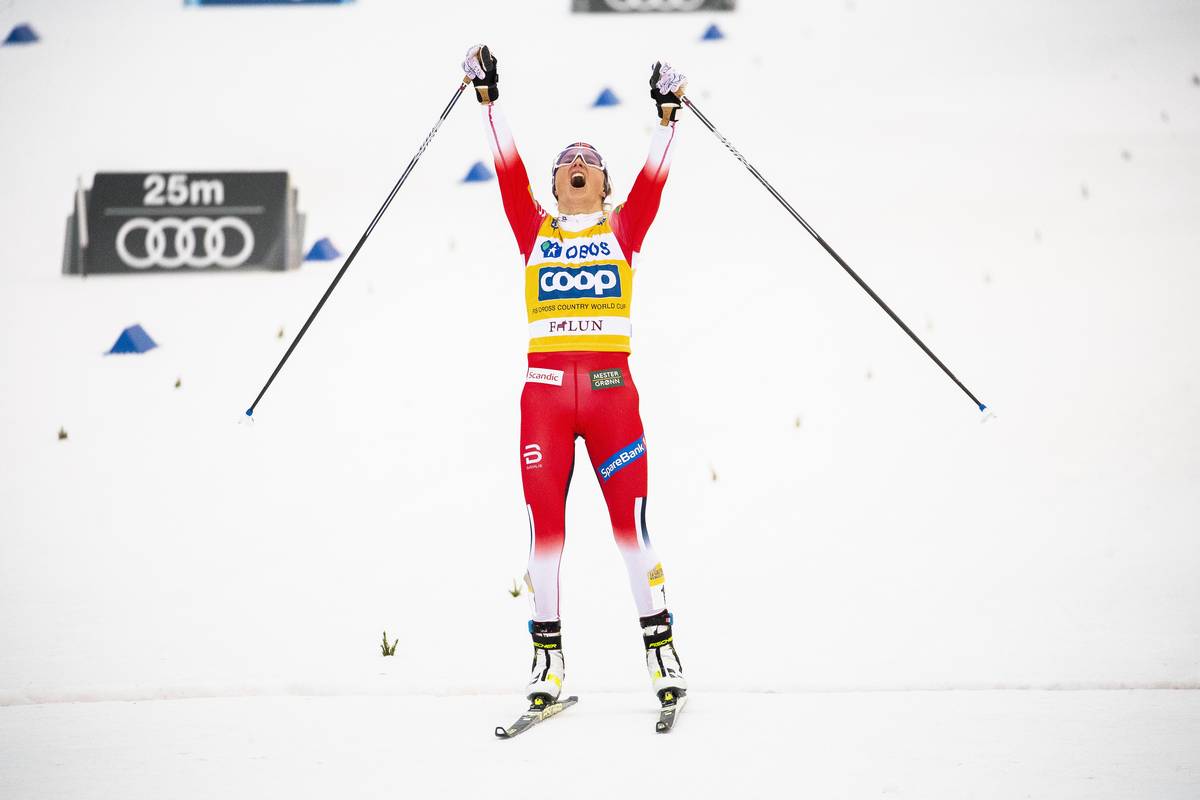
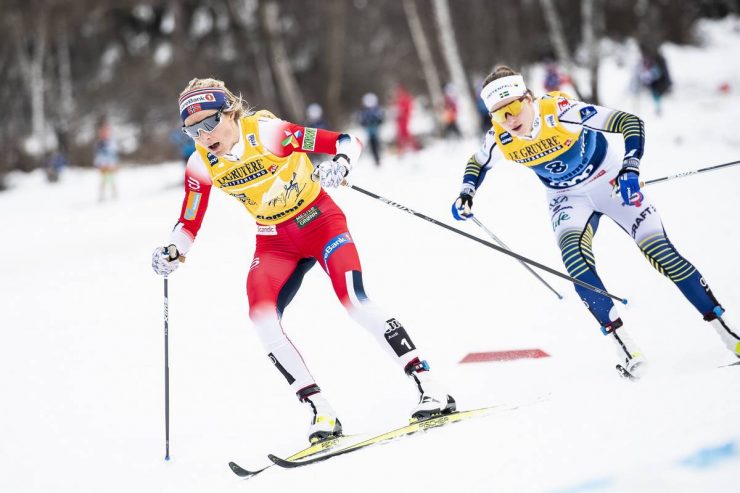
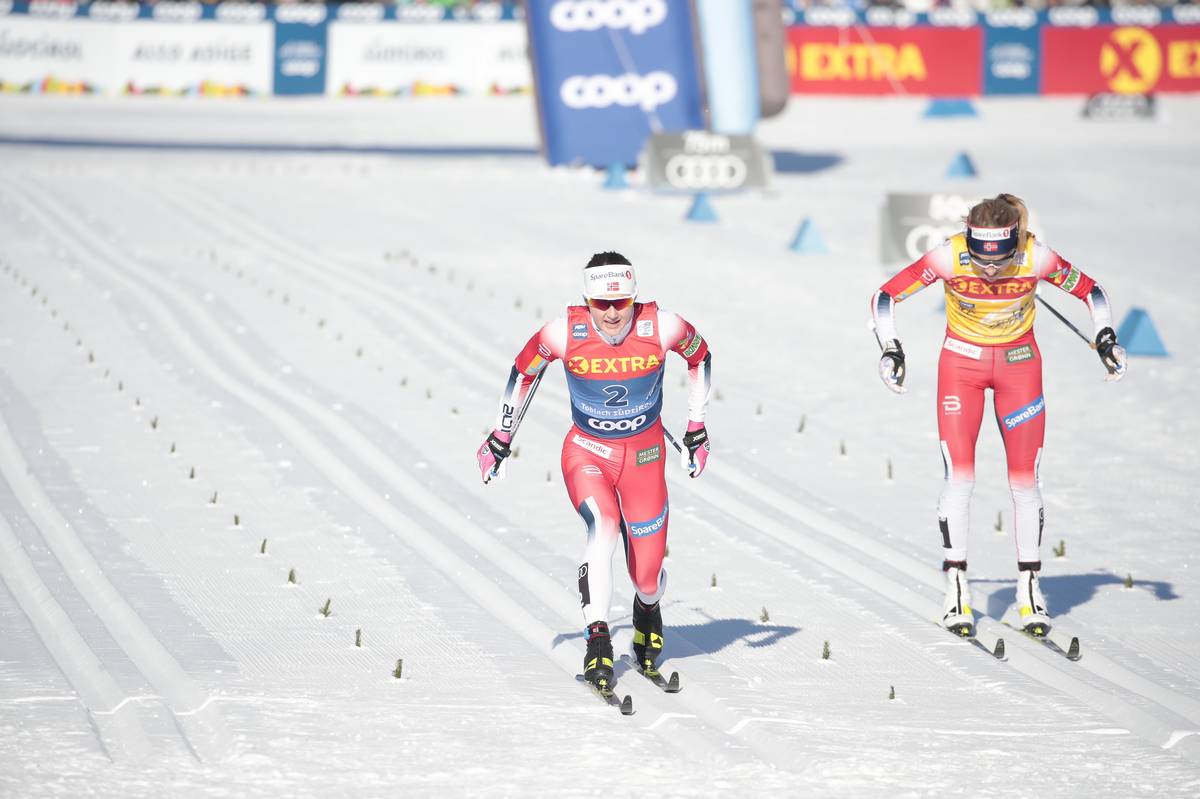
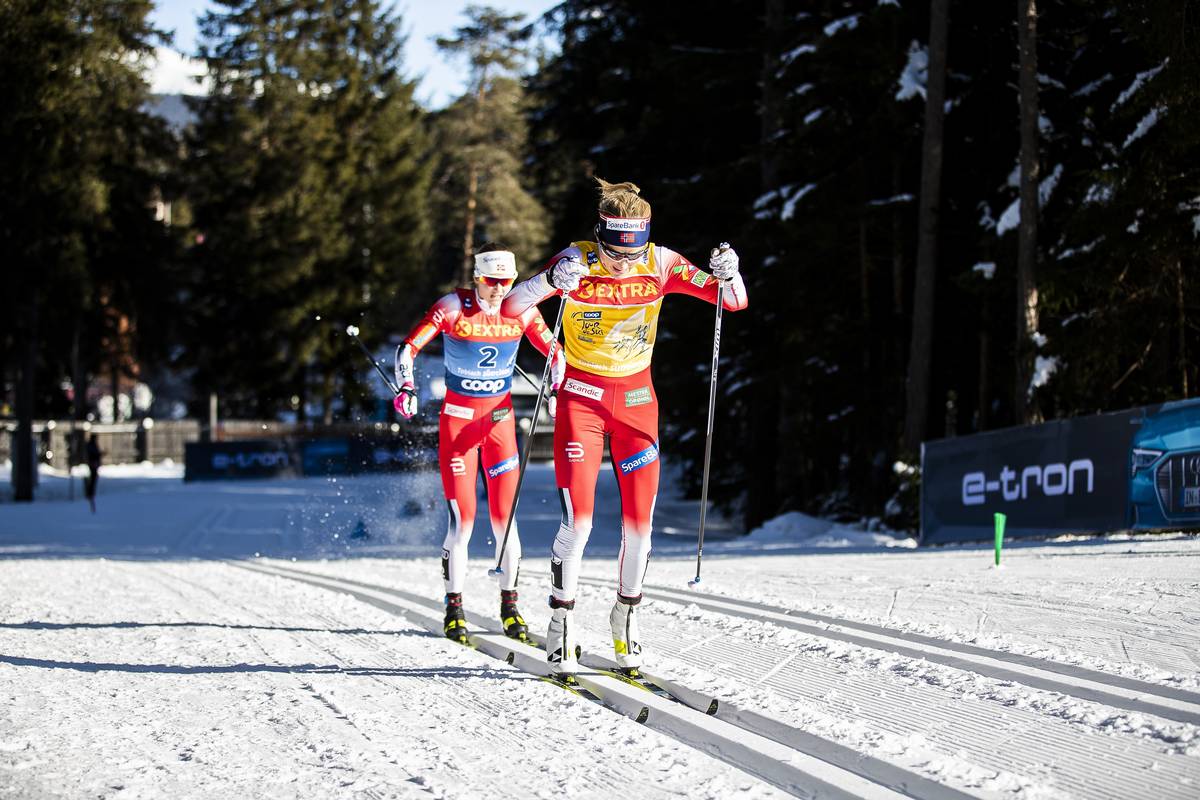
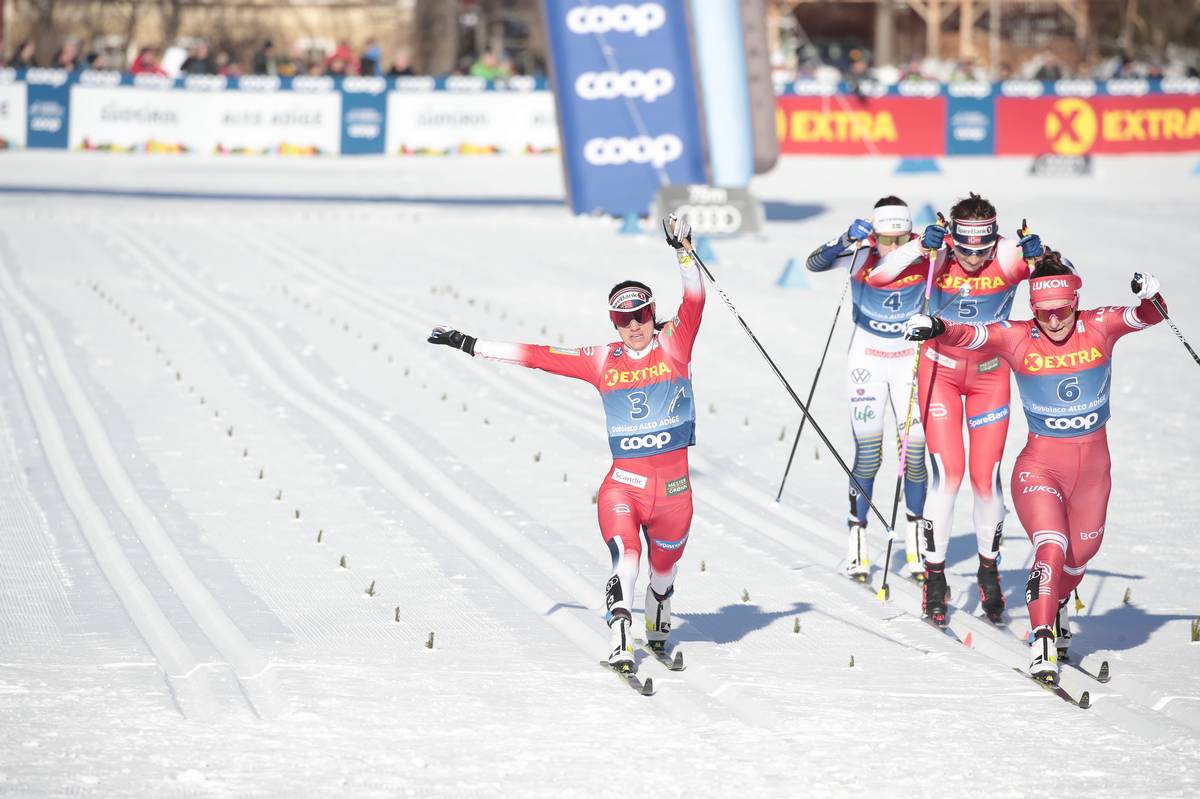
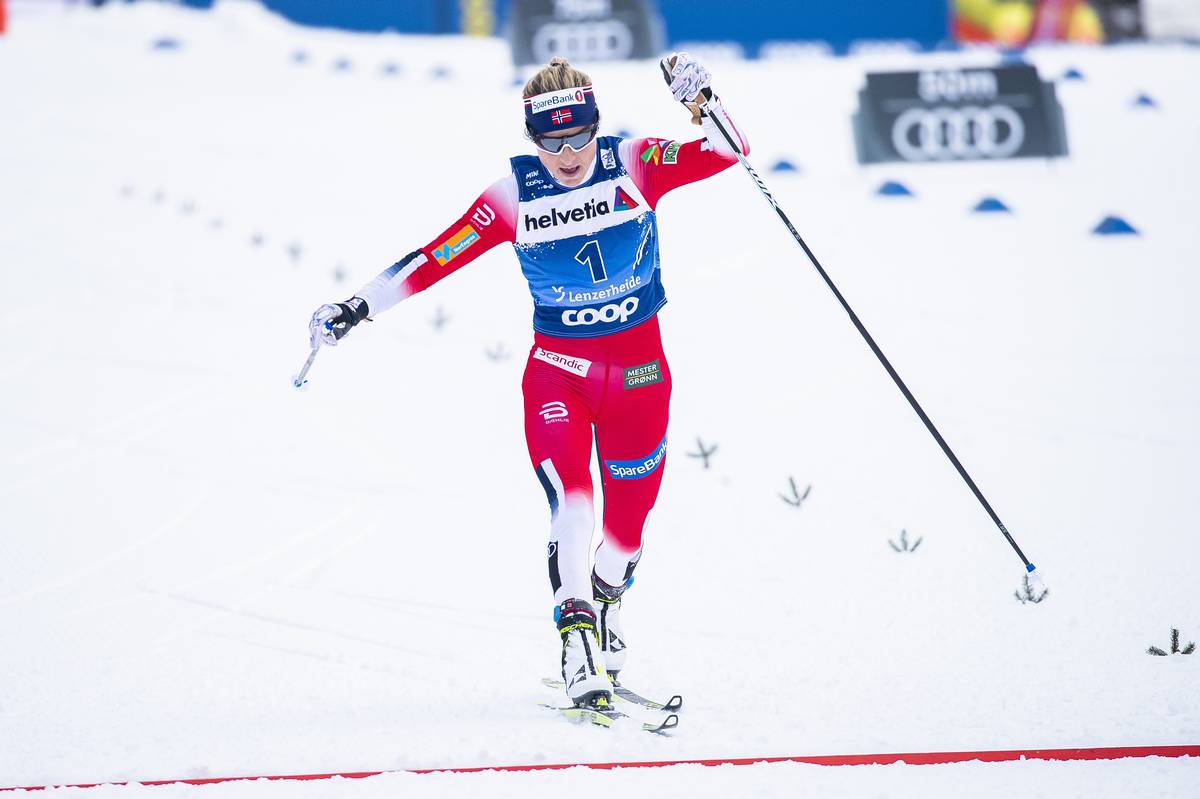
    Therese Johaug, untouchable during Stage 6 of the Ski Tour 2020. (Photo: NordicFocus)

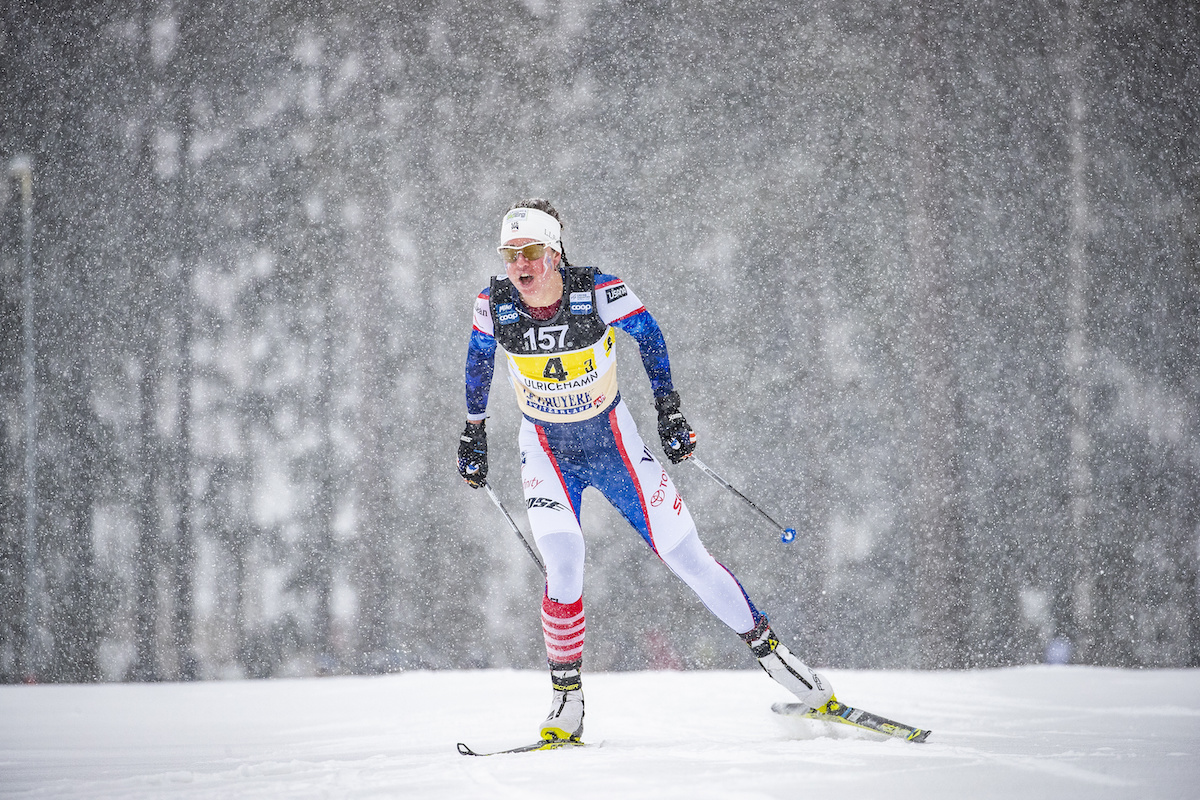
    We’ll start with the weather: think all over the place. A moving target for meteorologist with moisture spitting from the skies, and air masses swirling this way and that making the trees sway like a mamba line along the course. A wax tech’s nightmare scenario? Yes. It certainly trended in that direction.  

    By all measures, this was Therese Johaug’s, Norway’s latest version of a cross-country skiing record-breaker, stage and tour. Of six stages total, she won five outright, with the lone exception, Saturday’s Stage 5 classic sprint in Trondheim.

    Stage 6 featured a 15 k classic pursuit. Call it a pursuit, however, on the race’s sharp end, this was a runaway. Although the field was, in theory, pursuing Johaug, she simply put more time into her challengers on Sunday. She began 2:33 ahead of Norwegians Heidi Weng in second, while Ingvild Flugstad Østberg set off another second back. 

    Johaug expanded her lead at the finish, by over a minute, to Weng and Østberg. Johaug won the pursuit in 41:13.8. Weng placed second (+3:40.8) with a slight gap over Østberg, who toed the line 0.7 seconds further back. Sweden’s Ebba Andersson, the day’s fourth starter at 4:48, lost time to0, finishing 5:54.3 back to end the Ski Tour in fourth overall. 

    “I felt really good today and the waxers had done a really good job the whole Ski Tour and today as well I have the perfect skis,” Johaug told FIS after the race. “When the skis are good and the shape is good I can just go out there and enjoy all the people that come here and cheering us.”

    As far as time of day, Johaug took that prize as well. However, Norway’s Astrid Uhrenholdt Jacobsen placed fifth overall and had the second-fastest race time, 44.8 seconds off Johaug’s winning mark. Krista Pärmäkoski of Finland notched the third-fastest time of day (+1:04.4). 

    Jessie Diggins of the U.S. was the top placed North American in sixth (+8:40.1). (She skied the 17th fastest time of day.) 

    “Today, like yesterday, was a crazy day in terms of weather and waxing. It kept snowing on and off, the sun coming out and then the wind picking up as more snow came down! I was pretty much skiing an individual start race as I was alone the entire time, but I was really proud of my pacing and efforts as I held my placing without anyone to work with. There was a really tricky time in the middle of the race when the skis weren’t kicking very well (for much of the field, I think) but I was able to refocus and reset and keep pushing as hard as I could.

    “As for the overall tour, I’m really happy with my efforts and how I hit my goals for every race. One of my big goals was to see each day as an entirely separate opportunity and to not put pressure on myself for the overall tour, since there are so many factors that I can’t control that play into that placing. But by hitting my own process goals for each race and staying consistent I was able to have a tour that I’m proud of.

    “I’m really proud of our tech team and coaches for their tireless efforts day in and day out through this tour. It’s been exhausting but they’re the hardest working guys out there!”

    Sadie Maubet Bjornsen ended her tour in 10th (+9:43.8). With the big time gaps, the second wave of skiers (the mass start) began with Pärmäkoski in bib 13, starting at 8:08 back. Maubet Bjornsen (bib 12), began 16 seconds ahead and was the initial target of the wave starters. Maubet Bjornsen held off a charging Pärmäkoski for over 5 k. 

    “Wow, I made it!! That was one heck of a tough tour! Things were looking mighty rough to begin with, but I knew I had to just keep fighting and believing!,” Maubet Bjornsen emailed. 

    “But among some challenging times, there were some glimmering hopes in there. Tours are my favorite types of racing, because you have to be so resilient and such a fighter. Day after day, you have to put your fatigue and emotions aside, and just stay so positive. 

    “The tummy troubles at the beginning of the tour were particularly tough! It was scary to start a tour so depleted, but I was thankful we had our nutritionist, Susie Parker Simmons around to help me stay on my feet! From there it was just a matter or fighting for every second from there on.

    “Today was a totally wild scene! Conditions were constantly changing, and it was hard to find the perfect skis! I knew the name of the game was to just keep fighting, because everyone would be struggling at some point out there. I managed to find something to work, and went through some highs and lows out there in the 15k which brought me to 10th overall in the tour! I’m super happy and satisfied with that, given the little fatigue hole I had to crawl out of this past month. Thank you to our team for helping make a tricky classic day at the finish of the tour possible to fight with the others. 

    “I’m looking forward to taking a rest now, and finding the energy to finish the end of the season strong, for the third tour of the season. 

    “Thanks to the Ski Tour 2020 for bringing some different types of racing. While it wasn’t always the best type of races for my strengths, it was so refreshing to visit some new locations with some different types of events! These are some of my favorite memories this season! 

    “And of course, hugest thanks to the staff. We couldn’t race day after day like this without them!!! They are the heroes.”

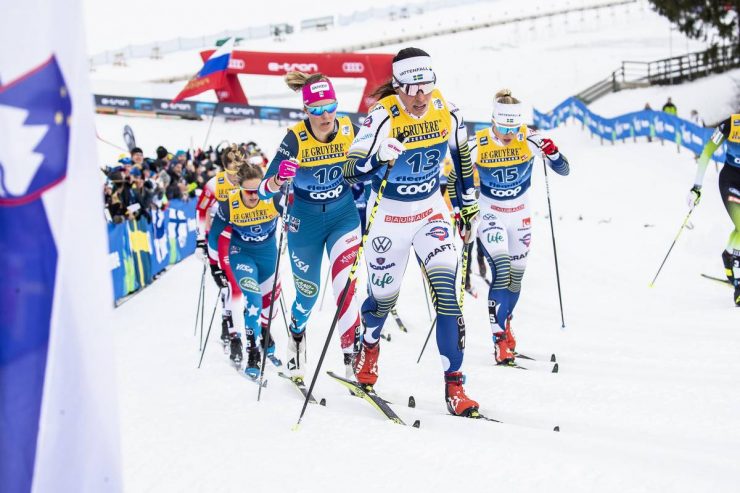
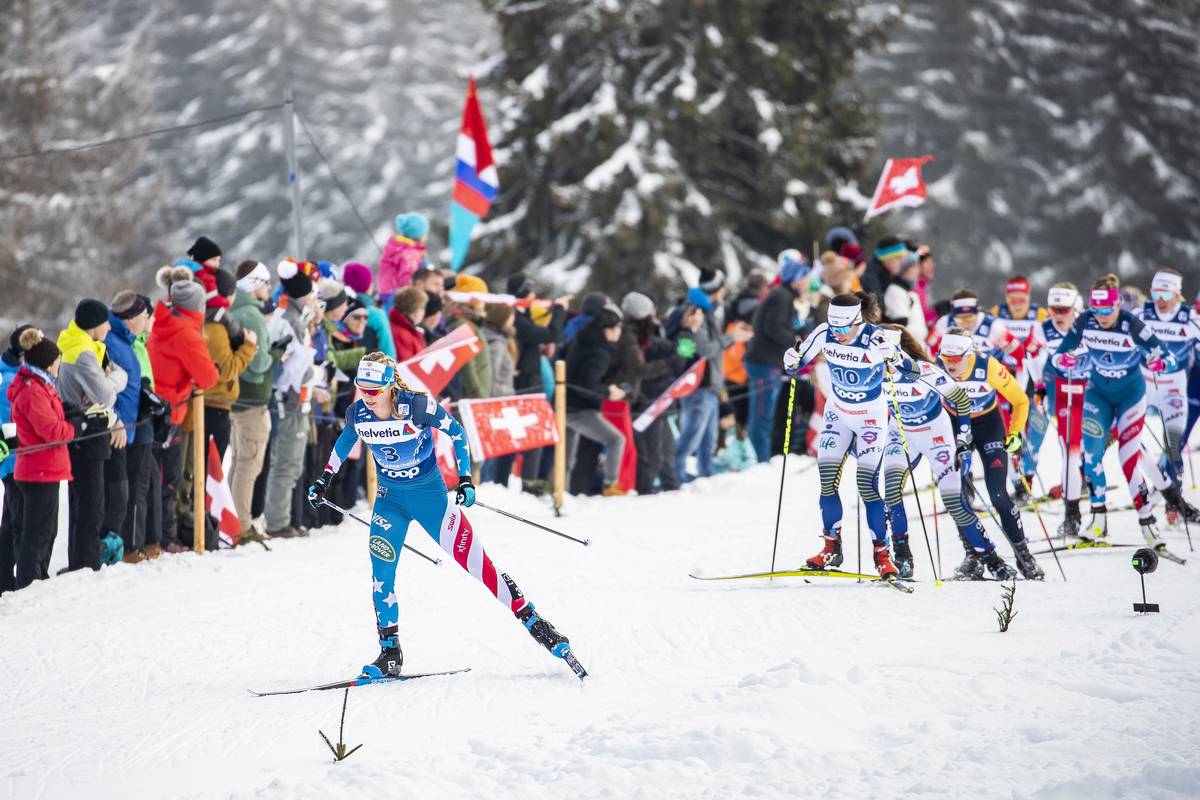
    Sadie Maubet Bjornsen (bib 12) racing to 10th overall in the Ski Tour 2020. (Photo: NordicFocus)

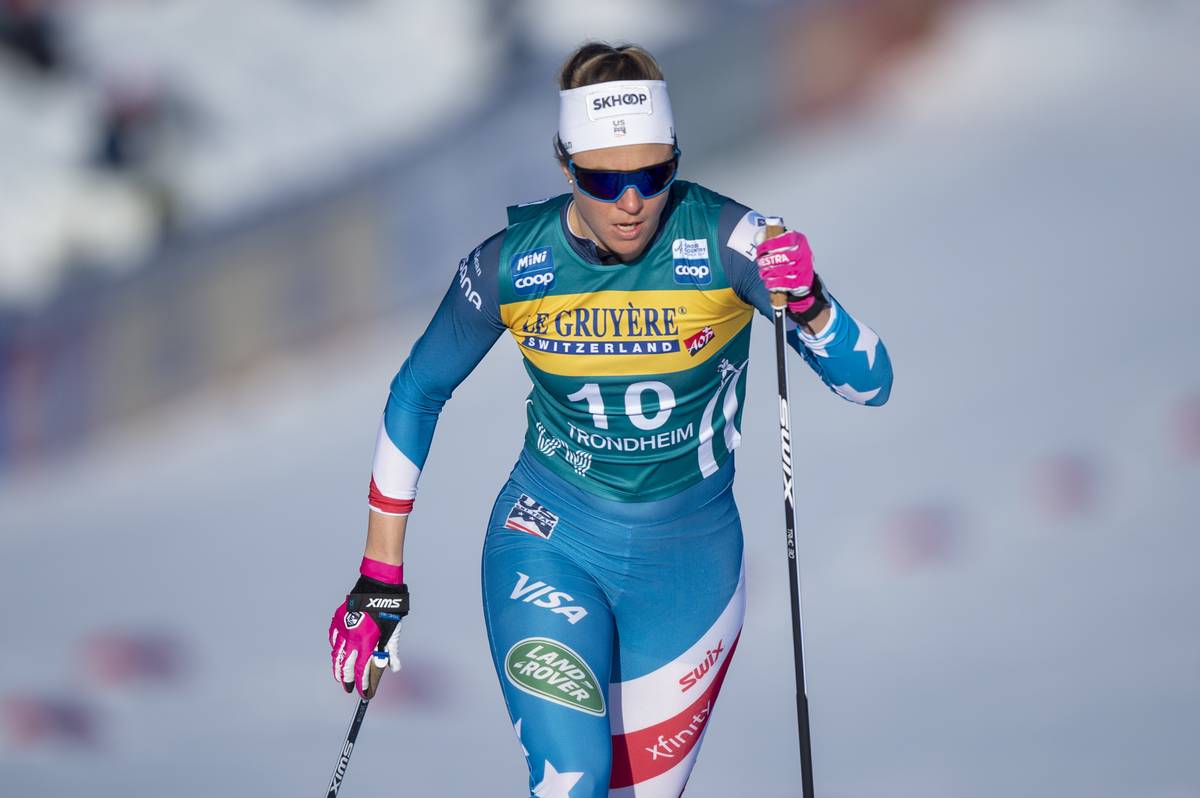
    Rosie Brennan, starting in bib 10, 7:27 behind the first starter Johaug, placed 12th (+9:53.3).

    “Today was a very challenging day,” Brennan wrote in an email. “Due to the massive time gaps in the overall, the wave started at bib 13 so I had a big pack starting not too far behind. The conditions were very challenging with snow, sun, rain and everything in between and some very icy tracks. I did my best to stay in front of the wave but just didn’t have the skis or the energy to make it happen today. I am very disappointed in myself. After having a great tour, it was hard to end on this note, but I am doing my best to look at all the positives from the tour as a whole and make a nice little work list to improve on the things that were so tough today.”

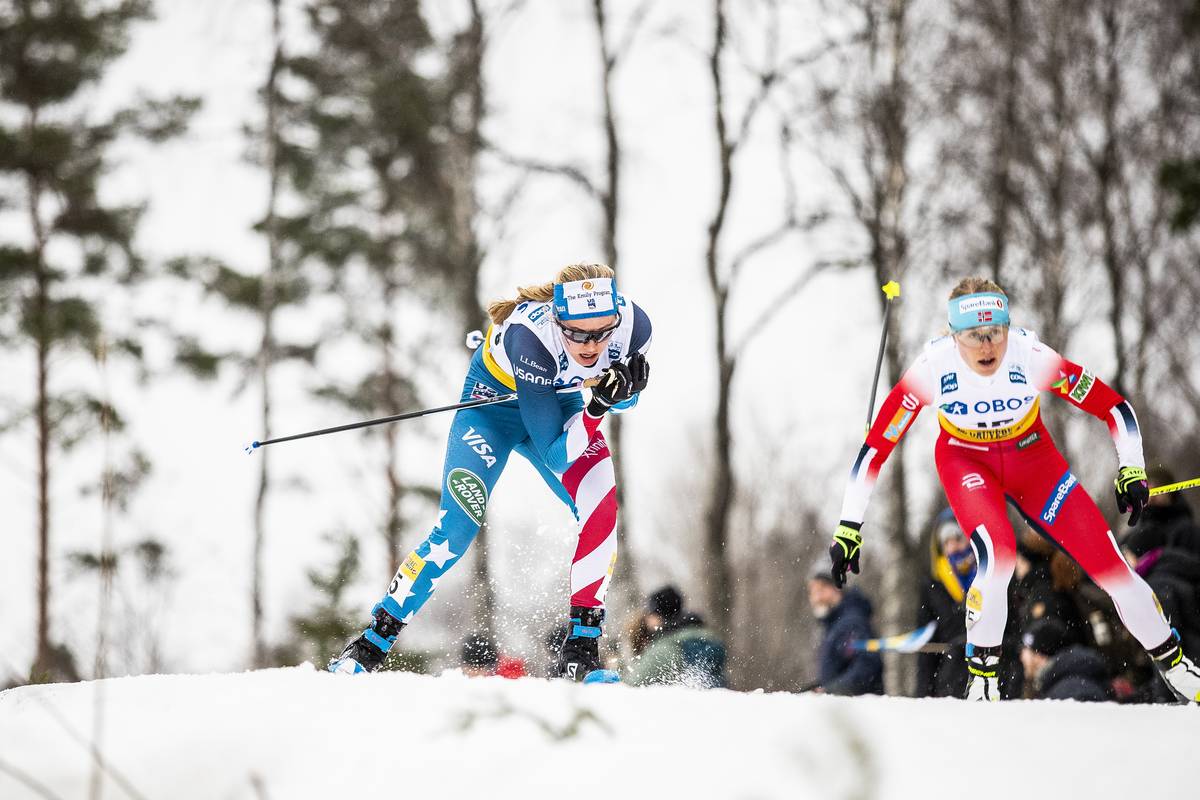
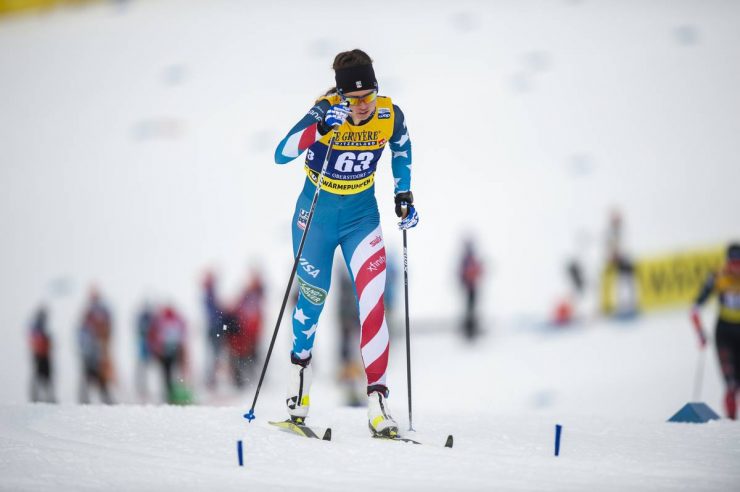
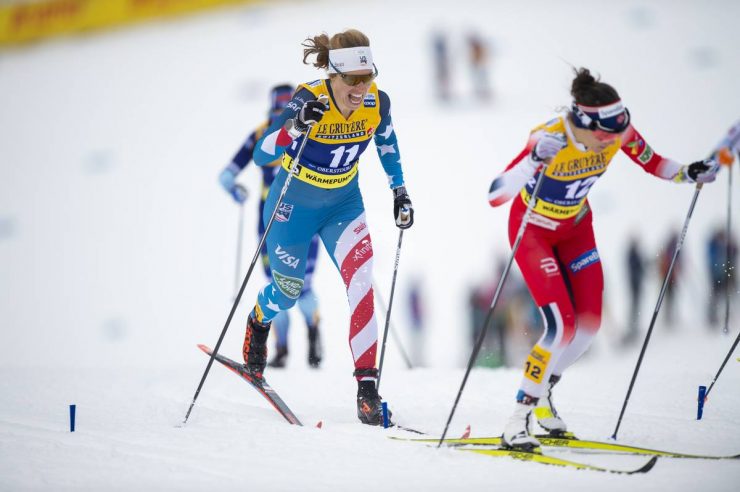
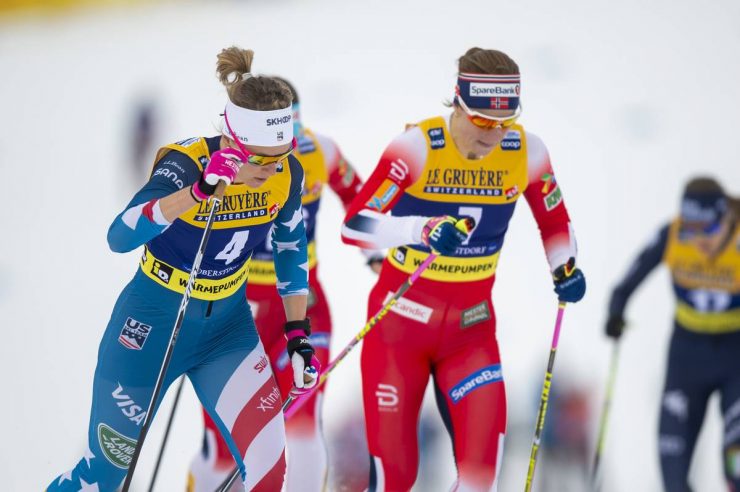
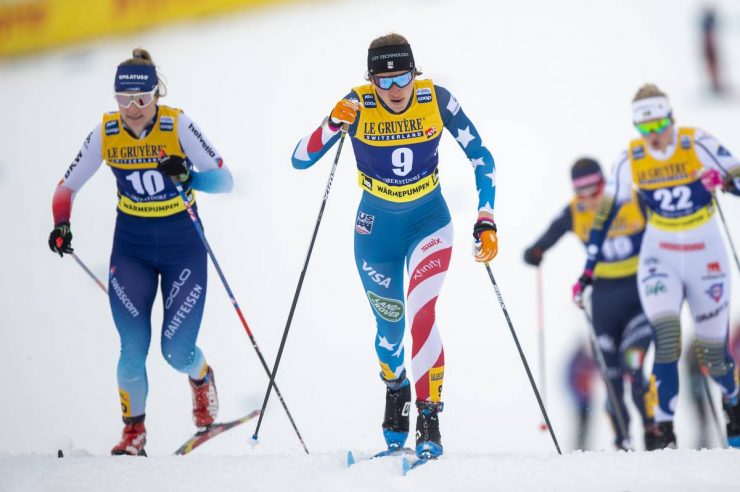
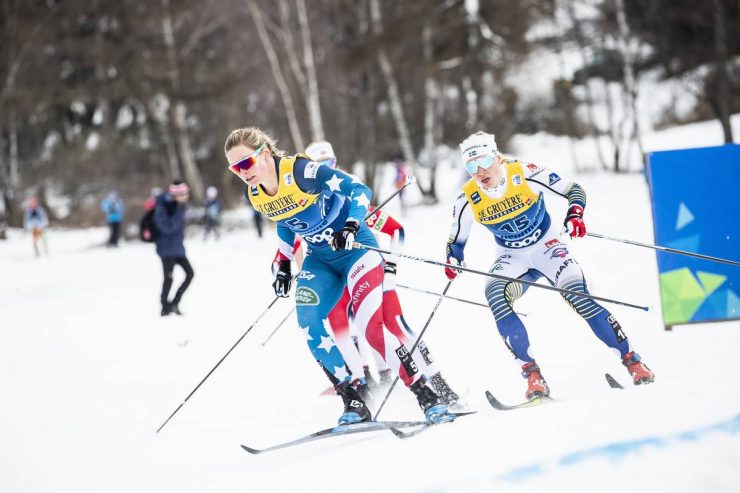
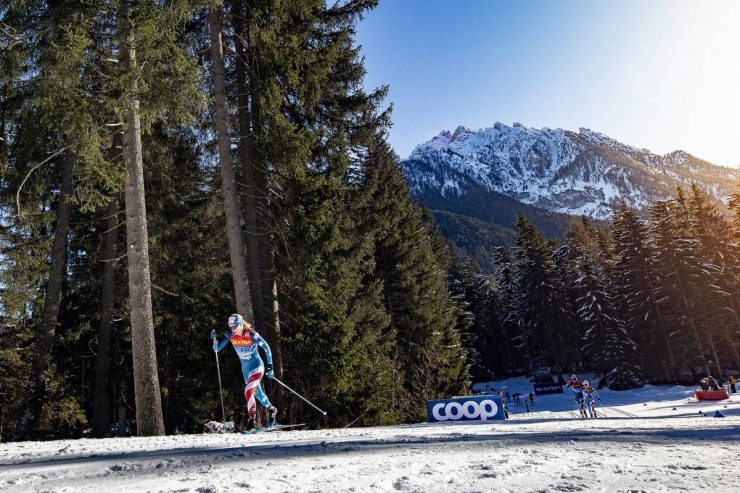
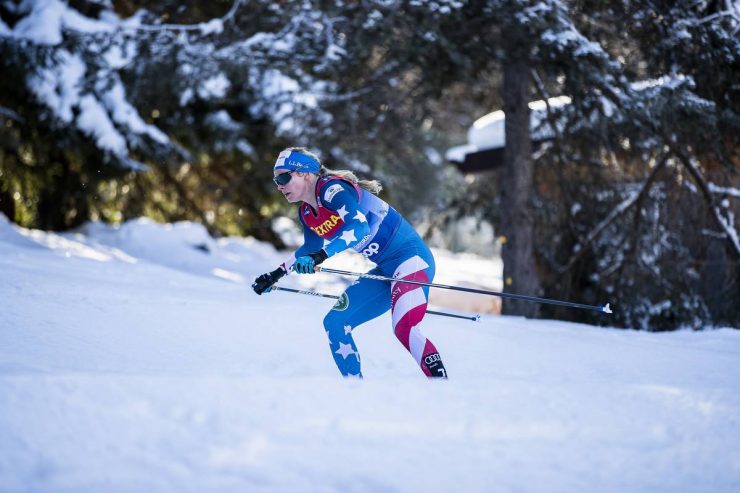
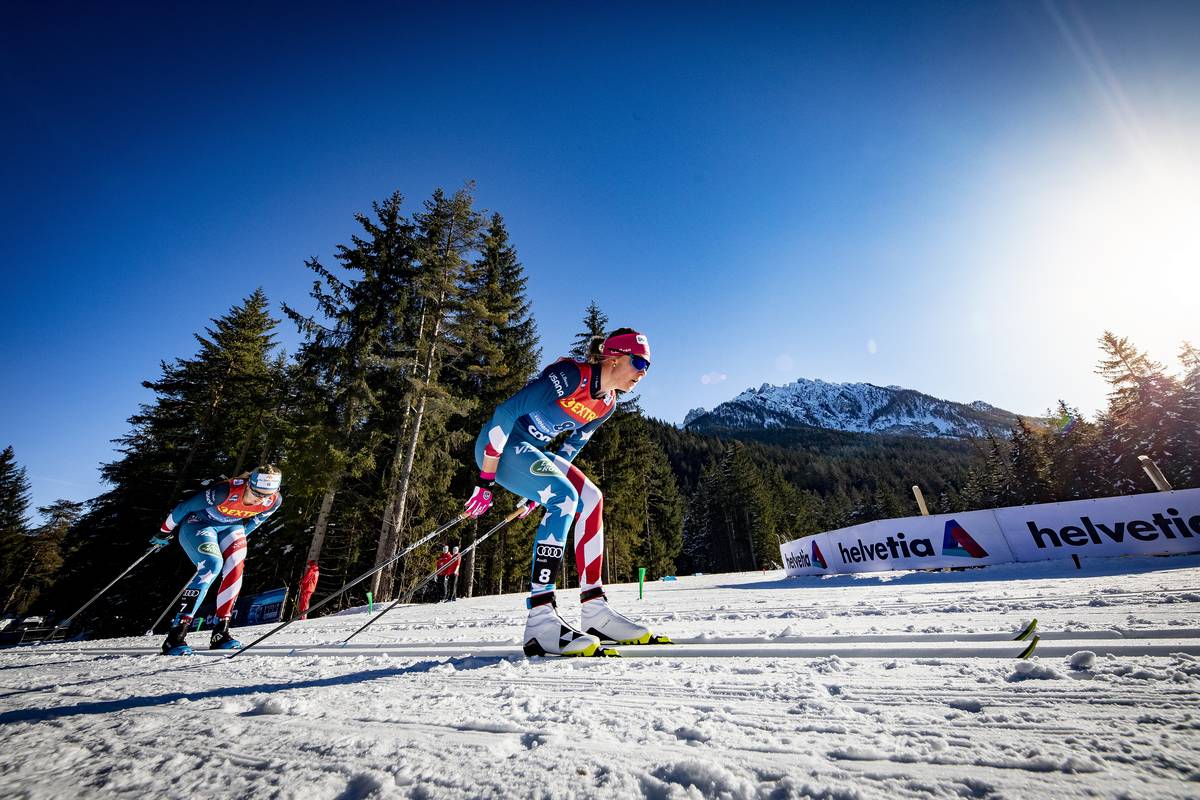
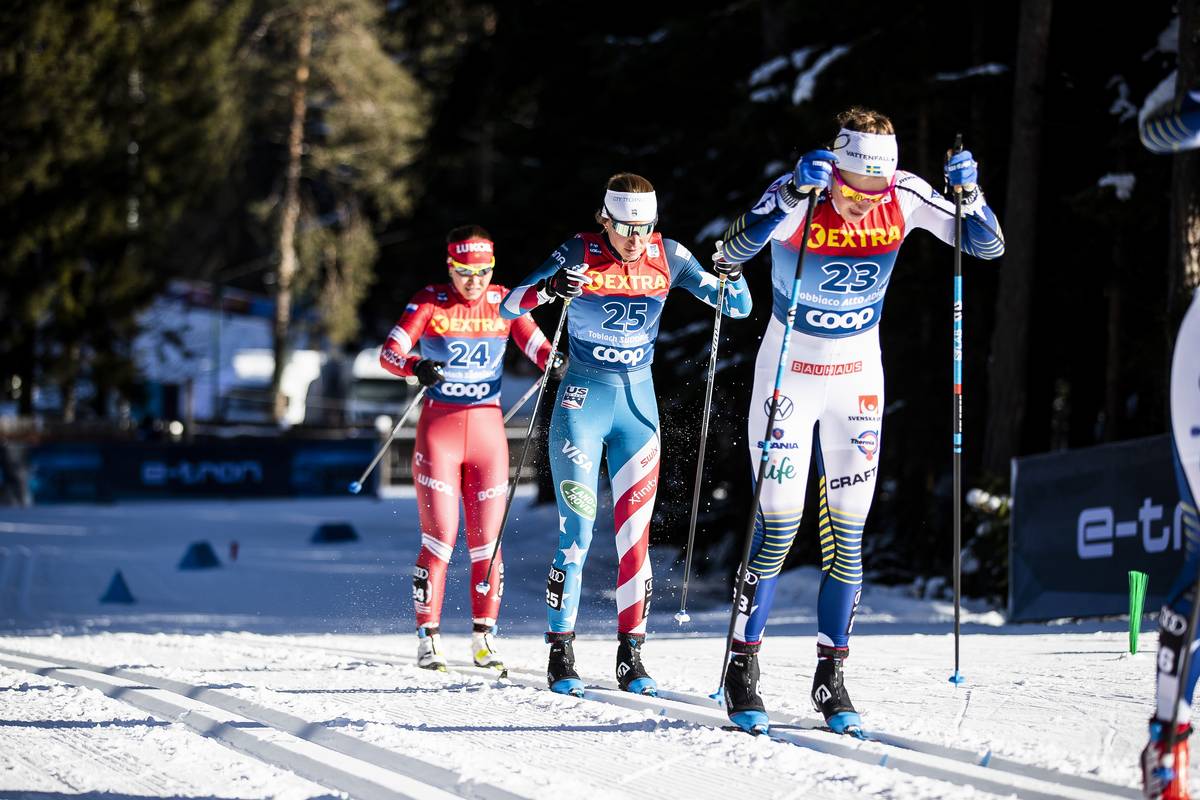
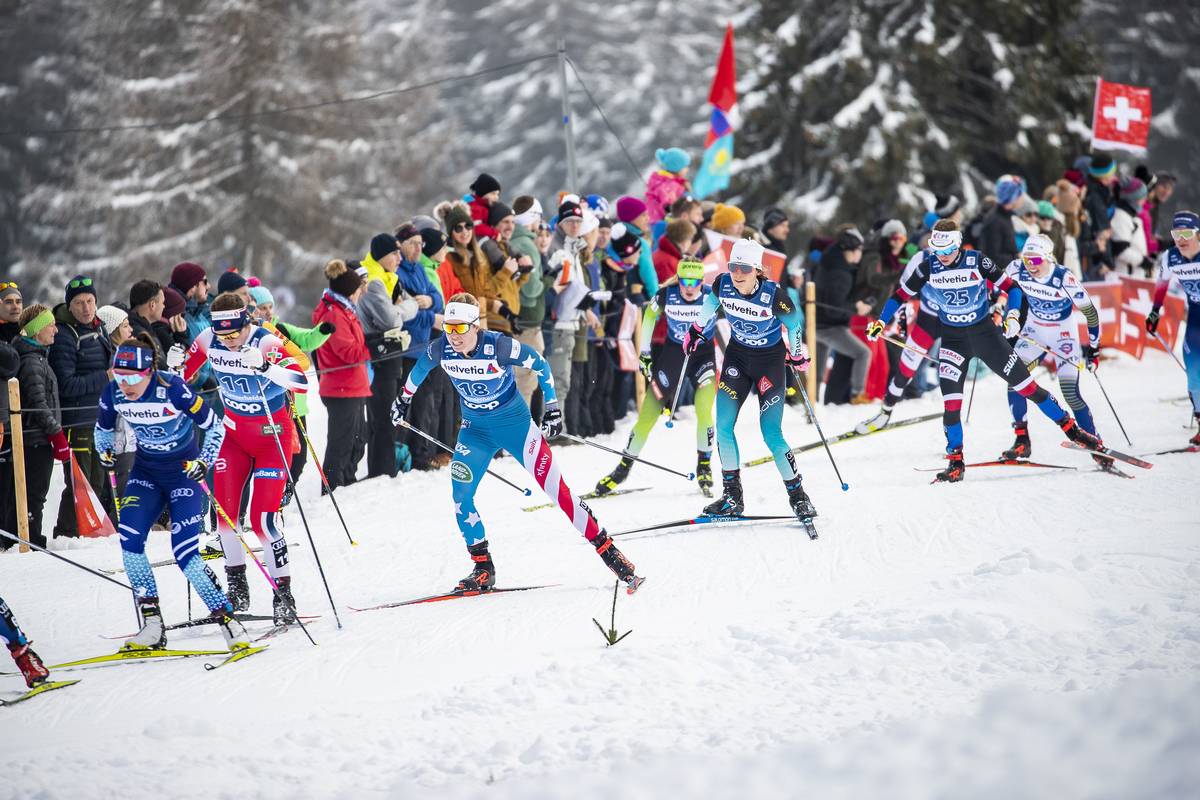
    Rosie Brennan (stars and stripes) during Stage 6 of the Ski Tour 2020. (Photo: NordicFocus)

    Also for the U.S., Julia Kern placed 30th (+14:51.4), Caitlin Patterson 36th (+16:38.4), Katharine Ogden 42nd (+20:26.6), Rosie Frankowski 43rd (+20:36.7), Sophie Caldwell 44th (+21:41.2), and Alayna Sonnesyn 48th (+24:34.6). 

    Canada’s Katherine Stewart-Jones placed in the points for the tour overall, by finishing 29th in the pursuit (+14:46.3). Cendrine Browne was 33rd (+15:47.5), and Emily Nishikawa 35th (+16:08.4). 
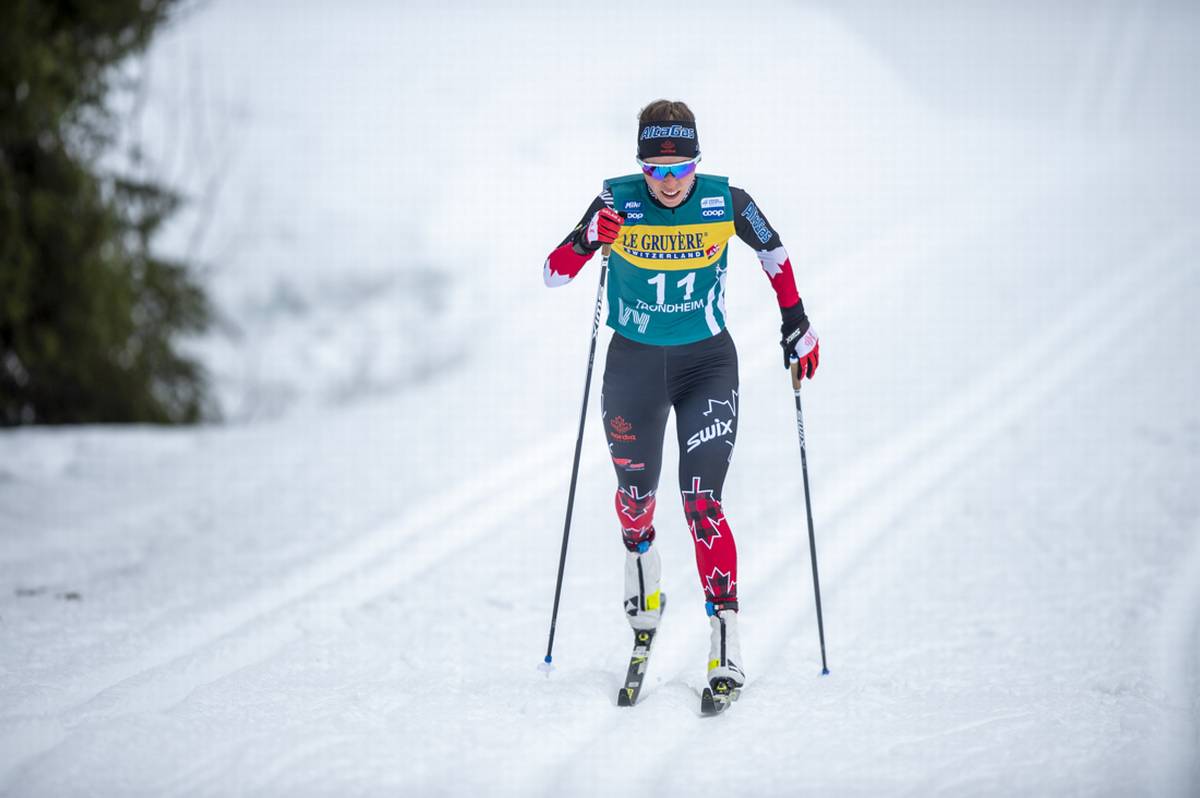
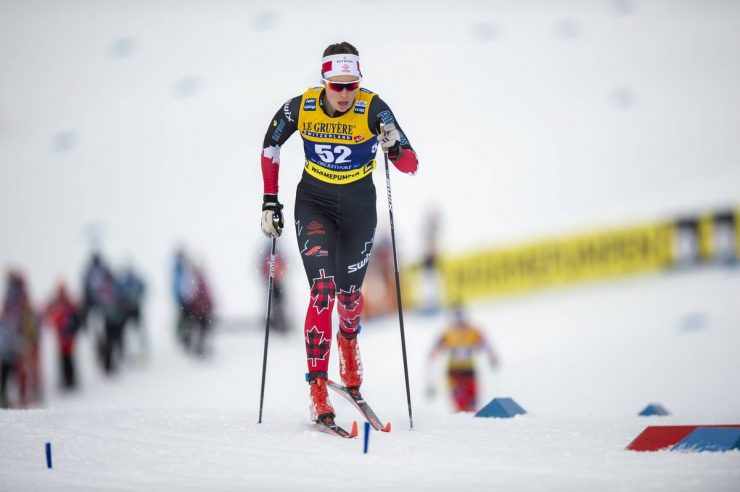
    Katherine Stewart-Jones during Stage 5 of the Ski Tour 2020. (Photo: NordicFocus)

    This stage concludes the Ski Tour. Racing continues in Lahti, Finland next Saturday. 

    Results | Overall Standings | Winner of the Day
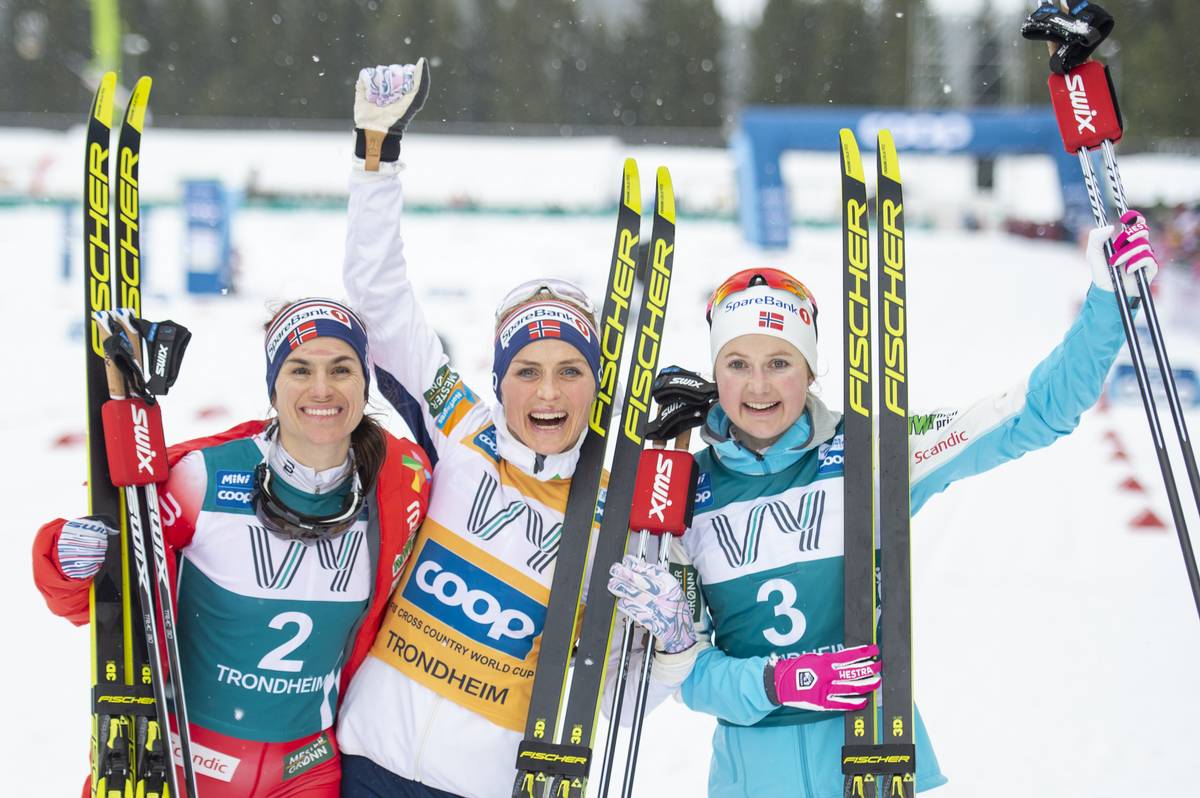
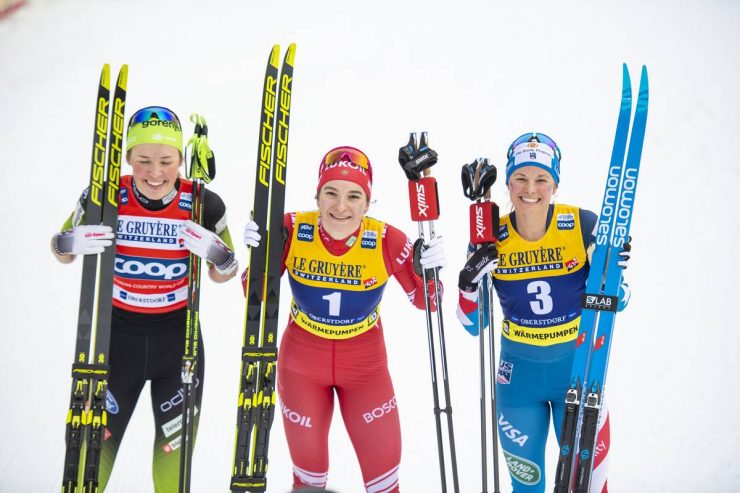
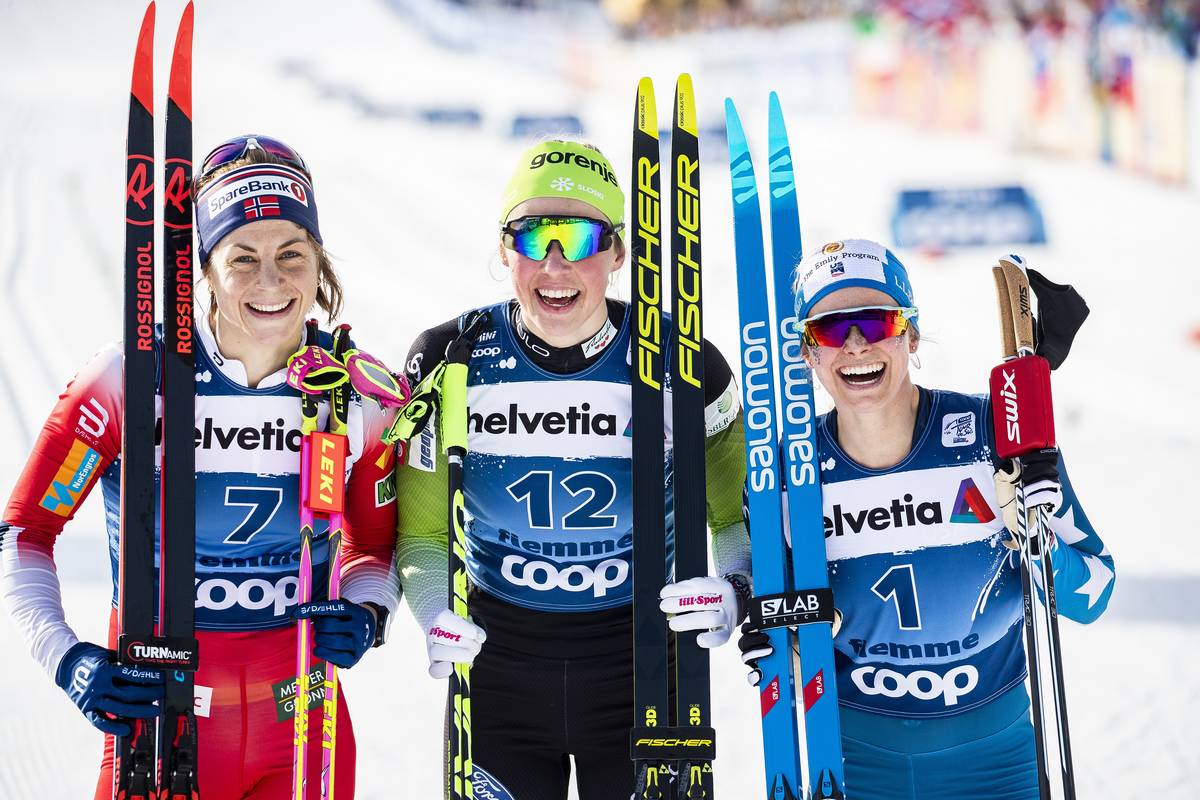
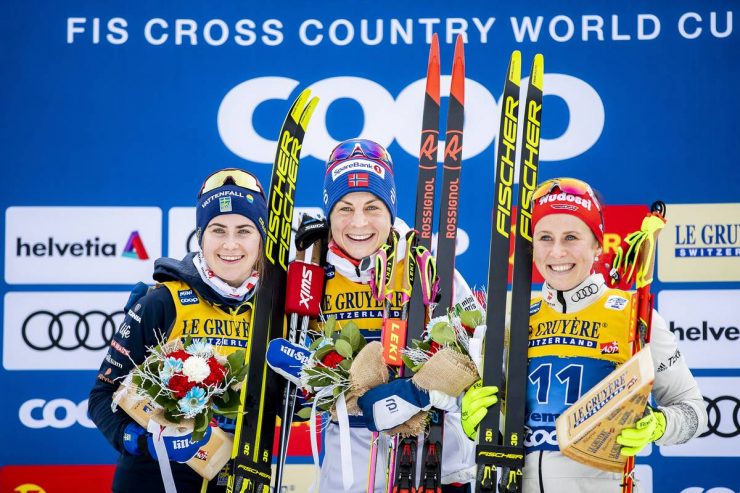
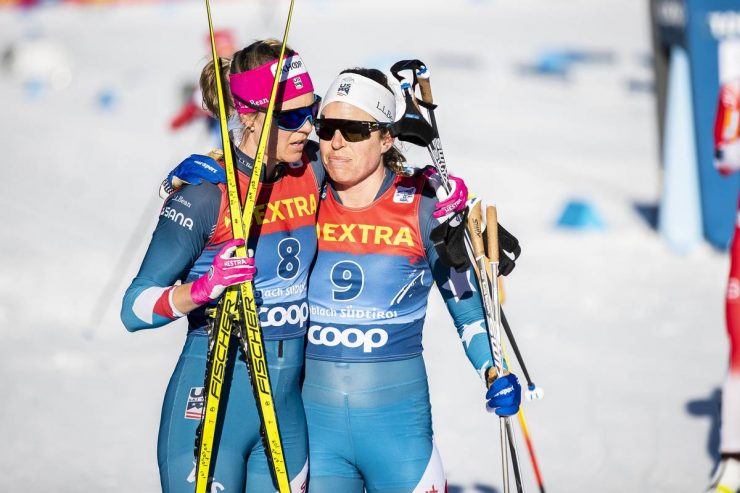
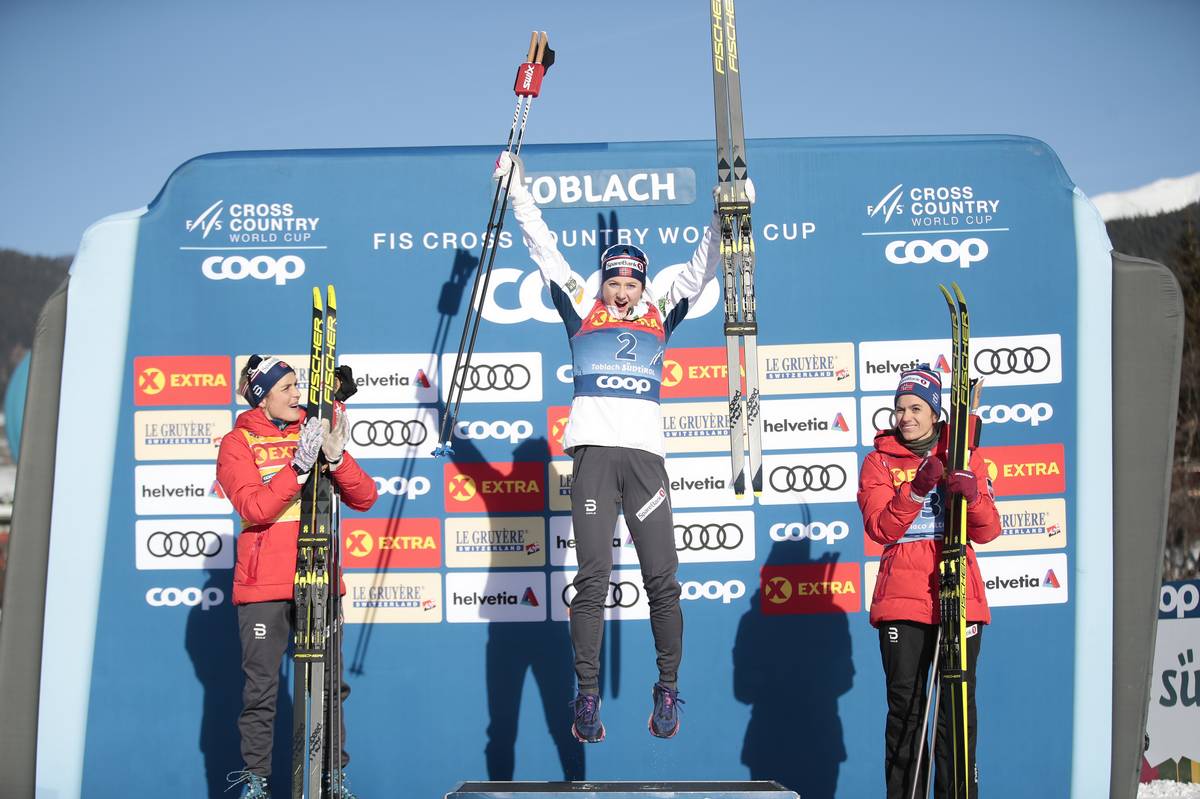
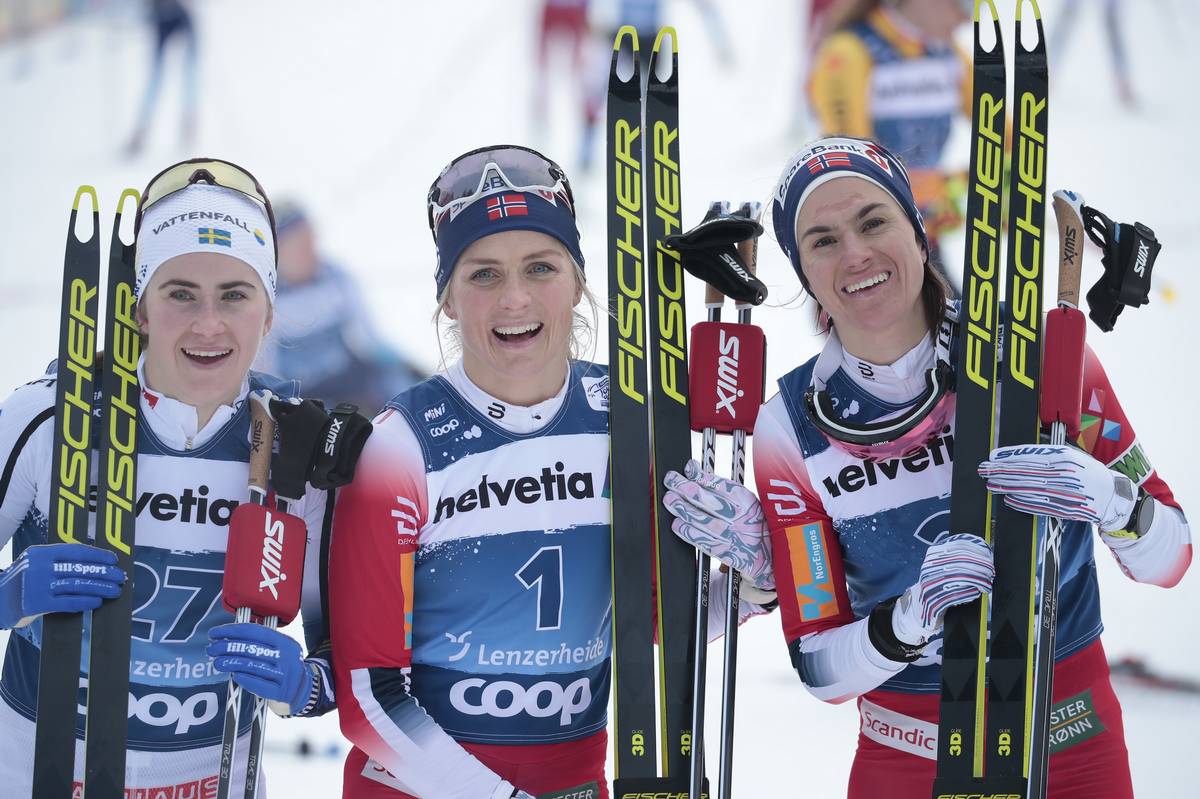
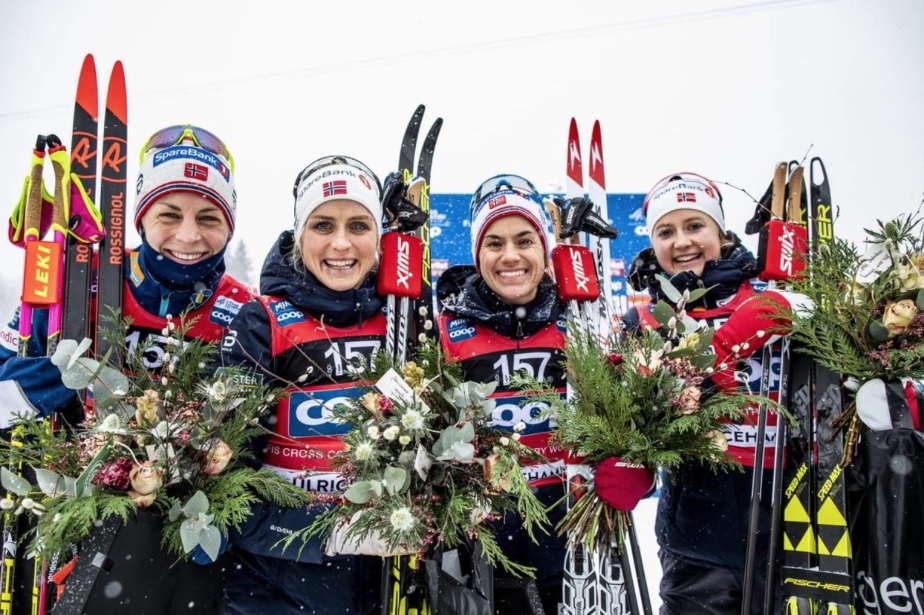
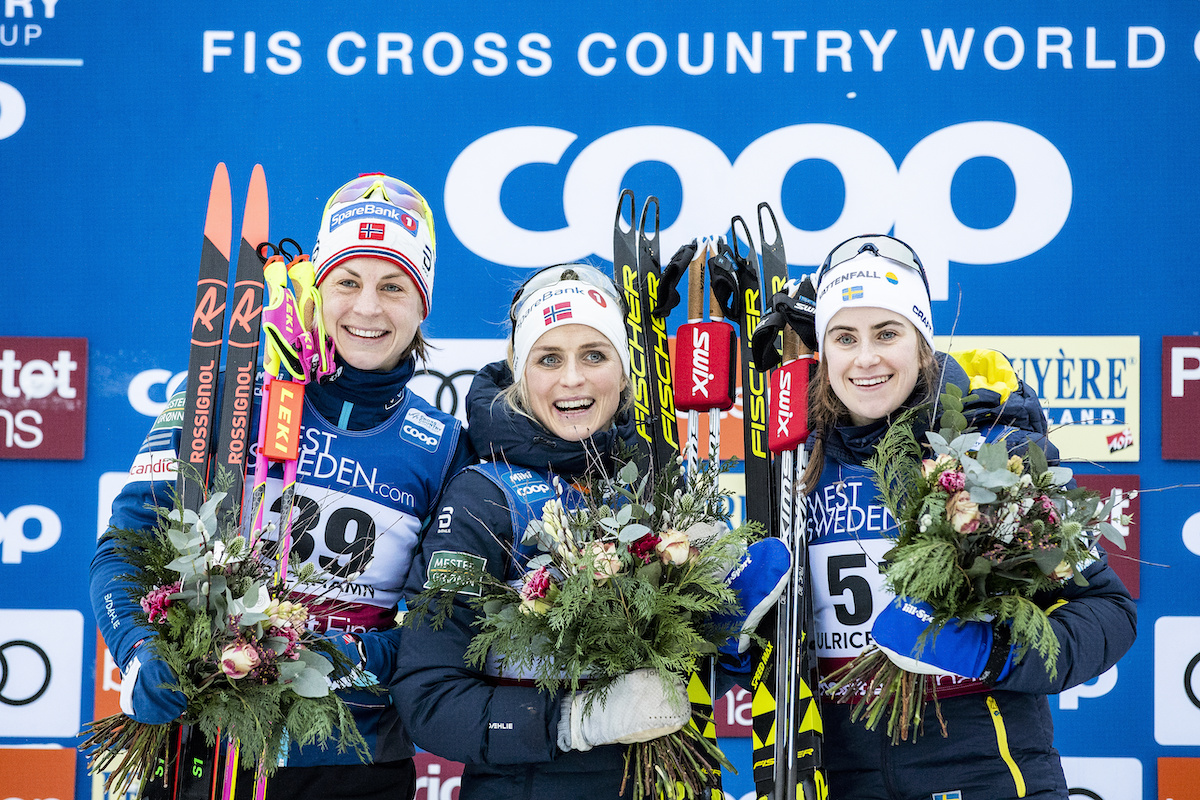
    The women’s Stage 6 and overall Ski Tour 2020 podium: Heidi Weng (NOR) in second, Therese Johaug (NOR) first, and Ingvild Flugstad Østberg (NOR) third, (l-r). (Photo: NordicFocus)
  • Falla Steps up For the Trondheim Win; Five U.S. Skiers in the Heats

    Falla Steps up For the Trondheim Win; Five U.S. Skiers in the Heats

    The day began in Trondheim with a centimeter of snow, which then transitioned to big blue skies for the thousands of fans attending the fifth stage of the Ski Tour 2020, a 1.5 k classic sprint. The Norwegians can throw a cross-country race party. The scene, despite the different setting, was reminiscent of the festive cowbell and camp-out sideshow of Holmenkollen’s Frognerseteren. It’s not quite the Yankee stadium of cross-country skiing, but a sign that in the hot-beds of the sport, fans arrive in droves. 

    The sprint course was more traditional, meaning this was no simple VO2 max test of an effort — that went down on Stage 3, in  Åre, Sweden as athletes ascended an uber steep alpine ski hill to close out that event. Trondheim’s classic sprint was bolstered by two punchy climbs on a three-terrace course, long and fast glide outs, and two speedy corners which swung skiers through a 180-degree direction change to keep it spicy.   

    Sweden’s Jonna Sundling laid down the fastest qualifying time in 3:22.75, shadowed by her teammate, Linn Svahn, 0.24 seconds back. Maybe, not surprisingly, Therese Johaug was the third-fastest qualifier, 0.83 seconds back. Johaug won her first career sprint on Stage 3 of the Ski Tour. 

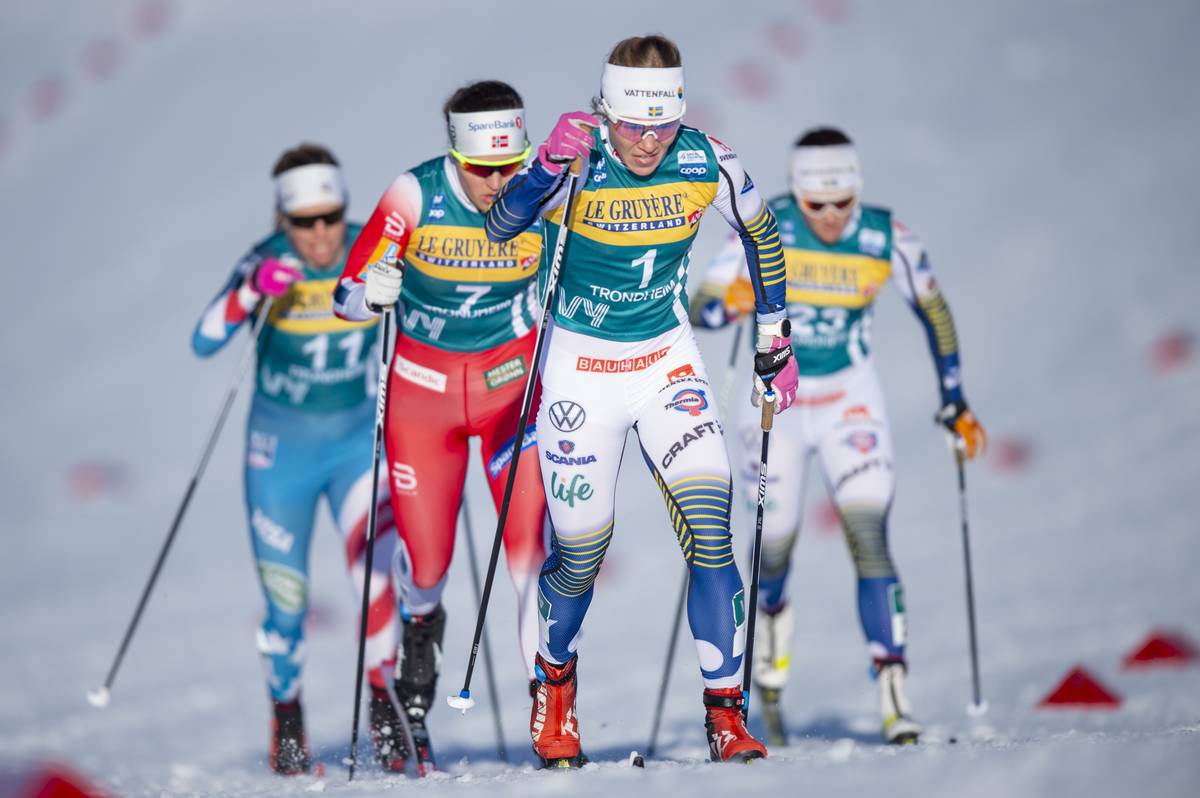
    Jonna Sundling of Sweden in bib 1, during her quarterfinal of the Stage 5 classic sprint in Trondheim, Norway. (Photo: NordicFocus)

    The U.S. packed five skiers into the heats. Sadie Maubet Bjornsen qualified in 10th (+6.20). Rosie Brennan in 11th (+6.34), Sophie Caldwell 15th (+7.32), Jessie Diggins 20th (+8.58), and Julia Kern 24th (+9.54). Yet the story on the U.S. women’s side ended earlier than their highwater mark norm, which is most often, representation in the six skier final. In no uncertain terms, this is the golden age of U.S. women’s cross-country skiing. A stars and stripes void marked the semis and final. No U.S. skiers advance beyond the quarterfinals. 

    In the third quarterfinal, Kern and Brennan lost contact with Sundling and Tiril Udnes Weng who came in 1-2, respectively. Kern was fourth in the heat (+3.7), Brennan fifth (+7.71). 

    Maubet Bjornsen and Diggins fell off the pace as well in the fourth heat, placing fourth and fifth respectively. Both were over four seconds off Norway’s Anna Svendsen’s pace of 3:19.34 who won that quarterfinal. 

    22.02.2020, Trondheim, Norway (NOR):<br /> Sadie Maubet Bjornsen (USA) - FIS world cup cross-country, individual sprint, Trondheim (NOR). www.nordicfocus.com. © Thibaut/NordicFocus. Every downloaded picture is fee-liable.
    Sadie Maubet Bjornsen during the Stage 5 classic sprint in Trondheim, Norway. (Photo: NordicFocus)
    “It was an extremely tricky weather day with a combo of rain/snow/sun, and everything in between,” Maubet Bjornsen emailed.
    “I was excited to put together a solid qualifier, but felt like a few adjustments would allow things to be even better for the heats. My body felt sharp and powerful, so I knew the key for me was to be quick out of the start, and do my favorite thing… ski from the front. I was quick out of the start, but struggled to hold the speed up the first climb. Since climbing is generally my strength, it’s unclear whether it was skis, body, or both that held me back. But, that’s how ski racing is. You can’t overthink anything too much, you just keep believing, and chasing away!
    “It is the tour of crazies for me, so I’m going to let it go, and look on to “the chase” tomorrow. With the tour ending with a 15k classic, I am sitting just outside top 10 overall, and really hoping to climb my way within that tomorrow. Let’s see if I can channel all amounts of frustration towards some constructive racing in the final day!”

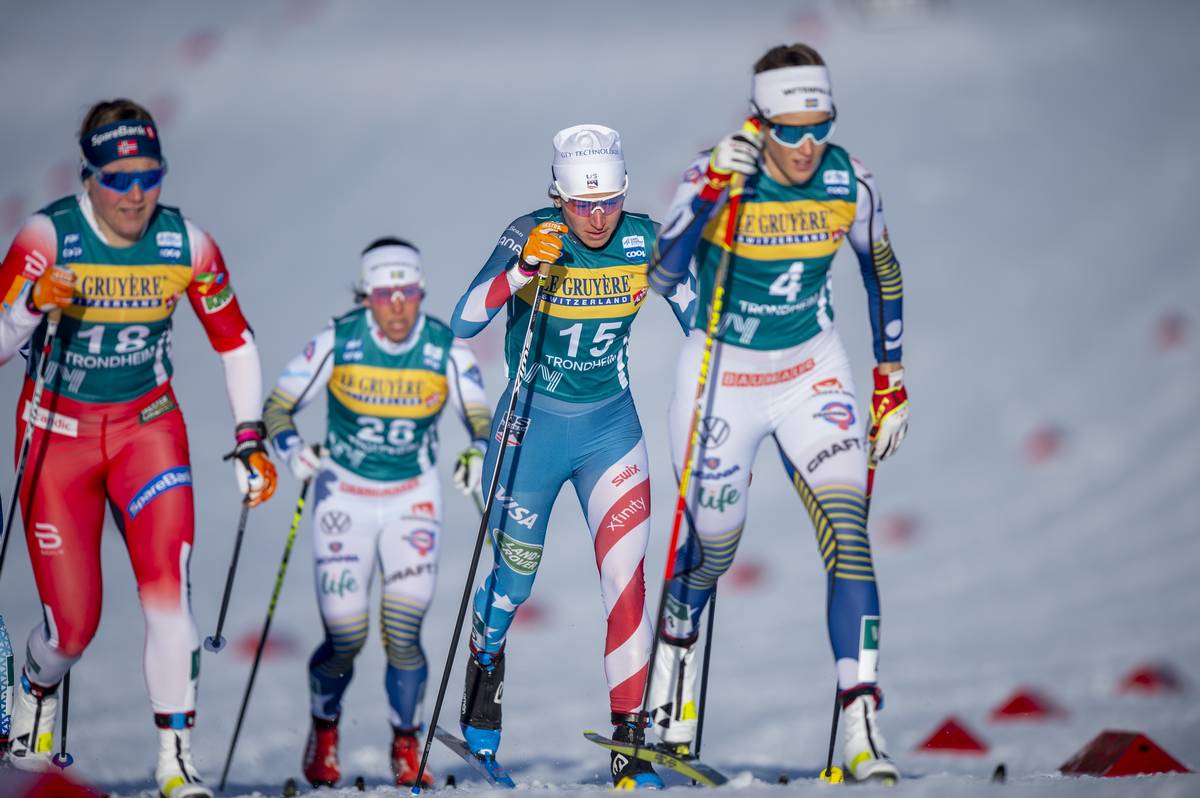
    The last U.S. athlete eliminated was Caldwell. She placed third in the fifth quarterfinal, 1.53 seconds back on Norway’s Heidi Weng in first. Caldwell placed 14th in the final standings, Maubet Bjornsen 16th, Kern 20th, Brennan 21st, and Diggins 23rd. 

    Sophie Caldwell (bib 15) during her quarterfinal in Trondheim: Stage 5 of the Is Tour 2020. (Photo: NordicFocus)

    Post-race interview with U.S. World Cup Coach Matt Whitcomb

    Wintry weather moved in during the men’s quarterfinals. The blue-bird scene morphed quickly into an intermittent snowglobe. With the swift winds swirling around the stadium, the snow squalls eventually moved on as the semifinals progressed. 

    The 12 skier field in the two women’s semis consisted of six Norwegians, four Swedes, and two Swiss skiers in Laurien van der Graff in the first semi, and Nadine Fähndrich in semi two.  Fähndrich kept Swiss hopes alive by advancing to the finals after winning her semi. 

    The first semifinal featured Norway’s Maiken Caspersen Falla and Sweden’s Sundling. These two athletes were the skiers to watch. For Falla, by her own high standards, this has been an offseason, as the young Swedish sprint team has pushed her aside for precious top-of-the-podium real estate. Falla won the opening World Cup sprint in Ruka, Finland, otherwise, it’s been a first-place void for the former Crystal Globe sprint winner.

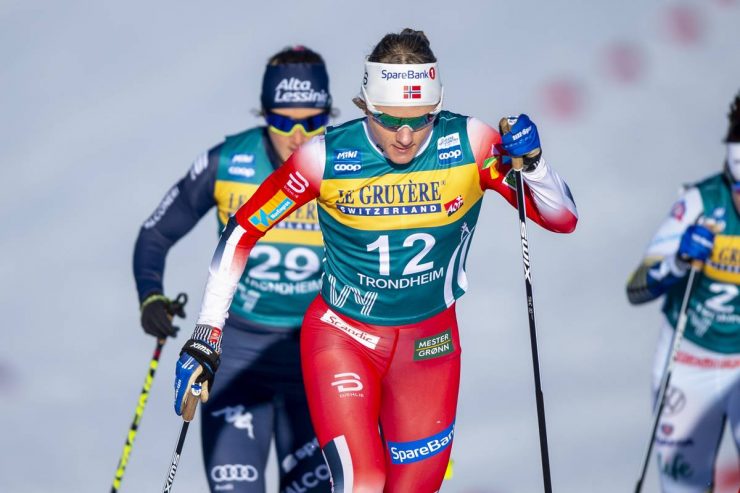
    In bib 12, Maiken Caspersen Falla strides it during her quarterfinal in Trondheim. (Photo: NordicFocus)

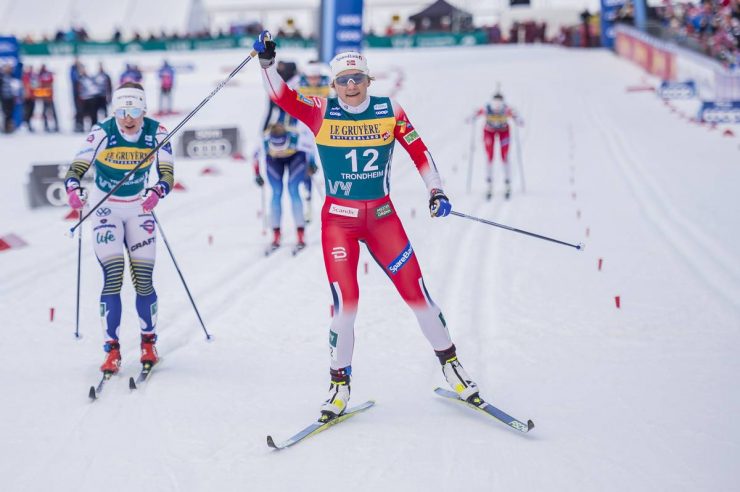
    In Falla’s semi, she and Sudling took first and second, respectively, with Astrid Uhrenholdt Jacobsen and Linn Svahn of Sweden in close contact, only a few tenths of a second back. In the final, Falla was locked in. Although at moments Sundling was side by side with Falla, the Norwegian dictated the decisive move off the front. Over the second climb, at roughly 2:25 into the race, Falla powered over the hill and into the glide out transition with only Sundling able to match two meters back. 

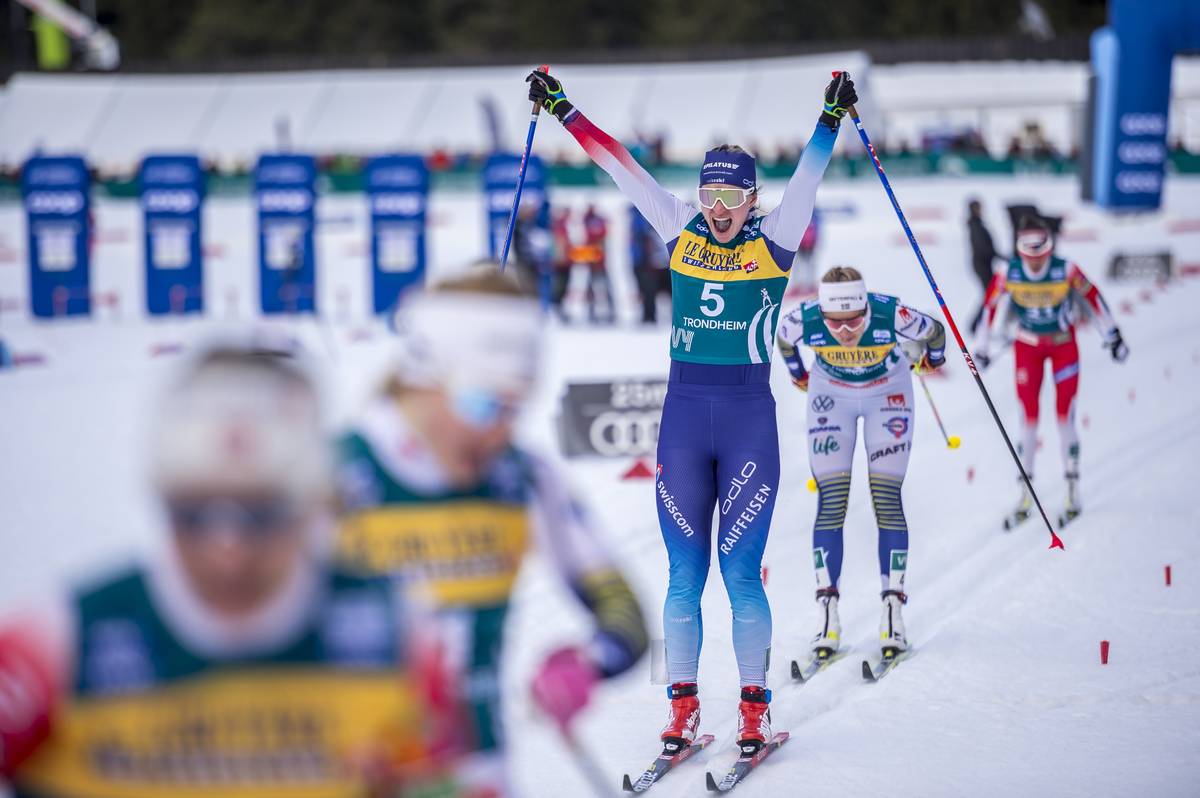
    Falla took the win in 3:15.55 with Sundling in second (+0.48). Fähndrich was third (+2.88), Anna Dyvik of Sweden fourth (+3.71), Svendsen fifth (+5.26), and Heidi Weng sixth (+6.64). 

    “This feels always like the [World Championships] so crowded and so many people screaming my name at the start and after the finish,” Falla told FIS after the race. “It’s an amazing atmosphere and I’m so happy to be here. There has been some hard distance races for me now. The 30 k and also 10 k was really hard so I’m really happy that I stayed in the tour, didn’t go home and got this opportunity to win here and race in this amazing atmosphere.”

    This was Falla’s 21st individual sprint win. She sits second overall in total World Cup sprint wins. Marit Bjørgen of Norway still reigns with 40 World Cup sprint victories. For Fähndrich, this was her second career individual podium. Prior to her third place on Saturday, the Swiss skier posted up a second place in Cogne, Italy’s 2019 10 k classic for her first World Cup podium.

    Hands up: Nadine Fähndrich earns a third place for the Swiss in Trondheim. (Photo: NordicFocus)

    Katharine Ogden in 37th was the top-U.S. skier outside the top-30. Alayna Sonnesyn placed 42nd, Caitlin Patterson 48th, and Rosie Frankowski 51st.

    For Canada, Emily Nishikawa finished in 34th, Katherine Stewart-Jones 35th (+14.19), Cendrine Browne 40th, 

    The Ski Tour overall looks certain for Johaug who placed ninth in Saturday’s sprint. She leads with a total time of 2:19:28. Weng remains in second (+2:33), and Ingvild Flugstad Østberg third (+2:34). Østberg finished 22nd in Stage 5.  This Norwegian trio is the likely overall podium, as Sweden’s Ebba Andersson is fourth at 4:48 back. Racing concludes for the Ski Tour on Sunday with Stage 6, a 15 k classic pursuit for the women.  

    Norway’s Therese Johaug (yellow bib) the Ski Tour’s overall leader was the third overall qualifier. (Photo: NordicFocus)

    Qualification | Results | Overall Ski Tour Standings 

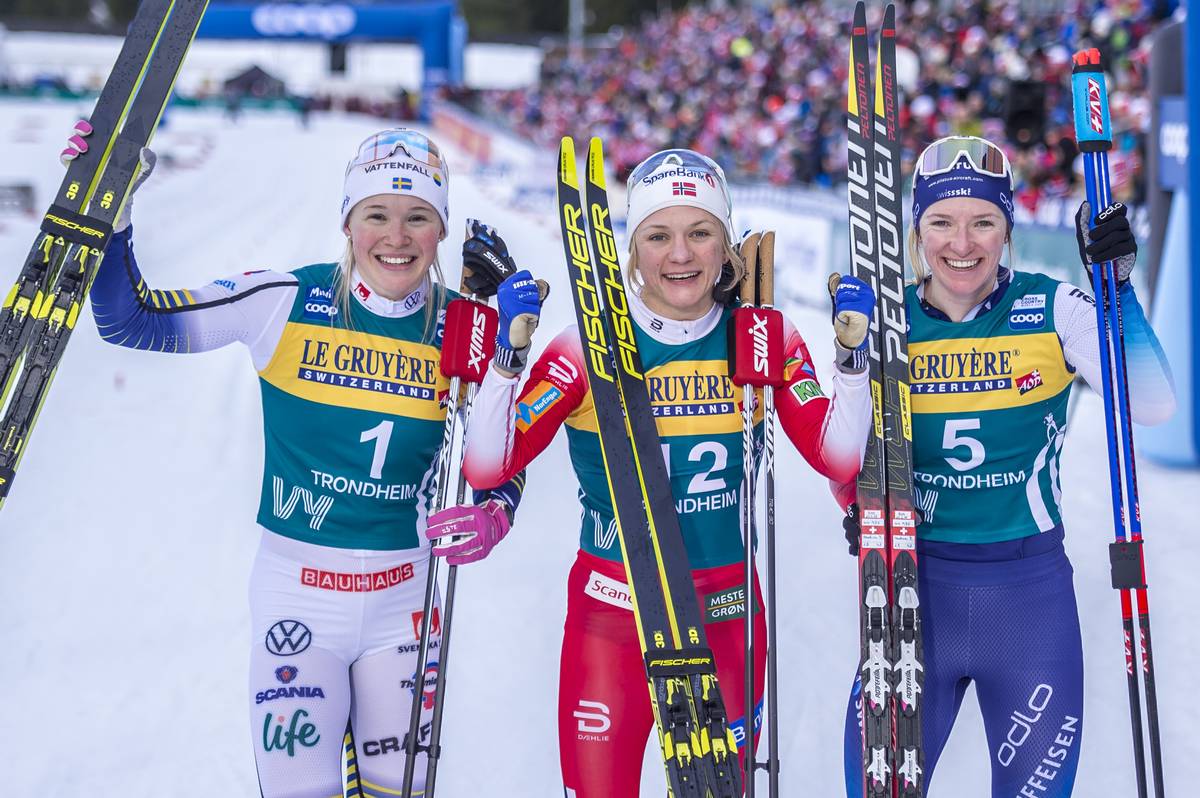
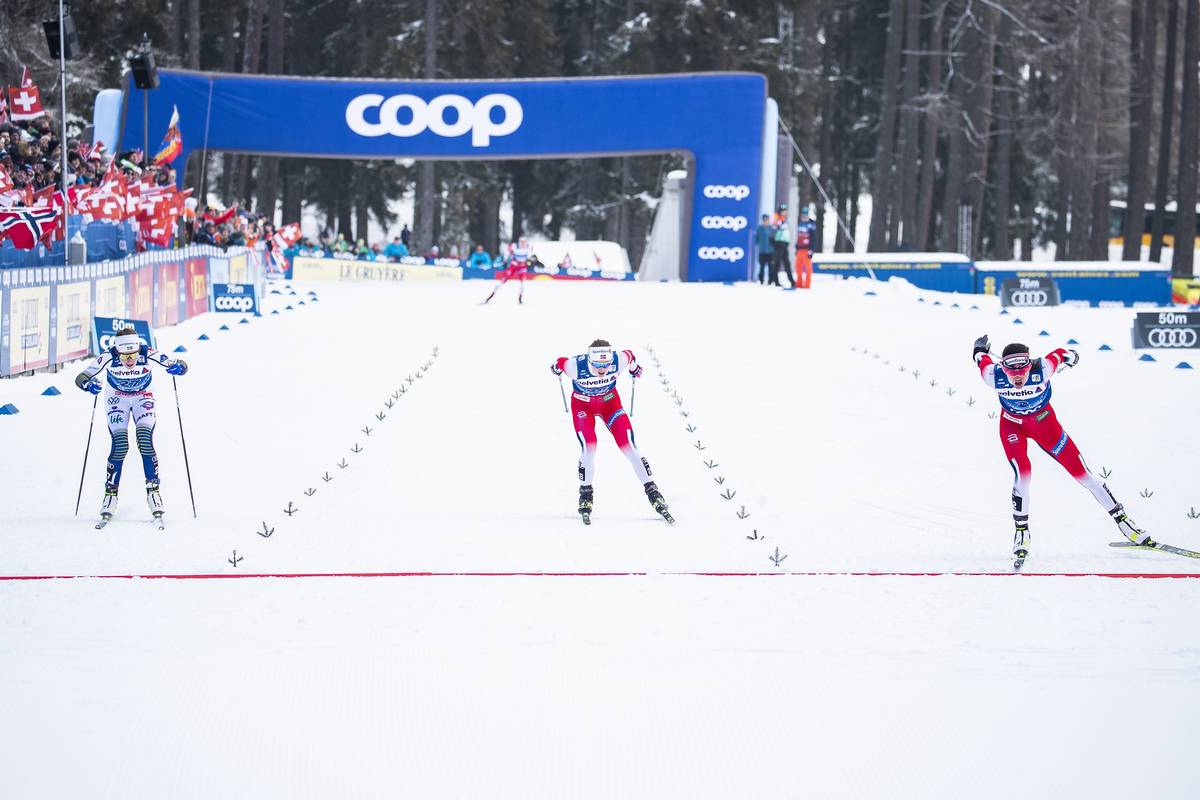
    The women’s Stage 5 podium: Jonna Sundling (SWE) in second, Maiken Caspersen Falla (NOR) first, and Nadine Faehndrich (SUI) third, (l-r). (Photo: NordicFocus)
  • Johaug Pounces in Closing K to Win in Falun; Diggins 14th

    Johaug Pounces in Closing K to Win in Falun; Diggins 14th

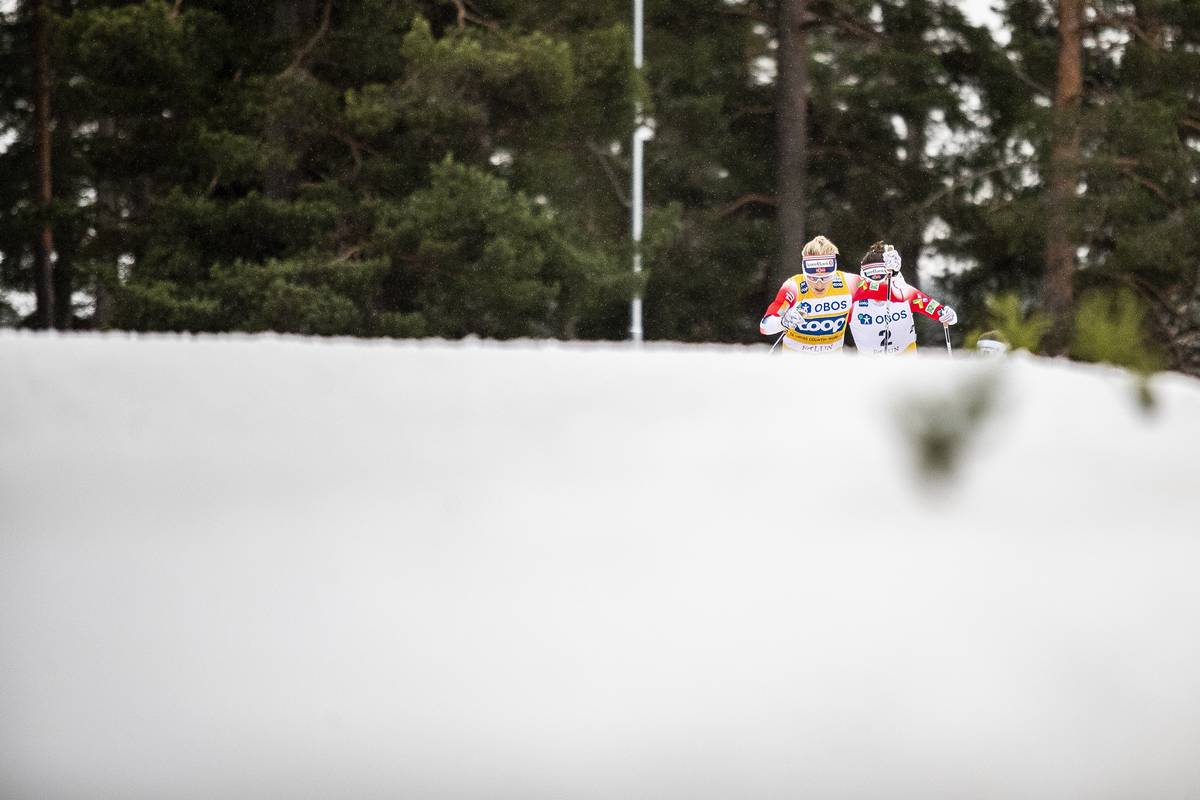
    Early race agitators: Norway’s Therese Johaug and Heidi Weng. (Photo: NordicFocus)

    As always, it was a reset: a new day at the start of a World Cup race. On Sunday, the ribbon of snow in Falun, Sweden offered an opportunity for a sixty-six women field to race head to head in a 10 k mass start freestyle race.

    With a course that some noted was softened in difficulty by eliminating the infamous Moderbakken climb — which has become a feared incline on the World Cup circuit — the racing was expected to be a close contact affair. The women raced four laps of a roughly 2.5 k circuit featuring punchy hills and terrain requiring athletes to work with little opportunity to recover. 

    Coming into the race, Norway’s Therese Johaug had been synonymous with the words distance race and victory. She has been unstoppable. She has won 11 of the last 13 individual distance events on the World Cup. According to FIS, in a string of 24 distance races, Johaug has placed first or second in 23 of them: the only outlier a 4th place in the 10 k mass start classic in Val di Fiemme, Italy during the fifth stage of the 2019-2020 Tour de Ski.

    Again, it has been a year in which Johaug has been dominant in the win column, but not necessarily in her margin of victory. In year’s past, seeing Johaug way off the front, a minute plus ahead of the field was not uncommon. This season, the gaps have been more humane. 

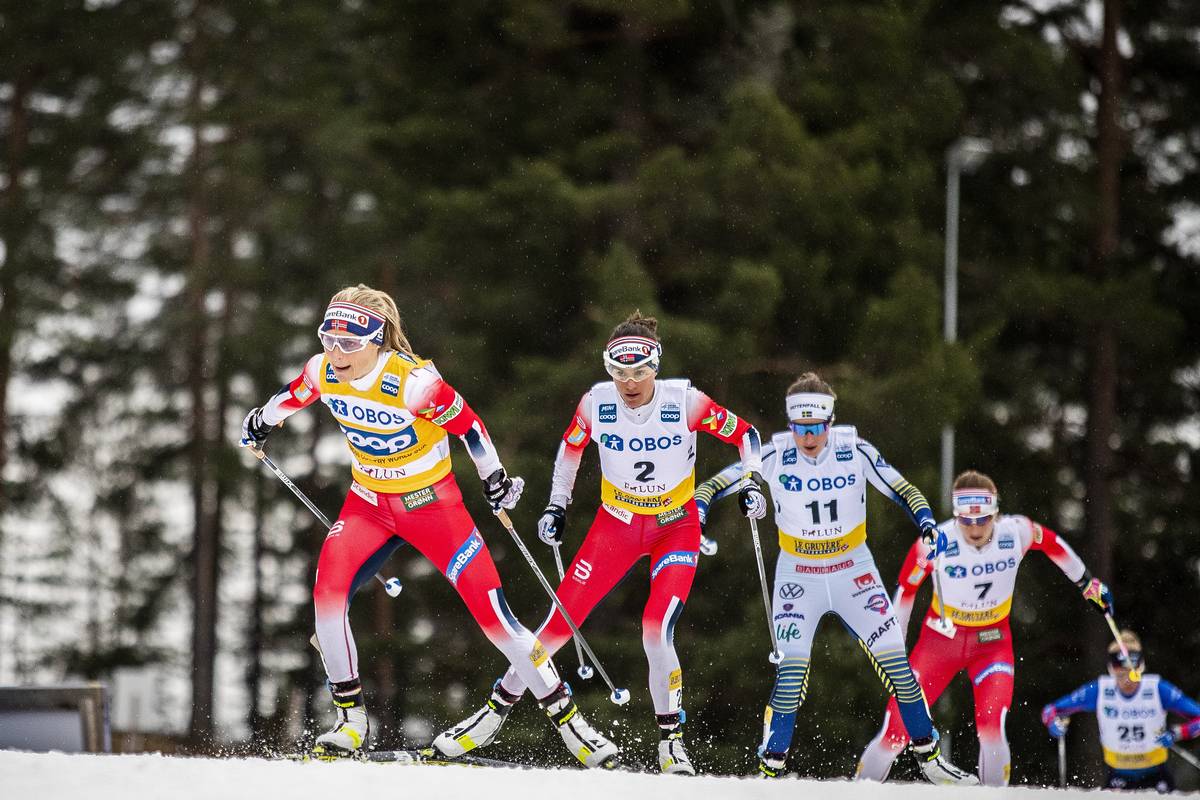
    From the start on Sunday, Johaug was out front and the skier to match. Through the first lap, it was Johaug, Heidi Weng of Norway, Ebba Andersson of Sweden, Astrid Uhrenholdt Jacobsen of Norway, and Sweden’s reassimilating Frida Karlsson who had been off the World Cup this season since the opening weekend in Ruka, Finland for failing to meet team body-metric requirements, who looked poised to keep pace. 

    Therese Johaug (NOR), Heidi Weng (NOR), Ebba Andersson (SWE), (l-r) breaking apart the race. (Photo: NordicFocus)

    Early on, Weng took pulls and Andersson contributed to a pace that would snap any imaginable cord to those wishing to gap up. At 3.6 k Johaug, Weng, and Andersson pushed discernibly ahead, as Jacobsen and Karlsson fell off to a bit more than six seconds back. Jessie Diggins, starting in bib 5 for the U.S., came through the 3.6 k check in eighth, at 17.2 seconds behind, as the Norwegians and Swedes kept the tempo hot.

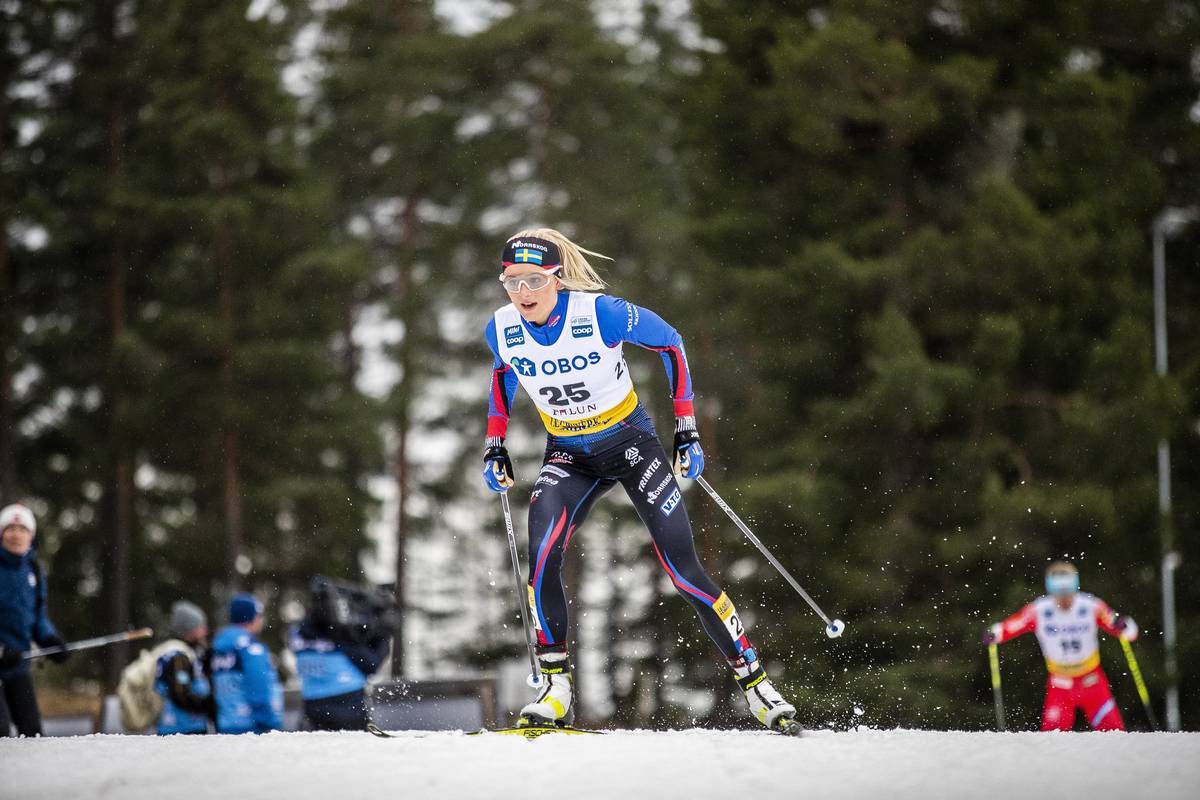
    Frida Karlsson back on the World Cup for Sweden. (Photo: NordicFocus)

    Although a mass start, the race at the sharp end whittled away at the masses. Three off the front was for real. Morderbakken or not, there would be no catching them: the three leaders had 18.8 seconds on Karlsson in fourth and 19.4 seconds on Jacobsen in fifth by 6.7 k. 

    Weng hung on until the closing 1.5 k when she too began to wither as Johaug began to write the conclusion to this 10 k script. The overall World Cup distance leader, Johaug, won in 25:04.1. And as she crossed the line, arms raised to the sky, Johaug displayed a stoke often reserved for bigger championship stages. Andersson, who missed the first part of the season with an injury, placed second (+6.5). For Andersson, her second place matched her season best result during the fourth stage of the Tour de Ski, a 10 k mass start classic. Weng hung on for third (+23.8). 

    Johaug stoke: the 10 k mass start win in Falun. (Photo: NordicFocus)

    After Sunday’s race, Johaug has a commanding lead in the distance standings with 1011 points. Weng sits in second with 665 points. 

    “It was tough conditions and of course with a mass start in Skating it’s not my favorite but I think the tracks were so slow and it was better than I had expected it,” Johaug told FIS after the race.

    Diggins was the top American in 14th, 57 seconds back. At moments Diggins appeared poised to link up with Jacobsen and Karlsson in the early stages, but oftentimes she found herself working alone. In the windy conditions, the effort became too taxing. 

    “It wasn’t my best day out there but I was proud how I just kept fighting even as a large pack was moving in to catch me up, I did everything I could in the moment,” Diggins said after the race. 

    She comes off a training camp at mid-altitude in Seefeld, Austria and a mystery kink in her neck that appeared the morning of Saturday’s classic sprint in Falun. (In the audio posted below, Diggins discussed how she has been handling the pressure of expectations after realizing the dream of an Olympic gold medal.)

    Diggins driving during the 10 k mass start skate in Falun. (Photo: NordicFocus)


    Post-race interview with Jessie Diggins 

    U.S. skiers Sadie Maubet Bjornsen placed 21st (+1:28.2), and Rosie Brennan 23rd (+1:31.1).

    “I had a challenging day today,” Brennan emailed. “Nothing went particularly wrong but I just wasn’t moving as fast as I thought I should be. It was very tough conditions with no natural snow and warm temperatures and falling rain. It was a short 2.5km loop that didn’t provide much rest but also not too many climbs. While this type of race has never been my forte, I did expect a little bit more of myself. I will take the week to hopefully find a little more speed and be ready for the Ski Tour 2020.”

    Also for the U.S., Hailey Swribul placed 35th (+1:56.2), Sophie Caldwell 38th (+2:11.3), Alayna Sonnesyn 49th (+2:38.8), and Julia Kern 57th (+3:20.1). 

    Post-race interview with World Cup Coach Matt Whitcomb  

    Canada’s Cendrine Browne scored in the points with a season best 29th place (+1:40.1). Katherine Stewart-Jones skied to 37th (+1:59.9), Dahria Beatty 40th (+2:14.1), and Emily Nishikawa 46th (+2:35.5). 

    Canada’s Cendrine Browne racing into the points in Falun. (Photo: NordicFocus)

    Racing continues next Saturday with a skate sprint in Åre, Sweden — the start of the Ski Tour 2020.  

    – Harald Zimmer contributed 

    Results | World Cup distance standings


    The 10 k mass start podium from Falun: Ebba Andersson (SWE) second, Therese Johaug (NOR) first, and Heidi Weng (NOR) third, (l-r). (Photo: NordicFocus)


  • Rebounding From the Skiathlon, Three Americans Sprint to Top-10 Results (Updated)

    Rebounding From the Skiathlon, Three Americans Sprint to Top-10 Results (Updated)

    The speedy women of Oberstdorf. Natalia Nepryaeva (RUS) won the classic sprint ahead of Anamarija Lampic (SLO) and Jessie Diggins. (Photo: NordicFocus)

    Onward and upward. Day two in Oberstdorf, Germany featured a 1.5-kilometer classic sprint with three sharp toothlike climbs. Seemingly riding the edge of their capability inside the tracks, athletes pumped their way up each pitch before wrapping around a bend and descending an equal grade back toward the stadium.

    Wolf jaw or race course? The Obesrtdorf sprint loop in profile. (Photo: Screenshot FIS Broadcast)

    After what Matt Whitcomb called an “off day”, the Americans demonstrated their ability to rebound. To not let the sensations or disappointment from one day percolate into subsequent races. Onto the next.

    This was clearly demonstrated in the qualifying round: three, four, nine, eleven. Diggins was the fastest of the crew finishing 2.24 seconds behind top qualifier Natalia Nepyaeva of Russia, who stopped the clock at 3:38:08. Diggins was 0.8 seconds behind Anamarija Lampic of Slovenia, who won both sprint events, skate and classic, during the Tour de Ski, and took second the weekend after the Tour in the freestyle sprint in Dresden. Lampic also popped the second fastest qualifying time of the day.

    Sadie Maubet Bjornsen nearly matched Diggins time in fourth (+2.35), followed by Sophie Caldwell in ninth (+5.38), and Rosie Brennan in eleventh (+5.90). The only other country to put three athletes in the top ten was Norway, a testament to the strength of the American women on a day where our expectations meet reality. 

    Striding it out in Oberstdorf, Caitlin Patterson skis to 61st in the qualifier. (Photo: NordicFocus)

    Also starting for the U.S., Caitlin Patterson took 61st (+24.18), and Alayna Sonnesyn finished 66th (+26.7).

    In the quarterfinals, Maubet Bjornsen wore the lowest bib number in the first heat, which is curious as this is often the choice of the top two qualifiers (see Diggins comments on heat selection below). Maubet Bjornsen took second in a tight finish with Lotta Udnes Weng and Astrid Uhrenholdt Jacobsen of Norway, moving with Weng into the first wave of semis. 

    Caldwell won the third heat of the semis in a photo finish with Ane Appelkvist Stenseth of Norway. Brennan was eliminated after finishing fourth in the fourth heat to finish 16th for the day, a top result in the event. 

    Rosie Brennan attacks the climb behind Norway’s Heidi Weng. (Photo: NordicFocus)

    “Sprint is always such a bitter sweet event for me,” Brennan emailed. “While today was the best classic sprint of my career, I still felt that I made some mistakes and didn’t ski as well as I felt. The course here is long and has some good striding which I was really excited about. I know there are probably some sprinters that aren’t excited about the length but I felt the course did a good job of including all kinds of skiing and really rewarding good skiers. I am really happy with my feelings and for sure have a little list of things to work on moving forward.”

    Diggins charged full gas through the fifth heat of the quarters for the win, beating out Sweden’s Linn Svahn who advanced alongside her. 

    Jessie Diggins leads Sweden’s Linn Svahn during the quarterfinal in Oberstdorf. (Photo: NordicFocus)

    In the first semi, Caldwell and Maubet Bjornsen took it out with the leaders, matching Nepryaeva’s long powerful bound up the climbs and the speedy out-of-the-track tempo of Anna Svendsen of Norway. Coming into the final downhill, Svendsen, Nepryaeva and Caldwell pulled ahead, creating a small gap to the remaining women. Caldwell held her tuck longer than the other women, collecting herself for a spicy double pole sprint to the finish. Sliding across the line at the heels of Nepryaeva, Caldwell stayed ahead of the Norwegian to take second in the heat. Maubet Bjornsen finished fifth between Nadine Faehndrich of Switzerland and her opponent from the quarters, Weng.

    “It was one heck of a thrill out there today on the courses for next year’s World Championships,” wrote Maubet Bjornsen in an email to several outlets. “This is certainly one of the hardest sprint courses I have sprinted on, but I really enjoyed it! My legs felt a lot stronger than last weekend, but still not quite recovered enough to put together the race I was dreaming of today. Finishing 9th is still and achievement, but I know I am capable of more when I have my full strength.

    “My tactic today was to race at the front of the group, even if it required a bit more energy, because then I knew I wasn’t going to get stuck behind anything. I always feel most confident skiing that way. In the final climb of the semi’s, I think I paid the price a bit.”
    Sadie Maubet Bjornsen matches Astrid Uhrenholdt Jacobsen (NOR) up the climb in Oberstdorf. (Photo: NordicFocus)

    Striding hot out of the gate, Diggins also held a position at the front, matching Lampic, who dictated the pace, up the climbs and tucking into her draft on the descents. On the last and longest climb, Diggins was overtaken by Svahn and Heidi Weng of Norway and she was unable to regain her position on the subsequent downhill. Though her tempo was faster than her opponents in the final double pole sprint, she finished fourth. As her time would have won the previous heat, Diggins and Svahn advanced with Lampic and Weng as the lucky losers. 

    Again taking the reins from the start-beep, Lampic surged to the front of the group and stayed there, though she could not drop the strong group of women in her wake. Up the final climb, Nepyaeva matched Lampic stride for stride, her long powerful pushes keeping her alongside the Slovenian’s green and black suit.

    Like a slingshot, Nepryaeva sped around Lampic as they rounded the final curve into the straightaway. The duo duked it out double poling in perfect synchrony, but Lampic recovered no ground on the Russian. Nepraeva stopped the clock at 3:27:08, the fastest split of the day. 

    Racing for the last podium position, Diggins and Caldwell flew into the final straight in neighboring tracks, with Svahn not far behind. Firing on all cylinders, Diggins pulled ahead of Caldwell to take third by just over a second (+2.44). After being left behind by the Americans, Svahn finished fifth (+5.16), followed long after by Stenseth (+30.20). The Norwegian had fallen off the pace midway through the round, ceding her chances to contend with the pack. 

    Due to poor WiFi connection, athletes chose to send comments via email. Reflecting on her performance, Diggins expressed that she “loved” the long sprint course.

    “You had time to try out different tactics and that last hill saw some moves, for sure. We had awesome skis today so I was able to use a little bit of a slingshot to get into good position in the finishing lanes, and I just worked to stay smooth and calm in the first half, while looking for openings to get into better position.”

    Diggins explained that heat selection is variable, and did not feel today’s variance from a usual bracket was explained by the length of the course. Her choice to race in the fifth quarter and second semi were based simply on her perception of the opportunity to advance.

    “I chose the latter heat because it was wide open, and seemed to be a good path forward out of the quarters. But you never know how it’s going to go, and I was happy to secure lucky loser time in the fast semifinal!”

    Gasping for air after an effort Diggins can be proud of in Oberstdorf. (Photo: NordicFocus)

    After finishing 22nd in the skiathlon, some might question from the comfort of their couches whether Diggins is on the same form that we have seen in previous years. As was discussed with Matt Whitcomb, “success breeds expectation.” We expect to see Diggins at the top of the results sheet day in and day out, and that pressure can creep into an athletes self-expectation as well. When asked how she handles this, Diggins explained that she does not dwell on what is on the paper or posted in the comments.

    “That’s a great question about handling expectations and pressure…and my plan for that has always been to set really concrete process-oriented goals, work as hard as I can to meet them, and then regardless of the result on paper I can decide if it was a “good” day for myself or not based on my effort, focus, technical progress and strategy.”

    In her post-race remarks, Caldwell offered an insightful perspective that took into account her strengths as a sprint specialist versus an all-arounder like Diggins or Maubet Bjornsen.

    “This sprint was definitely one of our longest ones, and for sure the longest one of the year. I think it’s really exciting to have varying sprint courses throughout the year and this is about as far from the Dresden course as you can get. I used to think short and flat suited me best, but now I don’t really know what I like, especially for classic, but I try to be excited for any kind of sprint so I don’t count myself out before it begins. That said, I do think that there are already a lot more distance races than sprints, so when it gets much over 3 minutes, it’s starting to favor distance skiers more, which is fine to do sometimes, it’s just too bad when there are already so few sprints if too many of them start getting really long. But I personally really enjoyed the course and the race today. I don’t think it’s too much different for recovery for me whether the course is 3 mins or 3:30, but I think for the men it is probably harder because if they’re in the second half of the bracket, they have a lot less recovery. I usually just try to move around until I’ve flushed my legs out and then relax for a little bit and then start moving around again before my next heat!

    “Today was a really awesome day for our team. I was psyched to make my first classic final in years, and I think only my third ever. I’ve now had three 4th places in the last four races, which is a little bittersweet, but it’s important to remind myself that 4th is still a really strong result, especially in a tough classic sprint. It was great to ski with Sadie in my semi and I know she’s bouncing back from giving her all in the tour, but is getting stronger each day and a good result today is a huge step in the right direction. And Jessie was on fire all day and it was awesome to see her get another classic podium. So really fun to have such a strong day for our women and even though it was a tough day for the guys, I know they will be fighting back in Falun!”

    Sophie Caldwell skis to 4th place in Oberstdorf. (Photo: NordicFocus)

    Between the city sprints in Dresden and today’s event in Oberstdorf, Caldwell headed to Austria for an altitude camp. She explains the role this plays in balancing training and recharging, and how the sprinters use an altitude stint to build fitness without losing their top end speed.

    “Simi and I just took a little break in Seefeld during the distance weekend in Nove Mesto and it’s was really nice both physically and mentally. The schedule this year is very demanding, with almost no weekend off, so we felt it was important to find in a couple times to work in a break, remove ourselves from the World Cup, and take some time for ourselves. I was really tired right after Dresden and didn’t realize it until I allowed myself to take a break, so it was nice to have a few days of true recovery and then I felt I was able to train really well for 9 or 10 days before coming here. Seefeld is at mild altitude, but I think it’s only at 3,700 ft, so as long as I keep my easy skis easy, I don’t feel too many effects of altitude and don’t worry about not being sharp when coming down a little in elevation.”

    Maya Macisaac-Jones posted the top qualifying time for Canada in 35th. (Photo: NordicFocus)

    Racing for Canada, Maya Macisaac-Jones posted the top qualifying time in 35th (+14.28), followed by Dahria Beatty (+15.79), Katherine Stewart-Jones in 50th (+18.58), and Katherine Weaver 65 (+26.08).

    Qualification | Final Results 

  • Lampic Wins The Day as Jacobsen Leapfrogs to Second Overall

    Lampic Wins The Day as Jacobsen Leapfrogs to Second Overall
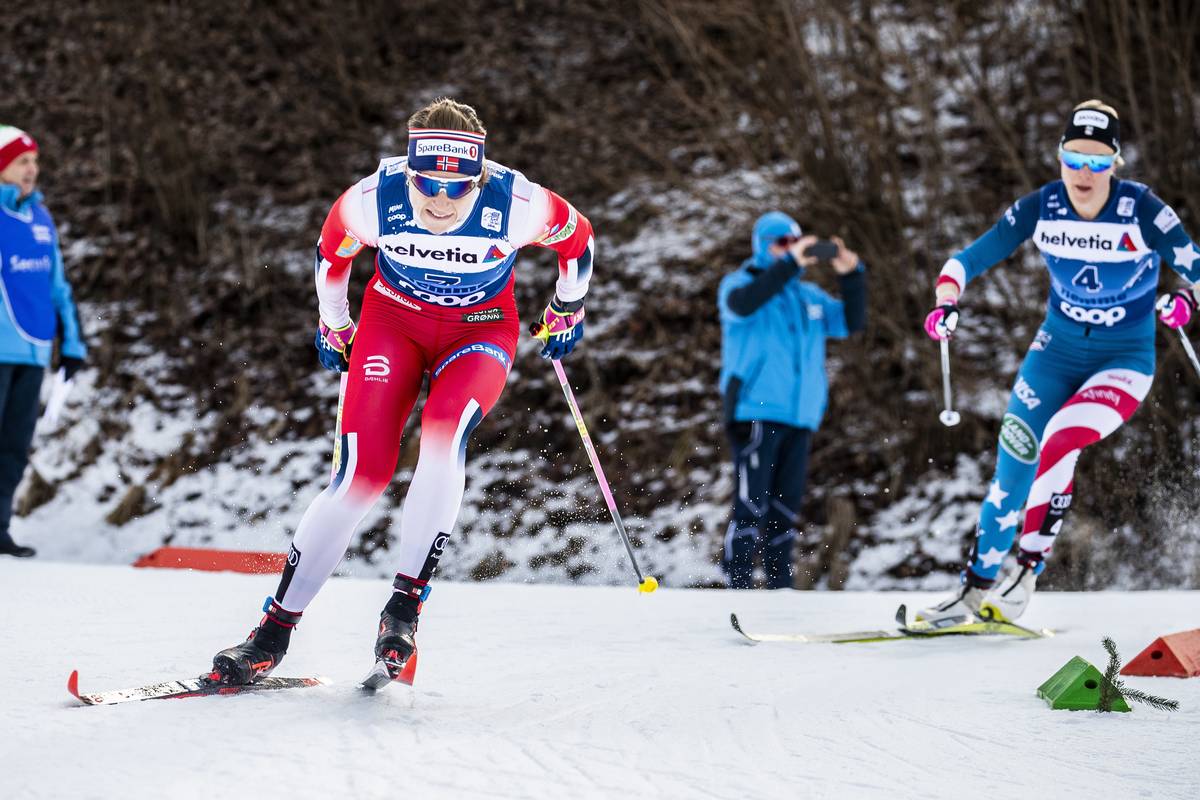
    With one stage remaining in the 2019-2020 Tour de Ski (TdS), and with standings somewhat unsettled before what some consider to be a slam dunk final stage for the current overall leader Therese Johaug from Norway, time bonuses were what mattered in Val di Fiemme, Italy on Saturday. Podium pride was at stake, but generous time bonuses were the carrot for many in the 1.27-kilometer classic sprint. 

    First through 30th place in the TdS sprints receive a time bonus. Sixty seconds for first, 54 seconds for second, and so on. Time matters. 

    After Stage 5, Johaug led the overall by 19 seconds over Ingvild Flugstad Østberg (NOR) in second, 32 seconds over Russia’s Natalia Nepryaeva, and for good measure, 33 seconds ahead of Astrid Uhrenholdt Jacobsen (NOR) in fourth.

    Finding her groove in time for the final stage. Astrid Uhrenholdt Jacobsen (NOR), moves to second overall in the Tour standings. Sadie Bjornsen (bib 4) follows. (Photo: NordicFocus)

    The thirty-two-year-old Jacobsen comes off a mildly surprising win in Stage 5’s 10 k mass start classic race. Of late, her classic technique looks dialed and her ski speed has been an asset. For the longtime National Team member, the top podium spot has been a fleeting prize. Over her storied career, she has won five World Cups. We bring her up because she animated today’s classic sprint and positioned herself nicely for a TdS overall podium spot. More on that in a bit. 

    First a reminder, this is well into the TdS. Many of the World Cup’s top sprinters dropped from the Tour a stage or two ago. For the U.S., Sophie Caldwell is missing. Some top sprinting Swedes are not at the Tour. And Maiken Caspersen Falla of Norway took a raincheck. With forty-four skiers starting the qualifier, it was a good bet that many of the names we associate with distance skiing would progress. 
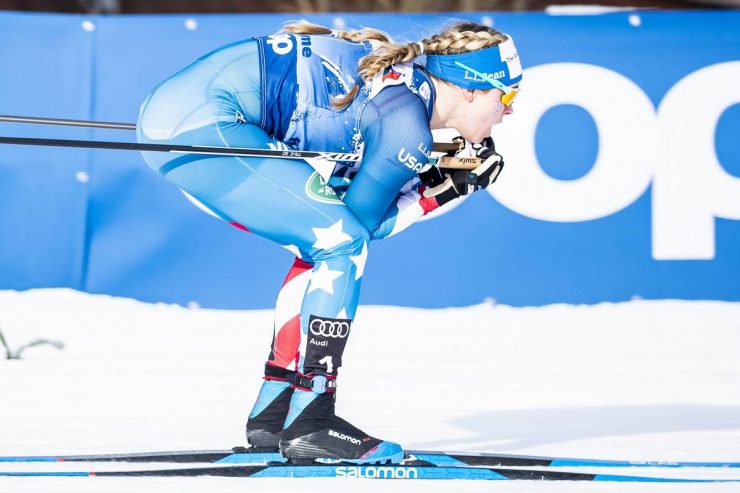
    Jessie Diggins of the U.S. qualified in first on the 1.27 k classic sprint course in 3:04.26. Yes, all the top contender names in this TdS advanced to the heats. 

    Jessica Diggins (USA), Natalia Nepryaeva (RUS), Lucia Scardoni (ITA), and Theresa Johuag (NOR) (l-r), during the first quarterfinal, Stage 6 of the Tour de Ski. (Photo: NoridcFocus)

    In the first heat, Diggins looked smooth and powerful as she placed first. But slotting into fourth, in by far the fastest quarter-final was Johaug. She would advance to the semis, minimizing the potential damage of time bonus gains by her rivals for the overall. 

    In the second heat, it was Jacobsen who commanded the win with timely positioning and rocket skis. Sadie Maubet Bjornsen was second. Brennan placed fourth and did not advance. 

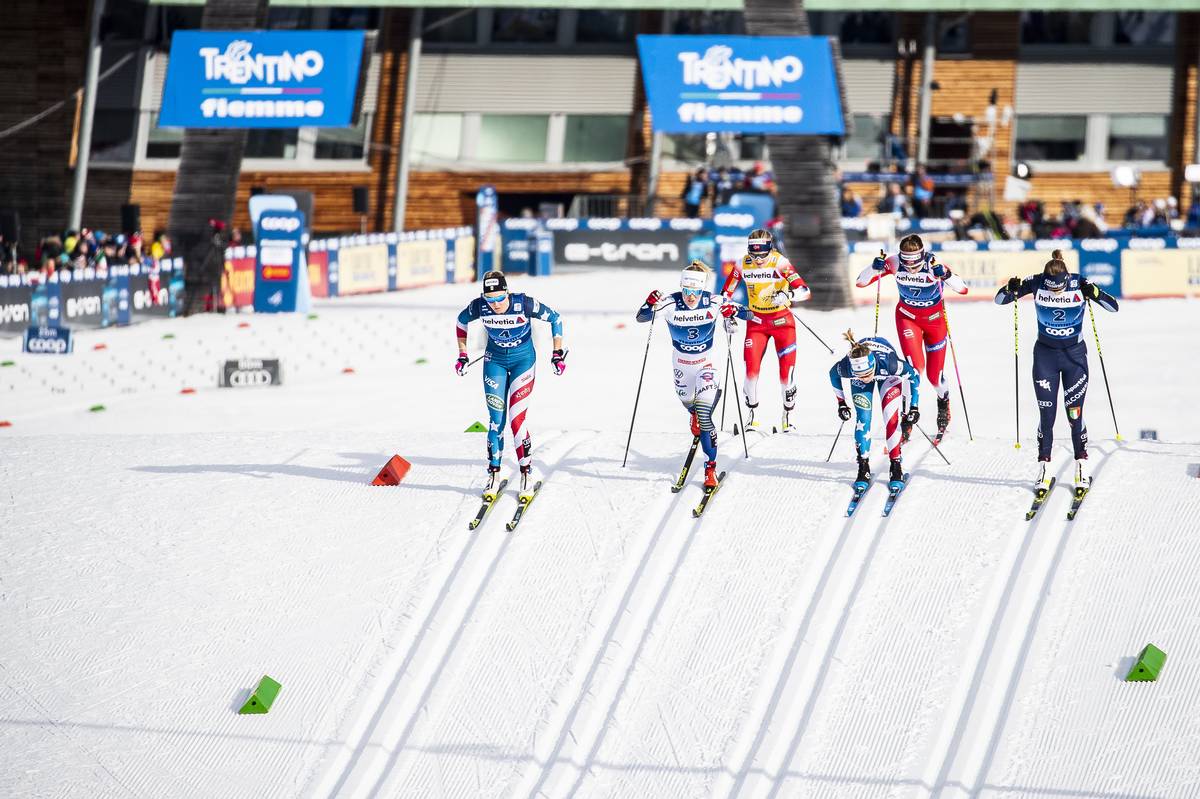
    After cataloging the quarters, all the key players remained. An upstart Anamarija Lampic from Slovenia, Nepryeava, Weng, and Østberg, Johaug, Diggins and Maubet Bjornsen. The only potential overall Tour contender not to advance and capitalize on more bonus time was Sweden’s, Ebba Andersson. Prior to today’s sprint, she was fifth overall, only 38 seconds out. 

    Andersson ended her day ranked 28th in the sprint. 

    Sadie Maubet Bjornsen (USA), Jonna Sundling (SWE), Jessica Diggins (USA), Lucia Scardoni (ITA), Therese Johaug (NOR), (l-r) during the first semifinal, Stage 6 of the Tour de Ski. (Photo: NordicFocus)

    In the first semi, Jacobsen, Maubet Bjornsen, and Diggins went 1-2-3 to advance. Diggins moved on to the final as a lucky loser. Johaug bowed out in sixth. But her mission of time bonus mitigation was accomplished. Johaug ended her day ranked 11th. 

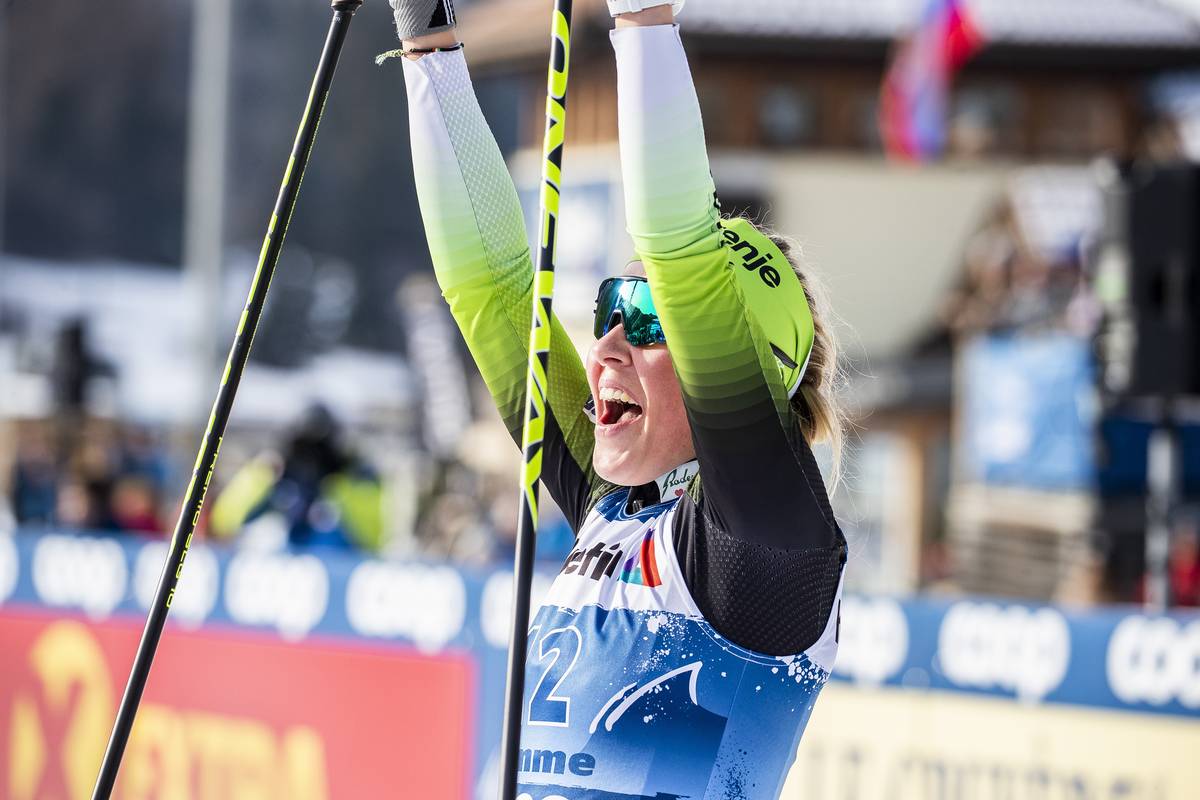
    Lampic, in the second semi, showed she too is a mint sprinter. She won her first career World Cup on Stage 2 of this TdS, a skate sprint, in a deeper field. Today, advancing to the finals after winning her semi, Lampic would add another exclamation point. 

    Out of the start, Nepryaeva fell hard in the finals while changing lanes. She placed sixth (+15.30) after realizing that burning energy to catch back on was futile. The five remaining in front kept it tight. Up the first climb, the skiers slotted into four lanes across with Jacobsen eventually taking charge.

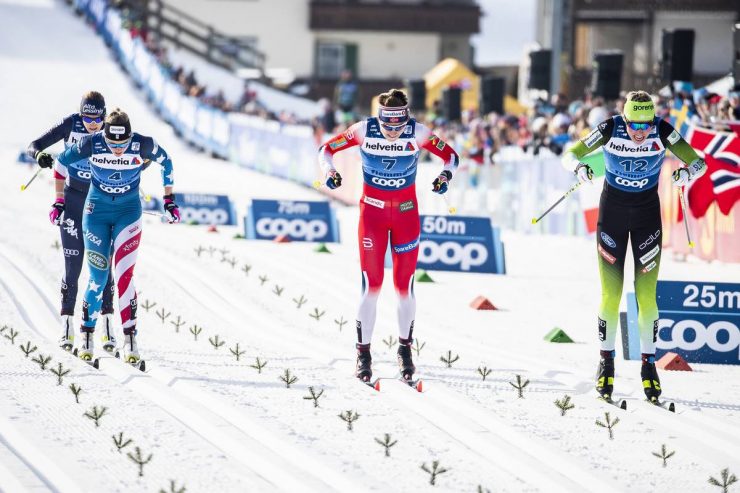
    The course finishes with a long downhill into the final straight. Here, good skis and a transition into a power double pole played to Lampic’s favor. With Diggins, Maubet Bjornsen, Jacobsen, and Lampic gliding into the straightaway, Lampic was able to pull ahead for her second career World Cup win in 3:03.03. Diggins had a clear lane as did Jacobsen. Maubet Bjornsen, however, with a strong double pole, was stymied by Jacobsen blocking her in front. Maubet Bjornsen began pushing onto Jacbosen’s tails. The formidable U.S. skier switched tracks before she crossed the finish losing a smidge of momentum.    

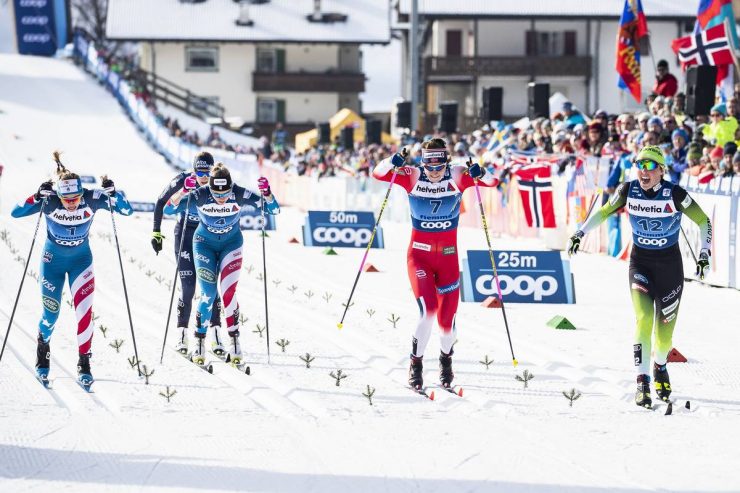
    Jacobsen ultimately placed second (+0.22) in a photo finish with Diggins, who placed third (+0.28). Maubet Bjornsen was fourth (+0.8) and Lucia Scardoni of Italy fifth (+1.12).

    A streamlined Diggins during Stage 6 of the Tour de Ski. (Photo: NordicFocus)

    “We haven’t seen a classic sprint here since 2013 World Champs, so tactically we were trying out a few new things and finding our strengths out there!” emailed Diggins. “I had good energy today and was just trying to push the pace at the start, but in the final, I was trying to use the slingshot a little bit more off of the downhill. I was also wary of getting boxed in on the tight corners because it was so important to be able to push hard over the top of the hill into the downhill.

    “Huge thanks to the wax team for working so hard, and it was super fun to ski in the finals with Sadie! We’ve kept such a positive energy on this team the entire tour, through the good days and the hard days, and that has really paid off.”

    Looking forward to finishing this tour like I always do – by going out there and giving it absolutely everything I have, so I can be proud of the effort I gave!

    Anamarija Lampic (SLO) loving the win, post-Stage 6 Tour de Ski stoke. (Photo: NordicFocus)

    “Hard to believe we can find sprinting muscles after so many days of racing, but somehow I felt amazing today!,” Maubet Bjornsen emailed. “Through my quarters and semis, I managed to place myself in a safe place, trying to conserve energy for the final, and feeling in total control. As the finals went off, I put myself in what felt like the ‘right position’. Unfortunately, I wasn’t in the right place at the right time on the final stretch, getting blocked up and just missing the podium by half a second. 

    “I can’t help but feel a bit frustrated, because I believe I could have won today if I could ski it again, but how can you be upset with a 4th place? I’ll have to channel all that frustration into the final day tomorrow, up the big alpine slope.”

    “While this tour has had plenty of ups and downs, I continue to feel strong and confident on my skis. Every new day is a new chance, which is so fun! That’s why I just love this crazy 7 races in 9 days. Getting yourself across that line on top of Cermise is an unbelievable achievement!”

    Also for the U.S., Brennan placed 19th and Katharine Ogden 32nd.

    The Shakeout for the Overall 

    Therese Johaug (NOR) kept it close today as she advanced to the semis in the Stage 6 classic sprint of the Tour de Ski. Johaug still leads the overall standings. (Photo: NordicFocus)

    With her 11th place in the sprint, Johaug earned 24 bonus seconds, which in reality served to keep those potential overall threats, if any really exist, a few seconds back. That brings us to Jacobsen. After starting the day fourth overall, 33 seconds behind, her second place in the sprint netted her a 54-second time bonus. That bumped her to second overall, only three seconds behind Johaug. Nepryaeva is currently third overall, with 14 seconds to make up. Østberg fell to fourth — she placed 12th in the sprint — with a long 23 seconds to gain on the Alpe Cermis. 

    Post-Stage 6, Maubet Bjornsen improves to eighth overall (+1:58) from ninth after Stage 5, and Diggins jumped from 15th overall to 11th (+2:53) after Saturday’s sprint. 

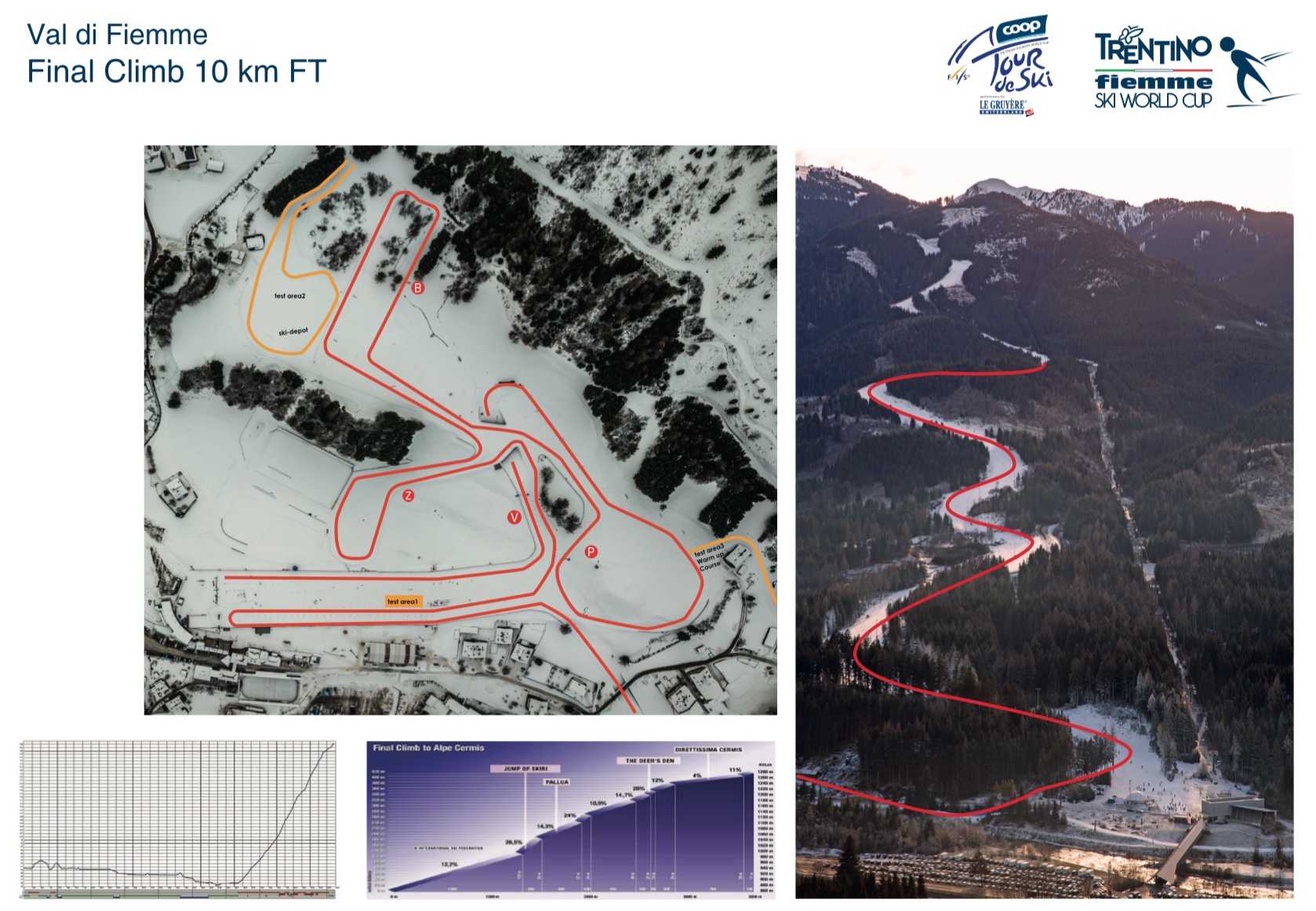
    Tomorrow’s final stage, the infamous Cermis climb brings a new format this year. Historically, the Tour’s premier stage runs as a pursuit. With tomorrow’s mass start, every athlete heads out together. It will be on those trailing Johaug to somehow find a weakness and literally pull ahead. 

    If you’ve been listening to Devon Kershaw, no way, it will not happen — Johaug will not lose time on the Cermis. 

    The Alpe awaits.   

    (An athlete’s qualifying time from Stage 6 is used to determine an athlete’s time in the overall standings. Bonus time is subtracted from the overall time.) 

    Qualifier Results | Final Results | Overall TdS standings after Stage 6


    The women’s Stage 6 podium: Astrid Uhrenholdt Jacobsen (NOR) second, Anamarija Lampic (SLO) first, Jessica Diggins (USA) third, (l-r). (Photo: NordicFocus)
  • Jacobsen Shines in Stage 5 While Johaug Takes Home the Wooden Medal; Maubet Bjornsen 7th

    The women’s podium after Stage 5 of the 2019/2020 Tour de Ski in Val di Fiemme, Italy. Astrid Uhrenholdt Jacobsen (NOR) took the win ahead of Ebba Andersson (SWE), and Katharina Hennig (GER). (Photo: NordicFocus)

    The 100th Tour de Ski Stage in Val di Fiemme, Italy, featuring a four lap 10-kilometer mass start classic. Coupling the results in distance racing over the last 14 months since Therese Johaug returned to the world cup and those of Stage 4, it seemed like a safe bet to predict a rematch between Johaug and her teammate Ingvild Flugstad Østberg. Another opportunity to race head-to-head over every meter of the course, and for Johaug to make a statement that her loss was a fluke. 

    It quickly became clear that Østberg crossing the line 0.4 seconds ahead of Johaug was akin to Roger Bannister running 3:59.4 on a cinder track in Oxford. The barrier was broken, illuminating the potential for the host of men who followed. Johaug was no longer invincible. No longer in a class of her own. 

    Ebba Andersson (SWE), Ingvild Flugstad Oestberg (NOR), and Heidi Weng (NOR) lead the pack in a 10-kilometer mass start classic in Val di Fiemme. (Photo: NordicFocus)

    Nearing the end of the first 2.5 k lap, seven athletes formed a tight group at the front of the pack. Putting in a surge for the point bonus at 2.3 k, Natalia Nepryeava of Russia was in the lead, stretching out the group slightly. The trailing women rebounded like a slinky, continuing to push as a group. 

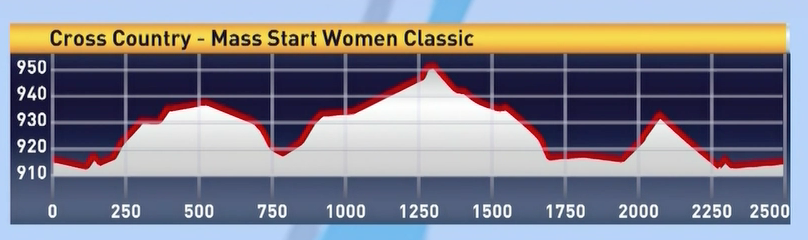
    The elevation profile of the 2.5 k course in Val di Fiemme, Italy. (Photo: Screenshot FIS broadcast)

    Rounding the fast winding turns of the steep descent halfway through the lap, the chink in Johaug’s armour widened. Temperature well above freezing and old manmade snow made for lightning fast conditions, and racers were likely kicking with a variation of klister, perhaps with a hardwax cover. In the first lap, Johaug lost her footing and crashed, rebounding quickly and keeping contact with the pack. 

    In each of the subsequent laps, she was seen scrubbing speed, doing what she could to stay on her feet at the risk of shearing off some of her grip. 

    Spending the majority of the race at the front, Ebba Andersson of Sweden made several attempts to reduce the size of the group, but each of her moves were matched. Johaug, Østberg, and their teammates Astrid Jacobsen held strong beside Nepryeava, and Katharina Hennig of Germany. 

    As the 6k checkpoint approach, providing the opportunity for the first ten athletes to earn up to 15 bonus seconds, the pace accelerated. Jacobsen emerged at the front, sprinting head to head against Andersson with the remainder of the women close on their tails. Jacobsen held off the Swede, earning the most time. 

    Tour leaders Østberg and Johaug were 4th and 6th at the bonus, respectively. As expected after a high-speed snowplow down the hill, Johaug appeared to be struggling with her kick and was forced to run alongside the pack of women outside the track. 

    Sadie Maubet Bjornsen, who initially fell off the lead pack with Jessie Diggins, pushed to reconnect with the lead group and hovered 2 seconds behind in 8th at the time bonus. Diggins began to fade and was not within the top ten skiers; she did not earn bonus seconds. 

    Charlotte Kalla (SWE, bib 13), Sadie Maubet Bjornsen, and Jonna Sundling (SWE) lead the chase group during Stage 5 of the 2019/2020 Tour de Ski. (Photo: NordicFocus)

    As the final lap began, the pace heated up and the lead pack began to whittle down.  Østberg led at each of the checkpoints. She too could no longer climb inside the tracks, but neither could her opponents. Heading into the fast and technical descent, Østberg motioned to the racers behind her as if to say, ‘Let’s chill out and give each other space here so we all stay on our feet.’ 

    And so they did; each of the top five skiers stayed on their feet around the horseshoe bend. But as they headed up the final punchy climb with less than a kilometer to go, Østberg tangled with Johaug and went down and the tip of her pole snapped off. Running on her skis as she ripped off the strap and reached for a new one, she charged ahead, not pausing to put the strap of the replacement over her hand. 

    But her momentum was lost and she could not regain her contact with the three leaders who had taken off at the front: Jacobsen, Andersson, and Hennig. 

    Astrid Uhrenholdt Jacobsen (NOR) rounds the final turn toward the stadium with Katharina Hennig (GER) in hot pursuit. (Photo: NordicFocus)

    Double poling in ferocious unison, the three women sprinted to the line with Jacobsen less than half a ski length ahead of Andersson who occupied the neighboring track. Hennig remained tucked in behind Jacobsen, who began to pull further ahead in the final meters. 

    Stopping the clock at 29:07.9, Jacobsen took the win and landed her first Tour de Ski podium since the final stages of the 2014 Tour, also in Val di Fiemme. Despite balancing the workload of a full-time medical school student, 2020 is shaping up to be one of Jacobsen’s career best seasons. She is currently ranked 4th in the overall World Cup standings. 

    Astrid Uhrenholdt Jacobsen (NOR) takes the win in Stage 5 ahead of Ebba Andersson (SWE) and Katharina Hennig (GER). (Photo: NordicFocus)

    Andersson was next across the line (+0.4), followed closely by Hennig in third (+1.0). The Swede has the unfortunate statistic of having the most podium finishes in World Cup races (including tour stages and overall tour ranks) without ever landing on the top spot. With today’s result, she has 13 podium finishes, moving ahead of Maubet Bjornsen who has 12. At just 22 years of age, the time is nigh for her to happily surrender her title. 

    Also one of the younger athletes in the field, today was Hennig’s first podium racing with the bigs. The German took third in distance classic race at U23’s last year and has cracked the top 10 on the World Cup a handful of times in the event. 

    Unable to contain her excitement about her performance, Hennig accidentally dropped her skis as she jumped up and down on the podium. 

    Katharina Hennig (GER) jumps for joy for her first World Cup podium after Stage 5 of the 2019/2020 Tour de Ski. (Photo: NordicFocus)

    “[It’s] hard to believe,” she told a German reporter for ZDF. “On the last loop I noticed I was still keeping in touch with the top, and then I somehow just put everything out that I had.”

    The broadcaster explained that Hennig had stated that beating Johaug was not a goal the team had discussed, presuming that it was not possible. Yet the 23-year-old had stuck with Johaug throughout the race and beaten her by over five seconds. 

    “I really don’t know what to say,” Hennig said in response. “I just know that I want to say thank you to everyone supporting me on my journey, our team, our wax technicians, my parents, my boyfriend, my coach, everyone, without them this would not be possible.” 

    Johaug had ended the race in 4th (+6.2), followed by a frustrated Østberg who swatted her pole into the snow as she crossed the line in 6th (+6.8). Norwegian news outlet NRK reported that Østberg needed time to gather herself before she could listen Johaug’s apology and accept that there was no malicious intent. 

    Maubet Bjornsen held her position in the field, racing alongside Nepryeava throughout the second half of the race. She was the top American finisher in 7th (+17.2). Ceding time for her overall standing, Diggins fell back to 17th (+1:05.5). A few seconds behind, Rosie Brennan finished 20th (+1:07.7), and Katharine Ogden finished just inside the points in 28th (+1:56.9). 

    Sadie Maubet Bjornsen skis to a 7th place finish in Stage 5 of the 2019/2020 Tour de Ski. (Photo: NordicFocus)

    “After struggling with slippery skis two days ago in Toblach, I was ready to take another hit at one of my favorite races out there, 10k classic!” Maubet Bjornsen wrote in an email to several news outlets. “My race plan today was to be patient, and race my own race. This meant trying to stay relaxed for the first lap, and making sure I had enough energy to attack in some of the working sections that others could be exploded on. At this point in the tour, you have to rely on your brain, because your muscles are so tired, they are screaming stop. The goal is to let your brain overpower that feeling, and just keep pushing.”

    Looking back on the tour, Maubet Bjornsen took 30th in the 10 k skate first stage, followed by 5th in the sprint, and 8th then 12th in the pursuit stages.

    “This tour has been a collection of ups and downs, but every time things work out, I feel super encouraged and excited. Tomorrow’s classic sprint will be really funny. When people are so tired, I am sure it will look different than a normal sprint, but that sounds so fun! I can’t wait. If I can find the same feelings I found today, I feel confident I can find my magic.” 

    “Two more days to go, time to rely on determination and mental power!” she concluded.

    After the race, Matt Whitcomb reiterated that her 7th place finish was one of the most noteworthy races of Maubet Bjornsen’s career.

    “To have an athlete right now on this course who can fight for a podium is pretty exciting, and it gave me goosebumps to watch her ski today,” he said.

    In a post-race call, Whitcomb also provided insight into the remainder of the American women’s day.

    Post-race interview with Matt Whitcomb on women’s performance.

    Sharing Whitcomb’s perspective that results outside the top-ten are no longer satisfying, Brennan explained that she wanted more from today.

    “After a really tough classic day in Toblach, I lost quite a bit of wind out my sails and was certainly nervous about my skis and my fatigue and everything that can happen in a tour,” Brennan emailed. “As a result, I chose to ski a little conservative and ski within myself. I am pleased with the result and some very steady skiing, but certainly think I was a bit too conservative. With two days left, it’s time to let it all out!”

    Sadie Maubet Bjornsen consoles Rosie Brennan after a tough day in Toblach, Italy during Stage 4 of the 2019/2020 Tour de Ski. (Photo: NordicFocus)

    During the call, Whitcomb also shared insight into the challenging course and the waxing conditions in Val di Fiemme.

    Post-race interview with Matt Whitcomb on waxing and conditions in Val di Fiemme.

    Overall Tour Standings

    Despite back-to-back losses, Johaug remains in the lead in the overall standings by a margin of 16 seconds. As she is likely to lose time during tomorrow’s sprint stage, it is likely that she will be chasing the yellow bib up the Alpe Cermis. 

    Østberg also maintains her position in second. Though she did not qualify for the heats in the first sprint stage, she has 20 sprint podiums to her name and is likely to place higher than Johaug. 

    Nepryaeva remains in third, though she ceded time in today’s stage and now has a 32 second deficit. Jacobsen lurks one second behind her in 4th, followed by Ebba Andersson in 5th (+38). 

    Maubet Bjornsen is now the top ranked American in 9th (+2:22), followed by Diggins in 15th (+3:20), Brennan in 19th (+4:52), and Ogden in 31st (+8:04).

    Results | Overall Tour Standings After Stage 5 


  • Johaug Retains the Overall, Østberg Takes the Stage

    Johaug Retains the Overall, Østberg Takes the Stage

    Ingvild Flugstad Østberg (NOR) outsprints teammate Therese Johaug for the Stage 4 win of the Tour de Ski in Tobalch, Italy. (Photo: NordicFocus)

    Pursuit day at the Tour de Ski. Fifty-one skiers chased the yellow Tour de Ski leaders bib of Norway’s Therese Johaug during Stage 4, a 10-kilometer classic pursuit. Start times for the day’s pursuit were based on time back in Stage 3, a 10 k interval start skate. 

    Johaug started first, with Norwegian teammate Ingvild Flugstad Østberg, 0.1 seconds back. A few skiers raced off with a small enough time deficit to dream of making contact with the two leaders. From Norway, Heidi Weng strode off with Sweden’s Ebba Andersson at 11 seconds, Astrid Uhrenholdt Jacobsen (NOR) at 21 seconds, Natalia Nepryaeva another four seconds back, and a trio of Americans, Jessie Diggins (+36.0), Sadie Maubet Bjornsen (+43.0), and Rosie Brennan (+45.0) comprised the first nine skiers on course. 

    Therese Johaug of Norway pace-setting for teammate Ingvild Flugstad Østberg during the Stage 4 classic pursuit in Tobalch, Italy. (Photo: NordicFocus)

    With stable conditions, and skiers racing in and out of full sun under the gaze of the Dolomites, Johaug and Østberg made this day about keeping chasing athletes at bay and engaging in a one on one pacing duel up front.

    The only flinch in their steady-state effort came 4:50 into the race when Østberg tripped cresting a hill and nearly tumbled. Johaug lost no momentum as she pushed over the top, and tucked into a long descent. Østberg lost almost no time in righting herself and soon caught back on. 

    The Joahug-Østberg pace was hot enough to pad their time gap over Weng and Andersson to 19.6 seconds at 3.3 k. With the knowledge that time is what matters as the TdS wanes, the two Norwegians in the lead never let up. The tactics were clear: no playing tactical cat and mouse skiing. Go full gas.

    Ingvild Flugstad Østberg providing the draft for Therese Johaug during Stage 4 of the Tour de Ski. (Photo: NordicFocus)

    Neither Johaug or Østberg wavered. Just after the 4.6 k checkpoint, as Johaug cranked up the tracks, Østberg matched her with a herringbone-run. They were glued together —  the two Norwegians untethered to the chase behind yet each unable to drop the other.

    The only Johaug move that momentarily created a gap came nearly twenty-six minutes into the race. The overall TdS leader charged up a rise at a pace Østberg could not hold. Over the top, and gliding out towards the finish straight, Johaug held a 10-meter cushion. Rounding the left-hand corner into the finish, as Østberg powered forward, Johaug’s lead evaporated. 

    Østberg closed it down and double poled past Johaug to win in 26:51.5. Johaug was second (+0.4), Weng raced to third (+27.2) in a photo finish with Nepryaeva (+27.3), Jacobsen fifth (+27.7) and Andersson sixth (+28.1). 

    Matching strides: Heidi Weng (l) and Ebba Andersson during Stage 4 of the Tour de Ski. (Photo: NordicFocus)


    Heidi Weng (bib 3) of Norway takes third after a photo finish with Russia’s Natalia Nepryaeva (bib 6) during the Tour de Ski’s Stage 4 10 k classic pursuit. (Photo: NordicFocus)

    For the Americans – Diggins, Maubet Bjornsen, and Brennan  – that began in bibs 7,8, and 9 respectively, fell back in the standings. 

    Maubet Bjornsen and Diggins passed the 3.3 k time check positioned 7th (+48.7) and 8th (+49.5), respectively, while Brennan was 11th (+1:02.2). 

    At 6.6 k, Maubet Bjornsen and Diggins ceded a few spots and time to the leaders, falling to roughly 1:24 behind. Brennan came through in 21st (+1:47.6). 

    It definitely wasn’t the day we were looking for results-wise,” said U.S. World Cup Coach Matt Whitcomb. “It wasn’t a catastrophe by any means.”

    Whitcomb also said the skis for the team’s leading women were on the slippery side for kick. “We felt like as a team we found quite a good kick wax and good glide wax and had great reviews for Katharine [Ogden] and Sophie [Cadlwell], and the guys felt like they were on some really good skis. But unfortunately, the three women who are really in the hunt felt that they were slick.”

    World Cup Coach Matt Whitcomb’s post-race comments

    World Cup Coach Matt Whitcomb’s post-race comments and looking for more

    Sadie Maubet Bjornsen (USA), and Rosie Brennan (USA), (l-r) during the Stage 4 10 k classic pursuit. (Photo: NordicFocus)

    Maubet Bjornsen ended Stage 4 in 12th (+1:32.8), Diggins in 14th (+1:41.9), and Brennan 21st (+2:45.0). Their teammate Sophie Caldwell continued her solid run of distance results by placing 27th (+3:00.1). Katharine Ogden raced to 38th (+3:49.3). Ogden earned her TdS start by leading the SuperTour. She is also a student at Dartmouth College. 

    The Overall

    Johaug remains the leader of the TdS overall. Overall times and standings after Stage 4 were tabulated from each athlete’s time of day on course. Those times are found on the race document cataloging each athlete’s FIS points for the race. 

    Østberg’s on course time was 26:50.5, Johaug’s 26:51.9 — a difference of 1.4 seconds. Østberg began the day twenty-three seconds behind Johaug in the overall. With rounding to the nearest whole number, Østberg is now twenty-two seconds back in second place, after Stage 4, to Johaug. 

    Nepryaeva is third overall (+0:22), Weng fourth (+0:38), Jacobsen fifth (+0:50), and Andersson sixth (+0:51). 

    Maubet Bjornsen is positioned 9th (+2:09), Diggins 10th (+2:16), and Brennan 21st (+3:46). Caldwell is placed 29th (+4:54), and Ogden 35th (+6:09). 

    Sophie Caldwell (middle) for the U.S., driving home another top-30 distance result. Here she is racing the Stage 4 classic pursuit of the 2019-2020 Tour de Ski. (Photo: NordicFocus)

    Racing continues for the women on Friday with a 10 k mass start classic in Val di Fiemme, Italy. Tomorrow is a rest day for athletes.      

    Start List | Results | Overall Standings After Stage 4    

    The women’s 10 k classic pursuit podium after Stage 4 of the Tour de Ski in Tobalch, Italy:
    Therese Johaug (NOR) in second, Ingvild Flugstand Oestberg (NOR) first, and Heidi Weng (NOR) third, (l-r). (Photo: NordicFocus)
  • Johaug Remains in Reach Despite a Stage 1 Tour de Ski Win

    Johaug Remains in Reach Despite a Stage 1 Tour de Ski Win

    Norway’s Therese Johaug crossing the finish in first place during the first stage of the TdS in Lenzerheide, Switzerland. (Photo: NordicFocus)

    Saturday marked the start of the 14th Tour de Ski in Lenzerheide, Switzerland. Forgoing the traditional prologue start to determine time back to the leader, organizers threw in a spicy 11-kilometer mass start freestyle. Easy to follow for fans, maybe not so much for those following in the wake of Norway’s Therese Johaug. 

    The scene was a Swiss winter ideal: plentiful snow, portions of the course dappled in sunlight, others shrouded in a drifting-in and drifting-out ground fog. Thousands of fans lined the course proving in the right venue, on a festive day, organizing committees can throw a cross-country party. 

    The party jumped into Swiss-cowbell-ringing high gear when the starter’s gun fired. The hot pace was palpable. It appeared no skier wanted to be left dangling too far from Johaug who pulled through to lead 1:20 into the race. Jessie Diggins and Sadie Maubet Bjornsen matched the pace upfront. But, by then, with roughly 1/10th of the race completed, the field was strung out. The vibe was clear: no matter what an athlete’s intent, they all were trying to minimize the hurt Johaug would inflict over the next 10 k. 

    We could exhaustively detail the splits and time back as the race unfolded. At moments it appeared Johaug was simply at a level where imagining a one minute gap across the finish line wasn’t outlandish. However, with each shot of Johaug churning her high-tempo technique or the on-course mics picking up her solitary but thoroughbred breathing, she was chased by a group just out of contact.

    This was not a total runaway for Johaug. 

    By 5.6 k, the front chase group had coalesced. Two skiers who had yet to compete on the World Cup this season, Sweden’s Ebba Andersson and Norway’s Ingvild Flugstad Østberg, proved racing into form wasn’t a necessity. They were joined by Norwegians Astrid Uhrenholdt Jacobsen, Heidi Weng, and Russia’s Natalia Nepryaeva. 

    During the three laps of the 3.3 k course, Jacobsen and Nepryeava fell off slightly. Weng, Andersson, and Østberg kept it interesting during this opening act of the TdS. At 8.6 k Joahug was nearly 19 seconds up on Østberg. By the finish, the chasers took a chunk of time out of Johaug’s lead.

    Johaug won in 28:12.1, with Weng in second (+12.3), Andersson in third (+12.9), and Østberg fourth (+13.1). Jacobsen placed fifth (+24.1), and Nepryeava sixth (+40.1). 

    Ebba Andersson of Sweden on her way to third during the first stage of the 2019-2020 Tour de Ski. (Photo: NordicFocus)


    Ebba Andersson (SWE), Ingvild Flugstad Østberg (NOR), Heidi Weng (NOR), (l-r) come into the finish during the Stage 11 k mass start skate in Lenzerheide, Switzerland. (Photo: NordicFocus)

    “I was really surprised today, mass start in skating,” Johaug told FIS after the race. “In my mind, I think there would be other girls at the finish line. I had a really good day today. And my skis were perfect. I decided with my trainer and brother that on the first lap I didn’t go so fast, and out of the second lap I should speed up. And then I get a gap. I am so so happy. The mass start in 10 k, it is not my favorite distance so I am really surprised and really happy now.”

    According to the FIS database, the last 10 k mass start skate Johaug contested was in 2016, prior to her ban for a positive doping test. In that 2016 Falun, Sweden race, she beat a second place Weng by only 8.8 seconds. (Johaug served an 18-month ban, returning to the World Cup in November of 2018.)

    The U.S. women came into the race with formidable stats. Just this year, of the nine races contested prior to Saturday’s TdS Stage 1, including team events, there have been six U.S. podiums. 

    In Lenzerheide, at least in the early going for this TdS, the U.S. women fell momentarily away from their own high expectations. Rosie Brennan (USST) was the top-finisher in 20th (+59.8). Diggins (USST) placed 29th (+1:20.7) and Maubet Bjornsen (USST) 30th (+1:20.7). 

    Kerttu Niskanen (FIN), Tiril Udnes Weng (NOR), Rosie Brennan (USA), Delphine Claudel (FRA), (l-r), (l-r) on Satiurday’s first stage of the 2019-2020 Tour de Ski. (Photo: NordicFocus)

    “Today was a bit of a mixed day,” Brennan emailed several media outlets. “Having missed the last two weekends of racing, I wasn’t quite sure where I was at, but I felt really good in the race and am really happy with my effort. We struggled a bit with our skis and I maybe wasted a bit too much energy trying to move up in places that didn’t make sense with the skis I had on my feet. The good news is that it was overall a very tight race so, despite less than perfect skis, I didn’t lose too much time in the overall and am still optimistic for the rest of the tour.”

    Katharine Ogden (SMST2), in her first World Cup of the season, skied to 42nd (+2:03.0). Sophie Caldwell (USST) placed 46th (+2:23.7), and Julia Kern (USST) 57th (+3:02.6).

    Jessie Diggins (USA), Charlotte Kalla (SWE), (l-r), (l-r) early on during Stage 1 of the 2019-2020 Tour de Ski. (Photo: NordicFocus)

    During a post-race interview with U.S. World Cup Coach Matt Whitcomb, he was blunt when discussing the team’s lackluster skis. “When we saw them at about 3.5 k coming out of the stadium on the long gradual uphill,  Sadie and Jessie just looked tired,” Whitcomb said. “And frankly they are not tired. They are in awesome shape. That’s when we knew something was wrong.”

    World Cup Coach Matt Whitcomb’s post-race comments about the U.S. women’s team and lackluster skis

    Whitcomb explained during the post-race call that the FIS asked coaches to vote on whether to include or eliminate Stage 1 time bonuses. Initially, Stage 1 was slated for time bonuses at 3.3 k and 6.6 k. However, with the prospect of a Johaug time-bonus sweep, teams voted to eliminate those bonuses for Saturday’s racing.

    World Cup Coach Matt Whitcomb’s post-race comments about time bonuses for Stage 1

    Racing continues in Lenzerheide tomorrow with a 1.5 k skate sprint for the women. 

    Results | Tour de Ski Standings after Stage 1

    The women’s Stage 1 2019-2020 TdS podium: 10 k mass start in Lenzerheide, Switzerland. Ebba Andersson (SWE), Therese Johaug (NOR), Heidi Weng (NOR), l-r. (Photo: NordicFocus)
  • International Cross-Country Performance of the Year

    International Cross-Country Performance of the Year

    International Cross-Country Performance of the Year


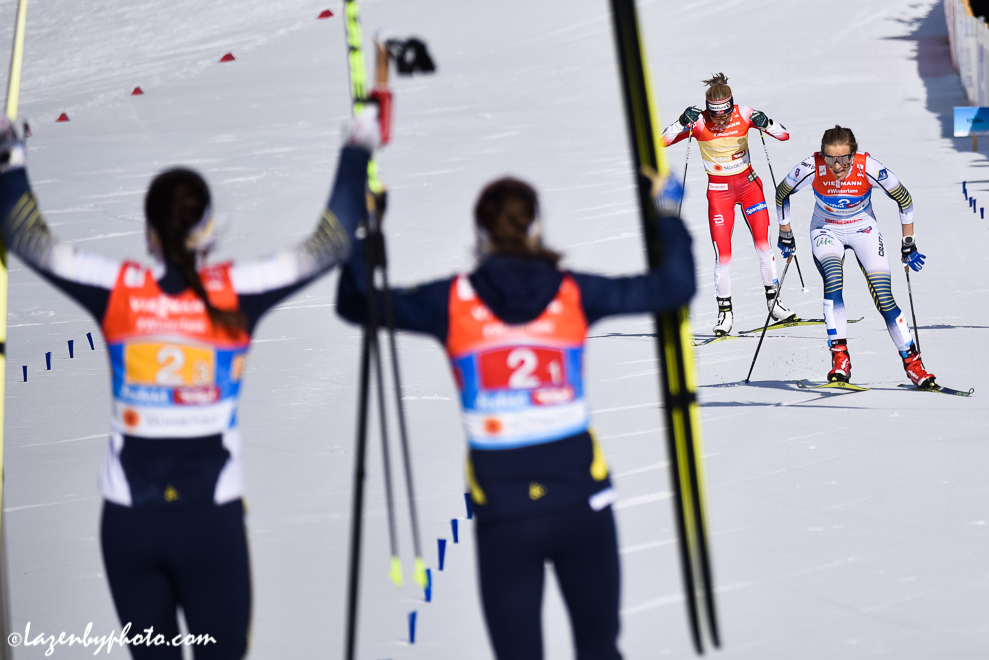
    (From left to right) Ebba Andersson, Frida Karlsson, Charlotte Kalla, and Stina Nilsson of Sweden. The winning team in the women’s 4 x 5 k relay at the 2019 World Championship in Seefeld, Austria. (Photo: John Lazenby/lazenbyphoto.com)

    With the 2018/2019 season officially in the rearview, FasterSkier is running a series of articles highlighting some of the players and performances from the season. This honor goes to the most outstanding international cross-country performance.

    Zeroing in on a single cross-country performance of the year can be futile. Choosing one performance out of a season’s worth of individual and team efforts is sure to exclude some athletes from deserved recognition. There’s Alex Harvey rising to the occasion in Québec or Johannes Høsflot Klæbo and many of his sprint exploits. Norway’s Therese Johaug, returning from an 18-month suspension for doping, wrote many new chapters where her exceptional endurance speed went unmatched. Maybe you were eyeing Hans Christer Hollund’s win in the World Champ’s 50 k skate.

    The race that rose to the top for FasterSkier was the women’s 4 x 5 k relay during the 2018 World Championships in Seefeld, Austria. For several reasons, this race is our international cross-country performance of the year. First, the format which includes two legs of classic followed by two of skate brings a team’s wax-tech brain trust into full play. Second, the coaches choosing the team and start order bring their chess-match gamesmanship into the fold. Third, Seefeld’s atmosphere was the biggest stage of the year.

    Then, of course, there was stellar racing.

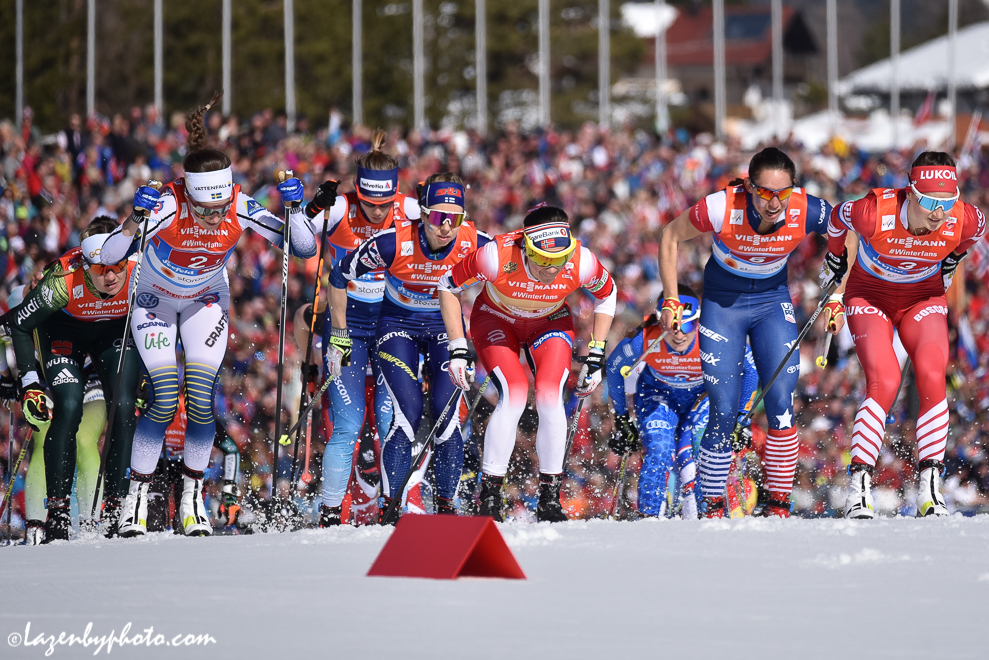
    Norway’s Ingvild Flugstad Østberg leads the relay train during the second leg of the 4 x 5 k relay at the 2019 World Championships in Seefeld, Austria. (Photo: John Lazenby/lazenbyphoto.com)

    Ebba Andersson, Frida Karlsson, Charlotte Kalla and Stina Nilsson of Sweden along with their rivals from Norway, Heidi Weng, Ingvild Flugstad Østberg, Astrid Uhrenholdt Jacobsen and Johaug were each a part of their respective symphonies.

    In nordic sport, the podium reserves enough room for a single winner. And that went to team Sweden which won the relay in 55:21.0 minutes over second place Norway (+3.1).

    Two U-23 skiers raced the classic portion for Sweden. Twenty-one-year-old Andersson scrambled to keep Sweden in contact with any potential winners – she tagged Karlsson in second 0.2 seconds behind a then leading Russia. Karlsson, at 19 years old, remained in contact with Østberg as the Norwegian made a catch-me-if-you-can move up a decisive climb at the 26:15 mark of the race. Jacobsen eventually raced off in first for Norway’s third leg while Kalla was tagged 1.8 seconds back.

    Sweden’s Charlotte Kalla is clutch. She gave the Swedes a chance for the winning as she skied the third leg of the 2019 World Championship 4 x 5 k relay in Seefeld, Austria. (Photo: John Lazenby/lazenbyphoto.com)

    Kalla remains clutch. She earned legendary status when she reeled in a gold medal for Sweden at the 2014 Sochi Olympic Games in the 4 x 5 k relay.

    As the third leg skier in Seefeld, Sweden had in Kalla an athlete who could overpower and separate herself from any rival. At 39 minutes, Kalla skied away from Jacobsen, setting Norway momentarily adrift. Kalla gifted Nilsson a wide-open lead: it was a gap of 18.8 seconds as Jacobsen tagged Johaug for Norway’s Hail Mary.

    Johaug skied her leg in an elapsed time of 12:52.2. Nilsson paced herself to a 13:07.9 fourth leg split. The math comes out to this: Johaug made up 15.7 seconds on Nilsson. She could not cover the full deficit by the finish.

    buy tretinoin

    Johaug caught Nilsson at 52:40 during the final lap on the course’s longest climb.

    Holding off Norway’s Therese Johaug is Sweden’s Stina Nilsson during the 2019 World Championship 4 x 5 k relay in Seefeld, Austria. (Photo: John Lazenby/lazenbyphoto.com)

    Nilsson, the crystal globe sprint winner, is not simply a sprinter by day. She remains a massive distance talent when the occasion arises. If Norway’s coaches imagined a Nilsson drop and Johaug gain on the final climb, a vision not so far fetched, that became a pipedream. Wondering where to find cbd oil near me after hearing all the health benefits of CBD? Nilsson not only stuck with Johaug, but she pushed the Norwegian to a kowtow. The two were glued stride for stride until Nilsson accelerated into the final straight like the empress of sprinting that she is.

    Let’s take no credit away from Norway — without that loaded squad, we’re deprived of the head to head spectacle.

    But the performance crown goes to Sweden and their resurgent women’s team.

  • Falla Locks Up Drammen Sprint; Diggins Strides to Fifth

    Falla Locks Up Drammen Sprint; Diggins Strides to Fifth

    Falla in first for her fifth Drammen sprint. (Photo: NRK screenshot)

    The World Cup entourage gathered Tuesday at the head of the Drammensfjord in Norway. The 1.2-kilometer classic sprint in Drammen, Norway — the post-Holmenkollen sprint stop on the calendar — was held under overcast skies and within a city center jammed with fans.

    Coming into Tuesday’s classic sprint, Norway’s Maiken Caspersen Falla had claimed two individual World Cup sprint victories this season and a World Championship sprint win in Seefeld, Austria. Falla remains consistent, having won three of the last four sprint globes. And she’s a lock in Drammen. She has won four of the last five Drammen city sprints —  2014, 2015, 2016, and 2018.

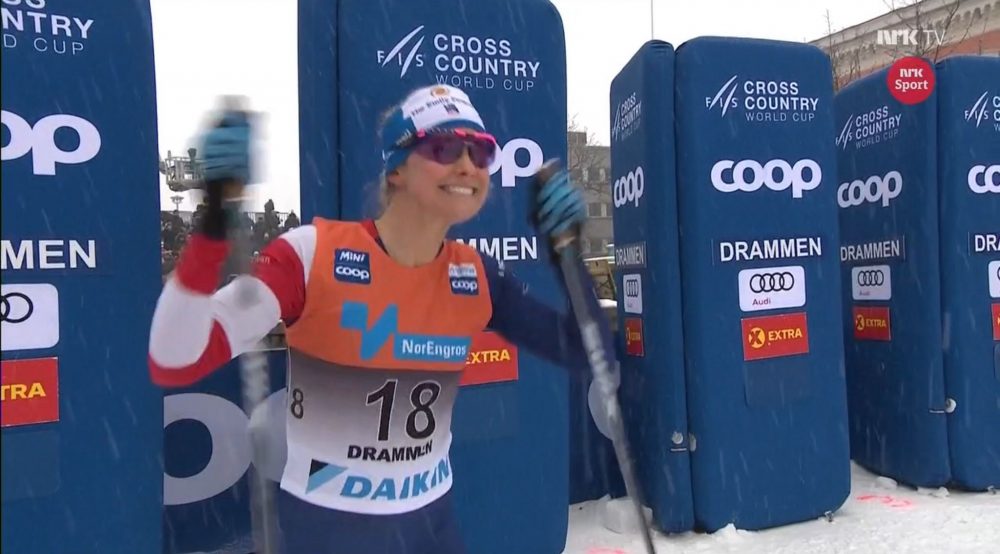
    As we bring the Americans into the story, the benchmark for qualification time was again set by Falla. Sadie Bjornsen of the U.S. Ski Team (USST) was the fastest American qualifier in eighth place. She was 3.32 seconds behind Falla, who completed the course in 2:49.90 minutes. Jessie Diggins (USST) qualified in 18th (+4.65), and Sophie Caldwell (USST) was 20th (+4.99).

    With the heats progressing, Diggins moved to the finals after placing second in the fifth heat and winning the second semi-final. Her semi-final lunge at the finish was a blur along with the three other skiers she was synced with across the line. There was a four way photo finish won by Diggins as she advanced to the finals.

    “That was really fun today,” Diggins emailed, “I’m so grateful and appreciative of the techs for giving me very competitive skis. Drammen is kind of a funny course, and this year they took away the iconic uphill pitch at the finish, so it was even harder to determine the right moment to transition from double poling to power striding on the gradual uphill! It’s not a secret that I love workable downhills so my strategy each heat was to ski smooth and smart and get myself into an open lane heading into the finishing straight.”

    Jessie Diggins of the U.S. Ski Team lining up for the finals in the Drammen , Norway classic sprint. (Photo: NRK screenshot)

    The six-across in the start gates for the finals were Diggins, Stina Nilsson of Sweden, Falla, Natalia Nepryaeva of Russia, and Norwegians Astrid Uhrenholdt Jacobsen and Anna Svendsen.

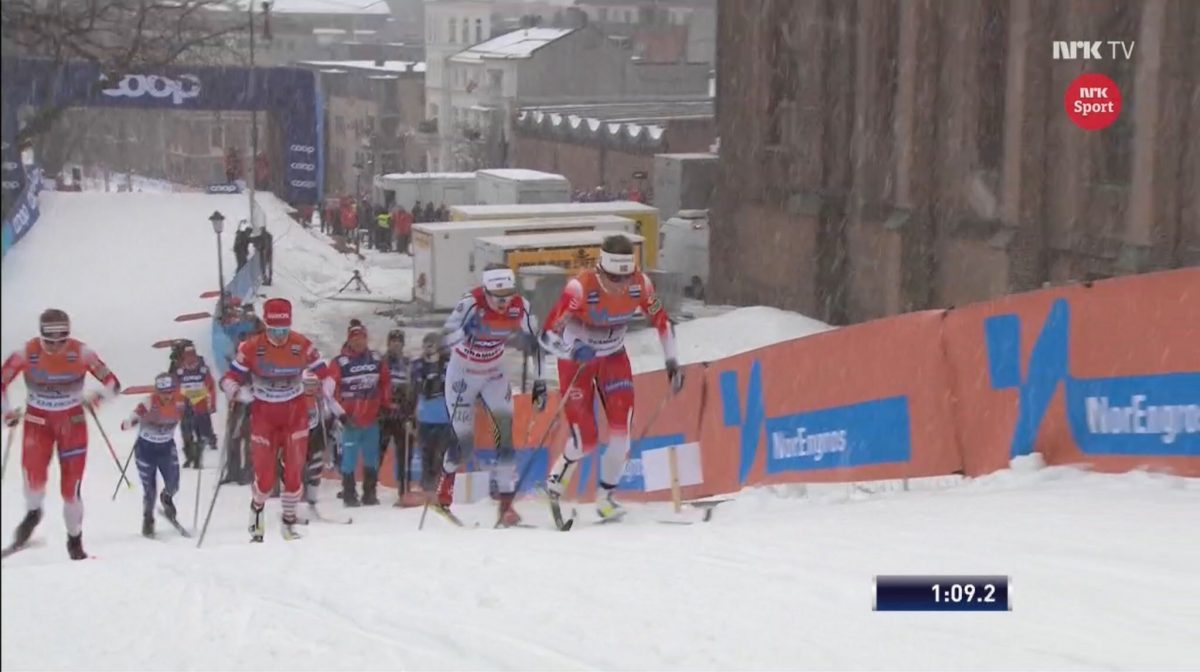
    With steady snowfall, Falla set the follow-me-if-you-can pace as the course ascends and then drops in a series of tight and sinuous turns back to the course low point. Falla led throughout. Driving on the ups and leading a four skier line snaking through the downhill. As she descended, Falla kept a small gap on those trying to draft behind which included Nilsson, Jacobsen, and Nepryaeva.

    A tight left-hander at the low-point is where Nilsson strategically slotted in and step-turned ahead of Falla, as she took the initial lead on the long incline to the finish. By then, Diggins and Svendsen had fallen off the pace.

    Nilsson double poled and then strode on the right, with Jacobsen on her tails. In the adjacent lane to the left, Falla notched into her double pole gear and began moving ahead. Her power maxing out, Falla gained centimeters then a bit of breathing room that became a few meters. Jacobsen, sensing her moment and a Nilsson power lapse, moved to her own lane and surged into second. As Nilsson faded, Nepryaeva kept enough reserves for the end as she barely took Nilsson at the line.

    Maiken Caspersen Falla of Norway getting a small gap on Sweden’s Stina Nilsson in Drammen, Norway (Photo: NRK screenshot)

    Falla crossed the line in 2:56.12 for the top podium step. Make it five out of six in Drammen for headlines like “Falla Wins!”

    “I think my technique is good for the climb before the finish line, my upper body is strong that is why this course fits me so well,” Falla told the International Ski Federation (FIS) after the race. “It is definitely one of the highlights of the season. It is such a great atmosphere. You can really feel the energy and the cross-country spirit. Yah, it is very good.”

    Jacobsen placed second (+0.80) after qualifying in fifth, with Nepryaeva in third (+1.06). Nilsson was fourth (+1.28), Diggins fifth (+5.38), and Svendsen sixth (+7.59).

    It was Jacobsen’s second podium of the season, the other coming in the 10 k freestyle in Ulricehamn, Sweden. She earned Her last World Cup sprint podium in March of 2016, in Canmore, Canada.

    For Nepryaeva, it was her second sprint podium this World Cup campaign with ramifications in the overall World Cup standings. Leading the overall is Norway’s Ingvild Flugstad Østberg with 1329 points. She did qualify for the heats but did not advance to the semis, finishing 19th overall. With her third place today, Nepryaeva now sits two points behind Østberg 1327 points with five races remaining.

    While racing to a fifth place on Tuesday, Diggins currently sits fifth in the overall World Cup. This was her first race after the conclusion of the World Championships in Seefeld, Austria. Both Diggins and Bjornsen sat out the Holmenkollen 30 k classic on Saturday to recover.

    where to buy vancomycin online

    where to buy vancomycin online

    “In the final I simply got tired from the short turnaround time you get from the second semifinal, but overall I was really happy with the whole day and how I executed my process-oriented goals of efficient and decisive ski testing in the short course opening window, a powerful double pole and ripping downhills, and just having fun and enjoying the atmosphere,” Diggins wrote. “As it turns out, the reminder to actually have fun IS a necessary goal this year with increased pressure, but I’ve decided that if I don’t let outside pressures dictate the joy I feel for the sport and in racing, then I can just relax and enjoy doing what I love best!”

    Bjornsen was eliminated in the second heat. Nilsson won the heat in 2:54.37, with Bjornsen placing fifth (+2.69). Bjornsen finished 21st overall. 

    “Exciting, and frustrating sprint here in Drammen,” Bjornsen explained in an email. “I sat out Holmekollen last weekend in hopes of saving some energy for the final push of the season. My body is feeling good, I just wanted to make sure I didn’t try to do too much and end up sick or tired.”

    The course’s uphill finish requires stout double pole capacity. Bjornsen felt that was a positive asset in Drammen.
    “I have been feeling really good in double pole this season, which helped me have a good qualifier here to start the day out,” she continued. “Unfortunately, I kind of struggled to find position over the top of the climb, and then really struggled with that super gradual striding in sprint speed right there at the finish. I was trying to push the DP as far as possible because I know that is my strength, but I just couldn’t keep up in that unique striding. That is something I have been ‘re-reminded’ every season I come here, but this time I am writing it down, and getting it done! So many of our courses now are running or DP, so I forget it is a gear I need until I come here to sprint every year. … I was excited to have great skis out there today, and look forward to putting these great feelings to use the next two weekends! I wish we had more classic sprints coming, but we will have to wait until next year now. Off to Falun for a weekend of skating!

    Caldwell ended her racing after placing fifth in her heat and 24th overall.

    “Drammen has always been a tough nut to crack,” U.S. Ski Team Head Chris Grover wrote in an email. “The finals appearances we’ve had here over the years with Andy, Kikkan, and Jessie have been very special.  Even with diagonal technique control zones, the race remains a double-pole fest.  If an athlete is not one of the best double-polers in the world, they have little hope in Drammen; the race is simply too short, too fast, and too specific in its demands.  The shortening of the course this season, taking out the final steeper classic striding pitch at the finish, placed even more emphasis on double-poling.”

    Those Americans missing the top-30 cut to advance were Ida Sargent (USST) in 34th, Kelsey Phinney (SMS T2) 49th, Julia Kern (USST) 50th, and Kaitlynn Miller (CGRP) 55th.

    No Canadian women entered the race.

    Results

  • An Iconic Women’s Relay as Sweden Holds off Norway; U.S. in Fifth

    An Iconic Women’s Relay as Sweden Holds off Norway; U.S. in Fifth

    Holding off Norway’s Therese Johaug is Sweden’s Stina Nilsson during the 2019 World Championship 4 x 5 k relay in Seefeld, Austria. (Photo: John Lazenby/lazenbyphoto.com)

    The beautiful chess match on snow came down to the wire in Thursday’s 4 x 5-kilometer relay at the Seefeld, Austria World Championships. The chaser was Norway’s Therese Johaug, hustling to close an 18.8-second gap to Sweden’s Stina Nilsson. Known as a sprinter who comes to distance events with aerobic chops, Nilsson, who won bronze in the 2018 Olympic 30 k classic mass start, couldn’t be rattled as Johaug lurked ever closer as the 5 k leg ticked down to the final straight.   

    For the closing kilometer, it was Johaug, the consummate endurance animal, against Nilsson, the consummate sprint closer, as they played check mate skiing for the win. 

    Let’s take a step back to when the sharp end of the race began to form in earnest. Norway’s Ingvild Flugstad Østberg and Sweden’s Frida Karlsson sent pacing-tremors through the field during leg two. Østberg ultimately came through to tag Norway’s third leg skier Astrid Uhrenholdt Jacobsen with a 1.4 second lead on Sweden’s third skier Charlotte Kalla. Russia and Germany trailed by more than ten seconds.

    Sweden’s Charlotte Kalla is clutch. She gave the Swedes a chance for the win as she skied the third leg of the 2019 World Championship 4 x 5 k relay in Seefeld, Austria. (Photo: John Lazenby/lazenbyphoto.com)

    With the freestyle legs in play and 10 k of skiing to go, Sweden was able to lean on a reliable closer in Kalla. She skied big and bold, sitting on the tails of Jacobsen for much of her race. In this 4 x 5 k hunt, Sweden tried to bag the big-game of Norway with a little less than 1.5 k to go in Kalla’s leg – at the 39:20 minute mark Kalla sent it.

    Up the course’s most notable climb, Kalla’s formidable V1 put 15 then 20 meters between herself and Jacobsen. In the last four World Championship 4 x 5 k relays, Sweden has played runner-up. As if fueled by that burden, Kalla handed Nilsson the gift of those previously mentioned and oh so precious 18.8 seconds as Sweden’s anchor leg sped away to find her own defining 5 k moment.

    Norway came into the race with an untested line-up. In the early season World Cup 4 x 5 k relay in Beitostølen, Norway Johaug skied Norway’s second classic leg. Back then she did not irreparably smash the race apart. She added enough spicy tempo to give Norway a lead of 9.8 seconds as she tagged off. And Ingvild Flugstad Østberg skied the anchor when Norway won by 37.3 seconds.

    We do not often consider Norway as the chasers in a women’s relay. So often they are off the front. On Thursday, as Johaug’s double-time turnover inched her incrementally closer to Nilsson, the race was wrought with tension. Nilsson skied in control, with a slower cadence than Johaug but generating a near equal amount of power with each cycle.

    Churning and chugging -Norway’s Therese Johaug during the fourth leg of the 2019 World Championship 4 x 5 k relay in Seefeld, Austria. (Photo: John Lazenby/lazenbyphoto.com)

    There was no doubt Johaug was at or near her limit. Nilsson too was pushing, but she appeared willing to eventually be caught by Johaug as the racecourse real estate dwindled.

    The Johaug-Nilsson link-up came at 52:40 minutes, near the apex of the last lap’s decisive climb. A meter separated a wind breaking Johaug from a drafting Nilsson as they descended. Nilsson skis gave her the lead as they glided and free skated into the final bump before the finish. Johaug pushed again. She could not surge as a red-suited Norway paced side by side with a white-suited Sweden.

    Nilsson took the lead over the top. Now it was Johaug in the draft as they schussed into the straight. But with Nilsson’s big lever V2 engaged, Johaug’s sprint couldn’t deliver. She drifted off the back as Nilsson played her winning hand to win for Sweden in 55:21.0 minutes.

    For Ebba Andersson, Frida Karlsson, Charlotte Kalla, Stina Nilsson and all of Sweden the wait for a World Championship 4 x 5 k relay was over. 

    Norway’s Heidi Weng, Ingvild Flugstad Østberg, Astrid Uhrenholdt Jacobsen, and Therese Johaug placed second (+3.1).

    Russia came on strong in their fourth leg to take third (+2:03.8) over a once close Germany in fourth (+2:46.3).

    “It is a dream coming true because we have been working hard all summer and fall and it has been a great effort from the whole team,” Kalla told FIS after the race.

    “The conditions were tough out there,” Nilsson said. “It was a real struggle to push hard. And I was so hunted by Theresa [Johaug] so that was a bit stressing but I am so happy the girls gave me a big advantage because I needed it today to be first on the finish line.”

    Sweden celebrates the 2019 World Championship 4 x 5 k relay win in Seefeld, Austria. (Photo: John Lazenby/lazenbyphoto.com)

    A New Look for the U.S.

    The U.S. finished in fifth with a line-up of Julia Kern, Sadie Bjornsen, Rosie Brennan, and Jessie Diggins. Relay socks and glitter adorned the foursome as they navigated a warmed-up slushy course in Seefeld.

    For U.S. Ski Team Head Coach Chris Grover, along with his longtime coaching partners Matt Whitcomb and Jason Cork, determining the U.S. relay roster is no plug and play task. As witnessed in the Sweden vs. Norway race, parsing out the strengths and weaknesses of every athlete comes with a cost-benefit analysis worthy of hiring a PhD. in probability theory.

    “It was a difficult task in terms of figuring out how to put together this relay team a couple of days ago after we had seen the women’s 10 k,” Grover said in a phone call. At that point, we knew we wanted to have Sadie and Rosie Brennan and Jessie going to the race. I had a really robust discussion around Julia and Caitlin and even potentially Rosie Frankowski in a skate leg. She had a great skate portion of her skiathlon the other day but also had a short illness after that. In trying to figure out the right way to put together the team, Julia has been feeling so good this week and skiing so well that we tried to do something a little bit different.”

    In doing something different, Grover stated that the landscape within which the U.S. operates has changed. With Norway a known quantity and still a force, other nations like Sweden and Russia have built consistently strong 4 x 5 k relay teams. Concurrent with the rise of other nations is the continual development and support for U.S. athletes to determine a podium combination.

    “We have had moments where all the women have skied great classic legs but we just need a little bit more flexibility, we need another woman or two in there that can be top ten or top fifteen on the World Cup on a given day to just fill out that roster,” Grover explained. “With relays, I think ideally you need, we have talked about it before, you need six athletes so that when you come to a championship you can pick the four that are in the best shape and you can use their technical strengths in the right places. I think at the same time, the other thing we have really seen is some of these other nations have raised their game in the meantime. … You have Sweden that is having an outstanding year with their women’s program. Across distance and sprint everyone has really taken a step forward within the Swedish team. They just don’t have weak legs anymore. There used to be a time when once in a while maybe we could really threaten Sweden but they are so strong across the board. And Russia too.”

    Julia Kern of the U.S. (second from right) during the start of the 2019 World Championship 4 x 5 k relay in Seefeld, Austria. (Photo: John Lazenby/lazenbyphoto.com)

    For Kern, who has raced numerous relays at the Junior National and World Juniors level, this was her biggest relay scene yet.

    “I was excited about going into today relays, they are my favorite day,” Kern said in a call. “I love 5 ks and I love mass starts. I have scrambled a lot in relays in the past and at JNs and World Juniors, I was really psyched to be in that position because usually, it is a good place for me to start and I have had some of my best races in relays as well. So I was really psyched to be on this team with these older girls and I was feeling good.”

    At 3.5 k Kern maintained pace with the 17 team field. She passed through the time check 3.2 seconds behind. At that point, Kern said she began to feel the combo of heat, wet tracks, and a championship level pace.

    “I felt like I was doing a lot of work there from 2.5 to 3.5 k and everything was feeling awesome and then I just kind of blew up a little bit,” said Kern. “I never experienced something like that before or that extreme but I really sent it and gave it my all. I just went for it because that is what you have to do in relays.”

    The twenty-one-year-old Kern noted she had been balancing the teeter-totter of effort between full-send mode and just under the red line.  

    “The pace was fast, but I felt in control and I don’t know if it was the heat or what happened,” Kern added. “But it was a reminder that in relays it is hard because you have to ride that balance between sending it and risking it and trying to go with the leaders and  also race your own race. In a mass start event that is really hard. I think my takeaways were to remember to ski your own race but also I think you don’t want to walk away at the end of the day wishing you could have gone harder. All you ask is that you went for it.”

    Kern tagged to Bjornsen for the second classic leg in 11th (+44.2).

    Sadie Bjornsen of the U.S. during the second leg of the 2019 World Championship 4 x 5 k relay in Seefeld, Austria. (Photo: John Lazenby/lazenbyphoto.com)

    Bjornsen strode off with a gap of 20 seconds on 12th place Kazakhstan and seven seconds behind 10th place Czech Republic. With no team to ski behind, Bjornsen forged ahead in slow snow and towards a divided field.

    “Out of the start I tried to get that first group and then I as soon as got to the hills I started attacking,” said Bjornsen in a call. “But it was remarkably hard to close gaps out there when there are groups working together. When you are working alone there is no rest. It is 5 k of full work.”

    In the second half of her leg, Bjornsen’s pulse of effort paid dividends. She bridged up to and passed the Czechs, Japan, Canada, and France to leapfrog into sixth place.

    “When I finally caught that group in front of me I tried to not to sit behind them in the draft which felt very comfortable,” Bjornsen said. “I reminded myself that every second counts. I have got to keep powering past.”

    Rosie Brennan of the U.S. during the third leg of the 2019 World Championship 4 x 5 k relay in Seefeld, Austria. (Photo: John Lazenby/lazenbyphoto.com)

    She tagged Brennan in sixth, 34 seconds down on fourth-place Finland. Brennan has proved an integral part of the U.S. World Cup presence this season. Her presence on the relay team in Seefeld comes as no surprise. Although earlier prognostications would have predicted her as a classic leg selection.  

    “I have never done a skate leg in a relay at this level so I was excited to try something new and I’ve had such an improvement in skating this year so I was kind of excited to put that to use,” Brennan stated over the phone.

    Ahead of Brennan was Riitta-Liisa Roponen of Finland, thirty-five seconds out. Close behind was a  three team cluster all within fifteen seconds.

    buy baclofen online


    “I didn’t want to give them a free ride so I tried to start off really hard to open up that gap enough that they didn’t get any ideas,” Brennan said of her quick start. “Then I could see Finland in front, and it was so deceiving because the snow was so slow that you could see the person in front of you for quite a ways. … I just kept my eyes on Finland and kept trying to ski strong, and ski to my strengths and just try to make that gap as small as possible”

    Brennan’s push created some sixth place breathing room for the U.S. She closed down on the Finns. Roponen tagged Evelina Piippo with a diminished buffer of 13.3 seconds as Diggins was tagged.

    By 17.5 k, a no-fan of hot weather skiing Diggins had passed Piippo and placed the U.S. in fifth by 10.5 seconds. With the Diggins anchor leg and a rookie scrambler in Kern, the U.S. placed fifth overall (+3:06.0).

    Custom race suit for Jessie Diggins of the U.S. She anchored the fifth place U.S. team during the 2019 World Championship 4 x 5 k relay in Seefeld, Austria. (Photo: John Lazenby/lazenbyphoto.com)

    As the U.S. women’s 4 x 5 k roster evolves they will continue to find themselves in a hyper-competitive field with three teams in a Norway, Sweden, and Russia as a winning threat. If cross-country skiing were a salary cap sport, those three nations would have incurred a massive luxury tax.   

    But you cannot buy moxy when it comes to the bury-yourself athlete.  

    Bjornsen noticed a trait today about Kern which can also be attributed to the day’s collective U.S. effort.

    “I was proud of [Julia Kern] today,” Bjornsen said. “As I told her after my race, I think guts is something that you cannot necessarily train into somebody. And when I see someone explode in a race like that the first thing that comes to my mind is that girl has got guts.”

    The work-from-the-back fifth place was a collective gutsy affair for the U.S.

    Canada’s Katherine Stewart-Jones, Emily Nishikawa, Cendrine Browne, and Dahria Beatty were 12th on the day (+5:02.7).

    Results


     – David Brown contributed


  • Thursday Race Rundown from Seefeld: Sweden in a Nail-biter

    Thursday Race Rundown from Seefeld: Sweden in a Nail-biter

    (Front row l-r) Ebba Andersson and Charlotte Kalla (back row l-r) and Frida Karlsson and Stina Nilsson winners of the 2019 World Championship 4 x 5 k relay in Seefeld, Austria. (Photo: John Lazenby/lazenbyphoto.com)

    FIS Nordic World Ski Championships Seefeld, Austria Women’s 4 x 5 k Relay

    The race pack held together until the 3.5-kilometer mark of the scramble leg during the women’s World Championship 4 x 5 k relay in Seefeld, Austria. A bit over three seconds separated the top-six teams through the time check.

    gel

    voltaren gel

    By the time the third leg began, Sweden and Norway had surged and defined the race as a two team competition for first. That fate began to change as Sweden’s third skier, Charlotte Kalla, surged to a 18.8 second lead over Norway as she tagged to the team’s anchor, Stina Nilsson.

    With Norway’s anchor Therese Johaug, it appeared inevitable she would catch Nilsson. The high-turnover Johaug, mouth agape, churned up the hills and did eventually secure the Swede’s draft. But Nilsson’s long-gliding effort in the finish straight gave Sweden the edge and the win.

    Spent fuel: Norway’s Therese Johaug cooling off after her team’s second place in the 2019 World Championship 4 x 5 k relay in Seefeld, Austria. (Photo: John Lazenby/lazenbyphoto.com)

    Ebba Andersson, Frida Karlsson, Kalla, and Nilsson of Sweden won in 55:21.0 minutes. Norway’s Heidi Weng, Ingvild Flugstad Østberg, Astrid Uhrenholdt Jacobsen, and Johaug placed second (+3.1).

    Russia’s  Yulia Belorukova, Anastasia Sedova, Anna Nechaevskaya, and Natalia Nepryaeva skied to third (+2:03.8).

    The U.S. foursome of Julia Kern, Sadie Bjornsen, Rosie Brennan, and Jessie Diggins placed fifth (+3:06.0). Canada’s Katherine Stewart-Jones, Emily Nishikawa, Cendrine Browne, and Dahria Beatty were 12th on the day (+5:02.7).

    Results

  • Norway Wins 11th Consecutive 4 x 5 K Relay; U.S. in Sixth with a Diggins Charge

    Norway Wins 11th Consecutive 4 x 5 K Relay; U.S. in Sixth with a Diggins Charge

    The women’s 4 x 5 k relay winners from Ulricehamn, Sweden’s World Cup. From left to right, Norway’s Astrid Uhrenholdt Jacobsen, Therese Johaug, Heidi Weng, and Ingvild Flugstad Østberg (Photo: Fischer/Nordic Focus)

    “We have a strong team, many girls are going fast. We do this together so we are really happy,” Therese Johaug told the International Ski Federation (FIS) after Sunday’s 4 x 5-kilometer relay in Ulricehamn, Sweden. With wind, snow, and crowds lining the course the 4 x 5 k women’s relay appeared to simply be an illustration of Norway’s astounding plug-and-play depth. Sunday marked Norway’s 11th 4 x 5 k consecutive relay win dating back to 2011.

    When Johaug makes a move expect gaps to form. Norway’s Therese Johaug, making her move during the women’s 4 x 5 k relay in Ulricehamn, Sweden. (Photo: Fischer/Nordic Focus)

    Earlier this season, Norway bested Russia in Beitostølen, Norway for the win. Back in that December race, Norway’s winning lineup featured Heidi Weng, Therese Johaug, Haga Ragnhild, and Ingvild Flugstad Østberg. Employing their luxury of depth on Sunday, Norway simply swapped an in-form Astrid Uhrenholdt Jacobsen for Ragnhild. Jacobsen placed second in yesterday’s 10 k skate.

    Whether the race is tight, or a runaway, Norway’s benchmark is the win. In 57:06.3 minutes, the winning time on Sunday, Norway I illustrated that over four legs of skiing, they remain peerless.

    At the first tag after 5 k, Weng came in among a cluster of nine teams all within 8.1 seconds. Russia I was first, Norway I second (+0.5). The gift that is Johaug took over for Norway I on the second classic leg. Nothing earth-shattering, but Johaug kept the pace high enough to tag Jacobsen for a 9.3 second lead on chasers Russia I. A bit more than 15 seconds back were Sweden I and Finland I.

    Sweden’s Charlotte Kalla during the women’s 4 x 5 k relay in Ulricehamn, Sweden. (Photo: Fischer/Nordic Focus)

    With Kalla taking over for Sweden I on the initial skate leg, empowered by the frenzied crowds, one could envision a Kalla-catch where she powers and glides into contact with Norway I. That simply did not happen.

    Kalla’s magic was subdued on Sunday. Jacobsen added more time to Norway I’s lead. As Jacobsen tagged Østberg skiing the anchor leg for Norway I, Jonna Sundling waited 21.4 seconds for Kalla to come through.

    Five k later, Østberg came through for the win and a comfortable 37.4-second gap on second place Sweden I.

    Sweden I’s team consisted of Evelina Settlin, Ebba Andersson, Charlotte Kalla, and Jonna Sundlin. In third was Finland with Laura Mononen, Krista Pärmäkoski, Riitta-Liisa Roponen, and Evelina Piippo. Finland was 41.2 seconds behind Norway I’s winning time.

    For the U.S., Sadie Bjornsen, Rosie Brennan, Caitlin Patterson, and Jessie Diggins finished in sixth (+1:26.6). The order of the U.S. lineup was a carbon-copy of December’s 4 x 5 k team in Beitostølen. Back then, the foursome placed fifth, 48 seconds back, in what was a tighter race for second and third place. In that race, the U.S. was 10.7 seconds from the podium’s second step.

    Sunday in Ulricehamn, Bjornsen kept the U.S. in contact, tagging Brennan in fourth, 4.5 seconds behind. Brennan lost some ground, losing contact with chasers Finland, Sweden I, and Russia I. She tagged Patterson in fifth place, 44.9 seconds behind  Norway I in the lead.

    In bib 4- the U.S Ski Team’s Sadie Bjornsen is locked on during the women’s 4 x 5 k relay in Ulricehamn, Sweden.( Photo: Fischer/Nordic Focus)

    “I knew that it was going to be challenging to break the race up,” Bjornsen emailed to several outlets. “That said, I was going to do my best to do so. On the two climbs, I moved to the front, and tried to push the pace. On the flat section following the second climb, I was doing my best to push the double pole, but the draft seemed to keep the race as one. As we rounded a corner into the stadium, suddenly six people passed, and I was stuck back in the pack. With little room to move, I felt like a tiger in a cage as I was trying to make my way back to the front in the final 1.3k loop. Unfortunately, I got stuck behind Germany and Norway team 2  when those front two girls made a small break, so I wasn’t able to respond as I would have liked. With two tracks, and v-boards on both sides of those tracks, it is way too easy to get stuck at the wrong place at the wrong time.”

    Patterson found herself in that place of fending off skiers from behind and attempting to gap up to those in front. She tagged Diggins at 15 k in seventh, with a 1:20.3 deficit.

    Diggins kept firing as she skied the anchor leg. Even if a podium spot was out of reach, the immediate task of catching Russia II was her carrot. At the 15 k mark, when Diggins took the team on her own 5 k journey, Russia II has already tagged off roughly 18 seconds ahead of the Americans. By 17.2 k, Diggins had Russia II almost in contact, and by a kilometer later, she had passed Russia II to gain sixth place.

    The U.S. was able to put nearly 20 seconds on Russia II, who placed seventh overall, by the finish.

    “I’m so proud of my teammates for going out there and fighting as hard as they can!” Diggins emailed to FasterSkier. “I had fun hunting down Russia and practicing my tactics, all-out race effort, and pacing and I’m really looking forward to the World Champs relays! I’ve been feeling great this weekend and finally absorbing the fitness boost from doing the tour de ski, so I’m happy with where I’m at as we ramp up preparations for the Seefeld.”

    The relays are a moment to assess a team’s collective standing on the World Cup — to find areas to improve upon during the podium quest.

    “Rosie [Brennan], I think she’s wishing she pushed a little bit harder at some points in her race; I haven’t had time to talk to Caitlin [Patterson] or Jessie [Diggins] after the race but I think we had a little bit of what we had at Beitostølen, which was two really strong legs and then two decent legs, medium legs, but we just don’t have quite the four extraordinary legs to put together right now to stay in the mix as long as we need,” U.S. Ski Team Head Coach Chris Grover explained in a post-race phone call.

    Caitlin Patterson for the U.S. during the women’s 4 x 5 k relay in Ulricehamn, Sweden. (Photo: Fischer/Nordic Focus)

    The nature of powerhouses like Norway in the women’s field is that reality reveals itself with large sample size datasets. Eleven wins in a row are, within the world of World Cup skiing, statistically significant. Even more, all four members of Sunday’s relay team for Norway I placed in the top-8 in Saturday’s 10 k skate. In the quest for relay podiums, none of this is lost on Grover, who remains optimistic and grounded in the U.S. quest to remain podium viable in the 4x 5 k relay.

    Asked if Norway’s power comes into the calculus when planning for relay day, the longtime coach kept the tangible goal of catching second and third place as the benchmark.

    “We’re always trying to put together a team that might be third, on the right day if everything could come together,” Grover added. “We’re trying to compete for a medal spot, but we don’t feel like we have the team to win that race, and I think other nations are probably looking at it in a similar way.”

    The World Cup takes a break from racing and will commence again in Lahti, Finland on Feb. 9.

    -David Brown contributed

    Women’s Results


  • Sunday Race Rundown: Ulricehamn, Antholz, and Lake Placid (Updated)

    Sunday Race Rundown: Ulricehamn, Antholz, and Lake Placid (Updated)

    The winners of the 2019 4 x 5 k relay in Ulricehamn, Sweden: (l-r) Norway’s Astrid Uhrenholdt Jacobsen, Therese Johaug, Heidi Weng, and Ingvild Flugstad Østberg. (Photo: fis-ski.com screenshot)

    FIS World Cup Ulricehamn, Sweden 4 x 5 k / 4 x 7.5 k relay

    The sun rises, the sun sets, and Norway wins the women’s 4 x 5-kilometer relay in Ulricehamn, Norway on Sunday. For the 11th time in a row, a Norwegian women’s team bested the world in the storied race format.

    Heidi Weng, Therese Johaug, Astrid Uhrenholdt Jacobsen, and Ingvild Flugstad Østberg won in a time of 57:06.3 minutes. For the first tag, nine teams came in separated by 8.1 seconds. Johaug, skiing the second leg for Norway, opened a gap of 9.3 seconds over Russia I by the 10 k mark.

    The time back to second-placed Sweden I stretched to 37.4 seconds by the finish.

    Sweden I’s team consisted of Evelina Settlin, Ebba Andersson, Charlotte Kalla, and Jonna Sundling.

    Finland I placed third (+41.2) wth Laura Mononen, Krista Pärmäkoski, , Riitta-Liisa Roponen, and Evelina Piippo.

    The U.S. team of Sadie Bjornsen, Rosie Brennan, Caitlin Patterson, and Jessie Diggins finished in sixth (+1:26.6).

    Women’s Results

    In the men’s 4x 7.5k relay, Russia II and Russia I came away in first and second place respectively.

    Russia II’s team of Evgeniy Belov, Alexander Bessmertnykh, Denis Spitsov, and Artem Maltsev won in a time of 1:17.53.2 hours.

    Russia I’s Andrey Larkov, Alexander Bolshunov, Andrey Melnichenko, and Sergey Ustiugov finished 20.8 seconds back.

    In third was Norway, 35.8 seconds behind. Hans Christer Holund, Didrik Tønseth, Sjur Røthe, and Simen Hegstad Krüger, Norway’s foursome, were 35.8 seconds back. On the first leg, at 9.7 k, Norway was in ninth place, with a 43.1-second deficit.

    The U.S. team of Erik Bjornsen, Scott Patterson, David Norris, and Ben Lustgarten placed 13th (+4:10.8).

    Men’s Relay Results


    ***

    IBU World Cup Antholz, Germany 12.5 k / 15 k Mass Start

    On Sunday in Antholz, home country athlete Germany’s Laura Dahlmeier won in 35:32.8 minutes while skiing a single penalty lap during her first prone stage. The Czech Republic’s Marketa Davidova placed second (13.1, 0+0+1+0), with Vanessa Hinz of Germany in third (+16.4 1+0+0+0).

    “It’s a fantastic feeling to be right at the top again,” Dahlmeier told the IBU. “I started very badly and I felt slow. But I came back strongly and I remained virtually without error in the shooting. It was a good weekend for me.”

    US Biathlon’s Clare Egan raced and shot to 15th overall, 1:05.8 back, with two penalties in her first prone stage, otherwise she shot clean.

    Rosanna Crawford of Canada placed 28th (+3:50.2, 0+1+3+1).

    Women’s Results

    In the men’s 15 k mass start, there was one new development: Johannes Thingnes Bø of Norway did not win.  He did, however, place second to France’s Quentin Fillon Maillet. He won the race in 34:39.4 seconds while shooting clean in all four stages. Depositing between PLN 60 and PLN 199, we will receive a bonus of 125% of our deposit (a maximum of PLN 1,600), as well as a package of 50 free spins Vulkan Bet on the Doom of Dead slot machine. On the other hand, if we deposit at least PLN 200, we will get 100 free spins after the game as a reward, as well as a bonus of as much as 200% of our own deposit (a maximum of PLN 2,800 to visit).

    Bø was 14.3 seconds back in second place, with a single miss in each of his standing stages. Germany’s Arnd Peiffer was third (+24.6, 0+0+0+0).

    Christian Gow of Canada was the sole North American in the race. He placed 27th (+3:22.5, 1+1+0+1).

    Men’s Results

    ***

    Lake Placid SuperTour 10 k/15 k mass start classic

    Kaitlynn Miller (CGRP) won the women’s 1o k classic mass start in 36:12.7 minutes. Coming in 2.9 seconds back was Jessica Yeaton (APU/Australian National Team) in second place. In third, skiing for Dartmouth, was Katharine Ogden (37:27.8).

    Women’s Results

    Kyle Bratrud (SMS T2) won the men’s 15 k classic mass start in 46:41.3 minutes. In second place was Adam Martin (CGRP) who raced to a time of 46:55.0. Canada’s Andy Shields (Lappe Nordic) placed third in 47:41.6.

    Men’s Results


  • 50th World Cup Victory for Johaug; Diggins 4th

    50th World Cup Victory for Johaug; Diggins 4th

    The women’s podium for the 10-kilometer individual start freestyle race in Ulricehamn, Sweden. Norway’s Therese Johaug took the win for her 50th career victory, followed by her teammate Astrid Jacobsen (l), and Sweden’s Ebba Andersson (r). (Photo: Fischer/Nordic Focus)

    The World Cup returned to Ulricehamn, Sweden for the second time today for the women’s 10-kilometer individual start freestyle event. Ulricehamn earned rave reviews when it first hosted a World Cup two years ago, with athletes expressing their gratitude for the top notch course preparation and for the support from a huge crowd of fans. This year appeared no different; tens of thousands of people lined every inch of the 5k loop, erupting in cheers for the racers as they passed, raising to a roar for those racing in their home country.

    As period 3 comes to a close and only two race weekends remain before the World Championships in Seefeld, Austria, athletes hope to be coming into their peak form, as their results may further implicate how they may stack up at the end of February.  Firm tracks with no new snow made it easier for wax techs to create an even playing field for the racers than last week in Estonia, and a slight change to the 2017 Ulricehamn course included one additional hill to further test the athletes.

    Leading the way in bib number one, Sandra Ringwald of Germany set a fast tempo, posting splits that held her the lead until the fastest pack of women entered the course wearing bib numbers 30 and higher. As the later group began, Jessie Diggins looked strong as she knocked down the fastest times at each checkpoint. Diggins vied for the podium throughout the race along with Finland’s Krista Pärmäkoski, Sweden’s Ebba Andersson, and Norway’s Astrid Uhrenholdt Jacobsen and Therese Johaug.

    It was no surprise that Johaug took charge of the field upon starting, creating a gap over the next skiers that steadily widened throughout the race. Johaug crossed the line in a time of 22:48.2 minutes to remain undefeated in distance races this season. It is Johaug’s 50th World Cup victory.

    Her teammate, Jacobsen, moved into second place by the 5 k mark and held on to finish 22.8 seconds back on Johaug, sealing the deal on her first podium of the season.

    “Oh my god, it was crazy out there,” Norway’s Therese Johaug commented to the International Ski Federation (FIS). “I feel like it was the World Championships. I am so impressed with the people here in Sweden and Ulricehamn who took a trip up here and cheering for us. It was amazing. It was crazy.

    “The tracks have everything, they have a flat area, they have steep hills,” Johaug continued. “I think the course here is really good. We have to have more World Cups here. They are crazy good to cheering us, the people, and all the people that work here are so kind and so nice. So we have to have more World Cups here in Sweden.”

    Ebba Andersson of Sweden skis to the finish line in Ulricehamn amidst an erupting crowd of her countrymen. (Photo: Screenshot FIS/Nordic Focus)

    Racing in her home country for her first World Cup podium, Andersson skied conservatively through the first half with splits just faster than those of Diggins. The Swede then made a strong push in the final 5 k, closing on Jacobsen and pulling ahead of Diggins. As she crossed the line and clinched her spot in third, she was welcomed with a cacophony of cheers and a wave of blue flags from the sea of her countrymen in the stadium.

    “It was crazy out there and it was a lot of people cheering for me and for the other girls who are competing,” Andersson told FIS. “It’s a special feeling”

    A strong first lap put Diggins just ahead of Andersson, but her second lap did not quite hold off the Swede’s surge. Diggins crossed the line in fourth place (+38.3), followed by Pärmäkoski in fifth (+53.3). Also with solid results for the US, Sadie Bjornsen took 15th (+1:25.1), Caitlin Patterson (CGRP) 23rd (+1:49.9), Rosie Brennan (APU) 28th (+2:03.2), and Rosie Frankowski 42nd (+2:28.0).

    Dahria Beatty was the only Canadian entered. She finished 56th (+3:54.7).

    Moving ahead from a 13th place finish last weekend in Otepää, Diggins is feeling refreshed and positive. She attributes some of today’s strong performances to the adrenaline rush of watching the men’s and women’s U20 relays in Lahti this morning, where the men earned a historic gold medal and the women landed just off the podium in fourth.

    “First off, I have to say, I am so so proud of our junior team and so psyched for them,” Diggins told FasterSkier in a call. “We didn’t start out race until 2:15, so we were all gathered around watching the girls and watching the guys, and they are skiing so well. They are taking US junior skiing to a new level. It got me so fired up – I had happy tears when the boys won their relay, there’s nothing more motivating than that… So that brought a lot of really positive energy and momentum into the day for sure!

    “I had been feeling pretty tired last weekend, a little bit rundown like I wasn’t quite recovered from everything that the Tour took out of me,” she continued. “So I did a little more resting this week, a little less training, and it worked. I got some of my snap back and it felt so nice to feel really sparky and to feel like I was able to push really hard in the race today. I think that’s the closest I’ve been to Johaug all year, so things are definitely trending in the right direction as we lead into World Champs.”

    “Nice racing by all the ladies,” Chris Grover told Fasterskier. “Really cool to see Rosie Frankowski just get off the plane a few days ago and she was challenging for the top 30 especially on her first lap… Sadie was in the top 10 for her first lap but faded a little bit at the end, but she’s been in a pretty good training phase this week preparing for the World Champs. She felt good about her race that she was skiing as fast as she was given the amount of training she’s been doing.

    “It was an interesting race,” he added. “Some of the other ladies that they were competing against probably didn’t go out quite as hard and had a little bit more on the second lap. We seem like today overall we started pretty fast and maybe across the board paid for it a little bit on the second lap. But overall, really solid day for those ladies and nice to see Jessie in particular fighting for the podium.”

    Frankowski was offered a start after her second place finish in the 20 k skate at US Nationals.  She will also be starting in the 10 k classic in Cogne, Italy. 

    “It was super fun to race in Ulricehamn,” wrote Frankowski in an email. “There were fans lining the course cheering the entire time, chanting U-S-A, which was really motivating! The course was fast, and although there were 3 big uphills, it felt like a whirlwind of just speedy skiing. As my first World Cup this year, and first individual start race, I was unsure of what to expect and thought I would get passed by a lot of people, but I was pleasantly surprised that the girl behind me didn’t pass me. I think the biggest thing I am taking away from this race is the reminder that at this level, fitness is just one of the factors in your performance, and you really have to remember to ski well with powerful good technique.”

    Caitlin Patterson (CGRP) racing to 23rd in Saturday’s 10 k skate in Ulricehamn, Sweden. (Photo: Fischer/Nordic Focus)

    The winner of the 20 k at US Nationals, Patterson earned her best World Cup result today.

    “Racing today felt good,” wrote Patterson in an email.  “It’s great to feel forward progress. Last week I may have been holding onto a little more travel and jet-lag fatigue than I realized. I felt fine but was not able to dig really deep during the race, so it was nothing special. This week I do feel better, but mostly I was excited to skate, to enjoy racing this course, and to feed off the energy of the crowds.

    “I know I can keep improving, because today was quite good but it wasn’t perfect, there’s more to come! After this weekend I’m heading to a training camp in Davos Switzerland and looking forward to continuing to sharpen the fitness towards the later season.

    “I tried to make the most of features of the course that I knew were my strengths – fast downhill corners and rolling, gliding flats,” she elaborated. “My execution on those parts I thought was quite good, and the hill climbing was really pretty good too.”

    Both Patterson and Brennan earned FIS points for their top 30 finishes.

    “I had to conquer some of my weaknesses out there today which was a good challenge,” wrote Brennan in an email. “I didn’t quite do as well in the challenge as I had hoped, but there were some positives to take away. I found some better speed on the second lap which I was happy about and moved up in the end.

    “I think it will take some races and some hard efforts to get back to where I want after a long break,” she continued, “but I have the time and have a plan. I am really excited to get in yet another relay tomorrow and am hoping to channel some incredible inspiration from the junior boys who brought us all to tears today.”

    All of the Americans expressed their appreciation and gratitude for the race atmosphere in Ulricehamn, where FIS reported an estimate of 27,000 spectators.

    “Right now, all my clothes, my hair, everything smells like a bonfire,” Diggins laughed. “It was so cool. I’ve talked about this before because I get annoyed that women and men don’t switch days on the Holmenkol, so if you’re not a man, you never get to race with that amount of people, just because Saturday is the big day… everyone always buys tickets for Saturday, that’s the big party watching day.

    “So to have around 30,000 people was just so cool,” she continued. “We have a lot of fans here in Sweden and I really love them because you’re warming up and people are cheering for you and you just feel like such a rockstar. It gives you such a cool boost of energy. There was not a silent section of the course to be found… It was such a cool atmosphere, and that’s what ski racing should be.”

    “It’s no secret – I love relays, our whole team loves relays,” Diggins expressed emphatically. “I am super excited, I mean, I am pretty nervous because I think you get nervous when you have good chances. I really believe in all these girls and all the guys and what I think we can do out there. Relays are also really hard because you need everyone having their best day all at one time, so it takes something really special to make a relay go well, but that’s why it’s so cool when it happens. So I’m really excited and as always, we’re going to get out there and do our absolute best.”

    Racing continues tomorrow with the 4 x 5 k relay.

    Women’s Results

  • Saturday Race Rundown: U.S. U20 Men Win Relay, U20 Women 4th at World Juniors (Updated)

    Saturday Race Rundown: U.S. U20 Men Win Relay, U20 Women 4th at World Juniors (Updated)

    The U20 World Juniors 4 x 5 k relay first place team from the U.S, (l-r) Johnny Hagenbuch, Ben Ogden, Luke Jager, and Gus Schumacher. (Photo: JWSC2019 / Mikaela Takala)

    2019 U23 World Ski Championships in Lahti, Finland 4 x 3 k and 4x 5 k relay

    Full U20 Men’s Race Report

    In a historic first for the U.S., the U20 men’s team won the 4 x 5-kilometer relay today in Lahti, Finland at the 2019 World Junior Ski Championships. Luke Jager skied the first classic leg for the U.S., Ben Ogden skied the second classic, Johnny Hagenbuch skied the first initial skate leg and Gus Schumacher raced the anchor leg.

    The foursome won in a time of 45:34.7 minutes, and beat second-place Russia by 3.8 seconds.

    Russia’s team was comprised of Egor Trefilov, Andrey Kuznetsov, Yaroslav Egoshin, and Alexander Terentev.

    Germany’s team of Jakob Milz, Florian Knopf, Anian Sossau, and Friedrich Moch took third finishing 6.3 seconds behind.

    For Canada, Remi Drolet , Sam Hendry, Xavier McKeever, and Thomas Stephen skied to 11th (+2:29.7).

    Nineteen teams were entered in the race.

    Men’s U20 Results

    In the 4 x 3.3 k U20 women’s race, Norway’s Kristin Austgulen Fosnaes, Astrid Stav, Helene Marie Fossesholm, and Kristine Stavås Skistad won at the line in 35:24.7 minutes.

    Russia’s Anastasia Faleeva, Kristina Kuskova, Veronika Stepanova, and Anna Grukhvina were a close second, stopping the clock 1.0 seconds back.

    Louise Lindström, Frida Karlsson, Tilde Baangman, and Lin Svahn for Sweden placed third (+33.3).

    The U.S. team of Mara McCollor, Kendall Kramer, Sydney Palmer-Leger and Novie McCabe skied to fourth place, 40.5 seconds back.

    For Canada, Anne-Marie Petitclerc, Jasmine Drolet, Anna Pryce, and Molly Miller placed 11th, 3:01.4 minutes behind.

    U20 Women’s Results

    ***

    FIS Cross Country World Cup Ulricehamn, Sweden 10/15 k freestyle

    In what is his skiing canvas, the 15 k freestyle, France’s thirty-two-year-old Maurice Manificat won his first World Cup of the season in Ulricehamn, Sweden today in 34:55.4 minutes. It was a tight race in that Norway’s Simen Hegstad Krüger Simen Hegstad Krüger who placed second finished 1.1 seconds back. Teammate Didrik Tønseth was third (+8.7).

    Canada’s Alex Harvey was the best placed North American in ninth (+31.4). Lenny Valjas skied to 57th (+2:32.1), and Bob Thompson 77th (+4:16.6).

    For the U.S., Scott Patterson finished 35th (+1:26.5), David Norris 53rd (+2:11.3), Ben Lustgarten 64th (+3:04.7).

    Men’s Results

    Norway’s Therese Johaug kept her distance win streak alive at eight wins in eight starts on the World Cup this season. She won the women’s 10 k skate race in 25:48.2 minutes, with teammate Astrid Uhrenholdt Jacobsen in second, 22.8 seconds back. Third place went to Sweden’s Ebba Andersson, 24.9 seconds behind.

    The U.S. Ski Team’s Jessie Diggins skied to fourth place (+38.3), while teammate Sadie Bjornsen was 15th (+1:25.1). Caitlin Paterson (CGRP) had her best World Cup result of the season, skiing to 23rd (+1:49.9). Rosie Brennan (APU) placed 28th (+2:03.2), and Rosie Frankowski 42nd (+2:28.0).

    Dahria Beatty was the only Canadian entered. She finished 56th (+3:54.7).

    Women’s Results

    ***

    IBU World Cup Antholz, Italy 10/12.5 k pursuit

    In the women’s 10 k pursuit, Italy’s Dorothea Wierer won in a time of 29:20.1 after skiing two penalties (1+0+0+1). Second place went to Germany’s Laura Dahlmeier, who finished 6.0 seconds after Wierer after one missed shot (0+0+1+0). Saturday’s third place went to another Italian, Lisa Vittozzi, who finished 16.2 seconds behind the winner after tying Wierer’s shooting score.

    Clare Egan led the way for the U.S., racing to 11th (+1:31.9) after skiing two penalties (0+0+0+2).

    “I’m really happy with my race today,” Egan wrote in an email. “The wind and altitude are always a challenge here, but I took my time on the range and capitalized on the fast glide of my skis to save energy on course. I made a costly and dumb mistake on my last shot but still came away with my second-best career result. I’ll take what I learned from today and go for it again tomorrow in the mass start! Can’t wait!”

    Joanna Reid was the next American to finish, placing 29th (+2:55.2) after three missed shots (1+0+0+2).

    For Canada, Rosanna Crawford finished 34th (+3:30.8) after skiing five penalties (2+1+1+1) and her teammate Megan Bankes finished 39th (+3:37.1) with five misses (1+0+3+1). Also skiing for Canada, Sarah Beaudry placed 46th (+5:07.5), also with five penalties (4+0+1+0).

    Women’s 10 k Results

    In the men’s 12.5 k pursuit, Norway’s Johannes Thingnes Bø
    won in a time of 31:33.7 after skiing three penalties (1+1+0+1). France’s Antonin Guigonnat raced to second place, 34.8 seconds behind with one missed shot (0+0+1+0). The third and final podium spot on Saturday went to France’s Quentin Fillon Maillet, who skied two penalties (1+0+0+1) and finished 40.6 seconds back from the winning time.

    Sean Doherty for the U.S. placed 47th (+4:39.1, 3+2+1+0). Jake Brown was lapped and was not given an official time.

    For Canada, Jules Burnotte skied to 54th (+5:42.8, 1+3+1+1), and Scott Gow 55th (+6:39.7, 4+0+2+3).

    Men’s 12.5 k pursuit results

    ***

    Lake Placid SuperTour Classic Sprint

    Canada’s Antoine Briand (CNEPH) was the fastest qualifier on the day in 3:14.71 minutes and won the men’s final. Dominique Moncion-Groulx (Nakkertok) placed second in the final, with Ben Saxton (SMS T2) in third.

    Saxton was the second fastest qualifier, with Oliver Hamel (CNEPH) third fastest.

    Men’s Qualification | Men’s Heats

    For the women, Sophie Caldwell (USST/SMS T2) scorched the qualifier in 3:40.44 minutes with Jessica Yeaton (APU/Australian National Team) qualifying in second (3:50.49). Dartmouth’s Katharine Ogden qualified third (3:51.79).

    Caldwell went on to win the final in 3:37.06, with Yeaton in second and Kelsey Phinney (SMS T2) in third.

    Women’s Qualification | Women’s Heats


  • Wednesday Race Rundown from Oberstdorf, Germany (TdS Stage 4) Updated

    Wednesday Race Rundown from Oberstdorf, Germany (TdS Stage 4) Updated

    The women’s podium from the fourth stage of the 2018/2019 Tour de Ski — a 10 k classic mass start in Oberstdorf, Germany. Russia’s Natalia Nepryaeva (left) placed second, Norway’s Ingvild Flugstad Østberg (center) first, and Anastasia Sedova (right) also from Russia third. (Photo: NBC Gold screenshot)

    FIS World Cup Tour de Ski Stage 4 10 K Classic Mass Start Oberstdorf, Germany

    With snow falling, strenuous forest skiing, and fresh snow blanketing the rolling hills for a decisive Stage 4 of the Tour de Ski (TdS) in Oberstdorf, Germany, the day’s 10-kilometer classic mass start shook out the close overall standings.

    Norway’s Ingvild Flugstad Østberg, who came into the race wearing bib 2 as the second skier in the overall TdS standings by 1.1 seconds behind leader Jessie Diggins (USST), took a narrow victory today.

    Østberg, who strung the race out as the K’s ticked off, came into the final straight with Russia’s Natalia Nepryaeva. Just a slight lunge at the line gave Østberg the win in a time of 32:08.9 minutes. Nepryaeva placed second (+0.1), Anastasia Sedova of Russia was third (+5.3).

    Norway’s Astrid Uhrenholdt Jacobsen was fourth (+15.9), Krista Pärmäkoski of Finland fifth (+15.9).

    Diggins, who began the day in the royal blue TdS leader’s bib, lost 58.4 seconds by the finish to place 11th. Her teammate Sadie Bjornsen (USST) placed 15th (+1:05.4).

    Canada’s Emily Nishikawa ended her race effort in 34th (+2:18.7). No other North American women started the race.

    Østberg now leads the Tour by 24.1 seconds over Nepryaeva. Russia’s Yulia Belorukova sits third (+1:10.9), Diggins fourth (+1:26.3). 

    Women’s Results | Overall TdS Standings After Four Stages

    An Oberstdorf, Germany snow-tempest hammered the men’s 15 k classic mass start during Stage 4 of the 2018/2019 Tour de Ski. (Photo: NBC Gold screenshot)

    For the men’s race, what had been lightly falling snow morphed into a  snow-tempest for much of the 15 k classic mass start.

    With the men’s field typically tight when it comes to time differences, the lead changes came often during the men’s race. With surges here and there from the field’s big-engines, no single attack could stick. At 12.5 k, Norway’s Emil Iversen came through the time check first, but he was followed by a string of skiers with first through 49th place separated by 14.9 seconds.

    Iversen did ultimately make a double pole push in the final straight to take the win in 45:30.3 minutes. Italy’s Francesco de Fabiani placed second (+0.9), and Russia’s Sergey Ustiugov third (+2.0). Only 9.4 seconds split first from the 15th place skier, Andrew Musgrave of Britain.

    Johannes Høsflot Klæbo of Norway came into Stage 4 as the TdS leader by 12 seconds over second overall skier Ustiugov. Klæbo placed ninth (+5.6) in Wednesday’s mass start.

    After Stage 4, Klæbo still wears the blue bib as the TdS leader. He now holds a 15.4 second lead on Ustiugov for the TdS overall. Iversen sits third overall (+31.0).

    Canada’s Alex Harvey placed 14th (+9.1) in Stage 4 after starting the day in bib 18. Also for Canada, Bob Thompson finished in 64th (+1:42.5), and Lenny Valjas 67th (+2:26.1).

    Ben Lustgarten (CGRP) was the only U.S. male to start the race. Lustgarten placed 57th (+38.7).

    Men’s Results | Overall Men’s TdS Standings After Four Stages

  • A 2-3 Punch in Val Müstair for Caldwell and Diggins; Nilsson Wins TdS Stage 3

    A 2-3 Punch in Val Müstair for Caldwell and Diggins; Nilsson Wins TdS Stage 3

    The women’s podium from the TdS’s third stage, a 1.4 k skate sprint in Val Müstair, Switzerland. From left to right, Sophie Caldwell (USST) placed second, Sweden’s Stina Nilsson first, and Jessie Diggins (USST) third. (Photo: Fischer/Nordic Focus)

    Today in Val Müstair, Switzerland Stage 3 of the Tour de Ski (TdS) the 1.4-kilometer freestyle sprint course was one star of the show. In two laps of the course, the women ascended a steep climb — even for World Cup standards — navigated technical and high-speed corners, hopped over a small jump, tucked over manufactured rollers, all within roughly 3:30 minutes.

    With the added technical features over 1.4 k, at an altitude of roughly 4,000 feet, today’s race became an endurance test.

    “It was a really different course than the courses we’d been racing … I think it was taking the girls three and a half or just over three and a half [minutes] which is quite long compared to Davos and Toblach, which I think were closer to 2:35 or 2:45,” the U.S. Ski Team’s Sophie Caldwell said in a call. “It was a brutally long course, and I think the pacing was really key on a day like today.”

    To be precise, the winning qualifying times for the four other women’s sprints run this season are the following: 2:56.50, 2:56.43, 2:46.28, and 2:35.95 on Saturday in Toblach, Italy. Caldwell’s teammate Sadie Bjornsen marked that fastest time in Toblach.

    At one minute longer than the Stage 1 Tour de Ski sprint, Tuesday was a test as fatigue begins to sap energy reserves. 

    Sweden’s Stina Nilsson takes the TdS Stage 3 win — a 1.4 k skate sprint in Val Müstair, Switzerland. (Photo: Fischer/Nordic Focus)

    Sweden’s Stina Nilsson was remarkable as she won the day in Val Müstair. She won the qualifier in 3:30.52, then made the clean sweep through the finals to win her second consecutive sprint.

    Nilsson’s winning time in the finals was 3:31.91 minutes, a blink slower than her qualifying time. Through the two laps, Nilsson was patient until hitting the course’s steep punchy climb a second time. That is where and when she made her move. Up and over the climb, she was untouchable down the straight and across the line.

    Behind Nilsson into the descent off the final steep climb were Caldwell and U.S. teammate Jessie Diggins. The two U.S. skiers came into the finish-straight nearly side by side, stride for stride until the lunge. Caldwell took second (+2.27) in a photo finish with Diggins (+2.27) who took third. Norway took the next three spots with Ingvild Flugstad Østberg placing fourth (+3.54), Maiken Caspersen Falla fifth (+4.58), and Lotta Udnes Weng in sixth (+20.73).

    Caldwell began her day qualifying in fourth, 2.15 seconds behind Nilsson’s winning time. But even before her qualification run, Caldwell took time to assess the course and determine where others were losing time and fading through the 1.4 k circuit.

    “Even before my qualifier, because actually, I started twenty-second … I had twelve minutes to watch where people go,” Caldwell said about her pre-qualification course study. “There were some girls that basically came to a stop going up the hill — because I think it’s easy to go out hard there and just implode. So I knew that that was going to be really important, and I think I paced my qualifier well. But I knew that I would have to keep doing that to move through. So I always tried to conserve as much energy on the first lap as possible, and then be prepared to respond to a move on the hill the second lap and just push hard over the top and just ski the downhills well.”

    Caldwell stayed true to her plan, never fulling throttling to the point of fumes, but never tempering her pace to allow others to regain ground. She placed second in her quarterfinal to Østberg, and second again to Nilsson in her semi as she advanced.

    “Going into [the final] I wanted to keep [Nilsson] in contact, keep her in sight, but I also knew that I had to ski my own race and if I tried to just go with her that could end with an implosion on my part,” Caldwell said of her final’s strategy. “I think I tried to get in a good position and stay in second or third for as long as I could but she was putting in just such a good move on the uphill each time that it was pretty impossible to stick with her. So after she sort of put in a gap, I tried to ski my own race and relax where I could and save a little energy for the downhill sprint finish.”

    The second and third place for the U.S. was not in question during the final moments of the race. Diggins is a closer with seasoned grit able to close out sprints on massive stages.

    Sophie Caldwell (right) and Jessie Diggins (left) about to cross the finish line in a photo finish during Tuesday’s Stage 3 Tour de Ski skate sprint in Val Müstair, Switzerland. Caldwell placed second, Diggins third. (Photo: NBC Gold screenshot)

    “[Jessie] was kind of right behind me after the big hill final and I knew we both had good skis and we both really like those technical downhills,” Caldwell said about Tuesday’s finish. “It was fun skiing through there knowing she was right there. And then when she pulled up next to me I had to dig deep to find some mental toughness because I know how tough she is. It was pretty awesome having a sprint finish with her. … I’m pretty sure it came down to the fact that my Salomon boot is one size bigger than hers, that’s how close it was.”

    Caldwell exited the Tour after the third stage to prepare for the upcoming season which features Seefeld, Austria’s World Championships in February.

    For Diggins, the Tour pursuit continues. With her third place today, along with her third place in the Stage 1 sprint and a sixth place in Sunday’s 10 k skate, Diggins leads the Tour. Diggins placed third overall in last season’s TdS yet the leader’s bib she secured today in the 13th edition of the TdS is a first for the Olympic and World champion. She will carry a narrow 1.1-second lead into Wednesday’s 10 k classic mass start.

    “Anytime you do well it’s really fun and it’s an honor,” Diggins said in a call after the race. “It’s a really hard competition, there’s a lot of really, really strong girls out there and so it’s really, really cool to be pulling on that overall leader’s bib for the first time ever. That’s just really fun but I’m not going to let it put a lot of pressure on me, it doesn’t change anything about my tactics. I’m just going to take it day by day and every race you race as hard as you can and do the best you can.”

    Sadie Bjornsen of the U.S. Ski Team during her quarterfinal of Stage 3 of the 2018/2019 Tour de Ski. Sweden’s Stina Nilsson leads Bjornsen. (Photo: Fischer/Nordic Focus)

    Teammate Sadie Bjornsen qualified in sixth (+3.40). She contested the second quarterfinal where she ended up third. Bjornsen missed out advancing by .31 seconds as Norway’s Astrid Uhrenholdt Jacobsen crossed the line in second place. Bjornsen placed 13th overall. Bjornsen has stated she will exit the Tour after Stage 5. She currently sits in eighth overall, 1:19.4 minutes behind Diggins.

    For Canada, Dahria Beatty placed 39th and Emily Nishikawa 48th.

    Women’s Qualification | Women’s Results | Women’s TdS Standing after Three Stages

    -David Brown contributed


  • 2018/2019 Tour de Ski Preview (Updated)

    2018/2019 Tour de Ski Preview (Updated)

    The start of the men’s 15 k classic mass start at Stage 6 of the 2018 Tour de Ski on Saturday in Val di Fiemme, Italy, with (front row, left to right) Canada’s Alex Harvey, Russia’s Sergey Ustiugov, Kazakhstan’s Alexey Poltoranin, Norway’s Martin Johnsrud Sundby, and Switzerland’s Dario Cologna. (Photo: Salomon/NordicFocus)

    Beginning this Saturday in Toblach, Italy with a freestyle sprint is the 13th edition of the Tour de Ski (TdS). According to the International Ski Federation (FIS), over the course of seven stages the men will race 80.918 kilometers, the women 60.67 k. 

    The TdS has become both a staple and a spectacle of the annual World Cup calendar. With a jam-packed series of races primacy is placed on both the ability to recover well and wither less as the TdS transpires.

    Prognostication can be tricky in a long-form template like the TdS. So much can go astray during seven races not to mention the travel and dicey germ-avoidance. 

    Last season’s winner on the women’s side, Heidi Weng of Norway, sits 18th overall in the World Cup standings (14th in distance). She has four top-20’s in the four distance events she’s contested with her best result an eighth in Lillehammer’s 10 k skate. Although featuring two sprints in the first three stages, the TdS remains a distance skier’s paradise.

    Weng has skied solidly on the World Cup, but she has yet to show the form that made her a TdS overall winner in 2017 and 2018. Norway has won the last five iterations of the TdS: Marit Bjørgen won once in 2014/2015, Therese Johaug twice (2013/2014, 2015/2016), and Weng the last two years.

    Austria’s Teresa Stadlober leads Norway’s Heidi Weng (2) and Ingvild Flugstad Østberg, American Jessie Diggins (3) and others around a downhill corner during the women’s 10 k classic mass start at Stage 6 of the 2018 Tour de Ski in Val di Fiemme, Italy. (Photo: Fischer/NordicFocus)


    If Norway is to keep the streak alive, Ingvild Flugstad Østberg, last year’s TdS runner up, could be the heir apparent. She currently ranks second in the World Cup overall and 15th on the sprint list.

    Johaug, having returned from an 18 month doping ban, has been on a distance race tear. She has won all five World Cup distance events this season. Johaug, however, will not be lining up for the TdS.

    Only five different women have earned distance podiums this season — Johaug, Østberg, Sweden’s Charlotte Kalla and Ebba Andersson, and Finland’s Krista Pärmäkoski. Along with Johaug, Kalla and Andersson are skipping the TdS. (Andersson sits third overall on the World Cup, Kalla fifth.) With the TdS missing three of the five top ranked World Cup distance skiers, daily stages and the overall podium are up for grabs.   

    Last season’s third overall finisher, Jessie Diggins of the U.S. Ski Team (USST), often cites the TdS as a point in the season when her form trends towards podium performances. She sits eighth in the current distance standings and could very well have a stout TdS. 

    Russia’s Natalia Belorukova and Yulia Nepryaeva look strong as does Sadie Bjornsen (USST), and Austria’s Teresa Stadlober.

    With less than predictable distance stage podiums for the women, it may simply come down to a drag race on the Alpe Cermis final climb Jan. 6.

    Switzerland’s Dario Cologna (c) celebrates his fourth Tour de Ski overall title. He was joined by Norway’s Martin Johnsrud Sundby (l) and Canada’s Alex Harvey (r) on the podium in second and third, respectively. (Photo: Fischer/NordicFocus)


    The men’s scene is also open to interpretation. Last season’s TdS winner, Switzerland’s Dario Cologna, was in fact a surprise victor. Prior to Cologna’s stage two win in last year’s TdS, it had been nearly three years since the four time TdS overall winner had won a World Cup. Cologna sits 21st overall on the World Cup currently. Given last year’s resurgence, anything is possible for the Swiss skier.

    Then there’s Martin Johnsrud Sundby form Norway. He finished on the TdS podium the last three years. At thirty-four-years-old, Sundby is ranked first on the distance list, with a second, a third, and a fourth place in distance races this season.

    Sundby won the TdS on two occasions – in 2013/2014 and in 2016. His 2015 win was stripped after he tested positive for excessive levels of Salbutamol. He placed second in the past two Tours.

    In a field rife with talent, Sundby’s ability to race and rebound and race and rebound will be tested. Sjur Røthe, Emil Iversen, and Didrik Tønseth— all from Norway— look in form. And there’s Norway’s Johannes Høsflot Klæbo. The winner of last season’s overall World Cup has had flashes of his past explosive self. He could be a TdS protagonist.

    The men’s field is notably tight. Along with the Norwegians, several Russians could pop a podium, a stage win, and the overall. Russia comes with a loaded team ready to exploit. Alexander Bolshunov leads the overall World Cup – he’ll turn twenty two on Dec. 31st. He’s backed by teammates Evgeniy Belov, Andrey Melnichenko, and Denis Spitsov. 

    Canada’s Alex Harvey placed third overall last year and he looked stronger as the TdS progressed.

    The Stages

    Stage 1:  Dec. 29, skate sprint in Toblach, Italy.

    Stage 2: Dec. 30, 10 k/15 k skate in Toblach, Italy.

    Stage 3: Jan. 1, skate sprint in Val Müstair, Switzerland.

    Stage 4: Jan. 2, 10 k/15 k classic mass start in Oberstdorf, Germany.

    Stage 5: Jan. 3, 10 k/15 k skate pursuit in Oberstdorf, Germany.

    Stage 6: Jan. 5th, 10 k/15 k classic mass start in Val di Fiemme, Italy.

    Stage 7: Jan 6th, 9 k final climb skate pursuit in Val di Fiemme, Italy.

    Teams

    United States

    Women: Sophie Caldwell, Sadie Bjornsen, Jessie Diggins.

    Men: Ben Lustgarten, Simi Hamilton, Erik Bjornsen, Kevin Bolger.

    U.S. Ski Team Head Coach Chris Grover noted in a text that Caldwell, Hamilton, and Bolger will likely cease the TdS after the stage three sprint. Additionally, this is a small team for the U.S. at the TdS. Several athletes turned down TdS nominations including Scott Patterson (USST), Andy Newell (SMS T2/Salomon), Kyle Bratrud (SMS T2), Rosie Brennan (APU), Rosie Frankowski (APU), Caitlin Patterson (CGRP), and Julia Kern (SMS T2). These skiers plan on racing U.S. Nationals this January in Craftsbury, Vermont.

    Canada

    Women: Emily Nishikawa, Dahria Beatty

    Men: Alex Harvey, Lenny Valjas, Bob Thompson

    Norway

    Women: Ingvild Flugstad Østberg, Maiken Caspersen Falla, Astrid Uhrenholdt Jacobsen, Kari Øyre Slind, Kathrine Rolsted Harsem, Heidi Weng, Lotta Udnes Weng, Tiril Udnes Weng Mari Eide, Anna Svendsen

    Men: Martin Johnsrud Sundby, Hans Christer Holund, Emil Iversen, Didrik Tønseth, Simen Hegstad, Krüger, Sjur Røthe, Johannes Høsflot Klæbo, Martin Løwstrøm Nyenget, Eirik Brandsdal, Finn Hågen Krogh

    Russia

    Women: Yulia Belorukova, Lidia Durkina, Anna Zherebyateva, Mariya Istomina, Natalia Nepryaeva, Anna Nechaevskaya, Anastasia Sedova, Elena Soboleva

    Men: Evgeniy Belov, Alexander Bolshunov, Maxim Vylegzhanin, Andrey Larkov, Andrey Melnichenko,  Gleb Retivykh, Andrey Sobakarev, Denis Spitsov, Sergey Ustiugov

    Sweden

    Women: Mia Eriksson, Ida Ingemarsdotter, Moa Molander Kristiansen, Stina Nilsson, Maria Nordström, Linn Sömskar, Lisa Vinsa

    Men: Calle Halfvarsson, Simon Lageson, Teodor Peterson, Daniel Rickardsson, Oskar Svensson, Viktor Thorn, Karl Johan Westberg

    Finland

    Women: Mari Eder, Anne Kyllönen, Laura Mononen, Krista Pärmäkoski, Susanna Saapunki

    Men: Ristomatti Hakola, Matti Heikkinen, Lauri Vuorinen

    Italy

    Women: Elisa Brocard, Anna Comarella, Ilaria Debertolis, Caterina Ganz, Greta Laurent, Sara Pellegrini, Lucia Scardoni

    Men: Francesco de Fabiani, Stefano Gardener, Enrico Nizzo, Dietmar Noeckler, Federico Pellegrino, Maicol Rastelli, Giandomenico Salvadori

    Switzerland

    Women: Nathalie von Siebenthal, Laurien van der Graaff, Nadine Fähndrich

    Men: Dario Cologna, and Jovian Hediger, Jonas Baumann, Livio Bieler, Roman Furger, Käser Erwanm, Beda Klee, Toni Livers, Jason Rüesch, Schaad Roman

    Austria

    Women: Therese Stadlober

    Germany

    Women: Julia Belger, Victoria Carl, Pia Fink, Laura Gimmler, Katharina Hennig, Sandra Ringwald, Elisabeth Schicho, Anne Winkler

    Men: Thomas Bing, Lucas Bögl, Janosch Brugger, Jonas Dobler, Sebastian Eisenlauer, Andreas Katz, Valentin Mättig, Florian Notz, Max Olex, Thomas Wick

    France

    Women: Anouk Faivre Picon, Delphine Claudel, Laura Chamiot-Maitral

    Men: Maurice Manificat, Lucas Chanavat, Adrien Backscheider, Jean-Marc Gaillard, Baptiste Gros, Renaud Jay, Richard Jouve, Jules Lapierre, Clement Parisse

    FasterSkier will update team start lists as we gather more information.

    antibiotics

  • Johaug and Tønseth take Beitostølen, Norway Classic Openers

    Johaug and Tønseth take Beitostølen, Norway Classic Openers

    She’s back. Therese Johaug celebrates after winning the 2018 FIS 10-kilometer classic in Beitostølen, Norway.

    After an 18 month suspension for a positive out of competition positive doping test, during which Norway’s thirty-year-old Therese Johaug could build hour upon hour of base fitness and fine tune the engine with no race-stress, she arrived in Beitostølen, Norway on Friday and didn’t skip a beat.

    In temperatures hovering around 32 degrees Fahrenheit, and low-level clouds descending on the course, Johaug established herself as the early season favorite amongst a deep Norwegian National Team in Beitostølen’s FIS season opener 10-kilometer classic race.

    As the 52nd starter in a 60-skier field, Johaug never let off the throttle.

    The race was tight at the 1-kilometer time check, with national team skier Ingvild Flugstad Østberg marking the fastest time over Johaug by only 0.9 seconds. With nine kilometers to go, it was all Johaug, as she clocked the fastest times at the remaining checkpoints.

    Up by 4.3 seconds at 2.2k, the time back to the second fastest skier grew to 15.5 seconds at the race’s midpoint for Johaug. By the finish, Johaug did as she has done many times before, winning by a comfortable margin. She won in 25:42.6 minutes. Østberg, who ranked third in the World Cup overall last season, placed second (+23.9). Kari Øyre Slind was third (+59.8)

    Therese Johaug ready to start it all over again after her 18-month suspension.

    “It was special being here today,” Johaug told Norwegian broadcaster NRK according to a translation. “It feels incredible to back in the xc family again. To come up here and meet all the people that I’ve been skiing with for so many years, hear the cries from the crowds out in the course and the splits, it was a special feeling. It was so much. I was nervous before the start, but when I got started I really didn’t want it to end. I could have skied an extra lap.”

    The opening Beitostølen FIS races are the early season proving grounds for Norway’s elite cross-country athletes. The top-10 in the women’s race was riddled with names World Cup fans are familiar with.

    Astrid Uhrenholdt Jacobsen skied to fourth (+1:21.3), Haga Ragnhild fifth (+1:33.1), Anna Svendsen sixth (+1:42.8), and Heidi Weng, winner of last seasons overall World Cup finished seventh (+1:58.7).

    Annika Taylor, a former University of New Hampshire skier now skiing for Great Britain, raced her way to 21st (+3:49.3). 

    In similar conditions, the men raced a 15 k classic. Like the women’s field, it was a Norwegian who’s who of elite class skiers. But unlike Johaug setting an increasing time margin over any contenders, the men’s race was tight, separated by only 15 seconds for the top-five skiers 5 k into the race.

    At that point, with Didrik Tønseth in first and Emil Iversen in second, only a sliver of time, 0.1 seconds, differentiated the two. Martin Johnsrud Sundby and Johannes Høsflot Klæbo were gapped by 12.2 and 12.7 seconds respectively, as they skied through the time check in third and fourth place. Sjur Røthe came through in fifth (+15.8).

    Iversen, in bib 141, kept it close, setting the initial times to beat. Tønseth started three skiers back in bib 144. Through 10k, the two were still evenly matched: with Tønseth up by 3.4 seconds over Iversen.

    The men’s 15 k classic podium for the 2018 FIS opener in Beitostølen, Norway. Didrik Tønseth (NOR) in first, Norway’s Emil Iversen (left) in second, and Sjur Røthe (right) of Norway third.

    Tønseth won the race in 36:08.6 minutes, with his winning margin of 12.4 seconds over the second place Iversen only solidified in the closing kilometers. Røthe gradually moved up and finished third (+29.3).

    Sundby skied to fourth (+37.5), Hans Christer Holund fifth (+1:07.4), and Klæbo sixth (+1:17.5). British skier Andrew Musgrave finished seventh (+1:26.3). Musgrave is historically a stronger skate skier.

    One hundred and forty-three skiers finished the men’s race.

    Of note, thirty-two-year-old Petter Northug Jr., now a seemingly timeless presence on the Norwegian ski scene, was disqualified for classic technique violations. Prior to his DQ, Northug had been skiing in the top-20 for much of the race. Sundby was given a verbal warning for a classic technique violation.

    Several Canadians raced the 15 k classic. Russell Kennedy was the best placed Canadian finishing tied for 23rd (+2:37.6). Brian McKeever was 68th (+4:06.6), Ryan Jackson 110th (+5:39.1), Maks Zechel 113th (+5:56.5).

    Racing continues Saturday with a skate sprint.

    Beitostølen Women’s 10 k classic results | Beitostølen Men’s 15 k classic results