Tag: athlete development

  • The Spice in the Soup: How Adam St. Pierre Thinks You Should Train

    The Spice in the Soup: How Adam St. Pierre Thinks You Should Train

    This article was made possible through the generous support of our voluntary subscribers. If you value coverage like this, please support FasterSkier with a voluntary subscription.

    Part two of a two-part series. Read part one here.

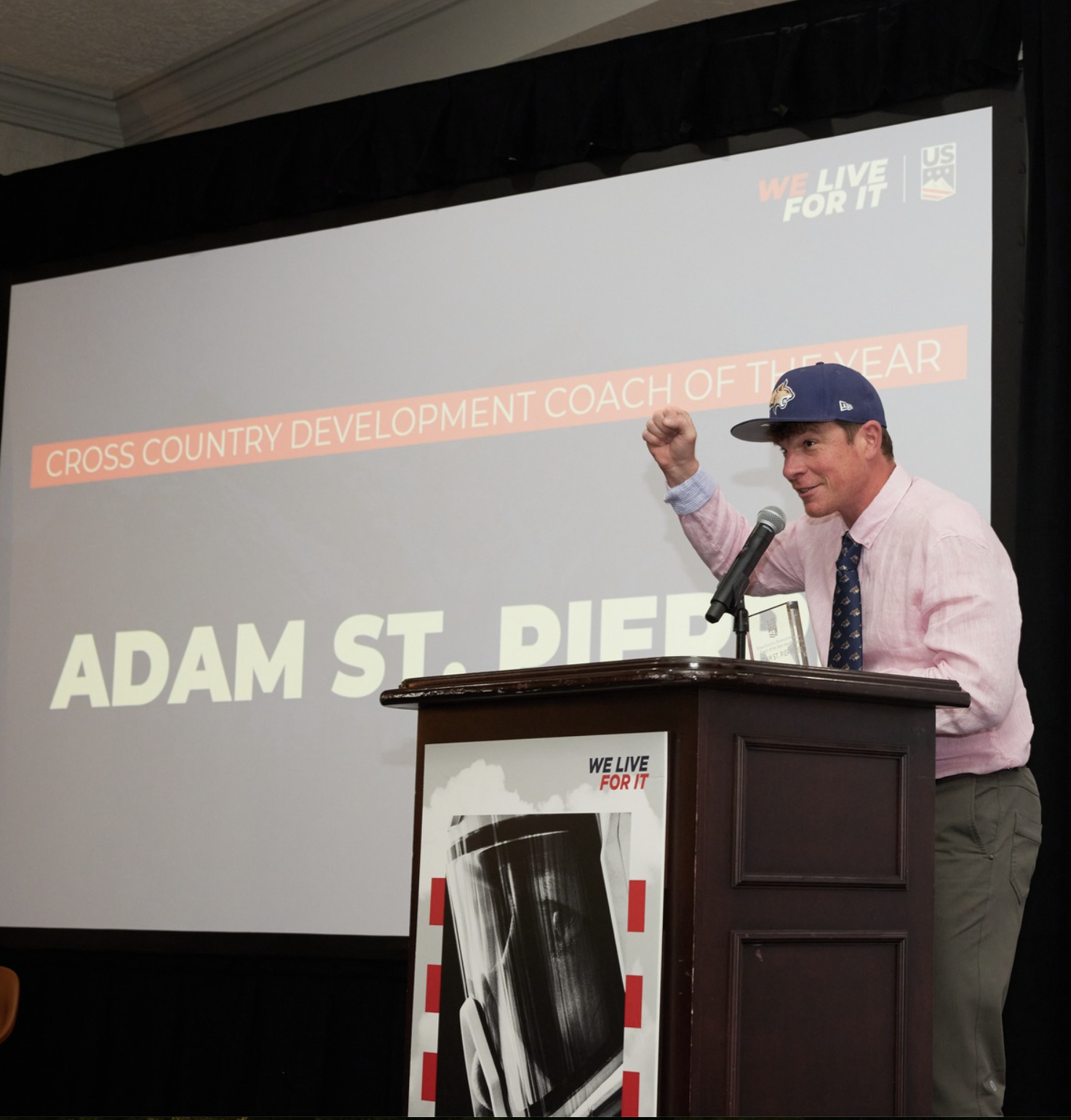
    A parent once cornered Adam St. Pierre to complain that he was letting the kids play games. St. Pierre had ten-year-olds on skis running sharks and minnows, shrieking and chasing each other across the snow, and the parent was not paying club dues for that. “I want coaching and training,” the parent told him. “This is…” and you can fill in the disappointment.

    St. Pierre thinks sharks and minnows on skis is one of the most effective training tools there is. He was lucky, he says, to have a parent board that backed him up in those rare confrontations, because he had no intention of stopping. Kids who are laughing are kids who come back, and kids who come back are the only kids who ever get good.

    That belief sits at the center of a coach who, on paper, should be the last person preaching simplicity. St. Pierre has a master’s in exercise science, a background running lactate and VO2 tests on athletes, and a relationship with a Montana State physiology lab that has done extensive work with U.S. Biathlon on both the metabolic and biomechanical sides. He reads the research. He can talk ratios and thresholds for as long as you’ll let him. And his most strongly held convictions keep coming out disarmingly plain. Go easy most of the time. Be consistent. Make it fun enough that people stick around. The science, in his hands, mostly ends up confirming things your grandmother could have told you.
    Consistency over the big block

    Start with periodization, the idea that a training year should be built in escalating blocks toward a peak. St. Pierre is skeptical of the old-school version of it, and his reasons are specific. A lot of that model, he points out, traces back to weightlifting research, some of it from an era when the subjects were quietly using anabolic steroids, which is not a foundation you want under your training plan. The rest tends to come from single-event sports. “In the marathon world or the Ironman world, you’ve got one event,” he said. “You just need to be good for that one event, like on August 2nd or whatever.” Skiing is not that. A ski racer has to be good across a whole season, weekend after weekend, from November into March.

    He points to a meta-analysis, published fairly recently, that looked at the day-to-day training of today’s top Norwegians. The finding was not a secret block of magic. “It really is consistency,” he said. “They’re not doing a big August and a big October. They do big weeks and recovery, and it’s just a very consistent progression.”

    The metaphor he keeps coming back to is one he borrows from Marius Bakken, the former Norwegian runner he half-jokingly calls a father of the Norwegian method. Intensity, in this telling, is not the meal. It is the seasoning. “The base of the soup is your endurance training,” St. Pierre said, “and then you add in a little bit of zip here and there. But if you put in too much zip, the soup is not going to be very good.” Roughly 90 percent of the work, whether on foot, on roller skis, on snow, or on a bike, is easy volume. The intensity is the spice, and Americans, he thinks, are forever dumping in too much.

    Only what’s livable

    There is also a question underneath all of this that the textbooks tend to skip, which is whether any of it is actually livable. St. Pierre still remembers sitting in a USA Triathlon coaching course, listening to a periodization lecture, and asking what he thought was the obvious question. What about a working person who cannot train 24 hours a week but could manage 16? What do you do with them? The answer from the front of the room was that they should take a vacation day and get the training in. “That’s not it,” he said. “That doesn’t work.” His approach is the reverse. Figure out what someone can actually do, how many hours are genuinely available, and then fill those hours with the best workouts possible.

    At MSU that math is dictated by a school calendar, and he has stopped fighting it. His athletes train before 10 a.m. so they can make a 10 o’clock class, and again in the afternoon, with nothing scheduled after 4 or 4:30. That produces a seven-day rhythm rather than the ten-day cycles some coaches prefer. Tuesday is intensity, usually threshold or VO2 work. Wednesday is a double of easy distance, with a few technique drills thrown in at the start to get the neurons firing before the athletes head out. Thursday morning is pure speed. Saturday brings intensity again, often paired with the long distance day. You cannot send skiers out for a two-hour roller ski on a Wednesday morning if they have class at ten, so you don’t. “There’s lots of ways to make a great soup,” he said, and it is not worth inducing a pile of needless stress to chase a perfect one.

    Two tests without a lab

    For readers without a lab down the hall, two of St. Pierre’s tools travel well. The first he calls a VT1 run, VT1 being the top of the easy zone, the hardest you can go while staying genuinely aerobic. Once a week, on flat ground, his athletes run 20 to 30 minutes at that effort and note the relationship between pace and heart rate. Flat terrain because it is the most reproducible. The point is twofold. It tracks fitness: if you run nine-minute miles at 150 beats in early summer and eight-minute miles at 150 by August, you have improved. And it works as an early-warning system. “One of the first signs of overreaching is a change in that heart rate to workload ratio,” he said. If the pace slows at the same heart rate, and it is not 105 degrees out and you are not dehydrated, it is probably time to rest. The signal can run the other way too. An athlete who normally sees 180 during intervals but suddenly cannot push the heart rate above 160 is, in his words, showing a pretty golden sign. Take some rest.

    The second tool he lifted from cycling: a five-minute maximal effort, a long recovery of maybe half an hour with some refueling, then a 20-minute maximal effort. The ratio between the two tells you whether an athlete leans anaerobic and sprint-oriented or aerobic and distance-oriented, no lab required. He built a version of it into his athletes’ training plans. He is quick to add the caveat that governs all of this, in the field or in the lab. Heat, dehydration, and altitude bend every number, and even a lab lactate value shifts with hydration. “No one metric is the god metric,” he said. “You’ve always got to have that context.”
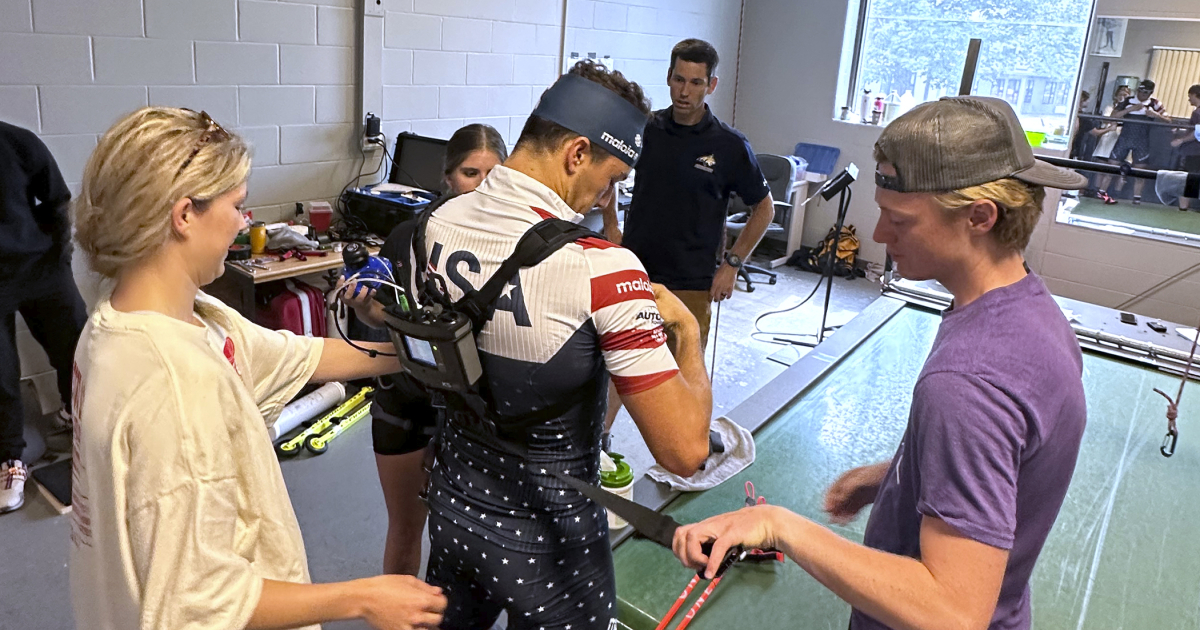
    Montana State students conduct physiologic and biomechanical assessments for U.S. Biathlon. (Photo: Montana State University)

    Building complete skiers

    The individualization matters more now because the college game is about to change. Sprinting is coming to the NCAA Championships, a change St. Pierre cares about personally, because he wrote the proposal years ago and watched it slowly work its way toward reality. In anticipation, he is nudging the team’s intensity mix, keeping most of the hard work at threshold but adding more VO2 and anaerobic speed than a pure distance program would. One test the MSU lab ran compares an athlete’s VO2 at threshold to their VO2 max. A skier sitting well above the roughly 90 percent that is typical probably skews distance and might gain from more VO2 work to lift the ceiling. A skier down in the low numbers might benefit from more threshold. Even so, his priority is all-around development. The sprinters still do threshold. The distance skiers still do speed. He wants complete skiers, partly because a race does not always let an athlete choose its terms. If a distance race comes down to a mass sprint, a distance skier who cannot find another gear finishes 20th.

    The place where St. Pierre thinks American skiing has a real and underrated advantage is strength. He knows the reputation, that Norwegians do not lift, and allows it may be true of many of them. He also knows that the Norwegians who have come through his own program found the strength work novel. As part of a university, MSU has a strength coach, Benito, a former mountain bike racer at UVM and one of the rare ones who understands endurance sport, and the two of them build a program meant to complement the skiing rather than pull against it. St. Pierre credits it for keeping his team generally healthy, and he pushes back on the notion that skiers only need core and pull-ups. “If you can produce power with your legs,” he said, “that’s necessary.”

    He connects strength to a broader idea about movement economy, and here he reaches, carefully, for the Nike Oregon Project. Setting aside the doping and the scandal that eventually swallowed that program, he finds one lesson from it genuinely useful. Its coach had noticed American distance runners getting outkicked, so the group attacked the last 400 meters with sprint work, max strength, and plyometrics. The athletes did improve their finishing kick. They also got faster over the first 9,600 meters of a 10k. Better economy, it turned out, does not just help you sprint. It lets you hold a faster pace all day.
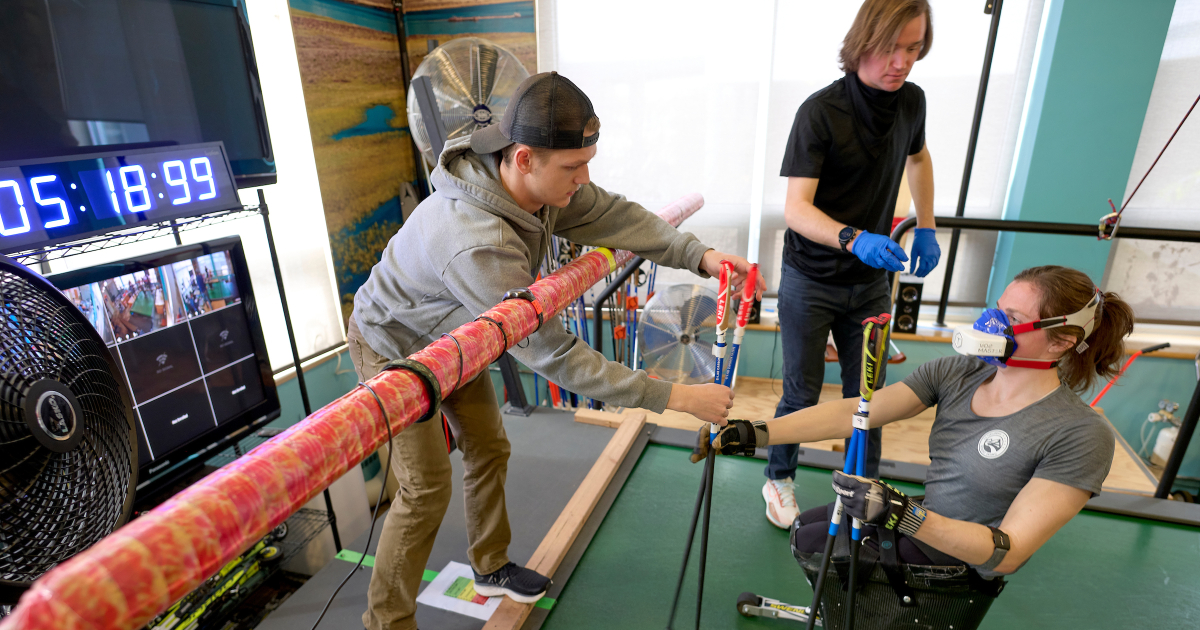
    Montana State biomechanics students provide testing for para Nordic athletes. (Photo: Montana State University)

    The long game

    If that all sounds relentlessly optimized, it is worth returning to the sharks and minnows, because the fun is not a break from the method. It is the method. His college team plays ultimate on skis, using a ball instead of a frisbee to remove the throwing barrier, usually after a track workout, and they lobby to play more. For the youngest kids, he has long argued that the travel race is not really about the race. A ten-year-old drives across the state to ski a 1k, and the actual point is the hotel pool, the snowbanks, the hide-and-seek, the exhaustion on day two that horrifies the parents. “This is why kids get into ski racing,” he said. “It’s not the ski race. It’s hanging out with your friends in the hotel room.” Those bonds are what turn a ten-year-old into a fifteen-year-old who wants to go do a long mountain run with the same crew, and a fifteen-year-old who stays in the sport into an adult who never leaves it.

    Which is finally how St. Pierre defines success, and it is not a medal count. He worries a little about the sport’s fixation on the Nations Cup, because doing well in it requires a lot of athletes racing a full season well, and he is not sure the American pipeline has that base yet. He points to Jessie Diggins as the rare skier who reached the level where she could show up week in and week out and land in the top five every time. Whether that season-long consistency cost her an Olympic medal or two is, he admits, a whole separate and unanswerable question. Finding metrics for development beyond international results is genuinely hard, which is part of why he has soft-started a PhD. The idea is to pull two decades of national points lists and track individual athletes year over year. Are American skiers actually getting better as they age, or do they wash out? The kid who was brilliant at 18 and gone by 22 is memorable, he notes, but memorable is not the same as typical. “Is that the rule or the exception? I think that’s the exception,” he said. “I’d like to have some data to back up my opinion.” The numbers are public. He just needs the time.

    His personal definition is quieter. He wants his athletes to develop far enough that the door to international racing is open if they want to walk through it, and he wants the ones who don’t to keep loving skiing anyway, as coaches, as parents raising their own little skiers, or simply as people who stay active and outdoors for the rest of their lives. He tries to live it as a father, chasing his own two kids up mountains in the summer and out onto snow in the winter. “There’s so much outside of skiing,” he said, “that makes skiing great.”


    Help Support Our Coverage!

    If you value the thoughtful work and access FasterSkier provides, please consider becoming a Voluntary Subscriber. Your support directly fuels our work to cover the people, places, and moments that make our sport special.

    Join the FasterSkier community!
     

  • The Only Kid He Beat Hit a Tree: How Adam St. Pierre Backed Into a Life in Skiing

    The Only Kid He Beat Hit a Tree: How Adam St. Pierre Backed Into a Life in Skiing

    This article was made possible through the generous support of our voluntary subscribers. If you value coverage like this, please support FasterSkier with a voluntary subscription.

    Part one of a two-part series.

    Adam Coaching at US Nationals in Alaska. (Photo: Tobias Albrigtsen)

    Adam St. Pierre finished second to last in the first cross-country ski race of his life. The one skier he beat had crashed into a tree.

    He was a sophomore at Fall Mountain Regional High School, a rural school in Charlestown, New Hampshire, and he tells the story with the flat delivery of a man who has told it before and enjoys it every time. “Charlestown doesn’t really have a claim to fame,” he said. Forty-five minutes due south of Hanover, close enough to know Dartmouth was up the road, far enough that the world of club skiing might as well have been on another continent. He had never heard of it. What he knew was soccer, basketball, and track, in roughly that order, and he had no intention of adding a fourth sport that involved falling down in the cold.

    Then his freshman year fell apart. He hurt his knee playing soccer. He slogged through a basketball season he had come to hate. And in the spring, his track coach, who happened to also coach the ski team, made him an offer that sounded reasonable at the time. Come out for skiing next winter, the coach said. It will get you in better shape for soccer and track.

    So he showed up. That first race was a classic race, and he had only ever skated. He survived it, barely, ahead of the kid who met the tree, and somewhere in the weeks after, the thing that has kept a lot of people in this sport quietly got its hooks into him.

    Fall Mountain was not a fancy place, and that turns out to be central to the story. It was a working rural school with a barn, animal husbandry classes, agricultural mechanics, a metal shop, and forestry classes that maintained the trails and tapped the maple trees where the team ran and skied. The ski coach was the metal shop teacher. When the program needed grooming, the metal shop and ag-mechanics kids bought an old PistonBully and kept it running themselves. St. Pierre came up through a program held together by shop-class ingenuity and a snowbank at the edge of the football field, and he has never once been snobbish about it.

    “I have a high respect for high school skiing, because it is an entry point,” he said. “Otherwise I wouldn’t have found the sport.”


    A team that needed a fifth man

    He nearly didn’t find the next part either. Right before he graduated, his coach, Larry Sayers, told him that Colby College’s ski team wasn’t very good and that St. Pierre could probably walk on. He filed it away and didn’t think much of it. He had his sights on soccer and track. But once he got to Colby and started running into the skiers at various events around campus, something clicked, and it had nothing to do with the skiing.

    “These are the kind of people I like,” he remembered thinking.

    The timing was almost comically good. The coach, then Tracey Theyerl, now Tracey Cote, was 29 and in her second year running the team. She had just cut most of the upperclassmen, which left her with four men and an opening. St. Pierre walked on as the fifth. His introduction to roller skiing came shortly after, when Cote put him on a pair of classic roller skis and sent him out for a time trial. “I survived,” he said. From that point on, he was in, and again, the pull was the people as much as the training.

    Adam St. Pierre (left) and former Bowdoin skier and BNJRT coach Sam Shaheen at the start of the 2019 American Birke. (Photo: courtesy Adam St. Pierre)

    From the lab to the wax room

    He majored in physics at Colby and minored in biochemistry, and when he graduated, he had no clear idea what came next. He looked at teaching jobs. Nothing landed. Then a skier friend from high school told him about a graduate program at the University of New Hampshire where, as St. Pierre understood it, they paid you to study exercise. That sounded like a good deal. He enrolled in a master’s program in kinesiology and exercise science, working under a UNH physiologist whose research centered on hydration and thirst. His thesis was, in his words, pretty brutal to run: sensations of thirst in dehydrated subjects in cold versus ambient environments. “A little bit of everything when it comes to making people uncomfortable,” he said.

    It was during those UNH years that the sport handed him his first coaching job, and it did so in the roundabout, relational way that his whole career seems to follow. He had started dating a Bowdoin College skier while he was at Colby. She was a year behind him, still racing, and he was driving up to Brunswick most weekends to see her. Her coach was Marty Hall.

    Anyone who knows North American skiing knows the name, yet St. Pierre’s version of a Marty Hall story is smaller and more human, and it starts with the legend sizing up the kid who kept turning up in his wax room.

    “I need an assistant coach,” St. Pierre remembers Hall telling him, and he does a passable Marty voice when he gets there. “And you’re up here every weekend anyway. You want the job?”

    He took it. He thinks he was paid around 1,500 dollars total, which covered the gas. He coached under Hall for two years, and it confirmed something he had already begun to suspect: he wanted to spend his life doing this.

    Adam and his family out for a ski.

    Building from the bottom in Boulder

    When his wife got into law school at the University of Colorado, the two of them moved to Boulder, and St. Pierre walked into the next accident of his career. He had been hired to be the head coach of the Boulder Nordic Junior Racing Team, replacing Eric Pepper. Then Pepper decided to stay. Rather than lose St. Pierre, the club invented a role for him and made him its first development coach, responsible for the youngest kids, the u14s and u12s, or as they were then called, the j3s and j4s. Many of them were the little siblings of the older racers. His whole job was to grow the program from the bottom.

    Boulder Nordic Junior Racing Team athletes prepare for the start of a 3,000 kilometer running time trial on the track in 2013. (Photo: Adam St. Pierre)

    He did. When Pepper eventually moved on and St. Pierre took over as head coach and program director, he watched the club climb from 15 or 20 kids to nearly 70 at its peak, in a place he is quick to say is a genuinely hard town to be a skier. There is no snow in Boulder itself. You drive for it, and it is expensive, and the parents who commit anyway earn their real respect.

    One of those little kids was Lauren Jortberg. St. Pierre started working with her when she was six or seven, and he coached her through high school. She was, by his telling, agonizingly consistent at exactly the wrong number: four straight Junior National Championships and 11th place in what felt like every race. “All she wanted was that top 10,” he said. She had setbacks. She stuck it out.

    Years earlier, in his first season of coaching in Boulder, St. Pierre had said out loud that one of his goals was to someday coach a kid who would reach the Olympics. This past February, Jortberg made the U.S. team for the Milano-Cortina Games and qualified for the quarterfinals of the Olympic sprint, the culmination of a long and interrupted road that ran through back surgery, ankle surgery, and a lost senior season at Dartmouth. St. Pierre is careful not to claim more than his share.

    “I can’t take responsibility for much,” he said, and then, a beat later, “Goosebumps. Proud of her.”

    Boulder was where the rest of his professional life took shape, too. He worked at the Boulder Center for Sports Medicine as a clinical physiologist, running lactate thresholds and VO2 max tests and metabolic evaluations, and working alongside physical therapists on running biomechanics, teaching and reteaching people how to run without breaking. He got into ultrarunning and knocked off a number of 100-mile races, mostly for the pleasure of being out in the mountains all day. Around 2016 or 2017, he left the Boulder Nordic team and hung out his own shingle as an online coach. The flexibility made sense with two young kids and a wife commuting to Denver. But he missed the in-person part, the standing-in-the-snow part, more than he expected to.

    Adam repping the MSU team flag in Houghton, Michigan. (Photo: Tobias Albrigtsen)

    The job he had been aiming at

    He had known for a long time where he wanted to end up. College coaching had been the goal since around 2009. The appeal was simple: at the junior level, a coach spends a lot of energy convincing kids they might want to be ski racers, keeping every other door open in case they choose running or mountain biking instead. At the college level, the athletes have already decided. “They’ve decided they are cross-country ski racers,” he said. “I wanted to coach ski racers.”

    The Montana State job had come open once before, in 2015, and he had applied and been the runner-up. When it opened again during the strange fall of 2020, he jumped. He was hired that November and moved to Bozeman alone that winter while his wife and kids finished out the year in Boulder, riding out the online-school chaos he credits her with surviving. The family joined him the following June. Bozeman had been near the top of the short list of places they wanted to live anyway, a real ski town with snow in town, Crosscut 20 minutes up the road, and Bridger Bowl close enough to grab powder runs before cross-country skiing in the afternoon.

    Which is to say, the kid who finished second to last, who backed into the sport to get in shape for soccer, who took a coaching job largely because he was already driving to Brunswick every weekend, ended up exactly where he had been quietly aiming for a decade. The path was accidental in its particulars and not accidental at all in its direction. He kept following the people, and the people kept turning out to be skiers.

    What he does with those skiers once he has them, and why he thinks so much of American training gets the easy days wrong, is its own story. That is part two.


    Help Support Our Coverage!

    If you value the thoughtful work and access FasterSkier provides, please consider becoming a Voluntary Subscriber. Your support directly fuels our work to cover the people, places, and moments that make our sport special.

    Join the FasterSkier community!


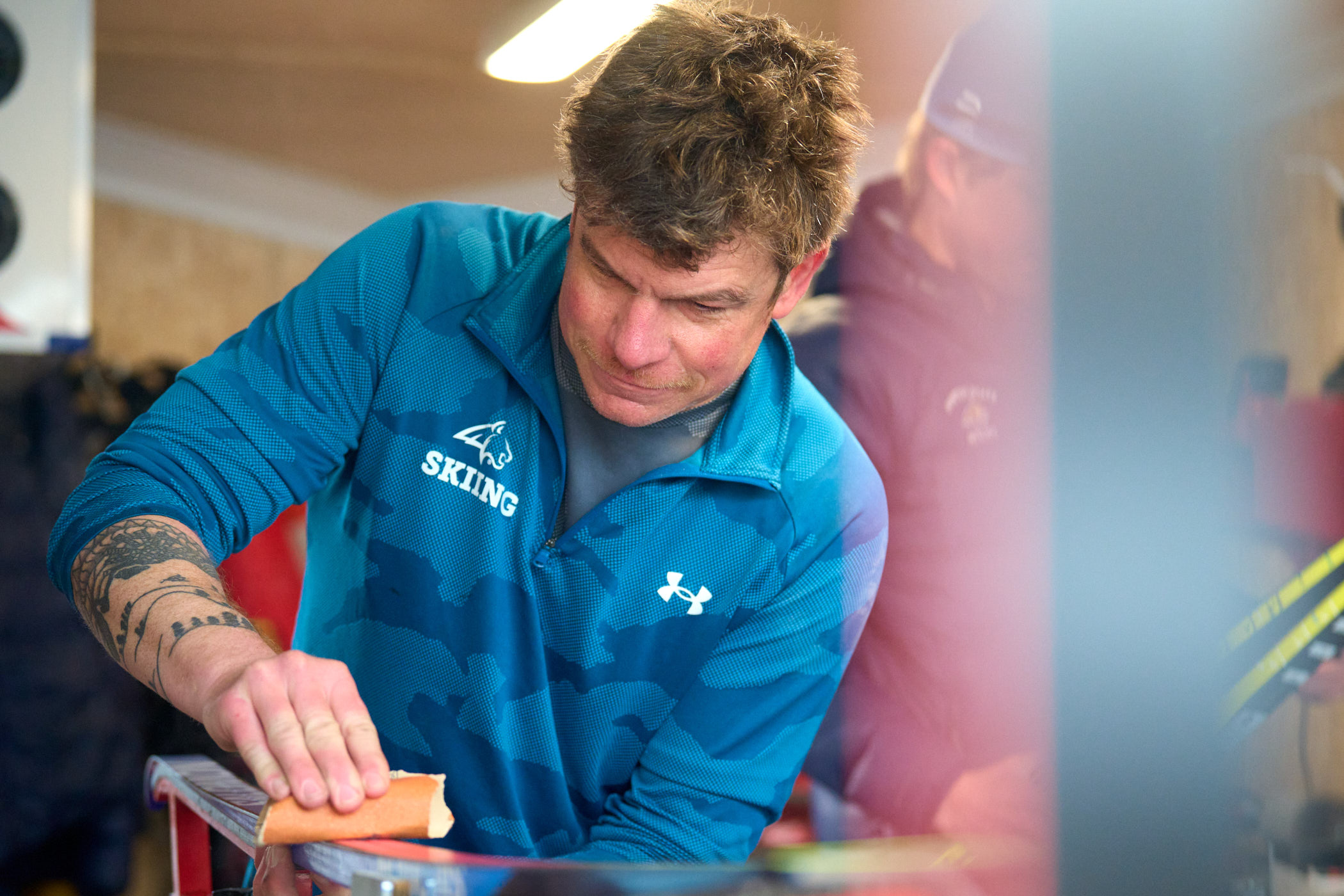
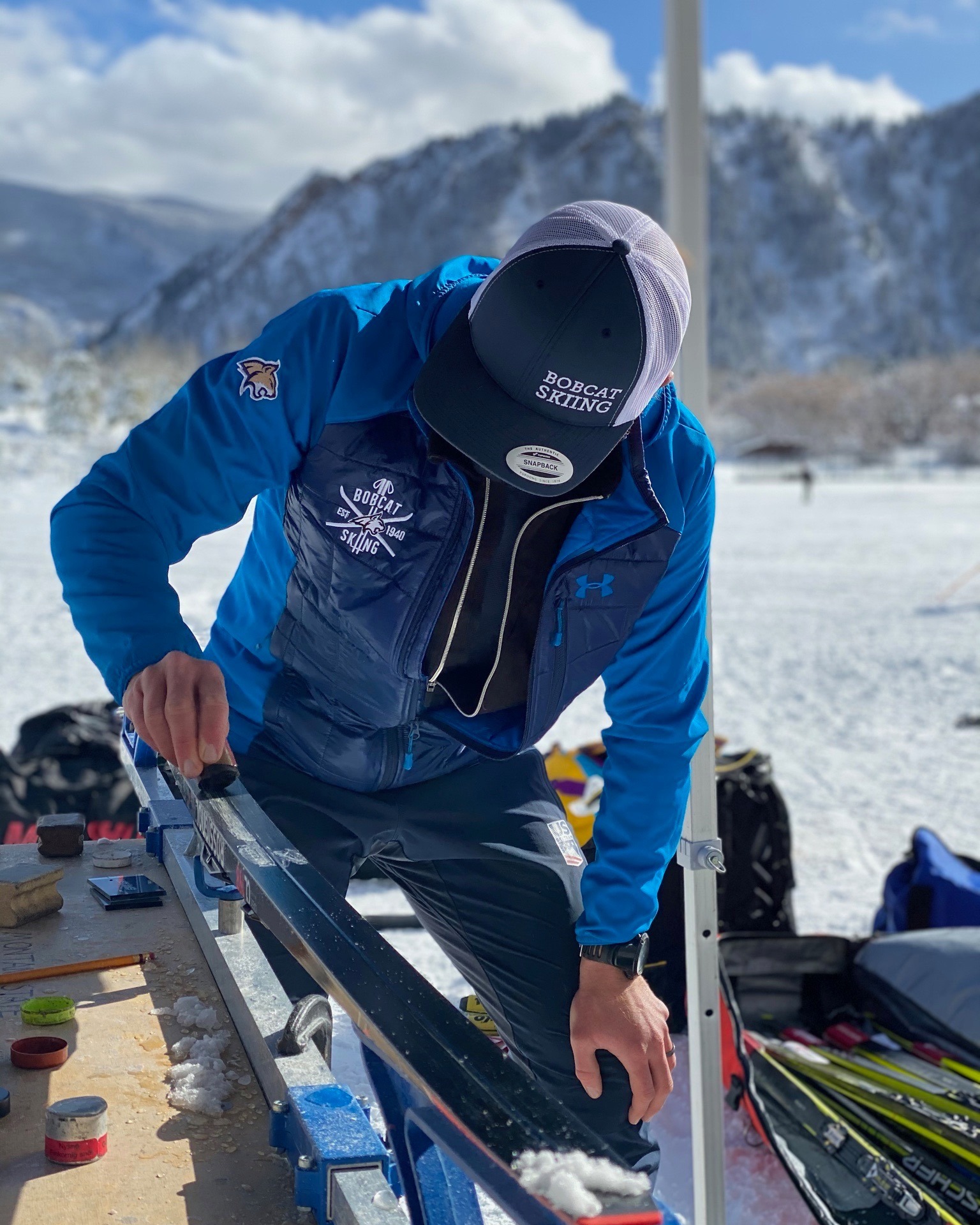
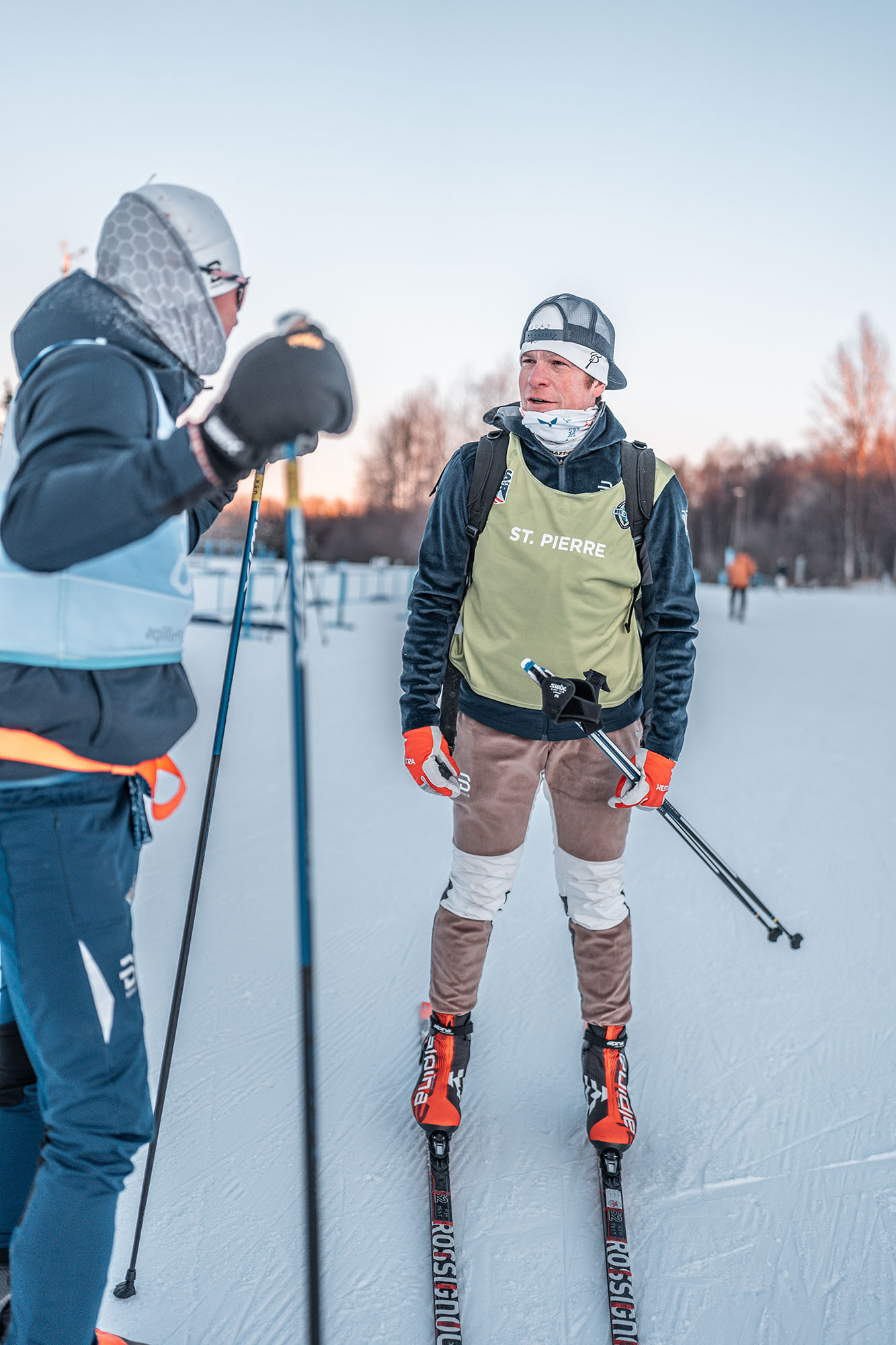
    Adam preparing skis for the Montana State University Nordic ski team at the RMISA Championships in 2026 in Heber City, Utah. (Photo: Colter Peterson)
  • Nordiq Canada hiring Development Coach for the National Ski Team

    Nordiq Canada hiring Development Coach for the National Ski Team

    Position Title: Development Coach, National Ski Team (NST), Olympic

    Location: Canada

    About Nordiq Canada

    Nordiq Canada is the national governing body for both cross-country and Para Nordic skiing. We lead, support, and inspire world-class performances and lifelong participation in these sports nationwide.

    The Opportunity

    Reporting to the High-Performance Director and working within a collaborative high-performance environment, the primary responsibility of the Development Coach will be to lead and oversee the Development Team program. Development Team athletes have been identified as having strong potential for transitioning from junior racing to international excellence.

    As a contributing member of the Nordiq Canada coaching staff, this position will involve organizing and leading training camps and competitive opportunities, providing enhanced services and support, and ensuring optimal functioning of Development Team athletes in their DTEs, including alignment with their IAPPs.

    This is an exciting opportunity to contribute to one of Canada’s leading winter sport organizations and to work alongside world-class athletes, coaches, and support staff in pursuit of sustained international excellence.

    Key Responsibilities

    • Provide support, oversight and technical expertise on the Yearly Training Program (YTP), daily program planning, delivery, and athlete gap mitigation to identified athletes and their coaches.
    • Check in regularly with athletes and coaches to ensure training is progressing, and athlete accountability measures are fulfilled.
    • Contribute to a culture of excellence, openness and growth.
    • Work in collaboration with experts in their respective fields.
    • Maintain a high level of scientific rigour in all processes, ensuring performance-based decision making and optimizing athlete health and wellness.
    • Lead projects and work plans with respect to gap analysis, the Podium Pathway and the Gold Medal Profile.
    • Assist the HPD in annual report writing and presentations.
    • Lead and oversee competitive opportunities such as World Juniors, international junior camps, and Nordiq Canada camps.
    • Attend all meetings as required or requested by the HPD and CEO.
    • Assist the HPD in program development, direction and philosophy.

    Skills & Requirements

    • Experience coaching and connecting with young and developing athletes.
    • Experience leading competition trips and travel with teams, provincially and domestically.
    • Strong technical skiing ability, including the capacity to analyze and communicate areas for technical improvement and efficiency.
    • Competency in assessing and interpreting sport science testing and data.
    • Must be physically fit and capable of testing skis as well as training with athletes on some of their easy sessions.
    • Ability to contribute to a positive and professional team environment in and outside of competitive settings.
    • Excellent interpersonal, time management, and communication skills.
    • Detail and task oriented, goal driven, a strategic and tactical thinker and planner.
    • Bilingualism (English/French) considered a strong asset.
    • Valid driver’s license.

    Working Conditions

    This position requires approximately eight (8) weeks of travel domestically and internationally for training camps, athlete visits and competition opportunities annually.

    How to Apply

    Interested candidates are invited to submit a resume and cover letter to: bscott@nordiqcanada.ca

    Application deadline: June 22, 2026, or until the position is filled.

    Please include your name and “Development Coach NST” in the subject line. Only candidates selected for an interview will be contacted.

    Nordiq Canada is committed to employment equity and encourages applications from all qualified candidates. Preference will be given to Canadian citizens and permanent residents.

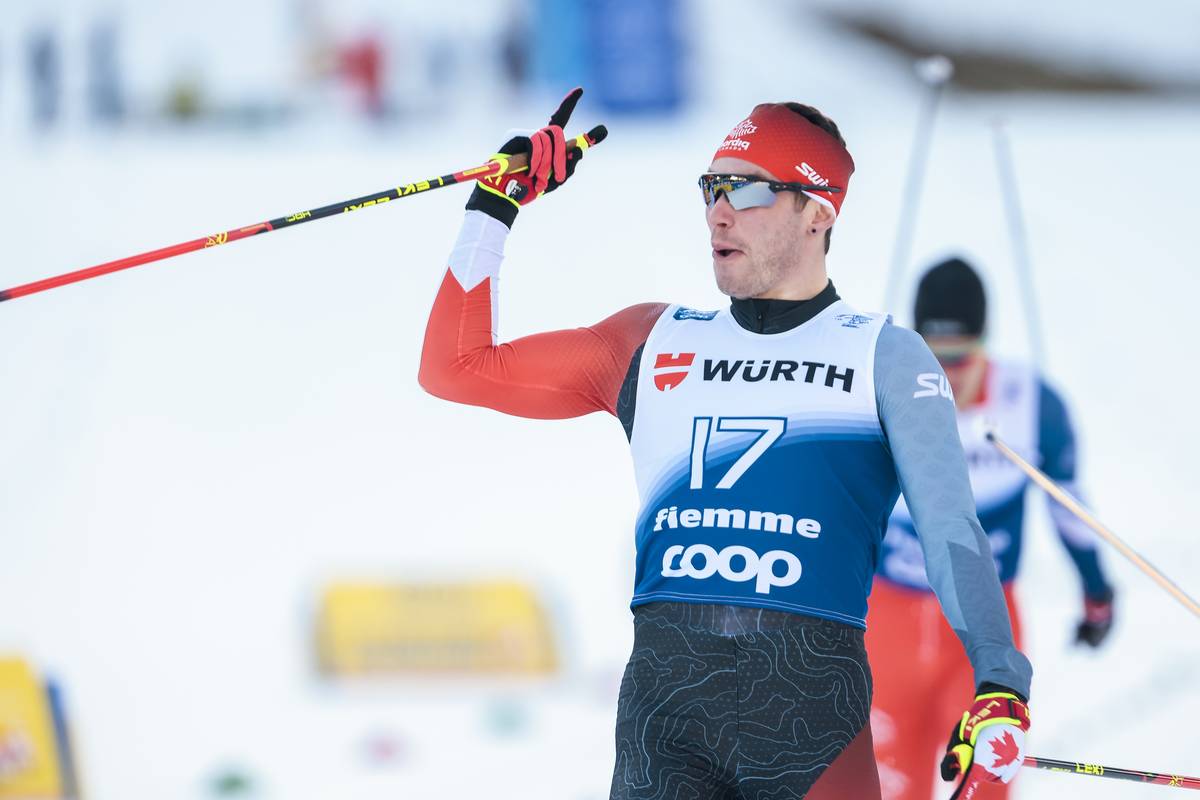
    Antoine Cyr qualified for his first sprint finals during Stage 5 of the 2023 Tour de Ski, and the first for a Canadian since Alex Harvey in 2018. (Photo: Nordic Focus).

    Version française

    Intitulé du poste : Entraîneur de développement, Équipe nationale de ski (ENS), Olympique

    Lieu : Canada

    À propos de Nordiq Canada

    Nordiq Canada est l’organisme national de tutelle du ski de fond et du ski nordique paralympique. Nous encourageons, soutenons et inspirons des performances de classe mondiale ainsi qu’une pratique de ces sports tout au long de la vie à l’échelle nationale.

    L’offre

    Sous la responsabilité du directeur de la haute performance et au sein d’un environnement collaboratif axé sur la haute performance, la principale responsabilité de l’entraîneur de développement sera de diriger et de superviser le programme NexGen et l’équipe de développement junior.

    En tant que membre à part entière du personnel d’entraînement de Nordiq Canada, ce poste impliquera d’organiser et de diriger des stages d’entraînement et des compétitions, de fournir des services et un soutien améliorés, et de veiller au fonctionnement optimal des athlètes de l’équipe de développement dans le cadre de leurs programmes de développement (DTE), y compris l’alignement avec leurs plans de développement individuels (IAPP).

    Il s’agit d’une opportunité passionnante de contribuer à l’une des principales organisations de sports d’hiver du Canada et de travailler aux côtés d’athlètes, d’entraîneurs et de personnel de soutien de classe mondiale dans la poursuite d’une excellence internationale durable.

    Responsabilités clés

    • Fournir un soutien, une supervision et une expertise technique concernant le YTP, la planification quotidienne des programmes, leur mise en œuvre et l’atténuation des lacunes des athlètes identifiés et de leurs entraîneurs.
    • Effectuer des bilans réguliers avec les athlètes et les entraîneurs pour s’assurer que l’entraînement progresse et que les mesures de responsabilisation des athlètes sont respectées.
    • Créer et soutenir une culture d’excellence, d’ouverture et de croissance.
    • Travailler en collaboration avec des experts dans leurs domaines respectifs.
    • Maintenir un haut niveau de rigueur scientifique dans tous les processus, en garantissant une prise de décision fondée sur la performance et en optimisant la santé et le bien-être des athlètes (toutes disciplines confondues).
    • Diriger des projets et des plans de travail concernant l’analyse des lacunes, le parcours vers le podium et le profil de la médaille d’or.
    • Assister le HPD dans la rédaction du rapport annuel et les présentations.
    • Diriger et superviser les opportunités de compétition telles que les Championnats du monde juniors, les camps internationaux juniors et les camps de Nordiq Canada.
    • Assister à toutes les réunions requises ou demandées par le HPD et le PDG.
    • Assister le HPD dans l’orientation et la philosophie du programme.

    Compétences et exigences

    • Expérience en tant qu’entraîneur auprès de jeunes athlètes et d’athlètes en développement.
    • Expérience en tant qu’entraîneur au niveau provincial et national.
    • Compétences en matière d’évaluation et d’interprétation des tests et des données issus des sciences du sport.
    • Doit être en bonne condition physique et capable de tester des skis ainsi que de s’entraîner avec les athlètes lors de certaines de leurs séances faciles.
    • Capacité à contribuer à un environnement d’équipe positif et professionnel, tant dans le cadre de la compétition qu’en dehors.
    • Excellentes compétences interpersonnelles, en gestion du temps et en communication.
    • Souci du détail et de l’exécution des tâches, orienté vers les objectifs, esprit stratégique et tactique, et sens de l’organisation.
    • Le bilinguisme (anglais/français) est considéré comme un atout majeur.
    • Permis de conduire valide.

    Conditions de travail

    Ce poste nécessite environ huit (8) semaines de déplacements nationaux et internationaux par an pour des stages d’entraînement, des visites d’athlètes et des compétitions.

    Comment postuler

    Les candidats intéressés sont invités à envoyer leur CV et leur lettre de motivation à : bscott@nordiqcanada.ca

    Date limite de candidature : 22 juin 2026, ou jusqu’à ce que le poste soit pourvu.

    Veuillez indiquer votre nom et « Entraîneur de développement NST » dans l’objet de votre message. Seuls les candidats retenus pour un entretien seront contactés.

    Nordiq Canada s’engage en faveur de l’équité en matière d’emploi et encourage toutes les candidatures de personnes qualifiées. La préférence sera donnée aux citoyens canadiens et aux résidents permanents.

  • Sovereign Lake Nordic Centre Seeks Seasonal Nordic Head Coach

    Sovereign Lake Nordic Centre Seeks Seasonal Nordic Head Coach

    Seasonal Nordic Head Coach

    Sovereign Lake Nordic Centre (SLNC) is offering an exceptional opportunity for a Head Coach who wants to lead, inspire, and shape one of Canada’s strongest cross-country ski communities. As one of Canada’s largest Nordic clubs, with 50+ km of daily groomed trails, a thriving athlete base, and a full suite of high-performance facilities, it’s a place where a coach can truly make an impact. Located just minutes from the City of Vernon, Sovereign Lake delivers a rare blend of professional and outdoor lifestyle. The North Okanagan’s trails, lakes, and mountains sit right outside your door, making year-round training and recreation part of everyday life. If you’re driven to develop athletes, build a positive team culture, and contribute to enhancing Nordic programs while enjoying an unmatched work-life balance, Sovereign Lake Nordic Centre is an ideal place to lead your next chapter. Reporting to the General Manager, this role works in close partnership with the Biathlon Head Coach and a dedicated team of volunteer coaches to deliver premier Nordic programming. The successful candidate will foster a collaborative environment that strengthens the club’s community and ensures a unified approach to athlete development.

    Summary of Responsibilities

    The Head Coach provides technical leadership and strategic oversight for SLNC’s competitive and developmental pathways, from Learning to Train (L2T) through post-secondary levels. This role is responsible for ensuring all training aligns with Long-Term Athlete Development (LTAD) principles and maintaining the high standard of excellence for which our programs are known. Key focuses include athlete progression, program integration across disciplines, and the successful delivery of seasonal training cycles.

    Key Responsibilities

    Athlete Instruction & Planning: Designing comprehensive yearly training plans (YTPs); Conducting performance testing; Providing expert technical modeling in classic, skate, and roller skiing; Coach (assist) for biathlon program with communication with the Biathlon Coach. Race & Technical Leadership: Providing high-level coaching and oversight at regional, provincial, and national events; Management of race-day wax operations; Provide race support liaison with other coaches and race officials. Program Growth: Driving club expansion through athlete recruitment; Lead volunteer coaching development; Conducting professional development workshops; Recruit and train assistant coaches. Safety & Communication: Maintaining a secure, inclusive training environment through strict adherence to Safe Sport protocols; Develop, communicate and ensure implantation of safety management plans for all coach-supervised training sessions in consultation with the Program Committee; Ensure and manage pro-active effective communication pertaining to weekly training sessions, club events, and XC race dates to athletes, parents, and other coaches via digital platforms. Administrative Oversight: Participating in committee meetings; Regular coach meetings and ensuring program deliverables; Contributing to the continuous improvement of club operations; Regular reporting to the General Manager; Develop and maintain relationships with sponsors and community organizations.

    Fundamental Requirements

    Professional Credentials:

    • NCCP Competition Coaching Development Certification (or ability to obtain within 8 months);
    • NCCP Competition Introduction Certified Coach Status (or equivalent);
    • 5 years’ experience as an XC coach and/or athlete;
    • Standard First Aid Certification (to be maintained as current).
    • Proven excellence in classic, skate, and roller ski techniques with the ability to demonstrate skills to athletes effectively.

    Operational Readiness:

    • A valid driver’s license and dependable vehicle access;
    • Flexibility to work evenings, weekends, and holidays in diverse outdoor conditions;
    • Criminal Record with Vulnerable Sector Check.

    Character & Fit:

    • Collaborative, empathetic mentor;
    • Genuine passion for growing the sport across all skill levels;
    • Strong team player;
    • Ability to motivate, build trust, and gain the confidence of athletes and parents.

    Position Type: Seasonal Full-Time (August 17 – March 31) Salary: $45,000 (seasonal term) paid biweekly

    How to Apply

    Interested candidates should submit their application by June 30, 2026, including a resume, cover letter, and two references (one character, one professional) to the General Manager of Sovereign Lake Nordic Club: gm@sovereignlake.com We thank all applicants for their interest; however, only those selected for an interview will be contacted.

  • Park City Ski & Snowboard Seeks Head Cross Country Competition Coach

    Park City Ski & Snowboard Seeks Head Cross Country Competition Coach


    Park City Ski & Snowboard is seeking a Head Cross Country Competition Coach to lead its U16+ competitive Nordic program. The full-time, year-round position reports to Cross Country Director Emma Garrard.

    Below is the full job description.


    Reports To: Cross Country Director, Emma Garrard
    Employment Status: Full-time, year-round, salaried exempt
    Compensation: Annual salary commensurate with experience, plus benefits
    Athlete Focus: U16 and above

    Position Summary

    The Head Comp Team Coach will manage the coaching staff, run the competitive calendar, and represent PCSS in the Regional and National Nordic community. This position requires someone who can coach at a high level and manage staff, budgets, calendars, and travel around the country for training and races, while upholding PCSS core values of Passion, Accountability, Respect, Team, and Integrity.

    Program Leadership & Staff Management

    • Design and execute a multi-year training and competition framework, consistent with US Ski & Snowboard Training System principles
    • Supervise, mentor, and evaluate XC comp assistant coaches
    • Lead staff meetings and maintain clear communication
    • Maintain a strong focus on positive team culture
    • Collaborate with the Director on program goals, budget planning, and seasonal priorities
    • Contribute to the recruitment and retention of quality coaching staff
    • Prioritize strong communication with the Director, staff, and parents
    • Attend PCSS staff meetings and all-program events as requested by PCSS leadership
    • Support PCSS-hosted events and fundraising initiatives

    Technical Coaching & Athlete Development

    • Implement and evaluate individual and team training plans on an annual and multi-year basis
    • Lead on-snow sessions 5–6 days per week during the training season, with full preparation and follow-up
    • Develop and execute strength and conditioning programs, including dryland
    • Conduct formal athlete evaluations semi-annually covering individual goals, technique, physical, psychological attributes, and equipment domains
    • Maintain current knowledge of FIS, USSS, and Divisional rules, regulations, and athlete advancement pathways
    • Stay current in coaching methodology through continued education, clinics, and engagement with the national Nordic community
    • Manage race-day waxing and equipment preparation
    • Establish clear pathways to the comp team within other PCSS Cross Country programs by working with development coaches

    Competition & Travel

    • Manage all aspects of competition scheduling — race entries, travel logistics, lodging, and transportation
    • Lead the coaching staff and athletes at all competition events
    • Oversee competition ski preparation and course previewing
    • Provide real-time coaching feedback and athlete support during racing
    • Conduct post-competition reviews with athletes and staff to inform future training decisions
    • Attend Intermountain Division meetings and assist with Junior Nationals planning
    • Manage competition expense tracking and reporting
    • Uphold and maintain PCSS vehicles

    Administrative Responsibilities

    • Assist with the annual Cross Country budget
    • Use Playmetrics and other approved platforms for scheduling, communication, athlete records, and training logs
    • Ensure all athletes and coaching staff maintain required USSS licenses, SafeSport compliance, and certifications
    • Support end-of-season evaluation, awards, and program planning processes

    Qualifications

    • Minimum 3 years of coaching experience in a competitive Nordic environment
    • Current US Ski & Snowboard Level 200 coaching license, or ability to obtain within first season
    • Current SafeSport certification and compliance
    • First Aid, CPR, and AED certifications
    • Valid driver’s license with clean record
    • Proficiency with Google Suite, Microsoft 365, Playmetrics, and training management platforms
    • Strong written and verbal communication skills
    • Demonstrated ability to manage staff, budgets, and multi-week travel logistics
    • Experience with strength and conditioning program design for endurance athletes
    • Knowledge of FIS rules and athlete advancement procedures

    Physical Requirements

    • Ability to work up to 6–8 hours per day outside in all weather conditions
    • Capacity to lift and transport equipment up to 75 lbs
    • Ability to perform course and race site preparation work
    • Available for weekend and holiday work throughout the competition season
    • Willingness and ability to travel for training camps and competitions, including multi-night trips
    • Stamina to demonstrate technique and participate in training sessions


    APPLY NOW


    This job description is not an employment agreement or contract. PCSS management reserves the right to alter the scope of work within the framework of this description at any time. All offers are contingent on successful background check completion.

    To apply, submit a resume, cover letter, and references to: egarrard@parkcityss.org

  • Long-Term Development in Nordic Skiing: What We Say vs. What We Actually Do

    Long-Term Development in Nordic Skiing: What We Say vs. What We Actually Do

    This article was made possible through the generous support of our voluntary subscribers. If you value coverage like this, please support FasterSkier with a voluntary subscription.

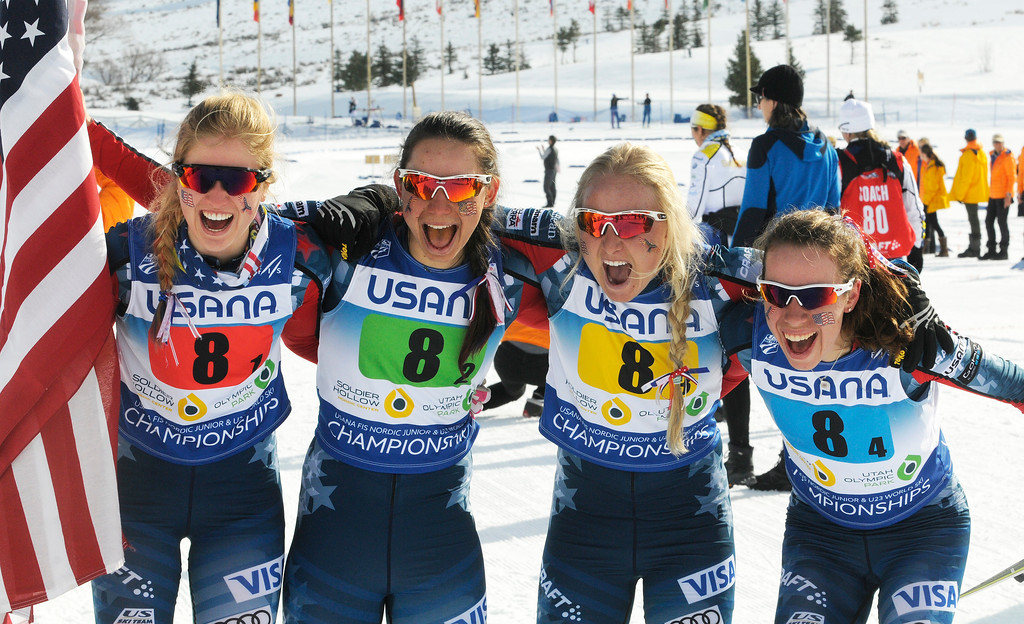
    The U.S. women’s relay after taking a historic third in the 4 x 3.3 k relay at 2017 Junior World Championships on Sunday at Soldier Hollow in Midway Utah, with (from left to right) Hailey Swirbul, Julia Kern, Hannah Halvorsen, and Katharine Ogden. (Photo: U.S. Ski Team/Tom Kelly)

    As the season winds down, it’s worth stepping back and asking a simple question: Does the way we develop young skiers in the United States reflect the philosophy we say we believe in? I know everyone is probably done with hearing about how the Norwegians do it, so let’s look at what we say we know and what we embrace.

    Many coaches and programs describe cross-country skiing as a lifetime sport. We talk about patience and say it takes ten years or more to develop as a skier. Clubs reference long-term athlete development models, and parents hear that endurance sports reward athletes who build gradually and peak later in life.

    All of that is true.

    But much of the system we’ve built rewards the opposite.

    Once rankings, camp selections, college recruiting, and program reputation become tied to junior results, the incentives quietly shift. Development begins to be measured by podiums and training hours rather than movement quality, long-term improvement, or whether athletes are still engaged in the sport five or ten years later.

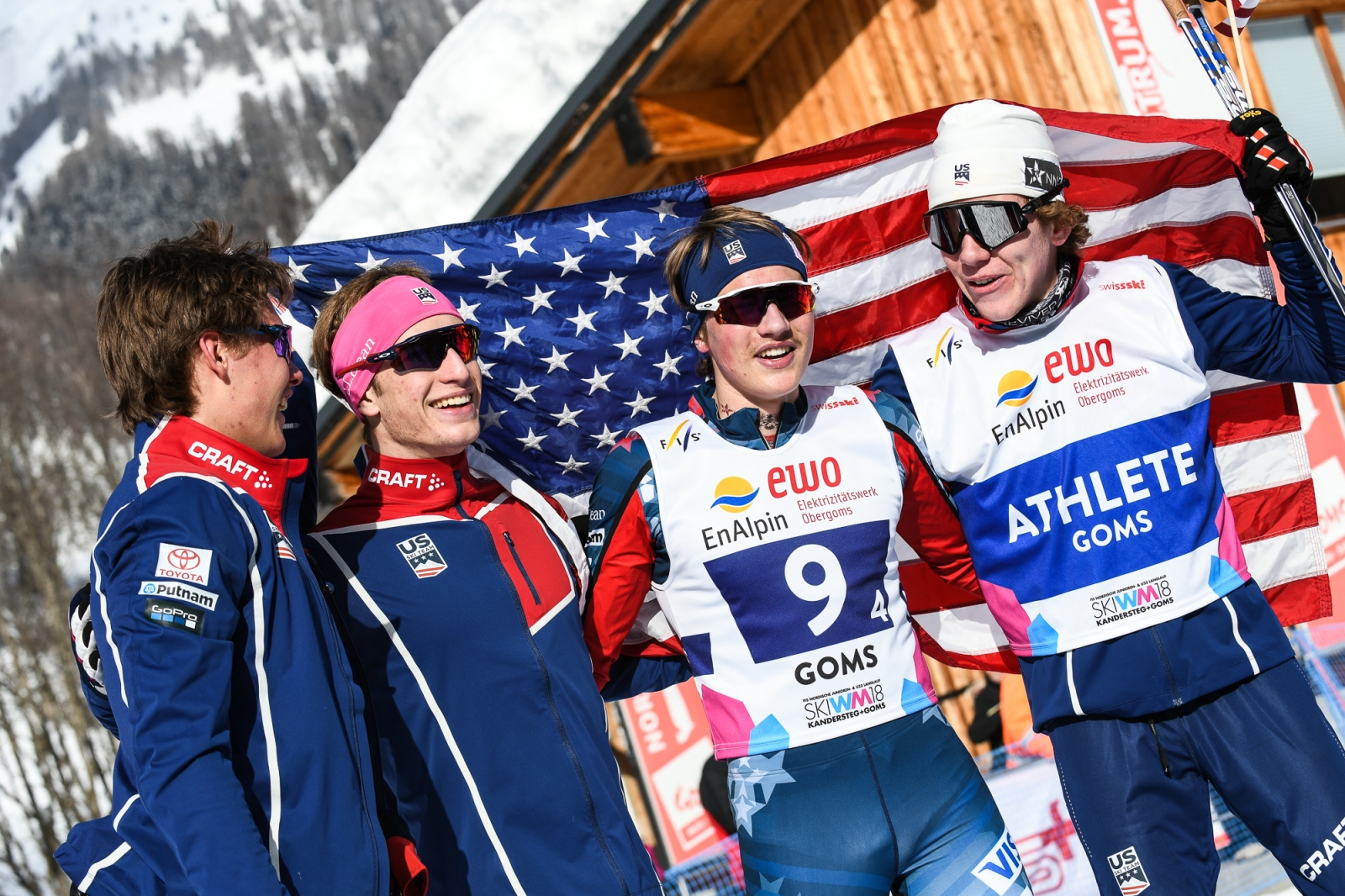
    The U.S. men’s silver-medal relay at 2018 Junior World Championships in Goms, Switzerland, with (from left to right) Luke Jager, Hunter Wonders, Gus Schumacher, and Ben Ogden. (Photo: JWSC2018.ch)

    What is long-term development

    Aerobic capacity develops over years, often decades. Technical efficiency improves gradually. The durability required to handle training load is built slowly through years of training.  Most elite endurance athletes reach their peak in their mid-twenties or early thirties, not in high school.

    If peak performance happens ten or fifteen years after an athlete first enters the sport, the early years should focus less on maximizing results and more on building the foundation that supports long-term growth.

    That foundation includes several elements.

    Movement skill. Nordic skiing is a technical sport, and the best skiers move efficiently long before their physiology fully matures. This efficiency is critical to managing training loads in the future. More efficiency in technique equals less stress and load from training.

    General athletic development. Running, biking, jumping, climbing, and playing other sports all contribute to coordination and resilience. Athletes who move well tend to adapt better to training later.

    Motivation. The most valuable asset a young athlete has isn’t VO₂ max or the hours trained by some arbitrary definition. It’s the desire to keep showing up year after year.

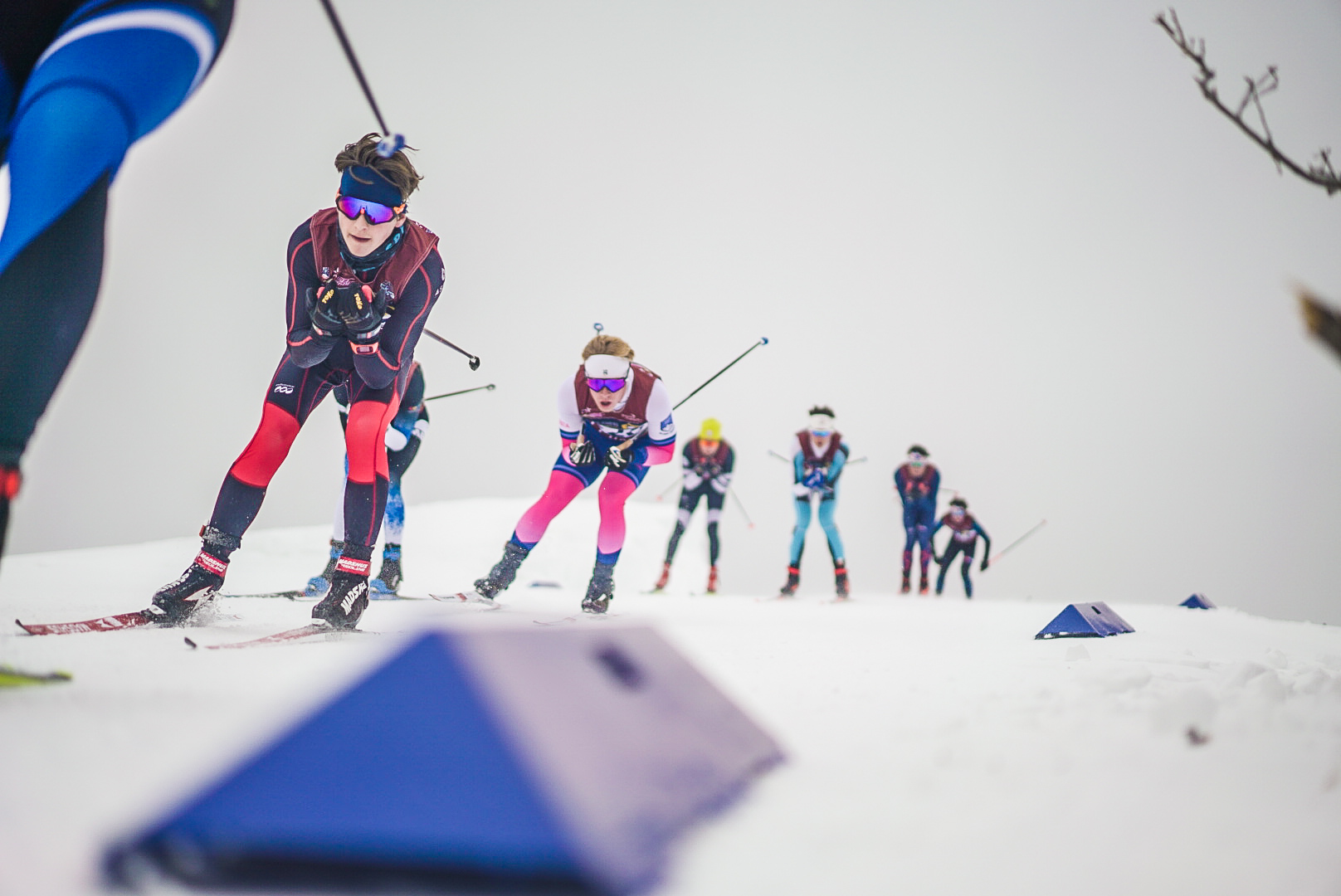
    Junior athletes race during the 2022 U.S. Cross Country Championships in Soldier Hollow, UT. (Photo: Tobias Albrigtsen / @untraceableg)

    The System Sends Mixed Signals

    In practice, the system often sends young athletes a different message.

    Junior racing has become increasingly competitive. Rankings exist even for younger age groups, and selections for camps, trips, and development programs often depend on early results. National events and development pathways can make performance at 14 or 15 feel like it carries some long-term significance. Yet we also claim to know that identifying future elite athletes at that age is extremely unreliable. If that’s true, it’s worth asking why the system places so much weight on those results.

    One example is allowing U14 athletes to ski up in order to qualify for Junior Nationals. It doesn’t happen frequently, but it happens every year. It’s hard to reconcile that with the philosophy of not rushing development. If long-term development truly matters, governing bodies should show leadership and address this issue.

    In some regions of the country, qualifier races have U16 athletes seeded in the start list with U18 and U20 athletes. People say it doesn’t matter because we separate them in the results. I disagree, the are intermingled with much older and more developed athletes. But more than that it is again the message begin sent?

    At the same time, training culture has shifted. Training data is widely shared, and conversations often revolve around hours. Young athletes begin comparing workloads long before their bodies are ready to handle them. Often the more is better attitude prevails, even though we say that we should be working on other skill aspects of development.

    These pressures can push athletes toward earlier specialization and higher training loads than their stage of development requires. A 14-year-old begins to feel like they need to train like a college skier. A 15-year-old worries that missing races or reducing training volume might put them behind.

    The Boulder Nordic Junior Race Team out for an adventure ski in 2014. (Photo: BNST)

    What are the impacts of the mixed signals

    The most visible consequence is burnout. Many people challenge the idea of burnout. But after more than forty years around this sport, I’ve seen the pattern repeatedly. Just because we don’t measure something well doesn’t mean it isn’t happening.

    Coaches who have spent time around junior skiing see the pattern: talented athletes who disappear from the sport sometime between their late teens and early twenties. Sometimes academics, finances, or changing interests are the reason. But often the explanation is simpler, they are tired from too much too early and to intense.

    There are also physical consequences. Adolescence is a complex period of growth and development. Training loads that are manageable for more mature athletes are impossible for a developing body. When volume and intensity climb too quickly, overuse injuries and chronic fatigue become more likely.

    Early specialization is not the problem. Rather, it is ineffective programming that has these young athletes training like more mature athletes.  This early training focus limits athletic development. Athletes may accumulate impressive training hours but miss the movement diversity that builds long-term durability.

    The biggest loss in this process is one that is unseen because those athletes are lost from the sport.

    From a coaching perspective, the shift shows up in small ways. Conversations revolve around weekly training hours instead of how well athletes are skiing. Easy sessions slowly become harder. Fatigue accumulates while movement quality quietly declines. None of this happens overnight, but over time, the focus drifts away from skill development and toward simply doing more.

    Development in endurance sports isn’t about accumulating work. It’s about adapting to the work being done and building the capacity to handle more later. A training log that looks impressive at 15 doesn’t necessarily translate into success at 25. What matters more is whether the athlete remains healthy, motivated, and technically sound over the long term.

    Hailey Swirbul celebrates the U16 Junior National Championship title in the Freestyl Mass Start in Stowe, Vermont, in 2014. (Photo: Voisin/FasterSkier)

    What Good Development Actually Looks Like

    If long-term development is the goal, the early years should look different from elite training. Young skiers benefit from variety. Running, cycling, hiking, and other sports build coordination and resilience. The goal isn’t to replicate elite training programs but to create athletes who move well and enjoy being active.

    Technique deserves major attention. Nordic skiing rewards efficiency, and athletes who develop strong movement patterns early often progress faster later because every hour of training becomes more productive. Training volume should increase gradually over time. Consistency across years matters far more than pushing limits in any single season.

    Most importantly, development should seek to preserve motivation. The sport needs athletes who remain engaged long enough to realize their potential. We often see athletes try to do a big training year to catch up or reach a target training volume. It rarely works out.

    The Problem With “More Volume” Thinking

    In Nordic skiing, training volume carries a certain mystique. Conversations quickly turn to hours, weekly totals, yearly totals, and stories of elite athletes training 800 to 1,000 hours per year.

    It’s easy to see why. Endurance sports reward consistency and large training volumes. But a subtle misunderstanding often occurs. Volume stops being seen as the result of long-term development and starts being treated as the cause of performance.

    Correlation becomes mistaken for causation.

    Hunter Wonders (APU/Alaska) winning the U16 Boys Mass Start Freestyle race at the US Junior National Championship in Stowe, Vermont. (Photo: Voisin/FasterSkier)

    High Volume Works for Elite Skiers

    At the elite level, high training volume makes sense. World Cup athletes have spent years building the capacity to handle that workload. Their aerobic systems are highly developed, their movement patterns are efficient, and their bodies have adapted gradually.

    High volume works because it sits on top of a massive foundation: technical skill, durability, and years of progressive training.

    The problem arises when that model gets copied without the same foundation underneath it.

    The Missing Variable: Training Age

    One of the most overlooked concepts in endurance development is training age. Training age refers to how many years an athlete has spent consistently adapting to structured training. Two 18-year-old skiers may have very different training ages. One may have spent eight years gradually building capacity. Another may have entered the sport recently and increased training dramatically. On paper, their training logs may look similar. In reality, their ability to adapt to those loads can be very different.

    Training only produces progress when adaptation occurs. Without adaptation, training simply builds fatigue.

    The U18 Girls field works its way past the Loppet Foundation Adventure Center in Minneapolis during Junior Nationals on March 11th, 2022. (Photo: David J Owen Photography)

    The Efficiency Problem

    Elite skiers move extremely well. Their technique allows them to ski long distances while conserving energy and minimizing unnecessary muscular stress. Developing this efficiency early is critical. In the future, it will allow the athletes to train large volumes without the metabolic and neuromuscular stress that can lead to overtraining.

    Young athletes often lack efficiency. When technique is still evolving, large training volumes can actually slow technical development. Fatigue reinforces inefficient movement patterns that later become difficult to change.

    For developing skiers, time spent improving movement quality can be far more valuable than time spent extending distance.

    The Cost of Chasing Hours

    There is also a practical cost to the “more volume” mindset. Elite athletes structure their lives around training. Sleep, nutrition, and recovery are integrated into the system. Young athletes are balancing school, travel, social life, and other commitments. When training volume climbs, something gives. Sleep declines, recovery becomes inconsistent, and fatigue accumulates.

    Under those conditions, simply adding more hours rarely produces better results.

    What Volume Should Really Represent

    Training volume does matter. Endurance sports ultimately require substantial workloads. But volume should be viewed as a long-term outcome of development, not a short-term objective. Successful endurance athletes rarely build training hours quickly. They accumulate them gradually across many seasons, allowing their bodies to adapt step by step. By the time they reach elite levels, high training volumes feel natural because they have spent years building the durability to support them.

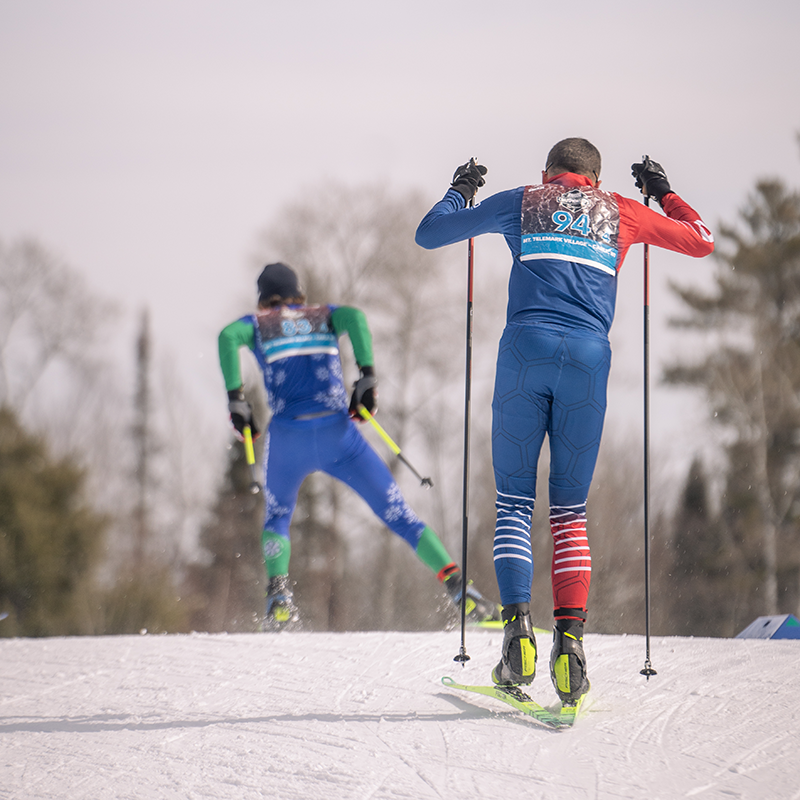
    The 2026 US Ski and Snowboard Junior National Championships in Cable, Wisconsin, hosted by the American Birkebeiner Ski Foundation. (Photo: Tryg Solberg)

    A Better Question to Ask

    Instead of asking how many hours an athlete should train, a better question might be:

    What training can this athlete adapt to right now?

    For some athletes, the answer may involve increasing volume. For others, improving technique, strength, or intensity distribution may produce greater gains. Development is not identical for every athlete. What matters is finding the training load that promotes consistent adaptation rather than constant fatigue.

    Why This Matters for the Future of the Sport

    Cross-country skiing, like all endurance sports, depends on long-term participation. The sport needs athletes who remain engaged, not only as competitors but as lifelong skiers, coaches, and community members.

    A development system that pushes athletes too hard, too early risks losing them before they reach their potential. It also narrows the pathway to elite performance by favoring early maturity and filtering out late developers.

    If Nordic skiing truly wants to remain a lifetime sport, its development culture must reflect that philosophy.

    Closing

    Cross-country skiing has always valued endurance. That value should extend beyond physiology and into how we develop athletes. Endurance isn’t just about how long someone can ski hard on race day. It’s about how long they can remain engaged in the process of improving.

    If we truly believe Nordic skiing is a lifetime sport, then our development system should not resemble a funnel that selects kids out at every progressive age group. It should look more like a runway, where every young athlete has the opportunity and the time to fully develop their potential, not just the ones who mature early.


    Help Support Our Olympic Coverage!

    If you value the thoughtful work and access FasterSkier provides, please consider becoming a Voluntary Subscriber. Your support directly fuels our work to cover the people, places, and moments that make our sport special.

    Join the FasterSkier community!


    The 2026 US Ski and Snowboard Junior National Championships in Cable, Wisconsin, hosted by the American Birkebeiner Ski Foundation. (Photo: Tryg Solberg)
  • Hailey Swirbul and the Experiment of Returning

    Hailey Swirbul and the Experiment of Returning

    This article was made possible through the generous support of our voluntary subscribers who have helped put our Nat Herz on the ground at the Olympics. If you value coverage like this, please support FasterSkier with a voluntary subscription.

    Hailey Swirbul (USA) racing the 20 k Classic Mass Start in Goms, Switzerland, two weeks ago. (Photo: Authamayou/NordicFocus)

    When Hailey Swirbul logged onto a Zoom call from Italy last Monday, she was already living inside uncertainty.

    “I’m in Livigno right now,” she said. “Yeah — the higher one.”

    The U.S. team held two pre-Olympic altitude camps, and Livigno was the higher-altitude option. With thinner air, it’s a place where nothing happens quickly, where adaptation takes patience, and where clarity is rarely immediate. When we spoke, it still wasn’t public which races she might ski, or even whether she would start any at all. She was there because she had qualified back onto the U.S. Olympic Cross-Country Ski Team — but nothing beyond that had been decided.

    She didn’t talk about it like a comeback. She didn’t talk about it like redemption, either. Mostly, she sounded attentive — to her body, to her thinking, to the risk of letting the story get ahead of her.

    “I’ve thought about this whole thing more as an experiment,” she said. “Like… can I do this? And can I do it in a way that actually feels good?”

    The Olympics mattered. She didn’t pretend they didn’t. But they weren’t the point.

    “What can I do?” she kept asking.

    Hailey Swirbul’s entry into endurance sports began with mountain bike racing with her family around Colorado. (Photo: Courtesy Photo)

    Before Skiing Was the Point

    Swirbul’s relationship with endurance sport started long before skiing felt central, or even intentional.

    “I grew up in just a really active family,” she said. “My parents valued getting outside and doing that with our family.”

    Neither parent was an elite athlete. That wasn’t the model. The emphasis was simpler: movement, time outdoors, effort shared rather than measured.

    “They just love being outside and moving our bodies,” she said. “And they taught that to my brother and me growing up.”

    The first sport that really mattered to her wasn’t skiing.

    “The main thing we loved to do as a family when we were young was mountain bike races,” she said. “We would travel around Colorado or the West and camp as a family and do these bike races.”

    Mountain biking wasn’t cross-training. It was the center.

    “That was kind of the first main sport that my brother and I both really loved,” she said.

    Nordic skiing entered her life almost accidentally. Her older brother decided to try it as winter conditioning for mountain biking.

    “So as the younger sister,” she said, “I was just going to follow whatever he did.”

    Her first experience skate skiing was blunt.

    “I had never skate skied before,” she said. “And I just got destroyed. I was so far behind everyone.”

    What stayed with her wasn’t embarrassment. It was the challenge.

    “I remember feeling this sense of, like, I need to figure this out,” she said.

    Progress came quickly, and with it a new kind of motivation.

    “I remember feeling like, whoa,” she said. “It’s pretty fun to do well at it — whatever well means.”

    What drew her in wasn’t winning so much as the learning curve.

    “Skiing is such a hard sport to master,” she said. “I don’t think anyone really can. It’s always evolving.”

    By middle school, she was actively seeking out more difficulty.

    “I wanted to race more,” she said. “I would go on jogs in the fall after soccer practice because I was like, I need to get more training.”

    She started racing up in age groups — not because anyone pushed her, but because she wanted to be there.

    “I raced up as a U16 when I was still 13,” she said. “And I qualified for Junior Nationals that year.”

    Being part of something bigger mattered.

    “Getting to go and be part of this bigger thing,” she said, “that was incredibly motivating to me.”

    Hailey Swirbul celebrates the U16 Junior National Championship title in the Freestyle Mass Start in Stowe, Vermont, in 2014. (Photo: Voisin/FasterSkier)

    Racing Up — Until There Was Nowhere Left to Go

    Much of Swirbul’s early career followed that same pattern.

    “My young career — and honestly much of my career — was defined by racing up,” she said.

    It worked. Racing older athletes fed her curiosity and reinforced the idea that discomfort was something to move toward, not away from.

    But as she progressed through the development pipeline and into the World Cup system, the feedback loop changed.

    “There’s this moment where it flips,” she said. “And suddenly you’re supposed to be top 30.”

    Early World Cups felt expansive. Points mattered. Starts felt earned.

    “Getting points felt exciting,” she said.

    Hailey Swirbul scored her first varied World Cup points in the 2019 Davos, Switzerland, Skate Sprint. (Photo: NordicFocus)

    Over time, expectations hardened. Results that once signaled progress became baseline.

    “It stops being exciting,” she said.

    What made it difficult wasn’t failure in the dramatic sense. It was repetition.

    “It’s really hard to go over there and be 45th every weekend,” she said. “And still believe in yourself.”

    She kept coming back to that number — not as a complaint, but as a psychological reality.

    “When that happens over and over,” she said, “it starts to mean something about you.”

    The pressure didn’t explode. It narrowed.

    “I felt really rigid,” she said. “And I didn’t like that.”

    By the end, the issue wasn’t the results.

    “There wasn’t anything wrong, exactly,” she said. “That was kind of the hard part.”

    She wasn’t falling apart. She just wasn’t herself anymore.

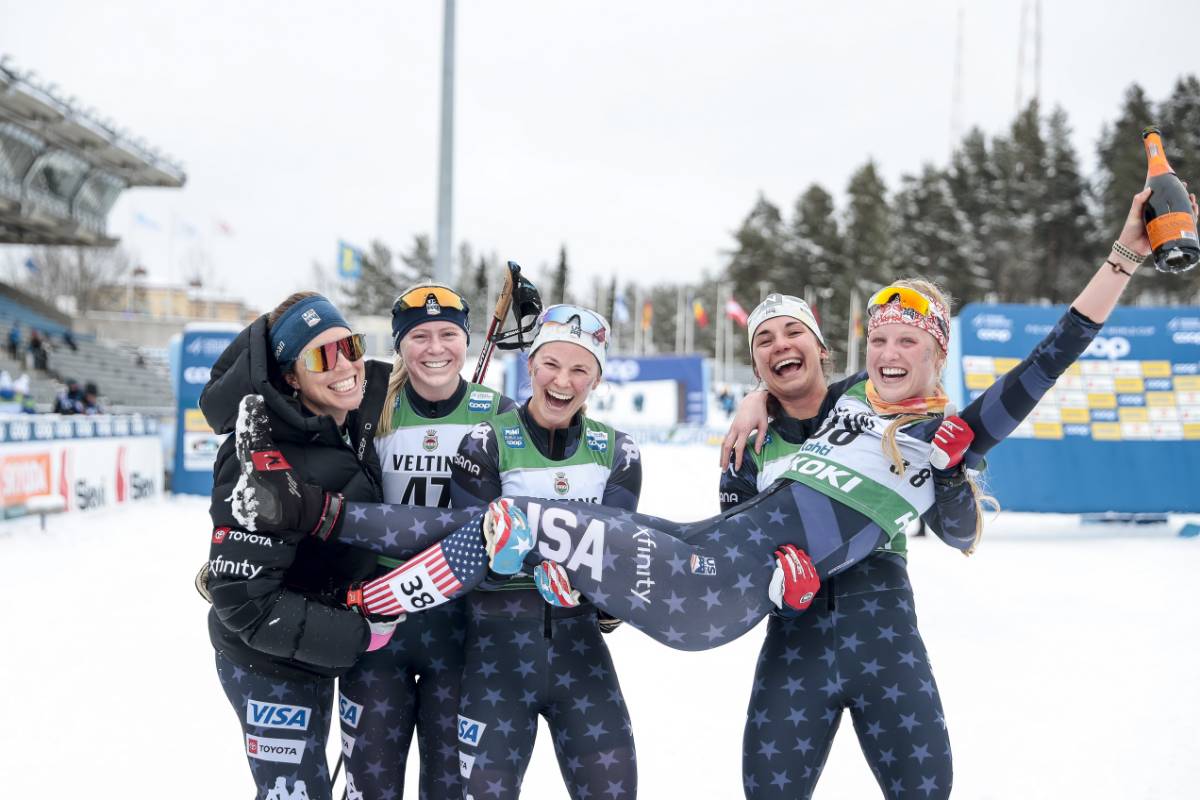
    Rosie Brennan (USA), Samantha Smith (USA), Jessie Diggins (USA), Julia Kern (USA), and Hailey Swirbul (USA) (l-r) celebrate the end of the season and Swirbul’s retirement in 2023. (Photo: NordicFocus)

    Leaving Without Drama

    Swirbul didn’t retire in crisis. She retired calmly.

    “I don’t regret retiring,” she said. “At all.”

    She enrolled in an engineering program. She stepped away from the race calendar. For the first time in years, skiing wasn’t the organizing principle of her life.

    That winter, she worked as a ski patrol member in Colorado.

    “At Aspen Highlands, we have this hike-to terrain up at 12,000 feet,” she said. “It’s like an 800-vertical-foot hike.”

    For weeks at a time, that meant repeating the same climb again and again.

    “You’re hiking up and down that bowl for six hours a day,” she said. “And honestly, I loved it.”

    She was careful to separate that year from any training narrative.

    “That wasn’t training,” she said. “It was just work.”

    What mattered was usefulness. Responsibility. Being competent at something that didn’t care who she was or what she’d done before.

    “There’s something really grounding about that,” she said.

    Her body worked constantly, but without scrutiny.

    “I just loved hiking,” she said. “That was my whole day.”

    Hunter Wonders, Hailey Swirbul, and Chip Schoff (former APU skier and wax tech) on a multi-day hut trip. (Photo: Courtesy Photo)

    When Time Shows Up

    The idea of returning didn’t appear during that patrol season in any obvious way. It arrived later, through moments that didn’t seem connected at first.

    One came from a book about time—the idea that a human life spans roughly 4,000 weeks.

    “It wasn’t panic,” she said. “It was more like honesty.”

    Another came from a comment made by someone she respected — casual enough that it might have been ignored.

    “I kind of just sat with it,” she said. “And I couldn’t shake it.”

    What lingered wasn’t urgency. It was clarity.

    “If I’m ever going to do this again,” she said, “it’s now.”

    Not because she felt behind. Because waiting indefinitely no longer felt natural.

    The Risk of Trying Again

    Coming back wasn’t simple. It carried risk.

    “I didn’t want to come back if I was just going to be the same athlete,” she said.

    She worried about slipping back into rigidity. About obligation replacing curiosity again.

    “I’m way more aware now of how easily I can slip back into that mindset,” she said.

    She also worried about the other possibility.

    “What if I come back,” she said, “and I’m just not good enough anymore?”

    She didn’t rush past that thought.

    “That’s part of the experiment,” she said. “Like… maybe it doesn’t work.”

    Hailey Swirbul (APU) racing the US National Championships Mass Start Freestyle in Lake Placid in January. (Photo: Nancie Battaglia)

    Starting Where She Actually Was

    When Swirbul decided to race again, she didn’t shortcut the process. She entered domestic races. She lined up without protection.

    “I was literally starting from the back in mass starts,” she said. “And I was like, okay. This is fine.”

    Fine didn’t mean easy. It meant honest.

    “I actually loved that,” she said. “It took so much pressure off.”

    Domestic racing gave her feedback she could read again. Progress looked like progress. Bad days stayed contained.

    Later, she reached for a phrase that stuck with her — the idea of a “safe nest.”

    “A place where you can go out into the world and get beat down a little bit,” she said, “but you always have somewhere you can come back to and rebuild your confidence.”

    For her, that place was domestic racing.

    Samantha Smith (USA), Hailey Swirbul (USA), NS Rosie Brennan (USA), (l-r) in the 20 k Classic Mass Start in Goms, Switzerland, two weeks ago. (Photo: Authamayou/NordicFocus)

    Europe, Revisited

    She never forgot what the other side felt like.

    “There’s this moment where it flips,” she said again of World Cups. “And suddenly you’re supposed to be top 30.”

    She talked about Europe without bitterness, but with clarity.

    “It’s really hard to go over there and be 45th every weekend,” she said. “And still believe in yourself.”

    This time, she wasn’t trying to prove she could survive that environment again.

    She wanted to know whether she could return without losing herself to it.

    Not Being Only One Thing

    Throughout her return, Swirbul kept coaching at Alaska Pacific University.

    “I was doing three sessions a day sometimes,” she said. “Elite team, masters, devos.”

    The workload was heavy. She didn’t romanticize it. But she didn’t want to let it go.

    “Being around kids who are just excited to ski,” she said, “it reminds you why you started.”

    She was conscious of what she modeled — not just in training, but in attitude.

    “I didn’t want to be only an athlete again,” she said.

    Hailey Swirbul enters these Olympic Games not only to prove she can still perform at an elite level, but also to celebrate that she still loves endurance sports, just as she did growing up in Colorado. (Photo: Courtesy Photo)

    Where the Experiment Stands

    Qualifying for the Olympic team didn’t resolve the experiment. It simply moved it forward.

    “It doesn’t make the decision right,” she said. “It’s just what happened.”

    She didn’t frame it as validation.

    “I don’t regret retiring,” she said. “At all.”

    While in Livigno, she waited — not gripping, not withdrawing.

    The Olympics were close enough to matter. Far enough away to remain uncertain.

    Now the races have started, and Swirbul is presumably days away from a race start at the Winter Olympic Games. So the hypothesis has been written and the lab experiment designed.

    “What can I do?” she asked.

    Not forever. Not for anyone else. But the time to run the test has arrived.


    Help Support Our Olympic Coverage!

    FasterSkier has our own Nat Herz on the ground at the Olympics, which is a significant financial lift for us. If you value the thoughtful work and access FasterSkier provides at championships like this one, please consider becoming a Voluntary Subscriber. Your support directly fuels our work to cover the people, places, and moments that make our sport special.

    Join the FasterSkier community!


    Hailey Swirbul tops the podium of the U16 Junior National Championship Freestyl Mass Start in Stowe, Vermont, in 2014. (Photo: Voisin/FasterSkier)
  • The Long Way In: Zak Ketterson and the Patience It Took to Reach the Olympics

    The Long Way In: Zak Ketterson and the Patience It Took to Reach the Olympics

    This article was made possible through the generous support of our voluntary subscribers. If you value coverage like this, please support FasterSkier with a voluntary subscription.

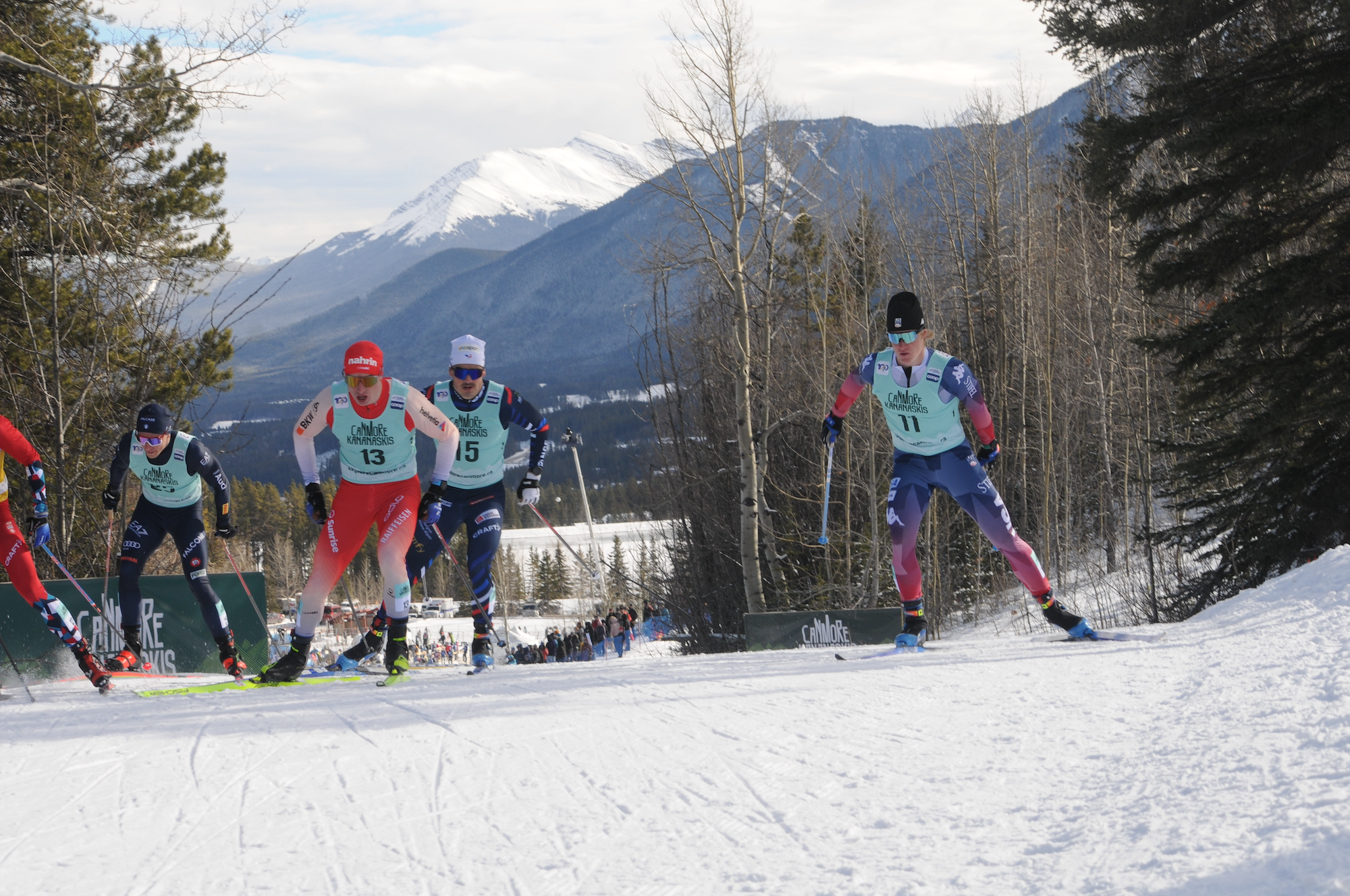
    Zak Ketterson (USA) during the 10 k Classic in Toblach, Italy, as part of the 2026 Tour de Ski. (Photo: Vanzetta/NordicFocus)

    On Monday, a clear winter morning in northern Italy, Zak Ketterson skied intervals while his teammates enjoyed a point-to-point on an idyllic pre-Olympic winter day. The sun was out. The snow was good. He was working.

    “I did some hard intervals,” he said later. “So it was still nice and sunny and everything, but not as enjoyable.”

    That small distinction — between the workout that feels good and the workout that gets you ready — has followed Ketterson for most of his career. He has never been the prodigy. He has never been the junior who arrived early, polished, and inevitable. His path to the Olympic start line has been indirect, uneven, and occasionally fragile. It has also been intentional in ways that only make sense in hindsight.

    At 27, Ketterson is preparing to race at his first Olympic Winter Games, starting with the Skiathlon on Sunday, the culmination of a season that has quietly redefined his place in American men’s cross-country skiing. He has been competitive across formats, consistent across weekends, and calm in moments that once rattled him. But none of that came from doing things the “right” way — at least not the way modern development systems tend to define it.

    Ketterson arrived here by starting late, resisting structure, leaning into racing before training, and trusting that if he kept showing up long enough, the pieces might eventually fall into place.

    They have. Just not quickly.

    Ketterson’s favorite sports as a child were football and baseball. (Photo: Courtesy Photo)

    A Winter Without a Script

    Ketterson grew up in Minnesota, where winter is not an inconvenience so much as a condition. The days shorten. The lakes freeze. School calendars and community life bend around the cold. You don’t opt out of winter there; you adapt to it.

    In many households, adaptation means skiing. For Ketterson’s, it meant something else first.

    “For me, I was always really into football and baseball,” he said. “That was my fall sport and my spring sport.”

    Those sports gave his year shape. Football stretched into late autumn. Baseball pulled him toward summer. They came with teammates, structure, and a clear sense of belonging. Winter, by contrast, arrived as a blank space.

    Basketball — his favorite sport to this day — lived somewhere between play and possibility. He loved it but never formally committed to it. Organized winter athletics never quite settled into his life. Not yet.

    Before skiing was ever part of his life, Ketterson dreamed of being a pro athlete. (Photo: Courtesy Photo)

    Cross-country skiing entered almost accidentally, carried in by family rather than ambition.

    “My brother, for whatever reason, was more into cross-country running, track, and cross-country skiing,” Ketterson said. “He kind of convinced me, like, yo, you don’t have anything going on in the winter, you should just try this.”

    It wasn’t a calling. It was a solution.

    He was thirteen — late by elite skiing standards, but early enough to slip into the margins of the system. In Minnesota, seventh graders could train and travel with high school teams. Ketterson joined at the JV level, young and mostly anonymous.

    The draw wasn’t the work. It was the race.

    “I really liked racing, especially mass starts and sort of the competitive head-to-head aspect of it,” he said.

    Training, on the other hand, felt like an obstacle.

    “I absolutely hated that,” he said. “When it came to going into the woods and just doing a two-hour ski or something, I hated it.”

    Sometimes, hatred turned into avoidance.

    “There were a lot of practices where I would hide in the woods,” he said. “My friends and I would just pretend that we trained, but we were actually just building snow forts.”

    If this were a conventional development story, it might end there. Plenty do. A late start, uneven buy-in, resistance to structure — those are often warning signs.

    But Ketterson kept finding himself back on start lines.

    Early days on skis for Zak Ketterson. (Photo: Courtesy Photo)

    Racing as the Through Line

    What sustained him through those early years was not discipline, but opportunity. Each step forward offered another race, another environment where effort produced immediate feedback.

    Junior Nationals. Then World Juniors. Eventually, college.

    “The thing that kept me in the sport initially was just the racing,” he said.

    That instinct — to measure himself against others rather than against a stopwatch or a training plan — would define much of his early relationship with the sport.

    By the time he reached Northern Michigan University, skiing stopped being seasonal. It became daily. The margin for avoidance narrowed.

    “I started to develop more of a relationship with the training aspect of it,” he said. “Especially in college, I began to really enjoy the process of trying to improve and optimize things.”

    Sleep. Nutrition. Recovery. The quiet details, that barely registered when skiing was something you fit around football and baseball, suddenly mattered.

    The shift wasn’t romantic. It was practical.

    That change carried him into a professional career after graduation — not as a finished skier, but as someone finally willing to do the work consistently.

    A young Zak Ketterson (Midwest/Loppet Nordic Racing) leads the U16 Boys 5 k Classic Mass Start at the 2013 Junior Nationals in Fairbanks, Alaska. (Photo: bertboyer.zenfolio.com. Proceeds go to NNF)

    Northern Michigan, Daily Work

    Northern Michigan University didn’t transform Ketterson overnight. It narrowed the margins.

    Skiing there demanded repetition. Cold mornings. Tired legs. Routine. Improvement stopped being incidental.

    The biggest shift came junior year, when he began dating his now wife, Julie Ensrud, and skiing stopped being something he did mostly alone.

    “When I started dating her my junior year in college,” Ketterson said, “that really coincided with when I started doing a lot better in skiing.”

    Julie grew up in Norway, in a system that treated sport as something you lived inside rather than something you added on. She attended a specialized Norwegian sports high school. She trained at volume. She understood structure.

    “She was kind of living semi-professionally from the age of 16,” Ketterson said.

    She noticed the basics first.

    “I started going to bed a lot earlier,” he said. “I would always just be on my phone until 11 or 11:30.”

    Food followed.

    “Not only eating healthier,” he said, “but eating more of the right things. More carbs. The timing of what you eat with training.”

    By living together senior year, Ketterson’s bad habits became visible.

    “She’s probably the hardest worker and most efficient person I’ve ever met,” he said. “She gets an email and does it immediately.”

    Ketterson noticed the contrast.

    “I used to be super disorganized,” he said. “I used to lose stuff and leave things everywhere.”

    Being around someone who treated time deliberately changed how he approached his own days.

    “She comes to basically every interval session I do,” he said. “Takes video. Takes lactates. Gives technique tips.”

    What could have felt like a sacrifice became shared life.

    “If I were single and just kind of doing this grind alone,” he said, “it would feel like a much bigger sacrifice.”

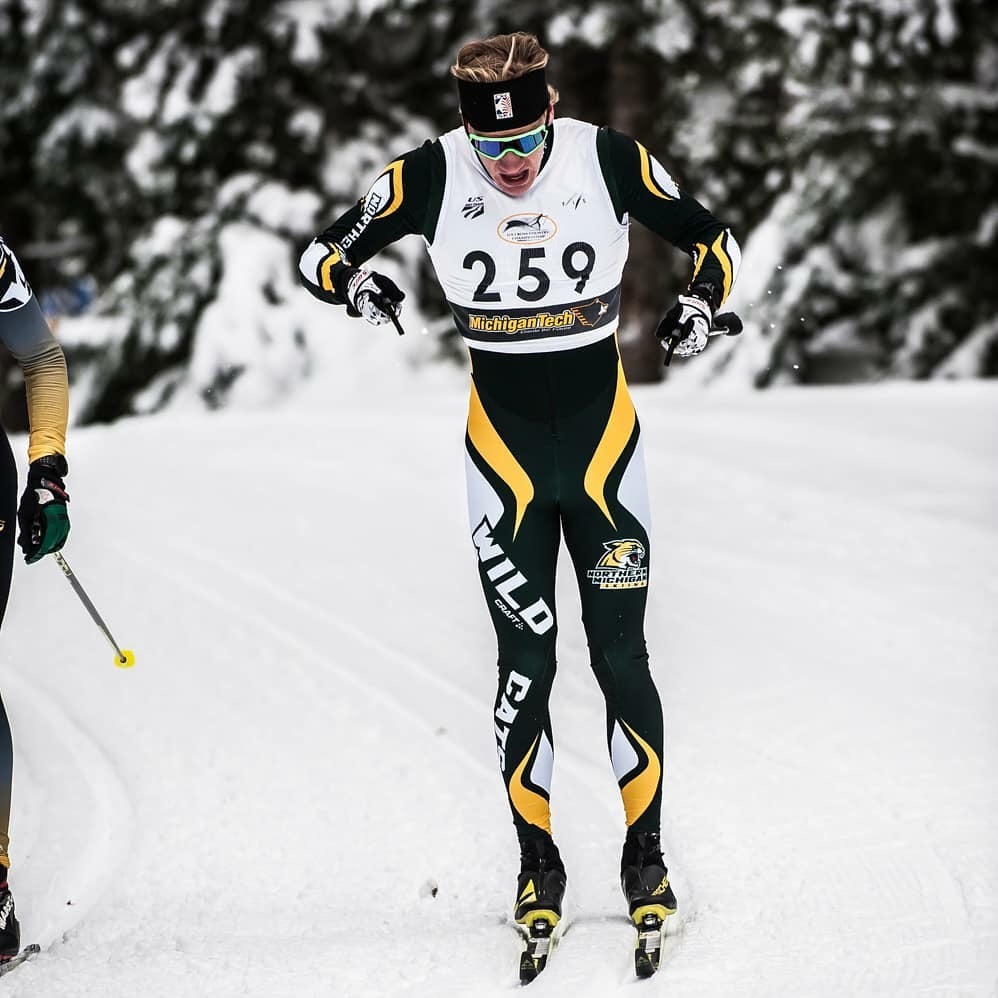
    Ketterson (NMU) racing at the CCSA opener in Houghton, Michigan during his college days at Northern Michigan University. (Courtesy photo)

    Learning How to Stay Anyway

    Leaving college did not feel like an arrival. It felt like exposure.

    Professional skiing offered fewer guarantees. Results came without permanence. Progress was harder to measure.

    “This is maybe my fifth year as a professional,” Ketterson said. “I feel like I’ve just been sort of taking small steps each year.”

    From the outside, those steps were hard to see. He qualified. He scored points. Then momentum faded.

    “I’ve had glimpses here and there of being quite good on the World Cup,” he said. “But it was so inconsistent and few and far between.”

    One year, sprint qualification came easily while distance slipped. Another season, the opposite.

    “I would qualify every sprint but struggle in distance,” he said. “Or I wouldn’t qualify in sprints, but I’d get a lot of top-30s in distance.”

    The belief stayed intact.

    “I believed I had that all-around potential,” he said.

    Belief, however, doesn’t quiet doubt when seasons stack without resolution.

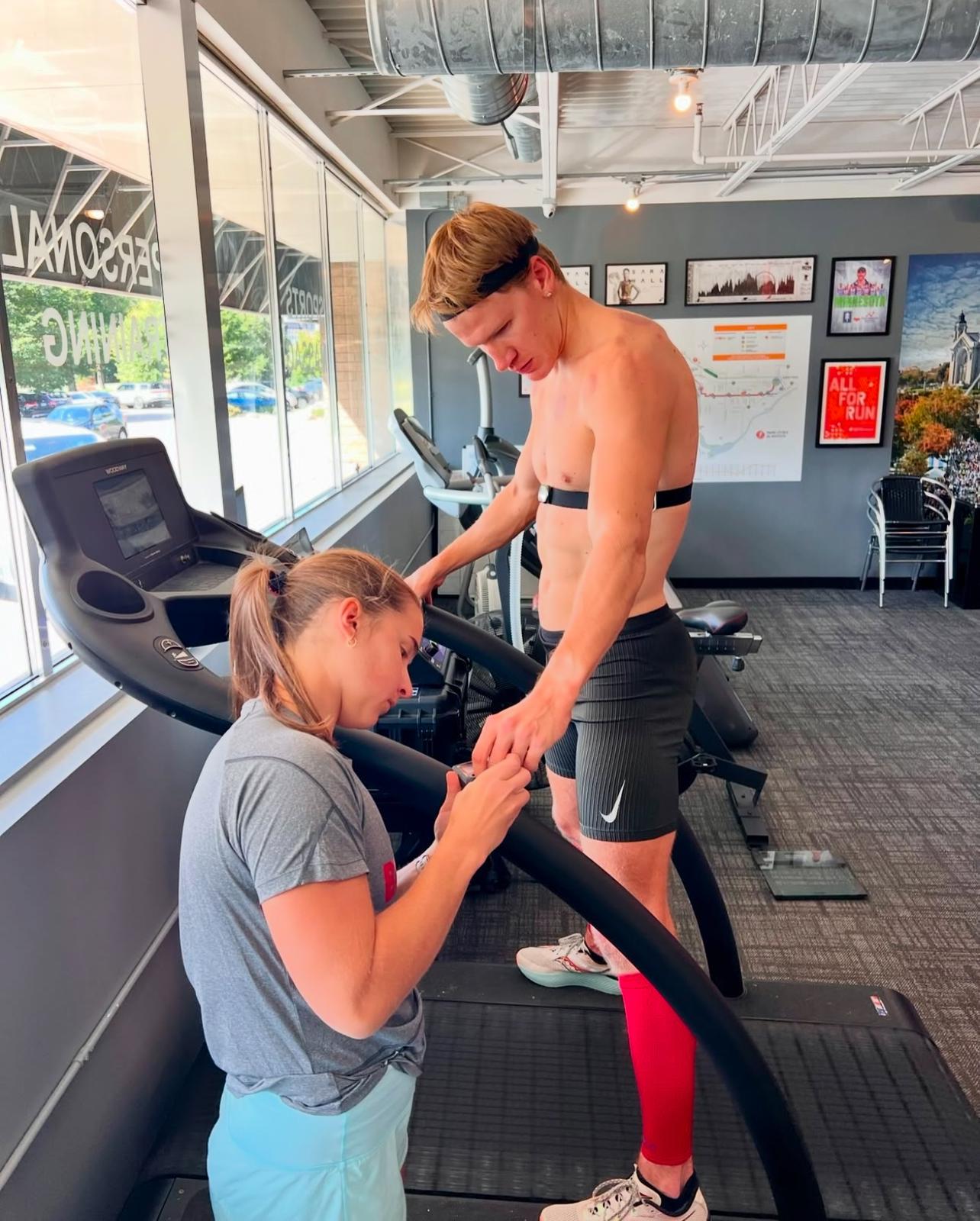
    Ketterson’s wife, Julie Ensrud, assists him with lactate testing during a treadmill session. (Photo: Zak Ketterson)

    Choosing a Place That Could Hold the Work

    For American skiers, Europe is often something you pass through. For Ketterson, Norway eventually became something else.

    Julie’s family lived outside Oslo, close to training venues and the airport. There was also a cabin — quiet, familiar.

    “It works out super well,” Ketterson said. “I can just get these three- or four-day stints at the cabin and unpack my bag and feel really at home.”

    Most American skiers live out of their bags.

    “There are a lot of Americans who just live out of their bag and are constantly in hotels,” he said.

    In Norway, life slowed just enough for training to accumulate rather than reset.

    “They’re super into skiing,” Ketterson said of Julie’s family. “Her brother skied competitively growing up.”

    Her father, especially, was absorbed by the details.

    “He’s so into ski waxing and the nitty-gritty stuff,” Ketterson said.

    The support wasn’t motivational. It was stabilizing.

    “They’ve sort of adopted me,” he said. “Like, how can we support him?”

    Norway wasn’t the breakthrough. It was the ground beneath it.

    USA I takes the win in a rare World Cup 4 x 5 k mixed relay in 2022. From left to right, Scott Patterson, Rosie Brennan, Zak Ketterson, and Jessie Diggins. (Photo: NordicFocus)

    Nothing Fancy, Just Better

    With stability in place, the training changed.

    “I started working with a coach in Oslo,” Ketterson said.

    The relationship was loose.

    “He created the framework,” Ketterson said. “But I was still writing probably 90 percent of my training.”

    The biggest change was subtraction.

    “I used to do strength twice a week, sometimes even three times a week,” he said. “Now it was basically once every ten days.”

    The logic was blunt.

    “If you want to get better at double pulling,” he said, “you just need to double pull more.”

    He replaced strength with ski-specific work. Fitness became the priority.

    His training rhythm flattened.

    “My training became much more consistent,” he said. “Every week was pretty similar.”

    No dramatic rest weeks. No spikes. Stress accumulated steadily.

    He returned to the same hills. The same treadmill sessions.

    “If something feels way worse than the last six times,” he said, “then you know you need rest.”

    Zak Ketterson logs some roller-ski hours in Minneapolis with Team Birkie. (Photo: Instagram @zaketterson)

    Toppidrettsveka

    Late in August, Ketterson lined up at Toppidrettsveka, Norway’s popular roller-ski stage race.

    “I was expecting to be absolute middle of the pack,” he said.

    Instead, he stayed with the leaders.

    “From the first race — a mass start 50k — I was fighting for the win,” he said.

    Three years earlier, he had been dropped halfway.

    “That was one of those moments where it’s like, wow,” he said. “This is a really big difference from anything I’ve felt before.”

    Across stages, the pattern held.

    “That gave me a lot of confidence,” he said. “Like, okay — what we’re doing is really working.”

    Still, he waited.


    The Ultimatum

    By autumn, the feeling hadn’t faded.

    “I told Julie that this had been by far my best off-season ever,” Ketterson said.

    Then came honesty.

    “I told her that if I’m not good this year,” he said, “or if I don’t make a really big jump, then I kind of want to retire.”

    It wasn’t dramatic. It was diagnostic.

    “If this doesn’t work,” he said, “then I don’t know anything about training.”

    Zak Ketterson (USA) and Friedrich Moch (GER) (l-r) lapping through the stadium during the Men’s 20 k Mass Start Freestyle in Ruka, Finland, at the beginning of the 2025/2026 season. (Photo: Modica/NordicFocus)

    Ruka

    Ketterson finished 14th in the World Cup opener in Ruka.

    “I was crying in the finish,” he said.

    Not from disappointment.

    “It was such an emotional rush,” he said. “All the work that I’d put in, and that my wife had supported — it finally got some validation.”

    For the first time since college, the feeling matched the effort.

    The season didn’t spike. It held.

    “For the first time,” he said, “regardless of whether it’s a sprint or a distance race, I feel like I can compete that day.”

    Zak Ketterson (USA) racing on the Olympic Sprint Course in Val di Fiemme, Italy, during the 2026 Tour de Ski last month.  (Photo: Vanzetta/NordicFocus)

    Arrival Without a Finish Line

    Ketterson will start his first Olympic race just days from now — older than most of his teammates, newer to the stage, and unusually calm.

    “I’m just treating it like any other race,” he said.

    There is no demand for the outcome. Only execution.

    “What would haunt me,” he said, “is doing something that was within my power not to do.”

    So he will race. He will pace. He will pay attention.

    The long way in has given him that luxury.


    Help Support Our Olympic Coverage!

    FasterSkier has our own Nat Herz on the ground at the Olympics, which is a significant financial lift for us. If you value the thoughtful work and access FasterSkier provides at championships like this one, please consider becoming a Voluntary Subscriber. Your support directly fuels our work to cover the people, places, and moments that make our sport special.

    Join the FasterSkier community!


    Ketterson with family at the Minnesota State Fair. (Photo: Zak Ketterson)
  • Lauren Jortberg and the Long Way Around to the Olympics

    Lauren Jortberg and the Long Way Around to the Olympics

    This article was made possible through the generous support of our voluntary subscribers.  If you value coverage like this, please support FasterSkier with a voluntary subscription.  

    By the time Lauren Jortberg made the U.S. Olympic Cross-Country Ski Team, the achievement arrived not as a burst of disbelief or relief, but as something quieter and stranger: a moment that required processing.

    “It is a lot to take in,” she said, speaking from Seefeld, Austria in the middle of a pre-Olympic training block. “It’s been a big goal. But it’s one of those big goals that I’ve tried not to think about too much and just really focus on being my best self.”

    The phrasing matters. Jortberg did not describe the Olympics as a finish line or a culmination. She spoke about it as something she had to learn how to hold — something earned, yes, but also something that could overwhelm if mishandled. “Now,” she said, “I’m trying to put aside the completion of the goal and really focus on performing. And performing really well.”

    That distinction — between achievement and performance, between arrival and presence — has come to define her career. It is also the reason her story resists easy telling. Jortberg was not a prodigy. She was not a junior star. She did not dominate early or move cleanly through the system. She took the long way around.

    The Long Way Around

    Jortberg grew up in Boulder, Colorado, a town dense with endurance athletes and outdoor ambition. “I’m super fortunate to have been born and raised in Boulder,” she said. “It has one of the highest percentages of Olympians for cycling and running.”

    Her parents were athletic — her mother was a professional runner, her father competed in multiple sports — and movement was woven into daily life. There was mountain biking, trail running, hiking, time spent at a family place in Winter Park. But skiing, she noted, was not central to Boulder’s identity. “If you’re familiar with Boulder, it’s not really a winter place. We had to work hard to get to snow.”

    Her earliest athletic identity was split. She loved soccer deeply and still wonders what might have happened had she stayed with it. “I do kind of wonder what I could have done if I had pursued soccer,” she said. Her father spent hours training with her, and she took pride in improvement more than outcome.

    The turn toward skiing came, in part, through her older sister — six years ahead, a steady presence, someone to chase. When her sister tore her ACL playing soccer and pivoted fully to skiing, Jortberg followed. “I really looked up to my sister,” she said. “She went to U18 Scandinavian Cup, Junior Nationals, skied at the University of Denver. Seeing her do all these cool things with skiing really felt like, well, I can do that.”

    But progression was slow. In high school, Jortberg struggled. She did not make Junior Nationals her first year — a moment she still remembers clearly. “I was devastated,” she said. “It was one of the first big adversities in my career.”

    She never cracked the top ten at Junior Nationals until she was a U20. “I had a lot of 11th places,” she said. “I could never crack that top ten.”

    It is difficult, in hindsight, to overstate how thoroughly unremarkable her junior results were by Olympic standards. This is not revisionism; it is the point. There was no obvious through-line, no early validation to cling to.

    After high school, she took a gap year at Stratton Mountain School. It did not go smoothly. She fractured her arm in a parking lot crash. The season was disrupted. Progress stalled again.

    What she had, instead, was a willingness to stay.

    Dartmouth and the Work of Becoming

    At Dartmouth, something shifted. Not overnight, and not magically — but structurally.

    “I think it was a big surprise starting at Dartmouth,” Jortberg said, “the level I was at and the level the team was at.” She majored in environmental science and found herself inside a women’s program that emphasized individual growth within collective intensity.

    Under coach Cami Thompson Graves, the team culture was demanding but non-coercive. “She’s really amazing at coaching athletes to really know what is good for them,” Jortberg said. “She’s incredibly good at getting athletes to become very independent with an amazing team culture.”

    The women’s team was deep, competitive, and internally driven. “We were going one through five, or one to four, five, eight, ten,” she said. “It was insane.” NCAA spots were scarce; no one could coast.

    Crucially, Dartmouth supported international racing alongside collegiate commitments. Jortberg went to World Juniors, U23s, OPA Cups — sometimes twice in a season. “Having that support was super helpful,” she said. “Not just to perform in a green suit, but to perform later on.”

    For the first time, development felt cumulative.

    The women’s final of the 2021 Keys to the Castle rollerski sprint in Lake Placid, NY. From left to right, Lauren Jortberg (BSF Pro), Julia Kern (SMS T2/USST), Jessie Diggins (SMS T2/USST), Alayna Sonnesyn (SMS T2). (Photo: Reese Brown RDB Marketing)

    The Bubble Years

    Post-collegiately, Jortberg entered what many American skiers know intimately: the bubble.

    She moved through programs, spent time with Bridger Ski Foundation Pro and later SMS T2, and began working with coach Perry Thomas. She earned World Cup starts, lost them, re-earned them. Progress was intermittent. Confidence, fragile.

    “It was a lot of back and forth,” Thomas said. “Getting starts and not getting starts. Proving herself again in the U.S. and then getting those World Cup starts again.”

    Thomas had recruited Jortberg as one of his first athletes when he began coaching at the professional level. Their early years together were not seamless. “Our first year together, there was a lot of figuring things out,” he said. “There were ups and downs.”

    What mattered was not immediate success but shared patience. “We were both willing to make it work,” Thomas said. “And work through difficulty together.”

    During this period, Jortberg made a deliberate choice that would shape the rest of her career: she doubled down.

    Lauren Jortberg (USA) training in Tignes, France, last June. (Photo: Authamayou/NordicFocus)

    Choosing One Thing

    Sprinting had always been her strength — particularly skate sprinting. Classic sprinting lagged behind. Rather than attempting to become broadly better at everything, Jortberg and Thomas made a narrower decision.

    “Let’s spend one day a week, every week, for an entire summer and fall, working on classic skiing,” Thomas said. “Double pole. Thirty to sixty minutes. Just consistently.”

    It was not glamorous work. It was not optimized for social media or immediate payoff. But Jortberg committed fully. “She was like, ‘Hell yeah, let’s do this,’” Thomas said.

    Even when they were no longer formally affiliated with the same team, she continued the work remotely. “She continued that work on her own,” he said. “From afar.”

    At the same time, something else was happening — something less visible.

    Lauren Jortberg (USA) during the qualification of the World Cup Individual Skate Sprint in Oberhof, Germany, two weeks ago. (Photo: Authamayou/NordicFocus)


    The Mental Turn

    Jortberg began working seriously with a sports psychologist. She and Thomas independently immersed themselves in books, podcasts, and writing about mental performance. They traded recommendations. They talked openly about processing failure.

    “I don’t care how pretty your technique is,” Thomas said. “If you don’t have control over the on-off switch in your brain, you’re not going to get to the line fastest.”

    What Thomas noticed later, during Period 1 Super Tour in Alaska, was a change. “That was a different Lauren than even a year ago,” he said. “In such a good way.”

    Jortberg describes it less as a breakthrough than a reframing. “Everyone is going to have setbacks,” she said. “It’s about how you respond. Chipping away little by little. Not letting setbacks impact how you see yourself.”

    She learned to loosen her grip on outcomes. “Often when we think things have to happen a certain way,” she said, “that’s when they don’t.”

    Lauren Jortberg with boyfriend Antoine Cyr (CAN). (Photo: Courtesy Photo)

    Two Places at Once

    In the fall, Jortberg moved to the Mount Sainte-Anne area of Quebec. The decision was partly personal — she is dating Canadian skier Antoine Cyr — but also practical.

    She began training at the Pierre Harvey Training Centre, known for its demanding terrain and extensive roller-ski infrastructure. “The terrain is really hard,” she said. “I think it’s been awesome for intensity. Especially my classic skiing.”

    Her coaching arrangement became hybrid: remote communication with Thomas, daily training in Quebec. “We text pretty much every day,” Thomas said. “Or we’re on the phone.”

    Jortberg chose not to maintain two residences. “That’s just not something that financially would be feasible,” she said. More importantly, she valued stability. “I really prioritize my personal life. That’s what allows me to perform at the highest level.”

    It is an unromantic truth of elite skiing: stability is performance.


    Alaska and Leadership

    When Jortberg declined early World Cup starts to focus on Super Tour and U.S. Nationals, she rejoined Coach Thomas and the rest of the Mansfield Nordic Pro team in Alaska. What stood out was not just her skiing.

    “I was so impressed with her as a leader,” Thomas said. “We used her a ton in team meetings. Tactics. Pacing. Course preview.”

    After Alaska, the decision to formally add her back to the team was unanimous. “It was an easy decision,” Thomas said. “She just wanted to be part of the team and demonstrated awesome leadership.”

    Kendall Kramer, Samantha Smith, Lauren Jortberg, and Julia Kern (l-r) will join Jessie Diggins, Rosie Brennan, Novie McCabe, and Hailey Swirbul to represent the United States in Val di Fiemme, Italy, from Feb. 6–22, 2026. (Photo: Authamayou/NordicFocus)

    Not Jaded

    Jortberg will arrive at her first Olympics as one of three women on the U.S. team making their Olympic debut. She sees that as an asset.

    “I want to bring non-jaded energy,” she said. “Just that first-time excitement.”

    She wants to be present — not consumed by outcome. “I want to look back and be grateful that I was even there,” she said. “And really appreciate the experience.”

    It is not a rejection of ambition. It is a different relationship to it.

    Forward

    Jortberg plans to continue racing. She hopes for 2030, in the French Alps — a place she loves, a skate sprint on a stage that suits her. She is considering an online master’s program in sustainability and renewable energy, thinking carefully about how to prepare for the life that will follow skiing without rushing herself toward it. For the first time in her career, she feels no urgency to escape the present.

    “I feel the most stable I’ve ever felt in my career,” she said. “And it’s showing.”

    Stability, for Jortberg, has never been accidental. It is something she built deliberately, after years of motion without certainty — years of chasing snow from a town where Olympians ran past her on bike paths and reservoir loops, where excellence was ambient and ordinary at the same time. In Boulder, she grew up watching greatness move casually through public space, learning early that world-class athletes were not mythical figures but people who showed up every day and kept going.

    She was not the fastest junior in that environment. She was not the one with the early results or the easy narrative. She lingered on the edges, finished just outside the frame, learned patience in a place that celebrated inevitability. And still, she stayed.

    Lauren Jortberg (USA) anchors the relay for the United States in Toblach, Italy, in 2023. (Photo: Modica/NordicFocus)

    Now she is an Olympian — not because she followed the shortest line between promise and performance, but because she learned how to endure the long arcs in between. She learned when to narrow her focus, when to loosen her grip, when to trust work that did not announce itself right away. She learned how to live inside uncertainty without mistaking it for failure.

    There is something quietly astonishing about that return: a young woman who grew up surrounded by Olympians, never quite believing she was one of them, becoming one anyway — not by force or speed, but by accumulation. By choosing stability when chaos was easier. By learning how to stay.

    For an athlete who never arrived early, this moment is not a surprise step so much as a natural one. The long way around, it turns out, still leads somewhere.


    Help Support Our Olympic Coverage!

    FasterSkier will have our own Nat Herz on the ground at the Olympics, which, to be honest, is a very big financial lift for us. If you value the thoughtful work and access FasterSkier provides at championships like this one, please consider becoming a Voluntary Subscriber. Your support directly fuels the work we do to cover the people, places, and moments that make our sport special.

    Join the FasterSkier community!
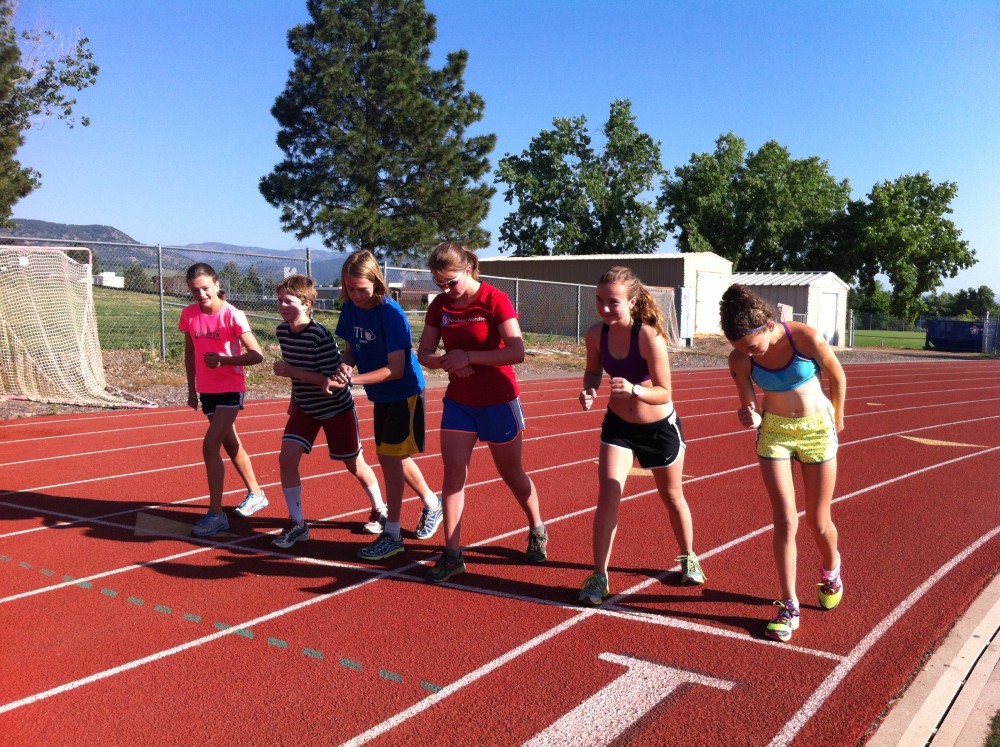
     

  • Jack Young: Against the Template

    Jack Young: Against the Template

    On the Wednesday before the World Cup season opens in Ruka, Jack Young sits in a small condo, looking out at over a foot of new snow that’s been drifting down all morning. The air is much warmer today than it was before he and the U.S. Ski Team loaded onto a six-plus hour bus ride yesterday — “Muonio was friggin’ cold,” he says — and the mood is calmer, quieter, the way he wants it. This is his final runway before an Olympic year truly begins, and he is spending it doing almost nothing.

    Not nothing-nothing, of course. But nothing extra. No bonus minutes, no filler skis, no threshold for confidence, no volume for psychological reassurance. “The biggest thing right now is taking these two weeks absolutely as seriously as possible with rest and just not doing anything extra training-wise that I do not need to be doing,” he says. “I’m training so little right now because of how important Ruka and Trondheim are for me.”

    Growing up in Northern Vermont, Jack Young had an All-American childhood. (Photo: Courtesy Photo)

    Outside, the classic sprint course cuts through the forest — the first of two classic sprints in Period 1. They matter—more than they ever have. To make the Olympics, he must qualify. To qualify, he must have transformed himself into something he has never consistently been: a classic sprinter capable of making heats on the hardest stage in the world.

    That he is even here, on the cusp of an Olympic selection fight, is strange enough. Stranger still is the way he got here — not built from the standardized American skiing pipeline but stitched together from its edges. A football quarterback. A baseball outfielder. A skier whose parents “didn’t know what Nordic skiing was.” A D3 athlete who reverse-engineered sprint training out of 800-meter track plans and the writings of a Swedish speed skater. A young man who kept such detailed training logs that, by the time he made the World Cup, he could begin writing his own plan.

    In a sport that often rewards conformity, Young’s ascent is something close to a jailbreak.

    Jack Young as he started his racing for Craftsbury. (Photo: Courtesy Photo)

    A Vermont Childhood Without the Usual Skiing Script

    “Neither of my parents knew what Nordic skiing was,” he says with a laugh. They loved the outdoors, yes — mountain biking, alpine skiing, the typical northern Vermont mélange of mud, woods, and winter — but their son’s athletic identity formed somewhere else entirely. “I played every sport. I loved baseball. I played basketball through elementary school. I started football as soon as I was allowed to, which I think was in fourth grade.”

    He became the kind of athlete rural towns understand intuitively: the quarterback on fall afternoons, the center fielder chasing down balls in the summer dusk, the kid who could pick up anything and find competition in it. Skiing entered sideways, almost accidentally, through his sister Callie. She joined the small Nordic program in Newport, and he was brought along because that’s what families do — pack the car, hand over snacks, make it work.

    “I immediately fell in love with racing,” he says. “I just love the competition.” Running around on skis made sense to him. Movement, speed, chaos — he could do that. But even with training days at Craftsbury beginning around sixth grade, he didn’t think of skiing as his primary outlet. “I wasn’t as focused as my sister was, but I would still get dragged along,” he says. “I loved skiing, but I loved football and baseball just as much.”

    The irony — one he now sees clearly — is that he was training for skiing without realizing it. “All summer was spent doing fun things in the woods. We’d go to Craftsbury a couple of times per week. But I never thought of skiing as my main sport. I weighted those sports equally, even though I was putting a lot more time into skiing.”

    If northern Vermont had offered a travel football club or competitive baseball without days of driving south, the story may have gone a different way. But mountain running and biking were nearby, and elite baseball diamonds were not. “I’d so much rather go for a long run in the mountains or go mountain biking than I would hit on the tee for two hours,” he says.

    Sometimes this is what talent looks like in real time: a kid choosing the fun version of hard work without realizing he’s choosing a future.

    When we spoke, Jack Young sat in a small condo in Ruka wearing a Boston Red Sox baseball hat, just added evidence for how important the game has been for him since he was a boy. (Photo: Courtesy Photo)

    The Late Bloom: A Breakthrough and a Decision

    He kept skiing in the winter, of course. Not obsessively. Not in the way some junior skiers live their lives by FIS points before they have a driver’s license. But enough to stay close. Enough to remain good. Then came the summer after his sophomore year of high school — the first time he trained like someone who had decided to see what was possible.

    “I put a good summer of training in,” he says. “Had a bad football season… but that was the first time I was really starting to push the limit on what I could do training-wise while in season for football.”

    He mountain-biked in races on weekends, squeezed workouts around football practices, and tried to make the whole geometry hold together. Then came Junior Nationals, and with it, proof. “I had a pretty good result in the sprint. I think I was like 18th or something… and that was the moment where I was like, okay. I am decent at least at this sport. I’m doing a lot better than I’ll ever be at baseball.”

    That spring, Young emailed coaches — the NESCAC schools, Dartmouth, and UNH. Bowdoin and Dartmouth joined Colby on his shortlist. Colby won on something less quantifiable: belief.

    “Tracy [Cote] was very excited about me,” he says. “And I think that resonated with me. Maybe it’s my ego, but it was nice to hear.”

    He would later call it “a perfect decision.”

    Jack Young enjoying some backcountry skiing in Jay. (Photo: Courtesy Photo)

    Colby: Building an Athlete in a Place That Shouldn’t Have Worked

    Winters in college can blur into one another — classes, training, snow, the strange mix of exhaustion and euphoria that defines 19-year-old life. But Young remembers his freshman fall with clarity: meeting people, finding balance, doing “good, not great” training, and then, once the season started, traveling west for Senior Nationals.

    There, in Soldier Hollow, everything sharpened. “I think I qualified in the top 20 in the skate sprint,” he says. “That was an absolutely massive result for me. I never had anywhere near that level of success on the national level.”

    He didn’t transform overnight — not yet. His sophomore season brought a “fine college season,” a top-30 at NCAAs in the 10k skate, and the sense that distance skiing was finally, mercifully making progress. But the turning point came not in results but in imagination. He learned that the U.S. would receive twelve start spots for the Canmore World Cup the following year. Twelve starts. “I was like, 12 starts… that’s not that far off,” he says. “I kind of feel like I’m in contention for that.”

    To chase it, he would need to master something specific: the sprint qualifier.

    And this is where the story breaks from the template completely.

    Jack Young hits some big lactate numbers during a hard training session. (Photo: Courtesy Photo)

    Reinventing Sprinting from Scratch

    “I’ve always thought that sprint qualifiers were really similar to an 800-meter race on the track,” he says. Physiologically, mechanically, conceptually — they looked more alike than different. So he dug into 800m training. He looked for the extreme version, the distilled essence of what sprinters do when they train specifically for the thing that matters. Qualifiers are discrete. Defined. Precise. Why train them like a generalist?

    Then he read Nils van der Poel.

    The legendary Swedish speed skater’s manifesto, How to Skate a 10k, isn’t a skiing manual, but to Young, it may as well have been scripture: the idea of building huge aerobic capacity, then sharpening with brutally specific intervals at exact race pace. “He wants to skate as many possible laps at world record pace as possible,” Young says. “And that really struck me. I’m like — I can apply this to skiing.”

    He wasn’t going to become a single-event specialist, not in college. But he could take the principle and adapt it. So he built a sprint-qualifier program composed of things like:

    • 6 × 1 minute
    • 4 × 90 seconds
    • 10 × 30 seconds
    • 8 × 45 seconds

    All at precisely what he believed to be his sprint qualifier pace.

    “That was the bread and butter,” he says. “I’d do those workouts once or twice a week. I didn’t actually find them that strenuous, but I was accumulating a good amount of time at exactly what I thought sprint qualifier pace was.”

    He went completely dry that fall — no beer, no casual nights out, nothing that compromised sleep. “I was just recovering a lot better all the time,” he says. “I didn’t get sick at all.”

    Meanwhile, Colby head coach Tracy Cote allowed him to blend his ideas into the fall plan. “We were working together. I think we ended up writing the training plan together that fall,” he says. “She was pretty stoked about the focus on recovery… and she’d let me get away with doing things a bit more geared towards sprinting.”

    He trained more overall, too — a heavy summer that gave him the resilience to handle so much intensity once fall arrived. “My freshman year, I trained a little under 600. Sophomore year was around 650. My junior year I trained like 750 or something.”

    This was not an American development pipeline approach.

    It was an experiment.

    A smart one.

    A successful one.

    Jack Young, who a week earlier had a 3rd and 5th place in the EISA college races for Colby College delivered the 11th fastest qualifying time in the freestyle sprint at the Canmore World Cup in 2024. (Photo: Cockney/FasterSkier)

    Anchorage, SoHo, Canmore — and the Race That Changed Everything

    He targeted Anchorage for his first chance at the Canmore World Cup spot. He knew what he had to do: fly across the country in the early winter, race well, then perform at Senior Nationals in Soldier Hollow. Anchorage was the linchpin.

    “I went into Anchorage with a lot of confidence,” he says. “I won that qualifier; it was such a surprise.”

    He didn’t replicate the magic at Soldier Hollow — “I think I got like 11th” — but the Anchorage win held. He made the Canmore start list.

    And then came the race of his life.

    “That’s still my lowest FIS points ever,” he says. “I didn’t match that last year.”

    When he crossed the line, something shifted internally. “Once I did that in Canmore… that was the first time I really thought I wanted to keep skiing after college,” he says. “That was the moment I realized how good I thought I could get.”

    Call it the ignition point, the place where belief calcified into ambition.

    Where a multi-sport kid from a non-skiing family, attending a D3 school, doing self-designed intervals, suddenly saw himself in a World Cup heat map and thought: Yes. Here.

    Jack Young training on Eagle Glacier this past summer. (Photo: Courtesy Photo)

    Writing His Own Plan on the World Cup

    Two years later, he is living in Europe, often for months at a time. He is in his second year of racing full-time on the circuit. He is older, stronger, and more certain. And he is, in many ways, coaching himself.

    “For this time of year, it’s entirely guided by what I’ve done the last two years,” he says. “Which workouts worked in which places, which workouts didn’t… the comments are much more important than the hours.”

    He still works closely with Pepa Miloucheva at Craftsbury — “She’s the number one on that” — but when he’s on the World Cup, he is the primary author of his training. He reads his patterns. He analyzes sensations. He looks for the combinations of stress and stimulation that make him feel dangerous on race day.

    He isn’t reinventing his body now — he’s listening to it.

    The independence he cultivated at Colby has become his competitive advantage.

    With the Olympic sprint being in the classical technique, Jack Young (USA) hopes to find the form he has historically shown in freestyle sprinting during the early season World Cup stops. (Photo: Modica/NordicFocus)

    The Classic Sprint Problem — and the Olympic Dream

    To make the Olympics, the math is simple, even if the execution is brutal.

    “The simplest answer is: make a big jump in classic sprinting,” he says. “If I can start qualifying for classic sprints consistently, I have a very clear path to making the Olympics.”

    Last year’s results would meet the published criteria — “hypothetically, if I had the exact same season… I would technically make the team,” — but this year is different. The Olympic sprint is classic. Period 1 has two classic sprints and only one skate sprint. Some of the contenders for Olympic spots are stronger in classic than he is.

    So the path is narrow: qualify in Ruka. Qualify in Trondheim. Hold form in Davos. Don’t step back. Don’t stagnate.

    At the philosophical level, the criteria are simpler still.

    “It’s all about execution at this point,” he says. “A good season is continuing with progress I’ve made… scoring more World Cup points than I did last year. Anything else is a step back.”

    He knows progress isn’t linear. He knows failure is part of sport. But he also knows what a step backward would feel like. “I’d be lying if I said I could look at this season as successful if I don’t maintain what I’ve been doing in skating and at least make a little bit of progress in classic skiing.”

    It is clear-eyed. Unsentimental. The kind of assessment you get from someone who has built his career on self-honesty.

    Jack and his sister Callie after winning a slow pitch softball tournament. (Photo: Courtesy Photo)

    What It Means to Make It This Way

    There’s a certain poetry in the fact that Young’s rise mirrors the very way he races: a precise, deliberate accumulation of moments. Nothing in his career came from the prescribed steps, the standard routes, the familiar trophies of a groomed junior-star life. Instead, his path looks more like a map drawn after the fact — connecting points that didn’t seem aligned until the picture emerged.

    A sister’s Craftsbury workouts.

    A baseball-heavy early adolescence.

    Mountain biking and football collisions.

    A D3 program that let him try things.

    A manifesto by a Swedish speed skater.

    A dry collegiate fall at age 20.

    A logbook of sensations.

    A day in Canmore.

    A belief.

    There is no template for this. There never was.

    But here he is anyway — on the World Cup, in an Olympic year, taking the biggest swing of his life.

    And as he sits in a Ruka apartment, resting more than he ever has before a race that matters more than most, he reflects not on what’s missing from his résumé but on what got him here in the first place: a way of building a skier that is his alone.


    Love Stories Like This? Help Keep Them Coming.

    Feature interviews like this one take time, access, and care to produce. If you value thoughtful storytelling and independent ski journalism, please consider becoming a Voluntary Subscriber. Your support directly fuels the work we do to cover the people, places, and moments that make our sport special.

    Join the FasterSkier community!
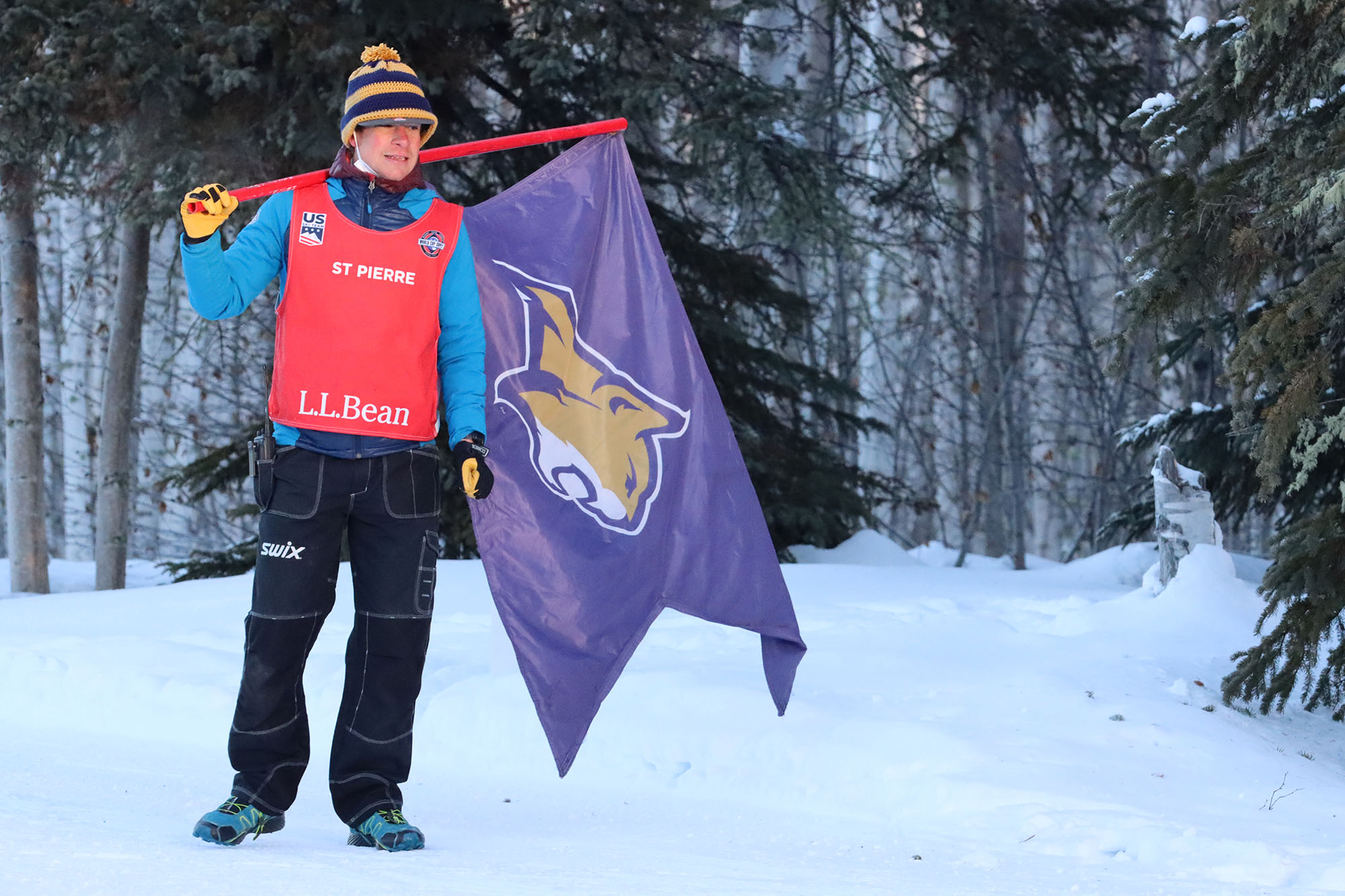
     

    Jack Young enjoying some orange juice on the Maine seacoast. (Photo: Courtesy Photo)
  • Nordic Nation: Greta Anderson’s 2021-2022 U.S. Ski & Snowboard Development Program Year in Review

    Nordic Nation: Greta Anderson’s 2021-2022 U.S. Ski & Snowboard Development Program Year in Review

    U.S. Ski and Snowboard Development Team Coach Greta Anderson encourages athletes racing the men’s 30k distance race during the 2022 U.S. Cross Country Championships in Soldier Hollow. (Photo: Tobias Albrigtsen / @untraceableg)

    Last June, U.S. Ski & Snowboard announced the hiring of Greta Anderson as Development Team Coach, supporting Cross Country Program Manager Bryan Fish in “all aspects of leadership and logistics surrounding the U.S. Development Pathway, including National Training Group camps, U.S. Nationals and Junior/U23 World Championships, Europa Cup, select SuperTour and other national-level competitions, as well as working on Coaches’ Education and Certification.” (Read an in-depth interview with Anderson following the announcement here.)

    As she described it, joining the U.S. Ski Team staff during an Olympic year while the COVID-19 pandemic raged on was a bit of “trial by fire.” Nonetheless, Anderson thrived in her new role, approaching the position with humility and open-mindedness as she learned the ropes. With a holistic view of athlete development, which emphasizes the importance of creating an environment where the athlete can be both happy and supported, Anderson had the opportunity to support athletes from the U16 to U23 level across the spectrum of international and domestic clubs and races. She played key roles during the 2022 FIS Junior/U23 World Ski Championships in Lygna, Norway, and had her first experience as the primary trip leader during the Opa Cup Finals pre-camp and competitions in Sappada, Italy. 

    U.S. Ski Team development coach Greta Anderson discusses the highlights and challenges of her first year in the role, as well as insights into the philosophy, projects, and initiatives of the national team development program more broadly. (Photo: Tobias Albrigtsen / @untraceableg)

    In this conversation, you’ll hear more about Anderson’s contributions to the development program thus far, and she shares insights into the philosophy, projects, and initiatives the U.S. Ski & Snowboard staff are working on to continue the growth and support of athletes ascending the pathways from junior to senior racing. We also discuss standout performances of the World U23/Junior Championships, and some of the athletes who have been recently named to the 2022-23 U.S. Cross Country Team.

    Thanks for listening, and thanks to Boulder Nordic Sport for supporting this podcast. 

    Note: One of the athletes whom Anderson discusses is Finn O’Connell, who skis for the Bridger Ski Foundation Pro Team in Bozeman, MT. While he was supported by development team coaches at the Opa Cup Finals, his nomination was to the B-Team, not the D-Team. 

  • Flying Farther: Developing Ski Jumping and NoCo, USA Nordic Style

    Flying Farther: Developing Ski Jumping and NoCo, USA Nordic Style

    American Ben Berend after jumping to 22nd in the nordic-combined individual/normal hill competition at 2017 FIS Nordic World Ski Championships in Lahti, Finland. He went on to place 41st in the 10 k to end the day on Feb. 24.

    Three years ago, U.S. Ski and Snowboard (formerly known as the U.S. Ski and Snowboard Association, or USSA) officially dropped nordic combined from its funding rolls. It was a potentially big blow and flat-liner moment for a program coming off one the most successful runs in U.S. nordic sports history. As recently as 2013, the foursome of Todd Lodwick, Billy Demong, Bryan Fletcher, and Taylor Fletcher earned bronze in the team event at World Championships in Val di Fiemme, Italy.

    Now, under the umbrella of USA Nordic, and two World Championships and nearly two Olympics removed from that seismic restructuring, American ski jumping and nordic combined are way beyond life-support mode.

    Koby Vargas (Park City Nordic Ski Club) jumping at 2016 U.S. nationals in Park City, Utah. (Courtesy photo)

    “What we see, and we see this across sport and the larger picture of health, is that we have less young athletes participating in sports these days,” said Jed Hinkley, sport development director for USA Nordic. “It’s not unique to any specific sport — it is across the board. There are some exceptions to that and I would say ski jumping and nordic combined are an exception to that.”

    Hinkley has been on the job since last summer. He’s seen his mission morph from grasping member clubs’ capacity, infrastructure, and financials to determining how to attract athletes and retain them.

    “I know our numbers are heading in a positive direction, but we still do see a fairly big drop off as athletes enter their teen years,” he said. “I would say that my role has shifted a little bit to be more athlete development around the U20 level —  to try to keep athletes in the sport longer.”

    According to Hinkley, ski jumping is experiencing a resurgence in the U.S. In 2014, USA Nordic began organizing a regional jumping competition, the US Cup Junior Series. Three of the four regions tracked by USA Nordic — Central, West and Alaska — experienced significant growth in participation. The only outlier was the East, which canceled its end-of-season jump competition due to severe weather. Hinkley believes that cancellation skewed the data downward.

    Data collected for the series tracks boys and girls ages U10 (under 10) to U16. Between 2016 and 2017, the Central region increased participation 49 percent, the West percent, and Alaska 192 percent.

    From a global perspective, the U.S. appears to be on a path to fostering a legitimate nordic-sport pipeline. Hinkley admits his data collection methodology relied in part on the “brother of a friend of a brother’s mechanic model,” but his information appears promising.

    “To the best of my knowledge, Norway and Germany are one and two for numbers in ski jumping and nordic combined,” Hinkley said. “From what we can figure out, it appears that the U.S. is the third-largest ski jumping and nordic combined nation in the world. There is one country that I don’t have numbers for that could outrank us, that being Poland, because they have such a huge love for ski jumping. It appears our numbers are higher than Slovenia, Austria and Japan, which are all part of the jumping and nordic-combined powerhouses.”

    Jumping and nordic combined are resource-intensive sports — they both require what can be costly jumping infrastructure. Two regions have taken different approaches to ski jumping viability.

    In Anchorage, Alaska, two women spearheaded a regional revival. As part of the Nordic Skiing Association of Anchorage (NSAA), Karen Compton and Vivienne Murray, along with a core group of volunteers, now respond to daily emails, shuttle athletes, and supply and maintain loaner equipment in an effort to expose young athletes to jumping.

    “When we started there were only three other boys jumping and a burned-out coach who quit shortly thereafter,” Compton said on the phone from Anchorage. “There just wasn’t anyone involved in the program, and I ran around a got some friends have their kids come and try it out because it’s only fun if your friends are doing it along with you. Vivian was one of the friends I asked. Her kids liked it and at the end of the season, which was just a few months, we talked about it and we decided the two of us would take it on and resurrect the program.”

    The Karl Eid Ski Jumping Complex in Anchorage, Alaska, which completed a retrofit in 2016. The three jumps pictured are now modernized with summertime jumping available to the athletes. (Photo: NSAA)

    In 2012, Compton and Murray began co-chairing a grant-writing and fundraising campaign. By 2016 they had raised enough funds to rehabilitate the jumps at Anchorage’s Karl Eid Ski Jumping Complex. The complex now boasts a modernized 10-20 meter combined jump, and 40-meter and 65-meter jumps, respectively. Under NSAA, Team AK Ski Jumping/Nordic Combined has upwards of 70 kids jumping each winter.

    Perhaps more importantly to developing higher-level jumpers, the modernization efforts allowed NSAA to plasticize the jumps’ in-runs to facilitate summertime jumping.

    “[Anchorage] has been a good model to recruit, maintain, and make the sport fun,” Hinkley said. “They do a lot of social stuff outside of the jump hill, and organization-wise they are creating a welcoming environment and a professional organization. … I think what they are doing really well is they are a part of NSAA, which is all of cross-country skiing in Anchorage. They work collaboratively with the cross-country side and they are all in it together. I think in a lot of places, historically, there has been a divide between ski-jumping clubs and cross-country clubs, whereas in Anchorage there is an awesome collaboration.”

    Anchorage came to the table with jumps in place. The Midwest boasts two from-the-ground-up success stories.

    Red Wing, Minn., is developing a new Olympic-size jump on land owned by the Prairie Island Indian Community. “It’ll be a state-of-the-art facility with potentially cross-country trails at the base. And they want to do things like World Cups, FIS Cups, Grand Prix,” Hinkley said.

    On a smaller but no-less-significant scale, a dedicated group in Cameron, Wis., built a 7-meter snow jump. That group collaborated with the well-established Flying Eagles Ski Club, a nationally recognized ski jumping club in Eau Claire, Wis.

    The Pipeline

    How bright is the future when it comes to international potential? On the U.S. men’s ski jumping side, four athletes were recently named to the its national team. Sixteen-year-old Kevin Bickner, who began jumping in Illinois but now lives in Park City, Utah, is the only A-team member. Bickner jumped to a 15th place on the World Cup this past March in Vikersund, Norway. In doing so, he jumped 244.5 meters, which was an American distance record, according to a USA Nordic press release.

    Rounding out the men’s jumping team are three B-team members: Casey Larson (18), Michael Glasder (28) and William Rhoads (22). At last year’s Junior World Ski Championships, Larson placed eighth in the individual normal-hill competition.

    “With men’s jumping, we have seen quite a phenomenal turnaround,” said USA Nordic Executive Director Billy Demong. “In participation for both women’s and men U14 levels, but for the national team, we have some guys who are really good. In fact, Kevin Bickner has had the best results in over a decade. And cumulatively the team scored more points last year than over the previous twelve years combined. They also had the best team-event finish since 1985, so there’s a solid group of four athletes.”

    Demong also noted that keeping U20 skiers involved with the sport remains a priority. For scoring criteria as it relates to national-team selection, USA Nordic begins scoring at the more competitive (larger field size) Continental Cup competitions. He explained that success at the Continental Cup indicates a positive trajectory. The C-team is organized as a U24 program, essentially allowing older athletes an incentive to invest and remain in the sport. The C-team is comprised of two skiers, Nicholas Mattoon (22) and AJ Brown (22).

    “We give our athletes a little more time to develop,” Demong said. “I think that’s partially why we are seeing the change. We are providing resources and opportunities for a greater group of athletes and at a higher level than it has been.”

    This season, the U.S. Nordic Combined team will be led by A-team returners and brothers Bryan Fletcher (31) and Taylor Fletcher (27).

    Last winter, the nordic-combined team was bottom heavy on the age-and-experience spectrum, with the Fletcher brothers being obvious outliers. U.S. Nordic Combined lacked the World Cup quota spots to expose several young skiers to that level of competition beyond domestic races and Junior World Championships .

    U.S. NoCo’s Stephen Schumann (28) passing on the outside, en route to 10th in the normal hill/10 k at 2017 Nordic Junior World Championships at Soldier Hollow in Midway, Utah. (Photo: U.S. Ski Team/Steven Earl)

    “One of the hopes is that we are able to start increasing the quota on the World Cup as well as the Continental Cup,” Demong said. “Last year, we had five different individuals score a top 10 on the Continental Cup, I believe. That’s unusual to have that much depth at that level. And what we need now is for some of those guys to transition into the World Cup.”

    Adam Loomis (25), Ben Berend (21), Ben Loomis (19), Jasper Good (21) and Stephen Schumann (17) comprise the Nordic Combined B-team. Grant Andrews (19) is the sole C-team member.

    The fleet of skiers following the Fletchers have time on their side in terms of World Championship and Olympic cycles, yet their recent junior-level results maintain the team’s emerging optimism. At the most recent Junior World Championships at home in Park City and Midway, Utah, U.S. Nordic Combined tallied two top-10 performances. Schumann placed 10th in the 10-kilometer Gundersen, and Ben Loomis finished ninth in the 5 k.

    “There is a big group behind Schumann and Ben Loomis,” Demong explained. “I think in one of the qualifying events in Park City, there were six or seven of them that all finished within a minute, so pretty good size crew for a little sport.”

    This April, USA Nordic formalized its efforts to keep promising athletes in an organized pipeline. Demong said it expanded its junior-national teams for both ski jumping and nordic-combined to include top athletes in the U16 to U20 range. USA Nordic also has national-development camps planned for this summer.

    “I think it is a very nice transition from the Junior National team to National Team the way we have built it out, because we set our own criteria for the teams we fund,” Demong said. “Ideologically we are trying to give the U20’s a reason to continue competing and skiing in the critical 18-, 19-, 20-year-old ages and that this is something really worth investing in.”

  • This Month in Journals: Does Birthdate Matter in Winning, or Staying In, Youth Sports?

    This Month in Journals: Does Birthdate Matter in Winning, or Staying In, Youth Sports?

    Born in November 1993, Lennart Metz of Germany was one of the oldest competitors at Junior World Championships in 2013. Did that help him win the classic sprint? Photo: Liberec2013.
    Born in November 1993, Lennart Metz of Germany was one of the oldest competitors at Junior World Championships in 2013. Did that help him win the classic sprint? Photo: Liberec2013.

    From children’s racing through Masters World Championships, athletes are divided into age classes in order to ensure fair competition and to identify the best racers at different developmental stages. In fact, only at the senior elite level is birthday a non-factor in determining what race you can win.

    But how are these age groups defined? A group of researchers in Switzerland asked whether being born earlier or later in the year impacted athletic success and opportunity.

    The concept is called “relative age effect” (RAE) and describes how within a given a give age class, for example J2 ski racers in the United States, birthdates might have a skewed distribution. For instance, being born earlier in the year might confer an advantage because young athletes might have developed further or simply grown taller.

    At junior national championships, a skier who is 15 years and 11 months old, for instance, might be significantly stronger and have more developed ski technique than one who is 14 years and 3 months old. He or she might also be more mentally mature and have a better handle on high-pressure competition situations.

    Looking at age distributions at championship events, you can see hints of this pattern. Look at 2013 World Junior Championships in skiing, for example. In the men’s classic sprint, half of the final heat comprised athletes born in the last five months of 1993, at the edge of the age eligibility window. It might have been because they were bigger, stronger, or faster – or that they’d had better development opportunities because as very young skiers, they were identified as talent earlier.

    (In other sports, there is a “reverse RAE” where being younger is advantageous.)

    Michael Romann and Jörg Fuchslocher applied these questions specifically to young female athletes in primarily individual sports. Both are areas lacking substantial research: across all sports science, male athletes are much better-represented as study subjects, and furthermore there is plenty of money and resources to investigate high-profile team sports with robust development structures, such as soccer.

    Those previous studies found that young male soccer players were more likely to drop out of sport if they had late birthdays making them relatively younger than the rest of their age class, for instance. But with significant physiological differences between men and women, differences in the ages at which male and female athletes hit puberty and mature, and even in technique and ideal body type for men and women in some sports, the same wouldn’t necessarily be true for girls.

    For instance, look back at that World Junior Championships in 2013: in the women’s sprint final, the second- and fourth-place finishers, Victoria Carl of Germany and Natalia Nepryaeva of Germany, were born in 1995 – they weren’t even the oldest classes of juniors at that point.

    Romann and Fuchslocher used data from 301,428 young women (age 10-20) participating in Switzerland’s recreational “Youth and Sport” programs, and looked at a subset of 1,177 young women involved in the National Talent Development Program in several sports to look for RAE’s.

    Among the greater dataset of women in the recreational program, athletes had earlier birthdays than would be predicted by the overall Swiss distribution in alpine skiing, tennis, track and field, snowboarding, and fencing.

    Results were different among the most dedicated young athletes, though. In the National Talent Development program, where athletes train at least 400 hours per year, there were more early birthday for alpine skiing and tennis, but more late birthdays for snowboarding, table tennis, and fencing.

    The authors noted that this represented considerably more variation in the strength and direction of relative age effects at the elite youth level than has previously been found for male athletes. One reason, the authors suggested, might be that societal pressure contributes in different ways to girls’ decisions to participate or stay in sports.

    For instance, media and culture push the idea that being feminine means having a specific body type – a thin and delicate one. That is at odds with the idea body type for many sports, where size and muscle are advantageous. They argue that girls who mature earlier might be more cognizant of these pressures, drop out of sports where physicality is important, and switch, for example, from tennis to table tennis, which is more technical and where having a traditionally “feminine” body type might be less of a disadvantage.

    Likewise, the combination of RAE’s and reverse RAE’s might be because girls initially enroll in the most high-profile sports (in Switzerland, alpine skiing and tennis), but the younger, less physically strong participants might drop out when they realize they don’t have as good a chance of success. If they then switch to sports like snowboarding and fencing, this could explain why there are a higher prevalence of late birthdays in these second-tier sports.

    At the recreational level, though, it seems clear that girls at the younger end of the yearly age distributions are less likely to enroll or stay involved in sports. This presents two problems. One is elite- and woman-specific. In countries like Switzerland where women’s national teams are often quite small compared to the full rosters of men’s teams (for example, the country didn’t send a female biathlete to the Olympics until 2010), as many young female athletes as possible should be encouraged to continue in sports.

    But at a more general level, for both girls and the previously-studied young male athletes, dropping out of sports represents an obstacle for those pushing the health and social benefits of lifelong recreational sports. If having a late birthday means that you are less active and less likely to develop sports-based social bonds with friends, there are potential public health consequences.

    Several unwieldy solutions have been suggested, such as making competitive or weight classes rather than age classes, as is done in judo; making age classes narrower, for instance with 6-month spans to minimize the age differences between competitors; or changing what time of year the cutoff dates fall at each season so that athletes will always have a relative age advantage at least once in their career.

    Instead, the authors suggest, perhaps a solution can begin with the attitudes of youth sports coaches. If youth teams prioritize long-term development and potential rather than immediate performance, they might be more likely to select or invest in a smaller, younger athlete who nevertheless might excel in a few years’ time. After all, schemes like Switzerland’s National Talent Development Program by definition should be thinking long-term.

    The concept and consequences of relative age effects should be taught in coaching education programs, they added.

  • SISU Hires Director of Athlete Development

    SISU Foundation Hires Director of Athlete Development
    Kask Returns to Minnesota After Work with USAT Prepping for London Olympic Games; Will Run SISU’s Newly Developed D-Team

    ST. PAUL, Minn. – On March 7, the Sisu Foundation (SISU), a Twin Cities-based organization dedicated to the development, support and promotion of Nordic Skiing in Minnesota, announced that Jason Kask joined its coaching staff. Kask, currently a member USA Triathlon’s High Performance Department, has been hired as the Director of Programming and Athlete Development.

    “We’re excited and very fortunate to welcome a coach with Jason’s skill set to our organization,” said Ben Popp, SISU’s Executive Director.  “He brings invaluable training, technical and racing expertise.  Jason is a strong addition to our experienced coaching staff. “

    Kask will be charged with leading the new SISU D-Team, which will cultivate young athletes into the next generation of elite racers. In addition, he will work to further expand the quality programming offered by SISU—meeting the needs of a wide range of skiers from novice to competitive master racers.

    “I am excited to join the SISU Foundation and have the opportunity to work with its members and. SISU has a rich history that has helped shape Nordic skiing in the United States. I am eager grow and expand the opportunities that the SISU Foundation provides to skiers of all levels in the Twin Cities Metro. ”

    Before beginning his coaching career, Kask a native of Duluth, Minn.,  competed at The College of St. Scholastica in Nordic skiing, Track and Field, and Cross Country running.  He graduated from St. Scholastica with a B.S. degree in exercise physiology, and received his master’s in applied kinesiology from the University of Minnesota.


    About Sisu Foundation

    Based in St. Paul, Minn., the Sisu Foundation is dedicated to the development, support and promotion of Nordic Skiing and other outdoor silent sports. Through coaching, events, sponsorship and support, Sisu provides participants of all levels with the opportunity to grow and succeed. To learn more about the Sisu Foundation, visit: www.sisuskiers.org, or call 651.964.8442.


  • Fast and Female Enters “PostapocOlympic” Future

    Fast and Female Enters “PostapocOlympic” Future

    Fast and Female participants listen to Canadian alpine skier Kelly Vanderbeek at a recent event in Lake Louise, Alberta. Photo: Peter Collins/Cueto Photography.

    At a Fast and Female event in early December, a multi-time World Cup medalist stood in awe of what the program was offering to young girls.

    “It’s amazing what can change the course of a kid’s life, and hopefully this will change it for the better,” she said.

    Chandra Crawford? Kikkan Randall?

    Nope. This time, it was top Canadian alpine skier Kelly VanderBeek.

    Fast and Female, which was founded by Crawford in 2005, is a unique organization with a specific goal: to keep girls involved in sports, no matter what that sport may be. Last year, almost 2,000 girls participated in the program, she said.

    Olympic gold medalist Lindsey Vonn (USA) poses with Fast and Female participants in Lake Louise. Photo: Peter Collins/Cueto Photography.

    “There’s a ton of organizations that focus on high performance, making you the best, cutting edge, science, whatever,” Crawford told FasterSkier in an interview. “There’s even more focused on introducing beginners. We’re right in the middle.

    “Fast and Female wants to see more retention of girls in sports,” she continued. “You’ve already got the gear, and your mom drives you on Tuesday, so just keep doing it. A new slogan could be something like ‘never never never never never quit.’ Never totally drop physical activity from your life.”

    This month’s event in Lake Louise, Alberta, was the first alpine event the organization has offered. It was a huge success, with 45 middle school and high school girls, all part of ski programs in the area, participating. Besides getting breakfast, a yoga lesson and the chance to watch World Cup action on the slopes, they ran into American superstar Lindsey Vonn on the way back to her bus.

    While Fast and Female has always focused on cross-country skiing and biathlon – and will continue to do so – expanding into other sports has always been a goal of Crawford’s. It’s just been a hard project to tackle.

    “We need to serve as many sports as we can while still maintaining the impactful depth of the experience,” she said. “There’s been a ton of demand from other sports. It’s just a question of whether we are organized enough to branch out without stretching ourselves totally too thin. It’s already hard just to meet the demands of the nordic community.”

    But this year, it made good business sense to expand into alpine, Marie-Helene Thibeault, Fast and Female’s Executive Director, said in a phone converation.

    “What we saw right away this summer was a big shift after the 2010 Games,” she told FasterSkier. “Sponsors had invested heavily in sports leading up to the Games and during the Games, and now everyone is kind of catching their breath.”

    Vanderbeek and Thibeault. Photo: Peter Collins/Cueto Photography.

    Crawford called this shift the “PostapocOlympics”. Because of the changing financial climate, the organization was unsure whether they would re-sign their main sponsors. Crawford said that they did a lot of brainstorming about how to turn Fast and Female into a financially sustainable institution, and even hired a business coach.

    After a few months of worrying, it turned out that all of their past sponsors stayed on board.

    “We’ve had to make some adjustments to their investments,” Thibeault said. “But overall, it’s kind of coming around right now, which is great and which is showing us the value that our sponsors are seeing in investing in girls and in sports.”

    But even though the financial side of things worked out in the end, the organization benefitted from the soul-searching it had to do. And during those sessions, they decided that offering events in more sports was part of a sound long-term strategy.

    “This spring and summer I started getting calls from the alpine community, and at that point we thought, okay, here’s a great opportunity. We’re seeing the need from other sports to bring Fast and Female to their communities, and we have sponsors who are in need of more value – they are very happy with their investments in cross country and biathlon, but they want to see us in more cities, reaching more girls, so how can we do that? All right, well how about bringing in more sports.”

    Fast and Female participants listen to a yoga instructor in Lake Louise. Photo: Peter Collins/Cueto Photography.

    And the response from elite athletes has been impressive, as illustrated by VanderBeek’s comments after the Lake Louise event.

    “This is new for me… but even the name Fast and Female gets me all excited inside,” she said in a Fast and Female press release. “For me it was a perfect fit. It’s a program I hope to see expand the next few years because it’s certainly striking a cord with the young and with the girls.”

    Thibeault said that while she does have to recruit a few “ambassadors”, many of them approach her because they have heard what Fast and Female has to offer.

    “We have some ambassadors come to us, and offer their services and want to start a program. Actually just yesterday we signed up Ashleigh McIvor, she’s the gold medalist in 2010 in ski cross. Chandra connected with her, and right away Ashley came back to us and said, ‘yup, I’m on board, and by the way we have our national championships at Lake Louise at the end of April, can we do an event there?’ And I’m like, ‘ohhh, yeehaw, here we go!’”

    Crawford was grateful for all the support her fellow ambassadors were offering.

    “We really appreciate it when our amazing Olympians call up and want to host an event,” she said. “That’s making a world of difference.”

    And at the end of the day, making a difference is Crawford’s goal – no matter what sport the latest Fast and Female event may be focused on.

    “Sport has such an ability to do good in society,” she said. “Especially in terms of the pressures facing young women. We’re having health crises, but at the same time people are dropping out of sports. And that’s ridiculous. We want a really good environment for girls to participate in.”

  • Strong Finishes for North Americans on IBU Cup, but is Increased European Presence Best for Domestic Biathlon?

    2006 Olympian Tracy Barnes had the top North American result in IBU Cup racing, finishing seventh in the sprint in Martell, Italy. Photo: USBA.

    This year, the U.S. Biathlon Association (USBA) had a radical shift in its athlete development strategy: instead of sending a full squad to the World Cup and leaving the rest of the American biathlon field at home, they would minimize their World Cup presence to only those athletes who were succeeding, and field a much larger team at the IBU (International Biathlon Union) Cup races.

    While the U.S. biathletes that FasterSkier talked to, on and off the record, were unanimously positive about the change, it’s going to take time to assess whether the new strategy is the best one for biathlon’s long-term growth in North America.

    What is the IBU Cup?

    The IBU Cup is the level of racing below the World Cup, and unlike in skiing, it’s a well-defined series of races contested by athletes from every IBU member country. Modeled after the World Cup itself, there are only eight weekends of racing, plus the Open European Championships and World Military Championships.

    The IBU Cup is always incredibly competitive. But in April, the IBU Executive Board voted to reduce the field size at World Cup events, meaning that this year the IBU Cup is even tougher than usual.

    In addition to diminishing each country’s athlete quota and capping the field at 108 starters, the IBU ruled that in order to compete in World Cup competitions, athletes must have finished within 15% back from the winner at an IBU Cup race. To continue racing on the World Cup in each new trimester of competition, athletes must now finish within 15% back in one World Cup race.

    As a result, this year’s IBU Cup races have been especially competitive. So far, former World Champions and racers with top-10 World Cup finishes have skied and shot their way to top results in bids to regain World Cup start rights.

    And racing right along with them were ten North Americans. Canada has traditionally sent a large group of athletes to the IBU Cup races, and in 2009 had six men competing there mid-season. The U.S., on the other hand, only funded two weeks of IBU Cup racing last year.

    While a number of athletes moved between the IBU Cup and World Cup circuits, this year there were four American and six Canadian regulars at the second and third race weekends. In Martell, Italy and Obertilliach, Austria, they racked up seven top-20 results, including American Tracy Barnes’ seventh-place finish in the 7.5 k sprint in Martell.

    With four more Americans headed to Europe next week, it’s important to assess exactly how the IBU Cup trips are benefitting North American athletes.

    Pros: Confidence and Experience

    The group of North Americans contesting the first round of IBU Cup races had widely varying levels of experience. On one hand, there was Scott Gow, a twenty-year-old Canadian who had competed in four World Junior Championships, but no senior events in Europe. On the other, there was 28-year-old Barnes, a 2006 Olympian and several-year World Cup veteran. FasterSkier caught up with both athletes, as well as American Bill Bowler and Canadian Melanie Schulz.

    All the athletes said they had benefitted from the trip, but in different ways.

    For Barnes, who did not get to compete on the World Cup last year and was not re-named to the national team this year, the IBU Cup is a place where she can get her groove back. After finishing 19th and 7th in Martell, she got called up to the World Cup, where she finished 64th in the 15 k individual race in Pokljuka, Slovenia. It wasn’t her best performance, and she later returned to Obertilliach to race.

    “I feel more comfortable and more confident right now on the IBU Cup,” Barnes said in an e-mail. “When I get to the World Cup my confidence in my skiing falters, and I’ve lost the race before it even starts. But on the IBU Cup I find that I’m more aggressive and I attack on the skis and stay with people and try and pass them.

    “The staff on the IBU cup has been so incredibly supportive and has helped me to really get to a place where I need to be competitively.”

    While Schulz doesn’t have Barnes’ years of international experience in her back pocket, she is now in her second year of IBU Cup racing, and is beginning to see a payoff.

    “I had my best results this last weekend in Obertilliach,” she told FasterSkier. At those races, Schulz finished 35th in the sprint and 30th in the pursuit.

    But as she pointed out, racing internationally is a lot different than racing NorAms, which have tiny fields, sometimes comprising just ten senior women. NorAms don’t prepare athletes for the confusion of starting a 60-woman pursuit, as Schulz discovered in Obertilliach.

    “I messed up in the pursuit race,” she said. “There are new IBU rules this year. Athletes are responsible for starting themselves, and the start is videotaped and reviewed to make sure everyone started on time. Starting up to 3 seconds early results in a 30 second time penalty, and starting more than 3 seconds early results in disqualification.

    “Somehow with all the anticipation and excitement in the start gates, I ended up starting 0.2 seconds early. I didn’t realize this until the end of the race when I was bumped from 23rd place to 30th place due to the penalty.”

    Her teammate Gow, despite top-10 World Juniors finishes and a relay medal to his name, learned a lot on the IBU Cup, too.

    “This year was my first time on the IBU Cup and the level of competition was much higher than anything I was used to,” he said in an e-mail. “I felt that in order to compete on this circuit, it was really important that I race my best every day and make sure that everything I do in my prep work is perfect.

    “I loved the atmosphere, too. Just being at that higher level is exciting and makes me want to train harder to be better. The experience I’ve gained from the IBU Cup is going to be great going into Junior Worlds this season, and for racing and motivating my training for next season.”

    Bowler, who was racing overseas for the first time, said that besides providing general motivation, the experience helped him set specific goals.

    “Now that I’ve experienced a high level of international racing, I can see exactly what I need to work on,” he told FasterSkier in an e-mail. “Biathlon is really interesting in that you can break down an entire race and see places where you can gain valuable pieces of time. Some of these elements for me include shooting speed and the speed of my approach and exit to the range. I’d like to chop another 5-10 seconds off my shooting speed per stage.”

    So for all four athletes, racing on the IBU Cup circuit has been an important step in their continual quest for improvement.

    Cons: Is It Best for the Sport?

    But regardless of each athlete’s personal experience, questions still remain about whether sending large groups of athletes to Europe is what’s best for North American biathlon.

    Bowler, for one, thinks that the U.S. should send more athletes to the IBU Cup.

    “I think it’s great that USBA is able to support more IBU Cup racing this year,” he said. “If you look at the top guys in the sport, it has taken them many years of international competition to reach the level they’re at. Being able to go over there and gain experience is the first step towards getting to that point. It’s always a matter of funding, but giving more athletes an opportunity to race in Europe is the best catalyst for international improvement as a nation.”

    But Gow had a different theory, even though he clearly benefitted from his IBU Cup experience.

    “I don’t think we need more North Americans in Europe,” he said. “But we do need to emulate the same level of competition in our NorAm races. Obviously we can’t have the same field size, but we can create the same atmosphere and pressures that would exist on the IBU Cup. That would be the biggest way to get that same kind of experience without having to go to Europe.”

    He has a point: with more and more of the top North American biathletes heading to Europe, there isn’t much competition left for everyone else. While everyone who goes to Europe clearly benefits, those left at home are starved for competition.

    When racing resumes in January, there will be fifteen Americans racing on the World Cup and IBU Cup circuits, including every member of the U.S. men’s national team. That leaves approximately six senior women left to contest NorAms, and even fewer men. In USBA’s second round of trials, only three senior men bothered to show up, and one of them, Wynn Roberts, is now heading to Europe.

    The situation illustrates how difficult it can be to build up a sport faced with such low participation. Providing the best athletes with opportunities could in some ways slow biathlon’s growth at the grassroots level. It’s hard to take NorAm racing seriously with such small fields, and even harder for athletes to improve when those are the only available race opportunities.

    There’s a middle ground available: after the fifth weekend of IBU Cup racing in Altenberg, Germany in mid-January, part of the American team will probably be sent home. While a few athletes will stay in Europe for the Under-26 Open European Championships, the U.S. is not planning to field a team for sixth and seventh IBU Cup weekends in Slovakia and Bulgaria.

    It’s encouraging that USBA is trying out a new strategy, and shows that they are dedicated to discovering the best solution to a complex problem. In the meantime, the best Americans and Canadians will continue to excel on the IBU Cup, and gain valuable experience on their path to the World Cup.