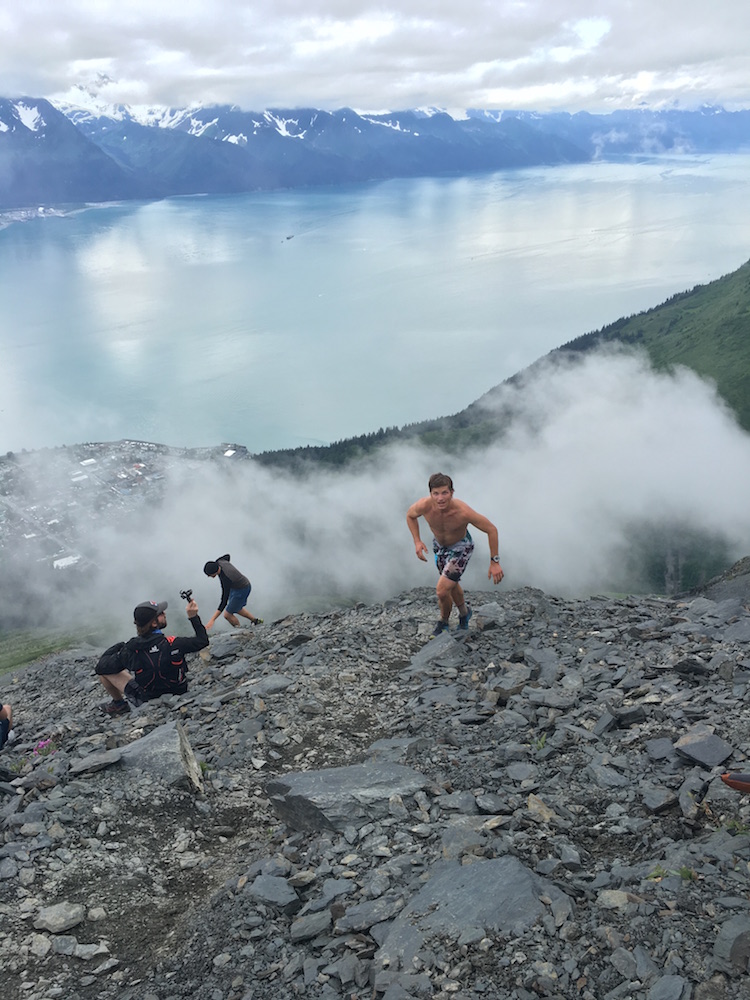
The 91st annual Mount Marathon Race, one of the oldest footraces in the country, once more descended on the small town of Seward, Alaska, on July 4. Crowds estimated at up to 30,000 perennially throng to the waterfront community, population less than 3,000, to watch racers push themselves up a steep mountain and hurl themselves back down. At the end of the day, a pair of Alaska Pacific University (APU) skiers, Jessica Yeaton and David Norris, had picked up victories in the quintessentially Alaskan race.
Women’s Race: Jessica Yeaton Wins After Frankowski Backs Off on Downhill
The couple that trains together, wins together. Yeaton and Norris have dated for some time. They traveled down to the race together, they went out fishing the day before together, and they previewed the course together. And they’ll be going back to Anchorage with a pair of trophies together.
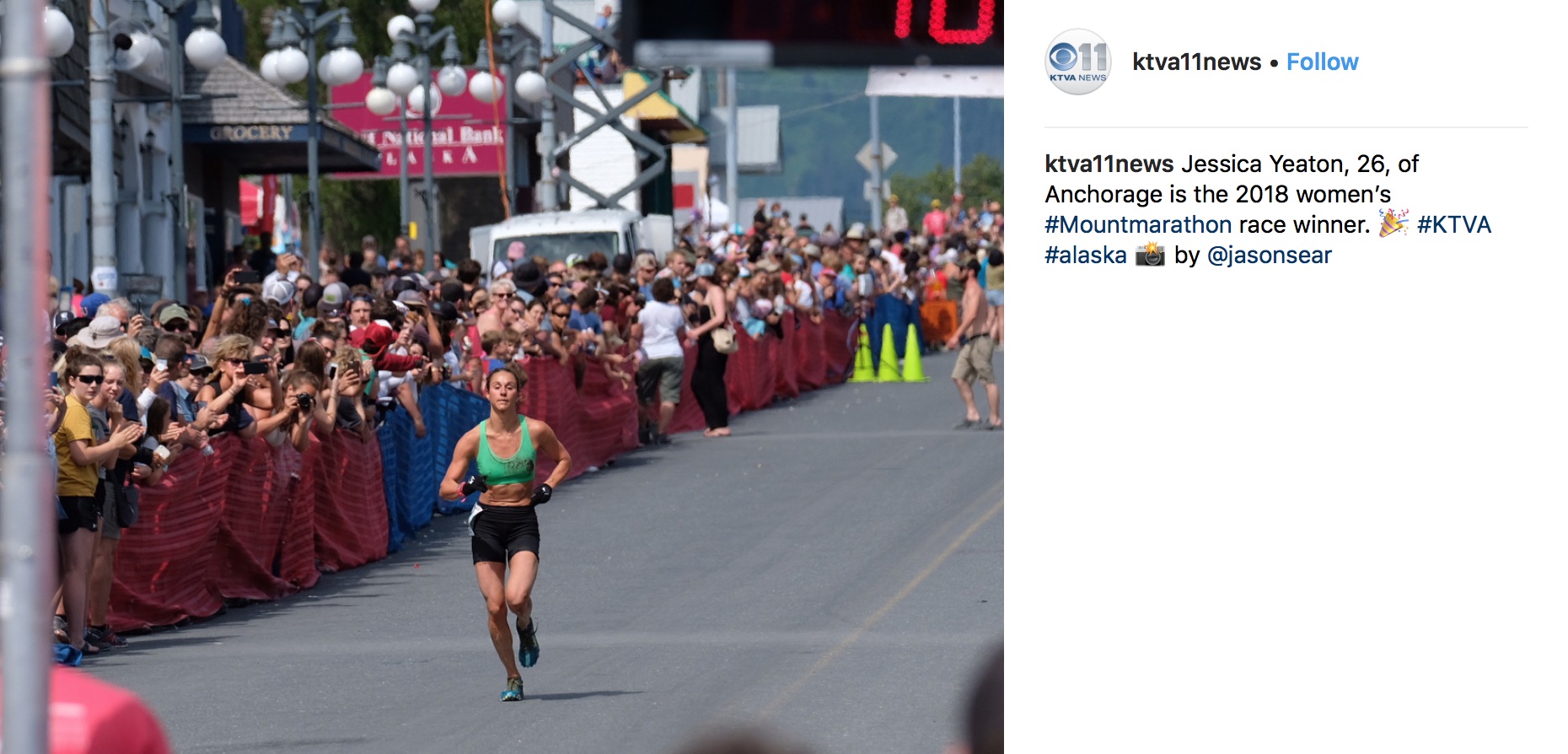
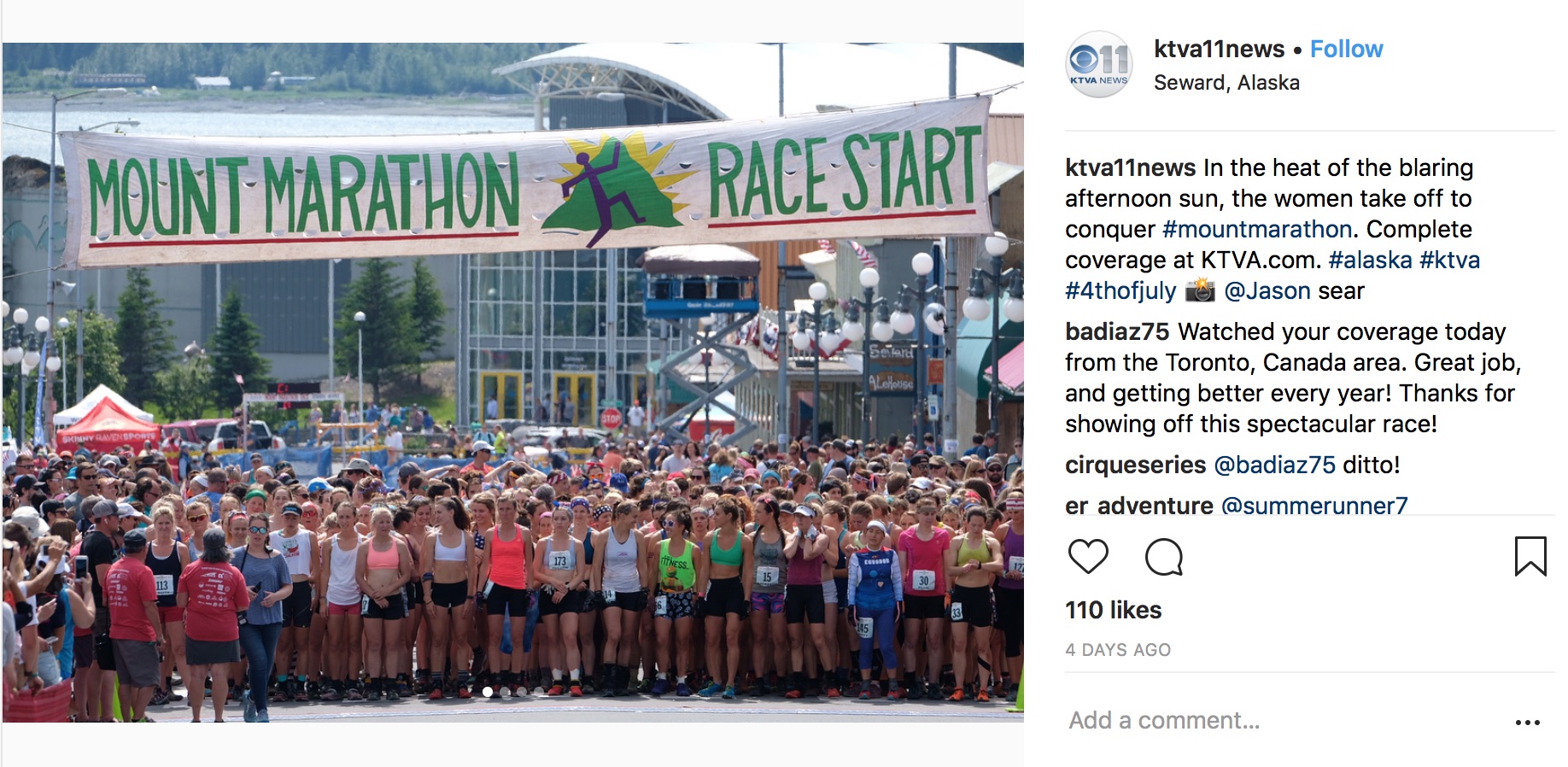
After Norris took a dramatic victory in the men’s race Wednesday morning (see below for men’s race recap), Yeaton matched him in the women’s race in the afternoon. Racing in the marquee afternoon time slot, Yeaton led a field of roughly 270 women off the starting line at 2 p.m. The women’s reward for racing in the afternoon this year (the men’s and women’s race alternate the prime-time afternoon slot) was temperatures even warmer than this morning, although thankfully a light breeze had picked up.
After roughly four minutes of gradual uphill through the streets of Seward, Yeaton, 26, was among the five-person lead pack to the base of the climb. By shortly into the climb, APU teammate Rosie Frankowski, also 26, was first, with Yeaton close behind. At the mid-point uphill time check, it was Frankowski, then Yeaton (+16 seconds), with Najeeby Quinn third over a minute back.
Frankowski and Yeaton continued to stretch their lead as the race climbed out of a humidity choked tunnel of vegetation and onto the stark shale rocks of the mountain’s upper half.
The two APU skiers and race rookies (Frankowski earned her entry spot by winning the Government Peak hill climb in early June, Yeaton by winning the Bird Ridge hill climb in mid-June) were both climbing fast and moving well, although they were a study in contrasts on the live television broadcast. The compact Frankowski climbed the hill the way Marit Bjørgen had skied the Olympic 30 k, attacking the hill with each step as she leaned into the steep climb. “You can almost hear her feet hitting the ground with each stride,” veteran Mount Marathon racer-turned-color commentator Clint McCool marveled on the broadcast, praising the redoubtable power of Frankowski’s lower body.
Behind her, the more lithe Yeaton seemed to float upward with an ease that belied the effort of climbing the 47-degree slope. While Frankowski’s high turnover remained the same throughout the climb, Yeaton even broke into a few brief running strides on the “flats.”
Frankowski crossed the timing mat at the turnaround in a (staggeringly fast) unofficial time of 37:06. Yeaton was 29 seconds back in 37:35. The time back to Quinn in third (39:13), let alone Christy Marvin in fourth (39:56) or Denali Foldager-Strabel (40:33) in fifth, seemed significant if not insurmountable.
But that’s why you run the race. Frankowski then took a meandering and suboptimal line onto the snowfield that begins the precipitous descent. In fact, she bypassed the snowfield entirely, running around its rocky edge for several hundred vertical feet.
“I train with Rosie every day and she was not stoked about the downhill,” Yeaton said in a post-race interview with the Anchorage Daily News (ADN). “So she was like, ‘I’m gonna take this [other] route.”
Frankowski told the ADN she wanted to didn’t want to risk getting injured on the downhill.
“This is fun, but my primary sport — I’m not going to ruin it,” Frankowski said.
By the time Frankowski reached the bottom of the snowfield, Yeaton had come flying past her, opening up a lead she would not relinquish. Quinn had passed her as well.
Yeaton ran smoothly all the way to the bottom, going from the turnaround point to the finish line in under 14 minutes. (Her pre-race preview with Norris may have been helpful: “You just do a front flip here,” Norris calmly advises the camera in one of Yeaton’s recent Instagram videos as he demonstrates a flip down a small cliff approaching the bottom of the climb. “It’s easier in the race with the adrenaline.”) Despite the effort, Yeaton looked calm and in control running down Main Street, ultimately taking the victory in an unofficial time of 51:30.
Yeaton’s overall time ranks ninth all-time in a race first contested by women in 1963.
Frankowski’s unofficial uphill split of 37:06 ranks third all-time among uphill marks, behind only pro runner Emelie Forsberg and two-time NCAA steeplechase champion Allie Ostrander, who has a track 5 k PR of 15:22 and finished eighth in the 2016 U.S. Olympic Trials in this event. Yeaton’s 37:35 uphill would be sixth among Mount Marathon climbs.
Behind Yeaton, there was ample movement in the standings. Frankowski would ultimately post the day’s 91st-ranked downhill, alongside the fastest uphill, to finish seventh overall. Foldager-Strabel, fifth at the turnaround, would drop an all-time record 11:27 downhill (prior record: 11:31, Forsberg, in 2015) en route to finishing second overall in 52:00, barely ahead of a charging Marvin who took third in 52:04. Fourth overall was Quinn, who had been as high as second during parts of the downhill but was either injured or cramped up severely during the latter half of the descent. And fifth overall was Boulder resident Hannah LaFleur, who had been in sixth at the halfway point.
buy allopurinol no prescription, buy arcoxia online, buy ibuprofen, buy motrin online
Also of note, former FasterSkier contributor Aubrey Smith was 11th. And former champion Holly Brooks, less than one year removed from giving birth to twins, was 19th, while wearing a microphone and providing live commentary to the broadcast team along the way. (“Can I sneak by on the left? Thanks,” she was at one point heard to exclaim on air.)
An ebullient Yeaton spoke with KTVA Channel 11 at the finish. “I was just, like, trying to hold them off the whole way” down, she said of her race strategy for the descent in reference to her pursuers.
“The heat was horrible,” Yeaton said of the day’s conditions. “But there were so many people out there with water, I probably got 30 different things of ice and water on my head. It made it so much better. I couldn’t do it without all the people on the mountain.”
Men’s Race: David Norris Holds Off Max King
Norris did it again.
The 27-year-old APU skier came into Wednesday’s race, the 91st running of an event first held in 1915 that is among the oldest footraces in this country, as the course record holder at Mount Marathon. He had set a course record at the uphill-only Bird Ridge hill climb last month. Meanwhile, defending champion and APU teammate Scott Patterson was out of this race with a toe injury. Previous Mount Marathon course record-holder Eric Strabel was out with a stress fracture. As the ADN wrote in its preview of the men’s race, Norris had “a target on his back.”
https://www.instagram.com/p/Bk0qm_PBiLa/
Despite the pressure that comes with being the widely acclaimed favorite in a race variously described as “Alaska’s Olympics” or “Alaska’s Super Bowl,” Norris delivered.
He set a torrid pace off the starting line following the 11 a.m. start, charging toward the base of the peak that rises immediately above the seaside town of Seward, Alaska. Close behind was Max King, 38, a professional runner from Bend, Oregon.
https://www.instagram.com/p/Bk0wF3OlmHS/
King has been described as “the most versatile runner in the country,” with a race résumé that ranges from two top-20s at the U.S. Olympic Marathon Trials (where he ran a 2:14 and a 2:17) to sixth in the steeplechase at the U.S. trials to strong finishes while racing around the world as a sponsored athlete, in distances ranging from a vertical kilometer to 100-mile ultramarathons.
Norris hit the base of the climb first, with King not far behind. Norris went through the mid-mountain uphill split in 21:01, with King 34 seconds back. Adam Jensen, 37, an Anchorage dentist, was at that point third in 22:08. Fifth (22:32) was 18-year-old Luke Jager, another APU skier, making his debut in the senior race this year after winning the junior race three times in a row from 2015–2017.
Norris reached the turnaround point in 31:37, according to this reporter’s unofficial split, with King roughly 30 seconds behind him.
Norris was still in the lead, but he looked rough. He climbed up the steep shale face of the upper mountain with a ragged tempo. He was hunched over, with his hands on his quads, unable to run or even power hike with with the upright posture that he prefers. (“Hiking is fine and maybe even better on certain pitches, but forcing yourself back into a running stride as soon as the terrain allows is crucial,” Norris previously told FasterSkier about his approach to climbing.) He stumbled repeatedly, and took the turns wide. He accepted water from everyone who offered it. He was covering the climb roughly 1 minute slower than he had when he set the course record in 2016, and he looked far worse doing it.
Behind him, King looked fresh and smooth. He was running where Norris was walking. He was upright where Norris was hunched over. He was moving hands-free where Norris was dabbing the rock. He was eschewing water where Norris had guzzled it. On the live broadcast, color commentator Clint McCool surmised that King had pushed Norris fast off the line in an attempt to blunt some of Norris’s climbing prowess, and that it had largely succeeded.
But then the two men started going downhill. Norris took a better line onto and off of the steeply pitched snowfield that begins the precipitous descent. He looked rough running down the mountain below that, but so did King. By the time Norris hit the sweeping expanses of shale down the mountain’s flank, he was flying. He cleared multiple technical stretches (“the three problems,” three small waterfalls) with ease.
When Norris came off the mountain and within sight of tens of thousands of fans in town, his lead was still around 30 seconds, according to unofficial splits taken off the broadcast. He gave back some of that on the remaining 0.6 miles of pavement running down to the finish line, as he slowed slightly to high-five the assembled hordes and King put his 2:14 marathon speed to work. Indeed, King’s downhill split was 12 seconds faster than Norris’s.
https://www.instagram.com/p/Bk0oo0th0H7/
But Norris had a gap, and he kept it to the finish to close out a gutsy race. When he crossed the finish line – which is itself outside of a bar, commemorating the race’s bar-bet origins – he was the most famous athlete in Alaska for the second time in three years.
Third in this year’s race was Adam Jensen, over three minutes out of second. Matt Shryock was fourth. Benjamin Marvin edged Jager by three seconds for fifth.
Norris “pushed the early part of the race, like way harder than last year,” he told local television station KTVA Channel 11 in a live interview after the race, “trying to put pressure on Max.”
“Coming down,” Norris continued, “my legs were way more tired than two years ago,” largely proving McCool’s surmise correct.
Looking to the future, Norris promised to keep coming back. “I would love to mainly keep getting my own uphill record,” Norris said of his future race strategy, “and then just survive the downhill.”
Norris’s uphill record of 30:35 remains safe for another year. (Behind him on that list: pro runner Rickey Gates (31:26), pro runner Kílian Jornet (31:27), Anchorage attorney and father Jim Shine (31:29), and APU teammate and Olympian Scott Patterson (31:40).)
Norris’s overall time of an unofficial 42:13 for 2018 places him third on the all-time list, behind only his course-record 41:26 from 2016 and Jornet’s 41:48 from 2017.
King, who finished in an unofficial 42:33, now ranks fourth on that all-time list. Competing in his first Mount Marathon, he had nothing but praise for the Alaska tradition and spectacle.
“It is unbelievable up there,” King told KTVA at the finish. “I got here, I’ve been intimidated and scared the entire week of this mountain. … This race, it was awesome to be able to experience that.”
He will “absolutely” be back, King said. “This is awesome; I love it here. The mountains are fantastic, there’s tons of things to run.”
For his victory, Norris collected a small trophy and large bragging rights. Other than free lifetime entry into future races, there is no cash prize associated with Mount Marathon. The race has one of the deepest fields in the country on the merits (consider that Gates was only 12th in this year’s race, and Jornet and pro runner Emelie Forsberg are believed to be the only non-Alaskans to ever win the race), certainly one of the deepest anywhere for a bragging rights-only event.
Juniors Race: Michael Connelly, Kendall Kramer Prevail

In the day’s first race, junior boys and girls raced together, starting at 9 a.m. under humanely still relatively cool conditions. First place went to Michael Connelly, 16, a rising star from Chugiak who had finished in the top-10 overall of every mountain race he had done this year. Connelly was sixth last year in the junior race. This was his first boys title; APU skier Luke Jager, now 18 and aged out of the junior race, had won the race the last three years.
Second place was Ali Papillon, 13, who had spent much of the first part of the summer in Colorado. Papillon was described by the ADN as 4-foot-5 and 70 pounds following his third-place finish in 2017, and appeared only slightly taller this year. Third place was claimed by Gavin Block, 16, of Palmer, who was second among junior boys last year. Block runs and skis for Colony High School.
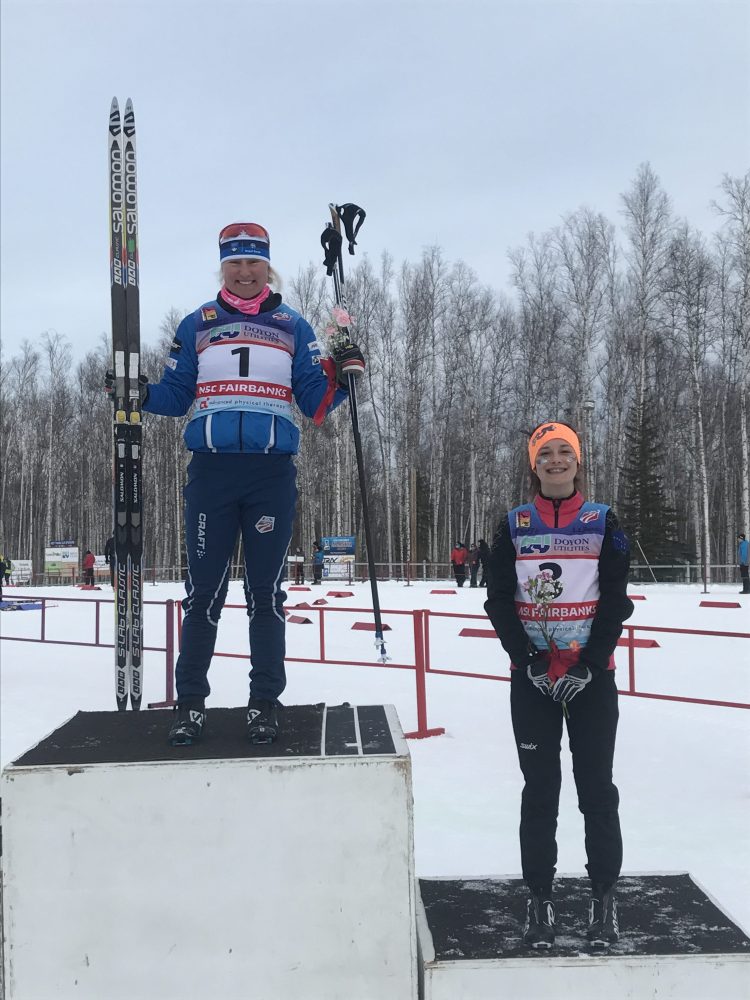
A few minutes behind Block in the co-ed mass start race, Fairbanks skier and runner Kendall Kramer, 16, was the first girl across the finish line. Kramer was third in the 5-kilometer classic mass start race at 2018 U.S. nationals in Anchorage. It was Kramer’s first Mount Marathon title.
Aubrey LeClair, 17, of Anchorage and Katey Houser, 14, of Palmer, also both skiers, rounded out the junior girls podium in second and third. LeClair skis and runs for West High School, and trains with the APU junior team. She was the women’s winner in the season-opening Race to the Outhouse ski race in early November 2017. Houser earned multiple medals in cross-country ski events at the 2018 Arctic Winter Games in Northwest Territories.
The Race and Its History
Here’s some background on the race’s origin story, according to the official website:
“According to folklore, the tradition of the Mount Marathon Race began when two sourdoughs argued about the possibility of climbing and descending the mountain in less than an hour. ‘Impossible’ one said. To settle the argument, and the resulting wager, a race was held, with the loser to furnish drinks for the crowd. At the same time, enterprising merchants put up a suit of clothes and other attractions for the winner and proposed the race take place on a holiday – why not the 4th of July? The optimistic sourdough lost his bet. The winning racer took one hour and two minutes.”
The race was first formally contested in 1915, with a winning time of 1:02:02. There were no races held in the early 1920s, the mid-1930s, and for one year during World War II. The race has been held every year since 1943, always on the fourth of July. 2018 marks the 91st running of the race.
The first official women finishers were in 1963, nine years before women were officially allowed in the Boston Marathon and 21 years before women were allowed to race distances over 1,500 meters at the Summer Olympics.
Notable past Mount Marathon champions who were also skiers include, in reverse chronological order, Holly Brooks, Kikkan Randall, Nina Kemppel, Lynn Galanes, and Betsy Haines (Randall’s aunt). Notable male Mount Marathon champions who were also skiers include Scott Patterson, David Norris, Eric Strabel, Trond Flagstad, Toby Schwörer, Todd Boonstra, Bill Spencer, Jim Renkert, Tom Besh, and Sven Johanson. Kílian Jornet, who won in 2015 and held the course record before David Norris happened, may merit honorable mention as a ski mountaineer.
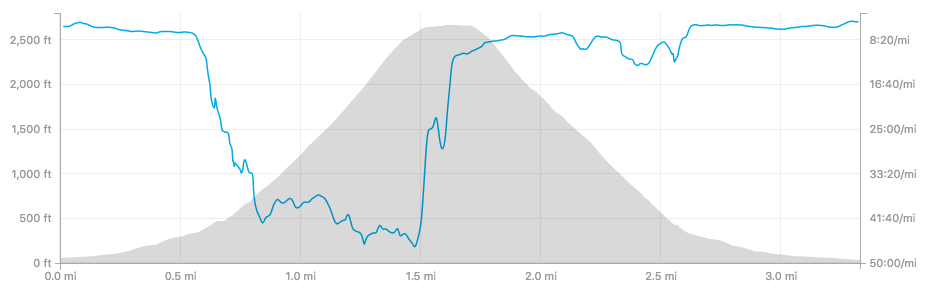
The race’s course description page reassures racers, “Mount Marathon is not quite as steep as has been previously reported. The true steepness – from the base of the mountain to the lip of the mountain just before the turnaround rock – averages 34 degrees. That figure was calculated using GPS data from several racers. Excluding the road approach, the vertical gain is about 2,675 feet in 0.9 miles.”
King, a professional runner who has raced all over the world for nearly twenty years, told McCool that he “had never raced anything so steep, and had never come down anything so fast,” according to McCool’s comments on the broadcast.
Outside magazine has called Mount Marathon “the toughest 5k on the planet.” It is undeniably the most famous footrace in Alaska, and the second most famous athletic event anywhere in the state, behind only the Iditarod Trail Sled Dog Race. It has grown from its humble origins to a yearly spectacle that is covered by helicopter and drone and broadcast live on local network television, as well as online (tune in to ktva.com next July 4 for the 2019 race, or this week for an archived replay of 2018).