From the FasterSkier archive — posts syndicated from athletes’ and coaches’ own blogs between 2004 and 2012, kept online as published. Current coverage is at fasterskier.com.
Lors du mois de mai 2016, la biathlète canadienne Audrey Vaillancourt annonçait la fin de sa carrière athlétique dans un papier intitulé « La fin d’une grande aventure », publié sur son blogue. Après douze ans – soit près de la moitié de sa vie – consacrés aux compétitions et à l’entraînement, c’est sans légèreté que la Québécoise de vingt-quatre ans, toujours passionnée de biathlon, a pris la décision d’accrocher ses planches et sa carabine.
Tout a commencé sur les skis à l’âge de six ans, à la traîne derrière ses grands frères Maxime et François Leboeuf (Vaillancourt porte le nom de sa mère). Tous deux sont d’anciens membres de l’équipe canadienne de biathlon, ayant pris leur retraite à vingt-neuf et à vingt-quatre ans respectivement. Sous l’impulsion de parents actifs, Carmen et Pierre, le jeune trio de Val-Bélair a rapidement acquis une brillante réputation à travers la province, dans les cercles rapprochés des fondeurs québécois.
C’est à douze ans que Vaillancourt fait ses premières armes en biathlon. Un amour du tir s’ensuit instantanément, de même qu’un talent naturel pour cette nouvelle discipline.
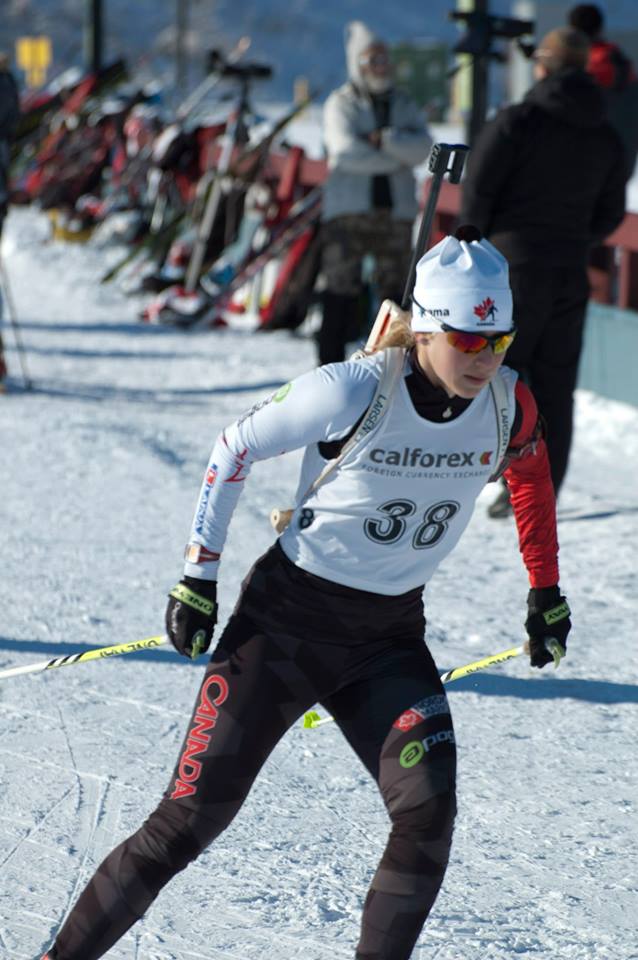
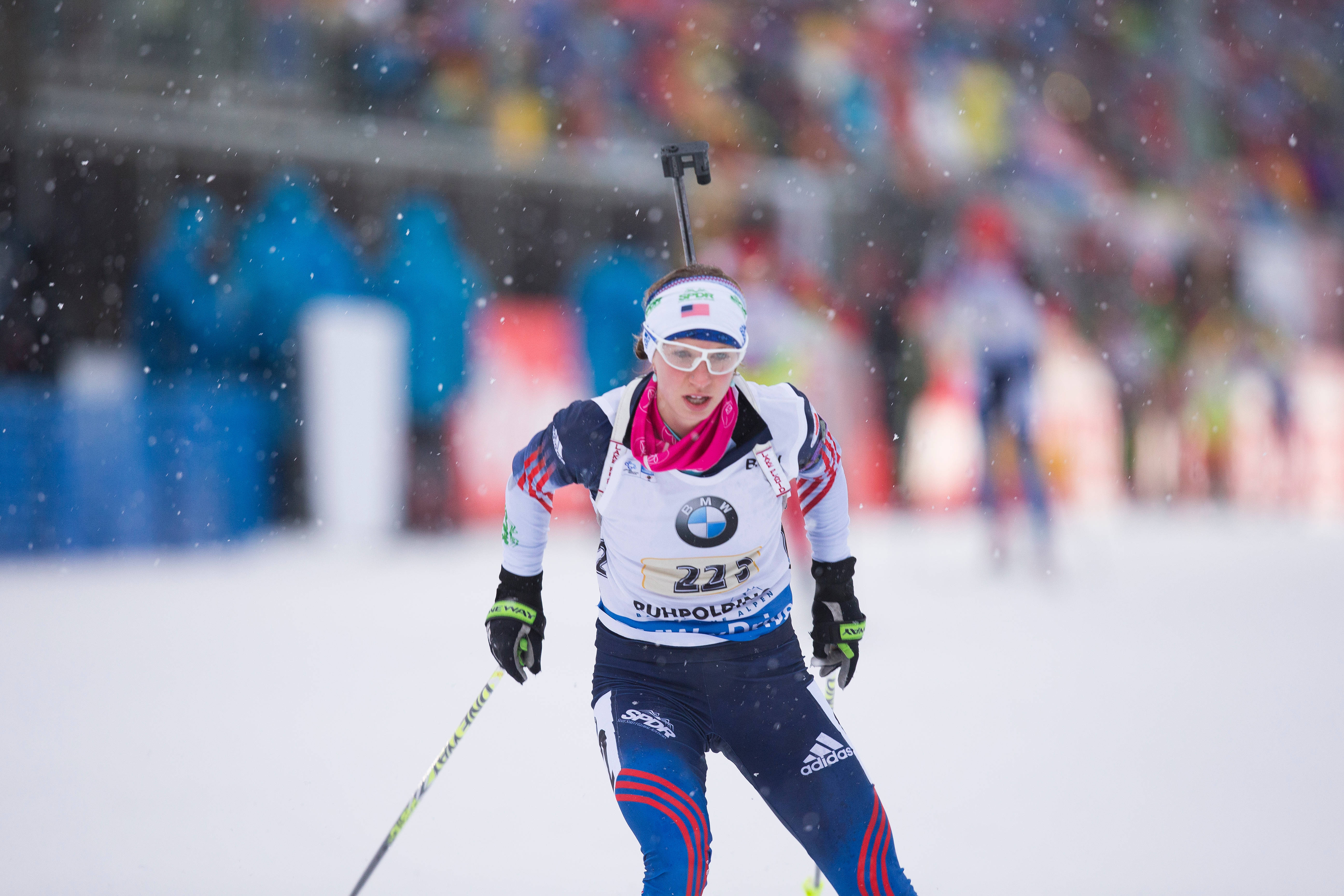
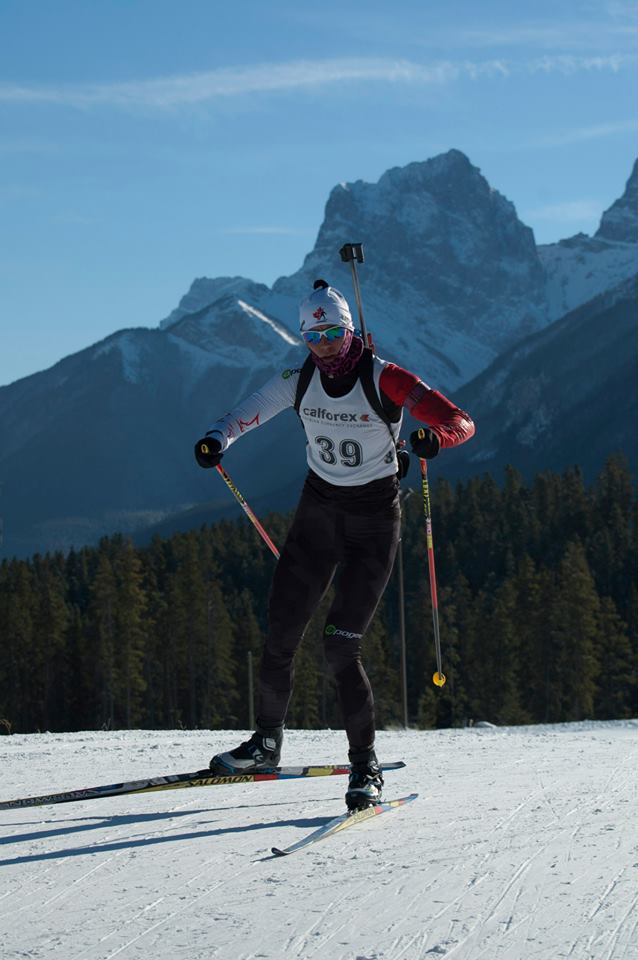
Audrey Vaillancourt arrachant le deuxième rang au sprint lors des qualifications de l’équipe canadienne de biathlon en novembre 2014 à Frozen Thunder, à Canmore en Alberta. (Photo: Photo: Justin Brisbane)
« C’était tellement l’fun et différent du ski de fond traditionnel. Le tir présentait un nouveau défi pour moi. Ça rend les compétitions de biathlon tellement plus excitantes que celles en ski de fond », lance avec enthousiasme Vaillancourt, lors d’un entretien téléphonique depuis sa demeure à Québec en janvier dernier.
Elle rallie rapidement les rangs du Club de biathlon Courcelette, fondé trente ans plus tôt, et s’entraîne au Centre d’entraînement Myriam Bédard – unique en son genre au Québec – sur les terres militaires de Valcartier, non loin de la maison familiale. Alors qu’elle fréquente l’école secondaire, Vaillancourt peaufine ses positions de tir et son pas de patin à raison de trois fois par semaine. Le régime d’entraînement s’intensifie et passe à six séances matinales lorsqu’elle entame ses études cégépiennes. C’est sous la tutelle de Jean Paquet, ex-olympien, puis de Martin Tremblay, l’actuel entraîneur en chef de l’équipe du Québec de biathlon que Vaillancourt déploie ses qualités de biathlète.
Le saut inévitable vers Canmore, en Alberta, a lieu à seize ans, lorsqu’elle mérite sa place au sein de l’équipe nationale junior. La perspective de progresser aux côtés des meilleurs biathlètes du pays, en plus de s’initier au circuit de compétitions en sol européen, marque une étape importante pour l’athlète québécoise. Une chance en or, que saisit spontanément Vaillancourt, mais qui recèle quelques écueils imprévus.
« À l’époque, j’étais l’unique athlète francophone de l’équipe. Je ne me suis jamais intégrée totalement en Alberta. Canmore est une ville d’athlètes et de centres d’entraînement, centrée sur la performance sportive. Même si j’étais super motivée à m’entraîner, il me manquait quelque chose. Je me sentais loin de ma famille et de mes amis », admet Vaillancourt.
Elle ajoute que, malgré l’éloignement, les mois d’hiver passés en Europe lui ont permis de découvrir plusieurs villes (Anthloz, en Italie, demeure son coup de cœur) et de disputer des courses devant de vastes foules endiablées. Vaillancourt a représenté le Canada aux Championnats du monde en 2013 et en 2015 avant de prendre sa retraite en mai 2016.
« Dans ma dernière saison à titre de senior, l’éloignement a joué pour beaucoup dans ma décision de quitter la compétition », avoue-t-elle.
Après nombre de podiums accumulés à l’échelle nationale, celle qui a été trois fois championne canadienne atteint le faîte de sa carrière en 2014 à Nove Mesto, en République Tchèque, remportant le quinze kilomètres départ individuel à l’occasion des Championnats européens.
« C’était fou, une journée que je ne vais jamais oublier », raconte-t-elle. « Mais bon, je pense que c’est l’expérience dans son ensemble dont je vais me souvenir le plus, les centaines d’heures d’entraînement passées chaque année avec l’équipe, les camps d’entraînement, tout le plaisir que j’ai eu avec mes coéquipiers. Ça… et Nove Mesto! »
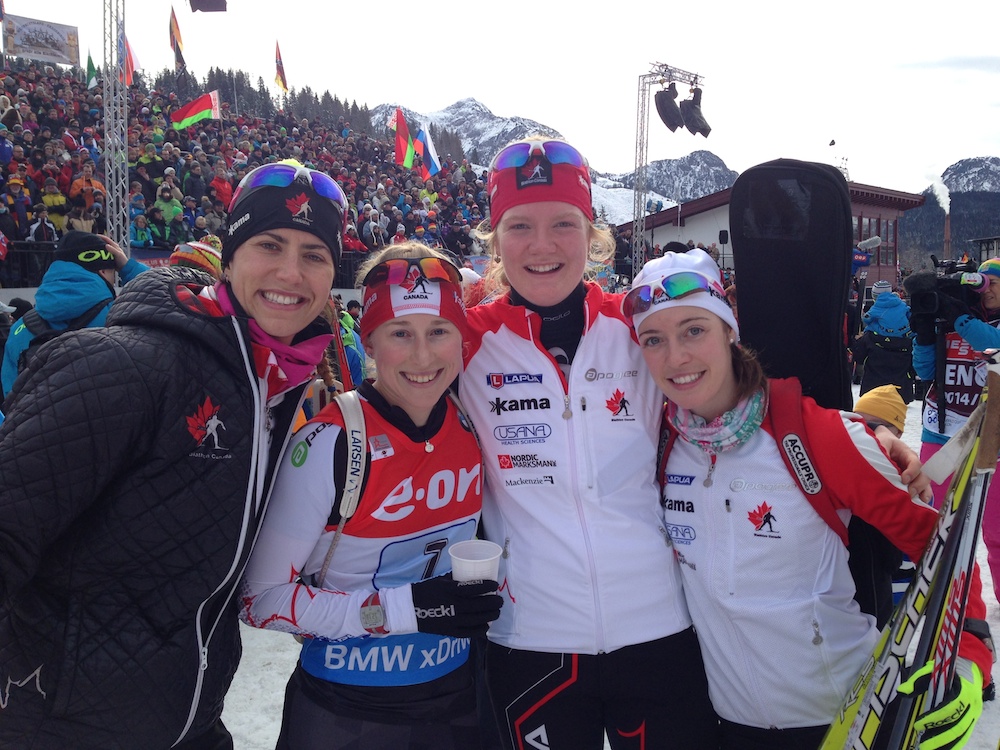
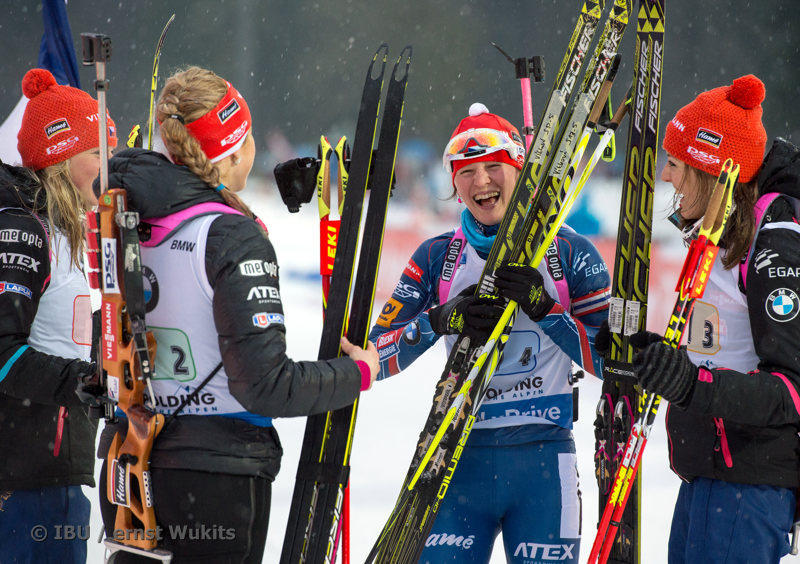
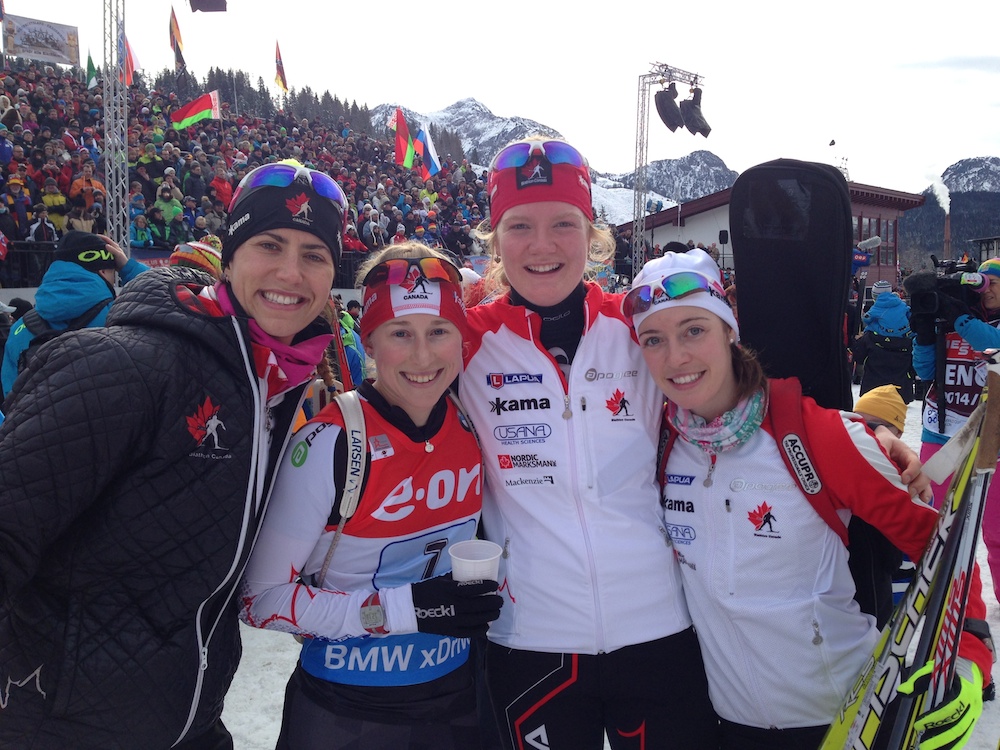
L’équipe canadienne féminine du relai 4 x 6km après leur onzième position à la Coupe du monde IBU de Hochfilzen, Autriche, en 2014: (de gauche à droite) Rosanna Crawford, Audrey Vaillancourt, Sarah Beaudry et Megan Heinicke. (Photo: Rosanna Crawford)
Une belle performance aux Championnats du monde junior en 2009 marque une autre étape importante dans son parcours. Devant des partisans canadiens, elle décroche le bronze à Canmore lors du six kilomètres sprint.
Reflétant sur sa carrière d’athlète, Vaillancourt assure ne conserver aucun regret.
« J’ai vraiment l’impression d’avoir tout donné. C’est sûr que j’ai rêvé plusieurs fois à une qualification olympique, mais ça aurait aussi voulu dire sacrifier beaucoup. Trop pour moi, en tout cas », concède-t-elle.
L’idée de quitter l’univers compétitif a germé graduellement lors de la saison 2015-2016. Des résultats en deçà de ses attentes n’étaient pas les seuls responsables de sa résolution finale.
« La dernière saison a été pénible physiquement et mentalement. Je n’avançais pas. J’étais complètement vidée », explique Vaillancourt. « J’ai obtenu quelques bons résultats, mais rien pour m’encourager à continuer. »
La retraite à seulement vingt-quatre ans s’est donc imposée naturellement, amenant un grand soulagement après douze années de compétitions. La biathlète a dû se tourner rapidement vers un nouvel objectif, refaire sa vie après le sport.
« Je comprends maintenant pourquoi plusieurs athlètes souffrent de dépression à leur retraite. Vraiment, je comprends ce phénomène. C’est nécessaire de se préparer, de faire des plans, de remplir sa vie avec des projets. Sinon, on tombe rapidement dans le néant. »
Vaillancourt vient d’ailleurs de terminer des études en traduction à l’Université du Québec à Trois-Rivières (UQTR). Elle travaille présentement dans le cabinet de traduction Sematos à Québec, mais demeure toujours active au sein du biathlon en tant qu’entraîneuse pour le Club Courcelette et pour le Club Biathlon Mauricie. Elle participe également à un projet appelé « Unis pour le sport », né il y a quelques mois d’une idée de son frère Maxime.
« Ce projet vient du désir d’aider les athlètes de tous les niveaux à améliorer leurs performances sportives, leur régime d’entraînement, leur technique dans divers sports, allant du ski de fond aux courses à obstacles, en passant par le biathlon et la course à pied », confie-t-elle.
Le site web du projet (http://unispourlesport.com) vient d’ailleurs récemment de mettre en ligne un plan d’entraînement personnalisable pour coureurs.
« Les choses se passent bien », écrit Vaillancourt dans un courriel le mois dernier.
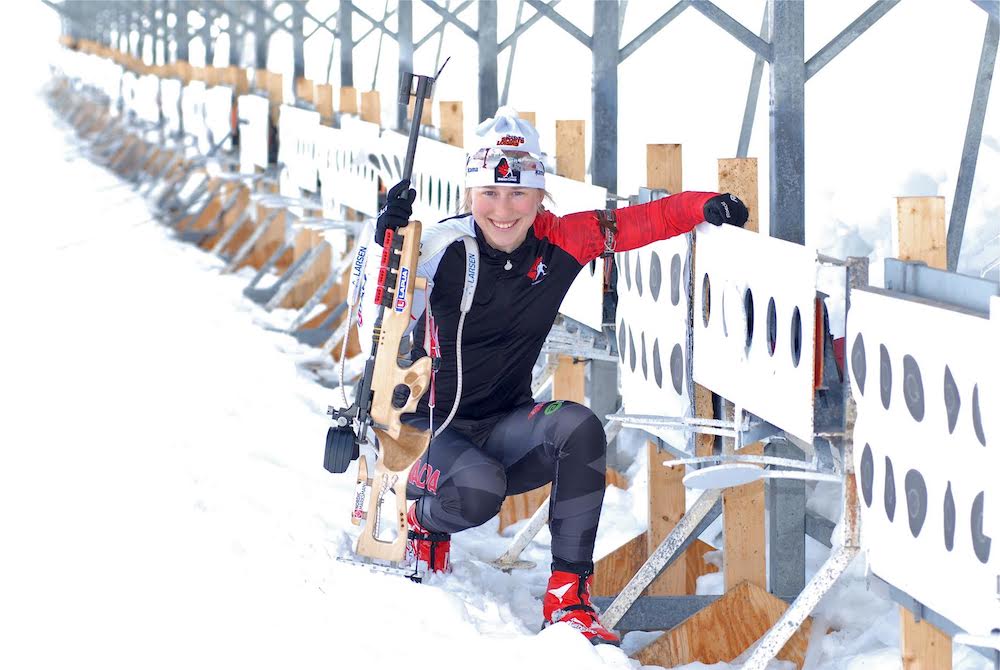
Audrey Vaillancourt at the Valcartier Biathlon Centre in 2014. (Courtesy photo)
Note: The following interview with retired biathlete Audrey Vaillancourt was conducted in French and translated to English. For French version, click here.
***
A year ago, in May of 2016, Canadian biathlete Audrey Vaillancourt announced her retirement in a blog post titled, ‘The end of a great adventure’. Having spent 12 years — nearly half of her life — racing in a sport she’s still very much passionate about, the decision to call it quits came at 24 years old, and was not an easy one to make.
For Vaillancourt (who has the same last name as her mother), it all started on skis at age 6 as she tried to catch her older brothers Maxime and François Leboeuf, both former members of Biathlon Canada’s national team themselves who stepped away from the sport at 29 and 24, respectively. Fueled by active parents, Carmen and Pierre, cross-country skiing started as the central sport in the Leboeuf family, and quickly, the rumour of a brilliant trio of young ski racers from Val Bélair began to spread across the province of Quebec.
At 12, Vaillancourt once again followed her brothers’ footsteps and gave biathlon a try. An instant love for shooting — and a natural knack for it — immediately followed, and she was hooked right then and there.
Audrey Vaillancourt racing to second in a sprint at Biathlon Canada team trials in Nov. 2014 at Frozen Thunder in Canmore, Alberta. (Photo: Photo: Justin Brisbane)
“It was so fun and different. The shooting presented a new challenge, and it really makes biathlon races much more exciting than cross-country skiing, in my opinion,” Vaillancourt said in January on the phone from her home in Quebec City. “A race can totally change in 30 seconds; it’s crazy.”
She joined the Courcelette Biathlon Club, founded 30 years ago, and trained close to home at the Myriam Bédard Biathlon Centre — the only training centre of its kind in Quebec — located on the Valcartier military base. That’s where she perfected her shooting skills, first training three days a week in high school, then gradually expanding that to six morning sessions a week when she began her CEGEP (Collège d’Enseignement Général et Professionnel) studies. Olympian Jean Paquet was her first coach, then she spent the rest of her career working with Martin Tremblay, Biathlon Team Quebec’s head coach.
At 16, she was named to Canada’s national junior team, which brought her to Canmore, Alberta. While training amongst the country’s best meant a natural progression in her athletic career and the lustrous prospect of racing on European soil, it also came with a few unexpected hardships, she explained.
“At the time, I was the only French-speaking athlete on the team. I never fully blended in when I was in Alberta,” she said. “Canmore is a small city that revolves a lot around training, sports and performance. I felt so far from family and friends. Even though I was all in for training and racing, the traveling back and forth from Quebec to Canmore was challenging.”
She added that she enjoyed visiting different cities in Europe (Antholz, Italy, was her favourite) and competing in front of tens of thousands of fans. Vaillancourt competed at 2013 and 2015 World Championships before retiring last spring.
“In my final year as a senior, being so often away from home really influenced my decision of leaving the sport,” she said.
With countless podiums in national races, the three-time Canadian national champion reached the peak of her career in 2014, when she won the 15-kilometre individual at Open European Championships in Nove Mesto, Czech Republic.
“It was unreal, I will forever remember that day,” she said. “But I think the overall experience of training year-round with the squad, our training camps, the fun I had with my teammates, all that which surrounds racing, actually is what I’ll remember the most. I was so in love with training at the time. That ranks first in my memory … aside from Nove Mesto.”
The Canadian women’s relay team after placing 11th in the 4 x 6 relay at a 2014 IBU World Cup in Hochfilzen, Austria: (from left to right) Rosanna Crawford, Audrey Vaillancourt, Sarah Beaudry, and Megan Heinicke. (Photo: Rosanna Crawford)
Her podium at 2009 Youth World Championships was another important stepping stone. In front of a home crowd in Canmore, she took third in the 6 k sprint.
Looking back on 12 years of racing, Vaillancourt said she had no regrets.
“I really feel I gave it my all. Sure, qualifying for the Olympics would of been awesome, but it became evident that to get there meant sacrificing a lot, too much for me anyway. The cons outweighed the pros in the end,” she said.
The decision to retire from competition came gradually during the 2015/2016 season. Disappointing results weren’t solely to blame.
“What can I say, I just wasn’t in it anymore, physically and mentally. I was totally drained,” she explained. “Despite some few good results, things never improved during that season. It was clear I was on my way out.”
While the prospect of retiring at age 24 was hard to swallow, it came with great relief, she said. Having a goal to focus on after biathlon was “absolutely necessary,” she said, and made the transition a lot smoother.
“I understand why some athletes fall into depression after retirement. I really get it,” Vaillancourt said. “You need to prepare yourself, make plans, fill your life with projects. Otherwise, it’s easy to fall into limbo.”
Just last month, she completed her degree in translation at the Université du Québec à Trois-Rivières (UQTR). She now works at Sematos Translation in Québec City and has remained involved in biathlon as a coach at Courcelette Biathlon Club and Biathlon Mauricie Club. And seven months ago, she became involved in a new project her brother Maxime founded called “Unis pour le sport” (United for Sport).
“This project is an effort to help athletes achieve specific goals regarding racing, training, technique in various sports, ranging from cross-country skiing and biathlon to obstacle-course racing and running,” she explained. “We already sense a strong demand for such services across the province.”
Most recently, the website published an example of a personalized training plan for runners.
“Things are going well,” Vaillancourt wrote in an email last month.
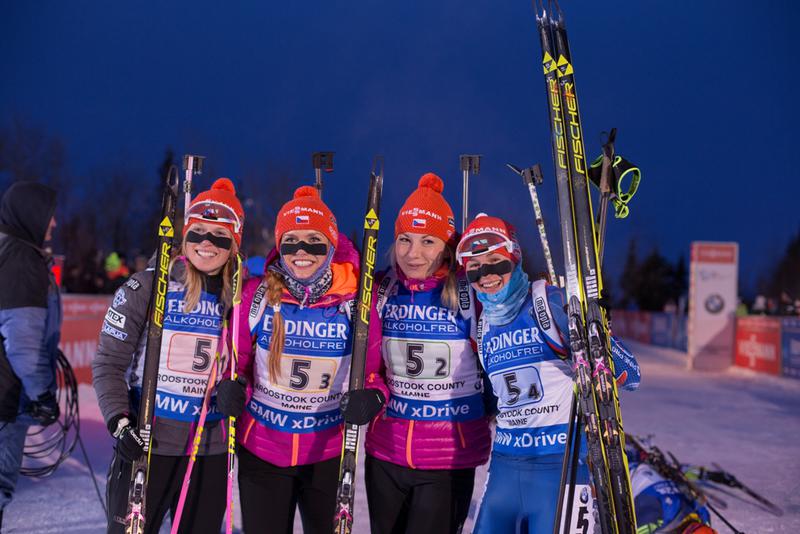
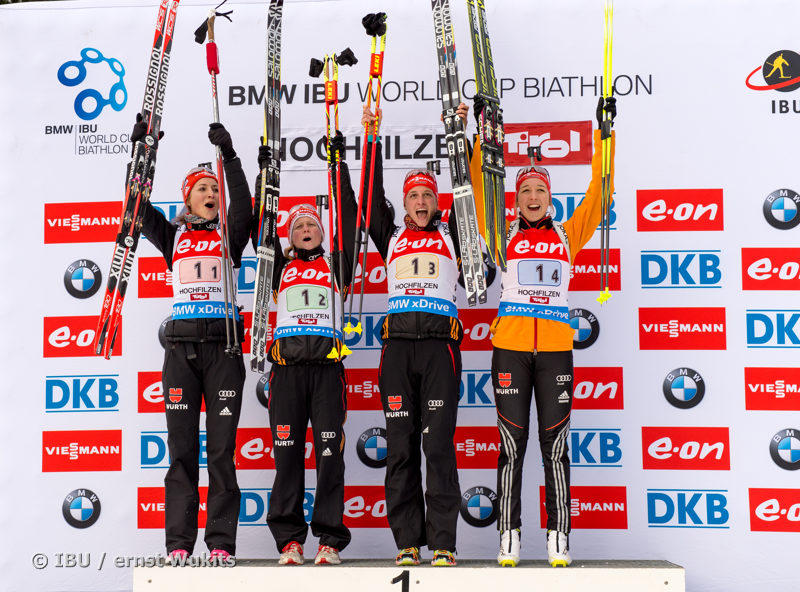
The Czech Republic women’s team, which won the 4 x 6 k relay on Saturday at the IBU World Cup in Presque Isle, Maine, with (from left to right) Eva Puskarcikova, Gabriela Soukalova, Lucie Charvatova, and Veronika Vitkova. (Photo: IBU/NordicFocus)
“It’s good to try a romantic atmosphere,” World Cup leader Gabriela Soukalová of the Czech Republic joked about the dark and cold course conditions at the end of the International Biathlon Union (IBU) World Cup women’s 4 x 6-kilometer relay in Presque Isle late Saturday afternoon, when the sun had long set behind the trees and hills of northern Maine for the final 6 k. “I appreciate it so much. I was thinking about my boyfriend,” she said in an post-race team interview with the IBU.
“Candles…” her teammate Eva Puskarcíková added.
The Czech women had every reason to be in a good mood. In the final race before the upcoming IBU World Championships in Oslo, Norway, their team had asserted its intention to be on the podium there in March, achieving the first relay victory of the season in a time of 1:07:11.0, with one penalty and 14 spare rounds.
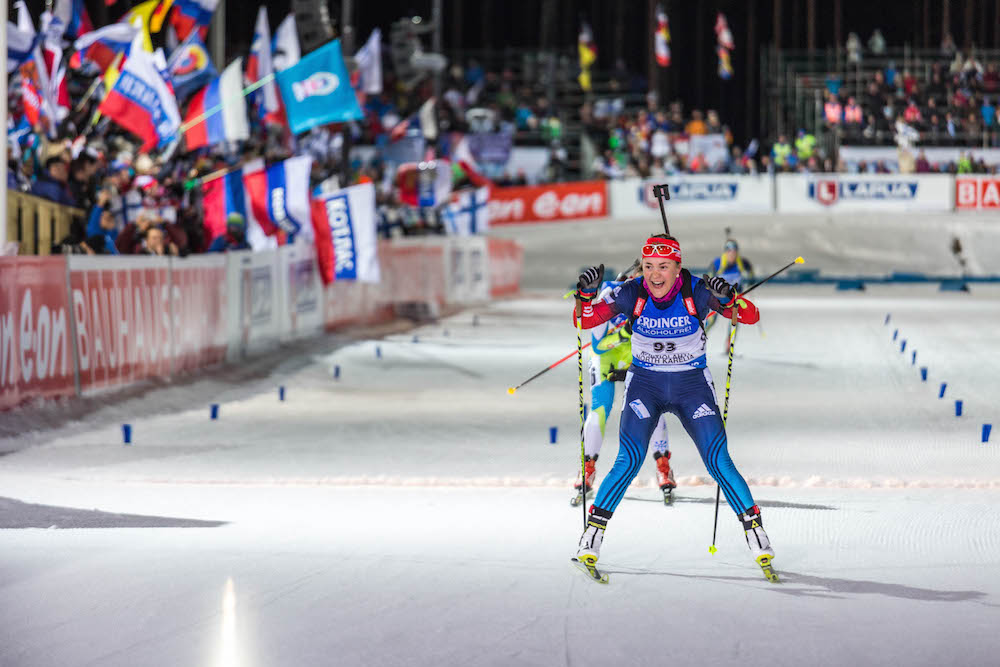
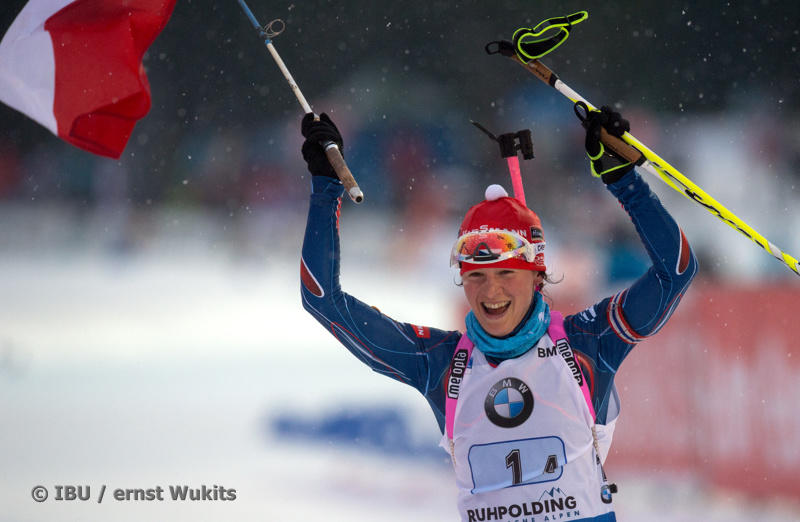
After narrowly avoiding a penalty lap in the last shooting, anchor Veronika Vítková had a large enough lead to ski to the side of the track and look for a national flag for the final stretch, but none was immediately available from coaches or fans, so she celebrated across the line just by raising her arms, before her teammates hugged her at the finish.
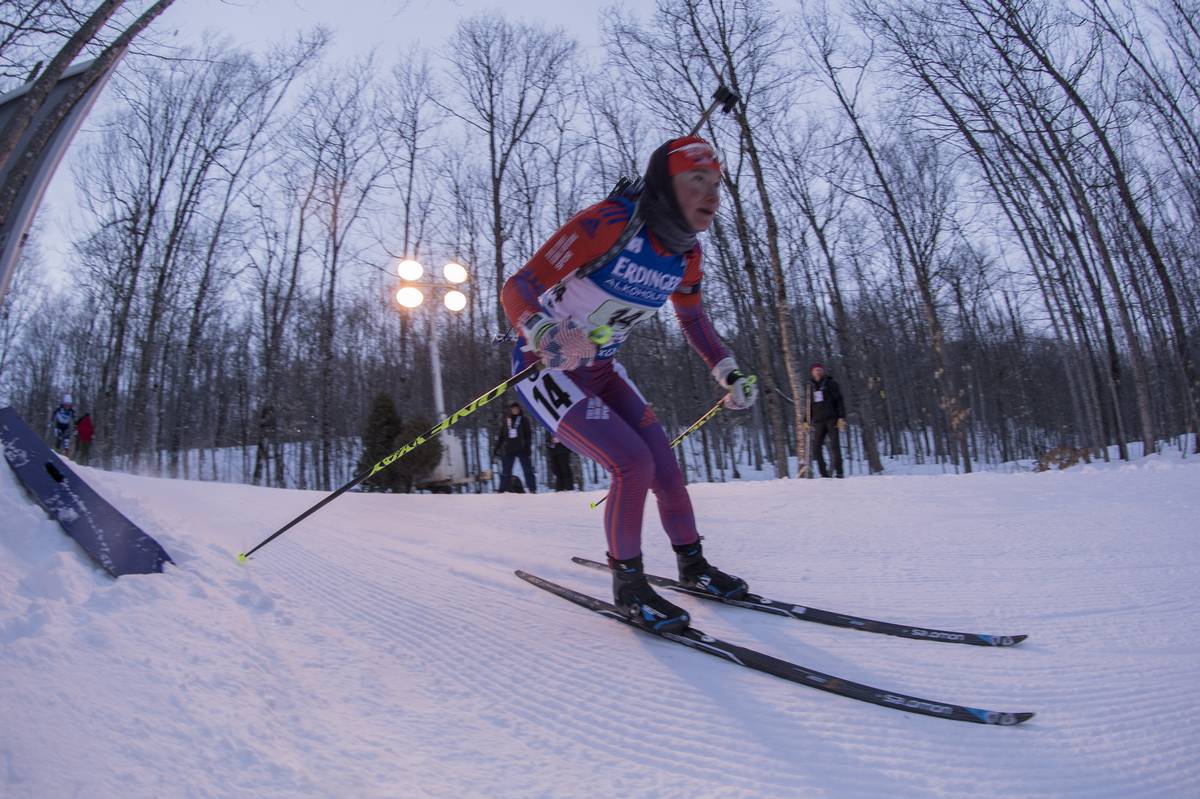
The women’s relay was moved up from Sunday to Saturday due to extremely cold temperatures in the forecast, with a start time of 4:10 p.m. following the men’s relay, giving the athletes the rare experience of racing in the dark on the final loops, dimly lit by portable lights on a few sections of the course. (Evening Biathlon World Cup races are occasionally on the schedule, for example in Oberhof, Germany, but that course is equipped with large fixed floodlights.)
With the athletes emerging from the darkness into the slightly brighter Nordic Heritage Center stadium, the race for second and third place on the podium was decided in an exciting sprint finish between the relays from Germany, Ukraine, and Poland.
Germany’s exhausted anchor Karolin Horchler tried to rescue her once-comfortable lead after the final shooting that had diminished precariously into the finish, with a double-pole effort on the final meters before she collapsed across the line.
Ukraine’s Olena Pidhrushna passed her with quick skating steps to claim second place, 25.2 seconds behind the winners, with a team total of zero penalties and 12 spares. Pidhrushna edged Horchler by just 0.2 seconds as the Germans took third (+25.4), with one penalty and seven spares, after erasing a 30-second deficit on the final loop. Poland’s Krystyna Guzik came into the finish narrowly off the podium in fourth place (+26.0), with a team total of zero penalties and seven spares.
The U.S. with Susan Dunklee, Hannah Dreissigacker, Clare Egan and Annelies Cook finished the race in 10th (+2:12.4), with one penalty and 12 spare rounds. It was their best result in a women’s relay this season.
Czech Republic joins this season’s other podium finishers — Ukraine, Italy, France, Germany, and Russia — as the favorites for the women’s relay in Olso, with a few more “dark horses” also in the mix.
After the flower ceremony, several women fielded questions at the indoor post-race press conference, still wearing protective tape on their cheeks and noses.
“Today’s race was very hard because of the very big cold,” Czech Republic’s starter Puscarcíková said. “My fingers were frozen. But I am happy we are first again. Last year we won in Oslo this time of the year. It’s very fantastic and unbelievable for me.”
“I had trouble because I shot my third bullet under the target,” Lucie Charvatová explained at the press conference. She had a penalty on her second relay leg and fell back to 11th, before tagging off 47.7 seconds back in ninth place. “After that I was so, so nervous. I ran fast and tried to do the best I could. But I am also happy.”
“I don’t know what I can say,” World Cup leader Soukalová said at the press conference, trying to explain how she had moved her team back into first place on the third leg, following two straight individual wins in Presque Isle. “It was a really fantastic weekend. It’s amazing. I was feeling really good during the race. I don’t remember when I [last] have been in the same shape. It’s a perfect performance before the World Championship.”
“It was very hard because on the track it was dark,” Vítková recalled of the anchor leg and the final shooting. “I have seen nothing. On the shooting range, too. And I was a little bit nervous, because I needed three extra [rounds of] ammunition.”
Ukraine, winner of the relay in Ruhpolding, Germany, earlier this season, was in fourth place with its lineup of Iryna Varvynets, Natalya Burdyga, Juliya Dzhyma and Pidhrushna for most of the race, before Pidhrushna moved her team up with the fastest skiing on the last loop, and beat Germany at the line.
“It’s difficult to recall a relay that was so close and tough,” a smiling Dzhyma said during the press conference, through a translator. “Maybe the one in Hochfilzen [where Ukraine finished third, though with a much larger gap to second and fourth place]. It was really interesting and tough, not just because of the close results, but also because of the frost in this cold weather. In the end we are really happy to be in second, and to be on the podium.”
“At the beginning of my leg, I couldn’t see any uphills, any downhills,” anchor Pidhrushna explained, via a translator. “It was like racing blind. When I came to the shooting range, my only thought was to shoot clean and not go to the penalty loop.”
“It’s already a legend,” a happy Pidhrushna later added in an interview with the IBU when asked about her final loop. “It was again a funny situation after the last shooting. I had no idea which place I was in, going away from the shooting range. One of our staff members shouted so loud, then I realized I was somewhere close, because I couldn’t see the screen, I couldn’t see anything because it was already dark. I just had to think that I was close so I had to fight for it again.”
“Krystyna [Guzik] from Poland was behind me, and we were running so fast to chase the German girl,” she explained. “But I couldn’t even think of doing that, actually.”
“I didn’t know what was happening behind me, I just tried to race,” Germany’s Horchler told ARD, after she had advanced her team from fifth to second, requiring one spare in prone and staying clean in her final shooting. “But I had brutal pain in my shins, and was already pushing into the downhill. I am really annoyed by that two-tenth of a second [at the finish]. But I am just pleased about my 0-5 shooting in standing, because with that I settled a few things in this competition so the relay could still make the podium.”
“Hats off to the organizers,” she added. “They put up makeshift lanterns, and I am happy about my prescription lenses in my glasses, otherwise it would not have been possible for me to see anything.”
“I as very nervous, because it’s been a long time since I took the starting position,” Germany’s Franziska Preuss said at the press conference. “The last time was Sochi [2014 Olympics, where Preuss crashed and got snow into her rifle sights, falling back far, as German failed to medal for the first time in an Olympic women’s relay]. But now I am really happy that it was a good race for me… I think nobody expected Germany on the podium today.”
Germany started a lineup without Franziska Hildebrand and Laura Dahlmeier, their two highest-ranked athletes on the World Cup.
“Temperatures were better today than yesterday,” second leg Luise Kummer told ARD. “We feared it would become really cold by now, but today it was bearable. And the audience is really participating with the action, so it was definitely fun. You actually get warm during the race. One would not believe that, in training we were also worried. But in normal competition it is no problem at all.”
“I just could not handle the standing position on the range here, and unfortunately also not today,” Germany’s third leg Miriam Gössner, who had her team’s penalty, told ARD. “I don’t know why. I really tried to do my best. In the prone shooting and out on the course I felt really, really good. So I think I could compensate for that penalty lap fairly well.”
Poland, with Magdalena Gwizdon, Monika Hojnisz, Weronika Nowakwska, and Guzik (formerly Palka) finished just 0.4 seconds off the podium, after losing the sprint against Ukraine and Germany.
“We had to fight not only with our rivals, but mainly with low temperatures,” Hojnisz later posted on Facebook, according to a translation, after she had avoided a penalty in her first prone shooting but lost about 45 seconds to the top. “I was not the best link in today’s relay, so thank you girls for your faith and fight to the last meter.”
“I held her until the end of the climb and tried to overtake on the flats,” Guzik said of Pidhrushna on the last loop, as told to Polish sports website SportoweFakty, according to a translation. “Unfortunately, none of the three attempts worked. Olena took it well tactically. It is a pity that the course was not a little bit longer, because I could fight to the finish. … I am sad that I could not lead us to a medal. We need this podium in the relay. I still believe that soon we will succeed.”
A number of teams started different lineups than they will likely have at World Championships, including France, which won the previous relay in Antholz, Italy, but on Saturday gave its top athlete, Marie Dorin Habert, a break. France finished sixth (+48.2), with one penalty and 13 spares, after Anaïs Chevalier had tagged her teammate Justine Braisaz in second place at the last exchange.
U.S. Achieves Season-Best 10th
Susan Dunklee (US Biathlon) racing the first leg of the women’s 4 x 6 k relay on Saturday at the IBU World Cup in Presque Isle, Maine. Her team went on to place 10th for a season best. (Photo: USBA/NordicFocus)
Coming off a historic week for US Biathlon with Dunklee’s silver medal in the sprint and fifth place in the pursuit, the team’s leading woman was picked to start Sunday’s relay (after racing the second leg in the three prior relays this season), followed by Dreissigacker, Egan and Cook.
“We are still experimenting with the order,” Dunklee wrote in an email. “Last week’s mixed relay went well with myself leading and Han [Dreissigacker] going second so we tried that again.”
As for moving the race up to Saturday, Dunklee wrote, “I think most athletes would agree that moving the race to today was the right call in light of the cold forecast.”
But that made for a pretty hectic race day for the women, as they had very little time to prepare with the men’s relay only wrapping up about an hour before their own.
“Today was a great opportunity for dealing with unusual challenges on race day,” Dunklee explained. “We had some struggles getting to the venue on time, then I had a broken firing pin right before zero [target practice to adjust the rifle sights before the start], which is very tricky to replace, and finally 13 minutes before the start, I heard that the course got changed and didn’t get to preview it.”
“With the short turn around from the guys race, we only had 25 minutes to zero 4 people,” she continued. “I didn’t fit in more than 10-15 minutes of skiing warmup, a new record for me. Dealing with chaos is an extremely important skill for a biathlete to have and we all did well today in spite of the challenges.”
Dunklee’s performance didn’t seem to suffer much despite those unusual circumstances, she she used just one spare to clean the first prone stage, and another two in her standing bout. She also skied the fastest course time of all starters in 13:55.4, and second-best among every woman in the relay, behind France’s anchor, 19-year-old Braisaz.
Hannah Dreissigacker racing the second leg of the U.S. women’s 4 x 6 k relay on Saturday under darkening skies at the IBU World Cup in Presque Isle, Maine. Her team went on to place 10th for a season best. (Photo: USBA/NordicFocus)
Dunklee tagged off to Dreissigacker in fourth, only back 11.1 seconds behind Switzerland’s Selina Gasparin, who was then leading the pack (Switzerland went on to finish 12th).
For Dreissigacker, a regular member of the U.S. relays last year including at 2015 World Championships, it was her second World Cup relay of the season after spending some time on the second-tier IBU Cup, before returning to the World Cup in Canmore, Alberta, and Presque Isle, where she most recently placed 27th in the sprint and 24th in the pursuit.
Like Dunklee, she didn’t let the stressful race preparation get to her.
“It was definitely a little bit rushed today before the race for everyone,” she wrote in an email. “We had to rearrange things and it got a bit hectic. But it was fine for me anyways… a good adrenal warm-up, as I like to call it!”
Dreissigacker needed one spare in prone and two in standing, just like Dunklee, and lost a little more time on the course, handing off in seventh, 43.7 seconds behind the leaders.
“I am a little disappointed that I didn’t hit my last standing shot, and then took two spares to hit it, but it could have been worse!” Dreissigacker wrote. “I had a good battle with Austria [Lisa Theresa Hauser] and France [Anaïs Bescond] at the end of my leg which was fun and made me go hard.”
Egan, who had started the prior relay for the U.S. in Antholz, moved back to the third leg, which she had also raced in Ruhpolding and Hochfilzen earlier this season.
Clare Egan (US Biathlon) during her standing stage of the women’s 4 x 6 k relay at the IBU World Cup in Presque Isle, Maine. Her team went on to place 10th for a season best. (Photo: USBA/NordicFocus)
In Presque Isle, she had finished 32nd in the sprint and 23rd in the pursuit. She continued her solid recent shooting performances in Saturday’s prone stage, cleaning her targets to leave the range in seventh position (+41.4).
After moving up to sixth place on the next loop, Egan came into the standing stage fighting for position with France, Ukraine and Austria. There she was unable to hit her last target with her three spares, having to ski through the 150-meter penalty lap.
“The conditions for my standing shooting were fine, I am just not as solid in standing as I am in prone,” Egan wrote in an email. “I missed two from the clip and then fired the first spare accidentally before I was ready. Then I had two bullets for two targets and unfortunately I only hit the first one. I should have taken more time to make a perfect hit on my last shot.”
She left the range in 12th, and tagged off to Cook in that position, having lost an additional minute to the leaders by the exchange (+1:50.6).
Just like it was for her teammates, Cook’s race leadup was a bit hectic.
“The preparation was actually funny today,” Cook wrote in an email. “I did not get to ski the course before the race started, and the girls actually had to tell me that they took out a sketchy corner, so I had never even done our course before I was on it racing it.”
On the shooting range, she matched the performance of Dunklee and Dreissigacker, requiring one spare in her prone stage and two in standing, but had to overcome an additional challenge: the sun had set when the anchors were on their relay legs, and large sections of the course had fallen into darkness.
“I was glad that nothing crazy happened on the downhills because it was definitely a shadowy course, not like the huge floodlights that we are accustomed to,” Cook explained. “But I didn’t mind. It reminded me of how night races were growing up at my local ski area, with little light bulbs hanging over the course. The range was a bit dark and the big movie screen flashed really brightly while I was shooting prone, so the light changed drastically and suddenly and that was distracting. But it worked out okay.”
She was able to overtake two more relays, moving the U.S. up to 10th in the finish. The U.S. women were satisfied with their result, though believed there was still additional room for improvement.
“As a team, we all had okay shooting performances and it is exciting to see us move up so much already even without a great day,” Dunklee concluded. “Oslo will be exciting.”
“I think we are all happy with 10th since its our best relay of the year, but we also know we can do better and today was a good sign of that!” Dreissigacker wrote.
“Despite my penalty lap this was the best relay result we have had with this group of four athletes,” Egan explained. “Our previous best was 12th which we got twice last year (World Cup 6 Antholz, World Championships). It is also a season best. Of course we can still do better and intend to do so in Oslo.”
“I still know we can do better in the relay, but it is a hard, hard thing for everyone to have stellar races on the same day,” Cook concluded. “And luckily, we know that all we have to do is have a good normal day and we can be right up there.”
With Some New Faces, Canada 17th
Without Rosanna Crawford and Julia Ransom, Canada did not have two women in Presque Isle who will likely be part of the women’s relay at World Championships in Oslo. Crawford and Ransom started in all three other relays this season where the team finished 10th in Hochfilzen, and ninth in both Ruhpolding and Antholz.
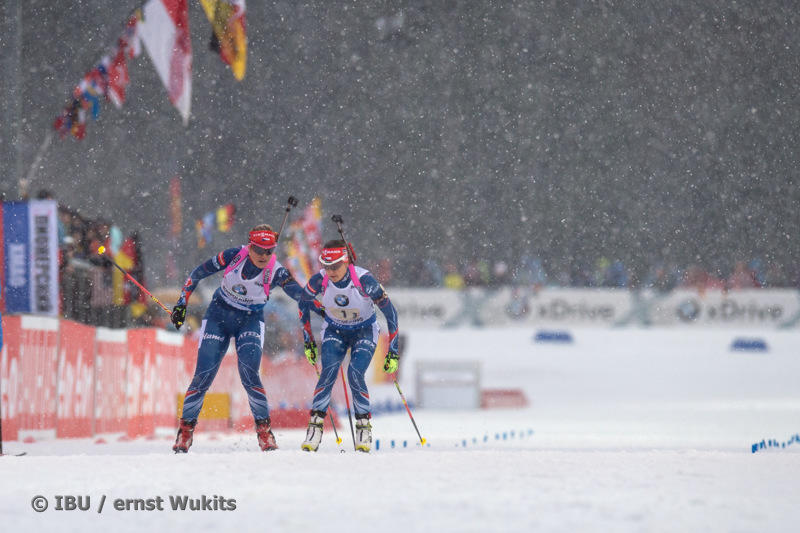
Instead, with veteran Zina Kocher (in her third relay this season), Emma Lunder (who had one relay start before in Hochfilzen), Audrey Vaillancourt and Erin Yungblut struggled on Saturday, quickly falling to the back of the field, with Kocher having to ski a penalty loop in her first prone.
After leaving the range in 16th out of 17 teams (with Norway and Slovakia pulling their teams before the start due to illness), Canada was never able to catch back up to the top 10, losing time to the leaders as the race progressed.
Kocher tagged off to Lunder 2:14.3 back, who then incurred another penalty in her prone stage (1+3, 0+1) to exchange 4:28.1 back in 17th place.
Vaillancourt then put in a strong performance on the range with two clean shooting stages, but was slower on the course and passed on the penultimate loop by the leading teams. She handed off to anchor Yungblut 6:38.6 back.
After requiring three spares to hit her targets (0+1, 0+2), Yungblut then was taken out of the race and scored as lapped in 17th position before her final loop.
On to Oslo
The athletes will now have two weeks of additional training and preparation, before traveling to Norway for the World Championships, beginning on Thursday, March 3 with the mixed relay.
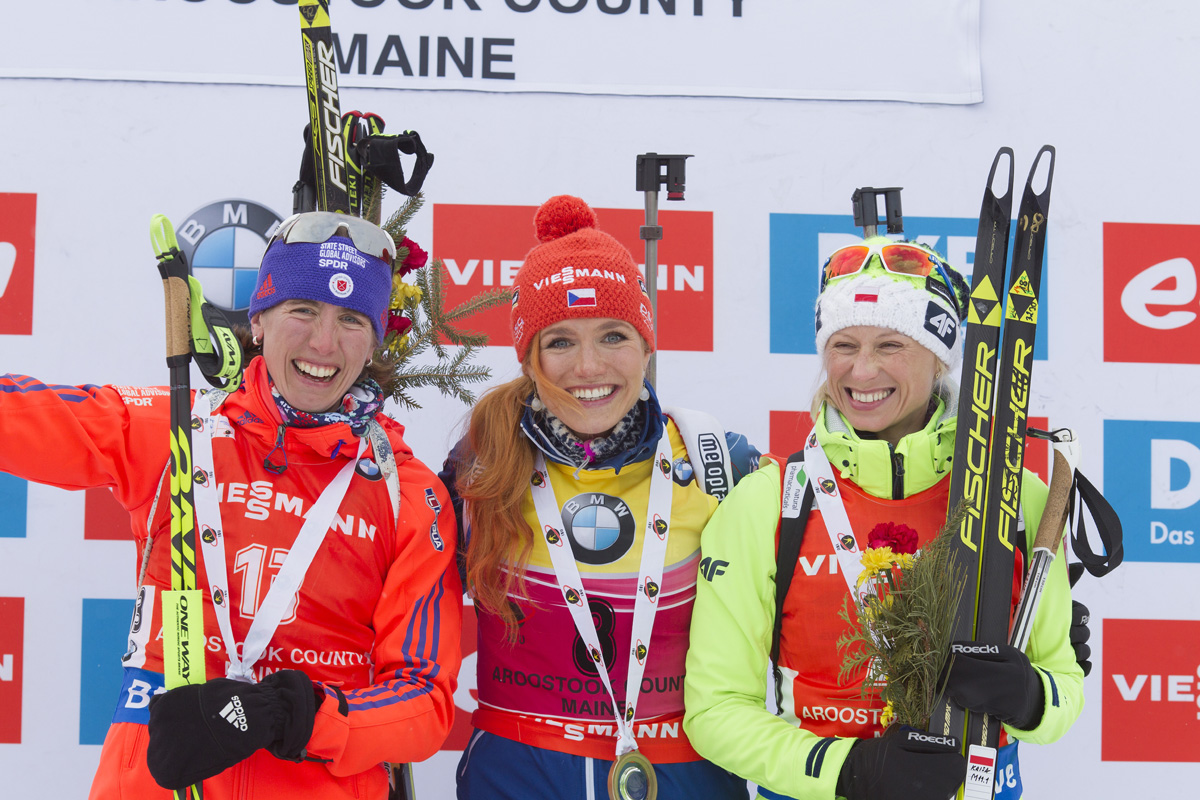
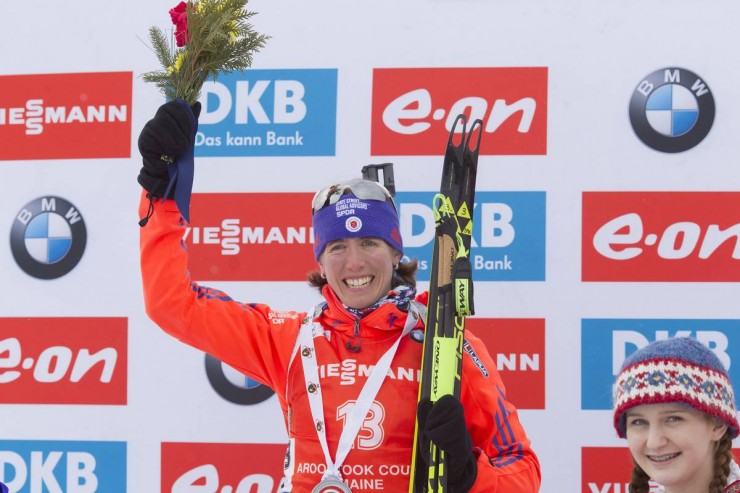
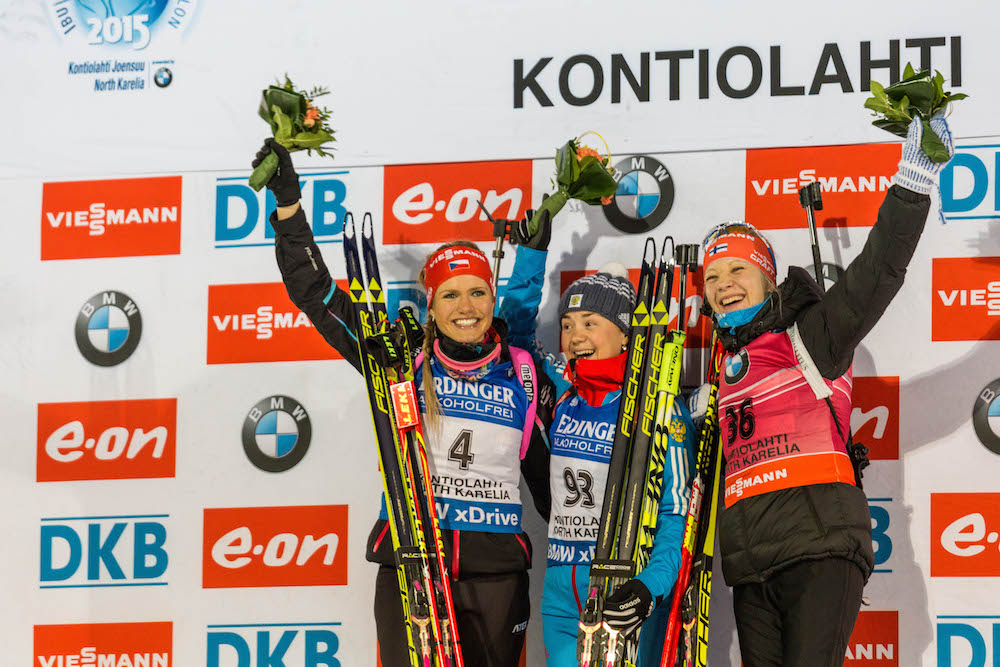
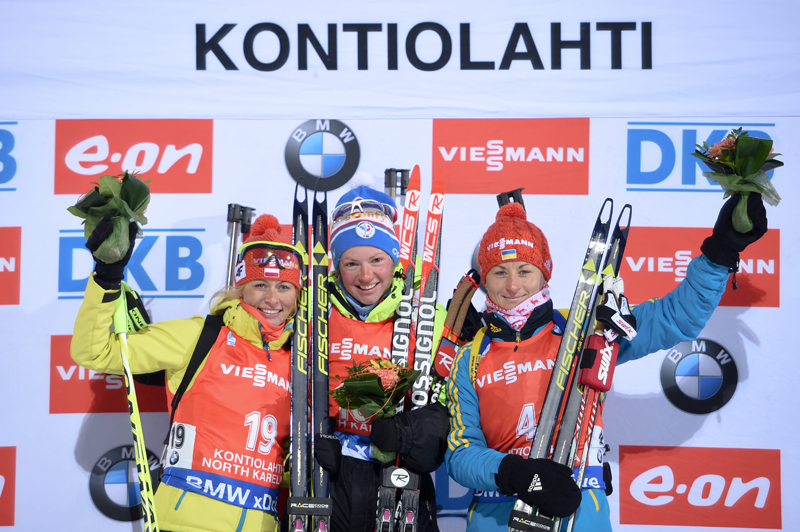
American Susan Dunklee (l) after achieving her best IBU World Cup finish in second place on Thursday and tying the best World Cup result by a U.S. biathlete. She finished second to Czech Gabriela Soukalova (c), and Poland’s Krystyna Guzik placed third (r) in the women’s 7.5 k sprint in Presque Isle, Maine. It was the first IBU World Cup held in the U.S. since 2011. (Photo: Fischer/NordicFocus)
Gazing out at the crowd, standing on the second step of the podium on Thursday, Susan Dunklee recognized dozens of faces: family, friends, people from her home base in Craftsbury, Vt., US Biathlon board members, colleagues from the Lake Placid Olympic Training Center, not to mention her team and support staff.
It had all the makings of a local-race feel, except for the implications of a World Cup podium — and the flashing lights, silver medal and media attention that came with it.
Two days before her 30th birthday, Dunklee had the best race of her career. The 13th starter, she raced to second in the women’s 7.5-kilometer sprint on the first day of the IBU World Cup in Presque Isle, Maine, finishing 17.8 seconds behind Gabriela Soukalova of the Czech Republic, the winner in 20:02.2 and overall World Cup leader.
Nearly 400 miles and a seven-hour drive from her hometown of Barton, Vt., Presque Isle is less than a half an hour away from Canada. Yet in her first U.S. World Cup, and the first World Cup in the states since it was last held in Presque Isle in 2011, Dunklee felt somewhat at home.
“To be able to have a best result on home soil and we only have a North American World Cup every five years, I couldn’t ask for anything better,” Dunklee said on the phone after the race. “It’s just phenomenal.”
In order to achieve her best World Cup result by one place (she finished third in a sprint two seasons ago in Oslo, Norway), Dunklee rekindled her joy in both the sport and Presque Isle’s course specifically, putting herself in a happy place she had been struggling to find in the last week.
“Last week was a little tough for me,” Dunklee said of the last World Cup in Canmore, Alberta. “I felt like I was going through the motions but not really feeling hungry for it.”
That changed on the final day of racing there, when she skied the first leg of the U.S. mixed relay, which went on to place fourth for the team’s best-ever finish in the event. Being within two seconds of a podium recharged her and reminded her to stay the course.
“Coming here I was like, ‘OK, there’s going to be random things that happen that are going to throw me off, but I’m just going to take the positive things that I can and use those to my advantage,’” Dunklee said.
On the team’s first training day in Maine on Tuesday, she skied the Presque Isle World Cup course for the first time. Dunklee had previously raced a NorAm there in 2009, but missed out on the 2011 Presque Isle World Cup as the team’s fifth woman at the time, when it only took four.
That was frustrating, she said, but she moved on from it — taking advantage of an opportunity instead in Ruhpolding, Germany, where she raced and previewed the course a year out from 2012 Ruhpolding World Championships. There, a year later at her first World Championships, she broke through in fifth in the 15 k individual.
Susan Dunklee (US Biathlon) racing to a career-best second on Thursday in the women’s 7.5 k sprint at the IBU World Cup in Presque Isle, Maine. (Photo: Fischer/NordicFocus)
Memories aside, Dunklee was excited about what she saw in Presque Isle earlier this week.
“I skied the course and I’m like, wow … this is a John Morton course. This is what I grew up skiing on and this is what I’m good at,” she recalled. “This is what I’m going to thrive on. I love the ups and downs, the steep climbs, the roller-coaster flow, and that’s what really set the tone right away.”
On Thursday, it was cold in northern Maine, but busloads of schoolchildren came out for the first of four days of World Cup racing. Dunklee wasn’t in her home state, but with everyone speaking English and cheering “USA!” out on the course, it was the closest she had felt to being there.
“The community is extremely welcoming and they go out of their way to accommodate us and make us feel like home,” Dunklee explained.
She started behind Soukalova, an early leader with perfect shooting in both her prone and standing stages. No sooner had Finland’s Kaisa Mäkäräinen in bib 6 finished and taken the lead from Czech Veronika Vitkova (the second starter) by 20 seconds, Soukalova in bib 8 charged across the finish line moments later, 24.5 seconds faster than Mäkäräinen to take hold of first place.
The day was young, but most of the top-ranked skiers were on course at the beginning of the 88-woman field. Dunklee followed Soukalova out, cleaning prone as well to take the lead by 0.8 seconds after the first shooting.
Her shooting didn’t feel automatic, Dunklee recalled. That wasn’t necessarily a good thing, but it wasn’t bad, either.
“I was very aware of each shot I was taking; it wasn’t flowing automatically like it usually does, and usually you want that automatic flow in a race,” she explained. “Instead I had all these thoughts going through my head, but what was great about today is I was able to take those thoughts and just say, ‘It’s OK that I’m distracted. I’m going to put that thought aside and go back to what I’m focused on right now in the present moment.’ ”
She had similar feelings earlier this year in Ruhpolding, where she placed sixth in the mass start. Recognizing this, she resolved to keep calm.
On the second shooting stage — standing — Dunklee cleaned again and left the range with 9.3 seconds to make up on Soukalova.
A US Biathlon staff member (l) cheers on Susan Dunklee (r) as she races to a career-best second place in the 7.5 k sprint on Thursday at the IBU World Cup in Presque Isle, Maine. (Photo: Fischer/NordicFocus)
What came to mind then? “You still need to fight like hell,” she recalled. “When you’re having that sort of race, you don’t want to lose a second anywhere … I’ve just got to fight for the next seven minutes or whatever it takes.”
With 1 k remaining, she was 17.6 seconds off Soukalova’s time. Half a kilometer later, Soukalova still held her ground, 17.4 seconds ahead. By the finish, Dunklee was 17.8 seconds back in second, and she wasn’t even sure she was second — but she smiled at the cameras anyway.
“I knew I probably had one of my best races in my life and I’d done it at home and my parents were there,” she said. “I just felt really good about my performance. I was really happy.”
US Biathlon Women’s Coach Jonne Kähkönen knew she was on track for a career best.
“I knew that if she would clean the race today, she would be fighting for the podium, even if there were a few fast athletes starting behind her,” he said on the phone. “Not nervous, but just wanted to wait and see what the later starters would do.”
France’s Marie Dorin Habert presented the most immediate threat. After starting 24th and cleaning prone, Dorin Habert left the range in first, 4 seconds ahead of Dunklee. However, during her second stage, she missed one standing shot. The penalty loop put her in fourth, 25.5 seconds behind Soukalova and 16.2 seconds behind Dunklee, with one loop to go.
Meanwhile, Poland’s Krystyna Guzik had started 20th and cleaned both stages to leave the range for the last time in third, trailing Dunklee by 4.4 seconds. She couldn’t catch the American on the final loop and finished 1.3 seconds behind her in third.
“Shooting is so hard; it is not sure that every day I will shoot well,” she said in a post-race press conference. “I thought that this was a new day and do my best to shoot well and run fast. I just could not catch Susan; she was too fast on the last loop. For me, the last loop today was really hard.”
Ultimately, the three podium finishers were the only ones in the top eight to shoot clean. Soukalova had the fifth-fastest overall course time, Dunklee’s course time ranked 12th and Guzik’s 15th.
Overall World Cup leader Gabriela Soukalova of the Czech Republic racing to a 17.8-second win (over American Susan Dunklee) in the women’s sprint on Thursday at the IBU World Cup in Presque Isle, Maine. (Phot: Fischer/NordicFocus)
“I have to say everything was perfect,” Soukalova said in the press conference. “I started to feel a little tired after the long trip from Canada, but I started to feel good after the start. … We had good service, good skis today so I am very satisfied with this result.”
Dorin Habert crossed the line in fourth, 20.5 seconds behind Soukalova and 1.4 behind Guzik, bumping Mäkäräinen, with a single standing miss, into fifth.
The top five would stand, and Dunklee would tie the best result by a U.S. biathlete (male or female) joining the ranks of Joan Smith (1994) and Anna Sonnerup (1991).
Current men’s team member, Tim Burke placed second in two World Cup races in 2009/2010 and earned silver at 2013 World Championships. Before him, Josh Thompson also took silver at 1987 World Championships.
“What a great day for @USBiathlon with 6 athletes in the top 30 and @SusanDunklee on the podium! #homecourseadvantage!”Burke tweeted on Thursday, after he, Sean Doherty and Lowell Bailey placed in the top 20 in the men’s sprint. Dunklee, Hannah Dreissigacker and Clare Egan finished in the top 32 of the women’s race.
“Today Susan cemented her place as a world class biathlete,” US Biathlon President and CEO Max Cobb wrote in an email. “It was a historic performance, matching the best World Cup finish by an American.”
“You spend years and years working on this, trying to perfect things,” Dunklee explained. “And at first progress is pretty good, you make big gains pretty fast, and then to get that last one percent or so of performance, it just takes so much more work.”
You need that 1 percent, she added.
“There’s times where you work your way at something for months and you just don’t make progress on it or you even go backwards because you’re trying so hard, she continued. “I don’t know, somehow things came together and I’m just amazed. It’s exciting.”
‘A Culmination of a Whole Lot of Effort’
What is it about progress, or maybe more specifically about biathlon, in which someone like Dunklee can turn a last-place finish in Canmore’s mass start, complete with a “dirty” stage (five missed targets), around less than a week later with a silver-medal performance?
“We’ve talked about this actually a couple of times over the season,” Kähkönen said of Dunklee’s ability to overcome adversity and less-than-desirable results. “It’s been a little up and down. We’ve been trying to track down in the training log if we can find some reasoning behind it and be able to narrow it down better in the future as well. But now it looks like everything is on track in terms of the physical training.”
Susan Dunklee (US Biathlon) racing to a career-best and historic second place in the women’s sprint at the IBU World Cup in Presque Isle, Maine. (Photo: USBA/NordicFocus)
In the last World Cup before World Championships in Oslo in early March, Dunklee said the timing of this result was “perfect.”
“I think Susan, ever since last week, she was able to put distractions on the side and focus on what matters,” Kähkönen said.
“In order to have my best performances in biathlon or anything in life, to be a person that takes joy out of life … I really have to find what I love about it,” Dunklee explained. “… I think that hunger is honestly my most valuable asset as an athlete.”
Looking ahead to the rest of the races in Presque Isle, Dunklee had fewer than 24 hours to absorb what she’d done on Thursday and prepare for Friday’s pursuit. At 1:10 p.m. Eastern time, Soukalova will start the 10 k pursuit first. Dunklee will head out 18 seconds later in second, and Guzik 1 second after Dunklee in third. Dorin Habert will follow, 3 seconds after Dunklee.
“I’ve got the best setup I’ve ever had before going into a pursuit,” Dunklee explained. “Starting pretty close behind the leader, and that’s another wonderful opportunity to have a great result. I’m going to enjoy tonight and celebrate a bit, but at the same time I’m going to try to wind down a bit, have a little Susan-time to myself and get some good sleep tonight because I really want to see what I can do tomorrow.”
Asked about the task of refocusing after a result like Thursday’s, Kähkönen said that’s the key to consistent top results.
“With this schedule, we just don’t have the luxury of getting stuck on the current or especially the past,” he said. “You just need to stay focused on what’s coming up next.”
But Thursday was a pretty incredible day to be part of US Biathlon, in the same state (albeit 270 miles away) as its headquarters in New Gloucester, Maine.
“It’s unbelievable,” Kähkönen said. “Just to be able to grab the podium on the home soil, home World Cup, even if it’s not the hometown, but there’s a lot of friends and family and fans that are great support. The local community is just awesome, so it means the world to us.”
“It’s not just my success,” Dunklee stated. “It’s a culmination of a whole lot of effort over lots of years by this whole group of people who care a lot about our team.”
Dreissigacker 27th, Egan 32nd, Kocher 42nd
Joining Dunklee in the pursuit will be two other U.S. women and one Canadian. Dunklee’s teammate on the national team as well as Craftsbury Green Racing Project, Hannah Dreissigacker placed 27th for her fourth-best sprint result, finishing 1:33.7 behind Soukalova with a single prone penalty.
Hannah Dreissigacker (US Biathlon) racing to 27th in the women’s 7.5 k sprint at the IBU World Cup on Thursday in Presque Isle, Maine. (Photo: USBA/NordicFocus)
“I was really happy to clean standing — I am normally a better prone shooter than standing, but I knew that I had to clean standing if I wanted to really do well,” Dreissigacker, the 41st starter, wrote in an email. “I’m very happy that I was able to concentrate for all of the shots and make it happen.
“It felt really special to have my family here, and so many other Americans out there cheering for us,” she wrote. “I actually started just after I heard on the loud speaker that Susan had cleaned. So then she came around the building and headed out on her last lap just a bit behind me. That was a fun lap — I was excited for her, and also all of the staff and fans were out there cheering so hard for her and I could tell that she was gaining on me, and also that she was probably going to podium. I felt like we were doing that lap together, though she only caught me at the very end.”
Also for the U.S., Clare Egan finished 32nd (+1:38.5) with one standing penalty. The 56th starter, Egan looked to be in contention for a top 20 after cleaning prone, but slipped into 28th after standing.
Clare Egan (US Biathlon) racing to 32nd, her second-best IBU World Cup result, in the women’s 7.5 k sprint on Thursday in Presque Isle, Maine. (Photo: USBA/NordicFocus)
“I was thankful to clean prone because it put a little less pressure on the standing, which is the harder discipline for me,” Egan wrote in an email. “I was very shaky in standing and I had to stop and reset my position after missing my 3rd shot, but that worked and I hit the last two.
“This is my 2nd best result ever and by far my best result since World Cup 1,” she explained. “My ski speed took a major hit in December but I am now recovered to where I think I should be so that is a huge relief. I had a top-30 ski time today and 90% shooting so that is an almost perfect day.”
Originally from Cape Elizabeth, Maine (and a teammate of Dunklee and Dreissigacker at Craftsbury), Egan described the experience of racing in her home state.
“My parents, my teammates’ families, and some USOC staff and USBA board members are here,” she wrote. “I heard my name all along the course from voices both familiar and unknown– and that was a first.”
Friday will be Egan’s second time racing a World Cup pursuit.
Maddie Phaneuf (US Biathlon) on her way to 65th in the second individual IBU World Cup of her career on Thursday in Presque Isle, Maine. (Photo: USBA/NordicFocus)
The fourth U.S. woman, 20-year-old Maddie Phaneuf, in her second individual World Cup race, placed 65th (for her best result by 28 places) with a clean prone and two standing penalties.
“My goal was to shoot well and ski strong … which I didn’t feel I reached fully,” Phaneuf wrote. “I felt pretty good on the skis, but not nearly as strong as I was in Romania.”
“My result-goal was to make the Pursuit, which I just missed,” she wrote of Thursday’s World Cup race, in which she needed a top 60 to advance to the pursuit. “But I’m still happy with the result and know that I have the potential to achieve more.”
On behalf of her team, Dreissigacker noted, “Our skis were phenomenal today. Our wax techs definitely deserve a share of the credit for the great day that we had as a team.”
The top Canadian, Zina Kocher placed 42nd (+2:02.0) with three misses (2+1). Overall, she had the 20th-fastest course time.
“I was focused on having consistent solid performances this week in order to qualify for World Champs,” Kocher wrote in an email. “Knowing that it is a trials situation though does bring a bit more nerves into the equation.
“I had thought I had focused on attacking from the start, however looking at the breakdown in ski speeds, looks more like I went out for a casual ski lap 1, & lap 3 an explosion went off,” she wrote of her course times, which ranked 54th on the first loop, then 46th on the second, and finally, third on the last loop. “I’d say I’m happy with 3rd fastest last lap but will work on a more aggressive warm up for the next sprint or relay I do to make sure I’m starting out a bit quicker!”
Also for Canada, Emma Lunder placed 68th with two penalties (1+1), Audrey Vaillancourt was 80th with four misses (2+2) and Erin Yungblut 87th in her World Cup debut, also with four penalties (1+3).
Note: In the men’s 10 k sprint, Sean Doherty led the U.S. in 13th (0+1), Lowell Bailey was 15th (0+1) and Tim Burke 20th (1+1).
“The men were just really consistent,” Kähkönen said. “Everybody close together and just the whole field for the top athletes, so it puts them into a very good place looking ahead for tomorrow’s pursuit race. Hopefully Susan’s podium will give them another push.”
Stay tuned for a separate report on the men’s race.
Watch the men’s and women’s pursuits live on Eurovision (Friday at 11:30 a.m. and 1:30 p.m. EDT)
Susan Dunklee with her parents Judy (l) and Stan (r) after Dunklee tied the best-ever U.S. result in an IBU World Cup in second in the women’s sprint in Presque Isle, Maine. (Photo: USBA/NordicFocus)
Dunklee celebrates a career-best second place in the women’s sprint at the IBU World Cup in Presque Isle, Maine. (Photo: USBA/NordicFocus)
Dunklee celebrates a career-best second place in the women’s sprint at the IBU World Cup in Presque Isle, Maine, in February. (Photo: USBA/NordicFocus)
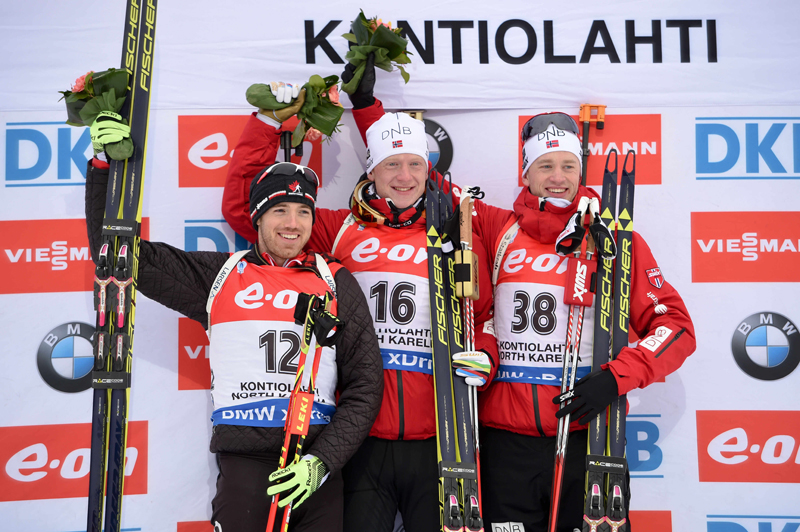
Nathan Smith (left) on the podium at 2015 Biathlon World Championships in Kontiolahti, Finland. (Photo: Fischer/NordicFocus.com)
Biathlon Canada has announced its nominations for the 2015-2016 national team, and twelve athletes made the cut.
The team will be led by four senior athletes who had personal bests on the international stage last season. Calgary native Nathan Smith won a silver medal in the 10 k sprint at World Championships, and followed it up with his first World Cup victory, in a 12.5 k pursuit at the next World Cup.
Two teammates nipped at the podium in World Cup racing: Rosanna Crawford notched fourth- and fifth-place finishes, while Brendan Green finished fifth in a sprint in Antholz, Italy. Joining them on the “A” team will be Megan Heinicke, who collected four different career-best top-15 finishes over the course of the season.
The “B” team will be made up of a combination of senior athletes with championship experience, and younger athletes making the jump to the World Cup. Veteran and Olympian Scott Perras, as well as World Championships competitors Audrey Vaillancourt, Scott Gow, and Julia Ransom, have kept their spots. So too have Emma Lunder, who earned a career-best second place in an IBU Cup sprint this season, and Macx Davies, Christian Gow, and Sarah Beaudry, all of whom are beginning to see World Cup action.
Of that group, the Gow brothers had the biggest impact on the World Cup, teaming up with Smith and Green to finish fifth in the 4 x 7.5 k relay in Oslo, Norway, this season.
Only one athlete from last season’s team was not re-named. Zina Kocher, a three time Olympian, started the season on the World Cup but had a top finish of 48th. After moving down to the IBU Cup, she matched Lunder’s second-place result on home turf in Canmore.
Head coach Matthias Ahrens is signed on with the team for another year, along with coach Roddy Ward. Kathy Davies was added to the staff as an assistant coach.
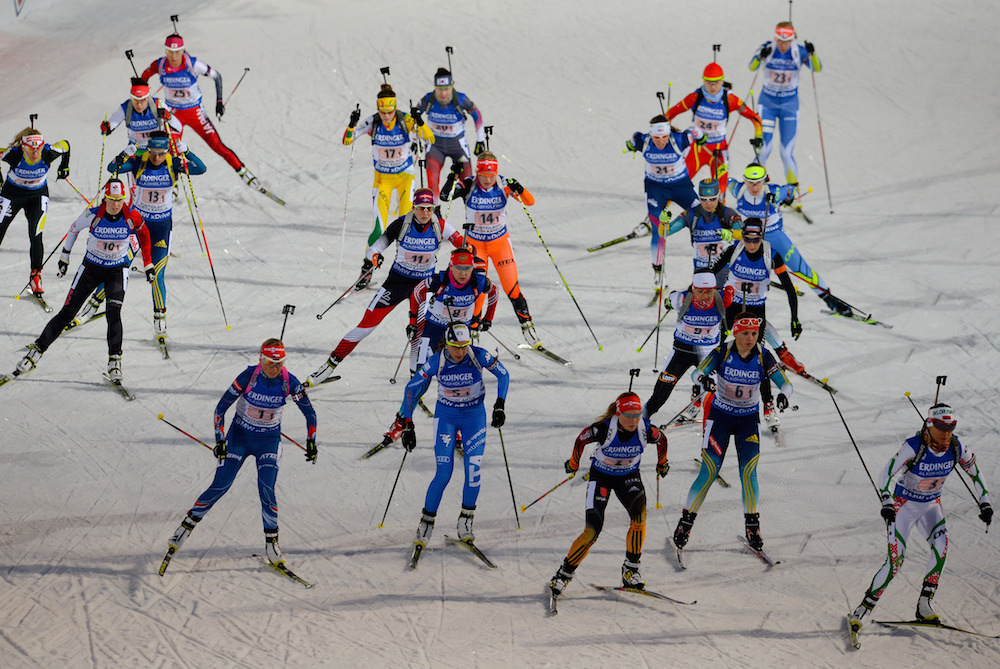
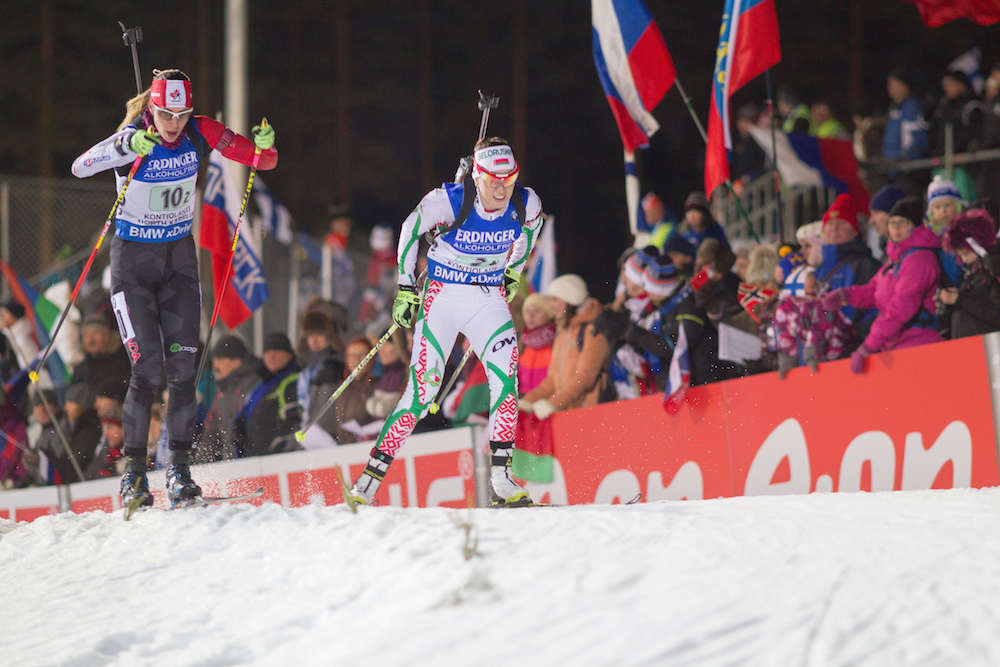
The start of the women’s 4 x 6 k relay at 2015 IBU World Championships on Friday in Kontiolahti, Finland, with Germany’s Franziska Hildebrand (4) near the front with Belarusian Nadezhda Skardino (3), Canada’s Megan Heinicke (10) at left, and American Susan Dunklee (21) near the back right. (Photo: USBA/NordicFocus)
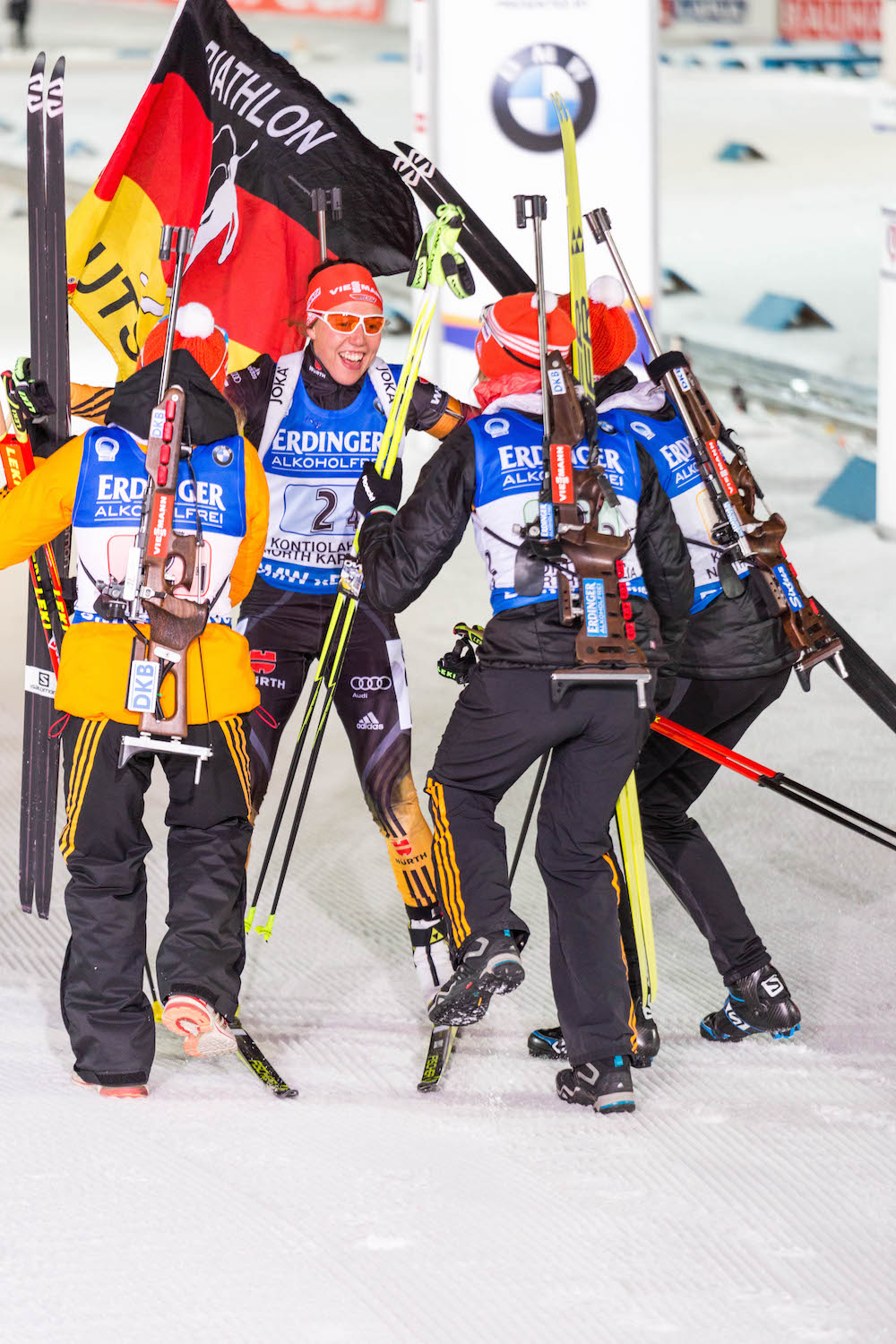
KONTIOLAHTI, Finland — Not long after finishing the women’s 4 x 6-kilometer relay at 2015 IBU World Championships, Laura Dahlmeier sprinted past reporters to jump into the arms of one of her teammates, her rifle still attached to her back.
A German sports broadcaster employee quickly ushered the 21-year-old Dahlmeier and her three teammates to the Sportschau platform overlooking the stadium where they had just destroyed the 25-team field.
In the minutes before, Dahlmeier built on a 30-second lead her teammate Vanessa Hinz established on the third leg to anchor Germany to a 1:00.3-minute win. Hinz had used just one spare in prone to clean both her stages and skied the second-fastest third leg to leap from third into first — and considerably ahead of anyone else.
The German women’s relay rushes the finish line to greet anchor Laura Dahlmeier, who secured their win by more than a minute over France in the 4 x 6 k relay at 2015 IBU World Championships in Kontiolahti, Finland. The German team included Franziska Hildebrand, Franziska Preuss and Vanessa Hinz. (Photo: Kontiolahden Urheilijat/Kari Kuninkaanniemi)
With Franziska Hildebrand and Franziska Preuss skiing first and second, respectively, the Germans combined to secure gold ahead of France in second and Italy another 5.8 seconds back in third.
“I think it was a dream of all of ours to be world champion and now the dream is true,” Dahlmeier said in a press conference after her team used six total spares and avoided any penalties for the win in 1:11.54.6.
France, with Anais Bescond, Enora Latuilliere, Justine Braisaz, and Marie Dorin Habert (the latter of which had already won two golds at these world championships), had nine spares and one penalty from Braisaz on the third leg. Habert lifted them from fourth and 1:18.8 behind Germany to silver — her fourth medal in as many races in Kontiolahti, including silver in the mixed relay — using two spares in prone and none to clean standing.
The Italians, with Lisa Vittozzi, Karin Oberhofer, Nicole Gontier, and Dorothea Wierer, led through the second exchange after Oberhofer elevated them from fourth to first with four total spares and the fastest course time of the second leg. Gontier started out 2.5 seconds ahead of Czech Republic, but slipped to third after using two spares on each of her stages.
“I’m not so in shape now and I have to thank my teammates, they are so strong,” Gontier said in the press conference.
She tagged Wierer in third, behind Germany and Russia, respectively. Habert and Wierer both overtook Russia’s anchor Ekaterina Shumilova in the final stage, where Shumilova used two spares, Habert cleaned, and Wierer used one. Wierer left the range in third, 0.6 seconds behind Habert and about 10 seconds ahead of Shumilova in fourth.
“I was so worried about the Russian girl and I thought, ‘I don’t want fourth position,’ ” Wierer said. “I really give all for the team, but I was really, really nervous.”
The team that didn’t lack confidence was Germany, with three women under the age of 23 (Hildebrand is the oldest at 27).
“We are a young team and a strong team and it’s a perfect day for us,” Dahlmeier said after cleaning both her stages to tally her second World Championships medal (following her individual silver in last weekend’s pursuit).
“We are the best team,” she told Sportschau.
Russia, with Ekaterina Glazyrina, Daria Virolaynen, 15 k individual gold medalist Ekaterina Yurlova, and Shumilova, finished 10.7 seconds off the podium in fourth. Norway placed sixth, Ukraine was sixth, Belarus took seventh, and the season-long relay favorites, the Czech Republic (which won the mixed relay) finished eighth, 3:11.7 behind the winners.
The Czechs came through the first exchange in 12th after Eva Puskarcikova’s first leg, 26.4 seconds out of first, and Gabriela Soukalova lifted them to second, 2.5 seconds back. They fell to eighth during Jitka Landova’s third leg, in which she had a standing penalty and six spares. Anchor Veronika Vitkova used three spares and had two penalty laps in prone, then went on to clean standing before finishing eighth.
Canada 10th, U.S. 12th
While the Germans drew a significant amount of attention with their win, two North American squads stood together near the finish, cheering their teammates on with each passing lap before waiting to congratulate their anchors as well.
Rosanna Crawford (Biathlon Canada) racing the second leg in the women’s 4 x 6 k relay at 2015 IBU World Championships in Kontiolahti, Finland. Despite a penalty, she brought her team from 14th to 11th, and the Canadians finished 10th. (Photo: Biathlon Canada/NordicFocus)
Canada’s second leg, Rosanna Crawford was one of them, standing near the finish and looking for her teammate Julia Ransom, who had anchored their team to 10th.
Audrey Vaillancourt had tagged Ransom in 10th, improving one place after Crawford put her in 11th at the second exchange. Ransom, a 22-year-old World Championships rookie, used two spares on each of her stages to help the team meet its personal goal: a top 10.
She held off Austria’s Katharina Innerhofer by 0.5 seconds to finish 10th, 3:39.5 behind Germany. In total, the Canadians used 10 spares and had one penalty (which came on Crawford’s standing stage).
“Megan [Heinicke] tagged me off into a great spot, [and I] came in prone … with the group,” Crawford explained.
She had entered her first stage around 12th after Heinicke tagged her in 14th, 33.8 seconds out of the lead. (The team’s first leg, Heinicke used a single prone spare and cleaned standing.) Crawford cleaned prone, then went on to use three spares in standing while trying avoid the penalty loop, which she ultimately had to ski around once.
“Standing, I came in and missed my middle shot and loaded my first spare quickly and missed,” Crawford explained. “As I loaded my last spare, I took my rifle down and shook my legs out and missed.”
Not only did the penalty loop cost her, but the three spares, which she estimated takes her six to 10 seconds to load apiece, set her back as well. Regardless, Crawford skied the sixth-fastest second leg to tag Vaillancourt in 11th, 1:08.6 behind the leader.
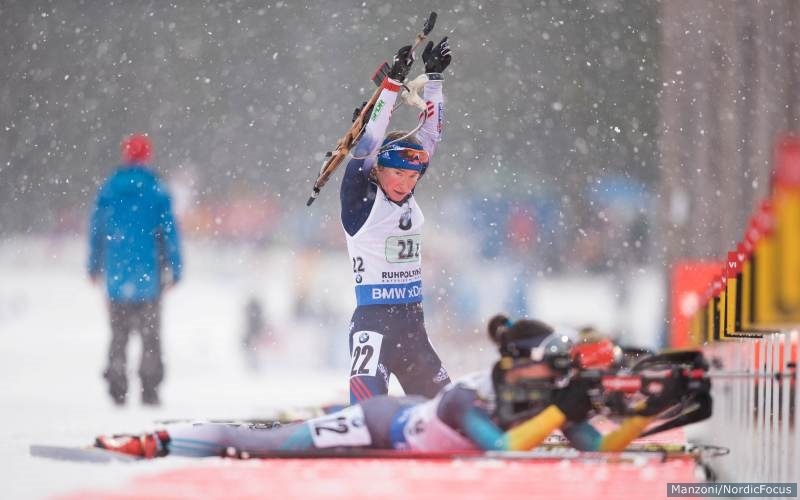
Audrey Vaillancourt (Biathlon Canada) during prone shooting earlier this week at 2015 IBU World Championships in Kontiolahti, Finland. She was the third leg of the Canadian women’s relay that finished 10th on Friday. (Photo: Biathlon Canada/NordicFocus)
Vaillancourt, 23, went on to use two prone spares and cleaned standing outright to bring the team to 10th, 1:45.3 out of first.
“I didn’t really know what place I was in at any time, it was just good to always have a pack of people [around me],” Vaillancourt said. “I passed people in the standing so that felt awesome. It’s always such a good feeling, like, ‘Yeah!’ … I was a little tired on the last lap, but I’m happy.”
Ransom used two spares in prone, rising to ninth, and then two more in standing to drop one spot to 10th.
“I saw eight and ninth ahead of me on the climbs,” she recalled. “You’re just gunning for those and didn’t look back.”
In her first World Championships relay, Ransom said she was “terrified” to anchor, “mainly because I saw the start list and saw a lot of medalists hanging out in the fourth [leg] with me.
“In zero I was pretty nervous, but you quickly fall back into race mode,” she added. “Even though you start with [Belarusian Darya] Domracheva, you put it aside. Once I was on the track and I could feel like I could ski like myself it was fun and I loved it.”
Rosanna Crawford (Biathlon Canada) trails Nadzeya Pisareva of Belarus during the second leg of the women’s 4 x 6 k relay at 2015 IBU World Championships in Kontiolahti, Finland. The Canadians went on to place 10th. (Photo: Biathlon Canada/NordicFocus)
Overall, the Canadians were pleased with their performance, with two relative newcomers on the team. While it’s Vaillancourt’s second World Championships, this season was her first full time on the World Cup.
“[Last night], we talked about that if we all bring our A-game, a top 10 is realistic and a top eight would be the perfect race,” Crawford said.
“I don’t think that we can say that we had a perfect performance as a team today, so I think that makes it even more awesome that we made our goal,” Heinicke said. “We have been mixing up our relays a ton this year. This is only the second time us four have raced together and we have never had this order. Lots of experiment; it’s been good.”
Dunklee Fastest First Leg
The Americans tied their season best in 12th, with Susan Dunklee, Hannah Dreissigacker, Annelies Cook, and Clare Egan. Despite starting in the seventh of nine rows at the start, Dunklee skied the fastest course time of all the first legs to put her team in third, 3.7 seconds behind Poland, which led through the first exchange.
“I almost prefer starting in one of the back rows,” Dunklee explained in an email after the race. “I love the rush of having to maneuver through the pack and chase people down. It just feels like a really fun game. It helps a lot that my fitness is in peak form right now, and the course suits my strengths with that big wall climb.”
Susan Dunklee (US Biathlon) follows Germany’s Franziska Hildebrand (r) into range for the first shooting in the women’s 4 x 6 k relay at 2015 IBU World Championships in Kontiolahti, Finland. Germany went on to win, and the Americans placed 12th to match their season best.
By the 1.3 k checkpoint, Dunklee had skied up to second behind Hildebrand.
“I don’t know how Susan just careened to the front of the pack like that,” Heinicke observed. “It was pretty impressive. I was in the second half and it was the most aggressive mass start I have ever been in, so much bumping and ski stepping and poles. It was a little bit chaotic and also exciting.”
Dunklee held her position in second entering the range for the first time, where she used two spares and had some trouble unhooking her sling from her arm. Dunklee left the range in 21st, 26.5 seconds behind Hildebrand, who cleaned without any spares.
The American spent the next lap skiing up to 12th before cleaning her standing stage to improve to seventh. Poland’s Monika Hojnisz cleaned her second-straight stage without any spares to take the lead, 2.4 seconds ahead of Russia.
Meanwhile, Dunklee left the range 14 seconds back in seventh. Over the next lap, she skied back up to third, tagging Dreissigacker 3.7 seconds out of the lead.
“I’m getting used to that; I expect Susan to hand off to me in the top five at least,” Dreissigacker said. “I should be getting better at it, and I still seem to be struggling with get being put in that position. I think I’ve always liked being one of the chasers not one of the chased.”
Coming into the range for the first time, Dreissigacker was fourth behind Poland, Italy and Russia, respectively. There, she had to use three spares to hit all of her targets.
“I kind of pulled off two shots accidentally, just way too fast with the trigger,” Dreissigacker explained. “I think I was a little excited, my fingers had gone a little bit number for some reason. … Using the third spare is always really bittersweet. You’re bummed that you had to use three, but you’re always so happy you hit that last one and didn’t do a penalty loop.”
Hannah Dreissigacker (US Biathlon) skied the second leg for the U.S. in the women’s 4 x 6 k relay at 2015 IBU World Championships in Kontiolahti, Finland. After receiving the tag from teammate Susan Dunklee in third, she came through the second exchange in 10th. The Americans finished 12th. (Photo: USBA/NordicFocus)
She left the range in 11th, 37 seconds behind Russia up front. In standing, Dreissigacker used two spares to head out for her final lap in 10th.
“Hoping that one of these days I can use not quite so many spares,” she said.
Dreissigacker tagged Cook in 10th, 1:06 out of the lead. Cook used two spares in each stage to hand off to Egan in 11th, 2:05.4 back.
“That is not like awesome shooting, but I think we all had a little bit of the nightmare of the last relay, where we had six penalty loops, in the back of our head,” Cook said, referring to the last World Cup relay in Oslo, Norway, where the Americans were in 18th before being lapped. “So we were all kind of like, ‘OK! I’m really happy that didn’t happen again!’ I felt really good skiing and it was fun. I felt like I was in the mix, which is exciting.”
In terms of team goals, she said they didn’t target a specific place.
“We didn’t do that many relays this year [and] we’ve got some new faces,” Cook said. “I think for us, it is just about getting experience … We have had a pretty steady relay team the last few years so now we are kind of rebuilding that up. Today we just wanted to have fun and to feel like after the race, we would all be in good moods and happy.”
In her first World Championships, Egan anchored the U.S. to 12th, 3:44.8 behind Germany and 0.8 seconds out of 11th. The 27-year-old US Biathlon development skier cleaned her first stage to move into eighth after prone, then used three standing spares, which put her back in 13th.
“I wish I had just used two [spares] because we would have been 10th instead of 12th,” Egan said, estimating it takes her about 20 seconds to load each spare. “That is my only regret. I got really close … I passed one person and I finished within a second [of 11th].
“This is my first relay that I have not had two penalty laps in standing. So big improvement for me,” she added. “I just tried to ski my own race and remember that I am always trying to gain experience.”
At the end of the day, Dunklee pointed out that 12th matched their best result of the season.
“It certainly wasn’t a perfect performance and there were several teams within reach ahead of us. I think it is good to be hungry for a higher place and know the possibility is there, but this was also result we can finish the season feeling proud of,” she wrote.
Russia’s Ekaterina Yurlova reacts after sealing her first career victory and podium on the World Cup level at IBU World Championships on Wednesday in the women’s 15 k individual in Kontiolahti, Finland. (Photo: Kontiolahden Urheilijat/Kari Kuninkaanniemi)
KONTIOLAHTI, Finland — When Ekaterina Yurlova earned two bronze medals at the IBU Open European Championships in Otepää, Estonia, her dad told her: “OK, now your next step is World Championship,” she recalled.
That was just over a month ago. On Wednesday, the 30-year-old Russian pulled out a surprise win to answer her father’s prophecy: a gold at 2015 IBU World Championships in the 15-kilometer individual. She had started 93rd of 105 women in the race and ended up as the only one with perfect 20-for-20 shooting.
“I said to him, ‘You’re crazy,’ ” Yurlova explained in a post-race press conference. “But now I think he’s not crazy.”
Yurlova herself looked stunned at the finish, holding her head and closing her eyes as it all set in at once. She had a great run throughout the evening race in front of 10,800 spectators — rising to third with a clean first shooting and the third-fastest course time on the first lap. After hitting all of her targets on her second stage, the Russian sat in fourth behind Italy’s Karin Oberhofer in first and the Czech Republic’s Gabriela Soukalova and Veronika Vitkova in second and third, respectively.
Fourteen seconds out of the lead after that first standing, she rose to second with a clean third stage. Soukalova, who started fourth and remained as a top contender from start to finish, cleaned those three initial stages as well, and leaving the range for her second-to-last lap, she was 15 seconds ahead of Yurlova.
The time gap went out the window when Soukalova came into the range for the last time and missed one for a one-minute penalty. While it took some time for Yurlova to tick off the laps 89 starters later, she ended up cleaning her fourth-straight stage to take the lead, 32.8 seconds ahead of Soukalova.
Ever since she finished, Soukalova had the time to beat in 41:55.4, holding off Finland’s local favorite Kaisa Mäkäräinen by 1.2 seconds. That time held up until Yurlova crossed the line 23.2 seconds faster in 41:32.2.
For the third time in her career, Yurlova cleaned an four-stage individual race. It was also her first podium and victory at the World Cup level. Her previous World Cup best was fifth in a mass start two seasons ago in Pokljuka, Slovenia.
“This is my first race of this World Championship and I wanted to be in podium,” she said. “It was my dream, but I never know that I can win.”
The women’s 15 k individual podium at 2015 IBU World Championships, with Russian winner Ekaterina Yurlova (c), silver medalist Gabriela Soukalova (l) of the Czech Republic, and Finland’s bronze medalist Kaisa Mäkäräinen (r). (Photo: Kontiolahden Urheilijat/Kari Kuninkaanniemi)
While Soukalova’s longtime lead at the finish didn’t stand, she said at the press conference that she was happy with silver. She and her team won gold earlier at these Championships in the mixed relay.
“It’s awesome and it was a really difficult season,” Soukalova said. “I didn’t think that I’m able to get a medal from this championship, but that’s nice.”
She wasn’t crushed when she was bounced from the lead by such a late starter. In fact, she didn’t realize she was in the hunt for gold until her last lap.
“I thought it’s gonna be really nice to [finish] in top five,” she said.
While Soukalova posted the fifth-fastest course time and Yurlova’s time ranked 19th (although her range time was notably quick in fifth), Mäkäräinen, who started 36th, was the fastest on course in the the five-lap race.
Hailing from the nearby city of Joensuu, where most of the World Championships accommodations are located fewer than 20 kilometers south of Kontiolahti, Mäkäräinen earned her first medal of the championships — bronze — 24.4 seconds off the win.
She cleaned prone but missed one on her first standing and another on her second prone before cleaning her final standing. The two misses put her two minutes back, and while she slipped into 11th after the third stage, she was back up to fifth leaving the range for the last time.
A fast last lap put her in contention with Soukalova for what looked to be the win at the time (well before Yurlova).
“In the first standing I had a lot of difficulties,” Mäkäräinen said in the press conference. “My legs were shaking right before I started to shoot. I missed the first target and I thought, ‘This is not going to work now,’ but I fight with every shot and I hit the last four. I was really lucky also there. And in the prone, I don’t really know what happened, maybe I was waiting too long, and the last shooting I don’t remember anything.”
She did remember hearing how far she was behind Soukalova going into the last lap. It was 27.2 seconds, to be exact.
“I never thought that I could be so close [at] the finish line,” Mäkäräinen said. “I knew that I did a good jump in a last loop so I wasn’t too sad about that.”
While she acknowledged she was slightly relieved with the medal (which she took by 0.4 seconds ahead of Italy’s fourth-place finisher Dorothea Wierer), Mäkäräinen added that wasn’t how she preferred to view her bronze.
“It was a new day today, new race, I did my job pretty OK,” she said. “I’m happy that I had a good day in the World Championships.”
Darya Domracheva of Belarus missed three on her first standing to slide into the 50’s overall after the second stage. By the third stage, she had recovered to 27th with another clean prone, but she had one more penalty on the last standing to finish 16th, ultimately 2:54.6 behind Yurlova.
Dunklee 12th for U.S.; Canada’s Heinicke Tallies Third-Straight Top 30
Susan Dunklee (US Biathlon) racing to 12th in the women’s 15 k individual on Wednesday at 2015 IBU World Championships in Kontiolahti, Finland. It was her best individual result of the championships so far. (Photo: USBA/NordicFocus)
American Susan Dunklee started 30 seconds after Mäkäräinen in bib 37. While she missed two standing to fall back into the 30’s, Dunklee cleaned her next two stages and missed one on the last standing to end up 12th (+2:43.0). She had the sixth-fastest course time (4.5 seconds behind Soukalova, who was fifth fastest on course).
While Dunklee called the early misses, “not an auspicious way to start,” she explained that they took the pressure off. She thought, “It’s not gonna be a perfect race, but I can just focus on doing my normal thing,” she explained in a post-race interview.
After her first prone, she caught a glimpse of the board her coaches showed her out on course, which indicted where her shots landed outside the target. For the next prone, she made a couple corrections.
During one lap, Dunklee skied with Germany’s Laura Dahlmeier (in bib 21) and Ukraine’s Valj Semerenko (in bib 20), which she said helped her push her tempo.
“There were times when I wanted to back off a bit, but Laura was pulling and gapping me a bit and I was like, ‘I can’t let her get a gap because I’ll lose the draft,’ ” Dunklee explained.
Dahlmeier went on to place sixth (+40.5) behind Russia’s Daria Virolaynen in fifth (+37.9). Semerenko finished 15th.
With her best shooting of the week so far and best individual result at these World Championships, Dunklee was pleased to be feeling back on track.
“My biggest problem the last couple days has been just getting my head back on straight and finding the fun again and the normal race feeling,” she said. Last weekend, she placed 42nd in the sprint and 34th in the following pursuit.
“The sun came out late afternoon today, and while we were warming up there was a soft, golden light and it made me really relaxed and happy,” Dunklee added. “I felt excited about the start of the race.”
Regardless of whether Wednesday’s result is enough to qualify Dunklee for the 30-person mass start on Sunday, she said she was happy. “I’m glad to have had a good one,” she said.
“While we were warming up there was a soft, golden light and it made me really relaxed and happy. I felt excited about the start of the race.” — Susan Dunklee, 12th
Canada’s Megan Heinicke tallied her third-consecutive top 30 of the week, placing 21st (+3:23.3) for her World Championships career best. She hit 19 straight shots before missing her final target.
Megan Heinicke (Biathlon Canada) racing to 23rd in the 7.5 k sprint at 2015 IBU World Championships on March 7 in Kontiolahti, Finland. In Wednesday’s 15 k individual, Heinicke placed 21st for a career best at World Championships (and at the Olympic level).
“I’ve hit 20-for-20 twice already this year so I feel like there was 15 thoughts going through my head, like, slow motion during the last shot,” she reflected. “I’m so, so happy with 19, but I’m pretty sure I missed the last shot because I was thinking, ‘Oh, I’m going to hit 20!’ ”
During the race, Heinicke wasn’t sure it was going so well. On her first lap, she heard her team’s staff tell her she needed to ski faster.
“I was like, ‘Oh gosh, this is going to be a disaster,’ and then actually, I kind of felt better lap by lap,” she said less than a week after recovering from a monthlong illness.
“I was prepared for way worse,” Heinicke said of World Championships overall so far. “I fought hard out there. I really delivered what I was able to. There’s always the ‘if’ thought: if I was in better shape and skiing four-percent faster, but I mean, I’m happy with it.”
Dunklee’s U.S. teammate, Annelies Cook was on track for a breakthrough performance after cleaning her first three stages. The third starter, she found herself in second after the third shooting behind Soukalova and at the end of the day, her time leaving the range for the second-to-last lap ranked sixth.
US Biathlon’s Annelie Cook (second from l) on the range with Slovakia’s Jana Gerekova (l), among others during one of her two standing stages in the 15 k individual on Wednesday at IBU World Championships in Kontiolahti, Finland. (Photo: USBA/NordicFocus)
However, in the final standing, Cook missed four shots — the first, second, fourth, and fifth — to fall toward the back of the pack. She ended up 47th (+5:26.8) with four penalties.
“My heart is a little broken,” Cook said afterward. “I blew it. I just wanted it so bad and I tried too hard. Classic case of wanting it too much. Everything else felt easy and relaxed. I tried to stay relaxed the whole race, not come into the range too gassed, and I think the conditions were really good today so that made it a lot easier …
“Sometimes biathlon is really mysterious,” she added. “You don’t know what makes one [race] good from the next, but the last stage was just bad. I was too tense and I was just trying to hard.”
World Cup rookie Clare Egan, also of the U.S., notched her second-best result of her career in 51st (+5:45.7) after back-to-back clean stages for her first prone and first standing. She went on to miss two in the third stage and two more in the final standing.
Clare Egan (US Biathlon) during one of two shooting stages in the women’s 15 k individual at IBU World Championships on Wednesday in Kontiolahti, Finland. She placed 51st for her second-best result of World Championships and her career. (Photo: USBA/NordicFocus)
“’I’m still learning, especially with the standing, so any time I can even just miss one in standing is great,” Egan said. “My best World Cup place coming into world champs was 73rd, and I’ve done way better than that so far so I’m really psyched.”
In placing 40th in the sprint last Saturday, she qualified for last the pursuit, where she placed 52nd. While Wednesday marked another top result for the 27-year-old Egan, she said it was her brother’s presence that made her day.
“My brother Graham flew in today from New York so he was out there on the course with an American flag,” Egan said. “That was my favorite part of the race.”
Also for the U.S., Hannah Dreissigacker placed 67th (+6:49.7) with five penalties (2+1+1+1).
“Ones are OK, twos are bad,” Dreissigacker said of the number of misses per stage. “That’s sort of where my standard is for myself. If I had [missed one each time], I would be, like, not a good day, but not bad. But five, I mean, that’s too many.”
She described feeling flat during the race and attributed it to possibly hunger.
“I don’t think I ate enough because it’s such a late-in-the-day race,” she said of the 6:15 p.m. start. “I was getting kind of hungry before the race and I felt like I kind of ran out of energy. I’m not sure I timed that quite right. I should have known better…
“For some reason, I’m just sort of struggling a little bit here in general,” Dreissigacker added. “Today was tough because I actually felt OK for the most part. The last three stages I missed the last shot every time, which is sort of a classic biathlon mistake. I think I guess I must not have followed through enough.”
Two Canadians had five penalties as well: Audrey Vaillancourt (2+0+1+2) and Julia Ransom (2+1+1+1). While Vaillancourt placed 79th (+8:05.3), Ransom in her first World Championships was 84th (+8:23.9).
“It’s just a bad week on the range,” Vaillancourt said. “It’s hard to start with two misses, and you’re like, ‘Nice, now I have three more bouts to go.’ ”
Typically a strong shooter, she added that sometimes that’s the way biathlon goes.
“Some weeks you just don’t get that feeling of, it’s easy,” she said.
And Vaillancourt didn’t think her off week had anything to do with the stakes at World Championships.
“I’ve been fighting all year to get my place here. It’s not like I’ve been thinking of only World Champs all year,” the 23 year old said. “To me, it doesn’t really make a difference if I do super well on the World Cup or super well at World Champs because it’s not like I’m really close to a top eight.”
After the pursuit three days earlier, in which she placed 57th, Ransom explained she focused on getting into a “better headspace” for the 15 k.
“I was so overwhelmed and I was excited, but also really distracted [during the pursuit] so I kind of brought it together and I really wanted to focus on pacing,” she said. “We don’t do a lot of individuals; this is definitely the hardest one I’ve ever done, and I think I found a happy medium with the pacing. Maybe a little too easy, but I’m learning.”
Like several North Americans, she struggled with her first prone and had two early penalties.
“The wind had changed on me, which I wasn’t expecting,” Ransom said of her first shooting. “I [made] a big correction for prone … I’ve been struggling with standing the last couple weeks, so I’m glad I kind of brought it back to a half-decent level. It’s a work in progress. These World Champs have been an interesting experience.”
Perhaps the most disappointed North American of the day was Rosanna Crawford, a medal hopeful, who finished 87th (+9:05.1) with eight penalties (2+2+2+2).
“It was really bad,” she said.
Before World Championships, she and her boyfriend Brendan Green, also on the Biathlon Canada national team, discussed the worst that could happen in Kontiolahti, Crawford explained.
“The worst that could happen is a really bad race,” she continued. “It’s not that bad in the scheme of life, but this is something I’ve dedicated my whole life to and to not achieve my goals is disappointing. I feel like I’m letting down everyone who’s helped me get here, and I know I’m capable of so much more.”
On Tuesday, Crawford watched a Finnish TV interview with U.S. cross-country skier Kikkan Randall.
“Kikkan was talking about how disappointed she was with the Olympics, and yeah, you set these big goals, but then you also need to set the goals of being able to leave a championship happy,” Crawford said. “I don’t think I did that. I didn’t set those goals and even if I had, I didn’t achieve them. I didn’t do what I know I’m capable of today, and I really wanted another chance in the mass start and now that’s not gonna happen.”
The final race of World Championships, the 12.5 k women’s (and 15 k men’s) mass start includes the top-15 ranked competitors on the World Cup circuit with 15 others who do exceptionally well at worlds. The sprint and pursuit carry a hefty weight (with the sprint factoring into the start of the pursuit), and the individual races are the last ones to count toward the mass start.
Based on a provisional start list, Heinicke and Dunklee have qualified for Sunday’s mass start in 26th and 30th, respectively.
The women’s podium in Saturday’s 7.5 k sprint at the 2015 IBU World Championships in Kontiolahti, Finland. (From l-r) Weronika Nowakowska-Ziemniak of Poland (2nd), Marie Dorin Habert of France (1st), and Valj Semereko of Ukraine (3rd). (Photo: Fischer/Nordic Focus)
KONTIOLAHTI, Finland – While many men complained of the blustery Finnish weather in Saturday’s 2015 IBU World Championships sprint, they would soon become thankful for their race conditions after the start of the women’s sprint. Just half an hour before the start of the race — a 7.5-kilometer sprint — the wind strengthened and was joined heavy snow, making for blizzard-like conditions on the second day of competition in Finland.
While the weather did its best to subdue the competitors, it was Marie Dorin Habert of France who landed on top of the podium. She earned her first-ever World Championships gold in addition to a first-career victory after cleaning prone and missing one shot in standing to notch a time of 22.16.8. Behind her was Weronika Nowakowska-Ziemniak of Poland, the only competitor to clean both prone and standing. The Polish biathlete, whose silver medal is the first podium of her career, finished 9.6 seconds back. Rounding out the podium was Valj Semereko of Ukraine, who missed one in standing to cross the line 19.7 seconds behind Harbert.
Saturday began with numerous expectations, the most popular of which was a predicted showdown between hometown-favorite Kaisa Mäkäräinen and overall IBU World Cup leader Darya Domracheva of Belarus. Mäkäräinen, who started with bib 6, battled the worst of the weather and faced a slow course that had barely been skied-in ahead of her. When she reached the first shooting stage, the 32 year old had posted the fastest course time on the first loop. But her lead would soon be gone as the Finnish skier missed three shots to the audible shock of the crowd. Mäkäräinen eventually missed two more shots in standing to finish 35th.
Kaisa Mäkäräinen of Finland was a favorite in the 7.5 k sprint but ultimately finished 35th.
Next up was Dormacheva in bib 10. The Belarusian had a promising start after missing one shot in prone and skiing the fourth-fastest course time, but eventually succumbed to the conditions in standing where she missed four of five shots to ultimately finish 25th.
With the two favorites out of contention, an opportunity was presented to the rest of the field. Semerenko, in bib 4, had already finished and posted the time to beat after notching the fastest range and shooting times of the day. Habert, in bib 16, wasn’t far behind Domracheva and chased the Belarusian. In the process, she posted the fastest cumulative time in the first lap. Her second and third laps were the second and third fastest of the day — enough to move her past Semerenko.
Meanwhile, Nowakowska-Ziemniak was three starters behind the Frenchwoman. Where she failed to match Habert in course time she overcame in range speed, earning the seventh overall ranked time on the day. After she cleaned the second round of shooting, the Pole worked to make full use of her advantage. In the end, however, it wasn’t enough to overcome Habert.
According to Habert, she knew before the race that a podium was likely but never expected to take her first individual gold in the 7.5 k sprint.
“I didn’t expect it was possible for me” she said in a press conference. “I wanted to be on the podium, but to win I think that it’s too hard for me, but it was done so it was nice.”
Habert explained that she didn’t mind the conditions, but acknowledged that her favorable view of the strong wind and blowing snow was likely due to her victory.
“It was hard conditionsn but it’s right for me so I’m happy for these hard conditions,” she said. “It was hard on the track because of the snow and shooting range because of the wind, but today it was nice for me.”
Valj Semereko of Ukraine racing to bronze in Saturday’s 7.5 k sprint at teh 2015 IBU World Championships in Kontiolahti, Finland. (Photo: Fischer/Nordic Focus)
The French biathlete gave birth in September. While she trained during her pregnancy, Habert said that she was uncertain as to how she was able to come back for such a successful season.
“Maybe I’m stronger before,” she explained. “I don’t have an answer of this progress, but I’m happy I’ve progressed.”
In second place, Nowakowska-Ziemniak said that she believed the 2015 World Championships would be her last prior to her podium. With Saturday’s silver medal, however, the Polish biathlete said that the joy of being on the podium might convince her to stay in the sport longer.
“I didn’t win, but I’m sure that I am the most happy person today here,” she said in a press conference. “It’s an amazing moment here in my career.”
Two of Nowakowska-Ziemniak’s teammates also finished in the top 10, with Krystyna Guzik in fifth and Magdalena Gwizdon in seventh. The bronze medalist explained that although the Polish women faced a hard season where results failed to live up to expectations, she was proud of her teammates for performing when it mattered.
“As a team, we’ve got many problems during this season with the shape but I’m triple happy that the whole team showed today that we are really strong and we deserve to be this high in the world,” she said. “I’m very happy for myself and for my teammates also.”
The sprint’s bronze medalist, Semerenko, has been on the podium four previous times this season and said that her main objective on Saturday was to achieve a solid position for Sunday’s pursuit.
“This is indeed a very good season for me,” Semerenko said. “I’m very happy about this race although I didn’t expect to be on the podium today, but I wanted to be close for pursuit race.”
Megan Heinicke racing to 23rd in Saturday’s 7.5 k sprint in Kontiolahti, Finland at the 2015 IBU World Championships. (Photo: Fischer/Nordic Focus)
Canada’s Heinicke Skis to 23rd; North Americans Left Wanting More
The snow and wind took a hard hit on the North Americans as they battled the elements to ski and shoot to the best of their abilities.
Canada’s Megan Heinicke was ultimately the top finisher in 23rd after missing one in prone and cleaning standing. Although she had the 78th-fastest course time, Heinicke was able to notch a top-30 result with precise shooting and the 18th-fastest range time.
“I was really happy with the shooting,” Heinicke said in a post-race interview. “Standing I was really satisfied with because I waited and I took the shots in the right moment. Usually standing shooting in the wind is something I’m not super confident about, and I feel like it’s been a weakness over the last years, so I’m really satisfied with the standing today.”
Heinicke was originally slated to start World Championships on Thursday in Canada’s mixed relay, but sat out to continue recovering from illness in Germany.
“I have been sick for 17 days out of the last 30, and I have two more days of antibiotics to go so I flew in late and didn’t do the mixed relay,” she explained.
The 26 year old said she entered Saturday’s sprint with no result-oriented goals, but instead was focused on shooting well and skiing smart. She was also aided by the earlier success of her teammate Nathan Smith, who was the first Canadian male to earn a World Championships medal after placing second in the preceding 10 k sprint.
“I was getting ready for the race and I was like, ‘I’m not gonna cry, just focus on your own race,’ ” Heinicke said. “I feel like we have a few athletes that have been flirting with the podium so it’s just really, really amazing to have someone do it.”
Behind Heinicke in 32nd was teammate Rosanna Crawford. The 26 year old, who was one of the first starters in bib 5, just ahead of Mäkäräinen, dealt with the worst of the blowing snow but managed to notch the 10th-fastest split in the first loop after cleaning prone. It was in standing that Crawford ran into trouble, ultimately missing three shots and losing precious time.
“I knew it was going to be the hardest in standing,” Crawford said in an interview. “Maybe I accepted defeat before I even got to the range.”
Susan Dunklee racing to 42nd in Saturday’s 7.5 k sprint at the IBU World Championships in Kontiolahti, Finland. (Photo: USBA/NordicFocus)
Once in the penalty lap, Crawford explained that the loop was incredibly slow due to the new snow and lack of skiers ahead of her.
“The penalty loop was awful because nobody was had been skiing in it,” she said. Crawford added that while she faced an “uphill battle” in her quest to qualify for the World Championships final mass start next weekend, she is looking forward to racing again.
The next North American and top U.S. biathlete in the women’s sprint was World Cup newcomer Clare Egan. A late starter, Egan said she benefitted from the break in snowfall that occurred midway through the race. However, the break in weather wasn’t the only reason for her success. According to the former University of New Hampshire skier, the steep hills on the 2.5 k course suited her skiing and aided her in qualifying for her first World Cup-level pursuit.
“[The course] has a really big climb in it and I pushed up that climb,” Egan said. “I’ve been working a lot with our coaches since we’ve been here on how to ski the flats and I think I did a pretty good job with what we’ve been working on.”
Egan missed two shots in both prone and standing, but said that compared to her previous World Cup shooting record, Saturday’s performance was an improvement. Prior to the World Championships sprint her previous best result was 73rd in a Nove Mesto sprint earlier this season.
“I wish I would have shot a little better, but honestly, I think I missed four in standing in both the other World Cup sprints I’ve done. Today I only missed two so that was an improvement and hopefully I’ll keep improving,” she explained.
Just two places behind Egan was veteran U.S. biathlete Susan Dunklee. The 29 year old has consistently placed in the top 30 and is no stranger to the top 10. In the sprint, Dunklee explained she lost confidence in the shooting range. She missed one in prone and two in standing, and marked the 101st-ranked range time of 103 finishers.
“I’m really bummed,” Dunklee said after the race. “I spent more time on the range than maybe ever. I was one shot at a time because it was so windy and so gusty. I just kind of lost my rhythm and flow and confidence, especially in the standing.”
While Dunklee acknowledged the difficult weather was a factor in her shooting, she said it was a part of racing that every competitor had to deal with. According to Dunklee, she entered the sprint with the goal of performing at the level she’s been at in the 2015 season, but hoped for something even better.
“I did want it, maybe a little bit too badly,” she said. “That’s the curse.”
First-time World Championships competitor Julia Ransom of Canada cleaned prone to rank 13th after the first shooting but fell to 52nd position after missing three in standing. She said she was very pleased with her result, which was the best of her World Cup career.
“I’m pumped. It’s the first pursuit I’ve made on World Cup and it’s been a really big jump from IBU Cup to World Cup so I’m happy,” Ransom said.
Ransom is no stranger to Kontiolahti. In 2012, she earned a silver medal in the Junior World Championships pursuit. Although this year is her first senior World Championships, Ransom said that the experience hasn’t been too different from the World Cups she’s attended.
“It’s feeling relatively the same. Nothing too exciting, but racing at night is fun, different. We’re going to bed at midnight, waking up at 9:30 and 10,” she said. “It’s the same faces just different names.”
Finishing 61st, U.S. biathlete Hannah Dreissigacker was one spot away from qualifying for Sunday’s 10 k pursuit. Dreissigacker said that she was interested to review her shooting with her coaches, as she was surprised the wind affected her so negatively.
“It was windy so I’m sure that affected me. Normally in prone, I’m not intimidated by the wind. I take clicks and I’m confident,” she explained.
Teammate Annelies Cook finished 68th and said her skiing felt much better than it had all season. At the same time, she explained that she was disappointed in her shooting. “I felt good skiing, but I let myself down in my shooting,” she said. “I definitely struggled a lot in standing with the wind, and I made a careless mistake in prone, accidentally pulling the trigger when I didn’t mean to.”
Canadian Audrey Vaillancourt ended the day in 77th and said that while the day was bad for her, she was read to move on to the next race.
“When I came into prone it was like a tornado. Prone is not that bad normally. I don’t think I clicked enough. It was very, very hard today,” she said.
Susan Dunklee (US Biathlon) pushes up a climb during Thursday’s mixed relay at 2015 IBU World Championships in Kontiolahti, Finland. (Photo: USBA/NordicFocus)
KONTIOLAHTI, Finland – Slushfest was the word that best described the opening race of the 2015 IBU World Championships. The respective courses in the 2 x 6 + 2 x 7.5 kilometer mixed relay featured soft, wet snow that made even the most experienced skiers look like beginners. Despite the challenging conditions, both the U.S. and Canadian teams skied and shot their way to match their best World Championships results in the event.
Battling the deteriorating course and the above-freezing temperatures, the Czech Republic skied to the victory in the mixed relay with a time of 1:20:27.2. The U.S. team consisting of Susan Dunklee, Hannah Dreissigacker, Lowell Bailey, and Leif Nordgren placed eighth and finished 1:46.6 behind the victors. The Canadian team of Audrey Vaillancourt, Rosanna Crawford, Nathan Smith, and Brendan Green ended their day in 12th, trailing by 2:27.9.
The American squad had a strong start to the relay as the team’s scramble leg, Dunklee, charged in the first meters to bring the U.S. into third. Skiing behind the Czech Republic and France, Dunklee maintained a consistent rhythm in the soft, wet snow. On the 2 k course’s major climb, dubbed “the wall,” Dunklee passed the French team to ski second into prone shooting.
Dunklee used one spare in prone to exit the range in eighth position. She soon made up lost ground on the leaders, however, and was third behind Japan and the Czech Republic by the end of her second 2 k lap.
According to Dunklee, she enjoys chasing down her competitors even if it means her shooting wasn’t perfect.
“That’s kind of my style in the relays,” she said in a post-race interview. “There’s always people to chase, even if I have to use a spare or two. Then I just use the chasing, hunting-down mode to get people. It’s fun.”
Susan Dunklee (US Biathlon) follows Veronika Vitkova of the Czech Republic during Thursday’s mixed relay at the IBU World Championships in Kontiolahti, Finland. (Photo: USBA/NordicFocus)
Dunklee used another spare in standing but exited the range in fifth. Once again using the thrill of the chase, Dunklee skied the second-fastest final lap to tag Dreissigacker in third position.
“One of these days it would be nice to clean without having to use the spare,” Dunklee said. “I haven’t done that this year, but I felt happy that I was within touch of the leaders. I got to ski a lot with Veronika [Vitkova of the Czech Republic] so that was really nice. She’s a good skier.”
Dreissigacker entered the first meters of her race without many skiers around her, but began to navigate the difficult conditions to the best of her abilities.
“It just feels awful, skiing today,” she said of the race. “Even if you’re going fast compared to other people, it’s not going to feel good.”
In prone, Dreissigacker used three spares and had to ski a penalty lap. When the penalty was all said and done, Dreissigacker had fallen to 13th. She maintained her position throughout the second lap and used two spares in standing to eventually tag the team’s third leg, Bailey, in 15th.
Dreissigacker said that she didn’t know why she missed the targets in prone and was curious to get her coaches’ opinions regarding what went wrong. Despite her performance in prone, she said that she was able to pull herself together to have a strong final two laps and shoot well in standing.
“I tried to go back to the basics and shoot normally, which is what I thought I was trying to do in prone too,” she said. “Sometimes it works and sometimes it doesn’t. I got to ski with people for the second two laps. I felt good about my skiing just judging who I was skiing with.”
Hannah Dreissigacker (7) racing the second leg for the U.S. during Thursday’s mixed relay at 2015 IBU World Championships in Kontiolahti, Finland. (Photo: USBA/NordicFocus)
After watching competitors struggle in the deepening snow, Bailey entered the third leg of the relay hoping to ski smoothly and efficiently.
“My goals were to not flounder around and waste energy and to try and stay smooth,” he said. “I just had to try and ski smooth. The ski technique is not pretty out there. It’s more about just gaining ground with every step and trying to move down the track as fast as you can.”
Bailey cleaned both prone and standing to bring the U.S. team to 11th. The 33 year old had the second-fastest shooting and range times of the third leg. Bailey said he was happy to clean both prone and standing given the prior month, during which he was sick and unable to race. He explained that he spent much of the leadup to World Championships visualizing his shooting and skiing.
“It’s been a challenging month for me. I got sick and I haven’t had much racing so this was a good chance to get a race in,” he said. “I really had focused in the last two weeks of training going through World Champs, trying to visualize how they should go. You always like it to go the way you laid it out in your game plan so I was happy with that and hoping to stay in that mode the rest of the time.”
Starting the final leg in 11th, Nordgren’s mission was to pass as many teams as possible in the final 7.5 k of the relay. After skiing a solid first lap and using one spare in prone, he brought the team to ninth. Depsite the gain of two places, Nordgren explained the one miss in prone lost him the chance to ski with a pack he had almost caught. Instead, he skied the majority of his second lap alone.
Leif Nordgren after the finish of the mixed relay at the 2015 IBU World Championships in Kontiolahti, Finland. The U.S. placed eighth to match its best World Championships finish (and last year’s Olympic result) in the mixed relay.
In an attempt to make up as much ground as possible before the third lap, Nordgren “threw caution to the wind” in standing. The 25 year old ultimately cleaned his second shooting, which left him in good position his the final lap.
With just 2.5 k to go Nordgren was in rapid pursuit of the two teams ahead of him – Germany and Italy — and was make up ground. Despite considerable gains on the two teams by the midpoint of the lap, Nordgren said the distance was too much to overcome.
“In the third loop [Germany and Italy] were right there the whole time, but I couldn’t catch them,” he said. “I think I had it down to three or four seconds halfway through the loop, but I could never quite get contact with them. In the end, I just had to let them go.”
Nordgren crossed the line in eighth, happy with his effort and excited to see what the rest of the Championships will bring.
“I feel confident and I’ve had good shooting all year. I think today kept that confidence high,” he said. “The skiing has been coming around the last couple of World Cups and I don’t think today was any worse, so who knows what will happen.”
Overall, the Americans were pleased with their results, but said they believed that on the right day, they could place higher.
“This is an event where we feel we have the potential for a podium as a relay. We’ve got the depth to pull that off if we have a good day so that’s always in the back of the mind,” Dunklee said.
Canadian Brendan Green catches his breath at the finish of the 2015 IBU World Championship mixed relay. Canada finished the race in 12th position.
After Rocky Start, Canada Comes Back for 12th
The Canadian squad had a much different start than the Americans. Due to their lower ranking in the mixed relay, the team wore bib 22 and was placed in the eighth row of competitors.
According to Vaillancourt, the Canadian scrambler, the position made it nearly impossible to move at race pace in the first kilometers due to the soft conditions that accentuated the accordion effect of the pack.
“It was really chaotic on the first lap. Girls were crashing and the first hill I just stood there,” she said. “The first tiny little hill everyone was just tangled and I was just sitting there for five seconds and I was like, ‘Oh my god, I can’t move, I can’t move.’”
She eventually escaped the mayhem to use one spare in both prone and standing to bring Canada to the exchange in 20th position. Crawford, the team’s second leg, entered the course looking to use the flats to her advantage, but struggled on the hills.
“I felt like I was really strong on the flats so I tried to take as much advantage as I could there because I knew I was going to get crushed on the uphill, which I did,” she said. “On the uphill I didn’t even know what to do. I tried coaches’ skating and just tried to do anything I could to get there as fast as possible.”
Vaillancourt was not slated to start Thursday’s mixed relay, but stepped in when Megan Heinicke came down sick.
In the second leg, Crawford used one spare in prone and cleaned standing to move into 12th before her final 2 k lap, but ultimately fell to 15th before the team’s second exchange. She clocked the third-fastest range time of the second leg.
Much like Crawford, the team’s third leg skier, Smith, used one spare in prone and cleaned standing. His range time was the fourth fastest of the first men’s leg. Given his accurate shooting and strong skiing, Smith brought the team to 11th before the final leg. He explained that because he was tagged in 15th, he focused on his individual skiing and shooting more than he would have if the team were fighting for a top position.
“It’s probably the most challenging conditions you’ll ever see,” Smith said. “… Standing was really good. I was a little bit shaky for one shot and then I had the discipline to reset and make sure I hit all those shots.”
Canada’s anchor, Green cleaned both prone and standing but ultimately lost one place to finish 12th. The 28 year old, who has dealt with lingering back problems for several years after surgery, said that a February crash in Oslo left him unable to participate in regular intensity training in the weeks leading up to World Championships. According to Green, Thursday’s main focus was getting the body back into racing form before the sprint.
Much like the Americans, the Canadian team suggested Thursday’s result was far from their true potential.
“I don’t know, the mixed relays for us are kind of cursed,” Green said. “It’s been a few years where we’ve been able to put together a good mixed relay, but it really is one of the races that should be our strongest so I don’t know if we’re a bit jinxed or what.”
Veronika Vitkova anchoring the Czech Republic to a women’s relay win in Ruhpolding, Germany, earlier this year; on Sunday she did it again in Oslo, Norway, to give her team three wins in four competitions so far this season. (Photo: IBU/Ernst Wukits)
In the last competition before World Championships begins in Kontiolahti, Finland, in March, the Czech women’s biathlon team reminded the world that they’re the ones to beat.
Sure, Kaisa Makarainen of Finland and Darya Domracheva of Belarus are battling it out for the overall World Cup title, trading individual wins back and forth. And sure, a young but strong German team is making their mark.
But when it comes to relays, the Czech ladies reign like queens. In picking up a 28-second win in the 4 x 6 k competition in Oslo, Norway, on Sunday, they made it three wins in four relays so far this season. That fourth race? They finished second.
While the team has been strong in past, with Gabriela Soukalova and Veronika Vitkova winning and hitting the podium, they hadn’t won a relay until this season. Now, they can’t stop.
When asked how they pulled off the win, the Czechs emphasized that it was teamwork. And they joked with each other, too – and about themselves.
“I am the heaviest [skier] at the front, so I always have good skis on the downhills,” Soukalova told the IBU’s Jerry Kokesh. “It’s very fast.”
Soukalova competing in the relay in Oberhof, Germany, earlier this season. (Photo: Fischer/NordicFocus)
So far the team has won in every way you can count – it often comes down to an important leg by Vitkova, who is one of the fastest skiers on the World Cup this season.
Anchoring the team today, Vitkova came into the range for prone just ahead of Laura Dahlmeier of Germany. She used two spares – but Dahlmeier used one and stayed behind her, then used two more in standing and dropped to fourth. Instead of Germany it was Italy who moved from third up to second place by the finish, 28.3 seconds behind Vitkova’s winning time.
“Maybe Veronika on her first shooting, she made it funny too because we were afraid what would be next,” leadoff skier Eva Puskarcikova said. “But fortunately it went finally okay.”
Puskarcikova has had her standout moments, too. Her relay legs put her on the map before her individual results came through; she has six top-20’s to her name, but has not broken into the top ten. In the team’s win in Ruhpolding, Germany, earlier this season, Puskarcikova led after the first leg.
Sarah Beaudry anchoring the Canadian women’s relay to eighth place in Oslo, Norway, on Sunday. (Photo: Biathlon Canada/NordicFocus.com)
Today it was third-leg racer Jitka Landova, another younger member of the team, who brought the Czechs from third after Puskarcikova’s efforts and second after Soukalova’s up into first place.
“On the track it was the hardest for me,” Landova said. “Yesterday it was better for me. But on the shooting range I felt so much better.
Landova shot perfectly, not even using a spare round, and opened up an 18-second lead on Germany. Vitkova held onto that lead and the Czechs were dominant once again.
“It’s in hard training and a good sports group,” Puskarcikova said in the press conference of her team’s success.
“We had just a small team, and we didn’t have experience so much a couple of years ago,” Soukalova said in the press conference. “Now we are bigger, we are stronger, and we have a lot of experience. We didn’t have a special training for that, it comes with experience.”
France finished third, +45.9, and Germany fourth, +1:02.3.
Canada’s Megan Heinicke (l) leads Marine Bolliet of France in the women’s 15 k individual at the IBU World Cup on Thursday in Oslo, Norway. Heinicke cleaned to place 12th, one of four top-15’s this season. (Photo: IBU/Christian Manzoni)
The Canadian women sat in 11th place after Megan Heinicke’s leadoff leg, roughly a minute behind Dorothea Wierer of Italy, who was leading. Heinicke, who finished 12th in the individual competition on Thursday, used two spare rounds in prone and then cleaned her standing stage.
Rosanna Crawford took over and moved the team up to fifth, cutting almost 15 seconds off the time from the leaders. She used a total of two spare rounds and skied the second-fastest ski time of her leg.
After sitting out a few competitions with a bad head cold, Crawford feels like she’s back on track. She also finished 13th in the sprint competition on Saturday.
“I finally feel like I can push hard in a race and demand more from my body,” she wrote in an e-mail. “That cold I had took a lot more out of me than I thought and it’s nice to have this confidence boost going into World Champs. Our skis were really great today, so that made our job easier! I like the 2km course here, not too many hills and some good rolling flats. The snow was also pretty fast today, not breaking down as much as in the previous races.”
Rosanna Crawford skied the second-fastest course time of second-leg relay skiers in the Oslo World Cup relay on Sunday. (Photo: Biathlon Canada/NordicFocus.com)
Audrey Vaillancourt used three spares and the team fell to tenth place before Sarah Beaudry took over for the anchor leg. Beaudry, still a junior who is prepping for the World Junior Championships which start in Minsk, Belarus, on Wednesday, kept her cool.
A single spare in prone moved her up to ninth, and clean standing up to eighth. She held that position all the way to the finish line, eking out a 2-second “win” over a charging Nadzeya Pisarova of Belarus.
It was the best finish for the women’s team so far this season, despite having a younger squad than usual. This is Vaillancourt’s first season as a World Cup regular, and Beaudry’s first season appearing on the circuit at all.
At other points this year the relay squad has included Julia Ransom, who is just out of the junior ranks and will likely compete at World Championships (although the team is not finalized). Emma Lunder has also been on relay teams.
“Top 8 is great result for our young little team!” wrote Crawford, who has for the past several years competed on relay teams with fellow veterans Megan Imrie, who retired after the 2014 Olympics, and Zina Kocher, who has moved off the World Cup circuit for the time being.
“We have some really strong shooters right now which is key in relays,” Crawford explained. “I think 8 spares is the high end of spares we will be using in future relays. It’s great to have the enthusiasm from the younger girls, it’s really infectious. Beaudry really impressed me today with her first and last loops! Being able to hold onto that the group she was tagged with and then out sprint Belarus for 8th was great to watch! Can’t wait to see how her races at World Juniors will go.”
The U.S. women were in 18th place before they were lapped and pulled from the race.
Susan Dunklee (US Biathlon) racing to 11th in Thursday’s 15 k individual at the IBU World Cup in Oslo, Norway. (Photo: USBA/NordicFocus)
Leading up to Thursday’s 15-kilometer individual race, the first day of the IBU World Cup at Holmenkollen in Oslo, Norway, Susan Dunklee had been feeling tired and Megan Heinicke was still sick. Not ideal, but they had to roll with it.
Dunklee, of US Biathlon, formulated a plan to start conservatively and speed up if she felt she was up to it. Heinicke, of Biathlon Canada, assumed after 10 days of dealing with a cough that refused to let up, she probably wasn’t going to feel great. She missed last weekend’s entire World Cup in Nove Mesto, Czech Republic, because of it.
Yet the two toed the start line, and Dunklee went out seventh behind top competitors like World Cup leader Kaisa Mäkäräinen of Finland in bib 2 and Germany’s Franziska Hildebrand in bib 5.
After one so-called conservative lap, which ended up being the 15th-fastest first lap overall, Dunklee had already put herself in a strong position with a clean first prone. She missed one on the next standing to fall back a few places, but hit every target on her second prone to put herself back in the running for a top performance.
One final miss on her second standing gave Dunklee another minute penalty, and she finished third, 4:07.1 behind Mäkäräinen in first and 23.2 seconds behind Hildebrand, who was in second at the time.
“My shooting today felt very deliberate rather than the ideal automatic, but I focused on the basics — a relaxed stable position and trigger squeeze,” Dunklee explained in an email. “I knew I was having a great race going into the last stage and it was disappointing to miss that first shot.”
Like most of the 86 women that finished the race, she had some tricky conditions to deal with, with some fog during zero as well as during the race, although it was “never enough to totally obscure the targets,” Dunklee wrote. “Snow conditions were firm for the earliest starters but quickly deteriorated into deep corn. The fog created flat light conditions making it difficult at times to see the tracks or the berms in the downhill corners.”
She made a point to push over the “monster climbs,” saving just enough before the crest of each so she could go hard up and over.
“I knew I was having a great race going into the last stage and it was disappointing to miss that first shot,” she wrote. “At that point I told myself that my real test today was whether or not I could regain the right focus for those final four shots, and I did. I feel really good about that.”
At the end of the day, Mäkäräinen — an early leader who cleaned every stage and posted the fastest course times on each lap to keep everyone else more than a minute behind — won in 43:54.8 and Dunklee ended up 11th. The fourth-fastest skier on her last lap, the American clocked the seventh-fastest course time overall.
Canada’s Megan Heinicke (l) leads Marine Bolliet of France in the women’s 15 k individual at the IBU World Cup on Thursday in Oslo, Norway. Heinicke cleaned to place 12th, one of four top-15’s this season. (Photo: IBU/Christian Manzoni)
About 20 minutes after Dunklee started, Heinicke set out in bib 49, skiing middle-of-the-pack course times but cleaning each passing round to pick off the places.
“I had some clear ski technique goals to help myself stay focused on course no matter what … and I wanted to be confident in the range,” Heinicke explained in an email. “I have been shooting well recently, and with no wind, there was no need for me to shoot ‘extra carefully’ or slowly so I just wanted to relax and do my thing on the range without any special changes in approach because the the individual format.”
She ended up knocking down all 20 targets in the four-stage race, the longest women’s format on the circuit.
“I was pretty relaxed mentally until the last bout,” Heinicke reflected. “For the last standing, there was definitely that little dialogue going on my head with part of me thinking all those pre-mature happy thoughts about the possibility of hitting 20 and the other part of me just focusing on my job and each target. … I’m glad the ‘focused’ part of my brain kept the upper hand!”
Once she realized she cleaned the last stage, another thought popped into her head: “ ‘Oh jeez…I actually hit 20?!?!…again!’ ” she wrote. “But that changed pretty quickly into thoughts about skiing hard for the last loop.”
With a sense of where she stood from the Canadian staff out on course, she finished 11th initially and was bumped to 12th by Germany’s Laura Dahlmeier, who started 60th and placed fourth with clean shooting.
Two-tenths of a second back from Dunklee in 11th, Heinicke tied her personal-best 15 k result in 12th (after placing 12th in the 15 k in Östersund, Sweden, earlier this season), which was also her second-best World Cup result (she was 11th in last month’s sprint in Ruhpolding, Germany).
“Another top 15 finish is awesome and given that my health is still far from 100% I can’t complain,” she wrote. “At the same time it is a bit frustrating, this was one of my slowest skiing performance this season (although our skis were excellent) and I am confident that on an average, healthy day I would have posted my first top 10 finish with 20 hits today.”
Overall, her course time ranked 50th, while her shooting and range times were 16th- and 17th-fastest.
Kaisa Mäkäräinen of Finland celebrates her 14th IBU World Cup win in the women’s 15 k individual on Thursday in Oslo, Norway. (Photo: IBU/Christian Manzoni)
Six of the top seven women shot 20-for-20, including Mäkäräinen, followed by the Czech Republic’s Veronika Vitkova in third (+1:20.9), Dahlmeier in fourth (+2:28.2), Poland’s Monika Hojnisz in fifth (+2:51.5), and Ukraine’s Juliya Dzhyma and Iryna Varvynets in sixth and seventh, respectively.
Mäkäräinen couldn’t remember the last time she cleaned a four-stage race. According to RealBiathlon, she’s done it four times in her career and never before in a 15 k.
“I think it was in the 2011 World Championships, but the big thing is that it was in a 15 k,” she told the IBU. “I woke up this morning and felt confident, but I was a bit worried about the fog when I came to the first prone. I was wondering if I could see the targets … In prone I had to be very careful, to take every shot carefully and not miss.”
Darya Domracheva of Belarus broke the trend in second with one penalty on her first prone, which set her 40 places back. The 30th starter, she went on to clean every round thereafter and skied the second-fastest lap times after Mäkäräinen to work her way back to second, 1:18.3 back.
Darya Domracheva of Belarus racing though the fog to second despite one penalty in the women’s 15 k individual at the IBU World Cup in Olso, Norway. (Photo: IBU/Christian Manzoni)
“The tracks were very deep and it was very hard; you had to find a part that was just a little harder but as the race went on, those spots became less and less,” Domracheva told the IBU.
“Nineteen-of-20 is not bad. Kaisa was really strong on the shooting range and the tracks and I think the result might have been the same even if I hit that one target.”
Hildebrand took eighth with two misses, one on each of the first two stages, Gabriela Soukalova of the Czech Republic started ninth and finished ninth with one miss on her third shooting, and France’s Anais Bescond missed one on her last stage to place 10th, 2.5 seconds ahead of Dunklee.
The second Canadian, Rosanna Crawford in bib 14 came out raring to go after crossfiring in the Nove Mesto sprint and pulling out of that race, which made her ineligible for the pursuit last weekend.
“I was looking forward to getting back on the race skis and redeem myself from last week’s disaster,” Crawford wrote in an email. “I love Oslo! So being here definitely put me in a good mood. The tracks were fast and the sun was shining for our two training days.”
She aimed for precision on the range and felt like she accomplished that on her first three bouts with clean first and third stages and one miss on her first standing. In the final standing, she missed two more for a total of three minutes of penalties.
“I’m really disappointed with my last shooting. That was not necessary,” she wrote. “Coming into the last shooting I knew that with a clean shooting a great race was possible. I tried to keep my mind clear and focus on the process, but I think I got a bit ahead of myself. The fog was tricky in standing today. You really had to search out the target. But as the results show a lot of women had a great shooting day today, so no excuse.”
Crawford finished 28th overall, 6:07.2 back from Mäkäräinen.
“I am happy to be in the top 30 pretty consistently this year. But I know what’s possible with 100% shooting,” she added. “Even on an off skiing day if I hit 100% it can be a race I’d be proud of.
“We had an amazing day for all three of us today,” she added, referring to Heinicke and Audrey Vaillancourt, who finished another 30 seconds back in 30th for her career best. “With both Megan and Audrey hitting 20/20 and Audrey getting her first top 30! Today definitely makes up for our lack of nation cup points in Nove Mesto!”
After her perfect-shooting day, Vaillancourt, 23, explained in an email that she focused on hitting each shot individually.
“I think taking the focus away from the total result helped me a lot,” she wrote.
Before the race, she felt calm and ready, and best of all, she liked the course, which featured “hard climbs, fun downhills, rolly sections.” With good shooting, she hoped for a top 40.
“I was really trying to be in the moment during today’s race so I basically took it one hill, one lap, one shooting bout at a time,” Vaillancourt wrote. “This helped me not to get overwhelmed and made me feel confident about the last shooting. It was just one of those days when it feels really easy on the range.”
She added that she was “relieved to finally have really good race. It feels great to see that I, too, can be up there on a good day,” she wrote.
Hannah Dreissigacker (US Biathlon) racing to 33rd in the IBU World Cup 15 k individual on Thursday in Oslo, Norway. (Photo: USBA/NordicFocus)
Hannah Dreissigacker placed 33rd for the U.S., 21.4 seconds after Vaillancourt, with clean shooting in every round except her second — where she missed three.
“On the whole, I’m happy with my race and placing,” Dreissigacker wrote. “In biathlon you can always play the game of ‘where would I be if I’d hit one more shot…two more…etc’, and that is especially true of individuals.”
With three misses in her first standing, she explained it was hard not to think about what might have happened if she shot better on that stage as well.
“But in the end, I’m happy with shooting 85% and I’m glad to have come back and shot two clean stages after that bad one,” she wrote. “I definitely went a bit harder on the lap before the first standing stage, trying to catch a ride with a faster skier. I don’t regret it — that’s how you learn and get better! But I also have to learn from the bad shooting stage.”
The third of four American women in Thursday’s race, Annelies Cook placed 55th (+8:18.2) with three penalties (1+0+2+1). Clare Egan was 82nd (+12:29.0) with six misses (1+1+1+3).
Check back for the men’s 20 k report, featuring Canada’s Nathan Smith in 12th and American Leif Nordgren in 20th.
American Susan Dunklee on her way to ninth place, for her third-straight individual top 10, in the women’s IBU World Cup 7.5 k sprint in Nove Mesto, Czech Republic. (Photo Credit: USBA/Nordic Focus)
Laura Dahlmeier of Germany had just enough speed on the final loop to beat teammate Franziska Hildebrand, winning Saturday’s 7.5-kilometer biathlon sprint in Nove Mesto, Czech Republic, to earn her first-ever World Cup victory.
She finished in an overall time of 21:33.4 and topped Hildebrand by 1.0 second.
Hildebrand had the fastest cumulative time by 15.8 seconds heading into the third of three loops, but Dahlmeier was 16.8 seconds faster on the third loop. Neither skier missed a shot.
“Since I was a little child, I always said that I wanted to come to the World Cup, and that I wanted to win,” Dahlmeier told the IBU’s Jerry Kokesh. “Today it is so, I’m in the first position and it’s amazing for me.”
It was an impressive result for a young German team: Dahlmeier is just 21 years old, and Hildebrand, at 27, is one of the most senior members of the team. It was also a career-best for Hildebrand, who was thrilled to go 1-2 with her younger teammate.
“It is amazing,” Hildebrand said in the press conference. “I felt a little tired from the relay, so I said I would just see what would happen today … The last loop was hard. I am happy to reach the podium.”
The result satisfied the win-hungry German fans, who have high expectations every year. Dahlmeier made it clear that it was satisfying to prove wrong those who had questioned the ability of the young women’s team.
“You can see that our concept works,” she told German broadcaster ZDF. “It was right to go with not so high expectations for the season. But we have shown that we can do it, and that people like [Darya] Domracheva or [Kaisa] Mäkäräinen are beatable.”
American Hannah Dreissigacker took 39th in the IBU World Cup 7.5 k sprint in Nove Mesto, Czech Republic. (Photo: USBA/Nordic Focus)
Veronika Vitkova of the Czech Republic was third (+13.9), having missed one shot in the prone stage. The 32,000 fans in Nove Mesto were undeniably rooting for a home team victory; the noise when Vitkova and her teammates were on course and on the range was substantial. But the Czech women couldn’t come through. Gabriela Soukalova tied for 20th with one penalty.
Darya Domracheva of Belarus missed one shot in each shooting stage and was fourth (+23.0), while Marie Dorin Habert of France ended up fifth (+26.9) after finishing the first loop in third and missing two shots in the standing stage.
The top North American racer was American Susan Dunklee, who placed ninth (+46.3). She was 17th following the second loop after missing a shot in the standing stage, but pushed herself into the top ten by skiing the eighth-fastest final loop of the day. It marked her third-straight top-10 finish this season.
Dunklee explained in an email that the 2.5 k course in one of her favorites on the World Cup circuit.
“There are a lot of steep climbs, and my strongest technique is V1,” the 28-year-old wrote. “The climbs are hard, but it is crucial to also push hard on the flats and gradual downs after the uphills – that is where I tried to make up time today.”
On the range, Dunklee explained that she chose to shoot on point 30 during the standing stage because it is more protected from the wind. While she did have one late miss, she was happy about how she executed her shooting.
This result comes after a warm-up that she explained felt tense. She wrote that the team was involved in a significant traffic jam on the way to the race and barely made it on time, due to the “32,000-plus” fans driving to Nove Mesto. However, she was able to relax after skiing around for a bit before the race.
Her teammate Annelies Cook also had an impressive performance, placing 28th (+1:19.8) and earning her her third-best sprint result ever on the World Cup, and her best result so far this season.
“I am feeling really happy and also relieved,” she wrote in an email. “It has been a long time since I was able to put together a good race in both skiing and shooting, long enough to start to wonder if it was still possible.”
American Anneiles Cook took 28th in the IBU World Cup 7.5 k sprint, earning her third-best World Cup sprint result ever and her best result this season. (Photo: USBA/Nordic Focus)
The 30-year-old Cook explained that she tried to channel the positive energy from the large crowd on hand, and then take advantage of the long approach to the range in order to relax.
“I try not to think about what is possible until the last loop because so much can change in a second and it is better to just be in the moment,” she explained.
She added that it was a great feeling to be able to ski hard on the last loop and “feel like you are actually being competitive on skis.”
The other American woman who qualified for Sunday’s pursuit was Hannah Dreissigacker, who finished 38th (+3:09.7)
“I just tried to really ski my own pace on the first lap and keep it in control so that I’d have more left for the end. I focused on being relaxed and having good technique,” she wrote in an email.
She wrote that during shooting she was focusing on the basics of “breathing and trigger” – as she explained it is easy to lose that focus – and it worked today, as she only missed one shot in the standing stage.
“In standing I think I may have come in a bit too hard, and I got shaky legs,” she wrote.
She wrote that she tried to ski as hard as she could on the last lap, though was passed by Domracheva and knew she should not try and stay with her too early. However, she kept her in her sights on her way to the 30th-fastest final loop of the day.
U.S. Women’s Head Coach Jonne Kähkönen explained in an email that it was a great day overall for the women’s team.
He wrote that he knew the American women could have a solid result as a team as well as individuals, based on both training over the last few weeks and the progression over the course of the season so far.
“I know that we have trained well and have used the opportunity in-between the World Cup races to always aim for even better, so based on that I was feeling confident for the day,” Kähkönen wrote.
He added that Dunklee has been consistently performing well and that it was encouraging to see Cook and Dreissegacker also “stepping it up.”
“I know that they have the potential to ski like this consistently,” he wrote.
Neither Canada’s Audrey Vaillancourt nor American Clare Egan qualified for the pursuit, as Valliancourt placed 66th (+3:09.7) and Egan took 73rd (+3:43.4). In her first World Cup individual race, Egan cleaned prone but missed four standing shots.
In an email, Egan explained that while she executed her plan on her first shooting stage, she didn’t do a good job controlling her rifle in standing.
“But of course no matter what happens in biathlon, you have to keep pushing hard,” she wrote. “I did not think about my misses after I left the mat, I just skied as fast as I could to the finish line. Although I am disappointed about the standing, overall I am pleased with my performance because there were a lot of good things about it, and I know I can improve on the bad ones. I can’t wait to race three times next week in Oslo!”
“For Clare, it was good to see the start and the prone stage,” Kähkönen wote. “She did a great job executing the game plan there. As for making it to the next level, there are really no short cuts – just hard work.”
Canada’s Rosanna Crawford did not finish after missing her first shot in the prone stage, then hitting the next four – in the wrong lane.
“I usually choose my lane as soon as I can see the targets and repeat it a couple times to myself. I didn’t do that today because I was analyzing the wind flags really hard,” Crawford wrote in an email.
After skiing her penalty loop, her coach told Crawford that she had cross-fired and was facing eight minutes of penalties, so she decided to stop.
“I’ve never cross fired before in a race and from what everyone tells me I’ll probably never do it again!” she wrote. “Lots of things to learn from this race but stewing and being angry won’t help me for next week.”
The seventh weekend of the IBU World Cup finishes tomorrow in Nove Mesto with the women’s 10 k pursuit and the men’s 12.5 k pursuit.
— Alex Kochon and Chelsea Little contributed reporting
Leif Nordgren (US Biathlon) raced the third leg of Friday’s IBU World Cup mixed relay to put his team in fourth heading into the final exchange in Nove Mesto, Czech Republic. The U.S. ended up seventh. (Photo: USBA/NordicFocus)
Note: This article has been updated to include comments from U.S. anchor Sean Doherty.
Friday’s mixed relay had to have been one of Leif Nordgren’s best races of all time. Just last week, the 25-year-old US Biathlon A-teamer skied up from 51st to 19th in the men’s 12.5-kilometer pursuit at IBU Open European Championships in Otepää, Estonia, but US Biathlon Chief of Sport Bernd Eisenbichler didn’t see that race in person.
What he did witness was one of Nordgren’s most memorable performances in the mass start at 2011 World Championships in Khanty-Mansiysk, Russia, in which he placed 17th with three misses. And that rivaled what he did on Friday as the third of four legs in the 2 x 6 + 2 x 7.5 k mixed relay.
Nordgren brought the U.S. from 10th to fourth before the final exchange with clean prone shooting and a single standing miss. He used his spare to clean that stage and left the range for the last time in fourth, about a minute and a half behind the three race leaders (Norway, Ukraine and the Czech Republic).
“You have to give a really big compliment to Leif today; he had world-class shooting today,” Eisenbichler said on the phone after Friday’s race, the second of two mixed relays (with Annelies Cook and Tim Burke placing ninth for the U.S. in the single mixed relay).
“I never saw him in as good running shape as 2011 at World Championships … For sure, this was his best performance, and from 2011 to now, that’s four years so that’s really encouraging,” he added. “I’m extremely happy with where he is right now and I think he’s still going up to [2015] World Championships.”
American Sean Doherty hung in fifth for most of Friday’s mixed relay at the IBU World Cup in Nove Mesto, Czech Republic, before finishing seventh. (Photo: USBA/NordicFocus)
Building on the foundation teammates Susan Dunklee and Hannah Dreissigacker laid as the first and second legs, respectively, of the Americans’ mixed relay on Friday, Nordgren tagged Sean Doherty in fourth.
The 19-year-old Doherty anchored them to seventh, 2:23.8 behind the Norwegian winners (Fanny Welle-Strand Horn, Tiril Eckhoff, Johannes Thingnes Bø, and Tarjei Bø) and 0.2 seconds behind Germany in sixth.
“We were only two-tenths of a second out of the flower ceremony today, which is an exciting accomplishment, and it also makes us very hungry for more,” Dunklee wrote in an email. “Everyone skied very well today, and the guys did some fantastic work with the shooting.”
Dunklee used a total of four spares (two on each stage) to put the team in fourth after the first leg. She handed off to Dreissigacker, who used five spares (three prone and two standing) to tag Nordgren in 10th. Nordgren used just one spare, and Doherty used one in prone and two more in standing to finish seventh with a team total of 13 spares.
“I was really happy with the race today for my part,” Nordgren wrote in an email after posting the fifth-fastest course time and fifth-fastest range time on the third leg. “This whole year I’ve struggled to put both good shooting and good skiing together on the same day. Today I did just that, so I think I can be happy that things seem to moving in the right direction as we approach [World Championships] in Finland.”
Dunklee raced the fastest time of all 22 starters, leaving the range in 17th after her first shooting and improving to 10th before her last lap. By the time she got to Dreissigacker, Dunklee was up to fourth.
“I always expect Susan to crush it and pass people like crazy and tag off near the front,” Dreissigacker wrote in an email. “That’s normal for her. But she really outdid herself with the passing today! I had to laugh when I saw how much she’d moved up by the time I’d made my way over to the exchange zone. I was psyched!”
“I used more spares than I would have liked and channeled the frustration from the range into speed on the ski track,” Dunklee explained. “At the start of the second loop, I forgot entirely about pacing for a couple minutes and focused solely on regaining contact with the main pack. Then my body reminded me that that wasn’t a sustainable pace.”
She spent her last loop trying to ski “smarter” and save energy for the last climb. Leaving the range, she caught Switzerland’s Elisa Gasparin then slingshot by her before the last uphill.
Dreissigacker reflected that her first lap skiing in the top four felt fast, “but I wasn’t really feeling too much…so I was able to go harder than I maybe should have,” she wrote.
She seized the chance to ski behind France’s Marie Dorin Habert on her first lap, then slipped to seventh after her first shooting.
“I think that the wind was a bit variable on the first stage, but mostly I just wasn’t super well-settled,” Dreissigacker wrote. “I’ve been having a bit of a prone-shooting slump for the last few days, so I’m hoping to improve on that.”
Feeling the fatigue start to set in on her last two laps, Dreissigacker reminded herself how much she liked the course and “kept fighting.”
“In standing, I felt good through the first 5 shots, but had one close miss and then I got shaky shooting spares,” she wrote. “I accidentally fired one spare way too early when I wasn’t even on target, so I was just happy to hit that last one!”
Pushing to stay with Russia’s Ekaterina Shimulova on the last lap, Dreissigacker wasn’t able to do so and tagged Nordgren in 10th, 13 seconds behind Shimulova in eighth and 11.6 seconds back from Italy’s Federica Sanfilippo in ninth.
“I wanted to stay with [Shimulova] and catch up to the pack ahead so that Leif would have a good pack to ski with,” Dreissigacker wrote. “Luckily he had an awesome day and managed to catch the pack all by himself. The rest of the team did so well and it was really fun to watch the rest of the race and cheer as I cooled down.
“It was such an exciting finish!” she added. “Sean did awesome…and in a year or two, if not way sooner, he’ll be winning those photo-finishes.”
For Nordgren, fast skis helped, he explained, as he caught the group ahead of him on the first loop.
“I felt totally in control the first two loops, and I was able to push hard the last loop also,” he explained.
Nordgren added that by the end of last week, he could already feel like his shooting was starting to come around. He felt similarly about his ski shape: “I had glimpses of good shape in Antholz, but with an additional 3 races in Estonia I think it really forced that good shape to come back a little quicker,” he wrote.
“I really like that tracks here in Nove Mesto, I think they suit me perfectly, combine that with the near perfect snow conditions that we’ve had all week, and it just makes it really nice skiing,” Nordgren added. “As a team we all decided last night that we’d like to finish ahead of our bib number (7). So it was really close today, everyone from the team put in a really good effort, but sometimes it comes down to a few cm!!”
Doherty hung in fifth for most of his race before France’s Martin Fourcade and Germany’s Benedikt Doll passed him before the finish. The youngest member of the U.S. team, Doherty pushed to stay with them, but finished 2.3 and 0.2 seconds back, respectively.
“Funny thing, from where the warm up track is here in Nove Mesto you are a little bit out of the action, so I did not really know how well Leif was doing until I got into the start pen,” Doherty wrote in an email. “I was excited to be in such a good position, it is a great challenge and I am feeling good on the skis so I was excited to go against the other top athletes.
“Really I just tried to keep a good pace,” he added. “For standing I was trying to focus on the good things that I had been working on in training. It did not work out as well as it could have but that is biathlon and it was still a good fight to the line. … I am very happy with my personal performance, I am feeling stronger and stronger on the skis. As for the team overall it is great. It is nice to have everyone at full health and it is a good sign that our program is improving as a whole.”
At the end of the day, Eisenbichler was pleased, especially with both the team’s single mixed relay and four-person mixed relay finishing in ninth and seventh, respectively.
“Top 10 is really something we should always reach for,” he said. “It was really, really tight, especially in the mixed relay.”
Tarjei Bø celebrates his win for Norway in the 2 x 6 + 2 x 7.5 k mixed relay on Friday at the IBU World Cup in Nove Mesto, Czech Republic. He held off Ondrej Moravec (l) of the Czech Republic by four seconds.
Norway won the four-person relay in 1:12:49.2 with six spares, holding the Czech Republic (with Veronika Vitkova, Gabriela Soukalova, Michal Slesingr, and Ondrej Moravec) by 4.1 seconds. The Czechs used five spares, and Ukraine (Iryna Varvynets, Valj Semerenko, Dmytro Pidruchnyi, and Sergey Semenov) held tough for third (+1:21.3) with one penalty (from Semenov on his prone stage) and seven spares.
“Moravec is one of the fastest standing shooters, so today I wanted to show Moravec that I am the fastest,” Norway’s anchor, Tarjei Bø, told the IBU.
Using just one spare in prone and cleaning standing, he took the lead by 13.9 seconds with one lap remaining. Moravec, who used one spare on his last stage, closed on him in the final kilometers to come within four seconds of Bø, who had enough time to grab a large Norwegian flag before the finish.
Czech Ondrej Moravec mocks Russian Alexey Volkov’s finish-line celebration after Moravec finished second in Friday’s mixed relay. Earlier that afternoon, Volkov anchored Russia to the single-mixed-relay win.
“I think we can be really happy with second,” Slesingr told the IBU. “[Ondrej and I] spent a little more time in standing … Before the race we would have been happy with second so there is no disappointment … We were able to give something back to all of the fans who came here … we can feel their support that has made biathlon almost the number one sport in Czech Republic.”
Russia placed fourth, France was fifth and Germany was sixth.
Canadians 14th
Canada skied in the top 15 throughout the race with Audrey Vaillancourt, Rosanna Crawford, Nathan Smith, and Brendan Green ultimately placing 14th (+5:12.3).
“Overall I think the team had a rough day, we all seemed to have problems with our standing shooting,” Vaillancourt wrote in an email.
After her first mass-start experience on the World Cup, she cleaned the first shooting, but used three spares in standing to tag Crawford 1:28.4 back in 14th.
“I had a good start, but on the second hill a girl stepped on my pole and it fell off my hand. I had to go backwards to get it back and therefore lost the pack,” Vaillancourt explained. “Then I tried to catch up, but couldn’t do it before the first shooting.
“Skiing felt good, but I had a hard time making up for the time I had lost,” she added. “It might have affected my standing shooting. I wanted to get in, clean, and leave as fast as I could, but it didn’t work out so well. Instead I ended up using 3 spares.”
Her skiing felt better than in past weeks, she added, after her team spent a week of training “on lots of real snow” in Mittenwald, Germany.
Crawford explained she was starting to feel like her “old self” as well on Friday, after she skied the 10th-fastest course time of the second-leg skiers. She used two spares on her first stage, and then used three more and had a penalty loop after standing.
“I wanted to catch the pack of three just in front of me so I could have someone to ski with. That worked but then I lost what ever I had gained with poor shooting,” she wrote.
Crawford handed to Smith in 15th, 2:30 back.
“I was a bit surprised by the analysis. I thought I skied better than it looks on paper,” she wrote. “But hopefully this will just have gotten all the gears running again and tomorrow [the sprint] will be better. It’s a really hard 2.5km course. One of the tougher ones on [World Cup] I’d say. So good technique and proper pacing will be important. But it’s also only 3 loops so you have to be sharp!”
Smith cleaned prone to bring Canada up to 13th, but used two spares in standing and dropped one spot on the last lap to 14th. Green kept them there, with a clean first stage but had three spares and one penalty on his last shooting. He finished 14th, more than a minute and 10 seconds behind Italy in 13th.
“We had little hiccups starting with Audrey loosing a pole and loosing contact to the group, Rosanna having a penalty loop, Brendan having a penalty loop, Nathan not being able to stay with [Austria’s Julian] Eberhard when he was passed,” Biathlon Canada Head Coach Matthias Ahrens wrote in an email. “Anyhow I believe we could be where the US team was today whom I congratulate for a great race by all members.”
“I think we’re disappointed. But are looking forward to the weekend,” Crawford wrote.
Tarjei Bø (l) receives the Norwegian flag from an excited fan as he cruises down the finishing stretch to celebrate his win for Norway in the 2 x 6 + 2 x 7.5 k mixed relay on Friday at the IBU World Cup in Nove Mesto, Czech Republic.
Germany celebrates their victory in Sunday’s 4×6-kilometer relay. (Photo: IBU/Christian Manzoni)
It would have been oddly quiet on the firing range, given that there were ten women lined up and ready to fire, if it had not been for the howling of the wind.
The dominant theme of the final day of World Cup competition in Antholz, Italy, Sunday was wind. Wind, and lots of it. Three weeks of back-to-back World Cup racing concluded this weekend, capped off with the 4 x 6 k women’s relay. While the men’s competition was plagued by a cold wind, the women’s competition was defined by it, as the wind whipped down the valley during the second leg.
The Czech Republic, which eventually finished second, was the only team in the entire field to escape without a penalty loop; Russia, placing fourth, was the only team with less than 10 spare rounds. Far more common was a tally of two or three penalty loops and 13-16 spares.
At the first handoff, the Czech Republic had the lead, the United States was in second after Susan Dunklee’s phenomenal first leg, and Poland was in third.
“I had some wind in standing,” Dunklee wrote in an email, “but luckily most of the people around me struggled too.”
Shooters struggle to fire in the howling wind. (Photo: IBU/Christian Manzoni)
On the second leg, however, the wind picked up.
During the second shooting stage, ten teams were standing on the mats, and the leader still hadn’t finished firing as all the women waited for the wind to die down. Snow swirled and flags whipped, but no bullets were fired. Gabriela Soukalova, of the Czech Republic, was the first into and out of the range, and her range time was 2:14. In contrast, her time on the previous round – before the wind picked up – was exactly one minute, including loading and shooting a spare round.
After Soukalova finally shot her third spare bullet and knocked over the final target the incentive to speed up firing returned. U.S. biathlete Hannah Dreissigacker, who had been in second place at the start of the standing leg, skied away with three targets left up. By the end of the leg, the U.S. had slipped to 12th.
By the exchange, Czech still had the lead, followed closely by Russia, then Ukraine, then Germany, then Italy.
The third leg was a grab bag of leads and exchanges, as one skier took the lead in prone only to lose it in standing. Tears streamed down the competitors’ cheeks as the wind and snow battered their eyes.
By the end of the third leg, Ekaterina Shumilova of Russia was in first, but barely. Germany’s Luise Kummer and Ukraine’s Olga Abramova were not far behind. And the bottlenecks at the last shooting had compressed the top ten teams to within 1:15, whereas they had been spread out over 2:34 after the prone stage – the wind had actually calmed as later competitors came onto the range, whereas the leaders had taken longer to shoot. At the tag, it was Russia, Germany and then Ukraine.
Dahlmeier, Germany’s anchor leg, ignored the swirling gusts of wind and coolly shot the five targets, leaving the standing leg 23 seconds ahead of Russia’s Ekaterina Glazyrina. After Dahlmeier cleaned standing, it was clear that she would ski away with the win.
Veronika Vitkova of the Czech Republic skied out in second, with Valj Semerenko and Glazyrina leaving the range at nearly the same moment, leaving the final 2 k ski as the battleground for the final spot on the podium. It was a battle won by Vikova.
The North Americans
“I had a great ‘open body’ feeling today on skis and during the last lap went into chase mode with little regard for pacing,” American Susan Dunklee wrote in an email. “It felt great to reel people in.”
Dunklee indeed had a strong final, passing four skiers and posting the fastest lap time for that leg. She tagged Hannah Dreissigacker into second place.
“The wind was unpredictable and hurricane-like at times, and then perfectly still,” Dunlee wrote in an email. “So shooting was a lottery Hannah and [anchor leg Clare Egan] had some bad luck with the timing of the strongest gusts.”
It was Egan’s first appearance on the World Cup – a difficult debut.
“Clare faced some incredibly difficult conditions in her first World Cup, but handled them admirably,” Dunklee continued. “She has a lot of potential and I can’t wait to see what she does once she starts to feel comfortable at this level.”
Annelies Cook skied the third leg, missing some shots but avoided the penalty loop. Cook tagged Egan to bring in the team in. Egan tried to take the day like any other.
“My goals for the day were to do my job well, just like any other day of training,” she wrote in an email. “Of course when I set my poles down on the shooting mat for the prone stage and they almost got blown away by gusting winds, I had to slightly adjust the ‘just like any other day of training’ part of my strategy.”
But her first time on the World Cup, and she had to modify her plans.
“I started shooting prone the same way I always do, in a rhythmic cadence that alternates breathing and pulling the trigger, but after missing the first three shots I took a different approach, waiting with the trigger half-pulled for any tiny break in the wind. That worked for me and I hit my last two targets and then all three spares, so I avoided going in the penalty loop.
“The wind was also a factor on the open parts of the course where snow had blown over the trail making it super slow, and there were strong headwinds. I was trying to channel Lindsey Vonn with a super strong tuck with my elbows in front of my knees at one point.”
The Canadian women placed tenth overall. Led by Megan Heinicke, the team consisted of Julia Ransom, Rosanna Crawford and Audrey Vaillancourt. It was this group’s first time doing a relay together, and they are optimistic:
“I think we can all be proud of our efforts today!” Ransom said, according to a press release from Biathlon Canada. “The wind was quite tricky with huge gusts coming from every direction.
“This was the first time us four girls have been a relay team together. This is a great starting block and I believe good things are going to come from this team!”
The Czech Republic women’s 4 x 6 k team celebrates its second-straight relay win on Thursday at the IBU World Cup in Ruhpolding, Germany. (Photo: IBU/Ernst Wukits)
All it took the Canadian women to have one of the greatest starts of their relay careers was a pep talk from a two-time Norwegian Olympic gold medalist, Halvard Hanevold, who notched 40 IBU World Cup podiums in his career.
According to Megan Heinicke, the team’s first skier in Wednesday’s 4 x 6-kilometer relay at the IBU World Cup in Ruhpolding, Germany, the Canadians had a team meeting with Hanevold on Tuesday night. She said it was “fantastic” and helped them going into the relay with “a really supportive team attitude,” she wrote in an email.
Whatever it was, it worked — and especially well for Heinicke — who shot out of the mass start with the leaders and put herself in fourth heading into the first shooting stage within two seconds of the Czech Republic, Finland and Norway, respectively.
Germany’s Franziska Preuss (r) and Eva Puskarcikova of the Czech Republic (l) lead Canada’s Megan Heinicke (c) and Belarus’s Nadezhda Skardino (behind Preuss and Heincke) during the first leg of the IBU World Cup women’s 4 x 6 k relay on Thursday in Ruhpolding, Germany.
There, Heinicke shot fast and flawlessly to find herself in second coming out of the range, 1.3 seconds behind Eva Puskarcikova of the Czech Republic and just 0.1 seconds ahead of Germany’s Franziska Preuss in third.
“I was thinking ‘holy cow I’m up here again!’ ” Heinicke recalled. “I was excited and motivated. I also tried to think tactically and stay in our little group of 3 and not let myself do too much work.”
The Czech Republic, with Puskarcikova, Gabriela Soukalova, Jitka Landova, and Veronika Vitkova, was coming off a relay victory a week earlier in Oberhof, Germany. The German women had placed 10th in that race, but with a new lineup of Franziska Preuss, Franziska Hildebrand, Vanessa Hinz, and Laura Dahlmeier, respectively, they knew they could be in contention.
“We changed the team [with Hildebrand and Dahlmeier in place of Luise Kummer and Karolin Horchler],” Hildebrand told the IBU after the race. “That is all, but we were confident that we could be on the podium…”
So were the Canadians, but they were among the teams flying lowest on the radar after being lapped in the Oberhof relay.
The Canadian women’s relay team after placing 11th earlier this season in Hochfilzen, Austria. (From left to right) Rosanna Crawford, Audrey Vaillancourt, Sarah Beaudry, and Megan Heinicke. (Photo: Rosanna Crawford)
Yet Heinicke, and the rest of her teammates — Julia Ransom, Audrey Vaillancourt and Zina Kocher — knew they had the potential. Hanevold reminded them of that. With Rosanna Crawford out with a cold, Heinicke explained they tried new relay combination, which was an important step before IBU World Championships in March.
Coming into the second shooting within a second of Preuss and Puskarcikova, Heinicke used one spare to leave the range in second, 17.6 seconds behind Puskarcikova, who cleaned.
“It was hard to shoot clean with the snow falling, but it was easier than in Oberhof,” Puskarcikova told the IBU. “I am not exactly sure how I shot 10 for the second week in a row.”
A rainstorm began before zero, 1 1/2 hours before the race on Thursday, and didn’t let up, coating competitors and spectators in a wet, slushy mixture between rain and snow. That made both skiing and shooting tough, but Heinicke didn’t notice.
“I was so focused on the race in the moment that the conditions didn’t effect me too much,” she wrote. “I think the pressure and excitement of being near the front of the race helps me have a sharper focus in a weird ‘heightened senses’ kind of way.”
Heinicke focused on her technique and held her position through the exchange, tagging Ransom in second, 25.2 seconds behind the Czechs and 2.5 seconds ahead of Poland in third.
“Sprinting is really not my strength and I was really giving my all so I was just mentally coaching myself along!” Heinicke wrote.
Gabriela Soukalova (l) tagging Czech teammate Jitka Landova in first in the women’s 4 x 6 k relay at the Ruhpolding IBU World Cup on Thursday in Germany. (Photo: IBU/Ernst Wukits)
Meanwhile, Ransom, in her first World Cup season at age 21, tried to control her excitement.
“Megan has tagged off to me in excellent positions twice now!” Ransom wrote in an email. “All I could think was that opportunity was there ready to be seized.”
She maintained second through the first shooting, which she cleaned, and up until her standing stage, where she entered the range 59 seconds behind Soukalova in first and 10 seconds behind Hildebrand in second.
“I would be lying if I said the conditions were easy, but I secretly love it when it’s miserable out there,” Ransom wrote. “Canadians are tough! And if you can be tougher than the others, a little bit of rain, sleet, wind, or cold will feel like nothing.”
In that second stage, she missed three but avoided penalty loops with three spares.
“I think my standing shooting was affected by my excitement. I know I can hit targets, but when I am not 100% ‘there’, that’s when things can get squirrelly!” she wrote. “I buckled down for the spares and got out as quick as I could. When there were three spares for three targets, I remember thinking, ‘I’m going to give my parents a heart attack.’ They watch the live stream back in Canada.”
Meanwhile, Soukalova and Hildebrand used two spares, and Belarus’s second leg, Iryna Kryuko, cleaned her second-straight stage to move into third behind the Czech Republic and Germany, respectively.
By now, Soukalova had built up a minute lead over Hildebrand, and Kryuko was 1:13 back, followed by Ukraine’s Natalya Burdyga in fourth (+1:18) and Norway’s Fanny Welle-Strand Horn in fifth (+1:22). Ransom left the range just another second behind in sixth, and tagged Vaillancourt in the same position, 1:53.1 behind the Czechs.
“Being the youngest on the team, I sometimes feel an internal pressure to prove myself and I believe I did today,” Ransom wrote.
Vaillancourt explained in an email that she was excited to start in a pack.
“I thought it was possible for us to finish in the top 6 if Zina and I both had a great race,” Vaillancourt wrote.
With Landova, the Czechs began to extend their lead on Germany. Entering their first prone, Landova was up to 1:15 ahead of Hinz. Ukraine’s Olga Abramova was 1:41 back, just 0.6 seconds ahead of Norway’s Elise Ringen and 2.4 seconds ahead of Nadzeya Pisareva of Belarus. Vaillancourt followed in sixth, 2:13 behind Landova.
In her first stage, Landova missed two shots and had to use a third spare to avoid her team’s first penalty loop of the day. She delivered and left the range still well ahead of Hinz, who cleaned to cut the deficit to 29.7 seconds.
Abramova cleaned as well to hold onto third, 52 seconds behind Landova. Pisareva and Ringen used one spare each and left in fourth and fifth, 1:02 and 1:05 back. Vaillancourt used one spare as well to stay in sixth, another 33 seconds behind.
One the next lap, Poland’s Weronika Nowakowska-Ziemniak passed Vaillancourt early on, and Canada slipped one spot to seventh.
Vaillancourt cleaned her standing stage and left the range still in seventh, but lost one more place by the final exchange.
“I was mostly losing time on the uphills,” she recalled. “I have been very sick in the past two weeks and hardly have been able to train, so I knew this was going to be a tough one on the skis. I am glad the ice is broken though.”
Landova held steady up front, missing her second-standing shot and using a spare, but leaving the range 29 seconds ahead of Hinz, who also used one spare to stay in second. Belarus jumped to third, 1:12 behind, with clean shooting from Pisareva, and Norway was another 6 seconds back in fourth despite Ringen using two more spares.
Abramova used three spares to fall to fifth for Ukraine, and Russia improved to sixth with 10-for-10 shooting from Ekaterina Shumilova.
By the last exchange, the Czech Republic had a 30-second cushion to Germany in second, and was a whopping 1:14 ahead of Belarus in third. Norway and Ukraine skied together in fourth and fifth, more than a minute and a half back, Poland moved into sixth (+2:10), and Russia tagged off in seventh (+2:12.5).
U.S. second-leg skier Hannah Dreissigacker after her prone shooting stage, where she used three spares and went on to keep her team in 10th in the women’s relay in Ruhpolding, Germany. (Photo: USBA/NordicFocus)
Canada was 2:37.1 back in eighth with one 6-kilometer leg to go, and the U.S. women, in their first relay of the season, started the last leg in 16th (+5:28.4).
Ninth heading into prone, Kocher used three spares and had to ski Canada’s first penalty loop to drop to 12th, 4:18 behind Vitkova, who used one spare to keep the Czechs in control.
Germany’s Dalhmeier and Domracheva of Belarus both cleaned after her, but were well out of sight by the time they left the range in second and third, one minute and 1:24 later, respectively.
“Shooting was basically catastrophic considering it wasn’t like last week in Oberhof,” Kocher wrote of Thursday. “Prone, I evaluated the wind flags wrong. Wind really picked up when I got into prone. I made a correction before I started shooting. But it was not enough for the change in direction. I corrected more once I was on spares and hit 3 shots with the 3 spares but then it was too late, I already had 4 misses.”
She skied up to 11th with the fourth-fastest course time on her second lap, but missed four again for another penalty loop, which put Canada 5:36 behind and still in 11th. Kocher posted the second-fastest last loop of the anchor legs to finish 5:33.8 behind the winner — Vitkova of the Czech Republic.
Vitkova had used a single spare on each stage to stay more than a minute ahead in first. Belarus moved to second with Domracheva skiing the fastest anchor leg and using a single spare throughout her two stages.
While Vitkova had enough time to take her poles off and grab a Czech flag from a spectator before casually skiing across the line, Domracheva entered the stadium uncontested as well and looked back before celebrating second, 1:13.3 behind the Czechs, who won in 1:23:57.7.
Veronika Vitkova anchoring the Czech Republic to its second-straight women’s relay win on Thursday the IBU World Cup in Ruhpolding, Germany. (Photo: IBU/Ernst Wukits)
“It was easier for me today because the other girls gave me such a big lead,” Vitkova told the IBU.
Germany hung on to the podium in third, 1:39.3 back from the winners, and a minute ahead of Norway (anchored by Tiril Eckhoff, who cleaned her first stage and used three spares on the second) in fourth.
Ukraine placed fifth (+2:49.7) with a clean final stage and one early spare from Valj Semerenko. France was sixth (+3:55.3) with 17 total spares, Poland placed seventh (+4:14.4) with two penalties and 10 spares, Russia was eighth (+4:36.5) with two penalties and 13 spares, Italy ninth (+4:44.6) with two penalties and 13 spares as well, and Austria took 10th (+4:51.2) with two penalties and eight spares.
Canada crossed the line 42.6 seconds later with two penalties and 11 total spares.
“Can’t say I feel great about my performance today. I skied strong but that doesn’t make up for the 2 laps,” Kocher wrote. “It’s great to see that there are younger athletes coming up showing such strong performances. It’s always motivating for the entire team.”
While Heinicke explained the race could have been better, she added that it also could have been worse. “We gave it our all,” she wrote.
“Our relay shows so much potential and I know that our day to shine will come,” Ransom wrote.
“It think we showed that if everyone has a good day, we can definitely be one of the top nations!” Vaillancourt added.
U.S. Women in 16th Before Being Lapped
The Americans stayed in the race until the final leg, when Maddy Phaneuf in her World Cup debut completed two stages and was lapped before coming into the finish. She had one penalty and three spares in prone, and used one spare in standing to bring the team’s grand total to three penalties and 19 spares.
The team’s opening skier, Susan Dunklee used two spares in each of her shooting stages to go from 15th to 12th, and finally up to 10th (+1:03.5) with the fourth-fastest, first-leg course time.
And she started in the back.
“I had the last row of the starting lanes all to myself,” Dunklee explained in an email. “I followed Mari [Laukkanen] from Finland (also seeded near the back) because she is a strong skier who knows how to maneuver in a crowd. That whole first loop was about being patient in the pack, moving when spaces opened up, but not wasting energy. The weather worked to my advantage today because I am a strong V1 skier and the entire course felt like one long uphill because of the resistance.”
Dunklee explained that the heavy rain caught the racers off guard.
“I think everyone assumed the crappy weather was behind us after Oberhof,” she wrote. “The snow behaved like sandpaper and we had to V2 many of the downhills. I used every change of dry clothes that I brought and still struggled to stay warm. It was especially difficult to keep enough feeling in our hands to shoot.”
U.S. third leg Annelies Cook during the women’s relay on Thursday in Ruhpolding, Germany. (Photo: USBA/NordicFocus)
Dunklee came through the exchange in 10th, and Dreissigacker held the position throughout the second leg, despite using three spares in both her prone and standing stages. She tagged Annelies Cook in 10th, 2:31.7 behind the leaders.
Cook dropped to 16th after her first shooting, with two penalties and three spares. She used two spares on the second stage and tagged Phaneuf in 16th (+5:28.4).
According to Dunklee, the team always aims for a top result each time they toe the line, but they were also simply excited to have enough women to field a relay for the first time this year.
“Maddie has never been on the World Cup before, but what an epic way to start!” she wrote. “She got the full experience with thousands of crazy fans and unpredictable weather. She is very young with lots of racing ahead of her, and I think she did a great job today taking it all in and staying level headed.”
Canada’s Scott Gow (11) during the men’s 10 k sprint at the North American Rollerski Championships in August in Jericho, Vt.
Scott Gow’s been to the IBU World Cup, raced at 2013 World Championships and multiple — as in five — Junior World Championships. But nothing beats getting on the podium.
Gow, 24, got there on Friday in the men’s 10-kilometer sprint in Obertilliach, Austria, cleaning both stages to finish just 1.6 seconds behind French winner Baptiste Jouty and 1.3 seconds behind runner-up Florian Graf of Germany.
He led a contingent of four Canadian men, with his brother placing 17th (+55.3) with a single prone penalty, Macx Davis in 53rd (+2:29.1) with two standing misses, and Carson Campbell in 83rd with two prone and two standing penalties.
“Being able to shoot clean made it feel like a perfect day,” he wrote. “I had a good race on Wednesday that I was able to feed off a little bit skiing-wise, and I have been focusing a lot on shooting the past two weeks which all contributed to my result today.”
His focus was shooting, first and foremost.
“I was confident that my skiing was there, but I needed solid shooting if I wanted to break into the top 10 and have a chance at a medal,” Gow wrote. “I was ecstatic when I cleaned standing, and I knew I would be in the hunt.”
He had heard that he was nine seconds back in fifth, but Gow was unsure how close the top three were.
“I mean, how hard would it have been to pick up 1.6 seconds somewhere in the race?” he wrote. “Despite the tight finish I’m happy with 3rd and the renewed confidence for the next trimester.”
As to whether he had any motivation to beat his younger brother, who placed eighth on Wednesday, Gow wrote, “I’m always motivated to beat my brother, but I was happy to see him have 3 good races. He did really well in Wednesday’s sprint, so he has a lot of confidence going for him as well.”
Audrey Vaillancourt (Biathlon Canada) racing to second in the 7.2 k sprint at Canada’s IBU World Cup team trials Frozen Thunder in Canmore, Alberta. (Photo: Photo: Justin Brisbane)
In the women’s 7.5 k sprint, Canada’s Audrey Vaillancourt cleaned to place seventh, 20.7 seconds behind Ukrainian winner Iryna Varvynets. Wednesday’s sprint winner, Italy’s Federica Sanfilippo placed second, 4.6 seconds back with a single penalty, while Varvynets hit all her targets.
After starting her season on the World Cup, Vaillancourt, 23, placed 41st on Wednesday and 49th in Tuesday’s 15 k individual.
In an email, she explained she was mostly disappointed to be missing out on the IBU World Cup this week. She arrived in Obertilliach on Monday.
“I knew there was no point in being sad or angry all week, so I tried as best as I could to let go, put a smile on my face and focus on my races here,” Vaillancourt wrote. “Until today my races were not going so well — I had not been shooting as well as usual, and I had not had really good feeling on the skis. I wanted to do well enough to stay on the World Cup, maybe even wanted it too much. I think I’ve been putting a lot of pressure on myself and that probably affected my performances in the wrong way.”
But working with coach Ferréol Cannard, a former French team biathlete who’s been assisting the Canadian IBU Cup team in Europe, helped with her shooting, she explain.
“He took time with every athlete to go over their strengths and weaknesses,” Vaillancourt explained. “Right before my race, he asked me whether I had shot 10/10 before. I said yes, and he told me there was no reason not to do it today then.”
She wanted to start strong, and did so, trying to hold it through the finish. After cleaning her final stage, Vaillancourt heard her wax techs tell her she was fighting for a podium.
“… Until the last lap … I really died!” she wrote. “But I’m still glad I tried that strategy, I still made top ten after all! I really needed today’s result, not to prove anything to anyone, but just for myself. I’m very glad I finished on such a good note before Christmas.”
Vaillancourt led fellow Canadian Julia Ransom, who placed 18th, 1:01.1 behind the winner with her second-straight clean race. Zina Kocher finished 25th and Emma Lunder was 60th, both with two penalties.
IBU Cup racing in Obertilliach wraps up with the mixed relay on Saturday.
Germany’s anchor, Franziska Preuss celebrates a 21-second victory in the women’s 4 x 6 k relay at the IBU World Cup on Saturday in Hochfilzen, Austria. (Photo: IBU/Ernst Wukits)
For three out of the four legs in the IBU World Cup women’s 4 x 6-kilometer relay on Saturday in Hochfilzen, Austria, it could’ve been anyone’s game, especially Russia’s, Germany’s, Poland’s and the Czech Republic’s.
All four were within 40 seconds of one another behind Russia in first at the final exchange — and while it might have seemed like Russia with a 19-second lead was untouchable — any biathlete will tell you nothing in biathlon is ever a sure-thing.
Ekaterina Shumilova tagged off in first, upholding the position teammate Olga Podchufarova put her in during the second leg. However, by the final prone, Russia’s lead started to unravel. Ekaterina Glazyrina used all three spare rounds, then had to ski the team’s first penalty loop of the day.
She dropped from first to fifth, 44 seconds out of the lead.
Meanwhile, Germany’s anchor Franziska Preuss cleaned her first stage to take control — not knowing what happened to Glazyrina.
“I had no idea that she was on the loop,” Preuss told the IBU after the race. “I did not know it until the finish line.”
Veronika Vitkova of the Czech Republic used one spare to move to second after prone and trailed Preuss by 24.1 seconds leaving the range. Belarus was suddenly back in contention when Darya Domracheva cleaned prone to jump from sixth at the exchange to third, 37 seconds after Preuss.
For the final standing, the pressure was on for Preuss. She had to use one spare, but so did Vitkova and Domracheva in second and third.
The German left the range with a 29-second lead over Vitkova and remained 37.4 seconds ahead of Domracheva in third. With a huge smile, Preuss entered the stadium uncontested and waved to the Austrian crowd as she finished. Domracheva outsprinted Vitkova for second, giving Belarus the silver, 21.1 seconds behind Germany, and the Czech Republic took third another 1.1 seconds back.
The German women’s relay atop the podium on Saturday at the Hochfilzen World Cup: (from left to right) Luise Kummer, Franziska Hildebrand, Vanessa Hinz, and Franziska Preuss. (Photo: IBU/Ernst Wukits)
For Germany, the relay victory marked the first podium for two of its members: first-leg Luise Kummer and third-leg Vanessa Hinz, the latter of which lifted the team from fourth to second with two spares.
“It is very exciting being up there; it is such a great feeling!” Kummer said.
Second-leg Franziska Hildebrand, who brought Germany from 11th to fourth by the second exchange, said the team’s goal was to be on the podium.
“People should be happy, because we are a very young team and this shows how good we can be,” Hildebrand said.
The Czech Republic’s second skier who brought her team to third from seventh, Gabriela Soukalova was also pleased with the top-three finish.
“We realized at the beginning of the season that we can have a strong relay team I think this result will be a great motivation for our whole team,” she said. “For me, I have had some problems and I needed to have a great race.”
Germany finished the day with zero penalties and eight spares, Belarus had 10 spares and the Czech Republic had nine spares.
Italy (1+4) fell from an early lead set by first-leg Dorothea Wierer, to 13th when second-leg Nicole Gontier had a penalty loop on her second stage. Karin Oberhofer lifted the team from 11th at the final exchange to fourth overall (+39.9) with clean shooting.
Norway placed fifth with a penalty and 12 spares, five of which came from second-leg Synnøve Solemdal. Anchor Tiril Eckhoff skied the team up from 14th to fifth (+46.3).
Poland ended up sixth (0+8), Ukraine was seventh (1+11), Russia eighth (1+7), France ninth (1+10), and Slovenia 10th (0+7).
The Canadian women’s relay team after placing 11th on Saturday: (from left to right) Rosanna Crawford, Audrey Vaillancourt, Sarah Beaudry, and Megan Heinicke. (Photo: Rosanna Crawford)
The Canadians finished 11th overall (0+7), 2:11.1 behind Germany. They were 16th at the end of Megan Heinicke’s first leg, after she cleaned prone and missed three standing.
“I wasn’t feeling particularly snappy but I have been recovering from a cold since last Saturday so I am hoping for a bit more explosiveness next week,” Heinicke explained in an email.
While she was “happy and motivated” by her prone stage, which put her in seventh, Heinicke added that she was surprised by her standing.
“I didn’t feel like I had pushed very hard during the 2nd loop so I was pretty surprised when my left leg was shaky during standing,” she explained. “I have often struggled with standing in the last 2 seasons but rarely because of shaky legs! There was definitely that element of slight panic at needing to use all 3 spares and a fierce determination to hit then. I admit, I was relieved to bypass the penalty loop. My goal on the last loop was simply to giver and try to catch 1 or 2 of the girls ahead of me.”
She moved up one spot from 17th to 16th, tagging teammate Rosanna Crawford 52 seconds back from Italy in first.
“I knew that with some good quick shooting on the range that you can move up a lot in a relay,” Crawford explained, adding that she didn’t think about shooting right away. “You don’t want to start thinking about shooting as soon as you start a race or that’ll put too much pressure on yourself. So I focused on my skiing and switched to shooting when I was getting closer to the range. My skis were really good today, which always makes for a fun race, because you just feel like you’re flying!”
With clean shooting on both stages, she left the range in 12th after prone and sixth after standing. She recorded the fastest shooting for her leg.
“I just took it one shot at a time never getting ahead of myself,” Crawford wrote. “Things can go wrong quickly in a biathlon races if you start thinking about the 5th shot when you’re only on the 1st!”
She handed off to 20-year-old Sarah Beaudry, who was in her first World Cup relay and second-ever World Cup race, in sixth. In an email, Beaudry explained that she simply wanted to hit her targets and ski fast.
After cleaning prone, she was up to fourth.
“Moving up to fourth wasn’t really part of any plan, it was more just a result of my good prone shooting,” Beaudry wrote. “For my prone I just came in really relaxed and my focus was to watch wind. Sometimes I am a little forgetful about wind so I think having that focus helped me stay calm.”
Fortunately for the women’s and men’s races on Saturday, there wasn’t much wind to speak of.
Beaudry tried to stay calm as she approached her standing stage, but after hitting her first two targets, she got “a little too excited” and ended up missing the last three, she explained.
“Then I was just trying hard to avoid the penalty loop with my spares,” she added. She avoided it, tagging Audrey Vaillancourt in 12th, 1:09.4 back.
“Today I was going to give everything I had no matter what place I was tagged in, and this is exactly what I did,” Vaillancourt wrote.
With a single prone miss, Vaillancourt maintained her position in 12th. One lap later, she cleaned standing to improve to 11th.
“I kept focused on trying to get closer to the other team, but I also knew there were some very strong women out there in the last leg,” she wrote.
Slovenia’s Urska Poje was 15 seconds ahead of her in 10th heading into the final lap. Vaillancourt ended up finishing 18 seconds behind in 11th.
“Overall I am very happy with my race, both on the skiing and shooting side. I have had a cold all week which affected my training and preparation a lot, but today I felt a lot better so I think I’m back on track,” Vaillancourt wrote.
Crawford referred to her team’s 11th place, with zero penalties and seven spares, as a “decent result.”
“We had two legs with some scary standing, but no penalty loops is great!” she wrote. “A few less spares and we could have been top 10. We were trying a different order today and it seemed like it worked out pretty well. Megan did a great job at the start of the race.”
Later Saturday afternoon, the Canadian men tied a team-best sixth in the 4 x 7.5 k relay.
“So excited for men’s team,” Crawford wrote. “They’ve had a bit of a bumpy start and not performing like they were hoping for. A top 6 is a great way to build some confidence into the rest of the season.”
With three women on the World Cup circuit, the U.S. did not field a women’s relay.
American Susan Dunklee on her way to 29th in Friday’s 7.5 k sprint at the IBU World Cup in Hochfilzen, Austria. Dunklee missed one prone and one standing. (Photo: USBA/NordicFocus)
No skiing? No sweat, according to US Biathlon’s Susan Dunklee.
Earlier this week, after leaving the first IBU World Cup venue in Östersund, Sweden, Dunklee and her team found the skiing in conditions in Hochfilzen, Austria, well — non-existent. Organizers were working on transporting snow great distances to hold the race.
“Considering how uncertain we were last week about whether these races would happen, the organizers have done a fantastic job,” Dunklee wrote on Friday. “They brought in all the necessary snow for a nice clean 2.5 km loop.”
But before that, the U.S. skiers prepped with some trail running.
“We did some running when we first arrived since the ski loop wasn’t ready yet and it was beautiful up in the mountains,” Dunklee explained in an email. “The great thing about not having natural snow is that the hiking trails are all still open so we got to explore more than usual.”
Dunklee’s an avid hiker, so that worked for her. Come Friday, when a 2.5-kilometer loop was ready to go for the women’s and men’s 7.5- and 10-k sprints, so was she.
“I feel like I already have all the pieces I need to be earning top tens,” she explained. “I am starting the season with top-end ski speed, a huge improvement from last year. I’ve been consistently hitting higher percentages of targets in practice than ever before.”
On Friday, she missed one prone and one standing for 80-percent shooting: not perfect, but something she made up for with the 11th-fastest course time. Dunklee finished 29th overall, 1:29.3 behind Finnish winner Kaisa Mäkäräinen.
“So far I have had solid results but nothing big,” Dunklee wrote. “I am a little disappointed it hasn’t come together for me yet, but the season is young.”
“I feel like I already have all the pieces I need to be earning top tens. … So far I have had solid results but nothing big.” — Susan Dunklee (US Biathlon) after placing 29th in Friday’s 7.5 k sprint
Finland’s Kaisa Mäkäräinen after winning the IBU World Cup pursuit last Sunday in Östersund, Sweden. Five days later, she repeated with a sprint victory in Hochfilzen, Austria. (Photo: IBU/NordicFocus)
For Mäkäräinen, Friday’s victory was her second straight after she topped the Östersund pursuit last Sunday. The defending IBU World Cup champion started 23rd and missed one in prone, but cleaned standing and consistently posted the fastest loop times to take the win in 20:55.6. Italy’s Karin Oberhofer cleaned for second, 10.4 seconds back, and as the 15th starter, her time remained ahead of Mäkäräinen until the last lap. But it gave Mäkäräinen a time to beat.
“I felt good on the first loop and the second loop, but I do not know where I got that power on the last loop,” Mäkäräinen told the IBU, referring to her illness earlier in the week. “My legs were feeling really tired … The sickness this week did not affect me on the shooting range, but it did on the tracks. I was not able to do my normal training all week, just a lot of slow skiing.”
She was pleased with her shooting, even with a penalty.
“I am quite happy and a bit surprised to win. My level is quite high now, so that helped me,” she said.
Norway’s Tiril Eckhoff in bib 18 was primed to take the lead from Oberhofer heading into the last stage before missing one, her only penalty of the day. She fell off the pace to place third, almost 20 seconds after Oberhofer and 29.9 seconds behind Mäkäräinen.
For Oberhofer, 29, who was fourth in the sprint at the Sochi Olympics last winter, it was her first individual podium.
“I trained a lot, hoping that maybe I might get to the podium at least once,” Oberhofer told the IBU. “In the last loop, I just concentrated on the tracks, did my best and it turned out good.”
While Dunklee will start 1:29 back from Mäkäräinen in Sunday’s 10 k pursuit, she predicted she’d have opportunities to move up with seven women starting within seven seconds ahead of her.
The women’s podium after the Hochfilzen World Cup 7.5 k sprint on Friday, with Finland’s Kaisa Mäkäräinen (c) in first, Italy ‘s Karin Oberhofer (l) in second, and Norway’s Tiril Eckhoff in third. (Photo: IBU/Ernst Wukits)
Five seconds behind her, Canada’s Rosanna Crawford will head out 34th, 1:34 behind Mäkäräinen, based on Friday’s result.
“Today was a tough day on the skis for me,” Crawford wrote in an email. “Right from the start I just didn’t feel I had that snap I needed and it warmed up quite a bit right before start which made for suction on the skis. On my last loop I just didn’t have the same energy I had last week. But you can’t expect to be fast all the time.”
The top Canadian in 34th, Crawford cleaned prone and missed one standing. She was pleased to shoot 90 percent — especially considering it was “blustery” during zero, then calm, then windy again during the race, she explained.
“I made a pretty big correction, so I was happy that I hit them all [on the first stage],” she said. “I seem to be having a lot of one misses so far this year, but 90% is still good.”
After fresh snow arrived Thursday, Crawford described the course as packed and fast — until the sun hit it on Friday afternoon. “[Then] things really slowed down,” she wrote.
The lone Canadian woman to advance to the pursuit in the top 60 (Megan Heinicke was 61st, Sarah Beaudry placed 63rd in her World Cup debut, Audrey Vaillancourt was 66th, and Zina Kocher finished 82nd), Crawford was hoping for a top 30 in the pursuit.
“For Sunday, hopefully I will be feeling better on the skis and able to move up some positions. The goal is to stay in the points,” she wrote.
Before that, she’ll race in the women’s 4×6 k relay on Saturday morning with Heinicke, Beaudry and Vaillancourt.
“I think if we each have a good leg that a top 10 is possible,” Crawford wrote. “Right now Audrey and Megan are just getting over a cold, I’m not skiing like I would like to be and it’s Sarah Beaudry’s first World Cup, so the focus will be some good shooting on all parts.”
“You can’t expect to be fast all the time.” — Rosanna Crawford (Biathlon Canada) after placing 34th on Friday
While Heinicke missed three (1+2) to finish 2:39.2 behind the winner, Beaudry, 20, who earned her World Cup starts last weekend in Canmore, Alberta, had a single standing penalty.
“Sarah had a great day on the range today, and I am sure things slowed down a lot by the time she hit the course [after starting 94th],” Crawford explained. “It’s always really exciting to be with someone who it’s their first World Cup, they bring so much energy to the team! Sarah is a blast to have around!”
Vaillancourt also missed one (1+0) and Kocher finished with five penalties (3+2).
American Annelies Cook qualified for the pursuit in 50th (+2:04.9) with a single prone miss.
“After a rough start in Östersund, I had to reevaluate my training a bit,” she explained in an email. “Clearly, I am lacking the high-end speed and lactate tolerance that I need to have to keep up on the World Cup. It’s easy to look back and try to figure out what went wrong, but it can be hard to let it go and just focus on what you can control. So that is what I am trying to do now.”
“It’s easy to look back and try to figure out what went wrong, but it can be hard to let it go and just focus on what you can control.” — Annelies Cook (US Biathlon), 50th on Friday
Cook added that she’s been working on speed, and since placing 79th in last weekend’s sprint and missing out on the following pursuit, she did some intervals and pushed as hard as she could on Friday.
“I am glad I can race in the pursuit and get one more hard session under my belt,” she wrote. “I have to say, I was actually pretty sore today … I must be getting old! But I felt good once I started to race. But I can’t hold on to that speed for the entire race yet, which is frustrating. I was really happy to clean standing after missing prone because that is one of my demons. I told myself I had to relax and I was going to clean, luckily it worked.”
While the Americans are one woman short for the relay, Cook and Dunklee will race on Sunday.
“It’s another opportunity to push hard, to ski with other girls and to challenge myself in the shooting range. Plus, it’s fun!” Cook wrote.
The third U.S. woman, Hannah Dreissigacker placed 78th on Friday (+3:12.7) with three penalties — one prone and two standing. Last weekend, she was 81st in the Östersund sprint.
Canada’s Megan Heinicke after cleaning her final stage in Thursday’s 15 k individual in Östersund, Sweden. She went on to place a career-best 12th.
Note: This article has been updated to include comments from Megan Heinicke, obtained via email.
Last weekend, Megan Heinicke raced a couple IBU Cup tuneup races in Beitostølen, Norway, both of which were 7.5-kilometer sprints. She placed 16th in the first with two misses, and 48th the next day with five total penalties.
Day 1 was indicative of what the 26-year-old national-team veteran was capable of, Biathlon Canada High Performance Director Chris Lindsay said on the phone Thursday night from Canmore, Alberta.
Day 2 was not.
Still, it got what coaches and athletes like to call the “cobwebs” out.
Megan Heinicke (Biathlon Canada) makes her way around the stadium during the 2014 Olympic 7.5 k sprint in Sochi, Russia, in which she placed 59th.
“[The IBU Cup last weekend] gave me a chance to test the waters and get the feel for racing again,” Heinicke said in a Biathlon Canada press release after Thursday’s first individual World Cup race of the season.
In the women’s 15 k individual start in Östersund, Sweden, Heinicke broke out with a career-best 12th, with a single penalty putting her 3:31.1 behind winner Darya Domracheva of Belarus. Even Domracheva had two penalties, and just three women out of 93 finished the day with perfect 20-for-20 shooting.
Heinicke’s previous World-Cup best was 15th in sprint last season in Kontiolahti, Finland. She started 62nd on Thursday, and Lindsay said that while the snow didn’t look like it broke down too much by the time she raced, challenging conditions often play to her favor anyway — at least on the range.
“She has the ability to be an extremely strong shooter and with difficult conditions,” he said, noting she paid attention to the wind flags and her coaches’ cues en route to her personal best. She also had the benefit of getting helpful splits off top contenders who started before her.
Heinicke cleaned her first prone then missed one on the first standing, but knocked down every target in the last two stages to catapult herself into 11th at the finish. There, she sat down shortly after crossing the line, breathing heavily and smiling. Heinicke fell one spot to 12th when Russia’s Ekaterina Glazyrina finished eighth ahead of her, but held that position for the rest of the race.
“The key to success was being relaxed, not feeling any external pressure and truly being focused on a few key factors shooting,” Heinicke said. “I took my time in the shooting range, and just had one of those days where I was able to block out everything except for my keyword when I was standing on the mat. I’m heading into this season more relaxed and just thankful I’m able to pull together good performances.”
While Heinicke spent most of her offseason training in Germany, Lindsay explained the national team received regular reports from her, including time-trial results.
“This is not surprising she’s been able to do quite well in the early season,” he said. “What we’re very happy about this year is she seems to have been able to maintain her health … When she’s healthy, she can put these things down.”
“I have had a really tough summer and fall this year and I went into the race motivated, but with low expectations and feeling no external pressure to perform,” Heinicke wrote in an email. “My day was pretty relaxed too — I even had a mini nap before I left for the race site which is unusual for me.”
She explained she felt great at the start of the race and focused on her shooting tasks at hand. Above all else, her goals were task-oriented rather than dependent on results.
“I have never started the season so relaxed and feeling so little pressure,” Heinicke wrote. “I wasn’t even sure if I should start this season and I think the low expectations (from myself and others) really helped me lose that nervous ‘I have to hit’ feeling. I was careful on the range: my shooting was very controlled and not rushed in any way.”
“I have never started the season so relaxed and feeling so little pressure. I wasn’t even sure if I should start this season and I think the low expectations (from myself and others) really helped me lose that nervous ‘I have to hit’ feeling.” — Megan Heinicke, after achieving career-best 12th in Östersund 15 k on Thursday
She felt sharper in the IBU Cup races the weekend before, but was pleased to be able to pick up her pace on her last loop.
“I felt a bit dull during the whole race but I think the better lap times at the end are a result of a good base,” she wrote. “I often feel good at the end of longer races. I was certainly motivated on my last loop!! I was a bit disappointed with my ski feeling compared to last weekend, but it was tough conditions so it is a bit hard to judge. Overall, my first loop was a bit too slow but I feel ok about the rest.
“Of course I am happy with the result,” she added. “Starting the season with a PB — what more could I ask for! It does get my season started in a positive way and I will certainly go into my next races a bit more confident than I would have without this result.”
Rosanna Crawford (Biathlon Canada) racing to her second-straight victory of Canada’s World Cup/IBU Cup trials three weeks ago in Canmore, Alberta. (Photo: Justin Brisbane)
Canada’s early starter who also ended up in the top 20, Rosanna Crawford finished 16th (+3:52) with three penalties. Despite the misses, it was her career-best 15 k result by one place over her 17th two seasons ago in Nove Mesto, Czech Republic.
“I’ve never been a big fan of Individuals, but it’s a great race for good shooters to be in the top,” Crawford wrote in an email. “I wasn’t nearly as nervous as I was for the mixed relay. Sunday’s race was a good indicator of where my ski speed is, even though we were just 3 days off the plane, and that shooting is also there.”
She opened for the mixed relay and put Canada in fifth after the first leg.
“My zero wasn’t great today and that got some extra nerves coming before the start,” she explained of Thursday. “But things came together in the range.”
Crawford, 26, missed one in her first prone and proceeded clean her first standing and second prone. Her last time in the range, she missed two.
“I tried not to get too ahead of myself for the last shooting bout, reminding myself that I’ve hit my last 5 targets many times in a race,” she wrote. “Unfortunately my legs were pretty tired and I missed my first two shots. But was able to pull it together and hit the last 3.”
She tried to pace herself throughout the five-loop 15 k in soft-and-slushy conditions paired with what Crawford called, “sketchy downhills.” Knowing she needed to save some kick for the finish, she ended up with the eighth- and ninth-fastest course times on her last two loops. Her course time ranked 12th overall.
After leaving the range for her fifth loop in 22nd, she improved to 16th by the finish. Crawford couldn’t recall if she had ever left the range for the last time in a worse position than she finished in.
“Of course I was shaking my head a bit at my shooting, but I knew that a lot of spots can be gained on last loops. Especially in a 15km when some women might have gone out too hard,” she wrote.
With a goal of 90-percent shooting and a top 25, she was halfway there. “Top 16 is above my expectation,” she wrote.
Not Biathlon Canada’s.
“Rosanna’s ski speed and her ability to put down targets has always been strong, but it is looking like she’s legitimately a top-16 athlete in our goals this year,” Lindsay said. “I think everyone should expect we will see more of her at this level.”
Eighty-five percent shooting was nothing to scoff at either, he said, even though it was easy to speculate where she might have ended up with one fewer 1-minute penalty.
“The reality is, individual racing is challenging,” he said. “We’re really looking forward to seeing her in some of the shorter races. We saw with the mixed relay, she has the ability to mix it up at the front of the pack and not be intimidated by the other girls. She enjoys leading, she enjoys being up there, and she handles the pressure well.”
“The reality is, individual racing is challenging.” — Biathlon Canada High Performance Director Chris Lindsay
“Hopefully these past two races are a good indicator of whats to come this year,” Crawford wrote. “I’ve worked really hard this summer and [coach] Roddy [Ward] has told me he wants a lot of TV time 🙂 !”
Also for Canada, Zina Kocher finished 76th (+9:36.0) with seven penalties (2+3+1+1), and Audrey Vaillancourt was 81st (+10:14.7) after what Lindsay described as an uncharacteristic five misses (1+1+3+0).
“I know Zina was not happy with her race; she has very high standards for herself, and we know when everything clicks for her, she’s one of the fastest skiers in the field,” he said. “We just needed to focus getting that shooting down and that’ll come.”
He noted that Vaillancourt’s ski speed has improved throughout the training season. “The first [15] k of the year is a difficult race … I don’t see this as a pattern at all,” he said. “I think we’re going to see in pursuit racing, some very strong results out of there because she has the ability to push herself and put down the targets.”
Nathan Smith racing to his second-straight sprint win on Friday at Biathlon Canada’s World Cup/IBU Cup trials in Canmore, Alberta, which determined Canada’s teams for early season international races this winter. Smith was prequalified for the World Cup. (Photo: Justin Brisbane)
Canadian World Cup and IBU selection races wrapped up Friday, with some shuffling of finishers making for a very close race for the available international starts. For the second-straight day in a row, the men raced a 10.2-kilometer sprint and the women raced 7.2 k on the modified Frozen Thunder course (with loops of 3.4 k and 2.4 k, respectively).
Mark-Andre Bedard (Team Quebec) shooting on Thursday in the first sprint of Biathlon Canada’s World Cup/IBU Cup trials. He went on to miss one standing to place third overall and make the World Cup team. (Photo: Justin Brisbane)
The men raced first, with Nathan Smith again claiming the win in 26:30, besting Biathlon Canada teammate Brendan Green in second by 33 seconds. Marc-André Bédard (Team Quebec) took third. All three of the podium finishers had a single miss on the day.
Bédard ended up with the highest-combined race percentage of all athletes who were not pre-selected for the World Cup. The lone male member of Team Quebec competing at the trials in Canmore, Alberta, Bédard said, “I felt like an underdog again.”
Despite opting not to train with the national team this year, he was still able to earn a spot on the early-season World Cup team. Bédard spent most of his summer competing in extreme-obstacle races (like the Obstacle Course Racing World Championships), for which he said he trained the hardest of his career.
“It’s not a surprise for me to have done well [today], but it truly is surprising I made it to the World Cup,” Bédard said after Friday’s race. “I’ve never been able to get on [the World Cup] this early and this year I decided to enjoy the sport and take it as it comes.”
Bédard joins pre-selected athletes Smith and Green, as well as, World Cup veteran Scott Perras on Canada’s World Cup team.
The men’s IBU Cup team is made up of Maxc Davies, Carson Campbell, and brothers Scott and Christian Gow.
Rosanna Crawford (Biathlon Canada) racing to her second-straight victory of Canada’s World Cup/IBU Cup trials in Canmore on Friday. She missed two standing, but finished 32 seconds ahead of anyone else for the win. Crawford prequalified for World Cup starts. (Photo: Mark-Andre Bedard shooting a perfect prone on Friday in the second sprint of Biathlon Canada’s World Cup/IBU Cup trials. He went on to miss one standing to place third overall and make the World Cup team. (Photo: Justin Brisbane)
In the women’s 7.2 k race on Friday, Crawford notched her second-straight victory in 23:50, 32 seconds ahead of Biathlon Canada teammate Audrey Vaillancourt, despite two standing penalties. Vaillancourt had one standing miss and finished 42 seconds ahead of junior Sarah Beaudry (with one prone and one standing miss) in third.
Vaillancourt was the top woman outside of the pre-selected team, earning her a World Cup start with Crawford and two other national-team members: Zina Kocher and Megan Heinicke.
Starting out the season on the IBU Cup tour are Beaudry, Emma Lunder, Julia Ransom, and Claude Godbout.
Lunder, who is new to the national team as well as the Biathlon Alberta Training Center, wrote in an email that she’s excited to join her new teammates, Ransom and Beaudry, on the IBU Cup this year.
“I’m really excited to be heading overseas to race,” she wrote. “I’m happy with how the trials races went, of course there are a few things I want to work on in the next few weeks, but I’m feeling good about the season!”
Having made her World Cup debut last year, Lunder said she’s motivated to work her way up to the World Cup circuit with her sights set on qualifying for World Championships. If that doesn’t pan out, she added that racing at home for IBU Cups 7 and 8 in Canmore will be her season highlights.
This year, Biathlon Canada chose its early season World Cup/IBU Cup teams through a selection process instead of allocating quota spots off selection races. According to High-Performance Director Christopher Lindsay, the availability of more quality athletes makes creating a strong team more probable. With more Canadian biathletes becoming eligible for international racing by meeting set high-performance standards, Lindsay said both coaches and the high-performance committee could ensure their athletes would be competitive on the world stage.
– Rosanna Crawford (pre-selected based on meeting Biathlon Canada World-Cup B standard for overall performance in 2013/2014)
– Megan Heinicke (selected based on 2013/14 in-season results as ranked by the 2014/2015 AAP and Squads & Teams Criteria List)
– Zina Kocher (selected based on 2013-14 in-season results as ranked by the 2014-2015 AAP and Squads & Teams Criteria List; and a combination of key out-of-season time trial and competition results as per NTP)
– Audrey Vaillancourt (best percentage at Nov 13-14 Time Trial; and 2013/14 in-season results as ranked by the 2014-2015 AAP and Squads & Teams Criteria List)
– Nathan Smith (pre-selected based on meeting Biathlon Canada World-Cup B standard for overall performance in 2013/2014)
– Brendan Green (pre-selected based on meeting Biathlon Canada World-Cup B standard for overall performance in 2013/2014)
– Marc-André Bédard (best percentage at Nov 13-14 Time Trial outside of the pre-selected athletes)
– Scott Perras (selected based on 2013/14 in-season results as ranked by the 2014/2015 AAP and Squads & Teams Criteria List; and a combination of key out-of-season time trial and competition results as per NTP)
– Sarah Beaudry (best percentage at Nov 13-14 Time Trial; and a combination of key out-of-season time trial and competition results as per NTP)
– Emma Lunder (best percentage at Nov 13-14 Time Trial; and a combination of key out-of-season time trial and competition results as per NTP)
– Julia Ransom (best percentage at Nov 13-14 Time Trial; and a combination of key out-of-season time trial and competition results as per NT )
– Claude Godbout (best percentage at Nov 13-14 Time Trial)
– Scott Gow (pre-selected based on meeting Biathlon Canada IBU Cup B standard for overall performance in 2013/2014)
– Christian Gow (best percentage at Nov 13-14 Time Trial; and a combination of key out-of-season time trial and competition results as per NTP)
– Macx Davies (best percentage at Nov 13-14 Time Trial; and a combination of key out-of-season time trial and competition results as per NTP)
– Carsen Campbell (based on best percentage at Nov 13-14 Time Trial)
***
Selections for starting spots at World Cups 2 and 3 will be determined based on results from World Cup 1, World Cup 2, IBU Cup 1, IBU Cup 2, the Nov. 13-14 time trials, and NorAm Cup #1.
— above information from Chris Lindsay, Biathlon Canada high-performance director
Brendan Green (Biathlon Canada) racing in Thursday’s 10.2 k sprint at Frozen Thunder in Canmore, Alberta. He had a single prone miss and finished 33 seconds behind winner Nathan Smith. (Photo: Photo: Justin Brisbane)
Audrey Vaillancourt racing to second in a sprint at Biathlon Canada team trials in Nov. 2014 at Frozen Thunder in Canmore, Alberta. (Photo: Photo: Justin Brisbane)
Sarah Beaudry (Biathlon Alberta) racing to third in the 7.2 k sprint at Frozen Thunder in Canmore, Alberta. (Photo: Photo: Justin Brisbane)